The Corne¬ Daily Sun




By JUSTINE KIM Sun Staff Writer
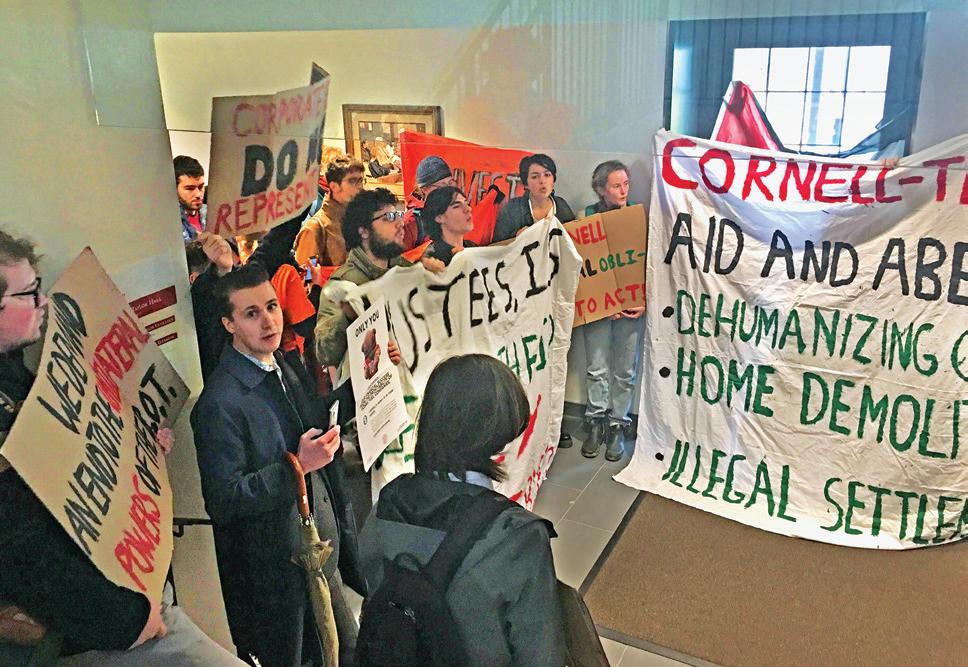
Students slammed their palms and posters against the windows of the Friday afternoon Board of Trustees meeting in Myron Taylor Hall, chanting, “We won’t rest ’til you divest!”
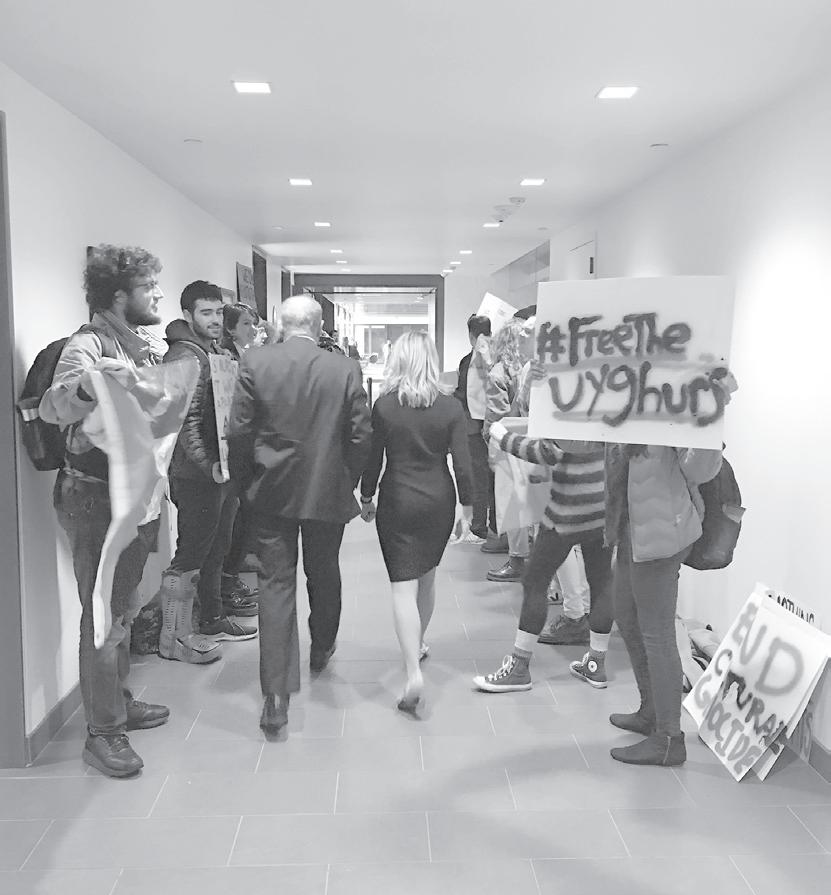
Security guards had escorted the dissenters out of the room after their initial disruption of the meeting. At the conclusion of the meeting, the guards also blockaded the students from nearing the trustees as they exited.
Hailing from Climate Justice Cornell, Students for Justice in Palestine, Uyghur Solidarity and the Islamic Alliance for Justice, the protesters urged Cornell leaders to divest from fossil fuel companies and re-evaluate their ties with top universities complicit in the Xinjiang Conflict and the conflict in Palestine along with corporate elites accused of exploiting migrant workers in Qatar.
“The board of trustees doesn’t accurately represent the university well enough,” Nadia Viteck ’22, a member of Climate Justice Cornell, told The Sun in an interview. Viteck and other climate change activists wore bright orange and waved matching banners with the words “Fossil Free Endowment.”
Max Greenburg ’22, president of the Cornell Jewish Voice for Peace and treasurer of Students and Justice in Palestine accused the Board of Trustees of working for the

SUN

C.U. must ‘support’ diverse classes, not just admit them, says Pollack
By TAMARA KAMIS Sun Staff Writer
Friday’s State of the Union address was an opportunity for President Pollack to redefine the University’s priorities, briefing the Statler Hall audience on the changes her administration has enacted since last year’s speech — a year that saw both scandals and lawsuits regarding admissions at Ivy League schools.
“It’s not enough to admit a diverse class, we must also support them,” Pollack told the crowd, which featured members of the board of trustees, the council, alumni and the public.
A main focus of this support was Cornell’s mental health resources, long a point of contention from students and advocacy groups.
On tap | The new downtown CTB location will boast more beverage offerings, a patio and bright decor featuring multi-colored bottles.
“Cornell Health has developed a number of initiatives, including telehealth programs connecting Weill Cornell specialists with the Ithaca campus and a revamped mental health service that significantly expands both access and flexibility,” Pollack said. “Concurrently, we are conducting a campus-wide mental health review, with both internal and external assessments.”
These changes were meaningful for some alumni, who described personal experiences with what they saw as Cornell’s failure to appropriately address mental health issues.
“One area where [Cornell has] fallen short for decades, maybe even longer, is mental health,” said Mary Jones ’78. “I saw this when I was a resident advisor and the resources were


By JILL CROSBY Sun Staff Writer
Collegetown Bagels customers will soon have to walk an extra block downtown to get their coffee and Zabs order. The beloved restaurant’s downtown branch will move from the corner of N.

Aurora Street to the new City Centre Ithaca building opposite the east end of the Ithaca Commons.
Gregor Brous, owner of Collegetown Bagels, said that he is aiming for “the end of the month” to open the new location at 301 E. State Street. Brous noted that they had both push and pull motivations for migrating: the redevelopment of the Aurora Street corner and the coincidental construction of the new City Centre apartment building. The new location at 301 E. State Street is more accessible, Brous said. There are
more parking options available on the block, and the three loading zones around the store will allow customers and deliverers to quickly stop in, he said.
“The visibility is strong coming from East Hill or South Hill, and it is right off the Ithaca Commons,” said
Brous. Prime visibility is one of the reasons behind the success of the Collegetown location, Alex Loane ’21, a former employee of the Cornell-adjacent branch, told The Sun. That location
See CTB page 4
Monday, October 21, 2019

COURTESY OF
Stateless | Professor and cultural anthropologist Nasir Uddin of Chittagong University in Bangladesh will deliver a lecture about the current state of the Rohingya people.
The Rohingya: Statelessness, Refugeehood And a ‘Subhuman’ Life, by Nasir Uddin 12:15 p.m., Uris Hall G08
U.S.-Mexico Relations Under Trump: Lund Debate 4:30 - 6 p.m., Rhodes-Rawling Auditorium, Klarman Hall
The REDress Project: Honoring Missing and Murdered Indigenous Woman and Girls 5 p.m., Memorial Room, Willard Straight Hall
Visas After Grudation 5 p.m., Warren Hall B25
Leaders in Residence With Reggie Fils-Aime ’83 7 - 9 p.m., Call Auditorium, Kennedy Hall
Dining Hall Diets
7 - 8 p.m., Seminar Room, William T. Keeton House
Mindfulness Mondays: Overnight Oats 8 - 9 p.m., Tatkon Center
Empire of Borders: the Expansion of the U.S. Border Around the World, by Todd Miller 11:40 a.m. - 12:30 p.m., G08 Uris Hall
Study Abroad: Not All Classrooms Have Four Walls 11:45 a.m. - 1 p.m., OADI Lounge, Computer and Communications Center
Baker Institute Seminar Series Noon - 1 p.m., Thaw Lecture Hall, Baker Institute for Animal Health
Making the Most of Your First Year 3:30 - 5 p.m., Tatkon Center
Alternative Breaks Info Session 5 p.m., Tatkon Center

COURTESY OF CORNELL
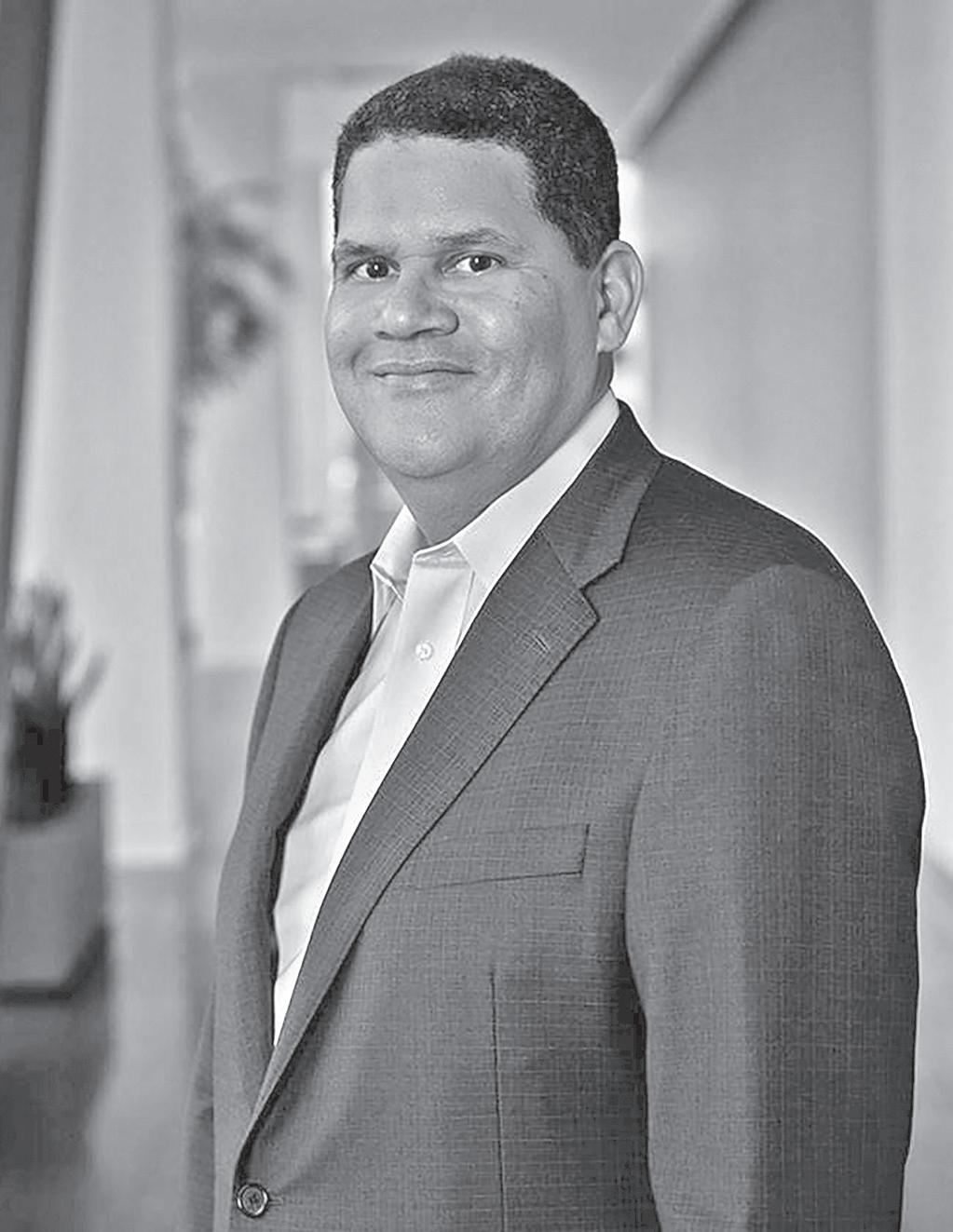
Nintendo now | Reggie Fils-Aimé ’83, retired president and COO of Nintendo of America, will be the first leader-in-residence at the Dyson schoool.
Renaissance Flatbush: Slavery And Education in Early-National New York 5 p.m., Klarman Hall
From Away: Immigrants in Maine, A Documentary-in-the-Making 7:30 p.m., Film Forum, Schwartz Center for Performing Arts

Despite a ‘large’ Hindu population, Hindu Student Council had long had trouble getting support
By EMILY YANG Sun Staff Writer
For twenty years, the only religious group for Hindu students at Cornell has operated out of a small storage closet.
This Saturday, the Hindu Student Council moved to permanent, larger real estate.
Located in the lobby off the Central Avenue entrance of Anabel Taylor Hall, the space will be used for “anyone to come in any time for prayer, meditation and reflection,” according to Anuush Vejalla ’20, Hindu Student Council member.
“It’s nice to see faiths with less financial resources be given special focus and institutional support.”
Chaplain Yasin Ahmed
For years, HSC has struggled with negotiating for space for their weekly services, programs and religious holiday celebrations due to scheduling and space limitations. Events for holidays like Diwali are often not held on the exact day of the holiday, council president Smita Bhoopatiraju ’21 told The Sun. HSC board members hope that the new space will make practicing Hinduism more accessible for all.
“Everyone in the community is very diverse. We obviously can’t provide services for every tradition across Hinduism. This is a space for anyone to come in and pray however they want at time is convenient to them,” Bhoopatiraju said.
The grand opening for the space, held on Oct. 19, featured speeches by dean of students Vijay Pendakur and associate dean of students and director of intercultural programs Renee Alexander, and included the “Griha Pravesh Puja,” a housewarming prayer ritual.
The HSC first approached Cornell United Religious Works two years ago to request a designated space, according to former HSC president Kimaya Raje ’20.
After many meetings and working through a change in CURW leadership, HSC was granted the
space, which formerly served as a meditation room for Protestant prayer, according to Raje.
“It seemed that [the Protestant students] were more than willing to share,” she said.
According to Bhoopatiraju, although HSC holds large events like Holi and Diwali, the Council is still relatively unknown. “There is a large Hindu population here that often gets ignored because we don’t have a prominent presence as an organized religion here, ” Bhoopatiraju said.
“This [space] will really cement us in terms of legitimizing us and making sure that we’re heard,” Raje said.

By CAIT WYMAN Sun Staff Writer
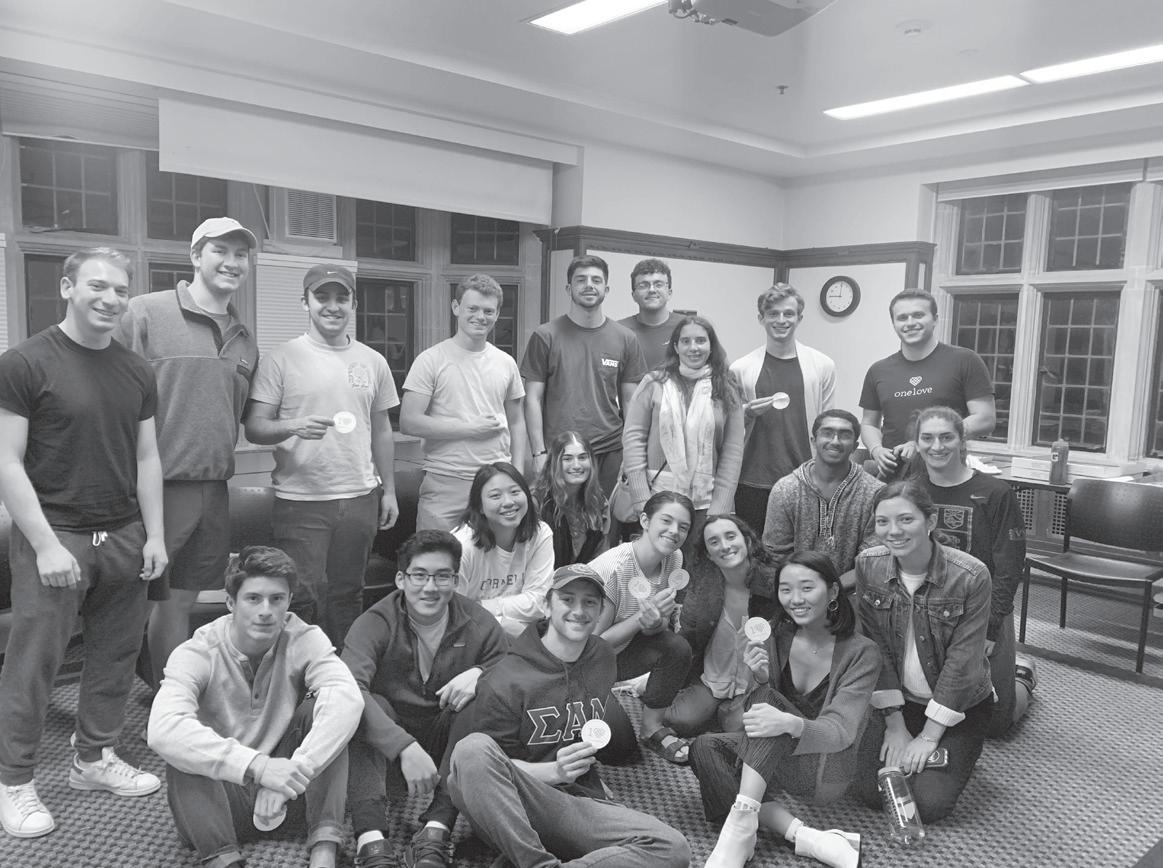
In an age in which dating violence is a reality for many young people, the new Cornell chapter of the One Love Foundation aims to define healthy relationships and spread awareness on risks and prevention.
According to the Centers for Disease Control and Prevention, 25% of women and 10% of men have experienced forms of intimate partner violence through the form of sexual or physical violence, stalking or psychological aggression. These behaviors are also highly common among college students, said one 2015 CDC survey — reporting that 43% of college women who date have experienced
abusive behavior.
To combat these disturbing trends, One Love holds workshops and peer-led discussions to promote and define healthy relationship behavior. One Love also instructs and equips students on how to handle dating violence.
The club, which was initially introduced to Cornell in 2017 by Tim Buttigieg ’19 and Morgan Chall ’19, was an effort to bring more attention to the issue of dating violence.
“[Buttigieg] wanted to encourage positive intervention strategies that will help Cornell students recognize abusive behaviors among their peers,” said Nina Cummings, program director for sexual violence prevention and victim advocacy at Cornell Health’s Skorton Center for Health Initiatives.
“We’re ecstatic to have The Hindu community feel at home in Anabel Taylor where they can help educate Cornell on one of the world’s most largest and most vibrant faiths,” Chaplain Yasin Ahmed, Cornell’s Muslim chaplain, wrote in an email to the Sun.
“As we work in making Cornell more inclusive it’s nice to see faiths with less financial resources be given special focus and institutional support,” Ahmed continued.
Srishti Belwariar ’20 said the space will allow her to share her culture and “introduce a lot of my friends to the community,” she said.
As a member of the Protestant Cooperative Ministry, Marta Faulkner ’20 came to the opening event to support her friends. “As a Christian on campus, there’s lots of resources and places for me to go and worship. For my Hindu friends to not have a space where that was available was just not fair,” she told The Sun.
Board members hope to acquire a larger space in the future and will also continue to work towards establishing a Hindu Chaplain, according to Raje.
“Students themselves have to advocate for all this,” Raje told The Sun. “We’re students first, and it’s a lot of impetus that’s put on us just to enrich the Cornell community.”
Bhoopatiraju said that there was a “lot of pushing” required, but that the group is satisfied with the end result.
“If Cornell is any person, any study, that not only means making this school accessible to come to…[it means] you want students to thrive while they’re here, and some of the thriving comes from supporting students in all aspects, including through religious life,” Raje said.
Vejalla told the Sun that he looks forward to adding statues and making the space feel more like a temple.
“People can come to celebrate and feel like they’re at home for a second,” he said.
Emily Yang can be reached at eyang@cornellsun.com.
However, Buttigieg and Chall were unable to fully register a One Love chapter at Cornell due to lack of support. They both laid the foundation for registering the club, which president Mia Lee ’21 and vice president Julia Eddelbuettel ’22 were able to utilize to officially bring Team One Love to Cornell this semester.
“The One Love Foundation’s goal is to bring down the statistics of intimate partner violence and dating violence,” Lee told The Sun. “We want people to become more aware of what relationship health is and [know] the difference between a healthy and unhealthy relationship, and then [be] able to read the warning signs of an unhealthy relationship so that either friends [or] those people themselves can get out of it.”
Currently, coordinators in many pre-existing campus organizations — Panhellenic Council, the Interfraternity Council, Cornell Athletics, the Alpha Chi Omega sorority and the Zeta Psi fraternity — are working to introduce One Love into various communities with pilot workshops, spreading awareness on the dangers of dating violence and how community members can better support each other.
The club aims for a student-driven approach so that One Love is something students are passionate about, rather than a mandatory University program, according to Lee.
By AYANA SMITH Sun Contributor
Laura Larson ’85, an Ithaca High School and Cornell University alumna, moved to Ithaca at nine years old. She recalls her love for reading and frequenting the plethora of bookstores available in Ithaca during her childhood — because of this, she dreamed of opening a bookstore someday. Since graduating, Larson has lived between her two homes in Seattle, WA and Ithaca, NY. The scene has changed, Larson notes, and over the last 35 years, independent bookstores have been closing around Ithaca — going from approximately 10 to 5 in 2015 — and nationally because of competition with Amazon and large chains such as Barnes and Noble.
One of the area’s book staples, The Bookery, is currently selling off stock to close its doors for good after 45 years. Despite this, Larson will be fulfilling her dream by opening Odyssey Bookstore, an independent bookstore. Larson believes that the competition between Amazon and large chains has created a demand for the sense of community that is offered by
independent bookstores.
The store will open at 115 W. Green Street, and Larson anticipates that construction on Odyssey will end sometime in early 2020.
“I want a store where I may not have, you know, a million options under every category but everyone can find something that resonates with them,” Larson said.
She hopes to foster an inclusive space for all readers at Odyssey and create a setting where diverse groups of people can come together and engage in dialogue.
Larson was motivated to pursue this because of her upbringing in Ithaca.
“When I grew up her it was a very bifurcated community,” Larson said, “The sections of Ithaca, as small as it is, often don’t talk to each other and don’t really interact with each other.”
Using this part of her Ithaca experience, Larson hopes that Odyssey Bookstore will foster unity between Ithacans.
“I want it to be that space where your kids are reading books with my kids and I’m joining a book group with someone I wouldn’t have met otherwise.”
Continued from page 1
“interests of power and corporate profit.”
At the end of the meeting, student protesters surrounded the Board of Trustee members, shouting “No Justice, No Peace” and waved banners with red paint reading “Cornell has a moral obligation to act!”
“Free and open inquiry and expression are among Cornell’s Core Values,” said John Carberry, Senior Director of Media Relations and News. However, Carberry objected to the protestors’ method, citing a formal divestment process approved by the trustees in 2016.
Cornell will only divest from a company when its actions are “morally reprehensible,” the policy states, and when divestment would have a meaningful impact or that failure to do so would go against the principles of the University.
Cornell’s partner institution Technion - Institute of Technology in Israel has been accused of researching and developing military technology to sustain Israel’s occupation of Palestinian land. Jeremy Soffin, a spokesperson for Cornell NYC Tech, said in 2013 that it was “just an academic partnership.”
Greenburg said that the Board of Trustees is going against Cornellian values of “providing an enriching, accessible education for everyone.” By fostering relations with corporations and elite universities, Greenburg argued that Cornell is complicit in human rights abuses.
“How can you say that ... we’re offering the Palestinian children displaced by Technion the opportunity for an enriching education? How can we say that we are providing the children of Qatari migrant workers a chance for an enriching education?” he said.
Tarannum Sahar ’20, an organizer for Uyghur Solidarity, called for Cornell to re-evaluate their partnership with MIT and Yale University, both of
JUSTINE KIM / SUN STAFF WRITER
Running the gauntlet | Cornell trustees passed student protestors outside the annual meeting, who demanded divestment from select organizations.
which have been accused of contributing to Chinese artificial intelligence technology. The Chinese police used “iFlytek,” a voice recognition software, to arrest and sequester Muslim Uyghur minorities into concentration camps in North Western China. “We don’t want Cornell to be complicit in this flagrant human rights abuses,” Sahar said, addressing fellow protesters. “We demand Cornell undertake a transfer review to make sure that no project or company ties are enabling this ongoing atrocities in Xinjiang.”
Members of the Board of Trustees declined to comment by the time of publication.
Sean O 'Connell '21 contributed reporting to this story.
Justine Kim can be reached at justinekim@cornellsun.com.
ADDRESS
Continued from page 1
inadequate, I saw it when my son was here and the resources were inadequate, I see it now with my daughter, who is a senior.”
Jones was optimistic about University initiatives to reduce wait times.
Another alumna and life member of the council, Angela DeSilva ’78, also had personal reasons for desiring mental health reform. Her son attended Cornell University, but due to treatment necessary for his bipolar disorder, he took three medical leaves before graduating in August 2019, she said.
“I think the University could do more to educate people and I think the University could do more with the larger societal problem, which is [to] stop stigmatizing this stuff so much,” DeSilva said.
Pollack also mentioned one of the University’s largest renovation projects — the North Campus Expansion Project — as an additional stress reliever for students.
“The expansion will take a great deal of stress off our students, who will be guaranteed housing through their sophomore years,” Pollack told meeting members.
In addition to the health of the students, many Cornell students are advocating for the health of the environment, in Ithaca and around the world.
Pollack promised that the North Campus Expansion buildings would be “net carbon zero ready, to accommodate future carbon zero technologies,” including rooftop solar panels.
This environmental sustainability goal was part of Pollack’s goal of civic responsibility, which she said included the need to both “educate global citizens and be a good institutional citizen.”
She described Cornell’s ongoing work in diversity and inclusion, including efforts to make a Cornell education more affordable, both at Cornell’s Ithaca Campus and Weill Cornell Medical School — which this year announced its plan for debt-free education.
“Last year, we awarded $257 million in grants [to students], and we also saw the lowest percentage increase in undergraduate tuition in decades,” she said.
Pollack’s goal of expanding education accessibility includes advocating for international students.
“They [international students] contribute immensely to our community foundation, so it is incumbent on us to do what we can to keep the doors open to them.”
Pollack and other New York university presidents recently filed amicus briefs, contacted members of the New York State Assembly and Congressional delegation, and wrote op-ed articles regarding accessibility for international students.
Talking time also went to the progress of interdisciplinary research initiatives, including the Cornell Institute for Digital Agriculture and the Institute for Global Affairs and Politics.
Pollack also raised a glass to Entrepreneurship at Cornell’s success in supporting new start-ups and the rising stacks of grant money from the National Institute of Health and the state of New York, and shout-outs also went to several faculty members who won distinguished accolades in the past year, including multiple recipients of the Presidential Early Career Awards for Scientists and Engineers.
Tamara Kamis can be reached at tkamis@cornellsun.com.
CTB
Continued from page 1
will shutter in June of next year, also due to redevelopment.
Collegetown Bagels asked customers for feedback over the last year on improvements to make for the new location, with suggestions including increased ordering speed and more seating.
Brous said they have “worked hard to adjust” these aspects of the store. The amount and variety of seating is increased in the new shop, with options to eat or drink at a table with chairs, bar seating, stadium seating or stand-up bar tables.
There is also a salad and bowl line, Brous said, offering patrons
customizable orders and more “healthy options.”
A self-serve kiosk will also give customers the opportunity to input their orders, which may be rolled out to other locations if customers like the feature, Brous said.
The range of beverages is expanding as well, with kombucha, cold brews and Ithaca root beer now offered on tap. Alcohol was not available at the previous 203 N. Aurora Street location, but the shop at 301 E. State Street will have a beer and wine license with a bar “accessible night and day.”
Jill Crosby can be reached at jcrosby@cornellsun.com.

Revered Literary Critic
Harold Bloom '51 Dies
Harold Bloom ’51, longtime literary giant and revered professor of English at Yale University, passed away on Oct. 14 at his home in New Haven, Connecticut. A Bronx native and the child of Eastern European immigrants, Bloom came to Cornell a “rough, shy, highly self-conscious and parenthetical” in his words, according to the Cornell Chronicle. A classics major, Bloom credited his advisor and mentor, the late Prof. M.H. Abrams, English, for both his writing and teaching career. After graduation, Bloom studied at Cambridge University on a Fulbright Scholarship before completing his Ph.D. in English at Yale, joining the faculty immediately after. In the years after, Bloom wrote dozens of books on critique and influence, cementing his status as one of the foremost literary voices in the modern era.

ODYSSEY
Continued from page 3
Larson has already been connecting with the Ithaca community. After speaking to people, Larson hopes to host author events, book groups, and poetry slams and is open to other events wanted by the community.
“I just think a community is better when it knows how to talk to each other and have conversations,” Larson said. She hopes that Odyssey will bring Ithacans together regardless of their differences.
Ayana Smith can be reached at aas337@cornell.edu.
Ithaca now has expanded services to treat opioid addiction. According to the Ithaca Voice, Cayuga Addiction Recovery Services’s new Opioid Recovery Program will soon offer counseling and offer methadone, a daily medication used to treat patients with addiction disorders. CARS will be the only place in Tompkins County to dispense methadone, a well-known treatment that has long been associated with higher quality of life and better survival rates. In 2017, there were 20 fatal overdoses of a total of 76 overdoses in Tompkins County.
Amid rampant criticism at President Donald Trump’s announcement that he would host the global political G7 summit at his own luxury resort in Miami, Trump declared that he would host the Group of 7 conference elsewhere. In a tweet, Trump blamed the uproar on “hostile media” and “Democrat Crazed and Irrational Hostility.” Since its purchase by Trump in 2012, the Doral resort has been financially unsuccessful, requiring millions in loans from Deutsche Bank to stay open. A conference with the size and scope of the G7 summit would be a windfall for the Doral, leading Democrats to call the proposed location “corrupt” immediately following the announcement. Other locations, such as Camp David, are currently being considered, according to the White House.


“Alot of people’s first films are bad,” Zia Anger said, or more accurately, typed, in her breathtaking multimedia performance My First Film, as her own first film played right next to the text.
It is hard to define what My First Film is. “An interactive live cinema performance,” sure: Anger sat in the first row of the theatre with her back to the audience, and on the big screen, a projection of the desktop of her computer. Throughout the event, she displayed image and video files, while typing in a text window to offer context and personal commentary. But it’s also a rare piece of self-reflection that’s not self-indulgent, and an invitation into an intimate past that I somehow find myself living in right now.
I started to introduce myself as a filmmaker to people about two years ago, when I was struggling to find a subject for my documentary filmmaking class. My professor told me to just go out and approach whoever I found intriguing: “Say you’re a filmmaker, and that you might want to make a film about them.”
self-deprecating” by New Yorker critic Richard Brody in his review. Singaporean filmmaker Sandi Tan’s first film was lost for 19 years, and when she was finally reunited with the footage as a professional director, she wasn’t uncritical either. Yet both women recalibrated these flawed explorations early on in their career into something bigger and more profound; Tan’s Shirkers, a documentary about the making of and the loss of her first film, also utilizes old footage and assigns them new meaning. Maybe Anger was right, that “this happens to a lot of people, it’s just that nobody talks about it.” But the talking about it part is what’s important; only when “failure” is talked about can we reclaim the past experience as part of us.


An initial awkward exchange led to my first short documentary, one I still think of fondly despite all its imperfections. Anger mentioned a similar feeling when she showed her favorite scene from Always All Ways, Anne Marie, her first and only feature film. She made it from 2010 to 2012 in her hometown with friends and non-actors.
On the screen, two girls run down a dirt road, laughing like there’s nothing to worry about in the golden hour sunlight. A drone glides by. She typed, “I’m proud that we pulled it off with what we had.”
I’ve had the exact same thought many, many times. When I had three days to finish a project I would never have the chance to do again, when the producer quit a week out from shooting, when the cops showed up asking for permits, when the main actor was a creep, when we had to do a feature with a six-person crew, we almost always managed to barely, but proudly, pull it off.
But I often ask myself whether or not it could have been better. Could I have done this or that differently? Should I have waited, for the right person or the right moment? Am I doing this project justice? Could someone else have done a better job if I hand it over? I never really dared to ask others these questions as, when did, my first film professor dismissed me as self-deprecating and gave me a C-minus.
Anger’s first film didn’t get into any of the 50 festivals she applied to and she is described as “sharply
And perhaps what we consider as “failure” with our perfectionist filmmaker mentality isn’t even that bad. Cynthia Wade, academy award winner for her 2007 short Freeheld, was giving a masterclass about her career. She was incredibly honest about the underbelly of being a filmmaker, like not knowing where you’re gonna sleep every night while shooting on location and desperately scrambling for money all the time. She also repeatedly mentioned, “you have to do it because it’s do or die. Do it yourself, just do it. Get it out there even if you can’t get everything, do it. You have to be a bit crazy to do it, because otherwise you could never.” And on and on.
When I saw Wade later that night after a screening of her most recent documentary, she asked what was my biggest takeaway from the masterclass. I told her it meant a lot for me to hear that you just have to “do it” even if the production value is low or you’re not getting everything you want to get. She laughed and said, looking directly in my eyes, “the scrappier, the better! That’s what I think.” “I’ll keep that in mind,” I promised her.
“Beg. Borrow. Steal. Crowdfund. Alienate your friends and family. Write from your experience. Almost kill someone.” This is Anger’s essential checklist for first-time filmmakers, which I can confirm is accurate. I’ve done most of those things. In fact, I’m doing them right now, working three damn jobs to fund my thesis and begging all my talented friends to work on it for the love of God. Maybe it’s still gonna suck, I just hope 30-year-old me would feel more ok with that.
Ruby Que is a senior in the College of Arts & Sciences. She can be reached at rque@cornellsun.com. Escape runs alternate Tursdays this semester.

JOHN COLIE SUN STAFF WRITER
Groups like the Whistling Shrimp, the Skits and many others have been eliciting laughter from Cornellians for decades, just like the various troupes at many other colleges. These groups across campuses would sometimes come into contact with each other, but have seldom performed together at a joint event … until now. For the first time ever, the Cornell Comedy Festival took place over two nights in the Statler Hall auditorium. Troupes from Cornell, Skidmore College, SUNY Binghamton, Tufts University, the University of Delaware, Columbia and Barnard were in attendance.
“This is something that the comedy community here has been talking about doing at Cornell for a really long time, since before I even started here,” said Alexander Newman ’20, the president of the Whistling Shrimp and main organizer of the festival. He went on to remark that the preparation for this festival began as far in advance as last December. Those many hours of planning have now paid off, and what a glorious final product they became.
Highlights from the festival include the Sketchies from Skidmore College recreating a yoga class turned Satanic ritual, Cornell’s own Midnight Comedy Troupe dramatizing disabled dogs and refrigerator deaths (“the ice is melting!”) and the Whistling Shrimp using a suggestion of “food” to revisit the story of Adam and Eve. There were also a number of professional performers, all of whom crafted very clever and humorous routines. Mark Vigeant ’11 induced uproarious laughter at every turn with various websites, videos and falling laptops. North Coast Hip-Hop Improv transformed various scenarios about compost, and Mary Beth Barone, a New York-based comedian, made a wry but endearing routine about her daily life. Finally OSFUG Sketch Comedy, a group comprised of various Cornell alumni, performed an eclectic group of sketches ranging from screwball comedy to slightly darker fare.
For Newman and the rest of the Cornell comedy community, these signs have validated months of hard work. However, the success of the festival also affirms a vital part of the entire Cornell community: the level of affection this university harbors for our many comedy groups. While he is quite happy with this year’s reception of the festival, Newman particularly hopes that it becomes a mainstay within Cornell’s long list of traditions and events. “When I’m dead and gone next year, this had better not stop — I’m going to start training the next people to be the new heads of the festival immediately,” he said. There always exists the fear that something will not be able to repeat its initial success — but even though the Comedy Festival has only been staged once so far, it is already quite clear that he has nothing to worry about.
John Colie is a freshman in the College of Arts and Sciences. He can be reached at jec439@cornell.edu.
Since 1880
137th Editorial Board
ANU SUBRAMANIAM ’20 Editor in Chief
JOYBEER DATTA GUPTA ’21
Business Manager
PARIS GHAZI ’21
Associate Editor
MEREDITH LIU ’20
Assistant Managing Editor
SARAH SKINNER ’21
KRYSTAL YANG ’21
NATALIE FUNG ’20
Working on Today’s Sun
Ad Layout Jenny Huang ’22
Production Deskers Dana Chan ’21
Mei Ou ’22
News Deskers Amanda Cronin ’21
Nicole Zhu ’21
Design Desker Jamie Lai ’21
Xiangyi Zhao ’22
Photography Desker Jing Jiang ’21
Sports Desker Raphy Gendler ’21
Former presidential nominee Hillary Clinton directed an unsavory comment at Rep. Tulsi Gabbard (D-H.I.) last Thursday, saying that the Russians were “grooming” a Democratic candidate for president. This baseless name-calling is not only divisive but also unnecessary.
As Cornellians gearing up for campus debates on the 2019 election and the 2020 presidential election, we should take note.
The evidence Clinton used to support her already hard-to-believe claim about Gabbard on a segment of the podcast “Campaign HQ” was porous. Apparently, “They have a bunch of sites and bots and other ways of supporting her so far,” she said. While Democrats like Clinton are suspicious of Gabbard’s popularity amongst Republicans and right-wingers, there’s no clear evidence that the Russians have intervened in her campaign or any indication of collaboration between the two parties.
There’s simply no way Clinton and her team can validate their claim about Russian interference in Gabbard’s run for president. Given that Clinton hasn’t thrown her hat in the rat race for Democratic nominee, she should stay out of it.
Gabbard’s reaction was lacking, too. She tweeted on Friday that Clinton was “the queen of warmongers, embodiment of corruption and personification of the rot that has sickened the Democratic Party for so long.” She suggested that the former Democratic nominee should join the presidential race instead of being a coward.
Personal attacks without evidence, Twitter wars and comments from people who have no stake in the conversation all seems very Trumpian to me. The short-term result of this spat has been to draw battle lines between candidates. One side, composed of entrepreneur Andrew Yang and self-help author Marianne Williamson, defended Gabbard, with Yang saying that Gabbard “deserves much more respect and thanks than this” because of her military background.
The other side tried to stay quiet and no presidential candidates supported Clinton’s comments outright, though Sen. Cory Booker (D-N.J.) and Sen. Amy Klobuchar (D-Minn.) both invoked Clinton’s right to defend herself in public.
Don’t get me wrong: I don’t support either candidate’s actions. Clinton shouldn’t be intervening in situations where she has no authority; moreover, she shouldn’t be commenting without evidence. In the past, Clinton wasn’t such a rabble-rouser, and now is a terrible time to start. Her time in the limelight (which was dim at best) is over.
And as a Democratic candidate, Gabbard doesn’t cut it. She’s said that Syrian dictator Bashar al-Assad wasn’t an “enemy of the United States” and her isolationist foreign policy is worry-
ing. Even white nationalist David Duke endorsed her candidacy (although she quickly rejected his support).
This episode is telling when it comes to internal Democratic politics. It illustrates delineations not only between the progressive and moderate factions of the party but also between the politicians and non-politicians and the more moderate and less moderate.
The granularity of these distinctions is an unhealthy one for Democrats and calls into question the ability of any nominee to win the general election against President Trump, with the possibility of spilling over into downstream races for Congress and local positions. The battle waged within the party reminds me of 2016 “Bernie Bros” that were unwilling to vote for “crooked Hillary” in the general election.
The fractures between Clinton and Gabbard represent other fractures within the Democratic Party. Are Bernie Sanders’ (D-Vt.) supporters going forgo voting for Biden if the former vice president wins the nomination? Would this unwillingness to vote for the party hold true if Warren, Harris or Buttigieg won the nomination? Should “leftists” decry “moderate liberals” again, Dems will be in a tough tough place come November 2020.
The same fractured dynamics come through even on Cornell’s seemingly isolated campus. If we think of Ithaca as a microcosm of liberalism (given that nearly 70 percent of voters cast their ballots for Democratic candidates in the last election), then we should think about these issues in detail.
Though the clear split between Democrats and Republicans extends to our campus, distinctive factions can be found within political groups Cornell Political Union. These factions play an important role, ensuring a diversity of views when it comes to voting and writing policy. For the most part, the divides within on-campus groups aren’t too deep. CPU’s infighting is softened by the fact that all its members are part of the same organization. In the same way, the different factions of the Democratic party have important roles, especially when candidates with unique views run for office — think Alexandria Ocasio Cortez (D-N.Y.) and Bernie versus Hillary Clinton and Sen. Dianne Feinstein (R-Calif.).
But, the dialogue that can be found in campus organizations that realize they are united as a whole should be mimicked on the grand stage of the presidential race. When we let divisions get the better of us (whether Democratic, Republican, both or neither), then we’ve slipped too far into unproductive debates with no factual basis, much like this spat between Clinton and Gabbard.
Darren Chang is a junior in the College of Arts and Sciences. He can be reached at dchang@cornellsun. com. Swamp Snorkeling runs every other Monday this semester.
Max Greenberg, Nima Homami & Nadia Vitek | Guest Room
In the days leading up to Oct. 18, University administrators prepared to receive Cornell’s esteemed Board of Trustees, a group of 64 people “vested with ‘supreme control’ over the University” and with final say on all recommendations made by other administrating bodies, including the Student Assembly. Among this select group of people entrusted with such great decision making power are University President Martha Pollack, New York Governor Andrew Cuomo and the oldest living descendant of the University’s eponym Ezra Cornell. The student body is granted three representatives, Cornell faculty have two, University employees have only one and tens of thousands of others with a stake in the actions this institution undertakes have no representation at all.
For all the talk of the system of “shared governance” on which the day-to-day administration of the University is supposedly run, we can’t help but note how unequally power is actually shared. The majority of trustees have close ties with the corporate world — many are CEOs, presidents or board members on large, influential companies and their collective net worth totals in the billions of dollars. As a result, the University is ultimately administered in the interests of corporate power and profit. It isn’t at all surprising, then, that Cornell has such an acute interest in preserving its relationships with Israeli academic institutions that abet the murder of innocents, Qatari subcontractors who regularly exploit South Asian migrant workers for use as a dirt cheap labor force or fossil fuel companies that are killing the planet as we speak.
There is no feasible way to advance the supposed mission of this University — to provide an accessible and enriching education for all — while Cornell maintains interests that cut against the promotion of human rights and environmental justice. How can Cornell claim to offer the opportunity for an enriching education to the children of its migrant workers in the Gulf monarchies whose parents are forced to work long days in dreadful conditions for meager pay? Or to Palestinian children whose homes were demolished by unmanned bulldozers developed by Cornell’s partner university Technion? Or to the children of families displaced by the increasingly severe effects of the ongoing climate crisis funded in part by Cornell’s investments?
the myth of “shared governance” is ever to be realized, power must be held jointly by everyone who has a stake in the decisions this University makes: the administration, the student body, Cornell faculty, waged University employees and the indigenous Cayuga people on whose territory the University stands.
To this end, various progressive student organizations — including Students for Justice in Palestine, Climate Justice Cornell, Islamic Alliance for Justice and others — rallied on Oct. 18th in front of Myron Taylor Hall to communicate to the trustees our concerns about the role this institution plays in perpetuating abuses the world over and our complicity, as students of Cornell, in them.
Our specific demands for the Board of Trustees read as follows:
1. That the Board heed the criteria it laid out for itself and enforce its existing policy by cutting financial ties with companies, institutions and other entities involved in morally reprehensible behavior. Cornell University should not have a stake in fossil fuel production, weapons development or recognized human rights abuses.
2. That the criteria for divestment be broadened by overturning the power of the Board of Trustees to unilaterally decide whether Cornell’s stake in a given instance of moral reprehensibility has a “meaningful impact” or is “inconsistent with the goals and principles of the university.” Divest from the morally reprehensible, period.
Access to education is inseparable from the social, economic and environmental issues for which this administration continues to evade responsibility.
3. That the Board of Trustees be fundamentally restructured to ensure students, faculty, employees, local community members and representatives of the Cayuga Nation have a large say in the decision-making process. Those with permanent ties to this community and this land have a far greater stake in how the University is administered than most of the current trustees and thus should be given the greatest share of representation in its highest administrative body.
In 2016, the Board of Trustees adopted criteria under which Cornell would consider divesting from atrocities it helps fund, which leaves the matter entirely at the discretion of the trustees: Cornell will consider relinquishing its interests in companies or institutions engaged in “morally reprehensible” practices only if it is felt that Cornell’s divestment would “have a meaningful impact toward correcting the specified harm” or if the abuses are particularly egregious. We do not feel, however, that these criteria are sufficient. Access to education is inseparable from the social, economic and environmental issues for which this administration continues to evade responsibility. It therefore falls upon students, faculty, staff and the local community to hold the University accountable. If
We are, of course, aware that there’s very little we can do at the present moment to affect the structural changes needed to right these wrongs. Nonetheless, there is still a pressing need for the student body to understand and take action on this issue, and not just to make the Board aware of our concerns. With this action we hope to have illustrated what the University’s priorities are, why they are what they are and what might be done to correct that state of affairs. The greater our collective understanding grows, the better we as Cornell students can identify the need for systemic change within this institution, and the stronger the foundation for ultimately making that change will be.
Max Greenberg is a sophomore in The College of Arts & Sciences. Nima Homami is a second year graduate student in the business school. Nadia Vitek is a sophomore in the College of Engineering. Comments may be sent to opinion@cornellsun.com.
Anti-establishment is an attractive buzzword in politics. Donald Trump clinched the GOP nomination and the Oval Office by contrasting himself to a stuffy old guard. Bernie Sanders (D-Vt.) led an unexpectedly successful primary challenge to Hillary Clinton in 2016, riding on a joint platform of progressive politics and being a second option. Backlash against perceived institutional meddling in 2016 drove the DNC to throw open its doors for the 2020 nomination contest. But coming from outside of the political establishment is not a credential. The slow grind of political rise is itself an extended vetting process. Those who hope to skip it must be subjected to a rapid scrutiny, not because they are outsiders but because we have much less time to figure out just who they are.
Tuesday night’s bloated debate demonstrated the problems caused by lowering the bar to qualify to be on stage. The stage included 12 contenders falling into four distinct categories. The first and simplest group is genuine contenders: Joe Biden, Sanders, Elizabeth Warren (D- Mass.), Pete Buttegieg, Cory Booker (DN.J.), Amy Klobuchar (D- Minn.) and Julian Castro. Many of these candidates are arguably running for cabinet positions by now but all are qualified choices for president (Buttegieg could use more experience).
is perhaps the most troubling. These are the candidates running on a solely anti-establishment platform and actually seem to believe they should be our president.
Steyer, the California billionaire made famous for his devotion to impeach the President, spent his time on the fourth Democratic debate stage demonstrating the flaws in the party’s quirky nomination process. Steyer, whose campaign seems to be an attempt to straddle running on a single issue and genuinely pursuing the presidency, has tied his fortunes to the promise of freeing our government from corporate control. After buying his way onto the debate stage shortly after entering the race,
Outsiders are valuable for who they are and what they bring, not just the fact that they are outsiders.
The niche candidate category used to contain Jay Inslee, whose climate-centered campaign was a woefully undervalued necessity in our political discourse, but is now limited to Andrew Yang, the entrepreneur whose ideas I laud as bold and forward-thinking. His campaign is anti-establishment, but its foundation is of ideas and policy, not outsider status alone. I hope to continue to see Yang and his message for along time. Most members of the “Why Are You Still Here? Get off the Stage!” category have gotten the message and suspended their campaigns, but the lone Beto O’Rourke (D- Texas) continues to cling to his candidacy, as though he would rather repeatedly embarrass himself on national television than spend time with his family. The final category, composed of Tom Steyer and Tulsi Gabbard (D- Hawaii),
BBashar al-Assad, whose countless crimes against humanity border on genocide. A regular Assad apologist, Gabbard continued her insistence that opposition to Assad’s government was an example of promoting “regime change wars,” a phrase she repeated too many times to count. Bound by her own dogma, she stands staunchly against the establishment politicians in both parties who oppose the illegitimate, murderous Syrian government. Furthermore, Gabbard’s relentless attacks on The New York Times and CNN fell safely into Trumpian territory, doing more to bolster his undemocratic attack on the press than to promote any valuable policy.

he fancies himself the champion of the working class, selflessly spending his time and money dismantling the political influence of the wealthy. Got that? With no political experience, and even less of an idea of how to be president, he wields the weapons our contorted economic system has bestowed upon him to foist himself onto the television screens of Americans trying to make a decision of utmost importance and distract them with well-funded platitudes. His justification? He is not an “insider” politician. He claims space in a limited spotlight, wasting our time and his money while cheapening American politics.
Gabbard, the Hawaii congresswoman who rose to prominence with her political unorthodoxy, spent her few minutes of speaking time eloquently conveying everything wrong with herself. Gabbard earned her spot on the stage by meeting the exceptionally low bar. She then went on to dive into a grab-bag talking of points from both the Republican Party and Syrian Dictator
A.J.
Carrying fresh ideas and minimal baggage shakes up the status quo and frequently fuels the greatest leaps forward, but outsiders are valuable for who they are and what they bring, not just the fact that they are outsiders. We are better for having Sanders and other outsiders who won seats in Congress in 2018, and ought to be thankful for both their practical and symbolic successes.
Steyer and Gabbard represent the notion that being anti-establishment is itself a worthy platform to be elected on. They are wrong. Lack of experience is intriguing for those pursuing lower office, but should be disqualifying for those running for president. Shoveling money into a vanity project is offensive and unhelpful, and bucking mainstream thinking is a poor choice when the mainstream has achieved consensus on a particular evil. Steyer should be spending his money on ensuring that a qualified Democrat wins the general election. Gabbard should spend her time learning to differentiate between anti-interventionism and support for the world’s cruelest. These are bad candidates who stand for a dangerous vision of politics. Whether we choose to support a firebrand progressive or time-tested moderate in this race to replace the mistake currently occupying the White House, we should hope that these two fail.
Elijah Fox is a junior in the School of Industrial and Labor Relations. He can be reached at efox@cornellsun.com. What Does the Fox Say? runs every other Monday this semester.
zzt. The door swings open to the grinning face of your elderly neighbor and you study the wrinkles around her eyes. “Trick or Treat,” you repeat, and she gladly picks up a dish of candy. You’re dressed as a superhero, or ninja turtle, or princess or fairy tale creature, and she starts gabbing about the constellations in the sky and her astrological sign. You have to sit and listen, but all you want is for her to place the Skittles in your pillow case or plastic pumpkin so that you and your parents can run off to the next house. Did you hear? The O’Reilly’s are handing out king size Milky Ways this year.
Halloween represents the different stages of our lives and the ever-changing fads we go through as we grow in size and bad ideas. For the first three Halloweens I can recall, I dressed as Spiderman — Peter Parker’s alter ego. As kids, the holiday consists of dressing up as our favorite movie characters and an unforeseen leniency from our parents about our sugar intake. As college stu-
Halloween represents the different stages of our lives and the ever-changing fads we go through as we grow in size and bad ideas.
dents, the holiday involves being stingy with our clothing and unforeseen independence in our alcohol intake.
As we enter our tweens, we eternally hurt our parents by telling them we don’t need them to walk with us at night anymore. We’re no longer scared of the dark — night lights were stowed away last winter. Despite our parents’ better judgement and shattered nostalgia, they let us roam the neighborhood or city blocks with our friends.
The newfound independence doesn’t stop here, as we’re granted the right to carve pumpkins because our parents finally trust us to hold knives. We dress in skel-
eton masks to scare the new generation of Peter Parker alter egos. The O’Reilly’s are out of town this year and leave a bowl with the typical “take 2” sign, but you don’t believe in bad karma and sprint as fast as your 12 year-old legs can carry you after emptying the bowl.
On campus, the leaves have started to fall off the trees and late night walks from the library remind us of why we used to be scared of the dark. College has coined the term Halloweekend, dragging the holiday night into a weeklong bash. Frats will host parties sporting themed drinks and sweaty dance floors, and our parents reminisce even more about the times we held their hands to cross the street packed with trick-or-treaters. Now, we replace our sugary piles of candy stolen from neighbors’ bowls with the sugary mixed drinks taken from mysteriously old coolers.
with the times — now we blast Big Bootie Mix and Young Thug.
My brother is now a working stiff, and costume efforts are limited to the annual office shindig and couples’ parties, if you’re lucky enough to be with the person that’s
The holiday is important to us for candy, for parties and maybe one day for the kids of our own who will inevitably break our hearts.
Halloweens pass and our interests change. I used to trade Almond Joys and any dark chocolate for Reese’s and sour candy. Now I trade small talk with the girl that’s out of my league: “I like … costumes.” In high school, we abandon the nighttime strolls that earned us treats for small house parties. Maybe we didn’t want to at first, but it’s hard to ignore the new kids at our schools. Crushes develop, and maybe a little liquid courage could help us say how we feel.
But the romantic interest spills over into our modern college parties, and probably into post-grad festivities as well. Who knows? Maybe your workplace flirt will be at the office party. As we get older, our focus shifts from food to drink and jack-o-lanterns to the people we can’t stop staring at in class. We change based on the social context we’re in and the people we’re surrounded by. Our adolescent desires for sugar rushes turn to the post-puberty, college stereotype of sex, drugs and rock’n’roll. Though, the genre of music has adapted

out of your league (my brother isn’t). It may not be until we have kids of our own that we remember the joy of dressing up as our heroes and favorite fictional characters.
But even as we get older, we may not grow out of all our fads — I’ve gone as Peter Parker for the last two years. Maybe I stick with this costume to hold on to a small semblance of my childhood Octobers, maybe it’s because I think I look good in fake glasses. Whatever the reason, I hold on to this small, nostalgic reminder for the Halloweens to come. The holiday is important to us for candy, for parties and maybe one day for the kids of our own who will inevitably break our hearts when they grow out of thinking their parents are cool (not for me, I’ll always be the cool dad).
Before we know it, we’ll be that elderly face looking down at future Cornell party-goers, talking about the constellations and our astrological signs. Until then, I suppose we’ll revel in our remaining time on this campus, drinking themed beverages and grooving on sweaty dance floors.
A.J. Stella is a junior in the College of Arts and Sciences. He can be reached at astella@cornellsun.com. Stellin’ It Like It Is runs every other Monday this semester.
Fill in the empty cells, one number in each, so that each column, row, and region contains the numbers 1-9 exactly once. Each number in the solution therefore occurs only once in each of the three “directions,” hence the “single numbers” implied by the puzzle’s name. (Rules from wikipedia.org/wiki/ Sudoku)


submit your caption for this week’s contest, visit sunspots.cornellsun.com.





We have availability for the 2020-2021 school year beginning June 1st at Hudson heights apartments. The studios include electric, heat, water, garbage and parking. There is coin-operated laundry facilities on site. Prices start at $750 / month for a 12 month lease. If you have any questions or would like to schedule a tour contact us by phone 607-280-7660 or email: renting@ithacaLS.com
COLLEGETOWN TERRACE APARTMENTS
Leasing for 2020/2021 Spring 2020 Semester leases available Heat, hot water and Wi Fi State of Art Fitness Center Shuttle Bus Service to campus Washer & Dryer in Apartments collegetownterraceithaca.com office@ithacastudentapartments.com (607) 277-1234
Now Renting
2-10 Bedroom Houses/ Apartments for 20-21. All Locations. Call today or visit our website: Certified Properties of TC Inc certifiedpropertiesinc.com 607-273-1669
2020-2021
Studio 1, 3, 8 & 11 BR Apts. Great Locations in Collegetown. 607-227-2535
120 Oak Avenue
Just steps to Cornell Campus 10 bedroom house & 1 and 2 bedroom apartment 607-277-1234 office@ithacastudentapartments.com Ithacastudentapartments.com
Collegetown Crossing College Ave's Newest Location 307 College Ave. Now Leasing for 2020-2021 Completely New Modern Studios & 4 Bedroom Apartments. Fully furnished, heat & hot water included. Reception area at 307 College Ave. www.urbanithaca.com 607-330-2442 info@urbanithaca.com
Boldly Refined Living 312 College Avenue
Sophisticated studio, 1, 2, 3-bedroom apartments. Superior fitness facility, theater, and coworking space. Free high-speed internet. Exclusive resident parking. Package delivery/return. Overnight concierge. 607-273-9777 or 312collegeave.com
3 Bedroom 1 Block from Starbucks in Collegetown Heat & hot water included. Lease starts June 2020. Parking & laundry available. www.porealty88.com 607-277-1888
20-21 College Ave. 5 BR House Furnished. Laundry. Parking. Call 607-273-8576
20-21 Upper Eddy St. 7 BR house Furnished. Laundry. Call 607-273-8576



By KEN CHOI Sun Staff Writer
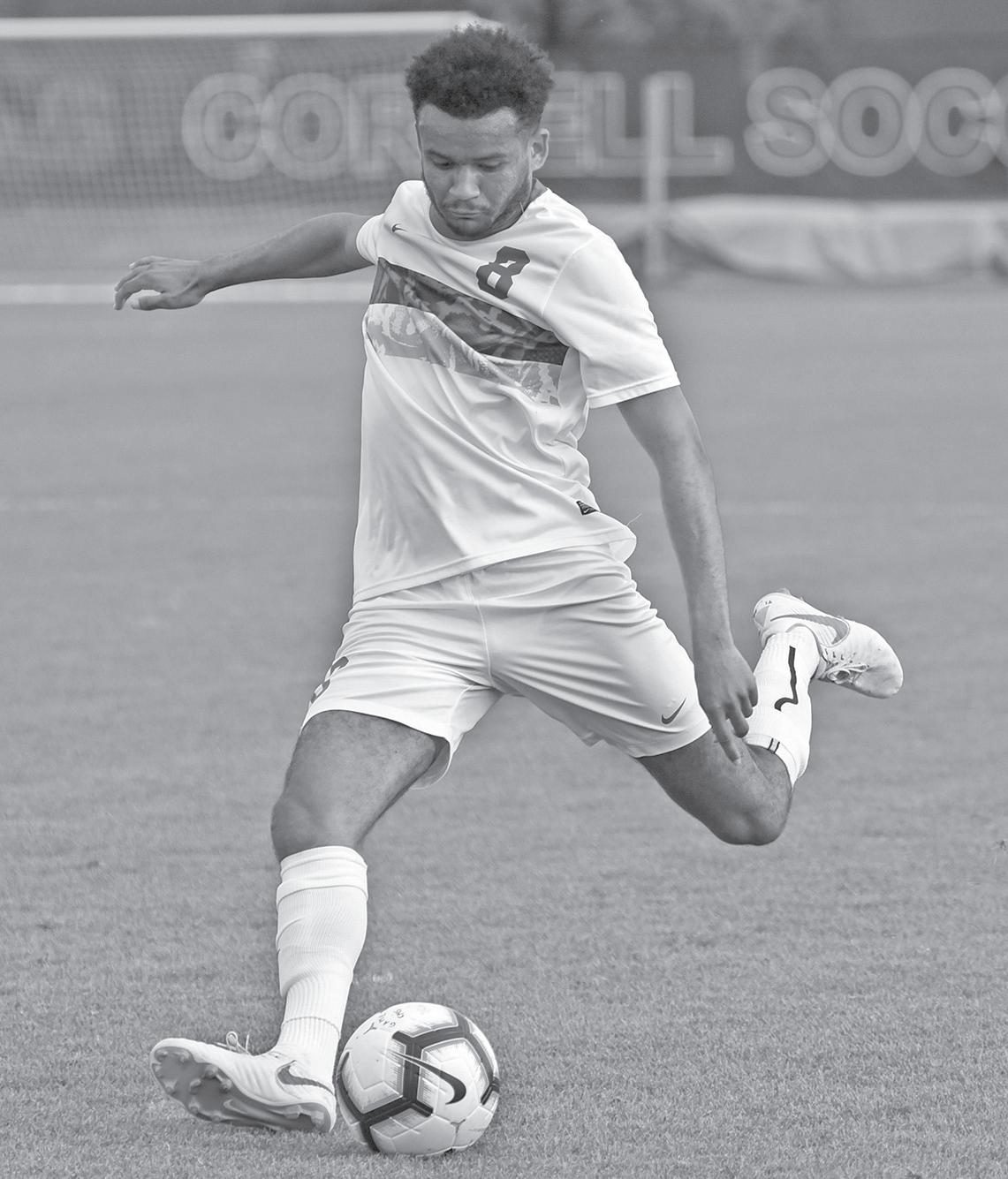
Cornell men’s soccer played an intense game against the Ivy League-leading Yale Bulldogs, but fell to 1-2 in conference play with a 3-1 loss.
Coming off a win against Harvard, the Red took the pitch at No. 24 Yale with optimism, but was ultimately disappointed, going behind early and failing to overcome the deficit.
Junior forward Charles Touche was once again given a starting nod. However, the usual defense saw some substitutions, as freshman defender Connor Drought sat out and freshman defender Will Citron took his place. As a result, the defense had to operate more like a three-back as Citron isn’t a typical wingback. This limited the involvement of wingbacks in the Red’s attack.
Yale was fast to get on the board as Jeremy Haddock scored on a set piece in the second minute. The Red attempted to equalize as fast as possible, but the Bulldog lead was doubled when Yale’s ace Mark Winoffer scored a header into the top shelf on a free kick. Sophomore defender Tate Keir received a yellow card for the challenge.
The Red brought some momentum back toward the end of the first half and junior forward/midfielder Vardhin Manoj scored with his left foot after a beautiful pass into the box by sophomore wingback

Jonah Kegan. This was his third goal of the season, reducing his team’s deficit to one.
The Red tried to equalize multiple times in the second half, but Yale came back to score in the 70th minute. Yale’s top-scorer Miguel Yuste put the goal into the back of the net to put them up 3-1. The Red nearly came back shortly thereafter but had three shots blocked inside the box. The Red couldn’t gather any more momentum until the end of the game, failing to upset the Bulldogs.
The Red actually had more efficiency and quality in the offense, recording a total of 14 shots, eight of them on goal, compared to Yale’s eight and five, respectively. The inability to finish the play and score once again contributed as a factor to the loss. The defense stood strong for most of the game, but the two set pieces were enough for the Bulldogs to emerge with a win.
The Red’s next game will be played against at Albany at 7 p.m. Tuesday. The Great Danes boast a strong offensive line, with striker Austin DaSilva currently ranked sixth in the nation in goals, with 10 tallies in 11 matches.
As it takes a break from conference play and heads to Albany, the Red will hope to recover from the loss at Yale and regain some momentum heading into a home game against Brown.
Ken Choi can be reached at kchoi@cornellsun.com.


By LUKE PICHINI and CHRISTINA BULKELEY Sun Assistant Sports Editors
With Cornell football riding a three-game losing streak and Colgate winless in its first seven games, it was safe to say both teams needed a victory.
For the Red, its win drought continued as it dropped a narrow contest to the Raiders at home, 21-20.
While Cornell battled Colgate throughout the afternoon in a back-and-forth contest, it ultimately ended up on the wrong side of the scoreboard due to errors on both sides of the ball.
On offense, Cornell moved the ball well, gaining 364 yards on the day, but the Red turned the ball over three times and stalled near the red zone on several drives. Meanwhile, on defense, Cornell gave up 174 rushing yards to a Raider offense that came in averaging under 100 yards per game on the ground.
“The last two games, we dramatically decreased those [mistakes],” said head coach David Archer ’05. “Today they reared their ugly head … We seem to be hitting the tough shots but missing the layups.”
Junior wide receiver Eric Gallman believes these errors can be fixed.
“I think we just need to clean up the little things,” Gallman said. “We’ll be fine because we can execute. We’ve got the players, and I believe in our guys.”
“Today [mistakes] reared their ugly head ... We seem to be hitting the tough shots but missing the layups.”
David
Archer ’05
The Red kicked off the contest with a strong drive. Junior quarterback Richie Kenney looked poised, completing several passes to junior wide receivers Phazione McClurge and Gallman. Couple that with a few chunk gains by senior running back Harold Coles, and Cornell found itself in scoring position. While the drive eventually stalled, the Red got on the board first thanks to a 39-yard field goal from junior kicker Garrett Patla.
From there, both offenses struggled to score for the rest of the frame. Colgate derailed several of its drives with penalties, and Raider junior quarterback Grant Breneman was
picked off by sophomore safety Eric Stoxstill-Diggs outside the red zone.
The second quarter was unfolding much like it did against Harvard in last weekend’s contest. The Raiders erased Cornell’s early advantage with a 10-yard touchdown pass from Breneman to Nick Gill.
Following a fumble by sophomore running back Delonte Harrell, Colgate only needed one minute to traverse 41 yards into the end zone. It looked like the Raiders were going to up their total to 21 points when they worked it to the Red’s one-yard line in the final seconds of the first half.
But then, Breneman was tied up and strip-sacked by freshman linebacker Jake Stebbins, who broke out for seven tackles and a forced fumble last week against Harvard.
With the ball bouncing back toward a sea of green grass, senior safety Jelani Taylor scooped it up and ran 87 yards for the score. The fumble return is the program’s longest dating back to 1946.
“If Stebbins isn’t in the conversation for Ivy League rookie of the week — rookie of the year, even — who is,” Archer said. “The guy is just unfazed by college football, especially at linebacker — that’s a really physical position.”
“Jelani Taylor’s always in the right place, and that’s by his own preparation,” said Archer.
Instead of trailing by 18, Cornell went into halftime with only a four-point deficit and the momentum in its favor.
“[The fumble recovery] helped us momentum-wise, especially after we gave up a couple of plays on defense,” Taylor said.
After the intermission, the Red came out firing. Cornell stymied the Raiders offense, and Kenney and co. took over. Buoyed by a 53-yard catch-and-run by senior wide receiver Owen Peters, the Red marched all the way down to the end zone. But on a carry at the goal line, Harrell coughed up the rock once again, giving Colgate the ball.
The fumble did not matter too much in the long run as the Raiders were stymied deep in their own territory. The ensuing punt only went for 30 yards, gifting Cornell prime field position. The Red did not squander this opportunity — Coles notched 22 yards on a reception, and junior running back SK Howard finished off the drive with a five-yard touchdown catch to put Cornell up by three.
On the very next possession, Colgate responded with a touchdown of its own. The Raiders orchestrated a seven-play, 78-yard drive that featured a 49-yard run by running back Alex Mathews. The senior capped off the drive with a one-yard run into the end zone, putting Colgate back
on top, 21-17.
In the remaining minutes of the third quarter, Kenney led a drive that featured a 23-yard third-down conversion to McClurge as well as two fourth-down conversions. By the end of the frame, the Red had reached the Colgate 15-yard line.
Cornell could not fully cash in. On third down, Kenney fumbled on a sack, but senior tight end John Fitzgerald recovered the ball, which bounced a few yards forward. On fourth down, Archer opted for the points, sending out


Patla, who successfully kicked the 28-yard field goal to cut the deficit to one.
“If you’re down more, then you probably go for it on fourth [down],” said Archer. “So, [we] kicked the field goal to make it 21-20, because I thought, ‘points are going to be at a premium, and we might win this thing on a kick.’”
The Red never found the winning score. Both teams traded possessions during the fourth, and Cornell had one more opportunity to take the lead.
Starting from his 18-yard line, Kenney led a drive that featured a fourth down conversion and a pass interference by the Raiders, which moved the Red into opposing territory. That marked the extent of Cornell’s drive, though, as Kenney threw several incomplete passes on the next set of downs, including a fourth-down throw to Owen Peters toward the receiver’s feet.
Despite the tough loss, one positive takeaway was that Saturday’s contest was not a conference game.
“We know the Ivy League games are the ones that count for us,” said Archer, echoing the same sentiment from the Georgetown loss.
The Red will take on Brown next Saturday as it searches for its second win of 2019. Kickoff is at 1:30 at Schoellkopf Field.