Undocumented Students Lack Admin Support
By ONALEE DUANE Sun Contributor
Cornell’s undocumented and DACA community has been navigating the coronavirus crisis that has uprooted students’ jobs and futures — without dedicated administrative staff to lean on for support.
The Associate Director for Undocumented and DACA Students, a position fought for by student advocates, has been vacant for the past nine months, meaning the University has no staff solely dedicated to supporting this group of students.
Previously filled by Diana Castellanos, who left Cornell in February, the University hopes to
“There is still little structural support for undocumented students on this campus.”
The DREAM Team
fill the position by spring 2021, according to the DREAM Team, a student organization that works to empower and support undocumented students.
“Though we’ve been helped by the first-gen low-income office, the law school’s legal clinic and several trusted professors, there is still little structural support for undocumented students on this campus,” the DREAM Team said.
Further up the identity resources ladder, Vijay Pendakur, the previous dean of students, departed from Cornell in September, leaving the position filled by interim administrator Marla Love. Pendakur had focused specifically on supporting first-generation, low-income and undocumented students during his time at Cornell.
In addition to these vacancies, Cornell does not provide institutional training for faculty, Counseling and Psychological Services or the Office of Financial Aid on supporting undocumented and DACA students, according to the DREAM Team.
See DACA page 2
Trump Rally Clashes With Protesters
Friday afternoon’s Make America Great Again rally ended up dwarfed by a counterprotest organized by the Ithaca chapter of the Democratic Socialists of America. Physical alterations, blocked traffic and burning Trump signs marked their dueling displays.
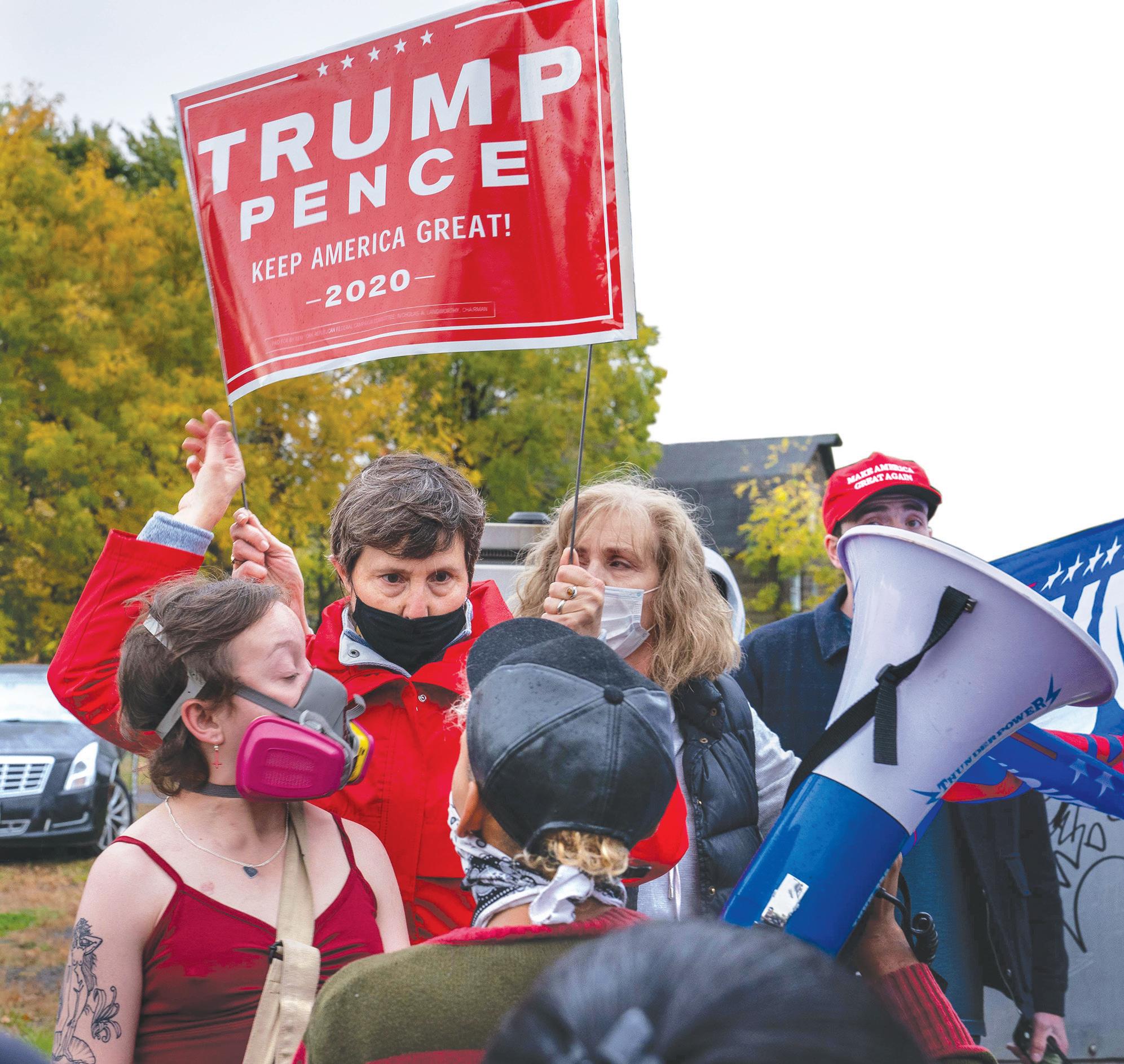
Both gatherings began quietly at 4 p.m., with DSA counterprotesters and supporters of President Donald Trump facing each other from opposite sides of Route 13. Members of the Trump rally carried Blue Lives Matter flags and campaign signs, as DSA counterprotesters carried anti-fascist signs and a DSA flag.
By 4:30 p.m., around 60 counterprotesters had crossed the street,
intermittently blocking traffic, to confront the roughly 20 Trump supporters.
Trump supporters stood in front of the “Republican Campaign storefront,” an office on Meadow Street and Cleveland Avenue recently opened by Nancy and Jim Crawford in coordination with the Republican Party. The Crawfords sought “visibility” of conservatives “in a very liberal town,” Nancy said.
Rocco Lucente, volunteer at the rally and the former chair of the Ulysses Republican Party, said before the event that local Republicans hoped to bring attention to the city’s new Republican storefront.
But it was clear early on that the Trump rally would not be as straight-
With Bar-Packing Nixed, Collegetown’s Loco Buzzes With Table Service
By MAYA RADER Sun Contributor
On a given Friday night last year, students packed the Collegetown bar Loco Cantina, chatting and dancing until 1 a.m. This year, the crowds of dancing students are gone. But Loco is very much alive. The bar turned to table service
— Loco invested in five highbacked booths with extra dividers to serve customers five days a week. Now, groups of up to 10 can reserve a booth for an hourand-a-half timeslot, giving the bar contact information in case the night ends with contact-tracing. When a group enters the bar, Loco employees check their tem-
peratures and seat them at their booth, where they remain for the evening. Customers can order drinks and, with Luna Street Food moved to a new Collegetown location, its old spot next door to the bar is fired up to serve sliders, wings, tacos and more.
“It’s all very low-key. It’s a very different atmosphere,” said Kevin
Sullivan, owner of Loco Cantina, Luna Street Food, Jack’s Grill and Pronto Pizza. “But I think that’s what people are after.”
He added that with the virus, if students are going to “go out and socialize, they want to know that they’re safe.”
Sullivan said he waited three weeks into the semester before open-
ing to gauge the risk of coronavirus transmission at Cornell. He said his staff didn’t want to risk dining customers indoors unless the virus proved to be more under control. Ultimately, Sullivan wanted to know: “Are the students well-behaved enough to keep this thing
See LOCO page 2
Trump rally trumped | A Trump supporter and counterprotester exchange words of animosity.
BEN PARKER / SUN ASSISTANT PHOTO EDITOR
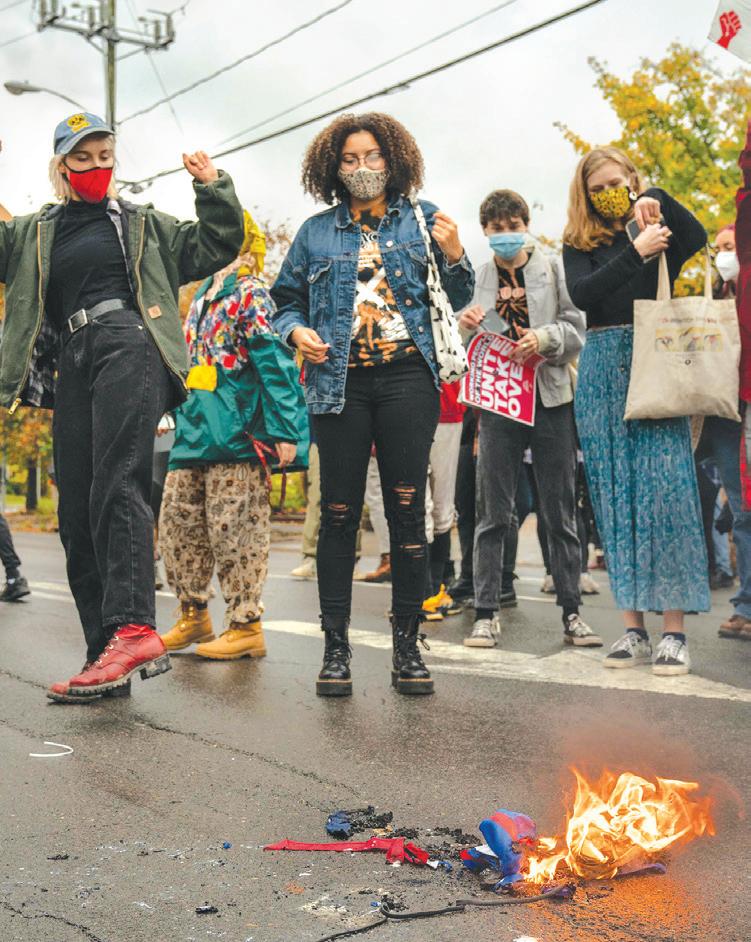
Flag’s ablaze | Counterprotesters celebrate as a Trump 2020 flag burns on Friday.
By ARI DUBOW and KATHRYN STAMM Sun City Editor and Sun News Editor
Admin Vacancy Leaves Students Vulnerable
The associate director is the primary point of contact for undocumented and DACA students, a position that oversees the Cornell Committee Supporting Undocumented Students, and provides programs focused on addressing the uncertainties undocumented students face when they transition to Cornell.
As these staffing gaps leave undocumented and DACA students demanding support, financial aid delays have further burdened the community without Cornell staff dedicated to its unique needs.
“Across the board, people have been struggling with financial aid and with security and support from the University in general,” said George Defendini, co-president of La Asociación
Latina. “If you apply that fact to a lot of these people in the undocumented community, it’s magnified.
“A lot of resources that are offered to traditional or registered undocumented students and citizens are not to them, and that can be challenging,” Defendini continued.
Undocumented students have historically been denied resources and rights, and the pandemic has further complicated their futures.
“There are still no pathways for undocumented students to figure out employment and funding,” the DREAM Team said. “COVID has increased the support undocumented students need from the institution, and there’s much to be done.”
Onalee Duane can be reached at osd4@cornell.edu.
Loco Adapts to COVID
under control locally? Are we going to have a localized outbreak?”
But as the semester progressed and the coronavirus on campus proved largely contained, Sullivan said it became clear that whatever students are doing, it’s working.
“Overwhelmingly, people are following the rules,” Sullivan said, “the important ones at least.”
For Sullivan, Loco’s dining model is working in part because “a lot of people live in little families on campus.” Students often dine with their roommates, and Loco provides a place for them to go out while distancing from other groups.
“As much as the living room or the front porch is an OK place to socialize,” he continued, “it’s nice to go out and get served drinks from a bartender and order food.”
When Cornell shut down in March, Loco and Sullivan’s other restaurants took a hit — business dropped as much as 50 percent during the quarter after students evacuated. Sullivan estimated that 75 percent of Loco’s business came from students, as well as 75 percent of business at Jack’s and 50 percent at Luna.
The week Cornell closed, Sullivan said he and his team debated whether to order their
typical cases of green beer for St. Patrick’s Day: “We can’t not order alcohol — what if we’re still open, what if none of this comes to fruition?” he said.
But the bar ended up delivering the green beer and giving it to employees, as students scrambled to return home on the holiday.
But this change was just the first Sullivan and his team made, later redirecting his business ventures to find ways to compensate for the losses. The team launched a grocery delivery service and a drive-in movie theater over the summer.
“We were able to keep everybody busy,” Sullivan said about moving his employees around. Some bartenders, for example, relocated to Sullivan’s lakefront food and beverage service.
Running a line of Ithaca restaurants during a pandemic comes with enormous obstacles, but Sullivan said he’s finding ways to engage the different communities they normally serve, keep Ithaca residents feeling safe and recreate the lost jobs.
“Being hit hard, like everybody was in this country, I think the whole team stepped up to the plate,” Sullivan said. “We found cool things like [at] Loco, which has been wildly successful.”
Maya Rader can be reached at mlr285@cornell.edu.
Daybook
Monday, October 19, 2020
Today
Employment Law and Investigations: Advanced Internal Investigations Process 9 a.m. - 12:30 p.m., Virtual Event
Into the Desert: Questions of Coloniality and Toxicity 10 - 11 a.m., Virtual Event
The Astronomical Observatories of Jai Singh 11:15 a.m., Virtual Event
Ballots and Borders: Election 2020 and What’s at Stake for International Students and Scholars Noon - 1 p.m., Virtual Event
From Leaves to Ecosystems: What Can We Learn About Plants Using Novel Remote Sensing Techniques?
12:20 - 1:30 p.m., Virtual Event
Racial Reclassification, Education Reform and Political Identity Formation in Brazil 12:40 - 1:50 p.m., Virtual Event
Repatriation of Museum Objects 3 - 5 p.m., Virtual Event
Jewish Trans Brazil: Identity, Activism and Music 5 - 6:15 p.m., Virtual Event
Between the Polls: How Voters Decide 7 - 8:30 p.m., Virtual Event
Tomorrow
Labor Relations: Investigation Tools and Techniques 10 a.m. - 1 p.m., Virtual Event
Sensing, Automation and Data Analytics For Plant Pathology 11:30 a.m. - 12:20 p.m., Virtual Event
Robots in the Hospitality Industry: Adopting New Technologies
While Maintaining the Human Touch Noon - 1 p.m., Virtual Event
How Little I Understand About Breeding And Genetics of Fusarium Ear Rot Resistance in Maize 12:40 p.m., Virtual Event
Fake News, Alternative Facts and Misinformation: Learning to Critically Evaluate Media Sources 1 - 2 p.m., Virtual Event
Computation, Statistics and Optimization Of Random Functions 4:15 p.m., Virtual Event
Red Table Talk for Inclusion: Women Entrepreneurs 5 p.m., Virtual Event
The History of Women at Cornell and ILR 8 p.m., Virtual Event
MONEY & BUSINESS
Cornell Fin. Aid Trails Ivies
By ANGELA DEMARAL Sun Staff Writer
Why did Cornell choose to raise tuition at a time when many are experiencing stiff financial hardship; why is the University’s financial aid lower than all of its Ivy League peers?
Amid concerns about the true value of a college degree in the era of “Zoom University,” School of Industrial and Labor Relations Prof. Ronald Ehrenberg, who studies how institutions of higher education operate, explained the nuances behind some of these questions.
Cornell’s tuition and mandatory fees for the current academic year total $58,568 for endowed colleges — a 54 percent increase from the $37,954 price tag a decade ago, and a 286 percent increase from the $15,164 a student would spend ten years before that.
But while the University’s sticker price has increased significantly in the past few decades, the total cost of attendance for many families hasn’t necessarily risen with it, primarily due to Cornell’s relatively generous financial aid policies. According to Ehrenberg, the net cost of attendance for students in the bottom 80 percent of family income distribution has actually not gone up in the last 20 years.
“The only students who are actually paying more are financial aid recipients who are in the upper quintile — the top 20 percent of the family income distribution — and students who are not receiving any financial aid,” Ehrenberg explained.
Even so, many families of undergraduate students expressed sharp discontent that Cornell elected to increase tuition by 3.6 percent at a time when much of the United States still faces unprecedented unemployment and economic hardship. However, Ehrenberg said that this was a practical necessity, given the massive cost of coronavirus testing and the University’s commitment to maintaining previous financial aid standards.
“A major reason for the tuition increases is because we needed to generate funds for financial aid,” Ehrenberg said. “Under our need-based financial aid policies and need-blind admissions, when every students’ needs go up, we have to automatically increase their financial aid.”
According to Cornell’s latest finan-
cial statements, the University endured significant operating losses in the most recent fiscal year amid soaring expenses. In the spring, President Martha E. Pollack projected that the University could lose up to $210 million due largely to “an anticipated $145 million that will be needed to meet the increased financial aid needs of our students.”
Although the pandemic has roiled Cornell’s financial position, many of its closest peers have nevertheless long historically offered better tuition grant packages to students.
In 2020, Cornell offered the lowest average amount of financial aid among Ivy League institutions, averaging $39,868 per student — compared to, for example, $51,191 per student at Yale and $50,655 per student at Princeton. Cornell’s cost of attendance is not significantly lower than other Ivy League institutions, suggesting that this variation is not simply due to charging lower tuition and fees.
Nor is the difference primarily due to a larger percentage of students requiring financial aid at peer institutions, with 52 percent of Cornell undergraduates receiving aid of some kind, compared to 60 percent at Columbia and 54 percent at Dartmouth.
Instead, Ehrenberg said that Cornell’s relatively less-generous financial aid can be explained by the University’s endowment, whose $7.2 billion in assets is lower than all but Brown’s and Dartmouth’s, despite having, by far, the Ivy League’s largest student population. Cornell’s investment returns have also often lagged behind peers, resulting in an endowment that has grown more slowly than those of other colleges.
As a result, Enhrenberg said, raising tuition is often the only way Cornell can generate enough revenue to offer sufficiently large financial aid packages.
Despite high tuition costs, an Ivy League education may still be a worthwhile investment. Those who graduate from college make an average of one million dollars more in their lifetime than those who don’t; Cornell undergraduates, in particular, have a mean starting salary that is more than $10,000 higher than the U.S.’ median income.
To continue reading this story, please visit cornellsun.com.
Billionaire Robert Smith ’85 Admits Guilt in Tax Fraud Case
By OLIVIA CIPPERMAN Sun Staff Writer
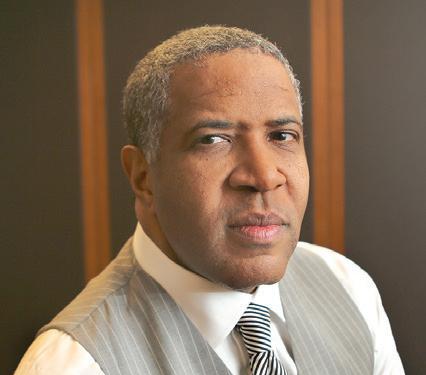
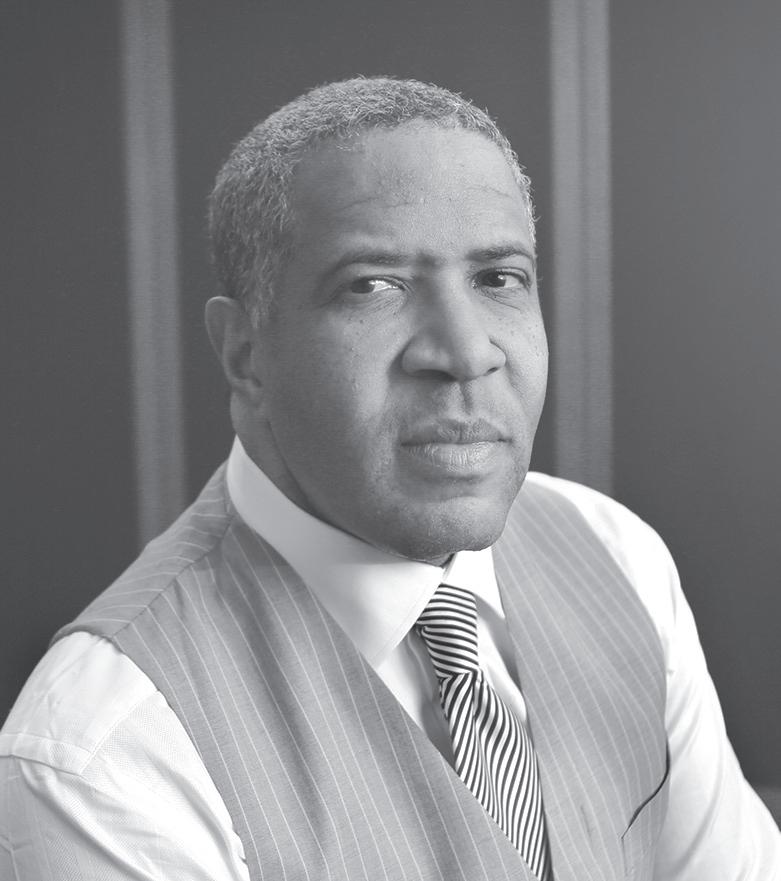
Philanthropist, billionaire and Cornell alumnus Robert F. Smith ’85 formally admitted wrongdoing in a scheme to illegally dodge millions of federal taxes.
The Justice Department and Internal Revenue Service first began an investigation into Smith’s financial activities in 2016, after the billionaire investor moved $200 million in assets through suspicious offshore entities, Bloomberg reported in August.
Last week, the four-year investigation concluded when federal prosecutors determined that Smith had filed false reports and fraudulently relied on foreign trusts to evade taxes over a span of 15 years. However, the Department of Justice offered to drop criminal charges in exchange for Smith partially paying back taxes and cooperating in the federal case against Robert Brockman, a billionaire software CEO and longtime business partner who was indicted in a related tax evasion case — the “largest ever,” according to prosecutors.
“It is never too late to do the right thing,” U.S. Attorney David Anderson said in a statement last Thursday. “It is never too late to tell the truth. Smith committed serious crimes, but he also agreed to cooperate. Smith’s agreement to cooperate has put him on a path away from indictment.”
The wealthiest Black man in America, Smith is the founder and CEO of Vista Equity Partners, a private equity firm that manages over $65 billion in assets. Revelation of the massive tax evasion scheme complicates the legacy of a man who had previously been best known for unique
business savvy and high-profile philanthropy.
Smith last made headlines in his 2019 commencement speech at Morehouse College, where he pledged to pay the student debts for the entire graduating class. The alumnus is also a major donor and Cornell department namesake, with the Robert F. Smith School of Chemical and Biomolecular Engineering and the Robert F. Smith Tech Scholars Program both named for him. In 2016, Smith made a $50 million commitment to Cornell.
As part of the government’s non-prosecution agreement, Smith agreed to pay $140 million back to the U.S. government and forfeit $182 million in charitable contribution deductions. According to the settlement, Smith had hidden at least $200 million in taxable profits from his ownership in Vista Equity in offshore accounts, evading at least $43 million in taxes.
Trump Supporters Twarted in Rally Face-Of With Counterprotesters
PROTEST
Continued from page 1
foward as the organizers anticipated. “We had no idea we’d be joined by people calling us members of the KKK,” Nancy said. “We’re not here to create trouble.”
Earlier this week, the Ithaca DSA planned in response a “Trump Rally counter-demo,” to “let them know they are NOT welcome here,” the group wrote in social media posts.
“If pro-authoritarian forces are going to keep showing up in Ithaca we need to show them that they are not welcome here,” said David Foote, chair of Ithaca DSA, of the motivation behind the counterprotest.
Throughout the afternoon, the DSA members and joining protesters drew a clear line between Trump’s politics and themes of racism and fascism — maintaining that Ithaca is not a place where those themes are welcome.
“I think it’s really important in a town like Ithaca, with its liberal veneer, to actually demon-
strate strong opposition to racist and reactionary politics,” said Prof. Russell Rickford, history, a member of the Ithaca DSA.
“Quite often, liberalism is willing to accommodate the far right, to justify it and, by doing so, legitimize it.”
Like the rally’s organizers, Foote said that he had not expected the high intensity of the counterprotesters.
“The event made clear just how much pain and anger people have experienced this year,” Foote said. “I think that that anger and fear and pain was a little closer to the surface than I anticipated.”
In one instance, a counterprotester took a “Make America Great Again” hat and set it on fire in the middle of the street. Others threw Trump signs into the fire, running into the street, stomping on the fire and dancing to music over a loudspeaker. Some vehicle passengers threw drinks out their windows onto Trump supporters.
This display then fully blocked the one-way traffic on Route 13,
and Ithaca Police Department officers arrived shortly after. Protesters took photos and videos of the officers, as they directed traffic away from the blocked road. The officers left just minutes later, driving away to chants of “cops and Klan go hand in hand,” and “no cops, no KKK.” IPD did not respond to requests for comment.
“I’ve heard everything he’s said,” Nancy said of Trump’s rhetoric, holding a Trump 2020 campaign sign. “I do not like the tone, often. But we are more about the policies than he’s been doing.”
She pointed to Trump’s trade policies, saying that prior to Trump, American leaders were “bending our knee to commie countries that sent jobs overseas.”
She added that she believes that many of Trump’s policies have been good for people of color.
Nancy was frustrated at what she saw as the counterprotesters’ immoderate protest tactics: “We don’t want to belittle anyone, but how are we supposed to be one nation when people are behaving
like this.”
Throughout the two hours, counterprotesters approached members of the Trump rally, yelling “fascist go home,” and “you’re racist if you support a racist.”
Mike Ande, an Ithaca resident who moved to the U.S. in 2007 from Dire Dawa, Ethiopia, said that while he believes that many individuals in government are racist, he does not believe in the concept of systemic racism. Ande recognized that Trump has used racist rhetoric, but said he believes that Trump’s actions ––for instance, hiring people of color in his businesses –– show that he is not, in fact, racist.
Conservatives have taken to the Ithaca streets twice in recent weeks. On Sept. 20, local residents held a “Back the Blue” protest outside IPD headquarters downtown, and on Oct. 3 protesters marched between the Staples parking lot and IPD headquarters.
Throughout Friday afternoon, protesters chanted “you’re not welcome here,” and “go inside” at the Trump supporters. Pushing
and shoving among the crowd caused the ralliers to retreat inside the Republican storefront.
Towards the end of the rally, several protesters tore down the “Vote Republican” banner in front of the storefront, leading to another tugof-war over the property.
But after over two hours, the counterprotesters declared “victory” and marched to the Commons through the streets, blocking traffic and garnering cheers and waves.
There, they celebrated and discussed future plans, including the rally for Black lives on Sunday, the 21st one since this summer.
“Today was a tremendous victory for the forces of anti-racism,” Rickford said. “It was a spontaneous and almost joyful display of, not only disgust with racism and fascism, but also a positive affirmation of an alternative politics, celebrating human dignity.”
Ari Dubow can be reached at adubow@cornellsun.com.
Kathryn Stamm can be reached at kstamm@cornellsun.com.
Olivia Cipperman can be reached at ocipperman@cornellsun.com.
Tax fraud | Billionaire Robert F. Smith ’85 admitted wrongdoing in a massive tax fraud case. Last year, he pledged to pay the debt for an entire Morehouse graduating class.
CHESTER HIGGINS JR. / THE NEW YORK TIMES
ARTS & ENTERTAINMENT
We’re All Techno-Sheep Infected By Relatability and Poisoned by Capitalism
Whether it be responding to your friends’ texts with “same,” praising a TV show for having “relatable characters” or sarcastically commenting on the recent exploits of the uber-rich, it seems that relatability has become an important facet of Gen Z culture. Beyond the world of YouTube comment sections and pointed tweets, relatability also seems to be a specific measure of how much we like somebody. Not just in our personal lives, but also in terms of how we view public figures. Especially during the election cycle, you’ll start to see a wide variety of social media posts detailing whether somebody is or isn’t “warm” and “relatable” — criticisms which seem to most commonly affect female politicians who tend to be criticized for their approachability or lack thereof.
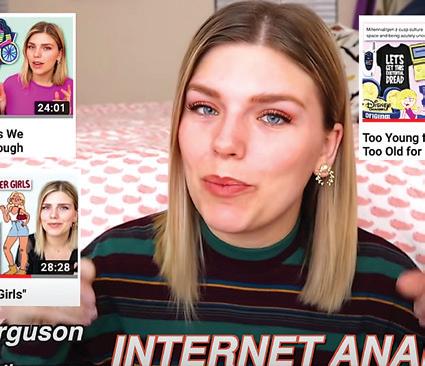
For Gen Z, the most obvious way to apply the “relatability” concept is through YouTube. In her video “You’re Not Relatable Anymore,” Youtuber tiffanyferg traces the evolution of relatable content, starting in the mid 2010s. From about 2013-2016, if you were a teenager with internet access and logged onto the platform, you would be barraged by highly saturated, cutesy thumbnails full of easy DIYs, life hacks and similarly uncontroversial, broadly appealing videos. Then, starting in 2016, relatable YouTubers got a shiny, brand-new Gen Z rebrand — a younger group of creators, a trendier Brandy Melville aesthetic, etc. Part of this trend is, of course, that teenage YouTube watchers want to watch people who are also teenagers — a video about getting ready for school is going to be far easier to connect to than a video about building your baby’s first crib. From this point of view, relatability is pretty harmless — you find somebody who feels relatively similar to you, you watch their videos. Done. But there’s a darker, stranger side to the phenomenon of relatability.
The first thing to address is just how popular these YouTubers are. A 2015 survey for Variety, which compared 10 traditional entertainment stars to 10 YouTubers, found that teenagers from 13-18 ranked YouTubers above traditional entertainment stars. The survey also reported that teens were as much as seven times more emotionally attached to Youtubers than traditional celebrities, and that YouTubers were perceived as 17 times more engaging. The exact reason that YouTube stars are able to capture teen audiences isn’t clear, but if I were to guess, it definitely has something to do with a cult of personality. Viewers are able to attach somebody’s content to a clearly recognizable image — thus, the creator can choose to project whatever best suits their brand. Subsequently, their brand evolves into a lifestyle of sorts, which is easily accessible through their videos. This is also part of what allows “relatability” to be so pervasive on the platform — creators have however many minutes they
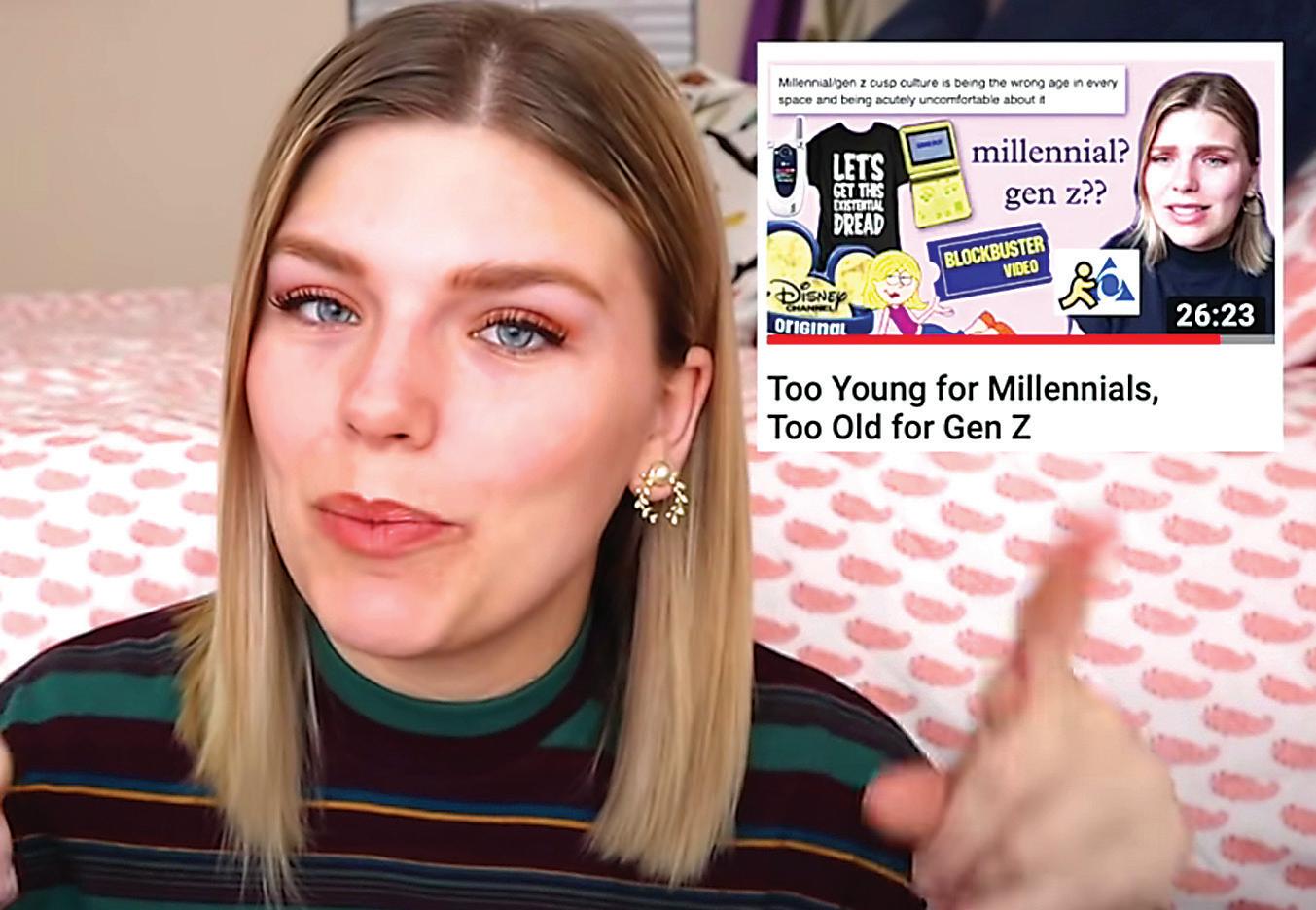
want where they can present themselves however they choose. Specifically, editing styles have become a much larger part of content, with creators such as Emma Chamberlain popularizing content which, though it appears amateur in terms of effects — picture editing styles that you would use for a middle school film project — are engineered to grab audience attention. Jeetendr Sehdev, the celebrity brand strategist who led the survey, commented “YouTube has an inherent ability to create contagious content. The level of advocacy teens have about YouTube stars is out of control.” It’s interesting that Sehdev mentions “contagious” content. In 2007, Jonah Peretti, the man behind BuzzFeed and the Huffington Post, co-authored a piece for the Harvard Business Review with Duncan Watts Ph.D. ’97, entitled “Viral Marketing for the Real World.” In the article, Peretti and Watts propose a new approach to marketing called “big-seed marketing,” which combines viral marketing tools with mass media. Their analogy for spreading content is the spread of an infectious disease — their analysis uses reproduction rate, R, to calculate the success of different viral campaigns. They write: “By providing social-sharing tools that are easy to use, moreover, marketers can reliably increase the reproduction rate of their message — an important point, as even small increases in R can dramatically increase the number of additional cases.” Essentially, big-seed marketing is a straightforward method of creating viral content and reliably improving adver-
tising yields, so “managers can dispense with the probably fruitless exercise of predicting how, or through whom, contagious ideas will spread.” Which is to say — there’s a formula to all of this, and marketing executives know it.
Therefore, if you’re trying to sell a product, you send it to relatable YouTubers. Anybody who consistently watches YouTube videos has probably seen this in action — how many product placements have you seen for Honey, or NordVPN or Curology? Even once the specific sponsored video is done, you’ll start to see clips of a YouTuber endorsing a product popping up in other places on your feed, so, whether you like it or not, you’re forced to remember which products they’ve endorsed. The fact that I could instantly come up with three examples of companies using YouTubers for advertising in less than a minute is proof of that.
Beyond the big-seed marketing approach, there’s also a psychological side to all of this. A 2016 article in the Journal of Consumer Marketing entitled “Credibility of a peer endorser and advertising effectiveness” shows that the credibility of a peer endorser (in this case, the influencer) is constructed from trustworthiness, expertise, similarity and attractiveness. Now, take a moment and think of this in relation to popular creators. The vast majority are conventionally attractive, stylish teenagers whose “relatability” allows them to present as trustworthy people who are “just like you.” The formula of a relatable content creator is also, not entirely coincidentally, the formula of the ideal peer endorser. If you don’t believe me, search “relatable.”
The sixth result is for an influencer marketing brand, with a tagline that defines “relatable” and says “In other words, how people like their advertising.”
I’m not necessarily making the argument that “relatable” content creators are trying to weasel their way into your capitalist rodent brain — but I’m not not making that argument. Take a moment to consider your idea of relatability. How much of it is tied to consumerism? Why do you want — or more accurately, why do you think you want — the things you want? Beyond the YouTube platform, consider social media as a whole. I distinctly remember back when I had Instagram, taking about 15 minutes to come up with the perfect caption. Not too over the top, not too dull, the perfect mix of relatability and ingenuity. A caption which, through the process of deliberation, became increasingly disingenuous. Even in moments of trying to seem unapologetic, or real, I still find that I’m projecting a falsified version of myself, carefully designed for mass appeal. Sometimes not necessarily mass appeal, but as I jokingly told my friend while talking about dating profiles, “I know my demographic.”
So, despite not being a marketing firm, I’m still advertising myself — a tendency which extends outside of my social media profiles and into the way I choose to act in-person. The specific mode of technocapitalism perpetuated by online influencers has effectively weaseled its way into my feeble rodent brain, encouraging alienation despite a veneer of collective behavior. It all seems to be a gossamer-thin illusion, and at this point it seems impossible to fully extricate myself from the abyssal web of technocapitalism. Which raises the question: Are any of us actually real?
Mira Kudva Driskell is a sophomore in the College of Agriculture and Life Sciences. She can be reached at mdriskell@cornellsun.com. Portrait of a Gen Z on Fire runs alternate Mondays this semester.
Portrait of a Gen Z on Fire
Mira Kudva Driskell
COURTESY OF TIFFANY FERGUSON
The Corne¬ Daily Sun
Independent Since 1880
138th Editorial Board
MARYAM ZAFAR ’21 Editor in Chief
JOYBEER DATTA GUPTA ’21
Business Manager
PETER BUONANNO ’21
Associate Editor
MEGHNA MAHARISHI ’22
Assistant Managing Editor
CHRISTINA BULKELEY ’21
Sports Editor
BORIS TSANG ’21
Photography Editor
CAROLINE JOHNSON ’22
News Editor
ALEX HALE ’21
News Editor
ARI DUBOW ’21
Editor
EMMA ROSENBAUM ’22 Science Editor
BENJAMIN VELANI ’22
Dining Editor
JOHN MONKOVIC ’22
Multimedia Editor
MIKE FANG ’21
App Editor
OLIVIA WEINBERG ’22
Assistant News Editor
MADELINE ROSENBERG ’23
Assistant News Editor
LUKE PICHINI ’22
Assistant Sports Editor
HANNAH ROSENBERG ’23
Assistant Photography Editor
BRIAN LU ’23
Assistant Arts & Entertainment Editor
ANNABEL LI ’21
Assistant Money & Business Editor
LEI ANNE RABEJE ’22
Layout Editor
JOHN COLIE ’23
Blogs Editor
JOHNATHAN STIMPSON ’21
Managing Editor
KRYSTAL YANG ’21
Advertising Manager
JASON HUANG ’21 Web Editor
NIKO NGUYEN ’22
Editor
PALLAVI KENKARE ’21
Editor
SEAN O’CONNELL ’21
KATHRYN STAMM ’22 News Editor ANIL OZA ’22
EMMA PLOWE ’23 Arts & Entertainment Editor
LEE ’21 Money &
CHENG ’21
PEÑEÑORY ’22
MEGHANA SRIVASTAVA ’23
EMILY DAWSON ’21
PARKER ’22
MORAN ’21
LAW ’22
WANG ’21
’22
KRISCH ’21
Working on Today’s Sun
Ad Layout Jenny Huang ’22
Production Deskers Sarah Skinner ’21 Mei Ou ’22
News Deskers Kathryn Stamm ’22 Madeline Rosenberg ’23
Opinion Desker Pallavi Kenkare ’21
Design Desker Lei Anne Rabeje ’22
Photo Desker Hannah Rosenberg ’23
Arts Desker Daniel Moran ’21
Sports Desker Christina Bulkeley ’21
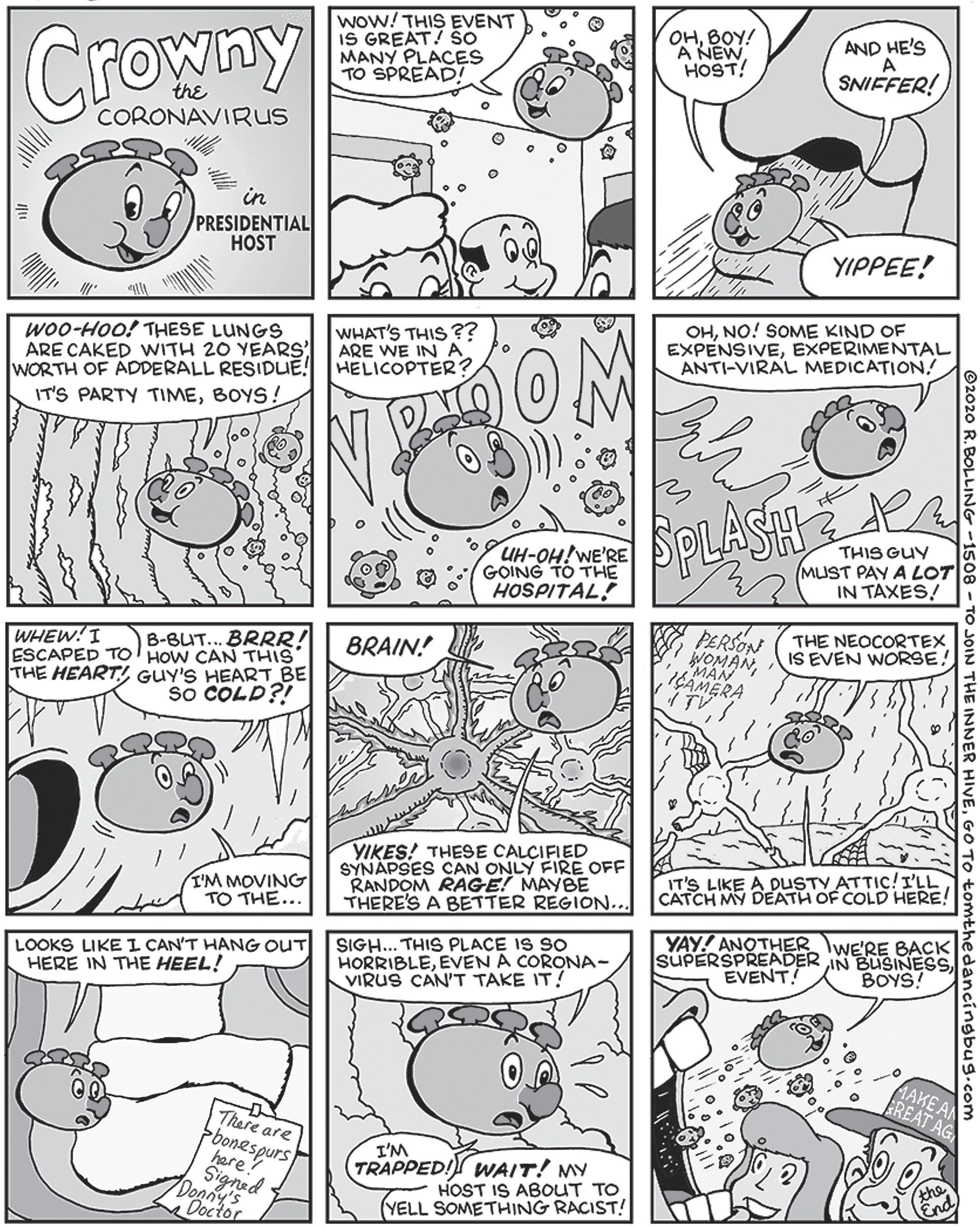
Tom the Dancing Bug by Reuben Bolling
What Do We Want to Be Now Tat We’re Grown Up?
Some of you still have a couple years before you need to figure this out, others of you already have – the return offer signed, sealed and delivered. But how many of us will answer this question the same way as we did in kindergarten? Our misspelling hands scrawling on our first homework assignments, writing down the reasons we wanted to be firefighters, astronauts, artists, secret agents, veterinarians, movie stars, the President, our fathers and mothers.
Not once did you hear trade analyst, consultant, HR representative. Yes, that’s probably because half those words weren’t in our vocabulary yet. However, while our interests do change, and our innocent career aspirations become long lost answers on home video interviews (or hobbies at best), how much should we let them?
As a senior, staring down into the black abyss of the real world after Cornell, careers are almost always on the mind. If we haven’t already lined up an offer, we’re searching, or planning our search once recruitment opens. Most of us, anyways. It’s hard not to when attending a school that has built its reputation on the high employment and graduate school rates of their alumni.
This is simultaneously a fantastic and detrimental aspect of Cornell. They prepare us for this rigorous recruitment and connect us to alumni networks (nepotism is the number one trick in the book), but, in so doing, they create an atmosphere on our campus geared towards pushing ourselves into high paying positions. While there is nothing wrong with wanting to make a comfortable living for ourselves, there might be something we’re letting go of in the process.
Even Cornellians that begin their four years here without any intention to switch out of their music major sometimes feel the pressure to sign up for a business or computer science minor, something more “practical” to add to their resumé. When your friends are lining up for info sessions, it gets you thinking.
Yet, maybe we shouldn’t let the corporate recruitment culture that emanates from our campus tether us to three or four industries. While not all of us can afford to explore multiple career paths after graduation, surviving on familial wealth, we also don’t have to choose a career path that works us from 7 a.m. until midnight just for the flashy paycheck. I have no doubt that some of us revel in the idea of spending weekends behind a computer, analyzing the trading patterns of Tesla, but at Cornell, there are a lot of us that put our passions on hold to establish a sense of security early on.
At what price do we sell our childhood
innocence?
For those of you who have read my columns before (the three of you not including mom and dad), the tone of this one might feel a little different — a little less satirical. But as is the spirit of this column, let’s get back to our roots.
Cornell makes us nearly forget how many careers there are out there. We may not think about it everyday like we do about the engineers that work to keep Zoom running, but there are New York Times Crossword creators out there. There are people who travel the world searching for the best place to shoot the next Marvel blockbuster. There are dog toy designers for our Mr. Snowball’s and our Baxter’s. There are fortune cookie writers (I think they particularly need help in this field: “You must try, or hate yourself for not trying” isn’t a fortune as much as a judgement). We don’t need to limit ourselves to our recommended Handshake and LinkedIn gigs.
The Cornell alumni base is incredibly helpful, but just because there isn’t a large quantity of graduates in San Diego following the behavioral patterns of otters in their coastal biology professions doesn’t mean we shouldn’t try to break into that field. Even if our interests have changed since kindergarten, as is the likely case, our modern day hobbies probably still have some roots in those old aspirations. It’d be a shame to let them go completely. And while building legos or hosting tea parties can’t earn us a living wage, architecture and event planning can. While we might not want to make finger painting and playing dress-up into our full time careers, we can and should still dedicate freetime to our art or to thrift shopping. Just as clubs at Cornell can serve as an outlet for these hobbies, we must also find ways to continue doing what we love once we’re out there in the Big Apple or the Bay or wherever else. It might be one semblance of our former lives to hold onto as we start buying our friends blenders for their housewarming and engagement parties. One reminder of what life was like before we signed away our booze money on electric bills and phone plans. At the end of the day, we need to figure out how much our happiness at waking up Monday through Friday is worth. Does the excitement at heading to the office (or the Zoom conference room) make up for the $20k smaller paycheck? Cornell might say so, liberative parents might not, pushing their children to seek out what they truly want to do while making flower crowns with them in the backyard. The question is then left to us – one of the many coming our way when we leave Cornell’s bubble.
Smile, You’re on Camera
Wendy Wang Common Nonsense
Wendy Wang is a freshman in the College of Arts and Sciences. She can be reached at ww376@cornell.edu. Common Nonsense runs every other Friday this semester.
As most of you reading this probably know, online classes kind of suck. Yes, online classes do mean I can get up ten minutes before class and still be on time. However, this also means that when I collapse into my desk chair and open up Zoom, there is a very high chance that my brain is still half asleep, and I will not fully process the majority of what my professor is saying. But in my opinion, that’s not the worst part of online classes. To me, the worst part is showing up to my classes and discovering that pretty much every single person has their camera of Of course, I am completely aware that some people need to keep their cameras of for personal reasons. And that’s obviously completely reasonable and acceptable. But there is just no way that out of the 70 people in my discussion-oriented history class, less than ten are able to keep their camera on the entire time. It’s even worse in my smaller classes, when there have been times when almost everyone has their camera of in a 16-person class for absolutely no reason. I
know from personal experience that most of the time, when you turn your camera of, it’s not because you’re having computer issues or have something going on that doesn’t allow you to turn on your camera. It’s because you’re doing something else, like folding your laundry or working out, and don’t want to risk anyone else noticing.
College tuition is very expensive, and unfortunately, I am not paying all this money to watch Tiktoks and Netfix all day. Remember, we are paying for this, so you might as well get your money’s worth. I know, sometimes staring at your screen for hours means that all you want to do is crawl back into bed. I get that. It is very hard to focus when your professor is just a tiny square on your screen, and you still have that tab with the next episode of your favorite show open. But when you turn your camera on, it’s a lot harder to get away with being distracted. I’ve personally found that when I turn on my camera, I want to participate more in the class, and I am better at actually listening to what the professor is saying.
Plus, think of your professors. Like everyone else, they’re trying their best in this highly trying time, and I really don’t think they particularly enjoy talking to a bunch of blank squares. I know I fnd it especially unpleasant. It feels
Think of turning on your camera not as a burden, but as an opportunity, especially if you’re at home this semester. It’s always good to have some sort of human interaction, even if it’s limited to pixels on a screen.
vaguely black mirror-esque, like I’m talking to a bunch of virtual characters. Honestly, talking to a blank square in a breakout room of one has been one of the more unpleasant
I would much prefer the awkward not-quite eye contact that comes with trying to stare into your computer camera.
experiences I’ve had this semester. I would honestly much prefer the awkward not-quite eye contact that comes with trying to stare into your computer camera.
Tink of turning on your camera not as a burden, but as an opportunity, especially if you’re at home this semester. You can use keeping your camera on as incentive to fnally tidy up your room, or change out of the pajamas that you’ve been wearing all day into something somewhat presentable. Particularly if you’re joining from home, these classes are the closest you’re probably going to get to seeing your classmates this semester, and it’s always good to have some sort of human interaction, even if it’s limited to pixels on a screen. Who knows, maybe someone will notice that cool poster on your wall and strike up a conversation and you’ll make a new friend in one of your classes, just like in in-person classes.
Granted, keeping your camera on can sometimes result in slightly awkward situations, such as your friend dramatically tripping on your chair while you’re in the middle of class. Tere’s also the time I saw a girl fling her nails in my english class. But at worst, these incidents just make for amusing anecdotes. So the next time you log onto Zoom university, consider turning on your camera. After all, that buzzfeed quiz telling you what piece of furniture you are can probably wait.
Posting Political: Do So at Your Own Risk
Anuli Ononye Womansplaining
Anuli Ononye is a junior in the College of Arts and Sciences. She can be reached at aoo44@cornell.edu. Womansplaining runs every other Wednesday this semester.
This past summer, my supervisor gave me and the other company summer intern a presentation on media literacy and internet branding. I worked for a feminist nonprofit, and, unsurprisingly, both the other intern and I were politically active and socially conscious. When it came time for questions, what we came up with was very different than our supervisor expected. She joked that our concerns showed a marked shift from worrying about the impact of our leaked private photos to the impact of political posts on our future professional prospects.
I remember getting the first “what you post on the internet stays on the internet” talk. Don’t sext; someone will see it. Don’t post pictures of yourself drinking underage; someone will see it. Don’t swear on social media; someone will see it. I was in eighth grade, attending a conference for aspiring attorneys and I took the talk to heart. A few months later, one of my high school teachers gave a similar presentation, only this time he recovered pictures we had deleted from social media to demonstrate that nothing is ever really deleted from the internet. All that to say, I have been very careful on social media my entire life.
Until college, maintaining a clean image on social media meant that I didn’t post anything political. Ever. My only exception to the rule was posting fem -
inist and women’s empowerment content. I justified that, telling myself that no one really hated women’s rights and gender justice. Most corporate companies should care about the gender pay gap and accessible education for women. However, even I can admit that my feminist “political posts” were always so broad and watered down that they could never really be political. I intentionally crafted the most centrist political posts that I could, in hopes that no future employer could hold it against me.
Looking back on that choice, it seems drastic and a bit disheartening that in my mind I’ve equated discussing immigrant rights, minority rights, women’s rights and other humanitarian issues as the same or equal to posting exposing pictures, profanity and illegal behavior on social media. However, making a very broad generalization, a lot of people see posting political in the same way.
I used to justify not posting political issues on social media, by telling myself that social media wasn’t the place to do so. People would disagree with me and there was, often, no way to have productive conversations. I can’t even count the amount of friendships I’ve seen ruined over Instagram story debates. But even at the time, that argument seemed weak. The truth is, we’re a generation that shares close to everything online. My social media followers know where I got my last iced chai latte, my mom’s birthday, every minute of the last concert that I went to and my favorite album. I’ve created a digital community where I can have conversations online, so — as a feminist gender sexuality studies and government major — it seems superficial that this community doesn’t know about the political issues I care about.
And now, given the COVID-19 pandemic, the struggle for racial justice and the election just days away, that argument feels even weaker. Why wouldn’t I post about politics on social media, when doing so could help raise money and resources for victims of police brutality? Or could raise awareness about voter disenfranchisement and provide resources to help ensure that a friend’s ballot isn’t thrown out? Or could provide access to support groups and resources for people who have lost family members and friends to the COVID-19 pandemic? I’ll borrow the feminist phrase “the personal is political,” because political issues are people’s lives. My life is my politics.
Yet, I’m a coward. I have a fear of offending people. On a good day I’m self aware, on a bad day I’ve
internalized racism. As a member of one of the only Black families in my neighborhood at home, one of the only Black students in my elementary and high schools almost my entire life and a child of immigrant parents, I have spent my life “staying the course.” My parents adapted well and quickly to our lives in a county with drastically different political views than our family’s. They taught my brother and I to do the same. Pushing buttons and talking about politics has always been just
What if the tide shifts and something I believe at twenty-years old is wildly unpopular and maybe even offensive when I’m forty?
What if H.R. is looking for someone “less political,” who stays their course?
another way to ostracize ourselves. It’s the chance that we won’t be invited to the sleepover or birthday party, the chance that we won’t be elected to the student council position or picked team captain and, most importantly, a one way assurance that we will not get that internship or job.
College has completely turned the tide. For the most part, I am surrounded by people who accept (and, even better, encourage) my political views. Yet, I still really don’t post political. There’s an overwhelming fear that this will all go away someday and someday soon. What if the tide shifts and something I believe at twenty-years-old is wildly unpopular and maybe even offensive when I’m forty. What if the human resources room is looking for someone “less political,” someone who stays their course? What if? The answer is, I really don’t know. In twenty years, that view I have now could be even more popular. That human resources room might be looking for someone eager to voice their opinions. I really don’t know. But, everytime that I post a political picture and lose five followers from back home, it reminds me what’s at stake.

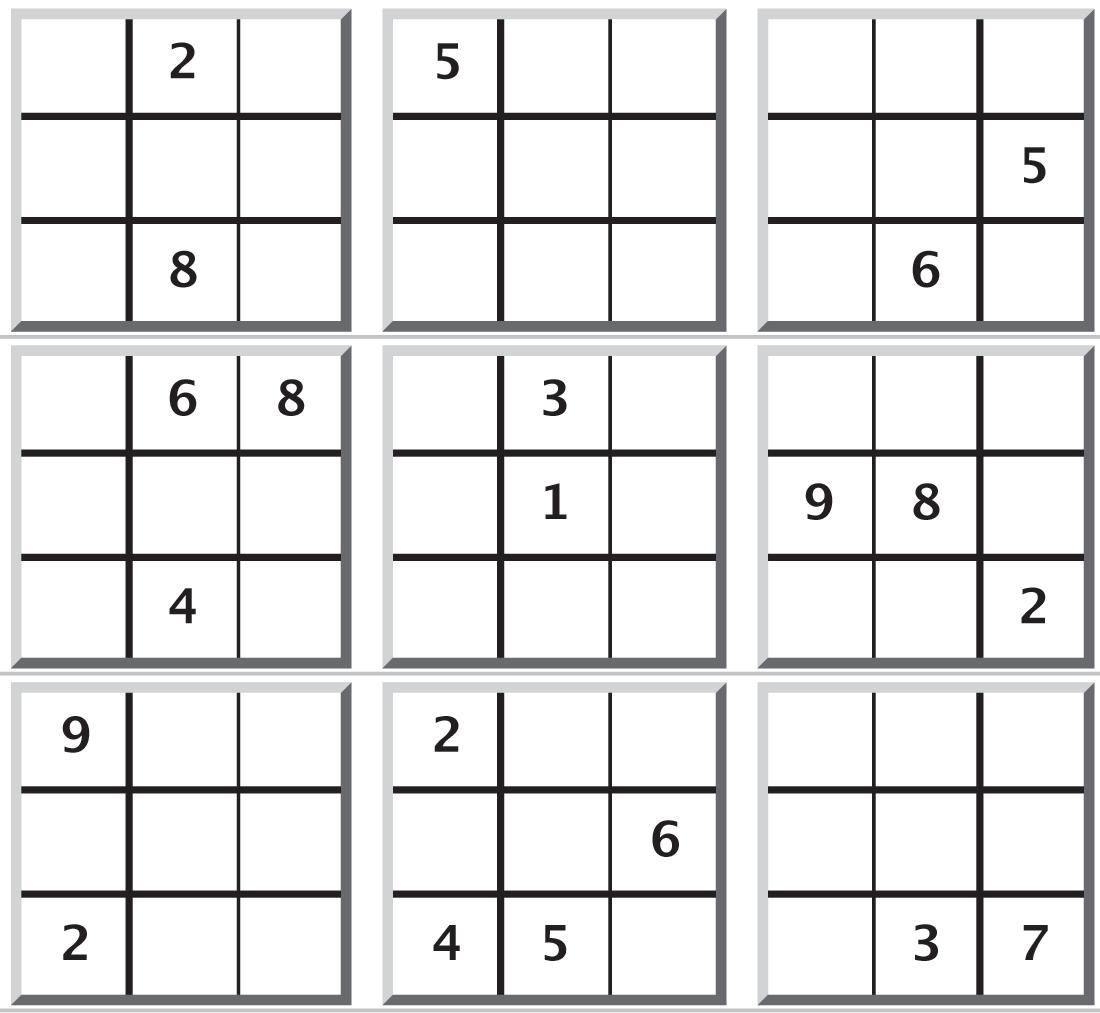
Fill in the empty cells, one number in each, so that each column, row, and region contains the numbers 1-9 exactly once. Each number in the solution therefore occurs only once in each of the three “directions,” hence the “single numbers” implied by the puzzle’s name. (Rules from wikipedia.org/wiki/ Sudoku)
Caption Contest Winner

submit your caption for this week’s contest, visit sunspots.cornellsun.com.

A UTOMOBILES
Art by Alicia Wang ’21
Mr. Gnu by Travis Dandro
Mr. Gnu by Travis Dandro
WEditor’s Corner
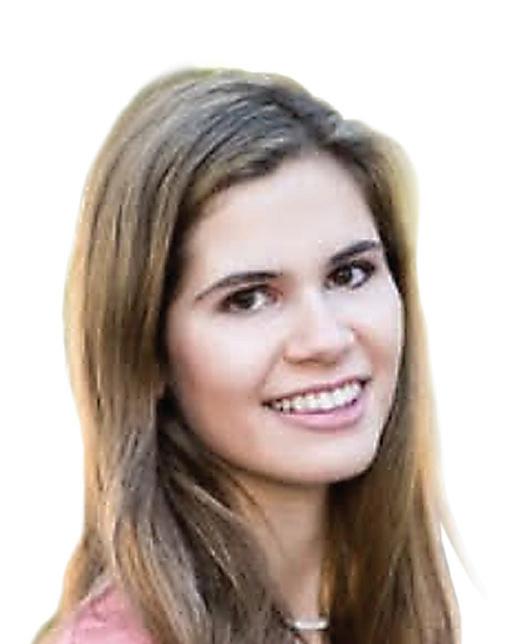
Christina Bulkeley is the sports editor on the 138th Editorial Board and previously served as an assistant sports editor. She is a senior in the College of Arts and Sciences and can be reached at cbulkeley@cornellsun.com.
Bring Back the Bubble; Kick the Fans Out of the Stands
e’re seven months into our lives being upended by COVID-19, and many still refuse to acknowledge the obvious: National-level sports are a bad idea unless leagues use an isolation bubble. Why aren’t we acting to improve safety measures when it comes to isolation?
Major League Baseball was forced to recognize the issues with traditional travel-based games after dozens of players caught COVID-19 over the course of the season. Now, the final rounds of the playoffs are being played in bubbles. So why aren’t other leagues following suit?
The National Football League, like the MLB earlier in the year, is postponing multiple games a week as players continue to test positive for the virus. There is no more getting around the truth — without restrictions on travel and players’ contacts, COVID-19 will infiltrate leagues.
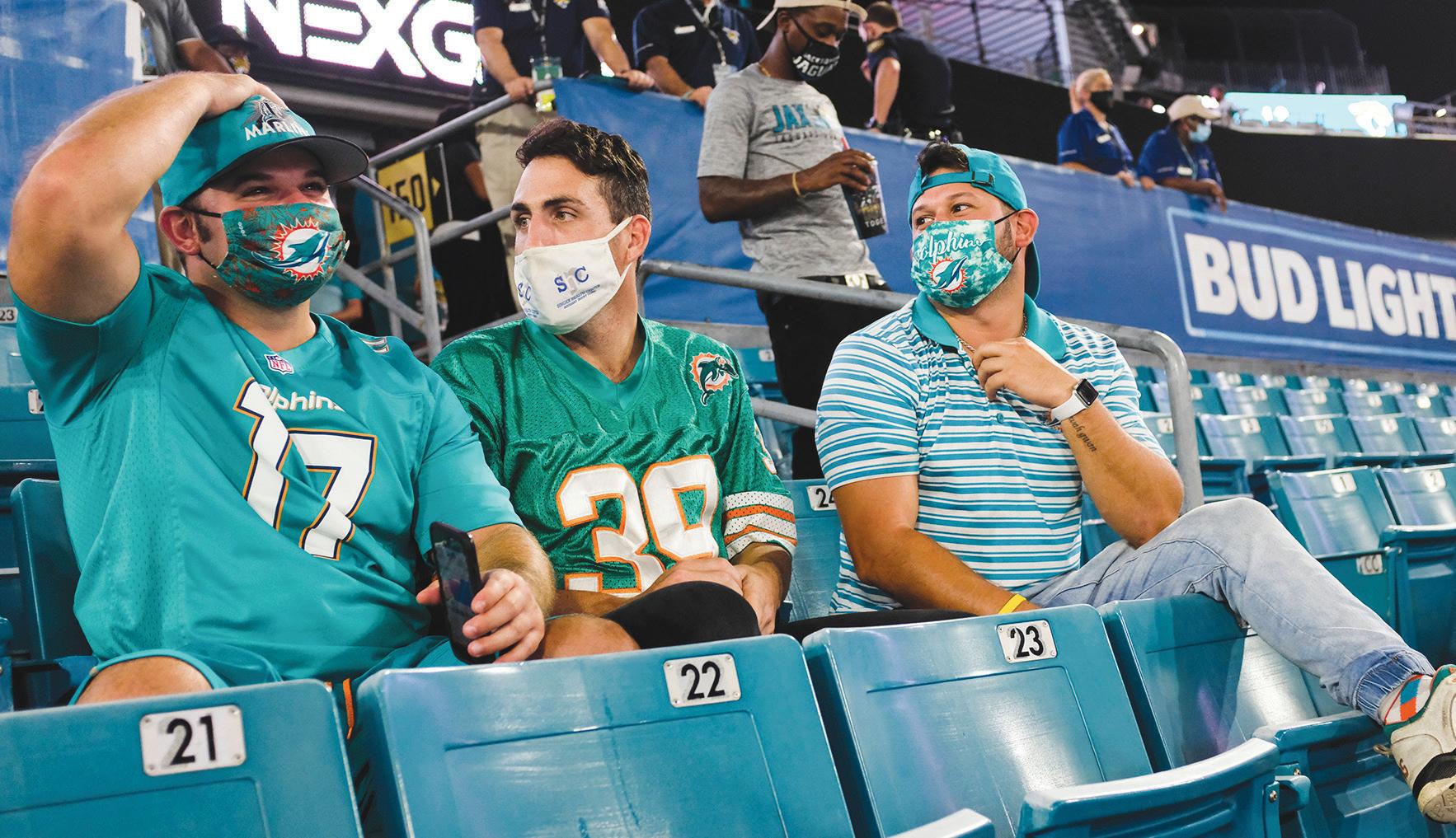
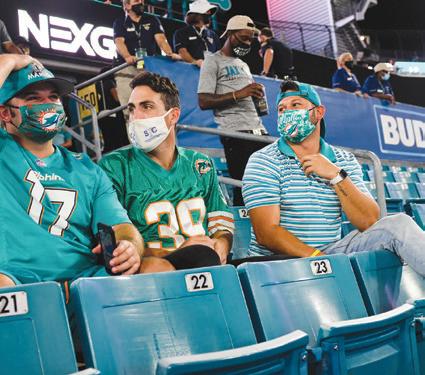
Of course, we do know why the NFL resists using the bubble format. Among the reasons are players’ resistance to the idea, the logistical issues with creating bubbles and, of course, money. The NFL, unlike the other three major sports, is allowing fans to attend games.
chance to go to a game offers the opportunity for life to resume some semblance of normalcy. And for colleges that are letting fans attend games, students will be grateful for a taste of the classic college experience.
Of course, if you catch COVID-19 at the game, your life stops being normal again pretty quickly.
Overall, allowing fans to attend games is a clearly misguided decision. Letting fans into the stadium is essentially proof that the health of fans — and by extension, that of the community — is not important to these organizations.
For Cornell students, it can sometimes be easy to forget that we are in the vast minority with our testing policy. Many in-person universities only conduct a test if a student shows symptoms or is contact traced; for the general public, surveillance testing is nonexistent. While we catch every case here on East Hill, asymptomatic spread is still a very real issue elsewhere in the country.
Of course, we do know why the NFL resists using the bubble format. Among the reasons are players’ resistance to the idea, the logistical issues with creating bubbles and, of course, money.
And contact tracing a person who just went to a football game with 13,000 other people is perhaps not as simple as contact tracing a student whose largest gathering in months was on the patio at CTB.
have fans in attendance for college football games. In just one such instance, the student section at Southern Methodist University was cleared out by police earlier
The NBA and NHL showed us how we could bring back sports in a pandemic while mitigating risk. If we can’t learn from our mistakes and play it safe, we are in for a hard winter.
this month as fans failed to follow guidelines. The student body on that day already had over 80 active cases on a campus of under 7,000 undergraduates. For reference, Cornell recorded five positive cases over the course of last week.
With case numbers on the rise around the U.S., now is not the time to throw caution to the wind. As we enter cold and flu season, our current situation is not predicted to improve — so why are we letting up now, effectively undoing whatever damage control the months of quarantine provided?
The policy is determined on a team-by-team basis, with some franchises barring fans from their stadium for the foreseeable future. But others are allowing upwards of 10,000 fans attend each game.
There is much to be said regarding the benefits of letting spectators attend games in person. At the top of that list is revenue. From the fans’ perspective, the
Letting fans into games allows too much room for error, just like having teams travel as frequently as in any other year — especially given the fact that we are still not positive about all the ways in which COVID-19 can spread.
Student sections are already making national headlines as they fail to wear masks or maintain social distance, showcasing the infeasibility of the plan to
The NBA and NHL showed us how we could bring back sports in a pandemic while mitigating risk. MLB proved that there will be cases if we resist using the bubble format — and some players who did catch COVID-19 are suffering long-term health consequences. NFL and college football games are being canceled every week as athletes get back positive tests. If we can’t learn from our mistakes and play it safe, we are in for a hard winter.