The Corne¬ Daily Sun


By
Oct. 10 — Ratan Tata ’59, B. Arch. ’62, a former Cornell trustee and the University’s most generous international donor, passed away on Wednesday at 86. He was the former chairman of Indian conglomerate Tata Group and gifted the University $50 million in 2008.
Tata’s passing was announced in a statement on X by the Tata Group. Tata passed away at the Breach Candy Hospital in South Mumbai, India. The statement did not specify the cause of death.
Tata initially attended Cornell to pursue engineering before pivoting to architecture. While at Cornell, he was a member of the Alpha Sigma Phi Fraternity.
Tata joined the Tata Group, which was founded by his great-grandfather, in 1961, doing manual labor on the steel workshop floor. 30 years later, he became chairman, the role he served until his resignation in 2012. Under Tata’s leadership, the Tata Group’s profits multiplied 50 times, with the conglomerate’s revenue exceeding $100 billion by the time he retired.
Tata was also a philanthropist. He was the chairman of Tata Trusts — a philanthropic organization rooted in humanitarianism — from 2012 until his passing. Tata Trusts’ wide scope of work includes healthcare, social justice and disaster relief.
Part of Tata’s $50 million donation to Cornell established the Tata-Cornell Institute for Agriculture and Nutrition, a research initiative that seeks to reduce poverty through innovation in food systems and nutrition. It also endowed the Tata Scholarship for Students from India, which supports about 20 Cornellians who attended secondary school in India and qualify for needbased financial aid.
An additional $50 million gifted by Tata Consultancy Services in 2017 contributed to the Tata Innovation Center on Cornell Tech’s Roosevelt Island campus in New York City. Tata’s generosity was formally recognized in 2012, when he was named Cornell Entrepreneur of the Year.
Tata Group has also provided large donations to other top universities across the U.S., including Harvard University; the University of California, San Diego and Carnegie Mellon University.
Interim President Michael Kotlikoff praised Tata for his lasting contributions.
“Ratan Tata has left an extraordinary legacy in India, across the world and at Cornell, which he cared about deeply.”
Michael Kotlikoff
“Ratan Tata has left an extraordinary legacy in India, across the world and at Cornell, which he cared about deeply,” Kotlikoff said. “His generosity and concern for others enabled research and scholarship that improved the education and health of millions of people in India and beyond, and extended Cornell’s global impact.”
Indian Prime Minister Narendra Modi said in a statement on X that Tata had an “unwavering commitment to making our society better.”
at964@cornell.edu.

By
Oct. 15 — A sweeping class-action lawsuit alleges that Cornell and 39 other top U.S. colleges conspired to overcharge students by including noncustodial parents’ assets in financial aid calculations.
Noncustodial parents include those who do not have custody of a minor and do not normally live with them. According to the lawsuit, filed in federal court on Oct. 7, Cornell and dozens of other elite institutions violated federal antitrust laws by manipulating how need-based financial aid was calculated.
The College Board was also named as a defendant for its College Scholarship Service Profile. The CSS Profile is widely used to apply for non-federal financial aid, which is generally given to students from the university’s own funds.
The suit alleges that the schools involved helped develop and use the NCP Agreed Pricing Strategy, which required applicants to disclose the financial information of noncustodial parents in their CSS applications.
The suit — which was brought upon by Eileen Chang ’21 and Maxwell Hanse, a current student at Boston University — alleges that this collusion allowed these universities to lower financial aid packages, resulting in a substantial increase in the net cost of attendance by approximately $6,200 per academic year when compared to other universities that did not consider noncustodial parental income. The suit now seeks a formal court order to stop the alleged conspiracy.
A spokesperson for the University declined to comment on the lawsuit.
Jeremiah Jung can be reached at jwj66@cornell.edu.
By GABRIEL MUÑOZ
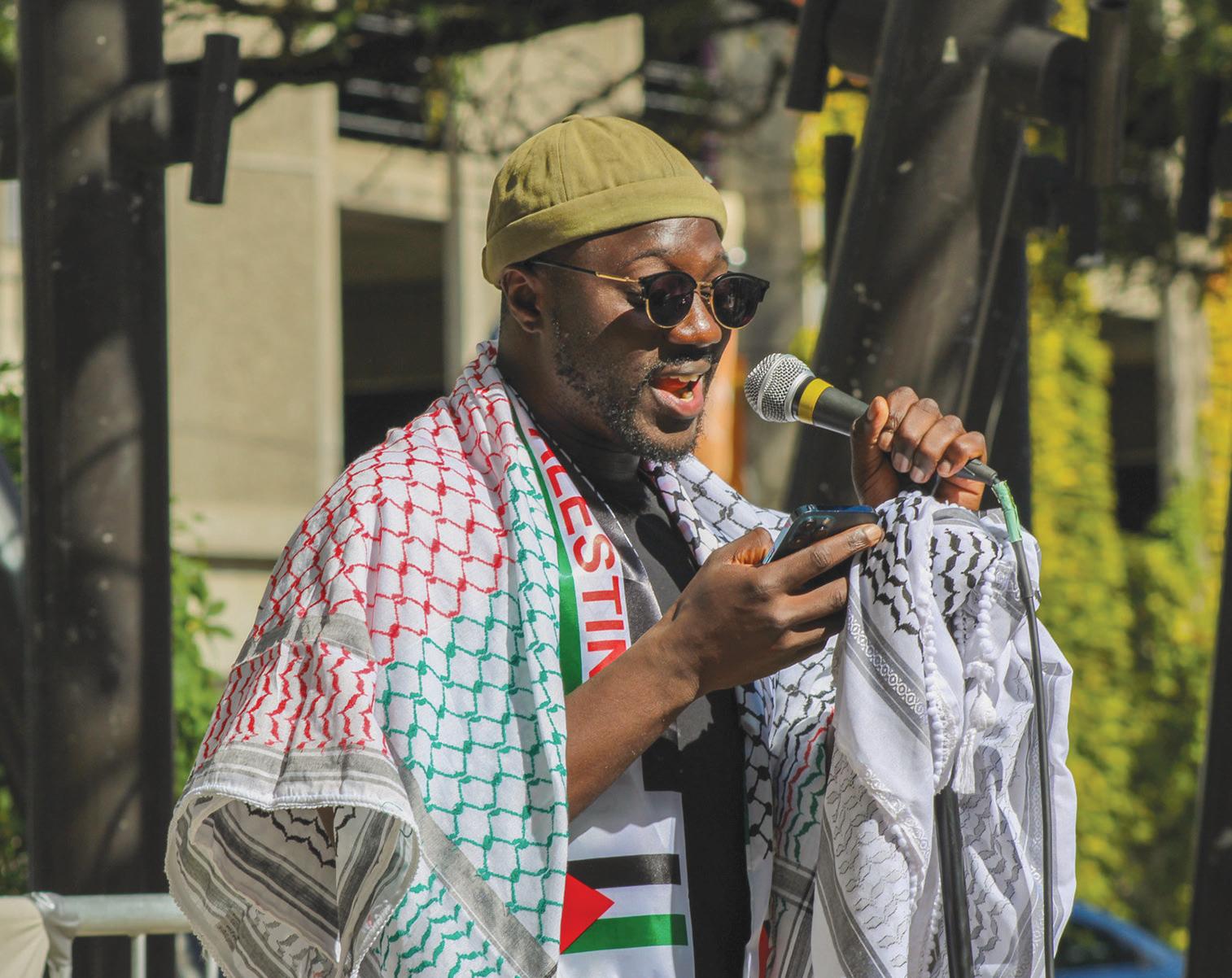
Oct. 10 — Momodou Taal, the suspended international graduate student activist, will remain banned from campus, but is no longer at risk of losing his student visa and can continue finishing his dissertation remotely, Interim Provost John Siliciano ’75 wrote in a Wednesday email to Taal obtained by The Sun.
Siliciano’s decision is final and brings to a close a two-week-long appeals process that Taal hoped would end with his suspension being overturned. Siliciano also said Taal would no longer be able to teach his First-Year Writing Seminar because it is not a requirement for his degree.
Taal said teaching the FWS — “What is Blackness? Race and Processes of Racialization” under the Africana Studies and Research Center — was valuable for his academic career.
“There was a process of development for me … [and] for the students as well, the ability to kind of discuss what it means to be Black, what is Blackness and in my
course how they relate to the spaces in which they’re in,” Taal told The Sun.
Taal was suspended on Sept. 23 after he participated in a pro-Palestinian protest that shut down a Statler Hall career fair featuring defense contractors L3Harris and Boeing. At the career fair disruption, Taal entered Statler Hall against orders from University officials and failed to leave when asked, according to a complaint Cornell University Police Department Lieutenant Scott Grantz ’99 filed with the University.
Taal appealed his suspension first to Vice President for Student and Campus Life Ryan Lombardi, who, according to Taal, denied it “after one business day,” before Taal appealed the decision to Siliciano. Taal has disputed the charges against him and repeatedly said the University has not provided him with due process.
“I maintain that all my actions have been peaceful and in accordance with my First Amendment rights,” Taal posted on X late last month, after Lombardi struck down his first appeal.
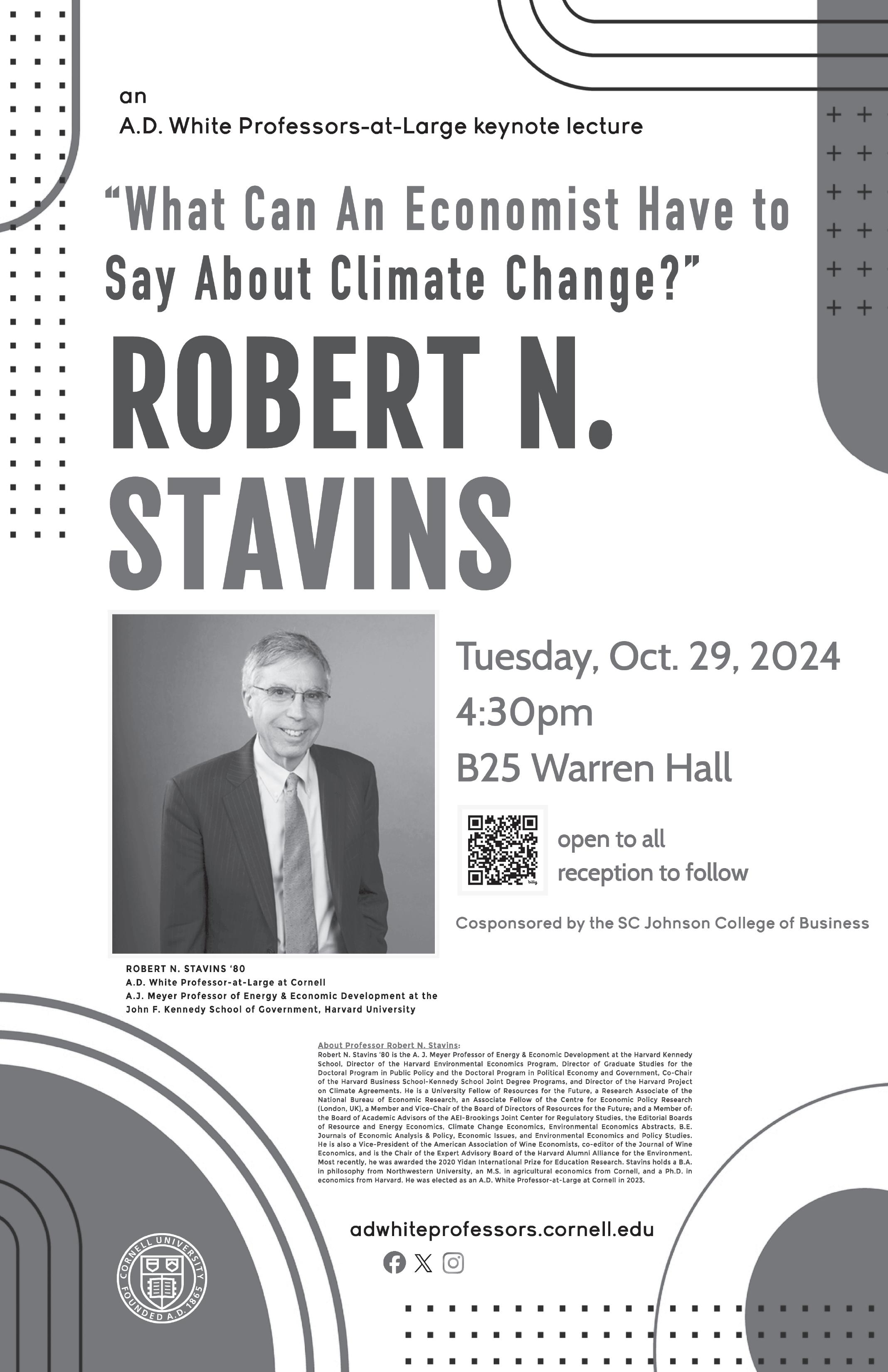
Behaviorally Targeted SMS Reminders Improve Smallholder Adoption of Sustainable Agricultural Practices 11:15 a.m. - 12:05 p.m., 109 Ives Hall
Econometrics Workshop With Sid Kankanala 11:40 a.m. - 12:55 p.m., 204 Uris Hall
Bat Flight With Cold Wings: Biomechanics and Thermoregulation in Flying Bats With Andrea Rummel Noon - 1 p.m., Lecture Hall 3 Vet Research Tower
Invisible Weapons: When Uncontentious Politics Undermine Democracy With Marcus Board Noon - 1:15 p.m., G08 Uris Hall
Comparative Ecophysics of Nectarivory With Alejandro Rico-Guevara 12:30 p.m. - 1:30 p.m., A106 Corson/Mudd Hall
Miles to Meters: Can Laser-driven Accelerators Supplant Large-Scale Facilities? With Manuel Hegelich 4:15 p.m. - 5:30 p.m., 700 Clark Hall

Tomorrow
Inventing the Cartesian Mind With Alison Simmons 10 a.m. - 11 a.m., 44 Klarman Hall
Fostering Antiracist Practices in Pedagogy and CommunityEngaged Learning 11:30 a.m. - 1:30 p.m., 160 Mann Library
Integrating Geospatial Science in Agriculture With Susan Hoskins Noon - 1 p.m., Virtual Event
Data-Model Convergence for a More Reliable and Resilient CyberPhyscial Power System With
Te Sun’s Editorial Board took time of from hard-hitting journalism to enjoy their Fall Break. See what they’re up to in this week’s special edition of Sunbursts
By SUN PHOTOGRAPHY DEPARTMENT


By KATE TURK Sun Contributor
Oct. 10 — Interim Provost John Siliciano ’75 was booed by over 30 faculty members after he responded dismissively to speakers’ concerns regarding the University’s use of temporary suspensions during a Wednesday Faculty Senate meeting.
Earlier in the meeting, Siliciano was given 10 minutes to discuss the use of academic and non-academic suspensions at Cornell. He discussed how temporary suspensions allow the University to respond quickly to potential disciplinary infractions without sifting through “thick” policy, but acknowledged that these measures can be “inherently speculative” and “restrictive” before adjudication.
Siliciano said that a temporary suspension should be issued only with credible evidence and when a student presents a significant potential of harm to the University.
Following his initial statement, a series of faculty members spoke out against the University’s use of such suspensions, which Prof. David Bateman, government, deemed “highly questionable.”
After four members had been given the floor to critique the policy, Siliciano responded, putting his hands in the air in a fruitless attempt to calm the crowd, and saying of faculty responses, “I realize this is, in some sense, theater.”
Instantly, the room erupted with a chorus of boos and scattered jeering, including a faculty member yelling, “Shame on you!” and another inquiring, “Why are you being so flipping dismissive of these legitimate concerns?”
Following the immediate backlash, six minutes were added for continued discussion, and a queue of speakers had to be sent back to their seats so that the meeting was not excessively long. Faculty concerns surrounded the “thin” process that justifies temporary suspensions, as well as the liberality with which the University has given out suspensions over the past year.
While Siliciano never mentioned any specific cases in his statements, the suspension of Ph.D. student Momodou Taal was continually referenced in faculty responses. Taal is an international student facing deportation after he was suspended for participating in a pro-Palestinian protest that shut down a Sept. 18 career fair featuring defense contractors L3Harris and Boeing.
Both Prof. David Bateman, government, and Prof. Tracy McNulty, comparative literature, criticized the administration’s characterization of Taal as a violent, repeat offender, because he has never been charged with violence, and of his three formal code violations, none have yet been investigated or adjudicated. Later in the meeting, Prof.
Beth Milles, performing and media arts, stood in front of the Faculty Senate to say that “theater is not a folly and should not be made fun of,” condemning Siliciano’s earlier statement.
Siliciano then responded, “I do apologize for my remarks. It was a stupid statement. That’s all I can say about that — it was a stupid statement, and I regret it.”
The Faculty Senate also introduced a resolution to condemn Vice President for
University Relations Joel Malina for his “violations of academic freedom,” based on statements he made during a Sept. 30 meeting with Jewish parents. At that meeting, Malina said that faculty members’ “in-class activities will be scrutinized.” He later clarified his remarks, stating that he intended to reference a University policy statement.

By HAMNA WASEEM Sun Staff Writer
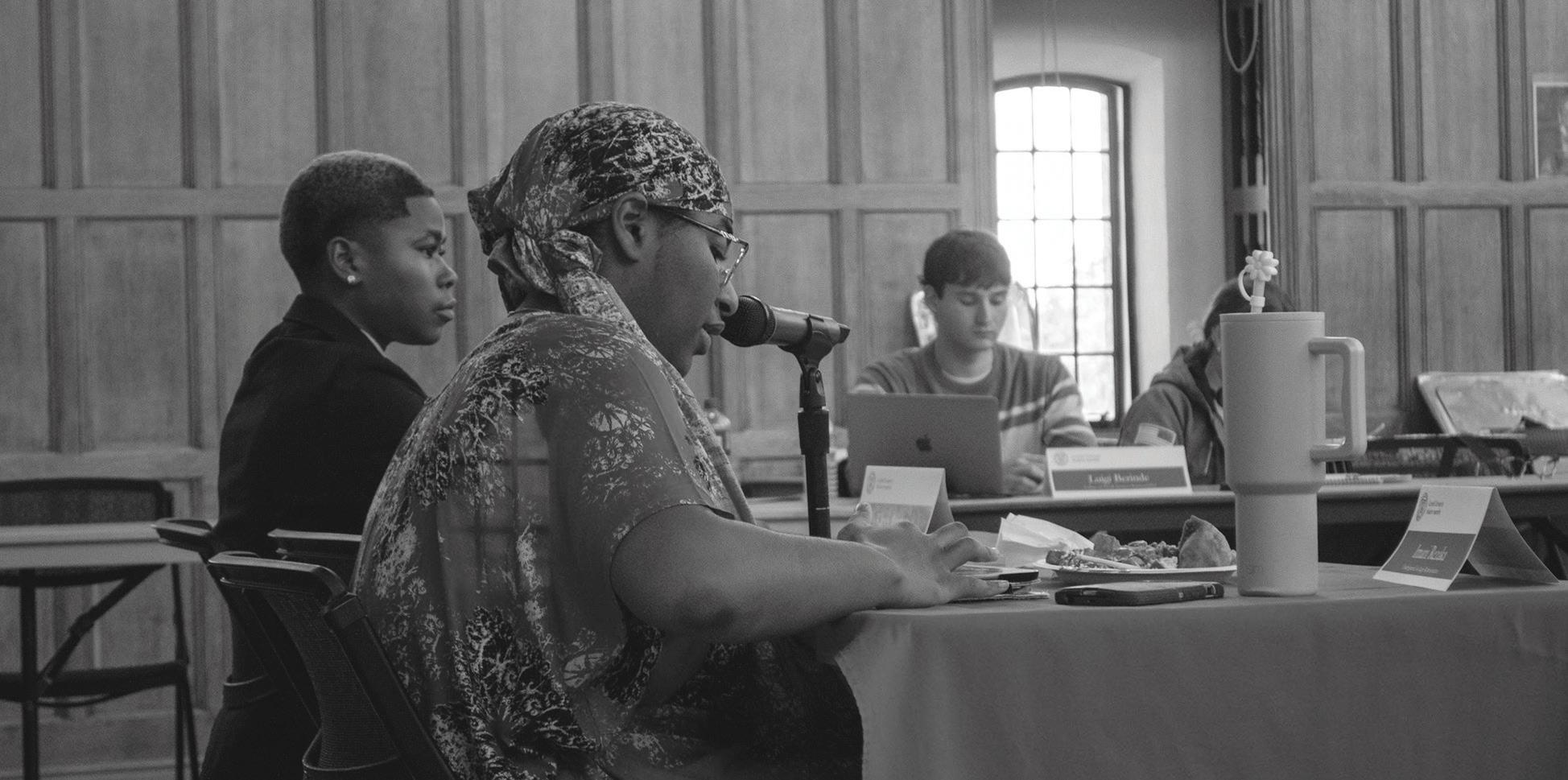
Oct. 12 — The Student Assembly voted on Thursday to indefinitely shelve a resolution calling on the Board of Trustees to cut financial ties with nine weapons manufacturers after several Assembly members expressed concern.
Resolution 8: Calling for Divestment from War Weapons Manufacturers followed up on a referendum last spring that saw most undergraduate voters vote for the University to divest from weapons manufacturers arming Israel, including Boeing and Lockheed Martin, among others. That referendum was ultimately rejected by former President Martha Pollack in May.
The resolution was sponsored by S.A. Undesignated Representative At-Large Karys Everett ’25 and Undesignated At-Large Representative Imani Rezaka ’25. In an interview with The Sun, Everett voiced disappointment in the S.A.’s decision.
“I am unsurprised that there is little credibility in the Assembly as a whole when students have repeatedly stepped forward, repeatedly stepped up, did the referendum last year, expressed how they felt and what they needed to see from the Student Assembly. And those actions were not taken,” Everett told The Sun after the S.A. moved to postpone the resolution indefinitely.
Unlike the referendum, which was targeted toward the war in Gaza, the resolution was not intended for one specific state, the sponsors said.
This was brought into question by College of Engineering Representative Jeffery Lederman ’26 who pointed out that a line in the resolution alluded to a weapons manufacturer supplying an unnamed state with missiles and bombs. Lederman asked the sponsors to clarify what the state being referred to was since the resolution claimed not to be targeted at any specific entity.
“There is no single state that is funded by these weapons manufacturers. There are many states,” Everett said. Everett proposed a motion to amend the typo, but the S.A. did not pursue the matter further.
Several Assembly members called into question last spring’s divestment referendum, which the resolution used as evidence that divestment was the majority opinion of the student body.
Last spring’s referendum stated that Israel had committed a “plausible genocide” in Gaza, alluding to a widely misinterpreted International Court of Justice decision in South Africa’s case against Israel. Students With Disabilities Representative Michael Scali ’26 said the assertion there was a plausible genocide in Gaza was unfounded, given that the ICJ did not actually judge whether the claim was likely or not yet. That wording heavily swayed how students voted, he added.
Oct. 12 — “All of a sudden, the joy I was having with my friends turned into something completely different,” Atir Vinnikov, a survivor of the Nova Music Festival massacre and Israeli army sharpshooter, told a crowd of about 40 at a Tuesday night Cornell Hillel event.
Throughout the week of Oct. 7, the one-year anniversary of the Hamas-led attack on Israel, Hillel organized four events, including a vigil, a talk from Vinnikov, a documentary screening and a Torah lesson, to honor those taken hostage and killed.
A vigil at Ho Plaza on Monday, Oct. 7 marked the start of the memorial week, where 500 attendees came together, some draped in Israeli flags and many holding candles, to mourn and pray for victims and those held hostage from the Hamas-led attack one year ago.
At the Tuesday night talk, Vinnikov said he was at the Nova Music Festival, about a mile from the Gaza Strip, when, at about 6:30 a.m., rockets began firing nearby. Vinnikov and his friends evacuated, seeking shelter in nearby fields until a local Bedouin man sheltered him in his home.
Vinnikov said he owes his life to this man, with whom he still keeps in contact.
Maya Weisberg ’26, vice president of Hillel, said that the vigil and the evening with Vinnikov helped Jewish Cornellians grieve together and offer each other support.
“The vigil was really impactful because we had a large number of people, and it makes you realize that you’re not alone,” Weisberg said. “[These events] provide a space to come together and remind each other that we’re strong and resilient and that we’re going to get through this.”
Cornell University Police were stationed directly outside of both the Vinnikov talk and the vigil. Weisberg further commented on the significance of having a safe environment for Jewish students on campus to gather together, especially in times of tragedy.
“Especially in the face of rising antisemitism and hostile campus climate at times, to see so many people come out and support makes people feel like they have a place on campus and that their experience is valid,” Weisberg said.
On Wednesday, Oct. 9, Hillel also collaborated with Cornellians for Israel for the screening of the documentary “Supernova: The Music Festival Massacre.” Members of the clubs gathered to watch the documentary, which featured interviews with survivors and videos taken as Hamas gunmen fired on Nova Music Festival revelers.
To continue reading this article, please visit www.cornellsun.com.
By GRACE LIU Sun Senior Writer
Oct. 10 — For over a decade, touch-and-go construction has defined McGraw Hall. Its latest construction plan — a $110 million renovation project that will renew the building’s interior — is set to begin in January.
In the months before the building’s three-year construction period begins, students and faculty have been preparing their transition to new spaces while also trying to maintain normal operations in the building.
The archaeology, anthropology and history departments’ faculty offices and labs will move out of McGraw at the end of the semester into temporary spaces in the Mary Ann Wood building on West Campus, Stimson Hall and Olin Library.
All physical objects in the anthropology and archaeology collections will move to the newly constructed Anthropology Collaboratory in Olin Library, set to open in January, according to Warren Petrofsky, associate dean of administration in the College of Arts and Sciences.
Prof. Adam Smith, anthropology, said that while “packing and moving are never fun,” the new facilities in Olin and McGraw will enhance capacities for archaeological research, teaching and work on campus.
While a line of fencing has surrounded the perimeter of McGraw throughout the Fall 2024 semester, by January, the entirety of McGraw will be enclosed with similar fencing to protect the public from construction site safety hazards.
“A lot of professors have to uproot their offices, and a lot of people don’t really know where they’re being moved to yet.”
Jeff Foote ’10
As the affected departments, faculty and students adjust to these changes, graduate student Sarah Orsinger said that the biggest problem for many archaeology students has been trying to access materials in collections for research.
“We’re trying to use the materials in the collections, but at the same time it has to get packed up,”

Orsinger said. “A lot of professors have to uproot their offices, and a lot of people don’t really know where they’re being moved to yet either, which makes it hard, because it’s like ‘Oh, I have this resource for you, but I don’t quite know when you’ll be able to get it.’”
“The seating is kind of interesting in the classroom because there are these poles, and so you have to kind of arrange the desks around them.”
Graduate student Sarah Orsinger
Orsinger spoke about a fellow graduate student who wanted to access materials for a class he currently TAs for, but would not be able to access the materials until May since items are currently packed away.
“Thankfully, what I’m doing for research doesn’t require a lot of stuff in those collections, but for students that it does require, you’re kind of on a waiting period just to even get your hands on it, which is annoying,” Orsinger said.
Sana Ghauri ’27 said that due to the construction, the seating in her archaeology class in the Landscapes and Objects Lab is partially obstructed.
“The seating is kind of interesting in the classroom because there are these poles, and so you have to kind of arrange the desks around them,” Ghauri said. “It’s annoying, but it’s not too bad.” McGraw’s Outdated Infrastructure
Although construction has brought inconveniences, students also reported issues with the building’s old and updated infrastructure.
For instance, Annabelle Behnke ’27 said that the current old heating and cooling system in McGraw is often disruptive to her anthropology class.
Behnke said that during her class, the classroom gets very warm, but students have a hard time hearing each other when the air conditioning unit in the window is turned on, causing them to intermittently turn the AC on and off every 10 to 15 minutes.
“It’s kind of this never-ending cycle that kind of interrupts the flow of class and discussion, which is a little bit frustrating,” Behnke said.
By SKYLAR KLEINMAN Sun Senior Writer
Oct. 9 — After nearly two dozen states banned or restricted access to abortion following the overturn of Roe v. Wade in 2022, New York voters will determine whether the state protects abortion in its state constitution this election.
The Equal Rights Amendment, also known as Proposal 1, makes New York one of ten states where voters will have the opportunity to vote for an abortion-related state constitutional amendment.
Proposal 1 guarantees “equal protection” against discrimination based on “sexual orientation, gender identity, gender expression, pregnancy, pregnancy outcomes and reproductive healthcare and autonomy,” in addition to traits that have been protected under past laws, such as race, color, ethnicity and national origin.
If passed, the proposal would amend Article I, Section 11 — the Bill of Rights to the New York State Constitution — to expand on current protections against discrimination on the basis of race and religion.
Progressive organizations such as the American Civil Liberties Union and Planned Parenthood have rallied behind the amendment, claiming that
it will effectively protect access to abortion, LGBTQIA+ rights and other issues that have been in unstable political territory since 2022.
Sasha Ahuja, the campaign director for pro-ERA organization New Yorkers for Equal Rights, hopes that voters will consider the “long-term” protection of their rights when considering Proposal 1 on the ballot.
“In June of 2022, Americans – and New Yorkers – were shocked that the Supreme Court overturned protections that we thought were safe all across the country,” Ahuja said. “It’s just a stark reminder that laws can be changed at any time, and the strongest and most protective thing we can do is make sure that our rights and freedoms are protected in our state’s constitution.”
In light of Dobbs, the New York legislature passed Proposal 1 in its second consecutive session in Jan. 2023, paving the way for the proposal to appear on the ballot this election.
According to Ahuja, the proposal will “close loopholes” in existing protections against discrimination in New York’s constitution.
In light of Dobbs, the New York legislature passed Proposal 1 in its second consecutive session in Jan. 2023, paving the way for the proposal to appear on the ballot this election.
According to Ahuja, the proposal
will “close loopholes” in existing protections against discrimination in New York’s constitution.
Though legislation such as the New York Human Rights Law, the New York Reproductive Health Act of 2019 and the Marriage Equality Act of 2011 offer some protection against discrimination, no current constitutional provision protects the broadened categories outlined in the proposal.
New Yorkers for Equal Rights is one of several progressive groups concerned about the stability of these laws while they lack a constitutional basis. These concerns echo those of the New York State Legislature which expressed the need to adopt a “modern vision of equality” that “demands comprehensive equal protection” through the proposal.
GABRIEL LEVIN ’26
Editor in Chief
MAX FATTAL ’25
Associate Editor
HENRY SCHECHTER ’26
Opinion Editor
MARIAN CABALLO ’26
Multimedia Editor
MING DeMERS ’25
Photography Editor
ERIC HAN ’26
Arts & Culture Editor
SYDNEY LEVINTON ’27 Arts & Culture Editor
JADE DUBUCHE ’27
Social Media Editor
JESSIE GUILLEN ’27
Graphics Editor
JOLIN LI ’27
Layout Editor
PARIS CHAKRAVARTY ’27
Layout Editor
LEILANI BURKE ’25
Assistant Photography Editor
KARLIE McGANN ’27
Assistant Photography Editor
KIRA WALTER ’26
Lifestyle Editor
DANIELA ROJAS ’25
Assistant Lifestyle Editor
NICOLE COLLINS ’25
Weather Editor
The Sun’s View
JULIA SENZON ’26
Managing Editor
ERIC REILLY ’25
Assistant Managing Editor
MARISA CEFOLA ’26 News Editor
MATTHEW KIVIAT ’27 News Editor
CHRISTINA MacCORKLE ’26 News Editor
JANE McNALLY ’26 Sports Editor
GABRIEL MUÑOZ ’26 City Editor
KAITLIN CHUNG ’26 Science Editor
LAINE HAVENS ’25 Science Editor
ANUSHKA SHOREWALA ’26
Assistant News Editor
OLIVIA HOLLOWAY ’25
Assistant News Editor
DOROTHY FRANCE-MILLER ’27
Assistant News Editor
DINA SHLUFMAN ’27
Assistant News Editor
ALLISON HECHT ’26 Newsletter Editor
Incumbent Rep. Marc Molinaro (R-N.Y.) and his progressive challenger, Josh Riley, have been battling for a House seat in one of the nastiest — and most consequential — bids for Congress that this election cycle has seen. The two are running to represent N.Y.19, which includes Ithaca and large swaths of the region surrounding Cornell.
The contrast between the candidates couldn’t be more stark.
Molinaro is, without question, a sell-out, just another stooge in former President Donald Trump’s crusade against pluralistic democracy. His recent, full embrace of Trumpism is particularly surprising given that, just last year, Molinaro was rated the second-most bipartisan member of Congress, according to the Lugar Center.
Now, to cling to power, he is refashioning his political image around tearing down and demonizing immigrants; amplifying racist conspiracy theories, including the Trump-Vance campaign’s horrible lie about Haitian migrants in Springfield, Ohio; and rallying against reproductive rights.
Molinaro’s switch-up has been so extreme that one-time allies and right-leaning moderates are turning away from him, baffled.
On the other hand, Josh Riley has fought for working- and middle-class Americans his whole life: At the Department of Labor, he helped workers affected by outsourcing; as a lawyer, he took on Wall Street, winning a landmark civil rights lawsuit that guaranteed that low-income children receive the healthcare they deserve; and now, he’s running to represent our community.
Refusing to accept money from corporate PACs, Riley has still managed to outraise his rival, even as Molinaro rakes in wealthy contributions from elite outsiders, including more than half a million dollars from the richest man in the world, Elon Musk’s super PAC.
Cornellians don’t have to stand by and watch as Molinaro continues to embarrass Tompkins County on the national stage. Students are eligible to register in Ithaca by Oct. 26 and cast their votes in one of America’s tightest House races. Two years ago, Molinaro beat Riley by 4,495 votes — that means just one-sixth of Cornell’s total student body could be enough to sway this election — and possibly give the House majority to the Democrats.
This November, the choice in N.Y.-19 is beyond obvious. It’s a matter of reproductive freedoms against draconian restrictions, labor rights against corporate greed, and compassionate immigration policy against vile, racist vitriol. The Sun wholeheartedly endorses Josh Riley and calls on all residents of Tompkins County, including every Cornell student and faculty member, to cast their votes wisely.
Nick Wilson is a third year student in the New York State School of Industrial & Labor Relations at Cornell. His biweekly column Interim Expressive Activity provides a perspective on goings-on on campus from those who believe that Cornell should act less like a hedge fund and more like a responsible stakeholder in the Ithaca and global communities.
Last week, three students, hereby dubbed the “Statler Three,” were arrested by the Cornell University Police Department following a protest for divestment from weapons manufacturers facilitating the genocide in Palestine. These arrests come after the non-academic suspension of more than a dozen other Cornell Students. Interim President Kotlikoff stated that Cornell has identified “nearly 20” individuals who participated at a career fair disruption on Wednesday, Sept. 18. Of the individuals contacted by Cornell administration, the vast majority have identified as Palestinian, Indigenous, Jewish, Black or an otherwise marginalized identity. For my column this week, I am sharing a statement from the Coalition for Mutual Liberation regarding the Statler Three:
Over these past two days Cornell Police have arrested three students for their alleged involvement in the pro-Palestinian movement. The University tries to silence their voices but we will be heard, for this movement is bigger than three individuals. These arrests are insignificant compared to the consequences that previous protesters, journalists and resistance fighters faced while fighting for Palestinian liberation. This movement will never die, for we the people are first and foremost scholars that bear the responsibility to act — and act we will. We are taught time and time again that we learn so that we may use that knowledge to better the world we live in. But how can we do so in a university that ignores their role in the active genocide and dispossession of Indigenous peoples across this country and around the world? We call on you to fulfill your roles as scholars and impart this knowledge to you all here.
We are now well over a year into the most documented genocide in history. As of June 2024, the Lancet Journal estimated that there may have been at least 186,000 deaths attributed to the current genocide in Gaza. The Gaza Health Ministry recently released the names of all the martyrs, the first 14 pages of which were children under one year old. The Israeli ethno-state continues its regime of settler-colonial expansion, now turning its eyes to Lebanon, where thousands have been killed already by incessant bombings and even more have been displaced. This is not some far-off conflict — members of our own Cornell community grieve and worry for their family and friends trapped in the endless nightmare the Israeli occupation inflicts upon Palestine and Lebanon. We also grieve the losses of members of our international scholastic community; students, professors and centuries-old universities, all lost to rubble.
And yet, the Cornell administration is spending considerable resources to repress opposition to their complicity in genocide. They have renovated buildings to install more cameras, fenced off the former encampment area and employed more cops for surveillance. Cornell’s harsh crackdown following the disruption of a career fair that involved weapon manufacturers shows their commitment to their moneyed interest. So much so that, despite the Cornell undergraduate body voting 70 percent in favor of divestment from 10 weapons manufacturers last semester, the previous Cornell President refused to call a vote for divestment at the following Board of Trustees meeting. Cornell administration clearly favors the interests of trustees like Kraig Kayser, the Chair of Cornell’s Board of
Trustees and director and major shareholder at weapons company Moog, over the demands of over 5,000 undergraduates who voted to divest. Cornell is not only violating its own rules but doubling down on its depravity by arresting and suspending us out of fear of the precedent that the Statler Hall rally sets. The administration is responding so intensely because the masses have shifted their tactics. No longer are they demanding the University change, but rather taking matters into their own hands by refusing to welcome weapons manufacturers into a place of learning and nurturing. The students are asserting themselves as not only the majority voice, but the true decision making body of this university. While some may try to paint the Statler Three as enemies of the student body, we would like those individuals to question their own administration’s integrities. These administrators are not simply cogs in a system, many of them have agency to push for change but instead choose to grease this death machine. Less than two months after Martha Pollack refused the call for divestment, the International Court of Justice concluded that Israel’s occupation of the Gaza Strip is “illegal” and must “immediately cease.” What is the purpose of an institution that willingly goes against international law? Whether in Lebanon, Gaza or the West Bank, there is no doubt in our minds that Israel will commit massacre after massacre in the weeks leading up to the student arrestees’ court dates. These massacres will be carried out using weapons from companies that Cornell invests in, collaborates with, and has helped research weapons for. By the time the three arrestees are arraigned, tens of thousands of Palestinians will most likely die at the hands of Israel. Cornell claims to hold “an enduring commitment to affirming the value of diversity and by promoting an environment free from discrimination.” However, Cornell has created a system that privileges certain groups while demonizing others based solely on political beliefs. The methods that Cornell administration has used to identify individuals have systematically targeted the most marginalized communities. These targeted students are not permitted to be on Cornell’s campus except to attend classes. In actuality, the University is in fact enforcing what is effectively a protest ban. Limiting suspended students to only academic spaces inhibits us from the freedom of speech that we are all entitled to.
Ultimately, however, the repression and struggle our students face is a drop in the bucket compared to the suffering the Israeli ethno-state inflicts upon the people of Palestine and Lebanon, the suffering that Cornell actively funds. Any amount of discipline we face at the hands of Cornell’s administrators, we know we can handle; for if there is one thing we have learned from Palestine, it is that we must never give up on each other. Those of us in CML plan on living long, beautiful lives, within which the world will see a free Palestine: A world which finally grants the wretched of the earth the paradise they have long deserved; A world in which all life, human or otherwise, is given the love, kindness and nourishment we have long forgone. We call on all members of the Cornell community to reawaken your empathy and cut all ties this University has, financial or otherwise, with all weapons manufacturers and military defense contractors. We have armed you with knowledge. Will you act?
By TAYLOR RIJOS Sun Staff Writer
The first human case of Eastern equine encephalitis in New York State since 2015 was reported in Ulster County last month.
Eastern equine encephalitis, also known as EEE and “Triple E,” is an alphavirus that spreads to humans and several animals such as horses and emus through the bite of infected mosquitoes. EEE is most common from late spring into early fall, peaking in summer months when mosquitoes are most active.
Human and animal cases are both rare. An average of 11 human cases in the US occur annually, though outbreaks exceeding 15 people have occurred in the past. As of Oct. 14, 15 cases have been reported across eight states, including New York.
Among horses, 112 cases were reported across the U.S. in 2021, including five in New York.
According to Prof. Elisha Frye, population medicine and diagnostic sciences, 18 equine cases were diagnosed in New York State as of Oct. 2. 15 of the cases were diagnosed at Cornell University’s Animal Health Diagnostic Center.
“This is definitely the most Triple E cases I’ve seen in one season,” Frye said.
EEE is endemic in North, South and Central America and the Caribbean, particularly around freshwater hardwood swamps in the Atlantic and Gulf coast states and in the Great Lakes regions.
Birds living within the swamps are the reservoir of EEE, which is spread by mosquitoes that feed on primarily birds, such as Culiseta melanura.
For humans and horses to become infected with EEE, bridge vectors must bite an infected bird and then bite a human or horse to spread infection. For EEE, bridge vectors are any mosquito species that can transmit a virus from wild birds to uninfected mammals. Common bridge

vectors include Aedes sollicitans, Coquillettidia perturbans and Ochlerotatus canadensis.
Humans and horses are dead-end hosts of EEE. This means that the virus cannot be spread between humans and horses and to mosquitoes that bite infected humans and horses.
According to Prof. Laura Harrington, entomology, who is also the director of the Northeast Regional Center for Excellence in Vector Borne Diseases, the ecology of EEE is not yet fully understood.
“I would say that there’s still a lot we don’t know about the disease dynamics,” Harrington said. “Birds are moving [EEE], … but, in recent years, they’ve found reptiles and amphibians that are infected in the wintertime. So some people are thinking maybe it’s overwintering.”
Overwintering refers to the maintenance of
the virus in ecosystems in temperate regions. The virus may be overwintering in other animals and mosquitoes, allowing the virus to remain in the environment.
Human cases of EEE are detected through passive surveillance, where laboratories and health departments report cases when they come up. EEE is a nationally notifiable disease, meaning that all detected cases must be reported to the Centers of Disease Control and Prevention.
In New York, all equine cases are also mandatory to report.
EEE is considered a select agent, according to Frye. Select agents are any biological agents or toxins that pose a severe threat to human, animal or plant health.
Mosquitoes are also tested for EEE. In known EEE hotspots, mosquitoes will be col-
lected early in the mosquito breeding season. A mosquito pool, which is formed by combining mosquitoes by species, location and collection date, is tested to identify if there is disease within the mosquitoes.
“This year, the mosquito populations were about standard, but there were many more mosquito pools ... positive for EEE,” Harrington said. “That was a good early warning that this was going to be a bad year and something needed to be done.”
According to State Health Commissioner Dr. James McDonald, mosquitoes carrying EEE have been detected within 15 counties across New York State this year.
Anyone can become infected with EEE, but people younger than 15 and older than 50 are more likely to develop severe illness. Many people who are infected with EEE do not have any symptoms. The majority of symptomatic cases experience fever, chills, joint pain and muscle pain that lasts for one to two weeks. While only five percent of cases develop meningitis or encephalitis, an estimated 30 percent of these cases die, and many survivors experience lifelong neurological problems after recovery.
Horses can also be asymptomatic or have mild symptoms from EEE. Horses diagnosed with EEE often show signs of depression, fever and lack of energy. Horses often present severe neurological symptoms, including paralysis, tremors, seizures and weakness. An estimated 90 percent of horses presenting neurological symptoms from EEE will die.
There is currently no vaccine available for humans. The best way to reduce EEE cases is to prevent mosquito bites.
To continue reading this article, please visit www.cornellsun.com.
Taylor Rijos can be reached at tlr65@cornell.edu.
By JAKE ZAJKOWSKI Sun Contributor
New York’s hidden cornucopia can be found within walking distance of Cornell — 11 small farms spanning 325 acres, featuring hundreds of varieties of produce.
These farms include apples — New York’s specialty — but also spicy peppers and the newest varieties of pumpkins, tomatoes, gourds, potatoes and more.
In the fall, certain harvests rise to the top of popularity lists for consumers and farmers alike.
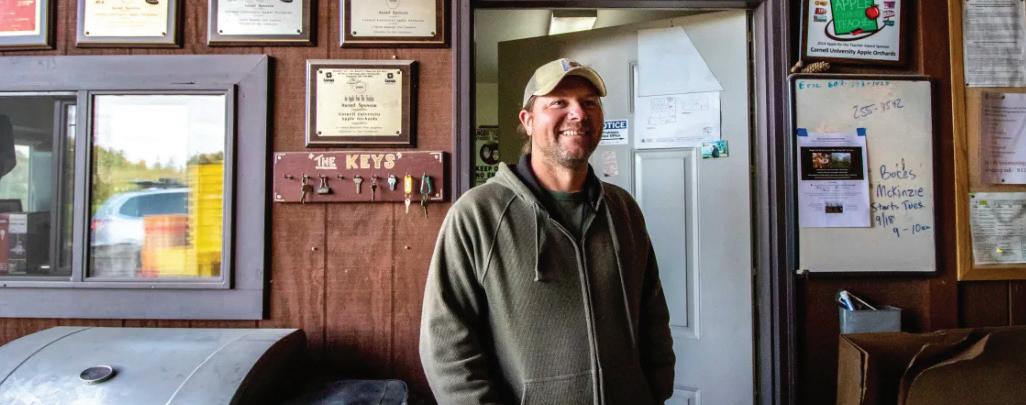
“Right now, it’s the SnapDragon apple that was developed by Cornell, which is the most popular, followed by Honeycrisp,” said John Owens, the manager of Cornell Orchard.
Cornell Orchard grows 50 varieties of apples on eight acres off Dryden Road. The property spans 22 acres, with additional acreage dedicated to grapes, stone fruits and berries.
By early October, Cornell Orchard is in the middle of harvest for fresh and cider apple varieties, according to Owens. Cornell Orchard is one of 674 commercial orchards in New York, contributing to the state’s title as number two for apple production in the nation, according to the United States Apple Association.
Those who believe they are eating a fresh Cornell-grown apple on campus in late fall would be correct. Cornell Orchards supplies the apples not used in research to the dining halls. With excess, they sometimes sell to P&C Fresh, a local supermar-
ket with locations in Ithaca and Cortland, explained Owens.
“It’s been a good season so far,” Owens said. “We haven’t faced any early spring frost, which often prevents us from having full yields in the fall.”
Researchers at Cornell Orchards examine the economic and environmental viability of commercial tree fruit growers and hard cider production, as well as tree root biology and apple storage life.
While the fruit season unfolds, the vegetable sector is also at its peak. This part of New York’s cornucopia is not small — vegetables, melons and potatoes contribute $500 million to the state’s economy.
Prof. Steve Reiners, horticulture, has spent his career helping produce successful fall vegetables crops in New York.
“This is a very productive season for vegetable growers,” Reiners said.
“Pumpkins, gourds and a wide variety of squash are in peak season.”
There are several advantages to growing vegetables in cooler weather. Cooler temperatures, even after a frost, can enhance the flavors of carrots, beets and kale, which can taste sweeter in the cooler fall months, Reiners explained.
Many people are surprised to learn that New York is among the top 10 states for vegetable production in the country, according to Reiner. Reiner said that the local production “makes you consider the tenuous supply chains and the origins of our food.”
Fall harvests have been an annual event at the University since 1897, when George C. Caldwell established the New York State Agricultural Experiment Station using university farmland to support agricultural production in the state.
However, since then, rising temperatures and shifting Plant Hardiness
Zones — an index developed by the U.S. Department of Agriculture to assess a plant’s ability to thrive in a particular region — have changed the types of crops that can be grown in New York State, Reiners said.
“There are crops that we couldn’t grow in the past that we will be able to grow in the next 20 years,” Reiners said. “At the same time, we continue to face invasive species, new diseases and new insects that we are always trying to stay one step ahead of.”
The need for production research on vegetables will never end, according to Reiners.
Cornell’s agricultural researchers conduct various year-round crop trials as part of its land-grant mission, which aims to advance the lives and livelihoods of New
York citizens through federal funding.
In Cornell’s vegetable fields, plant breeders conduct a variety of trials on commercial crops while developing their own varieties.
Prof. Greg Vogel, integrative plant sciences, leads the lab investigating vegetable varieties for yield, quality and disease resistance. The Vogel Lab started in 2023, addressing the needs of tomato and eggplant growers, gardeners and consumers that the private sector may overlook in the Northeast.
Vogel works alongside several other crop breeders at Cornell’s Ithaca campus. The School for Integrated Plant Sciences has 166 faculty members in teaching and research appointments across New York State, many of whom are working to improve fruit and vegetable yields statewide.
The Agricultural Experiment Station staff supports the management of hundreds of acres of field, in addition to the hundreds of students who use the trials as a learning lab.
“Just two weeks ago, I had around 200 plant science students visit our tomato field. The research we conduct is also for instruction, for students to participate and learn. It’s nice to have that close by,” Vogel said.
On an agricultural college’s campus, the fall harvest can take on a whole new meaning and scale.
Jake Zajkowski can be reached at jwz29@cornell.edu.
By Ella Sanchez
Clicking open the image my friend Anna sends me, my eyes widen with delight. The images of the Vet School are gorgeous: warm, wooden panels lining the walls and ceiling, light pouring in from the massive windows and illuminating the green carpet and yellow furniture. Looking between the colorless, basement classroom with zero natural light in front of me and the pleasant portrait of the Vet School, the comparison was stark. I turn my computer to my friend, watching her eyes light up in a similar fashion as mine did seconds prior. Both of us eagerly typed back our approval. Today just became lunch at the Vet School!
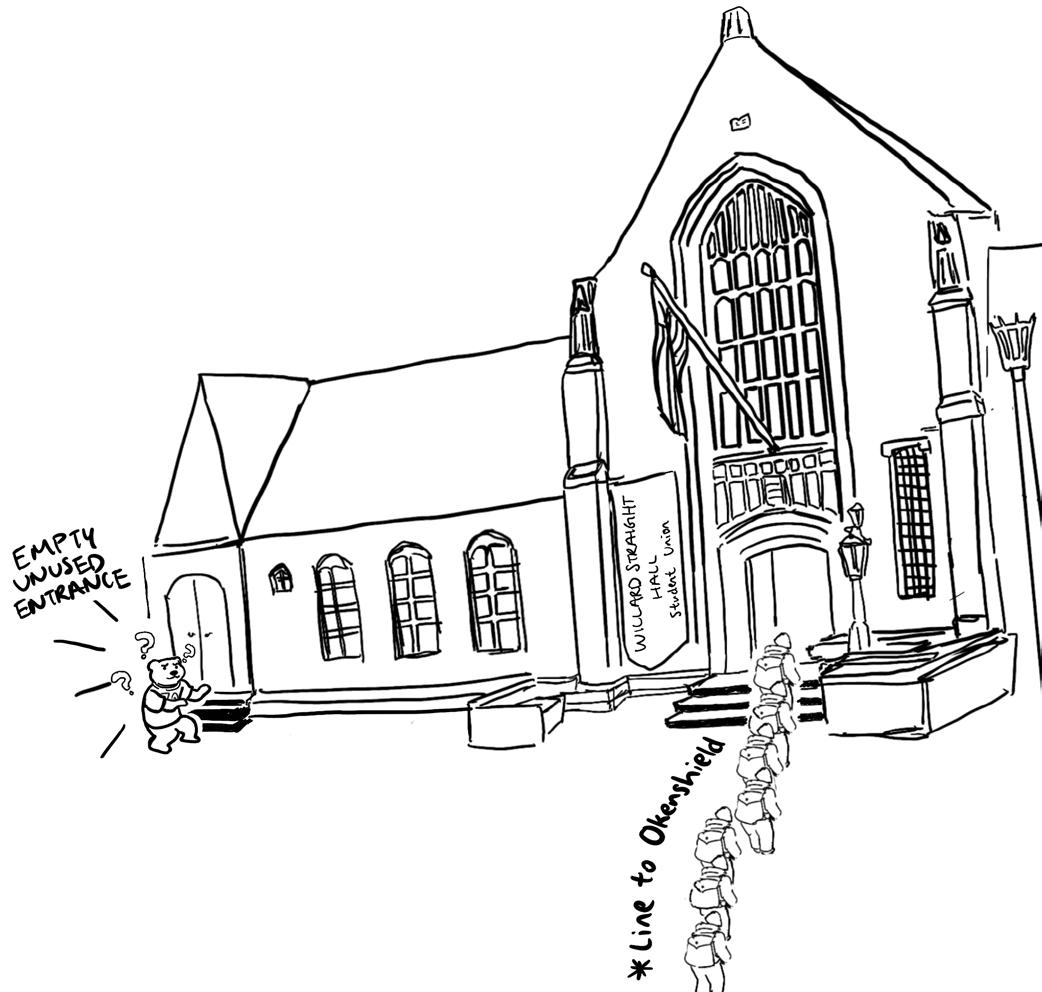
Our lunches were usually spent in Trillium, as Okenshields was a grim ten minute walk to and from the AG Quad to make in our short lunch period. But today, class was canceled; the redundancy of our Friday schedules could finally be broken, and we had the freedom to spend our Big Red Bucks as we chose!
As soon as we are dismissed, we march towards Bus Stop Bagels, where we would meet our other two friends. Opening the GET app, I stare at my quickly depleting Big Red Bucks—soon to be Big Red Bucks broke—and groan for mercy. Usually, I eat at Trillium anyways.
The four of us walk past AG quad, where AG Day is currently underway. After stopping by for some quick pictures with the cows and taking one of the free Chobani yogurt cups, we all make our way down Tower Road. Though I originally attempted to persuade a bus ride, unsettled by the fifteen minute walk, I enjoyed our stroll
Afar more than I anticipated. One of my friends reminds me that we should enjoy the warm air and gentle breeze while we can, before it becomes freezing temperatures and winter winds. She is completely right; after being buried in the basement of our previous class, the fresh air seems to resurrect my energy.
We repeatedly comment on how we’re rarely on this part of campus, all of us never having been past the Dairy Bar. By the time we reach the various greenhouses, we are the only people in the area. Though the emptiness is a bit off-putting as we approach the tall glass buildings, it feels contrarily pleasant; it’s as if we have discovered unmarked territory. The Vet School feels separated from the rest of the campus. You likely think, Well of course it is. It’s light years away from central. To be fair, you’re not wrong, but simultaneously, this part of campus feels like an alcove from the buzz of classes, a momentary pause in the marathon of our schedules.
The building seems to be designed as the crossing of modern architecture and the natural world. The golden lights, lush green floors, wooden ceilings, and yellow accents remove any feeling of synthetic construction; yet the smooth edges and sharp corners appeal to contemporary styles. The four of us journey beneath the tall ceilings to the stairs, climbing our way to the vast win-
ingly small number of my BRBs, I pay without looking at the total and beeline towards the exit. Can’t risk standing there for too long.
We sit outside to enjoy the fresh air again, many others with the same idea. Under the shaded portion of the garden, we dine happily. The food is delicious, which certainly helps lift our spirits.

When we meander to the doors, it appears the universe has granted us another gift—the first one being a canceled class, and the second being a person walking out of the building. The Vet School only allows those with ID to enter. With this perfect timing, we naturally slip through the doors, to be met with arguably one of the prettiest buildings on all of Cornell’s campus.
dows in the back of the open room. The exhilaration of being somewhere you aren’t supposed to flows through my veins as we walk into the cafe. Through the archways, the room opens to various meal options. From the several burger and sandwich options at the kitchen, self-served salads and soups, and grab-n-go pizza slices, we all look around with wonder. I am thoroughly impressed with the variety, my vegetarian friend excitedly pointing out all the options for her as well. After investigating each station, I settled on the Chicken Tikka Masala from the hot bar. As I approach the counter to pay, I glimpse at the drink menu. Remembering the alarm-
With a little less than an hour before I need to head back for class, we explore a bit more. It may be slightly exaggerated to say that it felt like heaven, but truly in that moment, positive attributes of the building continually emerged. From the mass amounts of free seating, which was typically rare to find, to the bathroom stalls that were certainly designed by women (you’ll probably understand if you are relatively active on social media and also a woman), the Vet School appealed more and more.
The ultimate point in our trip, however, is when we enter the library.
It is exactly like the pictures my friend had sent me from the website. The ambiance is elegant, yet comforting, modern yet also naturalistic. The green carpeted floors make it seem like you are stepping on grass, with the warm-toned, wooden tables and bookshelves adding to an earthy atmosphere. The lights were bright, a more amber tone than the other artificial lamps in some libraries. Red, orange, and yellow splashes
of color lightened the room even further, with sunlight streaming in from the floor-to-ceiling windows.
While my friend borrows a charger from the librarian at the front desk, my other two friends and I wander like tourists. We peruse the rows of books, pointing out the cool trinkets, circle the hammock against the window, and ascend the steps to the second floor. Our view of the library is pretty, my mind already drawing images of myself studying among the other students in the room. The natural light turns the room golden, the colorful hues picture-worthy. With a little time left, the four of us sit at one of the tables, a perfect amount of chairs for a perfect afternoon. The view before is certainly a treasure to behold.
The next time I venture back to the Vet School I am alone. It is now Tuesday, and I intend to stay a bit longer to finish my work, to write this article enveloped in an unparalleled ambiance. The sun sets beside me, with the warm glow of the lamp highlighting the keys of my computer.
As I sit and write about my experience that day, a part of me regrets choosing to pitch this topic; part of me wants to keep this place just to myself (which I’m keenly aware is ironic since I’m technically not allowed to be here). However, it is undeniable that the Veterinary School of Medicine is a must-visit spot here on campus—whether you want a good meal or a place to romanticize your studying—even if you only go once. Just make sure you have enough BRBs. Resisting that specialty drink took more willpower than words can describe.
By Mary Ellison
s the weather gets colder and the nights get longer, video games are a great activity for a night in. Halloween is right around the corner, so it’s no secret that students are prepping for the season and thinking about their spooky activities at the end of the month. To honor the Halloween spirit, here are some of my scary video game favorites, just in time for us all to procrastinate studying during the tail end of prelim season. All of these games are available on Steam, which is accessible from any PC. If you don’t have your own gaming setup, the Esports Gaming Lounge in RPCC on North Campus is worth a visit. Resident Evil Village is a tense, exciting first-person survival horror that will keep you on the edge of your seat the entire time you play. The game follows Ethan Winters, the same protagonist from its predecessor, Resident Evil 7: Biohazard, as he searches for his daughter. Ethan must navigate several labyrinths in unfamiliar enemy territory while fleeing dangerous cult members that include vampires, a doll brought to life, a fish creature and a veritable engineering genius with the ability to
reanimate corpses. The world is rich in lore exclusive to the game, while still making little references to previous Resident Evil editions. The abandoned snowy town setting is perfect for our Ithaca (though when winter comes around, we should hope no such monsters come with it).
An indie third-person survival horror reminiscent of the early Resident Evil games, Signalis has the player control a Replika android unit called Elster on a search for her human lover, Ariane. Elster awakens on a crashed spaceship and for most of the game travels through the ruins of a mining facility in order to find out what happened to Ariane. She fights other rogue Replika units throughout her search. Fans of H. P. Lovecraft and The King in Yellow will enjoy many references in these games, and if you enjoy classical music, Signalis gives us many moments of popular pieces like Schubert’s Serenade and Rachmaninoff’s Isle of the Dead.
Whenever it gets foggy, without fail, Ithaca’s thick fog is often characteristic of Silent Hill. Yet another survival horror (I’m sensing a slight trend here), Silent Hill 2 just got a remake
entation, with flavors of Dostoevsky.

and would be the perfect endeavor for someone looking for a spooky game this Halloween. There is a dreamlike, psychological quality to it that isn’t too common in the genre, and its soundtrack is phenomenal. The player acts from a third-person perspective as the widower James Sunderland and embarks on a search for Sunderland’s long-dead wife after he receives a letter from her. Prepare for more monsters, more riddles, and more disori-
Dead by Daylight is another survival horror, but this time it’s online and multiplayer. Four players are designated Survivors, who are trapped in a small area and must repair and power generators to open the gates to their freedom, and a fifth plays as a Killer, who must hunt the Survivors and prevent their escape. Survivors must work together to free each other upon being caught by the Killer. The game allows some character customization as well. Killers can play as many famous names, such as Ghostface, Freddy Krueger, Leatherface, Pyramid Head (whom you would encounter in Silent Hill 2), and Chucky. Additionally, there are some notable appearances for the Survivor role as well, like Lara Croft, David Tapp, Steve Harrington and Leon Kennedy. The character selection option gives various perks to players depending on their choices, making for more unique matches each time.
This one is not quite a survival hor-
ror. Devour is an indie player-versus-environment (PvE) horror game that can be played either alone or with up to three other friends. It has been compared to Phasmophobia, with the same feature of proximity voice chat. Players control members of a cult called the Watchers of Azazel and the goal of the game is to destroy various totems in order to prevent another member of the cult from summoning the demon. Players are not provided with weapons or anything significant to defend themselves from the hostile entities they encounter, except for a flashlight that can drive away the enemies for a time when shined at them. It is very tense and creepy, as you, the player, must navigate near-pitch darkness with no light but that of your flashlight, while also ensuring the safety of your companions. Hopefully these games can scratch your horror itch, prepare you for Halloween, give you something to do while skirting the inevitable cold that will be upon us soon, distracting you from the fast-approaching ghouls at the end of the semester.
By
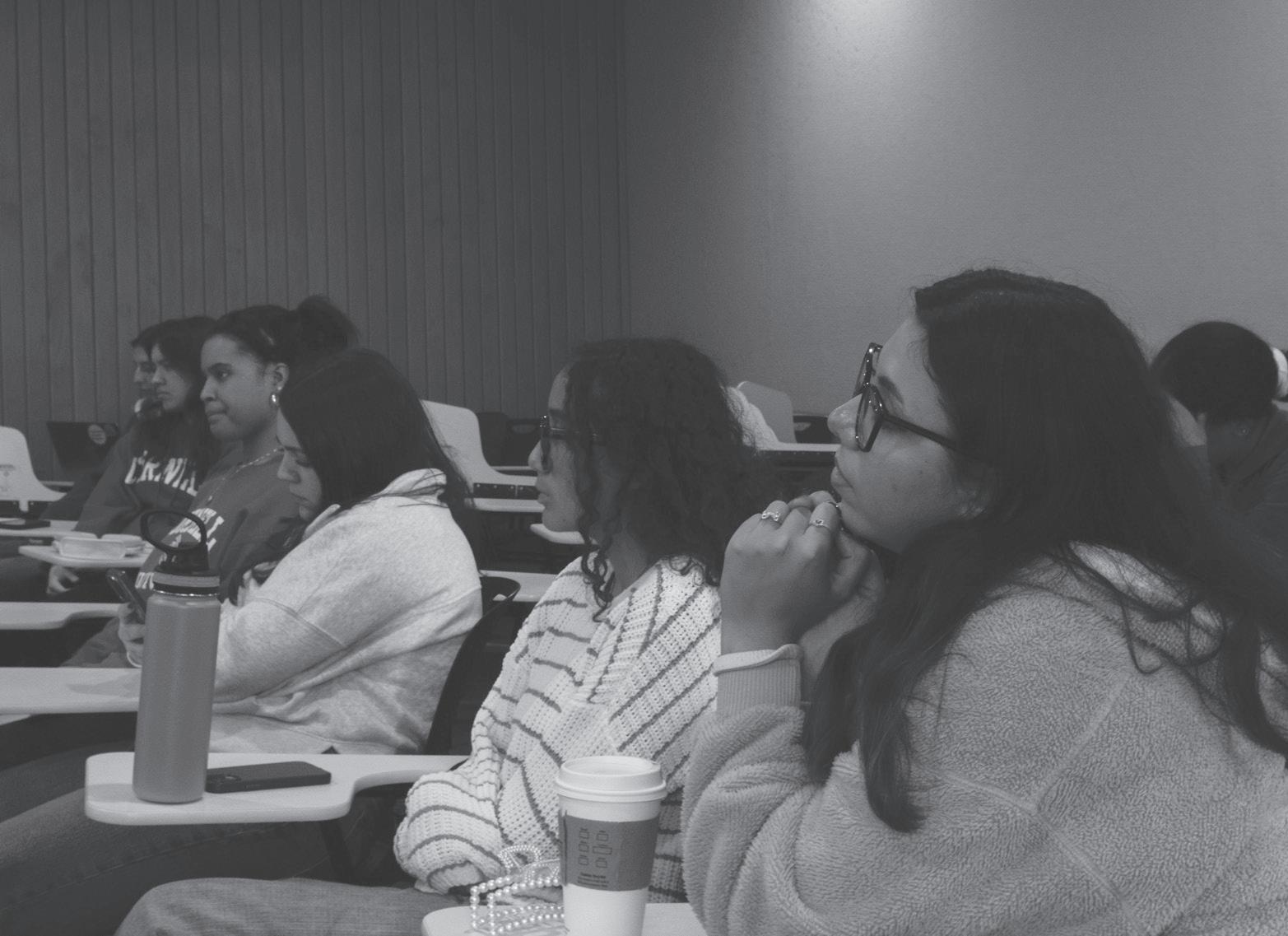
Oct. 16 — As Hispanic Heritage Month draws to a close, leaders of Cornell’s Latinx student organizations report drops in attendance and decreased Hispanic visibility following the Supreme Court’s ruling to end race-conscious affirmative action.
The class of 2028 — the first admitted after the end of affirmative action — saw a pronounced drop in enrollment for Black, Hispanic and Native American students, with the proportionally largest decrease being for Hispanic students, from 16.7 percent to 10.5 percent.
Rafael Montán ’26, social media chair for the Puerto Rican Students Association, said that recruitment has been “a bit of a struggle,” citing a decrease in the number of first-years who have joined.
Montán, who is also a member of the Committee on U.S.-Latin American Relations — a student organization aimed to “promote justice and mutual understanding among the people of the United States, Latin America and the Caribbean” — noted a similar problem in the group.
“CUSLAR is already a small organization to begin with, and the decline in enrolled Latinx students could be affecting our ability to keep moving forward as an organization,” Montán said.
Cristobal Ramirez ’26, alumni relations chair for Mecha de Cornell — a social justice-oriented Chicanx organization — also feels a decline in attendance. “The energy is definitely different. We had an average of four applications per position this year, but last year it was roughly six to eight per position,” Ramirez said.
“I feel the visibility of Latinos here is under threat,” Ramirez said. “Our motto in Mecha is ‘la unión hace la fuerza,’ which means ‘union is our strength.’ Without numbers, it’s harder to create union.”
Ramirez added that the University’s drop in Latinx enrollment is a concerning sign regarding Cornell’s commitment to diversity.
“What’s disheartening is that in peer institutions like Yale, Latinx enrollment has not gone down as noticeably, which makes me question if Cornell wants diversity,” Ramirez said.
Ramirez also pointed out that it is Cornell’s responsibility to release more detailed statistics about the backgrounds of Cornell’s Latinx demographic to show if the drop in Hispanic enrollment corresponds with other factors, such as socioeconomic status.
Shaunjae Suarez ’26, vice president of La Asociación Latina and co-president of PRSA, agreed that despite steady attendance from older members, he has seen a drop in new student attendance. “In a lot of the events I organized, the people who turn up to these are the same upperclassmen in the organizations already. It feels like there’s no new faces being introduced,” Suarez said.
Suarez pointed to the Latino Living Center’s annual Bienvenidos BBQ as an example. “Usually, the vast majority who show up are firstyears, so it was very surprising when I was tabling there … to see no one but people that I already know at the event,” Suarez said. “Very few firstyears actually came up to engage at our table.”
At a time of declining enrollment for Hispanic students, Hispanic faculty also remain a minority, with 151 out of 1136 faculty members being of Black, Hispanic or Indigenous descent.
Students report noticing this scarcity when reflecting upon their experience at Cornell.
Isabella Riano ’25, vice president of Cornell Latinx Association of PreLaws, said that she does not recall encountering Latino faculty members other than the times she specifically took a Latina/o studies class.
“For my other classes, I wish there were a lot more faculty members that were of Latin identity just so I could feel more comfortable.”
Despite University-wide declines in diversity, Cornell’s Latinx organizations remain committed to fostering community, including by collaborating with other Latinx identity groups.
“We’ve started planning collaborations with other organizations like Mecha,” Montán said. “We’re hoping that our events will grow our membership. The more visible we are, the more folks will come.”
Julia Lian and Yuhan Huang can be reached at jl4563@cornell.edu and yh2273@cornell.edu.




However, Taal said not being able to access resources in person restricts his ability to do research.
Continued from page 4
Siliciano wrote that while he understood the freedom of speech argument, Taal infringed on the rights of other students who wanted to attend the career fair and created a security threat to other students.
“I do not doubt the sincerity of these emotions, but I think it critically important to note that there are thousands of students, staff and faculty who have equally strong and painful views on all sides of this crisis and yet manage their fear, anger and turmoil without interfering with the rights of others,” Siliciano wrote.
While the decision on the suspension is final, Siliciano wrote that Taal had an alternative path to work with Liang to find a resolution to reduce or eliminate the other restrictions.
“I strongly urge you to reconsider this pathway to full resolution so that your energy is fully available, as you have indicated is now your wish, to focus on completing your Cornell education.”
John Siliciano ’75
Since Taal already completed all coursework for his graduate degree, he will not be allowed to physically return to campus. Instead, Siliciano said that Taal would be allowed to access University materials online to continue his dissertation work.
“I strongly urge you to reconsider this pathway to full resolution so that your energy is fully available, as you have indicated is now your wish, to focus on completing your Cornell education,” Siliciano wrote.
“I’m going to have to meet committee members off campus when I do things on Zoom,” Taal said. “I don’t have access to any libraries, so I have to either get someone to pick up books for me or get them delivered to somewhere else, outside of campus.”
Cornell Graduate Students United announced Wednesday night that the union would bargain over Taal’s teaching restrictions based on a memorandum of agreement the University signed with CGSU in July 2024.
The MOA gives the union the right to bargain over the effects of academic discipline of graduate students as long as it affects their working conditions. CGSU argued that the MOA is applicable in Taal’s case since he taught an FWS.
Nearly 20 other pro-Palestinian protesters who helped shut down the career fair were identified through video and photographic evidence and referred for disciplinary action, according to a Sept. 30 email from Interim President Michael Kotlikoff to the Cornell community.
Kotlikoff wrote that protesters were explicitly told that they were not permitted to enter Statler Hotel by Cornell University Police Department officers and pushed through police at the ground-floor and second-floor entrances.
“The question of me, the question of Palestine, has begun to expose the ways in which our institutions work, and it’s not a surprise that those who are protesting [in support of] Palestine are met with such oppressive tactics,” Taal said.
This is Taal’s second suspension. His first came in the spring for his involvement in the pro-Palestinian encampment on the Arts Quad.
“Trying to speculate on what specific aspects of the referendum students were responding to is unproductive,” Everett said. “It is our part to represent student interests, and students have expressed these weapons [manufacturers] should be looked into.”
“It is our part to represent student interests, and students have expressed these weapons [manufacturers] should be looked into.”
Karys Everett ’25
Brooks School of Public Policy Representative Eeshaan Chaudhuri ’27 proposed repolling the student body on the issue of divestment to clear up any misunderstandings about where students currently stand on the matter.
Everett clarified that referendums are initiated by students by obtaining at least three percent of the undergraduate student body’s signatures. She also responded to criticism that the referendum was not representative of the student body because it only saw 46.77 percent student participation.
“We have less than 40 percent of students voting in our own [S.A.’s] elections,” Everett said. “It’s safe to assume that we have numbers that are in line with and mirror our societal patterns when it comes to voting.”
Several S.A. members also questioned the timing of the resolution, noting that it comes during the week of Yom Kippur, the holiest day in the Jewish calendar, and the first anniversary of the Oct. 7 Hamas-led attack on
Israel, which marked the start of the Israel-Hamas war.
“Why are you so intent on having this [the resolution] on Jewish holidays?” asked Undesignated At-Large Representative Ezra Galperin ’27. Everett answered: “I did not choose to do it purposely on a Jewish holiday.”
She also referenced her email correspondence with S.A. President Zora deRham ’27 from the previous week to show that the resolution had been in development for weeks. deRham confirmed the timing of their correspondence at the meeting.
In an interview with The Sun after the S.A. vote, Everett expressed disappointment over the S.A. “not addressing the issue at hand.”
“No specific state was mentioned, and yet the conversation continued to single out one nation of many that was armed by these weapon manufacturers.”
Karys Everett ’25
“The question that I specifically stated that was on the table was if an academic institution should be investing in war weaponry. No specific state was mentioned, and yet the conversation continued to single out one nation of many that was armed by these weapon manufacturers,” Everett said. “So for the Assembly to postpone it indefinitely on the contingency that did not exist is incredibly disappointing.”


www.cornellsun.com
By JACK AHERNE and XAVIER ROLSTON Sun Contributors
In a year where costs have increased and tax revenue has fallen across the County, legislators have been busy debating and revising the 2025 Tompkins County Budget, which is expected to pass in November.
First introduced on Sept. 3, the proposed annual budget includes tax changes, funding for infrastructure projects and required New York State expenditures. County Administrator Lisa Holmes, who wrote and presented the plan to members of the Tompkins County Legislature, told The Sun that county funds were divided between nearly 30 departments, each with their own roles.
Some of this funding is mandated and decided by the State. In addition, the County must allocate enough funds for other essential services that are not legally required including the sheriff’s department, highway department and other agencies that the County depends on.
Is the County Raising Enough Money?
Taxes within the County pay for the necessary expenses and social programs. While costs are rising, sales tax revenue — the second largest source of revenue — is projected to drop significantly for Tompkins County.
Legislator Shawna Black (11th District) explained that the decline in sales tax is one of the County’s biggest concerns.
“Whenever we see less sales tax, it means less money that we can spend on the things that truly are a priority in our community,” Black said.
Holmes described the decrease in sales tax revenue as a “COVID hangover,” referring to the end of certain economic relief policies coinciding with rising inflation across the country.
“Several years of inflation have affected consumers and their ability to buy and spend,” Holmes said. “That’s led here locally to a decrease in sales tax revenues, and therefore a projection for 2025 that they are going to remain flat.”
Will Property Taxes Increase?
Property taxes are the largest source of revenue for Tompkins County, and in 2025, the property tax
percentage will decrease for homeowners. However, Holmes said that the number is not what most people consider. Instead, they look at the “tax levy” which is the total amount of money the county wants to raise through property taxes.
Even with a lower property tax percentage rate, homeowners will pay more overall due to rising home values. This year, home valuations increased by 20.5 percent in Tompkins County over the past year, far outpacing New York state’s overall increase of 6.8 percent.
“It’s a very large increase,” Holmes noted, describing it as “atypical.” The median price of a home in Tompkins County rose from $249,000 to $300,000 over the past year.
The initial budget proposal included a 4.34-percent rise in the property tax levy, or a $138 increase to the median valued home’s tax bill. However, county legislators have preemptively agreed to decrease this number.
“So far with the voting meetings and amendments made by the legislature, it is looking to be a 3.29-percent levy increase, and we’re still midway through the process, so that amount is still subject to change,” Holmes said.
Spending is more strained this year than in recent history. New York State increased mandated expenditures for Medicaid, childcare and psychiatric expenses for individuals unfit to stand trial, along with other spending categories. Holmes expressed her concerns over these increases to the legislature.
“The County’s mandated expenditures, over which we have little or no control, continue to rise and put pressure on local taxpayers,” Holmes wrote in her Sept. 3 message presenting the budget.
Plans to build a jail, public safety building and homeless shelter are also priorities for legislators. According to Black, the state covers the cost of sheltering services for about six months. The County may fund the remaining months, costing taxpayers an additional $3 million annually for homelessness services.
“With those three big capital improvements, and then the ongoing sheltering around, I mean, we’re looking at a lot of money going out the door,” Black
said. “So whenever we talk about having $50 million in the bank, it goes really fast.”
In previous years, there have been extra “unassigned” funds, allowing the County to fund social initiatives and infrastructure projects. This year, there are no funds left over.
“[Additional] funds would have allowed the County to fund the implementation of language access services, the distribution of informational mailings, the expansion of mobile support services and further backing for suicide prevention efforts,” Holmes wrote.
Community Response to Tax Increase
While raising property taxes is necessary to fund the County’s expenditures, it remains unpopular among residents, according to Black. Black called raising property taxes “the last thing that we want to do,” to citizens who struggle to pay for their bills.
Kate Seamen — a prominent Ithaca realtor who specializes in helping prospective professors find homes in Ithaca — said that some of her clients have turned down positions at Cornell because of high property taxes. She added that the quality of living is going down, and the cost of living is going up, and those two combined do not bode well for Ithaca.
“I am furious with this budget,” Seamen said. “I feel as though our taxes just keep going up and up and up. Assessments keep going up and up and up, and at some point you’re like, ‘where’s this money?’” What’s Next?
Holmes encouraged more residents of Tompkins County to become directly involved.
“[County legislature] meetings are televised and streamed on YouTube,” Holmes said. “They’re open to the public, and people can come in person and listen in or participate.”
Holmes hopes that before the budget becomes official in the coming weeks, residents will voice their concerns and priorities, highlighting the public hearing on Oct. 30.
“There’s still opportunities for public input and for the legislators to amend the work in progress,” Holmes said.
Aherne and Xavier Rolston can be reached at jea267@cornell. edu and xr46@cornell.edu.
Continued from page 5
Brando Sell ’25 recalled a unique classroom environment in McGraw that felt like a “dungeon complete with bars on the windows.”
“There was this one [classroom] in the McGraw basement. It had [this] kind of raw stone walls. There were skeletons of various animals and human skulls on the wall,” Sell said. “It was for an anthropology class about American education, and I found it very funny that we were talking about, you know, issues in 21st-century teaching just next to these like skulls of lemurs.”
A Decade of Construction
The third-oldest building on campus, McGraw Hall opened its doors in 1872 and is one of three original stone buildings on the Arts Quad. The other two stone buildings, Morrill Hall and White Hall, have both previously been renovated — Morrill in 1973 and White in 2003.
The initial announcement of the preservation project came in April 2011, after sections of the building’s
ceilings collapsed in two faculty offices and one hallway back in 2009. While the University started the renovation in May 2011, exterior steel supports on the building remained up indefinitely due to a lack of funding from the University to continue with the project.
Seven years later in March 2018, it was announced that McGraw Hall’s construction plan would be brought back in motion, but the COVID19 pandemic forced design to pause halfway through. The effort was resumed four years later in November 2022, when McGraw Hall was finally scheduled for interior renovations. The design process was completed last spring.
The renovation plans on adding modern building systems such as elevators, bathrooms, heating and ventilation strengthen the exterior walls and repair stonework.
To continue reading this article, please visit www.cornellsun.com
VOTING
Continued from page 5
The legislature also added that “many individuals are themselves members of numerous communities, identities, and protected classes, and true equality and justice demand protections that recognize the interconnected nature of discrimination.”
Voters across Tompkins County — such as Yvonne Fogarty, a member of the Tompkins County Democratic Committee — are working to champion the proposal locally by encouraging New Yorkers to “vote yes on Prop 1.”
“We have yard signs that we’re giving out,” Fogarty said. “We’re talking to everybody who comes in to pick up other yard signs. The people who are canvassing for Josh Riley are mentioning it when they go door-to-door.”
Josh Riley, the Democratic candidate for the NY-19 Congressional district, has publicly supported both Proposal 1
and the passage of the Equal Rights Amendment at the federal level.
Rep. Marc Molinaro (R-NY), the incumbent for NY-19, has recently gained national attention for becoming the first Republican to co-sponsor legislation on federal IVF protections, alongside Rep. Mike Lawler (R-NY).
Molinaro has also opposed a national abortion ban and affirmed his belief that “health decisions should be between a woman and her doctor, not in Washington,” in an advertisement titled “Where I Stand” released in August. He has not commented on Proposal 1.
However, Democrats have cast doubt regarding Molinaro’s dedication to pro-choice policies, pointing to his recent campaign collaboration with Rep. Kat Cammack (R-FL), the co-chair of the House ProLife Caucus.
The City of Ithaca Republican Committee did not respond to a request for comment
regarding their stance on Proposal 1.
According to Ahuja, while New Yorkers generally support protections against discrimination and on abortion, one of the biggest challenges facing Proposal 1 is ensuring that New Yorkers know that it is on the back of their ballots.
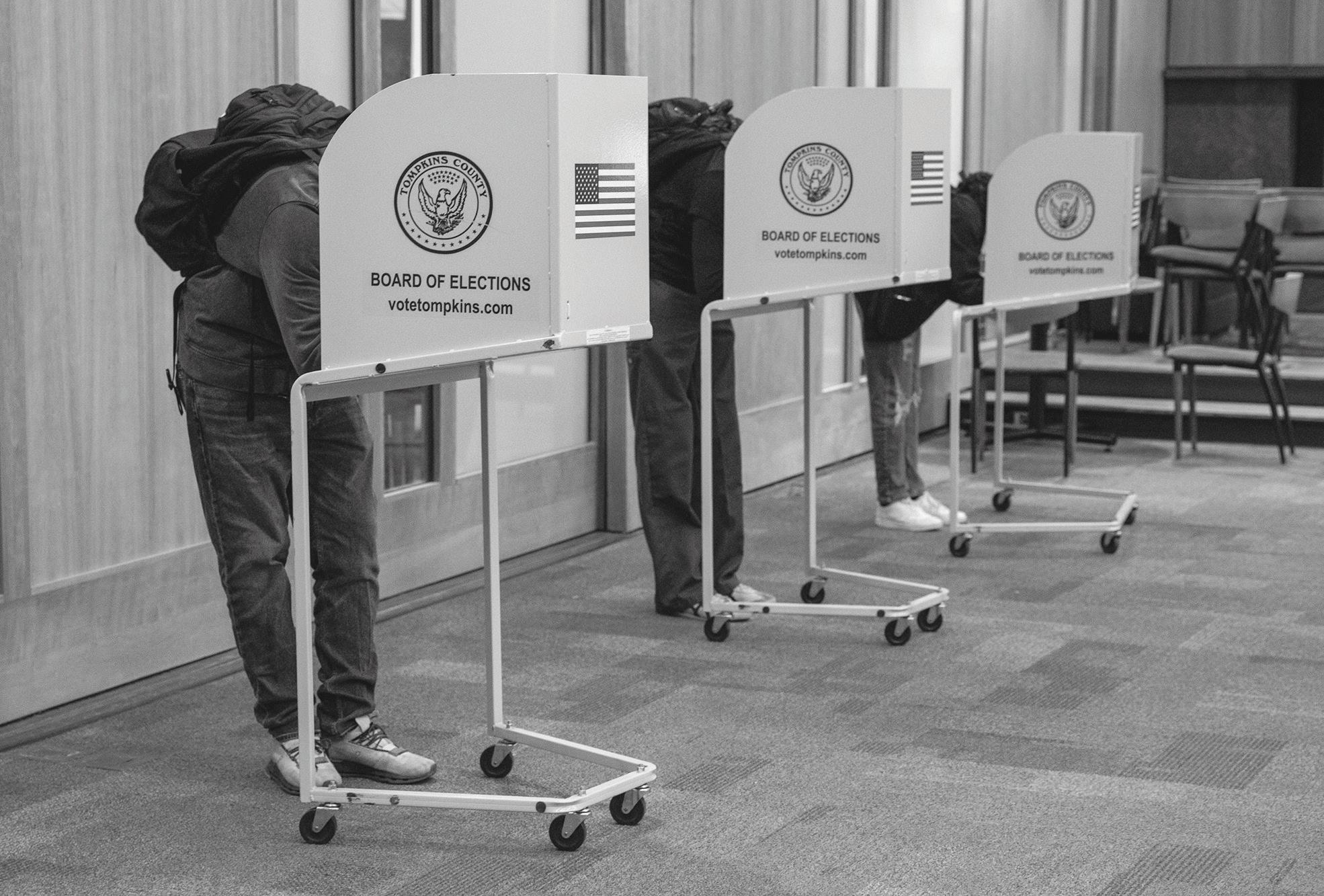
Alanna Congdon, the Tompkins County Republican Commissioner, said that the Tompkins County Board of Elections is working to encourage voters to remember to vote on Proposal 1.
“Propositions are always on the back of the ballot [in New York], and we’re trying to encourage our poll workers to tell [voters that] it’s a two-sided ballot,” Congdon said.
Congdon added that voters can view sample ballots on the Tompkins County Board of Elections website or at their local poll sites before voting.
Skylar Keinman can be reached at skleinman@cornellsun.com
By CHLOE ASACK Arts & Culture Writer
Every time I have thought about The Substance since watching it — most often in my attempts to write this review — I have felt a pit in my stomach and an unshakeable feeling of disgust. Two women left the theater halfway through, probably finding the unending shots of sharp needles, pus-filled wounds and bloody organs to be more than they bargained for. When the movie ended, my friend took a moment to sit down because she thought she was going to pass out. It’s a spectacle you must see for yourself, but it was gory enough that I watched the last third of the movie through the gaps of my fingers, which was getting so gross that much of the theater quietly laughed from sheer discomfort. I felt the alternative to laughing might be to gag.
Plasticky, playful, absurd and most saliently disgusting, Coralie Fargeat’s The Substance follows aging aerobics instructor, Elisabeth Sparkle, in her devolution after she takes a substance that will produce a newer, better, younger version of herself. After she produces (births? hatches?) her tighter, hotter offspring, the Bond-girl-esque Sue, you see just how far Elisabeth and her subsequent evolutions are willing to go to stay attractive and relevant.
Perhaps the movie only glows in the wake of the various horror disappointments of the year (See: Longlegs, Maxxxine and Trap), but wow, it stands out. The Substance masters the restrained march into absurdity where
its recent horror competitors jump the shark too quickly. By the time Elisabeth evolves into a repulsive, hunchbacked woman, you hardly remember the normal, conventionally attractive heroine we began with. The movie still had my attention by the time of its gorey, campy climax — an absurdity that, if executed any worse, would’ve elicited an eyeroll and hope for reprieve.
Between Longlegs and Maxxxine’s boring satanic panic and Trap’s forgettable serial killer scare, I have to consider why the insidious creep of The Substance’s mad science is so much more viscerally effective than other recent horror attempts. The Substance begs me to ask the extremely obvious question: “What if this really happened?” to which you might answer, “Chloe, that’s an extremely obvious question” to which I might answer, “No, but really.”
No, but really. The Substance isn’t making anything up. Women are already sticking needles in their bodies in hopes of looking younger and they’re already getting cosmetic procedures that might have dire consequences. According to the NIH, the mortality rate of the infamous Brazilian butt lift may be as high as 1 in 2,351. A woman cracking open her spine to hatch a better version of herself doesn’t seem so far-fetched when middle class women, with spouses, children, hopes and dreams are willing to risk their lives for a bigger butt. Black market cosmetic procedures aren’t new either. Countless Mexican women were permanently disfigured in the 1990s after they were injected with motor oil by a fake doctor who told her clients
that she would make them look like “Barbie dolls.” I don’t bring up these tragedies flippantly, but only to say that if The Substance existed, people would definitely take it and they’re already taking the closest approximations that we have.
Actually, many critics’ biggest qualm with the movie is that it is not creating anything new; their issue seems to be that it is so derivative and well, that’s true. Upon watching, a beginner cinephile can quickly spot the movie’s top influences: David Cronenberg’s The Fly, Darren Aronofsky’s Requiem for a Dream and most obviously, Robert Zemeckis’ halloween classic Death Becomes Her. All three are absolutely worth watching and so is The Substance, even if it’s not the most original movie of the decade. The Substance builds upon Death Becomes Her’s didactic warning against vanity and becomes an elegy for insecurity, as Elisabeth’s struggles for beauty are not for the attention of a man, like they are for DBH’s Madeline Ashton and Helen Sharp. Rather, Elisabeth is struggling for belonging in a world that tells middle-aged women that they have no place but the sidelines.
The movie’s thesis is even more poignant because Elisabeth is portrayed by Demi Moore, an actress who has personally struggled with aging in an industry that’s constantly searching for the younger model. Her performance is excellent, with Moore staying in control of the taciturn Elisabeth’s subdued moments, and properly exploding in her hard-hitting emotional climaxes. Sue is played by Margaret Qualley,
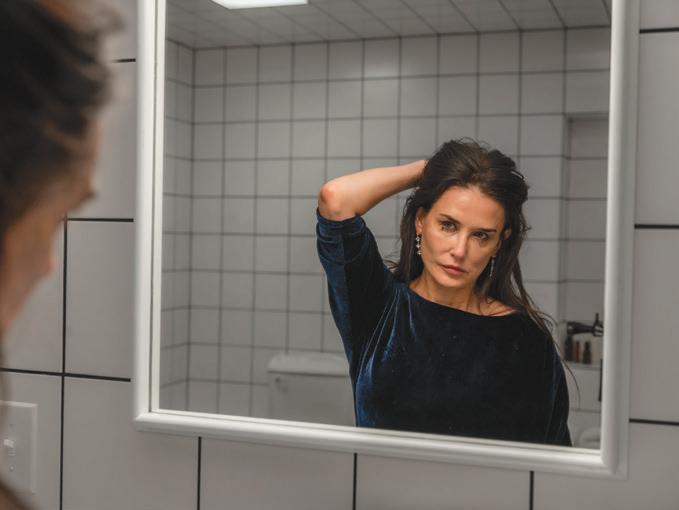
who with this, handily solidifies herself as Hollywood’s most interesting new actress (and also, as my personal favorite nepotism baby). As Sue, she’s hot, confident and charming, and she brings humanity to a character whose status as a human is a bit unclear. The Substance’s strong lead performances, stellar pacing, and focused aesthetic and message, make it a must watch this year.
The Substance is not admonishing women for doing the common things to feel confident under current beauty standards and neither am I. The movie isn’t trying to be smarter than it is; it’s warning you that if you see your body as a mutable entity to be improved upon, rather than the vehicle that allows you to live your life, you will always be an unfinished project. You’ll forever be Elisabeth Sparkle standing in front of the mirror putting your lipstick on and taking it off again, losing your sanity — and yourself — in the process.
Chloe Asack is a junior in the College of Arts and Sciences. She can be reached at cia36@cornell. edu.
Ithaca: a place where the gorges echo with stories, the trees whisper tales of the past and the libraries brim with wisdom. Stories weave together to form a tapestry of rich creative culture that invites all to get lost in the pages of imagination. Being surrounded by natural beauty, a thriving arts and culture scene and intellectual discourse, it seems only natural Ithaca would become a haven for booklovers. As fall is settling in, it is the perfect time to review all the wondrous offerings of bookish Ithaca.
The most obvious place to start is to explore all of the independent bookstores scattered throughout Ithaca. The main bookstores located near the Commons are Buffalo Street Books, Autumn Leaves and Odyssey Bookstore. Buffalo Street Books is at the back of Dewitt Mall and hosts a wide variety of books and bookish merchandise. There is a large fiction section as well as a substantive children’s and young adult section that is very easy to explore without being overwhelming which I found to be helpful and lead me to discover new books I might have glanced over elsewhere. If you look closer there are also many special editions unique to indie bookstores with stunning covers,
sprayed edges or fun bonus content. They also have a section dedicated to authors from the Ithaca area which is a perfect way to connect with local creative minds. The bookstore effuses a welcoming environment with cozy armchairs offering a perfect spot to try out a new book. Autumn Leaves is a used bookstore right on the Commons with an eclectic selection organized by genre. Unlike other bookstores in Ithaca, the environment is not as conducive to comfort browsing but could easily be a place where readers could devote time to find something unique. Personally, it was not my favorite as I quickly became overwhelmed by the sheer volume of books. The last main independent bookstore, Odyssey Bookstore, is nestled in an alcove off West Green Street. It is easy to miss, in fact it was a place I found by accident, but I believe that only adds to its charm. Odyssey is a hidden gem for booklovers that breathes an air of magic. The basement location creates a cozy and inviting atmosphere with a carpeted path that winds through genres and shelves. Whether it be fantasy, mythology, non-fiction or blind dates with books, readers can find whatever they wish for here.
Tompkins County Public Library is also a destination to visit, whether you are a booklover or not. A library is an important part of a community — it
offers a place to stay or study, to engage in community activities, learn about community resources, to read and to discover. TCPL offers a wide range of books to choose from, both in their main reading room as well as in the Young Adult and Children’s sections. However, if there is a book that TCPL doesn’t have, card holders are able to request books from another branch that can be delivered to the library usually within a week. After checking out a book, there are reading rooms, comfy chairs and public computers that offer a perfect environment to study or enjoy a new book. I have often come to study at the library after picking up a reserved book and it always provides a nice change of scenery and a chance to reconnect with my hobbies at the same time. Aside from reading material, the library also hosts many events and workshops, like eclipse box making, banned books week or creative writing workshops. Many of the library events are geared towards younger audiences, but it is still worth checking out their resources and upcoming events. Any Cornell student, as well as anyone living or working in Tompkins County, is eligible to get a library card with TCPL and can do so here. I wholeheartedly believe that everyone should have a library card as it is a gateway for a world of knowledge and resources. Library cards give access to a multitude
of free books and resources while also supporting libraries’ mission to promote access to literature, creativity and free discourse.
One of TCPL’s exciting upcoming events is the annual Friends of the Library Book Sale held on Oct. 12-14, 19-21 and 26-29. The sale acts as a fundraiser for Friends of TCPL and helps support their mission to advocate for library funding and improve access to books. The sale is held in a large-warehouse sized building and is organized by genre, but as the books are all different sizes and degrees of wear, browsing should be done with a careful eye so as not to miss anything special. I myself went last year and found some incredible books including a collection of illustrated Grimm’s Fairy Tales and a beautiful foil covered hardback of The Age of Fable from 1855. Everyone who works and volunteers at the event is incredibly kind which, along with the warm atmosphere, reignited my feeling of tangible connection to the bookish community. More information about the Book Sale can be found here.
By MIA ROMAN-WILSON Arts & Culture Writer
Coachella 2024: My ribcage is crushed between a barricade and the crowd behind me, there is a palpable humidity in the air and I’m running purely on adrenaline and three hours of sleep. I cannot relate to the mob of EDM fanatics behind me — at least, that’s what I thought until the house act steps onstage. And although I went to the festival for Tyler, the Creator, it was John Summit and Dom Dolla’s collaborative set, elusively named Everything Always, that convinced me to stay.
I have always found something enigmatic about house music’s allure. Until the months leading up to Coachella, I had sworn off the genre in detest of its repetition. For years, I couldn’t fathom the appeal of four-on-the-floor beats and electronically-looped lyrics, but my friends convinced me to start listening when the festival’s line-up was announced, and I’ve been an EDMlover ever since (shoutout “Miracle Maker,” the Dom Dolla song that sparked my love for all things house).
So on Oct. 11, I found myself anxiously awaiting the four singles set to release by Matroda, Cloonee, John
By LUSINE BOYADZHYAN Arts & Culture Writer
Sally Rooney, grandmaster of the contemporary writing scene has produced yet another masterpiece. In Intermezzo we find ourselves grappling with the grief of losing a parent but also losing the self we thought we were and would be, the love we encounter, and who we become along the way on this journey of life.
The book follows the story of two brothers, Peter and Ivan, and the ways in which they both cope with the mourning that their father’s death thrusts them into. The older, Peter, 32, is a successful lawyer in Dublin. He is caught between two women: his former girlfriend and true love (Sylvia) and that of his newer, younger (23 years old to be exact) love affair, Naomi. Ivan, 22, is a chess prodigy straight out of college, working freelance and drifting in life. He goes to community centers to run workshops for chess players, but his rankings and motivation for the game have dropped in recent years. As the book unfolds he begins his love affair with a much older woman, Margaret. Throughout the book, Rooney finds ways to impress upon us
Summit and Dom Dolla. My personal favorite is Dom’s “CAVE”: Tove Lo’s upbeat melody provides a welcome relief from the hard-hitting drum and bass in the background and the overall listenability is more than satisfying.
“When The Bass Kicks In” by Matroda is destined to be a club-classic, but its lackluster beat switches reflect an absence of ambition atypical of the DJ’s techno-inspired beat drops. Cloonee’s
“Still My Baby” is similar: as an artist, he stayed comfortable by leaning into his signature kick sound, but his production is reliably incredible. To my surprise, John Summit’s “Go Back” remix was the most disappointing of the four — by far. I have loved that song since I heard it live, but YDG’s techno-spin was an injustice to its character.
YDG’s “Diamond” is an example of his more creative releases, with the techno-approach serving to enhance the song as a whole, rather than to make for the most exciting beat drop. I think an attempt at the latter has been made on “Go Back.” Julia Church’s vocals are a marvel of their own and John Summit’s house flair is the reason so many of us fell in love with this single in the first place. The addition of YDG’s overdone synthetic bassline
the different kinds of love we encounter and the importance it has in our lives.
The love of parents is brought up throughout the book as a touchstone for moral and interpersonal behavior. When the brothers get into a fight at their childhood home, they are confronted with the notion that this would have never occurred had their father been there. Other characters too often seek their parents approval and love, showing that even as adults, we crave the love, approval and solace of our parents, especially in the face of grief.
Romantic love is explored in several senses. Rooney presents us with the idea of “the comfort of strangers”: when two lonely people come together in their solitude to understand each other. That is how Ivan and Margaret’s relationship evolves. Slowly, they become each other’s touchstones. Ivan gains courage and the motivation to return to chess and Margaret begins to live for herself rather than the opinions of others. Rooney also confronts the idea of what it means to love. She gives us the two women in Peter’s life — Sylvia and Naomi — who prompt very different emotions from the man that connects
feels like a cheap attempt at eliciting a reaction from the crowd.
But remix culture is of historic significance within subgenres of EDM, and it is especially salient today. The genre was conceived in the ’70s and ’80s in the Disco, PostDisco and Synthpop eras via remixing the time’s most popular songs. DJs work closely with one another to combine their unique sounds and strategies, either through back to back sets, features or remixes. Collaboration is an integral aspect of the genre and remixes specifically give already-released singles an excitingly novel flair. Although YDG’s “Go Back” was far from exceptional, it represents a blend of electronic styles native to DJs and their discographies. Remix culture goes hand in hand with the mass production and proliferation of music today, resulting in older songs and artists gaining popularity. Purple Disco Machine is just one example of media reborn in this era of new wave house music, and his performance at Coachella was a wildly engaging set of throwbacks that entertained both his longtime fans and nomadic festival-goers. The flipping of older songs, like John Summit’s “Sweet Disposition” or FISHER’s “Jamming,” revives the original works and the musi-
them, though he easily says “I love you” to both. Peter surely feels something for both women, yet could we say that it is possible to love in different ways? What can he do when he can neither let one nor the other go? The ending somehow provides the solution for this, while also forcing Peter to confront his ideas of what is “normal.” He, the man who had previously stated that no “normal woman” who was 36 years old would go for a boy of 22, ends up in an atypical relationship with not one, but two women. The book, like much of Sally Rooney’s other works (i.e. Normal People), considers that there isn’t such a thing as “normal.” Love is weird, people are different and their lives intermesh and separate in the oddest of ways.
The brotherly love shared between Peter and Ivan is a huge aspect of the novel. Despite them being imperfect characters who make mistakes, hurt each other, and forsake the love that they have for each other, they understand that they care for each other in the way that brothers do, because they are family. As Rooney writes “No one is perfect. Sometimes you need people to be perfect and they can’t be and you hate them forever
cians that inspired them.
Charli XCX’s newest, all-remix album Brat and It’s Completely Different but Also Still Brat has the potential to bring remix culture to other music niches entirely. Her hyperpop inspired sound is EDM-adjacent, but her soaring popularity in mainstream media has designated her a pop icon. With this album, the artist recruited features like Tinashe, Bon Iver, Lorde, and Troye Sivan to create space for themselves on her iconic album while preserving the integrity of every piece. It is through these remixes that we are not reminded of the dichotomy between an artist’s abilities, but the interplay of their unique talents. The album is a refreshing reminder that remixes offer artists the opportunity to defy their comfort zones and garner new audiences.
With this house-music revival, the genre is establishing itself within the scope of pop culture and bringing remixes to the forefront of mainstream music. Hopefully, this means more innovation, more creativity and more music for all of us.
Mia Roman-Wilson is a freshman in the College of Arts and Sciences. She can be reached at mjr436@ cornell.edu.
for not being even though it isn’t their fault and it’s not yours either. You just needed something they didn’t have in them to give you. And then in other people’s lives you do the same thing, you’re the person who lets everyone down, who fails to make anything better, and you hate yourself so much you wish you were dead.”
Intermezzo brilliantly covers the various kinds of love we encounter, and how loss, not just of loved ones, but the futures we thought we could have had changes us forever. The characters each ponder on the lives they thought they would have, just as we are all made up of the people we thought we would be, the lives we thought we would lead, the loves we thought we would keep. These are innately a part of us, we cannot ever fully exist without them. Yet, it is just as important to confront the future that faces us. Early in the book, one of the brothers expresses how it is sad to think of their father’s old house standing empty and alone. After everything, at the end of the book they discuss having Christmas there all together.
Hegemon of the writing world that she is, Sally Rooney does not stop at the vividness of her character develop-
ment and their interrelations when it comes to inviting readers to experience the worlds inside of her novels. Shifting between the stories of the two brothers, we begin to see on a cognitive level the differences in how they view the world. Disassociated from what is happening around him, Peter sees everything through snapshots of thoughts which more commonly appear as phrases written in a sort of stream of consciousness form. Ivan, on the other hand, creates patterns from everything. His parts of the novel feel like going inside of the mind of an over-thinker. The syntactical decisions made by Rooney to make us view the story through the lenses of her characters, is brilliantly executed. It brings us closer to the worlds and characters which she depicts.
Rooney’s works explore how we handle loneliness, ideas of normalcy, grief and pain. Intermezzo is no exception. The story of the two brothers, and their adventures to understand what it means to love and be loved remains as compelling as Rooney’s earlier works.
Lusine Boyadzhyan is a sophomore in the College of Arts and Sciences. She can be reached at lb785@cornell.edu.
By ANIKA KOLANU Sun Staff Writer
Friday night lights brought Harvard (1-2, 0-1 Ivy) to Schoellkopf Field for a showdown against the Red (1-2, 1-0 Ivy). Cornell, coming off a disappointing loss to UAlbany, faced a Harvard team that had just upset No. 16 New Hampshire.
The Red had a choice: to be the team that scored 47 points against Yale or the one that struggled to put up ten against UAlbany. Unfortunately, the night didn’t go as planned for the Red, ending in a 38-20 defeat.
This game wasn’t just a battle of players but also a matchup between two young, rising Ivy League coaches. On Cornell’s sideline, head coach Dan Swanstrom is in his first year on East Hill, tasked with turning around a team struggling on both sides of the ball. On the other side, Harvard’s Andrew Aurich, taking over after the retirement of his predecessor, looks to keep the Crimson’s championship pedigree intact.
It was also the debut of Cornell’s new black uniforms, adding further excitement to the night.
The game started off strong for the Red. Senior quarterback Jameson Wang led a swift opening drive, covering 83 yards in just ten plays. He connected with sophomore tight end Ryder Kurtz for the first touchdown, with sophomore kicker Alan Zhao tacking on the extra point to make it 7-0.
Harvard had a quick response. Quarterback Jaden Craig launched a deep pass to Cooper Barkate before being replaced by Charles DePrima, the same quarterback who dom-

inated Cornell last year. Both quarterbacks continued to switch off throughout the night.
However, Cornell’s defense held firm, forcing Harvard to settle for a field goal on its opening drive. Cornell led 7-3 midway through the first quarter. A late-quarter touchdown pass from Craig to Barkate, followed by a successful extra point, gave Harvard a 10-7 lead to close it off.
Early in the second quarter, a critical fourth-down stop by Cornell’s defense swung momentum back to the Red. A Harvard pass interference call soon after set up Wang for another rushing touchdown, with the extra point putting Cornell ahead 14-10.
But Harvard quickly regained the lead with a long pass from Craig to Seamus Gilmartin, making it 17-14. Another Craig to Gilmartin connection extended Harvard’s lead to 24-14 with 1:45 left in the quarter.
Harvard’s offensive pressure continued as an offensive pass interference call against Cornell left the Crimson in control. They capitalized with a last-second touchdown, giving Harvard a commanding 31-14 lead at the half.
Despite the Red offense’s promising start, defensive lapses, especially on deep plays, left Cornell struggling to keep pace.
Cornell’s defense finally found a break-
through in the third quarter on a disguised fourth-down field goal attempt, where it managed to stop Harvard and regain offensive control. However, its short-lived possession lasted less than a minute before they were forced to punt it back to the Crimson, who returned it 45 yards before being stopped again.
In a bold move, Cornell executed a fake punt, with junior running back Robert Tucker III sprinting down the field to give the Red some much-needed offensive momentum. Wang connected with sophomore wide receiver Samuel Musungu for a touchdown, but the two-point conversion attempt was unsuccessful, leaving Cornell trailing 38-20.
Despite the occasional flashes of offensive promise, Cornell’s defense struggled, plagued by missed tackles and costly penalties. The third quarter ended with Harvard still in command, 38-20.
The fourth quarter started with a huge sack from senior linebacker Luke Banbury for a loss of eight yards, which showed promise, but the rest of the quarter stayed scoreless. The game ended 38-20, with Harvard taking its win back to Cambridge.
This game ended the Red’s three-game homestand, and it looks to take on non-conference opponent Bucknell (3-2, 1-0 Patriot) next week in Union County, Pennsylvania. Kickoff is set for 1 p.m., and the game will be broadcast on ESPN+.
Anika Kolanu can be reached at akolanu@cornellsun.com.