The Corne¬ Daily Sun




By KATHRYN STAMM Sun Staff Writer
Georgia Southern University cancelled a second appearance by author Jennine Capó Crucet ’03 after a few students burned copies of her book, following a heated exchange during her first talk, where she spoke about diversity and the college experience.
Crucet spoke at Georgia Southern University in Statesboro on Oct. 9, and was slated to speak at the Savannah campus on Oct. 10, before the event was cancelled. She was invited as a part of GSU’s First-Year Experience, in which students read her novel Make Your Home Among Strangers
The book centers on a first-generation student and daughter of Cuban immigrants who is accepted into an
By ALIYAH KILPATRICK Sun Staff Writer
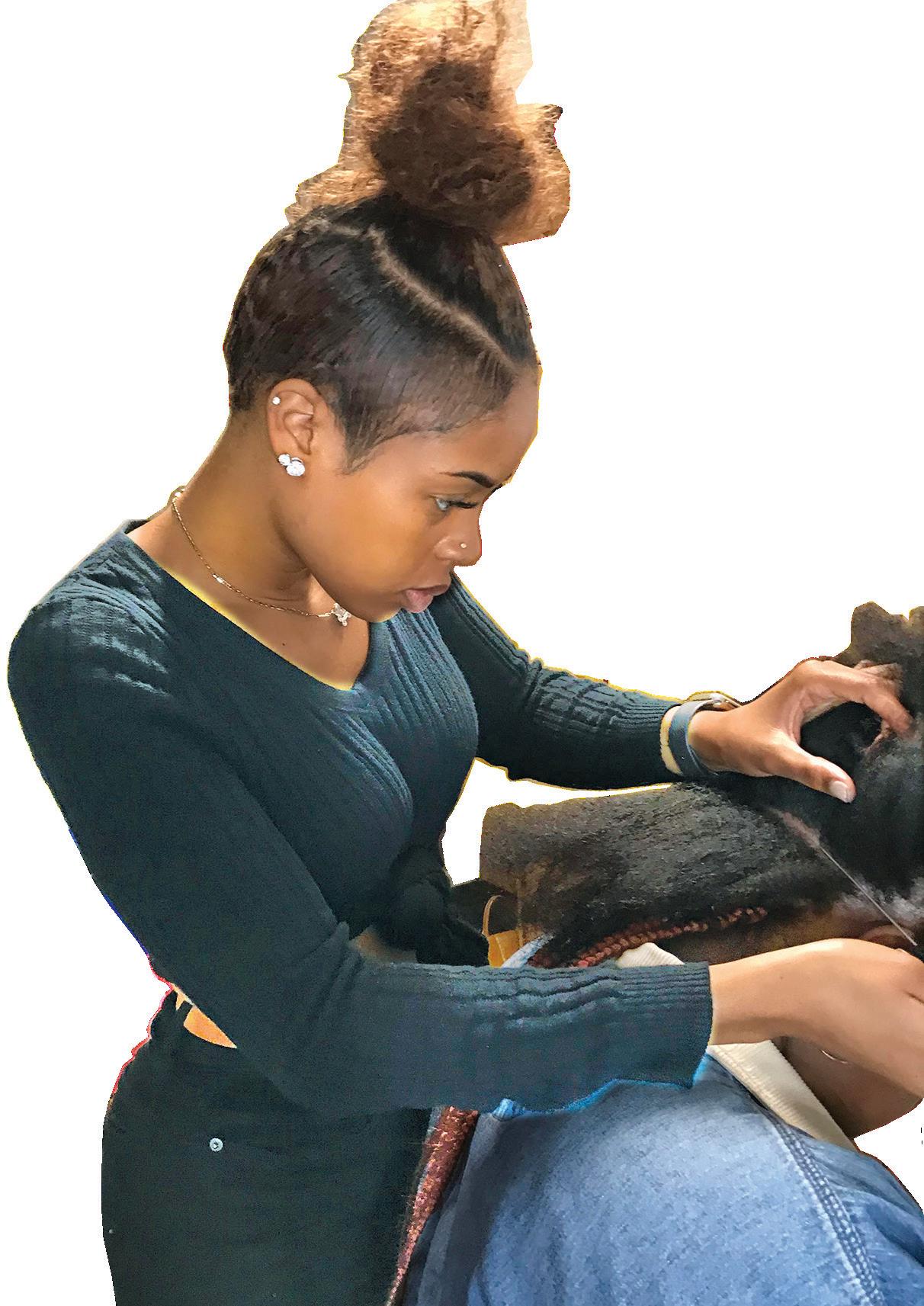
At home, everyone has their go-to hair stylist, barber, manicurist, etc. Yet, when students come to Cornell, they lose their favorite hometown beauty specialists, and have to find new people. That is where selftaught, enterprising stu
it to Cornell?”
Although this is her first semester on campus, word spread fast of Earl’s talents. She has already received positive reviews and returning clients. Through social media and word-of-mouth, she continues to attract new student clients every week.
YouTube and practicing on her mom and sister, she started to branch out and braid her friends’ hair.
elite university and struggles to understand the privileged world of her new campus.
Crucet, the daughter of Cuban refugees, grew up in southern Florida before attending Cornell. She is now an assistant professor of English and ethnic studies at the University of Nebraska, Lincoln, and a New York Times contributor. Crucet previously spoke at Cornell in November 2017, after winning the 2017 Philip Freund Prize in Creative Writing for excellence in publication.
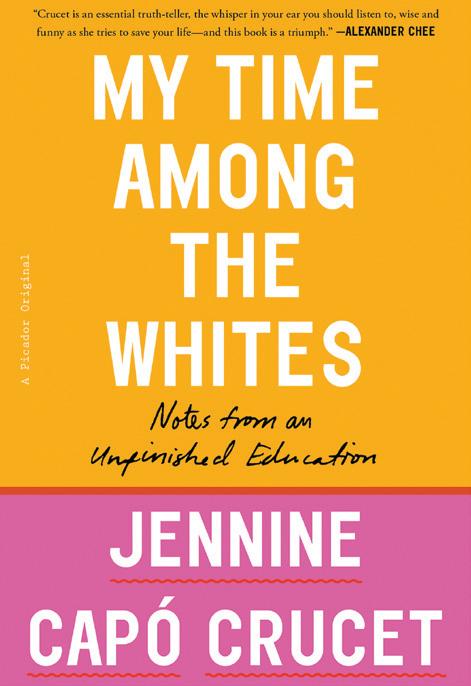
During the talk she read “Imagine Me Here, or How I Became a Professor,” an essay from her latest book, My Time Among the Whites , she said in a Twitter statement on Oct. 11.
Beauty hobbyists like Earl primarily learned and perfected their craft
“My first real client was my mom’s friend… and after that I started doing my sister’s hair, and her friend’s hair, then my friends started asking; it just started getting around,” Carmon said.
isfaction, friendships and funds that these amateur artists receive from their services make the effort worth the
“I like seeing it all come together,” said Skyla Carmon ’22, who learned how to style hair when she

She admitted that he sometimes struggles with juggling hair appointments, 15 credits, working two jobs and being a residential advisor on campus. Still, she makes it work and plans to continue seeking clients through ads on her Instagram account. She hopes to continue hairdressing after college, and maybe somehow combine her skills with her Human Development degree.
“It’s in one of my business plans, I want to be a counseling psychologist so I’ve thought about mixing the two in some way,” Carmon said.
Also switching between multiple responsibilities is hairstylist Kambria Lockett ’21. She found her passion after playing with dolls and practicing on her older and younger sister’s hair. Her appointments can take lots of time and energy, but, she says, doing someone else’s hair is a relaxing activity after a stressful day.
“Hair is a language, it’s a style, it’s part of your personality,” Lockett said. “Like if you walk around with blue hair
By KATHERINE HEANEY Sun Staff Writer
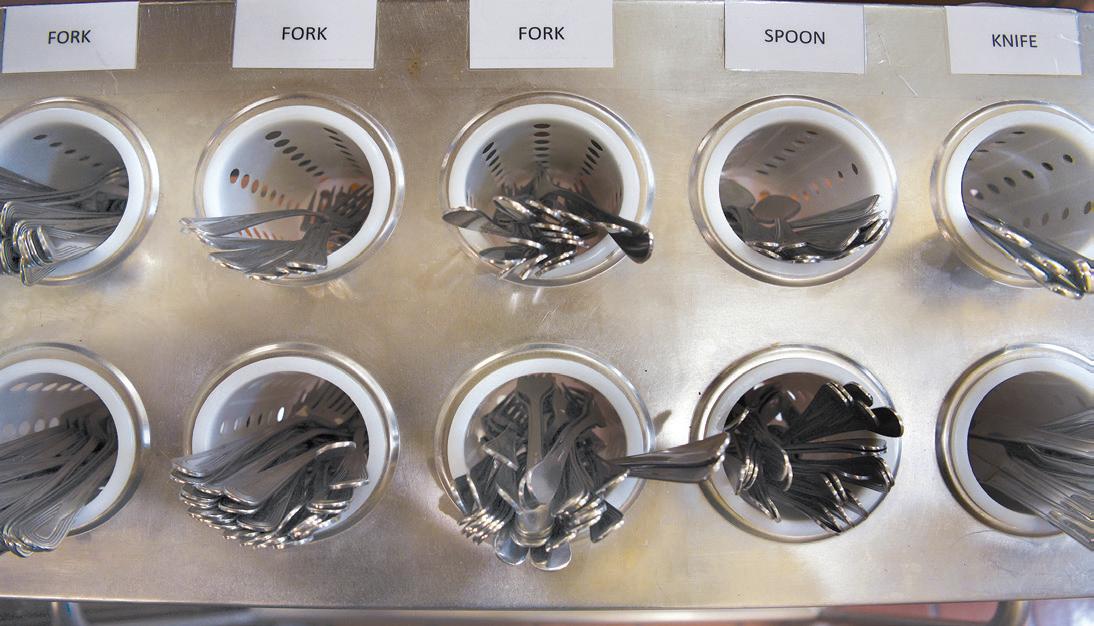
Cornell Dining spends hundreds of thousands of dollars every year to feed students on campus. But last year, $23,375 of that budget was spent not on the food, but on replacing utensils. In Mother Goose rhymes, the dish is culpable for running away with the spoon — but at Cornell, the students and faculty who dine at residential and on-campus eateries are the ones to blame.
New posters hung in dining halls across campus implore eaters to leave the forks be.
“[Spending money on silverware] makes us a little sad,” the poster further reads. “Help us out by not making us sad. Please return ‘misplaced’ silverware and dishware to any dining room.”
The Cornell Dining team does budget for some stolen silverware, as well as the wear, tear and breakage that comes
with regular use, according to Karen Brown, Senior Director for Marketing and Communications for Cornell’s Student and Campus Life.
“As much as we'd love to buy serviceware items only once and have them forever, we always budget with a factor for some damaged or lost quantities in mind,” said Brown, adding that other universities also do this.
If a Cornell Dining staff member sees a student or other visitor removing Cornell Dining property, including silverware and dishware, the staff member is allowed to ask that person to put it back. However, the staff member is not required to do or say anything.
“We don’t want our staff to feel they're in the position of having to confront someone, and we certainly don’t want our staff to feel they should

Canvas@Cornell: Moving From Blackboard to Canvas 9:30 a.m. - 11:00 a.m., G27 Stimson Hall
Professional Clothing Giveaway 11 a.m. - 2 p.m., 700 Clark Hall
Development Economics Workshop: Garance Genicot 11:40 a.m. - 1:10 p.m., 206 Stimson Hall
Joint Behavioral Economics & Public Economics Workshop — Sevgi Yuksel 11:40 a.m. - 1:10 p.m., 498 Uris Hall
Currencies of Imagination:
Channeling Money and Chasing Mobility in Vietnam Noon - 1:30 p.m., Kahin Center
Animal Behavior Club: Phobias and Anxiety in Veterinary Patients Noon - 1 p.m., Classroom 7, Vet Medical Center
“Understanding & Predicting Interannual Variability Of Global Terrestrial carbon Cycles” — Jiaming Wen 12:20 p.m., 135 Emerson Hall
Sensing Human Behavior With Smart Garments 2:30 - 3:30 p.m., 401 Warren Hall

Ag Day! Friday, 9 a.m. - 6 p.m., Agriculture Quad
AASP Spam & Eggs Community Breakfast: Co-hosted With Cornell Filipino Association Friday, 9:30 a.m. - 11 a.m., 4th Floor Rockefeller Hall
(Queering) Transpacific Nuclear Modernity Friday, Noon p.m. - 1 p.m., 190 Rockefeller Hall
Peaches and Pearls: Materializing Metaphors of Race in Eighteenth-Century British Art Friday, 12:15 p.m. - 1:15 p.m., G08 Uris Hall
Indonesian Tobacco Agriculture and Contract Relations — Marina Welker Friday, 3 p.m., B73 Warren Hall
Introduction to LaTeX Friday, 3:30 - 4:30 p.m., Classroom, Uris Library
Insectapalooza Saturday, 9 a.m. - 3 p.m., Stocking Hall
Garden & Arboretum Hikes
Saturday, 10 a.m. - 12:30 p.m., Brian C. Nevin Welcome Center
Society for the Humanities: Energy Conference Saturday, 2:30 - 6 p.m., First Floor, A.D. White House

New York College Presidents Urge State Leadership to Act on Immigration Policy
Martha Pollack co-signed a letter from leaders of 57 other colleges and universities across New York state on Oct. 10, addressed to New York state legislators on the issue of immigration policies that impact the lives of students. The academic leaders insisted that recent policy changes limit international student mobility, variety of educational opportunities and even post-grad career choices. All of these obstacles, the college presidents say, dissuade students from applying to American universities and consequently harm the economy. The letter recommended that lawmakers should “closely monitor the policies and administrative actions that are disrupting the mobility of students and scholars that are essential to U.S. universities and to maintaining steady economic growth.”
By SCARLETT YANGYANG ZHA Sun Contributor
On Oct. 24, Prof. David Lazer, academic expert on technology and politics in the digital age, will speak about how the Internet is influencing modern democracy and what can people do online to support democracy. Lazer teaches political science and computer and information science at Northeastern University, and is a visiting scholar at Harvard University.
Lazer has co-authored many papers on the intersection of politics and the internet.
Cornell’s Center for Social Sciences will host the talk. Since 2016, CCSS has invited a renowned scholar to speak about one “critical social issue” to the whole Ithaca community in its annual Distinguished Lecture in the Social Sciences.
Prof. Matthew Desmond, sociology, Princeton University, was the first scholar to be invited in 2016, followed by Prof. Dorothy Roberts, Africana studies, sociology and law, University of Pennsylvania in 2017.
Planned Parenthood of the Finger Lakes, located in downtown Ithaca — a mile away from Cornell’s campus — will be merging with four Planned Parenthood care centers starting in December. The four other affiliate locations in New York City, Nassau County, Mid-Hudson Valley and Mohawk Hudson will join with the Finger Lakes center to form “Planned Parenthood of Greater New York.” Last year, the Ithaca location served about 9,500 patients over 17,058 visits. The new conglomerate group of locations will avail its services to 65 percent of the state population.
After a district judge judge struck down a case prohibiting establishment of safe injection sites — supervised havens where those struggling with drug addictions can dose in a sanitary environment — the leaders of the nonprofit named in the suit announced that they plan to move ahead. Philadelphia will house the nation’s first site, the two heads wrote in a Washington Post op-ed, where they expressed hope that many other cities would follow in their tracks. The two’s efforts were reinforced after one “witnessed the heartbreak” of close friends whose son, a lacrosse player at Cornell, overdosed on heroin in 2016.
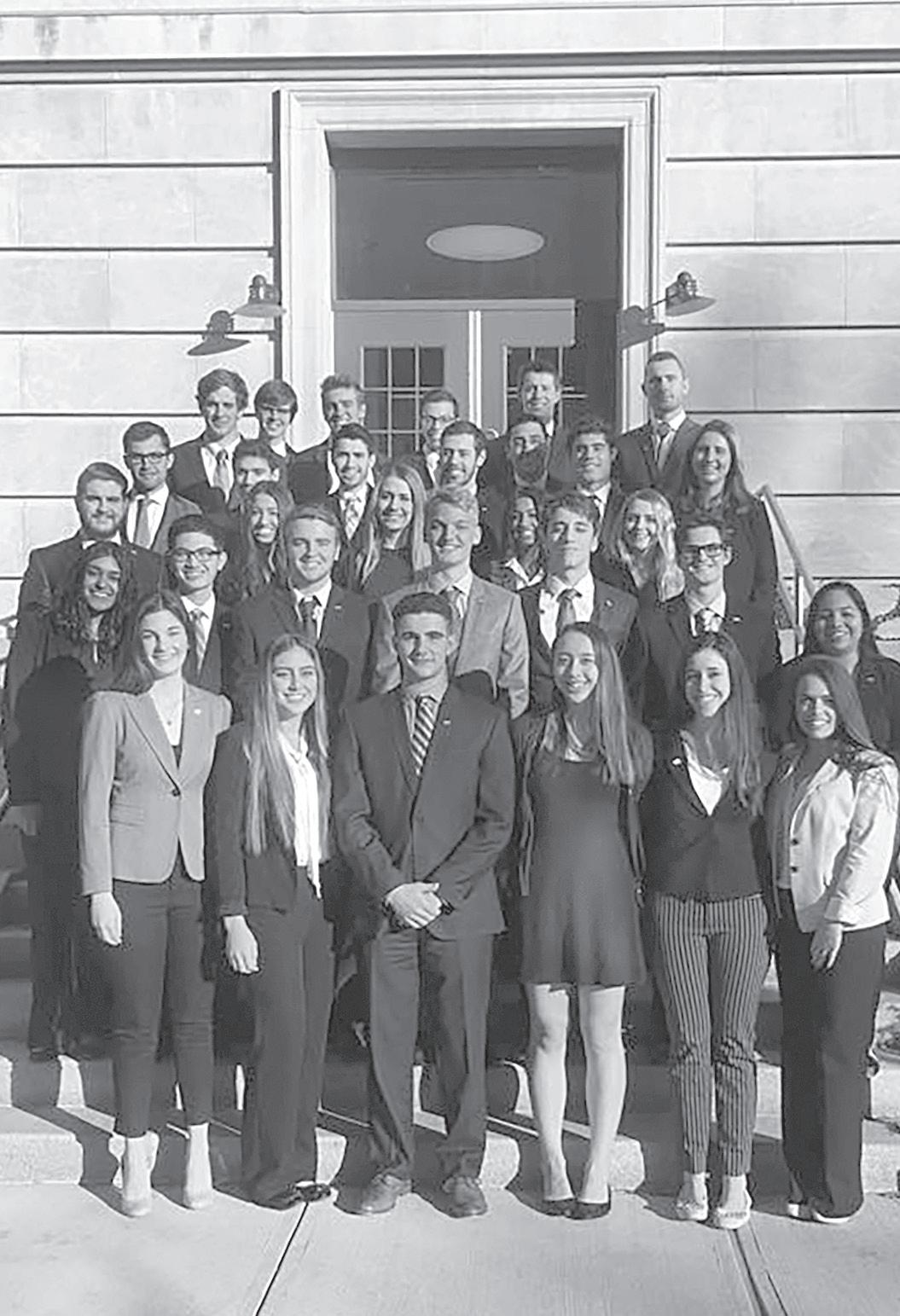
different approach to campus recruiting.
By ERNEST LI Sun Staff Writer
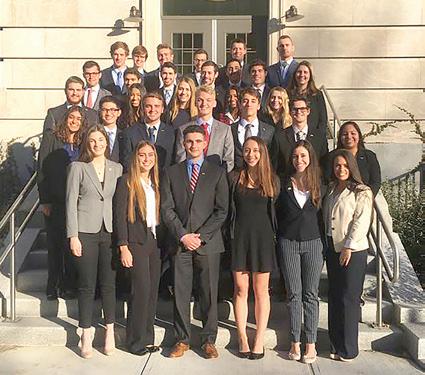
For students interested in business, the thought of joining a business fraternity seems natural. Yet many don’t know the purpose or goals of a business fraternity. Seeking to bridge the gap, we talked with members of Phi Chi Theta to get a glimpse of what goes on at Cornell’s newest business fraternity,
“If you’re passionate and willing to be part of something bigger than yourself, and one day give back to others, then PCT is the organization for you.”
Bryan Hyland ’21
founded in 2016.
According to PCT President Bryan Hyland ’21, a business fraternity is essentially an organization meant to educate students who are interested in pursuing careers in business.
“Our goal or our value-add as a business fraternity is to take kids and teach them new things,” said Hyland. “We’re not expecting you to have too much knowledge, but if you’re passionate and willing to be part of something bigger than yourself and one day give back to others, then PCT is the organization for you.”
— Compiled by Amanda H. Cronin ’21
rate, he did reveal some of the guidelines for member recruitment at PCT.
We have “no quota [for membership],” he said, “but usually accept eight to 15 [new members].” For context, PCT currently has around 30 active brothers and the other four business fraternities have 40-50 active brothers each.
The rush process is likely the most daunting part to people looking to enter a business fraternity. The mere thought of dozens of people dressed in formal suits all striving to be better than the person next to them may seem perplexing, exhausting or even terrifying to some people.
Hyland said he wanted to remove the aura of exclusivity and unapproachability surrounding the rush process. To help make the rush more accessible, for last semester’s rush, PCT gave all prospective applicants insight into its rush process.
“We’re all looking for qualified motivated and driven individuals. We created a flyer called ‘PCT Transparency’ that gave a brief introduction to the different rounds of the application process,” said Hyland.
“[PCT] focses on a move diverse brotherhood.”
Fiona Qiu ’21
One of the first things that comes to mind when thinking of business fraternities has to be the low acceptance rate to these organizations. Every fall and spring, Cornell’s five business fraternities receive a large number of applications, yet only a handful become pledges. While Hyland declined to provide The Sun with information about organization’s acceptance
Aside from making its recruitment process more transparent, PCT also hopes to differentiate itself through a focus on diversity. PCT aims for diversity in several dimensions, including career and gender. Fiona Qiu ’21, who joined PCT last semester, was surprised by the diversity in the organization.
“For me, I think PCT is very unique because it is the newest and it focuses on a more diverse brotherhood. We have brothers interested in finance, investment banking and consulting, but also engineering and business analytics,” Qiu said. “In my new member class [of 10 people], we only had one male and everyone else
Last semester, Prof. Mahzarin Banaji, psychologist, a professor at Harvard University, delivered a talk on “Blindspot: Hidden Biases of Good People.”
“This particular topic is very hot right now, it’s something everybody will be able to relate to in some way or another.”
Prof. Sahara Byrne
CCSS will also start its new Algorithms & Inequality Series next month, hosted by the center’s Algorithms, Big Data, and Inequality collaborative project team. The new lecture series focuses on bringing about the most pressing social issues of the time.
Prof. Peter Enns, government, CCSS co-director, told The Sun that the subject of social media, misinformation and fake news piques the interest of a broad cross-section of people — not only Cornellians, but also the general public from Ithaca and the surrounding community. This swelling interest in modern media ultimately led to Lazer’s invitation.
“This particular topic is very hot right now, it’s something everybody will be able to relate to in some way or another,” Prof. Sahara Byrne, communication, CCSS co-director, told The Sun.
Lazer’s research centers around social networks, technology and communication. Alongside his academic work, he also serves in several leadership roles including board member for the International Network of Social Network Analysts. Other projects in his lab include Volunteer Science and VisPolics. His lecture aims to inspire the community to think more deeply about the role technology plays in our democracy today, according to Enns.
The talk will be held in Statler Auditorium in Statler Hall and will start at 4:30 p.m. The event is free and open to the public and will be followed by a public reception from 6 p.m. and 7 p.m. in the Statler Hotel Carrier Ballroom.

PCT
Continued from page 3
was female.”
Most of the teaching done in PCT happens during the new member education process, an eight to 10 week process which occurs right after the rush process. In the new member education process, new members learn the essentials to succeed in the business world.
“Our new members go through various different things including case studies, meeting with brothers, papers, and seminars. It’s just a pretty wide-spanning learning opportunity for our new members that cover all aspects of business,” said Hyland.
PCT also utilizes a variety of different workshops to give new members a hands-on experience with skills they’ll need to land a job in business.
“We have excel workshops, resume workshops, powerpoint workshops, modeling workshops, interview workshops, mock superdays. And obviously we want [the recruits] to get better at their presentation skills and communication so that’s something we really stress,” said Hyland.
For non-business majors, PCT’s member education offers exposure to pre-professional topics not often covered in class.
“For me, PCT definitely prepared me for interviews, applications, and the recruitment process. Before joining PCT, I knew that I needed to have technical skills like
financial modeling and accounting, but as a stats and econ major, those skills weren’t covered in my coursework. PCT kind of forced me to learn those skills,” Qiu said.
In a world where internship experience is almost necessary to finding jobs post graduation, picking up and practicing the skills required to land those positions can be beneficial.
“[PCT] helped me secure my
“Joining a business fraternity or any club on campus is for the people you meet and the relationships you form.”
Bryan Hyland ’21
internship freshman year; it helped me secure my internship sophomore year; it’ll help me secure my internship junior year,” Hyland said.
While it may be easy to focus on entirely on the professional development aspect of a business fraternity like PCT, this often makes up only a portion of the entire experience.
“At the end of the day, joining a business fraternity or any club on campus is for the people you meet and the relationships you form,” said Hyland. “My friends at PCT are some of my closest friends here at Cornell.”
Ernest Li can be reached at el657@cornell.edu.


CRUCET
Continued from page 1
Throughout her work, Crucet also details many culture shocks she experienced as a first-generation student at Cornell.
One example was during Orientation Week, when her whole family — parents, younger sister and grandmother — traveled from Miami to Ithaca. They stayed for the whole week, assuming they all needed to be there for its entirety, going with her from department offices to dining halls. She recalls navigating the new landscape without a “road map” from Cornell to explain what she was “supposed to do once [she] made it to campus.”
occurred,” she said.
According to The George-Anne, GSU’s student-run newspaper, during the Oct. 9 talk, Crucet opened up the conversation to audience questions after talking about her book.
“I noticed that you made a lot of generalizations about the majority of white people being privileged.”
Unnamed audience member at
GSU
“I noticed that you made a lot of generalizations about the majority of white people being privileged,” one audience member said, according to The GeorgeAnne.
“What makes you believe that it’s okay to come to a college campus, like this, when we are supposed to be promoting diversity on this campus, which is what we’re taught. I don’t understand what the purpose of this was,” said the audience member.
I talked about white privilege because it’s a real thing that you are actually benefiting from right now in even asking this question,” Crucet said. “What’s so heartbreaking for me and what is so difficult in this moment right now is to literally have read a talk about this exact moment happening and it’s happening again.”
Crucet later said that the question resulted in students “shouting back and forth at each other in the auditorium.”
Following the talk, Crucet signed books, where she “met some very amazing, brilliant students,” where they shared tearful embraces and they thanked her for mirroring their experiences, according to her tweet that night.
“I‘m happy to know them and also legit worried for their safety,” she said.
Later that night, tweets surfaced of students burning copies of her book in a grill.
department.
GSU spokeswoman Jennifer Wise originally told AP that Crucet cancelled the second talk. However, Crucet wrote on Twitter on Thursday that GSU canceled the event due to safety concerns for both her and the students, specifically naming “open carry laws.”
A 2017 Georgia “campus carry” law allows guns on parts of public college campuses.
Wise told the AP that university officials didn’t plan to discipline the students.
University President Kyle Marrero sent an email, according to the AP, saying that “while it’s within the students’ First Amendment rights, book burning does not align with Georgia Southern’s values nor does it encourage the civil discourse and debate of ideas.”
In the statement, she explained that her books have appeared frequently as common reading selections for numerous colleges and she has given this talk before.
“Nothing close to the events at GSU has
About 60% of GSU’s 26,000 students described themselves as white, as of fall 2018.
Amidst agitated reactions from the audience, Crucet responded.
“I came here because I was invited and
In her Twitter statement, she said her campus hosts moved her to a hotel in another town, because a crowd had formed outside her original accommodations.
However, a spokesperson for the school’s department of writing and linguistics wrote on Facebook that the crowd had been reported in error, in part by the
Continued from page 1
that says a lot about you. If you walk around with short hair, that’s fierceness!”
Lockett is considering getting her cosmetology license and is looking to expand her business. She already does braids, trims, hair-coloring, hair straightening and nails. “I am never going to tell somebody I can do something I am not confident doing,” she said. “I want you to be the most satisfied as possible.”
Another student, however, takes a new style as
a challenge and becomes a beauty lobbyist solely because he doesn’t want others to mess with his hair.
“If I try something new, and I’m not 100 percent sure it’s gonna turn out right, it makes it even more fun and special. It adds thrill to it,” said Matthew Dressa ’21.
Dressa used to shell out tons of cash for haircuts. He eventually decided that enough was enough. The solution? It was time to learn how to cut his own hair. After watching hours of Instagram and Youtube video tutorials, Dressa has
been successfully cutting hair for five years.
“I started when I was a sophomore in high school … I was just playing around with it, but eventually I got good and I started cutting hair at Cornell,” said Dressa.
After his freshman year, he decided to advertise more and he became more established. He started to get so many clients that he created a public spreadsheet where people could sign up, and at some weekends, he would be cutting hair for 16 people.
After the deluge of new
clients became too overwhelming, Dressa decided to take this semester off. He wanted to make sure to preserve his original intention — that being a barber is a fun hobby and a passion. He has not given up hair for good, however.
“For me ...the reason why I like it is because it’s really relaxing, it’s satisfying to see some of these before and afters of people being cleaned up,” Dressa said.
Aliyah Kilpatrick can be reached at aliyahkilpatrick@ cornellsun.com.
“Yes, I wish our students had engaged in a reasoned discussion,” Marrero wrote Friday. “And yes, I wish these discussions had not deteriorated or led to broad generalizations that paint an ugly picture about our university.”
Kathryn Stamm can be reached at kstamm@cornellsun.com.
SILVERWARE
Continued from page 1
chase anyone,” said Brown.
If a student is caught stealing from a campus eatery, that student could be referred to the Office of the Judicial Administrator, or to the Cornell University Police Department, depending on the circumstances and the situation. However, Cornell Dining “generally prefers to avoid such approaches.”
“We prefer to imagine that students intend to borrow spoons for their ice cream, or forks and knives for their takeout meals, with every intention of bringing them back,” said Brown.
“Which is why we always welcome back ‘misplaced’ silverware, coffee cups, plastic tumblers, soup bowls, and so on, with no questions asked.”
In addition to stealing silverware and dishware, Cornell students have also stolen food from campus eateries. However, Cornell Dining approaches to stealing food differently.
find out whether the student is facing food insecurity,” said Brown.
Brown said that if students are facing food insecurity, Cornell Dining has a “variety of tools to help address their needs.”
“Of course, we'd prefer to have students approach us directly, such as by taking advantage of Cornell's Swipe Out Hunger Program,” said Brown.
The Swipe Out Hunger Program allows Cornell students to donate one meal from their traditional or house meal plan each semester into the Swipe Out Hunger fund. Eligible students with a Swipe Out Hunger meal plan can draw from this fund, using their Swipe Out Hunger meal plan at any of Cornell Dining’s All You Care to Eat Dining
“We always welcome back ‘misplaced’ silverware coffee cups, plastic tumblers, soup bowls...”
Karen Brown
Rooms.
“While we allow students to take a piece of fruit or dessert item with them when leaving a dining room, if someone is taking a bagel, or pizza, or sandwich, or other items to make a meal of later, or if someone is filling a carry-out container but also eating a full meal before leaving, we try to take the opportunity to
Brown said that the Cornell Dining team makes a point of reminding students to bring back serviceware at the end of every semester, but silverware will be welcomed back to any campus eatery at any time throughout the year.
Katherine Heaney can be reached at kheaney@ cornellsun.com.
Board
137th
ANU SUBRAMANIAM ’20 Editor in Chief
JOYBEER DATTA GUPTA ’21
Business Manager
PARIS GHAZI ’21
Associate Editor
MEREDITH LIU ’20
Assistant Managing Editor
RAPHY GENDLER ’21
Sports Editor
BORIS TSANG ’21
Photography Editor
AMBER KRISCH ’21
Blogs Editor
SOPHIE REYNOLDS ’20
Science Editor
SARAH SKINNER ’21
Managing Editor
KRYSTAL YANG ’21
Advertising Manager
NATALIE FUNG ’20
Web Editor
SABRINA XIE ’21
Design Editor
NOAH HARRELSON ’21
Blogs Editor
SHRIYA PERATI ’21
Science Editor
KATIE ZHANG ’21
Dining Editor
Ad Layout Mei Ou ’22
Production Deskers Krystal Yang ‘21
News Deskers Amanda Cronin ’21
Anyi Cheng ’21
Design Desker Simon Chen ’21 Krystal Yang ’21
Photography Desker Ben Parker ’22
Arts Desker Jeremy Markus ’21 Working on Today’s Sun
Sports Desker Christina Bulkeley ’21
Te Sun was wrong to publish column on mental health care
To the Editor:
Yesterday, The Sun published a column by Kristi Lim ’21 entitled, “Why I’m Choosing Not to Seek Professional Mental Health Care,” in which the author discusses not only her own personal experiences with mental health, but also claims that “it is easy to use [professional help] to substitute the difficult work of directly resolving an issue.” While personal approaches to mental health can vary based on individual needs, this piece promotes a dangerous attitude towards mental health care and further stigmatizes those who experience mental health challenges.
While The Sun already failed to provide a list of resources with the article, the publication of this article also served to compound the stigma already associated with seeking help. Though there are a variety of methods that one may use to support one’s own mental health and many cultural approaches to mental health, we push back on the idea that looking for help, whether through professional counseling or through close friends or family, is equivalent to admitting that there is something wrong with you or that you are unable to manage your life. The truth is that mental health is a team effort, and it should be framed as such.
A plethora of medical and psychological research backs the effectiveness of professional mental health support. The American Psychological Association and the Substance Abuse and Mental Health Services Administration have compiled “complete lists of evidence-based [mental health] therapies” that are supported by “a range of rigorous review processes that have complete lists of evidence-based therapies.” And while there should be a limit to how much you depend on your friends for your own mental health, it is not a deplorable action to share your feelings with those closest to you.
In fact, seeking mental health support is not “outsourcing” work on yourself, as Lim’s piece suggests, but rather a deeply empowering choice to acknowledge one’s own weaknesses and make active steps towards uplifting oneself. Even therapy or psychiatric support isn’t meant to be an end-all-be-all: These tools are meant to bolster one’s emotional guidance as one works through issues and help with the biological chemical imbalances that occur.
By publishing Lim’s column in its current form — and failing to provide a list of mental health resources along with it — The Sun has made a serious error of editorial judgment. Cornell’s paper of record has always been, and should remain, an open forum for the debate of diverse and controversial ideas, but the publication of what amounts to faulty medical advice crosses a line. Mental health is quite literally a matter of life and death for Cornellians, and The Sun should act in a way that honors the trust Cornellians place in the publication. By publishing questionable advice that could endanger student health, The Sun has violated that trust.
Joanna Hua ’20
Chelsea Kiely ’20
John Sullivan Baker ’20
Avani Bhargava ’20
Evan Mahoney-Bostrom ’20
Liz Davis-Frost ’20
Jenna Phelps ’20
Julia Pagán Andréu ’19
Alexis Knoebel ’21
Alexandra Gibbons ’22
Eden Knoop ’22
Sadman Chowdhury ’23
Nicholas Hansen ’20
Ellen Shulina ’20
George DeFendini ’22
Astrid Evenson ’20
Paola Ríos ’19
Hannah Lorenc ’19
well-meaning friend recently responded to my apology with an invitation to try going on antidepressants. After I politely declined, he insisted that it worked wonders for him and suggested I really think about it again. And so I have, and I stand by my initial position. I am accountable for my own mental wellness. Me not opting for professional help means I do not want to outsource the work I know I have cut out for me; it is not my refusal to admit a problem. It means I’m noting how I approach parallel contexts and understanding my relationship with my health from there. I’m the person that would sooner consume a mouth-numbing amount of oranges and force myself into bed at 10 p.m. than even consider Aleve (though I suspect that’s pain relief medication, which I’m about as familiar with as the theorists whose names I nod along to in Klarman conversations). There are people for whom medication or weekly counseling is precisely the type of support and anonymity they know they need for themselves, such as my friend. But by paying attention to broader patterns in my life, I know the honest solution to my disquiet lies elsewhere. Professional mental health services can mirror what a priest recently said in a sermon about confession: It is easy to use it to substitute the difficult work of directly resolving an issue between yourself and another person. If sin is the absence of love, then restoring love in my relationships (with myself, just as with others) calls for the courage to grasp my problems with both hands and feel for what they lack.
But by paying attention to broader patterns in my life, I know the honest solution to my disquiet lies elsewhere.
we ought to keep account of it for ourselves. Ensuring the sustainability of our self-support is tricky. There are only so many mental health equivalents of oranges and napping I can do for myself before I need to turn to a friend. And there’s only so much a friend can do before I realize the need to distribute the load and they realize the need to draw boundaries. In some cases, we encounter so earth-shattering a crisis that our existing support systems are ill-equipped to absorb the shock. Yet, completing the weekend-long Applied Suicide Intervention Skills Training gave me two primary realizations. One, that although it’s important to prepare more people to process this taboo-dilemma with a friend or stranger, none of us should have the illusion that we are anything more than a facilitatory step in a longer, idiosyncratic process. Two, and this one really stuck, that even in crisis, no external figure should strip from an individual the autonomy to make the final call on the shape of their safety plan and the nature of the help they need.
There have been points where I’ve tossed in the back of my mind the possibility of going to Counseling & Psychological Services as a substitute for taking an immediate step back from the stress I felt accumulating. Going through a tricky break-up my freshman year, I decided caffeinating myself numb would be less disruptive to managing other areas of my life than taking a step back to process what had happened. Both on inter and intrapersonal levels, the point at which I find myself really needing to address a situation is often too late. Whatever I find too indulgent to make space for — a call, an emptied afternoon — as various negatives accumulate is likely precisely the pacemaker needed. It’s hard to notice reality distorting when what we dismiss begins to employ the bulk of our faculties to suppress.
Even in crisis, no external figure should strip from an individual the autonomy to make the final call on the nature of the help they need.
The diversity of mental health needs are so great that we need to do the work of understanding what we need for ourselves where perspectives from others fall short. By the time I heard a second presenter go through the same set of slides on the oversubscription that pushed CAPS to remodel their services, I had begun contemplating these changes and their publicity in a less inspired light. Does the knowledge of their increased accessibility distract from more intimate forms of support we could be seeking? Does the decision to address the oversubscription of professional mental health services by increasing them also unintentionally narrow our understanding of our widest set of options? There are only so many counselors Cornell Health can house, so many cliched “Thrive” cards they can print, so much an institution can do to support us as we learn to know ourselves. The more intimate we grow in understanding our situation over time, the more precise the solutions we seek for ourselves can be. The more we sustain this self-knowledge and grasp of what really matters over continuously prioritizing external demands, the less the collateral damage we inflict on ourselves and others in negotiating the balance between our needs and what the world calls from us. Fall break was a helpful buffer, but in the future I hope to not need it.
But the recent damage of maybe my most important friendship made me process what my beliefs mean in practice: Nothing that I do — no passion or pursuit that in excess creates stress — could ever measure up to honoring the people in my life, the safeguarding of their wellness and the groundedness of intimately understanding myself. It’s hard to know where the lines are drawn between responsibility to our external lives and to our internal selves. It is precisely because no external metric or system demands attention to the latter that
Editor’s Note: An earlier version of this column failed to include available mental health resources through Cornell. Students may consult with counselors from Counseling & Psychological Services (CAPS) by calling 607-255-5155. Employees may call the Faculty Staff Assistance Program (FSAP) at 607-255-2673. An Ithaca-based Crisisline is available 607-272-1616. For additional resources, visit caringcommunity.cornell.edu.
Kristi Lim is a junior in the College of Arts and Sciences. She can be reached at kl782@cornell.edu. Riskit Kristi runs every other Wednesday this semester.
Michael Johns, Jr. | Athwart History
In her annual address to Cornell staff last Thursday, President Martha Pollack spoke about the many challenges confronting this institution, from the ongoing endeavor to expand University mental health services to the administration’s efforts to mitigate the inconvenience caused by the construction of the North Campus Residential Expansion. Although many undergraduates may have found the speech routine, Pollack highlighted an underreported development: this year’s ratification of a core values statement, a brief set of ideals intended to define the University’s 21st century mission. The statement correctly underlines the importance of “free and open inquiry and expression” as a means toward “purposeful discovery,” a laudable theme that this column repeatedly has argued is indispensable to the integrity of any university.
In Thursday’s address, however, President Pollack noted that it is now time to go a step further — to use the statement to ensure that “as a community of faculty, of staff and of students, that we live the core values” the University has outlined. This is an important step, and she is right to call on Cornellians to realize and represent the institution’s stated values in the campus community. But how can the administration make these values actionable?
For starters, Cornell could take a cue from its esteemed College of Veterinary Medicine, which 56 years ago turned its own “core values” into a clearly written honor code. The statement properly acknowledges “honesty and integrity” as “a highly prized way of life to be zealously guarded” and “an educational asset to the core curriculum that strengthens the quality” of its community and its graduates’ education. Unlike the undergraduate Code of Academic Integrity, a legalistic document that simply outlines rules and enforcement procedures, the College of Veterinary Medicine’s code carefully defines and enumerates the characteristics of honorable conduct, beyond just impermissible actions.
This is a notable distinction. While it is important, of course, that undergraduates be instructed to not cheat, they are not — as Cornell’s veterinary candidates have been for decades — guided to “show respect to peers, instructors, staff and clients” and to “behave in a manner that supports an environment conducive to learning.” A real academic community cannot stand merely on what one cannot do; it must impress upon students that values, and values alone, ultimately define an institution and those who graduate
from it. Under a prospective code, Cornell’s students would be expected to act honorably in communal interaction with their peers. As such, each would be responsible for our collective reputation.
The University must decide if its students are expected to be more than just studious — and an undergraduate honor code could be a strong step toward turning ideals into deeper obligations to this institution and its community.
The good news is that values of deference and respect are not arcane; nor is the University left with the obligation of making them up as it goes along. Discussions of these topics, including standards of conduct, are hundreds or even thousands of years old. Cornell would do well to require students in the College of Arts and Sciences, for instance, to take a class on ethics in addition to its promotion of honorable behavior across campus, among other potential changes. Do we really want to allow entire generations of students to graduate without even a rudimentary understanding of these crucial concepts?
The cost of inaction could be steep. Already, Cornell and universities across the country are nursing an entire generation with values in the wrong places, that are far more loyal to their own ambition than any notion of service. Writing in National Review this July, Charles C. W. Cooke authored a persuasive criticism of higher education, correctly reminding Americans that today’s average liberal arts graduate is really not all that “more educated, more capable, more useful and more rounded than is, say, the average electrician.” This is likely a hugely uncomfortable and shocking thesis for many current Ivy League students, faculty and administrators, who carry themselves with a sense of self-assigned elitism, to grasp. Absent action, however, this emerging thesis will only gain further strength.
evance is under attack as its integrity is wearing down, and the critics propelling these criticisms are not without some valid arguments. There ultimately is little reason to respect an academic class in this country that enters society without even a perfunctory exposure to the ethics, honor and respect that define civilized society.
At Cornell, we would benefit from a unifying statement that emphasizes these first principles. Good news: the University has finally taken prudent steps to protect at least one of its core values, the promise of “free and open inquiry and expression,” after several years of failing to do so. But the campus must do more than merely protect speech; it has bility to promote an ethical culture that
Institutions must promote a real standard of ethical conduct rooted in humility, not just supply an elite education.

makes such a core value implicit. Yet one need only take a single look at the nakedly abusive comments on The Sun’s Facebook page to grasp that it is still miles away from achieving this. The Cornell community is sorely wanting for some modicum of respectful restraint in student behavior.
To save higher education, universities must acknowledge that they will have to do much more than reward intelligent students who are merely ambitious. The purpose of the liberal arts ultimately is to civilize our society, not merely credential it — therefore, institutions must ensure that they promote a real standard of ethical conduct rooted in humility, not just supply an elite education. Academia’s rel-
APresident Pollack’s call to turn rhetoric into action is a timely opportunity to take stock of our community, which like many institutions of higher learning is likely more fragile than it may appear. At Cornell and on campuses across the country, we must follow the Vet School in emphasizing honor as an achievable, intrinsic good — defined in part by a generous disposition in our dialogue, a respectful temperance in our discourse and a spirit of zealous guardianship.
Michael Johns, Jr. is a senior in the College of Arts and Sciences. He can be reached at mjohns@cornellsun.com. Athwart History runs every other Wednesday this semester.
lbeit being just a four-day extended weekend, fall break comes as salvation for many students on the Hill. This is perhaps because of the unique stresses of fall at Cornell. On top of the usual academic responsibilities, students spend much of their time attending information sessions, filing applications and interviewing for positions. But not for jobs. For clubs.
In a process that bears a remarkable resemblance to a job search, students spend countless hours in ultra-competitive club recruitment, to demonstrate that they are a good “social and professional fit” for organizations. At least, this is the case for many freshmen and sophomores trying to find their niche on this vast campus. And given how much clubs shape our identity on campus, it’s hardly surprising to see students boasting club insignia ranging from T-shirts to laptop stickers and pins
But it turns out, getting that T-shirt or pin often involves an intricate, cut-throat game of thrones filled with forms, spreadsheets, transcripts, networking and interviewing — and sometimes even fancy “professional” attire and friends vouching for one another. But this recruiting culture, grounded in
This recruiting culture, grounded in arbitrary aselectivity, must be rooted out to realize the values we stand for as Cornellians.
arbitrary and sometimes excessive selectivity, must be rooted out to realize the values we stand for as Cornellians.
Recently, I interviewed underclassmen with a spreadsheet open in front of me — titled “Recruitment 2019 and containing personal details, applications, interviewer comments and ratings. As candidates answered our questions, we jotted down our thoughts on whether or not we believed they would be a good fit. In an uncomfortable moment of self-reflection, I asked myself: What makes me qualified to be interviewing these people who are barely a few months younger than me? And what would the spreadsheet with my name on it have said? Still, the interviews got done, and we ended up accepting
under 10 percent of candidates.
Given the experience, I don’t find it surprising that many I’ve talked to aren’t eager to join clubs as upperclassmen, as not to get themselves into an awkward situation where they’re being rated and judged by friends. Somehow we’ve morphed an opportunity for exploring interests and a reprieve from rigorous schoolwork into just another stressor and an obligation. That is, at least until you finesse your way to the other side of the table.
Debating the value of selectivity becomes somewhat moot when we realize that ultimately, clubs won’t cease to be selective. Cornellians are ambitious, and we strive to be the best. It makes sense that what brought us to a university like Cornell — and the extreme discipline we often exhibit — will once again entice us to selective clubs. An honest and productive discussion about how to improve club recruitment culture at Cornell will happen only when we acknowledge that the process is in part naturally competitive because so many students desire the benefits that accrue to their members. When we focus on criticizing selectivity, only a symptom, we miss the opportunity to uncover and fix the root cause of what has plagued our club recruitment system. What is genuinely harmful — and requires urgent attention — are the subjective standards by which we enforce selectivity. Interview prompts unrelated to the role description or the club’s mission, those designed only to intimidate candidates or an evaluation process of someone’s attire should never be a basis for rejecting a student. These arbitrary practices are antithetical to the values we uphold as Cornellians, and they discourage students who come from less-advantaged backgrounds from partaking in activities that make Cornell uniquely Cornell. There is only a fine line between finding students who are a “social fit” for the organization and a procedure of bias and nepotism. Misapplied, or excessive, selectivity serves no legitimate social purpose: It fails as a motivator for students to challenge themselves socially or professionally. Additionally, organizations subsidized through the University budget or the Student Activity Fee paid by every student on campus should bear a higher standard of social responsibility to the Cornell community. When these organi-
zations reject applicants for the sake of selectivity, they are barring students from enjoying the very opportunities and experiences they’ve paid for. Leaders of these organizations need to think critically about what resources they guard closely for their members and how these benefits can also be extended to the numerous Cornellians who get rejected every year.
But most importantly, only a collective shift in our mentality towards selectivity will bring a meaningful advancement of club recruitment culture at Cornell. Let’s recognize that we are all equally students before the roles we assume for our organizations. The next time you interview candidates for admission into your selective club, take a moment to think back to the time when it was you sitting on the other side of
Leaders of these organizations need to think critically about what resources they guard closely for their members and how these benefits can also be extended to the numerous Cornellians who get rejected every year.
the table. Instead of mechanically repeating the procedures by which you joined, ask critically: Are the standards you apply the ones that you would like to be judged by? That “back in your day” you got in through an overly selective process that handpicks only 2 percent of candidates should never be a reason for applying harsher standards to candidates now in front of you.
We can be the ones to break this cycle come next recruitment season. The responsibility is on us to create an uplifting community here on the Hill, and we will take the first steps together.
Jaewon Sim is an undergraduate student-elected member of the Board of Trustees and a junior in the College of Arts and Sciences. Comments may be sent to opinion@cornellsun.com. Trustee Viewpoint runs every other Tursday this semester.

By DOMINIC LAW Sun Contributor
The entrance to the Collegetown favorite is recognizable by its yellow signage. Customers pass through its black doors into the eatery, arriving at wooden tables that stare into the restaurant’s open kitchen.
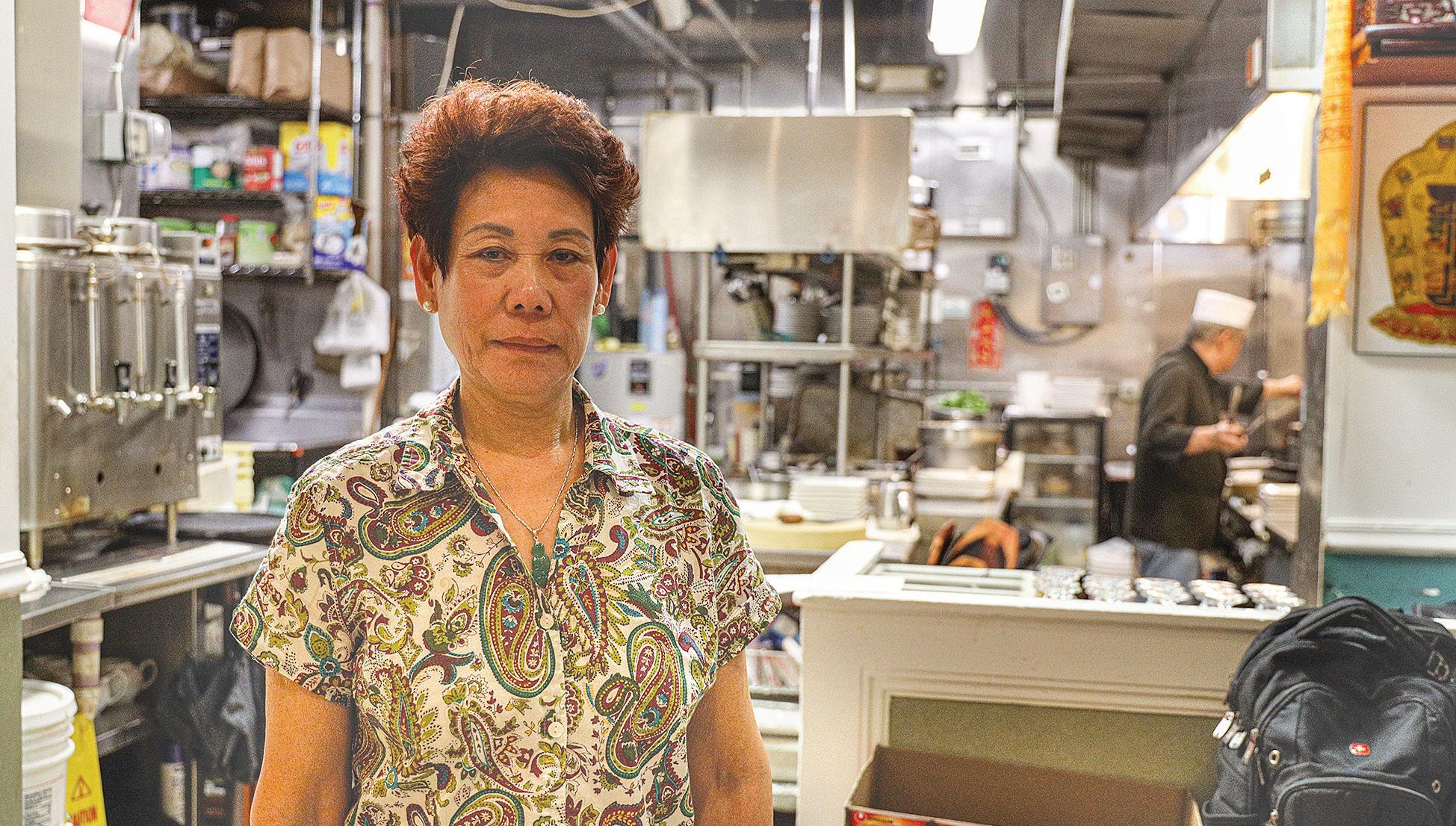
A side wall divides the restaurant into two dining rooms co-serving Cantonese-influenced cuisine and Vietnamese specialties, and frequent patrons to the restaurant cross-order dishes from the two menus. The sidewalls are simply decorated with a Southeast Asian influence, exemplified by the woven bamboo patterns and the floor’s turmeric colored tiles. Here, owner Helen Wong serves a variety of authentic Vietnamese specialties created from her memories. Helen had left her home country of Vietnam to come to Ithaca as a refugee in 1979.
“We actually named our restaurant Hai Hong after the ship that
Chi Minh City — and was a factory worker alongside her husband. When the Vietnam War ended in 1975, Helen and her husband decided to leave the country with their children to find better opportunities overseas. They first tried


brought us to freedom,” Helen says to me in Cantonese as she points at an old painting of a large steamboat on the restaurant’s wall. Although her ancestral lineage is from Southern China, Helen grew up in the city of Saigon — current day Ho
to pay local fishermen to take them away from Vietnam, but their escape plans failed twice as they were caught by local officials. Then in October 1978, Helen purchased six government-issued tickets for herself and her family
— her husband, her three children aged two, three and four, respectively, and the son of her family friend. The details of the tickets were ambiguous as they did not have a specific destination; all Helen and her family knew was that they would be allowed to leave the country via boat. In exchange for her freedom, she sold off all her family assets in exchange for gold bars as the local currency was deemed worthless following the communist takeover. Although it was technically a state-run program, the logistics of her escape had to be hidden as her tickets were informally purchased.
Leaving their home in the middle of the night, Helen and her family boarded a small dinghy which took them to the Hai Hong, an old industrial steamboat. Traveling for weeks by sea, the Hai Hong attempted to dock in Singapore and Indonesia but were rejected by each of the local governments. “We were all standing or sitting in the dark cabin with no place to lie down during the duration of our trip,” Helen recalled.
Hai Hong’s fortunes changed when a French journalist snuck on board with a camera after the ship was denied entry to the port of Malaysia for the second time.
“It was dark at night and we just saw flashes in the cabin, I did not know what was going on.” The journalist published the state of the passengers aboard the Hai Hong on international media, and soon after countries began to offer asylum to the refugees on board. “Canada, Germany and Australia were the first to offer asylum to the sickest refugees.”
ily still remain in contact with fellow church members in the Ithacan community, and she is still thankful to those who helped her
“We
actually named our restaurant Hai Hong after the ship that brought us to freedom,” Helen says to me in Cantonese as she points at an old painting of a large steamboat on the restaurant’s wall.
family settle into life in Ithaca.
“For every issue we had as new immigrants, the church sent vol-
then started to work at a neighboring Chinese restaurant named Peking Garden (which has since closed), and it was there that her famed pho was introduced to the public during the restaurant’s Sunday brunch. Eventually, she bought out the restaurant and moved it to Collegetown, changing the name to Hai Hong as a commemoration to her past.
“I love Ithaca. My favorite part is the fact that we can see the four seasons here,” Helen said when I asked about her perceptions of Ithaca.
“I have a strong relationship with Cornell. Many of your professors have been eating here for a while. My two daughters graduated from Cornell as well, one is working in Hong Kong and the other is still working for the University.”
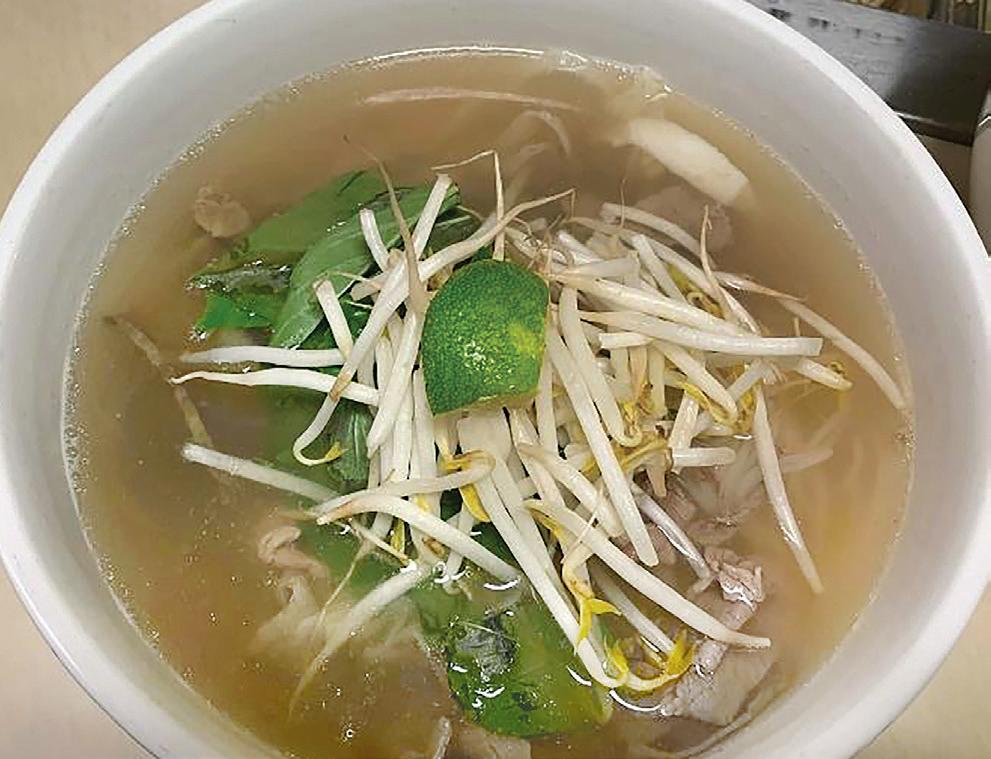
Pho is one of the restaurant’s specialty dishes. Helen’s version is made from her memory, as she jokingly says, “We ate the dish at home, but I never thought about being a chef before I came to Ithaca.” Hai Hong’s version is notably lighter than other versions of this rice noodle dish, which is seasoned in a silkily clear beef or chicken broth. Thin shavings of beef (tripe, tendon and brisket) are added to the flat rice noodles. Alongside the dish are fresh vegetable garnishes that give customers leeway to customize their bowl, with options ranging from lime wedges, chili, bean sprouts and Vietnamese coriander. “There’s no special formula to our dishes here. It’s dead simple,” Helen says. To truly enjoy the dish, she recommends tasting the clear broth first with the noodles before adding the condiments in humble amounts to elevate the broth to your liking.
Although they were offered asylum, Helen and her family had to wait for another six months before they were taken in by St. John’s Episcopal Church in Ithaca, New York. Helen and her fam-
unteers to help us. This included helping us learn English, find jobs, get medical check-ups and more,” Helen remarked, adding that although her family is made up of devout Buddhists, she has attended mass at the local church to extend fellowship with the community. Helen and her husband
Subtle home-cooked flavors are present in all of Hai Hong’s dishes as they are literal representations of Helen’s memories. Whether it is a bowl of cold Bun (thin strips of rice noodles) tossed in a fragrant homemade vinaigrette then generously topped with peanuts, fried shallots and minced pork or Cantonese inspired stir-fry elevated by the mahogany char that comes from her kitchen wok, Hai Hong has a dish for everyone. Next time you pay a visit to the restaurant, instead of ordering your designated favorite, ask your server for a recommendation and try something new. Just like the ship that took Helen and her family to freedom, at Hai Hong, every dish is a journey. Ithaca is very fortunate to have her.
Dominic Law is a sophomore in the College of Architecture, Art, and Planning. He can be reached at dpl78@cornell.edu.

By JACK WAXMAN Sun Contributor
Our role in the dining section is to tell stories about food. Whether it be through a restaurant review, a personal narrative or coverage of a special event, we want to get you thinking about how food impacts us as individuals and as a society. That is why sitting through four Democratic presidential debates — in which the Democrats spent more than 90 minutes talking about health care — and not hearing any of the candidates speak about health at all was disheartening.
The problem with the health care debate is that we are talking about how to fund the rising costs (which have increased twelvefold — from $500 to $6,000 — between 1950 and today) instead of talking about why costs keep rising and how to reverse them.
Costs are rising because America is unhealthy. We are spending more time in hospitals, we are spending less quality time with our family and we are taking more prescribed drugs.
Today, the total impact of obesity and its related complications on the United States’ economic output has been estimated at between 4 percent and 8 percent of gross domestic product. This is roughly the same expenditure as the 2018 defense budget ($643 billion) and Medicare ($588 billion).
According to new data from the Centers for Disease Control, the obesity epidemic shows no signs of slowing down. Today, around four out of ten adults are obese; For children, it’s nearly two out of 10. Most two-yearolds today will develop obesity by age 35, according to a recent projection from Harvard University.
This is pretty dismal stuff. How did we get here? The first part is physical inactivity. Youth and young adults around the world are less aerobically fit (read: we are opting to take the TCAT rather than walk up Libe Slope) than our parents were as kids, a decline that could be setting us up for serious health problems once we’ve grown up. The Guardian reported on a survey that found that we spend half the time our parents did outside. We also take 90 seconds longer to run a mile than our parents did 30 years ago, according to data from 28 countries. Our aerobic fitness has declined by five percent since 1975.
The second part is diet. In the past 40 years, the commercialization of food has brought us fast food and junk food. Here at Cornell, Terrace and Trillium on campus sell easy grab-and-go fries
and pizzas. These foods are filled with saturated fat, cholesterol and processed carbohydrates, all of which slow people down and fatten people up. Around $4.6 billion is spent on all advertising by fast food restaurants each year. Just like Big Tobacco, these companies are putting profit over people, selling products that jeopardize personal health and drive up health care costs for America.
First, our government can reform the Farm Bill, which is the primary agricultural and food policy tool of the federal government. It gives multinational food manufacturing companies such as Kellogg's billions of dollars in subsidies to process commodity crops, which they turn into high fructose corn syrup. This allows them to produce junk food at artificially low costs. It’s the same thing with fast food companies, which use the crops to feed livestock. This is a main reason why 41 percent of the contiguous
U.S. is used by livestock, which also has major implications on the climate crisis. The Farm Bill is a classic example of client politics, a type of politics when an organized minority or interest group benefits at the expense of the public. We need to make our agricultural subsidy system work for American families. Right now, it is failing them.
Just like Big Tobacco, these companies are putting profit over people, selling products that jeopardize personal health and drive up health care costs for America.
wiches, fresh fruits, etc. Instead they give some gross, unhealthy food.”
Costs are rising because America is unhealthy.
Second, the U.S. Congress needs to fund healthy schools. We need to set stricter nutritional guidelines by including maximum fat content per meal, mandating a ratio of fresh fruits and vegetables to other foods and removing processed foods altogether. A high school group in Chicago is currently fighting their district for better food. One of the students said, “It’s supposed to be the place where students get the best healthy lunches like salads, sand-

Although the health care debate forgets health, we don’t have to. We owe it to ourselves and our loved ones to get more exercise by running with friends, playing intramural sports or going to the gym. We also could eat clean-
er by swapping Cheez-Its for an Ithaca-grown apple, moving plants to the center of the plate and drinking water during meals. If we all make these individual choices in our lives, then we will live longer, healthier and happier lives and we will have around $600 billion more to spend on the issues that matter most.
Jack Waxman is a sophomore in the College of Arts and Sciences. He can be reached at jhw264@cornell.edu.

When Google’s next big endeavor, Stadia, was announced earlier this year (through a livestream I remember watching in the middle of a lecture hall during the last few minutes before class), it faced a lot of backlash. The idea was to release an online service — the “Netflix” of games — to stream popular video games without a console. Instead of requiring hardware or software, all users would hypothetically need would be a Google account and a good internet connection.
Right away, a problem emerges: How good an internet connection is “good”? With demanding games on their roster like Assassin’s Creed Odyssey , Borderlands 3 and Cyberpunk 2077 , their servers have to be rock-solid to keep up. Games like those are being developed with more and more intensive graphics each year, and the concept of running them with no specialized hardware or downloaded software is a tall order.
How does the company plan to combat latency, the time it takes for a local copy of a game to receive information from a server? Usually, latency is only a problem in multiplayer online games, like Splatoon 2 or Overwatch — where even though the game structure itself is local to a player’s system, the interactions with other players are constantly streamed through an internet connection. Google is trying to make all games browser-based, where every aspect of the game would be streamed directly to the player, like Club Penguin and all the other Flash games from the 2000s (may they rest in peace). 2-D renderings of cartoon penguins are one thing, but what about complex 3-D worlds made with the newest technology?
It’s worth noting that I myself tried Stadia as a beta tester last December when it was cryptically called “Project Stream,” a name I honestly kind of like better than Stadia. Using my home wi-fi and some luck, I was able to play Assassin’s Creed Odyssey for a decent amount of time. Honestly, I didn’t have too much of a problem with latency. The bigger problem was getting the game to connect in the first place, as it won’t let you so much
as look at the game’s menu until your internet connection is stable enough. Once I was connected, though, I had a pretty good time playing the game. So much so that when the beta period ended, I tried to download and play the game normally on my laptop — to disastrous results. I guess my Dell XPS 13 isn’t powerful enough to run intensive graphics, so I never made it past the title screen. That’s why I, personally, am looking forward to seeing what becomes of Stadia, and whether it can live up to its promises — I’d be willing to put up with a little lag to run games that are otherwise out of my computer’s league.
me think it’s responding to my choices, does it truly matter? Plenty of games use illusions and tricks to render complex environments and details like shadows and particle effects; tricking the player is just a part of game design.

Regardless, last week Google’s VP of engineering Madj Bakar told Edge Magazine that the Stadia team plans to shrink latency down in the next couple of years of service. Eventually, it will feature “negative latency,” a feature where Google’s servers predict the players’ button presses for them, using machine learning to eliminate the need for the game to even wait for user input before proceeding. It’s a concept that seems somewhat akin to handing someone an unplugged controller and telling them they’re controlling an NPC and led to even more community backlash. If games can just predict player input and operate on their own, are they truly interactive? Would the concept of these AI-driven games that play themselves ruin gaming?
I’m conflicted on the matter. On the one hand, it feels kind of disingenuous, not to mention something that sounds too good to be true. What kind of margin of error would this AI technology have, and what happens when the machine gets it wrong? It seems too early to know anything for certain, and I’m not sure why they would bring the technology’s distant future up now when the service has yet to launch. On the other hand, if the technology is good enough that it can really predict my clumsy button-presses and make
I can’t help but think about ways other games have already pulled this trick. Just the other day, at the Saint Motel concert, I was playing Mario Kart Tour between sets when the music started back up, interrupting my race. I locked my phone and enjoyed the concert, and afterwards, when I opened my phone, the race started up again as if I’d paused it. My car didn’t even swerve off the road. This would make sense if it were a normal, offline game, but Mario Kart Tour claims to be online, pitting players against each other. My opponents weren’t NPCs, they were players with usernames! How could they be still racing an hour later?
What Mario Kart Tour likely does is either give NPC racers real players’ usernames, or records players’ race performances and randomly select 11 performances to pit you against every time you start an online race. That would explain why I haven’t seen any players drop out or lag the way I would in an online console game like Splatoon . And for a mobile game, it makes sense — does it really matter that I’m not racing in real time, as long as I still have the experience of playing real Mario Kart ? I almost don’t think so; I think I’m willing to be fooled if I can still feel like I’m getting the real deal.
Olivia Bono is a senior in the College of Arts and Sciences. She can be reached at ojb26@cornell.edu. On the Level runs alternating Tuesdays this semester.
Breaking Bad has always been ahead of the curve. The neo-western crime television drama aired on AMC, establishing itself as one of the most popular shows of its time. While most contemporary dramas fizzle out and struggle to neatly tie up the complex worlds and characters they have created (think Game of Thrones), what made Breaking Bad a truly great television show was its ability to maintain the gold standard in terms of quality and consistency throughout its run. Rare is it to find a conclusion to a story as satisfactory and as universally accepted as what the show was able to achieve through its final episode “Felina.” To top that off, the creators have managed to create a successful (and perhaps better?) prequel in Better Call Saul
In many ways, it truly has been a unique and special franchise. However, when it was announced that the show will have a spin-off movie, set hours after the events of “Felina,” I was initially very skeptical. What more is there left to be said about the characters whose arcs were so expertly ended by the show creators? More importantly, and as is so often the case with sequels and spin-offs, will the creators be disloyal to the themes and characters that made the show what it is?

As is the case with its predecessor, El Camino is a story about transformation, this time of its lovable but grief-stricken Jesse Pinkman (to all the conspiracy theorists out there: Walter White is not alive). Jesse (Aaron Paul) is dealing with the severe trauma of the events of the show that saw him kicked out of his own home, have his face severely disfigured by a cop, witness the death of two of his lovers, commit murder and, last and most recent, being captured and tortured at the hands of a neo-Nazi group. It has been a rough ride for him and he is understandably looking for
a fresh start to his life.
However, as Breaking Bad has always reminded us, in the opening flashback deceased character Mike Ehrmantraut (Jonathon Banks) tells Jesse that the one thing he cannot do is run away from the past and avoid the consequences of the actions that got him where he is. The movie is about Jesse’s struggle to leave his old, wretched life behind. This journey is literally and symbolically achieved in the El Camino, the car in which Jesse drove away in the events of “Felina.” Jesse’s struggle to deal with his past is achieved through flashbacks, most of them revolving around his time as prisoner of the neo-Nazi group. As expected, these flashbacks are gruesome and painful to watch; one particularly impactful scene occurs when Jesse, having received the opportunity to finally free himself by acquiring a gun, completely loses his inner fight and hands back the gun to his heartless and much-hated captor Todd (Jesse Plemons). Present-day Jesse is still very much dealing with these mental scars as the situation almost completely repeats itself when Jesse surrenders himself to the thugs from the welding company, after having almost acquired the cash necessary for his identity change.
Through these flashbacks, we see a lot more of Todd too, and as much as I despise the character, it speaks volumes of Plemons’ ability as an actor to once again portray the cold-hearted Todd with utmost believability and aplomb. This movie is all about Aaron Paul, though, as he once
again gives a stirring performance as the PTSD-stricken, more reserved but smarter Jesse.
There might be a question as to why a sequel was needed in the first place. It would not be too wild a guess to have assumed that the events of the movie would happen to Jesse in the immediate aftermath of “Felina.” In addition, moments like Jesse exclaiming “Yeah Bitch!”, re-emergence of lovable fools Skinny Pete (Charles Baker) and Badger (Matt Jones) and even a flashback of Walt (Bryan Cranston) and Jesse together give weight to the idea that this was a simple fan-service sequel.
Indeed, El Camino is incredibly similar to its source material. We have the characteristic neo-western feel with big set pieces, bleak, somber settings and slow-moving plot and action. However, what makes El Camino really work is its loyalty to its predecessor’s themes. The reason that the series finale was met with universal approval was that it showed its characters dealing with the consequences for what they did, in a way getting what they deserved. El Camino’s success lies in that it doesn’t try and change that fact for Jesse. Jesse still gets what he deserves based on his actions on the show and the movie is simply about his transformation of getting there.
Saksham Mohan is a junior in the College of Arts and Sciences. He can be reached at sm985@cornell.edu.

Fill in the empty cells, one number in each, so that each column, row, and region contains the numbers 1-9 exactly once. Each number in the solution therefore occurs only once in each of the three “directions,” hence the “single numbers” implied by the puzzle’s name. (Rules from wikipedia.org/wiki/ Sudoku)



10
11

Houses, Apts, Parking
1 to 9 Bedroom
Collegetown - College Ave, Linden Ave, Dryden Rd, Bryant Ave, Cook St. 607-330-2442 info@urbanithaca.com www.urbanithaca.com
We have availability for the 2020-2021 school year beginning June 1st at Hudson heights apartments. The studios include electric, heat, water, garbage and parking. There is coin-operated laundry facilities on site. Prices start at $750 / month for a 12 month lease. If you have any questions or would like to schedule a tour contact us by phone 607-280-7660 or email: renting@ithacaLS.com
COLLEGETOWN TERRACE APARTMENTS
Leasing for 2020/2021 Spring 2020 Semester leases available Heat, hot water and Wi Fi State of Art Fitness Center Shuttle Bus Service to campus Washer & Dryer in Apartments collegetownterraceithaca.com office@ithacastudentapartments.com (607) 277-1234
Now Renting 2-10 Bedroom Houses/ Apartments for 20-21. All Locations. Call today or visit our website: Certified Properties of TC Inc certifiedpropertiesinc.com 607-273-1669
2020-2021
Studio 1, 3, 8 & 11 BR Apts. Great Locations in Collegetown. 607-227-2535
120 Oak Avenue
Just steps to Cornell Campus
10 bedroom house & 1 and 2 bedroom apartment 607-277-1234 office@ithacastudentapartments.com Ithacastudentapartments.com
Collegetown Crossing College Ave's Newest Location 307 College Ave. Now Leasing for 2020-2021 Completely New Modern Studios & 2 Bedroom Apartments. Fully furnished, heat & hot water included. Reception area at 307 College Ave. www.urbanithaca.com 607-330-2442 info@urbanithaca.com
Boldly Refined Living 312 College Avenue
Sophisticated studio, 1, 2, 3-bedroom apartments. Superior fitness facility, theater, and coworking space. Free high-speed internet. Exclusive resident parking. Package delivery/return. Overnight concierge. 607-273-9777 or 312collegeave.com
3 Bedroom 1 Block from Starbucks in Collegetown Heat & hot water included. Lease starts June 2020. Parking & laundry available. www.porealty88.com 607-277-1888
20-21
College Ave. 5 BR House Furnished. Laundry. Parking. Call 607-273-8576
20-21
Upper Eddy St. 7 BR house Furnished. Laundry. Call 607-273-8576
BLAIR STREET FURNISHED HOUSE
Available 2020-2021 7 Bedroom, 3 full baths 2 kitchens & Laundry Text or call Tracy at TLC Property Mgmt Corp 607-379-2776













COLGATE AT CORNELL
DARTMOUTH AT MARIST
PRINCETON AT BROWN
HARVARD AT HOLY CROSS
PENN AT COLUMBIA
YALE AT RICHMOND
ARIZONA STATE AT UTAH MICHIGAN AT
FOOTBALL Continued from page 16
have echoed from the early part of the season.
“[It’s unfortunate] for somebody [to be] injured, but fortunately that creates an opportunity for somebody else,” Archer said. “You don’t know when it’s going to happen in a game; things happen so fast.”
Freshman linebacker Jake Stebbins is one example of a player who has taken advantage of increased playing time. He had seven tackles and forced a fumble at Harvard, becoming the first Cornell freshman to eclipse 20 tackles in a season since 2014.
Players like sophomore quarterbacks Dez’mond Brinson and Kyle Neputy, who entered the season with no expectation of playing, may be thrown into game action as early as Saturday. Brinson saw a few snaps on Saturday at Harvard. Archer said the No. 2 QB will be “some combination” of Brinson and Neputy.
“I think it’s a great lesson to anybody on the roster,” Archer said of his third and fourth signal-callers now preparing for game action. “Oh, I’m No. 3, I’m No. 4. In an instant, you can be the starter. … You really have to be great in your preparation and strike when opportunity comes.”
In its final non-conference game before a gauntlet of five straight Ivy contests in the season’s second half, Cornell faces 0-7 Colgate, whose putrid record doesn’t tell the whole story: The Raiders, who smacked Cornell, 31-0,
in Hamilton last season and made the national quarterfinals, have faced tough opponents like Air Force — an FBS team — and top-tier FCS foes like Maine and William and Mary. Colgate is 0-2 in a tough Patriot League. Like Cornell, Colgate enters the Route 13 Rivalry seeking
a win to jump-start its season. Looking ahead, the Red hosts perennial Ivy cellar-dweller Brown in week six, so a win against Colgate could give Cornell an opportunity to build a win streak and take some momentum into four straight Ivy contests in which it’ll be the underdog.
This weekend’s game is the first of three straight home games for Cornell — after Colgate and Brown, the Red hosts Princeton Nov. 1 before facing Penn, Dartmouth and Columbia to round out the schedule.
“This is a big week for us, especially after what happened last year,” Jones said. “Every time we play Colgate we get their best game,” McClurge said. Kickoff is set for 1:30 p.m. Saturday at Schoellkopf Field.




‘Our Goal Is to Win It All’
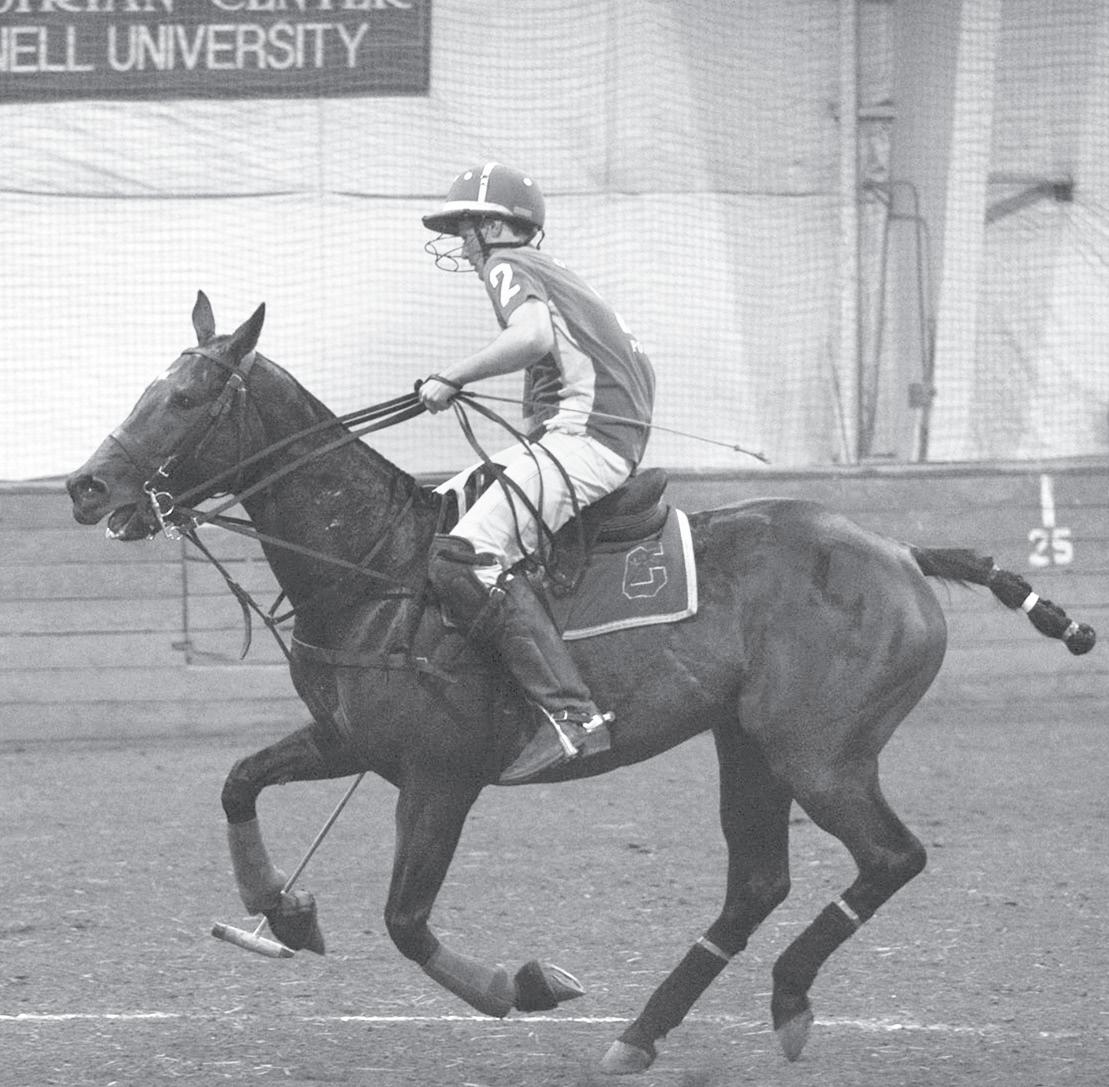
Polo enters 100th season
By JUSTIN SUZZAN Sun Staff Writer
Beginning their 100th season, Cornell’s women’s and men’s polo teams are looking to make this season count. They traveled to Bluestone Farm in Montgomery, N.Y. over the weekend for the first-ever meetings between the clubs.
In their second match of the season, the women cruised to a 13-2 victory over Bluestone, flipping the script on a tough 16-13 loss to Skidmore on Oct. 6.
“This weekend was a time where both teams proved to ourselves what our teams are capable of,” said senior captain Shariah Harris. “Communication on field has been our main focus and that is something that we executed extremely well this weekend.”
campaign, joined the Red after playing for Southern Methodist University. As a member of the SMU squad, he played a pivotal role in leading the team to the intercollegiate finals in 2018. Cogan and his team have high hopes for the Red this year.
“Our goal is to win it all,” Cogan said. “I think right now we are all looking forward to what the journey has in store for us.”
Cornell polo’s athletes are part of perhaps the most consistently talented Cornell athletic teams. Since a men’s polo team was adopted by the university in 1919, both the men’s and women’s programs have been establishing themselves as two of the top programs in the entire nation.
The men’s team’s last national championship season came in 2005. Since this dream year, the
“This weekend was a time where both teams proved to ourselves what our teams are capable of.”
Shariah Harris
After the win, newly appointed head coach Branden Van Loon was very proud of his squad. He praised the team for its high level of play and excellent communication.
“The men and women thrived in the larger outdoor arena,” Van Loon said.
The women were not the only ones who left Bluestone with success. The men also played well in their match and came out on the winning end of a tight 9-7 game. Junior Jed Cogan led the way for the team, contributing all around the playing field.
“I think overall the trip was a success for both the men’s and women’s team,” Cogan said.
“For us, it served as an opportunity to further build team chemistry, given that we are adjusting to the addition of two new talented freshmen.”
Cogan, who is also the team’s captain for the 2019-2020
men have secured a top three national finish in every season since. Many players on the women’s team still remember the taste of a national championship from 2016 — the team’s third national championship in the last 10 years.
After former head coach David Eldredge ’81 stepped away from both the men’s and women’s teams after 34 years, Van Loon is new to the helm, looking to lead the teams toward spring’s national championships.
With the historic 100th season of Cornell polo now underway, the women will play their first home match against Melinda’s Prospect on Oct. 19 while the men will square off against Westport at home on Oct. 18.
Justin Suzzan can be reached at jsuzzan@cornellsun.com.

By RAPHY GENDLER Sun Sports Editor
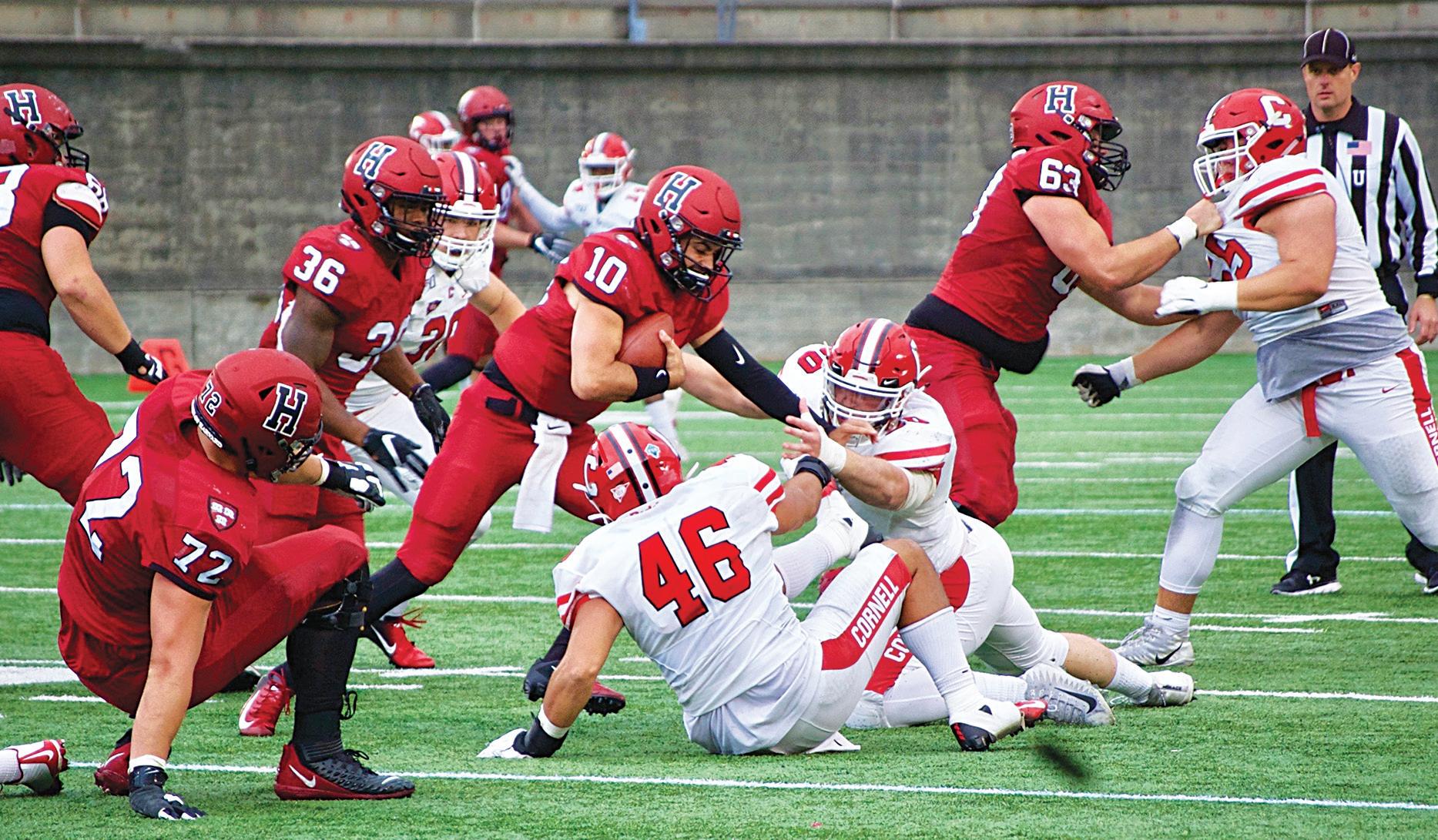
Cornell football limped off the field at Harvard last weekend, its Ivy League championship aspirations reduced to almost zero.
While it’s still mathematically possible for Cornell to win a conference title, its chances fell significantly with its 35-22 loss to the Crimson. No two-loss team has won the Ancient Eight since a three-way tie in 1982. At 0-2 in league play and 1-3 overall, Cornell’s focus now turns to
salvaging a season that appears headed for an ugly downward spiral.
Cornell last won the league in 1990. Its most recent winning season was 2005. With games still to come against Ivy unbeatens Princeton and Dartmouth, the Red seems bound for another season in which it’s lucky Brown is there to occupy the No. 8 spot in the league.
Two teams desperate for a win will take the field in Ithaca this weekend as the Red hosts Colgate (0-7, 0-2 Patriot) in the first of three straight home games. Cornell knows an Ivy title is unlikely — “it’s really hard to win the
Ivy League with two losses,” head coach David Archer ’05 said — now, it’s about building confidence and trying to pick up wins.
“In the back of the head you kind of know that what the team goal was [is] most likely diminished, but as a defensive unit and as a position group we’re just trying to be the best we can every week,” said senior cornerback David Jones.
The already almost impossible task of salvaging the 2019 season is made tougher still by a number of injury concerns. Senior quarterback Mike Catanese is done for the year. Sophomore running back Devon Brewer and junior running back Jake Derderian are out for the season and at least a month, respectively.

“The [Harvard] loss definitely hurts especially it being a league game but you do see some pieces coming together [offensively],” said junior wide receiver Phazione McClurge, who broke out for 137 yards and a touchdown on Saturday. “We’re not worried about anything, we’re going to put it all together.”
On the other side of the ball, a defense that has been one of the Ivy League’s best — and limited opponents even while the Cornell offense has struggled to do much of anything — is hit by the injury bug. Junior linebacker Lance Blass and junior safety Logan Thut won’t play this weekend. Senior defensive linemen Jordan Landsman and William Baker have also missed time due to injury.
Cornell believes it’s time for the “next man up” cliche to go into effect — a sentiment that members of the team
By ZORA HAHN Sun Staff Writer
Cornell volleyball put an eight-game winning streak on the line as it hosted Dartmouth and Harvard this past weekend. Unlike in previous seasons, the Red entered this batch of matchups undefeated in conference play and atop the standings in the Ancient Eight.
“We weren’t the reigning champs and now we have that target on our back, we’re just learning how to deal with a lot of pressure,” said senior libero Lily Barber.
pink. The Red raised hundreds of dollars toward breast cancer treatment. Saturday’s matchup against Harvard (3-11, 1-4) promoted the #DontBearItAlone campaign.
“[Senior] Jenna Phelps … started [the #DontBearItAlone campaign] last year,” said head coach Trudy Vande Berg. “We all wear green and promote awareness and do a lot of social media posts.”
“We’ve gotten a lot more mentally tough. [Before], the team would have all the skills but we’d crack under pressure.”
Lily Barber
The pressure did not faze the Red in the slightest. In fact, Cornell earned comfortable victories as it defeated Dartmouth, 3-0, and Harvard, 3-1.
Not only did the Red (12-2, 5-0 Ivy League) extend its winning streak to 10 games, but it did so while promoting awareness for both breast cancer and mental health.
Cornell’s tilt against Dartmouth (5-9, 1-4) was dubbed the “Dig Pink” game, and it featured players and spectators wearing
With the pair of wins, Cornell is now up to 5-0 in Ivy League play and has posted its best start in conference play since 2005, a year in which the Red won its first 12 Ivy games en route to an appearance in the NCAA Tournament.
Vande Berg attributed the Red’s success to quality play from many different players.
“Some great seniors … have played a ton. Our sophomore class is very talented and … we have some great freshmen,” Vande Berg said. “It’s been really good to watch them. We had a couple [tough] games, but we came back that next set and took care of business.”
“We’ve gotten a lot more mentally tough,” Barber said. “I feel like my last few

Good omens | The last time the team started its season 5-0 in conference play, it went to the NCAA Tournament.
years, the team would have all the skills but we’d crack under pressure. Every year, the freshmen get better and better, our coach is really good at recruiting.”
While the Red notched a clean sweep of Dartmouth, Harvard presented a tougher challenge. The Crimson only lost the second set by two points and notched a win in the
following frame. But Cornell secured the victory in the fourth set in a 25-20 decision. The Red continues its conference slate on the road with games against Brown and Yale on Friday and Saturday, respectively.