The Corne¬ Daily Sun

In year marked by turmoil, Cornell University announces 1.9% return, lowest in the Ivy League
By JOHNATHAN STIMPSON Sun Managing Editor
When the coronavirus prompted nationwide shutdowns in March, the stock market plummeted by over 13 percent in just one day. Fueled by concerns America’s economy would enter a depression, experts widely expected that investment funds, such as Cornell’s multi-billion-dollar endowment, could take a major hit.
Those concerns, however, largely did not materialize — with a dramatic, months-long rebound in equities helping to push Cornell’s annual results into the black. From July 2019 to the end of June, the endowment posted a 1.9 percent annual return, according to a University press release.
While the endowment’s investments generated a positive return, its total assets fell from $7.3 billion last year to $7.2 billion, likely owing to money distributed to help fund the University’s operations.
According to Cornell’s Chief Investment Officer, Kenneth Miranda, the performance mostly met expectations, allowing the University to manage “the crisis while meeting payout requirements and maintaining a long-term orientation.”
But although the pandemic has led to historic job losses and permanent business closures, most markets have proved to be unexpectedly resilient.
“The fiscal year-end returns across markets belied the extreme levels of pricing volatility seen during the year.”
Kenneth Miranda
The S&P 500 and Nasdaq both reached all-time highs in the last few months, while low interest rates have propelled the housing market to unprecedented heights.
All told, as Miranda put, “the fiscal year-end returns across markets belied the extreme levels of pricing volatility seen during the year.”
Even so, while Cornell’s just-positive results beat early spring’s most dire projections, they trail those of the entire Ivy League, except for Princeton University, which has not yet reported its performance.
Beyond its seven rivals, dozens of its peers proved much more successful in taking advantage of the financial turnaround. For them, the unpredictable coronavirus economy decisively proved to be more blessing than curse.
“Making further progress at an accelerating pace is the main priority for the year ahead.”

Kenneth Miranda
Harvard University posted a 7.3 percent return, beating its previous year’s performance. Columbia’s endowment returned 5.5 percent to total $11.2 billion, and Dartmouth’s returned 7.6 percent to total $6 billion. Yale’s returned 6.8 percent for the fiscal year, ending with $31.2 billion in assets.
In fact, data compiled by trade publication Pensions and Investments reveals that — of 26 major endowments that have so far reported 2020 results — Cornell’s annual return was worse than all but six.
The results represent another year of middling returns for the University, whose investment performance has, in the past, often lagged behind peers.
The management of Cornell’s investments has seen significant changes since 2016, when Miranda, who previously served as the International Monetary Fund’s Chief Investment Officer, took charge of the endowment after the fund experienced a long period marred by turmoil and turnover.
From 2005 to Miranda’s current tenure, Cornell’s endowment cycled through six investment chiefs amid a time of noticeable investment underperfor-
See ENDOWMENT page 3
By SEAN O’CONNELL Sun News Editor
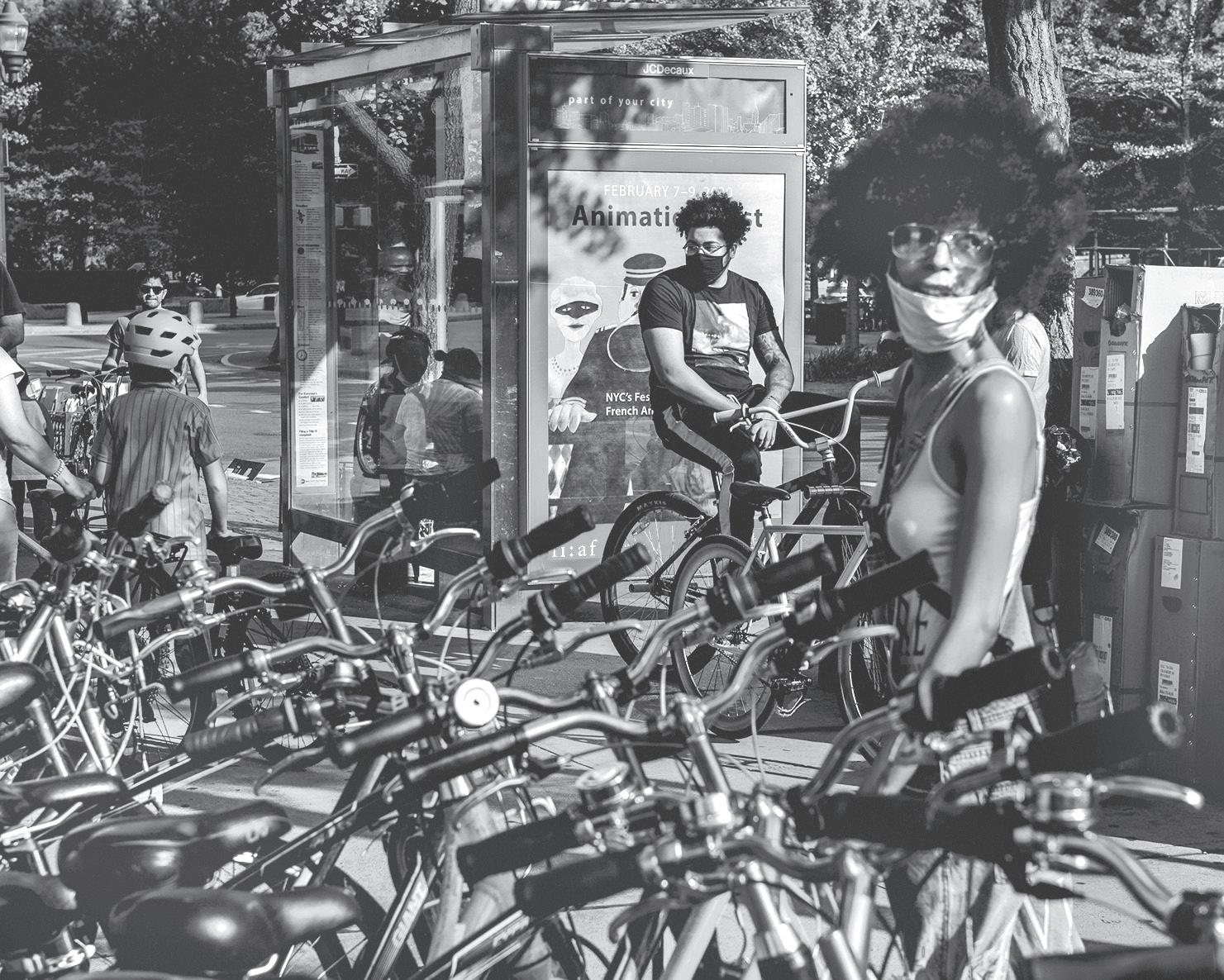
Allison Eng ’23 was riding her bike down 5th Ave. in New York City as a part of a Black Lives Matter protest on Oct. 3 when she was struck by a car, destroying her bicycle and throwing her into the pavement.
Five x-rays, one CAT scan and half a day later, Eng found herself dealing with a sprained right foot, neck soreness and a few pulled muscles — she had gotten off easy.
I turned around, looking [out] for my dad’s safety.”
Eng was immediately sent to the hospital, and was not released until 12:30 a.m. on Monday. Her father was unhurt. She now faces six weeks of physical therapy for her back and neck injuries, as well as a boot for the next three weeks for her right foot. Eng was grateful for the relatively minor nature of
“A few minutes later, when we were a few blocks down, we could hear screeching on the road and I turned around.”
Eng, who is currently taking a gap year, is no stranger to bike protests — New Yorkers biking together, chanting slogans and making noise in the main thoroughfares of the city — and would often go with her father on Saturday afternoons to participate.
“We were just riding down the street and then on the side of the road there was a car that wanted to enter the road,” Eng told The Sun in an interview. “A few minutes later, when we were a few blocks down, we could hear screeching on the road and
Allison Eng ’23
her injuries, despite the discomfort she feels.
Eng shared her experience in an Instagram post, which was widely shared and received 1,998 likes in the span of a week.
Two days later, the driver of the car that struck her was arrested by the NYPD. This was bittersweet for Eng, who found out that he was released from custody with no bail.
“Tuesday night, the driver
Thursday, October 15, 2020
Piecing Together the Puzzle to Understand the Evolution of the Ants: Macroevolution to Microbiomes 12:30 - 1:30 p.m., Virtual Event
Ghostly Meanings, Spectral Affects: Market Transformations and Possibilities in the Thai Spirit World 12:40 - 2:10 p.m., Virtual Event
Ghosts in the Schoolyard: Racism and School Closings on Chicago’s South Side 1:25 - 2:40 p.m., Virtual Event
Institute for African Development Special Topic Seminar Series: African Cultural Heritage: Indigenous Knowledge Systems and the Strategies of Managing Diseases During Pandemics 3 - 4:55 p.m., Virtual Event
Cornell Department of Astronomy and Space Sciences Colloquium: “Gravitational Test Beyond the First PostNewtonian Order With the EHT” 4 - 5 p.m., Virtual Event
Cornell Celebrates Toni Morrison: A Teach-in on Morrison as Writer and Scholar 4:30 - 6 p.m., Virtual Event
Appropriation vs. Appreciation Dreamcatcher Workshop 6 - 8 p.m., Virtual Event
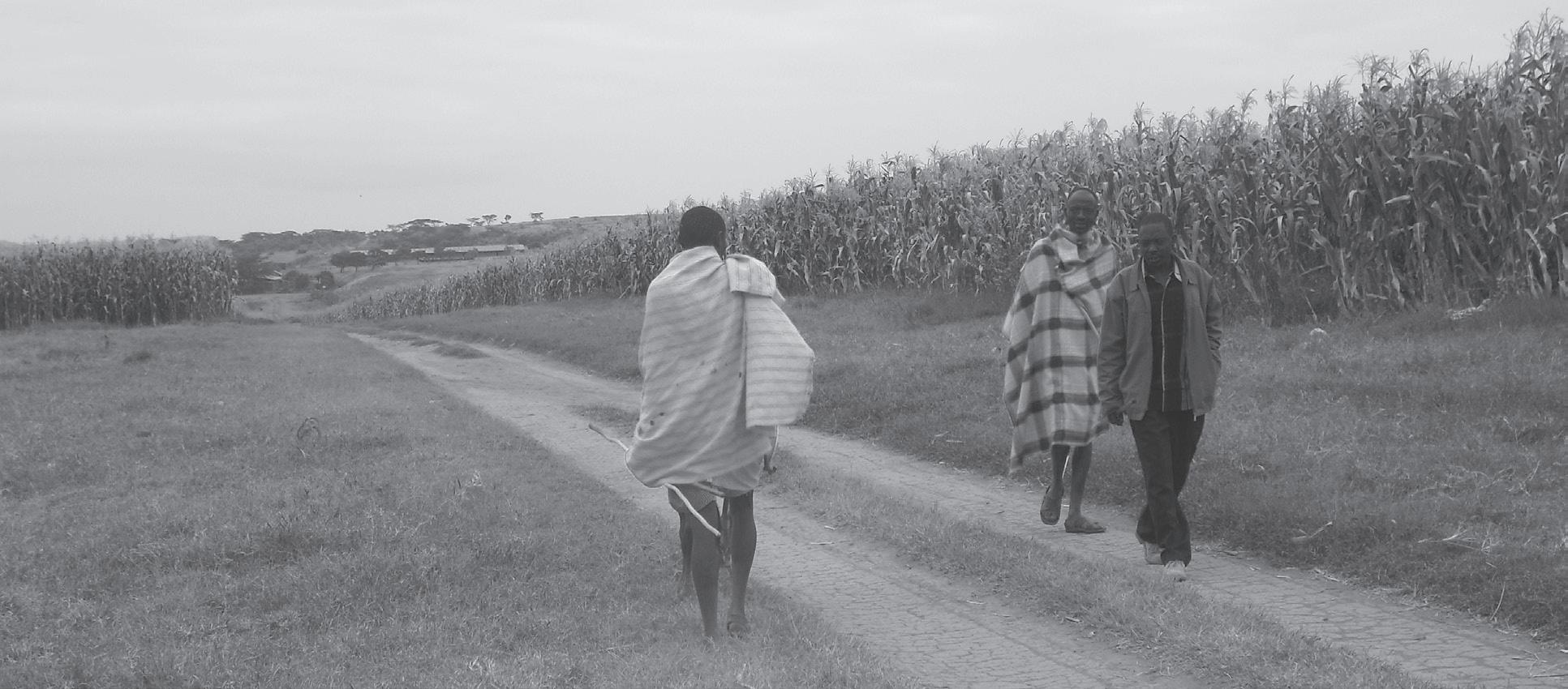
Cultural expertise | Ladislaus M. Semali, professor emeritus of education at Pennsylvania State University, will lecture on indigenous knowledge systems in the context of diseases, heritage and the global pandemic.
Just Sustainabilities in Policy, Planning, and Practice 10:10 a.m., Virtual Event
“Anishinaabe Women and the Law of Treaties” 11:30 a.m. - 12:30 p.m., Virtual Event
Career Conversation With Brandon Espinosa ’11 Noon, Virtual Event
The Annual Hu Shih Distinguished Lecture With Meir Shahar “Chinese Animal Gods” Noon - 1:30 p.m., Virtual Event

Webinar: What To Do for eBird’s October Big Day With Project Leader Jenna Curtis Noon - 12:30 p.m., Virtual Event
NSP Family Webinar Series: Sorority and Fraternity Life Info Session 12:30 - 1:30 p.m., Virtual Event
Latino Living Center Presents - Café con Leche: Migrant Citizenship 6:30 p.m., Virtual Event
Atkinson Center for Sustainability: Hackathon 7 - 9 p.m., Virtual Event
By SPENCER NACHMAN Sun Contributor
The loud hum of students packed into Olin Library’s Libe Cafe is a quintessential Cornell scene that has not survived the pandemic era. COVID-19 regulations have drastically altered the fall 2020 semester, with even getting a cup of hot coffee on the way to class now challenging.
While most cafes across campus are still open — although with reduced hours — students found that the changes had forced a shift from the daily routines they were used to.
senior director for marketing and communications for Student and Campus life.
“Last year, getting coffee was a stop along the way on a walk somewhere, but now it is its own destination.”
Sofia Pereira ’23
“Last year, getting coffee was a stop along the way on a walk somewhere, but now it is its own destination, which means I choose a place where I can sit and stay for a few hours as opposed to just passing through,” said Sofia Pereira ’23. Periera said that she enjoys visiting the Green Dragon, since she is able to get coffee and study in a place other than her dorm room. But each trip to the cafe has to be planned ahead, measured accordingly to her schedule.
“If there is an online class that I am going to speak in, something I consider is, how much am I going to be taking my mask off or talking?” Periera said.
Having a space to study was also important to Sunny Chai ’24, who decides where she gets her coffee depending on whether there is study space close by. But this can be an issue in light of social distancing regulations.
“This semester we’re still serving lots of coffee and tea and chai and cappuccinos, and of course bagels and pastries, but we don’t have room for everyone to stay and enjoy and relax for a while,” wrote Karen Brown,
This has forced students to adapt and find their own study spaces. Albert Sebastian ’22 used to count Temple of Zeus among his favorite places to get a cup of coffee and study, but now found Klarman to be a study-only space where masks are required all the time.
“Zeus is a good place to meet up with a group of people to study,” Sebastian said. “So you can go there to get work done.”
Temple of Zeus opened for take out and online-only coffee orders on Oct. 7, after being closed for the first month of the semester.
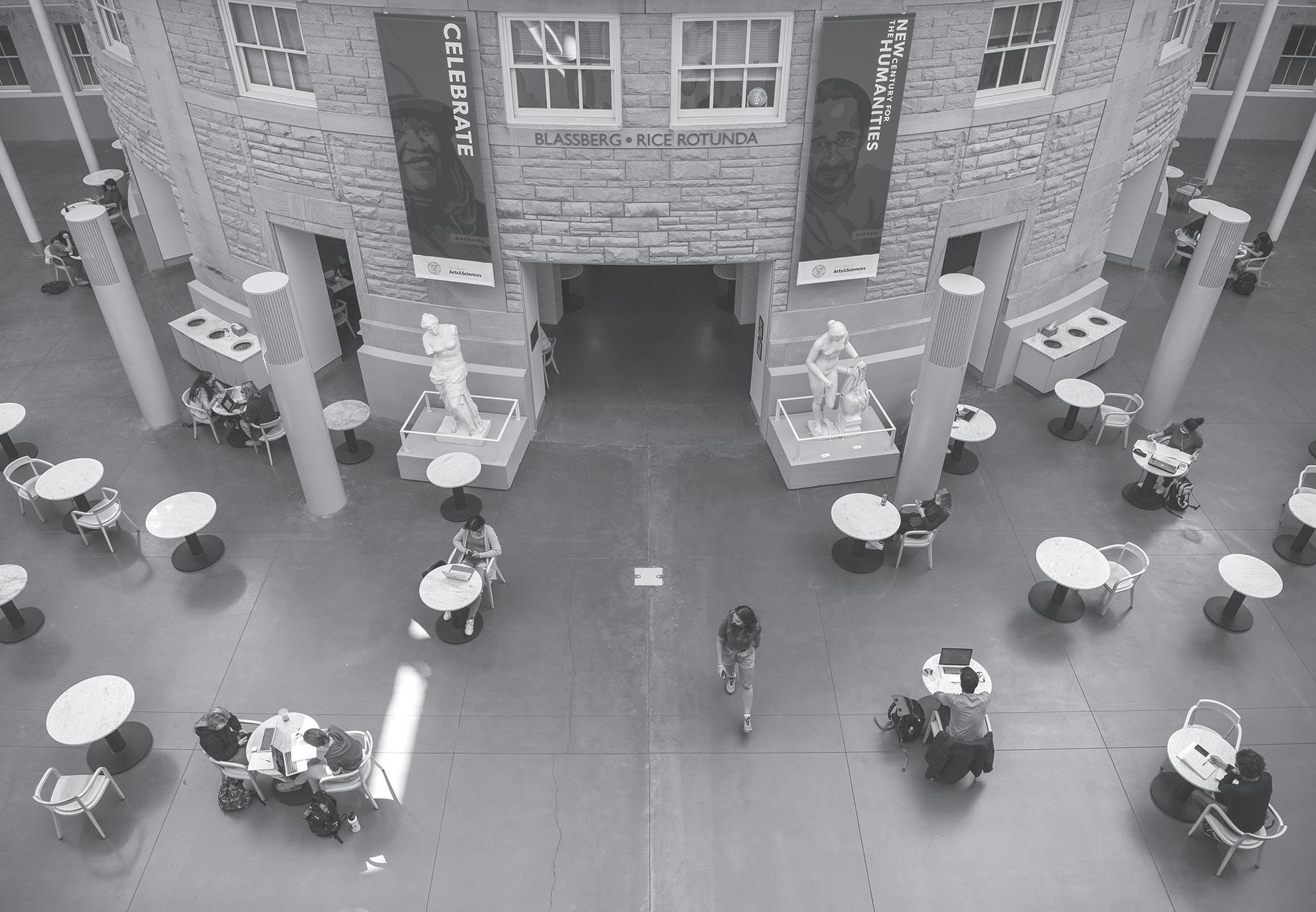
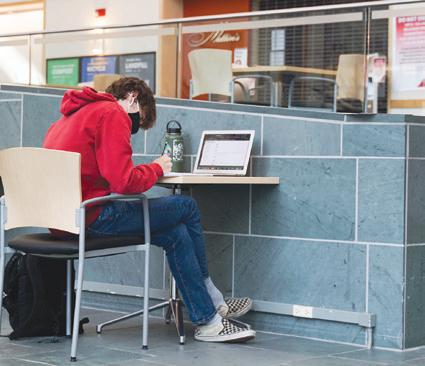
Empty | Students sit, socially-distanced, in Klarman Hall. Normally, the building would be full of students enjoying a coffee, studying, or just going from class to class.
Students were also concerned about the cafes’ shortened hours. Chai, for instance, expressed frustration that Martha’s Express closes earlier than it used to, but understood that is a part of the new reality on campus.
Most students, however, were appreciative of the lengths the cafes went to create a safe experience. “It’s more work on [the cafes’] end to make sure that as few people come into contact with the same thing as possible,” Periera said.
Brown discussed Cornell Dining’s new safety guidelines, which were formed based on instruction from the Centers for Disease Control, the Tompkins County Health Department and Cornell’s Office of Environment, Health and Safety.
“Some of the changes include not allowing the use of reusable coffee mugs, as much as we’d like to. All the muf-
fins and other baked goods are individually wrapped, and guests can’t help themselves,” Brown wrote.
Regardless of whether the new cafe culture is here to stay, both students and staff alike expressed nostalgia for the late-night study sessions, the crowds and coffee of previous semesters.
“We certainly miss the more relaxed and casual atmosphere of normal times, when dozens of people could relax with their lattes to study or chat with friends in our bustling cafés,” Brown wrote. “We’re hoping campus can be more lively next year.”
Spencer Nachman can be reached at sjn48@cornell.edu.
By ESAT BRAVEBOY Sun Contributor
During the English department’s first faculty meeting of the fall semester, faculty members of color introduced a proposal –– to change the department’s name.
The new proposed name — “the department of literatures in English” — would mark a distinct change in the department’s branding, helping to eliminate what Director of Undergraduate Studies Prof. Kate McCullough, English, said was the “conflation of English as a language and English as a nationality.”
Earlier this month, a majority of the department had approved the change, and is now awaiting approval from college administration.
Other faculty simply recognized that it was time that the department’s title represented what it was really focused on: literature written in English.
“In part, it was also a result of an ongoing shift in literary study in this department — and others across the country — to focus on a broader reach of literature,” McCullough explained.
The sentiments slowly formed into a plan of action over the summer — led by Boyce-Davies and Prof. Mukoma Wa Ngugi, English — where they began thinking about how to broach the topic with other colleagues.
Many of the concerns surrounding the decision were eased by the message to faculty and students sent from President Martha E. Pollack, who wrote that Cornell should make a concerted effort to be a more inclusive environment.
The department’s name update would mark one of the first explicit and permanent changes aligned with
“What surprised us was the fact that so many of the white faculty of the English department signed on — we were amazed.”
Prof. Carole Boyce-Davies
Continued from page 1
mance, according to a profile published by Institutional Investor. Over that 10-year period, the University delivered annualized returns of 4.8 percent compared to an average of 6 percent for all endowments with over $1 billion in assets; had Cornell matched average returns, it would have made an additional $700 million over that timespan.
“It was also a result of an ongoing shift in literary study in this department.”
Prof. Kate McCullough
The decision to demand such a change was spurred by this summer’s resurgence of the Black Lives Matter movement following George Floyd’s death, according to Prof. Carole BoyceDavies, English, one of the original proposal writers. As a result, the faculty felt a sense of obligation to react in their own department.
“Faculty around the country — not just faculty of color, but faculty in general — began to look at the institution to see how we can help advance a discourse that challenges structural forms of racism which get reproduced in students and in teaching over and over again,” Boyce-Davies said.
“We had a Google Doc where the proposal was available for a couple of months beforehand and people had aired their questions, so the meeting itself wasn’t a place where people had a lot of concerns,” said department chair Prof. Caroline Levine.
Boyce-Davies and Wa Ngugi first introduced the idea to the department’s faculty of color, who supported the move. Early on, they felt some anxiety about the reaction of the rest of the faculty — which was apparently unfounded.
“What surprised us was the fact that so many of the white faculty of the English department signed on — we were amazed,” Boyce-Davies said. “By the time we were ready to officially take it to the department as a whole, we had over 75 percent of the faculty signed on.”
According to Boyce-Davies, Levine “wanted to sign the proposal right away. We kept asking if she was sure because some of us thought that, as chair, she should stay neutral, but she signed it immediately.”
Pollack’s call to action.
“[The message] was a big help in making us feel like this was an important part of a larger collective action,” Levine said. “Sometimes when a department tries to do something like this in isolation, there’s concerns about whether or not people will recognize and respect it. When it comes from the top, there is a sense that this is something that the whole institution should be doing in some part and it makes it easy to rally around it.”
Smaller discussions about anti-racist changes have been happening for years, according to Levine, but current circumstances gave the faculty confidence to take concrete, unified action.
“I think leadership matters,” Levine said of her stance. “This isn’t just us doing a symbolic gesture, this is in keeping with the University’s call to have us really rethink our everyday practices around racism.”
Esat Braveboy can be reached at eab323@cornell.edu
In one of the biggest changes spearheaded by Miranda since his appointment, the CIO set forth a “multiyear effort to reposition and restructure the portfolio,” primarily by gradually unwinding positions in illiquid investments.
According to Miranda, underperformance in those legacy investments has left some “residual issues,” partially explaining the endowment’s comparatively low return this year. While the fund’s public and private equity investments returned 7.4 percent, and the “core fixed-income” portfolio yielded 9.4 percent, these gains were counteracted by marked losses in other asset classes. For instance, the endowment’s resources portfolio — which the press release said was “hard hit by the pandemic” — posted a 14 percent loss.
Nevertheless, Miranda expressed optimism that brighter days are ahead for Cornell’s endowment, which has hired new staff in the past year.
“Making further progress at an accelerating pace is the main priority for the year ahead,” Miranda said. “This will position the endowment to support Cornell for the long run.”
Johnathan Stimpson can be reached at jstimpson@cornellsun.com.
PROTEST
Continued from page 1
got arrested. I didn’t even know because nobody contacted me. I had to find out through Instagram — through protest groups,” Eng said.
A similar incident occurred a month earlier, again in New York City — a car drove through a protest in Times Square, though no injuries were reported. Eng criticized the New York Police Department for failing to arrest the driver in that case.
On campus, Eng works with several activist groups, including the College Upstate Initiative and the Cornell Prison Reform and Education Project, which are concerned with reforming our justice system.
While Eng may not be able to go to any bicycle protests
“I wanted to make it clear that activism should continue. The Cornell community has to be more aware that this is not just an issue they see on a screen.”
Allison Eng ’23
“There were videos [of the perpetrator], there were photos of their face and they were never found by the police,” Eng said. “I’m not really expecting any justice.”
Eng reflected on her experience with the police: “Because I am Asian and not Black or brown, there is more cooperation with the police and they’re doing more. If I was another race, this would be brushed off.”
in the near future, she stressed that her work with Black Lives Matter was not over.
“I wanted to make it clear that activism should continue.
The Cornell community has to be more aware that this is not just an issue they see on screen and is [now] gone, under wraps, under covers,” Eng said. “It’s continuing.”
Sean O’Connell can be reached at soconnell@cornellsun.com.

‘I feel like I’ve been doing so great in college now,’ one said
By ASHA PATT and ELEANOR ZWEBER Sun Contributors
Almost seven months after the abrupt transition to online school and the mass exodus of Cornell students back to their hometowns in March, many students are reluctant to once again retreat into isolation as Thanksgiving break approaches.
When Cornell announced their reopening plans for the Fall 2020 semester, a key component was limiting travel to and from campus. To ensure holiday travels did not start a new wave of cases, the University decided to transition to fully online instruction and shut down campus starting on Nov. 25.
After a week of semi-finals, students currently living in Ithaca will pack up their belongings and travel home to finish the semester online.
This transition brings back memories of midMarch, when students were abruptly told to leave campus as COVID-19 first began sweeping through the United States. This time around, students are more prepared — but also more hesitant to relive the social trauma of leaving Cornell behind.
“I’m not feeling great,” said Margaret Keymakh ’23. “When I was at home over quarantine, the transition was not the best for my mental health. I
“I’m not feeling great. When I was at home over quarantine, the transition was not the best for my mental health.”
Margaret Keymakh ’23
feel like I’ve been doing so great in college now and I don’t really want to return to that environment.”
For first-years, leaving behind friends they just recently met is even more daunting. “It feels like we’re just still getting to know each other and we’re already halfway through the time we’re going to be staying here,” said Maya Devarajan ’23.
Despite not wanting to leave their college friends, many students admit they anticipate a much easier transition — socially and academically — now that everyone is prepared for what lies ahead.
“Academically I feel like I already know what it’s going to be like, it’s going to be very similar to when we transitioned online in March. Except now the professors have a little bit of a better idea of what does and what doesn’t work,” Keymakh said.
ily, including my cousins and grandparents, go cut down our Christmas tree,” said Johnstone. “That will still be happening this year because we can be outside and with masks”
Chloe Solon ’23, who lives in the Pi Beta Phi sorority house, plans on returning home by the end of Thanksgiving break and volunteering or working over the break. The “strict deadline” for closing down campus residences applies to sororities as well, meaning that everyone living at the sorority house will leave for break.
“We’ll be here throughout the whole break ... everyone on the team will be staying in Ithaca.”
Zach Tupker ’23
“Depending on how everything’s going, I might continue working at a coffee shop I’ve worked at before, which had a lot of trouble staying open because of the pandemic,” Solon said, “I also volunteer at a place at home helping people with disabilities … everything is sort of up in the air based on whether or not it can be open, but I would definitely love to do that.”
Ben Tupker ’23 and Zach Tupker ’23, twin brothers and members of the Cornell men’s ice hockey team, said they planned to stay in Ithaca through the winter.
“I’m currently living in a nine-person house in Collegetown, with eight other teammates,” Zach said. “We’ll be here throughout the whole break … everyone on the team will be staying in Ithaca if there is a season, fingers crossed there is.”
Ben echoed his twin, speculating about the coming hockey season. “It’s looking really positive that we’re going to have a season,” he said. “As of right now we’re not exactly sure what training and practice will look like at that point in time, but we’re pretty certain that it’ll reflect pretty much what we were doing at that point last year.”
Natives of Collingwood, Ontario, the brothers will not be able to return home for the holidays, due to quarantine restrictions with travel and the timeline of the team training.
“I think Cornell was actually much more prepared and exceeded expectations. I thought I was going to be evicted after two weeks.”
Ethan Ruben ’23 also believes his academic transition will go smoothly. “I’m lucky enough to have my room so I won’t be distracted,” he said. “I also only have one in person class so it won’t be too much of a transition. Everything is pretty much virtual anyways.”
Ethan Ruben ’23
In terms of plans for the extended break, which goes from Dec. 22 to Feb. 8, students are considering a variety of options, ranging from volunteer work to resume-building to holiday traditions.
“The Friday after Thanksgiving, my whole fam-
The Tupkers plan to spend the extra downtime this winter spiffing up their resumes: Zach said he is interested in learning more about Python programming, while Ben plans to contribute work for the ILR Sports Business Society, which he recently joined. Regardless of their plans for the break, Cornellians are grateful for the opportunity to have been on campus, even for a shorter period of time.
“I think Cornell was actually much more prepared and exceeded expectations. I thought I was going to be evicted after two weeks … I’m grateful for the time I’ve had here so far. If that means going back early, that’s fine,” Ruben said.
Asha Patt can
By SPENCER NACHMAN and SASHA ABAYEVA Sun Contributors
As the semester falls into full swing, the undergraduate population regularly faces a daily decision — choosing between studying in their homes or venturing out to study spaces on campus.
Presented with an assortment of study spaces — small and large, quiet and collaborative, centralized and remote — students’ routines of moving between classes has been mostly replaced with the click of a button.
For Eva Dani ’24, the choice of where to study is obvious. Since Dani normally does
always enjoyed going to libraries because it gives him a designated space in which to focus solely on work.
As an engineering major, Upson Hall is his favorite spot because he is familiar with the building and enjoys the big rooms that he can sit in with a small group of friends; however, he has found that other spaces have become increasingly difficult to book.
“Usually at Upson, you can book the space the day of, but some of the others you have to book a couple days before, which gets annoying,” said Kassin. In order to maintain a sense of normalcy and work around his uncertain schedule, he often books study spaces for consecutive hours.
“You don’t always know exactly what your plan is or what things are going to come up at the last minute.”
Andrew Kassin ’23
everything in her room, getting distracted is her primary concern. As a result, she spends most of her time after her classes in libraries or study spaces –– her favorite spots are A.D. White Library and McGraw Hall.
Dani takes full advantage of the rooms with chalkboards, where she does her physics homework unbothered. “It’s just for my own sanity at this point. I just need to get out and change the scenery a little bit,” Dani said.
She is not discouraged from working in study spaces by the risks of COVID-19 because of the safety guidelines that are set in place, including disinfection stations and social distancing.
“No one’s not wearing a mask,” Dani said. “Even while studying there the whole time.”
Similar to Dani, Andrew Kassin ’23 has
“You don’t always know exactly what your plan is or what things are going to come up at the last minute, so that’s a little annoying. But you know, you work with it,” Kassin said.
Similar to Kassin, Liza Handler ’22 has also been taking advantage of study spaces through the Chatter app, the primary method for booking rooms. Her favorite spot is also Upson Hall due to its quiet environment and proximity to her house in Collegetown.
Like other students, her choice to study on campus instead of at home reflects a “need to have a separation between school and home, otherwise I find it very difficult to focus.” Handler finds that when she is productive early on, it gives her the opportunity to relax when she gets home and hang out with friends.
Brandon Cullen ’21 has a similar study strategy. Before the pandemic, Cullen mainly studied at Mann Library, but this year he has regularly been working at Uris Library since it is closer to where he lives in Collegetown.
He too has noticed some difficulty booking rooms during the day; however, he has attempted to mitigate this issue by reserving further in advance.
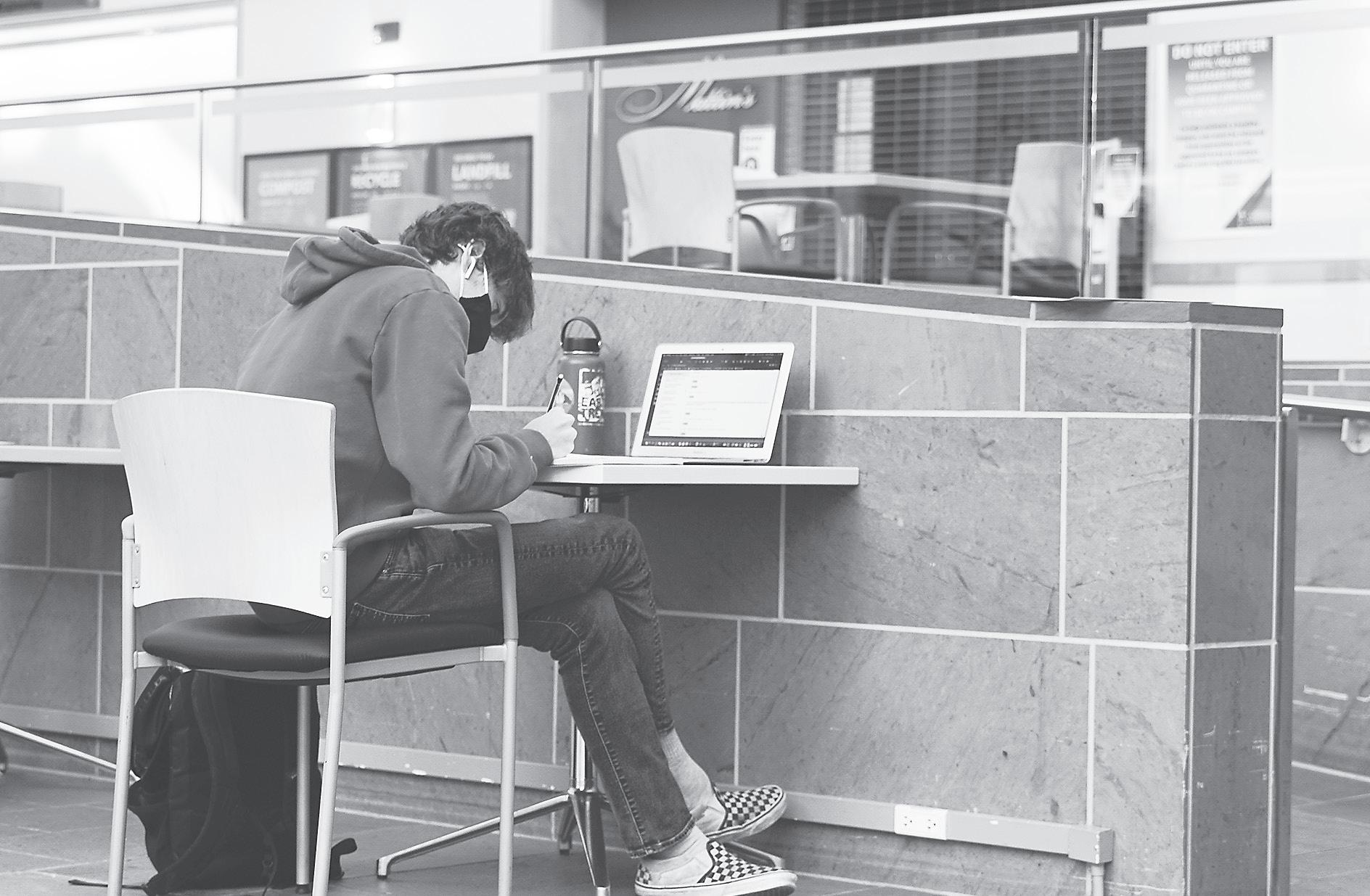
“There are ‘quiet rooms’ that are set up to allow for social distancing, but there are still multiple people in the room at the same time,” Cullen said. “I’ve been doing work in this type of space most of the time, and it has worked well for me so far.”
Manuel Carballo ’21 has a very different approach to studying from the other students — he normally does work in his apartment in Collegetown.
when I start getting more prelims for my harder classes this semester when I really need to focus and make sure I get all my work done,” Carballo said.
Even in the age of coronavirus and virtual classes, students have largely not been dissuaded from taking advantage of Cornell’s physical spaces.
“I need to have a separation between school and home, otherwise I find it very difficult to focus.”
Liza Handler ’22
“For the most part, I usually study by myself, but I am lucky enough to have some friends in classes with me, so sometimes we get together at each other’s apartments and study together,” Carballo said.
This strategy has been working well for Carballo, but he explained that when it comes down to crunch time, it is nice to have the option to book a study space.
“I might consider booking a study space
“If anyone feels stuck in their room or that they don’t have a lot of structure to their days, taking your online classes from a place on campus is a nice way to get outside and during the day; for me, it has been really helpful,” Handler said.
Spencer Nachman can be reached at sjn48@cornell.edu.
Sasha Abayeva can be reached at aa743@cornell.edu.
By
Despite financial struggles and backlash over program closures, the Southside Community Center continues to provide support to the Ithaca community.
The SCC is an organization focused on empowering Ithaca’s Black residents, and oversees a variety of community programs, including a food pantry, pet clinic and summer camp. However, last month, pandemic-induced budget strains led the center to lay off at least several employees; Executive Director Tammy Butler resigned, and several other board members left.
“The
until we have had the time to assess our needs.”
According to Nunn, the center is now working to reconstruct its team, seeking a new executive director, legal personnel and human resources employees.
In the letter, she also pointed to the lack of attention on the center’s current work, while critiquing a lack of sympathy –– something she says has been afforded to white-led organizations throughout the difficulties of COVID-19.
approach to us, the examination of us, the investigation of us is different. And it is rooted in anti-Black racism.”
In response to public outcry, the center’s board of directors chair, Prof. Nia Nunn, an education professor at Ithaca College, wrote a letter on Sept. 28th clarifying the SCC’s actions. In it she stressed that the center’s operations were “not closing,” but instead “on pause” temporarily.
“First, and most importantly we are undergoing a leadership transition, now is hardly the time to run official programs without strong oversight. Second, the pandemic has radically changed the needs of our organization, and our operating protocols,” Nunn wrote. “We made the decision to pause
Prof. Nia Nunn
Despite being on “pause,” Nunn emphasized that the SCC has done its best to sustain necessary programs, such as educational ones. This has required cutting programs like Recycle Ithaca’s Bikes — a long-heralded community bicycle shop — triggering heated objections from some residents.
However, Nunn criticized the focus on RIBs, an SCC program that she said primarily is used by white men. She believes this factor has contributed to the degree of harshness within backlash and said
that Ithaca’s journalistic narratives around Black-led organizations perpetuate a mindset of entitlement and ownership toward them.
“Being a Black-centered and Black-led space, the response to us, the approach to us, the examination of us, the investigation of us is different. And it is rooted in antiBlack racism,” Nunn said.
Following the closure of RIBs, Nunn received several calls on her personal phone number from angry RIBs patrons, who she said used violent, threatening language against her and the center.
Nunn was unfazed. “This is stuff that, unfortunately, we’re accustomed to. So in it, and despite it, we will thrive,” she said, emphasizing that the center will continue to do its work and adapt to the pandemic.
Nunn outlined the work the SCC has conducted throughout the summer, including new programming and continued regular events in virtual form, such as the celebration of Black leaders in commemoration of Juneteenth, summer camps and community enrichment programs. The SCC food pantry operated on a limited basis over the summer, and it opened for the first and fourth Saturdays of each month beginning on Oct. 3.
Throughout the summer, vol-
unteers helped paint murals, gave out smoothies on MLK State Street and hosted socially distanced movie screenings at the Lehman Alternative Community School Amphitheater. Showings included Black Panther, 13th and Litany for Survival.
Nunn also runs the Community, Unity, Music Education Program, a summer camp that is supported by and works closely with the SCC. It provides performing arts, music and human rights education to children in Ithaca. Due to COVID-19, the program ran a largely online camp with some in-person activities.
According to Nunn, the SCC has continued to operate many longstanding programs, including its food pantry and educational work. It has also continued to host Black Town Halls over Zoom and work with partner programs Black Hands Universal and Black Girl Alchemists.
“We are doing the work and have been doing the work for almost a century,” Nunn said.
In September, the SCC implemented a Zoom tutoring program for local children with a strong emphasis on literacy. Since many students are studying from home, the SCC also allows Ithaca families to borrow Chromebook computers.
“It’s really about honoring what
families, what parents, what young people are saying that they need,” she said.
Ithaca Mayor Svante Myrick ’09 has expressed his support for the center, with the City of Ithaca’s
“We’ve got to find a path forward, and I believe that requires more funding from the city this year.” Mayor Svante Myrick ’09
proposed 2021 budget providing a 32 percent increase in funding.
“The ups and downs of [Southside Community Center] are not sustainable.” Myrick said at a Common Council meeting last week. “We’ve got to find a path forward, and I believe that requires more funding from the city this year.”
Although its building is not currently open, a gymnasium upsizing and renovation project are underway. Nunn hopes to resume pandemic-safe, indoor programming once the gym is finished.
“I remain optimistic,” she said. “I remain in a space of imagining and reimagining and honoring my history, honoring our present.”
Olivia Cipperman can be reached at ocipperman@cornellsun.com.

By SADIE GROBERG
Sun Contributor
When Jin Kim and Jeesoo Lee opened Masita this past winter, they (like the rest of us) had no way of knowing what was right around the corner. The coronavirus hit restaurant owners incredibly hard, and many Ithaca businesses were forced to close their doors and regroup. Kim and Lee, having only been open for a month, were at a major disadvantage, as they lacked the dedicated fanbase of other established restaurants.
Fortunately, Masita was not their first rodeo. Back in South Korea, the two women were longtime business partners and owned multiple successful
restaurants together. After spending some time out of the food business, they ended up in Ithaca and agreed to take over the sushi restaurant Miyake from a mutual friend. Before the outbreak and lockdowns, they managed to revamp the eatery with a new name (Masita means “delicious” in Korean) and a pan-Asian menu with Korean and Japanese options. They knew their food was good, but how does a new restaurant establish itself as a Collegetown staple during the pandemic?
Well, they start by earning straight five-star Yelp reviews, which is how I knew I had to try it out. A few friends and I visited the restaurant, conveniently located on Eddy Street, on a late

Thursday afternoon. What struck me the most was the emptiness. The bare sushi bar and large dining room echoed with the ghosts of potential customers, clearly built for noisy groups of college friends. Because of COVID restrictions, Masita reopened with an abbreviated menu and no longer serves sake bombs (sorry everyone).
Large pictures of each menu item hang on the wall by the entryway, which my friends and I found to be helpful (let’s just say we’re not exactly experts on authentic Korean dishes). As we approached the counter to order, Jeesoo Lee came out to meet us with a smile on her face. Whatever difficulties are created by social distancing was made up for by Lee’s infectious energy, as she patiently answered our questions about the menu. She was also quite attentive to any dietary needs or preferences, asking us about our preferred spice level and detailing ingredients to us; I don’t eat meat and my friend is gluten-free.
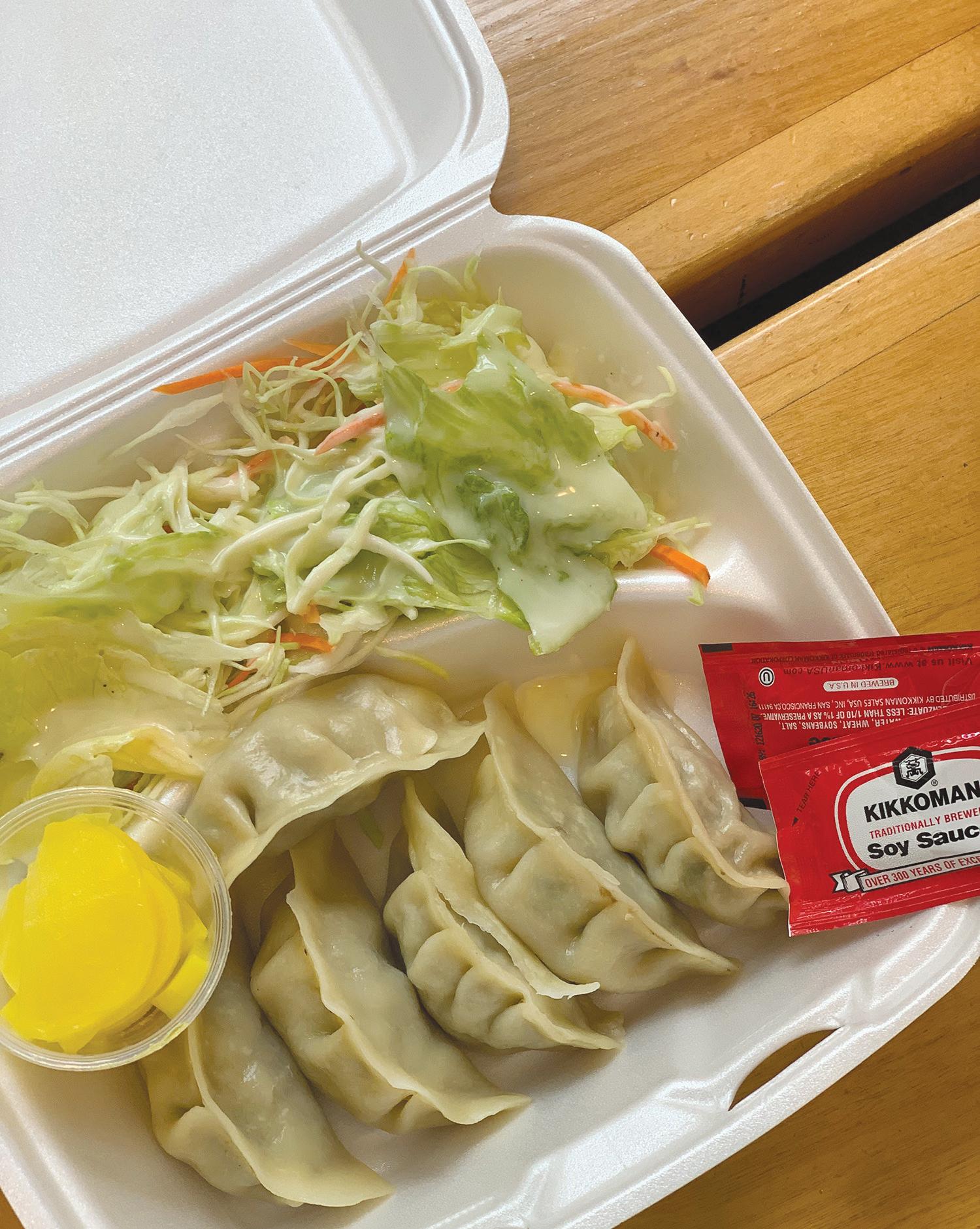
After ordering, Lee led us to a table in the large dining room, where Jin Kim’s interior design skills (she attended Parsons in NYC) were evident. Rather than sterile plexiglass dividers, colorful tapestries hung between each table, ranging from maps of the U.S. to images of the Eiffel Tower. We settled in and waited for our food, which didn’t take more than ten minutes to come out. For safety, the orders are served in takeout containers, which also makes taking home leftovers all the easier. The portions are huge — you will have leftovers. Lee also treated us with two bonus containers of fried rice and a mystery fried dessert for free! As “Come Together” by the Beatles played in the background, we eagerly dug into the heaping containers of hot food.
Each of us ended up with a large serving of the fried rice, which was fluffy and light with the perfect ratio of vegetables. It was definitely the highlight of our meal, and the item that still makes us salivate when thinking back in the days since. According to my friend, the pork barbecue was delectable, with a melt-inyour-mouth quality. Although we are far from experts on traditional Asian cuisine, there was a noticeable elevation in the flavor and presentation of the dishes. If the signs on the door proclaiming “HOMEMADE NOODLES AND DUMPLINGS” left any confusion, one bite of the steamed beef dumplings cleared it up. They were clearly made from scratch, with a fresh wrapping and well-seasoned filling. I ordered the vegetable Ja Jang Myon, which Jeesoo told me is a thick noodle dish in black bean sauce. I did feel that it could have been served hotter, but the flavor was pleasantly savory without being pungent.
From start to finish, our expe-

“One bit of the steamed beef dumplings cleared it up. They were clearly made from scratch.”
Sadie Groberg ’24

rience at Masita was a joy. If you have any qualms about ordering from restaurants during the pandemic, it’s the ideal environment for takeout or dining in safely. The food was delicious and affordable (around 10 to 13 dollars per entree), especially given the portion size. Most importantly, the people behind the business are smart, accomplished and truly care about providing authentic and top-quality food for the Ithaca community. The past seven months have been brutal for
business owners and customers alike, and those struggles have not disappeared with the reopening of restaurants. If you and your friends have been looking for a new spot to add to the rotation or just want to support our local entrepreneurs, you might as well get some delicious fried rice (and maybe, one day, a sake bomb) while you’re at it.
Sadie Groberg is a freshman in the College of Agriculture and Life Sciences. She can be reached at smg359@cornell.edu.
Independent Since 1880
138th Editorial Board
MARYAM ZAFAR ’21
Editor in Chief
JOYBEER DATTA GUPTA ’21
Business Manager
PETER BUONANNO ’21
Associate Editor
MEGHNA MAHARISHI ’22
Assistant Managing Editor
CHRISTINA BULKELEY ’21
Sports Editor
BORIS TSANG ’21 Photography Editor
CAROLINE JOHNSON ’22
News Editor
ALEX HALE ’21
ARI DUBOW ’21
EMMA ROSENBAUM ’22
BENJAMIN VELANI ’22
MONKOVIC ’22
MIKE FANG ’21
WEINBERG ’22
ROSENBERG ’23 Assistant
LUKE PICHINI ’22
HANNAH ROSENBERG ’23
Assistant
BRIAN LU ’23
Assistant
ANNABEL LI ’21
LEI ANNE RABEJE ’22
COLIE ’23
JOHNATHAN STIMPSON ’21
KRYSTAL YANG ’21
HUANG ’21
NGUYEN ’22
PALLAVI KENKARE ’21
Editor SEAN
’21
STAMM ’22
’22
PLOWE ’23
LEE ’21
CHENG ’21
’22
MEGHANA SRIVASTAVA ’23
DAWSON ’21
PARKER ’22
MORAN ’21
’22
’21
’22
Working on Today’s Sun
Ad Layout Dana Chan ’21
Production Deskers Sarah Skinner ’21 Sabrina Xie ’21
News Deskers Sean O’ Connell ’21 Meghna Maharishi ’22
Opinion Desker Pallavi Kenkare ’21
Design Desker Niko Nguyen ’22
Photo Desker Hannah Rosenberg ’23
Arts Desker Emma Plowe ’23
Dining Desker Benjamin Velani ’22
I’m spending the month of October in Michigan, a key swing state among a small cohort sure to decide both the presidential election and control of the Senate. While this is the priority I chose to set for myself this semester, I remain enrolled as an online student taking a full credit load at Cornell. The readings are immersive and the lectures are informative. Given that most of my peers living in Ithaca have only one or two in-person courses, the class component of my education this semester is not too dissimilar to theirs. Still, without the ability to study in groups, engage in free-flowing conversation and take full advantage of university facilities, a pressing truth becomes clear: This is not worth the money.
The rapid rise in cost of higher education has been driving these considerations for years.
At what point, many ask, is college simply too expensive?
Student loan debt topped $1.6 trillion in 2020. This number is going nowhere but up. Colleges engage in an endless arms race with one another to attract students at these high costs with fancier amenities, which in turn only push their price tags further into the sky. Appreciating the education but seemingly needing the degree, we hand over what is asked of us — with varying levels of financial aid — every year. But the pandemic has shaken the paradigm. The worth of higher education must be reexamined.
Four consecutive questions present themselves:
If Cornell charges full tuition (and in fact raised it) for an online semester, is the school implying that the value of the education is unchanged despite the dominantly online nature of hybrid courses?
If the value is unchanged, why not keep the option for remote learning permanently, turning Cornell into a continually hybrid institution?
Does Cornell consider its education to be fundamentally good, and expanding its availability to more students therefore also fundamentally good?
If Cornell remains a hybrid institution, why not expand its enrollment dramatically?
These questions do not have easy answers. If the quality and value of college education is somehow diminished when remote (as is my experience), then it should cost less. But, if I am mistaken, and the value is indeed the same, we are brought to question 2.
Should remote learning be made a permanent option? If quality and value are
indeed unchanged, the hybrid model must become permanent, especially to increase accessibility for students who live far from Ithaca or whose households are of limited means.
If quality and value are unchanged and remote education is made permanent, Cornell will have to ask itself if its offerings are a product sold for a reasonable value on the free market, or a societal good. If it is a product, its value is increased by limited admission simply through the basics of supply and demand. However, if society is made better by being populated by Cornell graduates, Cornell’s mission must be to grow its total number of graduates as much as possible.
One could argue that our stringent admissions policies are necessary to ensure only the best and brightest earn the few coveted spots at our school. However, the Cornell University rejection letter clearly states: “Cornell’s admission selection process was especially competitive this year. As the number of well-qualified applicants to the university has increased, we have had to deny admission to many candidates who could no doubt take advantage of a Cornell education.”
Our university is openly rejecting many applicants who our admissions department openly recognized as qualified to study here. This says nothing of the countless high schoolers discouraged from applying in the first place thanks to our low acceptance rate.
So, if more Cornell graduates is good for society, we should dramatically expand our enrollment to include all qualified applicants, understanding that a large number of students will spend most or all of their college experience online. If our university refuses to do this, they are either admitting that their education is a product sold for a profit, or admitting the diminished value of remote learning. Given the former, we should all pull up stakes and resettle in an institution deserving of its nonprofit status. Given the latter, tuition costs for remote students must immediately be slashed.
Cornell cannot have it both ways. Nor can the numerous other universities confronting the same dilemma. The rising cost of education is unsustainable; Covid-19 has proven to be an opportunity for paradigm shift across society. Whether through reduced costs, a move toward the hybrid model, increased enrollment or a reassessment of the entire system of elite education, change is coming.

HELENHU/SUNFILEGRAPHIC
I met Fabio during the February Break of my sophomore year. To preface, I was going through a pretty wild phase. I had just broken up with my first boyfriend of three months. I was scoring a lot of hookups off of Grindr. I was coming out to people left and right. Needless to say, I was always on the lookout for ways to truly strut my queerness. February Break rolled around, and I decided to go on a trip to Boston with some friends. On the menu for the weekend was sightseeing,
During our final day there, I decided to head over to Boston University to visit one of my childhood friends. I ordered my Uber and was informed of my driver’s name: Fabio. The Uber arrived and as I approached it, I noticed an Equality sticker on his back windshield. I instantly thought to myself, “Oh, how funny would it be if Fabio was a queer male that I ended up fucking?” Now let me tell everyone reading this something: Manifesting your destiny sometimes can come about in funny ways. From Downtown Boston to Boston University, it’s about a 30-minute drive with traffic. For 30 minutes, Fabio was the biggest flirt I have ever met. A 28-year-old from Brazil, Fabio had a thick accent that entranced my ears. He had one of the brightest smiles that have ever pierced my eyes. He had a laugh that warmed my heart. He wanted to know every detail about me, down to my Social Security number — kidding — but he honestly demonstrated true interest in my life. It was something new and refreshing compared to all my hookup-only rendezvouses. By the end of our ride, we had exchanged Instagram handles and agreed to go on a date that night. Before I start to bash Fabio, I should inform everyone that he was a real gentleman that night. He bought my movie ticket, popcorn and root beer. When the movie we saw got boring — it was The Favourite — he made out with me to keep me occupied. Later that night, he even agreed to bottom because I only wanted to top.
Through and through, Fabio was a great guy.
The next morning rolled along, and my friends and I were leaving the city. Here is the dialogue that ensued between Fabio and I:
Me: “Fabio, you have to leave.”
Fabio: “No, I want to stay with you.”
Me: “Fabio, you can’t stay cause I’m not staying either. I’m literally leaving the city in 10 minutes.”
Fabio: “I can stay with you for a couple more hours.”
Me: “…”
Needless to say, I left the city 10 minutes later, and I haven’t talked to Fabio since. Now, did Fabio message me every day on Instagram for months? Yes. Did he send a one-year text to commemorate our night together this past February? Yes. Did Fabio beg to come visit me? Yes.
I learned a lot from Fabio, and for that, I’m grateful. First, Fabio helped me realize I couldn’t be the dom in the relationship. I just realized I did not care to satisfy any man’s needs other than my own. As a result, I have now committed to be a sub bottom, for I want to be sought after and treasured while also fulfilling my sexual needs of taking cock. Second, Fabio helped me realize I probably shouldn’t just hook up with complete strangers. Now, that one I didn’t internalize, and I went on to continue hooking up with complete strangers. Some of whom I still don’t know their names. Third, Fabio showed me how crazy men can be. I know I’m a really charismatic, intelligent twink with a thick ass and decent cock, but I really was confused on why Fabio was that obsessed with me? I’m flattered with the nonstop attention, but sometimes it just feels overdone. Finally, Fabio made me realize that maybe I did want a relationship in my life. Our car conversation was really enjoyable, and I decided it would be nice to find a man I could do more of those types of conversations with. I decided that I wouldn’t mind finding a relationship one day that was refreshing on both a social and a sexual level.
Fabio, if you for some reason ever read this, please don’t take this as a sign to message me. I’m glad we did our onetime fuck, but it doesn’t have to be any more than that. learned a lot about myself from it, and I don’t think I’d learn anything more from additional time with you. Next time I’m in Boston, I won’t be messaging you, but I will be thinking of you. I will also be using Lyft instead.
Dick N. Diaz is a student at Cornell University. Comments can be sent to opinion@cornellsun.com. His Sex on Thursday column runs alternate Thursdays this semester.
Icouldn’t tell what caused it initially, but everyone was sexier when I came back to campus after an endless summer of quarantine. Certainly some of this was attributed to my pent-up isolation lust, but there was an added X-factor that really churned my butter. Never before have I thought such a vast number of people were attractive as I twiddled my thumbs, six-feet-apart, in the arrival test line. That is, until I recollected my childhood crushes: Zorro, the Phantom of the Opera, Mrs. Incredible, and Hannibal Lecter. All of them wore masks.
There is something hauntingly erotic about concealing your maw. It accentuates the slenderness of the nose and contour of the eyes. It’s this sense of anonymity and mystique in which I can gaze upon the passerby and imprint my fantasies upon their features. All of my mundane activities have molded into a masquerade ball in which everyone is invited. Though picking up a snack from 7-Eleven may not be the bacchanalian orgy-fest of Eyes Wide Shut, I still imagine all the other incognito shoppers as part of my masked sex cult. The costumes may be surgical respirators and face shields, but the sentiment still stands. I can be the host of this grand masquerade ball: Grocery shopping in a bandana like I’m robbing Wegmans, a wild west outlaw.
Over the past few months our social etiquette on face coverings changed to keep us
safe, and that change ushered in a new element of nudity. I feel vulnerable and naked in the open air without a mask. If my nose hangs over the fabric, it is as if my penis is flopped over the waistband of my panties. If I slide my mask down to suck through a straw, I am struck by the sensation of pulling my pants down for a quick public piss. It is like showing up to the masquerade without a mask. At least this provides for a subtle yet salacious taboo—an intimacy with those I reveal my cakehole to, such as my biweekly corona test when I expose myself to the tester. After they hand me the cotton swab through the glass, I tear off my veil and expose my bare muzzle as we both sustain eye contact. No matter how much I do it, it feels like the first time: The arrival test. Imprinted in my memory is the nurse peeling away my disguise with cold latex fingers, sliding her probe into my orifice. It penetrated deep into my nasal cavity until I tilted my head back in passionate discomfort, a single tear sliding down my cheek. She scraped my sinuses, but also scraped my heart.
When I first heard health experts were urging masks during sex, the idea sounded preposterous. It seemed you might as well not have sex if you’d miss out on all lip licking and mouth mauling. I was very wrong. Masks add a certain novelty to rolling around in the hay with endless roleplay possibilities. Who needs kissing when you
can be two Spidermen, spanking each other on a duvet cover? Or apocalypse survivors humping to repopulate the dying Earth? There are a variety of frisky fetish masks, or you can make your own by sewing CDCapproved ones to match your whips and chains. Viruses would have quite the chal lenge trying to escape the leather restraining your mouth to the bedpost.
Long before Covid-19, people employed masks to dominate and restrain in the boom boom room. You can enhance the BDSM qualities of your mask by wearing ones more difficult to breath in, such as masks made of leather or latex. Choking on latex continues to be one of the prime duties of a gimp suit, especially if the mouth and eye holes are zipped closed until you are a helpless little worm. For the four-eyed nerds out there, medical masks contain the same sensory deprivation as a gimp suit when you step inside and are blindfolded by the steaminess. Pair this with some noise cancelling headphones and you’re practically the Gimp Man of Essex. You can now suffocate on your daily trudge up Libe Slope, imagining the world softly dom inating you with breath play.
“Use protection” no longer applies solely to the jolly rancher wrapper around your schlong. Protection has extended to the sexy suit of armor upon your kisser. Don’t let the opportunity go to waste. Embrace the


Fill in the empty cells, one number in each, so that each column, row, and region contains the numbers 1-9 exactly once. Each number in the solution therefore occurs only once in each of the three “directions,” hence the “single numbers” implied by the puzzle’s name. (Rules from wikipedia.org/wiki/ Sudoku)




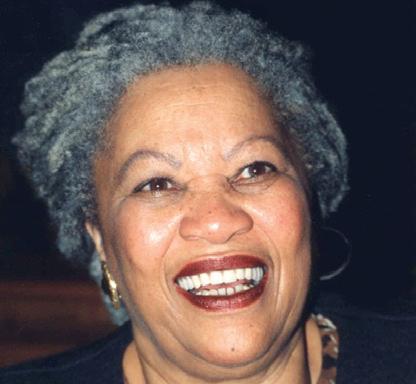
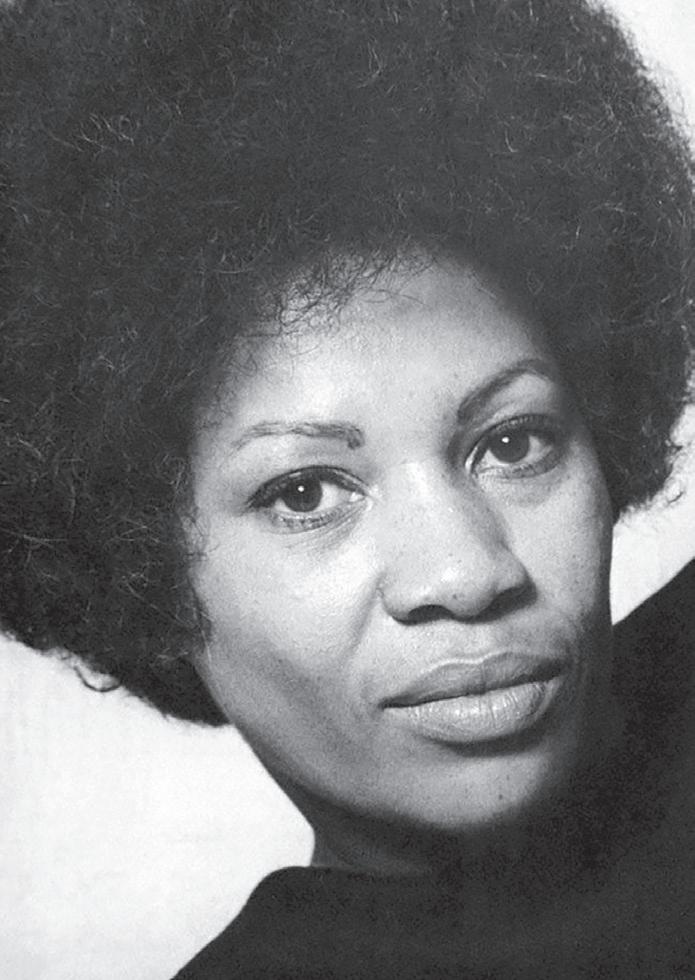
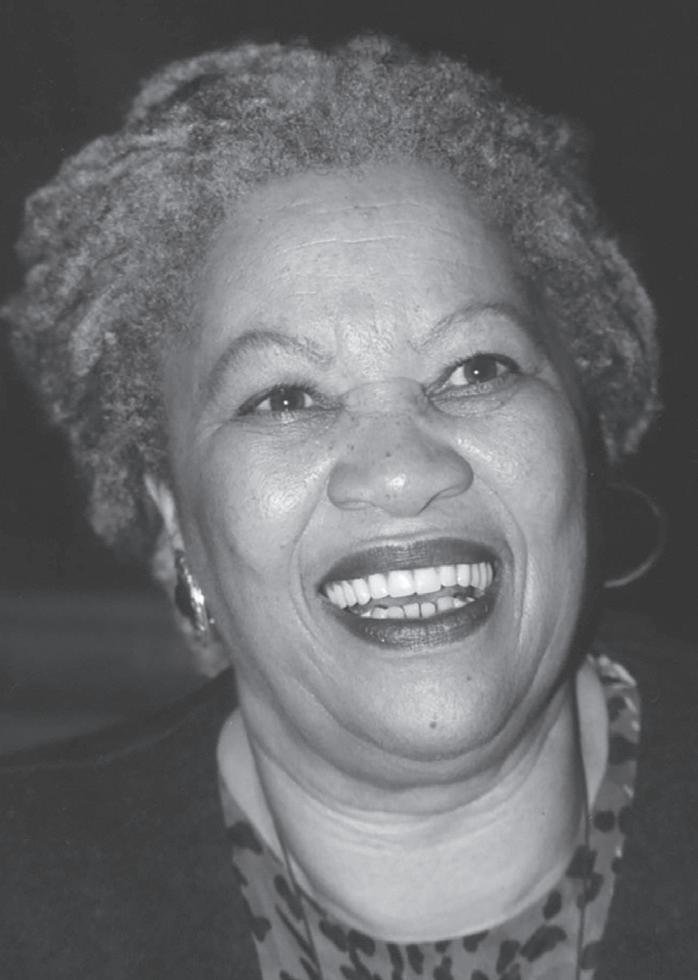
On Thursday, Cornell held a virtual day-long reading of The Bluest Eye to celebrate the amazing career of author Toni Morrison M.A. ’55 and the 50th anniversary of the book’s publication. This event was the beginning of a year-long celebration of Toni Morrison as part of the College of Arts and Sciences’ Arts Unplugged Series. Morrison, one of Cornell’s most notable alumni, published The Bluest Eye, her first novel, in 1970. While the pandemic delayed this event from its original planned date last spring, there are some benefits to the virtual format.
“The advantage of doing it remotely is that thousands of people everywhere can hear it, can see it,” said Professor Anne Adams, Africana Studies. “There’s more of a consistency to the experience of watching it than there would have been if we were going between live readers and readers being brought in remotely,” added Professor Roger Gilbert, English.
live to the public with as many as 800 viewers at once on eCornell and on Facebook, and boasted an impressive list of just over 120 readers from across the world. A wide array of people volunteered to read, including author Ta-Nehisi Coates, U.S. Poet Laureate Joy Harjo, author and A.D.White Professor-at-Large Tayari Jones and political activist Angela Davis.
Other notable readers include Cornell faculty and students, faculty from Howard University (Morrison’s alma mater), Cornell administrators such as President Martha Pollack, Ithaca mayor Svante Myrick ’09 and even audio clips of Morrison herself reading the book. The reading also featured two musical performances as well as sections read in French, Spanish, German and Portuguese to represent Morrison’s large international audience.
Student readers were part of the new, one-credit English class titled “The Bluest Eye at Fifty,” taught by Gilbert and Adams, which gives the opportunity for students from across the university to read and discuss The Bluest Eye and partake in
the event. “We wanted to have as many students as possible read the novel, think about it, write about it, talk about it and be part of this celebration” said Gilbert.
For Morrison, publishing and writing books featuring the voices of Black people was her form of activism and contribution to the 1960’s Black Power movement, Adams explained.
“She decided that the way that she could contribute to the social and political struggles of Black people was to put publications out there in the voices of, and telling the stories of, African Americans” said Adams. While Morrison was working as a fiction editor at Random House prior to writing her own novels, she published many works featuring Black voices, including the autobiography of Muhammed Ali and political activist Angela Davis — a longtime friend of Morrison’s who participated in the reading Thursday.
forms, “we’re still in this cycle” said Gilbert. “People are recognizing that racism and injustice are still with us in very powerful and violent ways.”
“Toni Morrison brings a voice of African Americans into the literary attention” said Adams. “The whole idea of listening to Black people, and of listening to Black people as individuals — seeing Black people as individuals — is a source of relevance of this book for today.”
“In a way, this reading is connecting three distinct moments” said Gilbert, referring to the 1940’s when the book takes place, the 1970’s when the book was written, and the Black Lives Matter Movement today. Despite being in slightly different
The next event celebrating Toni Morrison will be a “Teach-In” live-streamed on Thursday, October 15th at 4:30 PM EST featuring short lectures by Cornell faculty and a live Q&A discussion. More events will occur in the spring, including a staged reading of a play based on The Bluest Eye. “Some of us are committed to future [events] as well,” remarked Gilbert. “We think that Toni Morrison is important enough that she deserves at least a decade’s worth of celebration.”
The pre-recorded reading was streamed
This past month, a significant majority of the English Faculty voted to change the name of the department to “Literatures in English.” The proposed name change is awaiting approval from college administrators, but if it is approved, it would mark the first department name change in 130 years.
The study of English was introduced to Cornell in 1890 by Hiram Corson, a scholar of literature, who insisted that the only proper way to teach literature was by reading it aloud.
The proposal to shift the name of the department was spearheaded by Prof. Boyce-Davies and Prof. Mukoma Wa Ngugi, English. In response to a new reckoning with racial injustice across the U.S., Cornell English faculty felt they should promote a shift in literary study that promotes a broader reach of literature.
In light of President Martha Pollack’s call to action for “the development of a new set of programs focusing on the history of race, racism and colonialism in the United States, designed to ensure understanding of how inherited social and historical forces have shaped our society today,” the proposed department name change, if approved, would mark one of the first permanent departmental changes aligned with Pollack’s goal.
“It’s great to see faculty initiating change, along with students, as it puts pressure on the University to take action on the steps promised in June,” said Sammi Minion ’21.
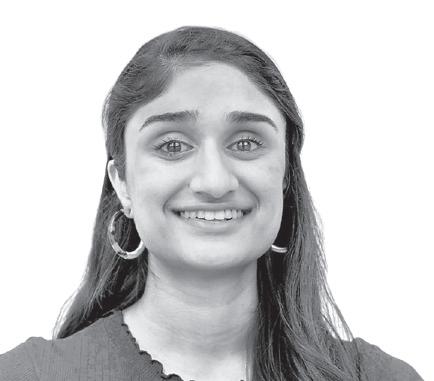
As an English major myself, I believe the proposed name change marks a positive step in moving away from anglicizing the field. As Boyce-Davies and Mukoma Wa Ngugi point out, changing our focus from “English” to “Literatures in English” allows the department to include post-colonial narratives and create space for diverse voices and histories.
Other students also reacted positively to the news of the department name change, but expressed hope for this to be the starting point for more conversation and changes.
“For this to not be just a performative change, the department should also think about applying these good intentions at a level that’s more immediate to student and faculty life,” said Priscilla Kim ’21.
In reference to actionable and immediate changes to the major, many students brought up the pre-1800 requirement, a contentious topic in the English department, which mandates that 12 out of 40 credits (30% of the major) be from courses which survey literature originally written in English that precedes the 1800s.
When looking at the pre-1800 course offerings, I am often underwhelmed by the homogeneity of these courses: it’s always Shakespeare, Chaucer, Milton and maybe Beowulf. While I still covet my annotated third edition of the Norton Shakespeare from Prof. Barbara Correll’s class, and think of the class fondly as one of my favorites at Cornell, I question why there is such a strong adamance that a full 30% of the major be from Eurocentric course offerings.
Other students expressed stronger views on the requirement, even going to the extent of expressing interest in its redaction. “Rarely was the work of anyone other than white men published in English during the 17th century, so having a requirement from that era already places exhaustive limits on diversity,” Minion said. “Offer me a course to teach me the ideology of MLK Jr or Malcom X, but don’t encourage the pre-1800 date.
Minion’s views are in line with a new push across the country and the globe to decolonize the curricula in schools and universities. Just this past September, a cohort of Cornell faculty and graduate students penned a list of demands to the University, some of which include the incorporation of “decolonized readings” into the curriculum.
Even if all three pre-1800 courses are proved to be absolutely necessary for sufficient scholarship in the study of literatures in English (we can agree to disagree), the issue is that the
English major is not supplemented by survey courses spanning non-eurocentric canons.
Yes, Cornell offers courses in subjects ranging from Black Speculative Fiction to The Future of Whiteness, but it is still entirely possible to complete an entire English major without ever having to take a course that focuses on literature from writers of color. And although the College of Arts and Sciences does have a geographical breadth requirement, one course is not enough to equip students with an adequate understanding
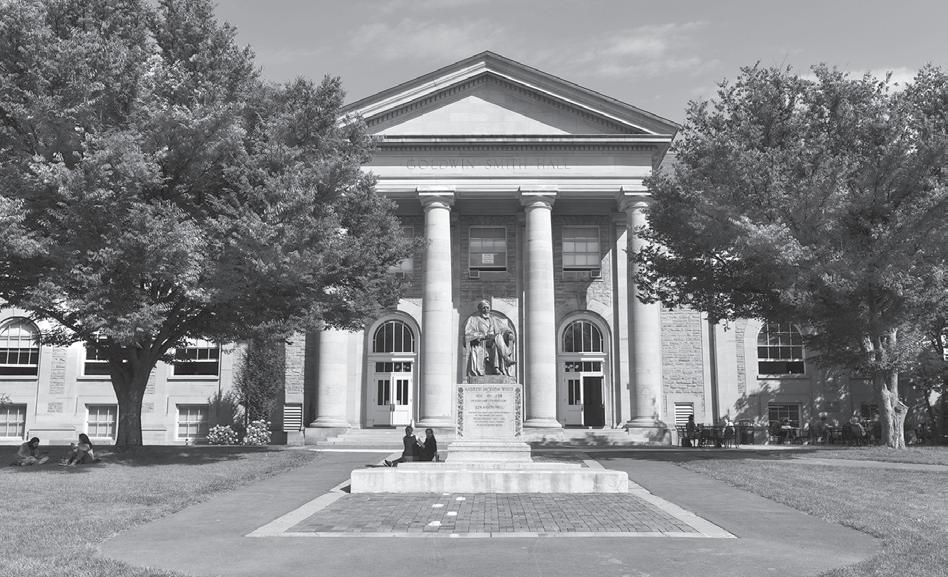
of post-colonial narratives
Let us set a precedent that if 30 percent of the courses that English majors take have to be from Eurocentric canons, then another 30 percent of the major should be required to comprise of courses that move us forward rather than focusing only on a historically problematic time. We should be encouraging a push in requirements to deliberately include literature that interacts with race, racism, gender, sexuality and colonialism
While I am wary of being hypercritical of a step in the right direction, if changing the name of our department is to be more than just a facade, the course requirements and offerings should also adapt to reflect a more diverse major.
Shriya Perati is a senior in the College of Arts and Sciences. She can be reached at sperati@cornellsun.com. Thought Experiments runs alternate Tuesdays this semester. Esat Braveboy ’22 contributed to reporting.
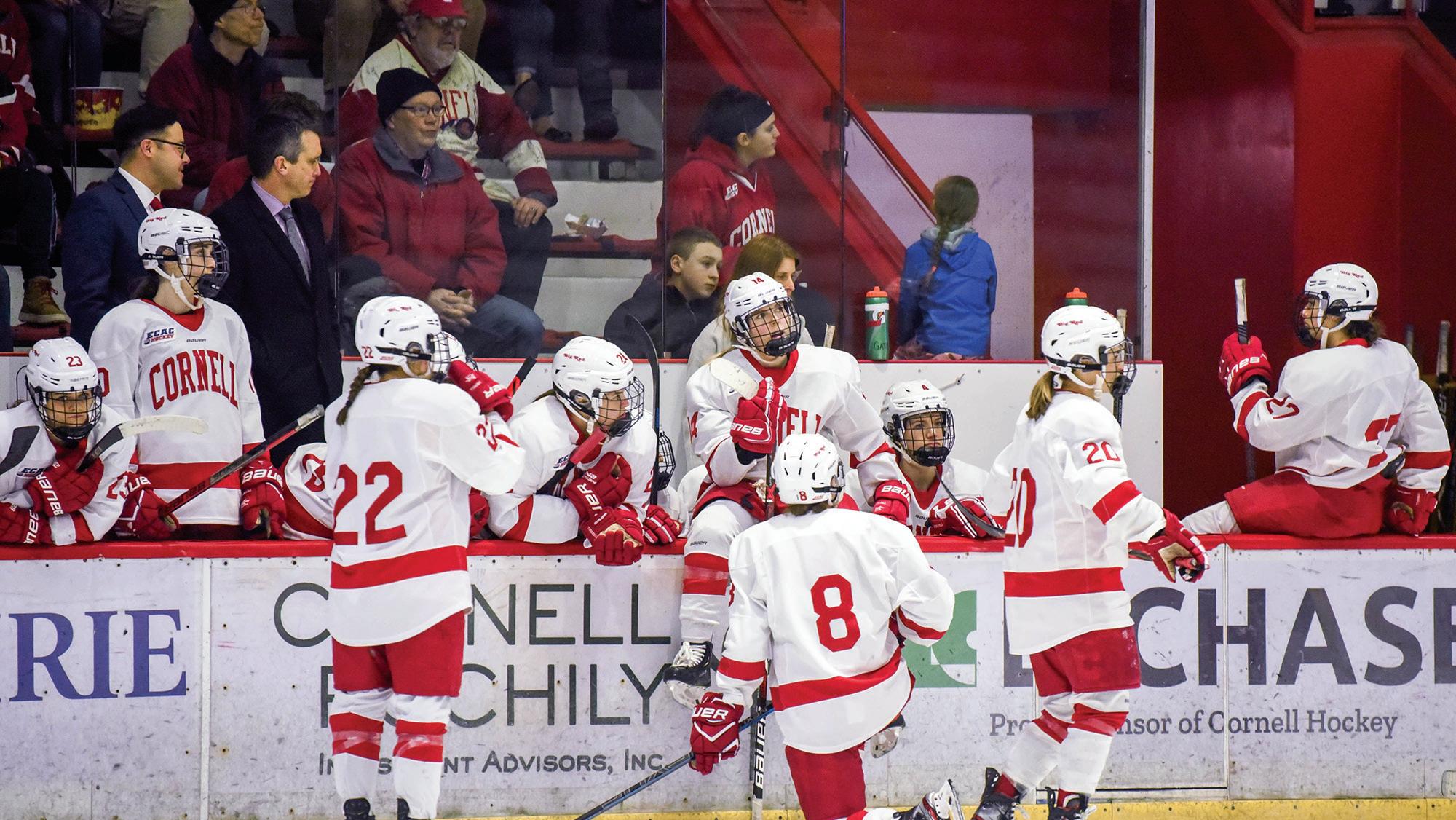
Cornell women’s hockey head coach Doug Derraugh ’91 formally welcomed seven new members onto the team as part of the Class of 2024.
The new Cornellians will fill the void left by six skaters who graduated last spring, including three Patty Kazmaier Award nominees in defensemen Jaime Bourbonnais and Micah Zandee-Hart and forward
Kristin O’Neill.
Lily Delianedis (Edina, Minn.)
Delianedis played as a forward at the Blake School, located in Minnesota. A team captain, she notched 68 total points in the 2019-20 season and racked up numerous honors, including Team MVP and AllMetro First Team. In addition, she was named a finalist for Ms. Hockey 2020, an award recognizing the best high school hockey player in Minnesota.

Deanna Fraser (East Hants, Nova Scotia)
As the lone goaltender in this year’s class, Fraser will develop behind senior netminders Lindsay Browning and Ally Dalaya. Jeff MacLeod, Fraser’s coach at King’s-Edgehill School, had high praise for the goaltender in an interview with Saltwire.
“Frasier is one of the best goaltenders for her age, and she has done well in our prep league and also with Team Nova Scotia at the Canada Games,” MacLeod said.
Kaitlin Jockims (Saskatoon, Saskatchewan)
A native of Saskatoon, Saskatchewan, Jockims completed her final season of pre-collegiate hockey at the Edge School following three seasons with the Saskatoon Stars. At the Edge School, she led the Canadian Sport School Hockey League in scoring, totaling 52 points on 31 goals and 21 assists.
Not only did Jockims play hockey, she also excelled in basketball, suiting up for the Basketball Saskatchewan’s provincial teams. Greg Slobodzian, the head
coach of the Stars, complimented her ability to juggle two sports.
“I honestly don’t know how she does it because of the ability to play at that level — it’s more time than anything,” Slobodzian said in an interview with Saskatoon StarPhoenix. “It’s quite remarkable what she’s able to do at that level. She’s so, so strong in both. I think her vision with basketball has really helped her hockey and vice versa. The two sports complement one another quite well.”
Ashley Messier (Wilcox, Saskatchewan) Jockims is not the only icer to represent the Stars as Messier, a 5-foot-3 defenseman, skated three seasons with Saskatoon as well. After Saskatoon, Messier spent the past season with Selects Hockey Academy, where she helped lead the team to a New York state title.
Representing Team Canada in the 2020 U18 Women’s World Championship, Messier helped lead her squad to a silver medal. During the 2019 iteration of the same event, she was named the team’s most valuable player as she also notched a silver medal.
Gabbie Rud (St. Cloud, Minn.)
During her five years at St. Cloud High, Rud established herself as a prolific scoring forward. In five seasons, she accumulated 202 total points. She also led the team in scoring for three of those five seasons.
Rud hails from a big hockey family. Her father, Eric Rud, is the current head coach of the St. Cloud State women’s hockey team. Meanwhile, her two brothers, Sam and Max, are also involved in the sport, and Sam went on to play collegiate hockey at St. Cloud State.
Abby Ruggiero (Amherst, N.Y.)
Ruggerio spent several seasons with the Buffalo Regals as a captain and guided the team to a state championship in 2017. That same year, she also committed to Cornell, a decision she explained in an interview with Neutral Zone.
“I did of course dream of playing hockey at an Ivy League college, but I never thought I would have the opportunity to play at one,” Ruggerio said.
“After going through this process, I felt Cornell was my dream school because it is as good as any school academically, it has always been a highly ranked D1 program, I loved the campus and it is close to home. It is just an amazing school overall.”
Claudia Yu (Stouffville, Ontario)
Yu competed on the club level as a forward with the Toronto Aeros, chipping in 26 points during the 2019-20 season. She also contributed to Team Ontario Red’s 2019 National Women’s U18 Championship.