The Corne¬ Daily Sun


By MATTHEW McGOWEN Sun Senior Editor
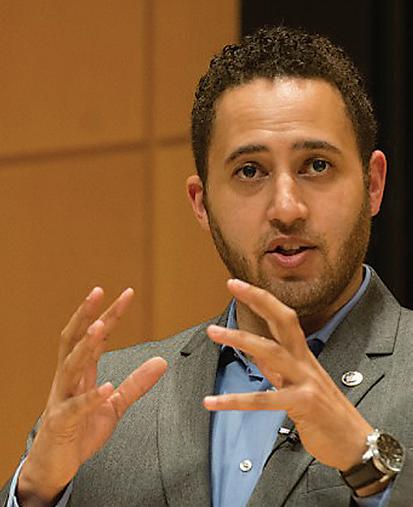
Mayor Svante Myrick ’09 blasted the University in an interview with The Sun on Thursday for not contributing enough to its home city after he unveiled a new budget plan for the city of Ithaca in which Cornell’s contribution increased by only a little less than $30,000.
“Ithaca would be a better place to live if Harvard were here instead of Cornell,” Myrick said. “The streets would be better paved, we’d have more police officers and the taxes would be lower.”
Cornell’s contribution to the total budget for 2019 is estimated at $1,365,594, a $29,936 increase over last year according to the budget narrative, but Myrick said that the University has an “enormous” impact on municipal operations, and gives little back to the city compared to similar institutions elsewhere.
In a Common Council meeting in the beginning of October, Myrick said that Cornell owns $2.1 billion dollars in tax-exempt property, which is nearly equivalent to all other taxable-property in Ithaca, The Ithaca Voice reported.
The University is expected to contribute more than
last year partially because the proposed budget plan increased the stormwater fees — essentially a tax on impermeable surface area — for large property owners like Cornell by 81 percent.
“We’re not looking for fees that specifically target Cornell. What we want them to do is to voluntarily make a contribution that would make them good citizens,” Myrick told The Sun.
John Carberry, senior director of media relations, responded to Myrick’s criticism by citing Cornell’s myriad effects on the local economy as outlined in a 2017 University fact sheet, including $142 million in local spending, $5.9 million in taxes and fees, $55.9 million in construction, and $65.2 million in venture capital funding raised by Rev: Ithaca Startup Works and the McGovern Family Center for Venture Development. Rev is a startup business incubator that began in 2014 as a collaborative project through Cornell, Ithaca College, and Tompkins Cortland Community College. In its four years of operation, Rev has spun off several companies that are now housed in Ithaca, including

‘Out with the old, in with the new:’ Ndaba Mandela champions African youth, culture
By KAREN LI Sun Staff Writer
Ndaba Mandela, grandson of Nelson Mandela, called for youth empowerment and the celebration of African identity in a roundtable of “friends, brothers, sisters, cousins,” just shy of 20 students Friday afternoon.
Ndaba is the founder and chairman of the Africa Rising Foundation, an organization that aims to empower African youth worldwide. Its founding was sparked by a book describing Africa during the slave trade as an “absolute abomination,” Ndaba said.
“That is not the perspective that I want my fellow brothers and sisters to continue perpetuating across the world,” he continued.
Instead, Ndaba said that Africa Rising empowers young people to fight “Afro-pessimism” shaped by mainstream media, and to carry the name of Africa through education, entrepreneurship and pride in being African.
Native to a South African village with very high unemployment, Ndaba recognizes entrepreneurship — specifically passion, failure, and collaboration — as the road to empowering ourselves and each other.
“There’s no room for failure in Africa,” said Ndaba on the lack of support for entrepreneurial spirit on his continent. “But as an entrepreneur, failure has to become your friend. You
URSA Space Systems, a geospatial intelligence company, and Rosie, an online grocery shopping platform, both founded and headed by Cornell alumni.
According to statistics provided by Rev, the group has raised $18.2 million in capital, generated $7.8 million in revenue and created 76 jobs in Ithaca through the businesses it has helped launch.
According to its website, The McGovern Family Center’s mission is “ to foster the development of early-stage Cornell life science startups,” and to increase and retain “employment and economic development for New York State.” In 2017, McGovern raise $47 million dollars for it’s Ithaca clients and created 18 local jobs, according to the University fact sheet.
In a statement provided to The Sun, Joel Malina, Vice President for University Relations said Cornell was “proud of its numerous contributions to the economic health of Ithaca and Tompkins County,” adding that the University provides “significant finan-
See BUDGET page 9
By AVRAHAM SPRARAGEN
This summer, Cornell faculty and alumni volunteered in Lebanese refugee camps to provide aid to victims of the Syrian Civil War, one of the largest humanitarian crises of the 21st century. The two doctors and a historian shared harrowing tales from their mission during a panel on Friday.
The event featured Shweta Iyer ’09, a member of the pediatric emergency medicine department at NYU Langone Health, Prof. Josayn Abisaab, emergency medicine, Weill Cornell Medicine and Prof. Mostafa Minawi, history, the director of the Ottoman & Turkish Studies Initiative. All three were stationed in northern Lebanon with the Syrian American Medical Society.
“It’s been seven years and the crisis continues. The level of destruction in Syria is almost unparalleled. For half of the country’s population, picking up and leaving was the only option,” Minawi said at

the event. Over 5 million Syrians have fled the country while 6.6 million are internally displaced, according to the U.N. Refugee Agency.
Minawi stressed the importance of recognizing the common humanity of the Syrian refugees.
“It is important for us to remember that most refugees, at one point or another, had lives incredibly similar to ours. Most of them wanted good lives; they wanted to go to university,” he said.
Minawi worked as a SAMS interpreter in Lebanon, servicing doctors during medical treatment. He shared the tragic story of a father of three who had his leg blown off.
“He considered himself lucky to have lost his leg. It meant that he could finally leave his refugee camp in Damascus, where he was dying of starvation,” Minawi said. All along,
Monday, October 15, 2018

Chemical Engineering Seminar: Radha Boya 9:00 a.m. - 10:00 a.m., 165 Olin Hall
The Power of Commitment: Estimating the Effect of a Tuition-Free Promise on College Choices of HighAchieving, Low-Income Students
Rethinking Tet 1968, Fifty Years Later: A Voices on Vietnam Spearkers’ Series Event Noon - 2:00 p.m., 374 Rockefeller Hall
Land Reform and Civil Conflict: Theory and Evidence From Peru by Michael Albertus 12:15 - 1:10p.m., 146 G01 Stimpson Hall
Marketing Value-Added Products in the Mid-Atlantic Region: Kathy Kelley 12:20 p.m., 404 Plant Science Building
Cornell Dairy Center of Excellence Seminar 4:00 - 5:00 p.m., College of Veterinary Medicine, Lecture Hall 1
The Politics of Racial Justice And the New Calls for Reparations 4:30 - 6:00 p.m., KG70 Klarman Hall
Culler Lecture in Critical Theory: Nahum Chandler 4:30 p.m., Guerlac Room A.D. White House
11:40 a.m - 1:10 p.m., 115 Ives Hall
CLV Lunch Talk with Navy Admiral Stephen G. Yusem, Esq. Noon - 1:00 p.m., Myron Taylor Hall Student Lounge
Henry Bial
Professor of Theatre, University of Kansas
The Gatekeepers:
Lambda Movie Night 5:00 - 8:00 p.m., 103 Barnes Hall
Cornell Fluids Seminar: Drinking and Diving Noon, 106 Upson Hall
Cornell Health “Let’s Talk” Walk-In Consultations 2:30 p.m., Room 146 E. Sibley Hall
ORIE Colloquium: The Influence of Customer Emotions in Service Operations 4:15 p.m., 253 Frank H.T. Rhodes Hall
Visas After Graduation: Navigating the U.S. Immigration System 5:00 - 7:00 p.m., 132 Goldwin Smith Hall
What Authority and Rights Do NFL Owners Have Over Player Conduct? 5:30 - 6:30 p.m., B25 Warren Hall
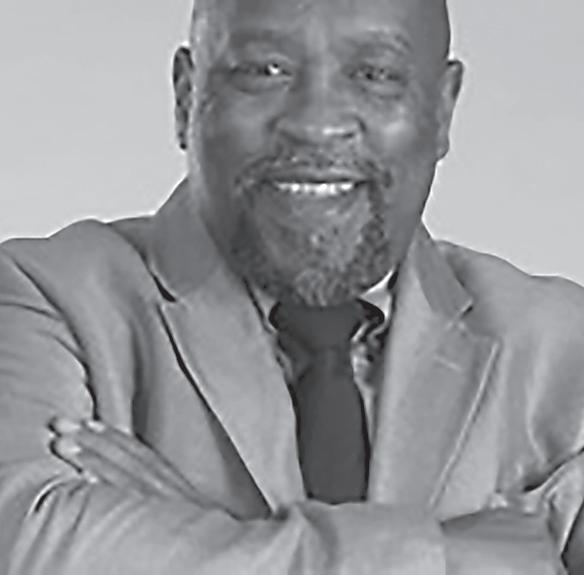
Critical theory | Nahum Chandler will reflect upon paraontology, the practical theoretical politics of thought, at a lecture on Monday.

New York Theatre Critics and The Policing of Religion on The American Stage
Wednesday , October 17, 2018
4:30-6:00 PM
Lewis Auditorium
G76 Goldwin Smith Hall
The Public is Invited


By RONNI MOK Sun Staff Writer
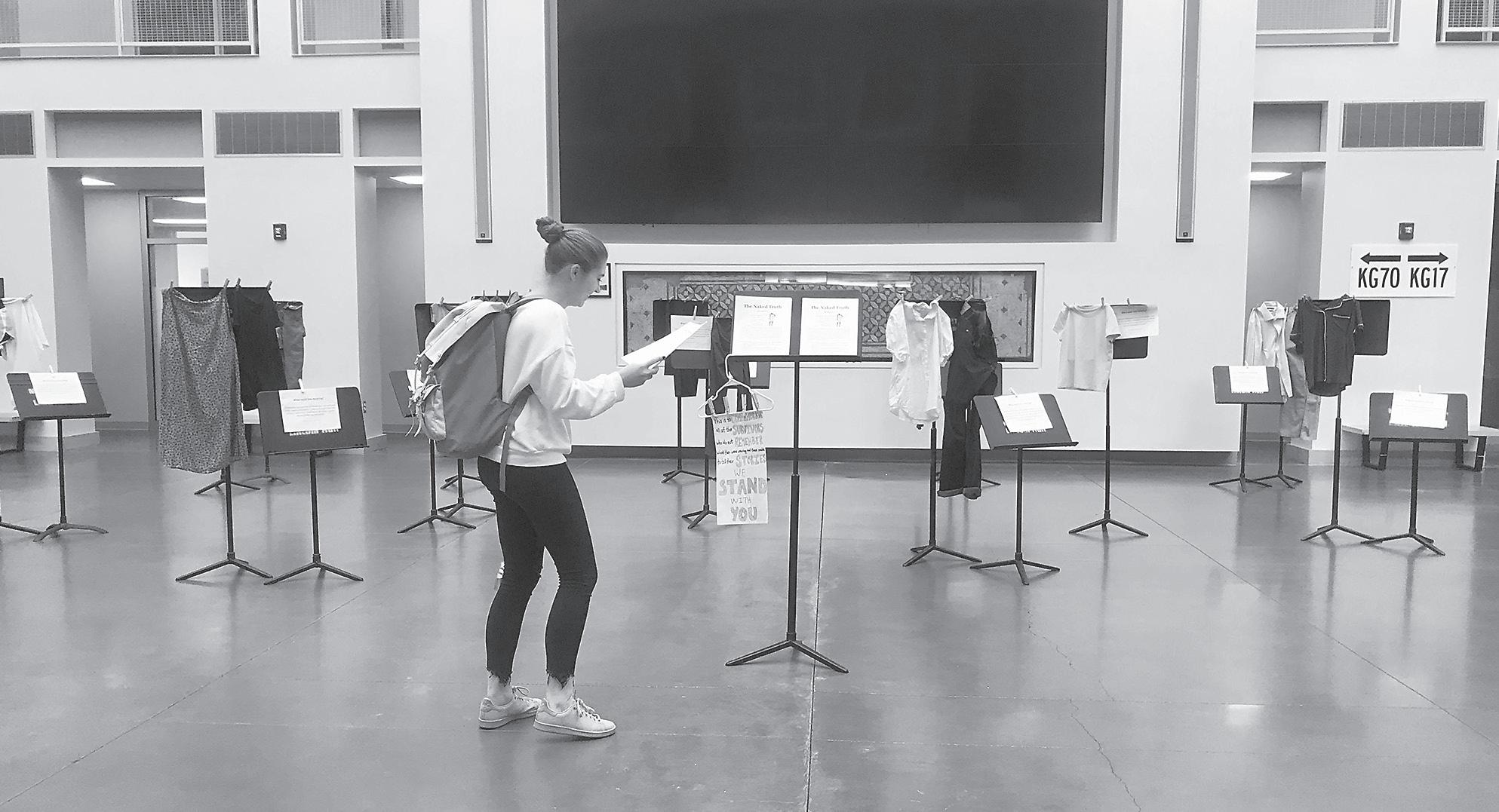
In Klarman Hall on Friday and Saturday, students quietly shuffled through stands with articles of clothing clipped onto them, reading the accompanying signs detailing stories of sexual assault.
Using the notion that survivors are often told how their choice of clothing and self presentation may have contributed to sexual violence, the “What Were You Wearing?” exhibit aimed to remind the public to hold perpetrators accountable.
The “What Were You Wearing?” exhibit originated at the University of Arkansas in 2013, and has been put on in many different universities since. This weekend’s exhibit at Cornell was put up by student organization The Naked Truth and aimed to demonstrate how sexual violence can occur to survivors of all genders, ages, professions and identities.
“Our biggest focus was to try and stay as true to the story that the survivors provided,” said Tarangana Thapa ’21, vice president of finance for The Naked Truth. “At the end of the day it isn’t about the clothes, but about the stories.”
The Naked Truth was founded this year in order to go beyond raising awareness for sexual assault by bringing new events and presenting issues to the community in a different fashion, founder and president Forest-Amber Borealis ’21 told The Sun.
“Last semester I noticed that there was a need on campus for another organization to tackle the issue of sexual violence on campus and in the community. While there have been educational efforts, it is necessary to bring transparency to the conversation surrounding sexual violence,” she continued.
“This exhibit is powerful beyond words. … This serves as a reminder that we must continually mobilize to combat sexual violence on campus and beyond,” said Grace Mehler ’20, one of the attendees.
Apart from the “What Were You Wearing?” exhibit, The Naked Truth is also petitioning the administration to
bring a database reporting system called Callisto to Cornell. Callisto, Thapa explained, is an online database where people can anonymously report perpetrators. When individuals are repeatedly reported, the University is notified.
According to Borealis, Cornell is aware of the existence of the database and the Naked Truth has brought the issue to their attention through an informal meeting.
“While it seems that Cornell is aware of Callisto, no formal steps have been taken to implement the program. We feel that part of the issue is the price of implementation, but our organization firmly believes that no price is too high when it comes to addressing sexual violence on
By KATHERINE HEANEY and YUICHIRO KAKUTANI Sun Staff Writer and Sun News Editor
Conservative activists Charlie Kirk and Candace Owens, famous for hot-take views and a strong social media presence, will hold a talk at Cornell on Nov. 13 as part of their national “Campus Clash” tour across the United States.
Kirk and Owen plan to speak at Cornell as leading members of the Turning Point USA, a conservative non-profit dedicated to building a “conservative grassroots activist network on college campuses,” according to their website. The Campus Clash Tour, which covers 11 universities across the United States, began at the University of Colorado Boulder on Oct. 3 and will end at Cornell.
Kirk founded Turning Point in 2012 after writing an essay for Breitbart news about liberal bias in educational textbooks. He now serves as its executive director. At the 2016 Republican National Convention, Kirk was the youngest speaker and has also been featured on Fox News, CNBC and Business News. Owens is the communications director for the organization and is known for being a women of color with an unfavorable view
of the Black Lives Matter movement. She has also appeared on InfoWars and Fox News.
The event, slated to take place in 165 McGraw Hall, is currently not listed on Cornell’s event page. Marshal Hoffman ’19, president of the Cornell branch of Turning Point USA, said that the event registration is currently pending approval from the University.
Hoffman said the two speakers will “discuss whatever they see fit,” but named a few possible topics that they may discuss.
“One could expect [Kirk and Owens] to speak on topics including the current federal administration, current events domestic and abroad, and other conservative issues,” Hoffman said.
Kirk and Owens have previously experienced vocal pushback against their activism, including an incident in August where they were surrounded by protestors in a Philadelphia diner, The Washington Post reported.
Protesters have also heckled at several events at Cornell featuring conservative speakers — most recently former Vice President Dick Cheney and former presidential candidate Rick Santorum in
See KIRK page 4

campus,” said Borealis.
The petition for Callisto will serve as one of the key goals for the organization moving forward, along with generating more conversation around sexual assault and spreading awareness.
“There are organizations on this campus that are doing a wonderful job spreading awareness, but there is never enough. There are always going to be issues happening, but we need to teach the idea of consent and also be there for survivors and victims after,” said Thapa.
Ronni Mok can be reached at rmok@cornellsun.com.
By WINNY SUN Sun Staff Writer
The University has received $1.5 million in funding from the Central New York Humanities Corridor to facilitate humanities projects amongst Cornell, Syracuse University, University of Rochester and the Schools of the New York Six Liberal Arts Consortium.
“The opportunity for collaboration is always important for one’s research in the Humanities,”
Prof. Paul Fleming, comparative literature and German studies, told the Sun in an email. “It can offer dialogue partners; perspectives one would not achieve on one’s own; insight into different methods and materials; feedback; and collaborative networks.”
The Corridor supports programs in seven main research clusters — philosophy, linguistics, visual arts and culture, musicology and music history, digital humanities, literature, language and culture, and archives and media — according to its website. Cornell faculty are making “remarkable progress and research outcomes” through the Corridor-sponsored working groups, Fleming said.
Some examples of current projects include Prof. Debra Castillo’s “New Readings’ Bodies in Latin American Visual Arts and Culture” and Prof. Ezra Akcan’s “New Approaches to Scholarship and Pedagogy in Ottoman and Turkish Architecture.”
Akcan has been involved in the project for three years.
Through the human corridor funding, she has been able to invite scholars from all around the world who have contributed to the study of Ottoman and Turkish Architecture to speak at Cornell and the University of Rochester.
Akcan also said that through the working group, she and her collaborator have been able to respond to “the violations of academic freedom in Turkey.”
“We have brought in last year a scholar who lost the job due to the violation of human rights and academic meltdown there,” Akcan said. “Because of current events, we have directed attention to creating a platform for threatened scholars or scholars at risk to share their work and continue their academic activity.”
Even though Fleming is currently not a part of the working groups, he said he plans on co-leading two initiatives soon. He will work on a project that examines the connections between art, handicrafts and gender during the 1800-1900s. He will also organize an undergraduate research conference for students in the Corridor schools.
“In addition to the opportunities the Corridor already presents for faculty, I see it providing a tremendous potential for developing and supporting undergraduate research and exchange in the Humanities, as well as for augmenting the ones already existing for graduate students,” he said.
Winny Sun can be reached at wsun@cornellsun.com.
SYRIA
Continued from page 1
however, the father’s primary concern was for his children.
“I still have dreams about him,” Minawi said.
When Iyer’s mentor emailed her about volunteering with SAMS, she jumped at the opportunity. “I had always read about the Syrian refugee crisis in the news and it felt very distant. This was my chance to do something besides donating ten dollars,” Iyer said.
The mission reminded her of why she went into medicine: “to help people and make a difference in the world,” Iyer said. “I learned what it meant to sacrifice everything for your child, despite having all the odds stacked against you.”
Iyer worked to provide primary care to children in the camps. “The trauma from war among refugee children is immense. It can manifest in various ways, from growth failure to bed wetting,” she said.
Abisaab grew up in Lebanon, studied pre-med at the American University of Beirut, and was forced to flee the country due to civil war. “I am, therefore, acutely aware that people in conflict situations have similar aspirations as me. However, many do not have the same fortune to come to the U.S. for medical
school,” Abisaab said.
Abisaab was horrified by the magnitude of the Syrian refugee crisis, the “unpunished use” of chemical weapons by the Assad regime, and the deliberate attacks on healthcare facilities which is why she was determined to return to her home country and assist in alleviating refugee suffering.
Armed with 14 suitcases full of medication and supplies, the team of 13 doctors, 11 interpreters, and 15 SAMS volunteers — many of whom were themselves refugees — travelled to Lebanon and “witnessed the extraordinary resilience and strength of the refugees,” Abisaab said. The panelists reported that their SAMS mission treated 1,219 patients over the course of the summer. They expressed their shared commitment to continue to advocate for refugees.
Iyer described the Syrian refugees as a population in limbo.
“Born without documentation, they are not considered Lebanese or Syrian. They are a lost generation, restarting a life where they are neither here nor there,” she said.
As one refugee told the volunteer group, “you see me smiling because I have no other choice, but inside my heart is broken into 1,000 pieces.”
Avraham Spraragen can be reached at aspragen@cornellsun.com.
CHARLIE KIRK
Continued from page 3
the past. Hoffman said the event organizers are “prepared to handle protesters, if the need should arise.”
“I obviously hope protestors will not disrupt the event because using one’s first amendment rights to debilitate others’ ignores the principle of the rights themselves. I encourage those who disagree with Charlie and Candace to attend and ask questions, provided the discussion stays civil,” Hoffman said.
Cornell Republicans president Michael Johns ’20, who is also a columnist for The Sun, said his organization is not involved in the event but noted that he hopes TPUSA “responsively contribute to the dialogue at Cornell.”
“We are aware of TPUSA’s efforts on campus but we have not received any communication from them asking for cooperation or help on this event,” John said.
Turning Point USA claims to have presence on over 1,300 high schools and university campuses nationwide, including in neighboring Syracuse University and Binghamton University.
The nonprofit’s website does not list Cornell
on its chapter directory, but the Cornell branch is listed on Cornell’s OrgSync site.
According to their website, the non-profit’s goal is to educate students about free market values.
“Turning Point USA’s mission is to educate students about the importance of fiscal responsibility, free markets and limited government. Through non-partisan debate, dialogue and discussion, Turning Point USA believes that every young person can be enlightened to true free market values,” the website said.
With the midterm elections coming up, the tour aims to rally conservative student voters, the website says. Kirk and Owens will discuss limited government and the current political culture.
Students can register for free tickets through Eventbrite, which is accessible through Turning Point USA’s website. The doors will be open at 6:30 p.m. and the event will run from 7-9 p.m. on Nov. 13.
Katherine Heaney can be reached at kheaney@cornellsun.com.Yuichiro Kakutani can be reached at ykakutani@cornellsun.com
MANDELA
Continued from page 1
just have to keep knocking your head against that brick wall until it starts cracking.”
Ndaba’s grandfather Nelson Mandela only held one expectation for his grandson: to be a leader, though not necessarily in politics, and to simply pick a passion and run with it.
“‘Ndaba, you are my grandson. Therefore, people will look at you as a leader,’” he recalled

Nelson Mandela saying. He was accompanied by Michael Jefferson, chairman of [waiting on a name], who got to know Mandela through his frequent travels to South Africa. Jefferson shared his concept of “failing forward” to define success as resisting failure and circumventing opposition.
“The definition of impossible is something that hasn’t been done yet,” said Jefferson. “If you give me no other choice, I’m going to go through you. One way or another, you have to get to the other side.”
Mandela also highlighted the unrealized potential of connectedness of the African community in America, augmented today by social media. Jefferson added that the power of LinkedIn and Facebook connects us to almost anyone in the world, eliminating any reason not to go over barriers.
According to Ndaba, the “tacit” power of connections helps entrepreneurs in Africa sustain their businesses against corruption. For example, without computers among the older generations in power, his physical presence is valuable when obtaining forms from administrators.
The lack of youth in powerful positions creates long-term leadership failures in Africa, according to Mandela. Overly competitive against each other, young generations fall to their own demise while old leaders remain stagnant.
“You don’t see new faces. The
youth are not rising up. They are not supporting each other,” said Mandela. “The most effective leader is the one who leads from the back, but we are not like that as youth.”
Instead, he champions an ‘out with the old, in with the new’ call to action, stating that the time of the “old dogs” is over.
In a room of young minds, Jefferson said that time and naivete are our most valuable assets. Fresh perspectives from inexperience yield the greatest power, allowing the youth to shape tomorrow.
“Be unstoppable — like water,” he said. “Water is something that will go in any direction. There’s no barrier you can put up that will ultimately stop it. The answer lies within you.”
Despite his drive, Mandela still believes in a time and place for fun.
“I want to thrive. At the same time, I’m a human being,” he said. “I also need to take a break, I also want to take a shot of tequila once in a while, I also want to go to the club once in a while. Why can’t I?”
Jefferson ended with a Robert Kennedy reference, “Most people see the world as it is and ask why. I view the world as what it could be and ask why not.”
Mandela also addressed a larger audience at Call Auditorium later on Friday.
Karen Li can be reached at kl886@cornell.edu.

JACOB S. KARASIK RUBASHKIN ’19 Editor in Chief
JOHN McKIM MILLER ’20
Business Manager
KATIE SIMS ’20
Associate Editor
VARUN IYENGAR ’21
Web Editor
MEGAN ROCHE ’19
Projects Editor
EMMA WILLIAMS ’19
Design Editor
JEREMIAH KIM ’19
Blogs Editor
AMOL RAJESH ’20
Science Editor
BREANNE FLEER ’20
News Editor
YUICHIRO KAKUTANI ’19
News Editor
NICHOLAS BOGEL-BURROUGHS ’19
City Editor
LEV AKABAS ’19
Arts & Entertainment Editor
SARAH SKINNER ’21
Assistant News Editor
ANNE SNABES ’19
Assistant News Editor
JOHNATHAN STIMPSON ’21
Assistant Sports Editor
EDEM DZODZOMENYO ’20
Assistant Photography Editor
PETER BUONANNO ’21
Assistant Arts & Entertainment Editor
GIRISHA ARORA ’20 Managing Editor
HEIDI MYUNG ’19 Advertising Manager
ALISHA GUPTA ’20
Assistant Managing Editor
DYLAN McDEVITT ’19 Sports Editor
MICHAEL LI ’20 Photography Editor
GRIFFIN SMITH-NICHOLS ’19 Blogs Editor
JACQUELINE QUACH ’19 Dining Editor
SHRUTI JUNEJA ’20
ANU SUBRAMANIAM ’20
JUSTIN J. PARK ’19 Multimedia Editor
PARIS GHAZI ’21 Assistant News Editor
MEREDITH LIU ’20 Assistant News Editor
JONATHAN HARRIS ’21
Assistant Sports Editor
RAPHY GENDLER ’21
Assistant Sports Editor
BORIS TSANG ’21
Assistant Photography Editor
VIRI GARCIA ’20 Assistant Arts & Entertainment Editor
Ad Layout Emma Williams ’19
Design Deskers Jamie Lai ’20 Megan Roche ’19 Greta Reis ’21
News Deskers Yuichiro Kakutani ’19
Sarah Skinner ’21
Night Desker Katherine Heaney ’20
Sports Desker Jonathan Harris ’21
Arts Desker Viri Garcia ’20
Photography Desker Boris Tsang ’21t Production Deskers Megan Roche ’19
Jamie Lai ’20
Editorial
STUDENTS FOR FAIR ADMISSIONS V. HARVARD, a case that could decide the future of affirmative action in America, goes to trial today in Boston. The issue at hand is ostensibly Harvard’s alleged discrimination against Asian-Americans in their admissions process to the benefit of other minorities and white students, but the plaintiffs have made clear that their true intention in bringing suit is to eradicate all race-based consideration from college admissions nationwide.
Though the case currently sits in front of U.S. District Court Judge Allison D. Burroughs, its outcome will likely be appealed all the way to the U.S. Supreme Court, where newly installed Justice Brett Kavanaugh and a 5-4 conservative majority await.
We strongly oppose this latest effort by conservative gadfly Edward Blum to force universities and colleges to ignore race when making decisions, and we stand with Harvard, the NAACP Legal Defense and Educational Fund, the ACLU, and institutions of higher education across the country, including Cornell.
Blum, who has made a career challenging affirmative action rules, most recently sued the University of Texas on behalf of Abigail Fisher, a white student rejected from that school in 2008. He lost the case in 2016, but since 2014 he has been organizing to take on Harvard, which he claims unfairly disadvantages Asian-American applicants through the use (or abuse) of amorphous “personal rating.” He is also suing University of North Carolina-Chapel Hill. It’s clear that Blum’s real concern is not the treatment of his clients but the completion of his idealogical crusade.
Affirmative action remains necessary at Cornell and elsewhere, and so race consideration must be upheld. To ignore race while evaluating applicants is to ignore the history of race in America, and all the pernicious effects of that history that still exist. Equality of opportunity does not yet exist in an America where White wealth far outstrips non-White wealth, where White mortality rates pale in comparison to non-White rates, where cities like Flint, Michigan go for years without clean water, where study after study shows that people with “White-sounding” names are far more likely to receive job callbacks, leases and mortgages that people with “non-White sounding” names.
For centuries, America held down all but a select few of its people, and it is foolish to suggest that, in the few decades since we began to unravel de jure racism, all inequities have vanished
We firmly agree with Cornell and 15 other elite colleges and universities that “it is artificial to consider an applicant’s experiences and perspectives while turning a blind eye to race.” Affirmative action plays a crucial role in offering opportunities to capable and deserving people who otherwise would not receive them, in mitigating pervious harm done by our society, and in creating a more diverse, equitable, cohesive nation and world. We hope the court sees similarly.

Last week, I slammed my Costcobought “Thermoflask” into a trash can in Anabel Taylor Hall, gave it the finger, then angrily strode out of the building. It was right after Friday prayers. Call it a spiritual awakening.
My $10 cerulean Thermoflask from Costco was a point of pride for a while before it started leaking all over my readings. I’d spent the first month or so of school flexing that I’d essentially gotten the same product for a fraction of what people were paying for trendy Hydro Flasks, joking that the only downside was that my Costco water bottle might give me BPA poisoning. (It’s actually BPA free — please don’t sue me for libel.)
I shelled out $30 for a Hydro Flask (on sale!). I put a sticker on it, too. I’ve gone through the same push and pull my whole life: I thought AirPods looked stupid until I didn’t. I successfully resisted getting an iPhone until last year. I entered middle school resenting the name-brand hype, but by the beginning of 7th grade you could fully catch me walking down Bull Run Middle School in my half-Aeropostale half-Hollister ’fit, looking like an absolute hypebeast.
Why do I cave in so often? Wanting to fit in, be trendy and engage in the cultural moment isn’t unique. But for third-culture kids, the pressure of fitting in sits heavier on our backs. For us, popular medium-luxury brands were and remain more than just trends. They
They serve as heuristics for coolness, which signals greater things: wealth and, more importantly, Americanness.
serve as heuristics for coolness, which signals greater things: wealth and, more importantly, Americanness.
Growing up between cultures often means trying and failing to live like our white friends. If our lives had little in common, at least we shared things. And by sharing those things, we shared all of the connotations that came with owning them. The accumulation of these items was supposed to draw us closer and closer together, like a curve approaching an axis. I would ride the curve, not knowing it was asymptotic the whole time. Whiteness would always be just a skip away.
I think I did a good job of assimilating, which is a grim, but honest thought. But when you enter a place like Cornell or a similar conduit into the world of upper class elites, the goal posts start to shift. Now, it’s not enough
I can’t help but still feel that twinge of shame every time I buy one of these signaling objects.
to be in line with the trends, to signal that you fit in with a water bottle or Herschel backpack or whatever. To continue your upward trajectory, you have to be ahead of the curve. Accumulate trends for too long and you’re basic, or worse: a wannabe white kid. There’s something unfortunate and sad about third-culture kids who follow the curve for too long, who try too hard to jump the gap between themselves and white culture. Like they’re unaware that that’s not where they belong, not really.

Hydro Flasks are, of course, probably one of the most inane and innocuous symptoms of this greater, more terrifying process. But the lure and ease of commercial coolness — of commercial whiteness and wealth — are everywhere. It’s challenging (and expensive!) to simultaneously try to fit in to a harmless stereotype (e.g. preppy, fratty, artsy, Zeusian) and avoid being placed into others, for which we’ve invented slurs: Twinkie, Ho-Ho, banana.
Honestly, maybe I just got it because it’s a durable water bottle and a worthwhile investment. But I can’t help but still feel that twinge of shame every time I buy one of these signaling objects, like I’m betraying some countervailing force inside of me. It’s as though the price tag includes some greater, more abstract cost: Something more malicious, more complicated.
Pegah Moradi is a senior in the College of Arts and Sciences. She can be reached at pmoradi@ cornellsun.com. All Jokes Aside appears alternate Mondays this semester.
Clare McLeod | Guest Room
Fall break was quite a time, a beloved break spent simply being.
I visited my sister in Hartford, Connecticut. She attends Trinity College, a school less “prestigious” than Cornell, sure, but filled with some neat people.
Friday morning. My sister goes to class. I sleep in. Her friend also sleeps in. We wake up. I convince her to practice yoga with me outside in the sun. My sister’s friend is immediately in. So there we were on a small patch of grass, saluting the sun, exhaling, inhaling, the whole ordeal. In my head, I thought “oh boy, these kids walking to class today are in for a surprise.”
Little did I know, I was the one in for the surprise. In time, people joined us! Granted, they knew my sister. But still. They stopped what they were doing — walking to class, breakfast, maybe meetings — to join us. What a time.
Would that happen at Cornell?
Cornell desperately needs some sunny Friday morning yoga.
Never.
And maybe it shouldn’t. We’re not a small liberal arts school. We’re a huge university, practically a city. But our size is no justification for the culture that pervades here. Though we’ll never be Trinity and shouldn’t strive to be, Cornell desperately needs some sunny Friday morning yoga. Why?
When I got back to campus after break, I was immediately reminded of the culture here. Four examples in the days since returning:
Me to friend I haven’t seen in a month: “Hey how are you?”
Friend (hugging me, rushing off, shouting over their shoulder): “Good, but I got to run!”
Ispent over an hour waiting at the stage. It was mid-day and the sun was raging. But I was at Firefly Music Festival and the reason I had come in the first place was to see BØRNS perform. So there was no option but to wait.
It was an experience that validated everything I had already thought about his music. He had an acoustic performance later in the day, and I waited for that as well, pushing people aside to get to the front. I was that girl. He had only released an EP then, but his psychedelic, ethereal tone was unlike anything I’d heard before. I got him to sign a copy of the EP for me. We hugged.
I saw him again at the Electric Factory in Philadelphia. He had released an album by then.
I’ve never really been a fan girl to any artist, but BØRNS was different. He connected with his audiences. He made every performance intimate and connected with all of us, as annoying as we all were trying to out-scream each other with his lyrics. Garrett Borns, in his funky crop tops and blazers, was real.
“I am both hurt and angered over the disturbing and false allegations that have been spread over the past few days on social media. All of the relationships I had were legal and consensual. They ended abruptly and that obviously caused hurt feelings, but for anyone to suggest anything beyond that is irresponsible.”
Borns? My Garrett Borns?
I couldn’t believe that he had to
Me (to myself): “Clearly.”
Me (to friend quarter-carding on Ho Plaza): “Hey, how are you?”
Friend: “I’m good.”
Me: “How’s quarter-carding?”
Friend: “Oh you know, quarter-carding”
Me: “What are you doing after this?”
Friend: “I’m quarter-carding until 6:15, then I have work from 6:30 until 10”
Me: “Will you have time to eat dinner?”
Friend: “I’ll grab a salad between shifts.”
Me: “Alright well get some sleep after. Do you have homework?”
Friend: “Always”
On the morning of a lunch date set a week in advance:
Friend’s text: “I woke up to a bunch of emails and am going to have to miss lunch. I’m so sorry, but can we reschedule?”
My reply: “Of course! Good luck with the emails.”
Friend (describing their next two days): “I’m going non-stop from 10 until 8 tomorrow. But I’m grateful. It’s fine. I’m all good.”
Me: no audible response, internal dismay.
Aye, aye, aye.
This is all great, don’t get me wrong. I love the achievement, progress, passion, involvement of my friends. But I miss them. I miss getting to know people. I miss hanging out. Where are my people? Where are the sunny Friday morning yoga-flowing folks?
Come find me. I’ll be around.
Lies. This semester, after four semesters here, I’ve finally been sucked into the busy-ness vortex. Here’s a fifth example:
After a week filled with various commitments, I planned to go for a nice stroll with my friend on a weekend morning. I woke up — physically fine, but mentally drained. I had nothing to do but walk. But I couldn’t. I wanted to lie in bed and let the sun shine in. Read a book. Write a story. Create. Learn.
Gabrielle
Anything but walk. Me: “I’m not feeling great. Can we reschedule?”
Friend: “Of course!” (likely because she’s been here before).
Much to my disappointment, I am now rescheduling, falling out of touch with friends, being “busy”
Let me tell you, the busy-ness vortex is suck-y. It both sucks you in and sucks once you’re in.
instead of “being.” Let me tell you, the busy-ness vortex is suck-y. It both sucks you in and sucks once you’re in.
What a perfect, privileged college student complaint: being occupied with opportunities you chose to pursue. I know. It’s a blessing to be here, which is why I wish I could genuinely exhibit the “gratefulness” my friend semi-exuded in my third example. By and large, I am grateful. I know how fortunate I am to be here. I just wish I had more time to be grateful. More time to be.
A wise friend of mine told me at the beginning of the semester, “Don’t complain about your plate being full when you asked to eat.”
Oh, I certainly did. Maybe we all did. But what do we do when all our plates are so full that we can only ever focus on our own selves. What then?
Come find me if you have the answer. I’ll be around. I’m choosing to be less busy. After all, I chose to eat, but I can also choose to not go back for seconds. And I certainly won’t be.
Clare McLeod is a junior in the School of Industrial and Labor Relations. Guest Room runs periodically this semester. Comments may be sent to opinion@cornellsun.com
issue this statement on Instagram. This wasn’t the singer-songwriter I knew. It couldn’t be him, they had to have had it wrong. These twitter accounts accusing him? Maybe they were fake.
But the more I looked into it, the more I knew these women had real reasons for coming forward with these allegations. Women described situations in which they were groomed at young ages and then taken advantage of when they turned of age. They described situations of friendship that turned into intoxicated encounters that led to manipulation. While many people have said that Borns didn’t act illegally and there was admission of consent, I couldn’t help but feel that these allegations had now taint
Brett Kavanaugh. I was at a place where I mistrusted men in power, where I knew that women had to speak up. I supported, I stood up for, I wanted these women to know I heard them. Yet I couldn’t believe it was so difficult for
I couldn’t help but feel that these allegations had now tainted my view on an artist who had once inspired me.
me to come to terms with the fact that one of my favorite singers had sexual assault allegations against him. Could I separate his music from his actions?
What about the artists whose sculptures and paintings I admired? What about the works I study in classes, that I have dedicated a major to?
he attempts to kill his brother using an iron crowbar and sends someone to disfigure the face of his mistress with a razor? Does this influence the way I would see Bernini’s work? Would I think it any less beautiful?
How easy is it to separate the lives of artists with the work they do?

ed my view on an artist who had once inspired me with his music.
The sexual assault allegations against Borns involving minors arose at the same time as did the allegations against
I was able to visit the Galleria Borghese in Rome last summer. Some of Bernini’s most beautiful sculptures, such as Daphne and Apollo and Pluto and Persephone, are located there. My favorite sculptures are Bernini’s: he works with marble in a way that turns it into
flesh — he gives lifeless material life. What happens when you find out that your favorite sculptor’s mistress was having an affair with the artist’s younger brother which makes him so angry that
How easy is it to separate the lives of artists with the work they do? I find it easier to appreciate their paintings and sculptures in artistic terms — texture, color, form — without connecting them with how they live their lives. I can disrespect how they live without disrespecting their art. With actors and producers, I find it more difficult. Actor Colman Domingo easily states in a New York Times article, “Yes, the art suffers” in reaction to the idea of separating art from the artist. His movie, The Birth of a Nation collapsed at the box office after the writer-director, Nate Parker, was accused of raping a woman 20 years earlier (Mr. Parker was later acquitted and the woman killed herself). Similarly, with the sexual assault allegations against Kevin Spacey, I find it difficult to watch American Beauty again.
I do not know if the allegations against Garrett Borns are completely true. But I will listen to these women and try to understand their experiences. And for now, BØRNS won’t be getting any more streams on Spotify from me.
Gabrielle Leung is a senior in the College of Arts and Sciences. She can be reached at gleung@cornellsun. com. Serendipitous Musings appears alternate Thursdays this semester.
If you sit for long enough at the Taiwan Taoyuan International Airport you will see luggage carousels fill up with aluminum-ribbed suitcases, a parade of muted colors, subtly labeled Rimowa. There, the suitcase is so common it is easy to forget that it is a luxury brand, with prices starting at $495 for your basic starter luggage. Perhaps this speaks to the different definitions of luxury. In my mother’s country, using clothing for wealth signaling is less pervasive and luxury is harder

to distinguish than in the Canada Goose-rife, Goyard bag-toting landscape that is Cornell. However, young or old, the obsession with the Rimowa luggage continues because of its practicality and quality. So you can imagine my surprise when a targeted Instagram ad (the gift that keeps on giving) showed a trippy video for Rimowa’s new collection featuring Off-White™ designer Virgil Abloh expounding his mantra on travel. Virgil Abloh, future arts director of Louis Vuitton, creative director for Kanye West, kingpin of Off-White™ and professional D.J. is hailed as one of the most influential designers because of his ability to integrate streetwear culture into high fashion.
Abloh’s signature is playful and seemingly irreverent, a Marcel Duchamp for the age of Instagram, featuring words in Helvetica that describe the object (i.e skirt,
shoe, knit, etc.) in quotation marks and visual allusions to the quotidian and the working-class. His clothing brand Off-White™ has developed a cult following of hypebeasts, with his deconstructed Nike and Converse collaborations going for thousands of dollars on the resell market. Because of this, it seems contradictory for him to partner with Rimowa, an understated, niche luggage manufacturer. However, this is part of a larger trend, a wave of rebranding by classic luxury goods brands in order to establish staying power in an era where bootleg luxury is more sought after than the goods themselves and trends fluctuate according to social media. In this economic environment, Abloh possesses the golden touch, injecting perceived “cool” and placing an emphasis on the individual into classic pieces, playing off of the cultural correlations these brands already have and tweaking them for a new type of consumer. His Rimowa collaborations feature a typical Rimowa luggage that comes either in transparent plastic or in aluminum with the words “PERSONAL BELONGINGS” emblazoned on the side. At once useless and ironic, the collaboration encapsulates a general feeling perpetuated by social media platforms like Twitter and Instagram.
In this sense, it is clear that Abloh doesn’t seem himself as simply a fashion designer but rather, a designer of experience. In a video interview with the New York Times, he places emphasis on his audience, “The millennial young person, they love to covet things, they are waiting for a designer that is faced to them.” This idea of designing for the user aligns greatly with the tenets of Don Norman’s legendary book The Design of Everyday Things , in which he says, “Design is really an act of communication, which means having a deep understanding of the person with whom the designer
is communicating.” In this case, Abloh has excelled, reading the pulse of a specific demographic, predicting their desires, and exploiting an unreached market. This is exemplified in his collaboration with Ikea — a part of every millenial’s DNA — the Swedish furniture company famous for their frustrating home-assembly instructions and cheap teak-wood bookcases. The MARKERAD collection, as it is called, includes a completely clear glass cabinet (for displaying your favorite personal items, of course), a rug emblazoned with the words “KEEP OFF,” and a classic wood-spindle chair with a doorstop for a fourth leg. These items are cryptic and avant-garde that bring nothing new to the table, but are so in-demand that they will sell out immediately when they drop in 2019 because of Abloh’s ability to predict consumer patterns.
But to be clear, Virgil Abloh is not designing everyday things, he is designing for luxury. He has helped foster a culture of consumption that is unsustainable and empty. Perhaps Abloh is not truly designing, but rather experimenting with elitism. By co-opting DIY youth culture, usually born of low-budget resourcefulness and placing exorbitant prices on everyday things, he is appropriating a way of being to create a feedback loop of coveting. But maybe Abloh is playing with us, operating a grand social survey that will result in a fabulous op-ed about how the millennials fell for the grand marketing ruse. Moving forward, it is important to realize our own roles as consumers and look deeply into how we form our opinions on what good design is and how it impacts our everyday lives.
Isabel Ling is a senior in the College of Art, Architecture and Planning. She can be reached at igl3@cornell.edu. Linguistics will run on alternate Mondays this semester.
DANIEL MORAN Sun Contributor
One common question posed among creatives deals with the separation of art from the artist. Where do you draw the line? If the art comes from the artist, can they be separated at all? Ian Bonhôte and Peter Ettedgui’s McQueen shows that in the case of the late Lee Alexander McQueen, it is all but impossible.
The movie is based primarily on the fashion shows McQueen was a part of, whether for his own eponymous brands or for Givenchy, as illustrated by footage of McQueen himself as well as exclusive interviews with his closest friends and family. It begins with McQueen’s rise to fame, detailing his rags-to-riches story from a poor East Londoner to one of the fashion industry’s most esteemed designers. The description of his rise is one of the successes of this film, as it would make for a much more compact story to simply gloss over the fine details and really delve into the storytelling when McQueen reaches Givenchy — it was only a four year gap between McQueen’s graduating college to his winning the British Designer of the Year award and being appointed Creative Director at Givenchy. The context, however, is important, and seeing a young McQueen struggle as the sixth child to working class parents, as someone who couldn’t afford formal schooling without the help of extended family and who used welfare checks and garbage bags to create some of his earliest shows is crucial to understanding his humble beginnings and his rapid success.
McQueen had every chance to be elit-
ist, or to elevate McQueen to a saint-like status. By establishing the early context of McQueen’s upbringing and personality, the film manages to capture him in every bit of his swagger for which he was known, as he was often called the “Hooligan of British Fashion.” Every clip of him showcases his boyish personality, including clips in which he insults his future employers at Givenchy by calling them rubbish and irrelevant. The film, though, begins to take a much darker tone following his appointment to Givenchy. Gone are McQueen’s constant jokes, replaced by a new pressure from taking over as head of one of Europe’s premier fashion houses. It’s at this point that the interviews used throughout the film change from reminiscent to mournful, as McQueen’s closest friends recount the spiral that would later lead to his suicide.
The film shows many of McQueen’s runway shows, but it’s the Autumn/ Winter 1995 “Highland Rape” show portrayed in the beginning that is by far the most important. Initially, the use of tattered clothes and distressed models who look as though they had just been sexually assaulted comes off as an attempt by a young McQueen to gain recognition through shock value. Later in the film, McQueen explains that “If you want to know me, look at my work,” as a way of explaining the inspiration behind his art. Certain interviews reveal that he was personally affected by something that may have influenced the aforementioned show, as his sister was sexually assaulted and struggled for years to understand what had happened. Either way, McQueen’s goal is the same: to make the viewer feel something after seeing his
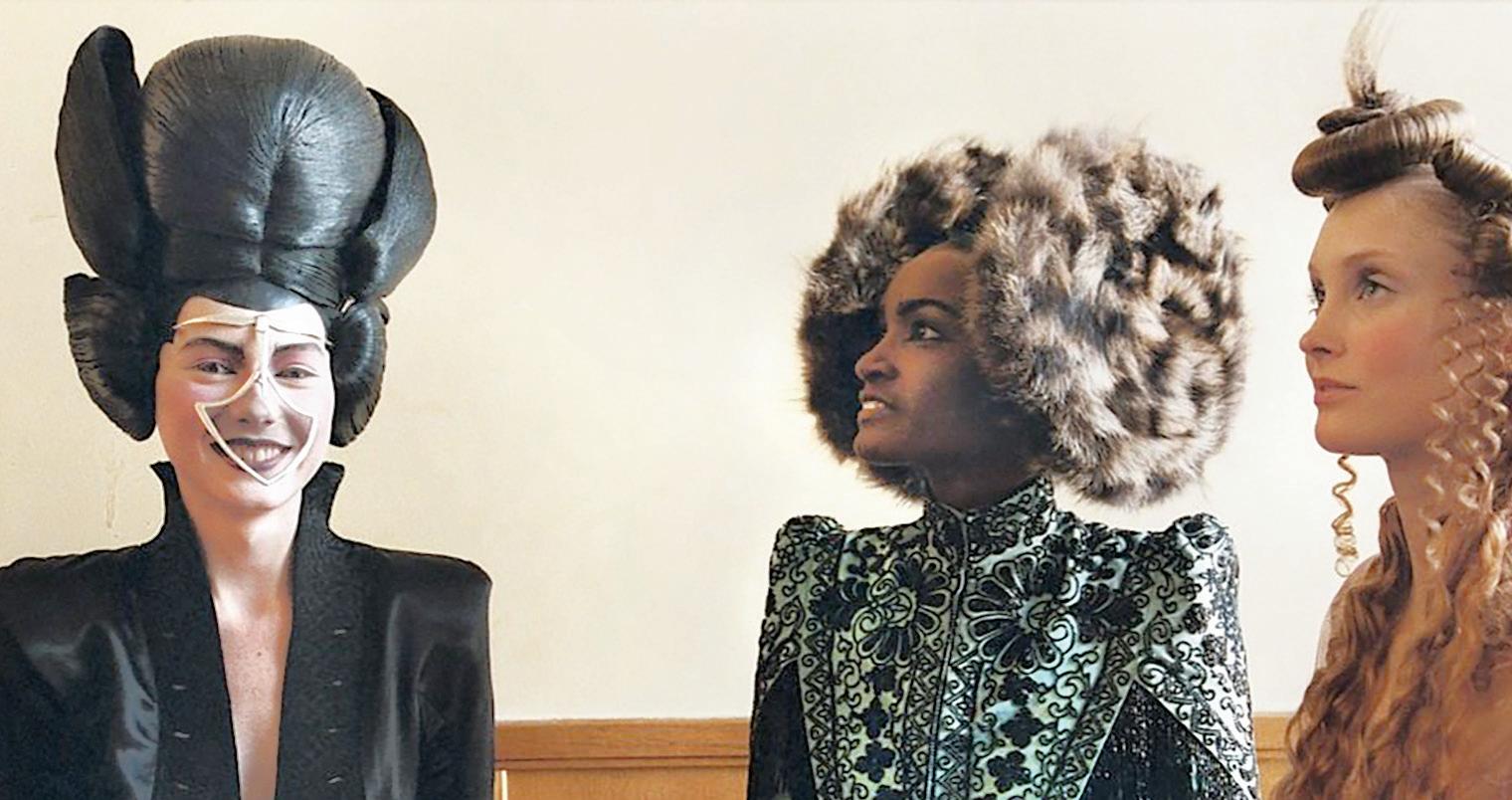
show. The common reaction throughout the theater seemed to be disgust, but McQueen explains that this is the exact reaction he was hoping for.
It seems that McQueen himself doesn’t want us to draw a line between Lee McQueen, the poor East Londoner, and Alexander McQueen, the hooligan of high fashion. This is crucial in explaining McQueen’s internal struggles and later issues with drugs, because as the pressure mounted, he was never able to pull himself away from his brand without worrying he would let down everybody who worked with or for him. The film is able to capture this in a subtle way through the juxtaposition of a thin, post-Givenchy McQueen with an overweight but incredibly lively pre-Givenchy McQueen, firmly that McQueen lost some part of himself as he ascended in fame.
This fame and influence was far reaching, something this film fails to really place in a broader light. From styling David Bowie and Bjork to being worn
by Rihanna and Sandra Bullock to being name dropped in a Playboi Carti song in 2017, Alexander McQueen had an immense reach that few other designers can claim — something this documentary hints at but never truly captures. Additionally, the movie never gives the words of McQueen’s suicide note, which simply read “I am sorry... please look after my dogs. Sorry... I love you… Lee,” which is incredibly haunting and could have served as one last bitter view into his dark but not entirely serious personality. Depicting the chaotic rise and fall of British fashion designer Alexander McQueen, McQueen is a beautifully dark tragedy that perfectly fits its namesake. Although it lacks in some minor parts, McQueen is nearly flawless and is among the most interesting fashion movies, even for those who aren’t interested in fashion.
Daniel Moran is a sophomore in the College of Human Ecology. He can be reached at dhm96@cornell.edu.
Fill in the empty cells, one number in each, so that each column, row, and region contains the numbers 1-9 exactly once. Each number in the solution therefore occurs only once in each of the three “directions,” hence the “single numbers” implied by the puzzle’s name. (Rules from wikipedia.org/wiki/ Sudoku)






1, 2, 3, 4, 8 BEDROOMS FURNISHED VERY REASONABLY PRICED 607-272-3389 avramisrentals@aol.com
COLLEGE AVE.
1 Bedroom available In a 2 BR apartment For Male, Undergrad student. Available NOW & Spring 2019
4 Bedroom Apartment Available NOW & Spring 2019 Novarr-Mackesey Property Management office@ithacastudentapartments.com 607-277-1234
By SARAH SKINNER Sun Assistant News Editor
The Roper Center for Public Opinion Research, a Cornell-based operation that collects and disseminates survey data on both the local and national level, was awarded a $1.43 million grant to create the world’s largest database on public health opinion.
2 & 3 BEDROOMS 109 SAGE PLACE
Available NOW, Spring 2019 & 2019/2020 Shuttle Bus Access to Campus Access to Free Fitness Center Novarr- Mackesey Property Management office@ithacastudentapartments.com 607-277-1234
Collegetown STUDIO 2019/2020 QUIET STREET only 1/2 Block from College Ave. Roomy - Fully FurnishedHardwood Floors 607-351-3898 Email: marthabell004@yahoo.com
>>AFFORDABLE, QUALITY LIVING<<
Special Deals for you! Furnished 1-6 Bedrooms Collegetown Apartments PARKING, LAUNDRY, UTILITIES! (607) 273-7368 www.IthacaApartmentRental.com
The Roper Center, the “largest public opinion archive in the world,” was founded in 1947 and has collected survey data stretching back to the 1930’s and the “infancy” of survey science, according to its website.
The recent grant will be used to create an “easily searchable” health opinion database, letting researchers and the public quickly find information about public views on health throughout the decades.
The database will compile tens of thousands of questions and answers on surveys pertaining to health from 1935 to the present, according to a University press statement. While empirical questions such as insurance and cost will be included, the database will also include more subjective influences on public health.
These include retirement costs, changing views on health practices such as smoking and diet, and the government’s changing role in promoting health care, the press statement details.
“Public opinion polls reveal that from the late 20th through the early 21st century, the federal government’s role in providing health care services has been a highly salient and contentious issue,” a 2013 Roper Center study on government and health states. However, this study also says that divisions “starkly evident” during the current
decade, largely related to the Affordable Care Act, have not always existed.
Researchers and others will be able to use the searchable database to examine similar changes in public opinion stretching all the way back to the pre-World War II era. According to University press statement, the database will also include “online analysis and data visualization” to help non-scientists, including the media, students, policymakers and the public, to interpret the results.
Though the Roper Center focuses on data-driven research, it is executive director is a history department faculty member, Prof. Peter K. Enns, illustrating its multidisciplinary approach.
“Our goal is to generate a valuable tool to better understand how attitudes and perceptions about health change over time and across different groups in society,” Enns said in the press statement.
The database will take three and a half years to develop, the statement says, but Roper Center users will start seeing “ongoing benefits” as the project advances, Enns said.
The awarding body, The Robert Wood Johnson Foundation, is America’s largest solely health-focused philanthropy with an endowment of approximately $10.6 billion according to their website, and gives roughly $500 million a year in grant funding.
Cornell’s Office of Sponsored Programs website lists the Robert Wood Johnson Foundation as one of the University’s “top funders” for competitive funding announcements.
Sarah Skinner can be reached at sskinner@cornellsun.com.
Houses, Apts, Parking 1 to 9 Bedroom
Collegetown - College Ave, Linden Ave, Dryden Rd, Bryant Ave, Cook St. 607-330-2442 info@urbanithaca.com www.urbanithaca.com
We have availability for the 2019-2020 school year beginning June 1st at Hudson heights apartments. The studio apartments come with: heat, water, and electricity included. There are garbages houses and coin-operated
on site. Prices start at $750/month for
12
lease. If you have any questions or would
to schedule a tour contact us by phone 607-208-7660 or email: renting@ithacaLS.com
RENT NOW, GET THE BEST www.MatoulasHouses.com
Apartments & Houses In Collegetown LINDEN AVE & E. SENECA ST 1 & 3 BEDROOM APARTMENTS ALL FURNISHED EMAIL: MatoulasHouses@Gmail.com PHONE: (607) 339-9644 FIRST-COME, FIRST-SERVED
Continued from page 1
cial support.
Collegetown Terrace Apartments INSPIRED LIVING TAILORED TO YOUR SUCCESS 24-Hour Fitness Center Shuttle Bus Service to Campus Study Rooms w/ Expansive Views
Apartments Available NOW, Spring 2019 & 2019/2020 Novarr- Mackesey Property Management collegetownterraceithaca.com office@ithacastudentapartments.com 607-277-1234
201 WYCKOFF AVE 6 Bedroom House Novarr-Mackesey Property Management office@ithacastudentapartments.com 607-277-1234 27 H OUSE FOR R ENT
Malina’s statement cited the $1.3 million repair of city-owned Forest Home Drive as the most recent example of Cornell’s support to the city with its utility and infrastructure costs.
The statement also highlighted Cornell as the third largest property tax payer in Tompkins County and its contribution of “millions of dollars each year” to non-profits like public schools, transit, day care and housing that help improve the city’s quality of life.
The budget narrative noted that the economy is “improving” but remains “unsettled.” When Myrick initally proposed the budget, he called the city’s financial health stable and said that with the proposed budget, general fund revenue would grow faster than expenditures. This implies
that the city would not need to dip as far into its savings in 2019 as in the past year.
Funding plans for the Ithaca Police Department caused some dispute between the City and law enforcement leadership, as The Sun previously reported. IPD chief Pete Tyler claimed the department was at a “breaking point” due to low staffing during a budget planning meeting on Thursday.
As it is currently proposed, the budget plan includes no new funds for IPD, despite Tyler’s request for two new officers. Other requests for staffing and funding increases were made by Fire Department Chief Tom Parsons and City Clerk Julie Holcomb, but the Common Council provided nothing definitive in terms of new funding commitments as a result of the meeting.
Myrick touted the budget plan’s allocation of $450,000 for
a seven-person paving crew to fix potholes, a common complaint for Ithacans. The crew will be phased in starting March 1 if approved in the budget plan, according to the narrative.
“This should be the headline for anyone who live in or drives through Ithaca,” Myrick said, according to The Ithaca Journal. “If we just hire one guy and send him out with a shovel, not a big impact would be made for that cost … by getting up to the minimum to operate a crew, you can see a larger impact. The police staff works the same way.”
The budget process will move forward with a series of public hearings meetings between city departments and the Common Council over the next two weeks. The final budget approval vote is scheduled for Nov. 7, according to the City’s website.
Matthew McGowen can be reached at mmcgowen@cornellsun.com.
COLLEGETOWN 6 BEDROOMS NEWLY RENOVATED 607-272-3389 avramisrentals@aol.com


By SARAH SKINNER Sun Assistant News Editor
Cornell may see its first snowfall this week, according to weather forecasts by the University. This would bring snow showers back to Ithaca approximately six months after the year’s last snowfall on April 20.
The official University weather service lists a chance of “snow showers” for early Thursday morning after 2 a.m. and before 8 a.m. The night is predicted to be mostly cloudy, with a low around
fall at Cornell for every month since February 1926. However, it has not snowed this early in the month since 2009, when it snowed two inches on Oct. 16. According to the center’s “normals” for data, which are constructed using data from 1981 to 2010, October’s average snowfall is 0.4 inches. However, the only time that it has snowed more than “trace” amounts in October since 2010 was one day in 2016. Despite this forecast, Syracuse. com reported earlier this month based on Accuweather’s seasonal
The official University weather service lists a chance of “snow showers” for early Thursday morning after 2 a.m. and before 8 a.m.
33. The chance of precipitation is 40 percent.
This denotes a drastic shift in temperature, as last Wednesday the maximum temperature in Ithaca was 80 degrees farenheit.
Last year, Ithaca did not see snow until nearly a month later on Nov. 8, 2017, according to US Climate Data.
It has only snowed in October for five of the last 10 years, according to Northeast Regional Climate Center data, which has collected data on snow-
forecast that upstate New York would see a serious reduction in lake-effect snow.
Ithaca sees an average of 43.9 days of snow during a season, with an average overall snowfall of 64.4 inches, according to National Weather Service data on climate normals from 19812010. Girisha Arora ’20 contributed reporting to this article.
Sarah Skinner can be reached at sskinner@cornellsun.com.
By GRACIE TODD Sun Staff Writer
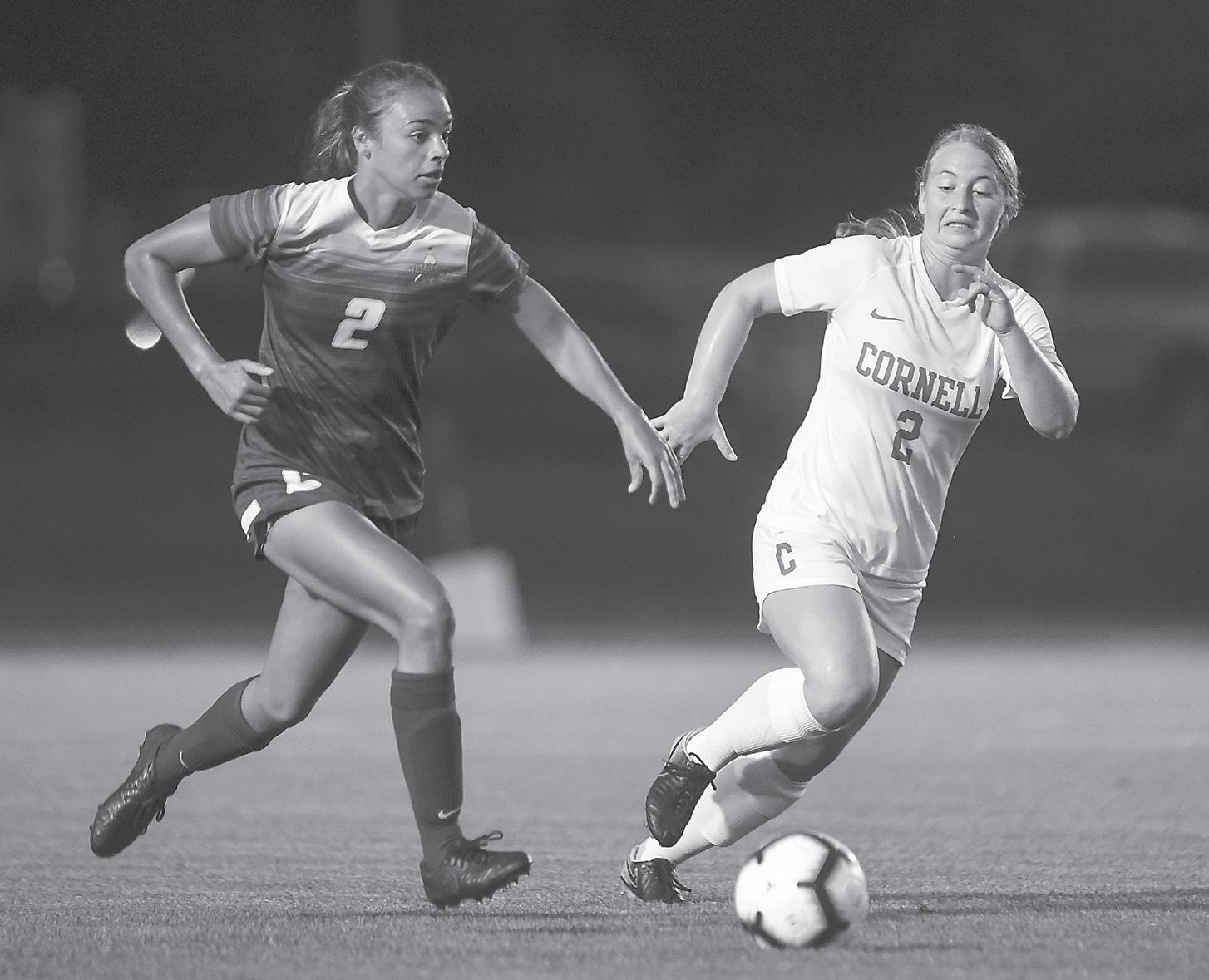
A rough season hasn’t gotten any better recently for Cornell women’s soccer — the Red is now 0-4 in the Ivy League and has lost five straight contests following its Saturday loss to Yale at Berman Field.
The Bulldogs beat Cornell, 1-0, scoring the game’s only goal via a header off a corner kick late in the first half.
The two teams were nearly evenly matched in terms of shots; Yale (6-5-1, 1-3 Ivy) had 10, while Cornell (1-10-1, 0-4 Ivy) had nine. But the Bulldogs far outpaced the Red in terms of shots on goal, with eight compared to two.
“Shots of goal are a function of confidence and skill to strike the ball well,” said head coach Dwight Hornibrook. “[We are] working hard, determined to improve.”
Sophomore Shelby Wray and freshman Evanthia Spyredes generated the Red’s two shots on goal. Both shots on goal occurred early in the first half. Spyredes also led the Red in shots, with
By FAITH FISHER Sun Contributor
Cornell field hockey came up short against conference rival Harvard in what ultimately became an 8-0 landslide victory for the Crimson in which the Red could never get its offense going.
Harvard (12-1, 4-0 Ivy) has suffered just one loss this whole season, and its victory this weekend extended its nine-game winning streak.
The first 25 minutes of the game were scoreless, but the Red (3-9, 0-4) were left scrambling to stave off the aggressive Crimson attack. Junior goalkeeper Maddie Henry kept Harvard off the scoreboard with eight saves. Although the score remained at a standstill, the Red made costly mistakes in its own end that set the tone of the game and eventually led to its demise.
“We were turning the ball over and giving up too many entries into our defense barrier,” said interim head coach Stephen Simpson.
“We had the ball in our circle a lot so defense was really busy, but we held them for a while,” said freshman defenseman Delaney Golian.
The dynamic of the game quickly shifted once Harvard’s Tessel Huibregtsen notched the first goal of the game. Harvard swiftly continued to capitalize on its opportunities. Within just seven minutes of the goal, Maddie Earle and Olivia Hoover extended the Crimson’s lead.
“When the first goal went in, our resolve and consistency on defense weakened,” Simpson said. With the Crimson’s first half momentum and the Red’s weakening resolve, the second half saw five more goals from Harvard. At 43:07, Bente van Vlijmen scored off of a penalty corner. Less than two minutes later, Harvard’s Maddie Earl intercepted the ball, broke into the Red’s circle, and secured the ball in the right side of the goal.
All the while, the Red struggled
to find offensive opportunities. The ball seldom entered Cornell’s offensive zone, and the Red had zero shots throughout the whole game.
“We were turning the ball over and giving up too many entries into our defense barrier” Head Coach Stephen Simpson
“We were attacking too straight, we were passing to Harvard instead of Cornell people,” Simpson said. Even when the Red did have the
ball on its sticks, the unwavering Crimson defense swiftly regained control.
“They played defense together, so they would hunt in pairs. Whenever one person took the ball, there would always be two Harvard girls pressuring the ball together,” Golian saiwd.
Close to the end of the hour, Harvard’s Huibrestsen placed a reverse stick shot into the back of the Red’s goal. Casey Allen quickly widened the Crimson lead when she scored a goal off of a rebound in the Red’s circle. In the last moments of the game, Crimson’s Maddie Earl landed a hat trick, capping the game off at 8-0.
three.
Senior goalkeeper and captain Meghan Kennedy prevented a larger losing margin for the Red by making seven saves.
Despite the loss — the team’s fifth in a row — the Red is focused on the positives.
“We controlled the play, created chances and nearly scored,” Hornibrook said. “Our passing and movement off the ball was good.”
The Red has only three more chances to garner Ivy wins. They’ll face Brown, Princeton and Dartmouth on the next three consecutive weekends.
However, the Red is not getting down on its losing record.
“Team mentality is excellent,” Hornibrook said. “We will focus on improving our attacking play and reducing technical and defensive errors.”
The game against Brown will be the Red’s last road matchup. The game will take place at 1 p.m. Saturday in Providence.
Todd can be reached at gtodd@cornellsun.com.

falling 0-8
“We had too many goals that came on second chances right after the goalie made the save by not getting to the rebound. We gave up too many chances and big scores happen when you do that,” Simpson said.
The Red will continue its hunt for an Ivy League win next Saturday at Brown. The game will be live streamed on ESPN+ at noon.
Faith Fisher can be reached at faf28@cornell.edu.
By RAPHY GENDLER Sun Assistant Sports Editor
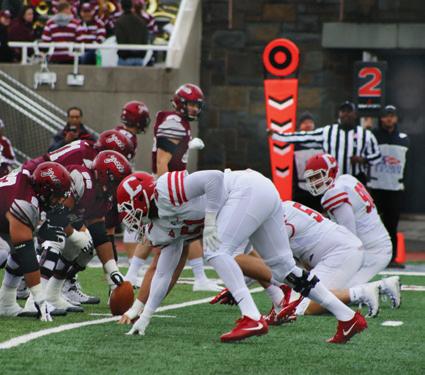
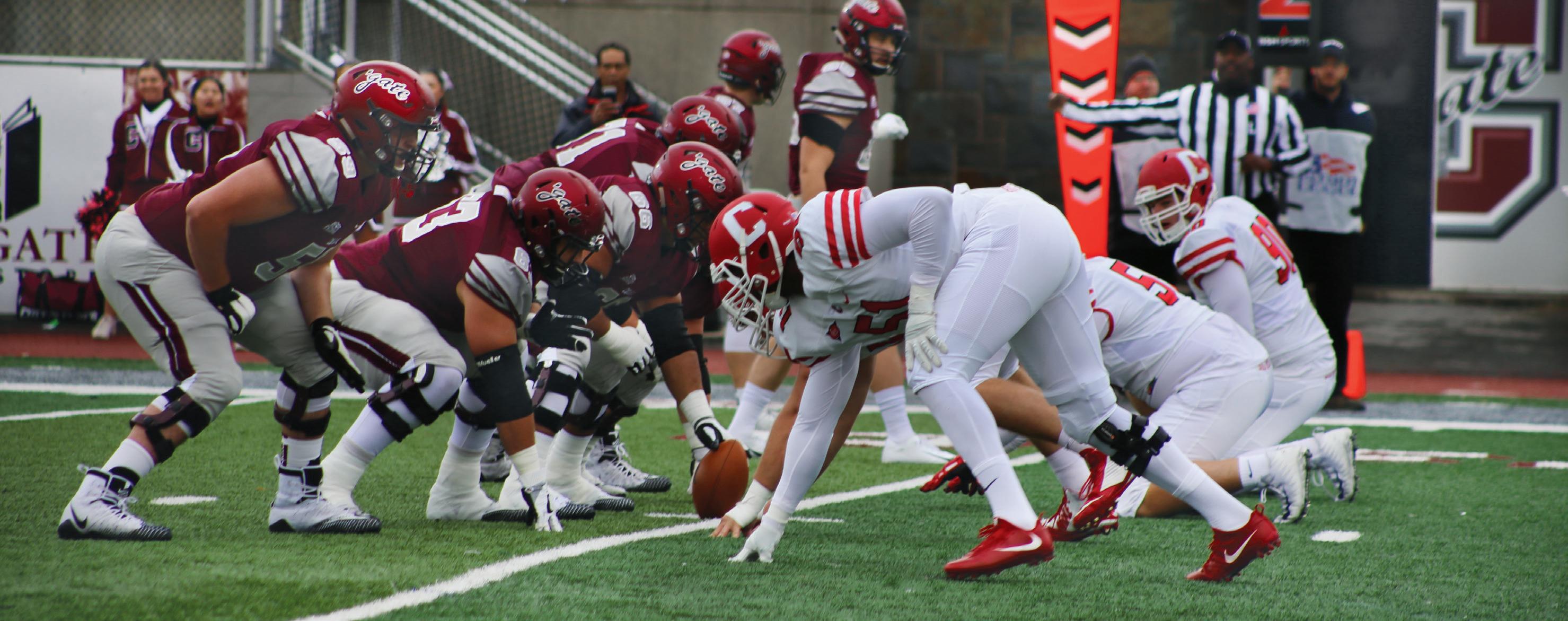
HAMILTON, N.Y. — Colgate entered Saturday having allowed just six points since week two of the season. After 60 minutes against Cornell football, that number stayed the exact same.
Colgate’s defense proved why it’s the nation’s best on Saturday, shutting out the Red and giving the Raiders a decisive 31-0 victory.
“If my quote from two years ago was a day I’ll never forget, this one is a day I’m going to try to forget really fast,” said head coach David Archer ’05.
The Red, whose record falls to 2-3, kept pace with No. 17 Colgate in the early going, but the Raiders quickly ran away from the Red in the one-sided contest.
Senior quarterback Dalton Banks and the Cornell offense couldn’t crack the FCS-best Raider defense, turning the ball over on downs four times and suffering four three-and-outs. Banks finished 14-of-25 passing for 91 yards and an interception.
“They’re just a really athletic defense that flies around, so they have 11 hats going to the ball,” said junior running back Harold Coles, who had just 46 yards on 14 carries.

Despite not scoring any points against the nation’s best defense, Cornell’s own defense kept pace with the Raiders in the first half, limiting the Colgate offense to 10 points.
Save for a 50-yard run by running back James Holland Jr., which set up Holland’s 9-yard touchdown catch, Cornell mostly kept the Colgate offense at bay in the first half.
But the Red didn’t last long in the second half in the 100th meeting between Colgate and Cornell. The Red’s offense was 4-for-16 on third down and managed only 3.3 yards per play.
“Even on our opening drive I felt really good there, we put a couple other drives together and just couldn’t finish it out against a good defense,” Archer said.
The Raiders came out firing on the first drive of the third quarter, using a 36-yard flea flicker completion on the first play to move into Cornell territory. A few plays later, Holland
By MILES HENSHAW
The season is halfway done and neither of the two Ivy leaders has played in a close game.
Princeton and Dartmouth continued their reigns of terror this weekend with another pair of 30-plus point victories. The Green and the Tigers are two of the four undefeated teams remaining in the Football Championship Subdivision.
Harvard 33, Holy Cross 31

The Crusaders, who topped Yale in an overtime thriller in week one, seem to have a penchant for the dramatic. Harvard entered the fourth quarter leading comfortably, 30-14, but Holy Cross made things interesting in no time. The Crusaders followed up a 24-yard touchdown run with a two-point conversion and a safety on the next play, cutting the deficit to six. A touchdown gave the Crusaders a slim lead with eight minutes left, but Harvard rallied to score on a field goal as time expired and move on with the narrow win.

punched in his second touchdown of the afternoon to give the Raiders an insurmountable 17-0 lead.
“I think [Colgate] came out of halftime with some adjustments that worked really well up the middle,” said junior defensive lineman William Baker.
The Red then quickly went three-and-out and, looking for a spark midway through the third quarter, tried a fake punt. Junior linebacker Justin Bedard’s pass was intercepted and the Raiders used a short field to extend their lead to 24-0 on a 21-yard touchdown run from quarterback Grant Breneman.
The final two minutes of the first half featured a bit of everything, including two plays on which junior kicker/punter Nickolas Null’s absence due to injury was noticeable.

Cornell looked poised to cut its deficit to one score, taking over with 3:25 left and all three timeouts available. But the drive stalled and a punt went awry, with long snapper Thomas Ferrara’s snap sailing over the head of freshman Koby Kiefer. Kiefer, upon recovering the loose ball, was hit hard by Colgate’s Nick Alvarez, seemingly giving Colgate possession inside the Cornell 20 yard line with 16 seconds left.
But the Raiders’ prime scoring opportunity was negated after a video review led to a targeting penalty and the ejection of Alvarez, giving the Red yet another chance to get on the scoreboard. Zach Mays’ 43-yard field goal missed as time expired.
With the score already 24-0 Colgate in the fourth quarter, Colgate continued to stuff the Cornell offense, which was without what Archer called its “spark,” junior quarterback Mike Catanese, who was out with an injury. The Red advanced inside the Colgate 20 midway through the quarter but failed to convert on a 4th and 2.
“We feel like if we stick to [the running game] it’s going to hit and today it didn’t,” Archer said.
Sophomore quarterback Richie Kenney, in for a garbage time series late in the fourth, threw a pick-six to Colgate’s Tyler Castillo, making the score 31-0.
Raphy Gendler can be reached at rgendler@cornellsun.com.
Penn 13, Columbia 10

Columbia couldn’t get the job done on the road against Penn as fourth-quarter touchdown for the Quakers gave them the edge in a back-and-forth game. The Lions had two chances to regain the lead in the fourth, but turned the ball over on downs on the first drive and threw an interception while trying to get into field goal range with the clock winding down.
With the loss Columbia drops to 0-2 in Ivy play.

Princeton 48, Brown 10

On their alumni weekend Princeton fans were treated to more of the same: dominant football. The Tigers posted 556 total yards including 304 with four touchdowns from quarterback Kevin Davidson in his first collegiate start, filling in for John Lovett. All-Ivy wide-receivers Jesper Horsted and Stephen Carlson combined for 296 yards and three touchdowns. Princeton’s defense held Brown to 3 for 14 on third down attempts. The outcome of this one was never in question.

Dartmouth 42, Sacred Heart 0

After a decisive win at Yale last week Dartmouth beat up on the non-conference Pioneers at home. Dartmouth dominated the run game with 277 yards to Sacred Heart’s 64. The Green opened up the playbook in the first half to jump to a 35-0 lead. Wildcat quarterback Jared Gerbino threw for two touchdowns while special teams kept a drive alive with a 24-yard fake punt run.

Yale 35, Mercer 28

Yale finished out non-conference play with a big win over a respectable Mercer team. Yale scored the first three touchdowns of the game including one on a fumble return. Mercer threatened late in the game but was never able to surmount the early deficit. Yale quarterback Kurt Rawlings threw for 344 yards and four touchdowns while the Bullldogs controlled the run game and took care of the football.
Miles Henshaw can be reached at mhenshaw@cornellsun.com.