The Corne¬ Daily Sun



By FAITH FISHER Sun Staff Writer
Public health restrictions have eased since March, but the damage caused by the virus continues to reverberate in Tompkins County, exacerbating the plight of the homeless and food-insecure population.
At the onset of the pandemic, several outreach organizations in Tompkins County provided crucial support to in-need members of the community. Months later, those local nonprofits continue to balance their
responses to the surge of need with public health standards that make in-person gatherings a challenge.
“It was like the rug got pulled up from under them.”
Sandra Sorensen
St. John’s Community Center, a homeless shelter in Tompkins County, has been using local hotels to provide shelter to homeless individuals since the spring, after
social distancing guidelines significantly reduced the capacity of the on-site shelter.
Much of the unhoused population — including those living at the homeless encampment known as the Jungle and not living in shelters provided by St. John’s — make use of the organization’s Friendship Center.
Director Roy Murdough equated the Friendship Center to a “living room for the homeless and disenfranchised,” where community members are welcome to




By ALEC GIUFURTA and MILO GRINGLAS Sun Senior Editor and Sun Contributor
Rep. Katherine Clark J.D. ’89 (D-Mass.) works behind the scenes in Washington. She doesn’t frequent day-to-day news headlines, eschewing cable TV in favor of forming coalitions, relationships and raising dollars for the Democratic party. It’s her secret to success, and, as she sees it, advancement towards the assistant House Speakership.
Clark is not only running for re-election to her Boston suburb seat this election cycle, she’s aiming higher. The current vice Democratic caucus chair is vying against three other Congressmembers to be Speaker Nancy Pelosi’s (D-Calif.) right-hand woman.
“I have used my current position and will use this position, if I am elected, to make sure that we are helping every member of Congress in our caucus be successful,” Clark told The Sun in a phone interview. “[It is] the meticulous work that helps Congress achieve our goals.”
The position, created by Speaker Pelosi in 2006, is the fourth highest-ranking position in the party’s House leadership, behind Majority Leader Rep. Steny Hoyer (D-Md.) and Majority Whip Rep. James Clyburn (D-S.C.). The role, which has no officially set responsibilities, is generally seen as an avenue for younger House members to attain a voice in the chamber’s administration and instill party values in new members.
See
The Ithaca Police Department arrested two protesters on Sunday at a rally against police brutality outside the police headquarters on Clinton Street.
IPD attempted to arrest a third protester, who then escaped, sprinting out of the IPD building and along Six Mile Creek. Around a dozen police officers chased him, several of whom got caught in the group of protesters attempting to block their path. IPD officers were unable to catch the person. Officers at the scene declined to comment on the protest or the arrests.
This is the 20th week of protests against police brutality in Ithaca since they began on May 31, following the May 25 police killing of George Floyd. Protesters gather every Sunday at the Bernie Milton Pavilion on the Ithaca Commons.
The two other arrested protesters were released from IPD’s custody roughly 30 minutes apart from one another. The arrests, which took place roughly two minutes apart from one another, occurred after protesters allegedly vandalized the IPD headquarter’s entrance earlier in the afternoon. Other protesters said that they did not believe that these two people were involved in the vandalism, and
said that they were unsure why they were singled out by the police officers.
Officers made the arrests at around 5:20 p.m., and for around 45 minutes while the two were in custody, the protesters on the street chanted, “How do you spell fascist? IPD!”, “We won’t leave, let them free!” and “Cops and Klan go hand-in-hand!”
“We were totally peaceful,” said Luke, the second person arrested, shortly after being released. Luke, who declined to give his full name to avoid redirecting attention away from the movement as a whole, said he could hear the protesters from inside the police headquarters.
Luke, an Ithaca resident and
Tompkins County native, said that he has attended nearly every protest against police brutality since they began.
The first person arrested was 15 years old.
Police made both arrests while the protesters huddled tightly together. Several officers reached into the group and pulled each of the protesters out, according to footage of the arrests. Protesters followed the officers to the IPD headquarters door, demanding their badge numbers and names, which they did not provide.
Erin, a protester, was frustrated by what she saw as the IPD’s overreaction to the vandalism.
“They’re arresting people for defacing property, but we’re protesting because they aren’t arresting cops for actually killing people,” she said.
After the two were released from custody, the group marched back to the Bernie Milton Pavilion at 6:30 p.m., blocking traffic on Green Street for about five minutes.
“We stop traffic to make people aware of what’s going on,” said Zeb, a protester. “There are people here who have been abused by the police. As small as Ithaca is, this is still a problem for us.”
Ari Dubow can be reached at adubow@cornellsun.com.
Monday, October 12, 2020
Beethoven & Pianos: Off the Beaten Path With Tom Beghin Noon, Virtual Event
Department of Physics Colloquium: Whatever Happened to the WIMP of Tomorrow? With Csaba Csaki 4 - 5 p.m., Virtual Event
Webinar: Indigenous Student Activism at Cornell, 1970s-Present 4:30 - 6:30 p.m., Virtual Event
Shut Up and Dribble? The Role of Sports in Advancing Social Justice, Diversity and Inclusion 6 - 7 p.m., Virtual Event
A Panel on the Cornell University and Indigenous Dispossession Project 7 - 8 p.m., Virtual Event
Global Studies Gateway Series: The Myth of Economic Development Noon - 1 p.m., Virtual Event
SHELTERS
Continued from page 1
shower, use the bathroom, get a meal and take advantage of other services. The Friendship Center has become an even more crucial resource for the homeless population, which no longer has access to the same public facilities that served as resources for them before the coronavirus.
“People could use restrooms, get something hot to eat, get out of the weather,” said Keith Payne, the Jungle Outreach coordinator for Loaves and Fishes, a free meal service in Tompkins County. “But when a lot of the stores closed their businesses, reduced their hours and reduced their capacity, that meant those resources were gone.”
Although the Friendship Center fills this resource gap for both the sheltered and unsheltered population, the pandemic has flipped how they deliver their services. Once a place for congregation and community interaction, the Friendship Center now operates on an individual level.
“Everyone used to all sit around and … have a communal meal with as many as 50 to 60 people, but that doesn’t happen anymore,” Murdough said. “We still have lunch three days a week, but they are now handed out in a brown paper bag.”
Second Wind Cottages, which offers transitional living units for formerly homeless men, has also effectively adjusted its operations to meet the housing needs of its clients. But, like St. John’s
Community Center, public health measures have limited its community-building abilities.
Acting in accordance with their mission “to house and walk with people toward restored lives,” the organization is working to provide their clients with the individual support they need. With widespread job loss, the staff shifted their normal duties and worked with the men, many of whom have struggled with sobriety in the past, to secure unemployment benefits.
Amid the stress of unemployment combined with the increased inaccessibility of mental health services, the Cottage community has also seen many of its clients fall back into drug or alcohol usage.
Without the organization’s usual programming, executive director Sandra Sorensen said that her main duties have changed to emphasize individually listening to her clients and offering them support for their struggles.
“It was like the rug got pulled up from under them,” Sorensen said. “A lot of programming and things would normally happen around here just kind of went away and that exacerbated the heaviness of all of the other loss these men faced.”
One of the biggest barriers for the homeless population is the lack of a mailing address — particularly when it comes to receiving stimulus checks. Both Second Wind Cottages and St. John’s have been able to help: Each cottage at Second Wind has its own mailing address, and approximately 200 people —
Manager Joybeer Datta Gupta ’21
both unsheltered and sheltered members of the community — use St. John’s Community Center’s.
The financial hardship generated by COVID-19 has not only affected Tompkins County’s homeless population, but has also exacerbated food insecurity. In response, St. John’s Community Center has leveraged the services of other community groups, like Loaves and Fishes, which provides free meals to in-need members of the Tompkins County community.
Since April, the number of meals Loaves and Fishes serves have nearly tripled. They distribute approximately 250 free meals each day to the homeless in the Jungle Encampment, St. John’s Shelter and anyone referred to them by the Tompkins County Department of Health and Social Services.
A persistent challenge, however, is the loss of the community-building approach. Those they serve can no longer congregate in the dining hall to share a communal meal, and instead take all food to go or receive it directly from front-line organizations.
“A huge part of our ministry was the community we share with our guests and volunteers, and the advocacy that resulted from that,” said Rev. Christina Culver, director of Loaves and Fishes. “This aspect of our ministry is unfortunately only happening to a minimal degree right now.”
But operating in tandem with other community partners under this modified delivery and to-go system, the organization has expanded to reach populations that were otherwise inaccessible
“This situation, in a way, has helped us reach people we may not have before because they had difficulty at least on a daily basis coming to our building,” Culver said. “So if there has been anything good to come out of this situation, that has been a plus.”
Further, these charities and Tompkins County agencies have increased their collaboration to better meet community needs collectively.
“It is important as a community to come together and work with our partners to try and figure out how to fill that gap,” Murdough said. “I don’t know what the answer is yet, but I am working with others to see if we can find a solution.”
The Future of Air Travel: Managing COVID-19 3 p.m., Virtual Event
Kuntanawa Nation: The Guardians of the Amazonian Rainforest 4:30 - 6 p.m., Virtual Event
Ada Lovelace Day: Women in the Sciences Wikipedia Edit-a-thon 5 - 7 p.m., Virtual Event
Rep. Steve Israel: “Debates, Ballots, and Elections, Oh My!” 7:30 - 8:30 p.m., Virtual Event
CONGRESS
Continued from page 1
Clark, dubbed the “the silent assassin” by some of her Democratic colleagues for her political tactics, said her time at Cornell Law School was key to shaping her legislative ideology and style.
“[Cornell Law School] taught me to challenge the status quo, and to not be afraid to dissent when it is necessary, something that Justice Ginsburg also modeled for us so very well,” she said. “The size of the classes, the opportunities to do clinic work, all helped me realize the power of law in people’s daily lives.”
She recounted one particular experience working for Cornell Law School’s Legal Aid Clinic that showed her how just minor misfortune can cause economic strife. A single mom had been in a car accident that, despite being minor, nevertheless placed an immense strain on her finances.
“[Cornell Law] taught me to challenge the status quo and to not be afraid to dissent.”
“In what seems like a small case of a car accident, where there were not serious injuries, really underscored for me, the interconnection, and how fragile people’s existence can become when you have these other economic factors at play,” she said. “It was a really a learning moment for me.”
Katherine Clark J.D. ’89
Over the past two decades, Clark has worked her way up the political ladder. She was a school board member, prosecutor, Massachutes House Representative and Massachusetts State Senator. In 2013, she ran for the House seat vacated by Sen. Ed Markey (D-Mass.).
The race for assistant house speaker occurs within the Democratic ranks, and is set to occur after the 117th Congress is elected on Nov. 3. Clark faces off against Rep. David Cicilline (D-R.I.) and Rep. Tony Cárdenas (D-Calif.) to replace current assistant speaker Rep. Ben Ray Luján (D-N.M.), who is running for New Mexico’s open Senate seat.
“I’m going to stay with the playbook and the strategy that I have developed for success.”
Katherine Clark J.D. ’89
Support from women colleagues and mentors has been fundamental to Clark’s ascent through party leadership, and if elected to assistant speaker by her colleagues, it will likely be because of their backing. According to Clark, amplifying issues that disproportionate affect women and women of color — including sexual harassment in the workplace and domestic violence — would be one of her central goals in the new leadership role
Clark hopes to join the party power organ as Democrats attempt to win the House, Senate, and White House for the first time in nearly a decade. Clark was ardent that Democrats need to “seize this moment” and show “the American people that as Democrats, we’re far more than just anti-Trump, that we know how to govern.”
Whether it be a red, blue or divided government, Clark’s methodical, relationship-centered approach to legislating is not going to change any time soon.
“I’m going to stay with the playbook and the strategy that I have developed for success,” she said. “That is meeting the needs of individual members, making sure that their offices are functioning well, making sure that they no matter where they are, whether they are incoming freshmen or senior members of our caucus, that they are able to contribute.”
Alec Giufurta can be reached at agiufurta@cornellsun.com. Milo Gringlas can be reached at mg862@cornell.edu.
By SURITA BASU and MAYA RADER
Sun Contributors
Clubs have lost their in-person chats, debates and socials, but for some, the virtual format has made joining more accessible and engaging.
A few weeks after the mid-September ClubFest, clubs are holding virtual meetings, applicant interviews and working toward their goals — without the hand shaking and Net ID swapping of Barton Hall recruitment.
For the Cornell Political Union, rethinking recruitment and club programs has brought both negatives and positives.
This year’s recruits have been much more committed and interested in the organization compared to previous recruitment cycles, according to CPU President Henry Lavacude-Cola ’22.
“In previous semesters when we did in-person recruitment, we saw a bunch of applications, but not everyone shows up for interviews, not everyone shows up for info sessions, not everybody shows up for tryouts,” Lavacude-Cola said. “This time, we saw fewer applications ... but we’re seeing more continued interest.”
CPU usually hosts speakers and holds debates — which can be contentious and potentially uncomfortable for new members.
As a result, the group, which has moved all programming online, still craves in-person meetings that can make these sorts of exchanges more natural.
to COVID-related safety concerns.
For Cornell Votes, the virtual format made joining the group more accessible across class years, even more important as the non-partisan campaign works to increase voter registration, turnout and civic engagement on campus.
“A junior walking into Barton Hall is a bit more intimidating and a bit more out of the norm,” said Dana Karami ’23, vice president of operations. She said she thought that a decreased stigma around the virtual ClubFest allowed upperclassmen — not just first-years — to feel comfortable joining.
The format expanded the reach for a group that didn’t exist before July, when it first launched its campaign.
“All the data [collected] was really helpful,” said Cornell Votes President Patrick Mehler ’23. “A lot of people pressed the interested button, but didn’t come into the live room. We were able to send emails to everyone that pressed the button and a good chunk of people filled out applications. If it were at Barton Hall, writing down everyone’s Net ID could be a bit of a mess.”

“Obviously, we’d love to do stuff like meeting in-person so you can see somebody face to face,” Lavacude-Cola said. “These are the ways you engage with individuals, especially in an organization where sometimes it’s kind of scary to get up and talk to a bunch of people about your thoughts on a political issue.”
Virtual recruitment also allows students and club leaders more one-on-one time. Raghav Inder ’23 joined Energy at Cornell through the virtual ClubFest, and said he was glad to have more in-depth conversations with club leaders in Zoom breakout rooms, compared to the usual Barton Hall chaos.
“During the actual real-live ClubFest, it was like you were fighting for them to talk to you,” Inder said.
Other participating clubs similarly found advantages in virtual ClubFest. Bianca Murillo ’20, president of Alternative Breaks, said that while in-person ClubFest can be loud and overwhelming, the virtual nature of the Zoom breakout rooms “really gave us the opportunity to talk in-depth about the issues we were interested in.”
Alternative Breaks focuses on social justice advocacy and education, and culminates in an annual spring break group service trip. Though the club is still active, its trip has been cancelled this year due
Keeping events virtual for the rest of the semester also allows Cornell Votes to include members who didn’t return to Ithaca. Now, they’re rethinking civic engagement work, which traditionally happens in-person.
The online format also means reimagining outreach work for the Ithaca Health Initiative, which partners with local schools, after-school programs and other youth programs to give presentations about health education. This year, their goals have shifted to creating educational videos.
This ClubFest was wildly successful for the group — initially hoping to attract 15 to 20 new members, about 80 students registered for their first information session and around 40 attended the session, according to outreach chair Angella Lee ’23 and vice president Victoria Tian ’22. Lee primarily credited this turnout to Zoom.
“When the info session is at 7 o’clock at night, to get yourself out of your house, out of your dorm, can be kind of demotivating,” Lee said. “For people just having to sign onto Zoom for a quick info session was a lot more time efficient for everybody.”
This year, the club hopes to focus on mental health education — about half of the applicants said they were interested in the topic.
For Lee, the group is thinking: “How do you take care of yourself during a time when everything is online? How do you take care of yourself when
Surita Basu can be reached at sb2629@cornell.edu. Maya Rader can be reached at mlr285@gmail.com.
MONEY & BUSINESS
By SARAH YOUNG Sun Contributor
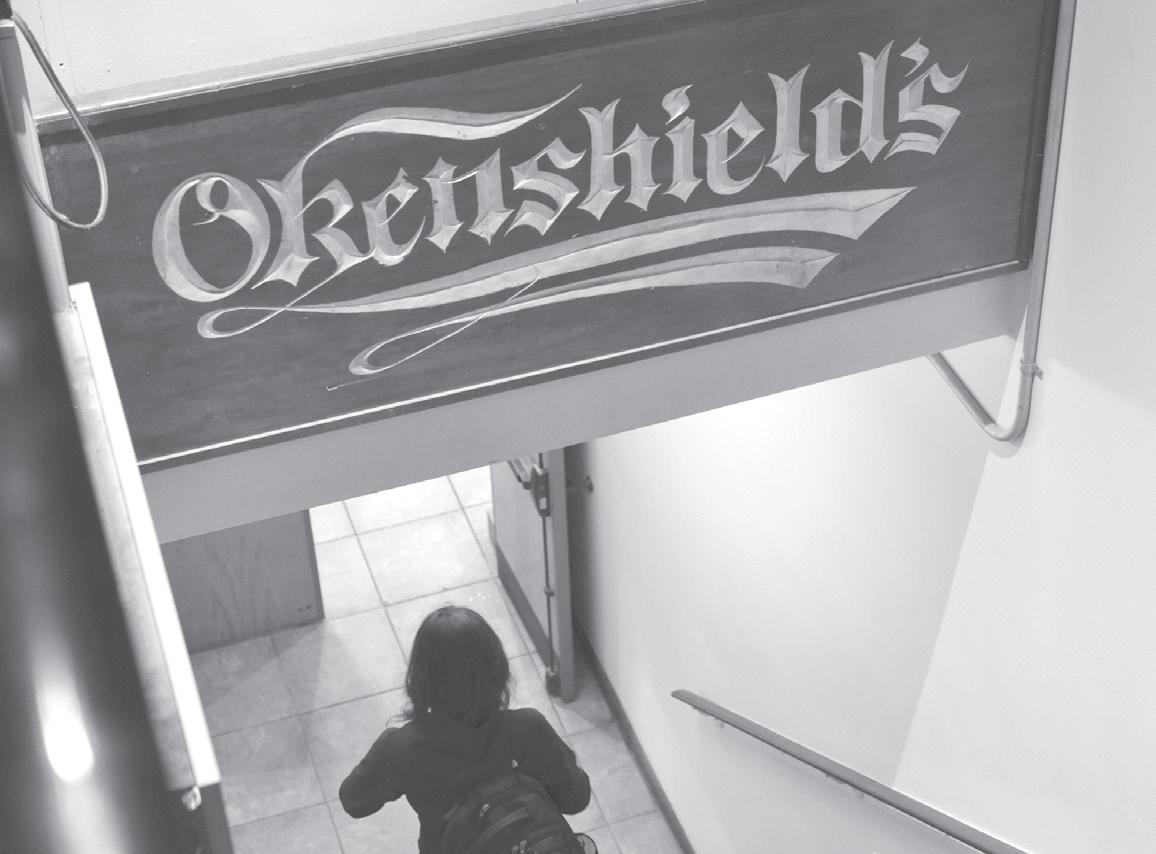
Okenshields, Cornell’s only Central Campus dining hall, will remain closed for the rest of the semester, following what was supposed to be a temporary break.
The dining hall closed in mid-September because of a low level of student traffic, said Karen Brown, director of Campus Life Marketing and Communications, and does not expect to reopen as Cornell Dining fills in staffing gaps at busier eateries.
While the closing of Okenshields could have increased traffic at other dining halls, John Raimonda ’24, a Robert Purcell Community Center dining worker, said that from what he has noticed, foot traffic has remained steady in RPCC.
The closing came as an unexpected shock to many Cornell students, including Mark Minton ’23, who ate at Okenshields four nights a week before what he called an unannounced and unexpected closing.
“As a new student to the campus, Okenshields was the greatest draw for me being on Central Campus and the only dining facility that was open,” Minton said. “It is located in the student union. It has a lot of history and the location is just a real nice place to eat.”
Okenshields is one of the oldest campus eateries and dates back in various forms to 1925, according to Cornell historian and American studies lecturer Corey
Ryan Earle ’07.
For students in need of food while on Central Campus, Cornell will open a satellite meal pickup location at Willard Straight Hall beginning Monday, Oct. 12. Students can order takeout meals at this location with the GET app. Eateries Bus Stop Bagels, Cafe Jennie, Cornell Dairy Bar, Goldie’s Cafe, Green Dragon, Martha’s Express, Mattin’s Cafe, Rusty’s and Trillium are also open.
But some students have expressed concerns about the satellite meal pickup option. Alyssa Schwertfeger ’24 said she likes being able to choose what she’s eating “instead of having someone choose for me.”
Others worried about going out of their way to get meals: Raimonda said he would likely travel all the way to West Campus to get food if he found himself hungry on Central Campus in the coming weeks. Despite closing Okenshields, Cornell has managed to keep all available staff employed on campus, according to Brown. Most of the Willard Straight Hall staff members have been reassigned to around campus, including to North Campus dining halls.
“I would think that, given the current situation, something is better than nothing,” Minton said, “but I will be the first in line when Okenshields reopens for good.”
Sarah Young can be reached at smy46@gmail.com.
By RUTHIE COVO Sun Contributor
As coronavirus continues to spread, working in office spaces remains a health hazard for non-essential workers, prompting many companies to continue work-from-home policies adopted last spring. Although the economy has largely reopened in some parts of the U.S., many large companies are still hesitant to ask their employees to return to the office.
Share prices in Zoom Technologies, a web-based video conferencing tool, have sky-
rocketed as video chatting has replaced the usual face-to-face workplace meetings. Some of the nation’s largest corporations — such as Amazon and Facebook — have already signalled they may make aspects of their work-from-home policies permanent.
meetings. Some of the nation’s largest corporations — such as Amazon and Facebook — have already signalled they may make aspects of their workfrom-home policies permanent. And while remote work has been primarily billed by most companies as a way to protect public health, it carries a host of cost-saving advantages that may solidify its use as a widespread alternative. Working from home, for example, lowers significantly companies’ overhead expenses and limits costs associated with travel.
ple, lowers significantly companies’ overhead expenses and limits costs associated with travel.
Collectively, these trends sug-
Collectively, these trends sug gest that the transition back to the cubicle and conference room may be stalled temporarily, or even indefinitely.
said that the pandemic has served as a “worldwide pilot study” for the work-from-home model — one that, so far, has delivered mixed results.
ers. It’s likely that startups and technology [firms] will take greater advantage of the low overhead associated with remote working to reduce their costs at the onset.”
“This is a long pull quote and it’s pretty cool to put in when you want to use.”
And while remote work has been primarily billed by most companies as a way to protect public health, it carries a host of cost-saving advantages that may solidify its use as a widespread alternative. Working from home, for exam-
Prof. Donna Haeger, applied economics and management, said that the pandemic has served as a “worldwide pilot study” for the work-from-home model — one that, so far, has delivered mixed results.
Jeff Foote ’10
gest that the transition back to the cubicle and conference room may be stalled temporarily, or even indefinitely.
Prof. Donna Haeger, applied economics and management,
“The groundwork has been laid for firms to consider at what they want to integrate the remote work policies,” Haeger said. “Some companies will go remote at higher levels than oth-
But even so, Haeger still believes that a remote form of work will not overtake the traditional office space, citing the sort of ad hoc, “water cooler”-type conversations such an environment more naturally inspires.
“The groundwork has been laid for firms to consider at what level they want to integrate the remote work policies,” Haeger said.
“Some companies will go remote at higher levels than others. It’s likely that startups and technology [firms] will take greater advantage of the low overhead associated with remote working to reduce their costs at the onset.”
“Nothing beats the productivity that happens in a casual hallway conversation or a good old fashioned brainstorming session over snacks in the ence room,” Haeger said. “That’s not going to go away.”
But even so, Haeger still believes that a remote form of work will not overtake the traditional office space, citing the sort of ad hoc, “water cooler”-type conversations such an environment more naturally inspires.
Sahitya Mantravadi ‘17, a data and applied scientist at Microsoft, echoed these senti ments, stating that she misses the more personal aspects of working in a physical location alongside other colleagues.
“Nothing beats the productivity that happens in a casual hallway conversation or a good old fashioned brainstorming session over snacks in the conference room,” Haeger said. “That’s not going to go away.”
“I think it’s harder to com municate ... it’s so much easier to pull your colleague aside when you sit next to them and go through something rather than message them,” said Mantravadi, who began working from home in mid-March.
To continue reading this story, please visit cornellsun.com.
Sahitya Mantravadi ‘17, a data and applied scientist at Microsoft, echoed these senti-
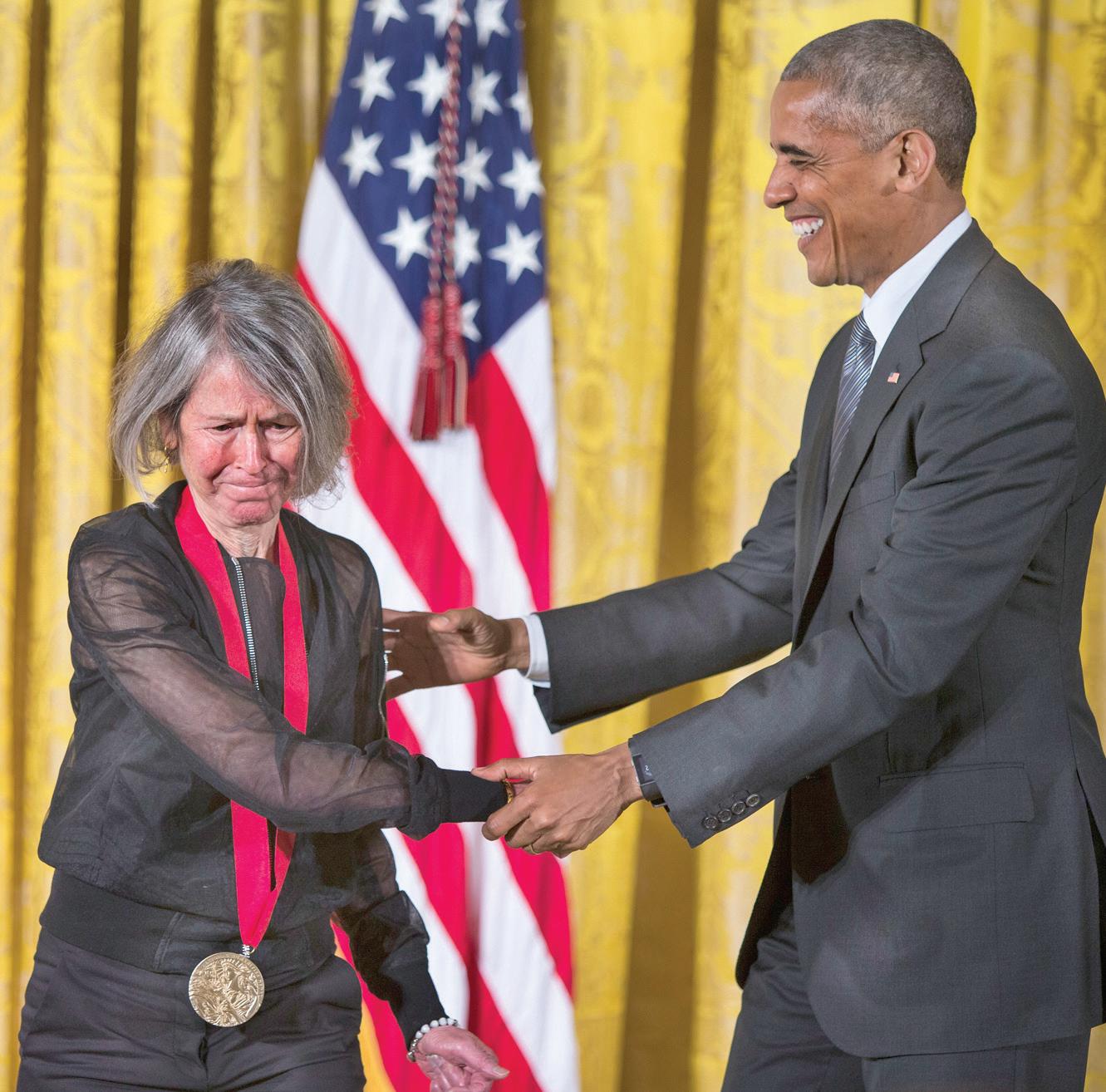
Returning to the books one used to read as a teenager often registers the same unpleasant surprise as finding old photographs of oneself: The words do not sparkle as much, the quotations hastily scribbled down in one’s diary are revealed to be too cliché, too overwrought and stultifying, just as one’s posture is worse, one’s smile decidedly more crooked than one remembers. You can imagine my delight, then, when I cracked open Louise Glück’s Poems 19622012 after learning she’d won the Nobel Prize to find the verse was still (to borrow John Berryman’s words) “fresh as a bubble breaks, / As little false.”
However — knowing more now about poetic technique, about form and meter, syntax and sound than I did then — I cannot say what exactly makes it so. Certainly, the simplicity and immediacy of Glück’s language is a large part of it, belying the gravity of themes like death, loss, grief, aging and love. Yet the archi-

tect’s hand seems to move invisibly; out of sight, backstage, someone is pulling the ropes, but the scene must be perceived by the audience as a whole, and the whole here is greater than the sum of its parts. It would be difficult to pick apart a Glück poem like a Shakespearean sonnet, to hold each cog and screw up to the light, and understand precisely how motion gets into the machine: There is only the simple fact of felt emotion once the poem is finished, the palpable sense
that one has been moved, the great shiver of great art.
One of the most moving aspects of Glück’s work is its sense of renewal, its underlying spirit of resilience. Glück has often drawn comparison to the Confessional poets of the 1950s and ’60s. To be sure, the personal narratives, the emotions and subjectivity and the metallic bite of irony are all still there, but the poems lack much of the solipsism and neuroticism that can be said to characterize that school. Moreover, Glück’s poems do not “confess” so much as quietly confide, as one might confide in a diary. If those Confessional poets find glory, almost perversely, in saying, “Look, I have suffered,” Glück takes a more private pride in being able to admit, “Yes, I have suffered, but I survive.”
In “Vita Nova,” the first poem of the eponymous collection chronicling the dissolution of a relationship, the speaker comes to the realization, “Surely spring has been returned to me, this time / not as a lover but a messenger of death, yet / it is still spring, it is still meant tenderly.” In another “Vita Nova,” the last poem of the same collection, the speaker concludes, “I thought my life was over and my heart was broken. / Then I moved to Cambridge.” “Snowdrops,” from The Wild Iris, ends with the lines: “afraid, yes, but among you again / crying yes risk joy / in the raw wind of the new world.”
These moments of joy and acceptance, hard-won and tenaciously held, occur hand-in-hand with the metamorphoses and vicissitudes of the natural world.
Glück is a great poet of seasons. Her poems seem to run on what I would like to call “Mythical Standard Time,” a conception of time that is cyclical as
opposed to linear, where the past is continually reborn into the present and the present gives birth to the past, where, like the sea or the seasons, everything is churned back upon itself so that, at last, something hard and translucent may be swept up to the surface. In this time zone, childhood acquires a fabulous significance, and the familiar Ancient Greek and Biblical figures are dispossessed of their own contexts so as to serve new purposes in our world. Like the baton of Time passed from winter’s hand to spring’s, Love and Death are kept in continual exchange, each informing and
fortifying the other.
“The soul’s like all matter: / why would it stay intact, stay faithful to its one form, / when it could be free?” asks “Lullaby.” Glück recognizes that it is only in unleashing the soul to experience the full flux and fluidity of the world that we realize, despite everything, the moon still rises, no matter how changed, and flowers will break from their graves to taste new consciousness.
Ramya Yandava is a senior in the College of Arts and Sciences. She can be reached at ryandava@ cornellsun.com. Ramya’s Rambles runs alternate Mondays this semester.
In a time where everyone seems to be focused on elevating stories of oppressed groups, the popularity of Netflix’s Selling Sunset seems to be an unwelcome break in the matrix.
In Selling Sunset, the viewer is taken through the ins and outs of the Oppenheim Group, a luxury real estate brokerage in Los Angeles. The Oppenheim Group is run by two twin brothers and staffed entirely by women, giving the show a Charlie’s Angels twist in the weirdest possible way. Selling Sunset marries together the easily digestible reality TV of Housewives, with the very American real estate obsession that makes us watch HGTV for hours on end.
Los Angeles is known for having one of the highest homelessness rates in the country and has only gotten worse with the coronavirus pandemic. At
the same time, Los Angeles is also home to some of the most wealthy people on the planet, leading to a very stark contrast of extreme wealth and extreme poverty within the city. This show focuses on the wealthiest inhabitants of Los Angeles and often struggles to balance the reality of the homelessness problem with the almost parodical nature of parading wealth around Los Angeles that the realtors and their clients partake in.
The lack of humanity and general unrelatability of the realtors and their clients is further aggravated by the almost ridiculous nature of the luxury real estate market. Throughout the show, there are several star-studded cameos of people coming to buy homes, from Taye Diggs in season one to Karamo Brown from Queer Eye in season three. However, most of the clients shown are young, white and many are making their first home purchase. Their starter homes are beyond what
most Americans can ever dream of having, and the fact that these clients are so young goes to show how big of a role generational wealth played in most of their lives.
The newest season was easily the most in-your-face lavish of the three. The focus was mainly on Christine Quinn’s wedding to a billionaire. Throughout the season she talks about making purchases on his card without asking or telling him. Every conversation she has centered on her travels, purchases and new life under the financial care of her fiancé that has more money than he could ever spend. She enters the season stepping off of a private jet and comes to work every day decked from head to toe in flashy designer clothes. She pays people to plan extravagant events for her equipped with zebras and live performers. She flaunts her wealth in a way that makes even her co-workers seem poor.
So, why did this blatantly out-of-touch show get as pop-
ular as it did? And why did I watch all three seasons in one weekend?
Everything about this show is meant to suck you in. Take the way it’s filmed: Bright lights and blurry backgrounds train your eyes to focus on one spot, making it easier to zone out. It functions as an elevated House Hunters, filling in the boring parts where they don’t show homes with petty drama to keep you interested. The episodes are short and fast-paced so that when watching you almost don’t feel time pass as you are seamlessly carried from one 30-minute episode into the next.
We say we want to highlight stories of BIPOC, and take the stories we have heard thousands of times out of the spotlight. But this hasn’t happened. One reason being the COVID shutdowns giving us more time to watch Netflix than shows to watch. But another reason is that shows like Selling Sunset don’t require much thinking. Selling Sunset fills the func-
tion of being something calming and relaxing, something you can turn on and not be forced to reflect on all of the glaring issues in our society that the pandemic has only worsened.
In Selling Sunset we get to experience the life of people who are equipped with the highest level of privilege for a day. The housing market, something most Gen Z-ers will be priced out of when old enough to partake, is shown as a world of endless opportunity for those with enough generational wealth to get a multi-million dollar starter home with a view.
Did I enjoy this show? Absolutely. It was comfortable and fun and the houses were stunning. It was a good break from thinking about everything that is going wrong in our world. As long as you don’t look deep enough within it to find it again.
Christina Ochoa is a junior in the College of Agriculture and Life Sciences. She can be reached at cos234@cornell. edu.
When you click on Margaret Groton’s ’21 website, “Yellow Sun” is the first work you’ll see:

Check your watch; you’ve just spent an hour analyzing it. As foreign as the proportions and contortions are, the body on display is too detailed to be otherworldly. Truly, there’s an assurance in the stroke that helps ground the picture’s more abstract elements.
Perusing through more of her artwork, it is evident that for Groton, her commitment to the abstract and the real is a defining feature of her work. “It is always figurative, sometimes abstract, sometimes closer to reality, but always made in the name of portraying the energy of the spirit through marks that make up the body, speaking truth to the union of the two when our existence is one of pure freedom/expression,” Groton writes on her “About” page; you could imagine her concocting the words effortlessly in one-take. Her focus is on “black female figures as bodies that are too grand for the confines of the page, that dare to jump off and out” and indeed, the bodies she displays are grandiose, full of nuance and life, the aforementioned “Yellow” and “Lexapro Venus II” below being paragons of this commitment:

such confidence is refreshing, especially in this time of great
disruption. For artists in particular, COVID has been a trial by fire for what habits and skills one could transfer when the daily rhythms of life changed drastically.
Where could you find Groton in the midst of this? In her room, probably rereading The Bluest Eye, occasionally taking a break to peruse through a collection of African Mythology, while Nina Simone, Digable Planets and Funkadelic played in the background. While disruption has become the soil for new patterns and rhythms to take form, Groton paints, sketches and draws as if nothing’s changed; Like the famous lo-fi hip hop girl animated by Juan Pablo Machado who writes endlessly in spite of everything going on around her.
“I honestly don’t feel dis-


rupted at all, I could never stop creating, I draw constantly,” she shares, “but I certainly am not working as big as I had been ... but I am a bit grateful for the excuse not to work large, it’s a lot of pressure sometimes, it’s a lot more serious work to me and I’m enjoying the fast pace, personal work I’m doing right now.”
In addition to her latest series, Millennial Madness (more on that in a moment), she continues to press into the dayto-day for inspiration. “My subjects are the faces in front of me, the conversations between them and the space they constantly alter — so in a way I’ve been working more collaboratively than ever with my daily surroundings such as intimate gatherings with friends I consider family.”
Knowing Groton’s origin story of how she started her artistic endeavors, it is no surprise that she is more unfazed than most. While some use the arts as a way to escape from the world by crafting realities through which to find solace, Groton has used her art as a way to understand the beauty and chaos around her. That required pressing further into her surroundings even when she may have wanted to retreat. “I have drawn and painted since before I could read and write, drawing is something I did all day in class growing up because I couldn’t stand being passive, it actually helped me pay attention, it’d help me stay in the moment rather than floating in some non reality in my head.” Understandably, it’s fair to say most teachers didn’t
quite get this precocious level of processing at that age “I mean it was definitely a distraction at times. But yeah, I was born an artist” she says.
Even in her set-up, she’s crafted her creative space to be a vessel to catch all of her ideas as they come to her; she has a sort of optical hunger that seeks to transcribe even as she interprets. “I’ll often be working on two pieces at a time,” she says, “I have my books around me. There are blank pieces of paper around to write ideas and revelations that come to mind, my music blasting, and if I’m at home I like to have incense burning.”
Her most ambitious project to date is the aforementioned Millennial Madness, a series that collects her personal interests with fervent relevance. The art series, like any good piece of art, has shifted over the course of time. Whereas before it focused on 29 faces of [her] peers belonging to various identities that will operate as a commentary on race and (the common enemy) capitalism in the country, it is now about desire as a factor of our lives that tie human beings to suffering. She calls the faces she depicts, the “true face of desire.” Right now, Groton is

highlighting her black friends in honor of their collective strength and survival against historical odds. “I started this project the week of the BLM protests following the murder of George Floyd in a state of rage.”
Zachary Lee is a senior in the College of Arts and Sciences. He can be reached at zjl4@cornell.edu.
Independent Since 1880
138th Editorial Board
MARYAM ZAFAR ’21 Editor in Chief
JOYBEER DATTA GUPTA ’21
Business Manager
PETER BUONANNO ’21
Associate Editor
MEGHNA MAHARISHI ’22
Assistant Managing Editor
CHRISTINA BULKELEY ’21
Sports Editor
BORIS TSANG ’21
Photography Editor
CAROLINE JOHNSON ’22
News Editor
ALEX HALE ’21
News Editor
ARI DUBOW ’21 City Editor
EMMA ROSENBAUM ’22
Science Editor
BENJAMIN VELANI ’22
Dining Editor
JOHN MONKOVIC ’22
Multimedia Editor
MIKE FANG ’21
App Editor
OLIVIA WEINBERG ’22
Assistant News Editor
MADELINE ROSENBERG ’23
Assistant News Editor
LUKE PICHINI ’22
Assistant Sports Editor
HANNAH ROSENBERG ’23
Assistant Photography Editor
BRIAN LU ’23
Assistant Arts & Entertainment Editor
ANNABEL LI ’21
Assistant Money & Business Editor
LEI ANNE RABEJE ’22 Layout Editor
JOHN COLIE ’23
Blogs Editor
JOHNATHAN STIMPSON ’21
Managing Editor
KRYSTAL YANG ’21
Advertising Manager
JASON HUANG ’21
Web Editor
NIKO NGUYEN ’22 Design Editor
PALLAVI KENKARE ’21
Editor
SEAN O’CONNELL ’21 News Editor
KATHRYN STAMM ’22 News Editor
ANIL OZA ’22
PLOWE ’23
LEE ’21
CHENG ’21
’22
MEGHANA SRIVASTAVA ’23
EMILY DAWSON ’21
PARKER ’22
MORAN ’21
LAW ’22
WANG ’21
&

‘Mr. Vice President, I Am Speaking’
LOU ’22
KRISCH ’21
Working on Today’s Sun
Ad Layout Mei Ou ’22
Production Deskers Sarah Skinner ’21 Dana Chan ’21
News Deskers Kathryn Stamm ’22 Madeline Rosenberg ’23
Opinion Desker Peter Buonanno ’21
Design Desker Niko Nguyen ’22
Photo Desker Boris Tsang ’21
Arts Desker Daniel Moran ’21
Sports Desker Christina Bulkeley ’21
ast Wednesday night, after scarfing down dinner and rushing through my homework, I took a quick shower and settled in for the vice presidential debate. My popcorn was popped, my pajamas were on and my friends and I huddled around a MacBook Air to witness yet another spectacle. My expectations were low … for Vice President Mike Pence. After watching how President Donald Trump handled the first presidential debate, I didn’t allow myself to expect class, couth or civility from his Vice President. I would not allow myself to be disappointed to the degree I was on Sept. 29.
I did, however, have high expectations for Sen. Kamala Harris (D-Calif.). As a Black woman who hopes to make space for herself in government some day, I had a lot riding on Sen. Harris’ performance. She was giving the world a taste of what America would look like if Black women held such esteemed offices. As a Black woman she couldn’t do a bad job, she was representing us. They will judge all Black women who run in the future in relation to Sen. Harris, that’s a fact. She wasn’t just making history, she was molding the future.
I am currently reading Eloquent Rage: A Black Feminist Discovers Her Superpower by Dr. Brittney Cooper. Chapter eight, “Orchestrated Fury” discusses the concept of respectability politics and its death on President Trump’s Inauguration Day. Dr. Cooper defines respectability politics as “the belief that Black people can overcome many of the everyday, acute impacts of racism by dressing properly and having education and social comportment.”
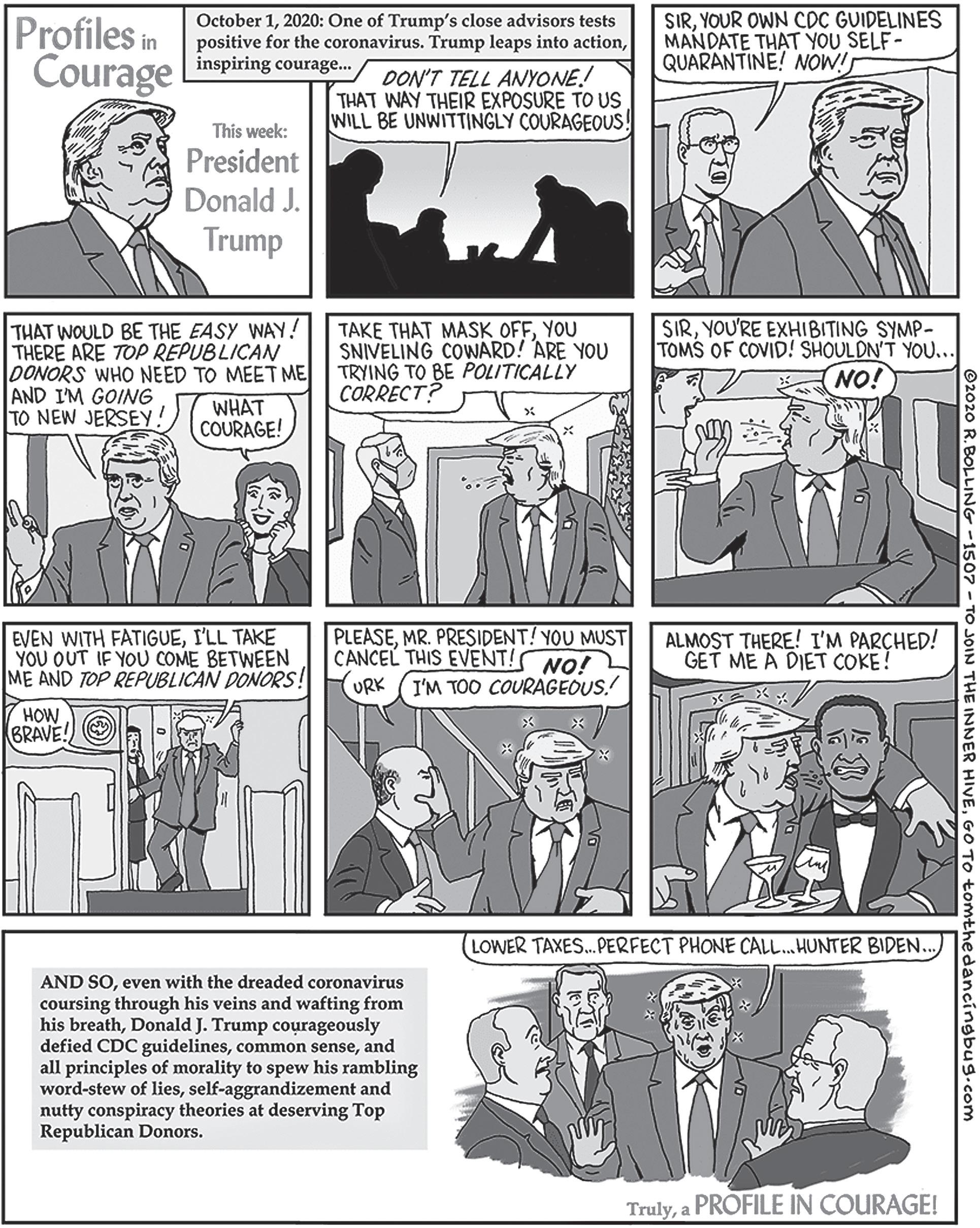
The vice presidential debate was more than an opposition of issues, it was more than a question of liberalism and conservatism, or taxes and policy. It was another display of respectability politics, but this time in the face of white-male-chauvinist politics. Harris’ curt responses to Pence’s unsuccessful attempts to model Trump’s tactic of speaking over and interrupting the opponent was a presentation of respectability politics on the national stage and an insight into Harris’ personal “rage-management project,” as Cooper calls it. As a Black woman, she was expected to avoid anger at all costs, lest she be classified as the angry Black woman candidate. So, instead she used the greatest tool in her arsenal, a phrase that was both firm but polite: “Mr. Vice President, I am speaking.”
As a Black woman and as an American I was impressed; no, I was proud. I was proud to see Harris up there defying stereotypes. She skirted around every trap Pence placed for her. She resisted anger and quieted her rage. Watching her eloquent handling of the situation made me think back to the slow but intense anger I feel when I am interrupted by a white-male-peer who decided that my opinions aren’t as salient as
his. Sen. Harris was interrupted in front of the American people while debating why she deserves to serve in the second highest office in the country. If the stakes are so much higher, is it unreasonable to assume that her level of anger was higher too? Mine would be.
Despite the high stakes situation, Harris did what I sometimes fail to do. She kept it together, she didn’t let warm tears prick at her eyes, she didn’t slowly get quieter as if to phase herself out of the conversation, she didn’t accept that her time would be cut short by this man, instead she paused, breathed and calmly reminded Pence, in the event he had forgotten, that she was indeed speaking and was owed her time and the right to finish her answer to the question.
Over the course of the nearly two hour debate, Pence interrupted Harris ten times. That is 10 separate instances in which the Vice President tried to make Sen. Harris felt small, and in all 10 instances she resisted with strength and grace.
There is a clear dichotomy in the expectations that the American people hold for the candidates and their respective parties. After President Trump abandoned politeness at the first presidential debate, his supporters revered him for “steamrolling Biden.” He was rewarded for behavior that my mother would not have accepted from me as a six-year-old. Sen. Harris was intentional about being civil and wasn’t met with the same respect from her base. Instead she was seen as weak or muted or, in the words of our Commander-in-Chief, “a monster that was onstage with Mike Pence.”
Sen. Harris is forced to operate in multiple confines that the Republican ticket is free of. She is expected to bring a sense of unity to this fractured nation, all while making sure that her hair, clothes and makeup adhere to certain standards expected of Black women. As the Black, female candidate, she is damned if she does and damned if she doesn’t. Vice President Pence was allowed to interrupt, mansplain and advocate for misogyny.
We expect the Biden-Harris ticket to fix a broken system and reward the President for refraining from racial and sexist slurs in press conferences. This isn’t to shame any person or party: With every tweet, press conference and televised interaction it’s hard to not let your expectations slip in order to prevent such frequent disappointment. In the same manner, though, it is easy to expect perfection from the people who seem to be the only solution to this mess. However, please remember that the candidates are all running for the same position. Hold them to the same standards, evaluate them the same way and call out their shortcomings with the same energy. Don’t let respectability politics substitute itself for American politics.

Fill in the empty cells, one number in each, so that each column, row, and region contains the numbers 1-9 exactly once. Each number in the solution therefore occurs only once in each of the three “directions,” hence the “single numbers” implied by the puzzle’s name. (Rules from wikipedia.org/wiki/ Sudoku)


“That definitely won’t be me if I keep refusing to wear a mask.”
To submit your caption for this week’s contest, visit sunspots.cornellsun.com.




By CHRISTINA BULKELEY Sun Sports Editor
Back before Homecoming was preceded by the word “stay,” Cornellians would look forward to the weekend as an opportunity to get together, celebrate and watch a football game at Schoellkopf Field. While this year’s StayHomecoming featured virtual panels and discus-
sions, Oct. 10 would have, in a world sans COVID-19, been the day Harvard came to East Hill to take on the Red.
While we missed out on an Ivy League football season this fall, we can look back on recent Homecomings to reminisce — and to remember what we might be able to look forward to in the hopefully not-too-distant future.
Homecoming 2017 was the Red’s second win of the season and catapulted Cornell into the limelight as the victory ensured that the team’s next game would be nationally televised.
The Red scored in each of the four quarters, only allowing Brown’s lone touchdown in the last minutes of the contest.
The Red accumulated 504 total yards on the day in its most decisive win over Brown
since 1990. The game drew a crowd of 13,514 to Schoellkopf Field.
The next week, Cornell would go on to take down Princeton 29-28 in a Friday night game on NBC Sports to propel the Red to the top of the Ivy standings. The season would ultimately end in a three-game skid that left Cornell to finish fifth in the league.


Cornell stayed in the game for the first quarter, matching Yale’s 14 points to enter the second quarter tied up. But the Red couldn’t keep up with the Bulldogs, who went on to score another nine points in the middle two frames of the contest.
A touchdown for the Red with 12 minutes left in the fourth
quarter brought the score to 23-21 in Yale’s favor, bringing the game within reach.
But a Yale touchdown in the dwindling minutes of the match was enough to effectively win the game for the Bulldogs — Cornell pulled off a 41-yard field goal with under two minutes left to make the Red’s tally 24. That would cap
off the scoring though, and time ran out with the late Yale touchdown being the deciding factor for the game. The Red would go on to win its next pair of games — including a victory over Ivy rival Harvard — but a 2-5 conference record would ultimately relegate Cornell to seventh place in the Ancient Eight.
In the last Homecoming before the COVID-19 era, Georgetown earned victory via a 39-yard pass with just over five minutes remaining. When the onside kick was unsuccessful, hope that Cornell might be able to overcome the Hoyas was revived, but to no avail.
The first non-Ivy to play Cornell on Homecoming since 2015 struck first with eight points in the first quarter. Cornell came back to tie the contest in the third, but like Homecoming a year before, the
Red’s opponent got the ball into the endzone to win the game. The matchup was the 500th game ever played at Schoellkopf Field. Both teams turned in a lackluster performance on offense, with Georgetown and Cornell completing 301 and 234 total yards respectively, and the Red outdoing the Hoyas in rushing yards by a five-yard margin.