The Corne¬ Daily Sun


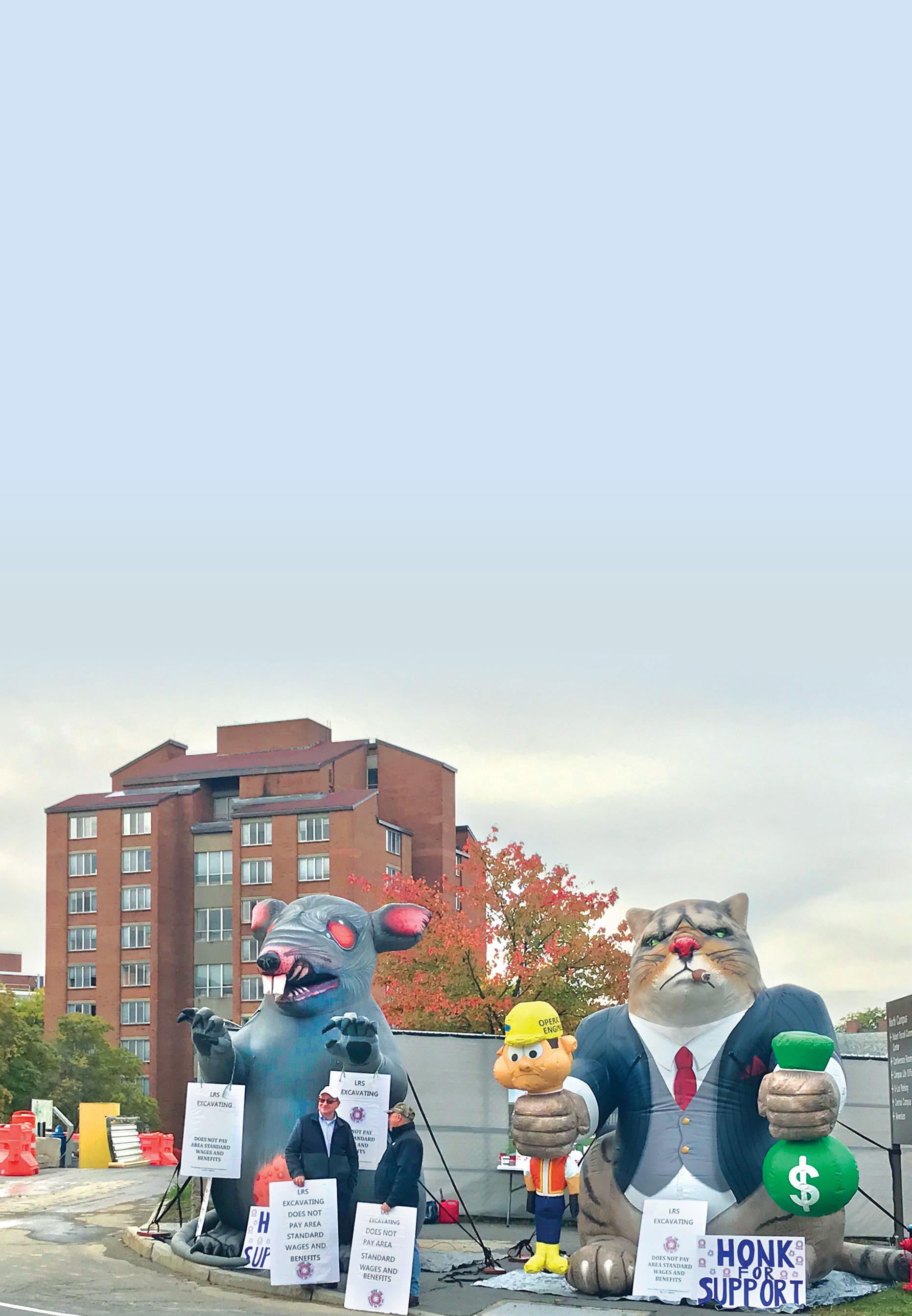
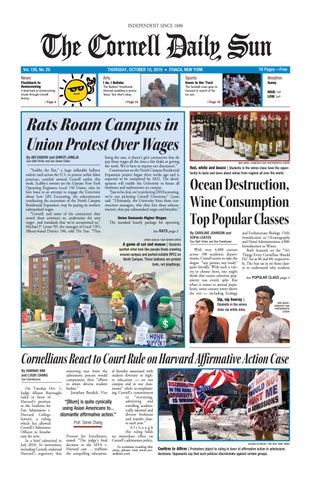
“Scabby the Rat,” a large inflatable balloon rodent used across the U.S. to protest unfair labor practices, crawled around Cornell earlier this week. Scabby’s owners are the Upstate New York Operating Engineers Local 158 Union, who let him loose in an attempt to engage the University about how LRS Excavating, the subcontractor conducting the excavation of the North Campus Residential Expansion, may be paying its workers substandard wages.
“Cornell, and some of the contractors they award these contracts to, undermine the area wages and standards that we’re accustomed to,”
Michael P. Lyons ’05, the manager of Local 158’s Albany-based District 106, told The Sun. “That
being the case, it doesn’t give contractors that do pay those wages all the time a fair shake at getting the work. We’re here to express our discontent.”
Construction on the North Campus Residential Expansion project began three weeks ago and is expected to be completed by 2022. The development will enable the University to house all freshmen and sophomores on campus.
“Just to be clear, we’re picketing LRS Excavating, we’re not picketing Cornell University,” Lyons said. “Ultimately, the University hires these construction managers, who then hire these subcontractors, that pay substandard wages and benefits.”
Union Demands Higher Wages
The standard hourly package for operating
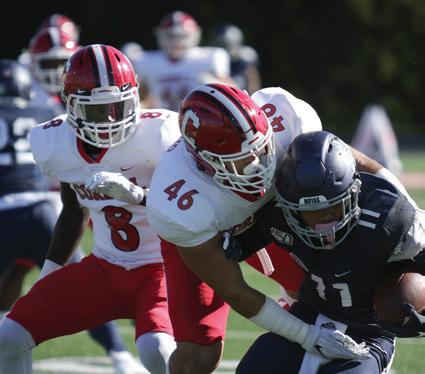
and Evolutionary Biology 1540: Introduction to Oceanography and Hotel Administration 4300: Introduction to Wines.
With over 4,000 courses across 100 academic departments, Cornell seems to take the slogan “any person, any study” quite literally. With such a variety to choose from, one might think that course selection pop-
Both featured on the “161 Things Every Cornellian Should Do” list at #6 and #8, respectively, The Sun sat in on these classes to understand why students
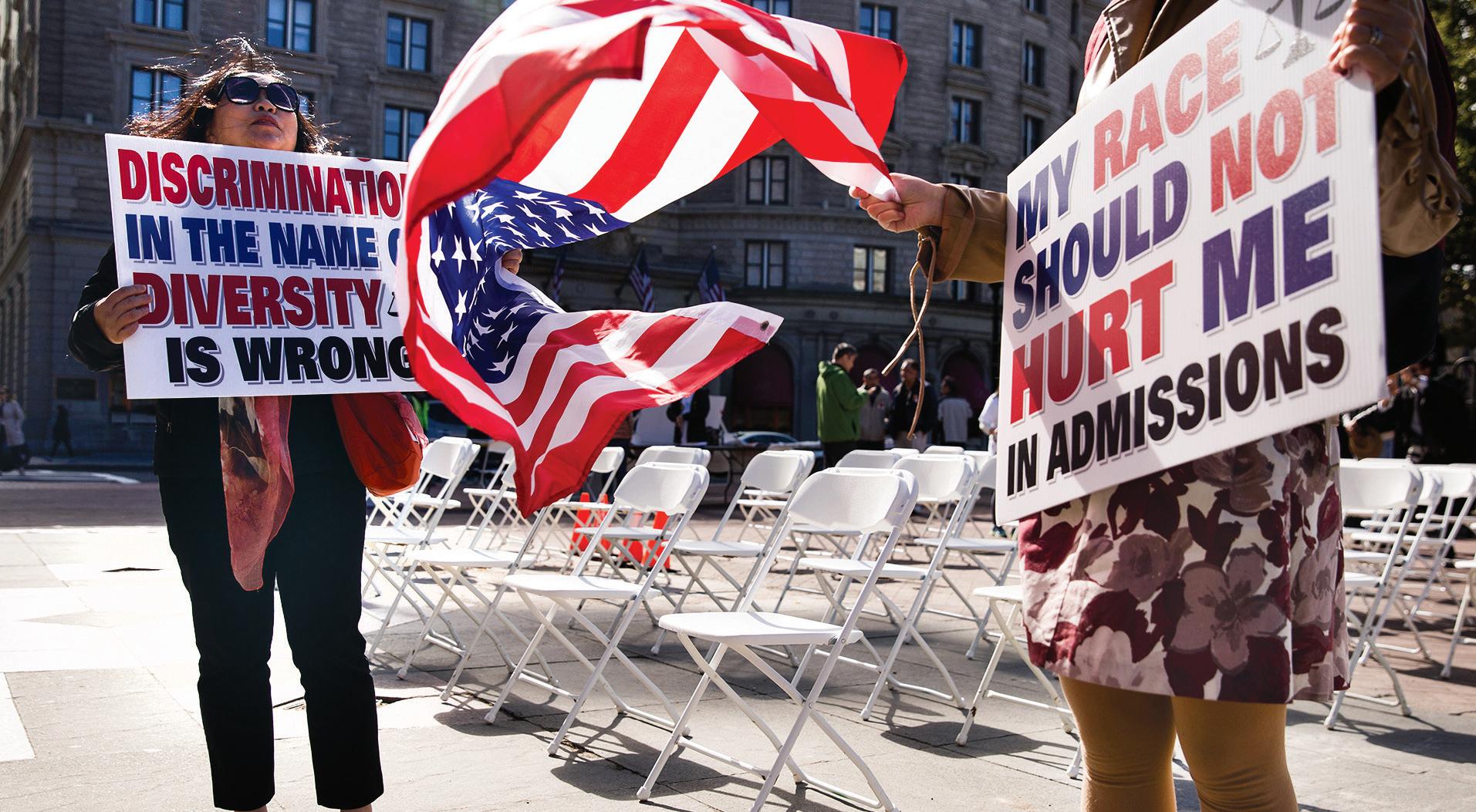
On Tuesday Oct. 1, Judge Allison Burroughs ruled in favor of Harvard’s position in the Students for Fair Admissions v. Harvard College lawsuit, a ruling which has allowed Cornell’s Admission Officers to breathe easy for now.
In a brief submitted in July 2018, 16 universities, including Cornell, endorsed Harvard’s argument that
removing race from the admissions process would compromise their “efforts to attain diverse student bodies.”
Jonathan Burdick, Vice
Provost for Enrollment, stated: “The judge’s final decision in the SFFA v. Harvard case ... reaffirms the compelling education-
al benefits associated with student diversity in higher education — on our campus and in our classrooms” while re-emphasizing Cornell’s commitment to “recruiting, admitting and enrolling academically talented and diverse freshman and transfer classes each year.”
Although this ruling holds no immediate effect on Cornell’s admissions policy,
Thursday, October 10, 2019
William Demaria and Steven McDonald: Memories of a Faded Landscape
8 a.m. - 4:30 p.m., Olive Tjaden Gallery, Tjaden Hall
Latitude: Persuasive Cartography
9 a.m. - 5 p.m., Level 2B, Carl A. Kroch Library
Inside Congress With Rep. Adam Schiff 10:30 a.m. - 11:45 a.m., Kiplinger Theater, Schwarz Center for the Performing Arts
Development Economics Workshop: Shuang Zhang 11:40 a.m. - 1:10 p.m., 206 Stimson Hall
Community Wellbeing Speaker Series Noon - 1 p.m., Green Room, College of Veterinary Medicine
What Turns Us Violent: Sacred Emergencies Noon - 1:30 p.m., Kahin Center
President’s Address to Staff 1 - 2 p.m., Schwartz Auditorium, Rockefeller Hall
Institute for African Development Seminar Series 2:30 - 4:30 p.m., G08 Uris Hall
Linguistics Colloquium Speaker: Micha Elsner 4:30 p.m., 106 Morill Hall
Mathematics 100th Anniversary Oliver Club Talk 4:30 p.m., 251 Malott Hall

2nd Annual Cornell Cancer Research Symposium Friday, 8 a.m. - 5 p.m., Lecture Hall 4, College of Veterinary Medicine


An Introduction to Market Research Friday, Noon - 1 p.m., , Stone Classroom, Mann Library
Iván Chaar López: Media Studies Midday Colloquium Friday, Noon - 1:15 p.m., 311 Uris Library
Ezra’s Round Table: Renzo Akkerman Friday, 12:15 p.m., 253 Rhodes Hall
“Integrated Metabolomics Technologies and Applications”: Lloyd Sumner Friday, 12:20 p.m., 404 Plant Science Building
LEPP Theory Seminar: John Stout Friday, 1 p.m., 401 Physical Sciences Building
Turkish Conversation Hour Friday, 4:30 - 5:30 p.m. G25 Stimson Hall
The Revelation of St. John Friday, 6 - 8 p.m., One World Room, Anabel Taylor Hall
SAVMA Ball Saturday, 8 p.m. - Midnight, Atrium, College of Veterinary Medicine


h Thursday, October 10 at 3 p.m. for the Wednesday, October 16 issue. h Thursday, October 10 at 3 p.m. for the Thursday, October 17 issue

h Thursday, October 10 at 3 p.m. for the Wednesday, October 16 issue.

Famous for his role in Bollywood’s 10th-highest-grossing flm of all time, Vaidya will visit Cornell on Nov. 9
By CAROLINE JOHNSON Sun Staff Writer
Comedian and director Omi Vaidya, famous for his role in India’s 10th-high est-grossing film Cornell on Nov. 9 for Society for India’s 57th Diwali Show, “Diya Jale” — making it “the oldest running Diwali Show in the entire world.”
3 Idiots debuted as the highest-gross ing film in its opening weekend in India and netted the highest opening day col lections for an Indian film to that point, receiving widespread critical and commercial success. The 2009 film also sucChinese and Japanese theaters — one of the few Indian films to do so.
Recognized for its prolific impact on attitudes and education in India,
3 Idiots follows the story of three young dents at one of India’s top engi neering colleges, satirizing the
Bollywood | Comedian and Actor Omi Vaidya will speak at Cornell’s 57th Diwali Show “the oldest running Diwali Show in the world.”
social pressures imposed by an Indian education system. Playing the role of Chatur Ramalingam, Vaidya starred as a UgandanIndian student who

Omi Vaidya after searching through prospective guest speakers and deciding they wanted to “bring in someone different to bring in a different crowd,” specifically “people who know comedy,” according to the organization’s president Aashna Kaur ’21. Having appeared in The Office, Bones, Shameless and Arrested Development , Vaidya has touched a breadth of genres, even having directed two short films himself.
“We make it an event for not only the South Asian community, but everyone on campus...”
“We make it an event for not only the South Asian community, but everyone on campus, even outside of campus, too,” Kaur said.
Aashna Kaur ’21
“We’ve been trying to do outreach for Binghamton, Syracuse and NYC because we know that Omi Vaidya is well-known. We want to make sure that whoever can come can definitely come to this event because it’s open to everyone,” Kaur continued.
With the event’s focus on celebrating the festival of lights with a range of performances and people from different backgrounds and interests, Kaur hopes to “bring a little bit of diversity” with the keynote through comedy, while still fostering the traditional musical and dance performances.
“The showcase is actually after the Diwali holiday, and Diwali is the largest holiday that South Asians celebrate, and so we really emphasize it every single year,” Kaur said.
“I obviously have been here for only three of those years, but for 57 years, this is the largest showcase that a student organization has put on college-wise,” Kaur said. “We want it to reach its hundredth year.” Kaur, having been a member of Society for India for the past three years, beginning as a Freshman Representative in her first year, realized the event requires “all hands on deck” due to extensive work and planning required to coordinate the event, so she expanded her executive board this past year.
“I just felt like I had done something right with recruiting all these passionate, hard-working people,” Kaur said.
Some additional music and dance performances include dance group, Break Free, and music group Yamatai, who all bring an additional element of artistic creativity and joy to the event.
Tickets are available for purchase on the Bailey Hall events website, as well as through Society for India’s board members. The event will take place on Nov. 9 at 7 p.m.
“This is an event that is celebrating diversity and culture and inclusion and creating a safe space for everyone to perform. It’s just pure entertainment and pure joy of people being there together,” Kaur said.
Caroline Johnson can be reached at cjohnson@cornellsun.com.
students keep coming back for more.
Day Drinking
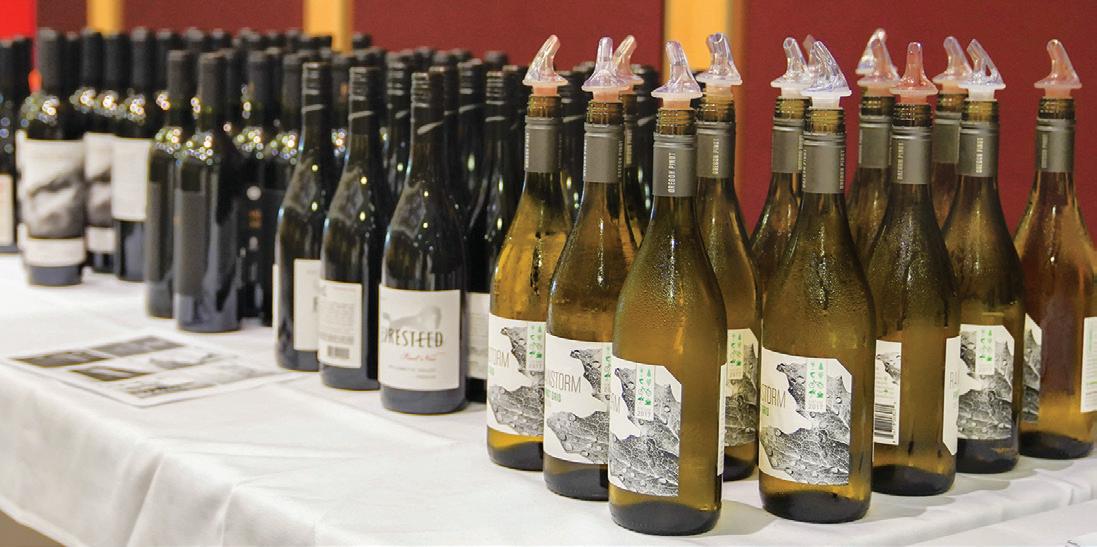
An average of about 700 people each spring and fall semester get away with drinking alcohol during class — in this course, students are actually encouraged to imbibe. The only slaps on the wrist they receive are if they incorrectly categorize a Chardonnay as a Riesling.
It’s safe to say that Introduction to Wines has grasped the attention of a wide range of students from different schools at Cornell. The class is taught by SHA graduate, restaurateur, and amateur chocolatier
by relating wine to two majors at random in the seven undergraduate schools,” Stanley said. Each semester, thousands of dollars are spent on wines and supplies for the class. Students get the chance to taste a wide variety of wines ranging in price and quality from fancy grape juice to five-star bubbly. Students pay a $30 course fee that includes a wine kit and wine glasses — perfect for in-class tasting.
“The student’s favorite wines vary,” Stanley said. “The Centine by Banfy, an Italian wine that we serve is always a popular one
“I would highly recommend students considering taking Wines to take it because it’s going to give them a step up in life,” Stanley continued. “It's just a life skill, being able to talk about wine; it’s helpful in job interviews, it’s helpful if you’re dealing with clients in your professional life and even with friends, and it’s kinda enjoyable.”
“This course has helped me develop a better understanding of the winemaking process,” said Alyssa Picariello ’20. “I would definitely recommend that other students enroll in this class! This course will improve your confidence in selecting wines and your knowledge of wine history and geography.”
“Even though it’s a giant room you still give the impression that you’ve made this connection with us.”
Prof. Cheryl Stanley ’00, recipient of the School of Hotel Administration Ted Tang ’79 Dean’s Teaching Excellence Award. Stanley inherited the class from Prof. Stephen Mutkowski in 2014, who led the class for a total of 41 years.
Hotel Administration 4300: Introduction to Wines centers around “understanding the wine laws, regions and grape varietals of the world,” according to Stanley. Students learn about wine culture, geography and social etiquette and use a range of wines to demonstrate climate and location, giving students a taste of the world. Although the course is offered in the Hotel School, Stanley teaches students from every one of the seven undergraduate colleges. But she makes sure every student feels welcome in Statler.
“That's why I start the class
Prof. Bruce Monger
because of the price point and it’s really good.”
The first course focused solely on wines was offered at Cornell in the 1950s. In the decades following, its popularity among students has soared, in large part due to its lasting legacy, and the “generations [of alumni] who keep talking about it,” said Stanley.
And though many of Cornell’s undergraduates haven’t yet reached 21, a New York State law protects the ingestion of alcohol for educational purposes at an accredited university — meaning that students of at least 18 years old can legally sip and swirl.
“Don’t wait until you’re 21 to take it, said Stanley. “You can take it as early as your first semester of your junior year.”
“I enjoy that she breaks it up by region of the country or different countries of the world. She’s a really exciting and engaging lecturer,” said Kelsie Raucher ’20.
Adeline Lerner ’20, a food science major, said that her favorite part of the class is when Prof. Stanley connects the wine that they’re tasting to a recommended food pairing.
“She’ll just go like... some roasted asparagus over a bed of arugula, maybe on the side a little bit of candied ginger, like that would go great with the New York Riesling,” said Lerner. “It’s really fun and entertaining, which makes the time go by super fast.”
Motion of the Ocean
Prof. Bruce Monger thinks that he has “the best job in the world.” Monger teaches Ecology and Evolutionary Biology 1540: Introductory Oceanography, one
of the largest classes at Cornell with over 1,000 students and 40 teaching assistants.
The class “started small.” said Monger, but then enrollment began to climb. “One hundred and thirty, then it was 230 then 330,” Monger said. “I went from a couple-hundred-seat room in Olin Hall to Call Auditorium in Kennedy Hall then that one filled up. Now I moved it to Bailey Hall and [I teach] a little over a thousand students.”
“Even though it’s a giant room you still give the impression that you’ve made this connection with us,” said Monger recalling what one of his students had told him.
Introduction to Oceanography covers the biological, geological, chemical and physical subdivisions of the study of oceans, examining the effects of global warming and current environmental threats such as overfishing and coastal pollution.
“After I give all of this information to the students, I ask them, so what are you going to do with this information?” Monger said.
“We don’t build universities just so you can get higher paying jobs. We build them so that you can be broadly educated and feed that knowledge back in. You’re the best and brightest this society can produce, and you owe something back,” Monger continued.
Monger recalls students telling him they were inspired by him to pursue different careers. In one instance, he recalls seeing a student in a bookstore who told him that Monger had inspired him to pursue a career in environmental law.
“Planting those little seeds, and inspiring students to want to act on the things that are the problems,” said Monger. “Those things are what make me feel like I have the
best job in the world.”
Years of teaching experience have made Monger an expert lecturer in the subject.
“When I’m lecturing, I don’t have to keep track of the steps anymore and that means I get to dance up there, essentially with my ideas and my side stories … which bring a little bit more color to the lecture,” said Monger.
Monger is known for his passion to keep students civically engaged. In previous years, he has handed out voter registration forms, and personally brought them to the post office. He also assigns students to complete a letter to their respective government officials, arguing for environmental policy change.
“I think my favorite part of the class is the fact that he tries to push taking care of the planet and conserving the planet that gives so much to us,” said Colby Palmer ’23, a student in the class.
“He wants us to understand that the planet is not something that we should be playing around with because we’re going into our sixth mass extinction.”
Introductory Oceanography and Intro to Wines share no common ground, yet both have been successful in attracting students across all schools and majors. Their ability to appeal to a broad audience plays a role in their high enrollment, as well as impactful stories told by students who have taken these courses. It looks like the 161 list still rings true.
Pre-enrollment for Spring semester courses kicks off on Nov. 4, 2019.
Caroline Johnson can be reached at cjohnson@cornellsun.com.
Sofa Loayza can be reached at srl222@cornell.edu.

Now it’s as reliable as snow in winter, but homecoming was not always tradition
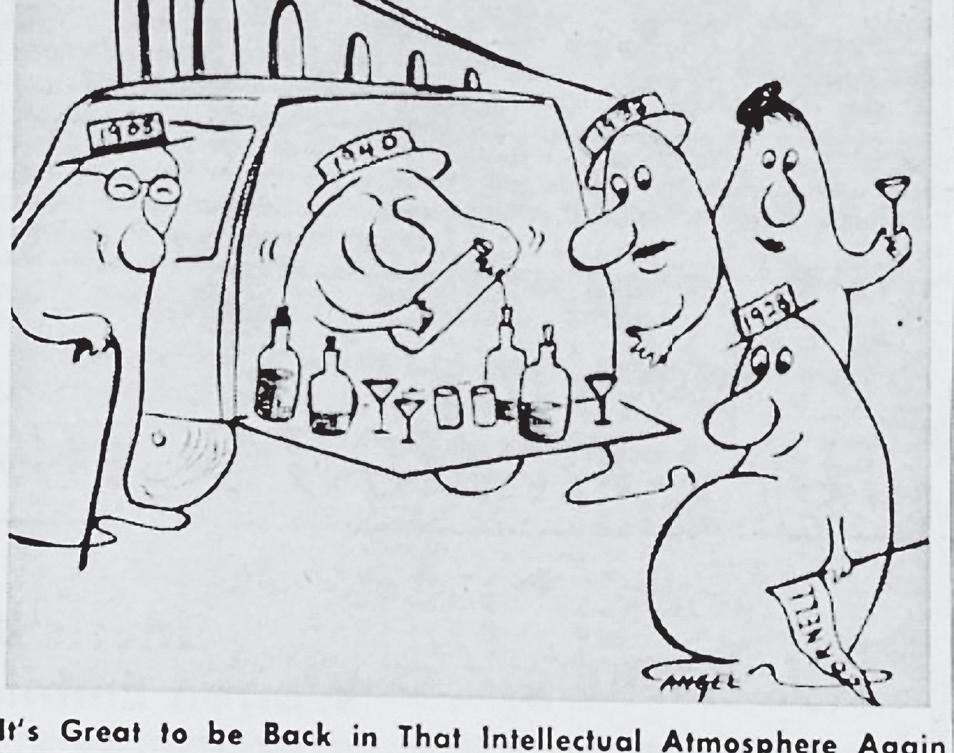
This past weekend, hundreds of alumni flocked back to Ithaca for Homecoming Weekend, joining current students in events ranging from watching the fireworks and laser show over Schoellkopf Field to tailgating at the football game against Georgetown.
Cornell Homecoming is a tradition that goes back almost 100 years, and this week’s Solar Flashback, takes a look back at some memorable headlines, photos and quotes from past Homecoming events — including the first ever Homecoming celebration in 1922, and the University claiming that Homecoming didn’t exist as an official event in 1948.
Solar Flashbacks is a special project connecting The Sun’s — and Cornell’s — past to the present to understand how this rich history has shaped the campus today. Flashbacks appear periodically throughout the semester. #ThrowbackThursday
By SHRUTI JUNEJA and BREANNE FLEER Sun Senior Editors
Obscure Origins and A Day of Glory
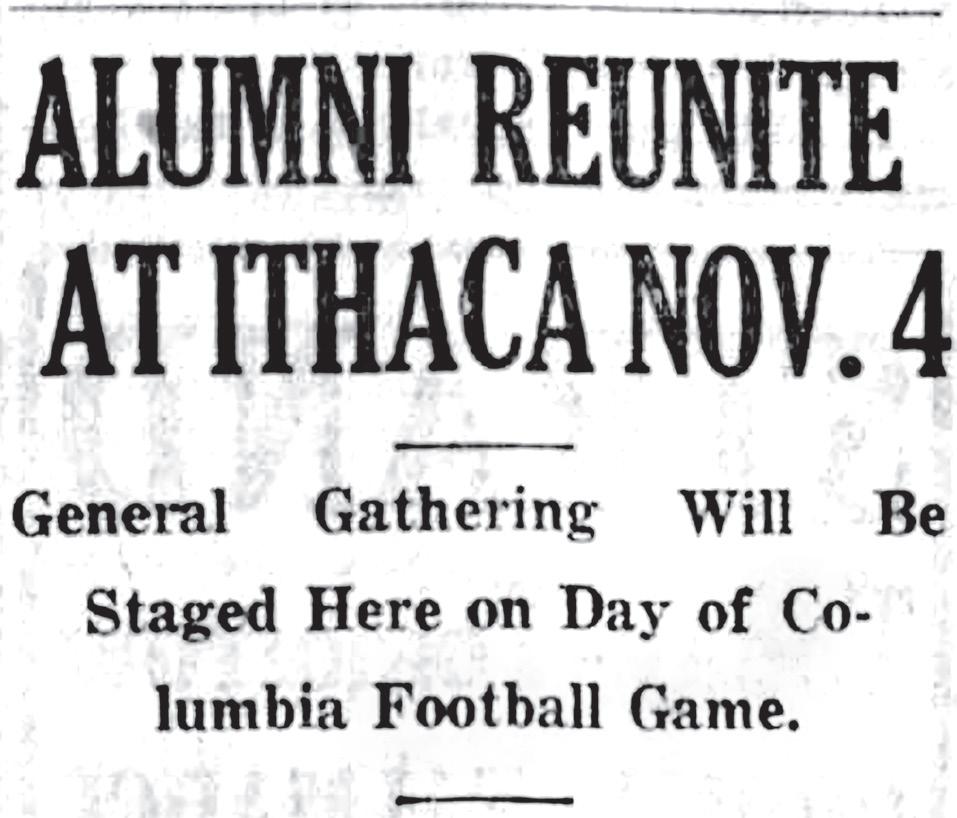
Cornell Homecoming had its humble start on Nov. 4, 1922, with the goal of giving alumni a forum to gather at each year. The decision followed the “successful” outcome of “two other alumni reunions, staged primarily for New York State Alumni,” hosted at Cornell during the previous years, The Sun reported on Oct. 3, 1922.
“This is the third fall reunion, and the plan has, in the past two years, proved so popular that these gatherings will undoubtedly become a regular annual function,” The Sun wrote on that first Homecoming Saturday.
The day itself, which saw an “unprecedented sale of tickets for the Columbia-Ithaca football game” and an alumni luncheon, involved “preparations … to take care of 1000 alumni,” according to Sun reporting on Nov. 4, 1922.
Attendees were greeted to “a day replete in thrills,” as evidenced by The Sun’s Nov. 6, 1922, headline, “Varsity Crushes Columbia in Brilliant Battle, 56-0; Harriers Shine at Syracuse.”
“In a brilliant exhibition of power and skill, which opened in mediocre style and suddenly gave way to sustained and deadly attack, the Varsity eleven completely crushed the Columbia Lions before 15,000 witnesses Saturday afternoon,” The Sun reported.
Alumni Accumulate
However, Homecoming was not officially embraced by the University for many more years. In 1948, “the Alumni Office had completely disclaimed responsibility for the event and announced that there was no such thing as ‘Homecoming’ at Cornell.”
“It seems that the whole business of designating one of the
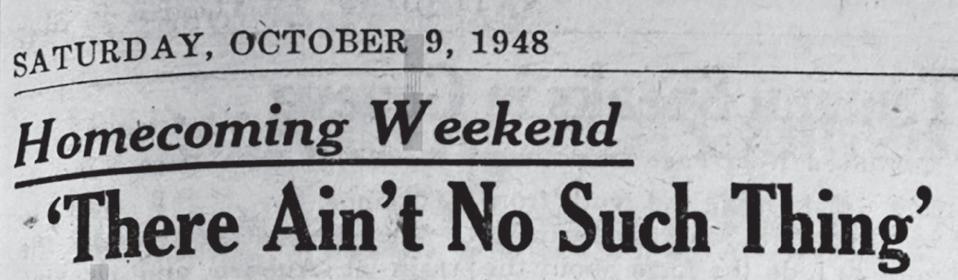
football weekends in the fall as ‘Homecoming’ was the idea of the Athletic Association, and presumably was designed to sell tickets for the game to the alumni and their friends,” The Sun reported. “Undergraduates, however, were so intrigued by the custom that the name ‘Homecoming’ stuck, and the institution has become an unofficial and widely known tradition. Most alumni and students are probably unaware of the nonexistence of the weekend, however.”
The reason for this? Alumni overcrowded the area, making accommodation difficult.
“There is simply not enough room in Ithaca to take care of all the Cornellians who would flock from all over the country to participate in such an affair,” The Sun wrote. “During the academic year, when the undergraduates are occupying the dormitories and rooming houses, there is neither food nor housing to accommodate any great number of visiting alumni.”
Lack of room in Ithaca has not stopped alumni from returning en masse over the years, and Homecoming did eventually become a more formally organized event. In 1966, over 20,000 people were expected to show up for the highly anticipated football game against Yale.
“Alumni and students, in particular, find common ground through traditions such as Homecoming,” Lisa Bushlow ’91, senior director of student and alumni, class and affinity programs, said in a University press release this year. “We’re all here to have fun, learn and celebrate Cornell together.”
One of the most prominent Homecoming events is the football game, which is typically the first home game of the season.
“We may not be a typical rah-rah school, but there are certain times where the Cornell Pride is strong … practice your cheers because this is the one day a year where we pretend to be like a real state school,” a Berry Patch (a Sun satire section) editorial joked in 2014.
The team has seen its share of historic victories and humiliating losses, but Homecoming never fails to draw a crowd of students, alumni and many others to Schoellkopf Field.
“Although many things about Mr. Cornell's school have
changed, the students still like the game and will cheer for the red and the white,” The Sun wrote in 1946.
Gorge-town vs. Georgetown
This wasn’t the first year that Big Red faced off against Georgetown for the big game.
“I know we don’t have a lot of history against Georgetown, but it is Homecoming, and in 2003 they came up here and they whipped Cornell and it led to a terrible season,” said head coach Jim Knowles ’87 in 2005.
While the Hoyas defeated Cornell 42-20 in 2003, Big Red made a comeback, defeating Georgetown 57-7 in 2005 and 47-7 in 2007. This year was another defeat for Cornell, with Big Red losing 14-8.
Final Scores in the Last Decade
In the last ten years, Big Red has faced many foes ranging from Yale to Georgetown to Brown, winning half of the ten games. The most resounding victory of the past decade took place against Yale in 2012. Here are the competitors and final scores:
2019: Cornell loses to Georgetown, 14-8
2018: Cornell loses to Yale, 30-24
2017: Cornell defeats Brown, 34-7
2016: Cornell defeats Yale, 27-13
2015: Cornell loses to Bucknell, 19-14
2014: Cornell loses to Lehigh, 31-14
2013: Cornell defeats Bucknell, 45-13
2012: Cornell defeats Yale, 45-6
2011: Cornell defeats Bucknell, 24-13
2010: Cornell loses to Yale, 21-7
Homecoming Weekend is about more than just football, however, and this year’s festivities included a 5K run in the Botanic Gardens on Saturday morning and a concert in Barton Hall featuring Daya and Saint Motel on Saturday night, along with various tours, lectures and exhibits organized by colleges and student groups.
“During Homecoming weekend, Cornell throws its doors open and invites everyone to ‘come home,’” said Lauren Graham Garcia, associate director of Homecoming and special interest programs, in a University press release. “With hundreds of collaborative events planned, there really is something to interest anyone.”
Back in 1956, a “Homecoming Harvest Dance” was held in Willard Straight Hall, and more recently, students competed for the title of “Homecoming Champion” in 2012. In 1947, when Homecoming Weekend corresponded with All Saints Day, Cornellians revelled with a “‘Danse Macabre’ in the Memorial Room” as well as “ghostly decorations and very live music.”
During the Vietnam War era, the domestic political climate permeated Homecoming, and in 1966, “the first anti-war demonstration of the year was a silent vigil on the Arts Quad held Homecoming weekend by the Faculty Committee on Vietnam. The faculty group also held two all-day symposiums in the Memorial Room of Willard Straight Hall entitled ‘My Country: Right or Wrong?’ and ‘My Country: Wrong!’”
In 2011, the concert featured rapper B.o.B., while in 2016, the concert was canceled altogether because of construction in Barton Hall. And in 2018, thunderstorms prevented the fireworks and laser show from taking place at the last minute.
One century after the opening of Schoellkopf Field, in 2015, Homecoming saw the dedication of a statue to commemorate the first Touchdown, a real bear, and the 1915 team that went on to claim Cornell’s first national championship victory.
With its myriad events and now-ingrained Cornell tradition, Homecoming has come a long way since those early days when football tickets sold for $2 and sales hinted in 1924 “that this game will attract the largest crowd ever assembled in Ithaca.”
Shruti
at bfeer@cornellsun.com.
‘Scabby
engineers in District 545, which includes Tompkins County, currently falls between $58.26 and $66.60, according to the Upstate New York Operating Engineers website. The 42 New York counties covered by Local 158 are divided into districts 106, 545 and 832, formerly independent locals which were merged into Local 158 in 2011, according to the union’s website.
The construction firm Welliver McGuire, which is conducting the NCRE construction, awarded the excavation work to the subcontractor LRS Excavating. Since LRS Excavating does not employ workers from the Upstate New York Operating Engineers union, the company is able to pay its workers below area-standard wages and benefits, according to Robert Aikens, special assistant to the business manager of District 106 of Local 158 and a graduate of the Cornell’s Union Leadership Institute.
“As a private group, they can pay the operators of the job anything they want,” Aikens said.
construction worker in the other caught the attention of many passersby. Lyons dubbed it “symbolic of corporate greed.”
A portable Scabby the Rat was also spotted driving around all over campus in a truck. Despite the pouring rain on Monday, union members still picketed outside the construction site, but didn’t drive Scabby around.
“I had seen a picture of inflatable rats in the Overheard at Cornell Facebook group but didn’t think much of it because I didn’t understand their significance,” Nisa Burns ’21 told The Sun. “That changed when I passed by the construction site next to RPCC and saw the rats alongside men from the local operating engineers union picketing the excavation company. I did some searching and found out that inflatable rats, often nicknamed ‘Scabby,’ are a sign of protesting trade unions.”
“We have been trying to make a strong push through the Uinversity to be at the table, to try to negotiate wages...”
Michael P. Lyons ’05
However, Lyons and Aikens admitted that they didn’t actually know how much LRS Excavating was paying its workers. None of the excavators hired by LRS were involved in the picket.
“It’s not a union or nonunion thing, because on any prevailing rate jobs, any public work, union or nonunion makes the prevailing wage. It’s on these private jobs where they can undercut those wages and benefits to make a bigger profit,” Lyons said.
“We’re convinced, because of the private work they do, there’s really no way our employers or any other employers that are paying the prevailing wage can compete,” he continued. “So… implicitly, they can’t be paying the same wage rates because if they were, then we would be able to compete.”
Lyons added that they reached out to LRS in a letter to ask what it was paying for wages, health insurance and retirement, but didn’t hear anything back.
“Because there was no response, that triggered us to come out here and voice our discontent with the whole process,” Lyons said.
LRS Excavating has not responded to The Sun’s request for comment.
Inflatable Rat Saunters Around Cornell’s Campus
Beginning aroundshortly before 7 a.m. on eachTuesday and Wednesday morning this week, union members stood at the entrance to the NCRE construction site at the corner of Northcross Road and Jessup Road. In addition to Scabby, an inflatable “Fat Cat” that held a bag of money in one hand and a
out of both sides of their mouth.”
However, Aikens said that ILR professors have generally been supportive of the union’s mission, but that they ultimately weren’t the decision makers.
Lyons also said that they currently don’t foresee a definite timeline for how long they plan to picket, but that their ultimate goal is to score a seat at the table and initiate productive discussions with the key decision makers at the University.
“We would certainly take everything down if we had an audience with the University and the people who could make decisions or at least hear us out on concerns that we have, but up to this point that hasn’t been the case,” he said.
This isn’t the first time Cornell has come under fire for its labor practices related to construction.

Cornell to pay employees area standard wages and benefits, according to Aikens.
According to the Chicago Tribune, Scabby the Rat, described as “a giant inflatable balloon with sharp claws, a perpetual snarl and a menacing demeanor,” was first created by the bricklayers union in Chicago to draw attention to unfair hiring practices, and has been adopted since then by various other trade unions.
In addition, Lyons — an alumnus of the ILR school — said that the pro-union values of the Cornell ILR school are at odds with much of the labor practices of the University as a whole, saying that “they’re kind of talking
A little over a year ago, a local construction union complained that the University did not hire enough local labor on the Maplewood Construction Project.
At that time, Mary Opperman, vice president and chief human resources officer told The Sun that the University was “fully committed to making sure the upcoming North Campus Residential Expansion … makes maximum use of our skilled and highly valued local labor community … the developer of this estimated $200 million project has been contractually required to comply with Cornell’s standing agreement with the Building & Construction Trades Council.”
Effective as of 2015, Cornell signed a Building and Trades agreement with the TompkinsCortland Counties Building Trades Council, Maintenance Division, which requires any contractor or developer hired by
Operating engineers, however, are not included in this agreement, which means that the contractors hired by the University are not required to pay operating engineers area standard compensation, Aikens said.
“The operating engineers have not been on that agreement for decades. We have been trying to make a strong push through the University to be at the table, to try to negotiate wages and benefits for our folks to work on all the construction that goes on here, and it’s been falling on deaf ears,” Lyons said. “Like they say, if you’re not at the table, you’re on the menu.”
In a statement to The Sun, John Carberry, a spokesman for the University, said “The general contractor building NCRE is responsible for awarding work to subcontractors who submit bids. We worked earlier this year with local leaders from the International Union for Operating Engineers to
encourage and support subcontractors who employ IUOE members to submit bids to the general contractor.”
“Unfortunately, none of those subcontractors chose to submit a bid,” Carberry continued.
Grant Malone, manager of District 832, said the union fights for more than just area standard wages.
“Shame on you if you don’t have a health care and retirement plan along with a good wage. Workers need protection so they don’t have to run equipment until they’re 75 years old just to make ends meet,” Malone said. “And maybe also send their kids to college here.”
Lyons added that the picket is not meant to communicate an “us versus them” attitude.
“We want to bring all of these people up to the area standard,” he said.
Shruti Juneja can be reached at sjuneja@cornellsun.com. Ari Dubow can be reached at acd232@cornell.edu.

137th Editorial Board
ANU SUBRAMANIAM ’20 Editor in Chief
JOYBEER DATTA GUPTA ’21
Business Manager
PARIS GHAZI ’21
Associate Editor
NATALIE FUNG ’20
Web Editor
SARAH SKINNER ’21
Managing Editor
KRYSTAL YANG ’21
Advertising Manager
MEREDITH LIU ’20
Assistant Managing Editor
Working on Today’s Sun
Ad Layout Krystal Yang ’21
Production Deskers Jamie Lai ’20
News Deskers Amanda Cronin ’21
Shivani Sanghani ’20
Design Desker Krystal Yang ’21
Lei Lei Wu ’21
Dining Desker Katie Zhang ’21
Photography Desker Ben Parker ’22
Sports Desker Christina Bulkeley ’21
Arts Desker Jeremy Markus ’22
This year marks the 10th anniversary of a uniquely Cornellian spat, a weird, manifestly pointless, partially televised dispute between pundits Ann Coulter ’84 and Keith Olbermann ’79. The tussle concerned the Ivy League legitimacy of the College of Agriculture and Life Sciences, which Coulter questioned in an attempt to discredit Olbermann, a CALS alumnus. New York Magazine called the tussle an “awesome college catfight,” The Washington Examiner dubbed Coulter’s comments “schadenfruede-licious” and Jordan Fabian ’09, editor-at-large of The Cornell Review, the conservative student publication Coulter helped found, told The Sun he found her instigation “pretty funny.”
The story of the “catfight” is an entertaining one, but it’s also a cautionary tale of two alumni who exposed toxic Cornell attitudes to a national audience. We should not follow the example they set.
Coulter, a right-wing provocateur, is a defective product of Ezra Cornell’s noble institution. She has a track record of anti-Semitic and anti-Muslim statements, she fantasizes about the disenfranchisement of women and she has called for the return of poll taxes and literacy tests. Olbermann is a sportscaster and retired liberal pundit who’s probably most relevant today as the voice of Tom Jumbo-Grumbo, a gossipy, unhappily divorced whale who works as a news anchor for MSNBSea, a TV station on Netflix’s BoJack Horseman.
So, what exactly went down?
It all began when Olbermann attacked the academic credentials of a Bush Administration employee who attended Regent University School of Law, a conservative Christian institution founded by televangelist Pat Robertson. Coulter took offense when Olbermann called Regent “Religious Lunatic University,” and she responded with several pot shots at CALS, which Olbermann often bragged about attending. CALS, she said, is not the private, “Ivy League Cornell,” but rather the “Old MacDonald Cornell,” an institution far inferior to the College of Arts and Sciences, from which she graduated. Olbermann’s frequent boasts about his Ivy League education, she claimed, were lies because he attended the “affiliated state college” with an average SAT “about that of pulling guards at the University of South Carolina” and an acceptance rate of “one of every 1.01 applicants.”
Olbermann reacted, as one does, with a segment on his TV show. He whipped out his Cornell diploma to show that it looked just like Coulter’s, bragged that he’d earned his degree at age 20 while paying less in tuition, made clear that he took a bunch of non-CALS classes and clarified that CALS in fact had a one-in-five acceptance rate.
The whole episode was, of course, amusing. There’s something very satisfying — schadenfruede-licious, if you will — about watching two wealthy Ivy Leaguers devoid of self-awareness get worked up in an embarrassing squabble about the boundaries of the Ivy League.
But humor aside, the spat is instructive. Coulter and Olbermann put on display two harmful attitudes all too common at Cornell, attitudes Cornellians should do away with. Coulter epitomized the historically illiterate elitism that prompts some Cornellians to look down on Cornell’s four contract colleges, and Olbermann evinced a sort of insecurity that our community just can’t seem to shake.
Coulter’s hyperbolic rant is an extreme manifestation of attitudes that pervade campus. I remember well the night a freshman year friend, an Arts and Sciences pre-med from Westchester, described what he claimed was his wealthy community’s conception of educational hierarchy. To attend the College of Arts and Sciences, he told me, was to have a foothold in the Ivy League. To attend a contract college, on the other hand, meant little. And if I had a dollar for every time I’ve heard a contract college disparagingly referred to as “SUNY Ithaca,” — as if “SUNY” were a dirty acronym — I could afford to eat at Taverna Banfi every day.
But those who denigrate the publicly endowed contract colleges fail to understand a fundamental truth. Cornell and the other private institutions that define America’s globally preeminent system of higher education would not have reached their present heights without massive public investment, as Profs. Isaac Kramnick, government, and Glenn Altschuler, American studies, make clear in Cornell: A History, 1940–2015. As Cornell matured into a top-tier research university after World War II, government-funded research ballooned. By 1952, 75 percent of Cornell’s research funding came from Washington. Federal grants — which propelled research intended to help the United States compete with the Soviets — were the bedrock on which Cornell built its world-class physics, foreign language, mathematics and space science programs.
And federal investment didn’t end with the collapse of Soviet communism. By the start of the 21st century, the government was funding 60 percent of the research performed by American universities — state schools and private institutions alike.
To continue reading this column, please visit www.cornellsun.com.
John Sullivan Baker is a senior in the School of Industrial and Labor Relations. He can be reached at jds526@cornell.edu. Regards to Davy runs every other Wednesday this semester.
Areport from The Sun yesterday adds ballast to what many had long suspected: that pro-Hong Kong materials are being vandalized on campus, with Snapchat screenshots suggesting that students were responsible for vandalizing stickers stuck to a footbridge railing. It harkens back to dark memories two years ago when pro-Tibet human rights posters on Arts Quad were similarly stolen. The repetition of such an act of grave immaturity and irresponsibility puts into question the conscience of those perpetrators, widening the chasm within the larger Chinese community between the mainland Chinese and Hong Kong people.
But one question lingers: why? Why would someone destroy materials meant to support those protesting an overbearing state? To understand this, you must first understand the human condition of Chinese students, especially Chinese students abroad.
As I highlighted in a previous column, the environment for Chinese students in the U.S. has grown increasingly hostile in recent years. Already, wild accusations of spying and harboring hardline communist ideologues have emerged in discussions among concerned members of the Cornell community. Though Chinese state-funded organizations do exist on campus, it is highly unlikely that any efforts in vandalization were pre-planned and well-thought-out. The suggestion that they are, however, may risk further alienation of the Chinese community. To let a few spoiled and privileged children ruin our community’s reputation is perhaps one of the greatest sources of my indignation towards this incident. On the other hand, to suggest that these individual perpetrators as mere bad apples and not representative of a general attitude, one that I intensely disagree with, will be ignoring the real issue at hand. Why do Chinese international students — many of whom come hoping to one day become American citizens, many of whom largely remain apolitical — become intensely nationalistic regarding Hong Kong and Tibet? Why do my fellow Chinese — many of whom at least understand and appreciate the need for free speech both at home and abroad, many of whom keenly aware of the injustice in China — become at this instance a natural extension of the oppressive machine?
Why do Chinese international students — many of whom are largely apolitical — become intensely nationalistic on Hong Kong and Tibet?
ing of the People’s Republic, several people got detained for up to a week because of their “unpatriotic and critical” posts on the tightly monitored Chinese social media. With the aid of a media environment completely under its control, ready to be used for propaganda at any point, Big Brother naturally becomes almost the sole arbiter of political correctness. Any dissent becomes “unpatriotic,” any local demand for autonomy becomes a “separatist.” To this day, the Five Demands of Hong Kong protesters have never called for an independent Hong Kong. Yet as long as the Central Government deems it a separatist movement, every Chinese person — from the far corners of Mohe, Heilongjiang to Ithaca, New York — will shudder at the risk of being labeled as a “separatist sympathizer,” unpatriotic or, worse, an outcast. Once the state proclaimed certain political dissent as “separatist” and “unpatriotic,” many normal, apolitical Chinese engage in a knee-jerk reaction to defend the Motherland. Your columnist risks becoming such an outcast, though I would argue that by risking myself in writing a piece that concerns my fellow compatriot, I am indeed a patriot of China, perhaps more so than those sticker-removers. Victims indeed we are, we Chinese live almost in a state of collective Stockholm Syndrome.
In such a state of mental and physical oppression, why then do the sticker-removers, who we must remember are also victims, become perpetrators of suppression?
The sticker, a political statement for the freedom of Hong Kong, becomes a personal affront in the perpetrators’ eye.
One potential answer that must be rejected is that they are believers of suppression of free speech, that somehow Chinese people hate freedom of speech. Just ask any international Chinese how frustrated they are when they have to use a VPN back home to access not only YouTube and Instagram, but even Cornell sites. Just ask how indignant they will be when their daily speech is shut down unreasonably in any circumstances. Just ask how fearful they are when invoking the one who shall not be named; I remember when a friend of mine who talked with me about our President intentionally lowered her voice, as if in Collegetown Ithaca there might be communist spies in the walls.
Simply put: Why do victims become perpetrators?
The answer to this question is perhaps rather simple. A twisted, state-controlled “political correctness” haunts every single Chinese person in their meager attempts at political discussion, where the uncrossable red line is the notion of “anti-separatism.” Granted, every country has its own reasonable limits on speech that will invite contention. The determinants of such boundaries in a normal, liberal society will, however, be the public. Civil societies can shape these boundaries through a free press and an open exchange of ideas and information, whether that means heavily edited newspapers or free-ranging Twitter.
But in China, the all-encompassing state monopolizes all press and all information. Twitter, by the way, is banned. Just this week, at the 70th anniversary of the found-
The reason, then, is rather simple. As a result of the “anti-separatist” kneejerk, the sticker, a political statement for the freedom of Hong Kong, becomes a personal affront in the perpetrators’ eye. If he had the opportunity to grow up in a free society, he would perhaps write a letter to the editor to The Sun, or host a pro-Chinese government protest on campus. Instead, being the victim as he is, growing up under a government that knows only one action in responding to his legitimate demand to be given more personal freedom, he naturally learns the only way to respond to dissent: to remove, to vandalize, to oppress. Such is the state of human condition of Chinese students. A person blindfolded by a warming red cloth gallantly smiles ahead, yet he cries.
Weifeng Yang is a senior in the College of Arts and Sciences. He can be reached at weifengyang@ cornellsun.com. Poplar Sovereignty runs every other Wednesday this semester.
I Don’t

HELENHU/SUNGRAPHICSEDITOR
Taylor Swift thinks she’s so cool because she’s crazy, a hookup said to me after we watched the Blank Space video together. (Maybe the problem in this situation lies more in the fact that I was watching this specific video specifically with a hookup, but bear with me here.) And it certainly looks like it at first glance — I mean, how crazy do you have to be to destroy your boyfriend’s sports car, his expensive suits, stab a cake and a portrait of him, solely because he was texting during a picnic? Isn’t this whole video just her delighting in the beauty of her destructive, chaotic power?
He missed the point of the song and the video — it’s not that Taylor Swift is the crazy ex-girlfriend, it’s that she’s playing the archetype of it to show how utterly ridiculous it is. It’s absurd and campy: cuz darling I’m a nightmare dressed like a daydream, the Elie Saab dress standing over the horses, the damaged car … This is how mainstream media and, more generally, society imagine her to be, ruthless in her unfounded rage, truly the Crazy Ex-Girlfriend come to life. This fairytale-turned-horror story does not happen in real life, women like that do not exist, a fact which seems to have been lost on my poor hookup, who was then subjected to my hot takes on the subject (bear with me…).
Amy Dunne from Gone Girl is similarly subjected to the same narrative, though
to
’ll admit it: I was a prude in high school. Sophomore year, my friends and I created a convoluted set of rules for what we would do with a guy. First hookup: second base. Third hookup: hand stuff. Fifth hookup: oral on him. Oral on us would come way later. (Today, my rule is: If he doesn’t go down on you before you go down on him, dump his ass.) Sex would only come once we were dating. Now, while there’s nothing wrong with taking it slow, this system meant that I never allowed myself to get very far with a guy. While I did have sex for the first time (with a guy I wasn’t dating! What a scandal!) my junior year, I hadn’t done all that much else by the time I came to college. And when I did get here, I didn’t want to take it slow anymore. By the end of freshman year, I’d banged someone from prac-
All of this is to say that I’m about to tell you my deepest, darkest secret: I don’t know how to give a handjob. And at Luckily, at this point in my life, handjobs are rarely something I ever have to contemplate. A quick, subtle poll of my friends (accomplished largely by me going up to them and saying “Handjobs. Thoughts?”) revealed that most of them felt the same way: Handjobs were largely useless, with their biggest appeal coming as a means of giving yourself a break during a blowjob. After all, what’s the point if guys can just do that themselves? But as time has gone on, I’ve become almost self-conscious about this lack of knowledge. And so, in the interest of anyone else in this same predicament, I decided to wade into the treacherous waters of the internet to see what it could tell me about how to give a handjob.
The first tip I found may seem obvious: Lube it up! The drier things are, the more friction there is, and the more uncomfortable things are for everyone involved. If you’re in a pinch, spit works fine, although it does dry out quickly. But if you want this to be a longer, more involved experience, get some quality water-based lube and go for it. The second tip I found may seem even more obvious than the first one: Ask him what he likes. No
The Hoeletariat | Afterthots
this one is born not out of derision, but something that seems closer to fear. The boys that have offered their opinions on Gone Girl to me have also called her crazy. Sure, framing your husband for your own murder and then impregnating yourself with his child after you come home covered in the blood of a man who had a crush on you in high school is a bit of an extreme reaction to getting cheated on. (Hot take: Nick Dunne totally deserved it.) But once again, they miss the point that Amy Dunne in no way resembles or represents an actual woman. She is a caricature of one; she is the caricature of the woman every man is afraid of, false rape allegation and all. Amy Dunne does not exist in real life, yet boys are so afraid of her that even though her rage at Nick is justifiable, she is branded as crazy.
I’ve never heard of someone having a crazy ex-boyfriend. Every man I’ve ever dated has a crazy ex-girlfriend. This phenomenon isn’t limited to them, nearly every woman I know has told me that a significant other of theirs has called them crazy. We are crazy for wanting replies to a text within a reasonable timeframe. We are crazy for saying that we were assaulted. We are crazy for not wanting sex. (How often has a man, after being denied sex, then flippantly calls the woman crazy? It’s less overtly sexist than calling her a slut or a whore, but is it really less harmful?) This perception of crazy girlfriends, ex or otherwise, goes back to the
one knows a dick better than the person that it belongs to, so if you’re trying to give the best handjob of your life, you should ask the expert. When surveying my non-penis-having friends, this was the biggest downside to the handjob that came up — he knows what he’s doing better than you ever will. However, I also asked a few of my penis-having buddies, and they said that it’s still great when someone else jerks them off. They know what feels good to them, so you should ask!
Again with the obvious tips — both people should be comfortable. You don’t want to get a good rhythm going and then suddenly have to stop because your arm is all twisted up and gets a cramp now, do you?
On the topic of rhythm, the noted expert on all things sex-related that is Cosmopolitan Magazine says that you should change up your rhythm every so often. Sure, find one that works and roll with it, but don’t just do the same thing forever. In a similar vein, Cosmo also recommends not just jackhammer pumping his dick (which should hopefully be obvious), but instead using your wrist and playing with the rhythm that way.
A handjob is called a handjob for a reason — you’re using your hands. So, think about how you’re using them! Switch between using just one or both hands, or mix it up with what part of your hand you’re using — just the fingertips, your flat palm or stroking him. Once again, Cosmo was there for me with a specific tip — start by trailing just your fingertips over him, or just lightly brushing him with a flat palm, then move on to a full stroke. Try using both hands and slowly going in opposite directions. Thanks, Cosmo!
Think about where you’re paying attention to. The head of his dick has the most nerves, so focus there, but don’t neglect everywhere else — and don’t forget about his balls! Once you have some technique down, start thinking about the context. When asking my friends about handjobs, a few of them mentioned that they’re most fun as something to do when you’re watching a movie, or as something sneaky to do in public.
Whether you’re a hookup newbie or a pro, hopefully this article made you consider the art of the handjob for a second. All in all, the most common piece of advice that I saw when I was doing my research was to just do what feels good and have fun, which is honestly advice that we should apply to every aspect of our lives. Happy Handies!
Scarlet Letters is a student at Cornell University. Between the Sheets runs monthly this semester. Sex on Thursday appears every other Thursday.
stereotype of hysterical women — with hysteria being seen historically as solely a female condition, the word “hysteria” itself derived from the Greek word for uterus.
I have lost any perception of when I’m genuinely behaving irrationally because of a boy or if it’s because I’ve been so socialized to believe that most emotions qualify me as crazy. If a boy constantly leaves me on read even after I message him about something important (even though I have known for years that that’s just how he rolls) and it bothers me, am I crazy then? Why is there something about genuinely caring about someone’s presence in your life and being afraid that soon the other shoe will drop that makes me feel as though there is something fundamentally wrong with my ability to process emotions?
I hesitate to tie this back to the stereotype of the hysterical woman, instinctively think ing that it’s narcissistic for me to blame my personal problems on politics. However, see ing how these patterns play out in the rela tionships of my friends as well has convinced me that there is something bigger going on here. The lack of empathy towards female pain, whether it is physical or emotional, leads to the characterization of any emotion as inherently irrational, and this is reinforced over and over in the media. When Taylor Swift or Amy Dunne attempt to deconstruct this notion, it is instead
seen as proof.
So, to all the women whose boyfriends have called their ex crazy: She wasn’t crazy, he’s insensitive. To all the women out there who have been called crazy by their ex-boyfriends: You’re not crazy. If your current boyfriend calls you crazy, I’m not saying you should look to Taylor or Amy for inspiration — but I’m also not not saying that.

The Hoeletariat is a student at Cornell University. Afterthots runs monthly this semester. Sex on Thursday appears every other Thursday.
An appreciation letter to the workers who make it the wonderful place it is
By ELIJAH FOX Sun Staff Writer
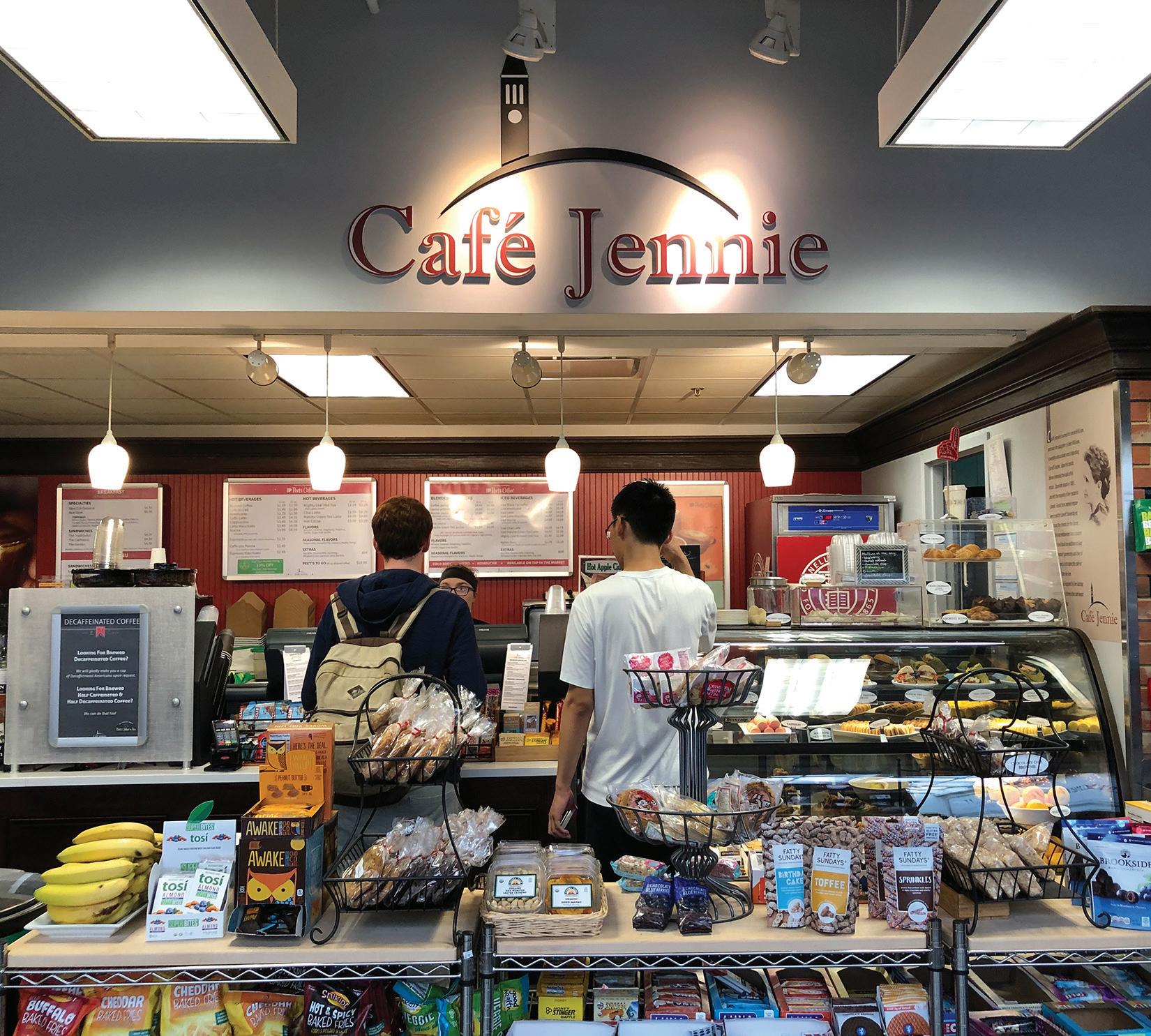
Igot my job as a writer for the dining section of The Sun about the same time I got my job working at Cornell Dining’s Café Jennie, each about 17 years after developing my love for food. In one, I wrote of my appreciation for Ithaca’s food scene, defined by restaurants, diners and groceries that never cease to surprise and impress as they rival the
best of big cities and small towns across the country. In the other, I learned to appreciate both the world of food service and, perhaps above all, my team in that little corner of The Cornell Store.
The café’s convenient location and superior coffee (Pete’s beats Starbucks any time) draw long lines that are frequently short on patience. Jennie rises to the challenge every time.
As the line begins to swell, the streamlined system whose effi -

ciency I rarely have time to marvel in kicks into action. Orders taken at the cash register are whisked off to the one of three locations (or more, “Would you like a drink with that sandwich?”) for preparation. A blend of blackclad students and full-time United Auto Workers workers then ignore the instruction sheets hung up by their stations as their tasks flow freely from muscle memory, and usually have an order fulfilled within just a couple of minutes, if not less. Throughout the day, shelves are constantly restocked, drinks made, food prepared and floors swept, all with a brisk professionalism that comes off as seamless to the customer.
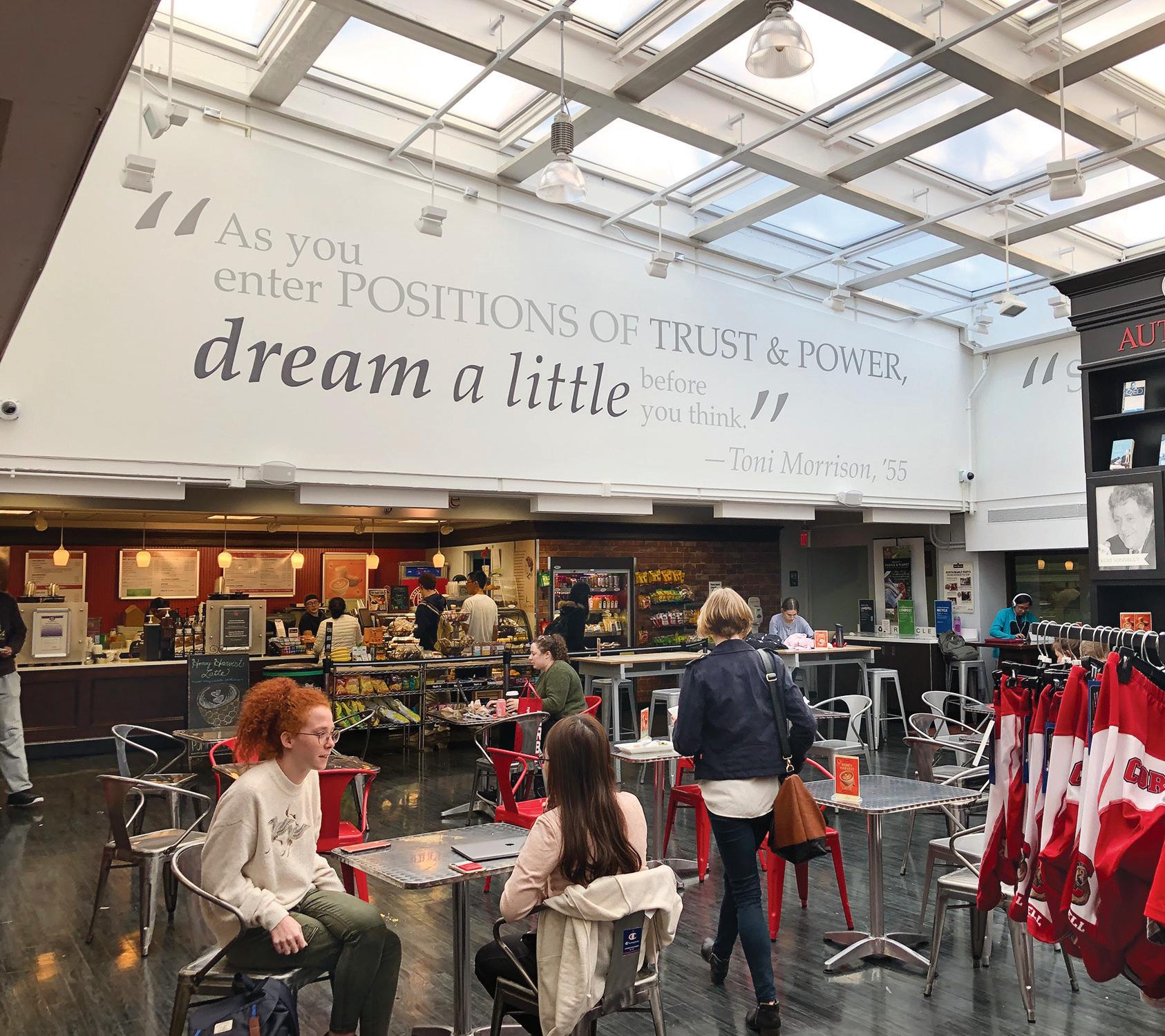

But most cafes and, frankly, most stores do the same. It is inherent to the business of running an operation like this that action and service must be smooth and confident, supplies must be maintained and speed must be assured. Café Jennie excels, as it must. It is not, then, a store of seamless sales and satisfaction that I am proud to be a member of, but this particular team. So raise a glass of Pete’s cold brew coffee (or plastic, if you forgot to bring your own cup for ten percent off) to Jennie.
To the ones who wake for the opening shift, losing sleep to provide the caffeine that makes up for your own lost sleep. To the ones whose relentless smiles are not uniforms worn just to face the customer, but involuntary swells of the cheeks that grow from a colleague’s well-placed joke. And to the warm welcome and warmer embrace each new hire encounters, then pays forward in turn.
I was asked to fill a slot to write in the dining section this week on any topic of my choosing. With the option of dozens of restaurants to review on the table, my mind leapt immediately to the café at which I have spent more time than any other.
As a customer, come to find a reasonably-priced breakfast or lunch, excellent coffee or impressive blended drinks. And whether new hire or long time employee, if you find yourself working at Café Jennie, expect to find a community.
So to the friendly management, savvy supervisors, clever baristas and charming coworkers: Thank you and keep it up; I look forward to seeing you next week.
By

At the bottom of Dryden Road and about half a block down from Mehak lies Souvlaki House, a Greek and Italian-inspired restaurant hidden in plain sight. Souvlaki House isn’t the first place that comes to mind when I think of Collegetown eateries; in fact, I was wholly unaware of its existence until I happened to sublet an apartment on the same street over the summer. For me, places like CTB, Oishii Bowl, Koko’s and Wings Over Ithaca are the most commonly suggested destinations to grab a quick bite with friends whenever we find ourselves in Collegetown for the evening. Even now, the name Souvlaki House only conjures up vague recollections of the restaurant’s lighted sign and large windows for those who happen to walk by it on the way to their intended destination.
My curiosity about what Souvlaki House served and the establishment in general — propelled also by a personal goal of eating my way through all restaurants in Collegetown before I graduate — led me to suggest the place for dinner to a couple of friends a few weeks ago. Intending to catch up over a meal after the summer apart, I found the atmosphere of Souvlaki House to be cozy and welcoming for our meeting, where we talked about the past, the future and everything in between. The restaurant has a
casual and home-y feel to it, with nods to it’s homage along the walls — pictures of the Parthenon, paintings of various Greek and Italian historical sights and framed football jerseys at every corner. The booths along the walls provide privacy for more intimate conversations and was something I appreciated especially toward the end of the night when larger, more rowdy crowds of students came by to eat their fill. The only mildly irritating thing had to do with the seating — the booths had fold-up seats (which I didn’t even know existed) that were also weirdly positioned. Basically, there was a huge gap in the seating between my fold-up booth seat and my friend’s, and in order to be seated normally, I had to scoot in between the two, leading to an awkward and uncomfortable seating arrangement. Seating aside, each of us ordered something different for dinner after perusing the extensive menu
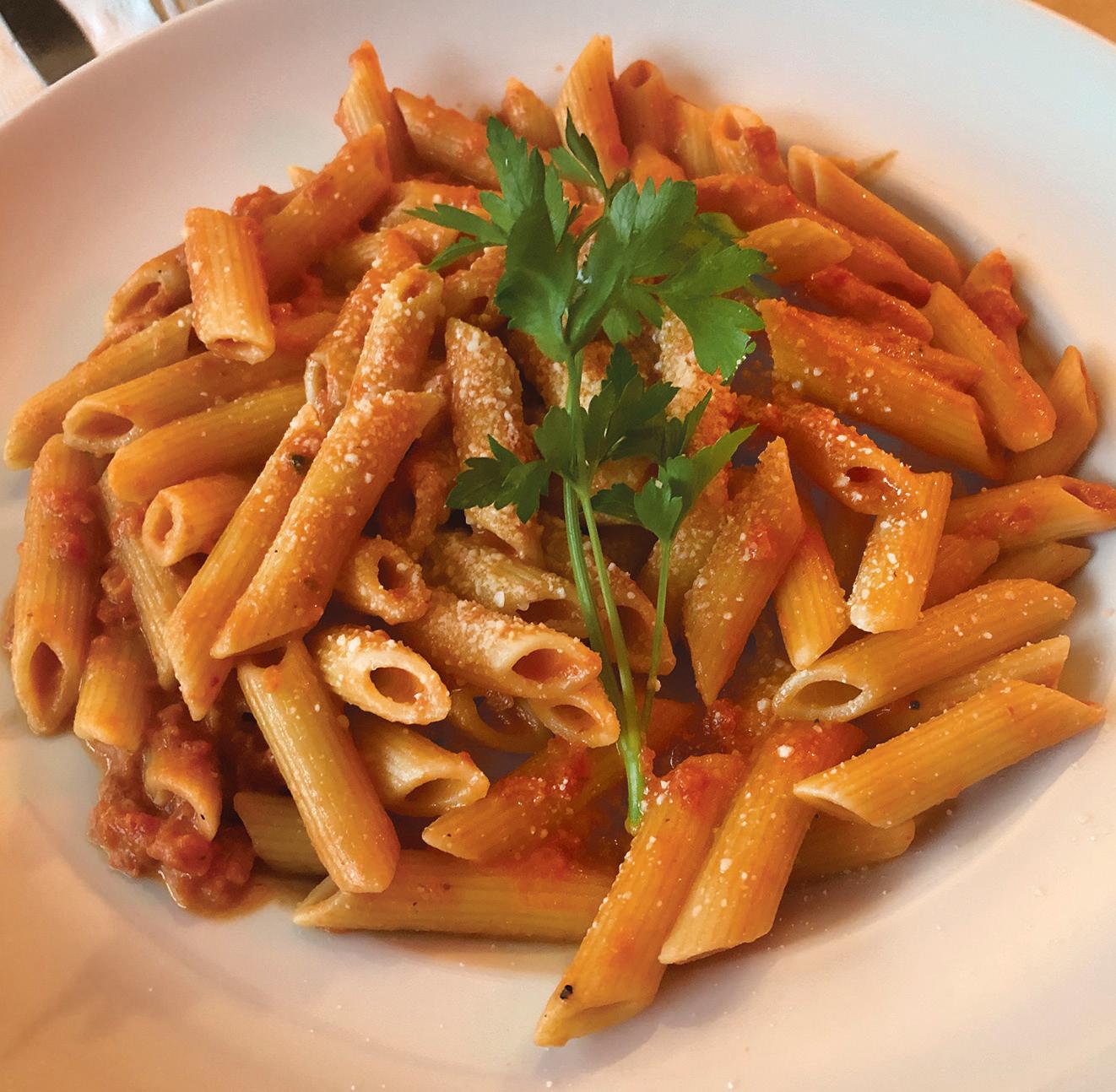
fresh-made pizzas, pastas and calzones. I was feeling pasta that night and ordered the Ala Vodka, which is apparently a favorite at the restaurant. Some people might look down at me for this (because why order pasta at a Greek establishment?), but I firmly believe that if a restaurant touts its Greek and Italian cuisine, it better be able to do both.
for a good five minutes. True to their name, there was a wide variety of options in both Greek and Italian fare. They had a large list of Greek specialities alongside
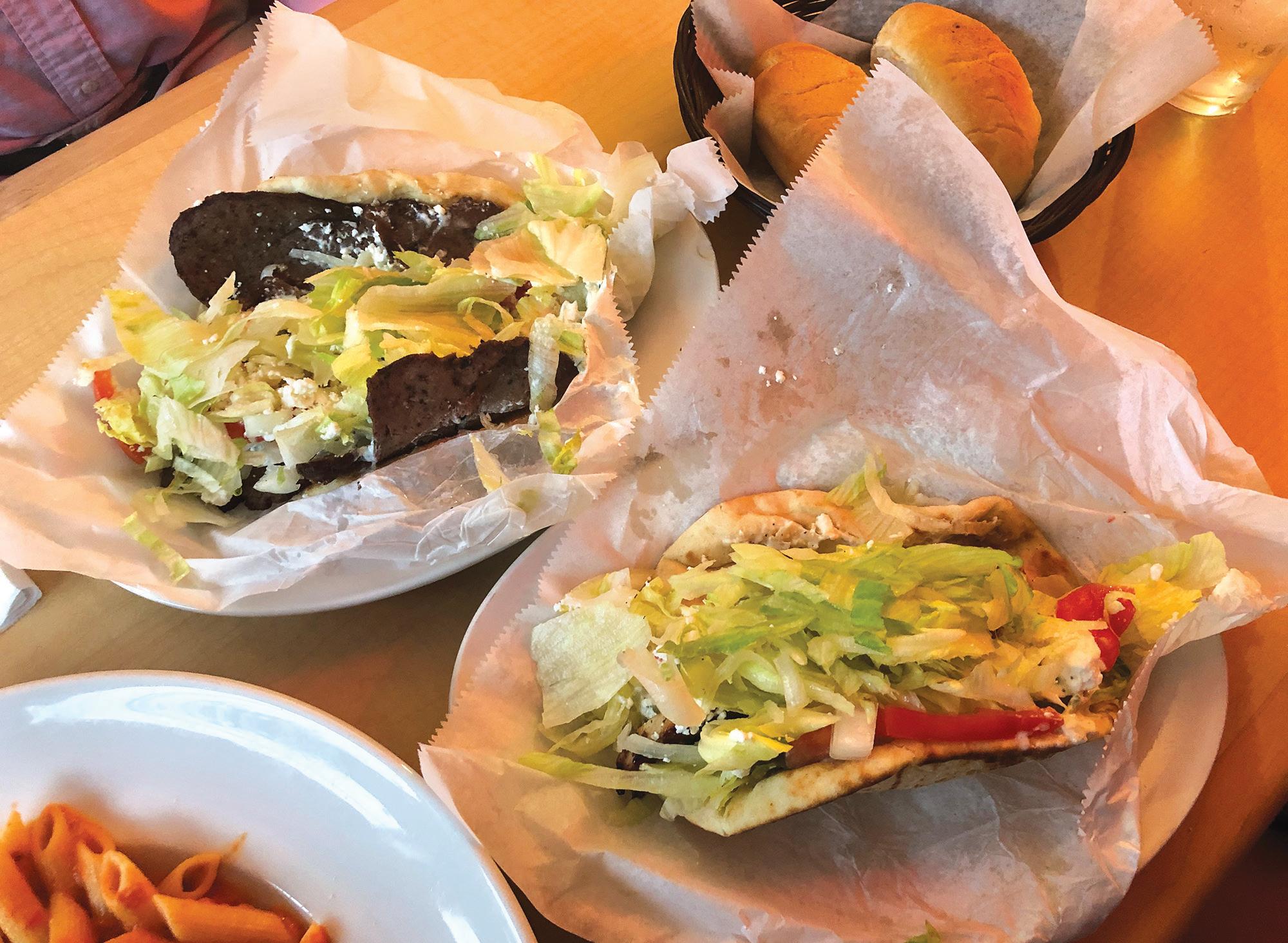
Before the pasta came, a heaping side salad for me and breadsticks for the group landed on our table. I appreciated these starters as we hadn’t ordered any appetizers and it was late in the evening. The breadsticks were toasted and brushed with a garlicky glaze on top but was nothing spectacular — just bread that looked suspiciously similar to a pack of hotdog buns. The side salad consisted of iceberg lettuce, tomatoes, feta cheese and an olive all soaked in a light Greek dressing. There was a little too much dressing on the salad which overwhelmed the other elements, but hey, it was free. I’ll never turn down a free salad
and carbs, and there was certainly enough to go around the table.
Shortly after, the main dishes arrived on our table courtesy of a friendly and efficient waitress. I was impressed by the portion sizes of all our meals. The Ala Vodka was huge and could easily serve two people, especially after the heaping starter salad. Consisting of al dente penne with a special sauce — a house blend of marinara and alfredo sauce, vodka, basil and Parmesan cheese, the overall dish was creamy and smooth. The penne paired well with the sauce, but I would be more surprised if it didn’t — pasta goes with everything, after all. However, in terms of a flavor profile, I found the dish to be one-dimensional. Outside of the creamy sauce, there was nothing else that added flavor to the penne, and for such a huge amount of pasta I was hoping for something a little more that would surprise my taste buds. I wasn’t able to finish the huge portion by myself and had plenty left over for lunch the next day, so on the plus side it was like getting two meals in one.
My friend, who got the Chicken Souvlaki for something more true to the restaurant’s name, thought her plate was decent but nothing too extraordinary.
much else in the first couple bites. The tzatziki sauce was pretty good though, and overall, she thought it was better than what Terrace had to offer. Another friend who got the beef gyro echoed similar sentiments. The meal was, he said, and I quote, “Aggressively adequate.” Overall, Souvlaki House was a nice divergence from the typical Asian-fusion places I usually end up at in Collegetown, but I’m not sure I would make it a place I frequent; for the price and the walk I think I would prefer to try out another eatery in Collegetown instead. I appreciate the ambience, diversity of dishes offered and generous portion sizes, and would recommend it as a place to try out if you want to switch things up. However, the experience was more than just the meal — Souvlaki House also provided my friends and I a welcoming place to reconnect for a couple of hours, and the conversation we shared over a warm meal is nothing to be overlooked. For that, I’m grateful.
My friend, who got the Chicken Souvlaki for something more true to the restaurant’s name, thought her plate was decent but nothing too extraordinary. The chicken was inconsistently cooked; some pieces were hard and burnt but others were tender, nicely salted and herby. The meat and vegetables weren’t incorporated evenly together in the pita either, so she’d get a mouthful of lettuce and not
Serves: Italian and Greek classics
Vibe: casual, family-style
Price: $
Overall:


Katie Zhang is a junior in the College of Agriculture and Life Sciences and currently serves as the Dining Editor on the 137th editorial board. She can be reached at kez22@cornell.edu.
You may or may not have heard about Justin Bieber and Hailey Baldwin’s recent (second?) wedding, a star-studded affair that took place about a week ago at a luxury resort in South Carolina. Why South Carolina, you ask? Because, of course, the wedding is Notebook-themed. As in The Notebook (2004), the film based around a Nicholas Sparks romance novel starring Ryan Gosling and Rachel McAdams, set in the 1940s. In the 15 years since it first came out, The Notebook, like Uggs and pumpkin-spice lattes, has come to be associated with the term “basic.”
Now, there’s nothing particularly wrong about being “basic.” The fact remains, however, that The Notebook is simply not a very good movie. (Maybe it’s just me, but “If you’re a bird, I’m a bird?” Really?) Still, there are a lot of bad movies out there.
The real crime of this subpar, lukewarm, sappy film is that the toxic relationship at the center of it is still — over a decade later — upheld as the shining paragon of romantic love to many impressionable women, especially teenage girls. If The Notebook had to be distilled into a single message, it would probably be that love is difficult, nay, that love is supposed to be difficult. Allie and Noah, the two roman-

The music of Wilco has always differentiated itself from contemporary rock in its unabashed sincerity. This sincerity reaches an apex on their 11th studio album, the understated but masterful Ode to Joy
How many bands from the mid-90s are making good music today?
tic leads, spend most of their time arguing with each other, and the rest having steamy, hot-people movie-sex, as if the excess of one passion could cure the other. As feminist theorist bell hooks writes in All About Love, “This is one of the great sadnesses of life. Too often women, and some men, have their most intense erotic pleasure with partners who wound them in other ways.”
Ramya’s Rambles
Earlier in the book, hooks makes another salient point, that although “Movies, music, magazines and books are the place where we turn to hear our yearnings for love expressed,” we often and increasingly find cynical or misleading portrayals of it in these sources. Indeed, we tend to view them as guides on how to love, but because they give us such skewed depictions, “we remain totally confused about the practice of love in everyday life.” That is to say, if the Biebers really do take the movie as seriously as making all their wedding guests watch it the night before the actual ceremony, are we to partly blame the messaging of such media if the marriage heads south? And should we ask for art to provide models for “the practice of love in everyday life,” as well as other examples of how to be a good person and live more morally “correct” lives?
On the other hand, however, it seems unfair to demand this — our most powerful narratives often turn on a great deal of emo-




It is hard to undervalue artistic consistency in rock music. With a few notable exceptions (Spoon, Radiohead, SleaterKinney), musical acts from the end of the past century tend to have tapered off, touring off the legacy of one or two great albums and repeatedly releasing mediocre projects until eventually going on “indefinite hiatus.” Wilco could easily have succumbed to this same phenomenon, resting on the (well-deserved) critical praise for Yankee Hotel Foxtrot and Summerteeth and refusing to change their formula until listeners finally got tired of hearing the same thing. It is a great credit to this band that, 11 albums in, they refused to do so. Ode to Joy eschews some of the more complex visions and abstractions of frontman Jeff Tweedy’s previous work, and instead opts for directness. The verses are concerned with quotidian existence and deal with the feelings which accompany 21st century life. Tweedy’s lyrical content creates the universal from the specific: getting stoned and laying in bed all day, losing the thread in a story you’re telling somebody, listening to the birds singing while you’re thinking about your lover. The emotional impact is exacerbated by the stripped-back instrumentation and the intimacy

tional turmoil, centering around characters who are most likely people you wouldn’t want to meet in real life. How lifeless, how boring would our books and movies become if there were no violence, if it wasn’t for terrible people doing terrible things?
In an 1889 essay, Oscar Wilde wrote that “Life imitates Art far more than Art imitates Life,” arguing against the famous Aristotelian principle. To be sure, the idea of bringing art to life is incredibly attractive. How much richer, how much more fulfilling, we might think, our lives could be if only we were fictional characters? In Donna Tartt’s novel
The Secret History, a group of classics students toy with bringing Greek tragedy to life, only to face the very real and unfortunate consequences (not to mention the psychological damage) of “a morbid longing for the picturesque at all costs.” Life, after all, is not written
in iambic trimeter.
Although art plays a crucial part in informing us about the world around us, acting as a lens through which we can understand complex emotions and dig deeper at difficult issues, we don’t have to twist our lives to resemble a work of art in order to gain from that work and enrich our lives with it. Instead, by thinking critically about the messages that art presents us, by engaging with it fully or simply allowing ourselves to enjoy it fully in the moment of consuming it, we can allow art to add to our lives in meaningful ways without (completely) forsaking our goodness or sanity.
Ramya Yandava is a junior in the College of Arts and Sciences. She can be reached at ry86@cornell. edu. Ramya’s Rambles runs alternate Thursdays this semester.
of the production, and these events carry with them an emotional weight which could never be matched by simply reading the words off of a page.
Adding to the gravitas, these congenial images of occidental life are presented alongside ruminations on modern American political anxieties, more often than not on the same song. On “Before Us,” for example, lyrics about front doors and silverware abruptly change to nostalgic remembrance for the days when “wars would end.” This switch seems abrupt until one realizes that Tweedy is simply holding a mirror to our own mercurial minds, assigning the same importance to mundane routine as to the imperative problems of our time.
Tweedy’s ponderous paci -
fism is also present on the classic Wilco song “War on War,” from the incredible Yankee Hotel Foxtrot
But while the older song melancholically accepts that its own advocacy is doomed to defeat, and stews in this fact singularly, “Before Us” finds distraction and meaning in the routine of daily life. The difference between the two songs is indicative of a greater theme on Ode , an album which rhapsodizes the comforts of simplicity in life when faced with an uncomfortable and uncaring world. On album highlights like “Love Is Everywhere (Beware)” and “Hold Me Anyway,” Tweedy’s fixation is love — even in its
RACHAEL STERNLICHT/ SUN GRAPHIC DESIGNER
most desperate forms of longing — as a provider
Ode to Joy is in its subtleties. This album doesn’t contain relentless affirmations of happiness, but it holds a melancholy joy that defies comparison. It doesn’t try to push out the boundaries of its genre, but opts to fully explore and flesh out what is inside of them. With this album, Wilco created a simple and beautiful contribution to the canon of folk/rock music, and one accessible enough that there is no excuse for not listening to it as soon as you get the chance.
Richard Beezley is a sophomore in the College of Arts and Sciences. He can be reached at rwb272@cornell. edu.
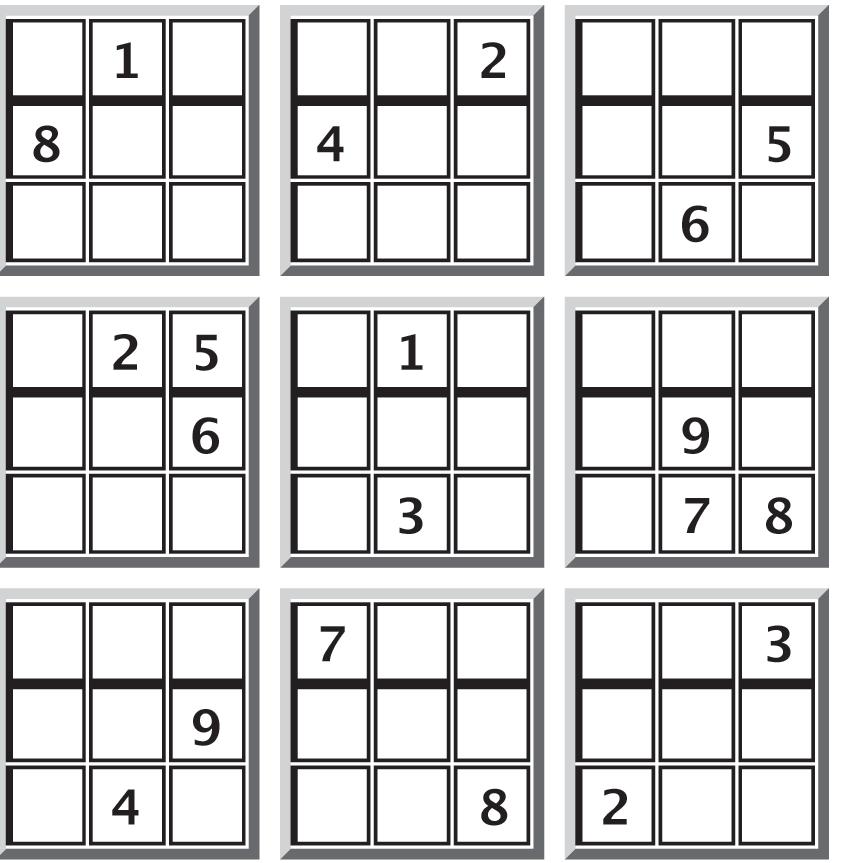
Fill in the empty cells, one number in each, so that each column, row, and region contains the numbers 1-9 exactly once. Each number in the solution therefore occurs only once in each of the three “directions,” hence the “single numbers” implied by the puzzle’s name. (Rules from wikipedia.org/wiki/ Sudoku)




Houses, Apts, Parking
1 to 9 Bedroom
Collegetown - College Ave, Linden Ave, Dryden Rd, Bryant Ave, Cook St. 607-330-2442 info@urbanithaca.com www.urbanithaca.com
We have availability for the 2020-2021 school year beginning June 1st at Hudson heights apartments. The studios include electric, heat, water, garbage and parking. There is coin-operated laundry facilities on site. Prices start at $750 / month for a 12 month lease. If you have any questions or would like to schedule a tour contact us by phone 607-280-7660 or email: renting@ithacaLS.com
COLLEGETOWN TERRACE APARTMENTS
Leasing for 2020/2021 Spring 2020 Semester leases available Heat, hot water and Wi Fi State of Art Fitness Center Shuttle Bus Service to campus Washer & Dryer in Apartments collegetownterraceithaca.com office@ithacastudentapartments.com (607) 277-1234
Now Renting 2-10 Bedroom Houses/ Apartments for 20-21. All Locations. Call today or visit our website: Certified Properties of TC Inc certifiedpropertiesinc.com 607-273-1669
2020-2021
Studio 1, 3, 8 & 11 BR Apts. Great Locations in Collegetown. 607-227-2535
120 Oak Avenue
Just steps to Cornell Campus
10 bedroom house & 1 and 2 bedroom apartment 607-277-1234 office@ithacastudentapartments.com Ithacastudentapartments.com
Collegetown Crossing College Ave's Newest Location 307 College Ave. Now Leasing for 2020-2021 Completely New Modern Studios & 2 Bedroom Apartments. Fully furnished, heat & hot water included. Reception area at 307 College Ave. www.urbanithaca.com 607-330-2442 info@urbanithaca.com
Boldly Refined Living 312 College Avenue
Sophisticated studio, 1, 2, 3-bedroom apartments. Superior fitness facility, theater, and coworking space. Free high-speed internet. Exclusive resident parking. Package delivery/return. Overnight concierge. 607-273-9777 or 312collegeave.com
3 Bedroom 1 Block from Starbucks in Collegetown Heat & hot water included. Lease starts June 2020. Parking & laundry available. www.porealty88.com 607-277-1888
20-21
College Ave. 5 BR House Furnished. Laundry. Parking. Call 607-273-8576
20-21
Upper Eddy St. 7 BR house Furnished. Laundry. Call 607-273-8576
BLAIR STREET FURNISHED HOUSE
Available 2020-2021 7 Bedroom, 3 full baths 2 kitchens & Laundry Text or call Tracy at TLC Property Mgmt Corp 607-379-2776

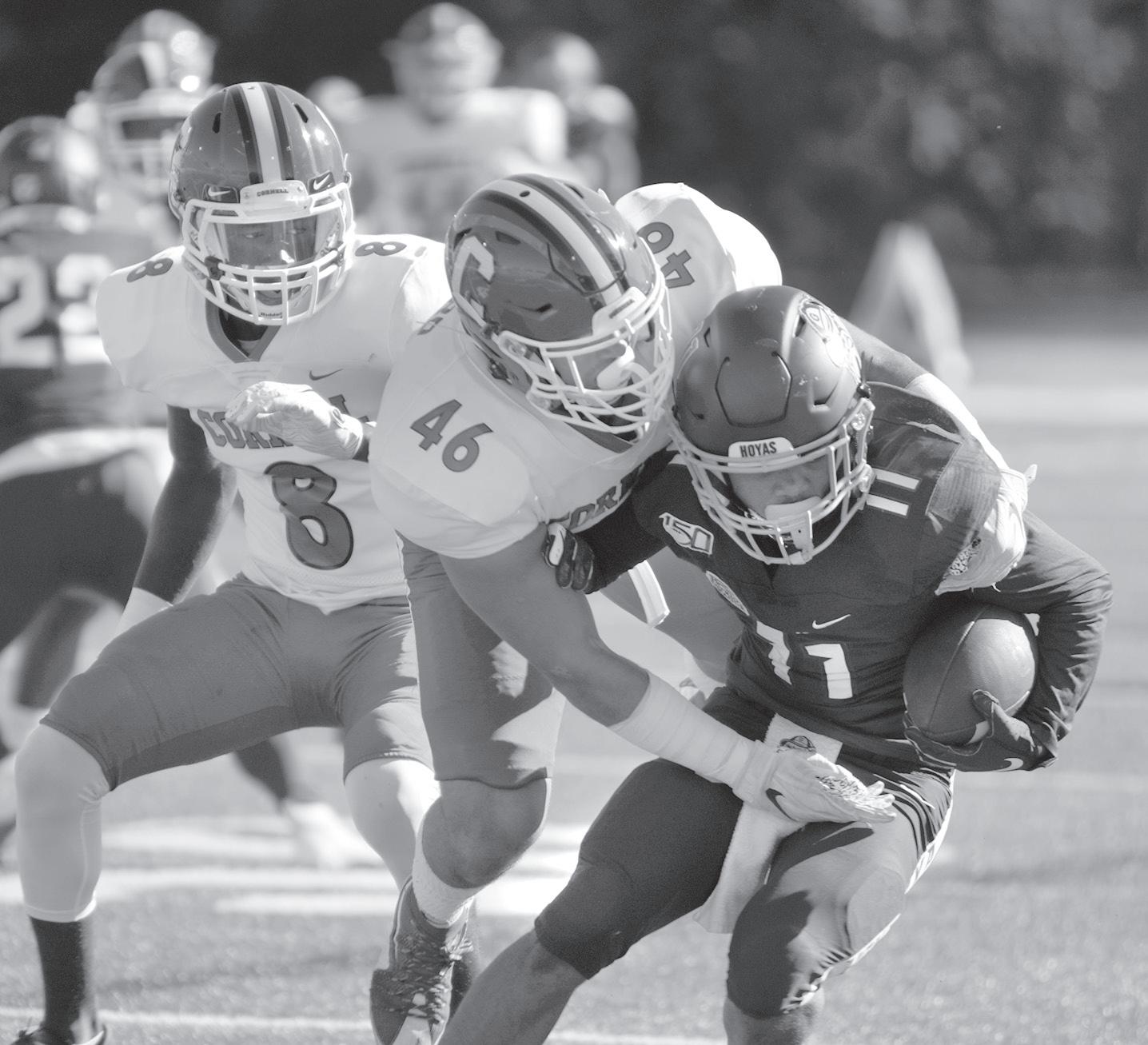
Following out-of-conference loss, the Red will aim for a victory at Harvard
imposing Harvard front-seven that held him to 15 carries for 70 yards. That being said, he did rush for a crucial 34-yard score that propelled Cornell’s thrilling comeback.
“My hammy feels great, actually,” said Coles. “Physically, I feel fine [now]. But mentally, obviously, I’m not very happy with [Saturday’s] outcome. I just want to win at the end of the day, whether that’s two carries or 20 — whatever it takes.”
Coles also offered his evaluation of Harvard’s defensive unit.
“Harvard’s Harvard. They do the same thing every year. They
“To be honest with you, the schemes and everything — they put us in position and give us a chance to win, but it just comes down to all 11 guys that we have on the field at all times that have high motors,” said Blass.
“That’s been a common theme that Coach Backus had addressed,” he continued. “It’s really an effort-based defense, is what he calls it. I think we’ve all bought into that, and I think that’s the result you’ve seen.
“It’s really an effort-based defense ... I think we’ve all bought into that, and I think that’s the result you’ve seen.”
Lance Blass
have a very base defense — they have four down, three linebackers. They’re very solid, and they don’t change a lot of what they do because they’re pretty good at what they do,” he said.
In order to top the Crimson, Cornell will have to maintain the defensive prowess it has displayed over the past few weeks.
Senior linebacker Lance Blass offered his thoughts on the matchup.
“I mean, I’m a little biased, but I think it always comes down to just playing good physical defense,” said Blass. “Anytime you do that, you’re going to give yourself a chance to win games by keeping their score down and limiting explosive plays.”
Cornell’s defense has emerged as one of the leading units in the country, currently ranking sixth in the nation in total defense. Blass credited defensive coordinator Jared Backus’ philosophy for inspiring the high play.
Continued from page 16 Luke
In 2018, the Red held Harvard quarterbacks Tom Stewart and Jake Smith to 10-of-34 passing for 134 yards, but Harvard yielded a whopping 320 yards on the ground. With the Red now boasting the tenth-best rush defense in the FCS, look for that latter number to drop. The Crimson, however, is no defensive slouch, either. Harvard’s defense ranks sixth in the rushing department.
Another interesting battle lies in the red zone. Bolstered by a number of goal-line stands, Cornell currently possesses the best red zone defense in the FCS. Meanwhile, Harvard has been quite efficient in scoring position, ranking second in red zone scoring.
Last year’s match between the two ended with a thrilling 28-24 win in the Red’s favor. A year prior, Cornell topped the Crimson in a narrow 17-14 decision. Given how the Red’s offense and defense have been performing this year, Saturday’s game looks like it could shape up to look a lot like 2017’s contest.
The teams will face off at 1 p.m. Saturday at Harvard Stadium.
By SOFIE LEVINE Sun Contributor
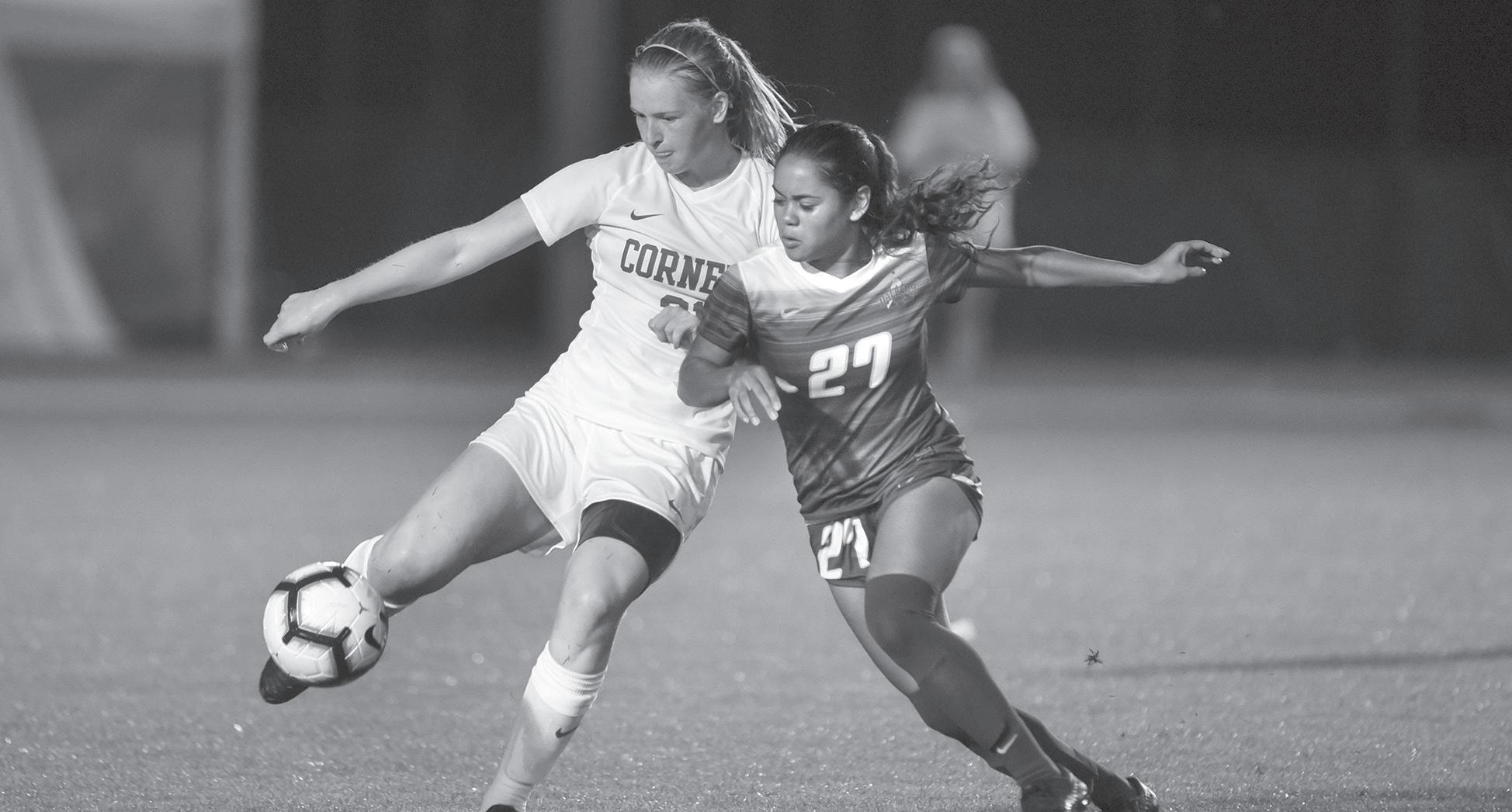
In the midst of a three-game losing run after starting the season with four consecutive wins, Cornell women’s soccer is set to host Harvard this Saturday.
The streaky Red (4-4-1, 0-2 Ivy) began 2019 with nine new players.
“The group of freshmen definitely helped us off to the best start we have had since 2005,” said head coach Dwight Hornibrook.
The nine freshmen have been an integral part of the Red’s success this season.
“There are really positive things happening. Freshman forward Ashley Durick is a dangerous player who scored a game-winning goal in the first game of the season, and freshman forward Liza Mariner is another freshman whose speed is hard to handle,” Hornibrook said. “There are also many freshmen who have come off the bench and been
very instrumental in giving us the start we had.”
Over the past two decades, the team’s tilts with the Crimson have all resulted in losses or ties. Cornell has not beaten Harvard since the early 1990s, giving the fresh-faced Red the opportunity for a monumental victory.
Coming to Ithaca hot off a five-game winning streak, Harvard (8-2, 2-0) is going to bring the competition. The Crimson’s last two matches were against Yale and Penn — two other strong Ivy opponents.
“We have the capacity this year to attack with more speed and more skill. We have shown that we have to do a better job defending — especially later in games,” Hornibrook said. “We need to play to our strengths and also be sharp in defending the best players on the opposing team.”
The game is set to take place at 1 p.m. this Saturday at Cornell’s Berman Field.
Sofe Levine can be reached at skl74@cornell.edu.








CORNELL AT HARVARD
YALE AT DARTMOUTH
LAFAYETTE AT PRINCETON
HOLY CROSS AT BROWN
SACRED HEART AT PENN
CENTRAL CONN AT COLUMBIA
OKLAHOMA AT TEXAS
ALABAMA AT TEXAS A&M
EAGLES AT VIKINGS
AT PACKERS





Display Advertising Deadlines: • Thursday, October 10 at 3 p.m. for the Wednesday, October 16 and Thursday, October 17 issues.
Classifed Advertising Deadline: • Thursday, October 10 at 3 p.m. for the Wednesday, October 16 issue. The





By MIKE SEITZ Sun Staff Writer
Cornell freshmen shone in a bounceback match against Colgate after a narrow loss to Penn last weekend, coming up with big minutes to seal the win for the team despite not having a full-strength roster.
Cornell looked comfortable in possession early, circulating the ball around and launching long passes towards speedy forwards.
“We had the lion’s share of possession,” said head coach John Smith.
The defense put on a no-nonsense display in the first half, locking down the Colgate offense. The Raiders did not have a single shot in the first half and finished the game with just two total. Vocal leadership in the back came via senior goalkeeper Ryan Shellow and senior captain and defender Ryan Bayne.
Hustle in the midfield by junior Tyler Bagley was unmatched, as he caused problems for the Colgate defense all game long. Bagley won challenges and looked to combine with forwards, but despite his strong efforts, the game remained scoreless at halftime.
The second half was full of chances for the Red through set pieces. Colgate committed seven fouls in the latter part of the game (15 total on the day). Senior midfielder Harry Fuller stood over almost every dead ball and served multiple dangerous passes.
Cornell also registered eight total corner kicks on the day. The team lacked the finishing touch on these set pieces despite Fuller’s inviting distributions.
Things finally changed in the 69th minute, when freshman midfielder Griffin Garrard came on as a substitute. Five minutes later, Garrard capitalized on a Raider defensive mistake inside the box and hit the ball with his left foot for a clinical goal.
“It was great for Griff to come on and tuck that one away,” Smith said.
Garrard has only recently been featured on the field, picking up a key assist two games ago in an upset win over national powerhouse Akron. For the freshman, patience and hard work off the field are what he says propelled him to
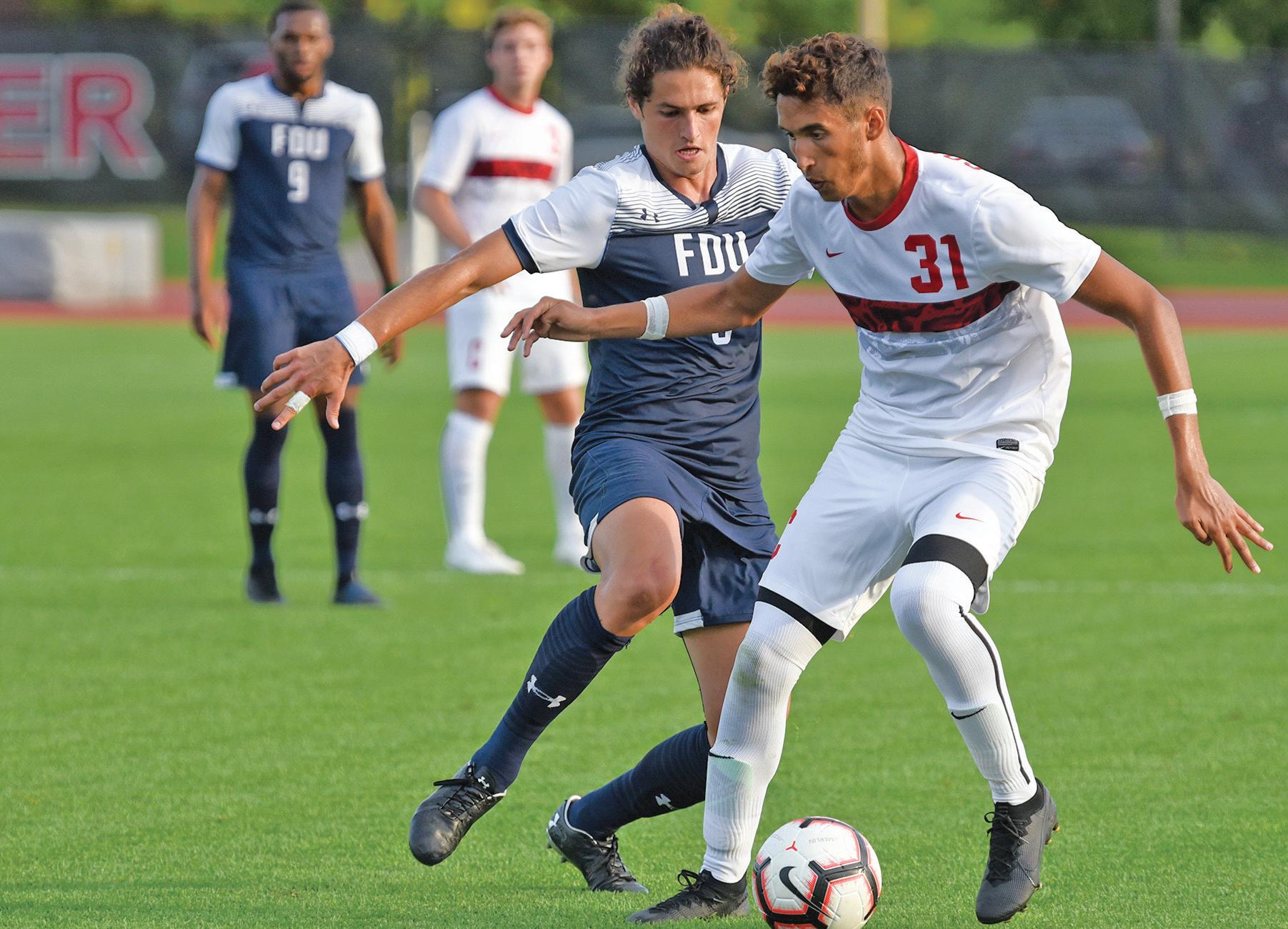
New faces | First-years came through for Cornell on Tuesday, providing big plays that put the Red on top.
show out in the squad lately.
“Every time I get in [the game], I take it as an opportunity to get better and make something happen,” he said.
Midfielder Brandon Morales, also a freshman, was credited with the assist — his third of the year.
Garrard and Morales have been two of the many freshman standouts this season, with defender Will Citron and midfielder Kurt Lehmkuhl also playing important minutes on the field.
Cornell took the game by the 1-0 margin, with much of the credit due to performances of the
young core. Coach John Smith has relied on his “soccer-savvy” freshman class for depth this season.
“They are mature on the field and mature off of it,” he said.
Next up, Cornell will play rival Harvard in a 4 p.m. Saturday battle at Berman Field.
“We’ve got to bounce back in the Ivy League and take control,” said Garrard.
Mike Seitz can be reached at mseitz@cornellsun.com.
By LUKE PICHINI Sun Staff Writer
Perhaps the best way for Cornell football to snap out of its recent slump is a matchup against a foe whose style of play they not only know but also know how to beat.
On Saturday, the Red will travel to Cambridge to face Harvard, a team that Cornell has beaten two years running. Prior to that, though, the Crimson tri umphed over the Red in 11 straight games.
Cornell is coming off a disappoint ing loss to Georgetown in front of its Homecoming crowd. While the Hoyas are much improved compared to previ ous seasons, the Red had a number
Going for three look to take down Harvard yet again. The Crimson is known to stick to the same strategies year to year.
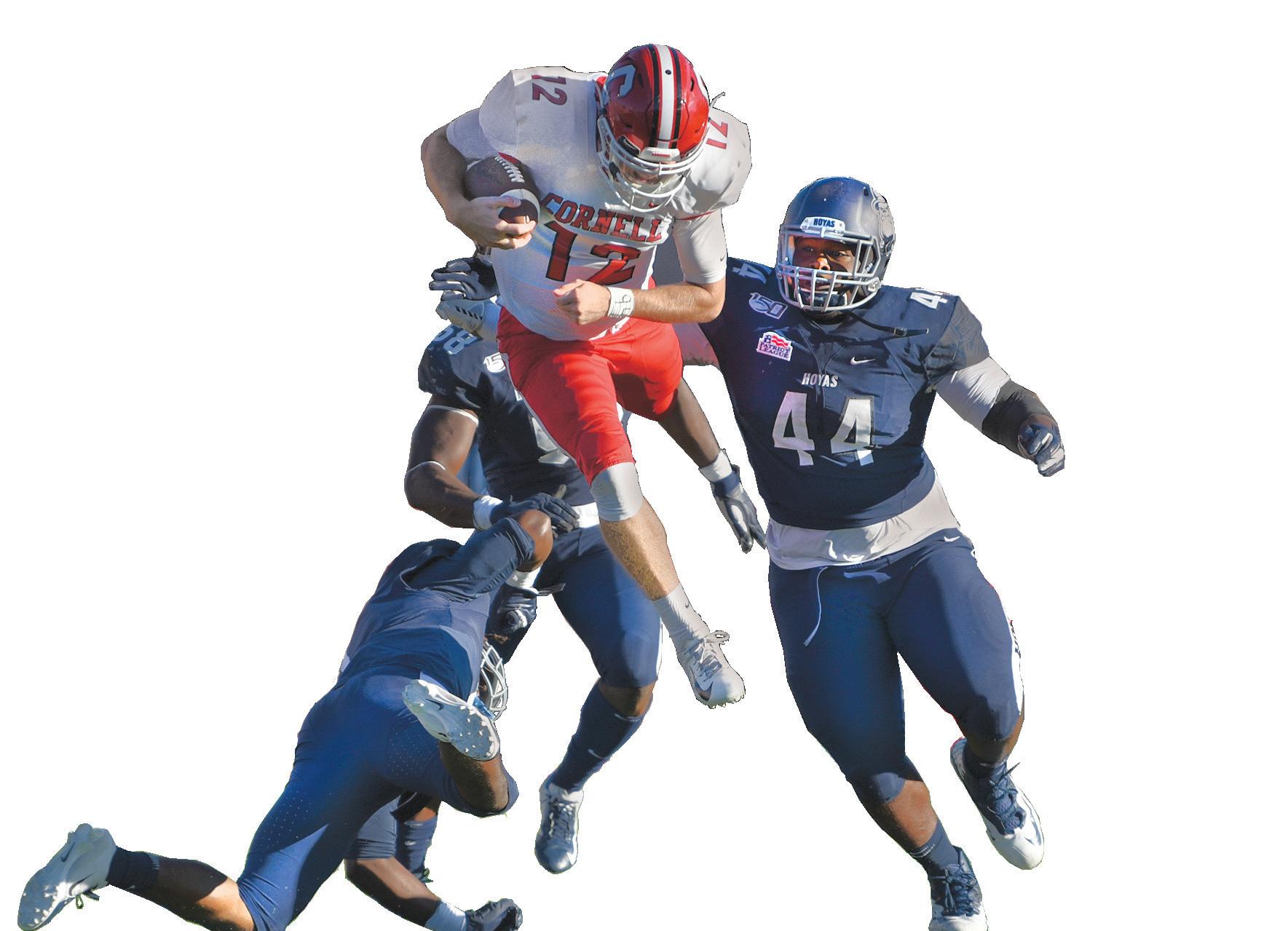
of chances to emerge victorious — but perience on the field post-game, head coach David Archer ’05 believes he has
“It comes down to the fundamentals and technique we’re using,” said Archer. “We made a point of making our calls simpler, so we tried to simplify the scheme. Now it comes down to the fundamentals of our footwork, of our hand placement, for holding calls, or false starts or concentration.”
Against the Hoyas, senior quarterback Mike Catanese threw an interception in the first quarter that led to a Georgetown touchdown. That mistake came off a misinterpretation of a call.
“He thought we were running ‘croc’ on the pick, and we were running ‘gator,’” Archer said after the game on Saturday. “And that’s the difference between a slant
The quarterback’s status is once again uncertain for the upcoming weekend. The first-season starter, who has
already suffered injuries including a concussion this season, came out of the physical game a little banged up after playing nearly every snap against the Hoyas.

Luckily for the Red, another core piece on the offense is feeling much better heading into Harvard. Senior running back Harold Coles will look to return to form this weekend. Hampered by hamstring issues, Coles only notched 65 yards on 10 carries last weekend — a far cry from his two 100yard efforts against Marist and Yale that kicked off the 2019 season. Last year, Coles was limited by an