
Dr. Fauci M.D. ’66 Addresses Cornellians
Says COVID-19 vaccine likely this year in virtual Homecoming event
By ANGELA BUNAY Sun Contributor
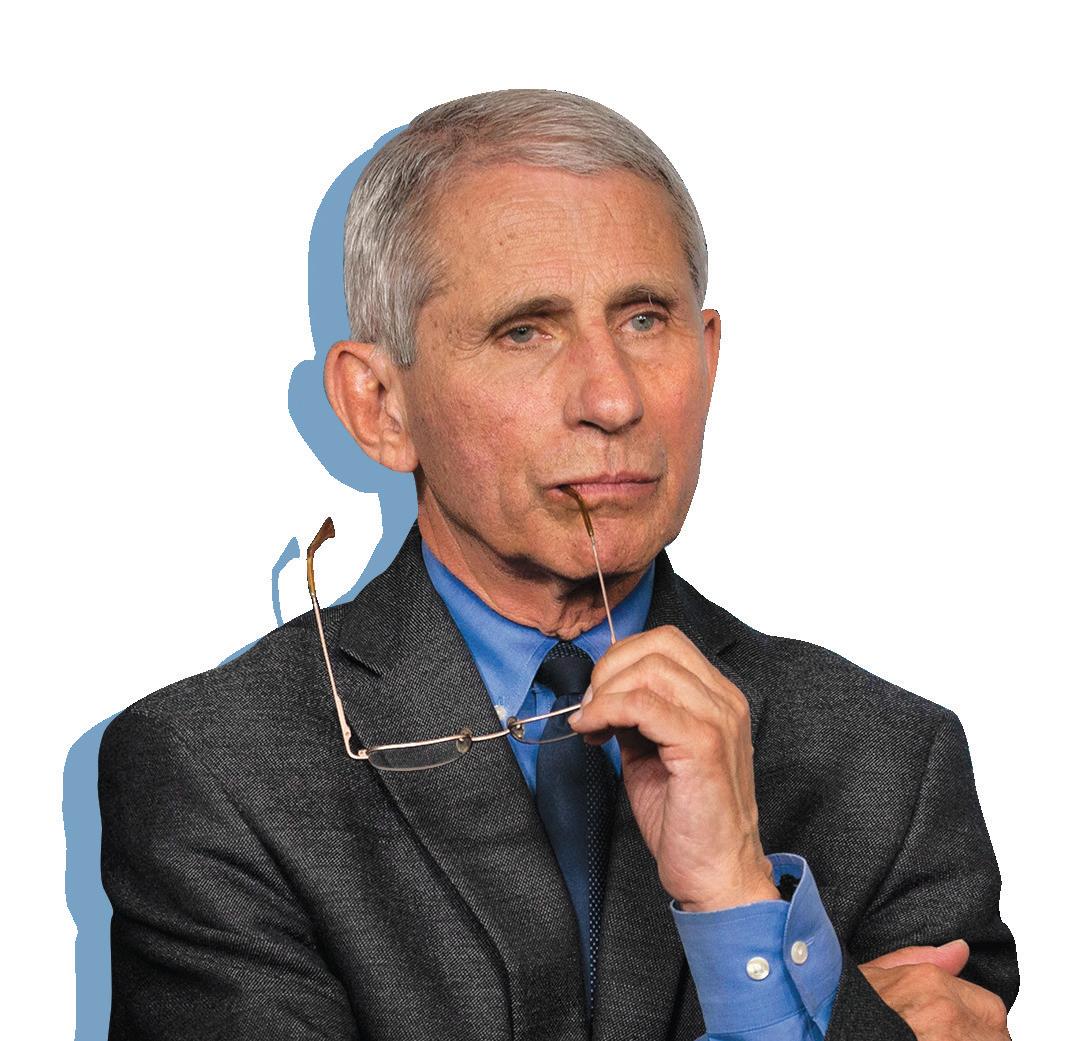
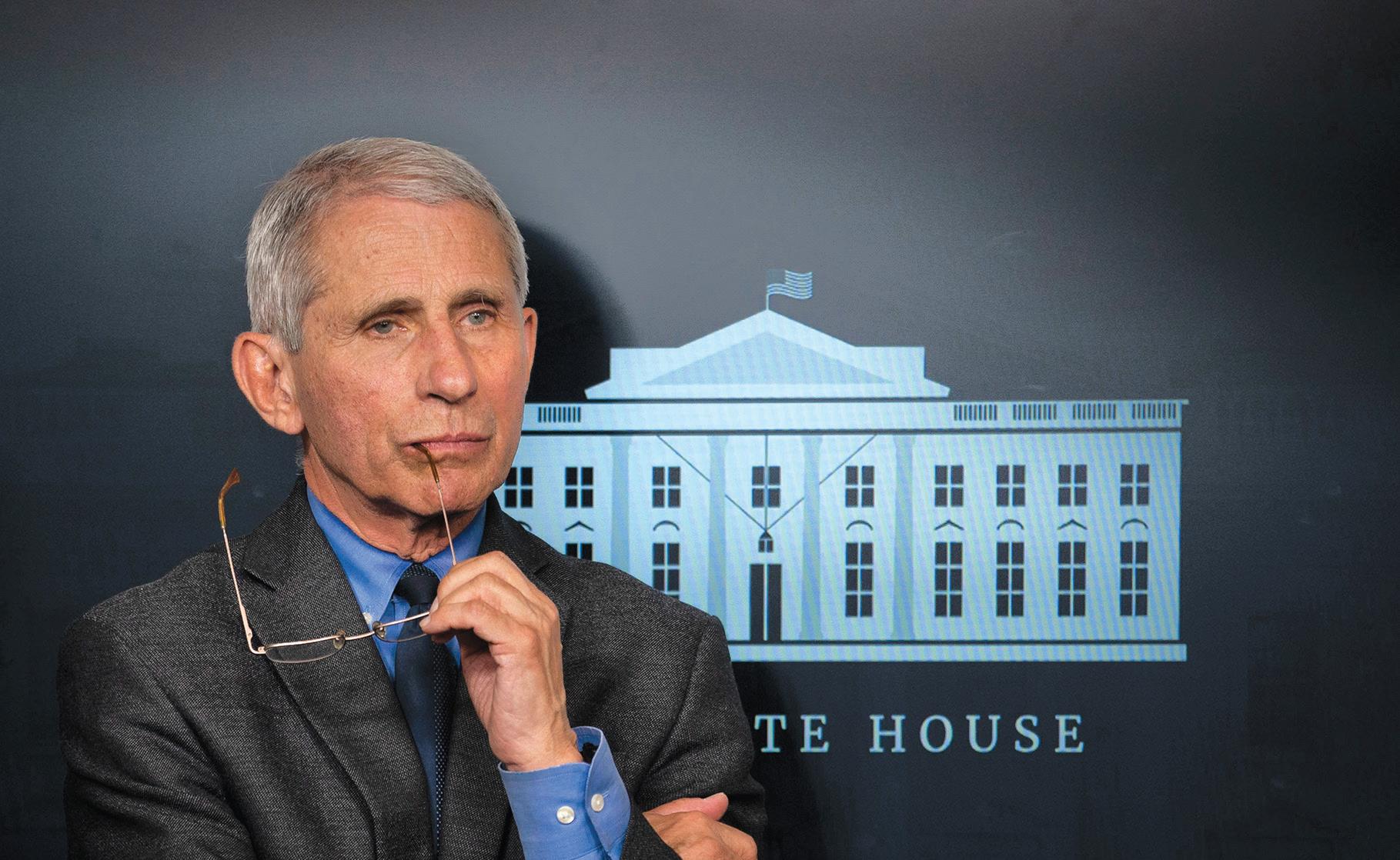
Instead of packing Schoellkopf Field stands and watching evening fireworks, Cornell alumni and students are gathering virtually for StayHomecoming, headlined by the alumnus who has become a household name: Dr. Anthony Fauci M.D. ’66.
On Tuesday afternoon, NBC anchor Kate Snow ’91 interviewed Dr. Fauci in a talk that addressed topics ranging from the timeline of a potential vaccine to Cornell’s role in the pandemic and
social distancing fatigue.
President Martha E. Pollack opened the event by briefly introducing the famous alumnus, touching upon his contributions to the field of medicine.
“The public health crisis we have all been living with for the past half year has really brought to light the vital importance of expertise, it has shown us how much we all need and rely on scientific experts like Dr. Fauci,” Pollack said.
Inside a North Campus Contact Tracing Cluster
Freshmen
‘dumpling party’ goes awry
with COVID-19
By KELSEY XU Sun Contributor
A “dumpling night” turned into a nightmare as a group of first-year students found out they had potentially been exposed to COVID-19.
Helen Zhang ’24 “So she organized and invited us and we all just met up. We all ate dumplings on the lawn.”
Six days later, Helen got a call from Cornell Health — she had been potentially exposed to COVID19.
“They were like, ‘Tonight, tomorrow morning, you’re gonna be leaving for the Statler.’ ”
Matthew Breitman ’24
The seemingly innocent mid-September gathering ended with a week of isolation in the Statler Hotel for the firstyears, who were released only after a series of negative tests. The potential cluster, started in a lawn near the North Campus townhouses, was as surprising as it was disrupting for the first-year students.
“One of our friends said we should have a dumpling night,” said
Matthew Breitman ’24 had been cooking dinner when he got the call. “I thought it was just some random number and when I picked up and they were like, ‘This is the Department of Health, Tompkins County,” Breitman said.
“They were like, ‘Tonight, tomorrow morning, you’re gonna be leaving for the Statler,’” Breitman said. “And it kind of didn’t hit me until at least like 20 minutes later that I was like, ‘Oh crap, you know, I really got to go.’”

Zhang, Breitman and Coby Sontag ’24 were three of the people present at the dumpling party that the health department contact traced.
“Most of us walked to Statler together with our suitcases because we all got the calls roughly around the same time,” Zhang said. “People on campus are either running away from us because we’re a large group of people with suitcases, or they’re taking a photo or a video, or they’re cheering us.”
They arrived at the Statler in the middle of the night and were checked in one by one. After they were handed keys, snacks and instructions, they headed to their rooms, alone, for the next few days.
For Breitman, the first couple of days were an “almost a luxurious experience, where you’re getting
See CLUSTER page 4
lead-up to the 2020 presidential election.
“[The pandemic] has shown us how much we all need and rely on scientific experts like Dr. Fauci.”
President Martha E. Pollack
One of the first questions concerned the possibility of a COVID-19 vaccine, and its potential to be politicized in the
“I try to, the best of my ability, in being very consistent in my messaging based on facts and scientific data,” Fauci said, “but when there are mixed messages coming out of any institution, including the federal government, there is confusion as to what people should do.”
He mentioned that in the United States there are currently five vaccine candidates in phase three advanced trials involving tens of thousands of people. While
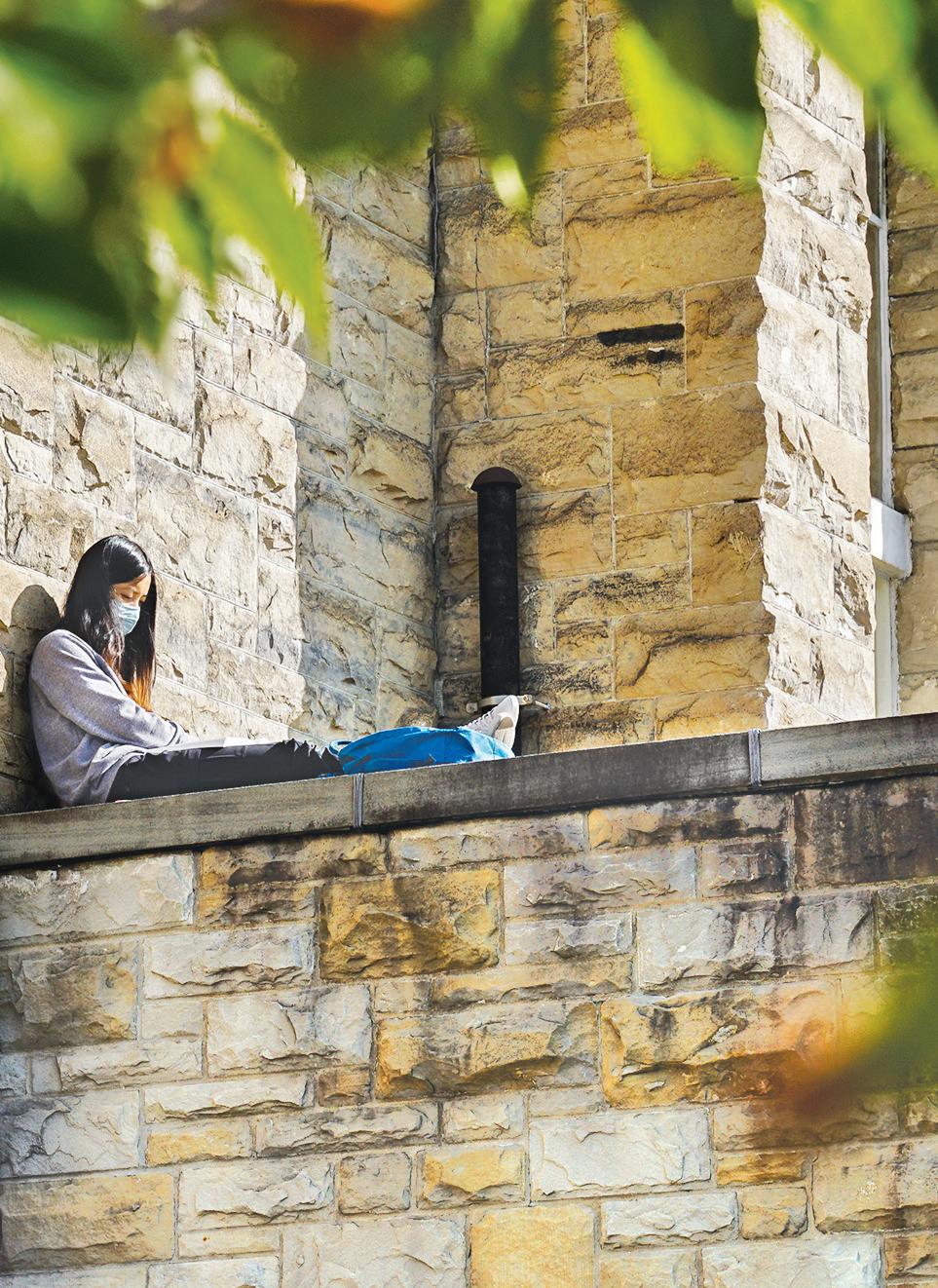

A mask-clad Cornell student reads silently, sitting near McGraw Tower. As eateries and study spaces reopen, the once-silent campus begins to show signs of life.
Quiet study
Daybook
Today
Thursday, October 8, 2020
A LISTING OF FREE CAMPUS EVENTS
Labor Leadership Skills Program: Negotiation Skills 6 - 11 a.m., Virtual
Let’s Meditate With Cornell Wellness 9 - 9:30 a.m., Virtual Event
Into the Desert: Questions of Coloniality and Toxicity 10 - 11 a.m., Virtual Event
The Battlegrounds: A State of Play 11 a.m. - noon, Virtual Event
The Bluest Eye: A Community Reading 11 a.m. - 8 p.m., Virtual Event
Joint Behavioral Economics, Public Economics, Labor Economics and PAM Workshop 11:30 a.m. - 1:00 p.m., Virtual Event
Pushing the Boundaries: Can We “Decolonize” Security Studies? 11:30 a.m. -12:45 p.m., Virtual Event
Poland’s Blues: Cornell Celebrates Toni Morrison M.A. ’55 1 - 6 p.m., Virtual Event
Fitness Goal Setting 2 - 3 p.m., Virtual Event
Memorial to Enslaved Laborers 6:30 - 7:30 p.m., Virtual Event

Vice-presidential | Americans watch as Sen. Kamala Harris (D-Ca.) and Vice President Mike Pence spar at Wednesday’s first and only vice presidential debate of the 2020 election.
Tomorrow
Commuting in Context: Qualitative Research of Transportation Challenges for Low-Income Workers 10:10 - 11:30 a.m., Virtual Event
State of the University Address and Keynote Panel by President Martha E. Pollack 10:15 a.m - noon, Virtual Event
Cornell Wellness Virtual Walk to Run Class 1:30 p.m., Virtual Event

Ezra’s Round Table: Electricity Markets Under Deep Decarbonization 12:15 - 1:15 p.m., Virtual Event
Citing Data: How to Cite Data for Your Research Project 12:30 - 1:30 p.m., Virtual Event
What’s In A Name? Hispanic/Latino/Latinx 6 - 7 p.m., Virtual Event
The World is Not Okay: Caring for Yourself and One Another 3:30 p.m., Virtual Event


State Sen. Makes Case For Sixth Term
By ARI DUBOW Sun City Editor
To incumbent State Sen. Tom O’Mara (R-N.Y.), Leslie Danks Burke’s threat to his seat is nothing less than a threat to the values of the 58th Senate District.
O’Mara described his political ideology, on a spectrum from moderate to conservative, as “one-third to halfway to conservative.” Although, when it comes to taxpayers’ dollars, he clarified he is “very conservative,” that government involvement should be limited to “things in society that likely wouldn’t otherwise get done.”
The Sun checked in with O’Mara as he heads into his sixth election for State Senate, and his second against Danks Burke, who lost to him in 2016 by an over ninepoint margin. The 58th district, which is among New York’s geographically largest and most rural, covers parts of Tompkins County, including all of Ithaca.
For O’Mara, the difference between him and Danks Burke is not simply one of a generalized political philosophy. Rather, it’s an approach to government that he best sees fit for the Southern Tier.
“She’s running to join with the extreme downstate faction of the Democratic party,” O’Mara said of his opponent.
There is no denying that O’Mara knows his district. He speaks of the Southern Tier with a tone of certitude and immediacy, as though he enters debates and fields phone calls while standing on Main Street in Elmira. It’s the tone of someone who knows the region from so many perspectives: that of an elementary school student, a county attorney, a father and a state senator.
O’Mara was born in Horseheads, New York, and graduated from Horseheads High School, less than 30 miles from Ithaca. Even though he left New York for
Washington, D.C. to attend college at the Catholic University of America, he hardly severed a connection to his home state.
While a student, he worked full time for the St. Lawrence Seaway Development Corporation, an agency in the Department of Transportation that handles shipping through the Great Lakes. After graduating from college, O’Mara moved to Syracuse for law school, and

later returned to the Southern Tier as Chemung County District Attorney.
O’Mara’s roots in the region go deeper than his own upbringing. His father, attorney and lobbyist John O’Mara, was a powerful force in state policy under the governorship of former Republican Gov. George Pataki in the late 1990s and early 2000s. John had his hand in shaping state policy, from criminal justice and environmental regulations to campaign finance and tax law, according to a 2005 report in The New York Times. John chaired the state Public Service Commission
and a state committee for nominating judges, and is now counsel for the largest law firm in Upstate New York, Barclay Damon LLP, where Tom is a salaried partner. State financial records show that Tom netted as much as $150,000 a year in salary from the firm, whose clients include players in the fracking, pipeline, power generation and waste disposal businesses.
On energy services, O’Mara has remained mostly against government regulation. High-volume fracking was permanently banned by state law in April 2020, an update to the previous 2015 ban enacted through the Department of Environmental Conservation, which could have been more easily overturned by future administrations.
Yet, O’Mara said he still supports fracking and natural gas exploration, believing that “natural gas, over the last decade or two, has helped decrease greenhouse and natural gas emissions that we had from dirtier energy producing plants.”
Albany’s fracking prohibition has long been highly contentious in the Southern Tier, much of which is potentially shale-rich. In 2015, over a dozen towns threatened to secede from the state to join Pennsylvania — which allows fracking — arguing that they were deprived of a significant opportunity to bolster their stagnant economies.
While emissions from natural gas are believed by many to be less harmful to the climate than emissions from coal, this is contested. Research shows that fracking can have far-reaching effects on the environment by polluting water and destroying natural habitats.
His support for deregulating the industry goes beyond energy production. As former chairman of the State Senate’s Environmental Conservation Committee,
See SENATE page 5
S.A. Election Sees Historic Lows in 2020 Voter Turnout
Invalid ballots, confusion over re-vote and pandemic blamed for lack of engagement
By KATHERINE ESTERL Sun Contributor
Less than a fifth of Cornell students voted in this year’s Student Assembly presidential election, a historic low for voter turnout. Disrupted by a postponement, a re-vote and a pandemic, the election only engaged 16.85 percent of eligible voters, compared to 39.9 percent in 2019.
Cat Huang ’21 ultimately won the presidency and Bennett Sherr ’21 won the University Assembly representative in an election marred by invalid ballots and confusion over the voting period.
Savanna Lim ’21, co-director of elections, said COVID-19 was the biggest barrier to engagement since candidates could only campaign online.
“It’s just much harder in general to engage with your peers,” Lim said.
S.A. candidates mostly relied on social media to advance their platform this year, unable to hold in-person forums or hand out quarter cards on Ho Plaza. Candidates made few chalkings, which Lim said were once “bountiful and plentiful.”
“[In] an in-person campaign, usually campus is buzzing,” Lim said. “It’s really intense, there are people all over, like in Libe Cafe,
just talking.”
Friday’s restart also made this election untraditional. Originally Sept. 29 through Oct. 1, the election started fresh Oct. 2 through Oct. 5 after Lim and co-director Moriah Adeghe ’21 realized an S.A. election rule invalidated ballots that had not been fully filled out. Before the re-do — which applied only to the races for president and University Assembly representative — students who did not rank all candidates on their ballot would have unknowingly disqualified their votes.
In 2019, as many as 1,435 ballots may have been discarded because of the faulty tabulation system.
Lim added that “voter fatigue” may have also discouraged students from voting a second time, but likely didn’t dissuade passionate voters from casting ballots.
The election was also delayed since last March, when the pandemic abruptly sent Cornell students home, but Lim said she didn’t think the postponement affected this year’s turnout.
“In the spring, people had other things to do than vote for their student government,” Lim said. “They were busy trying to find housing, trying to decide whether to stay on campus or leave, losing their internships or jobs.”
Whatever the reason, 2020
voter participation was significantly less than in elections as far back as 2016, when 29.3 percent of eligible students voted. In 2017, 29.1 percent voted in 2017 and 27.36 percent voted in 2018. These numbers, as in
2019, counted all ballots cast including those that would eventually be invalidated.
Lim said despite the low turnout, she’s happy with how the election went.
“I feel like we did the best that
we could,” Lim said. “I’m happy that we can finally hit the ground running and actually start working for students.”
MICHELLE FELDMAN / SUN FILE PHOTO
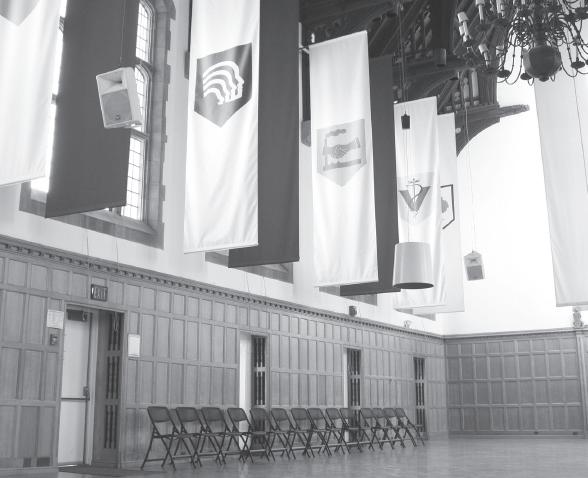
Out of session | The Willard Straight Hall Memorial Room lies empty without in-person Student Assembly meetings.
STATE SEN. O’MARA
Fauci Talks Vaccine Timeline at Virtual Homecoming Event
FAUCI Continued from page 1
he is currently unable to say which candidate is best, Fauci suggested that a vaccine would be ready by November or December of this year.
Fauci, despite being a member of the White House’s Coronavirus Task Force, has occasionally publicly disagreed with President Trump, who regularly downplays the severity of the coronavirus. After returning from a stay at Walter Reed Hospital, Trump controversially proclaimed in a video, “don’t let it dominate you, don’t be afraid.”
However, according to Fauci, “personally contradicting the President of the United States publicly is not a good thing if I want to get my job done.” Instead, he stressed the importance of wearing masks, avoiding crows, keeping a distance and washing your hands.
It was not just Snow asking Fauci questions throughout the event — three students, selected beforehand, were given the opportunity to ask questions.
Rachel Friedlander M.D. ’21 asked Fauci to give any advice to physician-scientists on effectively communicating important messages to the public.
“Realize and be humble to know you do not know everything and do not be afraid to say you do not know,” Fauci answered. “The goal in communicating is not to show everybody how smart you are, the goal in communicating is to have people understand what you’re talking about.”
Oummu Barrie ’22 followed up this question by asking if Fauci had ever doubted his own leadership abilities during his career and how he was able to combat that feeling.
Fauci said he had never doubted them.
He recalled his early years of conducting HIV/AIDS research, and how other experts then disagreed with him about his idea of meeting with AIDS activists and including them in their planning and discussions. Ultimately, he said, “it enriched the science, so I never doubted my leadership.”
Fauci also offered words of wisdom when asked how he got from Cornell to where he is today.
“It’s taking advantage of opportunities that come your way that you have no power over at all,” Fauci said. “You gotta have a good background and good training, but then what you gotta do is realize that often the things that take you into directions that you never planned, you have no control over.”
“I am very cognizant of people getting sick and dying. That’s real stuff for me, that’s not a statistic.”
Dr. Anthony Fauci M.D. ’66
In the end what really keeps Fauci hopeful is that, with a combination of interventions and public health measures, there will be an end to this pandemic.
For Fauci, the COVID-19 pandemic is what he used to describe as his biggest nightmare, he said. But he isn’t nervous now.
“I am very cognizant of people getting sick and people dying,” Fauci said. “That’s real stuff for me, that’s not a statistic. It just gives me more energy to say we got to get a vaccine, we got to get drugs and we got to get people to listen to us when we say what the public health measures are that we need to follow.”
Angela Bunay can be reached at anb75@cornell.edu.

Cornell Sustainability Boasts 1/3
Reduction in Carbon Emissions 2020 report showcases environmental progress, interactive design
By ONALEE DUANE Sun Contributor
The Campus Sustainability Office is showcasing Cornell’s one-third reduction in greenhouse gas emissions from 2008 and other marks of progress with this year’s annual report, made more interactive than ever with an elaborate design full of links, images and visuals.
The newly updated site includes a synopsis of 2020’s sustainability accomplishments, Cornell’s carbon neutrality progress, education and engagement, campus operations and future goals — shaking up the status-quo of the age-old PDF report.
In previous years, Cornell has maintained a gold rating in the Sustainability Tracking, Assessment and Rating System. Cornell is the first in the Ivy League and the sixth college in the world to reach platinum, the highest sustainability rating available.
STARS is a self-reporting
framework for colleges and universities to measure their sustainability performance. Cornell reports on thousands of sustainability metrics across campus operations, education, social justice and more.
With the one-third drop in carbon emissions, the site said that the University is “on track” for its goal of becoming 100 percent carbon-neutral by 2035.
Isabella Armas-Leon ’21 spent her summer at the CSO, working day-in and day-out on the sustainability report.
“For the first year, we finally got platinum, which is the highest rating you could get as an institution,” Armas-Leon said. “We didn’t just get platinum. We were the first Ivy to get platinum. That’s something that we thought, ‘OK, we have this huge news. How can we share this?’”
The communications department at the CSO used this as a basis to construct the report. With an extensive list of sustainability metrics and accomplish-
ments, the CSO chose what to feature.
“The truth is, no sustainability would happen on campus if it weren’t for the students and the faculty that are creating the solutions to these issues,” Armas-Leon said. “That’s what we wanted to highlight: ‘How did our Cornell community encourage change?’”
Other highlights on the report included the required sustainability learning outcomes Cornell students will graduate with, along with the benefits that community programs bring faculty, staff and students. It also highlighted the fact that, beginning in March 2020, renewable energy met all of Cornell’s campus electricity needs for the first time in 100 years.
“I took the report as, ‘Let’s do something that people are proud of and make people aware that Cornell is a leader in sustainability,’” Armas-Leon said.
Onalee Duane can be reached at osd4@cornell.edu.

First-Year Dinner Ends in Statler Isolation
Contact-tracing temporarily pulls students from campus life
CLUSTER
Continued from page 1
food delivered to your door, you get to chill in the bathrobe, you get your own private bathroom.”
But after several days, they all started feeling trapped.
“You just don’t feel like you’re at Cornell,” Zhang said. “It feels like you’re on a mini-vacation but not vacation because you’re isolated. When you’re in class, it’s kind of bizarre, especially when people recognize your [Zoom] background.”
Each student found their coping mechanism. Sontag ran 2.5 miles
in 440 laps around his hotel room, Breitman spent hours on the phone with friends, and Zhang said she ate plenty of meals over Zoom.
After eight days, they were released after several negative COVID-19 tests and checked out at midnight.
Matthew said he didn’t experience too much trouble readjusting to campus life, but mentioned feeling disconnected from new friends and events.
“It was an awkward time to leave. You’re just starting to kind of acclimate and you’re at this point where you just made your friend group and then you get pulled
out,” Breitman said. However, not all stuents have had the same
“You don’t have to be partying to get contact-traced ... All we did was eat dumplings with the wrong person.”
Helen Zhang ’24
“You don’t have to be partying to get contact-traced or to be in the presence of COVID because the group I got it with,” Zhang said. “All we did was eat dumplings with the wrong person. It was just circumstance.”
Kelsey Xu can be reached at kcx2@cornell.edu.
positive experiences in isolation in the Statler — especially as each of the three first-years tested negative for COVID19. One particularly egregious case concerning the treatment of a student who tested positive led to accountability demands through an Instagram campaign. Now, some of the first-years said they are significantly more aware of the risk of contagion and the danger of large groups.
A green Cornell | Beebe Lake glistens on a cloudy day. The CSO 2020 report shows slashed carbon emissions.
PARKER /
Cornellian-Led Biotech Company Treats Trump
Regeneron produces drug key in president’s treatment
By JENNIFER LIN Sun Contributor
After news broke last weekend that President Donald Trump tested positive for COVID-19, Regeneron CEO Leonard Schleifer ’73 was once again thrust into the spotlight, running the biotech company responsible for the experimental antibody cocktail that the president is taking to treat his symptoms.
Just last year, Schleifer was named Cornell Entrepreneur of the Year for being “a powerhouse in biotech,” according to a University press release. After starting Regeneron in 1988 with co-founder Dr. George Yancopoulos, the company has grown from a small startup to a leader in biotechnology.
Schleifer has been named repeatedly to Harvard Business
mental drug cocktail that has shown promising results in treating the initial symptoms of COVID-19 infections. The treatment, which is called a monoclonal antibody cocktail, works in a vaccine-like way, aiming to boost an individual’s immune defenses before more severe symptoms take root.
body like the president to go into a clinical trial just wasn’t practical,” Schleifer explained in an interview with The New York Times.
“We didn’t want to decide who gets a limited number of doses.”
“Asking somebody like the president to go into a clinical trial just wasn’t practical.”
Leonard Schleifer ’73
Review’s list of best-performing CEOs and Regeneron is consistently ranked among the most innovative companies by Forbes Magazine.
Now, Regeneron has not only gained recognition for its success, but also the experi -
Since the drug is still in experimental stages, it’s not available to the general public through any means other than a clinical trial. Schleifer had given Trump’s doctors access to the drug through “compassionate use,” which allows for patients with life-threatening illnesses to use experimental drugs. But Schleifer is more than just the man that supplies Trump’s experimental drug treatment
Dr. George Yancopoulos
The company is uneasy about giving priority use for the drug to certain patients. “We didn’t want to decide who gets a limited number of doses,” Yancopoulos told the Times. Ideally, the drug treatment would be available to many patients as soon as possible to transform COVID-19 from a life-threatening disease to a manageable illness.
Although the treatment is only available through compassionate use and clinical trials, Regeneron’s stock has already jumped by 10 percent in response to publicity surrounding the company’s involvement in Trump’s treatment.
— he has known the president for years and is a member of the Trump National Golf Club in Westchester.
Nevertheless, Schleifer says he hasn’t shown Trump favoritism in allowing doctors to use the drug, since “he is not the first patient to be granted permission to use the treatment this way,” but “asking some-
But regardless of the success and press that Schleifer has received as Regeneron’s CEO, during times of crisis, the health of patients is at the forefront.
“We want everyone to be potentially able to benefit,” Schleifer told Business Insider.
Jennifer Lin can be reached at jl4223@cornell.edu.
O’Mara Talks Renewable Energy, Budget Defcit
SENATE Continued from page 3
O’Mara voted against a ban on importing unregulated fracking waste products to the state, which has led to the shipment of hazardous materials — such as drill cuttings, waste water and contaminated tarps — into New York from Pennsylvania, according to the National Resources Defense Council.
These imports have halted since August 2020, when Cuomo signed into a law bill that closed the loophole in the 2015 fracking ban that allowed unregulated shipments. O’Mara voted against the bill to close the loophole.
Even so, O’Mara expressed support for making greater investments in renewable energy.
“Just because I’ve been supportive of natural gas exploration doesn’t mean that I have not been supportive of renewables,” O’Mara said. The senator lauded Cuomo’s climate goals, and said that more work needs to be done toward making renewable energy methods viable.
O’Mara suggested that energy storage for wind and solar energy needs more research and funding. Although he would not say whether he would sponsor any legislation along these lines, O’Mara promised to support any proposal that sought to boost the renewable energy industry.
The main target of O’Mara’s anti-regulation politics, however, is New York’s taxes on businesses. Protecting small businesses from steep taxes is one of his priorities.
O’Mara supports the reduction of franchise taxes that went into effect in 2017 through the state budget. But this legislation didn’t go far enough, O’Mara said, as it failed to cover “pass-through” entities, corporate structures in which the business owner, not the business entity itself, pays the franchise taxes.
generated off of that.”
But after months of a slowed economy, revenue is, of course, in short supply for New York, which passed a $177 billion budget in April. As O’Mara sees it, the shortage of revenue is only an exaggerated version of what the state typically experiences.
“This state doesn’t have a spending problem,” O’Mara said of the state’s massive annual budget, which ranks as the nation’s second highest behind California. “We have a revenue problem.”
O’Mara described his approach to making up this revenue as “all of the above” — a strategy that includes spending cuts, appeals for federal aid and perhaps certain tax increases. O’Mara’s passion for reducing the tax burden on businesses is matched with reluctance on the increasing taxes on the wealthy, citing concern of “capital flight” — the idea that if New York raises the tax rate for the wealthy, then the wealthy will migrate to other states, depriving the state of their tax dollars.
“This state doesn’t have a spending problem... We have a revenue problem.”
Sen.
would reduce costs on working families and businesses by avoiding expensive private insurance plans.
His support for reduced spending is not categorical: like his opponent, O’Mara opposes any defunding of the police. O’Mara characterized the current funding of law enforcement as “bare bones” in comparison to previous years.
“Just because I’ve been supportive of natural gas exploration doesn’t mean that I have not been supportive of renewables”
Sen.
Tom O’Mara (R-N.Y.)
O’Mara, the highest ranking Republican on the State Senate Judiciary Committee, is quick to clarify that he supports reforms — for instance, recruiting more diverse police applicants so that officer better reflect their districts’ demographics — and he believes that many instances of police brutality are attributable to racial discrimination. O’Mara supports racial sensitivity training for police officers, and said that instances of civilian death at the hand of police officers should be dealt with “harshly.”
While some academic research disputes the veracity of capital flight, O’Mara said that it may be situation of “death by 1000 blows” — that, although the wealthy typically do not leave the state in meaningful numbers as a result of increased taxes, you never know when they will say it’s the final straw.
Tom O’Mara (R-N.Y.)
Manufacturing, according to the senator, is the “lifeblood” of the Southern Tier. His focus on reducing taxes for businesses is founded on the notion that more money for employers means more, better-paid employees.
As he put: “The more money there is in businesses, the more people they hire. The more people they hire, the more they can produce, and the more the economy is
His main concern, in trying to mitigate the pandemic-induced financial deficit, is that federal aid should make up revenue losses that derive specifically from the pandemic. He cautioned against asking for federal aid that is aimed at mitigating problems caused by “the poor financial planning and spending habits of the state government.”
O’Mara is also a staunch opponent of the New York Health Act, a proposed statewide single payer program, on the grounds that it would cost the state nearly $200 billion. In their Oct. 1 debate, Danks Burke, who supports the bill, disagreed, saying that the New York Health Act
He suggested trying to increase the frequency of interaction between police and communities in non-combative capacities, in order to make the public more comfortable with the presence of police. That way, “when somebody sees a police officer, they aren’t just doing their enforcement,” O’Mara said.
“If they could be out and about and interrelated better, particularly with younger people in the community, there would be a better feeling about the police,” he said.
O’Mara was the only Republican in the senate to vote in favor of granting the New York State Attorney General the power of disciplinary review of significant complaints against police officers.
Alongside concern about Danks Burke’s values as reflected in her policies, O’Mara accused her of lying about her background — Danks Burke has said that she grew up on a farm — in order to appeal to the constituents of the district. For O’Mara, a victory for Danks Burke would mean a step further into the kind of excessive spending that he believes to be characteristic of New York’s government, but uncharacteristic of the values of the people in his district.
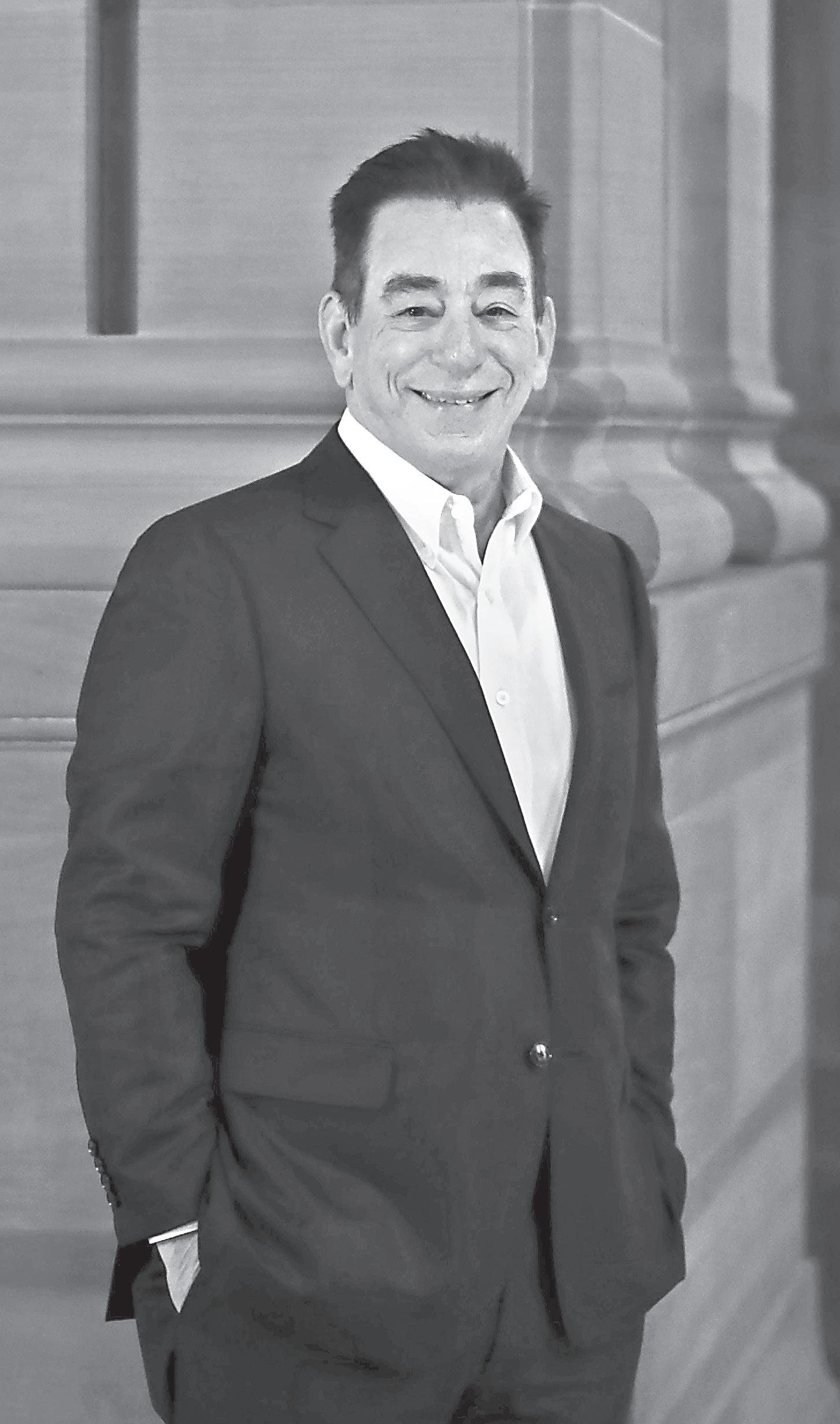
Pharma powerhouse | Regeneron CEO Leonard Schleifer ’73 founded the biotech giant in 1988 alongside Dr. George Yancopolous.
NATHANIEL BROOKS / THE NEW YORK TIMES
Dining Guide
Your source for good food

New to Ithaca: Kimchi Leaves You Craving Authenticity


By GRACE KIM Sun Contributor
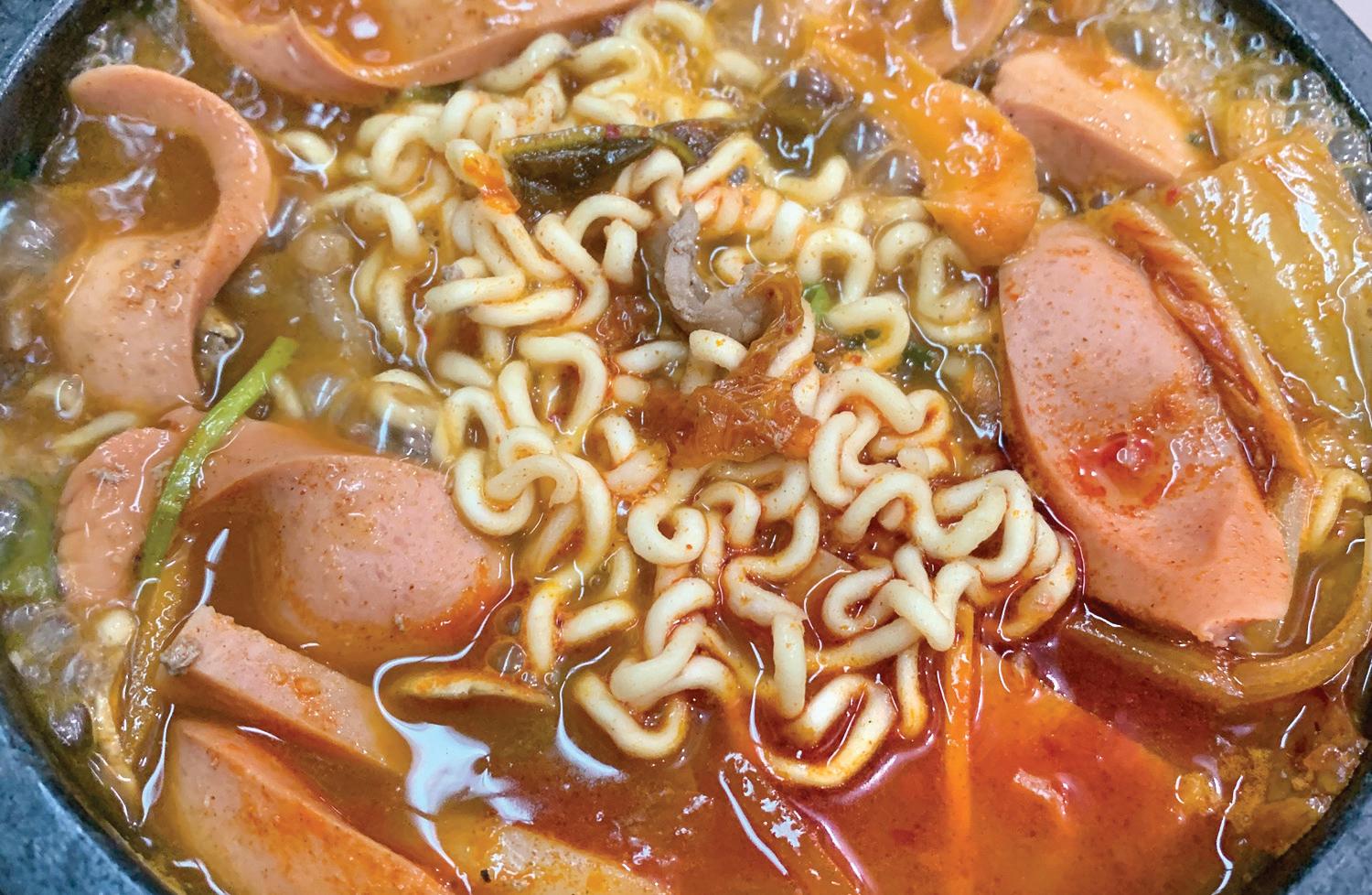
Having opened this past July on the West side of Ithaca Commons, Kimchi is a fairly new and cozy Korean restaurant that has a vast menu from noodles to Korean barbecue — the essentials of Korean cuisine. As a Korean student who was desperately craving home-cooked Korean food, I was more than excited to discover Kimchi on my daily Yelp search. When I first looked at the menu, I was overwhelmed by the amount of options they offered. I was already picking and choosing which Korean dishes to eat, something I hadn’t done in over a month. Ultimately, I ended up ordering tteokbokki, or spicy Korean rice cakes, the spicy Korean fried chicken and budae jjigae, a sausage stew that comes with a variety of toppings such as ramen, rice cakes and kimchi.
Right after we ordered, the waitress brought out banchans, complimentary side dishes that come before every Korean meal. It included kimchi, mini rolled omelettes and marinated fishcakes. Although the dishes were small, they were the perfect appetizers before a big dinner. Then the main dishes rolled out one by one until the table was filled with steaming meals.
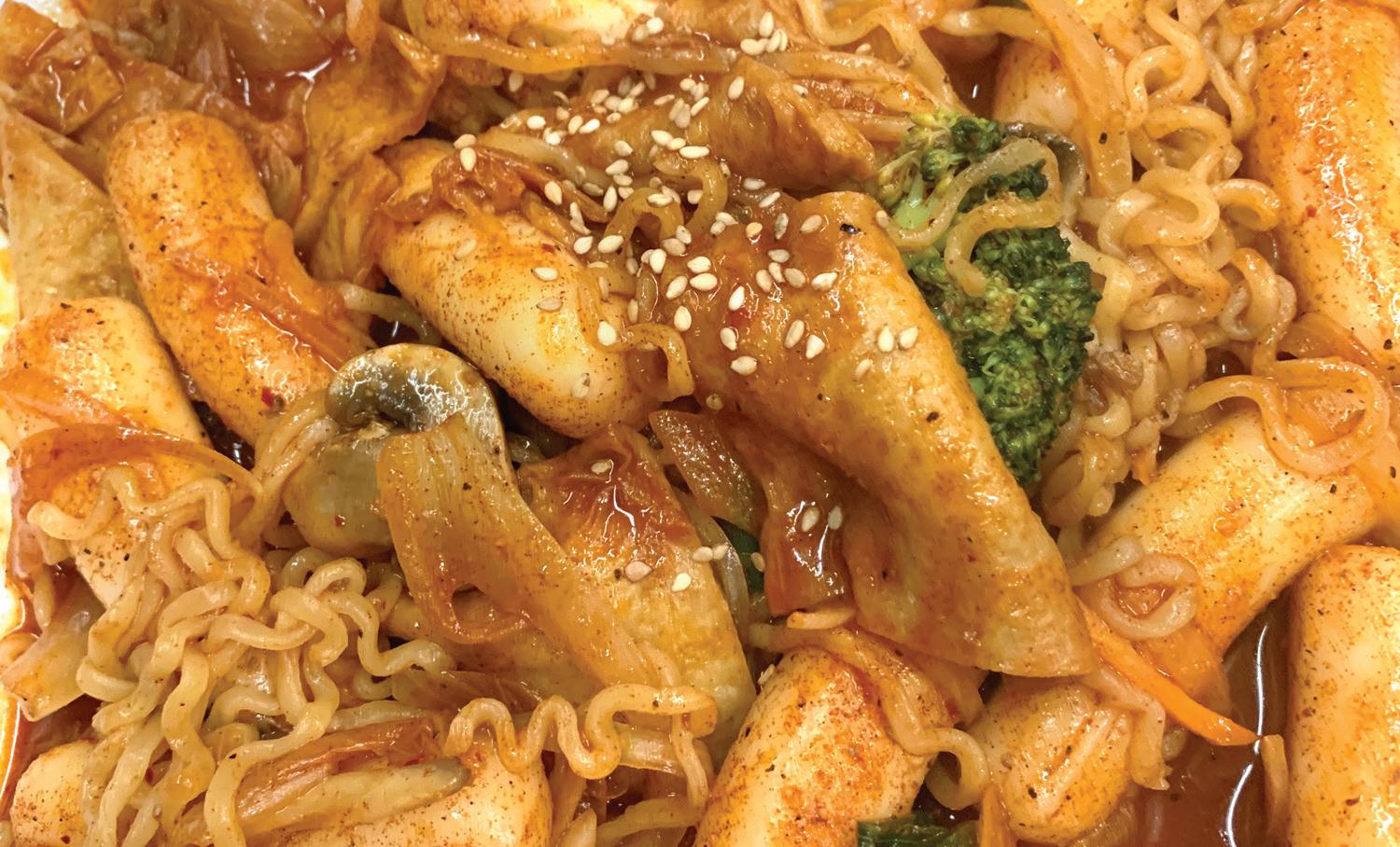
The first dish I tried was tteokbokki, served with plenty of ramen noodles and rice cakes mixed in. Although the visual was promising, the taste was bland and was lacking the sweet kick I was anticipating. The rice cakes were chewy and

didn’t blend in well with the sauce, leaving barely any taste at the end.
I was expecting a spicier and sweet tteokbokki sauce like what I’m used to having back home, but I immediately noticed the sauce’s
ratio of spicy and sweet was off.
The budae jjigae, however, had just the right amount of seasoning and wasn’t too spicy. It came out in a traditional Korean stew bowl, bubbling with flavor. I was pleasantly surprised by the many toppings like sausage and rice cakes added to the stew, making each bite just right. It wasn’t too salty and was complemented by the rice cakes and kimchi mixed in. It was the perfect stew to mix rice into.

Lastly, the spicy Korean fried chicken came drenched in sauce, making the wings barely visible. The chicken was perfectly fried but each bite was soaked in seasoning, making it hard to taste the actual chicken. In terms of the sauce, there was a strong kick of either ketchup or sriracha, leaving me wondering if the sauce was more sweet than spicy. I was expecting a more lightly tossed fried chicken rather than an overload of sauce. The Korean fried chicken I was used to eating had a more subtle flavor and a less liquidy sauce.
Overall my high expectations for this new Korean restaurant were let down by a lack of seasoning and flavor (or too much!).
Although some dishes were tasty, I left wanting a more authentic flavor that I’ve been craving ever since moving to Ithaca. I still crave home-style Korean food and hope to come back and give Kimchi another try in the future.
PHOTOS BY GRACE KIM / SUN CONTRIBUTOR

JOYBEER DATTA GUPTA ’21
Business Manager
PETER BUONANNO ’21
Associate Editor
MEGHNA MAHARISHI ’22
Assistant Managing Editor
CHRISTINA BULKELEY ’21
Sports Editor
BORIS TSANG ’21 Photography Editor
CAROLINE JOHNSON ’22
News Editor
ALEX HALE ’21
News Editor
ARI DUBOW ’21 City Editor
EMMA ROSENBAUM ’22
Science Editor
BENJAMIN VELANI ’22
Dining Editor
JOHN MONKOVIC ’22
Multimedia Editor
MIKE FANG ’21
App Editor
OLIVIA WEINBERG ’22
Assistant News Editor
MADELINE ROSENBERG ’23
Assistant News Editor
LUKE PICHINI ’22
Assistant Sports Editor
HANNAH ROSENBERG ’23
Assistant Photography Editor
BRIAN LU ’23
Assistant Arts & Entertainment Editor
ANNABEL LI ’21
Assistant Money & Business Editor
LEI ANNE RABEJE ’22
Layout Editor
JOHN COLIE ’23 Blogs Editor
’21
Darren Chang Swamp Snorkeling
Darren Chang is a senior in the College of Arts and Sciences. He can be reached at dchang@cornellsun.com. Swamp Snorkeling runs alternate Tursdays this semester.
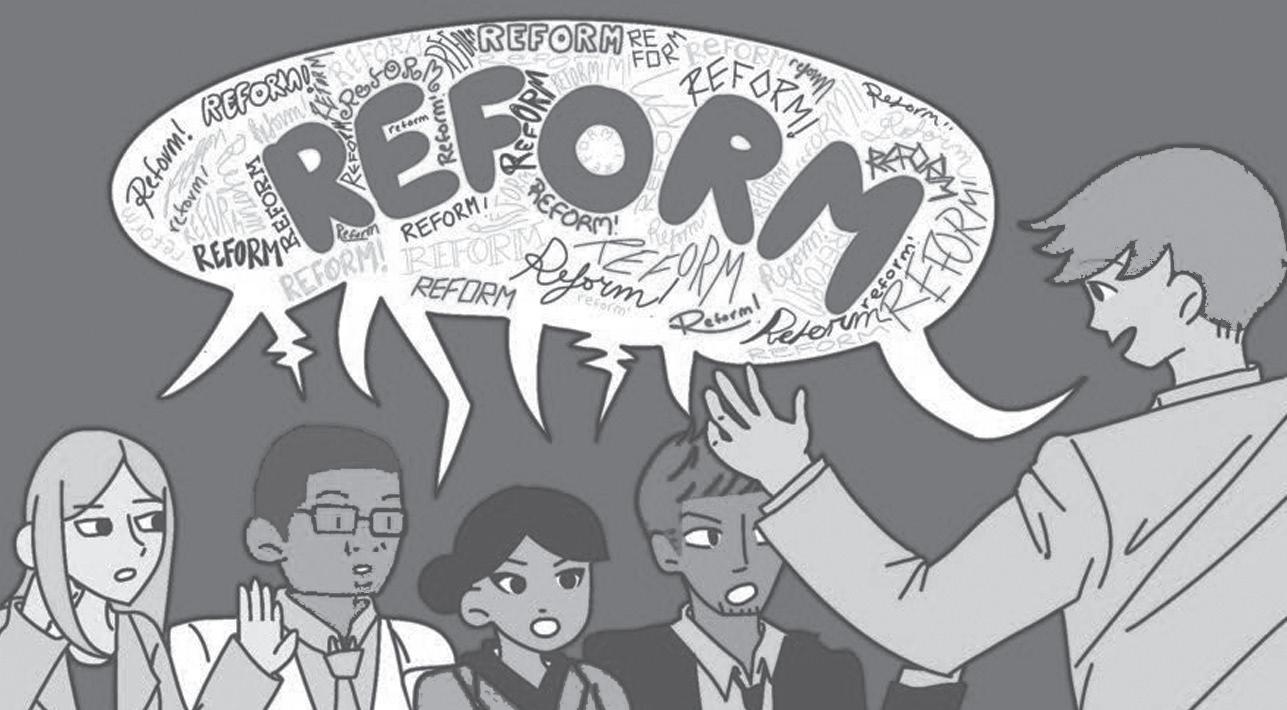
Reform the S.A.
In a letter to the editor, the Student Assembly directors of elections, Moriah Adeghe ’21 and Savanna Lim ’21, explained how voter disenfranchisement has plagued yet another round of elections. Ranked-choice voting is the culprit. While this system solves the need for runoffs and purportedly selects candidates with the broadest and deepest support, it has also allowed the Office of the Assemblies to throw out perfectly valid ballots. In past elections, this method of counting ballots has discounted over 25 percent of the ballots, including 1,435 ballots in the Spring 2019 S.A. president election and 1,761 ballots in the Spring 2019 executive vice president election.

While the widespread invalidation of ballots that aren’t completed is not new, the knowledge that the Office of the Assemblies counts ballots in this way is not widely known. This led to the abrupt suspension of the president and undergraduate representative races on Friday, Oct. 2 and a re-run election with a deadline of noon on Monday, Oct. 5. Good. This is the bare minimum for the Office of the Assemblies to qualify as accountable. The directions on ranked choice voting weren’t clear or obvious in either of the emails containing the ballot or the ballot itself; in a screenshot provided by the directors of elections, it was in fact the opposite of obvious that voters needed to fill out the entire ballot. Thus, it’s likely that a high number of ballots will be thrown out again, strengthening the argument that on-campus elections at Cornell are simply a farce of democracy. Most of the candidates in the election didn’t know about these rules, either, and they were left to inform supporters on their own in the eleventh hour, hardly a model of a fair and open election.
Yet, there was no meaningful change that was made: The Office of the Assemblies simply made it clearer that they would not count votes that did not rank all the candidates. This was neither the outcome the directors of elections wanted nor the outcome that Avery Bower ’23, candidate for the undergraduate representative to the University Assembly, wanted. And this is because requiring students to cast a ballot for every single candidate is an unnecessary burden and undemocratic: It doesn’t provide an option for an abstention or a vote of no confidence in a candidate. That’s an import-
ant detail, as there are certainly candidates on the ballot in any given election who could actively detract from the S.A. In a national election, the current ranked-choice voting system would have all of us voting for Vermin Supreme as the fifth place candidate. There’s no intrinsic reason why we need to rank all the candidates for the election to be properly and fairly counted, but there are reasons that the Office of the Assemblies’ actions in setting up the election and responding to the concerns of S.A. should be criticized. Disregarding ballots with a rationale that’s not entirely transparent to the student body harkens back to the strategy of voter disenfranchisement in darker, earlier parts of U.S. history when voters of color had their ballots invalidated for reasons that were not transparent. Disregarding ballots also ties into unfair electoral procedures for the November 2020 elections amidst COVID-19, with limited ballot drop-off locations and inane absentee ballot requirements. Although all of the S.A. elections are important, this election is especially so, given the amount of conversation that the S.A. and its members have engendered over the last few months.
For example, the Student Activities Funding Commission, which is part of the S.A., was accused of irresponsibly spending their funds by donating $10,000 to Cornell Students for Black Lives. The S.A. has been involved in many debates over the Boycott, Divestment, Sanctions movement and Zionism more generally. Finally, the S.A. was indicted for bullying tactics among its members, speaking to a toxic culture. It goes without saying that this election is a referendum on what Cornell students want in an organization that governs our student contributions and other pieces of the campus political puzzle — all with the added lens of COVID-19.
If you care about national elections, you should care about the down-ballot ones — especially the most down-ballot of elections. This election has the ability to cause hell for us this year or the ability to make our existence just a little better. The S.A. should not be decided on the whim of an office that has shown its decisions to be undemocratic and opaque. Vote and pressure the S.A. and Office of Assemblies to not allow another election like this one.
Tom the Dancing Bug by Reuben Bolling
WINNY SUN ’20 Newsletter Editor
Sophomore Slump It Up

Katherine Yao Hello Katie
Katherine Yao is a sophomore in the College of Arts and Sciences. She can be reached at kyao@cornellsun.com. Hello Katie runs every other Wednesday this semester.
Sophomore year is the awkward, forgotten middle child of the college experience. A new batch of eager-eyed freshmen has stolen the spotlight, pushing away the flock of washed-out students scrabbling for the last dregs of first-year excitement. The illusion of community that North Campus fostered doesn’t exist anymore as we scatter across the West Campus dorms and Collegetown apartments. Some friendships wane and the novelty of young adulthood grows stale. Classes increase in difficulty, seeding doubt into halfformed plans for major affiliation. At the same time, there’s no more excuse for struggling. We passed the trial period — freshman year. We should know how to play the college game by now. Right?
This “sophomore slump” is not unique to Cornell. According to a 2012 nationwide survey by the consulting firm Noel-Levitz, 25 percent of college sophomores reported feeling either uncertain about their place or
unenergized with classes. Furthermore, the support and encouragement that colleges try to provide to firstyears tend to subside, even as the stakes grow higher. Thus, the sophomore slump is seen as a major factor in attrition during second year, especially for undecided students.
In the past, some schools have started to find ways to bridge the gap between freshman and sophomore year. Ohio State University, for example, implemented a sophomore-exclusive program, where students engage in weekly meetings with faculty, learn career skills and obtain funding to conduct an individual project. Dartmouth University requires all students to spend the summer following sophomore year on campus, where they can connect with members of their class, delve into major requirements, and explore research opportunities. Cornell could learn a thing or two from these schools and make an active effort to show sophomores that they haven’t been deserted.
Even during a normal year, we sophomores are expected to make choices that will mold the latter half of our college careers –– and maybe shape the rest of our lives. At Cornell, most undergraduates face pressure to declare their major sometime during spring semester of second year. Within the span of a few short months, we’ll suffer through a dozen quarter-life crises before finally picking a course of study. Most of us will sign our souls over to the Ithaca landlords and learn to face the repercussions while others resign themselves to the housing lottery. Some of us might even decide to study abroad during junior year and scramble to adapt our schedules.
With graduation still three years away and without a definite life plan, staying motivated to navigate these decisions is hard enough during a normal school year, and this year is far from that. Online schooling brings its own major obstacles. Many professors have entirely changed their teaching styles and exam formats. Zoom fatigue runs rampant, draining away whatever energy there once was to learn. At least in my case, conversa-
tions on screen seem to have a stilted quality impossible to erase.
As someone taking classes away from Ithaca this semester, it takes far more effort than usual to maintain the connections I managed to forge last year. The weekly emails I get from the dorm I would have stayed in had I been on campus serve as stark reminders that I no longer have a solid community to rely on. More days than not, it feels as though I’m muddling through the year alone without any idea of how it might end.
Freshman year, I listened to my advisors, the upperclassmen, the professors: I welcomed the confusion that college brought. It was a sign that life was changing for the better, and I was changing along with it. Now, I’m still confused –– probably even more so than last year –– but the feelings of uncertainty have morphed into something to fear. After all, is there a point in crafting elaborate study abroad plans or fantasizing over Introduction to Wines when everything could deteriorate at any moment?
I’m trying to remember that the answer to that question is yes, there is a point. We should always take any excuse available to daydream about day-drinking. What better way to forget about the state of the world? Jokes aside, perhaps the slump is a product of having so many of these different avenues to decide between and not knowing what the right answers are. Maybe it’s because we have to start seriously thinking about what we want out of our time at Cornell.
I know that these considerations and conflicts will most likely stay with me for the rest of my time here in some capacity. Who knows? I might never have a clear idea of what I should be doing. But maybe that’s okay. Right now, we sophomores are going through one of the most traditionally uncertain times of college during the most tumultuous time our world has seen in ages. Every day that we push ourselves through online classes and homework, and every time we question our goals for the future, will only make us more equipped to handle difficulties later on down the road.
Cornell Should Help House Students Of-Campus

Roei Dery
Te Dery Bar
Roei Dery is a sophomore in the College of Arts and Sciences. He can be reached at rdery@cornellsun.com. Te Dery Bar runs every other Tursday this semester.
As freshmen begin to settle into the warmth of the dorms ahead of this winter, many upperclassmen are already on the lookout for their next homes. Tis’ the season of falling leaves, candy and house tours. Te last of the three, which has become somewhat of a Cornell rite, probably isn’t what Christian Baran ’22 has in mind when he calls on us to “Do the Seasons.” But, given the stress of fnding of-campus housing in a group full of rookie sophomores, it’s about as close as I can get at times. Perhaps the more accurate warning is “Winter is Coming:” Te dash to fnd afordable of-campus housing before options begin to dwindle within a few months.
In this spirit, what started as a cute couple of tours with friends has now devolved into failed negotiation attempts with landlords, constantly asking my go-to Hotelie about real estate lingo and sufered casualties (in the form of prospective housemates realizing the price to live in their frat is fractionally cheaper than the house whose lease you were planning to sign that night).
Tough my battle seems to be nearing its end (which is a thought I’ve had for about two weekends now), I address those underclassmen and fellow upperclassmen yet to embark on the of-campus housing search. Soon you will also shiver at the mention of leases, pro-rating and “utilities are not included.” Gone are the days of being coddled by Cornell housing. Sure, the price of housing in on-campus dorms is more expensive than
much of-campus housing, let alone the house meal plan that fails to pay of if you don’t wake up on time for breakfast and refuse to walk down and then back up the Slope for lunch on principle.
But being an upperclassman at a school that doesn’t guarantee housing is like being suddenly thrown into the wild; we are urged to sign leases as soon as possible by a likely irrational — yet very real — fear that collegetown will run out of housing, especially when searching in larger groups. By the same token, these housing groups are likely to lose people during the process, given more diversity in preferences and budgets. And even those seeking individual housing or housing in small groups are subject to higher prices, and may end up merging with other groups anyway. Te mentality changes from all students under one roof, on one campus, to brutal battle royal. Tough there are resources available to undergraduates looking to live of-campus undergraduates looking to live of-campus, when all is said and done, upperclassmen not in Greek Life or the like are really left to their own accords to fnd housing. For many students seeking lower-cost housing beyond the dorms, it’s Rush, Mozey or bust.
To reduce the stress and stakes of fnding of-campus housing, Cornell ought not to cut the housing umbilical cord from undergraduates. In fact, the University could go well beyond counsel and co-ops. Currently, Cornell does provide listings of of-campus apartments available to students. However, this list is in many ways incomplete, and in my housing search I have found that many other lucrative options are omitted. At best, this is Cornell merely checking a box in assisting with of-campus living, keeping a safe distance from the actual interaction between students and landlords, and the daunting task of reading over and signing a lease.
But it doesn’t have to be this way. If Cornell were to act as an intermediary between Collegetown landlords and students, helping set fair prices and connect the two parties, then perhaps the on-campus and of-campus housing processes wouldn’t be completely foreign in comparison. By compiling more comprehensive lists, and being able to reach out to a Cornell ofce directly to help locate and talk with landlords, the burden would be much lighter on students dealing with a semester in full-swing. Even more so, having the backing of Cornell administration in choosing of-campus housing would provide some consolation to the many tenants who don’t really know what they’re getting themselves into when signing on the dotted line. Whether it’s a Cornell representative who can assist with negotiation, reach out to landlords or just
help read over a lease, such small steps would help prevent yet another slew of upperclassmen who feel rushed into a lease agreement. On the fnancial side of things, Cornell could more smoothly integrate fnancial aid packages into lease agreements, beyond refunding extra aid after tuition is paid.
And, if we think bigger, Cornell could even look into operating of-campus housing that will provide low-cost options to students in need. Considering that co-ops are
If my experience these last few weeks is at all indicative of our off-campus housing search, Cornell needs to pick up the slack and be more active in assisting students, or take a direct role in the search process.
one of the only relatively low-cost options for non-freshmen students desiring to live in University-owned housing, more opportunities should be made available on this front too. Tough buying up enough of-campus housing — let alone constructing dorms — to house the full campus population is unfeasible at this point, Cornell could look into operating of-campus housing that will provide low-cost options to students in need, such that housing is no longer a socially infuenced part of Cornell life.
Te bottom line is that our school should start getting its hands dirty instead of waiving of non freshmen — many of which don’t know the frst thing about negotiating lease terms and don’t have a hotelie roommate to walk them through the process — from the Hill. If my experience these last few weeks is at all indicative of the reality of our of-campus housing search, then Cornell has much ground to cover. For the sake of landlords who need to speak to four parents spread across fve housing groups, and students who need to read over three leases among a wave of prelims, Cornell needs to pick up the slack and either be more active in assisting students, or take a direct role in the search process.

Fill in the empty cells, one number in each, so that each column, row, and region contains the numbers 1-9 exactly once. Each number in the solution therefore occurs only once in each of the three “directions,” hence the “single numbers” implied by the puzzle’s name. (Rules from wikipedia.org/wiki/ Sudoku)



COLLEGETOWN

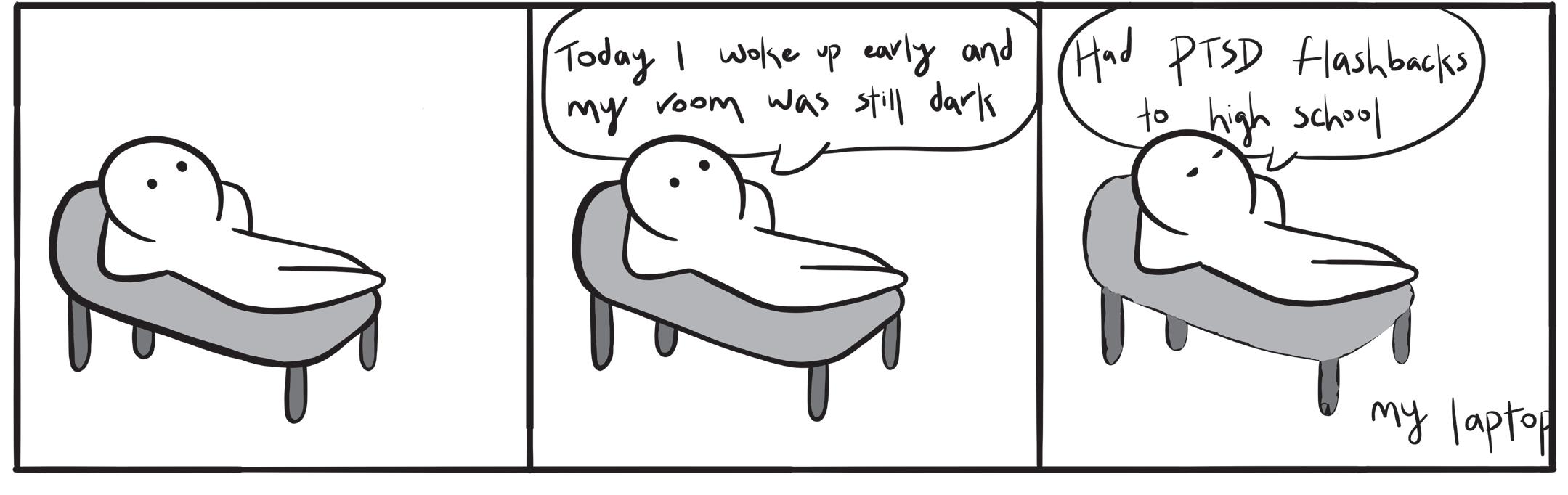

Mr. Gnu by Travis Dandro
Mr. Gnu by Travis Dandro Niko!
Priya Malla ’21
Faster than Light by Alicia Wang ’21
ARTS & ENTERTAINMENT
Museums vs. Diversity: Philip Guston Can Wait
On Sept. 21, Philip Guston Now, a retrospective show of Guston’s work between four museums including the National Gallery of Art and the Tate Modern, was postponed until 2024. Philip Guston was a Jewish immigrant artist who worked in the mid 20th century. Though he first gained notoriety for his abstract-expressionist paintings, he later shifted to representational work that often used hooded figures — Klansmen — to illustrate the racism and white supremacy that Guston witnessed in American society.
In the postponement announcement, the show directors acknowledged that “the world we live in is very different from the one in which we first began to collaborate on this project five years ago,” which prompted them to postpone “until a time... the powerful message of social and racial justice...of Philip Guston’s work can be more clearly interpreted.” The following days, the art world and beyond has erupted in a series of critiques, pushbacks, and callings to restore the show now. Even the New York Times churned out numerous articles on the ordeal.
An open letter spawned by the Brooklyn Rail and signed by big name artists, art critics and art-world adjacents framed the institutions’ decision and explanation as “[expressing] anxiety about the response that might be unleashed by certain paintings in which Guston depicts Ku Klux Klansmen” — plainly stated, that the museums simply fear controversy. The letter claims that the museums’ need to “reframe their programming” (NGA) shows “their longstanding failure to have educated, integrated, and prepared themselves to meet the challenge of the renewed pressure for racial justice.”

Philip Guston Now isn’t cancelled, just postponed. The museum directors acknowledge the weightiness of the present — not unlike how many artists delayed their album releases to make space for protestor voices. This decision dominated the otherwise tame art news cycle for two weeks and
counting, but was it really that incendiary?
It’s no secret that art intitutions, especially museums, don’t exactly champion an anti-racist praxis.
It wasn’t until the late 20th century — intersecting with the Civil Rights Movement and later the Feminist Art Movement —
Just last year, the Guggenheim put on Basquiat’s ‘Defacement’: The Untold Story, a wildly successful and comprehensive show, organized by guest curator Chaedria LaBouvier — the first Black woman to curate a solo show there. Unbeknownst to the public, Guggenheim leadership

that Museums and galleries increasingly granted Black consciousness space in the mainstream. Even then, the forces — gallery owners, museum curators, art critics — that propelled Black voices into the mainstream were predominantly non-Black ones, bringing questions of power dynamics between Black artists and the art world into view. As we might amend the saying: Old power structures die hard.
In 2018, a Mellon Foundation report showed that 84 percent of museum curators and 88 percent of museum leadership are white. These are the people who decide what voices and what artwork gets championed. And what doesn’t.
denied her of curatorial privileges and duties, silenced her, and left her out of a public panel discussion. In an extensive Twitter thread, she asks “What did the Guggenheim think they’d gain by….allowing this violence to happen behind the scenes and publicly erasing me from a show in which they own no works and almost no intellectual property?”
Four months ago, on the week #blackouttuesday, Glenn Ligon posted an email from Max Hollein, director of the Met, on Instagram. The email described the “upsetting and shattering” times and dutifully reported the ways the Met has used social media to “contribute to the national conversation,” and referenced works like Ligon’s that were shared. But Ligon never granted permission for the tokenization of his work. He aptly captions the post, “I know it’s #nationalreachouttoblackfolksweek but could y’all just stop... Or ask me first? Or apologize when you fuck it up?”
With all their do-good bravado, museums fall short of their own goals — and fail to champion the right goals — over and over, so I find it curious that people had such high expectations for the institutions behind this show to begin with. But even in un-jading my personal lens, I have to credit these four museums with coming forth and acknowledging their shortcomings, unprompted by the public and prompted instead by internal reflection, actually initiating a reckoning rather than taking to their social media about the need to “learn and grow.”
In an interview with Hyperallergic and later artnet, Kaywin Feldman, the National Gallery of Art director, acknowledged that the decision rested on two focal points. The first is that “Guston appropriated images of Black trauma” so “the show needs to be about more than Guston,” or, the need for additional context surrounding the exhibit. The second is that the show was done by all white curators. To both points, she presented not-quite-concretized solutions but also pointed out that changing — improving — institutional practices would take time and sacrifice, the Guston show being the most immediate example.
After endless outcry and petitions for museums to take actionable change, now it’s actually being attempted — and resisted by the same voices that demanded it. What would immediately reinstating this show offer? What would that imply for how we hold museums accountable for the change we’ve demanded?
Philip Guston isn’t going anywhere. He’s not getting censored or cancelled or taken out of the numerous public collections in which he’s included. Many open letters and Tweets and articles claim that this is the show that would rise to the moment, but there exist multitudes of worthy artists that could strengthen the current racial discourse in art. Ultimately, Guston’s temporary absence makes space. Maybe we can fill it with Black and other historically silenced voices, rather than reinstate Guston now.
Cecilia Lu is a junior in the College of Architecture, Art and Planning. She can be reached at zcl5@cornell.edu. Breathing Room runs alternate Thursdays this semester.
Queer, Latinx Spookiness in Cemetery Boys
Aiden Thomas’ Cemetery Boys is a fantastical read to kick your October off right. Filled with brujx (Latinx witches), ghosts, and a ton of Latinx magic, Cemetery Boys is the perfect romantic adventure to enter the spooky season.
The story follows Yadriel, a young trans boy who wants to prove his gender to his family by acquiring and wielding the powers of the other brujos in his community. In his brujx family, only men are allowed to summon ghosts and help them move onto the afterlife while women are expected to perform solely in the healing arts. Determined to demonstrate his skills and his identity to his family, he sets out to help uncover the truth behind his cousin’s murder. Instead of summoning his cousin, however, he accidentally summons the ghost of Julian Diaz, the local high school bad boy, and as you can imagine, trouble only ensues from there.
More than anything, this novel is simply fun. It presents a beautifully realized Latinx fantasy with vivid characters and rich descriptions. The main characters, Yadriel, Julian and Maritza, stand out from the page. The reader can truly feel and understand Yadriel’s hopes: Being accepted by his family, proving himself a real brujo and belonging both in his community and his own skin.
Julian, as the hot and hot-headed ghost of the band, is
complicated, vibrant and endearingly alive. Maritza, Yadriel’s cousin and strictly vegan bruja, is the friend you want watching your back, steadfast in her loyalty to both Yadriel and her refusal to use animal blood to perform the bruja’s healing magic. The fantastical elements of the world weave seamlessly with the L.A. backdrop, growing naturally out of the cultures that have inspired them. I particularly enjoyed the fact that

Yadriel’s family lives in and works at a cemetery, where the ghosts of young girls play around tombstones and snitch on Yadriel to his parents, and the deceased gardener still lovingly tends his marigolds even after death.
By far the best part of the story, however, is the relationship that develops between Yadriel and Julian. When they first meet, Julian is dead, just a faded version of the vibrant person he used to be, but even these embers are enough to light a spark. Compared to Julian, Yadriel is much more subdued and
quiet, but Julian’s influence helps bring out his more confident, reckless side. The steady growth of their characters as they learn from each other, and grow closer together, is heartwarming to experience.
My one critique of the novel is that the beginning especially seems to move forward a bit fast. The backstory and the exposition feel a little like they are dropped into the reader’s lap without much explanation; the characters move on quickly, not giving the reader much space to absorb or acclimatize to the basic setup and stakes of the novel before the plot really gets into motion. That said, once I understood the significance of Yadriel’s desire to be considered a brujo within the gendered binary of his family, I was fully able to immerse myself in the story and the rest of the novel moved at a wonderful pace. If you are looking for a queer, Latinx fantasy set around Día de Muertos and with a paranormal bent, Cemetery Boys is the right read for you. Yadriel, Julian and Maritza are a compelling trio to wander with on the streets of LA and around a cemetery full of ghosts. As they work to solve both Julian and Yadriel’s cousin’s murders, their investigations lead around twists and turns that you might predict and others you won’t see coming. Mysterious, haunting and romantic, Cemetery Boys is the perfect novel to begin your October.
Jessica Lussier is a senior in the college of Arts and Sciences. She can be reached at jll335@cornell.edu
JESSICA LUSSIER ARTS STAFF
Breathing Room
Cecilia Lu
COURTESY OF THE PHILIP GUSTON ESTATE
COURTESY OF MARS LAUDERBAUGH
FOOTBALL
The Evolution of Ivy League Football
By LUKE PICHINI Sun Assistant Sports Editor
While Ivy League football teams compete in Division I, their competition falls under the umbrella of the FCS instead of the FBS, which carries more prominent programs.
Prior to this shift, Ivy League football programs were among the most well-regarded in the nation. During the early origins of football, Princeton and Yale dominated in the 19th century and ultimately combined for 55 national championships.
In fact, seven Ivy League schools have claimed national championships with the lone exception being Brown.
Cornell has earned five national titles, with the most recent coming in 1939. As it turned out, that championship proved to be the Ivy League’s final national title.
1981 when the NCAA set criteria on home attendance and seating capacity, which four teams in the Ivy League could not meet. The conference considered adding two schools to avoid an ouster from Division 1-A (now known as Division 1 FBS), but in 1983, the Ivy League’s football teams were downgraded to Division 1-AA (now known as Division 1 FCS).
24-team bracket tournament to determine a national champion, Ivy League squads do not compete in any form of playoffs. Instead, the team that stands atop the Ivy League standings at the end of the season earns the
“We don’t have any playoffs, so this cup is our trophy — our bowl game.”
The Ivy League began to coalesce as the eight presidents signed on to the Ivy Group Agreement in 1945, which set the standards for the schools’ football programs, including the provision of prohibiting athletic scholarships.
Phazione McClurge
with how the Ivy League cham pion is crowned. Discussions about a possible bowl game have also stalled.
“The members of the Group reaffirm their prohibition of athletic scholarships,” the agreement read. “Athletes shall be admitted as students and awarded financial aid only on the basis of the same academic standards and economic need as are applied to all other students.”
This agreement extended to other sports starting in 1954. Over time, the conference continued to dig its heels with regards to scholarships. This ultimately hurt the Ivy League’s prominence as it struggled to compete with other major conference programs that morphed into national powerhouses.
While the Ivy League offered unparalleled educational opportunities, other universities offered actual scholarships and also served as more reliable pipelines into the National Football League.
The final nail in the coffin occurred in
would our champion play, with other teams commit ted to other postseason opportunities,” Harris said in an interview with Yahoo Sports back in 2019. “And then there’s a lot of other factors that would go into it. We have not even gotten past that hurdle.”
ular conference show downs have emerged as mini bowl contests in and of themselves. In the Cornell-Columbia rivalry, both teams have vied for
the Empire Cup since 2010. In addition, whenever Cornell and Penn meet on the field, they compete for the Trustees’ Cup.
Prior to the Red’s contest against the Quakers in 2019, then-junior wide receiver Phazione McClurge noted the significance of these particular conference games.
“This is our everything,” McClurge said.
tury ago, they have settled into a rhythm since their incorporation into the FCS. While some may advocate for a playoff system, others are comfortable with the longstanding tradition of the Ivy League.
Luke Pichini can be reached at lpichini@cornellsun.com.

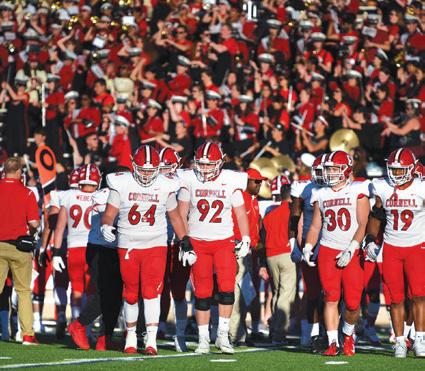
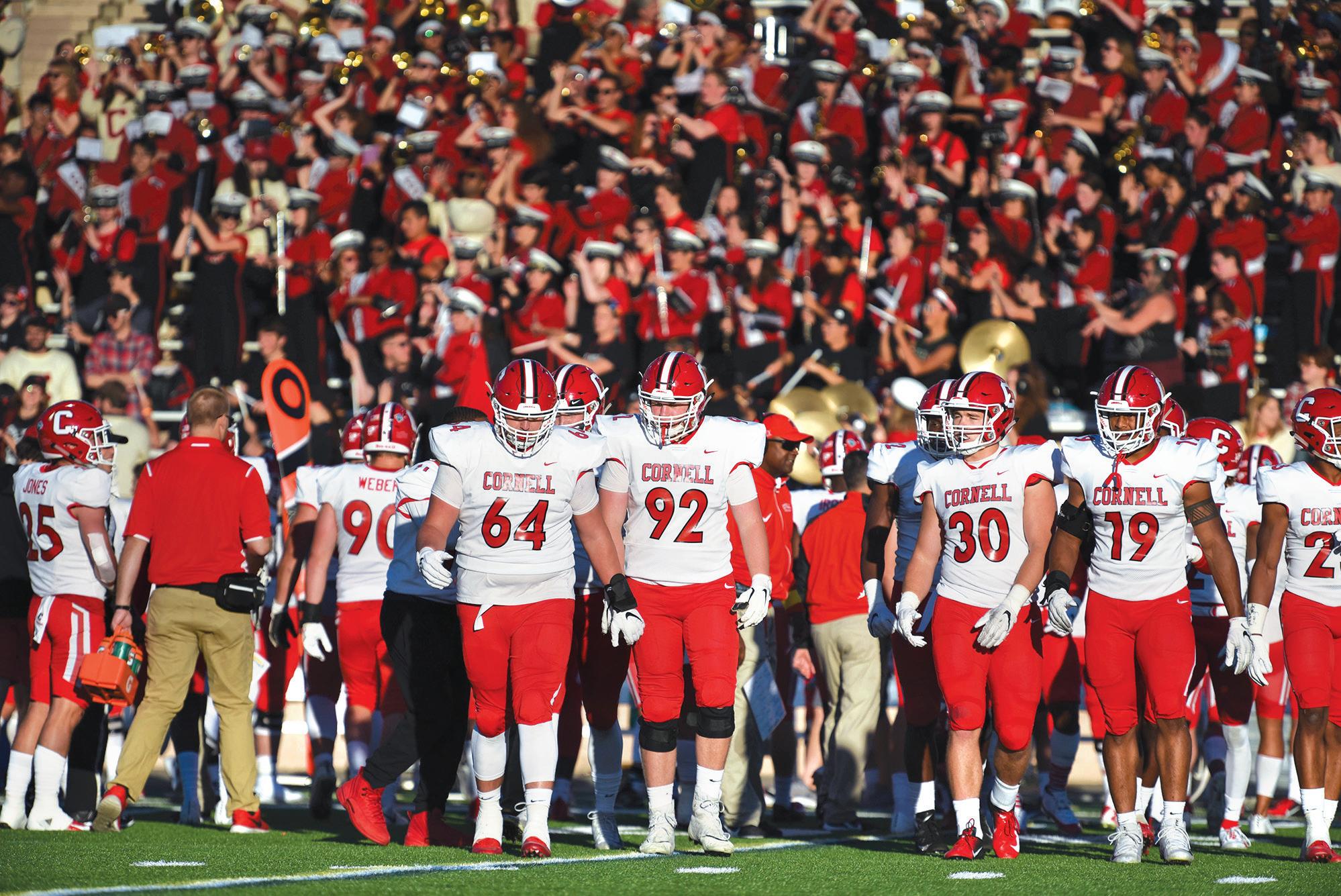
Old dogs in a new world | Though most FCS teams compete in a postseason tournament, Ivy League teams have retained tradition, forgoing any playoff participation.
BORIS TSANG / SUN PHOTOGRAPHY EDITOR