The Corne¬ Daily Sun

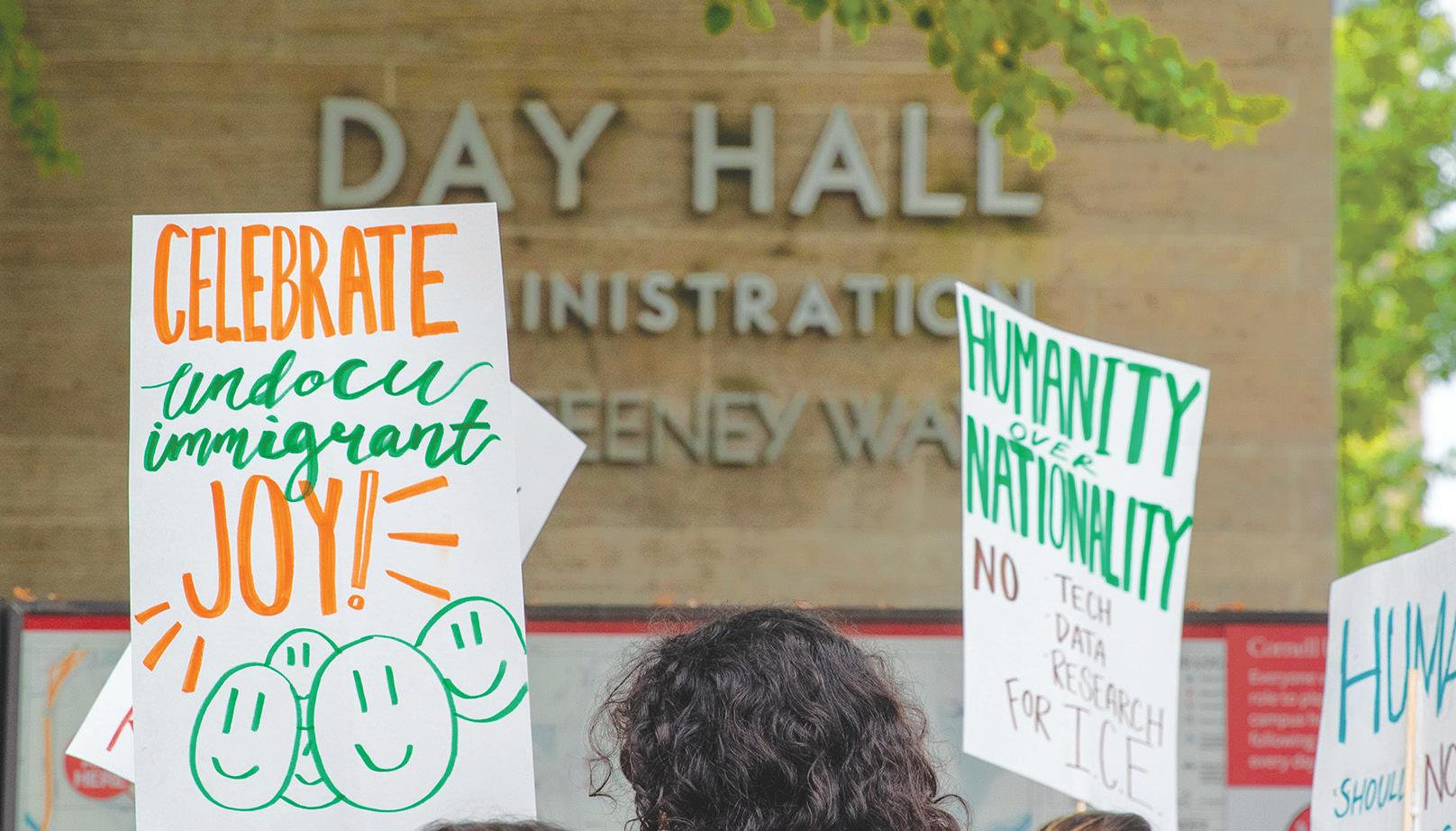
On Monday afternoon, around 40 students rallied for immigration Monday afternoon, around 40 students rallied for immigrant rights, demanding more legal services for undocumented students and an end to University contracts with Immigration and Customs Enforcement.
The rally, held in front of Day Hall, was organized by the Cornell DREAM Team, who is demanding that the University provide free immigration legal services to students, dissolve ties with ICE and provide more administrative support for undocumented students.
Protesters carried paper monarch butterflies as an immigrants rights symbol and signs reading “End the Contracts,” “Celebrate Undocumented Joy,” and “No one is illegal on stolen land,” while chanting “power to the people, no human is illegal,” and “humanity over nationality, people over profit.”
See RALLY page 3

and repurposing work.
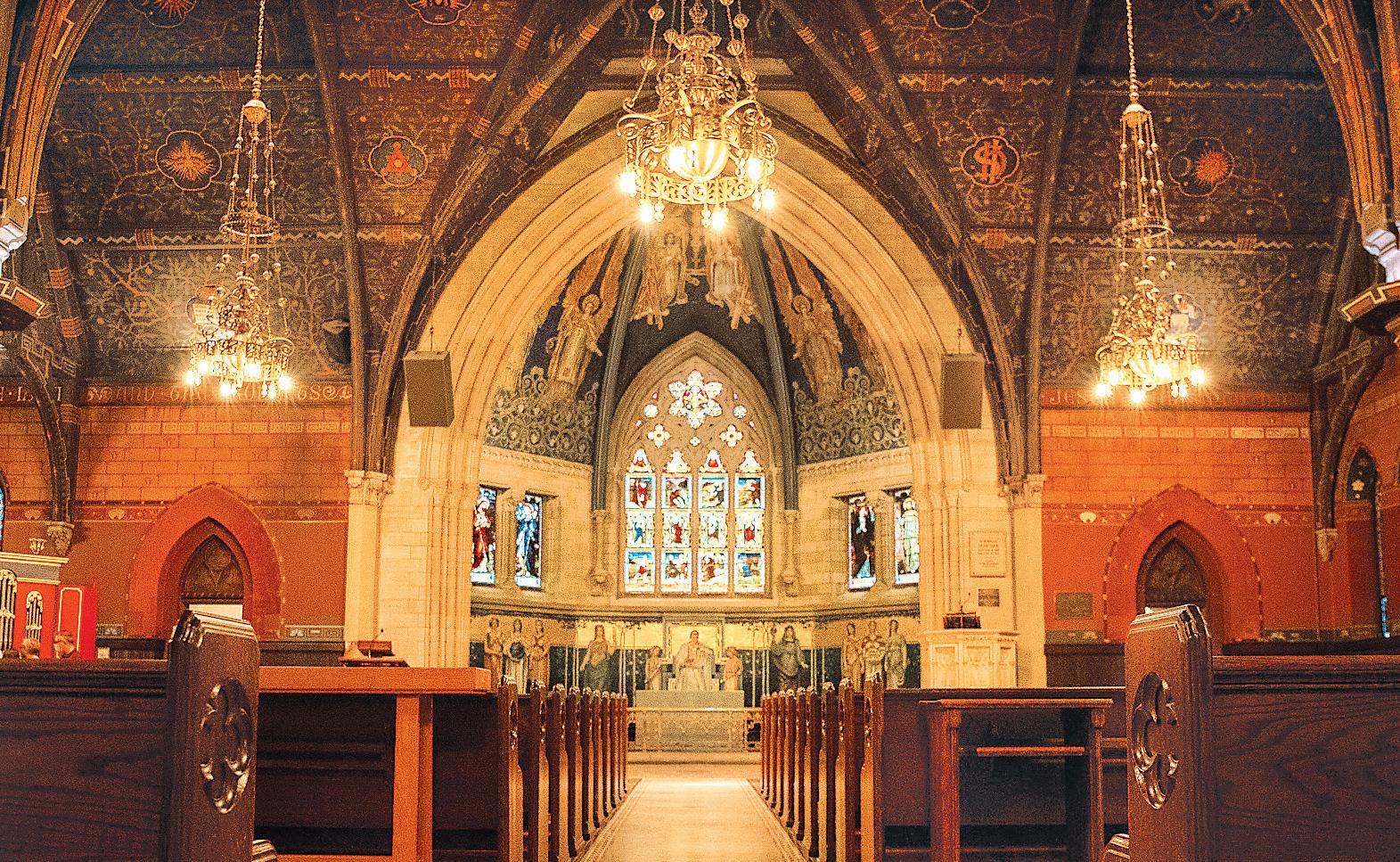
After more than a year of restoration and repurposing of the 146-year-old building, Sage Chapel officially reopened this September, inviting visitors into its amber and emerald hued gothic-style halls.
The chapel, which houses the graves of Cornell’s founding figures, including Ezra Cornell and Andrew Dickson White, has opened its doors after serving as a testing site in fall 2020. But student organizations say they continue to have limited access to the building due to COVID risks, and community members emphasize the need for further renovations in the building and on its historic organ.
Sage originally closed for repairs in summer 2020, but the renovation process was put on hold
when the building became a COVID-19 testing site the following fall. In spring 2021, it closed down again to complete renovations that included refinishing the pews and floors.
During the chapel’s closure and repurposing, many student groups that have offices in the basement of the building lost access, including the Cornell Chorus and Cornell Glee Club — both of which have called Sage Chapel home for over 60 years and have rehearsed there for 107 years. Without their usual rehearsal space, both organizations have relocated to Rhodes-Rawlings Auditorium in Klarman Hall, but have found rehearsing there to be a challenge.
“It has been difficult to rehearse in the auditorium because the chapel is so special. It has a choir loft that’s built for singing, and its acoustics are
By TAMARA KAMIS Sun News Editor
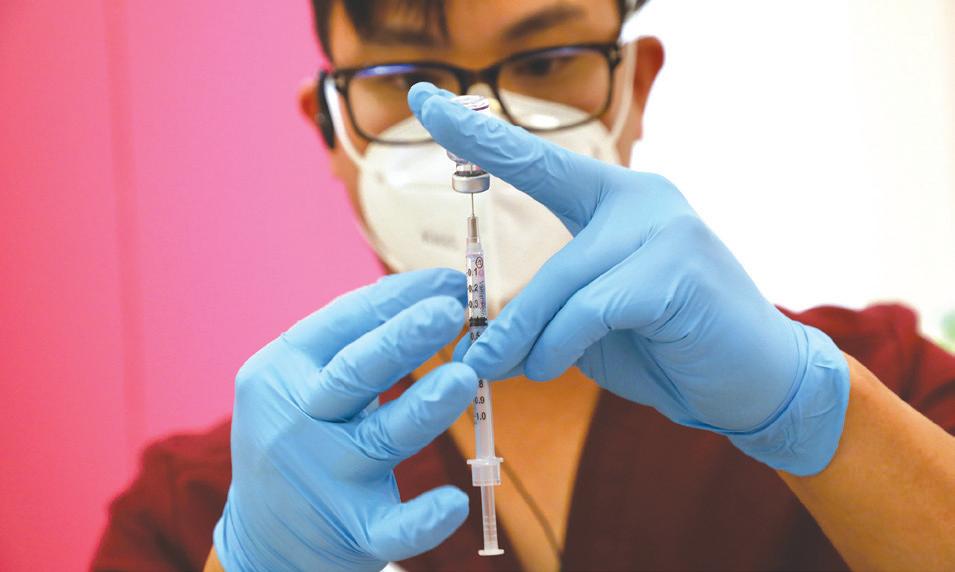
Under a recent executive order, Cornell will require all Cornell employees to be fully vaccinated by Dec. 8 — marking a shift from previous University policy that only encouraged faculty and staff to get their COVID vaccines.
In a Wednesday email to faculty and staff, President Martha Pollack, Provost Michael Kotlikoff and Vice President and Chief Human Resources Officer Mary Opperman wrote that — without an approved religious or medical exemption — all staff need to be vaccinated because the University has multiple federal contracts covered under the executive order.
This federal policy requires vaccination for all non-exempt employees of certain contractors that do business with the government, the email read.
For Cornell faculty and staff who have yet to get vaccinated, employees must get both of their doses by Dec. 8 to
fulfill the requirement.
“Unvaccinated employees should seek their first vaccine dose as soon as possible,” Pollack, Kotlikoff and Opperman wrote.
Ninety-nine percent of faculty, graduate students and undergraduate students are vaccinated. But only 91 percent of non-faculty staff are vaccinated. Cornell has required vaccination for students since August, but has until now only strongly encouraged vaccination for employees.
Vaccination is free, and faculty and staff can find a vaccination site through the Centers for Disease Control and Prevention and Tompkins County Health Department websites. Cornell employees in New York State can get up to four paid hours off of work to get vaccinated.
Fully vaccinated staff who have registered their vaccination with the University are in the clear. Cornell’s human resources department will contact those who have not yet been fully vaccinated and will provide information about the exemption process.
Thursday, October 7, 2021
The Role of Office Race and Gender in Police-Civilian Interactions in Chicago 11:25 a.m., Virtual Event
Gatty Lecture Series: The Mass Killings of 19560-66 in Indonesia: Problems of History and Responsibility 12:15 p.m., Kahin Center
Erin A. Cech - The Trouble with Passion: How Searching For Fulfillment at Work Fosters Inequality
3 p.m., 423 CC ILR Conference Center
French Conversation Hour
3:30 p.m., Stimson Hall, G25
Quechua/Kichwa Conversation Hour
3:30 p.m., Stimson Hall, G25
Chinese Conversation Hour 4:30 p.m., Stimson Hall, G25
Trade and Nation: How Companies and Politics Reshaped Economic Thought
4:30-6 p.m., Uris Hall, 262
The Archival Turn in Political Theory 4:45 p.m., A.D. White House, 201
How to Green Your Workshop/Event 5 p.m., Virtual Event
Transfer Your Transferable Skills 6 p.m., Uris Hall G08


Let’s Meditate With Cornell Wellness 9 a.m., Virtual Event
Cornell NanoScale Facility Open House for National Nanotechnology Day 10 a.m., Goldman Lounge, Duffield Hall
Cornell Virtual Graduate School Fair 11 a.m., Virtual Event
Foundations of Community-Engaged Learning: Three-Week Intensive 11:30-12:30 p.m., Virtual Event
Yiddish Conversation Hour Noon, Virtual Event
Jay Pitter: Engaging Black People and Power Workshop 12:25 p.m
What Remains: Colonial Racial Capitalism, Video Games, And an Empire in Play 12:25 p.m., A.D. White House, Guerlac Room
2021 Virtual Baker Symposium 12:30-3:30 p.m., Virtual Event
Polymers for Advanced Applications: From Controlled Chemistry to Unique Properties 12:30-1:30 p.m., Virtual Event
Farsi Conversation Hour 3:30 p.m., Stimson Hall, G25

DREAM Team vice president Stella Linardi ’22 and DREAM Team secretary Melissa Yanez ’21 said while some of the protesters’ concerns are newer, many of them are about long-standing issues that students have been protesting for years. Yanez said she hopes the rally will make the University take action on the group’s demands.
“I don’t need a Band-Aid solution anymore,” Yanez said. “DACA itself is not a solid form of status for anyone, yet Cornell treats it like it is.”
Deferred Action for Childhood Arrivals was an executive order under the Obama administration — then repealed under the Trump administration and reinstated by President Joe Biden in January 2021 — that allowed undocumented individuals who arrived in the U.S. as children to receive a renewable two-year period of deferment from deportation. People with temporary status through DACA are often called “dreamers,” a term from the Development, Relief and Education for Alien Minors Act, a proposed bill facing Congress.
Currently, activists at Cornell want increased support and legal service for undocumented students to navigate a tumultous and opaque legal system.
Linardi said she and her fellow organizers had planned the rally for two weeks — responding to the difficulties many new undocumented students especially say they have faced while trying to get legal assistance from Cornell since the semester began.
In a letter to the University administration — written by Linardi and other undocumented students, student activists and law students — the group demanded an end to many campus ties with United States. Immigration and Customs Enforcement, including limiting its presence on campus.
Linardi also said that following the rally, she received an email from the Cornell Law School offering a virtual “DACA Renewal Clinic” through Cornell Law School's 1L Immigration Law and Advocacy Clinic and Catholic Charities of Tompkins/Tioga County.
While this service would help Linardi and other students who already have DACA status, Linardi said she and other student organizers are especially concerned for students applying for DACA status for the first time because they may not know how to navigate the complex U.S. immigration system.
But beyond calling from greater support for undocu-
mented students from the University, according to Yanez, the rally also celebrated “undocumented joy.” Major parts of the rally involved singing parody songs targeted at the University and playing music through a speaker.
“I enjoyed just feeling the love and the support from different people because that's what we wanted to achieve, some undocu-joy, just like a celebration,” Yanez said. “I'm glad that my peers recognized me yesterday as a DREAM Team member especially, and I look forward to seeing people who really want to support undocumented students on campus.”
Thomas Dolan grad, a member of the Law Students for Abolition, said that the crossover between the two legal research databases used by Cornell Law — LexisNexis and Westlaw — and their connection to providing data to ICE made him want to get involved in the rally.
Dolan also said he believes that the Law School should make a statement addressing their contracts with the research databases: Dolan believes that while many students in the Law School use these services on a regular basis, they do not understand the ramifications of the data sharing the companies engage in with ICE.
“The best way to address [the issue of the data-sharing database contracts] is by working with the broader Cornell community, to call attention and call out, not only the dean of the law school but also President Pollack,” Dolan said. “That's why [the Law Students for Abolition] specifically were looking for outside groups and the DREAM Team is really the one that got this whole thing going.”
Two law students Claire Piorkowski grad and Serene Kabir grad also got involved in the rally taking the lead on the part of the letter of demands relating to the Lexis and Westlaw data sharing with ICE.
“I decided to become involved because I personally believe that no person, regardless of their documentation status, is ‘illegal’ while living on stolen land,” Piorkowski said, referring to the U.S.’s colonial past.
Linardi and Yanez said the DREAM team plans to expand their campaign to other Ivy League schools and the team is currently working with students at Dartmouth University. According to Yanez, collaborating with students in peer institutions has helped reduce the feeling of isolation that comes with doing advocacy work.
According to Linardi and Yanez, the University of California system has carried out many of the protocols they want to use as a model at Cornell — including a protocol in the case of ICE interactions, as well as an ICE interaction toolkit that applies to all students, faculty, staff and admin-
istration.
Relationships with ICE extend beyond the Law School to presence on campus, a large concern for activists, who are pushing for new protocol in the case of interactions with ICE. Linardi and Yanez hope to implement Know Your Rights training and further trainings during first-year orientation and for faculty and staff, alongside a safe house system and ICE alert notifications.
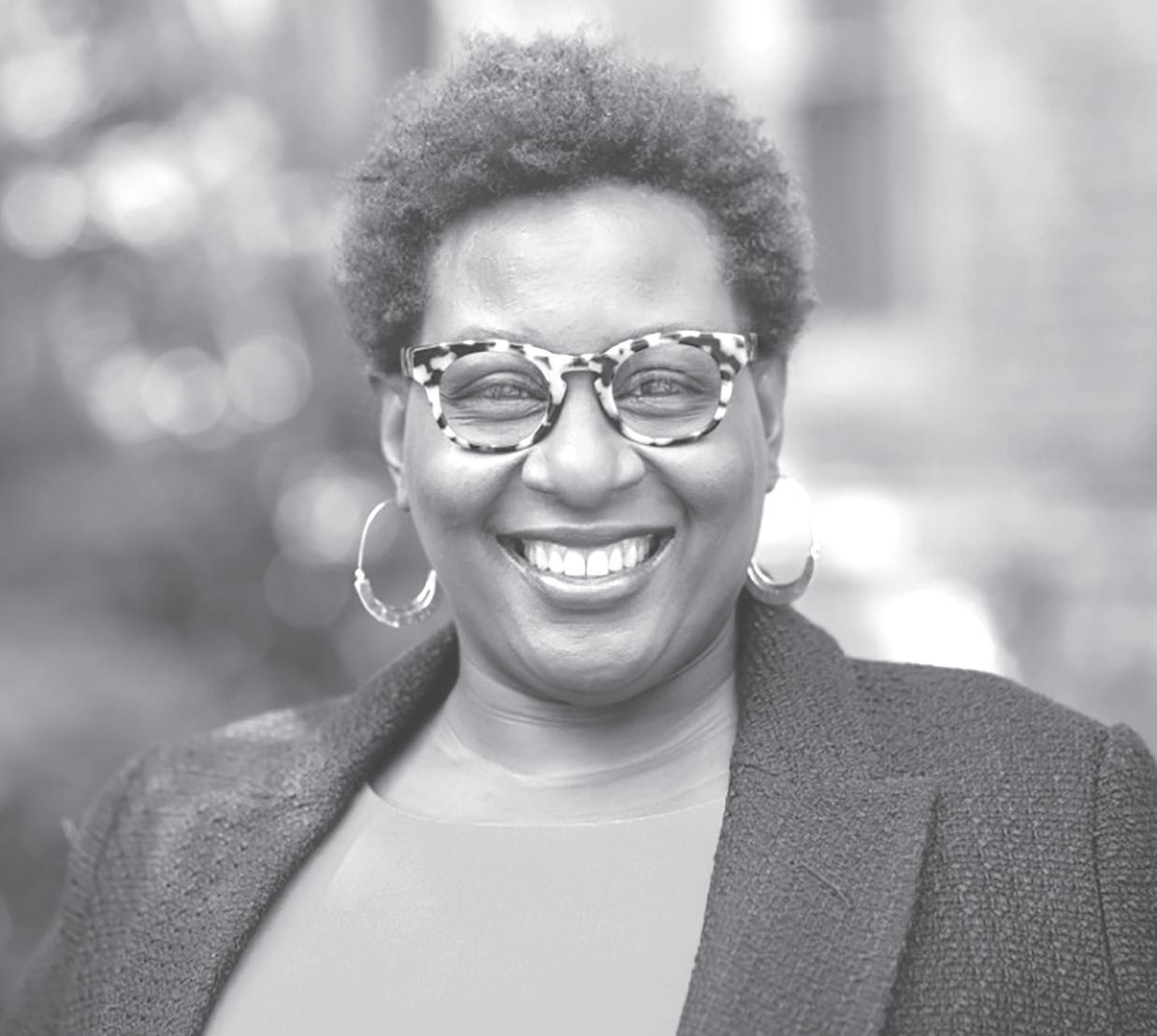
Cornell has named interim Dean Marla Love the Robert W. and Elizabeth C. Staley Dean of Students, the University announced Wednesday.
Love had served as interim dean since September 2020 after the departure of the previous dean of students, Vijay Pendakur. Before stepping into this post, Love served as Cornell’s senior associate dean of diversity and equity. During her time at Cornell, Love has been heavily involved in equity and mental health efforts, and plans to strengthen community among students.
Love joined Cornell as senior associate dean in 2017 and became involved in diversity initiatives aimed at engaging students of color. She also served as chair of the University’s Bias Assessment and Review Team, which provides resources for people who experience harassment or harm.
During the 2019-2020 academic year, Love co-chaired a campus-wide mental health review, where she worked with faculty to better understand their perspectives on student mental health. This year, she helped launch the University’s new Community Response Team, which provides assistance to students in crisis in on-campus residential communities.
Love is a mentor for the Meinig Family Cornell National Scholars program, a selective program for incoming students that demonstrate outstanding leadership. She is also part of the leadership team for the Kessler Scholars Program, which provides first-generation students academic, financial and social support. A first-generation college student herself, Love has overseen three cohorts of students through the program.
“DACA itself is not a solid form of status for anyone, yet Cornell treats it like it is.”
Melissa Yanez ’21
Victor Yengle grad, a member of the Graduate Labor Organization, came to the rally to advocate for the rights of immigrants in the workplace. As a previously undocumented person, Yengle also said he felt it was important to use his privilege now as a United States citizen to support organizations fighting for their rights.
“I empathize with the struggle that many immigrant students, especially those who are undocumented, are facing,” Yengle said. “It is my personal conviction to use the privilege I have access to now as a U.S. citizen to also support organizations fighting for collective recognition.”
At the rally, many speakers expressed their discontent with Cornell’s slogan, “any person, any study” in the face of barriers undocumented students face.
“It's hard to see Cornell being able to cultivate an image of inclusivity and diversity amongst academic success, while also refusing to better support its marginalized student populations,” Linardi said.
Linardi and Yanez said the best way the University community can support their efforts is by showing up to their demonstrations and helping with advocacy. Yanez said that simply recognizing the efforts of undocumented peers is not enough, and said she wants people of all immigration statuses to help with advocacy work.
“What we have achieved is incremental positive progress toward these demands,” Linardi said. “The bureaucracy of Cornell often serves to dilute student power and student input as stakeholders of their community and these policies.”
Rory Confino-Pinzon ’24 contributed reporting.
Before her appointment at Cornell, Love served 15 years at other educational institutions. She previously worked at Azusa Pacific University, where she served as director of graduate and professional student affairs and completed her Ph.D. in higher education. She has also worked at Scripps College, where she served as assistant dean of students, as well as at Calvin College and at Phillips Andover Academy.
As dean, Love plans to continue to support diversity and inclusion efforts. She will also continue to serve as one of Cornell’s Presidential Advisors on Diversity and Equity, a three-person team including the president, provost and academic deans.
“I have worked with Cornell students at defining moments in their lives and have been inspired by their courage, character and spirit,” Love said in a University press release. “I look forward to creating lasting partnerships with students as we build systems to support, strengthen and enhance the fabric of our campus community.”
very beautiful. It's just built for music,” said Caroline Hinrichs ’22, president of the Cornell University Chorus. “Klarman Auditorium is built for lectures. The seats that we sit in are not suited for music at all, but there's not enough room on the stage to fit the entire ensemble.”
According to Sam Schneider ’22, president of the Glee Club, not having access to the club’s office has presented administrative and logistical challenges.
More than a semester after Cornell shut down the testing site, the Chorus and Glee Club still have not been given a clear idea of when they will be allowed back into the building, according to the club presidents. Though officers are allowed to retrieve things from their offices by setting up appointments with members of the music department, the students have found the process cumbersome.
“It's just been really difficult not having access to that space,” Hinrichs said.



COLGATE AT
PRINCETON AT
COLUMBIA AT
OKLAHOMA
PENN



By GRACE KIM Sun Staff Writer
As I approached the commons, the harmonic melody of a violin welcomed me to the Commons
It was a surreal moment to see such liveliness and color amidst the streets in Ithaca on a rainy day.
entrance. This was just the beginning of the 39th annual Apple Harvest Festival, running in the Ithaca Commons from Friday, Oct.1 to Sunday, Oct.3 this year. All over the
Commons, the smell of apple crumble, kettle popcorn and fried food permeated through the air and mixed with the damp rain. This was my first experience at Apple Fest, and it only enticed me to visit every booth to check out the apple treats and local goods that merchants brought.
The main area of the Commons was focused solely on apple prod ucts like the famous homemade apple crumble, apple cider donuts and local apple cider. My first stop was the apple crumble booth, which already had a line formed around the tent. For $7, I was able to get a generous scoop of vanilla ice cream, surrounded by a warm apple crumble — I was not disappointed. The first bite was filled with a burst of apple cinnamon sauce, mixed in with the apple crumble, all finished by the cool vanilla ice cream. Addicting was an understate ment. Within a few minutes, I was able to finish the whole bowl, which made me only crave more.
local vendors were selling an assortment of products like eco-friendly t-shirts, flavored peanut butter and crystals. On the opposite side
potato pancakes and pumpkin funnel cake.
I then moved on to looking at the Carnival-themed booths across the street.

I proceeded to look at the arts and crafts booths, where
trucks, dedicated to selling hot meals such as Silo’s famous mac and cheese,

typical fair treats, such as cotton candy and caramel apples, there were also several carnival activity booths like balloon popping. It was a surreal moment to see such liveliness and color amidst the
streets in Ithaca on a rainy day. I quickly got in line to get the candy apple, drenched in homemade caramel, all finished with whipped cream on top. The slight bitterness of the apples mixed in with the sweet caramel was the perfect ending to my day.
Overall, my experience at Apple Fest was filled with awe, and it was delightful to see friends and families mingling around, eating treats and having a good time. I hope to come back every year during my time at Cornell, knowing that my bowl of apple crumble will be waiting for me, hot and sweet.
Grace Kim is a current sophomore in the School of Hotel Administration. She can be reached at gkim@cornellsun.com.
Apple Fest’s 39th Return |
Hundreds of Ithaca residents and Cornell students poured into the streets of Ithaca to celebrate the return of a long-loved Ithaca tradition. Over fifty vendors gathered to bring the Apple Autumn Festival to life. Present were a mix of Farms, Wineries, Cider Houses, Food Vendors and more.

Independent Since 1880
139th Editorial Board
KATHRYN STAMM ’22 Editor in Chief
ANUSHYA ALANDUR ’23
Business Manager
CATHERINE ST. HILAIRE ’22
Associate Editor
PRANAV KENGERI ’24
Advertising Manager
ODEYA ROSENBAND ’22
Opinion Editor
JYOTHSNA BOLLEDULA ’24
News Editor
TAMARA KAMIS ’22
News Editor
CAMERON HAMIDI ’22
App Editor
KRISTEN D’SOUZA ’24
Design Editor
HANNAH ROSENBERG ’23
Photography Editor
OMSALAMA AYOUB ’22
Science Editor
PUJA OAK ’24
Layout Editor
ANNIE WU ’22
Production Editor
MIHIKA BADJATE ’23
Assistant News Editor
SERENA HUANG ’24
Assistant Business Editor
ANGELA BUNAY ’24
Assistant News Editor
JOHN COLIE ’23
Assistant Arts & Culture Editor
AMELIA CLUTE ’22
Assistant Dining Editor
WILLIAM BODENMAN ’23
Assistant Sports Editor
AARON SNYDER ’23
Assistant Sports Editor
MEGHANA SRIVASTAVA ’23
Compet Manager Working
MADELINE ROSENBERG ’23
Editor NAOMI KOH ’23
Editor ANIL OZA ’22
Editor YUBIN HEO ’24
VEE CIPPERMAN ’23
NOOREJEHAN UMAR ’23
E.D. PLOWE ’23
YOON ’23
VELANI ’22
PICHINI ’22
TYAGI ’22
MENDOZA ’24
ARANDA ’23
Editor SURITA BASU ’23
News Editor KAYLA RIGGS ’24
LEYNSE ’23
’24
’24
’24
ALPERS ’22
’s
Wu ’23
Rosenband ’22
’23
deskers Tamara Kamis ’22
Mihika Badjate ’23
production desker Pico Ross ’22
layout desker Kristen D’Souza ’24
photo desker Julia Nagel ’24
dining desker Amelia Clute ’22
sports desker Will Bodenman ’23

Daniel Bernstein is a junior in the College of Arts and Sciences. He can be reached at dgb222@cornell.edu. Feel the Bern runs every other Monday this semester.
To make an impact in the fight against climate change, we have to change the way we live — I don’t just mean personal habits, I mean our literal living spaces. Existing buildings in the U.S. account for almost 40 percent of all energy consumed nationwide, and globally, they’re responsible for about 39 percent of carbon emissions annually. Fixing our homes and buildings is a crucial part of this battle, and one in which we can individually work to make a difference.
Building new green buildings is great, and thankfully, Cornell has made it an essential part of its growth over recent years. But it’s not environmentally friendly to tear down your home and put up a new greener version — construction is one of buildings’ main sources of energy consumption and carbon emissions. The answer is retrofits. We have to go into existing buildings and put on a little HGTV magic, fix them up and make them more sustainable.
This is so important, especially here in Ithaca, where so many of our houses are old and poorly insulated, and so much of our energy comes from gas and oil. It’s no different in Collegetown, where most of us students will live at some point in our four years at Cornell. As students, we have an opportunity to make an environmental impact.
As short-term renters, it may feel hard to make an effort. Landlords often don’t want to pay for energy improvements when their tenants are the ones paying the NYSEG bills, and we’re often not in one home for too long anyway. But small things add up, and we have options. Plus, it’s both a civic and personal good: energy efficiency and sustainable housing doesn’t just help the environment, but it saves you money. Your energy bills will go down when you use less energy or when your energy is renewably sourced.
Emily Belle is a community energy advisor for Tompkins County. She helps homeowners and renters who want to think about steps to reduce their energy costs and lower the greenhouse gas emissions associated with household energy use. She recently told me about different things College-student renters can do to make changes.
There are three different overarching categories of change that I talked about with Belle:
(1) Do-it-yourself fixes or habits that help insulate your home and help your energy
(2) Energy Evaluations, which show exactly where your house needs fixes and how to make larger improvements.
(3) Changing your energy source through community solar, which is surprisingly easy and makes a big difference in both energy usage and costs.
Some of Belle’s DIY suggestions are easy changes that add up: keeping the
temperature down (she said recommended thresholds are 68 degrees when home and 58 when out), using fans instead of ACs and making other energy efficient swaps like using LED light bulbs and unplugging devices when not in use (or turning off a power strip), because things like gaming consoles and TVs can drain energy even when off.
Some more hands-on changes include fixing some insulation issues yourself: you can check your windows and doors for air leaks. This can be a major energy drain because you need to use more energy to keep your house warm. Feel where the air comes from, and use rope caulk or plastic sealing to fix it.
Belle and I also talked about requesting an energy audit for your home. This is probably the most high-effort/high-reward option of the three options we discussed, but it can make a huge difference in your home’s long-term environmental impact and energy consumption.
Energy evaluations reveal where the real problems are, whether there are issues with heating, insulation, electricity, anything — and knowing Ithacan houses, we probably all have something. An evaluator can help tell you what’s wrong on a large scale and help you fix it. You can even learn about grants that will offer renewable heating sources — as students, there are some opportunities to get these things for free. You do, however, need to get your landlord on board for an evaluation, and it takes time, but it can be really meaningful. Belle told me that Cornell students seeking energy advising on an evaluation can contact her through Cornell Cooperative Extension.
The final suggestion, switching to solar, is easy, saves you money and makes a big change in sustainability. It doesn’t require any solar panels, and you can do it all on your own without landlord approval so long as you pay your own energy bills. Our electricity and energy has to be powered from somewhere. According to Belle, the Ithaca and the Finger Lakes area fuels its energy by using lots of hydropower, which is renewable and sustainable, but also a significant amount of natural gas. This is what we need to change.
New York State has a community solar program. You can subscribe to a local solar project, which takes clean energy from a solar farm and puts it into the local power grid. You’ll get credits on your electricity bill that help save you money. It’s an easy win-win switch that any renter in Collegetown can make — I’m doing it myself now and trying to get my friends to follow suit.
Making changes to save energy in your home helps your wallet, the environment and our community. Existing buildings can tear us down, but not if we rebuild them first.

Fill in the empty cells, one number in each, so that each column, row, and region contains the numbers 1-9 exactly once. Each number in the solution therefore occurs only once in each of the three “directions,” hence the “single numbers” implied by the puzzle’s name. (Rules from wikipedia.org/wiki/ Sudoku)




THE SUN offices will be closing at 5pm on Thursday, October 7, and will reopen on Wednesday, October 13 at 9am.
for
in the issues of Wednesday, October 13 and Thursday, October 14 is Thursday, October 7 by 3pm.
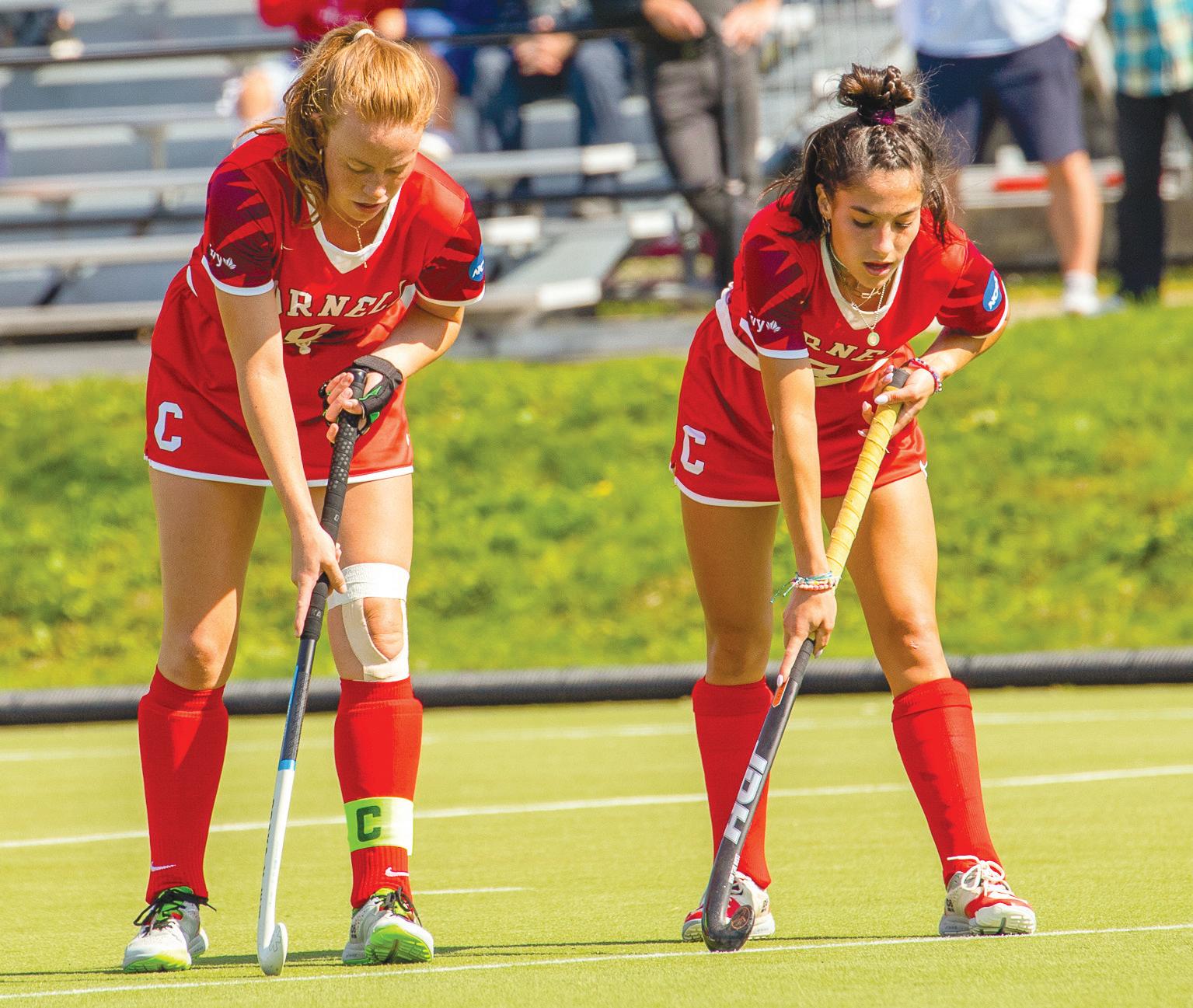
Elizabeth Friedberg found junior Isabella Palde for her second goal of the season. Palde struck once more before the half ended, this time connecting on a long pass from Ramsey to give the Red a 3-0 lead at halftime.
On the attack, the Red struck quickly in the second half, as Friedberg was able to corral the ball in front of the Lions’ net and keep enough balance to record her first goal of the season. The Red tacked on one more later in the third, when freshman Hanke Govaert found Mahoney for her first goal of the season.
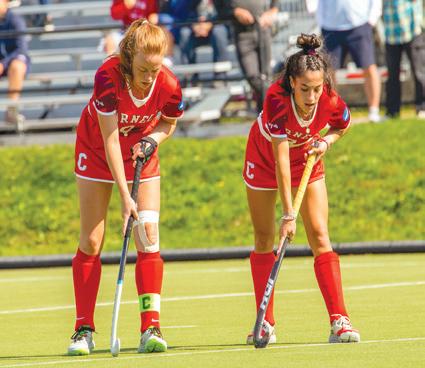
In a strong showing on both sides of the ball, the Red took its second contest in Ivy League play 5-0, the best record it had in a game this season. Despite recording 14 shots throughout the game and five on goal, the Lions were unable to find the back of the net, as junior goalkeeper Aerin Park tied her season-high with five saves.
For junior midfielder Isabella Palde, this burst of offense came with playing more as a team.
“I think the change that was made there was that we focused more on two-touch hockey and passing rather than individual skills,” Palde said. “We were able to connect really well at Columbia with our passing, and it allowed a lot of open play goals as opposed to scoring during corners.”
The Red had little time to celebrate this victory, as they took to the road the following day for a rematch against Colgate. The Red previously faced the Raiders at home on Sept. 12, taking that game 3-1.
The Red started off strong, converting its first attempted penalty corner of the game to take a 1-0 lead in the first. However, Colgate responded later in the quarter, scoring the first goal against the Red in a week. Ramsey responded by netting her ninth goal of the season and Cornell took a 2-1 lead. The Red added to this lead before the half, when Palde recorded her fourth goal of the year off a deflection of a shot by senior Avery Smith to give the Red a 3-1 lead into the half.
In the third quarter, Colgate was able to convert on two penalty corners, tying up the game at 3-3 heading into the fourth quarter. After a steal from a Raider defender, Friedberg found Palde on a sprint past the defense. Palde did a spin past the goalkeeper while maintaining possession and got a backhand shot off to put the Red 4-3 until the final whistle.
Entering this past weekend on a two-game win streak, Cornell field hockey had no plans to stop winning. The Red had its first back-to-back set of matches of the season, facing Ivy League rival Columbia at home on Saturday before traveling to Hamilton, New York, to face Colgate on Sunday.
Though the Columbia Lions entered Saturday’s matchup with a 6-1 record — with their sole loss coming at home against Harvard — they proved to be no match for the Red. After a competitive first quarter with no scoring, the team opened up the scoring in the second quarter on a penalty corner, when juniors Natalie Stone, Bridget Mahoney and Caroline Ramsey were able to execute their plan and Ramsey notched her team-leading seventh score.
Shortly after, the Red found the back of the net through open play, when sophomore
“We knew we had to score or essentially we were going to overtime,” Palde said. “I ran up high past the last defender so Friedberg was able to throw the ball over that defender’s stick. It gave me a one-on-one with the goalie and I was able to score.”
Head Coach Andy Smith couldn’t attribute the team’s success against Columbia and Colgate to anything in particular, but was pleased with the result nonetheless.
“It wasn’t necessarily massive adjustments. We did play against Columbia better than we had been all season,” Smith said. “There’s no real answer, no real major adjustments we made, it just came together for a change.”
The Red travels to Philadelphia to face Penn (3-6) on Saturday Oct. 9, and then to Lewisburg, Pennsylvania, to face Bucknell (6-4) on Sunday.
Grayson Ruhl can be reached at gruhl@cornellsun.com. Ruth Abraham can be reached at rva23@cornell.edu.
By KATRIEN DE WAARD Sun Staff Writer
The Red sailing finished sixth out of 18 teams this weekend in the Women’s ACC first round regatta, held in St. Mary’s City, Maryland, on Oct. 2 and 3. Finishing within the top nine teams, the Red qualified to compete in the Women’s ACC Championship Finals at Harvard on Oct. 16 and 17.
This weekend, the Red raced against 18 of the country’s 36 best intercollegiate women’s sailing teams. Among the sailors this weekend, the Yale Bulldogs placed first in both divisions, skippered by twins who sailed in U.S. 2020 Olympic qualifier regattas.
“Everyone’s skill was so high that there was little seperation between boats.”
Gabbi DelBello ’23
“Not only was it a challenging field of competitors, but the conditions were really challenging as well,”
Head Coach Brian Clancy said. “I think overall, we handled it quite well.”
The division A boat finished 12th in its division, sailed by senior skipper Brooke Shachoy, freshman crew Amelia Neumann and junior skipper Lillian Myers, who skippered for the 13th race in Shachoy’s place. The division B boat finished fifth in its division, sailed by freshman skipper Bridget Green and junior crew Gabbi DelBello.
“Everyone's skill was so high that there was little separation between boats,” DelBello said. “The time between the first boat crossing the finish and the last was only minutes.”
Sailors battled light winds and sunny skies in St. Mary’s City over the weekend. Easy breezes compounded mistakes, and sailors fought to find passing lanes.
“The starts and the first upwinds were just very competitive,” Neumann said. “You had to put yourself in a spot where you'd be able to maintain the whole race.”
Clancy commended the crews’ sailing in particular for keeping the Red competitive over the weekend.
“The crews on the team really made a big impact on the regatta, from a leadership standpoint,” Clancy said. “They were really focused, and that’s really helpful for everybody else.”
As a crew for the division B boat, DelBello had to make hard decisions to beat the competition. This fall season, DelBello and Green have emphasized trying to exhibit consistency in strategizing an approach and sticking to it. In the previous weekend’s Susan Rogers ’75 Memorial Regatta, the pair finished in second overall.
“In sailing, there is never one thing that always works. There is never one right answer and things are constantly changing,” DelBello said. “Bridget and I struggled to transition to a new strategy, because our old one had worked consistently for the past three regattas.”
Over the weekend, the boat struggled to make high-placing efforts, and DelBello said she knew they needed to change tactics.
“I feel like something clicked in my strategic decision-making skills,” DelBello said.

Making waves | Sailing’s sixth-place finish secured the team a spot in the Women’s ACC Championship on Oct. 16 and 17.
After switching gears, the boat’s performance soared. In the last two races, Green and DelBello finished with a two and one, their only first-place finish of the regatta.
“It felt so satisfying that by the end of the day, we had it figured out,” DelBello said. “It was too bad the wind was dying because I think Bridget and I could've continued this upward trend, but that’s the nature of the sport.”
Three other teams finished fourth in the Tom Curtis Memorial Regatta this past weekend in Washington D.C., a coed competition racing against five other schools.
The Red will compete in the Coed ACC Semifinals competition in Providence, Rhode Island, and the Stu Nelson Women’s regatta in New London, Connecticut, on Oct. 9 and 10.
Katrien de Waard can be reached at kd348@cornell.edu.