
C ommemorative P laques Give Belated
R ecognition to K ey C.U. 1960 s Events
Willard Straight Hall Takeover
April 19, 1969
By AMINA KILPATRCK Sun News Editor
“We are flawed. And our leaders are flawed. And our leaders are destined to periodically fail us for reasons as old as time.”
Zachary Carter ’72
“I’ll be damned if my children have to march for me,” sang the choir at the beginning of the homecoming weekend dedication.
This year marked the 50th anniversary of the Willard Straight Hall Takeover that ended on April 19, 1969. Now, the hall will be marked with a permanent plaque.
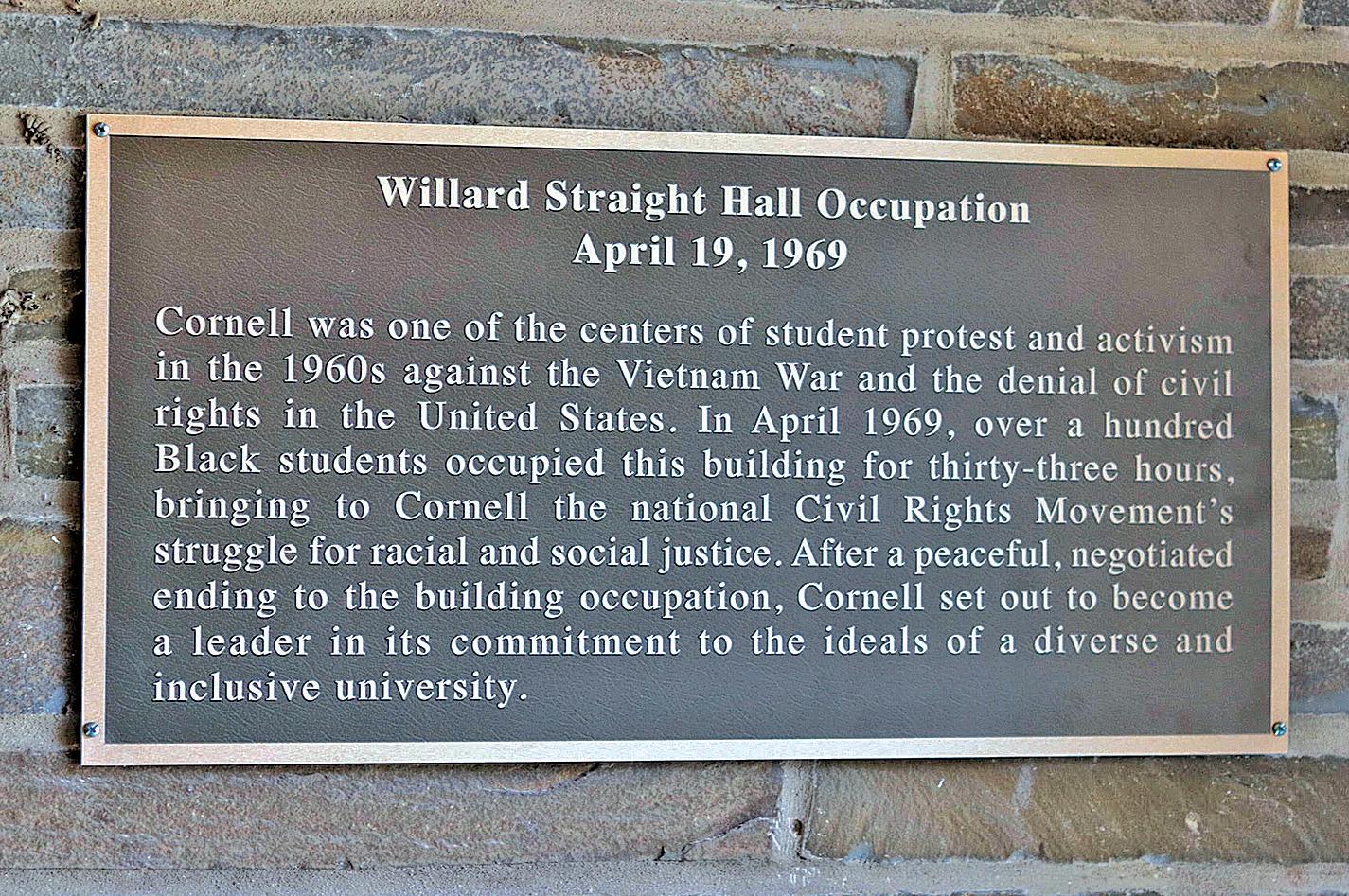
The tribute will occupy the space opposite a commemoration of Willard Straight 1901 in the breezeway entering the building. Currently, there is a facsimile is in place as the permanent plaque, which is cast in bronze, is not ready yet. The plaque reads: “Cornell was one of the centers of student protest and activism in the 1960s against the Vietnam War and the denial of civil rights in the United States. In April 1969, over a hundred Black students occupied this building for thirty-three hours, bringing to Cornell the national Civil Rights Movement’s struggle for racial and social justice. After a peaceful, negotiated ending to the building
See TAKEOVER page 5
ABOVE: MEGHNA
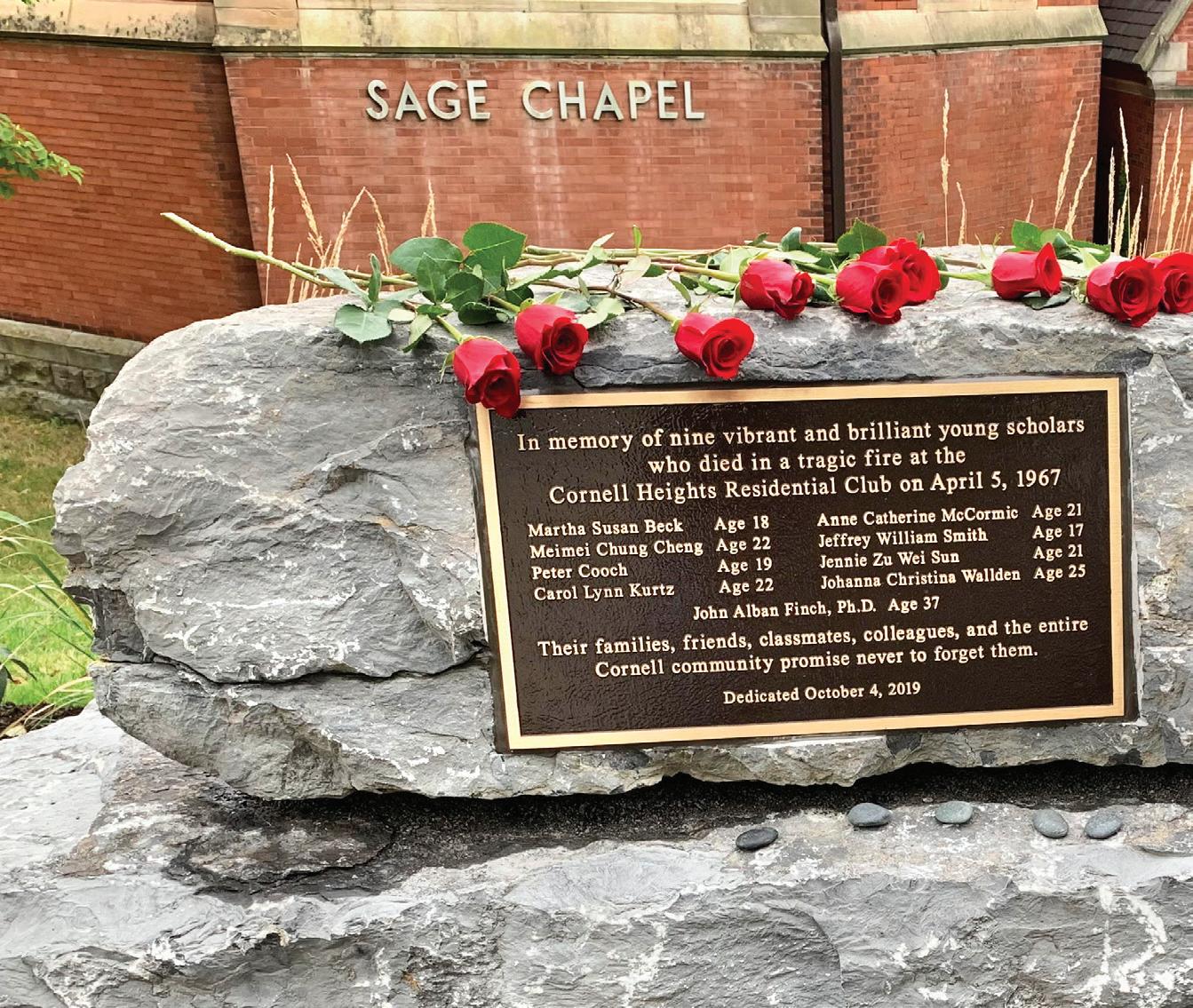
Remembrance | Cornell honored two events in its storied history with commemorative plaques this past week. Above: The residential club fire plaque is located behind Sage Chapel. Below: The Takeover plaque will be located in the Willard Straight Hall breezeway.
By MEGHNA MAHARISHI Sun Staff Writer
On April 5, 1967, a fire erupted in the Cornell Heights Residential Club, killing nine Cornellians. Fifty-two years after the horrific incident, the University dedicated a memorial to the victims at a ceremony outside of Sage Chapel on Thursday.
“For too long, all of you have felt unheard and your memories unacknowledged,” Cornell President Martha Pollack said in a speech at the event. “No one can take away the pain of what you experienced. But what we can do is hear your stories and become accustomed, become the custodians of your memories with this memorial, which will remain here in the heart of campus for as long as the University stands.”
A plaque now stands outside of Sage Chapel, engraved with the names of the nine victims, which reads: “Their families, friends, classmates, colleagues, and the entire Cornell community promise to never forget them.”
The fire broke out at around 4 a.m. in the basement of the Cornell Heights Residential Club —
“I think it’s good that the [University] did this. I think it’s sad that after 50 years, they still can't apologize or take responsibility.”
Joshua Freeman ’69
See FIRE page 4
Gordon Caplan ’88 Sentenced to One Month in Prison
T e sentence also includes community service, fne for paying $75,000 to boost his daughter’s ACT scores
By MARYAM ZAFAR Sun City Editor
Nearly eleven months ago, Gordon Caplan ’88 wired his first payment of $25,000 to a fake charity under the impression that his money would quietly bump his daughter’s ACT score. Today, a federal judge sentenced him to one month in prison, 250 hours of community service and a fine of $50,000 — less than the total $75,000 he shelled
out last year. The Cornell alumnus and now-disgraced international lawyer didn’t contest the case, pleading guilty to the charges of conspiracy to commit mail fraud and honest services mail fraud.
“I’m really sorry for my daughter, who I love more than anything in the world. She knew nothing about this. She hasn’t even applied to college yet,” Caplan said about his daughter, who is
now in her senior year, the New Haven Register reported. The former government major was the fourth parent sentenced, and the third sentenced by Judge Indira Talwani in the U.S. District Court in Boston. Other

A LISTING OF FREE CAMPUS EVENTS
Chemical and Biomolecular Engineering Fall Seminar Series
9 a.m., 255 Olin Hall
Cornell Initiative for Digital Agriculture Seminar Series
11:30 a.m. - 1:30 p.m., 114 Gates Hall
A Window to the Doors of Kathmandu 12:15 p.m., G08 Uris Hall
Communication Colloquium Series: New Directions For Communicating the Climate Crisis 1:30 - 2:45 p.m., 102 Mann Library
Mushroom Foray With the Cornell Mushroom Club 3:30 - 6 p.m., Plant Science Building
World Theater Voices: A Conversation With David Paquet
4:30 - 6 p.m., 220 Schwartz Center for the Performing Arts
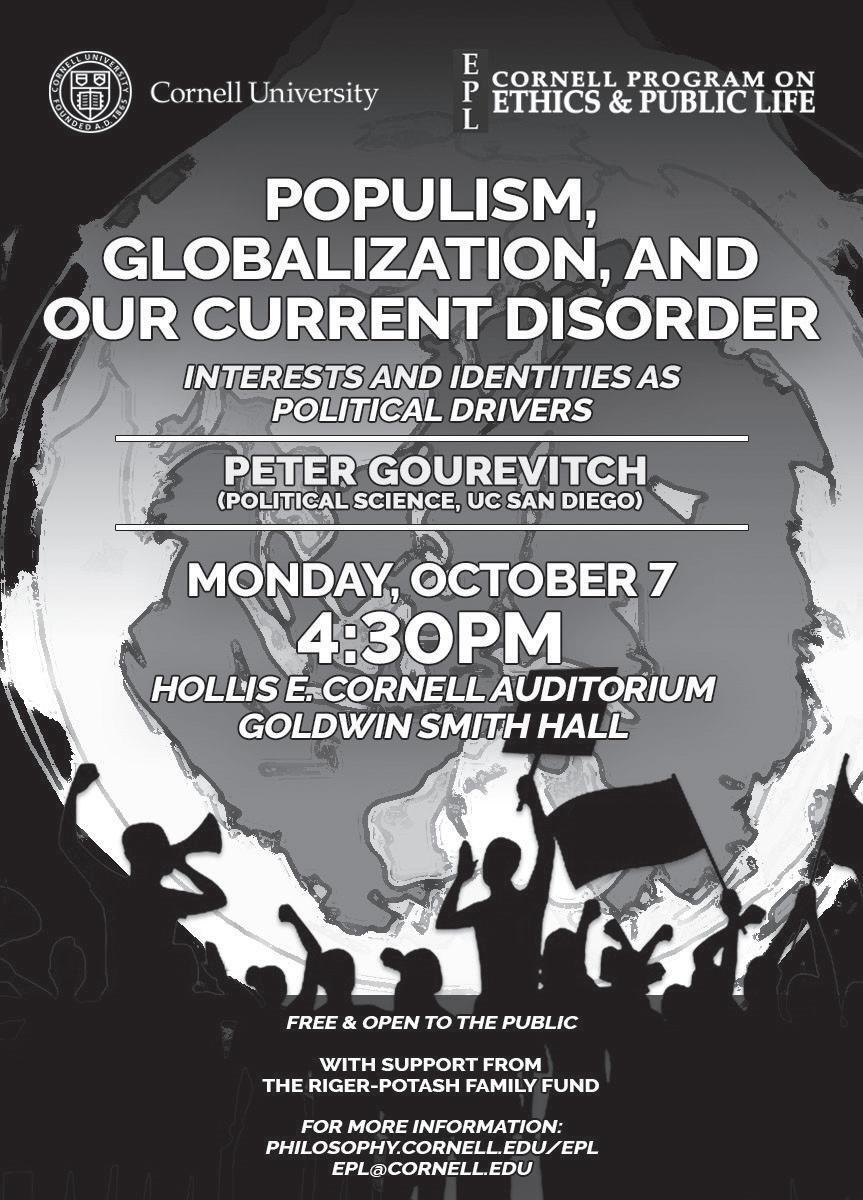
Populism and Globalization Lecture
4:30 - 6 p.m., Hollis E. Cornell Auditorium, Goldwin Smith Hall
Comparative Muslim Societies Seminar Series 4:30 - 6 p.m., 404 Morrill Hall
Learn How to Knit and Crochet 7:15 - 8 p.m., 604 Willard Straight Hall

Memories of a Faded Landscape Exhibition
8 a.m. - 4:30 p.m., Oliver Tjaden Gallery, Tjaden Hall
Department of Natural Resources Fall Seminar
3:30 p.m., G24 Fernow Hall
Carl Knappett: Artefact Typology as Media Ecology In Aegean Bronze Age Art
4:30 - 6 p.m., G22 Goldwin Smith Hall
Language Resource Center Speaker Series
4:30 - 5:30 p.m., G25 Stimson Hall
Poster Design and Printing
4:30 p.m., Mann 112, Mann Library
American Sign Language Conversation Hour
4:45 p.m., G24A Stimson Hall
Global Health Summer Programs Information Session
5 p.m., 200 Savage Hall
Yoga Sponsored by Cornell Minds Matter And Cornell Fitness Centers
5 - 6:15 p.m., 413 Willard Straight Hall
Cine Con Cultura Film Festival 2019 7 p.m., Cornell Cinema

Attention Advertisers Fall Break Deadlines



Display Advertising Deadlines:
• Thursday, October 10 at 3 p.m. for the Wednesday, October 16 and Thursday, October 17 issues.
Classifed Advertising Deadline:
• Thursday, October 10 at 3 p.m. for the Wednesday, October 16 issue.


The Sun’s Business Office will close at 5 p.m. on Thursday, October 10, and will reopen on Wednesday, October 16 at 9 a.m.

The doors to Kathmandu | On Monday, photographer Nipun Prabhakar will debut a series of photos based on the two years he
‘Access Ain’t Inclusion,’ Says Harvard Professor
By MEGHNA SRIVASTAVA Sun Contributor
To a fully-packed room in which audience members filled every seat, sat on the ground in rows and stood in lines in the back, Harvard University Prof. Anthony Jack, education, introduced his research to the audience with the following three words: “Access ain’t inclusion.”
Thursday, Oct. 3 marked the first stop of Jack’s book tour, which he kicked off at Cornell. His book, The Privileged Poor: How Elite Colleges are Failing Disadvantaged Students, published March 2019, explores access and inclusion for lower income students at elite universities. In his lecture, Jack relayed his personal story, his research, and advice for low-income students navigating Cornell.
Coming from a low-income background himself, Jack completed his undergraduate education at Amherst College, where he studied Women’s and Gender Studies and Religion, and his Ph.D. from Harvard University. His education at these elite universities, Jack stated, was proof that “even undreamt dreams come true. And I’m talking about those generational dreams that my grandparents and mother could not always put into words, but that they held onto in their hearts.”
However, Jack realized that once he was at those elite schools, he had to fend for himself: Although he had the support from his mother and grandparents, he found that there was a lack of resources and support for the transition from a low income background to a top-tier university.
Jack highlighted how 38 colleges in the U.S. have more students from the top 1% than the bottom 60, and that just 14% of undergraduates at the most competitive colleges come from the lower half of the income distribution.
“This disparity in destination is especially troubling given that selective colleges, places like Amherst and
Harvard, Michigan and Cornell, serve as mobility springboards for those from disadvantaged families, compared to lower-tier schools,” Jack said.
Jack’s research focused on interviewing 103 black, white and Latinx students while observing their campus lives over the course of two years. He aimed to answer the question: “What does it mean to be a poor person on a rich campus?”
Through these interviews, Jack was able to separate lower-income students into two groups: the privileged poor and the doubly disadvantaged. Jack defined the privileged poor as students who come from poor communities, but attend boarding, day and preparatory high schools before going on to elite universities, while the doubly disadvantaged are students from low-income areas who continue to study at local, often distressed public schools.
Jack argued that while elite universities are moving towards admitting more students from low-income backgrounds, universities still fail to bridge the gap between these students’ hometowns and an elite university for the doubly disadvantaged.
According to Jack, these students experience a culture shock because of their lack of exposure to the culture of an elite school. Through his research he asked the questions, “Which students immerse themselves into the college community? Who wants to leave after the first week? Who gets those strong letters of recommendation? And who says, ‘I couldn’t breathe here’?”
Navigating personal relationships was not the only problem the doubly disadvantaged faced, according to Jack — universities also fail to support these students through food insecurity and lack of familial support, as well as not accounting for students who need to stay on campus over breaks or do not have visitors on parents’ weekends.
Jack ended the lecture with a direct message to the
Editors Clash on State Of Democracy, Agree On Need for Better Media
By LOUIS CHANG Sun Contributor
Ezra Klein, the founder and editor-at-large of Vox, and contributing editor at New York magazine, blogger and author Andrew Sullivan debated the question of how democracy dies.
In an Oct. 3 conversation moderated by Prof. Liz Anker, English, the two panelists sparred over the root causes of the current political landscape — and what may be done to fix it.
“The country is changing too fast — [people] don’t recognize it anymore,” Sullivan said. “and that’s why the most winning slo-
gan in Brexit was ‘take back control.’”
Klein, on the other hand, had a more optimistic take. For him, even though “there is a feeling of crisis, rupture, and fracture … most institutions are doing reasonably well” in light of the social progress since the 1970s.
“We are probably more of a democracy today than we were in the 1980s — 1985,” Klein said.
Hosted by the Cornell Political Union in conjunction with Cornell Law School, the forum featured the two speakers debating concerns and solutions
students in the audience.
“Your college is your home. You are its citizenry,” he said. “Do not let the college receive donations in the name of diversity but spend those monies fortifying places where first-gen and lower-income students are not even allowed into.”
Jack’s advice to the students of Cornell can be summarized in one of his final statements: “Dare to demand as much of Cornell as Cornell demands of you.”
North Campus Combats Food Waste Trough In-House Composting Eforts
By CAITLYN WYMAN and VIRGINIA LO Sun Contributors
As concerns over climate and food insecurity mount, Cornell has launched the North Campus Waste Reduction Campaign — a multi-pronged effort that seeks to encourage students to increase composting in a bid to boost sustainability.
Cornell’s Sustainable Campus initiative explained that “when we throw away edible food, we also exacerbate food ... insecurity for those in need,” as resources that have gone to the production and delivery of food go to landfills instead.
In one effort to bring food waste to the forefront of students’ minds, the program has featured composting demonstrations in North’s dining halls, which weigh the remains of diners’ meals to demonstrate just how much trash can be produced by a single dish.
However, despite the interactive displays, it can still be hard to get students on board.
“The one time I saw peo-
ple composting was when there was somebody actually sitting in the booth right next to the tray return,” said Margaret Woodburn ’23.
In contrast, Risley’s dining hall has sought to boost participation by enforcing more stringent sustainability policies.
“I’ve been going to Risley a lot and I love the way that they do their food where you have to clear off the plate entirely before you put it in,” said Liam Kaplan ’23, who explained that he and other students would be willing to put in the time to compost more, as it was something that he did in high school as well.
Beyond the dining hall campaign, compost bins have also been placed in community kitchens on each dorm’s floor, along with a compost manager who changes the receptacles out each week.
Anna Goodman ’22, the compost manager for the Loving House, said that a student takes the compost to a central collection place in Low Rise 6 once a week, from where it is directed as
needed.
Students can choose to compost food waste from cooking in the kitchens, which involves simply placing food waste in bright green bins labeled with what can and cannot be composted.
“I feel like it should be the University’s responsibility to make it possible and easy for people to live as sustainably as possible,” Goodman said.
“I think more people should be using [the compost bins] because ... it’s not going out of your way to use it so I feel like if a lot more people used it, it would make a big difference,” said Kymani McCullock ’23.
But efforts to encourage greater student recycling represent only one component of the plan to boost sustainability on campus, with much of the efforts occuring behind the scenes.
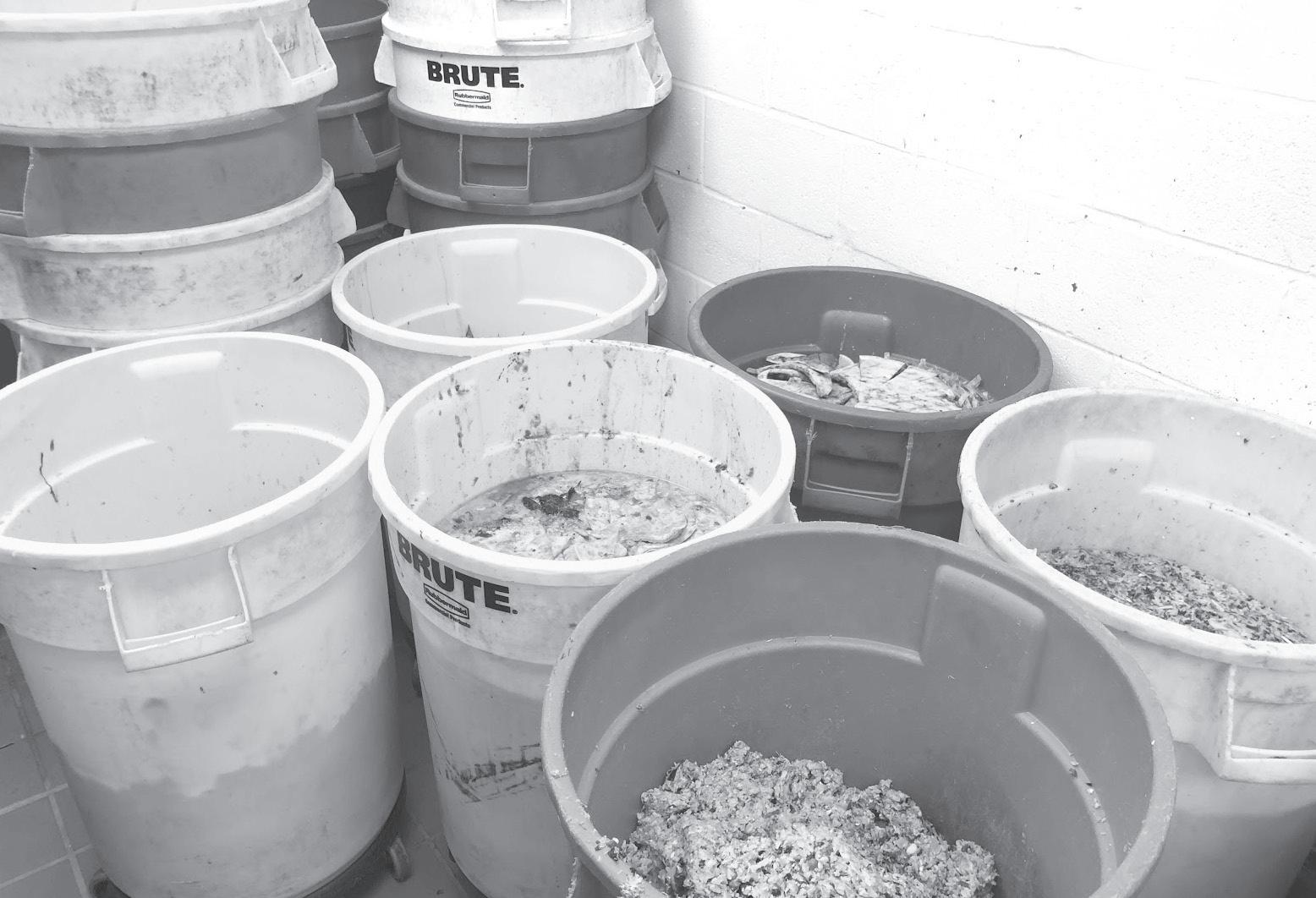
For instance, Justin Wunder, the lead supervisor for North Star, explained that the dining hall uses a machine to recycle water and create compost. Inside a climate-controlled room, the machines extract water from the food waste and pile up the reusable food scraps in numerous colored compost bins.
The resulting compost is then donated to local farmers in Ithaca, as well as brought to locations on campus like the Cornell Orchards, according to Wunder.
In addition to the placement of compost bins in dining and residential halls, Food Recovery Network, a student-run club at Cornell, donates surplus meals from dining halls to local food pantries.
Caitlyn Wyman can be reached at cew245@cornell.edu. Virginia Lo can be reached at cl895@cornell.edu.
Priveleged poor | Harvard Prof. Anthony Jack urged Cornell students to “demand as much of Cornell as Cornell demands of you.”
COURTESY OF CORNELL UNIVERSITY
Meghna Srivastava can be reached at mms453@cornell.edu.
Pass the plate | Buckets of compost sat inside Northstar, one step in the process of decreasing outright food waste.
VIRGINIIA LO / SUN CONTRIBUTOR
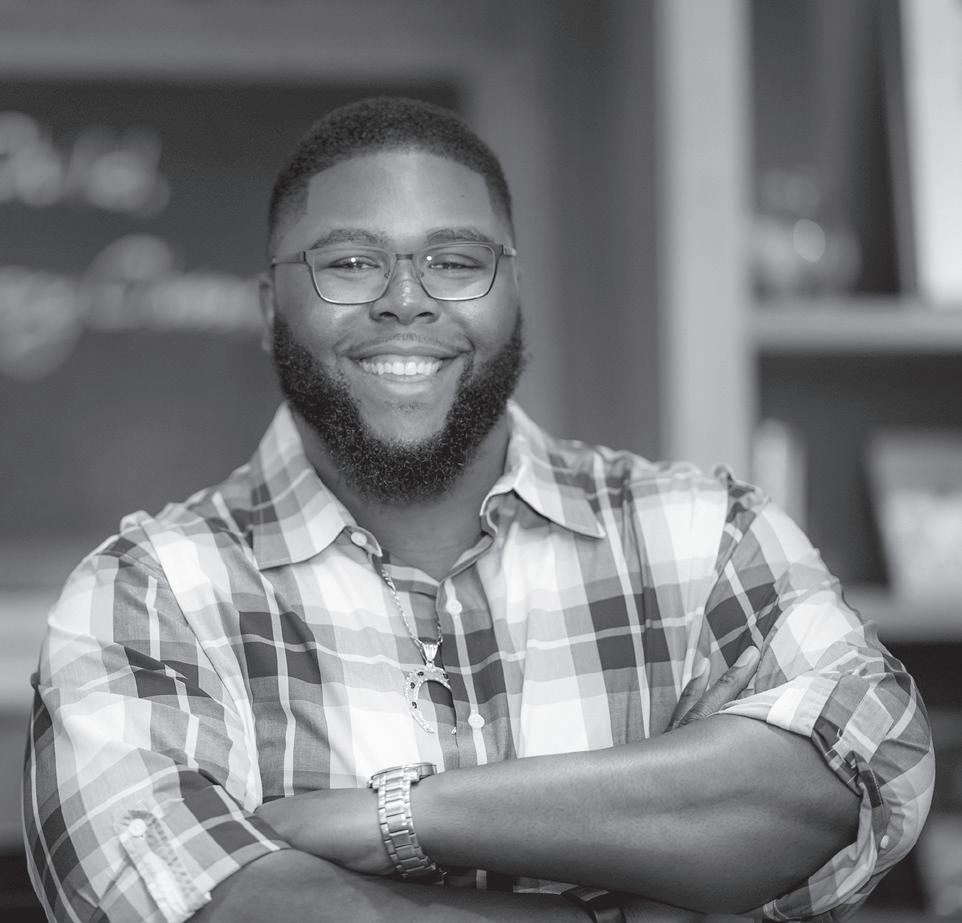
Fake news? | Editors Ezra Klein and Andrew Sullivan disputed whether democracy was dying last Tuesday.
KATIE SIMS / SUN SENIOR PHOTOGRAPHER
From Passing the Bar to Behind Tem: Lawyer to Spend One Month in Jail
CAPLAN
Continued from page 1
parents involved in the scandal that roiled the country last spring received skint prison time: Notably, actress Felicity Huffman was sentenced to only 14 days in prison; others received from one day of incarceration to four months.
Caplan was part of a scheme that snared 50 people exposed in the FBI’s “Operation Varsity Blues,” an undertaking that displayed the role of wealth in various parts of the college admission process to elite universities.
Last June, William Singer, the mastermind behind a fraudulent company to transform wealth into acceptance letters, urged Caplan to petition for extended test-taking time for his daughter under the pretense of a learning disorder.
In July, transcripts showed Caplan and his wife discussing having Singer’s employees take classes under Caplan’s daughter’s name. In November, Caplan forked out the first payment, wiring $25,000 to the Key West Foundation. At the time, Caplan told Singer his daughter’s highest practice score was a 22.
He later shelled out another $50,000; in return, Singer had guaranteed an ACT score between 32 and 34. Court documents say Caplan asked Singer not to score his daughter higher than a 32.
The scheme was tidily presented to Caplan and his wife in phone calls throughout the transactions. Caplan has said that his daughter was completely in the dark, and he has publicly apologized to her repeatedly.
News of the fraud prompted swift reactions from universities.
Immediately following the publishing of the complaint, the University reviewed its athletic programs to check that students who weren’t playing were doing so for legitimate reasons.
“Within days of the news breaking, our Athletics administrators conducted a thorough review,” President Martha E. Pollack told The Sun last May. “... We found that the few students who left did so for documented reasons.”
Pollack said that in the days following revelations about the breadth of the “appalling” college admissions scandal, Cornell’s own admissions department conducted a self-evaluation of its incoming and first-year student athletes.
The school found no irregularities, Pollack said, but noted that Cornell’s decentralized admissions would be reviewed.
The alumnus was interested in an athletic recruitment scheme for his daughter, too — even asking Singer for Cornell-specific information — but didn’t follow through on the request, according to the FBI complaint.
Caplan’s interest in Cornell was fiscal, as well. The Caplan Family Foundation Trust — headed by Gordon and Amy Caplan — donated generously to his alma mater, according to tax documents. In 2017, the Trust gave $100,000 to Cornell University, preceded by $140,000 in 2016, years during which Caplan’s daughter was likely in her first two years of high school.
These numbers were a significant jump from previous years. The Trust donated $15,000, $40,000 and $15,000 in 2013, 2014 and 2015, respectively. The University received at least $7,500 from the Trust before then, reports show.
Outside the courthouse Thursday, Caplan said he “fully respect[s] the decision of the court today.”
“I am deeply and profoundly sorry for being involved in this mess.”
Maryam Zafar can be reached at mzafar@cornellsun. com.
Cornell Commemorates Nine Cornellians Killed In ’67 Blaze on N. Campus
FIRE
Continued from page 1
now the Ecology House — which was colloquially known as the “Res Club” among students. The residential hall housed 71 residents, which included 60 freshmen and several female graduate students and faculty advisers.
Most residents were part of the University’s pilot six-year Ph.D. program, which offered gifted students the opportunity to earn a doctorate in six years after entering the university as freshmen. These students were known as “Phuds” on campus.
The tragic fire caught the attention of many for years after.
In April 2018, The New York Times published a longform profile of the fire and an alumnus’ quest to investigate its origins.
Among those who perished in the fire were three sophomores in the University’s six-year Ph.D. program: Martha Beck ’69, Peter Cooch ’69 and Jeffrey William Smith ’69. Anne McCormick ’67, a senior in the home economics program, and Jennie Zu Wei Sun ’68, a junior in the College of Arts and Sciences pre-med program, also died in the fire, as well as three graduate students: Meimei Chung Cheng, 22, Carol Lynn Kurtz, 22, and Johanna Christina Walden, 25.
The oldest student who perished, Walden, was 25. The youngest, Smith, was only 17.
Prof. John Alban Finch, English, was killed by the fire as he ran back and forth to pull students out of the burning building. He was 37.
Although Cornellians were grief-stricken by the fire at the time, the police investigation fell flat — no cause for the fire was ever determined. Students speculated the fire was an act of arson, as when the Phuds were placed in different housing, two other fires were reported. The University increased security measures at certain residencies, but mostly kept quiet on the situation.
As alumni and family members of the blaze’s victims gathered outside Sage Chapel, Paul Mermin ’70 — a member of the six-year Ph.D. program and survivor of the fire — reminisced on the brilliance of his friends and Finch.
“I struggle to imagine the three teenagers that I knew, Peter Cooch, Marty Beck, Jeff Smith, becoming full adults and living adult lives that did not come to pass,” Mermin said. “[They] were all hugely intelligent, the thing that they could not help knowing, but not any of them were full of themselves.”
One of the event’s other speakers, Sherry Carr ’67, MILR ’70, also echoed Mermin’s thoughts on the victims’ vitality. Carr described McCormic, who was one of her roommates during her time at Cornell, as a “dynamo” and fondly shared how she earned the moniker “Pygmy” because of her short stature.
While the speakers and alumni attending thanked the administration for putting the memori-
al together, many still critiqued what they saw as the University’s delayed and inadequate response to the fire.
“For the 19,000 sunrises and sunsets, in creating this beautiful memorial so long afterward, Cornell has done a handsome thing, and we are truly grateful,” Mermin said in his speech. “[T] his fire and these deaths have been nearly absent from the official histories of the University. That omission is partly rectified today ... If Cornell were to acknowledge this truth, it would not just be
“If Cornell were to acknowledge this truth, it would not just be handsome, but humble.”
Paul Mermin ’70
handsome, but humble.”
Some alumni who lived in the building and survived the fire told The Sun that the incident had a traumatizing impact on their lives.
Jabez Van Cleef ’70, who lived on the first floor of the building, said he remembered the ordeal in vivid detail because it was traumatizing. He also shared that he believed he would not have survived the fire if he had not listened to his roommate, who recommended that they escape through the window, rather than the lobby.
“What happened has had a very disproportionate effect on our lives,” Van Cleef said. “It takes up a lot of mental real estate having survived an event like that.”
Joshua Freeman ’69 also lived on the first floor of the building. He said that the fire had life-long psychological impacts on some of the Cornellians who survived, and the University needed to do more to address what happened.
“I think it’s good that [the University] did this,” Freeman said. “I think it’s sad that after 50 years, they still can’t apologize or take responsibility. Obviously, the people who are here now were not here then, but the institution was here.”
Joel Malina, vice president for university relations, told The Sun that while the University cannot comment on the actions of past administrations, the current administration believed that it was “appropriate” to commemorate the lives lost in the fire.
Thomas Cooch, Peter Cooch’s brother, said he was happy to see the University finally acknowledge the tragic fire.
“I think [Mermin] did an excellent job of acknowledging what would not be said by the administration — that there was a great deal of complicity on the part of the University, but I feel mollified today by the beauty of this memorial,” Cooch said. “I haven’t been [to Cornell] in 52 years, but I’m glad I came back today.”
Meghna Maharishi can be reached at mmaharishi@cornellsun.com.
Dedication Ceremony Spotlights Takeover Plaque 50 Years Later
TAKEOVER
Continued from page 1
occupation, Cornell set out to become a leader in its commitment to the ideals of a diverse and inclusive university.”
The text was written by Prof. Emeritus Isaac Kramnick, government, with modifications and input from members of the commemoration committee.
The dedication began with a commemorative walk from the current Africana Studies and Research Center to Willard Straight Hall, following the path students took on the day the takeover began.
Throughout the walk, Frank Dawson ’72, Jackie Davis-Manigaulte ’72 and Zachary Carter ’72, alumni who participated in the takeover, spoke at various points. The walk started at Africana Studies and Research Center and stopped at Wari Cooperative House, a historical space for black women on campus, and 320 Wait Avenue, where the first Africana center was burned down in 1970.
The walk ended at Willard Straight Hall, led by a group of people including current residential advisors of Ujamaa Residential College carrying a flag.
Once in the Straight, the unveiling and dedication ceremony took place.
The Dorothy Cotton Jubilee Singers opened the event under the direction of Ithaca College Prof. Baruch Whitehead, music. Maria Ellis-Jordan was the lead singer for two out of three of the selections.
Visitors were welcomed by Prof. N’Dri Thérèse Assié-Lumumba, Africana Studies, and Dean of Students Vijay Pendakur, who chaired the committee which planned the events.
After the welcome addresses, reflections about the takeover were shared by four alumni: Irving McPhail ’70, Fenton Sands ’70, Carter and Dawson.
Dawson spoke first, sharing his experience as a freshman coming to Cornell from the projects of the Lower East Side of New York City, where his class doubled the number of black students at Cornell.
He recognized the cultural differences he and other black students had compared to the existing black students at Cornell, citing increased marketing for the University within inner cities as the source of the change.
One thing he mentioned was the varying viewpoints people had about the direction of the Takeover, emphasizing that not everyone agreed.
“But just understand that … if your goal is one, you know, that is worth it, that others will join you in times of danger,” Dawson said.
Sands, who works in international development, could not attend the event as he is currently working in Malawi. During the takeover he documented the events from an inside perspective.
He prepared a reflection that was read by McPhail.
The final alum reflection came from Carter, who recognized the importance of young people to take action when necessary.
“Our children will always have to protest and their children will have to protest.,” Carter said.
“It is really because of a part, a permanent part of the human condition. We are flawed. And our leaders are flawed,” Carter continued. “And our leaders are destined to periodically fail for reasons that are as old as time, mostly a quest for power and self interest.”
Amina Kilpatrick can be reached at akilpatrick@cornellsun.com.
Panelists Debate Future Of Democracy, Fake News
DEMOCRACY
Continued from page 3
to problems with democracy, including the rise of “fake news” and the question of whether a liberal democracy is better protected by the elites or the people.
“Liberalism is a commitment to a set of universalistic rules that protect minority rights and protect generalized rights within larger democratic system,” Klein said to the room, which was filled with 200 people.
But that commitment has withered, as the ideals of liberalism and democracy have come to increas-
ingly diverge, Sullivan argued. Paradoxically, “we are less liberal because we are more democratic,” Sullivan said. He asserted that authoritative institutions which traditionally have held people together, such as the Christian Church, have slowly lost ground to more individualistic forces, like social media.
To read the rest of this story, please visit www.cornellsun.com.
Louis Chang can be reached at lc742@cornell.edu.
ARTS & ENTERTAINMENT
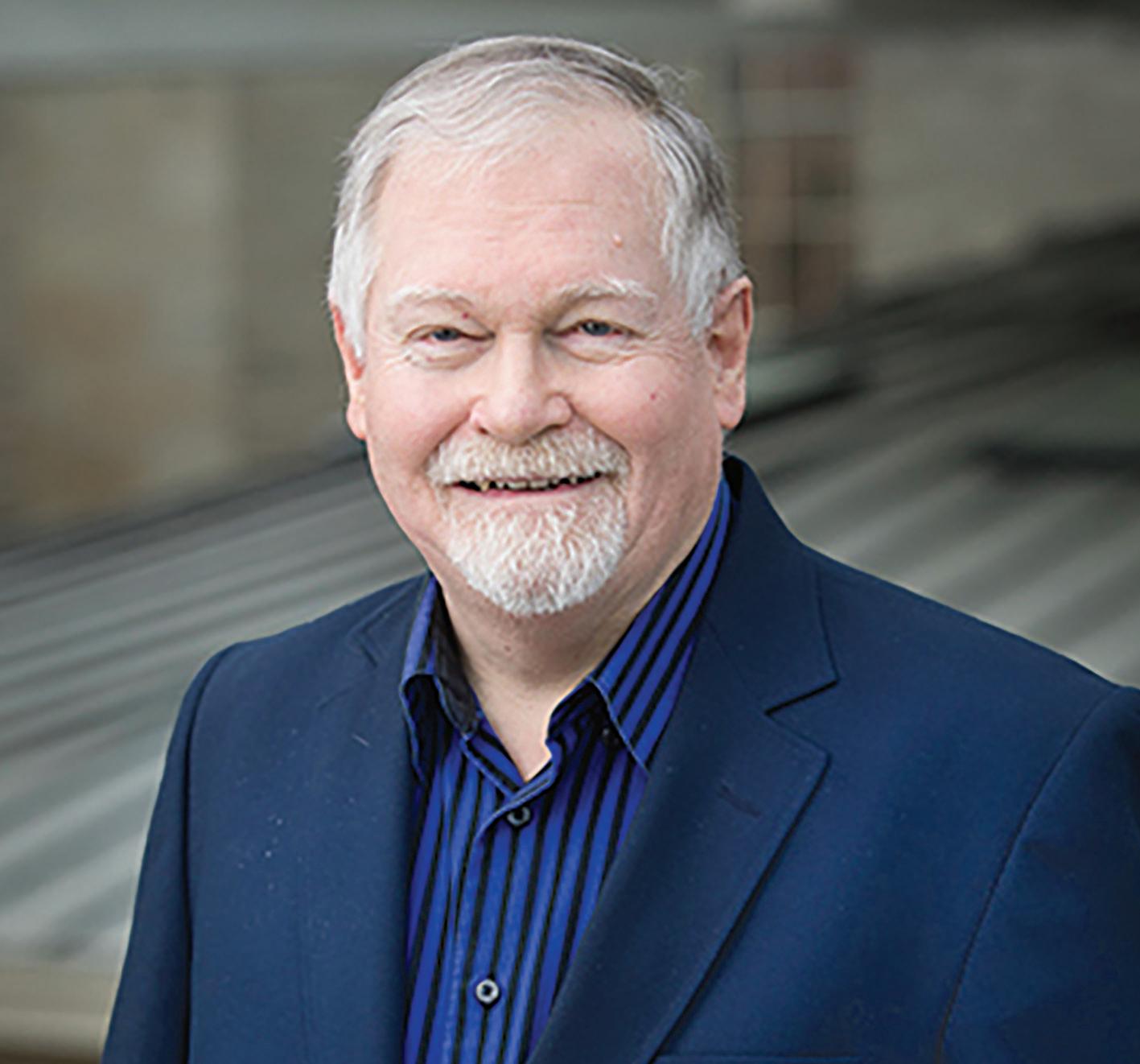
Cornell Celebrates Prof. Robert Morgan
GRETA GOODING SUN CONTRIBUTOR
Prof. Robert Morgan, English, is an author from Hendersonville, N.C. who has written everything from a Daniel Boone biography to a novel in which he invokes the voice of a young enslaved man. He is fearlessly Appalachian and speaks wisely with a charming twang. He is also one of the English department’s most beloved faculty.
On Thursday, a group of roughly 40 English professors gathered in a conference room in the Statler Hotel to celebrate one of their own, Morgan, as he turns 75. The day was filled with readings, panels and difficult questions. Ultimately, an exaltation of American perspective prevailed.
Morgan specializes in creative writing and American Letters. He has taught at Cornell since 1971. He is incredibly prolific and has written 14 books of poetry, nine volumes of fiction and many short stories. His most well known work is Gap Creek,a New York Times bestseller which was featured in Oprah’s Book Club. Through his work, Morgan traces themes of marriage, parenthood and landscape.
During a panel on which the other discussed his inspirations and the writing process, Morgan shared a bit of his philosophy: “Poetic imagination is a holistic animism. It’s holistic because everything is connected. It is an animism because everything is alive within it.”
Morgan regales in his imagination, although it never leads him too far from home. Though his characters are well built and his themes believable, they seldom leave the sphere of Appalachia. To a certain extent, he follows the famous adage of fellow American storyteller Mark Twain. “Write what you know.”
Panelist Prof. Kenneth McClane, English, asked him if he felt anxious about writing from the perspective of two enslaved black people as a white person. Morgan shrugged: “We create our best characters from going farther than ourselves. I hope not to sentimentalize Appalachian themes, but this is the narrative I need to tell.”
Prof. Roger Gilbert, English, shares his colleague’s poetry with students in his creative classes because he says, “aside from the fact that he [Morgan] is one of the greatest writers to ever teach at Cornell, he is just remarkably grounded in a reservoir of cultural memory and geographical imagery.”
To those who have never read any of Morgan’s work, Gilbert recommends Gap Creek.“It’s a classic,” he adds. For the poetically inclined, Topsoil Road offers smooth verse at the intersection of Cherokee lore and careful observation. And even for the scientists, Gilbert suggests Dark Energy,a collection of poems which exalt the practice of close looking on a scale as small as atoms and as large as the cosmos.
Morgan’s oeuvre is worth being read, discussed and critiqued now more than ever. His voice is remarkably American, and his wisdom is profound. Chances are he would love to share it with you.
Greta Gooding is a sophomore in the College of Arts and Sciences. She can be reached at gfg39@cornell.edu.


Saint-like | In these two photos, A.J. Jackson of Saint Motel serenades a Barton Hall crowd on Saturday, Oct. 5 during the 2019 homecoming concert presented by the Cornell Concert Commission.
MICHAEL SUGUITAN / SUN STAFF PHOTOGRAPHER
COURTESY OF CORNELL UNIVERSITY
Saint Motel Performs At Barton Hall, Details New Album
This homecoming, I was pretty hyped. A band I was already a big fan of, Saint Motel, was performing at our homecoming concert. When I learned I could review the concert and interview the band, I didn’t hesitate to take the opportunity.
Saint Motel is an LA-based indie rock/pop band that has been around since 2007. But they certainly have enjoyed an increasing amount of success in the past couple years: hitting the mainstream with their single “My Type,” touring with Panic! At the Disco and experimenting with multimedia albums. Saturday, they were joined by Daya, an electronic pop artist best known for her vocals on The Chainsmokers’ “Don’t Let Me Down,” for which she won a Grammy for Best Dance Recording.
Daya opened the concert with a strong vocal performance of songs from her 2016 album Sit Still, Look Pretty and a few of her well-known collaborations, including “Feel Good” with Illenium and “Don’t Let Me Down.” Her band performed well, and I especially enjoyed “I Wanna Know,” where the bass drop in the song was achieved almost completely with the instruments on stage.
I spoke to her about her background and evolution as an artist. Her stage name Daya is a Hindi translation of her first name, Grace, paying homage to her Indian American background. At 20 years old, she wants to ensure she is genuinely herself, Grace, on stage, while still incorporating her Daya character. “The Red Bulls get me there,” she joked. Her goal was to provide us students a respite from our studies, with “good vibes” all night. I thought her choice as an opener to Saint Motel was a good one, balancing out their indie-rock approach with a more EDM vibe to appeal to a larger audience of students.
Saint Motel took the stage shortly after Daya left, and they were, to put it simply, so much fun. Part of this, I think, is that they have fully integrated saxophone and trumpet players, which always kick up the energy and provide some groovy solos. That was certainly the case on “Puzzle Pieces” and “Benny Goodman,” two songs from their early discography. The middle of their show comprised of songs from their 2016 album, saintmotelevision , a debut song from their upcoming album and some audience participation. While Saint Motel
has only a few very wellknown tunes, the middle of their set showed off just how strong their back-catalog is. “Cold, Cold Man” was a highlight for me, having been the song that introduced me to the band. The ridiculously catchy piano riff exploded into a dynamic overture. For their encore, they played “Butch” another old song of theirs, “Born Again” and, of course, “My Type.”
I did expect “My Type” to blow the roof off Barton, but I did not expect frontman A.J. Jackson to take it to the next level. He started by dancing through the audience. Then he made a beeline for the back bleachers, where he introduced himself to some of the seated, quieter fans. The crowd started to follow, and by the middle of the song Jackson was attempting to climb one of the steel columns, as some of the crowd clambered up the bleachers, and the sea of students shifted to the back of the venue. Suddenly, the stage was in the back, and we were on it. At the climax of the song, a few hundred students were dancing on the bleachers as the crowd enjoyed the concert from below. Jackson ran down and made it back to the stage just in time for the final chord as the chaos came to a halt and everyone took a breath. I have never seen anything like that in person, and it was incredibly fun to be a part of it.

“Paper Towns,” FIFA video game soundtracks and various commercials. “FIFA was probably the greatest thing that’s ever happened to us,” Jackson quipped. “It’s actually one of the reasons we’ve been able to tour in Europe. We even have a custom Saint Motel jersey in the game.”
With the band’s next album The Original Motion Picture Soundtrack on the horizon, they are excited to share this multimedia adventure with their fans: “We’re working with film composers to arrange interludes between each song, so they all blend into one another,” Jackson explained. “The way you hold the album is gonna be really unique ... it comes out on October 16!”
When I spoke to Saint Motel, an intimate connection with their fans was paramount. “I like to meet every single person,” Jackson said. The band makes a special effort to involve their fans in concerts and on social media, posting fan art and covers on #fanappreciationFriday. “That’s probably our only tradition. We’re honored to see how people are interpreting our songs,” commented drummer Greg Erwin. Their accessibility as a group can be boiled down to “subtle pop music.” They are pop enough to please the average listener, with lots of added layers for music lovers to analyze. That’s the reason they’ve been featured on John Green’s
From a group that has experimented with virtual reality, augmented reality, 360˚ video and live streaming, it’s clear that Saint Motel will bring their love of film and music together with their new ambitious project.
The Homecoming 2019 concert was a blast due to Daya’s and Saint Motel’s fervent performances. Although the night was plagued with some technical issues and wait times that slightly detracted from the show, the engagement and energy from the performances were unforgettable. If you weren’t there, you missed out.
James Robertson is a junior in the College of Arts and Sciences. He can be contacted at jar524@cornell.edu.
JAMES ROBERTSON SUN STAFF WRITER
MICHAEL SUGUITAN / SUN SENIOR PHOTOGRAPHER
JOYBEER DATTA GUPTA ’21
Business Manager
PARIS GHAZI ’21
Associate Editor
MEREDITH LIU ’20
Assistant Managing Editor
ANU SUBRAMANIAM ’20
SARAH SKINNER ’21
Editor KRYSTAL YANG ’21
NATALIE FUNG ’20 Web Editor
Working on Today’s Sun
Ad Layout Mei Ou ’22
Production Deskers Dana Chan ’21
Jenny Huang ’22
News Deskers Amina Kilpatrick ’21
Maryam Zafar ’21
Night Desker Meghna Maharishi ’22
Design Desker Jamie Lai ’20
Xiangyi Zhao ’22
Photography Desker Jing Jiang ’22
Sports Desker Raphy Gendler ’21
JT Baker | Trustee Viewpoint
Te 44-Year Scholarship
Ireceived a phone call from my head football coach and mentor on a day like any other in my junior year at DeLaSalle High School in Minneapolis. He told me that a coach from Cornell University would be coming to meet me that afternoon. All of my hard work academically and athletically
I would be selling myself short if I chose a university solely based on football or its affordability. Passing on the opportunity to attend Cornell was a decision that I would regret for the rest of my life.
was finally paying off.
My dream was always to play Division I football at an Ivy League school, and this day was my very first step to accomplishing that goal. At that time in my high school career, I had my sights set on Harvard, Princeton and Columbia. I didn’t know much about Cornell. However, I was excited to meet the coach that would possibly give me the opportunity of a lifetime.
As I sat patiently in my school’s library, I felt overwhelmed when a man approached me wearing a red polo shirt that read, “Cornell Football.” He introduced himself as Coach Guido Falbo and told me that Cornell would be the perfect fit for me. He handed me a pamphlet that pictured a beautiful scenery of waterfalls, a breathtaking view of the slope and a panoramic shot of the football stadium that read, “America’s Best College Town.”
Little did I know at 16 years old that this conversation alone would change the trajectory of my entire life. As he left, Coach Falbo said “The difference between coming to Cornell and going to any other institution is this — there, you receive a four year scholarship to play football. At Cornell, you receive a scholarship that will benefit you for the rest of your life. You pick: four years or 44.” He later dubbed the chance to attend Cornell the “44-Year Scholarship” — an opportunity that keeps giving. I could not fully understand the magnitude and depth of this concept as a 16-year-old high school student, but knew in my heart it was the right choice to make.
I shared the news with my parents when I returned home. They were beyond proud yet reluctant, considering that we could not afford the cost of tuition at a prestigious institution like Cornell. I did not want to put such a large financial burden on my parents, so I threw the pamphlet away, telling myself that there would be alternative institutions that would give me a full ride scholarship to play football. However, I could not get the wise words that Coach Falbo told me out of my head. I knew that
I would be selling myself short if I chose a university solely based on football or its affordability. Passing on the opportunity to attend Cornell was a decision that I would regret for the rest of my life. This was a chance to change my life as a first generation college student and would allow me to create an impact on my family and community that they had never seen. After weeks of reflecting, I sat back down with my parents and told them that no matter the cost or sacrifice, I would be making the long-term investment in my future by attending Cornell University.
Now as a junior at Cornell, I can honestly say that I made the best decision of my life. Considering other schools may have seemed more reasonable to most. However, I believe there is no other experience as valuable as the one I’ve had so far here at Cornell. I have also come to better understand and appreciate the wise words Coach Falbo said to me four years ago. The “44-Year Scholarship” has already given me so much more than just the opportunity to play football. Cornell has allowed me to grow as a young man and has challenged me to reach new levels of excellence. I have been exposed to entirely new perspectives and I’ve been constantly forced to expand my way of thinking. Cornell has given me the tools that will allow me to change my family’s life.
The beautiful thing about the “44-year Scholarship” is this: It is not only about the benefits you receive as an individual, but rather the ability it gives you to empower everyone around you. This realization motivated me to find a way to leave a deeper impact on the entire Cornell community. Similarly to the thousands of people who have made the trek to Ithaca before me, I have been lucky enough to understand how special Cornell really is beyond its household name. By becoming the first student-athlete Trustee and one of very few African-Americans on the Board, it is my goal to leave a legacy at Cornell University that will inspire current and future students who have been labeled and stereotyped. To be a student at Cornell means more than just being an athlete or under-represented minority struggling to find a place. It means that you can take all of the perceptions that have been forced on to you and use it as fuel to go beyond systematic limitations, creating the changes you wish to see here at Cornell and in the world.
JT Baker is an undergraduate student-elected member of the Board of Trustees and a junior in the School of Hotel Administration. Comments may be sent to opinion@cornellsun.com. Trustee Viewpoint runs every other week this semester.
Te Pokémon Go Revival Tour
In July 2016, I attended my first sleep-away camp (never did one again), my first girlfriend broke up with me and perhaps the biggest worldwide phenomenon ever released reached our phones. Pokémon GO was a cultural revolution and the closest we’ve come to world peace.
Like many others who collected the cards or played the games as kids, I was thrilled to get back to my childhood, eager to hunt for Pokémon and reminisce my innocence before prelims and credit card bills. The game garnered so much attention that even those who couldn’t tell a Nidoking from a Kangaskhan (amateurs) strolled the streets of their hometowns, flinging Pokéballs across their little black screens.
the heaps of studies that show the correlation between levels of anxiety and depression with social media use amongst our generation, an alternative use of screen time could be beneficial. The people I know who have redownloaded Pokémon GO have spent less time on Instagram and Facebook.
Ithaca is well renowned for its natural
With prelims looming heavily over us, it’s important to remember to get outside. Clearly, the best way to enjoy Ithaca’s natural hikes is to redownload Pokémon GO.
Yet, the game’s popularity vanished just as quickly as it arrived. Strangers were no longer striking up conversations with each other about where to find the Charmander nest off Polk Street (that’s in San Francisco, for the 75 percent of campus that hails from the TriState area). It’s true, the app took some heat for car crashes and injuries due to not looking down the stairwell, but this wasn’t the reason for its eventual loss of interest.
The truth is, we got bored. After the thousandth measly Pidgey we caught, how could we not? As much of a blast to the past the game was for many of us, there weren’t enough features to keep us consistently entertained, and eventually, we logged off for the final time. Or so we thought.
At the beginning of this summer, my grown-up brother — with a full-time job,
beauty. The nomenclature “Ithaca is Gorges’’ has probably pulled in millions of dollars in just bumper sticker sales alone. With prelims looming heavily over us, it’s important to remember to get outside. Clearly, the best way to enjoy Ithaca’s natural hikes is to redownload Pokémon GO.
I promise I’m not on Niantic’s marketing team, but there is already a large Cornell community of Pokémon GOers for you to join.
a nice apartment and now even considering getting his own cell phone plan — brought up Pokémon GO at the dinner table. I hadn’t thought about the game in years, and shrugged him off at first, but as he kept explaining the new app, I became more and more intrigued. Shortly after, I was a part of the reason that August 2019 was the most successful month for the app since its initial release.
I’m in a group chat with my friends and fellow Pokémon hunters. It started when I convinced one to join the app again, and since then a new name has popped up in the chat every day. In fact, another one joined while I wrote this. I received the all-too-familiar notification, “Let’s be friends in Pokémon GO! My trainer code is…” Pokoboyos, the group chat, is now at a heroic 14 members, but is always looking for more enthusiasts. I promise I’m not on Niantic’s marketing team, but there is already a large Cornell community of Pokémon GOers for you to join.
I won’t bore you with all the updates the game has undergone, but if you haven’t been sold to redownload the app just yet, I urge you to consider that there are now five regions of Pokémon to catch out in the wild (Pidgeys are actually sort of rare now), and you can trade with and battle friends. If you have a friend who is prettier than you, smarter, more athletic and overall better in most aspects, challenge them to a battle. You might be a better trainer than them, and that matters most. There are events called raids, in which you gather with friends, strangers, loved ones and ex-cons alike to beat a very strong Pokémon. I’ve taken many a study break with my friends to challenge raids at Mann Library. If your team is successful, you all get the chance to catch the creature, be it an armored Mewtwo or a smiling Gengar. Finally, Niantic added community days. One day a month, 90 percent of all wild Pokémon appear as the same, rare breed, allowing you to earn enough candies to get it to its final evolution.
There is nothing more wholesome than spending a Saturday down on the Commons catching Turtwigs next to people of all ages, some geared up in Pokémon attire, others still shy about re-embracing the Pokémon world. I never thought I’d make friends with a middle-aged Asian man and his son, but Stephen and I send daily gifts to each other now — in-game. The app encourages strangers to work together and share in the excitement, and I’m very confident this will be how I meet my future wife.
Whatever team you choose (Go Team
There is nothing more wholesome than spending a Saturday down on the Commons catching Turtwigs next to people of all ages, some geared up in Pokémon attire, others still shy about re-embracing the Pokémon world.
Apart from the ecstasy you will face at the hands of this nostalgic game, it also inspires a healthy lifestyle. Pokémon GO promotes being active as you walk far distances to hatch eggs and earn other rewards. I used to try and catch a ride to my early morning classes, but now I always opt to walk. Additionally, with
Instinct!), you won’t regret hopping back on and secretly catching Seedots in the back of your intro to Psych lecture in Bailey Hall. As the saying goes, you gotta catch ’em all. P.S. Let’s be friends in Pokémon GO! My trainer code is 7854 0785 9557.
A.J. Stella is a junior in the College of Arts and Sciences. He can be reached at ajs548@cornell.edu. Stellin’ It Like It Is runs every other Monday this semester.
Authoritarianism Close to Home
The violence and protests in Hong Kong to free the city from China’s grasp escalated to a new point this weekend. Chief Executive of Hong Kong Carrie Lam invoked a British colonial-era emergency law that banned masks at public gatherings with a maximum penalty of one year in prison for wearing one. Masks have been frequently worn by protestors to hide their identities, and banning them is the first step in an increasingly heavy-handed government response.
The situation has become unavoidable for citizens of Hong Kong, and many Cornellians have families involved or affected by the protests. The efficient subway system shut down as an emergency measure to disrupt protests over the mask ban. Stores and malls also closed, making it more difficult to obtain even essential goods.
Yet, the protests look like they’re here to stay. Graduate student Aaron Hui ’15, who studied abroad in Hong Kong and has family connections there, explained, “If China controlled Hong Kong, it would cease to be the Hong Kong that it currently is. Hong Kong is characterized by many freedoms that the mainland does not have and a[n] internawtional position that mainland cities do not have. Hong Kong will just become another Chinese city.”
Although the violence and crackdowns are a continent away, losing the battle against the Chinese Communisty Party in Hong Kong could be a tipping point in the global fight against authoritarianism.
So far, the protestors have five main demands, including a full repeal of the extradition bill that would surrender fugitives to the mainland, an inquiry into police brutality and universal suffrage for citizens. These demands tie into a larger ideological struggle for freedom from China’s strengthening grip on Hong Kong’s political and social systems. Accountant Maggie Chung summed up the necessity of the protest: “If I lose my job, I can find another one. But if Hong Kong is lost, it’s gone forever.”
For students from Hong Kong and Asian Americans, this issue hits a little too close to home. My parents are from Taiwan, a country that has been embroiled in a trilateral conflict with the United States and China over
My GPA is below a 3.0. The campus culture frowns at that fact. It tells me that I have a bad GPA. I have been trying to resist the urge to agree. I go through these cycles throughout the semester where I become frustrated
But now that I have been admitted, in the eyes of my Cornellian community, I have no longer really accomplished anything — because everybody here has accomplished the same thing.
with Cornell’s atmosphere. Recently, I was fully submerged in that air of discontent. It is not because of prelims —though I’m not particularly ecstatic about those either. What instead frustrates me is the ambiguity behind the meaning of success on this campus. If being successful is defined as attaining some accomplishment, then one would think that we are all already successful. After all, we all attend this esteemed university.
But now that I have been admitted, in the eyes of my Cornellian community, I have no longer really accomplished anything — because everybody here has accomplished the same thing. What was once a major triumph now seems almost trivial. Which means I must now start over to prove my academic worth. And what a feat that is.
Through the intensity of my courses, through the piles of pages needing to be read, through the hours spent in the
the “One-China policy” since President Jimmy Carter re-established diplomatic ties with Beijing in 1979. This conflict hasn’t escalated beyond diplomatic posturing over arms sales and Chinese gray zone tactics in the East and South China Seas.
But if China is able to fully take over Hong Kong’s government in a show of its power, the situation could become a whole lot worse. The People’s Liberation Army has continued to reorganize and prepare for a cross-strait invasion of Taiwan. China’s defense budget is 14.5 times that of Taiwan. Chinese leaders have already attempted to frame Taiwan for its
Acts by governments or our own University that prevent civil response from those affected are problematic. We must bolster an environment for freedom.
history and culture foments its unique status as a Special Autonomous Region of China. China’s takeover of the city would install a repressive authoritarian government simply for the CCP’s gain while destroying universal values of freedom and justice. As another student from Hong Kong I spoke to remarked, “It would mean a Hong Kong where people dare not do anything to offend the government for fear of being extradited . . . It would mean a Hong Kong stripped of its freedom, and it terrifies me.”
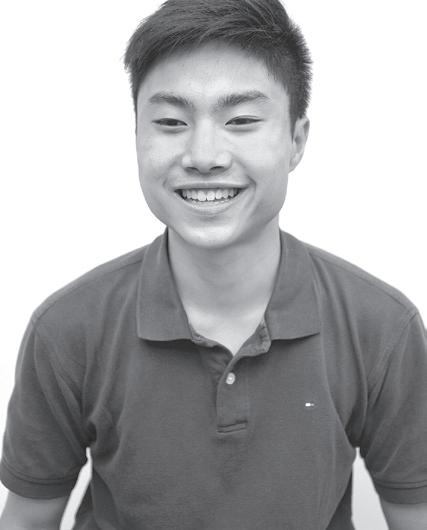
“involvement” in stirring the Hong Kong protests and the relationship between the two countries has only deteriorated since President Tsai Ing-wen LLM ’80 came into office in 2016. What’s next?
Unsurprisingly, Taiwanese citizens are mostly in support of the protestors. Crowdfunding efforts raised nearly $55,000 for the protestors and a Sept. 29 march in Taipei, Taiwan supported the pro-democracy movement in Hong Kong. The global alignment for democracy and Hong Kong’s grassroots movements can’t stop. Applying international pressure can combat the crackdown on Hong Kong’s streets, where a teenager was shot on Tuesday, Oct. 1. My parents may have immigrated to the “land of the free,” but I’m still connected to Taiwan. I don’t want it to be just another China.
Since its founding, Hong Kong has been characterized by its cosmopolitan nature: Its long and vibrant
Sidney Waite | Waite, What?
What’s in a GPA?
library, I’ve come to a troubling realization. My high school education has led me into a false sense of security. The plethora of As that I worked so hard for have lost their value here. I came onto this campus a fraction as prepared as so many of my peers. The fact that I received an A in AP Econ in high school, but a D in Econ 1110, speaks to this. In fact, it almost shouts. And since I studied harder in Econ 1110 than I did in AP Econ, I begin to question my intelligence. I begin to doubt my academic worth. No, I begin to doubt my personal worth.
It is then that the campus begins to convince me that, though important, it is not just about academics. I breathe a sigh of relief before it tells me that I must strive for something even more impressive. The sigh of relief turns into one of frustration. I must meet a new metric of accomplishment in hopes of differentiating my resume from my peers — because all our resumes say Cornell University.
Let’s fit our approach to these protests within a wider conversation about global authoritarianism and the limits of government. In March, I argued against U.S. presidents’ repeated use of emergency powers to justify their actions. As alarmist as it might sound to think about tanks “rolling down Tower Road,” civil liberties are important for us to keep as students. We need the right to assembly and protest — otherwise, how can we have gatherings like the Willard Straight sit-in or marches against school shootings that result in political change? We need reminders that government crackdowns and authoritarian power grabs like the one in Hong Kong could happen anywhere.
As an institution, Cornell doesn’t have the best record of preserving civil liberties. Think about the twisting and turning hallways of Ujaama and Ives. These buildings were built with a purpose: to inhibit student gatherings and protest activity. Presumably, administrators wanted to ensure quiet cooperation by targeting what they thought would be hotbeds of unrest.
Acts by foreign governments or our own University that prevent civil response from those affected are problematic. We must bolster an environment for freedom of thought and action. Although authoritarianism may begin or fester a world away, the second- and third-order consequences are felt close to home.
Darren Chang is a junior in the College of Arts and Sciences. He can be reached at dchang@cornellsun.com. Swamp Snorkeling runs every other Monday this semester.
my apparently bare resume, I listen to the mischievous ivy. I open up the Google Sheets, answer the first question regarding my interests in the org. I feel confident. But then I get to the end — I am asked to upload my resume. A resume that Career Services adamantly maintains requires my current GPA. Although I am told that a holistic approach would be taken, and GPA is only partially taken into account, I am still concerned. The road leads back to that question of academic worth.
But I can’t help but ask myself, is it really fair?
We have all reached what feels like the epitome of success, yet that does not suggest the playing field is level. We all had different experiences and different educations leading up to our arrival here.
The ivy walls urge me to “get involved, join a club.” Desperate to distract my mind from academics, but hoping to establish proof of “professionalism” on
at different positions on the Cornellian game board, but with different goals in mind. Though it is often described as such, life is not truly a race when both the starting blocks and finish lines look strikingly different.
To some of my peers, the knowledge
I am not ashamed of my GPA. Nor am I ashamed of the D I received in economics. I see it as a marker for my growth. A person’s worth and future success should not be measured by grades and numbers.
We have all reached what feels like the epitome of success, yet that does not suggest the playing field is level. We all had different experiences and— in some ways, more importantly — different educations leading up to our arrival here. But that doesn’t simply mean some of us are more or less qualified. Instead, it means we all have different definitions of success. From conversations with my friends and peers, it is clear that our unique backgrounds give us not just unique tools but unique priorities. In that sense, we all start
of my low GPA means they will now look at me differently. Perhaps with displeasure. Maybe even pity. What they would be failing to understand is that I am not ashamed of my GPA. Nor am I ashamed of the D I received in economics. I am actually proud of it. I see it as a marker for my growth. A person’s worth and future success should not be measured by grades and numbers.
In fact, I do not agree that my GPA is bad. But even if it is, it does not matter because I am not my GPA. I am going to graduate from this institution right beside my fellow class of 2022. And regardless of what the number says on my transcript, nothing is going to stand in the way of all the things I want to achieve in this world. Just as it shouldn’t for anyone else.
Sidney Malia Waite is a sophomore in the School of Industrial and Labor Relations. She can be reached at smw327@cornell.edu. Waite, What? runs every other Monday this semester.
Fill in the empty cells, one number in each, so that each column, row, and region contains the numbers 1-9 exactly once. Each number in the solution therefore occurs only once in each of the three “directions,” hence the “single numbers” implied by the puzzle’s name. (Rules from wikipedia.org/wiki/ Sudoku)

Caption Contest Winner

“Sure, I’ve put on a few sides. But I can get back into shape anytime I want.” —Anthony Notaroberta Jr. ’19
To submit your caption for this week’s contest, visit sunspots.cornellsun.com.
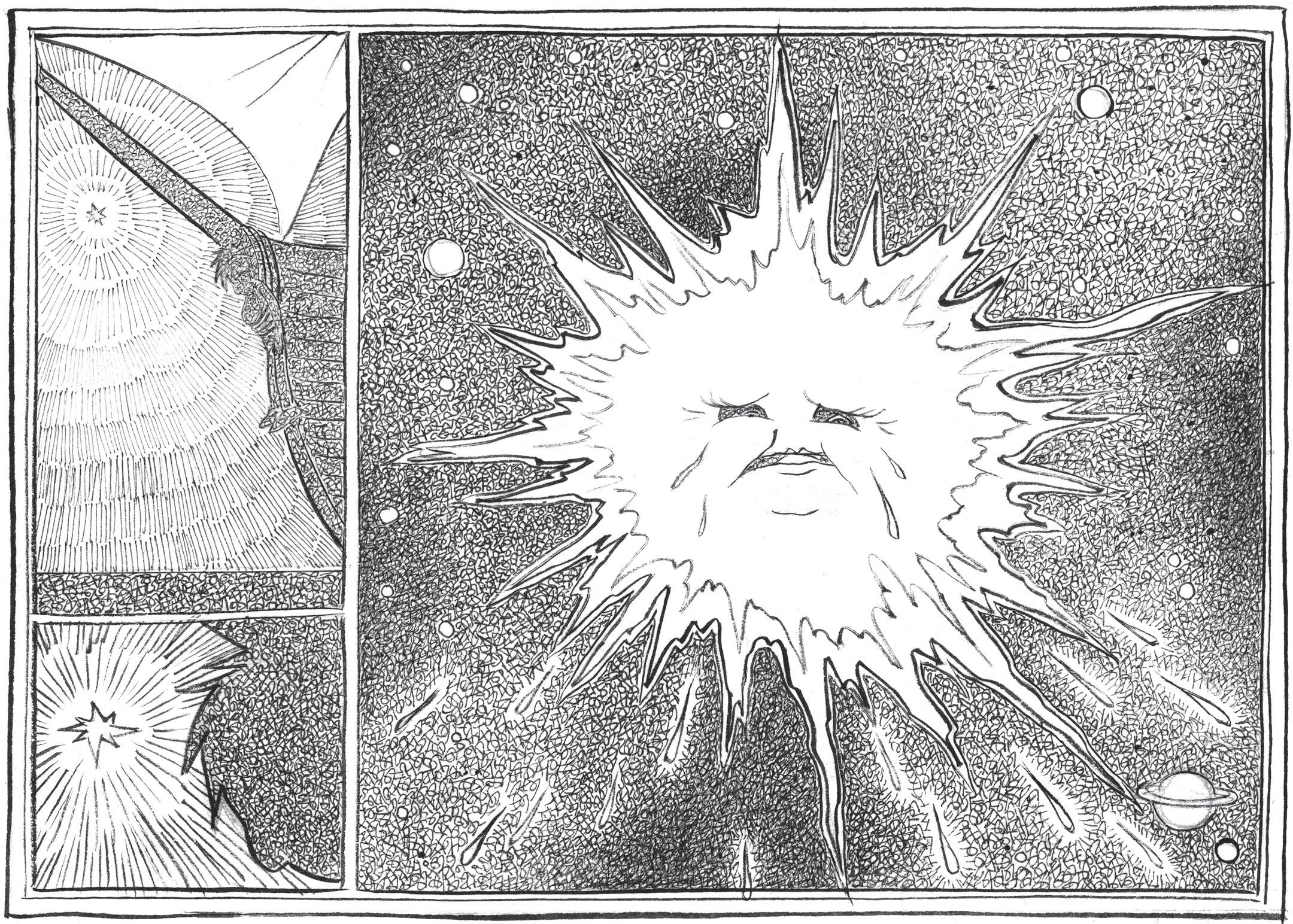
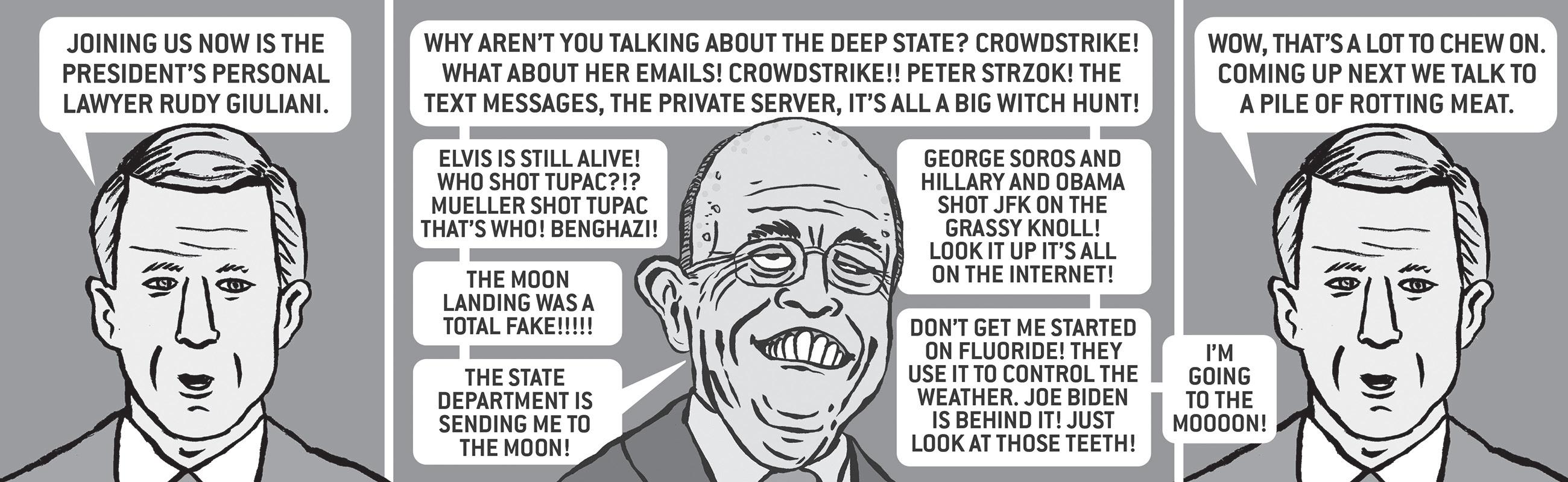

Art by Alicia Wang ’21
Johnny Woodruff by Travis Dandro

26 A PA R TMENT FOR R ENT
Houses, Apts, Parking
1 to 9 Bedroom
Collegetown - College Ave, Linden Ave, Dryden Rd, Bryant Ave, Cook St. 607-330-2442 info@urbanithaca.com www.urbanithaca.com
We
27 H OUSE FOR R ENT
20-21
Football Falters at Home
FOOTBALL
Continued from page 12
Lance Blass was ejected on a targeting penalty. Despite this loss, the Red stood tall and held the Hoyas scoreless throughout the quarter. Still, the offense still couldn’t find any semblance of rhythm.
“[We have a] next man up mentality,” Weber said of losing players mid-game. “It doesn’t matter who goes down. We got guys prepared.”
In the final minutes of the third quarter, the Red pinned the Hoyas deep in their own territory and nearly picked up a safety after a bad snap. After forcing a punt, Cornell received the ball from midfield and capitalized on the prime field position.
Senior running back Harold Coles bulldozed his way to a 20-yard gain and closed out the drive with a five-yard touchdown run as the clock hit 0:00 for the third quarter.

Coles, the Red’s strongest asset on offense, did not exhibit the same explosiveness against Georgetown as in the season’s first two games. Coles finished with 71 total yards after eclipsing 100 at both Marist and Yale.
“Harold’s been kind of nagged with a hamstring [injury], so that extra Harold Coles gear — you know, it’ll come,” Archer said. “He doesn’t really practice all week and then [it] depends on how he feels … We played him, but just couldn’t get him going through this one.”
Following the Coles touchdown, sophomore running back Delonte Harrell swept right and picked up the two-point conversion to tie the game at eight apiece.
After both teams exchanged punts to kick off the fourth quarter, Georgetown’s Joshua Tomas sparked some momentum on the Hoya side with a 23-yard return. From there, Georgetown only needed three plays to reach the end
zone with Johnson capping out the drive by completing a 39-yard touchdown throw to Cameron Clayton.
The Hoyas were penalized for delay of game, and they missed the ensuing PAT, perhaps providing Cornell a glimmer of hope.
Unfortunately for the Red, it never seized that opportunity.
On Cornell’s next possession, Catanese rumbled off a big gain on the ground but saw it all come back on a holding call.
“We
Mike Catanese
“I’m going to have to take a hard look at the hard tape tomorrow and Tuesday,” Archer said.
It only got worse from there as the Red punted and was called for an unnecessary roughness penalty on the play, placing the ball all the way on Cornell’s 35-yard line with under four minutes to play.
Georgetown called three runs, forcing Archer to burn all three of his timeouts. On 4th-and-8, Johnson threw a pass to Tomas, which he appeared to bobble as he went out of bounds. Initially called incomplete, the play was later ruled a complete pass upon further review.

FOOTBALL

Georgetown Spoils C.U. Homecoming With 14-8 Win
Cornell ofense again fails to click, scores just one touchdown in second straight loss
By CHRISTINA BULKELEY
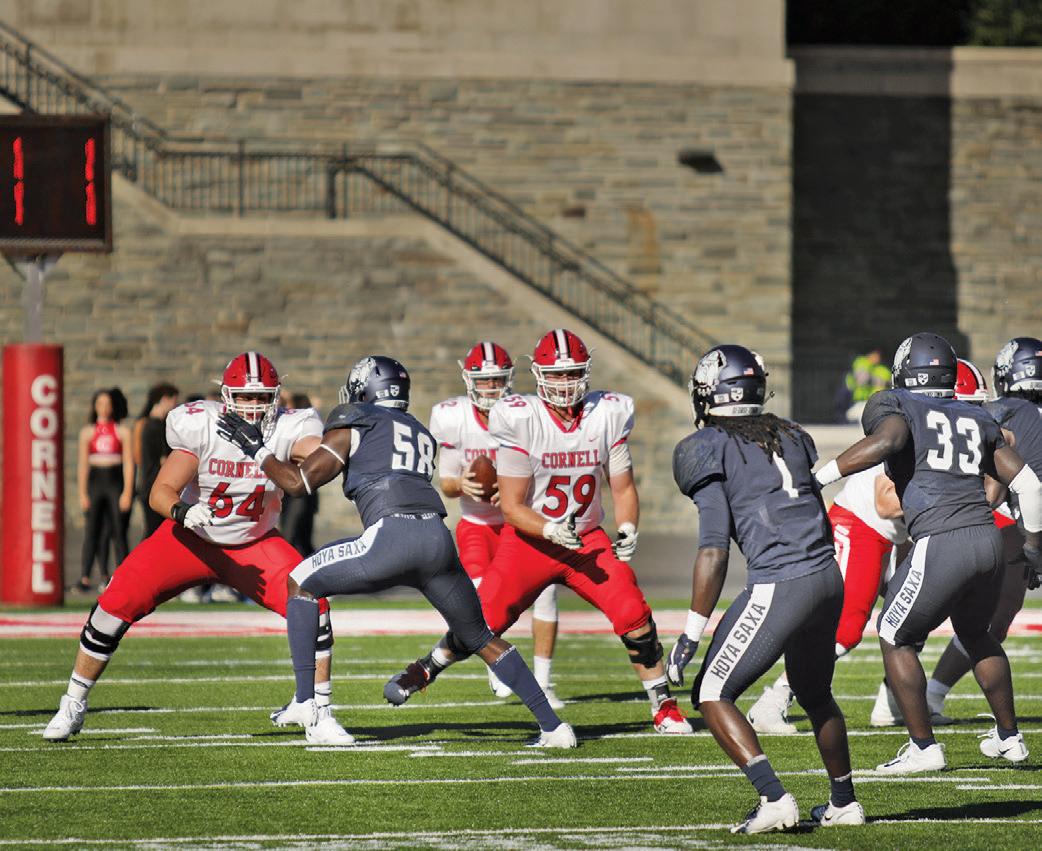
A Homecoming crowd cheering from the stands wasn’t enough to encourage the Red to a victory Saturday afternoon, as Cornell fell to Georgetown, 14-8. The team never took a lead.
Once again, the Red (1-2, 0-1 Ivy League) struggled in scoring position. Cornell moved the ball inside the Georgetown (4-1) 30-yard line on two separate occasions in the first half but came out of the first 30 minutes with zero points.
— one for a touchdown and one that set up a score — did in the defense.
“I think we were a little down this week compared to last week,” senior defensive lineman Nate Weber said. “We were really hyped up to go to Yale and try and get a win over there, so I think we were probably a little down but still firing on all cylinders.”
Catanese threw an interception on the Red’s first possession and junior kicker Garrett Patla missed a 44-yard field goal in the waning minutes of the second quarter.
“We just couldn’t get any sort of rhythm offensively. And when we did, something just seemed to happen.”
David Archer ’05
“We just couldn’t get any sort of rhythm offensively. And when we did, something just seemed to happen — to sputter,” head coach David Archer ’05 said. “That just kind of kills the sustained drives.”
The team’s failure to capitalize on scoring opportunities throughout the contest led to its demise in its first home game of 2019.
Over the last three weeks, Archer’s offense has shown little maturation as it continues to struggle to match up with other teams.
“We did move the ball up and down the field, but we just kind of went backwards in the red zone,” said senior quarterback Mike Catanese, who missed last week’s game with a concussion. “I need to be more efficient on third down, and that’s what we’re going to work on this week.”
Like in its two tilts prior, Cornell’s defense was stronger than its offense — but it still wasn’t at the level it needed to be. Two big plays
After Catanese’s interception, the Hoyas — buoyed by 33-yard pass from Gunther Johnson to Michael Dereus along with other chunk gains — marched into the end zone and picked up a two-point conversion to take an 8-0 lead.
The Cornell defense suffered a blow early in the second frame as junior linebacker
See FOOTBALL page 11
FIELD HOCKEY
Red Downs Columbia For 1st Ivy Win of 2019
Goalkeeper Henry stops all 5 shots in shootout; Royer scores game-winner
By FAITH FISHER Sun Staff Writer
A defensive standstill against Columbia couldn’t be decided in double overtime. But the Red finally sealed its first Ivy League victory of 2019 with a single shootout goal.
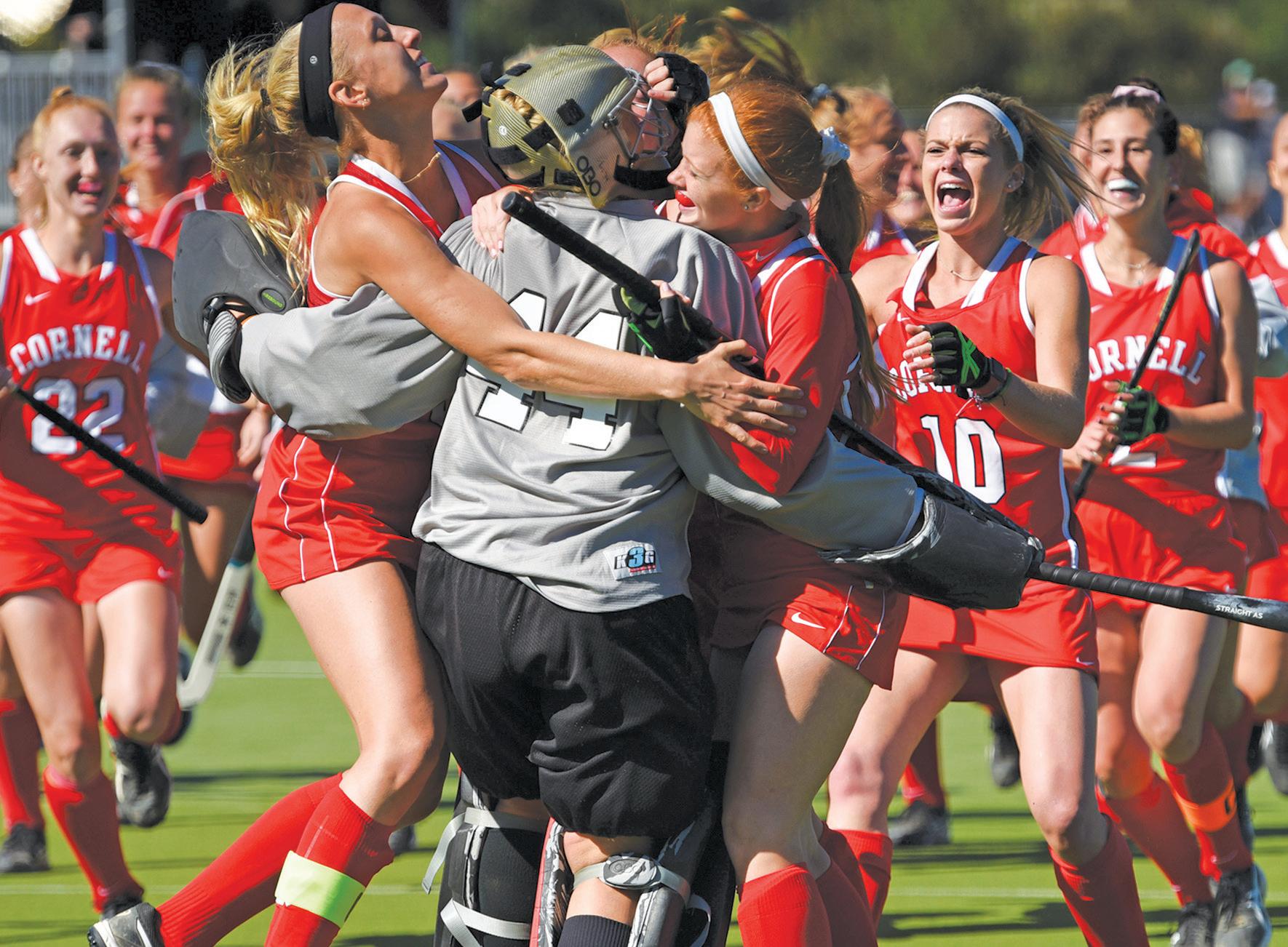
Senior goalkeeper Maddie Henry was the hero for the Red, stopping all five shots she saw in the shootout. Junior forward Grace Royer scored the shootout winner to give Cornell (5-2, 1-1 Ivy League) a 1-0 victory.
A second overtime proved equally fruitless. Only a shootout could crack the seemingly insurmountable deadlock between the Ivy League foes.
After three Cornell shots during the shootout, Royer was the first player of the day to find the back of the goal.
The Red held the weak shootout advantage, but Henry transformed the feeble edge into the team’s first Ivy League victory of the season. She was the hero of the day, saving all five shootout tries that the Lions fired her way.
“The game was a defensive battle,” Smith said. “We battled for the 80 minutes that really counted. We found a way to get it done and I am really proud of the heart, grit, and
“We would not have won without her,” head coach Andy Smith said of Henry. “It is not often you see the goalkeeper stop all five shots in a shootout. I thought she was brilliant, and she has been like that all season.”
An impasse was destined from the opening faceoff. Collectively, the teams totaled only four shots in the first half of the game, as play was limited primarily to the midfield.
Columbia (5-4, 1-1 Ivy), however, turned on their offensive engine in the second half of the game, recording six penalty corners and six shots. But their efforts were futile against the Red’s stout defense.
“Our defensive unit has been very good all season,” Smith said. “We were very hard on them in practice, and we feel like we have the right personnel in the right positions. We play very tight and very proactively on that end.”
With the score stagnant at 0-0 in the last seconds of the second half, the game headed for overtime.
An offensive outburst in the first overtime quarter overtook the defensive strategy that characterized regulation — Cornell and Columbia recorded a near equal amount of shots, the Red recording five compared to the Lions’ four. Despite a reinvigorated offensive energy, each team’s defensive unit protected their goals and the 0-0 impasse prevailed.
determination we showed in finishing the job with a shootout.”
The Red’s grit and endurance carried Cornell through the match, and the team was strongest in the most critical moments of the game —
“It is not often you see the goalkeeper stop all five shots in a shootout. I thought she was brilliant.”
Andy Smith
which drove it to victory.
“We were thrilled,” Smith said. “It is always nice to get the first (Ivy win) on the board. We felt that we were the better team coming into the game and the results showed that during the critical 80 minutes we were the better team.”
Looking to extend its two-game winning streak, the Red will travel to New Haven to take on Yale at noon next Saturday.
Faith Fisher can be reached at fsher@cornellsun.com.
Slowed down | For the third straight week, Cornell’s offense couldn’t get going. While the defense kept the Red in the game, Georgetown left Schoellkopf Field with a 14-8 victory.
BORIS TSANG / SUN PHOTOGRAPHY EDITOR
Banged up | Senior quarterback Mike Catanese played on Saturday after missing last week’s game due to injury.
MICHAEL WENYE LI / SUN SENIOR PHOTOGRAPHER
and LUKE PICHINI Sun Assistant Sports Editor and Sun Staff Writer
At last | Two overtime periods wasn’t enough to decide a defensive battle between Cornell and Columbia. A shootout goal was the difference in a 1-0 win.
BORIS TSANG / SUN PHOTOGRAPHY EDITOR