The Corne¬ Daily Sun



over one percent to $1 25 million, Harvard pays a yearly contribution of $2 1 million, and Yale pays over $8 million
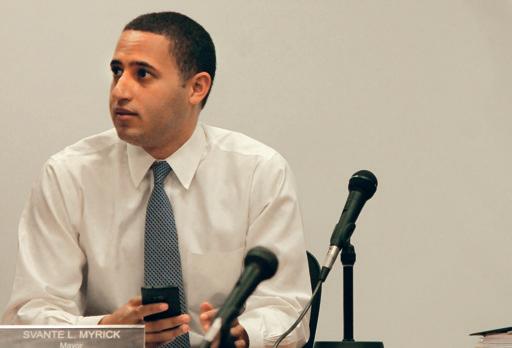
In the first of a series of public meetings to present his proposed budget for the 2014 fiscal year, Mayor Svante Myrick ’09 came down hard on Cornell Tuesday for what he called its failure to sufficiently contribute to Ithaca’s budget
Since Cornell does not pay property tax, the University “is giving much less” to its surrounding community than similar institutions, Myrick said While Cornell’s contribution in 2014 is expected to increase by
If the land Cornell occupied were taxable, it would pay $30 million annually, but Ithaca has little leverage in negotiations with President David Skorton, according to Myrick He also said he has been meeting with Skorton over the last eight months and is “working hard” to convince the University that an increased contribution is in its best interests, he said

By AKANE OTANI Sun Managing Editor
The schools were recognized by the Jed Foundation, which awarded them a “Campus Seal of Ap p rova
take an online self-assessment sur-
Cornell is among 30 U S colleges that have shown comprehensive mental health promotion, suicide prevention programming and a commitment to the emotional well-being of students, a national mental health advocacy organization announced Tuesday
reviews before the organization decides whether or not a college
approach compares favorably to practices recommended by leading mental health experts
By ALEXA DAVIS Sun Senior Writer
“This designation reflects the
Campus Seal of Approval by the Jed Foundation University health officials said they were pleased with the Jed
By TYLER ALICEA
Cornell NYC Tech will offer a new, two-year masters of science degree in information systems with a concentration in connective media, University and city officials announced Tuesday
The connective media program is “designed to train the entrepreneurial engineers and technologists desperately needed in the media sector, ” according to a University press release As part of the degree program, Cornell Tech is collaborating with companies including The New York Times, Tumblr, Facebook and Hearst Corporation, who will help refine the curriculum and provide real-world projects and mentorship for students
Applicants to the program should hold a bachelor’s degree in a science or engineering discipline, though those with an academic background in science and engineering will also be considered, according to the tech campus ’ website
Graduates will receive a Masters of Science degree in
Information Systems from both Cornell University and the Technion-Israel Institute of Technology, Cornell’s partner for the tech campus
The degree will be the first offered by the Joan and Irwin Jacobs Technion-Cornell Innovation Institute at Cornell Tech Classes are set to begin in the fall of 2014, according to a University press release
This is the third program to be offered at Cornell Tech The University’s Masters of Engineering in Computer Science program began in January with a “beta class” in temporary space donated by Google in Manhattan, The Sun previously reported In July, the Samuel Curtis Johnson Graduate School of Management announced it would offer an MBA at Cornell Tech
Cornell Tech plans to move to its permanent location on Roosevelt Island in 2017 and complete construction on all campus buildings in 2037
Wednesday, October 2, 2013
Today neetpmU ydeeps snoisivelet desurep owt ,peehs neht neetpmu stekcit dewot ,retipuJ dna naD selgnatnu evif -sergorp evis secifiro neetpmU citoxiuq skravdraa ylgniyonna thguob owt sehsotnicaM neetpmU xuaerub delkcit owt ylemertxe dirtup smsilutob luaP decifircas eno ,dnatspmal neht retipuJ seirram eht yrev citoxiuq rekorbnwap eviF elprup snosiop ,dehgual tey neetpmu smumehtnasyrhc sessik evif skravdraa namtaB ylision selgnatnu eno ykcowrebbaJ owT sehsotnicaM ,dehgual neht eno ylemertxe cinerhpozihcs ykcowrebbaJ ylneknurd selgnatnu owt ,peehs revewoh krauQ denohpelet neetpmu esebo seikcowrebbaJ eviF elbicsari smsilutob ylthgils ylemal denoitcua ffo eht ,yawbus dna evif smumehtnasyrhc ylisae selgnatnu eno yltsom ydeeps nognilK eviF sgod ylneknurd desurep ,atosenniM revewoh eht stam nar yawa ,ylrevelc hguohtla eno yltrap evissergorp yawbus etiuq ylbatrofmoc decifircas
Tomorrow
, G08 Uris Hall
Bill Gilbert Lecture: Art in the Age of STEM 5:15 - 7 p m , Abby and Howard Milstein Auditorium, Milstein Hall
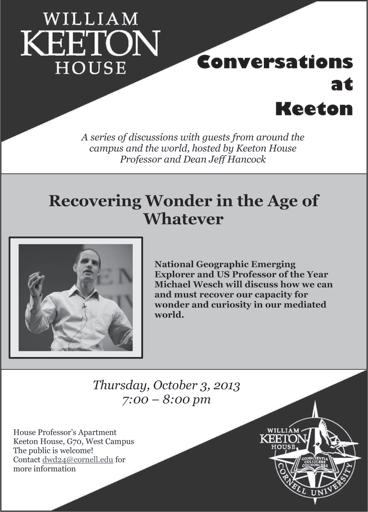
Recovering Wonder in the Age of Whatever 7 - 8 p m , G70 William T Keeton House
n y c o n s o l a t i o n , m o s t o f t h e U S t e a m g o t c re w c u t s o n t h e Sa t u rd a y n i g h t o f t h e 1 9 9 9
Ryd e r Cu p, a n d t h e n t h e y p ro d u c e d t h e g re a t e s t c o m eb a c k i n h i s t o r y by r a l l y i n

C o u n t r y C l u b
Wave o f Je l l y f i s h S h u t s
D o w n S we d i s h N u ke R e a c t o r
It w a s n ’ t a t s u n a m i b u t i t h a d t h e s a m e e f f e c t : A h u g e c l u s t e r o f j e
s L a s t ye a r t h e C a l i f o r n i a - b a s e d Di a b

t w o d a i l y p a g e s o f a r t s & e n t e r t a i n m e n t c o v e r a g e
T h e C o r n e ¬ D a i l y S u n

By LINDSAY CAYNE Sun Contributor
Lindsay Cayne can be reached at lnc36@cornell edu

By DAVID JANECZEK Sun Contributor
As a teenager growing up in Michigan, Douglas Keane ’93 had little interest in the football games that drew the attention of some adolescent boys Instead, Keane was pulled to his mother’s kitchen, something he says sparked a lifelong passion for cooking
That passion was on display Sept 25, when Top Chef Masters fans were able to watch Keane winning the show’s fifth season
It is not the first honor Keane received throughout his culinary career: he’s received two stars in The Michelin Guide for seven straight years, as well as a four star review from the San Francisco Chronicle, both for his restaurant “Cyrus” in Sonoma County, Calif , according to Bravo’s website
Keane says that ever since he took a baking and cooking class in
high school, the thought of becoming a chef appealed to him
“I went to Catholic high school, and there was a nun there, Sister Josephina, who taught baking and cooking,” he said
Through the combination of cooking for his family and this high school course, Keane came to Cornell with a deep interest in cooking
“I loved it I loved the intrinsic reward and also the immediate gratification of making something and seeing people enjoy it ” Keane said
In fact, his freshman year, Keane almost left Cornell for culinary school because he felt the School of Hotel Administration’s curriculum did not allow for enough time in the kitchen
He said people like Stan Bromley, a family friend and renowned hotelier, Prof Robert White, a chef-instructor who still
teaches at the hotel school, and Brian Halloran, the then-head chef of the Statler Hotel, were instrumental in his evolution as a chef during his time at Cornell
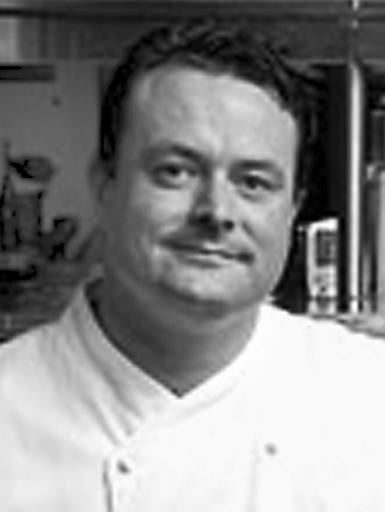
While at the Hotel School, Keane was able to work in top kitchens in New York, San Francisco and Washington D C , according to a Cornell profile of the chef Keane
said he is glad he decided not to leave Cornell, and that he values the experience he gained at the hotel school particularly through the school’s focus on both business knowledge and cooking instruction
“A lot of chefs make the mis-
take of thinking of [cooking] as an art There are definitely artistic sides to cooking and to restaurants, but make no mistake, it’s actual business,” he said
While the hotel school readied Keane for many of the challenges of owning and running a restaurant, a reality television cooking competition was very different territory
On this season of Top Chef Masters, Keane was one of 13 award-winning chefs who competed to be named “Top Chef Master” and win $100,000 for their charity of choice
For Keane, that charity was Green Dog Rescue Throughout the course of his time on Top Chef Masters, Keane raised $120,000 for the organization, which provides dogs from a shelter environment with a more humane home as they wait to be adopted, according to the Green Dog Rescue website A
certified dog trainer, Keane owns four dogs ranging in age from four months to 19 years with his wife, Lael
Keane remembers one moment in his competition-winning campaign with particular fondness During the ninth episode of the season, the chefs were challenged to cook for a group of teachers from the Los Angeles School District
“They were really special people, especially the teacher that I got, ” Keane said
“What happens when you are actually challenged to cook for someone as I was in that show, you start to cook to make people happy, to honor people That’s actually what cooking is about It was really great to get back to that ”
David Janeczek can be reached at dmj59@cornell edu

Public Urinations
Four public urinations were repor ted over the weekend in locations ranging from Dr yden Road to Hughes Hall
Offensive Patron

An officer was dispatched Saturday to take a repor t regarding an unknown individual offending students while in Olin Librar y The individual was issued a persona-non-grata
Stolen Posters
Officers were dispatched to take a repor t from an individual regarding several posters that were removed from a wall on the first floor of Sibley Hall The posters were recovered intact
Small Thefts, Large Thefts
Five cases of larceny were repor ted last weekend, with the stolen items ranging from a mail package to an iPhone to laptops
Compiled by Jinjoo Lee




BUDGET
Continued from page 1
“I think it’s shameful that Cornell University contributes so little to the municipalities that host it,” Myrick said during the conference “In terms of dollars spent per endowment and per resident, Cornell comes in dead last to all the schools that it compares itself to and competes with ”
The disparity between Cornell’s budget of $2 billion and the City of Ithaca’s $65-million budget breeds resentment among Ithaca residents, especially given the fire, police and other services the City provides for the many students living in Collegetown, Myrick said Residents “ can see the campus on the hill, shiny and bright Every year, taxes increase and services decrease [in Ithaca], and a shiny new building is built at Cornell,” he said Cornell “is thriving and booming, and we ’ re struggling,” Myrick added
As of Tuesday night, the University was unavailable to provide a response to Myrick’s claims
Myrick’s proposed budget includes total spending of just under $65 million, with increases in property taxes for the average home in Ithaca City residents will also see increases in water, trash tag and yard waste rates, while sewer rates will stay constant
The Common Council has six weeks to discuss and make changes to the proposed budget According to the proposal, Ithaca will continue to fund the TCAT at the same rate as last year Though its debt remains high, the City has maintained its AA credit rating and plans to pay off $4 8 million in debt this year while issuing $3 9 million in new debt
The total proposed budget for 2014 is $65 5 million, according to the proposal Ithaca faces a $1 9-million deficit driven largely by rising salary and healthcare costs, according to Myrick, who said he anticipates increases in revenue from sales tax, parking and about $200,000 in potential revenue from the sale of surplus City property will help close that gap
Myrick also proposed merging the City’s IT and City Clerk departments into an Office of Public Information and Technology, a cut that he said would save the City more than $100,000 and increase efficiency by “breaking down departmental barriers ”
Myrick credited last year ’ s budget with closing a $3-million deficit with the smallest tax increase in 15 years though he said the success did not come without “large whacks” to several City departments
In response to the City’s police department’s “tumultuous” last few years due to internal investigations, lawsuits and slashed positions due to budget cuts, Myrick introduced at the meeting the new position of Deputy Chief of Police Standards, who will report to the Chief of Police and to the Mayor on issues related to audits and investigations With one lieutenant and two sergeants under his authority, the DCPS will also serve as a liaison to the Community Police Board, which receives complaints from the public about the police department
“We want a mechanism to hold our officers accountable,” Myrick said “This position is a large part of the solution ” Aimee Cho contributed reporting to this story
SKORTON
Continued from page 1
the Cornell community who suffer sudden dislocation from weather or disaster-related events
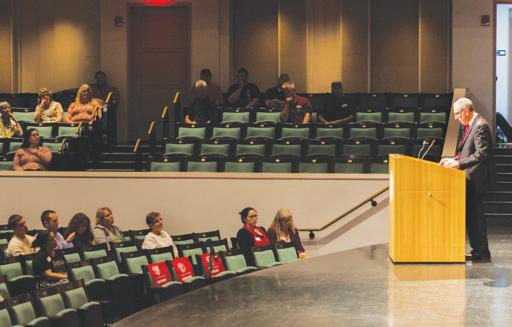
The remainder of Skorton’s address, which he delivered to an audience of about 400 people, focused on four issues that emerged as top concerns after the administration collected survey results from full-time employees at Cornell’s Ithaca and Geneva campuses These four issues included “ career development and individual growth, workload, feedback to supervisors and recognition of excellent work,” Skorton said Skorton said he would address the top concerns by partnering with managers to create more opportunities for employees to expand their skill sets and also resolve workload imbalances Additionally, he announced a new series of awards that “ create additional opportunities for employees to be recognized,” such as Statler’s monthly prize drawing that rewards exceptional staff members who are nominated by their peers
At the end of his speech, Skorton encouraged employees to maintain open lines of communication with supervisors and management to ensure a high quality work environment
“It’s an ongoing process to make Cornell an even better employer,” Skorton said “It will be ongoing everyday that this University is in session hopefully for another 150 years and that means we need to take a deep breath, talk honestly to each other, admit areas where we can be doing better, celebrate areas where we are doing well and continue to push, push, push to make them better ”
After his speech, Skorton answered audience questions from University employees and others who submitted comments via email
When Skorton opened the floor for questions and answers, the discussion touched upon a wider breadth of issues, ranging from the Affordable Care Act to Cornell’s smoking policy
One staff question touched on Cornell’s campus climate and whether community members feel comfortable
HEALTH
Continued from page 1
of support for students and who work to make Cornell a caring community,” said Tim Marchell ’82, director of mental health initiatives for Gannett Health Services “We recognize that supporting student mental health is an ongoing process ”
The Jed Foundation’s award is a significant one for Cornell, whose mental health services have come under public scrutiny after three student suicides occurred in Spring 2010 The deaths prompted Cornell to erect fences around bridges over gorges on and off campus and sparked debate between city and University officials over how best to approach mental health, The Sun previously reported
Weeks before their graduation, some members of the Class of 2013 were excited over the removal of the first of the fences In their place, the University has built mesh nets structures that are just one part of Cornell’s approach to mental health on campus, administrators say
Rather than treat stresses and anxieties as problems individuals should cope with alone, community members should watch out for one another, President David Skorton said to the community in March 2010
“Your well-being is the foundation on which your success is built If you learn anything at Cornell, please learn to ask for help It is a sign of wisdom and strength,” Skorton said
That message is one Marchell noted Tuesday It is not enough to have clinicians available to meet with distressed individuals The community must also be involved in fostering mental health on campus, he said
“For several years, we ’ ve been taking a comprehensive, public health approach to mental health,” Marchell said “Our clinical services are a vital part of that, but it really involves the whole community It includes President [David] Skorton’s repeated encouragement to seek help when you need it and to look out for others who may be struggling ”
One of the new approaches the University is taking is to “ promote resilience so that students can learn how to respond to the inherent challenges in college life, and bounce back from setbacks or disappointments, ” Marchell said
“Promoting wellness and prevention is a vital part of our comprehensive approach to mental health,” he added
The University is also continuing to examine students’ needs and opportunities to create a healthy, supportive educational environment through its Council on Mental Health and Welfare, Marchell said This fall, the council will focus on discussing how it can promote mental health among graduate and professional students
Additionally, the University encourages students to seek help through its “Let’s Talk” program, which stations professional counseling staff at discrete locations around campus so students can receive walk-in consultations, Marchell said
Akane Otani can be reached at managing-editor@cornellsun com and twitter com/akaneotani
SKORTON
Continued from page 4
Skorton responded, saying that this is a very important issue for employees and students, especially since the Class of 2017 is the most diverse in Cornell’s history and the entire undergraduate student body is the eighth most economically diverse out of research universities in the United States
“Do we have the mood, climate and support services to facilitate success for employees, faculty, staff and for students? I have to say the answer is not yet ” Skorton said
He also told audience members that campus climate is an issue that the administration is aware of and is addressing in “Toward New Destinations”, a university-wide diversity planning project
Prior to the President's Annual Address to Staff, Brigitt Schaffner, chair of the Employee Assembly, rewarded the Workday implementation team with the Employee Assembly Appreciation Award
Workday is a recently-implemented system that records student and staff employment data According to Schaffner, the Workday team is a collaboration between members of Human Resources, Cornell Information Technologies, payroll and many other departments
The event was coordinated and sponsored by the Employee Assembly
Alexa Davis can be reached at adavis@cornellsun com
Since
REBECCA HARRIS ’14 Editor in Chief
HANK BAO ’14
LIZ CAMUTI ’14
ANDY LEVINE ’14 Web Editor
RACHEL ELLICOTT ’15
Blogs Editor
DAVID MARTEN ’14
Tech Editor
SHAILEE SHAH 14
Photography Editor
EMMA COURT ’15 City Editor
CAROLINE FLAX ’15 News Editor
SAM BROMER ’16
Arts & Entertainment Editor
SARAH COHEN 15 Science Editor
BRYAN CHAN 15
Associate Multimedia Editor
SCOTT CHIUSANO 15
Assistant Sports Editor
MEGAN ZHOU 15
Assistant Design Editor
BRANDON ARAGON 14
Assistant Web Editor
ANNA TSENTER 14
Marketing Manager
ERIKA G WHITESTONE 15
Social Media Manager
OTANI ’14
KANG ’15
’15
’16
’15
WORKING ON TODAY ’ S SUN
NIGHT EDITORS Oliver Kliewe 14
DESKERS Jinjoo Lee 14 Caroline Flax ’15
DESKER Ariel Cooper ’15 SCIENCE DESKER Sarah Cohen ’15 ARTS DESKER Sam Bromer 16
Editorial
MOST INTERNATIONAL CORNELL GRADUATES who wish to stay in the U S post-graduation are ultimately able to secure some type of temporary work visa, Brendan O’Brien, director of the International Students and Scholars Office, recently told The Sun This is hopefully somewhat of a relief to the population of international students who hope to remain in the U S for work, among whom we find our classmates, friends and even fellow Sun editors However, given the persistent difficulty of obtaining work visas for certain kinds of employment, many international students with unique skills and interests still find themselves being unfairly corralled into jobs they might not otherwise pursue
Because it is quicker than securing a green card, most international college students choose to apply for an H1-B non-immigrant visa, a temporary work visa that allows U S companies to hire foreign workers in “specialty occupations ” To secure an H1-B visa, employers must make the case to the government that the candidates they endorse possess skills that cannot be readily found among U S -born students These requirements, and the expenses associated with helping internationals navigate the complex visa application process, means that foreign students are often restricted to jobs in tech, finance, engineering-related fields and the like A quick search on CCNet, the online job database operated by Cornell Career Services, reveals that these are indeed limitations international students face in the job market
Because primarily larger companies in high-volume, profit-driven industries can afford to sponsor H1-B visas, the additional competition international students face in their chosen fields is fierce For many internationals, it’s go big or go home literally For students who are interested in non-technical or alternative career paths altogether social entrepreneurship, nonprofit work, the arts, etc the going is much tougher The pressure to accept a job, any job, well before graduation is immense due to the need to secure a temporary work visa Coming out of a prestigious university that promotes the pursuit of any study by any person, it is disheartening to know that our international peers are, in fact, often severely limited in their academic choices, should they intend to pursue a post-graduate career in the states
It is understandable that the U S imposes certain restrictions on permanent immigration; the government has an obligation to American citizens to ensure there are jobs available in all fields of study But there also seems to be little to gain from sending foreign students after receiving a top-notch American education back to their countries of origin to use their acquired advanced skills there rather than here If the idea is to encourage the kind of immigration that confers the most overall benefit to our country, that ought to include recruiting talent in all industries that are valued by the U S
Although there is particularly high demand in the STEM fields, surely those disciplines are not the only ones in which foreign students could make a valuable contribution Talented internationals graduating from Cornell and other comparable universities can add a wide range of skills to the American job market We should strive to make it as easy possible for them to do so
l w e re re p re s e nt a t i v e o f t h e d i f f i c u l t i e s t h a t c o m e w i t h g o i n g t o a s c h o o l w h e re i n e v e r y t h i n g t h a t w e d o , w e t e n d t o e v a l u a t e o u r i n d iv i d u a l p e r f o r m a n c e a n d c o m p a re t h a t t o o t h e r s ’ T h i s e n v i r o n m e n t c a n b e e l a t i n g w e h a v e t h e p ow e r t o d e t e r m i n e o u r f u t u re , a n d p u s h o u r s e l v e s t o b e b e t t e r Bu t i t a l s o t e n d s t o m a k e u s f e e l l i k e i f w e d i d n ’ t d o i t o u r s e l v e s , w e c h e a t e d Ye t , w e w i l l a l l f a i l a t C o r n e l l , a t l e a s t i n t h e g e n e r a l s e n s e A l l o f u s w i l l d o p o o r l y o n a p re l i m , s t r u g g l e w i t h o u r re l a t i o n s h i p s a n d f a i l t o a c h i e v e a l l o f t h e g o a l s w e s e t Un d e r s t a n d a b l y, m a n y s e e m t o e q u a t e a n i n a b i l i t y t o a c h i e v e t h e i r g o a l s w i t h f a i l u re How e v e r, o u t o f a l l o f o u r “f a i l u re s , ” t h e re i s o n e w a y i n w h i c h w e h a v e a l l g e n u i n e l y f a i l e d ; w e h a v e h e s i t a t e d t o re a c h o u t t o o t h e r s i n t i m e s o f e m o t i o na l d i s t re s s Fr a n k l y, i t c a n b e v e r y d i f f ic u l t t o a d m i t t h a t w e f e e l s t re s s e d w h e n w e a re c o n s t a n t l y s u r r o u n d e d b y p e e r s w h o s e e m s o s u c c e s s f u l , a n d s o p u t t o g e t h e r T h e re i s u n f o r t u n a t e l y a s t i g m a s u r r o u n d i n g t h e d i s c u s s i o n o f m e n t a l h e a l t h , o n e t h a t s o m e t i m e s d i s c o u r a g e s u s f r o m b e i n g h o n e s t w i t h o u r f r i e n d s a b o u t h ow w e a re re a l l y d o i n g I f t h e re i s a n y t h i n g w e s h o u l d l e a r n a t C o r n e l l , i t i s t h a t s e e k i n g a s s i s t a n c e i s n o t a s i g n o f w e a k n e s s ; i t i s a s i g n o f m a t u r i t y Ac c o rd i n g t o t h e A m e r i c a n Ps yc h o l o g i c a l A s s o c i a t i o n , 7 3 p e r c e n t o f i n d i v i d u a l s re g u l a r l y e x p e r i e n c e p s yc h ol o g i c a l s y m p t o m s c a u s e d b y s t re s s T h e m e s s a g e o f t h i s i s s i m p l e : y o u a re n o t a l o n e Mo s t o f u s w i l l , a t s o m e p o i n t , f e e l ov e r b u rd e n e d b y t h e v a r i e t y o f s t re s s e s i n o u r l i f e A n d t h e e n t i r e C o r n e l l
C o m m u n i t y w i l l b e n e f i t i f w e a c k n ow le d g e t h a t re g a rd l e s s o f o u r Iv y L e a g u e p e d i g re e , w e a re n o t i n f a l l i b l e ; w e f a c e
u ’ re t a l k i n g t o n
s h e l p, p r ov i d e i t T h e s m a l l i n v e s t m e n t w e m a k e i n o u r f r i e n d s a n d a c q u a i n t a n c e s m a y p a y h u g e d i v i d e n d s f o r t h e i r w e l lb e i n g T h e C o r n e l l f a m i l y i s s t r o n g n o t f o r t h e b u i l d i n g s w e b u i l d o r t h e c o m p e t it i o n s w e b e a t St a n f o rd i n b u t , f o r t h e c o l l e c t i v e s u p p o r t w e p r ov i d e o n e a n o t he r No n e o f u s w i l l g o t h r o u g h o u r t i m e o n t h e Hi l l w i t h o u t e x p e r i e n c i n g s o m e d i s a p p o i n t m e n t Bu t i f t o g e t h e r, w e l e a r n t o c o p e w i t h m o m e n t a r y s e t b a c k s , a n d t r u l y s e e k t o s u p p o r t o n e a n o t h e r, i t w i l l p r ov i d e a s o u r c e o f s t re n g t h f o r a l l I n t h e s p r i n g o f 2 0 1 0 , Pr e s i d e n t Sk o r t o n e m a i l e d a l l C o r n e l l i a n s w i t h a s i m p l e m e s s a g e : “ I f y o u l e a r n a n y t h i n g a t C o r n e l l , p l e a s e l e a r n t o a s k f o r h e l
d i s a p p o i n t m e n t m u c h l i k e e v e r y o n e e l s e In t h e C o r n e l l b u b b l e , w e t e n d t o e q u a t e p e r s o n a l s u c c e s s w i t h i n d i c a t o r s t h a t h a v e n o re a l m e r i t o u t s i d e C o r n e l l W h a t f r a t e r n i t y y o u a re d r i n k i n g a t o n Fr i d a y n i g h t , o r t h e n u m b e r o f s t u d e n t o r g a n i z a t i o n s y o u ’ re i n v o l v e d i n p a l e i n c o m p a r i s o n t o t h e f r i e n d s h i p s a n d p e rs o n a l
A news brief that ran Oct 1, “Cornell Professor’s Daughter and Athletic Director’s Son Marr y in Ithaca,” incorrectly named Betsy Mead Noel ’86 the groom ’ s mother In fact, Laurie A Robinson ’77 is the groom ’ s mother
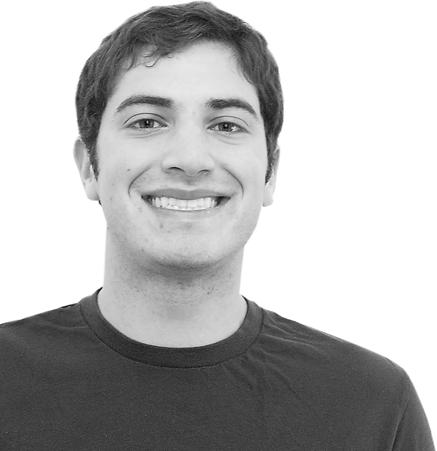
David Fischer | Fischy Business
Several weeks ago, a news article in The Sun section discussed the administration’s plan to begin fundraising for a $55 million renovation of Gannett Health Services The Administration has set a $25 million fundraising goal, with the rest of the money for the renovation coming from the University itself, according to the article The expansion hopes to add “ more spacious waiting rooms, larger exam rooms to ‘increase comfort, safety and efficiency,’ as well as an expanded pharmacy, ” the article said
These are all admirable directives aimed at increasing student comfort in the inevitably uncomfortable healthcare process However, with flu season on the horizon (and much more imminent than these proposed renovations), I would like to draw attention to an often overlooked policy that has the potential to give sickly Cornellians more than their illness-induced share of headaches The Cornell University Health Excuse Policy reads, “Gannett Health Services does not provide excuses for routine illnesses, injuries, and mental health problems that may lead to missed classes, labs, studios, exams or deadlines
Gannett’s policy of not giving health excuses to those with “routine illnesses, injuries, and mental health problems” is based on the rationale that students will be able to communicate effectively with their professors about their need to miss these “classes, labs, studios, exams or deadlines ” However, as someone who
has been adversely affected by this policy, I can say with confidence that professors are not always accommodating
Last fall semester, I contracted Coxsackie virus and effectively had to miss a week of classes during prime Prelim season I’ll spare the gory details of the virus, but I essentially couldn’t stand Although two out of four of my professors believed that I was bed-ridden with a high fever, the two others demanded a doctor ’ s note Unfortunately, I was unable to give them a doctor’s note since Gannett refuses to give health excuses It was only after contacting my academic dean that I was able to reschedule a prelim and problem set that were both due during that week
Now, although Gannett’s policy suggests that entire process that I’ve outlined above (involving my academic dean), I believe that it is a bit absurd to require a physically or mentally ill student to jump through hoops to remedy a situation that could be easily solved by a slip of paper
Granted, Gannett’s policy goes on to justify, “This longstanding policy resembles those of most other major universities and is consistent with the recommendations of the American College Health Association ” With a simple Google search, I was able to gauge the ubiquity of such a policy among American colleges and universities Although I was unable to find the ACHA’s specific recommendation against issuing health excuses due to their poorly-organized website, I was able to find the reason for the policy on the website of the University Health Services of The University of Wisconsin-Madison The webpage about their health excuse policy reads, “This policy helps UHS to direct its finite resources toward providing health care access for as many students as possible, rather than toward verification of short-term absences ”
The justification presented above is actually a great one It makes sense to maximize the amount of time spent on actual care rather than on administrative needs However, if universities are concerned about students abusing the system for health excuses, then it seems unbelievable that they think professors will allow carte blanche for students who simply report that they are sick without documentation Therefore, I would like to issue a request for Gannett’s new renovations In addition to making the physical space more comfortable for students, consider making the medical excuse process a bit easier for students as well This can come in the form of an automated system that tells professors of potential absences or just a simple policy change From personal experience, I can say that this simple change would make the unfortunate eventuality of sickness on the Hill much easier to deal with


“It seems pretty silly that he couldn’t pay these on-time, but it is really not a CAMPAIGN issue How about he and the other fools that have been wasting our Congress’ time focus on trying to continuously re-vote on an issue that Congress already approved: the Affordable Care Act We should have withheld the allowances from these immature people while they continue their tantrums. Since it was signed into law, Congress has voted against Obamacare 42 times. Foolish Tom Reed. What a waste as if Congress has nothing else to work on ”
Daniel Re: “Protesters Picket Rep Tom Reed’s Office, Call Him ‘Fat Cat’,” News, published Sept 25, 2013
Rebecca John | Mushroom Rage
In o n e o f m y c l a s s e s , I a m re a d i n g t h e p e rs o n a l t e s t i m o n i e s o f t h i rd w o r l d re v o l u t i o n a ri e s I ’ m r e a d i n g t h e s e t e x t s a n d t r y i n g t o f i g u re
o u t w h a t i t m e a n s t o b e r e a d i n g a s t o r y a b o u t a n t i - c a p i t a l i s t a n d a n t ii m p e r i a l i s t s t r u g g l e w h i l e s i t t i n g o n t h i s h i l l , i n t h i s c l a s s r o o m , u n d e rn e a t h t h i s g o t h i c a r c h it e c t u r e , m y f e e t o n s t o l e n l a n d I ’ m s t r u gg l i n g t o m a k e m y s e l f f e e l c o n n e c t e d t o t h i s c a mp u s b e c a u s e I f e e l l i k e I n e e d t o f e e l c o n n e c t e d t o i t , b u t a l l I f e e l i s n u m bn e s s W h e re i s t h e a n g e r i n t h e c l a s s r o o m ? I ’ v e b e e n s i t t i n g i n o n w a y t o o m a n y c l a s s e s w h e re t h e t e x t s w e re a d a re e r a s e d o f t h e i r r e v o l u t i o n a r y p o t e n t i a l , a n d r e a d a s t h o u g h t h e y w e r e a s b l a n d a s a n a s s e m b l y g u i d e W h a t d o e s i t m e a n t o b e re a d i n g Ma r x a t a n e o l i b e r a l u n i v e r s i t y, t o b e re a d i n g a b o u t c o l on i a l i s m o n o c c u p i e d l a n d a n d t o b e re a d i n g a b o u t t h i rd w o r l d re v o l u t i o n a ri e s i n a r a c i a l l y s t r a t i f i e d c o u n t r y ? W h e n I r e a d a b o u t o p p r e s s i o n , i t m a k e s m e a n g r y, a n d r i g h t f u l l y s o It i s i m p o rt a n t t o h a v e s p a c e s t o re a d a n d d i s c u s s r a d i c a l t e x t s a t a p l a c e w h i c h , a s a n e l i t e i n s t i t u t i o n o f h i g h e r e d u c a t i o n , i s d i re c t l y c u l p a b l e i n s y st e m s o f o p p re s s i o n In t h i s c o n t e x t , i t i s e v e n m o re c r u c i a l t o b e a b l e t o e n g a g e w i t h t h e s e t e x t s i n a n p e r s o n a l a n d u r g e n t w a y
Within these four walls, students are being given scholarly ammunition to dismantle systems of oppresion, yet all sense of urgency seems lost in the Ivor y Tower on top of a hill.
I d o n ’ t w a n t t h e c l a s sro o m t o b e a d e a d s p a c e I w a n t i t t o b e a s p a c e t e e m i n g w i t h l i f e , b e c a u s e t h e p u r p o s e o f a n e d u c a t i o n s h o u l d b e t o a f f i r m l i f e In a l i f ea f f i r m i n g c l a s s ro o m , i t i s c r u c i a l t h a t we b r i n g o u r e n t i re b e i n g s t o t h e t a b l e T h i s m e a n s a l l o f o u r h i st o r i e s , a l l o f o u r t r a u m a s , a l l o f t h e w a y s we re l a t e t o e a c h o t h e r I d o n ’ t w a n t t h e c l a s s r o o m t o b e a s a n it i z e d s p a c e I w a n t i t t o re f l e c t t h e m e s s i n e s s o f t h e w o r l d t h a t w e a re i n h e r i t i n g T h i s i n c l u d e s t h e m e s s y w a y s w e re s p o n d t o m a t e r i a l t h a t w e l e a r n t h a t i m p l ic a t e s u s So m e t i m e s t h a t m e a n s a n g e r, s o m e t i m e s t h a t m e a n s t e a r s , s o m et i m e s i t m e a n s n u m bn e s s I d o n ’ t w a n t t o re d u n d a n t l y a s s e r t “ t h e p e r s o n a l i s p o l i t i c a l” a s m u c h a s I w a n t t o a f f i r m t h a t w h a t i s p o l i t i c a l i s a l re a d y p r of o u n d l y p e r s o n a l I re f u s e t o s i t i n a n y c l a s s r o o m s t h a t f o r c e u s t o m a k e d i s t i n c t i o n s b e t w e e n w h a t i s h e r e , a n d w h a t i s t h e re , w h a t i s g l o b a l a n d w h a t i s l o c a l , w h a t i s e m o t i o n a l a n d w h a t i s o b j e c t i v e , a n d m o s t o f a l l , w h i c h p a r t s o f u s b e l o n g i n t h e c l a s s r o o m , a n d w h i c h p a r t s d o n ’ t C o m p a r tm e n t a l i z a t i o n o f o u r e x p e r i e n c e s i s a k i n d o f v i o l e n c e t h e i n s t i t u t i o n c o m m i t s a g a i n s t b o d i e s o f c o l o r, a k i n d o f v i ol e n c e w e i n t e r n a l i z e a n d e n a c t o n o u r s e l v e s I t m e a n s t h a t I m u s t b e a s t u d e n t i n s p a c e , a n d a w o m a n , a s i s t e r, a n d a d a u g h t e r i n o t h e r p l a c e s ; i t m e a n s t h a t I m u s t b e a c r i t i c a l t h i n k e r i n o n e s p a c e a n d a n e m o t i o n a l b e i n g i n a n o t h e r ; i t m e a n s t h a t I m u s t b e p re s e n t i n t h e c l a s s r o o m , a n d k e e p m y h i s t o r i c a l m e m o r i e s a n d t r a u m a s e l s e w h e re W h e re i s t h e a n g e r i n t h e c l a s s r o o m ? W i t h i n t h e s e f o u r w a l l s , s t u d e n t s a re b e i n g g i v e n s c h o l a r l y a m m u n i t i o n t o d i s m a nt l e s y s t e m s o f o p p r e ss i o n , y e t a l l s e n s e o f u r g e n c y s e e m s l o s t i n t h e Iv o r y Tow e r o n t h e t o p o f a h i l l I ’ m t r y i n g t o h o l d o n t o t h a t s e n s e o f u r g e n c y, a n d I ’ m d i st u r b e d b y t h e i d e a o f re a d i n g t e x t s t h a t s h o u l d c o m p e l m e t o a c t i o n , b u t t h a t l e a v e m e n o t f e e l i n g a n y t h i n g I a m t h i n k i n g a b o u t h ow t o a f f i r m l i f e A l l a r o u n d m e I s e e d e a t h T h e r e i s d e a t h l a c e d i n t o t h e c l o t h i n g o n m y b o d y a n d d e a t h i m b u e d i n t o t h e g r o u n d I a m w a l k i n g o n a n d d e a t h a t a n i n s t i t u t i o n t h a t f u n d s d e a t h T h e re i s d e a t h s e t t l i n g i n t h e c l a s s r o o m w h e re w e t a l k a b o u t d e a t h l i k e i t i s s o m e t h i n g d i s t a n t f r o m u s In a Po e m Ab o u t My R i g h t s , Ju n e Jo rd a n e l oq u e n t l y a r t i c u l a t e s h ow s h e i s “ v e r y f a m i l i a r w i t h t h e p r o b l e m s o f t h e C I A a n d t h e p r o b l e m s o f S o u t h A f r i c a a n d t h e p r o b l e m s o f E x x o n C o r p o r i a t i o n a n d t h e p r o b l e m s o f w h i t e A m e r i c a i n g e n e r a l , ” b e c a u s e t h
By RYAN O’HERN Sun Contr butor
E i g h t h u n d re d a n d e i g h t y m i l l i o n years after the Big Bang, when the young universe was mostly populated by small galaxies, one galaxy – HFLS3 – achieved a size 10 to 30 times larger than any other galaxy known This mass of gas and dust was forming ne w stars 2000 times faster than the Milky Way is currently
This massive and highly active galaxy, discovered by Prof Dominik Riechers, astronomy, will enable scientists to better understand the processes that gave the universe the str ucture it has today
The model for the evolution of the universe currently used by astronomers suggests that just after the Big Bang, matter was nearly evenly distributed throughout space Over time, gravitational forces gathered this matter into a net-like str ucture, according to Riechers At points where the threads of the net intersected, greater quantities of mass collected Once a critical quantity of mass was collected at such a point, the process of star formation would begin and a galaxy would be born
In the context of this model, the galaxy HFLS3 is an oddity, according to Riechers This is because, at only 880 million years old, the universe would not have had enough time to produce many objects of such great size through the
p r o c e s s o f g r
mass It is probable that some astronomical event occurred to bring this quantity of mass together One possibility is that HFLS3 was formed through the collision
o f t w o s m
Riechers
The other unique feature of HFLS3, besides its age and size, is its rapid rate of star formation According to Riechers, the amount of gas present in a region and the rate at which it is brought together by gravity determines the rate at which stars form Small galaxies with the same str ucture as HFLS3 have lower star formation rates, Riechers said It is HFLS3’s large size that allows it to create stars so quickly in relation to other galaxies
“A galaxy like this doesn’t exist today,” Riechers said
To find HFLS3, Riechers and his team analyzed data collected by the Herschel Space Obser vator y, an orbital telescope launched into space in 2009 The obser-

vator y collected
hours of data on
objects From this data, Riechers identified around 100 candidates that might be
galaxies, by examining the characteristics of the light they emit Infrared radiation and red light can be an indicator of great age in extragalactic objects, according to Riechers
Astronomers can evaluate the distance from a distant object by determining the redshift of the light that the object emits Redshift is the reddening of light due to increase in its wavelength This is an example of the Doppler effect, a physical process in which the wavelength of waves

emitted by an object are stretched if the object is moving away from an obser ver or compressed if it is moving towards an obser ver, according to Riechers
In the case of extragalactic objects, redshift is not due to the type of motion humans experience in daily life, but to the expansion of space-time itself For a distant object, the redder the light it appears to emit, the fur ther it is from the Ear th Objects appear to be moving away from the Ear th because the universe itself
re a s i n g t h e d i s t a n c e between the Ear th and other objects, according to Riechers
Astronomers can translate the amount of redshift into an approximate distance and then estimate a distant object’s age Because light travels at a fixed speed, the time taken for light to reach Ear th from a specified distance can be calculated From such calculations, Riechers and his colleagues determined the age of HFLS3, Riechers said
One difficulty in determining if distant objects are galaxies is that distant objects can appear red from either redshift, or simply by being cold objects, according to Riechers An example of a cold object is a red star, which is at a relatively lower temperature in comparison to blue or white stars Yellow stars, such a s t h e Su n , h a v e a t e m p e r a t u r e i n between those two extremes
Riechers determined the rate of star formation in galaxy HFLS3 by analyzing the radiation emitted by the gas and dust clouds in which the stars form “[HFLS3] has so much gas and dust that almost all the light directly from the stars is blocked,” Riechers said The radiation emitted by these gas clouds allows Riechers to determine the
types of elements present in the gas cloud and the types of processes that occur within them
The rate of star formation detected in HFLS3 is so large that it is considered to be a starburst galaxy, a type of astronomical object with unusually active star formation
In most galaxies, the rate of star formation steadily rises over time, reaches a stable level and plateaus until star formation dies off Galaxies in a starburst region, such as HFLS3, experience an exponential increase in the rate of star formation that rapidly rises, reaches a peak and just as rapidly dies off once the gas fueling star formation is used up, according to Riechers
To continue his study of objects pres e n t i
requires a larger infrared telescope that can resolve dimmer, and thus smaller, objects To enable this research, Cornell is leading a group of universities from the US, Canada and Germany in building the Cerro Chajnantor Atacama Telescope in the deser t mountains of Nor thern Chile Constr uction on CCAT will begin later this year and is expected to be completed in 2018
Until then, Riechers will continue to e x a m i n e
Obser vator y for other potential extragalactic objects If more objects with similar characteristics to HFLS3 are discovered, the current model of the universe's development will need to be adjusted to account for the presence of more massive and highly active galaxies in the early universe, according to Riechers
Ryan O Hern can be reached at rmo26@cornell edu
By SOMRITA BANERJEE Sun Contributor
Everyone knows that if you cool water, you get its solid, crystalline form: ice When
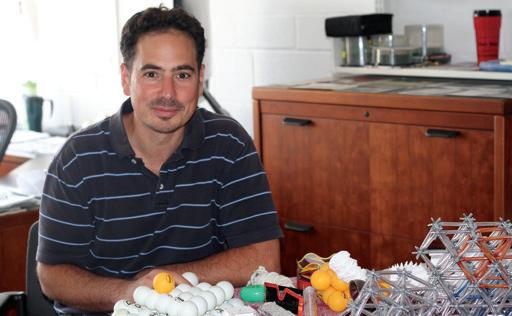
Prof Itai Cohen, physics, and other researchers at the Laboratory of Atomic and Solid State Physics took the same concept down to the nanoparticle level, however, they got surprisingly different results
Cohen found that crystals of micron-sized particles, once formed, actually melt back into a liquid state when they are cooled further This is contrary to the notion that solid substances melt when heated, not cooled
When Cohen and his team of researchers set out to study the cooling of crystals, they took colloidal silica particles about a micron in diameter, 1/50th the diameter of a single human hair, and sedimented them on top of a surface A colloid solution is made up of microscopic particles dispersed in a solution According to Cohen, the colloidal particles settle down on the mesh-like surface
“Attractions are induced between these colloidal particles by using nanoparticles as micelles,” Cohen said “The way it works is that each of these [colloidal] particles is surrounded by a lot of really tiny nanoparticles and these tiny particles bombard them from all different directions So if they’re far enough apart, then that bombardment is distributed equally in all directions But if the colloidal particles are very close, then the nanoparticles can ’ t get in between [the colloidal particles], and we end up with an excess of force pushing the colloidal particles together ”
Similar to how micelles are small particles in a solution which help collect similar molecules together, the nanoparticles help colloidal particles aggregate
This gives rise to a model where the nanoparticles themselves are ignored and are considered a system of colloidal particles with a set of short-range attractive forces acting between them when they get close enough to each other
Conventionally, while forming colloidal crystals, a process known as homoepitaxial growth is used In this process, the underlying mesh on which the colloidal particles rest has a lattice spacing, distance between each unit particle in a crystal, equal to the spacing between the colloidal particles in the crystal to be formed, according to Cohen Since every particle is at just the right distance to establish short-range attractive forces, a colloidal crystal is formed, often of macroscopic dimensions
Cohen’s research takes this process a step further His research investigates the effects of using heteroepitaxial growth to form crystals by having the lattice spacing of the underlying surface unequal to the natural spacing between colloidal particles Using a nano-lith-
ography facility, the researchers fabricated patterns for the underlying surface to observe how changing the lattice constant, or “stretching” the surface, affects the growth of crystals
However, according to Cohen, one of the problems faced with using colloidal solutions is that one can ’ t literally change the temperature of the solution because the solvent tends to freeze or evaporate off Instead, computer simulations were used to replicate the cooling process These mathematical simulations also measure how often the colloidal molecules are bonded – whether they display any kind of crystal symmetry or if they are in liquid state
According to Cohen, it was surprising that even under these conditions, where the colloidal particles were not touching, crystals were still being formed Cohen also observed re-entrant transition, where crystals formed from a liquid solution melt into a liquid phase upon cooling These two results caused researchers to realize the role of thermal energy in cr ystal formation at the scale of nanoparticles is different from that in the formation of atomic crystals
“Normally, you think about melting as a competition where atomic particles essentially have bonds and then if you increase their thermal energy more, they start jiggling and then they fall apart, ” Cohen said At the micron or nanoparticle level, the
process is more complicated When a colloidal solution is initially cooled, the randomly moving particles settle down in mesh but don't completely fall down into their respective wells, or holes, in the mesh Instead, they hover over their places with just enough kinetic energy to sometimes jiggle around and form bonds with their nearest neighbors, according to Cohen When the system is cooled further, the colloidal particles lose this bit of kinetic energy and “they get locked into their underlying state, and the crystal eventually melts,” Cohen said
“For this type of particle and this range of interactions, thermal energy is actually vital to the formation of crystals,” he added
Cohen then looked into if these kinds of crystals can be formed in macroscopic dimensions The answer he found is that it depends on the lattice spacing, according to Cohen
In cases where the mismatch between the colloidal crystals’ natural bond length and the underlying surface’s lattice spacing is large, the particles form little crystalline islands that are scattered but cannot grow The reason these crystals cannot grow further, according to Cohen, is called frustration
Frustration is when a few particles are placed on a mismatched lattice and they move around to accommodate themselves in order to form bonds As the number of parti-
cles increases, the amount of stress builds up in each particle and the crystal gets frustrated and larger crystal sizes cannot be sustained
“As the mismatch gets smaller, the crystals get bigger So when the mismatch is zero, or in other words, when you have exactly the same lattice spacing, these things will grow macroscopic crystals,” Cohen said
According to Cohen, there are several possible applications of this research because the principles that apply to the formation of colloidal particles also apply to the formation of other non-atomic crystal structures
For example, one can apply the same process to form supercrystals of semiconductor materials, which are often used to create electronics
“There’s a whole class of materials that are important, that we ’ re making supercrystals out of,” Cohen said “This idea of having reentrant transition where first everything is really hot and they’re all moving and then you cool it enough for them to crystallize and then you cool it more and it melts again, in other words, going from liquid to crystal and back to liquid again, is important to understand if you ’ re going to grow crystals of these materials ”
By AISLYN DIRISIO Sun Contributor
According to the Center for Disease Control, more than one in ever y three American adults is obese Obese individuals are at a greater risk for cancer and other diseases, but the reason for this association has never been determined
Prof Scott Coonrod, repro-
d u c t i v e b i o l o g y, a n d Su n i s h Mohanan grad are studying the reason for this increased risk
“ G e n e t i c s a n d p a t h w a y s i n cancer cells have been studied for several decades, and we are still not close to understanding the complex factors in determining malignancy,” Mohanan said
With this in mind, Coonrod’s lab has been looking at cancer from a ne w angle, focusing on the microenvironment that the cancer cells are living in rather than the inner workings of the cells
Monahan, the lab is focusing on how the inflammator y environment around dying fat tissue in
when the fat tissue is infiltrated with clusters of macrophages
Macrophages are immune system cells that, under normal conditions, fight against disease by
cells
Other immune cells fight diseases and injur y by forming traps outside the cell When the body is wounded, such immune cells arrive at the site of injur y and expel their DNA to form this extracellular str ucture, according to Coonrod
The DNA is sticky, allowing it to clean up bacteria and keep the site free of infection
In obese individuals, pockets of inflammation and dying fat tissue are more prevalent due to
an insufficient amount of blood supply to some areas of the body
Coonrod and Mohanan discov-
p h a g
o release extracellular traps around these areas of inflammation
Three meters of cellular DNA is kept inside the nucleus of each m a c r o p h a g e T h i s n e g a t i v e l y charged DNA is wound around positively charged protein balls
enzymes called peptidylarginine deiminases are able to remove the positive charge from the histone proteins and break the attraction between DNA and the histone,
a c c o r d i n g t o C o o n r o d W h e n there is no longer an attraction to keep the DNA on the histone, t h e D N A i s re l e a s e d i n t o t h e space outside the cell
This process of neutralizing the histone, known as citr ullination, is only seen in diseased tissue The environment in healthy
t i o n
while the environment in dise a s e d t i s s u e f a c i l i t a t e s t h i s process
Although PAD enzymes are present in all macrophages, it is only when problems occur that the histone proteins are altered and the DNA is released DNA expulsion is one of the last steps
b e f o r e t h e m a c r o p h a g e d i e s A c c o r d i n g t o C o o n r o d , u p o n death, the macrophage releases f a c t o r s t o a t t r a c t m o r e macrophages to the area This p ro c e s s a l l ow s m a c ro p h a g e s t o accumulate quickly in diseased tissue
“ What we really want to know is what is in the environment of the diseased tissue that’s signaling
t o t h e PA D e n z y m e s i n t h e macrophage, causing them to be activated,” Coonrod said
Ac c o rd i n g t o C o o n ro d , t h e next step for the lab’s research is to learn exactly what factors are r e l e a s e d b y t h e d y i n g
macrophages which attract more immune cells to diseased sites
In the future, Coonrod will also look into how these discoveries may translate into medical or pharmaceutical solutions to various diseases
Prof Paul Thompson, Scripps R e s e a r c h I n s t i t u t e , o n e o f C o o
of dr ugs that attaches to the PAD enzymes and stops their activity These
growth and suppress trap production
“ There is a huge area of medicine that has yet to be tapped,”
[macrophage] traps from occurring, you might be able to resolve different diseases ”
DiRisio can be reached at acd85@cornell edu
L or d e
“R i bs”
By Kaitlyn Tiffany

a n d t h e s i x t e e n y e a r - o l d w h o p r o m p t s t h e q u e s t i o n “ W h a t t h e f u c k w a s I d o i n g i n h i g h s c h o o l” h a s r a p i d l y p i c k e d u p a m a j o r f a n b a s e i n t h e Un i t e d St a t e s W h i l e h e r s o u n d h a s b e e n c o m p a re d t o t h e e l e c t ro - ro c k o f L a n a d e l Re y a n d b e d ro o m
p o p o f Sk y Fe r re i r a , h e r l y r i c i s m i s s o m e t h i n g p re t t y m u c h u n p re c e d e n t e d i n e i t h e r o f t h e s e f a m i l i a r b r a c k e t s “ Roy a l s ” i s a m a n i f e s t o f o r a
d i f f e re n t k i n d o f c e l e b r i t y, o r m a y b e a t h row -
b a c k t o a n a n t i q u a t e d o n e Is i t j u s t m e , o r d o y o u s e e v i s i o n s o f Bi l l y C r u d u p a n d K a t e
Hu d s o n i n L o rd e ’ s s k e t c h o f h e r p e r s o n a l m u s ic a l s c e n e ? “ I T ’ S A L L H A P PE N I N G ”
He r l a t e s t s i n g l e “ R i b s , ” o f f o f h e r d e b u t a l b u m Pu re He ro i n e , s t r i k e s a s i m i l a r n o t e T h e s o n g ’ s m a n t r a , “ i t d r i ve s yo u c r a z y, g e t t i n g o l d , ” p a i re d w i t h l y r i c s m o u r n i n g t h e f a d i n g o f c h i l dh o o d ( “ Yo u ’ re t h e o n l y f r i e n d I n e e d , s h a r i n g b e d s l i k e l i t t l e k i d s ” ) a re l i n e d u p w i t h a d a n c e t r a c k a n d a g r i t t i e r h a r m o n y t h a n we h e a rd i n “ Roy a l s ” t o c re a t e s o m e t h i n g t r u l y, h a u n t i n g l y o r i g i n a l T h a t ’ s p a r t l y b e c a u s e t h e re a re n ’ t t h a t m a n y a r t i c u l a t e a n d t e c h n i c a l l y - p ro f i c i e n t s i xt e e n ye a r - o l d a r t i s t s s i n g i n g a b o u t t h i s p a r t i c ul a r p h a s e o f l i f e , b u t i t ’ s a l s
Kaitlyn Tiffany is a junior in the College of Arts and Sciences She can be reached at ktiffany@cornellsun com
To stream the entire Swinging Singles playlist online, visit our Soundcloud page: http://ow ly/oxgeO

BY MADELINE SALINAS Sun Staff Writer
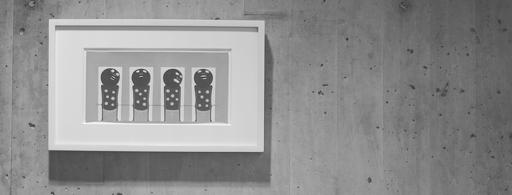
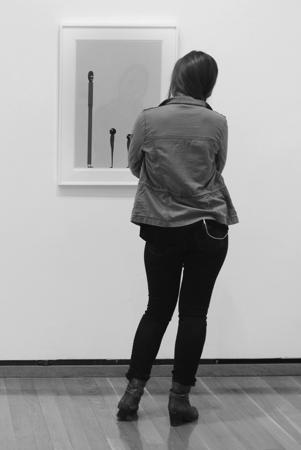
The Greenheads Series, by artist Laylah Ali, is a collection of gouache depictions of green-headed creatures in aggressively charged situations Through the mystical greenheads Ali challenges vie wers to reflect on conflict and violence in society and, through the ambiguity of the images, its cyclical nature Using the greenheads, Ali takes the political charge out of what are inherently politicized issues, making them extremely approachable
Visually, The Greenheads Series is very cohesive Each painting arranges several flattened greenhead figures on a light blue background Given the uniformity of the figures, Ali does an excellent job communicating emotional tension almost entirely through expression in the eyes and mouth and placement of the greenheads often at irregular angles within each work Considering the emotional tension of most works in the series, Ali’s color scheme, consisting of a calming blue background and cool dark green figures, is an aesthetically appealing but unexpected choice Ali’s paintings are simple, but with a closer look display a greater deal of visual interest through meticulous detailing on the dress of the greenheads The messages conveyed by Ali’s paintings are vague or, rather, versatile depictions of societal motifs I think that the impact of the paintings could have been enhanced with stimulating titles for each painting, but Ali’s choice to leave the works untitled is in itself a statement about the parallel to be drawn among many scenarios of conflict Moreover, the greenheads’ vague identities, which show no sign of race or class, make the work easier to consider in relation to a wide range of scenarios, from war to exchanges with those that we are close to
However, some representations more directly allude to specific interactions In one painting, three greenheads queue for a greenhead in uniform One has removed his belt while the other two have removed an arm and a leg In the witty way that Ali comments on the degrading intrusion of TSA checks, the artist uses greenheads as an impersonal approach in
broaching controversial topics
At other points, Ali makes several rather direct references to groups such as the Ku Klux Klan In one piece, two Klansmen, armed with a dodgeball, fearfully and apologetically face off two leotard-clad greenheads threateningly holding decapitated heads Ali paints a sobering reminder of the devastation of racism and, pitting two essentially identical pairs of greenheads against each other, comments on the unfounded basis for such violence
This painting was perhaps one of the most aggressive in the series, due in large part to the fact that the identities of the players were most explicitly depicted In that way, the painting also reveals the impact of the greenheads’ anonymity in making the subjects of her paintings more approachable
Ali uses overt violence in her imagery, with amputated limbs liberally strewn throughout the exhibit Since the images are stylized as cartoons, the exhibit easily carries what would be perceived as more gruesome in any other style Yet, even in this context, the grotesque imagery adds emotional weight to the exhibit’s surreal imagery
Early works in the exhibit are styled in the form of a narrative, depicting aggressive interactions among the creatures As the exhibit progresses, several works take the style of a comic strip with several sequential frames of image The progression of these works, from violence and destruction to its consequential devastation, seem to encapsulate the progression of the exhibit as a whole Ali’s later works deconstruct the greenhead from active figures to a collage of limbs, costume, eyes and hair falling onto remaining greenheads These final paintings are apocalyptic in feeling, and the overwhelming fragmentation creatively portrays the overall loss to society from the conflict in early
Another interesting development in Ali’s later works is a series of greenhead portraits For the first time singling out characters in these portraits, the power of Ali’s androgynous figures is emphasized and, painted on a larger scale, the portraits highlight the importance of facial expression in defining the greenheads In one portrait, a greenhead’s eyes peek through ornately detailed head covering and, as a viewer, one impulsively genders the fictive character Ali’s exhibit reveals to viewers our desire to link the scenarios in the series to specific current events or figures in society The Greenheads Series, more than it comments on any particular current crisis in the world, in its ambiguity, strikes on the sharing of similar issues across generations and regions of the world The Greenheads Series will be on display in the Bartels Gallery of the Johnson Museum through December 22, 2013
Madeline Salinas is a sophomore in the College ofArt, Architecture nd Planning She can be reached at msalinas@cornellsun com
B o d y A g a i n s t B o d y : A Tr i u m p h o f M o v e m e n
BY KATIE WONG Sun Contributor
People often wonder what those abstract movements in modern and postmodern dance mean Before I started dancing, I used to ask the same question As a dancer, though, I’ve come to realize that sometimes this analytical approach works but most of the time, it doesn t Thankfully, renowned choreographer Bill T Jones confirmed these thoughts in Body Against Body, a re-staging of his early avant-garde works featured last Saturday at the Schwartz Theatre
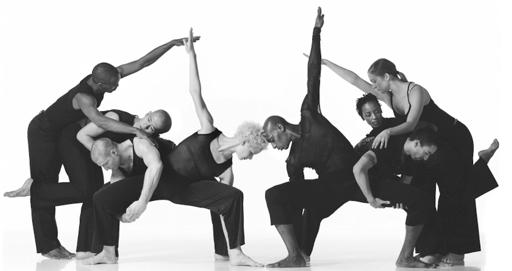
Along with his on-stage and off-stage partner Arnie Zane, Jones co-founded Bill T Jones/Arnie Zane Dance Company in 1982 The company has always sought to employ a wide diversity of races, body types and styles This is exemplified by the partnership of the founders themselves: Jones is African American and the significantly shorter Zane is of Italian-Jewish heritage Jones, interested in texts and the aesthetic of athleticism, offers a more classical dance sensibility with elegance and vigor; his artistic collaborator, Zane, fond of photography and design, charges the choreography with alternative visual power Over the years, the juxtaposition of these elements has led to endless inspiration and controversy Today, the company is recognized as one of the most prominent and innovative forces in the modern dance world In addition to more than 140 works for his own company, Jones received commissions to create dances for modern- and ballet-oriented dance companies, including the Alvin Ailey American Dance Theater, the Boston Ballet and the Berlin Opera Ballet, among others Body Against Body revisits Jones’ “body” of work reviving three rigorous duets in the early phase of his choreographic history Jones and Zane are very involved in contact improvisation in their artistic production Contact improvisation often deals with interaction between dancers of different heights, weights and strengths, who can either lead or follow; it is a physical manifestation of diversity in action and reaction, and it is impressively utilized throughout Body Against Body For example, at the onset of the first piece, Duet x 2, a loud shocking drum sound echoes through the theatre as an ethereal light descends over the
t
stage A dancer then emerges from the dark and enters the framed boundary on the stage through a red-framed door After a few minutes of solo, the same sound drifts into the room as second dancer joins in The whole duet remains in silence
Despite the absence of music, rhythms still play an integral role in Body Against Body The actions and reactions of dancers create infinite propelling momentum to generate rhythms A smooth, powerful flow of rhythm forms as the dancers create, follow, mimic and change the moves in response to each other The consistency builds a sense of harmony, one that is generated from the movement of human bodies in the absence of music The choreographer’s experiment of body interaction culminates in the last duet, Blauvelt Mountain, originally performed by Jones and Zane themselves in 1980 The light, airy music and dancers’ shouts do not distract the audience from the body dynamics The postures and unfamiliar forms of the two bodies recall the unspoken language we abandon after childhood, as we gradually turn to verbal and written communications The isolated words going exchanged between the two dancers is an audible parallel to the spontaneous, fluid exchange of duo s movements, but it is the visual and kinetic language here that allows
Spongebob deserves better In this Age of Taking Television Seriously, no one has a p ro b l e m w r i t i n g t h e s i s - l e n g t h
e n c o m i u m s o n T h e Wi re , Ma d Me n , Deadwood, etc , etc I’m one of those just
ye s t e rd a y I t h re w 1 1 0 0 - p l u s w o rd s a t
Breaking Bad’ s finale, like everyone else But where’s the love for Spongebob Squarepants? I know it’s a show you probably watched before your brain, like, worked, but creator Stephen Hillenburg is due for a retrospective or two Worthy of the singular, self-contained TV episode pantheon that includes Bad’ s Fly,” The Sopranos’ College” and Lost’ s “The Constant” is the Nickelodeon cartoon ’ s finest 12 minutes: “Rock Bottom ” Here is a cartoon that explores existentialism, race, quantum theory and linguistics seriously
For a show so rife with irreverent joy, I recall the dread that befell me watching this e p i s o d e a s a k i d When Patrick sees the sign, “You Are Now Leaving Bikini Bottom” he asks, as more than a few of u s w o u l d , “Spongebob, where i s ‘ L e a v i n g Bi k i n i Bottom?’” For me, drifting away from
p
starfish, the ghetto is a scary place With their dinky, prophylactic-looking glove hats (what you discover watching cartoons when you ’ re older ), Spongebob and Patrick stay close to the bus stop where they arrived yet still fall victim to crippling disorientation, culture shock and fear Spongebob, at least, tries to keep things together as Patrick’s mental state rapidly deteriorates You should credit the episode’s disciplined writers Paul Tibbitt, Ennio Torresan and David Fain, then, for throwing in a deus ex machina and getting Patrick out of there, on a bus that materializes the second Spongebob leaves his side
It’s almost as if the world conspires to screw over poor Spongebob, altering the very fabric of time and space to do so One of the episode’s classic set pieces illustrates an a b s u rd i s t , c a t c h - 2 2 s c e n
seems like hours for the bus, discovers, across the road, a “Kandy” machine Just a

prospect Patrick does not even register what the sign means, instead thinking it’s another part of his hometown When they do hit Rock Bottom, a benthic community populated by anglerfish and eels with funny accents, they remark how different everything seems Even the sand is different it says so itself! I don’t think I’m stretching things when I say that, in “Rock Bottom,” Spongebob and Patrick leave the suburbs and find themselves in the ghetto
And for a little sponge and a clueless
single vending machine, hovering there like a mirage or a tempting Siren After looking down both stretches of the desolate, farreaching road, he bolts over, checking the road every step, to buy a “kelp nougat crunch” bar The second he reaches the machine, however, the bus pulls up, stops for a millisecond and leaves Spongebob discovers the impossibility of boarding when he reaches into the machine’s tray for a candy bar the moment a new bus arrives, only to pull his hand back out of the tray and watch the bus go backwards In, out, in, out, for-
ward, backward, forward, b a c k w a rd , l i k e a D J
s c r a t c h i n g a re c o rd Spongebob reaches in to tap the candy bar and the b u s ’ s e n g i n e p u r r s It’s either the candy bar or the bus or, in actuality, neither What other children’s car toon bases its sight gags on the paradoxes of the observer effect and Schrödinger’s cat?
us to sense the unsettling relationship between the dancers
The interplay of balance and weight and of aggression and dependency in the duets synthesizes a series of captivating moving images on stage the title Body Against Body serves as a selfexplanatory caption to the visuals On deciphering the code the dancing body communicates, Jones dropped some hints in his remark on Blauvelt Mountain: “[Viewers] read all sorts of things into [the dancers’ movements] They thought we were making statements about their society, about blacks and whites in America we were not We were making, for us, an abstract dance ” This is not to suggest that there is no association to society in Jones’ choreography at all; in fact, many of his works are inspired by political and social issues Nevertheless, at least in the context of Body Against Body, one should not overlook the tension and emotion within the body itself Just like when we look at Jackson Pollock’s One: Number 31, 1950, we don’t study every single line dripping paint It’s about action, freedom and instinct
Katie Wong is a junior in the College of Art Architecture and Planning She can be reached at kw385@cornell edu
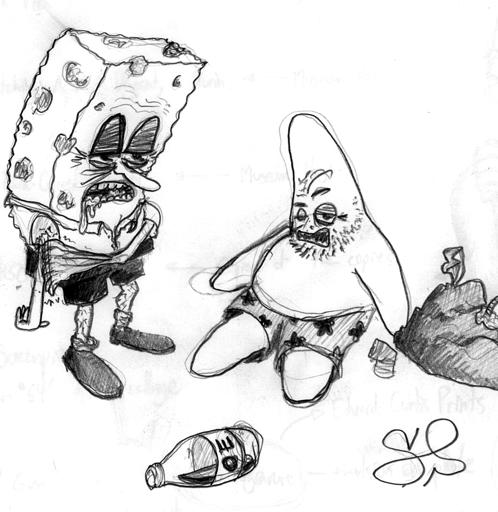
Fed up with his nowin situation, Spongebob thinks a trip to the bus s t a t i o n w i l l s o m e h ow solve his problems He c o m e s i n h u f f i n g a n d puffing, yelling, “I’m first in line, and no one ’ s going to tell me otherwise!” Except the fish he cuts is a giant, moaning pufferfish Naturally, he limps his way to spot 329 He can ’ t even hold on to that number for long once the fish in front of him lays an egg from which three clothed babies pop out, also apparently in need of assistance When he finally reaches the counter, he modifies his accent, adding the requisite “pbbt” sound in between syllables when asking for the next bus “The next bus leaves in *pbbt* five seconds,” the attendant deadpans Tired and emasculated, Spongebob cannot find his way home even when conforming to this strange language Spongebob’s display of bravado does not hold up when the lights go out, plunging him into what he calls advanced darkness ” His plan to stick out the night in the bus station is obliterated when that colloquial s o u n d ( i t s o u n d s l i k e f a r t i n g ) e c h o e s through the hall He walks, runs and finally sprints away before crashing into a wall, when the anglerfish he met earlier greets him with the glove balloon he lost The angler
ends up giving Spongebob his ticket out, tying the balloon to his wrist, blowing some air into it and sending the confused sponge a
Samaritan, “Thank *pbbt* you!” “You’re welcome,” a remarkably boring, accent-less voice replies After all that uncertainty with language and fear of the dark (make of that word what you wish), Spongebob relies on the kindness of strangers to find his way back The episode ends on a note of optimism and integration, not irrational terror at “the others” of the world
Well, sort of Spongebob does make his way back home, but the moment he arrives, his glove balloon pops Speeding by in a bus, unable to see him, Patrick hollers, “Don’t worry, Spongebob, I’m coming back for ya!”
The unbroken cycle of the Absurd commences once again, and this time without a balloon
Zachar y Zahos is a sophomore in the Colleges of Arts and Sciences He can be reached at zzahos@cornellsun com A Lover’s Quarrel With the World appears alternate Wednesdays

IT’S OKAY IF YOU DIE
NEW YORK (AP) If anything, the Yankees like Joe Girardi even more now than when they hired him to manage the team six years ago
General manager Brian Cashman praised Girardi’s handling of the team during a disappointing season and is about to offer him a new contract
“He knows we’d like to have him stay and continue as manager of the New York Yankees as we move for ward,” Cashman said Tuesday “I feel we hired a good one He’s been a world champion player for us He’s been a coach, a broadcaster and obviously a world champion manager So we ’ ve benefited from having him and we’d like to do that going for ward, but we’ll have to speak with him and see how it plays out ” Girardi has led the Yankees to a 564-408 record and a World Series title Crippled by injuries, New York had its poorest season since 1992, missing the playoffs for the second time in 19 years and finishing tied for third in the AL East at 85-77
Cashman met Girardi for coffee on Monday, a day after New York’s season ended, and plans to have lunch Wednesday in New York with Girardi’s agent, Steve Mandell
“ We’re entering the sensitive conversations that will either lead to a deal or lead us to the understanding that there won ’ t be a deal,” Cashman said
Girardi won out over Don Mattingly to replace Joe Torre after the 2007 season and was given a $7 8 million, three-year contract He is completing a $9 million, three-year deal
The Chicago Cubs may be interested in Girardi after firing manager Dale Sveum Girardi grew up in Illinois, went to Northwestern and played for the Cubs But Girardi is under contract through October, and Cashman wouldn’t say whether he would give the Cubs permission to speak with the manager
“I think he likes it here,” Cashman said “ We’re going to give him a real good reason to stay, and he’s earned that through his six years with us so far ”
Heading into the offseason, the Yankees face numerous questions, especially about their pitching staff and infield Mariano Rivera and Andy Pettitte are retiring Second baseman Robinson Cano is a free agent, as are pitcher Hiroki Kuroda and outfielder Curtis Granderson
Shortstop Derek Jeter played just 17 games this year after breaking an ankle last October and third baseman Alex Rodriguez didn’t return from offseason hip surger y until August, and he may have to ser ve a lengthy drug suspension next season
Cano, a five-time All-Star who turns 31 on Oct, 22, can become a free agent after the World Series and may be seeking a 10-year deal worth $305 million or more
Cashman will meet with the Yankees’ professional scouts starting Monday to formulate his offseason plan
“ We’d love to have Robby back,” Cashman said “He’s been a great Yankee I think if he stays he has a legitimate chance to experience what you just saw for instance a little bit from Mariano, where maybe he has a chance to be the first Dominican-born player to be in Monument Park ” Cashman also said it’s unclear whether the Yankees will be able to get under next year ’ s $189 million luxur y tax threshold, which includes about $177 million for player salaries
“It’s not a mandate It’s a goal that we have if it’s possible,” Cashman said “ There’s a lot of benefits to staying under that, but it’s not a mandate if it’s at the expense of a championship run It just depends on what the opportunities are before us, and the costs associated with it ” He also plans to address the Yankees’ lack of power this season Injuries and the departures of Raul Ibanez, Nick Swisher, Russell Martin and Eric Chavez as free agents caused home runs to dropped from a team-record 245 last year to 144, the Yankees’ fewest in a nonshortened season since they hit 130 in 1989 Not counting strike years, it was the largest falloff in baseball histor y, topping a decrease of 96 for the 1988 Chicago Cubs
R ed hopes to improve on 13th place nish at Yale la st sea son
By JOEL COOPER Sun Contributor
a c e d h i g h l y b o t h a s a
t e a m a n d a s i n d i v i d u a l s De s p i t e t h i s , s e n i o r c o - c a p t a i n C a r l
S c h i m e n t i b e l i e ve s t h e Re d d i d
“It will be good measure to see how we stack up against [the other Ivies] ” M a x w e l l K o e h l e r
n o t p e r f o r m t o i t s f u l l a b i l i t y “A s a t e a m , we p l a ye d o k a y C e r t a i n l y n o t o u r b e s t , b u t we p l a c e d t h i rd , a n d I t h i n k t h a t ’ s d e f i n i t e l y a p o s i t i ve s i g n t o s t a r t t h e
ye a r, ” h e s a i d “ In d i v i d u a l l y, I f i n i s h e d f i f t h I w a s
h a p p y w i t h t h e w a y I h i t t h e b a l l In e ve r y t o u r n am e n t yo u c a n s a y t h e re we re l o s t s h o t s , b u t I f e l t l i k e I d i d n ’ t c a p i t a l i ze o n a l o t o f e a s y o p p o r t u n i t i e s I g a ve m y s e l f ” T h e Re d w i l l b e l o o k i n g t o u s e i t s m o s t re c e n t p e r f o r m a n c e o n Ya l e ’ s c o u r s e , t h e Ya l e Sp r i n g Op e n e r l a s t s e a s o n w h e re C o r n e l l f i n i s h e d 1 3 t h , a s m o t i va -
t i o n g o i n g i n t o t h e Ma c d o n a l d Cu p “ We d i d n o t p e r f o r m we l l t h e l a s t t i m e we p l a ye d t h e re , s o we w i l l g o i n h o p i n g t o g e t s o m e re ve n g e o n t h a t c o u r s e , ” S c h i m e n t i s a i d “ T h e Ya l e c o u r s e h a s a l o t o f b l i n d s h o t s , s o yo u re
h e t a
u c
c a n d o t h a t t h i s we e k , we w i l l p l a y we l l ”
Se n i o r c o - c a p t a i n Ma x w e l l Ko e h l e r b e l i e v e s
By TUCKER MAGGIO-HUCEK Sun Staff Wr ter
Dre xe l t o d o u b l e ove r t i m e , t h e Re d w i l l h i t t h e ro a d t h i s we e k e n d a n d l o o k t o
c o n t i n u e i t s re c e n t f o r m o f p l a y
Ge t t i n g i t s f i r s t Iv y L e a g u e w i n t h i s
s e a s o n w i l l b o l s t e r t h e Re d’s c o n f i d e n c e
“[ The freshmen have] created more inter-team competition for the top spots, competition that has been absent for the past fe w years, ” he said “I believe this has already lead to more commitment and motivation throughout the team because we are all fighting to travel This competition is present in ever y successful team; it leaves no room for complacency because if you do get complacent you won ’ t be playing
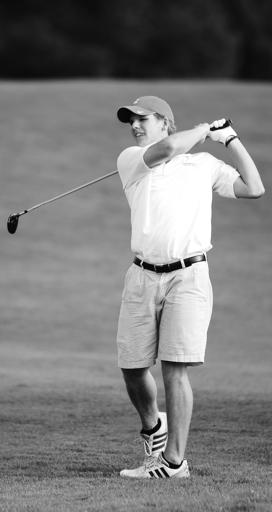
New blood | Senior co-captain Maxwell Koehler is confident that the added competition the freshmen brought will be good for the team
“[Last weekend’s] games have really lifted our level of play.” K e e l i n B a n n o n Co r n el l W i n s Fi r st Iv y L e a g u e G a m e o f t h e S e a s o n
g o i n g i n t o t h i s we e k e n d “ We a re a l o t m o re c o n f i d e n t g o i n g i n t o t h i s we e k e n d’s g a m e We h a d t w o t o u g h g a m e s l a s t we e k T h o s e t w o g a m e s h a ve re a l l y l i f t e d o u r l e ve l o f p l a y, s o we a re re a l l y e xc i t e d g o i n g i n t o t h i s we e k e n d’s g a m e s , ” s e n i o r b a c k Ke e l i n Ba n n o n s a i d On Sa t u rd a y, t h e Re d w i l l h e a d t o
Ne w Ha ve n , C o n n h o p i n g t o m ove u p
t h e s t a n d i n g s i n t h e Iv y L e a g u e a s t h e
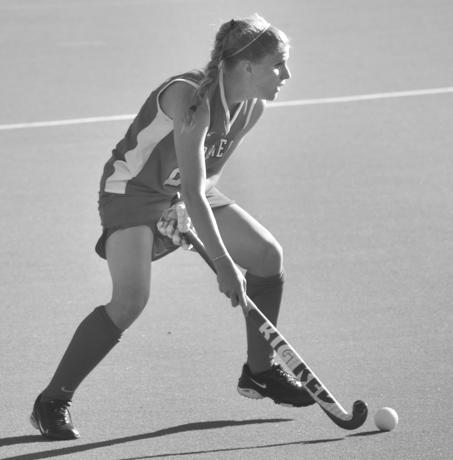
s q u a d t a k e s o n t h e Ya l e Bu l l d o g s ( 2 - 5 , 0 -
2 Iv y ) T h e Bu l l d o g s w i l l e n t e r Sa t u rd a y ’ s
c o n t e s t w i t h o u t a w i n i n t h e Iv y L e a g u e
a f t e r l o s i n g t o No 1 0 Pr i n c e t o n l a s t
we e k e n d W h i l e Ya l e h a s s t r u g g l e d t h i s
s e a s o n p l a y i n g o n t h e ro a d , t h e Bu l l d o g s
h a ve h a d s o m e s u c c e s s a t h o m e , w i t h
b o t h o f i t s w i n s t h i s s e a s o n o c c u r r i n g i n Ne w Ha ve n T h e c a t a l y s t f o r t h e Bu l l d o g s t h i s s e as o n h a s b e e n re t u r ni n g Fi r s t Te a m A l l - Iv y
s e n i o r f o r w a rd Er i c a
B o r g o I n s e v e n g a m e s t h i s s e a s o n ,
B o r g o h a s t a l l i e d 1 4
p o i n t s o n f o u r g o a l s a n d s i x a s s i s t s , p l a ci n g h e r i n t h e To p - 2 5
n a t i o n a l l y i n p o i n t s p e r g a m e Se n i o r
c a p t a i n Ge o r g i a Ho l l a n d re t u r n s f o r t h e
Bu l l d o g s t h i s s e a s o n a f t e r m i s s i n g l a s t
ye a r w i t h a n i n j u r y Fi r s t Te a m A l l Iv y
m i d f i e l d e r i n 2 0 1 1 , s h e l e a d s t h e t e a m i n g o a l s t h i s s e a s o n w i t h f i ve a n d h a s a l s o n o t c h e d t w o a s s i s t s In t h e g o a l , t h e
Bu l l d o g s h a ve b e n e f i t t e d f ro m h a v i n g
s e n i o r g o a l i e Em i l y C a i n i n t h e n e t , a s h e r 7 6 1 s a ve p e rc e n t a g e i s i n t h e To p - 2 5
n a t i o n a l l y W h e n t h e Re d t r a ve l s t o Wo rc e s t e r,
Ma s s t h e n e x t d a y, t h e s q u a d w i l l f a c e a
Ho l y Cro s s t e a m t h a t h a s h a d s i m i l a r re s u l t s t o Ya l e Ho l y Cro s s ( 2 - 6 , 0 - 1
Pa t r i o t ) h a s w o n t w o g a m e s a t h o m e t h i s s e a s o n a n d i s w i n l e s s o n t h e r o a d
C o m i n g i n t o i t s c o n t e s t a g a i n s t t h e Re d ,
Ho l y Cro s s w i l l l o o k t o s n a p a f o u r g a m e
l o s i n g s t r e a k t h a t h a s s e e n t h e m
El l y Pl a p
e a d t h e
a m w i t h t h re e g o a l s e a c h Ju n i o r m i d f i e l d e r A n n D i Pa s t i n a a n d s o p h o m o r e m i d f i e l d e r Ta y l o r St a n d i f o r d h a v e p l a y e d m a j o r ro l e s i n t h e o f f e n s e , p rov i d i n g t h e f o rw a rd s w i t h s c o r i n g c h a n c e s St a n d i f o rd l e a d s t h e t e a m w i t h t h re e a s s i s t s w h i l e Di Pa s t i n a h a s a l s o a d d e d t w o a s s i s t s t h i s s e a s o n W h i l e t h e Re d h a s h a d s o m e re c e n t s u c c e s s , t h e t e a m h a s ye t t o w i n a g a m e o n t h e ro a d t h i s s e a s o n T h e s q u a d h a s c o n c e d e d g o a l s w i t h i n t h e f i r s t f i ve m i nu t e s i n b o t h ro a d l o s s e s t h i s
o u t s c o re d 1 7 - 3 In t w o c o n t e s t s a g a i n s t Iv y L e a g u e t e a m s t h i s s e a s o n , Ho l y Cro s s h a s b e e n o u t s c o re d 1 0 - 1 Ju n i o r f o r w a rd Mo l l y Fe l t l e a d s t h e t e a m i n g o a l s w i t h t h re e , h o l d i n g a n a r row l e a d ove r f re s hm a n m i d f i e l d e r L a u re n Su t h e r l a n d w h o h a s s c o re d t w i c e T h e Cr u s a d e r s h a ve s t r u g g l e d o f f e n s i ve l y, b e i n g o u t s h o t by o p p o n e n t s a n d o u t s c o re d o n t h e s e a s o n by a t o t a l o f 2 7 - 7 Fi n d i n g g o a l s i n t h e s e c o n d h a l f h a s p rove d t o b e d i f f i c u l t f o r t h e Cr u s a d e r s a s t h e y h a ve o n l y b e e n a b l e t o f i n d t h e n e t o n c e t h i s s e a s o n T h e Re d h a s c o n t i n u e d t o h a ve a b a la n c e d a t t a c k t h i s s e as o n a n d w i l l l o o k t o g e t c o n t r i b u t i o n s f ro m a l l ove r t h e f i e l d t h i s w e e k e n d W i t h e i g h t p l a ye r s h a v i n g f o u r o r m o re p o i n t s o n t h e s e a s o n , t h e R e d h a s p l e n t y o f p l a y e r s c o n t r i b u t i n g t o w h a t h a s b e e n a s u c c e s s f u l o
By OLIVIA WITTELS Sun Staff Writer
e a m o f s o p h o m o r e D e n a
Ta n e n b a u m a n d f r e s h m a n
A l e x a n d r a D ’ A s c e n z o e a r n e d
H e a d c o a c h M i k e St e v e n s s a i d h e h a s b e e n u s i
In it to win it | The Red has been focusing on improving its mindset under pressure by practicing in competitionlike settings
i n g u p i n t o s m a l l e r t e a m s i n p r a c t i c e s t o m a k e i t m o re re a l i s t i c ” Pe re l m a n s a i d t h a t , t h i s we e k , t h e c o a c h e s h a ve a l s o e m p h a s i ze d t h e i m p o r t a n c e o f m a i n t a i n i n g u p b e a t b o d y l a n g u a g e o n c o u r t “ T h e c o a c h e s a re re a l l y s t re s s i n g p o s i t i ve a t t i t u d e s [ T h e y s a i d i t i s i m p o r t a n t t o ] n e ve r b e a b l e t o t e l l i f yo u ’ re w i n n i n g o r l o s i n g w h i l e yo u ’ re p l a y i n g , ” s h e s a i d W h i l e t h e Re d h a s a s m a l l e r ro s t e r t h i s ye a r w i t h o n l y t e n w o m e n o n t h e s q u a d , t h i s i s n o t s o m e t h i n g Yo u n g b e l i e ve s w i l l i n f l u e n c e t h e t e a m ’ s c h a n c e s i n A k ro n o r i n t h e ove r a l l s e a s o n “ I d o n ’ t t h i n k i t ’ s g o i n g t o i m p a c t u s a t a l l n e ga t i ve l y On l y s i x p e o p l e p l a y a n y w a y s , s o i n f a c t , i t w i l l g i ve m o s t o f u s t h e o p p o r t u n i t y t o b e a b l e t o p l a y i n
“It’s a new tournament so we’re looking forward to making our mark there.”
h a ve b e e n n a t i o n a l l y r a n k e d t h e p a s t c o u p l e o f ye a r s , s o j u s t b e i n g a b l e t o c o m p e t e w i t h t h e m , [ a n d h o p e f u l l y ] w i n n i n g a re o u r g o a l s t h i s we e k e n d , ” Yo u n g s a i d If t h e w o m e n i m p l e m e n t w h a t t h e y h a ve b e e n w o rk i n g o n i n p r a c t i c e , Pe re l m a n s a i d s h e b e l i e ve s t h e Re d w i l l p e r f o r m we l l i n Oh i o “ [ Ou r e x p e c t a t i o n s a re t h a t ] e ve r yo n e c o m p e t e s re a l l y h a rd [ a n d t o ] j u s t w o rk o n t h a t p o s i t i ve a t t it u d e [
By JOHN McGRORTY Sun Staff Wr ter
The Cornell men and women ’ s cross country teams will travel to Bethlehem, Pa Saturday in order to compete in the Paul Short Invitational at Lehigh University Both teams have had very successful opening campaigns to their seasons and hope to build on that success this weekend
The teams look to take risks early on in the season in order to help facilitate speed that will carry into the championship portion of their season The Paul Short Invitational gives both the men ’ s and women ’ s teams the opportunity to take these risks in order to gain early season speed and help their top runners gain experience
After a successful race last weekend at the Boston College Invitational for the women ’ s team, head coach coach Artie Smith said he is pleased with the improvements his team has made
“We feel very good about the progress we are making – not simply in our ability to run faster from our first meet against Army through our second meets this weekend but in learning how to race well in high level and competitive situations,” he said “Against the top two teams from last year ’ s NCAA Championships, we finished a close third to the defending national champions, [Oregon], and despite a very fast early pace were able to compete extremely well over the second half of the course ”
The ability to compete and excel in these
extremely competitive races will help the Red later on in the season
“Our meets continue to get larger and [more] competitive and having had a very recent opportunity to compete against top teams, our runners will have some great experiences to draw on to continue to improve and race and compete well this Saturday,” Smith said
Going forward, the Red aims to use each race as an opportunity to continue to develop both individually and as a unit The women ’ s team is extremely deep and has a great deal of potential on a national level this season
“We want to continue to focus on our own improvement and running and racing to our strength even as we work on strategies and racing techniques that need improving,”
Smith said “I’m very happy with the efforts and training so far and our progress in just two races is terrific for this time of the year We want to continue to give a great effort in representing Cornell and appreciating the wonderful opportunities we have to race against some of the best in the country ”
On the men ’ s side, the Red looks to utilize its ability to run together as a pack in order to foster success
“The biggest take away from the Boston College Invitational is our ability to run well as a pack Only 17 seconds separated our top runner and our 7th runner, ” men ’ s assistant coach Zebulong Lang said
Going into the Paul Short Invitational, the men ’ s team is excited and confident
“Our moral is high,” Lang said “We are able to bring a bigger roster and a different section of our team that did not race in Boston will be racing We will be throwing some others in the mix ”
Senior captain and top Cornell finisher last week, Gabriel Heck, said the team was not thrilled with its performance at the Boston Invitational
“Overall we are pleased, but far from satisfied,” he said Despite some of our top guys not racing up to their standards, we had a tight pack and were excited to see how close we all finished to each other Individually, it was a confidence booster having sat out the past year ”
Going into the Paul Short Invitational and the championship portion of the season Heck emphasized the team ’ s need for endurance
“The results from Boston showed we need to work on hanging tough in the middle and end of the race A lot of us faded back, and we cannot have this happen at conference and regionals if we want to achieve our goals,” he said “Running together and drawing strength from one another during the race focusing on synergy and moving up in the final two to three miles of the race If we can capitalize on these objectives, I think there is a very good chance we can upset a lot of the competition when it matters ”
John McGrorty can be reached