The Corne¬ Daily Sun


By MEGHNA MAHARISHI Sun Staff Writer
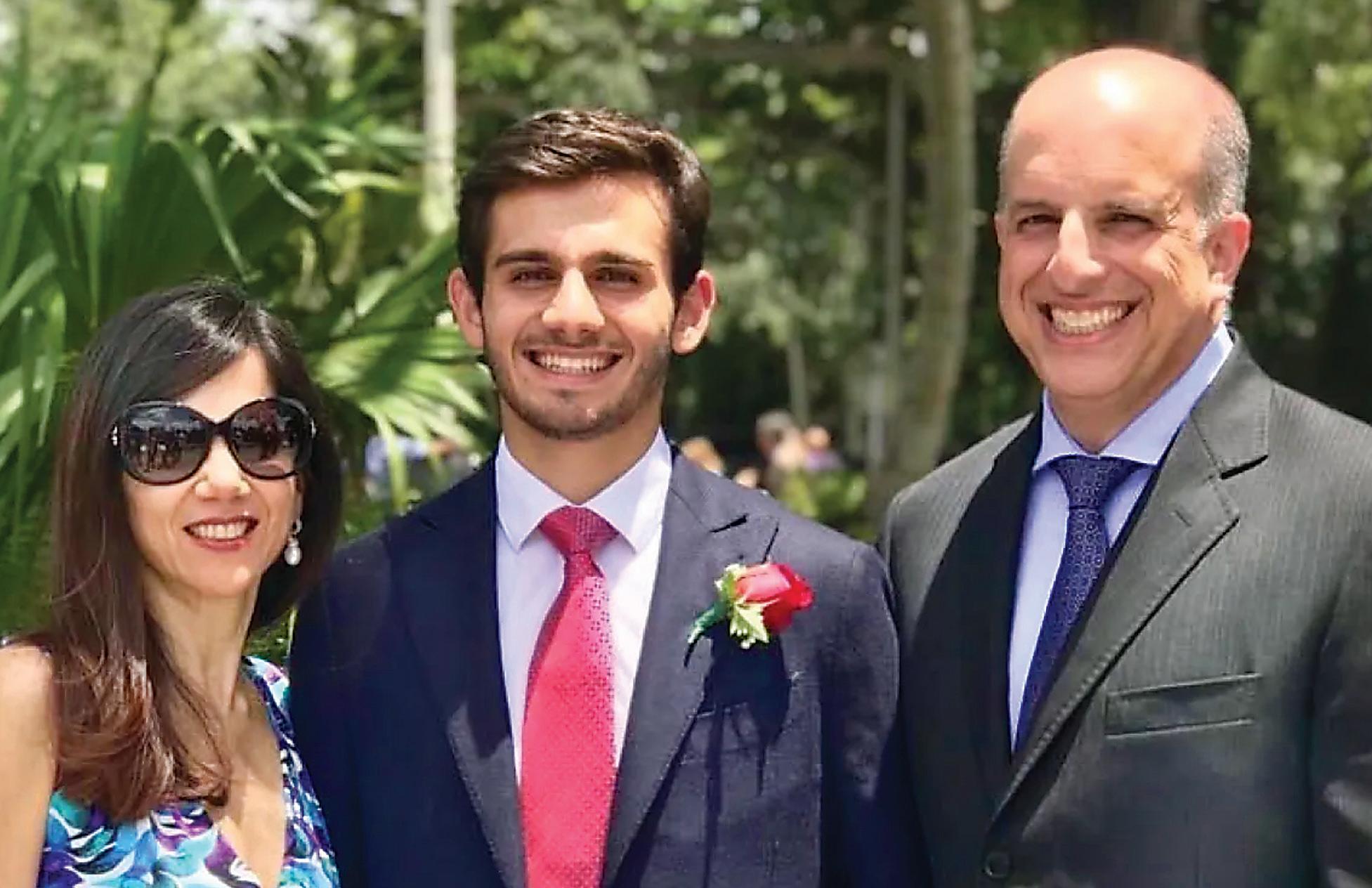
The parents of Antonio Tsialas ’23 — a freshman who was found dead at the base of Fall Creek gorge in October — have filed a lawsuit against Cornell University, the Phi Kappa Psi fraternity and seven Cornell students. The family is seeking compensation for the pain “suffered by their son … prior to his death.”
Tsialas attended a fraternity party at Phi Kappa Psi on Oct. 24, and was reported missing shortly after. Two days later, his body was found at Fall Creek gorge. His death prompted an ongoing University-led investigation, while private investigators hired by the family also investigated.
After Tsialas was found, the Cornell University Police Department wrote in an email to the Cornell community that “no foul play is suspected.”
The lawsuit additionally named the fraternity’s executive board members Andrew Scherr ’20, William Granath ’21 and Ryan Berman ’21 as defendants. Rush chairman Nolan Berkenfeld ’20, House manager Pietro Palazzolo Russo ’21, Shane Rohe ’21, who allegedly escorted Tsialas to the “dirty rush” event and Felipe Hanuch ’22, who the suit says invited Tsialas to the event, were also listed. Cornell Phi Kappa Psi advisor John Jacobs ’90 was another defendant in the suit.
The findings listed in the lawsuit were from
See TSIALAS page 4

Citing CDC warning, Kotlikof prohibits C.U.-related travel
By MEGHNA MAHARISHI Sun Staff Writer
The University will not permit any Cornell students and faculty to travel to mainland China for Universityrelated reasons in light of the Wuhan coronavirus outbreak — which has sickened 5,327 people and killed 349 in China.
Provost Michael I. Kotlikoff wrote in an email to the Cornell community that the University will support any Cornellians currently in China and students slated to study abroad in China this semester would be notified about this by the Office of the Vice Provost for International Affairs.
“I understand that this is a challenging time for many community members from China who are concerned for family and friends who may be in affected areas,” Kotlikoff wrote.
This ban on traveling to China for University-related purposes will last until Cornell’s International Travel Advisory and Response Team removes China from its elevated-risk destinations list. ITART placed China on the list because the Centers for Disease Control expanded its travel warning to include all of China — not just Wuhan, China, where the outbreak originated.
The University also said it will continue to monitor the outbreak. So far, there have been no confirmed cases in New York state.
There are currently five confirmed
By ARI DUBOW Sun Staff Writer
Just before midnight on Tuesday, two individuals were intercepted by the Ithaca police while reportedly using power tools to burglarize a business in northeast Ithaca, according to a press release from the Tompkins County Sheriff’s Office.
| The
has prompted many in its wake to resort to the
cases in the U.S. in Washington, California, Arizona and Illinois. All cases involve individuals who had previously traveled to Wuhan. In addition to the University-wide notice, faculty in the Chinese and Asia Pacific studies program decided on Tuesday to suspend its Beijing study abroad program for the spring 2020 semester, leaving students scrambling to figure out housing and course
The Tompkins County Sheriff’s deputies responded to a call Tuesday night from a resident near Salem Drive in northeast Ithaca.
The caller said that they had heard noises coming from inside a business after hours, the press release said. Upon arrival, the deputies found
The accused were Daniel P. Samson and Tressa E. Mikula, both age 36, of Groton, New York.
a running Jeep Wrangler in the driveway of the business and soon after caught up to the two individuals in the rear of the building. Samson attempted to escape through the front of the building, where he was intercepted and arrested. Mikula was found inside the building.

Thursday, January 30, 2020
Saying “No” Is Harder Than We Think: Implications for Compliance and Consent Noon - 1 p.m., 423 Industrial and Labor Relations Conference Center
Election Interference: International Law and the Future of Democracy 12:15 - 1:30 p.m., G08 Uris Hall
Book Signing With Martine Kalaw at the Cornell Store 1:30 p.m., The Cornell Store, Lower Level
Detecting and Characterizing Nearby Habitable Worlds 4 - 5p.m., 105 Space Sciences Building
Office of Internal Transfer and Concurrent Degrees General Informaiton Session 4:30 - 5:30 p.m., Tatkon Center
Labor’s Response to Neoliberal Reforms: A Trade Union Perspective On the General Strikes in France 4:30 - 5:45 p.m., 281 Ives Hall
Dis.em.POWER.ed: Puerto Rico’s Perfect Storm 4:30 - 6:30 p.m., 132 Goldwin Smith Hall
Chimes Competition Information Session 5 - 6:15 p.m., McGraw Tower, Top Floor
Business Manager Joybeer Datta Gupta ’21
SEND
Latina/o Studies Fridays With Faculty Seminar Noon, 429 Rockefeller Hall
Urban-Rural Linkages in Meeting Climate Change Goals: Case of Ithaca and Tompkins County 12:20 p.m., Milstein Auditorium
Functional Polymers and Bacteria: An Evolving Conversation 2:30 - 3:30 p.m., 226 Weill Hall
Anthropology Colloquium: Edward Swenson 3 - 4:30 p.m., 165 McGraw Hall
Engineering Career Fair Prep Session For First Years 4:30 - 5:30 p.m., Tatkon Center
Latinx Go Global 6:30 p.m., Latino Living Center, Anna Comstock Hall
Black Students United Presents: Black History Month Opening Ceremony 7- 10 p.m., Africana Center
Ithaca Sounding Music 2020: C.U. Music 8 p.m., Barnes Hall
By JOHN YOON Sun Staff Writer
Moving away from its usual opening ceremony of games and trivia events, members of Black Students United will kick off the decade and Black History Month with reflection, attempting to connect the past with the future with a reformed ceremony on Friday.
The event, held at the Africana Research and Studies Center, will focus on the theme of “black excellence,” according to BSU events coordinator Jalen Wise ’22, who said the purpose for the opening ceremony is to allow students to express the impactful stories they have acquired while at Cornell.
The event will begin with a presentation on major events that have shaped black culture, such as dances, clothes and movements like Black Lives Matter.
Afterwards, attendees will help create a time capsule — named “The Box” after the song by rapper Roddy Ricch — which will be filled with items that represent their experiences at Cornell.
“The song has a big cultural impact right now,” Wise said, explaining the time capsule’s name. “It’s the number one song in the country. It’s kind of like solidifying black history and black music.”
Henderson adds that the name is also an allusion to the

ancient Greek myth of Pandora’s box. According to Greek mythology, the box contained only evils inside, but when Pandora opened the box, she released these evils, leaving hope within the box.
While “Pandora’s box has a negative connotation … [It] brought bad but also some good,” said William Henderson ’22, one of the event’s planners, on how the time capsule is meant to embrace both the positive and negative.
This ceremony is just the beginning of the monthlong celebrations. Throughout February, BSU will introduce various themes that celebrate black achievement, such as “black excellence for self,” “black in business,” “black in society”
and “black in community.” Each theme will incorporate its own events, from professional development workshops to a special speaker recognizing Martin Luther King Jr.
While the event remembers accomplishments in this past century, “the box” symbolizes future accomplishments, with the time capsule intended to be opened twenty years later.
“[The event is] looking towards the future — the next 10 years,” Henderson said. “That’s what we want to bring, since 2020 isn’t looking so great so far.”
John Yoon can be reached at johnyoon@cornellsun.com.
By STACEY BLANSKY Sun Staff Writer
Some argue the current impeachment is a stance for justice, while others claim it to be a political sham.
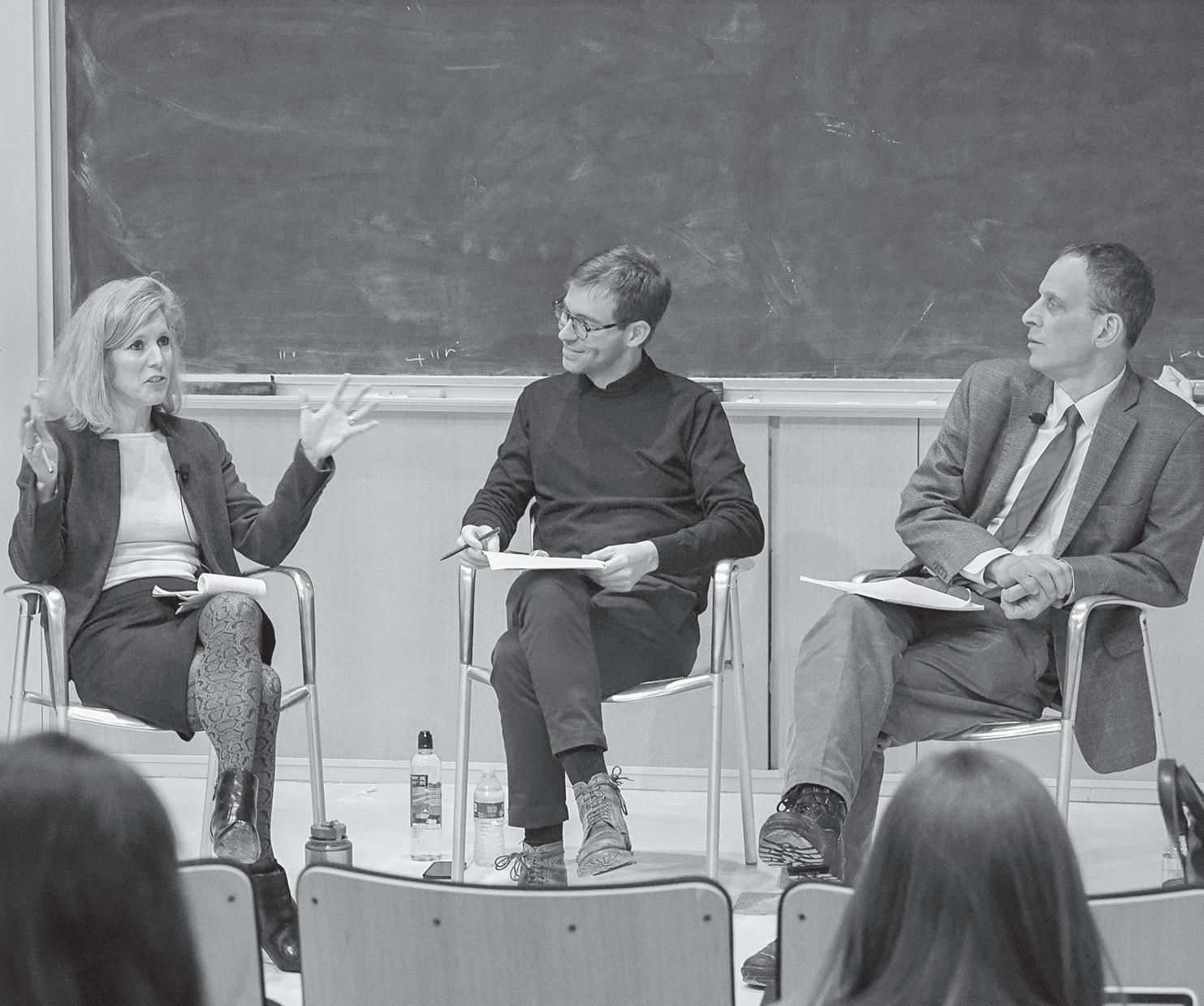
Two Cornell professors, Prof. Michael Dorf, law, and Prof. Sarah Kreps, government, took to the stage on Wednesday night to debate the legal and political concerns surrounding the third-ever impeachment. The talk was moderated by Prof. David Bateman, government.
On Dec. 18, the House of Representatives impeached President Donald Trump on two articles: abuse of power, stemming from Trump’s alleged solicitation of Ukrainian interference in the 2020 presidential election, and obstruction of Congress, tied to his failure to comply with House-issued subpoenas.
their party, rather than the institution. The Senate currently has a three-seat Republican majority, which so far has been closely supportive of the president.
During the Nixon era, parties were not nearly as ideologically coherent as today, leaving open the possibility that Republicans would vote against a president belonging to the same party, according to Dorf.
In his view, though, today’s increased partisanship has made that no longer a possibility.
“Impeachment is going to be politically at best a wash — possibly harmful — for the Democrats.”
Prof. Michael Dorf
“The basic problem, from my perspective, is that our Constitution was written by people who neither expected nor wanted there to be political parties,” Dorf said. “I think we have reached [Andrew Hamilton’s] and [James Madison’s] nightmare in that the party system has truly taken over the separation of powers system.”
Now — as the trial has turned to the Senate — Dorf argued that Republican senators are currently serving the interests of
What is happening now in the Senate is
See IMPEACHMENT page 4
By TAMARA KAMIS
Sun Staff Writer
The University is trying to renew its permit to operate the Cornell University Hydroelectric Project, which includes a dam, turbines and associated structures which have been on Fall Creek for decades, providing energy to campus.
Renewable energy initiatives like the hydroelectric plant are a part of Cornell’s goal of a carbon neutral campus by 2035.
According to a Federal Energy Commission Report, the average annual power generation from 2013 to 2018 was over 4,500 megawatt-hours. All the power
produced by the plant is used to fuel Cornell’s main campus.
The hydroelectric project is designed as a “run of the river operation,” meaning that Cornell uses water as it flows in Fall Creek and does not store water.
“The deep waters of Cayuga Lake ... will save 80 percent of the energy used for cooling.”
Water from Beebe Lake flows into the facility, through a pipe that bypasses most of Fall Creek and then through turbines that make electricity for campus, before it is discharged.
Cornell Facilities
Sustainable energy is not only a part
of Cornell’s future, it is part of its past. Cornell Hydroelectric was built in 1904, according to Cornell Facilities. Cornell is the only university in the U.S. with an operating hydroelectric plant, according to Frank Perry, program manager, Facilities and Campus Services. The century-old turbines and generators were replaced in 1981, and the turbines were refurbished in 2014. The request for a new major license was filed on June 28, 2019,
according to a Federal Energy Regulatory Commission notice. The Federal Energy Commission wrote in a report that it now intends to conduct an assessment for the hydroelectric project, analyzing its “site-specific and cumulative environmental impacts.”
The Cornell University hydroelectric project is not the only way that the University is harnessing local waterways to reduce its carbon footprint.
Cornell’s Lake Source Cooling plant places warmer water used by Cornell University and Ithaca High School next
See ENERGY page 5

will help students locate the appropriate University service to address a wide variety of problems.
By MEGHANA SRIVISTAVA Sun Staff Writer
From checking on their financial aid status to securing housing, almost every Cornell student has had to navigate an overwhelming number of offices on campus.
“People get confsued
about, ‘Where do I find jobs? How do I get work study?’”
Kataryna
Restrepo ’21
The Office of the Student Advocate, created by the Student Assembly last September, is gearing up to help students find the right office to deal with their issues, as well as follow up with those students to ensure that the issue has been resolved. Cases that the OSA expects to deal include conduct violations, grade disputes, enrollment issues, financial aid problems, residency concerns, and discrimination and harassment.
Liel Sterling ’21, a co-sponsor of the resolution that created the office, was appointed by the S.A. as the first Student Advocate in October 2019.
Students Sidney Malia Waite ’22, Natalia Hernandez ’21, Anuli Ononye ’22 and Kataryna Restrepo ’21 were also reviewed and appointed by the S.A. to serve alongside Liel in various leadership positions to act as a “knowledgeable point-person” for the “wide variety of issues students” may have, according to Sterling.
Sterling and Cat Huang ’21, S.A. executive vice president, who also co-sponsored the resolution, said the creation of the office is necessary to bridge the gap between students and University administration.
“We really want students to reach out to us for
any issue, even if they’re hesitant about whether it’s something that our office will deal with,” Sterling told The Sun. “The main purpose of the office, the reason that we started it, was helping students navigate the bureaucracy of the University.”
The OSA has met with several university departments to compile information about each department and the services that they provide. The primary goal of the OSA is to help confused or frustrated students more quickly find the University department that can best handle their problem.
“People get confused about, ‘Where do I find jobs? How do I get work study?’” Restrepo told The Sun. “Usually it’s done through financial aid or HR, and those distinctions are hard to make, especially for new students that are just coming into campus,”
After a student approaches the office, their case will be assigned a caseworker. The caseworker will continue to follow up with the student, and help them through any bumps in the road, until a solution to the issue is reached.
Caseworkers are expected to be able to handle sensitive and confidential information. While there are no prerequisites to be an OSA caseworker, applicants will go through an interview process prior to selection.
Huang believes that students should apply for this role, because “everyone has their own complaints.”
“I think everyone is really valid in being critical of Cornell, and I hope that people can channel that energy into a way that actually is productive,” Huang said.
According to Sterling, “the overwhelming response that we’ve gotten to this is, ‘I can’t believe this doesn’t already exist.’ And that’s from both university administrative offices and from students.”
Meghana Srivastava can be reached at msrivastava@cornellsun.com.
IMPEACHMENT
Continued from page 3
less of an investigation of the facts, according to Bateman, who argued that impeachment is about which side can make the most compelling case to a partisan electorate.
“It is true that there is always a fuzzy line between a political gain and a legitimate policy objective, but life is nothing but fuzzy lines” Bateman said. “We are always in the business of trying to discern whether [something] was a legitimate action or not.”
While both professors asserted that the current trial has been marred by intense partisanship, Dorf expressed less certainty over whether the proceedings would be a political winner for Democrats.
from office currently stands at just below 50 percent.
With the Iowa caucus only five days away, Kreps said that the impeachment’s timeline may hurt Democrats by distracting them from the upcoming presidential primaries. The media wants to focus on the “shiny object in the room” — impeachment she said.
“[Impeachment] is taking up all of the oxygen,” Kreps said. “Comparatively, little focus is on the Democratic candidates at a time when I would think that they want to be building up enthusiasm.”
“There is always a fuzzy line between a political gain and a legitimate policy objective.”
Prof. David Bateman
“A lot is going to depend on the perception,” Dorf said. “I still tend to think that impeachment is going to be politically at best a wash — possibly harmful — for the Democrats.”
Recent surveys on the electoral ramifications of impeachment proceedings have yielded mixed results. According to FiveThirtyEight’s polling tracker, Americans’ support for removing Trump
Bateman asked the panel whether the impeachment was “anything more than just theater” — or if the Democrats were simply using it as a tool to momentarily curtail the president.
“There is a literature in the law about publicity as a form of accountability, even without any further sanction,” Dorf responded, suggesting that, even if the Senate does not render a guilty verdict, shaming is its own form of penalty.
But, Dorf added — “that assumes agents who are capable of experiencing shame.”
By SAMANTHA STERN Sun Staff Writer
In the early hours of Jan. 24, police responded to a call at a residence on West State Street, where they found a 37 year-old male with several stab wounds. The victim was treated by the responding officers until an ambulance arrived, the Ithaca Police Department announced in a press release last Friday.
The victim — who was in-and-out of consciousness — was transported to Cayuga Medical Center and later airlifted to a regional trauma center.
The IPD press release said that the attack was drug-related and that the victim was targeted by a group osf unidentified individuals. The victim reportedly refused to cooperate when contacted by IPD officers.
According to the IPD, the victim was targeted by a group of individuals, none of whom have been identified as the victim declined to cooperate with the investigation.
Vincent Monticello, IPD senior deputy chief of operations, declined to comment further, adding that the department is still actively working to identify the suspects.
sstern@cornellsun.com.
TSIALAS
Continued from page 1
an investigation carried out by a private investigator. David Bianchi, a Miami-based attorney representing Tsialas’ family, told The Sun that the Cornell University Police Department did not provide any of its findings to him. None of the defendants listed in the lawsuit spoke with the private investigator, Bianchi added.
According to the lawsuit, members of Phi Kappa Psi drove Tsialas from the Robert Purcell Community Center at 8:30 p.m. to the fraternity’s house. The event — called “Christmas in October” — was held to identify freshmen who could be potential pledges for the fraternity. Members of Phi Kappa Psi invited “suitable candidates” to the event, the lawsuit read.
The event allegedly consisted of multiple hazing activities in which freshmen had to consume copious amounts of alcohol. At the house, there were seven rooms in which these activities were conducted, the lawsuit read.
In one of the first activities, the lawsuit claimed that sorority women were present in the hazing of the freshmen. Bianchi did not know the identities of the women involved and said that the University did not provide him with any names.
Freshmen leaving the event left heavily intoxicated, and the lawsuit further alleges that Phi Kappa Psi members did not try to stop Tsialas from leaving or get him back safely to his dorm.
An autopsy report from the Tompkins County Health Department cited multiple traumatic injuries as the cause of Tsialas’ death, according to an email from Bianchi. The report also determined that he had acute alcohol intoxication.
The University did not keep the family or the family’s lawyer informed of the ongoing investigation, Bianchi told The Sun in a phone call Wednesday morning.
Once Bianchi planned to file the lawsuit, he did not contact the University. The University has also not contacted Bianchi about the lawsuit, as of Wednesday afternoon.
Phi Kappa Psi’s national chapter was made aware of the lawsuit through multiple media inquiries. Ronald Ransom, Phi Kappa Psi national executive director, wrote to The Sun that the national chapter had not been served with the suit. Ransom added that the chapter does not comment on any impending litigation.
Currently, the amount of damages Tsialas’ family is seeking is undetermined.
The Sun’s request for comment to Cornell police was responded to by Cornell media relations, who provided The Sun with a statement at 11:35 a.m. on Wednesday.
“At this time, Cornell University has not been made aware of any legal action by the Tsialas family, and we cannot comment on potential future litigation,” the statement read. “The Cornell University Police continue to actively investigate Antonio Tsialas’s death, We continue to ask anyone who may have information related to the incident to contact us at 607-255-1111. People can also email Cornell Police investigators at cup-inv@ cornell.edu or reach out through the Silent Witness Program.”
Scherr and Hanuch declined to comment to The Sun. Rohe, Granath, Berman, Berkenfeld, Russo and Jacobs have not responded to The Sun’s requests for comment.
CAPS students, required to study abroad in China, scramble to arrange new spring semester plans
CORONAVIRUS
Continued from page 1
arrangements for the semester. Students in the major were set to leave Feb. 13 for the trip.
“Our advising deans and CAPS faculty are working closely with the seven Arts & Sciences students affected by this decision to provide support and alternate arrangements for courses and housing,” said Rachel
ing the outbreak and the CDC’s expanded travel warning, according to Chang.
In Beijing, there are 111 confirmed cases of coronavirus as of Wednesday evening. Schools in Beijing have also closed indefinitely.
Worries surrounding the Wuhan coronavirus have spread across campus. Students can be seen wearing masks, and the Office of Global Learning hosted community gathering on Jan. 29 to offer support to Chinese international students affected by the outbreak.
“I would have been interning part-time in Beijing...I’m glad they took our personal health and safety that much in concern.”
Drake Avila
’21
Bean, senior associate dean for undergraduate education in the College of Arts and Sciences.
Students were told at approximately 1 p.m. on Tuesday about the cancellation via a ZOOM chat, where the director of the major, Prof. Allen Carlson, government, confirmed that the Beijing program would not be in place this semester.
Jae Chang ’21, a CAPS major, told The Sun that he is now trying to find housing for the spring semester
While Bean gave no specific reason given as to why the program was suspended, CAPS students told The Sun that the cancellation was attributed to the recent Wuhan coronavirus outbreak.
Faculty decided to cancel the semester in Beijing because of the uncertainty surround-
A student studying abroad at a Syracuse University partner program in Australia tested positive for coronavirus, and is currently isolated.
To complete a CAPS major, a semester in Beijing is required, according to the major’s website. Students spend a semester at Peking University’s School of International Studies, where they take courses on topics such as Chinese perspectives on international issues and the Chinese language. It is currently unclear how this cancellation would affect graduation requirements.
CAPS major Drake Avila ’21 said he was looking forward to the trip, but was relieved that the semester abroad was canceled.
“As part of this program, I would have been interning part-time in Beijing, two hours, two days a week,” Avila said. “I’m glad they took our personal health and safety that much in concern.”
Meghna Maharishi can be reached at mmaharishi@cornellsun.com.
CRIME
Continued from page 1
Police said that Samson and Mikula used a hatchet and pry bar to enter the building and used power tools to access the contents of an interior safe. Before they were able to complete the heist, the pair were interrupted by police, read the press release.
After detaining the pair, police discovered that the Jeep Wrangler, the presumed getaway car, was stolen. The Sheriff’s Office believes that Mikula and Samson may be connected to several burglaries within and around Tompkins County.
Samson is currently in custody without bail in Tompkins County Jail and Mikula was released “on her own recognizance,” the press release said.
Both Samson and Mikula were charged with third-degree burglary and fourth-de-
gree criminal possession of stolen property. Samson was additionally charged with possession of burglar tools and a traffic violation.
The sheriff’s office expects more charges to come, the press release said. The sheriff’s office is working with the Ithaca Police Department, Cayuga Heights Police Department and the New York State Police to investigate the links between this case and others in the surrounding area.
“I am incredibly proud of the prompt and diligent response of our entire overnight shift,” said Sheriff Derek R. Osborne in the press release. “This capture will go a long way in stopping the rash of property crimes that has inflicted our community and others.”
Ari Dubow can be reached at adubow@cornellsun.com.
ENERGY
Continued from page 3
to cold lake water, which absorbs some of the heat and reduces Cornell’s use of fossil fuels for cooling.
“The deep waters of Cayuga Lake are a naturally renewable source of chill that will save 80 percent of the energy used for cooling by conventional refrigeration,” the Facilities and Campus Services website read “Some energy is needed to pipe the cold water two miles to the heat exchanger, but gravity does the rest, taking it back to the lake.”
Student-elected Trustee Jaewon Sim ’21 — who ran his campaign on mak-
ing Cornell more financially accessible to all students — is optimistic about this plan because he sees it as not only environmentally sustainable, but also as a good financial decision.
“The heat exchange plant is one of the most successful projects, and it saves us money,” Sim said in an interview with The Sun. “It is not just an environmentally conscious decision, it is a good financial decision.”
Tamara Kamis can be reached at tkamis@cornellsun.com.
Independent Since 1880
137th Editorial Board
ANU SUBRAMANIAM ’20
Editor in Chief
JOYBEER DATTA GUPTA ’21
Business Manager
PARIS GHAZI ’21
Associate Editor
MEREDITH LIU ’20
Assistant Managing Editor
RAPHY GENDLER ’21
Sports Editor
BORIS TSANG ’21
Photography Editor
SARAH SKINNER ’21
Managing Editor
KRYSTAL YANG ’21
Advertising Manager
NATALIE FUNG ’20
Web Editor
SABRINA XIE ’21
Design Editor
NOAH HARRELSON ’21
Blogs Editor
Working on Today’s Sun
Ad Layout Mei Ou ’22
Production Deskers Mei Ou ’22
Design Deskers Simon Chen ‘21
Photography Desker Ben Parker ’22
Editors in Training
Editor in Chief Amina Kilpatrick ’21
Managing Editor Johnathan Stimpson ’21
Assistant Managing Editor Meghna Maharishi ’22
Associate Editor Peter Buonanno ’21
News Editor Ari Dubow ’21
Sean O’Connell ’21
Arts Editor Emma Plowe ’22
Jeremy Markus ’22
Assistant Sports Editor Luke Pichini ’22
Dining Editor Dominic Law ’22
IF YOU SEE SOMETHING, SAY SOMETHING. If you hear something, say something.
According to The Sun’s reporting, the parents of Antonio Tsialas ’23 are suing Cornell University, the Phi Kappa Psi fraternity and individuals. Cornellians who know information — but are willingly hiding that information from law enforcement — are sinning against the parents, siblings and friends of Tsialas. Cease the all-too-Cornellian habit of selfishness.
This call extends to the University: Share the information of the death with the family of Tsialas. Cornell Police and the Office of Student and Campus Life both declared there was no foul play in the death of Tsialas on the day he was found; if this still holds, they have an obligation to share the information they have to a distressed community.
In the coming weeks, The Sun and every local media outlet will report on the details alleged in the lawsuit filed in Tompkins County Court on Tuesday afternoon. Our reporters will fixate on and highlight — and rightfully so — the tragic circumstances that caused this campus to lose a friend.
The lawsuit filed on Tuesday describes a fraternity party with dozens of students, copious drinking and horrifying behavior. The suit names seven undergraduate students specifically, detailing intimate facets of a “Christmas Party” hazing event.
It is important to take this moment now, before the whirlwind begins, to think about the culture that existed on this campus far before this heart-wrenching event in late October. The Phi Kappa Psi fraternity and its members are a startling symptom of the toxic culture infused in our campus — one of “in groups” and “out groups,” heavy inferiority complexes and thirsts to prove ourselves. Above all else, complacency in wrongdoing has reared its ugly head.
But this problem is confined not only to the enumerated fraternity members — it manifests in the unnamed sorority women described complicit, in the fraternity members who allowed it to happen and to the scores before who silently bore through the hazing ritual. However this problem spreads most to the individuals who know the intimate details of that night and chose, or continue to choose, not to report that information.
This fraternity event is not the first hazing incident on this campus; it is not the first fatal hazing incident on this campus.
The leaders of this University have been actively addressing Greek Life reforms since Tsialas’ death, in passionate pursuit of a solution to a systemic problem. However, the deafening silence of the University on the details of this case — and their slothiness in defining the actual problem — make it difficult to embrace the structural changes they have been trying to make.
Speak up about systemic problems. Speak up about individual actions. Speak up about complacency. If no one’s talking, silence rules.
Amonth-long winter break has come and passed. Still, after having just completed this year’s first rush cycle, the state of Greek life at Cornell and new University policies on Greek events remain some of the most contentious issues on campus. However, this isn’t the first time that the Greek system at Cornell has been at the center of controversy.
Some of the first major complaints about dirty rushing were filed around 1915, to which the IFC responded with a Barnes Hall trial of the accused fraternities. Why are we – a century later – still grappling with the same question of how to curb misbehavior in Greek communities? I see that while there are several obstacles, the biggest one isn’t resistance from members and alumni. Instead, it is that the recruitment procedures that give Greek life its positive, community-building attributes are the same ones that help perpetuate the cultural problems that we strive to abolish.
Ironically, the very benefits of a fraternity come from the double-edged sword of a recruitment process not based on a professional or objective-driven evaluation, but a social and subjective one. The self-selecting nature of chapters makes them impenetrable – and occasionally –unaccountable. As a result, culture change becomes incredibly tricky. Paradoxically, without this process designed to recruit students who are a good social fit with existing members, Greek communities would lack the tools to create a consoling and supportive environment that prompts
Why are we still grappling with the same question of how to curb misbehavior in Greek communities?
Recruitment procedures.
While it would be impractical for me to enumerate all of the problems of Greek life embedded within its centuries-long history, social structures and power dynamics, it seems that high-risk behavior and harmful culture plagues Greek life for three reasons. Firstly, as it is possible in all campus spaces, some members of Greek
students to want to join one. So how do we square this circle?
We begin by recognizing that a meaningful reform that preserves the positive aspects of the Greek system while addressing its flaws must walk a fine line. It should discourage the excessive selectivity that makes a cultural change in a chapter practically impossible. But it also needs to help students find a social circle that they click with. Simultaneously, as we review recruitment procedures, we must continue to transform all fraternities and sororities into a safe and risk-free environment where unhealthy behavior cannot take place under the radar.
The perceived lack of consequences for offenses committed in fraternity and sorority settings makes it an appealing venue for malevolent actors.
life communities fail to uphold the values we share as Cornellians. Secondly, the perceived lack of consequences for offenses committed in fraternity and sorority settings makes it an appealing venue for malevolent actors to fly under the radar. Finally, because Greek life recruitment practices are inherently self-selecting, they can create a cultural monolith that perpetuates precisely the type of bad behavior that we try to prevent. Collectively, these circumstances form the perfect storm.
The reality, though, is that I often, personally, struggle to reconcile the differences between the misbehaviors that afflict our community and the positive experiences I have had in my fraternity. In Korea, Indonesia and China, where I grew up, the concept of Greek life does not exist. Even to this day, I’m not sure if my parents fully understand what it means when I tell them that I am in a fraternity. My first material exposure to Greek life was at Cornell: I joined because I saw the benefits of being a part of a close-knit community even while away from home. And I turned out to be right; in a school that can be competitive and stressful, my fraternity has been a place that I could “fall back on” because it comes without the attached obligations which characterize professional clubs.
A change in how we deliberate about the Greek system is also a necessary precursor and a good starting point for prompting this desperately needed shift. The first order of business in a debate on Greek life is often a frantic calculus of whether the person standing in front of us is “pro-” or “anti-” Greek life. However, this reductive and antagonizing process does real harm to the productive dialogue that we need to have about the state of the Greek community at Cornell. Instead, let’s ask for – and share – a more nuanced view about both the good and the bad of Greek life.
It is in these times of reflection that I remain optimistic about the Cornell
I remain optimistic about the ability to find a way forward that establishes a healthy social outlet while ensuring the safety of our students.
community’s ability to find a way forward that establishes a healthy social outlet while ensuring the safety of our students. Further, I am confident that Cornell’s leadership has and will work tirelessly towards that end. As we navigate how to transform our Greek system, I encourage our community members to reach out to me with their perspectives.
But my positive experience in a fraternity and the problems inherent in Greek life are, in fact, intimately connected.
Jaewon Sim is an undergraduate student-elected member of the Board of Trustees and a junior in the College of Arts and Sciences. Comments may be sent to opinion@cornellsun.com. Trustee Viewpoint runs every other Thursday this semester.
Three years have demonstrated the extent of Donald Trump’s moral depravity, personal instability and disregard for our Constitution and rule of law. But the impeachment investigation has proven beyond a reasonable doubt the nefarious lengths to which he has gone and will, go to steal a second term in office. Trump’s shameless willingness to cheat paired with his considerable advantage in the electoral college highlight the necessity of selecting a Democratic candidate who will defeat the president by the widest possible margins and in the most important places. For the energy of his supporters, the diversity of his movement and the infallibility of his character, Bernie Sanders is best suited to lead the Democratic Party to victory.
There have generally been two schools of thought regarding the surest Democratic path to the White House.
Sanders’ career in public service bleeds authenticity. He has always been an advocate for the working class and has never backed away from powerful corporations.
The first asserts that a moderate candidate, with broad appeal to swing voters and to college-educated, Trumpwary Republicans, could clinch victory under his or her big tent (Biden, Klobuchar). The second sees turnout as the tool of choice. An energized left-wing base, excited for a candidate’s vision and passion, would surge to the polls and decide the election without the support of the mystified middle (Sanders, Warren). But of the Obama-Trump voters who switched their vote back to Democrat in 2018, 83 percent support Medicare for all. If this crucial group of voters swings on a factor apart from political leaning, it would be a mistake to chase them with a politically moderate candidate.
Sanders’ ability to excite his base is undeniable. He has received more donations than any politician in history and has the largest network of volunteers. He consistently tops polls of youth voters and beats Trump in head-to-head matchups. But thanks to his extraordinary fundraising numbers, you’ve probably heard this before from his
small-dollar-funded ad campaign.
The Joe Biden campaign also regularly touts his poll numbers against the President’s, and he may well be right. But these numbers hide the lurking danger in nominating a man with Biden’s history.
Trump is relatively immune from scandal; Democrats are not. This is a sad truth that must be reversed in the longterm but heavily considered right now. In this regard, Biden is a mirror image of Hillary Clinton in 2016.
Hillary Clinton is not corrupt. But her reputation is eclipsed by the image of corruption built by the Republican Party. The decades-long “vast right-wing conspiracy” to discredit Hillary Clinton was so blatant and cartoonish that, as a caricature of itself, it could become invisible. Her dutiful handling of the Benghazi Embassy attack was castigated as treason by the GOP. Her email server folly was held up as a deception so sinister that it dwarfed Donald Trump’s history of housing discrimination against black people, trail of bankruptcies, refusal to release his tax returns, courting Russian interference in the American democratic process and on-tape confession to sexual assault. Trump’s history is irrelevant to his voters; a Democrat’s history can sink them.
Joe Biden has devoted his career to public service, and as such has an entire career to examine. As a clear Washington insider, he fits perfectly into Trump’s archetypical politician Trump is necessary to defeat. If Biden was a winning candidate before Trump’s traitorous move to force Ukraine to investigate Biden and his son, that status is now surely diminished.
The Ukraine ordeal is Biden’s email scandal. The news media, desperate to appear even-handed, will continue to report on it as Republicans investigate this misstep as though it were a crime. “Both sides are bad,” Trump will argue. “I’m the outsider necessary to do the dirty work in the Washington swamp.” The voters may listen, and that is a risk we cannot afford to take.
With Bernie Sanders, we won’t have to.
Sanders’ career in public service bleeds authenticity. He has always been an advocate for the working class and has never backed away from standing up to powerful corporations and special interests. He has the highest favorability ratings of any Democrat because he fights for what he believes in and always has. Sanders is the perfect counterweight to Trump because he has no significant baggage or past scandal. In fact, the worst Fox News seems to be able to dig up on his is that he has made over a million dollars in book sales (which he wants to pay higher taxes on). Sanders holds the outsider status
TTrump fakes, as well as the policy proposals most in line with American voters.
If electability isn’t enough for those who don’t support his grander policy proposals, rest assured: There is no magic wand to achieve them. Any serious path to Medicare for All would run through the immensely popular public option. An economic restructuring of the scale required by a Green New Deal may be out of reach in Congress. But a president who prioritizes rather than denies climate science is indispensable in combating the world’s greatest threat. Popular infrastructure investment — which, from Trump, is a scam to deliver tax cuts to the wealthy — would be a central tenet to a Sanders presidency, to the benefit of the economy and environment.
A country with sky-high levels of inequality, collapsed faith in government, over $4 trillion in consumer debt and declining lifespan due to deaths of despair, needs Medicare, investment and hope.
America deserves a break from the crippling pessimism that has defined our politics for a generation. We deserve a visionary over a demagogue. And we deserve the ability to march proudly toward a bright and beckoning future, not to resign ourselves to cynical stagnation. Bernie Sanders can lead us there.
That any Democrat would be derided as a socialist negates Sanders’ greatest vulnerability. That he rises passionately to the best of what America can be

America deserves a break from the crippling pessimism that has defined our politics for a generation. We deserve a visionary over a demagogue.
bolsters his once-longshot bid. We must enthusiastically cast our votes for whomever the Democrats nominate for president. To ensure enough of the country does, too, let us canvas, donate and spread the word to friends and family, then nominate Bernie Sanders.
Elijah Fox is a junior in the School of Industrial and Labor Relations. He can be reached at efox@cornellsun.com. What Does the Fox Say? runs every other Tursday this semester.
Michael Johns, Jr. | Athwart History
his semester, Cornellians are returning to a campus familiarly abuzz with activity. There are no shortage of extracurricular activities and other opportunities to explore here: Cornell claims to have over 1,000 active student organizations and 60 fraternity and sorority chapters among its countless ways to get involved just about everywhere on campus. And members of all of these groups are arriving back in Ithaca this spring with fresh resolve and enthusiastic plans for the semester ahead. It can be exciting to consider the vast breadth of possibilities available at Cornell, but between course shopping, mapping major requirements and juggling commitments to countless other organizations that students are already invested in, it can sometimes be difficult to consider other opportunities. It’s a familiar story; many Cornellians are hugely overcommitted. But as Clubfest approaches this Sunday and Cornellians take stock of their obligations, they should consider an essential question: How do I grow as much as possible at Cornell?
This is an important place to start. Ithaca can be very isolated — a city “surrounded by reality,” as the famous adage goes — and so it can be easy to lose perspective after just a few months at the University. Cornell is undoubtedly an intense environment, but it is not always intense in the right ways, and not all of its pressures are productive. Although it is easy to get swept up in a wide array of resume-padding extracurricular activities, constant quests for intern-
ships and jobs and frantic competition over almost every aspect of life around campus. These can be valuable pursuits, obviously, but it is important to remember that they are not everything. This college experience is meant to inform our lives and civilize us in the truest sense. No Cornellian should leave campus without dedicating him or herself to an authentic intellectual encounter, although it may not immediately jumpstart careers or boost GPAs.
I am fortunate to be entering my eighth and final semester in such an organization, the Cornell Political Union, where I serve as president. The Cornell Political Union is one of many debate and discussion groups within some of the world’s most prestigious universities; the Oxford Political Union at Oxford University is perhaps the most prominent but political unions exist at Harvard, Yale and elsewhere. Our organization has worked tirelessly to expose students to real-world and sometimes cutting-edge ideas in politics and philosophy. In the last few years alone, we have welcomed to campus Tiananmen Square protest organizer Wang Dan, former U.S. Ambassador to Mexico Roberta Jacobson and many others.
It has been a humbling and nurturing experience. Although there has been a great deal of abstract talk in recent years, much of it correct and well-meaning, about the importance of “free speech” on campuses, this concept is but a means to an end. This valuable maxim is ultimately hollow if not applied to the real world and transformed into action. The purpose of the value is
not just to protect minority opinion; it is a means to expose ourselves to robust challenge, which forms the basis of any substantive academic or intellectual experience. We are meant to pursue debate. It is as essential to higher education as our professors themselves.
This column has written frequently on these themes, and thankfully many Cornellians still see the value in this kind of exchange, whether they engage in it themselves or not. But unfortunately, some self-described radicals have repeatedly rejected debate as a concept and have taken great pains to discredit efforts to talk things through with political opponents at the University. Many of them dishonestly charge that there is no purpose in dedicating time to extensive discussion and rebutting opponents that will likely never have a change of heart. While it may be true that few students will be truly convinced, this argument misses the purpose of such exercises.
On both the right and left sides of the Political Union, discourse is not a parlor game, nor is it a distraction from the challenges of the real world. Debate and critical inquiry is the methodology that allows us to interrogate real concepts and answer questions old and new. It is not just a method for understanding others’ perspectives, but also a path toward sharpening our own through direct challenge. To answer that core question — how do I grow? — we must commit ourselves to spaces of political and philosophical encounter.
As the values that undergird the liberal arts sadly wane throughout much of higher education, we must make an effort to fill the gaps, benefitting from one another’s conviction and growing through friendly confrontation and reasoned discussion. To do so isn’t to win bonus points in the intellectual experience that is Cornell — it is to keep alive, as we do in the Political Union, the traditions of scholarship and advocacy that form the basis of intellectual growth and tolerance. Our debates enhance our advocacy on campus and elsewhere, and improve our efforts to turn ideas into action. After all, one must think before they act. Are we spending enough time thinking? Perhaps not.
The people we surround ourselves with, perhaps more than anything else, shape our time at Cornell. But I am thankful for having committed so fully to a debating society like the Political Union, and my caucus within it. There really is nothing quite like it on campus. The friendships I have made here, forged through lively disagreement within and across political differences, have been among the strongest I’ve made at Cornell. I suspect they are experiences and relationships that will last a lifetime. This semester, let us intentionally seek out these spaces — and bring discourse back to the forefront of a Cornell education.
Michael Johns, Jr. is a senior in the College of Arts and Sciences. He can be reached at mjohns@cornellsun.com. Athwart History runs every other Tursday this semester.
By BENJAMIN S. VELANI Sun Staff Writer
By the 20th century, it kind of became assumed that humans should eat meat, and a good amount of it, to sustain a healthy, well balanced diet. Even more recently in Western food thought comes the colorful,

indicates that man is supposed to eat “every green plant for food”, but not the beast or the birds. Contrastly, in Leviticus 11:1-47 God speaks to Moses and Aaron and says, “These are the living things that you may eat among all the animals that are on the earth. Whatever parts the hoof and is cloven-footed and chews the cud,
them into peoples’ everyday lives. From here the Jewish community sources its rules for Kosher. The Muslim community has a very similar practice for the processing of Halal meats, the only caveat being that the word of God must be uttered while slaughtering the animal. This is their way of recognizing the animal as a creature of
of the, then mistaken, Western portrayals of early hunter-gatherer societies. In 1924, Raymon Dart, the archaeologist who first discovered early human fossils in Africa, popularized their image as carnivorous savages. This failed understanding of our ancestors led us to create our flawed notion that meat needs to be the centerpiece
is no feasible way to deal with all of that waste — the land can’t absorb it. So, where does it all go then? Every now and then, it will get shoveled into a lagoon by a frontloader where it will sit and stink to high hell. Though these waste lagoons have capacities, they are frequently ignored because hiring trucks to haul it away would

or not so very, variety of fads and diets that dominate mainstream public discourse.
On one end of the spectrum you have the Paleo or “caveman” diet that consists of eating pretty much nothing other than red meat, while leaving out grains, beans and dairy or any other nasty pastoral food groups. On the opposite end of the spectrum sits the stoic and reserved vegan, who eats positively no animal products whatsoever. They even go so far as to feed their dogs and cats a strictly vegan diet, contrary to their carnivore nature. The myriad of “diets” between have ranged from cigarettes instead of sweets to diet pills to Atkins low carbs; even masticating and prayers were said to help you lose your love handles. With so many options, how are we supposed to know what really works and what doesn’t, or at the very least what’s acceptable? For those answers we can turn to science and God. Religion has always had much to say on what people can and cannot eat, how certain foods are to be prepared and more generally the ethics surrounding all things animal.
Abrahamic scriptures have a number of conflicting ideas surrounding whether or not man is allowed to eat meat or not. For example, in Genesis, God only
among the animals, you may eat.”
While Christianity still has some scripture to sort through, Judaism and Islam have much clearer and codified rules surrounding the consumption of meat and the treatment of animals. From the Jewish oral tra-
Religion has always had much to say on what people can and cannot eat, how certain foods are to be prepared and more generally the ethics surrounding all things animal.
dition of Mishna, whom Judith Prince put much into writing, came the concept of “tza’ ar ba ‘alei hayim” or “rules against cruelty to animals.” These rules are drawn from scripture and have a community agreement that legitimizes them, thereby working
God’s creation.
Buddhism and Jainism have even stricter rules surrounding the treatment of all living things. These rules stem from the ancient notion of ahimsa, meaning non-hindering or non-violence towards other living creatures.
Jainism has some of the most strongly codified food ethics of any religion. The standard practice is that one’s diet must be fully vegetarian, except for anything that grows below the ground.
Coming back to our initial qualm, let’s now confront the science and history of frequent meat consumption. Taken to the extreme, the paleo diet tells us to drop “pastoral” foods like grain, beans and dairy. This diet’s philosophy is founded on the belief that our hunter-gatherer ancestors derived over half of their caloric intake from meat. This is just simply not true, as most hunter-gatherers only “get around 30 percent of their annual calories from animals.” In fact, it was the women and children, the gatherers, who provided most of the calories consumed by these groups; The Hadza, modern Tanzanian hunter-gatherers, get 70 percent of their calories from plants. So, how did this misconception about nutrition come to be? It came through the proliferation
of every meal. If that is the precedent, then how, with an exponentially growing population, are we going to provide for that demand?
The answer: factory farms. Conveniently labeled by the industry as confined animal feeding operations, businessmen have brought the logic of economies of scale to animal husbandry. As an example, David Kirby in his book Animal Factory models a CAFO for hogs. He says that for
We are lying to ourselves and consciously choosing to hurt animals and people if we believe such things.
a 5,000 animal hog pen, sitting on an acre or two, there could be up to 650 animals per barn. The daily waste created by all these hogs would equal that of 20,000 people. In a space that small, there
cost way too much money. This toxic waste is often times sprayed over fields as manure, but unlike normal manure, hog waste is filled with bacteria and pathogens that go airborne and can infect humans.
I feel like I’m speaking for most when I say that there seems to be a massive disconnect here, between the “ethics” of factory farming and those supported and practiced by religious persons. For instance, “... producers insist that farm animals are better off confined than set loose on pastureland, where they fall prey to the elements, predators, and disease.” We are lying to ourselves and consciously choosing to hurt animals and people if we believe such things. Producers at such high scales budget for mass recalls of contaminated meat and the unnatural die-off of animals. In no sane state of mind could anyone honestly claim that the animals raised as such are better off confined in these CAFOs. We are lying to ourselves for the sake of better profit margins, a notion that is propagated by the growth imperative of modern corporations in a highly capitalist and extremely unethical market.
Benjamin Velani is a sophomore in the College of Arts and Sciences. He can be reached at bsv8@cornell.edu.
By MURALI SARAVANAN Sun Staff Writer

y motto for these last four months is “never turn down an invite,” so when my editor offered me this column, I immediately decided to do it. Without further ado, welcome to my column, Somewhat Sober: A Guide to Eating and Drinking. Like most of my ideas, this one is not well thought out at all, and I’m not even entirely sure what I’ll write about. Regardless, I hope you’ll follow along as I eat and drink (responsibly) through my last semester here at Cornell! Or don’t — I don’t really care — I’m a second semester senior after all.
Our very first edition of this column already breaks whatever loose motif it had in the first place. Today we’re going to be talking about CBD. CBD, or cannabidiol, is a compound found in strains of cannabis, particularly hemp. Note that CBD is different from THC, or tetrahydrocannabinol, which is the cannabis compound responsible for psychoactive activity. What that means is that CBD does not get you high; consuming CBD keeps you completely sober, despite what this column’s name may suggest. CBD has official medicinal uses,
with the FDA approving epilepsy drugs containing CBD in 2018. Currently there is a lot of clinical research on using CBD to treat anxiety, cognition, movement disorders and pain. But there is no sufficient evidence that CBD is an effective treatment for these conditions. Moreover, we don’t have a clear picture of what the
About
20 minutes
after drinking CBD tea, the first thing I notice is how relaxed my body feels.
long-term effects of CBD usage is. Obviously as the years go on, we’ll learn more and more about these effects, but none of this research exists yet (thanks to the terrible decision to classify marijuana as a Schedule I drug, but I won’t get too political here). So keep this
in mind! The reason I’m writing this is to provide my perspective and recommendation. Hopefully, you’ll have another source to look at when making your own decision about using CBD. (Of course, you should consult your doctor first).
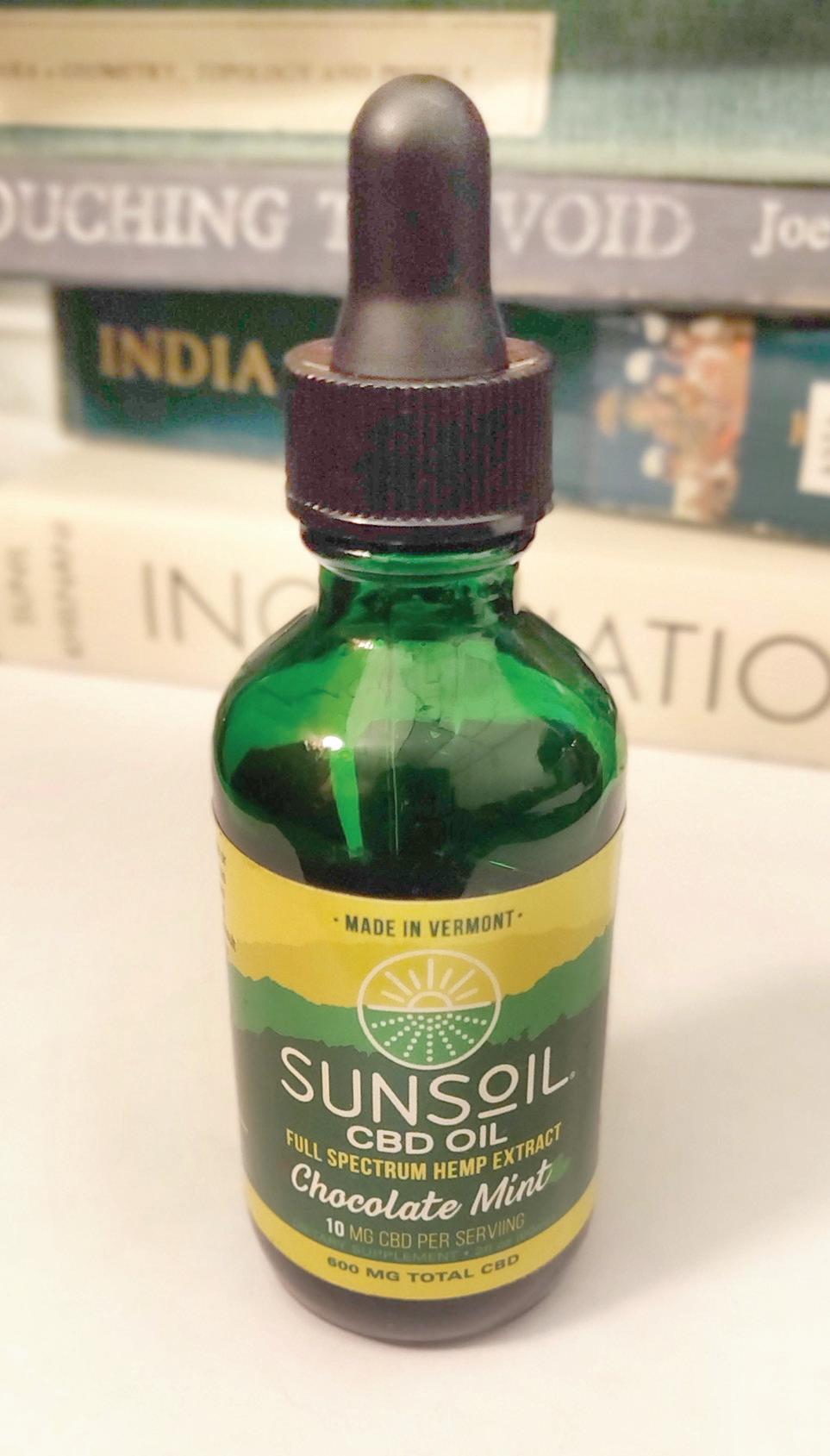
In the United States, CBD is derived from hemp, which has less than 0.3 percent THC, and is legal. More and more stores nowadays have CBD products on their shelves. Here in Ithaca, getting CBD-infused oil is as easy as going to GreenStar in Collegetown. Behind the cashiers is a small selection of CBD oils that you can look through if you ask the cashier. The cheapest bottle is a Chocolate Mint flavored oil that has 600mg of CBD for $30 (10mg/ml).
In New York State, food and drug products with CBD infused in them are technically illegal since the FDA has not approved them for consumption. You could use the stopper to drink the oil directly, but I much prefer adding it to some homemade tea. To be honest, CBD oil doesn’t really taste that great but adding it to tea makes it tolerable. Unfortunately, oil and water don’t mix well (darn you chemistry) but I keep a spoon nearby to mix the tea before a sip. Many websites recommend starting with a 20-40mg dosage and increasing it until you start to feel the effects. Personally, it takes about 100mg for me to fully feel the CBD and I would recommend
You may have a terrible mattress but CBD will make things feel like a soft, fluffy cloud.
starting at 60-80mg and going from there.
But why take CBD in the first place? What’s the use? About 20 minutes after drinking CBD tea, the first thing I notice is how relaxed my body feels. Cornell, and I guess life in general, is pretty stressful. My shoulders are always a little tense from all the sitting and my legs are always tight from all the walking. Plus there’s always some general soreness after working out. (This makes it seem like I never stretch, but I promise I do). CBD makes all these dull aches and pains fade away. Your whole body feels as smooth as butter and you just feel calm. Since your
body is super relaxed, your mind is also super relaxed. And lying down is an actual game changer. You may have a terrible mattress but CBD will make things feel like a soft, fluffy cloud. One of my friends puts it perfectly, “If you are interested in experiencing the extremely subtle yet wholly soothing sensation of having your entire body feel as smooth as a spaghetti noodle — without having your thoughts turn into a bowl of pasta — make some CBD tea.” CBD tea unwinds my whole body and
I’ve only had positive experiences with it.
So the next time you want to have a nice, relaxing night in by yourself, make some CBD tea. Put on some smooth music and lay in your bed. Feel that tension in your shoulder disappear and the intense comfiness of your sheets as you fall asleep. I’d highly recommend it.


“Much remains for me to learn, and I hope to continue to grow with fellow artists and scholars at [insert school].” Upload. Review. Submit. Pay the unreasonably high application fee. Viola , another grad school application done.
Around early December last year, out of the all-too-familiar fear of the unknown and my more pertinent concern of obtaining a visa after graduation, I thought I’d start applying to grad schools. I called my advisor — who was on sabbatical at the time — and asked if I should go into Ph.D. programs in comparative literature or film studies and she was absolutely appalled at my indecision. “Ruby,” she said, trying her best to contain her disbelief on the phone, “you can’t start a five-year — and that’s the minimum, usually it goes for longer — program without knowing exactly what you are into and just hope for the best.”
I supposed she was right, so I opted for MFA programs instead. I should have two years to spare even if all goes terribly wrong? But still there were choices to be made — art practice or filmmaking? And if filmmaking — producing, directing or editing? What is this new discipline called art therapy? In any case, by the time the first round of deadlines rolled around, I had to make some premature decisions. I assembled a rough personal narrative of who I am as an artist, had two friends
read it and told myself that there’s not much else I could do but “hope for the best.” Buried in the heavy workload as finals were approaching, I had little time to think about anything anyways. I even missed the deadline of a school because of conflicting obligations, yet it didn’t really feel significant at the time.
Over break, I started to realize why I barely felt invested in this entire process. The thing about graduate school is that it is purely a choice; when I was a high school senior, I was sure that I was going to college next. All my friends were doing the same, and my family would probably see me as a disgrace if I didn’t. But at this point in our lives, things are not so certain anymore. People I know have gone off to pursue vastly different careers and passions. And honestly, they all seem to be doing quite well, whether in Cupertino working for some tech monstrocity or in Lisbon writing poems. (But then again, observing others’ lives via their carefully curated instagram profiles might be illusory.)
I’ve thrown some “imaginative” options at my advisor as she puts it: Should I become a masseuse in New York’s Chinatown, sell my soul to a Hollywood production company or go make unprofitable films about the ruins of Prague? A friend even suggested that I look into Teach for America. I learned I am not eligible because you have to be American to teach for America (apparently!), but I’ll include it for someone out there as confused as I am.

Coming into this semester I’m confronted even more frequently with the dreaded question of “what’s next?” I don’t know! There are a few less unrealistic options, but it can’t be too bad to take some time off to figure my shit out before the next step, whatever that might be?
The day before school started this year I had to get a root canal in New York City. The lady at the front desk tried to lure me into getting an annual membership at the clinic, because it would make the procedure “so much cheaper,” plus I get an exam and two cleanings “for free” each year. In turn, I tried to explain that I have no clue what will happen with my life after May; in fact, I can’t even guarantee I will still be in this country, let alone New York City. But that didn’t make a difference for her.
With the strong Cantonese accent that reminded me of a childhood neighbor, she somehow convinced me that getting this dental membership is my first step of adulting and establishing a new life after graduation — very effective rhetoric, I must admit — and before I realized what I was doing, I was already handing her my credit card. Let’s hope she’s right — that in four months when my life is in complete disarray, I can anchor myself with at least this one thing, and that will be my annual membership at Sunny Dental Care, 101 Lafayette Street.
Ruby Que is a senior in the College of Arts and Sciences. Escape runs alternate Tursdays this semester. She can be reached at rque@ cornellsun.com.
When a former cast member of arguably the most loved and prolific TV show of the past 45 years came to campus, people were excited. They asked her questions like, “what was it like to get the call?” and, “what is your favorite on-set memory?”
Vanessa Bayer answered these questions with gracious humor. She told the audience that it was
frustrating not being able to tell her friends why she was moving to New York, and revered Ryan Gosling’s surprising intensity in the sketch “Santa Baby.” Although it was a blast hearing Bayer talk fondly about those memories, I had heard those questions asked repeatedly in YouTube interviews. The most interesting points of discussion at Bayer’s talk didn’t quite fit the mold of Conan or Jimmy Fallon interviews.
My favorite moment from the talk was when an audience mem-

ber asked Bayer about what advice she would have for a college audience. She recalled a time when her peers in college would ask her questions along the lines of, “what bank are you at?”, prompting her to ask herself: “Should I be working at the bank?!” The anxiety of lacking the perfect internship, job or summer program is a common fear at Cornell. Smiling, Bayer leveled with us: “No, you don’t have to work at the bank.”
An audience member also asked Bayer about dealing with failure, specifically about bombing during stand-up comedy. Bombing a stand-up set seems like one of the most nerve-wracking things a person can experience, but everyone has felt some variety of failure akin to bombing on stage (think: terrible presentations or first dates).
“It’s like falling off a horse, or whatever you ride,” Bayer told us. She explained that when we fail, we emerge slightly wiser: “I just bombed, and I’m okay. If I got through that, I can get through anything.”
The high-stress environment of media is infamous, but being a
student is also a little like showbiz.
When prompted to tell the audience about her experience working at SNL, Bayer described the uncertainty built into the show. “Going into a show, you don’t know what’s staying or what gets cut,” she said, referring to the potentially devastating moment when a writer’s sketch, the proud result of a long night of hard work, isn’t selected to be in the week’s televised show. That feeling likely resonated with the student audience — rejection from clubs or getting low grades on projects you worked hard on is reminiscent of the same kind of disappointment.
Bayer continued to demystify comedy by explaining one of comedy’s noble purposes — helping people get through hard times. As a fifteen-year-old leukemia patient, Bayer’s prized joke was, “You guys think you’re so cool ’cause your hair is real.”
“You don’t get it, it was funny, trust me,” Bayer said to the audience, who seemed a little uneasy at the cancer joke.
Jewish humor has the same power, Bayer discussed, a fre-
quenter of Hebrew school as a kid. Bayer mentioned ye olde “Jewish guilt,” the guilt that results from our own existence, despite the murder of millions of our people. Obviously, this subject is extremely dark, but joking about it renders it less scary and more accessible to both Jewish people and to non-Jewish people. Maybe this is why humor worked for Bayer and her friends when she was battling cancer — jokes connect people no matter the circumstances.
To be honest, I rolled my eyes when someone from the audience asked which celebrity was the least fun to work with. Besides the inappropriate nature of the question, it couldn’t have captured Bayer’s remarkable perspective on life. Triumph over leukemia, persistence and success in the comedy world, authorship of a children’s book, unapologetic femininity and pride in her Jewish heritage make Vanessa Bayer a truly unique actress of this century; she is worthy of good interview questions.
Emma Plowe is a freshman in the college of Arts and Sciences. She can be reached at eplowe@cornellsun.com

Fill in the empty cells, one number in
so that each
and region contains the numbers 1-9 exactly once. Each number in the solution therefore occurs only once in each of the three “directions,” hence the “sigle numbers” implied by the puzzle’s name. (Rules from wikipedia.org/wiki/ Sudoku)



We have availability for the 2020-2021 school year beginning June 1st at Hudson heights apartments.

26 A PA R TMENT FOR R ENT
2020-2021
Studio 1, 3, 8 & 11 BR Apts. Great Locations in Collegetown. 607-227-2535
Collegetown Crossing
College Ave's Newest Location 307 College Ave. Now Leasing for 2020-2021
Completely New Modern Studios, 2 & 4 Bedroom Apartments. Fully furnished, heat & hot water included. Reception area at 307 College Ave. www.urbanithaca.com 607-330-2442 info@urbanithaca.com
120 Oak Avenue
Just steps to Cornell Campus 10 bedroom house & 1 and 2 bedroom apartment 607-277-1234 office@ithacastudentapartments.com Ithacastudentapartments.com
>>MAKE ITHACA HOME<< Collegetown Apartments Furnished 1-3 Bedrooms PARKING, LAUNDRY, UTILITIES! (607) 273-7368 www.WestShortApts.com
Boldly Refined Living 312 College Avenue
Sophisticated studio, 1, 2, 3-bedroom apartments. Superior fitness facility, theater, and coworking space. Free high-speed internet. Exclusive resident parking. Package delivery/return. Overnight concierge. 607-273-9777 or 312collegeave.com
1, 2 & 5 Person Apts. Overlooking Cascadilla Gorge Architecturally designed. Decks, patio, fireplaces, Jacuzzis. Furnished, parking, internet. 607-592-7564
504 1/2 Thurston AveSTUDIO 607-277-1234 office@ithacastudentapartments.com Ithacastudentapartments.com
26 A PA R TMENT FOR R ENT
Catherine & Eddy St. 1 & 2 bedroom Furnished, heat included Laundry in building Parking available for fee 607-277-1234 office@ithacastudentapartments.com
***************************** 1-3 Bedroom Apartments Quiet Fall Creek Location 5 Minutes to Busline 607-351-1267 joe@joegrealty.com *****************************
Houses, Apts, Parking 1 to 9 Bedroom Collegetown - College Ave, Linden Ave, Dryden Rd, Bryant Ave, Cook St. 607-330-2442 info@urbanithaca.com www.urbanithaca.com
Now Renting 2-10 Bedroom Houses/ Apartments for 20-21. All Locations. Call today or visit our website: Certified Properties of TC Inc certifiedpropertiesinc.com 607-273-1669
Flexible Housing Solutions! Short Stay Accommodations “Brand New” Studio Apartments 238 Liden.com Leasing@inteprop.com
109 Sage Place 2 & 3 Bedroom Apartments Access to Shuttle to Campus Access to Free Fitness Center Novarr-Mackesey Property Management office@ithacastudentapartments.com 607-277-1234
20-21
College Ave. 5 BR House Furnished. Laundry. Parking. Call 607-273-8576







We’ve been reporting the news to curious minds for more than 1 39 years.
MEN’S HOCKEY
Continued from page 16
continued to thrive. After giving up two power-play goals to Union on Jan. 11, the Red has killed 13 straight penalties over the last four games.
“We knew our PK was struggling,” said junior forward Brenden Locke. “We just all kind of sat down the one Monday and hit the reset button.”
As a result, Cornell’s coaching staff completely revamped the team’s penalty kill and went back to the basics after the Union game.
“[Schafer] and [associate head coach Ben Syer] brought us in and they just said, ‘Hey, we’re starting from scratch now,’” Locke said. “‘We’re just going to reteach everything and make it really basic.’ We went like we were starting from day one and made sure we had the fundamentals down before moving on.”
knotted the contest on a 6-on-4 advantage.
Another concern for the Red is the 137mile distance between Quinnipiac (14-91, 7-4-1) and Princeton (3-12-4, 1-8-3).
After Cornell faces Quinnipiac in Hamden, Connecticut, it will have to take a long drive down to Princeton, New Jersey late in the night.
“One year, we got down there at 4 o’clock in the morning with an accident on the road,” Schafer said. “You just got to
“One year, we got down there at 4 o’clock in the morning with an accident on the road.”
Mike Schafer ’86
deal with it, get up and get readjusted for the following day … Sometimes, we’ll skate. Other times, we’ll have breakfast, stretch out, meet and put a premium on sleep.”
While the Red beat Quinnipiac, 2-1, and Princeton, 5-1, in its previous matchups, the outcome of a second meeting can vary, especially since both teams possess film on each other. Just last weekend, Harvard surprised Cornell with a change in its game.
“Harvard totally changed their penalty kill in the game against us,” Schafer said. “We never saw that in 10 games that we scouted them before that. It was a great lesson for us to expect the unexpected … teams are going to do some things that maybe they don’t traditionally do in order to win.”
That change resulted in the Red failing on its first three power-play opportunities before sophomore forward Michael Regush
Even if the Red is not performing perfectly, it is still the No. 1 team in the nation, and its accomplishments cannot be understated. Cornell is currently riding an eight-game unbeaten streak, and through 19 games, the team has only sustained a single loss. This start is the best for the program since 1970 — when the Red went undefeated and won the national title.
Cornell will strive to continue its excellent season as it travels to Connecticut and New Jersey to square off against Quinnipiac and Princeton this weekend. Puck drop is set for 7 p.m. on Friday and Saturday.
Luke Pichini can be reached at lpichini@cornellsun.com.

By LUKE PICHINI Sun Assistant Sports Editor
After notching a victory over Dartmouth and a draw against Harvard last weekend, No. 1 Cornell men’s hockey heads back on the road to take on a pair of


rivals, it did not play up to high expectations.
“I think we’ve gotten away from the identity of playing faster,” said head coach Mike Schafer ’86. “I just think that with all that’s going on for our team, we got to get back to some of the habits we had when were playing a little bit faster, quicker, stronger.”

ECAC foes in Quinnipiac and Princeton.
Though the Red earned three total points against its conference
According to Schafer, Cornell (141-4, 9-1-2 ECAC) has not been putting the same pressure on its opponents that it had done through the first half of the season. During the Dartmouth matchup, the Red struggled to complete its scoring chances, and against Harvard, it only mustered a few scoring chances.
“Our special, as a team, is going north quick and putting on a lot of pressure,” Schafer said.
“Putting pressure on the opposing defense and team, and hopefully by the second or third period,

they’re worn down … We did that in a lot of the successes we’ve had this year. In the games where we haven’t done that, they’ve been a real grind and real fight.”
Junior captain Morgan Barron, the team’s leading point- and goal-scorer, echoed similar sentiments to his coach’s.
“I don’t think we were fully satisfied with the effort we had on our Saturday,” Barron said. “So we’re trying to get to the basics … because that game on Saturday was probably the least we’ve created in terms of opportunities throughout
the year.”
The Athletic reported that Barron, a 2017 sixth-round draft pick by the New York Rangers, was considering leaving for the NHL after the end of Cornell’s season. Barron, however, said that he was committed to the team.
“I have expectations of taking the season as deep as we can into the playoffs,” Barron said. “The
Hosting a two-day meet against their upstate New
“The Rangers want us to go as far as we can as well, so it’s been pretty good — we’re all in unison.”
Morgan Barron
Rangers want us to go as far as we can as well, so it’s been pretty good — we’re all in unison.”
While Cornell’s scoring may be down, the team’s penalty kill has
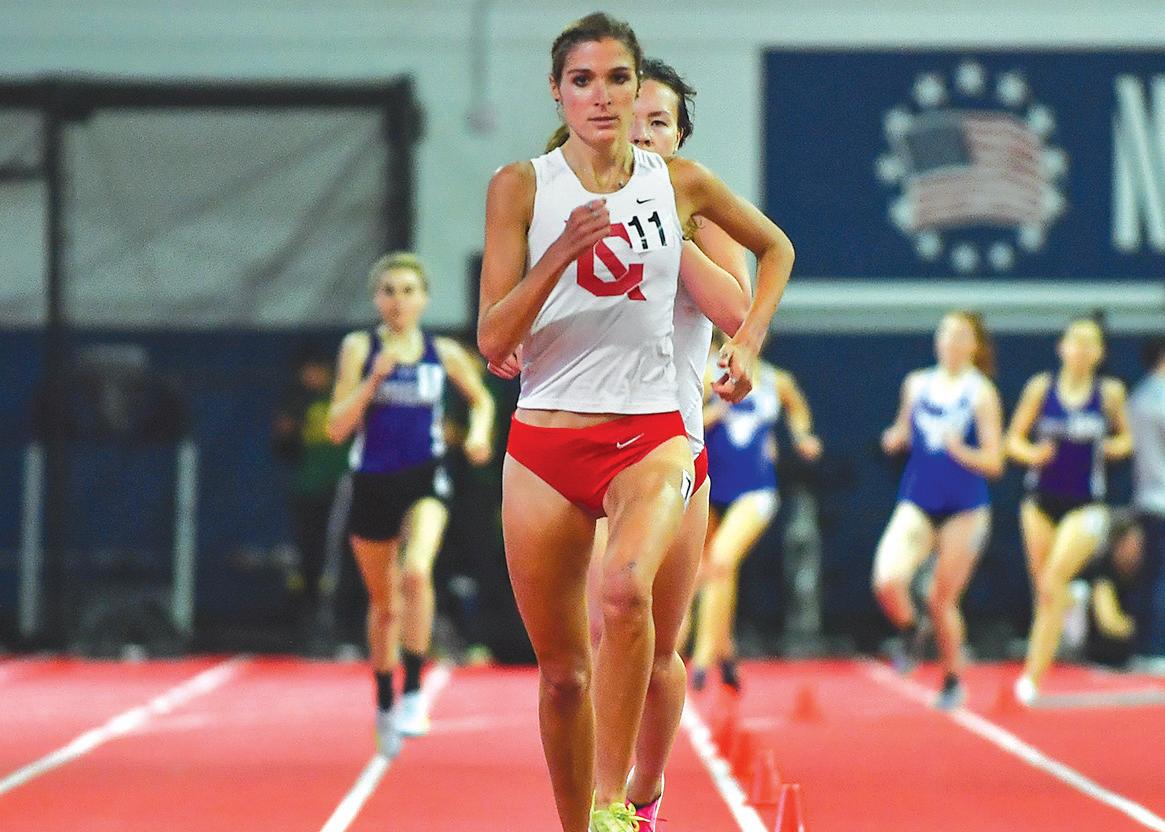
York rivals, the men’s and women’s track and field teams placed first at the Upstate Challenge this past weekend.
The men’s team had four more members qualify for the IC4A Championships, while the women’s team had eight more qualify for
the ECAC Championships. Binghamton, Buffalo, Princeton and Colgate were also in attendance at the event.
The men’s team, with 121 points, narrowly beat out Binghamton for first place by a single point, with Princeton, Colgate and Buffalo trailing in the final results.
The Red also featured two event champions, with freshman Rishabh Prakash finishing first in the mile (4:15.82) and sophomore Johannes Stromhaug taking home firstplace in the pole vault (5.07m). Stromhaug’s impressive pole vault performance was a personal record, landing him eighth in the Red’s record book and qualifying him for the IC4A Championships.
Three other members from the men’s team also recorded personal records, automatically qualifying them for the IC4A Championships. Freshman Smith Charles (6.97) qualified for the 60m, junior Tumani Edwards (14.84m) qualified for the triple jump and Ian Frost (17.09m) qualified for the weight throw.
The women’s team finished first with 263 points, crushing Binghamton by 141 points, and it featured nine event champions.
Junior Kellian Kelly (59.11) finished first in the 400m, senior Reagan Bachman (1:17.16) in the 500m, junior Melissa Zammitti (2:18.18) in the 800m and junior Elle Orie (5:02.49) in the mile.
Additionally, senior Claire Kao (3.87m) finished first in the pole vault, as did junior Marguerite Lorenzo (1.70m) in the high jump and sophomore Beatrice Juskeviciute (3973) in the
pentathlon. The A team placed first for the 4x400 (3:53.08) and 4x800 relay (9:59.14) and the B team (11:58.85) for the distance medley relay.
Juskeviciute’s remarkable performance in the pentathlon not only earned her first place and a personal record, but also broke the program’s previous record in the event.
Juskeviciute, Kao, Lorenzo, the 4x400 A team and distance medley relay B team earned ECAC qualifications through their performances. Senior Victoria Casarrubias (2:51.61) qualified for the 1000m, sophomore Maria Siciliano (3.72m) qualified for the pole vault and senior Nikolia Kanaris (14.30m) qualified for the shot put. The men’s and women’s team will return to action on Saturday, Feb. 1, when they host the Kane Invitational at Barton Hall.