The Corne¬ Daily Sun
| Page 4


| Page 4
Te natural history exhibition faces severe fnancial difculty after a $30 million donor pledge fell through
By TAEHEE OH Sun Senior Writer
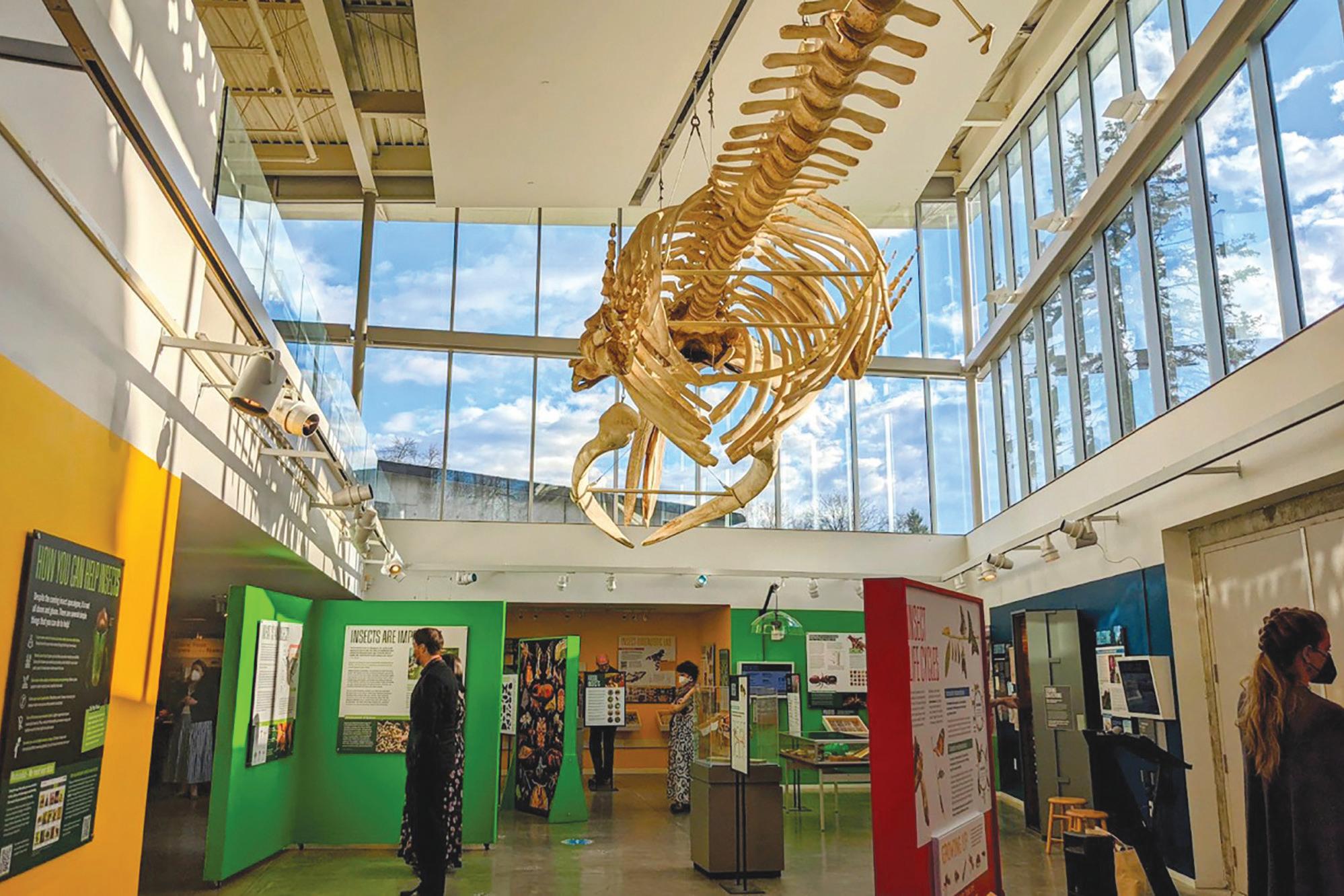
Jan. 24 — At the Museum of the Earth, visitors can journey through the history of life on Earth. Located on 1259 Trumansburg Rd, the 8,000-square-foot natural history museum features exhibits from “Hyde Park Mastodon” to “Rock of Ages, Sands of Time,” highlighting Ithaca’s geological history within the broader context of Earth’s past.
But now, the museum is facing severe financial challenges after a $30 million donor pledge collapsed, putting the institution’s stability at risk.
Drawing on Cornell’s partnership with Paleontological Research Institution — the independent nonprofit that owns and operates the museum — students and professors are advocating for the University to provide greater support for the museum through its financial issues.
When the Museum of the Earth was founded in 2003, a group of anonymous donors pledged more than $30 million to support various aspects of the organization. For over 20 years, their annual contributions of over $1 million have played a critical role in supporting the museum’s operations.
However, since late 2023, donors have been unable to fulfill their annual pledges and the 20-year pledge they had previously made, forcing the museum to downsize operations significantly, including drastic staff reductions that slowed progress on science-based projects, reduced public programming and limited its operating hours.
“We’ve prided ourselves on developing really quality programs across our institution, but obviously, we can’t do everything with the downsized staff, so we’ve just been strategic in
deciding what can get done and the timelines that they can get done on,” said Amanda Piha, the associate director for philanthropy and communications at PRI.
While the museum does not have immediate plans to close, according to Piha, without significant financial support, the museum will be unable to cover the expenses required to continue operations.
“There are no plans to close, but of course, that is also dependent on being able to continue to raise funds and keep ourselves financially stable, while we also build some really longterm partnerships in the background so that we could build even more stability and make the organization sustainable moving forward,” Piha said.
Piha explained that the financial challenges faced by the Museum of the Earth are not entirely unique, with similar institutions across the nation grappling with difficulties.
A 2024 survey of museum leaders by the American Alliance of Museums found that half of museums faced revenue loss or tough decisions on personnel, programs or expenses, while 25 percent are using reserves or endowments to cover operating costs.
The museum’s 8,000-square-foot permanent exhibition features a mix of natural history displays, interactive science features and art exhibitions, according to the museum website.
With over seven million specimens — marking one of the largest fossil invertebrate collections in the United States — the Museum of the Earth and PRI significantly contribute to local students’ science education since the formal affiliation between the two institutions in 2004.
See MUSEUM page 10
By MATTHEW KIVIAT Sun News Editor
Jan. 28 — In a statement sent to the Cornell community on Tuesday night by Interim President Michael Kotlikoff, Provost Kavita Bala and Provost of Medical Affairs Robert Harrington, M.D., the administrators responded to concerns surrounding how new executive orders and policy announcements from President Donald Trump might impact University affairs.
The White House budget office on Monday sent a memo to government agencies officially ordering a pause in “grants, loans, and other federal financial assistance” authorized by Congress across the U.S. Cornell, which receives federal and state funding for research and federal grants for students, would immediately be affected by the order.
The executive action was temporarily blocked by Federal Judge Loren AliKhan of the District of Columbia on Tuesday.
In the University statement, the administrators highlighted that senior leadership on all of Cornell’s campuses, the Office of General Council and federal relations staff located in Washington D.C. are “actively working to analyze and assess new guidance coming from the federal government.”
The administrators also advised that ongoing programs or research that rely on federal funding should not be halted.
“It is vital that we continue this important work in partnership with our federal sponsors, unless otherwise directed,” the administrators wrote.
The statement also addressed concerns about President Trump’s recent executive order on immigration, which calls for the “expedited removal” of undocumented immigrants in the U.S. According to the administrators, the University remains committed to supporting “all members of the university community,” while noting that Cornell “will comply with university policy and federal law regarding the protection of sensitive personal information.”
The statement also announced the creation of a new email address — ExecutiveOrders@cornell.edu — that community members can use to ask questions and “share examples of impacts” of the new federal policies.
Administrators also announced the creation of a new website that will provide key updates and guidance to Cornellians on President Trump’s executive orders and policies.
While the administrators recognized that the recent “extraordinary developments are unsettling,” they claimed that as Cornell has done before, it will come together to address these great challenges.
“Thank you for continuing to work together to ensure that we maintain our efforts to ‘do the greatest good,’” the administrators wrote.
Matthew Kiviat can be reached at mkiviat@cornellsun.com.

Lunar New Year Guessing Game
7:30 a.m. to 10:30 p.m., Noyes Community Recreation Center
Extreme Soft Materials by Polymer-network Design with Shaoting Lin 1:30 p.m. to 2:30 p.m., B11 Kimball Hall
Asian American Intervarsity Lunar New Year Event 2 p.m. to 4 p.m., Physical Sciences Building
Graduate Students Mentoring Undergrads
5 p.m. to 6:30 p.m., OADI Lounge
Bowling Practices
5 p.m. to 6:30 p.m., Helen Newman Lanes
Community Dinner
6 p.m. to 7 p.m., Annabel Taylor Hall Founder’s Room
Socially Just Leadership
Soup and
Noon a.m. to 12:45 a.m., Sage
Lunch and Learn: The Existence and Longevity of Radical Spaces Within Higher Education 1 p.m. to 2 p.m., 140 Sibley Hall The Sortability Hypothesis Cross-linguistically with Veneeta Dayal 4:30 p.m. to 6 p.m., 106 Morrill Hall
Lunar New Year Celebration 5:30 p.m. to 7 p.m., LH5 Lower Atrium
Spring Welcome Back: Craft Night
7 p.m. to 9 p.m., 103/105 Robert Purcell Community Center
Tastee Treat: Cupcake Day
9 p.m. to 10 p.m., Unit 1 Lounge
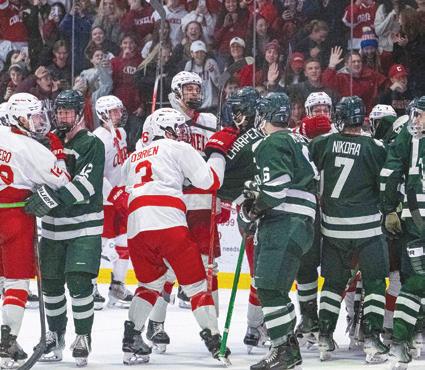
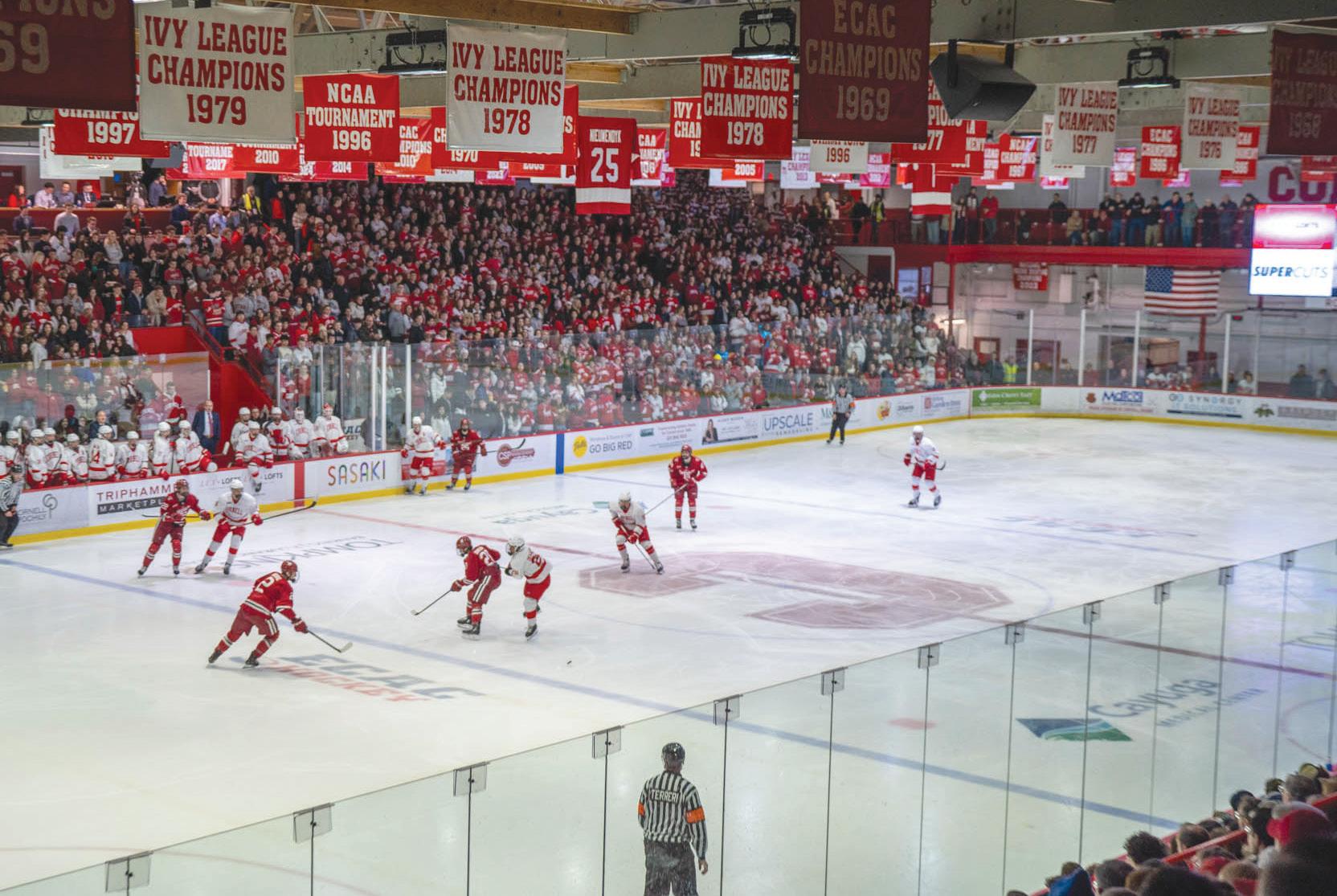
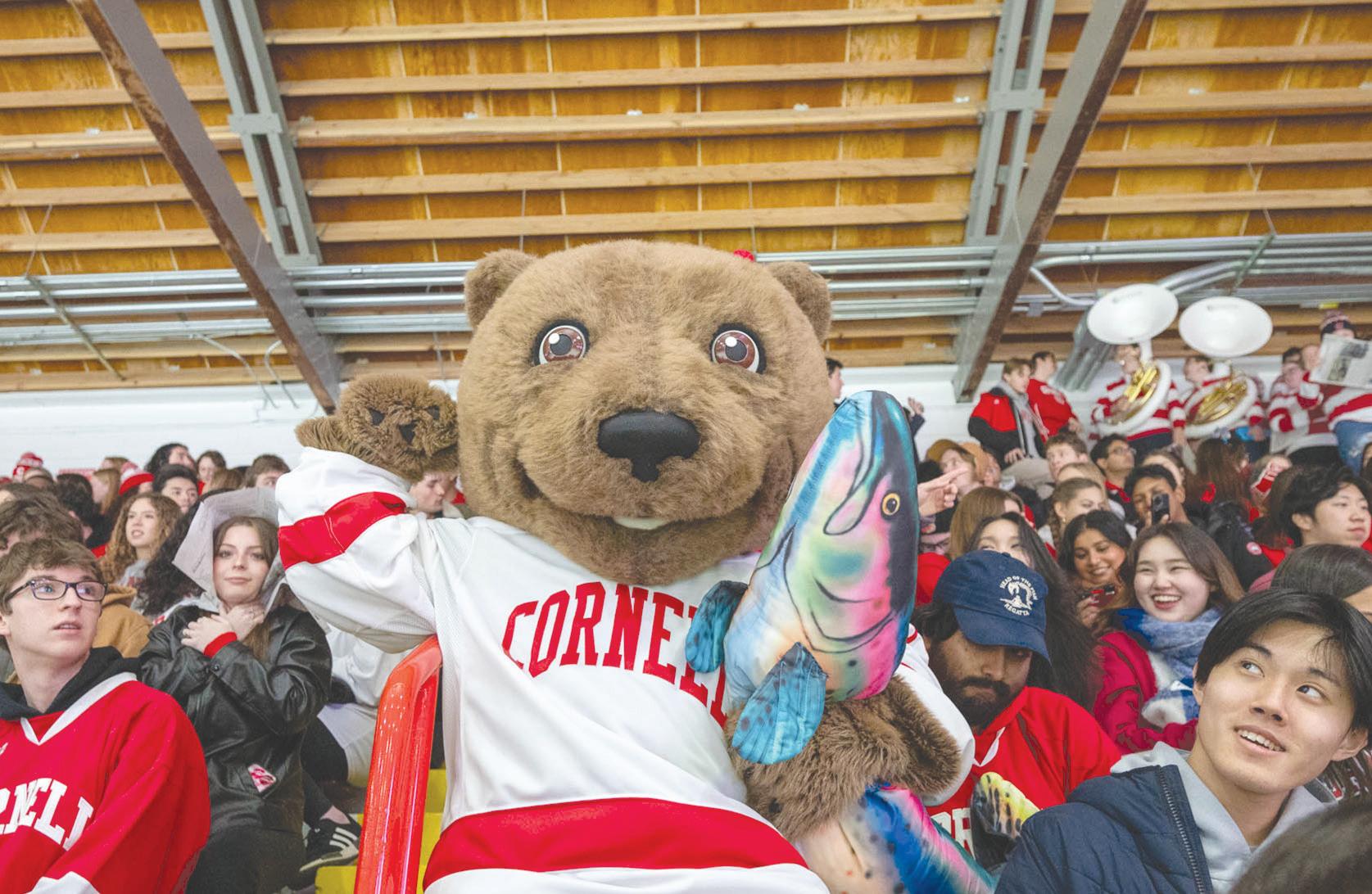
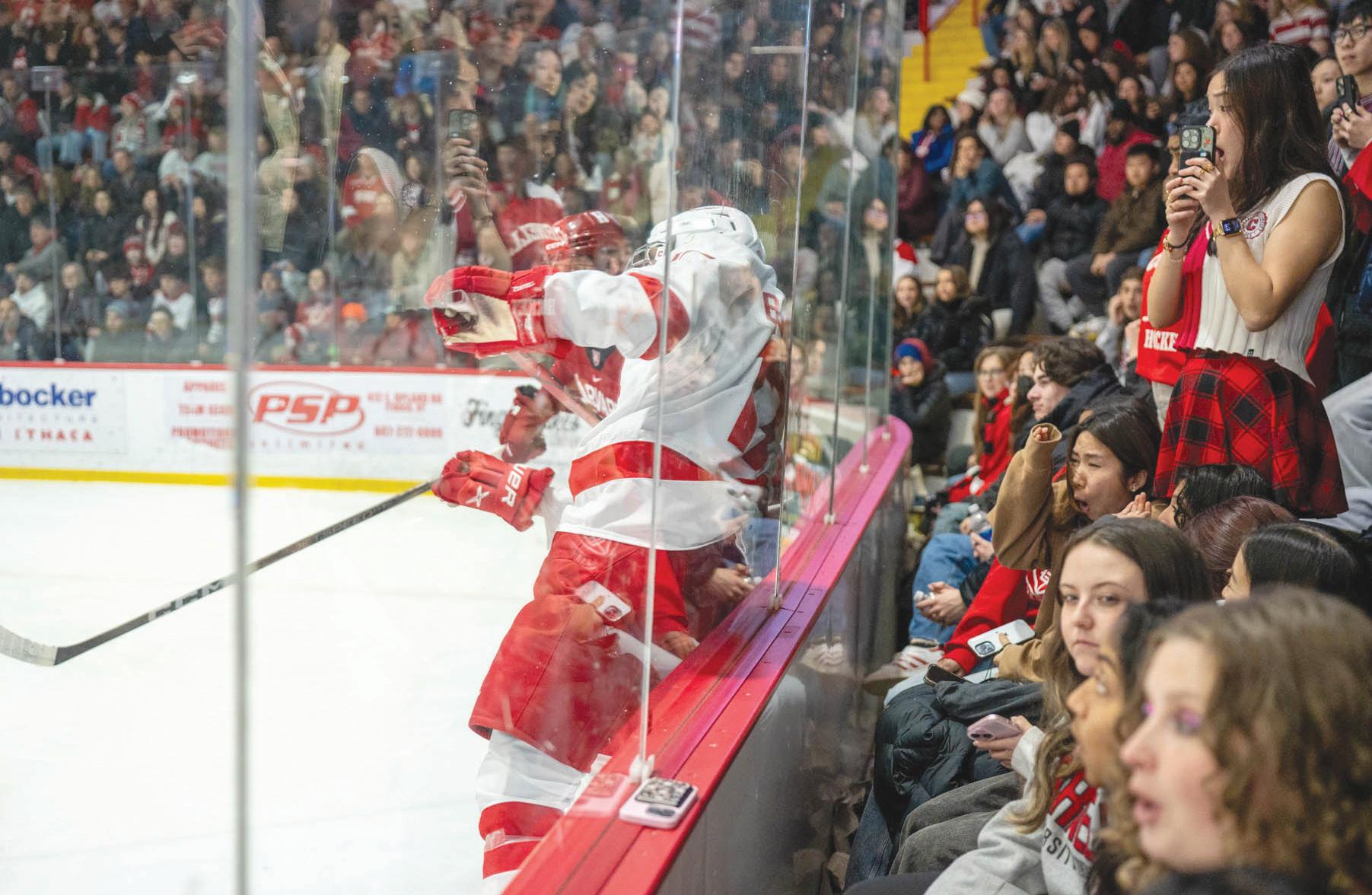
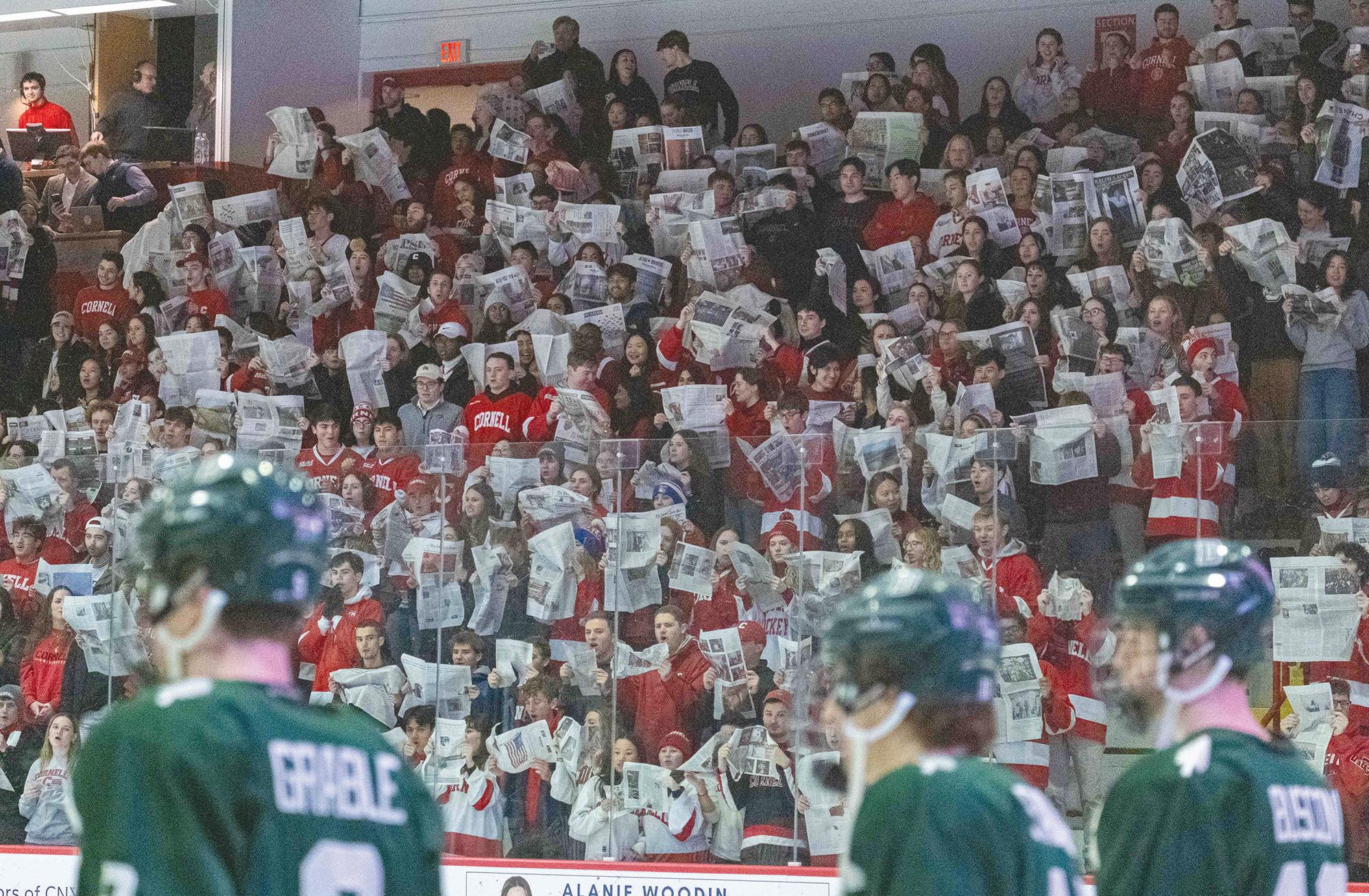
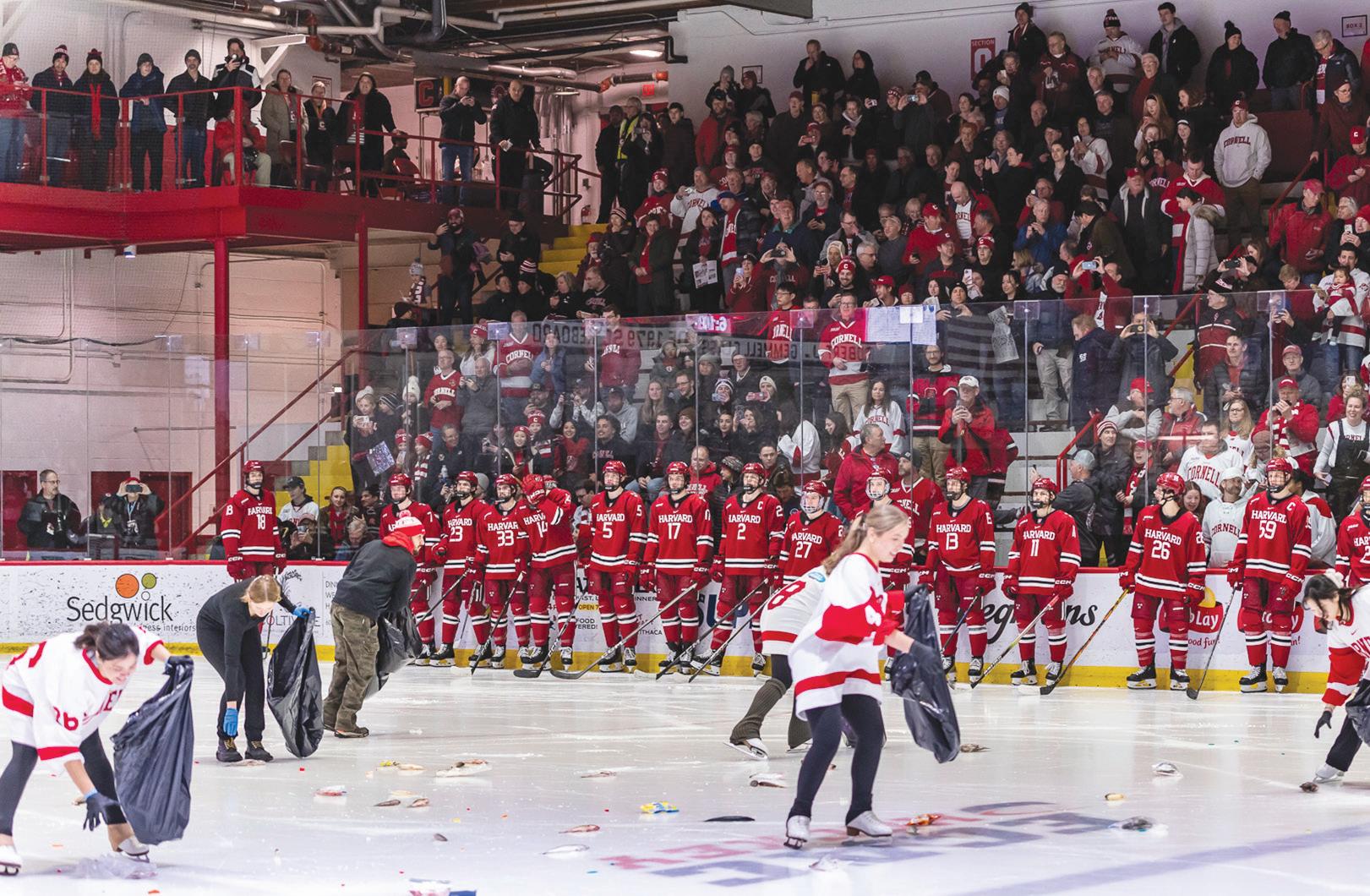
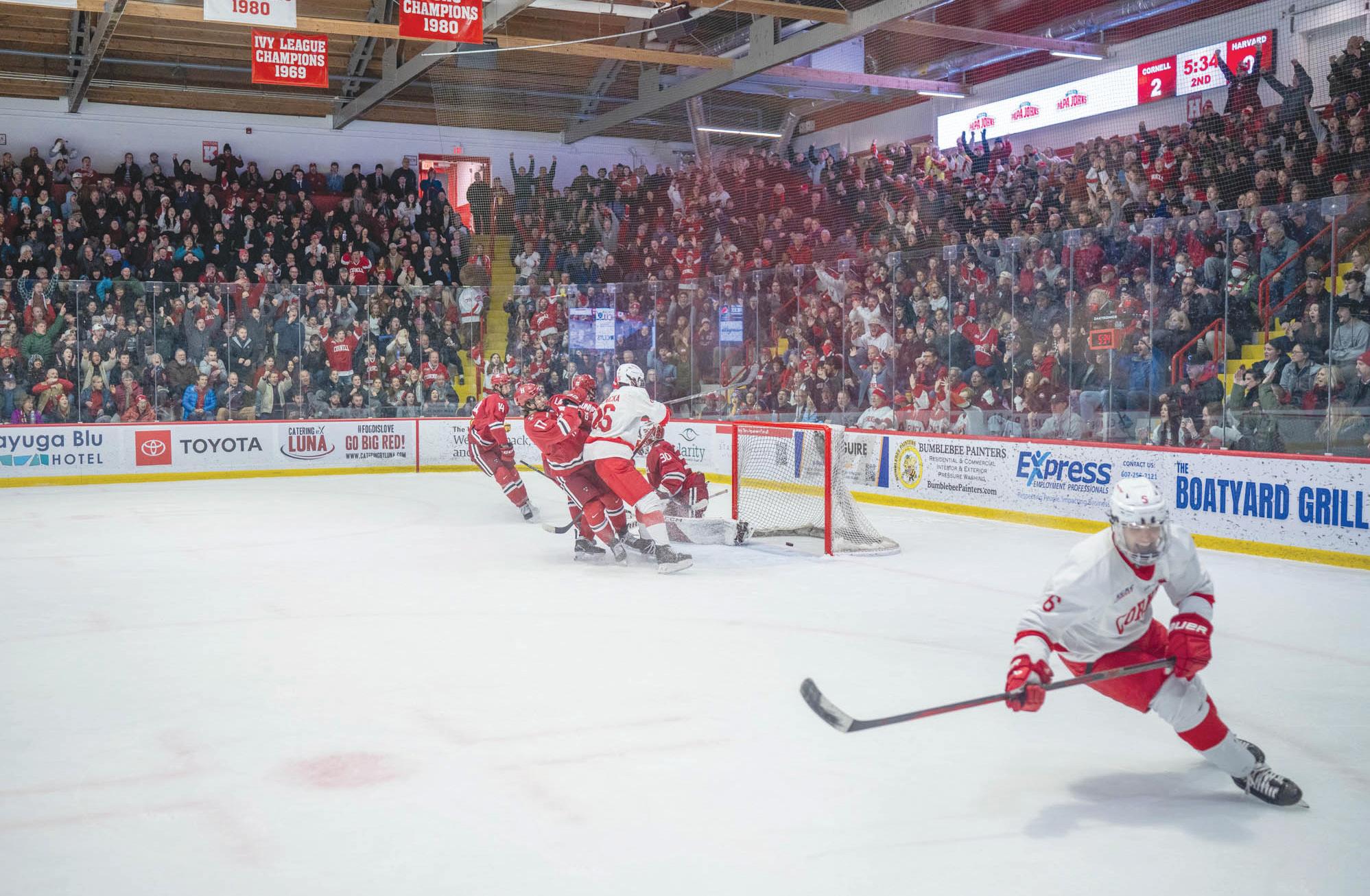
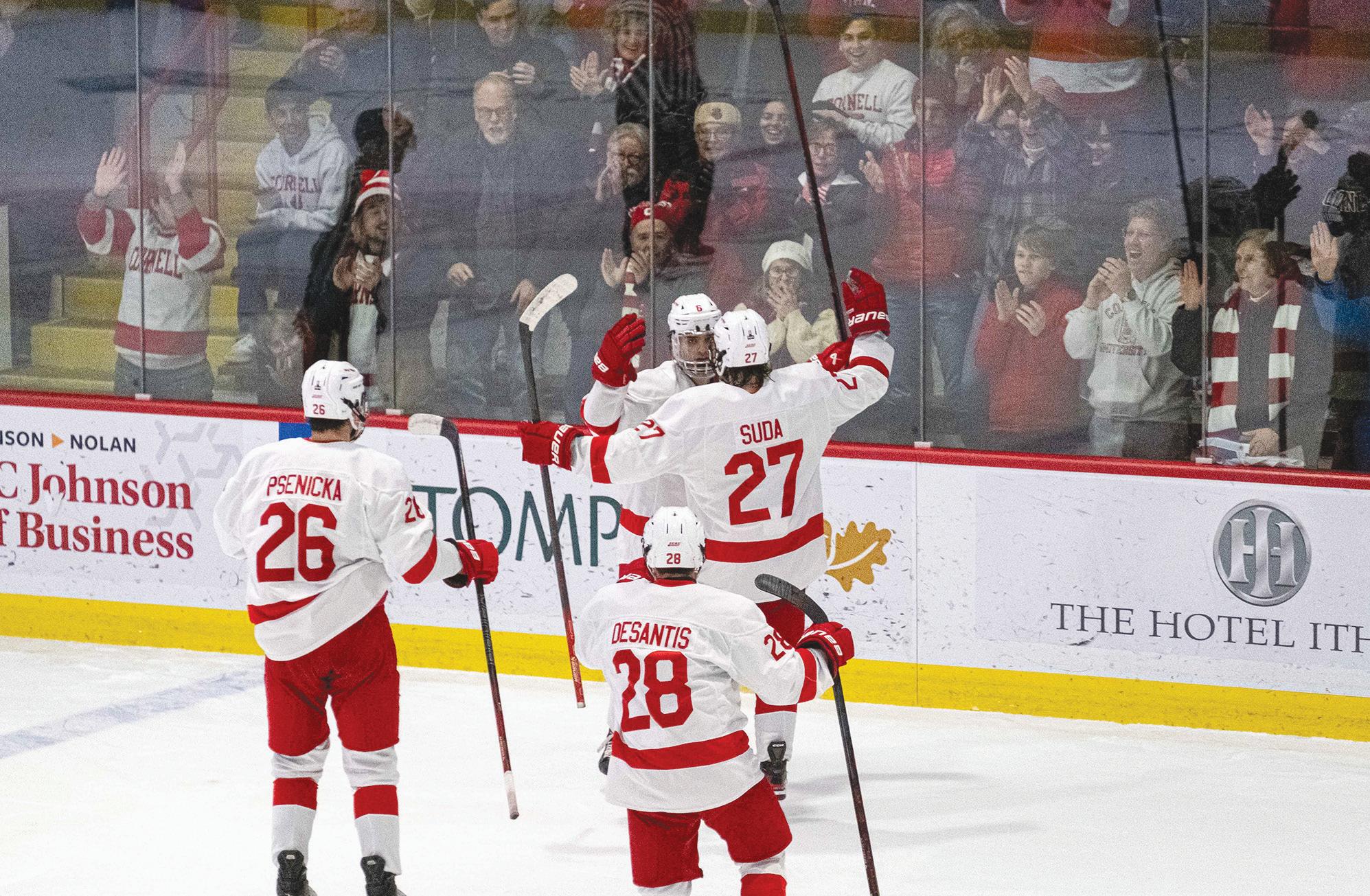
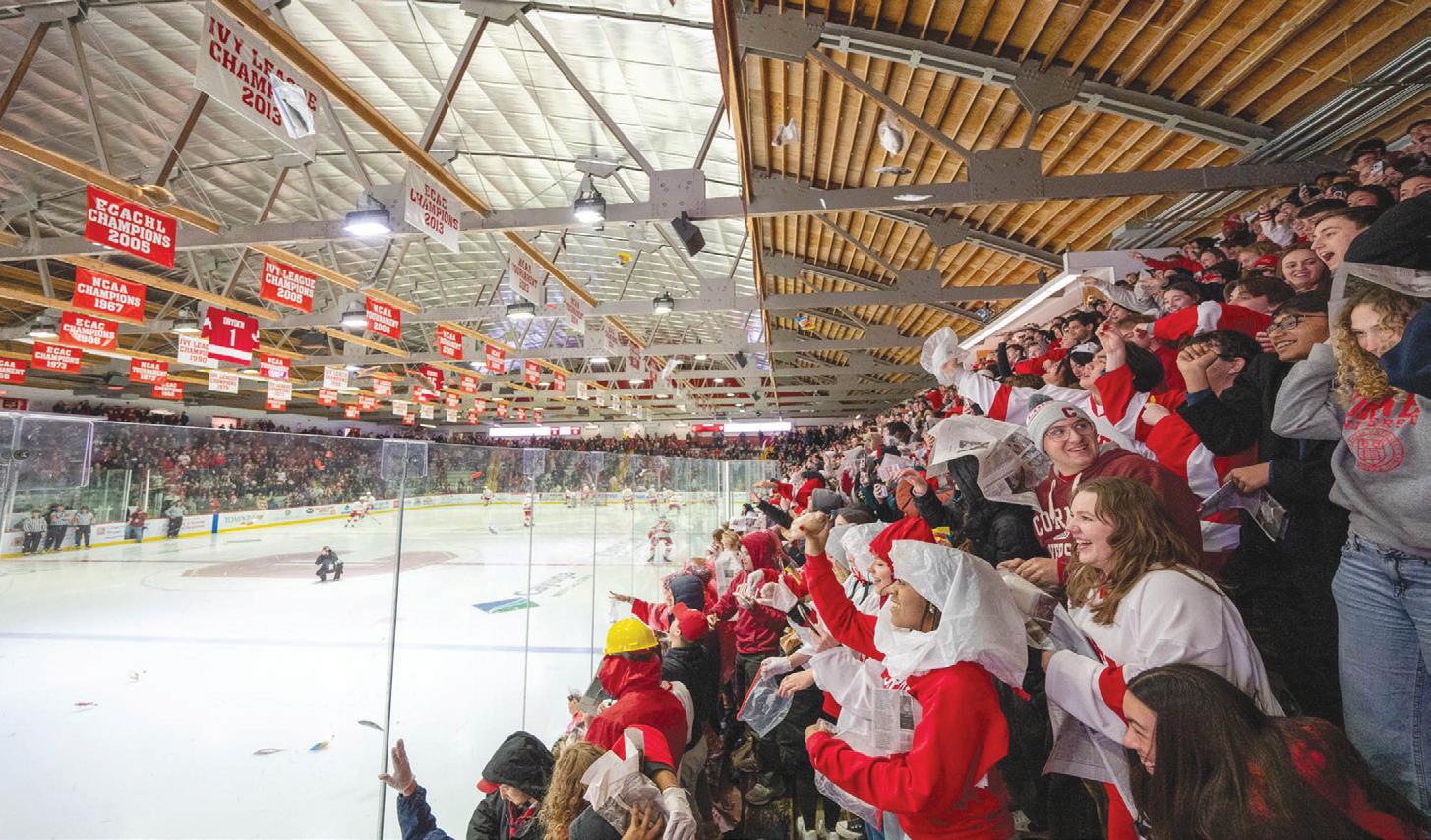
Te men’s ice hockey team faced Harvard and Dartmouth in front of sold-out crowds at Lynah Rink
By SUN PHOTOGRAPHY DEPARTMENT

By BENJAMIN LEYNSE Sun Senior Writer
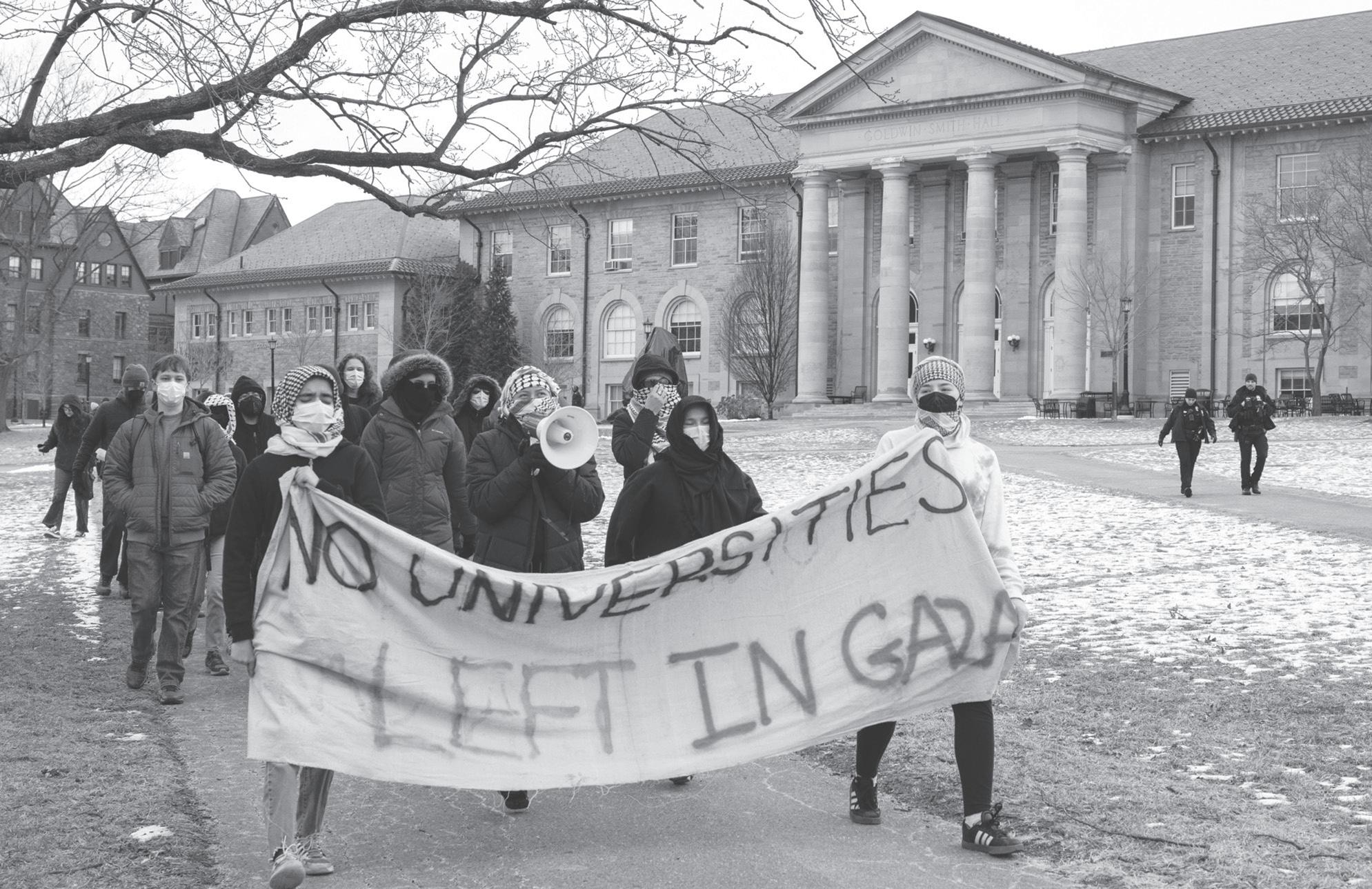
Jan. 24 — Amassed before the recently vandalized Andrew Dickson White statue, the Coalition For Mutual Liberation staged its first protest of the spring semester on Friday in support of Palestine and against the Trump administration’s immigration policies.
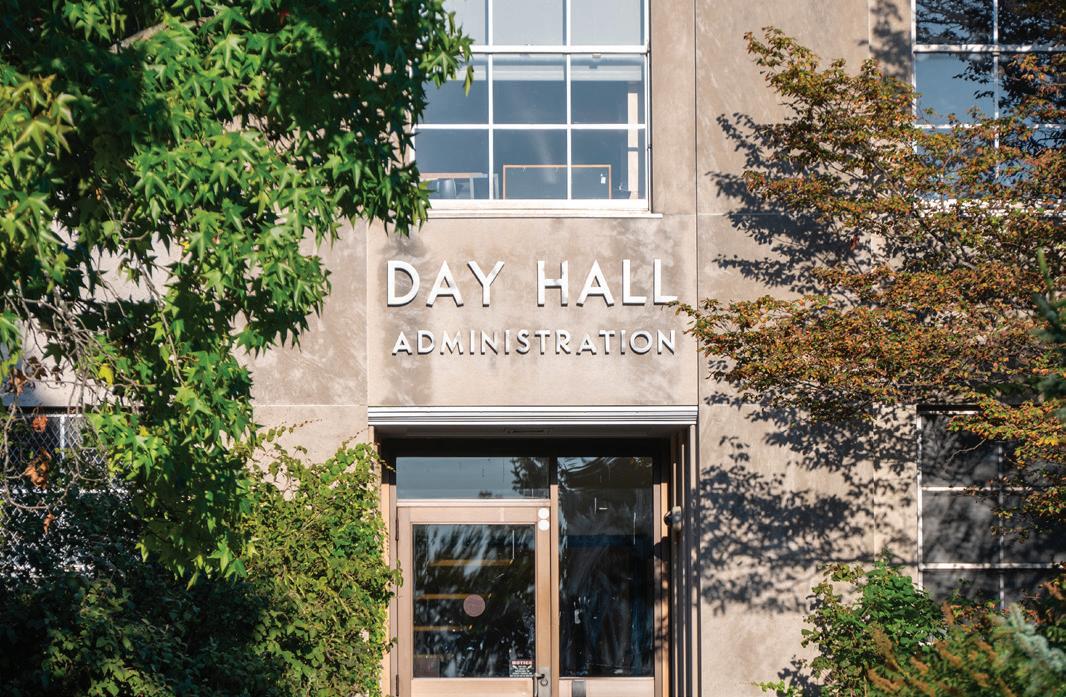
CML is an umbrella group of over 40 campus and local organizations. While prior CML-led demonstrations garnered hundreds of demonstrators, only about 30 students, faculty and community members met in front of Day Hall on Friday. From there, they marched to the
Arts Quad and gathered in front of the defaced A.D. White statue, now covered with a tarp.
On Monday, students awoke on the first day of classes to “Divest from death” and “occupation=death” spray painted in dark red on the statue of A.D White. CML expressed support for the vandalism in a Tuesday Instagram post, writing, “You can cover a statue with a tarp but you can’t cover up your complicity.”
As the protesters rallied on Friday, they continued to push the University to divest from defense manufacturers involved in the Israel-Hamas war.
Protesters chanted “From the river to the sea, Palestine will be free,” “More
repression, more resistance” and “F*** you Kotlikoff.”
The protesters also focused on concerns for undocumented immigrants under the Trump administration. Since President Donald Trump took office, deportations have expanded across the United States. Trump will allow officers enforcing immigration law to carry out arrests in schools, according to reporting by The Associated Press.
Assembled in front of Day Hall, pamphlets were distributed with the title, “What’s wrong with ICE?” and a speech by a masked speaker warned that “We need each other now more than ever with ICE raids possibly imminent.”
Protesters listened to speeches from students, an alumna and Prof. Russell Rickford, history. Multiple members of the Cornell University Police Department and University officials were present throughout the demonstration but did not appear to intervene.
Rickford took a voluntary leave of absence during the 2024 Spring semester after receiving backlash for stating he was “exhilarated” by the Oct. 7 Hamas-led attack on Israel. Since returning to campus, he has remained involved in pro-Palestinian demonstrations. On Friday, Rickford pushed for guarantees from the University “that our records [and] our information will remain private.”
“We demand that our institutions reject the depredations of ICE and the despotic federal government,” Rickford said.
When asked by The Sun if the
By VARSHA BHARGAVA Sun Staff Writer
Jan. 22 — Beneath a glass table in newly-appointed Provost Kavita Bala’s office, a small marble makes a geometric, measured journey through sand, forming mandala patterns that she treasures.
In 2007, Bala designed graphic visualizations of mandalas — much like the one on the table — with local monks and a student from the College of Human Ecology. At the time, Bala was an assistant professor of computer science at Cornell. While sitting down with The Sun, she reflected that the experience of working closely with a student from a different field shaped the way she thinks of her role at Cornell.
“Developing the talent of the next generation — the intellectual development, growth and the education of the next generation — to me, that is really appealing,” Bala said. “I have one life, this is what I want to do with it. I want to be here thinking about the research and the education that drives the future of all [students].”
On Jan. 1, Bala assumed her role as Cornell’s 17th provost. She is preceded by Interim President Michael Kotlikoff, Cornell’s longest-serving provost. Previously, Bala served as the first dean of the Bowers College of Computing and Information Science.
Bala described how computer science reflects her personality. When first breaking into the field, the breakdown of complex problems excited her, and she was immediately “sucked in.” Bala said she uses this same logical thinking process when solving problems in her own life.
Before becoming a dean in 2020, Bala taught at Cornell as an assistant professor of computer science in 2002. Since then, Bala said that being a professor has become “the most meaningful part of how [she thinks] of [herself].”
Along with computer science, Bala loves Indian classical dance, honey matcha lattes and playing Dungeons & Dragons with her children — who she said inform her perspective as a leader at Cornell.
“I have a better appreciation of how the student experiences [things],” Bala said. “As a parent, [I’m] wondering what are [my] kids’ futures going to look like, and [I] see that in all of the students.”
Growing up, Bala valued education “consciously”
as her parents did not attend college. She pursued her undergraduate education at the Indian Institute of Technology Bombay and stood alone as the only woman in her computer science class. Bala explained that this experience “toughened” her and shaped how she approaches moral decisions now.
“[I] approach things from a sense of, ‘Am I doing the right thing? Do I have the right values?’ That’s [my] moral compass that [I] use to guide [my] actions,” Bala said. “I truly believe in listening to anybody who has an opinion to share with me that’s informed, [and] I would like to listen to and hear that point of view and incorporate it into my thinking.”
People will not always agree with each other, Bala explained. As provost, she hopes to embody the practice of listening, talking and respecting each other.
At Cornell, Bala immerses herself in working with different voices and disciplines. In addition to her stint modeling mandalas with a human ecology student, she recently worked with fashion anthropologists to study global cultural erasure.
To be “tethered in the right space” while working, it is important to Bala to talk to the “practitioners” of the discipline — the people actively engaged in the work. Bala said that at Cornell, she appreciates the enriching conversations and opportunity to constantly learn that is presented to her on campus.
“I go and talk to alums, and when they come back, they realize that this was a much richer place than they remember,” Bala said. “This campus is so intellectually rich. You always find something cool or new with a different lens that somebody brings to life.”
For Bala, the joy of her job is being able to work with people who are “driven by their missions” and want everyone to succeed. According to Bala, this is “a great time to be a provost,” and she looks forward to tackling the challenges of the world’s current “lack of public trust” and concern around democracy and misinformation.
“I think Cornell has some of the best, most amazing minds of our time who can address these challenges together… [and] I’m excited about bringing together this ‘any person, any study,’ very broad university,” Bala said.
University would allow ICE or other governmental officers enforcing immigration law onto campus, a Cornell Media Relations representative did not immediately respond to a request for comment.
“We demand that our institutions reject the depredations of ICE and the despotic federal government.”
Prof. Russell Rickford, history
Barbara Taam ’74, a member of Alumni For A Fair And Just Cornell, also spoke. She explained that the organization of alumni works to support student protesters in “their interest in trying to do their part to stop the genocide.”
Taam handed out flyers to the protesters calling for Interim President Michael Kotlikoff to reverse punishments against student protestors, Chair of the Board of Trustees Kraig Kayser MBA ’84 to resign and Israeli Prime Minister Benjamin Netanyahu to be arrested.
“[The members of Alumni For A Fair And Just Cornell are] very concerned,” Taam said in an interview with The Sun. “We don’t think that suspending students and just telling them to go away is the way to run a University.”
Benjamin Leynse can be reached at bleynse@cornellsun.com.
By HOPE THOMAS Sun Contributor
Jan. 27 — Following months of negotiations with Cornell Graduate Students United, Interim President Michael Kolitkoff released a University statement on Thursday in support of an open shop policy for graduate students, which would allow graduate workers to choose to join a union.
This position starkly contrasts with Cornell Graduate Students United’s advocacy for a union shop — a place of employment where all employees are required to join a union. CGSU is a union for graduate students that is fighting for a union shop — a place of employment where all employees are required to join a union.
In response to CGSU’s demands for a union shop, Kotlikoff wrote, “Cornell made clear that it would not accept such an arrangement, which would be contrary to our university’s core values and would have grave consequences for many of our current and future students.”
According to Kotlikoff, the consequences of a union shop include graduate workers needing to either be added to the union or leave the University. Additionally, it forces all graduate workers to be associated with any political decisions CGSU makes, Kotlikoff wrote.
“We want to be clear that Cornell is not opposing unionization of graduate student workers, and we are open to considering proposals other than the union shop that has been approved,” Kotlikoff wrote.
According to Ph.D. student Ewa Nizalowska, after winning the election to form a union, CGSU began negotiating its first contract with the University throughout the fall semester to secure protections that ensure improved working conditions for graduate students.
Currently, CGSU relies on union cards to advocate for graduate workers. Union cards are legal documents that allow a union to negotiate with employers on behalf of the employee. The employee needs to give consent before a union can negotiate for them under a union card. In contrast, under a union shop, all workers would automatically be represented by CGSU.
“[A] union shop will allow us to maintain our union power in the long run,” Nizalowska said. “That’s why it’s such a central part of our contract fight.”
By MATTHEW KIVIAT Sun News Editor
Jan. 23 — In two related lawsuits, Cornell sued AT&T Inc. and Verizon Communications Inc. in the U.S. District Court for the Eastern District of Texas on Tuesday, alleging that the tech giants infringed on two patents relating to Wi-Fi technology developed at the University.
The lawsuits allege that wireless communications technology invented at Cornell to improve signal strength on devices that operate on Wi-Fi 5 and Wi-Fi 6 networks was used in routers and other products sold by the two companies in violation of patents held by the University. The products, which also include tablets and cellphones made by Apple and Google, used techniques patented by the University, the legal filings claim.
In the complaints, Cornell explains that the University received patents in 2010 and 2011 for wireless communications technology invented by Prof. Emeritus Toby Berger, electrical and computer engineering, and Douglas Chan — who was working
toward a Ph.D. at the time. Cornell claims that it is the “owner and assignee of the entire right title, and interest” of the patents.
The University alleges that AT&T and Verizon’s infringement of the patents is “willful” and that as a result, Cornell suffers monetary damages.
The lawsuits seek judgments from the court that the two companies have infringed one or more claims of the patents, must stop selling products and services that conflict with the existing patents and need to pay Cornell for past and supplemental damages associated with selling products and services relating to the technology.
A University spokesperson sent The Sun a statement explaining that the “lawsuits seek to enforce patent rights in Wi-Fi technologies developed at Cornell.”
Representatives from AT&T and Verizon did not immediately respond to a request for comment regarding the cases.
By JEREMIAH JUNG Sun Staff Writer
Jan. 22 — The U.S. Supreme Court heard oral arguments in Cunningham et al. v. Cornell University, et al. on Wednesday. The University argued that the plaintiffs had no grounds to file the lawsuit due to a lack of evidence, while the plaintiffs asserted that this argument undermines employee protections provided by law.
In the case, filed by law firm Schlichter Bogard in 2016, the plaintiffs allege that Cornell engaged in prohibited transactions with two major retirement service providers that handled investment and recordkeeping duties for workers’ retirement plans.
The lawsuit maintains that these arrangements violated the Employee Retirement Income Security Act, a law that enables workers to sue employers for breaches of contract in their employee retirement and health plans. Section 1106(a)(1) (c) of this law prohibits certain financial transactions with “parties-in-interest” unless the transactions are reasonable and necessary.
The respondents, represented by Nicole Saharsky, co-chair of the Supreme Court & Appellate Practice at Mayer Brown, said the plaintiffs failed to meet the
legal requirements to bring their claims forward, arguing that the ERISA demands conclusive evidence of harm or improper conduct.
The petitioners’ attorneys pushed back, arguing that the ERISA’s design places the burden of proof on the University.
“It makes perfect sense to put the burden on the fiduciary,”
Yaira Dubin, one of the petitioners’ two arguing attorneys and U.S. assistant to the solicitor general, said referencing the University during the oral arguments. “The fiduciary is the one who enters into the transaction. The fiduciary is the one who has information about the transaction.”
The plaintiffs continued that placing this burden on employees undermines the protections Congress intended when creating the ERISA.
Cornell’s legal team countered that allowing ERISA-related cases to proceed based solely on allegations would open the floodgates to “frivolous lawsuits” and divert resources away from legitimate employee benefits or concerns.
The Supreme Court was divided on the issue, with Chief Justice John Roberts and Associate Justice Brett Kavanaugh expressing concern about the cost and burden of providing information or evidence for employers if plaintiffs can sue without evi-
dence upfront.
“This expanded litigation threat would be near limitless because every college and university relies on third-party service providers,” Kavanaugh said. “And because the contract’s mere existence … would be enough to force these defendants to proceed through expensive discovery, it risks opening the floodgates to burdensome [lawsuits].”
Conversely, Associate Justice Ketanji Brown Jackson highlighted the importance of employee protections and questioned whether the current legal standard makes it too difficult for workers to hold fiduciaries accountable.
“[With] some of the exemptions [it] would be really, really hard for us to determine that the plaintiff has to plead them because they don’t have the information,” Jackson said, explaining why employees should not be held responsible for providing evidence of contract violations.
The Supreme Court adjourned the hearing to allow more time for deliberation, citing the complexity of the issues presented. Justices will reconvene on Feb. 21 to continue discussions, with Supreme Court opinions traditionally delivered in late June.

By HOPE THOMAS Sun Contributor
Jan. 28 — During its first meeting of the semester, the Graduate and Professional Student Assembly passed a resolution formally expressing its disapproval of the Cornell Committee on Expressive Activity’s recommendations on a final Expressive Activity Policy. Resolution Six passed on Monday with 21 votes in approval and six abstentions.
In 2023, the CCEA was “charged with writing a report to evaluate and recommend changes to the existing expressive activity policies for Cornell University,” according to the committee’s Dec. 18 final report. The University is now preparing a final version of the Expressive Activity Policy, following a spring 2024 semester filled with frequent protest activity.
“We are hoping that [Resolution Six] gets the attention of Interim President Kotlikoff, his executive cabinet and the Board of Trustees,” said Nicholas Brennan, GPSA executive vice president. “Graduate students have serious concerns about the current recommendations.”
Although the statement accompanying Resolution Six acknowledges that changes have been made — such as updating the masking policy and removing the “Spontaneous Protest” policy that limited disruptive sound use without prior approval to Ho Plaza and Day Hall to a one-hour window — the GPSA is dismayed by a lack of change surrounding disruptive activity regulations.
“Changes have been made, but it’s not enough, unfortunately,” said Srinica Hampi, GPSA student advocacy committee chair and resolution sponsor.
Among the GPSA’s top concerns is that the University fails to protect minorities from hate speech on campus. According to GPSA’s statement, CCEA’s policy “currently absolves the university of the responsibility it has toward protecting its community from hate speech, which may make certain community members feel unsafe, harming our academic community and the interest the university has in maintaining an open culture.”
According to a University website, while hate speech can be considered “extremely offensive,” the posting of “hate speech does not generally constitute a violation of university policies or codes.” The website further explains that the policy protects “freedom of expression” at Cornell.
Hate speech is protected by the First Amendment, and therefore “cannot lawfully be censored, punished, or unduly burdened by the government
— including public colleges and universities,” according to the Foundation for Individual Rights and Expression.
The assembly is also concerned that the language used and recommended by the CCEA surrounding expressive activity regulations is vague and open to interpretation.
For example, the assembly addressed the CCEA’s use of the word “disruption,” arguing that this wording creates questions about how the University decides which actions are considered disruptive.
Echoing this concern, Brennan said that disruptions are not uncommon on campus.
“As a graduate student, I would say I’m disrupted all the time, every day. Whether that is a late TCAT bus or something in the lab breaks,” Brennan said. “This policy needs to be more in touch with the regularity that disruption and inconvenience happens.”
Hampi said that the assembly wants clearer definitions of open-ended phrases used in the CCEA’s recommendations.
In addition to clarifying ambiguous language, the assembly recommends removing content neutrality in all forms from the adopted policy and replacing it with language that “emphasizes fairness and clemency.”
Under the committee’s recommendations, activities deemed expressive are subject to both general policy and the Expressive Activity Policy, a standing that the GPSA calls “doubly damned.”
The CCEA recommends dividing expressive activity violations into five tiers for disciplinary purposes, ranging from peaceful assembly to threats, violence and property destruction. The proposed definitions of these categories may guide the disciplinary processes if an individual or group violates the policy.
“It is not content-neutral to determine the level of penalty deserved for an activity on the basis of its expressive value,” the GPSA wrote. “Nor is it content-neutral to expect any University officer to be making regular determinations on what extent an activity is expressive such that the recommended policy be applied.”
The GPSA wrote that under the latest policy recommendations, interrupting a lecture by protesting the loss of human life and interrupting a lecture with a loud typewriter would result in similar disciplinary action from the University.
“Our work in all of this is to make sure there is nitty-gritty policy language that matches that sentiment,” Brennan said. “That’s where our concerns rest.”
GABRIEL LEVIN ’26
Editor in Chief
MAX FATTAL ’25
Associate Editor
HENRY SCHECHTER ’26
Opinion Editor
MARIAN CABALLO ’26
Multimedia Editor
MING DeMERS ’25
Photography Editor
ERIC HAN ’26
Arts & Culture Editor
SYDNEY LEVINTON ’27
Arts & Culture Editor
JADE DUBUCHE ’27
Social Media Editor
JESSIE GUILLEN ’27
Graphics Editor
JOLIN LI ’27
Layout Editor
PARIS CHAKRAVARTY ’27
Layout Editor
LEILANI BURKE ’25
Assistant Photography Editor
KARLIE McGANN ’27
Assistant Photography Editor
KIRA WALTER ’26
Lifestyle Editor
DANIELA ROJAS ’25
Assistant Lifestyle Editor
NICOLE COLLINS ’25
Weather Editor
JULIA SENZON ’26
Managing Editor
ERIC REILLY ’25
Assistant Managing Editor
MARISA CEFOLA ’26 News Editor
MATTHEW KIVIAT ’27 News Editor
CHRISTINA MacCORKLE ’26 News Editor
DOROTHY FRANCE-MILLER ’27 News Editor
JANE McNALLY ’26
Sports Editor
GABRIEL MUÑOZ ’26 City Editor
KAITLIN CHUNG ’26 Science Editor
LAINE HAVENS ’25
Science Editor
ANUSHKA SHOREWALA ’26
Assistant News Editor
OLIVIA HOLLOWAY ’25
Assistant News Editor
DINA SHLUFMAN ’27
Assistant News Editor
ALLISON HECHT ’26 Newsletter Editor
JENNA LEDLEY ’27 Assistant Arts Editor
Emily Cavanaugh is a senior in CALS. She can be reached at emc288@cornell.edu.
There is a time machine in Ithaca. Not from the movies, not from an engineering project team, but in the form of a museum along Trumansburg Road, filled with art and fossils that whisper tales of a world long gone. I was a freshman entomology student when I first walked into the Museum of the Earth for an introductory evolutionary biology course. Immediately, I was transfixed by the 544panel mural painted by Trumansburg resident Barbara Page. Each panel represents one million years of geologic time, and the countless displays of fossils and geologic formations, meticulously curated to reflect each period, led me deeper into the heart of the museum. Descending the ramp, I felt a surreal sense of traveling through time. Everything was laid out in such a way to tell us a story — a true story — about the history of our Earth.
The Museum of the Earth, however, is in imminent danger of closing its doors. After more than 90 years of contributions to paleontological research and over two decades of service to the Ithaca and Cornell community as a museum, this invaluable institution now faces severe financial struggles and may need to close its doors for good. But I refuse to allow this haven to be forgotten so easily. This museum ignited my academic passion and future career aspirations. It embodies Cornell’s timeless motto: “Any person, any study.”
I have been drawn to the natural world for as long as I can remember. However, when I wasn’t exploring the outdoors, I was immersed in my world history books or writing furiously in my journal, drafting my next short story. Initially, I even questioned whether a scientific career was even for me. Would it allow me to nurture these creative aspects of myself or would I be forced to neglect passions that felt intrinsic to me? The Museum of Earth proved that I didn’t have to choose. Its interdisciplinary approach to Earth’s history taught me that fossils were more than just dead things in rocks, they were storytellers of lives before our own: environments defined by unimaginable extremes and organisms that thrived long before we existed. The museum’s blend of scientific precision with philosophical wonder singlehandedly reshaped my academic path and proved to me that curiosity and creativity are just as vital to science as precision and rigor.
My visit to the Museum inspired me to join the Pangea Club, founded by William Hooker ’24, who was a transfer sophomore student at the time (and is now a Cornell PhD student). I spent countless hours in the accessible gorges and riverbanks of Ithaca, often returning home covered in mud and sweat, brimming with awe. The landscape was teeming with fossils: there were brachiopods everywhere we stepped, discs of crinoids dotting the shale with little Os and bryozoans snaking like auburn roots across slabs of gray rock. A whole ecosystem of organisms was preserved under our feet, a window into Earth’s distant past.
To continue reading, visit www.cornellsun.com.
Jan Burzlaf is a Post-Doctoral Associate in the Program for Jewish Studies. He can be reached at jb2825@cornell.edu.
Te Urgency of Listening: A Refection for Holocaust Remembrance Day
This Monday, Jan. 27, the world will mark International Holocaust Remembrance Day — a day to honor the six million Jewish lives lost and countless others persecuted under the Nazi regime. Cornell, a university that prides itself on intellectual engagement and social responsibility, should also take a moment to ask a pressing question: How can we preserve memory in a world driven by immediacy and fractured by noise and division? At a time when the power of listening has never been more urgent, this day calls on all of us to respond to the voices of history and conscience.
As a historian at Cornell, I grapple with the challenge of listening every day. This spring, I am teaching a course titled “The Past and Future of Holocaust Survivor Testimony,” where we explore the profound responsibility of keeping survivor voices alive in a rapidly changing world. In our weekly discussions, we examine how digital archives and other technologies are reshaping how we interact with memory, challenging us to reflect on what it means to “bear witness” in the 21st century. The rise in Holocaust distortion, combined with broader societal shifts toward polarization, amnesia and nationalist whitewashing in Eastern Europe, makes this work all the more vital. At its core, this course is about more than history — it is about the transformative power of active, ethical listening and its relevance to the challenges we face in today’s society.
Listening, in this context, is not passive. It is an ethical choice and a deeply human connection. Particularly, I am reminded of the testimony of one survivor from eastern Poland, describing the moment she returned home after the war to find her family gone and her neighbors hostile. It was the silence, she recalled, that made her feel like she did not exist. Her words remind us that silence, whether born of fear, indifference or power, can perpetuate harm. But listening — truly hearing these stories — has the potential to counteract that silence, fostering empathy and understanding in its place.
Holocaust testimonies bear witness to humanity at its most vulnerable. They urge us to confront the fragility of memory and the weight of history. These stories are rarely neat or complete — they are raw, fragmented and profoundly human. Yet, it is precisely in their complexity that they offer vital lessons in a world that continues to grapple with division and the consequences of silence.
In my course, Cornell students explore not only the nature and ethics of listening but also how it intersects with innovation. One focus is on applying artificial intelligence methods to preserve and present testimony. AI-powered tools, such as interactive holograms that allow users to “ask” survivors questions in real time, offer new ways to connect with these narratives and put a face to those stories. However,
they also raise pressing ethical questions: Can a digital avatar ever replicate the emotional depth of a conversation with a living survivor? How do we ensure that these tools amplify rather than diminish the power of testimony?
At the same time, active listening is not just limited to technology. It demands a mindful, empathetic approach that engages with ethical dilemmas and the challenges of representation. Through this work, Cornell students are not only learning about the past — they are helping to shape the future of memory and justice by applying the lessons learned from history to today’s divided world.
Recent events on campus have highlighted just how much this kind of listening is needed. On Tuesday, Jan. 21 — the first day of the semester — pro-Palestinian activists vandalized the Andrew Dickson White statue, expressing dissent over the University’s actions. I unequivocally condemn the vandalism of campus property, which undermines any hope for a constructive dialogue. Yet this incident underscores the importance of mutual listening: to hear each other out, to hear perspectives rooted in deeply held convictions, even as we struggle with their implications in a polarized world. Disagreement and debate are vital to any university community, but they must take forms that foster understanding, not deepen divisions. Implementing this kind of listening on our campus requires intentional action from all members of the Cornell community — students, professors, administrators and activists alike. For students, it means approaching conversations with curiosity rather than defensiveness, asking questions to understand rather than to debate. For administrators, it involves creating spaces where dialogue can take place safely and inclusively, perhaps through moderated forums or structured conversations that encourage diverse perspectives to be shared respectfully. Professors can model this approach in the classroom, fostering environments where students feel empowered to voice their opinions. In my class this spring, for instance, I will integrate structured debate formats and collaborative projects.
As we approach International Holocaust Remembrance Day, I urge everyone in the Cornell community to reflect on the transformative power of listening. In a world saturated with distraction and division, personal testimony offers something rare and essential: a chance to connect deeply with the voices of those who endured. It also challenges us to build a future rooted in compassion, justice and understanding. Survivor voices, when actively heard and shared, do not truly fade; instead, they weave themselves into the fabric of our communities, carried forward by each of us, like echoes resonating through time. This is why listening today is not just an act of memory but also a moral responsibility, one that sustains the human connection at the heart of these narratives.
Grace Elmore is a student at Cornell University. Comments can be sent to gelmore@cornellsun.com. Grace and her column can be found on Instagram, @graace.elmoree Let’s Talk About Sex runs during alternate Sex on Tursdays this semester.
Hello , World! My name is Grace, and I’m a second-semester senior in Cornell’s College of Arts & Sciences. I study English, Religious Studies and, in my free time, the sexual escapades and dynamics of 20-somethings. My beloved column, Let’s Talk About Sex, was born in August 2022 and I’m so excited to share it with you as my authentic self, ditching the pseudonym that has valiantly guarded me for the last two and a half years. You may be wondering: why talk about sex? To which I would respond, well you’re reading about it, so… Just kidding. Truth be told, there are tons of reasons why I’ve spent so much of my time at Cornell thinking and writing about sex, and I’ve gotten quite good at justifying this column to friends and family. (I mean, seriously, I had to explain this to my grandma…and my boyfriend’s parents). So now, I invite you to join me on a categorically organized journey to unpack why I talk about sex.
1. Growing Up (in Rural Indiana)
I fear the title of this first explanatory category should speak for itself, but I will elaborate nevertheless. Before moving to Ithaca, I grew up in a very small town in rural Indiana. While this experience taught me how to spit watermelon seeds and play a beautiful game of cornhole—both valuable life skills, no doubt—it did not teach me much about how to exist as a sexual being. Further, I did not grow up in a particularly progressive household when it came to conversations or openness about sex. I don’t hold this against my parents; as the oldest, I get that I was kind of the practice kid – they’d never had to give “the talk” before. Regardless, keeping questions and curiosities bottled up during my childhood definitely led to preacher’s kid syndrome in adulthood. I’ve got a lot of biting my tongue to make up for. All in all, these experiences gave rise to three of the major reasons why I talk about sex…
1a. Education
Allow me to paint you a picture of my 7th (or was it 8th?) grade sexual education experience. The year is either 2015 (or 2016). There are about 2 hours left in the day and my middle school gym reeks of Axe Apollo body spray. Despite this, everyone still smells like body odor. All the girls are taller than the boys, and all the boys are speaking in high-pitched, voice-crack-ridden squeaks. We are separated into gendered groups and the boys disappear with our male swim teacher while my estrogen-baring peers and I are whisked away by our female gym teacher.
I have no idea what the boys discussed, but it was over in <10 minutes and they finished the day with a game of dodgeball. Meanwhile, the girls viewed a narrated PowerPoint that briefly discussed periods, fallopian tubes, eggs, how sex leads to pregnancy and featured an anatomical diagram of a penis which animated how sperm travels up and out of the shaft during “procreation,” at which point we all looked down at our desks and either giggled or turned red with embarrassment. After the video, we were given a blank slip of paper where we could write any questions we may have anonymously, which our teacher then read aloud to the class and did her best to answer without disclosing any advice that may be deemed age-inappropriate.
In all of this, there was no mention of how to use a tampon or a condom, what constitutes consent for someone to see or touch your body, STDs or how to have sex without getting pregnant. (Unless that’s what the boys talked about, but I’m pessimistic). This lack of proper
sex education led to a childhood of uninformed or misinformed experiences. [I also recognize that I’m lucky to have had even minimal education. My roommate’s only sex ed was a course called “The Theology of the Body”].
Many adults argue that middle school is too early to teach kids about sex, but failure to do so is dangerous and unfair. I know at least five people who were having sex before high school—cluelessly. Now that I am an adult with access to proper education, information and healthcare when it comes to my body, I believe it is important to share that knowledge with others who may have also lacked productive sex education. Sad as it may seem, there are plenty of sexually active people who don’t understand their partner’s anatomy, and have no idea what having safe sex actually entails, let alone how to have enjoyable sex. So, I talk about sex in order to teach about it, because no one really taught me.
1b. Taboo
The second reason I talk about sex is because lots of people are too embarrassed or scared to. We were definitely not talking about it in rural Indiana and, even now, I’ve found that my peers in adulthood struggle with the topic. Of course, there is talk in the locker room and on girl’s night, but when it comes to serious conversations about intimacy, compatibility and sexuality, most people cower. The best way I know to remove taboo from a subject is to talk about it until it is no longer sensitive or embarrassing, so that’s what I’m trying to do. After all, how can anyone expect to find answers to their questions (or a compatible partner) if we can’t even talk about sex openly?
2. Gap in the Market
Now, don’t get me wrong, I’m not claiming to have created gay pop. Sex columns have been around, and I hold the legends–Ruth Westheimer, Carrie Bradshaw, Dan Savage, Eli Rallo, etc–in the highest regard. However, there are vacancies in the sex writing market, and I am happy to help fill them. My writing is heavily influenced by my experiences as a cisgender woman who has sex primarily with men—a role I’m happy to play—but I also put quite a bit of effort into making my topics and stories relevant across genders and sexualities, so hopefully there’s something for everyone.
Also, for the record, smut has its place (and there are plenty of smut writers for “Sex on Thursday”), but that’s not what I’m doing here. My column aims to explore questions, start conversations, reduce taboos and share comedic experiences—not to get you off.
3. Entertainment/Comedy
Let’s be real: sexcapades often lead to some pretty funny stories, and I enjoy sharing the comedic moments from myself, my friends and the occasional rando with all of you. These stories lighten the load and help us all feel a little less self-conscious in the bedroom (or car, or couch, or floor).
This is surely not an exhaustive list of my motivations for talking about sex, but hopefully I’ve made my case well enough for you to keep reading. Since I was a measly sophomore in college, on alternating Thursdays I’ve used this space to chat about the politics of sex, health and history, relationships, tidbits of advice and comedic anecdotes from my own experiences. This column has already created a diverse set of conversations, and I’m so eager to cultivate a space where that can continue. So, sit back, relax and welcome to Let’s Talk About Sex! I can’t wait to see what you think.
Yihun Stith is a junior at Cornell University. He is a co-chair of Te Progressives at Cornell and a press representative for the Coalition of Mutual Liberation. Yihun can be reached at ycs6@cornell.edu
OOn Jan. 21, the first day of the semester, pro-Palestinian activists vandalized the A.D White statue. The statue was spray-painted with “divest from death” and “occupation=death,” references to Cornell’s refusal to divest from weapon manufacturers and end its close collaboration with Technion–Israel Institute of Technology. Even if Cornell identifies and punishes the activists, recent history shows that these actions will do little to suppress the growing dissent against the university’s actions. It has been 16 months since protests have mired Cornell’s campus. Cornell has already employed heavy-handed tactics to suppress dissent. For instance, on Sept. 18, 2024, pro-Palestinian protesters disrupted a career fair hosting weapons manufacturers. In response, the university launched a month-long investigation to identify participants. Over 20 students were suspended, myself included. I received a three-year campus ban and faced two misdemeanor charges. A similar suppression was seen in the suspension of Momodou Taal, who risked deportation. Cornell’s actions mirror Donald Trump’s fascistic rhetoric, who pledged to “deport pro-Hamas protesters.” However, the University’s attempt to expedite Taal’s removal backfired. A relentless pressure campaign, supported by figures like Bernie Sanders, exposed the administration’s authoritarian tactics. Facing widespread condemnation, Cornell relented, granting Taal the due process owed to him under university policy. Few universities have resorted to such extreme measures during the Pro-Palestinian movement. Furthermore, these tactics are unprecedented for any Cornell Administration. Even the Willard Straight Hall takeover, in which students armed themselves with rifles following an anti-black cross-burning, did not provoke such punitive action. Cornell’s decision to quell dissent through fear and punishment was a deliberate strategy to silence the pro-Palestinian movement on campus. Yet,
today’s continued activism proves that this approach has failed. Not only are these tactics ineffective, but they are wasteful. In pursuit of career fair disrupters, the Cornell University Police Department spent a month identifying protesters, gathering evidence for arrest warrants and filing court documents. Furthermore, the resulting 20 suspensions overwhelmed the small team in the Office of Student Conduct and Community Standards, resulting in them being unable to timely handle other cases. The excessive and lengthy investigation both detracted from the code of conduct’s ability to handle more serious cases and wasted Cornell’s monetary resources. Ultimately, these efforts were inconsequential: The majority of suspensions have been lifted and my charges have been dismissed. With the recent increase in violence on campus, how much longer can our limited resources be diverted to appease donors while our students are unsafe?
Two semesters ago, 70 percent of student voters chose “yes” for Cornell to divest from ten weapon manufacturers supporting the war in Gaza, which has been deemed as a “plausible genocide.” Yet, former President Pollack refused to even call for a divestment vote. When the administration stifles the democratic process and reveals the system doesn’t work, students are forced to pursue methods that fall outside of Cornell’s rigid rules. Furthermore, when an institution resorts to oppressive tactics to punish peaceful anti-genocide protesters, should students even consider the arbitrary confines of “academic freedom.” As revealed by the vandalization of the A.D White statue, even in the face of suspension or deportation, dissidents against Cornell’s complicity will continue to organize and protest. If Cornell truly wants to restore peace on campus, it must listen to its students and divest from death.
By KAITLYN LEE Sun Staff Writer
When President Donald Trump took office as the 47th president of the United States on Jan. 20, concerns about the future of science emerged.
“You can tell Trump really cares about some areas, but with respect to science policy, it’s not entirely clear how much he cares or what he’ll be able to get support for,” said Prof. Stephen Hilgartner, science and technology studies. “How things will [turn out] on these matters [is] tricky to predict at this point.”
During his first term, Trump displayed various instances of indifference towards science and healthcare policy sectors of government. At the very beginning of his presidency, Trump proposed funding cuts from the U.S. Environmental Protection Agency by 30 percent. Additionally, he downplayed the COVID-19 pandemic, disregarding Centers for Disease Control and Prevention recommendations and interfering with public outreach.
With his upcoming second presidency, Trump has made several plans that may continue to limit scientific progression throughout the U.S.
According to Prof. Dan Lamb, public policy — who served as a congressional aide for 15 years — one of these plans involves funding cuts across regulatory science institutions and acts. He explained that as the Trump administration plans to cut $2 trillion from the federal budget, various institutions and acts devoted to scientific search and development may be at risk. Given that Cornell receives over $800 million in funding from science grants and contracts from these institutions and acts, this may also impact scientific pursuit at the University.

Lamb also explained that Trump has pledged to remove numerous civil servants from various regulatory science agencies, further affecting these institutions’ power and influence in government decisions.
“There’s a movement within the new Trump administration to cut a lot of civil servants and diminish their roles entirely,” Lamb said. “And what that will do is turn a lot of authority over to the private sector and remove the ability of agencies to promulgate regulations that protect public health and welfare, research [and] etc.”
Trump has also nominated Robert F. Kennedy Jr. as Secretary of Health and Human Services and Dr. Mehmet Oz as the administrator of the Centers for Medicare and Medicaid Services. According to Lamb,
neither of these individuals has the relevant background experience necessary for these positions, and they hold controversial beliefs regarding topics such as vaccination and COVID-19 that lack evidence or have been disproven.
“My greatest concern right now is truth being compromised,” Lamb said. “With recent presidential cabinet nominations like Robert F. Kennedy Jr and Mehmet Cengiz Oz. — who deny basic scientific conclusions and perpetrate myths on autism and vaccines that were debunked 20 years ago — it brings a threat to everybody.”
Amid the unpredictability following the election, Hilgartner urges scientific communities to find more effective means of communication with the public. America’s
confidence in scientists to act in the public’s interests remains lower than during pre-pandemic times, which indicates ongoing issues of distrust towards scientific experts.
“It’s clear that there’s been some significant erosion and trust in the scientific community,” Hilgartner said. “It’s possible for [scientists] to respond in ways that will increase polarization and discredit it further with people that doubt whether scientists can be trusted or whether they overreach in asserting their authority over matters that should be under democratic control.”
With overall youth turnout eight percent lower in the 2024 presidential election compared to the 2020 election, Hilgartner added that students can strive for greater political engagement, whether through voting in general and midterm elections, reaching out to legislators or participating in open discussions regarding upcoming changes in Trump’s second term — especially with individuals of opposing opinions and perspectives.
Ph.D. students Isako Di Tomassi and Emma Scales, who lead the student organization Cornell Advancing Science And Policy Club, also emphasized the necessity for scientific experts to have open and understanding conversations with policymakers to provide essential background on science-related issues.
“You don’t have to compromise who you are, but we should learn to approach viewpoints that are different from yours with a sort of curiosity and empathy,” Scales said. “Because, at the end of the day, we’re dealing with human beings.”
Kaitlyn Lee can be reached at kl629@cornell.edu.
By TAYLOR RIJOS Sun Staff Writer
As of Jan. 27, more than 60 human cases of avian influenza have been confirmed in the United States.
Avian influenza — also known as bird flu or H5N1 — is a strain of influenza virus that can cause severe illness in birds and can be transmitted to other animals, including humans. H5N1 is known as a highly pathogenic avian influenza virus, meaning that it spreads rapidly between wild and domestic bird flocks.
Although severe outbreaks of H5N1 have previously occurred in bird flocks across the United States, the current outbreak is the first documented human outbreak of avian influenza in the U.S., which has raised significant concerns among health officials about its pandemic potential.
H5N1 may be much more severe than common human influenza strains, such as H1N1 and H3N2. While current estimates are biased due to the small number of total international cases since 1997, 52 percent of the 909 documented H5N1 cases died from the disease as of April 2024. To compare, an estimated 0.5 percent of people who contracted H1N1 died from the disease during the 2009 H1N1 outbreak.
While vaccines are available for H1N1 and H3N2, a vaccine is not yet available for H5NI.
According to the CDC, people infected with H5N1 may experience a fever or chills, a cough, a sore throat, a runny or stuffy nose, eye irritation, muscle aches, headaches and fatigue.
H5N1 infections in humans have historically stemmed from exposure to infected birds and contaminated surfaces.
Wild aquatic birds, such as ducks, geese and shorebirds, are considered the reservoirs of avian influenza, spreading the virus through their saliva and feces. Highly contagious among birds, avian influenza can devastate domesticated bird species such as chickens, with mortality rates as high as 90 to 100 percent after infection.
H5N1 is a zoonotic virus, according to Prof. Jarra Jagne, public and ecosystem health, which means that it can be transmitted from animals to humans or vice versa. The virus can mutate by small mutations in the genome. The virus can also have major mutations called antigenic drift. Antigenic drift refers to the major reassortment and mixing of viruses and exchanging viruses among species.
Viral reassortment increases the ability of influenza strains to jump from one species to another.
According to Jagne, preventing avian influenza spread primarily occurs through biosecurity measures, or preventing potentially infected organisms from getting onto farms. These procedures include controlling who comes into a farm by requiring employees and visitors to wear protective equipment and shower before and after entering the farm. Additional measures to protect against avian influenza spread include routinely spraying the wheels of trucks and other vehicles. These measures protect
birds, people and other animals from avian influenza infection.
There are robust surveillance mechanisms in place to detect avian influenza among birds. The U.S. Department of Agriculture conducts H5N1 testing in wild and domestic birds. The U.S. Fish and Wildlife Service also monitors for possible HPAI H5N1 outbreaks in wild birds. When a flock is infected with avian influenza, the entire flock is usually depopulated.
In July 2024, Cornell researchers published a study titled “Spillover of highly pathogenic avian influenza H5N1 virus to dairy cattle” which showed that H5N1 was spreading between infected dairy cows and to other animals. This is one of the first studies demonstrating mammal-to-mammal transmission of avian influenza.
So far, 616 dairy herds have been affected by avian influenza across 15 states. As of Jan. 25, There have not been documented cases of H5N1 in New York State dairy cows. NYS dairy workers have been advised to wear protective equipment, including particulate respirators, gloves and goggles while working with cows.
Following a federal order issued by the USDA, NYS mandates that all lactating dairy cows transported into and out of New York must test negative for H5N1 within seven days of interstate travel. The Animal Health Diagnostic Center at Cornell University tests for H5N1 in sick cows.
According to the Cornell study, the detection of mammal-to-mammal

transmission is troubling because this can lead to H5N1 adapting to be more infectious and transmissible to humans. Over half of the human cases have been reported among dairy farmers.
While the majority of human cases were contracted through exposure to infected birds, cows and animals, several confirmed cases have occurred without known animal exposure. This includes the first case of H5N1 in a child in the U.S.
To continue reading this article, please visit www.cornellsun.com. Taylor Rijos can be reached at tlr65@cornell.edu.
By Melanie Delfosse
Melanie Delfosse is a first-year in the College of Human Ecology. She can be reached at md2262@cornell.edu.
For many, winter break was the perfect opportunity to relax. Home at last and free from the burden of classes, it was easy to leave our lives as students behind and transform into couch potatoes. As a result, you may now find yourself in a post-winter break slump. But, as we get back into the groove of school, with actual assignments replacing syllabus-skimming, it is important to start the spring semester off on the right foot. I’ve curated a list of suggestions to help you do just that!
1. G-Cal It
Despite the random, slow rollout of courses’ Canvas sites, hopefully by now you have access to your classes’ syllabi, along with their key dates. Start by putting this into a calendar or to-do list, including everything from prelims worth 30% of your grade to weekly homework assignments. Doing this ensures you stay on top of your coursework and prevents you from falling behind. Trust me, once you become a Google Calendar warrior by outlining your entire semester, you’ll never find yourself faceto-face with another 11:59 PM deadline.
2.
If you know you have to wake up at a certain time, try to regularly go to bed seven to nine hours before then, and set up a recurring ‘go-to-sleep’ alarm or, if possible, a bedtime mode on your phone to encourage this habit. This will be especially enjoyable now that you’re (hopefully) not staying up completing homework anymore (thanks to your assignment tracker). If nine hours is nothing more than a nice hypothetical, try to catch up on sleep on your lighter days or during weekends; while this isn’t as effective as consistent sleep, it is still an improvement to your current situation.
You need energy to fuel your studies (and to climb all of the Ithaca hills), so make sure you’re not passively eating, but trying to get all of your food groups in. Eating a diverse array of fruits and vegetables can help you get all of your vitamins. Additionally, try to limit caffeine to under 400mg a day (~3 cups of coffee) to avoid negative effects, saving it for when it feels more necessary. Working out, whether through a PE class, extracurricular club, or personal gym session, is great for you and releases hormones that make you feel good.
4.
While it is still pretty cold (and windy) outside, Ithaca is still gorges, so try to make some time to appreciate nature. Whether it’s through that physical activity or just looking up at the stars at night, spending time in nature can improve your health and well-being.
5. Keep Up StudyingOn
The last thing you want is to get behind on homework now, only a week into the semester. So, through whateve method is best for you (a to-do list, a planner, checking canvas), make sure you’re not falling behind. Additionally, the LSC recommends that you study for every class a few times a week ahead of time–that way you don’t have to cram everything at the last minute (i.e. days before a prelim).
6.
Especially for those who spent winter break with their families, it may feel strange to leave again and lose home-cooked meals, hanging out with siblings or parents or just the comfortability of our hometowns. If your classes haven’t distracted you enough, be sure to make time to talk to friends and family - from quick
phone calls back home to meals with friends, connecting with those you love will always brighten your day.
Learning to enjoy (instead of dread) listening in your classes, attending club meetings, spending time with friends and taking in the beauty of Ithaca are all great places to start. Try to find at least one exciting thing to look forward to each day, whether that’s meeting your friends for a meal, a random Cornell course or an event you’re going to. In addition, you should solidify what you’re working toward and set goals to achieve. If that’s discovering your own personal interest through various classes, zoning in on a specific career goal or just getting a specific task done each day, having some sense of meaning can be a great way to start the semester.
8. Take It Slow
This may feel like a new year’s resolution list, so if you just want to start with one thing and go from there, completing one task at a time is easier and much more sustainable in the long run. Maybe find one task you want to start (re) implementing each day–whether that’s going to bed a bit earlier, going to a new event or going for a run outside, implementing new, healthy habits can be super helpful for setting yourself up for success this spring.
Hopefully some of these tips and tricks give you a good launching pad for achieving your goals this semester, as well as for simply making it through the rest of (what seems to be) this unpredictable Ithaca winter. Of course, you can also always check out the advice Cornell Health and the Learning Strategies Center have to offer. Maybe you’ll even find yourself going to bed a little earlier and calling your loved ones throughout the week!
By Kaitlyn Bell
Kaitlyn Bell is a first-year in the School of Industrial and Labor Relations. She can be reached at kgb57@cornell.edu.
Hockey at Cornell is more than just a sport; it’s a real cultural phenomenon, one you need to experience to understand. And when it comes to the Cornell vs. Harvard game, one tradition steals the show — throwing fish onto the ice. This uniquely Cornell ritual is as iconic as the game itself, blending school spirit with a hint of chaos (and a lot of bad smells). As a first semester freshman, I thought I had the best plan: smuggling in a massive fish strapped to my leg for dramatic effect. But as the day approached, I told my friends “nevermind” and traded my ambitious scheme for a quick stop at Wegmans, where two dollars got me a small, gutted fish, a traditional type for the throw. While my fish-throwing experience was everything I hoped for, it got me thinking— how do the different types of fish stack up? From the crowd favorites to the bolder choices, here’s my definitive (and in my opinion, objective) ranking of the fish that make Cornell vs. Harvard hockey unforgettable.
The classic. Whether you’re a firstyear or a seasoned senior, chances are you’ve thrown this fish at least once. Affordable, compact, and easy to toss, the Wegmans fish is the everyman’s choice. My own experience included trolling from the Wegmans butcher, who tried to convince my friends and me that they were sold out. (Spoiler: they weren’t.) While it lacks the flair of more extravagant options, it’s reliable and gets the job done. Plus, the communal act of dozens of these on the ice is truly a sight to behold. Ranking: 8/10.
For those who prefer humor over drama, Goldfish crackers are the ultimate lighthearted choice. They’re easy to sneak in, don’t leave a lingering smell, and are perfectly on theme. Watching a handful of bright orange crackers scatter across the ice is an interesting yet convenient and cheap option. The options to get the crackers are also extensive, including but not limited to; RPCC, Target and Wegmans. The downside? They’re not as satisfying to throw as something with more weight, and they definitely lack the theatricality of a real fish. Still, they’re a fun,
low-stakes option for those dipping their toes into this tradition. Ranking: 7/10.
For those who want to participate without the smell or mess, Swedish Fish are a good compromise. They’re easy to smuggle in, non-perishable, and technically still on theme. Throwing candy onto the ice may not carry the same drama but it’s a fun option. But, for my love of Cornell hockey and the Zamboni guy (and to make everyone’s lives easier), I say don’t throw Swedish fish. I’ve been told they stick to the ice, and that is a waste of time when you could be watching the game. So overall, not the ideal throw. Ranking: 3/10.
The crown jewel of fish throwing. Spotting an octopus hit the ice is a rare but crazy moment. You might have not seen an octo -
“This uniquely Cornell ritual is as iconic as the game itself, blending school spirit with a hint of chaos (and a lot of bad smells).”
Kaitlyn Bell ’28
pus this season, but I actually know three separate people who threw one, as rare as it is. I’m not sure where you get one, but it sure is extravagant and attention-grabbing. That said, octopuses are unwieldy, probably expensive and not exactly easy to smuggle into the arena. But if you’re willing to put in the effort, the payoff is unmatched. Ranking: 9/10. Cornell vs. Harvard hockey isn’t just a game—it’s an event, an experience, and a tradition that brings students together in the most unexpected ways. Whether you’re tossing a tiny goldfish or going all out with an octopus, the entertainment of watching the ice littered with seafood (or artificial seafood-related snacks) is a memory that will stick with you, much like the smell of fish stuck with Lynah Rink. As a freshman, I can confidently say I’ll be participating in this tradition for years to come. And who knows? Maybe next time, I’ll finally work up the courage to bring that arm-length fish strapped to my leg (but don’t tell Cornell).
By ANGELINA TANG Sun Staff Writer
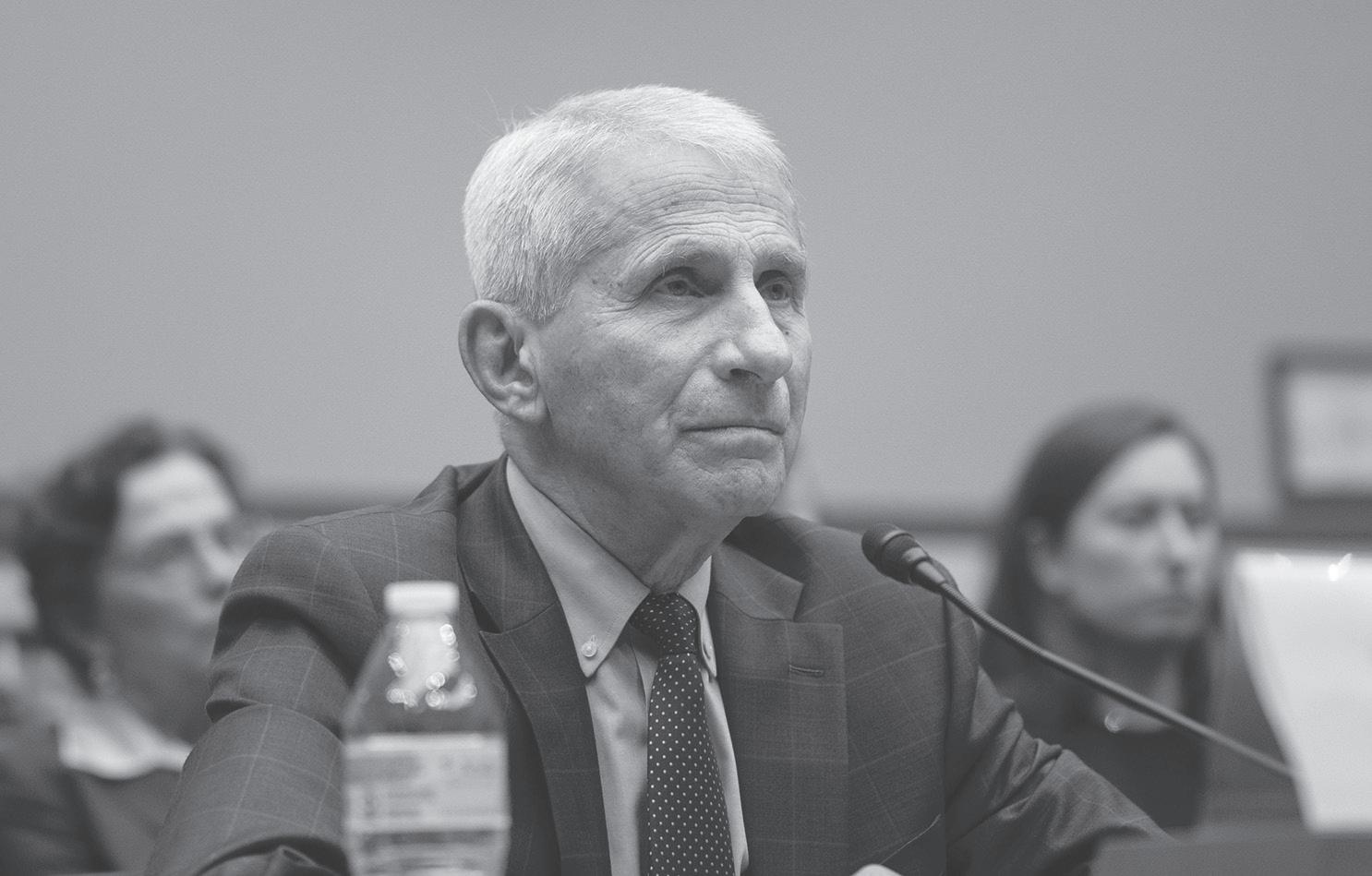
Jan. 24 — During the COVID19 pandemic, Dr. Anthony Fauci M.D. ’66 confronted death threats while operating as the director of the National Institute of Allergy and Infectious Diseases and the chief medical advisor to the president of the United States.
Now, he faces President Donald Trump’s removal of his security funding, as of Thursday night. Fauci has since hired his own security detail, which Trump had suggested when he cut funding.
“When you work for government, at some point your security detail comes off and, you know, you can’t have it forever,” Trump said, according to reporting from The New York Times. “I can give them some good numbers of some very good security people.”
Trump’s actions follow Senator Rand Paul (R-K.Y.) publicly calling for Fauci’s security to be cut. Paul also recently criticized former president Joe Biden for pre-emptively pardoning Fauci, saying that Fauci was “accepting his guilt” by accepting the pardon.
In a statement released after the pardon was issued, Fauci said that he had “committed no crime” and that there were “no possible grounds” for any criminal allegations against him.
Trump has told reporters that he would feel no responsibility if Dr. Fauci was harmed after losing his security detail, according to The New York Times. The stripping of Fauci’s security follows Trump’s revocation of Secret Service detail from his former National Security Advisor John R. Bolton.
In his memoir On Call: A Doctor’s Journey in Public Service, Dr. Fauci described his relationship with Trump as “complicated,” saying that Trump would alternate between telling him he “loved” him and publicly threatening to fire him.
During the COVID-19 pandemic, Fauci faced death threats to himself and his family. He initially received protection from federal marshals and then by a pri-
vate contractor paid by the government.
As the former director of the National Institute of Allergy and Infectious Diseases, Fauci was originally recruited by Trump to work for the White House Coronavirus Task Force. Biden announced his appointment of Fauci as the chief medical advisor to the president in December 2020. Fauci acted as a public health spokesperson and became a household name for Americans throughout the pandemic.
To continue reading, please visit www.cornellsun.com.
Angelina Tang can be reached at atang@cornellsun.com.
By EVELYN MULLEN WALSH Sun Contributor
Jan. 28 — In honor of the 80th anniversary of the liberation of Auschwitz, Cornellians gathered on Ho Plaza on Monday for a vigil.
The Holocaust was the systematic mass murder of more than six million European Jews, along with millions of other individuals from marginalized groups, orchestrated by the German Nazi party. The largest Nazi concentration camp, Auschwitz, was liberated on Jan. 27, 1945.
The vigil was organized by four campus organizations — Cornellians for Israel, Hillel, Chabad and the Center for Jewish Living.
The vigil began with a speech emphasizing the importance of the event, in terms of remembrance but also defiance.
“The Holocaust was not just an assault on Jewish people, but also the essence of humanity,” said the speaker, a member of the Cornellians for Israel executive board.
The speech also highlighted the importance of Israel for the Jewish people, describing that “the story of Israel is a story of survival” and acknowledg-
ing recent antisemitic incidents, including the attack on Israeli soccer fans in Amsterdam in November.
“Anti-semitism, once thought defeated, has re-emerged,” the speaker continued. “We cannot afford to turn our backs again.”
After the conclusion of the speech, there was a moment of silence held for the six million Jewish individuals murdered during the Holocaust. Vigil attendees then joined together in reciting the Mourner’s Kaddish — a prayer for those who have died.
The vigil ended with the Israeli national anthem “Hatikvah,” or “The Hope.” The anthem was first read aloud in English and then sung in Hebrew.
When asked about the importance of the vigil, Cornell Hillel President Maya Weisberg ’26 said, “In light of recent events, it’s even more important to remember the Holocaust as an example of what happens when anti-semitism goes unchecked, so I’m very happy we could have this event as a moment to remember the detrimental consequences of anti-semitism.”
Evelyn Mullen Walsh can be reached at eam435@cornell.edu.
on the history of the evolution of life on planet Earth, from its origin all the way up until present day.”
spheric sciences, who directs the PRI, influenced her to pursue her honors thesis on trilobites.
As a formal partner with PRI, Cornell has provided various resources to the nonprofit, including library privileges, software licenses and financial support for some of its programs. Cornell and PRI have also maintained numerous academic connections, such as partnerships on federal grants, student teaching and mentoring, on- and off-campus exhibits and granting adjunct faculty status to three PRI staff in the Earth and Atmospheric Sciences department, according to Piha’s email to The Sun.
Prof. Bruce Monger, Earth and atmospheric sciences, shared his appreciation of the museum, calling it a “wealth of information
Monger highlighted the enriching role the Museum of the Earth and the PRI play in his “Introductory Oceanography” class, as PRI scientists deliver guest lectures and the museum provides guided tours for his students.
“[The PRI] provides a lot of teaching resources, both lectures and also the museum itself and that kind of experiential learning component that I think is really valuable,” Monger said.
PRI and the Museum of the Earth have been pivotal in shaping Emily Cavanaugh’s ’25 academic journey. Cavanaugh explained that taking a paleobiology class with Prof. Emeritus Warren Allmon, Earth and atmo-
“Because of PRI, I’ve been able to complete this project. I used their fossil preparation materials to complete my project … [my project] would not have even started without PRI [and] the Museum of the Earth,” Cavanaugh said. “It’s completely changed my academic career for the better, and it’s just incredible the impact that it’s had on my life.”
Now, the Museum of the Earth’s ongoing financial struggles have sparked growing concern for Cavanaugh about the future of this important partnership for Cornellians.
“PRI has been around for over 90 years. The museum itself has been around for over 20 years, and that’s still impacted multiple generations,” Cavanaugh said. “It really means a lot to me that people beyond my generation get the chance to have an experience like I did, which is a completely career-changing experience and really benefited my experience at Cornell, and it would be really upsetting to me if that wasn’t an option for students in the future.”
To rally public support for the Museum of the Earth and the PRI, Cavanaugh, together with Ph.D. student William Hooker, launched a petition which garnered over 3,000 signatures as of the article’s publication.
Monger also submitted a letter to the Cornell administration along with several other faculty members, urging University support for the PRI and museum. While Monger was notified that his letter was received, he and his colleagues have yet to receive a response.
“I got a response from Benjamin Houlton, [dean of the College of Agriculture and Life Sciences], saying he’d received a packet of
letters and that he was grateful for the people who wrote the letters to provide him with some insights on the importance of the museum and PRI more generally,” Monger said.
However, it is unclear whether the University will take action to address the financial challenges facing the Museum of the Earth and PRI.
“We’ve been having a lot of conversations with people at Cornell and trying to figure out if there is a way to build a stronger partnership between us,” Piha said. “I don’t believe that there’s been anything decided or sorted out yet, but I know that there have been conversations. And as small of an institution as we are, in comparison size-wise, we’re very big in what we do, and so it’s not as easy to just absorb.”
When asked about the University’s plans regarding its potential role in supporting the Museum of Earth amid PRI’s financial struggles, Cornell Media Relations declined to provide a statement.
In light of these uncertainties, Monger stressed the importance of universities supporting resources like the Museum of the Earth to better educate students.
“We’re at a moment in human history where the things we do today are going to have an impact that lasts 10,000 years,” Monger said. “So [in] this moment in human history we, as a university, have an obligation to both train, but also just generally, broadly inform all students — whether they’re Earth science students or not — about where we’re at as a human society, and this museum has that great ability to take that big, long look.”
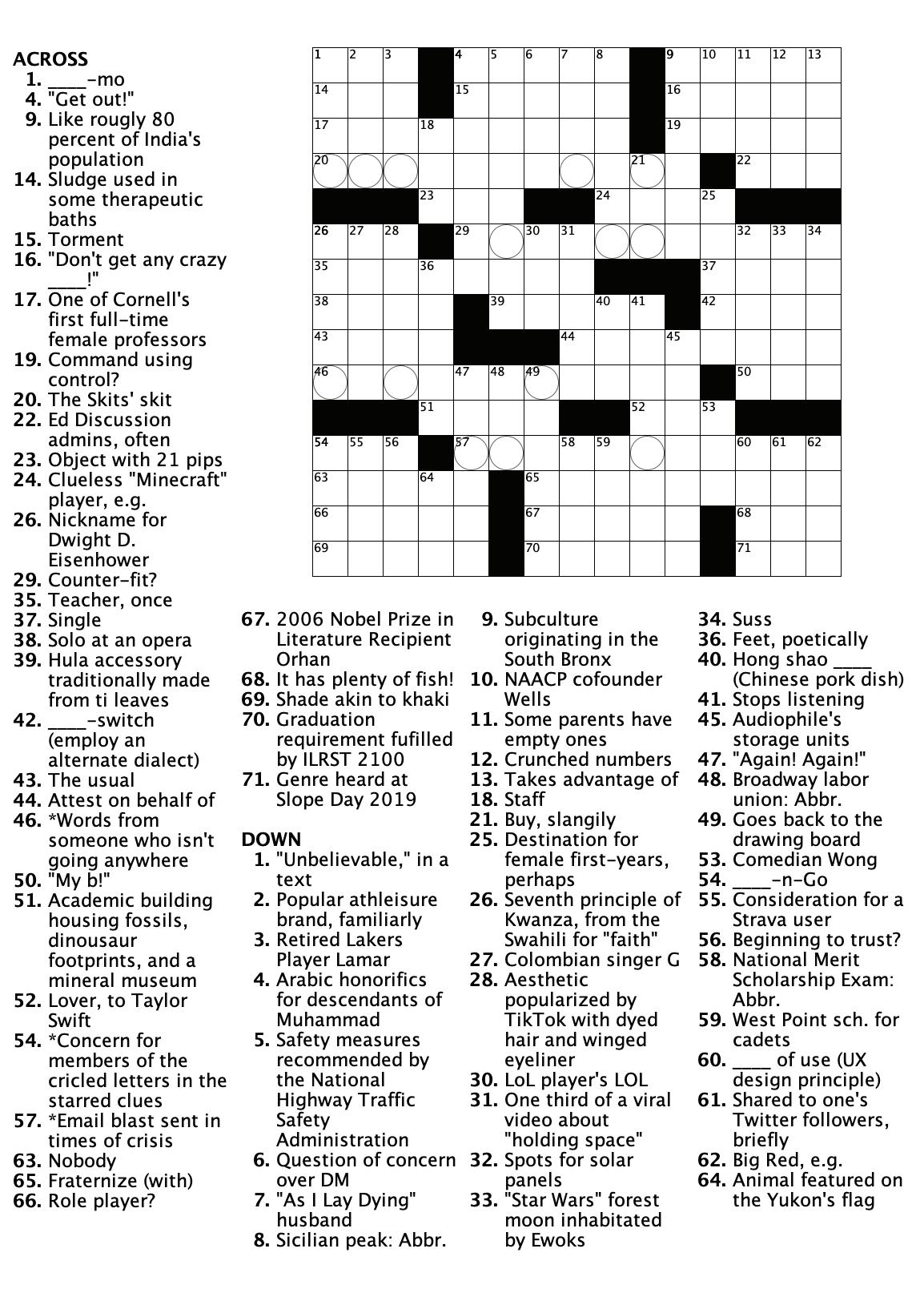
Fill in the empty cells, one number in each, so that each column, row, and region contains the numbers 1-9 exactly once. Each number in the solution therefore occurs only once in each of the three “directions,” hence the “single numbers” implied by the puzzle’s name. (Rules from wikipedia.org/wiki/ Sudoku)


By JANE HAVILAND
Sun Staff Writer
Jan. 27 — The Chinese art of Lion dance has spread good fortune for centuries, and as the Lunar New Year approaches, Lion Dance at Cornell brings a piece of that festivity to the Cornell community.
Lion dance dates back to the third century B.C.E., when groups of martial artists would travel from village to village and perform to spread good fortune and ward off evil spirits, according to CLD Senior Advisor, Nelson Fang ’25. Today, Lion dance performers across the world travel to venues and events spreading luck to all.
Cornell Lion Dance was founded in 2015. People with any level of experience are welcome to join the group without an audition process. Since its founding, Cornell Lion Dance has performed for several on-campus organizations, including the Chinese Student Association.
Cornell Lion Dance performances combine instrumental music with traditional Lion dance, in which two or more people maneuver the head and body of a colorfully vibrant costume. The dance mimics the movements of a lion. Cornell Lion Dance typically handles two lions in its performances, accompanied by drums, cymbals and gongs.
The group consists of over 20 students who mix live music and dance at performances on and off campus. While gearing up for the upcoming Intercollegiate Lion Dance Competition, Cornell Lion Dance is ringing in Lunar New Year with an active performance schedule.
“This time of year is really busy for
us because it’s Chinese New Year,” said Vivian Liu ’26, co-president of Cornell Lion Dance. The group often performs multiple times a week on campus and beyond during the Lunar New Year season, which begins in 2025 on Jan. 29.
The group is performing as soon as Jan. 31 at the Cornell Chinese Students and Scholar Association’s Spring Festival Gala in Bailey Hall. They will also be showcasing their routines at Cayuga Climbs’ Lunar New Year Party on Feb. 7.
The group has also been invited to perform within the local community including at the Tompkins County Public Library on Feb. 1.
Cornell Lion Dance is not limited to just Ithaca — in 2023, the group was invited to perform at a Rochester wedding.
“A lot of people want good fortune for their marriages,” Liu said, reflecting on the event.
Beyond event performances, Cornell Lion Dance has also performed at parades. In 2022, the group performed alongside the Cornell band, cheer and dance teams in the Sy Katz ‘31 Parade — a New York City celebration of Cornell football when the team plays on Columbia University’s field.
In addition to performance invitations, Cornell Lion Dance attends the Intercollegiate Lion Dance Competition to contend with multiple collegiate lion dance groups every spring. This will be the first year that Cornell is hosting this competition, and it will be held at Barton Hall on March 30. Tickets to watch will be free.
Liu hopes that although the competition is scheduled for Cornell’s spring
break, people will come and support their performance.
“A lot of people don’t know what Lion dance is — we’re bringing that level of cultural awareness to people along with some joy and fun,” Liu said.
Liu and Fang both shared that they receive performance requests on social media platforms, such as Instagram and Facebook. They encourage students, alumni and the local community to reach out to them, as the group would love to perform and spread the lion’s good fortune to others.
Cornell Lion Dance’s influence on campus transcends entertainment. Liu said that “being a source of joy” for people is the group’s main goal.
“Every time I go inside a lion head, I’m able to surprise [people] and make
them all fascinated and be put in awe — I think that’s what continues to inspire me to be doing it,” Fang said.
“A lot of people don’t know what Lion dance is we’re bringing that level of cultural awareness to people along with some joy and fun.”
Jane Haviland can be reached at jhaviland@cor-

By ZEINAB FARAJ Sun Staff Writer
Jan. 16 — Since the introduction of name, image and likeness deals to the NCAA in 2021, college athletes have been profoundly affected by changes in the sports industry.
Sydney Moore ’24 experienced the need for tools to navigate the modern college sports environment firsthand as a volleyball player at Cornell. NIL allowed college athletes to capitalize on their success through social media, brand collaborations or other business ventures.
Playing at a competitive level, Moore recognized the lack of an “outlet” for athletes to discuss how to navigate the commercialization of their personal brand through endorsements or business projects, while balancing their academic, athletic and personal commitments. Without the right tools to navigate these priorities, life can become difficult to balance, Moore explained.
Now, at Syracuse University, Moore is pursuing her master’s degree in marketing at the Whitman School of Management and has just wrapped up her first and final volleyball season with The Orange.
As an undergraduate, she worked with various athletic advocacy groups on campus, non-profit organizations and other companies to advocate for athletes. Most notably, Moore has collaborated with HeadSpace XR — a virtual reality and mixed reality mental health resource — to support athletes’ mental health As time went on, Moore wanted a platform to explore important issues and facilitate open discussions.
In December 2023, Moore created her podcast “Let’s Talk About It” on her personal Instagram account. She initially featured Cornell athletes and, over time, built a rapport with other athletes across the country. Along with her podcast, Moore launched her consulting company, Thrive Insights, in October 2024.
“While I am interviewing people, these podcasts are more like advice sessions for athletes to listen to,” Moore said. “Through the experiences of my guests, I hope other athletes can gain advice and help with any topic regarding being a student-athlete.”
Her podcast covers topics including transferring, medically retiring and building an accepting team culture.
Beyond her podcast, Moore has spoken about athletic advocacy at various conferences, working towards pushing
women’s support and advocating for the mental health of athletes. Most notably, Moore attended the Entertainment and Sports Programming Network Women + Sports Summit and the Black Student Athlete Summit in 2022 and the Athlete Con Resort and the Cornell Alumni Leadership Conference in 2024.
In February 2022, Moore took her work even further. She worked to introduce the Fair Play for Women Act into Congress. She got involved in policy work through her time volunteering at the Voice In Sport Foundation and wanted to address gaps in Title IV she noticed through extensive research.
The bill worked to address discrimination against women in sports by ensuring equal and fair access to athletic opportunities in elementary, post-secondary and college levels. To promote the necessity of this bill and attract support for it, Moore hosted a panel in the Senate for the introduction of this bill.
“I wanted to create a panel that was intriguing,” Moore said. “When you have these bill introductions it’s really just members of Congress [and] rarely the people who are actually represented by the bill invited, so we had different female athletes of different ages come to [Washington] D.C.”
The following year, Moore was named one of Glamour Magazine’s 2023 College Women of the Year. From the Classroom to the Court
Moore majored in psychology with a specialization in behavioral and evolutionary neuroscience in the College of Arts and Sciences.
She said she really appreciated the emphasis on human development in her major, describing how understanding psychology increased her awareness of why people may act in specific ways.
“In business having those psychology skills is so helpful. … But, moreover, as someone working in athletics, I apply those skills to help me have interesting conversations on the podcast and understand why athletes react a certain way in different situations,” Moore said.
On her podcast, Moore often makes references to concepts she learned in her classes at Cornell. For example, in her psychology and neuroscience courses, Moore learned about how people take different cues from their environment and how this shapes their responses in athletics. She felt the athletic
resources and community at Cornell contributed to her success early on.
“Through my Cornell education I was being taught by the best in their fields — I learned how to be a leader through volleyball, but my academic education taught me how to do research, ask good questions and shar[e] those principles with my audience,” Moore said.
To continue reading this article, please visit www.cornellsun. com.
Zeinab Faraj can be reached at zfaraj@cornellsun.com.
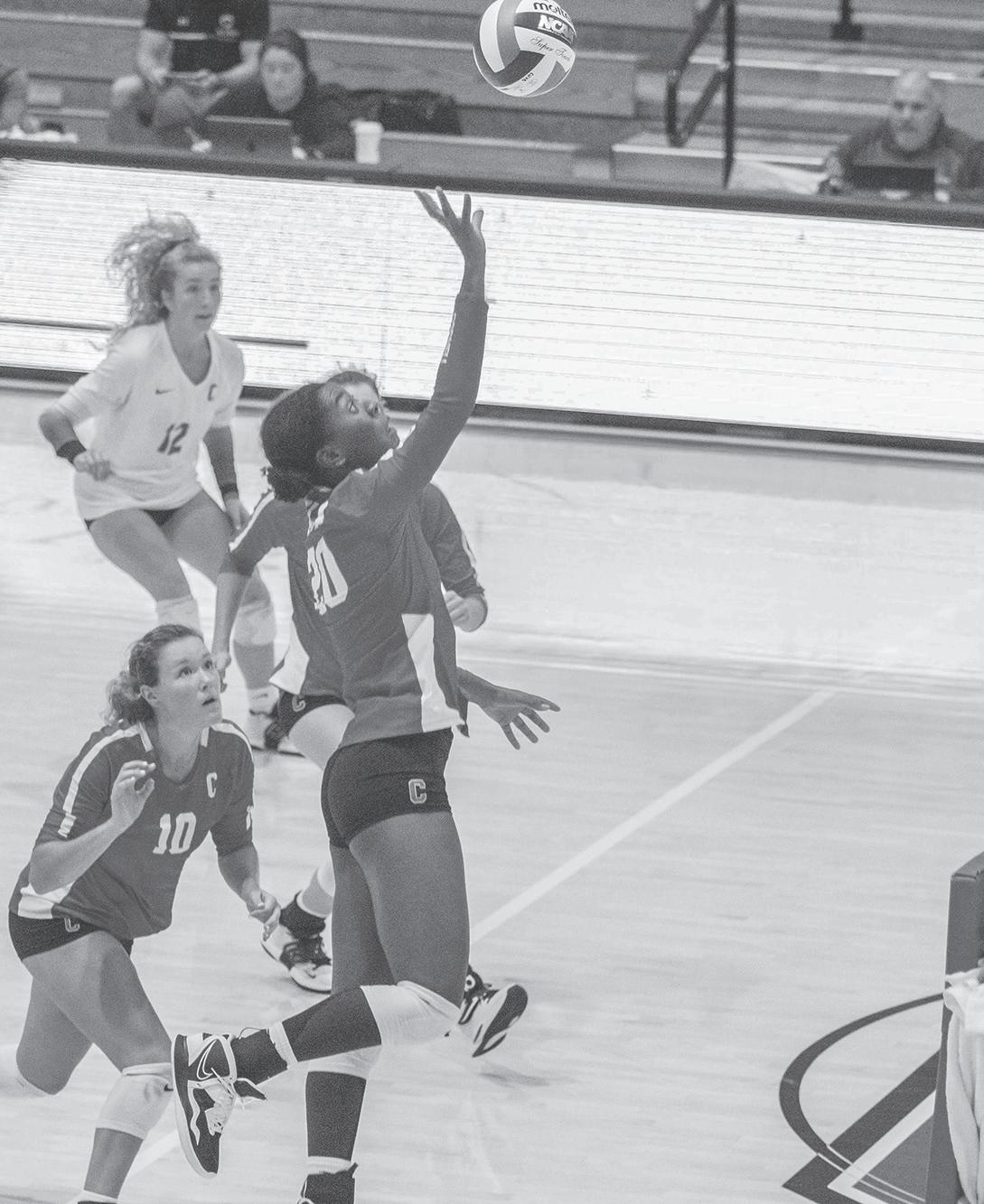
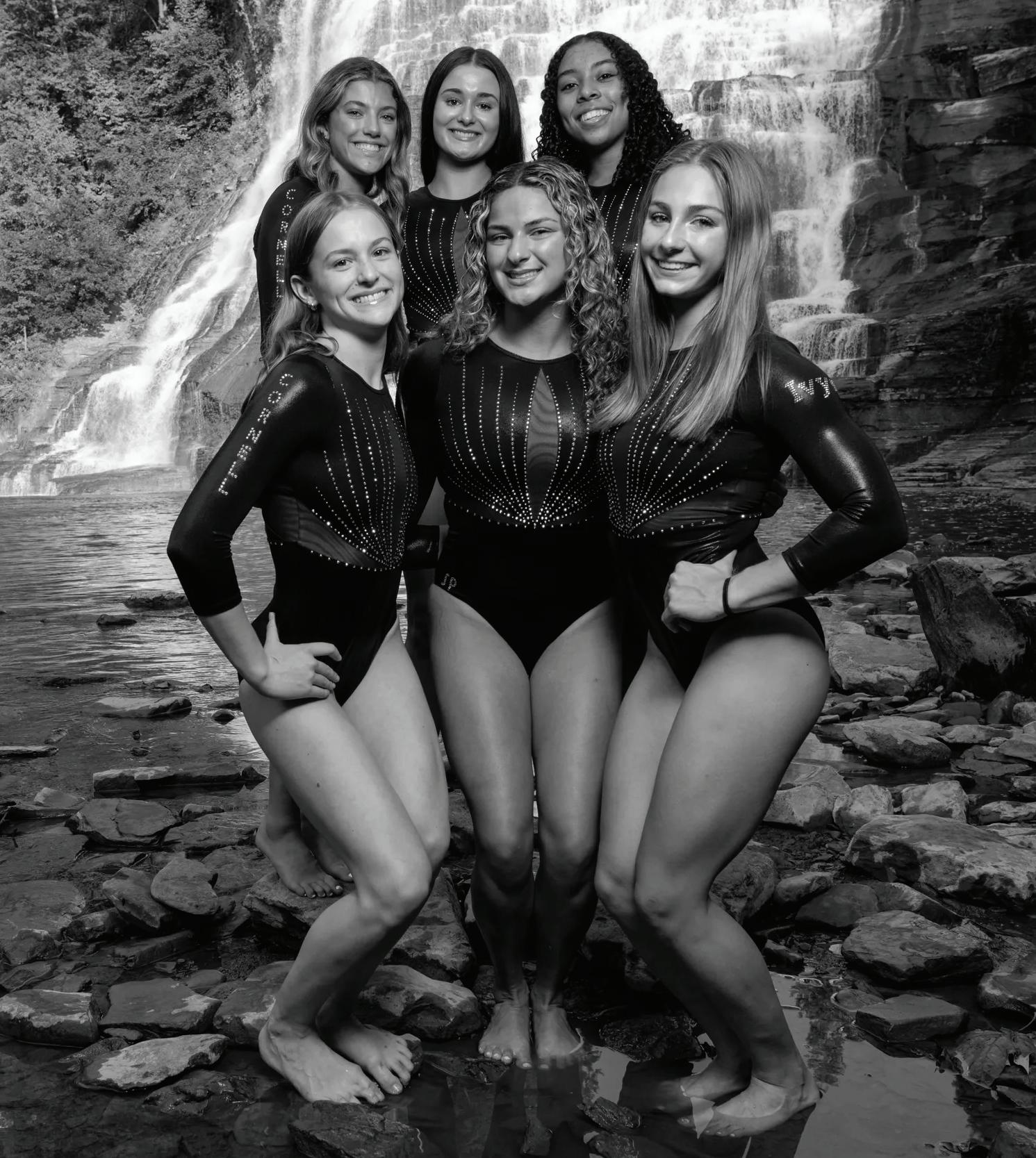
By ZEINAB FARAJ Sun Staff Writer
Jan. 28 — With gymnastics earning fifth place in the Gymnastics East Conference preseason rankings, the Red are setting their sights on achieving great things this season.
At the opening Rumble and Tumble tournament in Ithaca, Cornell earned a score of 193.150, second only to Yale at 193.700. Along with that, the Red placed second at the Sacramento State tri-meet on Jan. 18.
With nearly a quarter of the team being composed of freshmen, this blend of new energy and expectations has sparked anticipation and high hopes for the season.
The Sun spoke to these new athletes as the season begins to uncover their motivations, goals and excitement surrounding the season.
Anne MacKenzie
Anne MacKenzie ’28 is a Design and Environmental Analysis major in the College of Human Ecology. MacKenzie is from Mountain View, California and has been a gymnast for 14 years. Her main events are typically uneven bars and beam. She was a six-time Northern California State Champion.
MacKenzie says that she is grateful to be a member of a welcoming
and talented team. Her ambition is to contribute to the team by creating a positive environment during practices and at meets.
“We already have such a positive team, so my goal is to be super confident in my gymnastics and see that spread across the entire team,” MacKenzie said.
MacKenzie is also excited to compete with her older sister, Laura MacKenzie ’25, this year.
“Going to the same school together and working on our gymnastics together has been an incredible experience,” MacKenzie said.
Sarah Goetter
Sarah Goetter ’28 is from Scranton, Pennsylvania and studies Human Biology and Society in the College of Human Ecology. Before Cornell, Goetter was a Level 10 National Qualifier on uneven bars and vaults as a part of the United Sports Academy. She has been a gymnast for ten years, and her main goal is to get healthy and stay healthy.
Although Goetter is dealing with an injury right now, she says her presence in the team is important to her.
“For me, I love hanging out with the girls on the team, going to the gymnastics house and getting to know everyone,” Goetter said. “Making these connections as a
By CEREESE QUSBA Sun Staff Writer
Jan. 28 — Once a bustling hub for pilots during World War II, the Hangar Theatre has transformed from an aviation site into a vibrant stage, now echoing with 50 years of theatrical performances and serving as a beacon for the Ithaca arts community.
Tucked behind Cass Park, the Hangar brings together renowned theatre professionals and trains budding artists in New York’s Finger Lakes region. In 2024, mainstage performances included “Todd vs. The Titanic,” “Ragtime: The Musical” and “Ride the Cyclone.” Founded by the Ithaca community, the Hangar Theatre aims to inspire the community with “work and classes that enrich, entertain, and enlighten,” as written in its mission statement.
Originally built in 1912 as a single hangar and airstrip, the Ithaca Municipal Airport hosted over 4,000 training pilots during World War II. An ideal airplane testing site, the airport was expanded to address increasing popularity during the Great Depression.
team now will help us during the season.”
Prior to her injury, Goetter participated in the Rumble and Tumble competition and earned a score of 9.650 for the Red with her debut.
Once Goetter is healthy again, she is excited to contribute her gymnastics abilities to the team and help the team perform better — whether she is a part of the lineup or not.
Taylor Gomez
Taylor Gomez ’28 hails from Hinsdale, Illinois and is undecided in the College of Arts & Sciences. In 2021, Gomez won the Illinois State Beam Championship.
Although Gomez is sidelined right now due to an injury, she says she is excited to contribute her energy, support and approximately 14 years of experience to the team.
“Right now I am focused on the basics and ultimately getting back [in] shape. Working with all my coaches and teammates has been great for my progress,” Gomez said.
Gomez’s goal for this season is to maintain a positive attitude and strive to be the best gymnast and student she can be.
“It is always a goal of mine to improve everyday whether that be socially, mentally or academically,” Gomez said.
Zeinab Faraj can be reached at zfaraj@cornellsun.com.
the Hangar Theatre by Cornell faculty she met through her interdisciplinary major — which combined theater, child development and education.
Bushlow worked at the Hangar for two summers with the Hangar’s KIDDSTUFF and Lab Company programs — immersive programs designated to rising theater professionals. At the time, the theater had recently introduced its Next Generation School of Theatre program. In an emailed statement to The Sun, Bushlow noted that the program initially enrolled about eight children — now she says there are hundreds.
“It was at the Hangar that I discovered the impact that professional theater could have on a community,” Bushlow said. “Fostering and deepening community connections has always been critical to the Hangar’s success.”
Hugo Keil ’27, who attended “Ride the Cyclone” and a Haley Heynderickx concert at the Hangar Theatre, reflected on the strong sense of community he experienced.
“It was just a great space to be in, and it was a lot of people I’ve seen around the community,” he said.
“Fostering and deepening community connections has always been critical to the Hangar’s success.”
Lisa Bushlow ’91
However, by 1948, Cornell University’s East Hill airport had become the region’s aviation site and the hangar was repurposed as a storage facility for city equipment in 1966.
Around this time, community members formed the Center for the Arts at Ithaca and repurposed the airport hangar into their headquarters. The CAI began performing improvisation and traditional theater at the hangar site, calling it the “Hangar Playfair.” While the Hangar Playfair initiative did not gain much traction, it set the stage for the theater and art that would follow.
In 1973, Gov. Nelson Rockefeller (R-N.Y.) personally donated $100,000 to renovate the hangar, alongside other donors — including Cornell. The Hangar opened its doors with a performance of “Man of La Mancha” on July 11, 1975.
“I’ve heard from so many people whose lives were enhanced by the theater, who are now raising their kids and grandkids in this community,” said Lisa Bushlow ’91, the first education director and executive director of the Hangar Theatre, now a senior director for Alumni Affairs at Cornell.
Bushlow was introduced to
Bushlow remained in Ithaca to work with the Hangar Theatre to design a new, year-round education program that could reach the Tompkins County community and beyond.
The University continues to maintain its ties with the theater through sponsorship, ads, promotions and renting out the Schwartz Center over the summer. Shirley Serotsky, Hangar Theatre Producing Artistic Director, explained that the Hangar Theatre’s relationship with Cornell is “pretty transactional,” and expressed hope that it “can move into something more meaningful.”
The Hangar typically hosts a number of performers with a roster of Broadway credits — such as Erin Davie, who performed in six Broadway shows and starred in “Ragtime: The Musical,” at the theater — as well as a mix of professional artists who create and work in Ithaca and New York at large.
“Members of the Hangar family understood the vital role that theatre plays in our collective lives,” Bushlow wrote, “and in the health of our community.”
“I’ve
heard from so many people whose lives were enhanced by the theatre, who are raising their kids and grandkids in this community.”
Lisa Bushlow ’91
MIA ROMAN-WILSON ARTS & CULTURE WRITER
Without fail, awards season always stirs controversy — whether it’s a physical altercation, a movie snub or a misallocated award. That being said, it seems almost fitting that this year the drama is entirely political, centering around the film Emilia Pérez
The movie has garnered incredible support from critics, receiving 10 Golden Globe nominations, two Cannes awards and 13 Oscar nominations — including the three highly coveted awards of Best Director, Best Picture and Best Leading Actress. However, many audiences are unabashedly sharing their dislike for the musical comedy. With the all-Spanish film following a transgender cartel leader, it’s clear how numerous the potential risks are. Beyond the overarching plot, there are many creative choices, such as the jarring song breaks and Mexican stereotypes, that defy and challenge industry norms.
Although I am one of the viewers who struggles to understand the critical acclaim, I find Karla Sofía Gascón’s nomination for Best Leading Actress fitting and well-deserved. Her performance was captivating despite some of her scene partners’ lackluster acting and a script that often demonstrated an absence of trust in the audience’s deductive skills. Ultimately, I believe her title as the first transgender woman to be nominated in the category is more than justified. Disappointingly, a prominent population of conservatives is entirely overlooking Gascón’s talent and has taken to blatant transphobia against both the actress and The Academy. Megyn Kelly, previous FOX News Host and political commentator, publicly demeaned Hollywood’s decision in an inane
rant during which she repeatedly and intentionally misgendered Gascón and used slurs to describe the movie itself. Upon discovering this, I was horrified at how unsurprised I was. In America’s increasingly hostile and polarized political climate, opposing voters have lost all common ground, and marginalized communities are caught in the crossfire. Kelly’s tirade is further proof of this phenomenon.
I believe at the heart of this issue is President Trump, who has exploited both America’s complex history with transphobia and his immense influence. His active anti-transgender rhetoric as well as the issue of an executive order refusing to acknowledge these individuals is destined, and possibly even designed, to propagate hate. It is a dire and devastating time for the transgender community, but this Oscar controversy may be the reminder necessary to encourage artistic expression as a means of identity preservation, cultural connection and rebellion.
Whether knowingly or not, it is probable that many of us have enjoyed art created by transgender individuals. From Hunter Schafer’s role in Euphoria to Ethel Cain’s haunting discography, it is clear this community is not less talented simply because they are underrepresented in artistic media. More often than not, they’re refused the very same platforms and opportunities that are handed to cisgender artists. Gascón’s award-winning performance is the most recent addition to a long history of exceptional queer media.
While grieving the recent discriminatory actions, policies, and beliefs imposed by the federal government is important for queer individuals, it is equally crucial to recognize this hatred and persevere in spite of it. The transgender community will not cease to exist merely because President Trump wills it so. By

cal narrative will alter an entire collective’s identity, he reveals just how little education he has amassed on the matter. Ultimately, this awards season acts as a direct rebuttal to the hatred of today. People will continue consuming and producing queer art no matter the political climate: Not because it is the right or noble thing to do, but because it is nothing short of extraordinary.
Mia Roman-Wilson is a freshman in the College of Arts and Sciences. She can be reached at mjr436@cornell.edu.
MAYA BLANCHARD ARTS & CULTURE WRITER
I have to admit, I am not an avid follower of Mac Miller’s musical career. I know only two things about him: that from 2016-2018 he dated Ariana Grande, and that shortly after their breakup he tragically passed away. Which is why, last Friday, I was flabbergasted when a Spotify notification implored me to “stream Balloonerism: Mac Miller’s newest album.” This name that meant almost nothing to me two weeks ago all of a sudden occupied my thoughts 24/7, affecting every conversation I had with my loved ones and consuming my daily life. Picture me, a grizzled small-town detective slumped at my grimy desk with a cigarette dangling from my lips, desperately trying to crack how Mac Miller was operating in the music industry from beyond the grave. I felt like I was going mad (and my detective office burned down due to my indoor smoking habit). I’m writing this article so my detective work doesn’t go to waste, and I hope the die-hard fans out there won’t be too annoyed that I’m only now discovering things you’ve been aware of for years. To those of you who, like me, were unfamiliar with the deep lore of this
album, I am warning you not to listen to Balloonerism unless you’re willing to risk becoming a Mac Miller fan.
Mac Miller, born Malcolm James McCormick on Jan 19, 1992, has a distinct lyrical style that evolved from “frat rap” in the late 2000s to hip hop with R&B, funk and jazz influences. In addition to his popular albums, such as K.I.D.S. and Blue Slide Park, Miller’s many unreleased SoundCloud mixtapes have been revered by fans for years. His family began approving the posthumous release of his unfinished albums in 2019, which is why non-fans like me are now discovering his old music. Miller recorded a slurry of tracks in 2014 that reflect his struggles of transitioning from his original record label, Rostrum Records, to the self-founded REMember Music. Many went on to become Faces , a Soundcloud mixtape that only became widely distributed in 2021. Fans will recognize Balloonerism as the longlost sister to Faces from their matching musical styles and similar themes.
Balloonerism contains 14 tracks of mellow R&B with heartbreakingly introspective lyrics about Miller’s struggles with fame, addiction and substance abuse in 2014. The few songs of his I knew were from K.I.D.S., Miller’s happy-go-
lucky era, so I really didn’t expect to be punched in the gut by tracks like “Funny Papers” and “Excelsior.” The dreamy vocals of SZA are featured on “DJ’s Chord Organ,” creating a more instrumental and jazzy vibe than I was expecting. After listening to Faces as well, I can see why the two fit together: Miller’s mind was obviously clouded with depression at the time, and writing was his therapy. He reflects almost flippantly about life, death and the dark side of fame, lyrics that hit even harder six years after his career was tragically cut short. I’m a fan of the sixth track, “Stoned,” in which Miller writes in sympathy for a girl who seems to be struggling with life. Whether or not “she” is a stand-in character for Miller himself, the song alludes to drug use as an escape from worldly troubles. A somber electric guitar riff echoes through the chorus as Miller sings the heartbreaking line, “I swear to God heaven feels just like home / Let’s go home.” The cover art for the album is Picassoesque, a piece that according to his family was commissioned by Miller himself. “It was a project that was of great importance to Malcolm,” they shared in a statement on Instagram. Miller’s head is depicted as a giant balloon,
the features topsy-turvy, dragging along a silhouette as it ascends into the sky. Maybe it’s a metaphor for how Miller felt, trapped in his own head with scrambled thoughts that threatened to uplift him from reality. Whatever the case, it pairs well with the psychedelic atmosphere of the music. It’s clear that Mr. Miller had a vision for this project.
At this point in my detective journey, I had gathered that somewhere there was a whole network of Mac Miller fans keeping tabs on his unreleased SoundCloud mixtapes. And, as a seasoned sleuth, I knew of one place where online fandom is sure to thrive. That’s how I found myself browsing the Mac Miller subreddit to find out what his day-ones had to say about Balloonerism
The fandom has been busy in the last week sharing their top track picks, album-inspired artwork and thoughts on the project. One fan shared a picture of an old CD with “Mac Miller Balloonerism” scrawled on it in sharpie, a burned copy that they made and kept in their car, next to the new official CD dawning the same title in dreamlike cursive. This tracklist, so new and unfamiliar to me, obviously means a lot to a whole community of fans. Reading the SubReddit made me glad that the project has finally come to fruition,
but I also got the sense that it leaves a bittersweet taste in fans’ mouths. Reddit user Macs_aquarium put this sensation into words better than I can:
“When listening to Balloonerism, I can’t help but have the feeling that I am listening [to] the potential Mac had that had already been realized but was left incomplete.
While Balloonerism is a great opportunity to hear more of Mac’s music, I can’t help but feel a deep longing for the Grammy-winning, genre-bending, chart-topping, bar-raising music that I know was in Mac’s future. We will never have that. And that is a tragedy.”
It’s true that we will never get to see the young musician reap the full benefits of his talent and fame. Mac Miller’s career was shortened unjustly, but his legacy is sealed in a time capsule of unreleased work that is still leaving imprints on the music industry. We may not get to see his music grow and change throughout his adult life, but these posthumous releases give old and new fans a chance to discover more about the person he was while alive.
Maya Blanchard is a junior in the College of Agriculture and Life Sciences. She can be reached at mhb237@cornell.
By YAELIN HOUGH Arts & Culture Writer
In October of 2022, Richard Edwards of early 2000’s indie band Margot & the Nuclear So and So’s released an album about love, time, hope and most importantly, ketamine. Ghost Electricity/Vampire Draw wasn’t an experimental album more than it was an emotional one. Its songs contained Margot’s uniquely atmospheric indie rock sound, and the lyrical content was mostly familiar: nostalgia, love, redemption and in typical Margot fashion, drugs. It was a full-length album, consisting of 10 songs, but not quite a hefty one. It was layered instrumentally and lyrically, featuring reverberating piano and guitar lines. It was a solid addition to a solid discography and a satisfying reminder of Margot’s legacy. However, something was missing. Richard Edwards has a knack for love songs, but, as demonstrated in the 2008 album Not Animal , Edwards finds his stride in melancholy. GE/ VD was a sweet album — with songs like “Off to See the World” verging on cloying — but it only teased at the edge that defined Margot’s previous work. Without an edge, the sweetness of songs like “Off to See the World” and “Love” made Margot’s atmospheric quality seem shallower — not
less genuine, but simply less whole. And the album wasn’t whole — at least, not on the day of its release in 2022. “Ketamine,” the third track of the album and that around which the album arguably centers, was written when Edwards was receiving ketamine treatments in Chicago for stomach pains. This song, which is about falling in love, was built off a foundation of pain. While Edwards sings of a passionate love, the song’s built-up layering and measured pace allude to a deeper sensation; His voice resonates yearning and nostalgia for something hidden within the beauty he describes in his love. There’s an eerie sense of mortality imbued within the saccharinity of Edwards’s lyrics: “This time I’m hoping it’s enough,” Edwards sings, “I wanna know you till the whole hog expires/ The world goes to fire/ And there’s nothing left but ocean.” It is the notion of mortality that makes life worth living. It is this sense of finitude that gives each word — each note — its gravity. “[‘Ketamine’ became] the centerpiece of an album about love and time,” Edwards writes, “Which must be what all records are about.” Somehow, however, the two words seem synonymous. Love is nothing if not bounded by time. And within the same concept, there is a hidden third word: pain. At the
time of its release, Ghost Electricity/ Vampire Draw capitalized on its sentimental lyrics, atmospheric instrumentation and mellow, haunting vocals to paint a story of exactly what Edwards intended: love and time. But pain and death is left unstated, implied only through each deliberate lyric and reverberating piano line.
The album was good, but the proverbial tent was left unzipped, leaving an uncomfortable breeze. The truth was, Edwards had written three more songs: “Neighborhood Girl With Dog,” “Benzedrine” and “Bacall.” “I assembled a version of the album without the three songs that I was convinced would curse it or me,” he wrote. It’s easy to see why. The lyrics in “Neighborhood Girl With Dog” immediately strike a listener as less familiar given the context of the album. The lyrics sing more of dependence and obsession than love: “Your head, but mine/ Chimpanzee time/ Swing me, little monkey, gimme heart attack,” Edwards sings. He has lost control over himself, completely under the duress of the “neighborhood girl with dog.” His life is no longer his. His love, for the first time in the album, manifests in the loss of himself. “Benzedrine” and “Bacall” are both songs explicitly about pain. In “Benzedrine,” Edwards sings of a breakup: “I’ve
been feeling your ghost/ Lasso-d from the moon.” “Bacall” is a song about death, inspired by one of Edwards’s screenplays. To Edwards, the songs were a risk: “The album about love and time became an album about love and time and death.” He would later realize that to tell a story of love and time and death was the only way to tell a complete story. Because, in the end, love and time and death define life itself.
In Dec. 2023, Edwards added the three songs to the album in an attempt to resolve the discomfort left by the loose strings. And, on Jan. 24, 2025, he released the final, Deluxe edition, comprising 27 songs and multiple different remixes of the songs from 2022 and 2023. “I’m sure it feels finished now,” Edwards writes, “It feels like a complete work and as essential as anything I’ve made to me.” Beneath all of its instrumental layers, imaginative lyrics and haunting melodies, Ghost Electricity/ Vampire Draw tells a melancholic story of love and time and death, and, above all, life.
Yaelin Hough is a freshman in the College of Arts & Sciences. She can be reached at yh2299@cornell. edu.
By MATTHEW RENTEZELAS Arts & Culture Writer
Aardman Animations exists today as one of the only animation companies specializing in stop-motion animation. Though lacking many of the resources major animation studios possess, Aardman has created an impressive library of renowned claymation films, such as the Chicken Run series and the Shaun the Sheep series. Last month, the studio released Wallace & Gromit: Vengeance Most Fowl , the second feature film entry in the beloved Wallace & Gromit series. The film masterfully addresses complex modern topics such as smart home technology, artificial intelligence and law enforcement agencies while staying true to the series’s semi-retro style and elaborate usage of visual comedy.
The film acts as a successor to Wallace & Gromit: The Wrong Trousers , a 1993 short film with a comical plotline hilariously unrelated to its “sequel,” featuring a villainous penguin called Feathers McGraw trying to steal a diamond. Wallace and Gromit are the heroes of the first film; however, Vengeance Most Fowl goes for a different approach by highlighting problems in Wallace’s behavior completely unrelated to external factors or a villain. Wallace’s obsession with creating smart home technology leaves him
unable to do basic things like prepare breakfast or dress himself. Gromit also needs to operate said technology in order for it to tend to Wallace’s needs, putting unnecessary stress on himself while Wallace continuously ignores his needs. This is most emblematic when Wallace invents a machine that pets Gromit for him, severing one of the most loving aspects of the duo’s relationship.
Having established several criticisms of overreliance on smart home technology, the film switches focus to the emergence of artificial intelligence. Unlike other films that focus on the dangers of artificial intelligence, Vengeance Most Fowl takes a much more nuanced approach. After Wallace unveils an AI-assisted lawn gnome robot named Norbot to assist Gromit with his chores in the garden, Norbot ends up rearranging the garden’s layout, leaving it far less cozy than before. The change in the garden aesthetic addresses criticisms regarding AI-generated art. Though AI-generated art can be very impressive and elaborate, overvaluing and overusing said art discredits the uniqueness and passion of human creativity. This point feels even more personal coming from an animation studio, one of the entities most threatened by the possibility of an AI art takeover.
Vengeance Most Fowl also demon-
strates the potential power of AI and the danger of that potential when in the wrong hands. Though imprisoned, McGraw uses his ingenuity to gain control of Norbot. He then makes an army of Norbots that have the power to break him out of prison. In this manner, Vengeance Most Fowl offers a refreshing take on evil AI-powered technology. The Norbots do not operate in villainous ways due to an envy of humanity or gained sentience, but rather due to a deliberate reprogramming on behalf of a villainous actor. Despite these criticisms of AI, the film ultimately does not condemn the use of the technology in all circumstances. The Norbots, after being restored to their usual programming, serve a vital role in helping Wallace and Gromit save a diamond from another one of McGraw’s theft attempts. Additionally, the final scene of the film depicts the Norbots safely working on some parts of the garden, which has been restored to Gromit’s style. These details convey that AI can have useful applications — however, overreliance can have disastrous consequences.
Throughout the story, Wallace and Gromit have several interactions with police officers that subtly criticize aspects of law enforcement agencies throughout the world. The police chief of the local area proves himself to be utterly incompetent, being more con-
cerned with his image than effectively preventing crime. Police are depicted handling evidence irresponsibly, using a battering ram to enter Wallace and Gromit’s home despite their compliance and ignoring vital evidence related to crimes in the area.
Apart from the main theme of the possible issues surrounding technological advancements and criticisms of law enforcement agencies, Vengeance Most Fowl presents refreshing and comedic visuals that stand apart from today’s industry trend. The film uses striking lighting and occasionally incorporates computer-generated imagery for sequences involving technology and complicated settings. The animation team successfully used CGI as a tool rather than as a crutch, allowing the claymation figures and physical models to remain in the spotlight of viewer’s minds, delivering an unparalleled film experience.
Overall, Wallace and Gromit: Vengeance Most Fowl presents a stunning viewing experience with salient social commentary to be interpreted by the moviegoer. One can only hope that Aardman continues to create unique and beautiful claymation content for years to come.
Matthew Rentezelas is a freshman in the College of Arts & Sciences. She can be reached at yh2299@ cornell.edu.
By JANE McNALLY Sun Sports Editor
On Mar. 22, 2024, men’s hockey skated out for the third period against Dartmouth, down 3-1 on the scoreboard.
The stage was the biggest of them all — the Red and the Big Green were battling in the ECAC semifinals, looking to advance to the championship game for a date with St. Lawrence. And after the final 20 minutes, the score read 6-3, Cornell. A comeback that seemed entirely improbable was complete.
On Saturday night, Cornell once again faced a 3-1 deficit against Dartmouth heading into the third. But this time it was not March in Lake Placid but rather January in Ithaca, and Cornell couldn’t muster up the same magic it had the prior year.
The Red fell 6-1 at the hands of the Big Green on Saturday, completing Dartmouth’s regular season series sweep of Cornell. A physical game reached its boiling point after 60 minutes had come and gone, as both teams brawled and could potentially face further disciplinary action from the ECAC.
Senior forward Kyle Penney, senior forward Jack O’Leary and sophomore defenseman Hoyt Stanley were given disqualifications and will be forced to sit out for at least the next game.
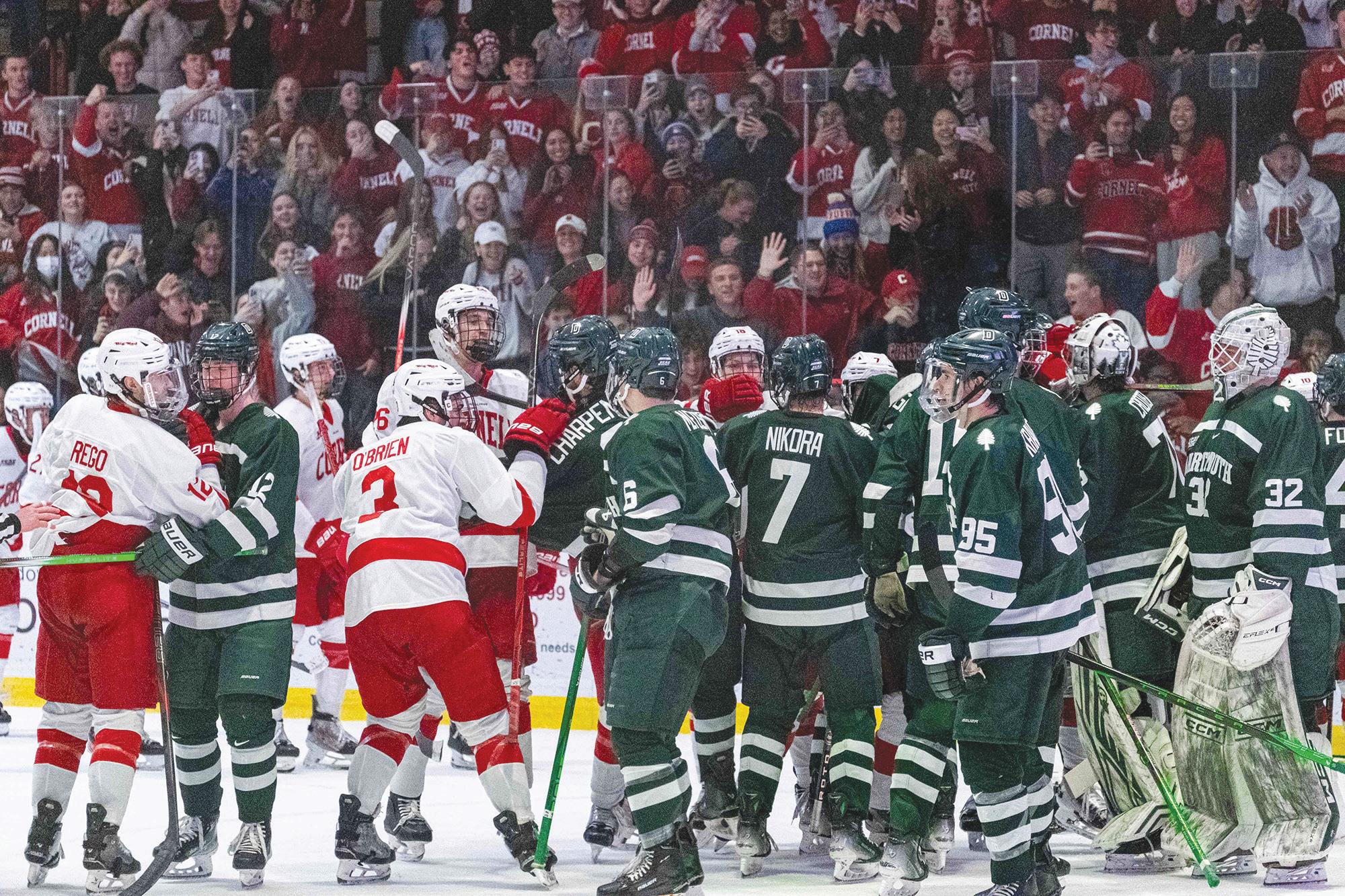
Dartmouth delivers a punch | Fighting broke out on Saturday after Dartmouth’s 6-1 win over Cornell.
“I talked to the referee at the end. … He put his hands on one of our players, and I [thought] it was inappropriate, and I put my hands on him and asked not to put his hands on our player,” said head coach Mike Schafer ’86. “So I’ll probably get suspended. … But I take full responsibility to keep our guys near the bench on what went on near the end of the game.”
The brawl was initiated after Cornell’s displeasure with Dartmouth’s taunting of the Lynah Faithful, as the Big Green celebrated loudly in front of the Cornell student section.
Both benches were emptied while coaches on both sides attempted to get involved and separate the altercations taking place. 108 minutes of penalties were called between the two teams as a result of the fight. In addition to the three Cornell disqualifications, three Dartmouth skaters were also handed disqualifications
“Some stuff was going on with their team and our guys went down there. … They felt that [Dartmouth’s behavior] was not appropriate, whatever it was,” Schafer said. “And I’ll talk with our guys afterwards, and I have to take responsibility.”
Perhaps failing to fully recover from an emotional Friday night victory at Lynah, Cornell struggled to match Dartmouth’s pace in the opening period. The six goals Dartmouth scored were the most it had scored at Lynah Rink since Jan. 23, 1960.
But Dartmouth’s pressure was ultimately too much to handle, as Luke Haymes — who missed the first meeting between these two teams back on Nov. 15 — cleaned up a puck that had deflected off the shinpad of Stanley.
Neither Cornell nor Dartmouth struck on special teams in the first period despite a combined 10 minutes of penalties, and the trend of undisciplined hockey continued when sophomore forward Jake Kraft was nabbed for slashing just 13 seconds into period two.
“[Dartmouth] were stronger on their pucks and sticks. When that
happens, and then the game [gets] out of control, and you get frustrated,” Schafer said. “That’s what we have a tendency to do to other teams, and they did that to us.”
While the Big Green (11-7-2, 8-4-1 ECAC) wouldn’t strike on its third power play of the night, just 10 seconds elapsed before doubling its lead. John Fusco would be credited with the goal, as a faceoff win found his stick for a hard slapshot that deflected off of Penney’s stick and over the shoulder of senior goaltender Ian Shane.
Dartmouth’s lead grew to three less than five minutes later, but it didn’t take a lucky bounce for Haymes to find his second of the night. The second-line center forced a turnover along the boards and took it into the slot himself, beating Shane glove side to widen Dartmouth’s lead.
Cornell’s lone goal came off the
stick of sophomore defenseman George Fegaras, whose first goal of the season was a hard wrist shot that cleanly beat Dartmouth’s goaltender.
The Red (8-6-5, 5-4-3 ECAC) showed signs of life as time ticked down on the second period, but Dartmouth’s physicality combined with its speed off the rush stymied any more Cornell scoring opportunities. The Red was outshot 11-6 in the middle frame.
“I thought [Dartmouth] played really, really well,” Schafer said. “We were gassed, but it’s no excuse. So we’ve got to find a way to come out [after the Harvard] game and play better than we did, and [I] give Dartmouth all the credit in the world.”
Cornell battled through the first eight minutes of the third, but Dartmouth’s Hank Cleaves finished off a perfectly executed passing play to restore the threegoal lead with 11:59 to play.
The Red drew a penalty with 5:03 remaining in the third and opted to pull Shane for a sixon-four advantage. However, the Big Green quickly took hold of the puck and flung it into the empty net to make it 5-1, quickly adding a sixth goal and four two short-handed goals in 20 seconds.
Frustration boiled as ten minutes of penalties across both teams piled up in the final 3:22 of play. And when the final buzzer sounded, the action only picked up from there — a brawl ensued in front of the Red’s student section, as each player from both teams pushed and shoved as a sold-out Lynah Rink crowd cheered them on.
“I don’t blame any of the guys on our team. I blame myself for our guys going down there,” Schafer said.
Jane McNally can be reached at jmcnally@cornellsun.com.
By ELI FASTIFF Sun Staff Writer
After narrowly avoiding a major upset en route to a 2-2 tie with Dartmouth on Friday, No. 6 women’s hockey bounced back the next day to defeat Harvard, 6-1, and secure its 17th Ivy League championship in program history.
“[Winning the Ivy League] was exciting,” said head coach Doug Derraugh ’91. “I’m proud of our team in the way that [they] recovered from the start of the season and then played really consistently over the past two months.”
The Ivy crown comes less than a year after Cornell won the championship on the last game of the 2023-2024 regular season, and marks the first back-to-back titles since winning in 20162017 and 2017-2018. The Red has now won the Ivy league in half of Derraugh’s 18 seasons at the program’s helm.
Despite clinching the first of four possible championships, the weekend was underwhelming for Cornell (15-4-4, 11-2-3 ECAC). The Red started off its final weekend of Ivy play in Hanover, New Hampshire, taking on a Big Green team that is second-to-last in the ECAC standings.
Despite the mediocre record — which includes a 4-0 loss to Cornell at Lynah rink on Nov. 16 — Dartmouth (4-15-3 2-11-3 ECAC) entered the matchup having allowed just three goals in its last four games.
Despite junior forward Mckenna Van Gelder nearly opening the scoring 1:25 into the game, Cornell’s offense struggled against an improved Dartmouth defense.
“They play physical, they make it difficult to get to their net,” Derraugh said. “They’ve really clamped down defensively and [they] play hard. That combination of them doing what they did, and I did not think we played our best game either … You saw the result.”
Cornell did well defensively in the opening period, allowing just two shots on goal, but struggled to test Dartmouth netminder Michaela Hesová.
It took until midway through the second period for Cornell’s offense to strike. The first penalty of the game gave the Red a five-on-four advantage, and just 13 seconds in, freshman forward Lindzi Avar rocketed a one timer so hard she spun around as the puck flew into the back of the net.
45 seconds after taking a 1-0 lead, Cornell was put on its back foot when senior defender Rory Guilday was whistled for interference. Despite not allowing a shot on goal during the penalty, the Dartmouth power play slowed the Cornell momentum. Then, with two minutes to go in the second period, Dartmouth would tie the game on a two-on-one rush, the Big Green’s first goal against Cornell since Nov. 11, 2023.
The teams would trade chances in the third
period, with Cornell getting the majority of the looks but unable to find the back of the net. Instead, Dartmouth would score with just 1:42 remaining when a well-placed wrist shot sailed by sophomore goaltender Annelies Bergmann.
Cornell took a timeout to regroup and pulled Bergmann for an extra skater. Despite surrendering the late goal and being on the verge of a troubling loss, the Red did not panic.
“One of the things I found, when we called the timeout [was that] there seemed to be a really calm presence about our team,” Derraugh said. “It felt like we were going to get [the late goal] back.”
As the time wound down, the Red maintained possession of the puck while probing the Dartmouth defense and Hesová. Crucially, Cornell won all three offensive-zone faceoffs that occurred while trailing. And just as all hope seemed lost, a cross-ice pass from sophomore forward Karel Prefontaine snuck through the Big Green defense to find the stick of junior forward Avi Adam in the low slot. Adam flicked the puck into the net to preserve the Red’s unbeaten Ivy campaign with just 11.6 seconds remaining on the clock.
Cornell would dominate much of the five-minute overtime despite another Guilday penalty, but would end the night with a 2-2 tie. With the 1.5 points already secured, Cornell won the ensuing shootout 2-0 — it was the Red’s third win in the shootout, which is the
ECAC’s fourth tiebreaker category.
After the disappointing result the day before, Cornell turned its attention to what could be improved in next day’s matchup against the Crimson (2-18-2, 1-14-1 ECAC).
“We just talked about execution and consistency,” Derraugh said. “The teams that tend to do well in the playoffs are the ones that are consistent in their habits [and] consistent in their details.”
Cornell responded to Derraugh’s call for consistency against Harvard in front of a crowd of 1,741 fans, a Bright Landry Hockey Center record for women’s hockey. The Red commanded the Crimson all game long, dominating Harvard in shot attempts, 81-20, over the course of the afternoon.
For the second game in a row, Avar converted first for Cornell, this time finding the back of the net off a rebounded shot. Five minutes later, Avar once again lit the lamp when she deflected a shot from junior defender Alyssa Regalado past Harvard netminder Ainsley Tuffy. The goal was Avar’s 13th, and her seventh in the past six games.
“I thought tonight we came out a lot sharper,” Derraugh said.
To continue reading this article, please visit www.cornellsun.com.
Eli Fastif can be reached at efastif@cornellsun.com