The Corne¬ Daily Sun


By SEAN O’CONNELL Sun Staff Writer
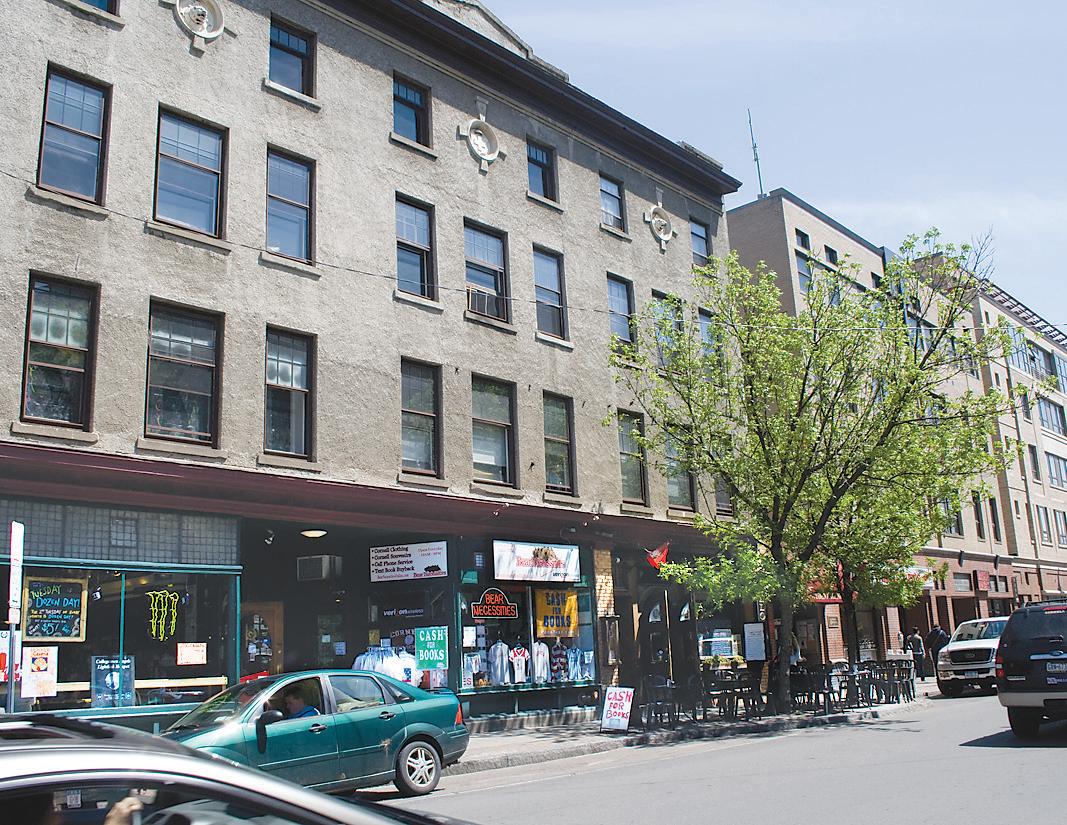
The Ithaca Planning and Development Board gave the official go-ahead for next June’s planned demolition, which will level the historic Chacona Block building in favor of six stories of sleek new apartments during its meeting on Tuesday.
The plans, submitted by the student-owned company Student Agencies Inc. last month, provide for the construction of 56 student apartments, along with retail on the ground floor.
Detractors of the proposed plan were able to voice their opinions in a general public hearing.
Christine O’Malley, Historic Ithaca Preservation Services Coordinator, urged input from historians and argued in favor of following the Collegetown Design Guidelines, a document outlining the requirements for the area’s aesthetic.
Overseeing the plans is Kyle Karnes ’91, CEO of SAI


By JILL CROSBY Sun Staff Writer
The College of Human Ecology — or the College of Public Policy? Administrators are currently mulling ways to inject more public policy into the college, with two proposals on the floor: one for a total rebranding, and one for a joint-venture school in collaboration with the College of Arts and Sciences.
The Charge for Policy Implementation Committee, led by co-chair Prof. Melissa Ferguson,
psychology and senior associate dean of social sciences, has been tasked with the goal of establishing a “world-class” entity for public policy at Cornell.
The two name-change options are the latest in a long-term effort to improve social science studies. Last year, another committee suggested combining the human ecology college and the School of Industrial and Labor Relations, which Provost Kotlikoff ultimately ruled against after considerable public backlash.

By
On Wednesday, the White House released a highly-anticipated memorandum of President Donald Trump’s call with Ukrainian President Volodymyr Zelensky, the subject of a formal impeachment inquiry announced by House Speaker Nancy Pelosi on Tuesday.
The launch of an impeachment inquiry comes after this weekend’s revelation that President Trump requested damaging information from the Ukraine government about presidential candidate Joe Biden. The memorandum, a non-verbatim transcript, confirms this. Late Wednesday, the whistle-blower complaint which ignited the impeachment effort was sent to the House after attempts by the White House to contain it.
Prof. Douglas Kriner, government, told The Sun just how damning he believes this revelation is.

Prof.
Trump’s conduct, Kriner said, “cuts to the very core of abuse of power envisioned as a ground for impeachment by the framers.”
A motion to impeach formal-
ly begins the process to remove a sitting president. The judiciary committee, chaired by Rep. Jerry Nadler (D-N.Y.), may pass a resolution of impeachment, including the accused offenses, before it is voted on by the House as a whole. Once a majority of the House passes the resolution
Thursday, September 26, 2019

Developing the future | On Friday, the Carl L. Becker House will host Saleemul Huq, the director of the International Centre for Climate Change and Development at Independent University, Bangladesh.
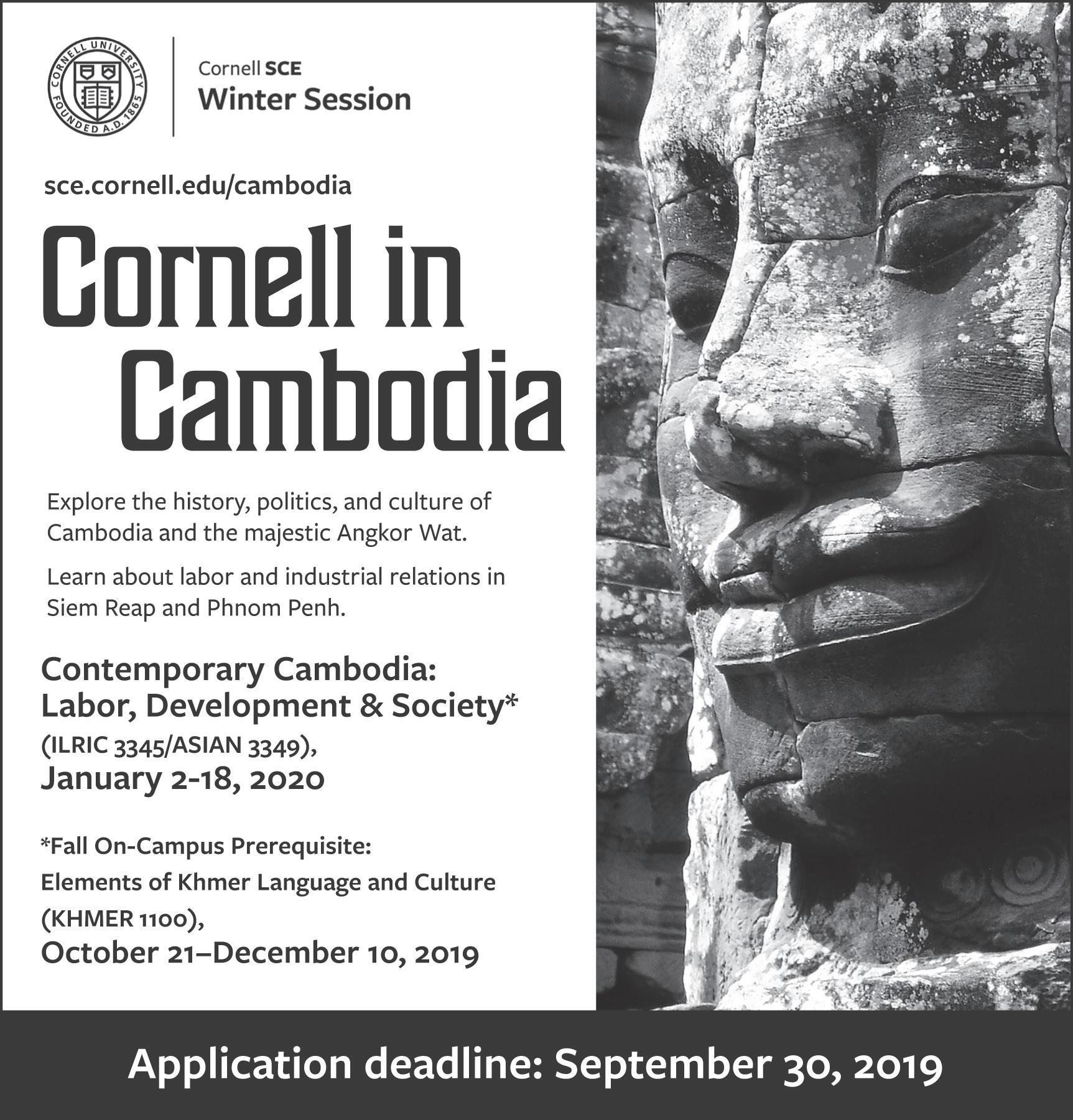
Western Influence on Cambodian Cultural Production After 1991 12 p.m. - 1:30 p.m., Kahin Center
Intstitute for African Development Seminar Series 2:30 - 4:30 p.m., G08 Uris Hall
2019 Neurotech Mong Family Foundation Lecture 4 - 5:30 p.m., G10 Biotechnology Building
The Solitary Bees: Biology, Evolution, Conservation 4 - 5 p.m., 160 Mann Library
Exploring the Transient Sky With the Dark Energy Survey 4 - 5 p.m.,105 Space Sciences Building
India and the United States: Overcoming the Hesitations of History 4:30 p.m., G85 Myron Taylor Hall
Noreen McDonald: Impacts of Ride-Sourcing on Road Safety: Analysis of Austin, Texas 4:30 p.m., 115 West Sibley Hall
North Campus Expansion Student Open House 6 - 8 p.m., 103/105 RPCC


Saleemul Huq: Developing Climate Resilient Migrant Friendly Towns in Bangladesh to Tackle Future Climate Migration
Friday, 12:20 p.m., Abby and Howard Milstein Auditorium
BLSA/LALSA/NALSA Block Party
Friday, 1 - 3 p.m., Myron Taylor Hall Courtyard
CAMP: Cinema at a Time of More People Than Cameras
Friday, 4:45 - 6:45 p.m., G22 Goldwin Smith Hall
Cornell Games Club Weekly Meeting Friday, 7 p.m., 183/185/187 Rockefeller Hall
Karoake Night
Friday, 9:30 p.m., Dining Room, Carl Becker House
Grad and Professional School 101! Friday, 6:30 p.m., Anna Comstock Hall
Botanical Garden Cleanup
Saturday, 12:30 p.m., Carl Becker House Lobby
Engage in Change
Saturday, 2 - 3 p.m., Call Auditorium, Kennedy Hall
Cornell Symphony Orchestra and Chamber Orchestra: C.U. Music
Sunday, 3 p.m., Bailey Hall Auditorium
By VIVIAN FAN Sun Staff Writer
With the help of dancers in elaborate hanbok gowns and hip-hop groups performing popular k-pop dance routines, the Korean Language Program celebrated its 30th anniversary last Friday in Klarman Hall.
“I wanted to plan this memorable event to save and cherish our history,” one of the event’s planners, Prof. Meejeong Song, Asian studies, told The Sun. “If we don’t do that, then it might all disappear.”
“I wanted to plan this memorable event to save and cherish our history. If we don’t, then it might all disappear.”
Prof. Meejeong Song
The celebration featured performances from student dance groups such as E-motion, LOKO, Hanchum and Korean percussion group Shimtah. It also presented the documentary Looking Back, Moving Forward, created by JT Miller ’21 and Sophia Lee ’22, which showcased the journey of the department.
According to Song, who has been a part of the Korean Language Program for nearly 20 years, the program was first created in 1989 by Professor John Whitman, linguistics, and Professor Heyrin Diffloth Cheong, the first Korean language lecturer at Cornell. Dick Feldman, the former director of the Language Resource Center, was also instrumental in the development of the program.

The 30th Anniversary celebration offered an opportunity for the Cornell community to recognize these three important contributors in a flower ceremony.
Song then gave an overview of the program to the audience of 200 people, retelling its history and highlighting its students.
“We started with only elementary Korean 30 years ago,” Song said, “now we have six courses in one semester with classes for both heritage and non-heritage speakers.”
“This semester we have a record high enrollment of 105 students,” she added.
Song believed that the Cornell community’s increased
interest in Korean pop-culture contributed to the growth of the program.
“So many more students are interested in taking Korean because they want to understand Korean dramas or listen to Korean pop music,” she explained.
Song hoped that student interest in Korean will continue to grow so the program can open more classes and enrich student experiences.
Vivian Fan can be reached at vfan@cornellsun.com.
Te club launched during the school strike for climate justice, harnessing environmentalist momentum
While environmental strikers rallied and screamed protest chants on the Commons last Friday, six equally energetic — albeit quieter — activists gathered on the Engineering Quad to promote their own vision of ecological sustainability.
That vision? GreenClub, a Cornell-based startup where students buy carbon offsets in exchange for benefits from environmentally friendly businesses. “Offsets” are projects that reduce carbon dioxide emissions or absorb
existing greenhouse gases to reduce total atmospheric carbon levels.
Since its founding last March, the organization has funded the removal of over 130 tons of atmospheric CO2; equal to the emissions from 28 cars in one year.
“People are accepting climate change as a reality,” co-founder Alex Li ’19 told The Sun. “We’ve done a great job growing awareness for the problem, but we need to shift our focus to action.”
“That,” Li said, “is where GreenClub comes in.”
Like a “Netflix service for sustainabili-
ty,” the startup charges members $10 per month and donates $9.50 of that sum to GreenTrees, a company dedicated to reforesting the Mississippi Alluvial Valley, according to Li. With each of these monthly payments, GreenTrees plants enough saplings to suck up approximately one ton of atmospheric CO2.
Because this sum is roughly equivalent to the average college student’s monthly carbon footprint, GreenClub effectively allows subscribers to “go carbon neutral,” Li said.
Offsets aside, members receive additional perks through exclusive discounts at environmentally conscious companies. Benefits

include 20% off unlimited purchases from S’well and LifeStraw, as well as a one-time offer of 15 free TCAT rides.
TCAT, which this year is expanding its fleet of electric buses, was enthusiastic about the partnership.
“GreenClub would have to be a pretty incredible initiative for us to back it like that,” TCAT general manager Scot Vanderpool told The Sun over the phone. “It’s unusual for us to partner with student groups.”
For its part, GreenClub aims to be “more transparent” than competing environmental organizations, Li said. While other online carbon offset programs exist, “they often lack personalization for individuals”— users don’t always know exactly where their donation went, or the total amount of CO2 they offset over time, according to Li.
GreenClub, on the other hand, offers users an interactive dashboard tracking their emissions-reducing progress.
At its launch on Friday, the startup tried to stress this personalized approach. The effort paid off. In the days following the event, membership ticked up by 15 users, for a total of about 50 subscribers.
“Seeing the reaction our mission generated in people at the launch gave me hope for GreenClub’s future,” said member Anyi Qian ’22, who manages the organization’s sponsor relationships.
Qian, who joined the GreenClub team this summer, says the energy of the startup is “frenetic but exciting,” driven by what she called Li’s “infectious” enthusiasm.
Looking toward the future, both Qian and Li hope to expand the startup’s reach beyond the bounds of the Ithaca community, considering partnerships with other universities.
“We believe in our mission,” Li said. “But regardless of success or failure, creating a startup has been a great learning opportunity.”
By AMINA KILPATRICK Sun News Editor
Early Wednesday around 7:50 a.m, Trumansburg Fire Department arrived at Taughannock Falls State Park to rescue an individual that had fallen 30 feet to the rocky bottom of the waterfall, according to a statement by the department.
The individual was attempting to scale a ledge at the bottom of the falls, although initial reports said the individual had fallen near the overlook area. Officials entered a prohibited area to attend to the individual and provide medical attention, according to a statement. After the individual was removed,
they were transported to Cayuga Medical Center with non-life threatening injuries.
The fire department and other park officials reminded the public to stay within designated areas.
“The Trumansburg Fire Department, along with the NYS Police and park staff, remind everyone to please stay on marked trails and not to adventure off to restricted areas,” the statement read.
“You are not only putting yourself in harm's way, but also jeopardizing all the first responders who come to your rescue.”
Amina Kilpatrick can be reached at akilpatrick@cornellsun.com.
Continued from page 1
to the Senate, where a two-thirds vote is required to convict the President.
Impeachment has “no legal standard,” according to Prof. David Bateman, government. The process is meant to be entirely political –– not “partisan or tawdry,” Bateman said, but considering “whether the president's actions have harmed the polity.”
As of 11 p.m. on Wednesday, 215 representatives in the House had publicly voiced their support for an impeachment inquiry, according to The New York Times. 218 would constitute a simple majority.
President Trump, in a Wednesday press conference, called the inquiry “a joke.” He questioned, “Impeachment for that?” According to Kriner, the answer is likely in the affirmative.
“The President unequivocally asked a foreign power to investigate a political rival. That alone is deeply troubling and arguably an impeachable offense,” Kriner said.
“I remain confident in our democratic institutions and would urge patience as we wait for more facts to emerge,” Isaac Schorr ’20, president of Cornell Republicans, told The Sun. “Given the reality that the President will not be convicted by the Senate, I do wonder about the efficacy of beginning such a divisive process.”
Cornell Democrats President Jaia Clingham-David ’20 questioned the President’s actions and gladly welcomed the inquiry.
“It is extremely worrying that President Trump is potentially abusing his diplomatic powers to pressure the Ukrainian president into meddling in domestic affairs for his own political gain,” ClinghamDavid said.
“It is important to start an impeachment inquiry given the current American-Ukrainian relations and the growing list of Trump’s corrupt activity, and I support efforts to hold him accountable,” she continued.
Bateman explained that currently there is no set timeline, and it all depends on what documents — if any — are discovered during the inquiry.
“I am afraid no one knows the timeline right now — it could happen relatively quickly, but I think a safer bet is that the committees will now use the additional leverage they have (and the fear in the administration) to get documents they have been trying to get for a while,” he wrote to The Sun. “How damning these are, and how damning the whistleblower report is, will determine the pace and content of any steps beyond the inquiry.”
Alec Giufurta and Amanda H. Cronin can be reached at agiufurta@cornellsun.com and acronin@cornellsun.com.
CLOSING
Continued from page 1
and Whitham Planning & Design, the firm responsible for projects like the Day Hall-Stimson Hall Plaza and 409 College Avenue’s eHub.
As part of the site plan review and approval procedures outlined in Ithaca’s zoning codes, the firm was made to conform to a three-part design review meant to ensure the development was up to code and adhering to the project proposal.
This meeting of the Planning Board was the first step of this approval process, which had been met with resistance two years prior in a fight to deem the Chacona block a historical site.
The Ithaca Common Council was caught in a 5-5 deadlock until Mayor Svante Myrick ’09 broke it by voting against the designation in 2017.
Council member Rob Gearhart, as reported by the Ithaca Voice, explained his views during that council session. “This is a really tricky, challenging vote for so many reasons,” he said, “but I think we can trust in an owner of a building that has publicly said they would commit to a good building for that block, and I think we have to give some credit for that.”
Even after that defeat, Historic Ithaca Executive Director Susan Holland ’85 reminded the council of the building’s eligibility.
Holland then talked about her discussions with SAI about “possible mitigation measures and our concerns about the loss of historic fabric.”
After the public hearing, Karnes and representatives of Whitham presented their concept for the development of the site on College Avenue.
Prof. Jack Elliot, design and environmental analysis and a member of the Planning Board, was concerned with the lack of sidewalk space proposed by the plan, an opinion echoed by Planning Director JoAnn Cornish.
However, the Planning Board agreed
when Chair Robert Aaron Lewis M.S. ’12 called SAI’s proposal an “incredibly respectful design,” taking into account the history of the building.
The concept was ultimately approved by the board.
The board also conducted a public hearing on a recommendation to the Board of Zoning Appeals for a new eight-apartment student housing development on Dryden Road, plugging a gap between The Lux and 320 Dryden Road.
The site, located on 238 Dryden Road, requires approval by the Appeals Board due to its size — it is 1,660 sq. ft. larger than zoning regulations allow.
Residents, like James R. Orcutt Jr. ’95 MMH ’02, a local realtor, voiced concerns about inconsistencies in the site plan, and the danger of setting a precedent in regards to the proposed variance.
The Planning Board agreed with its chair’s assessment of SAI’s proposal as an “incredibly respectful design,” taking into account the history of the building.
This too, was discussed by the board.
A few members, including Cornish and Lewis, anticipated pushback from the neighborhood if the variance was granted.
Cornish cited a desire to “protect single-family homes,” but finally acknowledged the “growing need for housing in Collegetown.”
The Planning Board decided to support the variance, with the caveat that they would require a fire consultation to ensure the safety of the proposed building’s inhabitants.
Sarah Skinner ’21 contributed reporting.
Sean O’Connell can be reached at soconnell@cornellsun.com.


HumEc back in the spotlight, following controversy over potential merger with ILR last year
HUMEC
Continued from page 1
Either the College of Human Ecology would become the “College of Public Policy,” or Cornell would look to create a school of public policy “shared” between the human ecology college and the College of Arts and Sciences — “with most [policy analysis and management] faculty plus other policy faculty.”
The suggested changes have already been met with resistance.
“Human Ecology is a unique concept and framework for a school,” Emily Miller grad, who is studying policy analysis and management, told The Sun. “When I tell people I am from Human Ecology, I sometimes get weird looks, but it is always fun to explain more in depth how Human Ecology started and how the school operates today.”
“And I think that other students feel similarly,” the human development major said.
The Charge for Policy Implementation Committee stated on the Office of the Provost’s website, “Given that our charge is to give these structural options equal consideration, we did not make assumptions about the future role of individual College of Human Ecology departments in this vision.”
“If they think we can transfer
The committee report states that it has “not yet sought to map this vision against the current, or possible future, organizational structure of the university,” a statement that some students, including PAM major Hayley Timmons ’20 took issue with.
“There needs to be at least a basic statement of what the plan would be for these other majors, or the proposal shouldn’t move forward.”
Hayley Timmons ’20
“The suggestion of a data science and public policy major sounds great, but why can't we just make that a minor in [the information science major]?” asked Timmons. “The teaching infrastructure already exists at Cornell, just in another college.”
The Charge for Policy Implementation Committee stated online: “The committee’s final recommendations on both the optimal policy structure and on enhanced social sciences departments will be reported to the
“I would be sad to hear that the college rebranded to match other institutions when the college was an historical trailblazer,” she continued.
Amanda Madenberg ’20 said that she applied to Cornell because of its “unique, hands-on, interdisciplinary and wonderfully niche” College of Human Ecology, and that she doesn’t think the curriculum she loves fits a School of Public Policy.
into the College of Public Policy, without considering the majors in the college that do not focus on policy, it makes me question how they think about my major,” said Abby Lerner ’21, a design and environmental analysis major.
The College of Human Ecology is currently composed of nine majors: design and environmental analysis, fashion design and management, fiber science and design, global and public health sciences, human biology, health, and society, human development, nutritional sciences, policy analysis and management, and health care policy.
“I think that’s doing a huge disservice to members of the HumEc community that read the report today and are now fearful of the uncertain future of their jobs, majors, and college placement,” Timmons told The Sun. “There needs to be at least a basic statement of what the plan would be for these other majors, or the proposal shouldn't move forward.”
The college’s website states that its current mission is to allow students to use their unique majors to focus on the “interaction of humans with their biological, economic, social, and physical environments.”
“What unites the College of Human Ecology is that all majors are human-centric,” Vivian Shiu ’21, a DEA major, said. “Public policy just seems like it relates to law, which has nothing to do with DEA, FSAD or health majors.”
The committee said that a new school of public policy would likely include new programs of study — for example, an undergraduate major for “data science and public policy,” according to the website.

Subcommittees have been formed for economics, psychology and sociology with professors in the relevant departments to determine how to collaborate across departments.
Wynne Chen ’20, nutritional sciences major, told The Sun, “People who just casually browse the website might disregard Human Ecology immediately because they might not be interested in public policy and don’t know that there are other majors in the college.”
Shiu also voiced concern over how the changes would be implemented. “This whole topic has not been publicized enough and most people don’t even know about it,” Shiu said.
“This whole topic has not been publicized enough and most people don’t even know about it.”
Vivian Shiu ’21
President and Provost by the end of the semester, who, in consultation with CHE leadership and other stakeholders, will then decide what recommendations will ultimately be implemented through the formal change processes.”
Jill Crosby can be reached at jcrosby@cornellsun.com.

137th Editorial Board
ANU SUBRAMANIAM ’20 Editor in Chief
JOYBEER DATTA GUPTA ’21
Business Manager
PARIS GHAZI ’21
Associate Editor
NATALIE FUNG ’20
Web Editor
SABRINA XIE ’21
Design Editor
NOAH HARRELSON ’21
Blogs Editor
SHRIYA PERATI ’21
Science Editor
AMANDA H. CRONIN ’21
News Editor
JOHNATHAN STIMPSON ’21
News Editor
PETER BUONANNO ’21
Arts & Entertainment Editor
ANYI CHENG ’21
Assistant News Editor
SHIVANI SANGHANI ’20
Assistant News Editor
CHRISTINA BULKELEY ’21
Assistant Sports Editor
BEN PARKER ’22
Assistant Photography Editor
DANIEL MORAN ’21
Assistant Arts & Entertainment Editor
ALICIA WANG ’21
Graphics and Sketch Editor
DANA CHAN ’21
Production Editor
RYAN RICHARDSON ’21
Snapchat Editor
ALISHA GUPTA ’20
Senior Editor
SHRUTI JUNEJA ’20
Senior Editor
AMOL RAJESH ’20
Senior Editor
SARAH SKINNER ’21
Managing Editor
KRYSTAL YANG ’21
Advertising Manager
MEREDITH LIU ’20
Assistant Managing Editor
RAPHY GENDLER ’21
Sports Editor
BORIS TSANG ’21
Photography Editor
AMBER KRISCH ’21
Blogs Editor
KATIE ZHANG ’21 Dining Editor
SOPHIE REYNOLDS ’20
Science Editor
AMINA KILPATRICK ’21 News Editor
MARYAM ZAFAR ’21 City Editor
ETHAN WU ’21 Opinion Editor
HUNTER SEITZ ’20
Assistant News Editor
NICOLE ZHU ’21
Assistant News Editor
JING JIANG ’21
Assistant Photography Editor
JEREMY MARKUS ’22
& Entertainment Editor LEI LEI WU ’21
Editor
WANG ’20
LEANN McDOWALL ’21
GIRISHA ARORA ’20
Editor
BREANNE FLEER ’20 Senior Editor
Working on Today’s Sun
Ad Layout Dana Chan ’21
Production Deskers Sabrina Xie ’21
News Deskers Amanda Cronin ’21 Nicole Zhu ’21
Design Desker Simon Chen ’21 Lei Lei Wu ’21
Photography Desker Ben Parker ’22
Sports Desker Maryam Zafar ’21
Arts Desker Daniel Moran ’21
Letter to the Editor
To the Editor:
The Sun’s Facebook comments section needs to be moderated. The comments on Amelia Zohore’s ’21 latest piece, “Loteria, the Ivy League Stripper,” makes it clear that The Sun’s online platform has become a vehicle for those who aim to impugn the essential dignity of The Sun’s columnists as well as marginalized groups.
Commentary below Zohore’s column and other posts by The Sun frequently contains language that perpetuates hatred toward low-income people, women, nonbinary people and people of color. Implementing a clear and concise set of rules about what constitutes an appropriate comment within The Sun’s social media pages will promote productive discourse and preserve the essential dignity of columnists and identity groups the paper frequently discusses.
There is a precedent for this kind of action. In an article announcing the winner of the student-elected trustee campaign of 2016, a number of anonymous, racist and homophobic comments were left in response to the election of a gay Taiwanese-American student. In response, The Sun removed its built-in commenting tool on its website and limited commenting to Facebook alone.
Requiring Facebook-based comments makes it more difficult to comment anonymously, but it does not absolve the problem of hateful comments. Additionally, the use of anonymous Facebook profiles often occurs. Setting standards for appropriate comments will help mitigate this problem. Major media platforms such as The New York Times, Wall Street Journal and Fox News all have their own comment moderation policies.
The Sun must work towards accountability for the impact of their media on campus climate and its role as a platform for public discourse. Setting strong and just standards for appropriate commentary on its social media pages is an essential first step.
ClubFest is a tease. The long-awaited Sunday afternoon came and went, as did the freshmen who emptied North Campus and congested Barton Hall. Our task was simple: walk around, shake some hands, share some NetIDs and so on. But add in hundreds of other freshmen and a two-foot visibility radius, and voila: Any chance of meaningful interaction with club leadership vanishes. In the midst of the chaos, email lists are saturated with overcommitted rookies who gladly feed their NetIDs into Google Forms or Excel spreadsheets. In the ensuing days, waves of information sessions hit, as does the ominous realization that any potential free time during the semester has disappeared.
Even so, during the half-hour daze that was my ClubFest experience, I was caught off-guard. How could so many organizations demand their own application, fast-approaching deadline and interview? It seemed so excessive a demand from a freshman confused about which clubs to sign up for in the first place — let alone apply to.
In the aftermath of ClubFest, a friend I regularly saw in morning lecture was absent throughout the week.
interdisciplinary exploration. We are institutionally pushed toward safe bets and deterred from risk-taking. Pre-meds stick to pre-med, pre-laws stick to pre-law and Ezra rolls in his grave. We aren’t compelled to apply to clubs that spark our interests, but instead to those that maximize return on investment. Joining is no longer spontaneous; it’s goal-oriented. Therein dies the idea that a club should capture one’s passions.
A mutually beneficial and perhaps more realistic way to alleviate this defunct system is an add-drop period for clubs. We aren’t forced to commit to a semester-long class before having attended a few lectures, so we also shouldn’t be pressured to apply to a club before actually experiencing it — which entails more than a customary information session. This trial period would allow prospective members to attend club meetings for a few weeks before choosing — or not choosing — to apply. Incoming freshmen would have a greater understanding of the club’s inner workings that can’t always be captured by a ClubFest booth poster.
Email lists are saturated with overcommitted rookies who gladly feed their NetIDs into Google Forms or Excel spreadsheets.
We had not eaten or studied together as we usually do, and so when he abruptly resurfaced during the following week’s lecture, his reason for his absence was concise: “club apps.” And he is not alone.
The application to-do list snowballs as we weave through the club booths, and before we know it, we’re faced with the real possibility of skipping both class and sleep in a scramble to meet deadlines — a choice a second-week freshman should never have to make. For freshmen already certain of their club pursuits, this decision may be worth it. But it simultaneously repels those of us who aren’t.
Prospective applicants inclined to explore new interests are turned off by the possibility that their efforts would be in vain if the club isn’t the right fit after all. In our recruitment system, there is simply no way to know if the extracurricular is truly a match until it’s too late; a mere overview pitched by the club booth is supposed to suffice. Applicants take a risk that comes with excessive down payment in the form of a grueling application — one that forces those who fall behind elsewhere into debt. And although applying can act as a necessary weedout for those unwilling to devote themselves, expecting us to decide on a club after just one brief info session misses the point. Crossing the application barrier into uncharted intellectual waters requires an informed decision, one that cannot be reached over the course of a slideshow summary and before the following week’s deadline.
On the flip side, it would give club leadership the opportunity to better evaluate the merits of potential applicants. Beyond canned application responses and forced interview dialogue, club members would observe future applicants in real time before reaching a conclusion. In a method akin to rushing a fraternity, both the clubs and their potential members should be certain of the mutual fit before committing substantial time and effort.
The lack of adequate information combined with the clubs’ premature demands is too strong a repelling force.
In the absence of such an option, ClubFest is indeed a turn-off. Many student organizations immediately assign applications that scare away those of us who aren’t necessarily too lazy to complete them (or so I tell myself), but are instead deterred by a lack of exposure to the organization. Our broken recruitment system forces those potentially willing to step out of their comfort zones back in them. The lack of adequate information combined with the clubs’ premature demands is too strong a repelling force. As a result, we gravitate toward activities we have always done, dissuaded from exploration by tedious applications.
I can only hope that by next year’s ClubFest, wide-eyed freshmen will be welcomed into Barton with a grace period, not the rude awakening of fast-approaching deadlines. This way, joining clubs will be collaborative, exciting and spontaneous — not a race to the finish line. Systemic change is necessary to make “any person, any study” a reality outside the classroom, too.
Therefore, our system incentivizes students to remain within their interest bubbles, as daunting applications stand in the way of
Roei Dery is a freshman in the College of Arts and Sciences. The Dery Bar runs every other Thursday this semester. He can be reached at rdery@cornellsun.com.
HELENHU/SUNGRAPHICSEDITOR

My boyfriend of five months, Desert Not-So Solitaire, was snoring softly next to me, his arm curled around my back. It was winter, so instead of sleeping in his car, he had struck up a deal and was living in an unfinished guest house in someone’s backyard. The house didn’t have a heater, so breath rose from my lips in little puffs, but I was warm underneath our blanket. I wanted to be moved by his soft smile and how peacefully he was sleeping. I felt my stomach clench; a rising nausea overtook me. Desert Not-So Solitaire was the first boy I’d loved, the first person I’d slept with, but right then, everything about him seemed unfamiliar — the beard I loved to feel between my legs, faint freckles from days in the sun, and lumberjack-esque body. Though hours before I’d found myself thinking about how I’d never been so close to anyone, suddenly, sleeping beside him felt no different from lying beside a stranger.
What is it that causes these feelings of distance in our most intimate moments? Maybe I was scared of the intensity of my feelings, or maybe I felt young and inexperienced and like I had committed too much time and effort to someone who wanted more than I would eventually be willing to give. I think partly, I had never shared physical space so constantly, and wanted some kind of a reminder of where
Riley
was fifteen when I first had sex. It was with my first real boyfriend, and it hurt so much I cried. It was a splitting sensation — it hurt so badly that any sane person would never want to experience it again. However, it was me who didn’t want to wait, it was me who bought the condoms and it was me who re-initiated every time, only to assume a fetal position in pain
My preoccupation with sex continues to baffle me — especially because I wasn’t a very sexual person. I never masturbated and, despite what my pen name suggests, I still haven’t ever watched porn. If I had to guess, I was having sex not because I liked it, but because I didn’t like it and wanted to. I wanted to understand what all the fuss was about, and understand it before any of my friends did. I wanted to be the frontrunner in a race
We kept fucking until it didn’t hurt me, but it was far from enjoyable for me. I’d lie on my back like a beached dolphin and wait for him to cum, cluelessly wondering why I wasn’t getting
It took a few weeks, and a couple accidental thrusts against my clit, before I started liking sex. The sensation was about the same — the same feeling of being filled up, and then empty, then filled up again — but without the pain. What I really wanted wasn’t the physical feeling, but the mental. I desired to be desired, to make seductive eyes at my partner until he was on top of me, to tease him and torture him until I could see the sheer excitement in his eyes when I’d say softly, “Please fuck me.”
After my first boyfriend, there were other guys, of course — guys who’d walk me to class and get the heart emoji with me on Snapchat. Guys who’d come over and do all kinds of things with me, but not sex. Never sex. They’d tell me how’d they do it and how badly they wanted to, but I’d always call their bluff. No one
Well, I was too young and naive to understand that. Instead, I took my perceived dry spell personally — all the while, becoming more and more sexually frustrated. On a random Saturday night, nine shots and my high school’s soccer goalie ended my dry period. He finished virtually as soon as he entered me. He was a virgin. 18 years old and desperate to pop his cherry before college. Of course, I didn’t know this. I was upset, feeling empty-handed and kept chasing. When I got with my last boyfriend, I hadn’t been fucked like I so
desired in almost two years. For the first time, I was having sex that satisfied me physically. He was different. Experienced. For him, sex wasn’t a big deal. He fucked around for sport, and I liked that. I liked that he didn’t put this extreme weight on it like everyone else — that we shared the idea that sex was the pursuit of a dopamine rush, like playing Mario Kart or gambling. If he didn’t care who or when or how, it meant I didn’t have to either. Well, it became clear that our relationship was based solely on our physical, rather than emotional, compatibility. Cliche, I know. When I got to Cornell, I began to see less and less of a reason to stay with him when we couldn’t have sex. It was the only thing that brought us together in the first place.
A couple days after meeting my current boyfriend, Brian, I knew I wanted to fuck him. As vapid as that sounds, it’s all I really knew. That’s how I showed affection to the guys in my life. To me, sex was and remains integral to a relationship. I don’t even think you should enter a relationship without fucking first.
So Brian and I go out on a Friday night. I get inebriated, fast. Utterly sloppy. He noticed. He suggested we leave, and he walked me back to his dorm, arm-in-arm. As we walked through Collegetown, then Central, then through North, I noted his chipper attitude — almost patronizing me, as if he knew what was going to happen. I’d been in that situation many times before: some guy I just met taking me home, before I escaped to my own hall, passing out with a full face of makeup. Except, I didn’t plan to break off this time, and I was content with our implied agreement.
We entered his room and I began drunkenly untying my mud-caked Converse.
“Wait. Stop that. Stop taking your shoes off,” said Brian. “What?”
He looked at me sternly. “Look, I like you. I value you as a person, and I want to be in a relationship with you. But if we do anything tonight, I don’t think I would value you as much as I do.”
I was fucking confused. Partially because I had read him so wrongly. Mostly because I didn’t know that not fucking was an option. In my drunken state, we had walked right into an entire debate about the gravity of sex. I had never seen it as anything but an activity before. I had hated it, practiced it, improved at it, loved it, offered it, retracted it and turned it into a hobby. Now suddenly, my body was a temple? Because someone else told me it was? To me, sex is liberating and powerful, but for him, it degraded me. I couldn’t help but feel somewhat slightly insulted. There is something to be said, however, about a guy who takes you home, sleeps with you throughout the night, ignores his most primal instinct and doesn’t fuck you out of respect. Sex certainly does have gravity. But if he’s on Earth, then I’m in space.
my body ended and his began — that I was still fully formed and complete by myself. Luckily, I was able to lay back on the pillow and fall asleep. When I woke up, the feeling was gone as if it had never happened, and we spent another amazing five months together before I moved to Ithaca.
At Cornell, I’ve occasionally felt versions of the same thing. While sitting on my bed after an argument with a good friend I was dating — we’ll call him Lonely Hearts Club Boy — he tried to touch my arm and I recoiled. I instantly felt guilty, but still I couldn’t shake my discomfort. I resented being comforted; I didn’t want LHCB to think he had any ownership over my feelings, even though this is kind of what a relationship is. It was like my heart was the emotional version of a fainting goat (look them up, they’re really cute in animal form!) — when I felt something too intensely, my feelings froze and fell away.
On another occasion, I lay curled against a boy who I actually really liked — let’s call him Rocky Mountain High — but who had made clear he just wanted to hook up, and felt as if I were floating above my body. I felt estranged equally from him and from myself, and unlike at other times, the feeling persisted, so for a while, my skin felt like an ill-fitting pair of clothes. I kept seeing him, though, and the
more distant I felt from myself, the more I longed for him, as if only by being close to him — this foreign, icy object — could I return to my own body as well. What is this distance that comes twinned with intimacy, and how can we know when to trust those feelings, and when to wait for them to subside? I think it depends on how the person makes you feel at other moments. If they make you feel warm and loved, then it makes sense to wait and see if the alienation fades. But if you never quite feel like you can trust them, or like you’re being let in, then maybe you should listen to that feeling. In moments of closeness, my body delineates itself by creating artificial distance, while when I share what should be intimacy with someone who doesn’t care about me, I feel equally far from my own body and emotions to avoid dealing with my hurt.
It seems almost everyone is familiar with these feelings. Even a friend in a long term, happy relationship confessed that, once she woke up next to her boy friend and his breath smelled off, his arm around her too tight, and she thought, who is this dirty boy in my bed? In a song, Joan Baez sings, “How long since I’ve spent a whole night in a twin bed with a stranger?” This could be the anthem of college, but I wonder if these feelings of estrangement are an unspoken
aspect of sex and love at all ages and in all types of relationships, too.
Maybe there are parts of myself, parts of my heart, I don’t yet understand, and this is my body’s way of telling me. Maybe love is the pain of separation between bodies. Or maybe I am the stranger in my twin bed, but that doesn’t mean I can’t love myself and my body completely.


By CATHERINE RYBERG
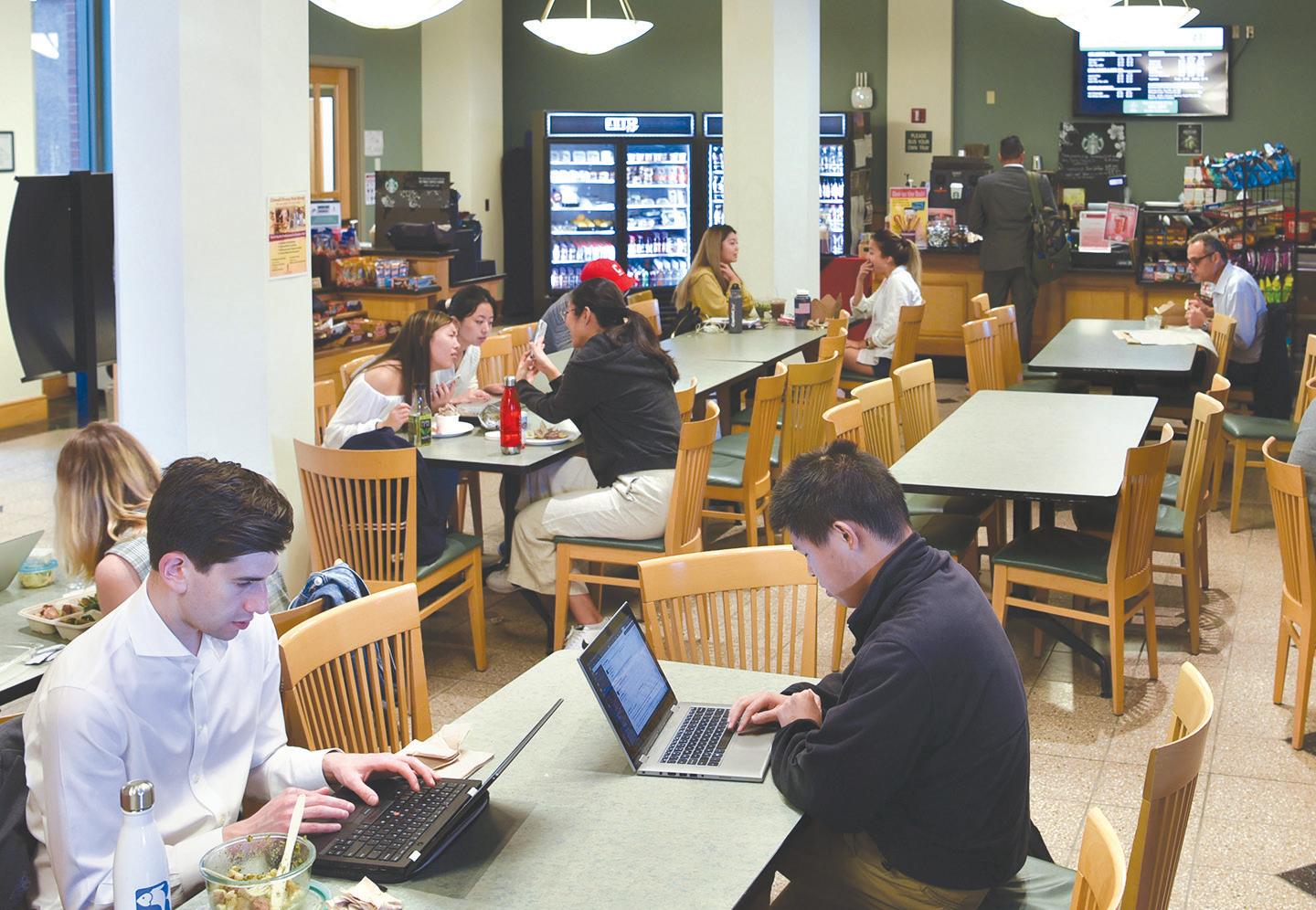
If you ask any undergrad here what their favorite campus eatery is, they’ll likely say Terrace, Trillium or Zeus. Each one is delicious in their own right, but let’s be real — making it through the lines at these places is hard work. Even in the late morning, you’ll find long lines filing out of most popular campus eateries. Although no eatery could ever replace my beloved Terrace salad or Zeus soup, I’m getting a bit tired of spending my entire lunch break waiting in these lines, leaving me to discreetly eat my lunch in the back of the lecture.
My solution? The Atrium Cafe. This humble cafe is tucked into the corner of Sage Hall, the hub for Johnson MBA students. It is an especially convenient location for Hotel, Engineering and Arts & Sciences students. Although I’m a student in Human Ecology, I sometimes still make the trek over just to avoid the long lines and loud
noises at the other nearby cafes.
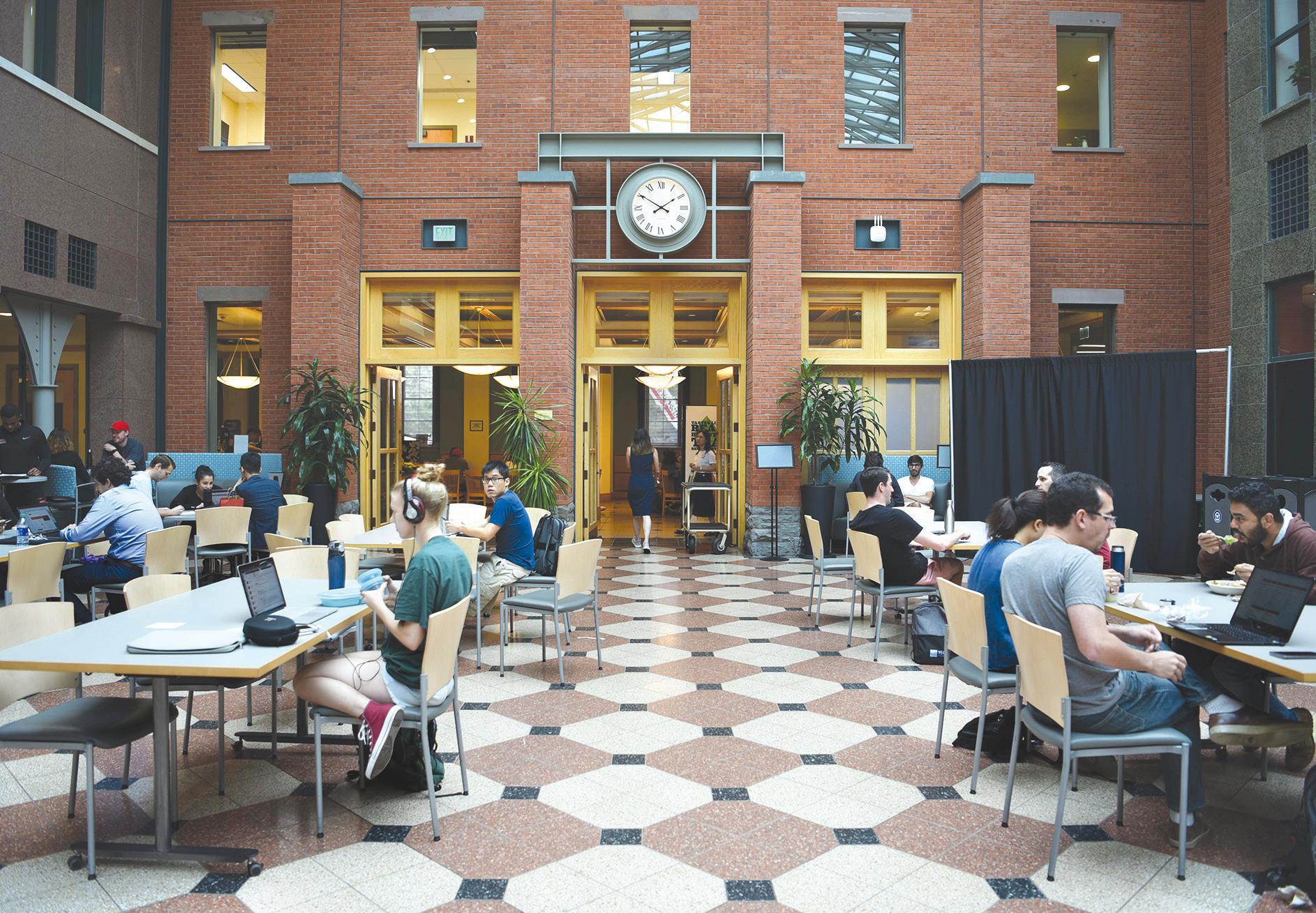
Upon entering the Sage Hall atrium, you are welcomed by a soaring ceiling composed entirely of a mosaic of windows which let abundant light in. The space is airy, refreshing and light, even with the weak dredges of winter sun in the later months.
Upon entering the Sage Hall atrium, you are welcomed by a soaring ceiling composed entirely of a mosaic of windows which let abundant light in. The space is airy, refreshing and light, even with the weak glimmers of winter sun in the later months. Various sized tables are scattered throughout the space and taller tables are pushed up against the walls, making it an ideal place to eat solo or meet up with friends. The most notable part of the space is the bustling energy of the graduate students, who form clusters to mingle between classes. Beware that you might feel underdressed amongst these students, who often use the atrium to network and host various business-related events, but do not worry. Smile, pretend you’re not a measly undergrad student, and take a left to find Atrium Cafe.
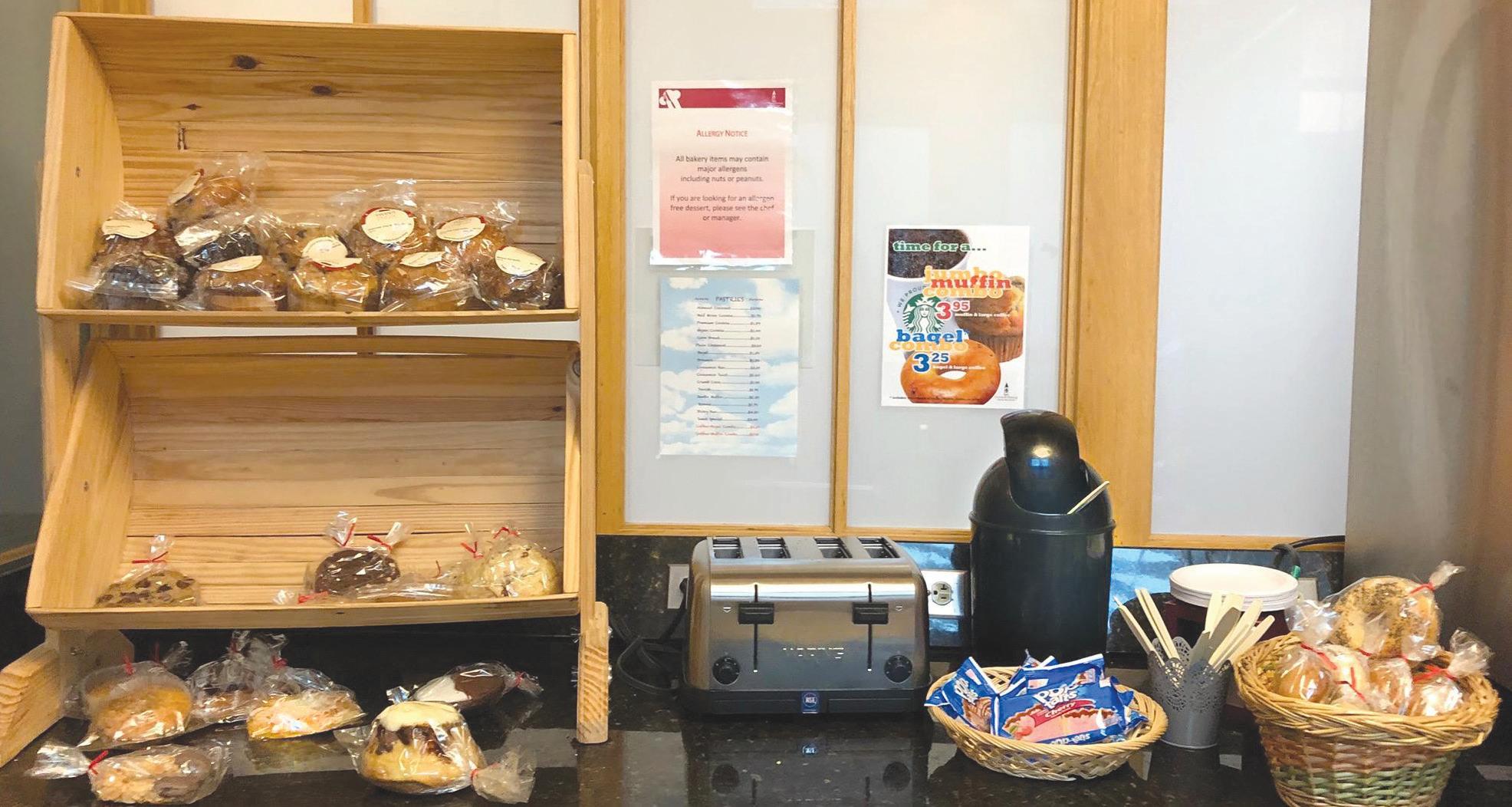
Atrium Cafe appears rather small from the outside but has a wide range of menu offerings. The space boasts a make-your-
own salad bar, soups, fresh-made sandwiches, dumplings and personal pizzas. In the mornings, they even have an oatmeal bar in place of the soup bar for a customized boost of energy on the go. The most popular offering at Sage is their hot lunch option that alternates between a burrito wrap/ bowl on Mondays and Thursdays, a noodle/rice bowl on Tuesdays and Fridays and a curry rice bowl on Wednesdays. Although I’ve never tried the curry rice bowl, I absolutely love the burrito bowl. It is served Chipotle-line style, but here’s the catch: Guacamole is not extra! The portion size of these hot options are very large, and I am always left fulfilled.
The noodle bowl, too, is a real deal in terms of how much you
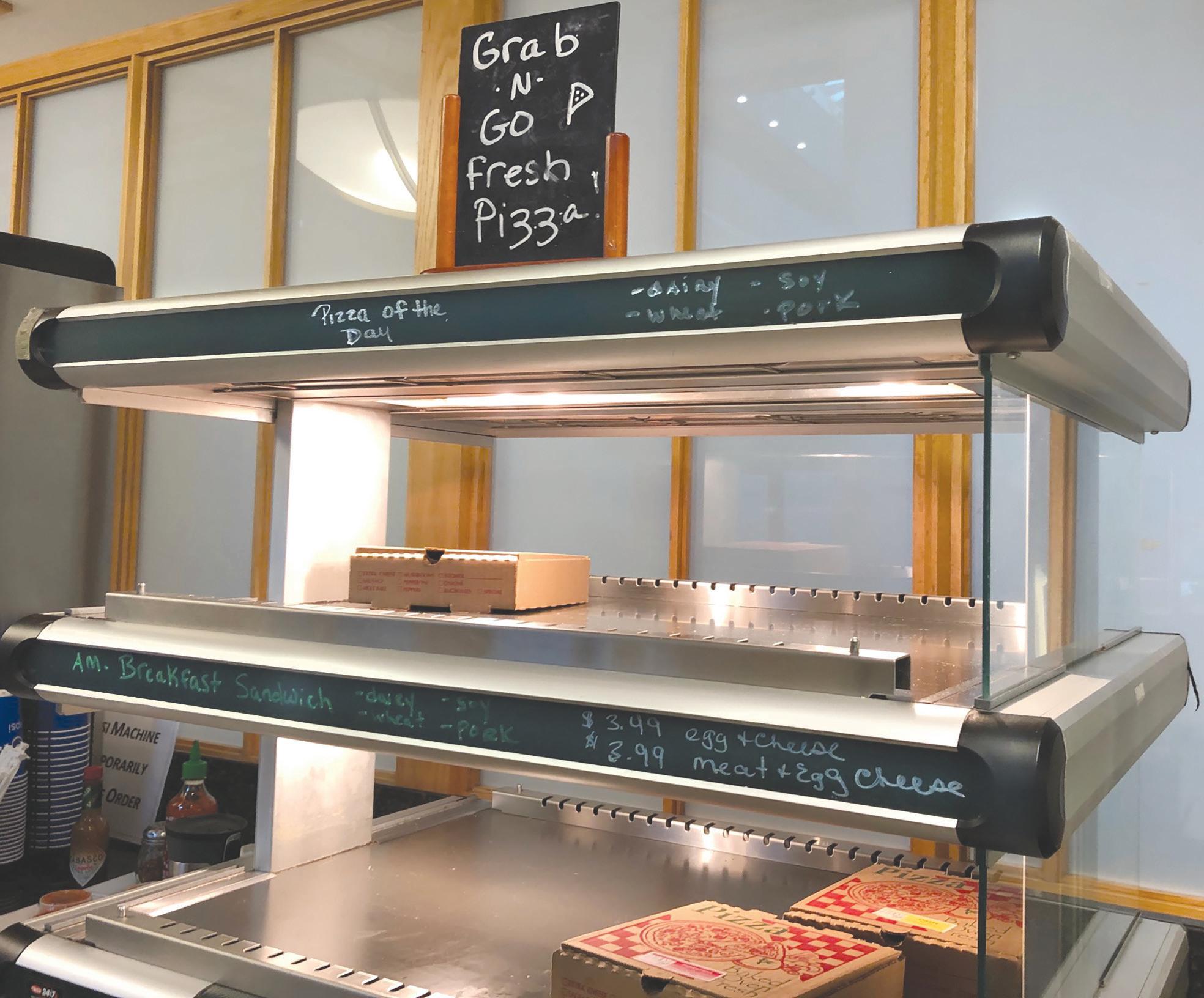
get for the price. For about $6 (a little more if you get the chicken instead of the tofu), you’re able to get your fill of rice noodles or white rice and a wide variety of Asian-inspired toppings in a savory ginger lemongrass broth. While the tofu and noodles can be a little bland on their own, the additional sauces you can add along with the broth adds a nice kick of acidity and unique flavor that you can’t find anywhere else. If bowls aren’t your thing, or you just need something super quick to-go, the personal pizzas that come prepared in their own mini pizza boxes are a great option. They come in cheese, meat, vegetarian or gourmet (a pie based on the cook’s choice) and are all decent
Atrium Cafe appears rather small from the outside but has a wide range of menu offerings. Within its walls boasts a makeyour-own salad bar, soups, fresh-made sandwiches, dumplings and personal pizzas.
options for something hot and satisfying without the wait. The toppings on the meat and vegetarian pizzas change daily, and they’re baked fresh in-house. These are personal pizzas meant for one person, but with four slices, they’ve always filled me up and left me with enough time to make it to my next class, too.
Atrium Cafe’s variety of options don’t stop with their pizzas. They’ve recently been changing up their sandwich menu too, as last year’s sandwich options with business-themed names like “Parker Center Pesto” and “Immersion Chicken” have

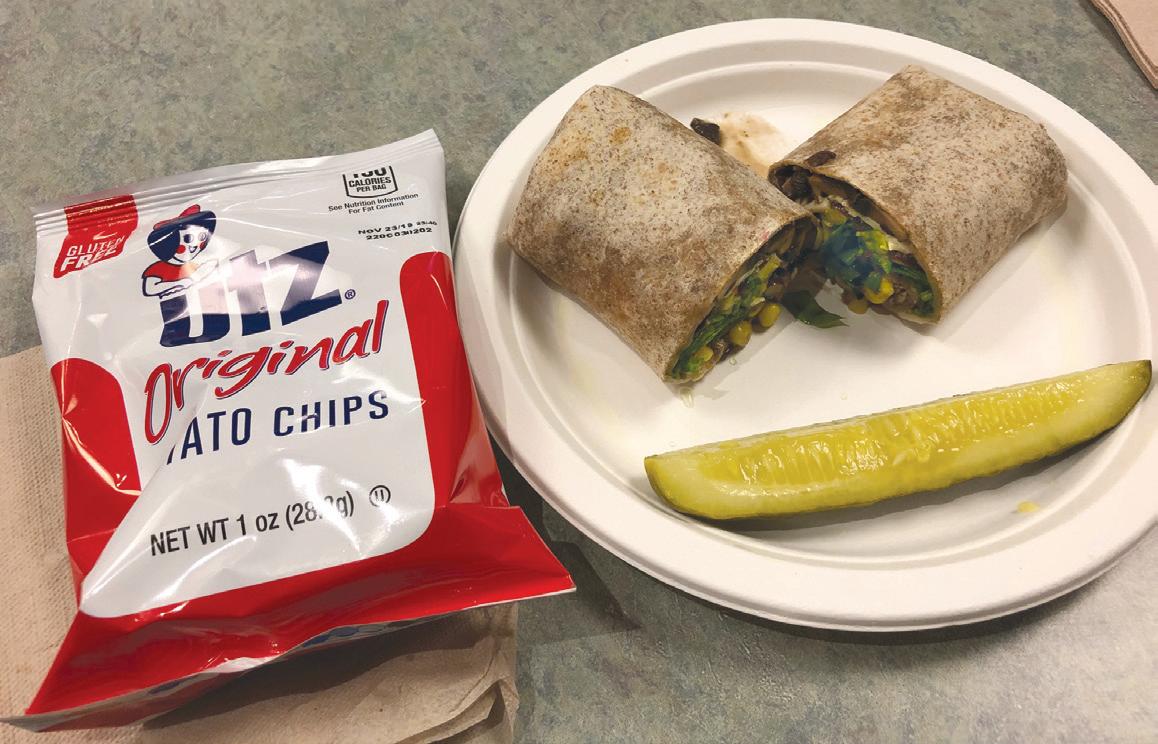
now been replaced by six new speciality deli items ranging from classic chicken or turkey sandwiches to pork banh mi. I got the "Southwest Portobello Wrap" one day, which features tangy chipotle marinated portobello mushrooms, refreshing corn and black bean salsa, cheese and spinach in a whole wheat wrap, and thoroughly enjoyed it. The combination of flavors and textures was interesting and filling, and although the sauce ended up leaking out of the wrap making it messier to eat than I would’ve liked, it didn’t make the wrap any less delicious. All sandwiches come with your choice of either carrots and celery or chips

Everyone deserves to have a relaxing break within their busy day, and lunch is the perfect time for that if you can manage to find a place on campus that allows for it.
and a pickle. For the price that you pay, which is about the same at any other eatery on campus, the overall value makes the sandwiches appealing offerings to return for. My favorite aspect of Atrium Cafe? I can almost always find a seat in a nicely lit, not-too-loud place, which sure seems like a luxury compared to the narrow, crowd-
ed spaces at most other popular eateries. Everyone deserves to have a relaxing break within their busy day, and lunch is the perfect time for that if you can manage to find a place on campus that allows for it. I’m thankful that I discovered Sage, and now can only hope that it stays a place where both undergrads and Johnson students can enjoy Atrium Cafe’s offerings harmoniously, too.
Catherine Ryberg is a junior in the College of Human Ecology. She can be reached at crr223@cornell.edu. Katie Zhang ’21 also contributed to this article.

Place an Ad in the Dining Guide at 273-3606 Monday - Friday, 9 a.m. - 5 p.m.


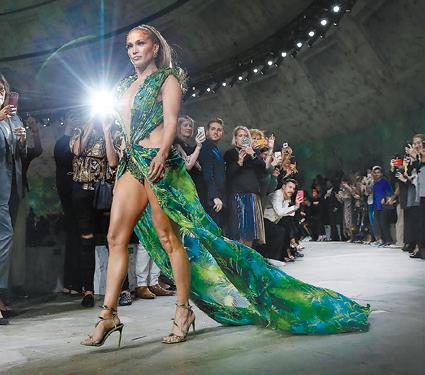
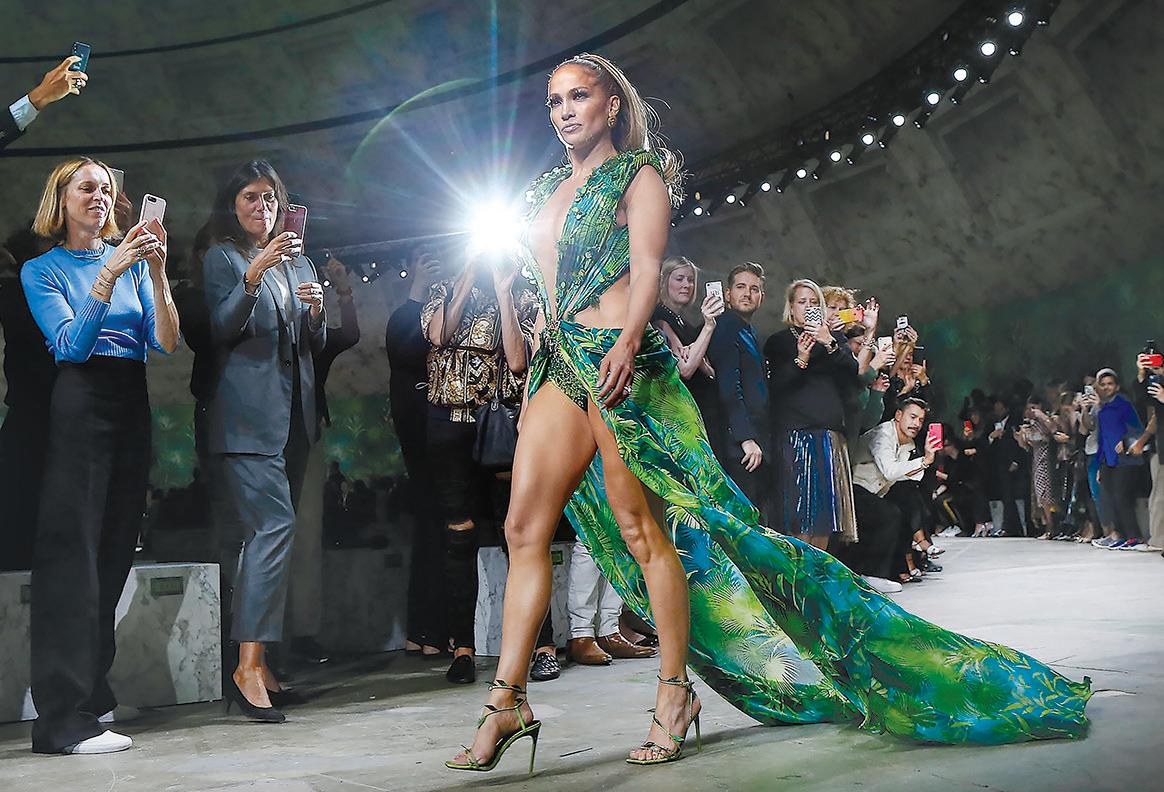
You might recognize Jennifer Lopez’s green Versace dress because, following her appearance at the 2000 Grammys, it single handedly sparked the creation of Google Images. As Google CEO Eric Schmidt wrote in a 2015 blog post, “After all, people wanted more than just text . . . But we had no surefire way of getting users exactly what they wanted: J. Lo wearing that dress. Google Image Search was born.”
Last week, almost two decades later, J. Lo and Donatella Versace nearly broke the same part of the Internet they helped build when Lopez walked the runway for Versace’s Spring-Summer 2020 show at Milan Fashion Week in a similarly plunging, jungle-printed dress. This time, however, the feat was an explicit partnership between Versace and Google: Invitations included a Google Search box, digital art made with Google Tilt Brush decorated the runway and, after a montage of Google Image searches for the 2000 dress was projected, Donatella Versace playfully used Google Assistant’s voice command technology to summon J. Lo on the floor (excuse the pun). When she finally stepped out — the chiffon fabric of the new dress fanning out behind her, goddess-like — everyone stood up, phones in hand, no doubt already sending and resending the image through the stratosphere of social media.
However, the power of the new dress derives not so much from the dress itself but from its function as a throwback to an iconic moment in fashion history. Though the new dress is much more revealing than the original — with the skirt of the dress open to the navel, side cut-outs and an open back, in addition to the famous plunging neckline — after two decades of racy dresses, I didn’t find myself quite struck or moved by it as I expected to after all the hullabaloo.
To see what was missing, I took to Google Images. In comparison to the 2019 dress, the 2000 dress is quite demure — aside from that famous neckline, it has long sleeves and a long, flowing skirt with a slight slit up the middle, paired with relatively light makeup and few accessories. But this still didn’t help me answer my
question: What does make a dress iconic?
From a Vogue interview with Lopez given shortly after her appearance on the Versace runway, I was surprised to learn that J. Lo had not been the first to wear the dress. In fact, she’d been warned against wearing it by her stylist for this very reason. The dress had initially been introduced on the runway by Amber Valletta, who, as one of the reigning supermodels of the ’90s, was by no means an obscure figure. Donatella Versace herself had worn it at the 1999 Met Gala, and Geri Halliwell (a.k.a. Ginger Spice) followed, donning it at Cannes a mere month before J. Lo’s moment at the Grammys.
All of these women had their fair share of clout, and the events the dress had been worn to were no less significant than the Grammys, so why had Versace and Halliwell gone so unnoticed? Neither of them had accessorized much, either. In contrast to Lopez, though, Halliwell’s neckline is less open, and most of the pictures of her wearing it have that area covered by her long, blonde hair anyway. In Donatella’s version, the slit of the skirt is also left quite open, creating a sort of double-V shape.
Ramya’s Rambles
J. Lo, however, seems to take on almost a mythical effect in the dress, the transparency of the fabric revealing just her legs posed at an angle not unlike that of Botticelli’s Venus , the neckline of the dress always threatening to gape into malfunction (though as she reassures us in her interview, it was very firmly taped down), toeing the line of suggestion just enough to titillate.
Perhaps what the dress really reveals is the way fashion allows art to penetrate life; indeed, to conjoin life and art in such a way that few other art forms are capable of, rooting deeply in our collective cultural consciousness, elevating what might otherwise be dull or mundane and even reshaping our technology.
In the meantime, though, I’m still waiting for my dress.
Ramya Yandava is a junior in the College of Arts and Sciences. She can be reached at ry86@cornell.edu. Ramya’s Rambles runs alternate Thursdays this semester.

After the collision course that was the first few songs of Illiterate Light’s set, the lead singer told the crowd, “We’ve got a few more songs, if that’s alright.” Many cheered, and I replied with a delayed “No thank you,” even though it wasn’t really a question. While I found the majority of their set to be monotonous and fairly overbearing, their last song “Growin’ Down” was actually something I would consider listening to on my own . . . however, just as I thought I was coming around to their set, the microphones gave out and my wish had been granted.
But I didn’t come for the opening act; I had come for Rainbow Kitten Surprise. As the first semester has transitioned into a boring routine, the homework has piled high and Ithaca’s weather has rapidly become crisper, a prescription of Rainbow Kitten Surprise was the perfect dosage of zest and enthusiasm that I had been craving.
Every single song they played was a hit. Every. Single. One. Between their opening song “Matchbox” to “Devil Like Me” to “Holy War,” Rainbow Kitten Surprise truly couldn’t go wrong because they have no bad songs in their discography. There were rainbow lights and surprises (unfortunately, there were no kittens). There were floral leggings and there was a smooth, ever-changing cycle of instruments. There were Rockette-esque kicks and an unignorable sense of collective effervescence.
Perhaps the most exceptional element of the concert was the dynamic of the band, the type that couldn’t be felt through headphones or speakers, but needed to be seen. Each member left their distinct impression, and no member overpowered any other. Lead singer Sam Melo regularly shifted between strutting on the front of the stage to the keyboards towards the back of the stage, next to the drummer Jess Haney who was constantly smiling. Lead guitarist Derrick “Bozzy” Keller was quick to fill in with jumping and dance moves, and bassist Charlie Holt made the concert feel personal through a kaleidoscopic presence. And when the acoustic pressure mounted on guitarist Ethan Goodpaster, he shined, and it was all incredibly humbling. Unlike many bands which depend on the lead singer to be a frontman, the interdependency of Rainbow Kitten Surprise made the concert even more compelling.
In between the high-energy of “Goodnight Chicago” and intensity of “Cocaine Jesus” — a song whose lyrics will forever be ingrained in the minds of devoted RKS fans — loomed gentler ballads like “All That and More (Sailboat),” which proved to be a crowd favorite. Their latest releases, “Heart” and “No Vacancy,” flowed so seamlessly that their impression felt just as strong as the songs that had been on the minds of fans for years. RKS truly proved themselves as a shape-shifting band.
As I was dreading the end of the concert, hanging on to their encore’s, I was reminded by one of their lyrics; “All is well that ends well, but all is well that ends.”
Odeya Rosenband is a sophomore in the College of Arts and Sciences. She can be reached at omr7@cornell.edu.


Fill in the empty cells, one number in each, so that each column, row, and region contains the numbers 1-9 exactly once. Each number in the solution therefore occurs only once in each of the three “directions,” hence the “single numbers” implied by the puzzle’s name. (Rules from wikipedia.org/wiki/ Sudoku) Sundoku Flakes Puzzle 12 Fill in the grid with




10
11

Houses, Apts, Parking
1 to 9 Bedroom
Collegetown - College Ave, Linden Ave, Dryden Rd, Bryant Ave, Cook St. 607-330-2442 info@urbanithaca.com www.urbanithaca.com
We have availability for the 2020-2021 school year beginning June 1st at Hudson heights apartments. The studios include electric, heat, water, garbage and parking. There is coin-operated laundry facilities on site. Prices start at $750 / month for a 12 month lease. If you have any questions or would like to schedule a tour contact us by phone 607-280-7660 or email: renting@ithacaLS.com Now Renting 2-10 Bedroom Houses/ Apartments for 20-21. All Locations. Call today or visit our website: Certified Properties of TC Inc certifiedpropertiesinc.com 607-273-1669
COLLEGETOWN TERRACE APARTMENTS
Spring 2020 Semester Leases Available Heat, hot water and Wi Fi included Free State of Art Fitness Center Free Shuttle Bus Service to campus Washer & Dryer in Apartments collegetownterraceithaca.com office@ithacastudentapartments.com (607) 277-1234
20-21 College Ave. 5 BR House Furnished. Laundry. Parking. Call 607-273-8576
20-21 Upper Eddy St. 7 BR house Furnished. Laundry. Call 607-273-8576

2020-2021
Studio 1, 3, 8 & 11 BR Apts. Great Locations in Collegetown. 607-227-2535
1, 2 & 5 Person Apts. Overlooking Cascadilla

FIELD HOCKEY Continued from page 16
A fourth quarter goal by freshman midfielder Caroline Ramsay sealed the fate of the game. Royer notched her fifth point of the game with the 47th-minute assist.
Despite the 4-1 outcome in favor of the Red, the shots and penalty corners were heavily skewed in the direction of the Leopards. Lafayette outshot Cornell 17-5, and had a 6-1 edge in penalty corners. What the game came down to was the ability to create and capitalize upon scoring opportunities — that is where the Red dominated.
“We created some grade-A scoring chances and we took advantage of all of them.”
Head Coach Andrew Smith
“We were really efficient in our attacking circle tonight. We created some grade-A scoring chances and we took advantage of all of them,” Smith said. “We played really well in and around the circle and we got ourselves in the position to take those chances.”
Although the season is young, the field hockey program has undergone a transformation, one defined by early success. This year’s success, compared to last year’s losing season, can be attributed to the formation of a team identity, a goal for the program put forth by Smith upon his arrival.
“We started developing our culture when I first came on board, and our culture is based around having fun and working hard — I think that has developed every single day and we are beginning to see an identity on the field,” Smith said. “We have more smiling people and a lot of hard workers there.”
As the Red move into Ivy League play this weekend, the team will continue to place an emphasis on the development of their team culture, and will take on Penn with the same passion they displayed on Monday against Lafayette.
The Ivy League showdown will take place Saturday at noon on the Quaker’s home turf.
Faith Fisher can be reached at fsher@cornellsun.com.
YALE Continued from page 16
suffered a season-ending injury on a second-half run. From there, Yale lost three of its last four games. Rawlings’ last full season — which came in 2017 — saw him pass for 2,320 yards and 19 touchdowns while running for 226 yards and two more scores.
“We feel like it kind of slipped through our fingers, and we’re going to try not to have that happen this year.”
Mike Catanese
Next to Rawlings in the Bulldogs’ backfield is junior Zane Dudek, one of the top running backs in the Ivy League. Similar to Rawlings, Dudek saw his 2018 season derailed by injury. But during his freshman year, the Pennsylvania native led the Ivy League in nearly every rushing statistic, tallying 1,135 rushing yards, 15 touchdowns, and an average of 7.1 yards per carry: the second best in Ivy history. Archer described the challenge

of defending against a multithreat offense.
“You can’t say, ‘let’s take Rawlings,’ and limit his production because they have other guys that will do it ... They have too many weapons, so you really have to play great team defense.”
In the past two years, Cornell has come close to defeating Yale. Last year, the Red battled the Bulldogs during Homecoming and came within two points during the fourth quarter. But Yale held on for the victory.
“I feel like we have some unfinished business to take care of,” said senior quarterback Mike Catanese. “We lost to them on our home turf, 30-24. We feel like it kind of slipped through our fingers, and we’re going to try not to have that happen this year.”
The year before, Cornell played well in the first half but trailed at the intermission, 14-10. From there, though, the wheels fell off as Yale bullied the Red in the second half to run away with the game, 49-24.
“We got to finish,” said Archer. “Kind of like the last two years seasonally ... We just got to be able to finish and put four quarters together.”
Luke Pichini can be reached at lpichini@cornellsun.com.
By KEN CHOI Sun Contributor
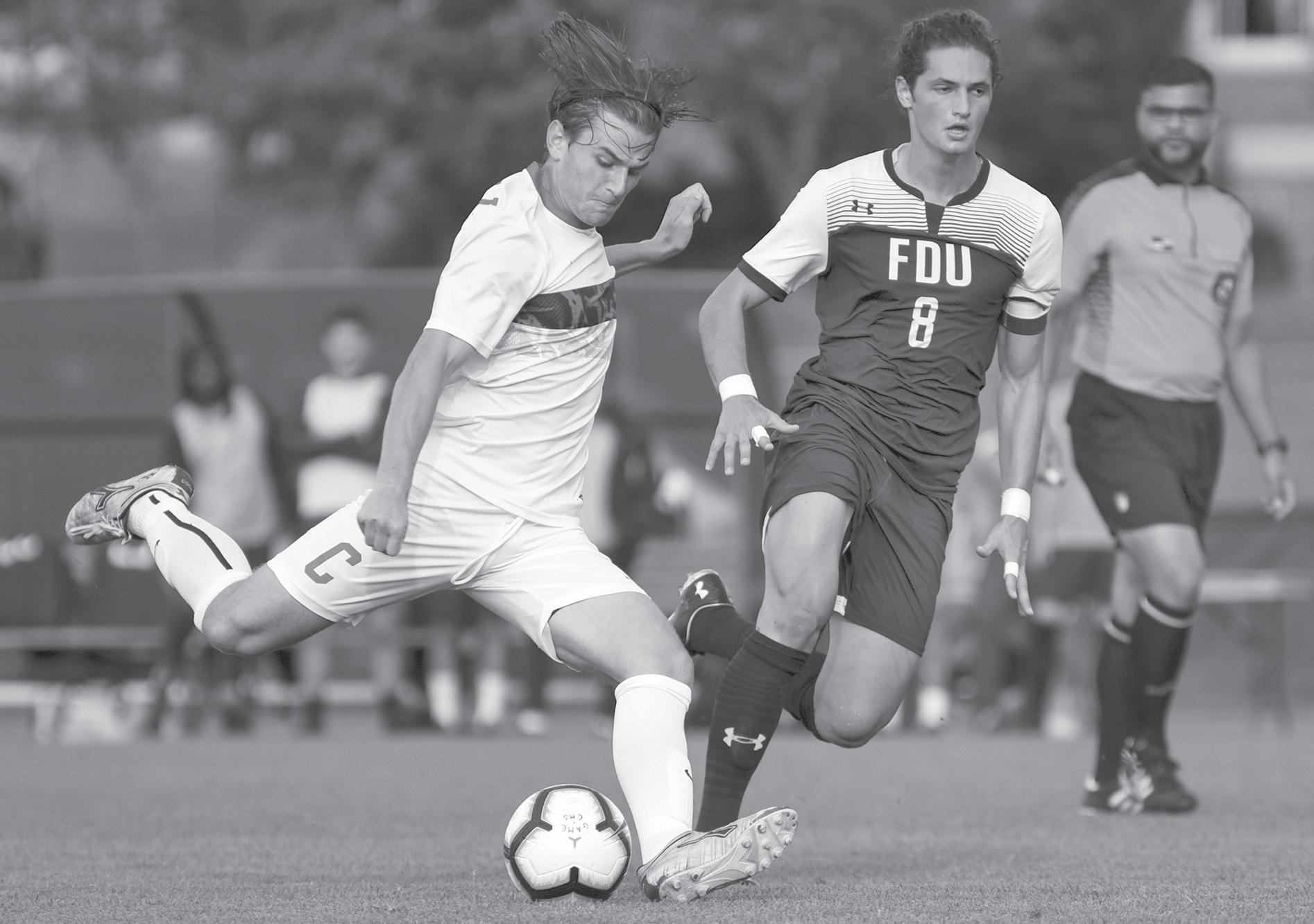
Cornell men’s soccer took a total of 29 shots throughout a commanding 90 minutes on Tuesday, yet junior midfielder Harry Fuller’s precise penalty in the eleventh minute was all that mattered in a 1-0 win against Siena College at Berman Field.
The Red held on to the sole goal, and are once again on a two-game winning streak before facing the University of Akron on Sept. 28.
Dominating throughout the game, the team recorded a 62% possession total, spending 69% of their possessions on the opposite field.
“Everybody on the team has an animal mentality. The entire backline are animals.”
Jonah Kagen
The Red came out with a sturdy yet forceful 4-4-2, with the two center-backs senior Ryan Bayne and sophomore Tate Keir maintaining possession in the backfield and the dynamic wingback/winger duo freshman Connor Drought and sophomore Jonah Kagen attacking the sides. Right from the start, the two were everywhere on the field, delivering silky passes and crosses, then making clean tackles in defense.
“A huge part of our style going forward is getting the fullback in on the attack. Especially for [Siena College], we noticed that their winger didn’t decide to track us when we had the ball,” Kagen said. “It is easier for me to go forward. We get more space, and more space means more numbers in attacking.”
The Siena College Saints never seemed to get a grasp on the offense, totaling only two shots. Their first shot came in the 25th minute off a pass miss from the Red defense. Their second — and last — shot came in the final minutes of the game.
“They tried to play out; they put guys forward and [kept] fighting ’til the end even though they had players sent off,” Kagen said of the Saints’ overall play. Still, he stressed that the team must, and will, work on their finishing as they missed countless quality chances.
Aside from Fuller’s penalty, most of the midfield and forwards had great chances — they just couldn’t con-


nect. Junior forward Vardhin Manoj started the shooting parade in the second minute after a great pass from the freshman left-back Connor Drought. Both sidelines were spry, with sophomore forward Emeka Eneli and substitute freshman midfielder Noel Ortega providing flashy drive-ins, opening up space for the offense to work with.
The defense line that provided two shut-outs in the last five games came up with a strong performance and helped senior goalkeeper Ryan Shellow another clean sheet.
“Everybody on the team has an animal mentality. The entire backline are animals,” Kagen said. “We have a lot of pride in the fact that we are the last line before the goalkeeper. And also our captain Ryan Bayne is back there always barking. He’s always loud, and as a result, the energy is always high ... [The noise] is great for us
THE SUN’S FOOTBALL PICKS




because we’re used to it. In our training sessions, everybody’s yelling. We’re trying to control our emotions, our excitement on the pitch, and the comments from Bayne and Shellow motivates us. We listen to what is said rather than how it is delivered. It’s also intimidating for the opposing side because we are barking and yelling the entire time.”
Now on a two-game winning streak, the Red is preparing to face Akron at 7 p.m. on Sept. 28 on Saturday in Ohio. Though the Saints have the coveted home advantage, the team will play off a six-game losing streak. The Red’s next home game will take place at 7 p.m. on Oct. 8 at Berman Field.
Ken Choi can be reached at kyc37@cornell.edu.





By FAITH FISHER Sun Staff Writer
Two first period goals from the Red proved insufficient to attenuate the field hockey team’s competitive energy. Rather, the quickly-earned advantage fueled the team’s offensive vigor, which carried them to a landslide 4-1 victory against the Lafayette Leopards.
The win is especially impressive in light of last year’s matchup on Oct. 22, when the Leopards toppled the Red 2-1. Such a reversal is a testament to the newly-developed cohesiveness of the team, fostered under new head coach Andrew Smith’s revamped coaching philosophy.
“We are on a different trajectory now,” Smith said. “For us, each game is just a game and we just have to focus on the task at hand.”
The Red (3-1) entered the game against Lafayette (3-5) with a clear strategy: clinch an early advantage — and junior forward Grace Royer delivered. Just seven minutes into the game, Royer gained possession of the ball. With a quick maneuver, she moved the goalie and comfortably netted the ball.
“For us, each game is
just a game and we just have to focus on the task at hand.”
Head Coach Andrew Smith
Junior Julianne Mangano, with the help of freshman Natalie Stone, was next to answer the quick-lead call. With just 13 minutes of play on the clock, Stone placed the ball in front of Mangano, who stood within the circle, face to face with the goalie. Mangano gracefully dodged the goalie, eclipsing the second goal and widening the scoring gap to 2-0.
“Before the game we talked about wanting to have a fast start, and I think we came out to play tonight,” Smith said. “We got those quick two goals in the first quarter, which
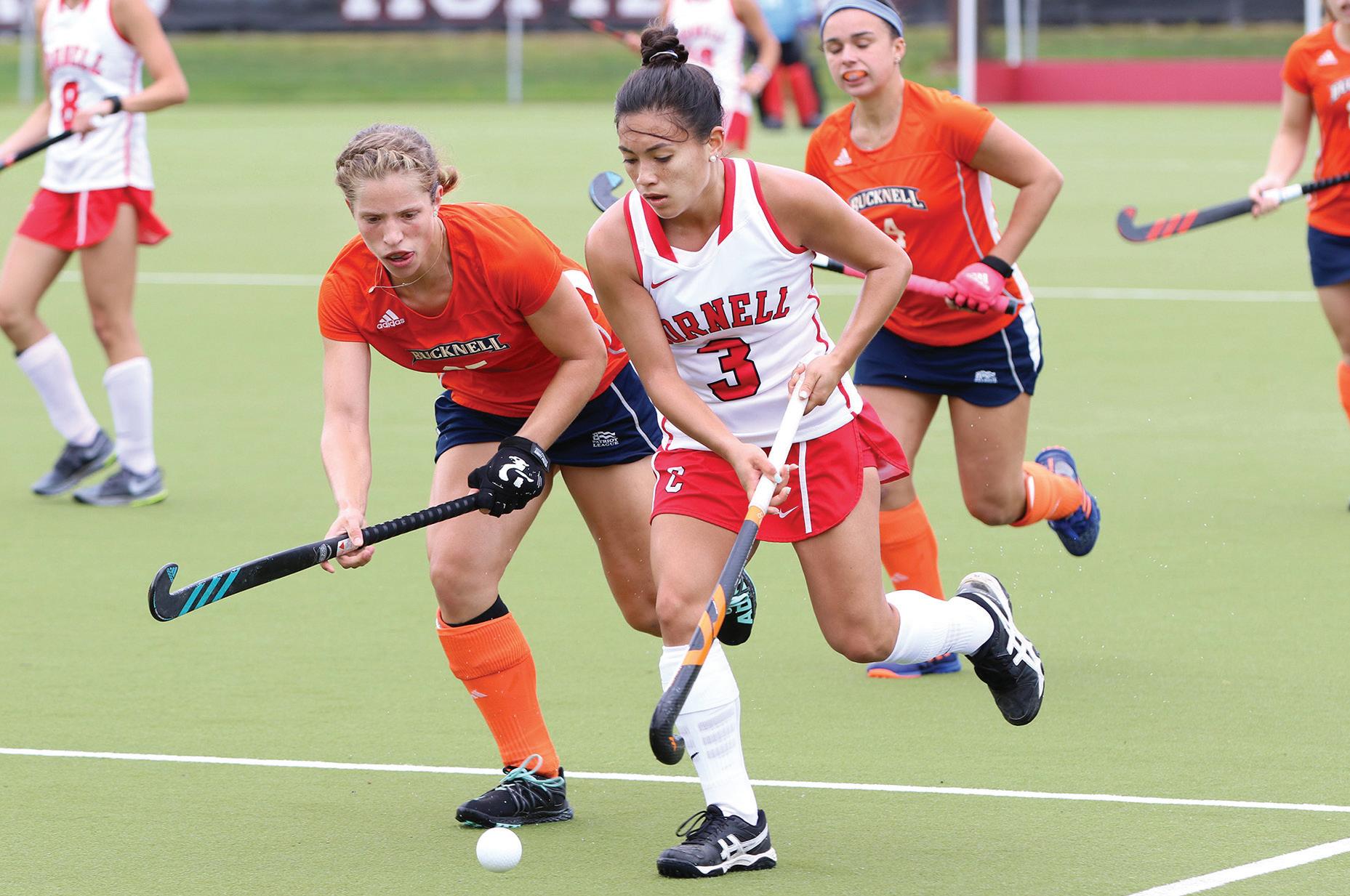
really set us up for success, and I felt like from that point onwards, Lafayette was chasing the game.”
Despite the Red’s sustained intensity, the second quarter was offensively futile. The second quarter was a game of defense with no points notched on either side. Still, the Red ended the half with clear control of the game, still leading 2-0.
Going into the half, Lafayette decided they would not let the Red protect their home field so easily. Hungry for
a goal, the Leopards executed, tipping a rebound into the goal.
The Red, however, was left completely unfazed. Rather, the Red regrouped and retaliated with their third goal of the day. Grace Royer gained control of a loose ball off a shot and tipped the ball into the goal. Cornell comfortably ended the third quarter with a 3-1 lead.
See FIELD HOCKEY page 13
Cornell will head into the Ivy opener against the Bulldogs stronger than it has in the last two years
By LUKE PICHINI Sun Staff Writer
Cornell’s football season is already playing out differently than past years.
For two years in a row, the Red has
faced the tough task of playing Delaware, an FCS powerhouse. In both 2017 and 2018, Cornell lost, falling into an early hole.
But this time around, the Red were gifted with an early season matchup against

Marist College, a much weaker foe. In spite of its sloppy play, Cornell knocked off the Red Foxes on the road, 21-7. Now, the Red must turns its eyes from arguably its easiest matchup of the season to one of its hardest.
This weekend, Cornell will venture out to New Haven, Connecticut, to take on Yale, the preseason pick to finish atop the Ancient Eight.
After clinching the Ivy crown in 2017, Yale regressed the following year, finishing with a fourth-place tie during an injury-plagued season. In their 2019 opener, the Bulldogs — like the Red — kicked off the season in an unimpressive manner, letting a Holy Cross team hang around for much of the contest before topping the Crusaders, 23-10.
To play against an intimidating opponent like Yale this early in the year is an exciting opportunity for head coach David Archer ’05.
Ivy League Defensive Player of the Week honors, senior cornerback David Jones described a different energy in the locker room following the Red’s opening victory.
“Losing the season opener — you come in during the weekend and you’re a little down,” said Jones. “Right now, there’s a lot of confidence ... lot of good energy we’re trying to channel into this week.”
Matching up against such a vaunted opponent this early in the year is also a plus for Jones.


“You only get 10 [games],” Archer said. “Especially the league games — they’re like bowl games. And this one’s really a bowl game playing in the Yale Bowl against the preseason favorite.”
Fresh off earning his second career
“It raises the bar for us this week, especially for how we prepare for that,” Jones said. “You definitely like to see them early because you kind of hope, in a way, they’re not as good as they are capable of being or projected of being.”
Cornell’s defense turned in a phenomenal effort last week, holding Marist’s ground game to a measly two rushing yards. But the challenge this week will be far greater as Yale boasts one of the top quarterbacks in the Ivy League in senior Kurt Rawlings. During the sixth game of the 2018 season against Penn, Rawlings