Cutthroat housing market forces students to camp out for 15 hours
By
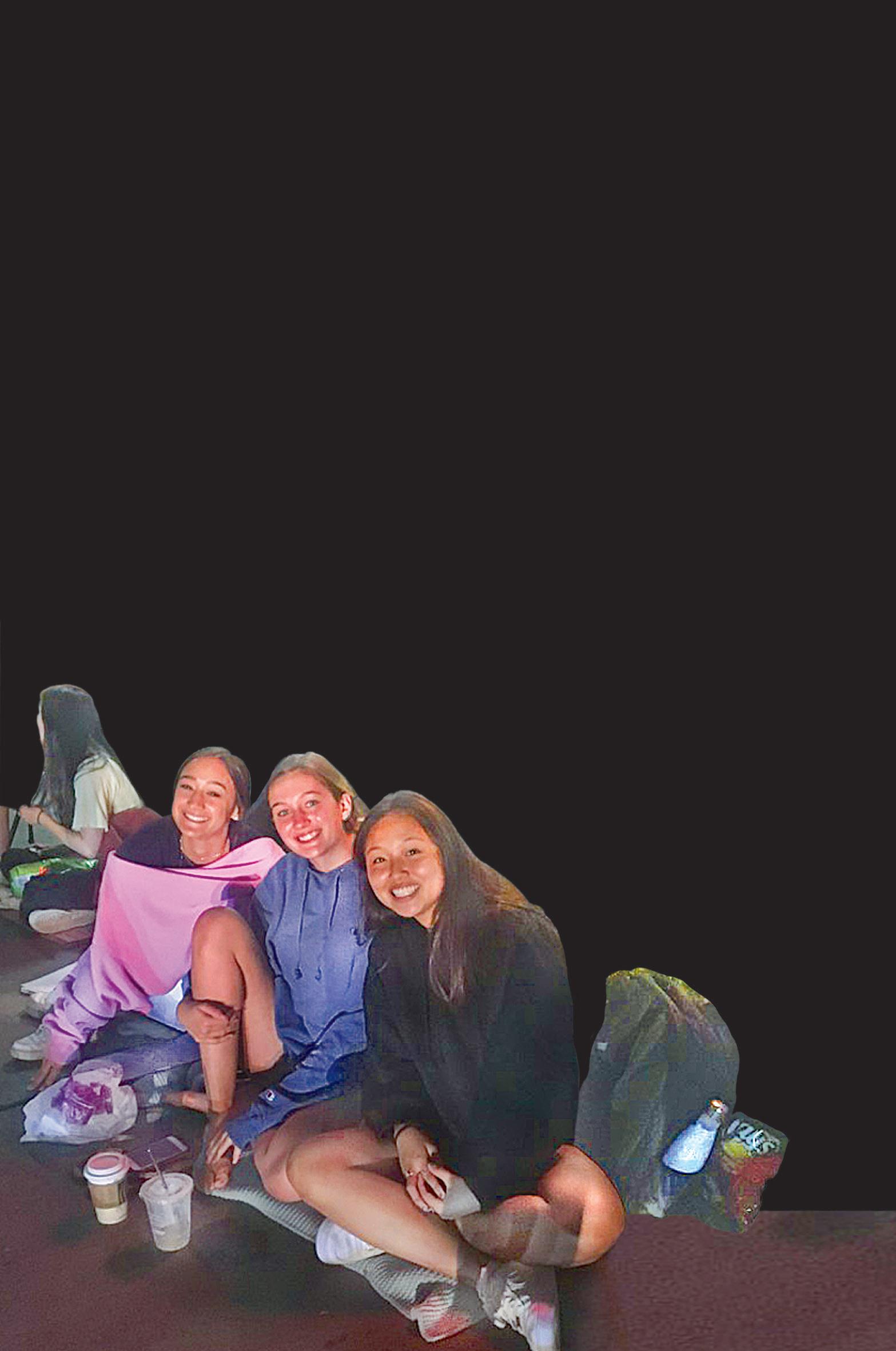
Fifteen hours before the renting office opened on a rainy Thursday morning, the girls spread out their blankets on the sidewalk, plugged in an extension cord through a hole in the door and settled in for the night.
Large local firm the Ithaca Renting Company advertises the opening of the next year’s Collegetown leasing for 9 a.m. sharp on a September day each year. To snag leases in prime locations and at lower prices, students line up hours beforehand or even camp out the night before.
Sophomores Amy Chen ’22, Sophie Matton ’22 and Bella Romano ’22 arrived at the door at 6 p.m. on the night of Sept. 11, equipped with warm clothes and a big umbrella — the forecast threatened rain early in the morning. That wouldn’t stop them from getting the apartment they
bid for the most
wanted for 2020-2021, the only three-bedroom in their complex of choice. One of the girls parallel parked her car in front of them on the street, an accessible haven for a quick nap.
“It’s like Black Friday,” Matton told The Sun four hours into their vigil, but nearly 11 months before she could move into the apartment she hoped to sign a lease for the next day. “We’re not waiting outside of Walmart to get our TV, we’re waiting to get our apartment.”
“It’s like Black Friday ... We’re not waiting outside a Walmart ... we’re waiting to get our apartment.”
Sophie Matton ’22
This is a yearly phenomenon, the company’s manager said. Ithaca Renting is used to students queuing up half a day in advance for the cheapest or most desirable leases, and allowed the groups to stay inside until around 9 p.m.
The three-bedroom that Chen, Matton and Romano camped out for was listed at $1,160 per person, per month. Other buildings that opened up that morning offered rents in Collegetown for as low as $720.
The sophomores could see the window of what they hoped
See HOUSING page 4
Annual Ithaca Apple Festival to Arrive Tis Weekend on Commons
By JOHNATHAN STIMPSON Sun News Editor
Tompkins County’s iteration of the time-honored Upstate New York fall tradition, the Ithaca Apple Harvest Festival, will open this Friday in Downtown Ithaca at noon and continue until Sunday, Sept. 29.
The three-day festival celebrates one of upstate New York’s most iconic and valuable agricultural exports — trailing only Washington in production, the state produces 30 million bushels of apples annually, according to the United States Department of Agriculture.
“The idea is to help share the story and the strong, rich agriculture economy that we have in the county and the greater
Finger Lakes. With apples being the prime crop in New York State, we are in the prime apple region,” Allison Graffin, marketing director of the Downtown Ithaca Alliance, told the Ithaca Times. “The real goal has been to get back to the roots to share with people coming in why this festival and why apples are so important to our region.”
Started in 1982, the 37-yearold event, which is free to attend, will include a wide variety of musical showings, artist demonstrations and local vendors.
Over 20 local farmers will have stalls centered on the Commons and surrounding streets, selling products and ingredients sourced from Ithaca’s hinterlands, notably
See APPLES page 3
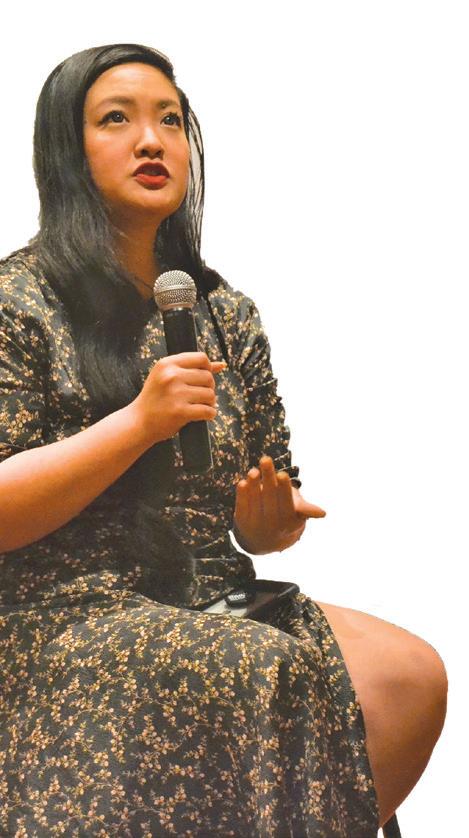
Amanda Nguyen Gives Speech at 10th Anniversary Celebration of A3C
Nobel Peace Prize nominee speaks about struggles, triumphs at Asian and Asian American Center
10
By ANGELA LI Sun Staff Writer
She is a Nobel Peace Prize nominee, has helped pass protections for sexual assault survivors unanimously through the U.S. Congress and is training to become an astronaut — and she’s only 27.
Amanda Nguyen visited Cornell on Sept. 19 as the keynote speaker for the 10th-anniversary celebration of the Asian and Asian American Center, bringing with her a tale of Asian American determination, political will and activism that parallels the history of the A3C itself. The center was borne out of a
need to “make this campus more responsive to the specific needs of students of Asian descent,” after several suicides by Asian students and incidents of “anti-Asian assaults” sent shockwaves through the Cornell campus during the 2002-03 academic year, according to Prof. Derek Chang, history and Asian American studies.
A task force was then convened and issued recommendations. But it was not until 2009 — after the University faced years of sustained pressure from student activists, with help from alumni, faculty and staff — that the A3C opened its doors.
“Institutional leaders, rather
than initiating change themselves, were pushed to it by stakeholders,” Chang said. “This center was created by you, and this center is for you.”
That same ethos held true for Nguyen as she “penned her own civil rights into existence” in the face of a broken criminal justice system after she was sexually assaulted in 2013 as an undergraduate at Harvard.
a choice. I could accept the injustice or rewrite the law, so I rewrote it. No big deal!”
“I realized I had a choice. I could accept the injustice or rewrite the law, so I rewrote it.”
Amanda Nguyen
As the room laughed, Nguyen echoed the words of Elle Woods, a fellow Harvard alumna of Legally Blonde fame: “What, like it’s hard?”
“I felt a lot of despair, but I also felt fire,” she said. “I realized I had
SARAH SKINNER Sun Managing Editor
SARAH SKINNER / SUN MANAGING EDITOR
Early birds | Students line up nearly 15 hours before the Ithaca Renting Company opens in a
desirable leases.
BORIS TSANG / SUN PHOTOGRAPHY
Apple-tizing | The 37th annual celebration of New York’s most iconic fruit will feature musical acts, cider tastings and farmers from the local area. Above: A scene from last year’s festival.
Years | Nguyen’s keynote address marked a decade of existence for Cornell’s Asian and Asian American Center.
September 24, 2019
A LISTING OF FREE CAMPUS EVENTS
Retirement plans | For
Today
and
Graduate Women in Science: On the Menu 11:30 a.m. - 1 p.m., 100 Mann Library
BEDR Workshop: Hengchen Dai 11:40 a.m. - 1:10 p.m., 141 Sage Hall
Professional Development Roundtable With Goldman Sachs Noon - 1:30 p.m., 401 Warren Hall
Economic Education Talk: Mike Urbancic 3 - 4 p.m., 231 Rockefeller Hall
Transboundary Conflicts of the Food-Energy-Water Nexus: SahelianTranshumance and Mekong Waters
3:30 - 4:30 p.m., G24 Fernow Hall
American Sign Language Conversation Hour 4:45 - 5:45 p.m., G24A Stimson Hall
Kader Attia: Restitution – Reparation? 5:15 p.m., 105 Space Sciences Building
Total Archaeology at Tel Akko, Israel: New Approaches To Akko’s Past, Present and Future 6 p.m., G22 Goldwin Smith Hall
Retirement & Beyond Seminar For Endowed Faculty and Staff 10 - 11:30 a.m., ILR Conference Center, 423
Afro-Asia: Futurism and Feminisms Working Group Noon, FGSS Seminar Room, Rockefeller Hall
Race, Gender and Sexuality: Real Talk about Navigating Differences at Work Noon - 1:30 p.m., 401 Warren Hall
Pyrrhic Constitutionalism? Buddhism, Secularism And the Limits of Law in Sri Lanka 12:15 p.m., 277 Myron Taylor Hall
Functional Fibres
12:20 - 1:10 p.m., T01 Human Ecology Building
Midday Music for Organ 12:30 to 1:15 p.m., Sage Chapel
Cornell United Way Campaign Kickoff Celebration 3 - 4:30 p.m., Willard Straight Hall, Memorial Room
Understanding the Veterinarian’s Role in Wild And Captive Chimpanzee Conservation in Uganda 4 - 5 p.m., LH 3 College of Veterinary Medicine
endowed faculty
staff, transitioning into retirement involves looking at finance, healthcare and more. This workshop, hosted by the Division of Human Resources, dives into things to consider when retirement planning.
COURTESY OF CORNELL UNIVERSITY
From U.S. Politics to Cornell: ILR Students Discuss General Motors Labor Strike, Employee Rights
By MEGHNA MAHARISHI Sun Contributor
The United Auto Workers union made headlines last Monday when it announced a nationwide strike — for the first time in 12 years — against General Motors, demanding better wages and a bigger share in the company’s multi-billion dollar profits.
As nearly 50,000 workers continue to strike for the second week, some Cornellians in ILR shared their thoughts on the issue with The Sun — speaking in support of the strike and workers’ rights to collectively organize.
For labor organizer Dan Kirchner ’21, the ongoing strike has been exciting to witness.
“I’m a labor-side student at ILR and I plan on going into the labor movement when I graduate and the strike is really exciting for me,” Kirchner said. “It’s one of the first times in decades auto workers have stood up to companies like General Motors, which have been making record profits. They’re not sharing that with the workers who produce that wealth.”
The UAW strike comes after General Motors and the union failed to negotiate a new contract in July on wages, health care, benefits, profit sharing and job security for
“What
they’re doing is fair, and it is one of their rights to express that they are not happy with the current conditions.
’20
”
permanent and temporary workers. The UAW also tried to persuade the company to reconsider the proposed closures of four facilities. Currently, negotiations have appeared to hit a stalemate.
In a press release, UAW vice president Terry Dittes said that the strike was justified after General Motors employees helped the company reach sizeable profits since the company filed for bankruptcy in 2009 — General Motors generated $8.1 billion globally in 2018.
General Motors responded to the UAW’s concerns on Sept. 15 and said it offered more than $7 billion investments in U.S. plants, an additional 5,400 jobs, access to more healthcare services and increased wages and benefits.
Despite General Motors’ proposed offers, ILR Global Affairs Club president Malikul Muhamad ’20 believed the strike was fair and found it fascinating to see concepts from his ILR classes in Labor Relations and Labor and Employment Law in a real-world setting.
“I think the workers, what they’re doing is fair, and it is one of their rights to express that they are not happy with
the current conditions,” Muhamad said. “The fact that General Motors is trying to resort to other controversial tactics such as relying a lot on temporary workers, I think that’s something that’s very — you know, spitting on the face of the workers.”
While General Motors has resumed talks with the UAW, the company furloughed over over 1,200 workers in the U.S. and Canada. Some believe the workers’ demands in this strike could leave GM uncompetitive in U.S. markets as globalization and outsourcing has increased over the past few decades and the company now makes more revenue in China than it does in North America.
Muhamad also mentioned that the ILR Global Affairs Club is hoping to discuss the strike at club meetings and as president, he hopes to foster an inclusive environment that allows for all perspectives — workers and management — to be heard.
Kirchner told The Sun his organization — which is currently in the process of a merger between the Cornell Organization for Labor Action and the People’s Organizing Collective — will be discussing the strike and finding ways
to support the affected workers.
Beyond the halls of Ives, the strike has also become a political issue in the 2020 presidential election. As auto worker support for the Democratic Party has slightly declined in recent years, a few presidential contenders have expressed their support for the strike. While the UAW endorsed Hillary Clinton in the 2016 presidential election, almost 30 percent of the union’s members voted for President Donald Trump, representing a greater share than the percentage of votes that went towards Republican presidential candidates in the two previous elections.
Labor organizer Kat Restrepo ’21 said that the UAW strike illustrated the importance of worker’s rights beyond General Motors plants.
“Everyone’s gonna work,” Restrepo said. “Everyone’s gonna be in the workplace, regulated by their managers, by their employers and it’s important for people to know their rights to collectively organize to obtain those rights.”
Meghna Maharishi can be reached at mm2828@cornell.edu.
Locally Beloved Apple Fest Returns to Ithaca
including at least five apple donut vendors — long one of the festival’s most popular seasonal treats. Dozens of other established area restaurants and popular Farmer’s Market staples will also be stationed at the festival.
A lineup of area musical acts will perform regularly throughout the festival at the Bernie Milton Pavillion and at a West State Street location.
At least 10 cider makers hailing from the upstate area will host a series of four separate, paid tastings throughout the day on Saturday. For fans of the boozy apple-based beverage, Ithaca restaurants will also stage a “Cider Trail,” offering special cocktails and deals throughout the weekend.
In addition, on September 28, the First People’s Festival will take place concurrently at nearby Dewitt Park from
11:30 a.m. to 5:30 p.m. The event, hosted by Ithaca’s Multicultural Resource Center, will highlight Upstate New York’s Native Americans through a variety of cultural demonstrations, craft vendors and workshops.
Long a fall favorite among residents, Cornell students also expressed excitement at the chance to attend the downtown events.
“Going to Apple Fest my freshman year introduced me to Ithaca Commons and was one of the many vibrant community events I attended there,” Weston Barker ’21 told The Sun. “Ithaca is more than just the Cornell campus, so if you’re looking to broaden your horizons, and palate, it’s something I highly recommend.”
Johnathan Stimpson can be reached at jstimpson@cornellsun. com.
Laborious | United Auto Workers union members and supporters demonstrate outside the General Motors Flint Metal Center in Flint, Michigan. The strike has already impacted General Motor’s operations in Canada.
ERIN KIRKLAND / THE NEW YORK TIMES
Malikul Muhamad
HBO swept the 71st Emmy Awards with big wins for its hit show Game of Thrones, while Amazon followed behind in streaming services.
Game of glory
Students Camp Outside Ithaca
Renting in Bid for Housing Lease
to be their new home from the street.
“The location is really good, and the price is pretty good too,” Matton said. The three said they didn’t really want to be on the sidewalk, where people took pictures of their camp and passerby shouted questions, but they didn’t want to miss out on the apartment and regret it later.
Rentals in Ithaca are an increasingly competitive game, especially in the highly sought-after Collegetown area. The closer to campus and the better the amenities, the higher the rent.
Some apartments in the area, such as those at 312 College Avenue, cost up to $4,150 (around $1400/ month per person) for a three-bedroom apartment. The same complex offers students one bedroom, one bathroom apartments for up to $2,445.
Down the street, residents of 201 College Avenue pay up to $2,500/month for a 400-square-foot, one-person “luxury” apartment.
Typically, students sign leases on these apartments far in advance. Lisa Everts, the rental manager for Ithaca Renting, told The Sun that the business began receiving inquiries for the 2020-2021 academic year in April — over 14 months before those leases would begin.
Ithaca Renting, one of the largest local firms, leases to over 600 tenants near campus. Often, Everts said, it is one of the last Collegetown companies to open up their rentals for the following year.
“We want to give our current residents enough time to at least move in to their new apartments before we invite them to renew their leases,” Everts said.
Ithaca Renting opened their leasing on Sept. 12. As of that day, Cornell students had been in class for exactly two weeks.
Chen had a 10:10 a.m. class that Thursday morning, and carefully folded inside her bag was a profes-
sional outfit for the day’s Career Fair. She planned to sign her lease, don her heels and catch a ride up to Bartels, hopefully scoring both an apartment and a summer internship in one day.
Everts said that the company tried to plan the opening times strategically, but seeing people waiting outside is “a little bit of a shock each year.”
While only a handful of students — also including Caroline Lee ’22 and several others — spent the whole night on the sidewalk, some arrived hours before the company was set to open.
“I’ve heard that if you don’t get here early enough, you can get screwed over,” said Chris Hales ’22, who showed up at around 6:50 a.m. “And it’s a good thing I did.”
Hales and his roommates clinched the final triple in another Collegetown building, also owned by Ithaca Renting. It was worth it, he said — “We’re not homeless next year.”
Neither are Chen, Matton and Romano.
They stayed through the night, working on problem sets on computers plugged in through the crack in the Ithaca Renting door and watching Katherine Heigl movies. A Wings Over Ithaca employee offered to let them use the bathroom, at least until the shop closed at 2 a.m. Around that hour, a soft rain began to fall.
The renting office employees took pity on the groups of people on the sidewalk, and opened up the leasing office early the next morning. By 9 a.m., the girls were official lessees of the Ithaca Renting Company.
“There was a group that got here at like 7 p.m. last night,” said Chris Konja ’22, who lined up at around 8 a.m. that morning to sign a lease with Hales that would start the next year. “That’s crazy.”
Sarah Skinner can be reached at sskinner@cornellsun.com.
Activist Amanda Nguyen Speaks at A3C
Celebration
It is with the same lighthearted humor and frankness that Nguyen narrated the monumental significance of the unanimous passage of the Sexual Assault Survivors’ Bill of Rights Act in 2016, a rare example of bipartisanship in an increasingly polarized political climate.
“Jeff Sessions and Elizabeth Warren stood together to cast their vote on my bill — they’ll never do that again,” Nguyen quipped.
The achievement was made possible by the lobbying and advocacy work of Rise, a nonprofit Nguyen founded in November of 2014. Her work alongside the organizers and volunteers of Rise demonstrated the power of grassroots activism and the importance of passing on the torch to anyone who wants to join the movement.
The passage of the federal bill was “not the end of the story; really, it was just the beginning,” said Nguyen. Because most rape cases are adjudicated at the state level, her goal was to pass similar laws in all 50 states. To date, 26 state-level laws have been passed in the span of 27 months, which, as Nguyen pointed out, made the movement more successful than all the Democratic presidential candidates in the number of bills they were able to pass in their careers.
Nguyen also tapped into themes of the Asian diaspora and Asian American struggle. She credits her mother, who came to the US as a Vietnam War refugee, as the reason she got the “courage to take on the United States government.”
“She went into death to seek life,” Nguyen said of her mother’s harrowing escape from the Vietcong by boat. “She got me here, and we are all the dreams of our ancestors.”
At this point, the conversation turned to the sense of duty to their immigrant parents that many Asian American children feel.
“I’m an activist, which means by default I’m a failure because I’m not a doctor,” she joked. But there is truth behind the humor: Her decision to dedicate herself to this “risky field” faced “strong objections” from her parents for years.
“My other classmates felt this pressure from their parents, because their parents had given them so much and sacrificed so much to be in this country, that they had to do what their parents wanted them to do,” she said. “But we don’t owe anyone anything. You owe yourself the truth, which is what makes you happy.”
Aside from lack of support from family, being a young Asian woman in activism is lonely in other ways as well, she said. Nguyen spoke about “one of the most humiliating experiences [she’s] ever had,” when Senate staffers did not believe she was one of the witnesses invited by both parties to testify, but let her fellow white witnesses go through to the Senator’s office.
“I didn’t know whether to be the angry minority or to just accept it,” she said. “Is it even worth it to play by the rules of a game that wasn’t written for you?” Since then, through conversations with other Asian female trailblazers, Nguyen has learned to “just keep going.”
“This is the price you pay when you are the first of something,” she recalled what labor activist Ai-jen Poo once told her. “You will feel this pain. Just keep going.”
“If Elon Musk can do Paypal, Tesla, and SpaceX, then I can do civil rights, and space, and fashion,” she said. “It’s totally okay to do all these things. You don’t have to sacrifice any part of your life.”
SC I ENCE
Big Red Hacking For a 5th Year And Beyond!
By CAROLINE CHANG Sun Staff Writer
This past weekend, Big Red// Hacks, Cornell’s oldest, student-run, large-scale hackathon hosted their annual event in the Physical Sciences Building for the fifth year in a row.
Sixty-seven teams representing Cornell and other universities such as Princeton and Binghamton came together to brainstorm and develop projects ranging from website applications to hardware prototypes that centered around this year’s theme of “Community Superheroes.”
“We wanted to encourage hackers to think about how they can use their skills to help their communities and the people around them,” said Danny Yang ’20, a member of the Big Red// Hacks organizing a committee.
Students aimed to cover a wide variety of social justice issues, from tackling housing inequality to fine-tuning interface support for the visually impaired. For instance, the team ArkAngels, which came up on top in the Wayfair Housing Inequality, created an application targeted towards low-income households. This app uses computer vision to detect potential home intruders and fires and allows users to monitor their homes.
Hackathon participants benefited from learning different software frameworks for building their applications as well as working collaboratively in teams.
“I think it’s a great opportunity to get to know others who one may not usually interact with,” said Jordan Levin, a current senior at Binghamton University and a weekend participant in Big Red//Hacks. “I always like to join a group of totally new people at a hackathon.”
In addition to hosting competitions, Big Red//Hacks provides workshops to teach students how to incorporate the software used by these companies into their projects. This encourages
the event’s sponsors — such as Wayfair, IBM and Google — to attend the hackathon to help mentor and interact with the students.
“Hackathons are very expensive to run, and there are definitely a lot of events that companies can pick to attend,” Yang said.
“We have a fantastic sponsorship team that maintains excellent relations with sponsoring companies, and every year we try to think of new ways to improve the experience of sponsors based on their feedback.”
While a lot of participants majoring in fields such as computer science and electrical and computer engineering, there are certainly opportunities for students with other unique skill sets to find their spotlight.
“I would definitely encourage future hackathon members even outside the [computer science and ECE] majors to participate in such events.” YunMi Koh ’20, who majors in environmental analysis and design, said. “You can always bring fresh ideas and perspectives to the table.”
Koh said that with her design background, she was able to contribute to the aesthetics of her group’s app Foresight, a runner-up project to Bloomberg’s prize. It was an ideal situation where her teammates could learn from her, while she learned from them.
“I largely enjoyed my experience at Big Red//Hacks. I got to meet people with creative ideas and who really liked to make cool stuff, and I got to make something I felt was pretty cool.”
Kane Tian ’21, a member of ArkAngels, said. “I’d tell underclassmen to explore their options and try a hackathon for the experience itself, because you’re not going to get to do this often later.”
Check out all the student projects at the following link: https://brhfa19.devpost.com/
cchang@cornellsun.com
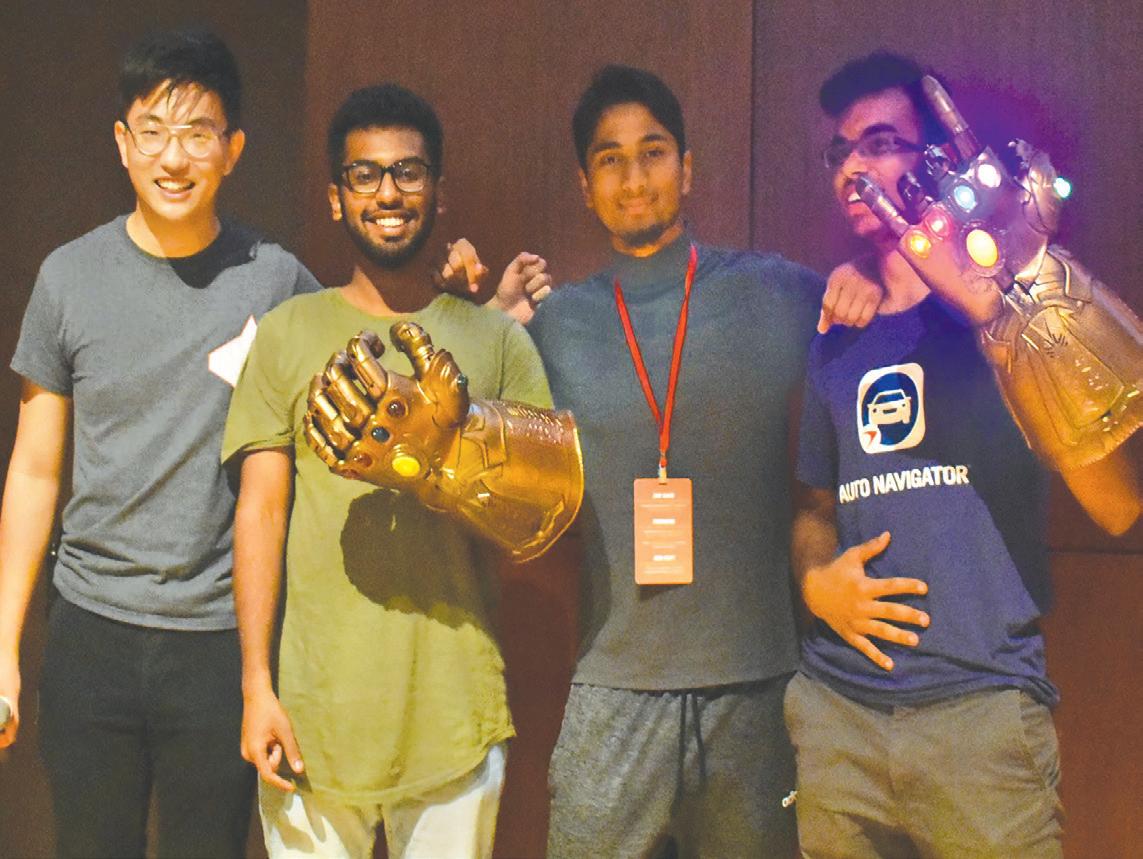
Champion hackers | Big Red//Hacks coordinator Danny Yang ’20 with a winning team and their prize, an Infinity Gauntlet.
Caroline Chang can be reached at
ARTS & ENTERTAINMENT
Cine Con Cultura Takes Over I.C., Cornell
September 15 marked the start of Latinx Heritage Month, and therefore the opening of the annual Cine con Cultura Latin-American Film Festival. The film festival is a huge collaboration between Ithaca College, Cornell University and the Ithaca community that brings 11 films in Spanish to local cinemas. The festival runs the duration of Latino Heritage Month: September 16 to Oct.13. This is the festival’s sixth year, showcasing films with a variety of themes with the common goal of celebrating Latinx culture struggle, art and resilience.
In addition to longtime partners Cinemapolis, Ithaca College, Cornell Cinema, ¡Cultura Ithaca! and the Latino Civic Association, Cine con Cultura is also teaming up with the Multicultural Resource Center, the Tompkins County Immigrant Rights Coalition, the LGBTQI Center at Ithaca College, the Finger Lakes Environmental Film Festival and the Committee on U.S.-Latin American Relations. Festival screenings are currently taking place several times a week from Monday, Sept. 16 through Sunday, Oct. 13. There will be a total of 12 films shown this year with a wide selection of feature-length films and documentaries. There are also related events for festival-goers this year, including a Q&A with Cuban filmmaker Miguel Coyula on Oct. 3 at 7 p.m. at Cornell Cinema.
The ¡Cultura Ithaca! program aims to provide, foster and share Latinx & Latin American culture with the Tompkins County community through free and low-cost arts and education experiences. Community members, professors and students bring events into the community and build connections to its exciting and diverse Latinx roots that explore different Latinx cultures through
storytelling, music, film, dance, art, theater and more. ¡Cultura Ithaca! also provides programming that focuses on civic engagement and education on subjects like finances, health, legal issues and more. Cultura’s downtown office, located in the Tompkins County Workers Center on the second floor of Autumn Leaves Used Bookstore, acts as a resource center and gathering space for Latin@s and amig@s to come together. It is also the site of the Cafe con Cultura coffee and Spanish conversation hour.
Several films are free and open to the public and to buy tickets go to Cinemapolis and Cornell Cinema’s websites. Film passes are available at Cinemapolis. The cost is $8.50 per film or $50 season pass for all 12 films.
One film you don’t want to miss is “ I’ll See You Around , the first feature length film produced in Ithaca by Ithaca native Latino director Daniel Pfeffer. I’ll See You Around is about the story of an everyday man, Lucas, navigating complicated personal relationships in the context of a drug crisis that grips the nation and his own family, now and in the past. Showtime is 7 p.m. on Wednesday Sept. 25 at Cinemapolis.
The Cine con Cultura Film Festival would not be possible without its director Dr. Enrique González-Conty, an assistant professor of Spanish and Modern Languages and Literatures at Ithaca College. Further acknowledgment goes to Cornell’s chair of Hispanic Studies Prof. Debra Castillo, comparative literature. Also, Prof. Cecelia Lawless, romance studies and author of Making Home in Havana, has collaborated closely with González-Conty and Castillo to make Cine con Cultura a success for years to come.
Ariadna Lubinus is a junior in the College of Engineering. She can be reached at alubinus@cornellsun.com.
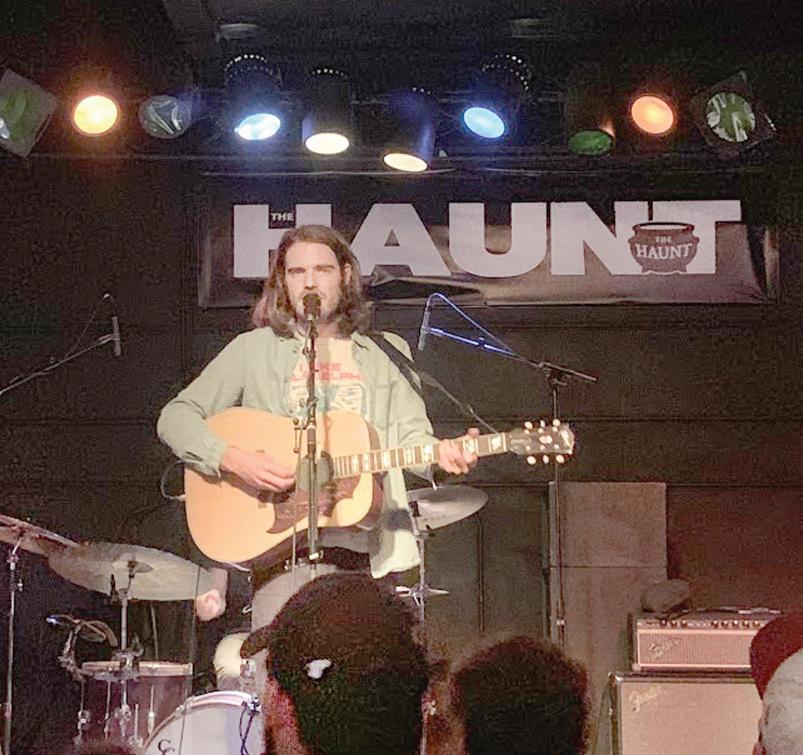
Slaughter Beach, Dog Rocks T e Haunt
DANIEL MORAN SUN ASSISTANT ARTS EDITOR
Often, describing musicians who were previously involved in the emo or punk scene as “maturing” is as good as writing their obituary as a band. Although Slaughter Beach, Dog is independent of Modern Baseball, they clearly rose from their ashes and even contain half of Modern Baseball’s former members. Although it took two albums, Slaughter Beach, Dog has successfully shed all of its former emo-pop sounds and is starting to come into its own, although their new sound is nearly impossible to describe.
The show opened with Cave People, who began with a poem by a recently departed friend that was supposed to go on this tour with them. Their music ended up being pleasant, and it was the perfect opener for Slaughter Beach, Dog. Also, Cave People performed with half of Slaughter Beach, Dog’s members, which is also a quarter of Modern Baseball, if we’re keeping score.
Lead singer Jake Ewald proved once again to be one of the more entertaining live acts in the Indie scene. The entirety of Slaughter Beach, Dog’s discography reflects his personality, and his stage presence is an extension of this. He held conversations with the audience, at one point talking about the crickets outside at the Haunt before telling everyone he’s from Philadelphia and only knows cockroaches.
“Your Cat” was the clear favorite of the night. This is one of the standouts of Slaughter Beach, Dog’s discography and seeing it live was amazing. The lyric “I’ll make it through this if it kills me / And when it kills me I’ll come back / Jesus will make me a disciple / Or maybe he’ll let me be your cat” is one of my favorite lyrics of all time, and hearing it live gave me chills.
Both Cave People and Slaughter Beach, Dog had some of the best live sounds I’ve heard at the Haunt, especially without any major sound effects. Whoever the sound tech was for this show deserves a promotion. Every instrument was perfectly audible with no instrument overpowering any other, to the point that you could even see why bassist Ian Farmer was vibing so hard the entire show. This made some of Slaughter Beach, Dog’s groove sections feel like you were getting hit with a wall of sound.
Usually when you see a band in their “maturing” phase, you expect a rather tepid concert that’s more focused on showing their progression than in getting a rise out of the audience. For Slaughter Beach, Dog, just the opposite happened. Tracks like “Black Oak” and “104 Degrees” showed everyone that they rip way harder than you expect. “104 Degrees” in particular was the best, as it was the song that closed the night and it ended with every member performing their absolute heart out during a five minute groove section.
Slaughter Beach, Dog’s live performance was enough to make me reconsider my opinion on their latest album, Safe and Also No Fear. I was originally lukewarm on it . . .
To read the full story, visit www.cornellsun.com.
Daniel Moran is a junior in the College of Human Ecology. He can be reached at arts@cornellsun.com.
COURTESY OF CORNELL UNIVERSITY
COURTESY OF DANIEL MORAN
ARIADNA LUBINUS SUN STAFF WRITER
Katie Sims Is on Strike
This column space is intentionally left blank because today’s columnist is on strike as a part of the Global Week for Climate Action.
We’ll keep you updated as each day blooms
Katie Sims
Resident Bad Media Critic
Since 1880
137th Editorial Board
ANU SUBRAMANIAM ’20 Editor in Chief
JOYBEER DATTA GUPTA ’21
Business Manager
PARIS GHAZI ’21
Associate Editor
NATALIE FUNG ’20
Web Editor
SABRINA XIE ’21
Design Editor
SARAH SKINNER ’21 Managing
KRYSTAL YANG ’21 Advertising Manager
MEREDITH LIU ’20
Assistant Managing Editor
RAPHY GENDLER ’21
Sports Editor
Working on Today’s Sun
Ad Layout Dana Chan ‘21
Production Deskers Krystal Yang ‘21
Ben Mayer ‘21
News Deskers Anyi Cheng ‘21
Johnathan Stimpson ’21
Design Desker Krystal Yang ’21
Lei Anne Rabeje ’22
Photography Desker Boris Tsang ’21
Sports Desker Raphy Gendler ‘21
Arts Desker Peter Buonanno ’21
Editorial
Tracy Mitrano’s Second Go Is A Bet on Moderation
THE MORNING AFTER TRACY MITRANO J.D. ’95 LOST HER CONGRESSIONAL RACE, she cried
But it wasn’t the bruising eight-and-a-half point defeat that made her well up. It was a text from a campaign staffer telling her that a developmentally disabled man had come by the office to ask, “Did that nice lady win yet?” The man reminded Mitrano of her brother, who also lives with a developmental disability, and who relies on Medicaid — a social service her victorious opponent, Rep. Tom Reed (R-N.Y.), voted to slash.
But the tears dried quickly. On Nov. 14, 2018, just eight short days after losing the midterm election to Reed, Mitrano declared via email, “I’m In.” Once more, she would stand as the Democratic candidate for New York’s 23rd district (which includes Ithaca) in next year’s election.
The Sun’s editorial board recently sat down with Mitrano for an exclusive interview, reflecting on the lessons of 2018 and her outlook for 2020. We came away with the image of a battle-ready candidate who keenly understands her opponent’s soft spots — but who is up against a formidable, well-funded incumbent holding a reddish seat.
Even before eeking out a narrow win in the 2018 primary, Mitrano knew her odds were slim that year. The 11-person Democratic primary would leave whoever clinched it cash-strapped and understaffed. Plus, Gov. Andrew Cuomo, an unpopular Democrat, was on the ballot, driving turnout from moderate Republicans who might’ve stayed home if not for him.
Neither will be true in 2020. Mitrano so far faces just one primary challenger, and the Democratic movers and shakers of NY-23 are all lining up behind her. She maintains a dedicated core of roughly 50 volunteers, Mark Pruce, Mitrano’s campaign manager, told us. That number will no doubt swell as the runoff nears.
But the Mitrano campaign stares down one nagging fact: NY-23 is a Republican district. The Cook Political Report puts the district at six percentage points more red than the national average. As such, the race is Reed’s to lose by default. Mitrano must outmaneuver, outwit and out-mobilize her opponent to win.
How to do that? The Mitrano campaign’s theory of the case boils down to just two numbers, both of which come from an internal poll shared with The Sun. First, the number of NY-23 likely voters who hold a “somewhat unfavorable” or “very unfavorable” view of Reed is 44.8 percent. The same figure for Mitrano is 26.9 percent, exposing Reed’s vulnerability at home. Second, 95 percent of likely voters had heard of Reed, whereas just 80 percent recognized Mitrano’s name — meaning Mitrano has more room to woo new voters than does Reed.
To do so, Mitrano is staking out her ground as a center-left Democrat with deep local ties, much like she did in 2018. Indeed, Mitrano and Pruce both echoed a sentiment expressed most clearly in a campaign kick-off Facebook post: “[Our strategy] was working, we just ran out of time.” In that sense, Mitrano’s second go is very much a rerun of her first.
What Mitrano is doing different is doubling down on moderation. This is in part to neutralize Reed’s “Extreme Ithaca Liberal” tagline — which he trotted out against Mitrano last year, as with his opponents in 2014 and 2016. After receiving blowback, Reed has retired the label as a “good faith extension of an open arm,” perhaps revealing more weakness than good faith.
To continue reading this column, please visit www.cornellsun.com
Loteria, Te Ivy League Stripper
While most Cornell students were off exploring Collegetown annex parties from 8 p.m. to 4 a.m. at the start of their college experience, Loteria* was learning the ins and outs of working as a stripper. Her first night on the job, she made $1,600 — the equivalent of working roughly 144 hours at a minimum wage job in New York state.
Loteria* came to Cornell under the pretense that her tuition costs would be covered entirely by financial aid. But after getting to campus, she realized that a “full-ride” could only get her so far. She found herself in thousands of dollars of debt within her first week at Cornell.
“There were a lot of hidden costs that I didn’t know about as a first-generation college student,” she said when I sat down with her for an interview last week.
comes with significant obstacles. Stripping has taken a toll on Loteria’s mental health and her social interactions.
A student athlete, Loteria had to disrupt her sleep schedule to keep up with her job. On days she strips, she sleeps three hours at night and three hours in the day. “It started messing with my psyche a little bit. I had to start going to therapy because I was so disoriented all the time.”
Her line of work has also socially isolated her from her peers at Cornell. Not only does her schedule prevent her from participating socially, but the stigma attached to stripping also doesn’t help. As a freshman living in Balch, an all women’s dorm, she would often receive complaints about coming home at 4 a.m. or 5 a.m.
She feared what her parents and other loved ones would think. But most of all, she feared getting sucked into a lifestyle that few manage to escape.
The steep textbook costs, plane tickets for when dorms “kick us out” and the fine print costs of Cornell like the student health and activity fees led to a realization about attending college: “I just thought the school was, pardon my French, fucked up.”
On top of her rapidly accumulating debt, Loteria had no laptop, hindering her way to academic success. Managing her rigorous course load and playing on a club sports team, there weren’t enough hours in the day for her to make enough money to sustain herself through a minimum wage job. Her mother raises five other children and doesn’t have the means to financially support her. And taking out loan would guarantee her a lifetime of paying back crippling debt.
“It wasn’t because of what time I was coming home. It was because of what I was doing. It felt like a direct attack.”
As someone who is candid about what she does, she also receives a lot of unwarranted attention. When her social media was open to the public, she received inappropriate messages from students and strangers.
“I started getting D.M.’s with questions that were nobody’s business. People would ask me if I was a prostitute, which there’s nothing wrong with, but you’re mislabeling me.”
She even once had an awkward encounter with giving a lap dance to a professor.
“Those conflicts of interest … they happen.”
Loteria didn’t choose this job because of the perceived glamour or even the unconventionality of it. It was a decision she made out of sheer need. For her, it is just a job, nothing more.
She was left with few options.
So, within the first few days of her freshman year, Loteria took a job dancing at a local strip club. She feared what her parents and other loved ones would think. But most of all, she feared getting sucked into a lifestyle that few manage to escape.
Thus began a cycle of going to class in the morning, sleeping during the afternoon and working from night until daybreak four times a week. Within a month, she was able to repay all of her debts and got herself a laptop.
“I was very happy to feel financially stable for the first time in my entire life,” she said.
Now two years into the job, she finds stripping to have several other benefits aside from financial relief. She has the freedom to choose her own work schedule, dress codes and routines. Dancing serves as a form of exercise while also making her feel like she’s “flying.”
But most importantly, working in a club has given her a unique outlook on life.
“I have definitely gained a lot of empathy. All of the women who are there are there for a reason. We all really struggle with something, especially financially,” she said. “But we are the only support system we have, and once we realized that, we became like a family. I think if I could do that with them, I could do that with anyone.”
But stripping while being a full-time college student at an Ivy League school
At Cornell, where the median family income of a student is almost $152,000, it may be difficult for some to understand her motivation for entering this line of work. But Loteria didn’t choose this job because of the perceived glamour or even the unconventionality of it. It was a decision she made out of sheer need. For her, it is just a job, nothing more, nothing less.
“As much as I do love my job, I wouldn’t do it if I didn’t have to. I wouldn’t do any job if I didn’t have to.”
Loteria hopes to go to law school, and one day work as an entertainment lawyer prosecutor, fighting for sex workers’ rights. Though limited empirical data is available about exotic dancers, most studies conclude that strippers and other women in the sex industry experience disproportionately high rates of sexual assault, substance abuse and PostTraumatic Stress Disorder.
“There’s a lot of sexual assault [in the industry], and a majority of the time we lose the cases. I think we need educated women who have actually been through it and are passionate about fighting against it.”
Leaving my interview with Loteria, I had a newfound understanding of the financial struggles students across this campus face, and a deep sense of respect for her and all of those who work hard everyday to sustain themselves. I wonder if I would have the courage to make the difficult choices she’s made.
*The subject’s name is reflected as her stage name to protect her anonymity.
BORIS TSANG / SUN PHOTOGRAPHY EDITOR
After Protests, Policy
The political climate in Ithaca this past week has been characterized by protests. On Friday, about 50 Ithacans gathered in front of Tompkins County Courthouse to support Rose de Groat and Cadji Ferguson over a controversial arrest in April. On campus, hundreds of Cornellians marched for action on climate change, calling for reforms such as the Green New Deal and divestment from fossil fuels.
These protests are important to change the political lens on our campus. They can inform students and Ithacans about the problems in our community and lead to sustained conversations about the response. But if the rallying cries of these protests aren’t portable outside of Cornell’s insular community, they are meaningless.
The loudest voices in the Cornell community on issues like racism or the climate change are often the most easily heard. But, there is a large sector of the population — your average Cornellian not involved in student organizations and only marginally informed on the issues — ignoring these pertinent problems. If you asked a random student outside of Mann Library their thoughts on abortion, they would be able to forward an opinion. No matter how strong that opinion is, however, it’s likely that the student wouldn’t be found leading, participating or even associating with a protest.
After all, the protest Downtown had 50 individuals (few Cornellians) and the climate protest had hundreds of participants. Neither of these had anywhere close to a majority of the over 20,000 students on campus, indicating that these issues didn’t reach the threshold of action for Cornell students. Why is this the case? If we have opinions, shouldn’t we motivated to pursue action that forwards these opinions?
The efficacy of social protest has often been undersold and denigrated in unfair ways in the university community. I’ve personally heard comments by people wondering whether protestors actually care about the issue or wash themselves of any responsibility in their “one protest of the year.” Second, many of these social protests don’t demands on the state that warrant participation.
American history is rife with examples of “successful” social
protests. The actions of the Civil Rights Movement, ADAPT and anti-war protests all culminated in some change in U.S. federal government policy. The modern-day examples include Parkland students like David Hogg. Florida gun laws changed significantly because of his work along with the activism of several Parkland survivors. Black Lives Matter also critically raised questions about police brutality and anti-blackness.
Cornell’s history is also filled with examples of protest, including the sit-in at Willard Straight and the divest from Israel resolution that was nearly passed in the student government last year. Yet, the narrative during the two most recent protests was negative. Comments on The Sun’s social media feature criticism from readers
We cannot allow folks in Day Hall to determine the direction of resistance: We must define it — in bills to pass, resolutions to propose and representatives to elect.
like Climate Justice Cornell have demanded that President Pollack (and previous presidents) cease ties with major drivers of greenhouse gas emissions and affirm the goal of making Cornell carbon neutral.
None of this is a call to stop protest. Rather, I’m persuaded that calls to change tied to specific and enumerated demands on people in positions of power are the key reason why protests translate into change. Policy change at any level simply occurs slowly. In a university setting, the president and Board of Trustees’ hegemony over the operation and goals of Cornell challenge any power students have to make decisions.
who thought that the climate march was contradictory. One reader even wrote “Hundreds? Sad,” clearly belittling climate change protests using an asinine argument. I heard comments on campus that bemoaned the noise the students were making and wondered why this march was necessary in the first place: “Governments and corporations won’t ever care about student protests,” I heard.
Protest in a vacuum is a strategy of escapism. As many protests as there are that succeeded, there have been just as many protests that have failed. The view of many Cornell students reflects the low probability of success for social movements. Although the divest from Israel bill nearly passed last year, it was stopped by last-minute politicking, like the successful attempt to switch to a secret ballot. Cornell still hasn’t divested from fossil fuels, even though various campus groups
Sarah Park | Spark Notes
Dear Juul Labs,
Although abolition activism started as early as the beginning of the 19th century, the Civil Rights Act wasn’t passed until 1964. And African Americans still experience the aftermath of slavery today. In the same way, the Willard Straight sit-in was over 50 years ago. Yet, a swastika was drawn on campus just last year. Even if activism isn’t perfect (which it rarely is), we should not take short-term failures as determinants of the second-order results of protest.
If, at the end of a protest, we can explain neither who we are demanding concessions or changes from nor what exactly we are demanding from them, the efficacy of a protest and its actual implementation decreases. I don’t think the climate change protesters were wrong for protesting. But, I struggle to find a way forward: When students chant “system change, not climate change,” there has to be an answer to what systems should change and who the actors are to change it. Without an outline for this, the chances of success for protests sink.
We cannot allow folks in Day Hall to determine the direction of resistance: Instead, we must define it — in bills to pass, resolutions to propose and different representatives to elect.
Darren Chang is a junior in the College of Arts and Sciences. He can be reached at dchang@cornellsun.com. Swamp Snorkeling runs every other Monday this semester.
How to Make the Juul Uncool
Oh no! Your cool, sleek, highly addictive flash drive of fun has gotten a generation hooked on nicotine and one step closer to death. And now everyone, including Walmart, the President, New York State and China, is sick of your shit. Who would have thought?
I’m so sorry, it’s so unfortunate that entirely unintentional actions outside of your control resulted in one of the most successful, accidentally detrimental marketing campaigns, giving rise to a health crisis that vilified you in the eyes of the general public.
If you’re going to change the psyche of the Tide-pod generation, you’re going to have to do a little more than add a box on your website that says “Are you 21?”
Certainly not you, who launched the Juul with a “patently youth-oriented” campaign with young models and influencers in a social media frenzy. You, who hired lobbyists and increased political spending to the millions after a study concluded that teens are 16 times more likely to Juul than adults. You, who became the fastest start-up to become a decacorn in the same year the NIH witnessed the largest increase in teen use of any substance in history.
Why did you do all this? Because, of course, you only wanted Juuls to be a means for nicotine addicts to make the switch from cigarettes. Why else would you go to classrooms across the country to tell students that Juuls are “totally safe” before the science was in and launch a full lineup of flavors? Everyone knows that hardcore cigarette addicts could not even imagine getting their nicotine fix without the freshness of a mint or sweet creme brûlée flavored cloud.
How could you have possibly known that your product would single-handedly reverse the greatest decline in domestic smoking to create what The Atlantic called a “mango-flavored trolley problem”. Fail to act and continue to foster youth nicotine dependency; regulate the Juul too intensely and lose an opportunity to get regular smokers off cigarettes.
So what is there to do?
I saw the action plan you rolled out last November — the one that made such sweeping changes including shutting down your Instagram and reducing flavored pod sales. It’s cute. But if you’re going to change the psyche of the Tide-pod generation, you’re going to have to do a little more than add a box on your website that says “Are you 21?”
If you’re going to make a real difference in stopping the crisis you caused or even if you’re covering your ass, you’re going to have to do better than that; you’re going to have to make the Juul uncool. It’s going to take a millenial or gen-Z-er to get you out of this mess. This is where I step in.
Marketing
You claim Juuls were intended for an older demographic, but could you imagine watching your grandma taking fat, mango-flavored rips in the middle of her weekly bridge club? I don’t think so. It’s time to reestablish your target clientele.
You can begin by bringing back your social media presence with full force. But instead of filling your feeds with cool, young influencers, present a lineup of exclusively middle-aged and elderly brand ambassadors who’ve used Juul to wean off cigarettes.
In fact, if the mission of Juul Labs is truly to cure the disease of cigarettes, then start treating your product like an antidote. Take cue from Viagra, and start advertising Juul like a drug. Switch to TV ads with elderly people playing with dogs and running through fields.
Design
Any device small and sleek enough to allow us to take hits unnoticed in the back of class while blowing the smoke into our sweatshirts is a problem. I’d recommend launching an entirely new product version that looks like a floppy disk instead of a flash drive. Instead of pairing it with a tiny charger that fits into a laptop, this version should be connected by a cord to a battery pack that only runs on AA batteries.
Consumer Experience
Juuls are far too accessible to youth. In order to cut down on accessibility, eliminate online sales entirely. Rather, sell Juuls exclusively at malls and only accept payment in cash. Make each Juul consumer sign up for emails and allow Juul to post for them on Facebook.
Who ran against the first Bush? How do you turn on your home’s television?)
Features
Since impending lung cancer doesn’t seem to be enough of a disincentive for young Juulers, it’s time to tap into our collective self-obsession with the new product version launch. This new version could be a social media Russian roulette of new functions.
Every time you take a hit, one of the following will occur: you reshare one of your old Facebook posts, you screenshot the Snapchat story of the person you’ve been stalking the most, you randomly like an Instagram post of one of your followers from at least a year ago, your Airpods lose all charge or one of your Instagram posts loses all its likes, but can’t be deleted.
This will allow us to balance our self-absorption with our nicotine absorp-
This will allow us to balance our self-absorption with nicotine absorption to test if we care more about the decay of our online presence or the decay of our lungs.
An 18 or 21 year-old age requirement? That’s too easy to get around with fakes. Instead, have them answer a unique riddle with each pod that they can’t use their phone to answer (i.e. What is a Roth IRA?
tion to test if we care more about the decay of our online presence of the decay of our lungs. And if none of this works — well then maybe we deserve what’s coming to us.
Sarah Park is a senior in the School of Industrial and Labor Relations. She can be reached at sarahpark@ cornellsun.com. Spark Notes runs every other Monday this semester.
Fill in the empty cells, one number in each, so that each column, row, and region contains the numbers 1-9 exactly once. Each number in the solution therefore occurs only once in each of the three “directions,” hence the “single numbers” implied by the puzzle’s name. (Rules from wikipedia.org/wiki/ Sudoku)
10
On Campus by Elizabeth Klosky ’21
Johnny Woodruff by Travis Dandro Nuclear Apocalypse by Halle Buescher ’21
26 A PA R TMENT FOR R ENT
Houses, Apts, Parking
Golfers Falter in Penultimate Fall Tournament
By BENNETT GROSS Sun Staff Writer
We
607-273-1669
2020-2021
Studio 1, 3, 8 & 11 BR Apts. Great Locations in Collegetown. 607-227-2535
Coming off two top-three finishes to begin the 2019 fall season, the Red didn’t fare as well this past weekend at the Dartmouth Invitational.
After two rounds at Hanover Country Club, Cornell concluded the tournament with an eighth-place finish in the 12-team field.
Junior Charlie Dubiel led Cornell, finishing the weekend at three-under par, his third consecutive top-10 finish. Dubiel secured a seventh-place finish after placing fourth and seventh in the previous two tournaments, respectively.
“I don’t want to call the golf course easy because Hanover Country Club definitely has a few really difficult shots, but beyond those few holes, you can really get after it,” Dubiel said. “I struck the ball really well all week and
never made a big mistake, so I definitely felt like I could have finished even better than I did.”
Senior Jack Casler had gotten off to a hot start to begin the year, with two seventh-place finishes; however, he was unable to continue his early success at the Dartmouth Invitational, completing the two rounds at nine over par, good for 57th place.
The remaining three Cornell golfers — all freshmen — were Benjamin Choe, Josh Lundmark and Sam King. Lundmark led the three neophytes at two over par. Choe, making his first career start, ended at three over par, while King finished at eight over par.
Martin Gutierrez, also a freshman, played as an individual and shot four over par; but since he was designated as an individual, his score did not count in Cornell’s final total of 577.
“Going into the weekend, we kind of had it figured out that double digits under par
could win as a team,” Dubiel said. “It’s easy to panic a bit and try to force shots and make up ground, and all of a sudden you shoot a 75 or a 76 instead of a 71 or a 72, which makes a big difference for the team when two or three guys do that.”
Drexel left Hanover with the crown, compiling a team score of 557. Cornell finished in third place among the four Ivy League schools competing. Dartmouth, the host school, shot 564 and Harvard ended at 574. Cornell was able to edge Brown, which completed the two rounds at 597.
After playing tournaments on three consecutive weekends, Cornell will not be in action this weekend. After the off weekend, Cornell concludes its fall season October 7-8 at the Hampton Intercollegiate.
Bennett Gross can be reached at bgross@cornellsun.com.
607-277-1888
Collegetown Crossing College Ave's Newest Location 307 College Ave. Now Leasing for 2020-2021
Completely New Modern Studios & 2 Bedroom Apartments. Fully furnished, heat & hot water included. Reception area at 307 College Ave. www.urbanithaca.com 607-330-2442 info@urbanithaca.com
27 H OUSE FOR
R ENT
20-21 College Ave.
5 BR House Furnished. Laundry. Parking. Call 607-273-8576
20-21 Upper Eddy St.
7 BR house Furnished. Laundry. Call 607-273-8576
PATRICK SHANAHAN / CORNELL ATHLETICS
Three in a row | Junior Charlie Dubiel completed his third straight top-10 finish.
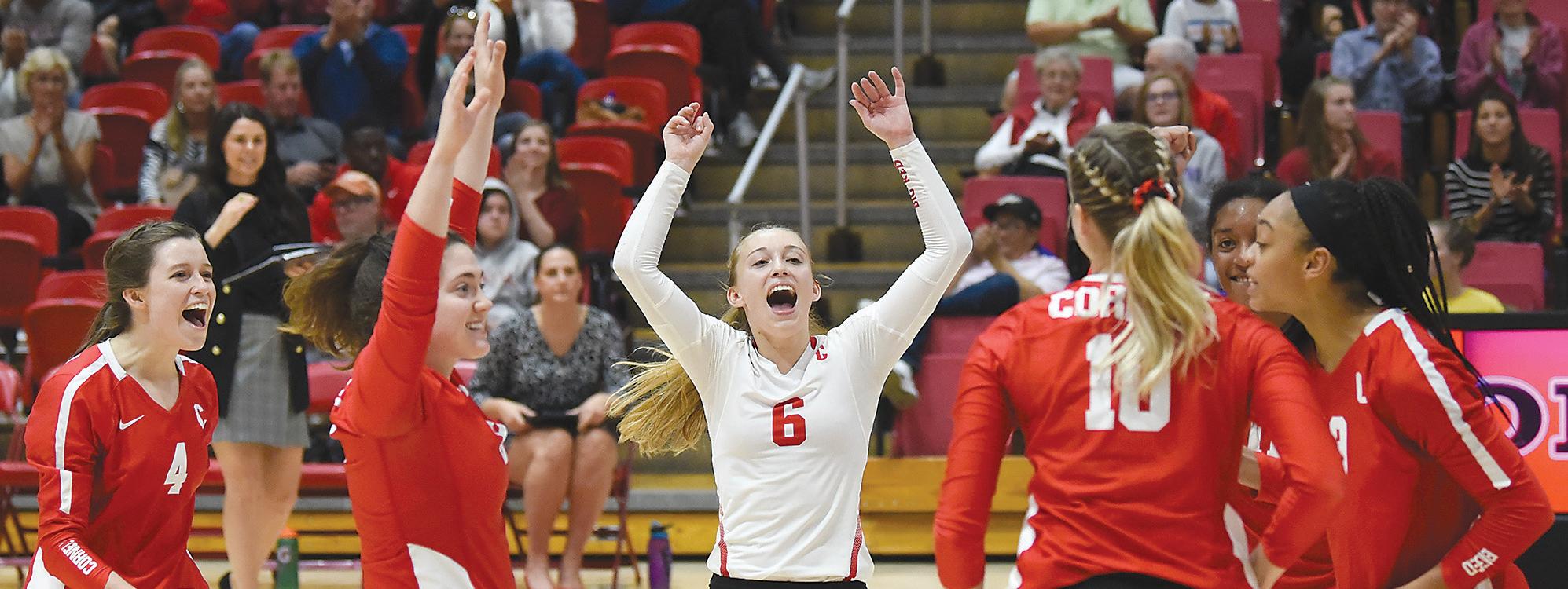
On a roll | Cornell is off to its best start since 2005, and starts Ivy League play against Columbia on Saturday.
C.U. Wins 3 Straight in Bufalo, Heads Into Ivy Play 7-2
By ZORA HAHN Sun Staff Writer
Cornell volleyball travelled to Buffalo, New York to play in the Blue and White Classic last weekend, earning a piece of hardware and securing its best start to a season in more than a decade.
The Red swept its three opponents, increasing its record to 7-2.
Cornell began by playing Canisius College, beating them 3-0 in sets (25-17, 25-15, 25-18). Freshman Joanna Chang contributed nine kills, three aces and one block to Cornell’s win.
The Red then moved on to the University at Buffalo, where it squeezed by with a 3-2 win. The Bulls won the first and fourth sets, but Cornell clinched the game-winning fifth set, 15-9.
Senior Jenna Phelps, sophomore Madison Baptiste and freshman Joanna Chang led the Red in offense, each contributing double-digit kills.
Cornell’s final game was against Saint Francis University, which the Red swept 3-0 to win the tournament.
Phelps was named the tournament’s most valuable player after contributing game-winning kills and blocks in each
match.
Chang and senior Jada Stackhouse both earned both earned spots on the Blue and White Classic all-tournament team.
“I think definitely offense, hitting was really important,” Chang said of what led to the team’s weekend success. “We’ve been working a lot on shots. Also blocking has gotten a lot better and…that helped a lot in the end.”
Cornell’s 7-2 record which is the Red’s best start to a season since 2005. Chang said the team has heightened confidence after such a successful start.
Next weekend, the team will square off
Red Turns in Mixed Results at Princeton; Has Sights Set on Ivy Crown, NCAAs
By JUSTIN SUZZAN
Sun Contributor
After a long summer, the Cornell men’s tennis team began its 2019-2020 campaign with a trip to Princeton Sept. 20-22 for the annual Farnsworth-Ivy Plus tournament. After a loss to Columbia ended his team’s season last year, head coach Silviu Tanasoiu is motivated to push his team to new heights this time around.
“Our primary goal is to be as professional as we can possibly be in our approach to training, competing and everything else preparation-wise that pertains to us giving the best possible chance to perform at the highest level,” Tanasoiu said.
weekend.
“I thought the tournament was successful for me. It was unfortunate that I injured my shoulder,” Kirovski said. “I played very good tennis. My forehand worked very well.”
Bynoe continued his tournament in the Tiger bracket, where he took on Scott Jones of Tennessee. After fighting hard for two sets, he suffered a 6-4, 6-0 loss. Despite losing in singles, the junior said he had much to be proud of this weekend.
“I felt that I played at quite a good level this weekend but [didn’t win] since I haven’t played a tournament in awhile,” Ho said. “I was able to get a lot of good match experiences this week and I hope to build on that.”
Rounding out the singles matches, junior Eero Vasa competed in the Lenz bracket against Tennessee’s Jordan Chrysostom. He fell to his opponent 6-4, 6-4. In doubles, Vasa and Ho teammed up in the Forbes bracket to take on Michigan’s Harrison Brown and Kristofer Siimar. After a contested match, the pair fell 8-3.
“We came extremely close last season and saw a little glimpse of what we’re capable of.”
Evan Bynoe
Four players represented the Red at the event. In the Cordish bracket, sophomore Knonstantin Kirovski lost his second-round match to Kentucky’s Parth Aggarwal by a score of 6-1, 6-3.
In doubles, Kirovski teamed up with junior Evan Bynoe to defeat Luka Vukovic and Patrick Graziani of Indiana, 8-4.
In the next round of the Rockefeller bracket, the Red conquered the Miami duo of Stephen Madonia and Pablo Aycart-Joya by a score of 8-3 before an injury brought an early end to Kirovski’s
“Doubles was fantastic,” Bynoe said. “I think Konstantin and I worked really well together as a team. As for singles, I would say I played fairly well, though there’s lots of room for improvement.”
Over in the Pagoda bracket, junior Denton Ho faced Buffalo’s Valdemar Holm. The two produced a thrilling, back-and-forth three-setter that saw Ho come out on the losing end 7-5, 4-6, 7-5. Ho hopes to draw on his experiences this weekend and use the fall tournament schedule to work on his game.
Despite the loss-heavy results, Tanasoiu sees this weekend as a learning experience for the team. He said he is excited to watch his team grow this season while they focus on improvement everyday at practice.
For the Red, this weekend was the start of an exciting year in which the team will look for redemption. After Columbia ended Cornell’s season and NCAA tournament chances, everyone is eager and focused on accomplishing more.
“I am very excited about the entire group of guys we have for this year,” Tanasoiu said. “We have a tremendous amount of depth with some incredibly talented individuals that are capable
against Columbia in its first Ivy League matchup. Last year, Cornell defeated the Lions twice (3-1 and 3-2).
Chang said that in preparation for the game, Cornell will “watch and see their hitters and how they hit and so we adjust our defense to them.”
Cornell will only be playing Ivy League teams until mid-November, when the season ends. Last year, the team placed third in the Ivy League after Princeton and Yale. Cornell faces Columbia at 2 p.m. Saturday at Newman Arena.
Zora Hahn can be reached at zhahn@cornellsun.com.
of great things. I have a lot of faith in this entire group and believe we will accomplish great things together.”
The Red is eyeing something much greater this season. With their coach behind them, the players’ sights are already set on next spring’s NCAA tournament as well as the Ivy League crown.
“I would love to help lead the team to an Ivy League Title and make the NCAA tournament,” Bynoe said. “We came extremely close last season and saw a little glimpse of what we’re capable of, so I think we’re all hungry for more this time around.”
One of the biggest concerns for Tanasoiu and the team for this season will be staying healthy.
The injury to Kirovski this weekend is a reminder that tennis is a sport that requires its athletes to be in peak physical shape. The season is long and grueling and for the Red to succeed, it will have to get season-long contributions from all its players.
“Last year we played half our season without two of our better players,” Tanasoiu said. “We need to do a better job in that department.”
With months until the ultimate goals — an Ivy championship and the NCAA Tournament — the team’s next test will come Sept 27 when it heads to Yale for Ivy Minus.
Justin Suzzan can be reached at jbs389@cornell.edu.
Looking ahead | Cornell’s injury issues derailed its season a year ago — but the Red hopes its health can hold up next spring.