The Corne¬ Daily Sun


By VEE CIPPERMAN Sun News Editor
In a special meeting on Sept. 9, the Faculty Senate voted on two Resolutions to grant instructors the ability to move their courses online. They both passed on Sept. 10, and now await approval from President Martha Pollack and Provost Michael Kotlikoff.
Prof. Risa Lieberwitz, industrial and labor relations, president of Cornell’s American Association of University Professors Chapter, spoke on the importance of these Resolutions at the Sept. 9 meeting.
“They call for logical and fair actions based on three principles: safety, transparency and consultation,” she said at the meeting.
The vote follows weeks of controversy over the
University’s classroom accommodation policies, which emphasized in-person teaching over other concerns. On Aug. 11, Cornell announced that it would deny faculty requests for remote teaching based on disability. Two days later the University walked that decision back, allowing
By SARA JAVKHLAN and KAYLA RIGGS Sun Staff Writer and Sun Assistant News Editor
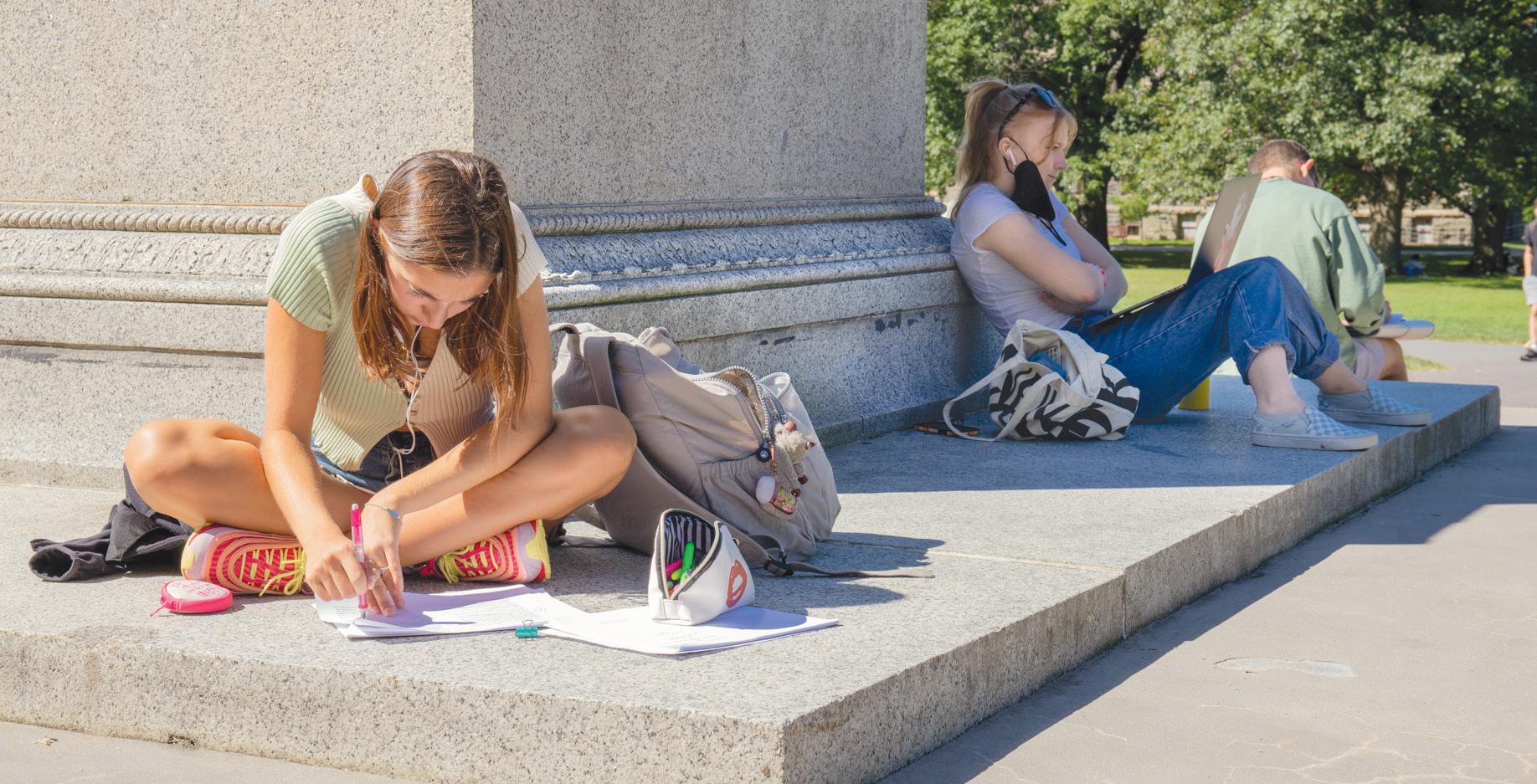
With the fall semester fully underway, the hustle and bustle of campus is back with in-person classes and events –– but crowding in campus dining halls is posing concerns for some students and workers.
Lines snaking out the door at Trillium and students packed side by side at tables against a tune of loud chatter have caught some students by surprise after last year’s mostly to-go dining experience. Some students say they worry about the health and safety of eating in Cornell dining halls, even as University guidance is giving the go ahead to maskless meals.
Cornell announced in June that dining halls would reopen this fall amid low COVID cases and rising vaccinations on campus. But with Cornell at alert level yellow, some students said they’re concerned by crowded dining halls, especially during peak hours such as lunch time.
Scott Wang ’22 has frequented the dining halls this semester and noted this fall’s long lines at the renovated Okenshields, compared to before March 2020 and to last year — when Central Campus’s only dining hall closed as foot traffic dwindled.
“Usually the lines are pretty long, but the line would be so long that it would snake around the entire room,” Wang said. “The entire room was actually full ... like a party.”

“Sometimes going from being in isolated seating to a crowded room of people is daunting.”
Kelli Williams ’24
Last school year, students experienced Cornell Dining operating at a limited capacity. Most students took their food to go, an option Cornell has kept this year. Only a small number of seats were available for in-person dining last year, with students often having to reserve a dining time slot on OpenTable. Dining halls were dotted with physical distancing markers, and students could not serve their own food.
For students like Roland Aristide ’24 and Kelli Williams ’24 –– both of whom worked at Robert Purcell Marketplace Eatery last year –– the return to closer to normal operations in dining halls has been intimidating, since this is their first entirely in-person semester.
“This is what I imagine the regular college experience to be like,” Williams said. “I think we need time to get used to that, but sometimes going from being in isolated seating to a crowded room of people is daunting.”
Aristide pointed to the amount of people in the crowded dining halls eating, maskless at tables with no social distancing restrictions, noting that this setting feels difficult to work around.
“It’s not their fault, because they’re literally eating, so what are you going to do, keep your mask on?” Aristide said.
Despite concerns about the number of students eating in close proximity at dining halls, Senior Director of Campus Life Marketing and Communications Karen Brown said not to worry.
“Students, who are nearly all vaccinated, should be comfortable taking off
Thursday, September 16, 2021
Incredible Commitments: How U.N. Peacekeeping Failures Shape Peace Proceses 11:25 a.m., Virtual Event
Want Less Whine With Dinner? Attaining ‘Ideal’ Family Mealtimes With Parents of Young Children Noon, Martha Van Rensselaer Hall
Non-Academic Job Search Resources for Positions In and Outside of the U.S. Noon, Virtual Event
Deliver and Grade Assignments With Gradescope 2:00 p.m., Virtual Event
Establishing Africa Free Trade Agreement 2:40 p.m., Virtual Event
Trans-Generational: A Dialogue on the Evolving Meaning Of Gender and Sexuality 4:30 p.m., Virtual Event
Crafting a Compelling Cover Letter 4:45p.m., Virtual Event
Cannupa Hanska Luger: Artist as Social Engineer 5:15 p.m., Abby and Howard Milstein Auditorium
College Scholar Information Session
7 p.m., Virtual Event
Movies on the Arts Quad: Spider-Man: Homecoming (Welcome to Your Cornell Home!)
8 p.m., Arts Quad

Climate change | Attend a lecture at the Milstein Auditorium tomorrow by Timon McPhearson, Associate Professor of Urban Ecology and Director of the Urban Systems Lab at The New School.
Tomorrow
Ridhi Kashyap Innovations in Population Science Seminar Noon, Mann Library 102
Timon McPhearson: Climate Risks, Nature-Based Solutions and Equity in New York City 12:25 p.m., Abby and Howard Milstein Auditorium
Natural Dye Use
In the United States by Individuals, Communities and Industries 12:30 p.m., Martha Van Rensselaer Hall
Cornell Field Hockey vs University at Albany 2:00 p.m., Dodson Field
Stochastic Mechanisms of Cell-Size Regulation in Bacteria 2:00 p.m., Baker Lab 219
LEPP Journal Club
Valentina Cairo (SLAC)
3:00 p.m., Physical Sciences Building
Ice Cream & Cow Party Crowns Coloring At The Dairy Bar! 3:00 p.m., Stocking Hall
Cornell Career Services Open House 3:00 p.m., Virtual Event
Sophomores @ Schoellkopf 7:30 p.m., Schoellkopf Field
and the University has outlined several ways to reduce transmission, including social distancing and meeting only in small groups, that are impossible to carry out in many classrooms.
Chapter of the American Association of University Professors each submitted a letter to the University. The faculty letter requested an expansion of online teaching accommodations and stated community safety concerns with an in-person semester. The AAUP letter outlined the legal challenges to Cornell’s policy at the time, which it stated stood in violation of the Americans with Disabilities Act and the New York State Human Rights Law.
The Faculty Senate did not originally plan to meet until Sept. 22, but it convened early to vote on the resolutions that senators introduced on Sept. 8. Each Resolution received backing from over 64 faculty member cosponsors, 9 faculty senators and the Cornell Chapter of the AAUP.
Senators titled the first resolution as the “Resolution on Adopting Policies for Reasonable Accommodations to Faculty, Instructors, Staff and Students During the Pandemic.” It passed with 65 votes to 21.
“When the public health situation permits it, we are committed to providing our students with a residential experience.”
President Martha Pollack
“This resolution concerns University policies to provide reasonable accommodations during the pandemic,” the resolution’s introduction read. “University policies should be developed based on the principles of safety, transparency, and consultation to respond to faculty, instructor, staff and student needs for a safe and healthy teaching, learning, and working environment.”
The first resolution criticizes the Aug. 11 and 13 University policies, stating that they caused anxiety for the Cornell community, violated the ADA and the New York State Human Rights Law and failed to meet ethical obligations to the Cornell community. It calls on Cornell to adopt broad, flexible policies, using consistent standards and good faith consultation with the Faculty Senate and other bodies of governance.
The second resolution, called the “Resolution on Faculty Discretion to Teach Online If Students Are Infected or Where Classroom Conditions Make Social Distancing Impossible,” addresses classroom modality more directly than the first. It passed 51 votes to 34.
“When the administration isn’t making the best decisions for the institution,” Irene Mulvey, national AAUP president, wrote in a statement included in the Resolution. “It’s the faculty’s responsibility to stand up, speak out and do all they can to ensure that the core academic mission is carried out in the most effective way for the circumstances.”
The resolution states that instructors are responsible for the quality of their instruction,
It also notes that instructors don’t always receive notice of students who test positive. It emphasizes that Cornell’s instructors are eager to teach in person, but they all teach differently and should therefore control their teaching environments. It demands that the University give instructors sole discretion over their classrooms.
The meeting took place over Zoom. Faculty senators and research-teaching-extension faculty, including visiting and senior faculty, attended as the eligible voting body. Prof. Neema Kudva, city and regional planning, associate dean of faculty, facilitated the meeting’s presentations and discussion periods.
President Martha Pollack and Provost Michael Kotlikoff attended before the deliberations started. Pollack spoke briefly on the University’s dedication to safety and quality education.
“[Our goals] are to provide our students with the best possible educational experience we can, consistent with protecting the health of our community or residential University,” Pollack said at the meeting. “When the public health situation permits it, we are committed to providing our students with a residential experience.”
She said the University is committed to providing reasonable medical accommodations, but she noted that Cornell is a “residential university” that requires many faculty and staff to conduct essential functions on campus.
“We have to make these decisions balancing the needs of all the stakeholders,” she said.
After Pollack’s statement, Lieberwitz presented the first resolution. She noted the importance of transparent policymaking on the University’s part and stated that the faculty wants a fulfilling but safe learning environment.
“We would all like to be back in the classroom teaching,” she said. “But obviously, this is not a normal time, and classrooms are not normal places.”
Next, Prof. Richard Bensel, government, spoke on the second resolution. He presented the University’s lack of communication with the faculty thus far, especially when it comes to COVID-19 spread in the Cornell community.
“There's no detailed information,” he said at the meeting. “We don't know how many faculty are sick. When we're told that there are clusters, there's no network analysis of the transmission. There is nothing that we were told; all this information is being collected and used to make general policy, but we don't know what it is.”
To finish out the meeting, Kudva facilitated a ten-minute audience discussion period on the second resolution and a 35 minute forum for general discussion. Faculty cast their votes through Qualtrics after the meeting ended, and the results were announced at 5 p.m. the next day.
Vee Cipperman can be reached at ocipperman@cornellsun.com.
enjoying dining halls’ return to normal operations, citing better food and more variety.
their masks for a short time to eat their meals and putting them back in place frequently,” Brown said. “Guidance from our health officials have indicated that this is appropriate.”
Still, many dining hall workers remain wary of potential COVID risks at dining halls across campus.
Williams worked as a training captain at Robert Purcell Marketplace Eatery last semester and the beginning of this semester. While she does not currently work there, she experienced working at RPME earlier this academic year under the current operating conditions.
“There’s a higher population to serve and a lot more tasks for us to do,” Williams said.
Williams said that at the beginning of the semester, she and other dining hall workers had to be re-trained on their first few shifts because current operations — such as the return to buffet-style stations — were so different from last year.
“It was a little more overwhelming, in the sense that I never had to deal with that many people,” Williams said. “It's also coming back to a completely different job, because it was a different system that I was used to.”
According to Brown, labor shortages have been apparent in dining halls this semester with the addition of new campus eateries –– Crossings Cafe in Toni Morrison Hall and Mann Cafe.
“Unfortunately, we are seeing the same hiring crunch that everyone else is,” she said. “We ask for everyone to be patient when visiting dining halls, especially during high-traffic times.”
Despite COVID-related unease, some students have been
But dining hall operations could potentially change if campus COVID cases increase, according to Brown. Although positive cases have been on the decline in recent days while quarantine capacity has opened up again, the University reported 70 new cases the week of Sept. 7, and Cornell remains at a yellow alert level as of Tuesday night.
“While we're remaining optimistic, we also know that
the guidance could change and we might need to adapt our operations again,” Brown said. “As challenging as it has been to come up with new ways to adapt to health guidance and requirements, we couldn't have pulled off what we have for this fall, or for last year, without the dedication and flexibility of our amazing staff.”
By SURITA BASU Sun Assistant News Editor
The 2022 rankings for the U.S. News and World Report have named Cornell the 17th best university in the country, returning it to the rank it held in 2020 after it falling to 18th place last year.
social mobility ranking was relatively low at 242.
Other ranking factors include average alumni giving rate, financial resources per student and undergraduate academic reputation — determined by an assessment from top academics, deans and provosts. Only seven percent of the ranking comes from student selectivity for the entering class of 2020, which consists of SAT and ACT scores and high school class standing.
“The report gave Cornell an overall score of 87 out of 100... It also ranked Cornell 22nd place for best undergraduate teaching and best value schools.”
The rankings, released Monday, buck the trend of the University sliding down the list in recent years.
U.S. News and World Report publishes news, opinion, consumer advice and rankings. It serves as an essential source of college information, particularly to prospective applicants. This year marks its 37th report of best colleges and universities, and this year's list ranked 1,466 U.S. bachelor's degree-granting institutions.
According to U.S News, it ranks institutions by 17 measures at different weights. Forty percent of a school’s rank comes from post-graduation outcomes, with graduation and retention rates weighted at 22 percent, social mobility at 5 percent, graduation rate performance at 8 percent and graduate indebtedness at 5 percent.
The report gave Cornell an overall score of 87 out of 100. It identified Cornell’s student-faculty ratio at 9:1 and noted that 62.5 percent of classes have fewer than 25 students. It also ranked Cornell 22nd place for best undergraduate teaching and best value schools. Cornell’s
The bump in rankings comes as the 20212022 admissions cycle approaches. Like many other selective universities, Cornell experienced an unprecedented rise in applications in 2021 and only admitted 5,836 out of 67,380 students, yielding a historically low acceptance rate of 8.6 percent.
This year’s list is largely similar to last year’s, with none of the top 50 schools moving more than three places up or down. Princeton University took the top spot for the 11th year in a row. This year saw Columbia University overtake Harvard University for second place, and Duke University made its first entry into the top ten.
While the U.S. News list has proved highly influential for colleges and applicants alike, it has faced criticism for creating incentives for universities to favor wealthy students and for promoting unhealthy competition.
Other publications have adjusted their criteria to focus more on social mobility.This year, Forbes revamped its annual college rankings by placing a higher emphasis on student outcomes. Their 2021 list determined rankings by alumni salary, academic success and number of appearances on the Forbes American Leaders List, among other factors. In Forbes’s rankings, the University of California, Berkeley topped the list while Cornell placed 13th.
Surita Basu can be reached at sbasu@cornellsun.com.

2. Columbia University (tie) 1. Princeton University 2. MIT (tie) 2. Harvard University (tie) 6. Stanford University (tie) 5. Yale University
6. University of Chicago (tie)
8. University of Pennsylvania
9. Calif. Institute of Technology (tie)
9. Duke University (tie)
9. Northwestern University (tie)
Dartmouth College
9. Johns Hopkins University (tie) 14. Duke University (tie)
Vanderbilt University (tie)
Washington University (tie)
19. University of Notre Dame
17. Rice University (tie) 17. CORNELL UNIVERSITY (tie) 20. UCLA



By MARGARET CHAN Sun Staff Writer
It’s that time of year again, where a full moon rises in a clear night sky and families gather around to eat delicious mooncakes. When I was living at home, I always knew when the Mid-Autumn Festival was around the corner because my grandma would come home from the Asian supermarket with fancy looking tins of packaged mooncakes. I would hungrily search through the tin, wondering which cakes had my favorite fillings, ready to dig in.
The mooncake ( 月饼 ) is a traditional pastry served during the Chinese Mid-Autumn Festival ( 中秋节 ). For over three thousand years, this holiday has celebrated the moon, the moon goddess Chang’e and the bountiful autumn harvest that she brings. Occurring on the 15th day of the eighth month of the Chinese Lunar calendar, it will fall on Tuesday, Sept. 21 this year.
Mooncakes come with all different types of crusts and fillings, but at its core, it’s a small, circular pastry with a dense, chewy filling and wrapped in a thin, flaky crust. While most types of crusts are baked, snow skin mooncakes are wrapped in a white crust that does not require baking. Almost always, mooncakes are
pressed into a mold, leaving an imprint of an aesthetic design or Chinese characters on the top depicting well wishes or the bakery where it was made. It’s almost a shame to have to cut into a cake and dismantle the beautiful engraving on top.
white lotus seed paste, giving it a savory and rich, nutty flavor. Other possible fillings include mixed nuts, green tea, fruits or really anything you want. My personal favorite is a pineapple jam-like filling, something I sadly haven’t been able to find in Ithaca.
Even though mooncakes are very small, they’re meant to be shared amongst family and friends to celebrate the holiday
Traditionally, a salted duck egg yolk will be placed in the middle of a lotus seed mooncake, so when it’s cut in half, the cross-section will resemble a bright yellow moon against a dark night sky; sometimes, two or even three egg yolks will be baked into the mooncake. The flavor of the crumbly yolks add a bold saltiness to balance out the richness of the filling.
Even though mooncakes are very small, they’re meant to be shared amongst family and friends to celebrate the holiday. Traditional mooncakes are often extremely dense and filling, so the cakes are cut into small slices and shared, usually to be enjoyed with tea. Mooncakes are regularly gifted around the holiday time and packaged in intricately designed tins that seemingly get fancier and fancier each year. If you’re wondering how to get your hands on some mooncakes this year, then you’re in luck. Basically every Asian supermarket or grocery store has them in stock right now, including Green Castle Asian Market, Ren’s Mart, Ithaca
Tofu and WinLi Supermarket. I recently visited Green Castle in Collegetown and found they had white lotus seed paste mooncakes, both with and without an egg yolk, as well as ones with red bean filling.
In terms of on-campus events, the Chinese Students Association is hosting a MidAutumn Festival celebration on
Ho Plaza on Oct. 1. All night long, there will be booths and performances, along with food, drinks and, of course, mooncakes.
Happy Mid-Autumn Festival! 中秋节快乐!
Margaret Chan is a senior in the College of Engineering. She can be reached at myc39@cornell.edu.

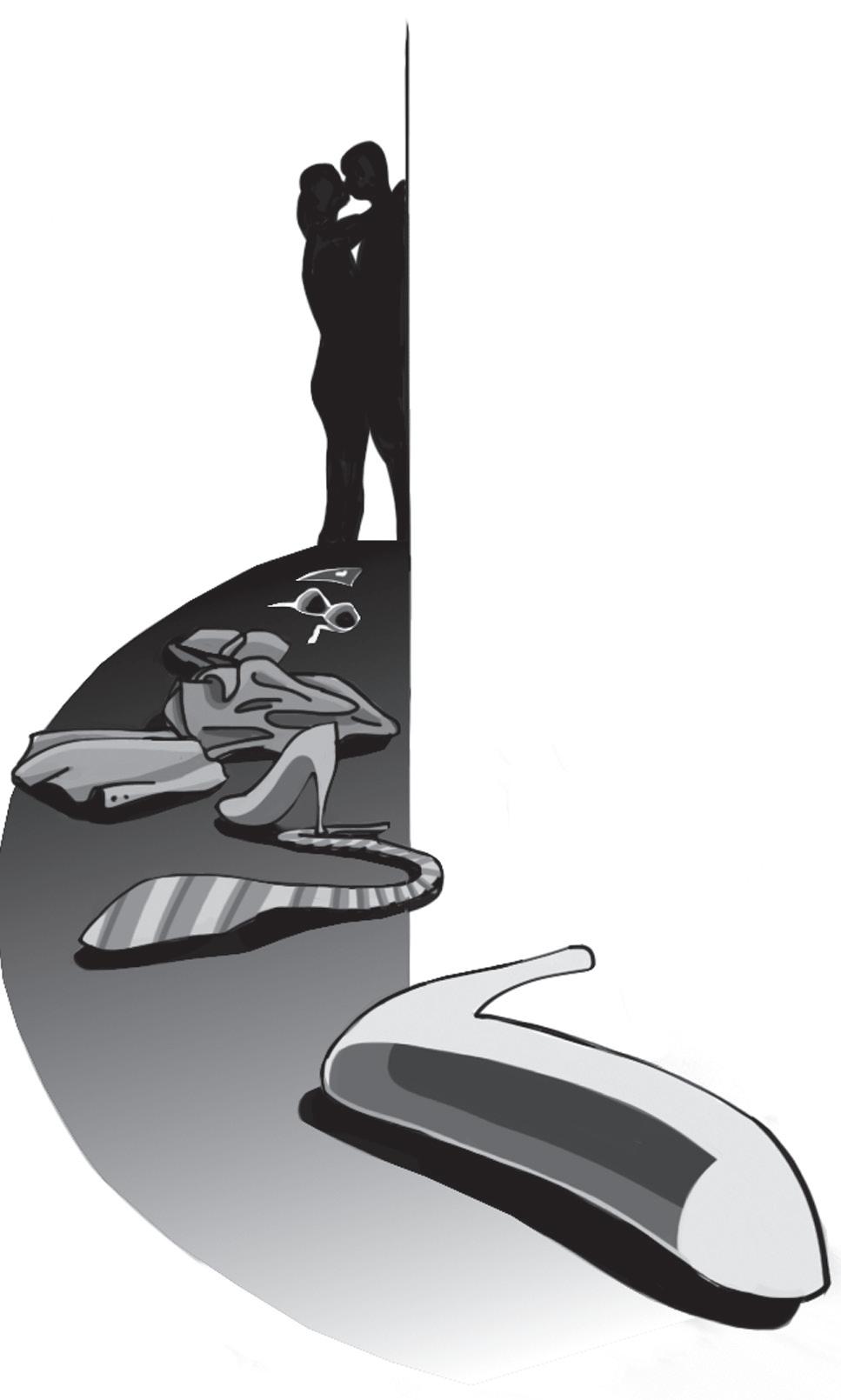
Icrunchies and mom jeans aren’t the only trends that are making a large resurgence in today’s day and age — astrology is also making a roaring comeback. Checking Co-Star to see our daily compatibility or listening to Spotify’s questionable “Horoscope Today” podcast is, whether you like it or not, a large part of many youngins’ routines. But what if you don’t want to hear about how you’re going to act or what you’re going to encounter that day, but instead you want to know what you’re going to be feeling at… night? Well you’ve come to the right place. As your resident sexual astrologist, I’ll be able to enlighten you with all that your heart, or genitalia, desires. thought it would be appropriate to begin with Virgo, since it is Virgo season after all. With its symbol being The Virgin these individuals unsurprisingly are, let’s just say, still in the sexually repressed stage of life — so basically any engineering major. Virgos are known to have a need to feel useful, aka be the ones to leave “I’m just a hole daddy” comments on TikTok thirst traps. Rarely though are these claims sustained with their heads too busy stuck in a book. Their problem is that they’re so good at having a quick fix for everything that they’ll cure their sparse horny episodes by wanking before they can get on Tinder and get some. Sorry Virgos this ain’t looking so good for you, maybe when Mercury is in retrograde it’ll get better? I
a week. I know, the horror! How dare I. But I can see in the stars that a relationship is really what your crotch needs, not another round of pubic lice a la Lambda Chi Brad.
Okay now for a bit of a cool down and take a swim with the fishes and water sign, Pisces. So tell me little fishies, do mommy/daddy and baby kinks sound right up your alley? Thought so. Y’all are so busy acting mature for your age one minute and then like a toddler the next that that follows you to sexy time. Your switch ass might want to be called daddy but we all know in like two minutes you’ll be sucking her nips like a baby calling her mommy. Yeah suck those mommy milkers little boy. Pisces also love to live in a fantasy so it’s no surprise role play is such an arouser. I wonder if our resident Pisces RBG ever brought her robe and gavel home to have some fun. Rest in peace you kinky icon.
Queue the fiery red TikTok lights because someone doesn’t know how to keep quiet in bed, and certainly not while Zeta Psi Chad blows your back out in your freshman dorm.
hope you don’t fall in love with them too because you’re pretty good at falling in love with your little no strings attached blow’n’gos. Hope gonorrhea doesn’t show up as a cute little parting gift! How about we focus a little more on self-improvement, which, in your current state, is obviously needed. Delete Tinder for say,
Honey, you doubled your body count in the last month, I don’t think elusive is the best word to describe you.
You know what zodiac sign always pisses me off? Aquarius. It literally has water in its name and yet its element is air. Then it goes way out into left field with its symbol being the water bearer. Like what kind of ~avatar~ is that. Okay fucking Jack and Jill went up the hill. It really does fit Aquarius though because they’re always the most esoteric bitches, trying to use big words to impress others and be exclusive. Honey, you doubled your body count in the past month, I don’t think exclusive is the best word to describe you. Let me humble you some more with how Uranus is such an appropriate ruling planet for y’all, emphasis on ur-anus. The stars seem to inform me that you sure like to take it up the ass. I’m sorry, y’all would have to call it anal intercourse to make you sound smarter than the rest. Sorry babe, no sapiosexual is fooled by your act. Any Aquarius who goes to Cornell really needs to come to the realization that using big words doesn’t, in fact, make you special. So my little beings floating through the cosmos, how are y’all fending. Called out? Butt hurt? Are you reflecting on your rendezvous? I really don’t expect any of you to change, I know better than to expect that. For those of you who were left out and feeling jealous, don’t worry, I’ll be back with more installments of Your Daily Whoreoscope. xoxo, a growing boy
remember when my mom sat me down to explain how babies were made. It was Christmas Day and there was a new, tiny rodent running around with our two, supposedly male guinea pigs. My mom knew this was her chance to tell me how that happened.
“So Speedo put his penis inside Gizmo’s vagina,” she explained, but it was absolutely horrific to imagine. First of all, I had only heard a penis be called a weiner and a vagina a coochie. I remembered innocently seeing a penis in the bathtub with my male friend, washing sand off from the beach, and I thought he had a useless shriveled finger between his legs while my own coochie was an endless pit of mystery. Those were two body parts that, in my judgment, should never go near each other. The stork story or even immaculate conception made more sense for reproduction than sexual intercourse. Up until this Christmas, I thought that if someone wanted a baby they could just pray for one and it would appear. It was baffling that combining privates was responsible for the perpetuation of
the human race and I had half of that recipe.
My mom insisted I not tell anyone else this secret knowledge. It was as if I had just cracked the Da Vinci Code. What other sacred riddles of the world would reveal themselves to me as I got older? So far nothing else has really come close to the enlightenment of first learning the birds and the bees. Access to such knowledge gave me status among my second-grade classmates, many of whom would ask me to tell them my powerful secret, but I had sworn an oath. The other kids who knew would give me a wink from afar as if we were in a secret society together: The Society of the Sex-Knowers.
The stork story or even immaculate conception made more sense for reproduction than sexual intercourse.
others berated. We all wanted to know what it was like to join it, but yet, we looked down on the girl in first period English who boasted that she’d gone “all the way” before.
I would be completely unaware of why there are animalistic sounds pounding from my housemate’s room.
This unspoken club lost its mystic aura when we all reached puberty and the mystery became common information. But then, the onset of high school gave many of us firsthand knowledge of sex, not just as a concept but as an act. This revived the Society of Sex-Knowers, but membership now involved participating in the mystery. Some members of the club were applauded,
I wasn’t in the Society of SexKnowers until I graduated high school. Before I could officially become a member, imagining the feel ing of sex continued to be as mysterious as when my mom first sat me down and told me about it. What did it feel like? Why was everyone so obsessed with it? Was it really that good? Part of me was upset that I had ever learned the solution to the reproduction puzzle. After I knew, there was no going back and suddenly it seemed to be what every thing in life was about.
Even in college, I sometimes wish I could return to innocence. I would be complete ly unaware of why there are animalistic sounds pounding from my housemate’s room. Suddenly I would no longer read into the sexual subtext of daily life. I would be frolicking through a field of undefiled sunflowers. Without sex, I would be writing something more blissful than this horny col-
umn. Without sex, I would be free. We can regain this innocence by looking at sex through fresh eyes. We can realize how absolutely strange it is that we want to put a fleshy finger in a meat pocket. Acknowledge we have this juice inside of us that, if it gets inside someone else, can make a whole new person. Never let that become normal.

Fill in the empty cells, one number in each, so that each column, row, and region contains the numbers 1-9 exactly once. Each number in the solution therefore occurs only once in each of the three “directions,” hence the “single numbers” implied by the puzzle’s name. (Rules from wikipedia.org/wiki/ Sudoku)




By LUKE PICHINI Sun Sports Editor
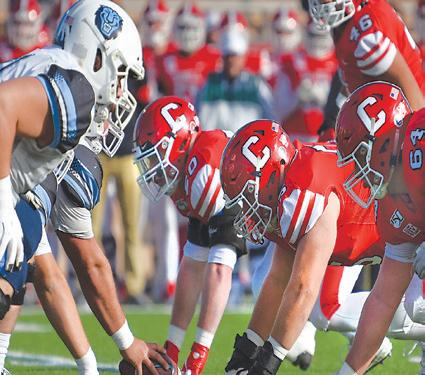
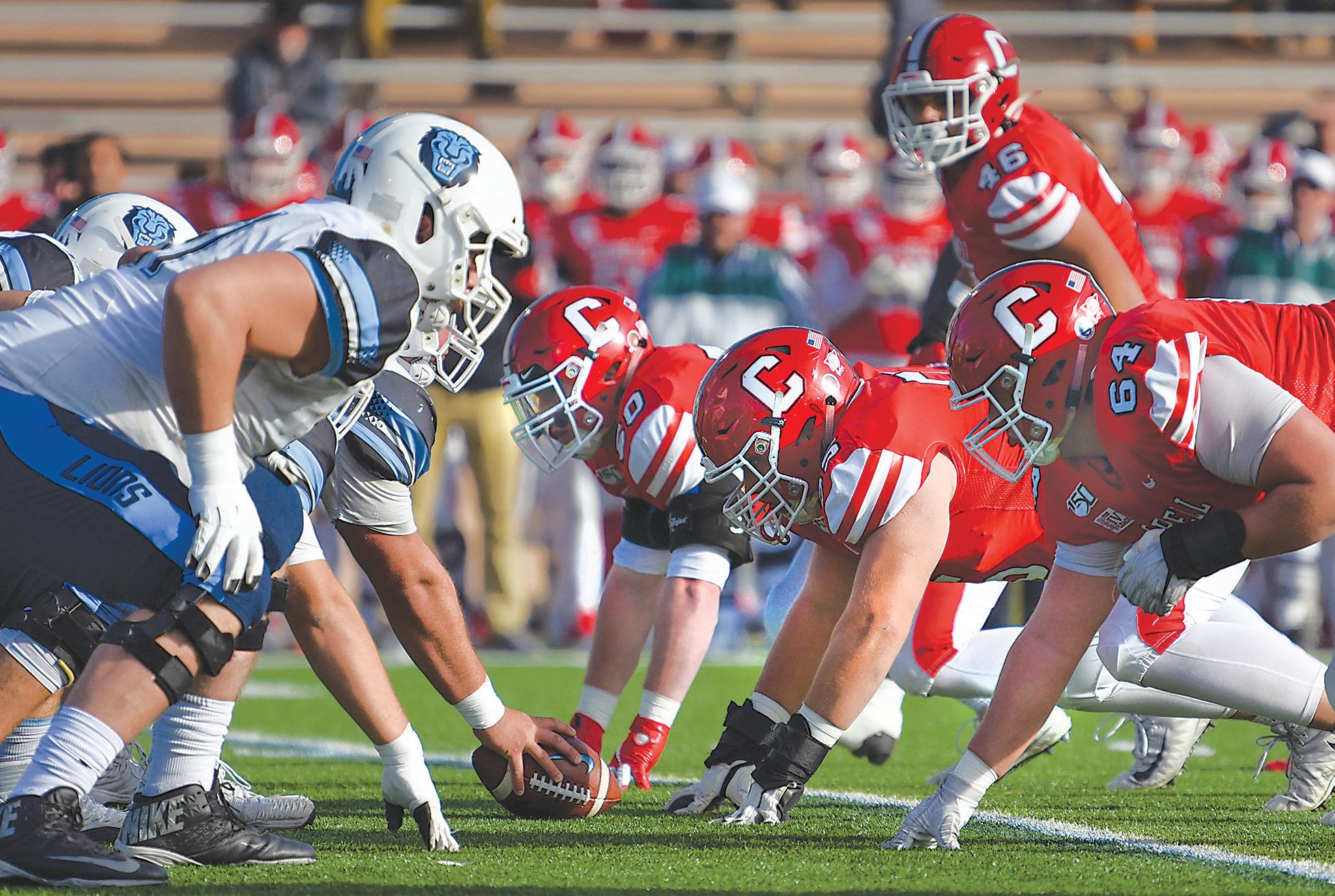
In Cornell’s last full season of football, the Red finished in a tie for fourth in the Ivy League despite the team entering the final stretch of the season with a 2-6 record.
Much of the Red’s success in 2019 can be attributed to the defense’s strong performance. Cornell possessed the third-best scoring defense, conceding 20.7 points per game. Meanwhile, the Red allowed just 335.6 yards per game, the second-best mark in the Ivy League and only 14.7 yards behind the leader, Dartmouth.
After a lost 2020 season, the Red is now gearing up for a return to Schoellkopf Field. Head coach David Archer ’05 provided an overview of the players powering this year’s defense and special teams, which hopes to achieve similar success this coming season.
Leading the linebacking corps will be fifth-year Lance Blass and junior Jake Stebbins. Blass was a core defensive figure for the Red from 2018 to 2019, racking up 82 total tackles across 19 games. With Mo Bradford ’20, Malik Leary ’20 and Justin Bedard ’20 having graduated, Blass will step up as the most senior leader of the unit.
Stebbins was one of the most impressive freshmen on the team in his debut season for the Red, piling up 58 total tackles, 4.5 sacks and two forced fumbles to earn second team All-Ivy honors. If he makes a leap this year, he could easily establish himself as one of the best linebackers in the Ivy League.
Archer described the unit as a “really exciting, solid group.” Behind Stebbins and Blass, senior Christoph Sontich will likely see significant time at the position. Additionally, several younger players are likely to rack up time in the rotation, including sophomores Noah Labbé, Noah Taylor and Nic Paschall.
An area of concern could be the defensive line, which is working through several injuries. Chief among them are fifth-year defensive tackles Maxton Edgerly and Nick Haydu. Edgerly has been a core piece on the defensive line, having racked up 26 tackles over the course of the 2019 season, while Haydu figured to see significant time on the line this year.
“Maxton Edgerly got hurt last spring, and he’s a tremendous leader,” Archer said. “Nick Haydu got hurt in camp. Those two guys have played a lot of d-tackle for us. We’re hoping they can come back midseason.”
To fill the void in the middle of the defensive line, Archer will rely on players such as junior Onome Kessington and sophomore Connor Morgan. Meanwhile, on the edge, senior Jack Muench, fifth-year Jordan Patrick and senior Max Lundeen will look to improve upon Cornell’s sack total of 22 from 2019, which was tied for fifth in the conference.
The secondary, which stood out as one of Cornell’s top units in 2019, will reload this year with plenty of talent. For one, Kenan Clarke returns as a fifth-year corner-
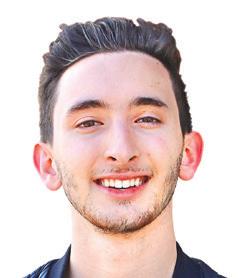

back. Clarke, who was drafted by the Edmonton Eskimos with the 50th overall pick in this year’s CFL draft, has decided to return to the Red in the hopes of delivering an Ivy League title to East Hill.
Archer also had high praise for senior cornerback Michael Irons. As a sophomore, Irons started nine games at corner, solidifying a pass defense that held opponents to 213.7 yards per game. Archer said he believes Irons has a chance to step up even further this season.
“I think Mike Irons is an outstanding corner,” Archer said. “I think he has a chance to be one of the better — if not the best — kind of player at corner.”
Cornell is particularly loaded at safety, with experienced players such as fifth-year Logan Thut, junior Jalyx Hunt and seniors Eric Diggs and Isaiah Hogan all expected to make important contributions on the back end. Beyond Irons, the versatile senior Demetrius Harris will see time at corner, along with senior Kolby McGowan and junior Paul Lewis III.
Special teams will be missing one of its core players from the past few seasons — kicker and punter Nickolas Null ’20.
“On special teams, you got to have great specialists,” Archer said. “We had one, and Nick Null was a really, really good one. He won a lot of games for us and was a two-time All-Ivy League at two different positions.”
To continue reading this article, please visit cornellsun.com.