The Corne¬ Daily Sun

By SARAH YOUNG Sun Staff Writer
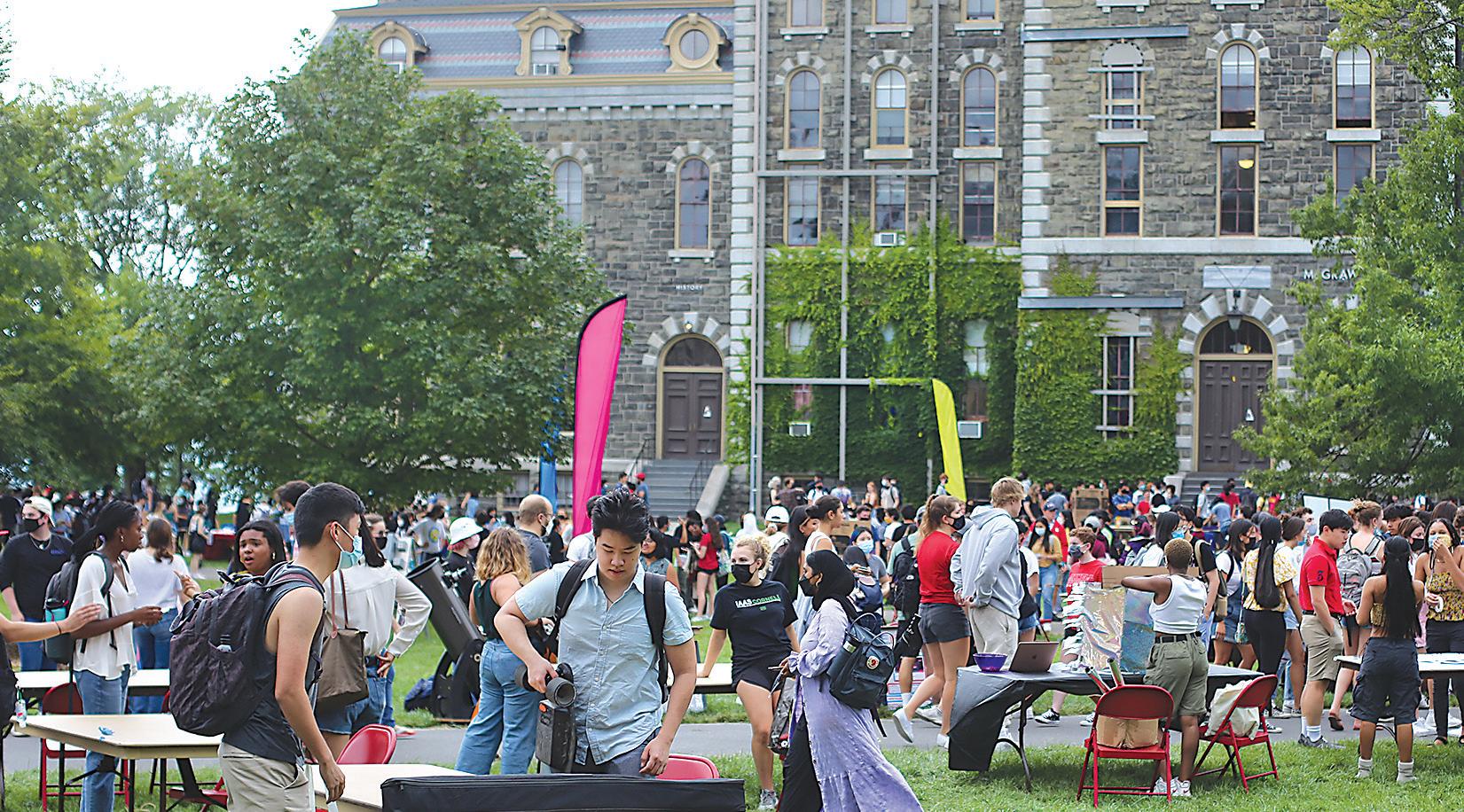
After a year of mostly virtual club activities at Cornell, many of the University’s clubs set up tables around the Arts Quad this weekend to attract potential new members during ClubFest.
During the two-day event, students were able to talk to club members in person, view more than 900 student organizations and weigh what clubs they might want to join.
After last year’s online ClubFest, in-person tabling took on a new form again this year, as the event normally packs students into Barton Hall to peruse what Cornell has to offer. First-years and upperclassmen alike swarmed the Arts Quad, eager to make up on lost time during the online school year and find their communities on campus. Club leadership distributed brightly colored quarter cards, hoping to fill the holes left by
By VEE CIPPERMAN
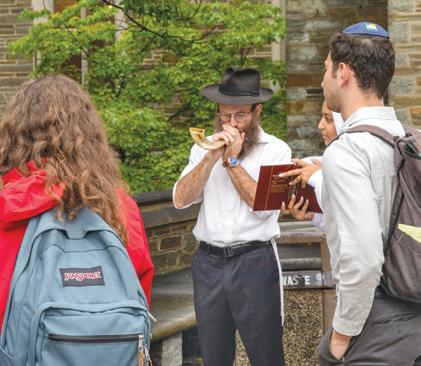
The last days of summer are a time for fresh starts: a new semester, a new season and a New Year for Cornell’s Jewish communities. Students celebrated Rosh Hashanah from the evening of Sept. 6 though Sept. 8 with services, meals and gatherings — all slightly modified to fit the ongoing pandemic, but much closer to tradition than last year’s.
“I wasn’t allowed on campus for close to 500 days because of COVID-19,” said Rabbi Ari Weiss, executive director of Cornell Hillel. “It was just great to be able to celebrate again with
a large community.”
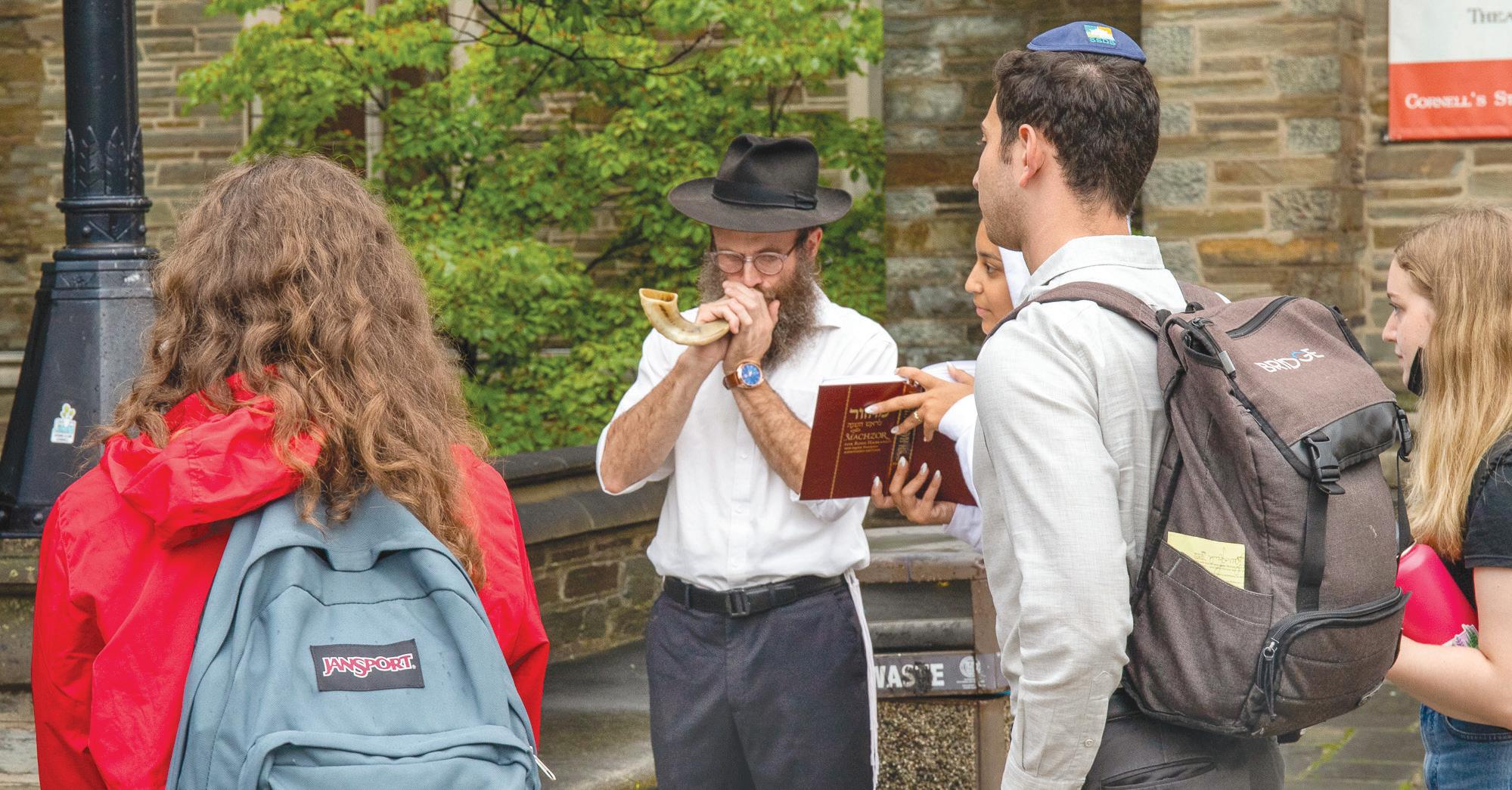
Rosh Hashanah occurs annually as part of the Jewish High Holy Days or Yamim Noraim (“Days of Awe”). Jewish people put the old year to rest and celebrate new beginnings with a variety of traditions, including communal meals and the sounding of the shofar, a ram’s horn carved into an instrument. This Rosh Hashanah marked the year 5782 in the Jewish calendar.
“[The High Holidays] serve as the focal point of the year, where people come together,” Weiss said.
Sophia Bergen ’23, co-gabbai
By KAYLA RIGGS
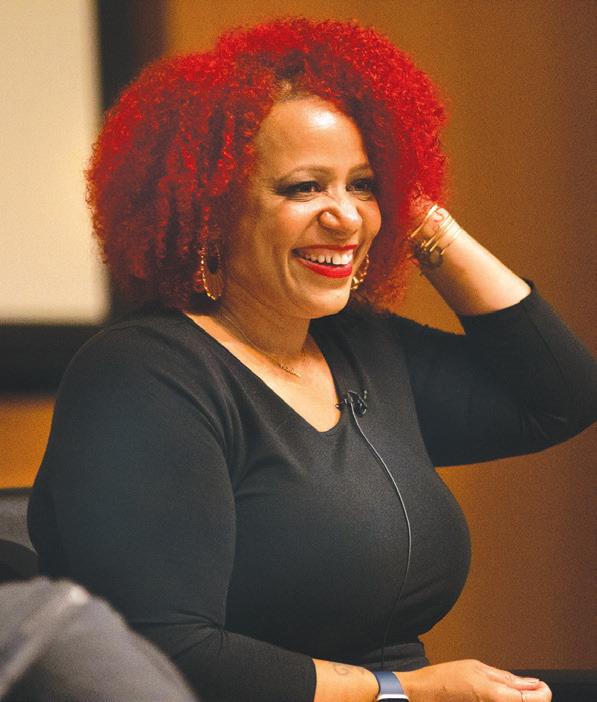
Pulitzer Prize-winning journalist Nikole Hannah-Jones spoke to a socially-distanced audience in Rhodes-Rawlings Auditorium Thursday night for the annual Kops Freedom of the Press lecture, discussing her award-winning 1619 Project, race and American history.
The lecture, which was also live streamed, lasted for nearly two hours, during which Cornellians were given the opportunity to listen to HannahJones and participate in a Q&A following her speech.
The event began with a land acknowledgement and the introduction of Prof. Jamila Michener, government, and Prof. Derrick Spires, literatures in English –– both of whom mediated the Q&A portion of the event –– and, of course, HannahJones.
Hannah-Jones is a staff writer at The New York Times Magazine who investigates racial injustice and civil rights. In her 19-year career, she’s been awarded over 50 national accolades for her work.
In recent years, she is most well known for her work on the 1619 Project, an initiative launched on the 400th anniversary of the beginning of American slavery that “aims to reframe the country’s history by placing the consequences of slavery and the contributions of Black Americans at the very center of our national narrative,” according to its website.
This project was a focal point in her lecture, especially because it has brought an onslaught of backlash from critics and conservative news sources since its publication. Former President Donald Trump released a rebuttal to her project –– entitled the 1776 Commission, which did not include a single historian –– on Martin Luther King Jr. Day this past January. The National Association of
Scholars, a conservative advocacy group, launched a campaign to revoke the Pulitzer Prize awarded to Hannah-Jones in 2020, and, in May, she was denied tenure at the University of North Carolina amid backlash she received due to the
Monday, September 13, 2021
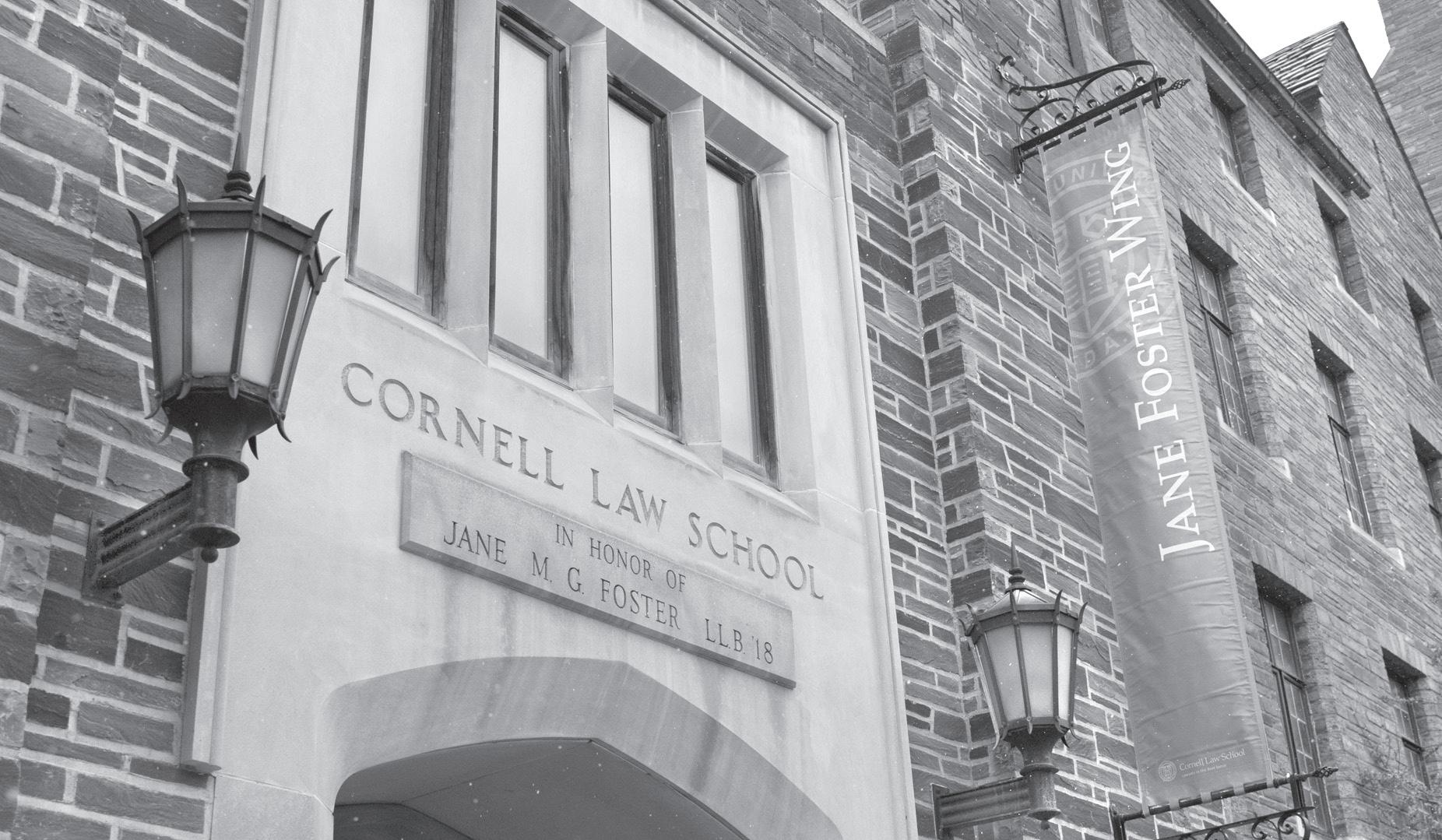
Application season | As application deadlines are approaching in a few months, Cornell is holding many events teaching students how to optimize their law school applications.
CBE Seminar Series: Jeffrey Gray, John Hopkins University 9 a.m., Olin Hall, 255
Cornell Institute for Food Systems Industry Partners Career Fair
10 a.m., Virtual Event
Deterritorializing Kashmir: Migration, History and the Literary Ecumene, by Asiya Zahoor 11 a.m., Uris Hall, G08
Sustainability GooseChase: Cornell Scavenger Hunt Noon
Freedom’s Captives: Slavery and Gradual Emancipation on the Colombian Black Pacific, by Yesenia Barragan, LACS Weekly Seminar Series
1 p.m., Stimson Hall, G-01
Behavioral Workshop: Hunt Allcott 11:15 a.m., Sage Hall, 141
Perspectives on Law School Admissions With Amanda Moser, Assistant Director of Admissions, Cornell Law School 12:30 p.m., Virtual Event
Job Offer Consideration and Negotiations 3:30 p.m., Virtual Event
Joint Microeconomic Theory Workshop and Public Workshop: Parth Parihar 4:15 p.m., Virtual Event
ORIE Colloquium: Modibo Camara (Northwestern) Mechanisms for a No-Regret Agent: Beyond the Common Prior 4:15 p.m., Frank H.T. Rhodes Hall, 253
Introduction to Market Research
4:30 p.m., Mann Library, Stone Classroom, Mann 103 Optimizing Your Law School Application Process 4:45 p.m., Virtual Event
Visual Culture Colloquium 4:45 p.m., Goldwin Smith Hall, G22
Foundations of Community-Engaged Learning: 3-Week Intensive 6 p.m., Virtual Event

HANNAH-JONES
Continued from page 1
backlash she received due to the project. (HannahJones is set to join Howard University’s tenured faculty this fall, where she was appointed the Knight Chair in Race and Journalism.)
Hannah-Jones explained that efforts to discredit this work of American journalism center around questions of national identity, as some Americans resist grappling with the country’s founding histories of slavery. The 1619 Project places the democratizing force of Black Americans at the forefront, pushing against narratives of American exceptionalism.
Many of these reactions followed the nationwide Black Lives Matter protests over the summer of 2020 as well as amid discussions regarding critical race theory and policing in America, she said. HannahJones said that the source of these conversations, however, is rooted in America’s treatment of slavery as an “asterisk” rather than a transformational part of the country’s history.
Ongoing efforts to discredit the project, she said, create a threat to democracy and the rights afforded to journalists as a part of the First Amendment, which allows for freedom of speech.
Even though the 1619 Project does not engage with critical race theory, Hannah-Jones explained that many conservative news outlets have conflated the two, turning them into buzzwords — with critical race theory being named in Fox News about 1,800 times. (Critical race theory is a graduate-level legal theory that interrogates the role of race and racism in society, not present in K-12 classrooms or the 1619 Project curriculums.)
As discussion about both grew, many states –– including Texas, Idaho, Tennessee, Oklahoma, Iowa, New Hampshire, Arizona and South Carolina –– have passed legislation banning or restricting the teaching of critical race theory in classrooms in recent months, what Hannah-Jones said was an act using the power of the state to limit the spread of ideas.
“It would be laughable if it weren’t so dangerous,” she said, quoting lawyer, activist and leading critical
race theory scholar Kimberlé Crenshaw ’81, who has been outspoken about the aforementioned state laws.
Amid these events, Hannah-Jones emphasized the importance of learning accurate history in classrooms and in the academic world.
“History is the fruit of power, but power itself is never so transparent that its analysis becomes superfluous,” she said, quoting anthropologist MichelRolph Trouillot. “The ultimate mark of power may be its invisibility; the ultimate challenge, the exposition of its roots.”
If history is not learned, she said, power can stay in power.
Hannah-Jones noted the significance of training journalists to read history and to report on democracy “with the urgency it needs,” especially when it comes to race. She explained that some mainstream publications are concerned about being labeled as “too liberal” rather than focusing on telling the truth about racism, slavery and the treatment of Black Americans.
She also mentioned the relevance and magnitude of Black journalists reporting on issues related to democracy.
“Who better to report and understand how dangerous of a time we are in,” Hannah-Jones said, “than Black journalists, who have always had to write about the worst.”
As her lecture came to a close, Hannah-Jones reminded Thursday’s audience of a pressing notion: Prioritizing democracy and standing up for racial equality must be a collaborative effort.
“You have to step up and fight for the democracy you think you have,” she said, noting that young people can take action –– including through advocacy and educating themselves –– to work toward justice.
A key part of this work, she said, is recognizing that America was built upon racism and slavery –– only after Americans acknowledge this past can they move toward a more equitable future, she told Cornellians.
Kayla Riggs can be reached at kriggs@cornellsun.com.
CLUBFEST
Continued from page 1
students and those exhausted by a year of Zoom meetings and virtual coffee chats.
Addy Capel ’25 described experiencing ClubFest for the first time as a first-year student: “It’s been really interesting to see all the different groups that are here,” Capel said.
Many club leaders said they saw the in-person festivities as a golden opportunity to broadcast their club to potential members, particularly after a year of Zoom recruitment and meetings.
“We are having a great time meeting people ... to potentially join our club,” said Chris Rampaul-Pino ’24, a member of the Cornell Investment Banking Club.
Other clubs took different approaches when it came to recruiting new members. Cornell ROTC set up a fitness test complete with a pull-up bar and other physically demanding activities to attract attention for the organization.
Many new clubs made their debut at this year’s ClubFest, including A Seat at The Table, a business ethics and human resources group that promotes social responsibility and inclusion.
Member Matt Sovik ’24 describes A Seat at The Table as a club focused on “HR business ethics to [create] a safe space to have discussions on different topics, like decisions involving gender, race, sexuality and just how to confront internal biases.”
According to Sovik, an in-person setting brought students together in a way that just wasn’t possible on Zoom.
“I would’ve never had this much community if it was online. I went to the [virtual ClubFest] last year and this feels
“It’s
really, really awesome to see people and then get to talk to people and interact in person.”
Ehi Esemuze ’23
so much more homey, so much more personable,” Sovik said. While many students had fun perusing Cornell’s many clubs in person, others expressed concern about the swarms of people present amid the University’s current yellow alert level status. The University is reporting 113 cases during the week of Sept. 3.
“There’s a lot more people
large turnout for the first Rosh Hashanah event this year.
Continued from page 1
at Cornell’s Shevach prayer community, said that Rosh Hashanah evokes comfort and holiday joy.
“The holidays are always full of tradition,” she said. “For me in particular, they’re about being with my family, the smells of challah and even new dresses for services.”
Cornell’s Jewish organizations, especially Cornell Hillel and the Roitman Chabad Center, hosted a variety of holiday events on and off campus. The Chabad Center hosted shofar blowings at multiple times across campus. Cornell Hillel planned three different services for Jewish celebrants in progressive, conservative and orthodox denominations, and it hosted its yearly firstnight dinner in large tents on the Arts Quad.
Adam Feldman ’22, Cornell Hillel chair of communications, explained that event planners had to pivot at the last minute to accommodate the new yellow alert restrictions. The first-night dinner ordinarily takes place in Trillium Dining Hall, where other Cornell Hillel meals have operated this semester.
“We have had Shabbat dinners that are weekly dinners on Friday nights inside Trillium, because that counts under Cornell’s rules as a well-ventilated area,” Feldman said. “We’ve had a bunch of freshmen, I’d say about 80 people or so the first couple weeks.”
than I thought and a lot closer together,” said Ellie Connolly ’24, who also expressed concern about the large number of students present without masks on.
Other students took more interest in the accompanying performances. Linda Piccolo ’24 joined the Cornell Society for Women in Business at ClubFest, but still described the performances as “the best thing so far,” which featured groups ranging from Cornell Anjali to Pole Posse and Big Red Raas.
On top of clubs and organizations, some project teams also had an opportunity to recruit potential new members and create excitement about their projects at ClubFest.
Ehi Esemuze ’23 was part of a table for the Cornell Designing Tech Initiative — an engineering product project team that develops software, including both mobile and web apps.
“It’s really, really awesome to see people and then get to talk to people and interact in person,” Ehezume said Saturday, who viewed the Arts Quad arrangement as a positive alternative to Zoom breakout rooms or stuffy indoor crowds in Barton Hall.
Sarah Young can be reached at syoung@cornellsun.com.
“They had to set up picnic blankets outside of the tents because they were so full,” she said, “and it was just such an amazing feeling that so many people really wanted to be there and connect to this new year.”
Into the next days of Rosh Hashanah, student turnout for other events was larger than expected. Goldstein led the progressive service in the Willard Straight Hall Memorial Room, inspiring reflection through music with her partner and Base co-leader Lizzie Sivitz and other local musicians.
According to Goldstein, 40
“[The High Holidays] serve as the focal point of the year, where people come together.”
Rabbi Ari Weiss
guests attended her Zoom service last year. This year, more than 100 turned up, outnumbering chairs and prayer books two to one.
“We ended up having 107 people trying to get a seat,” Goldstein said. “It was incredible.”
Goldstein also observed high student enthusiasm for engaging in spiritual exploration. She led the Amidah, a praise prayer that involves silent meditation, and appreciated students’ willingness to engage.
With the University’s change in safety protocols, Cornell Hillel planned to move their Rosh Hashanah dinner outside in collaboration with Cornell Dining less than two weeks before the event. They set up tents, tables, chairs and lights on the Arts Quad. According to Weiss, each tent could hold 220 diners, and nearly 450 people showed up to celebrate.
Rabbi Hayley Goldstein, co-leader of the Hillel initiative Base Ithaca, expressed her happiness at seeing such a
“I invited people, if they felt called, to go and stand on the balcony outside of the Memorial Room and connect to nature and talk to God in their own language,” she said. “In the past, I’d say Cornell students were a little resistant to trying things out of the box spiritually. But there really was a mass exodus to the porch.”
Shevach planned the conservative services outside Sage Hall. According to Bergen, 50 to 75 people attended — a surprisingly high turnout, she said.
“I wanted to create those spaces for people that fostered community,” Bergen said. “And I think having those very full services definitely accomplished that.”
Students expressed their gratitude for the in-person celebrations this year, citing their appreciation for community above any other factor.
“To come to a school where there’s such a prominent Jewish presence and then not be able to celebrate that over the past year was very difficult,” Feldman said,
noting Cornell’s large population of Jewish students as compared to other schools.
Samantha Noland ’21 attended a variety of events this year, from the dinner on Monday to the Center for Jewish Living’s Beebe Lake Tashlich ceremony, where Jewish people cast bread into water to symbolically cast off sins.
Noland enjoyed connecting with other Jewish students, saying she found it more difficult last year with Zoom and distanced events. Even though the celebrations this year unfolded in person, she noted the struggles of celebrating Jewish holidays on a college campus even without a pandemic. She missed her parents and skipped classes to celebrate.
She expressed that her professors are ordinarily understanding, but she thinks it would be helpful if Cornell gave students the holidays off. She noted that nearby colleges, like Binghamton University, get a halfweek break for Labor Day and Rosh Hashanah.
Bergen noted that Cornell doesn’t pause to acknowledge the holiday.
“I’ve experienced a lot of people not knowing about the holiday, particularly in classes and extracurriculars,” Bergen said. “Everyone just treats it like it’s a normal
day. And the analogy I try to make is that this is the Jewish equivalent of Christmas and Easter.”
The second part of the High Holidays, Yom Kippur, will take place over Sept. 15 and 16. Cornell Hillel will host another outdoor meal and organize three different denominational services.
“We expect a similar, if not even bigger, turnout this time around,” Feldman said.
Hillel is also planning a CTB bagel drop-off for first-year students to break their Yom Kippur fast with a traditional Jewish meal. Weiss explained that although bagels and lox have no religious significance, they hold strong cultural associations that are comforting for Jewish students on Yom Kippur. Students can also apply for microgrants through Hillel Across Cornell to host their own meals.
Base Ithaca plans to host more in-person events for Yom Kippur and beyond. Goldstein said they will update students through the Base Ithaca Instagram on how events might change to respond to variable COVID conditions.
“While the weather is tolerable,” she said, “we’ll be outside and doing bigger Shabbat meals and different events like that while we can.”
In the New Year, Jewish Cornellians are striving for community and rebirth as Cornell’s campus bursts with energy once again.
“I wanted to create those spaces for people that fostered community.”
Sophia Bergen ’23
“I’m trying to go into the new year and start fresh with friendships and relationships, making sure that I’m really being my full, authentic self,” Noland said.
Goldstein and Weiss both expressed their dedication to focus on community in the upcoming year through mindset and event planning. Feldman noted that Cornell Hillel prioritizes this over all else.
“If you ask us what our one-line mission statement is, it’s to bring people together,” Feldman said.
Weiss expressed his optimism for what the future holds.
“I know we’re still in this moment of uncertainty and this moment of anxiety,” Weiss said. “But this year, hopefully, will be a year full of blessings and joy.”
Vee Cipperman can be reached at ocipperman@cornellsun.com.

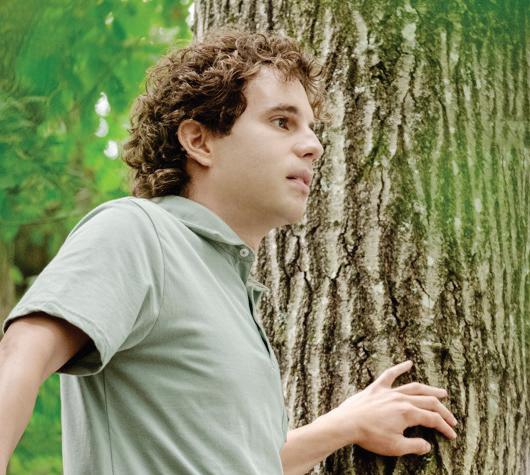
After gaining widespread popularity on Broadway, the Tony award-winning musical Dear Evan Hansen is finally coming to movie theaters with its film adaptation. Ben Platt, who first played the titular character on Broadway, returns to the role for the film, alongside a star-studded cast that includes Amandla Stenberg, Amy Adams, Julianne Moore and more.
Evan Hansen’s social anxiety seems to define his life, preventing him from truly connecting with the people around him and leaving him to feel almost invisible. When a letter he wrote to himself for a therapy assignment is mistaken for his classmate Connor Murphy’s suicide note by Connor’s parents, Evan finds himself unable to tell the grieving Murphy family the truth. Instead, he crafts an illusion of a friendship with Connor, and when combined with his own desperation for connection, he finds himself becoming closer to Connor’s parents and sister Zoe. However, as one lie turns into another, Evan finds himself spiraling further and further until his lies are exposed and the relationships he built fall apart.
Having watched the musical on Broadway, I was ecstatic to see how Dear Evan Hansen translated to the format of a movie. I can say without a doubt that I was blown away by how powerfully the film came across in its depiction of mental illness and reminders of the persistence of hope through tragedies and mistakes. Audiences are sure to leave the theater feeling moved by the film’s strong emotions.
The characters themselves were certainly a highlight of the film. Each character was realistically flawed, and the audience sees them learning from their mistakes without being absolved of their wrongdoings. I felt this made the characters and their actions understandable, which helps audiences connect with them and even see themselves reflected in their thoughts and actions. The compelling performances of the cast emphasize the depth of the

characters; each actor delivered a uniquely emotional performance that made the touching tone of the film resonate strongly.
Dear Evan Hansen doesn’t shy away from the grim realities of mental illness, especially with its effect on young people. I appreciated how the film highlighted how mental illness appears in a variety of ways by showing how Evan and Alana (Stenberg’s character) both strug-
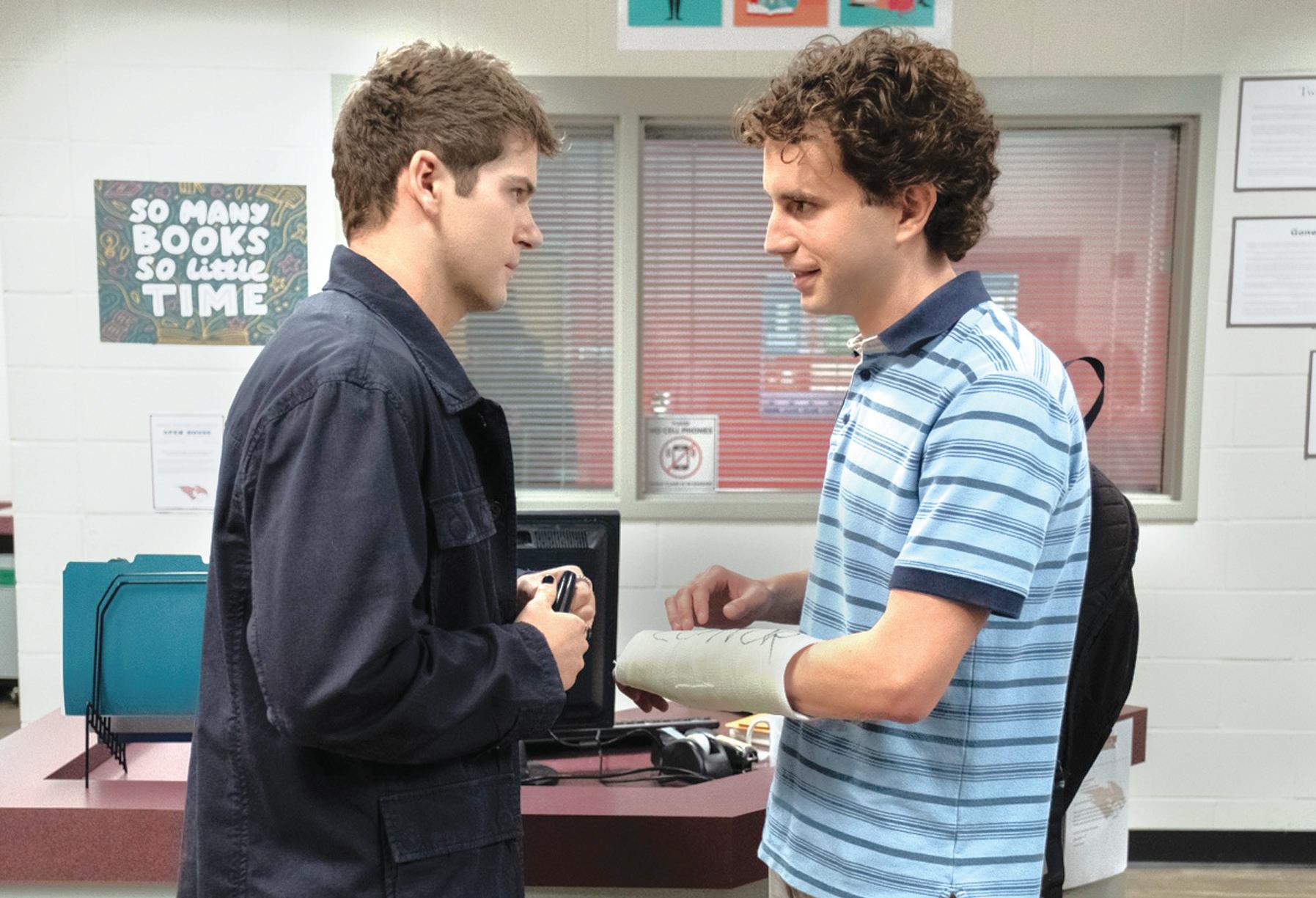
gle with depression and anxiety, whereas only Evan’s illness was included in the musical. The distinction between how the two experience and show the effects of their illnesses reminds audiences that mental illness manifests differently among the people it affects. By seeking to foster understanding about mental illness, the film calls attention to the important issues it presents by fostering empathy in the audience, which is a powerful way of getting its message across.
Despite the emotionally-charged material it presents, Dear Evan Hansen still manages to create an uplifting tone throughout, which especially comes through near the end of the film. When I asked about how this balance was found in the film, writer of the book of the musical and film’s screenplay Steven Levenson said, “I would say from the writing perspective that was always really important to us from the beginning — that we leave this story with some hope because this character does some really
bad things and he makes some very bad mistakes, and especially knowing that young people were going to see this, we always wanted it to be clear that there was hope possible and that change was possible and that just because somebody does something terrible, even if its reprehensible, they can still be OK. So that was sort of almost like an ethical imperative for us as storytellers — we had to find a way to leave this story with some hope.”
Echoing Levenson’s sentiment, director Stephen Chbosky added, “That tone is something that I share with Steven. When I did The Perks of Being a Wallflower, mixing the light with the dark, the sad with the funny was honestly the point because it is true to life. Steven is a very funny writer. He really knows how to write a joke and find the humor in all situations, and so it was very easy for me as director to translate that, because I fully share that approach to tone and it was a blast to execute.”
Overall, Dear Evan Hansen transitions from a touching musical into a film that is sure to take audiences on an emotional journey. Raising awareness about mental illnesses and reflecting the balance between hope and despair that so many of us face, this film is one that you don’t want to miss.
Dear Evan Hansen opens in theaters on Sept. 24.
Aditi Hukerikar is a junior in the College of Arts and Sciences. She can be reached at adh247@cornell.edu.
Independent Since 1880
139th Editorial Board
KATHRYN STAMM ’22 Editor in Chief
ANUSHYA ALANDUR ’23
Business Manager
CATHERINE ST. HILAIRE ’22
Associate Editor
PRANAV KENGERI ’24
Advertising Manager
ODEYA ROSENBAND ’22
Opinion Editor
JYOTHSNA BOLLEDULA ’24
News Editor
TAMARA KAMIS ’22
News Editor
CAMERON HAMIDI ’22
App Editor
KRISTEN D’SOUZA ’24
Design Editor
HANNAH ROSENBERG ’23
Photography Editor
OMSALAMA AYOUB ’22
Science Editor
PUJA OAK ’24
Layout Editor
ANNIE WU ’22
Production Editor
MIHIKA BADJATE ’23
Assistant News Editor
SERENA HUANG ’24
Assistant Business Editor
ANGELA BUNAY ’24
Assistant News Editor
JOHN COLIE ’23
Assistant Arts & Culture Editor
AMELIA CLUTE ’22
Assistant Dining Editor
WILLIAM BODENMAN ’23
Assistant Sports Editor
AARON SNYDER ’23
Assistant Sports Editor
MEGHANA SRIVASTAVA ’23
Compet Manager Working
’22
MADELINE ROSENBERG ’23
Editor NAOMI KOH ’23
Editor ANIL OZA ’22
Editor YUBIN HEO ’24
VEE CIPPERMAN ’23
NOOREJEHAN UMAR ’23
E.D. PLOWE ’23
YOON ’23
VELANI ’22
PICHINI ’22
TYAGI ’22
MENDOZA ’24
ARANDA ’23
Editor SURITA BASU ’23
News Editor KAYLA RIGGS ’24
LEYNSE ’23
’24
’24
’24
ALPERS ’22
Daniela Wise-Rojas ‘25 is a freshman in the College of Arts and Sciences. She can be reached at dnw26@cornell.edu. Anything But MunDANIties runs every other Monday this semester.
When I realized I was Cornellbound, I didn’t know what to expect regarding diversity and how to fit in. I know now that the Cornell student body needs to learn to own their privilege and actively listen to others’ stories and histories, both on-campus and online. Failing to do so hinders the success of students who need the most support. It also makes campus more hostile towards those the University claims to protect. Members of the Cornell community should make a conscious effort to check their privileges while teaching others to do the same.
I was not prepared to trailblaze alone. Trailblazing is fun and something to be proud of, but there’s a reason why most people who are trailblazers can’t provide us with a how-to guide. I think it’s because it involves teaching others to admit their privileges while going against one or more social norms. I consider this to be an incredibly lofty goal. There’s no way to educate people without sharing stories.
’22
’23
Umar ’23
Mihika Badjate ’23 production desker Alexandra Kim ’24 layout deskers Kristen D’Souza ’24 Puja Oak ’24 photo desker Julia Nagel ’24 arts desker John Colie ’23 sports desker Liam Monohan ’24
My first perception of Cornell was through the Prefreshman Summer Program. It’s a program for roughly 200 students, many of whom come from disadvantaged backgrounds. I won’t lie, I found that comforting. If I ever felt excluded, it wasn’t because of things I can’t change, like my socioeconomic status or identities. . It was because I didn’t get along with everyone. That’s how it should be.
Nevertheless, coming back for the fall semester hit me like a wall of bricks. I found myself clinging to the friends I made over the summer (and they did the same). My queerness made me feel ostracized and alone; I had to find my community. I didn’t understand why hearing people’s answers to, “Why did you choose Cornell?” would internally infuriate me; hearing, “One of my parents went here” or “I love the campus” or “My older sibling went here. I almost didn’t go because I didn’t want to be too similar to my sibling, but I’m glad I did,” during small talk and brief class discussions made me roll my eyes.
I’m not a passive-aggressive person, and I know that many people don’t identify as a neurodivergent biracial first-gen somewhat gender-nonconforming yet female-identifying Latina interested in law, politics and the press (as I do). If anything, this makes me more empathetic and open to different perspectives and identities.
However, the tone and context matter. For instance, most of these students sounded almost exhausted, failing to understand that there are students who can’t go to Ivy League schools because they don’t have the money to apply, they need to stay close to their families or a less-prestigious school offered better aid at a time when money is tight. Many students in specific areas can’t apply to college, period, or graduate from high school for various reasons.
Sometimes it’s exhausting being left out of mainstream narratives, especially at a place where you are supposed to explore and challenge yourself academically and socially without fear of rejection. Cornell provided a small number of students with support through PSP, but there are plenty more struggling students who haven’t been given this opportunity. The newfound freedom of being in college is euphoric on its own, which I was prepared for.
I have peers whose schools barely offered any A.P. classes and had to travel to a different school for science labs. Most PSP students were part of New York State’s Higher Education Opportunity Program (HEOP); to qualify, a student must have the grades, be a N.Y. state resident, and a family with two household dependents must make $31,894 or less for the 20212022 year (see the total income eligibility criteria here).
On the other hand, some students are part of the “privileged poor,” such as in the book by the same name by Anthony Abraham Jack. Jack, in a Vox interview, described this group as “lower-income students who were lucky enough to attend boarding schools or preparatory high schools before coming to college.” These students, although minorities, are not only academically prepared but according to the book have been socially prepared for how to survive in elite crowds. They have experience with small class sizes and counselor-to-student ratios. They’ve been taught how to network and find themselves/people they trust in a primarily white community.
I admit, I have some privilege. I fall somewhere above and below “the privileged poor” but not precisely in that box. My skin is tan. I was prepared academically; not all people are. I was able to go to college out of state. My family is middle class, and I come from an area that is anything but poor. Although my public high school, which was unofficially known as a University of California feeder school, was very crowded it had no shortage of extracurricular activities, funding and resources. Although I was still a minority at that school, I spent time with plenty of other minorities, even if it wasn’t my ethnic group. After all, it was the Bay Area.
Socially, I don’t think I was ready. Even if my culture wasn’t represented at my school, I was always around someone else’s culture without trying. Now, I have to seek that out. Otherwise, I feel isolated and lonely. Outside of any minority groups, I still have to prove my worth and intelligence in social circles. Telling people “I go to Cornell” helps, but that doesn’t excuse the fact that society should not prioritize minorities with Ivy degrees over those who weren’t able to get there and achieve the “American Dream.”
To continue reading this column, please visit cornellsun.com.

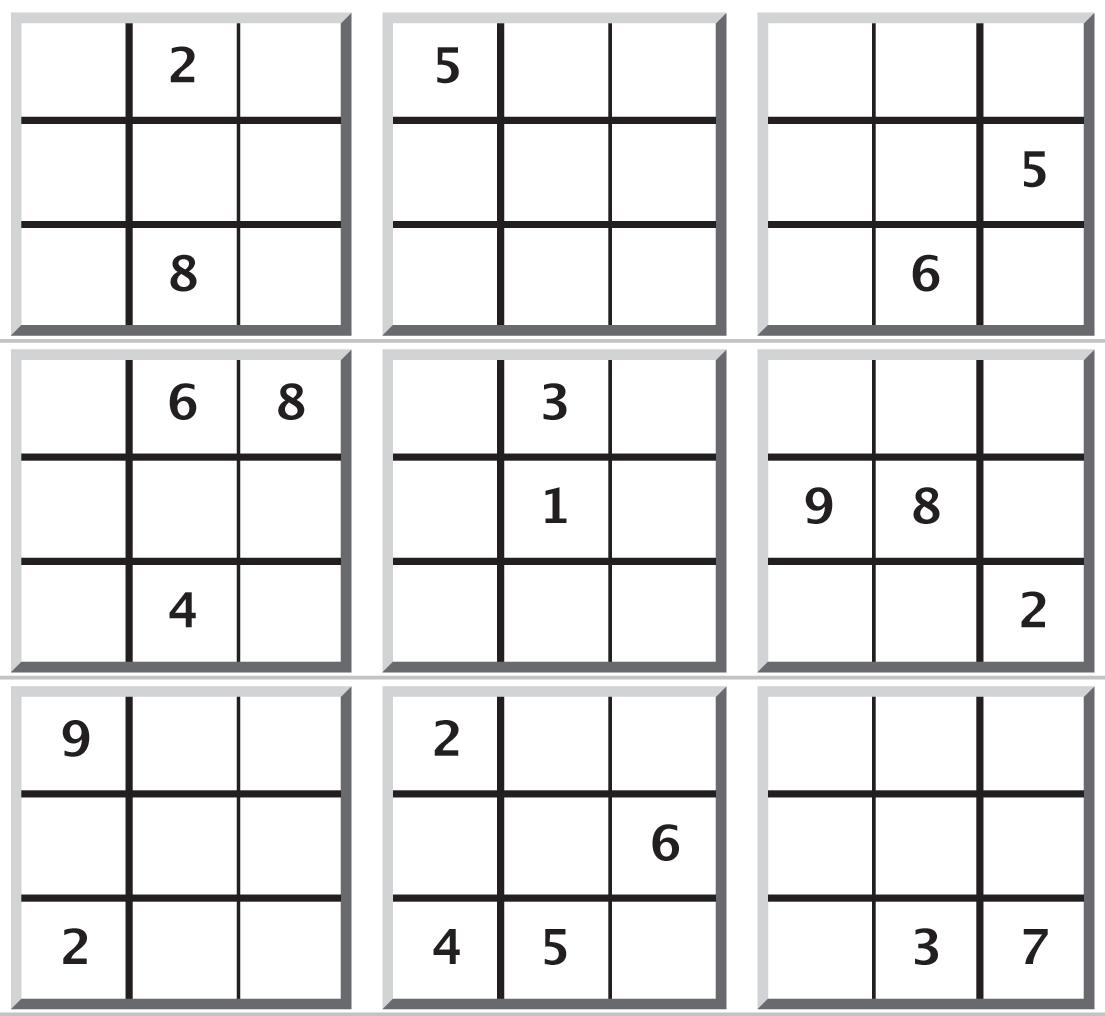
Fill in the empty cells, one number in each, so that each column, row, and region contains the numbers 1-9 exactly once. Each number in the solution therefore occurs only once in each of the three “directions,” hence the “single numbers” implied by the puzzle’s name. (Rules from wikipedia.org/wiki/ Sudoku)
By LIAM MONAHAN Sun Assistant Sports Editor
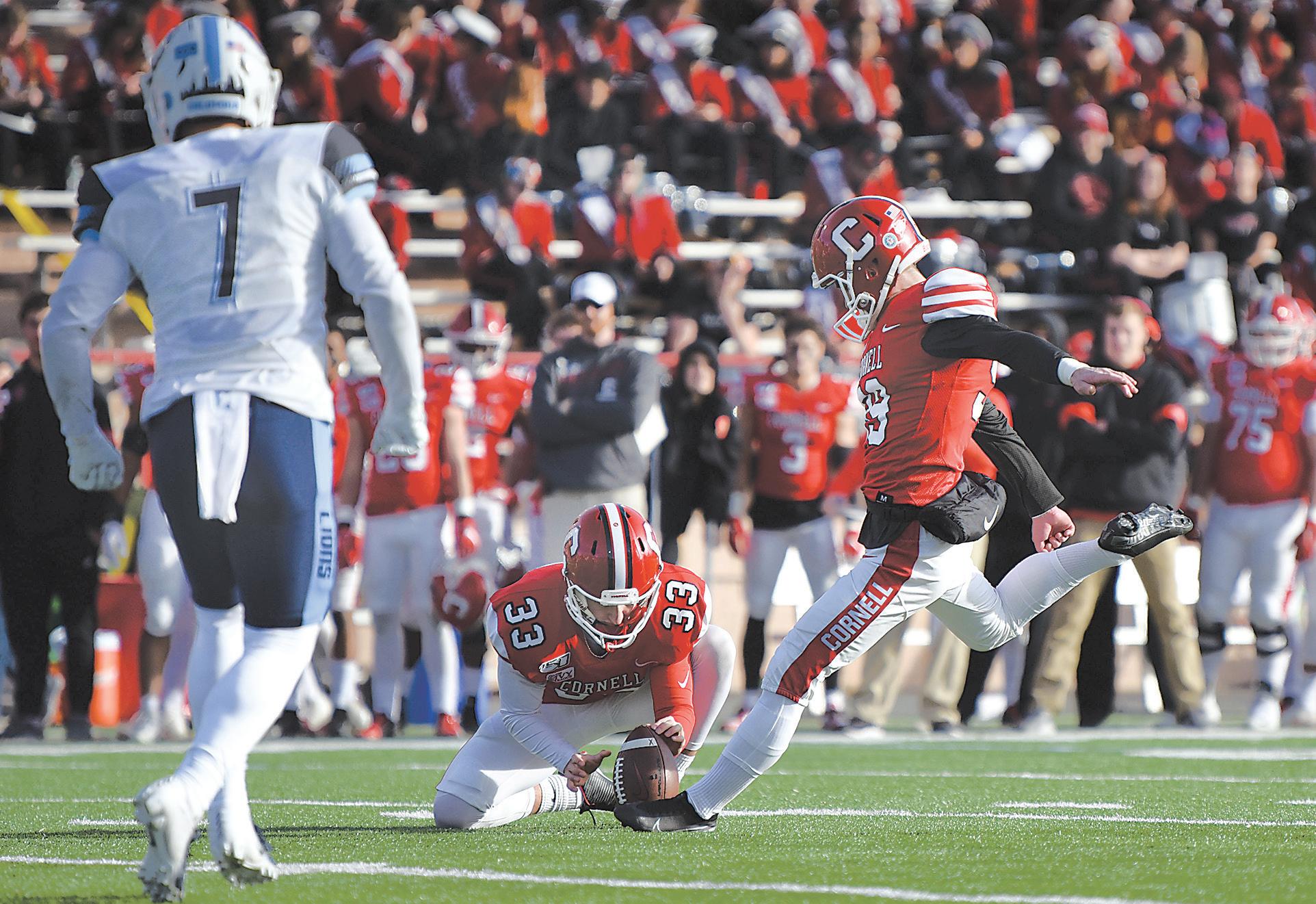
Ivy League football is back, and fans got their first glimpse at what is to come through the Ivy League Preseason Football Media Day.
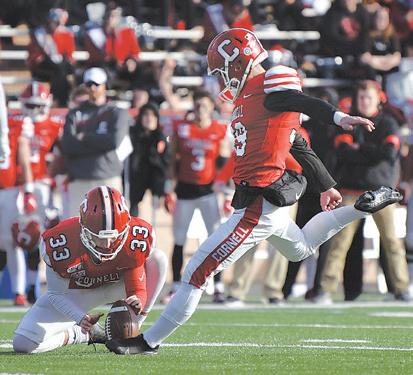
In a virtual event Aug. 16 featuring all eight Ivy League institutions, coaches and players from each school were granted 15 minutes to speak on the state of their programs and answer any questions on the upcoming season. Head Coach David Archer ’05 represented the Red along with fifth-year players Kenan Clarke ’20 and Richie Kenney ’20.
While Cornell had the floor, Archer’s opening remarks made it clear that this year was important not only for the current student athletes, but also for the returning seniors whose final season was nearly taken away.
“[For these] super seniors, [it’s] like you're rearranging your whole life. Whether it's at Cornell, Brown or Penn, they're taking off semesters, taking off years academically, [putting off] jobs or finding gap years to play,” Archer said. “And so for those reasons I think the 2021 Ivy League football season has the chance to be its best ever because of the collective effort of all these teams and all these amazing student athletes.”
Archer said these fifth-year players will bolster the squad for years to come because of the expertise they offer incoming members of the team.
“[For these] super seniors ... They’re taking off semesters, taking off years academically, [putting off] jobs or finding gap years to play. ”
David Archer ’05
“Their presence is going to be felt not only this year but for years to come. Imagine being an 18-year-old freshman and walking into a program that doesn't have just one senior class, it has two,” he said. “[They offer] a different level of maturity, not only for the team to feed off of this year, but also for those younger guys to see.”
With the opportunity to lean on the guidance of his fifth-year players, Archer looks forward to working with the team in person to create relationships with the players and coaching staff.
Assistant coaches Jeff Comissiong, Kashif Moore and Will Blanden were all brought in
during the offseason to help mentor the linebackers, running backs and defensive backs respectively. Making sure that the new coaches and players create a healthy relationship has become a top priority for Archer as football season approaches.
“Guys are excited to get back together to get to work together … I don’t think anyone can stop us. ” Richie Kenney ’20
“It has to be an entire team thing, so that's been our theme,” Archer said. “Coming from the top down, let's build trust amongst each other and be committed to doing that.”
The players are just as excited to return to Cornell football. Recent Canadian Football League draftee and Ontario native Kenan Clarke chose to forgo playing professional football in his home country this year in favor of returning to school to play for the Red with his extended year of eligibility.
“Overall with the defense, just the tenacity, the energy that we bring is really unparalleled,” Clarke said. “When we get together, it's a domino effect and it's something the special teams can feed off of in our offense ... so carrying that momentum and bringing our own juice, day in and day out is something that we pride ourselves on.”
Former starting quarterback Richie Kenney has been eager to get back into football form as well. After patiently waiting for the opportunity to return, he said he believes the team around him has the potential to reach new heights.
“We've been waiting for this opportunity to get back in play,” he said. “You don't need to motivate anyone to show up. Guys are excited to get back together to get to work together as a team … I don't think anyone can stop us.”
With no shortage of experience coming from both sides of the ball on every team in the Ivy League, each program will navigate one of the most unique years in conference football history.
The obstacles of new player dynamics and being over a year removed from competition offer the Red a unique opportunity at a new start with established talent. Whatever comes of the upcoming season, Cornell plans on building on its team internally with newly established trust and veteran leadership.