The Corne¬ Daily Sun

By DYLAN McDEVITT Sun Sports Editor
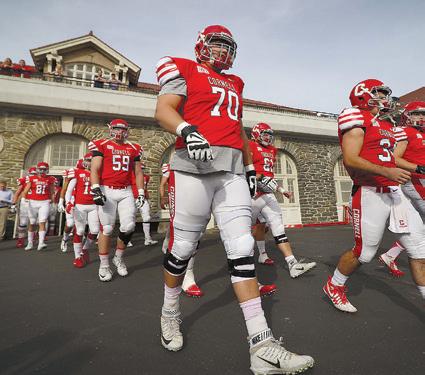
David Eldredge ’81, the decorated coach who led Cornell’s polo teams for the last 33 years, has retired amid an investigation into claims of “potential past misconduct,” the University confirmed on Wednesday evening.
tion followed complaints from players that Eldredge used a slur in a team meeting and drank from a beer while driving students, according to interviews with three former men’s polo players and a letter obtained by The Sun.
Reached at a barn across from his house on Wednesday night, Eldredge confirmed to The Sun that he was investigated in 2007 and said he had been cleared of any wrongdoing.
“I would not have been able to remain coach for the next 12 years had anything ... come of that [2007 investigation].”
David Eldredge ’81
“Allegations of potential past misconduct by Mr. Eldredge have been brought to Cornell’s attention,” said John Carberry, a Cornell spokesperson, in a statement to The Sun. “They will be reviewed thoroughly, and all actions considered appropriate will be taken once that process is complete.”
Cornell declined to say what reported misconduct will be reviewed as part of its investigation, but the University looked into allegations against Eldredge more than a decade ago and briefly placed him on leave in 2007. That investiga-
“Cleared, as in cleared, as in not guilty, as in cleared,” he said, wearing a Cornell polo hat and T-shirt. “I would not have been able to remain coach for the next 12 years had anything, you know, come of that.”
That investigation began on March 9, 2007 and concluded several months later, according to a letter Eldredge sent to former polo player Daniel Crespo ’08, in which the coach apologized for making an “offensive remark” at a team meeting.
Eldredge wrote that he was “instructed to not contact” Crespo until after Cornell’s investigation had ended.
“Because of that, it is only now, when the investigation is completed, that I am able to apologize to you for the offensive remark I made in a men’s varsity team meeting in the 2005-2006 Cornell Polo season,” Eldredge wrote in the

Architects representing the University defended the decision to power the new North Campus expansion with natural gas at an Ithaca Planning and Economic Development Committee meeting on Wednesday.
The North Campus Residential Expansion will construct two new housing sites on North Campus, giving housing to an additional 1,200 freshmen and 800 sophomores, The Sun previously reported.
These new dorms, like North Campus currently, will be powered by Cornell’s Combined Heat and
Power Plant, which relies on natural gas. Natural gas is composed mostly of methane, according to the U.S. Energy Information Administration.
Kathryn Wolf of Trowbridge Wolf Michaels Landscape Architects spoke about Cornell’s project at the meeting and described how the power plant works. She said the gas passes through a combustion turbine, which produces electricity that “powers the campus.” She said this process “throws off waste heat,” which is captured to produce steam, and that steam heats Cornell. In addition, the University uses lake-source cooling to cool the campus.
letter, which was sent to Crespo sometime after the end of the 2007 spring semester.
Crespo told The Sun that during that meeting at the Oxley Equestrian Center in the fall of 2006, Eldredge used
recognition election is a long-term goal, CGSU intends to focus on other initiatives until then.
Cornell Graduate Students
United outlined plans for new “winnable” campaigns for the semester following the loss of their certification in the graduate assistant union recognition election in March 2017 at their Wednesday meeting.
CGSU lost the election by 74 votes in an election that saw an approximate 80 percent turnout among eligible graduate student assistants, The Sun previously reported. The vote total was 941 votes against unionization and 867 votes in favor.
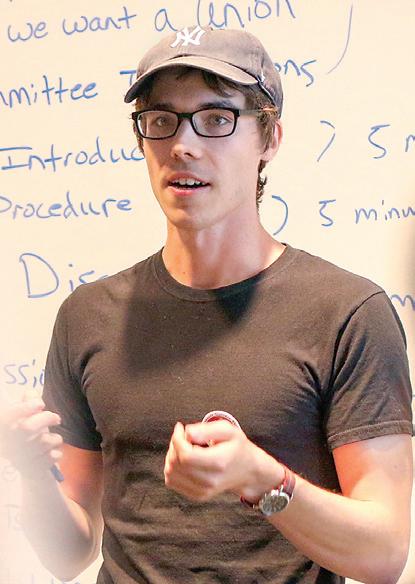
“We want to grow the union. Eventually we’d like to win a recognition election, but in the meantime we want to act like a union, and we think that there’s things that we can do that will have tangible effects on grad workers’ lives in the meantime,” he said. “And so right now we’re sort of directing our focus toward those initiatives.”
Attendees at Wednesday’s meeting proposed and discussed ideas to tackle issues ranging from mental health to transportation services to holds on registration.
CGSU is barred from filing a petition for another union recognition election until May 25.
Henry Kunerth grad, chair of the communications and outreach committee, told The Sun that while winning another union
In the area of mental health, David Blatter grad, chair of the Legal Affairs Committee, presented some results of a recent mental health survey distributed by
Juice Hazard Analysis and Critical Control Points
8 a.m. - Noon, 148 Conference Center
Tenant/Landlord Rights and Responsibilities
11 a.m. - 1 p.m., Cornell Cooperative Extension of Tompkins County, Room A
Indian Economy: Where From and Where To Noon - 1:30 p.m., 401 Warren Hall
Epistemology of Islamic Feminism Noon, Kahin Center
Introduction to Zotero Noon - 1 p.m., 106G Olin Library
Karl Polanyi: The History of Ideas and the History of Capitalism Noon, 110 White Hall
Veterinary Nutrition Rounds: Nutritional Approaches to Weight Loss Noon - 1 p.m., LH1 College of Veterinary Medicine
Berger International Speaker Series Lunch Talk 12:15 - 1:15 p.m., 276 Myron Taylor Hall
Twenty Years of Nuclear South Asia 12:15 - 1:30 p.m., G08 Uris Hall
Thursday, September 13, 2018
Engaged Learning Workshop: Ethical Practice and Meaning Making in Community Engagement 9 - 11 a.m., 100 Mann Library
Does Where You Die Depend on Where You Live? Evidence from Hurricane Katrina Noon - 2 p.m., B51 Warren Hall
The Works in Progress Seminar 12:10 - 1:10 p.m., 488 Uris Hall
Gavel Gap Lecture with Judge Pamela Chen 12:15 - 1:15 p.m., 184 Myron Hall
Ben Austen: Cabrini-Green and the Fate of American Public Housing 12:20 p.m., Abby and Howard Milstein Auditorium
An Introduction to Bloomberg 1:30 - 2:30 p.m., Stone Classroom Mann Library
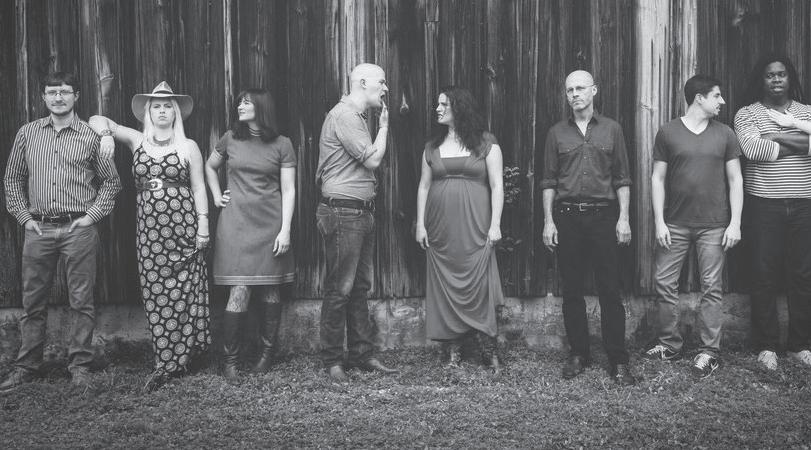
Conversation with Roomful of Teeth 3 - 4 p.m., Auditorium Klarman Hall

By JILL CROSBY Sun Staff Writer
“Is American Democracy truly in danger?” was a question that Prof. Daniel Ziblatt, government, Harvard University, never thought he would ponder — until the modern political climate.
Ziblatt discussed a book he co-authored with Steven Levitsky, How Democracies Die, in a lecture Wednesday, warning attendees about the potential of a collapsing American democracy and giving solutions to protect the United States.
How Democracies Die traces the evolution of modern political philosophy in Europe and helps to understand how democratic notions get constructed. The piece was rated a New York Times bestseller and translated into 15 languages, according to Ziblatt’s Harvard staff biography.
“Like most Americans, I have always taken American Democracy for granted,” Ziblatt told the auditorium.
The lecture emphasized President Trump’s election as an indication of a dying democracy in America and how “the past one and a half years has put us in uncharted territory.”
“Americans tend to think we can place a lot of faith in our Constitution,” Ziblatt said.
He continued to discuss how the system of checks and balances in place are not enough to keep Trump in line and that “the Constitution is not enough to save us,” as many things have changed since the document was written.
“Democracies used to die at the hands of men with guns,” Ziblatt said. “Today, democracies die at the hands of presidents and prime ministers.”
According to Ziblatt, the protection of the United States’ democracy can be found in political parties, as opposing
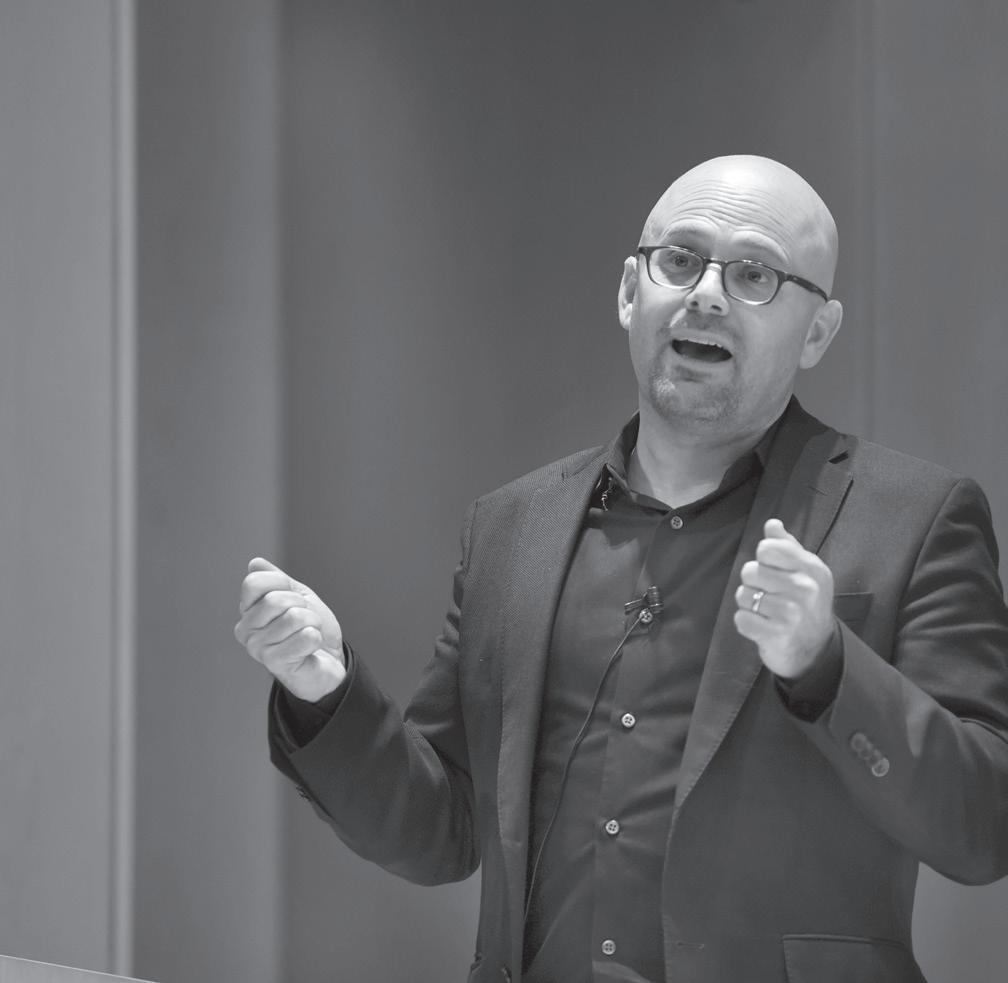
Democracy debate
| Prof. Daniel Ziblatt, government, Harvard University, speaks about a book he co-authored “How Democracies Die,” during his Wednesday afternoon lecture.
political parties act as democracy’s gatekeepers to “keep extremists and demagogues out of power.”
Ziblatt feels that in the past the American political parties fulfilled this duty, but during the “extraordinary times” of today, parties very rarely endorse candidates outside their own party.
He encouraged the audience to consider the state of America because “citizens aren’t fully aware their democracy is dying until it is too late.”
Lauren Kazen ’21, who attended the lecture, characterized it as “really eye-opening.”
“I’ve caught myself taking the stability of our democracy for granted,” she told The Sun. “It’s interesting and important to look at what the erosion of democracy would look like in contemporary America compared to historical and foreign examples.”
However, not all members of the audience were left convinced that the country is in peril.
“I do not think democracy is dying,” Ben Ostfield ’22 said. “I think democracy in America is changing.”
Crosby can be reached at jillcrosby@cornellsun.com.
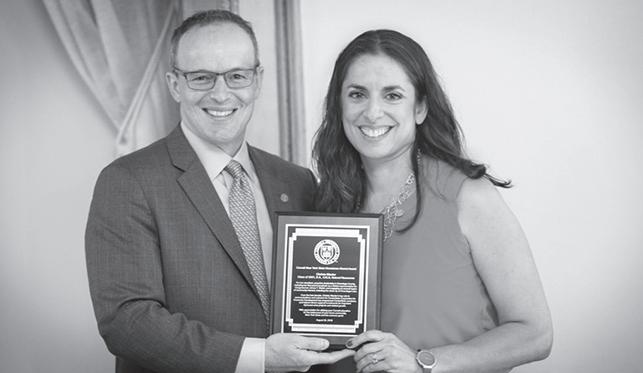
For her work in marketing and communication that helped secure funding for a number of Central New York economic development initiatives, Christa Glazier ’01 became the second recipient of the Cornell New York State Hometown Alumni Award on Aug. 28.
As a way to “tell an important part of the Cornell story” and show the “University’s commitment and engagement in New York State,” the University began giving out the Cornell New York State Hometown Alumni Award on a bi-monthly basis in April, according to Gary Stewart, Associate Vice President for Community Relations.
Glazier is the current vice president of communications and marketing at CenterState
Corporation for Economic Opportunity, a business leadership organization that is “dedicated to the success of its members and the prosperity of the region,” according to the organization’s website.
Stewart said in an interview with the Sun that the University established the award earlier this year to recognize people “who left their hometown or region, attended Cornell, and returned home to start or enhance a business or non-profit, and to volunteer in their community.”
Glazier majored in natural resources and after graduation went to work for a local congressman, U.S. Rep. Jim Walsh (R-N.Y.), but her career took a turn when she chose to get involved in communication.
“Even though I had a major that was natural resources, I just remember
[doing] so much writing for so many different classes,” she said. “The breadth of experiences that I had at Cornell through coursework and diversity of people that you meet … serves me well in my job now.”
Glazier helped draft the 2015 Upstate Revitalization Initiative proposal for Central New York, which ultimately received $500 million in competitive New York state funding for a number of regional economic development initiatives. One notable project is the advancement of infrastructure and technology to support the growth of the unmanned systems, or drone, industry in Central New York, according to Glazier.
Part of the funding is currently being used to attract business and jobs from that industry to the region, as well as work with the federal government, including the FAA
By MATTHEW McGOWEN Sun Senior Editor
Dr. Gunhild Stordalen took the stage of the fifth annual EAT Stockholm Forum in a metallic silver suit and matching dyed grey pixie cut, and like her futuristic appearance, her topic was a forward-thinking initiative about how to feed the planet’s 10 billion people by 2050.
The Oslo-based nonprofit EAT Forum was founded by Stordalen and regularly hosts gatherings to foster collaboration among representatives from science, business, NGO and government groups. The meeting provided Cornell faculty a platform to meet and strengthen relations with organizations from over 50 countries working on sustainable ways to feed a rapidly growing human population.
David Lodge, Francis J. DiSalvo Director of the Atkinson Center for a Sustainable Future at Cornell and a member of EAT Forum’s advisory board, attended the event for the fourth time and outlined shared goals of the Atkinson Center and EAT.
“[The conference] brings representatives from all these groups together in a very professionally produced program,” Lodge said. “Our role in this topic of food is to bring Cornell research to bear to make food production occupy the smallest footprint possible.”
According to Lodge, ongoing agricultural research funded by the Atkinson Center is consistent with EAT’s mission: to “feed people nutritious food and [feed] more people in the future without destroying the planet.”
and NASA, and private sector partners to set up the infrastructure and policies to advance the industry.
Working in Syracuse where she grew up has also helped her gain a “better awareness” of her home community.
“I gain a better appreciation for some of the things that are going on in the community,” she said.
As part of the award, the University gives a monetary gift of $1,000 in the name of the recipient to a community non-profit of their choice.
Glazier selected the Syracuse-based InterFaiths Works’ Center for New Americans, according to the University.
In addition to helping her hometown, Glazier is also an active leader in the Cornell alumni community.
As a member of the Cornell Alumni Admissions Ambassador Network, she has interacted extensively with prospective Cornell applicants from her local community.
She is also on the board of the Cornell Alumni Association of Central New York where she has planned alumni networking sessions and fundraisers. Money from the fundraisers goes to the association’s scholarships programs, she said.
“If you have an open interest or passion for something, see if there is something you can get involved in. Create an opportunity,” she said.
Cornell is currently putting its considerable research clout to work on food technology and farming practices, Lodge said. He gave the example of Prof. Johannes Lehmann, soil and crop sciences, who helped build the largest biochar facility, which heats and decomposes organic materials into usable products.
According to Lehmann, the facility is “a testbed for the conversion of wastes into soil amendments and other uses,” converting potentially harmful organic material into better soils to spur more nutritious produce and better crop yield.
Prof. John Tobin-de la Puente, jointly appointed at the SC Johnson College of Business and the M.P.A. program in Cornell Institute for Public Affairs, was asked by Lodge to join the forum and bring his background in economics to bear on the issue of sustainability.
“There is a strong recognition at Cornell that the intersection of economics and business and the environment is a crucial one, and one that needs to be managed more carefully,” Tobin said.
Cornell is consistently ranked third among the world’s agricultural universities, according to U.S. News rankings, but Tobin said that building stronger relationships with partners like the Stockholm Resilience center and other groups was the “most important” goal of attending the EAT forum.
“As much as we may like to think of ourselves at Cornell as one of the leading universities in the world in sustainability, and we are, geographically Western and Northwestern Europe are real centers of activity in the sustainability space,” Tobin told The Sun in an interview.
To further those goals, Cornell has invited Olav Kjorven, EAT chief strategy officer, to visit campus from Sept. 30 to Oct. 2, according to Chris Miller, alumni affairs and development specialist.
Kjorven plans to “speak at an Atkinson Center ‘Topical Lunch’ for invited faculty and grad students whose work in the increasing food security arena aligns with his expertise and the foci for EAT” and lead a “professional development program with invited grad students and post-docs,” Miller said in an email to The Sun.
By VALE LEWIS Sun Staff Writer
Replacing prior diversity training, all incoming freshmen students were required to participate in a three-hour, student-facilitated session led by the Intergroup Dialogue Project to gain insight about themselves, others and learn active listening and communication skills across different identities.
IDP was originally created in 2012 as one undergraduate course in the College of Agriculture and Life Sciences and has since evolved to include more courses, a graduate program and workshop series.
Groups on campus can request a workshop or extended workshop series from IDP, led by student facilitators, which the project hopes allows individuals to “gain practical skills for making their offices, classrooms, and student groups more inclusive environments,” according to IDP’s website.
During Orientation Week this August, each freshman participated in one of these IDP sections, which were designed to help them “learn more about themselves and each other, as well as for practicing skills and tools for communicating across difference both inside and outside the classroom,” said Adi Grabiner-Keinan, IDP director. According to Grabiner-Keinan,
President Martha Pollack and other senior Cornell officers agreed to sponsor the inclusion of these IDP sessions in orientation as part of the early recommendations that emerged from the Presidential Task Force on Campus Climate in June.
Throughout orientation, the IDP ran 169 individual sessions for all 3,325 freshmen, who were separated into groups of 20. Each session was facilitated by two upper-level undergraduate or graduate facilitators.
Within each session, facilitators began with an explanation of main concepts and personal identifiers, such as race and gender identity. Students were then asked to reflect on their own identities and rank which ones they relate to most.
Henry Lavacude-Cola ’22 described the sessions as “a little uncomfortable” at first due to the fact that he didn’t know anyone in his group, but he said that by the end, he felt “more comfortable sharing” aspects of his identity.
Within the three-hour session, there were several discussions, between the whole group, small groups as well as one-on-one conversations in order to encourage dialogue between individuals with different backgrounds and identities.
The discussions ranged from “how we can best listen to everybody” to “the various backgrounds
people might have that you may not be aware of,” Lavacude-Cola said.
Freshmen are in the process of completing surveys about the workshops, but Grabiner-Keinan said that the feedback IDP has received so far has been positive.
“Students were actively engaged during the sessions and were excited to explore issues related to identity and communication across difference,” Grabiner-Keinan said, based on preliminary reports from IDP facilitators.
She also said that they are working to incorporate any ideas students have for future workshops. For example, GrabinerKeinan said that several students have expressed that they would prefer more small group discussion time rather than large group interaction.
There will be two mandatory follow-up sessions for freshmen which will aim to allow them to reflect on their first few months at Cornell and continue the dialogue started during their Orientation sessions.
Grabiner-Keinan said that IDP plans to continue their role in orientation and incorporate feedback from students to improve the sessions in order to “strive for a more inclusive campus.”
Vale Lewis can be reached at vlewis@cornellsun.com.
NORTH CAMPUS
Continued from page 1
“This [cogeneration] system is the most efficient and generates the least greenhouse gases of any solution today,” she said.
She said that Cornell is committed to its Climate Action Plan, and the project is being designed in a “flexible” way.
“[The project is] being designed in a way that can be switched over in the future to other renewable energy sources when they become more efficient than the Cornell district energy system,” Wolf said.
Before architects from Trowbridge Wolf Michaels Landscape Architects spoke, community members voiced concerns during the public comment section of the meeting.
Buzz Lavine, an anti-fracking activist from Dryden, described the environmental impacts of methane leakage. He said that by the time natural gas reaches the place where it is used, such as a power plant, “a significant portion” of the gas has leaked. The “best estimates” for the leakage
amount today, according to Lavine, are five to 12 percent of the gas.
Lavine explained that methane, once it enters the atmosphere, acts “80 to 100 times as rapidly as [carbon dioxide]” over the net 10 or 15 years. This is because most of methane’s action occurs “upfront,” according to Lavine, while carbon dioxide “takes a long time to have its effects.”
“That also means that methane emissions, if we’re able to control them, lessen them, get rid of them completely — that’s our very best hope for conquering climate change,” he said.
Joseph Wilson described a memo that he, along with 15 other individuals, including Lavine, wrote to PEDC.
“In reviewing Cornell’s application, we involved experts in energy, emissions and building efficiency,” Wilson said at the meeting, referring to the memo. “We found at least 12 instances in the application of inadequate, incorrect or misleading information.”
One example is how Cornell, in its application, “omits quantifica-
tion and consideration of ‘upstream methane emissions,’” according to a copy of the memo given to The Sun. Quantification of the emissions is mandatory under the State Environmental Quality Review Act, according to the memo.
Jenny Xie ’20, a member of Climate Justice Cornell, also spoke at the meeting. She said she is “frustrated” at Cornell for “failing to do a comprehensive and thorough assessment of student opinion” on the project before starting its plans.
“In the application for the project, Cornell indicated ‘no’ for whether or not methane would be generated by the project, which is misleading,” she said. “Even if the construction of the project doesn’t generate methane, the actual project itself, once completed, obviously will, since it’s being powered by the combined heat and power plant.”
According to Xie, the new buildings will utilize 41 million cubic feet of gas each year.
Anne Snabes can be reached at asnabes@cornellsun.com.
Continued from page 1
a racial slur while warning players not to confront referees during games. Crespo said Eldredge’s “exact words were, ‘I don’t care if they [the referees] say something about your mother fucking a spic.’”
Another former player who was in the room for the meeting confirmed Eldredge’s use of the slur.
Crespo is the son of a Cuban man and an American woman and said he believed Eldredge’s remark was directed at him.
“There was nobody else who it could have been directed towards,” Crespo said.
In the letter, Eldredge wrote he used “an inflammatory trash talking remark as an example to illustrate the importance of restraint, even when provoked, as the appropriate response by a team member.
“I do understand the offensive nature of my comment,” Eldredge continued, adding that his “usage of this remark was a one time, regrettable use” and that he did not mean to direct it at Crespo “or anyone specifically.”
Cornell also investigated a claim from former men’s polo player Jesse Llop ’07 that Eldredge sipped from a beer can while driving him and three other players in April of 2007.
Llop said in an interview that after the team watched the men’s and women’s finals at the U.S. Polo Association national tournament in Lexington, Kentucky, Eldredge drove the players back to their hotel in a rented van. Llop said Eldredge steered the vehicle with his left hand and used his right to hold and drink from a Budweiser. Possessing an open alcoholic beverage as a passenger or driver has been illegal in Kentucky since at least 2000.
Asked about Llop’s claim, Eldredge said he was “cleared of everything,” adding: “that’s an encompassing statement.” He said Cornell handled the 2007 investigation and turned its findings over to the Athletics Department.
“There was an investigation upon me and I was cleared of everything,” he said, adding that the claims were “old, cleared news” and had nothing to do with his retirement.
Eldredge said “some opportunities have come up that have developed from my 33 years of being around polo and it’s a
good time for me” to retire.
A friend of Eldredge, Phil Wilde ’73, told The Sun last week that the coach told him he was “being forced to retire.”
Llop said that within weeks of the tournament in Kentucky, he described what happened in a letter to Andy Noel, who has served as athletics director since 1998, and told Noel he was concerned by the coach’s behavior.
During Cornell’s 2007 investigation into Eldredge, the coach was placed on leave and Steve Kraus, an assistant polo coach who remains in that role, briefly served as interim coach.
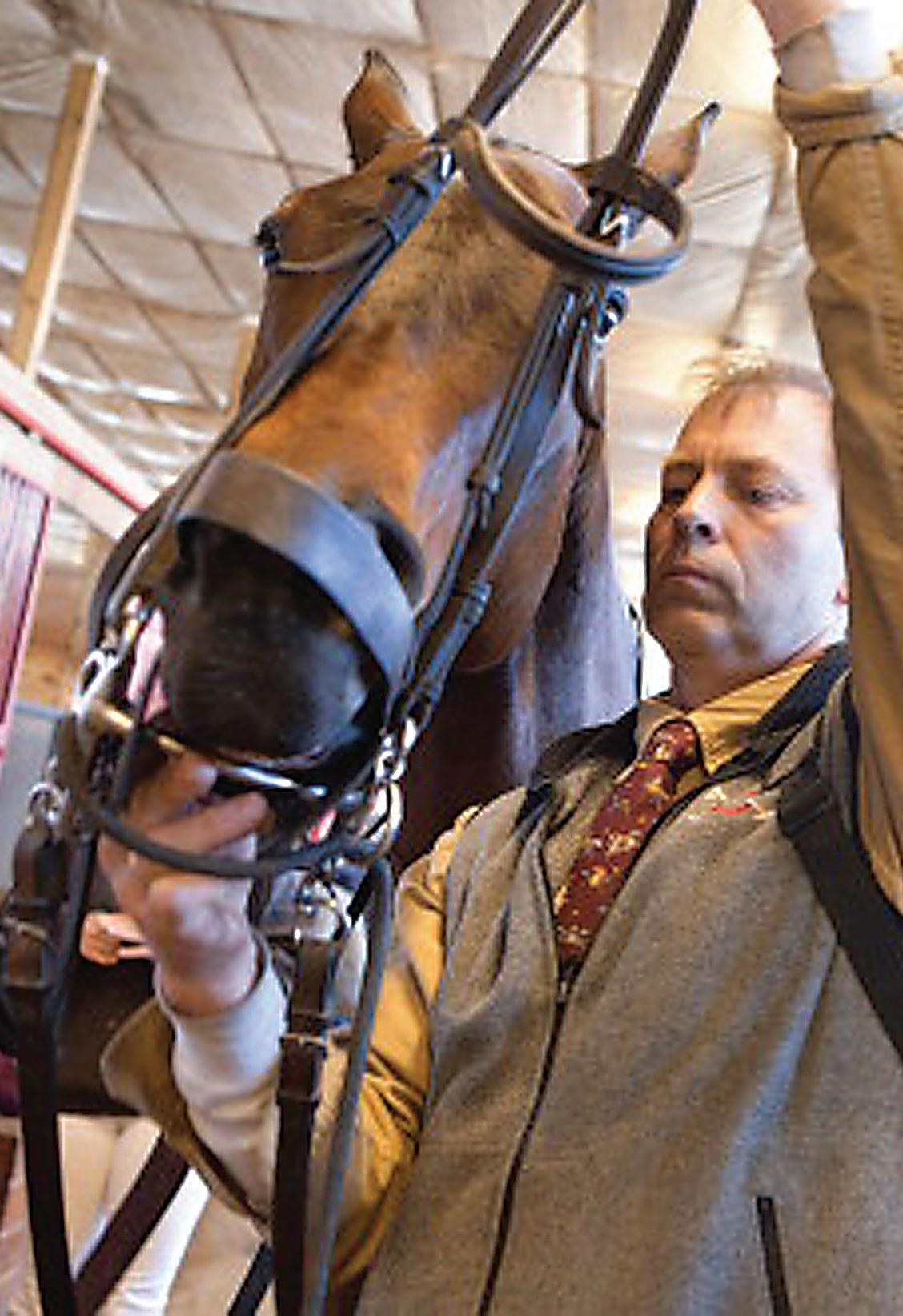
“I was the coach on an interim basis at that time,” said Kraus, who is also a clinical sciences lecturer and a widely respected ferrier who outfits horses with their shoes. “The only other official comment I have is that,
“Aside from the use of the racial slur, those allegations were found to be false.”
Steve Kraus
aside from the mistaken use of the racial slur, those allegations were found to be false and there were a number of people out to get David then, and that appears to be the case now.
Eldredge returned to coach the team in the fall of 2007.
Llop said Noel interviewed him twice about the Kentucky incident and became upset when he learned that Llop had discussed the incident with other teammates.
Noel’s assistant said he was not available for an interview on Wednesday, and Noel did not answer a detailed list of questions emailed on Wednesday evening. Eldredge had been the coach of Cornell polo since 1985 and is the winningest coach in the history of Cornell Athletics. Under his leadership, the men’s and women’s teams won 988 games and 15 national championships.
Anthony Condo, a laboratory manager at the Center for Materials Research, is currently serving as interim coach of the men’s and women’s polo teams, The Sun previously reported.
Nicholas Bogel-Burroughs ’19 contributed reporting to this article.
Dylan McDevitt can be reached at dmcdevitt@cornellsun.com.
CGSU
Continued from page 1
CGSU in the spring. He told The Sun that the results were “really useful” and that the Mental Health Working Group plans to start by working toward free or reimbursed gym passes for graduate students.
Other concerns expressed in the survey centered on the relationship between advisors and advisees, the experiences of marginalized and underrepresented communities and the services provided by Counseling and Psychological Services.
CGSU members participated in an Ithaca “Rally for a Living Wage” over the summer and, more recently, showed support for the “Does Cornell Care” campaign by local workers aiming to pressure the University to use skilled local trade laborers in construction projects.
Ethan Ritz grad, CGSU administration liaison and chair of the union management committee, joined construction workers when they protested in mid-August.
“It just seems like it was the right thing to do,” Ritz told The
Sun. “Unions stand in solidarity with other unions, and like Cornell showed that it didn’t prioritize … the like health and safety of its workers.”
The meeting comes after the University was ordered to post a notice explaining unionization rights following American Arbitration Association arbitrator Howard C. Edelman’s ruling on May 16 that the University violated the National Labor Relations Act through an email sent to graduate students during the March 2017 union recognition election.
The notice states the arbitrator’s finding that the University violated the NLRA and outlines several rights afforded by federal law including the right to “form, join, or assist a union.” The notice also states that the University “will not do anything that unlawfully prevents you from exercising the above rights,” threaten job loss for union supporters or members or “interfere” with rights under Section 7 of the NLRA.
According to a presentation slide at the meeting, the University sent the notice in an email to all
graduate students on Aug.16. Ritz explained that the notice is also physically posted “for 60 continuous days at the Big Red Barn, the Physical Sciences Building, Goldwin Smith and Biotech.”
Over 50 people attended Wednesday’s meeting, according to Vera Khovanskaya grad. The meeting concluded with attendees taking a photograph in front of “#DoesCornellCare?” written on the whiteboard.
BreAnne Fleer can be reached at bfeer@cornellsun.com.
JACOB S. KARASIK RUBASHKIN ’19 Editor in Chief
JOHN McKIM MILLER ’20
Business Manager
KATIE SIMS ’20
Associate Editor
VARUN IYENGAR ’21
Web Editor
MEGAN ROCHE ’19
Projects Editor
EMMA WILLIAMS ’19
Design Editor
JEREMIAH KIM ’19
Blogs Editor
AMOL RAJESH ’20
Science Editor
BREANNE FLEER ’20
News Editor
YUICHIRO KAKUTANI ’19
News Editor
NICHOLAS BOGEL-BURROUGHS ’19
City Editor
LEV AKABAS ’19
Arts & Entertainment Editor
SARAH SKINNER ’21
Assistant News Editor
ANNE SNABES ’19
Assistant News Editor
JOHNATHAN STIMPSON ’21
Assistant Sports Editor
EDEM DZODZOMENYO ’20
Assistant Photography Editor
PETER BUONANNO ’21
Assistant Arts & Entertainment Editor
CHENAB KHAKH ’20
Assistant Science Editor
JULIAN ROBISON ’20
Layout Editor
HELEN HU ’21
Graphics Editor
DUSTIN LIU ’19
Human Resources Manager
ANNA DELWICHE ’19
Senior Editor
MATTHEW McGOWEN ’19
Senior Editor
GIRISHA ARORA ’20
Managing Editor
HEIDI MYUNG ’19
Advertising Manager
ALISHA GUPTA ’20
Assistant Managing Editor
DYLAN McDEVITT ’19
Sports Editor
MICHAEL LI ’20
Photography Editor
GRIFFIN SMITH-NICHOLS ’19
Blogs Editor
JACQUELINE QUACH ’19
Dining Editor
SHRUTI JUNEJA ’20
News Editor
ANU SUBRAMANIAM ’20
News Editor
JUSTIN J. PARK ’19
Multimedia Editor
PARIS GHAZI ’21
Assistant News Editor
MEREDITH LIU ’20
Assistant News Editor
JONATHAN HARRIS ’21
Assistant Sports Editor
RAPHY GENDLER ’21
Assistant Sports Editor
BORIS TSANG ’21
Assistant Photography Editor
VIRI GARCIA ’20
Assistant Arts & Entertainment Editor
CATHERINE HORNG ’21
Assistant Dining Editor
LIZ CANTLEBARY ’21
Snapchat Editor
ALICIA WANG ’21
Sketch Editor
KATHLEEN JOO ’18
Marketing Manager
JOSH GIRSKY ’19
Senior Editor
ZACHARY SILVER ’19
Senior Editor
Working on Today’s Sun
Ad Layout Jamie Lai ’20
Josh Girsky ’19
Design Deskers Emma Williams ’19
Simon Chen ’21
News Deskers Sarah Skinner ’21 Anu Subramaniam ’20
Night Desker Maryam Zafar ’21
Sports Desker Jonathan Harris ’21
Arts Desker Lev Akabas ’19
Dining Desker Jacqueline Quach ’19
Photography Desker Michael Li ’20
Production Deskers Katie Reis ’20
Jamie Lai ’20
Letter to the Editor
To the Editor:
According to its own website, Cornell has been spewing 600,000 metric tons of CO2 equivalent of Methane Emissions from its fracked gas-burning co-generation plant since 2016. This is a ten-fold increase in this 100 times more powerful than carbon dioxide heat-trapping pollutant since 2008.
Now Cornell proposes to dump another 5,700 metric tons per year or 285,000 metric tons on us over 50 years as part of its North Campus Residential Expansion. This kind of explosion in greenhouse gas emissions violates our community’s plans to cut emissions and natural gas implied in the City’s Climate Smart Pledge and specified in the Town’s Comprehensive Plan and the County’s Energy Road Map. Moreover, the buildings won’t meet the City and Town’s Green Building Policy standards for energy efficiency.
Repeating recent history, the City is ignoring these dangers by overlooking Cornell’s legal obligation to disclose methane emissions and kowtowing to Cornell’s demands for fast-track approval. As with other big City projects, the results will be approved based on misleading “facts,” no systematic Environmental Review, public interest in sustainability pushed aside and a hotter future for us all.
Time for the City to meet its responsibilities and for Cornell to do what’s right.
Joseph Wilson
In response to “Former Hotel Prof: ‘The Best People Are Not All White’”
This past May, and, most recently, last week, I had the opportunity to meet with Cornell Daily Sun reporter Meredith Liu ’20, to review with her our comprehensive diversity and inclusion initiatives and programs at the School of Hotel Administration and, broadly, at the SC Johnson College of Business. This issue is extremely important, so I appreciated being able to meet with her and to clarify our strategic focus. While in our discussions we acknowledged the challenges that our school and most business schools face, we were also able to share the critical ways in which we are reaffirming our commitment to, and expanding our efforts to, create a truly diverse and inclusive community.
One of our school’s fundamental core values is to be a community that is supportive of and inclusive to all.
One of our school’s fundamental core values is to be a community that is supportive of and inclusive to all. That is foundational to hospitality, and our school’s stakeholders fully embrace this guiding principle. One of the key ways we support this value is through selecting a diverse and vibrant student population, one that represents all identities, including underrepresented minority students. In part, we accomplish this through generous grants we have secured, such as the one with The Hilton Foundation, which helps to fund recruitment and support efforts for underrepresented minority students. In addition, this fall our admissions team will lead significant recruitment efforts in major U.S. cities to connect with those underrepresented and first generation high school students (and their counselors) who are interested in learning more about SHA and Cornell.
Our goal is to provide [students] with a comprehensive support system.
Once our students arrive in Statler Hall, our goal is to provide them with a comprehensive support system as part of a fully welcoming community. One of our student-supported organizations, the National Society of Minorities in Hospitality, a non-profit organization founded at SHA, continues to help provide a network for minority students of African, Asian, Hispanic and Native American descent. The NSMH has grown to nearly 100 collegiate chapters in five regions, and the SHA chapter is a leader among them. In fact, our school is hosting the regional conference next month, which will attract over 250 students from 30 schools.
Beyond this, and through the efforts of our faculty and student-services team, we work to provide an infrastructure of support to underrepresented minority students throughout their academic and social experiences at the Hotel School and Cornell University. For example, each summer our students actively participate in the pre-experience summer program (PSP), which provides important preparation for the year ahead. We also provide ongoing programming and opportunities to engage with fellow students and alumni. Our alumni of color panel discussions are held each semester and cover topics such as: achieving academic success, securing internships and leveraging
industry resources. We also strive to bring diverse alumni to campus. This semester, our Dean’s Distinguished Lecture Series will welcome Thomas J. Baltimore, Jr., Chairman and CEO of Park Hotels and Resorts, a distinguished leader of color. All of these efforts are holistically aimed at building a welcoming and warm environment of support and success for all our students, one that provides a visible, inspiring and mentor-supported career path ahead. In alignment with Cornell University’s plans to dedicate $60 million over the next five years to hire and retain diverse faculty, we are dedicated to building a diverse faculty within SHA. As Liu pointed out in the Sun article, we adhere to a “faculty search directive,” which requires that if a search committee cannot find a qualified underrepresented minority candidate, we need to show that the result followed a substantial effort. As with all searches throughout the SC Johnson College of Business, last year our candidate lists were reviewed and approved by the college’s associate dean for diversity and inclusion. As the dedicated college diversity officer (CDO), the associate dean serves as an ex officio member of every faculty search committee and ensures that our searches meet our goal of sourcing diverse candidate pools. In addition, the University Office of Faculty Development and Diversity provides a wide range of resources to support faculty, including training for comprehensive searches. We recognize that, like all of Cornell, attracting, supporting and retaining underrepresented faculty of all identities is an ongoing challenge, and there is much more work to be done in this regard. Strengthening the diversity of and work experience for all of our faculty is one of the school’s and the college’s ongoing goals, and a key focus for the year ahead. At the School of Hotel Administration, we strive to create and sustain a diverse, inclusive and supported learning community. In fact, as I recently shared with our faculty, staff and students, we want our school to be a model for the entire university, a place that embodies and symbolizes hospitality for all. We are working to achieve this in profound ways through supporting the many identities of our diverse community members, including student-colleagues and educators, as well as symbolic ones, through the visual imagery we create throughout our school. We are so proud of our accomplished students, our deeply committed faculty and our supportive alumni. We will continue to tap into all of our collective resources and, building from a place of commitment and care, will provide an ever-increasing diverse, supported and supportive place of learning and growth; one that showcases why our school is the thought-leader for our industry, and one day, we hope, the model for all educational institutions.
Manisha Munasinghe | Trustee Viewpoint
When I first arrived in Ithaca 3 years ago, I found myself taken aback by the general aura of Cornell. Everything seemed to exude excellence. The research, the students, even the buildings exceeded my expectations. Despite the repeated assurances of those around me, I could not shake the idea that, to exist in a place like Cornell, I too needed to be excellent. I spent most of my first semester in a state of constant worry that I could not meet this standard, and I struggled to integrate myself into the Cornell community. It would take over a year, and the kindness of quite a few senior students, for me to quash this belief and to find my place here.
The transition into any new academic program can be jarring. Some students can find their place easily, building camaraderie with other new students within their program or with student organizations they click with right away. Others, like me, can spend quite some time trying to find their space, their niche, here at Cornell. The diversity of firstyear experiences here is too vast to enumerate. However, as I’ve had the opportunity to connect with more graduate and professional students each year, I have come to realize that many more students than I anticipated shared my experience of first-year isolation. Many of us expressed envy over the multitude of ways that the university invested in integrating first-year undergraduates into the Cornell community and expressed a desire for similar assistance for first-year graduate and professional students.
tions and developed relationships within those organizations sooner.
Choosing who will build an apartment complex should be an economic decision, not a moral one.
Fortunately, many of these factors that ease the transition to Cornell for graduate and professional students can easily be adapted across campus. Academic programs can standardize first-year course work, even if it is limited to only one class, and can institutionalize mentorship programs that connect senior and first-year students. A continued investment in developing graduate and professional student housing, particularly those that employ these same students to help foster community building, can create physical and emotional hubs where students can meet and socialize with each other. Departments can also take the lead in changing the culture within their programs to encourage a healthy work-life balance, which is key to creating opportunities for students to build relationships with each other. As we move forward, we should strongly consider integrating these experiences into the first-year experience.
Inever anticipated that my happiness in college would be so directly correlated to my major. In hindsight, it seems obvious, but I never really believed the whole “if you love what you do, you’ll never work a day in your life” mantra. I figured that I could get away with being mildly interested in my major and rest assured that I’d get a decent job that would make me enough money to fulfill me. But as anyone who has changed their major multiple times will tell you, that certainly isn’t the case.
No matter how much I tried to convince myself that studying biology for a measly four years of my life couldn’t be that bad, I was miserable in every class.
Throughout my conversations with students, certain factors seemed to repeatedly emerge as impacting the severity of first-year isolation. Students in programs where first-years often took the same coursework together seemed to build a sense of connection to their program faster than those that did not. Students that lived in housing complexes with a high-density of graduate and professional students often became friends with those that lived near them. Students that formed connections with senior students repeatedly mentioned these relationships as crucial for making them feel included. Finally, students with faculty advisors that encouraged them to pursue activities and hobbies outside of their academic responsibilities often joined student organiza-
We cannot forget, though, that there is a group of graduate and professional students who are right now starting the process of finding their place here at Cornell. The most effective thing we can do to help connect these new students to our community is to actively include them. An invitation to grab lunch, go to the movies or to join a group for Tell Grads It’s Friday (TGIF) at the Big Red Barn can be the first step in helping someone find their place at Cornell. It sounds cheesy, but having experienced it first hand, this simple effort of inclusion can mean so much to a student who might be feeling alone. To any students who are struggling right now, let me speak from experience, and say that you will find your community here at Cornell. You will build relationships here with some of the most truly intelligent, passionate and kind-hearted people. I cannot promise that it will happen overnight, but I can promise that it will happen.
Manisha Munasinghe is the graduate and professional student-elected member of the Board of Trustees, and a PhD candidate at Cornell University. Trustee Viewpoint runs every other Thursday this semester. Munasinghe can be reached at mmunasinghe@cornellsun.com.
Ijust sprinted to Mann at the end of Spanish. I once again didn’t do the homework for that class, worsening my already abysmal grade in it. I need to pass it to graduate. I was going to email Katie and tell her that I just couldn’t turn in a column this week. But here I am sitting at this damn table writing this. Even though I’m very much crunched for time, I’m writing this because I’m feeling some type of way and I have something to say about it. And I want to express that for queer people, especially queer people of color, that may be feeling the same way about relationships. Whether it’s one they’ve been in, are currently in or yet to be. This is something y’all should know.
If you’ve listened to the song on repeat that the title of this column is referencing, you can stop reading now. Last year while I was allowing myself to be played, I wrote that I was basically Taylor Swift. This year in my development, if you can call it that, I’m Amy Winehouse. That’s who I was to my first boyfriend, now my first ex, at no fault of his. The shittiest thing about queer relationships, especially when they involve two queer people of color, is that each person probably has their own individual shit that they’re going through as a result of their lives up to their meeting. And unlike Julie Michael’s song “Issues,” that’s not what I chose for the title. Even But her sentiment does make sense while you’re drunk in each other’s company. We are abandoned. Whether it’s from our own families, our own friends, our “communities” that extend acceptance only up to their
own politics. I don’t feel the need to justify what I mean, if you read that and it resonates then that’s enough. If it doesn’t, go talk to someone like me. Or email me. Starved of genuine, unconditional love, we cling to each other and in a world that has roundly rejected us. While we were dating for all of two months, he was my only source of happiness.
No one has ever touched me like that, no one has ever kissed me like that. I’ve never felt loved like that. At the height of it I would’ve done anything for him, proudly promising I was his “ride or die” and the last thing he did before I cut him off was promising that he was mine. No matter the level of toxicity our relationship reached — and we reached some heights — we knew that the only refuge we could ever find was with each other. The reason I had to cut him off was because if I broke up with him in person, I wouldn’t. I told him I’d always be there for him, a promise I broke. We promised if we ever wanted to break up (it happened about five times over the course of those few months), then we would at least do it in person. Another promise I broke, but I had to. We loved each other. But I feel like what I’m about to say isn’t even an opinion. Love isn’t enough. If you’re already working on yourself, love will not help that process. Your issues won’t disappear but will adjust with your partner in some way, in my case, I drowned in them. In my case, I have severe self-esteem issues and clung to him because he made me feel like I was dumb for even thinking I was nothing. But the reassurance couldn’t smooth
over deep wounds that caused them. That traced to the deep, growing pains that are still fresh as I continue to develop. Taylor Swift was still in there. I loved him so much I doubted it every time he said he loved me. I convinced myself he was fucking some twink on the side. Perhaps the worst thing about anxiety is it flattens even the people you deeply love, and convinces you somehow they too will eventually abandon for some reason or the other. Or just the simple fact that you were never worth it.
After I share this on my Facebook, I don’t need someone to comment “you’re amazing!” I don’t like “empowerment,” because it doesn’t let me sit with pain, and learn to live with it. It’s human to have it, and I’ve spent years masking it. Whether it was grades, boys or love, anything to numb it. And through an actual proactive thought I had at a particularly tense moment, I knew our love would destroy us. I would leave Cornell and go wherever he went. Chase that feeling for the rest of my life.
Falling in love when you’re already fucky is a lose-lose. I lost when I lost him, but I’d lose if I didn’t. I’ve joked that I was basically a teenager when I first started thinking about boys in a real sense, but now I’m not and it hurts to involuntarily let go of that innocence. But I’m better for it, and you’ll be too. Growth is good. And the fact that there’s always tomorrow is too.
It’s exhausting enough to feign interest in a subject to your professor or parents or friends, but it’s even more exhausting to lie to yourself. I think that a lot of college students tell themselves that they just need to persevere through their undergrad studies and get a degree in something worthwhile, even if they hate every minute of it. Maybe it’s because we have been bombarded with the idea that we need to be deemed traditionally successful: who cares if you hate your job? At least you’ll be making a steady income and people will look up to you. Somewhere along the line, we allowed ourselves to believe that the void of personal fulfillment can be filled with money and status. Honestly, I don’t blame us…”loving” your job seems so trivial compared to the concrete value of being able to pay the bills and living in a nice house. Even now, I sometimes find myself doubting the idea that money doesn’t buy you happiness, because I really don’t see how it couldn’t.
Still, it wasn’t until I took the step to switch my major and started taking classes I was genuinely, wholly invested in that I realized that all those sappy Pinterest quotes have a point. Studying psychology made me happier than biology ever could. There was some kind of relief that came with not having to sell myself the idea that I was enjoying the reading assignments or being truly interested in the lectures. I looked forward to studying and for the first time, I wanted to ask questions. I went to office hours not because I felt a weird internal obligation to pretend like I wanted to “engage with material further,” but because I actually wanted to…engage with material further.
Not only did I stop dreading going to class, but I also starting doing a thing I had only heard in motivational videos or read in freshmen orientation pamphlets: taking initiative. I joined a research lab, applied to volunteer at a mental health facility and even took an optional online class over the summer out of my own free will. I felt like a nerd — but in a good way. I remember enrolling for classes in my junior year and being upset that I couldn’t fit all the courses I wanted to take into my schedule. Suddenly, my time at Cornell felt extremely limited; there was so much I wanted to do and so little time do it.
Now, I want to make clear that I still don’t believe if you do what you love, you’ll never work a day in your life. It’s not all rainbows and butterflies all the time; there will be instances where things get tedious and uninteresting and overall, you’ll have to work just as hard to be successful in a field that you like compared to one you don’t. I think the difference is that when you are sincerely interested in the work you have to do, it isn’t as much of a chore.
I’m in my senior year now, taking classes solely related to my major and I feel more academically fulfilled than ever before. Whenever underclassmen tell me about how they’re thinking about switching majors, I want to grab them by the shoulders and scream “DO IT!!!” Cornell is an incredible place with resources that most of us are probably not going to have access to again. If there’s some voice in the back of your mind urging you towards a different major, maybe give that voice a chance. It might just have a point.
n September 11, 2001, nearly three thousand Americans tragically lost their lives at the hands of terrorists. Those terrorists carried out a heinous attack on our way of life, our sense of safety and our freedom. Our fellow citizens were forever immortalized not just as victims, but as heroes.
Every year, on the anniversary of this dark day, we solemnly say — or nod in agreement when someone else says – “Never Forget.” On social media, we solemnly retweet and “like” posts bearing the hashtagged phrase.
And every year, we are liars. Because when we say “Never Forget,” we have no trouble forgetting that the reprehensible force of evil responsible for the 9/11 attacks was borne of the reprehensible force of evil that is American empire.
two questions: “Why are we [al-Qaeda] fighting and opposing you [the American people]?” and “What do we [al-Qaeda] want from you [the American people]?”
The virulent anti-Semitism, dogmatic rambling and sprinkling of cherry-picked Quran verses make for a very difficult read. It’s clear — in case anyone was on the fence — that bin-Laden was a violent, unstable psychopath, and we’re lucky he’s dead (thanks, Obama!). However, valid points were made.
Allow me to clarify once again: there is no “valid” reason for terrorism. His points about the brutality of United States foreign intervention, however, reveal the logic behind jihadist rhetoric that persists in new and perhaps more dangerous forms today.
I implore you to lean in to your existential crisis.
Let me be clear: extremist ‘Islam’ (a misnomer — it perverts the Quran) is an insane, murderous belief system that must be eradicated. I can’t believe I have to say this, but I don’t want to be misunderstood: there is no justification for terrorism nor should there be empathy for terrorists. Any individual who pledges allegiance to jihad resigns their right to be seen as human.
Nevertheless, it remains imperative that we understand why this anti-American ideology was able to gain traction: America has — continuously and without apology — bombed, raped and murdered countless innocents, obliterating entire nations in its quest for global hegemony.
When we forget the atrocities committed by the United States cited by the attackers as motivations for their atrocity against us, we dishonor the mothers, fathers, sons and daughters forever lost to their loved ones. When we allow the system, and the individuals, partially responsible for their deaths to continue wielding power, we dishonor those whose lives were stolen from them.
Osama bin-Laden’s 2002 “Letter to the American People” outlines al-Qaeda’s reasons for carrying out the 9/11 attacks. In his letter, bin-Laden answers
It is uncontroversial to say that one must know one’s enemy in order to defeat them. Nearly two decades into the War on Terror — with at least 370,000 dead and $5.6 trillion spent — there is no end in sight. It behooves us to ask why.
Let’s assume that America wants to win this war (a significant suspension of disbelief, considering its continued profitability for the military-industrial complex). In that case, the problem is the United States’ unwillingness to engage with terrorism’s root causes.
Hawks love to remind us that Obama once referred to ISIS as a “JV team,” before it rose to prominence. In so doing, hawks seek to justify continuing — if not escalating — the War on Terror, replete with drone strikes, military occupation, and the installation of puppet regimes ad infinitum. What they don’t seem to understand is that those so-called “solutions” are precisely the causes of our problems.
bin-Laden, in his letter, condemns America’s support for Israel, which has, in its conflict with Palestine, not only killed more than 7,000 but continues to subjugate Palestinians to an existence of constant fear. He condemns US intervention in Somalia, Chechnya, Kashmir, Lebanon, Iraq, Afghanistan and even Japan. He calls out the hypocrisy of US intervention and intimidation in light of our self-appointed role as global protector of freedom and democracy. I am no foreign policy expert, but even cursory research proves his
Iclaims are not baseless.
In seventeen years of the War on Terror, researchers estimate the official death toll omits hundreds of thousands who “have died indirectly due to malnutrition, damaged infrastructure and environmental degradation.” More than ten million Afghan, Iraqi and Pakistani people are living as war refugees.
Maybe I’m crazy, but I’m pretty sure there’s been like one case where people in crisis — after being decimated and subsequently abandoned by the American military — united around a genocidal dictator waging ideological war on the world. I’m not a betting woman, but given our destruction of generation after generation in the Middle East, I’d wager that more terror looms on the horizon.
Before you solemnly nod when called to “Never Forget,” I implore you to question what it is exactly that we aren’t forgetting. Are we to remember that ambiguous brown faces are a constant threat to our nation? That brown mothers, fathers, sons and daughters deserve to suffer indefinitely as retribution for the citizens killed here? That we deserve, somehow, to wage our own Holy War?
Ask yourself: who lines their pockets with that version of our memories?
I urge you to remember 9/11 for what it was. Remember the vivid poignance of those heart-wrenching last phone calls and text messages. Remember the valor of those three hundred and forty-three firefighters who gave their lives for their countrymen. Remember the unity of a wounded nation and our resilience in the face of fear.
Never forget that we were proudest to be Americans in the wake of our greatest expression of our humanity, not our power.
Then, remember the devastation wrought by an attack on civilians, on two of the nation’s most iconic sites and on our right to live in peace. And never forget that our leaders have made use of those triggering memories to justify doing the same, hundreds of times over, to nations with families just like ours.
jpinero@cornellsun.com
n a historic change of heart, Cornell has finally decided to open an LGBT living community on campus. Though details remain in the works, the “Loving House” will be a part of Mews Hall and opening to students in Fall 2019. This is a fantastic development for bettering campus life at Cornell and a historic win for LGBT students, considering the losses in the past. What I fear most, however, is that the Loving House will be segregated rather than included on campus, and stigmatized rather than understood much like the other program houses on North. In the finishing touches of this project, Vice President Ryan Lombardi ought to tread carefully and make sure that it is designed to promote Cornell’s unity and diversity as a campus.
While we want the house to be a place of security for its inhabitants, coordinators of Loving House should also make sure it adds value to the rest of campus. The community should not be an insular place, but rather a conduit to different students on campus. In addition to strong programs within the house, there should be discussions to connect with other groups like Cornell United Religious Works, multicultural groups, and Cornell Republicans, for example. Simple conversations with these organizations who may seem to be at odds with LGBT students will foster understanding and dispel implicit biases, and Loving House should actively promote them. These events of course can be voluntary, but program directors can nudge students with incentives, like a free meal that comes with having lunch with a non-LGBT student. All in all, Loving House shouldn’t just be a place to be yourself, but also a venue to learn and understand others.
Additionally, Loving House residents should be selected at random from a pool of interested students. First, administrative costs will go way down.
Second, needless competition and implicit biases will be eradicated. Although already enrolled in one of most prestigious schools in the nation, Cornell students are constantly embattled in competition for anything from memberships in business clubs to West Campus rooms. LGBT students, I’m sure, are particularly sick of going through another round of judgement on something as personal as their sexuality. Worst — some may even feel pressure to not portray themselves in a genuine way, but rather lie in their applications to prove how “gay” they are. In order to provide foster development and maturity for its inhabitants, Loving House simply cannot be an echo chamber of RuPaul fans.
On the school side, the authors of
The community should not be an insular place, but rather a conduit.
these application questions and their subsequent reviewers (probably the same people) will most definitely implant implicit biases in their decisions. We’re human and they are in everyone. True randomness, by definition, rids selection from all biases. So, instead of typecasting on what being “LGBT” means, we ought to trust that students are applying to join with good intentions and leave it to true randomness.
Lastly, Loving House should be designed to act as a big tent and remodeling for LGBT student life. Like racoons in bushes, current LGBT student organizations like Haven and OUTreach remain cliquey and ineffectual, and therefore have scarcely any
profile on the wider student population whatsoever. Meanwhile, Cornell’s own LGBT Resource Center, tucked away in a quaint little house on 626 Thurston Avenue, also has a limited presence on campus, and should leverage new visibility in Mews to promote itself. The establishment of Loving House should coincide the reestablishment of these LGBT groups. At the end of the day, Cornell students are largely occupied by academics — during prelim season, their dorm is basically a bed to sleep in. However, the Loving House is another shot for Cornell to really think about how to create a living community for a group of students that need much support outside the classroom. The simple truth is that homophobia is still rampant in 2018. Gay teens are three times more likely to consider suicide than their straight peers and last month, a a 9-year old boy committed suicide due after being bullied for coming out. High school is often hellish for many LGBT students despite changing attitudes in the media and corporate world. For those who have also managed to get into Cornell after all the nonsense they’ve been through, this school needs to welcome them with loving arms and provide meaningful support during their formative time here. Loving House presents itself as a tremendous opportunity and challenge for campus life administrators. They can either go with creating the same-old New Age program house that serves as a hackneyed diversity talking point for campus tour guides. On the other hand, they can forge a substantial living community that promotes development and unity within its walls and out onto campus. Cornellians deserve the latter.
Matthew Lam is a senior in the College of Arts and Sciences. The Despatch Box runs every other Wednesday this semester. He can be reached at mlam@cornellsun.com.

By JACQUELINE
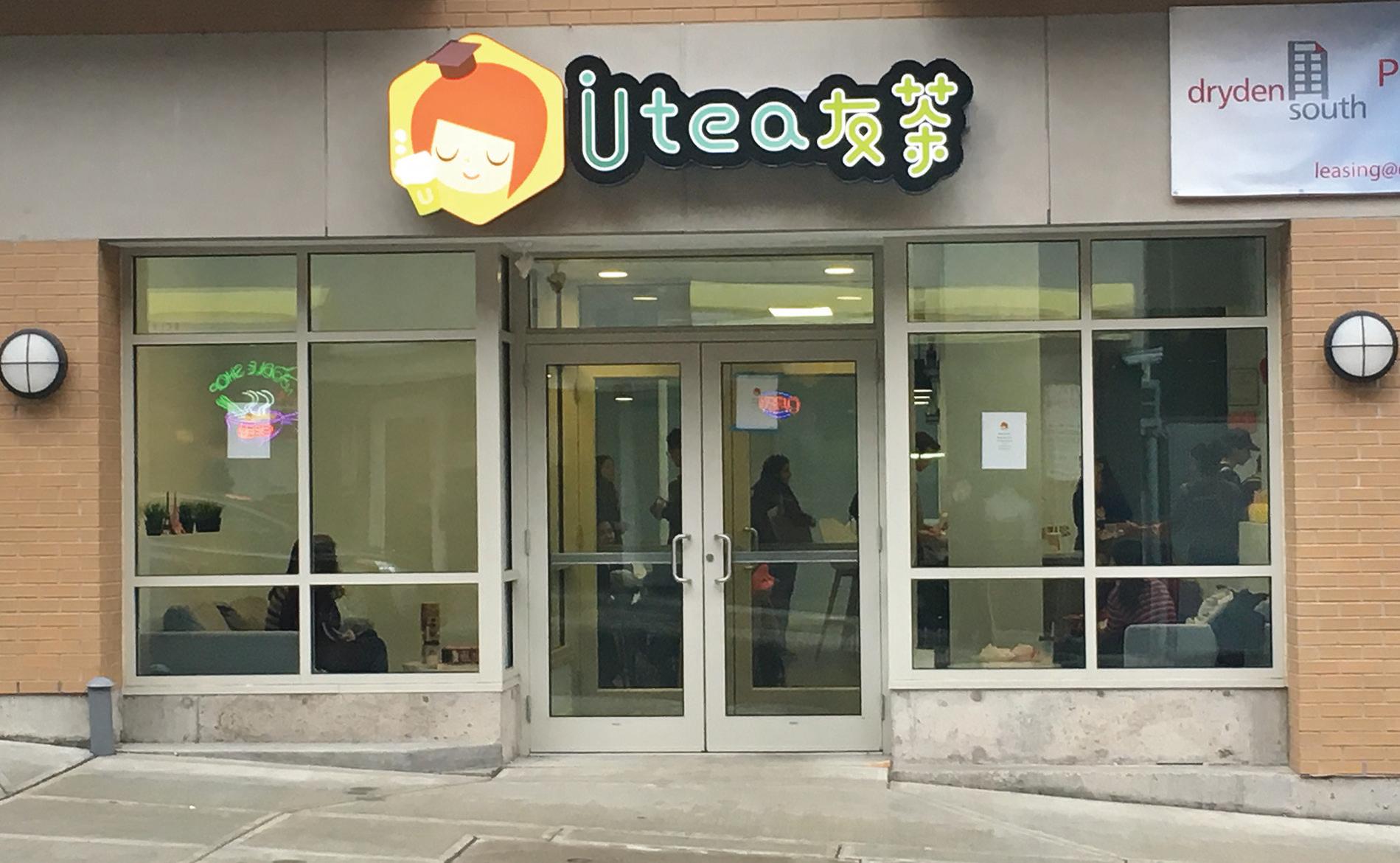
Situated on Dryden between College and Linden is a new tea house, the storefront of which depicts a graduation cap-donning girl with cartoonishly large eyes and foam-mustachioed mouth closed in satisfaction. Not since my miserable middle school weekends at Kumon has a face on a logo so perfectly embodied my experience of the establishment itself. After a couple of stops to U Tea, I have to admit it’s a thrilling new addition to the Collegetown scene and — dare I say it — presents stiff competition for the folks at Kung Fu Tea and Panda Tea Lounge.
When I set foot into U Tea, I was immediately struck by its fresh and neat interior. It’s powder blue walls are mostly bare, save for the occasional floating wood shelf that holds some vases and trinkets. There aren’t any obnoxious close-ups of its drinks, which many places often resort to as an aggressive combination of advertisement and interior design. The furniture is minimalist yet conducive
to group gatherings, as there’s plenty of seating for clusters of college students looking to wind down at the end of the school day. In fact, it would seem that students are actually encouraged to stay in the tea house, whether it’s to use the free wifi or play the board games provided at the counter.
U Tea’s menu consists of 30 drinks, which fall under seven different categories. On my first visit, I decided to try one of U Tea’s signature drinks, the cheese uji matcha. At around $6, it’s a little pricier than what you might usually order from other Collegetown tea houses, but trust me, it’s totally worth it. The cheese component of this drink isn’t a solid chunk of parmesan, but rather a thick layer of foam atop a green tea blend. It’s somewhere between the consistency of cream and whipped cream.
This particular construction means that the drink must be consumed in a special way; according to the “tips” sticker affixed to the top of my lid, “Do not use [a] straw immediately[.] Open cup lid and tilt at 45°[.] Simultaneously drink the two
layers[.] Try a few more times if unsuccessful[.]” The recommendations are accompanied by a cute illustration of a cup of cheese uji matcha tilted at the aforementioned angle.
To make your experience a little easier, the plastic lid of the cup can actually be opened by bending back half of it. This way, when you tilt and drink, you don’t have to worry about

the foam and tea spilling onto your clothing because the rim of the lid will be holding it back. With such incredible attention to detail, U Tea had already impressed me, and I hadn’t even taken a sip yet! I mean, how many places have their own special instructional stickers and user-friendly lids?
After a couple of attempts, I finally managed to drink both layers at the same time, and the result was a delightful blend of flavors. Although the cheese foam didn’t actually taste like cheese, it had a milkiness and saltiness that complemented the sweetness and herbal taste of the matcha. The creamy consistency of the foam with the liquid state of the matcha green tea made for a light and smooth texture. The matcha didn’t feel powdery at all, and it wasn’t overly sweet, which I had worried it might be. My only complaint is that I wish it had come with fewer ice cubes. Overall, I love this combination because it takes four different flavors and brings them together for a party in your mouth.
My second time around I was deciding between the brûlée bubble milk tea and the rose oolong tea “expresso” with milk foam, but I ultimately opted for the lat-


ter because I wanted to explore U Tea’s menu by trying something distinct from the cheese uji matcha. Most items on U Tea’s menu actually don’t come with bubbles (or tapioca pearls, as some call them), but according to the cashier I asked, you can request that they be added to almost every drink there.
As someone who drank oolong tea almost every day of her life until college, I wouldn’t consider myself an authority on all things oolong, but I think it’s fair to say that I can appreciate a good cup of oolong and I was hoping that U Tea would deliver — which it did! Although U Tea’s oolong tea is lighter than what I’m used to, it still had that pretty amber color and rich, slightly smoky-and-sweet taste that I will always associate with my childhood.
However, I couldn’t taste anything remotely rose-flavored at all, which was disappointing since it’s the drink’s defining feature. The milk foam, which is thinner than its cheese counterpart, required that I follow the 45° rule. The oolong tea and milk foam were quite good together and felt like a mellower version of the cheese uji matcha — the oolong wasn’t as sweet as the matcha, and the milk foam wasn’t as salty as the cheese foam. For a little over $5, the rose oolong tea was still refreshing, but I wouldn’t order it again.
Between good service, reasonable wait times and a simple and unique menu, U Tea is off to a promising start, and I can’t wait to try the rest of its menu. Time will tell if it’s just a fleeting fad or a Collegetown hotspot in the making, but my hopes are on the latter.
Serves: fruity and milky teabased drinks
Vibe: nighttime hangout for the caffeine-inclined Price: $ Overall:



BY ISABEL LING Sun Staff Writer
Passerby, which ran from September 3 through September 8 in the Tjaden Experimental Gallery, displays work by Maggie O’Keefe ’19 that spans her time in New York, Ithaca, Rome and the Chautauqua Institute over the course of two years, from 2016 to 2018. The exhibit draws upon a theme of intimacy and liminality, featuring works whose subjects exude a sense of familiarity. A largely autobiographical show, the artist invites the viewer to participate in the works, drawing upon one’s own memories to understand this state of in-betweenness as passerby.
The exhibit plays with scale, featuring full body, life-size portraits of family and friends of the artist that invite the viewer to come face-to-face with the art. One particularly striking piece is “Welcome,” which features the artist’s mother and grandmother sitting opposite of each other on a porch. In the painting, the subjects mirror each other, arms crossed, levelling the viewer with their matriarchal gaze. Visually, however, they are juxtaposed, with the younger of the women depicted in bright pink hues and the older woman painted in neutral shades. There is a feeling of depth to the painting, as if the viewer has come upon their own stoop to their family members.
The underlying narrative plays on themes of gender and intergenerational relationships, offering a branch of relatability and thus bringing the viewer into the artist’s family. The artist emphasizes scale and the humanity held within each portrait. “They’re human. I didn’t want to make them any smaller than they are. I wanted to make sure these paintings were true to who they are. I started painting these life-sized portraits because I missed a friend, and it was comforting to paint someone you love and show how they feel to other people,” O’Keefe said.
While O’Keefe’s portraits are exuberant and full of life, her series Nightscapes focuses on stillness and isolation. The three paintings each depict homes in the night that are cast in the eerie glow of late-night television, family dinners and pools of street lamp spotlight. These nighttime scenes, though inspired by homes in Ithaca, draw from a collective suburban con-





Anna Calvi’s career as a songwriter began with the release of her eponymous debut album in 2011. Garnering nominations for both the Mercury Prize and the British Breakthrough Act at the Brit Awards in 2012, Calvi quickly gained recognition for her reverb-drenched guitar riffs and drifting vocal runs. Her euphoric sound

sciousness that can be found in Anytown, USA. The paintings turn the viewer into a voyeur, demanding a level of attention to the quotidian that feels almost like a violation of privacy.
For the most part, O’Keefe’s work is never convivial, always centering around individuals or places of solitude, but her work emanates warmth. She paints subjects that toe the line between personal and the imaginary, inviting viewers to dig into their own personal mythologies — the landmarks, legends
feels quintessentially Brit-punk, yet her illusory vocal inflection feels oddly operatic.
Before any success as a songwriter and virtuosic guitarist, Calvi was a classically trained violinist and didn’t begin singing until her mid-twenties.
Throughout her latest album, Hunter, baroque vocal harmony and ambient guitar riffs are masterfully integrated to create a space that feels more like a dreamscape than a compilation of songs. Calvi creates with a level of theatricality that simply demands more from her listeners. A looming dissonance carries her vocal performance throughout Hunter, as we patiently wait for that fateful, culminating moment of sonic bliss, where her wandering voice and tenuous timbre find themselves, if only for one blissful moment, as lush organs swell behind her.
Before the release of Hunter, Calvi took to Instagram to explain to her fans that “gender is a spectrum,” and her music tries (more on this later) to follow that same vein. Hunter’s third track, “Don’t Beat The Girl Out of My Boy,” serves as an anthem for androgyny in which Calvi’s voice careens through an overdriven guitar before erupting in a vocal run with both the tact and caliber of the late Jeff Buckley. “Let us, be us,” she screams in all of her calculated madness. It would be impossible to listen through Hunter without hearing the influence of David Bowie and his final record Blackstar, which bravely confronted the transience of life and finality of death. Unfortunately, such a dramatic and ambitious sonic
and giants in our own personal histories that we’ve cobbled together to shape our stories. In this exhibit, artist and viewer share a mutual experience; we not only get a chance to look into O’Keefe’s life but also meditate further on the everyday in our own life.
Isabel Ling is a senior in the college of Art, Architecture, and Planning. She can be reached at igl3@cornell.edu.

approach has left Calvi with a collec tion of lyrics that feel incomplete and banal. The overall looseness of Calvi’s voice paired with complex arrangements don’t leave space for instrumen tal synthesis with lyrical content that says much of anything. There is a skele ton of a project with the potential to question and explore evolving concep tions of gender and sexuality, but Calvi is much too focused on the aesthetic quality of her music, and falls short. Many of the songs consist of verses and choruses containing five or so words, and many of these are simply throwaway phrases. On “Swimming Pools,” Calvi sings “Ah the swimming pool, shadows of light / Shadows divide on the earth / Come down on the swimming pool,” and the chorus follows “Waves of desire / Waves of desire on the earth / Come down to the swimming pool.”
It’s possible that my formal education in English and literature has failed me and I
reticence with which Calvi writes, but I don’t think that’s the case. Her lush arrangements and creamy vocals only carry the music so far, and leave the listener with a delusively complete album. With that being said, give a listen to Anna Calvi’s new album, Hunter — her musicality is impressive, and you can see for yourself if you can find meaning in her words.
Noah Thomas is a junior in the College of Arts and Sciences. He can be reached at nbt22@
BY
Searching is a refreshing film. Although the plot isn’t as graceful as I expected it to be, the movie serves up enough novelties to redeem it.
Unfolding entirely on a desktop screen, the movie is about a father, David Kim (John Cho), looking for his missing daughter, Margot (Michelle La), through a police investigation. It’s
no typical search, though; Asian-Americans can imagine what it might be like if their father decided to set out on a mission to save his daughter. Google spreadsheets are happening. Vaguely neurotic over-protective tendencies bubble to the surface. Wildly misinformed “I know my daughter, trust me” feelings arise.
Honest representations of the Asian-American experience on screen have been long overdue. We need more mov -
ies like Searching — movies that aren’t conscious of overplayed stereotypes and don’t stoop to the level of culturally uninformed audiences. We see piano lessons (practice every day with Mom), we see persistently naggy parents, we see the broken father-daughter relationship because of the well-meaning-but-emotionally-stifled David.
On top of that is the movie’s entirely new take on filmmaking. If our lives are so inextricable from technol -
ogy, then why not film an entire movie through that medium? Instead of watching through a camera behind the fourth wall, the audience engages with the story through David’s personal computer, Margot’s laptop and CCTV recordings. Conversations always happen through Skype or FaceTime. The search is more digital than it is physical — we see David’s internet browsing habits as he frantically searches on Facebook and Google, his expressions

peeking through in an always-open FaceTime window adjacent to the web browser.
Director and co-writer Aneesh Chaganty is spot on in his approach; so many of today’s real-life mysteries unfold exclusively on the Internet. So much of communication happens online. New relationships no longer always form in person. All of these truths which have been, for the most part, ignored in large screen films, are fully embraced in this movie. While in other movies, audiences are often left scratching their heads because That One Clue could have been found by a simple Google search, this one is technically savvy and knows how to stalk its characters the way the audience knows how too.
The movie sits at an interesting juxtaposition; we’re familiar with technology and we’re familiar with film, but we aren’t used to both coexisting as a medium of communication. Chaganty definitely plays with this to some degree, as he uses the lack of interpersonal relationships to withhold information. Because the audience is used to an up close and personal camera in which the cinematography is part of the storytelling, this movie robs us of using that built-up film intuition to jump to conclusions. Instead, we know exactly as much as David does because we are literally seeing exactly what he is.
With that said, Searching also demonstrates the downsides that come with leaning on Internet surfing as a way to tell a story. Because the Internet is such an information-driven tool, Searching falls victim to this in its writing. Instead of a flawed protagonist driving the suspicion through the movie with accumulating tension and fear, we’re served bitesized plot points that are quickly resolved within the next ten minutes. There is little opportunity to really develop character relationships, especially the ones that could have led to a bigger emotional impact (a particular relationship involving Detective Vick, to name one with massive untapped potential). Even the biggest twist at the end isn’t given the time it needs to sink in. Right afterwards, we cut to an oversimplified ending. Still, Searching is one of the first of its kind and it deserves recognition for that feat. Let’s hope to see more of this in the future — both the funky Internet storytelling and the Asian-American casting. With movies like Crazy Rich Asians and To All the Boys I’ve Loved Before , and Searching ’s early box-office success, it definitely seems to be the time for the latter.
M-F 9-5
for information about placing your ad in The Corne¬ Daily Sun



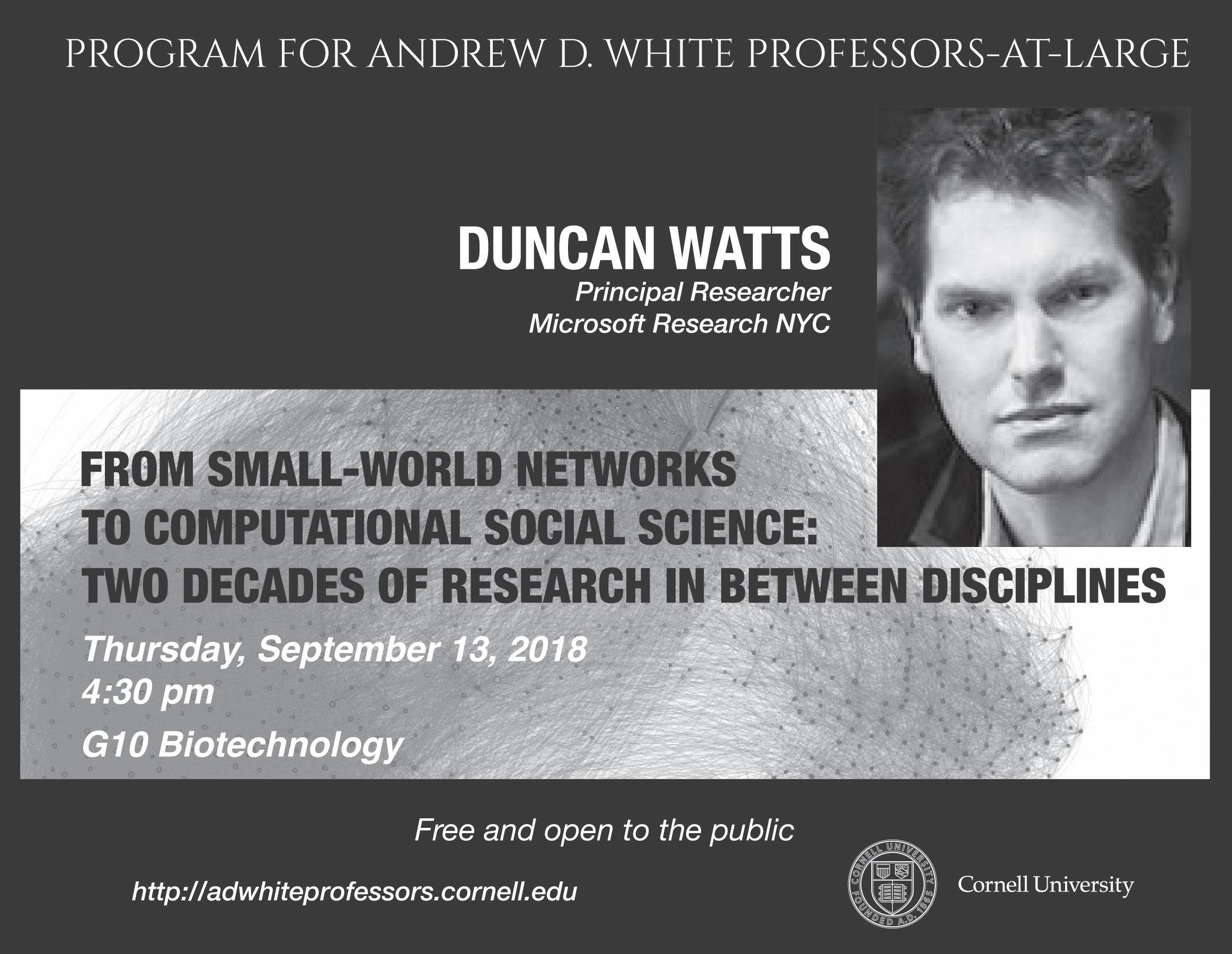

Fill in the empty cells, one number in each, so that each column, row, and region contains the numbers 1-9 exactly once. Each number in the solution therefore occurs only once in each of the three “directions,” hence the “single numbers” implied by the puzzle’s name. (Rules from wikipedia.org/wiki/ Sudoku)





BANKS
Continued from page 16
“I get it, it’s a big deal to say who’s the starter so the video board can show someone’s face, but if I feel good about it they’ll split reps,” Archer said. “That’s how I want the team to be, multiple guys playing at a starter-type level.”
The decision comes a year removed from a season of mixed results for Banks and two years removed from Banks’ honorable mention all-Ivy selection in 2016. Last season, Banks threw a third of the touchdowns (6) he threw the year prior (18) and saw his throwing yards per game decrease by over 50 (251.4 to 199.4) despite putting together a higher completion percentage (58 percent to 61 percent) and the same number of interceptions (14).
It won’t be the first time Banks sees his share of snaps decrease, however. As the 2017 season progressed and Cornell battled to remain in contention for the Ivy crown, Jake Jatis ’18 earned more playing time primarily on run-oriented plays.
A bit inspired by his own relative success last year from week four onwards, Dartmouth’s two-quarterback play in 2017, Alabama’s in the national title game and Princeton’s two years prior, Archer hopes a fresh approach can keep defenses on their toes.
“I think once a couple of people did it, it was like a golden unwritten rule, you play one quarterback, and if you play two that’s terrible because there’s some controversy,” Archer said. “And now it’s not like that, people are playing two.
… If you have two guys that can lead your team, why wouldn’t you use them both? People want to talk about, is it [Alabama’s Tua] Tagovailoa, is it [Jalen] Hurts? Well why can’t they both play and help the team?”
Archer said he came to this decision after a five-person battle for the starting job in the spring, and the trio of Banks, Kenney and Catanese separated themselves from the pack.
“A lot of things we see in Banks we see in Kenney,” Archer said of the Georgia native. “His ability to throw the ball, big, physical, can run when you ask him to, kind of like a young version of Banks.”
Catanese, like Jatis, will take snaps on more run-oriented plays, Archer said. Catanese has made one appearance at the varsity level, taking a rush in last season’s win over Brown.
“He’s a playmaker more instinctively with his feet,” Archer said of Catanese. “You wouldn’t want to put him in and have him throw the ball 70 times a game, but he can throw it. But he’s more if something breaks down and he takes off, look out — there could be a big play.”
Worth noting:
Senior Harley Kirsch, Washington state’s Class 3A Player of the Year in 2015, is no longer part of the Cornell program. The lefty underwent shoulder surgery in the offseason and decided to step away with a lengthy recovery in the forecast.
Zachary Silver can be reached at zsilver@cornellsun.com.
WALKER Continued from page 16
Red’s official depth chart.
“[Coles] ran this camp like he took it personally if any time he read ‘Chris Walker got hurt, so our offense sputtered,’” head coach David Archer ’05 said. “He was like ‘Oh really, is that what you think?’ He just runs at a different gear than he has in the past, physically [and] mentally.”
Archer has lots of backs who can do “a lot of different things,” he said, and he plans to use them in innovative ways.
“He might be in the game but you might not see him at tailback,” Archer hinted about Walker, who isn’t listed on the official Cornell depth chart. Coles and J.D. PicKell occupy the No. 1 and No. 2 running back designations.
be good to go for the season-opener.
Walker, who Archer said Tuesday is “day-to-day,” has had a speedy recovery and is on track to play week one — a welcome sign after the injury seemed likely to keep him out for the beginning of this season. Walker had over 200 yards rushing and receiving before his untimely injury last season.
While Coles and Walker are the bigname returners, the backfield will be bolstered by the return of PicKell, who sat out all of last season due to illness, a continued development of sophomore S.K. Howard, who saw his first varsity action last season, on top of the surprise of sophomore Jake Derderian, who is a walk-on.
“He just runs at a different gear than he has in the past, physically [and] mentally”
David Archer ’05
With both Walker or Coles unhampered by injury, Archer is excited about his depth at running back, and he doesn’t plan on having a traditional hierarchy among his tailbacks.
“There’s a lot of guys I trust with the football,” Archer said. “If I have to say ‘he’s the starter,’ it would purely be [based on] what play do we want to run.”
Coles led the team with 515 rushing yards and scored three touchdowns last year, working as part of a trio with Walker and then-senior Jack Gellatly before seeing increased playing time after the former’s injury. Coles recently pulled his abdomen, but Archer expects him to
Trust in the multiple running back options is the key for Archer, who plans to use his skilled ball carriers in non-traditional ways — what exactly that means remains to be seen, he said. Regardless, a rejuvenated backfield will be looking to take the next step behind a more experienced offensive line.
“Harold has had a great camp, we really trust him,” Archer said. “S.K. Howard has had a great camp, I trust him. J.D. PicKell … can do a lot of different things. Chris Walker is coming off an injury, he can do a lot of different things. Jake Derderian is a walk-on who’s producing the more reps we give him, and I think I’ve got three explosive freshmen.”
Raphy Gendler can be reached at rgendler@cornellsun.com.
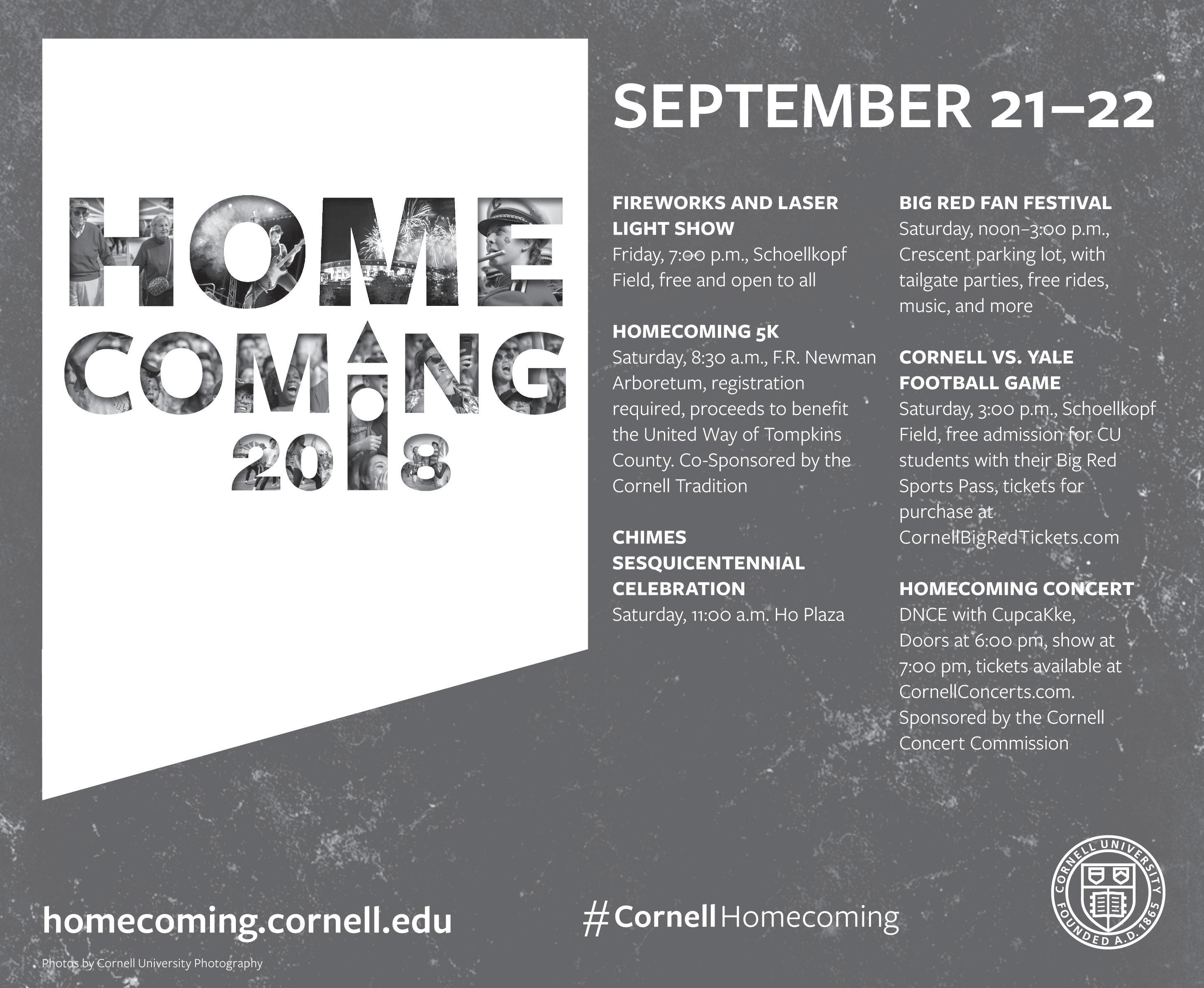
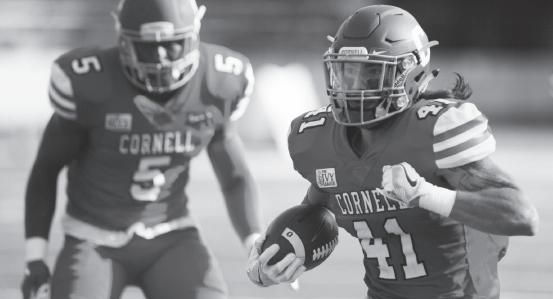
By RAPHY GENDLER Sun Assistant Sports Editor
Cornell football can’t just use one guy to fill in for safety Nick Gesualdi ’18. But a season after his team sported the best pass defense in the Ivy League, head coach David Archer ’05 doesn’t think he will need to.
“[Gesualdi] could really, really play,” Archer said of the former captain and two-time first-team All-Ivy selection. “You can’t replace a guy like that, you just have to fit it into a different mold.”
Cornell’s secondary will be tasked with plugging the gaps created by Gesualdi’s graduation, along with Justin Solomon ’18 and Jelani King ’18, but Archer is confident in his crop of defensive backs heading into this season.
After taking a big step developmentally last season, junior cornerback David Jones is set to lead the Red’s secondary. An All-Ivy honorable mention recipient a season ago, Jones had four interceptions last year, three of which came in the season finale at Penn.
“[Jones is] another guy that intrinsically wants to be great,” Archer said. “He can really help us at corner. I think we can play a lot of man coverage with him.”
Joining Jones at the cornerback position will be sophomore Phazione McClurge, while senior D.J. Woullard — an All-Ivy honorable mention at cornerback last season — and junior Jelani Taylor will get the starts at safety.
“You can play zone, you can play man, they are really good at pattern reading, they are really good man coverage kids,” Archer said. “The secondary needs to be a strength, because I think it can be.”
McClurge, a former North Dakota State commit who played in all of the Red’s 10 games last season and started each of the final four games as a freshman, will see his role greatly expanded in the 2018

season — one his head coach believes he is ready for.
“We took him from North Dakota State — bigtime recruit,” Archer said of McClurge. “So far, he is playing like it.”
Archer said the Red’s depth at defensive back will serve the team well, allowing Cornell to use different players depending on the situation, package and opponent. Archer said Woullard, McClurge and Jones can play in three-corner sets, and senior safety Jake Watkins and Woullard will rotate in against run-first teams.
The Red will enjoy senior leadership in its defensive backfield, with three senior safeties: Watkins, Woullard and Austin Holmes. The experience of its veterans paired with the unit’s depth makes Archer confident the secondary can be one of the team’s strengths.
Cornell is coming off a 2017 campaign that saw it surrender just 189 yards in the air per game — the best in the Ivy League by 13 yards — compared to 267 passing yards per game in 2016.
The Red has playmakers in the secondary who can make game-altering plays, but Archer said creating turnovers will be a three-down, full-defense effort. Cornell had 10 interceptions last year after posting 15 in 2016.
Instead of focusing on things like strip techniques, the coaching staff set out to “re-engineer” the approach to creating turnovers, focusing on getting the opponent into “a situation where we can beat them” by preventing yards after the catch and shutting down early-down runs.
“We focused a lot on how are we going to get better on first and second down to where we can create third and long and passing opportunities and where those ballhawks can then have an opportunity,” Archer said.
Raphy Gendler can be reached at rgendler@cornellsun.com.
When Cornell football loses this weekend, don’t think much of it.
Yes, Cornell has not had a winning season in 13 years, and to finally break out of that funk, it’ll need all the wins it can get. But this is not one of them.
It is very likely that Delaware is going to take Cornell to the cleaners this Saturday. When the Red traveled down to Newark last year, the Blue Hens won with ease. Starting the first drive of the game with a fumble, the Red fell behind early, eventually losing 41-14 to Delaware.
Cornell is purported to have improved in multiple areas since last season. Specifically, the offensive and defensive lines did not graduate many players last year. The units gained experience and even added depth over the offseason.
Another bonus for Cornell heading into week one is the return of junior running back Chris Walker. Once Walker had his season-ending ACL injury in 2017, Cornell ceased to be competitive in the Ivy League.
And the list goes on, concerning this 2018 roster and the positives surrounding it.
So having said all of that, Cornell does at least have a shot at stunning the Blue Hens and starting off the season with a win. Just don’t count on it.
This is not to discount the improvements Cornell has made over the offseason. They are just a bit outmatched here. First off, Delaware has more talented players (they can also give athletic scholarships while Cornell can not) — plain and simple . The Blue Hens already
have had two games under their belt. Delaware was able to shake off the rust in their first game in a loss to Rhode Island, but have since rebounded with a convincing victory over Lafayette.
So while Delaware will be hitting its stride in week three, Cornell will be beginning their season where the Blue Hens were two weeks ago — shaking off the rust. Perhaps the Red will be a bit more “fresh” than the Blue Hens, but it’s marginal. The chemistry and rhythm built through in-game experience is certainly more valuable.
So there you have it. Cornell is probably, but not definitely, going to lose. But don’t lose sleep over it. If and when they fall to Delaware Saturday, move past it.
This out-of-conference road game is a tune-up more than anything. Delaware is going to be one of Cornell’s toughest opponents this season. If they put together some good looking drives and defensive stands, then that’s the victory right there. They can then ride that momentum into the coming weeks when it actually matters against Yale and Harvard.
The goal of Cornell football every year is to win the Ivy League Championship. A win or a loss against Delaware has no direct effect on the team achieving that goal. The success of the 2018 season does not rest on the outcome of this weekend.
After this weekend Cornell still has nine games. And in those nine games, Cornell arguably has a better chance at winning than this weekend. Just like a bad play in any sport, you move past it. Cornell football fans should do the same after whatever happens this weekend. Because after its opening tilt this weekend, this 2018 squad will have plenty of time to prove what it’s worth.
Jack Kantor can be reached at jkantor@cornellsun.com.

‘I expect us to be right back there this year and fnish it.’
Reis Seggebruch has been through the go-around of training camp enough times to know what it’s like — the weight room competition, on-field conditioning, playbook learning, mental workouts. But each year, more or less, Cornell football has seen the same result: a losing season.
But as Cornell embarks on the 2018 season, the senior captain and linebacker has noticed some differences this year.
“Nothing against defenses we’ve had in the past, but I feel like this season we’ve had a lot more camaraderie than we’ve had in the past,” Seggebruch said. “We’ve always been best friends with each other, but I feel like this season we are playing like a unit a lot more than we have in the past, [and] we have a lot more game experience with each other.”
Cornell kicks off the 2018 campaign Saturday for the second straight year on the road in Newark, Delaware. This time, however, the team believes it brings in the most depth it has ever had in the six-year reign of head coach David Archer ’05.
Starters up and down the depth chart are returning while several others will make their triumphant reappearance from season-ending injuries.
“I really like our talent, I really like our depth and I think our health kind of prevented us from finishing things off last year, in addition to coaching mistakes [and] player mistakes,” said head coach David Archer ’05.
“We’ve had a really good camp, much better than last year in terms of developing our depth.”
But questions remain. Just how much can Walker, who is not listed on the depth chart at running back, return to his All-Ivy first-team selection self from 2016? Can the secondary recover from losing two-time All-Ivy first team selection Nick Gesualdi ’18? Will the three-quarterback approach pay dividends, or will it prevent the offense from getting in sync?
“We’ve got several guys that can play. We’re going to see what we can do right now.”
Dalton Banks ‘19
“We’ve got several guys that can play. We’re going to see what we can do right now,” said senior quarterback Dalton Banks, who will split time under center with sophomore Richie Kenney and junior Mike Catanese. “ … The coaches want to mix things up for the first game and see what we all can do and go from there.”
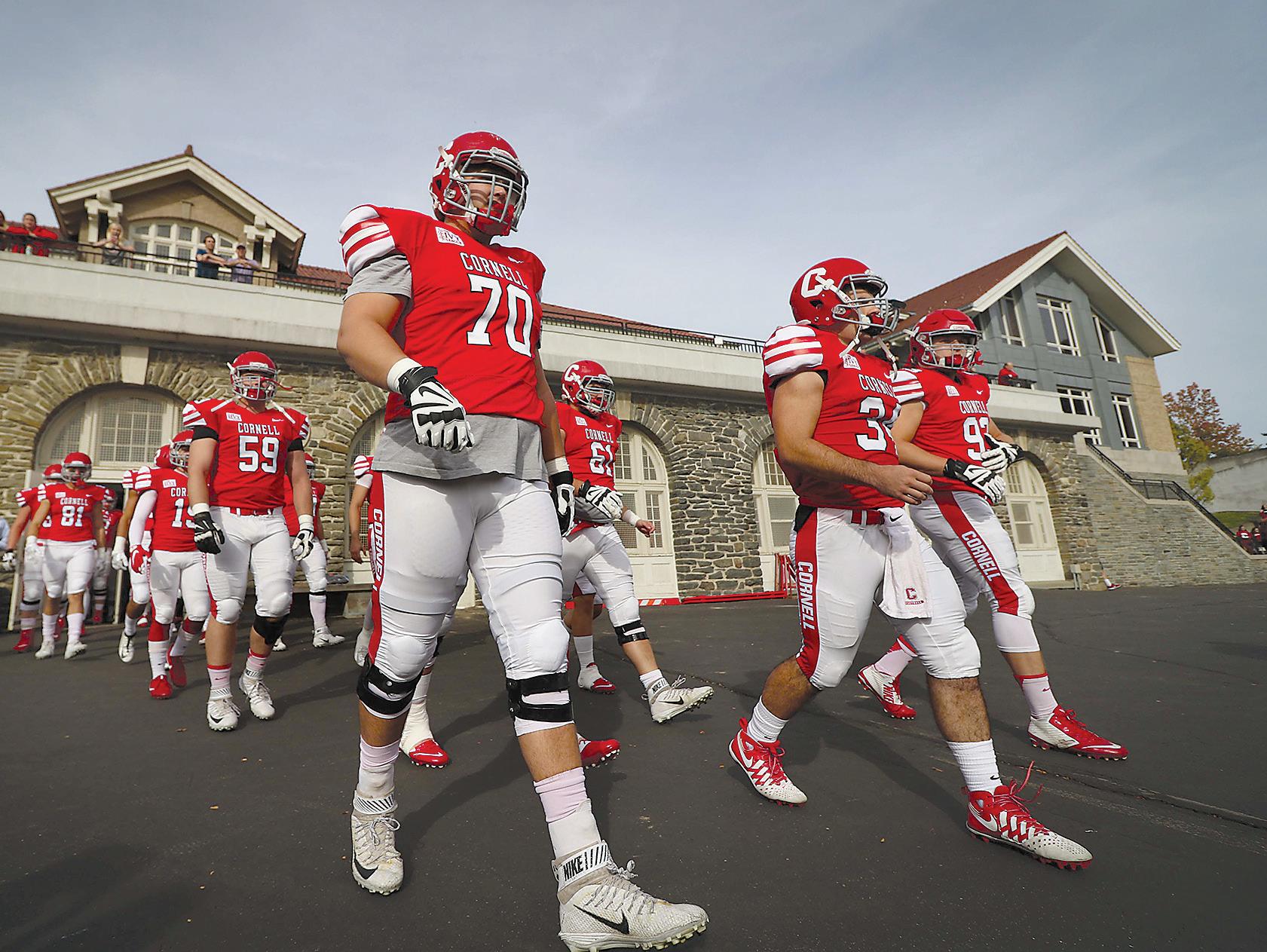
Cornell has only two overall winning seasons since 1998 — in 1999 and in Archer’s senior season in 2005, which was the last time Cornell finished with a record above .500 in the Ancient Eight. Last season saw the Red flirt with breaking the skid, but three consecutive losses to close out the year eradicated that hope.
In last year’s opener against Delaware, things started off about as badly for Cornell as they possibly could have. Chris Walker, whose rehab from an ACL tear has him day-to-day entering the weekend, fumbled on the very first play of the game. From that point on, Delaware never looked back, scoring on the ensuing drive to kick off 34 unanswered points and a 41-14 victory.
This time around, Archer will be looking for a bit of a different start.
“It’s important for us to get out and compete and execute and take it play by play,” Archer said. “Even if it’s not a league game, it’s certainly an important one because we only have 10 of them.”
Delaware was ranked No. 13 headed into the season,
and like last year, will have a few games under its belt before Cornell’s season-opener. But Banks thinks that could prove beneficial, as Cornell maintains its fresh legs and the Blue Hens haven’t gotten a look at their new schemes.
“It’s nice for us because they don’t know, really, what to expect from us,” Banks said. “We get to go out there having seen them play two games already. We saw Rhode Island beat them, so we saw what works and doesn’t work.”
As Archer embarks on year six at the helm, Saturday will provide a tough test for what he calls the deepest team in his tenure. While a game against a reloaded Delaware may not be indicative of how the rest of the season plays out, confidence will remain present after tasting success just a year ago.
“I feel like the roster has been developed so much over the last couple of years,” Archer said. “We were close last year. … We couldn’t finish it, but I expect us to be right back there this year and finish it [this time].”
Archer hopes will maximize the upside of each individual under center.
Don’t be fooled by what the Cornell football depth chart reads at the quarterback position — at least this early in the 2018 season. Senior Dalton Banks may be listed as QB No. 1, but that’s not necessarily how he will be used this year.
“I don’t know how we’ll list it on the depth chart,” said head coach David Archer ’05. “It might be or-or-or, it might be all three of them, it might be two of them.”
Archer pointed to a three-headed attack of Banks, sophomore Richie Kenney and junior Mike Catanese — the latter two who have never attempted a pass at the varsity level — to anchor the Cornell offense, at least for now. It’s a decision
“You’d be asking one guy to take on all this burden, I said ‘this is ridiculous,’” Archer explained of his reasoning. “I’m going to play as many of them that I think help us win and that keeps them all fresher and keeps them all playing at a higher level.”
Archer wouldn’t name the individual who will lead the offense onto the field for Sept. 13’s season-opener at Delaware. It will come down to whatever play is called and whatever gunslinger best suits that role.
BANKS page 14

By RAPHY GENDLER Sun Assistant Sports Editor
Cornell football’s ground game, bolstered by the team’s impressive depth at running back, was a strength early last season. But when then-junior running back Chris Walker went down with a season-ending ACL injury, the ground game stalled and an Ivy title fell out of grasp.
A long and grueling road back has Walker — who ran for 72.8
yards per game on his way to an All-Ivy firstteam selection in 2016 — ready to return at nearly full strength by Saturday’s season-opener at Delaware, deepening a backfield thanks to last season’s breakout of junior Harold Coles. What’s more, Coles’ emergence gives Cornell the flexibility to use Walker in new ways — Walker isn’t even listed as a running back on the
See WALKER page 14