The Corne¬ Daily Sun


By MADELINE ROSENBERG and ANIL OZA Sun Managing Editor and Sun Assistant Managing Editor
In February 2021, Jamie ’24 was forced to quarantine hours after stepping foot on Cornell’s campus after someone on her bus from New York City tested positive for COVID-19. She never tested positive herself — but she spent seven days in quarantine at The Statler Hotel.
But on Aug. 26, after Jamie, who asked to omit her last name because of mention of personal medical history, learned the boss of her summer job tested positive, the sophomore spent two days trying to get a COVID test at Cornell before learning that she, too, had COVID-19.
“[The health department] basically said since you’re vaccinated, it’s not urgent,” Jamie said. “Between the time that I found out I was contact traced, and when I actually got my positive result back on Saturday night, I had no restrictions. I could have gone anywhere.”
levels are reaching record highs in Tompkins County — as of Monday evening, there are 442 active cases in the county.
With nearly all students vaccinated, the University suspended arrival testing and reduced surveillance testing to weekly nose swabs for vaccinated students. But now, some students are reporting long waits to get supplemental tests and test results, and some have been forced to navigate campus with the suspicion that they are positive for COVID-19.
After Jamie learned she might have been exposed, she spent two days attending classes and gathering with her friends. She minimized her time spent indoors and wore a mask indoors and outdoors — but without specific University guidance, she was forced to calculate her own decisions while she awaited her test results.
“I have no idea why this house of 20-year-olds has to make public health decisions.”
Clara Enders ’22
Jamie is one of nearly 400 Cornell students who tested positive for COVID from Aug. 26 to Sept. 5. They’ve scrambled to get tested and find isolation arrangements during the first weeks of classes — isolating in Balch Hall, hotels or at home.
She and hundreds of other students are now keeping up with coursework with few live classes to attend. Some students will meet their professors for the first time three weeks into the school year, as faculty aren’t required to provide remote course access to those in isolation.
Most Cornell cases are linked to “informal, off-campus gatherings” among undergraduates, and the University has asked students to put off parties and wear masks as much as possible. Case
(According to the University, fully vaccinated individuals do not need to quarantine after contact with someone who tests positive unless they have symptoms).
“It was pretty scary, because I knew that I had been in contact with a lot of people,” Jamie said.
“At a certain point, I knew I should limit my indoor use, like the mask on outside when possible, but I’d already been in close contact with like 30 people.”
While Jamie said she tried to keep her distance, even avoiding crowded dining halls, she attended Trevor Wallace’s performance in Bailey Hall directly before she received a call that she had tested positive. While Jamie wasn’t breaking University policy when attending class and the event, she feared facing repercussions now that she has tested
See QUARANTINE page 3
S.A. debates resolutions for over two hours
By ELI PALLRAND Sun Staff Writer
In Thursday’s Student Assembly meeting, representatives discussed COVID-19 risks on campus given the rising number of cases and potential academic accommodations, financial aid delays and beginning-of-year business.
In one of their first meetings back in Willard Straight Hall, the representatives spoke to a nearly empty room.
The S.A. approved its annual budget and heard presentations about the Empathy, Assistance & Referral Service’s new mentoring programs, which aim to be more informal and cultivate better peer-to-peer support than their previous model.
Later, the S.A. heard presentations about plans to generate interest in the first-year and transfer student elections, and the S.A.’s new role in soliciting applications for the University Hearing and Review Boards.
This meeting came in the midst of extensive delays in the distribution of students’ financial aid packages. Some students have had to pay tuition without knowing what their aid would be, have received incorrect aid packages, have been temporarily
“I really want to call on Cornell to fix this situation, because paying for college is one of the biggest stresses that students face.”
Adele Williams ’24
withdrawn from the University over outstanding fees or have not yet received a package of any kind.
Condemning this state of affairs, the S.A. passed Resolution 15, which calls on
Tuesday, September 7, 2021
2021 Master Gardener Volunteer Bulb Sale 12 a.m. - Noon, Virtual event
Town-Gown Tuesdays Sept. 7: Cornell Opening Fall 2021 9 - 9:30 a.m., Virtual Event
BEDR Workshop: Crystal Hall 11:15 a.m., Sage Hall, 141
Joint Econometrics Workshop And Labor Economics Workshop: Alberto Abadie 11:15 a.m. to 12:45 pm., Virtual Event
LASSP & AEP Seminar - Arkhady Shekhter National High Magnetic Field Laboratory 12:20 p.m., 700 Clark Hall
Biomedical & Biological Signature Seminar Speaker, Professor Joanna Wyoscka 4:00 to 5:00 p.m., Virtual Event
Meeting the Engaged Ambassadors 4:30 p.m., Engaged Cornell Hub
Being a Human Person 7:15 p.m., Willard Straight Hall

2021 Master Gardener Volunteer Bulb Sale 12 a.m. - Noon, Virtual event
AASP Wednesday Lunch Series with John Cheng Noon - 1 p.m., Rockefeller Hall, 429
Demystifying the Literature Review Noon, Virtual Event
Information Session: Migration Studies Minor 4:45 p.m., Virtual Event
Working in the U.S. For International Students 4:45 p.m., Virtual Event
Sisters With Transistors 7:15 - 8:40 p.m., Willard Straight Theatre
STUDENT ASSEMBLY
Continued from page 1
any charges wrongly billed to students, and establishing an inquiry into the problems facing the
financial aid department.
“My [financial aid package] came out after the first payment was supposed to be due… [and] financial aid revisions were… not available until literally Aug.
10, when people then could not [plan] out their year to figure out how to pay for school,” College of Agriculture & Life Sciences Representative Adele Williams ’24 said. “I really want to call
on Cornell to fix this situation, because paying for college is one of the biggest stresses that students face.”
At the same time, the University is struggling to con-

tain the spread of the delta variant, which prompted the passing of Resolution 16. The resolution asks the University to enable and allow instructors to record lectures, offer a temporary virtual learning option and Zoom office hours and create accommodations for students who are in quarantine or cannot attend classes for other pandemic-related reasons.
“I just wanted to remind everybody that we’re ambassadors, we’re on the Student Assembly and we need to make sure that we’re being responsible,” Paine Gronemeyer ’24, College of Architecture, Art & Planning Representative, said. “We need to be wearing our masks as much as we can… and be a model for our constituents.”
The S.A. also passed Resolution 12, which aimed to resolve a conflict with the Convocation Committee. According to the resolution’s sponsor, Vice President of Finance Morgan Baker ’23, the Convocation Committee had disagreed with a historical requirement to invite all seniors in the S.A. to sit on the Convocation Committee.
Following a change by amendment, Resolution 12 passed, by proposing that the S.A. president and vice president must be invited to the Committee if they are seniors, and an additional six S.A. members must be invited after being selected internally by the S.A. to sit on the 30-member Committee.
Continued from page 1
positive.
“I’m relying on the school to not only keep me from getting COVID, but also keep me from giving it to other people,” Jamie said. “It feels like neither of that is happening.”
Ekaterina Shetekauri ’24 said that finding out she had COVID was “pretty overwhelming,” but said the process of being isolated in Balch Hall was relatively seamless. A van picked her up from West Campus and dropped her off to a room furnished with a fan, various electronics chargers, bedding and three meals a day.
Justine ’24, another student in isolation at Cayuga Blu Hotel by the Shops at Ithaca Mall who also asked to omit her last name because of mention of personal medical history, waited nearly two days after her test to be isolated. After being tested on Aug. 26, she woke up to a text from the New York State Health Department notifying her she had tested positive on Saturday.
But Justine said she didn’t get a call from Cornell until the early afternoon, and was transported to the hotel around 5 p.m. Without guidance, she and her roommate — who also tested positive — isolated in their room and did not eat until getting to the hotel
in fear of infecting other students in a dining hall.
As Justine and her roommate retraced their steps to tell those they had been in close contact with, she said it was difficult to know when they contracted COVID because of the lack of arrival testing.
“It was also stressful, because I went through the first two days of classes with COVID unknowingly,” Justine said. “On Friday, I ate my meals with people I just met.”
As Cornell’s isolation capacity fills — as of Monday, only 19 percent of quarantine and isolation space is available, according to the COVID dashboard — the University is giving students living off campus the option to isolate at home, as long as they have access to their own bedroom and bathroom.
Emma Grabowski ’23 — who lives in an off-campus house — said her roommates who tested negative are delivering meals to her door to stay isolated from her. Grabowski rushed to urgent care last Saturday when she learned she might have been exposed to the virus, unable to find available supplemental tests at Cornell.
To continue reading this article, please visit cornellsun.com.
Anil Oza can be reached at aoza@cornellsun.com. Madeline Rosenberg can be reached at mrosenberg.com.
By TAMARA KAMIS Sun News Editor
Anabel’s Grocery will reopen its doors this semester, hoping to continue advocating for its values of food justice this semester, using the proceeds of products donated by Dilmun Hill Student Farm and Cornell Hydroponics Club to finance future grants to support anti-racist iniatives from campus organizations and students.
“We're trying to empower groups and individuals to pursue creative ideas in the anti-racist action space,” said Dylan Rodgers ’23, the collaboration and education lead for the store.
Anabel’s is a student-run grocery store which sells subsidized groceries to Cornell students to promote healthy food access on campus.
According to Rodgers, Anabel’s Grocery is working with other campus partners to plan a committee that will evaluate grant applications for initiatives, which could include speakers, events and other educational programs starting next semester.
“Part of the idea is we're opening it up to the student body,” Alyssa Gartenberg, purchasing lead, said. “If people have really great ideas, I think we're super open to a lot of different types of things.”
Anabel’s Grocery is adapting to COVID-19 risks while trying to accommodate consumer preferences, according to Rodgers, Gartenberg and Katie Go ’22, operations lead.
Anabel’s will offer both in-person shopping and online ordering with contactless pickup for those who do not feel safe shopping in person. Only 15 people will be allowed in the store at a time, and all people within the store are required to use hand sanitizer. While most things offered in-person will also be available via online pickup, there may be some discrepancies because of the challenge of managing in-person and online inventory simultaneously.
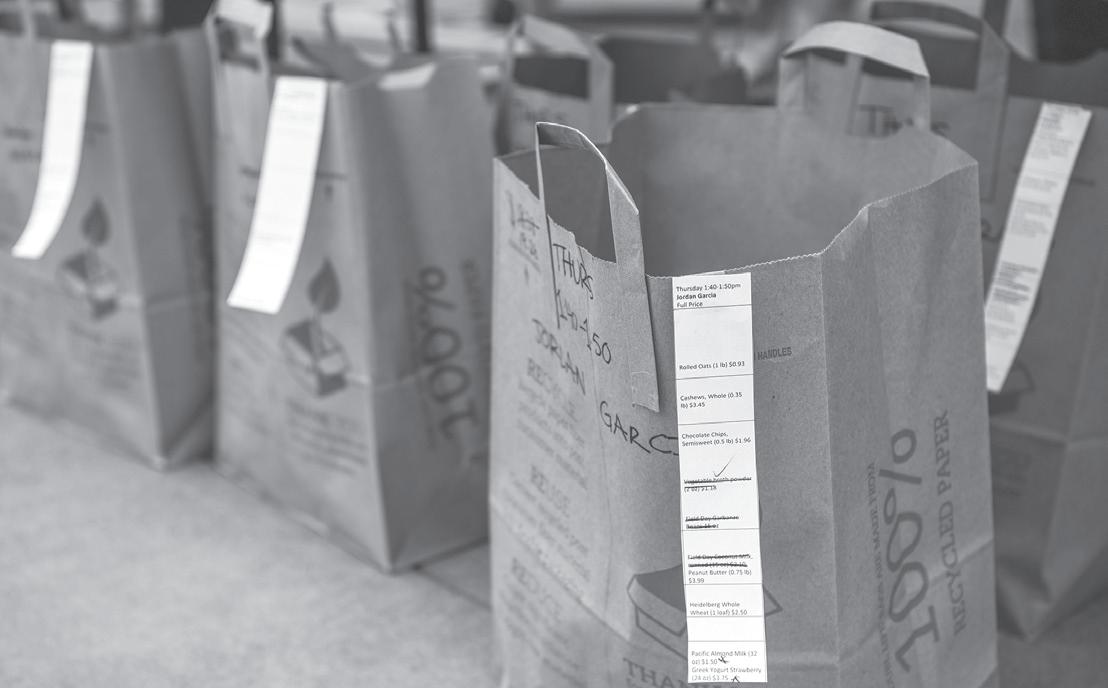
“We sent out a survey to all our customers and we asked them how they prefer to shop. A huge majority said they prefer shopping in person and that's why we wanted to make it work,” Go said.
Depending on how much COVID-19 cases rise in the coming weeks, Anabel’s Grocery may return to online ordering only, as it did last semester.
Anabel’s Grocery reopened last semester for online ordering and grocery pickup only, after months of advocacy including a Student Assembly resolution and a petition.
“Part of the reason we did want to maintain the hybrid option is it does give us flexibility for if we decide to shut the store down and go back to just online ordering, we already have that infrastructure in place,” Gartenberg said.
Grocery selection will be wider this semester in response to consumer feedback, with new products including curry paste, cheese and collard greens. Anabel’s Grocery sources products from producers and buyers including Dilmun Hill Student Farm, the Cornell Hydroponics Club, Regional Access, Headwater and Cornell Orchards.
The Anabel’s Grocery store is staffed by students who are taking or have previously taken the AEM 3385: Social Entrepreneurship Practicum course, taught by Anke Wessels, director of the Cornell Center for Transformative Action. The
By SARAH YOUNG Sun Staff Writer
This year, as first years made their arrival to campus, so did the first new dorms on North Campus in over two decades.
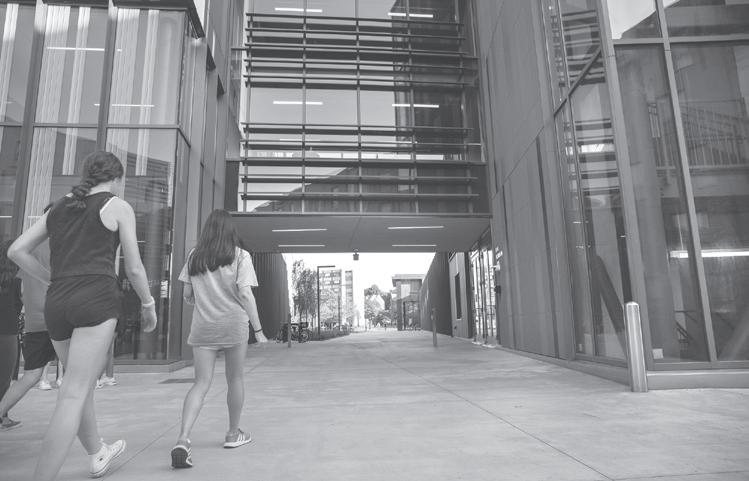
Some lucky members of the class of 2025 found themselves moving in to Ganedago Hall and Toni Morrison Hall. While both of these halls are intended to eventually be a part of Cornell’s Sophomore Village on North Campus, this year they are occupied by first years, who are ecstatic to be able to call these buildings home.
“I remember thinking ‘OMG’, I was just living the life,” said Madeleine Chedraoui ’25 when she was assigned to Toni Morrison Hall. Chedraoui, like many first year residents of the new dorms, is happy with her placement and has been taking full advantage of the many features of the new buildings.
This year, Toni Morrison Hall serves as a community for female-identifying students, taking Balch Hall’s place as the building undergoes renovations. The Community Council of Toni Morrison Hall aims to organize activities and provide opportunities for residents to celebrate themselves and learn how to best thrive at Cornell.
course covers cooperative economics and food system related health and racial inequities. In addition, students can get involved through the Anabel’s Collaboration and Education student organization.
According to Gartenberg, this semester’s wider selection of groceries is meant to make the store more welcoming to students from diverse communities.
Anabel’s Grocery plans to offer small group cooking lessons and community dinners if the number of COVID cases falls, according to Rodgers. If cases remain too high for this to be a possibility, Anabel’s may offer cooking lessons online.
All of Anabel’s Groceries changes for the next semester are aimed at providing accessible food to students while limiting the risk of COVID transmission, furthering their goal of food justice.
According to Gartenberg, the Anabel’s Grocery team wants to help reduce barriers to food access at Cornell by providing convenient, lower cost, healthy groceries. Gartenberg sees transportation challenges, cost and limited time as some of the key obstacles to healthy food access on campus, especially for lower income students.
“Food justice exists when all people have access to the food they need to live a happy and healthy life,” Rodgers said.
Tamara Kamis can be reached at tkamis@cornellsun.com.
The two air conditioned halls are equipped with numerous lounges, study spaces, shared kitchen areas and a music practice room. In 2022, Toni Morrison Hall will also house an “all you care to eat dining facility,” according to the North Campus Residential Expansion website, which will include a salad bar, two 900 degree pizza ovens and a pasta platform to dry noodles.
Ganedago Hall resident William Lee ’25 described the building as spacious. Like many other first year residents of the new buildings, Lee has heard stories from his friends of their experiences in North Campus’ older dorms. He is grateful to live in a newer facility and have access to air conditioning.
“I remember thinking ‘OMG’ I was just living the life.”
“I know a lot of my friends who live in other dorms are not having as great a time as me,” said Lee.
Madeleine Chedraoui ’25
Paz Ortiz ’25 feels a strong sense of community within the female-identifying community of Toni Morrison Hall, so far.
Ganedago Hall is named after the Cayuga nation in their language, with permission and support from the current leadership of the nation. The hall has space for a total of 520 residents who live in single gender suites composed of singles and doubles on mixed gender floors.
Toni Morrison Hall is named after award-winning author and Cornell alumna Toni Morrison M.A. ’55, who was the first African American woman to receive the Nobel Prize in Literature. The hall can house up to 280 residents who live in suites of singles and doubles.
“In general it's just been very comfortable and you can hang out with your friends in lots of comfortable common spaces,” said Temilola Omojola ’25, another Morrison resident.
While the class of 2025 gets the opportunity to experience life in Cornell’s new dorms during their first year, the university plans to convert them into sophomore housing units following the 20212022 school year, marking the first few steps in the expansion of the currently first year-dominated North Campus.
Sarah Young can be reached at syoung@cornellsun.com.
It was a clear, sunlit afternoon when photo editor Julia Nagel ’24 and I walked into the gallery that housed Mia Hause B.F.A. ’22 and Erin Conolly’s B.S. ’23 new exhibit, Until the Bliss of All This Hurts. On display at the Tjaden Hall Experimental Gallery from August 30 to September 3, the exhibit’s startling, almost poetic title was what first captured my attention.
The room was pleasantly bright and airy. After the previous week’s oppressive humidity, simply being able to pause and take this in felt like a luxury.
Other visitors would periodically walk in and out of the room, but apart from these arrivals, the space itself was unassuming. White walls surrounded a floor of simple wood panelling.
On this austere, impersonal floor was something utterly unlike it.
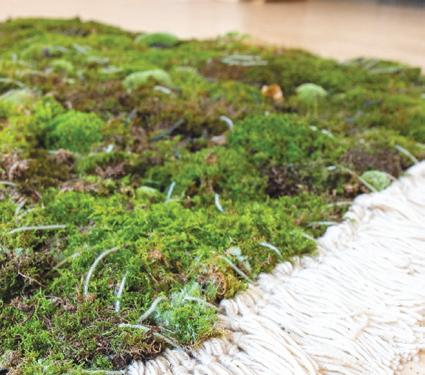
It lay there like a piece of the forest floor transported miraculously into Tjaden: A rug made of moss. Marveling at the lifelike detail of what I thought was a fabric facsimile, I tried to imagine the work that had gone into this intricate production.
(Later, Hause would explain that th e rug was, in fact, made of real moss — patches of it, stitched together with yarn. My amazement at this was sec -
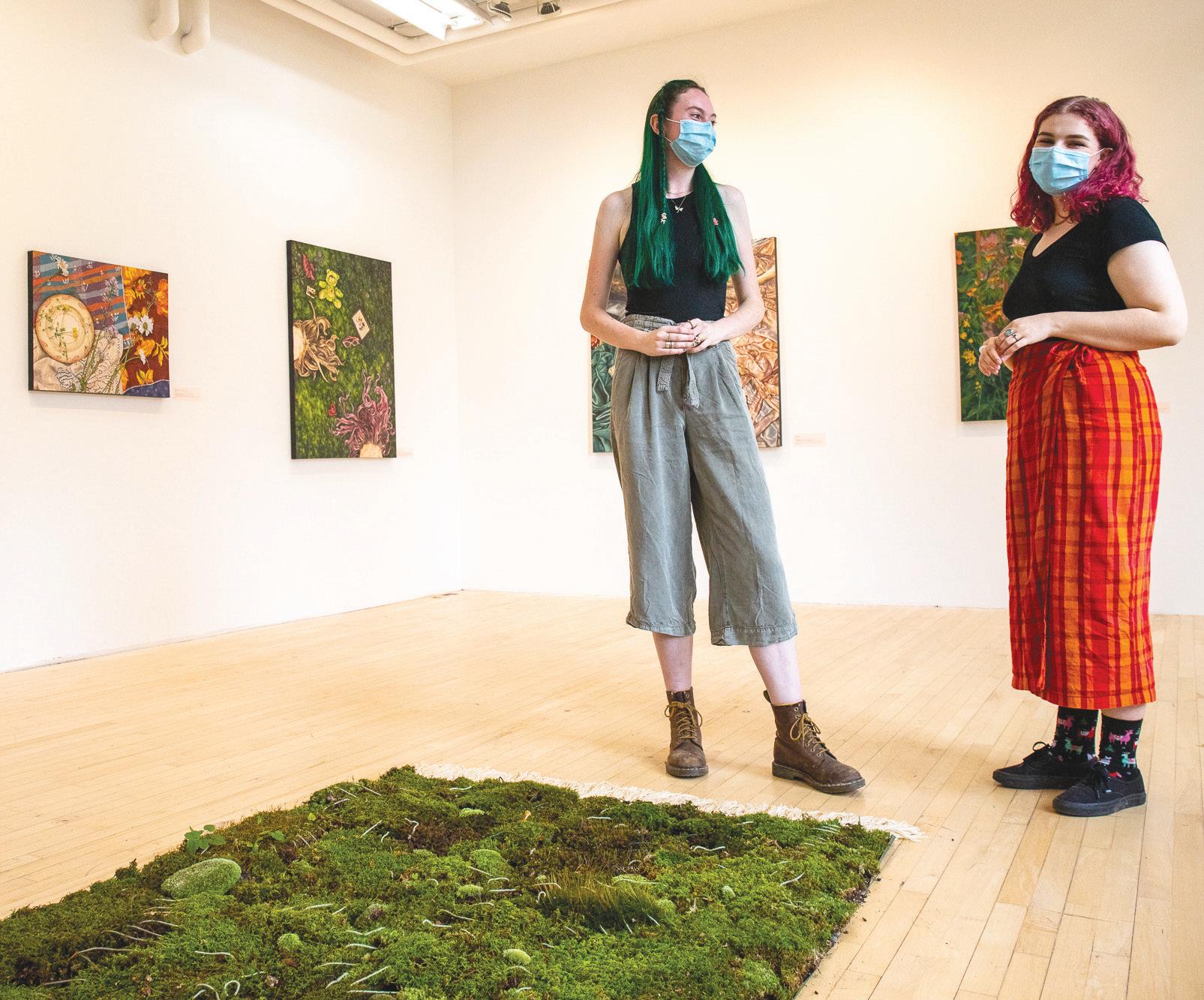
ond only to my shock that the two of them had apparently dug up the moss themselves from Sapsucker Woods and Fall Creek Valley, keeping it wet and alive in their living room until its display.)
Not long after we arrived in the room, the artists made their appearance. Conolly, as she would reveal in our interview, is actually majoring in Environment & Sustainability at the College of Agriculture and Life Sciences. As a minor in Fine Arts and Infectious Disease Biology, she tries to take classes that “combine them, or find intersections between art and science.” Particularly interested in “mushrooms and… detritus,” she hoped to explore how nature “[breaks] things down” through this exhibit.
Hause’s work has previously been focused on exploring the concept of “pathetic fallacy,” a term coined by Victorian literary critic John Ruskin in reference to “the assignment of human feelings to inanimate objects.”
It was used in the title in the poem of Prof. David Bosworth, English, University of Washington: “Pathetic Fallacy: A Field Guide for the Biologist,” a work that itself contributed the title of the exhibit we stood in.
Being “surrounded by nature” in Ithaca, as Hause said, also brought up thoughts on how we “insert” ourselves into the environment. To them, the exhibit’s title speaks to humanity’s “fleeting” relationship with nature, a relationship that they wished for their
audience to examine through an “interactive space” through which people could move.
The exhibit reflects a feeling of human constancy and observation as the nature around us moves through cycles of decay and rebirth.
Conolly and Hause are also interested in the way that humans “[create] permanence” by mimicking nature — with our floral patterns and animal-themed decorations — not only to defy its impermanence, but as an expression of gratitude. As Hause put it, a way of saying “I love you back” in the language of art.
Some more of their influences included the work of environmental historian William Cronon, from the course History of Art 3620: After Nature: Art and Environmental Imagination with Prof. Kelly Presutti, plant ecologist Robin Wall Kimmerer’s Gathering Moss , and Ralph Waldo Emerson’s Nature
As this was both Conolly and Hause’s first independent show — as opposed to shows for class or for their year — they said that collaboration felt “vital” for success.
When the interview concluded, Julia and I lingered in the gallery for a few more moments. While she surveyed the room for the best shot, I took a moment to examine more carefully the paintings I had seen when I walked in.
The warm, desaturated colors brought a dryly organic aspect to the otherwise sterile walls, like pressed flowers from the pages of an old book.
In fact, flowers were the subject of multiple paintings. Hause’s “Bath for a Sylvan” is a surreal and unsettling piece featuring a leporine-costumed child swathed in vegetation, while “A Place So Benign and Beautiful and Good” presents a poignant tableau of flowers over floral-patterned houseware: A serendipitous show of thanks for the nature from which we draw inspiration.
Other pieces were more dramatic. Connolly’s “Nymph Meal” offers a breathtaking rendition of a deer’s head descending over silk blankets — the sheen of its fur like the shine of the fabrics beneath.
Her “Fibers: Moss, Feather, Thread” features a bird appearing to rise—even while prone — over a backdrop of moss and thread, its beak stabbing upward into the green.
As she’d explained, the culmination of her message finds its expression in “Nonsensical Microbiome.”
With hair branching out on a backdrop of greenery like hyphae and sentimental objects scattered like spores, the piece recalls the human microbiome: A constant process of life, death and decay taking place within ourselves, and a reminder that the decomposition we abhor in nature is not so far from our own funerary practices — or indeed, our very bodies.
Hause’s “Sap-sucking, Soft-bodied” calls attention to smaller creatures with
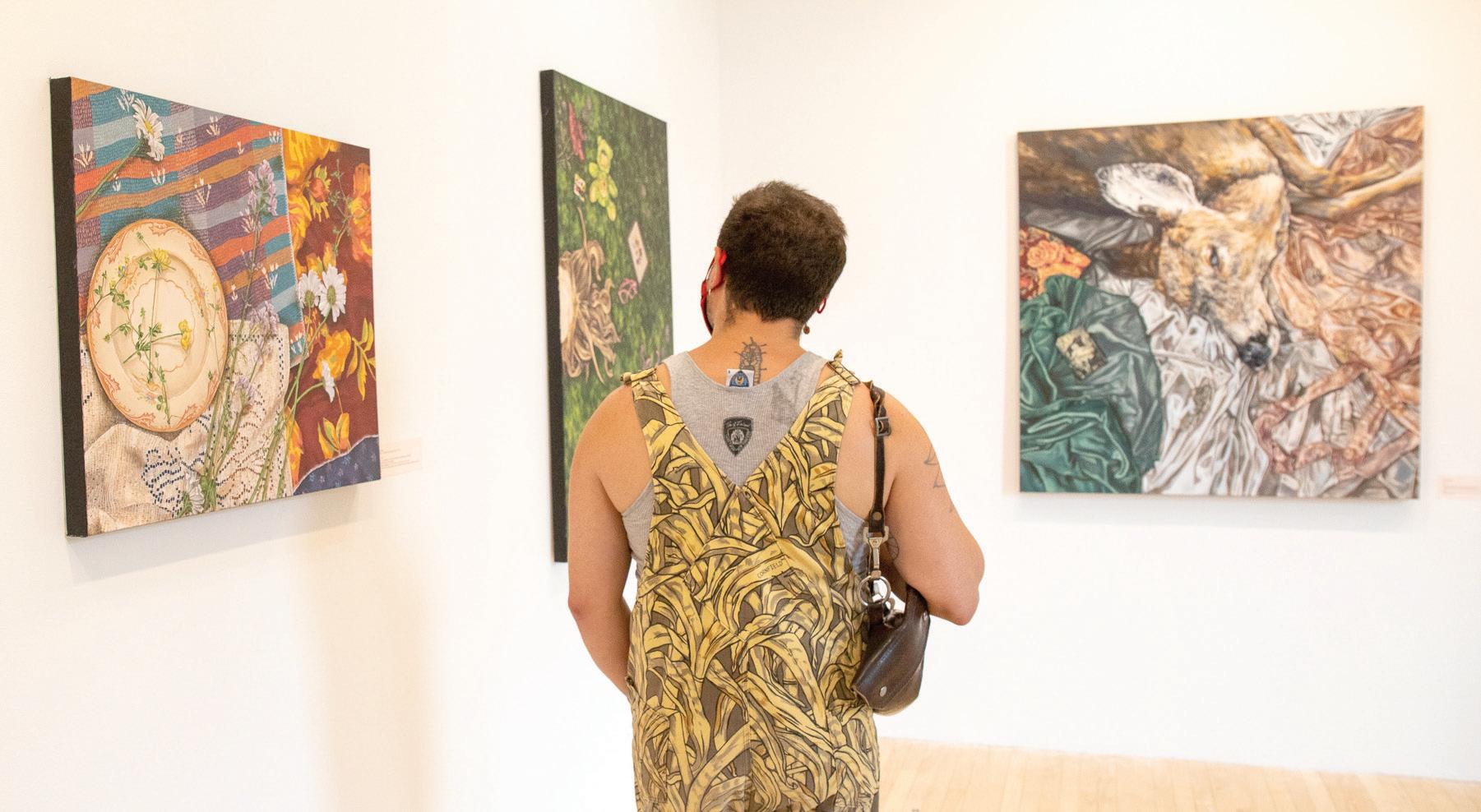
an array of insects over wood panelling, a ladybug charm resting innocuously among them.
Per the description, I thought of the ease with which we brush aside the stray fly or beetle, while ascribing human qualities to them with equal ease.
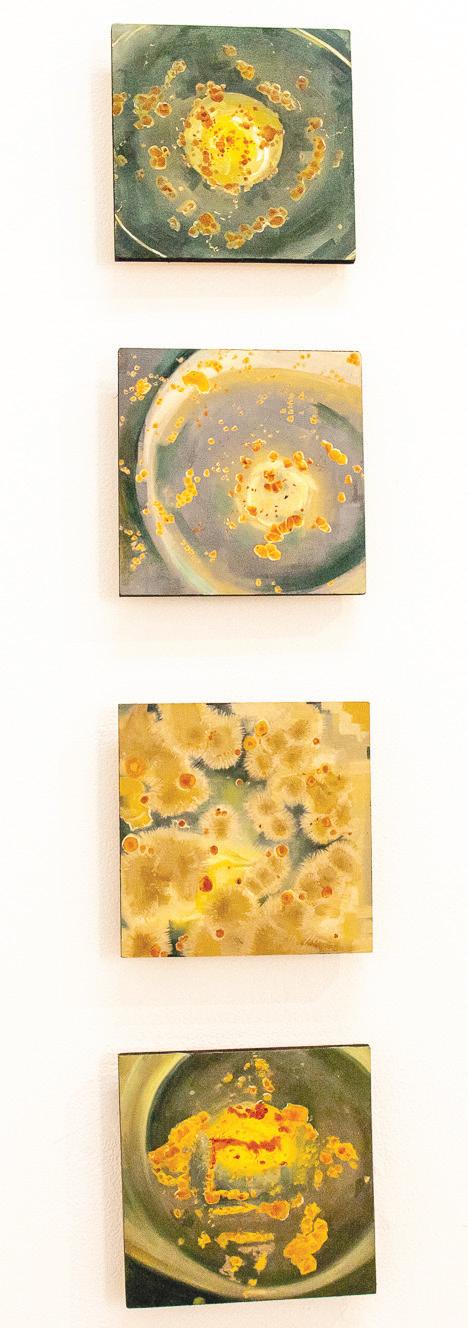
Even smaller were the subjects of Hause’s final, untitled piece featuring bacteria in petri dishes, rendered in vivid reds and metallics against a murky ink-blue.
(The piece had found its genesis in their living room, as Mia confided, while she “incubated” the bacteria in the back of her car.)
Julia had finished with her photos, and while I could marvel for longer at the exhibit, time was an inevitable
constraint. We stepped from Tjaden Hall, back into the sun, my head filled with wonder at the effort and patience — and genuine passion, for the wild and the human and all the interstices between them — that must have made such an exhibit possible.
On the Arts Quad, trees fluttered their leaves like handkerchiefs after departing sailors. Was I doing it now, committing Ruskin’s pathetic fallacy? Had the exhibit planted its spore in me?
Neither trees nor sun nor sky deigned to answer. But as I considered the misshapen grey lump within my mite-breeding, microbe-housing head, I felt that was answer enough.
Amy Wang is a sophomore in the College of Arts and Sciences. She can be reached at saw289@cornell.edu..
WE ARE EXCITED TO ANNOUNCE a revamp of The Sun’s Arts & Entertainment section. With a fresh mission, we are happy to introduce you to the new Arts & Culture section. Arts & Culture represents a broadening of the previous Arts & Entertainment section to include content that covers more than just entertainment. Societal issues and creative output are inextricably linked — Arts & Culture strives to bring you the most important pieces of art and cultural news from campus, Ithaca and beyond.
Arts & Culture will absorb the Sunspots section, previously the Sun’s online-only blog which championed personal reflections and commentary on college life and life at large.
The mission of Arts & Culture is to bring new voices into The Sun with ease. We will spotlight students and locals alike, while acknowledging biases in our institution, our city and in ourselves. We continue our arts coverage with the intention to change our culture.
The new Arts & Culture section is excited to bring a wider range of content to our readers. We seek fresh perspectives, and we will foster bold and beautiful writing.
With gratitude, Emma “E.D.” Plowe ’23, Arts & Culture Editor Emma Leynse ’23, Assistant Arts & Culture Editor John Colie ’23, Assistant Arts & Culture Editor


Independent Since 1880
139th Editorial Board
KATHRYN STAMM ’22
Editor in Chief
ANUSHYA ALANDUR ’23
Business Manager
CATHERINE ST. HILAIRE ’22
Associate Editor
PRANAV KENGERI ’24
Advertising Manager
ODEYA ROSENBAND ’22
Opinion Editor
JYOTHSNA BOLLEDULA ’24
News Editor
TAMARA KAMIS ’22
News Editor
CAMERON HAMIDI ’22
App Editor
KRISTEN D’SOUZA ’24
Design Editor
HANNAH ROSENBERG ’23
Photography Editor
OMSALAMA AYOUB ’22
Science Editor
PUJA OAK ’24
Layout Editor
ANNIE WU ’22
Production Editor
MIHIKA BADJATE ’23
Assistant News Editor
SERENA HUANG ’24
Assistant Business Editor
ANGELA BUNAY ’24
Assistant News Editor
JOHN COLIE ’23
Assistant Arts & Culture Editor
AMELIA CLUTE ’22
Assistant Dining Editor
WILLIAM BODENMAN ’23
Assistant Sports Editor
AARON SNYDER ’23
Assistant Sports Editor
MEGHANA SRIVASTAVA ’23
Compet Manager
MADELINE ROSENBERG ’23
Editor
NAOMI KOH ’23 Web Editor
ANIL OZA ’22 Assistant Managing Editor
YUBIN HEO ’24 Assistant Web Editor
VEE CIPPERMAN ’23 News Editor
NOOREJEHAN UMAR ’23
E.D. PLOWE ’23 Arts & Culture Editor JOHN YOON ’23
BENJAMIN VELANI ’22
LUKE PICHINI ’22
Editor SRISHTI TYAGI ’22
Editor MARIA MENDOZA ’24
Editor AMAYA ARANDA ’23
SURITA BASU ’23
News Editor
KAYLA RIGGS ’24 Assistant News Editor
EMMA LEYNSE ’23
Assistant Arts & Culture Editor
JULIA NAGEL ’24
Assistant Photography Editor
LIAM MONOHAN ’24
SASHA ABAYEVA ’24
ALPERS ’22
Working on today’s sun ad layout Annie Wu ’22
desker Catherine St. Hilaire ’22
desker Anil Oza ’22
deskers Tamara Kamis ’22
Angela Bunay ’24
production deskers Pico Ross ’22
Sofa Van Mierlo ’23
layout desker Kristen D’Souza ’24
photo desker Julia Nagel ’24
arts desker E.D. Plowe ’23
Emma Leyse ’23
sports desker William Bodenman ’23
From the Editor
WHY WOULD ANYONE WORK FOR A NEWSPAPER? A great question (and one any Sunnie has asked at least once while up late fighting with InDesign) — with its constant challenges and the constant insistence on the death of the journalism industry.
I can offer you my reason: hope.
I’m in a class this semester with Pulitzer Prize-winning journalist Molly O’Toole ’09, this year’s Distinguished Visiting Journalist at Cornell (and, I should mention, a former news editor of The Sun), and she asked us what we loved about journalism. My own answer hinged on telling the stories of the people around me, of my classmates and neighbors — it is a public service, this hope.
In our 141 years, this has always been the case. We, as we always have, ask hard questions and work tirelessly to uncover the truth; we interview, research, argue, photograph, design, report and write to highlight the lives of the people here on the Hill. We face the challenges posed and jump in together.
On the horizon of my time on The Sun, I hope you’ll take this as a personal invitation to come start your own.
Whoever you are — a first-year or a senior, an anthropology or a zoology major, a future journalist or someone who’s crossed it off the list — there is a place for you here. Your voice, yes yours, matters.
Our recruitment meetings this fall will be on Sept. 8 and Sept. 9 from 6-7 p.m. in Goldwin Smith Hall G22 and on Zoom. See cornellsun.com/join-the-cornelldaily-sun for more information. Our team of editors will be there to answer your questions, including why they themselves work for this newspaper. We hope to see you — the future of The Sun — there.
Email editor@cornellsun.com with any other questions, and stay tuned for more information.
— K.S

Brenner Beard ‘24 is a sophomore in the College of Arts and Sciences. He can be reached hbb57@cornell.edu. Agree to Disagree runs every other Friday this semester.
Who do you know here?” “Name four brothers.”
The trio of fraternity brothers were glaring at me, blocking my entry into their Collegetown houseparty. Honestly, I was blanking. I had one vague connection to this particular fraternity, but it was one of those “friends of a friend” things that rarely ever fly. I was in a tough spot and they could smell the fear on me. Apparently, stammering out “Kevin” wasn’t a good enough answer to their interrogations. Ultimately, I struck out. This experience was only improved by the shortest brother of the bunch threatening to “knock me the f*ck out” if I didn’t get off his steps. Seeing that I had obviously overstayed my welcome, I grudgingly left and tried my luck elsewhere.
It was orientation week at Cornell, which was largely seen as an excuse for the student body to engage in a five day bender of alcohol-induced poor-decision making. For the sophomores, like myself, it was another Cornell tradition that in 2020 fell victim to the pandemic. So naturally, my roommates and I made the pilgrimage down to Collegetown this year to see what exactly we missed out on.
Up and down the streets of Collegetown, house after house played host to various scenes of debauchery. There was dancing, zero social distancing and carefree fun. In other words, it was everything COVID-19 took from all of us. Guarding these oases of unrestrained enjoyment were various iterations of the fraternity trio I encountered posing similar questions to would-be partygoers and ensuring that the sanctity of their fraternity’s “mixers” were maintained.
Like brick walls, they stood stonefaced, arms crossed, determined to keep the riff raff at bay. Crowding their front steps, each doorman assertively staked their claim to the thirty-by-thirty mud-pit they called a front yard, daring unwanted guests to attempt entry. Some bouncers were easily satisfied with claims of knowing a fellow brother. Every once in a while a “yea, I had a class with so-and-so” was good enough to gain entry, other times not so much. Some doormen enjoyed their role a little too much (like the one who zealously threatened me). Others felt a sense of duty to their party. Either way, the fraternity doorman was a constant. “Who do you know here”, has been repeated so many times that it’ll echo for eternity in the streets of Collegetown.
Full disclosure, the number of gatherings I actually attended was far lower than my number of attempts. To say the least, I was not batting one thousand. One might think then that these words come from a sense of bitterness. I assure you, however, that they do not. Honestly,
I think a little empathy for fraternity doormen is in order. It is the dictionary definition of a thankless job. A doorman doesn’t get to enjoy the gathering he’s protecting, they must deal with hundreds of inebriated underclassmen and their task is nigh impossible. In most cases, their mission is protecting a totally porous outdoor space and filtering everyone who tries to enter. An enterprising individual can just step over the fence circumventing an interaction with the bouncer and in this case that’s exactly what most people did. For all these reasons, I would like to say directly to all the fraternity doormen out there, I feel for you. Astronaut, fireman, doctor and party bouncer -- during Cornell’s O-Week, these are all equally important and difficult jobs. There’s no room for debate.
It’s not just the sheer impossibility of the task that made the doormens’ jobs hard, it was also that they were out of practice. It’s been over a year since the last semi-sanctioned O-Week extravaganza. Frankly, we’re all out of practice. I mean, I’d never been pressed by a fraternity bouncer before. Same with my roommates. Like most other underclassmen, we’re just wide-eyed sophomores whose only experience with Cornell’s social scene was limited to masked gatherings of ten people or less. So, when that initial trio barked, “name four brothers”, I was flummoxed. I didn’t know what to say. This was an interaction I just wasn’t prepared for and so naturally the doormen got the best of me.
But it wasn’t all doom and gloom. While I may have failed their test and been blocked from their heavily guarded party, my mind didn’t immediately jump to disappointment. As I gazed up and down the street and saw each house with its own party defender, I was overcome with a strange sense of optimism. After two years of our freedom to socialize being constrained, we were finally cutting loose relatively safely.
Of course, the disclaimer here is the Delta variant and the increasing number of cases on campus, but at that moment I was hopeful. As the brave doormen of Cornell returned to their posts, guarding their respective parties and kicking schmucks like me out, the world began to feel marginally more normal. Students were having fun, inhibitions were lowered, the coronavirus wasn’t at the forefront of everyone’s minds. Nature was healing. And as I sat from the outside of the party looking in, that was a glorious thought. So, to the bouncers and the would-be partygoers keep being you (responsibly of course), and here’s to a time when getting into a fraternity party will be the only thing we have to worry about instead of masks, social distancing and pandemics.

Fill in the empty cells, one number in each, so that each column, row, and region contains the numbers 1-9 exactly once. Each number in the solution therefore occurs only once in each of the three “directions,” hence the “single numbers” implied by the puzzle’s name. (Rules from wikipedia.org/wiki/ Sudoku)




By ALYSON WONG Sun Staff Writer
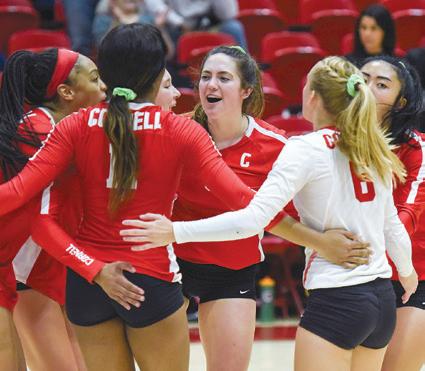
The women’s volleyball team kicked off their season this past weekend, playing three matches against St. John's University, Colgate University and the University of Albany. Strong performances by offensive veterans and first year defensive specialists led the Red to wins against St. Johns and Colgate but did not carry the team to a victory against Albany.
In its first game against St. John’s (2-4), Cornell (2-1) found itself in a hole after dropping the first set 28-26 and trailing in the second set by 17-10. However, game-changing contributions by veteran players led to the team’s comeback and turned the tide of the match in the Red’s favor.
Junior Joanna Chang led the team with 15 kills and 18 digs, while three other seniors — Madison Baptiste, Jilliene Bennet and Casey Justus — all tallied double digits kills as well. The team’s impressive comeback was due in part to its performance from the serving line, as the Red notched 13 aces compared to St. Johns’ three.
The Red narrowly completed the second set comeback, taking the set 27-25, and went on to edge out St. John’s in the next two sets, winning 25-23 and 25-19.
In its next game against Colgate (1-4), the Red dominated the Raiders, beating them in three straight sets, 25-17, 25-12 and 25-13, respectively. Similar to the first game, Chang and Baptiste led the team to their second win, with Chang recording 13 kills and Baptiste tallying 10.
“I thought we played really well,” Chang said. “Coming back from two years of not playing and to win the tournament, I thought we were pretty good.”
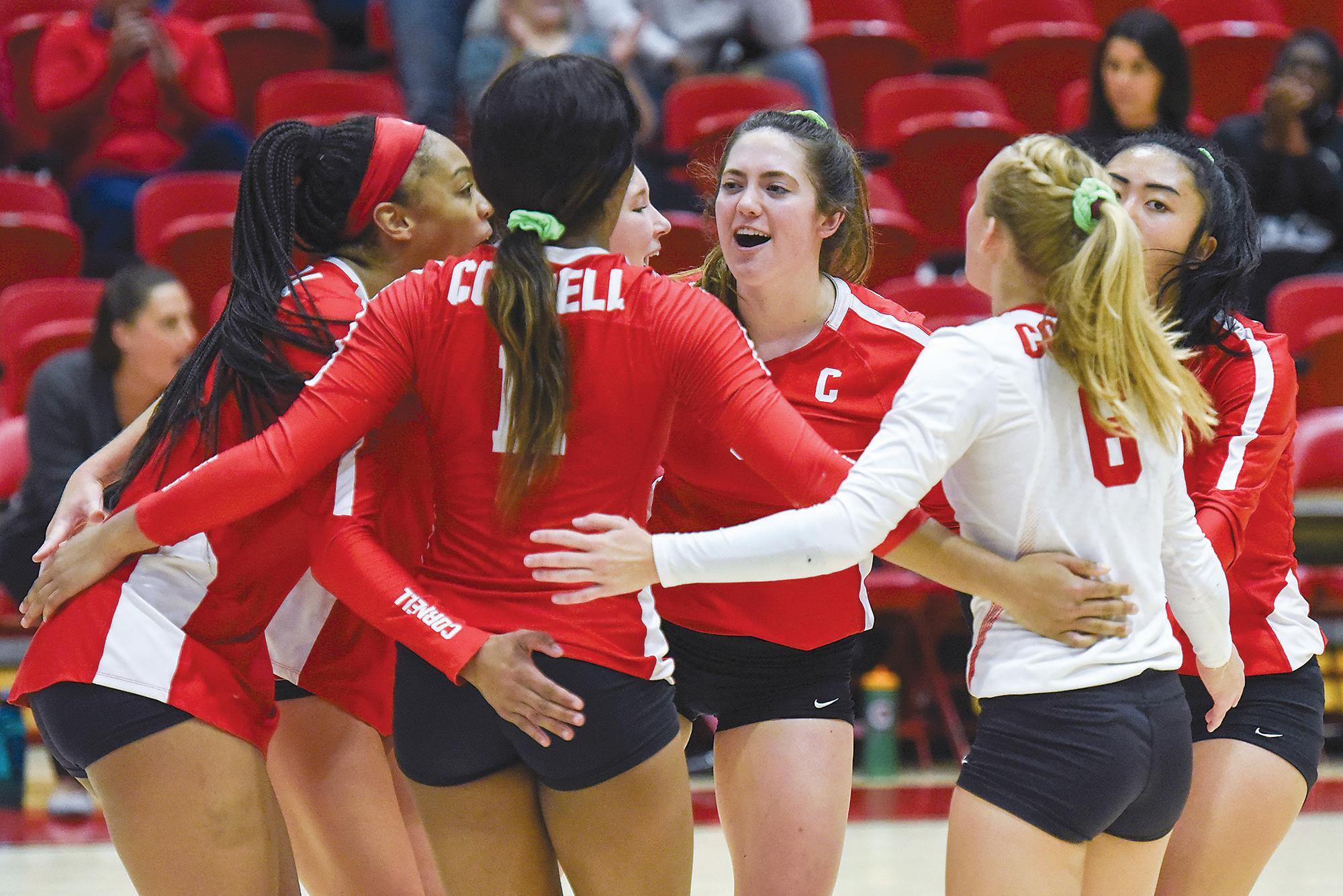
In addition to the impressive display from the veterans, first year liberos Jackie Baker and Megan Bickel helped carry the team to victory by recording 12 and 11 digs, respectively.
“[Baker and Bickel] did really well,” Chang said. “They were good under pressure, which is hard for freshmen to do, so I thought their performances were really good.”
In the final game of the tournament, the Red fell to Albany (3-4) for the first time in the program’s history. The Red won the first set 25-23, but dropped the next three sets 25-21, 25-23 and 25-23, respectively.
Despite the loss, Baptiste still put up double digit numbers with 15 kills, along with senior Casey Justus’s 10 kills. Albany’s defense solidified the win for the Great Danes, as the
team out-blocked the Red 14-5 and senior Charlotte Macken led the way with a match-high of 20 digs.
“In our last game we lost because we weren’t communicating well,” Chang said. “[If we practice] more of that and more basic movements, we should be okay by the time we get to Ivy’s.”
The Red will look to bounce back this Friday and Saturday when they host the Cornell Invitational at Newman Arena at Bartels Hall. They will face off against UNLV (3-2), Niagara University (2-4) and Bucknell University (3-3).

By GRAYSON RUHL Sun Staff Writer
After not taking the field since 2019, Cornell Sprint Football will return to competition this fall with the hope of improving on their most recent record of 1-5 — when their sole win came in their opening matchup against Alderson Broaddus.
Since then, Coach Bob Gneo and the team have had to alter the manner in which they prepared for the upcoming season, by taking their preparation online..
mates over the summer once everyone left Ithaca.
“Over the summer, through group chats, we kept track of each other,” he said. “We had workout plans, we kept each other to the team standard, made sure everyone was working out, that we’re all in this together.”.
“We consider everybody part of the family — as soon as you sign up, you’re part of the family”
Head Coach Bob Gneo
“We meet as a team, once a week, zooming, and then we would break up into individual groups. For example I would work with quarterbacks and running backs twice a week — installing the playbook, talking about culture,” he said.
Gneo was able to bring in Buffalo Bills head coach Sean McDermott, and multiple NFL linebackers, to speak with the team and keep them mentally sharp for the fall.
The team has ensured that their group remains tight-knit and committed, even if they have to be distant, according to Sophomore offensive lineman Andrew Song, who emphasized the importance of the team community..
“During the spring, the captains did a really great job of organizing informal spring practices,” Song said. “Obviously we socially distanced. It was outdoors, we had our masks on. But the captains did a great job of getting the team together however they could.”
Song also discussed the importance of accountability between the team-
Gneo echoed the importance of the culture cultivated by both coaches and players in the offseason as a key driver to success during the season. The team implemented a leadership program that assigned veteran players to mentor new additions to the team.
“We consider everybody part of the family — as soon as you sign up, you’re part of the family,” Gneo said.
One of their most pivotal matchups on the schedule is their annual game against Penn. This year the Red will be on the road in Philadelphia on Oct. 8, looking to avenge their defeat from 2019. However, Gneo emphasized the importance of their opener, an away game against Mansfield University on September 18.
“The first game is going to be [big] because we haven’t played in so long. It’s always a great atmosphere at Mansfield. We play at night, they’ll have a parade, they’ll have a band, they’ll have cheerleaders, it’s a big deal when we play over there. So that’ll be a great night.”
The Red’s home opener is on October 1, when they take on Caldwell University at Schoellkopf Field.