The Corne¬ Daily Sun


By MARYAM ZAFAR Sun City Editor
Law enforcement at several levels of government collaborated to arrest Adrian Dove, 48, in Ithaca for a murder that occured across the country, the U.S. Marshal’s Service shared in a press release Wednesday.
The Savannah Police Department was searching for Dove for his connection to a murder in Georgia in which the victim was shot. Dove was employed as a truck driver, the report said, and traveled in upstate New York, including the Syracuse area. The press release was circulated by Lieutenant John Joly of the Ithaca Police Department.
enforcement agencies whose cooperation was so very important in this case,”
David McNulty, the U.S. Marshal for the Northern District of New York, said in the release. The office could not be reached for additional comment Wednesday night.
Tompkins County Sheriff’s and the Cayuga Heights Police Department, arrested the man on Tuesday “without incident,” the report said.
“We are proud to have secured Mr. Dove’s capture and wish to thank both the community and all of our fellow law
By MARYAM ZAFAR and SARAH SKINNER Sun City Editor and Managing Editor
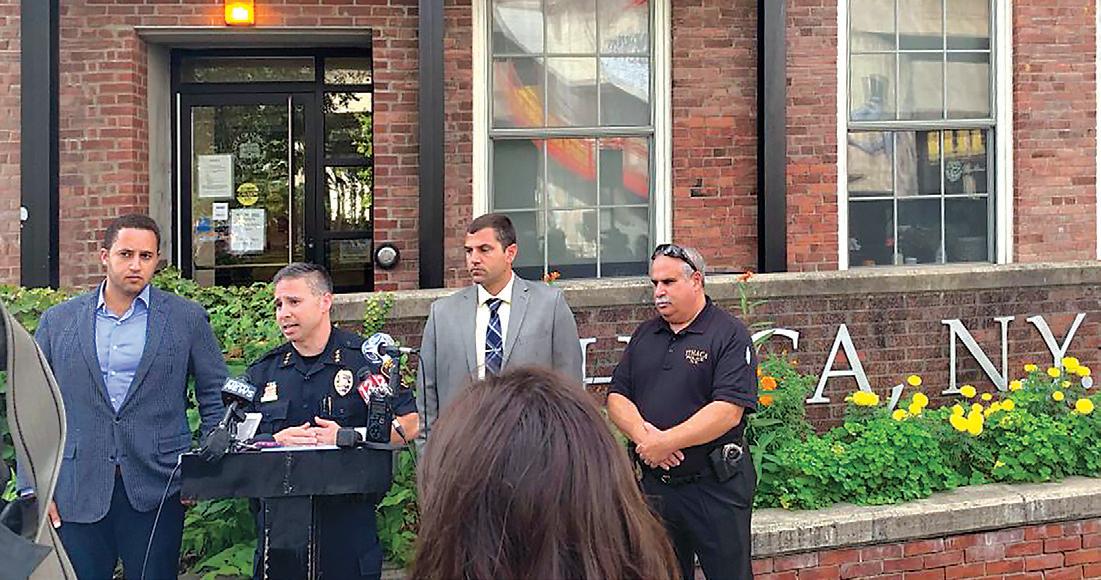
Outside of City Hall on Wednesday afternoon, Ithaca Mayor Svante Myrick ’09, Acting Police Chief Dennis Nayor and other members of the Ithaca Police Department briefed the public on the status of the investigation into the shooting on Green Street earlier that morning. As of Wednesday night, the suspect was still at large.
At 9:44 a.m., the IPD received a call that shots had been fired around the Green Street parking garage. When officers responded to the scene, they found a victim who had been shot multiple times.
John Joly wrote in a press release.
The Ithaca police arrested and charged Turner with criminal possession of a weapon in the second degree and tampering of evidence, police said.
The primary suspect, identified as Andrae Martin during the conference, is a 33-year-old African American male between 5’10” and 6 feet, with an average build. Police said Martin first attempted to flee on bike, before discarding the bike. The search for Martin is ongoing.

Myrick, who said he was in a meeting with the acting chief during the time of the shooting, cited today’s shooting as an example of the police force’s cohesion.
The victim, who police identified as 30-year-old Shayne Lott of Rochester, was first taken to Cayuga Medical Center and then a regional trauma center, Nayor said.
At the time, police apprehended one suspect, Woodrow Turner of Ithaca, who was attempting to dispose of a .357 caliber revolver; five shots had been fired, and the gun still contained one live round in its cylinder, Lieutenant
The investigation, which involved collaboration between the Tompkins County Sheriff's Office, state police and the Federal Bureau of Investigation, involved multiple scenes, Joly said. The police continued working Wednesday, closing the parking garage and causing a temporary pause in the operation of the TCAT station on Green Street.
The law enforcement coalition, which included U.S. Marshals New York/New Jersey Regional Fugitive Task Force, Ithaca Police Department, New York State Police,
Dove, who was arraigned in City Court, will face extradition proceedings as a “fugitive from justice,” the release noted.
Maryam Zafar can be reached at mzafar@ cornellsun.com.
By DENA BEHAR Sun Staff Writer
After extensive review, taskforces and student input, Cornell Health’s mental health reforms went into effect with the new semester — featuring free sessions, easier scheduling and a greater variety of care options.
The reforms were first announced by Vice President Ryan Lombardi in March. The improvements include increased access to mental health care in the form of free, 25-minute in-person counseling appointments that can often be scheduled the same day, according to the executive director of Cornell Health, Dr. Kent Bullis. Longer 50-minute sessions are available for a $10 copay.
The updates were inspired by the suc-
cess of the “Let’s Talk” counseling program that offers free dropin sessions. As a part of the updated services, Cornell has expanded Let’s Talk at locations around campus and has also expanded group counseling options for those seeking peer support.
Over the past two years, Cornell Health has increased its Counseling & Psychological Services staff by 15%. Currently, there are 40 counselors on staff, 37 of them full-time, according to Bullis. This represents a ratio of 694 students to each full-time counselor.
“For context, the nationwide average for universities of our size is 13 counselors, according to the most recent figures from the Association for University College
Counseling Center Directors,” Bullis said.
The increase in staff has come at a time where there has been an increase in students utilizing mental health resources, and the change in the service model is meant to account for the growing
itoring tools such as an online dashboard to track appointment requests, the type of service and the specific provider. These tools allow Cornell Health to respond to the demand and improve the offerings, according to Chris Payne MHA ‘97,
“I hope that the administration might now look towards putting regulations on course grading/curves, caps on workload, and other reasonable changes to aid student well-being.”
number of students that simply increasing counselors cannot address, according to Bullis.
In the last year, 25% of students used CAPS services, which was an 11 percentage point increase from the prior year.
Cornell Health is currently using mon-
Chelsea Kiely ’20
director of administrative services at Cornell Health.
Cornell is currently working on other projects to address student health and well-being in other ways. Dr. Timothy Marchell ’82, director of Skorton
See HEALTH page 4
Thursday, September 5, 2019

Sustainability GooseChase 9 a.m., various locations on Ithaca campus
Truman Scholarship Info Session 12 - 1 p.m., 103 Barnes Hall
Master Your Future: How to Successfully Navigate the Career Fair
4:30 - 5:15 p.m., 110 Hollister Hall
ODI Kick Off Social 4:30 - 5:30 p.m., 401 Warren Hall

CALS Study Abroad 101 4:45 - 5:45 p.m., B25 Warren Hall
College of Engineering Study Abroad Info Session 4:45 - 5:45 p.m., 206 Upson Hall
The Hotel School Study Abroad Info Session 4:45 - 5:45 p.m., 196 Statler Hall
CUBS Meeting
6:30 p.m., Seminar Room, Carl Becker House
Beginner Salsa Dance Class 7 - 8 p.m., 303 Appel Commons
Unturned Leaves: Early Women in Botanical Illustration Saturday, 8 a.m. - 5 p.m., Mann Library
PolliNation: Artists & Scientists Crossing Borders to Explore the Value of Pollinator Health Saturday, 8 a.m. - 5 p.m., Mann Library
Annual Ancient Philosophy Workshop 2019 Saturday, 9:30 a.m. - 6 p.m., 401 Physical Sciences Building
CU Music, New Meets Old: Collaborative Confrontations Festival Saturday, 9:30 a.m. - 12:30 p.m., Barnes Hall
Saturday Garden Tours Saturday, 11 a.m. - noon., 4 - 5 p.m., Brian C. Nevin Welcome Center
CU Downtown Saturday, 1 p.m., Downtown Ithaca
Work Party at Dilmun Hill Student Farm Saturday, 6 - 8 p.m., Dilmun Hill Student Farm
Jazz Faculty Concert: CU Music Sunday, 7 p.m., Carriage House Loft
WVBR’S Bound For Glory Starts Its 53rd Year Sunday, 8 - 11 p.m., Anabel Taylor Hall




Lyme disease — a tick-transmitted bacterial infection infamous for its difficult diagnosis and chronic symptoms — may soon become more manageable, thanks to the work of Ionica Sciences, a scientific research group housed in Cornell’s McGovern Center. Ionica has reportedly developed a blood-based assay system, which could allow doctors to test for the infection directly. This would deliver verdicts to patients faster when the disease has a better prognosis. Ionica must still undergo further testing and approval, but its lead researchers expressed optimism on bringing the test to market by 2020. If successful, the product would have an immediate impact in New York, the country’s second highest population of confirmed cases.
On Tuesday, Tompkins County Administrator Jason Molino unveiled a $191.8 million budget for the upcoming fiscal year. Following in the footsteps of New York State — which earlier this year enacted an ambitious plan that hopes to make the state a net-zero carbon emitter by 2050 — the new budget contains a number of initiatives, including $100 million in investments over 15 years. The budget also features $2 million to convert the County’s 70-vehicle passenger fleet to electric, $30 million for public safety building improvements and $22 million for a new downtown facility. The property tax levy is set to increase to 2.76 percent. According to the Ithaca Voice, a resident owning a home appraised at $190,000 can be expected to pay only $13 more than last year. The budget now moves to the legislature, which will review the plan before passing it.
Hurricane Dorian Wreaks Havoc in Bahamas, Threatens Carolinas
After pummelling the Bahamas in one of the island nation’s worst ever storms — with at least 20 people so far reported dead — Hurricane Dorian is now nearing the Carolinas as a still-powerful Category 2 storm, CNN reported. While the storm was initially predicted to make landfall in Florida, it has so far tracked further east — and, as of yesterday night, is currently situated 100 miles south of Charleston, South Carolina with a radius of 70 miles. Today, the storm is projected to deliver harsh conditions to both the Carolinas and Georgia, with well over a foot of rain possible in the eastern portions of those states. By Friday, Dorian will likely move towards southeastern Virginia.
— Compiled by Johnathan Stimpson ’21
By JOHNATHAN STIMPSON Sun News Editor
Best-selling conservative author, Iraq War veteran and National Review commentator David French will speak at Cornell University on September 18 at the invitation of the Cornell University College Republicans.
CR President Isaac Schorr ’20. “Unapologetic, well-versed, and respectful, he’s everything that the CRs strive to be as political advocates.”
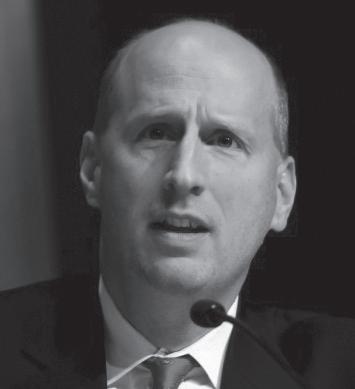
“We decided to bring Mr. French because he is among the most thoughtful voices on the Right today,” said
By NICOLE ZHU Sun Assistant News Editor
For students rushing to print course syllabi, book lists and first assignments, the pages are already piling up. It seems like free printing can’t come soon enough. However, Cornellians can soon breathe a sigh of relief; an update to printing pricing is on the way.
“The current Net-Print system includes 200 printers in nearly 130 locations across campus and as with any project of this scale, enough time and preparation is paramount to preventing unnecessary service disruptions,” student trustee Jaewon Sim ’21 told The Sun in a written statement on Wednesday.
Sim did not give a specific date for when the printing allocation would go into effect.
Originally announced last
French currently serves as a senior writer for the National Review, a right-leaning publication that has served as a mainstay outlet in conservative circles since its founding. Previously, French served as president of the Foundation for Individual Rights in Education, a group
that pledges “to defend and sustain individual rights at America’s colleges and universities.”
After graduating from Harvard Law School in 1994, French worked as senior legal counsel for the American Center of Law and Justice and the Alliance Defending Freedom, advocacy organizations focused on the intersection of the Constitution and religion —
issues that will feature prominently in his speech later this month.
“Unapologetic, well-versed, and respectful, he’s everything that the CRs strive be as political advocates.”
Cornell Republicans President Isaac Schorr ’20
According to Schorr, French “will be speaking about cultural conservatism and its merits,” a topic that will include a dis-
See FRENCH page 5
semester, undergraduate students will receive approximately 200 pages of free printing each year, as The Sun previously reported. The new printing allocations, which are part of the larger Student Printing Service Project, are scheduled to begin this October.
As of right now, students can only print documents free of charge at select spots on campus, such as Office of Diversity
and Academic Initiatives, the Student Development Diversity Initiatives building and in the Asian American Studies Resource Center.
“I appreciate Cornell IT’s leadership — and the student body’s patience — during this time of transition and look forward to the expected announcement and launch of the new printing service,” said Sim.
Sim, former vice president of internal relations for the Student Assembly, led the initiative to streamline and overhaul the printing system over the course of his two years in S.A. The success of this initiative became a cornerstone of his campaign for student trustee last year.
Nicole Zhu can be reached at nzhu@cornellsun.com.

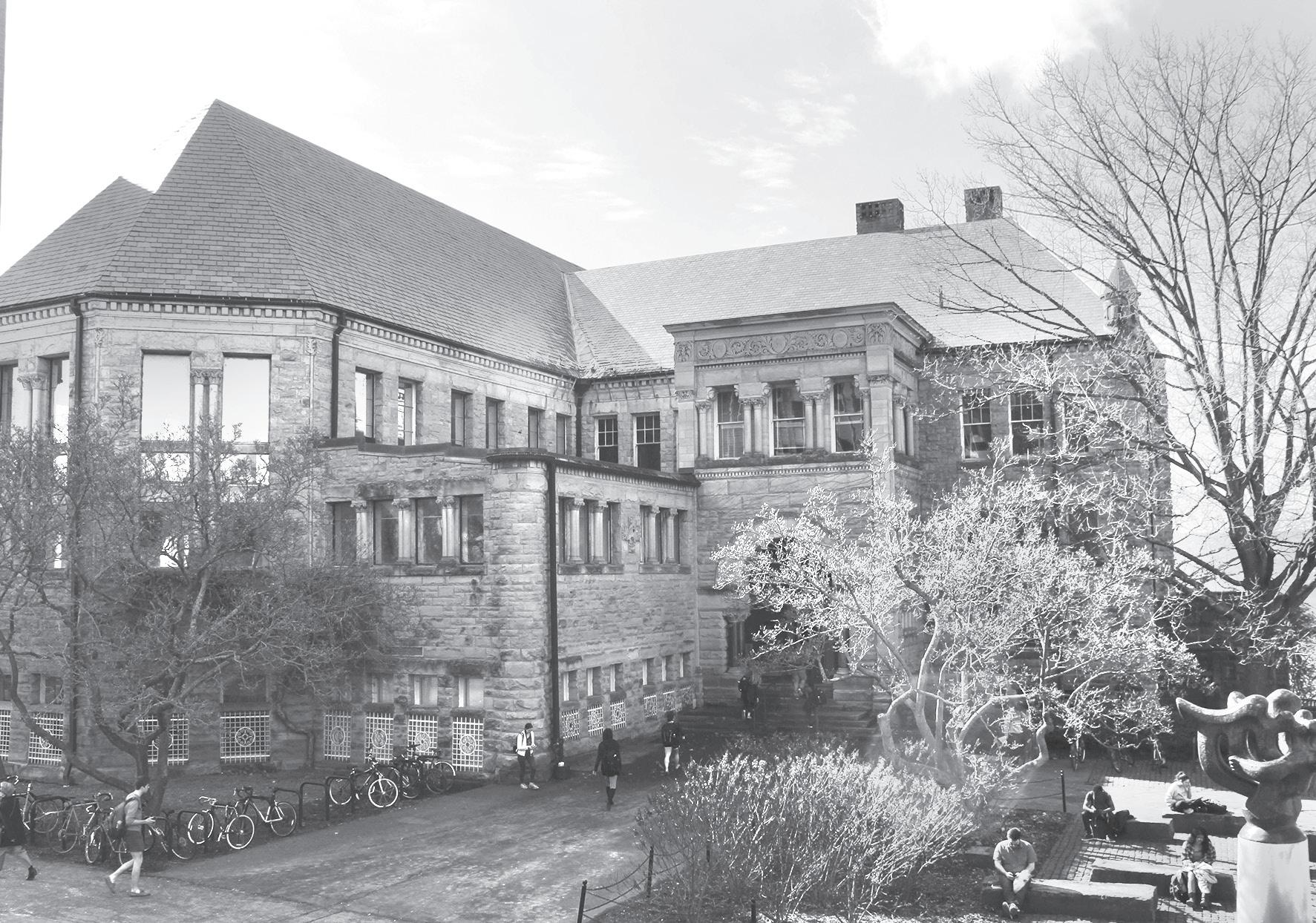
Renewing the terrace | A year-long renovation of the Olin Library terrrace will make vital maintenance updates to the library roof, including bringing certain elements of the building up to code, improving accessbility and making over the terrace itself.
By KATHERINE HEANEY Sun Staff Writer
Olin Library’s terrace, famous for its musical rocks and views of the Arts Quad, will be closed until spring as the University manages a series of leaks and maintenance updates to the
58-year-old building. The Olin Library Terrace Renewal project began construction during August 2019 and will continue into Spring 2020. The project is part of the greater Olin and Uris Libraries Space Improvement Projects.
Jon Ladley, the library
facilities planning coordinator, said that the main goals of the Olin Terrace Renewal project including replacing guardrails, improving the safety and accessibility of the stairs and entrances and replacing the roof of the terrace.
“We have had mul-
tiple leaks over the first floor of the building that prioritized the roof replacement,” Ladley said. “The main access stairs by the building entrance have also deteriorated, and the original guardrails along the terrace walkway are not up to current safety code.”
“It made sense to complete all of this adjoining work within the scope of one project,” he concluded.
Ladley said that the project also provided an opportunity to improve Olin’s Americans with
See TERRACE page 5
Be a part of 138 years of proud history that includes
SHOOTING
Continued from page 1
HEALTH
Continued from page 1
Center for Health Initiatives at Cornell Health, said they are currently working on a program called W.I.S.E – Well-Being in Scholarly Environments – to help the Cornell community identify students in distress in academic settings.
The changes also removed the telephone assessments that were required as the first step to receiving mental health care. Additionally, students have more flexibility in selecting a counselor. Students can select the first available appointment or look for an appointment with a provider of their choosing.
vices. That review has just begun.
The review is conducted by both an internal and an external team, which will share their findings at the conclusion of the review. The internal Mental Health Review Committee (MHRC) is charged with examining the “academic and social environment, climate and culture related to mental health” of Cornell’s campus.
review committees this past week, outlining numerous suggestions for the review teams to consider — from ways to alleviate institutional causes of stress to mandatory suicide prevention training for RAs.
Co-founder Scott MacLeod told The Sun in a phone inter-
“Cornell, like many other universities, has been met with a tsunami of mental health crises involving its students.”
Scott MacLeod

E.B.White ’21, Kurt Vonnegut ’44, ESPN’s Jeremy Schaap ’91, various Pulitzer Prize winners and many others.
Learn more about The Sun at an informational meeting:
• Wed.,Sept. 11, 5 p.m., or
• Thur., Sept. 12, 5 p.m., both at Goldwin Smith Hall G76
“Everyone’s feeling a bit traumatized,” Myrick said, echoing the contents of a Facebook post uploaded just moments before his public remarks. Myrick, who emphasized the “wake up call” nature of the incident, initially notified the public of the shooting in a tweet this morning at 10:01 a.m. Police say they received their first call regarding the shots at 9:44 a.m.
“And it’s clear that an act of violence like this has more than just one victim,” Myrick wrote in the lengthy post, where he urged those with ideas to stem violence in the city to contact his office. “I’ve spoken to dozens of witnesses and others who heard the shots and took shelter in their homes, offices and stores.”
“Incidents of violence like this in our city are so troubling in part because they’re so rare,” Myrick said, standing in front of City Hall, which is yards from the parking garage.
This past summer also saw two incidents of stabbing which startled the community. On July 17, a stabbing at Auden Ithaca apartment, just yards from the Cornell campus, resulted in the victim dying from his wounds. A second knife assault occurred later in July, 14850.com reported.
Maryam Zafar can be reached at mzafar@cornellsun.com, Sarah Skinner can be reached at sskinner@cornellsun.com.
Chelsea Kiely ’20, president of Cornell Minds Matter, said she thinks the changes will most certainly have a positive impact on student life at Cornell. According to Kiely, the reforms are specifically designed to meet the needs of the large population of students who want access to counselors but do have an immediate need.
“The previous CAPS system was successful in maintaining [students’] regular appointments, but could not meet the needs of people who wanted onetime or dayof appointments, or those who wanted to switch counselors,” Kiely said.
The External Review Team, led by Michael Hogan ’69, a health systems consultant, plans to complete a review of clinical services and campus-based strategies, according to the university website.
Bullis, executive director of Cornell Health, told The Sun in an email that he and his colleagues “look forward to gaining valuable feedback through the findings, and to identify opportunities for continued improvements to our services.”
“[CAPS] could not meet the needs of people who wanted one-time or day-of appointments.”
Chelsea Kiely ’20
Kiely, who is also on the MHRC, said she hopes the changes to Cornell Health build on addressing other “systemic mental health issues.”
Additionally, Kiely noted that it was difficult to enter the system by getting an appointment or even a phone interview, particularly in high-stress weeks during prelim season — as has been critiqued by many student groups.
Along with these new reforms from Cornell Health, the university announced in Fall 2018 that it would be engaging in a comprehensive review of mental health ser-
“I hope that the Cornell administration might now look towards putting regulations on course grading/ curves, caps on workload, and other reasonable changes to aid student wellbeing,” she said.
The Sophie Fund, an advocacy group focused on supporting mental health initiatives in Ithaca and said that it is encouraged by the steps it has seen the review take.
The organization submitted a presentation to Cornell’s
view that while the group is pleased to see that Cornell has undertaken improvements in their delivery of mental health services to students, they are also advocating for a much more comprehensive review of student mental health.
“If the environment is exacerbating students’ mental health problems, then adding more counselors isn’t necessarily going to solve that underlying problem of what is exacerbating and triggering disorders,” MacLeod said.
MacLeod hopes the university will act “decisively and robustly” in tackling its mental health crisis.
“Cornell, like many other universities, has been met with a tsunami of mental health crises involving its students, but it has not meant that tsunami with a commensurate response,” he said.
Students may consult with counselors from Counseling & Psychological Services (CAPS) by calling 607-255-5155. Employees may call the Faculty Staff Assistance Program (FSAP) at 607-255-2673. An Ithacabased Crisisline is available at 607-272-1616. To access the National Crisis Text line, Text HELLO to 741741 any time. For additional resources, visit http://caringcommunity.cornell. edu/get-help/.
Dena Behar can be reached at dbehar@cornellsun.com.
TERRACE
Continued from page 3
Disabilities Act (ADA) accessibility by replacing the east stairs with a ramp to the raised podium on top of the library. This change will enable more Cornell community members to enjoy Olin’s terrace.
Ladley said that the impact on students will be mainly visual — and they have made requests to minimize the Terrace Renewal Project’s disruption.
“There will be some construction noise throughout the duration of the project, but we have requested that the most disruptive noise happens in the early morning before Olin opens,” Ladley said. “Construction will also cease during study week and finals.”
Ladley said the goal is to complete Olin’s roof work before winter weather begins. Additional work and site restoration for the Terrace Renewal Project will take place when weather permits in the spring.
The project was awarded to Streeter Associates of Elmira, the same contractor who renovated the Olin Library entrance during the Summer of 2018 and the Uris Library Cocktail lounge, which reopened last month after closing for a semester. The Terrace Renewal project is funded by central planned maintenance funds.
The John M. Olin Library, built in 1961, is home to a vast
collection of electronic and print research materials in the humanities and social sciences, and shares its collection with the neighboring Uris Library. According to the University, the two libraries hold a combined nearly 2 million volumes.
With an increased emphasis on digital research, the way that students and faculty optimize the library’s resources has changed in the 58 years since Olin’s construction. The University saw the need to improve heating, ventilation, air-conditioning, accessibility and space allocation, amongst other needs.
In March, Cornell University Library held two workshops, one for students and one for faculty, to brainstorm future renovation ideas for both Olin and Uris. Once the project proposal was created, organizers held an open Q&A session in an effort to lessen a potential renovation’s disturbance to library staff and students.
sultant and architect team will be guided by a Cornell executive committee and core group. Other University stakeholders will be included in the planning process, including students, faculty, and library staff, through a series of forums.
The study outlines a vision for both libraries and is being used to develop conceptual design options by the end of 2019. The options will be presented to stakeholders in January 2020 and further open sessions will be organized for stakeholders to voice their opin-
“We have requested that the most disruptive noise happens in the early morning before Olin opens.”
Jon Ladley
ions. The designs created for the feasibility study will be used to fundraise future building renovations.
According to the University, Cornell signed a contract with Brightspot Strategy LLC, a planning firm, to collaborate on the Olin and Uris Libraries Renovation Feasibility and Program Study. The firm’s con-
After the completion of the feasibility study, further construction to Olin Library likely won’t begin before 2022, at the earliest. However, Cornell community members can look forward to the renovated Olin terrace by the end of the 2019-2020 academic year.
Katherine Heaney can be reached at kheaney@cornellsun.com.
FRENCH Continued from page 3
cussion on “the importance of a legal system that protects religious freedom and culturally conservative views — an especially prescient topic right now and one that he’s eminently qualified to address given his distinguished legal career.”
Despite his right-of-center bona fides, French has famously staked
“There was an uncomfortable truth only half-hidden in her words.”
David French
out a position as a staunch Trump skeptic, frequently criticizing him as “dishonest and morally corrupt.” French’s status as a “Never Trumper” — a term commonly used to denote conservatives who oppose the President — has earned the writer a barrage of highly-publicized online harassment.
According to NPR, “French was bombarded with hateful tweets
— including an image of his child in a gas chamber,” in response to publicly rebuking those aligned with the alt-right.
The speech later this month also marks something of a homecoming for French, who previously served as a lecturer at Cornell Law School.
While French has written positively of his former employer in previous essays, he referenced aspects of his tenure at the University in an op-ed criticizing ideological homogeneity in American higher education.
“When I left Cornell Law School … I cringed when a colleague toasted me by saying, ‘To David, the person who taught me that conservatives are people too,’” he wrote in the National Review.
“She was joking, of course, and I took it in the spirit it was it was intended. But there was an uncomfortable truth only half-hidden in her words.”
French will present on September 18 at 6 p.m. in Goldwin Smith Hall G64. The event is free and tickets are not required.
Johnathan Stimpson can be reached at jstimpson@cornellsun. com.


Independent Since 1880
137th Editorial Board
ANU SUBRAMANIAM ’20
Editor in Chief
JOYBEER DATTA GUPTA ’21
Business Manager
PARIS GHAZI ’21
Associate Editor
NATALIE FUNG ’20
Web Editor
SABRINA XIE ’21
Design Editor
NOAH HARRELSON ’21
Blogs Editor
SHRIYA PERATI ’21
Science Editor
AMANDA H. CRONIN ’21
News Editor
JOHNATHAN STIMPSON ’21
News Editor
PETER BUONANNO ’21
Arts & Entertainment Editor
ANYI CHENG ’21
Assistant News Editor
SSARAH SKINNER ’21
Managing Editor
KRYSTAL YANG ’21
Advertising Editor
MEREDITH LIU ’20
Assistant Managing Editor
RAPHY GENDLER ’21
Sports Editor
BORIS TSANG ’21
Photography Editor
AMBER KRISCH ’21
Blogs Editor
KATIE ZHANG ’21
Dining Editor
SOPHIE REYNOLDS ’20
Science Editor
AMINA KILPATRICK ’21 News Editor
MARYAM ZAFAR ’21 City Editor
Working on Today’s Sun
Ad Layout Jamie Lai ’20
Production Deskers Krystal Yang ’21
Jamie Lai ’20
News Deskers Nicole Zhu ’21
Amanda Cronin ’21
Design Deskers Krystal Yang ’21
Simon Chen ’21
Photography Desker Ben Parker ’22
Sports Desker Raphy Gendler ’21
Arts Desker Jeremy Markus ’22
ettling back into school after the summer is sometimes unsettling. It could be relearning a specific detached hello to that peripheral acquaintance, reunderstanding — in neutral sunlight — that route from the library once weighted with late-night assignments and February snow or retrieving social postures and modes of thinking almost exclusively inhabited in this patch of the world.
Settling back into Watermargin took relearning for me. I start from detached, structural descriptions to friends back home: “It’s a co-op — like a gender-neutral fraternity, but you help with the cooking and cleaning so it’s dirt cheap — themed around social justice.” More privately, I recall that its resonance to me wasn’t through spring formals or the barbeque on Slope Day as penetratingly
seemed to angle itself toward the representation of a very specific set of “identities” and causes that appeared self-selecting.
I was not the only one with this realization. A lot of attention has been paid to diversifying co-ops, which are currently mostly popular with a self-perpetuating, left-leaning demographic. Watermarginites themselves, noticing they had become predominated by white suburbanites several years back, sought to return to their roots as one of the first interracial and interreligious houses in North America by increasing base votes for “moseyers” of color and those facing financial barriers. But these identity labels cannot capture or guarantee a plurality of worldviews. And don’t differences in worldview hold far richer potential for cross-difference understanding?
But identity labels cannot capture or guarantee a plurality of worldviews. And don’t differences in worldview hold far richer potential for cross-difference understanding?
as it is rushing a final paper and hearing a housemate make his fourth trip bringing down utensils he accumulated over the semester, dumpster diving and the festive sharing of spoils the night of and watching the house fall into disrepair during finals to the extent that my roommate proclaimed, “You know you’re in Watermargin when you feel an ant crawling up your leg.”
I remember, also, my early dissonance with its culture. My alternative description of Watermargin to Christian friends back in Singapore notes how within my first week here, I found a portrait of Jesus with condoms taped to his nipples. This, alongside the irreverent pasting of evangelical stickers I disagreed with but felt by-association defensive over and the confusing presence of religious paraphernalia disoriented my understanding of American social justice more broadly. Espousing inter-difference dialogue, Watermargin
While a lot of my alienation was internal in ways that most house members likely never characterized me by — being a racial minority, majoring in something “artsy” and overlapping music tastes were things I superficially understood as compensatory social currency — it still led to nervousness over the visibility of aspects of my life that were far more fundamental to who I am.
Significant external changes have happened since I first began to live in my co-op. People moved out and in. Braver voices in the house have spoken out against the assumed homogeneity of lifestyles and politics on my behalf. In conversations both fleeting and deep, through which I discover deeper nuances on housemates’ perspectives and histories with positions I hold, I grow more reassured letting my differences be visible and discussable.
To continue reading this column, please visit www.cornellsun.com.
Examine the view from Libe Slope at any time of day and you will see the Stars and Stripes waving from Baker Flagpole, flying rain or shine in any season. It is lit brightly at night thanks to a unanimous March 2017 resolution of the Residential Student Congress, which states that the flag must be illuminated 24 hours a day in accordance with the United States Flag Code. It was a good determination, and not the University’s first decision on the issue — in 1991, Cornell chose to suspend its ban against displaying flags of any kind in dorm windows to allow students to show support more vocally for U.S. troops serving in the First Gulf War. Cornell should be proud of its record in honoring our flag, especially given that it stands in stark contrast to anti-flag rhetoric and acts at other universities. In April 2018, for instance, student govern ment leaders at Michigan State University chose to cancel the installation of new American flags on campus over vague and ill-conceived concerns from student leadership, despite a poll indicating over 70 percent of students felt that the flag was “important” or “very important” to them. Two years prior, Hampshire College in Amherst, Massachusetts chose to stop flying its flag shortly after the 2016 election because “the flag is a powerful symbol of fear,” as Hampshire College president Jonathan Lash preposterously alleged at the time.
A pro-democracy Hong Konger put it best: “It’s because we respect the spirit of the United States … In the United States Constitution, they have the right to defend their own democracy.” No such right exists in the city of Hong Kong, where Beijing repeatedly disqualifies democratically elected candidates and has set up the Legislative Council with essentially permanent pro-Beijing majorities in a country where those challenging Beijing’s ethos often disappear or are arrested. Hong Kong’s chief executive, Carrie Lam, has dutifully done the Communist Party’s bidding as she oversees the escalating crackdown on those demanding democratic reform. These people are Hong

Where
are
the
so-called
anti-fascists as Hong Kongers appeal to the West for help and moral support?
Kongers, but they are still flying Old Glory as they are shot with rubber bullets and as Chinese paramilitary forces begin to amass across the border in nearby Shenzhen.
While these events are largely outliers on campuses, they also are indicative of anti-American animus in the broader culture. The debate over the flag has been brought to the forefront repeatedly since former NFL quarterback Colin Kaepernick’s infamous refusal to stand for the national anthem. To a small but increasing number of leftist radicals, the American flag outrageously is a symbol of oppression, not an icon of liberty, and they have even been inspired to burn the flag at “anti-fascist action” or “antifa” rallies across the country in an act of explicit anti-Americanism.
These radicals, as this column has noted before, are dangerously aloof and misguided in their worldview. Not only do they promote a dogmatically negative and wildly inaccurate view of Western democracy, but they are completely silent — sometimes even defensive, especially in the case of Nicolás Maduro’s Venezuela — concerning real authoritarianism abroad, and ignorant of the inspiration that this country gives to freedom-loving people living under genuine oppression. Perhaps they should turn their eyes to the biggest anti-fascist struggle of today: that of the people of Hong Kong against an increasingly repressive and militaristic Chinese Communist Party regime in Beijing. In Hong Kong, the American flag has been waved repeatedly by demonstrators, largely students, protesting against the authoritarian Chinese government. Protests peaked at almost two million demonstrators, so these are hardly isolated incidents, and they are not executed flippantly. These demonstrators also have been repeatedly witnessed singing the U.S. national anthem.
Where are the so-called anti-fascists as Hong Kongers appeal to the West for help and moral support? While students their age are facing down the Chinese Communist Party, one of the most powerful regimes in the world, the American left — many of them students themselves — are silent. The Colin Kaepernick wing of its activist corps has now spent years directly rebutting their faith in the United States and Americanism more generally. These people instead insist irresponsibly that the Stars and Stripes signify oppression and denigrate those who believe in its symbolism as backward or even bigoted. But it has the exact opposite meaning in Hong Kong, and it is only a “symbol of fear” for apparatchiks in Beijing who seek to impose the same degree of control over Hong Kong as they have already done on the Chinese mainland.
Whatever their perspective on the wrinkles in the American system, these leftists’ silence on China — and simultaneous fixation on flag-burning, flag removal and ritually destroying other symbols of the
The American flag was and is the ultimate anti-fascist symbol in world history. Long may it wave on East Avenue, and in streets everywhere from Havana to Hong Kong
U.S. that are inspiring pro-democracy and pro-freedom movements and peoples around the world — is telling about their real priorities. While exasperated Americans try to explain to these radicals the unique greatness that the red white and blue symbolizes, the reality is all too clear to freedom-loving people abroad: The American flag was and is the ultimate anti-fascist symbol in world history. Long may it wave on East Avenue, and in streets everywhere from Havana to Hong Kong, signifying the same message today as it has since 1777: Liberty and independence for all.
Michael Johns, Jr. is a senior in the College of
Why is the American flag such a common symbol in this struggle for liberty?
Istill vividly remember my first semester at Cornell as a newcomer wearing a shiny ID on the red “Tatkon Center” lanyard. Early freshman year was many things, but it mostly boiled down to two activities: sporting my fashionable “Hello, my name is ____” sticker and strutting down College Ave. in my massive O-Week group with only Google Maps to guide us to a party we had found on Facebook.
Now a junior, I’ve been here long enough to feel at home that I rarely walk through Collegetown in groups larger than three. But watching — from the eHub window seats — the new generation of Cornellians engage in these freshmen processions makes me reflect on my own arrival on the Hill.
I kicked off my first year dreaming about all the wonders Cornell would have in store.
As an early decision applicant whose first choice was Cornell, receiving my red “Welcome to Cornell” envelope was the achievement of my lifetime. And having spent the eightmonth wait until college watching “Glorious to View (Full Version)” and “Glorious to View (Short Version)” at least 73 times each, my excitement about life at Cornell was at an all-time high.
So I kicked off my first year dreaming about all the wonders Cornell would have in store for me, but, oh boy, was college full of the unexpected.
The pinnacle of my freshman year career speaks for its anxiety-filled chaos pretty well. It was the epic season finale: missing my Campus-to-Campus bus by a minute, running after it only to watch it leave without me, and hitchhiking my way to the Vet College lot — the last on-campus stop —
after two unsuccessful attempts to find help. I am eternally grateful for the kind then-junior who, without any hesitation, rescued me from missing my JFK flight back to Seoul. I also had not envisioned spending Friday nights in my room watching Netflix and — through the Clara Dickson windows — see other freshmen head down to Collegetown parties. As a non-drinker, it felt as if there was practically no difference between being alone in my room or being the only uninebriated kid at a party. I soon realized that the dozens of icebreakers during classes, orientation and floor meetings weren’t going to make my freshman year the “Time of Our Lives ™” experience as promised.
To make things worse, I often felt out of place and homesick, always reminded that I was halfway across the globe from family without anyone to rely on. Living in four countries and moving schools 10 times during that period, I was confident that the move to Cornell would be a smooth one. But it wasn’t, and the experience hadn’t made adjusting any easier. On many days in early freshman year, calling home at night or in the morning — when Eastern Time and Korean Standard Time aligned — was the highlight of my day.
Like any other major leap you’ll take in life, your transition to college may be a journey with many bumps and twists — and buses that depart without you. But know that you are not alone in this. This particular leap is one that countless Cornellians who have come before us have already taken.
Nevertheless, I will also tell you that this process is a deliberate one. Take some time to get out, explore, and join organizations that you click with. Join the Student Assembly and advocate for support resources for incoming freshmen and transfers. Become a member of the International Students Union and run programs that will help the next generation of students settle in on the Hill. Join a project team and meet students that share your enthusiasm. But whatever you do, don’t be the freshman me, who thought “finding my people” meant trying to fit in with the nearest group of students I saw, in fear of missing out.
Cornell is full of resources to support you throughout this challenging time of change and growth, but they are only as helpful as you let them be. Take benefit of these, but also remember to give yourself time to adjust.
I hope by the time you realize what an extraordinary community we have on a picturesque campus like no other, you too will be passing the halfway mark of your own Cornell career.
I will tell you quite confidently that you will find your place despite the struggles of your first year. Whether your home is a 16-hour flight, a two-hour layover and a six-hour bus ride away or a quick TCAT ride downtown, you will find your new, second home here at Cornell.
Elijah Fox
As someone who struggled to find a sense of belonging in the first few months of life in Ithaca, I am rooting for your success. I hope that by the time you realize what an extraordinary community we have here on a picturesque campus like no other, you too will be passing the halfway mark of your own Cornell career, reminiscing about your rather turbulent arrival on this Hill.
First-year students, I can’t wait to see you make your four years the Time of Your Life, with friends you’ll proudly call your family away from home.
Welcome to Cornell.
Jaewon Sim is an undergraduate student-elected member of the Board of Trustees and a junior in the College of Arts and Sciences. Trustee Viewpoint runs every other Tursday this semester.
The concentrated wealth at Cornell University is palpable. Large donations, legacy status and well-connected private schools all work in tandem to ensure that over 10 percent of students hail from the wealthiest one percent of families. The trade-off between this history and admissions equity is generally justified with the understanding that the wealth these families bring in — both through full-tuition payments and donations — does a great service to Cornell as a whole, and its low-income students in particular.
In his op-ed last semester, Rory Walsh ’21 said of the money coming in from the families of wealthy students, “If not for their contributions, Cornell would likely be less accessible for low-income students.” The administration hails large donations as “provid[ing] critical,
few that hold similar status to elite private colleges — are in increasingly dire straits. Conservative governments (and the occasional liberal one, too) in search of easy budget cuts are slashing funding at an alarming rate.
Skyrocketing tuition costs are driving students into more “pre-professional” majors like business — which overtook history as the country’s largest major a few years ago — leading to the reduction of humanities departments across the country. A dearth of support resources keeps four- and six-year graduation rates at unacceptably low levels. Democratic party politics is shifting ever closer to support for free public post-secondary education, but the conversation about maintaining and improving the quality of those institutions has taken a back seat.
It is a deliciously self-congratulatory truth that we in elite institutions spend our time and energy devising ways to let a few extra people through our pearly gates.
permanent support for faculty, students and programs.” They are correct: The funding derived from these students and their families both improves and makes possible the educational experiences of thousands of Cornell students, and allows for the development of public-oriented research and development, the benefits of which are undeniable. Still, this is a poor bargain — not for Cornell, but for the broader education system in America. The system of legacy and donor priority in admissions ought to be discontinued.
It is a deliciously self-congratulatory truth that we in elite institutions spend our time and energy devising ways to let a few extra people through our pearly gates. Every dollar an alumnus donates, we figure, is a dollar another student will save in their family’s collective effort to pay for college. What we forget is that most Americans who pursue bachelor’s degrees are enrolled in colleges with acceptance rates greater than 50 percent. The bulk of college-goers attends public colleges, the backbone of our higher education system.
But public colleges — with the exception of a notable
In addition to their full tuition payments and hefty donations, wealthy families’ impact on post-secondary education includes their considerable political sway. With near-guaranteed spots in elite schools through legacy admissions and past and prospective donations, these families have little incentive to lobby to protect the public higher education system. As long as elite private universities remain insulated from the burdens facing public systems, and the politically powerful maintain their safe memberships, public colleges will remain vulnerable to further erosion.
Padding the treasuries of Cornell and other peer institutions to diversify student bodies and expand opportunities is a noble mission. To ease the admissions of the already fortunate in order to guarantee room and resources to those in need makes sense as long as the Ivy League is seen as the centerpiece to higher education.
But the argument breaks down when its inherent elitism is highlighted. A just and healthy society relies not on a small number of elites being equipped with the tools to build and to lead, but on an educated population able to drive prosperity from the ground up. Furthermore, acceptance into a university like Cornell would not be seen as necessary to propel one into (or preserve) a position of social and economic stability if the state system were allowed to act at its full potential.
Money also goes further in public colleges than in private ones. When Michael Bloomberg gave $1.8 billion to his alma mater, Johns Hopkins, last year, he was rightfully lauded for his generous philanthropy. But the impact that money could have had on the underfunded state sys-
tem is much greater. With just 20 American colleges raking in 28 percent of all donations, the concentration and availability of money for higher education becomes clear. The billions of dollars spent on political campaigns every year demonstrates the gravity of wealth in effecting policy change. If the political interests of the wealthy were aligned with the educational interests of the greater population, public funding might join with private philanthropy to restore and improve the post-secondary education of the state.
The admissions system that prioritizes wealth and legacy should be scrapped.
The proposal to deprioritize legacy and donor applicants is not a silver bullet. But by easing the paths of the already privileged into bubbles like Cornell, a distinct potential is lost. The concentrated benefits of concentrated wealth pale in comparison to the potential impact the money could have elsewhere. Cornell can and should be made more accessible and affordable by directing money currently devoted to excessive amenities
A just and healthy society relies on an educated population able to drive prosperity from the ground up.
to scholarships. The admissions system that prioritizes wealth and legacy should be scrapped not because it is immoral, but because it isn’t pragmatic. The very wealthy — those best suited to economically advance Cornell — ought to be nudged toward spaces where their dollars would go furthest. Their much-needed political influence would follow in tow, drawing government support back to a higher education system once considered the finest in the world.
Elijah Fox is a junior in the School of Industrial and Labor Relations. He can be reached at efox@cornellsun.com. What Does the Fox Say? runs every other Tursday this semester.
By MURALI SARAVANAN Sun Staff Writer
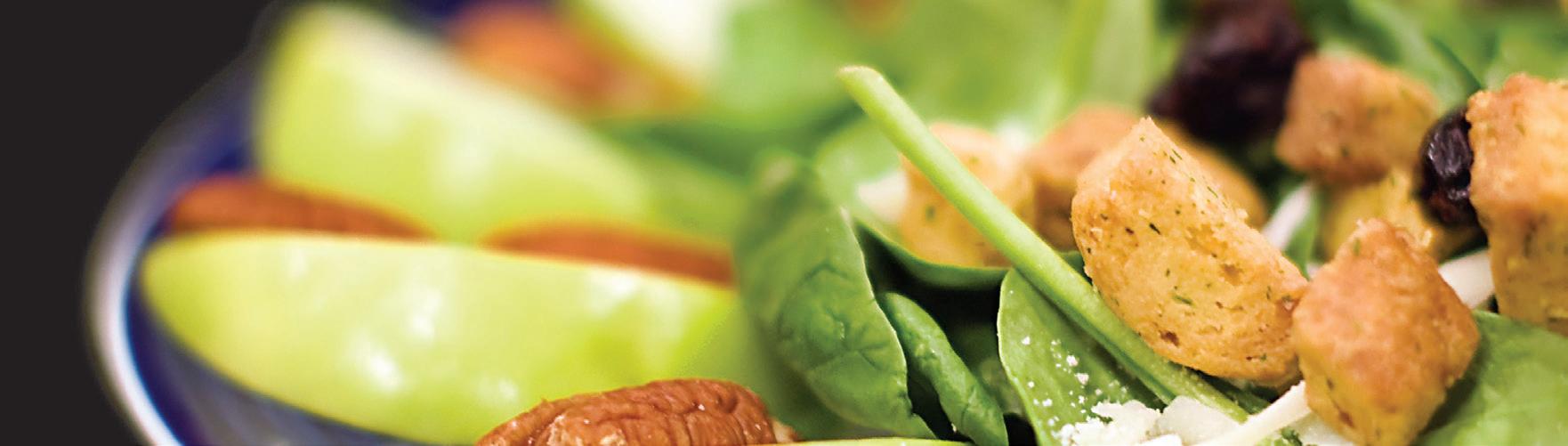
The past few months have been worrying times in the Ithaca food scene. With the recent closings of various restaurants such as The Nines and Aladdin’s, and planned future demolitions that put places such as CTB in danger, the appearance of a new restaurant is a salvation for Ithaca foodies. But just because it’s new doesn’t mean it’s any good, so I went to check the place out for myself. Hakacha is an Asian fusion restaurant that has recently opened on 311 Third Street, near the DMV and across from Aldi. I won’t lie, for most of us without
a car, bike or bus pass, this is a bit of a trek. Thankfully, they do deliver through various services like Ithaca To Go and Grubhub. When I read ‘fusion’ online, I audibly groaned. When a casual
dining restaurant claims to provide fusion cuisine, I’ve come to expect nonsensical combinations
of foods from various regions, haphazardly slapped together on a board with little to no regard for actual gastronomical composition. Therefore, most of the time, ‘fusion’ food falls short of any claims to innovation. Nevertheless, my dedication to my fellow foodies is the reason why I decided to visit this place anyways. The interior décor of Hakacha is incredibly cozy, with string lights that cast a gentle, warm glow on diners as gentle guitar music plays in the background. There are tree branches along the walls, complementing the wooden furniture. My friends and I were seated quickly and as we perused the menu, I ordered a

Green Tea Latte. It tasted like it was made with condensed milk so that it was quite sweet but had a pleasant aftertaste. A few of my friends found it a bit too sweet, but I enjoyed it, though I do have a huge sweet tooth so take my word with a grain of salt.
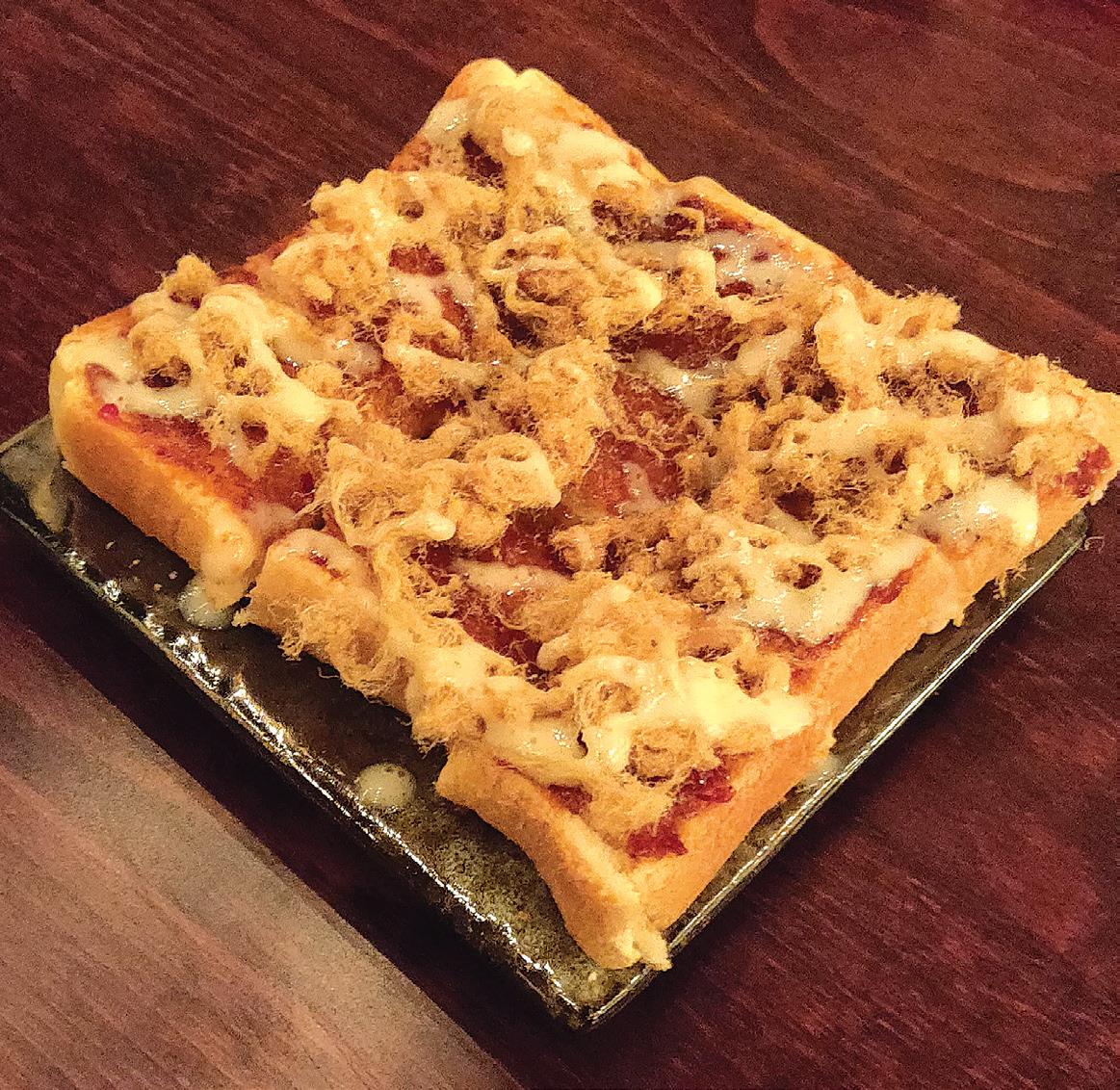
For appetizers, we ordered the Fried Chicken and Toasted Bread with Dried Shredded Pork. The Fried Chicken was nice and crispy but personally I thought it could have used some more salt. The other appetizer was lightly toasted bread with mayo, tonkatsu sauce, shredded pork and a little chili paste which gave it a nice kick that contrasted well with the sweetness of the sauce.
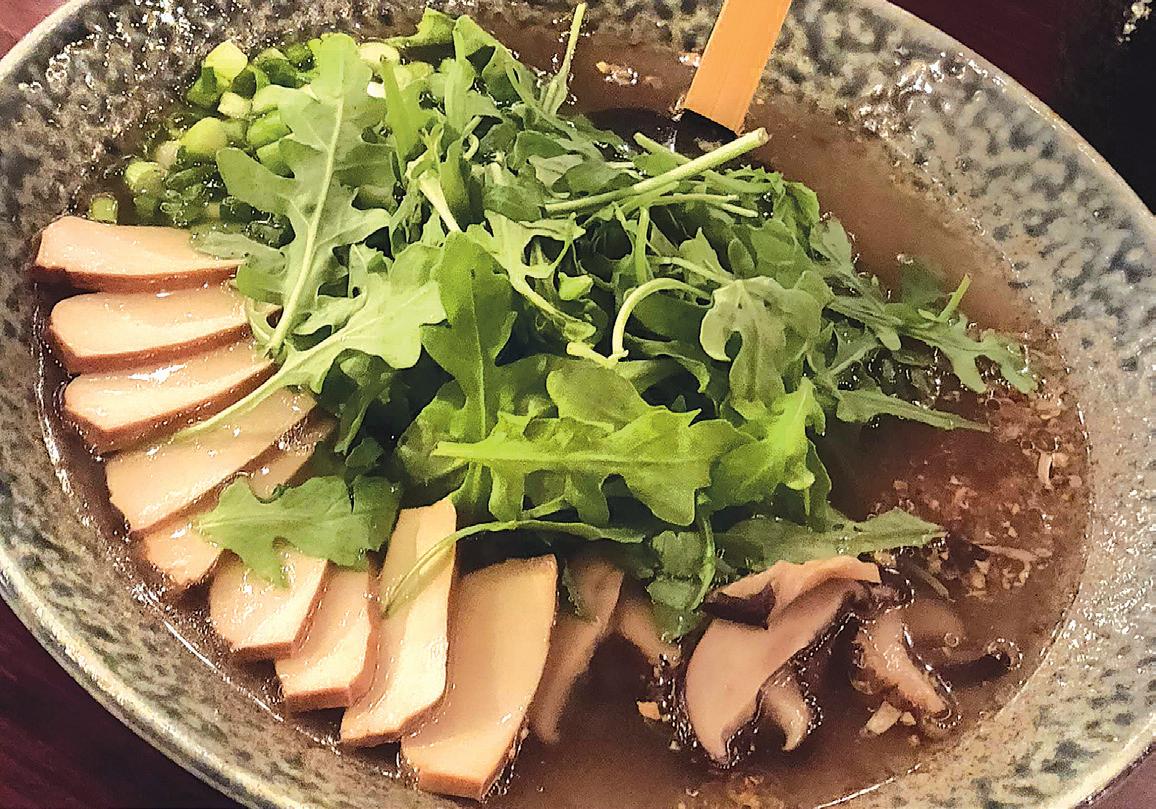
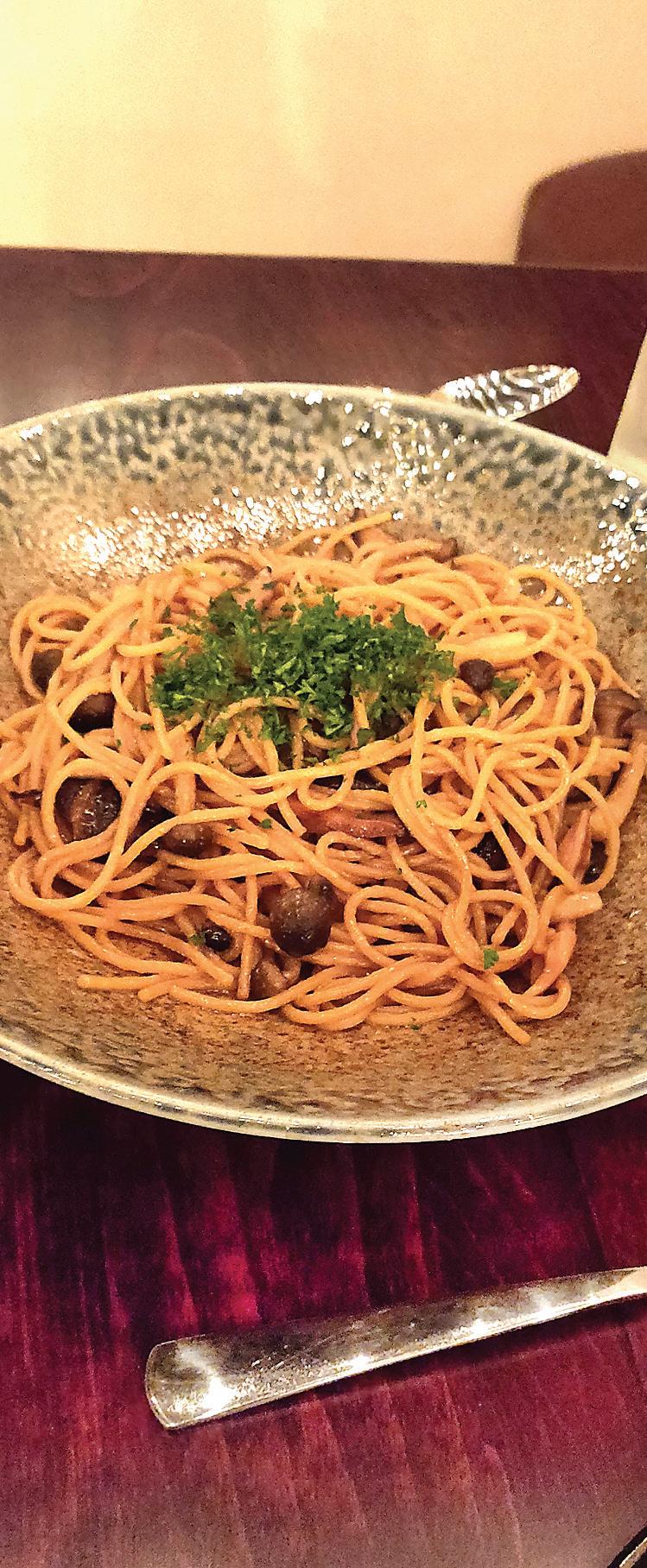
tioned. The Mushroom Soy Sauce Pasta had nice little morsels of caramelized mushrooms, slight soy sauce notes and buttery spaghetti cooked to perfection. The Vegetarian Ramen featured kale noodles and sliced mushrooms floating in a rich earthy broth that I enjoyed.
Two of the more ‘fusion-esque’
When a casual dining restaurant claims to provide fusion cuisine, I’ve come to expect nonsensical combinations of foods from various regions, haphazardly slapped together on a board with little to no regard for actual gastronomical composition.
The menu featured a nice mix of dishes found at a traditional Asian restaurant as well as more ‘innovative’ fusion dishes. Dishes such as Mushroom Soy Sauce Pasta and Vegetarian Ramen take classic American dishes and put an Asian spin on them. There were six of us at the table, so I was able to get a nice sample of various entrees.
One of the more traditional dishes was the Katsu Don, a bowl of rice topped with a fried pork cutlet, eggs, caramelized onions and green onion. Though a little sweeter than most Katsu Don, the dish was fine and generously propor-
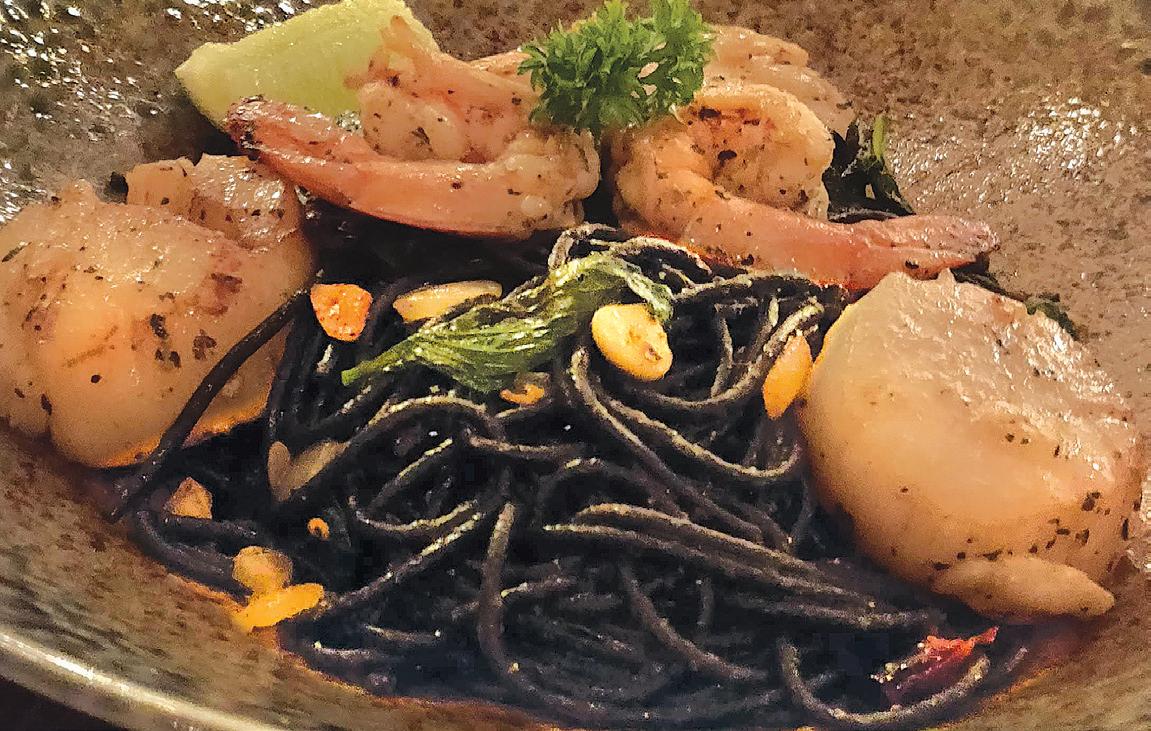
pasta dishes on the menu were the Squid Ink with Salmon Pasta and the Spicy Seafood Squid Ink Pasta. The noodles in these dishes are made with squid ink giving it a gorgeous, shiny black hue. Taste-wise, the squid ink’s effect is very subtle, giving the pasta a slight briny flavor which makes it perfect for pairing with seafood. The salmon was slightly over-seasoned when eaten by itself but in combination with the creamy pasta, balanced perfectly. The spicy seafood pasta was, true to its name, spicy, and the scallops in the dish were grilled and seasoned nicely. The last dish I sampled was Green Curry with Fried Breaded Chicken Pasta. This was the dish I was most apprehensive to try.

Green curry? With pasta? Would this really work? To my great surprise, it totally did. When the food hit my tongue I instantly recognized the traditional green curry taste, but as I chewed the difference in texture hit me since the dish uses pasta noodles instead

of the rice that I’ve come to expect. This little twist makes this dish incredibly fun and interesting to eat. The staff at Hakacha have done a great job of marrying the flavors of the green curry with the texture of the noodles in this dish. For dessert, we tried a crème brulee and a Black Tea Cheesecake with strawberry sauce and raspberries. The crème brulee was smooth, sweet and had a silky finish. The cheesecake was more interesting, with hints of black tea within the creaminess of the cheesecake. The tartness of the glaze was a nice contrast, but I did wish it was served more chilled. All in all, Hakacha is a place worth checking out. While I usually scoff at casual ‘fusion’ restaurants, these
Instead of the usual ‘I hope this works’ attitude that lots of fusion restaurants seem to have as they slap together two wildly different dishes, Hakacha has done a good job of ensuring their dishes carefully balance two different ends of the culinary spectrum.
dishes were fun and fascinating to taste. Instead of the usual “I hope this works” attitude that lots of fusion restaurants seem to have as they slap together two wildly
different dishes, Hakacha has done a good job of ensuring their dishes carefully balance two different ends of the culinary spectrum. With generous proportions (I got two meals out of my Salmon Squid Ink Pasta) and a cozy environment, this would be a great place for a date night or casual night out with friends. Definitely worth a trip in my book.
Serves: Asian/Asian Fusion
Vibe: a cozy, casual, sit-down restaurant
Price: $$
Overall:


Murali Saravanan is a senior in the College of Arts and Sciences. He can be reached at mms396@cornell.edu.


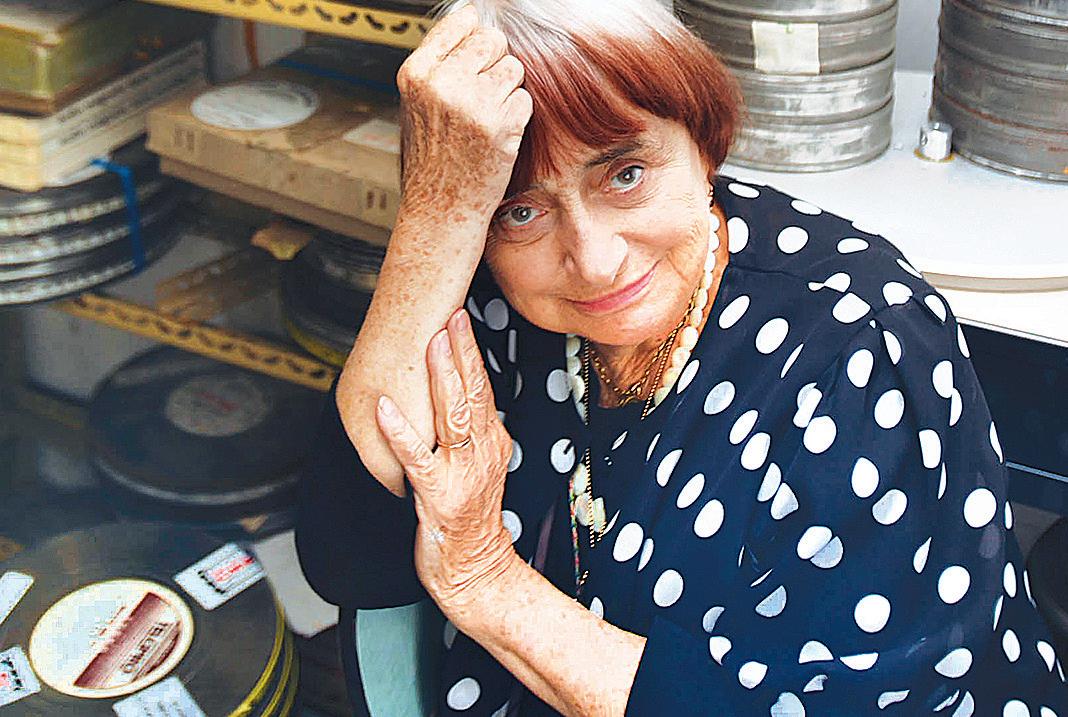
Agnès Varda died on March 31; I’ve talked about her in various ways — in a paper, in a review, to friends, to myself. The weekend before I happened to be in Paris and insisted on dragging my friend along to visit the Montparnasse Cemetery. The place was massive and it took us two hours to find the grave of Jacques Demy, Varda’s late husband. The gravestone read “Family Demy-Varda” and I shivered at the possibility that she might leave us one day. A mere week later I woke up to the news. A few friends had already texted me about it, knowing how much she meant to me. I sank back into my bed and spent the day rewatching her films and interviews.
The next Monday in my directing class, the professor canceled class and played his favorite Varda film instead. I’ve watched Le Bonheur before but when her name appeared on screen this intense feeling of grief gratitude dawned on me; the fact that I was almost through with her filmography and there would be no more to come made me sentimental.
What really upset me, though, was that my classmates didn’t like the film. In the discussion afterwards they tore the film apart and some even accused Varda of supporting the patriarchal psyche. I stayed in my seat fuming after class, when my professor asked me what I thought of the film. Oh, I can talk about her for days, I answered. I think she had absolutely no intention of supporting the patriarchy, quite the contrary; she’s making fun of it. The clues are all over the place —

He interrupted me and told me he was glad I thought that. We proceeded to discuss all the other screenings he’s done in the class previously; they’re mostly European arthouse films, of course (we were at one of the oldest European film schools in Prague), and attendance dropped every week. This program I attended was full of typical American film students who are ambitious, sleep-deprived
and huge fans of Tarantino. A friend at a prestigious film school in LA (let’s not name names) once told me that every time he refers to a film his professor would yell at him: “But how did it do in the box?” as in, how was the box office result. I honestly think that’s horrifying.
Hollywood’s deeply ingrained capitalist values have rendered too many films that are homogeneous and uninteresting, solely for the sake of desirable market outcomes. I’m by no means saying that film should be high art; since its invention, going to the movies has been an affordable pastime for the people who can’t or don’t want to go to the theatre. What I’m saying is that we are losing so much of the variety in storytelling because of how film schools nowadays, along with Hollywood, convince students that there is a formula for success, and in this case success narrowly means “doing well in the box office.”
If there is a formula at all for good filmmaking, I personally believe it would be for the filmmaker to watch as many films as they could. Most masters of cinema are cinephiles to begin with; Scorsese is incredibly well-versed in classical Hollywood, Varda constantly refers to filmmakers she loves in her interviews and of course we all know that Tarantino enjoys Asian cinema (so much that he “pays homage” to them).
You see, I’ve been called a “film snob” several times, and I can’t say it is pleasant. The word “snob” has a negative connotation, indicating an often exaggerated and unjustified sense of superiority. The last thing I want to be is an elitist, and no, I don’t think I know more than the next person, or that my taste in particular is better. What annoys me, truly, is how people take pride in not wanting to know more.
One of the few living masters of cinema Pedro Costa tells the following story in an interview:
The guy who came with me to film school is now a teacher. He stayed on. He’s been a teacher for twenty years. He is the best teacher in that school today. A year ago, he asked me to dinner. He told me that he screened Pierrot le fou. Twenty minutes after it started, the students asked for it to be stopped because it was going nowhere. Pierrot le fou? There’s guns and girls and colours. I mean really? If I was there, I would kick their fucking brains in. I would break their arms. I would break their necks. Really.
Costa definitely sounds arrogant, perhaps a bit too extreme, here. But he has a point. Over and over again I see people walking out of the theatre when the first 10 minutes of the film isn’t entertaining enough — and not just in a film class, but also in arthouse theatres and premieres at film festivals (my friend walked out of Shoplifters at Cannes only to learn a week later that it has won the Palme D’or). The movie industry is seemingly operating on this principle of efficiency: If a project doesn’t promise to make money, toss it; if a film doesn’t promise to entertain, leave it.
It’s not about class (hence snobbery is NOT elitism). From the very beginning,
movie going is supposed to be a pastime accessible to all. At the movies, all of us get to escape from whatever reality we live in and watch someone else’s life unfold. Nowadays films are more accessible than ever with all the streaming services; while I have my own opinions about Netflix and such, as college students we do have free access to Kanopy, not to mention Criterion Channel and Mubi. In A Century of Cinema, Susan Sontag wistfully proclaims that the midcentury love of cinema has decayed. “If cinephilia is dead, then movies are dead too. If cinema can be resurrected, it will only be through the birth of a new kind of cine-love.”
None of the people that called me a snob ever explained to me what they meant by that. Was it about my use of words like “auteur” and “mise-en-scène”? Or my patience to sit through movies that are longer than two hours? Perhaps it is about my willingness to read subtitles. In any case, I’m fine with it if my not-so-appreciated cinephilia can keep cinema alive. At least Cornell Cinema and Metrograph are getting most of my income instead of a random AMC.
Ruby Que is a senior in the College of Arts & Sciences. She can be reached at rque@cornellsun.com. Escape runs alternate Tursdays this semester.
really make sense. But that’s precisely the point — to challenge and instigate the creative mind with the absurd.
I came to this edition of Festival 24 with reservation. The biannual event has been happening at the Schwartz Center for the Performing Arts since 2008 to showcase talents in the Performing and Media Arts department. Students get together and try to produce a play, a film or a dance from a theme and a twist within 24 hours, starting Friday afternoon. Since I last covered the event in January 2018, the producers decided against including a film in the program, which makes the festival feel interchangeable to the 10-Minute Play Festival, which occurs later in the fall. This semester’s theme is “fear” and the twist is “fish.” As producer Milo Reynolds-Dominguez ’20 pointed out in the program note, it doesn’t
Fishers of Men, written and directed by Gloria Oladipo ‘21, is a truly fearless piece of art. Rather than a performance, the piece is carried out more as a reading, prefaced by a trigger warning message given by ReynoldsDominguez and then a statement by the author. Oladipo explained her intention to write the play as a protest against the whitewashing of #MeToo and #TimesUp and her hope to have an all-Black cast. However, there were zero Black actors available. The fact that non-Black people are reading the African American Vernacular English exactly as written was a choice the playwright made not without struggle; “even if these are not Black vessels, disgust is the emotion you’re looking for, not
humor,” Oladipo proclaimed. As some audience members got up and walked out, Oladipo delivered her last line, “white fragility has left the building. Lean in with hearts open and ears up, people.” And the show began. We were immediately pulled into a loaded monologue by Tetra (Sophia Matthews ’22), who unapologetically showed her sexuality while cursing the entire time. She introduced us to Cholly (Adam Shulman ’23 and Ben Lederman ’23), her stepfather, a preacher and the “fisher.” With a passionate chorus by the churchgoers, the chronology shifted back to when Tetra was nine, and Cholly took her out to teach her to fish. What seems innocent enough at the beginning soon morphs into lust. Oladipo effortlessly conveys the complexities of sexual abuse; while the moral depravity is heartbreakingly obvious, the victim often
experiences a multiplicity of emotions such as confusion, revulsion and denial. Matthews is impeccable as the vulnerable young girl who grows into a woman still “fucking [her] way through trauma trying to just figure it out.” And Shulman brings the seemingly gentle yet desperately flawed abuser to life. Oladipo’s story reminds me of Paula Vogel’s tragic tale How I Learned to Drive, which similarly explores the issues of pedophilia and manipulation using the metaphor of driving.
Finally, the light dimmed with the gentle, recurring chorus of “Fishers of Men.” I found myself shivering uncontrollably in the dark. This play is a tour de force by Oladipo and easily one that will leave a mark in the history of Festival 24. On top of the issues the text tackles, the performance is a wake up call to Cornell’s art community. What stories do we choose
to tell, and who has the right to tell those stories? Matthews mentioned feeling “uncomfortable” going into the role, since the last thing she wanted was to be offensive or seen as playing a caricature. However, she believed that “it didn’t seem right for [Oladipo’s] words to be silenced just because there’s no diversity [in the festival].” In a long and emotional message, Shulman told me he had to cry after the show, and the fact that they were able to give a supporting voice to a cause that is rarely acknowledged or vocally supported by non-black people will have a lasting effect on his mind and hopefully others in the theatre ...
To continue reading this article, please visit www.cornellsun.com.
Ruby Que is a senior in the College of Arts and Sciences. She can be reached at rque@cornellsun.com.
Fill in the empty cells, one number in each, so that each column, row, and region contains the numbers 1-9 exactly once. Each number in the solution therefore occurs only once in each of the three “directions,” hence the “single numbers” implied by the puzzle’s name. (Rules from wikipedia.org/wiki/ Sudoku)








SAILING
Continued from page 16
on the national stage. The Red sailed well throughout March before claiming the MAISA Team Race title. The following month, the Cornell women booked their trip to nationals with a second-place finish at SUNY Maritime.
Soon after, the team clinched a spot at the coed national championship by finishing in eighth at the American Trophy Regatta. At the Sperry Women’s Finals, Cornell finished 15th out of the 18 competitors, but skipper Gabby Rizika ‘20 earned AllAmerica honors in the process.
During the coed semifinals, the Red concluded its campaign by slotting in at 10th in a field of 18 teams. With only nine teams moving onto the finals stage, Cornell was on the cusp of keeping its season alive, but its season ended in the semifinals as the Red’s 261 points fell two short of UC Santa Barbara’s total of 263.
In his 10 years at the helm, Clancy reflected on how far his team has come — to within two points of the national finals.
“We’ve been growing the whole time, growing our endowment, growing competitively. So that’s been a fun process, but that
also takes a significant amount of time as well,” Clancy said. Just three years into his tenure, Clancy’s team experienced a major breakthrough.
“In 2013, that was a huge year for us. We finished on the podium at the women’s national championship. And that was a shocker to many. Even for us — we were just floored with how well we competed in that moment. And so, that was a huge, huge turning point, no doubt about it.”
The Red has established itself as a national powerhouse, and there’s little doubt that Cornell will retain its position in the upper echelon of the sailing world. But the next step is securing an appearance in the national finals during the spring. Given the improvement that Cornell has displayed under Clancy and its opportunity to use the fall as a tune-up, the Red hopes to find itself on the country’s biggest stage in the spring.
Cornell will kick off the fall campaign this weekend by once again hosting the Jack Boehringer ’52 Memorial Regatta on Saturday and Sunday.
Luke Pichini can be reached at lcp84@cornell.edu.
M. SOCCER
Continued from page 14
Jack Hallahan — Senior, Forward, 2018 Big Ten Offensive Player of the Year, United Soccer Coaches All-America Second Team Selection, 2019 MAC Hermann Watch List
Umar Farouk Osman — Junior, Forward, 2018 All-Big Ten Second Team
Scouting report: Strong defense with superior striking talent upfront make this Michigan side dangerous despite losing key pieces from last season in the midfield.
“We have to a good job defensively of shutting them down,” Smith said.
Game 2 Preview:
When: 3 p.m. Sunday at Michigan State Opponent: Michigan State Spartans
2018 record: 14-5-4
Key players:
Giuseppe Barone — Senior, Midfielder, 2018 Big Ten Midfielder of the Year, 2018 First Team All American, 2018 MAC Hermann Semifinalist, 2019 MAC Hermann Watch List
Patrick Nielsen — Junior, Defender, 2018 All-Big Ten Honors, 2018 All-North Region,
W. SOCCER
Continued from page 16
Cornell’s three goals in the season-opening win over Iona were more than the Red ever tallied in a single game last season.
“Every game brings a set of problems that you have to solve as a unit and that’s what we’re trying to do,” Hornibrook said. “It’s everybody for everybody else and that’s what makes it work.”
With the problem-solving mentality, time will tell how the rest of the 2019 season shapes up given Cornell’s 2-0 start.
“The kids who came back [were] very frustrated by the results of the last couple of seasons so they wanted to make it better,” Hornibrook said.
“There’s a collective hunger for everybody to succeed.”
Winners of two straight at Berman Field to open the 2019 season, Cornell heads to Lewisburg, Pennsylvania, to take on Bucknell on Sept. 6 before returning home Sept. 8 to battle St. Bonaventure.
Katherine Faiola an be reached at kfaiola@cornellsun.com.
2019 MAC Hermann Watch List
Scouting Report: Ranked No. 7 in the country by United Soccer Coaches Preseason Poll, this Spartan team has a strong midfield that likes to distribute goals — nine players scored two or more goals for Michigan State last season.
“They have guys that can hurt us,” Smith said.
Cornell Players to Watch in 2019: Charles Touche — Junior, Forward, Ivy league leader in goals (8) last season
The Red’s deadliest attacking weapon will need to be razor sharp in front of the opponents’ goal.
Ryan Shellow — Senior, Goalkeeper, Ivy League leader in saves (70) last season
The veteran goalie will likely be busy against the early season attacking threats of Big Ten opponents.
Emeka Eneli — Sophomore, Forward, 7 goals and 2 assists last season
To continue reading this article, please visit wwws.cornellsun.com.
Mike Seitz can be reached at mseitz@cornellsun.com.

By BENNETT GROSS Sun Staff Writer

• A.D. White House
• Admissions Offce
• Africana Studies Center & Library
• Alice Cook Dining
• Anabel Taylor Hall
• Appel Commons
• Baker Hall
• Bard Hall
• Barnes Hall
• Bartels Hall
• Bethe House
• Big Red Barn
• Carl Becker House
• Carpenter Hall Library
• Center for Intercultural Dialogue
• Clark Hall
• Computer Services & Financial Aid, East Hill Plz.
• Cornell Institute for Social & Economic Research
• Cornell Store
• Corson Hall
• Court Hall
• Dairy Bar
• Day Hall Main Lobby
• Dickson Hall
• Donlon Hall
• Duffeld Hall
• East Hill Offce Complex
• Environmental Health & Safety Building
• Flora Rose
• Gannett
• Goldie’s (Physical Sci.
Bldg)
• Goldwin Smith
• Hasbrouck Center
• Horticulture Offce
• Humphreys Service Bldg.
• Ives Hall (ILR)
• Ivy Room (WSH)
• Johnson Museum
• Keeton House Dining
• Kosher Dining Hall
• Mac’s Café
• Martha’s (MVR)
• Mann Library
• Myron Taylor Hall
+ Hughes Dining
• Noyes Main Lobby
• Okenshields, Willard Straight Hall
• Olin Hall
• Olin Library B Level
• Plantations Gift Shop
• Rhodes Hall
• Risley Dining
• Robert Purcell Community Center (RPCC)
• Sage Hall Atrium
•Sibley Hall, Green Dragon Café
• Snee Hall
• Statler Lobby
• Statler Terrace Restaurant
• Tatkon Center
• Teagle Hall
• Transportation Dept., Maple Ave.
• Autumn Leaves Used
Books (Ithaca Commons)
• Bear Necessities
• Center Ithaca
• Coal House Café
• Collegetown Bagels: CTown + Triphammer
• Commons Grocery (Ithaca Commons)
• CFCU (Triphammer Rd.
+ East Hill Plaza)
• Corner of College & Dryden
• Corner of State & Aurora
•Express Mart, Comm. Crnrs.
• Hillside Inn
• Hilton Garden Inn
• Trillium
• Holiday Inn
• Ithaca Coffee Co.
•Ithaca College, Phillips Hall
• Jason’s Grocery & Deli
• Kendal
• Kraftees
• Lifelong
• Oasis (Greenstar)
• P&C Fresh (East Hill Plaza)
• Salvation Army
• Shortstop Deli
• Tompkins Cty. Public Library
• Tops (Triphammer Rd.)
• Universal Deli
or stop by The Sun’s offce at 139 W. State
Coming off of a seventh-place finish in the Ivy League Championships to conclude its 2018-19 campaign, Cornell golf hopes to bounce back and return to the upper echelon of the Ancient Eight as it starts its season this weekend.
This year, the team will be without last season’s top performer in now-graduated Tianyi Cen ’19. Cen averaged 2.7 strokes over par between the fall and spring seasons last year.
In 2019-20, senior Jack Casler — the team’s highest returning scorer — will lead the Red into its first tournament of the season this weekend at the Alex Lagowitz Memorial Tournament, hosted by Colgate.
A predominantly younger, inexperienced squad will join Casler in the starting lineup. Junior Charlie Dubiel returns for his third season in Ithaca; last year, he averaged 3.9 strokes above par, improving upon his 4.2 average from his freshman season. The team will need Dubiel to take another step forward if they expect to compete for an Ivy crown in the spring.
“For the season as a whole, I think that we have a great chance to win our first team Ivy League championship this season,” Casler said. “Individual performance is a big part of that, and my game feels like it is in a good spot to start the season. If we stay committed to practicing throughout the year, we are going to be really successful.”
Rounding out the starters will be sophomore Gus Lascola and freshmen Josh Lundmark and Sam King. All three will make their first career starts this weekend in Hamilton, N.Y.
“I am really excited for this year,” Casler said. “I think that we have a great group of guys who are motivated to work hard this season. We are a lot stronger from top to bottom as compared to last year, and I think that is going to help us be a very competitive team.”
At last season’s Lagowitz Memorial Tournament, the Red fared particularly well, placing third among the 17 teams participating.
Casler finished the tournament tied for second place individually at one under par. While Dubiel ended the weekend at 10 over par, the duo gained important experience at Seven Oaks Golf Club this summer. Both players also participated in the U.S. Amateur Open

Qualifying at the Colgate golf course in July.
While there are high expectations for the newcomers this season, the squad understands that there will be growing pains throughout the year, as the team is concentrating on each individual hole throughout the three rounds every weekend.
“When I played with some of the younger guys the last few days, it’s pretty easy to see that they have the raw skill and game to make a smooth transition to college golf, so I think a lot of our focus will be on course management and just staying really focused and committed to the game plan for all 54 holes every week,” Dubiel said.
Dubiel said this year’s team is “the deepest it has ever been here.”
“It will definitely keep everyone sharp, given that we have eight to 10 guys who are capable of starting, whereas it has been more like five the last few years,” Dubiel said.
The Red will follow up its first tournament of the season Sept. 14 and 15 when it hosts the Cornell Invitational at Robert Trent Jones Golf Course. Last year, the Red placed tenth out of 15 teams at the tournament, which is the only home event of the school year for Cornell.
Bennett Gross can be reached at bgross@cornellsun.com.
By MIKE SEITZ Sun Staff Writer
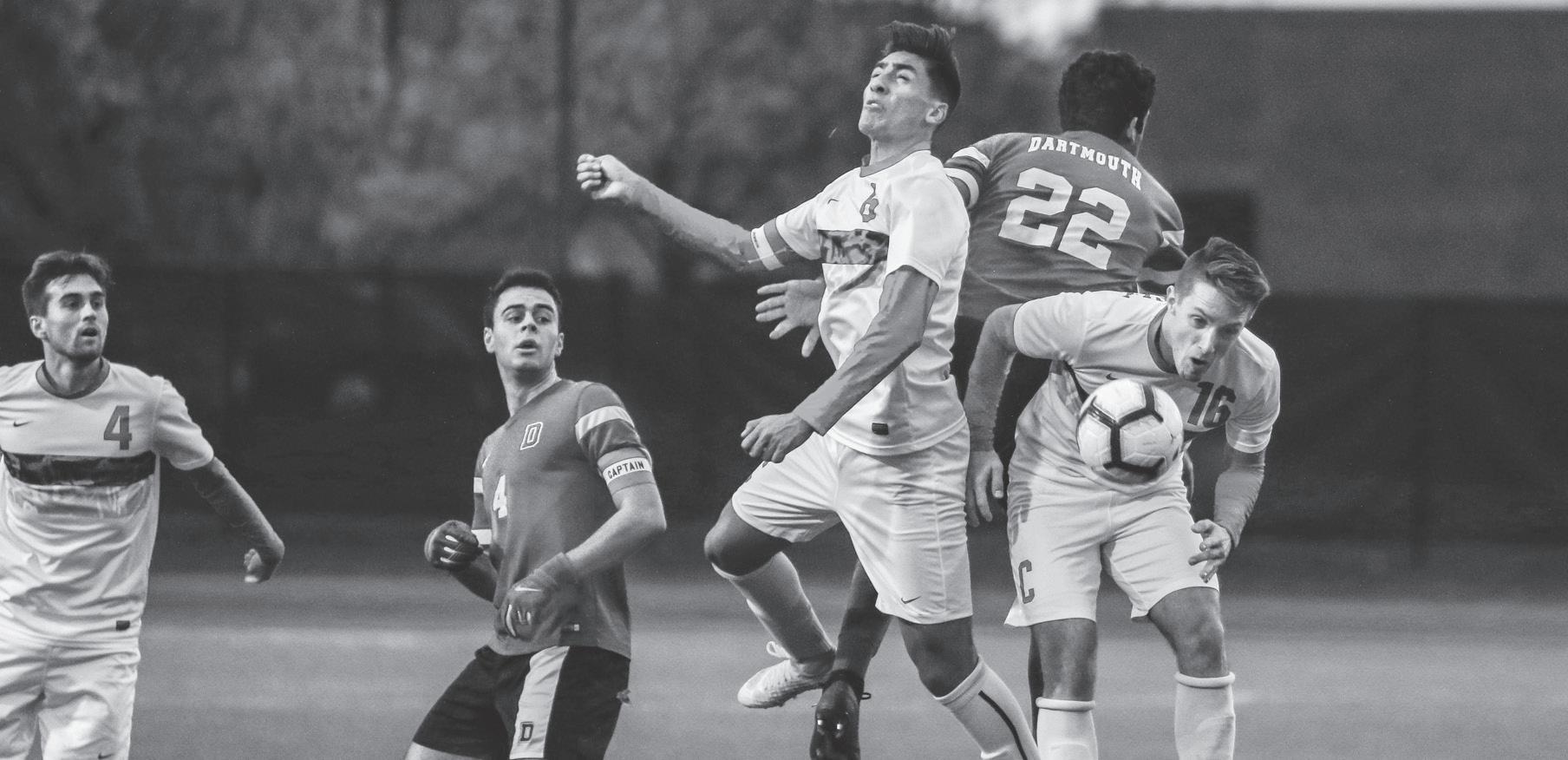
Coming off a strong 11-6 season, the Cornell men’s soccer team is looking to turn heads during the upcoming fall season. The Red starts its 2019 campaign on the road against two Big Ten conference powerhouses.
Coach John Smith is confident that his team is up to the task.
“We recruit players who want to play in these kinds of games,” Smith said.
Rallying on the Road:
The Red posted an outstanding 9-1 away record last season and is looking to continue its fruitful travels. Cornell’s road wins last season included victories over Cal State Fullerton (2-1), Lehigh (3-2), and Columbia (2-0). Out of the 10 away games last season, then-freshman Emeka Eneli and/or then-sophomore Charles Touche contributed towards goals in all but one of the matches.
“We do an awful lot on mental preparation. That’s especially important when you’re playing on the road,” Smith said.
Preseason Poll:
Cornell was picked to finish third in the Ivy League preseason media poll. Ahead of the Red are reigning Ivy League champion Princeton and last season’s third place finishers, Dartmouth. Cornell finished fourth in the conference last year with a league record of 4-3. The Red has a promising attack force, but will need midfield and defensive pieces to step up to contend for an Ivy championship.
Game 1 Preview: When: 5 p.m. Friday at Michigan Opponent: Michigan Wolverines 2018 record: 12-5-4 Key players:


By KATHERINE FAIOLA Sun Staff Writer
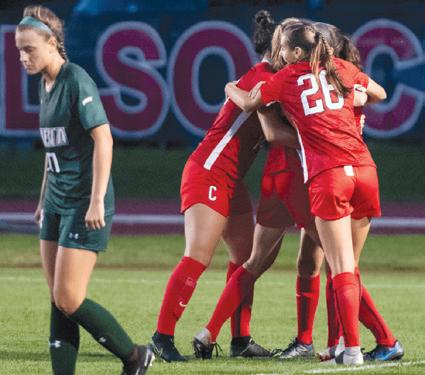
A year ago — Sept. 3, 2018 — Cornell women’s soccer faced Siena in Loudonville, N.Y., where the team suffered its second loss of the season — starting a winless streak that continued throughout the painful fall.
364 days later at Berman Field — against Siena — the Red rebounded in impressive fashion to improve to 2-0, already doubling its 2018 win total. After beating Iona, 3-1, in the season opener on Friday, Cornell earned a statement 1-0 shutout victory on Monday over the team that handed it the second of 14 straight games without a win.
A shutout against a team Cornell lost to last year is a “good sign for a group like this that’s so young we’re starting four or five freshmen every night,” head coach Dwight Hornibrook said.
While the Red outshot Siena 7-4 in the first half on Labor Day, the game remained scoreless. Then, with less than a minute left, junior Naomi Jaffe sent an arching cross that sunk its way into the back of the next, bringing Cornell to halftime with a 1-0 lead
“[The shutout win was] a good sign for a group like this that’s so young we’re starting four or five freshmen every night.”
Head Coach Dwight Hornibrook
that held for the remaining 45 minutes.
Jaffe’s first goal of 2019 resembled her first tally of 2018 — in last year’s season opener — where her long shot got past the traffic of St. Bonaventure’s defense to find the net. The goal sent the game to overtime, where Cornell emerged victorious for its only win of the 1-13-1 season.
Paired with the Red’s promising nine-member freshman class and newfound attack-first outlook,
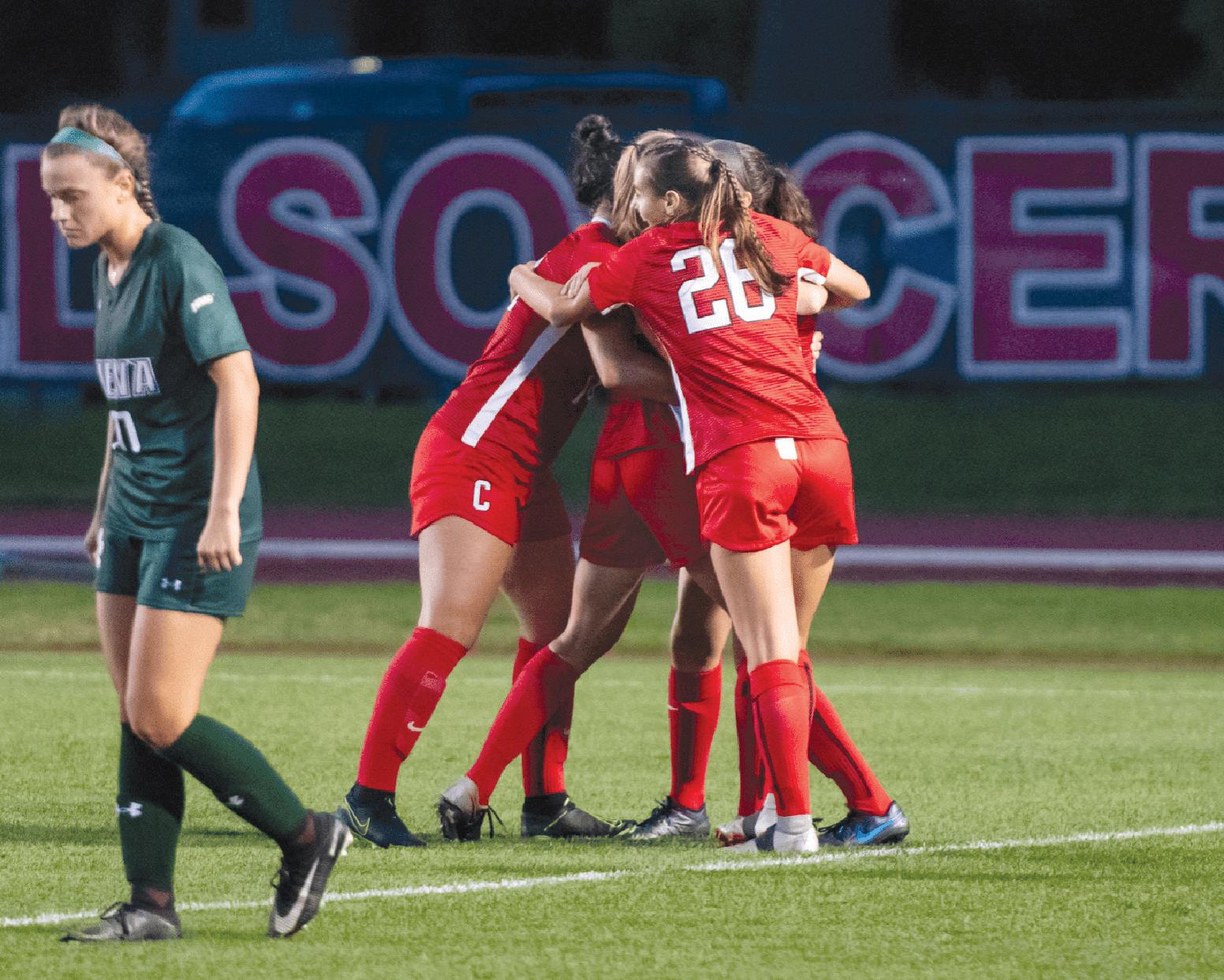
the team’s “high performance mentality” — a term Hornibrook has coined — identifies a “set of lifestyle habits that will allow us to show up to win soccer games,” the coach said.
These habits create a holistic approach for the team on and off the field — ranging from eating, resting and studying to balancing social habits and training regimens. Hornibrook has emphasized the importance of quality as the primary factor contributing to the high performance mentality.
“Everything we do in practice, whether it’s tech-
nical, tactical, physical, mental — it’s a high level of concentration, a high level of commitment to detail, a high level of commitment to competing.”
After two non-conference games — Cornell kicks off Ivy League play Sept. 28, hoping to improve upon its 0-7 record and last-place finish in the Ancient Eight last year — the competitive approach seems to be working. The Red scored four goals over Labor Day weekend and picked up two wins.
See W. SOCCER page 13
By LUKE PICHINI Sun Contributor
Under head coach Brian Clancy, success has become commonplace for Cornell sailing. Cornell recently completed its best season in recent memory by earning its first conference title and a 10th-place finish in the national coed semifinals.
Despite reaching these new heights, there is still room for improvement. By
finishing in 10th, the Red fell just one spot short of qualifying for the national coed finals. Cornell has been absent from those waters since 1984, but Clancy and Co. will strive to break the drought this year.
In order to do that, Cornell will have to forge ahead after the graduation of Diana Otis ’19 and Kimberly Wong ’19. Otis participated in 16 events throughout 2018-19. For her effort, the Severna

Park, Md. native earned nods as an honorable mention on the Intercollegiate Sailing Association All-America crew and as a member of the Middle Atlantic Intercollegiate Sailing Association all-conference first team. Wong was similarly accomplished, sailing in 15 regattas en route to first-team honors on the AllMAISA crew team.
Clancy had nothing but high praise for the two seniors, describing them as “absolutely incredible people.”
Nevins Trophy.
In Clancy’s view, the fall season represents a chance to tune up for what the team hopes is a championship run in the spring.
“They’re hoping to execute and do their best. But at the same time, they know that this isn’t the time to peak.”
“Beyond [sailing,] both of them had 4.0 GPAs in their respective majors, and they really did an amazing job of that balance,” Clancy said.
Head Coach Brian Clancy
Despite losing these core athletes, Clancy’s squad has reloaded with nine freshmen.
“They’ve all done a great job so far,” Clancy said of his newcomers. “I think they’re really talented. They’re coming in with a strong group of leaders in the classes above them. They’ve really welcomed them to the team so far — I think they’re going to make a major impact this year.”
Over the course of the fall season last year, the Red displayed its prowess on a number of occasions. Cornell started strong with a first-place showing at the Jack Boehringer ’52 Memorial Regatta on the women’s side. And from there, the team notched the top slot at the Jen Harris Women’s Regatta, the Susan Rogers ’75 Memorial Regatta and the
“No matter when you go out to competition, you want to do well, yes,” Clancy said.“So they’re hoping to execute and do their best. But at the same time, they know that this isn’t the time to peak. This is the time to make the adjustments that we need and just try to improve.”
Last year, the Red clearly made the necessary adjustments to improve. Perhaps the biggest highlight in the first leg of the year came during the MAISA conference championship, which was hosted in Ithaca and served as one of the biggest events during the fall season. There, sophomore Brooke Shachoy and junior Becca Jordan propelled the women’s team to its first conference championship as it narrowly edged out MAISA juggernaut Hobart and William Smith Colleges in a thrilling comeback.
“It was a huge milestone for the program,” Clancy said. “But we have higher aspirations.”
Cornell’s success from the fall carried over into the spring as it sought to shine on the national stage. The Red sailed well