The Corne¬ Daily Sun



By VEE CIPPERMAN
With a hardline in-person teaching requirement, Cornell has pushed its instructors back into classrooms — and more than 100 have organized against its current policies.
Cornell announced to faculty on Aug. 11 that it would only offer in-person classes — denying requests for remote teaching premised on disability accommodations. On Aug. 13, Provost Michael Kotlikoff released a statement saying that deans and unit leaders can grant classroom accommodations at their discretion, as well as suggesting that concerned faculty and staff consider a medical leave.
According to Prof. Celia Bigoness, law, the University’s standards for granting accommodations, who they’re consulting with or how final decisions are made feel unclear.
“[The statement] refers to extraordinary circumstances where some accommo-
dations, like partial or temporary remote teaching, might be provided,” said Prof. Risa Lieberwitz, law, president of the Cornell University Chapter of the American Association of University Professors. “But this still doesn’t address the people’s needs.”
On Aug. 29, two faculty bodies submitted letters to Cornell administration calling for revisions to its in-person, limited accommodations policy for the fall 2021 semester. They criticized the University’s lack of accessibility measures and limited flexibility for faculty, asking the administration to provide more transparency in policy making.
A group of concerned faculty members detailed their concerns in the first letter, and the Cornell chapter of the AAUP under Lieberwitz penned the second. The faculty letter’s signatories, consisting largely of professors in the College of Arts and Sciences,
By TAMARA KAMIS Sun Staff Writer
At the first University Assembly meeting of the semester Tuesday, representatives discussed encouraging the University to institute a vaccine mandate for all staff and faculty — expanding the requirement beyond students.
“Cornell currently requires only students to be vaccinated, but with
this resolution, we ask that this be expanded to all students, faculty and staff,” Nikola Danev, grad, a Graduate and Professional Student Assembly representative, wrote in an email to other members of the U.A. before the meeting. “With the recent surges in cases, this is our only way forward.”
While some representatives supported the mandate, which includes religious and medical
exemptions, others said they think an education-based approach to increasing the vaccination rate, combined with expanded testing, would minimize the risk of COVID-19. Students have been required to get vaccinated for the fall semester since last April — but faculty and staff are only encouraged to be vaccinated. Duke

By ANGELA BUNAY Sun Assistant News Editor
Distinguished professors
Robert George and Cornel West will discuss democracy and free speech as part of The Peter ’69 and Marilyn ’69 Coors Conversation Series titled “Civil Discourse” on Sep. 9. The series, hosted by the Cornell Law School and sponsored by Cornell alumni Pete and Marilyn Coors, is the first in an intended fourpart series to spark discussion among the Cornell community on national issues. It will feature a range of topics in an attempt to foster greater understanding across varied perspectives.
Prof. Sheri Lynn Johnson, law, who specializes in constitutional and criminal law, will moderate the event.
George’s writings have been featured in publica
tions including the Yale Law Journal, the Harvard Law Review and the Columbia Law Review. He serves as the director of Princeton University’s James Madison Program in American Ideals and Institutions. George has also pub -
lished numerous books on the topic of morality and law, such as Making Men Moral: Civil Liberties and Public Morality , In Defense of Natural Law , The Clash of Orthodoxies and Conscience and Its Enemies . He has received several awards for his teaching and human rights advocacy.
Cornel West is the Dietrich Bonhoeffer Chair at
an

Interview Prep for International Students Noon - 1 p.m., Virtual Event
Karen Chapple: Double Jeopardy: The Unintended Effects of Climate Change Mitigation
12:25 p.m. - 1:25 p.m., Abby and Howard Milstein Auditorium
Curator’s Conversation, TEXTURES: The History and Art of Black Hair 12:30 p.m. - 1:30 p.m., T01 Human Ecology Building
Biomedical Engineering 7900 Seminar - James Collins, Ph.D.
2:45 p.m. - 3:45 p.m., 226 Weill Hall
COVID Disruptions: Teaching Tips for Supporting the Incoming Class 3 p.m. - 4 p.m., Virtual Event
CAM Colloquium: Andrea Giometto - Evolutionary Dynamics of Spatially Structured Microbial Populations
3:30 p.m., 655 Frank H. T. Rhodes Hall
MBG Friday Seminar: Peter Lwigale - Uncovering The Mechanisms of Neural Crest Cells During Ocular Development
4 p.m. - 5 p.m., G10 Biotechnology Building
Bienvenidos BBQ 6 p.m. - 8 p.m., Anna Comstock Hall Tomorrow


University has already taken this step, mandating vaccination for all staff, faculty and students.
According to Joel Malina, vice president for University relations, the University decided not to mandate vaccination for faculty and staff based on high rates of voluntary vaccination: 99 percent of faculty and 90 percent of staff were vaccinated as of Aug. 31. Unvaccinated faculty and staff are required to continue surveillance testing. 95 percent of people on campus are fully vaccinated.
Danev and Jacob Feit ’22, U.A. executive vice chair, co-sponsored the resolution calling for a vaccination mandate for all staff, faculty and students. Along with the mandate, it calls for paid time off for employees experiencing vaccine side effects. If the University declines to follow the recommendation of a vaccination mandate, the resolution requests an explanation from administration.
Preston Hanley, grad, who is the vice president of internal operations of the GPSA, said he felt that if the mandate were accepted, the University should address staff concerns through legal avenues and labor bargaining practices.
19 policies is a lack of shared, agreed-upon goals. He does not think COVID eradication on campus is possible, but thinks that the University’s goal should be to minimize illness.
Marcy Benda, an administrative assistant and Employee representative, said she would prefer that the University works to educate its community about vaccination, before Cornell considers other policies such as employee vaccine mandates.
“We’re
“If we do mandate a vaccine, we do potentially risk losing some very talented staff.”
David Hiner
“We want to make sure that everybody understands where we’re coming from,” Hanley said in an interview with The Sun, “and be able to listen to any concerns that the unvaccinated members of our campus community are having.” Feit said he supports expanded testing and increased vaccine education. He also wants the University to offer clinics for booster shots on campus, as soon as community members are eligible. He sees a vaccination mandate as one necessary strategy within a larger plan to minimize COVID-19 risk.
But Prof. Thomas Fox, molecular biology and genetics, said he’s skeptical that a mandate would effectively encourage unvaccinated people to become vaccinated. He expressed concern that some staff would simply quit their jobs instead.
Fox said he believes that the root of much of the disagreement surrounding campus COVID-
Employee Representative David Hiner, a senior application programmer for the College of Human Ecology, declined to take a position on whether or not a mandate should be instituted. However, he said he worried that a mandate could cause staff to quit and is hopeful that education efforts could help convince more people to get the vaccine.
Jacob Feit ’22
“If we do mandate a vaccine, we do potentially risk losing some very talented staff,” Hiner said. “With that said, I wholeheartedly would encourage everyone to get the vaccine.”
Feit said he agreed that mandating vaccinations for faculty would need to include open discussions with University employee unions and the University community as a whole.
“We’re really just trying to maximize the amount of folks who get the vaccination,” Feit said. “We’re not trying to penalize anybody or have anyone quit.”
Danev acknowledged concerns about potential staffing shortages in the case of a vaccine mandate, but emphasized that his top priority is having a higher vaccination rate on campus. He said he agreed that education-based approaches could be useful, but wants this approach to supplement a mandate.
“I am confident that campus will be not only safer, if we all get vaccinated, but also it will reduce any potential pressure that unvaccinated people would cause on the hospital system, on our University and on our emergency services,” Danev said.
Tamara Kamis can be reached at tkamis@cornellsun.com.
Union Theological Seminary, where he teaches the works of Dietrich Bonhoeffer, a German theologian known for his writings on Christianity’s role in a secular world. West leads courses in a broad range of topics, including the classics, philosophy, politics, cultural theory, literature and music.
West is best known for his books Race Matters and Democracy Matters, which are both regarded as contemporary classics. He has also been a guest on the Bill Maher Show, CNN, C-Span and Democracy Now, discussing various national issues including police violence.
West made headlines this past summer after he resigned from Harvard University, after it rejected his application for tenure. In a letter West shared on Twitter, he cites political prejudice as the reason for his tenure rejection and mentions his support for Palestinian rights causing hostility from the Harvard administration.
“We all knew the mendacious reasons given had nothing to do with academic standards,” West wrote in his letter. “When my committee recommended a tenure review — also rejected by the Harvard administration — I knew my academic achievements and student teaching meant far less than their political prejudices.”
George and West, described as two ideologically opposed professors, wrote a statement
in 2017 on the same topic of this upcoming discussion, titled “Truth Seeking, Democracy and Freedom of Thought and Expression.” The statement came in response to the March 2017 event at Middlebury College, where students shouted down and physically injured conservative guest speaker Prof. Charles Murray.
“All of us should be willing — even eager — to engage with anyone who is prepared to do business in the currency of truth-seeking discourse by offering reasons, marshaling evidence, and making arguments,” they wrote in the statement published on Princeton’s James Madison Program website.
The Coors conversation series launched in 2019 with a discussion on executive power in politics with lawyers George T. Conway III and Neal Katyal. Other guest speakers that same year included Ezra Klein, founder of Vox, and Andrew Sullivan, a former editor of The New Republic, who discussed whether illiberalism is corroding U.S. democracy.
The series will take place on Sep. 9 from 6:30 p.m. to 7:45 p.m. in the Landis Auditorium at Myron Taylor Hall. It is open to Cornell faculty, staff and students, with Cornell ID required at the door. It will also be streamed through CornellCast. The event will be followed by an open discussion moderated by the Cornell Political Union.
FACULTY
Continued from page 1
ask Provost Michael Kotlikoff and Vice Provost for Undergraduate Education Lisa Nishii to hear the needs of Cornell faculty, staff and students. The AAUP letter, addressing President Martha Pollack, outlines the legal and ethical concerns with the current University policy.
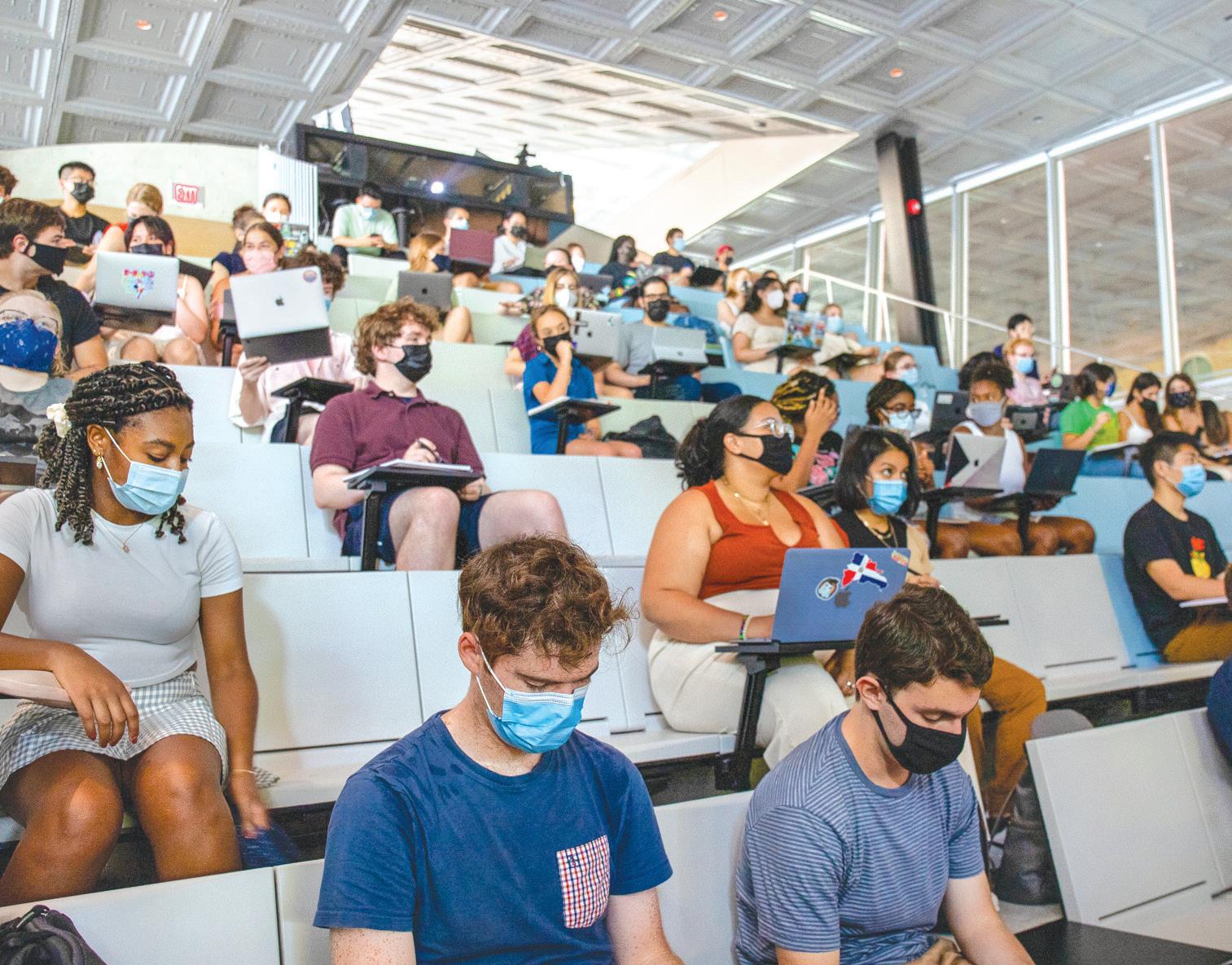
The faculty letter implores Cornell to reconsider its classroom policies on the basis of community safety, calling for the return of classroom measures such as social distancing and improved ventilation, enforcement of the mask mandate and support for immunocompromised and health-concerned faculty. Currently, students attend courses packed in full-capacity classrooms, and Cornell has confirmed 263 positive cases on campus as of Tuesday evening.
“We are concerned that Cornell is not doing more to minimize risk and prevent transmission of this virus,” the faculty letter reads. “We are also very concerned that this acceptance of risk will have the worst impact on the most vulnerable members of the Cornell community, as the efficacy of the vaccine wanes for those in the highest risk groups who received their shots more than six months ago.”
Prof. Kathleen Long, romance studies, started drafting the letter based on the concerns of her colleagues following the mid-August University statements, according to Prof. Celia Bigoness, law. The letter circulated through faculty email chains and accumulated 117 signatures. The professors submitted it to Cornell administration and featured it in The Sun on Aug. 29.
Lieberwitz drafted the AAUP letter as president of Cornell’s chapter. It details legal and ethical concerns with Cornell’s classroom accessibility policies and calls for three specif-
ic actions: the reversal of the policy against remote teaching as a reasonable accommodation, the adoption of a newer, flexible policy that responds to changing pandemic conditions and for the administration’s good faith engagement with the Faculty Senate to develop future policies.
According to Bigoness and Lieberwitz, Cornell failed to consult with the Faculty Senate before adopting its current policy that limits the use of remote learning for accommodations. According to Lieberwitz, this move violates Cornell bylaws and ethical standards.
“Instead of consulting, as they were obligated to do, Cornell simply unilaterally adopted and announced policies that did not respond to health and safety and needs of faculty, staff and students,” Lieberwitz said.
The AAUP letter outlines how Cornell’s policy may stand in opposition to state and federal laws. Lieberwitz cites the New York State Human Rights Law and Americans with Disabilities Act, which require reasonable accommodations for employees with disabilities. The federal government currently recognizes immunocompromised individuals under this act.
“If reasonable accommodations will allow those individuals to carry out the essential functions of their job, then the employer is obligated to provide those reasonable accommodations,” Lieberwitz said. “Now, Cornell’s administration has stated that the essential functions of teaching are teaching in person.”
Lieberwitz expressed that there’s nothing normal about the fall 2021 semester, and added that in-person teaching is an unreasonable expectation for at-risk faculty. In the AAUP letter, she describes the ableist implications of the term “normal,” which the administration has frequently used to describe the ideal state of campus.
Bigoness also expressed her concern that Cornell hasn’t followed the current Centers for Disease Control and Prevention guidelines for institutions of higher learning. The CDC indicates that masking cannot sufficiently limit transmission alone.
For campuses where some community members remain unvaccinated, the CDC strongly suggests masking, physical distancing, enhanced sterilization procedures and improved airflow, among other safety measures. Currently, Cornell mandates masking in classrooms. 95 percent of people on campus are fully vaccinated.
The CDC also encourages rigorous contract tracing, and some Cornell faculty say they cannot tell if this process is happening effectively. The administration has stated that faculty will not be informed if a student in their class tests positive, unless it determines close contact between instructor and student or the student requests a temporary accommodation from Student Disability Services.
“Right now,” Bigoness said, “the onus is on the students to basically say, ‘Do I want my privacy? Or do I want to tell my teachers so they can maybe give me a way to keep up with class?’”
Cornell administrators noted in an Aug. 30 email that they’ve received pressure from faculty, students and parents to transition to remote study as cases rise on campus, but the University stood firm in their decision to keep classes in-person. Neither of the letters sent to the administration advocate for a shift to fully remote study as cases spike.
In fact, many signatories, including Prof. Richard Bensel, government, and Bigoness, said they value their in-person connections with students and dislike the idea of returning to Zoom. However, they believe that they should

have a choice and flexibility in their work.
Three out of 15 students in Bensel’s seminar class have tested positive — and he said he wants the option to move to remote learning if half the class goes into quarantine. Bensel said he finds Zoom especially difficult for a discussion-based class, but he wants to keep his class moving forward.
“For many of us, we would want the option to switch to online instruction to maximize our ability to teach,” Bensel said, “and it should be left up to our judgment during the pandemic.”
Bigoness teaches a class and manages a clinic in the Law School. She has to teach in-person, though she said she feels uncomfortable with two unvaccinated children at home. She has limited her in-person meetings to days when she has to teach on campus to restrict her time interacting there as much as possible.
All the classrooms in the law school, Bigoness said, contained devices for automatic recording even before the pandemic. Now, the University has told instructors not to grant access to these recordings unless a student tests positive and asks them directly, according to Bigoness. Even then, professors are not required to do so.
On Aug. 27, Kotlikoff and Nishii released a statement in response to accommodation concerns, noting that faculty, staff and students can still apply individually for disability accommodations.
The statement does not address the faculty’s specific policy concerns, including the return of classroom safety and accessibility measures from last year, such as distancing and sanitizing.
To continue reading this article, please visit cornellsun.com.
Vee Cipperman can be reached at ocipperman@cornellsun.com.



Is your sweet tooth aching for some dessert? Go to the bakery. Feeling snack-ish? Go to the bakery. Want to procrastinate your work? Go to the bakery. There are many places to grab a sweet treat such as CTB, Mango Mango, Ithaca bakery and the newly relocated Rashida Sawyer Bakery.
Rashida Sawyer Bakery desserts are based on the recipes created by Loraine Rashida Sawyer, a Cornell Hotel School alumnus. You can find the bakery in the Ithaca Commons on West Green Street, a little bit past Urban Outfitters. It’s a cute little store that houses a variety of cakes, cheesecakes, cupcakes, tarts and other baked goodies including a gluten and dairy free honey-banana chocolate bar.
In my recent visit, I had the pleasure of trying their fruit tart, chocolate swirl cheesecake and their chocolate cupcake with fudgy chocolate cream cheese frosting.
My favorite out of all of those desserts was the fruit tart with raspberries, blackberries, blueberries and oranges. The best part of the tart was definitely the crust. It was surprisingly light, not too crumbly, not too dense and easily
By SARAH AUSTIN
Sun Staff Writer
I’m not stupid, but that didn’t stop the woman on the other end of the phone from calling me that. English is my first language, but that didn’t stop the woman on the other end of the phone from questioning my command of it. My name is Sarah, but that didn’t stop the woman on the other end of the phone from never using it.
After spending months sending cold-emails and having “informational interviews”, I was so excited to find a job as a reservationist for a restaurant group. I had this romanticized view in my head of being a working girl in New York City, and everyone around me was too nice to pop my bubble constructed of naivety and ignorance.
I spend eight hours a day answering phones. Some days, I book reservations for CEOs and influencers. Other days, time seems to move in reverse — it feels like eight days pass before I walk into the dark night and begin my fear-filled walk to the train station, gripping my phone in my hand, ready to make a call if I feel unsafe. After a week, I realized that this job wasn’t what I thought nor what I wanted, but I placated myself with cliches like “it’s a stepping stone” and “I’m learning great customer service
skills.” I learned, above all, that a phone is equally the single most protective and destructive object that we, as a society, have unencumbered access to.
Technology is a miracle. It’s made our lives easier, more efficient, and has given us the gift of connection. However, this gift of connection is a double-edged sword. A phone provides all of us with the blessing of safety and the curse of anonymity. Walking through the dark night, a phone provides me with a sense of security. On the other hand, at work, the phone shields the customer on the other end from the reality that they’re speaking to a living, breathing human — with feelings of frustration and exhaustion just as legitimate as their own.
The act of having a conversation without the ability to look into one another’s eyes is dehumanizing. How often have any one of us been on the phone with a customer service representative, only to lose our tempers after being left on hold? Even the nicest person falls prey to this trap — and in the world of restaurants, you’re often on the receiving end.
The restaurant industry has come under fire lately for its treatment of employees. The industry has always struggled with retention and has one of the highest turnover rates. The pandemic and subsequent governmental financial support have further
deterred many employees from returning to a life of unfair wages and unjust treatment – the irony that the majority of employees at fine dining restaurants cannot afford a meal at their own workplace should not be lost on us. However, above all, no one should have to be subjected to being another person’s verbal punching bag just to put food on the table. The industry as a whole needs to do better.
As a reservationist, you are the customer’s first impression of the restaurant. You hold the power to make or break both the customer’s experience and the restaurant’s bottom line. While I afford a lot of power to the reservationist, I want to make it very clear that we do not have the ability to conjure up a table from thin air, increase your party size on the July 4 weekend, or correct your UberEats order. And when I politely tell you that something is outside of my ability, please don’t call me names or threaten to report me to management — I’m just doing my job. I certainly can’t reserve a table for you if you’re rude, but there’s a special place in hell reserved for people like you.
When I answer the phone at work, it’s impossible to mistake me for anything but a kid. I don’t have any of the weariness or maturity in my voice that unavoidably comes with age and hardship, yet
cut with a fork. The crust even carried a subtle sweetness that did well to add to the understated sweetness of the cream without overpowering the overall sweetness of the dessert. The texture of the cream was heavenly, very even, gliding smoothly across the tongue. The seedy texture of the berries, paired with the slight crumbliness of the crust, contrasted the smoothness of the cream and added another dimension to the dish. The tartness of the berries balanced the dessert very well when coupled with the sweetness of the cream. Especially on a hot summer day, the fruit tart provided a nice relief due to the fresh and cool juiciness of the fruits.
The next dessert I tried was the chocolate swirl cheesecake, which I found to be a nice break from the usual heaviness of most cheesecakes. It was completely light and creamy with a subtle hint of chocolate. Originally, I expected the cheesecake to be more chocolatey and heavy like most chocolate cheesecakes; nevertheless, the delicate chocolate flavor was a smart move as it helped maintain the lightness of the overall dish while still keeping chocolate lovers interested. My main complaint with this dessert was the crust. While I thought the slight salty flavor contrasted the sweetness of the dish well, I found
somehow this fact is not enough to stop a disgruntled guest from using the same language one would expect from a sailor — or in a kitchen. In no other field, would this type of language or behavior be deemed acceptable. I do not know if this treatment is a reflection of bad manners, a feeling of entitlement, or simply because of the telephone.
it too dense, almost like a hard crumbly cookie. I really had to dig my fork in to break a piece of it. The last dessert I tried was my least favorite, and to be honest I was slightly disappointed with it as I expected more coming from the previous desserts. While the fudgy chocolate cream cheese frosting of the chocolate cupcake is a chocolate lover’s paradise, the actual cake was very dense. Because the frosting is very heavy, rich and fudgy, the density of the cake seemed to weigh the dish down even more, and made it harder to swallow. The cake in combination with the frosting seemed to smother my taste buds and I got the urge to chase the dessert with a glass of milk. In general the taste was average. In fact, it reminded me more of a brownie than a cupcake.
Overall, while I found the desserts pleasurable, nothing special stood out to me. I definitely recommend stopping by if you’re in the area and I myself also plan on dropping in again to try some of the other baked goods. At the end of the day, if you’re craving something sweet, you now have another place to add to your list.
However, I do know this: in two months’ time, I will return to the bubble of my college campus and its holistic approach to education; but how holistic can my education truly be if it doesn’t teach me how to be a good person?
Sarah Austin is a junior in the College of Arts and Sciences. She can be reached at sarahaustin@cornellsun.com.



Independent Since 1880
139th Editorial Board
KATHRYN STAMM ’22
Editor in Chief
ANUSHYA ALANDUR ’23
Business Manager
CATHERINE ST. HILAIRE ’22
Associate Editor
PRANAV KENGERI ’24
Advertising Manager
ODEYA ROSENBAND ’22
Opinion Editor
JYOTHSNA BOLLEDULA ’24
News Editor
TAMARA KAMIS ’22
News Editor
WENDY WANG ’24
Arts & Entertainment Editor
KRISTEN D’SOUZA ’24
Design Editor
HANNAH ROSENBERG ’23
Photography Editor
OMSALAMA AYOUB ’22
Science Editor
PUJA OAK ’24
Layout Editor
ANNIE WU ’22
Production Editor
MIHIKA BADJATE ’23
Assistant News
ANGELA BUNAY ’24
Assistant
JOHN COLIE ’23
Assistant
AMELIA CLUTE ’22
Assistant Dining Editor
WILLIAM BODENMAN ’23
Assistant Sports Editor
AARON SNYDER ’23
Assistant Sports Editor
MEGHANA SRIVASTAVA ’23
Compet Manager
MADELINE ROSENBERG ’23
Editor NAOMI KOH ’23
OZA ’22
Editor
HEO ’24
VEE CIPPERMAN ’23
NOOREJEHAN UMAR ’23
YOON ’23
BENJAMIN VELANI ’22
PICHINI ’22
SRISHTI TYAGI ’22
MENDOZA ’24
ARANDA ’23
Editor
BASU ’23
RIGGS ’24
’23
’24
’24
ABAYEVA ’24
ALPERS ’22

Gillian Harrill is a senior in the College of Agriculture and Life Sciences. Comments can be sent to opinion@cornellsun.com. Guest Rooms run periodically throughout the semester.
This morning I was on the phone for an hour with a Tompkins County Health Department contact tracer. She was calling the long list of students who had, like me, just tested positive for COVID-19. Over the course of the call, it felt as though we had a transient friendship as I took her through every place and person I had encountered over my last two weeks like a personal diary. She shared her own experiences that overlapped with mine. We broke through the fabric that commonly shrouds bureaucratic phone calls when it was clear there was a human being on both ends of the line as she genuinely wanted to check on how I was feeling and opened up about the pandemic as she saw it. Then she mentioned something that truly struck me:

She couldn’t wrap her head around Matthew Samilow’s Sun article “Cornell’s Virus Restrictions Defy Reason.” In this article, Samilow calls indoor mask mandates at Cornell a “burdensome restriction for which the costs heavily outweigh any benefits.” She continuously emphasized that wearing masks is such a small inconvenience on campus when it means you are protecting the larger Ithaca community, vaccinated or not. She wished she could write a response to this article from her perspective, a service worker on the phone all day with COVID patients.
I told her I would write that response for her (I have plenty of time to do so, being isolated in my room). The fact she had been religiously keeping up with what students had to say about COVID in The Sun illustrated just how much Ithaca as a city is keeping an eye on our hill. Not just out of morbid curiosity, but out of concern that their children, too young to be vaccinated, will fall ill returning back to school. Concern that if they catch meningitis, Ithaca’s limited hospital capacity will be too full of COVID cases to help them. Concern that Cornell students care more about not wearing a piece of cloth over their mouth during lectures than they do about their larger community. We have to remember that for many of us, we are only guests here in Ithaca. Samilow’s article discusses how a campus of vaccinated 18-22-year-olds are capable of “returning to normal life with a minimal level of risk,” but this sentiment neglects an entire community representing all ages and abilities. Cornell is not a bubble that can simply pretend a pandemic doesn’t exist while its surrounding communities have to face that reality every single day.
It is a reality that many fully vaccinated 18-22-year-olds are, in fact, facing on Cornell’s campus at this present moment. When I experienced some cold-like symptoms when I arrived in Ithaca, I shrugged them off as allergies because in my mind Pfizer had made me practically invincible. I was comfortable traveling and visiting-
family without a second thought. Even prior to being vaccinated, I luckily didn’t catch anything when my COVID-positive mom gave me a hug. I would hear news of the Delta variant spreading, but it didn’t affect me, especially when I would be returning to my Cornell bubble: a utopia where everyone was vaccinated and our actions had no dire consequences, where life could be “normal.” I was even more optimistic hearing that there was now live music in the Commons with maskless dining and dancing. I felt invincible. We don’t assess our shortcomings until we build wings out of wax and fly too close to the sun, but I didn’t catch a breakthrough case of COVID participating in risky behaviors like parties and concerts; I caught it at the airport, fully vaccinated. As Samilow said, I will not be hospitalized or die of this illness, but it definitely feels awful not being able to smell or taste any of my meals, shivering in bed with a fever. What Samilow gets wrong is that it should be common courtesy to wear a mask indoors, because I do not wish any of these symptoms on anyone else, no matter how “minor” they may be.
Masks actually have saved many of my classmates from experiencing what I am feeling right now. I received my positive test result after I had already attended the first day of class, thinking I was just having a flare-up of allergies. Since I was wearing a mask the entire class, no one in my group was sprayed by a rogue cough. Samilow wrote that masks would cause “tremendous harm” to our ability to enjoy Cornell this year, even stating that the costs of wearing them on campus heavily outweighed the benefits, but he never specified what these “costs” were. My class joked about how we couldn’t wait to take off the sweaty things when the four-hour class was over, but if we hadn’t all been urged by Cornell (and our consciences) to wear them, I would’ve directly subjected my peers to my sickness. I would take a slight inconvenience any day in order to be able to safely go to class in person, because most of us know someone who is immunocompromised. Masks don’t take away from our college experience like Samilow surmises; they give it to us.
Samilow points out the hypocrisy that if restaurants don’t require masks, classes shouldn’t either. This is a false equivalency. We mask in class because who knows what others are doing while unmasked. We also don’t eat while in class and I am not going to restaurants every day to get a degree. Going out to eat is not an essential activity, and if Ithacans feel comfortable doing so without a mask, it is their choice to live their lives. However, when students go out to party with each other on weekends, we don’t want them coughing up an unprotected lung next to us in a lecture. To continue reading this column, please visit cornellsun.com

Fill in the empty cells, one number in each, so that each column, row, and region contains the numbers 1-9 exactly once. Each number in the solution therefore occurs only once in each of the three “directions,” hence the “single numbers” implied by the puzzle’s name. (Rules from wikipedia.org/wiki/ Sudoku)






By ALLY KNAPP Sun Contributor
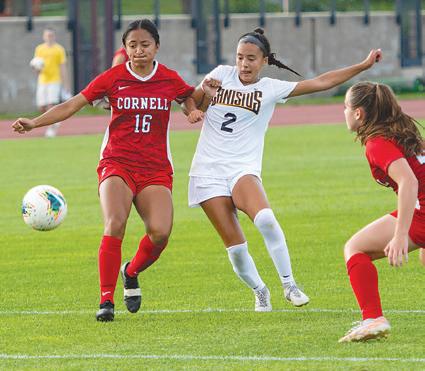
After nearly two years, Cornell women’s soccer is back in action for the first time since fall 2019, welcoming a freshman class of eight new players and one walk-on.
In the Red’s first game of the season against Canisius College, Cornell defeated the Griffs 2-0, with three new freshmen in the starting lineup.
Locking down the net was freshman goalkeeper Erica Fox, who played the full 90 minutes, an unexpected feat for her first collegiate game. Fox, a San Diego native, is one of three goalkeepers on the team, alongside junior Nicole Shulman and senior captain Miranda Iannone.
The coaching staff for the Red was one of the main reasons Fox wanted to attend Cornell, and she looks forward to improving her game for the next four years under a newly appointed goalie coach, Dani Britt.
“Even the shots are way more powerful than I am used to.”
Erica
Fox
“Even the shots are way more powerful than I am used to,” Fox said. “It’s an adjustment to make and I am having to train harder to get my hands ready for college-level shots. [Practices] are really intense at the moment, and everyone’s super focused while we’re in training, and then afterwards we get out all of the social aspects.”
Although Fox did not know any older players on the team coming into Cornell, she played on the same club soccer team, Albion SC San Diego, with freshman Lily Ellingson for four years.
As she starts her season, Fox said she wants to impress on and off the field. Outside of athletics, she hopes to go into medicine and is studying biological sciences.
“It’s been one of my dreams for a really long time. And I take school pretty seriously, because I want to be successful when I’m older, so I’m excited to be at an institution that has strong academics,” Fox said.
Freshman midfielder Reinna Gabriel is from Menifee, California. Like Fox, Gabriel is studying biological sciences in the College of Agriculture and Life Sciences.
Gabriel was not expecting to start in her first game, but after switching club teams three times in high school before settling down with Slammers FC — a Costa Mesa, Californiabased club — she was not deterred by a new squad.
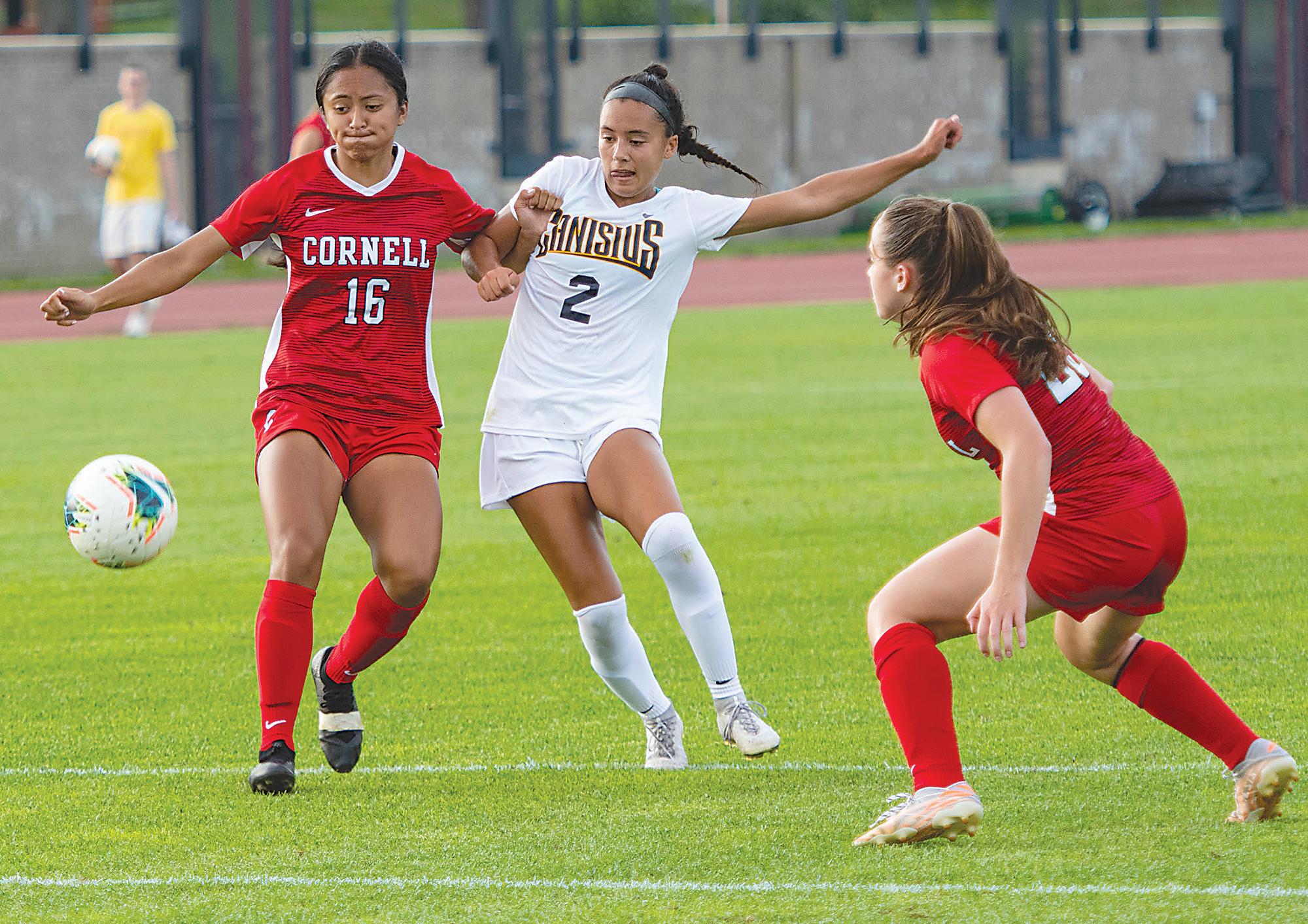
“It’s good for my development to learn how other people play, and it’s been fun to get to know how other people on this team play,” Gabriel said. Gabriel said she hopes to put her best effort into games and practices as she adjusts to a new position as a holding midfielder.
The biggest adjustment, though, for Gabriel is being away from her family, so she said she’s grateful to be part of a closeknit team.
“I’m super close with the freshmen already,” Gabriel said. “It’s like eight new best friends that I have and it’s a lot of fun having school and soccer. It’s just what I’ve always been used to, but it’s definitely different.”
The third freshman starter is midfielder Peyton Nichols, who hails from New Vernon, New Jersey, and started in the first game of the season. She said she is finding the transition

to the team to be smooth after playing for nine years for the club team Players Development Academy, because the teams share a similar play style.
Like Gabriel, midfield is a new position for Nichols, so she is looking forward to continuing to develop her skill set and gain comfort in the position.
“We play in a 3-6-1 formation, so gaining a comfortable relationship with the other midfielders on the team would probably be my main goal,” Nichols said.
These three freshmen have gotten off to a strong start. With the team goal of earning an Ivy Conference Tournament victory, they are willing to put in the work to bring a title home to East Hill.
Ally Knapp can be reached at alk245@cornell.edu.
By MITCH HOY Sun Staff Writer
Cornell golf’s 2021-2022 season is set to tee off this weekend with the annual Alex Lagowitz Memorial Invitational at the Seven Oaks Golf Club in Hamilton, New York. The tournament will host 15 teams for 36 holes on Saturday and the final 18 on Sunday.
The Red has a strong track record of recent success at this tournament. Cornell won the team title at the invitational in 2019, riding on strong performances from Jack Casler ’20 and Charlie Dubiel ’21. The team took second place in 2015, 2016 and 2017.
While the Red is returning to action for the first time since 2020, Dubiel’s graduation during the canceled 2020-21 season leaves a large hole for the team to fill. Jack Casler’s graduation in 2020 left a similar gap, though with Dubiel as the lone incoming senior at the time, it was assumed he would step up to fill the role — but Dubiel’s senior season never came.
Now, an already lean team must replace two of the program’s best players in recent memory, all while coming off a canceled season. Still, the Red is excited to hit the links in varsity action for the first time in nearly two years.
“I can speak for everyone on the team on this one and say that we couldn’t be more excited,” said junior Ben Choe. “For most of us, it’s been nearly two years since we’ve competed for the school, and we’re just counting down the days until Saturday.”
Despite the lack of team action for an extended period, Cornell golf has been gearing up for a return by golfing in individual competitions.
“We’ve competed in individual tournaments all summer, getting our game in peak condition for this weekend,” Choe said. “We put in the work for the past two years, and we’re ready to play.”
Though the golf roster currently only lists six members, more additions to the team will be unveiled in the coming weeks.
“I feel very confident about this season,” Choe said. “Our roster is one of the deepest we’ve ever had. Everyone is capable of going low, which is huge to have over the course of a long season. Also, we took a very strong freshman class, who are already showing great signs of potential.”
“Our roster is one of the deepest we’ve ever had.”
Ben Choe
One of those freshmen is Char Russekoff, who is from Greenwich, Connecticut, and qualified for this weekend’s invitational. Russekoff will play in his very first competition as a Cornell athlete.
“I’m beyond pumped going into my first season,” Russekoff said. “It is a really good group of guys and we have a lot of depth, and I’m just excited to start playing golf and competing. I like to feel like I’ve been preparing my whole life for this.”
Mitch Hoy can be reached at mah429@cornell.edu.