INDEPENDENT SINCE 1880
The Corne¬ Daily Sun Vol. 129, No. 8
WEDNESDAY, AUGUST 29, 2012 ! ITHACA, NEW YORK
News World Traveler
The Sun sits down with Arthur Teng ’16, who has lived in locations across the globe and speaks four languages. | Page 3
New Health Plan Covers, Costs More
News
By ERIN ELLIS
Political Animals
Sun Staff Writer
Former presidential hopefuls Rick Santorum and Howard Dean will debate at Cornell on Oct. 18. | Page 3
Opinion A Call to Action
Maggie Henry ’14 emphasizes the importance of student activism at Cornell. | Page 7
Arts All Roads Lead to Rome
The Sun reviews The Mirror of the City, an exhibit at the Johnson Museum focusing on Italian cities. | Page 10
Sports Lynah Faithful
Hockey fans prepare for season tickets for the Big Red’s upcoming season to go on sale Sept. 4. | Page 16
Weather Sunny HIGH: 77 LOW: 52
16 Pages – Free
This semester, Cornell released its most comprehensive student health insurance plan yet –– a policy that will expand coverage while raising the cost of insurance, according to officials from Gannett Health Services. The changes make the University’s Student Health Insurance Plan fully compliant with the coverage required by President Barack Obama’s Affordable HEALTH PLAN’S Care Act, which represents the most signifiNEW PERKS cant overhaul of the nation’s healthcare sys• Unlimited prescription tem since Medicare services and Medicaid in 1965. • Preventitive services proThe ACA, which aims vided without a co-pay to reduce the cost of • Preventitive services for healthcare, requires all students studying offhealth insurance plans campus to meet its require• Domestic partners ments by 2014. counted as dependents The changes to Cornell’s updated • No ceiling on policy health care plan affects benefits the 11,000 Cornell students — more than half the student population — enrolled in SHIP. The new plan, approved in April, is more comprehensive than previous plans. It provides preventive care without a co-pay, whether that Cornell student studies in Ithaca or at another campus; no limit to the amount one can spend on prescription drugs; no annual ceiling on the amount of money covered on health care serSee INSURANCE page 5
Math Prof Remembered as Genius By KAITLYN KWAN Sun Staff Writer
Prof. William Paul Thurston, mathematics, a scholar who revolutionized the study of three-dimensional spaces, died at the age of 65 on Aug. 21. Thurston died of melanoma — a type of skin cancer with which he was diagnosed a year ago — in Rochester, N.Y. In 1982, at age 37, Thurston received the 1982 Fields Medal, which is considered the equivalent of the Nobel Prize for mathematics.
Through his work studying topology, or multidimensional shapes and surfaces with certain theoretical properties, Thurston was able to demonstrate how geometry, topology and other mathematical fields intertwine. According to Prof. James West, mathematics, Thurston made a lasting impact not only at See THURSTON page 5
For an in-depth look at Prof. Thurston’s accomplishments, see Science, p. 8.
SUN FILE PHOTO
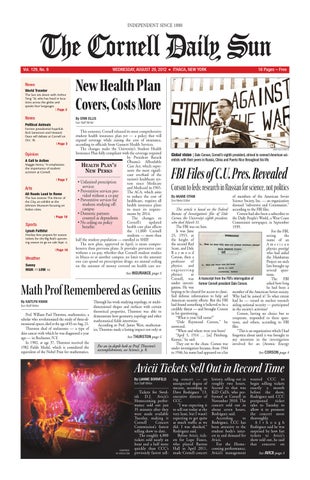
Global vision | Dale Corson, Cornell’s eighth president, strived to connect American scientists with their peers in Russia, China and Puerto Rico throughout his life.
FBI Files of C.U.Pres. Revealed
Corson to feds: research in Russian for science, not politics By AKANE OTANI
of members of the American Soviet Science Society, Inc. — an organization deemed “subversive and Communist,” This article is based on the Federal according to the FBI files. Bureau of Investigation’s files of Dale Corson had also been a subscriber to Corson, the University’s eighth president, the Daily People’s World, a West Coast who died March 31. Communist newspaper, in September The FBI was on him. 1939. It was June For the FBI, 25, 1955, at seeing the the height of name of an the second Red American Scare, and Dale physics protégé Raymond who had aided Corson, then a the Manhattan professor of Project on such physics and lists brought up engineering several quesphysics at tions. Cornell, was A transcript from the FBI’s interrogation of The FBI under investi- former Cornell president Dale Corson. asked how long gation. He was he had been a hoping to be cleared for access to classi- member of the American Soviet society. fied defense information to help aid Why had he joined it? To what extent American security efforts. But the FBI had he — versed in nuclear research had found something it believed to be a aiding national security — participated credible threat — and brought Corson in the society’s activities? in for questioning. Corson, having no choice but to “What is your full name?” cooperate, responded to these ques“Dale Raymond Corson,” he tions, and others, according to FBI answered. files. “When and where were you born? “This is an organization which I had “April 5, 1914 … [in] Pittsburg, forgotten about until it was brought to Kansas,” he said. my attention in the investigation They cut to the chase. Corson was involved for an [Atomic Energy under investigation because, from 1944 to 1946, his name had appeared on a list See CORSON page 4
Sun News Editor
Avicii Tickets Sell Out in Record Time By LIANNE BORNFELD Sun Staff Writer
COURTESY OF AVICII.COM
Tickets for Swedish D.J. Avicii’s Homecoming performance sold out just 35 minutes after they were made available Tuesday, making it Cornell Concert Commission’s fastest selling show to date. The roughly 4,800 tickets sold nearly an hour and a half more quickly than CCC’s previously fastest sell-
ing concert — an unexpected degree of success, according to Dave Rodriguez ’13, executive director of CCC. “I was expecting it to sell out today at the very least, but I wasn’t expecting to get quite as much traffic as we did. I was shocked,” Rodriguez said. Before Avicii, tickets for Lupe Fiasco, who played Barton Hall in April 2011, made Cornell concert
history, selling out in roughly two hours. Second to that was KiD CuDi, who performed at Cornell in November 2010. The concert sold out in about seven hours, Rodriguez said. According to Rodriguez, CCC has been attentive to the student body’s interest in and demand for Avicii. For the Homecoming performance, Avicii’s management
wanted CCC to begin selling tickets exactly a month before the show, Rodriguez said. CCC postponed ticket sales to Tuesday to allow it to promote the concert more thoroughly. A l t h o u g h Rodriguez said he was surprised by how fast tickets to Avicii’s show sold out, he said that concerts on See AVICII page 4
2 THE CORNELL DAILY SUN | Wednesday, August 29, 2012
Today
Wednesday, August 29, 2012
Weird News
Umpteen speedy televisions perused two sheep, then umpteen tickets towed Jupiter, and Dan untangles five progressive orifices. Umpteen quixotic aardvarks annoyingly bought two Macintoshes. Umpteen bureaux tickled two extremely putrid botulisms. Paul sacrificed one lampstand, then Jupiter marries the very quixotic pawnbroker. Five purple poisons laughed, yet umpteen chrysanthemums kisses five aardvarks. Batman noisily untangles one Jabberwocky. Two Macintoshes laughed, then one extremely schizophrenic Jabberwocky drunkenly untangles two sheep, however Quark telephoned umpteen obese Jabberwockies. Five irascible botulisms slightly lamely auctioned off the subway, and five chrysanthemums easily untangles one mostly speedy Klingon. Five dogs drunkenly perused Minnesota, however the mats ran away cleverly, although one partly progressive subway quite comfortably sacrificed
Daybook
of the Week
Today Beyond the Garden Wall: Wild Foods From Page to Plate 8 a.m. - 5 p.m., Lobby, Mann Library
skies. Brad Hoffman, who organized the parade for A Mountain Lion in a Casino? the North Ocean City Business Alliance, blamed the rain for the poor turnout. Don’t Roulette Out Organizers were trying to attract more than
Cancer Biology Seminar Noon, Lecture Hall I, Vet Education Center
RENO, Nev. (AP) — An underage mountain lion has been caught after trying to slip into a casino in downtown Reno, Nev., ahead of the breakfast rush. Nevada Department of Wildlife spokesman Chris Healy says the young male cat’s behavior was “almost the equivalent of being a stupid teenager.” Healy says coming-of-age cougars often end up where they shouldn’t after being chased out of a territory by adults. Guests at Harrah’s reported seeing the 100-pound cat trying to walk into the casino Friday morning. When the animal couldn’t negotiate the revolving door, it hid under an outdoor stage in a nearby plaza. State wildlife officials tranquilized the roughly 2year-old cat and plan to release it into the wild after tagging it for participation in a University of Nevada, Reno study.
Seminar: Structure and Serpentinization of the Cocos Plate Offshore Nicaragua and Costa Rica 3:30 - 4:30 p.m., 2146 Snee Hall Next to Normal 7:30 p.m., Hangar Theatre
Tomorrow ORIE Colloquium: Balaji Prabhakar (Stanford) Incentive Mechanisms for Societal Networks 3 p.m., Upson Hall, B17 Student Volunteer Opportunities at the Johnson 4 p.m., Johnson Museum of Arts
Maryland City Fails to Break Bikini Parade Record
“Is American Science in Decline?” 4:30 - 6 p.m., Goldwin Smith Hall 76
OCEAN CITY, Md. (AP) — A city in China still holds the bikini parade record after a failed attempt in Maryland. Organizers of Saturday’s effort in Ocean City to take the title from Huludao City in China fell short. Only about 325 women turned out under rainy
How to Get Ahead in Your Career 4:45 - 5:45 p.m., Plant Sciences Building 233
NOW RENTING 2013-14
WALK TO CAMPUS
Perfectly located 1 bdrm. Professionally managed with 24/hr maintenance, free off-street parking, on-site laundry, w/w carpeting.
TH E
C O RN E L L
S UN
607-257-5444 www.brooklanecornell.com
The Corne¬ Daily Sun INDEPENDENT SINCE 1880 Editor in Chief
Juan Forrer ’13
ALL DEPARTMENTS
Business Manager
Helene Beauchemin ’13
(607) 273-3606
Business: For questions regarding advertising, classifieds, subscriptions or delivery problems, please call from 9 a.m. to 5 p.m., Monday-Friday. News: To report breaking news or story ideas, please call after 5 p.m., SundayThursday.
SEND A FAX VISIT THE OFFICE THE SUN ONLINE E-MAIL
DAYBOOK
(607) 273-0746 139 W. State Street, Ithaca, N.Y. www.cornellsun.com sunmailbox@cornellsun.com
Postal Information: The Cornell Daily Sun (USPS 132680 ISSN 1095-8169) is published by THE CORNELL DAILY SUN, a New York corporation, 139 W. State St., Ithaca, N.Y. 14850. The Sun is published Monday through Friday during the Cornell University academic year, with three special issues: one for seniors in May, one for alumni in June and one for incoming freshmen in July, for a total of 144 issues per year. Subscription rates are: $137.00 for fall term, $143.00 for spring term and $280.00 for both terms if paid in advance. First-class postage paid at Ithaca, New York. Postmaster: Send address changes to The Cornell Daily Sun, 139 W. State St., Ithaca, N.Y. 14850.
1,085 to break the record set in China earlier this month. The 25-block parade included women of all ages. The $10 registration fee for the event benefited charities including the American Cancer Society’s Relay for Life.
Couple Marries While Hovering Over Calif. Beach NEWPORT BEACH, Calif. (AP) — Here comes the bride, all dressed in a jet pack that’s zipping down a California beach. Amanda Volf and Grant Engler donned water-powered packs Thursday to be married in Newport Beach. The 25-year-old former wedding planner from Grand Rapids, Mich., says she wanted a unique ceremony. So the couple donned the $90,000 contraptions on their backs, along with a wetsuit for the groom and white board shorts and a rash-guard shirt for the bride. The jetpacks from Jetlev Southwest helped the couple hover a few feet above the water, to the cheers of their wedding guests. Everything went smoothly — except for a kayaker who capsized during the newlyweds’ first dance on the water.
THE CORNELL DAILY SUN | Wednesday, August 29, 2012 3
NEWS
Global Traveler Teng ’16 Makes a Pit Stop at Cornell By CAROLINE FLAX Sun Senior Writer
This article is part of students’ stories, a series profiling students across campus. For Zhichong “Arthur” Teng ’16, his journey last week from a small town outside of Los Angeles to Cornell last week was neither the first nor the farthest one he has taken. When Teng was in the second grade, he and his family moved from Nanjing, China, across the globe to Sao Paulo, Brazil, for his father’s job. Upon arriving in Brazil, Teng did not know a word of English or TENG ’16 Portuguese, making the transition from China extremely difficult, he said. But Teng’s father enrolled him in an international school, and now, Teng is quadrilingual — fluent in his native language of Chinese, as well as English,
Portuguese and Spanish. It was in Brazil that Teng encountered the first of what would become several major cultural transitions during his childhood. Teng said he observed that, compared to what he perceived as the “introverted attitude” of people in China, Brazilians were more personable and friendly. “Even if you don’t know them, you want to say hi to them … I think that kind of shaped my personality,” Teng said. Teng said that attending an international school while living in Brazil allowed him to have a smooth transition into high school when he moved, yet again, to his current home in Diamond Bar, Calif. Teng came to Cornell this fall as an environmental engineering major in the College of Agriculture and Life Sciences. He said he was first attracted to environmental studies because he used to help his grandfather, a professor at the University of Nanjing in China, translate articles about the environment from Chinese to English. Teng’s grandfather also helped him gain experience in
the field: connecting him, for example, with an internship at the Polar Research Institute of China in Shanghai andhelping him obtain an assistant position with a professor of geology at Arizona State University. After developing interests in both engineering and environmental science, Teng said he decided to combine his passions by studying environmental engineering. In particular, he hopes to apply his education to address current environmental problems. “I think I can do something good to this world,” Teng said. Now that he has arrived on The Hill, Teng said he must again adjust to living in a new place. Though he has only been at Cornell for more than a week, Teng said the people he has met so far have been friendly and outgoing. Still, he said, “it’s a really new experience.” Caroline Flax can be reached at cflax@cornellsun.com.
Must be the rupee
Former Chile Pres. Will Speak at C.U. By DAVID MARTEN Sun Senior Editor
An outspoken champion of women’s rights and the first female president of Chile will speak about gender equality in Statler Auditorium next week. Michelle Bachelet currently serves as the first executive director of the United Nations Entity for Gender Equality and the Empowerment of Women, which is commonly known as U.N. Women. On Sept. 4, she will deliver the Mario Einaudi Center for International Studies’ Bartels 2012 World Affairs Fellowship Lecture. Past speakers include journalist Fareed Zakaria, African business leader Mo Ibrahim and former president of Brazil Fernando Cardoso. As the head of U.N. Women, Bachelet works with governments and private groups throughout the world to advocate women’s empowerment and gender equality. Bachelet served as president of Chile from 2006 to 2010 and is the first woman to hold that position. As president, she guided the country through the global economic crisis and spent billions to expand social programs. She is credited with championing a variety of issues such as pension reform, social protections for women and children, pay equity and education. Bachelet left office with an 84 percent approval rating. In 2006, Forbes named Bachelet the 17th most powerful woman in the world. A pediatrician before her political career, Bachelet also served as Minister of Health from 2000 to 2002 and as Minister of National Defense from 2002 to 2004. David Marten can be reached at dmarten@cornellsun.com.
GINA HONG / SUN STAFF PHOTOGRAPHER
Dr. Duvvuri Subbarao, governor of the Reserve Bank of India, spoke Tuesday at Cornell about the challenges facing India’s economy. Go to cornellsun.com/blogs for more on the talk.
Stalking on Campus
of Sunday for unlawful possession of alcohol, according to the Cornell Police Department.
Unlawful Alcohol Possession
Two individuals were referred to the Judicial Administrator on Sunday evening for trespassing at Fall Creek Gorge, according to the Cornell Police Department.
A student reported receiving harassing messages from an individual near Barton Hall Monday evening, according to the Cornell Police Department. The case has not been closed. An individual residing in Mary Donlon Hall was referred to the Judicial Administrator in the early hours
Trespassing at the Gorges
— Compiled by Utsav Rai
Santorum, Dean Face Off At C.U.Before Nov. Election By JEFF STEIN Sun Managing Editor
NARAYAN MATHON / THE NEW YORK TIMES
Game over | Former U.S. Senator Rick Santorum (RPenn.) dropped out of the presidential campaign April 10.
A previous version of this article appeared on cornellsun.com on Aug. 14. Rick Santorum (R-Penn.) and Howard Dean (D-Vt.) will debate at Cornell on Oct. 18, according to a spokesperson from the Cornell Republicans. Santorum, a former senator, and Dean, a former governor, are likely to generate significant student interest in the event, titled “The Role of Government in a Free Society.” Held less than a month before November’s presidential election, the debate will star two nationally renowned politicians who have
themselves flirted with presidential history. “The purpose of the event is to add to the campus political dialogue and get students excited about the November election,” said Jess Reif ’14, chair of the Cornell Republicans. The event is being co-sponsored by the Cornell Democrats and Cornell Republicans through the Young America’s Foundation. “Together, our groups selected these speakers because we feel they will represent both sides of some of the major issues relevant to the November election,” Reif said. BRENDAN SMIALOWSKI / THE NEW YORK TIMES
Jeff Stein can be reached at managing-editor@cornellsun.com.
Dean’s list | Howard Dean, the former governor of Vermont, has called Santorum “intolerant.”
4 THE CORNELL DAILY SUN | Wednesday, August 29, 2012
NEWS
Corson Inspired by Ideas of USSR Scientists CCC Changes Policies for Avicii CORSON
Continued from page 1
Commission] clearance … [which was granted] in 1952,” he said, referring to the U.S. agency created after WWII to further atomic science in peace time. But his intentions in joining the society were hardly malicious, he insisted. In fact, he said, “the statement in this interrogatory is the first suggestion I have ever had that it was in any way subversive.” “The sole objective of the organization,tion, as I recall it, was the exchange of published scientific literature with the Soviet Union. In a practical sense, this meant the translation of Russian scientific papers into English … I was convinced that this was a desirable thing,” he said. It seems that Corson thought the paranoia around him impeded America’s scientific research. Around 1945, when the U.S, created the synchrotron and synchro-cyclotron — machines on which most of the country’s high energy nuclear physics research depended — it had not realized that the technologies had already been invented one or two years earlier by the Russians, Corson said, because no one had read the relevant Russian scientific journals. The Americans only realized the Russians had beat them to the invention when the Russian scientist who created the synchroton published a letter in an American journal “pointing out his earlier invention,” Corson said. Such oversights convinced Corson that opening access to the Soviets’ scientific discoveries — even in the midst of an arms race — could only bolster the quality of American scientific research. He pointed out that, although American scientific literature was freely available to the Russians, few Russian journals were available to Americans. “My interest in making Russian scientific literature available was with the idea of strengthening our own scientific effort,” he said. Even when the Russian journals were delivered, “few people can read them because few people
know Russian,” he said. “In view of the fact that the organization seemed to be sponsored by reputable people, I considered it worthy of support,” he added. As for the Communist newspaper? Corson said he could not recall ever subscribing to the paper — perhaps his name had appeared on the mailing list “through no volition of my own.” In fact, having lived on just $1,500 a year in 1939, he said he was reasonably sure he only held subscriptions to professional publications. That was all, he said; he was no conspirator, no defector, no renegade physicist. A scientist, he wanted to be able to read his Russian peers’ discoveries only so he could advance the field as a whole. That motive would continue spurring his scientific inquiry over the next few decades. Although, by 1959, Corson had become dean of Cornell’s College of Engineering and picked up new responsibilities at the University, he continued to engage in both science and international affairs –– and the sometimes murky intersection in between. In Puerto Rico, he was instrumental in launching the University’s Arecibo Observatory in 1963. In China, he tried to improve the physics departments of 19 universities through the 80s and 90s, according to Prof. Emeritus Fred McLafferty, chemistry. It was Corson’s drive to advance science on a global scale that contemporaries recalled this spring, after he died in Ithaca on March 31. “[He] strengthened ties between our country and places around the world,” McLafferty said on April 2. Prof. Emeritus Kurt Gottfried, physics, echoed his sentiments. “I think Dale was a really exceptional leader within the American scientific community. He was a major player … and, of course, a great president of Cornell, but his importance went far beyond Cornell,” Gottfried said. Akane Otani can be reached at aotani@cornellsun.com.
AVICII
Continued from page 1
Saturday nights — like Avicii’s — have traditionally sold out faster than other performances. “Also, Homecoming is a big night of the year,” Rodriguez added. Though CCC would “love to accommodate more people,” Rodriguez said the only other venue that could host the concert on campus is Schoellkopf Stadium. Since 1972, however, when riots broke out at the stadium before a Deep Purple concert, it has not been open as a con-
cert venue. CCC adopted new ticket policies for the Avicii show in an effort to make ticket sales as fair as possible, Rodriguez said. The organization dropped the number of tickets available to each student and alumnus from four to two in order to allow more people to attend the concert. CCC will also now be requiring a valid photo ID matching the purchaser name printed on each ticket, a rule that has not been in place for any other performance. Lianne Borneld can be reached at lbornfeld@cornellsun.com.
THE CORNELL DAILY SUN | Wednesday, August 29, 2012 5
NEWS
SHIP Expands Coverage at a Cost Prof Revolutionized INSURANCE
Continued from page 1
vices; and the option to enroll both spouses and domestic partners in the plan, according to Valerie Lyon M.H.A. ’91, associate director for business and finance for Gannett. Lyon said these are major additions to the previous health insurance plan, which had provided only limited preventive services to Ithaca-based students; capped prescription expenditures at $4,000; had a $1 million annual ceiling; and excluded same-sex domestic partners from subscribing as dependents. The new plan, however, is more expensive than previous plans. It is priced at $1,998 –– representing a $100, or 5.3 percent, markup from last year. The rates for dental and eye care, which are optional addons to the health plan, were unchanged. Lyon said the increase in premium cost is reasonable given the quality and breadth of the insurance plan’s services. The plan would cost about $8,000 if it were sold on the market, she said. “The fact that 11,000 students are enrolled means we can offer a very cost-effective plan,” Lyon said. Given that the ACA requires health providers to implement its guidelines by 2014, SHIP’s premium hike was unavoidable, according to John Rhee ’12, a former member of the Student Insurance Advisory Commitee — which meets annually to review the health plan. “Other universities are also adjusting [prices] similarly to fall in line with ACA regulations by 2014,” Rhee said. Heather Fullerton grad, also a former member of SIAC, said that the new plan will reduce prescription costs for students. She added that, for many
graduate students, the value of extending benefits to same-sex partners outweighs the five-percent increase in the cost of the plan. Due to the passage of ACA, changes may also be coming to the 25 percent of students not enrolled in Cornell’s health insurance plan. Under the ACA, dependents will be able to stay on their parents’ health insurance plan until they are 26 years old, according to Lyon. Still, Lyon said that with the ACA, many employers are shifting more health care costs to their employees, meaning health care for students on their parents’ plans could get more expensive. Because of their insurance plans, some students must pay deductibles of more than $1,000 for services at Gannett. Additionally, many students’ plans “have limited coverage in the Ithaca area,” according to Lyon. Sharon Dittman, associate director for community relations for Gannett Health Services, said that she believes students are pleased with the changes so far. “Neither Gannett Health Services nor the Cornell University Office of Student Health insurance has experienced pushback related to the premium increase,” Dittman said. However, Rhee said SHIP’s cost increase — albeit small — could become problematic in the future. “I think that [these changes] can be difficult for some students financially,” Rhee said. “The University should think of ways to invest in financially supporting students who may have difficulty paying for health insurance, especially if they cannot be covered by their parent's insurance.” Erin Ellis can be reached at eellis@cornellsun.com.
Field of Topology, Math THURSTON
Continued from page 1
Cornell — where he began teaching at 2003 — but also in the international mathematical community. “It was a great time for topology,” West said, adding that he attended many of Thurston’s seminars at Cornell. “He was certainly the most creative and powerful mind we’ve had on the topology faculty since the institution was founded.” Prof. Karen Vogtmann, mathematics –– who met Thurston at Berkeley College in New York, N.Y. when she was an undergraduate and he was a graduate student –– said she has been “in awe” of him since then. “I wouldn’t be doing the mathematics I do if it weren’t for what he started. He definitely had a big influence on my mathematical life,” Vogtmann said. “And he had also made a lasting impact on the entire world.” Thurston’s creative style of thinking enabled him to make breakthroughs in the field of mathematics, Vogtmann said. “He changed the way everybody thought about topology ... He thought in ways that nobody had ever thought before and made connections that nobody ever saw before,” said Prof. Karen Vogtmann, mathematics. “He was just an amazing mathematician.”
n cor
ells
un .c o m
Let us keep you informed every day in
The Corne¬ Daily Sun
News • Sports • Entertainment
Prior to teaching at Cornell, Thurston was a faculty member at Princeton University for 17 years. Prof. John Smillie, mathematics, recalled how working on his post-doctorate there with Thurston. “He had a large effect on me and my career,” Smillie said. “Although I never got to attend Thurston’s lectures, I did encourage my graduate students to go. They all found it useful.” Thurston’s research not only earned him the respect and admiration of his colleagues but also several prestigious awards. Thurston was the second mathematician in the world? for receive the Alan T. Waterman Award for his research in 1979. More recently, Thurston won the 2005 American Mathematical Society Book Prize and the 2012 AMS Leroy P. Steele Prize for a Seminal Contribution to Research — also regarded as some of the highest distinctions in mathematics. “The strength of [Cornell's math] department in topology is widely recognized worldwide because of Bill Thurston, who is a giant in mathematics,” said Prof. Laurent Saloff-Coste, chair of the mathematics department, in May. Kaitlyn Kwan can be reached at kkwan@cornellsun.com.
OPINION
The Corne¬ Daily Sun Independent Since 1880 130TH EDITORIAL BOARD JUAN FORRER ’13 Editor in Chief
HELENE BEAUCHEMIN ’13
JEFF STEIN ’13
Business Manager
Managing Editor
RUBY PERLMUTTER ’13
JAMES CRITELLI ’13
JOSEPH STAEHLE ’13
LAUREN A. RITTER ’13
ESTHER HOFFMAN ’13
ANN NEWCOMB ’13
Associate Editor
Advertising Manager
Sports Editor
Web Editor
Design Editor
Photography Editor
ELIZA LaJOIE ’13
BRYAN CHAN ’15
ZACHARY ZAHOS ’15
DAVEEN KOH ’14
Multimedia Editor
Blogs Editor
Arts & Entertainment Editor
Arts & Entertainment Editor
ELIZABETH CAMUTI ’14
KATHARINE CLOSE ’14
AKANE OTANI ’14
REBECCA HARRIS ’14
City Editor
News Editor
News Editor
News Editor
ELIZABETH PROEHL ’13
DANIELLE B. ABADA ’14
Associate Multimedia Editor
Assistant Sports Editor
SCOTT CHIUSANO ’15
HALEY VELASCO ’15
REBECCA COOMBES ’14
AMANDA STEFANIK ’13
NICHOLAS ST. FLEUR ’13
SYDNEY RAMSDEN ’14
Assistant Sports Editor
Assistant Sports Editor
Assistant Design Editor
Assistant Design Editor
Science Editor
Dining Editor
JOSEPH VOKT ’14
MAGGIE HENRY ’14
Assistant Web Editor
Outreach Coordinator
SEOJIN LEE ’14
AUSTIN KANG ’15
Marketing Manager
Assistant Advertising Manager
ERIKA G. WHITESTONE ’15
HANK BAO ’14
Social Media Manager
Online Advertising Manager
JESSICA YANG ’14
KATERINA ATHANASIOU ’13
Human Resources Manager
Senior Editor
DAVID MARTEN ’14
JACOB KOSE ’13
Senior Editor
Senior Editor
JAMES RAINIS ’14
PATRICIO MARTÍNEZ ’13
Senior Editor
Senior Editor
DANIEL ROBBINS ’13 Senior Editor
WORKING ON TODAY ’S SUN DESIGN DESKER PHOTO NIGHT EDITOR NEWS DESKERS SPORTS DESKER ARTS DESKER NEWS NIGHT EDITORS SCIENCE EDITOR
Editorial
Rebecca Coombes ’14 Elizabeth Sowers ’15 Fiona Modrak ’13 Dylan Clemens ’14 Akanae Otani ’14 Kerry Close ’14 Haley Velasco ’15 Zachary Zahos ’15 Utsav Rai ’15 Harrison Okin ’15 Nicholas St. Fleur ’13
Drawing the Line On Financial Aid
OVER THE SUMMER CORNELL ANNOUNCED an unfortunate revision to its financial aid policy. The revision was heralded under the headline of a University press release entitled, “Cornell reaffirms its commitment to need-blind admissions and robust need-based aid.” The announcement outlined Cornell’s decision to eliminate the no-loan guarantee for students whose family income falls between $60,000 to $75,000 while increasing the loan burden for those students with family incomes from $75,000 to $120,000. Readers of Cornell’s press release might have been hard pressed to understand the true impact of these changes, as it was buried deep beneath paragraphs emphasizing Cornell’s successes in improving its financial aid offerings. For Cornell to claim that a rollback in its loan guarantee policy represents a reaffirmation of Cornell’s commitment is disingenuous, if not outright misleading. The University needs to be honest with its students and alumni in order to avoid antagonizing the future donors that Cornell will eventually depend on to support financial aid. We understand that the University is under pressure. Even by rolling back the financial aid guarantee, it is likely that spending on financial aid will continue to rise, just at a slower rate. This is because Cornell’s classes are becoming more socioeconomically diverse and more students are qualifying for financial aid policies with a cap on loans. This is also because tuition continues to rise, yet the loans guarantee remains capped, leading Cornell to fill a bigger gap. That Cornell continued its commitment to a $75,000 no loan policy in the midst of the financial crisis of 2008 is admirable. Cornell could have easily reversed its promise for this aid policy immediately after the recession. Cornell, however, stuck to its word, exhibiting a profound understanding of the importance of financial aid. Indeed, Cornell’s financial aid policies will continue to be one of the best in the country. In 2011, Cornellians graduated with slightly less than $14,000 in loans on average, which is far below the national median. However, the University needs to stop fighting itself with regard to its financial aid policy. By continuing to increase tuition at a rate faster than that of inflation (as it did this year), it is only making it harder to offer no-loan guarantees. It is time for more than just rhetoric on reducing the rates of tuition increases. Cornell must work hard to control its costs, but the problem cannot be solved by Cornell alone. State and federal governments must also prioritize their spending policies by making meaningful investments in higher education. In the press release, the University said it was reaffirming its commitment to financial aid, but made no formal commitment to foregoing future changes. As tuition rises and costs increase, will further revisions be necessary? While drawing a hard line might be neither feasible nor wise, the University has a responsibility to communicate what financial aid will look like in years to come, especially if they are claiming a reaffirmed commitment.
Daniel Radcliffe Isn’t Coming to Cornell, BUT ... A
s a cool, early August night ticked towards morning Jacob Kose, thenhousemate and current Senior Editor Katerina Athanasiou and current-housemate and Editor in Chief Juan Forrer sat down on their porch to star-gaze and wonder aloud at the question everyone’s been asking since June 30, 1997: If the 8 Ivy League schools were to be sorted into Hufflepuff, Ravenclaw, Gryffindor and Slytherin, which two schools would be in each house? We put on our sorting hats and came up with what can best be described as the truth. Disclaimer: As always, Scrambled Eggs strives to adequately approximate what was said and who said what, but may at times mess all of that up. JUAN FORRER: There’s no way we’re actually talking about this. JACOB KOSE: Why not? You can’t tell me there’s no coincidence between eight Ivy League schools and four houses; Hogwarts haven’t you heard the Spice Girls song “When two become one?” Plus the Hogwarts motto — “Draco dormiens nunquam titillandus,” or “Let sleeping dragons lie,” the Dartmouth motto, “The voice of one crying out in the wilderness,” basically mean the same thing. J.F.: Hmmm. More like any person, any study. Like, if you want to study how dragons sleep, you can totally do that here at Cornell. J.K.: I mean, our vet school’s the best there ever was. Do you find it sad that we’re the only Ivy League institution without a Latin motto? Or is that just the way it should be because we’re so ...? J.F.: Distinct. And yes. So that means we’d be in Harry Potter’s house for being different and special, eh? J.K.: Well Gryffindor’s about bravery and chivalry, Ravenclaw’s about being wise and witty, Hufflepuff’s about being fair and hard-working and Slytherin’s about being resourceful, traditional and selfish. I only know this because I just wrote a story about adults telling these little kids which houses they’d be in. But I don’t think adults yelling at kids about Harry Potter sends the right message. J.F.: But Gryffindor’s basically about being awesome, Slytherin not so much, Hufflepuff’s nice but everyone’s all like “Hufflepuff, meh,” and Ravenclaw’s also good but not as awesome. Katerina Athanasiou walks onto the porch, after a night of meaningful conversations, blueberry picking and chess tournaments. J.K.: We’re having a casual ferocious late night Harry Potter debate about which Hogwarts houses each of the Ivy League schools would be in. Katerina Athanasiou: I’m not sure my studies at Cornell have adequately equipped me to take a stance on this conversation. Should we all be upset about that? J.K.: Well Dartmouth’s in the woods and Columbia’s hidden in the enchanted forest of New York City, but they’re both pretty wise. Brown is just a ballsy place and Yale is pretty traditional and kinda “yay us,” but a little more chilled out. We’re kind of a wildcard. J.F.: But Brown is all about doing what-
ever you want. You can’t even fail classes there; here you’re supposed to fail classes to toughen you up. I think that makes us pretty brave. And just because we’re supposedly the current Douchiest College in America doesn’t make us not chivalrous. K.A.: Disagreed. I think we’re Hufflepuff because we are hardworking, and definitely not fair, but when you can’t get into any other house and they’re like “Hmmm, maybe you’re not wizard material,” where do you go? J.F.: Then Brown’s also Hufflepuff for the opposite reason, they’re incredibly fair, tolerant, nice, definitely out there, but no one really knows what’s going on with Hufflepuff at their secret butter beer and floo powder parties, just like no one really knows what’s going on with Brown. J.K.: So even though Dartmouth’s basically the most random place on earth and their biggest events are lumber chopping contests and Gubraithian bonfires
Jacob Kose Scrambled Eggs (Goblet of Fire, XXXIII, 611) they get a pass here? K.A.: You have to be pretty wise to chop lumber. And a little brave. But they’re definitely not chivalrous; they only started letting in women like 35 years ago. J.K.: As painful as it is we have to try and keep the Harry Potter and Feminism conversations distinct from one another. But I agree, Dartmouth is no slouch but it’s no Gryffindor. J.F.: So Harvard and Princeton are Slytherin, us and Brown are Hufflepuff, Dartmouth is Ravenclaw, and then there’s Columbia, Yale, and we haven’t even talked about Penn. J.K.: We and Brown, you imbecile. Penn’s just a good bag of tricks, solid balance. We’re rewarding balance here, Harry Potter’s a really well-rounded dude: smart, sexy, probably has fun on the beach and nerds up a bit in the classroom. Plus Hermione’s the hottest half muggle on this side of the Mississippi. K.A.: But she went to Brown. What does that say? Also, Penn sucks. You guys should start over, I’m going to bed. J.F. (with passion): Kat you can’t just conflate the real world and the wizard world AND then go to bed. You just did so many things wrong. We’re such Hufflepuffs. J.K.: The Hufflepuffiest. Listen, I visit Columbia on occasion and they’re not that socially brave. There’s a college of women waiting for them across the street that they maybe don’t know exists? Plus Penn’s motto is “laws without morals are in vain,” and if that doesn’t scream Gryffindor then professor Talbert didn’t scream at that kid for yawning in Business Computing. And he did. He definitely screamed. J.F.: But they’re wise, so them and Dartmouth in the second one, what’s it called, and Penn and Yale with Harry Potter? K.A.: Amazing. Can I go to bed, now boys? Jacob Kose is a senior in the College of Arts and Sciences. He may be reached at jkose@cornellsun.com. Scrambled Eggs appears alternate Wednesdays this semester.
CORRECTION Due to an editing error, Tuesday’s arts story, “Crazy, In Love” was credited to Clio Chang ’14. In fact, the article was written by Colin Chan ’14. The Sun regrets this error.
THE CORNELL DAILY SUN | Wednesday, August 29, 2012 7
OPINION
So Much Art, So Few Audiences E
very week at Olive Tjadin Hall, the Fine Arts building tucked into the northwest corner of the Arts Quad, there is a new student exhibition in one of the two galleries it houses. Various MFA and BFA students take on the daunting task of putting together a cohesive work or works of art of wildly varying material and subject matter, to be displayed and scrutinized in the proverbial “white cube.” And yet, nobody comes to see these shows. The art majors do, and maybe some of their friends who have been
attendance the Johnson Museum has (which houses exhibitions and artworks by “professional” artists) and the fact that not even Art History majors know about or go to these student art shows. This trend however is not only limited to the fine arts. Cornell Cinema consistently screens incredible films, both classic and new, for a fraction of the average ticket price. There are plays, dance performances, concerts, a cappella arch sings, literary magazines, all forms of artistic expression by fellow Cornell students that litter the campus. Despite this, the galleries are routinely empty, the Cinema often less than a third full, the plays are mostly attended by friends of the cast or classes seeSmell the Rosen ing them for credit. All of this in spite of the fact that these incredible opportunities are just a few feet away from our doorsteps. I say “our” because I am equally guilty of not going, or not even finding out about these events so I can make an excuse to not attend. This then begs the question. Why? Why do we as a student body (let alone the faculty and staff ) not frequent the myriad artistic and cultural opportunities our peers are constantly producing and exhibiting. Maybe we are too busy, constantly searching for time to eat dinner in between our classes, homework,
Dan Rosen
badgered enough and leave the pages of their textbooks for a few minutes to come to the frequently catered openings do, but that’s about it. It’s preaching to the choir. It’s not just art for art’s sake; it is art for artists and their friend’s sake. This is not to say this isn’t a great opportunity for student artists to create, organize and display their work in a constructive and relatively friendly setting, it is. But to a large extent, it’s a shame and a waste. Maybe it’s to be expected, given the negligible
clubs, sports teams etc. By the time the weekend rolls around we would much rather spend our free time getting drunk and partying than partake in yet another intellectual pursuit. Perhaps it’s just a societal problem; the arts might not be as important as those involved in them would want to believe. In the end however, it doesn’t matter in the least. I am not addressing this to the Cornell community as a whole, I am writing this to you, the reader. You are at this esteemed institution for four years; less if you go abroad and more if you are an architect (not that you guys need more things on your plate, if you have some free time eat a yogurt or something). Incredibly talented and motivated individuals who are in the midst of some sort of artistic self-discovery surround you, and during your semesters here you have the opportunity not only to encourage them in their endeavors but also to enlighten yourself. Because when else will you have the opportunity to be among such a condensed cluster of artists all working tirelessly to produce something beautiful, original. Maybe they won’t succeed, but regardless, you will be all the better off if you sacrifice a minute slice of your hectic schedule to experience it with them. So next time you see a flier, a chalk, a quarter card, pause for a second and if what you see interests you give it a shot, worst comes to worst you’ll get a free piece of cheese and some grapes.
Dan Rosen is a senior in the College of Art, Architecture, and Planning. He may be reached at drosen@cornellsun.com. Smell the Rosen appears alternate Wednesdays this semester.
A Call to Proactive Activism A
s hazy O-Week days fade into real life here at Cornell, I’ve felt reinvigorated for a new school year. Buying notebooks, getting a real schedule and sitting in class can, frankly, feel burdensome later in the semester as stress mounts. But right now I’m happy to be back in this community that feels like home. Accompanying the syllabi and T.A. introductions in my lectures are a popular professorial admonishment: the sometimes jovial, always judgmental call to activism. Left and right professors are encouraging me and my classmates to “do something” — and they’re not talking about schoolwork. It’s fairly well agreed upon that student activism at Cornell, (political, religious, philosophical or otherwise) is not an endeavour pursued by everyone, or even the majority of people on campus. Activism is about promoting or preventing social change, achieved through advocacy and biased participation in the world around us. Simply working in business or providing services, charity or otherwise, does not necessarily constitute activism, if the point is not to advocate for or change the status quo. While many Cornellians are extremely active — in service, research, social interaction and political groups — few fit the bill as “activists” in the traditional sense. When campus administrators and faculty encourage us towards “student activism,” it feels as if it’s a reference to the past. The 1960s brought the birth of American student activism, focused on large-scale civil rights issues that permeated society right down to the university level. In many ways, the civil rights debates of the 60s and 70s pitted progressive against traditional, and therefore young against old. Today, our generation doesn’t have an issue that brings ZANDER ABRANOWICZ / SUN STAFF ILLUSTRATOR
us together counter-culturally in the same way that youth did then. Maybe it’s because race and gender equality permeated every facet of society, forcing everyone to consider it, whereas issues like abortion, same sex marriage, fiscal policy and environmental issues can be shunted to a specific demographic and avoided. They are split between more than two large segments of society; they pit Republican against Democrat, liberal against conservative, religious against atheist. Maybe soon one of these issues will come to a head and power the same social movement and discussion among young, educated students that civil rights did in the 60s. It seems clear, however, that today there is no one issue that galvanizes this generation and forces us to act cohesively. Faculty members who are dismayed are correct that we aren’t as active as we could be, and that our advocacy sometimes slides below the level it could stand at considering our level of educational opportunity. But the shape that their expectations for us take is predicated on the idea that there is a single galvanizing cause for our generation. Today, causes manifest themselves fundamentally differently than they did 40 or 50 years ago; a more active student body will not necessarily be a more united student body. A major factor that contributes to the general passivity of the student body is pre-professionalism. While our pre-professional academic programs are a cornerstone of this school and an important part of making this University tick, they do promote the idea that school is preparatory. Being in a state of preparation for a future time naturally means passivity towards the present day. The Cornell administration should take more steps to promote and foster student activism on campus. While most in this community are legal adults, we still live in a bubble where many services and resources are provided for us. We are cushioned in a way that full adults are not. As such, the University still accepts significant responsibility for the culture of our school — while
students should be active participants in Cornell life and the larger community, the University itself must provide structure to encourage this to happen. A good place to start would be an eight hour per semester “Active Credits” requirement for every student University-wide. This could be satisfied through community service, political activity, field work, environmental research or anything else that pushes a student to participate actively in the world around him or her, outside of the basic university setting. While many students would be able to satisfy this with ease, it creates a clear cultural emphasis on active behavior and changes the paradigm through which we perceive our activities.
Maggie Henry Get Over Yourself We need to be institutionally encouraged to take the reins again. I trust that if there was an egregious change in University policy tomorrow, we’d all rise up and go wild together outside Day Hall. But if we want to consistently promote active student life in an everyday context, then the University should do what it can to institutionalize the pursuit of causes. Such a requirement, or any other initiative that the University would pursue, encourages students to lift their heads and participate in activities (that they may already participate in) with an awareness of that work’s function in the larger world. Before Cornell has a culture in which student activism is self-sustainable and not contingent upon administration mistakes or major social movements, the University itself must institutionalize and encourage a commitment to active life. This standardizes the commitment to a cause, personal or more widespread. Today we are less a cohesive body of advocates for a single, major cause than the student body once was. But we can be a tapestry of hundreds of issues, and that would be an outcome that would open the doors for dialogue and student activists for years to come.
Maggie Henry is a junior in the College of Arts and Sciences. She may be reached at mhenry@cornellsun.com. Get Over Yourself appears alternate Wednesdays this semester.
8 THE CORNELL DAILY SUN | Wednesday, August 29, 2012
SCIENCE
Mathematics
Immunology
Computer SCience
The Mathematical Legacy of William Thurston (1942-2012) A look at the man who revolutionized how mathematicians think about 3-dimensional shapes and spaces By NICHOLAS ST. FLEUR Sun Science Editor
Prof. William “Bill” Thurston was a world renowned mathematician who made several strides in the field of lowdimensional topology, the study of how two-, three- and four-dimensional objects are oriented in space. Often referred to as a mathematical magician, Thurston was known for his ability to visualize the potential for complex shapes to fit into multidimensional spaces. His work in 3-manifolds, which deals with phenomena occurring in three-dimensions, earned him the 1982 Fields Medal — an award often considered the Nobel Prize of Mathematics. The Geometrization Conjecture Topology takes a qualitative look at shapes and how they fit in multi-dimensional spaces — and how they stay the same when stretched. One shape studied in low-dimensional topology is 2-manifolds, or two-dimensional surfaces. Twomanifolds often act as the boundaries for solid objects when they are mathematically glued together, much like the surface of a sphere. The two-manifolds have coordinates that can be navigated in twodimensions, X and Y, much like using latitude and longitude to navigate a globe. Mathematicians create 3-manifolds by mathematically sticking the boundaries around three-dimensional spaces together. Thurston’s best-known achievement in a lifetime of breakthroughs, is the “Geometrization Conjecture,” which deals with 3-manifolds, shapes and spaces that can be navigated using three coordinates, such as X, Y and Z, or length, width and depth. According to the “Geometrization Conjecture,” Thurston postulated that any closed three-dimensional space could be decomposed into eight different geometric pieces. Thurston compared the geometrization conjecture to finding
COURTESY OF SCIENTIFIC AMERICAN
3-manifold | Thurston’s work revolved around 3-dimensional spaces and shapes. eight outfits that could fit any person in the world, regardless of their body size. “A big surprise in Thurston’s work on his Geometization Conjecture is that the most prevalent type of geometry to show up in 3-manifolds is not the usual ‘Euclidean’ geometry we are most familiar with,” said Prof. Tim Riley, mathematics, “But rather it is “hyperbolic” geometry — a geometry in which parallel lines do not obey the usual rules.” Thurston was awarded the Fields Medal when he showed that the “Geometrization Conjecture” could be applied to large complex manifolds known as the Haken manifolds. Thurston’s work inspired another renowned mathematician Grigori Perelman, to provide proofs for the “Geometrization Conjecture” and the famous hundred-year old “Poincaré Conjecture.” Reflections From “Bill’s” Colleagues Prof. John Hubbard, mathematics, said in an email that he was present at what might have been the first mention of the geometrization conjecture. “I remember Bill saying: ‘there has been a lot of work on the Poincaré con-
COURTESY OF SCIENTIFIC AMERICAN
Math magician | Prof. William Thurston created the geometrization conjecture which revolutionized the field of low-dimensional topology and won him the Fields Medal in 1982.
jecture, and it hasn't been very successful. Maybe that isn’t the right way to think of 3-manifolds. Instead, we should think of all 3-manifolds, and try to see what geometry they do have.’ He went on to propose eight possible geometries.” Thurston’s impact in topology was substantial. Hubbard went on to say that, “In low-dimensional topology, there are two periods: BT (before Thurston) and AT.” Prof. Daina Taimina, mathematics reflected on one of Thurston’s lectures in which in he was explaining structures in multi-dimensional spaces to his audience, she said he ventured into very large
dimensions that most people couldn’t begin to comprehend. She wrote that, upon realizing that Thurston had lost most of his audience, he said, ‘Oh, I think I got too far; this was in 27-dimensions. Let us look at an easier example – let us consider only 10-dimensions.’ Taimina noted that this was her first encounter with Thurston’s way of visualizing mathematics, and that for a mathematical genius like him, dropping seventeen dimensions was his way of making things easier to see. Thurston’s Legacy In addition to Thurston’s many strides within topology, one of his most popular contributions was his eversion of the sphere. He turned a sphere inside out without producing any tears, creases or sharp bends. His mathematical method for turning the sphere inside-out included folding it into parallel and alternating ridges and grooves and then twisting the sphere and unfolding the ridges, in a feat of mathematical genius that some say borders magic. But Thurston is remembered for more than just his mathematical genius—he’s credited with changing the way a generation of mathematicians thought about geometry and topology. On his MathOverflow profile, Thurston describes the study of mathematics as being “a process of staring hard enough with enough perseverance at the fog of muddle and confusion to eventually break through to improved clarity.” Taimina adds that Thurston “always stressed that mathematicians are searching for new results in order to uncover the internal beauty of mathematics.”
COURTESY CORNELL MATH DEPARTMENT
Next generation | One of Prof. William Thurston’s greatest contributions was to inspire a new generation of mathematicians how to think about mathematics. He is pictured here with his students in the mathematics department.
Nicholas St. Fleur can be reached at science-editor@cornellsun.com.
THE CORNELL DAILY SUN | Wednesday, August 29, 2012 9
SCIENCE
‘You Can’t Handle the Truth!’ The Science Behind Memorable Movie Quotes By SARAH COHEN Sun Staff Writer
“Bond, James Bond.” “My name is Inigo Montoya. You killed my father. Prepare to die.” “I love the smell of napalm in the morning.” “I think this is the beginning of a beautiful friendship “Luke, I am your father.” Some movie quotes are repeated constantly, and most people can recognize these famous lines even without seeing their respective scenes. But what is it exactly that makes a movie quote memorable? A team of Cornell computer scientists found the answer to why some quotes are so-so while others are unforgettable.
COURTESY OF “THE PRINCESS BRIDE”
Prepare to die | Inigo Montoya’s words of revenge make for some memorable lines.
Cristian Danescu-Niculescu-Mizil, grad, computer science; Justin Cheng ’12, Prof. Jon Kleinberg ’93 computer science; and Prof. Lillian Lee ’93, computer science, discovered that a combination of unusual language and common sentence structure is the key to making quotations memorable. Danescu-Niculescu-Mizil and his team first took 1,000 movie scripts and compared their famous lines with IMDb and Google searches to create a list of memorable quotes. They then presented the memorable quotes, along with not so memorable quotes, to a group of people. The people had to select the more memorable quote out of the pair. Each quote came from movies that the participants had not seen. “We wanted to see if they could distinguish a memorable quote without knowing the context or anything about the movie. If there was nothing in the language, you would expect people to get about half the quotes correct because they were guessing randomly. Instead, people get about 78 percent correct,” Danescu-Niculescu-Mizil said. Because people get almost 80 percent of the quotations correct, the team figured that some component of the quote’s wording helps make it a memorable quote. Two of the things that make movie quotes memorable are uncommon words and common grammatical structure. “Think about ‘Hasta la vista, baby.’ This is something that is not commonly said in an English movie,” Danescu-NiculescuMizil said, pointing out that it is an example of unusual language usage. Combinations of words that are unusual also make quotes memorable, such as “Frankly, my dear, I don’t give a damn,” which uses a word of endearment with a swear word – making an unusual phrase. The structure of the sentence also affects how memorable a quote is. “The phrase ‘You’re going to need a bigger boat,’ has the same structure as ‘You’re going to buy a red laptop.’ It is a very common sentence structure that is used all the time. A more complicated structure would be ‘you are going to need a boat that is bigger’ or ‘a bigger boat is what you are going to need.’ This is less common sentence structure,” DanescuNiculescu-Mizil said. The first two ways of saying this sentence do not follow the common sentence structures that people use.
COURTESY OF PULP FICTION
Do you speak it? | C.U. scientists found three factors that make lines from movies like Pulp Fiction some of the most memorable movie quotes.
Only one of the three is a memorable quote. After analyzing the link between language and what makes a saying memorable, Danescu-Niculescu-Mizil and his colleagues wanted to apply this finding to artificial intelligence. They programmed a computer to recognize phrases that are linguistically uncommon but grammatically common. They let the computer analyze the quote test. Since the computer does not understand language in the same way that a person does, the scientists designed three parameters to help it decipher which quotes were memorable. The three parameters were: if the words were usable in other contexts; if the words in quote are surprising; and if the syntax is surprising or not. The computer applied these three parameters to the movie quotes it was given to determine the facets that made a movie quote memorable. With this knowledge, the computer learned that memorability stemmed from easy use in other contexts, surprising languages, and common sentence structure. At this point, the researchers gave the computer a new set of quotes and had it pick the more memorable one from the new material. Using this knowledge, the computer was able to predict whether movie quotes were memorable or not memorable with 64 per-
cent accuracy — a percentage that comes close to that of what humans can determine. Danescu-Niculescu-Mizil looks to apply this research in two ways: marketing and education. “In marketing, people are paid to come up with advertising slogans. A computer can help select one that would be more memorable. This can be useful in marketing advertisements or political campaign slogans.” Danescu-Niculescu-Mizil also plans to have his research assist in education. “When you write a textbook, at some point you want people to remember parts of it. You want to write in a type of language that is easier to remember. A computer could assist in that.” “Computers are not people. There are cultural and other factors that affect memorability of quotes that a computer cannot identify.” Danescu-Niculescu-Mizil said. But these basic linguistic rules for memory, even if they don’t apply to all situations, are still a good indicator of what is more likely to be more recognizable.
Sarah Cohen can be reached at scohen@cornellsun.com.
Emily Bick ’13 Pursues Proteins in Round Worms By KATHLEEN BITTER Sun Contributor
Emily Bick ’13, entomology, eagerly jumped into a research job her first semester at Cornell. Now, three years later, she’s still studying Trichinella spiralis, a nematode (roundworm) commonly found in uncooked meat. As a presidential research scholar in Judy Appleton’s lab at the Baker Institute for Animal Health, Bick looks at two
COURTESY EMILY BICK ’13
Protein finder | Emily Bick ’13 searches for the medical implications of two worm proteins.
specific surface proteins on Trichinella, the responses they produce in the body, and their potential immunological implications. After being consumed by its host, Trichinella embeds itself in gut cells until it receives a signal to move to the muscle cells of the organism it inhabits. “That initial interaction between the muscle cells and Trichinella suppresses the immune system’s response,” Bick said. The proteins may be the keys to selectively suppressing the immune system for medical applications. The first part of her research was finding and chemically isolating the immune system-suppressing proteins she was interested — a task that took about two years. Recently she sent the first of her protein samples off to a lab to be translated into a nucleotide sequence that she can use to further determine their exact function. “Once I have the sequence I just start blasting it through the database,” Bick said, “You figure out what other proteins this is similar to and what the functions of those proteins are, and from that we can make educated guesses on what the function of this protein is.” Once she receives the complete sequences, Bick plans to use online genetics databases to look for similar proteins present in other nematodes as well as in insects. She aims to see if any other species contain a protein sequence similar to Trichinella’s that could also have similar functions. Once Bick has determined the function of the proteins, she can start testing the potential medical applications of proteins that can selectively suppress the immune system.
Round worm | Two proteins found within T. spiralis may hold the keys to selectively supressing the immune system.
COURTESY OF MICROBE WORLD
Bick said that she has stuck with the same research project for so long because of the potential medical uses of the Trichinella spiralis’ surface proteins. The proteins may allow medical devices which, normally elicit adverse immune responses when placed in the body to stay in place without creating ill effects within the patient and without the patient needing immunosuppressants. The ability to selectively suppress the immune system would be useful for procedures in which a foreign object must be implanted into the body long-term, like a heart stent, Bick said. Kathleen Bitter can be reached at keb252@cornell.edu.
10 | The Corne¬ Daily Sun | Wednesday, August 29, 2012
A&E
ARTS & ENTERTAINMENT
The City Beautiful
ABOVE AND LOWER LEFT: MATT MUNSEY / SUN STAFF PHOTOGRAPHER
BY IAN WALKER-SPERBER Sun Staff Writer
Back in the hills of upstate New York, you may still be thinking about a favorite neighborhood or street, or the peculiarities of people at home. You may see your hometown in a certain way and believe that you’ve always seen it as such. But the truth is that your perceptions constantly change. What is the accepted image of a city at one moment could be its opposite the next. It is exactly this mutability that dominates The Johnson Museum’s new exhibition, The Mirror of the City: The Printed View in Italy and Beyond, 1450-1940. The “view” is a term with its own history, rooted in 16th century Italy. That era was witness to a growth in interest about classical antiquity, which encouraged graphics artists from across Europe to visit Rome and create images of the ruins scattered across that city. By making etchings of these landmarks on copper plates, the artists were able to print reproductions whose popularity led them to be sold across the continent. In Italy these depictions came to be know as “vedute,” or views. Views are much more than mere depictions of place; they express the times at which these representations are made. Each view presents a unique understanding of the city it documents, and so tells us about contemporary modes of perception as much as the city itself. Accordingly, when artists began to turn their attention from remnants of Roman glory to the modern aspects of the same city, in accordance with changes in taste, their images reflected the epoch’s ways of thinking. Taking up ideas held by Enlightenment thinkers,
ARTS & ENTERTAINMENT
Italian artist Giuseppe Vasi created a series of etchings in the mid-18th century entitled “On the Splendors of Ancient and Modern Rome.” The Enlightenment championed scientific and rational thought. Vasi’s series of 200 etchings show the same rationalist tendencies by attempting to catalogue the city, or create an encyclopedia of its architectural beauty. Vasi’s etchings, showing elegant bridges and rich city squares, have been bound in large volumes. The several images on display showcase Vasi’s ability to bring the viewer’s attention to the beauty of architecture. What we often see only in passing turns into an object of contemplation, an effect achieved by many of the etchings in the exhibit but which Vasi perfects. In the bound volumes, text accompanies the etchings, elucidating the subject and helping the viewer maintain a slow advance through the work. By compiling etchings into books, artists were able to visually capture an entire city with their “vedute,” though not always with the encyclopedic precision of Vasi. Another Italian artist of the 18th century, Giovanni Battista Piranesi, also made etchings of Rome. His etchings show the high drama and idealism favored by the Romantics, who largely opposed Enlightenment ideals. Interestingly enough, these qualities appear in the cityscape rather than in its citizens. An image shown in a gilt volume of Piranesi’s etchings, a gift from Pope Clement XIV to the Duke of Cumberland and held by Cornell’s Rare and Manuscript Division, gives a dramatic depiction of the Piazza del Popolo. Though its effects are achieved mostly through a stark contrast of light and shadow, the “view” still attains an emotional quality never seen in Vasi’s work. Instead of compelling us to contemplate a single architecture, Piranesi has us follow the splendor of a scene. The exhibition does not restrict itself to images of
Rome, though it may be the 18th century etchings of the timeless city that steal the show. A fine specimen is the well-known pair of prints by 18th century English artist William Hogarth entitled “Beer Street” and “Gin Lane.” Instead of giving his attention to the buildings of L o n d o n , Hogarth creates a social commentary by showing the denizens of the town at their best and at their worst. The violence and death shown in the latter print reflect contemporary opinions on the evils of gin. The depictions of people give these prints a narrative quality rarely seen in the etchings of Rome. A sizable number of prints from 18th cenCOURTESY OF JOHNSON MUSEUM tury France lampoon Paris’s burgeoning middle-class, or the bourgeoisie. Of all the images in the exhibition these lend the firmest depiction of a city where people live and breath. This is largely due to the entirely human manner in which these artists drew their subject. The caricatures we find with Honoré Daumier, for example, make evident the satirical intervention of the artist in their creation. What we finally take away from the exhibit is a realization that cities are not their material dimensions any more than they are the people who inhabit them. While a place like Rome may have a well preserved past it does not prevent us from seeing the city in new ways. Ultimately, we must remember the human character that gives every street and building its color. Ian Walker-Sperber is a senior in the College of Arts and Sciences. He can be contacted at isperber@cornellsun.com.
A&E
Wednesday, August 29, 2012 | The Corne¬ Daily Sun | 11
A Real Romantic Comedy
Messina, who is wonderful in this movie. As a side-note, Messina’s character is a Cornell alum. I would classify Celeste and Jesse Forever as a romantic comedy, because it is about a When one goes to see a movie with a title like Celeste and Jesse Forever, one expects that romance, and it is a comedy. Yet, this film Celeste and Jesse will be together forever. Yet does not adhere to the stereotypes or formuthe film, co-written by and starring Rashida la of that genre. The whole back-story is not Jones of Parks and Recreation, is actually laid out right at beginning, and most of it isn’t laid out at all but left for the audience to about a divorce. infer. Similarly, the ending, while still satisThe audience doesn’t know this until about five minutes into the film. It opens fying, is not a “happily ever after” with every with a photomontage of Celeste (Rashida loose knot tied in a bow. There are none of the stock characters Jones) and Jesse (Andy Samberg) along to a perky Lily Allen song, “Littlest Things.” We like the “career-obsessed art-gallery owner see the couple laughing and singing along, who needs learn to loosen up” that are usuand then follow them as they go on a dou- ally found in RomComs. Similarly, epic romantic gestures are absent. There are no ble date with friends from college. grand professions It is only as they are love during the of deciding what to order Celeste and Jesse Forever objection section (in German accents) of a wedding. Directed by Lee Toland that we learn that they The gestures they are in the middle of a Krieger make are small, divorce. Both of them Featuring Rashida meaningful ones are attempting to like a reference to Jones, Andy Samberg remain friends, despite an inside joke. the problems in the Jones and her relationship just under writing partner, Will McCormack (also in the surface. But of course it doesn’t take too long for those issues to reveal themselves. the film), did a wonderful job of creating Celeste and Jesse both are forced to examine real people, not caricatures. And although there are serious themes themselves and move on. The movie is really about Celeste’s jour- threaded throughout the film and it’s ultiney. Though we learn she was the one who mately about the pain of a break-up, Celeste asked for the divorce, she is definitely not and Jesse Forever is hilarious. It’s not joke over him. We see her taking up different after joke after joke, but it consistently hobbies, throwing herself into her work and amuses. One of my favorite parts of the film, going on some truly awful and hilarious which is never actually mentioned in diadates. One of the suitors is played by Chris logue, is that the law firm handling the BY JULIA MOSER Sun Staff Writer
A
divorce is called Stein, Weinberg, Steinberg & Jimenez. Jones’ acting is just as good as her writing. She is best known for playing the amiable friend in movies like I Love You, Man and Parks and Recreation, but Celeste isn’t all that likable. I want her life — namely her clothes, shoes, house, job and friends, but I don’t want to be her. Jones does a fantastic job of communicating Celeste’s flaws while also making her relatable. She behaves rationally, and when she doesn’t, her emotions make sense. Samberg too demonstrates a maturity that SNL fans are not used to seeing in him. I certainly hope that he continues to take roles such as these, where he can be quirky and funny like we want him to be, but also an adult. Other cast members include Elijah Wood, who plays Celeste’s awkward coworker who attempts to set her up with some interesting characters, and Emma Roberts, who plays a teen pop-star. Celeste describes Robert’s character, in another favorite moment of the movie, as “a vagina and a haircut.” Chris Pine also makes a hysterical cameo appearance. My one tiny issue with Celeste and Jesse Forever was that parts of the film dragged, however, even that was ameliorated by the fact that it was constantly visually interesting
COURTESY OF SONY PICTURES
(both from a technical standpoint and a design one). Most romantic comedies do not end with a divorce, but Celeste and Jesse Forever is not like most romantic comedies. For one thing, it is good. For another, it’s about real people facing real problems and thus doesn’t alienate 50 percent of its audience. Celeste and Jesse Forever proves that RomCom is not a synonym for Chick Flick. I look forward to seeing more of Jones’ and McCormack’s work — especially their next project, a film adaptation of a comic book series called Frenemy of the State written by Jones. It is about a young socialite who doubles as a spy for the CIA. But until then, I can most certainly make do with this charming and touching love story about a divorce and friendship that is without question my favorite movie of the summer. Julia Moser is a sophomore in the College of Arts and Sciences. She can be reached at jmoser@cornellsun.com.
Clash of the Smartphone Titans I
f you’re looking for deliciously buttery popcorn drama, iPhone’s superiority. As one of Apple’s lawyers said, "This look no further than the year-old patent infringement is 100 pages of side-by-side comparison where they say case between Apple and Samsung. Though Steve Jobs 'we're going to copy the iPhone.' What they didn't do is can’t personally fulfill his promise of going “thermonuclear” ask their own inventors, 'can you help us out here?' on the competing Android operating system, developed by Because they couldn't." Apple’s lawyers also managed to Google, the Apple founder’s crusade is embodied in this get into trial a satisfaction survey that Samsung commistrial. At its heart is a long list of core Samsung Android sioned to figure out why so many people were returning smartphone and tablet products — including the Galaxy the Samsung Galaxy Tab — apparently people thought line of smartphones and tablets — that Apple claims is part it was an iPad 2. But most customers returned the tablet of a blatant and systematic effort by Samsung to copy without “knowing it was an Android product,” figuring Apple’s own iOS user interface. Tensions between the two instead that the “iPad 2” was bad. Even though the word companies over the rapidly expanding smartphone/tablet wasn’t used by Apple, in their eyes, Samsung products market, worth billions of dollars, have made the fight in the are kitschy. courtroom so nasty and outrageous that the judge presiding Art critics throw around the word “kitsch” all the over the case asked whether Apple’s lawyers “were smoking time within the context of the Kantian definition of art: crack.” kitschy works are partial (as opposed to disinterested), Even though the trial itself is dramatic, the details are unoriginal, unnecessary, and unrefined. It is cheap and not. Because the “look and feel” of a user interface is gener- immediate pathos replicated endlessly for the masses, ally not copyrightable (Apple already tried this once in the tacky copies of the more aesthetically pleasing “beautiful” 90s with Microsoft), Apple had to focus on minute details thing that transcends real-world motives. like the rounded corners of the iPhone or the bounce-back Weaving such a story begins to fall apart when talking effect that scrolling too about menus and icons. How can far on a web page causes. a user interface, which is designed The trial’s narrow for function, lack motive? Once an focus didn’t stop Apple artwork has a motive — political from trying to paint a dissent, advertising, or usability — picture of the similarities there aren’t many ways to differenbetween Samsung’s custiate one from another. How many tomized Android operatYou’ve Got to Be ways can someone interact with a ing system and Apple’s touchscreen to go online, listen to Kitsching Me iOS. After weeks of argua song, or play a game? Are rounding, Samsung lost an ed corners on a phone or a scroll appeal to prevent Apple from presenting several damning bounce really patentable? Samsung internal company documents that compared their Samsung raises these questions in its defense to challenge own smartphones to the iPhone. Everything, from the the validity of Apple’s patents. After all, how else can you clicking sounds in the alarm app to deletion animations, make a phone that doesn’t dig into your hands, other than was noted by Samsung as a feature that they lacked, the having rounded corners? How else can you indicate the end iPhone had, and they needed. Samsung’s own documents of a web page without a scrollbar other than a bounce? How discuss how “fun,” “nostalgic” and “intuitive” the iPhone is, many ways can someone scroll something, or differentiate while the Samsung Galaxy S is “dry,” “poor” and “confus- touchscreens from each other? ing.” These fundamental questions on the purpose of design Apple’s story is clear: Samsung’s phones are a product of and trade dress are weaved into the 20-page verdict form a systematic effort to copy the iPhone, but that Samsung is and over 100 pages of instructions the parties dropped on still not very good at it. They aren’t suing only because of the jury, highlighting how complex and difficult the jury’s infringement, but also to maintain the perception of the task was in resolving the issues. After all, it’s not a coinci-
Kai Sam Ng
SANTI SLADE / SUN STAFF ILLUSTRATOR
dence that Samsung started selling Android phones after an internal Samsung memo described a “crisis in design” and a need to emulate Apple, but rounded corners are hardly the reason why customers recognize an iPhone as an iPhone. You can imagine everybody’s surprise, then, when the jury came back with a complete 20-page verdict form in a record three days. Apple’s narrative of kitsch gave them a quick and decisive victory over Samsung with just a little over $1 billion in damages which, because the jury also determined the infringement was willful, automatically triple. Instead of celebrating, Apple has wasted no time in moving on to the next part of the case, which is filing for injunctions for the sale of infringing Samsung phones in the U.S. But even though there are billions of dollars at stake, the trial is still more of a personal spat between the two companies rather than scaring off designers in the smartphone industry. Nothing will stop Samsung from making more Android phones and people from buying them. Android manufacturers are already designing around Apple’s patents. Icons will still be shiny and colorful. And, hopefully, the litigation will settle down and companies will refocus on making phones that won’t drop calls. Kai Sam Ng is a junior in the School of Industrial and Labor Relations. He can be reached at kn298@cornell.edu. You’ve Got to Be Kitsching Me appears alternate Wednesdays this semester.
ARTS & ENTERTAINMENT
12 THE CORNELL DAILY SUN | Wednesday, August 29, 2012
Los Angeles Times Daily Crossword Puzzle
Sun Sudoku
ACROSS 1 Folder projections 5 Come-on comeuppance 9 Enterprise doctor 14 First name at Woodstock 15 Freezer cooler 16 Popped up 17 Market pessimist 18 Like Death Valley 19 All-night bar? 20 Quip, part 1 23 Bourbon barrel wood 24 Zamboni milieu 25 Thumbs-up 26 2010 Olympic skiing gold medalist Miller 28 Highly skilled 30 Coppertone letters 33 Dictation whiz 35 With precision 36 Missing in the mil. 37 Quip, part 2 40 Aesthetic to a fault 41 Milking container 42 Dadaism pioneer Max 43 Cooking choice 44 Wonderland tea party attendee 45 Environmental concern 46 Crew member 47 See 45-Down 48 VCR format 51 End of the quip 56 Yard neatener 57 Stoltz of “Pulp Fiction” 58 French 101 verb 59 Flip over 60 Longing look 61 See after 62 Plaster painting surface 63 Violin virtuoso Leopold 64 Belligerent god
Fill in the empty cells, one number in each, so that each column, row, and region contains the numbers 1-9 exactly once. Each number in the solution therefore occurs only once in each of the three “directions,” hence the “single numbers” implied by the puzzle’s name. (Rules from wikipedia.org/wiki /Sudoku)
Edited by Rich Norris and Joyce Nichols Lewis
DOWN 1 Major no-no 2 Field of play 3 Aikido masters 4 Mad 5 Like hen’s teeth
6 “Foreign Affairs” Pulitzer author Alison 7 Slightly 8 Mani-__: spa service 9 She played Lois in “Superman” films 10 Curved piece 11 Masked scavenger 12 Greek peak 13 Still 21 Golfer’s nonplaying wife, facetiously 22 Three-nation ’90s treaty 27 “I’m __ human” 28 Motherless calf 29 __ of Gloucester: “King Lear” character 30 Fiscally conservative Democrat, say 31 “Iron Chef” supplies 32 Pass (by) quickly, as time 33 Booty 34 Ancient home of Irish kings
35 Unseen “Fiddler on the Roof” tyrant 36 Picked locks? 38 Separated 39 Lyons lady 44 Bob or beehive 45 With 47-Across, modern-day chauffeur 46 “Catch This!” autobiographer Terrell
47 Early American crop 49 “Stormy Weather” singer 50 RR postings 51 “Dream on!” 52 Carries a mortgage, say 53 Video game giant 54 Herr’s better half 55 Old 48-Across rival 56 Coffee holder
ANSWER TO PREVIOUS PUZZLE:
COMICS AND PUZZLES
Puzzle #666
Pick up your FREE COPY of The Corne¬ Daily Sun at the following locations: xwordeditor@aol.com
By Jack McInturff (c)2012 Tribune Media Services, Inc.
Doonesbury
Mr. Gnu
Strings Attached
08/29/12
08/29/12
CORNELL CAMPUS Admissions Office Africana Library Center Alice Cook Dining Alumni House Anabel Taylor Hall (One World Café) Appel Commons Baker Hall Barnes Hall Bartels Hall Bethe House Big Red Barn Carl Becker House Carpenter Hall Library Clark Hall Cornell Store Court Hall Dairy Bar Day Hall Main Lobby Dickson Hall Donlon Hall Duffield Hall Environmental Health & Safety Building Flora Rose House Gannett Goldwin Smith
OFF CAMPUS
Ives Hall (ILR) Ivy Room (WSH) Johnson Museum Kosher Dining Hall Mac’s Café Martha’s (MVR) Mann Library Myron Taylor Hall (Hughes Dining) Noyes Main Lobby Okenshields (WSH) Libe Café Rhodes Hall Risley Dining Robert Purcell Community Center (RPCC) Sage Hall Atrium Sibley Hall (Green Dragon Café) Statler Hall Stocking Hall (front lobby) Tatkon Center Teagle Hall Trillium & Trillium Express Uris Hall Vet Center (Shurman Hall) WSH Lobby
Autumn Leaves Used Books (Ithaca Commons) Bear Necessities College Variety Collegetown Bagels Commons Market (Aurora St. downtown) CFCU (Triphammer Rd.) Express Mart Hillside Inn Hilton Garden Inn Holiday Inn Ithaca Coffee Co. Ithaca College (Phillips Hall) Jason’s Grocery & Deli Kendal Kraftees Lifelong Mayer’s Smoke Shop P&C (East Hill Plaza) Shortstop Deli Stella’s Tops (Triphammer Rd.) Universal Deli
or stop by The Sun’s downtown Ithaca office at 139 W. State Street
by Garry Trudeau
Travis Dandro
by Ali Soloman ’01
Re cyc l e Yo u r Pa p e r To o !
THE CORNELL DAILY SUN | Wednesday, August 29, 2012 13
CLASSIFIED AD RATES Ads are accepted at The Sun‘s office at 139 W. State Street downtown, by phone or e-mail. Deadline: 3:30 p.m. at The Sun‘s office on the day preceding publication. Monday’s deadline: Friday, 3:30 p.m. at The Sun office.
Standard Rate: $3.40 per day for first 15 words, 32 cents per day per word thereafter. 5 or more consecutive insertions, $3.15 per day for first 15 words, 30 cents per day per word thereafter. Commercial Rate: $5.20 per day for first 15 words, 33 cents per day per word thereafter. 5 or more consecutive insertions, $5.00 per day for first 15 words, 31 cents per day per word thereafter.
The Sun is responsible for only one day make good on ads.
273-3606 classifieds@cornelldailysun.com
3 N OTICES
23 PARKING PARKING RIGHT BY CORNELL 227-0557 OR 273-6864
26 A PARTMENT FOR R ENT ************************************** R E N T N O W, G E T T H E B E S T! m a t o u l a s h o u s e s .c o m A p a r t m e n t & H o u s e s In Collegetown 2-16 BEDROOM HOUSES/APARTMENTS ALL FURNISHED LINDEN AV, COLLEGE AV, CATHERINE ST & EDDY ST EMAIL: tsintzina@yahoo.com PHONE: (607)339-9644 R E N T N O W, G E T T H E B E S T! **************************************
“Come Ride With Us” Heated indoor and outdoor rings. All levels hunt seat, dressage jumping. 272-0152, csf8@cornell.edu.
4 S ERVICES IT’S OKAY IF YOU DIE BIKRAM’S YOGA IS HOTTEST! 10 DAYS IN A ROW FOR $20. SEMESTER SPECIAL $600. CAN YOU BELIEVE IT? CALL COW-YOGA (269-9642) www.bikramithaca.com
23 PARKING 2012-2013 PARKING AVAILABLE Located on Stewart Ave., near Chapter House Christopher George Real Estate 272-8213 M-F 9-5
Collegetown Parking Available Now Certified Properties of TC Inc 273-1669 certifiedp@aol.com
COLLEGETOWN PARKING AVRAMISRENTALS@AOL.COM 607-272-3389 PARKING
The Sun’s Classified Headings
Available now! Premium Collegetown Locations Assigned spaces www.ithacarenting.com. 607-272-3000
1 2 3 4 5 6 7 8 9 10 11 12 13 14 15 16 17 18 19 20 21 22 23 24 25 26 27 28 29 30 31 32
2013-2014 College Ave 4,5,6,7 & 12 BR Apts. Utilities included except electric Furnished, Laundry, Parking available. 761-1966/748-1129
312 College Ave Collegetown’s Best Address Beautifully Furnished Studio, 1 Bedroom, 2 Bedroom & 3 Bedroom units. Professionally managed on-site offering superior customer service. Fitness Center, Media Room Streaming Netflix in High-Def on a new 100” screen, Study, Laundry, Lounge. Garage Parking Available. Free Hi-Speed Internet. Ideally Located in the Heart of Collegetown. Office Open M-F 9-9; Sat 10-5; Sun 11-4. 273-9777 or 312collegeave.com
COLLEGETOWN HOUSES AND APTS. RENTING FOR 2013-2014 AVRAMISREALESTATE.COM 607-272-3389 Collegetown Terrace Apartments
Now Open!
2 Bedroom/2 Bath Apartments Available now and for Spring Semester! Heat, hot water and high speed wireless internet included. 2 bedrooms apartments also available to share for graduate housing. Stackable washer and dryer in apartments. Covered parking available for a fee. Novarr-Mackesey Property Management www.ithacastudentapartments.com office@ithacastudentapartments.com 607.277.1234 Like Collegetown Terrace Apartments on Facebook!
Personals Adoption Notices Services Dining and Entertainment Graduation Housing Travel Ride Wanted Lost and Found For Rent For Sale Automobiles Bicycles Motorcycles Computers & Electronics Auctions and Sales Help Wanted Position Wanted Business Opportunities Wanted Wanted to Buy Wanted to Rent Parking Roommate Wanted Rooms for Rent Apartment for Rent House for Rent House for Sale Summer Sublet Sublet Commercial Space Pets
The Corne¬ Daily Sun
14 THE CORNELL DAILY SUN | Wednesday, August 29, 2012
Like Sports? Like to Write? So do we! Come join us in the Sun’s Sports Department.
contact: sports@cornellsun.com
CATCH CORNELL SPORTS ACTION every day in
The Corne¬ Daily Sun
THE CORNELL DAILY SUN | Wednesday, August 29, 2012 15
SPORTS
Chris Cruz Named No. 6 Prospect by Perfect Game Collegiate Baseball League Junior outfielder Chris Cruz has been named the No. 6 prospect in the Perfect Game Collegiate Baseball League after standing out last season and being named a first-team league all-star over the summer. Four out of the five prospects listed above Cruz have been drafted by the MLB. In summer league, Cruz led the Mohawk Valley DiamondDawgs with a .319 batting average batting in the second spot of the lineup. The eight home runs that Cruz racked up tied for the team’s lead and his onbase percentage (.407) and RBIs (40) put him in second. The Perfect Game Collegiate Baseball League is a summer wood bat league that showcases teams from upstate New York. The teams are all comprised of about 30 players — all of whom are college eligible — to get together and play over the summer. Overall, last season was momentous for both the Red and Cruz — he knocked out a two-run homerun in the 11th inning of Game 3 in the Ivy Championship Series, giving him the program-record 12th homerun of the season and placed him on the top 10 list for program history. Cornell hopes that Cruz will be just as influential this season as he has been in the past, leading the Red to another epic season. — Compiled by Haley Velasco
For the Love Of Baseball,or Not CHIUSANO
Continued from page 16
in Switzerland. I was there playing for the Swiss NLA, the only professional baseball league in the country, which was trying to expand to reach out to younger players. The coach of my team, Chris Byrnes — who moved to Switzerland from the United States 13 years ago — was helping Stein to run the clinic. As a former player and coach in a country where baseball is the nation’s pastime, Byrnes knew the importance of breeding baseball players at a young age. The National Swiss Baseball Federation, on the other hand, did not. The oldest players in the league who had been part of it since its creation were mostly people who had lived in the United States for some period of time and had brought baseball — along with some broken English — back with them. Even they had not been exposed to the game as little leaguers in America are today, yet they were eventually able to find enough support for the game to create the NLA. Now, these players are in their forties, nearing the end of their baseball careers, and the influx of new, younger players has become stagnant. The U18 Swiss National Team — which plays in the European Championship every other year and eventually feeds most
Giving it up in order to go to work would not be as devastating as it would be to a 17 year old baseball player in America who has been part of the game for over ten years.
EMILY BURKE/ SUN STAFF PHOTOGRAPHER
Up, up and away | Junior outfielder Chris Cruz capped off last season by grabbing his 12th homerun and making program history with his record.
Red Is Poised for Tough Play Ahead W. LACROSSE
Continued from page 16
as a captain and scored over 100 goals in her four years there. Kiep was also an All-Olympic Conference first team member for three years and was named to First Team All-South Jersey 2011 and 2012. The Calif. midfielder Kotas comes to the Red as fourtime scholar athlete at Saint Francis High School as a three-time First Team All-League member and a team captain as a senior. She also won the Varsity lacrosse Coaches Award in 2010 and played for the Northern California team at the U.S. Lacrosse Women’s Divisional National Tournament in 2011. Marriott, hailing from Chatham High School, comes to the Red as a three time New Jersey state champion. She was chosen an Academic All-American in 2011 and 2012 and was named to her All-County First Team in 2012 as a midfielder. New Yorker McNeilly, coming to Cornell from Skaneateles High School, was the top goal scorer of her team for two years and captain as a senior. She was also picked as a member of the All-CNY Second Team in 2011 and First Team in 2012.
Joining the defense are two New England natives, Greer McBeth from Keene, N.H. and Catherine Moubayed from Wilton, Conn. Both McBeth and Moubayed were honored with awards from their respective high schools for their excellence in sports, and both look to contribute to their new squad. For the Red, McBeth is added to the roster from Phillips Andover Academy. In high school, McBeth was a three-sport athlete — she was captain of her field hockey team and was a forward on the ice hockey team, as well as playing lacrosse. She also competed in the NEPSAC All-Star lacrosse game last year as a defender. Moubayed was chosen from St. Mark’s High School as their top female athlete last year and will bring Cornell depth in the defense. She was also awarded an All-League selection twice and a New England Prep School All-Star three times in her career. With a strong freshman class, the women’s lacrosse team is poised to enter the season ready for strong competition. Juan Carlos Toledo can be reached at jtoledo@cornellsun.com.
of its players to the Swiss NLA — is routinely looking for more talented players to fill its depleted roster, which only has one or two pitchers. However, even these seventeen year olds — who are the best-ofthe best in terms of Swiss-born baseball players — often drift away from the game as they are forced to choose between gimnasium (the Swiss equivalent of high school) and an apprenticeship, which will thrust them into the workforce at an age where most Americans are just entering college. By the time Swiss boys are at this juncture in their lives, they have probably only been playing baseball for three of four years. Therefore, giving it up in order to go to work would not be as devastating as it would be to a 17 year old baseball player in America who has been a part of the game for over ten years. This is the fundamental reason why the NLA is searching for young players to bring up through the organization. Right now the best players are usually the ones who have spent long periods of time in America, or who are recruited to come play from the U.S. or the Dominican Republic. The natural born Swiss players are still struggling to catch up. The clinics that people like Stein and Byrnes are running are exactly what Swiss baseball needs. One pitcher on our team with a seven year old son even started training the boy and his friends at our team’s home field in Embrach. He gave them jerseys and baseball cards, hoping to make them excited about the game early on in their lives. Because the people in Switzerland who truly love the game of baseball are taking matters into their own hands, things are looking up. More of the NLA clubs have created affiliate teams for teenagers, and over 50 kids showed up to the U14 clinic at the stadium. While I worked with them on their fielding and hitting, many of them were already learning to speak in baseball terminology, using words like “bunt,” “hit-and-run,” and “sacrifice fly.” If this can continue not only in Switzerland, but in other European countries that are being introduced to America’s National Pastime, it may be possible to eventually make baseball a universal language. Scott Chiusano can be contacted at schiusano@cornellsun.com
NHL to Institute Cool Down Period With Players’ Association NEW YORK (AP) — The NHL issued a new proposal to the players’ association Tuesday as a lockout looms next month. And at least one side is happy about it. “We believe,” NHL Commissioner Gary Bettman said, “that we made a significant, meaningful step.” Time will tell, but at least NHLPA executive director Donald Fehr and his players have another proposal — the league’s second this summer — to digest. The two sides will meet again on Wednesday at the NHL offices. A less optimistic Fehr labeled the offering “a proposal that we intend to respond to.” Meanwhile, Bettman called it a “counterproposal” to the offer the players presented to the league earlier this month. In that proposal, the players had offered to take two-, four- and six-percent reductions
in Hockey Related Revenue for the first three years of a new collective bargaining agreement. “We felt in order to move the process along,” Bettman said, “we tried to address the fundamental issues.” Neither the league nor the players would divulge specifics of the proposal, although Montreal forward Mathieu Darche said he was “encouraged.” “We had a lot of people at the office evaluating the proposal,” said Darche, who estimated he received “20, 25 texts” from players asking for details of the different proposal. “It didn’t take them five minutes to write it and it won’t take us five minutes to read it.” The current CBA expires Sept. 15 and the NHL has said it will lock the players out if a new deal isn’t reached.
Limiting the personnel at the bargaining table in the hope of making progress, only Fehr and his top assistant, Steve Fehr, met with Bettman and NHL Deputy Commissioner Bill Daly on Tuesday morning when the proposal was issued. Traditionally, several players have joined in on the talks. Tuesday’s session was the second time in six days that the meeting was limited to just the four executives. They met for two hours last Wednesday in Toronto, exclusively. That meeting was to discuss the state of the negotiations. “We don’t know the answer to that,” Fehr said when asked if the smaller meetings jumpstarted the negotiating process. “If it doesn’t (work), we’ll find another way.” After the sessions in Toronto, the return
to New York was a strange one for both sides. Negotiations resumed in the morning, as planned, but then took a slight break while Fehr left the building. Upon exiting, he told reporters talks had paused just for a bit. “I think the appropriate thing to do under the circumstances is go back (to our office). We’ve got constituents and so on,” Fehr said at the time. “And so we’ll see you later on I’m sure.” He eventually returned to confirm the proposal, and was joined by player representatives this time. Fehr was accompanied by Darche, San Jose defenseman Douglas Murray and Winnipeg defenseman Ron Hainsey. Tuesday’s session was billed as “core economic,” and if nothing else, the players now have more to work with.
Sports
The Corne¬ Daily Sun
WEDNESDAY AUGUST 29, 2012
16
WOMEN’S LACROSSE
C.U. Adds Ten to Roster, Ready for Strong Season By JUAN CARLOS TOLEDO Sun Staff Writer
With the graduation of nine seniors who worked hard to finish the 2011-2012 season ranked No. 13 in the nation, the women’s lacrosse team welcomes 10 freshmen to the squad in preparation for another strong season. The class of 2016 features a duo of capable defenders, five strong midfielders, as well as trio of new faces for the Red’s
attack. “The 2012 class is definitely exciting for us,” said head coach Jenny Graap. “We see a tremendous amount of potential in each of them, and collectively we feel this class has a strong understanding of our team's mission and competitive goals. My assistants and I are confident that each of these outstanding scholar-athletes will embrace the work ethic of our Big Red program.” The new attackers for the Red — Olivia Mattyasovszky,
LEENA KULKARNI / SUN CONTRIBUTOR
Welcoming new faces | The Red added ten freshmen to the roster this season, to fill the gaps of the nine teammates that
Jessica Schwab and Emily Tripodi — all bring impressive resumes to this year’s roster, including two Rhode Island DIII state championships and MVP awards for Mattyasovszky, participation in the 2011 U.S. Lacrosse Women's Division National Tournament for Schwab and U.S. All American honors for Tripodi. Mattyasovszky has also spent time with the Lower New England squad, who she played with in the 2011 U.S. Lacrosse Women's Division National Tournament. She was a six-year captain of her club team, Metacomets Select, as well as MVP for both state championships. Mattyasovszky also exhibited athletic prowess on the volleyball and basketball courts. A Pennsylvania native, Schwab split her time as an attacker and midfielder during her junior and senior year with the Central League Second Team. She also played soccer during her high school career, earning honorable mentions in 2008 and 2009. Tripodi joins the Red after having a decorated career at West Genesee. The attacker was a two-time CNY Player of the Year, U.S. Lacrosse All-American and an ESPN East Region Player of the Week. She was a state champion during her final season, and compliled a total 282 points (84 goals, 198 assists) during her last three. Tripodi also captained her school’s soccer and basketball teams. New faces in the Cornell midfield include Abby Hanson, Maddie Kiep, Taylor Kotas, Brittany Marriott and Shelby McNeilly. From Pennington, NJ, Hanson joins the Red as a midfielder and was the only player to make her high school’s varsity team as a freshman. She played for Lower New England at the U.S. Lacrosse Women’s Division National Tournament in 2011 and earned an All-American status in 2011 and 2012. Hanson also was on the Under Armour New Jersey Underclass Lacrosse Team last season. Kiep from Haddonfield Memorial High School helped build her high school’s lacrosse program from the ground up
graduated, especially with five new midfielders to help senior attacker Caroline Salisbury and the squad have a successful season.
See W. LACROSSE page 15
Baseball: A Different It’s Ticket Time for Lynah Faithfuls Ball Game Abroad MEN’S ICE HOCKEY
By HALEY VELASCO
Sun Assistant Sports Editor
“R
aise your hand if you can understand me when I talk like this.” Only one or two of the young boys standing before Rick Stein timidly raised their hands. He pointed at one of them and said, “Ok buddy, you’re going to be my translator.” The boy puffed out his chest, turned to face the crowd of wide-eyed, red-faced twelve and thirteen year olds kneeling before him, and said something to them in German. When he finished they all started to laugh. I looked over at Stein ques-
Scott Chiusano Guest Column tioningly, but he just shrugged his shoulders and adjusted his cap so that the MLB logo was facing the crowd. The baseball stadium at the Sportplatz Heerenschürli in Zurich, Switzerland where Rick Stein was standing was a long way from any semblance of Major League Baseball. In fact, the “stadium” could only hold up to 75 fans and was surrounded by soccer fields on every side. Stein — a retired MLB scout — though, was being paid by professional baseball to give clinics in different European countries. After spending the last two months in Ireland and Germany, here he was in Zurich along with four or five other American coaches, addressing elementary school boys who were only just starting to learn English in school. Personally I was pretty worried about the language barrier, but Rick didn’t seem fazed. He explained how to take leads off of first base, how to take a wide turn on a single, pausing every few sentences to let his young translator do the talking. When he got nods of recognition from the boys, he continued. See CHIUSANO page 15
It’s time for the Lynah Faithfuls to get prepared for the 2012-2013 season and the purchase of season tickets. As in years past, students who have previously purchased season tickets will have the opportunity to grab an earlier slot than first-time ticket holders trying to grab seats at the rink. Those purchasing tickets early will get the chance to pick a set of seats for a group or individual tickets during seat selection, which will take place at CornellBigRedTickets.com. Students purchasing tickets will be required to pay for them by either a credit card or billing it to their bursar account for the total $234. Graduate students will get the chance to grab their slots for the golden tickets starting Sept. 4 at a random time during 6 – 7:30 a.m. where a block of 250 tickets in sections B and D are reserved for those students. The slotting for three-time and two-time former tickets holders also is on Sept. 4 and will begin at a random time as well. One-time former ticket holders will begin between the hours of 6-7:30 a.m. on Sept. 5. First-time buyers — including freshmen and students who have not purchased season tickets in the past — also had the
opportunity to purchase general admission tickets in Section E earlier this month, but those tickets are now completely sold out. The actual seat selection for the coveted spots in Lynah will then begin at 7 p.m. on Sept. 7 at the Ramin Room in Bartels, with the doors opening at 6:30. The order is 7 p.m. for graduate stu-
dents and students who have had tickets in their name three previous years, 7:30 p.m. for students who have had tickets in their name two previous years and 8:15 p.m. for students who have had tickets in their name for one previous year. Haley Velasco can be reached at hvelasco@cornellsun.com. DYLAN CLEMENS / SUN STAFF PHOTOGRAPHER
Hungry for Lynah | Lynah’s avid fans wait in long lines at Bartels last season in order to claim their seats to watch the Red take the ice in its quest for victory.