Phillip Zukowski ’23, a sophomore studying computer science, was found dead Saturday near Ezra’s Tunnel in the Ithaca Falls Natural Area, Vice President for Student and Campus Life Ryan Lombardi wrote in a Sunday afternoon statement. The cause of his death is currently unknown.
Zukowski was a student in the College of Arts and Sciences, where he was interested in computer science. He transferred to Cornell from Grinnell College in the fall 2020 semester, and had joined the Phi Kappa Tau fraternity and lived in Becker House. He was 19.
As a high school student in Jamaica, Queens, he learned Python through the Google Ignite computer science program at Columbia University, according to Lombardi.
The Ithaca Police Department responded to the area — around Ezra’s Tunnel — at around 10:48 a.m. on Saturday, according to Ithaca Police Department Lieutenant Theodore Schwartz.
At 11:26 a.m. on Saturday, 14850.com tweeted about a technical rescue operation underway at Fall Creek gorge near Willard Way; IPD announced around 8 p.m. that the body of a 19-year-old male had been found, but did not release his identity.
The Ithaca Fire Department, the Tompkins County Medical Examiner’s Office, Bangs Ambulance and Cornell University Police also responded to the scene. IPD is continuing to investigate the incident, but currently does not suspect the death to be the result of a criminal act.
Anyone who may have been in
the area of North Willard Way and Ezra’s Tunnel between the hours of 1 a.m. and 10 a.m. on Saturday, May 8 is asked to contact the Ithaca Police Department at 607-330-0000 or by using the anonymous tip form at www.cityofithaca.org/ipdtips.
This is the fifth unexpected student death in the past school year. First-year computer science student Shawn West ’24 was found unresponsive in a dorm room after a day of search in early April. Health care policy student Matthew Crovella ’23 died unexpectedly of a medical episode in late January. At the end of the fall semester, chemistry and chemical biology Ph.D. student Wai Hang (Will) Lee died unexpectedly; in December, environment and sustainability student KAR Robison ’22 died unexpectedly.
Support meetings are being scheduled for the Cornell community, as well as organizations that Zukowski was most closely engaged with, Lombardi said.
Students in need of professional mental health support can call Counseling and Psychological Services (CAPS) at 607-255-5155 and employees can call the Faculty and Staff Assistance Program (FSAP) at 607-255-2673. Due to the COVID-19 pandemic, all CAPS and FSAP services are currently being delivered via telehealth. Whenever these services are closed, calls are answered by Cornell Health’s on-call mental health provider. The Ithaca-based Crisisline is also available at 607-272-1616. A wide range of supportive resources is also available at caringcommunity.cornell.edu.
John Yoon ’23 contributed reporting.
Madeline Rosenberg can be reached at mrosenberg@cornellsun.com.
Vaccinated Students Unmask
By JIWON ESTEE YI Sun Staff Writer
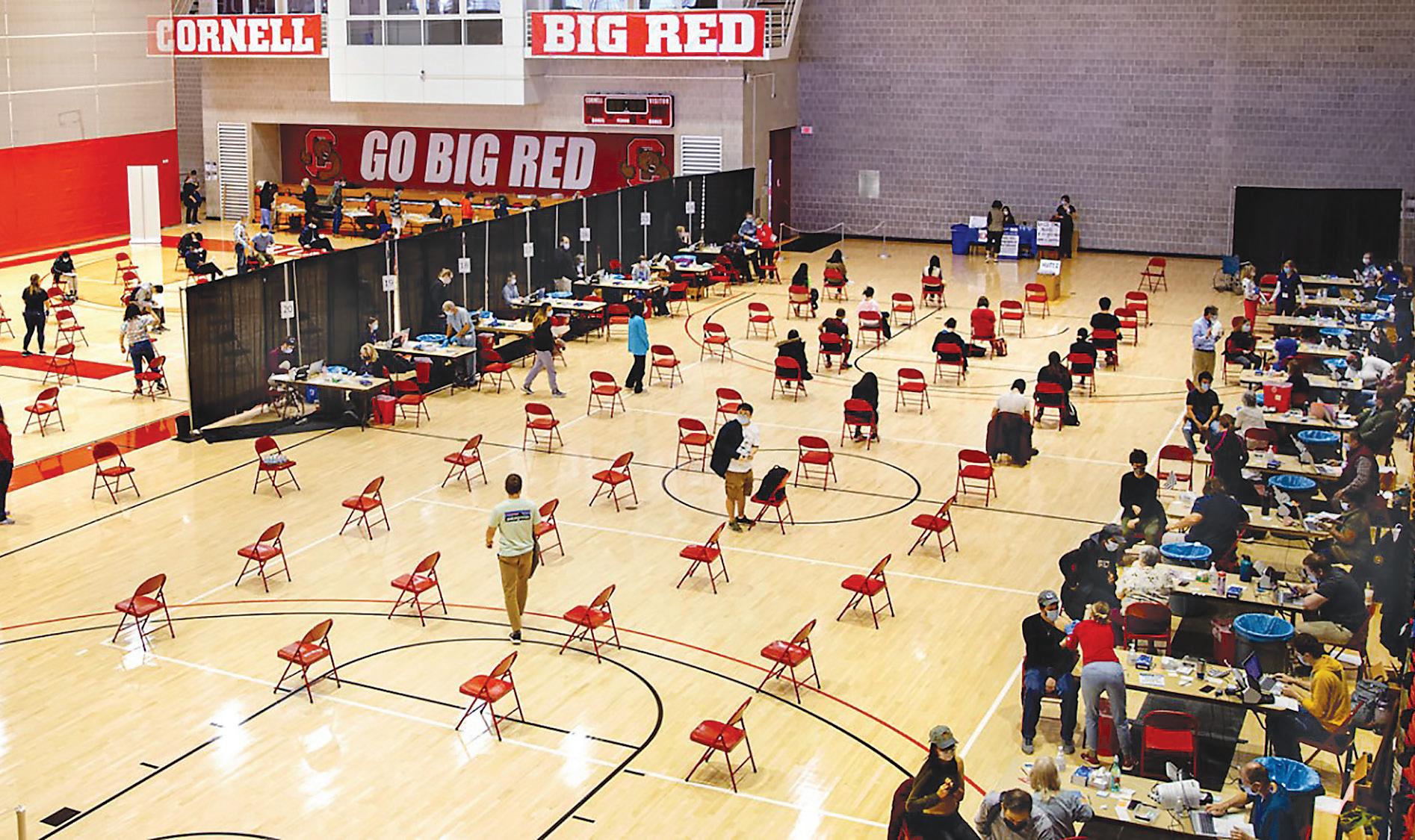
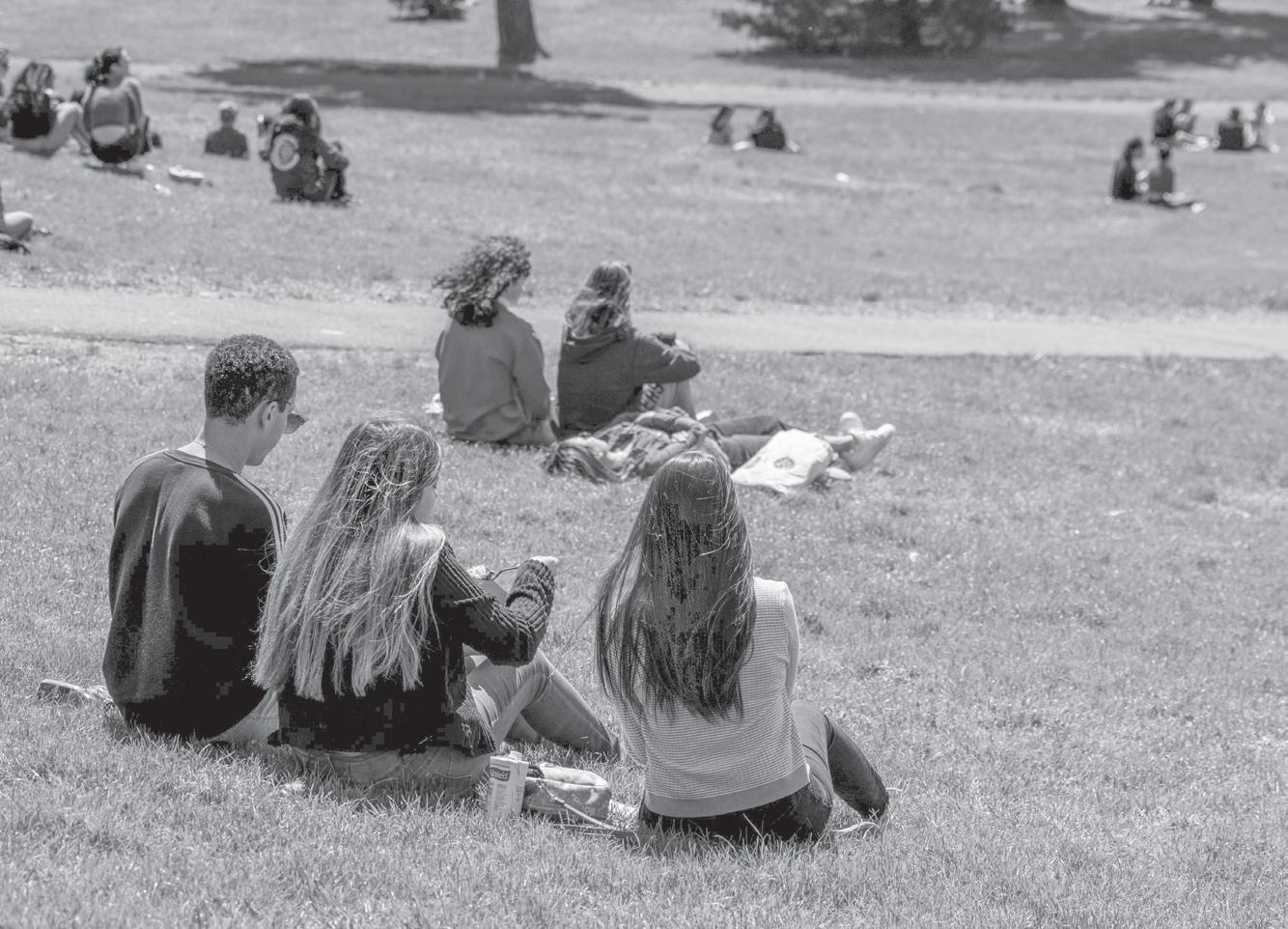
When Kristinko Mato ’24 goes on runs around Beebe Lake, he is no longer required to wear his mask. Jade Ovadia ’21 can avoid a mask tan when she gathers with her friends on Libe Slope. These are just some of the privileges that Mato and Ovadia have been granted as fully vaccinated students on Cornell’s campus.
As more than half of the on-campus population has completed their doses and waited two weeks to reach full immunity, some students said they’re excited for more opportunities to gather in-person. But others said they worried about unknown vaccination
statuses, as around 40 percent of campus still isn’t fully vaccinated, according to Cornell’s COVID tracking dashboard.
According to the University’s new guidelines announced May 3, those who are fully vaccinated no longer need to wear masks when they gather outdoors with 10 or fewer people. Student organizations can also hold masked gatherings of up to 30 people with both unvaccinated and vaccinated students.
The announcement came a week after the Centers for Disease Control and Prevention updated its mask wearing guidelines for fully-vaccinated individuals.
Ella Yitzhaki ’24, who will be fully
By VEE CIPPERMAN and JOHN YOON Sun News Editor and Sun City Editor
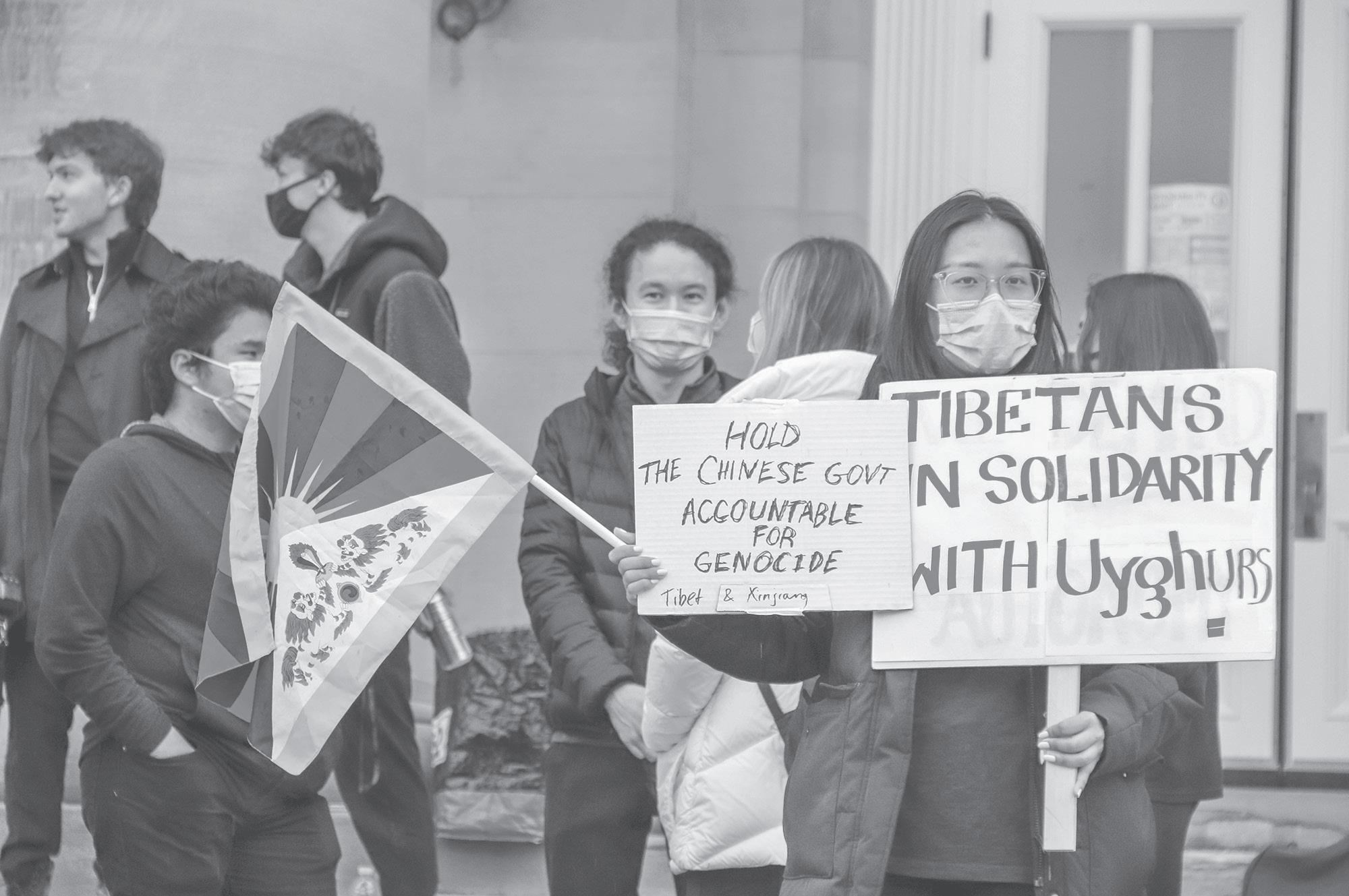
Aiming to spread awareness on the genocide of the Uighur people, Cornell students formed the student organization Boycott the People’s Republic and hosted a rally Friday outside Goldwin Smith Hall.
Organizers
Arab Student Association, Pi Lambda Sigma, Phi Alpha Delta and the Society for the Promotion of East Asian Liberty.
The Boycott the People’s Republic organizers and their guest presenters gave speeches about why the Cornell community must take action.
encouraged the crowd to sing “Do You Hear the People Sing?” from Les Misérables, a defining song of the 2019 Hong Kong movement.
“You don’t want to be complicit or complacent by spending your money on a good that was made with forced labor.”
Jonathan Davydov ’21 and Cooper Stepke ’23 are advocating for a boycott of Chinese-produced goods to protest the forced labor inflicted on Uighurs by the Chinese Communist Party. To gain support for their cause, they created a pledge to join the boycott and hosted the rally, co-sponsored by Cornell MECA, the
Jonathan Davydov ’21
Kinen Kao ’22, a Society for the Promotion of East Asian Liberty officer, and Basirat Owe ’21, a co-chair of Black Students United, spoke along with Davydov and Stepke. Owe started her speech with a two-minute silence to honor the Uighur peoples’ suffering. She then
Owe encouraged those at the protest to recognize their own agency and autonomy, and to take seriously the power they have through educating others, speaking out and making ethical consumer choices, reinforcing the message of the Boycott the People’s Republic organizers.
Both organizers denounced the rising antiAsian violence in the United States — changing their organization’s name from “Boycott China Now” to “Boycott the People’s
By MADELINE ROSENBERG Sun Managing Editor
MICHELLE ZHIQING YANG / SUN STAFF PHOTOGRAPHER
The campus reels after the second unexpected student death in the past month.
The Curation of Dress, Diversity, Equity and Inclusion 1:30 p.m. - 2:30 p.m., Virtual Event
Biophysics Colloquium: Jane Wang 4 p.m., Virtual Event
Oil-Gotten Gain: Petrodollars, Abscam and Arab American Activism, 1973-1981, by Salim Yaqub 4:30 p.m., Virtual Event
Enterprise Engineering Colloquium: Mark Brozina ’80: Everything’s Big in Texas — What Really Happened to Their Grid in February 5 p.m., Virtual Event
Sharing Diverse Experiences in Nutrition: A Near-Peer Panel Discussion 5 p.m. - 6 p.m., Virtual Event
Education and Politics: Setting the Stage for the 2021 Elections and Legislation 7 p.m., Virtual Event
Vaccinated Students Unmask
VACCINES
Continued from page 1
vaccinated on May 18, said she believes students will take these new guidelines and their benefits as a sign to get vaccinated. But Yitzhaki said that because she doesn’t know the vaccination status of others, she doesn’t want to risk spreading the virus to them.
Ecology and Evolution of Infectious Diseases Journal Club 1:30 a.m. - 2:30 a.m., Virtual Event
Configuring the Future in Vietnamese Francophone: Readings of Marguerite Duras, Pham Duy Khiem and Kim Lefèvre 12:30 p.m., Virtual Event
Fabricating Archives of African History 2:25 p.m. - 4:15 p.m., Virtual Event
Migrations Foum 4 p.m. - 5 p.m., Virtual Event
“At this point, I expect everyone to have the basic decency to wear a mask, even if they might be half vaccinated or fully vaccinated, just until a certain majority of the world feels safe,” Yitzhaki said. Fatima Al-Sammak ’24 received her second dose and is waiting her two weeks to be fully vaccinated. She said that the loosened restrictions on mask wearing outdoors is a reminder that campus is on the cusp of normalcy. “I know it’s not going to be perfectly
See COVID POLICY page 3
Seniors Say Goodbyes as Semester Winds Down
Class of 2021 fnishes Zoom classes, soaks up fnal weeks in Ithaca after two online terms
By KAYLA RIGGS Assistant News Editor
As the Class of 2021 exits their final Zoom classes and bids farewell to their favorite spots on campus, seniors are reflecting on an unusual last year while looking ahead to their next chapter –– one marked by increased competition for jobs and graduate school admissions as they soak up their final weeks on campus.
Two semesters of canceled events, online classes and limited social interaction have contributed to a senior year a world away from the one most graduating students had imagined when they first stepped foot on Cornell’s campus nearly four years ago.
Before the pandemic began, Sofie Wilson ’21 looked to her senior year as a time when she would be more free to explore Ithaca and Cornell.
“I was really waiting until my senior year because that's when I had time,” Wilson said. “And then COVID happened.”
Some, like Rachel George ’21, hardly spent any time on-campus at all this year — the possibility of a full final two semesters in Ithaca cut short by the pandemic. Returning to campus just two weeks ago, George found staying home while many of her peers decided to study in person to be socially challenging.
“There were times where people were on campus, and I would see my friends just being able to have a bit more freedom in Ithaca than they could have if they were at home,” George said. “And those times, I was like, ‘It would be nice to be able to step outside my house for more than just my CDC-mandated walk.’”
Maria Aono ’21, an international student from Japan who transferred to Cornell her junior year, spent only one semester on-campus without COVID restrictions — her college experience filled with transition after transition, from moving colleges to adjusting to Zoom University.
“There's just so many transitions, like being an international student but then also transferring and then transitioning to online classes,” Aono said. “You might be able to do it one at a time, but if it happens at the same time,
it’s just really hard and stressful.”
Course limitations added even more challenges for seniors who scrambled to fulfill requirements needed for graduation. Skyeler McQueen ’21, a German studies and math major, was among the seniors who found their course options restricted this academic year.
According to McQueen, the limited course offerings of the German studies department this year allowed very little room for choice — out of four classes that she hadn’t yet taken, only two fit into her schedule.
Along with balancing a social life with classes and extracurriculars, job recruitment has also been filled with hurdles, as seniors rush to find jobs in a world of virtual career fairs and high unemployment rates as businesses recover from pandemic-related layoffs and closures.
Cornell because I missed out on a lot.”
Wilson said while she will be attending Cornell College of Veterinary Medicine next fall, many of her peers struggled to find jobs. But the workforce wasn’t the only place that saw an increase in competition this year — according to Gabriel Vergara ’21, this year’s grad school application cycle was anything but easy.
Vergara noted that many universities, including Columbia, Brown and the University of Pennsylvania, did not accept graduate students in some fields for fall 2021 to make sure they can fund their current students, heightening application cycle stressors.
Still, many seniors are making sure they use the time they have left as Cornellians well –– and some are even planning on returning to campus next year to experience the events they missed due to COVID.
“Academically, I'm a first vet student at Cornell,” Wilson said, “but socially, in my mind, I'm a senior at
Students Protest Uighur Genocide
Republic Now” on May 6 after feedback from members of the AAPI community.
“This is not an anti-Chinese movement by any means, and we will not let our movement be associated with Sinophobia,” Stepke said in an interview before the rally.
Davydov explained that his family consists of Bukharan Jewish refugees from Uzbekistan, a Central Asian country in the same region from which the Uighur people originate.
He described Bukharan Jewish and Uighur people as belonging to “sister ethnicities,” a relationship that he said informs his investment in this issue. However, Davydov and Stepke said their movement should matter to anyone, regardless of ethnic or religious background.
According to Davydov, he and Stepke launched the organization around the time of this year’s Passover, drawing on their
interests in activism and their Jewish heritage. Davydov recalled seeing a picture of Holocaust survivors in a Seder book and connecting their past struggle to that of the Uighur people now.
“You don’t want to be complicit or complacent by spending your money on a good that was made with forced labor,” Davydov said.
According to Davydov, he and Stepke have also worked to establish connections and spread awareness by speaking at Ithaca area unions, religious centers and other community-based organizations.
“This movement is open to anyone with a conscience,” Stepke said. “It’s not about what you’re interested in. It’s not about your political history or your activism. It’s more about standing up against a genocide.”
John Yoon can be reached at johnyoon@cornellsun.com. Olivia Cipperman can be reached at ocipperman@cornellsun.com
When George returned to Ithaca, she jumped to check off her bucket list before graduation, looking forward to watching the sunset at Stewart Park and taking a hike along Taughannock Falls trails.
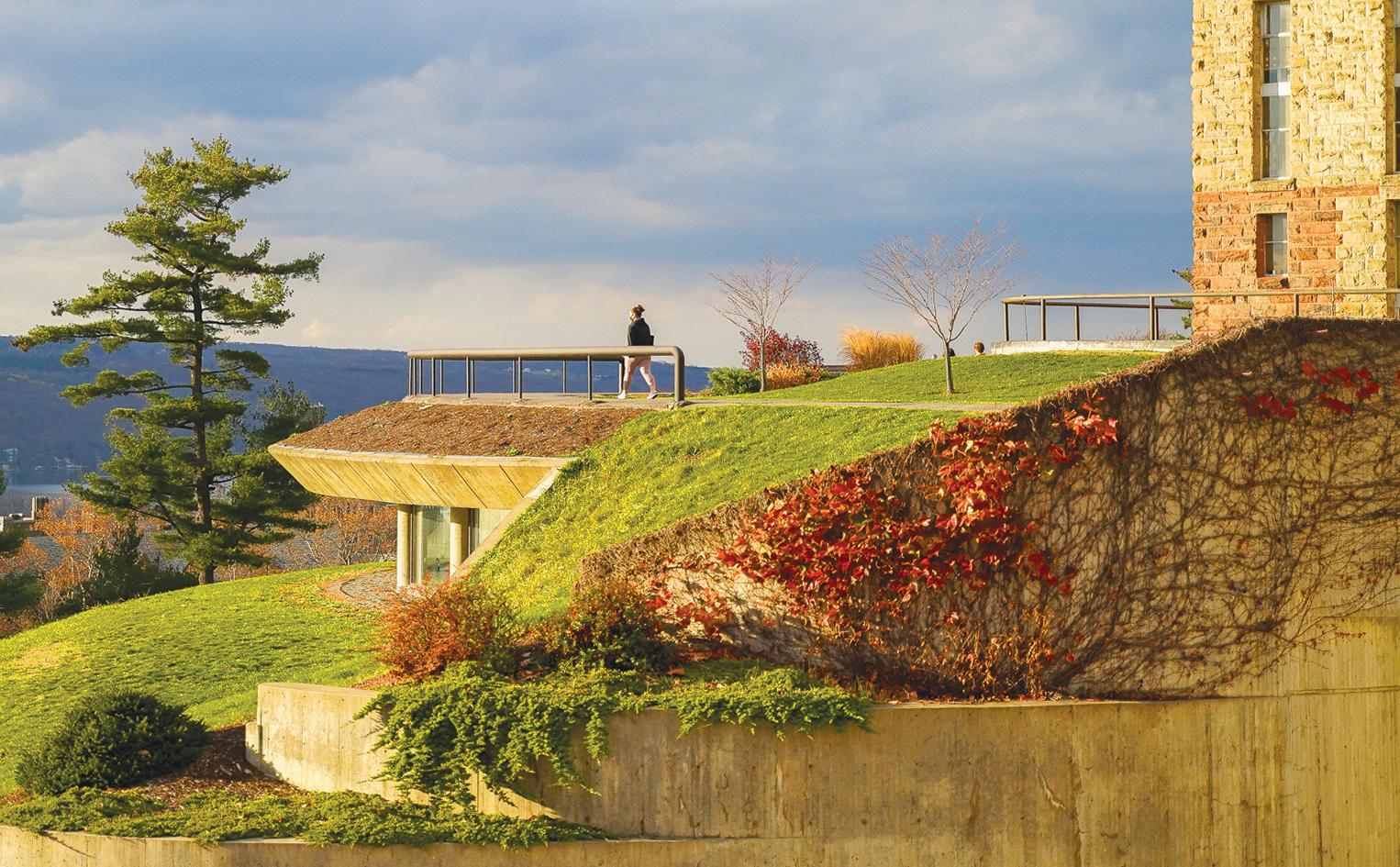
With commencement ceremonies less than a month away, graduating seniors are scrambling to take cap-andgown pictures, watch their final slope sunsets and make last-minute treks to central campus.
As seniors prepare to say goodbye, for some it is not Cornell’s campus, but the people, that they’ll miss the most.
“I've made such wonderful friendships here,” Vergara said. “Leaving those people I see every single day that I love and care about and who are brilliant and have such wonderful interests … I think that’s probably what I'm going to miss the most.”
Kayla Riggs can be reached at kriggs@cornellsun.com.
Vaccinated Students Adapt
As policies loosen, students have mixed feelings
COVID POLICY
Continued from page 2
normal until maybe the fall, but I want to feel like this is ending,” Al-Sammak said. “I want to feel like we’re going toward something that resembles normalcy.”
Al-Sammak isn’t the only one enjoying the changes that the new policies allow. When Mato and his friend went for a run around Beebe Lake, they were able to take off their masks.
“It felt weird because it’s a very minor thing and it doesn’t bother me much at this point, but it definitely felt nice,” Mato said. “Around Beebe the flowers smelled nice, I had missed this experience.”
The increased gathering capacity guidelines for student organizations also come as a relief for clubs and organizations centered around in-person events, providing hope for more in-person activities in the fall.
joy [and] so much pride in being a Cornellian, because it shows this resilience that we can survive anything,” Ovadia said.
But some students said they worried that these guidelines didn’t allow them to check that those they interact with are vaccinated.
Kate Slinchenkova ’22, who has been fully vaccinated for over a month, said though loosening restrictions for in-person gatherings may support students’ mental health, she is concerned about the risk of unvaccinated individuals being exposed to the virus.
“I want to feel like we’re going toward something that resembles normalcy.”
Fatima Al-Sammak ’24
Ovadia has been fully vaccinated since mid-April and is co-president of the Willard Straight Hall Student Union Board. She said that she is looking forward to continuing in-person Cornell traditions like Club Fest and the annual Willard Straight Hall TGIF event in the fall semester.
“To be able to see one of my fellow Cornellians enjoying one of these events brings me so much
“Loosening guidelines is a nice beacon of hope, but I don’t think they’re really strong enough to give you a sense of freedom.” Slinchenkova said. For Mato, who recently became fully vaccinated, this progress feels reassuring as the University prepares for an in-person fall semester.
“It just reminds you that this collective effort of the entire community is really paying off. We cannot always see the direct impact with our own eyes but we can see it in the numbers,” Mato said. “It’s nice to see that we are coming together in this sense and wrapping up the semester as safely as possible.”
Jiwon Estee Yi can be reached at jyi@cornellsun.com.
Rally for change | Students rally Friday to raise awareness of the genocide of Uighur people.
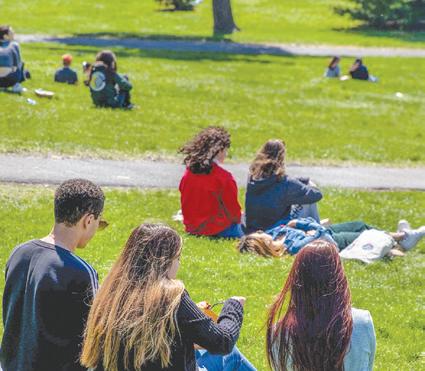
Slope days | Cornell students gather on Libe Slope. Seniors savor slope sunsets.
HANNAH ROSENBERG/SUN PHOTOGRAPHY EDITOR
ARTS ENTERTAINMENT &
Plein Air Painting and Refecting Constant Change
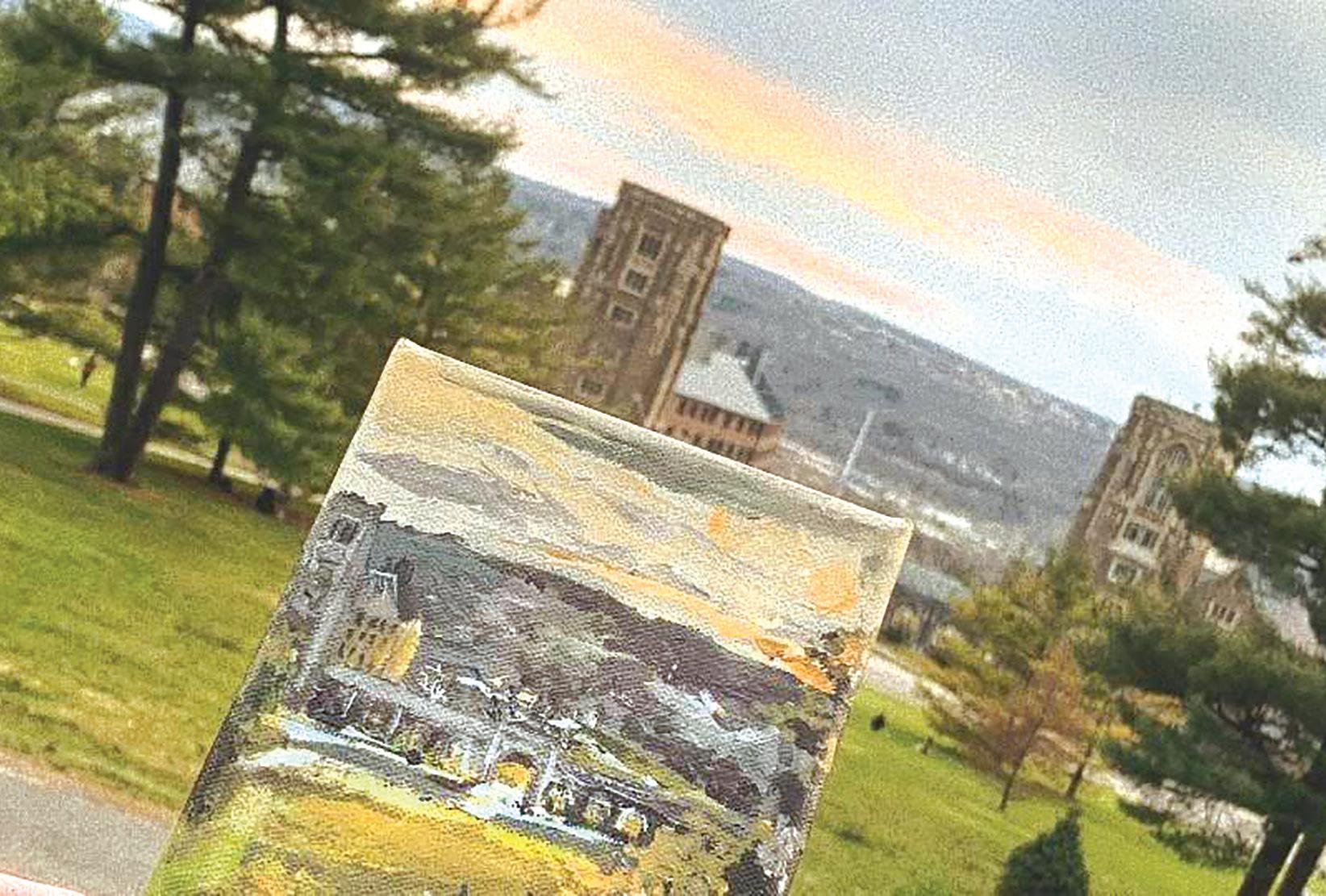
I doubt that any of us ever thought that living through dramatic historical events would feel like dissolution in slow motion, but here we are. Futures evaporate and reform by the day. We all have our ways of creating normalcy and, if not embracing constant change, at least looking it in the eyes. All I can do is offer one such way.
As I’m sure you do as well, about a hundred times a day I notice a moment of time that I would like to keep — damp blossoms on a branch after a brief morning drizzle, golden hour filling with voices and people sunning themselves on the Slope, a tree bending in the wind. Light and color never stay the same for long. Of course, we take pictures, thousands of them, until our phones prompt us to clear out some storage space or else. It’s what we do. We have magpie tendencies. But if you ever have a miraculous hour or so to yourself and even the slightest interest or ability to invest in a few paints and brushes, sit down somewhere, on a step or a bench, or in the wet grass. Spread your materials out around you. Mix your paints until they are reflections of the place and of you in it, and see if you can’t paint a moment as it happens to you.
Painting en plein air is an old way of breaking out of the so-called predetermined results of painting in a studio, the sort of thing famous old painters did in French gardens while wearing excellent
of thirty minutes, if you will. You’ll have to work quickly, far more quickly than if you were painting from a photograph or from still life, but there is something about plein air that will capture not just
hats. But you can make it whatever you like. Consider it an exercise in presence. The clouds will not wait for you, and neither will the sun. I wouldn’t fight with them or try to fix them into place, because they’ll always win, and the trick is rather to fill paper or canvas with a series of closely related moments. A sky
what you see in that moment of time but also how it felt to experience it. You may see at last that shadows are often blue, and there are so many springtime greens that they elude capture.
The longer you sit, the more the world will change around you.
Eventually you will be faced with
a second decision perhaps even more important than the choice of time and place, and that is when to stop. You could sit there forever and keep at it until you’ve painted a building or a tree many times over, but forces will seem at work to keep you from sitting too long in one place anyway — the sun will get in your eyes, your fingers will stiffen from the cold or a cloud of gnats will decide to host their family gathering right above your head. Try as you might, you will never truly be able to capture a moment, for it will already have passed by the time you sit down to try. The point is not the capturing, but the following. Follow a strand of light or a leaf for as long as it takes to know it.
The result might seem less than accurate, but while I am no art student, it seems to me that accuracy is not the purpose of art anyway, nor are the materials, necessarily. If you want, try it with a pencil and paper. Try it enough times and you will see possible paintings or drawings everywhere—the world will not pause long enough for us to preserve them all, but I find the recognition comforting.
Inconstancy is constant. Defy it, give it form and sign your name in the corner.
Charlee Mandy is a sophomore in the College of Arts and Sciences. She can be reached at crm299@cornell.edu.
Carolyn Forché Reads From Her Work For Zalaznick Reading Series
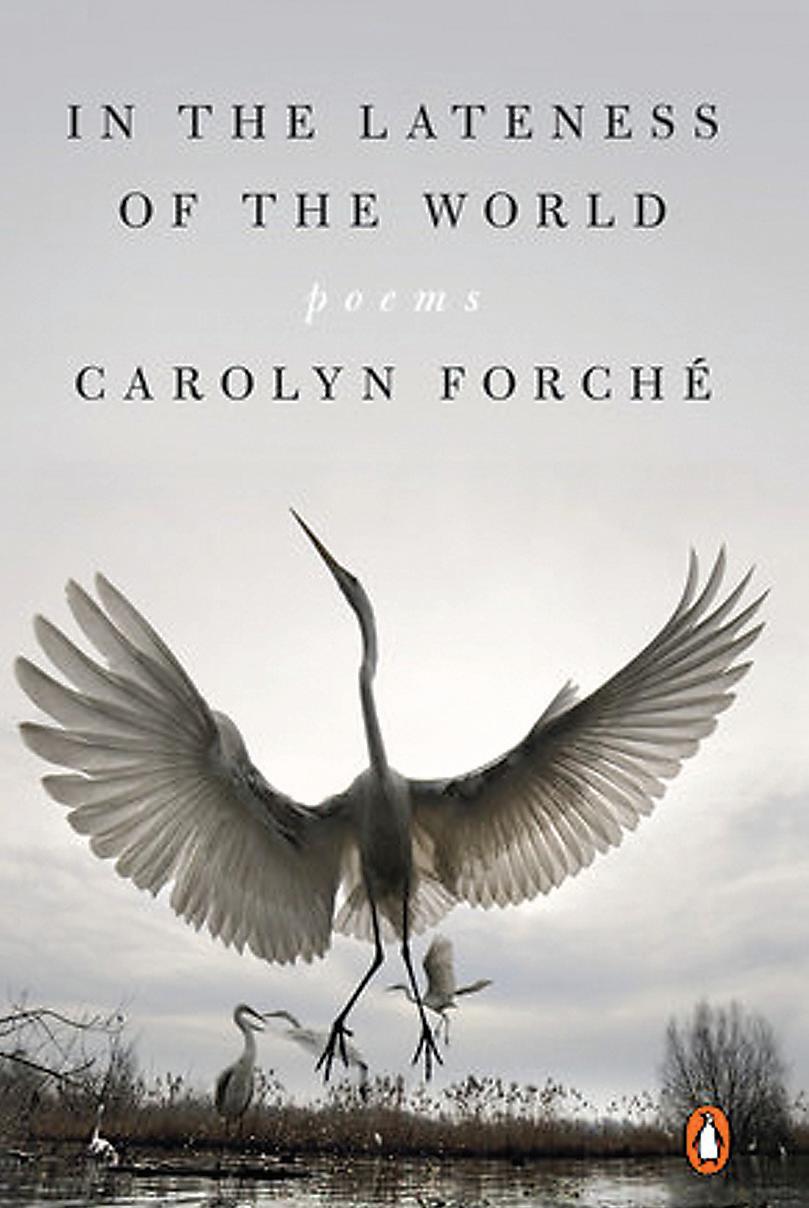
On April 29, renowned poet and memoirist Carolyn Forché read for the final event of the Spring 2021 Barbara and David Zalaznick Reading Series: Together. The readings were from What You Have Heard Is True, a 2019 memoir on her experiences in El Salvador, her 2020 collection In the Lateness of the World and an excerpt from a work in progress.
Known for coining the term “poetry of witness,” Forché has received numerous awards for her poetry and human rights advocacy. Her first book, Gathering the Tribes, won the Yale Series of Younger Poets Prize. However, it was her experience witnessing the outset of the Salvadoran civil war that inspired her next volume in 1981, The Country Between Us, and set her apart from less “political” peers.
Over 80 attendees tuned in to watch the livestream. Prof. Ishion Hutchinson, Department of Literatures in English, introduced the Zalaznick Reading Series. Prof. Valzhyna Mort, from the same department, introduced Forché herself.
Forché began by reading “Museum of Stones,” which she described as an invocation poem. It
was followed by a brief documentary-style segment from Penguin Press, produced and edited by Sean Mattison, which included a previous interview where Forché described her trip to El Salvador with activist Leonel Gómez Vides, which she only recently chronicled in her memoir, What You Have Heard Is True
This is what she read from next, as Forché described in visceral detail the scale and depth of human suffering that she witnessed in El Salvador. She told of a deserted village, a man who has been decapitated and dismembered, and a hospital ward sheltering emaciated workers. I was struck by the descriptions of limbs strewn across the ground, a woman with bed sores that must be treated with peroxide and maggots — suddenly aware that these were not faraway events, that I was in the presence of someone who had seen these very things.
Another excerpt told of the treacherous gorge El Imposible, and a moment of unexpected beauty in the night, followed by a frenzied litany of deteriorating conditions in pre-war El Salvador, which Forché discovered in her own notebook. It ends with the chilling line: “No one wants to eat the fish from Lake Ilopango anymore. The fish have been eating the dead.”
Next was the sixth excerpt, featuring an encounter with the famous archbishop Oscar Romero — sometimes called Monseñor Romero — who was assassinated after speaking out against government-sanctioned violence. Only later would Forché understand that “here the dead and the living were together, and those who stood alive before him, he was blessing in advance.”
Returning to poems once more, Forché read “The Boatman,” which tells of a refugee from Homs, Syria, and other poems In the Lateness of the World. For Prof. Mort, Forché then revealed a prose piece for a new book she is working on, focusing on Belarus, Ukraine, and refugees moving into “alienation zones” surrounding Chernobyl.
Moving into the Q&A, Prof. Mort asked about the relationship between the poetic The Country Between Us,which both Gómez Vides and Romero asked her to write, and the prose memoir What You Have Heard Is True
Forché responded that the poems were written very “immediately near” to the events she’d experienced, and that she needed a more “capacious” place for which prose allowed her to better convey the necessary detail while also capturing the full story. While she delayed writing out of a fear of reliving some experiences, the pub-
lication of What You Have Heard Is True felt ultimately freeing.
Though there was little time left for questions, I was lucky to have mine relayed to Forché by Prof. Mort, in combination with another, similar question. Mine was: “You touched on this in your last poem, but you’ve often addressed urgent political and humanitarian issues in your work. Would you say that
there are any unique limitations or advantages to writing as a means of documenting these issues?”
In response to this, Forché contrasted the documentation of events by a journalist, also in writing, with the task of a poet or literary writer. For the latter, she said that “It’s not informa-
tion you’re after” but “something deeper… something that can reach the human soul,” which allows people to “imaginatively experience” your subject.
Following the Q&A, Forché ended the reading with a final poem. Also from In the Lateness of the World, I was surprised to learn that “What Comes” came to her while she was in chemotherapy. The poem served as a poignant conclusion to both the collection and this event: a meditation on the nature of death and acceptance in the face of uncertainty.
Having reviewed In the Lateness of the World for an earlier article, I’d still been unsure of what to expect from this event — and even, I confess, a little intimidated by Forché’s reputation. But I realize now that my nerves were unwarranted. From the genuine emotion that pervaded her reading to her well-considered answers to our questions, I believe that Forché deserves her reputation as a humanitarian poet. She gave every impression of a person who has witnessed horrors, had time to reflect on them deeply, and emerged irrevocably changed.
Amy Wang is a freshman in the College of Arts and Sciences. She can be reached at saw289@cornell.edu.
CHARLEE MANDY / SUN CONTRIBUTOR
CHARLEE MANDY SUN CONTRIBUTOR
AMY WANG SUN CONTRIBUTOR
139th Editorial Board
KATHRYN STAMM ’22 Editor in Chief
ANUSHYA ALANDUR ’23
Business Manager
CATHERINE ST. HILAIRE ’22
Associate Editor
PRANAV KENGERI ’24
Advertising Manager
ODEYA ROSENBAND ’22
Opinion Editor
JYOTHSNA BOLLEDULA ’24
News Editor
TAMARA KAMIS ’22
News Editor
WENDY WANG ’24
Arts & Entertainment Editor
KRISTEN D’SOUZA ’24
Design Editor
HANNAH ROSENBERG ’23
Photography Editor
OMSALAMA AYOUB ’22
Science Editor
PUJA OAK ’24
Layout Editor
ANNIE WU ’22
Production Editor
KATHERINE WANG ’24
Assistant Business Manager
MIHIKA BADJATE ’23
Assistant News Editor
ANGELA BUNAY ’24
Assistant News Editor
JOHN COLIE ’23
Assistant Arts & Entertainment Editor
AMELIA CLUTE ’22
Assistant Dining Editor
WILLIAM BODENMAN ’23
Assistant Sports Editor
AARON SNYDER ’23
Assistant Sports Editor
MEGHANA SRIVASTAVA ’23
Compet Manager
MADELINE ROSENBERG ’23
Editor
NAOMI KOH ’23
Editor ANIL OZA ’22
Editor YUBIN HEO ’24
OLIVIA CIPPERMAN ’23
NOOREJEHAN UMAR ’23
YOON ’23
BENJAMIN VELANI ’22
PICHINI ’22
SRISHTI TYAGI ’22
MENDOZA ’24
Editor
ARANDA ’23
Editor
WANG ’24
SURITA BASU ’23
KAYLA RIGGS ’24
LEYNSE ’23
JULIA NAGEL ’24
’24
ABAYEVA ’24
ALPERS ’22
desker Catherine St. Hilaire ’22
deskers Nooroo Umar ’23
Mihika Badjate ’23
desker Sabrina Xie ’21 Ben Mayer ’21
deskers Kristen D’Souza ’24 Puja Oak ’24 photo desker Julia Nagel ’24 arts deskers Emma Leynse ’23
Tom the Dancing Bug
John Colie ’23
by Ruben Bolling
Roei Dery Te Dery Bar
Roei Dery is a sophomore in the College of Arts and Sciences. He can be reached at rdery@cornellsun.com. Te Dery Bar runs every other Monday this semester.
Social Media and the Next Generation’s Professor
My friend was ecstatic when he thought he found his professor’s profile on Snapchat. We’d soon learn that the discovery was too good to be true; the account was not the professor’s, who quickly disappointed inquisitive students in a Piazza post. The greater irony is that as students, our communication with professors outside the classroom is indeed limited to Piazza, aside from email and now Zoom. However, as younger generations increasingly link themselves to the social media phenomenon, it begs the question how much longer this “distance” between professors and students will remain.
I have experienced the effects of social media on the instructor-student dynamic since high school. There, club members joked with my debate coach about being added as Snapchat friends after graduation. Evidently, this running joke from high school seems to have found its way into college, too. Even so, the barrier between the personal lives of professors and students is greater now than it was in high school. Google search your Cornell professors and you will likely find their University web page, and maybe some of their research. Consequently, we students view most of our academic superiors either through their lecture presence or their internet-published accomplishments -- often in the field that they teach. A social barrier thus exists between student and professor. On the one hand, it produces a sense of respect for professors who we consequently associate with their mastery of our fields of interest. By the same token, the barrier has also mystified the person behind the title of professor.
As younger generations rise to these same positions of influence, the script is beginning to change. Already, my friends have taken courses — generally with younger professors — where the instructor explicitly and repeatedly asks to be addressed by their first name. Other professors address students with “Mr.” and “Ms.” -- essentially elevating the students to their level. But, deconstructing the social barrier between student and instructor will occur in more ways than this. It’s only natural that today’s digitally connected student body will turn into tomorrow’s digitally connected cohort of instructors. Time will tell to what extent the rise of social media will bleed into the professor’s end of the classroom.
For the time being, we’re left to enjoy the occasional story of a classmate finding their T.A. on Tinder. And though the lower age gap between student and T.A. makes such discoveries less shocking than if they involved a professor, we appear to not be far from that reality. Today’s generation of students is in the midst of leaving behind a sizable digital footprint. At a time when we can each be traced back to anything from casual podcast conversations to Reddit threads, it’s almost inevitable that students will peer into the past personal lives of future professors. For one, today’s social
media presence will pay off in making our generation’s professionals more relatable to the next generation’s students. Listening to a professor’s podcast from their college days, for example, immediately gives them a causal dimension beyond their formal lecture presence.
But, the implications extend beyond what future students will be able to see about their professors’ pasts. Potentially more impactful is each party being active on these platforms at the same time. Professors joining their students as fellow social media users and vice versa means that each party will always be a click away from learning personal elements about the other that they otherwise wouldn’t have known. Naturally, this possibility raises potential for the deterioration of classroom ethics. I recall a friend telling me that it’s not uncommon for him to connect with his professors on LinkedIn after taking their classes. Fast-forwarding to a world where future students can connect with their instructors using less formal social media sites like Instagram and Snapchat, it begs the question of whether the current “distance” between professor and student is what in part holds together the integrity of our education. Social media like Instagram and Snapchat offer a less professional atmosphere than does LinkedIn or even Facebook, meaning that the chance for future students and professors connecting outside the classroom in non-professional contexts becomes evermore likely.
This concern transcends the “pause
It’s only natural that today’s digitally connected student body will turn into tomorrow’s digitally connected cohort of instructors.
before you post” trope when navigating the internet. It warns us to maintain a healthy distance from the personal lives of our colleagues, whether they are our superiors or otherwise. Yet, it also paves alternate routes to learn about the person behind the professional. Today, obtaining the cellphone number of a professor, as an example, is an obvious sign of a tightly-knit relationship with them. That threshold is naturally going to increase as both parties begin to use increasingly intimate methods of communication through social media. Although we’re still far from Snapchatting a professor about a problem set, we still must be careful. We cannot let the spread of social media outpace our self-restraint in interacting with the digital presence of future generations.
Create a New Cornell
Aminah Taariq-Sidibe I Spy
Aminah Taariq-Sidibe is graduating from the College of Agriculture and Life Sciences. She can be reached at ataariq@cornellsun.com. Tis is the last installment of her column I Spy.
When we think of a rock, we tend to think of something solid, strong and well formed. Yes, rocks come in many shapes, sizes and colors, but a rock is a rock… right? It can be touched, examined and identifed.
When I picked up a rock, I used to not think about where it came from, only the potential for where it can go.
... joining The Cornell Daily Sun and shining light on the sentiments of the Black community in my column ... I learned that it was not my job to solve the major injustices present at institutions like this one, it was only my job to make a difference.
Emma Harte Guest Room
Emma Harte is a junior in the College of Arts & Sciences. Comments can be sent to opinion@cornellsun.com. Guest Room runs periodically throughout the semester.
Every year, birdsong and fower buds mark the arrival of warm temperatures in Ithaca. While these signs of spring may feel reassuringly constant, they are occurring earlier each year due to climate change. Birds shift their migration timeline and fowers bloom closer and closer to the winter months. As a hub for climate and ecology research, Cornell is home to many scientists studying the efects of climate change on ecosystems.
While researchers analyze climate impacts in the lab, they generate enormous amounts of plastic waste. Scientists from the University of Exeter estimated that in 2014, biological, medical and agricultural research labs used 5.5 million tons of plastic. Tis is equivalent to 83 percent of plastic recycled worldwide in
I considered the rock only as it was in the present neglecting the hundreds of millions of years it took to reach this form and the form it will take on when another hundreds of millions of years pass.
When I frst entered Cornell through the Prefreshman Summer Program, I thought I was a pretty solid rock. In the same way a piece of sediment may consider itself a boulder, or a boulder may consider itself to be a mountain.
By the beginning of my Fall semester, I realized that I was still a small formation of organic matter,unable to size up the solid giants that roam this campus. I wondered if I would ever be strong enough to shatter the glass ceiling and attain the successes that were expected of me. In order to reach that goal, I had to be willing to push far past my limits and achieve as much as I could, otherwise I would never make it.
My journey was tumultuous,peppered with wins, losses and the constant feeling of having to do more because what I could ofer wasn’t good enough. I allowed my experience and this institution to shape me: weathering, melting, cooling, compacting and distorting. Breaking me down and building me back up again. Sure, pressure can make a diamond (given the right starting materials), but it can also burst a pipe.
Te most precious rock I was blessed with at Cornell was a community, and without them holding me down I may have burst. I found a community where I felt I belonged, that could serve as the wind, water, ice and fre to help shape me within the greater atmosphere of Cornell. It was this community that helped me realize that change isn’t one-sided. If just one rock can change its environment, a whole bunch of rocks can enact an even bigger change.
Tis fueled me to push far past my limits and achieve things that were beyond my expectation. By entering new spaces and taking action, I could change Cornell as much as it was changing me. For example, joining Te Cornell Daily Sun and shining light on the sentiments of the Black community in my column I Spy. I learned that it was not my job to solve the major injustices present at institutions like this one, it was only my job to make a diference. It is hard not being able to see the tangible impacts of our work, but sometimes we don’t see the fruits of our eforts until much later. Even the smallest decisions can make a grand impact, especially when you are not making that decision alone.
Although it is hard to conceptualize what an equitable and inclusive institution may look like, that doesn’t make it impossible. During the 156 years since Cornell University
When I first entered Cornell through the Prefreshman Summer Program, I thought I was a pretty solid rock. In the same way a piece of sediment may consider itself a boulder, or a boulder may consider itself to be a mountain.
was founded, the University has made revolutionary decisions to admit female and underrepresented minority students, establish multicultural organizations and academic programs and advance workforce diversity. But many of these changes have been ignited by students, like the 1969 Willard Straight Hall Takeover which led to the establishment of the Africana Studies & Research Center.
It is students who are the wind, water, ice and fre, shaping the school like a rock. Students shape this school by engaging in courses, extra-curricular activities and on-campus jobs. It is the school’s job to create an environment conducive to learning by creating an environment where students can apply what they learn.
In this upcoming academic year following the disruption of COVID-19, much of the student body will not be socialized by the pre-COVID cultures on campus. Tis is an opportunity to create a new one. We know more than we did before about making education more accessible and what issues are at the forefront of concerns for students (i.e. mental health, diversity and inclusion), and we should apply it.
I implore students to use their collective power to make Cornell a better experience for those coming after them,to use their imagination and make bold demands about necessary changes. I am so grateful for my growth during the four years I’ve spent at Cornell and the lessons I have learned. Everywhere we go we have the power to make a diference, no matter how big or how small.
Unsustainable Science
2012. Researchers use plastic because of its convenience. From petri dishes to pipette tips, many tools for biological research are made from plastic. Single-use materials ensure that experiments are free of contamination, and plastic implements are cheap enough to justify disposal after just one use. Most lab materials are autoclaved, or sterilized at high temperature and pressure, before being sent to a landfll.
Te throwaway culture of science has detrimental efects on the environment.
Te extraction of fossil fuels and the processing of these materials into plastics emits greenhouse gases. In addition to the carbon footprint of their production, plastics have direct impacts on ecosystems. Waste mismanagement and littering allow plastics to enter soil and waterways, where animals can ingest them and become sick. Even when disposed of properly, single-use products degrade into microplastics that can more easily enter ecosystems and contaminate drinking water.
Scientists can mitigate these environmental impacts by reducing their plastic use. Many materials used for biological experiments have metal, wood or glass alternatives. For example, researchers can replace plastic inoculation loops used for plating bacterial colonies with wooden sticks or metal loops. Glass is also an option. As prevalent as plastics are in research labs today, scientists relied on glassware before plastic was invented. Labs can reduce their overall consumption by using smaller containers for experimental materials when possible, buying chemicals in bulk and planning experiments to minimize use of consumables.
Research institutions such as Cornell must encourage scientists to make changes. Labs often purchase supplies from centralized stockrooms at their institution. At Cornell, the department of Chemistry and Chemical Biology operates a stockroom used by researchers across chemistry and the life sciences. To reduce packaging, stockrooms can ofer common materials such as pipette tips in bulk. Institutions can also nudge researchers towards more sustainable options. At the Vienna BioCenter, glass pipettes are free to scientists and supplied at locations closer to research labs than are plastic pipettes.
Reusing materials also lowers consumption. Alternatives such as glass can be more costly and harmful to the environment than plastic when used only once. Researchers at the University of Edinburgh have developed a method of decontaminating plastics with chemical treatment and autoclaving. Te lab equipment manufacturer Grenova also makes a pipette tip washer that can be tuned to diferent standards of cleanliness. While sterile materials are crucial for some experimental methods, such as tissue culture, reusing implements may be more acceptable in teaching labs or when performing protocols that are less sensitive to contamination.
Why have few labs adopted more sustainable practices? Reusing experimental materials takes time and money. Scientists who are busy with their research may be unable to wash the bags of plastic waste that they generate each day. In the age of glassware, some labs hired dishwashers to maintain their operations; however, paid help is costly. Furthermore, the water and heat
needed to autoclave materials for reuse can lead to an expensive utilities bill. Tough it is unclear how the cost of washing and reusing lab implements compares to simply buying replacements, it is no question that washing instruments demands time. Without institutional support, researchers have little incentive to reuse plastic materials when it is easier to simply throw them away and open up a new package.
To encourage sustainability, research institutions can make reusing lab materials an attractive option. Scientists at the University of Edinburgh created a centralized decontamination system to sterilize materials and return them to labs for reuse. When reusing materials is more expensive than replacing them, institutions or grant agencies could provide funding for sustainable science.
Universities such as Cornell must consider lab waste when taking institutional action to promote sustainability. While students faithfully lug reusable takeout containers to dining halls and replenish their water at bottle refll stations, labs on campus continue to churn out plastic waste. As reducing and reusing have a more positive environmental impact than recycling, research institutions should support labs in lowering their plastic consumption. Tey can even go so far as to ban plastics. Leeds University and University College London have pledged to eliminate all single-use plastics on campus by 2023 and 2024 respectively. Institutional action will be key in reaching these goals.
To continue reading this column, please visit cornellsun.com.
By
SC I ENCE
Maternal Struggles of the Animal Kingdom
While human mothers received elaborate bouquets or harried text messages for Mother’s Day, the other mothers of the animal kingdom dealt with the threat of predators and scrounged for food to feed their young.
To shed light on these mothers across the tree of life, The Sun spoke with Cornell professors who offered a glimpse into the lives of animal mothers.
Stegodyphus
While it’s customary for human mothers to be treated to breakfast in bed or a fancy dinner, spider moms in the genus Stegodyphus become food for their children.
For the first few weeks after her eggs hatch, a mother regurgitates food for her spiderlings before being eaten alive herself, according to Prof. Michael Webster, neurobiology and behavior.
“When the young hatch, she will secrete this really nutritious stuff [from] her joints, and the young feed on that,” Webster said. “But then as they get bigger, they start to actually consume the mother herself. They’ll eat her legs, and by the time they’re
all grown and ready for independence, she’s dead, and she’s sacrificed her entire life for her offspring.”
This maternal sacrifice, which may seem strange to humans, is an evolutionary tactic to better the odds of the spiderlings’ survival, according to Prof. Linda Rayor, entomology.
“It provides a really massive amount of prey to the youngsters that they’re able to eat for a while. And it gives them a head start in life,” Rayor said.
Polar Bears
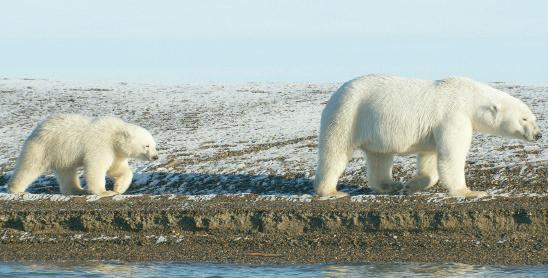
In the harsh and unforgiving Arctic, polar bear mothers go months without food and put off birth to provide the safest conditions for their newly born cubs. To ensure that their young enter the world in survivable conditions, polar bear mothers can “schedule” birthing by pausing their embryo’s development for four months after the spring mating period.
This four-month pause also allows mothers to pack on hundreds of pounds to prepare for birth and raising their pups. They spend the winter in dens, where they give birth and protect their helpless cubs from the harsh cold.
During this period, mothers stop eating, drinking, urinating and defecating to conserve energy for making milk for their cubs.
Come springtime, mothers emerge from their dens and eat their first meals in almost six months. A polar bear mom will use the next 2.5 to three years to teach her cubs to hunt and fend for themselves, all the while vigilantly protecting them from predators like wolves and adult male polar bears.
Emperor Penguins
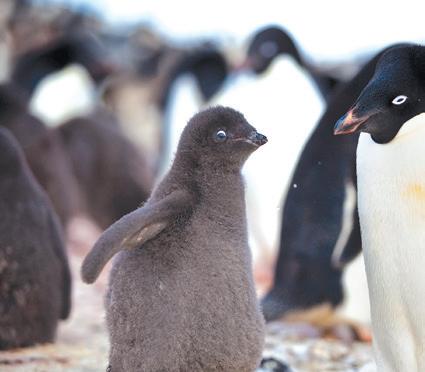
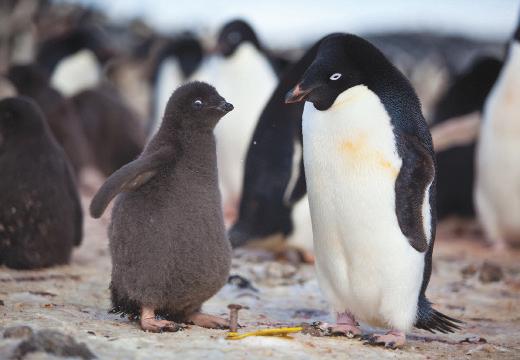
For the emperor penguin mother, finding dinner is no trip to the grocery store — she must journey for two straight months, avoid predators and trek up to 900 miles to find food for her young, according to Prof. John Fitzpatrick, ecology and evolutionary biology, executive director of the Cornell Lab of Ornithology.
Fitzpatrick explained that emperor penguins huddle together in massive colonies to maintain their heat against Arctic wind chills of minus 76 degrees Fahrenheit. After a mother penguin lays her egg and leaves it in the care of the father, she must venture out of the colony to forage for fish and store the fish “goop” in her belly.
Within a week of her egg hatching, the mother makes it back to the colony, identifies her mate among hundreds or thousands of other penguins and begins to regurgitate the food she stored to feed her new young, Fitzpatrick said.
Meanwhile, the father penguin has gone without eating for two months, so he hands off the baby penguin to the mother and makes the same voyage out to
gather food for his family.
“The female does these heroic trips and foraging ventures to provide the first round of food for the babies when she comes back,” Fitzpatrick said. “[The male and female] take turns doing that, to be able to raise these young.”
Hornbills
Instead of having to traverse land and sea, some mothers seclude themselves with their young to protect them.
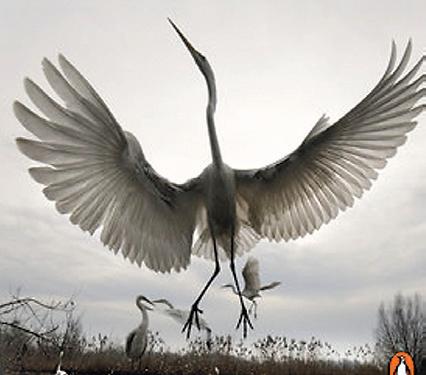
According to Webster, mothers in some species of hornbill form their nests in tree hollows — cavities in tree trunks. Upon entering the hollow, the female bird works with the male to seal the cavity with mud, drying into a cement-like wall with only a tiny slit opening to the outside world. This cement can keep out predators, while also guarding the cavity from being taken over by other birds, Webster explained.
The female — fully enclosed within the cavity — lays her
eggs and stays in the enclosure until her young hatch, grow up and are ready to leave the nest, Webster said.
“The female is in there for weeks and weeks with the young. She loses all her wing feathers because she doesn’t need to fly, because she’s trapped,” Webster said. “The male brings food and passes it to her through a little slit for weeks. That’s pretty extreme maternal devotion, I would say.” Fitzpatrick said that while people don’t normally appreciate the dramatic lives of animal mothers, a diversity of animal life lies at the heart of a healthy climate, sustainable ecosystem and a thriving, interesting planet.
“Why should we care? Because the world is so interesting with them,” Fitzpatrick said. “It would be so incredibly boring without them.”
Srishti Tyagi can be reached at styagi@cornellsun.com. David Dayan can be reached at ddayan@cornellsun.com.
Alumnus Appointed to Top NYC Environmental Position
By NATALIE MONTICELLO Sun Senior Staff Writer
Ben Furnas ’06 was appointed director of the New York Mayor’s Office of Climate and Sustainability — the organization responsible for reducing carbon emissions and physical waste by managing roadways, rethinking public transportation and optimizing the electrical grid.
“Our office is charged with working closely with other agencies, such as the Office of Climate Resiliency, to both fight climate change and improve quality of our air, the quality of our water, and correct inequities associated with [water quality, pollution and air quality],” Furnas said.
According to Furnas, New York City government operations use entirely renewable
energy and he hopes to extend that to power the five boroughs completely with renewable energy.
While Furnas said he hopes to stave off some of the effects of climate change in New York, he also aspires to create a model that other cities can follow.
“New York is a city of islands, so we are going to see many effects associated with climate change,” Furnas said. “From rising sea levels, increased heat, to increased precipitation, on some fundamental level you know New York needs to be doing its part to reduce human contribution to climate change.”
“If we can show the way that cities and people who live in cities can reduce [their] contributions to climate change, hopefully that can be replicated in communities all over
the world,” Furnas said. “[Sustainable living is a] big part of how we’re going to be reducing our greenhouse gas emissions and you know in fighting climate change.”
Furnas also said he believes that mitigating the effects of climate change is an opportunity
system aimed to serve more than 60,000 riders a day in Washington Heights.
Furnas began his career in local politics in 2013, when he worked on the 2013 Bill de Blasio campaign for mayor, and spearheaded a street safety agenda
“Sustainability is definitely in the bloodstream of folks who grew up in Ithaca. Along with thinking holistically about our impacts on the planet and also how to create a better future for our societies and communities.”
Ben
Furnas ’06
to address inequities in the city through environmental justice initiatives.
Furnas’ office, for example, worked on an initiative to develop a renewable energy bus
called Vision Zero.
Vision Zero was aimed to bring down the level of traffic fatalities and serious injuries associated with people making their way around New York. A significant
change that paid dividends was making the city more pleasant to walk and bike, in part by creating more bike lanes.
During the past year, the Mayor’s Office of Sustainability built more bike lanes than it had in any other year.
Before his time in New York, Furnas worked at the Center for American Progress, which sparked his interest in developing and implementing climate policy measures to benefit D.C..
Eventually, Furnas moved to New York City and attended law school at New York University, where his interest in city government grew.
According to Furnas, working in D.C. made him feel less connected to the effects of his climate action work, as he said he didn’t could not see the immediate impact of his work. This
disconnect fueled his decision to pivot towards city government, where he could experience the direct effects of policy making throughout the community.
While Furnas has lived in some of the country’s largest cities, he said he partially attributes his interest in sustainability and his environmental values to his upbringing in Ithaca, and his undergraduate government and economic professors.
“Sustainability is definitely in the bloodstream of folks who grew up in Ithaca,” he said. “Along with thinking holistically about our impacts on the planet and also how to create a better future for our societies and communities.”
Natalie Monticello can be reached at nmonticello@cornellsun.com.
SRISHTI TYAGI and DAVID DAYAN Sun Science Editor and Sun Saff Writer
ANDY ISAACSON / THE NEW YORK TIMES
Pregnancy pause | Polar bears are able to pause their pregnancy until conditions are safest for their young.
March of the penguins | Mother penguins spend two months foraging for food to feed their chicks.