The Corne¬ Daily Sun

By ANGELA BUNAY Sun Assistant News Editor
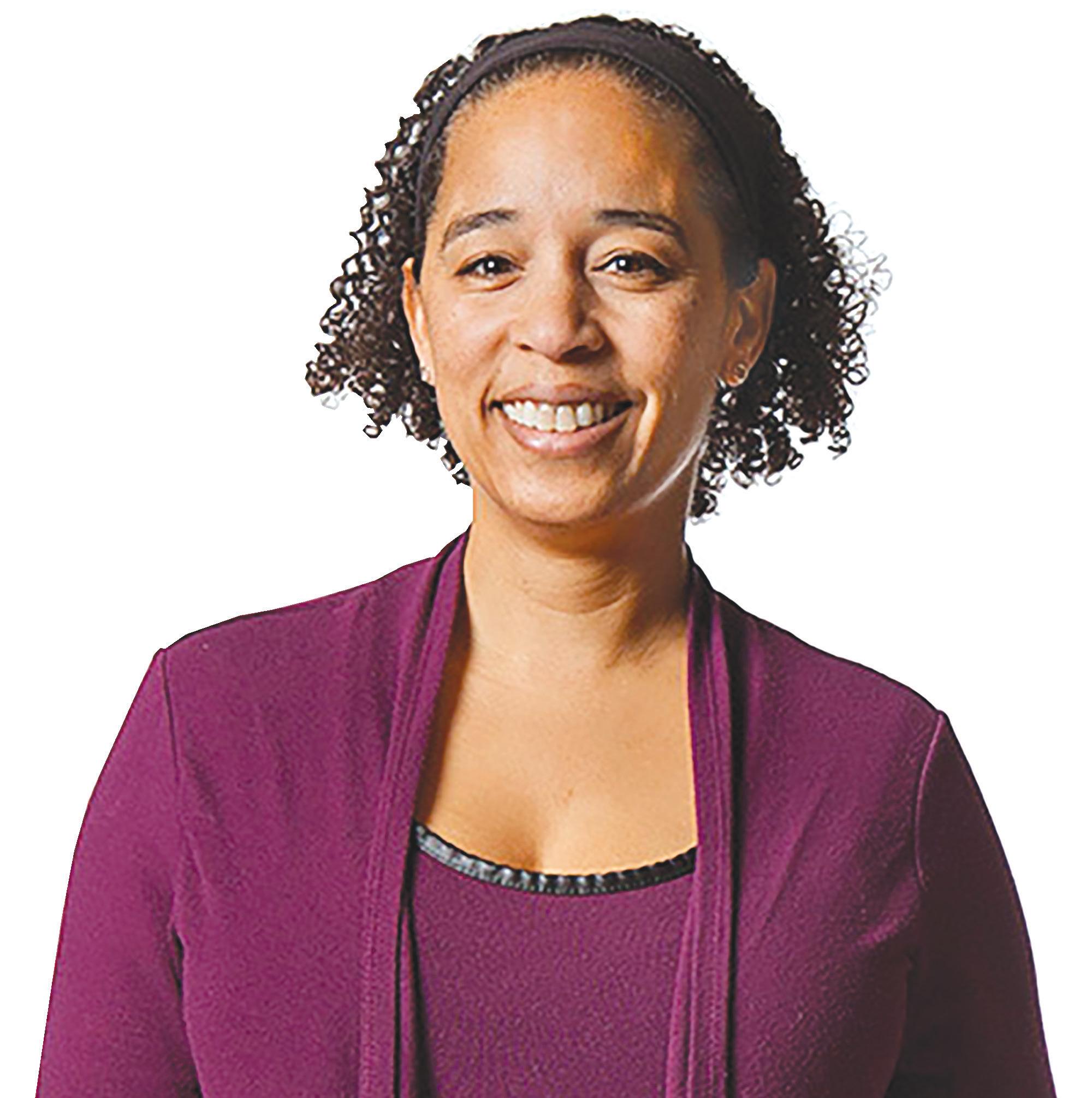
Prof. Eve De Rosa, human development, will serve as the next dean of faculty and will be the first woman and first person of color elected to the position.
Over the course of her term, De Rosa said she hopes to improve communication across colleges and increase participation in shared governance while bringing a fresh voice to the senate.
The faculty senate elected De Rosa to dean on May 3, winning with 441-390 votes over Prof. Risa Lieberwitz, industrial and labor relations. De Rosa will officially assume her position July 1, taking the reins from Prof. Charles Van Loan, computer science.
The dean of faculty, a role with three-year terms, informs the faculty on campus issues, addresses constituent concerns and represents faculty interests to the Board of Trustees, University administration, employees, students and alumni.
Since 1872, 25 deans have preceded De Rosa. She will be the first professor from the College of Human Ecology to fill the position, as well as the first person of color and first woman.
Born in New York and raised in Bermuda, De Rosa said women’s empowerment has been central throughout her educational background, from her high school days at an all-girls institution to her time as an undergraduate at Vassar College, founded as a historically women’s college.
De Rosa has served as a professor at the human ecology college for eight years, where she has worked in a number of leadership positions.
“The College of Human Ecology had the first tenured woman at Cornell. They had the first tenured African American woman at Cornell, and now they have the first African American woman dean of faculty,” De Rosa said. “There's something that really makes me feel honored that I'd be representing the college in that way.”
Unlike many of her predecessors, De Rosa has not previously held a position on the Faculty Senate — but she said joining the senate now will allow her to offer a different perspective.
However, De Rosa has held many positions with the human ecology college as the director of undergrad uate studies in the human devel opment department, a member of the college education policy committee and as the dean’s fellow for racial and social justice.
As the dean’s fellow, De Rosa created Pathways to Social Justice, an initiative that hires six to eight like-minded scholars to study topics such as childhood pov erty and nutrition, racial and ethnic identity and dis crimination in the workplace, using their expertise to leave a positive
impact on their communities.
De Rosa said her collaborative leadership style will support her in the dean of faculty role as she works to promote the wellbeing of every part of the senate, from the faculty to the professional librarians and archivists to the post-doctoral researchers.
De Rosa said she hopes to follow some of the goals of Van Loan, including improving transparency and communication. She also said that as someone who was able to attend the senate meetings once they became remote in spring 2020, she said she wants remote attendance to remain accessible to the Faculty Senate once gathering restrictions
“I would love to bring more discourse into the senate,” De Rosa said, “allowing more perspectives to come in front of the senate so that there's more of a conversation rather than a presentation.”
De Rosa’s fellow faculty members expressed delight that she won the dean of faculty election. Prof. Neil Lewis, Jr., communication and psychology, said De Rosa is one of the senior
By KATHERINE ESTERL Sun Staff Writer
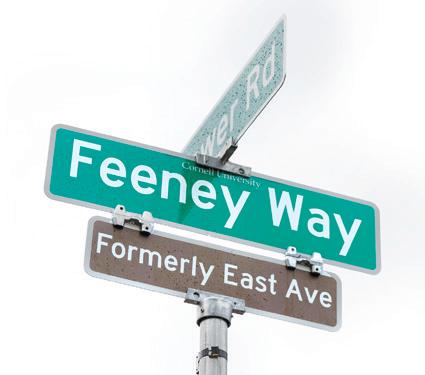
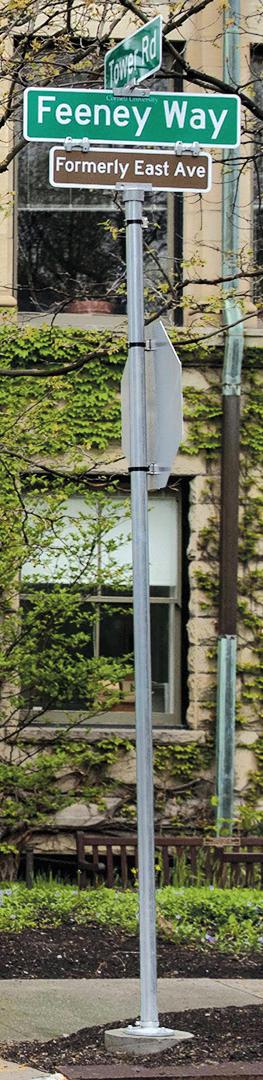
Cornell has renamed East Avenue to Feeney Way, honoring long-term donor Charles “Chuck” Feeney ’56. Feeney has contributed almost $1 billion to Cornell over the past 40 years, often anonymously. Now, the oftused street, running through central campus from Milstein Hall to Duffield Hall, pays homage to the former hotelie who made billions — and then gave it all away.
“I can’t see anyone who rises to his level of both generosity and impact.”
signage on April 23, Feeney’s 90th birthday. Founder of Atlantic Philanthropies and proponent of “giving while living,” Feeney has donated almost his entire fortune of $8 billion to support causes around the world, including peace-making in Ireland, health care in Vietnam and AIDS treatments in southern Africa. Because he kept his gifts secret for so long, some label him the “James Bond of philanthropy.”
Robert Harrison ’76
“We have wanted to recognize Chuck’s incredible generosity for many, many years, but he refused,” said Robert Harrison ’76, chair of the Board of Trustees. “It wasn’t until this specific opportunity that he finally agreed.”
Cornell unveiled the new
At Cornell, Feeney’s contributions helped create the Robert A. and Jan M. Beck Center at the School of Hotel Administration, the Martin Y. Tang Welcome Center and both North and West campuses. His donations also established the Cornell Tradition program, which financially supports students
By KELSEY XU Sun Staff Writer
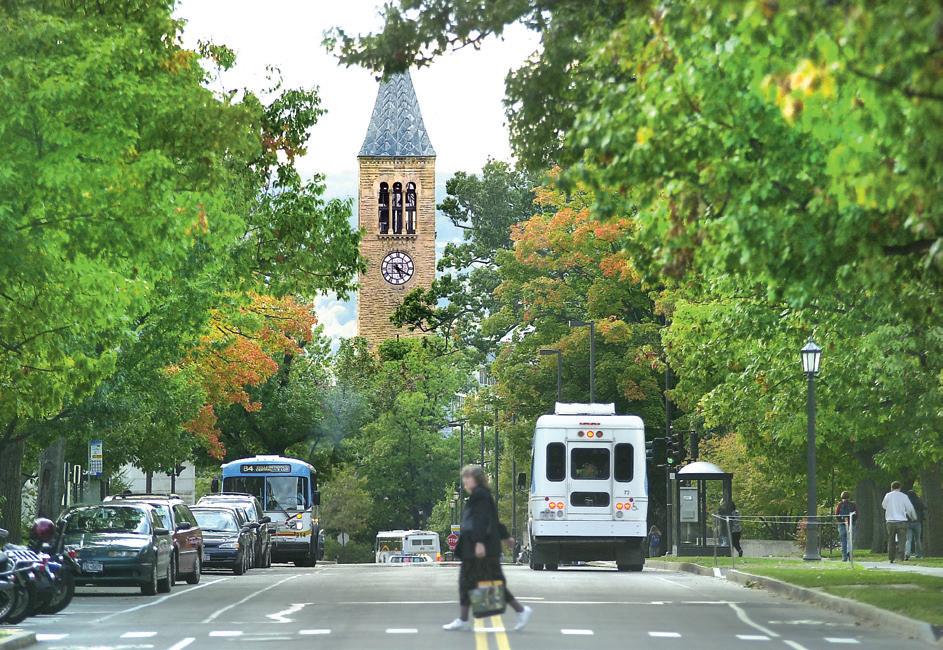
Equipped with Wi-Fi and GPS, TCAT has sent a new fleet of electric buses zipping down Ithaca’s streets.
The electric fleet, unveiled on Earth Day, comes after a significant decrease in ridership due to the COVID-19 pandemic. Added technology, according to TCAT general manager Scot Vanderpool, could be the key to enticing riders back.
In addition to newly installed Wi-Fi and GPS apps, which allow riders to see where the bus is on its route, the electric buses have outlets on the back of every seat for riders to charge their devices.
Releasing the electric fleet is years in the making, as TCAT has worked to meet its goal of offering more sustainable public transportation. The Volkswagen settlement in 2017 gave New York State $127.7 million to put
toward moving away from diesel and toward electric batteries, giving Tompkins County the funding to move away from diesel.
In 2018, TCAT applied for a competitive federal grant through the Low or No Emission Grant Program, or the Low-No Program, which provides state authorities funding to buy low-emission buses and facilities to house them. TCAT won the grant and was additionally awarded three electric buses. Although electric buses
cost approximately twice as much as diesel buses, TCAT was able to buy four more buses with the Volkswagen settlement.
According to Vanderpool, TCAT worked with the New York State Energy Research and Development Authority to get the funds from the settlement. The state paid for the differences between the electric and diesel buses.
To continue reading this article, please visit cornelllsun.com.

DEAN
Continued from page 1
faculty members who has supported him and other junior faculty since he began working at Cornell in 2017.
“I am confident that she will use her new role to continue to support faculty across the University,” Lewis said. “The fact that it took us until 2021 –– over 150 years –– to finally elect a woman or a person of color to the role is something we should deeply reflect on as an institution.”
Van Loan said the senate will be in good hands and that De Rosa will bring fresh ideas and perspectives to the table.
“When you leave a position like this, there is no better feeling than handing off to a successor, like Eve, who cares about the same things as you,” Van Loan said.
De Rosa said it was very rare to receive an invitation to the senate before she was a member, unless there was an issue directly impacting the staff and faculty. As dean, she said she hopes she can encourage more senators to invite constituents to the meetings.
“I know that there is a diversity of voices there,” De Rosa said. “I think if we really have the senators make a greater effort of bringing their faculty’s voices into the senate by inviting them to the senate, that would be lovely.”
De Rosa said she wants to create a structure for mentorship among the faculty, which would better connect super departments within the colleges and give voice to more faculty members.
“Just having that conversation across the University will be really meaningful,” De Rosa said, “especially as we start to bring more diversity into the faculty more and more.”
Angela Bunay can be reached at abunay@cornellsun.com.
FEENEY
Continued from page 1
opportunities, and secured the University’s ability to build Cornell Tech on Roosevelt Island in New York City with the largest-ever donation to the University.
Harrison remembers when Feeney helped make Cornell Tech a reality in 2011. In the last minute of Cornell’s pitch to Mayor Michael Bloomberg’s administration, former President David Skorton announced that an anonymous donor — Feeney — was prepared to commit $350 million to support the new campus.
“Every jaw on the other side of the room dropped,” Harrison said. “They had made what was a theoretical, great idea into reality. There was no question that we were going to be able to complete the job, because we had the funding.” Harrison said he hopes to name part of the new tech campus after Feeney, if he allows.
Feeney also funded part of Cornell Tradition, initially founded in 1982 with $7 million. The program has received more than $40 million from Atlantic Philanthropies today and has served more than 6,000 students.
Massimo Carbone ’22, a Tradition Fellow and co-chair of its student advisory committee, receives part of his financial aid package from the program. He said that Feeney deserves the renaming honor.
Carbone said when he walks down the new Feeney Way with his friends, he likes to “brag to them a little bit” about Cornell Tradition and the history that
made it possible.
“Without that monetary support, my experience as a whole might not even be possible, so I’m very grateful for the program,” Carbone said.
With additional recent donations, Atlantic Philanthropies has permanently endowed the program, according to Tradition program coordinator Suzanne
“It only makes sense to give him a small part of our campus, especially something so integral.”
Avhan Misra ’24
Horning. She said the East Avenue renaming “does [her] heart great good.”
“When you’re committed to service, sometimes you don’t get a lot of thanks, but you’re doing really important stuff,” Horning said, adding that Feeney’s name is a reminder of what can come from hard work, hoping that it will affirm students.
According to a University press release, Feeney, of Irish-American background, was born in New Jersey during the Great Depression and came to Cornell on the GI Bill as the first in his family to attend college. He eventually co-founded Duty Free Shoppers, the source of his fortune. At the time, the business sold cars and liquor duty free to travelers.
While at Cornell, Feeney began his business career selling sandwiches at sports games and in student residences.
Dan Silverberg ’56 graduated from the School of Hotel Administration with
Feeney and remembers the wicker baskets he used to carry the sandwiches. He also noted how involved Feeney later became in the Class of 1956’s fundraising efforts.
During their 25th reunion, Silverberg said, Feeney helped the class raise about $2 million — $1 million above their goal. In later competitions with the Class of 1955, Feeney was determined to make sure his class outperformed the other. All the while, Silverberg said, Feeney insisted his donations remain anonymous.
Silverberg recalled that a few years ago, Feeney said he didn’t own a tie of his own. News reports say Feeney prefers to fly coach over first class and uses tape to fasten his photographs on his walls.
Avhan Misra ’24, who was walking down Feeney Way on Tuesday, said he respected the honoree’s humility.
“He was not looking for any glory or valor when he donated. I think it only makes sense to give him a small piece of our campus, especially something so integral,” said Misra, who uses the street daily to get between his North Campus dorm and the engineering quad.
Harrison, who has experience working with philanthropists, said Feeney’s generosity and preference for anonymity are “extraordinary.”
“I really can’t see anyone who rises to his level of both generosity and impact, and I think having a street that goes from one end of the campus to another and passes his hotel school where he graduated — I can’t think of a more appropriate way of honoring him,” Harrison said.
Katherine Esterl can be reached at kesterl@cornellsun.com.
STAMM ’22
CATHERINE ST. HILAIRE ’22
Associate Editor
PRANAV KENGERI ’24
Advertising Manager
ODEYA ROSENBAND ’22
Opinion Editor
JYOTHSNA BOLLEDULA ’23 News Editor
TAMARA KAMIS ’22
Working on today’s sun
layout Sofa van Mierlo ’23 opinion desker Odeya
Pichini ’22

By NATASHA AYSSEH Sun Contributor
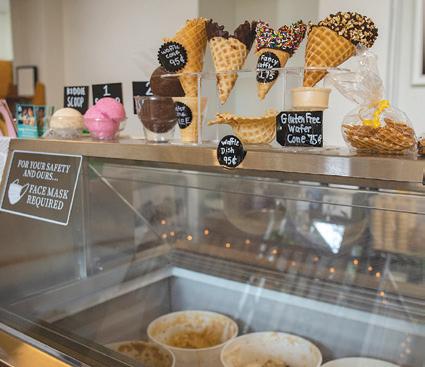
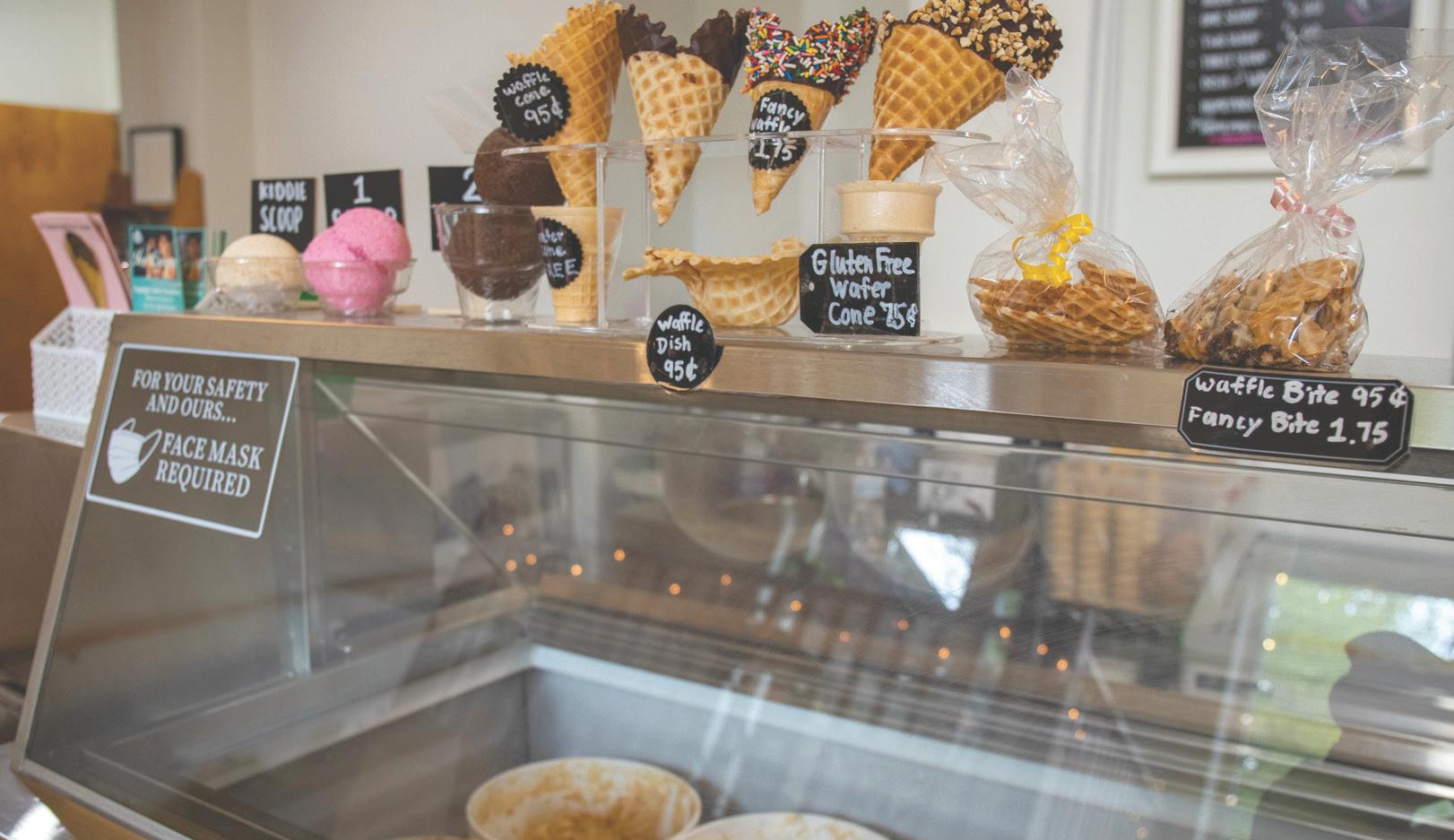
Cayuga Creamery, located inside the Dewitt Mall, has been my go-to stop for an ice cream fix every time I’ve been out and about in Ithaca. This quaint parlor resides right in the corner of the mall, inside a little nook overlooking Buffalo Street and Dewitt Park.
Based in Interlaken, NY, their Ithaca location opened up in late 2020. Their original location has been praised immensely for their ice cream quality, designated a must-try in multiple articles. They house over 200 flavors total, but rotate around 30 flavors at a time in the shop.
Walking into this little ice cream boutique, you may find yourself stuck choosing between creatively named and delicious sounding flavors. I could sit and try their ice cream flavors for hours, and when you get the chance to go, I’m sure you will, too; hopefully this guide gives you some direction in your final choice.
With that being said, here is the Cayuga Creamery flavor you should buy, according to your major:
Try out the Purple Cow flavor! Yes, I may just be assigning this based on the name. But this creamy, black raspberry-infused ice cream includes snappy chocolate chunks that perfectly top off a refreshingly sweet cone, and I would definitely recommend it.
The archaeology major must enjoy a classic Cookie Dough. Though you may spend some time
digging out chunks of little dough, I do believe that is exactly what ties this flavor with the study itself.
For the talented and busy Archie, I will assign Cayuga Creamery’s own Pistachio. Their take on this classic flavor is a wonderfully refined ice cream, inviting comparison with the stylishly-known architecture student.
For the astronomy major, I’d recommend the Cookie Explosion.
This supernova of a flavor is a stronger version of cookie dough, with something like cookie butter

spread within it. The student of space is bound to love this galactic looking ice cream.
To the business major reading this, I’d recommend you try their sophisticated Coffee flavor. Not much explanation required, I believe, but it is delicious. The strong coffee flavor truly comes through in this ice cream, and it’s sure to wake you up for some hard work.
The computer science major is assigned Blueberry Cheesecake. An unexpected ice cream creation, this flavor combines the fruitiness found in warm blueberry muffins with the full-bodied character of a classic New York cheesecake. This assignment was highly contested among the people I was with, but I’d say give it a shot.
The waffle cone. No ice cream, literally just the waffle cone.
English is a classic: a simple Vanilla Bean. Classy, but reserved. Sweet, but simple. No further explanation required.
I believe the entomology major might enjoy the oddly delicious Maple Bacon flavored ice cream. This sweet and salty flavor is apparently a fan favorite for some, with regulars coming back in to grab double-scoops every time.
The environmental major must be assigned a non-dairy option: and to this I respond with Soy Cherry Jubilee. For the enjoyer of Ben & Jerry’s classic Cherry Garcia,
you’ll love this one. This ice cream inspires an outdoorsy feeling, and while not overly sweet, it is perfectly creamy nonetheless.
For the fine arts major, I encourage a tasting of the Mango Passionfruit Sorbet. Fun, flavorful, and delicately fruitful, this flavor is perfect for a creative. The fresh taste is perfect as the weather in Ithaca begins to brighten up.
Though I could certainly designate a flavor for each language, I’m going to generalize us foreign language majors by assigning Lavender. Decadent and smooth, lavender is surely a show-stopper, and is perfect for the worldly Cornell student. [This flavor is actually not in store currently at Cayuga Creamery’s Dewitt Mall location as of 4/30/21, but is among their larger list as mentioned by the workers there.]
The Hotelie, in contrast to the environment & sustainability major, is recommended to try Cherry Jubilee––the regular dairy version. This ice cream is a business-in-the-front flavor while still perfecting a certain level of sweetness: ideal for impressing the people around you without sacrificing taste.
The ILRie should try the Butter Pecan ice cream. A lawful-good flavor, butter pecan is hard to go wrong with, and would probably be paired well with the reading you have due tomorrow.
One of my majors––Information Science––has always felt like a mix of other things to me,
and for that, I’d like to assign it the Peanut Butter Ripple flavor. This delicious, creamy blend has swirls of rich peanut butter inside it, combining an almost spiced-vanilla base with the classy nutty flavor.
The psychology major should try their Mint Chocolate Chunk ice cream. Some love it, some hate it, but ultimately this flavor is one of their most popular, and for good reason.
This major receives the designation of NSA-FF Chocolate ice cream (AKA no sugar added, fatfree). Mainly, this designation was assigned after consultation with the workers there, after finding out that some physics majors they know enjoy this flavor. I trusted their opinion on this, but am looking forward to hearing any hot takes on this one.
For the hopeful wine connoisseur, I’d recommend the Red Raspberry flavor. Sour and sweet, this berry flavor is sure to entertain your sophisticated palate.
For those unlisted majors: this is your chance to check out Cayuga Creamery and continue the list’s legacy on your own. Personally, I’d highly recommend the coffee, peanut butter ripple, ginger, and mocha flavors. Enjoy!
Special thanks to the two Cayuga Creamery workers, Sofia Segal and Vittoria Georgiadis, who helped us taste and assign flavors with much-appreciated patience.
Natasha Aysseh is a current sophomore in the college of Arts and Sciences. She can be reached at nca28@cornell.edu.

Darren Chang is a senior in the College of Arts and Sciences. He can be reached at dchang@cornellsun.com. Swamp Snorkeling runs every other Tursday this semester.
ACornellian can map the stage of their college education by the walk they take. Is it the freshman scramble across the Turston Avenue bridge to make it from North Campus to Central Campus before attending a massive lecture? Is it the harried sophomore climb from West? Is it the pajama-wearing senior who slothfully meanders from Collegetown northwards, still struggling with last night’s hangover. Or is it the other kind of senior who’s always running late and already two cofees in before the sun is even overhead?
Or is it me, planning to meet a mentor at Olin Hall but really meaning Olin Library, and wasting twenty minutes of everybody’s time? Even after four years, some things don’t change. Tis school is still massive and everybody still runs around with reckless abandon, balancing several exams, homework and a social life to boot.
But perhaps the changes are far more telling. I take myself much less seriously compared to freshman year. I use stupid words like “yeet” and “sadge” all the time because they’re funny and I already have enough boomer (or “dad” according to some) energy. I now know I’m not that naturally smart (especially at math) and I need to work much harder than others for the same grades or results. I found out I wasn’t predestined for the pre-med life but also realized that other intellectual pursuits were
way more fun and rigorous. A high-strung attitude took an enormous toll on my emotional and mental health and it wasn’t worth it. I’m okay not being the best at something — or anything — that’s just part of college and life.
But I also know that I don’t need to pretend to be someone else I’m not. In so many cofee chats, we are told that companies want to hire someone who’s easy to work with and approachable. To convey that in interviews, we are to overplay our personality traits that convey teamwork. I no longer subscribe to that view. Te easiest way to convince anybody that they should hire you (or just be friends with you) is to actually be a genuine and easygoing person, which starts from being comfortable with yourself. And, if you aren’t a genuine and easygoing person, perhaps reconsider the kind of person you want to be.
Writing columns for Te Sun has been an integral part of my time. Primarily, it has forced me to reckon with viewpoints that disagreed with mine — often in constructive ways, and sometimes in actively destructive ways — over the past six semesters (with one sabbatical). Some columns are barely read, especially when compared to the hard-hitting content my colleagues put out each week. Some work is not my best work: I remember visibly cringing as I hit the submit button when the biweekly noon deadline came. I am ever grateful to the editors who laboriously corrected my mistakes and helped tease out trite ideas. Special shoutouts to Katie Sims ’20, my frst editor; Paris Ghazi ’21, who wisely asked me not to go forward with garbage; and Ethan Wu ’21, who I still go to when I have questions about economics.
Insofar as I’ve hastily thrown together ideas, there is also work I’m proud of because it represents diligent research and very personal thought. The early era of this column reflected often on politics and economics and published some very unqualified and unpolished hot takes. The middle era of this column wrote a controversial article about Cornell and faith that inspired multiple letters to the editor. The latest era was an exhaustedly rebellious take it or leave it “say what you mean and mean what you say” phase. I learned how to take criticism (ignore the Facebook comments and respond to the emails that were serious), how to present ideas that may have been better as either a tweet or a research paper and how to loudly complain into the void. Good luck to each successive generation of col-
umnists and opinion department editors. The opinion section at The Sun is a special and sunny platform to play with, but use it wisely so it can continue shining brightly.
Remember the mentor I mentioned meeting at Olin? Tat specifc meeting never actually happened, but the mentorship did. I am thankful and beholden to the diferent people who have looked out for me, including
That is the story of my journey through, and what I think should be the spirit of Cornell: people willing to help other people. More than most places, Cornell lends itself to walking alone — physically through its snowy large campus, mentally through long semesters and spiritually by the construction of high-brow liberals.
several older friends and a whole host of professors in the economics (and later the statistics) department who not only had wisdom but also the willingness to care even when I wasn’t taking their classes. Without them, my path at Cornell might have looked a lot diferent and flled with even more twists.
Tat is the story of my journey through, and what I think should be the spirit of Cornell: people willing to help other people. More than most places, Cornell lends itself to walking alone — physically through its snowy large campus, mentally through long semesters and spiritually by the construction of high-brow liberals. But, it does not have to be so. Take the time to truly care about and for each other.
Katherine Yao
Hello Katie
Katherine Yao is a sophomore in the College of Arts and Sciences. She can be reached at kyao@cornellsun.com. Hello Katie, runs every other Wednesday this semester.
Not to flex on any ILR and AEM majors out there in the wild, but I have cycled through pretty much all forty majors offered in Cornell’s College of Arts and Sciences. Just recently, I started fantasizing about pre-med despite my poor biology lab partner having to carry the both of us through the dissection unit (look, I’m squeamish, okay?). If I had a dollar for every time I have heard the words, “Wait…I’m looking at your schedule… but I can’t tell what your major is” I wouldn’t be running out of BRBs the way I am now.
Te College of Arts and Sciences is unique among Cornell’s schools in that all students come in as undecided, for better and for worse. Experimentation is
not only possible but encouraged through distribution requirements and major prerequisites. I have cycled through classes ranging from law to visual studies to economics to computer science. Te College of Arts and Sciences touts this fexibility as its greatest strength but for me, it’s also the college’s greatest curse.
Choosing your major is an important college milestone. For pretty much the frst time ever we, students, have the opportunity to focus our education in the direction that we want. As naive as it may sound to those who have already been in “the real world” for a while, it feels as if this one decision has the potential to shape the frst part of our post-grad lives. Especially now, with the COVID-induced recession, insurmountable student debt and ongoing uncertainty, choosing a major is a more daunting task than ever.
Te battle between doing what I want, doing what my classmates are doing, doing what society considers “prestigious” and doing what my parents expect of me plays out at the forefront of my mind every single day. And this constant dilemma only raises new questions. Do I only like the major I’m currently thinking about because the concepts come naturally to me right now? Will I start to hate it when the course difculty ramps up later on? Which major will grant me the most fnancial security? What does passion even mean anymore?
Zoom learning has proved to be another great barrier. Even courses in data science and ethics –– subjects I’m interested in –– have transformed into
laborious tasks that I muddle through each day before exiting Zoom with relief. Choosing a course of study based on “what I enjoy” feels like an impossible order when some days I barely have the energy to log onto Zoom. Choosing a course of study based on “what will bring the most stability” is no less formidable a task when people of all professions have lost jobs during the pandemic. Who knows what jobs will exist two, fve, ten
Choosing your major is an important college milestone ... Especially now, with the COVIDinduced recession, insurmountable student debt and ongoing uncertainty, choosing a major is a more daunting task than ever.
years down the road?
Second semester sophomore year is when CAS students should be lock -
ing in their majors. Tis year, I have watched friend after friend gain approval into their majors and transcend into a new class of ultimate envy: the assembly of decided students. Last week, craving entry into this group, I caved and submitted the major afliation form. At least I could stop feeling like a liar when introducing myself to strangers.
I couldn’t completely tell you my thought process for why or how I chose my major because, truth be told, I’m still as uncertain as ever. Yeah, that pre-med crisis I detailed earlier? Tat came after I submitted the application form for a completely diferent feld. Far from making me feel better, solidifying a major has made me wonder whether I’ve shut doors to other opportunities in the future. Yet at the same time, I already feel like I’m playing catch up to those students in my future major who have known what they wanted from day one.
Furthermore, although I know people who love their majors, I also know people who wish, late into their senior years, that they had chosen something diferent. In certain cases, that means something more “practical.” In other cases, something more “risky.” All I can do is constantly tell myself that there are no right answers. Even though the “what if” questions will likely always linger, that’s not necessarily a bad thing. It means that my experiences will continue to shape me. Tat I’m an evolving human being. Tat the topic I’m interested in right now may not be what I’m interested in three years from now. And I’m working on being okay with that.

Fill in the empty cells, one number in each, so that each column, row, and region contains the numbers 1-9 exactly once. Each number in the solution therefore occurs only once in each of the three “directions,” hence the “single numbers” implied by the puzzle’s name. (Rules from wikipedia.org/wiki/ Sudoku)





By LUKE PICHINI Sun Sports Editor
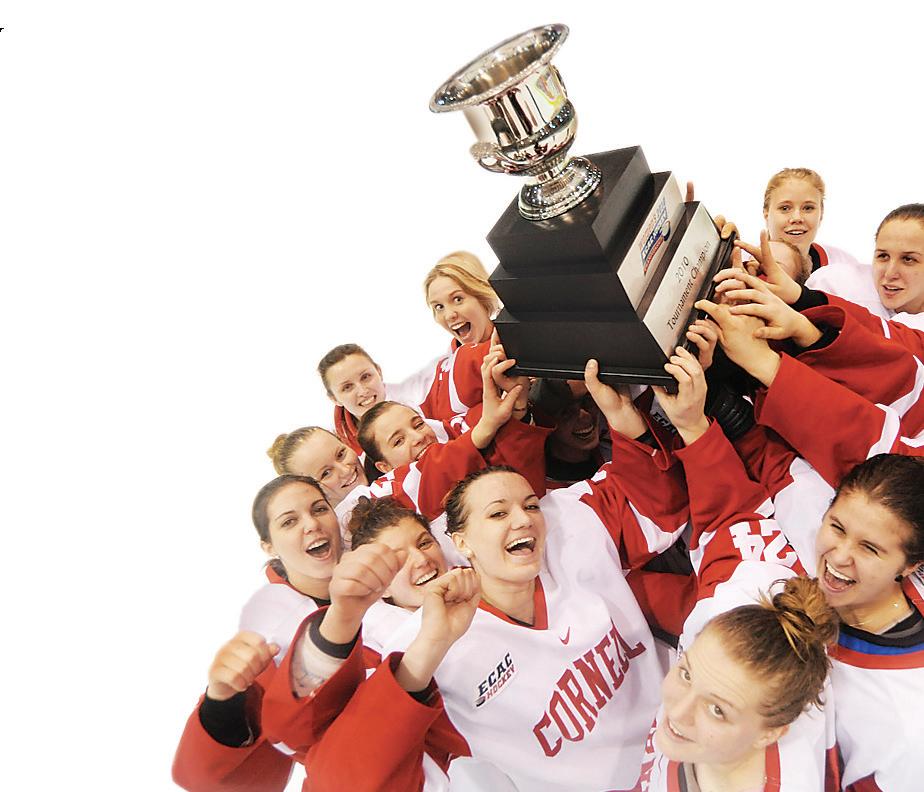
Since the 2009-10 season, Cornell women’s hockey has been a perennial contender for a national title. Since coming up just short as the national runner-up in 2010, the Red has been a mainstay in the postseason, clinching seven additional NCAA Tournament appearances as well three Frozen Four showings.
At the helm for the entire ride has been head coach Doug Derraugh ’91, who has led the team since 2005 and is the winningest coach in program history. After starting off his tenure with four straight losing seasons, Derraugh and the team flipped the switch beginning in 2009.
The biggest catalysts for women’s hockey’s new success in the 2009-10 season were a group of underclassmen in sophomore forwards Chelsea Karpenko and Catherine White and freshmen defensemen Laura Fortino and Lauriane Rougeau.
Over the course of the season, the four underclassmen racked up a total of 139 points. Not only did they succeed at finding the back of the net, but the freshmen defensemen also helped stifle opponents behind the blue line.
Cornell also had sophomore goaltender Amanda Mazzotta, who led the country with 11 shutouts — also a program record — and was ranked sixth in the nation in goals-against average.
Though the Red’s season began with two losses to Mercyhurst at Lynah Rink, the team regrouped for conference
play, notching five wins in a row. A mid-season lull saw Cornell only pick up five victories from mid-November to early May.
But the Red regained its footing for a late-season push.
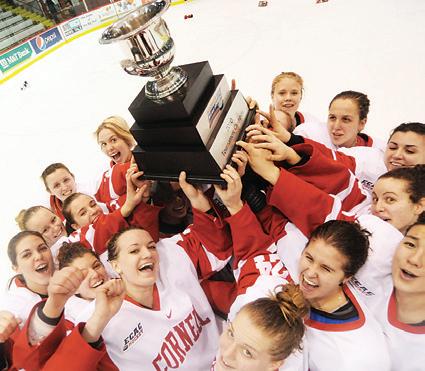
Powered by Mazzotta, who recorded four straight shutouts from Feb. 5 to Feb. 13 and only allowed three goals over the final month, Cornell rode into the ECAC Tournament with a five-game winning streak and plenty of momentum as the No. 1 seed. Once it reached the conference stage, the Red continued to stay hot. After handling Colgate and Rensselaer in the opening rounds, Cornell clinched its first-ever ECAC conference championship with a 4-3 overtime victory over Clarkson.
The winning strike came from sophomore forward Kendice Ogilvie, who beat Golden Knights netminder Lauren Dahm. Ogilvie, who also scored earlier in the tournament, was named the most outstanding player in the ECAC Tournament.
To continue reading this article, please visit cornellsun.com.
Glory | The 2009-10 women’s hockey team celebrates its ECAC title victory on March 7, 2010.