The Corne¬ Daily Sun



By
Ahead of this weekend’s Charter Day celebrations, approximately 70 faculty members from the College of Arts and Sciences have signed a letter addressed to Gretchen Ritter ’83, dean of the arts college, stating they will forgo Monday’s faculty procession over grievances relating to budget cuts in order to restate their commitment to a liberal arts education
The letter, written by Prof Durba Ghosh, history, is planned for submission Friday and reaffirms the importance of the arts college and its ability to offer a liberal arts education The letter states that the college’s “liberal arts mission is under threat from the budgetary policies
adopted by Cornell’s central administration ”
The letter describes how the professors will spend their day instead of attending the Charter Day festivities
“It’s a change that’s basically due to a central administrative policy, not because we’re working less hard or we’re teaching less.”
on Monday “In lieu of attending the Charter Day ceremonies on
the morning of April 27, we will be working on our research, compiling notes for an article or book chapter, writing a grant proposal, working on our teaching, grading papers or preparing to teach our classes for that week,” the letter states
The College of the Arts and Sciences will be facing a $5 to $10 million budget cut in the coming fiscal year due to reduced allocations from the provost ’ s office, The Sun previously reported
The reduction is being implemented to fix a structural deficit in the provost ’ s budget which was created when allocations exceeding the office’s revenues were allotted to help colleges manage the financial crisis of 2008 and
Some decry store ’ s funding source, nancial aid allocation plans
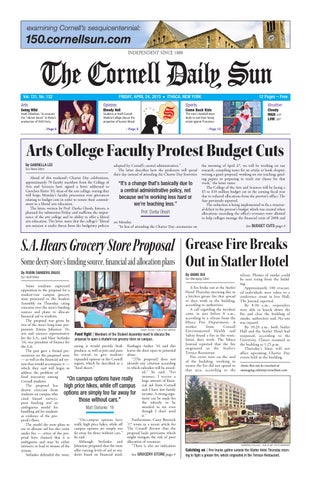
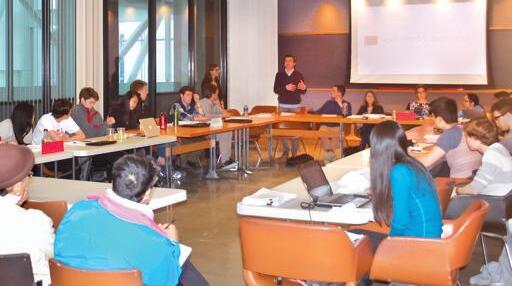
So m e s t u d e n t s e x p re s s e d opposition to the proposal for a s t u d e n t - r u n c a m p u s g ro c e r y store presented to the Student Assembly on Thursday, citing concerns over the store ’ s funding sources and plans to allocate financial aid to students
The proposal was given by two of the store ’ s long-time proponents: Emma Johnston ’16, arts and sciences representative for the S A , and Matt Stefanko ’16, vice president of finance for the S A
The pair gave a formal presentation on the proposed store as well as the financial aid system that would accompany it which they said will begin to address the problem of food insecurity among Cornell students
T h e p ro p o s a l h a s d r a w n c r i t i c i s m f ro m students on campus who
c i t e d b i a s e d s u r ve y s , p o o r f u n d i n g a n d a n a m b i g u o u s m o d e l f o r handling aid for students as evidence of the proposal’s flaws
By ANNIE BUI Sun Managing Editor
u t h o r i t i e s A c a l l re g a rd i n g t h e i n c i d e n t c a m e i n j u s t b e f o r e 8 a m , a c c o rd i n g t o a re l e a s e f ro m t h e
It h a c a Fi r e D e p a r t m e n t A
w o r k e r f r o m C o r n e l l
“On campus options have really high price hikes, while off campus options are simply too far away for those without cars ” M a t t S t e f a n k o ’ 1 6
The model the store plans to use to allocate aid has also come under fire critics of the proposal have claimed that it is ambiguous and may be either intrusive or lead to misuse of the system Stefanko defended the store,
saying it would provide fresh produce, as well as pots and pans f o r re n t a l , t o g i ve s t u d e n t s expanded options in the Cornell region, which he described as a “food desert ” “ On - c a m p u s o p t i o n s h
ve really high price hikes, while off campus options are simply too far away for those without cars, ” he said A l t h o u g h St e f a n k o a n d Johnston proposed that the store offer varying levels of aid to students based on financial need,
Kushagra Aniket ’16 said this leaves the door open to potential abuse “ [ T h e p ro p o s a l ] d o e s n o t identify any criterion according to which subsidies will be awarde d , ” h e s a i d “ Fo r instance, I receive a large amount of financial aid from Cornell and I have low family income A strong argument can be made for t h e s u b s i d y t o b e awarded to me even though I don’t need it ”
Furthermore, Casey Breznick ’17 wrote in a recent article for The Cornell Review that the proposal lacks provisions which might mitigate the risk of poor allocation of resources “There is also no indication
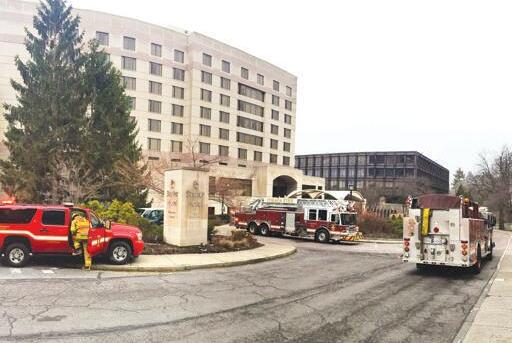
E n v i r o n m e n t a l H e a l t h a n d Sa f e t y f o u n d a f i re i n t h e ve n t il a t i o n d u c t w o rk T h e It h a c a Jo u r n a l re p o r t e d t h a t t h e f i re o r i g i n a t e d i n t h e St a t l e r ’ s Te r r a c e Re s t a u r a n t Fi re c re w s we re o n t h e ro o f o f t h e b u i l d i n g , w o r k i n g t o e n s u re t h e f i re d i d n o t s p re a d t o t h a t a r e a a c c o r d i n g t o t h e re l e a s e Pl u m e s o f s m o k e c o u l d b e s e e n r i s i n g f ro m t h e b u i l di n g Ap p rox i m a t e l y 1 0 0 e va c u a te d i n d i v i d u a l s we re t a k e n t o a c o n f e re n c e ro o m i n Ive s Ha l l , T h e Jo u r n a l re p o r t e d B y 8 : 3 0 a m , r e s p o n d e r s we re a b l e t o k n o c k d ow n t
How Strong is Putin’s Russia 3 p m , 106 White Hall
Take Back the Night 6:30 - 8:30 p m , Ho Plaza
Cornell Chimes Sesquicentennial Concert 6:45 - 7:15 p m , McGraw Tower
CULTURA: Poetry Open Mic Night
7 p m , 139 W State Street, Sacred Root Kava Lounge
Jonathan Schakel Organ Performance
8 - 9 p m , Chapel, Anabel Taylor Hall
Friday, April 24, 2015 Tomorrow
Barnyard Fun Day
9 a m - Noon, Livestock Pavilion
Revolution in the Humanities in the Last 50 Years 11


Opi ni on, “A
Speaking about the cultural diversity she has experienced on campus “Diversity does exist on this campus we just don’t realize the extent or appreciate it Nevertheless I doubt my life will ever be as full of diversity as it has been over these few years on the
W i l l De par t C .U. , ” Tue sday
Speaking about Phlegar taking a new position as vice president for advancement at Virginia Tech
“Charlie was the first person I hired when I came to Cornell, and I have valued his counsel and partnership every day since While Cornell will miss him, I am happy that he is heading home to Virginia Tech, an exceptional institution where he has such deep personal roots ” President David Skorton
“U
Speaking about
“I’m pleased that we voted yes and I hope that the Cornell community continues to support these efforts even now after the resolution has passed because now is where all of the hard work begins ” Sarah Balik ’15
News, “Charter Day Organizers Prepare for Celebrations,” Thursday
Speaking about final preparations for Cornell’s sesquicentennial celebrations
[The Sesquicentennial should be] a time to showcase the contributions of student organizations to campus life and and to highlight the history of the student experience on campus over the past 15 decades ”
Jonathan Schmidt-Swartz 15




By JEANETTE SI Sun Staff Writer
The Ithaca Police Department has partnered with the Tompkins County Sheriff ’ s Office in an effort to equip all local police officers with body cameras Mayor Svante Myrick ’09 first introduced the initiative in August
protocol issues regarding cameras, such as whether or not officers have to declare that they are filming events
“[ These issues] have to do with when the cameras are going to be turned on and when they’re going to be turned off what needs to be captured, what needs to be taped whether or not the officer has to confirm to other people that he or she is videotaping them, what would happen to an officer if he or she did not turn their camera off,” Williamson said
Campus Advantage of Austin, a
building student housing located near universities, plans to construct new housing at the triangle e
, according to The Ithaca Journal
Only a few details have been re
Board The building will have a maximum height of 120 feet due to zoning The ground floor will most likely have retail use, The Journal reported
C o l u m b i a S t u d e n t S u e s U n i v e r s i t y f o r L a c k o f
P r o t e c t i o n F r o m R a p e
A l l e g a t i o n s
A m a l e C o l u m b i a Un i ve r s i t y s t u d e n t , Pa u l Nu n g e s s e r, f i l e d a l a w s u i t a g a i n s t t h e s c h o o l ye st e r d a y i n M a n h a t t a n f e d e r a l c o u r t , a c c o r d i n g t o T h e
A s s o c i a t e d Pre s s Hi s c o m p l a i n t a l l e g e d t h a t t h e u n i ve r s i t y d i d n o t p ro t e c t h i m a f t e r a f e m a l e s t u d e n t , Em m a Su l k ow i t z , we n t p u b l i c w i t h c l a i m s t h a t h e r a p e d h e r Su l k ow i t z g a i n e d n a t i o n a l a t t e n t i o n a f t e r s h e v ow e d t o c a r r y h e r m a t t re s s w i t h h e r u n t i l e i t h e r h e r r a p i s t w a s e x p e l l e d o r s h e g r a d u a t e d Howe ve r, C o lu m b i a d i d n o t p u r s u e d i s c i p l in a r y a c t i o n a g a i n s t Nu n g e s s e r f o l l ow i n g t h e r a p e a l l e g a t i o n s , T h e A P re p o r t e d
National
P o l i c e O f f i c e r s Q u i t A f t e r
T o w n ’ s E l e c t i o n o f F i r s t B l a c k M a y o r
A f t e r Ty u s By rd b e c a m e t h e f i r s t b l a c k m a yo r o f Pa r m a , Mi s s o u r i , f o u r o f s i x m e m b e r s o f t h e t o w n ’ s p o l i c e f o r c e re s i g n e d t h e i r p o s i t i o n s , T h e Ne w Yo r k Ti m e s r e p o r t e d
R a n d a l l R a m s e y, w h o h a d s e r ve d a s m a yo r f o r t h e l a s t t h re e a n d h a l f d e c a d e s , d e f e n de d t h e o f
T w o a l - Q a i d a H o s t a g e s
A c c i d e n t a l l y K i l l e d I n U . S . S t r i k e
Tw o h o s t a g e s h e l d b y a lQa i d a we re a c c i d e n t a l l y k i l l e d i n a Un i t e d St a t e s - l e d Pa k i s t a n i d ro n e s t r i k e , a c c o rd i n g t o T h e Ne w Yo r k Ti m e s Pr e s i d e n t Ba r a c k Ob a m a re s p o n d e d w i t h a n a p o l o g y a n d s a i d h e t a k e s “f u l l re s p o n s i b i l i t y ” On e o f t h e h o s t a g e s w a s a n A m e r i c a n , w h i l e t h e o t h e r w a s It a l i a n , T h e Ti m e s re p o r t e d Compiled by David Ticzon
Police Depar tment to deliver
vices
The cameras have received positive
large, according to Jamie Williamson,
Ithaca Police Department
“[The cameras] will document the officers’ activities, bolster their investigation and hold officers accountable to their actions.”
“I think the main players that are involved the police department, City Hall and the city administration and the public all realize the value of our officers being equipped with body cameras It will document the officers’ activities, bolster their investigations and hold officers accountable for their actions if they do act unprofessionally,” Williamson said Williamson said the department is currently working to reconcile
The IPD will work in conjunction with city administration and the Police B
according to Williamson He also said he believes these negotiations will proceed smoothly
“[In] the overall scheme of things, they’re pretty minor issues that the police department, City Hall and the Police Benevolent Association will [work out, because] they’re all eager to start utilizing cameras, ” Williamson said
Williamson said the police department is currently narrowing down a list of companies to purchase their cameras from
“ We’re looking at a couple different vendors,” he said “ We have not formally announced which vendor we ’ re going to be using, but that vendor that we do choose will meet all of our criteria at an affordable price
”
Williamson said while he does not yet know the overall costs of the project, the department is hoping to have all officers equipped with cameras by this summer
“ We’re looking [at] sometime this summer we were shooting for this spring, but there’s just a lot of legwork in making sure that we purchase the right cameras and the right ser vice agreements, ” he said
Though proceedings are slower than expected, Williamson said it is because all parties involved in this project want to thoroughly address all the complex financial and regulator y issues
“[ W ]e don’t want to go into this hastily We really want to be methodical because we realize the value of having these body cameras and how [beneficial] they would be to not only the officers, but the public as well,” he said
By STEPHANIE YAN Sun Staff Writer
C o r n e l l i a n s g a t h e re d t o h e a r Pro f
Stephen Long, crop science and plant biology, University of Illinois Urbana-Champaign, discuss food security, the use of bioenergy without conflict with agriculture and social barriers to crop yield improvement at a lecture Thursday
Long began by affirming the need for greater crop productivity in the future He said this is necessary because while the United Nations food and agricultural report predicted “that we [will] need 70 percent more primary foodstuffs by 2050 than we have today,” crop yields will not improve proportionally based on current trends
“The United States could develop renewable sources of liquid fuels without impacting production.”
t e p h e n L o n g
“Over the last decade, the average yield of wheat per hectare of land has not improved at all,” Long said “We’re rather getting into a stage where we ’ re seeing a flattening out of yield improvement year by year Part of this may be that we ’ re just reaching biological limits on some aspects of crop improvement ”
Long emphasized that the United States is pivotal to production of primary foodstuff; thus, any change in food output would have a lasting impact on worldwide food production
“Although we only have a tenth of the world area devoted to maize, in fact we produce over a third of the world’s maize, we produce about a third of the world’s soy and a significant part of the world’s wheat as well,” Long said “And the United States remains the biggest exporter of these primary foodstuffs So what happens in the United States is actually very important for costs of many of these foods globally ” He explained that while the rise and fall of the price of basic foodstuffs is not a pressing matter for Americans, it greatly affects others around the world
“We don’t really feel that impact very much because these primary foodstuffs are a really small part of our household budgets,” Long said “But in some parts of the world, 60 to 70 percent of household budget goes to basic foodstuffs So if they double in price, t h a t ’ s a c a t a s t ro p h e f o r those areas, ” Long said Long then spoke about the use of biofuels as possible sources of sustainable energy in the future, citing Brazil’s use of sugarcane to produce fuel and sell more ethanol than gasoline in 2012 as a model other countries should aspire to “They’ve managed to do this by using abandoned sugarcane land and moving on to fairly low-grade pasture, ” Long said “So it really isn’t competing with their food production in any significant way ” Long said he wanted attendees to develop a better understanding of how innovation
will “play a major part in feeding the world and fueling the world from plants by 2050 ” “I hope they get the vision that these things are possible that we can increase food production without using more land, without destroying more of the environment, that we do have a way forward and we should be using that,” Long said “[I also want them to] get the view that the United States could develop renewable sources of liquid fuels without impacting food production ” Long ended the talk by stressing the importance of science communication in making these advances in crop production “ Today we have the availability of communication and discommunication, which makes the communication of science critical,” he said “From a scientific perspective, we could have it all by 2050 Whether policy and society will allow us we don’t know ”

GROCERY STORE
Continued from page 1
of whether students must apply for this subsidy, or ‘food scholarship,” Breznick wrote “If FARC and SRGS executive board members instead assess each student’s application on a case-by-case basis, what is the expected efficiency of this method? A student in need of food immediately cannot wait weeks for these students and administrators to assemble and review potentially hundreds of applications ”
Renee Alexander ’74, associate dean and director of intercultural programs, said at the S A meeting that methods exist for the store to counter any problems critics point to
“ The data will be self reported,” she said “One way to test this honor system is to be able to check one [out of ever y] four or five of the applications The other option is to ask students to bring in financial documents We would eventually be setting up a criteria for scanning or auditing ever y fourth or fifth application ”
The store ’ s source of funding has been a further point of controversy, according to Stefanko The Students Helping Students fund, which is an endowed fund, is the planned initial source of funding The interest earnings from this fund each year are used ever y year to provide emergency aid to low income students Some critics believe that the funding of this grocer y store does not constitute as emergency aid
Critics like Breznick say the proposal, which asks for $400,000 to cover startup costs or 25 percent of the
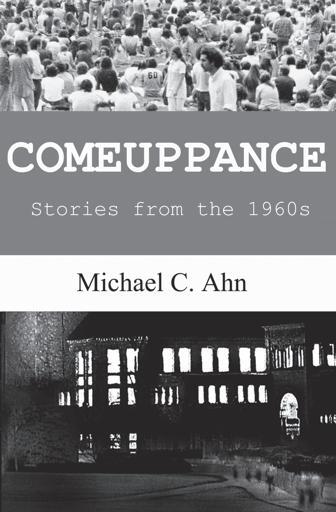
Stories from the 1960s
by Michael C Ahn
‘69
principal investment of the fund will put the fund in danger of being unable to meet the needs of the students it is intended to help
Breznick further cited concern that much of the costs would go towards capital investment rather than solving the problem of food insecurity “ There are several more cost-effective methods to address the issue of food insecurity,” Breznick wrote “[These methods] do not require capital costs in excess of $300,000, and therefore will reach more students and more students’ needs ”
“There are several more cost-effective methods to address the issue of food insecurity.”
Aniket echoed this sentiment, criticizing the high opportunity cost of the project
“ The store will cost $400,000, which forms 25 percent of the contingency fund,” Aniket said “Over 75 percent of the proposed cost is going to be ‘sunk,’ [meaning] it cannot be recovered if the plan fails ”
However, Stefanko insisted that the $400,000 estimate is a generous guess, saying it would likely would end up being closer to $300,000 He also said this investment will be necessar y to form a sustainable program
“ This is not a program that we want to end in two or
Eleven compelling tales set in Ithaca, NY, including:
A brilliant physics professor does not yield to a desperate student
A sophomore sells paper dresses to buy a car
A student has flashbacks of a Vietnamese woman and of a former teacher
A returning senior is caught between the hip and the conventional while trying to avoid the draft
A Chinese Texan is invited to join a Jewish fraternity
Available on Amazon com
three years when its founders leave, but something we want to be helping students in 20, 30, 40 years, ” he said “ This will give students better options and provide opportunities to learn how to cook and eat better ”
Johnston said that enduring stigma prevents many other potential solutions to this problem from taking root
“ The problem with food pantries is that there is a ver y large stigma attached to them,” Johnston said “Students will often visit the small pantr y at 626 Thurston either ver y early in the morning or ver y late at night to avoid being seen by their peers ”
Stefanko said he agreed that alternative remedies to food insecurity often go underused due to social pressure
“ We’ve heard stories from students who have not taken advantage of these ser vices because of the stigma attached to them,” he said
Stefanko further emphasized the need to have a clear source of funding in order to get necessar y partners on board
“Not having funding that we can point to is a real burden, so when you ’ re tr ying to convince people to begin conversations with you regarding sourcing, or you ’ re tr ying to get people to invest in the store, when you ’ re tr ying to get construction companies to bid on the space, you need some kind of tentative budget structure, ” Stefanko said
Supporters say they hope that the proposal will come before the S A for a vote in the coming weeks
Rubin Danberg Biggs can be reached at rdanbergbiggs@cornellsun com
BUDGET
Continued from page 1
to adjust to a new University budget model first implemented in fiscal year 2014, The Sun previously reported
One of the policy changes under the new University budget model reduces the tuition revenue colleges receive when students from other colleges enroll in their classes, according to Ghosh
Previously, when students enrolled in a course outside their home college, the college offering the course would receive 75 percent of the students’ tuition, while the other 25 percent would go back to the students’ home colleges In the new model, host colleges only keep 60 percent tuition paid by out-of-college students, with 40 percent diverted back to the students’ home colleges, she said
The endowed colleges, including the College of Arts and Sciences, were the most affected by the new budget model as it differed greatly from the model they used in the past, The Sun previously reported
“My sense is that a lot of faculty don’t understand why we went to this new formula,” Ghosh said “It’s a change that’s basically due to a central administrative policy, not because we ’ re working less hard or we ’ re teaching less ”
Earlier last week, the Faculty Senate passed a resolution that expressed similar concerns and called for greater faculty input on administrative decisions, The Sun previously reported
Ghosh emphasized, however, that the letter does not constitute a boycott of the sesquicentennial events this weekend Rather, she said it is a formal statement to signify that faculty will choose not to attend Monday’s ceremony
“These budgetary policies ... have very deliberately drawn resources away from the arts college.” P r o f D u r b a G h o s h
Ghosh said the arts college has seen reduced revenues that in the past had been in part mitigated by the provost ’ s allocations But as of July 1, the provost allocations will be reduced The combined loss of income will be a large blow to the arts college’s liberal arts mission, according to Ghosh
Ghosh said she believes this reduced funding is emblematic of the decreased respect the University has for the arts college
“I’m not someone who is likely to write a letter like this, but for me it does feel like there’s been a real change in the culture of Cornell in terms of not showing as much value or respect for what constitutes the critical liberal arts, ” Ghosh said “I think of lot of that is expressed by these budgetary policies that have very deliberately drawn resources away ”
Beyond the immediate impacts of a decreased college budget, Ghosh said she is frustrated by the new budget policies because she sees these decisions made from the central administration without much explanation or consultation with the faculty as an insult to the faculty
“Many people had already decided not to go [to the Charter Day ceremony] because they were not feeling committed to the idea of marching, so I think it only makes visible that we ’ re not going to march on Monday ” However, Ghosh acknowledged that she believes faculty members who chose not to sign the letter had valid reasons for abstaining
Prof Rayna Kalas, English, who chose not to sign the letter, said she was sympathetic to the letter’s cause but was unsure of how it would be perceived
“Faculty are less involved and less frequently consulted than they once were about matters of strategic and financial planning that have an impact on the educational mission of the University,” Kalas said “I share the very genuine concerns of the letter writers My reservation was that the letter might reinforce the mistaken perception of a faculty standing apart from the institution, when we are in fact foundational to it ”
Ultimately, Ghosh said the adjustments to the budget were only symptoms of a larger concern that the University is not maintaining the strength of the arts college
“I think in some sense this is really about drawing attention to a larger shift in the administration away from some of the core activities of a liberal arts education,” she said
Gabriella Lee can be reached at glee@cornellsun com

DETROIT (AP) Federal agricultural officials announced Thursday voluntary programs and initiatives for farmers, ranchers and foresters meant to build on President Barack Obama’s efforts to combat global warming and they don’t require congressional approval
Agriculture Secretary Tom Vilsack unveiled the plans at Michigan State University, where Obama signed the sweeping farm bill into law last year The efforts, many of which have their roots in that law, aim to reduce net greenhouse gas emissions, boost carbon capture and storage and come with various enticements, including grants, low-interest loans and technical assistance
Vilsack said the agriculture industry accounts for about 9 percent of U S emissions, adding that compares favorably with the rest of the globe but can be improved
“American farmers and ranchers are leaders when it comes to reducing carbon emissions and improving efficiency in their operations,” he said in prepared remarks “We can build on this success in a way that
combats climate change and strengthens the American agriculture economy ”
Before the event, Vilsack said officials “ want to do this in a way that will help not only the environment but also improve agricultural productivity with improved yields, and we can also improve the bottom line of producers with greater efficiency ”
Obama administration aides have said the issue of climate change became even more attractive after the November election, because the Democrat has considerable leverage to act without Congress Such actions, though, have drawn fierce objections from Republicans and the energy industry
Specific actions include reducing the unnecessary use of fertilizer and methane emissions from cattle and swine, reforesting areas damaged by wildfire and disease and encouraging tree planting in urban areas
For methane reduction in particular, the federal program promotes installing more anaerobic digesters, which use naturally occurring bacteria to break down organic waste to produce biogas, a fuel similar to natural gas
BOSTON (AP) A video played Thursday at the trial of
B o s t o n Ma r a t h o n b o m b e r
D z h o k h a r Ts a r n a e v s h owe d a mother crouched over her 8-yearold son as he lay dying on the
s i d e w a l k , a s c e n e p ro s e c u t o r s hoped would linger in jurors’
m i n d s w h i l e t h e y d e t e r m i n e whether Tsarnaev lives or dies Prosecutors rested their case after playing the video during the testimony of a man who lost his leg in the bombings, and jurors watched as the mother pleaded with her little boy
“I heard ’please’ and ’Martin’
b e i n g u
t e re d by De n i s e Richard,” said Steve Woolfenden, who was lying on the pavement next to Martin and his mother after the second bomb exploded “Just pleading with her son ”
The boy bled to death Prosecutors presented the testimony and searing images to give the jury one last reminder of the brutality and heartbreaking consequences of the bombings before the defense begins to present its case next week Prosecutors argue Tsarnaev, now 21, deserves to be executed for his crimes, while his lawyers say his life should be
s p a re d b e c a u s e h i s l a t e o l d e r brother, Tamerlan, was the mastermind of the attack
Wo o l f
n d e n ’ s l
g w a s sheared off below the knee He described frantically trying to get his 3-year-old son, Leo, out of his stroller after he heard him screaming and saw he was bleeding from the side of his head As he lay helpless on the pavement, he
s p o t t e d Ma r t i n a n d De n i s e Richard “ I s a w Ma r t i n ’ s f a
Woolfenden said “I could see a boy that was, looked like he was fatally injured ”


c o u l d
c o n t a m i n a t e w a t e r, c a u s e re s p ir a t o r y i l l n e s s e s a n d g r o u n d m o re f l i g h t s
En s e n a d a , i n t h e f o o t h i l l s o f t h e vo l c a n o , l o o k e d l i k e a g h o s t t o w n b u t f o r a n o c c a s i o n a l h o r s e o r d o g ro a m i n g i t s o n l y s t re e t Mo s t o f t h e 1 , 5 0 0 re s id e n t s h a d e va c u a t e d a f t e r t h e i n i t i a l e r u p t i o n We d n e s d a y, w i t h o n l y a b o u t 3 0 p e o p l e re f u s i n g t o l e a ve o u t o f w o r r y f o r t h e i r h o m e s a n d a n i m a l s Da n i e l Pa t r i c i o Go n z a l e z l e f t w i t h h i s w i f e , s e v e n - y e a r - o l d s o n a n d f o u r - ye a r - o l d t w i n s , b u t h e re t u r n e d t o t ow n T h u r s d a y n i g h t t o a s s e s s t h e d a m a g e T h e ro o f a t t h e re s t a u r a n t h e m a na g e s h a d c a v e d i n f r o m t h e we i g h t o f t h e m o u n t i n g a s h “ T h i s h u r t s a b i t , b u t t h e re ’ s n o t h i n g t o d o a g a i n s t n a t u re T h e i m p o r t a n t t h i n g i s t h a t m y f a m i l y i s f i n e , ” Go n z a l e z s a i d T h e v o l c a n o e r u p t e d We d n e s d a y a f t e r n o o n f o r t h e f i r s t t i m e i n m o re t h a n f o u r d e c a d e s , s p e w i n g o u t a p l u m e o f a s h m o re t h a n s i x m i l e s ( 1 0 k i l o m e t e r s ) h i g h E m e r g e n c y o f f i c i a l s we re t a k e n by s u r p r i s e a n d h a d o n l y a f e w m i n u t e s t o i s s u e a n a l e r t C a l b u c o h a d a n o t h e r s p e ct a c u l a r o u t b u r s t e a r l y T h u r s d a y w i t h l i g h t n i n g c r a c k l i n g t h ro u g h a d a rk s k y t u r n e d re d -
d i s h o r a n g e by t h e e x p l o s i o n A s t h e a s h c l o u d s p r e a d We d n e s d a y, “ p e o p l e we n t i n t o a s t a t e o f p a n i c , ” s a i d M i g u e l Si l v a Di a z , a n e n g i n e e r w h o l i ve s i n Pu e r t o Mo n t t , a c i t y a b o u t 1 4 m i l e s ( 2 2 k i l o m e t e r s ) f r o m t h e v o l c a n o “ T h e n , a t a ro u n d 1 a m , I h e a rd a l o u d n o i s e , a s i f s o m e b o d y h a d d e t on a t e d a n a t o m i c b o m b ” Wi n d s b l e w a s h i n a w i d e n -
i n g a rc a c ro s s t o A r g e n t i n a No
i n j u r i e s we re re p o r t e d a n d t h e o n l y p e r s o n re p o r t e d m i s s i n g s i n c e t h e e r u p t i o n w a s l o c a t e d
T h u r s d a y Au t h o r i t i e s e va c u a t e d 4 , 0 0 0
p e o p l e a s g a s a n d a s h c o n t i n u e d t o s p e w, a n d t h e y c l o s e d a c c e s s t o t h e a re a a ro u n d t h e vo l c a n o , w h i c h l i e s n e a r t h e c i t i e s o f Pu e r t o Va r a s a n d Pu e r t o Mo n t t , s o m e 6 2 0 m i l e s ( 1 , 0 0 0 k i l o m et e r s ) s o u t h o f Sa n t i a g o “ I w a s s h o c k e d I h a d j u s t a r r i ve d h o m e w h e n I l o o k e d t h ro u g h t h e w i n d ow a n d s a w t h e c o l u m n o f s m o k e r i s i n g u p We c a l l e d o u r f a m i l i e s , p o s t e d p h o t o s , ” s a i d Da n i e l Pa l m a , a p s yc h o l o g i s t w h o l i ve s i n Pu e r t o Va r a s “ We w o k e u p t o d a y w i t h a b l a n k e t o f f o g a n d i t h a s n ’ t c l e a r e d We h a v e a l a y e r o f s m o k e a b ove u s , ”

BY EMILY FOURNIER Sun Staff Writer
The Schwartz Center’s performance of Federico Garcia Lorca’s 1932 tragedy Blood Wedding tells a tale that seems to have been transported directly from a soap opera, but is based on real events Directed by E D Intemann and Emily Ranii, the play will be performed over the next two weeks in Kiplinger Theatre by Cornell’s Performing and Media Arts Department The actors ’ intensity and the play’s balance between drama and realism make this a captivating production, for which I was able to attend a dress rehearsal
The play opened to a stage that immediately appeared to be elaborately decorated, with two hanging structures covered in vines and flowers; otherwise, though, it was a simple set with only a single chair on the floor Beginning the story, a mother (Sarah Coffey ’16) and her son (Chandler Waggoner ’15) argued about the dangers of being a young man in their neighborhood in Seville, Spain The mother revealed that her husband and other son had both been killed in acts of violence, so she hesitated to allow her living son to walk around with a knife just to cut the grapes in his vineyard Her concern and loneliness both weighed on her son, but she ultimately permitted him to leave and to marry the girl he had been seeing for the past three years (Claire Roberson ’15) However, others suggested that this girl had been with another man, Leonardo (Alex Quilty ’15), who belonged to the family that killed the future bridegroom’s father As Leonardo had since married another woman (Carla Perez ’15) and had a son, it was decided that there was no true obstacle to this new marriage, despite the mother’s reservations
wedding day, it was clear that the two were still in love despite their relationships with other people Their decision to run away from the wedding and to leave their respective spouses resulted in the sudden halting of festivities and a call to search relentlessly for the pair Woodcutters dashed through the forest, which was created by a simple turn of the flower-covered structures The performers ran through the audience and searched from Kiplinger’s balconies, frightened by the presence of Death disguised as a beggar, until the play’s final act of horrific violence was revealed Upon the announcement of this news, the hanging structures were further turned to resemble two tombstones on
tress were equally strong and helped the somewhat fantastical play seem more realistic The actors ’ steadiness helped the show which, with its personification of both death and the moon, could well have come off as outlandish seem much more plausible, as well as legitimizing the intense chaos
Though singing and dancing were important aspects of Blood Wedding, the production was performed not as a musical, but as a play with music in it The songs such as the lullaby Leonardo’s wife and her mother (Katelyn Pippy ’15) sang to the baby all served their purposes and fit naturally into the story
In some scenes, characters consciously treated songs as such, but occasionally music was used for expository purposes

the flower-covered lawn of a cemetery
While the importance of violence was present from the play’s opening scene, its influence became impossible to deny as the show progressed The bride expressed her reservations to her maid (Jillian Holch ’16), and upon Leonardo’s appearance on her
The play mixed genres, feeling at times like Romeo & Juliet and at others like a fantasy horror film, which could have made it difficult to determine how the characters should have been played However, the actors were able to remain consistent in their portrayals The mother was at first rather hard to read due to her volatility, but Coffey managed to portray her various and rapidly changing states quite effectively As the play came to a close, she became more resolved and Coffey’s utter despair was very convincing Quilty’s rage and Roberson’s near-constant dis-
Composer Danny K Bernstein 14 and choreographer
Jumay Chu, Performing and Media Arts faculty, helped to incorporate the elements of music and dance into the play Though the acting was of a higher quality than the singing and dancing, the latter elements were quite impressive for a play that was not predominantly focused on these arts, and some of the actors had very pleasant voices
Incorporating elements of both modern and traditional tragedy and of both reality and fantasy, this intriguing play makes contradictory features work well together The actors ensured that the play maintained its serious tone through the dramatic moments that could otherwise have elicited laughter While certain events and characters were clearly invented, the strong acting helped the this story ’ s truth seem possible Full of hatred, music, romance and drama, this play has widespread appeal and is strengthened by actors who really seem to understand their characters
Blood Wedding will be playing at Kiplinger Theatre April 24 and 25 and May 1 and 2 at 7:30 p m , and May 2 at 2 p m
Emily Fournier is a sophomore in the College of Arts and Sciences She can be reached at efournier@cornellsun com
BY MARK DISTEFANO Sun Staff Writer
m
rd c o re r a g i n
n d d r u g s w h i c h R i s l e y
o s t e d i n t h e Sp r i n g o f 2 0 1 4 On a r r i v i n g a t t h e t h e a t e r, i t s e e m e d l i k e I h a d w a n d e re d i n t o t h e Ja z z A g e , j u d g i n g
by t h e f l a p p e r d re s s e s t h e l a d i e s we re we a r i n g a n d t h e
s u s p e n d e r s ove r t h e b a c k s o f t h e m e n I h a d g u e s s e d t h e r i g h t e r a , b u t a s I w a t c h e d t h e f i r s t r u n - t h ro u g h o f t h e
s h o w, I d i s c o v e r e d t h a t t h i s w a s n o t e x a c t l y l i k e Su b c u l t u re T h i s w a s n o t a m u s i c a l l i k e I h a d s e e n a t R i s l e y b e f o re Ho u s e d i n t h e t h e a t e r ’ s m o d e s t a c c o m m o d a t i o n s w a s a f a i r l y l a r g e e n s e m b l e c a s t a n d a f u l l p i t , c o n d u c t e d by R i s l e y ’ s A r t i s t In Re s i d e n c e Em i l y Di A n g e l o , w h o i s m u s i c d i re c t i n g t h e s h ow w h i l e R i s l e y Re s i d e n c e Ha l l Di re c t o r St e ve Je n k s i s d i re c t i n g T h e p i t w a s i n f a c t a
s m a l l j a z z b a n d , h i g h l i g h t i n g b l u e s g u i t a r a n d b r a s s y r i f f s o n t h e t r u m p e t T h e e r a o f p ro h ib i t i o n i s e vo k e d by t h e m u s i c a l o n e , w h


e e n i e ’ s f i r s t e n t r a n c e i m m e d i a t e l y r e c a l l s R o x i e H a r t f r o m C h i c a g o , a n d h e r v i o l e n t b i c k
r i n g w i t h Bu r r s m a k e s u s e x p e c t s h e , l i k e Rox i e , m a y l a n d h e r s e l f i n p r i s o n
Bu t i n s t e a d o f m u rd e r, Qu e e n i e d e c i d e s t h e y’l l t h row “ t h e p a r t y t o e n d a l l p a r t i e s , ” a n d i n c o m e s a c o l o r f u l p a r a d e o f g u e s t s T h e s h ow w a s c a p t i va t i n g , b u t a f e w s c e n e s i n p a rt i c u l a r s t o o d o u t a s h i g h l i g h t s Fo r e x a m p l e , Ma d e l a i n e ’ s ( C h i s o m Aw
Fa s h i o n e d L ove St o r y, ” w i t h a d i f f e re n t k i n d o f t w i s t Ma e ( Sh i r a Po l a n ’ 1 5 ) , a b l o n d e d i t z , a n d Ed d i e ( Eva n Cz a k o ’ 1 8 ) , a d i m j o c k , d e m o n s t r a t e h ow t h e y we re m a d e f o r e a c h o t h e r w i t h “ Tw o o f a K i n d ”
Eve r y t h i n g s c re e c h e s t o a h a l t w h e n K a t e ( A m b e r
Hi l l h o u s e ) , w h o i s t ro u b l e o n w h e e l s , b u r s t s i n w i t h
a b o t t l e i n h a n d He r n u m b e r “ L o o k At Me Now” i s a re a l s h ow s t o p p e r He r c o m p a n i o n M r Bl a c k ( A n d y Go n z a l e z ‘ 1 7 ) t a k e s a l i k i n g t o Qu e e n i e w h i l e K a t e s e t s a b o u t s e d u c i n g Bu r r s T h e re ’ s a l o t o f t e r r i f i c w o rk f ro m t h e re s t o f t h e e n s e m b l e w h i c h i s c o m p r i s e d o f Ph y l l i s ( Gl o r i a Ma j u l e ’ 1 7 ) , Ol i v i a ( C h e l s e a R a n c e ’ 1 7 ) , Na d i n e ( Je s s i Si l ve r m a n ’ 1 7 ) a n d Sa m ( Et h a n Fu l d ’ 1 6 ) W h i l e t h e y f u n c t i o n a s a Gre e k c h o r u s i n t h e b a c k g ro u n d d u ri n g m a n y o f t h e n u m b e r s , e a c h o f t h e e n s e m b l e m e m b e r s a l s o g e t s a m o m e n t t o s h i n e T h e p l a y i s , i n a w o rd , f u n It’s g o t a l o t o f v i b r a n t d a n c e i n i t a n d i s e a s y t o f o l l ow, u n l i k e s o m e o f t h e o t h e r m o re e x p e r i m e n t a l w o rk t h a t g o e s u p ove r t h e c o u r s e o f t h e ye a r T h e c h o re o g r a p h y i s s l e e k a n d p o l i s h e d a n d t h e c o s t u m e d e s i g n i s b r i g h t e ye c a n d y Re h e a r s a l s s t a r t e d ove r t w o m o n t h s a g o a n d t h e re s u l t o f s o m u c h p re p a
magine taking a woman ’ s order for a burrito bowl and having absolutely no idea that the lady behind the dark sunglasses and pink dress-suit is Hillary Clinton, a presidential candidate Surrounded by her closest staff members, Clinton enjoys her meal and walks out to continue her campaign journey Moments later, the manager of the Maumee, Ohio branch of Chipotle learns that their store has, in fact, just served the potential President of the United States
Although the manager is probably beating himself over the head for failing to have recognized the former Secretary of State, I do not blame him American politicians, especially during election season, are constantly going out of their way to prove that they are much more like common citizens than the public perceives them to be From wearing cowboy boots to formal functions like George W Bush to sporting normcore turtlenecks à la Rand Paul at the Koch brothers’ most recent fundraising event, it seems like ever y American presidential candidate is obsessed with blending in with the crowd

The tactic of playing with appearance in politics is tied not only to American presidential elections, but also to political philosophy on a greater scale In Government Professor Isaac Kramnick’s final course, Introduction to Political Philosophy, he has recently introduced his class to Edmund Burke, an elo-
quent Irish statesman from the late 18th century One of Burke’s most famous and influential essays, “Reflections on the Revolution in France,” reveals his absolute hatred for the state of French politics immediately following the French Revolution and preceding the Reign of Terror
In a series of arguments as to why France should return to its long history of nobility and tradition, he also states that the only difference between a woman and a queen is her clothing Stripped away of all external appearances, each individual is simply the same as the next In his words, by way of pursuing equality, “all the decent drapery of life is to be rudely torn off,” leaving royalty and commoners indistinguishable

Burke saw this to be an a b s o l u t e nightmare, a foreshadowing of anarchy and extreme violence in a world without hierarchy And he was right During the Reign of Terror, over 15,000 individuals were beheaded Burke advocated that citizens respect their social ranking to uphold a hierarchical community, in which the guillotine would play a far less prominent role in coloring French history
Meanwhile, on the other side of the Atlantic, the American Revolution had recently ended and the colonies were transitioning to a state of independence Inherent in the revolution was the goal to pursue equality and freedom
Hundreds of years later, American political figures still carry these ideals through their sartorial choices They are, whether they know it or not, responding to Burke’s emphasis on appearance in politics
By dressing in ordinary clothing and carrying casual conversations with common citizens, they remind America that it is a country conceived by the vision of equality one that subverts tradition and hierarchy
However, unlike French aristocrats, U S presidents are not usually born into their position They must, like Hillary, travel
from coast to coast and prompt the public to believe that there is no hierarchy in American politics She, like you and I, enjoys a burrito bowl from time to time There is no silver spoon over here, she seems to say Ideally, identifying presidential candidates in public should be like a game of “Where’s Waldo ” At first, she is indistinguishable from the sea of people dressed in similar apparel Then, after several moments, you catch her in the center of things, popping out with a cheeky grin as if to remind you that she is truly just one of us
Letitia Chai is a freshman in the College of Ar ts and Sciences T h e Me l t i n g Po t r uns alternate Fridays this semester She can be reached at lchai@cornellsun com

Independent Since 1880
133RD EDITORIAL BOARD
16
EMMA LICHTENSTEIN 16 Business Manager
SLOANE GRINSPOON 17
Associate Editor
AMBER CHEN ’16
Web Editor
NATALIE TSAY ’18
Blogs Editor
JAYNE ZUREK ’16 Design Editor
MICHAELA BREW 18 Sports Photography Editor
SOFIA HU 17 News Editor
JAEL GOLDFINE 17 Arts & Entertainment Editor
NOAH RANKIN ’16 Science Editor
REBECCA BLAIR ’17
Assistant News Editor
PAULINA GLASS ’18
Assistant News Editor
TROY SHERMAN 18
Assistant Arts & Entertainment Editor
JOON LEE 17
Assistant Sports Editor
SAMANTHA BRIGGS ’16
Assistant Design Editor
ADELE GU ’17
Human Resources Manager
ANUSHKA MEHROTRA 16 Senior Editor
MADELINE SALINAS 16 Senior Editor
WORKING ON TODAY’S SUN
DESKERS Jayne Zurek 16
Salinas 16
’17
Cohen ’18
CUSICK ’17
COHEN ’18
PHOEBE KELLER ’18
To the Editor:
Re: “LETTER TO THE EDITOR: Course Enrollment Minimums Run Contrary to University values,” Opinion, April 21
Small, seminar-style courses are an important part of an excellent liberal arts education The new policy that the senior associate deans and I have crafted in consultation with department chairs over the course of the past several months to establish a minimum enrollment policy is not intended in any way to discourage small classes
We believe that undergraduate seminars with six or more students provide many opportunities for rich intellectual exchange We offer more than 2,000 courses in the College of Arts and Sciences each year, and our responsibility to our students requires us to use all our resources as effectively as possible, and to make sure our allocation of faculty effort to undergraduate teaching is optimal
“Any person, any study,” cannot mean “ every study, every semester ” If a class is being taught year after year with only a couple undergraduate students within the entire university choosing to take that class, then the rest of our students have less access to that faculty member
Moreover, the minimum enrollment policy requires no one to cancel a class Faculty can continue to teach very small classes or even independent study courses with individual students, but it will not count toward their full teaching obligations There is an issue of equitability and fairness, particularly when other faculty sometimes within the same department are consistently teach-
An April 23 news story, “Trustee Hopefuls Talk Platforms,” misquoted Blake Brown ’17 as saying “until we get men to participate in rape culture at Cornell,” students will not be able to make progress addressing sexual violence issues In fact, Brown said “until we get men to participate in the conversation about rape culture at Cornell ”
An April 22 science story, “Synchotron Laboratory Welcomes New Particle Accelerator Module,” incorrectly stated that Prof Ralf Eichhorn, physics, works at the Nordic Institute for Theoretical Physics In fact, this refers to a separate Ralf Eichhorn, who is also a physicist
ing larger classes
While this proposal is still in draft form, we have solicited feedback from faculty throughout the college Currently, classes exempt from the six-student minimum include language, studio and ensemble classes, as well as undergraduate courses concurrently offered to graduate students, new courses and courses offered by new faculty in their first year Whatever the final details of the policy, it will certainly include exemptions on a case-by-case basis, to ensure flexibility across the College
Many of our Ivy Plus peers have minimum enrollment expectations similar to our new policy, as do other colleges and schools at Cornell, as well as some of our departments within the College While we expect that there will be some transition issues involved in our shift to a more consistent and equitable approach, we are confident that this policy will do nothing to harm in fact we expect that it will ultimately enhance the excellent educational opportunities available to our students
Finally, when we speak of “administration” I believe it is important to keep in mind that our senior associate deans, chairs and myself, as dean, are faculty members We have many years of experience teaching in the classroom and we can appreciate the benefits gained by both faculty and students in small classes We believe strongly that we can preserve our cherished intellectual diversity and deep engagement with students within this new framework
Gre tc hen R itter ’83 , the Harol d Tan ne r Dean of A rts and S cie nc e s
To the Editor:
Re: “LETTER TO THE EDITOR: Administrators’ response to Robert Harrison ’76,” Opinion, April 12
It is extraordinarily detrimental to “free speech” at a university when campus administrators threaten disciplinary action for students who have taken part in a political demonstration on campus A letter to the editor on April 12 by Vice President for Student and Academic Services Susan Murphy ’73 Ph D ’94 and Vice President for Human Resources and Safety Services Mary G Opperman demonstrates that administrators would rather usurp due process and enforce discursive norms than remedy legitimate student grievances
In their letter, Murphy and Opperman insist that the protests on March 26, “ are a violation of the Campus Code of Conduct and will have consequences, the severity of which will depend on the violation ” In the same letter where they produce a verdict before any hearing has taken place, two of Cornell’s highestranking administrators also urge students to read the Campus Code of Conduct, which outlines a clear institutional hearing and appeals process Given the disproportionate presence of police at any sign of protest on this campus, it hardly seems necessary for Murphy and Opperman to remind demonstrators that they are subject to the campus judicial code As a “ campus community” we are now faced with a fundamental problem: whether dissenting “community members” can be assured of their limited due process protections under the Campus Code when administrators including Opperman, who is Chief of Police Kathy Zoner’s immediate superior opine a verdict before charges have even been disseminated Most troubling in this letter is a tendency to dismiss legitimate grievances instead of providing a “coherent argument ” in response Students aren ' t the only group on campus dissatisfied with the empty administrative rhetoric about “shared governance ” Two weeks ago, the
faculty senate passed a resolution compelling the administration to comply with procedures of shared governance in response to draconian budget cuts and the implementation of “ revenue enhancement ” (All the while, Cornell’s endowment continues on an upward tear ) This is not the first time the faculty senate has passed a resolution of this kind, and they will probably have to do this again the next time that administrators ask everyone to “share the pain” of their blunders Perhaps some student protestors felt driven beyond the (very limited) bounds of “civil discourse” on this campus after recognizing that all claims to theoretically equal positions through “dialogue” with administrators are practically false, especially in situations where students’ financial ability to continue studying at Cornell comes under threat
Administrators will continue to condescendingly delegitimize student grievances by criticizing discursive tactics (and to discredit protesters ’ tactics by publicly lying about them) Indeed, Murphy and Opperman never engage in a “coherent argument ” as to why students, faculty, and other workers should continue to bear the logical consequences of administrators’ corporate vision within moribund bureaucratic bodies that are meant to contain and perpetually defer dissent It is not enough for Harrison, Murphy and Opperman to simply dismiss students' material concerns and claim that they violate the campus social compact by disrupting private meetings in which administrators impose their own will as that of the “ campus community ” The rhythms and chants of protesting masses must have been an alarming reminder of that delusion
Alex Brown grad
Conall Cash grad
Jonathan Davenport grad
Jack Frost grad
Jane Glaubman grad
James Ingoldsby grad
Nadia Shebaro ’15
Dan Sinykin grad
Tatiana Sverjensky grad
Xiang Li & David Roy | What’s Up Doc?
Sorry,but I am not talking about some dragon blood in a witch’s cauldron that can rejuvenate life, nor some artificial serum from sci-fi movies for instant healing I am referring to actual blood itself and its potential for medical purposes One may think that blood is too accessible in every living person to be considered miraculous Yet, beyond maintaining our lives (What can be more important than that?), it is able to perform more magic if we cast the right spells
The healing and rejuvinating effect of blood does not only belong to some mysterious medieval remedy scientists have long sought to demonstrate that blood from a young and healthy animal may actually improve certain physiological conditions of an older counterpart
The first evidence came from a series of experiments called parabiosis, invented more than a century ago It is an experimental procedure to surgically connect the circulatory system of two animals mostly rodents together at the flanks of their bodies Specifically, in 1957, Dr Clive McCay, a professor of Animal Husbandry at Cornell University reported that by joining an old rat with a young one, the bone weight and density of the old rat were improved toward similar levels of the younger counterpart Recently, more exciting findings emerged This past January, Nature published a 4-page news feature with fresh evidence that young blood might help restore function to aged tissues
We know that stem cells in the blood (i e hematopoietic stem cells or HSCs) have the capability of unlimited self-renewal and also give rise to all blood cells in the body These stem cells reside mostly in the bone marrow, though low numbers of them are also found in the blood itself Dr Irving Weissman’s research team at Stanford University demonstrated that these circulating stem cells could migrate between “parabionts” or physically connected organisms Could these stem cells be the key to the improved health of the older rodents? Also, what other components in the blood are responsible for this observed rejuvenation?
Research groups such as the Rando Lab, the Wager Lab and the WyssCoray Lab carried out further studies on stem cells, as well as possible signaling molecules in the young blood that might stimulate the anti-aging process Signaling molecules are usually protein or steroid hormones that deliver a certain message by binding to receptors on its target cell The message could be to grow, or to change or even to die It is likely that these molecules (ex growth factors) work in many different ways in the young blood Some of them help repair the DNA damage in aged cells, while others engage in stimulating the metabolic efficiency of an aged system
Instead of implementing the ghoulish technique of parabiosis or blood fusion to cure our ills, scientists aim to further elucidate the specific blood components necessary to fight aging, among other diseases In fact, related studies may lead to treatments for additional maladies such as heart disease or Alzheimer’s disease For example, a recent clinical trial found that 20 of 23 patients with type 1 diabetes became “insulin free” for periods as long as four years following hematopoietic stem cell transplantation
It is certainly positive news that HSCs hold promise for treating diseases other than just blood disorders However, even for the treatment of leukemia, a cancer of the blood, one of the biggest challenges is the shortage of compatible blood/bone marrow donors As a result, many have sought a means to expand the population of HSCs in the laboratory to produce an ample supply
It turns out that magical potions might also need magical containers to brew them The answer for the right “brewing container” to expand blood cells may seem too simple to be true endothelial cells, the sealant lining of our blood vessels
Emerging evidence indicates that endothelial cells not only provide blood vessel structure, but also actively participate in biological processes by secreting signaling molecules Furthermore, it is believed that HSCs originate from the vascular bed (i e primitive blood vessels) during embryonic development Therefore, the contact between these budding stem cells and endothelial cells may play an important role in the stem cell generation process
Dr Shahin Rafii and his research team at Weill Cornell Medical College grow endothelial cells in the tissue culture dish and exploit their use as a “feeder layer” for blood cells They put umbilical cord blood cells directly in contact with these endothelial cells Within only 12 days, blood cells were expanded 400-fold They also found a 23-fold expansion of the stem/progenitor cells of the blood If this technique becomes more mature, we may one day use cord blood from a single donor for multiple patients in need
The magic even goes beyond this Endothelial cells can do more than cast spells on the HSCs to cause them to expand In fact, these blood vessel cells can undergo transformation into blood itself In 2014, the Rafii Lab reported that human endothelial cells could be reprogrammed into cells that have blood progenitor or stem-like features They first identified four critical “transcription factors” (i e cell regulators of gene expression) for HSC generation Then, they introduced these factors into endothelial cells Weeks later, these endothelial cells became blood-forming progenitor cells in the culture dish This finding brings us closer to the promise of producing blood de novo using our own endothelial cells, which are both easily accessible and abundant
While much progress has been made through exploiting the power of blood and its vessels, we have much left to explore in the vast unknown of the blood system Technical challenges and ethical concerns give rise to countless hurdles in the fight against diseases and aging Regardless of all these scientific “tricks” one can perform with blood, the normal function of our blood system is a marvel by itself Just at this very moment your blood is busy trafficking oxygen, nutrients, immune components, waste, hormones and other chemical messengers throughout your body Simultaneously, it maintains the proper pH and temperature for your body The complexity required to fulfill these everyday tasks is extraordinary In this way, the blood is performing magic for us all the time



“Cornell is VERY liberal and most students are not mature enough to handle intelligent opposition without resorting to personal attacks It’s easier to dismiss Kairey as a person than to dismiss his ideas He is incredibly brave to continue to share his ideas in the face of ad hominem attacks and very little structural support ”
#jesuiskairey
Re: “Letter to the Editor: The Burdens of Free Speech,’” Opinion published April 23, 2015
Thiswill be my last column with the Sun In trying to find the best way to sum up my vet school experience, I started by re-reading some of the columns I’ve written throughout the years I was sure that I would find things that I had written in my first year at least that I disagree with now, but I was surprised to find that this wasn ’ t the case The main difference is that I was a little more dramatic and prone to make sweeping statements, and over the years I’ve learned how to live in the shades of gray There are two topics that I would like to cover for this last column that I think show the most abstract areas where I’ve experienced the greatest growth in the last four years
The first is confidence
T h r o u g h o u t my life, I typically used to be one of those students who liked school Academics, especially when I enjoyed the subject matter, came fairly easily to me So when the first fe w months of vet school probably the most difficult portion of the curriculum were the first time I felt seriously challenged, I was a little concerned and wondered if I was doing the right thing with my life after all I think that ultimately this was a productive way to feel though, because it prevented me from becoming overconfident and allowed me to then build my confidence throughout vet school This is especially true of clinics, where I learned to trust myself and the education that has gotten me to this point That being said, one piece of advice that many experienced clinicians offer to us almost graduates is “don’t start believing in your own bullshit” in other words, don’t become so overconfident in your knowledge and abilities that you start fabricating facts you ’ re not sure of, just blindly trusting that you ’ re right I think that finding the balance between confidence and humility is some-
thing that all of us will have to work on for the rest of our careers, and in vet school we were able to experience a large range of this spectrum and start working on this balance
The second topic, which also deals with moderating two extremes, is the work-life balance This is a term I turned my nose up at until the last couple of years I think that societal pressures often make us feel that as young, highly-educated women we have an obligation to take life by the horns and aggressively pursue our careers essentially, pursue an all work and no life un-balance so that we can break the glass ceiling When I started
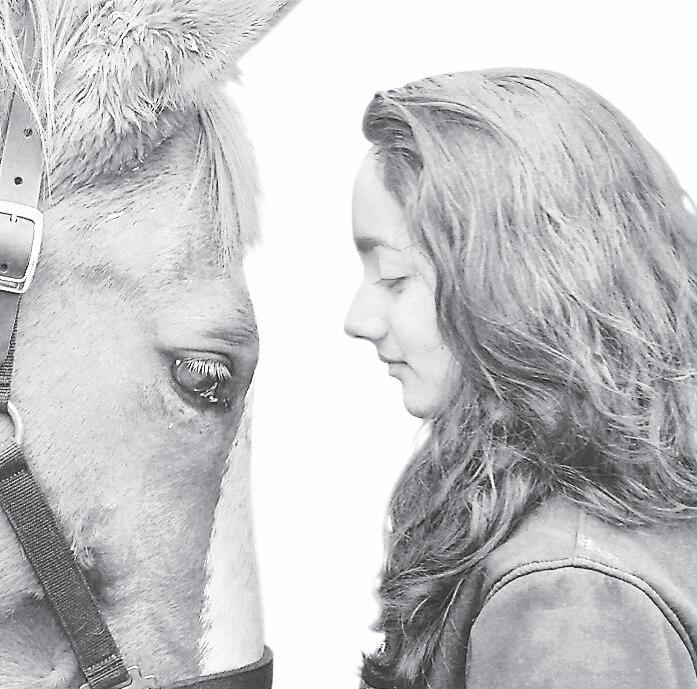
I think that societal pressures often make us feel that as young, highly educated women we have an obligation to take life by the horns and aggressively pursue our careers
vet school, I was fairly committed to following the path of an internship, residency and eventual specialty position in academia as well as being a crazy cat lady However, I met many extraordinar y professionals around the world throughout vet school, and I began to see that those (both men and women) who had thrown themselves into their careers like I planned to didn’t seem to have as much life satisfaction as those who had actually considered this balance So I began to offer myself a little more life School was always the priority and especially in clinics I would be willing to drop everything for a patient, but I started to consciously take time to see my horse, hang out with friends, talk to my parents, cook, exercise the little things that bring enjoyment to daily life I’m still going to do an internship after I graduate, but pursuing a specialty is more up in the air now I was fortunate enough to also meet an amazing man to spend my life with who also supports
my career aspirations I still can ’ t relate even a little to the women who want to throw away years of schooling for raising a family I personally know a handful of these women, and we ’ re told by older veterinarians that in the past, at least, it happened relatively commonly In my case, although there were a few bumps in the road, I’ve always found veterinary medicine to be a calling the satisfaction I get from the work itself contributes to my general satisfaction, and I feel that I would be unhappy to ever let it go Proportionally, females will soon dominate the veterinary profession (veterinary classes these days have typically no more than 25 percent males, if that), and there is talk of private practices transitioning to a m u l t i - o w n e r model so that v e t e r i n a r i a n s can be practice owners and therefore earn more money than being associates, but will also have the flexibility to instill a work-life balance
This is a significantly more personal column than I normally write, but I suppose it’s to be expected from a final column Anyways, I’ve covered most of the more practical aspects of vet school (developing good learning habits, the importance of interacting with people, how to be compassionate in the face of difficult decisions, etc ) in previous columns After eight years at Cornell (and with the Sun!), my time on the Hill is drawing to an end for now, at least I’m immensely grateful to have had the opportunity to meet so many outstanding people and be offered such amazing opportunities, and would like to thank everyone along the way who has offered support
Nikhita Parandekar is a fourth-year veterinary student in the Cornell College of Veterinary Medicine She may be reached at nparandekar@cornellsun com Hoof in Mouth appears alternate Fridays this semester



PJ APARTMENTS COLLEGETOWN STUDIOS TO 18 BEDROOM MANSION 607-229-5116 WWW PJAPTS COM PJAPARTMENTS@GMAIL COM
NEW BEAUTIFUL RENOVATIONS COMPLETED TOURS AVAILABLE M-F, NOON-6PM OR BY APPOINTMENT AVAILABLE FOR 2015-2016

BASEBALL
Continued from page 12
has been senior Brian McAfee, who currently ranks second in the Ivy League in ERA and ranks third in wins
Despite the team ’ s recent problems, players said they are still confident they have what it takes to compete
“I’m confident that our team will go out and have a good series this weekend,” said junior outfielder Jordan Winawer “ We have all the tools that it takes to consistently win ball games and it’s just a matter
“Whether we’re down in a game or coming off of a loss, this team has shown fight all year.”
F r a n c e s c o P a d u l o
of putting all of ever ything together on a more consistent basis ” With division title aspirations out of the way, the final Ivy League series will mainly be a matter of pride for the Red A Princeton sweep would give the Tigers a third-place finish in the Lou Gehrig division Cornell needs to win at least one game to avoid being stuck in the division’s cellar Regardless of the situation, players will continue to play hard
“ Whether we ’ re down in a game or coming off of a loss,” said sophomore infielder Francesco Padulo, “this team has shown fight all year "
Shane Lewis can be reached at slewis@cornellsun com
LEE
Continued from page 12
the level of Yasiel Puig
And that’s what bothers me; baseball is the only sport in America where emotion is almost frowned upon The traditions of baseball from the good ol’ days have long said that showing up a pitcher after a long home run is bad form Baseball culture in America has become gentrified to the point where the sport almost expects every player to be the same, or otherwise face the wrath of opposing players
In basketball, the pimped out dunk is celebrated as a feat of athleticism In football, people love a great touchdown dance or celebration In hockey, fans love watching players celebrate goals in a unique way In baseball, if you take too long to circle the bases, drop your bat in too emphatic a manner or celebrate for too long, there’s a good chance you’ll get plunked In baseball, the culture encourages punishment for celebration, for personality, for emphaticism
In Chris Rock’s monologue for HBO on why baseball is struggling to capture Black America, he mentions how issues like money don’t hold back third-world countries like the Dominican Republic from becoming a powerhouse in baseball
In Korea, bat flips and the general pimping of home runs is an art form Over the last 20 years, the growth of baseball in Korea has been exponential I’ve been lucky enough to have the chance to attend a couple of games in Korea, and there’s one incredibly pronounced difference Games are a celebration, a party for athletic achievement People encourage flair, excitement and pizzazz
People watch baseball in Korea because it’s an opportunity to see something different every single night
The notion that baseball is dying right now is untrue
Attendance numbers are at an alltime high, but that statistic, at the moment, isn’t quite relevant for judging whether or not the sport is relevant The demographic that baseball is struggling to reach right
Baseball isn’t dying yet, but the foundations for its demise are being dug.
now cannot pay for tickets The youngest group of people buying tickets to baseball games are those who grew up in one of the most diverse, entertaining periods in baseball history
Those attendance numbers that suggest that the game is thriving, however, are irrelevant when considering if baseball is dying The people who are going to determine the future of baseball aren ’ t the people paying for tickets right now, it’s the people in high school and college who can ’ t yet pay for tickets
The culture of baseball discourages individuality, for players to have their own identity on the field Individuality, unique players and the chance to see something new every night is what attracts my generation to the screen Baseball simply doesn’t provide enough of that Baseball isn’t dying yet, but the foundations for its demise are certainly being dug right now
Joon Lee can be reached at jlee@cornellsun com

Princeton, who has lost eight straight games and has dropped 16 of their last 20 matchups Over these past 20 games, the Tigers have scored three or more runs only nine times and have been shut out twice
Princeton ranks last in the Ivy League in hits and RBIs and is near the bottom in almost every other hitting category Bright spots for the Tigers include infielders Billy Arendt and Danny Hoy, who have both hit over 300 under the season and have been the team ’ s main source of run support
The Tiger pitching staff also ranks near the bottom of the Ivy League Princeton has given up 6 24 runs a game and is last in the Ivy League in strikeouts No pitcher on Princeton’s staff has a winning record or an ERA under 4 00 Over the course of teams eight game losing streak, the staff has surrendered nine or more runs four times
Fielding has been just as big of an issue for the Tigers, as they rank second to last in the Ivy League in both errors and fielding percentage
While all of these factors should bode well for Cornell, the Red is going through many of the same problems Cornell ranks below Princeton in batting average and has fewer total hits on the season While there have been flashes of quality hitting during the Red’s losing streak, the team has shown to be incapable of keeping up with teams that can score six or seven runs a game
I’ m a young person (19 years old) and I’m living in an age where I have, literally, unlimited sources of entertainment at my fingertips I, like most of my classmates, cannot stand a minute of

boredom If we feel bored even for a moment, we take out our phone and find something to consume ourselves with
are, however, a couple of things that will get me to turn on a game on MLB TV:
1) An unbelievable pitching matchup
2) The chance to watch history (a player’s
It seemed they only thing that could put the Red’s losing streak on hold was the weather Cornell’s match against Binghamton was cancelled due to inclement weather Previously, the Red (9-25, 6-10 Ivy) had been losers of six straight games, including a sweep from Columbia The team has now being eliminated from divis i o n c o n t e n t i o n a n d a s p o t i n t h e Iv y L e a g u e Championship Series
The Red will look to end their losing streak against
The Red pitching staff, commonly thought to be the strength of the team as well, has struggled recently The unit allowed a staggering 57 runs over the six game losing streak, including 30 runs in a Sunday doubleheader against Columbia The Red has fallen to sixth in the Ivy League in ERA, giving up an average of 6 07 runs a game
One pitcher who has continued to stand out for the Red
By JOHN McGRORTY
Staff Writer
T
Cornell women
s softball team will
p l a y t w o d o u b l e h e a d e r s a g a i n s t
Princeton University The Red (1221) look to close out regular season Ivy League this weekend in competitive matches against the league rival Tigers Coming off of a two-game sweep on Thursday against Siena College, the Red looks to carry strong momentum into this weekend
“We’re really excited about this weekend,” said senior infielder Claire Feely “ This will be our last Ivy League matchup of the year and a special weekend for [head coach] Dick Blood and us seniors This matchup the last few years has been pretty competitive, so we ’ re expecting the games ahead to be no different ” The Red knows that this weekend
w i l l b e e x t re m e l y c o m p e t i t i ve However, they have shown poise in their recent games that will help them exceed in this competitive atmosphere
“We really seemed to hit our stride last weekend against Columbia, coming up with clutch hits and defensive stops throughout the series,” Feely said “To be successful in our upcoming games we’ll need to stay aggressive and consistent on both sides of the ball ”
Senior catcher Sophia Giaquinto said the teams hopes to carry momentum into the weekend
“I don’t think our record is a good
re p re s e n t a t i o n o f o u r t e a m , ” Giaquinto said “We have so much

talent and potential, but we have struggled to get it done on the field If our defense holds up, I’m confident that our offense will get the job done, and we will be successful this weekend against Princeton It’s our senior weekend, so it would be very rewarding to go out with a bang ” So p h o m o re i n f i e l d e r C h l o e Pendergast was recently named the Ivy League Player of the Week This c o u p l e d w i t h f re s h m a n Ma d d i e Orcutt being named the conference’s pitcher of the week With games against Princeton and Binghamton still left on the schedule, the Red l o o k s t o c o n t i n u e t h e i r s t ro n g upswing “ The season as a whole hasn’t gone quite the way we planned in the scorebook,” Feely said “However,
We’ve been playing some of our best softball recently, showing a great deal of promise for the future Our young squad has grown tremendously this year and is delivering in key situations on the mound and at the plate Mov i n g f o r w a rd , c o n s i s t e n c y a n d good team energy are key both for i m p rove m e n t a n d l o n g - t e r m s u ccess ” With this being the last home games of the season, the Red will celebrate their senior day for the class of 2015 This senior day will also be momentous because it will act as the last home games for Blood, who he announced he would retire after this season
The main way I know what’s going around in baseball is through Twitter and Vine snippets; the majority of those Vine snippets are something that I wish I could’ve seen live and, in recent years, a lot of those snippets contain Yasiel Puig, the theatrical Cuban star of the Los Angeles Dodgers He’s a freak of an athlete and pumps excitement into any game he plays, highlighted by his bat flips at the plate If there were a Yasiel Puig NFL RedZone type channel, I’d subscribe without hesitation
But many baseball tra-
debut, a perfect game, etc )
3) The chance to watch something I’ve never seen before
More than ever before, the gentrification of baseball is discouraging individuality, and that’s the source of baseball’s issue
Puig, on almost a nightly basis, makes you laugh and drops jaws in awe He makes dumb mistakes and he hits flips bats like nobody else in baseball He makes baseball exciting He shows emotion and shows that he cares about the game of baseball
It s not that Puig is an amazingly gifted player (he is) or that he plays he’s one of the best young players in baseball (he is) that draws me to him
The gentrification of baseball is discouraging individuality, and that’s the source of baseball’s issue
ditionalists take issue with Puig’s bombastic play, saying he’s disrespecting the integrity of the game This led Puig to tell the Los Angeles Times that he would work on cutting down his bat flips
“I want to show American baseball that I’m not disrespecting the game, ” Puig told The Times
Herein lies the reason why baseball continues to str uggle capture young fans Baseball is a game with a lot of down time; studies have shown that approximately 14 to 18 minutes of a baseball game are actual action
Beyond watching the Red Sox, I don’t have a lot of time to spend watching baseball There
Mike Trout is all of those things and more What draws me to Puig is that he has pizazz and flair He provides the opportunity to watch something that you can ’ t find anywhere else in baseball
Trout, by all measures, is the best player in baseball and could go down as one of the all-time greats when he decides to hang up the cleats in 15 years
But Trout is almost great to a fault; he’s so consistently amazing, evenkeeled, that it can get monotonous and boring Now, I understand how entitled that can sound, but beyond the occasional home run-robbing catch, Mike Trout is too routinely great to be exciting to