The Corne¬ Daily Sun

By OLIVIA WEINBERG Sun Staff Writer
On March 31, New York became the second state to pass state-wide legislation banning single-use plastic bags, following California’s ban in 2016.
The ban, included in the new state budget and set to take effect next March, also includes a five-cent tax on paper bags that counties can choose to opt in to, The New York Times reported. Although New York is second in statewide ruling on plastic bags, all of Hawaii’s counties had passed individual rulings barring plastic by July 2015, effectively banning use in the state.
“We’re 100 years strong, family, private owned, nearly 100 stores … we’re happy to help the environment whenever we can.”
Brianna Brown
However, New York’s new ruling includes several exceptions. Plastic takeout bags, bags for deli or meat counter items, bags sold in bulk such as trash bags, garment bags and newspaper bags are still permitted. State legislators, led by Gov. Andrew Cuomo (D-N.Y.), hope that the ban will lessen the impact of non-biodegradable plastics on the environment.
“Plastic bags are trash. I’m including provisions in my executive budget to ban single-use plastic bags … Let’s protect our environment,” Cuomo tweeted on Jan. 3, 2018.
The Governor cited a reduction in land and water



By HUNTER SEITZ and AMANDA CRONIN Sun Assistant News Editor and Sun News Editor
Stephen Moore, nominee for governor of the Federal Reserve board and former advisor for Trump’s 2016 election campaign, began his talk Wednesday by giving three pieces of advice to students: do what you love, question both experts and “scientific consensus” and read the Wall Street Journal editorial page no matter one’s political affiliation.
Moore prefaced the talk by polling the room for attendees’ opinion of President Trump and warned the audience he wasn’t there to persuade them that Trump was “the greatest president ever.”
Moore said that upon first meeting Trump during the primary, he was not impressed. “I thought he was kind of a blow hard,” Moore said. “I thought [his campaign] was

By AURORA ZHANG Sun Contributor
a publicity stunt.”
However, after sitting down for three hours with Trump and Larry Kudlow, appointed by Trump as Director of the National Economic Council in 2018, Moore became convinced that Trump had potential to win the election.
“Bill Clinton is the best politician I’ve ever met in my lifetime,” Moore remarked, explaining that Trump reminded him of Clinton’s ability to connect with the average American. Former presidents Barack Obama and Ronald Reagan were also mentioned in comparison with Trump.
Discussing the idea of “Trumponomics,” Moore explained that the basic idea is that problems are better solved by economic growth. He cited the $3.1 trillion
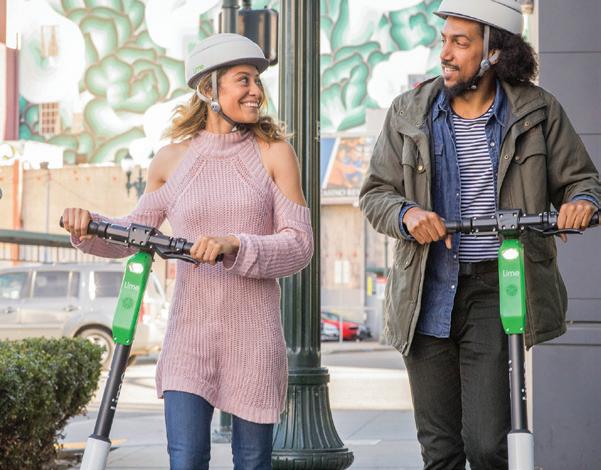
A new fleet of citrus-green scooters may potentially be whizzing through campus come May to join the ranks of LimeBikes, the characteristically green bikes that hit Ithaca streets last April and quickly garnered popularity with Ithaca residents and Cornell students.
To address various complaints about the bikes, including manual pedaling and relatively low speed, the city is considering an alternative choice for the “last mile” in the daily commute.
The Lime electronic scooter is essentially a stand-up kick scooter that runs on electricity. Riders download the Lime app, scan it to unlock
a nearby scooter, step on to the floorboard, push the throttle button and the pay-by-minute journey begins.
The scooters, like the bikes, will cost one dollar to unlock and fifteen cents
15th Annual Willard Straight Hall Chili Cookoff 11 a.m. - 2 p.m., Willard Straight Hall Memorial Room
How to get Work Authorization in the U.S. 11 a.m. - Noon, 276 Caldwell Hall
President Trump’s Nuclear Security Strategy 11:30 a.m. - 12:30 p.m., 182 Myron Taylor Hall
C.U. Music Undergradua Open House Noon - 2 p.m., B20 Lincoln Hall
Presentation from Cornell Entrepreneur of the Year Leonard Schleifer ’73 1:30 p.m., 101 Phillips Hall
Pathways to Entrepreneurship: Families, Foodies and Hospitality 2:45 - 3:45 p.m., Statler Hall Conference Center
Solving the Puzzles of Planet Formation in the Modern Era of Planet-Hunting 4 - 5 p.m., 105 Space Sciences Building
Creating a Culture of Wellbeing Noon - 1 p.m., G01 Biotech
The Works in Progress Seminar 12:10 - 1:10 p.m., 488 Uris Hall
Planning in Action in Dallas: Pragmatic Strategies for a Business-Friendly City 12:20 p.m., Milstein Auditorium
How Subtle Ethnic Associations and Interpersonal Interactions Shape One Another 12:20 p.m., 202 Uris Hall
Cornell Chimes - Yamatai Collaborative Concert 1:10 - 1:25 p.m., McGraw Tower
Health Impacts of Wildfire Plume Dynamics 2:30 - 4 p.m., 401 Warren Hall
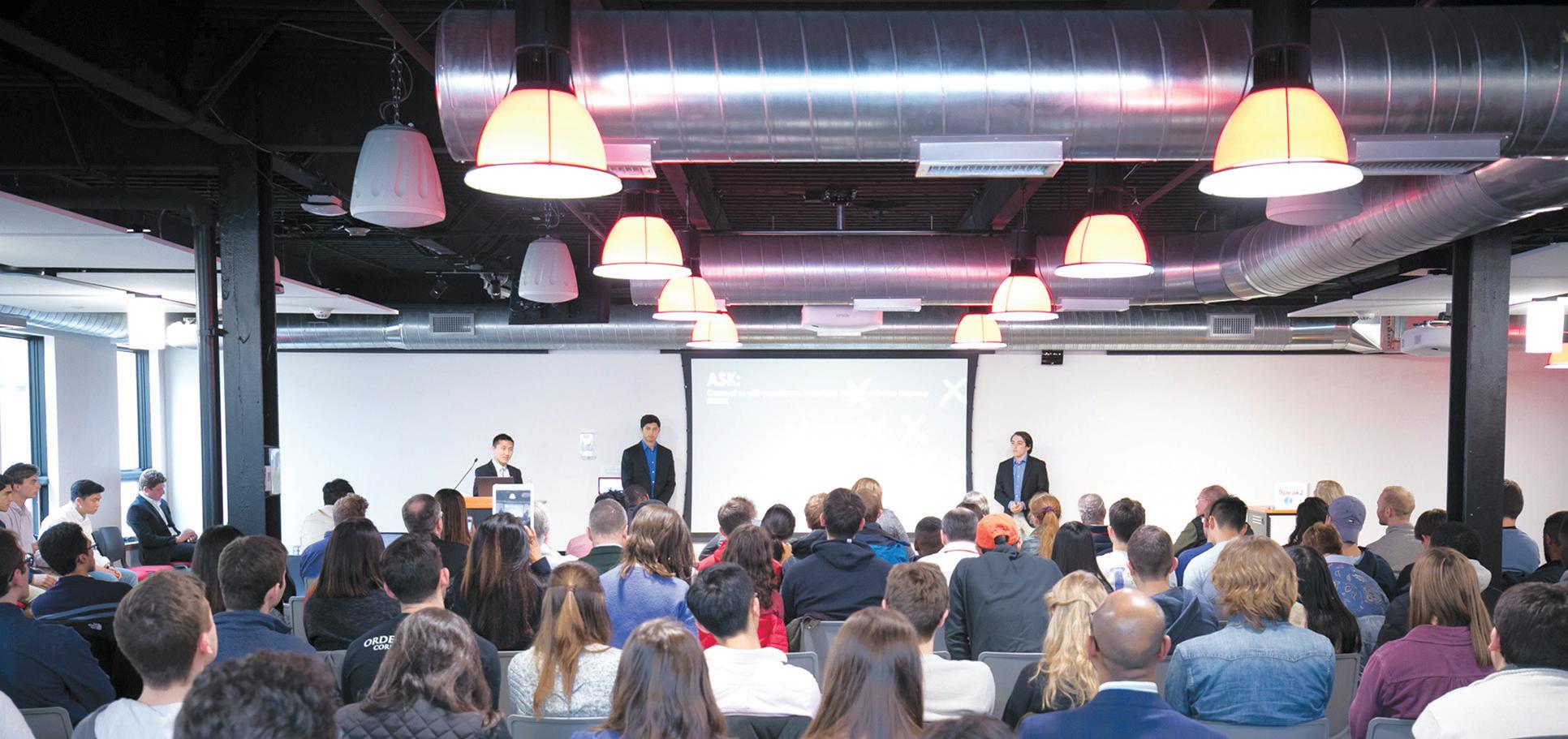
Big Idea Competition 3 - 4:30 p.m., eHub Collegetown
Cornell University Core Values Listening Section 3 - 4 p.m., 127 A&B Cornell Health
Animal Welfare Institute Panel 4 - 5 p.m., 279 Myron Taylor Hall
Centrally Isolated Film Festival 4:30 p.m., Schwartz Center for Performing Arts, Film Forum
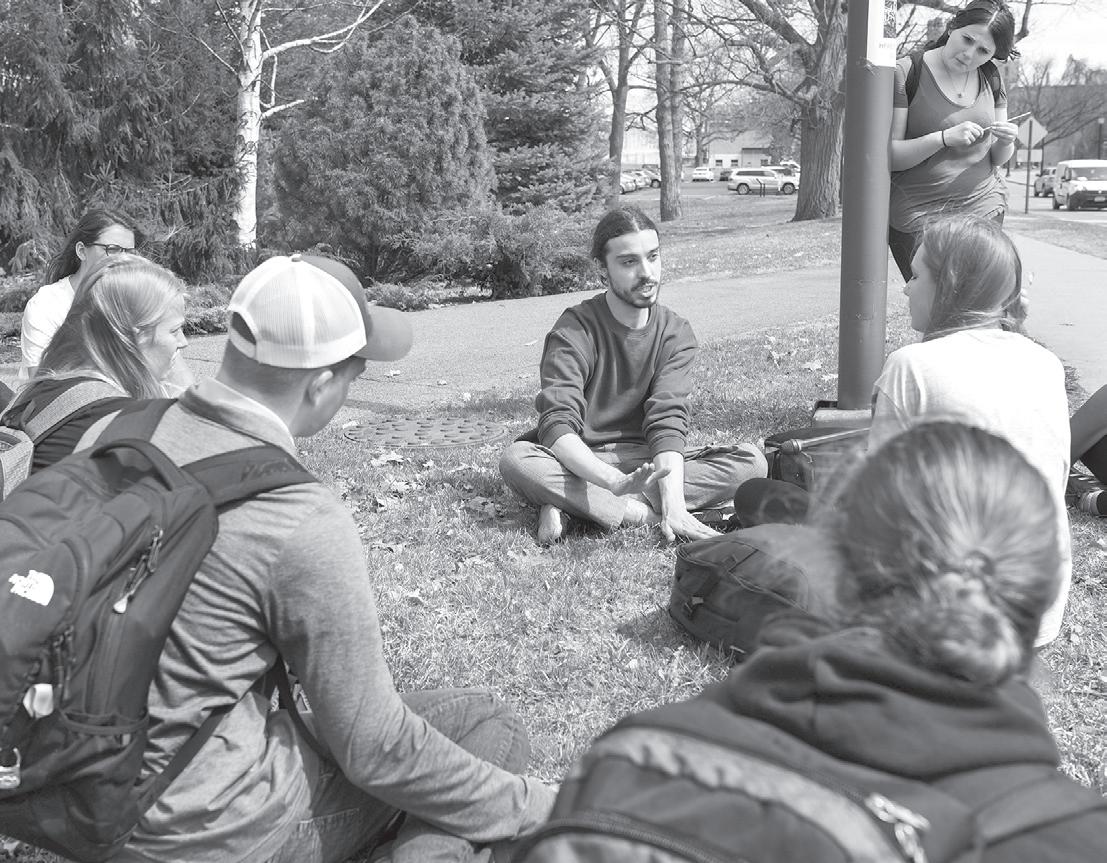
By CATHERINE CHMIEL Sun Contributor
In hopes to bridge the Ithaca residential community and Cornell, the Collegetown Small Business Alliance will host a competition to design new light pole banners in Collegetown. The winning designs will be displayed on a minimum of 15 light poles for at least two years, according to the contest page.
The contest aims to create a sense of pride and involvement in the community, said Harrison Unruh ’19, a team member of the Cornell Medium Design Collective, in an interview with The Sun.
According to evaluation criteria on the contest page, the new banners will seek to showcase the identity of Collegetown, focusing on Cornell students, small Ithaca businesses and the city itself. Successful banners will have designs that are timeless and do not include elements of design that may quickly go out or style, such as trendy fonts or colors.
The original idea for a contest was pitched by Tom
Knipe, City of Ithaca Deputy Director for Economic Development and David Cutter, University Landscape Architect for Cornell University, at a meeting of the Collegetown Neighborhood Council at the Half Built event in early March — an event where members of the Cornell community gathered to share ideas for revitalizing underused spaces.
The Medium Design Collective, a multidisciplinary student group, agreed to lead a design competition to come up with a design for the banners.
In the past, Cornell students have contributed to local projects in the community, including the Student Infrastructure Fund, which contributed to the reimagining of Schwartz Plaza on College Avenue. Design Connect’s Project Eddy Gate also held a two-day “Tactical Urbanism” event to explore redevelopment ideas for the space around the historic Eddy Gate, Cutter said.
The Alliance has partnered with Cornell, along with Ithaca, the Tompkins County Beautification Program and the Tompkins County Chamber of Commerce to

Animal agriculture and global warming have little connection, says prof
By STACEY BLANKSY Sun Staff Writer
On Monday afternoon, Prof. Frank Mitloehner, animal science and Air Quality Extension Specialist at the University of California, Davis, discussed the latest research surrounding animal agriculture and its “surprisingly modest” contribution to global greenhouse emissions. Mitloehner pointed at food waste as the largest contributor to environmental damage.
Prior to the talk, Stephanie McBath ’19, President of Cornell’s Dairy Science Club, told The Sun she hoped that the talk would debunk some of the myths surrounding animal agriculture and replace them with “real scientific facts.”
“I hope that [Cornellians] become more familiar with what the realities of animal agriculture are and how that impacts you as a person,” McBath said. “Everybody has to eat, so this is relevant for every person.”
“The global average is not a number you can use to characterize emissions in the United States,” Mitloehner said. “This nuance is so important in this discussion, but most people in the media do not get that nuance, and that is why they keep getting it wrong.”
Mitloehner said that unlike the agriculture industry, other carbon-emitting sectors such as the fossil fuel and electricity sectors are unable to quantify the specific amount of carbon produced by their industry.
“I hope that [Cornellians] become more familiar with what realities of animal agriculture are and how that impacts you as a person.”
“Many people are out there blaming agriculture for being a gross polluter — the worst of all — and that we should all change what we eat in order to save our planet, ” Mitloehner said. “I can tell you that no other industry I know of has made greater reductions of emissions, but they have quantified where they are today and have pledged for further reductions.”
Prof. Frank Mitloehner
He said that the factor causing the most considerable environmental damage is not the agricultural production itself, but food waste.
host the contest. Representatives from participating groups will form a panel to select three winners who will be announced on May 6. For the top three places, there will be three cash prizes: $125 for first place, $75 for second place and $50 for third place.
Anyone with a connection to Collegetown is eligible to submit a design for the contest — students, residents, and professionals — the contest website states.
The judges are looking for a design that easily showcases the Collegetown brand and connects the groups involved in the community, Unruh said, adding that the judges hope to inspire the community by crowdsourcing a design rather than hiring an artist.
Submissions are due by April 16 at 11:55 p.m., and will include a space for a written description of the piece. Banners must be one-sided and display the word “Collegetown,” and details can be found on the contest website.
Catherine Chmiel can be reached at cac465@cornell.edu.
By GRACE LU Sun Contributor
In a world where compassion, justice and equality have become common motivators for how responsible members of
“If we can’t watch [slaughterhouse footage], can we ever claim that it is humane?”
Ed Winters
society should act, do our food choices need to be included in the conversation?
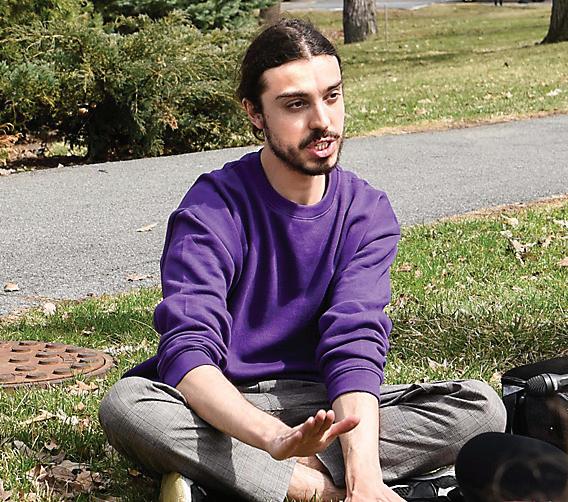
This is the question that Ed Winters, a popular vegan YouTuber with over 160,000 subscribers, aimed to answer in a talk in Kennedy Hall’s Call Auditorium on Monday entitled “Should We All Be Vegan?”
Winters, who works under the moniker “Earthling Ed,” primarily creates content about vegan education and peaceful activism aimed at vegans and non-vegans alike, with the goal of promoting veganism for its large-scale benefits to the environment, animals and human health.
Originally from the U.K., Winters recently embarked on a tour around the U.S. east
coast to spread his message, with speeches at Cornell as well as Harvard, Brown, Columbia, Yale and Rutgers.
In his talk, Winters focused on the moral and philosophical implications of eating meat and animal products, and how this highlights the inconsistencies of society’s collective ethics.
According to Winters, it is morally inconsistent of people to love some species, such as dogs and cats, but systematically slaughter others, such as pigs and cows.
“We have to understand that the distinction between animals that we value within our families, such as dogs and cats, and the animals that we exploit, such as pigs, chickens and cows, is arbitrary in that they all feel
“If we acknowledge that unnecessary suffering is wrong ... we have to avoid inflicting suffering on others...”
Ed Winters
pain and are conscious and are sentient,” he explained.
Winters argued that people consider eating animal products normal because of societal conventions, and they should
In his talk, Mitloehner explained that in the United States, livestock emissions constitute a mere four percent of total greenhouse gas emissions, in contrast to countries such as Paraguay where livestock emissions constitute around 50 percent.
This statistic, which he said demonstrates that many countries are not efficient in their approach to animal agriculture, is why Mitloehner believes livestock emissions should not be problematized as a major player in the United States’ contribution to climate change.
He said that, although the United States has a far greater number of cows, it is much more efficient than nations such as India and China, which use their cows so “inefficiently” that they generate a larger carbon footprint than the U.S.
Food waste, Mitloehner said, was the biggest culprit. “If you think about the entire food supply chain, from cradle to grave, and what within that food supply chain has the greatest environmental footprint, then it might surprise some of you that the greatest detriment is food waste,” Mitloehner said. “We are wasting 40 percent of all food produced in this country.”
He referenced Trump’s recent executive order, designed to cut back on food waste, as an example of one potential solution to the issue of waste.
“Today, President Trump has signed an executive order instructing all major agencies — including the USDA, EPA and the Department of Energy

Simulation | Schoellkopf Field will be the site of Cornell’s planned “simulated emergency incident” drill, where over 100 volunteers will take part in training for potential emergency situations and how to handle these events.
By SHIVANI SANGHANI Sun Assistant News Editor
More than 100 first responders and 40 volunteers acting as victims will trial a broad range of procedures “in a simulated emergency incident” from 10 a.m. to 1:30 p.m on Sunday, according to Dan Maas ’87, emergency manager for Cornell’s Office of Emergency Management.
“We will be testing our ability to triage, treat and transport multiple patients from a major medical emergency,” Maas told the University in a news release.
During the event, signs alerting people to potential minor traffic congestion along Campus Road will be posted, a news release from Cornell read.
Parking in the area, including in the Crescent Lot and in the Teagle Gym, Lynah Skating Rink and Biotechnology building parking lots, will be inaccessible during the drill.
“We conduct small exercises and drills throughout the year, but bringing all these groups together for a full-scale, real-time, multi-agency exercise is a large undertaking,” Maas told the University. “This offers a unique test of our response plans and procedures, our incident command structure, and interagency coordination and communications.”
Numerous local agencies — Cornell University Medical Services, Cornell Environmental Health and Safety, Cornell University Police, Bangs Ambulance, Ithaca Fire Department and the Tompkins County Department of Emergency Response — will participate in the simulation.
“This exercise will serve the public well, in that first responders will be better prepared to handle emergencies that could impact the community,” Maas continued.
Shivani Sanghani can be reached at ssanghani@cornellsun.com.
SCOOTER
Continued from page 1
Several Cornell students who have previously used Lime bikes expressed excitement about the addition of e-scooters. Yuran Zhang ’22 said he has “been looking forward to it for so long!”
Lime’s launch plan, however, is still awaiting final approval by the Ithaca Common Council due to concerns about safety issues related to Ithaca’s hilly geography. Such concerns include vehicle visibility given the scooters’ smaller sizes, sidewalk scooter use protocol and vehicle handling education.
The city’s Mobility, Accessibility and Transportation Commission will have the final say. They will base their decision on E-scooter performance in other cities, according to Ithaca Common Council member Seph Murtagh (D-2nd Ward).
“It is a big decision for the question of whether or not we are gonna allow the e-scooters in Ithaca. I think there are pros and cons,” Murtagh told The Sun. He explained that while the e-scooters provide an alternative transportation method, safety concerns
See LIME page 5
ANIMAL
Continued from page 3
— to devise a plan to minimize food losses and waste,” Mitloehner said. “Think about all of the inputs that go into producing all of that food, and then we are throwing almost half of that away.”
Mitloehner stated it does not matter what makes up a person’s diet; everyone should agree that
“I can tell you that no other industry I know of has made greater reductions of emissions.”
Prof. Mitloehner per minute.
food waste is “just not acceptable for a society like ours.”
Mitnolher stated that removing animal agriculture altogether would lead to extreme waste, partly due to the fact that twothirds of all agricultural land is not suitable for solely crop production.
“If you grow organic crops, you need to have animal manure to fertilize them,” Mitloehner said. “The idea of animal agriculture and crop agriculture being synergistic is not new; our ancestors have known that for a long time.”
The talk was part of the Cornell Dairy Center of Excellence Seminar Series, which continues on April 22.
Stacey Blanksy can be reached at sblanksy@cornellsun.com.
dollar growth disparity between Obama and Reagan during their respective presidencies.
According to Moore, they both inherited extreme economic crises, but tackled the issue in very different ways. “You probably couldn’t find two presidents who were more ideologically opposite,” he said.
Moore explained that Reagan believed government regulation was not the solution to the economic crisis, and instead enacted his well-known “Reaganomics” policies focused on deregulation and reduction in taxes.
In contrast, according to Moore, Obama heavily favored more government programs and regulations to try and fix the issues facing the country, limiting economic growth and therefore recovery.
Moore heavily criticized liberals in metropolitan areas such as Washington, D.C., and Hollywood for thinking Obama had fixed the economy, citing stagnant wages that persisted under both Obama and President George W. Bush.
He claimed that in states such as Ohio, Michigan and Pennsylvania — all of which swung for Trump in the 2016 presidential election despite backing Obama in 2008 and 2012 — the reverberations of the 2008 financial crisis were still being felt throughout Obama’s presidency, and this was one of the reasons for Trump’s victory in 2016.
Trump’s election “unleashed the animal spirits of the economy,” according to Moore, citing increased small business optimism, consumer sentiment remaining high and the economy being rated good or excellent.
Trump won the working man’s vote, in Moore’s opinion, because Trump has brought back jobs in mining, construction and manufacturing.
In addition, Moore cited that despite
Trump being a so-called “racist,” he has lowered unemployment among AfricanAmerican and Hispanic demographics.
Moore responded to criticisms of being a “sycophant” and “Trump loyalist,” stating that he did disagree with Trump on the issue of trade.“Trump was absolutely wrong when he attacked NAFTA,” Moore said, in reference to the president calling the North American Free Trade Association the “worst trade deal ever struck.”
Moore covered various items on Trump’s presidential agenda during the talk, discussing issues of reducing taxes as well as going into particular detail on the issue of climate change and oil production.
“We’re not running out of oil and gas production, we’re running into it,” he said, citing that for the first time in 50 years the United States has become a net energy exporter.
He criticized the Paris Agreement climate accord, saying that none of the countries who signed the agreement were even close to meeting their promised commitments, while America had reduced its carbon emissions significantly over the last couple of years.
One reason in particular Moore felt had aided in this effort was the usage of natural gas. He claimed that natural gas was “wonder fuel” and “clean burning.”
“I don’t understand why anybody would be against natural gas,” he said.
Moore said he wanted to end his talk on a positive note, and criticized the growing trend of “glumness and gloominess” today such as the panic about global warming.
“You’re facing the most awesome future,” Moore said. “Stop the gloom. There is no time or place better to live than the US. You’re living a charmed life.”
Hunter Seitz can be reached at hseitz@cornellsun.com.
Amanda Cronin can be reaced at acronin@cornellsun.com.
loom regarding riding on sidewalks, riding without helmets and young children operating the scooters. According to Murtagh, installations of new bicycle- and pedestrian-friendly infrastructure have been “successful” so far, citing projects such as the Cayuga Waterfront Trail, the Black Diamond Trail and some of the busier bike lanes and pedestrian crossings. However, “there are still many areas of the city where it’s difficult or dangerous to ride a bike, not to mention a scooter,” Murtagh said.
Jeff Goodmark, Ithaca operations manager for Lime, expressed confidence that the company’s scooters will be in the streets of Ithaca this spring. Emphasizing that scooters are “accessible and equitable”, he told Ithaca Voice that the company would update scooters with new
safety features such as larger wheels, upgraded brakes and brighter lights.
Murtagh also expressed concerns about the potentially steep learning curve facing new riders in handling the e-scooters.
Goodmark told the Ithaca Voice that the company would introduce training clinics and one-onone lessons to teach community members about safe usage of the e-scooters.
Several Cornell students expressed excitement for the e-scooters. “I have only used Lime bikes for two or three times each past semester as pedaling up the slope could so difficult.
E-scooters are definitely better as they are electricity-driven,” said Yifan He ’21.
“E-scooters could be more popular for students than bikes. A lot of us just don’t want to be pedaling to sweat and look clumsy to friends you know? But E-scooters are like skateboards, you can just stand up
Te
pollution as a main goal, as plastic trash can harm wildlife, in the announcement statement.
The ban also seeks to reduce emissions released during the plastic production process.
Jules Isnardi, sales team member at Home Green Home — a natural home goods shop on the Ithaca Commons — expressed her excitement about the ban’s passing.
“I think it’s going to set the foundation towards a mindset that helps people live more sustainable lifestyles and not single-use lifestyles,” Isnardi said. “I think it’s going to affect the shop really positively because we carry so many alternative options, and I look forward to helping people find those alternatives.”
Concerns have been raised, however, that without a mandated ban on paper bags, shoppers will continue to use them as a disposable option and further add to the waste and emissions that the ban aims to eliminate. According to Eric Goldstein, the New York City environment director for the Natural Resources Defense Council, paper requires more ener-
gy to make, resulting in water and air pollution. Additionally, its added weight requires more fossil fuels to transport, according to The New York Times.
Business owners have voiced concerns about the new legislation, specifically that paper bags cost more and smaller retailers cannot keep up with their larger competitors. “Every mandated cost increase adds up,” Greg Biryla, the New York director of National Federation of Independent Business, told The New York Times.
However, GreenStar Natural Foods market employee Joel Hartnett said that he wasn’t concerned about the ban’s potential negative impacts on business.
“Business model, business schmodel, get with the times, do the right thing,” he told The Sun in an interview.
GreenStar already charges a five-cent tax on paper bags, and Hartnett estimated that over 50 percent of customers either put their goods in a backpack or purse or opt to bring their own reusable bags.
The ban stipulates that three of the five cents charged for paper bags will go towards the state’s Environmental Protection
Fund and the other two will go to local governments, according to The Democrat and Chronicle. This is not the first time New York has regulated bag usage. On May 5, 2016, the New York City Council passed a Bring Your Own Bag Law, requiring businesses to charge five cents for any disposable bags within the city. The bill was delayed until Cuomo passed a bill essentially extinguishing the law, though the law was opposed by members of the State Assembly who cited fears that the tax would further stress low income families.
Brianna Brown, an employee at Wegmans and an Ithaca College student, said that the ban will not negatively affect Wegmans because “we’re 100 years strong, family, private owned, nearly 100 stores and care about the environment and obviously follow the law … we’re happy to help the environment whenever we can.”
Despite the pushback, the plastic bag ban hopes to be a step towards a cleaner, greener New York, and will go into effect next March.
Olivia Weinberg can be reached at oweinberg@cornellsun.com.
and move fast while looking cool,” Zhang said.
However, student concerns remain about how available E-scooters would be on-campus with factors such as the slopes and the difficult weather. “I feel like it would be dangerous riding e-scooters down the hills. I wonder would they allow e-scooters entering areas like West Campus?” Yifan questioned.
Zhang also expressed worry about the electric scooters on areas with snow, rain and other precipitation during the winter months.
“There’s definitely a concern about the use of e-scooters on hills since we live in such a hilly place,” Murtagh said, but added that it was likely that Cornell would be included in a pilot program if the scooters were approved for use in the Ithaca area.

‘Should We All Be Vegan?’ Earthling Ed Says ‘Yes!’ Te vegan activist asked the audience why we love dogs, eat cows, and wear sheep
even more unethical, than meat consumption.
be questioning those norms.
“If we can’t watch slaughterhouse footage, if it’s not good enough for our eyes, then the question is, why on earth is it good enough for our stomachs?” he asked of his audience. “And if we can’t watch it, can we ever claim that it is humane?”
Winters spent a portion of his time focusing on the dairy industry, and explained the vegan perspective as to why dairy is considered to be as unethical, or
“In the dairy industry, all the animals are still sent to the slaughterhouse,” Winters said. “But we can argue that dairy is even worse than meat because the cows are forcibly impregnated through a process called artificial insemination, have their babies stolen from them so that the mother’s milk can be given to humans instead of their own calves, and this is a cycle that happens year by year.”
Winter’s talk also focused on the environmental implications of the meat and dairy industries as well as the large subsidies that
“Dairy is even worse than meat because the cows are forcibly impregnated through artificial insemination.”
Ed Winters
are given to these industries for them to be upheld.
He provided statistics on the
environmental harm of beef and dairy products. “It takes 1,799 gallons of water to produce one pound of beef. It takes 2,000 gallons of water to produce one gallon of milk,” Winters said.
He related this back to the ethics of supporting animal agriculture industries, which require massive amounts of freshwater to support, in the face of socioeconomically disadvantaged people and minority groups who live in impoverished areas that have no

clean drinking water.
“Environmentalism is also a manner of social justice, so to really be intersectional, we have to consider how morally inconsistent it is of us to support the animal agriculture industries when they require one-third of the world’s drinkable water. There are so many people living in such impoverishment that they have no clean drinking water,” Winters argued.
There was a 50-minute question-and-answer session at the end of the talk, in which members could challenge, question or simply express concern or support on the topic of veganism itself.
“A lot of people see veganism as an elite way of eating,” Emma Smith ’22 said, mentioning the existence of food deserts and systematic poverty which makes health, environment, and ethics a low priority for many people in underprivileged communities when making food choices.
Winters acknowledged that veganism is not always a possibility for people in tough circumstances, but elaborated further on why it was necessary to make veganism more accessible and how he believed that this could be achieved.
“It seems morally questionable
“[Veganism] is better for the environment, it’s better for our health, it’s the only logical, consistent way.”
Ed Winters
that people find it right to use the suffering of others to justify the actions of themselves. Why are you using the impoverishment of others to justify your own immorality?” he asked.
He stated that, especially on the Cornell campus, there are many students who are certainly capable of supporting a vegan lifestyle, and so if they used their privilege to support more vegan foods, then vegan foods would eventually become more competitive in price to non-vegan foods.
Winters argued that doing so would have domino effects of lowering the prices of plant-based products, which would make these products more accessible to low-income communities.
“If you look at impoverished third-world countries, most of the foods they eat are plant-based because meat is considered a luxury,” Winters said. “Plants are the cheapest foods they can buy.”
Winters made a point to focus on the power of the individual consumer, and the importance of having one’s morals line up with their actions.
“If we can acknowledge that unnecessary suffering is wrong ... we have to avoid inflicting suffering on others whenever we can,” he said. “So if we want to live in a civilized society and claim to be moral beings, we have to exhibit that in our behaviors. [Veganism] is better for the environment, it’s better for our health, and morally, it’s the only logical, consistent way of acting.”
Grace Lu can be reached at gml87@cornell.edu.
137th Editorial Board
ANU SUBRAMANIAM ’20 Editor in Chief
DAHLIA WILSON ’19
Business Manager
PARIS GHAZI ’21
Associate Editor
NATALIE FUNG ’20
Web Editor
SABRINE XIE ’21
Design Editor
NOAH HARRELSON ’21
Blogs Editor
SHRIYA PERATI ’21
Science Editor
AMANDA H. CRONIN ’21
News Editor
ROCHELLE LI ’21
News Editor
JOHNATHAN STIMPSON ’21
News Editor
PETER BUONANNO ’21
Arts & Entertainment Editor
ANYI CHENG ’21
Assistant News Editor
SHIVANI SANGHANI ’20
Assistant News Editor
CHRISTINA BULKELEY ’21
Assistant Sports Editor
BEN PARKER ’22
Assistant Photography Editor
DANIEL MORAN ’21
Assistant Arts & Entertainment Editor
ALICIA WANG ’21
Graphics and Sketch Editor
DANA CHAN ’21
Production Editor
RYAN RICHARDSON ’21
Snapchat Editor
ALISHA GUPTA ’20
Senior Editor
SARAH SKINNER ’21
Managing Editor
MEREDITH LIU ’20
Assistant Managing Editor
RAPHY GENDLER ’21
Sports Editor
BORIS TSANG ’21
Photography Editor
AMBER KRISCH ’21
Blogs Editor
KATIE ZHANG ’21
SOPHIE REYNOLDS ’20
Editor
AMINA KILPATRICK ’21
MARYAM ZAFAR ’21
Editor
ETHAN WU ’21
Editor
HUNTER SEITZ ’20 Assistant News Editor
NICOLE ZHU ’21 Assistant News Editor
MILES HENSHAW ’20 Assistant Sports Editor JING JIANG ’21
Assistant Photography Editor
JEREMY MARKUS ’22
Assistant Arts & Entertainment Editor
LEI LEI WU ’21
EMMA WANG ’20
LEANN McDOWALL ’21
GIRISHA ARORA ’20
Working on Today’s Sun
Ad Layout Dana Chan ’21
Production Deskers Krystal Yang ’21
News Deskers Amanda Cronin ’21
Hunter Seitz ’20
Night Desker Alex Hale ’21
Design Desker Lei Lei Wu ’21
Krystal Yang ’21
Photography Desker Ben Parker ’22
Sports Desker Miles Henshaw ’20
Editorial
JUST A FEW WEEKS AGO, 10 CANDIDATES TOOK TO THE CAMPUS QUADS, Willard Straight Hall and social media feeds to campaign for the undergraduate position of Student-Elected Trustee.
We saw 39.9 percent of undergraduates — a 13 percentage point increase from last year — fill out the Qualtrics survey that also included slots for positions such as Student Assembly President and Executive Vice President.
Elections closed on Wednesday, March 27 at 2 p.m.
The results rolled out: Joe Anderson ’20 as Student Assembly President, Cat Huang ’20 as Student Assembly Executive Vice President — and 13 days of silence from the Trustee Nominating Committee.
For 13 days, the Nominating Committee has failed to report any results from the 2019 Trustee election. They have numbers and they have results, given that results for President and EVP were promptly released. But, nearly two weeks out, the general community doesn’t know any information and the candidates themselves only know that there were some challenges and due to spring break there were delays.
The irony is that each of the 10 candidates made a point to include transparency as part of their platform, identifying it as something currently lacking in the Trustee position.
But here we are — 13 days later.
We deserve to know who voters chose to represent us on the Board of Trustees. The Board has 64 members, and we get five constituent-elected spots. This position is important.
If the results were challenged, we should know that, too. On April 9, 2018, we were informed a candidate had been disqualified for use of a Cornell logo in a meme. We were given information about the challenge process and the judicial and procedural red tape that surrounded it. Though last year’s election was surrounded by ridiculous amounts of drama — created by a meme, no less — we at least knew what was happening.
In line with this precedent and a broader duty to the Cornell community, the Nominating Committee should update what information is available about the Trustee Election. If the candidate who comes to assume the position had a challenge against him or her, we should not be blindsided. An undergraduate Trustee’s responsibility is, at its core, to be a student advocate, and if something was done to taint that role, it’s only fair we know.
Election turnout is never as high as is hoped for, but we made some significant progress this election and saw a huge increase in voter turnout. But being secretive and unnecessarily quiet about these positions ruins the community momentum that the election began to build. The undergraduates who put their coursework aside even for a minute or two to vote are being told, through silence, that their vote “matters” — but not enough for them to be in the loop. Rip the red tape off — it’ll just take one email.
In elementary school, there was one other black girl in my year, and she had the Addy Walker American Girl: a fugitive slave doll who’d escaped with her mother from a plantation in North Carolina to Philadelphia during the Civil War. My mother wouldn’t buy us the Addy doll, telling us that we wouldn’t hold a slave doll and betoken a painful heritage that wasn’t ours — a strict edict heavily loaded with implications about identity. Still wanting me to be happy and fit in, she did what any mother would: she bought me an Elizabeth Cole doll.
Growing up, my parents made sure my sisters and I knew to never allow anyone to classify us as African American, a term that typically refers to descendants of enslaved black people. Not because there’s anything inferior about any other diasporan identity, but simply because I’m not. I’m black. My parents are West-African immigrants and I identify as a Ghanaian American. In the U.S., African immigrants aren’t culturally identifiable by much except that we tend to aspire toward becoming pharmacists, researchers, doctors or lawyers and live in predominantly white, upper middle-class neighborhoods. We comprise 0.5 percent of the U.S. population.
I didn’t fit in with the few other black kids and certainly didn’t fit in with the white kids. To my parents and their friends, I was too American; to my friends, I wasn’t American enough. To the white kids, I was too black; to the black kids, I wasn’t black enough. By high school, I realized that whether or not the people I felt uncomfortable around were black or white, there was some degree of American-ness both of them possessed that I’d never be fluent in. Even though the only black American Girl doll was a slave, at least she reflected a member of American society.
my parents could afford it. There’s joy in the exclusivity of being able to hold the doll and bring it to recess to play with — I was part of the American Girl Doll club, just like I’m a part of Greek life, even though it, like the dolls, doesn’t represent everyone, is elitist and really only for people with money and forces people to adopt roles that are too limiting. People like me — third culture kids — some of us still buy the doll. We join the club. We accept the part because even if the role we’re playing doesn’t represent us, at least we’ve got screen time.
My African-American friends are, understandably, both curious about my sorority’s perks and wary about the culture and members. I tell them about being one of five black women in an organization of 131. They ask about the weekly mixers — they heard so-and-so was turned away at the door of her srat’s mixer and told to “go back to her black friends.” I tell them I don’t really go, because Chad and Tim aren’t checking for me. They ask about living in a house with a chef. I tell them about living in a house amongst all white women. We laugh about my being asked in the bathroom if, and how often, I wash
To my parents and their friends, I was too American; to my friends, I wasn’t American enough. To the white kids, I was too black; to the black kids, I wasn’t black enough.
When I got to college, I didn’t even consider joining a panhellenic (read: traditionally white) sorority at first. They were a reminder of the petty cliques from high school. One of my close new friends Amber was Caribbean and African-American and showed me the significance of traditionally black Greek letter organizations. The men and women who join remain life-long members and shining exemplars of black excellence. However, there was a distinction — these orgs aren’t just black. They are culturally African-American.
I can still taste the discomfort of that first dinner with Amber’s housemates, tensing with every burst of laughter over shared cultural references, silently cursing my own tongue for its inability to glide through their lyrical, buttery vernacular with ease. Traditionally black greek orgs seemed like another Addy doll I couldn’t force myself to carry just to feel like I belonged somewhere, but I also know I chose to make my life harder by holding the blond, blue-eyed Elizabeth Cole doll and joining a panhellenic sorority. Knowing I’d struggle in either space, I hung back, like always, on the sidelines of a culturally white space, doing my own thing, not looking like anyone else, not understanding cultural references and assumptions, never being asked and not even knowing how to bring my own culture to the mix.
People at the intersection of multiple, seldom-crossed identities (my nationality, race, and socioeconomic status) often find ourselves accounting for only some of our identities in the spaces we inhabit. My status as a black person has made me more aware of the socioeconomic disparities experienced by many people in my race. But at least I’ve got a doll, right? At least
my hair. I tell them, “It’s difficult, in ways that I didn’t anticipate.” I don’t mince words, but it’s not the full picture either: It’s just as hard, I want to say, as it’d be in your sorority, but without the numbers to shield me: hyper-aware of the timbre of my voice, guilty that the slight difference in our ancestral trajectories afforded me privileges that drastically color our differing experiences.
I don’t regret my decision to join my sorority. It’s easily the warmest and most loving space for me on campus and has introduced me to many close friends. But I also envy my black friends in DST or AKA for their strong sisterhood based on their shared identity as black women. Whether it’s in my sorority or with my African-American friends for our shared history and heritage, I’ve learned to seamlessly slip in and out of unfamiliar, vastly opposite spaces, fitting in just enough to get by, but never belonging. I don’t know if I’ll ever fit into one of these spaces, or whether my own demographic will ever gain recognition.
While not even my parents can understand my struggle — there’s a whole country of people somewhere that are just like them — I’m grateful that they taught me to not to allow any person to define for me what my experience would be, despite navigating this neo-colonial, patriarchal world as a black, African woman. I don’t worry about whether or not any of my friends will think I’m not enough of one thing or too much of the other when it’s near-impossible as it is to cultivate and preserve self-love, excellence and the motivation to thrive in a Western society that disparages Africa and demonizes blackness. Instead, I force myself to worry about being as true and authentic to myself and my values as a Ghanaian, as an American, as the child of hard-working immigrant parents, as a woman, as a person, as myself.
Edem Dzodzomenyo is a junior in the College Agriculture and Life Sciences. She can be reached at ejd93@cornell.edu. Ed’s Declassified appears periodically this semester.
Fornicating Feminist | Tameless Shrew
HELENHU/SUNGRAPHICSEDITOR
Acouple of years ago, an intense and very witty friend on The Sun sent a message to one of my GroupMe chats asking if anyone wanted to write a Sex on Thursday piece. Coincidentally, I had just returned from a weekend of debauchery in NYC where I had enjoyed a threesome with my high school best friend and our club promoter. So as fate would have it, I began writing Fire & Ice and Cherries in the Snow.
Looking back at my previous pieces, I can’t help but feel like this is a bittersweet end of an era as I prepare to leave Cornell. After all, I arrived here having had my first kiss a month before O-Week, so this really was the home of my sexual awakening.
Freshman year, I downloaded Tinder for the first time, had the worst date of my life, and got my heart broken by a boy with a girlfriend. Splitting my time between sloppily making out at frat parties and reveling in naughty adventures in NYC, sophomore year whizzed by in a swirl of lust and heavenly cocktails. Junior year, I lost my virginity, discovered porn and fucked a guy on my five-person apartment kitchen counter. This year, I briefly enjoyed the magical perks of being a unicorn, flirted with public nudity and underwent a traumatic dry spell. Four
went on birth control before I had my first kiss.
I did not have to sneak around to Planned Parenthood or make a secret call to my doctor’s office without my parents knowing. My mom just posed the idea to my doctor during one of my annual check-ups. While my doctor and my mother were deep in conversation about the “new” types of birth control, I continually glanced at my phone praying that my childhood doctor wasn’t picturing me as an uncontrollable sex whore. But “hearing my options,” felt a lot less like an adventurous treat and more like choosing which type of allergy medication I’d
My mom’s not a regular mom. She’s a cool mom.
Like I said, I went on birth control because my mom wanted me to. For a self-proclaimed feminist and declared feminist, gender and sexuality studies major, the process felt a lot less badass than the girls who go on birth control to take control of their sexuality in college. What’s rebellious about going on birth
“Well everyone’s doing it. I had sex in college so I won’t
that I will shake it sooner rather than later.
Considering that my religious upbringing has scared me into associating pre-marital sex with the fiery pits of Hell, being on birth control seems like a bit of a waste of money and time for me. But there have been some benefits to my first few months on the shot. First off, I am on one of the “cool” types of birth control. I steer away from science classes and am definitely not pre-med, so I won’t pretend to know the ins-and-outs of its effects on my body. But for some reason, there is a common conception that the Depo-Provera shot and IUDs are cooler than the pill. So I am very conscious to mention to my friends that I have an appointment to get my shot, rubbing it in the faces of my non-virgin friends who had to pretend to their parents that the pill was essential for their hormonal control. My birth control is effortless. I get to book my appointments and don’t have to set 30 timers on my phone to remember to take my pill.
I have an internalized guilt complex associated with sex that I am still trying to shake.
no, I am not counting the girls who went on the pill in middle school to control their acne. I still don’t think that counts. The irony of the situation is that I am on birth control and don’t want to have sex, at least not yet. I completely blame this on religious brainwashing from countless years in Christian
“Save yourself for your husband.”
“Sex before marriage is a sin.”
“Sex is more intimate with a husband who
“Don’t have sex, because you will get pregnant and die!” Okay — that one’s a Mean Girls quote, but you get the point. As much as my liberal upbringing fought against religious slut shaming, I have an internalized guilt complex associated with sex that I am still trying to shake. Cross my fingers
years, countless sexual adventures. Now what?
As I depart the place that both nurtured and tortured me, I can’t help but wonder what the sexual milestones were that made my college experience so sexually transformative. After all, most people at Cornell have good, bad, awkward, funny, wild and sexy sex stories that they will cherish long after their four years in Ithaca. So here go my 20 sexy college things every sexually active Cornellian should prepare for during their four year feat:
1. Download Tinder, Bumble, Hinge and Grindr. Delete them on and off during your time at Cornell after disappointing encounters.
2. Engage in excessive PDA at a frat party.
3. Have sexy time in a twin XL.
4. Netflix and chill.
5. Have a one-night stand with a person you met at Level B and proceed to run into that person daily for the next four years at Cornell.
6. Bang your TA.
7. Do the walk of shame from Collegetown to North.
8. Sexile your roommate.
9. Visit the Adult Outlet in the Commons with friends.
Secondly, my guy friends think that it’s a major turn on that I’m on birth control. I know I said that I wasn’t rushing out to have sex, but I still love being sexually desired and any notch on the hot list helps. I don’t know how it slipped out to them that I’m on birth control, but a decent amount of them now know. Guys don’t miss any opportunity to let us girls know how hot it is to be on birth control. Apparently the birth control girls harness a level of spontaneity that women not on birth control do not have. It seems that men think any minute now the girls on birth control will drop their pants and ask for a foursome.
I can promise you that a foursome is not anywhere on the horizon for me. But the last and best benefit about my newfound condition on birth control is the potential for spontaneity. Sometimes I wish I was that spontaneous sex-all-thetime-and-everywhere-girl. And being on birth control means that if one day I have the sudden urge, I can be without the fear of rapid onset pregnancy.
So as the first woman I know to get on birth control before her first kiss, I will confirm that birth control lives up to the hype. I didn’t gain all the weight that my doctor warned me about and the process got me some attention with the guys in my life. However, I will warn the “never-had-their-first-kissgirls-whose-mothers-encouraged-them-on-birth-control” that your mother admitting to having sex in college creates an undesired competition between yourself and your 18 old mother. My mom was having sex with random guys at my age and I’m busy stuffing my face at Temple of Zeus. Like I said, unnecessary competition.
10. Have loud and rough sex on your communal kitchen counter.
11. Booty call and get booty called.
12. Sext during a boring lecture.
13. Go on a date at Panda Tea Lounge.
14. Forget the name of the person you just fucked minutes after sex.
15. Get an STD test.
16. Have a threesome.
17. Stare at an Urban Outfitters tapes try while you cum.
18. Dress in the sluttiest Halloween costume you can think of for four years. Playboy bunny anyone?
19. Find a friend with benefits only to ruin it by catching feels.
20. Have sex in the stacks.
While my sexual awakening at Cornell empowered and challenged me to grow physically, emotionally and spiritually, I’m excited to expand my sexual adven tures beyond this bubble. More specif ically, I look forward to better sex, sex with better food, blind dates, dates with people that hate dogs as much as I do, sex with a hipster in Brooklyn, no sex, embarrasing sex, sex abroad, joining the mile-high club, La Perla lingere sex, sex in the office, sex with someone I love . . . memorable sex-ca-
pades and never hooking up in a twin XL ever again.
As I embark on this sexy, new journey, I kiss Veuve Cliq-hoe goodbye and wish you all lustful adventures and formidable

The spring semester of my freshman year, I took Biology 1440: Introductory Biology: Comparative Physiology, a popular intro-level biology course. The course content was interesting and enjoyable; however, each exam and assignment I completed was a devastating reminder that the median of the course would be a C+ or B-.
Even worse, I learned from the course syllabus that the curving of all freshmen-level biology core courses to a C+ or B- has been a standard policy at Cornell for years, a sign of grade deflation. Grade deflation, the act of lowering the median grade of classes relative to other courses or institutions, is a highly controversial topic that surrounds colleges and has been acknowledged on the national level.
course is overly stressful and difficult, a major reason being that it is curved to a B- or B.
Encountering grade deflation has led me to become upset with the importance of GPA for medical school in general. I stopped attending pre-health advising seminars because I felt students were too often encouraged to choose easier majors and take easier courses to conserve their GPA. It is already easy enough to focus on earning a good grade in a class more so than learning; grade deflation only exacerbates this problem.
Cornell, with its academic rigor and low acceptance rate, is difficult enough to attend, so why must we be further challenged for choosing to be surrounded by brilliant peers?
The effects of grade deflation are far-reaching and undoubtedly horrible. Negative connotations and labels like “weed-out courses” are often associated with grade deflated courses because of their apparent intention to “weed-out” students (i.e. convince students to drop the class and even reconsider their career path due to the difficulty of the course). This is an especially large issue for pre-graduate school students and engineers. Moreover, non-pre-grad and non-engineer students, or those who wish to simply learn about a subject, are unjustifiably punished for taking a course that might interest them but is grade-deflated.
Being a pre-medical student, I have had several personal conflicts with the phenomenon of grade deflation. As a freshman, I dropped Chemistry 2070: General Chemistry I and considered dropping Biology 1440 entirely out of fear of earning a B- or lower in both classes. I have also opted not to take Biology 2800: Genetics, a popular class among pre-meds, because I have heard from my peers that the
Removing grade deflation would provide more reasonable approaches to other issues regarding academics. In 2011, Cornell controversially stopped the online posting of median grade reports for all courses, a practice started in 1996. A major motive for this decision was that the publishing of median grades was “used by students to select courses that give high grades,” consequently contributing to grade inflation. And in 2008, the University began posting median grades of courses on official transcripts for all undergrads — another contentious action. These choices could be reanalyzed, if not changed for better with the removal of grade deflation.
Each course then would have a more level playing field and students would have an equal opportunity for academic success, regardless of career choice or personal interest.
Interestingly, the University’s choices allude to a different take on grade deflation, that there are benefits to grade deflation that possibly outweigh its detriments. One of these include encouraging students to work hard and thus increase Cornell’s prestige among peer institutions. However, this argument fails to account for the side effects of these benefits; while grade deflation may develop good
Christian Baran | Honestly
Many of us at Cornell use some sort of mobile payment system multiple times a week, if not nearly every day. Venmo, Uber, Apple Pay, Lyft and PayPal are just some of the mobile payment platforms linked to our debit and credit cards that we rely on. Generation Zs and millennials turn first to mobile wallets when we’re with friends. But to our great frustration, we rarely find the same ease of
Millennials turn first to mobile wallets when we’re with friends.
work ethic, it also fosters unhealthy competition among students rather than collaboration, since a much lower number of students can earn A’s. Consequently, students are more likely to experience unhappiness, stress and mental health issues. Encouraging hard work is invaluable, but at what cost?
Cornell’s aggrandized prestige is also limited somewhat by the prevalence of high school seniors that use academic rigor to help decide which college they want to attend. The saying “Cornell is the easiest Ivy to get into, but the hardest to stay in” has become an all-too-common line among Cornellians and non-Cornellians, reflecting the immense difficulty that some academic programs possess. If grade deflation is eliminated, people can have more discussions pertaining to the other, more positive aspects of Cornell that can help guide their college choice.
However, there is a delicate balance to be achieved between grade deflation and inflation. Grade inflation, the other extreme of the spectrum, can be just as bad. If all students in all courses receive an A+, the value of the grade is diminished, likely unreflective of student diversity in academic performance. Therefore, the ideal median grade for most, if not all intro-level and intermediate STEM courses would fall somewhere between a B+/A-. This would not punish students for choosing to take difficult courses, but still reward top-performing students appropriately with an A or A+. Most computer science courses do this, and others, like the intensive six-credit introductory Mandarin and Japanese classes, do this as well.
Cornell, with its academic rigor and low acceptance rate, is difficult enough to attend, so why must we be further challenged for choosing to be surrounded by brilliant peers? Eliminating grade deflation would elevate the general well-being of our student population and continue to maintain Cornell’s reputation as one of the world’s most prestigious universities.
Nile Jones is a junior in the College of Arts and Sciences. He can be reached at nnj9@cornell.edu. Rivers of Consciousness runs every other Wednesday this semester.

payment when dealing with merchants. Potential buyers in our demographic often find ourselves unable to make purchases because we don’t have cash or a card on us in person. Instead, we’ll Venmo a friend who does have a means of paying or simply go without a purchase. Sellers everywhere are letting profits slip through their fingers by not accepting mobile payments.
This phenomenon is somewhat paradoxical when the ubiquity of virtual payment is considered. People make purchases on Amazon or via PayPal on computers every day without batting an eyelash, but some may balk at the idea of paying for food at any restaurant with our phones. And it’s not just buyers. Retailers too are hesitant to make the change to accepting mobile payments. The two platforms — computer-based and mobile device-based — are essentially the same, but one gets a bad rep sometimes. Why?
Well, Americans are infamously con-
cerned with privacy and security, particularly when it comes to unfamiliar entities or systems that tap into our wallets. Many, especially older generations, are distrustful of paying for mundane things via their phones. One of my cadre members in the Army ROTC program represented this distrust well when I asked him his opinion on mobile payment. He does not use any online mobile payment apps, and said, “I don’t like putting my personal stuff on my apps.” Online shopping has developed independently of physical shopping, which may explain the broad, intergenerational adoption of the practice. Mobile wallets, on the other hand, have broken into the consumer scene in the past decade; for that reason, in-person shoppers continue to reach for credit cards and cash. However, with a strong international following coupled with strong support from younger Americans, mobile payment systems are quickly finding traction in daily life in the United States.
According to a report by the Mobile Payments Conference, nearly 70 percent of Chinese Internet users use their phones to pay for things ranging from food to car services. Almost one-third of the population of Kenya does the same. Meanwhile, in the U.S., banking companies like American Express expect young generations to drive mobile payment usage in the future. Young Americans are more amenable to using mobile apps, more trusting of digital money transfers and engage with their mobile devices more than their elders. While older generations have grown to use systems such as PayPal and participate in online shopping, millennials and the generations
below them are more apt to use platforms like Venmo and Apple Pay. Slowly but surely, retailers in the U.S. are recognizing that they can bend platforms that young adults now primarily use to split rent and bar tabs to their advantage. In an effort to increase profits and convenience and keep with the trends of the demographic to which they sell, almost 2 million merchants now accept Venmo, including Urban Outfitters and Abercrombie and Fitch.
natory towards low-income people. “Poor people don’t have Apple Pay,” Ringer said
Mobile payments are also environmentally friendly as they do away with the need for receipts and other paper uses at stores.
There are sundry advantages to integrating mobile payment into the U.S. economy. Using phones to pay is convenient for both customers and retailers. Stores can cut down on expenses by jettisoning the costs of point of sales equipment. Mobile payments are also environmentally friendly as they do away with the need for receipts and other paper uses at stores. Retailers could have better access to consumer data through purchase tracking software on payment apps.
However, it is true mobile payment isn’t all great. There are some increased security risks with phones compared to traditional methods. Due to the large variety of payment apps, it could be difficult for businesses to standardize payment if they wish to make the digital transfer. Also, users and businesses alike are slow in adopting the technology.
with a shrug. “They can’t make it mandatory because some people . . . will be left on the outside.”
If taken with a mindset of efficiency and ease, mobile payments are certainly the future of shopping. As my generation and others who grew up surrounded by technology mature, the practice will only
Retailers are recognizing this, but in the opinion of many college-age students, they are doing so much too slowly.
become more prevalent. Retailers are recognizing this, but in the opinion of many college-age students, they are doing so much too slowly.
Max Ringer ’21 provided an additional detriment of adopting mobile payment systems, one that I hadn’t previously considered: This technology may be discrimi-
Christian Baran is a freshman in the College of Arts and Sciences. He can be reached at cbaran@cornellsun.com. Honestly runs every other Friday this semester.

By JACQUELINE QUACH Sun Staff Writer
As spring progresses and we are blessed with continually warmer weather, my longing to go out on a 70-degree day and enjoy some ice cream beneath the sunshine has only intensified. As a graduating senior, I’m already beginning to miss certain ice cream establishments that can only be found in Ithaca. Below are three recommendations (in no particular order) based on my research during my past four years at Cornell: PURITY ICE CREAM
700 Cascadilla St.
Founded in 1936 by Cornell alum Leo Guentert, Purity Ice Cream may be located the farthest from campus of the three establishments in this list, but it has the greatest variety in terms of both flavors and products. Of their 34+ flavors of ice cream (some of which are vegan), my favorites are bulldog crunch, green tea and a lucky monkey. According to their menu, bulldog crunch is a “praline-flavored ice cream with caramel swirl and chocolate-covered pecan candies.” This may sound strange,
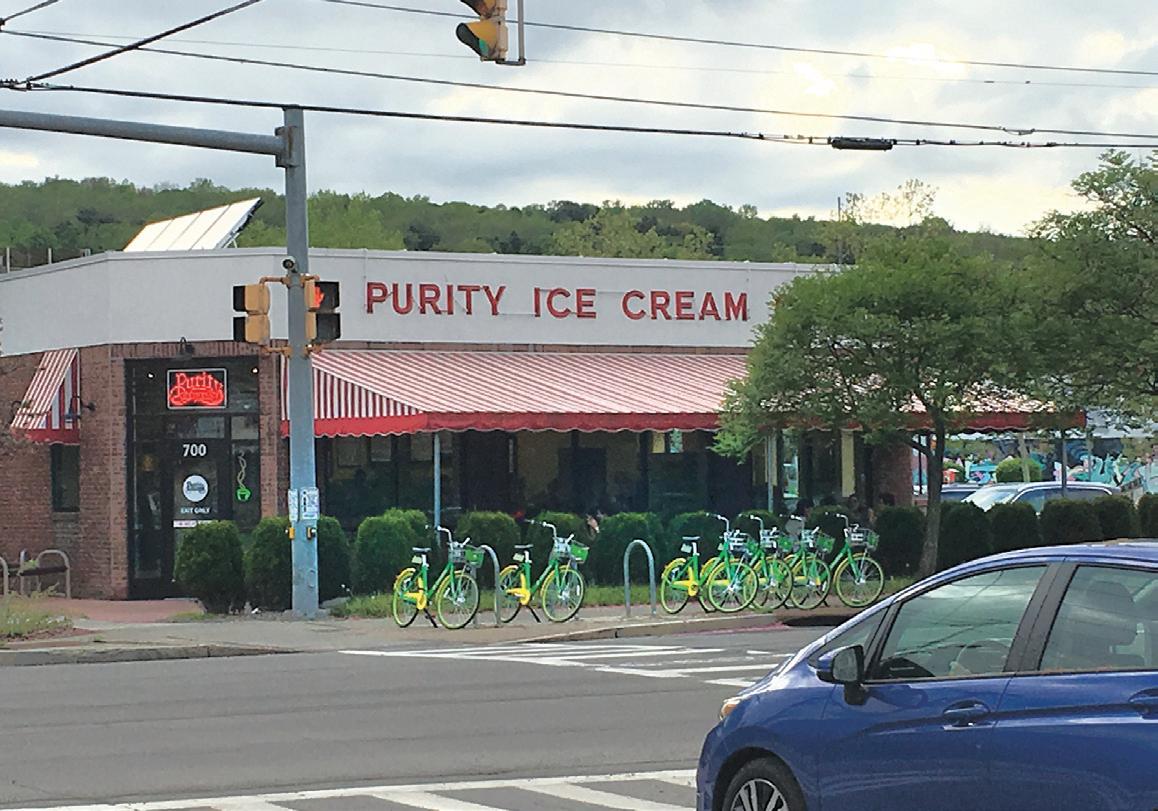
but bulldog crunch is absolutely mouth-watering, even though it’s in liquid form. The caramel and praline flavors are very strong, but the pecans and chocolate balance that creaminess and sweetness with their crunchiness and slight bitterness. Green tea is much less sweeter and made from “green tea powder blended with vanilla ice cream,” which I found slightly disappointing because I was hoping it’d be made with real green tea leaves. However, making green tea ice cream with just leaves is quite difficult and

While I could sense some vanilla, I’d say sweet cream tastes more like custard, eggnog or perhaps even crème brûlée. It’s very subtle, but in a way
that keeps your taste buds on the edge and leaves you wanting more!
can result in a barely detectable flavor.
Purity’s use of powder means you get a more concentrated flavor and sometimes there are bits of powder that bunch up together, which I’d liken to a swirl.
Finally, a lucky monkey is “banana ice cream with a fudge swirl, chocolate chunks and walnuts.” I’d liken it to Ben and Jerry’s Chunky Monkey — both have a banana ice cream base with chocolate bits mixed in, but Purity’s version is less sweet (and probably healthier).
Besides ice cream, Purity offers frozen yogurt, pastries (i.e. cupcakes, pies, cookies and cakes), espressos and milkshakes. I’ve never tried any of these, but my best friend had one of their cupcakes and said it tasted absolutely delicious.
Of my recommendations, Purity is also number one in the seating department. With abundant indoor and outdoor seating, Purity is extremely group-friendly, and its logo-covered decorations and booths give the space a relaxed, almost diner-like ambience.
If you can’t find the time to make the drive or take a walk to Purity, no worries — CTB usually has six differently flavored tubs of Purity’s ice cream towards the back.
Another dessert staple of Ithaca’s food scene is Sweet Melissa’s (named after one of its founders), so much so that the company opened a second location in Ithaca at Press Bay Alley that exclusively serves hard ice cream. Although Sweet Melissa’s has at least 12 flavors of hard ice cream, it doesn’t offer them all concurrently; they are served on rotation and vary from day to day. I haven’t tried all of them, but I am obsessed with their sweet cream flavor. When I asked an employee just what sweet cream was, he said it had a sort of vanilla flavor and is the vase of all their ice cream flavors. While I could sense some vanilla, I’d say sweet cream tastes more like custard, eggnog or perhaps even crème brûlée. It’s very subtle, but in a way that keeps your taste buds on the edge and leaves you wanting more! I usually prefer hard ice cream with a lot of elements (like bulldog crunch from Purity), but the sweet cream was just so refreshingly crisp that I wish I’d gotten another scoop. Its first and original location is hard to miss; painted in cobalt blue and pastel orange, the kiosk is situated next to Shortstop Deli, which is similarly designed. This Seneca St. location offers both soft serve (of which there are eight flavors) and hard ice cream, as well as flurries, shakes, floats, sundaes and slushies. So far, I’ve only tried their orange/ vanilla twist soft serve, which is a combination of their orange sherbet and vanilla flavors. I was deciding between just orange sherbet and orange/vanilla twist, and I’m glad I opted for the latter because even combined with vanilla, the orange
See DINING page 11

you’ll notice the large, white sculpture of a milk bottle out front.
sherbet was too saccharine for me. Nonetheless, I plan on trying their other soft serve flavors in the coming weeks, especially because The Sun’s office is near both of their venues.
Seating at both locations is entirely outdoor. There is just one table with four chairs at the Press Bay Alley branch, but the first location has a few picnic benches with umbrellas, which is ideal for warmer days.
CORNELL DAIRY BAR
411 Tower Rd. (Stocking Hall)

What can I say? I love fudge. Bavarian raspberry fudge is “vanilla custard ice cream with old-fashioned fudge pieces and a raspberry swirl,” and reminds me of raspberry cheesecake. It’s smooth, and the little punches of raspberry and fudge complement each other. Kahlua fudge is “Kahlua ice cream with a chocolate fudge swirl.”
For the past 139 years, Cornell Dairy Bar has been creating ice cream from the university’s cows and currently offers about 20 different flavors, some which you’ll have noticed are offered in our dining halls. If you want to have the Dairy Bar’s entire selection in front of you, then I recommend you pay a visit to Stocking Hall, within which the Dairy Bar is located. You definitely don’t need to drive a car or take the bus here, as it is located on campus and is about a 20-minute walk from North Campus. When you arrive at Stocking Hall,
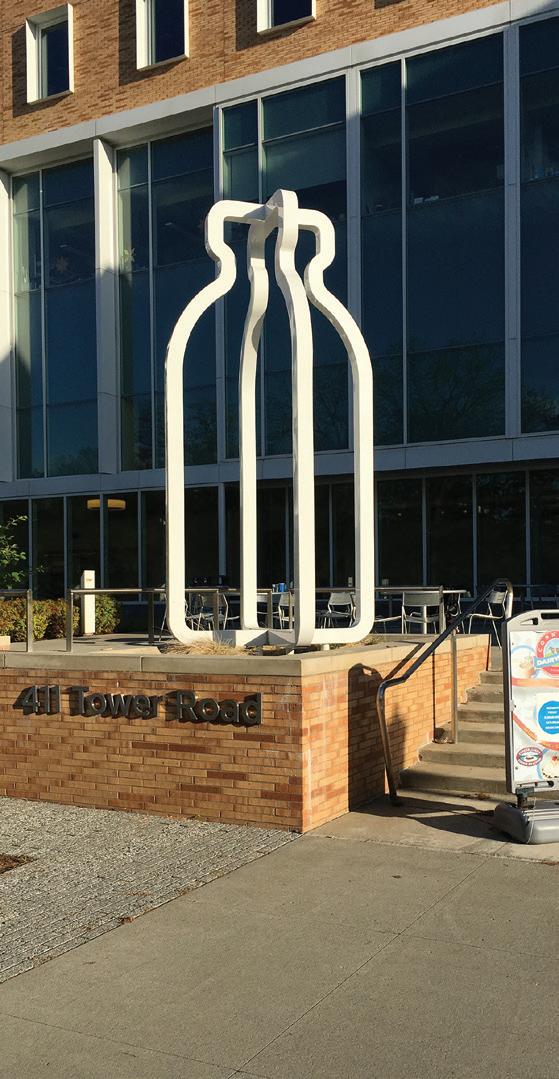
I’ve definitely tried every single flavor, and my favorites are Bavarian raspberry fudge and Kahlua fudge. What can I say? I love fudge. Bavarian raspberry fudge is “vanilla custard ice cream with old-fashioned fudge pieces and a raspberry swirl,” and reminds me of raspberry cheesecake. It’s smooth, and the little punches of raspberry and fudge complement each other. Kahlua fudge is “Kahlua ice cream with a chocolate fudge swirl.” Ezra’s morning cup, another Cornell Dairy Bar flavor, also has a coffee flavor, but I’d say Kahlua fudge is much stronger and thus satisfying. Because the Dairy Bar is located in the lobby of Stocking Hall, there’s plenty of seating around the shop. Moreover, Stocking Hall was renovated a few years ago, so the place has a casual and modern vibe, given its clean lines and all-white interior.
Jacqueline Quach is a senior in the College of Arts and Sciences. She can be reached at jq64@cornell.edu.

As a self-proclaimed “movie guy” — really, that’s in my Tinder bio — I’ve struggled over the past couple years to reconcile my own growing knowledge about the medium and the fact that I’m almost uniformly turned off by “good” movies (or, at least, those that typically take home Best Picture).
It’s not that I have anything against the movies that win Oscars (or whatever other awards show you subscribe to). I get it. There are, after all, a laundry list of reasons why movies like Moonlight (2016), The Shape of Water (2017) and Green Book (2018) win these awards, but it’s pretty easy to think of a couple movies from each of the last three years I enjoyed more: Star Trek Beyond, Baby Driver and Mission: Impossible – Fallout all come quickly to mind.
There are certainly exceptions to this — both No Country for Old Men (2007) and The Hurt Locker (2009) serve as good counterexamples that garnered exceptional amounts of critical praise but still kept me planted firmly in my seat — but even in those cases, I might opt for Superbad or Zombieland on any given night. And, if you’re noticing an action/comedy slant to my slate of “Oscar-killers,” that’s fair enough — those tend to be the sort of movies I like.
I’m Nick by the way. In writing movie reviews for The Sun over the last couple years, my bread and butter has been ripping into objectively flawed action movies and praising the ones that exceed even the lowest standards of mediocrity. In this column, my goal is to explore the intersection of the media I like (and don’t) and my own psychology.
Anyway, column number one’s spicy take is that Spider-Man: Into the Spider-Verse was the best movie released in 2018. Despite receiving a warm critical reception (it beat out Pixar’s Incredibles 2 for Best Animated Feature), the film is nonetheless doubly discounted from sitting at the “big kid’s table”
on account of its being both a) animated and b) a superhero movie. But neither of those is bad.
While I myself am in no way discounting the tremendous amounts of work that more “conventional” filmmakers put into their art, Into the Spider-Verse creates beauty in a way no cameraman could ever hope to capture. Before it closed down, one of my favorite YouTube channels was “Every Frame a Painting,” where Taylor Ramos and Tony Zhou broke down some of the more exceptional examples of common tropes in cinema. I reference them here because their channel’s title describes Into the Spider-Verse perfectly. Every pixel of every frame of every scene is incredibly and painstakingly detailed in a way unparalleled in any form of artistic expression.
Pause the film at any point and you’ll notice something that some animator spent hours researching and bringing to life from the fringes of Spider-Man lore knowing full

well that only a few people would ever appreciate it. Animated movies like Into the SpiderVerse (of which I’m honestly not sure there are any) ooze joy and love for their source materials in ways traditional films simply cannot.
To my second point, I think superhero movies resonate with us in a very special way and that’s a statement I can back up with numbers. The way Marvel (and DC, to a lesser extent) movies have financially dominated the cinematic medium is unprecedented —

people like this stuff. I grew up going to the movies with my mom — it’s how I was socialized to enjoy cinema. She’d have had a long week of work and I’d have had a long week of . . . I don’t know . . . multiplication tables? Neither of us were ever in the mood to do anything but smile for a couple hours. And so what if none of the movies we liked were particularly profound? For me, going to the movies is one of the best forms of escapism.Life is taxing by itself so give me a little bit of fun with my $10 popcorn, damn it!
Beyond that, we don’t need black and white pictures and somber orchestral melodies to find substance and inspiration in film. In fact, it’s the accessibility of Into the Spider-Verse’s substance that makes it so important — it’s a film that takes the time to show historically underrepresented children that they too can wear the mask, that they can be the hero.
Spider-Man is a symbol for a new generation that no longer buys into Al Pacino and
Clint Eastwood as the models of masculinity our fathers thought them to be — Spidey is quintessentially badass but he’s also kind in the moments it matters most. What I’m trying to say is that I love this movie because I want to be Spider-Man. I want to feel like I can swing around and save the day at the last minute, like no matter how bad things get, me and my web shooters can fix it and we’ll still have time to get the girl at the end. Your cat’s in a tree? I got that shit. Someone’s going to blow up the city? I got that shit too and I’m still going to ace my math test tomorrow.
I want to tell that scared little kid who feels like his world is being torn apart that it’s all “okay” now — Spider-Man’s here. And he’s got this.
Exhale. Alright, in two weeks I’ll be back to tell you all why Avengers: Endgame could be not just the greatest movie of this year, but the greatest movie of all time. See you then.
Nick Smith is a junior in the College of Arts and Sciences. He can be reached at nsmith@ cornellsun.com. Media Relations runs alternating Tursdays this semester.

Shazam!, starring Zachary Levi, Asher Angel, Jack Dylan Grazer and Mark Strong, is the seventh film in D.C’.s foray into the crowded superhero-universe genre (and it is absolutely its own genre at this point). And it’s really fun? It feels weird saying that but it really was. I suppose, though, most things would be more fun than the death of Superman, the Suicide Squad scrambling to avoid execution and Wonder Woman crusading through a grim World War I. Chock full of good performances and good, if not above average, writing, Shazam! is a self-aware yet still somewhat hard-hitting superhero movie and could serve as a stepping stone for D.C. on its way to Marvel-esque success. Fingers crossed. Anyway, Sun staff writers Nick Smith and Olivia Bono team up with assistant arts editor Jeremy Markus to discuss the film. Here goes:
The Good:
N.S.: For me, the standout here was Zachary Levi as the transformed Shazam. To explain that “transformed” bit — in the film our hero Billy Batson (Angel) gains the ability to turn into the magically-powered Shazam by saying his name. When he does, we get the comically beefcake-ified Levi, who was an outstanding casting for a surprisingly complex role: playing an initially poorly-tempered 15-year-old who knows nothing about superheroes inside the body of a superhero. I think Levi works so well here because I didn’t really know him beforehand (I never watched Chuck and only recognized his voice from things like Tangled after I searched through his IMDb page), all of which is to say he didn’t bring anything distracting from previous roles into this one. His comedic timing was great and he really looked the part physically, which is pretty crazy considering the musculature of the character.
O.B.: Shazam! is a story about the importance of family, and I thought the writing told that story really well. The film was at its best when it leaned into the interactions between Billy and his foster family. I already knew Levi was fun from his appearance on The Marvelous Mrs. Maisel, but the kids really surprised me. It was really satisfying to watch Billy learn not only to adapt to his new powers, but his new life in a group home with five eccentric siblings. There were also a lot of fun connections to the comics and jabs at some of the more well-known DCEU heroes, which I definitely appreciated.
J.M.: If I could describe this film in one word, it would be “cute.” Which isn’t necessarily a bad thing, though I get how that sounds. I think it is a fantastic divergence from the overly heavy, (literally) dark theme that seems to have infiltrated the DCEU. Shazam! was lighthearted and dealt with more than just good guy needs to defeat bad guy because movie. The villain felt more secondary to the real plot of Billy connecting with his new foster family, which is definitely unique among superhero films.
The Bad:
N.S.: Complaining that a superhero movie is formulaic is to complain that the sky is blue but as of late, films from both major players (think Wonder Woman and Thor: Ragnarok) have done pretty bang-up jobs subverting their own genre. Despite those recent exceptions to the rule, Shazam! plays out exactly as you’d expect it might. A foster kid who’s initially resistant to a family at yet another foster home gets superpowers? (Warning: some spoilers in the next couple sentences). I could’ve written “he shares the powers with the other kids and they become a family” on the bottom of my popcorn bucket by minute 20 . . . I ate the whole popcorn during the previews but that’s not the point. However, that doesn’t totally take away from the movie’s appeal. If you go into the film understanding what it is, you’ll almost certainly have a good time.
O.B.: I don’t think that the plot was formulaic, per se, and I was impressed by certain story/casting choices that they managed to keep out of the marketing. I thought that kept the story relatively fresh, even if it wasn’t as subversive as others. But I’m not going togonna lie, I was kind of disinterested for the first 20 minutes of the movie. Shazam! really takes its time fleshing out its villain, Thaddeus Sivana (Mark Strong), which I would normally enjoy. I think Black Panther did a great job
“Complaining that a superhero movie is formulaic is to complain that the sky is blue.”
Nick Smith ’20
of having an empathetic villain, and I’d love to see more superhero movies follow suit rather than “space alien blows things up because it moves the plot along.” However, it felt like we spent so much time following Sivana through his quest for revenge. It felt so unnecessary, I understood Sivana’s motives after three minutes and anything else just bloated the runtime, so I spent a lot of time wondering when Zachary Levi would show up.
J.M.: Why the hell were there so many Santas? Is it some gag from the comics that I don’t get? Also, it wasn’t a great film. It was a fun family film, which is, unfortunately, the category DCEU films seem to be falling into, rather than mind-blowingly innovative action epics, which is what Marvel tends to churn out.
O.B.: Seriously, the commitment to the numerous Santa gags was so bizarre.
The Surprising:
N.S.: The child acting! Do Angel (Billy) and Grazer (Freddy) count as child actors at 15 and 16? Either way, they (and all of the other foster children in the Vasquez home for that matter) are great. I never know if I should chalk my liking of younger actors’
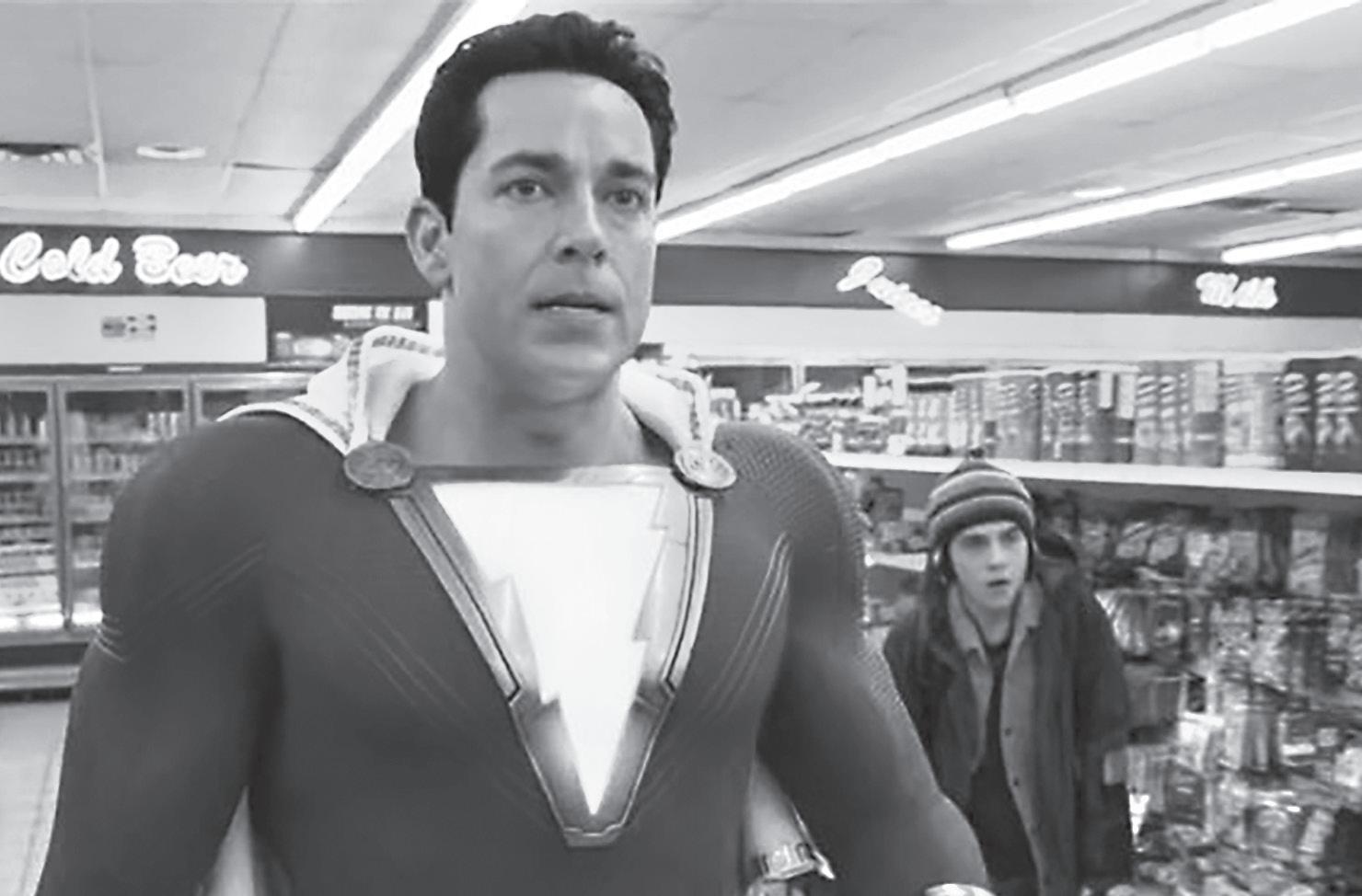
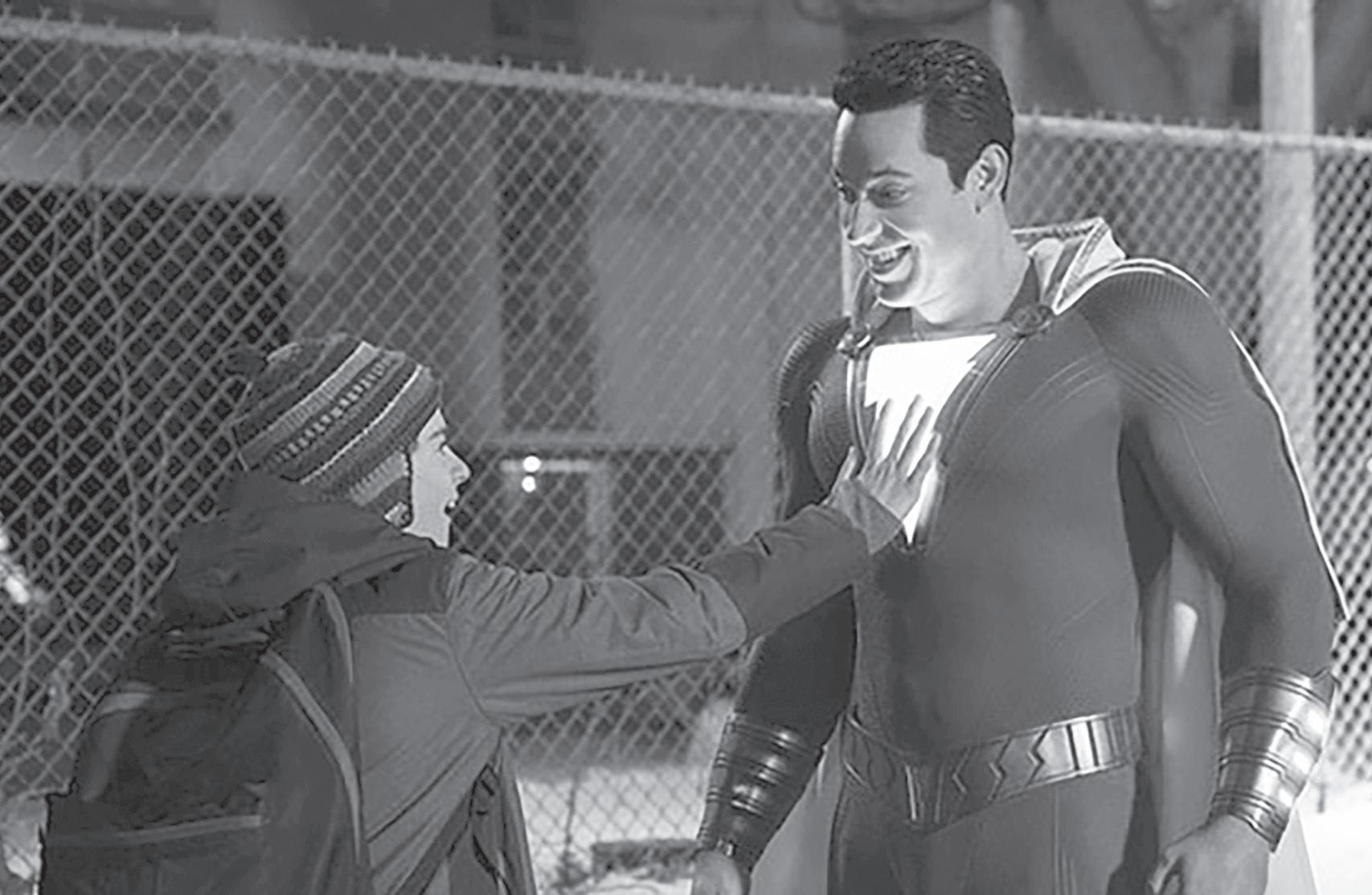
performances to the actors themselves or a combination of good writing and directing, but the two high schoolers nailed playing, well, high schoolers. Shazam! is at its best when Billy and Freddy are hanging out around school and especially when the two start experimenting with Billy’s newfound powers. Like Olivia mentioned earlier, the two play off each other well and regularly had my mom (who’s a good barometer for superhero movies as they pertain to “regular” people) and I (an irregular person) laughing out loud.
O.B.: Everyone talks about how fun this movie is, and they’re right. There are some solid comedic moments and by the end credits, you’re left feeling excited for more Shazam. However, a lot of the movie (especially in the first third, when the story follows Sinestro — I mean, Sivana) is surprisingly dark and disturbing. A lot of backstory scenes focus exclusively on traumatizing children (and certain adults in the audience, like the 20-year-old writing this) with cries of “this was all YOUR fault!” and people being eaten alive by Sin Gargoyles. It felt more like horror for shock value’s sake than anything that added depth. It’s still a fun movie, but a few parts had me wondering whether it can truly be considered kid-friendly in the same vein as Spider-Man: Homecoming or other fun-focused titles. Also, this isn’t a bad thing, but the Seven Deadly Sins who give Sivana his power were downright spooky.
J.M.: Billy finally accepted his foster family at the end of the movie! Wow, I did not see that coming. I’m joking, obviously. There wasn’t anything shocking about the film, as I expected the acting to be good, superhero plots are generally predictable and it wasn’t such a break from the DCEU genre that it was revolutionary. Again, this makes it seem like I disliked the film, which is incorrect. I enjoyed it, but I didn’t *love* it. Which is also unsurprising.
Well, Has D.C. Figured It Out?
N.S.: Maybe? Wonder Woman was great, Justice League was fine and both Aquaman and Shazam! were pretty good. For the record I’d rank this one between Wonder Woman and Aquaman, which is to say this is the DCEU’s second best film (which is a good sign!). I think I and many, many others often unfairly compare D.C. it to its cinematic big brother, Marvel. Other than Age of Ultron, Marvel hasn’t really released a clunker since the DCEU has existed, but we shouldn’t really compare D.C. to Marvel’s current position. I’ve already got my tickets for Avengers: Endgame, which is about to break every record ever, so right now Marvel has a sizable lead. We really should be comparing Shazam! to Iron Man 3 (each franchise’s seventh film), though, which makes the disparity much smaller. DC’s taken longer to get the ball rolling but with some promising projects on the horizon, I’m excited to see where they take this momentum.
O.B.: I think D.C.’s still growing. It took longer to find its identity than the MCU, straddling between the creative visions of darker directors like Zack Snyder and lighter directors like Joss Whedon (as Justice League showed), but I think it’s starting to hit its stride. I totally agree with Nick that Wonder Woman is still #1, but (about two-thirds of) Shazam!’s story was so well-crafted that I’d put a lot of space between it and the more convoluted Aquaman
J.M.: I think comparing the DCEU to Marvel is a fool’s errand because, at this point, they are drastically different entities. Marvel creates worldwide phenomenons — Avengers: Endgame will probably be the single biggest film in history — and D.C. supplements the superhero genre with fun but slightly lesser films. All three of us agree that Wonder Woman, Shazam! and Aquaman are the top three films in the DCEU, in that order, but I’d say the gap between the first two is almost as large as the chasm between Shazam! and Aquaman, and I really didn’t think Aquaman was that good. I don’t know. I hate predictable things (which works great because I also hate suspense . . . maybe I hate everything?), so my favorite movies are those that leave audiences with questions and don’t wrap up neatly. Since superheroes always win in the end, a movie has to be really fantastic for me to claim the studio has “figured it out.”
Are You Excited for the Future
Of the DCEU?
N.S.: Saying I’m just excited for Joker (slated for October) does a disservice to my excitement. Two things: the Joker is the greatest villain ever written and Heath Ledger’s portrayal of the character is the greatest acting performance of all time. Sorry Brando; sorry De Niro; sorry Nicholson, sorry Day-Lewis; sorry Hopkins and sorry Hanks, Pacino and Streep. Ledger’s performance occurring inside a comic book movie does not detract from the fact that he stands alone atop the mountain of what one actor can achieve in a single film. In spite of my adoration for Ledger’s version of Gotham’s Clown Prince of Crime, Jared Leto’s stab at it was one of the most fundamentally misunderstanding and uninspired adaptations of a character I have ever seen. For Leto to follow Ledger like he did would be like me following Mike Trout in the Angels’ batting order (that’s a baseball thing . . . he’s really good).
To continue reading this article, please visit www.cornellsun.com.
Jeremy Markus is a freshman in the College of Agriculture and Life Sciences. He currently serves as an assistant arts and entertainment editor on The Sun’s editorial board. He can be reached at arts@cornellsun.com. Nick Smith is a junior in the College of Arts and Sciences. He can be reached at nsmith@cornellsun.com. Olivia Bono is a junior in the College of Arts and Sciences. She can be reached at ojb26@cornell.edu.



Fill in the empty cells, one number in each, so that each column, row, and region contains the numbers 1-9 exactly once. Each number in the solution therefore occurs only once in each of the three “directions,” hence the “single numbers” implied by the puzzle’s name. (Rules from wikipedia.org/wiki/ Sudoku)
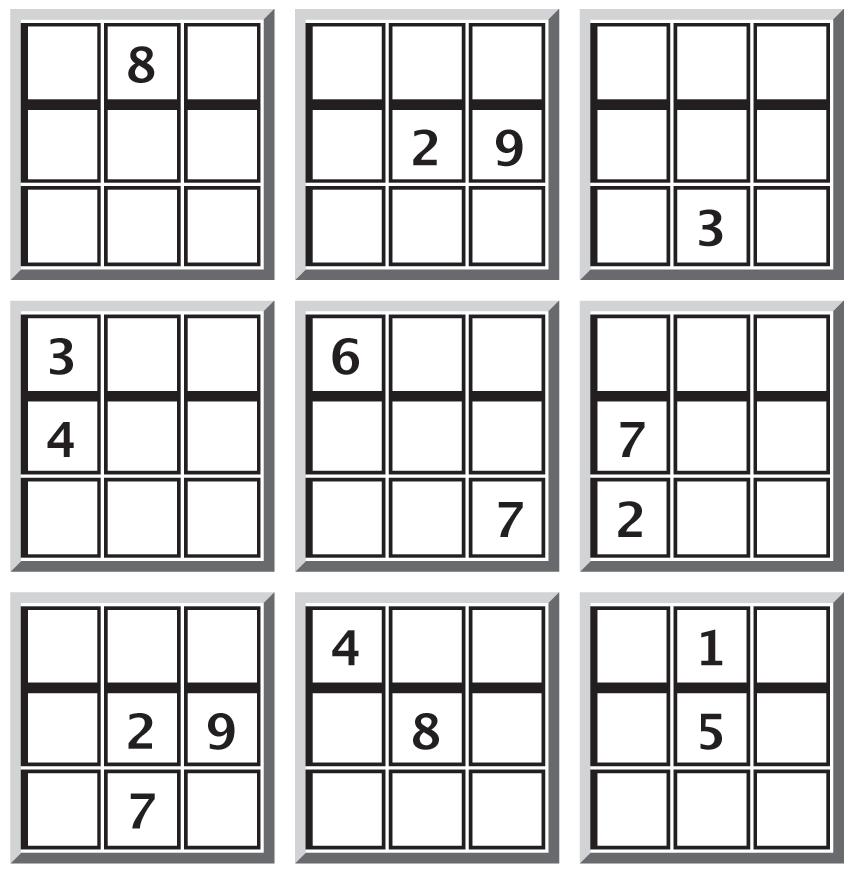
Collegetown 1 & 3 Bedroom Apts. Available for Next School Year 2018-2019. 607-327-2927
NORTH CAMPUS Studio and 3 bedrooms Available 2019/2020 Novarr-Mackesey Property Management office@ithacastudentapartments.com ithacastudentapartments.com 607-277-1234
The Top of Collegetown Dryden Rd-Linden Ave 3 BR Apt & House 2019-2020 607-351-1115 ksteel202@yahoo.com
Boldly Refined Living
delivery/return. Overnight concierge. 607-273-9777 or 312collegeave.com
3 BEDROOM SOUTH HILL
Large apt, washer/dryer furnished. $550 pp 607-272-3389
1-Bedroom Apt
Downtown
Linden Ave. 5 Bedroom House Available June 2019. $900 per bedroom. Parking included. 607-327-2927
2019-2020 Upper Eddy St. 7 Bedroom House Furnished. Internet. Laundry.


COOK ST. Furnished House for 5-7 persons, 10mo. Lease for 2019-2020 Text or call Tracy at TLC Property Mgmt Corp 607-379-2776
Collegetown Terrace Apartments INSPIRED LIVING TAILORED TO YOUR
1 Bedroom Apartments Bright nice and clean, Great location Linden Ave $895 to $950 plus electricity Call 607-237-2541 or 607-227-2535 Downtown / Fall Creek Renovated 3 Bedroom Grad student apartment Walk to everything $1950 plus utilities 607-592-0475
Available June 1 (or earlier) Ideal for Grads or Staff. Lovely one bedroom second floor apartment. Downtown on Cascadilla St. near N. Albany St. Carpeted bedroom and living room (with rustic real wood paneled walls), full bath, kitchen. Bus line in front of house that goes to Commons, then on to Tower Rd. on Cornell Campus. Private porch. $890 plus utilities, available June 1. (anytime after 4/15) NO undergrads, no dogs, no smokers, references. For info and appointments email gm27@cornell.edu or text 607-280-4024
==SPRING BREAK SPECIAL== Furnished 3 Bedroom Collegetown Apartments PARKING, LAUNDRY, UTILITIES! (607)273-7368 www.WestShoreApts.com
Now Renting for 2019-2020 3-7 Bedroom Apartments All locations. Contact us today or visit our website: certifiedpropertiesinc.com Certified Properties of TC Inc 273-1669
2019-2020 317 Upper Eddy St. 1, 2 & 3 BR Apartments Ten month lease. Furnished. Hardwood floors. Spacious rooms. Steam heat provided. 607-227-0924

Continued from page 20
2/3 perfect innings. The Red ultimately downed Colgate 10-7 in the first game, but was shutout 6-0 in the second game.
“We have a pretty small pitching staff,” Rockstroh said, “so the other teams have seen our pitchers multiple times and are able to make adjustments. That’s something that’s hard to get around.”
Riddled by injuries, Cornell has been forced to adapt to playing without many of their key players.
“We only have two [healthy] pitchers,” Rockstroh said. “For other positions, there’s been minor injuries and there’s been major injuries. We’ve been trying to work around that as much as we can and being able to pick each other up position-wise and also psychologically.”
Although the Red has faced many curveballs this season, it remains determined as it heads into the latter half.
“We’re trying to keep it as loose as possible,” Rockstroh said. “The season so far isn’t 100 percent what we wanted, but we’re working with what we have. Getting tight and focusing on what could go wrong isn’t going to help anything. We’re just trying to take it one day, one game, one pitch at a time — as simple as you can make it. Hopefully we can make it work from there.”
The Red will be back in action this weekend in New York City taking on the Columbia Lions (14-14, 6-3 Ivy) in a three-game series. Cornell will take the field at 12:30 p.m. and 2:30 p.m. on Saturday and again at 12:30 p.m. on Sunday.
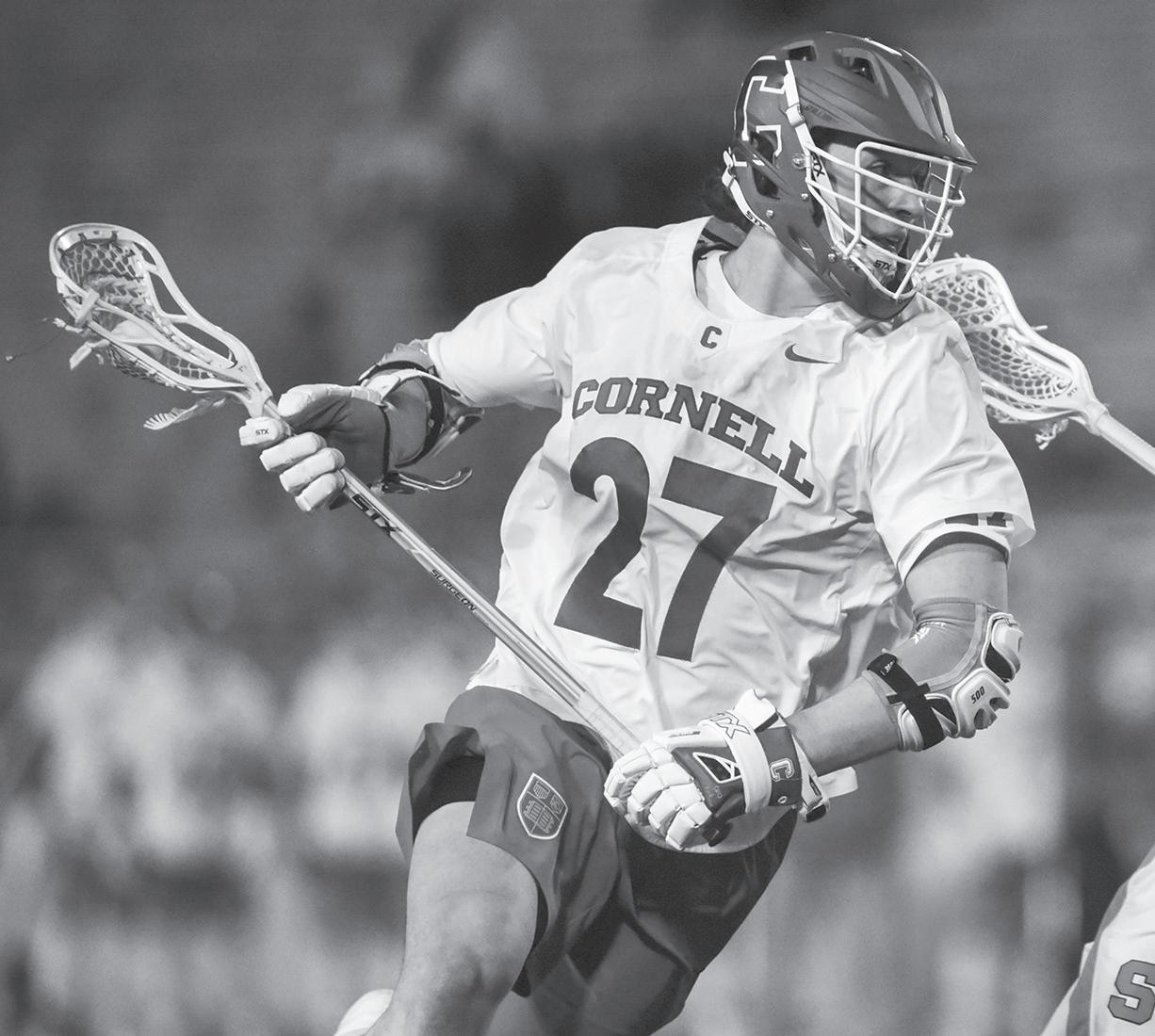
No. 10 men’s lacrosse was shut down by No. 11 Syracuse 13-8 at the Carrier Dome Tuesday, a reversal of last year’s regular season meeting between the regional rivals.
Sharing the ball | Eight different Red players recorded a goal against Yale on Saturday as the Red moved to 3-1 in the Ivy League.
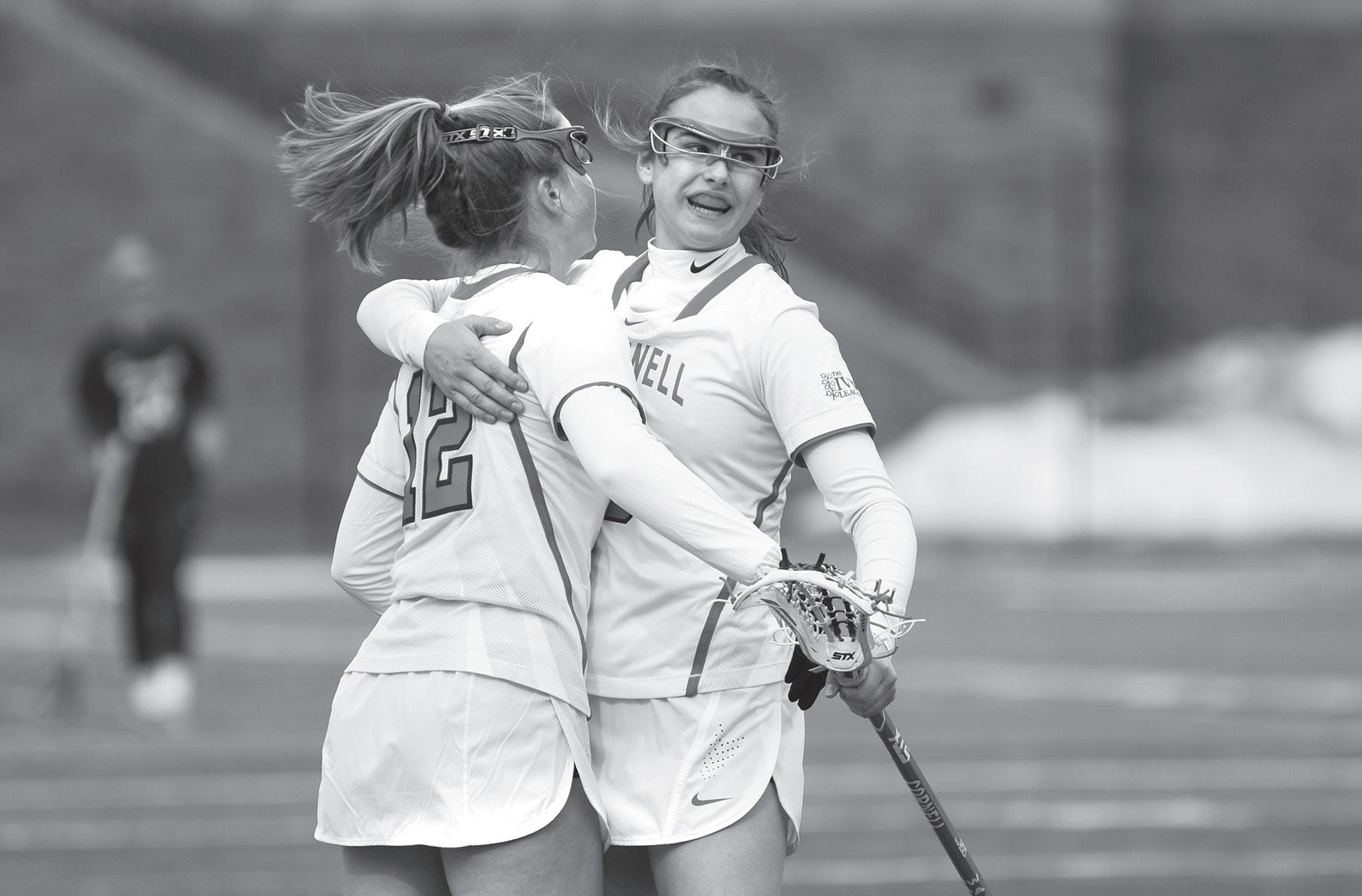
By GRACIE TODD Sun Staff Writer
On Saturday, women’s lacrosse tied its wins from the 2018 season and surpassed last year’s total number of conference wins. And there are still four regular-season games yet to be played.
The 18-12 win over Yale (4-6, 0-4 Ivy League) marked the Red’s (7-4, 3-1 Ivy League) twelfth consecutive takedown of the Bulldogs.
Cornell didn’t wait even three minutes before getting on the board with a goal by sophomore Ellie Walsh. The Red went on to extend its lead to 3-0 with goals by senior Tomasina Leska and junior Caroline Allen before Yale scored its first point.
But the Red answered with three more of its own by Walsh, freshman
Shannon Brazier and senior Shannon Bertscha.
The scoring was more back-and-forth for the remainder of the half. Yale scored five more, but the Red matched it with Allen, sophomore Grace Paletta, fresh-
man Genevieve DeWinter and senior Sarah Phillips all putting one in the net. Walsh scored with 14 seconds left in the half to secure herself a hat trick.
The Red would lead, 11-6, going into the second half.

Less than four minutes after the break, Leska scored her second goal of the day with a free position goal. Yale responded with a goal of its own but the Red then countered as DeWinter scored for her second goal of the day.
The Bulldogs went on a 4-0 run to shrink the lead to 13-11. This would be the closest the game would come before its finale, as the Red then went on its third 3-0 run of the game. Paletta scored one of those goals, and Allen put the other two on the board.
The Bulldogs scored once more before the contest was over, but the Red scored twice, with goals by Paletta and Bertscha, to take a decisive win.
Allen, Walsh and Paletta each had hat tricks in the victory.
Notably, the Red was 15-17 in draw controls against Yale, which has one of the nation’s top draw controllers in Izzy Nixon. Paletta controlled 6 of those draws for the Red.
This was the third consecutive game that the Red won by six or more points.
Cornell will aim to continue its dominance next Saturday when it faces Brown at home at 1 p.m.
By ZORA HAHN Sun Staff Writer
All three Cornell crew teams kicked off their spring seasons with regattas this past weekend, bringing home various accolades while still seeking to improve overall performance.
The No. 2 ranked lightweight men’s crew team was successful at the Matthews Cup, starting the spring season off strong. The Red competed against Harvard and Penn on the Schuylkill River in Pennsylvania.
The team won its 25th consecutive Matthews Trophy and also claimed its eighth straight Leonard Cup, which is awarded to the team that wins the majority of the eight races.
“We’ve seen the best. It gives us a goal of what we’re working towards.”
Todd Kennett ’91
Both Penn and Harvard were ranked No. 5 going into the regatta and put up impressive performances. Harvard beat Cornell last year at this regatta, but due to its status as a guest participant, was not eligible to win any of the trophies.
The Cornell Lightweight Varsity 8 is a relatively young squad, featuring 3 sophomores. The boating assignments were successful in all four boats and led to their achievements on the water.
Men’s heavyweight had a home regatta on Cayuga Lake against Harvard and George Washington. The No. 12 Cornell team came in second after No. 3 Harvard, with No. 15 George Washington trailing at third overall in the contest.
Cornell came in second against Harvard in the Varsity Eight and Third Varsity Eight races. The Red came in third in the Second Varsity Eight and Fourth Varsity Eight races, with Harvard sweeping those races as well and George Washington coming in second.
“The varsity boat had a good race. The second varsity boat needed a lot of improvement; [they need to] find better connection to the water so they go faster,” said head coach Todd Kennett ’91. “As soon as you start … changing the lineups, that can change everything.”
With this past weekend’s being the first regatta of the

3 Harvard.
spring season, the team needs to find their stride by putting together optimal lineups.
“The varsity boat had a good race. The second varsity boat needed a lot of improvement.”
Todd Kennett ’91
“We’ve seen the best. It gives us a goal of what we’re working towards,” Kennett said.
Women’s crew was successful in the Ivy Invitational this past weekend at Carnegie Lake in New Jersey. The Princeton Tigers took the Class of 1975 Cup for the fifth
year in a row for its win with the Varsity 8. Columbia swept Cornell in the Varsity 8, Second Varsity 8 and Varsity 4 meets. Cornell was beaten by No. 5 Princeton and No. 14 Harvard-Radcliffe in the Varsity 8, Second Varsity 8 and Second Varsity 4 meets. The Varsity 4 was second to Princeton, beating Harvard-Radcliffe by just under 3 seconds.
Women’s crew will travel to New Haven, Connecticut, to take on Yale next Saturday, April 13.
The lightweight men’s team will participate in the Platt Cup against Princeton in Ithaca on Saturday, April 13. The heavyweight men’s team will travel to Annapolis, Maryland, on April 20 to face off against Navy and Syracuse.
Zora Hahn can be reached at zhahn@cornellsun.com.
By KATHERINE FAIOLA Sun Staff Writer
sweep at the hands of Brown in the season’s first home Ivy series. Then, on Tuesday, Cornell hosted Binghamton, losing 8-4.
Of the many games in the past two weeks, game one of the Yale series, a 3-0 victory, was a bright spot for the Red.


Junior RHP Colby Wyatt hurled 7 1/3 scoreless innings and junior RHPJohn Natoli got the final five outs of the game to earn his second save of the season.
explosive start from the Red: Arndt ripped another leadoff double, and up next Taylor hit an RBI single to center field. All of Cornell’s runs were scored by players who hit leadoff doubles and the Red beat Yale decisively 3-0. Cornell’s home opener versus St. Bonaventure April 2 was also decided by stellar pitching and leadoff hits. Notably, freshman RHP Luke Yacinich threw for six scoreless innings and senior center fielder Adam Saks was 4 for 5 and scored twice for the Red.
The Red offense came alive to strike first in the top of the third inning. Junior infielder Matt Collins connected for a leadoff double, and junior infielder Alex Carnegie knocked him in with an RBI double.
In the top of the seventh, it was senior IF/OF Josh Arndt who got the ball rolling with a leadoff double. Immediately after, freshman infielder Justin Taylor’s sacrifice grounder advanced the runner, and during the next at-bat Ardnt was able to score on a wild pitch from Yale’s pitcher Scott Politz.
The ninth inning saw a similar
Despite tallying 25 hits in three games against Brown, the Red had little to show for its efforts as Brown coasted to easy victories in two of the three games. Six errors in the series — including one that let in the unearned winning run in Cornell’s 2-1 loss — may have done the Red in.
Cornell will travel to Cambridge this weekend looking to get back on track in Ivy play against Harvard.
Katherine Faiola can be reached at
By BENNETT GROSS Sun Staff Writer
Men’s golf found itself both in the top and bottom thirds of tournament placements on the road over spring break, with a first-place finish followed by an eleventh-out-of-thir teen score the next weekend.
The squad began its tour with a firstplace finish in Palm Beach Gardens at the BCD Invitational on March 30 behind a strong round by junior Jack Casler, who shot one-under par to lead the field. He was aided by senior Tianyi Cen who ended his round by shooting even par.
The Red’s scorecard was rounded out by junior Mike May’s three over par and a pair of five over par finishes by sophomore Charlie Dubiel and freshman Noah Schwartz.
Cornell escaped Palm Beach Gardens with a one-stroke victory over Ivy League foe Dartmouth. The Red compiled a cumulative score of 295 while the Green carded 296; Brown rounded out the competition with 306 strokes.
“It was certainly nice to win the BCD Invitational, but the purpose of the trip was just to get some reps in and put some pressure on ourselves in a tournament environment before the Princeton Invitational,” Dubiel said after the first tournament.

However, the Red were unable to replicate its prior play last weekend, finishing eleventh out of 13 squads at the Princeton Invitational. The threeround event, played at Springdale Golf Club, was dominated by Yale. The Bulldogs shot a cumulative 23 under par and had the top two individual finishers in the tournament. Penn, which finished in second place, aggregated a score of 9 under par, while the Red ended the weekend by shooting 25 over par.
“We made a lot of mental mistakes as a team in the Princeton tournament,” Casler said. “All of us left a lot of shots out there, and I definitely think that we could have easily made a run at a top-five finish collectively.”
Cornell was again led by Casler, who finished the three rounds four over par, tying for 28th place. Dubiel followed closely with a five over par finish. The rest of the Red struggled throughout the weekend, including Cen, who entered the final round at even par, but shot 12 over in his final round to finish him tied
“Conditions were different from the first day in terms of wind direction, strength and green speed,” Cen said. “Golf is a tough game not only because of the
By SMITA NALLURI Sun Staff Writer
Cornell suffered a conference sweep at the hands of Penn last weekend, but bounced back to record a season-high 15 hits en route to splitting a doubleheader with Colgate on Tuesday.
Cornell (6-25, 2-7 Ivy) battled to hold its own against the Quakers (17-11, 8-4 Ivy) in the first of three games this week-
end, but ultimately fell 12-7. The Quakers then shut the Red out 8-0 and 14-0 to sweep the series.
“It was obviously not the outcome we wanted,” said junior outfielder Erin Rockstroh. “But the first game we battled as long as we could, which I think is something we’ve gotten better at throughout the season.”
The Red rebounded from its conference loss to split a midweek doubleheader with the Raiders
(17-18, 3-3 Patriot). Cornell got off to a hot start in the first game, tallying eight runs in the second inning. The team recorded a season high 15 runs in the game — led by three hits each from junior Bridgette Rooney and sophomore infielder Brianna Straley. Junior pitcher Lisa Nelson came back from an injury that has sidelined her for a month to throw 2
See SOFTBALL page 18
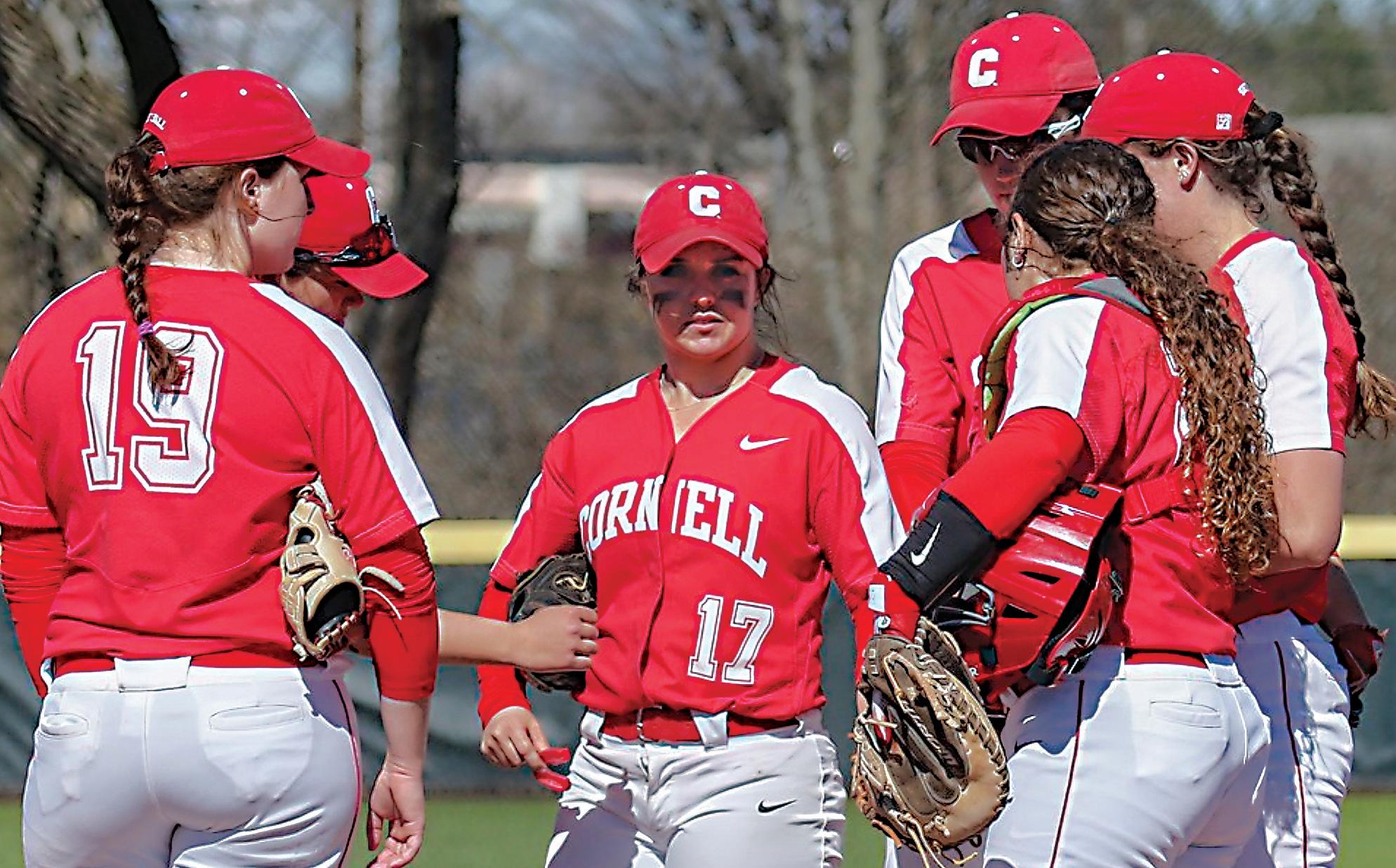
conditions, but your game changes on a daily basis; the best golfers are the ones best at adapting to the current situations. On Sunday, I was unable to come to a solution and was struggling to hit greens and make putts.”
“It is just a matter of us making the right decisions and being mentally tougher when we are playing those important rounds.”
The Red will look to right the ship this upcoming weekend when the group golfs in its final regular-season tournament of the 2018-19 campaign. Cornell will travel to participate in the Rutherford Intercollegiate Tournament, hosted by Penn State, on Saturday and Sunday.
Cornell will conclude its season the following weekend at the Ivy League Championship. Last season, the Red placed fourth in the competition. Each of the Ancient Eight schools fields a team.
“We are going to tune up in the next couple of weeks and hopefully get a lot mentally sharper because that is what is ultimately going to help us finish higher in the next few weeks,” Casler said. “We all have the ability to compete with a team like Yale for the Ivy League Championship, so it is just a matter of us making the right decisions and being mentally tougher when we are playing those important rounds.”
Bennett Gross can be reached at bgross@cornellsun.com.