The Corne¬ Daily Sun




By
Michael Davis, a 47-year old Dryden man, received the maximum prison sentence Friday for killing Josie Berrios, a 28-year old Ithaca resident.
Berrios’ body was discovered last June near the Breazzano Center construction site at 209-215 Dryden Avenue in Collegetown and Davis was arrested by the Ithaca Police less than 24 hours after the discovery, The Sun previously reported.
other protected categories of people,”
Van Houten said. “The victim and the defendant were in a domestic relationship. The victim was not singled out because of who she was. It was a crime of domestic violence, not a hate crime.”

Davis pleaded guilty to second-degree murder and was sentenced to 25 years in prison.
“That’s what we felt he deserved,” District Attorney Matthew Van Houten told The Sun. “We’re happy with the court’s ruling.”
Berrios was a transgender woman of color and was in a personal relationship with Davis. Although prosecutors did consider charging Davis with a hate crime, there was not sufficient evidence.
“What a hate crime is defined as [is] one victim selected or singled out for gender, orientation, or religion or
Van Houten said that although Davis waived his right to most of his appellate arguments, there is still the possibility of an appeal.
“What I learned throughout the case and especially at sentencing is that Josie Berrios was someone who was very well loved and wanted and respected and courageous within the community,” he said. “I think that’s the thing we should take away from this … is that she was taken away from this community and she was a bright light that shined on the community.”
Berrios, also known as Kimbella Rosé and Kendra Adams, was one of the founding members of The House of Merlot, a drag performance troupe in Ithaca, and was an active member of the LGBTQ+ community.
“A proud trans woman of color, she always tried her best to make new performers feel comfortable in our
By EMILY YANG Sun Staff Writer
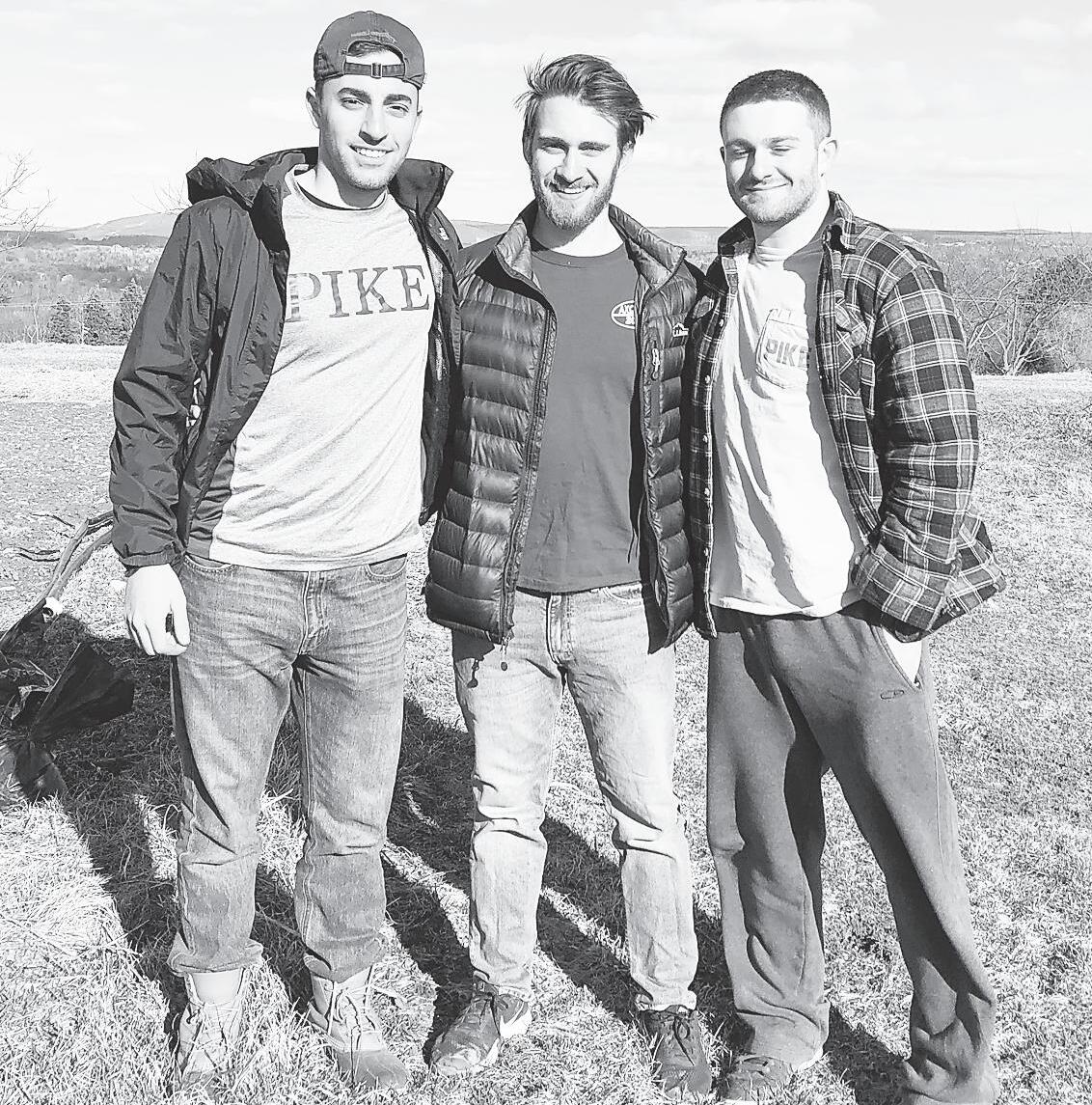
Members of Cornell’s Greek life interacted with the Ithaca community on Satur-
day for a day of service during the biannual Greeks Give Back event, which was hosted by the tri-council of the Interfraternity, Panhellenic and Multicultural Greek Letter Councils.
According to Grace Burgin, vice president of university and community relations for the Panhellenic Council, over 780 students signed up to volunteer, which was one of the highest numbers in recent years.
The program allows Greek students to “explore the greater Ithaca area and discover some really neat places that provide the backbone for the Ithaca and Cornell community,” said Chris Galantino, vice president of university and community relations for the
spaces,” The House of Merlot posted on its Facebook page after her death.
“She recognised the realness in all of us without question and made us feel beautiful. She was part of so many families here in Ithaca, that many are
Council.
feeling stunned and lost following this news. Her presence is still felt, and will never be forgotten.”
Shruti Juneja can be reached at sjuneja@cornellsun.com.
By BREANNE FLEER Sun News Editor
The Graduate and Professional Student Assembly passed a resolution on Monday calling on the University to take steps to facilitate communication with the LGBTQ+ community regarding changes to support services, such as those provided by the LGBT Resource Center.
The resolution specifically requests the release of “campus-wide communication” that would clarify these changes and the creation of a “University Council on LGBTQ+ Affairs” that would include LGBTQ+ representatives from different communities to “review Cornell’s support infrastructure for the LGBTQ+ com-

“Transnational Kurdish Cinema: Aesthetics, Memory, and the Archive” With Ozgur Cicek Noon - 1:00 p m , Schwartz Center for Performing Arts, 124
Academic Freedom and Authoritarian Governance: Reflections on the China Quarterly Censorship Incident Noon - 2:00 p m , Uris Hall, G08
Introduction to Korean Botanic Gardens 12:30 - 1:30 p m , Plant Science Building, 404
Food Science Graduate Seminar 4:00 - 5:00 p m , Stocking Hall, PepsiCo Auditorium
Ruth Messinger: What’s Jewish About Social Justice? 4:30 p m , Goldwin Smith Hall, Hollis E Cornell Auditorium
Linguistics Speaker: Shobha Satyanth 4:30 - 6:00 p m , Morrill Hall, 107
Economics Coffee and Bagels
9:30 - 11:00 a m , Uris Hall, Economics Graduate Lounge
Introduction to Rhodes & Marshall Scholarships
1:30 - 2:30 p m , Barnes Hall, 103
LEPP Theory Seminar: Anson Hook, University of Maryland 2:00 p m , Physical Sciences Building, 401
Artist Talk: Jompet Kuswidananto 2:30 - 4:30 p m , Johnson Museum of Art, Wing lecture room
Cornell Health: “Let’s Talk” Walk-In Consultations 2:30 p m , East Sibley Hall, 146
Historic Maps
From Paper to the Screen 3:30 - 5:00 p m , Olin Library, Digital CoLab, 701
LASSP and Biophysics Colloquium With Alexandra Zidovska 4:00 p m , Clark Hall, 700
Overcoming Imposter Syndrome 4:30 - 6:00 p m , Mann Library, Makerspace






By GIRISHA ARORA and ALEXIA GE Sun Managing Editor and Sun Contributor
o n
Wo m
n ’ s D a y, “ T h e Wa n t
Project” displayed several banners in the Sage atrium, Statler Hall and Willard Straight Hall that challenged

instead
the traditional perceptions of how women “should” behave in society
“ Women have been the recipients of the word ‘should’ and it shows the constraints that women face,” said Shaibyaa Rajbhandari ’18
The banners contained statements ranging from how women “should wear makeup” and “should have children” to how they “ want to have an orgasm ” , “ want a level playing field” and “ want to be a CEO ”
Rajbhandari, one of the three students who worked on the campaign, explained the motivation of launching The Want Project in an inter view with The Sun
“Women have been the recipients of the word ‘should’ and it shows the constraints that women face ”
She said it star ted last year when she reached out to Kate Huffman grad who was collecting “should statements ” When the Should Project did not materialize, Rajbhandari and Huffman decided to “do the opposite of should and focus on wants ”
According to Huffman, this year ’ s Want Project gathered over 280 statements while last year ’ s unfinished Should Project only had 100
The banners went up in the early morning on March 8 and by 4 p m , the ones in Willard Straight Hall and Sage Hall had been taken down, but the one in Statler remained Rajbhandari said that the management of Willard Straight did not give a reason as to why the banner was taken down
The building managers of Sage Hall, on the other hand, reached out to her and said they had to take it down since the group was “ not affiliated with the busi-

ness school” and because an outside event was being hosted in the atrium
However, pictures of the banner were taken and put up on one side of the atrium, and a marker board was made available for anyone who wanted to leave comments Additionally, pictures were circulated to all MBA students in an email later that day to call their attention to the campaign
“I really appreciate it that they are not tr ying to silence us, ” Rajbhandari said
In addition to the banners that were put up on campus, the team released a video that featured women reading out the “ want ” statements and men reading out the “should” statements in first person As of print, the
See WOMEN page 5
By
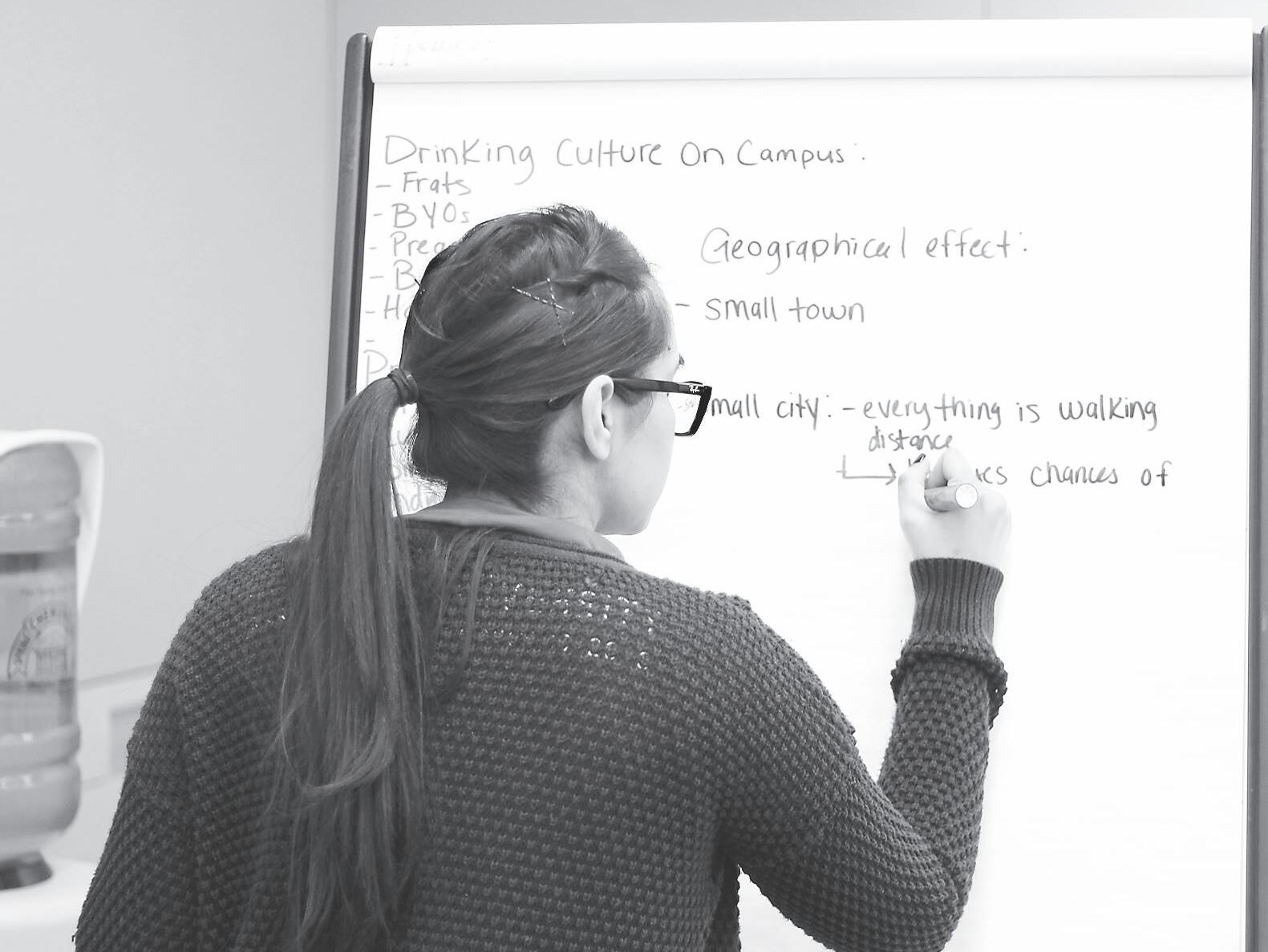
Students from across the Ivy League and the nation brainstormed ways to promote a safe party scene at their respective schools through a working group at Cornell on March 16 -17
Dustin Liu ’19, an organizer of the meeting and human resources manager for The Sun, said the ILR School’s Smithers Institute for Alcohol-Related Workplace Studies developed the idea to gather student leaders from various schools to “understand what we needed to do to create a safe party culture on campus ” Students from MIT, Har vard University, Yale University, Princeton University, the University of Pennsylvania, Villanova, Tompkins Cor tland Community College and others traveled to Cornell to participate in the working group, according to the ILR website
Liu said the day was divided into three sections: the first aimed to “understand” the party culture at each school, the second looked at the difficulties of changing the culture and the last allowed participants to develop “action steps ” that they could carry out at their own schools
“One of the main things we saw was that it was really important to acknowledge how different campuses have different party cultures,” he said This included assessing the differences between schools that do have Greek life and those that do not
Liu also said that the “exclusivity” associated with party culture was a theme of the day Students party with their organizations or attend parties they are invited to, instead having a “ very open social scene, ” according to Liu
“We think that a large component of
that is the lack of community that students may feel, which creates an unsafe culture where they don’t necessarily feel supported,” he said
Liu discussed how underclassman are “coached” by upperclassman about how the party culture works
“Many people shared that upperclassman perpetuate the culture that they themselves do not necessarily agree with,” he said
Lauren Goldstein ’20, an organizer of the working group, serves as president of Cayuga’s Watchers, a student run-organization that monitors parties to make sure they remain safe and a co-sponsor of the conference Goldstein presented Cayuga’s Watchers as a “solution that has worked
well on Cornell’s campus ”
“That being said, it wouldn’t necessarily work on every campus, because of the different party cultures and campus environments, ” Goldstein said She said that participants brainstormed solutions that would be more applicable to their own campuses, as well as “ more subtle cultural shifts and conversations, and [the] kind of steps to take with administrators at their schools ” Cornell community members also spoke at the event, including Ryan Lombardi, vice president for student and campus life, Prof William Sonnenstuhl, organizational behavior, and Prof Samuel Bacharach, organizational behavior The faculty speakers study party culture and
organizational behavior, Goldstein said “The professors provided a better context for the students, explaining why the work they are doing is so important, and how their actions can have a lasting impact," she said
Liu said it was “really interesting” to look at how academia applied to students’ daily lives, including how students might not talk honestly about drinking and party culture because of how they perceive others ’ experiences
Liu said organizers are planning a “virtual working group ” involving 14 different colleges some of whom attended the March meeting and some of whom did not in order to continue engaging with the issue
Manpreet Kaur, a student at Tompkins Cortland Community College, also participated in the workshop She told The Sun her campus is alcohol-free, so students party outside of the campus
Due to this, most of Kaur’s ideas concerned transportation resources for students “Issues with drinking and driving increase because students on campus are traveling elsewhere to engage in this culture, ” she said “How can we make that safe?”
Kaur said the working group allowed her to think about the party culture on her campus
“At TC3, party culture isn’t really the hot topic of conversation as it is a dry campus, ” she said “This conference really made me think about the ways in which students on our campus may be finding ways to engage in party culture, because students will always find a way to do so and it’s necessary to keep them safe ”
leagues and say that they should have equal access to the programming put on by the LGBTRC,” she said H o w e v e r, Un i v e r s i t y l e a d e r s
Ry
munity and to advise the administration regarding future changes ”
A d d i t i o n a l l y, t h e r e s o l u t i o n a d v o c a t e s f o r “ t h e strategic planning of the expansion of the LGBTRC,” according to the resolution
G P S A R e s o l u t i o n 9 c o m e s a s a r e s p o n s e t o
Employee Assembly Resolution 8, which was adopted by the E A on Nov 9
E A Resolution 8 called on the administration to rescind a directive issued by the Dean of Students in 2017 “for the LGBTRC to no longer ser ve staff and faculty due to [it] being understaffed,” according to the language of E A Resolution 8
Manisha Munasinghe grad, executive vice president of GPSA and a co-sponsor of the GPSA resolution, told The Sun that to some involved par ties, President Mar tha E Pollack’s Jan 2 acknowledgement of E A Resolution 8 “seemed to indicate that the faculty and staff were not going to be allowed to use the LGBTRC in the way that they’ve historically been allowed to ”
Pollack wrote in her acknowledgement that while LGBTQ+ faculty and staff would still be able to “visit” the LGBTRC, “ to provide the appropriate levels of service, separating educational and suppor t ser vices for students from faculty and staff allows Cornell to meet the unique needs of our LGBTQ students, as they pursue their degrees ”
Munasinghe discussed how the GPSA resolution was drafted in light of Pollack’s response
“So we wrote this resolution sor t of to express our solidarity with our LGBTQ+ faculty and staff col-
n Lombardi, vice president for student and campus life and Dean of Students Vijay Pendakur clarified in a meeting with the GPSA resolution’s sponsors that faculty and staff will still be able to use the LGBTRC for programming, according to GPSA Resolution 9
The Division of Human Resources will handle “staff diversity and inclusion training” and “bias incidents,” according to the resolution
Munasinghe expressed her concerns about the communication between the University and faculty and students regarding these LGBTRC changes
“ We’re just really fr ustrated that it wasn ’ t communicated effectively to not only the employees but also to students,” she told The Sun
Munasinghe, however, said she is “encouraged” after a “productive meeting with the administration ” She told The Sun that she thinks changes will occur, and s h e
LGBTQ+ community in conversations about future policy
“I think LGBTQ+ community members across the board sor t of sometimes get left out of the conversation when we ’ re talking about diversity and inclusion,” she said
“I think not only with sor t of this [University Council on LGBTQ+ Affairs] but also with the ne w creation of the Loving House, I think it’s really important to make sure that ever ybody, you know, across constituencies can come together and think about what are the best next steps for Cornell to best suppor t LGBTQ+ community members,” she added
After voting on Resolution 9, GPSA also passed
during the March for Our Lives demonstration in downtown Ithaca on Saturday
R e s e a r c h I n s t i t u t i o n , Fr i e n d s o f t h e
L i b r a r y a n d It h a c a C o m m u n i t y
Childcare Due to the large number of students, many were also assigned to the
L e t t e r Wr i t i n g C a m p a i g n t o s u p p o r t groups such as Cards for Hospitalized Kids and Soldier's Gratitude, according to Galantino
“Given how much of the undergraduate population is Greek, there is a lot of potential for impactful work,” Galantino said The event forces students out of the “college bubble” and “has a unique and incomparable effect on the student perc e p t i o n o f C o r n e l l ' s n e i g h b o r s a n d friends,” he said
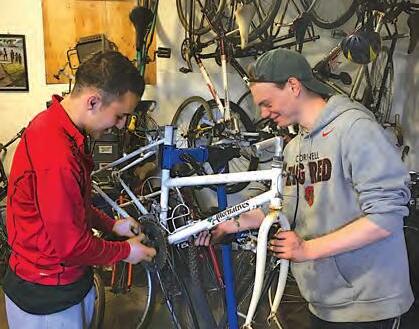
This year, the Tri-Council collaborated with Greeks Go Green to offer more oppor tunities for sustainability focused p r o j e c t s , a c c o rd i n g t o G a l a n t i n o I n addition to many other new endeavors, students helped expand the Sustainable Fi n g e r L a k e s Ma p a n d w o r k e d w i t h Recycle Ithaca’s Bicycles to assemble and test bikes
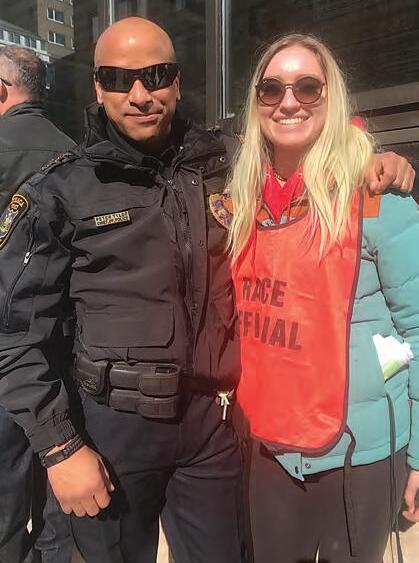
Some Greeks Give Back par ticipants also played a special role as peacekeepers
The vice presidents from each of the three councils spent over a month planning the large event, including reaching out to community organizations, assigning shifts and coordinating transpor tation
Burgin said that a major concern was about whether volunteers who signed up would uphold their commitments
“ The biggest fear when putting on an event like this is that you 'll tell the community par tners how many people are coming, they’ll take the time to set up projects for them, and no one comes to their shift,” she said
However, lack of par ticipation did not prove to be as much of problem this year, according to Galantino
“It was as exhausting as it was rewarding,” he said
Burgin said that the impor tance of Greeks Give Back was to allow members to extend their impact beyond the typical fundraisers
“ T h e r e ’ s n o t h i n g w r o n g w i t h fundraising for your cause, but I think the current culture around philanthropy is missing something really impor tant:
a
Resolution 12: “Calling for the Creation of a Graduate and Professional Student Specific ‘Notice and Respond: Friend 2 Friend’ Workshops ”
This resolution requests that the administration fund a graduate and professional student workshop analogous to the bystander inter vention F2F Workshop
“So we wrote this resolution sort of to express our solidarity with our LGBTQ+ faculty and staff colleagues ”
Workshop “ was designed to help students to consider their role in Cornell’s suppor t suppor t network and ways they might respond when peers show signs of distress, ” according to a University press release from November 2011
Munasinghe, who also co-sponsored Resolution 12, told The Sun that the resolution will be par ticularly impor tant because of the dispropor tionate impact of mental health issues on graduate and professional students “ The hope was that by creating a Notice and Respond: Friend 2 Friend workshop specifically for graduate and professional students, we could help graduate students inter vene when they see students in their program who are suffering, and making sure they can actually get the suppor t they need from Cornell,” she said
BreAnne Fleer can be reached at bfleer@cornellsun com
the why,” Burgin said “If members don’t really know why they are putting on these events and raising all of the money that they do, the philanthropic spirit is gone ”
Emily Yang can be reached

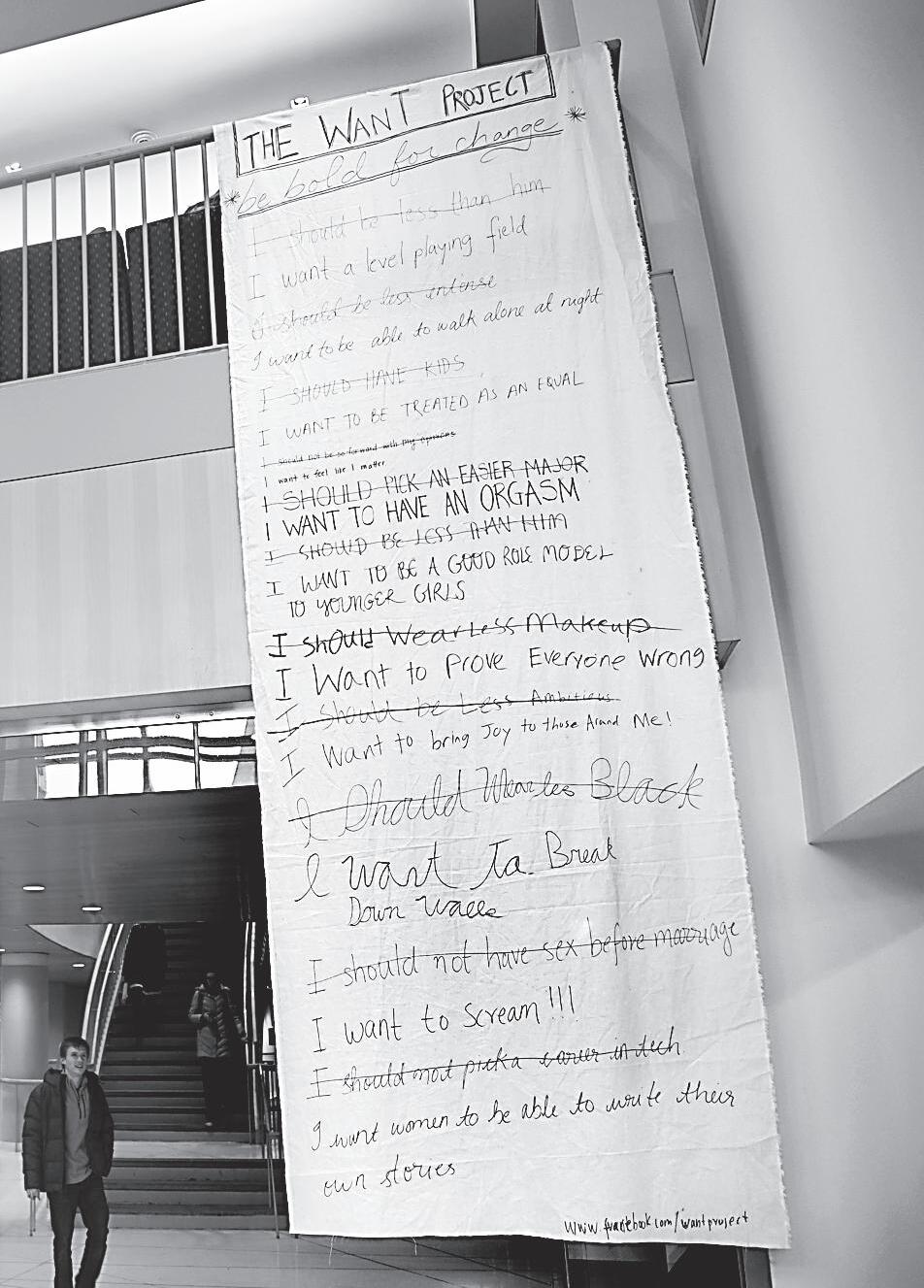
Want for change | Banners were hung in three locations on campus displaying statements collected from Cornell women
WOMEN
Continued from page 3
video had garnered over 13,000 vie ws on Facebook
According to J J Erpaiboon ’18, the video’s producer and the third student working on “ The Want Project,” the purpose of featuring both men and women in the video was to “ put guys in
t h e s h o e s o f w o m e n ” a n d encourage allyship
“After we were done shooting the video a lot of men came up to us and told us that actually saying the statements out loud
‘
a n d ‘ i n t e r n a l i z i n g ’ t h e m changed the way they saw the
words were not ne w to them,” Erpaiboon said Aside from the banners and featured video, the team is looking into “phase two ” , in which stories from behind the scenes will be released periodically to maintain sustained interest in the project The team is determined to t r a n s f o r m t h i s p ro j e c t i n t o a long-term cause at Cornell “ We don’t want it to be a once a year celebration and then it’s over, ” said Rajbhandari
Girisha Arora can be reached at garora@cornellsun com Alexia Ge can be reached at qg29@cornell edu
The DEADLINE to e mail advertisements for Display and Classified Ads for the Monday, April 9 and Tuesday, April 10 issues of The Corne¬ Daily Sun is Thursday, March 29, 3 p.m.
The Sun Business Office will close Thursday, March 29 at 5 p.m. and will reopen Monday, April 9 at 9 a m WX
The Cornell Daily Sun 139 W. State Street • Ithaca, NY 14850 607-273-3606

Independent Since 1880
136TH EDITORIAL BOARD
JACOB S KARASIK RUBASHKIN 19 Editor in Chief
JOHN MCKIM MILLER 20 Business Manager
KATIE SIMS 20 Associate Editor
VARUN IYENGAR 21 Web Editor
MEGAN ROCHE 19 Projects Editor
EMMA WILLIAMS 19 Design Editor
JEREMIAH KIM 19 Blogs Editor
AMOL RAJESH 20 Science Editor
BREANNE FLEER 20 News Editor
YUICHIRO KAKUTANI 19 News Editor
NICHOLAS BOGEL-BURROUGHS 19 City Editor
LEV AKABAS 19
& Entertainment Editor
SARAH SKINNER 21
ANNE SNABES 19
JOHNATHAN STIMPSON 21 Assistant Sports Editor
EDEM DZODZOMENYO 20 Assistant Photography Editor
PETER BUONANNO 21 Assistant Arts & Entertainment Editor
CHENAB KHAKH 20 Assistant Science Editor
JULIAN ROBISON 20 Layout Editor
GIRISHA ARORA 20 Managing Editor
HEIDI MYUNG ’19 Advertising Manager
ALISHA GUPTA ’20
DYLAN MCDEVITT ’19
MICHAEL LI ’20
GRIFFIN SMITH-NICHOLS ’19
JACQUELINE QUACH ’19 Dining Editor
SHRUTI JUNEJA ’20
ANU SUBRAMANIAM ’20
JUSTIN J PARK ’19
GHAZI ’21
LIU ’20
KANTOR 19
GENDLER 21
T h e Bl e s s i n g o f a B - was the name of a book that I often used to see around my home Its orange cover a n d r a i n b o w s p i n e w o u l d a l w a y s draw my eye as I passed by its bookshelf I didn’t realize it was a parenting book until I became curious and read the back cover, on which author Wendy Mogel extols reframing worries and fr ustrations as blessings to promote resilience in the adolescent offspring of her readers That’s as far as I got It was a little too insightful for my 16-year-old self I wedged it back on the shelf
Yet I have always remembered that title, maybe because of the snappy a l l i t e r a t i o n , b u t a l s o b e c a u s e I thought that calling something like a B- a blessing was odd I don’t consider grades to be blessings The gratifi-
taken What grade did I receive? It’s
W
m b e r, however, is the gratification I felt from debugging code or the reprieve ever y time a problem set compiled The amount that I learned from the course rendered the grade completely unimpor tant
In college, my attitude about class s e l e c t i
toward subjects that I’m good at, I’m more concerned with which subjects are good for me, regardless of difficulty My transcript is not some pristine treasure that requires curation If taking courses that expand my skill set and breadth of knowledge sully it, all the better, because I will graduate with more to show for my education and ability I ’ v e f o
Students need to learn the value of being challenged and how to practice academic resilience if a difficult class results in disappointment.
cation that I find upon receiving them is rooted in feelings of fulfillment from my achievement
WORKING ON TODAY’S SUN
DESIGN DESKERS Julian Robison 20 Catherine Horng 21 Hannah Lee 20
AD LAYOUT Hannah Lee 20
PRODUCTION DESKERS Megan Roche 19 Katie Reis 20
NEWS DESKERS Shruti Juneja 20 Sarah Skinner ’21
NIGHT DESKER Stacey Blansky 20
SCIENCE DESKER Chenab Khakh ’20
ARTS DESKER Peter Buonanno 21
PHOTO DESKER Boris Tsang 21
SPORTS DESKER Johnathan Stimpson 21
Have an issue with our news coverage?
Want to give your take on a campus issue?
The Sun thrives on your feedback Continue the conversation by sending a letter to the editor or a guest column to opinion@cornellsun.com.
Letters should be no longer than 250 words in length, and columns no more than 800 words in length
In high school, I most enjoyed the classes in which I excelled Being challenged wasn ’ t quite on my mind, and I wasn ’ t unique in that regard Like most high school students with their eyes on college, I was considering the whole picture: an ideal balance of difficult yet doable classes to p r o d u c e t h e p e r f e c t t r a n s c r i p t A p e d i a t r i c i a n t h a t I ’d v i s i t e d a s a teenager hit it on the nail when, about to stick a tongue depressor d ow n m y t h ro a t , s h e s a i d , “ Now Julia, what do you want your high school transcript to read when you apply to college?” It was terrifying College was a different ballgame
D u r i n g m y f i r s t s e m e s t e r, I w a s f l o o re d by t h e n u m b e r o f c o u r s e oppor tunities and subjects I’d never h e a rd o f To t o p o f f a c o m i c a l l y diverse course load, I enrolled in C S 5 0 a n d s u b s e q u e n t l y a t t e n d e d ever y minute of ever y office hours, four nights a week After those ended at 11 p m , I would sometimes continue working until 4 a m
Some of my dearest friends str uggled alongside me that semester We
s t i l l l a u g h a n d s h a k e o u r h e a d s i n c r e d u l o u s l y t h a t w e d e v o t e d s o much time to one course that first year “Never again will I take a computer science class My transcript is still recovering,” they lament “I have my two QR credits That is enough for a lifetime ” But that wasn ’ t my last computer science course, and no, I’m not a computer science major It was and still is one of the hardest classes I’ve
m y s e l f in a plethora of foreign language, biology, histor y, psycholog y, a
o g y a n d sociology courses I’ve recently been on a statistics binge Because I take so many classes o u t s i d e m y m a j o r s , I’m constantly asked, “ What are you doing here?” I often encounter surprised, skeptical reactions to my cons c i o u s c h
t o t a k e d
m
n d i n g courses that I want, rather than need, to take
The tendency of many students is to remain comfor tably within their realms of study, rarely veering into ne w subjects and only dabbling in d i ve r s e f i e l d s t o f i l l d i s t r i b u t i o n a l requirements We are unwilling to risk our carefully crafted transcripts and GPAs
Yale students need to learn the value of being challenged and how to practice academic resilience if a difficult class results in disappointment We don’t learn for learning’s sake anymore A spot at Yale promises fr ustration and str uggle, and if we a l l ow t h i s t o d i s c o u r a g e u s f r o m intellectual enrichment, we r un the risk of graduating as one-dimensional people It takes practice to confront, work through and accept challenge In Judaism, to study is to per form a mitzvah, or good deed The choice to study tedious subjects is considered an honorable endeavor for selfbetterment and growth The difficulty of learning can dampen the desire to challenge oneself when the re ward is a grade In my mind, the act of receiving a grade signifies perseverance, not failure or success It means you ’ ve made it through a class with knowledge you didn’t possess before No grade, regardless of the letter, can devalue what you ’ ve gained There’s always a blessing in a B-
A Monday ar ticle, “McGraw Hall Renovation Plan Back in Motion After 7-Year Suspension,” referred to McGraw Hall as the second-oldest building on campus It is the third-oldest building on campus by constr uction date
A Monday letter to the editor stated that student subscriptions to the Wall Street Journal through the Collegiate Readership Program were funded by the Student Assembly at $2 50 per student The S A Resolution stated the cost was $1 75 per student The Sun regrets these errors
Iam now 22 years old and I can drink legally but, for much of my Cornell career, I was underage I came into college with the I D of a friend of a friend who looked kind of like me and whose name was “Yelena ” That got taken at a liquor store and then I used a string of fakes before I turned 21 Being underage in Collegetown is more of an obstacle than a barrier The bar scene here is always changing but there will forever be three or four places that 18 and 19 and 20 year olds can get into if they know the right tricks
Some of these bars don’t care at all My Korean friend from freshman year got in with a white girl’s I D Some of the other bar’s don’t look at your I D at all and just see if it scans For most of the “underage friendly” spots, your chances of getting in depend greatly on who the bouncer is, what time it is and how busy the place is One Collegetown bar in particular has this one bouncer who lets in all the underage girls but not for nothing I met this man my freshman year, when my roommate and I would go out drinking almost every night of the week He would always let us in if he was working, greet us by name (except he thought my name was Yelena) and give us a hug This bouncer knows everyone, especially the girls And he knows the I D s are fake He must! Halfway through my sophomore year when I was no longer Yelena from Massachusetts but rather Cara from Connecticut, he still let me in But every “ you ’ re good” or stamp on your hand came with an uncomfortable touch on your back or a hug that lasted little too long
Economists often talk of the m e t a p h o r i c a l p i e t h a t keeps growing with ever y passing year Economy has been in fact steadily multiplying for more than a centur y now: for example, our GDP per capita now is 5 times what it has been in the 1950s; we are collectively producing 5 times more stuff per person
Bu t , w h e n I t a k e a l o o k around, I do not see people kicking back to enjoy the pros-
p e r i t y o u r a n c e s t o r s c o u l d n ’ t h a v e i m a g i n e d Ev e n i n t h e somewhat elitist bubble I inhabit people worr y an awful lot about the money and the jobs
T h i s m i s m a t c h b e t w e e n t h e numbers and felt reality puzzles me a great deal, in a way that an NFL star is puzzled when he discovers the millions he earned through sweat and trauma have somehow vaporized between the lines of contracts and lawyer fees
So m e , g i v e n t h i s p re m i s e , would turn to Marxism, proclaiming that the exploiting 1% is sucking up all the benefits of the improved economy, leaving ever yone else stuck in the conditions of the past This claim certainly has some truth to it, but t h e e c o n o m i c w e i g h t o f t h e wealthiest is sometimes overestimated Let me illustrate
Imagine (and you really need to strain your creative muscles
He walks all through the bar, putting his arms around girls, grabbing waists and asses and kissing cheeks We all accepted this as the norm This was the toll we had to pay We had a reliable bar to get into if we could suffer through the creepy bounc-
years I’ve been here, probably longer Seeing this play out, as someone removed from the situation, was sickening I understood the desire to get in the bar and get it over with I also appreciate the vulnerability that younger girls feel in this situation
life, a rite of passage that I would be robbing future girls of But then I remembered that although this is normal, it is not OK
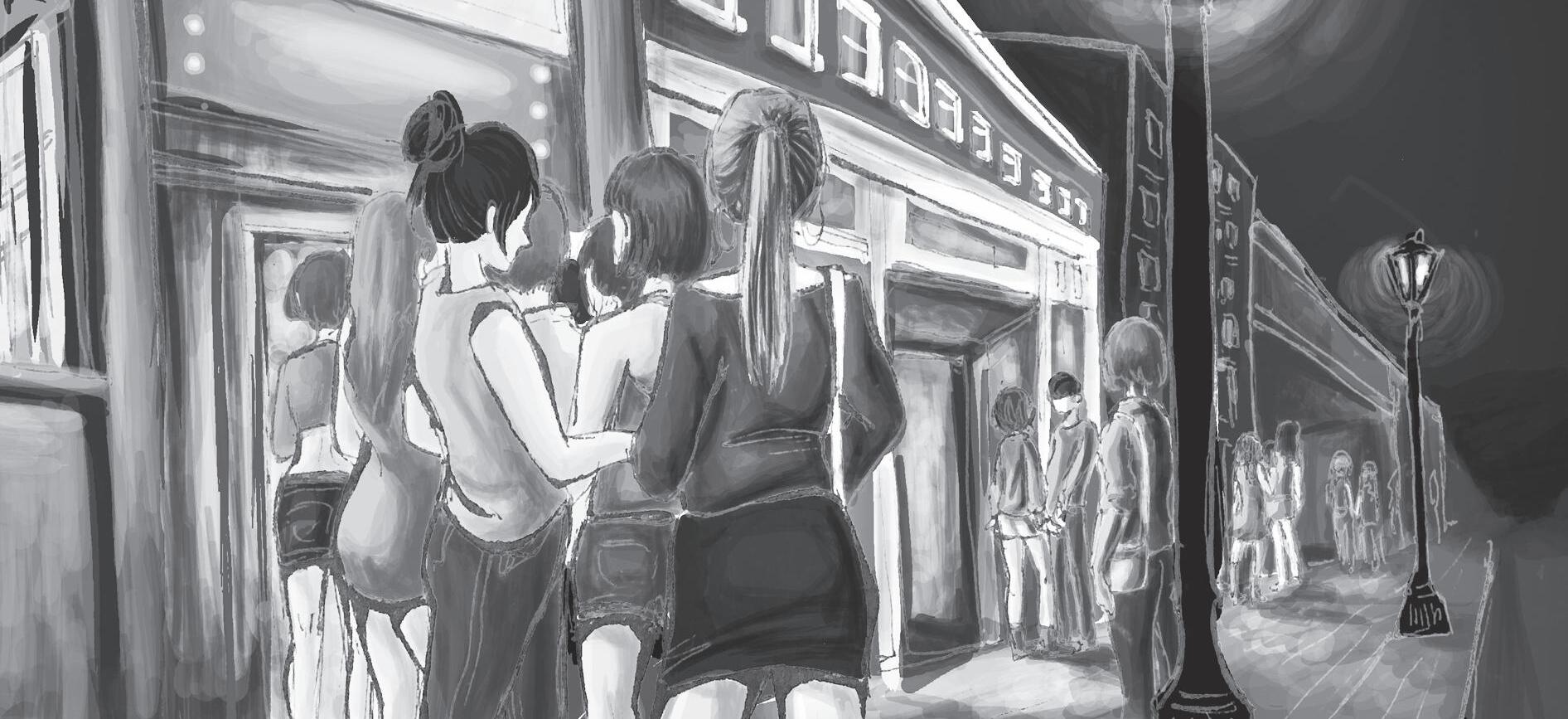
er, and we did He handed out his number with the instructions to “ text him if you had trouble getting in,” knowing full well that if you did, you would have to feel his hot breath on your neck as he told you how good you looked But all your friends are inside and you ’ re already dressed up and it is cold out and your girls are pressuring you to just do it There was no one to complain to because even if he was inappropriate, we were still underage Last month, my older sister came to visit and I decided to take her to this bar where I had spent many a weeknight taking shots out of little plastic cups Sure enough, he was standing outside the bar, checking I D s and exhibiting the same predatory behavior he has for at least the 4
The choice to be groped and get to be social or stay home is unfair and sexist
Drinking is a part of the college experience and telling girls to just wait until they are 21 is like preaching abstinence: it doesn ' t work This is a distinctly gendered issue Boys would sometimes get in and sometimes they wouldn’t, depending on how good their I D s were; that’s it Even at Cornell, social pressures and an arbitrary drinking age force girls to commodify their own sexuality and we allow this to happen I understand the hypocrisy of me talking about this now I’ve reaped the benefits of this crooked system and yet now I am sounding the alarm My reticence to write about this issue has stemmed from the thought that maybe this is just a part of
for this one) America elects a socialist scratch that communist president who manages to pass a law that distributes all i n c o m e e q u a l l y Us i n g e i t h e r m a g i c o r h y p n o s i s s h e t h e n manages to convince ever yone to show up for their jobs the next day as if nothing happened to t h e u n d e r l y i n g i n c e n t i v e s
Economy still outputs the same amount of stuff, and ever y family of three is making $73,000 (the average household income as of now)
What strikes me about this number is just how low it is Such an income doesn’t make you poor (unless we ’ re talking San Francisco), but not particularly affluent either It’s only about $15,000 more than what most people live on right now
( m e d i a n i n c o m e i s a b o u t $60,000) Take this number and subtract taxes, housing, insura n c e , c a r m a i n t e n a n c e , g r oceries, babycare and you ’ re barely left with anything Having fulfilled the communist ambition in the wealthiest of states, we are left with ever yone still absorbed in the material concerns At the same time we are purportedly producing 5 times more value than back in the E i s e n h ow e r d a y s , s o w h a t i s going on?
T h e f i r s t e x p l a n a t i o n t h a t comes to mind is the inefficiency accumulated in the system
We waste resource on stuff we don’t really need The U S is spending half a trillion dollars on militar y (more than it did in the midst of Cold War, inflation adjusted!) and the medical system is spending a trillion dollars on people who are going to die within 2 months Higher education cost has increased more than tenfold in its cost in the last 40 years without any apparent i m p rove m e n t i t s q u a l i t y, a n d don't get me started on lawyers It's a ver y eye-opening experience to look at the employment statistics and see just how few people are involved in actually p ro d u c i n g a n y t h i n g o f va l u e This is a personal experience as well: many of my friends and acquaintances, that is the ones who knew better than to apply to grad school, are busy doing t h i n g s a s s o c i a t e d w
l e s , finance and bureaucracy They are dealing in and being paid for handling abstractions built upon abstractions Others are working on making Uber rides arrive a few seconds earlier, or personal assistants for plants Meanwhile, housing and food and all other basics are still expensive enough to absorb most of our income Or, maybe, the life a family can buy for $73,000 is plentiful enough and it's our conception of what is enough that is broken Aside from certain inadequacies mentioned above, the prices of
If you want to say that underage girls shouldn’t go to bars, then fine What I am arguing is that women should not be harassed for taking part in something that almost all college kids do Telling women they have to be harassed to enjoy the same things as their male classmates is not only a dangerous precedent to set, but sounds eerily similar to telling a girl she is asking for it because of her short skirt
I don’t really go to this bar anymore I’ve swapped Long Islands and karaoke for White Russians and reality TV Still, I believe this is a topic that needs to be addressed The most obvious solution is to lower the drinking age so that vulnerability of college freshmen and sophomores is not exploited as a way for male bouncers to cop a feel Otherwise, Collegetown businesses should be more cognisant of the way their employees treat their clients not that I believe that management does not know exactly what is going on We need more female staff in nightlife and we need to punish people who treat women as sexual commodities, whether the women should be allowed into the bar or not
Willow Hubsher is a senior in the School of Industrial and Labor Relations She can be reached at wrh73@cor nell edu This is Not a Sex Column appears alter nate Tuesdays this semester
most consumer goods are in fact going down We did learn to make most things better and more efficiently Cars, clothes, electronics and books cost much less than they used to while having better quality Maybe, if we were to teleport a 1950s into nowadays America she would be ecstatic with the buying power $73,000 gives you and genuinely puzzled as to why would some find such a sum insufficient (she would then, of course, collapse after seeing the bill from the doctor’s office) W
thing to do in an efficient economy spend less money and less time earning money is low status and, moreover, bord e r l i n e i m p o s s i b l e f o r m o s t occupations
One of the first things you learn in a microeconomics class is the concept of revealed preferences the preferences that best fit the choices made The histor y of 20th centur y seems to tell us that a nearly universal revealed preference of humans is to spend most of their time working at a job they hate to have more shoes, bigger phones and a few bonus years of life expectancy; to choose that over working three hours a day like Jo h n K e y n e s p re d i c t e d w e would Bu t h u m a
n f u s i n g creatures only vaguely reminiscent of the rational agents that populate the tales of economists Sl a v e
v e s w e o
t garments, they're
money, or, alternatively, getting by just as well while working less, we start to consume more of this good or some other good We choose to have more comfortable cars and wider tvs while still spending most of our time laboring at a job we find utterly meaningless What exacerbates or maybe even drives this issue are the s o c i a l d y n a m i c s b e h i n d i t Clothes aren
Jo
e d s t a t u s W h e n economy makes things cheap, what used to be normal becomes l ow - s t a t u s L i k e h a v i n g f e w clothes and fixing them up when t h e y t e a r L i k e u s i n g p u b l i c transportation The most sane
n choose things we do not wish and fail to pursue the ambitions our mind harbors Maybe that’s just it and growing the pie further is going to be no remedy, or maybe I’m wrong and one day we will wake up in a world of plenty I don’t know
BY ADAM HIGH Sun Contributer
The Hudson River is infamous for being one of the most polluted rivers in America, but its waters have a lot more to them than meets the eye Estuaries like the Hudson are some of the most biodiverse ecosystems in the world, where one can find marine, brackish and freshwater species intermingling in a relatively small area In the Hudson River, oysters served as the foundation for this rich environment until around 1900, when a combination of overfishing and pollution locally decimated the stocks
Oysters begin their life cycle as small, mobile larvae As they mature, they seek out a surface to settle on and develop their recognizable shells They have a tendency to cement down on previously established oyster beds and eventually form large reefs in brackish environments
These reefs create habitat for a variety of species within estuaries, as well as provide direct social and economic benefits for the communities around them Oyster reefs are also capable of reducing the impact of storm surges and other natural disasters As filter feeders, oysters have also been studied extensively for their ability to filter some water pollutants and regulate phytoplankton populations in bodies of water which are over nutrified
Given the numerous ecosystem services oysters perform, many groups, including New York State and the City of New York have taken part in efforts to restore oyster populations in the Hudson to their historic levels
Notable undertakings, such as the Billion Oyster Project and NY Baykeepers, have led the charge in engaging the community in seeding hatchery-bred oysters into the Hudson
In the past, hatchery-bred oysters were the most feasible source of spat, or young oysters, for restoration pro-
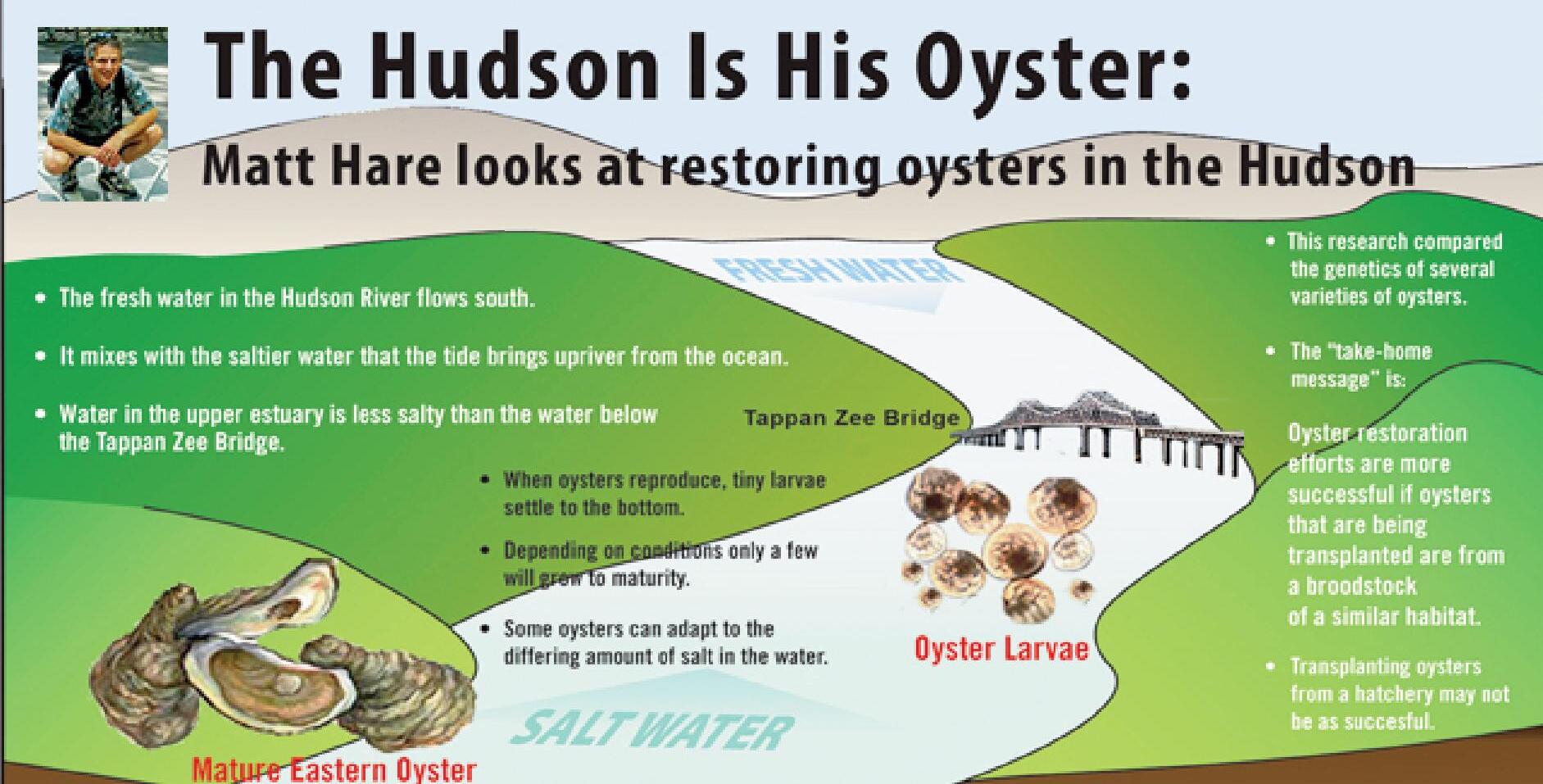
jects However, a new report from the Hare Lab in Cornell’s Department of Natural Resources suggests a new source of healthy oysters: a wild Hudson River species located near the Tappan Zee Bridge in the New York City metropolitan area Discovered during unrelated research by Prof Matthew Hare, natural resources, and his team, this new find is proof that a wild population of Hudson oysters has survived the degradation of the river and are stable enough to reproduce regularly
The significance of a stable wild oyster population ultimately boils down to genetics All oysters sourced from a hatchery are subject to the conditions inside the hatchery These conditions can sometimes create genetic bottleneck events, favoring certain genetic groups over others
After such an event, the genetic diversity of hatchery
oyster populations are severely reduced With lower genetic diversity, there is a lower chance that a given population will be able to thrive With the discovery of a stable, wild Hudson River oyster population, Hare hopes that future projects can implement their genetics to increase chances of future successful populations Hare elaborated on the genetic differences between hatchery and wild populations Hare discussed why local species are better suited than hatchery species for restoring oyster populations “It comes down to climate change and a population’s adaptive capacity during environmental change,” Hare said
Adam
BY SHRIYA PERATI Sun Contributer
For many, Drs Rosemary and Peter Grant, evolutionary biology, Princeton University, are living legends in the field of modern evolutionary biology, having conducted over four decades of field research on the Galapagos finches On Monday, March 12, students, professors and alumni packed into Call Auditorium in Kennedy Hall to witness the scientists bring their research on the Galapagos Finches to life
Rosemary’s talk, titled “Evolution of Darwin’s Finches: Integrating Behavior, Ecology, and Genetics” kicked off the Paul C Mundinger Distinguished Lectureship, in honor of the late Paul C Mundinger Mundiger received his Ph D from Cornell in 1967 and developed a strong attachment with lab of Ornithology as a graduate student Mundinger, formerly a professor at Queens College, prized teaching and inspiring his students with his love for evolutionary biology The Mundinger lectureship series was instituted in 2018 to honor his memory and spirit by bringing inspirational and renowned speakers to the University each year
“I chose this title because Paul’s very innovative research in a number of species of birds really did integrate behavior,
ecology, and genetics This is where Peter and I have followed in the same footsteps as Paul,” Rosemary said “Paul was able to show that song-learning involved an interaction between experience and genetic determancy or observatory, and this is a really innovative piece of work that he and his colleagues did ”
Rosemary began her talk emphasizing fundamental questions that scientists seek to answer regarding biodiversity
“All of us, in this room, whether we are hiking in the Alpine meadows, traveling in the Amazon jungle, or diving to the depths of the sea are just amazed at the diversity of life on this planet How is all of this biodiversity generated? How and why do species multiply? How do we even go about studying this process of speciation?” Rosemary said Rosemary’s enthusiasm for the diversity of life reverberated throughout the course of her talk
For many, the most fascinating part of Rosemary’s talk was her discussion of the origin of a completely new lineage,which Rosemary and Peter both followed since its inception through the sixth generation
“Her results were amazing: she witnessed a new species being born right before her own eyes, ” Edwin Quaye ’21 said In her talk, Rosemary described the
chronological progression of how she and her husband, Peter, observed the origin of the new Big Bird lineage When the couple went to the islands in 1978, there were two distinct species: Geospiza fortis and Geospiza scandens After the enormous El Niño event of 1983, the hybrids began to survive and G fortis and G scandens began to converge on each other Five years later, G magn
Española and mated with the species, G for tis producing multiple hybrid offspring These offspring then proceeded to interbreed producing a unique hybrid lineage, which the Grants now call the Big Bird lineage
“In all respects, the new lineage is functioning as a new separate species Will it die out through inbreeding depression? Will the genetic variation be augmented through genetic exchange?” Rosemary said Despite these lasting questions Grant emphasized that whether or this new lineage survives, it still provides incredibly valuable insight into how a new species could arise and either persist or become extinct
In the concluding remarks of her talk, Rosemary delivered two key messages First, she highlighted the dynamic nature of environments and populations and emphasized the importance in keeping environments capable of further natural
change for a sustainable environment
Second, Rosemary commented on the importance in understanding ecology and evolution even with our rapidly accumulating genomics data
“[ We] live in very exciting times: the genomics data are rapidly accumulating, changes are happening every year, and this can really enhance our field studies
But reciprocally, a reliable interpretation of genetic data really requires a deep understanding of ecology, evolution, and behavior in the natural environment,” Rosemary said
For students who are currently enrolled in BIOEE 1780: An Introduction to Evolutionar y Biology and Diversity, it was exciting to see the one of the quintessential researchers behind the science that they are currently learning about in their class Many students approached Rosemary and Peter after their talk, buzzing with enthusiasm or requesting autographs on their sketches of the Galapagos finches
“I feel very excited now, about her research, especially because she performed her research over such a long period of time, and she stayed with it It motivates me as well to keep pursuing research,” Jasmine Mack ’20 said
Shriya Perati can be reached at sp774@cornell edu
BY ZACHARY LEE Sun Staff Writer
Even with a Kanye West endorsement and an all-star cast, many believed Guillermo Del Toro’s mecha-monster film Pacific Rim would bomb when it was released in 2013. While it is unfortunate that the guileless thrills of seeing giant monsters brawl equally colossal robots no longer excites as it used to, Del Toro’s eye for detail and ability to bestow a haunting grace to his extraterrestrial and mechanical monsters alike elevated Pacific Rim above the typical creature features. A stellar overseas performance helped drag the sequel’s status from the depths of development hell and now, Pacific Rim Uprising graces screens five years later. However, the absence of Del Toro’s idiosyncratic and artful touch looms over this Steven DeKnight directed film. While Pacific Rim Uprising never quite “rises up” to the iconic nature of its predecessor, it is fast-paced and undeniably fun, delivering exhilarating and bright action sequences and crisp CGI spectacle that excites in the moment, even if it does not stimulate much afterthought.
Pacific Rim Uprising works well as a stand-alone sequel,though a quick voice-over covers the essential plotbeats. In 2013, humanity built massive robots (Jaegers) to fight Kaiju, alien sea monsters that emerged from an interdimensional portal at the bottom of the Pacific Ocean. With the help of Stacker Pentecost (Idris Elba), the world was able to defeat the Kaiju and seal the portal. Ten years later, humanity is rebuilding cities and the Shao Corporation has launched a new program of automated Jaegers that threaten to put pilots out of business. When new Kaiju emerge, a group of pilots must put aside their differences and past histories and suit up to save the world.
Sadly, even with this straightforward plot, the character’s narrative arcs are not enough to anchor the film. Rinko Kikuchi reprises her role of Mako Mori yet is reduced to a glorified cameo, with her presence only present to help further Jake’s story. Burn Gorman and Charlie Day also return as the eccentric Dr. Hermann and Newt respectively, and while Gorman’s performance is a carbon copy from the first film, Charlie Day’s character factors significantly into the plot. The notable exception is John Boyega’s Jake Pentecost who, while loquacious and rebellious, delivers his lines with a passion that is convincingly reminiscent of Idris Elba’s Stacker. His brash personality clashes well with pilot recruit Amara Namani’s (Cailee Spaeny) fiery temper, who proves to be resourceful and courageous in the heat of battle.
To DeKnight’s credit, he honors the themes of the first film by attempting to answer question of “can you fight monsters without becoming monstrous yourself?” This is cleverly explored through the Shao Corporation’s drone Jaeger program. For Jake and his comrades, they view piloting Jaegers not as privilege but as a duty; the machines are less symbols of scientific innovation than they are weapons of last resort. Yet by creating drones, the Shao corporation literally removes humanity from machine, rendering Jaegers solely as armaments used for destruction. Likewise, the film raises interesting questions about legacy. Jake cannot deny the influence he has being the son of a great war hero. Is he obligated to “honor” his dad and sister’s legacy by fighting, or can he justify avoiding the past?
Yet being a monster movie, Uprising provides an action feast for the eyes. From Sabre Athena to Obsidian Fury, the outrageous Jaeger names are only matched by the equally insane fight scenes. There’s a childlike glee in seeing a Kaiju toss a Jaeger around like a doll or seeing two Jaegers, one

with flame chainsaws, and the other with glowing cobalt swords spar against the backdrop of snowy Russia. It is in these moments where DeKnight excels; he chooses not to focus on the majesty of the robots’ aesthetic but their abilities.
If I were to describe the monster movie genre as a food, it would be pasta: difficult to mess up, yet it takes a master to transform this plebeian dish into a piece of culinary art. Guillermo Del Toro is one of those master chefs who is able to take the simple recipe of a monster movie and imbue it with zesty flavor that still lingers long after you have partaken in his cinematic feast. DeKnight’s sequel is largely lacking of those unique components yet still gets the job done. For my pasta cravings, while I usually prefer a lobster carbonara spaghetti with smoked bacon and sugar snap peas doused in truffle cream sauce and topped with parmesan and hot peppers, sometimes, a vat of tomato sauce with meatballs is not a bad alternative. Likewise, for those looking for action and adventure, look no further than Pacific Rim Uprising.

Ifyou’re a fan of the rap group/radical-left hype-men Run the Jewels, you may have been surprised by the news this weekend. Rapper Killer Mike, who forms one-half of Run the Jewels with El-P, gave an interview with the NRATV host Colion Noir in which he seemed to agree with the NRA and guns-right activists that new gun-control laws are not a solution to gun violence, separating himself from the progressive left that he has often acted as a celebrity spokesman for. In the interview, Killer Mike accused guns rights activists of being “lackey[s] of the progressive movement,” adding that “I told my kids on the school walkout: ‘I love you — if you walk out that school, walk out my house.’”
To be fair, Killer Mike was not simply aping the NRA’s incendiary rhetoric — he was trying to make an argument about the need specifically for African-Americans in poorly-policed areas to be prepared to defend themselves against
threats. Killer Mike apologized in two videos he filmed at home soon after the NRATV interview was posted online, saying that he had unintentionally allowed the NRA to post the video as a counter to the March for Our Lives on Saturday,
right too, then I’m standing on your side of the room when they say, ‘Who’s for guns?’”
March 24, a protest which he called “a very noble campaign that I actually support.” However, he has chosen to explicitly align himself with gun-rights activists in the past: he said on Tavis Smiley’s show on PBS last year that “White men don’t want to give up their guns, and I’m with that. If you don’t want to give up your guns, and I have that right — not privilege — but I have that
A less surprising attack on gun control activists came from Jesse Hughes, the frontman of Eagles of Death Metal. Hughes and the rest of the band were actually present during a mass shooting in 2015, when their show at the Bataclan Theatre in Paris was interrupted by armed attackers who killed nearly 90 people — part of the coordinated attacks in Paris of November 2015, which ISIS claimed responsibility for. After a brief period of prayer-tweeting and donation-collecting, Hughes began claiming that the Muslim security at the Bataclan probably knew about the attack beforehand, a claim he made, apologized for and then continued to make publicly.
After the March for Our Lives, Hughes called the protesters “vile abusers of the dead” in a long post
on Instagram and hoped that they would “live as long as possible so they can have the maximum amount of time to endure their shame....and be Cursed…,” a truly bizarre condemnation. Hughes also called himself a “survivor of a mass shooting,” which seemed intended to discredit those at the march who hadn’t actually been present at one — and as for the Parkland survivors, they were “playing hooky at the expense of 16 of your classmates blood,” as if their protesting itself was responsible for their friends’ deaths.
Hughes also threw a “Long Live Rock’n’Roll” into the middle of his mocking of teenage mass-shooting survivors, for good measure.
Lots of things differentiate these two cases. The two artists come from opposing political viewpoints, even if there views converge to some extent on this topic. Perhaps the most important difference, however, is in their relationship to their own opinions. Killer Mike sees himself as in-
progress; he admits to mistakes and apologizes. Hughes, on the other hand, has no self-checking mechanism to counter his bluster. He denigrates and smears his opponents, including tweeting the fake, Photoshopped image of Parkland survivor Emma González tearing the U.S. Constitution in two that has been circling in altright online communities after the March for Our Lives. And his apologies are insincere and irreversible, as they were in the case of his racist accusation about the Bataclan security guards.
If there’s anything to learn from these roundly unimpressive takes, it comes from Killer Mike’s willingness to reexamine his words and actions, and to treat debate as an opportunity to reconsider rather than a zerosum game of verbal assault.
Jack Jones is a senior in the College of Arts and Sciences. He can be reached at jackjones@cornellsun.com. His column Despite all the Amputations runs alternate Tuesdays this semester.



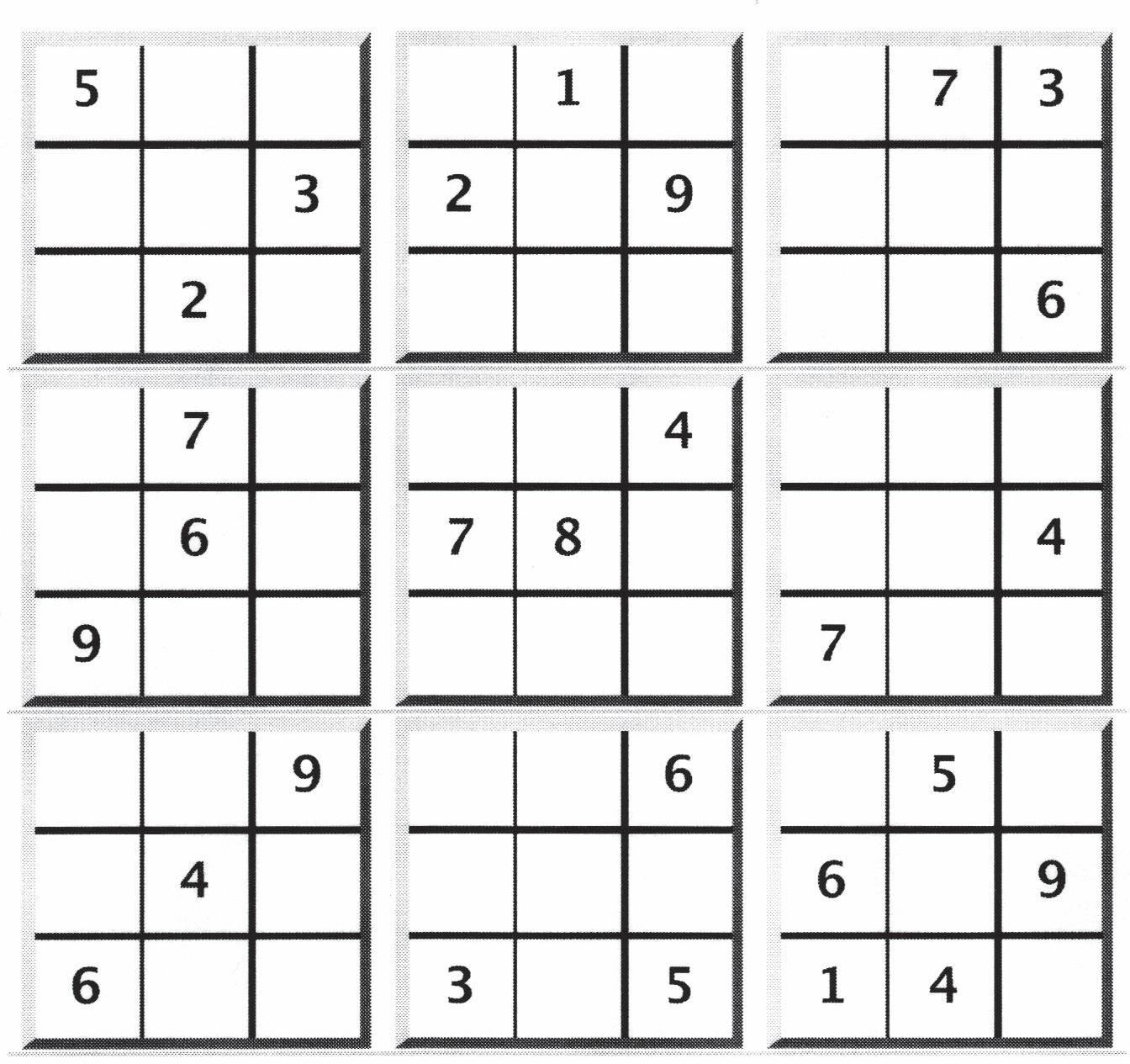
by Jeffrey Sondike ’19



Heart of Collegetown EDDYGATE
1 2 and 3 bedrooms Huge apartments Fully furnished HSIA included Laundry on site www travishyde com kworden@travishyde com (607) 273-1654
Collegetown 2018-2019
1-6 BR APTS & HOUSES
All New Furnished Gas fireplaces. Laundry Parking 315-254-1717
607-272-3160 www cpstudentproperties com
2 Floors of fun! Fully furnished includes w/wireless internet Laundry on site Parking available Pets Allowed www travishyde com kworden@travishyde com (607) 273-1654

Fitness Center Shuttle Bus Service to Campus Study Rooms with Expansive Views Single Rooms Studios 1, 2, & 3 bedroom apartments Spring 2018 & 18/ 19 Availability Novarr-Mackesey Property Management collegetownterraceithaca com office@ithacastudentapartments com (607) 277-1234
1 2 3 and 4 BR RAVENWOOD Fully furnished includes
Collegetown Crossing College Ave's Newest



Sun contributor Caroline Kleiner sat down with Cornell women’s tennis senior captain Priyanka Shah to talk about everything from Roger Federer to taking on Harvard.
This transcript has been lightly edited for content and clarity.
1. How did you fall in love with tennis?
That’s actually a funny story. I moved to Florida to play tennis and I was supposed to go to an academy there, but my older sister went to the academy because she’s a little better and I was too scared to go.
Those days, I went to a local park instead because I just hated tennis. I lied to my mom, “Oh, practice is cancelled.” I would stand behind one of the buildings and cry and not go to practice. But eventually, everyone there at that academy made me fall in love with the game and now it’s the best thing that’s ever happened to me.
2. Did your tennis career in high school help prepare you for the intensity of Cornell tennis?
High school tennis is a little bit different than college tennis. I didn’t play that competitively within my high school, so I wouldn’t say it’s prepared me. It’s brought me a lot of great memories, but, college tennis is a whole different ball game.
3. What made you choose to come play for Cornell?
“I have so many memories of van rides and clinching points that I’ll never forget.”
Senior Priyanka Shah
I just fell in love with the campus and I really liked the coach, the program and the girls. I thought there was a lot of room for me to grow here, academically and athletically. So I really took that to heart in my decision to come here.
4. Last year, you had a 14-4 singles record and helped the team win its first Ivy League title. What was that historic moment like?
It was amazing, there are no words that can describe it. I was also a captain that year and having that historic season for the program and for everyone, all the girls on this team, was incredible. I have so many memories of van rides and clinching points that I’ll never forget.
One moment was at Reis [Tennis Center] when we beat Harvard 4-3 and I was the only person on the court for about an hour during the third set. There were 50-100 people watching. The electricity … just knowing that I was going to win the whole time, even though it was
close, is a moment I’ll never forget.
5. Is there a tennis player that you model your game after?
I really like Kim Clijsters: she’s very athletic and has a lot of passion on the court. In terms of exact replicating, I would say no. But, I also am a fan of Roger Federer. He’s just a class act and it’s inspiring to have that kind of composure on the court day in and day out.
League Champions since freshman year, I’ve been the one to clinch that match ... I was the person who ultimately decided it and I hope to do that again this year.
“I’ll just miss coming to Reis every single day. This has become my home and I love every second of it.”
Senior Priyanka Shah
6. What is the most memorable match you have played representing Cornell?
A pretty memorable matchup for me has always been our annual match against Harvard. For the last three years at Ivy
7. How has becoming captain changed your responsibilities on the team?
It has definitely made me balance my relationship with my teammates and my coaches differently. It’s gotten me closer to my coaches, which has been great. I’ve also
learned how to balance that with the relationships I have with my teammates, which is also incredibly strong. I naturally do set a great example, so that came easy to me. But, I’ve also taken to heart the responsibility of motivating others in trying to grow future leaders on this team.
8. Aside from tennis, what are your other hobbies?
I love being outdoors and experiencing nature and that’s why I really love Ithaca. I love hiking and going to the gorges. Another hobby of mine is trying new things like new sports and picking up different skills. I just picked up squash in the fall and it’s

super, super fun. When I grow up, I’m making my kids play squash.
9. If you could spend a week anywhere in the world for free, where would you go?
I would go to Australia. I still have not been to Australia and I’m a dual citizen of Australia! I would spend more than a week there.
10. When you graduate from Cornell this May, what is going to be the one thing you’ll miss the most?
I’ll miss everything. To pinpoint, I’ll just miss coming to Reis every single day. This has become my home and I love every second of it.
Caroline Kleiner can be reached at crk74@cornell.edu

By MILES HENSHAW Sun Contributor
Eager to turn things around after a turbulent star t to its season, Cornell made headway when it exploded at the plate for a combined 21 r uns in its doubleheader home opener on Sunday
Facing nearby rival Niagara (5-11), the Red (2-9) split the doubleheader: Cornell won the first, a 17-5 blowout, while Niagara claimed the second game in a 7-4 nailbiter
made just two errors on the day, a welcome improvement from last weekend’s Fordham series when the Red amassed a total of nine errors
Senior star ting pitcher Tim Willittes cr uised to his first win of the season
To s s i n g e l u s i ve s t u f f, h e l a s t e d s e ve n innings, let up only seven hits, str uck out five and gave up just one earned r un Niagara str uggled to string together hits against the crafty star ter
“I thought that, even in game two, I saw a lot of quality swings I think we’re really starting to come out of it.”
However, game two did not get off to an auspicious star t for the Red Niagara quickly put up three r uns in the first on a leadoff walk, a single, a triple, and a squee ze bunt Things were quiet until Cornell clawed back two r uns in the f
u r t h o f f a t
p l e f r o m Wickham, followed by a sacrifice fly
After a sle w of relatively low-scoring games, the Red’s offense came out strong and early in game one The team put up three r uns in the first on a bases loaded d o u b l e b y s e n i o r o u t f i e l d e r D a l e Wickham, followed by another three in the second and four more in the third amounting to a healthy 10 r un lead from which Cornell never looked back
“It’ll never disappoint you, that many r uns, ” said head coach Dan Pepicelli “I thought that even in game two I saw a lot of quality swings I think we ’ re really star ting to come out of it ”
Continuing its onslaught, senior outfielder Kyle Gallagher who currently leads the team in batting average led the inning with a double and later, a two r un single when the Red batted around He finished game one four-for-four with four RBIs
On defense, the Red also looked comf o r t a
The outfielder’s per formance in the doubleheader was a consistent bright spot for the Red Having collected only three hits prior to Sunday, his six RBIs marked a welcome return to form for a player who batted just over 400 last season
“I was just tr ying to relax out there and tr ust myself, and eventually this was bound to happen It was a good day,” said Wickham “See the baseball, tr y not to do too much with it, adjust to offspeed It’s been the same approach all season ”
Cornell gave up a home-r un that had some help from a lucky gust in the sixth, but got the r un back in the bottom of the inning In the seventh, the Red blanked the Purple Eagles and put up a r un to tie the game on a wacky infield single from Gallagher a squibber that bounced from foul to fair
Niagara pulled away in the eighth by stringing together a couple doubles and

singles for three r uns However, Cornell brought the tying r un to the plate in the bottom of the eighth and loaded the bases in the bottom of the ninth, but was not able to conver t this last-ditch effor t into r uns
Despite the loss, Pepicelli considered the series a success and remains optimistic looking for ward
“If we play up to our standard I think the scoreboard will take care of itself at the end of the weekend, but we ’ ve got to
be sharp and be a little bit better than we were this weekend I’m really hoping it all comes together next weekend,” Pepicelli said
The Red will travel to Penn State on Wednesday night, followed by a weekend series at Princeton, Cornell’s first chance at league play
By ZORA HAHN Sun Staff Writer
In perhaps the most critical meet of its season thus far, women ’ s gymnastics managed to turn in another solid performance, this time finishing well enough to advance on to the next and final, round of postseason play
Last weekend, Cornell travelled to Philadelphia to compete in the ECAC Championships, which included Yale, William and Mar y, Brown, Penn and Temple The Red, which earned a score of 193 200 the fifth time it has surpassed 193 00 this season tied with the Quakers to win fourth place, just good enough to earn a spot at the USAG Collegiate National Championships
As has been the case for much of the year, Cornell’s success was driven by a diverse group of competitors, ranging from rookie to veteran Freshman Amy Shen claimed second place on vault with a score of 9 800, while freshman Izzy Herczeg earned fifth in the same event Freshman Madison Smith and sophomore Samantha Henry tied for second on floor with 9 850 points
“At our last home meet I scored a 9 925, tying the school floor score record This
week I’ve been focusing on improving the little things in my routines like straightening my legs and emphasizing my dance to earn back tenths on my score, ” Smith said
Adding to the contributions of the squad’s younger athletes, senior Lauren Wong placed seventh on bars with a score of 9 850
“I really focused on quality over quantity in my routines and tried to balance doing numbers and staying healthy for the weekend,” she said
Despite qualifying for nationals, the Red performed slightly worse this meet than it had in the previous two weekends But some players attributed this decline to issues limited to one event
“We had a rough start to the meet on beam with two falls but I think the team did really well in keeping the positive energy and motivation up, and did really well on the rest of the events, ” Wong said
O t h e r s , i n s t e a d , p o i n t e d o u t t h e ECAC Championships’ unique caliber of
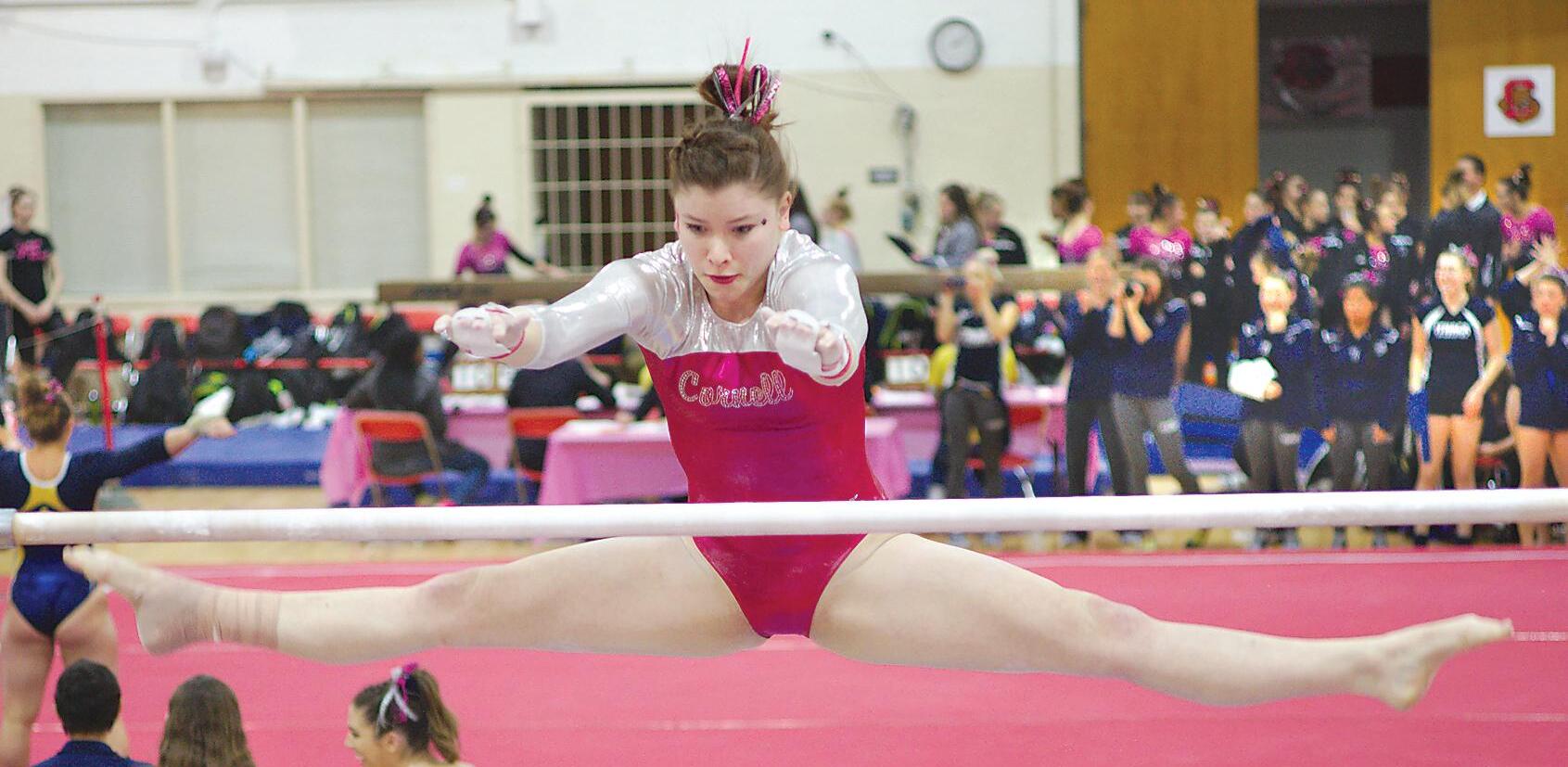
“The other teams had a really good showing during the weekend's competition,” Chen noted “Yale, in particular, has been having their best season ever, probably in program history ”
In either case, Cornell remains optimistic heading into the USAG Collegiate National Championships, its last official meet of the season The team hopes to continue building on what has proved to be a year generally defined by an upward trend, and aims to do so by fostering individual growth and maintaining consistency
“We are a really strong team and definitely capable of accomplishing way more than we have this year, but we definitely have things we need to work on, ” Wong said Throughout the season we have done really well in all four events, but have struggled in doing well on all four in one competition If we can improve our consistency in practice, we have a really good chance of performing well at nationals ”
Action next starts for the gymnasts when they travel to Denton, Texas, April 14th to compete in the USAG Championships