How Dr. Anthony Fauci M.D.’66 Became Trusted Disease Expert
By EMMA ROSENBAUM Sun Science Editor
When Dr. Anthony Fauci did not appear at a White House news conference on March 18, “Where is Dr. Fauci” began trending on Twitter — proving to many that Fauci has become one of the U.S.’s most trusted voices in the fight against the progressing COVID-19 pandemic.
The head of the National Institute of Allergy and Infectious Diseases, member of the White House Coronavirus Task Force and “the most influential man in American public health” is also a Cornell alumnus.
treatment, Fauci spearheaded the development of combination drug treatments — when different types of drugs are prescribed so the virus is less likely to become resistant to all of them simultaneously — that increased the lifespan of HIV-positive individuals. Fauci is currently developing an HIV vaccine to completely eradicate the disease.
During the SARS outbreak in 2003, Fauci and his team be-
(D-Mass.) and now teaches the class Biomedical Engineering 4440 Science Policy.
Since the initial outbreak of COVID-19 in Wuhan, China, Fauci has served as a national expert on combating the disease. Appearing at press conferences alongside President Donald Trump and other White House officials, Fauci doesn’t sugarcoat the extent of the crisis.
“He’ll be responsible for saving tens of thousands of lives if not more.”
Prof. Chris Schaffer
Fauci received his medical degree from Weill Cornell Medicine in 1966, ranking first in his class. Two years after graduation, he began working for the National Institute of Public Health as a clinical associate, and eventually became the director in 1984.
In this role, Fauci was at the forefront of the AIDS epidemic that hit the U.S. in the 1980s. While urging the federal government to increase funding for AIDS research and
gan isolating the virus and developing a vaccine. The SARS outbreak was successfully contained within four months. He has also led government efforts to prevent the spread of the 2009 H1N1 pandemic and the Ebola outbreak in 2014.
“Fauci once again is playing an absolutely critical role in the face of an epidemic in this country,” said Chris Schaffer, biomedical engineering. Schaffer worked as a science policy advisor for Sen. Ed Markey
“When you’re dealing with an emerging infectious diseases outbreak, you are always behind where you think you are,” Fauci said at a news conference on March 16.
Through various media appearances, Fauci’s main role in the outbreak has been educating the public on how the virus spreads and ways to prevent the spread from person to person, as well as being involved in the initial stages of developing a vaccine.
Fauci has also been very vocal on the ways people can change their behavior in order to stop the diseases’ spread.
“He’s helped us understand that if we feel like we’re over-
See FAUCI page 3
C.U. Student Stabbed In Robbery Attempt At Campus Intersection
Sufers back wound while feeing
By SEAN O’CONNELL Sun News Editor
A Cornell student was stabbed in an attempted robbery on the intersection of South Avenue and West Avenue on Sunday evening.
The student was treated by witnesses and the Ithaca Police Department before he was transported to Guthrie Robert Packer Hospital in Sayre, Pennsylvania for treatment, according to a Cornell crime alert.
The victim was approached by four suspects, one white male and three black males wearing dark clothes, walking down South Avenue. One of the suspects demanded he give up his phone and wallet. The victim fled, was chased by one of the suspects, who then stabbed him in the back, according to the crime alert.
The suspects then fled westbound down West Avenue. The IPD reported that there was no further identifiable information about the suspects.
Sean O’Connell can be reached at soconnell@cornellsun.com.
While Cornell has extended the deadline for students to choose between letter grades and pass/fail to April 21, a growing number of students are advocating for a more radical approach: a mandatory, “universal pass” system for all students this semester.
According to an FAQ page made by supporters of the movement, students would receive credit for all of their courses and have a “P” on their transcript,
circumstances.
While other schools, such as Columbia, have moved to an allpass/fail grading system for the remainder of the semester, the group takes it a step further, arguing that all classes should receive credit no matter one’s final grade.
According to supporters, this move alleviates inequities in technology access, the personal impact of COVID-19 on some students and other factors that may keep students from achieving their full potential during this time of crisis.
“What unites all Cornell students is
Man of the moment | Director of the National Institute of Allergy and Infectious Diseases Dr. Anthony Fauci, displays guidelines to slow the spread of the coronavirus, during a news conference at the White House in Washington, Friday, March 20. Vice President Pence is in the background.
ERIN SCHAFF / THE NEW YORK TIMES
Deserted classroom | Some students are calling for a “universal pass” system since the pandemic shifted students’ living and academic arrangements.
HANNAH ROSENBERG / SUN ASSISTANT PHOTOGRAPHY
Fill in the empty cells, one number in each, so that each column, row, and region contains the numbers 1-9 exactly once. Each number in the solution therefore occurs only once in each of the three “directions,” hence the “single numbers” implied by the puzzle’s name. (Rules from wikipedia.org/wiki/ Sudoku)
On Campus by Elizabeth Klosky ’21
Johnny Woodruff by Travis Dandro
Nuclear Apocalypse by Halle Buescher ’21
26 A PA R TMENT
FOR R ENT
Flexible Housing Solutions!
Short Stay Accommodations Available
*Brand New* Studio Apartments
238Linden.com
Leasing@inteprop.com 607-379-6023
120 Oak Avenue
Just steps to Cornell Campus
10 bedroom house & 1 and 2 bedroom apartment 607-277-1234 office@ithacastudentapartments.com Ithacastudentapartments.com
Access to Free Fitness Center Novarr-Mackesey Property Management office@ithacastudentapartments.com 607-277-1234
Houses, Apts, Parking 1 to 9 Bedroom
Collegetown - College Ave, Linden Ave, Dryden Rd, Bryant Ave, Cook St. 607-330-2442 info@urbanithaca.com www.urbanithaca.com
Catherine & Eddy St. 1 & 2 bedroom
Furnished, heat included Laundry in building Parking available for fee 607-277-1234 office@ithacastudentapartments.com
2020-2021
Studio 1, 3, 8 & 11 BR Apts. Great Locations in Collegetown. 607-227-2535
Collegetown Crossing
College Ave's Newest Location 307 College Ave. Now Leasing for 2020-2021
Completely New Modern Studios, 2 & 4 Bedroom Apartments.
Fully furnished, heat & hot water included. Reception area at 307 College Ave. www.urbanithaca.com 607-330-2442 info@urbanithaca.com
Now Renting
2-10 Bedroom Houses/ Apartments for 20-21. All Locations. Call today or visit our website: Certified Properties of TC Inc
certifiedpropertiesinc.com 607-273-1669
*Brand New*
Full Term & Semester Leases Studio, 1 & 2 Bedrooms College Townhouse 121-125 College Ave. CollegeTownhouseIthaca.com
Leasing@inteprop.com 607-379-6023
APTS/HOUSES COLLEGETOWN
BEST LOCATION/BEST PRICING 607-272-3389 avramisrentals@aol.com
27 H OUSE FOR R ENT
20-21 College Ave.
5 BR House Furnished. Laundry. Parking. Call 607-273-8576
How Dr. Fauci M.D.’66 Became Trusted Expert
FAUCI
Continued from page 1
reacting, that probably means we’re still behind the curve...that’s an excellent way of trying to help someone get their head around the idea of exponential growth,” Schaffer said.
Fauci and the White House Coronavirus Task Force established a set of guidelines on March 16, outlining how Americans can slow the spread of the virus in their communities. These guidelines encourage those that feel ill or have underlying medical problems to stay home and urge the general public to practice social distancing and good hygiene.
“[Young people] will and can get infected,” Fauci told Mark Zuckerberg in a live-streamed Facebook interview on March 19. “Even though there may be minimal symptoms or no symptoms at all, they become the vector to infecting those people who are vulnerable, who can get in trouble,” he added.
Before the outbreak grew exponentially in the U.S, Fauci spoke to PBS in January about his main concerns for when the virus would inevitably consume the U.S. in fear.
“The fear of the unknown and what might happen almost always supersedes the concern of something that actually is happening and causing a lot of damage,” he said.
Fauci also garnered media attention for the way he publicly contradicts the president at news conferences about the pandemic.
“He’s negotiated this fine line between being able to consistently and reliably state what he believes the science is telling us we need to do and what we need to prepare for, while at the same time correcting statements that are made within seconds of [the president’s] statements,” Schaffer said. “He’s done it in such a way that he hasn’t pissed the president off.”
The NIAID director has received multiple accolades for his work in public health, including the Presidential Medal of Freedom in 2007 and the Weill Alumni Award of Distinction in 1992.
“He’s fearless, candid, and able to translate what he understands from the science into actions that we should take...he’ll be responsible for saving tens of thousands of lives if not more,” Schaffer said. “I can’t imagine a better person to look to for answers.”
Emma Rosenbaum can be reached at erosenbaum@cornellsun.com.
Students Urge Mandatory Pass Grading System
how much we care about our grades and how much our grades will impact us in the future,” said Ahmed Elsammak ’21, one of the Big Red Pass organizers. “Many students will be going back to environments where they will not be able to maximize their potential in achieving those grades.”
Over 470 students signed the group’s petition in the last 48 hour. Already endorsed by Climate Justice Cornell and the Muslim Chaplaincy at Cornell, the movement has reached out to a range of other student groups for support and feedback.
While Cornell significantly expanded the availability of optional pass/fail grading to help accommodate for “lost instruction,” according
to Vice Provost Lisa Nishii, Big Red Pass organizers said the opt-in option is still unfair because it allows future employers and graduate schools to discredit courses that are not taken for a letter grade.
“We think that [an opt-in option] is inequitable because the letter grade option still exists. Graduate schools and employers can still see you chose to take a class pass/fail instead of a letter grade,” said Elsammak, who, on the other hand, claimed that the universality of all-pass grading would prevent graduate schools from stigmatizing students for any choice they make.
Students shared their stories about why they support the Universal Pass movement on the Big Red Pass Facebook page. “I live in rural Texas with nearly no internet connection,” wrote Zack McConnel in a Facebook post.
Some students that wrote on the page
raised not just logistical issues, but also emotional challenges, such as escalating mental health concerns and family members with terminal illnesses who are particularly vulnerable to COVID-19.
In this way, El-Sammak does not believe that letter grades are fair in a time of crisis because the more level playing field of residential college life has been eliminated.
“The campus creates a shared condition. It equalizes a lot of disadvantages students may have by providing us with recreational services, office hours, peer tutoring, libraries, wifi, a safe space,” Elsammak said.
To continue reading this article, please visit cornellsun.com.
Tamara Kamis can be reached at tkamis@cornellsun.com.
Senior Wrestlers Ref ect on Lost Season
“He’s made it to nationals before, and he’s been on track to All-American, but he never quite got there,” said freshman Nathan Thacker. “And this was his year — he was seeded third at nationals, and he was really in the running for a national title. So I really feel bad for guys like him on our team.”
Head coach Rob Koll shared similar sentiments about both Tucker and Baughman, and their seasons unexpectedly cut short.
“It’s guys like Chas [Tucker] that you feel the worst for. He’s 31-0, finally getting a shot,” Koll told The Sun. “For guys like Noah [Baughman], he had been disap-
pointed two years prior and the year before that — he was the last guy not to make it in the weight class both times. So he finally busted through, and then to have this happen was such a bummer.”
The trio of seniors nevertheless celebrated the season’s accomplishments. For instance, the team’s loss of its star wrestlers — Yianni Diakomihalis, Vitali Arujau and Max Dean — to Olympic redshirt meant the Red faced low expectations heading into this year.
But under the tutelage of Koll and the leadership of the seniors, however, the Red defied these prospects — placing second overall in the EIWA championships and qualifying eight wrestlers for nationals.
“What we did as a team this year was pretty cool, especially because it was going to be considered an off-year for Cornell,” Womack said. “Everyone was wrestling for each other, for our team and not just for ourselves, and that really showed.”
The success of these three seniors is not limited to the 20192020 season. Tucker, Baughman, and Womack have been integral members of the program, not only contributing their athletic talent, but also their work ethic.
“The senior leadership this year was probably the best we have had since I arrived at Cornell,” said junior Hunter Richard, who praised the trio’s leadership skills.
“Noah was that guy who you always knew was giving his all no matter what we were doing,” Richard continued. “Chas led by example. He wasn’t crazy outspoken but he was always doing the right things the right way and showed the underclassmen what it takes to be successful. And Brandon was a vocal leader trying to push everyone to be the best they could.”
While the virus may have taken away the seniors’ chance at a satisfying send-off from collegiate athletics, they recognize that their time as Cornell wrestlers has been a journey defined by far more than the sudden effects of COVID-19.
According to Baughman, the cancelation of the tournament did not detract from the lessons they learned and growth they experienced over their four-year wrestling experience — from the countless hours spent on the mat to the time constantly surrounded by teammates and coaches.
“I just try to keep reminding myself that everything that I came to Cornell for has been achieved, and it turned out even better than I could have imagined,” Baughman said. “So while I didn’t get to live out the dream of wrestling in the national championships, I got to achieve even more than that.”
By appreciating his entire journey as a member of the Red wrestling program, Tucker, too, has found solace in this less-than-ideal ending to his Cornell athletic career.
“I’ve become such a better person because of my team and because of the experiences and hardships I’ve gone through at Cornell,” Tucker said. “I can’t be anything but grateful even though it had to end abruptly like this.”
Like many of the University’s seniors, Tucker, Baughman and Womack all saw their final Cornell glories slip through their fingers, falling victim to the impacts of a fast-ravaging coronavirus. But, according to Womack, COVID-19 cannot take away their achievements, character development and memories made as they move on to the next chapter of their lives.
“My teammates, my family, and every part of this journey that I was on teaches me more than I would be able to learn from one tournament,” he said. “Obviously I love wrestling, but more than anything, I think it’s the people that are a part of the program — the coaches, my teammates, and everyone else — they made the four years so amazing.”
PASS Continued from page 1
Pair of Alumni Fundraise to Help Ithaca Eateries
Join other eforts to aid reeling local businesses
By MADELINE ROSENBERG Sun Assistant News Editor
Marco Levy ’19 and Rob Karp ’19 were scrolling through Facebook on Saturday when a brutal reality appeared on their screens: A Hotel School alumnus had posted that The State Diner closed until further notice. The downtown and Collegetown restaurants they called home for four years were suffering, as a state executive order restricts them to takeout-only service.
But the two School of Hotel Administration alumni quickly turned despair into action. As the COVID-19 outbreak has transformed Ithaca into what George Papachryssanthou — co-owner of Thompson and Bleecker, Chatty Cathy Cafe and Ithaca Wine and Spirits — called a “ghost town,” Levy and Karp launched a GoFundMe fundraising campaign to help keep Collegetown restaurants afloat.
Alongside other local initiatives to relieve business, the crowdsourcing campaign reached $1,600 in donations on Monday night, out of a $5,000 starting goal.
“You cannot sustain a non-takeout business with just takeout. We just want to help,” Karp said. “If we get this into the right people’s hands, we can make a bigger impact. We love Cornell, and Collegetown was a really important place for us that we lived in junior and senior year.”
Levy and Karp said they are using the Collegetown Small Business Alliance and the Tompkins County Chamber of Commerce as resources, helping them to determine the most effective way to distribute the donations within the restaurant community. Many eateries have forced their staffers to file for unemployment as takeout-only service has cut front-of-house staff, from servers to hosts.
Gregar Brous, owner of student staples Collegetown Bagels and Ithaca Bakery, said that in just 10 days, “the business is gone.”
Although many of his eateries remain open under reduced hours, about a quarter of Collegetown businesses have closed indefinitely, according to March 23 data from Marty Johnson, co-founder of the Collegetown Small Business Alliance.
Beyond circulating the fundraiser over social media, Levy and Karp are seeking support from Cornell Hotel School alumni networks, looking to those who care about Collegetown — from Ithaca locals to recent graduates and industry leaders like Shake Shack’s Randy Garutti.
But Collegetown and downtown Ithaca businesses need the
BORIS TSANG / SUN PHOTOGRAPHY EDITOR
economic relief now, and it can’t just come from locals and crowdsourcing fundraisers, Papachryssanthou told The Sun.
“The devastation to business — ours included — is unheard of,” Brous said. “We’ve never experienced anything like this. It’s just all-encompassing.”
Brous is operating curbside pick-up, along with takeout and delivery, at five of the CTB and Ithaca Bakery locations, but he closed his other restaurants, Agava and Ruloff’s. The remaining “miniscule” business levels have come at a harsh price for employees: He has laid off a significant portion of his staff as business plummets.
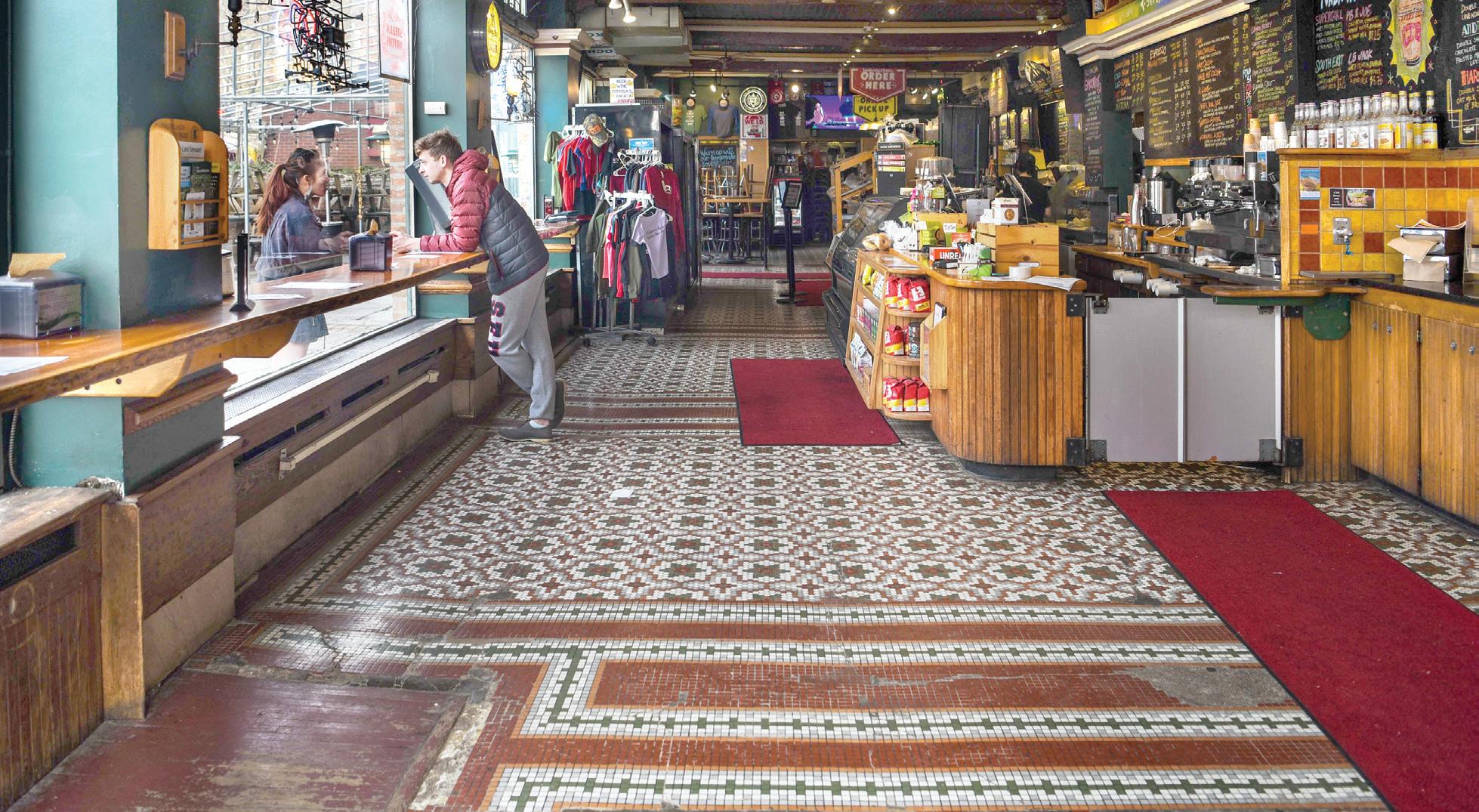
What’s left are emptier storefronts, as Brous said he moved half the furniture at his still-operating locations to a warehouse, while the rest remain pushed to the side, barring customers from eat-in dining.
Other local restaurant owners said they are working to maintain the salaries of full-time employees for as long as possible, even as most of the Collegetown customer base has fled Ithaca. Papachryssanthou said the continued takeout business from local diners has allowed him to keep providing these paychecks.
“People in this community are exceptional and they’ve supported many families,” Papachryssanthou said. “That’s why we’re open, and that’s why we continue to fight and we encourage people, as long as they can, to eat out at their favorite restaurant as much as financially possible.”
Both Brous and Papachryssanthou had not yet heard about Levy and Karp’s fundraising campaign, but said they appreciated their efforts — along with other local initiatives, which include gift card purchasing and a virtual tip jar for Ithaca service workers.
But Papachryssanthou said he viewed purchasing gift cards from local eateries as a temporary solution, despite the “amazing” community support. He called for economic relief from the government, calling the lack of larger-scale mobilization “beyond frustrating.”
“We have what seems to be hundreds of alliances, organizations, local, state and political authorities,” he said, “and the only two people who have come up with a creative way to help support Collegetown businesses are two Cornell alumni who have created a GoFundMe page?”
As Levy and Karp circulate their fundraising campaign, the two alumni said they hope anyone who has from $10 to $1 million will contribute, as the coronavirus outbreak threatens to cause a local and national industry collapse.
“We need the Cornell community’s help and we need the Ithaca community’s help,” Karp said. “We need the alumni to step in and make sure there’s something when school starts again in August.”
Madeline Rosenberg can be reached at mrosenberg@cornellsun.com.
Activists Push for Emergency Fund; C.U. Adds Sick Days
Letter to University, I.C., Cayuga Medical Center calls for numerous aid eforts
By TAMARA KAMIS Sun Staff Writer
In an open letter sent to the presidents of Cornell University, Ithaca College and Cayuga Medical Center, a network of community organizers and activist groups called for greater support in the form of various emergency aid measures.
Organizers had three demands of the major, community institutions: Rent and utility payment forgiveness from Cornell, Cayuga Medical Center, and other major landlords, and the creation of an emergency fund for the county to be adminsitred by local officials and community groups.
“The COVID-19 pandemic is an unprecedented threat to humanity, and our response must meet the scope of this crisis,” wrote the organizers, who expressed particularly concern for low-paid and undocumented workers that they fear will fall through the cracks of a federal or state relief plan.
The groups signing the letter included organizers from Black Lives Matter, the Tompkins County Workers Center, Ithaca
Tenants Union and the Cornell Graduate Students United Steering Committee. Multiple Cornell professors and students have also signed onto the letter. The proposed emergency fund would be administered by the Community Foundation of Tompkins County and the county government. It is meant to pay for emergency paid leave for all workers, as well as support food banks, caregivers, household expenses and mental and physical healthcare, according to the open letter.
In the press release, organizers wrote that “the economy of Tompkins County depends on transactions between these businesses and community members. Without revenue from students and visitors, small businesses are being forced to lay off or cut the hours of local retail and service industry workers, increasing pressure on employees who do not receive paid leave.”
Liel Sterling ‘21, president of the Ithaca’s Tenant Union, said “I do think [a rent freeze] is feasible right now. Things we viewed as not feasible before this crisis are becoming feasible as it becomes necessary for dif-
ferent parts of the community to show solidarity with each other.”
Sterling worried about the possible impact of not acting quickly enough, with the effects of COVID-19 already being felt by the Ithaca economy.
“We are already seeing the impact on this community. People have already lost their jobs, and businesses are in crisis,” Sterling said.
The Ithaca Voice has compiled a list of ways to support local businesses through COVID-19, to minimize the financial damage of business closures.
Even though thousands have left campus, Sterling said that Cornell students have a responsibility to stand by longtime Ithaca residents in this time of crisis.
“It is time for Cornell students to show solidarity with Ithaca residents at this time. We are not just coming to stay for four years and not engaging at all,” Sterling said. “We have to acknowledge the fact that we become a part of the community, we contribute to these businesses, our presence has an impact on people who spend
their lives in Ithaca.”
While it has not offered to create or contribute to a county-wide emergency fund so far, Cornell has offered some assistance to its own current employees as a result of COVID-19.
According to the Cornell website, the University has given 10 extra Health and Personal days to each full-time employee, prorated for part time employees, and employees have been allowed more flexibility for how these days will be used.
“Because some K-12 schools have begun to close for short periods of time, we are permitting the use of Health and Personal (HAP) leave for staff to use for childcare even though their child is not sick,” wrote the University on its website.
Although parts of campus have remained open for students who were not able to return home, the possibility of a full University closure remains, which would both displace students who have applied to stay and University employees.
Tamara Kamis can be reached at tkamis@cornellsun.com.
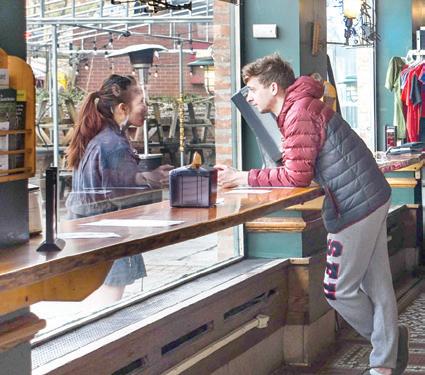
Tables taken | Collegetown Bagels, seen above on March 20, is now — like other New York State restaurants — restricted to take-out only service. Hence, the former tables and chairs have now all been removed.
BORIS TSANG / SUN PHOTOGRAPHY EDITOR
SC I ENCE Medical Ethicist Weighs In on Coronavirus Issues
By TAMARA KAMIS Sun Staff Writer
COVID-19 is placing unprecedented pressure on the U.S. health system, with medical professionals and supplies in high demand. As New York State faces a potential shortage of respirators and intensive care unit beds due to the exponential rise in coronavirus cases, healthcare systems may have to answer the difficult question: Who receives care when there isn’t enough for everyone?
Dr. Kim Overby, a medical ethicist in the Department of Science and Technology Studies, said that while it is difficult to make guidelines for who receives care first, it is essential to do so.
Overby believes that many factors, including lives saved, equity, efficiency and saving frontline medical workers should be balanced with public input.
“We are facing an absolute medical scarcity, which is very rare for the United States,” Overby said. “There need to be consistent, transparent guidelines that help to prevent ad hoc bedside decision making, which can be stressful for healthcare staff, family, and patients.”
The medical care industry is already working on reducing the impact of implicit bias in how clinicians make decisions about patient care, including when to make pain management recommendations. This is especially important as hospitals in the U.S. will reach capacity as more
coronavirus patients become hospitalized.
Overby expressed concern that bias issues will also emerge in triage decision making — the process of determining which patients need priority treatment — if there are no clear guidelines on who should receive care first.
“There is also always the potential for explicit or implicit biases if you do it [rationing decision making] bedside, ad hoc. There needs to be consistent, transparent guidelines,” Overby said.
According to Overby, values balanced in the creation of guidelines include efficiency, which she
defined as “maximizing the total benefits to society;” equity, which she defined as “giving people equal access to a scarce resource;” and the rule of rescue, which entails helping those most in need before those who are struggling less.
“We need to make sure there is a process of public engagement and dialogue for this instead of just having guidelines appear, because that would undermine public trust,” Overby said.
Even the idea of saving lives, which seems straightforward, can be measured in different ways.
“Saving the most lives, typically in healthcare that is looked at
as survival to hospital discharge, is one potential principle, but a second one that is really relevant is maximizing life years (for patients),” the medical ethicist said.
The value of a year of life for different patients is another difficult question often discussed by medical ethicists. One way this is examined is through the life-cycle principle.
Overby defined the life-cycle principle as, “giving every individual the equal opportunity to live through different stages of lives tends to prioritize young people first because they haven’t had the opportunity to experience every
Cornell Suspends Majority Of On-Campus Research
By ANIL OZA Sun Science Editor
In the past two weeks, the coronavirus pandemic has put Cornell on pause.
The University suspended classes, closed on-campus housing and limited on-campus eateries to take-out only. As of March 18, “nonessential” research was added to the list of activities that would be indefinitely suspended.
On March 15, Provost Michael Kotlikoff and Vice Provost Emmanuel Gianellis alerted principal investigators and researchers in an email that the majority of on-campus research activities would be restricted.
“Research that is essential for the understanding and reduction of COVID-19 risk should continue,” Kotlikoff and Gianellis wrote in the email. “Beyond this, we ask that only those research activities that are absolutely necessary to retain critical research assets for long-term progress are conducted on campus.”
delays in conducting experiments and publishing papers.
But it remains unclear how this halt in research will affect the long-term projects of laboratories or the degree progress of graduate students.
“The most difficult aspect to deal with is the uncertainty of how long it will take until researchers can resume some or all of their on-campus activities,” wrote Julia Nolte grad.
Nolte conducts research in human development, analyzing the perception of risk in a healthcare setting in different populations. Her work requires interviewing a large number of people, which becomes impossible without undergraduate research assistants, most of whom have already returned home.
“This is a truly cruel twist of fate as in previous years, I had opportunities for data collection, but no funding to do so. Now I have funding for studies and no opportunity to complete them.”
Activities that are classified as “critical” are those that are necessary to maintain essential components of a laboratory’s function. Specifically, the email enumerates the care of biological specimens, the preservation of unique or expensive reagents and maintaining equipment that cannot be monitored remotely.
Julia Nolte grad
For some, this suspension could result in significant
The timing of this suspension is particularly inconvenient for Nolte. She currently has funding for three experiments, two of which cannot be completed after the end of June.
“This is a truly cruel twist of fate as in previous years, I had opportunities for data collection but no funding to do so. Now I have funding for studies and no opportunity to complete them,” Nolte wrote.
Researchers have been encouraged to pursue activities that can be completed remotely, like writing papers and proposals or analyzing data that has already been collected.
Nolte said that she may have to adapt her research by
stage of life to the extent of people who are older.”
One final concern that is often considered in allocating medical resources is instrumental value, or the multiplier effect — people who could save others after being saved themselves, therefore contributing to future care, according to Overby. However, this may not be an effective strategy for care rationing during the coronavirus pandemic.
“With this particular disease, it is not clear that physicians and nurses would be able to come back in a short time to help on the frontlines. There seems to be a protracted recovery period,” Overby said.
While all of these different principles and values must be weighed to decide what the guidelines will be, Overby worries that digital outreach strategies will miss parts of society, especially because of inequities in access to technology.
“Not everyone has access to high speed Wi-Fi. There are many people who will be impacted by these decisions who will not be able to have input,” Overby said.
The medical ethicist added that implementing these guidelines is just as important as establishing them.
“People need to feel like there is legitimate oversight. There have to be processes for appeal and revising individual decisions if people disagree,” said Overby.
Tamara Kamis can be reached at tkamis@cornellsun.com.
either collecting data online, delaying in-person experiments or shifting her focus to more theoretical or review papers.
While current circumstances impede Nolte’s initial plans, she expressed support for the measures that the University took amid the pandemic.
“If I can return to campus in June, then the delays should not impact my dissertation too much, seeing as I still have two years until I graduate,” Nolte said. “If my data collection is stalled until the Fall semester, then I might have to adapt my plans to ensure I can still make progress toward my degree in the meantime.”
Anil Oza can be reached at aoza@cornellsun.com.
MICHAEL WENYE LI / SUN SENIOR PHOTOGRAPHER
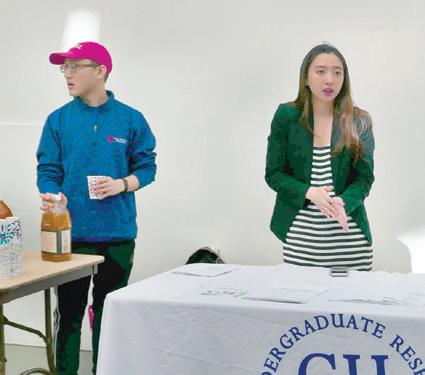
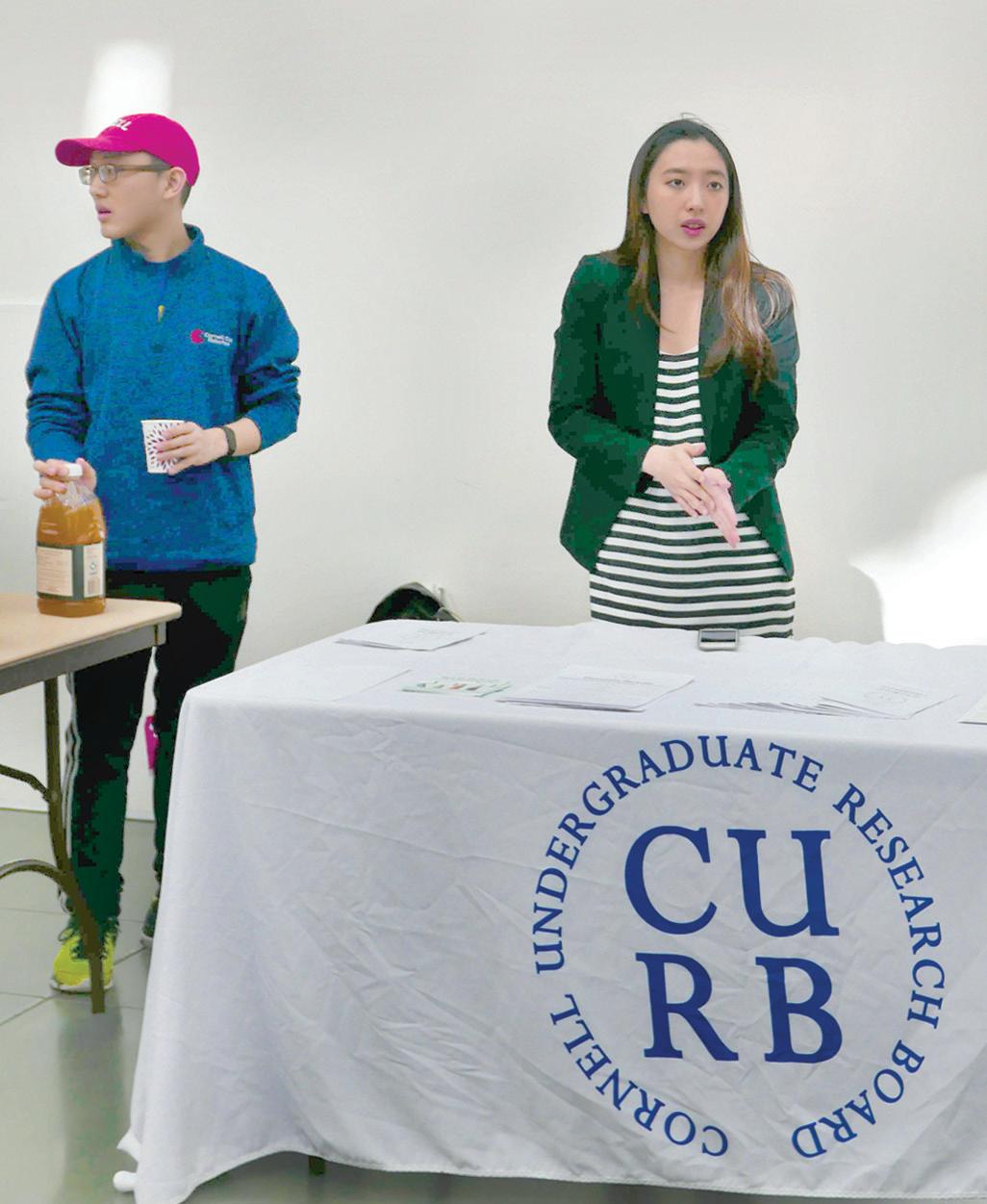
Let’s get critical | Members of the Cornell Undergraduate Research Board display work at Klarman Hall on May 3, 2017.
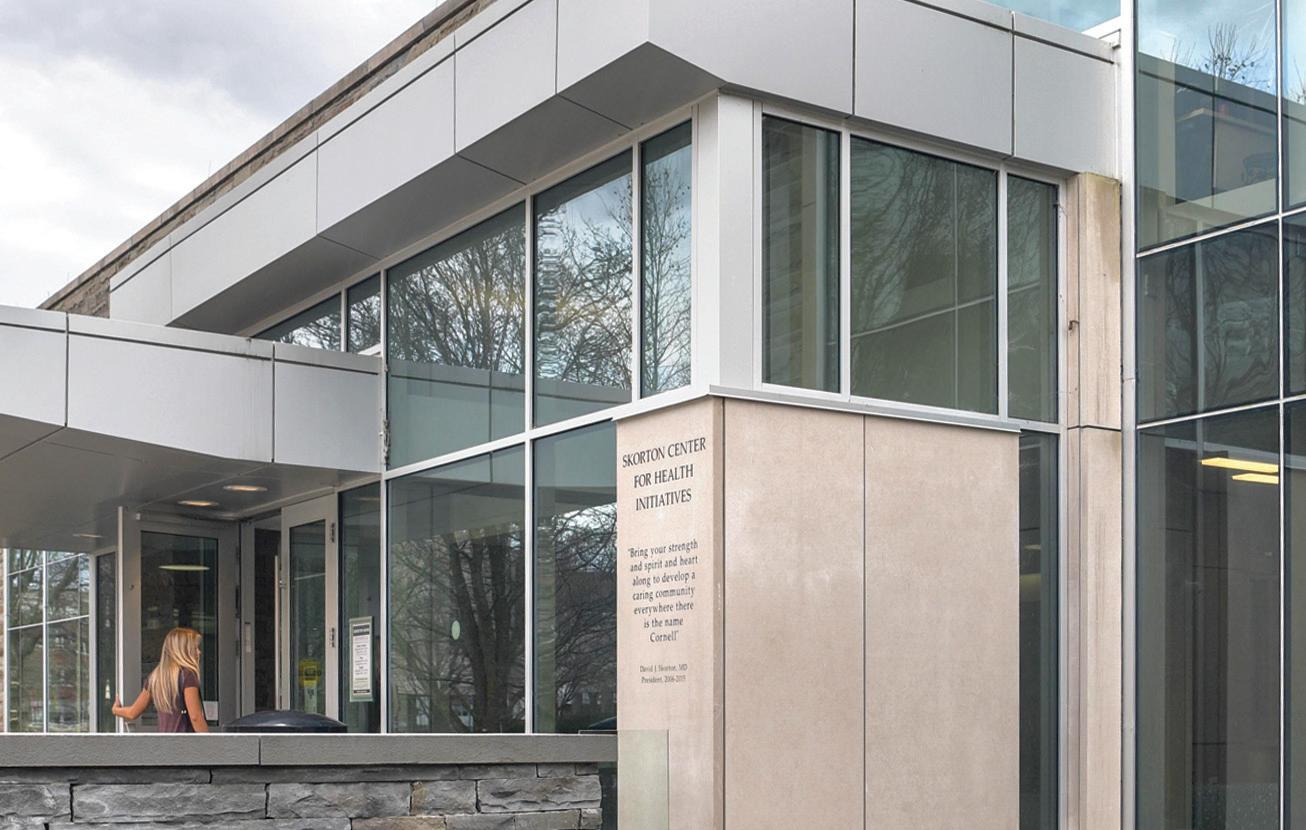
Public input | A student pays a visit to Cornell Health center on March 20.
BORIS TSANG / SUN PHOTOGRAPHY EDITOR
John Sullivan Baker | Regards to Davy
To Hear Remembered Chimes: Love Beyond Cornell
As the rapids roared below us and the suspension bridge swayed in a Fall Creek February gale, she laughed with me (and at me) the way she’d done countless times before. She reminded me of the legend that says you’ll die if you kiss on the bridge. She made some crack about the smell of the Thai bubble tea on my breath. And she said something about how I shouldn’t hate her for not liking boba.
Though I don’t remember her exact words, I vividly remember mine. “No,” I told her without thinking, “I love you.”
Uh oh, I thought as I braced myself for her response, I just went really far. Our fledgling relationship, like the virus that would soon challenge it, had overwhelmed us in the course of just a couple short weeks, so my four words were nothing if not premature. As a senior, I’ve spent enough time playing the commitment-free Cornell game, but she’s a sophomore who only recently found her stride on East Hill and did not expect to face down an “I love you” midway through her college career.
She stopped and stared at me. “What? What did you just say? Did you mean that? What did you mean?”
Having expected this reaction, I mumbled a few excuses, grabbed my bubble tea and told her we should just keep walking; I wanted to get off the swaying bridge. And though I tried to act like nothing was wrong, she knew her response had hurt me. She tried to hug me, and she assured me she’d get to where I was one day. But she didn’t say, “I love you too.”
So I worried that my risky words would be too much, that they’d make her pull back and slow our relationship’s pace. But nearly four years at this place have taught me that caution is often unwise. What is Cornell without risk? What is life in the ivory tower without bold leaps into the unknown? What is college without the shocking satisfaction that accompanies the triumphs you never thought you’d create for yourself?
In the following days, I pushed past my initial embarrassment and fear, and I continued to tell her I loved her — even though she didn’t say it back. I hoped my leap would end in triumph for us both. But would she get to where I was?
I thought I would have until May to deepen our bonds above Cayuga’s waters. But little did I know, my relation-
On Friday, I watched my mom bask in the 75 degree daylight on our back porch. She sported her typical lounge outfit — a light magenta athleisure jacket and gray capris — and browsed the web on her iPad, taking occasional sips of jasmine tea and enjoying her time off from work. I felt like I was watching her in a video: It was my mom, but from a different, slower, easier time. It was so normal.
But nothing as of late has been normal. If I had to guess, I would say that my mom was reading about coronavirus. The pandemic has infected every thread of our lives, even if it has not yet infected us. I’ve returned home on some dystopian spring break and — after the pandemonium of packing and unpacking all of my belongings — have quickly languished into
ship with her, and my relationship with the campus that has served as our foundation, would soon be tested by an even more profound uncertainty.
Two weeks later, I would take her to the airport, where she struggled to hold back tears before I left her in a terrifyingly-sterile terminal ruled by faceless, mask-clad agents. The following day, I would depart Cornell for the last time as a student, not knowing when I would see her or my treasured campus again.
But I would soon find some comfort in a message left by Cornellians before us. As I walked the Slope — reeling from her departure but absorbing one final stunning sunset — I glanced at the base of the clock tower to find ten haunting words from an old Cornell song that’s drifted into obscurity: I wake at night and think I hear remembered chimes.
The song continues,
And mem’ry brings in visions clear Enchanted times. Beneath green elms with branches bowed, In springtime suns, Or touching elbows in a crowd
Of eager ones. Again, I’m hurrying past the tow’rs Or with the teams, Or spending precious idling hours in golden dreams.
O Cornell,
Of the kindly heart,
The friendly hand,
My love burns clear for you in distant land! O fates that shape the lives of men, Vouchsafe that I, Before I die, May tread “The Hill” again!
The song is a painful read from quarantine. Collegetown’s crowds of “eager ones” have all but fled. We seniors expected two more months of “golden dreams.” We planned to let ourselves down slowly, taking in the final “springtime suns” as we steeled ourselves for the leap to true adulthood. Now that the virus has erased those plans, which we’ve shared with nearly every other class of Cor-
nellians before us, our love must “burn clear in distant land,” even if we’re woefully unprepared for this long distance relationship.
But “The Hill” is a powerful testament to the indelibly transformative nature of the Cornell experience. Our time here will live on as long as we do. We’ll hang on to the treasured memories the song so eloquently captures; we’ll feel this place’s imprint on our character and identity, and, if we’re determined, we’ll “tread ‘The Hill’ again.” In times like these, it’s hard to remember that we can still hang on, that our bond with this place, and to the people who have made it home, will endure.
Just as Cornell will always remain with us, we will always remain with Cornell. Fellow Cornell Daily Sun columnist Michael Johns ’20, with whom I’ve been lucky to share many of the highs and lows of my Ithacan odyssey, noted in a heart-wrenching recent column that “all of life’s acts are simultaneously permanent and irrevocable, echoing through time as small contributions to the history of this great institution.”
With the woman I love, I listen intently to the echoes of Cornell past.
The first night she kissed me, she said we needed to walk the Beebe Lake trail just as Ruth Bader ’54 and Marty Ginsburg ’53 had done in their time. Initially, we put off our walk, thinking we’d find time before my departure from campus in May — which seemed eons away as we pushed through a frigid Ithaca February. But when we learned, just on the edge of spring, that my time at Cornell would end far sooner than we could have ever expected, I knew what we had to do.
That night, we stumbled to the edge of the Slope to what we know as The Bench — bequeathed in 1892 to the future generations that would tread the crest of the hill. Its inscription, anchored in space yet broadcast across time, is known by countless Cornellians who have strived, suffered and triumphed against the arch of heaven:
To continue reading this column, please visit cornellsun.com.
John Sullivan Baker is a senior in the School of Industrial and Labor Relations. He can be reached at jds526@cornell.edu. Regards to Davy runs every other Wednesday this semester.
Lei Lei Wu | Get Lei’d Masks for My Mom
a bored, constantly binging human blob. However, between all the episodes of Star Wars: The Clone Wars and Killing Eve, my mom serves as my reminder of, and my telescope into, the frenzy of the coronavirus pandemic.
My mom is a hospitalist, a general physician who works in a hospital. When my mom gets home from work, she first strips in the garage. She then immediately jumps into the downstairs shower, which has been unused since my grandma returned to China. She has also moved into my grandma’s old room downstairs, quarantining herself from our upstairs bedrooms. She eats separately from the rest of my family, making sure we don’t touch anything she uses.
As the daughter of a doctor, reading national news coverage provokes a discon-
certing anxiety — health care workers are being hospitalized for COVID-19, some are self-quarantining and all face the abysmal shortage of masks.
That’s my mom.
In her self-quarantined state, my mom has spent blocks of time arguing for more personal protective equipment for herself and her colleagues, much of which has proven futile. Thankfully, she acquired her own masks — a variety of donations from family friends in New Jersey and our family back in China. Seeing masks in my home brings me a sense of relief, knowing that at least there will be some barrier between my mom and the virus.
But when there is coronavirus at the hospital where my mom works, I can never truly be calm. Everyone who comes into contact with coronavirus is ordered to self-quarantine for 14 days. Everyone except health care workers. They have to keep working. PPE and quarantine can prevent the virus from spreading, but they can’t kill it. So all I can do is hope my family will come out unscathed. Many will. Some won’t.
In these times, I owe my mom two things. The first is a thank you. Thank you for assuring us that you have the training and PPE to protect you, even when you yourself are fearful. Thank you for going
through the extra hurdles to keep your family safe — having dinner by yourself, living downstairs. These seem like small things, but it must be lonely living
separately in the same house.
The second is an apology. First, I’m sorry I didn’t do the dishes Friday night. I forgot. Second, I’m sorry that you’ve had to find ways to acquire your own masks, but I’m grateful you were able to do so. Most of all, I’m sorry that health care workers are being made martyrs. You and your colleagues shouldn’t have to disproportionately bear the burden of risk in the midst of this public health disaster, especially when our president is still lying, and people are still taking “coronacations”.
My mom goes back to work on Tuesday. I hope Tuesday never comes. But, all too fast, it will.
In the meantime, I’ll take a page from my mom’s book. Spend some time reading out on our back porch. Watch the next episode of Killing Eve. Sew some cloth masks with my sister. Houseparty call with my friends. And hope. For me, for you, for my family and for my mom.
Senior Wrestlers Grapple With Lost Season
Chas Tucker, Noah Baughman and Brandon Womack ofer their refections
By FAITH FISHER Sun Staff Writer
Three of Cornell’s senior wrestlers, Chas Tucker, Noah Baughman and Brandon Womack were deprived of their final opportunity to compete for national titles, when NCAA officials canceled all remaining winter and spring championships due to the continued rise of COVID-19.
The early cancellation of the season came on March 12, just one week before the tournament was set to begin. While Baughman said that he braced himself for the worst after a flurry of nationwide disruptions, the NCAA’s official an nouncement still came as shock.
“There were a lot of emotions at the beginning, and I am still feeling different emotions about it everyday, but at first it really
was just utter shock,” he said. “Maybe I was underestimating the seriousness of it at the time, but I never thought that canceling nationals would even really be an option.”
His teammate Womack offered a similar reaction of surprise, saying that the premature end to the season left him unable to end his illustrious Cornell career on a highnote.
“I am still kind of taking it all in,” Womack said. “[The cancellation] was re-
ready missed a lot of the year ... I didn’t finish the way I wanted.”
Due to an injury, Womack missed a majority of the regular season, but devoted himself to healing, and eventually found himself back on the mat. Even despite losing several weeks of practice and competition, the seasoned wrestler quickly rebounded,
third-seeded wrestler — and when his opportunity for a national title slipped away, for reasons out of his control, the news was difficult for him to process.
“There were a lot of emotions at the beginning, and I am still feeling different emotions about it everyday.”
Noah Baughman
“I was kind of in shock, but at the same time, with the progression of everything getting canceled, it was just a matter of time,” Tucker said. “It was definitely sad, and when it actually happened it was kind of surreal. I was upset... It just hurts, especially because I thought this year I could have gotten on the podium. I thought that I could become a national champion.”
The younger members of Cornell’s wrestling squad recognized the utter disappointment that these seniors face, particularly for Tucker, who was slated to finally stand on the podium.
Swimming and Diving Caps O f Season At February Ivy League Championships
By AARON SNYDER Sun Staff Writer
Before the COVID-19 pandemic brought on a slew of postseason cancellations, Cornell’s swimming and diving teams wrapped up their seasons at the Ivy League Championships last month.
The women’s tournament took place Feb. 19 through 22 and was hosted by Brown, while the men’s tournament took place a week later at Harvard.
The women’s team (3-6, 1-6 Ivy) placed eighth at the Ivy League Championships, which was hosted by Brown from Feb.19 through Feb 22. But despite its last-place finish, the Red’s 543 points at the event still marked an improvement over last season’s 506.
In another silver lining for Cornell, the team broke a number of school records, even while falling to the rest of the Ancient Eight. On day one, the 800-yard freestyle relay team of freshmen Lexie Handlin and Melissa Parker, junior Sophia Cherkez and senior tri-captain Laurel Kiselis finished in 7:20.96 — topping the Red’s previous record by nearly two and a half seconds.
On the second day, sophomore Demetra Williams’ 266.50 points in 1-meter diving shattered a 14-yearold school record, while, on day three, Kiselis broke her own record in the 200-yard freestyle.
On the final day, freshman Elise Jendritz also etched
her name in the record books, breaking the school record in 3-meter diving (306.05 points).
The men’s team (3-6, 1-6 Ivy) finished sixth at the Ivy League Championships, capping off a season that saw 43 lifetime-best swims by Cornell swimmers.
“The team really came together well this season, and as a result we
saw a lot of successful seasons both individually and as a team,” said head coach Wes Newman ’09, praising the team’s improvement from last year. “You can look at your own personal best times and if you improved and got faster…I would describe that as a successful season.”
Going forward, the Red will miss the contributions of the team’s seven seniors, especially for its relays which was an area of strength for Cornell. The team broke three of five school relay records over the course of the season, with most of the team’s relay spots held by seniors.
“For me, it was a special [senior] class [because] it was the first class that I recruited as a head coach,” Newman said.
“They certainly left their mark on the program. They’re going to leave some shoes to fill.”
A big part of the Red’s future will be freshman Paige DaCosta, who became the first Cornell swimmer to take home an Ivy League championship in the 100-yard backstroke.
The Ivy League Championships marked the end of the season for all but one of Cornell’s swimmers. Junior Brett Hébert was set to become the program’s first athlete to compete at the NCAA Championships since 1987, after qualifying in 3-meter diving at the NCAA Zone A Diving Championships, but the event was cancelled due to the COVID-19 outbreak.
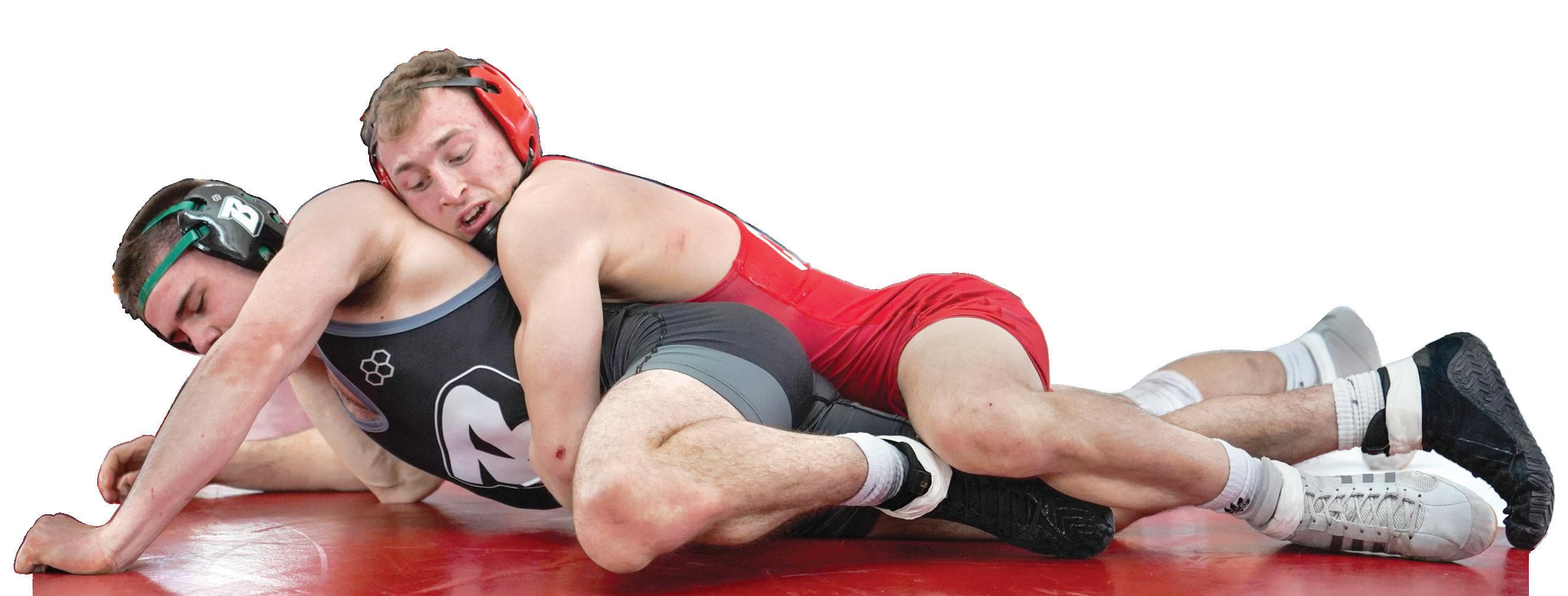
Looking back | The Red wrestlers compete against Binghamton on Feb 15.