After ordering 75 percent of the New York workforce to stay at home on Wednesday, Gov. Andrew Cuomo (D-N.Y.) has “closed the valve,” ordering all nonessential workers to stay at home in a press release Friday morning.
The executive order, titled NYS on P.A.U.S.E.,
aims to reduce population density. Only essential businesses — which include grocery stores, pharmacies and internet providers — “can have workers commuting to the job or on the job,” the governor said. Cuomo said that his team was continuing to assess a list of what qualifies as an essential worker.
As the novel coronavirus continues to spread in
First C.U. Community Members Test Positive
By SARAH SKINNER Sun Senior Editor
Cornell President Martha E. Pollack informed students in a mass email on Friday afternoon that two members of the Cornell community in Ithaca tested positive for COVID-19.
These individuals are among Cornell’s “faculty, staff and students,” Pollack wrote. Both are currently in isolation and receiving care, and the health department has contacted people known to have been in their close proximity. The announcement comes after Friday afternoon’s Tompkins County Health Department update that 11 total cases of the
coronavirus have been identified in Tompkins County.
Pollack also called upon the community to respect the privacy of individuals who have tested positive for the coronavirus.
“I appreciate that the news is difficult,” Pollack wrote, “though
See TESTING page 3
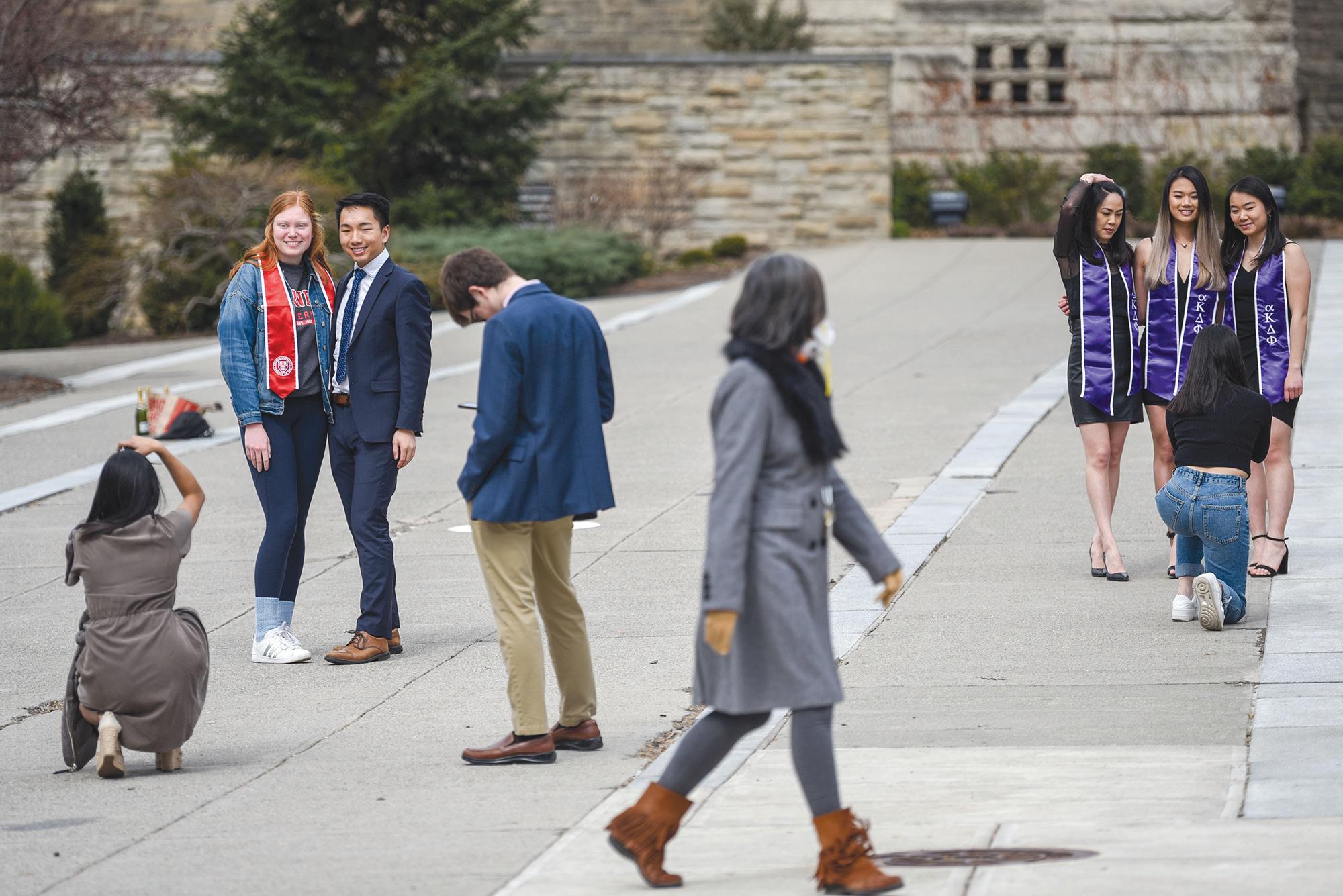
‘We will have a commencement – and it will be a joyous one!’
2020 Graduation Ceremony Delayed, Not Cancelled
By ALEX HALE Sun News Editor
COVID-19 cancelled much of Cornell’s spring semester activities, such as
in-person classes, and even Slope Day. However, one annual tradition withstood the historic pandemic: senior commencement. In an email sent to Cornell students
— and addressed to “seniors and other graduating students” — President Martha E. Pollack promised that a graduation ceremony will occur, although admitted that the logistics are
still uncertain at this time.
Pollack opened the email emphasizing the “intense years of study” that spring graduates completed while at Cornell, and said that “in normal times” a celebration on Memorial Day would occur.
That will not happen this year, Pollack said in the email. The president wrote that the University is “not yet able to announce a date or location” of commencement ceremonies due to uncertainty of the impact COVID-19 will have, but she did state that “we will have your commencement.”
Although the location has not yet been announced, Pollack said it will occur in Ithaca, and that the University “will find creative ways for those who are unable to attend in person to be able to fully participate virtually.”
Cornell’s pledge to eventually hold an in-person commencement event contrasts with that of many peer colleges. Emory University and Washington University in St. Louis opted to cancel their annual send-offs completely, while the University of Pennsylvania said it would hold a “virtual event.”
Degrees will still be granted in May, before the commencement ceremony.
Please turn to Page 3 to see the text of Pollack’s full e-mail.
Sun Assistant News Editor See PAUSE
A lone student eats in the Physical Sciences Building atrium on March 22, surrounded by rows of empty tables and chairs.
Fill in the empty cells, one number in each, so that each column, row, and region contains the numbers 1-9 exactly once. Each number in the solution therefore occurs only once in each of the three “directions,” hence the “single numbers” implied by the puzzle’s name. (Rules from wikipedia.org/wiki/ Sudoku)
Caption Contest Winner
“Excuse me, do you have a minute to talk about our Lord and Savior, Martha Pollack?”
To submit your caption for this week’s contest, visit sunspots.cornellsun.com.
Johnny Woodruff by Travis Dandro
Art by Alicia Wang ’21
— Michelle Robbins, ’21
26 A PA R TMENT
FOR R ENT
Flexible Housing Solutions!
Short Stay Accommodations Available
*Brand New* Studio Apartments
238Linden.com
Leasing@inteprop.com 607-379-6023
120 Oak Avenue
Just steps to Cornell Campus
10 bedroom house & 1 and 2 bedroom apartment 607-277-1234 office@ithacastudentapartments.com Ithacastudentapartments.com
Access to Shuttle to Campus Access to Free Fitness Center Novarr-Mackesey Property Management office@ithacastudentapartments.com 607-277-1234
Houses, Apts, Parking 1 to 9 Bedroom
Collegetown - College Ave, Linden Ave, Dryden Rd, Bryant Ave, Cook St. 607-330-2442 info@urbanithaca.com www.urbanithaca.com
Catherine & Eddy St.
1 & 2 bedroom
Furnished, heat included Laundry in building Parking available for fee 607-277-1234 office@ithacastudentapartments.com
2020-2021
Studio 1, 3, 8 & 11 BR Apts. Great Locations in Collegetown. 607-227-2535
Collegetown Crossing
College Ave's Newest Location 307 College Ave. Now Leasing for 2020-2021
Completely New Modern Studios, 2 & 4 Bedroom Apartments.
Fully furnished, heat & hot water included. Reception area at 307 College Ave. www.urbanithaca.com 607-330-2442 info@urbanithaca.com
Now Renting
2-10 Bedroom Houses/ Apartments for 20-21. All Locations. Call today or visit our website: Certified Properties of TC Inc
certifiedpropertiesinc.com 607-273-1669
*Brand New*
Full Term & Semester Leases Studio, 1 & 2 Bedrooms College Townhouse 121-125 College Ave. CollegeTownhouseIthaca.com
Leasing@inteprop.com 607-379-6023
APTS/HOUSES COLLEGETOWN
BEST LOCATION/BEST PRICING 607-272-3389 avramisrentals@aol.com
27 H OUSE FOR R ENT
20-21 College Ave.
5 BR House Furnished. Laundry. Parking. Call 607-273-8576
Cornellians Test Positive New Yorkers Told to ‘Pause’
PAUSE
Continued from page 1
the U.S., New York has quickly become the largest hotspot. The state saw a growth curve that shot from zero to 2950 positive cases between March 3 and March 19.
“This is the most drastic action we can take,” Cuomo said. However, he was adamant that the order was not a shelter-in-place like the one placed on Northern California at midnight on Monday.
With nothing to do, New Yorkers seemed to flock to what green space is available to them. “The few times I went outside … I was really surprised by the amount of people outside. Even though almost all restaurants are closed, Central Park in particular has never been so packed with people,” Livia Caligor ’21 said.
To continue reading this article, please visit cornellsun.com.
Olivia Weinberg can be reached at oweinberg@cornellsun.com.
TESTING
Continued from page 1
it is not entirely unexpected given the rise in confirmed cases nationally and globally and the recent news of the first confirmed cases in the county.” The first positive case in Tompkins County was announced on March 14.
According to the county, as of 5 p.m. Friday, 88 individuals have tested negative and 280 test results are still pending. There are 515 people still under quarantine and being monitored by the health department. 153 have been released from quarantine. Cornell Health is still operating but not accepting any walk-in patients. All appointments must be made by phone, though the pharmacy was still open as of Friday. Pollack urged members of the Cornell community to continue to practice social distancing whether on or off-campus, and promised updates if more individuals test positive in the future.
Sarah Skinner can be reached at sskinner@cornellsun.com.
TEXT OF MARTHA POLLACK EMAIL REGARDING COMMENCEMENT
COMMENCEMENT
Continued from page 1
Dear seniors and other graduating students (and, by copy, the entire Cornell community),
You have just about completed intense years of study at Cornell. You’ve done amazing things here, both inside and outside the classroom. In normal times, we would celebrate your accomplishments with commencement on Memorial Day weekend. Commencement is a momentous, milestone celebration, one that everyone in academia, and especially graduating students, their families and their professors look forward to each year. This year, while degrees will be granted on
time, we will not be able to have the ceremony on Memorial Day weekend. But we will celebrate: we will have a commencement – and it will be a joyous one!
We are not yet able to announce a date or location, as that will very much be determined by the progression of the current public health crisis. But I can say with certainty that your celebration will occur. It will take place in Ithaca. All of our graduates and their families will be invited. And we will find creative ways for those who are unable to attend in person to be able to fully participate virtually.
Thank you again for the incredible flexibility and resolve that each of you has demonstrated over the past few weeks as we have had to
adjust to our new, current realities. I emphasize current, because I know that we – as individuals, as Cornellians, as a nation and as a global community – will get through this and be able to once again congregate with friends and neighbors, to return to a normal work routine and to the physical classroom. And we will have your commencement.
So, stay well. Practice social distancing. And we will be back to you with more information.
Sincerely, Martha
Alex Hale can be reached at ahale@cornellsun.com.
Barron, Schafer ’86 Earn ECAC Honors
ECAC Player of the Year ECAC Coach of the Year
BARRON
Continued from page 8
just speak the words, but they got to come out and they got to execute.”
With Barron leading the way, the Red compiled a 23-2-4 record, earning the Ivy League title and ECAC regular-season title. Going into the playoffs, Cornell appeared poised for further accomplishments until the season was cut short.
Individually, Barron paced the team in both goals (14) and assists (18). He also scored five goals on the Red’s power play, which ranked sixth in the nation (.262).
When Barron was on his game, the team was churning as well. Barron started and ended the season on a tear. In the team’s first
six contests, Barron racked up 12 points, including his first career hat trick in that Yale contest.
While the Red went through a bit of a midseason lull, it flipped the switch following a 5-0 loss to Quinnipiac and finished the regular season on a nine-game winning streak. During that run, Barron put up 10 points, leading an offense that scored at least three goals in all nine of those contests.
Though Barron completed one of the best seasons for a Cornell forward, his future with the team remains uncertain. A sixth-round pick by the New York Rangers in the 2017 NHL Draft, Barron has the option of forgoing his remaining year of eligibility to turn pro.
Luke Pichini can be reached at lpichini@cornellsun.com.
SCHAFER
Continued from page 8
the national tourney’s cancellation last Thursday, the topranked team’s promising season came to a screeching halt.
“I’ve been coaching 34 years — you get a gut feeling that a team’s destined,” he told ESPN last week. “You just wonder in the back of your mind if it’s gonna be your year, that all the things are going to fall into place.”
Cornell ended the season riding a nine-game winning streak while boasting first place in the USCHO.com poll and third in the Pairwise. Had those rankings held, the Red would have been given a No. 1 seed in one of the four NCAA regionals.
Two weeks ago, Schafer was
also named Ivy League Coach of the Year.
Schafer’s five Tim Taylor Awards are the most for any ECAC coach, ever. With four awards, Schafer had been tied with former St. Lawrence head coach Joe Marsh for first. Tim Taylor himself was ECAC Coach of the Year three times.
The other two finalists for this year’s award were Clarkson’s Casey Jones ’90, who won the award last year, and RPI’s Dave Smith.
“I feel very fortunate and privileged to coach these young men,” Schafer wrote in an open letter last week. “I am very proud of my team, our staff and to be coaching at Cornell University.”
Christina Bulkeley can be reached at cbulkeley@cornellsun.com.
Women’s Basketball
Eyes Rebuilding Season
But the whole team will need to look to lower its turnover numbers going forward — all of the team’s starters had multiple five-turnover games, with two starters having at least one six-turnover game.
Cornell led the Ivy League in turn-
overs this season with 496. That is 13 more than second-highest Harvard, and 176 more than Penn, which had the fewest. The season was not without its bright spots for the Red, however. Widmann notched her 1,000th point in a down-to-thewire overtime win against Columbia in January. Cornell
beat Harvard in Cambridge for the first time in program history. And the Red hung in against out-of-conference competition — even grabbing two 28-point wins against St. Bonaventure and East Tennessee State.
Chronically Ill, Disabled Grapple With the Coronavirus
By TAMARA KAMIS Sun Staff Writer
While some Cornellians partied their class cancellation days away, chronically ill students remain aware that being young does not always mean being healthy.
Symptoms of COVID-19 can mimic those that chronically ill students regularly experience, but the limited availability of testing can make it difficult to find any peace of mind.
Thea Kozakis grad has celiac disease, chronic asthma, heart rate variability and some symptoms of Sjogren’s syndrome — an autoimmune disorder that attacks the salivary gland. Her heart rate variability also restricts which treatments she can use for her asthma.
Kozakis said she currently has a low grade fever, difficulty breathing and multiple contacts with people who may have been exposed to the novel coronavirus. But Kozakis often has difficulty breathing, making identifying a cause for her symptoms difficult.
The graduate student was tested for COVID-19 on Monday, and was in medical isolation until she received her tests results on Friday confirming that she did not have Covid-19.
“I don’t know what this is. I know I’m sick,” Kozakis told The Sun, before she received the good news. “If I have the coronavirus, I won’t leave my apartment. I’m not really that far into this but it already feels like I’ve been [in my apartment] forever.”
Kozakis paused many times when speaking because it was difficult for her to breathe. Before she learned that she did not have Covid-19, Kozakis said she was sad to potentially need to spend her last few months in Ithaca in her apartment, but optimistic about her recovery.
“I have been through so many illnesses that should have killed me,” Kozakis said. “I have a really strong will to live.”
Even for chronically ill students who are not currently experiencing symptoms, the risk of exposure feels more serious than it would without a pre-existing diagnosis.
Michal Weiss ’20 of Westchester, New York, has an autoimmune disorder which impacts her lungs. She said she was
worried about returning home.
Additionally, pre-existing health concerns complicate their decisions to stay on campus or go home.
“Here, I feel comfortable going outside, but back home I would feel very stuck in my house,” Weiss said. “Social distancing is still a thing here, but I can move around a little more here. At home, if I interacted with anyone, there are so many cases that it feels more risky.”
Despite the more than 178 COVID-19 cases in Westchester, Weiss said she would be more comfortable leaving campus if the number of local cases continued to increase, expressing concerns about the quality of healthcare in Ithaca. Tompkins County confirmed its sixth case on Wednesday.
“The healthcare here is a lot worse than the healthcare system at home,” Weiss said. “If the cases increase here, going home would be a better option.”
For Conan Gillis ’21, born with Larsen’s Syndrome, the medical accommodations he receives at Cornell aren’t neces-
sarily available at home. Gillis requires constant nursing care, but is only approved for Medicaid-funded care in Tompkins County. If he returned home, his family would need to take over providing his medical care.
But if Gillis stays, receiving nursing care could increase his risk of contracting COVID-19. Two of his nurses work at Guthrie Hospital in Sayre, Pennsylvania, and regularly come in close physical contact with Gillis.
“I am just assuming I am going to get it,” he said.
In addition to worrying about his own potential exposure to COVID-19, Gillis worries for the livelihoods of the nurses who work with him. “The reason I don’t want to go home isn’t so much how I will be taken care of at home, but what my nurses are going to do?” Gillis said. “They are not going to get paid. One of my nurses, I am his only case, so he will have to get another job in order to eat.”
Faculty Ask C.U. to Mitigate Closing’s Impact on Ithaca
By ALEK MEHTA and RAPHY GENDLER Sun Staff Writer and Sun Senior Editor
As the impact of the COVID19 crisis continues to expand, some Cornell faculty — who have scrambled to address the effects the pandemic will have on students, families and University staff — are now focusing on the Ithaca community, which they fear will be irreparably harmed.
On Thursday, the Cornell Coalition for Inclusive Democracy,
a group composed primarily of Cornell faculty, started a petition — addressed to President Martha E. Pollack and Cornell’s Board of Trustees — on Change.org imploring the University to support the local community during the crisis.
In the petition, which had been signed by 246 people as of Friday afternoon, the faculty wrote that Ithaca’s prosperity is a key factor in influencing students’ and faculty’s decision to come to Cornell. The professors who signed the peti-
tion expressed concerns about the impact the coronavirus will have on Ithaca and called on Cornell to help mitigate the local economic impact.
“Cornell cannot thrive without Ithaca,” the petition reads. “With the spread of Covid-19, however, thousands of our most vulnerable neighbors face threats of a kind and degree unseen in our lifetime.”
While Cornell cannot thrive without Ithaca, many fear that the reverse is also true: Local businesses and the economy as a whole are likely to strug-
gle with students’ early departure. According to The Ithaca Journal, Cornell students spend $4 million in Ithaca and Tompkins County per week when school is in-session. A Cornell report estimated that over the course of a year, Cornell students inject $221 million into the local economy.
Ithaca businesses are already facing the harsh reality of a spring without Cornell students. April and May are usually two of the busiest months of the year for restaurants and other small companies — one business
owner said these spring months are the “lifeline of business.”
The petition asks the administration to create a committee to make recommendations on how the University can support the community and its members.
Suggestions of what these recommendations should be include asking trustees to make unrestricted donations in order to “help preserve the Ithaca they know and love,” freezing rents on University-owned properties and increasing funds that Cornell contributes to the City of Ithaca.
Gregar Brous, owner of Collegetown Bagels, told The Sun last week that economic relief for the city likely needed to come from Cornell.
“You have campuses like Amazon which sent all [its] employees home, who [are] supporting all the businesses around them and giving out money and giving out loans,” Brous said. “So I think it’s going to be dependent on Cornell or the big institutions that are going to think about how they want to help provide for the local economy and for the businesses.”
While Mayor Svante Myrick ’09 has called on State and federal officials to take action to help businesses and workers, he also told The Sun on March 12 that he wanted Cornell to take action: As the dominant force in Ithaca’s economy, he said, the University needs to step up to help the city during what could quickly become an economic crisis.
“I would hope that [Cornell officials] keep an eye as we move into the future on the impact,” Myrick said. “This could really affect Cornell when students return in the fall and half the retail stores in the Commons and half the stores and restaurants in Collegetown have closed.”
Alek Mehta can be reached at amehta@cornellsun.com. Raphy Gendler can be reached at rgendler@cornellsun.com.
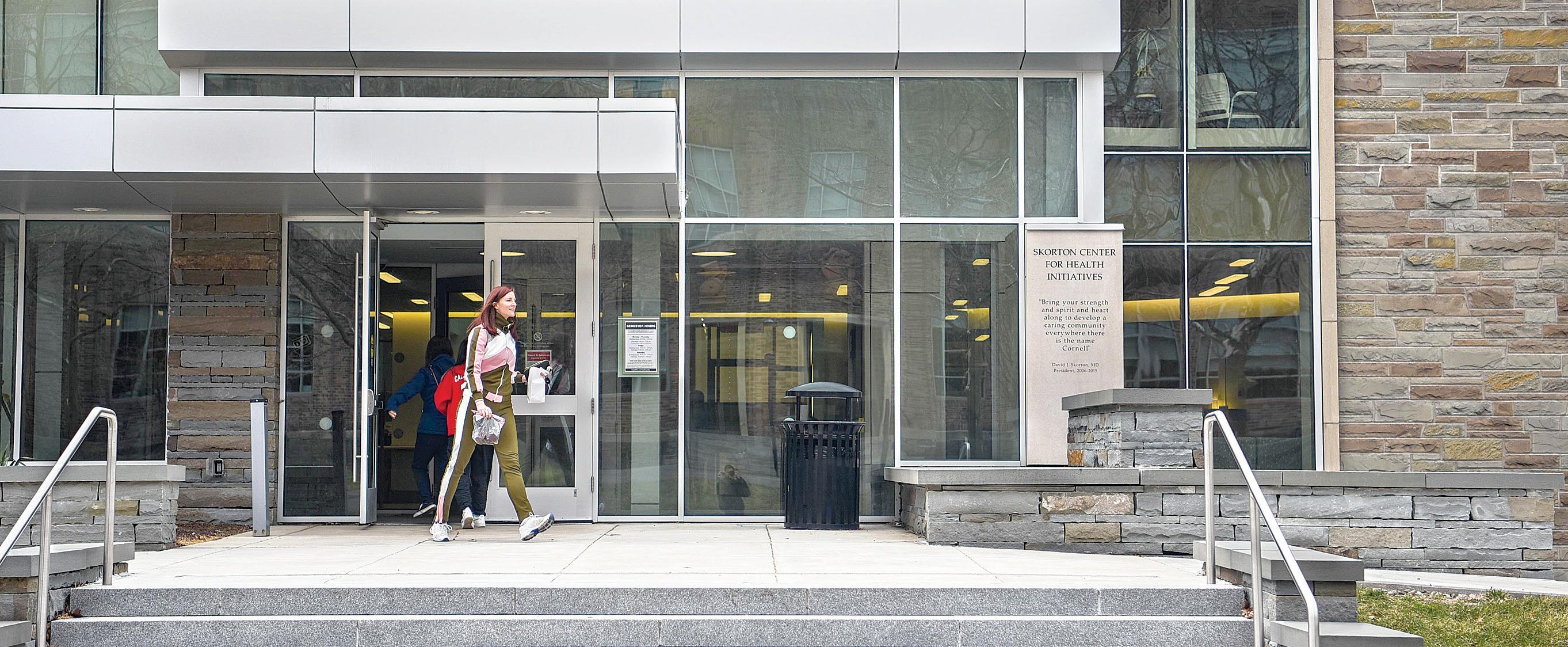
On her way | A student leaves Cornell Health Services on March 18. Chronically ill students are conflicted on whether to leave campus.
Kamis
ARTS & ENTERTAINMENT
Artists in Exile
Ilooked forward to being a fine arts thesis student my whole life. I always looked up to senior artists whose status came with studio practices, solo exhibitions and thousands of Instagram followers. I’ve spent the last few years acting as a thesis student, making and thinking about my art in all my waking hours, my apartment filling with scraps of paper and art supplies.
As a senior this year, I finally got my own studio, shared with one of my closest friends, on the fourth floor of Olive Tjaden Hall. At last! Enough space to pin huge stretches of canvas up on the walls, with natural sunlight keeping my plants alive and my colors accurate. The space gave me the freedom to work fluidly, transforming old paintings, ripping and re-stretching canvases and showing and discussing works in progress with other artists. The best moment of the spring semester was when my studio mate and I swapped roles: Madison (@madchalfant), the sculptress and furniture designer, started painting, while I (usually limited to two-dimensional work) made sculptures. This fluid expres-
sion of ourselves as artists happened because of the energies we shared in the studio space, and the freedom we felt to make the work we were passionately driven to create.
By the beginning of March, I could feel my work taking on a new quality, conceptually coalescing all that I’ve been focused on in my undergraduate work and studies across art history, religious studies and classics. I felt that I had finally reached the point I’d been working towards my entire college career.
But the coronavirus cancellations put a stop to all that. I had a week to document all my pieces, deconstruct my canvases and pack up everything that I was working on.
Most disappointing of all is the cancellation of the BFA seniors’ thesis shows, which
would have been the culmination of the work we’ve been making over the past four years. Many of us have had opportunities to exhibit in the past (Tjaden has two beautiful galleries, with new exhibitions by students, faculty and alumni cycling every week), but for many others, this final show would have been the first time showing a focused body of work in a gallery setting. As for the rest of the semester, we’re expected to translate our art practices into quarantine settings, which is challenging when you create large scale paintings or rely on the university’s printmaking facilities to create work.
Ultimately, I’m thankful for the (almost) four years I was able to spend as a fine arts student at Cornell. I had the freedom to take classes that inform the work I’ve made,
including various art history courses, Jewish studies and the anthropology of religion. I was part of an eclectic group of 28 talented, diverse, intelligent artists, all with different interests, passions and ways of art-making in response to the world to which we all belong.
The College of Architecture, Art and Planning is where I met my best friends at Cornell, and I’m so grateful to know these amazing people. I will always remember Aiza Ahmed’s intensely colorful portraits (@aizaahmedart), Sophie Galowitz’s cheeky animated videos (@are_grubs_larvae), Curtis Ho and Irene Song, the duo known as Uncle Boy’s Landscaping (@ uncleboyslandscaping) and their unexpected social commentary installations, Vivian Lin’s whimsical plushie mushrooms (@ bigsoftfungi), William Demaria’s technical, nuanced printmaking (@william_of_ orange) and Michelle Wu’s honest and darkly hilarious illustrations. Even though I couldn’t see everyone’s final work at the end of the semester, I know we will all stay in touch as our careers take us in wildly different directions.
The last painting I completed at Cornell is entitled “Exile,” as I’ve spent the last few months thinking about the generational trauma and diaspora which is central to Jewish identity. But this week, exile took on another meaning. We Cornellians have been forced out of our homes on the hill prematurely, and now we wander, creating art as a means of survival in this tumultuous world.
Lucy Kay Plowe is a senior in the College of Architecture, Art and Planning. Her work can be found on Instagram @lucyplowe or her website lucyplowe.com. She can be reached at lkp39@cornell.edu.
Cog Dog’s Smorgasbord Refects
On the Human Condition in a Time of Panic
very human responses to extreme circumstances within each play.”
On Friday, March 13, just hours after receiving the email notifying us of the suspension of classes due to the coronavirus and still in a state of shock, I went to see the Spring Smorgasbord at Risley’s theater. The theater was full, and I could hear the buzz of anxious conversation. Everyone was on edge, but once the play started we all were able to tear our minds away from Cornell’s chaos and bring back a semblance of normalcy.
Smorgasbord is a collection of five ten-minute plays and two monologues put on by Cog Dog, which is Risley’s entirely student-run theatre troupe, founded in 2015 to provide an alternative, approachable theatre troupe for Cornell students. Four of the plays are student written, and all were directed by star students. While not explicitly interconnected, each play brought the audience a glimpse into the characters’ lives. As the producers wrote in the program, they “enjoyed watching the
Nothing strikes me as more topical now than human reactions to the extreme — we are all literally living in an extreme situation that will go down in the history books. How we choose to act in this time carries much weight, just as how the characters’ responses define their personalities.
In the first play, Gin Before Dinner, written by Regina Lassiter ’21, a young woman reluctantly reconnects with her father when he visits her comedy set at a bar after she drunkenly called him the previous night.
The first monologue, Evan Calls Sis, by Quinn Theobald ’22, follows Evan repeatedly leaving distressed and emotional voicemails to his sister, slowly revealing his emotions around his mother’s recent death and his relationship to his sister as he goes from indifferent to angry to desperate.
Smorgasbord continued with Sylvia II: The Awakening of Callie,written and directed by Sydney Wolfe ’20. In this, a disillusioned drama teacher discovers that her dog, Callie, can talk. A
comedic and heartwarming conversation between a woman and her dog reflects the feelings of disenchantment with our lives which we all feel sometimes.
Reality, written by Aaran Leviton ’20 and grad student Anna Evtushenko, explores the potential ability of technology to control us. Footsteps, written by Audrey Rytting ’21, follows a budding romance on a camping trip and a ghost story that quickly turns real. In the second monologue, Thank You So Much
masterfully interweaves three people telling the stories of why they committed murder: a boyfriend getting back at his abusive partner, a woman enraged by her cheating wife, a teacher poisoning her evil students. Each person spoke in turn, jumping from one to another and then speaking over each other in a crescendo of emotion ending in numb acceptance of their fate.
Nothing strikes meas more topical now than human reactions to the extreme —we are all literally living in an extreme situation that will go down in the history books.
for Stopping, written by Halley Feiffer, a woman nonchalantly chats, while stopped on the side of the road, about how she accidentally killed her husband. And, on the theme of murder, the final play, Bright. Apple. Crush. written by Steve Yockey,
Before the show, I sat down with the producers, Rowan Yearley ’21 and Nicole Guillen ’21 to learn about their goals with Smorgasbord . As Guillen explained, similar to the overall goal of Cog Dog to make theater more accessible to students, with this play they “wanted to cater to all” and have many “different flavors.” “This play has a little something for everyone, honestly,” said Yearley. It was evident from the smiles on people’s faces after the show that it had made a unique impact on everyone. The producers described the
plays as focusing on the human condition. “It shines a light on these various different people who have a lot of things going on and who are forced to confront or deal with that in some way or another. And sometimes it’s more mundane, sometimes it’s more extreme, but they all sort of have that unifying characteristic,” explained Yearley. There was something very compelling about watching the characters struggle through life on stage as the world around us descends into a pandemic. Life must go on, and our actions are important.
As the producers said at the start of the play, “The show will go on.” The collective experience of watching a play together after receiving such crazy news moved me. It reminded me that in a time of crisis, we can still come together to enjoy art (even if it’s six feet apart or virtually). At the end of the day, we are all in this together.
Emma Leynse is a freshman in the College of Arts and Sciences. She can be reached at eal257@cornell.edu.
EMMA LEYNSE SUN STAFF WRITER
Lucy Kay Plowe
Guest Room
“EXILE” BY LUCY K AY PLOWE, OIL AND OIL PASTEL ON CANVAS
Joanna Hua | Cup of Jo
Trough Coronavirus, Cornellians Come Together
Every 24 hours, my life is uprooted again. Since Tuesday, every 24 hours has changed my future. Every 24 hours, a new update. Every 24 hours, a new sinking feeling in my chest.
Amidst the rapid changes, there were some horrific moments on campus that left me shell-shocked. Someone had their food stolen right out of their hands in Collegetown. I cleared my throat once on Ho Plaza and got several dirty looks. People I considered my friends refused to cancel spring break plans and went
been taken away from me so quickly.
However, through all the lows, the Cornell community mobilized together in a way that I had never witnessed before. Graduate students (who usually don’t work with undergraduates in capacities other than TAing or directing research) quickly offered a bedroom, a spare couch, cars for transportation. Full and part-time workers at the Cornell Store opened up their homes to students who found themselves struggling to figure out housing after dorms were scheduled to close.
Everyone
out to fishbowls, disregarding the pleas from so many others to think of the community and practice social distancing. Everyone was terrified and dejected, seniors most of all. I felt their pain, wandering around campus as if in a fever dream for days, unable to accept what had
Ihesitation. Even as we give up our spring semester, our spring breaks, our Slope Day, our well-deserved time in the sun, and, for seniors especially, our last moments on Libe Slope with friends and our graduation to celebrate all that we have overcome and accomplished here, we all are doing so for the better of our community.
seniors most of
Friends offered to help me pack even as they were figuring out their own plans and reached out to check in on me even as they were crying themselves. The Office of the Student Advocate immediately took in questions and compiled a list of resources for students struggling to figure out housing and transportation.
In my 3.75 years here, I have never seen the campus come together so quickly. Through the collective trauma, I have never felt so proud to call myself a Cornellian and to be a part of this family. This moment calls for such a profound level of community care, and while we aren’t always great at practicing this, through the past week we as Cornellians embodied this care without
While I am also mourning the lost time, I know that we as a Cornell community ultimately
chose humanity over selfishness. There will always be people who will work to make the community better, and better, until finally things aren’t horrible anymore. With our health professionals leading the way, Cornellians ultimately came together as a family, all squabbles and discontent put away for our glorious campus and community. So while I won’t be able to say a proper goodbye to Cornell, I know that Big Red blood will always run through us all.
Joanna Hua is a senior in the College of Arts and Sciences. She can be reached at jhua@cornellsun.com. Cup of Jo runs every other Friday this semester.
Alecia Wilk | Girl, Uninterrupted Viral Nihilism: Chronically Coping Where No One Gives Us a Cure
was in seventh grade and 12 years old, when my history teacher, Mrs. Saylor, paused and turned her attention away from the dirty whiteboard in a moment of realization to say that we, the cluster of restless preteens seated in front of her, had never known life without war.
I’m still not sure if that statement was completely correct.
I do know that she was right about the list of events she subsequently rattled off to try to help us, children supposedly bombarded with unending violence on the very largest scale, understand the stuff we’d been through, the stuff we’d seen: 9/11, the Iran/Iraq War, ongoing military aggressions with Afghanistan, a hard-hitting recession, the Boston Marathon Bombing, constantly-stacking murders by our police force, Sandy Hook Elementary and so many shootings since that it’s far past the point of pathos to try to name them all. It was a lot. I almost hadn’t noticed.
ebrating, rough-housing with each other, cheerily listing off weapons they knew from COD right there in our elementary classroom. My eyes tried not to linger too long as they raced to see who could find the rumored uncensored pictures of his dead body. I remember being panicked that I was supposed to be so happy over the grotesque details about the death of a person I had just then heard of for the first time. I was the second to last stop on the bus and my heart beat hard all the way home.
still navigable enough for me to remain only childishly half-aware.
However, for many people, elsewhere, in countries we mindlessly group together in that mental space of “I think we bombed them, not sure why,” life was far from navigable through these times.
moronic or deluded.”
The constant terror on the screen didn’t touch me, not really. Through the collective trauma, I have never felt so proud to call myself a Cornellian and to be a part of this family.
I was in fifth grade and ten years old when Osama Bin Laden was apprehended and executed under the Obama administration. Between listening for the H bus to be called on the announcements to tell me I could go home, boys around me started cel-
The thing is, all this “trauma” left me relatively unscathed. Mrs. Saylor was correct in her observation that the world, since we’d been born, was consumed by war and similarly apocalyptic occurrences. But though I stared blankly at the news from behind my dad’s spot on the couch, throughout my adolescence I never stopped to take it in. Or rather, I never had to. The constant terror on the screen didn’t touch me, not really. No matter how many villainous mentions I heard of Iran, Iraq, Afghanistan, from birth through middle school, I wouldn’t ever experience it. I returned every day to a home that was safe. I was healthy. I was happy. In my childish half-awareness of all the disaster, life was
And with the onset of this pandemic, I’m constantly reminding myself of that. Pestilence is looming, it’s vacating college campuses, shutting down cities, and bringing nations to their knees. Corona, among its other more grave consequential effects, has brought to the surface all of the building, internal dread stirred up by so much tragedy. At the same time, it has given us so many cathartic, irresponsible ways to deal with (read: ignore, repress, downplay, make a joke of) it. Here, we have a weird, shared consciousness that sits at an intersection of powerless yet somewhat protected.
Coronavirus deaths have exceeded 9,000 worldwide. At the moment I’m writing this, the United States has just under 11,000 cases and the growth seems to be exponential, unchecked. Last week I saw reports predicting medical inadequacies and threads from public health professionals detailing how these shortages could exacerbate the issue and send us into an even more turbulent spiral. Shortly after, in a move that was painfully, depressingly predictable, our government poured hundreds of trillions of dollars into the stock market. Reports are being released exposing to us how, three weeks ago, state and federal officials were selling shares and protecting their wealth according to pertinent, virus-related information that they’d continue to hide from us until it would be too late. Our president refuses to accept the WHO-certified test to help protect us against the virus and then lies about it to our faces. Because the health of the market is far more pressing than peoples’ lives. “If COVID-19 proves anything, it’s that institutions have failed you, elites don’t give a shit about you, and most experts are either
Between cracking jokes and desperately advising each other to pause spring break festivities and St. Patrick’s Day bar crawls, we wallow in this historic, global, but still somehow American, disaster. We wallow in it the way we’ve always been told to do. We become the media we’ve relentlessly consumed all these years — treating disaster after disaster as an opportunity to broadcast morbidly entertaining or weakly hopeful footage. More often, the former. Because we’ve tried demanding justice in the past and frankly we’ve grown too numb to know it’s what we deserve and urgently need. We capitalize off of it. We
make darkly comedic viral memes and Instagram our impressive and aesthetic quarantine reading lists. We do our best to express how seriously or lightly we’re taking it and feverishly await the validation that it’ll bring. We do whatever it takes to keep ourselves sane while the people in charge decide, again and again, we’re not worth it.
So we sit, still, safely distanced from one another (or not), and get through it. We get through it because we are stuck at the point of simultaneous plight and privilege regarding what it is to be an American. To be treated like such a laughable last priority by your government that you have no choice but to laugh as well. So we look like hyenas to the rest of the world, cackling deliriously amongst carcasses of the less fortunate.
Because what do we do with absurdity when it becomes so overwhelmingly normal?
Alecia Wilk is a sophomore in the College of Arts and Sciences. She can be reached at awilk@cornellsun. com. Girl, Uninterrupted runs every other Friday this semester.
Men’s Icers’ Barron, Schafer ’86
ECAC Honors:
PLAYER, COACH OF THE YEAR AWARDS
Awards pour in | Junior forward Morgan Barron takes a shot at the game against St. Lawrence on Feb. 28.
Junior captain Morgan also wins slot on All-ECAC First Team
By LUKE PICHINI Sun Assistant Sports Editor
While Cornell men’s hockey’s season ended abruptly due to the COVID-19 pandemic, awards continue to pour in for junior captain and forward Morgan Barron. On Friday, the ECAC announced that Barron was named the conference’s Player of the Year.
The announcement comes two days after Barron was revealed to be one of 10 finalists for the Hobey Baker Award, the most prestigious accolade in college hockey. Earlier in the week, Barron also received a nod on the All-ECAC Hockey first team, his second year in a row receiving that honor.
Barron, who tied for sixth in the ECAC in total points, may not have stuffed the stat sheet in comparison to some of the conference’s premier scoring threats, but he was clearly the best player on the ice and a leader for Cornell.
“He’s a great, great leader, along with our other captains,” said head coach Mike Schafer ’86 after the team’s win against Yale on Nov. 9. “But he also does it on the ice, and that’s what you want your leaders to do, is they gotta perform — they can’t
See BARRON page 3
Schafer
wins Tim
Taylor
Award
as top coach for fifth time
By CHRISTINA BULKELEY Sun Sports Editor
Men’s hockey head coach Mike Schafer ’86 took home his fifth ECAC Coach of the Year title on Thursday, one day before his team would have taken the ice in the conference semifinal. Schafer last won the Tim Taylor Award, named for the Yale coach who was its first-ever recipient, at the end of the 2017-18 season. Schafer led the Red to a 23-2-4 record before the postseason was canceled due to the COVID-19 outbreak. Cornell did not lose a single game on home ice all season, with the team’s only two losses coming at Dartmouth and Quinnipiac. The Red’s effort was enough to secure the Cleary Cup. Since voting for the Tim Taylor Award recipient takes place at the end of the regular season, the postseason cancellation had no effect on the accolade.
SCHAFER page 3
Women’s Basketball Looks to Focus Next Year on Rebuilding
By MITCH HOY Sun Staff Writer
While postseason college basketball was canceled last week, the end of a largely uninspiring season for Cornell women’s basketball came two weeks prior, after the team suffered a loss for their final game of the season to Princeton, 69-50.
The Ivy League canceled the Ivy Madness basketball tournament ahead of the NCAA canceling the national tournament. The league named Princeton, the regular-season victor, the de-facto Ivy League champion. Cornell finished the season 10-16 overall, marking its third consecutive losing season. Perhaps what is most notable about the team’s year was its
struggles with in-conference play, finishing 3-11 in Ivy League games — and at one point seeing an eight-game in-conference losing streak.
This year marked the Red’s 12th season in which it ended with a losing record in-conference.
PAST SEASON IN REVIEW
While the team will be losing two of its senior starters to graduation — forward Laura Bagwell-Katalinich and guard-forward Samantha Widmann — the future is not entirely bleak. Freshman guard Shannon Mulroy
impressed many in her inaugural year and represents a fresh start for the team.
While averaging only eight points per game on the season, Mulroy displayed the skill to produce a high concentration of points when given consistent minutes. But perhaps her biggest asset is her court vision. Mulroy has shown that she has the foresight and passing ability to spread the ball around and create scoring opportunities for her teammates on the floor.
Reaching for the stars
| The women’s basketball team competes against Harvard on Feb. 15, earlier this spring.
Man on a mission | Mike Schafer ’86 strides across the ice in front of the huddled icers on March 10, 2018.