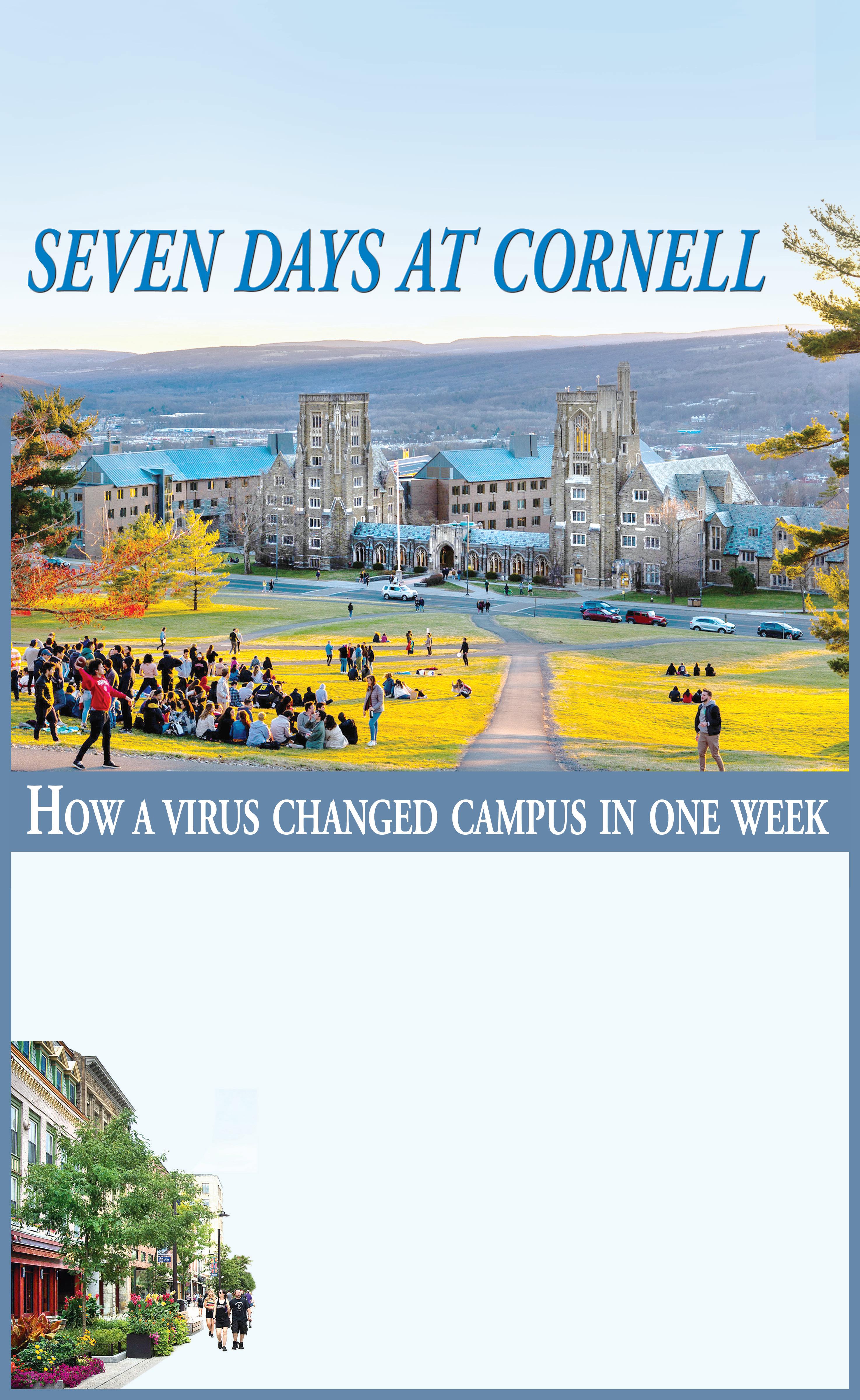
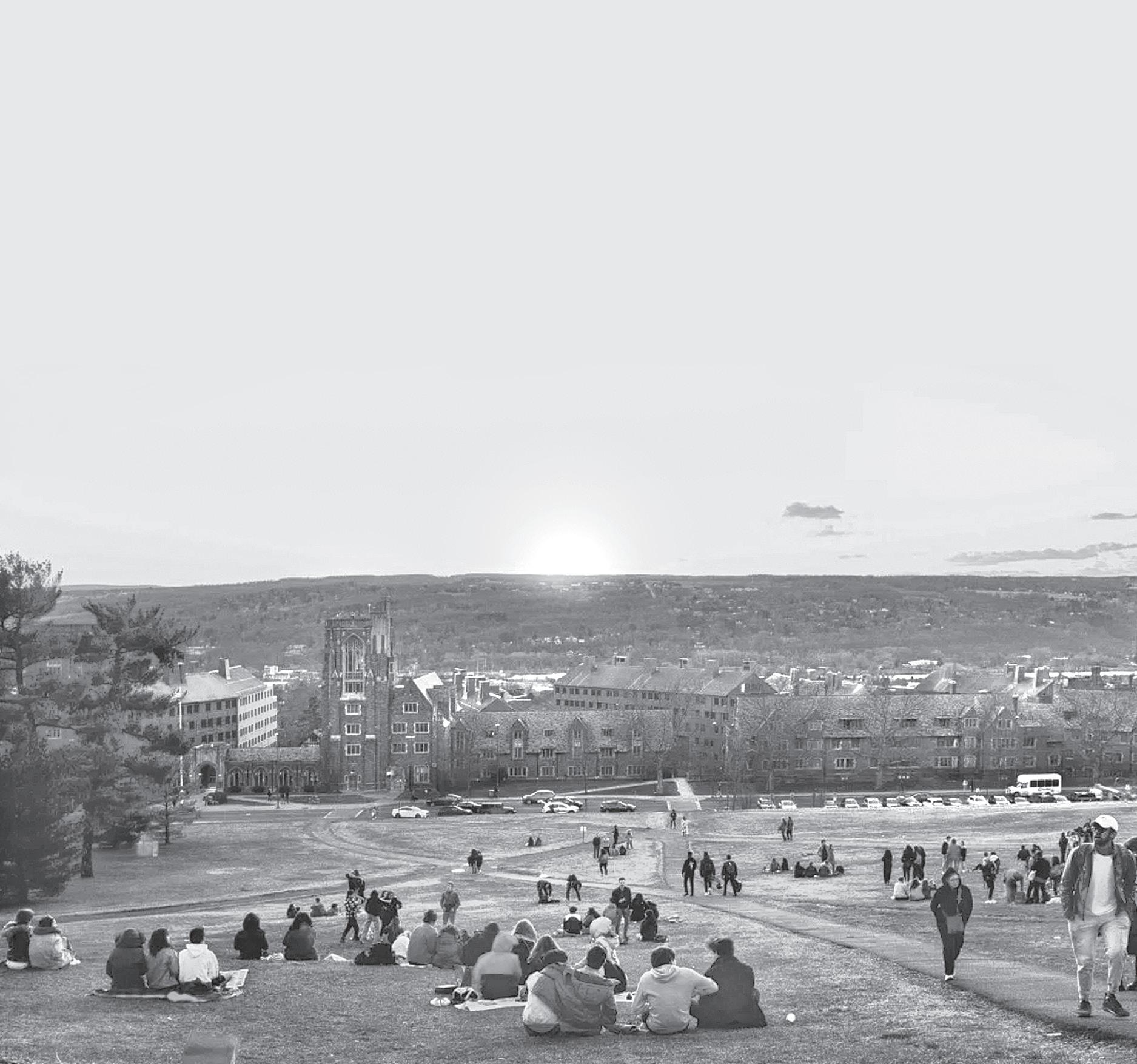
Cornellians lounged from hammocks that swooped between Libe Slope trees on Monday, as they soaked up rare March 60 degree weather. Engineers scribbled out problem sets from beneath Arts Quad tree trunks in the middle of prelim season. Student Assembly candidates squared off in an evening debate. Snow piles that collected on the edges of walkways were thawing,
and “No Winter Maintenance” signs began to disappear from campus.
Monday’s weather brought scenes from an end-of-semester May afternoon, as students emerged from winter hibernation.
But Tuesday’s news brought what felt like the semester’s end.
President Martha E. Pollack’s Tuesday email sent shock waves into student and faculty inboxes, as Cornell became the latest university to slash in-person classes
and urge students to return to their permanent residencies after spring break, amid the novel coronavirus outbreak that had not yet touched Tompkins County. Students screamed and sobbed in shock: They had two months, then two weeks.
The novel coronavirus that had already shuttered the University of Washington and Stanford appeared as though it would spare a New York university tucked
See SEVEN DAYS page 4
NYS Restaurants Now Limited To Serving Take-Out Menu
By ARI DUBOW Sun City Editor
Across the state, movie theaters, gyms and casinos are shut down, restaurants and bars are limited to takeout service, and crowds above 50 people are banned. These restrictions — announced by Gov. Andrew Cuomo (D-N.Y.) in a morning press conference on March 16 — are the newest measures the state is taking in the face of the COVID-19 pandemic. Connecticut and New Jersey instated identical restrictions.
See RESTAURANTS page 11
Students Create Spreadsheet as Local Safety Net
By OLIVIA WEINBERG Sun Assistant News Editor
Amid the tumult resulting from Cornell’s March 13 announcement to suspend classes , students created their own safety net through a spreadsheet that features resources ranging from housing to transportation and even plant sitting. Over 200 students and faculty members have entered their contact information onto the sheet, which was gener-
See SPREADSHEET page 3
By MADELINE ROSENBERG Sun Assistant News Editor
Cornell Dining Ends
Dine-In Service; Now Ofers Take-Out
By TAMARA KAMIS Sun Staff Writer
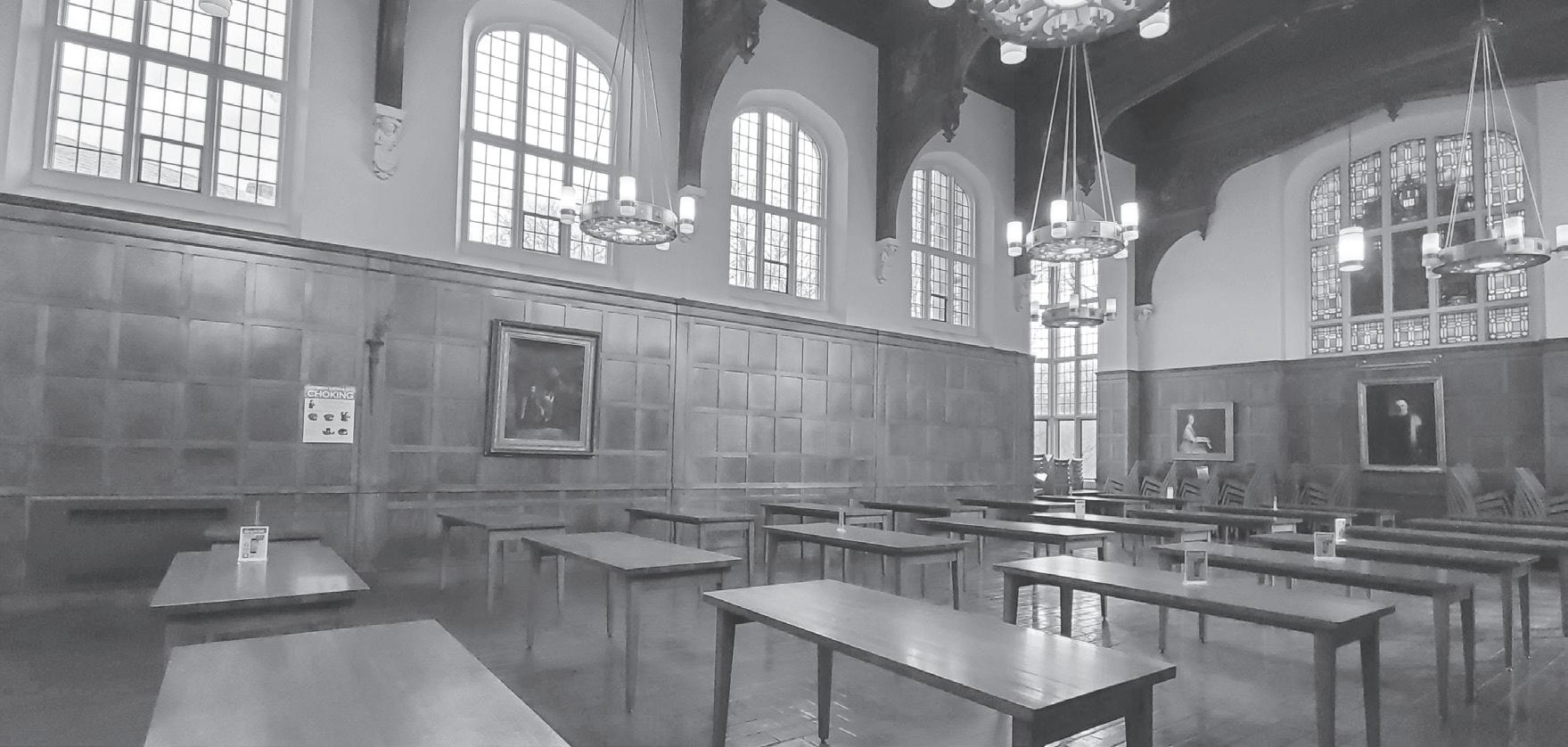
With classes suspended, social distancing in place and a slew of recently released New York State regulations in place, Cornell Dining is adapting to reduce the risk of spreading COVID-19 in dining halls.
Since Tuesday, all Ithaca campus l dining facilities will be takeout only, with no seating available. This is in accordance with new regulations from Gov. Andrew Cuomo (D-N.Y.), who said that restaurants and bars will close and be take-out and delivery only at a press conference on March 16. This take-out only rule will last until at least April 6.
Long lines were common in many Cornell Dining eateries during peak hours last week –– the end of self-service slowed down food pickup.
“Cornell Dining’s ability to act really quickly is a good sign and something I am appreciative of, but the amount of staffing is the
Only
potential bottleneck causing the lines,” said Austin Kick ’22. “If you have every station needing people, you need more people than when it was self-service.”
But as campus emptied out, these lines subsided.
Self-service has been eliminated from all Cornell Dining eateries since March 17, according to the Cornell Dining website. All food is served by staff members, and all single serving items are individually wrapped.
An increasing number of eateries are closing entirely, including Straight from the Market, Libe Cafe, the Atrium Cafe, Carol’s Cafe, Green Dragon, Jansen’s Market and McCormick’s at Moakley House. Eateries at Cornell Tech, including the Cafe and the Parliament, are also offering to-go food, but dining areas have shuttered.
Students still have access to gluten-free dining facilities, as Risley remains open. However, 104! West, Cornell’s Kosher dining hall, is closed until March 23, creating difficulties for students who keep
kosher and are remaining on campus.
“Today I woke up to a message that 104! West was closed due to lack of staff and that there is now to-go Kosher food from Becker house and North Star dining hall,” Elliot Meyers ’22 wrote in a Facebook message.
In a time of the recent public health crisis, sustainability practices previously implemented by Cornell via reusable products have been paused.
According to the Cornell Dining website, disposable plates, cups and utensils have replaced reusable ones –– people are not allowed to reuse cups even within the dining hall. Others have mixed feelings
about this change.
“It sucks that transitioning to disposable products is something that we have to do but I think it’s more important to maintain some semblance of cleanliness,” said Evelyn Kennedy Jaffe ’22. “It makes me wonder if sustainability concerns will continue to be scrapped in crisis.”
Hand sanitizer is now available at every eatery, and serving counters and tables have been wiped down more frequently. Tables were spaced farther apart from each other to facilitate social distancing, before the dine-in option ended altogether.
According to the Cornell Dining website, frequently touched
areas such as door handles, light switches and tables are being cleaned more frequently using special disinfecting wipes and spray products. Cornell Dining workers are using Environmental Protection Agency-recommended disinfectants.
The Cornell Food Pantry, located on 109 McGraw Place, provides food and personal care items to Cornell undergraduate and graduate students, staff and faculty. According to its website, the Cornell Food Pantry remains open despite the University’s transition to virtual classes.
After Party Weekend, Cornellians Adhere to Social Distancing
By MEGHANA SRIVASTAVA Sun Assistant News Editor
The few students left on a nearly deserted Cornell campus, and those now scattered across the globe, appear to be heeding to recommendations from officials to prevent the spread of COVID-19 –– they’re staying home.
After a party-packed weekend, Ryan Lombardi, vice president for student and campus life, sent out an email on Sunday imploring students to follow social distancing guidelines.
Students like Gauri Pidatala ’22, an international student living in Cascadilla Hall, have observed the impact of these guidelines while adjusting to life on an emptying campus.
“Leaving the campus, that’s very tricky for me because if I leave, I might be quarantined for 14 days, possibly by a local government hospital, which is very risky,” said Pidatala.
In the face of travel restrictions that both India and the U.S. may implement to prevent the spread of COVID-19,
Pidatala also expressed concerns over if she would be allowed to reenter the U.S. if she left.
While living on the edge of campus, Pidatala has noticed drastic changes in Collegetown and in University buildings.
Pidatala has been eating meals in Collegetown because she is not on a meal plan. She explained that restaurants are changing their policies, and gave the example of D.P. Dough, which now requires online orders and only allows customers in the building to pick up their food.
Pidatala has observed restaurants becoming more deserted, with several such as Wings Over Ithaca and Subway not allowing dine-in anymore. This is in compliance with New York State’s recent order for restaurants to be take-out and delivery only.
On campus, buildings also seem nearly deserted to Pidatala.
“I went to Duffield today, and I was surprised to see that Mattin’s was still open, but it was just weird to see that this really lively place be completely deserted,” she said. “The lively vibe isn’t there anymore. It doesn’t feel like the
engineering quad. It’s just really upsetting.”
Ravi Patel ’22 is also still on campus, and plans to stay there at least until the end of the week as he sorts out his travel plans.
Patel observed a similar “eerie” feeling on campus, describing how he barely sees any other students when walking from his West Campus dorm to Central Campus.
Patel also noted the lack of any major social events on campus.
“The majority of social events have not come to fruition, and I think that in the past few days, as far as I can tell, there may be like small groups getting together and things like that, but definitely not on a larger scale,” Patel said, showing a stark contrast with Collegetown parties which were still occurring the weekend after the suspension of classes.
Some students, who left campus soon after classes were suspended, are self-quarantining and social distancing from home.
Students Create Spreadsheet to Serve as Local Safety Net
ated on March 11 by Jeff Pea grad and Manisha Munasinghe grad, who is also the graduate and professional student trustee.
The spreadsheet provides space for peoples’ names, contact information and their ability to help lift heavy objects and drive students to airports. It also asks if they have space in their homes for guests.
Munasinghe said she noticed that undergraduate students were unsure where international and low-income students would go if the University asked them to leave, especially if they are not comfortable returning home. Now, as students scramble to book flights as borders close, help is welcomed wherever it is offered.
“I was watching a lot of my grad student friends post about how they had extra housing spaces
and were willing to take anybody who needed a place to stay, but I wasn’t seeing a lot of crosstalk between those two groups,” Munasinghe said.
Munasinghe took inspiration from the spreadsheet created by Simone Fried, a Harvard graduate student. Fried generated the sheet after the school announced on March 10 that it would transition to online classes for the rest of the spring semester. Harvard students were given until March 23 to vacate their dorms.
Their peers at Cornell are now expected to do the same as soon as possible, following Friday’s announcement that classes in all forms would be suspended and online instruction would begin April 6.
“I guess I am disappointed but unsurprised,” Munasinghe said regarding the University’s choice to move classes online for the entirety of the semester. “I recognize that they are trying to act in a way
that minimizes the spread.”
However, the students were concerned that the suddenness of this decision and the lack of resources provided alongside the announcement “might cause a lot of anxiety,” Pea said.
“The recommendations from the University policy [at the time] didn’t really stipulate any additional resources that students [could] go to,” Pea added.
On Friday evening, Ryan Lombardi, vice president of student and campus life, sent an email to students outlining additional information regarding housing, dining and financial support. He linked the University’s page regarding the virus for resources, which provides a phone number for Cornell Health, international travel information and pay guidelines for employees.
Lombardi also stated that students in on-campus housing will receive a rebate for housing and
dining if they were not staying in their housing after March 29, but the amount of compensation is unclear. Additionally, P.E. and swim test requirements were waived for seniors who have not yet completed them.
encouraged to reach out to Cornell’s counseling services if necessary.
How
Seven Days at Cornell
coronavirus changed campus within one week
between gorges and trees — even after Gov. Andrew Cuomo (D-N.Y.) declared a state of emergency that previous Saturday.
Students who had previously fretted about their spring break plans now grappled with a new reality: What would Zoom discussion sections look like? How would architecture students construct physical models online? Would seniors who missed their swim tests freshman year still have to complete the requirement?
Commencement also became a question mark for seniors who learned they would squeeze senior spring into a remaining two weeks. First-year students cleared the Bear Necessities shelves on Tuesday evening and frantically emptied out their Big Red Bucks — just as a portion of them entered the housing lottery and selected next year’s on-campus dorms at the beginning of the week.
A slew of events dissolved, from Cornell Fashion Collective to a cappella concerts, after months of rehearsals and planning. Spring Student Assembly elections were pushed to the fall semester, as students’ minds drifted away from the present and into the looming burden of travel plans and online courses.
Wednesday brought some of the first recorded Canvas lectures and piloted Zoom classes, as lecture halls stood vacant, without clanging laptops and filled seats. Prelims slated for the week became a next-week problem; other professors scrapped exams altogether and wondered how they would restructure their curriculums. Those enrolled in Computer Science 1110: Introduction to Computing Using Python completed a 1.5 hour exam on Tuesday, writing out code the same evening their student-centered world came crashing down.
Campus started to feel more panicked, more sanitized. Hand sanitizer stations sprang up in library entrances, the Willard Straight Hall lobby and academic halls. Bottles of Purell stood adjacent to cash registers, sharing counters with gift cards at The Cornell Store and accompanying a basket of apples at Green Dragon Cafe. Libe Cafe and Temple of Zeus baristas brewed espresso drinks and swiped student IDs wearing gloves.
sipped Bubly from plastic cups as ceramic ones vacated shelves — before the University moved to take-out only dining on Monday. Some dining hall salad bars stood empty, while scoop-your-own Dairy Bar ice cream disappeared and Straight From the Market shuttered completely, as the eatery relies heavily on self-service.
Students had two months, then two weeks, then nothing.
As new health guidelines went into effect on Wednesday, croissants and bagels that filled the Libe Cafe display case were covered in plastic wrap. Coffee carafes slid behind cafe counters as the University eliminated self-service dining and eateries exchanged reusable mugs for their single-use counterparts.
Students ate their dining hall meals on paper plates and
Other eateries and campus facilities scrapped ID and credit card swiping altogether, asking students who entered dining halls to read out their ID numbers or punch in the codes. Cornellians who headed to the gym for a regular treadmill sprint or to ease the turmoil of a shortened semester did so for some of their last times: All gyms closed on Monday.
As professors devised online lesson plans and students booked flights out of Ithaca for the days preceding spring break, the semester then completely dropped from beneath their feet: Another University email crashed into their inboxes. On Friday, all classes were suspended, as Pollack urged all students to return home as soon as possible.
Students had two months, then two weeks, then nothing.
The semester was upended as COVID-19 cases reached into the hundreds in New York State. Students cried in library
reading rooms and called their families; others shouted for joy as Cornell called for class cancellations. Many piled into storage service centers, awaiting boxes to pack up and flee campus.
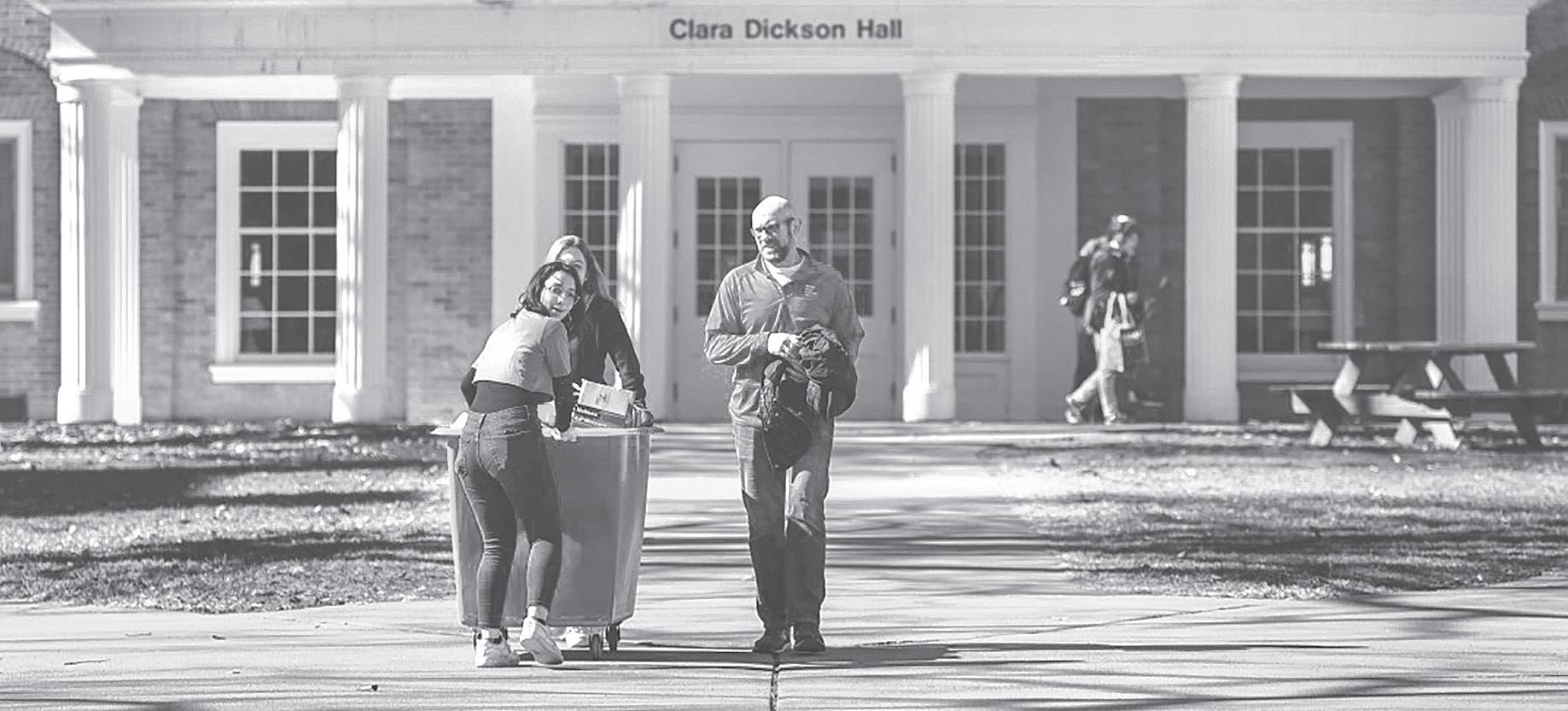
On Saturday, swarms of first-year students emerged from Robert Purcell Community Center with flattened storage boxes as they prepared to vacate campus; West Campus residents did the same. International students booked and rebooked flights as they ticked against the clock of increasing border closures.
Moving carts flooded North Campus on Saturday as freshmen packed their belongings into cars and waved goodbye to their abbreviated first year of college. First-year residence halls became quieter and quieter by Sunday: fewer bathroom doors slammed, fewer students occupied their low rise common rooms. Piles of leftover snacks remained in Donlon Hall kitchens with only a few lingering students left to eat them.
As recently as last Monday, students were in class learning about microbiology and information science and psychology. They were sipping coffee in Libe, hanging out in common rooms and apartments, unaware that Cornell would be the next school to shutter as COVID-19 works its way into seemingly isolated corners of the world.
Cornell Athletics Annual GARAGE SALE
Dickson departure | A student pulls a cart of belongings away from the Clara Dickson Hall columned portico as her parents walk along with her.
BORIS TSANG /
ARTS & ENTERTAINMENT
The majority of The Sun’s content over the last few days has centered around the coronavirus and the University’s handling of it. We’ve seen incredible reporting from our news department, and some moving columns from our opinion department (including one from our godmother, Paris Ghazi ’21). Where does arts fit in all of this? It feels wrong to publish a Lil Uzi Vert review during a global crisis.
What are we going to be putting out?
We aim to put out our usual run of album, movie, book and video game reviews, along with thought-provoking columns. While we settle in and practice social distancing, we’re going to have more time than ever to lock into our favorite entertainment and provide you with more things to do and enjoy besides Office reruns and stale memes about Zoom lectures. There will be more content to let our writers really show you what they’re made of — Mira Kudva Driskell’s ’23 column on communism in Antz is a great example. Something may feel missing from our content, though: dozens of Cornell and Ithaca art events have been canceled. Cornell Fashion Collective designers had to improvise after their show was canceled. Concerts at the State Theatre and The Haunt are temporarily shut down. We never even got to find out who our Slope
TART IN A TIME OF CRIsiS
Day artist was supposed to be. We’ll do our best to cover these stories remotely — hearing from CFC artists, seniors in arts majors or anyone who wants to get a story of creation told.
What do we hope people get out of it?
As a department, we hope you find
distraction, comfort and connection through entertainment. Art can provide solitude in quarantine, but reading about what others have enjoyed will hopefully remind our readers that they aren’t alone — we’re all processing together. Many students will listen to music as they drive or fly home. Songs are taking on new meanings, absorbing the moments of
urgency, fear and love. Exerting her entire life force and with tears in her eyes, one of the arts editors belted “Movies” by Weyes Blood as she drove to downstate N.Y. She felt like this week was a movie with its love, quarantine, sadness and unity, and felt understood by the song.
Beyond acting as an emotional outlet, art can help us think about where we are and contextualize the coronavirus crisis in history. Looking back at movies like Apocalypse Now made during or about times of crisis shed light on our cultural psychology: How have we expressed ourselves during turmoil?
Self-expression today is important — the arts department urges you to keep creating. Writing a poem, playing the ukulele for your family or just doodling a cool turtle wearing a mask can help you get through quarantine. When you put something unique into the world that wasn’t there before, you capture the moment with your individuality. It’s satisfying, but also good for posterity.
It’s okay to be worried — that sense of urgency is what is going to get everyone through this pandemic. But it’s important to take a break, to not let that worry and anxiety consume you. Live the moment — that’s what art is here for.
Emma Plowe is a freshman in the College of Arts and Sciences. Daniel Moran is a junior in the College of Human Ecology. They can be reached at arts@cornellsun.com.
e Nether: An Escape in Strange Times
I caught the last performance of The Nether on Friday afternoon, and when I sat down in the front row I realized it might be the last show I ever got to see at Cornell. Over the past four years I’ve spent hours in the Black Box Theatre rehears ing, directing and watching my peers put on wonder ful performances. I am incredibly grateful, and this was a fitting, wistful goodbye.
The Nether, written by Jennifer Haley, depicts a grim future where people can only experience the sensations of the natural world in the Nether, previously known as the Internet. In this virtual wonderland exists a simu lacrum, the Hideaway, a poi soned Victorian Eden created by a man who calls himself Papa. Pedophiles are invit ed to indulge their darkest desires here in the safety of their own imaginations.
him but he remains impossible to penetrate — that is, until she threatens to take away his login to the Nether. He submits to Morris, which prompts the question, can virtual experiences become so important
will be chained to a life support system, but his mind will roam free in the Nether. While Sims’ defense for the Hideaway often appears rationalist, Doyle sounds like a hopeless romantic, offering a more emotion
The play opens with Sims (Joey Welsh ’21) sitting by himself in an interrogation room. Detective Morris (Ankita Bhattacharjee ’22) throws a series of charges at
“real” life?
Another man brought in for questioning seems to think so. Doyle (Andrew Dettmer ’22), a loyal visitor of the Hideaway has been pondering the possibility of a crossover. His physical body
examining the matter. He argues, “this communication — the experience of each other — is the root of consciousness.” Dettmer is perfect in the role of this 65-yearold science teacher; he looks nerdy, stressed out and beaten
up with his thick glasses and oversized sweater, but an aching tenderness seeps through his voice, making me tremble at how much I empathize with his yearnings. And then it’s time to venture out of the interrogation room into the Hideaway. With an incredible lighting shift, the stage is transformed into an otherworldly digital escape, where the birds sing and the flowers blossom in spring. We are greeted by Iris (Abbey Crowley ’22), a nine-year-old girl, or the image of one. She is special; her naïve appearance and action is unmatched with the sobering clarity in her inquiries. Papa seems to favor her of all the children. Someone else has also taken a liking to her immediately — Mr. Woodnut (Ian Capell ’20), a well-mannered, perhaps reserved, new guest to the Hideaway. He brings her flowers and engages in conversations with her, deviating from the designed course of the realm. Eventually Papa notices the unusual connection the two have been building and demands Iris to have Woodnut “try the axe,” another generous offering of the Hideaway. In the post-show talkback, Welsh
interpreted the design as a “desensitization” process, and Dettmer added that there was a line from his character that read “murdering children doesn’t make you detached, but complicit.” Crowley delivers a stellar performance in a hard role. She balances the seductive charm and the painfully simple desires — to be loved, to be special — in this complex character so well that she reminds me of Nabokov’s Lolita at times. Her chemistry with both Welsh and Capell is palpable and beautiful to see.
Director Bryan Hagelin ’20 sure does magic with the minimum. The stage becomes gradually populated with props as the plot builds to a shocking revelation, then in a scene shift everything is taken away and we return to the cold, emotionless interrogation room. Without showing explicit violence or sexual behaviors on stage, Hagelin makes the brilliant decision to have Iris reenacting the scenes in the background as Morris reads chilling confessions from the two men. And composer Jacob Nannapaneni ’22 gives a captivating score that encapsulates the complex emotions of the store.
My only issue with the production, really, was the melodramatic portrayal of Detective Morris; I’ve always
imagined her as someone who battles her inner struggles while trying extremely hard to maintain the calm, unbiased voice of justice. It saddens me to see how this over-the-top performance risks taking away from the nuance of the character.
When the curtain falls, we have to walk away from The Nether with questions instead of answers. The notions of love and desire are taken to uncharted territories, if not redefined altogether. Haley’s tragic tale feels strangely timely now. When the world, or at the very least the world as we know it, ends, where do we go to seek basic human needs? How do we connect with each other emotionally, if at all? How can nature, even the mere image of it, help calm our anxiety about the collapsing reality?
The Nether, as Haley defines it in the playwright’s note, is “a dimension of Evil or Imagination” or simply, “Demon world.” Yet in her imagined demon world, love still exists in its purest form, regardless of gender, age, appearance and such. Perhaps we can find consolation in knowing this.
Ruby Que is a senior in the College of Arts & Sciences. She can be reached at rque@cornellsun.com.
RUBY QUE SUN STAFF WRITER
Your source for good food
Old-Fashioned Diner With Vegan Twist: angelhearts surprises
By MELANIE METZ Sun Staff Writer
When you envision a diner, images of piles of eggs, bacon, fries and pancakes come to mind. At Ithaca’s first vegan diner, Angelhearts, very similar items can be found on the menu. The Engelharts, who have long craved starting a family-owned restaurant, opened Angelhearts Diner in August of 2019.
According to an Ithaca Journal article, Kim named the diner “Angelhearts” because by eating vegan, “you are choosing compassion in your food.”
The family makes every dish from scratch, aside from Susie’s Seitan, which is made locally in Ithaca. They create vegan cheeses out of cashews and soy, offer many gluten-free and wheat-free options and focus on fresh ingredients.
Their decor, as well as their menu options, recreates the classic diner atmosphere with brightly colored booths and a tiled floor. The staff are friendly and provided helpful suggestions on what to order. Angelhearts offers a wide selection of breakfast and lunch options, as well as desserts, so it is best to arrive hungry.
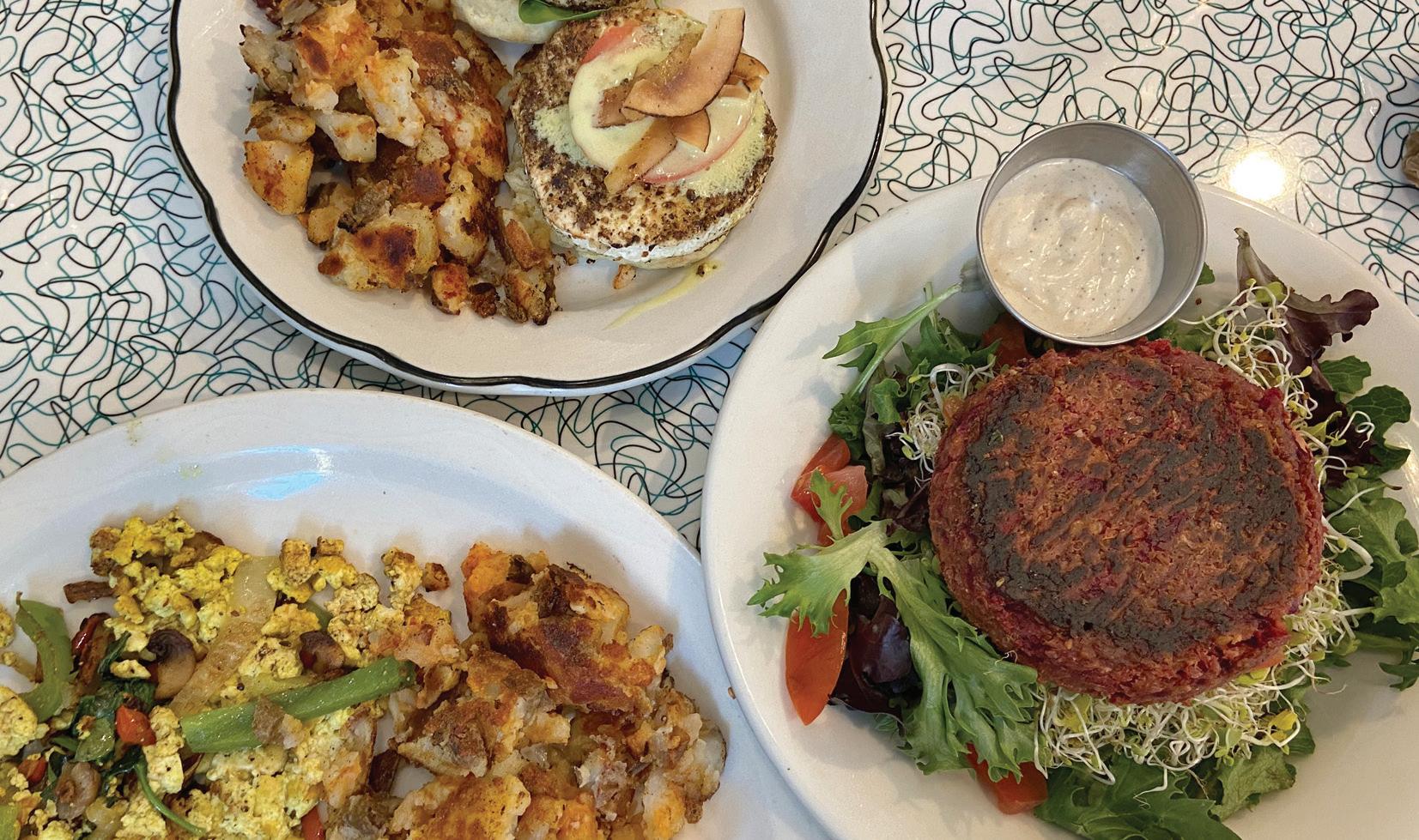
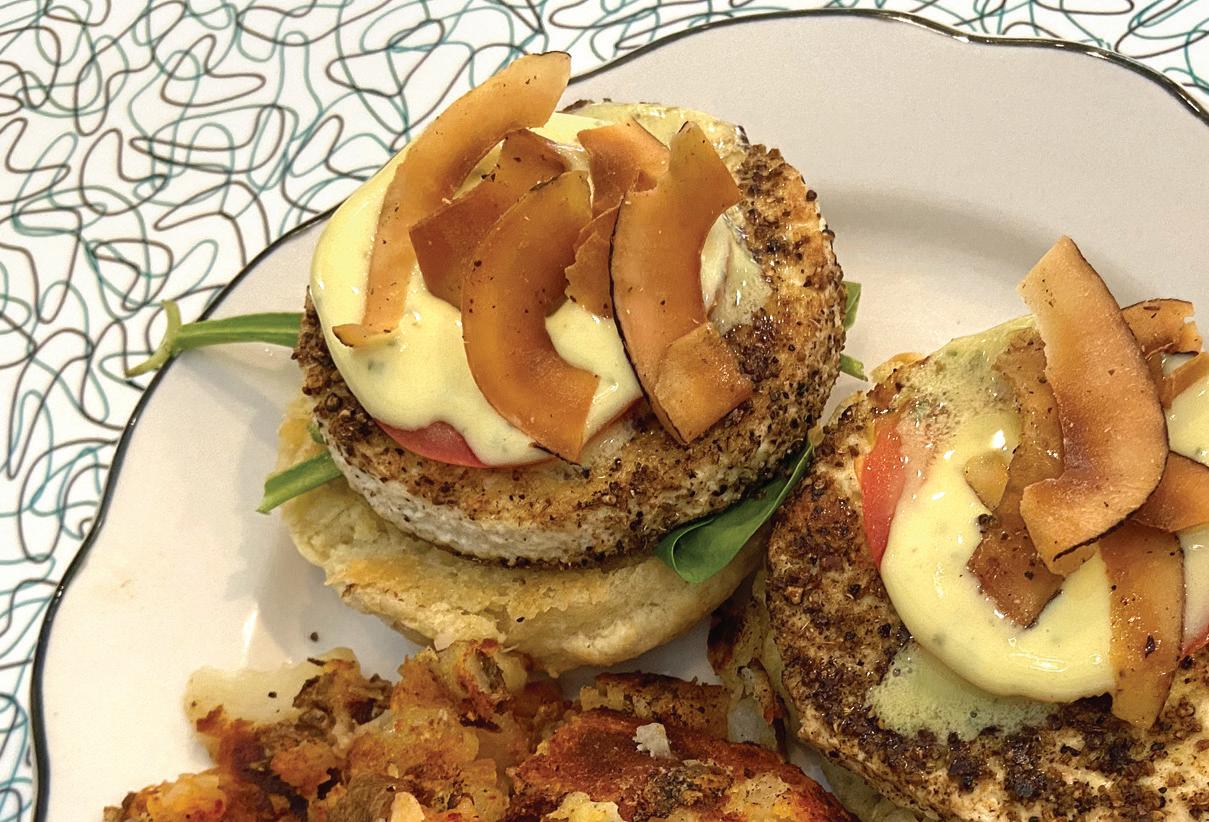
Tofu Benedict | This is a freshly-made biscuit topped with veggies, seasoned tofu patties and smoked coconut bacon, with hollandaise sauce spread on top. The tofu was spiced just right and had a thick, yet crumbly, texture. The hollandaise sauce was flavorful and enhanced by the tomato and spinach on top. The biscuit was moist and had a great mouth feel, similar to the pleasant experience of the tofu “eggs.” My dad thought the Tofu Benedict was “excellent” — a rare review.
Full
the
Beat Burger Salad | This was filling, but not heavy. It contained a handmade beet patty on a bed or organic greens, sprouts, veggies and smoked coconut bacon sprinkled on top. The beet burger was chewy, moist and had a unique texture, unlike a store-bought burger. The coconut bacon, made from fresh coconut, was flavorful and not greasy at all. My mom ordered a side of multigrain toast and commented that the addition of grain was a necessity to the dish.
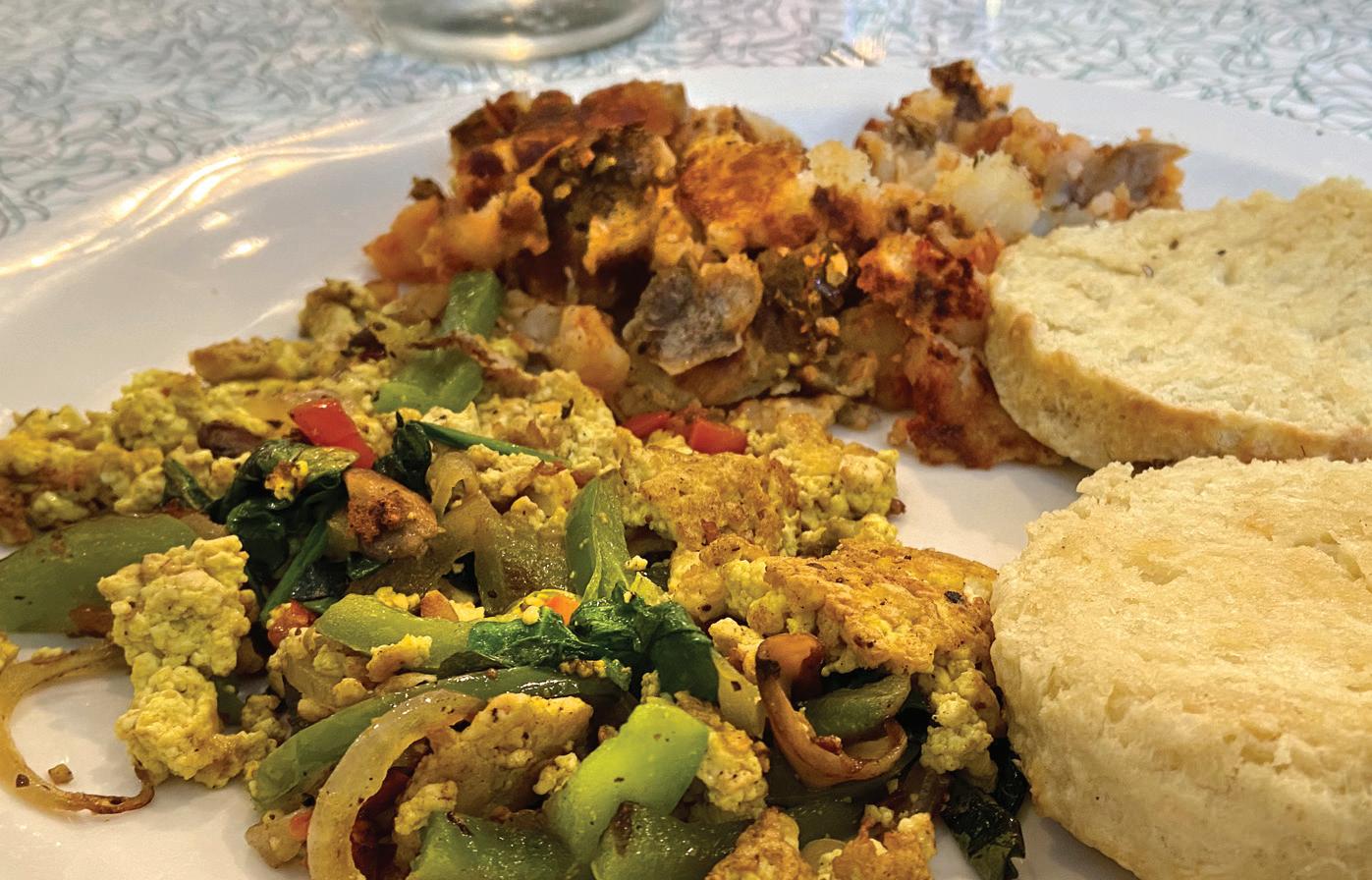
Full Plate | The Full Plate consisted of a seasoned tofu scramble with veggies, homefries, sausage and a biscuit. The tofu scramble was a nice texture, although a bit too oily for my liking. The home fries were delicious; the potatoes were slightly mashed and moist, yet still somewhat crispy without being overly fried. The sausage had the consistency of scrapple, great spicing and an authentic crumbly texture.
Although many Ithaca residents seem to be open to a more plantbased diet, Angelhearts Diner is only the second fully vegan restaurant currently open in Ithaca. Even Moosewood, well-known around the country as a landmark vegetarian
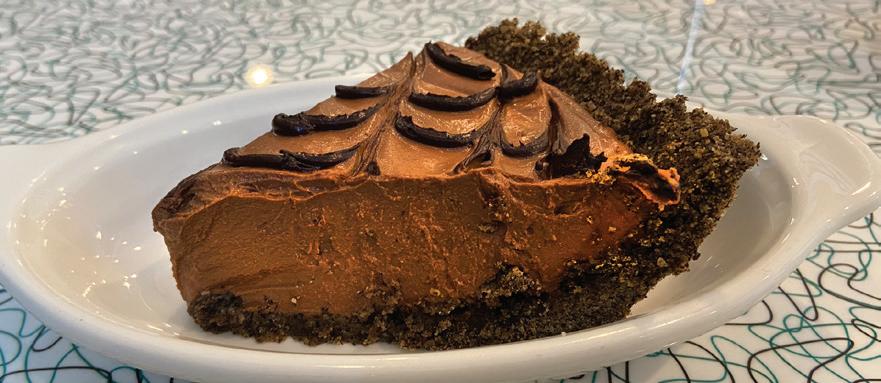
Pie | The
whose beans are
by Oak & Crow, was
but made better by the free refills. The
was excellent; you would never know it’s non dairy. The creamy filling was complemented well by the
The pie was rich, chocolatey, firm and left no heavy aftertaste. It was a perfect end to the meal.
eatery, offers seafood. I hope that the Ithaca community patronizes Angelhearts Diner and encourages other vegan eateries to open. Not only does Angelhearts provide delicious food and a nostalgic atmosphere, but they have created a place
for vegans and non-vegans alike to experience how classic American dishes can be deliciously plant-based.
Melanie Metz is a sophomore in the College of Human Ecology. She can be reached at mnm55@cornell.edu.
The spread | My parents and I visited Angelhearts for brunch served on Sunday mornings. As we are all vegan, a new vegan restaurant was too exciting to pass up. We ordered the Tofu Benedict ($12), The
Plate ($12),
Beet Burger Salad ($8), a cup of drip coffee ($3) and a slice of Chocolate Dream pie ($6).
Mocha
coffee,
roasted
decent,
Chocolate Dream pie
chocolate graham cracker crust.
PHOTOS BY MELANIE METZ / SUN STAFF WRITER
The Corne¬ Daily Sun
138th Editorial Board
MARYAM ZAFAR ’21
Editor in Chief
JOYBEER DATTA GUPTA ’21
Business Manager
PETER BUONANNO ’21
Associate Editor
MEGHNA MAHARISHI ’22
Assistant Managing Editor
CHRISTINA BULKELEY ’21
Sports Editor
BORIS TSANG ’21 Photography Editor
CAROLINE JOHNSON ’22
News Editor
ALEX HALE ’21
News Editor
ARI DUBOW ’21 City Editor
EMMA ROSENBAUM ’22 Science Editor
BENJAMIN VELANI ’22
Dining Editor
JOHN MONKOVIC ’22
Multimedia Editor
MIKE FANG ’21
App Editor
OLIVIA WEINBERG ’22
Assistant News Editor
MADELINE ROSENBERG ’23
Assistant News Editor
LUKE PICHINI ’22
Assistant Sports Editor
HANNAH ROSENBERG ’23
Assistant Photography Editor
BRIAN LU ’23
Assistant Arts & Entertainment Editor
ANNABEL LI ’21
Assistant Money & Business Editor
LEI ANNE RABEJE ’22
Layout Editor
JOHN COLIE ’23 Blogs Editor
JOHNATHAN STIMPSON ’21
KRYSTAL YANG ’21
HUANG ’21
NGUYEN ’22
KENKARE ’21
O’CONNELL ’21
STAMM ’22
’22
’21
’22
MEGHANA SRIVASTAVA ’23
’21
’22
MORAN ’21 Assistant
’22
’21
Re: ‘Forget the public policy school; give us a design school’
To the Editor:
This past week Michaela Bettez authored an opinion that advocated for the replacement of Cornell’s School of Public Policy with a school of design. Although Bettez argues some reasonable points, there is a grand irony and underlying message that runs contradictory to Cornell as an institution. “Any person, any study” should imply that all schools have merit. As an MPA student in Cornell’s Institute for Public Affairs, my win is not another student’s loss. In other words, the creation of a new school is not a zero-sum game. Yes, there are a finite amount of resources, but there is no reason to vouch for the dismantling of a school that could help others achieve their goals. In fact, it is our advocacy, legislation and persistence that allows such efforts.
Additionally, using clubs as a metric of measuring interest is a somewhat novice and inaccurate gauge of overall university need. Extracurricular club interest does not necessarily equate to academic interest or need. A better metric would be polling the Student Assembly, Graduate and Professional Student Assembly, Employee Assembly, the Faculty Senate and the University Assembly — or even the students themselves. Although I enjoyed reading the connections from mechanical engineering to DEA, virtually the exact same argument can be applied to public policy. Every person, company and institution in the United States (and several other countries) are related to policy in that they are mandated to abide by or write it. Additionally, policy intersects virtually every discipline on campus — design codes in architecture, consumer products in business and movie ratings in theatre, just to name a few. Lastly, there is significant value in translating research from all disciplines into policy and practice, like working with experts to make decisions during a pandemic. It’s one of many things we can do.
Victoria J. Kasonde grad, GPSA vice president of operations
While Kasonde is the VPO of the GPSA, she is not speaking on behalf of it or of the CIPA program.
Letter to the Editor
Cornell, don’t put grad workers in danger amidst coronavirus
To the Editor:
Working on Today’s Sun
Ad Layout Krystal Yang ’21
Desker Hannah Rosenberg ’23
Desker Peter Buonanno ’21
Sports Desker Christina Bulkeley ‘21
Dining Desker Benjamin Velani ‘22
Tom the Dancing Bug by Reuben Bolling
We, members of the Cornell Graduate Student Union, commend the Cornell administration for taking preemptive effort to minimize risk due to COVID-19. Provided that the campus shutdown is executed in a way that accommodates undergraduates who depend on their housing, employment or other necessities through the University, this is a step towards protecting some of the most vulnerable members of our community. That said, graduate workers are expected to remain on campus and do their jobs, and we continue to advocate for working conditions that are safe and fair.
Firstly, we urge the graduate school to ensure that teaching assistants who are expected to convert courses to a virtual format on short notice are given the proper I.T. resources and training to do so effectively, and that the students taking those courses are insured to have sufficient access to computers and internet. Failure to do so would shortchange the students who have dedicated energy and money to take these courses and may unfairly impact the T.A.’s evaluations. Additionally, CGSU has received multiple disconcerting reports from grads (who wish to remain anonymous) of some academic advisors, primarily those in experimental laboratories, leveraging this crisis to exploit graduate workers. Afraid that the campus may completely shut down if the virus worsens, grads have been urged to work long hours such that “progress will not be lost” if the lab must close, and risk their relationship with their supervisor (and possibly their job, the security of which overwhelmingly rests in the hands of the supervisor) if they refuse. The long taxing hours and lack of sleep are not only unfair working conditions, but may increase vulnerability to illnesses like COVID-19, undermining the very point of a potential shutdown. Some have been told that if they become quarantined, the two weeks spent out of the lab will come out of their own paychecks. Whether this is even something within an advisor’s power is beside the question — and grads should never be forced into no-win situa-
tions where they must choose between risking their good professional standing or their health and financial stability. Again, this isn’t conjecture — it is already happening, and it must come to an end.
This is a failure of priority — the health and safety of workers should come before the lab’s output, which itself is impacted negatively if the grads performing it are tired and stressed. It can be seen as another instance of how the conditions of our employment have been designed for an “ideal, average” graduate student: A young, healthy, financially stable person with no dependents, who is not at risk of a “serious case” of COVID-19 and who’s willing and able to put the quantity of work they produce before everything else. This is an inept description of the graduate student body, and it erases the myriad of ways in which both the virus and the ways our manager’s respond to this virus can seriously impact our lives. We urge the graduate school to provide a promise of job and stipend security, even if a grad worker is unable to complete research tasks due to infection or quarantine.
As a union, we are here for all grads, to support you and advocate for your needs. If professional fallout from COVID-19 is unfairly affecting you or someone you know, please reach out to us. To be clear, we believe this behavior is far from the norm — many supervisors are truly trying to accommodate for their student’s health. If you are one of these supervisors and know a colleague who is exploiting their students, we urge you to stop them immediately. And if you are worrying over the productivity of your lab this spring semester, consider the health and wellbeing of your workers first, and, instead, help us face this crisis together with solidarity and mutual support.
Ethan Ritz grad
Jacy Tacket grad
Nathan Sitaraman grad, Weill Cornell M.S. Program
David Blatter grad
Cornell Graduate Students United Organizing Committee members
Katherine Yao | Hello Katie
My Final Freshman Feelings In the Wake of Coronavirus
When people warned me that my freshman year in college would be the most difficult, I was expecting many long, hot dates with Calculus: Early Transcendentals in the Olin Stacks. Never did I imagine that there would be a coronapocalypse.
I’m typing this article on my phone with one hand, my dead laptop having long been tucked away in some bag or another. My other hand is throwing some unworn spring dresses into a suitcase. A tangled web of blankets swathes my feet. I can’t find the aforementioned calculus textbook anywhere. With every overflowing box and each poster ripped from the walls, I am moving one step closer to reverting my sanctuary of the past eight-ish months to a barren dorm room. By the time I finish cleaning, even the vomit stain on the carpet will disappear.
After the dust from all the cardboard boxes settle, you wouldn’t know that my –– wait, but it’s not mine anymore –– that this Donlon quad was where I met the best
With every overflowing box and each poster ripped from the walls, I am moving one step closer to reverting my sanctuary of the past eight-ish months to a barren dorm room.
roommates in the world. Where I cried after my first (and second and third) prelim. Where I fell apart and pulled myself together upon hearing President Pollack’s life-shattering statement last Friday.
A mere three weeks ago, the thought of coronavirus making its way to Ithaca seemed almost unimaginable. Yet here we are. Two positive cases about ten minutes
away from Cornell. I spent the past few days phasing between reality and nightmare –– to be honest, the line between the two has all but disappeared. A constant mantra of “should I petition to stay” played through my mind as I thought of potentially bringing the virus home to my immunocompromised mother. As I pictured my relatives quarantined in China. As the selfish part of me grasped in vain at the fading remnants of my freshman spring.
Ultimately, I decided to go back to Ohio, and I am fortunate enough that my moving process can be carried out with relative ease. Many of my international friends face dilemmas with far higher stakes. Going home, for them, means large time zone differences and the uncertainty of returning to the United States. Staying in Ithaca means indefinite separation from family and friends. Both options involve high costs, visa considerations and health concerns.
I could write a book about the fears of the Cornell community, government incompetencies or even the sheer stupidity of Collegetown block parties (turns out common sense, like face masks and toilet paper, is in short supply these days). But I instead want to reflect on a quote that I recently found (fine, a quote that I googled just now) by Victor Frankl: “Everything can be taken from a man but one thing: the last of the human freedoms — to choose one’s attitude in any given set of circumstances, to choose one’s own way.”
So, in the latter part of this column, I choose to be grateful.
For all that we roast Zoom, the fact that technology has advanced to the point where we can gain any semblance of an education right now is remarkable. I am grateful for the professors who must figure out Zoom, along with Canvas, Gradescope and many other softwares to make this transition as seamless as possible. To my peers, please show your instructors patience, as they, just like us, are struggling to navigate these uncharted circumstances.
I want to thank the dining staff for working to maintain normalcy in the locations around campus where
Robyn Bardmesser | Guest Room
“Iwe need it the most. In the midst of the chaos, we can always rely on these places of refuge to share food and conversation, tears and commiseration. But maybe don’t literally share food. And unrelated to the dining halls, definitely don’t share alcohol at, say, some college town parties in the upcoming weeks. Thanks for coming to my TED Talk.
I will miss the first Ithaca cherry blossoms and my freshman Slope Day.
Most of all, I am grateful for the shows of solidarity among my fellow Cornellians. Every insistence that “it’s only the flu” has been contradicted by countless conversations seeking to correct such rampant misinformation. From the strangers who left heartwarming notes on my library table last Tuesday to the Donlonians helping people move out, I know that I can find solace in the community I’ve learned to call my own. Our instinct to seek out humor exhibits our compassion because we insist on spreading laughter in lieu of panic. Even when everything goes to shit, we choose to fight fear with memes and empathy.
I will miss the first Ithaca cherry blossoms and my freshman Slope Day, but I look forward to returning next school year having realized the full strength of this institution. As it stands, I have (hopefully) three more years in the ivory tower we call Cornell. Three more years to cherish. Three more years to create memories that nothing, virus or otherwise, can steal away. Three more years that grow all the more valuable because I understand how precarious that tower truly is.
Katherine Yao is a freshman in the College of Arts and Sciences. She can be reached at kyao@cornellsun.com. Her column, Hello Katie, runs every other Wednesday this semester.
Coronavirus and the Luxury of
now understand how my parents felt, fleeing without warning from the Somalian Civil War,” my friend semi-joked on Thursday when I told her I would be leaving London the following Monday. I gave a weary chuckle and showed her my friend’s Instagram story saying that she and her mom had Gestapo flashbacks while scrambling to pack the past three months of studying abroad into a bag. It was 2 a.m. in Madrid, and there was a palpable sense that if she and her parents did not leave at that very moment, their rights as citizens to return to their own country would be stripped.
I am only slightly luckier than other students fleeing Europe before President Trump shuts us out entirely. I have four days to pack, say goodbye to my friends and wake up early to see the sunrise over the Thames for the first and last time. My grandfather used to tell me bedtime stories of German bombs following his refugee caravan to Uzbekistan, one of which ripped off the arm of a girl ten feet away from him, turning her white dress red. My last Saturday stroll down Brick Lane to buy the vintage jeans I’ve been pining for can hardly compare. So let’s set the Holocaust comparisons aside for now, even though I’m simultaneously writing an essay on Hannah Arendt’s notion of the banality of evil; even in this “increasingly apocalyptic semester” as my professor put it, last-minute essay-writing remains a constant.
On Wednesday, I was insisting to my coworker that it makes no sense for me to leave. I can’t infect my grandparents at home if I am here; New York City is so
much worse than London; I already paid for my apartment; I have a job; I made travel plans; I was invited to Passover Seders; I have tickets to a concert with my best friend on her birthday. Now, I join my friends in a two-week quarantine in New York City, in spirit but not in person. Who knows what the city will look like, and who will remain, when we emerge.
My semesters in college have thus far operated according to certain routines, subconsciously built up, with the majority of my life contained to a halfhour walking radius. Going to class (as long as it started after 11 a.m.), starting assignments too close to the deadline, meeting up with friends for late night adventures, the knowledge that support networks lay at my fingertips. No matter what temporary setback I got myself into, I always retained a coherent, known structure to my life.
Now we learn what previous generations knew: Security is a luxury, and we took it for granted.
Stability
alone and lonely in a massive city. I made friends anyway. Life went on. In my second week here, my phone was stolen in a campus cafe, and no matter how many managers I talked to at the insurance company, they would not ship my new phone overnight to Britain. While I waited ten days for my mom to fly in with my phone, I meticulously memorized directions, gaining an intuition for the twisting streets of London. I learned to have faith, to trust that no matter what, I would find my friends and find my way back home.
Life went on, arguably better without Instagram and Snapchat. The clouds became silver linings.
lame fraternity parties.
In the space of four hours, I can go from packing for a weekend in Barcelona to buying a last-minute plane ticket home while sobbing to my mom over the phone. Who knows what will happen by Monday, my city may be locked down upon arrival. (Here is one certainty: if that happens, you will find me snorkeling across the Hudson River in my friend’s dad’s wetsuit to get back to the Upper West Side, Bill Deblasio you mark my words.) In one week, we went from believing the virus is contained, to thousands sickened in Italy. In the week after that, it finally dawned on us that coronavirus will spread everywhere and nothing will stop it. Our last recourse is to delay it at the cost of massive disruptions to our routine-filled lives. Life won’t go on for all of us, but it will go on for more of us if we hold ourselves to dramatic yet responsible measures.
Even removing coronavirus from the narrative, studying abroad was chaotic from the start, lacking much of the stability I didn’t realized I had grown dependent on. I procrastinated on applying for my Visa and ended up arriving in London a week late, missing a crucial period of making friends; I nearly bailed on going abroad because of the thought that I would spend a semester
Now I feel silly trying to placidly accept whatever the future holds, and it gets harder for me to maintain my religious conviction that everything happens according to a plan inherently beyond my comprehension. How do I embrace terrifying risks and uncertainties even though I now have no other choice? We used to have certainty that life will continue on until tomorrow, that our forecasts will be reasonably accurate, that the yield curve inverting means a recession will come, that Mondays mean grilled cheese and tomato garlic soup at Zeus, that Friday sundowns mean going to increasingly
I think of my great-grandmother fleeing Belarus in the middle of the night with Nazis on her heels and her infant child, my grandmother, in her arms, of Paris Ghazi’s heartbreaking account of the disaster in Iran her family is enduring, of my immunocompromised friend’s parents’ escape from the Somalian civil war. Now we learn what previous generations knew: Security is a luxury, and we took it for granted. This coronavirus is only a taste of the power a cruel world possesses to upend even the most sheltered of lives.
Robyn Bardmesser is a junior in the College of Arts and Sciences. Comments can be sent to opinion@cornellsun. com. Guest Room runs periodically this semester.
Fill in the empty cells, one number in each, so that each column, row, and region contains the numbers 1-9 exactly once. Each number in the solution therefore occurs only once in each of the three “directions,” hence the “sigle numbers” implied by the puzzle’s name. (Rules from wikipedia.org/wiki/ Sudoku)
Niko!
by Priya Malla ’21
Pizza Rolls by Alicia Wang ’21
Mr. Gnu by Travis Dandro
Mr. Gnu by Travis Dandro
26 A PA R TMENT FOR R
ENT
Flexible Housing Solutions!
Short Stay Accommodations Available
*Brand New* Studio Apartments
238Linden.com Leasing@inteprop.com 607-379-6023
120 Oak Avenue
Just steps to Cornell Campus
10 bedroom house & 1 and 2 bedroom apartment 607-277-1234 office@ithacastudentapartments.com Ithacastudentapartments.com
3 BR & Large Studio Apartment Ten month lease. Heat, water & gas provided. 607-227-0924
109 Sage Place
3 Bedroom Apartments
Access to Shuttle to Campus Access to Free Fitness Center Novarr-Mackesey Property Management office@ithacastudentapartments.com 607-277-1234
Houses, Apts, Parking 1 to 9 Bedroom
Collegetown - College Ave, Linden Ave, Dryden Rd, Bryant Ave, Cook St. 607-330-2442 info@urbanithaca.com www.urbanithaca.com
Catherine & Eddy St.
1 & 2 bedroom
Furnished, heat included Laundry in building Parking available for fee 607-277-1234 office@ithacastudentapartments.com
2020-2021
Studio 1, 3, 8 & 11 BR Apts. Great Locations in Collegetown. 607-227-2535
Collegetown Crossing College Ave's Newest Location 307 College Ave. Now Leasing for 2020-2021 Completely New Modern Studios, 2 & 4 Bedroom Apartments.
Fully furnished, heat & hot water included. Reception area at 307 College Ave. www.urbanithaca.com 607-330-2442 info@urbanithaca.com
Now Renting
2-10 Bedroom Houses/ Apartments for 20-21. All Locations. Call today or visit our website: Certified Properties of TC Inc certifiedpropertiesinc.com 607-273-1669
*Brand New*
Full Term & Semester Leases Studio, 1 & 2 Bedrooms College Townhouse 121-125 College Ave. CollegeTownhouseIthaca.com Leasing@inteprop.com 607-379-6023
APTS/HOUSES COLLEGETOWN BEST LOCATION/BEST PRICING 607-272-3389 avramisrentals@aol.com
27 H OUSE FOR R ENT
20-21 College Ave.
5 BR House Furnished. Laundry. Parking. Call 607-273-8576
Wrestling Shows Strong Senior Leadership in Challenging Year
WRESTLING
Continued from page 12
— and only two of those wrestlers had ever qualified — to get six new qualifiers was really a remarkable achievement,” Koll said.
Senior Chas Tucker echoed his coach’s sentiment.
“We didn’t necessarily have all of our superstars on the team this year, but we still finished second in the EIWA,” Tucker said. “Everyone else didn’t think that could happen, but we made it a reality. It was so cool just to see this growth.”
everything really counts … We all just felt really bad that the season had to end this way.”
Baughman — one of the three seniors who was slated to compete in nationals — has not let the news tarnish the accomplishments of the team for the 2019-20 season.
“We all just felt really bad that the season had to end this way.”
Freshman Nathan Thacker
Unfortunately, the decision to cancel the NCAA Tournament amid the growing COVID-19 pandemic marked an abrupt end to the 2019-2020 season for the eight Cornell wrestlers who qualified: Tucker, senior Noah Baughman, senior Brandon Womack, junior Hunter Richard, sophomore Ben Darmstadt, sophomore Dom LaJoie, sophomore Brendan Furman and freshman Jonathan Loew. For the three seniors, this season marked their last opportunity to compete on the national stage.
“It was definitely sad to have the year end like this,” said freshman Nathan Thacker. “It was sad because the seniors have been wrestling all year to get ready for nationals, and it’s at the end that
“We lost a lot of our go-to leaders and the faces of Cornell wrestling due to the Olympic redshirt, but I think our seniors did an unbelievable job of reorganizing and refocusing, and bringing this group together to achieve what we did this season,” Baughman said. “Although we didn’t have a season that will go down in Cornell wrestling history from an accomplishment standpoint because of the circumstances, I think the leadership was the best I have ever seen in my four years at Cornell.”
Looking at the abnormal season from a holistic perspective, the wrestlers recognized that their losses only stimulated their growth, their disappointments only made them stronger and the challenges they overcame only prepared them to be even more dominant on the mat next year.
Faith Fisher can be reached at fsher@cornellsun.com.
Students Adhere to Social Distancing Guidelines
DISTANCING
Continued from page 3
Taylor Owens ’22, who returned to Wisconsin on March 15, has been in a self-quarantine since she arrived back home.
“Our governor actually said that anyone coming from New York State had to self quarantine for 14 days, so I’m doing that right now. I probably would have done that anyway,” Owens said.
This time has brought Owens some stress because she has a lack of obligations and classes to fill up her time.
“I try to plan out my day a little bit because I am Type A, so the whole concept of not having classes in any capacity is kind of stressful,” Owens said.
Even though Owens is not showing symp-
toms of the virus, she remains cautious and proactive in preventing its spread.
“I try to limit my exposure to even my mom and my brother a little bit just because I am coming from this highly contagious area. So, I do spend a majority of my time in my room by myself,” Owens said.
Sarah Rosenthal ’20 is also trying to maintain a distance from others while at home in New York City, although she is not under self quarantine. Rosenthal spends most of her time indoors, and leaves the house only to go on runs in Central Park and to shop for groceries.
“If I do go outside, I really try to maintain a 10-foot radius between me and anybody who I come into walking distance of,” Rosenthal said.
In terms of academics, Rosenthal said that the abrupt shift has been “pretty weird … it
just stopped all of a sudden. So now, everything’s postponed three weeks and we don’t really know what’s gonna resume after that.”
Although under self-quarantine, Owens counts herself lucky. She still has access to the internet and other basic needs, and her family remains financially supported by her mother’s job, despite the general economic turmoil caused by the virus.
Owens is adhering to self-quarantine guidelines on her own, but is maintaining contact with her friends from campus virtually.
“It’s kind of been hard for me because I kind of was uprooted so fast and I didn’t necessarily get to say goodbye to all my friends,” Owens said.
Meghana Srivastava can be reached at msrivastava@cornellsun.com.
NYS Limits Restaurants to Take-Out
RESTAURANTS
Continued from page 1
“It’s a big hit for us,” said Sam Chafee, owner of Sammy’s Pizzeria, a restaurant on the Commons.
In past years, the upcoming weeks of the spring semester typically bring added service as a result of finals and graduation. This makes these restrictions even harder on business than they might be other times of year, according to Chafee.
“I cannot pay the payroll, I have to cut hours,” Chafee said. “I just hope they are right, and that all these sacrifices are necessary.”
According to Chafee, employees have been distraught over losing hours, and food distributors are frustrated by returned orders and lack of business.
“We’re all suffering,” Chafee said. “I have big problems because I have employees asking me how they are going to pay the rent on their houses.”
Chafee was frustrated that neither the city, state nor federal governments communicated how small business owners and their employees will be financially
compensated for the losses these restrictions will inflict.
Dan Tabb, an employee of four years at Collegetown Bagels, was shocked when he learned before work yesterday about the new statewide regulations.
“The place is empty and it’s a little scary,” Tabb said. As an added precaution, CTB management instructed employees to adjust to the new guidelines by 6 p.m., two hours earlier than required, Tabb said.
The reduced business makes the health precautions — such as disinfecting surfaces — easier to carry out, though they do involve more work for the employees.
Sakulthorn Goodall, an office worker at Taste of Thai, said that the restaurant’s servers will all take a hit financially from the loss of tips. The majority of the restaurant’s service is from inhouse diners, according to Goodall.
But Goodall was confident that enough locals and students will remain in the area to maintain business at the restaurant.
“I hope it’s over soon,” Goodall said. “I’m getting sick not from the virus but from all this news.”
As far as a long-term plan, Taste of Thai management will “play it by ear,” Goodall said, as they adjust to the constantly changing set of state-mandated requirements.
During the March 16 press conference, Cuomo said that New York State will require 50 percent of all local government workers to work from home, and that all police officers in the state will have access to masks. The governor also strongly encouraged non-essential business to close by 8 p.m., exempting medical facilities, pharmacies, gas stations and grocery stores.
In order to alleviate the pressures of staying at home with small children, Cuomo eliminated all fees to enter state, local and county parks.
“I believe we’ve taken more dramatic actions than any state in the United States,” Cuomo said in the press conference. “I believe we’ve had the most effective response of any state in the United States.”
Kathryn Stamm contributed reporting to this story.
Ari Dubrow can be reached at adubrow@cornellsun.com.
Icers’ Morgan Barron Named Finalist for Hobey Baker Award
By LUKE PICHINI Sun Assistant Sports Editor MEN’S HOCKEY
Cornell men’s hockey captain and forward Morgan Barron has added another honor after a stellar junior season.
Barron was named one of the 10 finalists for the Hobey Baker Award, an accolade given to the best player in men’s ice hockey. During the shortened 2019-20 campaign, Barron led Cornell in scoring, with 32 points on 14 goals and 18 assists.
As one of three captains, Barron guided Cornell to one of its best seasons in program history. The Red occupied the No. 1 spot in the national polls throughout 2020, and it earned an Ivy League championship, an ECAC regular-season championship and was guaranteed a fourth straight appearance in the NCAA Tournament before COVID-19 abruptly ended the season during the playoffs. In 2019, Barron was touted as a nominee for the award, but this is the first time he has moved onto the finalist stage.
No Cornell player has ever won the award. The 10-person field will be narrowed down to three finalists on April 2, and the winner will be announced on April 10.
at lpichini@cornellsun.com.
Men’s Hockey’s Green Receives ECAC Honor
By RAPHY GENDLER Sun Senior Editor
ECAC Hockey named Cornell junior Alex Green its best defensive defenseman on Tuesday. A solid presence on the blue line since his freshman year, Green has been a model of consistency for the Red, usually lining up alongside senior Yanni Kaldis. After an early-season injury derailed his sophomore season, the Tampa Bay Lightning draft pick played in all 29 games in his junior campaign and posted a plus-19 rating while contributing 16 points. He played a key role on a defense that regularly started three freshmen and had just three returning everyday players in Green, Kaldis and junior Cody Haiskanen. Cornell allowed just 1.55 goals per game this season, the second-fewest in the country.
In taking home the best defensive defenseman award, Green becomes the third straight Cornellian to win the honor. Alec McCrea ’19 and Matt Nuttle ’19 won after the 2017-18 and 2018-19 seasons, respectively. Green is the eighth Cornell defenseman to win the award, which has existed in its current form since the 1992-93 season. Cornell has more winners of the award than any other school.
Team qualifes six new wrestlers in canceled NCAA Tourney
By FAITH FISHER Sun Staff Writer
From start to finish, the 20192020 Cornell wrestling campaign was accompanied by unusual circumstances. The Red ventured into uncharted territory without its star wrestlers, which it lost to the Olympic redshirt, and the team faced a premature conclusion to its season due to the mounting concerns over the novel coronavirus.
Such abnormalities presented the team with unprecedented challenges, but nothing that the seasoned athletes were not ready to face. Despite the season’s drawbacks, the Red achieved a season record of 11-7 and a conference record of 4-1. More importantly, Cornell accomplished its wins and suffered its losses as a team with humility and grit.
“In my 31 years of coaching, this was definitely one of my most enjoyable years,” said head coach Rob Koll. “In every single match, there was always the possibility of losing. We didn’t have the certainty of Yianni [Diakomihalis] and Max [Dean] — we didn’t have those guaranteed wins. There was no
drama, no problems, so it really was just a coach’s dream come true.”
Two opening losses against North Carolina State and Ohio State revealed the Red’s vulnerabilities and left its future prospects shaky. However, the team found its groove at the South Beach Duals, where it went 4-1 against some of the nation’s top competition.
After the South Beach Duals, the team faced off against Ivy League competition, seamlessly top-
pling Columbia, Brown, Penn and Harvard. Cornell’s victory against Harvard marked the team’s 300th all-time Ivy League win and propelled it further down the path to its 17th consecutive Ivy League title.
However, Princeton stood as a roadblock. In a devastating 19-13 loss, the Tigers terminated the Red’s unblemished Ivy-League domination. Although the loss humbled the team — which had once been an Ivy-League powerhouse — the Red took it in its stride and used the loss as fuel leading up to the EIWA tournament.
The Red’s unwavering dedication throughout the season, especially in the absence of its top competitors, materialized in the EIWA tournament. Defying all preseason expectations, the Red earned second place, three spots above Princeton. Cornell’s performance secured eight bids into the NCAA tournament — a testament not only to the team’s talent, but also its growth.
“This team wrestled far over anyone’s expectations, and to qualify eight for the NCAA Tournament
/ SUN PHOTOGRAPHY EDITOR BARRON
Luke Pichini can be reached
Raphy Gendler can be reached at
GREEN
Season shortened | The Red wrestlers this year faced a