The Corne¬ Daily Sun

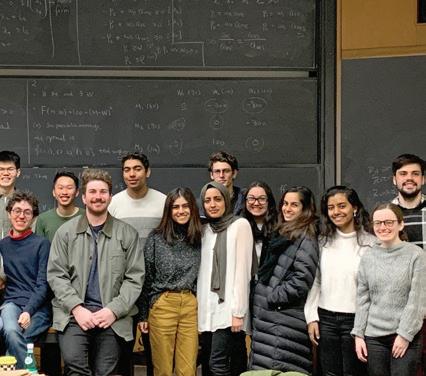
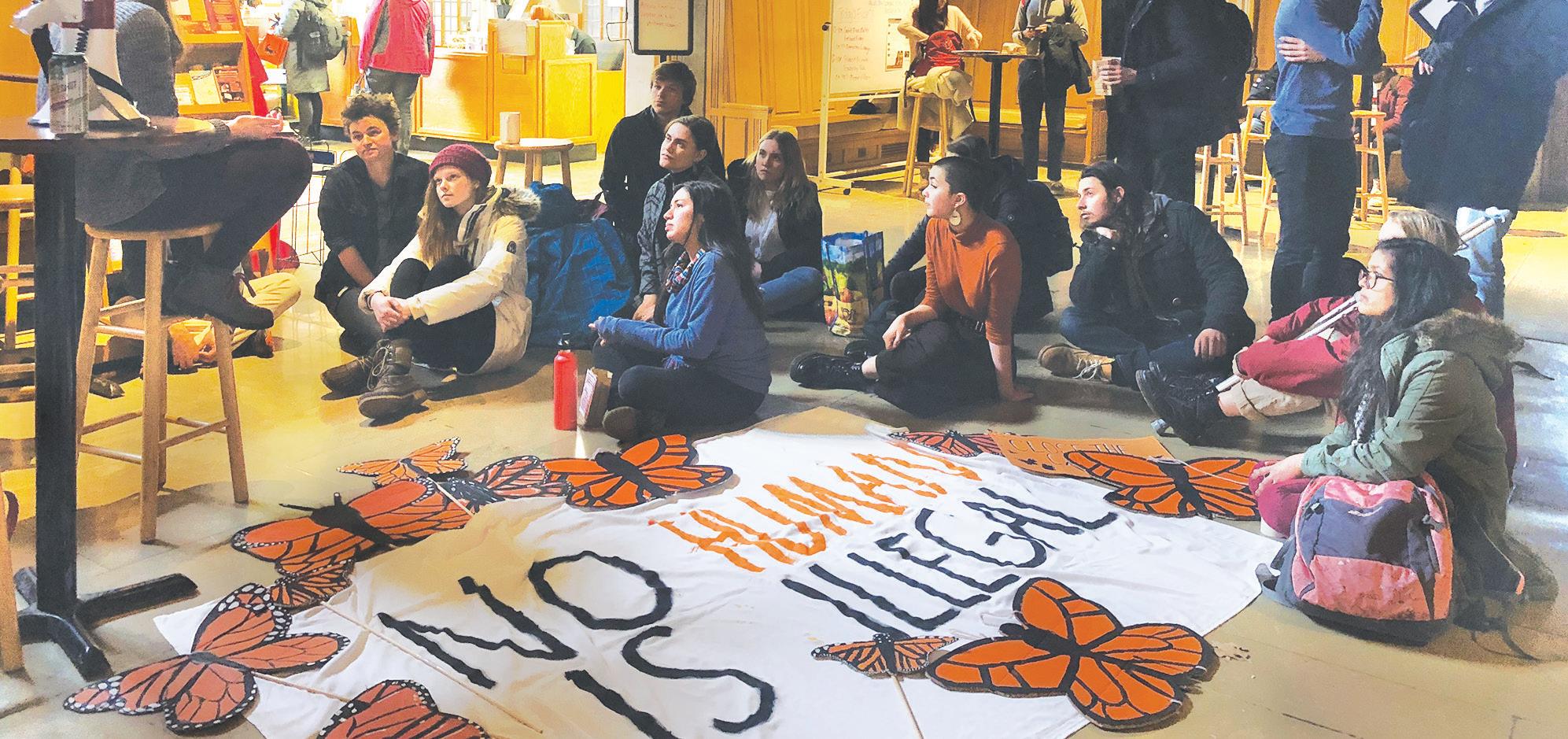

After march from Bailey Hall to Willard Straight, protesters sit over an hour to condemn climate change efects, labor practices in Qatar
By TAMARA KAMIS Sun Staff Writer
More than 20 student activists marched and gave speeches on Friday to raise awareness of injustices around the world impacting migrants and refugees and their intersections with climate change.
Protesters from Climate Justice Cornell, Friends of Farmworkers, Cornell Dream Team and Cornell Welcomes Refugees met at Bailey Hall at 12:15 p.m. and marched to Willard Straight Hall where they held a teach-in until 1:30 p.m. They discussed issues ranging from the adverse effects of climate change on farmworkers to poor labor practices in Qatar — the location of Weill Cornell Medicine-Qatar.
to Palantir, a data mining company that has played a role in designing ICE’s software for deportation operations, according to the MIT Technology Review.
Cintron was also concerned about the possibility of a more direct association between Cornell and labor practices in Qatar, a country recently under scrutiny for labor concerns.
According to Human Rights Watch’s 2020 report, there are over 2 million migrant workers in Qatar, and protective reforms intended to protect them from poor labor conditions have not been enforced by the Qatari government.
“The fact that Weill is in [Qatar] is a pretty big indicator that the same types of exploitation is happening on that campus.”
Angeliki Cintron ’22
CJC members Angeliki Cintron ’22 and Mira Kudva-Driskell ’23 spoke about migrant rights issues in which they thought Cornell was indirectly complicit because it allows companies, like Amazon, that have worked with Immigration and Customs Enforcement to recruit on campus.
Amazon has been criticized for providing its web servers
Cintron expressed concern over the possibility that Cornell’s Weill Medical Campus may be adjacent to or complicit in some of these abuses. In 2014, the International Trade Union Confederation released a report on Qatar that detailed concerns over forced labor, contract substitution and the withholding of passports in the University City — which houses Cornell’s
By ALEC GIUFURTA and ARI DUBOW Sun Staff Writer and Sun City Editor
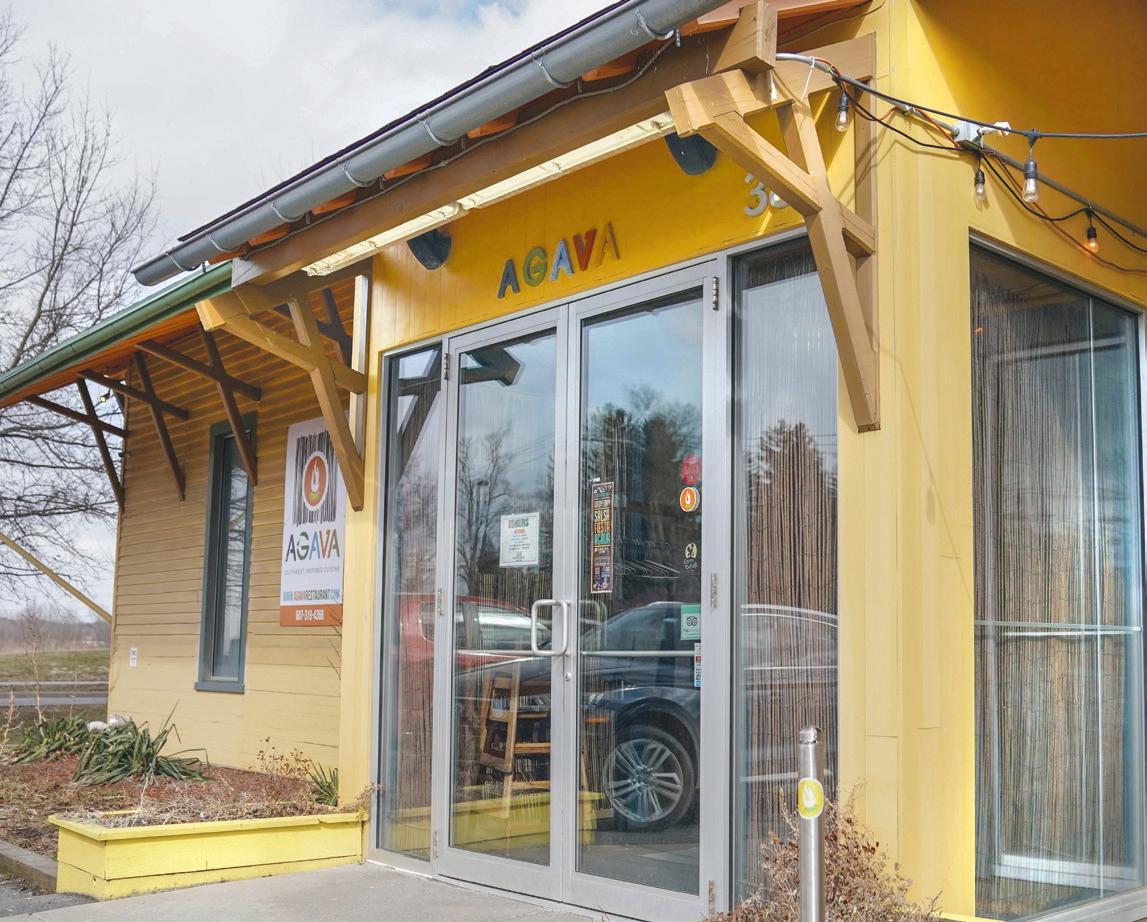
Agava Restaurant’s Salsa Night ended in panic after a stabbing critically injured two, including a Cornell student who intervened late Wednesday night.
The Tompkins County Sheriff’s Office responded to the scene around 11:50 p.m. on Wednesday, where police officers found two individuals who had been stabbed, a Tompkins County Sheriff’s Department press release said.
Nick Hudson ’20, the student
involved, is expected to make a full recovery, Maria Hudson ’78, his mother, told The Sun in a Thursday evening phone call. Maria was at the student’s hospital bedside late Thursday. Maria heard about the incident while in St. Louis –– a friend of Nick riding in the ambulance to the hospital contacted her while “holding pressure on [Nick’s] wound,” she said.
Nick did not know either of the individuals involved in the altercation, she said.
“[Nick] was fearing for his friends … He stepped in to push [the people fighting] apart,”
Maria said.
The other injured individual was Daquan Graves, 26, who is currently in “critical, but stable condition” at another regional hospital, according to the release.
Nick underwent one surgery on Thursday, and will undergo a second surgery on Friday, according to his father, William Hudson.
The suspect, who fled the scene, was described by the release as male, between 5’8” and 5’10”, in his late 20s to early 30s and wearing a black leather jacket at the time of the incident. In the

By BECKY HAN Sun Contributor
After graduation, many alumni find themselves holding onto their alma mater by keeping up with campus publications, attending college reunions or staying active in online alumni groups.
But for Peter Ang ’86, his love and growing interest for Cornell and its history manifests through his collection of school memorabilia overflowing the cabinets in his house.
Ang, who currently lives in his hometown of Kuala Lumpur, Malaysia, realized nearly three decades after leaving the Hill that he had barely any physical items to honor his time on campus.
“I never even bought a Cornell sweatshirt in my four years there. I left Cornell with one plastic mug ... on sale for $1.99.”
“I never even bought a Cornell sweatshirt in my four years there,” Ang said in an interview with The Sun. “I left Cornell with one plastic mug with the Cornell seal, which was on sale for $1.99 at the Cornell Campus Store.”
Peter Ang ’86
For the past five years, Ang, who was the first in his family to attend college, has been collecting various Cornell memorabilia, particularly those that reflect the University’s and the evolution of its seal.
Ang’s unique hobby began after a Hong Kong celebration of Cornell’s 150th anniversary in late 2014, when he realized that the University emblem he remembered from the 1980s had changed.
“No one knows about the seal, and it’s such an enduring legacy,” Ang said.
Monday, March 2, 2020

CBE Seminar Series: Insights From Molecular Modeling 9 - 10 a.m., 255 Olin Hall
Selves Among Others: An Artist’s Talk 11:15 a.m., 324 Tjaden Hall
Art Under Conditions of Oppression Noon - 1:30 p.m., Schwartz Center
Public Humanities in Practice 3 - 4:30 p.m., Guerlac Room, A. D. White House
Language Resource Center Seminar Series: Pathways to Language and Intercultural Proficiency 3:30 - 4:30 p.m., G25 Stimson Hall
Ithaca’s Green New Deal: Opportunities and Challenges, Svante Myrick ’09 2:55 - 4:10 p.m., 233 Plant Sciences
Workshop: Introduction to Market Research 4:30 - 5:30 p.m., 103 Mann Library
Abundance: Sexuality, Historiography, Geopolitics 4:30 - 6 p.m., 122 Rockefeller Hall

Your Head is Connected to Your Body 11:15 a.m., 324 Tjaden Hall
Computer-Aided Food Manufacturing 11:30 a.m. - 1 p.m., 122 Gates Hall
Integration of Multi-Omics Data for Modeling Drought Stress Response in Soybeans 12:20 p.m., 135 Emerson Hall
LEPP Joint Seminar: What is the Higgs Boson Hiding? 12:30 p.m., 401 Physical Sciences
Stop, Drop, Create: Drop-In Hours 3 p.m., mannUfactory Makerspace, Mann Library
Alternative Ecosystems: Finding Purpose and Creating Impact Across Disciplines in Higher Education 3:30 - 4:30 p.m., G24 Fernow Hall
Clarity or Chaos? The Democratic Primaries On Super Tuesday 4:30 - 5:30 p.m., 401 Warren Hall
Can We Achieve Health Equity Without Addressing the Criminal Justice System? 4:30 - 6 p.m., G70 Klarman Hall
Speak and Be Heard: Communication Tools For Career Success 4:30 - 7:30 p.m., 133 Rockefeller Hall
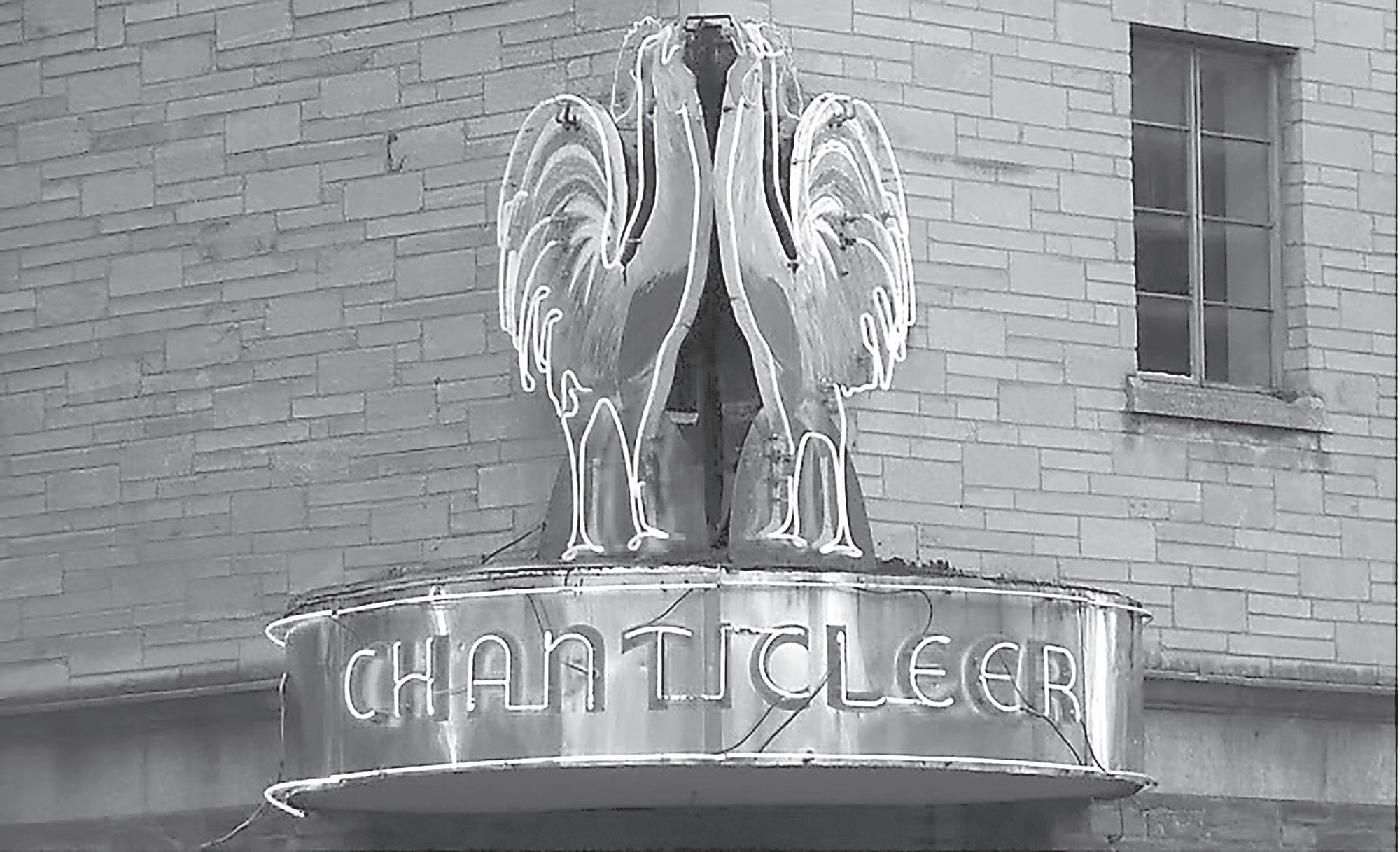
Fowl play | “Rich the Rooster” (above) has occupied his perch above the downtown bar’s entrance for decades. Its now empty roost is ruffling feathers with a GoFundMe raising nearly $7,000 to repair the beloved signage.
By ANIKA POTLURI Sun Contributor
Since its opening in 1946, local watering-hole The Chanticleer has long been synonymous with its distinctive neon signage.
For decades, “Rich the Rooster” occupied his perch above the downtown bar’s entrance, greeting flocks of college students, travelers and native Ithacans. But when the quintessential icon went missing in January, The Chanticleer’s now-empty facade did not go unnoticed by patrons long-accustomed to its watchful eye.
The removal of the quintessential signage was the result of building issues that were first identified last fall. According to Jeff Mazer, manager of The Chanticleer, attempted maintenance work on the awning revealed that the structure was “leaking and rotting from years of standing water and snow.”
As a result, professional repairs are needed to restore the concrete base and structure over the corner entrance. But the estimated bill of the project has now tripled, with the cost for restoring the structure and signage coming in at over $10,000.
“[The Chanticleer] tried to request funding from local groups, such as the Downtown Ithaca Alliance and Historical Society,” Mazer said, but was told that grant money was either unavailable or already allocated to other projects.
When attempting to secure funding for the restoration, The Chanticleer’s owners were advised to start a GoFundMe page. TJ Leonardo, daughter of Chanticleer owner Rich Leonardo, opened an online crowdfunding campaign on Feb. 20 — which so far has raised $6,934 of its $10,000 goal, as of Sunday night.
“We didn’t, as a family, anticipate the outpour of inquiry and support that we’ve gotten,” TJ told The Sun.
Support for the project has also come from those who have offered discounted services for necessary work on the rooster, including artist Amanda Mulholland and contractor Mike Snyder.
The Chanticleer, which has occupied the
Te philanthropist earns school’s highest alumni honor
By ALEK MEHTA Sun Contributor
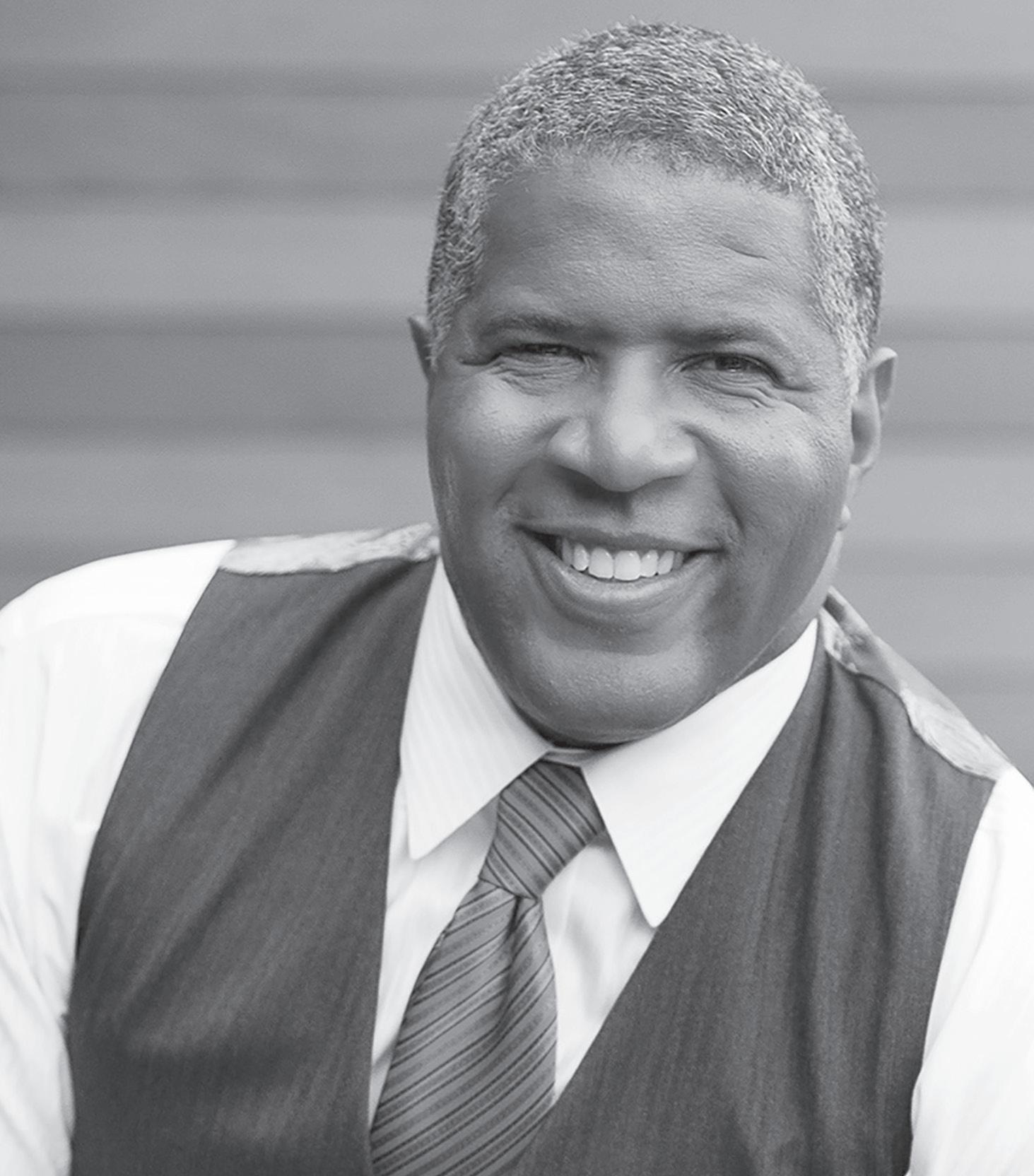
America’s wealthiest black billionaire and founder of private equity firm Vista Equity Partners, Robert F. Smith ’85 will be honored with the College of Engineering’s 2020 Distinguished Alumni Award in April.
The award — the college’s highest alumni honor — recognizes candidates who have demonstrated exceptional vision and leadership, exhibited a strong commitment to community and achieved success in their profession.
Smith was born and raised in Denver, before earning his bachelor’s degree in chemical engineering from Cornell.
corner of 101 West State Street since 1946, was first established by Frank Leonardo as a fine dining restaurant, who later passed ownership to Rich.
Over the decades, the eatery has undergone significant changes, evolving from its fine dining origins into a bar, now known for its jukebox, pool table and social atmosphere.
In the early years of the restaurant, the Leonardo family had matchbooks made for the restaurant with the inscription “you’re a stranger here but once.” According to TJ, the saying encompasses what The Chanticleer has meant to its patrons and the local community.
“People learn your name and know it the next time,” TJ said of her family’s business.
Many donations on the GoFundMe page are accompanied by comments describing The Chanticleer’s status as a landmark — which also has gained historic designation from the Ithaca City Landmarks Preservation Commision.
“Ithaca’s my hometown, and it just wouldn’t be the same without that rooster!” read one comment, while another alluded to “[l]ong ago college memories!”
“The Chanticleer and its neon facade are Ithaca icons — as are Rich Leonardo and his family,” wrote Steve Mount, a former bartender at The Chanticleer, who donated $1,000.
Early birds and night owls alike have been beckoned in by The Chanticleer’s neon rooster for over 70 years, and TJ acknowledged that Ithacans are eager to see the original signage reinstated.
Unfortunately, the project is contingent upon weather conditions, as a rubber membrane that needs to be added to the structure must be done when the temperature is around 50 degrees for several consecutive days.
Still, thanks to the outpouring of support, the owners are hoping to have Rich the Rooster back up with the crows by May 1 at the latest.
Anika Potluri can be reached at abp76@cornell.edu.

Goldman Sachs, where he advised on $50 billion worth of investments for some of the largest international tech companies. In 2000, Smith founded Vista Equity Partners, an Austin-based private equity and venture capital firm that specializes in backing software and tech-related startups. The company has amassed more than $52 billion in total investments, sporting a portfolio of more than 60 companies that collectively employ over 70,000.
Smith most recently made headlines
“I credit much to my career success to being an engineer by training. Engineers solve problems and fix things.”
“I have had the privilege of being a Cornell graduate with a degree in engineering,” Smith said in a 2016 statement. “I credit much to my career success to being an engineer by training. Engineers solve problems and fix things.”
That year, Cornell named the School of Chemical and Biomolecular Engineering after Smith following a $50 million donation.
“Robert’s gift creates an extraordinary opportunity for Cornell,” the late president Elizabeth Garrett said at the time of the announcement. “Not only will it sup-
Robert F. Smith ’85
for pledging an estimated $40 million to pay off the student loan debt of every Class of 2019 Morehouse College graduate. Calling it “a little fuel in your bus,” Smith made the surprise announcement during his 2019 commencement speech at the historically black college.
Other charitable contributions include $20 million to Washington D.C.’s National Museum of African American History and Culture, the single largest by any individual donor. In 2017, Smith became the first African American billionaire to sign the “Giving Pledge,” a commitment to eventually donate more than 50 percent of his wealth to charity.
The award ... recognizes candidates who have demonstrated exceptional vision and leadership [and] exhibited a strong commitment to community.
port a critical and rapidly expanding area of study … it will also allow the university to help address a national challenge: improving the representation of women and minorities in scientific research and development.”
Early in his career, Smith worked as an engineer for companies such as Kraft, Goodyear Tire and Rubber and later
For his philanthropic efforts, Smith received the Carnegie Medal of Philanthropy in 2019. The College of Engineering will formally present the award on Friday, April 24 at 4 p.m. at Statler Hall Auditorium in a public event that will feature remarks from President Martha E. Pollack.
Alek Mehta can be reached at asm327@cornell.edu.
AGAVA
Continued from page 1
security camera image of the suspect and a photo of the suspect’s blue Chicago Bulls hat.
Alice Navadeh ’21 had just arrived at Agava shortly before midnight with friends when the chaos erupted. The group was waiting to get their wristbands checked by a bouncer when a crowd of people began running toward the exit, Navadeh said.
Navadeh then saw a man in a bloody white undershirt run past her.
“I’d never seen anything like it before,” Navadeh said. “I’m honestly still pretty shaken up by it.”
Navadeh quickly alerted her friends in the Kappa Delta sorority, posting a warning in a GroupMe message.
Another Cornell student, Sarah Prokop ’21 was salsa dancing on the dance floor just before midnight, before the DJ cut the music.
Prokop said that people on the ground floor did not realize what had happened –– a group started a chant of “no music, no music!”
When the chant started, a bouncer instructed the people on the dance floor to be quiet because the situation was “serious,” and that emergency services were coming and that they needed to leave the premises, Prokop said.
Emergency services arrived quickly, including five police cars, an ambulance, a fire truck, K-9
dogs and high beams police lights, Prokop said.
Prokop said that they thought there had just been a bar brawl and that it wasn’t until later that they heard that there had been a stabbing.
Agava tweeted on Thursday morning that a personal dispute “resulted in two people receiving injuries.” The restaurant also stated that its private security company was on site at the time of the incident, and that the suspect fled the scene in a white Nissan Altima.
The car was found unattended in Lansing later that night, CUPD said.
A manager who answered the phone at Agava on Thursday declined to comment to The Sun.
Cornell sent a crime alert at 2:48 a.m. on Thursday to the campus community, saying that the Tompkins County 911 Center originally reported there were three individuals stabbed. At the scene, officers only found two individuals stabbed.
Cornell University spokesperson John Carberry released a statement on Thursday: “Cornell was notified by the Tompkins County Sheriff’s Department that a Cornell student was stabbed while attempting to intervene during an altercation at a local restaurant last evening. Our prayers go out to our student and to the second victim of the attack, and to their families and friends.”
Carberry encouraged anyone with information to reach out to the Sheriff’s Office.
Agava — located on Pine Tree Road, a mile and a half from Collegetown — reopened on Thursday for lunch and dinner “as usual.” However, Salsa Night will be canceled until police complete their investigation, the restaurant tweeted.
Salsa Night at Agava is a weekly late-night event, popular among Cornellians and Ithacans. Agava’s bar on Wednesdays remains open until 1 a.m., two hours later than on other nights.
Chris Sayers ’20, Daniel Farthing ’20 and Alec Hopping ’20 — who were all at Agava with Nick Wednesday night — followed the ambulance to the hospital, Maria said. The three declined to comment. The next morning, Sayers and Farthing brought Maria coffee and doughnuts as well as Nick’s car so she could get around.
Maria said that her son is “not like an aggressive person at all.”
“We’re proud that he wanted to make a difference in a situation where he saw he could make an impact,” William, his father, said. “But he paid a very harsh price.”
Sarah Skinner ’21 contributed reporting to this story.
Alec Guifurta can be reached at aguifurta@cornellsun.
Ari Dubow can be reached at adubow@cornellsun.com
By LIN AI Sun Staff Writer
The fate of Ithaca East Apartments was sealed last month during a public hearing of the Town of Ithaca Planning Board, which reviewed Cornell’s plans to demolish the complex housing professional and graduate students by the end of March.
The apartments, a string of townhouses which once housed 200 occupants, were closed to new tenants last fall because of mounting maintenance costs. The demolition is expected to last between 8 and 12 weeks.
First opened in 1972 after Cornell transferred the land to a local housing developer, the 82-unit facility was rented out to residents of low-middle income levels for 40 years, Bruce Abbott, the former owner of the complex, told the Ithaca Journal. During this period, the apartment complex was maintained under state and federal rent control.
But in 2013, the complex was converted to a mix of student and low-income housing — and as a result, property taxes and maintenance costs skyrocketed.
“I can no longer personally subsidize the property,” Abbott said. “Add to that the age of the buildings and the increased cost of repairs and replacements, and I concluded that this is the time to bow out gracefully.”
As a result, Abbott agreed to vacate and return the property back to Cornell, nine years earlier than the planned 2028 hand-off.
However, prior to the University regaining ownership of the complex, Cornell learned that “the operating cost associated with the aging site was extremely high,” according to Jeremy Thomas, Cornell’s senior director of real estate, who described the site as being in poor condition.
Citing deteriorating facades, the presence of asbestos in interior building materials, a burnt out unit and a number of other code violations, Thomas said that “given the property’s condition, reuse of the existing facilities is not feasible.”
The ultimate fate of the site, however, is still not set in stone. While Cornell has been in talks with a number of developers — possibly with the goal of constructing graduate student housing — it is unclear whether such a project would be financially viable, at least in the near-term.
“The economics of such a project are challenging, and Cornell simply does not know at this time whether this potential development, another potential development, or no development at all will occur,” according to the University.
By YIFEI WANG Sun Contributor
In the past two months, the novel coronavirus, now often called COVID-19, has infected over 70,000 people in China, continuing to spread rapidly as it makes inroads in the U.S. — which, on Sunday, reported its second fatality from the disease.
While it has not yet been declared a pandemic, the effects of the virus have been seen worldwide in slowing factory output and a contraction in the services sector, raising concerns about the economic impact of the coronavirus.
Reflecting those intense anxieties, American markets saw historic turmoil last week. Erasing nearly $6 trillion in equity, the S&P 500 saw its worst week since the 2008 financial crisis, while the Dow Jones lost a record 1,190.9 points.
But as the second-largest economy and responsible for nearly 20 percent of the world’s total exports, the current Chinese economy is especially vulnerable to the outbreak. Due to strict travel restrictions and containment efforts aimed at halting the disease, China’s manufacturing has reached record lows — affecting millions of consumers and businesses that rely on the nation’s production.
“China is sufficiently important in the global economy today that others are bound to feel the strain,” Prof. Kaushik Basu, economics, told The Sun.
But within its borders, China’s increasing reliance on the purchasing power of its middle class to fuel growth has put the nation at particular economic risk.
“Compared to 70 years ago, today’s China has a consumption-driven economy much like the U.S.,”
explained Prof. Yongming Hong, economics. “The coronavirus will not only have an immediate effect on the service sector of the Chinese economy, but also influence other countries that rely on Chinese visitors.”
For instance, millions of Chinese people shop for gifts on the Lunar New Year — which this year fell in late January just as coronavirus began gaining a nationwide foothold — typically generating well over $100 billion in sales. But such consumer activity has been severely limited following the virus’ onslaught.
As a result, the long-term financials of some businesses may be in jeopardy, as the coronavirus continues to reduce the amount of capital flowing into China — continuing a trend that had already been exasperated by a years-long trade war with the U.S.
“The more serious challenge comes from the supply chain,” Hong said. “For example, Hyundai and Toyota have temporarily discontinued their production in China. If the coronavirus drives them to transfer their companies to other countries, it will be difficult for China to get them back.”
To proactively protect themselves from these economic risks, many businesses have started to implement damage control. Companies like Apple and Microsoft, for example, have already issued warnings to investors about not meeting projected earnings figures.
Moreover, according to Basu, banking giant HSBC plans to cut 35,000 jobs, while the global airline industry is estimated to lose 30 billion dollars this year.
While the struggle of certain sectors, like the airline industry, come as no surprise amidst a worldwide outbreak, Basu also expressed concern that there will be a “possible cascad[ing]” effect of the coronavirus.
For instance, “the airline industry doing badly
MEMORABILIA
Continued from page 1
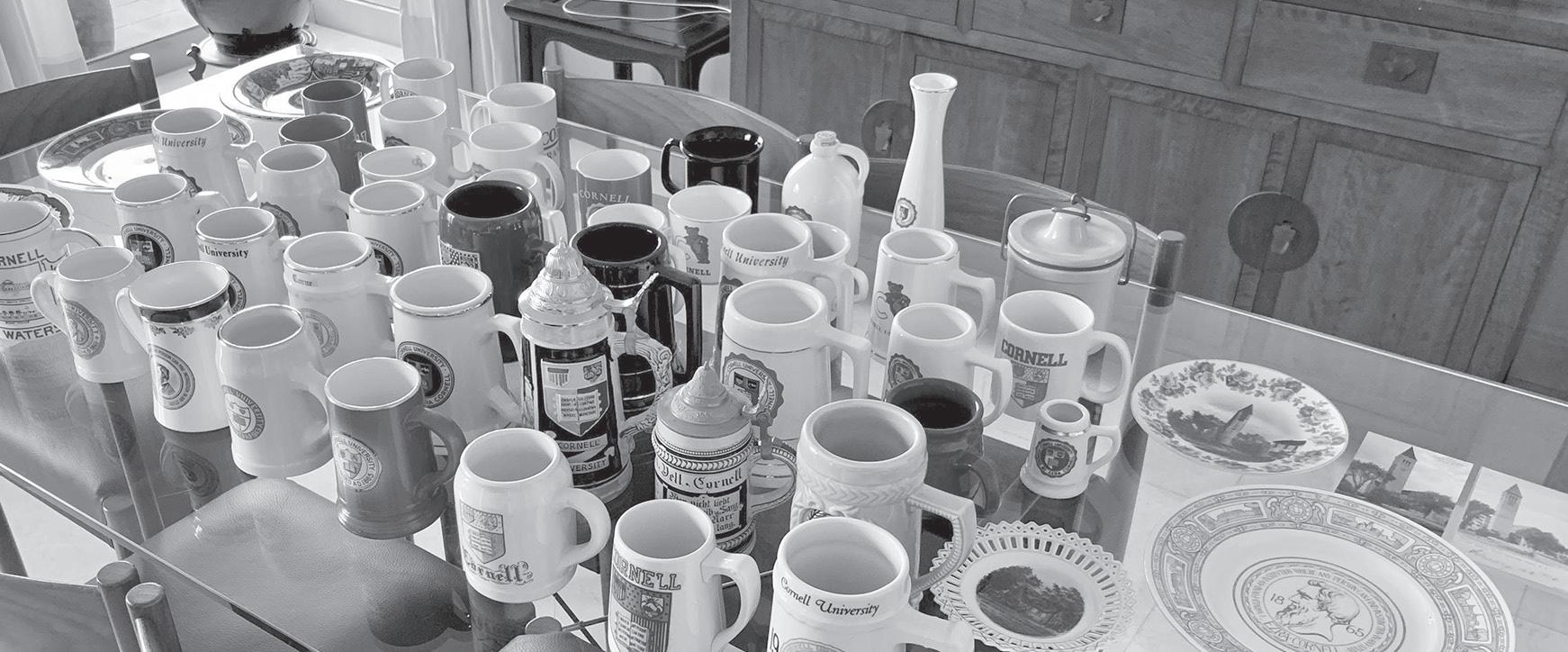
His collection has grown to include vintage mugs, seals, pins, medallions, fob pendants and plates displaying each iteration of Cornell’s 150-year-old seal. He also boasts an autobiography excerpt from Andrew Dickson White addressed to the University co-founder’s great-grandniece.
His daughter Ginger Ang ’21, now a Cornellian herself, estimated that the total collection is worth tens of thousands of dollars. But Ang himself isn’t sure of its total worth, having never counted it up because “my wife and daughter [would] kill me.”
Ordering items from the Internet or directly from previous owners, Ang said the most expensive part of the process was often not the price of the object itself, but high shipping costs.
“It’s a long journey these things have travelled,” Ang said. “One even ended up in India.”
Because Ang is more interested in the story behind the objects than just their appearances, he develops extensive notes for every single piece — a sometimes arduous process of tracking each item’s provenance and date.
Once, Ang even consulted Cornell postcards to track the growth of trees and ivy in the background of a plate’s engraving. He eventually figured out that the plate was from the early 1900s, as the exterior of McGraw Tower depicted on the plate had not changed.
Much of the memorabilia in his collection are hand-engraved and hand-made — intricate details that he says reveal so much about the history of the United States. For instance, Ang
described how the seals — and changes in the origin of their “Made In” production labels — over the years trace the rise and decline of American manufacturing.
“It’s really sad,” An g said about the current state of U.S. production. “America made amazing things, beautiful things, and now they don’t make anything.”
Ang believes that his collection is the largest collection of memorabilia related to Cornell seals in the world, and one of the only significant collections of Cornell memorabilia outside the U.S.
“Collecting things is for the story, it’s not the thing,” Ang said. “The thing only tells the story, and that’s the real value of collecting.”
Despite being an engineering student, Ang mentioned that the college that had the greatest influence on him during his undergraduate years was the College of Arts and Sciences. There, he found an interest in art history, which helped him realize that art enables one to understand history, the world and people.
Ang, who is currently retired from a job in finance, keeps most of the memorabilia on a cabinet or tucked away in custom-made wooden boxes, with the intention of one day shipping them back to Ithaca to give to the University.
“You’re not buying an expensive watch or jewelry or a gold bar. It’s a mug, for most people,” Ang said. “But it’s for the love of Cornell and the history of Cornell and the history of the United States.”
Becky Han can be reached at bh449@cornell.edu. .
adversely affects the catering industry, which in turn, can impact farmers.”
Echoing America’s nervous investors, China’s financial markets have also reflected the uncertainties of these concerns. According to Prof. Will Cong, finance, the outbreak has worsened a stock market that has already been “lukewarm” since April 2019, causing the Shanghai Composite to drop more than eight percent in one day.
However, Cong suggested that patience may be the best remedy to quell stock market fears.
“I personally expect the stock market to rebound and correct over-reactions to the coronavirus problem. The harder question is when,” Cong said. “If it is just as severe or becomes more severe, then that would be a big issue for both stock markets and the economy.”
And despite the negative consequences of the coronavirus on the Chinese economy, Hong nevertheless pointed towards possible positive effects, positing that new industries such as automation and remote-conferencing may see growth as employees are increasingly asked to work from home.
Case in point, the stock price of online video conference company, Zoom, doubled since the coronavirus outbreak.
But whether or not these consequences play out completely, or turn out to be ephemeral swings in the long term, is still unclear.
“We have not seen the end of the pandemic and still do not know what course it will take,” Basu said. “Once this is behind us, we have to use this as a lesson to build a stronger future.”
Yifei Wang can be reached at yw847@cornell.edu.
Friends of Farmworkers and Climate Justice Cornell stage teach-in at Willard Straight
of Farmworkers, expressed worries that these laborers would disproportionately bear the brunt of climate change.
Qatar campus.
“The fact that Weill is in that city is a pretty big indicator that the same types of exploitation is happening on that campus,” Cintron said. “It is pretty suspicious that in the past and currently, Cornell has refused to do a third party investigation for the labor conditions.”
“The people who will be affected most by climate change are the most vulnerable,” Engel said. “Working with farmworkers, you can see how vulnerable they are.”
According to a December report by the Union of Concerned Scientists — a non-profit climate advocacy group — higher temperatures will exacerbate the heat stress risks that farm workers already face.
“There have already been hundreds of deaths due to heat rise. It is contributing to the already bad labor conditions.”
Angeliki
In 2016, the Student Assembly passed a resolution, urging Cornell to address concerns with labor issues in Qatar and expressed frustration that the administration failed to fully acknowledge the issue at the time. In 2015, the administration declined the suggestion of a third party investigation.
Cintron sees climate change as potentially exacerbating labor concerns with Cornell’s Qatar campus.
“In Qatar, climate change has caused a real rise in temperatures,” Cintron said. “There have already been hundreds of deaths due to heat rise. It is contributing to the already bad labor conditions.”
Other activists spoke about labor issues closer to Cornell’s Ithaca campus, including the challenges faced by upstate New York farmworkers. Nancy Engel ’20, the tutor coordinator for Friends
Cintron ’22
CJC has staged five demonstrations this semester over climate change and related issues.
On Feb. 13, they supported a demonstration protesting a proposed Canadian pipeline — in solidarity with Wet’suwet’en people who did not want a pipeline on their ancestral land — and Cornell’s investment in fossil fuels.
For the remainder of the semester, CJC plans to “disrupt business as usual” and stage other protests to pressure the University to divest from fossil fuels. Since the spring 2020 semester started, three University assemblies have already passed resolutions supporting fossil fuel divestment.
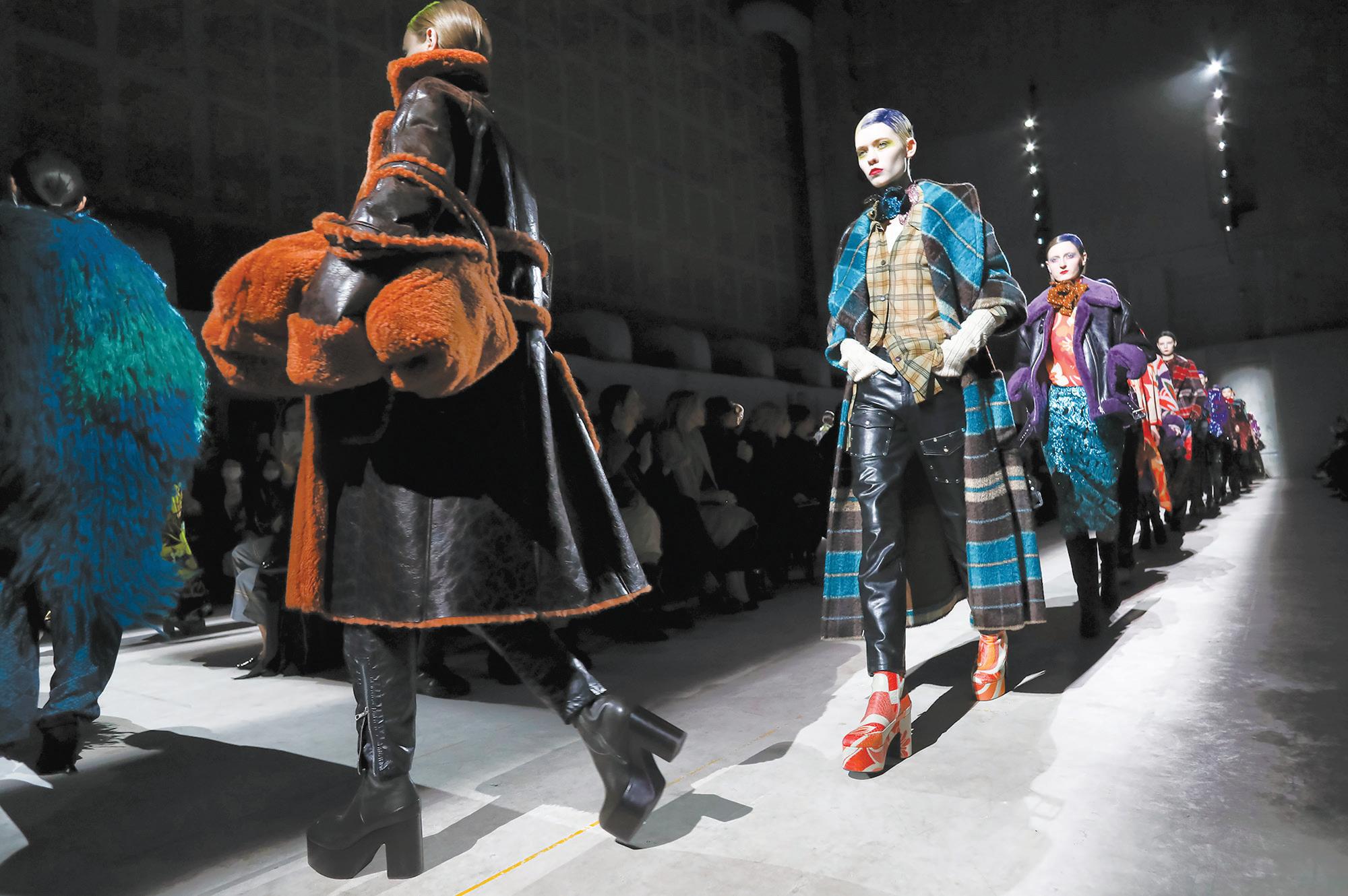
Ruffled collars, puffed sleeves and … face masks? Yup, it’s Fashion Week, and amid the hustle and bustle of runway shows and street style, overshadowing news that Raf Simons will join Miuccia Prada as co-creative director of her eponymous brand or that Kanye West held a surprise Sunday service at Paris Fashion Week, there’s one word that’s been on the tips of everyone’s tongues: coronavirus.
At Milan Fashion Week, in light of the emergence of several cases in Italy — especially in the Lombardy region, of which Milan is the capital — Michael Kors and the National Chamber of Italian Fashion had to cancel their events, and Giorgio Armani canceled his show last-minute, opting instead to livestream it. Others, though, like Hugo Boss and Dolce & Gabbana forged ahead. In Paris, Dior’s Maria Grazia Chiuri made a statement in reference to the virus in the show notes, and Dries Van Noten’s show offered free face masks to attendees outside its entrance in addition to providing hand sanitizer inside the show, while several other designers canceled their shows altogether.
However, in the midst of all this fear and anxiety (not to mention the ominous threat of an estimated $43 billion loss of revenue as Chinese customers remain at home), the face mask has emerged as an unlikely fashion statement. On Instagram, celebrities like Bella Hadid, Kate Hudson and Gwyneth Paltrow have posted face mask selfies on airplanes en route to Paris (predictably, Paltrow’s mask costs around $100 and is currently sold out), and face masks can be spotted in front
rows and as attendees pose for photos outside of shows.
Face masks have also made it onto the runway itself. At the Marine Serre show in Paris (which was designed before news of the outbreak came out, with the masks intended for “anti-pollution” usage), models could be seen in sophisticated plaid and floral ones. There were also rather less conventional full-coverage knit pieces and veil-like garments that encased the entire head. In an interview with Vogue, Serre said that she wanted her garments to feel “both feminine and tough and protected at the same time,” a sentiment that has since taken on a new, more portentous meaning.
As a fashion item, though, face masks are no new thing. In Europe, doctors once believed that illness was caused by “bad air,” donning strange, bird-like, beaky facial accoutrements to protect themselves. While we associate these with the Black Plague, they were actually invented in the 16th, not 14th century, by Louis XIII’s chief physician. Part of what was perhaps the world’s first hazmat suit, these masks contained dried flowers and herbs in the beak, meant to further keep out “miasma.” Today, however, what was once used seriously is now worn as a costume at the Carnival of Venice and associated with commedia dell’arte.
Outside of their anti-epidemic usage, masks have played an important cultural function in rituals and ceremonies. They might aid the wearer in connecting with both divine and animal worlds, providing a liminality between the human and non-hu-
man, and suspend temporarily the norms of everyday behavior and social convention.
Surgical masks as we now recognize them emerged at the turn of the 20th century. In a historical anthropological study of the 1910-1911 Manchurian plague, researcher Christos Lynteris states that face masks associated with illness are “potent symbols of existential risk.” More than simply offering protection from sickness, they allowed wearers to perform “medical reason and hygienic modernity,” showing the triumph of man over mortality, our emergence from a dim, shadowy past of ignorance and illness.
Both on the runway and on Instagram, usage of the mask is undoubtedly performative. But it’s worthwhile considering what exactly that performance says. In the caption of her post, Paltrow made a joking reference to her film Contagion — “I’ve already been in this movie” — followed by an advisory to “stay safe” and
“wash hands frequently,” resulting in sort of Insta-equivalent of nervous laughter. Kate Hudson wrote, “Travel. 2020.” Bella Hadid, disconcertingly enough, had no caption at all.
Though celebrities were criticized by experts who say face masks don’t actually do much and that promoting hand washing would be far more effective, these posts serve as telling encapsulations of our current global mood of anxiety and ambivalence. Face masks no longer suggest the conquest of reason but rather our humbling mortality even in the face of great human medical and technological achievement, a kind of memento mori. Moreover, it seems that in an era where anything serious is liable to become a meme, all we can really do is laugh nervously.
Ramya Yandava is a junior in the College of Arts and Sciences. She can be reached at ryandava@cornellsun.com. Ramya’s Rambles runs alternate Thursdays this semester.
Kitty Green’s The Assistant takes an unexpected approach to revealing a woman’s plight in the workplace. Following the narrow perspective of an office assistant at a New York City movie production company (modeled after Miramax), The Assistant is almost disturbingly quiet where it could easily be loud and explicit about its source material. The boss at this company — modeled after convicted sex offender Harvey Weinstein — is never seen or named, but his dark presence is still felt prominently throughout the move. His voice can be heard manipulating women behind doors and yelling at Jane, the film’s main character, over the phone.
The Assistant is restrained
almost to a fault. With very little dialogue, a relatively stagnant plot and no emphasis on entertainment value, this film is so realistic that it might leave some movie goers expecting more. The Assistant follows Jane from the moment she wakes up, until she walks home from work at the very end of one terrible work day. After nearly half an hour of watching, Jane (Julia Garner), wash dishes, make copies, talk on the phone and sweep up pastry crumbs, I couldn’t help but wonder what the hell the point of this movie was.
However, after watching the pivotal scene where Jane talks to a male HR representative about her concerns about the young women that come in and out of her boss’s office throughout the day, the reason I had just watched Julia Garner pretend to file and make appointments for
half an hour started to become clear. The Assistant is a study on all of the little ways that women experience the workplace differently than men, and how these little moments culminate into something much bigger. Jane is
“The Assistant is a study on all of the little ways that women experience the workplace differently than men.”
Jean Cambareri ’22
not a victim of her boss — she is “not his type,” as the seemingly friendly HR representative puts it bluntly, but she is still enormously affected by the power dynamics that poison this office.
The Assistant does not show the strife of women in the work-
place through lengthy monologues and explicit rape scenes, but rather it is shown in the way that Jane doesn’t take off her scarf until the the HR representative asks her to, or the way that she keeps her bulky coat stuffed in her desk drawer, while all of her male collegues hang theirs up on the coat rack. It is shown when she is left out of inside jokes and plans made by the fellow assistants in her office and it is apparent in the way she stands silently by her male colleague’s desk, waiting for him to notice her before speaking.
This film’s power is in the way it depicts the vulnerable feeling of being a woman who feels alone. Julia Garner is perfect in this role as she nails the uncomfortable body language and facial expressions of a young woman who is made to feel completely unsure of everything she does. Jane feels
completely alone in this new position, just as she feels alone with the knowledge that her boss’s predatory behavior should not be swept under the rug.
The Assistant ends abruptly, with Jane starting her walk home from work after stopping for a muffin and wishing her father a happy birthday a day late. It leaves the viewer to assume that this film is simply a microcosm of what would go on every single day at a place like Miramax and many companies like it. Jane would never report her boss again, she would get promoted and continue working there until she didn’t have to anymore, and her boss would continue to get away with it.
Jean Cambareri is a sophomore in the College of Agriculture and Life Sciences. She can be reached at jc444@cornell.edu.
of life’s many hardships, you can keep moving forward with the mantra, “strictly speaking, I’m still on track.”
Since his 2015 release of Currents, Tame Impala has achieved an incredible level of crossover appeal. Currents was psychedelic enough to appeal to prog and alternative rock fans, mild enough to attract a broader pop audience and even pulled in listeners from the hip hop and techno communities due to its punchy basslines and inventive synths. It’s fair to say that The Slow Rush had plenty of lofty expectations by a diverse group of music fans to live up to.
While The Slow Rush offers an engaging atmosphere and some fantastic emotional and nuanced moments, it ultimately fails to live up to the expectations set by Currents, although I believe it is unfair to expect that it would. Unfortunately, it also has significant drawbacks that hurt the overall effectiveness of the album.
On first listen, The Slow Rush has many satisfying moments. I enjoyed the carefree and catchy vocal lines and punchy, Kanye-like horns on “Instant Destiny,” the dreamy piano tones and optimistic lyrics on “Breathe Deeper” and the thick grooves on “It Might Be Time.” These are all solid tunes that play to Tame Impala’s musical strengths. I particularly enjoyed “Borderline,” one of the singles for the album that was released last April. It features rhythmic guitar stylings, a plucky vocal melody and a clairvoyant kick and snare beat that cuts through the spookiness and anxiety of the lyrics.
While Tame Impala is known mainly for his creative sound play, The Slow Rush surprisingly distinguishes itself with the vulnerability and emotion displayed in front man Kevin Parker’s lyrics. “Posthumous Forgiveness” capitalizes on a searing, epic instrumentation by pairing it with an intense narrative progression. Parker challenges his distant father figure, uncertain of his whereabouts or even if he is still alive, but ultimately offers his forgiveness. On the other side of the emotional spectrum, Parker exudes optimism on “On Track.” Once again, the musical composition and arrangement emphasizes the dramatic lyrical moments of the song to great effect. Parker lightheartedly reassures us that even in the face
Despite these moments that I greatly enjoyed, The Slow Rush is not a cohesive album. As much as “Posthumous Forgiveness” provided one of the most emotional performances on the album, it failed to live up to its potential. The song ends with a lengthy instrumental passage where several synth and guitar layers build the emotional climax, only to fizzle out with no catharsis. This is exactly the kind of moment that Currents would have capitalized on with an iconic guitar or synth solo; but this opportunity was not seized. As a result, the final emotional impact did not stick with me as strongly as it could have.
With the exception of “On Track,” the second half of The Slow Rush is weak. It does not offer any significant songs. There is a significant amount of material that should have been cut from this album, including standalone songs such as “Glimmer” and snippets of songs found in the final minutes of other tracks. These feel like undeveloped musical ideas that Parker could not bear to cut but bloat the album significantly to a runtime of just under an hour. Parker is on record as saying, “I like to imagine the part [of Breathe Deeper] at 4:37 is a sample of a song that exists in full somewhere in a parallel universe.” While this is a fun concept, the album does not explore themes of alternate realities, leaving the audience confused as to the meaning of this material. To me, it seems to be an excuse to preserve material that Parker felt connected to but should never have made it into the final album.
I don’t believe Tame Impala was ready to release a new album. You would think that five years would have been enough time for Kevin Parker to write enough quality material for The Slow Rush. Looking at his final track list, there is way too much fluff.
While there are some real gems on this album that I will listen to for years to come, The Slow Rush is not a musically or narratively complete project, falling short of Tame Impala’s standards, much less the legacy set by Currents



Hallowed by indie devotees for silky techno rhythms and dreamy synths, listening to Tame Impala is a lot like what I imagine those Stranger Things sensory deprivation tanks would be like. My dad says it’s “trippy,” I say it’s “soothing,” but to each his own.
Tame Impala released his first EP over 10 years ago and has since created music ranging from spacey to spirited. With bold anthems like “The Less I Know the Better” and “Feels Like We Only Go Backwards,” he is a staple for “left-of-center” listeners and has headlined shows across America, the United Kingdom and Australia. Much of Tame Impala’s musical aesthetic is slightly existential, contemplating personal development and bending the boundaries of space and time. In this way, he voices the questions that we spend much of our adolescence trying to answer, garnering vast following of young listeners in the process.
The Slow Rush, which dropped on Valentine’s Day, is the newest album to the collection. With 12 tracks, it’s a serendipitous amalgamation of all the best features of Tame Impala. It’s got the subtle bops he’s known for and the
powerful, hard-driving melodies that earned him a spot on my “hall of fame” playlist. I usually rely on Tame Impala to keep me awake while I’m reading, and this album’s got just enough “slow” to keep me in my chair and enough “rush” to get me excited about my stats homework.
Unfortunately, the best track on the album is one we’ve already heard. Released as a single last year , “Borderline” is utopian and exhilarating — with lyrics like “Will I be known and loved?” and “Is there one that I trust?” that make identity crises sound cool. It’s the one of the few songs in the group that make you want to bob your head really vigorously in the library, and that’s quite honestly what I’m looking for when I queue up Tame Impala.
“Lost in Yesterday” is a close second, already garnering over 19 million streams on Spotify. With a bouncy downbeat and a catchy chorus that you can actually understand, it’s the perfect tune for rocking out in your room at weird hours of the morning.
“Breathe Deeper” takes the bronze, anchored by a simple yet solid keyboard strand and lyrics that are just the right level of repetitive. The vibe is half intergalactic and half 1980s piano bar, and the result is a piece that both pulls you into the future and makes you feel
reminiscent about the past. The longest song on the album is “One More Hour,” rolling in at a preposterous seven minutes and 13 seconds. (If you need a frame of reference, that’s over a minute longer than “Bohemian Rhapsody,” which is an arguably much more exciting way to spend five minutes and 55 seconds.)
The shortest song, “Glimmer,” has a groovy beat and sounds like something you’d hear when you’re walking through a high-end department store, but at 2 minutes and nine seconds, it’s over before you blink.
“It Might Be Time” is a personal least favorite, sounding frankly cacophonic as we hear vocals over aggressive drums over something that sounds like a power drill. For the stark chill-ness that is a key piece of what sets Tame Impala apart, this song is really just a bit too much.
On the whole, The Slow Rush is an excellent showcase of Tame Impala’s strengths, with only a few minor drawbacks. It’s the ideal soundtrack for philosophizing, focusing or feeling all the feels, with tracks that’ll feed your wild side and your wallowing side.
Independent Since 1880 138th Editorial Board
MARYAM ZAFAR ’21
Rochester, N.Y.
Editor in Chief
JOYBEER DATTA GUPTA ’21
Kolkata, West Bengal, India
Business Manager
PETER BUONANNO ’21
Charlotte, N.C.
Associate Editor
MEGHNA MAHARISHI ’22
Montclair, N.J.
Assistant Managing Editor
CHRISTINA BULKELEY ’21
Boston, Mass. Sports Editor
BORIS TSANG ’21
Plano, Texas Photography Editor
AMBER KRISCH ’21
Brewster, N.Y. Blogs Editor
EMMA ROSENBAUM ’22
Toronto, Ontario, Canada Science Editor
ARI DUBOW ’21
Brooklyn, N.Y. City Editor
CAROLINE JOHNSON ’22
Huntington, N.Y. News Editor
KATHRYN STAMM ’22
Evansville, Ind. News Editor
PALLAVI KENKARE ’21
Atlanta, Ga. Opinion Editor
MIKE FANG ’21
San Jose, Calif. App Editor
CATALINA PEÑEÑORY ’22
Jakarta, Indonesia
Assistant News Editor
MADELINE ROSENBERG ’23
Chappaqua, N.Y.
Assistant News Editor
LUKE PICHINI ’22
Dresher, Pa.
Assistant Sports Editor
HANNAH ROSENBERG ’23
Chappaqua, N.Y.
Assistant Photography Editor
DANIEL MORAN ’21
Matthews, N.C.
Assistant Arts & Entertainment Editor
ANNABEL LI ’21
Cupertino, Calif.
Assistant Money & Business Editor
LEI ANNE RABEJE ’22
Ossining, N.Y. Layout Editor
JOHN MONKOVIC ’22
Ardsley, N.Y.
Multimedia Editor
From the Editor
JOHNATHAN STIMPSON ’21
Darien, Conn. Managing Editor
KRYSTAL YANG ’21
Shanghai, China Advertising Manager
JASON HUANG ’21
College Point, N.Y. Web Editor
NIKO NGUYEN ’22
Fremont, Calif. Design Editor
JOHN COLIE ’23
West Paterson, N.J. Blogs Editor
ANIL OZA ’22
Queens, N.Y. Science Editor
BENJAMIN VELANI ’22
Minneapolis, Minn. Dining Editor
ALEX HALE ’21
Cumberland, R.I. News Editor
SEAN O’CONNELL ’21
Brooklyn, N.Y. News Editor
EMMA PLOWE ’23
West Nyack, N.Y.
Arts & Entertainment Editor
MAIA LEE ’21
Yorba Linda, Calif.
Money & Business Editor
OLIVIA WEINBERG ’22
Briarclif Manor, N.Y.
Assistant News Editor
MEGHANA SRIVASTAVA ’23
Plainsboro, N.J.
Assistant News Editor
EMILY DAWSON ’21
Ithaca, N.Y.
Assistant Sports Editor
BEN PARKER ’22
New York, N.Y.
Assistant Photography Editor
DOMINIC LAW ’22
Hong Kong
Assistant Dining Editor
BRIAN LU ’23
Taipei, Taiwan
Assistant Arts & Entertainment Editor
ALICIA WANG ’23
Fayetville, N.C. Graphics & Sketch Editor
MEI OU ’22
Brooklyn, N.Y. Production Editor
ANYI CHENG ’21
Palo Alto, Calif. Compet Manager
WINNY SUN ’20
Vancouver, B.C., Canada Newsletter Editor
FOR THE 138TH TIME, The Sun elected yet another cast of editors and managers to attempt the wondrous and daunting task of steering this newspaper. I can proudly say that we are here to work for you; we will continue to unfurl facts, to showcase stories, to amplify voices and to highlight every inch of Ithaca and the Cornell community.
The 137th board saw immense section growth — departments across the board can proudly say that their hard work, impeccable attitude and countless late nights paid off in ways we couldn’t have anticipated a year ago.
We’ve been here, rain, snow or shine, to keep you informed since 1880. And rest assured that the 138th board will continue to do so in creative ways. As the journalism industry hobbles to anchor communities together, know that The Sun will always prioritize the content that informs and expands the discourse thoughtfully and diligently. Support us as we do so: read cover to cover, scroll headline to footer, offer us constructive feedback and challenge us to be better. We thank you for your support as The Sun maneuvers through the ever-changing media world; we appreciate our roots, and are excited to explore the future. The 138th board is equipped and eager to embrace the unpredictable upcoming year.
After nine hours and 18 minutes, three boxes of Krispy Kreme donuts, a couple hot wings and a few Bang! Energy drinks, The Sun has elected its 138th editorial board. Over the past six weeks, the new Sun editors have eaten one metric ton of Taste of Thai and have learned that punctuation goes inside the quotation mark. But most importantly, they have become confident leaders with a unique vision for The Sun. They intend to work ever-so-diligently to put a copy of The Sun in your hands.
Taking the helm as editor in chief in our 140th year of publication is Maryam Zafar ’21. Maryam is stepping down from her post as city editor to lead the paper to infinity and beyond. Word on the street is that Maryam has never sat in a chair; she prefers the floor. No one knows why, but it’s weird, and we love it.
Long gone are the days of horribly reporting on the four quarters of hockey for Johnathan Stimpson ’21. He will be the supreme overlord of the objective departments, a job fitting for his status as a self-proclaimed energy drink enthusiast. When asked for a comment on his energy drink addiction he said, “I don’t even read the labels — I just pick the ones with the most caffeine and drink that.” NYU dropout and best-dressed Meghna Maharishi ’22 will join Johnathan in leading the newsroom. She wears a lot of flared pants and has some really cool earrings; cries to open up a shop on etsy have gone unheard.
Associate Editor Peter Buonanno ’21 is currently trying to come up with funny things to say for this editorial. He wears a lot of hats, mainly because his hair game is weak. Peter will be joined at the wheel of the opinion department by opinion editor Pallavi Kenkare ’21 who is the cooler of the two. Joining The Sun just last semester, she has never tried Taste of Thai … but she will.
Since we continually break Wordpress, web editor and gatekeeper of the passwords Jason Huang ’21 will be there to make sure things stay running smoothly and elevate The Sun’s digital presence.
Design editor Niko Nguyen ’22 is planning to take Sun design to new heights with layout editor Lei Anne Rabeje ’22. Staying the latest is the too-patient production editor Mei Ou ’22. Everyone still wants to be best friends with graphics editor Alicia Wang ’21. They are going to Marie Kondo the heck out of our paper, and we can’t wait.
Sports editors Christina Bulkeley ’21, Emily Dawson ’21 and Luke Pichini ’22 are still trying to clean up the mess that Stimpson left for them when he was a sports editor many winters ago. All sports editors are transfers, which just goes to show how good our hockey team is.
News editor Sean O’Connell ’21 has been wearing the same bright orange beanie for the past month, but he insists he’s not in Climate Justice Cornell. Alex Hale ’21 is also a news editor, and would like you all to know that he studied abroad in Ireland. Long Island native Caroline Johnson ’22 is elusive and none know anything about her other than the fact that she travels extensively and kicks ass at news. Kathryn
Stamm ’22 is wonderful, and it’s probably because she was raised in Indiana. Joining them in the news department are assistant news editors Cata “I’m not from here” Peñeñory ’22, Meghana “I’ll write that for you” Srivastava ’23, Madeline “SunStyle” Rosenberg ’23 and Olivia “I do graphics, too” Weinberg ’22. OH! I almost forgot about city editor and Sun hunk Ari Dubow ’21.
Emma Rosenbaum ’22 and Anil Oza ’22 will be science editors for the next year. Emma is always drinking some sort of caffeine (coffee, tea, yerba literally anything). Anil’s dream is to become Bill Nye ’77. Unfortunately for him, he has expressed that he is unable to learn how to tie a bow-tie.
Next up, photo editor Boris Tsang ’21 will be returning for a third year of pain and saving our derrieres on photos. Ben Parker ’22 is back as assistant photo editor this year. He currently holds the title for best Ben Parker on The Sun. Hannah Rosenberg ’23 will be joining this rag-tag team as the other assistant photo editor. She claims to be the cooler Rosenberg twin, but we’ll let you be the judge of that.
John Colie ’23 will be joining Amber Krisch ’21 as a blogs editor, finally doing something useful with his time at the Sun other than trying to verify frighteningly specific facts nobody needed to hear. Amber will remain a shining ray of hope in the blogs department and pray that John won’t publish anything too outlandish.
Arts editor Emma Plowe ’23 is planning a sun concert. Please Venmo The Sun for a ticket; she’s planned a great event! “Sk8r boy” Daniel Moran ’21 is returning as an assistant arts editor, and he will be joined by freshman boy wonder Brian Lu ’23.
Maia Lee ’21 and Annabel Li ’21 are going to teach us all a little bit more about how to spend, save and invest money as they help kickstart The Sun’s newest section, money and business.
Did you see that new Sun video? Thank John “Tarantino” Monkovic ’22. There’s a Sun Oscar in his future for sure.
Some of you may remember Anyi Cheng ’21 for her work with the news department, but she will now be taking over our recruitment. Her social competence astounds us every day — join The Sun so you can meet her.
Our most senior board member is newsletter editor Winny Sun ’20, who single handedly ensures that the news gets delivered right to your inbox — and always with a smile.
The single most competent person on The Sun, Joybeer Datta Gupta ’21, will continue to try and make us money. And Krystal Yang ’21 has the unfortunate position of trying to fill our pages with advertisements.
The ever elusive Mike Fang ’21 will be in charge of our iPhone app.
Finally — since all papers need to eat — dining editor Benjamin “Benny V” Velani ’22 will be leading the dining department alongside Dominic Law ’22. They both love food, which is great because we like knowing where we should order from.
Warmly, —
M.Z.
Eyes on the clock, notebook in hand, I quickly sprinted from my class in Kennedy Hall that had just ended to Okenshields Dining Hall. My next class began in 30 minutes, and I only had 15 minutes to eat a quick lunch.
Despite my hurriedness, by the time I got to Okenshields, it was too late. The line to swipe our ID cards to enter the dining hall was already long, and the line to get lunch was even longer. Refusing to waste time by getting a full lunch, I opted to eat a bowl of salad and a cookie — since there was no line for those choices. I left the dining hall a little less hungry, albeit not filled or satisfied.
The worst part though was that I felt I had no other
Maybe having no other choice would be okay if the one choice available is good. However, Okenshields is far from perfect. Its food selection, in my opinion, is often inconsistent in quality and variety.
choice. It’s no wonder why Okenshields is so crowded during the afternoon hours — it is the only dining hall on Central Campus that accepts meal swipes. As a resident of West Campus, I am required to purchase the Unlimited meal swipes plan; thus, I would feel as though I was wasting money if I do not eat at a dining hall that accepted meal swipes. I can only imagine that other students who have similar meal plans would feel the same.
Maybe having no other choice would be okay if the one choice available is good. However, Okenshields is far from perfect. Its food selection, in my opinion, is often inconsistent in quality and variety. Not to mention, despite being the only dining hall on Central, it is hardly central in location on Cornell’s campus. While reasonably close to the Engineering Quad, it is arguably closer to Hans Bethe House of West Campus than much of the Arts Quad, and it is quite distant from the Ag Quad.
From my own experiences and those of my friends, these problems have placed a huge emphasis on Big Red Bucks. Eateries like Terrace, Mac’s Café and my personal favorite, Trillium, are arguably more central in location than Okenshields and provide superior food choices. However, they only take BRBs and are similarly troubled with long lines during the afternoon hours. Further, the all-too-common scenario of running out of BRBs halfway through the semester is troubling because students must pay out of pocket or attend a meal swipes dining hall to eat lunch.
I have considered other dining halls that accept meal swipes for lunch. Risley Dining Hall is the closest dining hall on North Campus to my classes on Central and usually has short lines. However, I personally choose to not attend because of its sometimes limited and obscure food selection.
I have even felt tempted at times to eat at Hans Bethe on West Campus, which usually has no lines and is a five minute walk from Okenshields. However, those five minutes, while short, are painful – I refuse to walk down Libe Slope only to walk back up 20 minutes later.
These issues could be resolved by opening another dining hall on Central that accepts meal swipes. This would provide students another option for lunchtime meals, effectively mitigating long lines at other eateries and the campus dependence on BRBs. Cornell’s new North Campus Residence Expansion, due to be completed in 2021, includes building another dining hall on North Campus that accepts meal swipes. Why couldn’t Cornell do the same for a dining hall on Central?
Building another meal swipes dining hall on Central is long overdue. North Campus has three. West Campus has six.
Building another meal swipes dining hall on Central is long overdue, too. North Campus has three dining halls, plus one in the making, that accept meal swipes. West Campus has six dining halls that accept meal swipes, most
Colton Poore | Help Me, I’m Poore
Tof which were completed a relatively short decade ago. However, most of them suffer from the same problem of distant location, limiting their usage only to breakfast and dinner mealtimes. Because they aren’t feasible options for many students who want a quick lunch during the day, it’s ironic that so many of them even exist.
Another option would be to convert either Trillium or Terrace into a meal swipes dining hall, still providing students the luxuries of convenient location and tasty food yet reducing Cornell’s cost for building another dining hall. It
Students shouldn’t feel forced to attend Okenshields simply because it is the only choice. Students should attend because it is an iconic dining environment.
seems that these eateries are ready to facilitate meal swipes, anyways. Both have large open areas with lots of seats for socializing and eating, and Trillium’s past late night hours are an indication that it can serve dinner even with meal swipes. This solution probably wouldn’t do much to mitigate long lines, but it’s better than nothing.
Students shouldn’t feel forced to attend Okenshields simply because it is the only choice. Students should attend because it is an iconic dining environment. Legends like Happy Dave, that I have been fortunate enough to develop a friendship with, and his hip music playlist are parts of Okenshields that can’t be found anywhere else at Cornell. Opening another meal swipes dining hall on Cornell would provide students more flexibility in their meal choices and uplift the University’s accomplished dining reputation.
Nile Jones is a senior in the College of Arts and Sciences. He can be reached at njones@cornell.edu. Rivers of Consciousness runs every other Monday this semester.
he principles of the KonMari method are simple: If something no longer sparks joy for you, then you don’t need to keep holding onto it. Thank it for its service, and then move on.
As my last semester at Cornell progresses, I’ve started to say goodbye to many things. Old chemistry notes, drafts of essays, prelims — thank you for your service. And though Marie Kondo gives us strategies to declutter and say goodbye to our possessions, I’ve found that her philosophies have lent themselves just as well to
is to be acutely uncomfortable.
But when we ignore the negativity in our lives, we only end up hurting ourselves. We drain ourselves of energy when we try to keep up with relationships that no longer spark joy for us. We carve ourselves into ruts. We teach ourselves to normalize and accept toxic and unsatisfying relationships as facts of life. We carry so much stress with us about others that we lose our time and connection with
As my last semester at Cornell progresses, I’ve started to say goodbye to many things.
the relationships in my life.

Like our possessions, we hold onto so many relationships with people because we’re afraid of letting go, even if we’ve long since stopped being excited about hanging out with them. We might be afraid of confronting potentially difficult or embarrassing situations with these individuals. And we’ve been conditioned to believe that we need as many friends and followers as possible in order to be valuable. We bog ourselves down with past drama, hurt feelings and idle conversation — it’s easier to be chronically dissatisfied than it
Marie Kondo writes that “the process of facing and selecting our possessions can be quite painful. It forces us to confront our imperfections and inadequacies and the foolish choices we made in the past.”
When I looked back on some of the friendships that I’ve had, I began to realize that I made and kept them because I didn’t want to face issues in my own life. I’d spent years engaged in strained conversation at Terrace because I thought it was better to scroll idly on my phone next to someone than it was to be seen scrolling by myself. I invested my time into one-sided friendships with people that I didn’t even feel comfortable being around. I sat
with friends to reminisce about past memories, without ever making any new ones.
Just as we purchase our possessions for a specific purpose in our lives, these relationships have all played a role in my life. But that doesn’t mean I have to hold onto them forever, especially when holding onto them would prevent me from building new ones.
I think we too often fall into the trap of feeling like it’s a bad thing to move on or to change. As Marie Kondo says, “when we really delve into the reasons for why we can’t let something go, there are only two: an attachment to the past or a fear for the future.”
We anchor ourselves in our past life, or else we hoard relationships to combat against the uncertainty of the future. All because we are afraid of living in the present.
making me happy or helping me grow in the way I wanted to. I was afraid of hurting others’ feelings.
But you aren’t selfish for wanting to be happy. If happiness means that you have to distance yourself from a few negative influences, then thank them for what they’ve taught you and quietly move on.
It’s not a bad thing to drift apart from someone, because it means that you can drift closer to someone else. Moving away from my
If happiness means that you have to distance yourself from a few negative influences, then thank them for what they’ve taught you and quietly move on.
We don’t want to admit to ourselves that we don’t care about certain people like we used to — and we don’t reflect on why we feel that way. We ask to catch up with others over lunch, and never follow through. We suggest, vaguely, that we should “hang out sometime” with them. We are irrationally uncomfortable with letting people go, even when those people begin to make us feel exhausted and miserable.
At some point I realized that I’d gotten myself so tangled up in the webs of a friend group that was no longer sparking joy for me. I stayed tethered to it for so long because it was safe and convenient, even if it wasn’t
old friend group gave me time to meet new people and to be a better friend to the others in my life.
Marie Kondo tells us to “Find what you truly cherish in life.” Our life shouldn’t be about trapping ourselves in our pasts. The answers to everything we need are in front of us already, in the next thing that feels right.
Colton Poore is a senior in the College of Arts and Sciences. He can be reached at cpoore@cornellsun.com. Help Me, I’m Poore runs every other Monday this semester.
Fill in the empty cells, one number in each, so that each column, row, and region contains the numbers 1-9 exactly once. Each number in the solution therefore occurs only once in each of the three “directions,” hence the “single numbers” implied by the puzzle’s name. (Rules from wikipedia.org/wiki/ Sudoku)

“I
To submit your caption for this week’s contest, visit sunspots.cornellsun.com.





26 A PA R TMENT FOR R ENT
*****************************
1-3 Bedroom Apartments
Quiet Fall Creek Location
5 Minutes to Busline 607-351-1267
joe@joegrealty.com
*****************************
120 Oak Avenue
Just steps to Cornell Campus
10 bedroom house & 1 and 2 bedroom apartment
607-277-1234
office@ithacastudentapartments.com Ithacastudentapartments.com
>>SPECIAL PRICING<< Collegetown Apartments
Furnished 1-3 Bedrooms PARKING, LAUNDRY, UTILITIES! (607) 273-7368 www.WestShoreApts.com
109 Sage Place
2 & 3 Bedroom Apartments
Access to Shuttle to Campus
Access to Free Fitness Center
Novarr-Mackesey Property Management office@ithacastudentapartments.com 607-277-1234
Boldly Refined Living
312 College Avenue Sophisticated studio, 1, 2, 3-bedroom apartments. Superior fitness facility, theater, and coworking space. Free high-speed internet. Exclusive resident parking. Package delivery/return. Overnight concierge. 607-273-9777 or 312collegeave.com
Flexible Housing Solutions!
Short Stay Accommodations Available
Collegetown Crossing
College Ave's Newest Location
307 College Ave. Now Leasing for 2020-2021
Completely New Modern Studios, 2 & 4 Bedroom Apartments. Fully furnished, heat & hot water included. Reception area at 307 College Ave. www.urbanithaca.com 607-330-2442 info@urbanithaca.com
Houses, Apts, Parking 1 to 9 Bedroom
Collegetown - College Ave, Linden Ave, Dryden Rd, Bryant Ave, Cook St. 607-330-2442 info@urbanithaca.com www.urbanithaca.com
Now Renting 2-10 Bedroom Houses/ Apartments for 20-21. All Locations. Call today or visit our website: Certified Properties of TC Inc certifiedpropertiesinc.com 607-273-1669
2020-2021
Studio 1, 3, 8 & 11 BR Apts. Great Locations in Collegetown. 607-227-2535
*Brand New* Full Term & Semester Leases Studio, 1 & 2 Bedrooms College Townhouse 121-125 College Ave. CollegeTownhouseIthaca.com Leasing@inteprop.com
*Brand New* Studio Apartments 238Linden.com Leasing@inteprop.com APTS/HOUSES COLLEGETOWN BEST LOCATION/BEST PRICING 607-272-3389 avramisrentals@aol.com
MUST SEE Collegetown
1 & 3 Bedroom Apts. Available for Next School Year 2020-2021. 607-327-2927
Catherine & Eddy St. 1 & 2 bedroom
Furnished, heat included Laundry in building Parking available for fee 607-277-1234 office@ithacastudentapartments.com
20-21 College Ave.
5 BR House Furnished. Laundry. Parking. Call 607-273-8576
MEN’S HOCKEY
Continued from page 12
know, he more than learned his lesson.”
It was the team’s second hat trick of the season.
And, between the two top ECAC teams, perhaps the game was a foreshadowing of a conference championship game — or maybe the tension was just reminiscent of last year’s. The two most dominant teams in the conference have had their fair share of nailbiters in the last couple of seasons, not least of which was Clarkson’s overtime win for the ECAC title last March.
While Saturday night’s game looked like it might end up another close call, that didn’t turn out to be the case. Going into the third period, Cornell was up by one. Exiting the frame, the Red had tacked on thrice more to put Clarkson at a four-goal deficit.
“The score ended up looking one-sided, but it was a hard, competitive game,” Schafer said.
Clarkson was the first to put up a score, with a power-play goal from Adam Tisdale 5:25 into the first frame after junior forward Alex Green was called for tripping. It was the second of 22 penalties in the game. Yes, 22 — with Clarkson being hit with a total of 51 penalty minutes.
Tisdale’s goal ended junior goaltender Matt Galajda’s shutout streak at just short of 203 minutes, good for the sixth-longest in Cornell history.
But before the first period was over, Cornell would notch two man-advantage goals of its own. The first would be Berard’s first of the night; next was junior forward Tristan Mullin’s ninth of the season. Clarkson entered the game with the highest penalty-killing percentage in the nation but ended up surrendering three to Cornell by the end of the night.
“We told our guys that it was gonna be a big boys’ hockey game tonight ... That there was gonna be a lot of physicality.”
Mike Schafer ’86
“I thought we created good movement — our passing was pretty crisp, our entries were good, I think our power play looked pretty good tonight, overall,” said senior defenseman and captain Yanni Kaldis.
The second period came and went with no change in score, but several infractions were committed on both sides, with 3:53 of four-on-four play over the course of the middle frame.
And in a game that was chippy from the onset, the third period was when things really started to heat up — in the final 20 minutes, each team was handed six penalties.
“We told our guys it was gonna be a big boys’
hockey game tonight,” Schafer said. “That there was gonna be a lot of physicality.”
It was already 8:05 into the third period when Berard scored his second goal for the first evenstrength tally of the night for either side. Eight minutes later, the score was made 4-1, with sophomore forward Michael Regush putting any fears of a Clarkson comeback to bed.
A minute later, the major tussle of the night broke out when Clarkson’s Jordan Schneider lunged at a Cornell skater — he was charged with contact to the head and game misconduct and immediately escorted off the ice. Eight more penalties were distributed between the teams: four 10-minute misconducts and
“Coach knew I had two [goals], so he told me to go stand in front of the net and try to bang one in.”
Mike Schafer ’86
four roughing calls.
With under three minutes left, Cornell had a five-minute power play thanks to Clarkson’s major penalty.
The revered Clarkson penalty kill almost did its job. But with 9.4 seconds remaining in the regular season, Berard completed his first collegiate hat trick.
“Coach knew I had two, so he told me to go stand in front of the net and try to bang one in,” Berard said. “And it worked out.”
Even though Cornell won the Cleary Cup outright Friday night, the win over Clarkson remained valuable to the Red — with the NCAAs on the horizon, all eyes are on the PairWise rankings, which approximate seeding for the national tournament. Cornell currently sits at the No. 3 spot in the algorithmic system.
After the game, the Senior Night festivities began to celebrate the last home game of the regular season. The three seniors — Kaldis, forward and captain Jeff Malott and forward Noah Bauld were honored as per Lynah tradition. Bauld was injured in Friday night’s game and could not play Saturday night.
“It’s obviously one of the best atmospheres in college hockey, if not the best,” Kaldis said. “The fans were special tonight.”
But it won’t be the seniors’ last home game — Cornell will return to the Lynah ice March 13 after a bye week to kick off ECAC Tournament play. As the No. 1 seed in the conference, the Red will face the lowest remaining seed.
“Now the real fun begins,” Schafer said. “The playoffs.”
Christina Bulkeley can be reached at cbulkeley@cornellsun.com.
WOMEN’S HOCKEY
Continued from page 12
Even with Cornell’s offense barraging her throughout the game and dominating the ice, Morgan kept the Saints in the game to try and bring St. Lawrence to a tie-breaking game Sunday.
But Morgan couldn’t save St. Lawrence’s season, as Cornell tallied a pair of goals in the third period to ensure a Red victory.
“We just turned around ... and we ended up executing on our chances,” said senior forward Grace Graham, who scored twice in the contest. “And that’s really important in playoffs, like, that’s absolutely essential in playoffs.”
But at the beginning of the game, a Cornell team that was perhaps over-eager to close out the quarterfinals came out of the gates a little too amped up and not paying enough attention to the finer details.
“I wasn’t crazy about our start. I thought, first period, our passing was pretty sloppy,” Derraugh said. “We didn’t
seem to be able to execute. I thought the effort was there — I just didn’t think that the execution was very good in the first.”
The first period saw the Cornell offense dominate, but none of the Red’s 11 shots could sneak past the goal line. The two teams entered the first intermission tied at zero.
But under halfway into the next frame, the Red finally put a score up on the Lynah video board with a power-play goal from Graham. Leading up to the tally, Cornell had desperately been trying to get something going, even pulling junior goaltender Lindsay Browning for upwards of 20 seconds for six-on-five play.
Ten seconds after St. Lawrence was handed a tripping penalty, though, the 0-0 score was gone. Graham put Cornell up for the first time in the game off assists from sophomore forward Gillis Frechette and junior defenseman Devon Facchinato.
“Our seniors have been tremendous all four years here, but especially this year,” Derraugh said. “They’ve really shown a lot
of leadership, a lot of character on the ice.”
But St. Lawrence wasn’t going to enter the third frame facing a deficit — with just over three minutes left in the second period, it was St. Lawrence’s Julia Gosling with an even-strength goal to tie it back up.
The third period started with the score even again — it would all come down to the final 20 minutes.
The Red broke through again when senior forward Kristin O’Neill found the back of the net 7:29 into the final frame. Fewer than three minutes later, O’Neill was called for cross-checking to put St. Lawrence on the man advantage.
31 seconds into the penalty kill, it was Graham who notched her second goal of the night on a breakaway short-handed goal.
“I don’t remember it that well, because I was kind of just in the moment, but I just saw the puck squirt out and I skated as fast as I could,” Graham said. “And somehow I got by — I thought the D[efense] were catching me — but I don’t know, I shot it and it happened to go in the net.”
St. Lawrence would not be deterred, returning with under two minutes left in the contest with its final attempt at staying alive — an extra-attacker goal. But that would be the last score of the day for the Saints, who couldn’t save their season by the time the final buzzer sounded on a 3-2 game.
The Cornell seniors will get one last go-around at Lynah next weekend, when Cornell hosts the ECAC Semifinals and Championship.
“Really, our mentality was, like, pedal to the metal, especially for our seniors,” O’Neill said. “I mean, this is a couple of our last games, and one of our last weekends at Lynah. So I think that really sunk in this weekend. And we made it count, and all the seniors really stepped up.”
The Red will play Harvard on March 7 at home for the ECAC Championship Semifinal.
Christina Bulkeley can be reached at cbulkeley@cornellsun.com.

By CHRISTINA BULKELEY Sun Sports Editor
Following a 7-2 defeat the day prior, St. Lawrence was not going to go down so easily on Saturday afternoon. A loss, after all, would mean that the Saints’ season was over.
But No. 1 Cornell women’s hockey prevailed in the end, breaking away from a tied game with 12 minutes to play in the third. With the victory, Cornell punched its ticket to the ECAC Semifinal next weekend.
St. Lawrence goaltender Lucy Morgan held off the Red for much of the contest, recording 27 saves across 60 minutes. Morgan, who had been pulled in the first game of the series after allowing three goals in seven minutes, came out with a vengeance Saturday afternoon.
“I think it was important probably for [Morgan’s confidence] to get some saves early on,” said head coach Dough Derraugh ’91. “I remember there was one on the backdoor, she made a really good save on that — I think that really helped her to get back in her groove.”
By CHRISTINA BULKELEY Sun Sports Editor
Friday night, freshman forward Ben Berard didn’t dress. Saturday, he recorded a hat trick against the ECAC’s second-best team and bitter rival No. 7 Clarkson in the regular-season finale.
Though the fate of the Cleary Cup was decided the night before, the contest between No. 1 men’s hockey and the Golden Knights was anything but low-pressure. And for Berard, who was a healthy scratch against St. Lawrence, it was a chance to show he deserved a spot in the lineup.
“Last week, I just didn’t think he played very well. He didn’t work hard enough, do the things we require … he needed to come out of the lineup,” said head coach Mike Schafer ’86.
“I knew one game was probably gonna be enough to teach him a lesson, in the sense of making him understand how it hurts to be out of the lineup,” he continued. “And, I mean, obviously, story-book — he comes in to score three goals. You
See MEN’S HOCKEY page 11