The Corne¬ Daily Sun
After 15 years and a journey of over 140 million miles, NASA said Wednesday that the Cornell-led Opportunity Rover had reached its final resting place: a dusty, frigid valley on Mars.
From its Jet Propulsion Laboratory in Pasadena, C.A., NASA officially declared the rover dead after a months-long effort to regain communication with it proved fruitless.
Mars’ Perseverance Valley, from where Opportunity sent its last update, was bombarded by a massive dust storm last summer, choking out both the sky and communication between NASA and the rover. The last transmission reached Earth on June 10, 2018.
In the eight months since then, NASA sent over a thousand messages to Opportunity. None received a response.

As dessert was served in a Boston hotel’s grand ballroom Friday night, about 100 students sat side by side with alumni, proud to be representing Cornell at an annual conference dinner.
The Cornell Association of Class Officers honored a 1952 alumnus for being an “outstanding class leader,” and he took the stage to give a speech. The students and alumni listened as he spoke from behind a podium about his admiration for Satchel Paige, a Hall of Fame pitcher who followed Jackie Robinson as one of the first black players in Major League Baseball’s modern era.
Then the alumnus, Paul Blanchard ’52, referred to Paige as a “Negro,” and students’ ears perked up. They gave each other nervous glances. Blanchard’s subsequent qualification — “Now they call them blacks” — only intensified the discomfort.
“I was just like, what is going on?” recalled Jaëlle Sanon ’19, who was sitting at one of about three
dozen tables in the Sheraton hotel ballroom. “After his speech ended, there were black people looking to other black people like, did we all hear what just happened?”
As Blanchard wrapped up, an event organizer quickly took the stage, encouraging students to stick around for an impromptu debriefing session that ended up lasting more than an hour and was attended by Fred Van Sickle, Cornell’s top alumni official.
In the days following the Cornell Alumni Leadership Conference dinner, Blanchard’s comments have been denounced by students, Cornell alumni officials and a conglomerate of alumni associations.
Some students told The Sun that Blanchard’s use of the dated word, as well as an insinuation in his speech that he and his friends used to “survey” women on the Arts Quad, were signs of a larger disconnect between the alumni network and Cornell’s next generation of alumni — its current students.
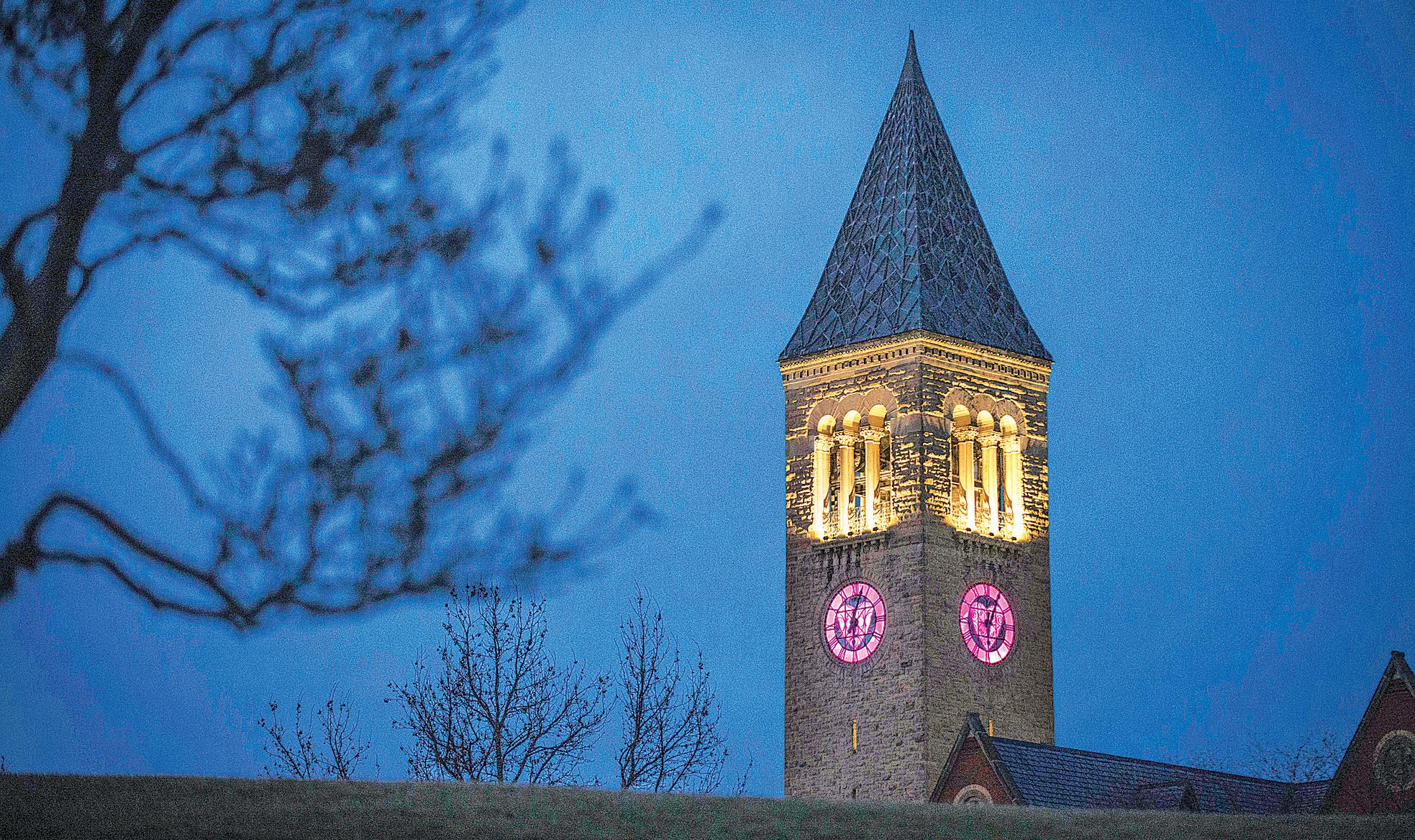
The clock tower is lit up with a magenta heart, a smattering of invitations to themed galas and club parties abound; it’s Valentine’s Day at Cornell.
To some, the holiday is a time to share their amorous adventures with the world — but to others, it may be an unwelcome reminder that they are without a partner.
Leading up to a day often known for love and heartbreak, 811 undergraduate and graduate students responded to a series of questions posed by The Sun including how often they have sex, where current couples met and how often they use dating apps.
The survey was shared via Facebook, Instagram, email, text message and GroupMe
chats over a period of five days. The survey was anonymous, but collected demographic information on gender and academic year.
The majority of respondents self-identified as female — 68.63 percent — compared to 29.17 percent male. The remainder identified as gender non-conforming, non-binary or other. Most respondents were sophomores, at 34.94 percent, followed by juniors at 21.72 percent, seniors at 20.67 percent, freshmen at 13.85 percent and graduate students at 8.81 percent.
This relationships survey gave us intimate insight on the status of Big Red love, relationships and sex. Here are The Sun’s findings.
Thursday, February 14, 2019
Soup and Hope Series: Cal Walker Noon - 1 p.m., Sage Chapel
How Leaders Establish Reputations In International Politics 12:15 - 1:30 p.m., G08 Uris Hall
Improving Global Health With Plant-Based Biologies 12:20 - 1:10 p.m., 100 Savage Hall
Cornell Geospatial Forum 2019 3 - 5 p.m., 102 Mann Library
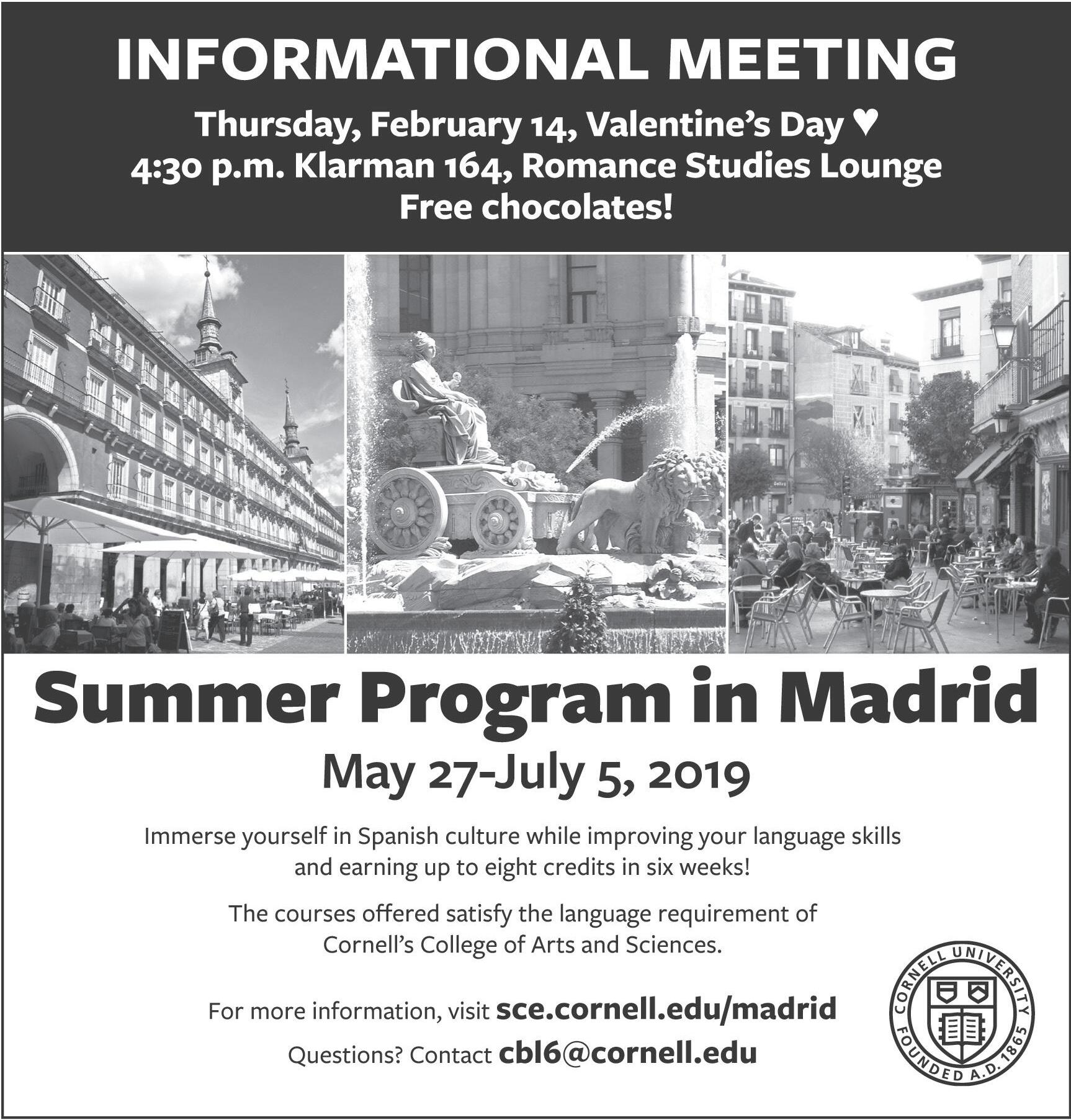
Summer Program in Madrid Information Center 4:30 - 5:30 p.m., 164 Klarman Hall
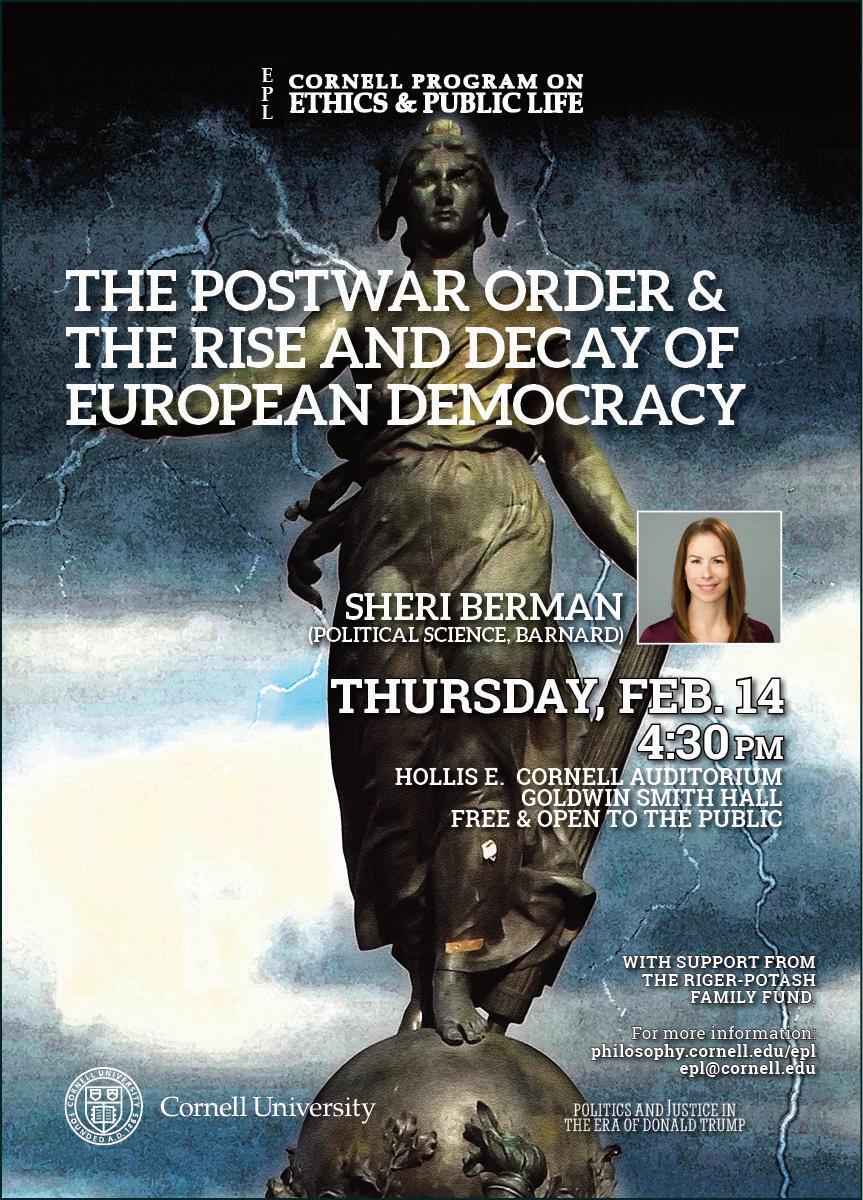
The Postwar Order and the Rise and Decay Of European Democracy
4:30 - 6 p.m., HEC Auditorium, Goldwin Smith Hall
Learning Strategy Center Statistics Tutoring 4:30 - 6:30 p.m., 417 CCC Building
Exponentially Faster Algorithms For Machine Learning and Beyond 3 p.m., 253 Rhodes Hall
Free Yoga!
5 - 6:15 p.m., 413 Willard Straight Hall
Valentine’s Day Open House at the Johnson 5 - 7 p.m., Johnson Museum of Art

Urbanophilia in the Living Room: On Urban Exploration and Entrepreneurism 5:30 p.m., L.P. Kwee Studios, Milstein Hall
Cornell Chimes Valentine’s Day Concert 6 - 7 p.m., McGraw Tower
Pianist John Stetch 8 p.m., Barnes Hall Auditorium

Spam and Eggs Breakfast With Asian American Studies Program and Asian and Asian American Center 9:30 - 11 a.m., 422 Rockefeller Hall
Coffee and Conversation About the Bolsonaro Government in Brazil 12:15 - 1:10 p.m., 153 Uris Hall
A Tale of Two Viruses 12:15 - 1:15 p.m., Lecture Hall 3, College of Veterinary Medicine
Politics, Sandwiches and Comments Workshop 12:15 - 1:45 p.m., 106 White Hall
Engineering and Reverse-Engineering the Core Of Human Common Sense 12:20 - 1:45 p.m., G76 Goldwin Smith Hall
Sarah Menefee: First They Came for the Homeless 12:20 p.m., Abby and Howard Milstein Auditorium
Unemployment and Wage Inequality in the U.S. 2:30 - 4 p.m., 401 Warren Hall
Democratic Populism and Development: Lessons from the Coalfields 3 - 4:30 p.m., B73 Warren Hall
Tartuffe by Moliere: A Performance Venture 7:30 p.m., Schwartz Performing Arts Center
Te group seeks to bridge communication gaps, meet with administrators to collaborate on improvements students would like to see
By SAMANTHA STERN Sun Staff Writer
Last semester, a student-led Mental Health Task Force presented a list of recommendations signed by nearly 300 students, faculty and community members to Cornell administrators. This semester, at least one of its recommendations will be fulfilled as the University’s first Mental Health Standing Committee officially convenes.
The student-led committee aims to bridge the communication gap between administration and students involved in the mental health community by creating
“And often they are in turn unaware of some of the less obvious problems students have with the systems in place for handling mental health.”
Chelsea Kiely ’20
“established contact” between the two groups, according to Chelsea Kiely ’20, co-chair of the new committee and president of Cornell Minds Matter.
“Often we are unaware of some of the work Cornell
Health and the administration is doing,” Kiely told The Sun in an email. “And often they are in turn unaware of some of the less obvious problems students have with the systems in place for handling mental health.”
The committee will serve as a liaison between the students and the University, and will be independent of the University — which, according to Kiely, means they do not have to report to the school administration.
tions on campus can reasonably adopt,” Hua said.
In keeping with last year’s Task Force recommendations, the committee will review and recommend practices to address mental health concerns.
“We want to see as much diversity as possible on this standing committee to ensure representation of all angles to mental health.”
Joanna Hua ’20
“The committee will dedicate itself to not only streamlining this communication process, but also working on the recommendation list objectives with the administration as we collaborate to improve mental health on campus,” Hua said.
The main objective of the committee is to ensure that parties are held accountable, wrote Joanna Hua ’20, co-chair of both the committee and the previous Mental Health Task Force in an email to The Sun, who said the committee will coordinate regular meetings with key University representatives — such as Vice President of Student and Campus Life Ryan Lombardi, the Cornell Health administration and the dean of Students.
“The point of the standing committee is to keep people accountable, and meet with administrators to ensure that we can collaborate on improvements that students would like to see and Cornell Health and other institu-

By VIVIAN FAN Sun Staff Writer
Aiming to connect indigenous students across the Ivy League and to showcase Cornell’s unique strength in fashion design, Cornell’s native and indigenous students are preparing to host the biannual Ivy Native Conference March 22-24.
The conference became a recurring event soon after the formation of the Ivy Native Council by Native American and indigenous student organizations at different schools in 2004. The institutions take turns hosting the conference every semester, according to Colin Benedict ’21, co-chair of the Native American and Indigenous Students Group at Cornell.
Each year features a unique theme; the upcoming conference will center on fashion, Benedict said.
“Our theme is ‘Native American and Indigenous Voices in Fashion’ because we’re hoping to showcase the fact that Cornell is the only Ivy League school with fashion majors,” he told The Sun.
According to Benedict, the conference will feature a number of academics who are involved in the fashion industry, including Prof. Denise Green ’07, fiber science and apparel, and Leah Shenandoah grad.
The organizers also plan to invite speakers from outside the university, such as Sage Paul, an indigenous fashion designer based in Toronto and founding member of Indigenous Fashion Week Toronto. The conference will also include a screening of Emerge: Stone Breaks, a short film that focuses on
the models and designers of Indigenous Fashion Week Toronto; its director, Evelyn Pakinewatik, also plans to present at the conference.
The event’s keynote speaker will be CEO of Beyond Buckskin Boutique Prof. Jessica Metcalfe, Native American and indigenous studies, the University of Arizona.
“She’ll be speaking on her experience of … founding a fashion boutique that tries to debunk the stereotypes of indigenous people in the fashion industry,” Benedict said.
“[Fashion] is an industry that commercializes native and indigenous symbols,” he added.
Outside of listening to and learning from native and indigenous voices in the fashion industry, attendees can also expect to find a strong and welcoming community that spans across the Ivy League institutions, Benedict said.
“I loved the chance to meet new people and build relationships with other Native American and indigenous students,” Benedict said. He has attended every Ivy Native Conference since arriving at Cornell.
Expecting around 150 attendees, the conference will provide networking opportunities with other students, faculty and staff in the community.
“I’m hoping that we can showcase the fashion industry from an indigenous perspective,” Benedict said. “If any of the attendees are interested in going into that industry, we hope that we can give them the contacts to make that happen.”
Recommendations proposed by last year’s Task Force included easing access to off-campus mental health services, adding more CAPS counselors and appointing permanent mental health professionals to advocate on behalf of students, The Sun previously reported.
Cornell Health currently employs 18 psychologists, 18 clinical social workers, three psychiatrists and two psychiatric nurse practitioners, according to Sharon Dittman, director of community relations for Cornell Health. A survey of students conducted last November found that
recycle.”
Cornell dove into its 10th year of participating in the sustainability contest “RecycleMania” — a continent-wide, two-month-long tournament in which universities compete to generate the least waste and recycle the most.
Spanning from Mexico to Alaska, the event, which began Feb. 3 and will continue until March 30, features hundreds of schools aiming to spur “greener” living through friendly competition, according to Recyclemania.
The competition encourages universities to track and measure their recycling activity of their campus, which is then submitted to the official RecycleMania website to be used for competition rankings.
Cornell specifically stresses a two-pronged approach, according to their web page, to foster a more sustainable campus: waste minimization and waste diversion.
While minimization focuses on reducing total product consumption and waste generation, “diversion” promotes the sustainable treatment of existing trash through the familiar mantra of “reduce, reuse,
This year, Cornell is participating in four national competition categories: overall waste, recycling, food waste and electronics. Each category includes different initiatives and activities.
To reduce overall waste, for instance, the Sustainability Office recommends hosting “zero-waste” events by using reusable utensils and water bottles or by contributing leftover materials to one of
“First, we need to respect the planet. Next, we need to rethink how we use materials and goods.”
George Wood
Cornell’s reuse centers.
Students are also encouraged to familiarize themselves with new recycling rules that went into effect in Tompkins County last fall, which limited recyclable plastics to types 1, 2 and 5.
Cornell currently ranks 14th in RecycleMania’s total recycling category, with a recycling rate of 46.6 percent,
MARS
Continued from page 1
“I always felt that the only two acceptable ways for a mission like this to end would be either we wear a rover out …. [or] Mars just reaches out and kills it,” Prof. Steven Squyres ’78 Ph.D. ’81, the James A. Weeks Professor of physical sciences and principal investigator of two Mars rover missions, told The Sun last fall after NASA lost contact.
Opportunity’s role was that of a historian, trawling Mars’ surface for clues into its past. Primarily, Squyres said, the rover was seeking signs that Mars had once been warmer or more habitable.
Today, Martian nights can be as frigid as minus 140 degrees Celsius, temperatures that can wreak havoc on fine-tuned machinery.
“It’s not low power that would kill a vehicle,” Squyres said in September, after eight months of silence from the rover. “It’s low temperature.”
The 400-pound rover was only designed to last 90 days on the red planet’s surface, but it continued to collect data and transmit pictures and information back to Earth for
fourteen and a half years.
“I am now teaching adults, college students, who cannot remember a time when there wasn’t a rover on Mars,” Squyres said last fall.
Squyres let students in his spring class — Astronomy 1102: Our Solar System — in on the impending end of the program over a week before NASA’s official announcement, said Yizhou Yu ’20, who is in the class. Squyres made sure to tell them “not to report anything” until the official announcement was made, Yu said.
Squyres was in Pasadena on Wednesday when the end of the mission was announced, where he recalled the challenges and triumphs of Opportunity’s two missions.
The first mission, he told the crowd, was to look for signs of water near the landing site. This mission lasted nine years, searching the surrounding rocks for imprints and evidence of flowing liquid, which the rover found and photographed.
“We were running around saying ‘water on Mars, water on Mars,’” Squyres said. “It was sulfuric acid on Mars. This was not evidence of an evolutionary paradigm.”
After team members concluded that they
had done everything they could at the first site, Squyres said they made a difficult decision to direct the rover on a long, lonely journey around the planet.
“What we could have done, I suppose, was just kind of noodle around on the plains until the wheels fell off,” he said. “But it didn’t feel like the right thing to do.”
After four and a half years of driving, Opportunity made it to a new crater, where it found what humans back on Earth hoped it would.
“We were able, at the rim of Endeavour crater, to find rocks that were probably the oldest observed by either one of the rovers,” he said. “Rocks that even predated the formation of Endeavor crater. And those told the story of water coursing through the rocks, but with a neutral pH. It was water you could drink.”
Opportunity’s twin rover, Spirit, also far outlived expectations as it scoured different sectors of Mars for the same signs of life. That rover was retired in 2011 after scientists lost communication with it the previous year.
“We just wore Spirit out,” Squyres told The Sun in the fall. “It ran for six years and
we did some pretty insane, pretty aggressive things with it.”
NASA’s Mars exploration lives on after Opportunity with the Curiosity rover, which launched in 2011 and landed in August 2012. NASA also plans to launch another rover in 2020.
“It is because of trailblazing missions such as Opportunity that there will come a day when our brave astronauts walk on the surface of Mars,” NASA Administrator Jim Bridenstine M.B.A. ’09 said in Pasadena. NASA has said it hopes to launch a manned mission to Mars in the 2030s.
Opportunity has paved the way for other missions and left an impression on the public deeper than its six treaded wheels’ tracks on Mars.
“I, in my lifetime, have seen the entire Space Age,” Squyres said last fall. “The first time humanity sent anything into space was 1957. I was born in 1956.”
“That is the future of exploration,” he continued. “It’s always uncertain. It’s always been uncertain.”
Sarah Skinner can be reached at sskinner@cornellsun.com.
Michelle Vaeth ’98, associate vice president for Alumni Affairs, said the alumni office is creating a task force of students, alumni and staff in response to the incident to “develop productive new ways for Cornell’s different generations to work together with even more mutual respect and understanding.”
Blanchard apologized in a statement addressed to students and alumni, saying he was “devastated to hear how my words hurt members of the Cornell community.”
“I’m sorry, as that truly was
never my intention,” Blanchard said. “This is a learning opportunity — for me, as I hope it will be for others — to do better.
The highlight of this weekend was spending time with students, and the last thing I would ever want to do is hurt you.”
“Please know that your presence here means the world to me, and I’m grateful that we’re all part of such a unique and diverse Big Red family,” he added.
Even as they condemned Blanchard’s remarks, students and alumni said they were impressed by Alumni Affairs’ quick response.
“That’s one thing I appreci-
ated,” Sanon said. “They knew, OK, this happened and this is something we need to talk about.”
In a joint statement, four separate groups representing black, Asian, Latino and LGBT alumni challenged Cornell to continue working to foster respect and celebration of diversity and noted that Alumni Affairs staff took swift action.
“This incident illustrates the importance of our alumni associations in continuing to implement initiatives that foster intergroup dialogue and create a culture of inclusion and belonging after our time on campus as students has ended,” the statement read.
The CACO board of directors said its members were “saddened” that Blanchard, whom they had given the William “Bill” Vanneman ’31 Outstanding Class Leader Award, “made comments that distressed members of the Cornell community.”
“Students were among our greatest teachers this weekend — and we acknowledge the invaluable role that all students play in shaping our alumni network,” the board said.
Clady Corona ’19 said she was not even sure she had heard Blanchard correctly at first. When she and Sanon locked eyes seconds
later, she knew she had.
“It mostly boiled down to a sad event — it’s sad that it happened,” she said. “We’re at this alumni event, we’re networking, we’re excited about being alumni and getting involved with Cornell after graduation, and it hits you in the head that nothing’s going to change, that the same things we’re experiencing on campus are going to continue with alumni after we graduate.”
Corona said that the task force Alumni Affairs is planning to create must implement tangible changes and avoid putting all of the burden of improving the organization on the same students who were most affected by Blanchard’s comments.
An alumni official emailed attendees just before 3 a.m. following the dinner to thank students for staying behind for the discussion. She also sent an updated Saturday schedule that included a morning meeting with the Alumni Affairs leadership and several alumni after breakfast.
Later that morning, Lotoya Francis ’22 addressed the entire conference, saying she did not believe that Blanchard had been acting maliciously, but that what he said was “loaded with bias.”
“As long as you’re aware and as long as your eyes are open, it can be easy to be in a rage at all times,” she told the group, paraphrasing James Baldwin. “I’m able to be so calm in a situation like this because I’ve seen so many things like it already.”
Shannon Cohall ’14, secretary of the Cornell Black Alumni Association, said she and many other black alumni were disappointed, but not surprised.
“For a lot of alumni of color, and specifically African-American and black alumni, there is a sense of being both part and apart from the University,” Cohall said, alluding to the title of a book about black students’ experiences in the decades after Cornell’s founding.
“We can sing the alma mater with our fellow Cornellians but there are differences in our experiences, and this conference was a testament to that,” she said.
Of the 811 people who responded, 42 percent said they were in a committed relationship, compared to the 36 percent single, 9 percent “single and not looking” and 11 percent “single and dating.” Five respondents said they are engaged to be married, and all eight of the married couples are graduate students.
According to the results, if you asked five students if they are in love, two would tell you that, yes, they are. However, the other two of the five would deny any romantic feelings, and the last person would say “maybe” or “I don’t know.”
Interestingly, 12 percent of those in love identified as “single and dating,” while 6 percent of self-identified singles and 3 percent of “single, not looking” said the same. Of the students that professed love, 80 percent reported being in a committed relationship.
“It’s perhaps not surprising that most people in a committed relationship indicate ‘yes’ that they are in love,” relationships researcher Prof. Vivian Zayas, psychology, said. “But this brings to mind research showing that sometimes what people say is not a great predictor of how their relationship is doing. That is, there are many reasons for saying that one is in love, even if it isn’t quite true.”
“The single and not looking category is particularly intriguing,” Zayas continued. “It would be very interesting to try to learn more about the experiences of these folks. Even though they don’t have any interest in being with someone, are they hanging out with a friend and finding that they may have feelings for this person?”
Zayas conducts a similar annual study of Cornell students through the Personality, Attachment and Control Lab, and based on her sample of roughly 800 people, “approximately one-third report being in a relationship.” Zayas said. She continued to say that variances in data could be due to survey distribution and labeling techniques. “If you are in a relationship, or possibly interested in relationships, you are more likely to want to volunteer your time and answer a survey about love and relationships.”
Looking for love? Consider going out — the largest portion of Cornell students (19.47 percent) shared that they met their current significant other while at a party. Not a party person? The second most common location was at an extracurricular activity, club or pre-professional society event (18.60 percent). Fifteen percent of students currently date their high school or middle school sweethearts, the survey revealed. However, the largest portion of students put their location where they first met their S.O. as “other.”
“They’re not meeting in class because they’re not talking to each other in class! Nobody’s meeting in the library,” exclaimed Prof. Sharon Sassler, policy analysis and management, who teaches the popular Modern Romance course.
According to the data, Sassler’s observations have merit: only 11.16 percent of couples reported meeting in class, while less than one percent of students kindled the start of an affair in the stacks. Sassler conducts similar surveys of her students over the course of the semester, and even gives them the assignment to ask someone out on a date.
The survey also touched on hook-up culture. Only 18.32 percent of people answered that they have casual sex with different partners on a regular basis. It is true that this question may have discounted those who “hook up” with one or two of the same people on a regular basis. However, the definition of “hook up” itself is debated as well: Roughly half of respondents define it as making out, an equivalent portion define it as sex, while the remaining 11 percent marked it as “other.”
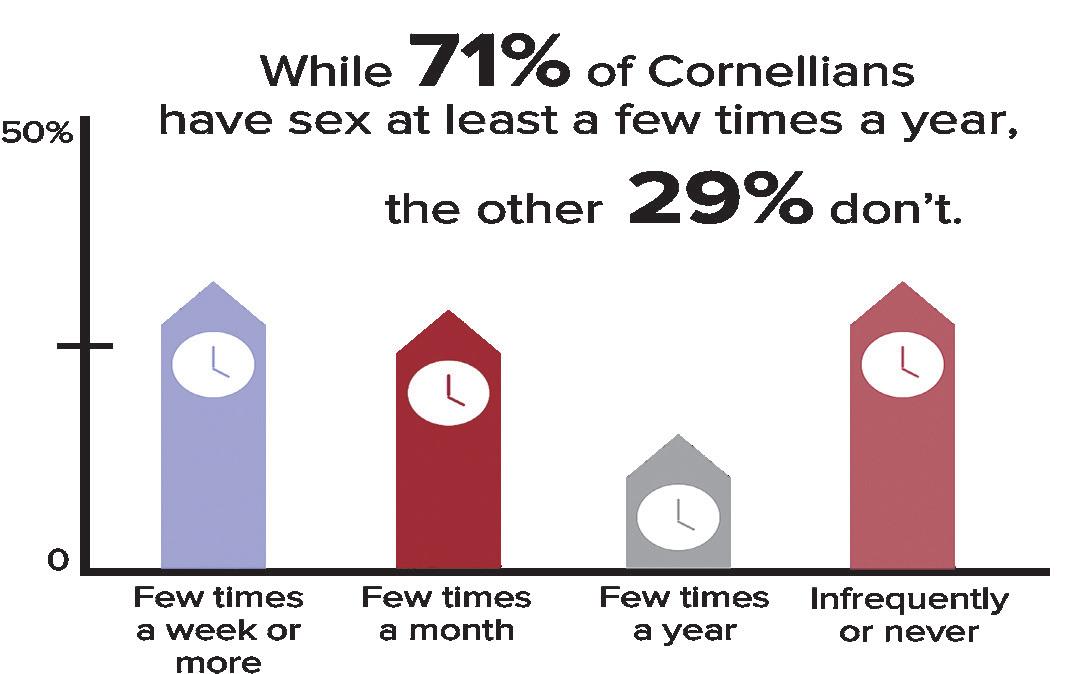
About 30 percent of surveyed students reported that they engaged in sexual activity a few times a week, while 26.23 percent reported having sex a few times a month. The majority of freshmen replied “infrequently” or “never,” which Prof. Sassler said is most likely because they are “coming to figure out what college is like.”
To continue reading the story, visit www.cornellsun.com.
Amanda H. Cronin can be reached at acronin@cornellsun.com.
Continued from page 3
over 80 percent “considered adding counselors a ‘medium’ or ‘high’ priority.”
The committee is still in the process of forming and is currently accepting online applications to gather a group of diverse students to ensure that all voices are heard.
“We want to see as much diversity as possible on this standing committee to ensure representation of all angles to mental health,” Hua said.
“Often we are unaware of some of the work Cornell Health and the administration is doing.”
Chelsea Kiely ’20
The task force is hoping to channel students’ motivation on mental health — which Kiely called a “hot button issue” on campus — to create real change in the Cornell community.
“Mental health is at a tipping point at Cornell University, and this momentum that we have for improving mental health for all is incredible,” Hua added.
Samantha Stern can be reached at sstern@cornellsun.com.
RECYCLING
Continued from page 3
according to the competition’s weekly rankings. Berkshire Community College presently stands atop the rankings, boasting a recycling rate of 78.21 percent.
Among the competition’s classic per capita rankings, Cornell sits in 15th with 1.94 lbs of recycling per capita — well above the national average of 1.49.
Despite operating a sprawling residential composting initiative that covers North Campus and parts of West Campus, The Sun
previously reported, Cornell fared poorly when it came to food waste, placing in a paltry 75th.
Cornell’s participation in the annual sustainability event is organized by the Campus Sustainability Office and the “R5” Operations Department — short for “Respect, Rethink, Reduce, Reuse, Recycle” — in conjunction with the RecycleMania Steering Committee, a group of student, staff and faculty volunteers.
“Recycling is important, but even recyclable goods are waste. First, we need to respect the planet,” George Wood, who works for

R5 Operations, told the Cornell Chronicle, a University-run publication. “Next, we need to rethink how we use materials and goods, including whether items we purchase are sustainable. Only then should we start to reduce, recycle or reuse goods properly.”
Other universities participating in RecycleMania include
Ithaca College and just one other Ivy League school, Harvard University.
According to RecycleMania’s website, the tournament first began in 2001 as a rivalry between Ohio University and Miami University when the two competed to see which university could produce more recycling per student.
Since its inception, over 1,000 colleges and universities have participated in the event. In last year’s competition, campuses participating in RecycleMania collectively recycled and composted 68.6 million pounds of waste.
Anyi Cheng can be reached at acheng@cornellsun.com.

JACOB S. KARASIK RUBASHKIN ’19
Editor in Chief
JOHN McKIM MILLER ’20
Business Manager
KATIE SIMS ’20
Associate Editor
VARUN IYENGAR ’21
Web Editor
MEGAN ROCHE ’19
Projects Editor
EMMA WILLIAMS ’19
Design Editor
JEREMIAH KIM ’19
Blogs Editor
AMOL RAJESH ’20 Science Editor
BREANNE FLEER ’20 News Editor
YUICHIRO KAKUTANI ’19 News Editor
NICHOLAS BOGEL-BURROUGHS ’19
City Editor
LEV AKABAS ’19
Arts & Entertainment Editor
SARAH SKINNER ’21
Assistant News Editor
ANNE SNABES ’19
Assistant News Editor
JOHNATHAN STIMPSON ’21
Assistant Sports Editor
EDEM DZODZOMENYO ’20
Assistant Photography Editor
PETER BUONANNO ’21
Assistant Arts & Entertainment Editor
CHENAB KHAKH ’20
Assistant Science Editor
GIRISHA ARORA ’20
Managing Editor
HEIDI MYUNG ’19
Advertising Manager
ALISHA GUPTA ’20
Assistant Managing Editor
DYLAN McDEVITT ’19
Sports Editor
MICHAEL LI ’20
Photography Editor
GRIFFIN SMITH-NICHOLS ’19
Blogs Editor
JACQUELINE QUACH ’19 Dining Editor
SHRUTI JUNEJA ’20 News Editor
ANU SUBRAMANIAM ’20 News Editor
JUSTIN J. PARK ’19
Multimedia Editor
PARIS GHAZI ’21
Assistant News Editor
MEREDITH LIU ’20
Assistant News Editor
JONATHAN HARRIS ’21
Assistant Sports Editor
RAPHY GENDLER ’21
Assistant Sports Editor
BORIS TSANG ’21
Assistant Photography Editor
VIRI GARCIA ’20
Assistant Arts & Entertainment Editor
CATHERINE HORNG ’21
Assistant Dining Editor
This weekend marked my third Cornell Alumni Leadership Conference. While many elements of the weekend were the same — a seeming takeover of a hotel in a major city and at least 23 renditions of the alma mater — this weekend gave me newfound hope about how we as a community can exercise compassion and move towards the Cornell we hope to be.
In the case you haven’t read the aptlytitled Sun article, Cornell gave an alumnus an award and while accepting it, he called Satchel Paige a “Negro,” prompting swift backlash.
As I sat in the ballroom, I felt similar reactions to my peers: Looking around to find eyes and share a moment with someone else to make sure I was hearing correctly, scrolling through texts from other students in the room, including one that said “I can check off experiencing a racial incident on my 161 things to do,” and understanding the impact that his words were having on the group. But the focus of this column is not on the incident itself but the way in which we reacted as a community.
that label students as oversensitive is a direct violation of the very human principle that everyone has the right to feel what they feel. The ability to evolve as an institution to pursue our core values of equity requires all members of our community to lean in and ask questions, to empathize and listen. Regardless of one’s identity, I strongly believe we all know what it feels like to be othered. Let’s draw on those experiences to ensure we suspend judgement and listen acutely to the impact folks in our community feel, and think about our individual responsibility in creating a more inclusive Cornell.
This weekend gave me newfound hope about how we as a community can exercise compassion and move towards the Cornell we hope to be.
Editors in Training
Editor in Chief Meredith Liu ’20
Managing Editor Sarah Skinner ’21
Maryam Zafar ’21 Associate
Paris Ghazi ’21
Christina Bulkeley ’21
Yisu Zheng ’21
Zhang ’21
Spahr ’22
Johnathan Stimpson ’21 Winny Sun ’20
Editor Peter Buonanno ’21
Jeremy Markus ’22
Letter to the Editor
To the Editor:
A little over a month ago, Dr. Leana Wen, President of Planned Parenthood, confirmed what the American pro-life movement has recognized for years when she tweeted: “First, our core mission is providing, protecting and expanding access to abortion and reproductive health care.” In the words of its own leader, Planned Parenthood is an organization that believes its primary purpose is to push for more abortion, full stop.
This admission renders the decision made by the Class Councils of 2021 and 2022 to fundraise for Planned Parenthood at their Valentine’s Day Gala completely inappropriate and extraordinarily insensitive. Although the majority of Cornellians may favor abortion rights to one extent or another, there exists a great many of us who believe that the result of the procedure is the ending of a distinct human life deserving of dignity like any other. Despite my own strong feelings on the matter, I understand that in a diverse community such as ours, disagreement on this issue is inevitable. What I fail to understand, and what I object to, is the Class Councils’ reckless decision to spend money collected from each and every undergraduate via the Student Activity Fee on a fundraiser for such a deeply divisive organization — an organization that performed 332,757 abortions in 2018 alone.
For students horrified by that statistic, the Class Councils’ choice quite literally makes them complicit with what we believe to be murder. The Class Councils should respect this belief, especially when it is those students’ money that helps fund the gala. While Student Activity Fee funds are spent by many individual organizations in ways that others may find offensive or objectionable, the key difference here is that the Class Councils are meant to represent an entire year of undergraduate students — rather than some small constituency. As a student body, we would be better served by a fundraiser for a more unifying, and less controversial cause. I am therefore urging those responsible for this decision to consider more fully the implications of this fundraiser — and to choose a more broadly acceptable organization to support.
Isaac Shohr ’20
What isn’t captured in the news article is the empathy expressed by the leaders of Alumni Affairs who stepped up and responded immediately. What isn’t captured is the way in which staff worked through the night to change the schedule — the critical thought placed into offering space for folks to process and reflect. What isn’t captured is the late night conversations between alumni, staff, trustees and students working collaboratively to think about how we all have a responsibility to shape the Cornell we hope to see.
What needed to be captured was the way in which students voiced the impact of words that hold historical weight, words that were used in a time when humans were othered. How students in the room were careful to separate intent and impact, how the action was criticized and not the person and the amount of compassion exhibited by the students, alumni and staff in the room.
When I think about what makes Cornell special, I think critically about the way we bring top talent from around the world to live, learn and grow side by side.
The opportunity to call someone in and bring them into the conversation is an act of compassion. Too often I see how we call members of our community out, pushing them away from the table rather than pulling them closer. I urge all members of our community to have compassionate accountability. Beyond the use of task forces and committees and even beyond policies, the ability to affirm how someone feels is central to how we move forward as a community. I refuse to believe that nothing is going to change — if anything this weekend was a reminder of how plausible social change is within a community with members who are willing to put in the work.
Sitting in that room and looking around at my peers gave me a sense of how far Cornell has come. The identities and stories that color our campus today were not present even 15 or 20 years ago.
The potential to grow from experiences such as this should not be overlooked. The way in which we as an institution helps develop leaders committed to values of equity and inclusion gives me hope for the way future leaders are created on our campus.
I think about how this experience sparked dialogue between generations of Cornellians. The identity of a Cornellian is not uniform, but a shared identity as Cornellians pushes us to create a space where we all can call home. It is clear that the life alumni lived on the hill is unlike the life that we live today. But the way in which alumni were willing to listen, to empathize and to understand is something I will hold as one of my most memorable Cornell experiences as a student.
Reading comments on the Sun article
The ultimate lesson I took away was how we as a Cornell community have differences and how we all need to move forward together. Sitting in that room and looking around at my peers gave me a sense of how far Cornell has come. The identities and stories that color our campus today were certainly not present even 15 or 20 years ago. While hearing the narratives of my peers and seeing the courage they had was inspirational, the burden should not be put on students or marginalized members of our community. The need to come together and think about the commitment needed from all community members is imperative to how we continue to grow and learn together. This weekend gifted me with a new sense of what it means to be a Cornellian and how while there may not be a singular Cornell experience, a Cornellian requires us to be sensitive to each other’s humanity and to never give up the spirit of lifelong learning. Earlier in the day at CALC, I had a chance to share my own Cornell narrative — to share the experiences of my immigrant parents and even further back to my ancestors who dreamed to see that day that their descendants would have the opportunity to learn at one of the top educational institutions in the world. Cornell University has fundamentally changed not only my narrative, but the narrative of my family. We often talk about how Cornell changes us, but this experience has reminded me how we as members of the community have the ability to change Cornell.
The number of students who want to live on-campus far exceeds the number that actually live on-campus, according to a housing survey. The current system consists of guaranteed on-campus housing for all incoming first-year students. Following freshman year, students have a variety of on-campus housing options, which include the West Campus House System, program houses and cooperative houses. In order to live on campus, students register online for housing, then receive a randomly designated General Room Selection timeslot. During this timeslot, they select a room and sign a housing contract. Although on-campus housing is guaranteed for sophomores, the problem with this system is that preferred housing is never ensured — especially if students receive later timeslots.
Well, if students can’t live on-campus or don’t like what their timeslot got them, they could consider off-campus housing right? That’s not always the easiest choice either.
Well, if students can’t live on-campus or don’t like what their timeslot got them, they could consider off-campus housing right? That’s not always the easiest choice either. At the Ithaca Affordable Housing Panel, which was organized in response to the difficulties of finding off-campus housing, problems such as expired Certificates of Compliance for properties, high housing prices and early housing rushes were consistently brought up. Students are signing leases months or even over a year before moving into houses that are overpriced and in a state of disrepair.
Only 48 percent of undergraduate students and six percent of graduate students at Cornell live on-campus, leaving half of Ithaca’s apartment market occupied by students. The median rent in the city nearly doubled between 2000 and 2016. The rent has surpassed the 30 percent threshold of gross income spent on rent, which the government uses to designate financially burdened households. In other words, students are become more financially burdened by how much rent takes from their incomes.
So how did the University respond to combat the issue of students being forced to consider subpar off-campus housing? North Campus Residential Expansion plan — an entirely flawed plan itself.
The North Campus expansion will be separated by firstyear and sophomore housing sites. Two new dorms will be added. The first-year housing site will include new residential facilities (a cafe, amphitheater, basketball court and multipurpose field), and the sophomore site will include a new fitness center and dining hall that will replace Robert Purcell Marketplace Eatery. Current North Campus residents are no strangers to poor conditions like losing heat and water or dealing with burst pipes, so renovations for these facilities are also in the plan. This expansion will allow for “100 percent of its first-year students in developmentally appropriate campus housing and 100 percent of its sophomores in campus residence halls, co-ops and Greek housing,” according the the expansion website. This new project hopes to assist students’ purchasing power in the Ithaca housing market. With less competition between students to live off-campus, the more pressure is applied to landlords to improve the safety and quality of the housing whilst lowering the price.
One proposal from the expansion plan does, however, raises some questions. The housing plan would also requires the increase of total enrollment by 900-1,100 over the course of four years (the freshman class would increase by 225-300 students). President Martha E. Pollack said that increasing the enrollment for students will enrich the Cornell academic and extracurricular experience. Although the bed expansion could accommodate an influx in enrollment for freshmen and sophomores, off and on-campus living following those two years could be a nightmare. Without new beds being added to West Campus or the surrounding campus area, the majority of students will be forced to consider off-campus housing. This inundation in the housing market will make it hard for upper level undergraduates, graduates, and staff to secure housing with a reasonable price. Thus, increasing North Campus housing will mean little for upperclassmen if the University plans to increase enrollment as well.
AAnother question that has to be asked is how much this will cost for students. Currently, Cornell’s housing, dining and health related expenses is an estimated $15,136 for a double occupancy room. If there is an increase in housing expenses due to the costs of construction, what will that mean for the low-income or working class students, or students who pay full tuition but would like to pay less for living and studying at Cornell by finding cheaper off-campus housing? Almost half of all undergraduate students receive a considerable amount of financial aid from Cornell grants. Considering how increasingly socioeconomically diverse every incoming class is, the cost for students must be considered — especially since on-campus housing will now be mandatory for freshmen and sophomores. Many undergraduate students still prefer to live in off-campus housing with friends anyways. According to Chiemezue Ijomanta ‘21 who lives at The Lux apartments, “the overall cost [for living off-campus] is similar to living on West. While it was basically my only option... it was the best one.”
In defense of landlords, it is important to know that Cornell University is one of the biggest landowners in Ithaca. However, because the University is a nonprofit we do not pay property taxes, leaving other property owners to absorb the costs which they supplement by raising rent. To alleviate stress, Cornell should consider increasing city and county financial contributions in order to expand publicly funded infrastructure like TCAT services and sidewalk coverage. Or, the University should invest more in financial aid for students housing payments. Finally, it does not seem reasonable for selective universities such as Cornell to increase enrollment at the long term detriment of upperclassmen searching for affordable housing.
There is still much more assessment that needs to be done about the Cornell housing process, both to benefit the students financially and to improve Cornell’s carbon footprint. With construction starting this year, students have to ensure that their concerns are being heard, and that the housing project will be a positive addition to our, and future students, experience at Cornell.
Aminah Taariq is a sophomore in the College of Agriculture and Life Sciences. She can be reached at ataariq@cornellsun.com. I Spy runs every other Wednesday this semester.
fter sitting for my senior portrait, each step I took as I emerged from Willard Straight felt suddenly significant — as though each was one closer to my youth’s looming end. I felt an unfamiliar urge for quiet contemplation and reflection. Sage Chapel seemed to beckon, so I obliged. The pilgrimage to Sage quickly became a part of my routine; five daily minutes in a sanctuary with a Bible seems to keep me spiritually satiated.
I don’t consider myself religious, but I do, however, find solace in the words of radicals — people who dare to challenge the status quo and evangelize our collective imagination. It so happens that the most famous radical of all time is Jesus Christ.
Despite the posthumous mainstreaming of his teachings in service of hegemonic interests, Christ’s own words discredit the false prophets who exploit his name to justify bigotry or enrich themselves. His words encourage us to embody radical compassion and to see ourselves not as individuals, but as the children of divinity acting on behalf of our shared Creator.
Jesus’s teachings define one’s purpose in terms of one’s selfless service to others. His greatest hits include the inherent evil of wealth accumulation, loving thy neighbor, and the vacuous nature of social hierarchy. In all the stories he tells, the villains are those who choose to live according to bourgeois values — like elitism or the pursuit of capital — rather than the values of faith and empathy. Jesus asserts that within all of us lies the innate propensity to love one another, and implies that those who deviate from this propensity do so out of self-interest.
I’m a big fan of his work.
Religion has endured because it is a useful framework to grapple with the fundamental human struggle. The world is
struggling right now, so perhaps it could use some religion.
Experts warn that our existence is threatened by the specters of artificial intelligence singularity, climate change, dystopian inequality and surveillance. The threats we face today aren’t just epochal; they’re the ultimate culmination of centuries of selfishness and greed. The zealots who insist we are approaching the Final Judgment for our sins aren’t far off, because how we answer these eschatological questions will, indeed, determine humanity’s fate.
Our response to such perils so far have been insufficient and limited by our dedication to logic and reason as governing principles. Though the capacity for abstract thought is the only thing that separates us from animals, we dismiss spirituality as an exercise in frivolity.
Yet all religious texts contain truths that might help alleviate our postmodern nihilistic malaise, because each seeks to elevate our terrestrial existence by integration with the sublime. So, as a humble agnostic, I am making the case for spirituality in a secular world.
Like many others, I allowed the malaise to consume me. But when I saw the rise of radical left and right populism, I realized there was a growing collective rejection of the structural forces that profit from our apathy. All populist movements are fueled by the same existential and emotional crisis: alienation.
Alienation is the process through which one becomes divorced from one’s own labor, power, and neighbor. It is a sociological theory but it describes a deeply spiritual phenomenon — the widespread, systematic denial of self-actualization to the masses.
We live in a culture that normalizes alienation. It is so deeply embedded that hating Mondays and hiding in the bath-
room at work are universally parodied experiences. We become alienated from our labor and from one another because it is easier to isolate oneself than to earnestly acknowledge the ubiquity of purposelessness.
In the information age, we are constantly reminded that evil and injustice operate relentlessly and without pause. These reminders are often conveyed to us via smartphone notifications, the most passive possible way to absorb
We live in a culture that normalizes alienation.
us and keeps us docile — alternately, its expression would grant us peace, foster unity, and mobilize us around shared values.
If we hope to overcome the numerous apocalyptic challenges we currently face, we must reject habitual self-interest and embrace the active practice of compassion as a means to self-actualization. There is no way to do this effectively without confronting the distinctly spiritual poverty that plagues us.
information. Each time we are apprised of the world’s pain this way, we are subconsciously reminded that ours is merely to observe — that events of significance occur entirely absent our input. We are thus alienated from our own power.
Grassroots organizing and collectivist philosophies use terms like “moral imperative” to justify progressive political action, but they fail to explicitly define that imperative. Without a remedy for the spiritual deficit created by alienation, our stultifying apathy can never be truly eradicated.
We are conditioned to quiet our altruistic impulses and value self-preservation above all. Jesus was executed because his own remedy of radical love posed a serious threat to that individualistic conditioning, upon which all oppressive superstructures necessarily depend. The repression of our compassion is a burden which alienates
Jesus has some quality content, but our focus should be on building a non-denominational spiritual, moral ethos that draws on a universal tenet — the Golden Rule. Across religious traditions, the Golden Rule implies the ethic of reciprocity in action; it is through being of service to others that one connects to oneself, one’s productive capacity, and one’s fellow human. Nihilistic malaise and apathy serve the interests of the ruling class at the expense of the majority’s fulfillment and our potential survival as a species.
It is time we recognize secularism as an insufficient framework to address oppression’s spiritual deficit. We have to acknowledge that only through embracing our collective connection to some kind of divinity can we move forward, creating a world that radically aspires to a purpose greater than ourselves.
It’s a lofty goal, but maybe just five minutes a day in a house of worship is a noble place to start.
Jade Pinero is a senior in the College of Agriculture and Life Sciences. Jaded and Confused runs every other Thursday this semester. She can be reached at jpinero@cornellsun.com.
By SPENCER SIGALOW Sun Staff Writer
he warm, dimly lit entrance of ZaZa’s Cucina served as a welcoming oasis from
the frigid, subzero Ithaca temperatures over the weekend. I rushed through the doors, leaving my three dining companions in my wake, eager to claim our OpenTable reservation and warm up my exposed ankles — I’m still unsure why I insisted on wearing sockless loafers rather than my Timberlands in the snow. We were led to our table by the smiling hostess and thus began a delightfully long meal full of tasty food and great conversation worthy of writing about in the paper.
Unlike many of the other eateries I have had the pleasure of dining at for The Sun, ZaZa’s Cucina is a restaurant I have visited many times. In fact, this was probably my fifth or sixth time eating here during my four years at Cornell. Although I have always found the meals to be pretty good, I wanted to truly make an assessment this time around and decide once and for all whether or not ZaZa’s deserved to be in my starting rotation of the best restau-

rants in Ithaca. With a two-tiered dining room, the restaurant’s interior is quite large. Some tables are in a sunken area in the middle, while the majority of tables surround the perimeter of the space. The atmosphere is upscale but
intimate, with dim lighting, warm colors and all-white linens. We were seated at an oddly large, rectangular table that sat four but easily could have fit more. The ambience was inviting, and the warm bread on the table smelled delectable.
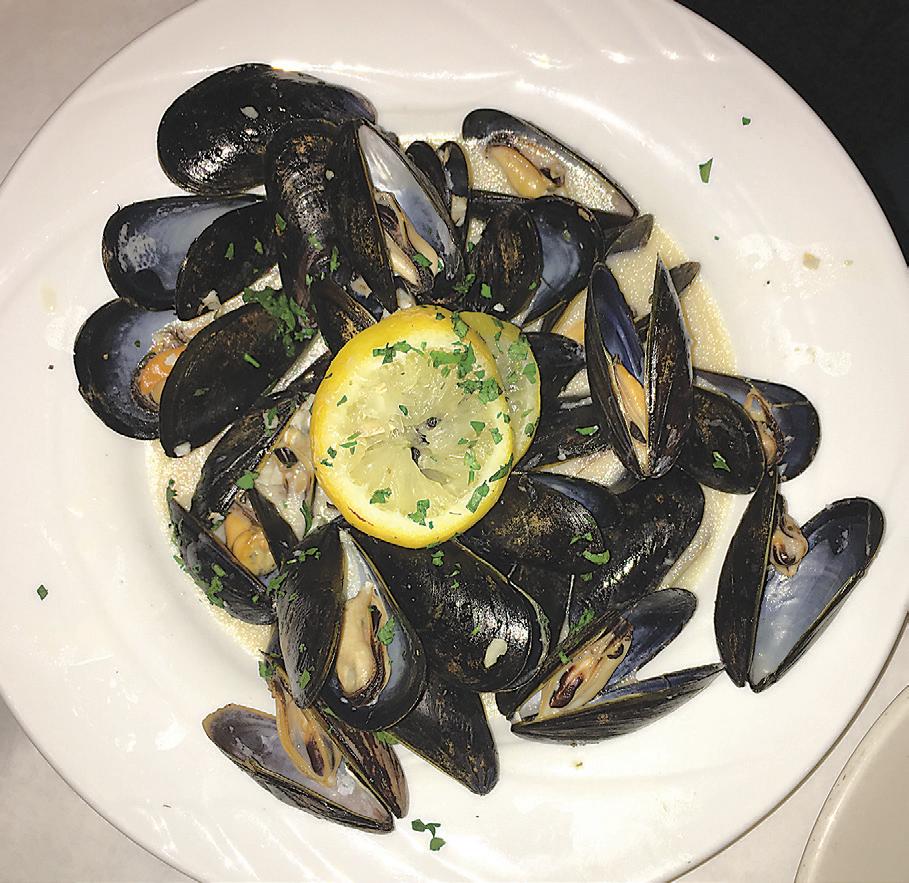
To start our meal, our table decided upon one order of both the fresh burrata caprese ($12) and the Prince Edward Island mussels ($14). Some might remember from my previous articles that I happen to be lactose intolerant, but burrata is one of my absolute guilty pleasures. While I was not necessarily disappointed by the dish, the serving of burrata was not as large as I would have hoped, and certainly was not the best appetizer to share with more than one other person. The mussels were good, served in a garlic and white wine mixture, with an ample amount of the tasty mollusks to go around the table. While they were not the best mussels I have ever had, I would not hesitate to order them again in the future.
When it came to ordering our main course, we could not resist choosing from the many pasta dishes offered, made in-house with fresh pasta daily. After much debate, my girlfriend and I split the


Continued from page 8
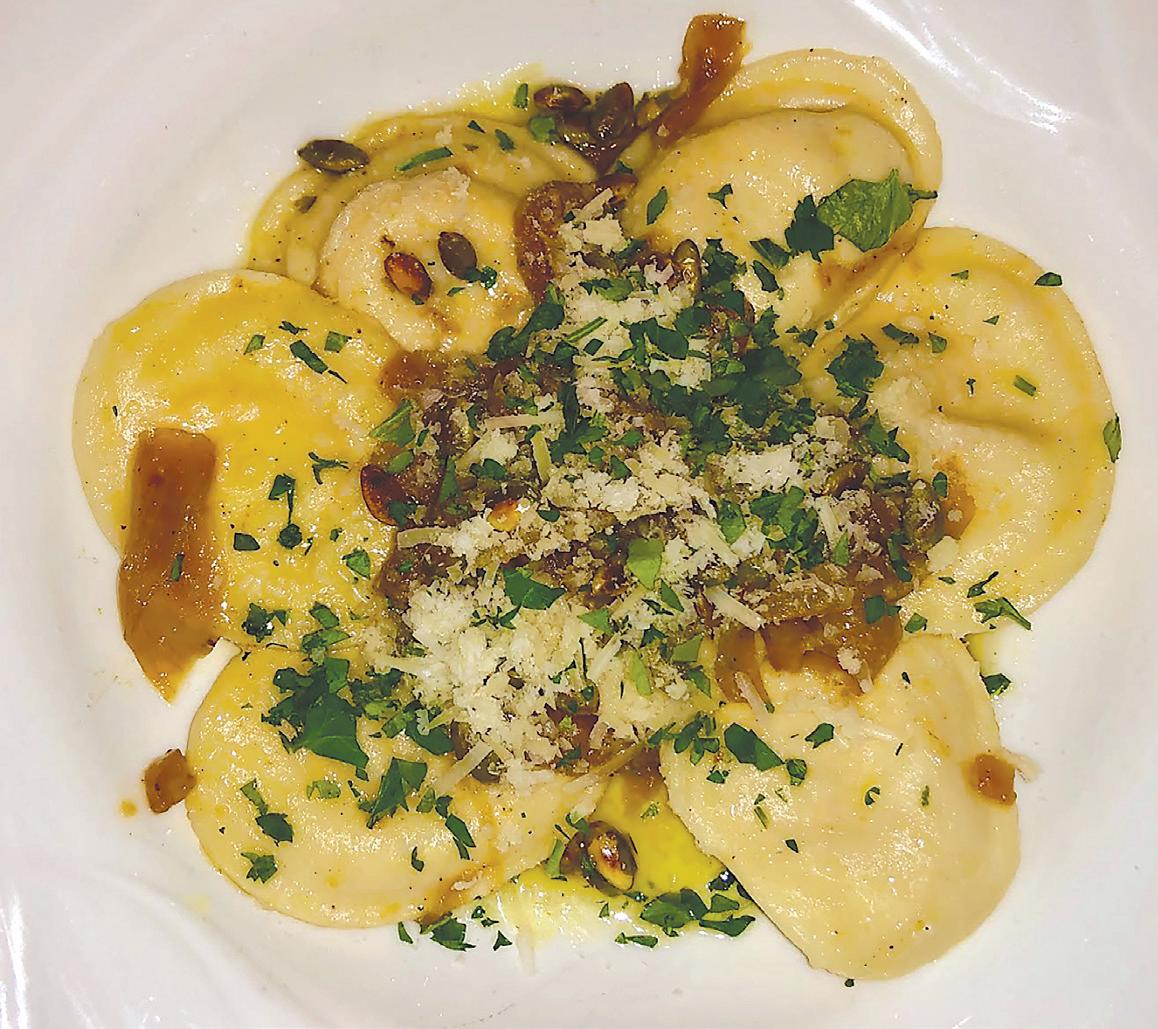
pumpkin ravioli ($21) and the red seafood misto ($25). The pumpkin ravioli was decent, but nothing to rave about. There was a mealy consistency, with an oily coating on the raviolis. Were it not for the pumpkin seeds (which admittedly created a crunchy texture contrast), I’m not entirely sure I would know there was even pumpkin in this dish. I was much more impressed with the red seafood misto, which was full of shrimp, clams, mussels and calamari. The fresh spaghetti was delicious, slightly al dente and far tastier than normal store-bought pasta. The ratio of spaghetti to seafood was perfect, and the serving size was also satisfactory. Although I was unable to finish the entirety of my meal, the red seafood misto in the to-go container was just as good for a late-night snack a couple of hours later.
Overall, my dining experience at ZaZa’s was quite enjoyable. While I wouldn’t consider it to be in the upper echelon of Ithaca restaurants, it is definitely a solid eatery worthy of a visit for a date night or merely on a night you want to treat yourself to a tasty and


reliable Italian dinner. However, I am obligated to warn all readers to be careful when ordering, as it is quite easy to run up a hefty bill, especially when ordering any of the more expensive non-pasta dishes or alcoholic beverages. And as Billy Joel would confirm, this is especially the case if you order a bottle of red, a bottle of white or perhaps a bottle of rosé instead.
Serves: contemporary Italian dining Vibe: upscale, intimate Price: $$$ Overall:



When I think about what ties most of my favorite music together, one thing really sticks out — I originally thought it sucked.
I listen, mostly, to the type of indie rock that is somewhat repulsive but has an impassioned cult following. I’m always embarrassed to play it during car rides, parties or literally any place where someone else might hear it. But, you can bet that on my early morning drives out to the research forest and late-night walks back to my dorm, my ears are tuned into the whiny, dissonant voices spewing mediocre bedroom poetry.
Back in high school, I drove my the family-hand-me-down Toyota Rav4 up and down the Westchester parkways, listening primarily to my “Pop/Folk-Punk” Spotify playlist. It featured New Jersey folk-punk band The Front Bottoms, Welsh pop-punk band Neck Deep, and emo-pop idols All Time Low, even though none of which are really known for superb music making.
The Front Bottoms were my absolute favorite. My friends, on the other hand, hated them for the band’s simplistic chanting. They got more frustrated with every trip in the soccer mom-mobile marked by The Front Bottom’s characteristic loquacity about outlandishly minute details. I totally understood my friend’s resentment — I remembered that when The Front Bottoms first popped up on some internet-algorithm-created playlist, I didn’t approve of them either. But slowly but surely, I’d hear a line that I thought was funny, creative or novel.
Not just in spite of, but because of, the stupid metaphors they spin, their lyrics ended up on a constant loop in my head. They wrote about everyday life in ways that seem boring, but they approach it with a unique amount of attention and earnestness that allowed the met-
aphors to be lucid without falling into classic tropes.
Girlpool is similar, too. Although they have somehow achieved critical acclaim despite their music being, in my opinion, downright hard to start with. While their voices sometimes come together in stunning and relieving harmonies, bandmates Cleo Tucker and Harmony Tividad often sing in amateurish and conflicting tunes. When I first listened to them, I found it grating. But I felt that I owed it to the person who had
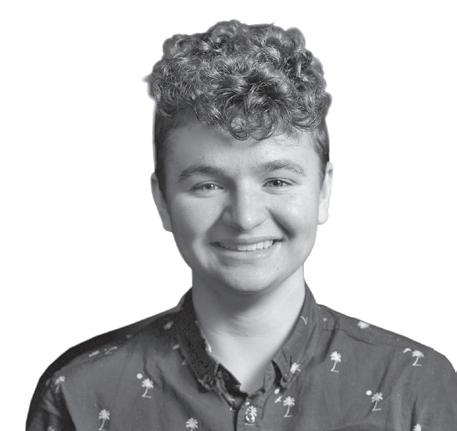
recommended them to me to try it again. So I kept listening, and kept listening, and kept not liking them until at some point, I noticed the subtle genius of their turns of phrase and became endeared to the interplay of their voices.
Girlpool became one of my favorite acts, so much that when I saw them down at The Haunt last spring, I stood struck in complete awe for their whole set. I left feeling like a changed, or newly spiritual, or finally actualized person. Despite my deep appreciation for the power of the group’s music, I still feel like a public nuisance when I play even their best work out loud.
I think what I’m really seeking for in music is vulnerability, mistakes, aggression or the whining that I don’t want to express in other aspects of my life. The wretchedness of the sound provides comfort in the face of the
wretchedness of the world.
Just like the experience of seeing a beautiful painting is often portrayed as a shining aesthetic experience, you can depict listening to outstanding music in the same way. But I can hardly say that’s what I’m going for when I throw in my earbuds. I want the stuff that I know, I want the run-of-the-mill, I want commiseration and validation. Great music is, well, great, but I’m not looking for a trip to The Met on my walk to class or to stroll around the Louvre at 2 a.m.
Who would want that?
What does the “Mona Lisa” have to say about a terrible, no good, very bad day?
Probably little, but it’s easy to tell it’s beautiful. Conversely, Picasso’s “Guernica” is harsh and grotesque, critiquing a depraved state of humans: in war, suffering the effects of bombings. Both are acclaimed paintings, but I think It’s harder to see the beauty of Guernica when placed against vibrant landscapes, realistically detailed portraits, or even shadowy paintings of tragic scenes. And while, on first sight, Guernica lacks the simple signatures of beauty that you can find in other paintings, it has a potent ability to portray the worst that is beautiful in itself.
I’m reluctant to compare The Front Bottoms or Girlpool to Picasso, but both have made clear the value of art that isn’t all cut flowers and pretty faces, or sweet voices and cordial harmonies. And by making a more true-to-life artistic experience out of the rest of the bad, this art is comforting and kind in depicting a world that is not.
Resident Bad Media Critic runs alternate Tuesdays this semester.
By: Peter Buonanno & Jeremy Markus
Hi, it’s your arts editors here. Today, we would like to talk about art you can enjoy to enhance your Valentine’s Day experience. Jeremy will be writing from the single (alone) perspective, and Pete . . . well . . . he’s happily in a relationship. Can you tell we ran out of content to publish today? Well if you can, blame Pete. This whole thing was his idea. So here we go . . . Presenting Pete and Jeremy’s Valentine’s Spectacular.
Jeremy:
Most of my single time (read: all the time) is spent in my dorm. What’s great about my room is that the walls are so pristinely off-white. Perfect for staring at during Valentine’s Day. There’s something magical about a blank wall. I used to have a poster on it, but it fell off and broke, which really isn’t a metaphor for anything. The remnant Command hooks are no longer holding anything up, including my motivation for this semester. So I’m really looking forward to Valentine’s Day. I also like listening to Eminem’s songs about shitty relationships. They console me.
Pete:
Wow, Jeremy — that was poetic. Now for all of you cuffed folks out there, here is some actual fun art for this beautiful February day. I heard Big Mouth came out with a Valentine’s Day special. This is what I will be watching as I cuddle with my significant other tomorrow — however, if you are more in the mood for a more romantic experience, might I suggest the Oscar-winning (in my heart) Sandra Bullock and Ryan Reynolds feature, The Proposal. There is nothing more romantic than watching a naked, wet Bullock and Reynolds collision. To accompany this film, I recommend Haribo Gummy Bears. You can console each other on the toilet tomorrow.
Peter Buonanno is a taken sophomore in the College of Arts and Sciences. He can be reached at pbuonanno@ cornellsun.com. Jeremy Markus is a single, fve-seven-and-a-half freshman in the College of Agriculture and Life Sciences who can bench press 180 lbs. He can be reached at jmarkus@cornellsun.com.
Irecall vividly a memory of my friend and I dancing a kind of salsa improvisation to Nio Garcia’s “Te Bote Remix” and having the absolute time of our lives. I began to realize how much the commerically “Spanish” sound has crept into the commerical music market. It influences some of the biggest artists in the world, including Drake and many others. Artists love putting a Latin spin on their tracks, as there is something inherently infectious about Spanish music. It’s a vibe, and we American college students are undeniably here for it.
I have been following up-and-coming artist Bebeboy’s wave for some time now. Keeping with the Latin trend that is all over the charts these days, Bebeboy authentically stands within that category. However, he, alongside producer Bounce Zaddy, is adding a unique bounce to his music that makes it more hype than the classic Latin track. His most recent project “HUH?!” stands out as one that combines a hip-hop, synth-heavy

beat with his Latin sound, and it is all-around a musical treat. While the beat was actually on its way over to Travis Scott’s A&R, landing on Bebeboy’s track was anything but a mistake.
Recently, I was lucky enough to ask Bebeboy some questions about both his musical and personal background, so this column sources none other than the artist himself.
From the notoriously musical city of Toronto, Bebeboy gained inspiration from watching now-major artists like Drake, The Weeknd and a personal favorite, PARTYNEXTDOOR, come up from the city and find worldwide success. In addition to these rolling success stories, Bebeboy also shared that music has been a part of his life for as long as he can remember. His mother actively sings in their local church choir. With a Hispanic background — both of his parents are from El Salvador — Bebeboy feels inspired to bring his culture into his work and into the American music space. Looking at the trends these days, it seems that no one will be opposed to this notion.
bump, which occupies the playlists of our designated frat-party DJs. By the way mainstream American artists are increasingly incorporating elements of their Spanish culture into their work while testing out new stylistic tones and wowing fans, it seems that 2019 will be the year in
“Perhaps we will name our Spotify playlists by pure feeling, rather than by a cookie-cutter term that simply now ceases to exist.”
Juliette Rolnick
which the term “genre” grows passé. Perhaps we will name our Spotify playlists by pure feeling, rather than by a cookie-cutter term that simply now ceases to exist.
By: Peter Buonanno Sun Assistant Arts Editor
It appears that another year has come and gone and the Grammys remain mediocre. The Recording Academy has once again proven they are like a college pamphlet, highlighting “diversity” but not doing much at all. Instead of striving to be diverse and recognize good art, the Grammys threw in the towel and did a half-hearted job at both. In fact, the only decision the Recording Academy made this year that I agree with was handing out Grammys like Tic Tacs to Donald Glover and crew for “This is America.”
Yet, there was even a hint of irony that came along with the song’s win for Record of the Year. Nothing was more frustrating than watching Ludwig Göransson go on a tangent about his life — as a white kid from Sweden — while totally disregarding the important message that “This is America” conveys about violence and injustice in and against the black community. To make matters worse, Derek Ali, in utter disbelief, was not allowed to express his gratitude for the award as the group was ushered off the stage.
In addition to the Toronto and OVO Sound artists that continue to inspire Bebeboy to create, LatinAmerican artists like Cardi B, Lil Pump and 6ix9ine are opening up new lanes and opportunities for his music to truly infiltrate the market. It seems that some boundaries have been broken this past year, leading artists to incorporate aspects of their culture in one track and entirely different sounds in another.
But that’s the beauty of Bebeboy’s music, as he does not conform to any style but his own. While he would likely call himself a hip hop artist, he and Bounce Zaddy have spent about four years practicing the intricate mix between Spanish music and modern hip hop

In addition to watching the American music market transform and grow, I am looking forward to Bebeboy releasing new singles and exciting audio-visuals. I believe he will pave the way for other up-and-coming Latin American artists who are also finding their way in the current hip hop space.
Juliette Rolnick is a junior in the College of Arts and Sciences. She can be reached jr798@cornell.edu. Eyes Wide Shut runs alternate Tursdays this semester.
It’s even sadder that no one else saw this as a problem.
The Grammys were on their high horse this year, trying to be show how diverse they are through a tribute to Motown artists, yet they enlisted Jennifer Lopez to perform in it over countless black artists who attended the award show. They included a diversity feature but yet there was still a bias towards white artists in the nominees and winners.
But maybe the thing that angered me the most was the total disregard for Mac Miller’s passing. When you invite the Mac Miller estate to the Grammys, you should at least honor Miller’s life through raising awareness for The Opioid Epidemic.
Finally, on a less political note, Dua Lipa was not the best new artist. I would even have been alright with Greta Van Fleet, the altrock band bringing back the sounds of Led Zeppelin, taking home that title. But Dua Lipa? H.E.R was the obvious choice for Best New Artist, especially since she was also nominated in the Album of the Year category for her self titled EP and is only 21.
But as Eminem and many others have said, the vote the Recording Academy takes isn’t a real vote. In the end, they give the award to whoever they want, and they don’t consult anyone relevant. Next year, I will be boycotting this abomination of an award show and save myself the frustration — I encourage everyone to do the same.
Peter Buonanno is a sophomore in the College of Arts and Sciences. He currently serves as the assistant arts and entertainment editor on Te Sun’s editorial board. He can be reached at pbuonanno@ cornellsun.com.




A PA R TMENT FOR R ENT
2
109
Novarr- Mackesey
Management office@ithacastudentapartments.com ithacastudentapartments.com 607-277-1234
Houses, Apts, Parking 1 to 9 Bedroom
Collegetown - College Ave, Linden Ave, Dryden Rd, Bryant Ave, Cook St. 607-330-2442 info@urbanithaca.com www.urbanithaca.com
Nicest Apts. in Collegetown Located on Eddy St. 4 Bedrooms
Fully furnished. Spacious living areas with large bedrooms & closets. Hardwood flors, spectacular views, eat-in kitchens with additional sun rooms. Laundry & parking. 607-339-1137 bgm900@gmail.com
COLLEGE AVE.
1 Bedroom available In a 2 BR apartment For Male, Undergrad student. Available NOW & Spring 2019
4 Bedroom Apartment Available NOW & Spring 2019 Novarr-Mackesey Property Management office@ithacastudentapartments.com ithacastudentapartments.com 607-277-1234
201 WYCKOFF AVE 6 Bedroom House Novarr-Mackesey Property Management office@ithacastudentapartments.com ithacastudentapartments.com 607-277-1234
2019-2020 317 Upper Eddy St. 1, 2 & 3 BR Apartments Ten Month lease. Furnished. Hardwood floors. 607-227-0924


By RAPHY GENDLER Sun Assistant Sports Editor
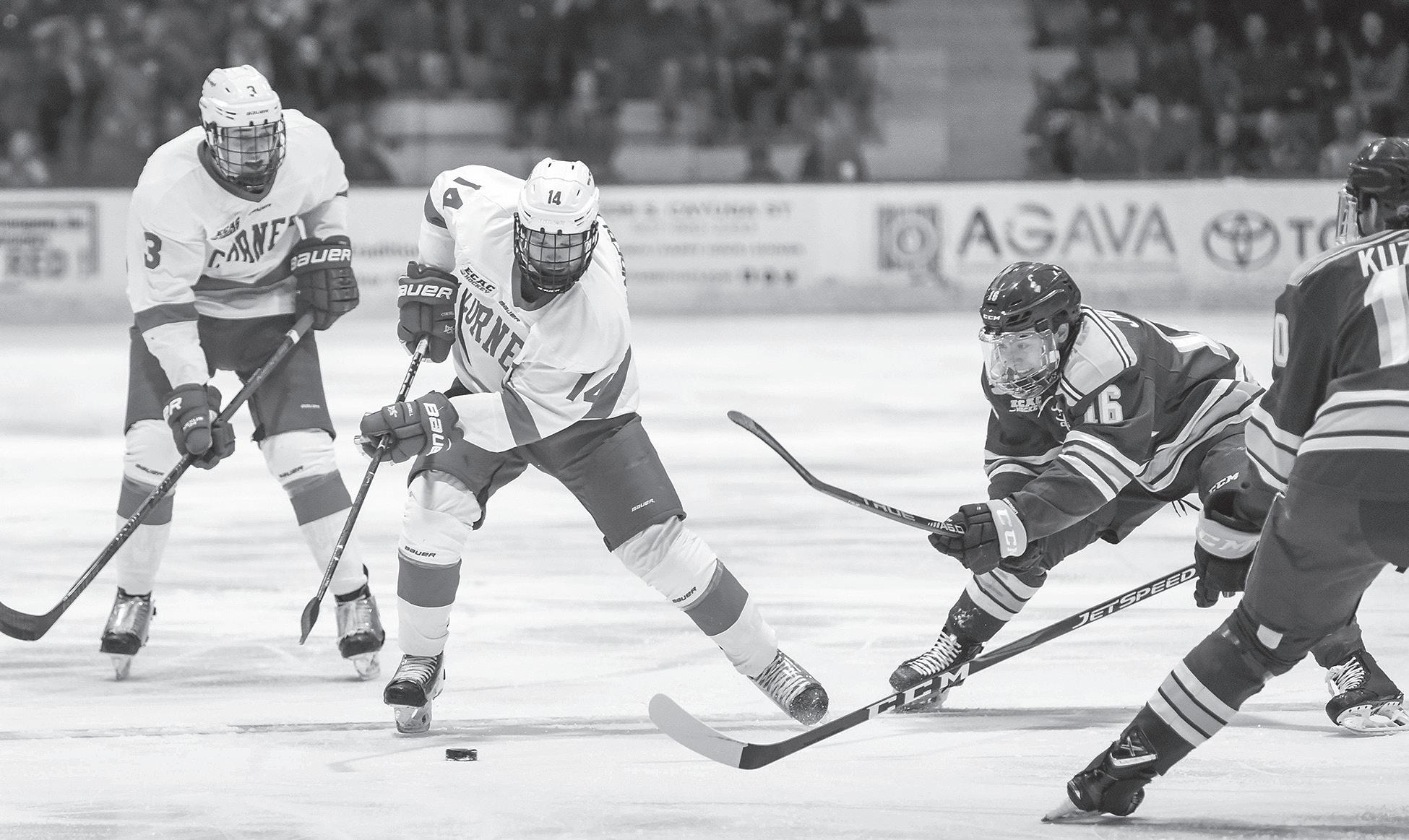
Cornell men’s hockey holds a three-point lead atop the ECAC, clinched its second straight Ivy League title last weekend and is a near-lock for the NCAA Tournament — and the Red has gotten here despite not having its full top lineup available throughout the entire season.
Cornell (15-6-2, 11-3-2 ECAC) takes on Ivy League foes Brown (1010-3, 7-6-3) and Yale (11-9-3, 9-6-1) this weekend, two squads looking to fight their way into the top four in the ECAC and earn first-round playoff byes.
spell of bad luck, but the team’s response to it.
“It is an unusual year [but] you can never hope or think about ‘what if’ or ‘what could be’ rather than what is, and right now the ‘is’ is we’re hurt,” said head coach Mike Schafer ’86. “I’ve never felt like our guys have gone in and had a ‘woe is me’ attitude of ‘poor us, why us.’ They’ve never asked that question once all year long.”
“Everybody’s playing with everybody and they’ll play every position all night long.”
The Red earned two wins last weekend but lost key players in each. Sophomore defenseman Cody Haiskanen exited with a scary arm injury in a 5-0 win over Clarkson; sophomore forward Cam Donaldson — the team’s second-leading scorer — left with an upper-body injury after an awkward fall in a 3-1 win over St. Lawrence.
Mike Schafer ‘86
And while Cornell has had a short roster all season, what has defined the season thus far has not been the
Cornell’s resilience, Schafer said, is more than just its ability to harness the “next man up” mentality when injuries force players to miss games. It also means players competing while banged up and enduring the long haul of a college hockey season nearing playoff time. Only three weekends remain in the regular season until Cornell hopes to enjoy a much-needed first-round bye. The Red has been grinding hard since October.
“That’s where guys have really been resilient; the guys that have played hurt, that are playing with significant injuries, are doing the jobs,” Schafer said.
The Red’s apex lineup has been intact for a total of fewer than 10 minutes this season. Cornell’s top 12 forwards and six blueliners all suited up for the team’s 4-2 win over Yale Nov. 2 — but sophomore defenseman Alex
Don’t get me wrong, there are plenty of games left to be played ... but who saw this one coming?
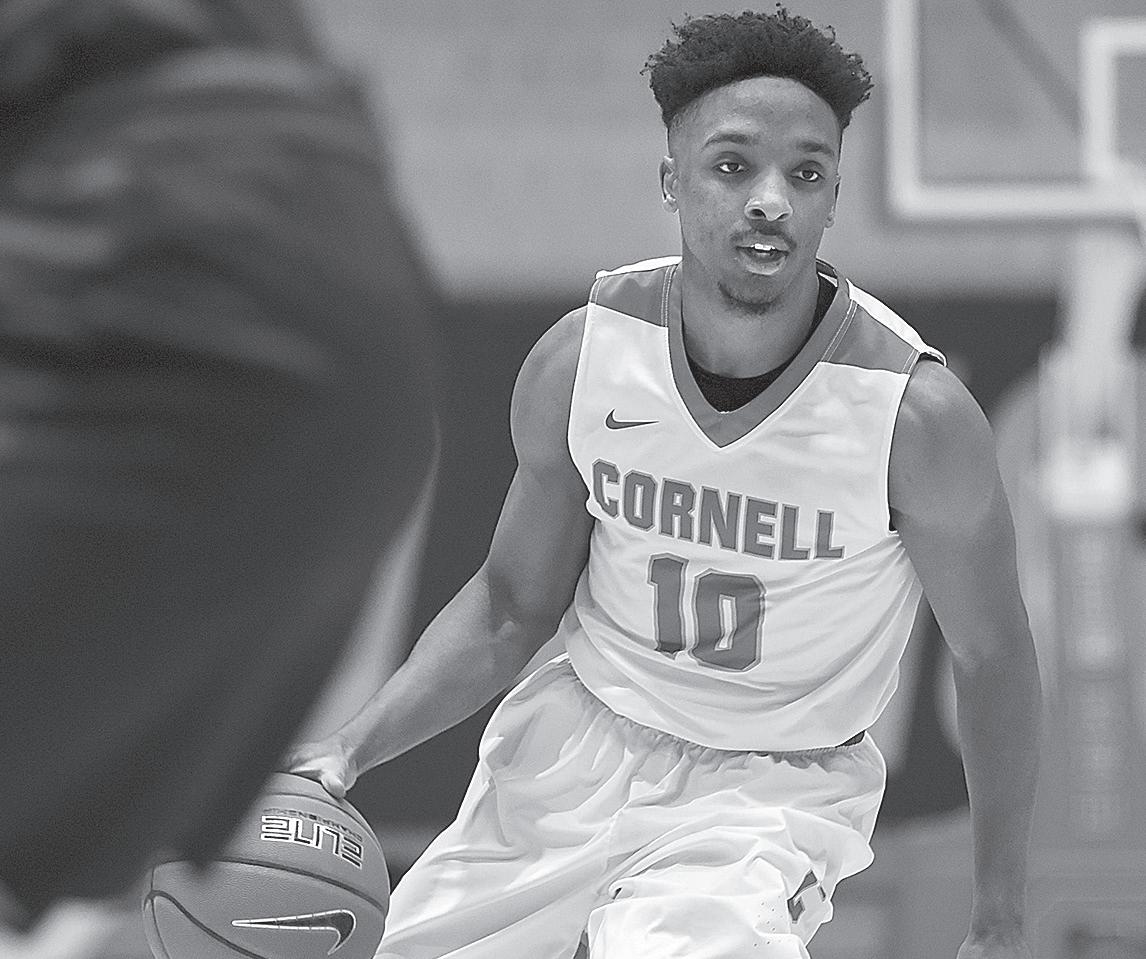
Picked to finish sixth in the preseason media poll, the Cornell men’s basketball team used a 2-0 weekend to catapult itself into second place in the Ivy League. The Red (12-10, 4-2 Ivy) had already knocked off last year’s champion in Penn and can now, after this past weekend, add this season’s former frontrunner Harvard to its list of victims.
So the least you could do this weekend is show them some of that “Big 10 heart” Cornellians love to tout.
Expectations were not exceedingly high surrounding the 2018-19 edition of Cornell basketball. The team had lost one of its top big-men in Stone Gettings to Arizona. On paper, the Red was undersized compared to most of its competi-
tion and didn’t boast the most formidable supporting cast surrounding senior sensation Matt Morgan.
Yet someway, somehow, head coach Brian Earl has his players performing at a high level, night in and night out. Cornell was by no means dominating its non-league opponents, dropping some games to beatable opponents. But once Jan. 19 came along and the Ivy season was underway, the Red took things up a notch.
After splitting two close games with Columbia, Cornell topped Penn, lost to Princeton in overtime, eked out a win at Dartmouth and took down the Crimson the following night.
Along the way, Morgan became the second-leading scorer in Ivy League history — yes, you read that right — and contributed a career-best 41 points in Hanover. The North Carolina-native is truly outstanding. He deals with double — if not triple — teams every game and somehow creates open looks for himself and his teammates. He is remarkably efficient, too. He went 9-for11 from beyond the arc against the Big Green and is shooting
Green’s concussion in the first period started a monthslong streak of Cornell playing shorthanded.
Donaldson’s injury will keep him out at least this weekend. His absence, plus the continued absence of freshman Max Andreev, means Cornell’s forward lineup — in addition to the jumbled defensive pairings with an injured Haiskanen and day-to-day Brendan Smith — will be all over the place.
“Everybody’s playing with everybody and they’ll play every position all night long,” Schafer said. “There’ll be no set lines for this weekend whatsoever.”
Yale’s Joe Snively, who Schafer called the best forward in the league, presents challenges for whomever is tasked with matching up against him. He had a goal and an assist — both on the power play — when the Bulldogs met Cornell at Lynah Rink in November.
But the Red’s sound defensive play gives Schafer confidence in his skaters’ ability to match up with Snively and his team — even if Cornell’s lines are fluid.
“Even though we’ll play multiple lines, it’s pretty evident that our defensive ability on the road or at home — [centers] Kyle Betts, Beau Starrett, Brenden Locke — it doesn’t matter who they’re playing with, they’re really, really solid defensively,” Schafer said. “Then you roll a group of defensemen out behind them, that’s what gives you the balance to be able to play anybody with anybody because those three guys up front are so solid.”
While Yale occupied the No. 2 spot in the conference until recently, and while Snively garners much attention, Brown poses a new threat. The Bears enter the weekend on fire, returning home after five straight road games — a stretch that ended with convincing road wins over Princeton and now-No. 6/5 Quinnipiac.
The Bears have won eight of their last 11 games and, in sixth place, are in line to host a playoff series, even after being picked to finish 11th in the preseason media poll.
While Cornell’s injury problems are as bad as they’ve been all season, junior forward Noah Bauld’s return to the lineup last weekend should help anchor a solid line for the Red as it does battle with Snively and Brown’s leading scorer Tommy Marchin.
“You definitely have to respect him,” Bauld said of facing Snively. “We’re not going to completely change our game plan just to play against Snively, but definitely the biggest thing is just being aware when [he’s] out there and not changing the way you play but just being aware and respecting them.”
Cornell faces Brown and Yale at 7 p.m. Friday and Saturday, respectively, in Providence and New Haven.
Raphy Gendler can be reached at rgendler@cornellsun.com.
nearly 55 percent from the field in Ivy play thus far. Overall, he’s averaging 23.5 points per game to lead the league. It remains to be seen whether he has a legitimate shot to be drafted come June, but he’s certainly making a strong case.
Morgan has not done it alone, though. Junior Josh Warren, senior Steven Julian and sophomore Jimmy Boeheim were key in the Red’s comeback victory over Harvard, and fellow senior starter Joel Davis has contributed as well. The team has certainly struggled on the glass at times this year — the Red ranks dead last in the league in rebounding and points scored — but the effort is there on the glass and the team’s forwards are finding ways to get the job done. Considering their size, their rebounding numbers could be much worse.
Although Cornell qualified for the four-team Ivy tournament a year ago — and lost in the first round — this year’s group has already won as many games as last year’s did over the course of the entire season. That number is sure to go up, but the team still has work to
Team game |
Though Matt Morgan’s play has been sensational, the key to the Red’s success is how his teammates are answering the call.
do. The group has to get better offensively and find ways to score points in case Morgan has an off night.
Next up on the slate is a pair of home games against Brown (14-8, 2-4) and current first-place Yale (15-4, 5-1) at Newman Arena. Given the team’s recent success, it’s now time for the fans to show up.
Having played three Ivy games so far at home, the team has drawn around 1,700 fans in each contest. That number is not terrible, but it’s a far cry from the arena’s 4,500-seat capacity. And while I’m by no means comparing this team to
the one that consistently sold out Newman back in 2010 — and happened to make the Sweet Sixteen along the way — the players’ hard work and impressive results should be rewarded by the Cornell fan base. So come out on Friday and Saturday nights and cheer on an upstart men’s basketball team that features the Ivy League’s best player and a host of solid complimentary pieces. After all, the hockey team is on the road this weekend.
Charles Cotton can be reached at ccotton@cornellsun.com.
By SMITA NALLURI Sun Staff Writer
From getting their start watching their siblings on the ice to playing hockey at a nationally ranked school, senior forwards Diana Buckley, Pippy Gerace and Lenka Serdar and senior goalkeeper Marlene Boissonnault have left their mark on Cornell Hockey.
After watching the four seniors move in unison on the ice like pistons in a well-oiled machine, it is hard to believe that they have such diverse interests outside of the rink.
“We all live together,” Buckley said. “But all of us have our fingers in a different project at all times, which is really cool because we overlap with hockey, but in most other things we don’t overlap. So we have a lot to talk about because we’re not sharing every moment together.”
Off the ice, Buckley has worked at the Cornell Botanical Gardens and Gerace at Cornell Health. Serdar is a intergroup dialogue facilitator and Boissonnault, an aspiring physician, has spent countless hours shadowing doctors.
“We’re all lifelong learners in this class for sure,” Boissonnault said. “We learned from the upperclassmen and saw what worked and didn’t work and just stuck together.”
Carving Out a Legacy
The quartet has worked relentlessly since their freshman year to establish themselves as the group willing to do whatever it takes to help the team — regardless of whether it brings them individual laurels or not.
“There’s a term in hockey called the grinder,” Buckley said. “They’re basically the person who a lot of times doesn’t get all the glory for scoring goals, having good hands or dangling, but they’re the person who’s willing to go into the boards battles and fight for their teammates. I think that term embodies all four of us on and off the ice.”
Though they might not have been the top scorers on
“We’ve seen each other almost everyday for the past four years ... We have lifelong friends now.”
Diana Buckley
the team, their impact on the Red has been tangible since their freshmen year. All four were an integral part of the 2016-17 and 2017-18 squads that secured back-to-back Ivy titles, the 2017-18 team that ended the season ranked No. 6/6 in the nation, and the No. 6/6 team this season that is currently ranked No.2 in the ECAC and a top contender
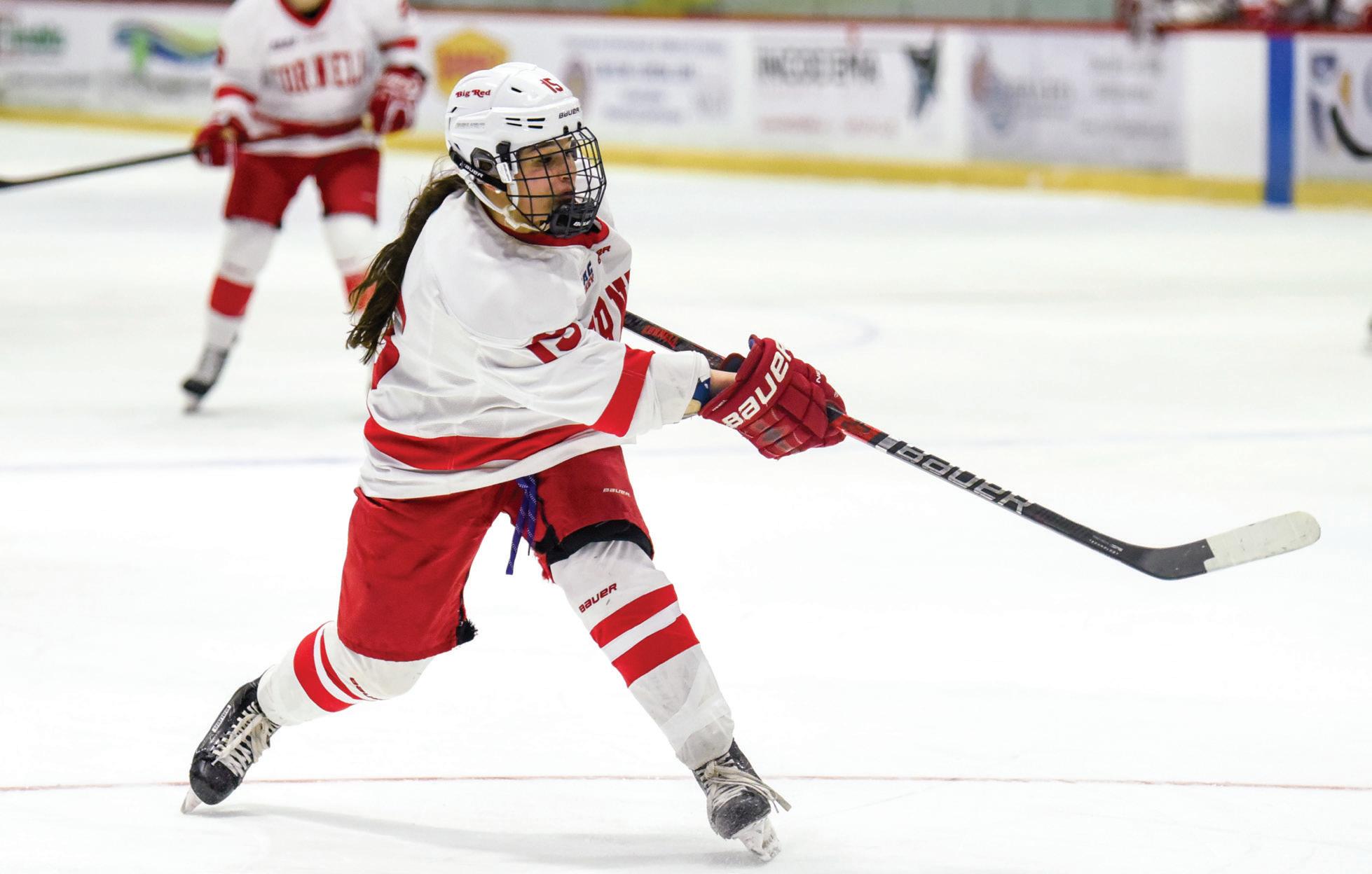
Buckley have each skated in over 100 games for the Red and Boissonnault has earned 14 shutouts over the course of her career, ranking her third all-time in Cornell’s history.
Collectively, Gerace, Serdar and Buckley have tallied a respectable 54 goals and 82 assists thus far. Serdar also led the way for the Red last season in faceoffs by winning an astonishing 344, and Buckley earned a spot on the Wall of Honor this year — a strength and conditioning honor reserved for the strongest and most agile top 10 percent of athletes. Additionally, Gerace overcame a torn ACL that cut her sophomore campaign short. She returned for her junior season, playing in all but two games and ending the season with a +1 rating.
Between the pipes, Boissonnault has established herself as a formidable goaltender in her time at Cornell — making 1,471 career saves and posting an impressive .927 save percentage this season.
But the ice isn’t the only place that the seniors’ unbridled determination has been evident. When the ice at Lynah was unavailable earlier this year, the seniors said that the team had to make the arduous hour-long round trip to Cortland every morning to be able to get on the ice. The seniors embraced the opportunity — waking up at 4:30 a.m., practicing and then rushing back to class — as a time for the team to bond.
Reflections on the Ice
Given the plethora of highs Cornell hockey has had over the past four years, the seniors had a difficult time choosing just one favorite memory. One moment that stands out in their minds is winning the Ivy League title in 2017.
“We had won at Brown, who wasn’t the strongest competitor at the time, and it was a blowout game,” Buckley said. “We were all just so excited. It was the first time in a couple of years [that we won the Ivy title].”
For Serdar, a Massachusetts native, the Red’s 6-0 shutout win against Harvard at the Bright-Landry Center this season is one she won’t soon forget.
“Our class hadn’t won at that rink in the four years that we’d been there,” Serdar said. “And for me personally, I had a lot of friends and family in attendance and it’s the last time a lot of them will ever see me play. Our team came out firing and that whole day was amazing.”
As their time as Cornell hockey players draws to a close, the four agreed that they would most miss the team itself.
“We’ve seen each other almost everyday for the past four years,” Gerace said. “And you go on Christmas break and it feels like you haven’t seen your teammates in years and it’s been two weeks. So I think once hockey ends we’re not going to see the team as much and it’s kind of sad, but we
end, they expressed appreciation for the loyal fanbase of the
“The amount of genuine, loving fans we have is a big part that can’t be recreated,” Boissonnault said. “The fans we get here are phenomenal. You see them here every game regardless of the score or the season we’re having. Our fans are there day in, day out, and that’s a great thing that’s
As the reverberations of their sticks echo through Lynah as they salute the fans after each game, the reverberations of their tenacity and grit will be felt by the team long after