President Martha Pollack is Cornell’s highest officer, leading the multi-campus university and overseeing billions in operations from her Day Hall office. But while she takes in hundreds of thousands in salary for this gig, tax documents show that her first-year payout was far less than any other president in the Ivy League.
Pollack made a base salary of only $671,693 in her first year, with an additional $16,000 in benefits and “other” compensation, according to Cornell’s tax filings for 2017-2018.
Her first-year Ivy League salary didn’t clear the top 100 total take-ins for American private university executives, and according to tax data compiled by the Chronicle of Higher Education, the presidents of all seven Ivy League universities took in far more cash during the 2017-2018 academic year than Pollack.
Across the Ivies
Some other Ivy League leaders have reigned over their brick-and-mortars for decades, others for only a few years, but all — save the president of Princeton University — took in at least a million dollars from their institutions during the 2017-2018 year.
Salaries range in the millions, and presidential pack-
ages can come with lucrative retirement plans, complimentary mansions for their tenure and tens of thousands more in benefits.
The University of Pennsylvania set aside $686,500 in 2017-2018 just for its president Amy Gutmann’s retire ment plan — Gutmann’s total paycheck, the highest in the Ivy League, was just shy of $3 million. Gutmann has been in office since 2004.
Princeton head Christoper Eisgruber, then in his fifth year in office, made $970,900 — still nearly $300,000 more than Pollack.
Eisgruber started at Princeton in 2013 with a salary of around $730,000 between base pay and benefits. Harvard recruited a new president, Lawrence Bacow, the year after Pollack in 2018; Bacow’s salary has not yet been made public.
Many prestigious schools shell out millionaire salaries for their top dogs, and while paydays often skew higher for private universities than for public ones, there’s no hard-and-fast rule.
When Pollack came to Cornell from her post as provost and executive vice president of academic affairs at the University of Michigan, she took a pay raise of around $175,000. However, she currently makes less than Mark Schlissel, president of the Big 10 school, both now and in his first year in office in 2014.
The 2017-2018 figure only reports President
See POLLACK page 5
Tompkins County Legislator Makes
History, Elected as First Black Chair
Leslyn
By JOHN YOON Sun Staff Writer
assumed historic role on Feb. 18
With a 9-5 vote, the Tompkins County Legislature elected Leslyn McBean-Clairborne (D-2nd District) as Chair of the Legislature, making history on February 18.
In an election presided over by Interim Chair Shawna Black (D-11th District), McBean-Clairborne — the first black chair of the Legislature — bested Mike Lane (D-14th District) after he couldn’t win the eight votes necessary to be re-elected chair.
When speaking about her victory, McBean-
Clairborne said while it was “heartbreaking” that we are still celebrating first people of color, the development was still “encouraging.”
“We fight as people of color so hard to stay relevant,” McBean-Clairborne said. “It feels good to know that I can be an example to many young people of color out there … including my own daughter.”
For the past decade, leadership has flip-flopped between two legislators — Martha Robertson ’75 and Mike Lane — a cyclical back-and-forth that caused McBean-Clairborne and other county legis-
See CHAIR page 5
By ALEC GIUFURTA Sun Staff Writer
For the first time, the PanAfrican flag is being flown atop Ithaca City Hall in recognition of Black History Month.
But for Tompkins County Legislator Henry Graison J.D. ’88 (D-3rd District), who spearheaded the initiative, this moment represents just another step in his plan to fly the flag on more buildings.
The PanAfrican flag, adopted in 1920 by the Universal Negro Improvement Association and African Communities League, represents a connectdness of the African Diaspora, black nationalism and black freedom –– elements of Garveyism. Marcus Garvey, a Jamaican political activist, founded the UNIAACL in 1914 to promote black nationalism.
the post at a government building really gives you a sense of belonging,” Graison told The Sun.
While this is the first time the flag was flown atop Ithaca City Hall, Graison used the County Legislature’s authority to fly the Pan-African flag on county buildings in 2019. The flag is also being flown at Ithaca Town Hall.
“To see the flag flying on the post at a government building really gives you a sense of belonging.”
Henry Graison J.D. ’88
This year, Graison worked with the Ithaca Common Council sub-committee to fly the flag on City Hall, which granted Graison’s application to fly the flag for the remainder of February on Feb. 5.
“There was no hiccup or anything else,” Graison said, though noted that the city clerk reportedly “forgot” to fly the flag the day after the application was approved until after an email
“To see the flag flying on
Pollack’s own first year at her Day Hall desk — Cornell’s presidential salaries have traditionally increased over time. Previous records show that while base pay may increase by a few tens of thousands each year, the real
Sun Managing Editor
COURTESY OF CORNELL UNIVERSITY
McBean-Clairborne
COURTESY OF CORNELL UNIVERSITY
Chair change | McBeanClairborne (pictured) speaks at Sage Chapel in 2017. She began her role as chair on Feb. 18.
A LISTING OF FREE CAMPUS EVENTS
TO D AY
Workshop: Can I (Fair) Use It?
10 a.m., 160 Mann Library
Strategy and Business Economics Workshop: Markets for Rhetorical Services
11:40 a.m. - 12:55 p.m., 333 Sage Hall
Workshop: Joint Industrial Organization and Sustainable Environment Energy And Resource Economics 11:40 a.m. - 1:10 p.m., 498 Uris Hall
A Wild Solution for Climate Change 12:15 - 1:15 p.m., A106 Corson/Mudd Hall
A New Philosophy of Clothes 12:20 - 1:10 p.m., T01 Human Ecology Building
The Creative Diaries of Indian Poet A.K. Ramanujan 4:30 p.m., G08 Uris Hall
Second Homes: Using Natural Language Processing Techniques to Find Paradomestic Architectures In the Novel 4:30 - 5:30 p.m., 107 Olin Library
Latinx Read: Book Launch Series 4:30 - 6 p.m., 258 Goldwin Smith Hall
Workshop: Intro to Laser Cutting 4:30 - 6 p.m., mannUfactory Makerspace, Mann Library
Transing Gender in the 19th Century: Female Husbands and Their Wives 5 - 6:30 p.m., G645 Goldwin Smith Hall
Designing a Secure Smartphone: Beyond Crypto 6 p.m., 203 Phillips Hall
Forged by War: The Great War of Global Economic Governance 12:15 - 1:30 p.m., G08 Uris Hall
Energy Seminar Speaker: Is Carbon Neutrality a Reality For the Cornell Ithaca Campus? 12:20 p.m., 155 Olin Hall
Management of Field Bindweed in Reduced Tillage Systems in the Central Valley of California 12:20 p.m., 135 Emerson Hall
Caveat Utilitor: A Comparative Assessment of Popular Resilience Measurement Approaches 12:20 - 1:20 p.m., 200 Savage Hall
Wikipedia: Art and Feminism 4:30 - 5:30 p.m., 106G Olin Library
LGBTQ history | Today, Prof. Jen Manion, history, Amherst College, will speak about the history of people who were assigned female at birth, but who lived as men and married women in the 18th and 19th centruries.
COURTESY OF CORNELL UNIVERSITY
Solar Panels Planned for New North Buildings
By MEGHANA SRIVASTAVA and LIAM GALEY Sun Staff Writer and Sun Contributor
The North Campus Residential Expansion project has been made a bit more green, thanks to an initiative that will see new buildings equipped with solar panels.
Cornell recently made a purchase agreement with GreenSpark Solar, a New York-based solar panel provider –– a decision that “represents a tenfold increase in the on-campus rooftop solar capacity,” according to the University.
The University’s current on-campus solar energy output amounts to only 0.09 megawatts, but the new buildings’ rooftop solar panels will produce about 1 megawatt of energy annually — equivalent to about 155 homes’ worth of electricity. The solar panels will provide for 35 percent of the residential expansion’s energy needs, according to the University.
“These buildings will require the equivalent of only about 1.4% of today’s total campus district energy (in the form of
chilled water, hot water, and electricity) despite representing over 4% of Cornell’s utility-connected campus in terms of net square feet of building space,” wrote Chris Davenport, project manager for Facilities and Campus Services, in an email to The Sun.
According to Davenport, the energy use of these buildings is about “30% better than the latest State Energy Code standards.”
The solar construction project fits into the University’s broader goal of aiming to be carbon neutral by 2035, joining a series of other ambitious renewable energy initiatives, such as earth source heating, a technology that could leverage geothermal power beneath Cornell to power campus.
Despite the energy conservation ambitions of the expansion, some of the inevitable consequences of its construction have not escaped the notice of current North Campus residents. Many first-year students living in Jameson Hall, Mews Hall and the Low Rises have bemoaned the noise pollution and inconveniences that have resulted from the construction.
Cayuga Nation Demolishes Rival
By SEAN O’CONNELL
The Cayuga Nation Council seized and demolished 12 buildings at 2:30 a.m. on Saturday morning in Seneca Falls, New York –– the result of a dispute between two tribal factions, both claiming to lead the Cayuga Nation.
In a press release sent later that morning, the council, led by the Halftown faction, stated, “the Cayuga Nation has employed tribal law to detain persons who have violated that law, and the Nation has retaken possession of its properties.”
The properties, which included a gas station, an ice cream stand and a daycare center, were being operated by members of the Unity faction, which claims to be the traditional leaders of the Cayuga tribe and reject the council.
This memo was used as justification for the council’s actions on Saturday, in lieu of a ruling from the State Court of Appeals: The Nation stated in its press release that its actions were “in accordance with authority expressly recognized by the United States Bureau of Indian Affairs”.
Joseph Heath, legal counsel for the Unity faction, referred to the demolition as “viciously unlawful,” the Ithaca Times reported. Heath referred to the Cayuga Nation Council as a “newly concocted government, which was created with the illegal, backroom assistance of the Bureau of Indian Affairs.”
“What happened was awful ... [It] cannot go unpunished.” Chuck Schumer
Last October, the New York Court of Appeals refused to rule on which faction had jurisdiction over the properties after the council sued to recover them, arguing that the dispute was out of the court’s jurisdiction, The Citizen previously reported.
The council police force, which was established only a year ago, reportedly found methamphetamine, marijuana, guns and ammunition on the properties. The Cayuga Nation Council said it demolished the buildings “to eliminate certain public safety issues,” and to prevent them from becoming “a target for any further friction in the community.”
In June 2019, the U.S. Interior Department’s Bureau of Indian Affairs sent a letter to Seneca Falls law enforcement recognizing the Cayuga Nation Council as the official leadership of the Nation.
Seneca County officials have strongly objected to the bulldozing of the properties, calling on both Rep. Tom Reed (R-N.Y.) and New York’s two Senators to halt federal funds to Cayuga Nation until the conflict is resolved. The incident is now being investigated by the FBI and the U.S. Marshall Service.
“We do not support this kind of violence that’s gone on there,” said Supervising Chair Robert Hayssen (R-Varick), who likened the actions to “domestic terrorism,” according to the Daily Messager.
Saturday’s disruption has attracted attention statewide, with political leaders weighing in on the disputed leadership. Senate Minority Leader Chuck Schumer (D-N.Y.) has called for a federal investigation by the Department of Justice and the Interior Department.
“What happened was awful,” Schumer told reporters. “[It] cannot go unpunished.”
Sean O’Connell and Liam Galey can be reached at soconnell@cornellsun.com and ltg25@cornell.edu.
“I sleep with earplugs in anyway, but I know a lot of kids who are woken up by [the construction] every morning,” said Will Hasapis ’23, a Jameson Hall resident.
Even with the noise, students agree that the construction of new dorms is an overall improvement for Cornell.
By MIHIKA BADJATE Sun Contributor
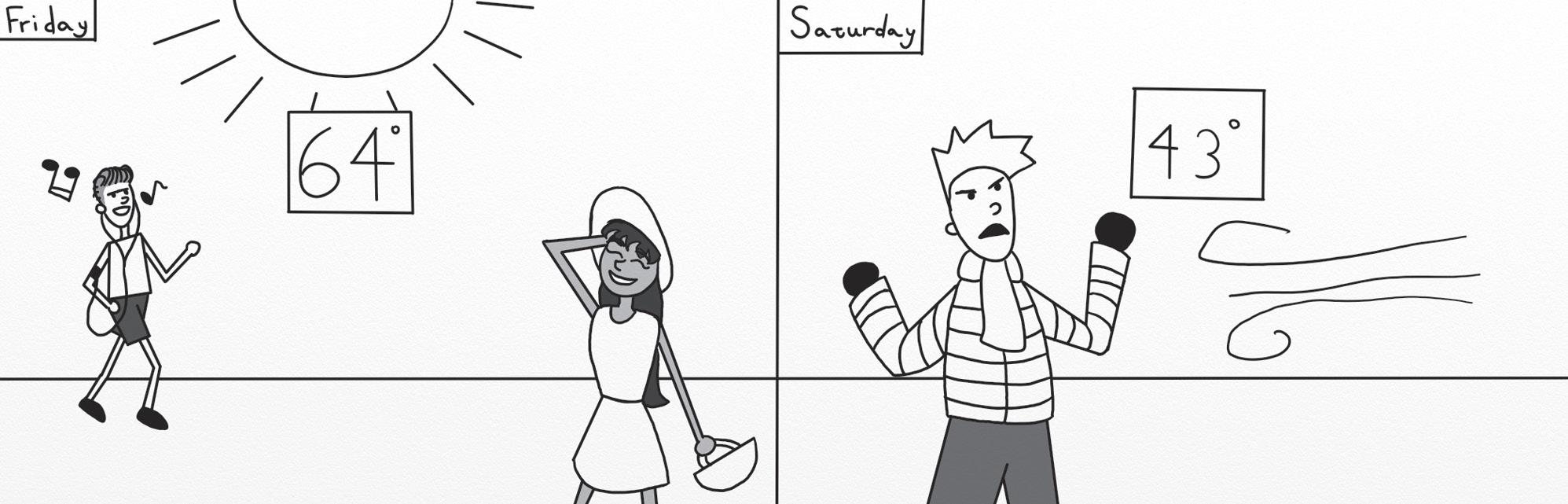
Students who stayed near Ithaca and Tompkins County over February Break were graced with abnormally sunny skies and 50 degree weather.
Enjoying the unseasonably comfortable temperatures, many used the four day weekend as a chance to get off campus and into the outdoors.
Laura Azcarate ’23, an international student from Colombia, took full advantage of her first white winter by spending a day at Greek Peak, a nearby Ski resort.
“I actually had a lot of fun because since I’m from Colombia, I had never experienced seasons before,” Azcarate said. “I took advantage of that and I went skiing for the first time in my life –– I had never done that before and it was really fun.”
Also sticking relatively close to campus, Ian Wallace ’20 ventured out of Ithaca for a one night excursion.
“Me and a few friends rented a car and went out to a cabin outside of Syracuse,” Wallace said. “We took advantage of the time to spend outdoors, go on a hike, enjoy the snowy woods, and just relax
–– not worrying about schoolwork and obligations, just unwinding and having a good time together.”
The looming cloud of postbreak prelims still cast a shadow over the break, and many students also made use of the extra time to get a head start on studying.
“I decided a four day break would be good to catch up with my studies because I have a prelim coming on Friday,” Sumay Mishra ’23 said.
Many campus facilities, such as service centers, dining halls and fitness centers, had limited hours over the break. On North Campus, Appel Fitness Center was closed all four days, while Helen Newman’s facilities remained open.
All service centers were closed for the duration of Saturday and Sunday, while Robert Purcell Community Center Dining Hall’s closing forced students to go to Appel Commons to use meal swipes.
“My dorm is right beside RPCC, which is really convenient, so it was kind of a bummer that it was closed,” Azcarate said. “But I get that they cannot have everything open for the few people that stay.”
Mihika Badjate can be reached at mb2342@cornell.edu.
Fighting factions | The Cayuga Nation Council, lead by the Halftown faction, destroyed several buildings, including a gas station (above) operated by the Unity faction, triggering backlash from state officials.
and LIAM GALEY Sun Staff Writer and Sun Contributor
C.U. President’s Salary Bottoms Out Ivy League
Above Cayuga’s Waters
Between his first year in 2004 and 2015, Cornell President David Skorton’s base pay increased by over a quarter of a million dollars, even before adding on six-figure retirement payouts and benefits. Skorton left office in 2015 after ten years of service, netting a base pay of over $872,000 plus bonuses and other income totaling well over seven-hundred grand.
His successor, the late President Elizabeth Garrett, was only president from July 2015 through Feb. 18 of the next year, only a few weeks before her March 6 death from cancer. The University paid its first female president less than Skorton’s 2004 starting salary for that length of time, both in base pay and in total including benefits and deferred retirement.
In the year that former President Hunter Rawlings stepped
in as “interim president” following Garrett’s death, he made significantly more than Pollack in her first year in the top office, with total compensation amounting to over $1.6 million. Even during Pollack’s first year in office, Rawlings continued to take in big paydays of deferred income, netting another $1.5 million.
University spokesperson John Carberry pointed out that 2017-2018 was a transition year, accounting for the large figures paid to Rawlings. He did not comment on the reasoning for Pollack’s figure.
While that year did see the swearing-in of a new president, its tax documents, from July 2017 to June 2018, reflect Pollack’s full first term as president.
Pollack doesn’t even have the highest paycheck among the University administration — Provost Michael Kotlikoff made around $30,000 more between 2017 and 2018 even without his heftier retirement package.
Pollack’s yearly salary, including base pay, bonuses and benefits, is set by Cornell’s Board of Trustees, a 50-plus-member collective that meets in New York City.
Cornell isn’t the only source of income for Pollack, who has a prolific background in artificial intelligence — she sits on multiple boards, including that of technology titan IBM. Information on Pollack’s earnings from this position are not yet public.
Also a factor as Pollack balances her checkbook: Cornell owns and maintains a 9,000-square-foot mansion, known as Robin Hill or Thorn Hill, as an official residence for its sitting president and their family while they live in Ithaca.
Salary figures for Pollack’s second year in office will be filed with the University’s taxes after the academic fiscal year ends in July.
Sarah Skinner can be reached at sskinner@cornellsun.com.
Legislature Names New Chair Pan-African Flag Flies
Continued from page 1
reminder.
“I checked with the county administrator, and he said he knew of no other county in New York State that [flies] it,” Graison added.
Not all, however, support the flag’s ascent onto Ithaca’s government buildings: Prof. Russell Rickford, history, called it “empty symbolism.”
“It’s especially ironic that the symbol of black liberation flies above this town,” Rickford said, slamming the city’s record on police brutality and marginalization of black residents. “You can’t have symbolism without the substance.”
“At a time when powerful landlords and developers are buying up the town and pushing people to the margins of Ithaca and into its outlying area into its periphery that at this moment officials should see fit to fly the flag of black liberation,” Rickford said.
“We don’t need tokenism,” Rickford continued, “and we don’t need an ornament.”
Graison’s next goal is to fly the flag above the New York State Capitol Building. In 2019, the LGBT pride flag flew over the capitol building. In 2017, the pride flag mounted Ithaca City Hall, which inspired Graison to apply for flying the Pan-African flag.
“The pride people flew the pride flag, and so I thought, why can’t we fly the Pan-African flag,” Graison said. “This is our representation.”
Graison hopes Ithacans realize the power and meaning behind the flag: “Hopefully everyone understands that, it really is for a unifying nature and something that we can all be proud of.”
John Yoon can be reached at johnyoon@cornellsun.com. CHAIR Continued from page 1 FLAG
Alec Giufurta can be reached at agiufurta@cornellsun.com.
McBean-Clairborne makes county history
[by running for Chair],” said Dawson.
lators to express an eagerness for change.
But, according to McBeanClairborne, what caused her to run wasn’t just a desire for fresh leadership, but a personal calling.
“I’m a very spiritual person and I believe that what I do, I’m called to do by some higher power,” she said about her run. “It was the right time and I was the right person in the right place in this moment.”
The first person to nominate McBean-Clairborne was Legislator Anna Kelles (D-2nd District), who dropped out of the chair race to announce her candidacy for the 125th New York State Assembly District. When nominating McBeanClairborne, she called her the “soul of the Legislature.”
“She’s a moral compass … she doesn’t just think about her own constituents,” Kelles said. “She’s thinking about how every decision we make is going to affect everyone.”
Legislator Deborah Dawson (D-10th District), said that McBeanClairborne had made a sacrifice for the Legislature in taking on the position.
“I think Leslie did us all a favor
McBean-Clairborne was elected after legislators Anne Koreman (D-5th District) and Black voted for McBean-Clairborne — both had voted for Lane when he was running against Kelles.
When Koreman seconded McBean-Clairborne’s nomination, she pushed the other lawmakers to “make history tonight.”
She further explained that, “if two people have the exact same qualities that that we should consider, you know, strongly consider that... because with our own internal biases, we often disclude [people of color]. So I think ... it was absolutely a part of my decision.”
For McBean-Clairborne, the recently flown Pan-African flag for Black History Month helped reconcile the historic markings of the moment.
“[I] just stood on the podium and it was not lost to me realizing that hanging to my left was the PanAfrican flag,” McBean-Clairborne said. “That is when it began to really sink in that something historic happened in Tompkins County.”
Solar Power Comes to New North Buildings
NORTH
Continued from page 3
“I’m glad that students might be able to avoid the exorbitant costs of collegetown housing,” said Hyun Do Cha ’20, who also lives on North Campus.
According to Davenport, the project is still on track to meet its original construction goals, with Site One, which is located near Robert Purcell Community Center, set to open during the fall 2021 semester, and Site Two, near Appel Commons, set to open during fall 2022.
In terms of road and sidewalk disruptions, the path behind the low rises and Mews, which has been closed since fall 2019, will remain inaccessible until the project is completed in 2022.
Additionally, according to Davenport, in spring 2021, Program House Drive will be closed entirely for a rebuilding, while during summer 2021 Jessup Road will be subject to regular roadwork.
Meghana Srivastava and Liam Galey can be reached at msrivastava@cornellsun.com and ltg25@cornell.edu.
Morgan Stanley Vice Chairman Shares Job, Internship-Hunting Tips
By MAIA LEE Sun Staff Writer
Internships and full-time jobs at investment banks like Morgan Stanley, Goldman Sachs and JP Morgan are highly sought-after among Cornellians interested in finance.
A Vice Chairman and Managing Director of Wealth Management at Morgan Stanley, Carla Harris shared her insights on how students can land a coveted Wall Street gig — offering tips on acing finance interviews, climbing the corporate ladder and excelling in an industry where both women and people of color are highly underrepresented.
Harris first broke down one of the most important questions that students should know the answer to, but often struggle with: Why do you want to work for us?
“If [banks] sense that you’re just trying to get a job in finance, then it’s the easiest way to take yourself off the list,” Harris said, who pointed out that it is vital for applicants to understand what distinguishes each Wall Street firm and position.
Understanding the “why” entails genuine introspection. Highlighting the importance of “understanding your own mind,” Harris
said that no matter what financial profession one pursues — corporate finance, banking, internal strategy roles — it is necessary to communicate some understanding of the role’s function.
However, once students land a role, there is often more to it than just having a good work ethic. Recalling the greatest obstacle she faced as a young woman in finance, Harris said relying too much on the notion of “meritocracy” ultimately proved not enough: “I knew I was smart, and I knew I could work hard. So why wasn’t it working for me?”
Instead, Harris said it is critical that students begin to build relationships with upper management and key employees by the time their first year at the company is over — an ongoing process of networking that can shape a young professional’s trajectory by creating “awareness about how smart you are [and] what you can bring to the table.”
This skill means having the ability to read an environment and analyze the culture of the firm in order to “get people to think about you in the way that you want them to think about you.”
For women and people of color, build-
ing those connections may prove especially critical to rising the ranks in a homogeneous workplace — one which is still disproportionately male and white.
That lack of diversity prevalent in high finance is an issue that Harris has long been working to address.
For instance, to help increase representation of people of color in the field, she has placed a large emphasis on assembling diverse recruitment teams, with the reasoning that “if students don’t see people that look like them, then even if they made it to the process, they’re not apt to go.”
When it comes to internal mobility beyond college campuses, however, diversity is cultivated by the presence of strong role models in upper management positions — especially women and people of color. But even though financial firms have expanded their diversity recruitment programs in recent years, Wall Street as a whole has still struggled with a lack of representation among executives.
According to Harris, the root of this problem stems from two harmful signals that girls are given from a young age: one, that they need permission, and two, that they can or cannot do certain things.
Recalling interactions with women who have told her that “numbers are not [their] thing,” Harris guessed that somebody had told them this early on, eventually becoming a “self-fulfilling prophecy.” To combat these harmful perceptions, a solution she offered was for parents to constantly affirm their daughters, encouraging them to try again when they fail.
Harris has also implemented some of her own initiatives at Morgan Stanley to address these diversity issues.
One is the Multicultural Innovation Lab, which focuses specifically on investing in “female founders of color.” Analysts and associates at the company rotate through this program and get exposure to traditional investment banking, as well as early stage company and entrepreneurial experiences.
To help more women and people of color achieve these higher positions, Harris gave her final piece of advice to incumbent employees who hold upper management roles: “The biggest thing that you can do is give people the confidence that they can execute.”
Maia Lee can be reached at maialee@cornellsun.com.
SC I ENCE
The Carbon Footprint of February Break Travels
By NATALIE MONTICELLO Sun Staff Writer
Every year, Cornellians travel around the country and world to get away from the cold of Ithaca for a couple days during February break.
in on the most sustainable methods for traveling.
“Traveling can often be very carbon-intensive [for] the environment,” said Eiseman, who teaches a variety of environmental communications courses at Cornell and focuses her research on sustainability messaging and pro-environmental behaviors.
While some think that traveling by car is more sustainable than traveling by airplane, this is not always the case. The degree of sustainability depends on distance — for longer distances flying becomes more sustainable due to more efficient fuel usage during cruising, while for shorter trips, driving may be better.
as replanting trees to absorb excess carbon dioxide from the air using photosynthesis. This results in a net reduction of an individual’s carbon footprint through reabsorption of the harmful carbon emissions one can generate, especially through travel.
Even if carbon neutrality is a stretch for some, individuals can make small changes during their daily commute to increase the sustainability of their travel.
For regular commuters, public transportation is one eco-friendlier option, which, instead of using separate, emissions-producing vehicles, results in an overall reduction in air pollution on a per-person basis.
driving, like staying within the speed limit, stopping and starting your car whenever possible and not idling your vehicle during rest stops, according to Eiseman.
Cars themselves also vary in their sustainability — older vehicles are less fuel-efficient than newer, hybrid and electric cars, which release significantly lower quantities of greenhouse gases.
However, the manufacturing of newer “eco-friendly” cars can actually create a larger environmental impact than the carbon emissions potentially saved from simply switching to a more fuel-efficient car.
Unfortunately, by emitting greenhouse gases, traveling by car, plane or bus can contribute to climate change — with America’s transportation alone responsible for almost 30 percent of all global warming emissions in the US.
Despite Ithaca’s limited transportation options, if you plan to travel during breaks, but want to do it more sustainably, there are still a few ways to make your journey more eco-friendly.
As students flock back to campus from various destinations, Prof. Danielle Eiseman, communication, weighed
One way is carbon offsetting, in which individuals fund environmental projects that decrease atmospheric greenhouse gas levels, such
If driving is absolutely necessary, carpooling can produce a similar effect and reduce vehicle emissions.
“Carpooling is a great way to make long drives less boring while traveling sustainably,” said Miranda Vincent ’20, an environment and sustainability major.
There are other practices to promote more sustainable
“A lot of people think that, as an individual, their personal carbon footprint is unimportant,” Vincent said. “This couldn’t be further from the truth. If we all take little steps towards sustainability, we can make a massive impact as a society.”
Natalie Monticello can be reached at nmonticello@cornellsun.com.
Evolving Viruses: What Does the Future Hold?
By MILENA BIMPONG
Writer
As disease-wary stock markets tumble, the outbreak of the novel coronavirus, COVID19, has continued to see global death tolls rise — rapidly spreading from its Wuhan roots to gain a foothold in countries as diverse as Italy and Iran.
But virus outbreaks are nothing new: in just the past 10 years, the world has been plagued with the H1N1 pandemic of 2009 and a resurgence of the Ebola virus from 2014 to 2016 — and it seems like such epidemics will continue for years to come.
Which begs the question, can scientists predict if, and when, we will see another new virus strike within the next several years?
But despite advancements in virus detection technology, according to Prof. Roy Gulick, medicine, chief of the division of infectious diseases at Weill Cornell, it is often difficult to predict when and how often such outbreaks will occur.
These difficulties are compounded by the fact that viruses cannot be singularly categorized — instead, representing
a wide range of illnesses, which vary considerably in both symptoms and manner of transmission.
However, the medical community is increasingly equipped with more advanced technology that can more quickly discover new viruses, though challenges still loom.
“We’re much better at discovering, tracking, and characterizing new viruses,” Gulick said.
“Given that we have much better tools today to analyze these [viruses], we’re going to continue to discover more viruses and microorganisms and that will help us do genetic analyses and develop vaccines and medications.”
For instance, a new virus, Yaravirus brasiliensis , which was discovered at the end of January in Brazil, is a testament to the gap in knowledge in the world of viruses.
Over 90 percent of the virus’ genome has never been seen in other organisms, and bears no resemblance to any genome cataloged in over 8,500 publicly available metagenomes, genetic samples recovered from the environment.
In fact, the virus is so foriegn it actually
represents an entirely new group of viruses — based on current classification protocols, the Yaravirus would not even be considered a virus.
The novel virus does not cause human disease, but its exact effects still remain unknown.
“For a virus to cause diseases in humans, it has to be able to recognize a cell and target that cell,” Gulick said. “Different viruses target different cells in the body… the cold and flu virus tend to target cells of the upper airways, nose, mouth, and the throat.”
Another reason that makes viruses so difficult to track and contain is the vast variety in the way they are transmitted.
For instance, some viruses, like the common cold, spread through nasal or oral secretions that are passed from one individual to another through contact, while others, like measles, can spread through mere proximity, moving through coughs or sneezes near others.
In a type of illness Gulick called “zoonosis,” humans can contract viruses not only from other humans, but animals as well, such as
in the case of SARS.
The occurrence and severity of outbreaks, Gulick explained, depends on which of these modes of transmission a virus uses to spread. This, in turn, affects what preventative measures are recommended by healthcare professionals to halt a virus’ contagion.
“Typically, around cold and flu season, we remind people to wash [their] hands frequently,” Gulick said. “If someone is admitted to the hospital for measles, we put a mask over them and anybody
entering their rooms so that measles is not transmitted through the air from one person to another.”
While the nature of the next viral outbreak is uncertain, significant medical advancements, such as vaccines, have improved the treatment of viruses and the state of public health as a whole, according to Gulick.
“We’re much better, particularly in the last five years, about being able to develop vaccines in a rapid way,” Gulick said.
Vaccines are not
available for all viral ailments, but advancements in antivirals have significantly improved treatments for viral infections within the past few decades, Gulick said. Gulick explained that antivirals are commonly used for influenza and Hepatitis C.
Overall, the trend of new virus outbreaks doesn’t seem to be slowing down any time soon, but preventive measures are crucial for avoiding infection.
Milena Bimpong can be reached at mbimpong@conellsun.com.
ANTOINE MAILLARD / THE NEW YORK TIMES
A shadow of doubt | Greenhouse gas emissions from vehicles can have ramifications for wildlife as far as the Arctic.
Sun Staff
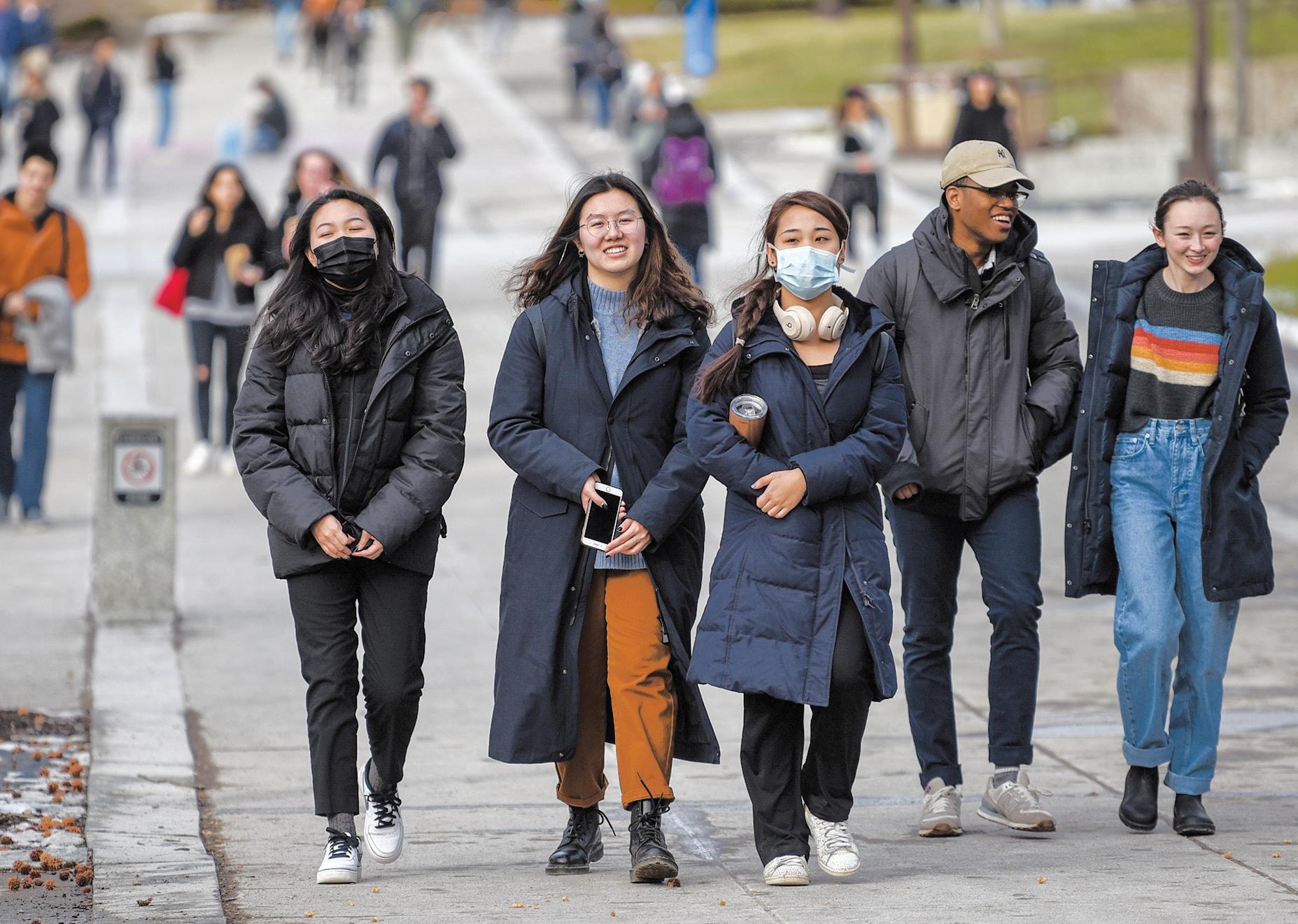
Combating coronavirus | Students on campus protect themselves from airborne pathogens, like coronavirus, using surgical masks.
BORIS TSANG / SUN PHOTOGRAPHY EDITOR
ARTS & ENTERTAINMENT
Subtle Asian Streaming
I’m a little ashamed to admit that I don’t typically watch Asian movies or television.
For the last few years, my knowledge of them has remained on the periphery — I vaguely know what everyone is watching and loving, but rarely do I venture to try them myself. While I do not have any real aversion to Asian entertainment, I grew up watching mostly Hollywood films, so I never developed a great interest in it. More importantly, since high school, American streaming services and Youtube have pretty much fully comprised my options, and it’s often difficult to get a hold of Asian films and TV due to copyright restrictions. Disinterest became something akin to aversion over time, and unless my friends talked my ears off about a Korean drama or Chinese variety show, I rarely took the initiative to seek them out.
Recently, however, I’ve noticed that things have started to change. Back in January, I was surprised to find a spin-off of a hugely popular Chinese period drama on Netflix, and out of curiosity, I watched a few episodes. The spin-off had the exact same style as the original, and if I had seen it on some other platform I wouldn’t have believed that Netflix had a hand in it at all. Unlike The Crown or You, nothing about it was typical of the streaming giant. It appears that Netflix simply bought out the show’s overseas distribution rights and labeled it an original series, but exerted no significant influence over the actual production process.
On Valentine’s Day, I finally succumbed to the overwhelming amount of press coverage of the To All the Boys sequel and watched it over dinner one day. I ended up not having
What will music sound like when artificial intelligence takes over the world? Miss Anthropocene, framed as a concept album for an imaginary “death god” personifying the climate crisis, gives us a good idea. On her newest album, Claire Boucher, who goes by the stage-name Grimes, sings somber and often trance-like songs about death, the climate crisis, drug addiction and the A.I. revolution, all accompanied by her characteristic mixture of fantasy and demonic imagery.
At 31, Grimes has risen to pop-culture super-stardom, thanks to her talents as a singer, graphic artist, engineer and video director. Her relationship with tech billionaire Elon Musk has hardly lowered her profile, espe-
much patience for the movie and exiting out of it halfway through, but the next recommendation drew my attention — A Netflix Original Korean drama. I didn’t know what was more bizarre: me getting recommended Korean television by the algorithm, or American streaming services distributing K-dramas. The show was Crash Landing on You, and the premise sounded too intriguing to pass up. So, instead of finishing To All the Boys, I clicked on the series. Along with breaking my streak of not having seen any K-drama since Freshman year, I also proceeded to become the friend that talks nonstop to everyone else about it.
As soon as I watched Crash Landing , the algorithm began aggressively recommending me other Korean shows, and I discovered belatedly just how many Asian films and TV series are on the platform. Just two years ago, my friends and I were watching Goblin on some sketchy, nondescript website with tons of ads. We knew where to look, but even then it took forever to find a reliable way to stream the latest episodes. Similarly, on Youtube, almost all of the Chinese variety show videos used to only have Chinese titles, and even if you knew exactly what you were looking for, they were still difficult to find. Therefore, I’d imagine it’s nearly impossible for any non-Asian Americans to come across Asian television by accident.
Once I started to pay attention, it became clear how much Netflix has changed, and how it has diversified itself culturally and across genres. I wonder how exactly the company got the memo that bringing Asian television to the American market would be a hugely profitable decision. While some of the
cially after her Instagram posts in the last month, where she sports a clear baby bump. However, in lieu of revealing details about her much-scrutinized personal life, Grimes opts to focus on a self-created fantasy world on her latest full length release.
The Canadian singer stays true to her experimental dream pop, electronic and hip hop influences throughout Miss Anthropocene. The ten-track album comes over four years after her last LP, Art Angels, was released in 2015. While both tackle real-world problems with an overlay of electronic beats, Miss Anthropocene sounds more distinctly other-worldy and hypnotic in comparison to Art Angels’ more raw soundscape. In contrast to her single “We Appreciate Power,” released in 2018, Miss Anthropocene is noticeably more timid, despite a consistent theme of death throughout its tracks. “We Appreciate Power” has a heavier beat and harsher-sounding lyrics, which hardly compare to “Violence”
credit must be attributed to the recent explosion in popularity of K-pop groups in western countries, part of it may also be due to the sharp rise in competition in the streaming industry. Judging by the continuous increase in the number of Asian films and TV shows that are becoming available on the platform, it’s clear that this is an investment that Netflix wants to continue making.
The implication of this paradigm shift is significant. With the growing success of Amazon and Disney Plus, Netflix’s strategy signals that diversity in streaming is the key to remaining competitive and irreplaceable, which could in turn prompt other platforms to act accordingly. Consequently, this would mean that foreign film and television could finally become more accessible and mainstream in western countries, especially to those outside of the original target audience, who formerly could’ve been interested but would not or did not know how to seek them out.
I was a little dumbfounded when I saw the sheer number of oblivious comments on Amazon Prime complaining about Parasite
or “So Heavy I Fell Through The Earth,” both of which are far more trance-like. Insead, the album much more close ly resembles “Nihilistic Blues” by Bring Me the Horizon, a chart-topping single released in 2019 which Grimes featured on.
Like her earlier work, Grimes was influenced by a variety of sources.
“4ÆM”, which will be fea tured in the video game 2077, is the cyberpunk interpretation of the Bollywood movie Bajirao Mastani. In addition, the title of the album itself comes from the ‘Anthropocene Era’, the name given to the current geological era defined by human impact.
not being a movie in English after its monumental sweep at the Oscars. Bong Joon Ho was right in his Golden Globes speech when he said “once you overcome the one-inch tall barrier of subtitles, you will be introduced to so many more amazing films.” But the reason why it might be hard to overcome in the first place is a lack of exposure following decades of Hollywood’s cultural monopoly. We live in an age where recommendation systems dictate our choices. We helped make it that way, but that doesn’t necessarily mean no good can ever come from it. Ultimately, it’s what we choose that changes the system. And for that, the diversification of choices on streaming platforms is pivotal and worth celebrating. I hope to see a day when subtitles are no longer the barrier but the bridge, and no one bats an eyelash when another non-English film wins Best Picture.
Andrea Yang is a senior in the College of Arts & Sciences. She can be reached at ayang@cornellsun. com. Five Minutes ‘Til Places runs alternate Mondays this semester.
RACHAELSTERNLICHT/SUNGRAPHICDESIGNER
Many of the songs on Miss Anthropocene draw inspiration from difficult topics. Most notably, “Delete Forever” addresses the opioid epidemic, beginning with the lines “Lying so awake, things I can’t escape/Lately, I just turn ‘em into demons/Flew into the sun, fucking heroin.” Written on the night that Lil Peep over-
dosed, the song displays the raw emotions of Grimes’ reaction to the death of yet another superstar artist by drugs. In addition, “Darkseid” featuring PAN addresses the suicide of PAN’s friend. Sung partially in Chinese, the song exemplifies Grimes’ production talents, as it manages to convey grief in an entirely different language.
Despite the album’s many positives, it is lacking in one important area. While the album’s sound
ten singles mashed together onto a mixtape. Although all of the songs relate to the theme of death, they lack the cohesive storyline which characterizes great concept albums. Despite this, the songs consistently hit a high mark, distinguishing Grimes not as simply a name in the headlines, but a boundary shifting artist capable of greatness in her own right.
Carolyn Hale is a sophomore in the College of Arts & Sciences. She can be reached at cjh287@cornell.edu.
Andrea Yang
Five Minutes ‘Til Places
COURTESY OF NETFLIX
Carolyn Hale
Grimes
Miss Anthropocene 4AD
The Corne¬ Daily Sun
Independent Since 1880
137th Editorial Board
ANU SUBRAMANIAM ’20
Editor in Chief
JOYBEER DATTA GUPTA ’21
Business Manager
PARIS GHAZI ’21
Associate Editor
MEREDITH LIU ’20
Assistant Managing Editor
RAPHY GENDLER ’21
Sports Editor
BORIS TSANG ’21
Photography Editor
AMBER KRISCH ’21
Blogs Editor
SOPHIE REYNOLDS ’20
Science Editor
AMANDA H. CRONIN ’21
News Editor
JOHNATHAN STIMPSON ’21
News Editor
SARAH SKINNER ’21
Managing Editor
KRYSTAL YANG ’21
Advertising Manager
NATALIE FUNG ’20
Web Editor
SABRINA XIE ’21
Design Editor
NOAH HARRELSON ’21
Blogs Editor
SHRIYA PERATI ’21
Science Editor
KATIE ZHANG ’21
Dining Editor
AMINA KILPATRICK ’21
News Editor
MARYAM ZAFAR ’21 City Editor
Working on Today’s Sun
Ad Layout Sahara Ellis ’22
Production Deskers Ben Mayer ‘21
Krystal Yang ‘21
News Deskers Alec Giufurta ’21
Lucas Reyes ’21
Design Deskers Niko Nguyen ’22
Krystal Yang ’21
Photography Desker Ben Parker ’22
Arts Desker Richard Beezley ’21
Editors in Training
Editor in Chief Maryam Zafar ’21
Managing Editor Johnathan Stimpson ’22
Kathryn Stamm ’22
Associate Editor Pallavi Kenkare ’21
Sports Editor Emily Dawson ’21
Arts Editor Richard Beezley ’21
Science Editor Anil Oza ’22
Srishti Tygi ’22
Letter to the Editor
Re: ‘Tracking the fossil fuel divestment dollars’
To the Editor:
A Feb 16th letter to the editor in this section claimed that “[d]ivestment would harm Cornell, reduce its influence and, most significantly, do absolutely nothing to fight climate change.” However, the analysis was incomplete and misleading. Divestment is a moral imperative for the University and a meaningful sanction for the fossil fuel industry.
It’s hard to believe that Cornell’s endowment would suffer by removing assets which effectively did not grow over 10 years. Selling fossil fuel stocks, coupled with the shrinking investor market, makes them less valuable. While higher risk investments “ought to” have a higher return, they don’t consistently — that’s why the risk is higher.
Critics of divestment love to cite that shareholders can advocate for changes to the practices of businesses they own equity in. Cornell has publically reported that it does not do this. Furthermore, shareholders cannot effectively advocate for oil companies to stop expanding their drilling, because the way oil companies establish and maintain their value is through the expansion of proven reserves of gas — basically, a company will be devalued if it doesn’t consistently expand its reserves. (Naomi Klein’s This Changes Everything explains this concept in more depth in the chapter “Banning and Planning”). If Cornell isn’t doing shareholder advocacy, and it wouldn’t work anyway, it seems like a silly thing to worry about preserving.
Oil companies are uniquely culpable for climate change because they have known for decades that their business results in dramatic, disruptive changes to how our climate works. Because they are a “rational actor,” as economists often call actors who seek to maximize profit without concern for the other things that may indicate human success or fulfillment, they realized that they could maximize profit by covering up their scientific findings, sowing doubt about the changes they knew were coming and aggressively resisting policies which might help the greater good.
Let’s assume that we can use companies’ supposed “rationality” for good for a second — divestment is a sanction which challenges the ability of fossil fuel companies to operate in the ways that they do. Divestment has had a large enough impact that Shell Oil has called it a “material risk,” which they anticipate making it more difficult for them to raise capital. It also calls into question the social right to continue their current practices, asserting that companies cannot seek profit at the expense of human livelihoods and our personal, ecological and social prosperity. The fossil fuel industry cannot operate as usual if we want to prevent further suffering and damage caused by climate change and pollution, and divestment communicates our refusal to support it.
Katie Sims ’20
Cecilia Martindale ’20
Nick Sutera ’22
Letter to the Editor
Re: ‘With past campaign lessons under her belt, Mitrano J.D. ’95 believes 2020 will be diferent’
To the Editor:
Perennial candidate Tracy Mitrano J.D. ’95 — who announced her 2020 bid to unseat incumbent Congressman Tom Reed (R-N.Y.) just eight days after her loss in 2018 — continues to receive coverage in this newspaper suggesting that Mitrano can and deserves to win this November. Its readership is left to wonder why The Sun believes so ardently in Mitrano’s virtues as a candidate and as a potential representative.
In the latest reported piece on the coming election, Mitrano explains her viability in this cycle by citing the fact that in 2018, she had the disadvantage of having Governor Andrew Cuomo on the ballot. Mitrano goes on to insist that her campaign was plagued with “close to the ceiling of Republican turnout” in 2018. If Mitrano is counting on lower rather than higher turnout in a presidential election year when a Republican incumbent is on the ballot, she can expect to be sorely disappointed. A government major with even a single semester under their belt could have debunked Mitrano’s theory.
Furthermore, Mitrano’s moderation has been wildly overstated by this newspaper. In its September 2019 endorsement of her, The Sun’s Editorial Board maintains that Mitrano is a beacon of moderation while acknowledging that she once supported Medicare-for-All.
Mitrano later recanted and reassuringly informed The Sun that she doesn’t “know exactly what that solution is” when it comes to healthcare. The Sun insists on said moderation while in the same breath lavishing praise on the Democrat for being an unyielding defender of abortion on demand, and while failing to name a single issue where Mitrano may break with her party. On the other hand, The Sun dismisses Congressman Reed’s bipartisan record by noting that he voted for the Republican Party’s healthcare bill. How easily the Editorial Board ignores the fact that Reed is the co-founder and co-chair of the bipartisan Problem Solvers Caucus that he runs with Congressman Josh Gottheimer (D-N.J.) — how quickly it forgets his vote for the Equality Act. Moderation is about supporting the Democratic Party line on any given issue. The more issues you agree with it on, the more moderate you are. Game. Set. Match. Mitrano. Tracy Mitrano will lose on Nov. 3. She will lose because she is not a moderate, because her values do not align with this district’s, and because Congressman Reed is an eminently reasonable and talented politician who represents his constituents and their values well. I’m sure he’d be thrilled to find out on Nov. 11 that his 2022 opponent will be none other than Tracy Mitrano.
Isaac Schorr ’20
Continue the conversation by sending a letter to the editor or a guest column to opinion@cornellsun.com.
Letters should be in response to any recent Sun news article, column, review or editorial. They should be no longer than 250 words in length. HAVE YOUR VOICE HEARD.
Andrew Lorenzen | When We’re Sixty Four
Laundry: A Parable for the Ivy League
You go downstairs to get your clothing out of the dryer. You open it up to find that every article of clothing is still soaking wet. You mutter a seven letter word which my editor won’t let me print. You take out all of your clothing and transfer it to another machine which will hopefully work. You swipe your card and pay another dollar whatever to the ghost of Ezra Cornell. You return upstairs to do homework or whatever responsible thing it is you’re assuredly doing to pass the 60 minutes.
An hour later, you return downstairs to get your laundry. You realize, incredulously, that the dryer never started. It still reads ‘Select Drying Cycle’ on the digital screen. But you pressed it before. You definitely did. Didn’t you? You mutter two four letter words and that seven letter word again. You select the cycle again and go back upstairs to procrastinate doing homework or whatever responsible thing you really should be doing to pass the 60 minutes.
Third try. You stumble downstairs and pop open the dryer. Your clothing is there… And it’s dry! You mutter the four letter word happily now! You haul your clothes up to your room triumphantly. When you turn the handle, you find that the door is locked. Why the (censored) is it locked? You left it unlocked. You always leave it unlocked, but somehow it locked itself. And you don’t have the key. Of course you don’t. You dial the number of the RA on call. She assures you she’ll be down momentarily to get the extra key for you. You begin to feel a little better. When you finally have both the key and your laundry, you open the door and return to your room triumphantly, actually laughing a little. It was all so trivial and so absurd, but it’s alright now. You finished your laundry.
Mission accomplished.
You begin to fold the laundry. It really wasn’t even as much as you thought it was. Already, you’re almost done folding. Wait. Already, you’re almost done folding? Where is that shirt you like?
You. Forgot. The. Other. Load. Of. Laundry. You had to split your laundry into two dryers because it was too much, and you forgot all about it. You say the four letter word a few times and a nine letter word
Fossil fuel divestment is finally a hot topic. With no small thanks to the protesters who blocked roads and occupied Ho Plaza earlier this month, the movement has been ushered from the margins of campus political life into relevance. Though people may not necessarily know what ‘divestment’ means, they’ve at least heard about it, read about it or had it shouted at them. However, the job is far from done.
The goal of the fossil fuel divestment movement is, obviously, to divest. However, the Cornell community can’t do that directly. That decision has to come from the Board of Trustees — specifically, the Finance committee.
Once all five Cornell shared governance bodies (student assembly, faculty senate, employee assembly, University assembly and graduate and professional student assembly) pass divestment resolutions, the motion will be sent to the Finance committee, which will then make a recommendation to the rest of the Board. At this point, the entire board will vote on the divestment measures. The outcome of that vote determines whether or not we divest.
The immediate impact of fossil fuel divestment is fairly simple. If the board votes in the affirmative, our endowment’s managers would sell off Cornell University’s shares in companies that profit from the production and sale of fossil fuels. If we’re lucky, they’ll also reinvest those funds in renewable energy ventures.
In itself, that would be a big deal. Although Cornell doesn’t disclose how our endowment is invested, four to six percent of most University endowments are invested in fossil fuels. If this pattern holds for our endowment of $7.3 billion, we would have roughly $400 million in
for good measure. For the entire night, you have been fighting to accomplish one singular task — do your laundry. Every single time you think it’s done, it never is. You keep reaching towards the dryer like Jay Gatsby in a faded t-shirt from high school. Your own carelessness and inattention has created additional roadblock after roadblock, which were somehow further heightened by an uproarious collection of almost cosmic turns of fate specifically designed to disrupt your evening plans. It all has gone wrong — terribly wrong. You’ve put your entire heart and soul into doing this laundry, into getting it done and having it all folded absolutely perfectly without the slightest crease askew, and you’ve utterly failed and destroyed yourself in the process.
And now, it really is done.
That second load of laundry is, presumably, still sit-
We become so fixated on finishing our laundry that we come to loathe the process of actually doing it and when we fail, we don’t know what to do.
ting in the machine — fully dry. You should be perfectly able to go down there, take it out of the dryer and bring it back up to your room. Your sacred goal of literally just doing your stupid laundry remains in reach, but now you just feel disinterested. You sit in the chair and scroll on your phone, the thought of that second load of laundry gnawing at you. You’re Odysseus, but you decided not to return to Ithaca out of frustration.
You don’t want to be the Odysseus of laundry. You don’t want to be single minded about simplistic goals to the extent that you drive yourself absolutely mad in the process. You used to like doing laundry. It was stupid and mundane, but there was something relaxing about doing something stupid and mundane. Elite universities
Julian Kroll | Losing My Edge
like Cornell have a way of focusing the minds of their students entirely on end results: that dream job, that prestigious graduate school, that perfectly completed load of laundry. Yet, this winnowing of our focus in life to a binary succeed/fail end state and perspectivizing of the process of chasing a goal to solely a means to an end removes the personal enrichment we derive from what we do on a daily basis to chase our aspirations. We pick classes based upon what will inflate our GPAs and thereby boost our resumes rather than what we actually want to learn, we cater our essays to what we know will receive an A rather than what we ardently want to argue, the list goes on and on.
Elite colleges are like telescopes. They allow you to see things you never could have possibly imagined and learn about that which is beyond your reach. They focus you on what is ten thousand yards beyond your line of vision. There is real value to that. There is also real risk. You forget what’s in front of you and spend your time chasing the far off to the detriment of your personal well being. When things do not go according to plan (as they never do), you risk finding yourself wholly incapable of handling it healthily because you’re entirely focused on that tiny speck through the telescope, and the thought of not reaching it is petrifying. Eventually, the stress builds to the point where the idea of reaching that tiny speck you see through the telescope no longer even appeals. You’ve lost your love for it, and even worse, you don’t recognize anything around you when you take your eye away from the telescope. We become so fixated on finishing our laundry that we come to loathe the process of actually doing it and when we fail, we don’t know what to do with ourselves.
Don’t let it happen to you. Don’t spend all your time looking into the telescope. Enjoy doing your laundry and try not to fixate on how bad of a job you’re doing on it. It’s going to get dry eventually. There’s no need to worry.
Andrew Lorenzen is a sophomore in the College of Arts and Sciences. He can be reached at alorenzen@cornellsun.com. When We’re Sixty Four runs every other Tuesday this semester.
Divestment, Explained
fossil fuel holdings.
The long term impacts of fossil fuel divestment are more complicated. When we sell off our shares, they’ll be bought by others — we can’t pull Big Oil’s plug in one fell swoop. Instead, the movement aims to create change by challenging the fossil fuel industry’s market legitimacy.
Theoretically, as more universities sell their shares, fossil fuels will be stigmatized, which will negatively impact stock performance. A 2019 report from Truzaar Dordi and Olaf Weber asserts that “divestment announcements decrease the share price of the fossil fuel companies,” based on “several robustness tests using alternate expected returns models and statistical tests … to ensure the accuracy of the result.”
Our administration loves to flex our sustainibility credentials and history of environmental stewardship. If we’ve had these proxy votes in our pockets, why haven’t we done anything?
The share values of companies are often regarded as indicators of general performance. Market stigma and depressed stock value will hopefully incentivize fossil fuel companies to clean up their act.
The Cornell administration referenced this reasoning in their divestment FAQs, released earlier this month. Though their tone was somewhat favorable, their claims about the current sustainability practices of the endowment and the virtues of strategic proxy voting could use some unpacking.
As shareholders in fossil fuel compa-
nies, Cornell can proxy vote in shareholder meetings to advocate for more sustainable practices. When we sell our shares, we lose this right. In theory, this might be bad; proxy votes can be a valuable tool to affect change. In this case, however, they’re not. Most of our fossil fuel holdings are likely facilitated by asset managers, such as BlackRock, Vanguard and State Street. Altogether, these three firms manage nearly $300 billion in fossil fuel holdings. The potential CO2 emissions from their investments alone accounted for roughly 38 percent of global CO2 emissions last year. Despite this troubling behaviour, according to ProxyInsight, “BlackRock and Vanguard opposed or abstained on more than 80 percent of climate-related motions at FTSE
100 and S&P 500 fossil fuel companies between 2015 and 2019.” By and large, these firms have shot sustainability initiatives down.
When Cornell bragged about our endowment’s Environmental, Social and Governance practices in their divestment FAQs, this was what they were referencing. All three of these asset managers technically have ESG policies.They don’t seem very strong. If Cornell’s proxy votes are managed by these companies, it’s doubtful that they will be used to advocate aggressively for enhanced sustainability practices.
Further, if proxy votes are such a valuable tool, why haven’t we used them already? Our administration loves to flex our sustainability credentials and history of environmental stewardship. If we’ve had these proxy votes in our pockets this whole time, why haven’t we done anything with them?
It’s also important to note that fossil fuel stocks are currently underperforming, and aren’t projected to improve. As the Financial Times’ Henry Sanderson put it, “[i]nvestors who bet on a shift from fossil fuels to clean energy are being richly rewarded as solar and wind stocks outperform oil and gas shares by a widening margin this year.” Bloomberg’s NEO and Deloitte’s 2020 Renewable Energy Industry Outlook both predicted the energy market to shift more towards renewables in the near future. Divestment might hurt the endowment a little in the short run, but the long run effects seem by no means dire.
My point here is that divestment is our best bet. We don’t have time to waste with empty ESG policies or tacit activism. It’s imperative that we do what we can to build a sustainable future, now. The mechanics of divestment are neither perfect nor elegant. For our community, however, it’s the most effective tool available to steer fossil fuel companies away from business as usual. As we see this issue escalate in coming weeks, it’s important that we all speak up, get involved, and urge our administrators and trustees to make the right decision.
Julian Kroll is a senior in the College of Arts and Sciences. He can be reached at jkroll@cornellsun.com. Losing My Edge runs every other Wednesday this semester.
Fill in the empty cells, one number in each, so that each column, row, and region contains the numbers 1-9 exactly once. Each number in the solution therefore occurs only once in each of the three “directions,” hence the “sigle numbers” implied by the puzzle’s name. (Rules from wikipedia.org/wiki/ Sudoku)
On Campus by Elizabeth Klosky ’21
Johnny Woodruff by Travis Dandro
Apocalypse by Halle Buescher ’21
Hockey Sits Atop USCHO.com Polls
26 A PA R TMENT FOR R ENT
*****************************
1-3 Bedroom Apartments
Quiet Fall Creek Location
5 Minutes to Busline 607-351-1267 joe@joegrealty.com
312 College Avenue Sophisticated studio, 1, 2, 3-bedroom apartments. Superior fitness facility, theater, and coworking space. Free high-speed internet. Exclusive resident parking. Package delivery/return. Overnight concierge. 607-273-9777 or 312collegeave.com
Flexible Housing Solutions!
Short Stay Accommodations Available
26 A PA R TMENT FOR R ENT
Catherine & Eddy St. 1 & 2 bedroom
Furnished, heat included Laundry in building Parking available for fee 607-277-1234
office@ithacastudentapartments.com
Collegetown Crossing
College Ave's Newest Location
307 College Ave. Now Leasing for 2020-2021
Completely New Modern Studios, 2 & 4 Bedroom Apartments. Fully furnished, heat & hot water included. Reception area at 307 College Ave. www.urbanithaca.com 607-330-2442 info@urbanithaca.com
Houses, Apts, Parking 1 to 9 Bedroom
Collegetown - College Ave, Linden Ave, Dryden Rd, Bryant Ave, Cook St. 607-330-2442 info@urbanithaca.com www.urbanithaca.com
Now Renting 2-10 Bedroom Houses/ Apartments for 20-21. All Locations. Call today or visit our website: Certified Properties of TC Inc certifiedpropertiesinc.com 607-273-1669
2020-2021
Studio 1, 3, 8 & 11 BR Apts. Great Locations in Collegetown. 607-227-2535
*Brand New* Full Term & Semester Leases Studio, 1 & 2 Bedrooms College Townhouse 121-125 College Ave. CollegeTownhouseIthaca.com Leasing@inteprop.com
*Brand New* Studio Apartments 238Linden.com Leasing@inteprop.com APTS/HOUSES COLLEGETOWN BEST LOCATION/BEST PRICING 607-272-3389 607-592-1352 cbeach24@aol.com
CLEAN & QUIET! 2 bedroom, attached garage, full basement, ON BUS ROUTE, large yard. Avail. 3/1. Concept1747@gmail.com
2020-2021
317 Upper Eddy St. 3 BR Apartment Ten month lease. Heat, water & gas provided. 607-227-0924
27 H OUSE FOR R ENT
20-21
College Ave.
5 BR House
Furnished. Laundry. Parking. Call 607-273-8576
MEN’S HOCKEY
Continued from page 12
at ninth in the conference. While the Bears only picked up three wins in their first 18 contests, they were 4-2-2 in their last eight games, which included a 3-1 win against Colgate the night before.
Brown’s recent play did not stop the Red from once again gaining an advantage in the first period. Before its early success, Cornell received two power-play opportunities early in the frame, but it whiffed on each one before tallying the first goal. The Red saw several of its shots hit the post.
“We hit two posts and a crossbar,” said head coach Mike Schafer ’86. “It was just one of those nights where we were fortunate we did get things to drop for us first.”
Following the expiration of the second penalty, senior forward Jeff Malott charged into the Brown zone and then dished the puck out to freshman forward Matt Stienburg, who tipped the puck home to gift the Red an early lead. A familiar play, this same connection sprouted Cornell’s fourth goal in its previous game against Yale.
“I thought Matt [Stienburg], [freshman
NUMBER ONE
Continued from page 12
in this week’s poll. North Dakota, which perviously occupied the top spot, received nine first-place votes and tumbled to No. 3 following a tie and a loss at St. Cloud State. Minnesota State obtained the other 14 votes and rose from No. 3 to No. 2 to complete the triad.
Boasting a 21-2-4 record and the best winning percentage in the country (.857), the men’s team climbed to No. 1 following a sweep against Yale and Brown. In those two contests, Cornell outscored its Ivy foes, 7-0, claiming the Ivy League title and upping its winning streak to seven games.
After suffering a shocking 5-0 setback at Quinnipiac on Jan. 31, Cornell dropped from No. 1 to No. 2 in the poll. But since that loss, the Red has returned to its dominant form — outmatching its ECAC competition in the last seven games.
Perhaps the most striking development during the run has been Cornell’s showing in the first period. Up until its one-goal first period against Brown on Saturday, the Red had notched multiple goals in the opening frame in its previous six contests. In February, Cornell has tallied a total of 18 goals in the first period — a mark that leads the nation.
Meanwhile, the women’s team has achieved an even more impressive level of dominance. Sitting at 25-1-3 at the end of the regular season, the Red earned both
the Ivy League title and the ECAC regular-season title. Ever since a 3-1 loss at Ohio State on Nov. 29, the Cornell women have not lost a single contest, ending the regular season on a 19-game unbeaten streak. This unparalleled level of play arises from the Red’s strength on both sides of the ice.
Junior goaltender Lindsay Browning recently broke the school record for shutouts in a season with 11 and has allowed a nation-best 0.80 goals per game. And on offense, Cornell’s well-balanced attack features eight icers with 20-plus points. Senior captain Jaime Bourbonnais leads the pack with 38 points, which includes 31 assists.
Having occupied the top spot for the last three polls, Cornell only tightened its grip this past weekend, beating both RPI and Union to bookend one of the program’s best regular seasons on record. The Red received 14 of the 15 first-place votes, ceding a lone ballot to No. 2 Wisconsin.
The women’s team will kick off their postseason play against No. 8 St. Lawrence in a best-of-three series this weekend at Lynah Rink. The men will put their newly minted ranking to the test in their final action of the regular season against Clarkson and St. Lawrence this weekend, when the Red will look to claim the Cleary Cup.
Luke Pichini can be reached at lpichini@cornellsun.com.
Women’s Hockey Heads to Postseason
WOMEN’S HOCKEY
Continued from page 12
goal in the third — this time off a feed from senior Jaime Bourbonnais. Charging towards the Engineers’ net on her backhand, Bourbonnais shot the puck up and was deflected by Mills on the way to the net. Her redirection was enough to get past the goalie for her second goal of the night. With the game out of reach late in the third, Cornell’s young fourth line got significant ice time and netted the final goal. With less than a minute remaining, freshman Izzy Daniel took control of the puck off a rebound from senior Micah ZandeeHart. Daniel circled the ice and shot the puck. Her rebound bounced right to fellow freshman Elana Zingas putting an exclamation on the squad’s 4-0 victory. It was the first goal of Zingas’ collegiate career.
Junior Lindsay Browning recorded her eleventh shutout of the season in the 4-0 win. The star goalie permanently etched her name into the record books by becoming the pro-
forward] Jack [Malone] and Jeff [Malott] were one of our best lines this weekend,” Schafer said. “That line was going tonight, and it gives them that needed confidence going into the playoffs.”
After being outshot, 7-0, during the first half of the period, Brown finally developed some offensive momentum when senior forward Noah Bauld was sent to the penalty box for tripping.
The Bears’ power play was initially disorganized as Brown struggled to penetrate the Cornell zone. Eventually, the Bears plowed through and pressured junior goaltender Matt Galajda with several shots on goal, but he stood tall in net to allow the Red to retain its one-goal lead.
Much like the Yale contest, the second period did not feature much action. Cornell went on the power play early in the middle frame after Tristan Crozier was whistled for cross-checking, but the Red’s drought on the man advantage continued.
From there, both teams traded scant shots on goal before Brown received a power-play chance following a call on Stienburg for interference. The Bears were held scoreless, though they launched a close shot on Galajda
gram’s outright leader of shutouts in a single season.
After a few hours, the Red headed back to Lynah Rink for the season finale against Union (5-24-5, 5-14-3 ECAC) on Feb 22. Just like in the first game, Cornell jumped its opponent early. Receiving a centering pass from Zandee-Hart, Mills tipped the puck towards the net and into the top left corner for the goal. Later in the first, Bourbonnais threw the puck at the net. Sophomore Gillis Frechette intercepted her shot and before the Dutchwoman goalie could react, she released a quick shot to put the Red ahead, 2-0.
In the second period, Daniel picked up a pass from junior Finley Frechette in Union’s zone. Daniel found junior Kendra Nealey streaking towards the net. Nealey took the puck and was able to sneak it through the skates of several defenders for the goal. Junior Joie Phelps scored a similar goal later in the period. With a simple touch off a pass from Zandee-Hart, the forward extended the lead.
Despite the Red’s strong start,
in the final seconds of the penalty.
By the end of the period, Cornell and Brown were tied for shots on goal in the second frame at eight apiece. Unlike previous games, the Red, which only held a 1-0 lead, was not sporting a comfortable edge heading into the final 20 minutes.
This uncertainty carried over into the third period with Brown launching numerous shots against Galajda, but none of them found the back of the net.
Meanwhile, Cornell continued to struggle on offense. The Red was gifted another power play, but it moved to 0-for-4 on the man advantage following another failed conversion.
It wasn’t until the 12:39 mark that the Red finally had a bounce go its way. Freshman forward Sam Malinski — who returned from injury on Friday against Yale — sent a pass to the center, which deflected off junior forward Kyle Betts and then ricocheted off a Brown skater into the goal.
“We just couldn’t get that second one,” Schafer said. “We finally ended up getting the second one. I thought we had to work hard in the third period, and we did a good job.”
Union kept pushing though, and the Dutchmen put in their first goal seven minutes into the final frame. Mills responded on the power play by scoring her second of the night off assists from Bourbonnais and Zandee-Hart.
The final minutes of the period saw a late push by Union. Scoring two goals on the power play, Union cut into the Red’s lead, but Cornell still emerged with a 5-3 victory.
The victory closed out a remarkable regular season for Cornell. After being crowned Ivy League and ECAC regular-season champions, the Red’s win against Union marked the first time in program history the women’s team had gone undefeated in ECAC play.
With the regular season now behind them, Cornell will now embark on its postseason quest, which starts with a three-game series against St. Lawrence from Feb. 28 through March 1 in the ECAC quarterfinals.
Justin Suzzan can be reached at jsuzzan@cornellsun.com.
The own-goal gave the Red a comfortable two-goal cushion heading into the final minutes. With under three minutes to go, Nieto was pulled from the game in a last-ditch effort by the Bears to score.
That move backfired on Brown, though, as junior captain and forward Morgan Barron took advantage of an error by Zach Giuttari, who failed to track the puck back in the Brown zone. Barron beat him to the puck and fired into the empty net to lock up the outcome.
In the waning moments, sophomore defenseman Joe Leahy was called for tripping, setting up a 6-on-4 for Brown. But as he did all game, Galajda shut down the Bears and notched his second shutout in a row.
“I thought [Galajda] was a little more zeroed in and more focused, and the guys did a good job around him,” Schafer said. “Back-to-back shutouts — that doesn’t happen very often.”
Cornell will come back home for its final regular-season series against Clarkson and St. Lawrence next weekend.
Luke Pichini can be reached at lpichini@cornellsun.com.
MEN’S AND WOMEN’S HOCKEY
MEN’S, WOMEN’S ICERS MAKE HISTORY BY TOGETHER TOPPING NATIONAL POLL
Symmetrical celebrations | Men’s hockey (left) joined the women’s team (right) — which has been at No. 1 since Feb. 10 — atop the USCHO.com rankings this week. Cornell now boasts the two top-ranked teams in college hockey.
By LUKE PICHINI Sun Assistant Sports Editor
The last time a program had the No. 1 hockey team in both the men’s and women’s polls was on Oct. 27, 2014, when Minnesota grabbed both spots. Cornell can now also claim
this distinction.
For the fourth week this season — and the first time since Jan. 27 — Cornell men’s hockey has earned the No. 1 spot in the USCHO.com poll. The Red previously earned the top spot in the Jan. 13 edition of the poll, hanging onto that ranking for three weeks.
And with No. 1 Cornell women’s hockey reigning atop the rankings since Feb. 10, this marks the first time ever that both the men’s and women’s hockey teams have been No. 1 concurrently.
The men’s team garnered 27 first-place votes
See NUMBER ONE page 11
Both Hockey Squads Sweep Weekend Matches
Women close out near-perfect regular season
By JUSTIN SUZZAN Sun Staff Writer
Over the weekend, Cornell women’s hockey completed its near-perfect regular season by picking up two wins
against RPI and Union. The homestand marked the end of the regular season for the team, which has not lost a game since late November. On Feb. 21, Cornell (25-1-3, 19-0-3 ECAC) hosted RPI (0-32-1, 0-21 ECAC). The Ivy League champions played in front of a packed Lynah Rink and did not disappoint. Less than three minutes into the opening frame, senior Amy Curlew took the puck over the blue line and found junior Maddie Mills in front of the opponent’s net. Her shot trick-
led right to senior Kristin O’Neill, who fired it into the back of the net. O’Neill continued her late-season dominance, scoring her eighth goal in just seven games. In the second period, Mills doubled the Red’s lead off a brilliant deek. Taking a pass from O’Neill by the faceoff circle, Mills switched from her forehand to her backhand and flicked the puck over the RPI goalie’s glove for the goal. Mills recorded another
See WOMEN’S HOCKEY page 11
Men cap of Ivy weekend with victory over Brown
By LUKE PICHINI Sun Assistant Sports Editor
After capturing the Ivy League title the night before against Yale, Cornell men’s hockey continued its late-season push, earning its seventh straight win with a 3-0 victory over Brown on Saturday. On the surface, the Bears appeared to be a weak opponent. After all, Brown came into this contest slotted