The Corne¬ Daily Sun



Climate Justice Cornell blocks trafc, closes road, second time in seven days
By TAMARA KAMIS Sun Staff Writer
Climate Justice Cornell blocked campus roads for the second time in less than seven days, demanding that Cornell divest from the fossil fuel industry and disrupting the commutes of students finishing classes and walking home on Wednesday afternoon.
This is the second time in the semester that CJC has staged a protest by occupying streets for divestment, delivering on their promise to disrupt “business as usual.” The roads were closed for around 45 minutes, reopening at 4:30 p.m.
At around 3:30 p.m. on Wednesday, more than 20 CJC protesters briefly gathered in Ho Plaza where they discussed plans for the protest, chanting, “I believe that we will win,” and “Fossil fuels have got to go,” before marching to East Avenue.
Only 10 minutes later, CJC had blocked the East Avenue crosswalk next to Statler Hall, asking students passing by to sign petitions calling for fossil fuel divestment. At Statler, Cornell police cars blocked both ends of the road.
At the intersection, multiple protesters poured molasses over the heads of other CJC members seated in the middle of the road to simulate an oil spill, while others chanted, “We can’t drink oil,”
“I feel like they can protest in a form that doesn’t affect other people. People have prelims.”
Alexia Ge ’21
and “System change, not climate change.”
Cornell sent out a road closure email alert at 4:15 p.m., stating that East Avenue and Tower Road between Garden and East Avenue were blocked to vehicular traffic. The CJC blockage also prevented access to Lincoln Drive,

President’s Drive and the Day Hall loading dock. These same roads were closed last Thursday due to CJC’s first protest in front of Uris Hall.
This email was sent more than 30 minutes after the road had been blocked.
Alexia Ge ’21, whose car was stranded between the protesters and the Cornell police cars, said the protesters frustrated her. Ge had been driving to Collegetown to pick up glasses before a study session for an exam when the protest brought her to a halt.
“I feel like they can protest in a form that doesn’t affect other people,” Ge said. “People have prelims.”
For the protesters, however, the cause of fossil fuel divestment is critical enough to warrant disrupting traffic.
“We want Cornell University to divest from fossil fuels and reinvest in local communities,”
Employee Assembly greenlights divestment nearly unanimously, following GPSA, U.A.
By SHAWN HIKOSAKA Sun Staff Writer
After a week of divestment protests, Cornell’s Employee Assembly voted — nearly unanimously — in favor of divesting from fossil fuels.
The resolution, which passed with a 22-1-0 vote, calls for the University to “divest from all investments in coal, oil, and natural gas in an orderly manner and as rapidly as possible.” The vote comes after the unanimous passage of similar resolutions in the University Assembly and the Graduate and Professional Student Assembly.
Only hours later, Climate Justice Cornell staged their second major protest — blocking traffic in front of Statler Hall — in the last seven days, urging the University to divest from fossil fuels, following suit of other universities including Georgetown. In 2015, similar resolutions
By TAL DOTAN Sun Contributor
Amidst the harsh Ithaca winter, 50 new Cornellians faced the cold and joined the Class of 2023 in January, admitted as part of the First-Year Spring Admissions program.
In the fourth year of the program — originally designed to accommodate the growing number of students seeking admission to Cornell — 30 students enrolled in
the College of Arts and Sciences and 20 joined the School of Hotel Administration.
Cornell is one of many universities that offer spring admissions programs, including U.C. Berkeley, the University of Southern California and Boston University.
For the Class of 2023, the Office of Undergraduate Admissions reviewed over 49,000 applications and enrolled 3,175 students in the fall — allowing the University to
give an additional 50 admits the opportunity to come to Cornell. Previously, the University had a similar program, known as “J Fresh,” which was discontinued in 2003. Cornell decided to reinstate the First-Year Spring Admit program in 2016 to fill in spring semester room vacancies — admissions assumes that more rooms are typically vacated in the spring, according to Jonathan Burdick,
See SPRING ADMIT page 11

The 10th annual Harold I. Saperstein ’31 Cornell Student Topical Sermon Contest PROVIDING A “BULLY PULPIT” to speak on today’s most important and critical issues Open to all Cornell students 1st Prize $1800. This year’s contest theme: Migration!!! YES, NO, PERHAPS.
Express your thoughts. To present on Tuesdays—February 18, March 3, 10 or 17
Anabel Taylor Hall, Founders Room, 4:30-6:30pm
Awards Gala: Sunday March 22, 2020, honoring the memory of ERNEST L STERN ’56 and CURTIS REIS ’56 presidents and officers, Class of 1956 named “Super Class” by Cornell president Frank H.T. Rhodes
Sign up at www.sermoncontest.com <http://www.sermoncontest.com>
www.cornellsun.com E-MAIL sunmailbox@cornellsun.com Business Manager Joybeer Datta Gupta ’21
Lies, Fakes and Deep Fakes: Advances and Abuses of A.I. in the Age of Trump 10:30 - 11:30 a.m., Boyce Thompson Institute Auditorium
Canaries in the Coal Mine: Bornean Ape Calls as Early-Warning Indicators of Anthropogenic Change Noon - 1:30 p.m., 102 Mann Library
Work Talks: Work Authorization for International Students 3 - 4 p.m., B108 Comstock Hall
American Sign Language Conversation Hour 4:30 - 5:30 p.m., G24A Stimson Hall
Workshop: Intro to V.R.
4:30 - 6:00 p.m., mannUfactory Makerspace, Mann Library
From Art to Porn: Watching the Image-Event in Indonesia’s Public Sphere 4:30 p.m., G22 Goldwin Smith Hall
Katherine Behar: Digitally Divided: The Art of Algorithmic (In)Decision 5:15 p.m., 304 Rand Hall
Post-Prelim De-Stressor: Board Games and Pizza 9 - 10:30 p.m., Tatkon Center
Academic Job Search Lunch Discussion Noon - 1:30 p.m., 102 Mann Library
Populism, Fascism and Why So Many Workers Turn from Left to Right 12:15 - 1:15 p.m., G08 Uris Hall
Delivering the Goods: Leveraging Functional Genomics to Understand Cofactor Trafficking 12:20 p.m., 404 Plant Science Building
Laboratory of Accelerator-Based Sciences and Education Seminar: Matthias Schlaffer 1 p.m., 401 Physical Sciences Building
Exploring Legal Careers Panel 1 - 2 p.m., 182 Myron Taylor Hall
From LanNa to Lanka: Regional Bhikkhuni Identities and Transnational Buddhist Politics 4 p.m., 374 Rockefeller Hall
Workshop: Introduction to Zotero 4 - 5 p.m., 106G Olin Library
Beef Quality Assurance Transportation Workshop
6 - 9 p.m., Empire Livestock Auction Barn
Poker Night 8 p.m., TV Room, Carl Becker House

By CESAR CISNEROS Sun Contributor
In the workplace, men who are overweight may be perceived as more persuasive than their “normal weight” peers, a Cornell study found.
A November 2019 study by the Johnson Graduate School of Management showed that overweight men in the workplace tend to be more persuasive than their female counterparts.
The team, led by applied economics and management professors Kevin Kniffin, Vicki Bogan and David Just, conducted six different studies using 141 participants’ data from a questionnaire, asking participants to rate some of the behaviors they engage in at the workplace, including “being a convincing speaker.”
“Benefits ... might accrue alongside costs when people carry abovenormal weight.”
2019 Study
The study explained that overweight men are perceived as more persuasive at the workplace, a tendency that does not appear to hold for women. The researchers established that overweight women are often expected to have a “better sense of humor,” but persuasiveness does not carry the same expectation.
“Gaining a better sense of what associations people make that should be irrelevant can help to improve future decision making,” Kniffin told The Sun in an email.
In most western cultures, ideas surrounding being overweight do not carry a positive connotation. However, with persuasiveness, people have the tendency to per ceive most overweight or obese men to have distinct leadership skills and an apparent “positive contribution,” the study found.
“Explaining those gender differ ences would warrant a separate set of focused studies,” Kniffin told HuffPost.
“But perhaps it’s because bigger women carry the extra burden of societal expectations of physical beauty.”
Previous stud ies have observed height as being a predictor in other people’s perceptions of their ability to take on leadership roles.
Specifically, these studies highlight tallness as favorable when it comes to success at the workplace.

By SARIKA KANNAN Sun Contributor
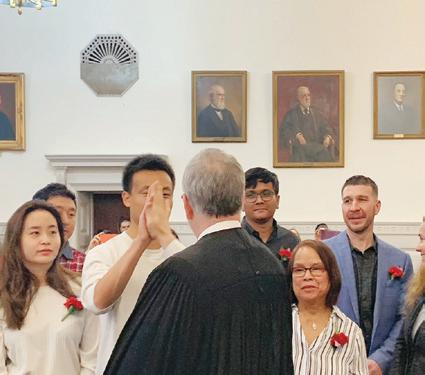
Almost an hour before the ceremony even began, the courtroom brimmed with anticipation.
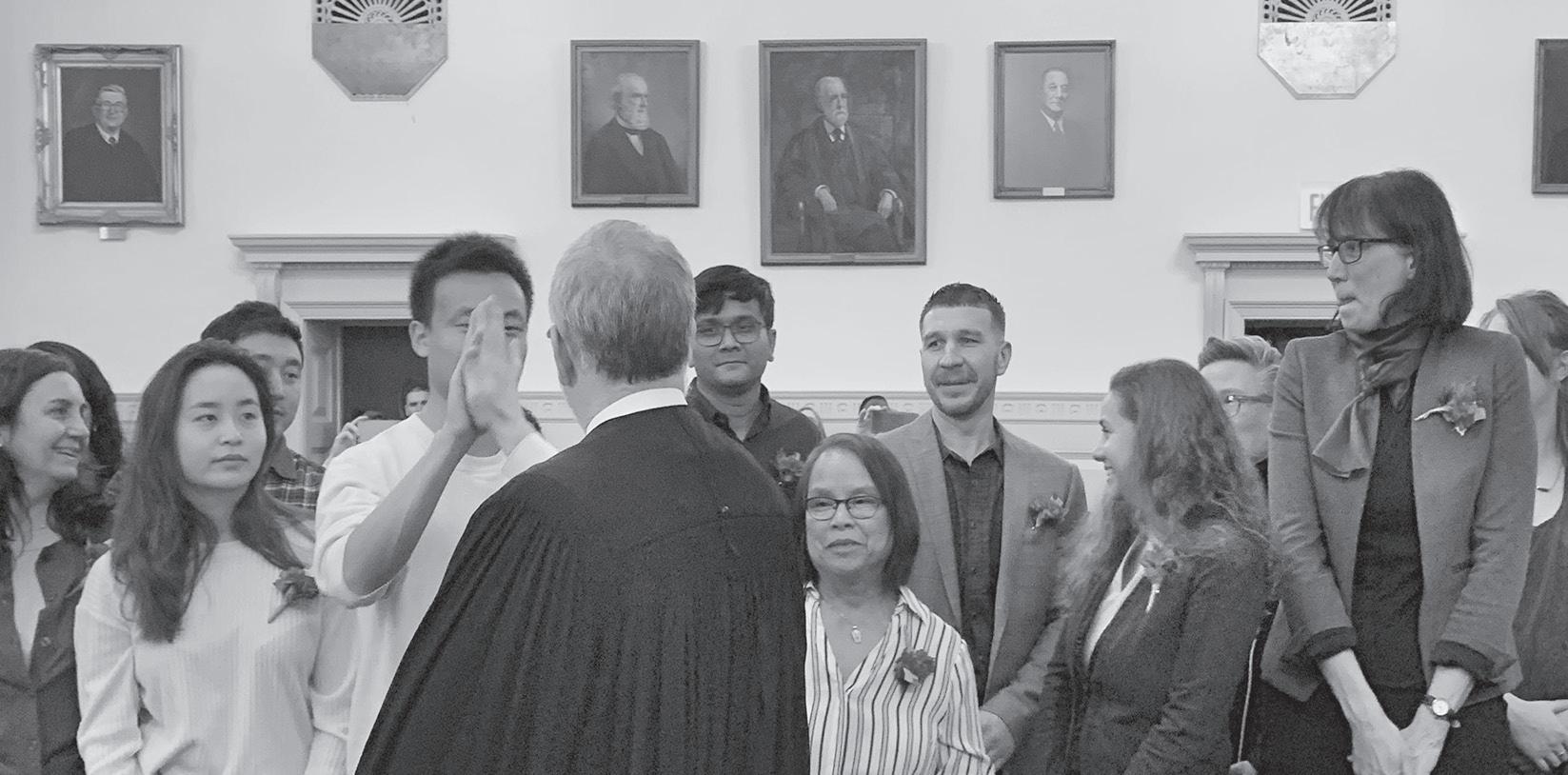
On Wednesday, 35 applicants from 24 countries took part in the first naturalization ceremony of 2020, officially becoming U.S. citizens in Tompkins County’s first naturalization ceremony of the year. As part of the ceremony, Tompkins County Judge John Rowley ’82 administered the Oath of Allegiance to the group at the Tompkins County Courthouse.
Some fidgeted with the flowers and American flags pinned to their lapels, while others smiled wide for pictures with their families.
After a welcome speech by Tompkins County Legislator Anne Koreman, Tompkins County Clerk Maureen Reynolds took a roll call of petitioners and Liz Susmann, a teacher at ESL program Open Doors English, delivered a speech, the Pledge of Allegiance and the Oath of Allegiance took place.
The ceremony is the final step in a process that begins with filling out the application for naturalization, getting one’s biometrics taken, being interviewed and taking English and civics tests.
Once applicants reach the final step for citizenship, they must recite an oath in which one swears full allegiance to the U.S., while renouncing any allegiance to any other country. For many, this did not cause any distress.
“I’ve spent most of my life here,” said Pakala Nakornthap, formerly a citizen of Thailand. “Finally it’s official. It’s a culmination.”
Mirit Bessire, another new U.S. citizen, described the process as a nerve-wracking journey, but one that
was worth it. Bessire came to the U.S. from Israel as an international student before beginning the process 12 years ago.
The Trump administration’s rhetoric has been accompanied by changes to the immigration process such as more vetting and prolonged processing times, as well as executive orders intended to restrict immigration. One such executive order was in effect from Jan. 27, 2017 until March 6, 2017, and was intended to suspend the entry of immigrants from seven countries.
“That’s something that grieves a lot of immigrants,” Bessire said. “People just want to go by their lives, their everyday lives and sometimes it feels like you’re being chased after.”
However, she did acknowledge that the individual workers she interacted with in immigration agencies were very helpful, as they were often immigrants themselves.
Samir Azza — originally from Morocco — had another opinion on Trump’s comments.
“Whether you like him or not, it doesn’t matter,” said Azza, who has lived in Ithaca with his family for five years now. “He’s the president. Imagine if you built a house and someone broke into it and messed everything up. That’s what illegal immigration is like. It’s nice to be here legally.”
One thing those who were interviewed agreed upon was that they were looking forward to being able to vote, and the crowd around the voter registration stand outside the courtroom attested to that, blocking the entrance and threatening to spill down the stairs.
Despite these findings highlighting a benefit for overweight men, weight discrimination contin-
A study by researchers from the University of California and the University of Vermont explain that media messages play a critical role among the perception of overweight individuals, making them more preoccupied with their appearance and its stigma.
Although this study brings a new perspective on overweight men, the researchers emphasized that men should not aim to gain weight if their intention is to become more persuasive.
“Our studies do invite closer recognition of benefits that might accrue alongside costs when people carry above-normal weight,” the Cornell researchers wrote.
cec343@cornell.edu.

enacting these fees in response to this decrease in revenue, according to Ekstrom.
Disposing yard waste –– the leaves and brush that clutter yards each fall –– is about to get more expensive in Tompkins County.
The Tompkins County Recycling Center announced in a statement on Feb. 12 that there will now be a fee for dropping off yard waste — which was previously free of charge.
According to the TCRC website, a $20 permit was already required for use of the center, but now permit-holders must pay for the disposal of yard waste in one of three ways: purchasing an $8 coupon that allows residents to dispose of one vehicle load, using a punch card that permits for six vehicle loads for $12 or for paying $90 per ton for commercial vehicles.
“In recent years, single-stream recycling revenue has declined substantially,” said Barbara Ekstrom, TCRC director of recycling and materials. “As a result, we can no longer subsidize the cost of yard waste handling and processing through the recycling revenues and need to collect fees to pay for this service.”
The Tompkins County Legislature was responsible for
While there were worries that these new fees would cause residents to dispose of their yard waste with their trash, but Ekstrom managed to assuage these concerns.
“Yard waste is not accepted in [regular trash] waste, and it costs more to dispose of waste than yard waste,” Ekstrom said, pointing to the fact that it costs $2.40 per trash bag to be picked up while it only costs $2 to drop off a bag of yard waste with a punch card.
Ekstrom has not heard much feedback on the fees yet, but said that throughout the winter, there has not been much yard waste. Generally, Ithaca residents have “wondered why we put those fees in place.”
Ithaca resident Michael Dow heard of the new fees, but thought they were reasonable.
“Recycling doesn’t make any money,” Dow said. “They turn some plastic into a bottle and only get a penny for it. I am surprised [TCRC] doesn’t charge more for their services.”


By ANIKA POTLURI Sun Contributor
The Collegetown Neighborhood Council discussed a laundry list of topics, including the 2020 United States Census, fire safety, Cornell Greek life and Collegetown banners at a meeting on Tuesday.
The Collegetown Neighborhood Council serves as a forum for Cornell students, business owners, law enforcement, University officials and members of the Ithaca community to discuss issues and developments in Collegetown.
During the meeting, a representative from the United States Census Bureau explained how Tompkins County aims to improve its high non-response rate — which was 23 percent in 2010 — by hiring approximately 700 census takers.
The representative urged Cornell students to apply to be paid census takers, saying that this year’s census would help advocate for the 46.9 percent of children under 18 in Tompkins County that live under the poverty line.
After discussing the 2020 census, Tom Knipe, director of economic development in the City of Ithaca, updated the council that approximately 30 individual water services on sewer main remain to be completed.
Denise Thompson, Cornell’s off-campus living manager, reported a partnership with the American Red Cross’s “Sound the Alarm” campaign that will provide students with free smoke alarms and installation. On March 3, from 11 a.m. to 2 p.m., students will be able to sign up to have up to three smoke alarms installed within their residence free-of-cost.
Life, described the reforms as “more in line with national standards,” requiring that all events be registered, regardless of where they are held. Previously, only events at University-recognized sorority and fraternity houses were required to be registered.
“We’re seeing a lot of dry events registered, and I think it’s debatable how dry a dry event is.”
Kara Miller McCarty
Recent Greek life reforms were also discussed at the meeting. Kara Miller McCarty, the Robert G. Engel Director of Sorority & Fraternity
“We’re seeing a lot of dry events registered, and I think it’s debatable how dry a dry event is,” McCarty said of her doubts about the implementation.
Lucas Smith ’22, representative of the Student Assembly’s City and Local Affairs Committee, announced plans to host a community dinner in order to increase dialogue between students and the Ithaca
community. The dinner may replace the Homeplate program, which has arranged for Ithaca residents to host Cornell students for informal dinners in the past.
Smith also acknowledged that ongoing discussions about the replacing the TCAT system on campus with a University bus system might affect the Ithaca community, and introduced plans to survey the Ithaca community for feedback on what Cornell students can do to improve community engagement.
“If we put a survey out and we get 10, 12 comments … we’d be thrilled just because it’s that direct interaction with the city and local affair committee that we can affect change,” said Smith. “We’re doing our best to try to get better as students to increase our advocacy.”
reached at abp76@cornell.edu.
calling for divestment were submitted by the five shared governance assemblies of the University. However, the Board of Trustees voted against divestment. After the contentious decision, the board released a set of guidelines in the event divestment would come up in the future.
The guidelines outlined three critical points for the board to reconsider fossil
fuel divestment: companies would have to be committing acts that are “morally reprehensible,” divestment would need to have a “meaningful impact” and not inadvertently trigger other social issues or the company’s goals would have to be “inconsistent with the goals and principles of the university.”
Adam Howell, chair of the Employee Assembly and a sponsor of the resolution, argued that these criteria had been met. He pointed to what he said was the
fossil fuel industry’s usage of “strategies to subvert efforts to address [climate change] in any meaningful way,” in complete disregard of the human impact of climate change — calling this “morally reprehensible.”
“Cornell has an opportunity to be one of the most noteworthy institutions to divest,” Howell said, urging the University to take action.
Howell also cited the University's mission and core values to argue that the

fossil fuel industry’s goals do not align with Cornell’s. The University mission states that Cornell aims “to enhance the lives and livelihoods of students, the people of New York and others around the world,” while the University core values codifies “respect for the natural environment”.
“I think it’s self-evident that the investment in fossil fuel companies are in contrast to that statement,” said Howell.
Many in the E.A. were vocal in their support for the resolution, including constituent Scott Burke, an engineer specializing in building construction, who expressed his support, despite working for a petroleum company in his hometown.
Burke acknowledged the potential negative effects fossil fuel divestment may have on his career. However “it’s not going to be because Cornell divests,” Burke said at the meeting, explaining that fossil fuel divestment would most likely have a minimal economic impact on the companies he works for.
Currently, Cornell invests approximately $95 million towards the fossil fuel industry — a miniscule amount compared to the hundreds of billions of dollars that companies like ExxonMobil are worth.
“It’s more about the University as a whole, what’s right for the University,” Burke said. “What do we want to say to our students, what do we want to say to our researchers, what do we want to say as a University?”

By ISHA VAISH Sun Staff Contributor
Whenever someone asks me to get Indian food, my immediate answer has always been the same, “let’s go to Mehak.” But what about Sangam, conviently located down the road? I’ve been out many times for Indian food, more times than my mom would have liked, considering my unlimited meal plan, and yet I still hadn’t been to Sangam. After finally trying out Sangam, I came to the conclusion that they deserve every bit of recognition and status Mehak carries, if not more. Sangam is a sleeping giant tucked under the blanket of Mehak’s reputation, and today I got my first glimpse at what’s lying beneath the covers.
The first difference I noticed was the quality in service. From the moment I sat down at Sangam to the moment I signed the check, the staff was attentive and always around if I needed anything. Every 10 minutes or so, someone would come over and ask us how the food was or if we needed anything. My glass of water never saw an empty minute. I thought this was a pretty stark contrast to the staff at Mehak. While Mehak’s staff is nice, they don’t interact as much with their
customers. There were many times I had to extinguish the fire set loose on my tongue by spice with rice rather than water, as it was a pain for me to find someone to refill my glass.
Now don’t get me wrong, I love Mehak. But when I tell you Sangam took my taste buds to a whole other dimension with just one sip of mango lassi, I mean it.
I couldn’t even tell you if the lassi was just sweet or just tangy; each drop seemed to have its own flavor: A cool refreshing combination of the earthly sweet overtones of mango cut by the curt tanginess of yogurt. The texture was heavenly as it gently caressed my tongue with it’s smoothness. While Mehak’s mango lassi is also top tier, Sangam’s lassi is definitely giving it a run for its money. In fact, I think it won this match-up by a hair.
In order to accurately compare which restaurant I enjoyed my meal at more, I decided to review the same dish at both: Fish curry — a boneless fish cooked in a tangy onion and tomato based sauce with garlic naan and rice. I noticed the first difference as soon as my waiter at Sangam put down a large plate of warm rice. Unlike Mehak, Sangam’s rice is tinted golden-orange because of the spices it’s cooked with. This


additional step in preparing the rice with a mixture of spices, black peppercorn and cumin helped bring out the flavor of the accompanying dishes. The spices added a subtle zing, the peppercorn added an earthy taste and the cumin added an almost smoky and nutty taste to the rice. In fact, the rice was so good that it took everything in me from eating the whole plate plain. While Mehak’s rice is also yummy, and could be enjoyed plain, the addition of spices in Sangam’s rice set it a league above Mehak’s.
The biggest, and perhaps the most important, difference between Mehak and Sangam was their garlic naans. Sangam absolutely obliterated the playing field with the most buttery-soft garlic naan I’ve ever had. The naan tore very easily and practically melted on my tongue. It was decorated with the right amount of roasted garlic, adding a toasty flavor with a slightly sweet undertone. In my opinion, an Indian restaurant’s garlic naan either breaks or makes it. I’d honestly give Sangam, as a whole, five out of five stars just from trying their naan. On the other hand, I was somewhat disappointed by Mehak’s garlic naan. The naan was slightly overcooked, making it kind of chewy and somewhat burnt on the edges as the sides looked dusted by charcoal. While the warm butter added a nice toasty taste, the garlic flavor was understated. Overall, the taste was pretty decent but nothing remarkable.
Before I start comparing the fish curries, I’d like to say that I enjoyed both dishes. Mehak’s fish curry is standard. The fish was juicy and soft — the perfect texture — and it was marinated well, soaking up the flavor of the sauce. The gravy seemed like the majority of it was just tomato puree, as if they just poured it out of the can and cooked it with some spices on the side. It was more watery and tomato-y than I would have liked, but it did have a nice tangy and earthy taste with a hint of spice (I ask for a level three spice because I’m a weakling).
On the other hand, Sangam’s fish curry was the best fish curry I’ve ever had. That’s saying something since it’s my go-to dish whenever I eat Indian. The fish was tender with a consistency like butter. It was juicy too; a single bite and the fish would give way to a subtle pop of juice. When the gravy first hit my tongue, it felt smooth like cream, but as I ran my tongue through it, I could feel the bits of garlic, onion and coriander, adding a satisfying contrast in texture and a perfect balance of flavor. The gravy was tangy, nutty, earthy and spicy. It felt homemade and heartfelt. The perfect finalizing touch was the boiled egg garnish. The only thing to beware of at Sangam is their spice level. When Sanagm says spicy, they mean setyour-body-on-fire-and-jump-into-the-gorge-to-extinguish-it spicy.
Usually, my roommate, a true spice veteran, barely sweats, but after a few bites of lamb vindaloo, her nose and forehead were dripping. So, if you like spice but don’t like-like spice you’ll want to get the mild. Both restaurants have their pros and cons. Both restaurants make mouth-watering food and deserve a visit. In my opinion, at least for my most recent visits to both restaurants, the winner of this battle was Sangam. So, next time you’re in the mood for Indian, spice things up by going to Sangam.
MEHAK
Serves: Authentic Indian Cuisine
Vibe: Subtly Elegant
Price: $
Overall:

SANGAM

Serves: Hearty Indian Cuisine
Vibe: Home
Price: $
Overall:

Isha Vaish is a sophomore in the College of Arts and Sciences. She can be reached at ikv2@cornell.edu.


Discussions about transitioning from a fossil fuel to renewable energy economy often spend time talking about “green jobs.” Options such as installing solar power arrays and maintaining wind turbines are often thrown around. But, presumably, a green economy would need more than just the energy sector to employ people in “green jobs.” Could the art industry also be considered “green”?
A coalition of social movement leaders in Canada, creators of The Leap Manifesto, think so. In 2015, they wrote: “Shifting to an economy in balance with the earth’s limits also means expanding the sectors of our economy that are already low carbon: caregiving, teaching, social work, the arts and public-interest media.”
The question of whether art is really a low-carbon sector is a slippery one. Last spring, an analysis of the carbon footprint of Spotify assessed that the streaming alone (not the electricity data centers use, and not the electricity required to charge your cell phone and laptop to play the music) resulted in the release of hundreds of millions of kilograms of carbon dioxide emissions.

What the article doesn’t mention is that the millions of kilograms are about 200,000 metric tons, and that the U.S. greenhouse gas footprint was 5.4 billion metric tons in 2018. “Devastating,” as the article puts it, is an overstatement, but if you include all of the YouTube, Netflix, Hulu, etc., videos streamed, as well as the electricity demand of the data centers and streaming devices, it’s definitely not negligible. Luckily, this energy demand is already electrified (unlike, say, natural gas heating), so it can be converted to renewable electricity easily.
If you’ve ever seen two 18-wheelers and a tour bus in front of the State Theater, you might have noticed that there’s a sizeable transportation cost which goes into touring. If you’re a Coldplay fan, you might resent that just a little bit, as they decided not to tour on their most recent album because they felt they couldn’t justify the environmental cost. There aren’t great numbers available on the total carbon footprint of touring musicians, but it’s unlikely that it is comparable in any way to the footprint of other types of trucking.
One of the weird things about art is that while
much of it is material, it’s debatably not materialist While the accumulation of stuff is typically considered anti-environmental — for example, big wardrobes of fast fashion, or a full 17-car garage — there’s something about the accumulation of art that tends to be considered differently. We have special words for it like collecting or curating, and it feels offensive to call it “stuff,” but isn’t it?
I don’t have a great answer to this, but one of the things that sticks out to me is that art can be about the process of creation. The skill, time and originality of a work is what makes it special. Does craftsmanship eliminate the commodification of art, or is a pair of shoes designed by a CFC student just as artful as your dad’s tennis shoes?
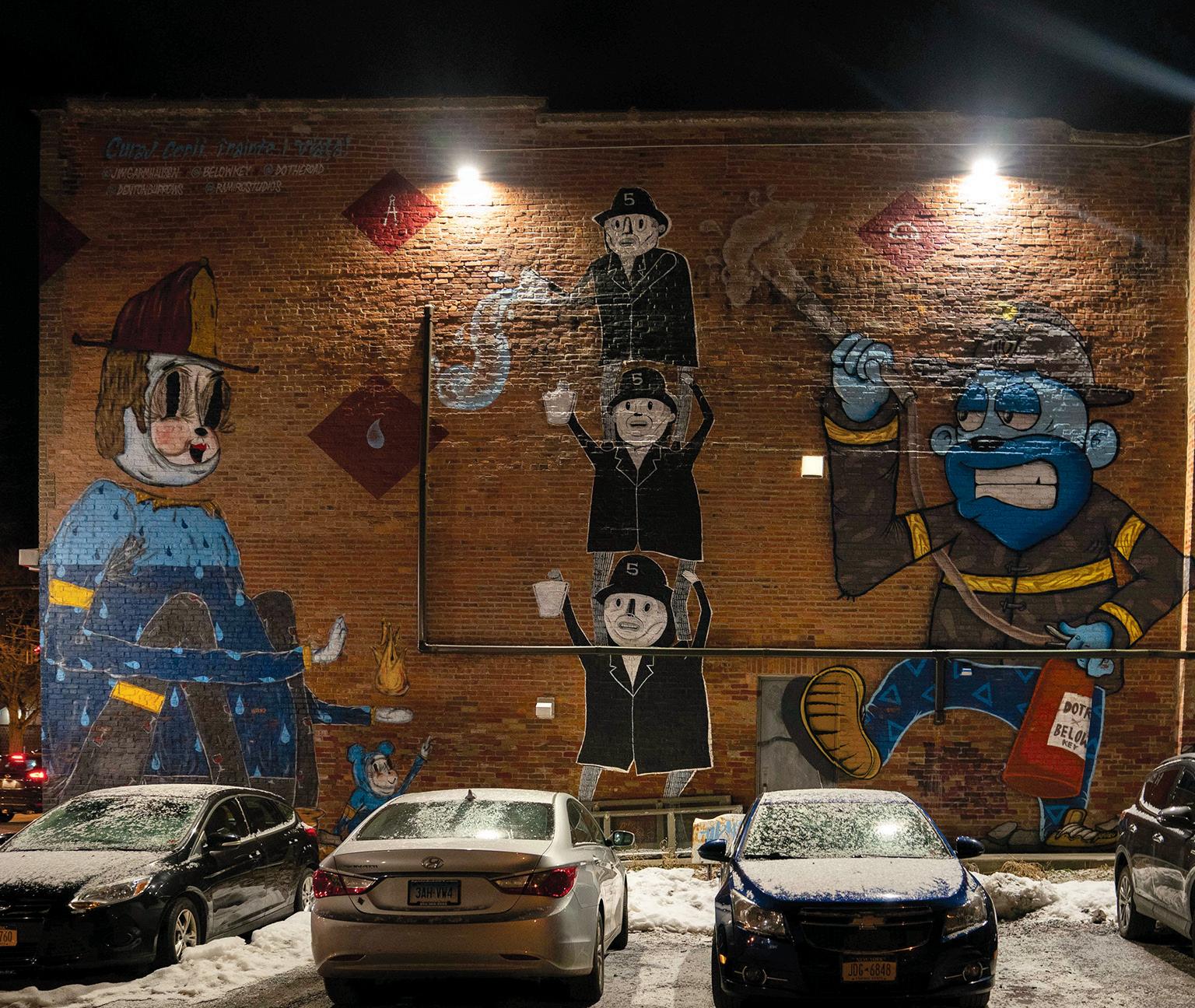
I think we might do better by imagining art as not so material. For example, instead of imagining the expansion of the arts as a way to get more paintings in the homes of elites, it could be focused on painting murals on every brick wall, with only millimeters-thick layer of paint, and it is not possessed or accumulated by any one person. Performing arts, also, defy ownership and accumulation. Art education programs — both for young people and adults — are another non-accumulative way to encourage artistic flourishing. Non-material, communitarian ways of expanding art are a huge societal positive. Art, as anyone who likes it will tell you, is an enormous social good. It’s responsible for the development of people’s values about different subjects and strengthens democracy by providing media for expressing and discussing opinions.
Resident Bad Media Critic
What about the actual creation of these “green jobs”? Art, other than the kind that’s a status symbol, has a hard time growing in an economy dedicated to profit as the primary mode of assessment. At a time of transition in the economy, as we re-work the way industry and energy address climate change, including environmentally and socially beneficial art as a priority of the economy should be a critical consideration.
Katie Sims is a senior in the College of Agriculture and Life Sciences. She can be reached at ksims@cornellsun.com.
Resident Bad Media Critic runs alternate Tursdays this semester.
BEN

ANNA CANNY SUN CONTRIBUTOR
Bracing myself against the bitterly cold February day, I huddled on the steps of Risley Hall, poring through Instagram and Facebook — with no success — for any word of the Climate Justice Cornell art event. Just as I was set to head back and escape the cutting wind, Avery MacLean ’23 opened the door and greeted me with a rush of warm air. We exchanged introductions as she led me back to the woodshop, which was filled with scattered newspapers and the acute aroma of spray paint. To the left of the doorway, cast in gold and glitter, lay a diamond engagement ring the size of my head.
CJC’s takeover of Ho Plaza on Feb. 13 took on a more darkly humorous tone than the rallies and sit-ins of the past. This was a black-tie — or rather, orange-tie — occasion to celebrate the “wedding” of Cornell University to the fossil fuel industry. CJC joined 50 other campuses across the country to recognize Feb. 13 as “Fossil Fuel Divestment Day.”
Art was a major component of this historic disruption. I was lucky enough to meet the members of the “wedding party” as they were preparing for the big day. Groomsmen — caricatures of trustee members complete with grotesque, exaggerated wrinkles, tufts of white hair and smug expressions — were captured in their newspaper-cast faces. Bright posters of major fossil fuel companies, B.P., Exon and Shell, accompanied the party as bridesmaids. Familiar faces were among the additional guests, including President Martha Pollack and Touchdown the “ring-bearer.” And of course, the lovely bride was gorgeous as a massive silhouette of the iconic McGraw clock tower; she was prepared to dance with her groom, a three-foot long mask of an oil baron with a stern gaze.
MacLean, the brains behind this idea, cites the theatrical company “Bread and Puppet,” based in the Lower East side of New York City, as the inspiration for the spectacle. Puppets were selected as the medium of choice for standing out, a key component of their long-term divestment campaign. The construction process began with cardboard base pieces, while the faces were built up little by little with newspaper paper mache and an abundance of painter’s tape. Deep contours dappling the forehead of these crafted faces spoke to an unspoken, sinister nature. Even before the paint-job, the wedding party sent a chill up my spine.
“We have sort of an escalation plan, with the goal being that we put more and more pressure on different parts of the administration,” explained Evelyn Kennedy-Jaffe ’22. “What we’re looking to do is make it harder and harder to ignore the presence of student disapproval of investment [in fossil fuels].”
The sheer absurdity of this event is meant to pique curiosity, and — with any luck — get people thinking.
Beyond that, art is clearly an important part of camaraderie for this spunky band of activists. Mixing paints to create the perfect color for Touchdown’s fur and gathering to debate effective ways to construct an oil rig display made planning action enjoyable, creative and uniting. There was a shared sentiment of frustration among the CJC members about the way that the arts are undervalued in the current political schema, but efforts to use arts as a source of power and controversy — a tool for protest — turns that on its head. One thing is for certain: Attendees of the wedding were left with stark images in their mind – images which, like Cornell’s continued commitment to fossil fuels, will be hard to ignore.
Anna Canny is a junior in the College of Agricultural Life and Sciences. She can be reached at aec272@cornell.edu.
ANU SUBRAMANIAM ’20
JOYBEER DATTA GUPTA ’21
Business Manager
PARIS GHAZI ’21
Associate Editor
MEREDITH LIU ’20
Assistant Managing Editor
RAPHY GENDLER ’21
Sports Editor
BORIS TSANG ’21 Photography Editor
AMBER KRISCH ’21
Blogs Editor
SOPHIE REYNOLDS ’20
AMANDA H. CRONIN ’21
JOHNATHAN STIMPSON ’21
PETER BUONANNO ’21
ANYI CHENG ’21
HUNTER SEITZ ’20
SARAH SKINNER ’21
KRYSTAL YANG ’21
NATALIE FUNG ’20
SABRINA XIE ’21
NOAH HARRELSON ’21 Blogs Editor
SHRIYA PERATI ’21
FZHU ’21
PICHINI ’22
JIANG ’21
MORAN ’21
ive months after my Cornell interview and three months after committing to my Big Red acceptance, I attended a local meet-and-greet for the incoming class. Hosted at an alum’s home and intended to be a mixer between incoming freshmen, current students and alumni, it was meant to be a laid-back social. But in the immediate aftermath of the crapshoot that are college applications, such socials are anything but laid back. Allow me to offer a snapshot of what I mean. After parking a block away from the event’s address, I walked down the street and arrived at the front door, only to run into a line of fellow Cornellians waiting to enter. As I eventually got within sight of the hosts, one of them waved me over, so I instinctively approached, made eye contact, reached out my hand and, as had been ingrained in me over the course of numerous interviews and information sessions, said “nice to meet you.” I let out an internal sigh of relief having successfully introdu — “We’ve already met,” he replied while tentatively shaking my hand, “I went to your graduation, Roei. I shouted your name from the bleachers when you were on stage.” Of course he did. As I pulled back my outstretched hand, it all came back to me: the interview at my high school for which he drove up to meet me, the fact that his daughter attended my school, his involvement with the Cornell radio station.
awkward silences I authored in the midst of college interviews. The speeches and talking points I industriously prepared in the comfy retreat of my room are unrecognizable from my mumblings in real time, and pale in comparison to the cadence of any improvising extrovert. I would exit each interview leaving behind a forgettable first impression, torturing myself with every awkward moment I replied to “Good
by Reuben Bolling

But it all came a moment too late. I had been graciously invited to someone’s home, summoned by the host and casually skipped the line — and this was all I had to show for it. I vaguely recall responding with, “Of course, of course, thank you so much, thank you,” but it didn’t matter. My head held low, I wrote my name on a sticker, slapped it on my chest and proceeded into the kitchen. All I remember from the rest of the evening was hogging the veggies-and-ranch, meeting some frat brother who never reached out to the email
luck” with “You too!” in conversation with an alumni or representative.
But in a world where career fairs and interviews are the sole ticket into a competitive workforce, my complaints do little good. However, neither do career fairs that cast introverts to the side. Some of the smartest and most capable people I have met here would not want anything to do with a business-casual career social, and yet such events are still forced down our throats on a regular basis.
To refocus students on becoming intrested in the actual content of a career-oriented opportunity as opposed to just wanting a job, we need only look to workshops and sessions held by recruiters to present the specifics involved. Indeed, club tryouts, project team information sessions and even Cornell Days are all examples of realistic representations of certain opportunities for their respective applicants. But nonetheless, we continue to see career fairs, mixers and interviews as prerequisites. Instead of separating those genuinely interested in content from those who pursue the optics, our current recruitment system weeds out the introverts and gives socialites a leg up on contacts before any matter of substance is discussed.

I gave him and genuinely asking another alumni if he knew Ezra: ingredients for a typical meet-and-greet in the life of Roei Dery.
So, after I arrived on campus, I was anything but excited to learn of the career and project team fairs that flooded my inbox. Networking events are the extrovert’s hunting grounds, and for the rest of us, it’s an imitation game, a glorified smile-andwave. Whereas my Hotelie friend attends career fairs and meet-and-greet dinners on a regular basis, to me and many of my comrades in physics, they seem like a foreign, daunting reality.
When I went to freshman career fairs in the fall, I looked on as hundreds of business casual students waltzed between booths, freely shook hands with every recruiter and dived head-first into smalltalk. I became exhausted just observing the interactions, and thought back to all the
But I saw a glimmer of hope while interviewing with an alumni for another school. This time, when he asked me to describe myself, I unapologetically told him I prefer inside jokes with a close-knit group to shaking hands with strangers, that it sometimes takes me weeks to develop my comfort zone and open up, a side of me that he won’t be able to see over the next 15 minutes. And though I fully braced myself for the confused look I had grown accustomed to over the course of my college interviews, he smiled instead. He appreciated the self-awareness, and I appreciated his understanding even more. That’s what “networking” should be. Enough of telling introverts to “fake it till’ we make it”: for us to emerge from the shadows, we need to hold our judgements and reconsider our current system.
Luke Warm | Guest Room

HELENHU/SUNGRAPHICSEDITOR
here’s no time to be an ingenue when you’re an upperclassman. I’ve slowly come to the understanding that by the end of my first two years of college, I should’ve been out on weekends, flirting with cute guys and making my debut
Now I’ve reached the final stages of undergrad only to realize that I damned myself for the first two years of college that I spent on weekend movie nights with my friends, drinking from the comfort of our home, dancing to our own music in our
Because now, after meeting with a guy once or twice, there’s an underlying assumption that I’m supposed to be putting out. The courtship ritual shifts within a week from friendly texts and witty banter into late-night Snapchats that I don’t really want to open. After hanging out with a guy for a few hours one time in public, suddenly I’m at fault for not wanting to come over at 12 a.m. Everyone’s supposed to be on board with casual sex.
And that’s a problem because relationships — especially those between gay men on campus — don’t exist in a vacuum. There’s simply not that many of us on campus, and thanks to modern technology, I know (or at least can recognize) a lot of
For instance, if I’ve talked to a friend of theirs before I talk to them, they know. The friend might tell them what we talked about, whether they liked me or whether I’m worth it. And I, no different, walk in with my own background knowledge — my friends might give me friendly warnings that the person I’m going to meet is pushy or that they sleep around a lot.
As a result, I go into these “hangouts” feeling like I’m walking into a den of lions. If things go beyond my comfort level, what do I say? If I stop
ing, will I be labeled as a prude? If I refuse a few late night
Dirty
In September, your photo came up on my screen while I was scrolling through Tinder. I accidentally swiped left. My stomach dropped. I hurried to the bathroom to avoid waking my roommate, flicked on the light and proceeded to spend the next half hour trying and
Snapchat invitations, will I be a tease?
So I attend these midnight rendezvous, though I don’t really want to. And when things go further than I’m comfortable with, I have a hard time saying no. I end up doing things I don’t want to. Because it isn’t like the straight world where I can make a mistake or stop things and leave, come home, be embarrassed for a few days and then get over it (my friend told me how she would walk back with guys and then simply leave if she felt uncomfortable). If I do something wrong, or make things awkward, I’m not severing my acquaintance with that one person. I might be cutting myself off from the whole network of their gay friends.
Consequently, it’s difficult for me to say no and walk away when the time comes. But even when I go beyond my comfort level, I still ask myself: Was I good enough? What will they tell their friends about me? There’s no way to win.
Oftentimes, I’m simply at the mercy of the maturity level of the person I’ve been talking to. And in an ideal world, they’d understand if I were uncomfortable with doing something or wasn’t interested in trudging across Collegetown after 1 a.m. But when they bring up questions during our one allotted presex screening — who I’m friends with, if I know this or that person, what other people have said about them or sometimes even blatantly who else I’ve hooked up with — I don’t have much faith in their confidentiality or their respect.
For how supportive the LGBT community claims to be, it feels like a particularly fraught space on campus. The main reason why I’m writing this column under the cover of anonymity rather than attaching my name to it is not because I’m still closeted or uncomfortable with my identity as a gay man. It’s because I have serious reservations about attaching my name to it and sending it out to the wolves. I don’t want to become ‘that kid who wrote a column’ to the rest of the gay community, and I don’t want to give people more opportunity to cancel me than they already have.
I wish only to accept my doom with dignity and grace.
something that happened to you during the day. Driving with you to buy beer as you teased me lightly about my eternally angsty music. Timidly approaching the counter to order coffee from you at Zeus — you must’ve been sure my cheeks were permanently flushed.
I didn’t know what it would feel like to be with someone here, to see the Arts Quad through the rosy lens of romance.
failing to download Tinder Plus so I could undo my erroneous finger movement. I flooded my best friend’s phone with texts, frantically trying to figure out which way you would’ve swiped on me, and how to show you in a totally-deniable-but-still-flirty-and-cute way that I really, really meant to swipe right. Over time, we became friends. You dated other people, and I wasn’t jealous so much as in awe at the way you moved through the world. Once, we were sitting together after dinner and you stood up and said, “Alright, I’m gonna go flirt with some girls now,” and then just walked away and did it. I thought, why don’t you flirt with me instead?!
I think I must’ve liked you for a long time before I fully realized what I felt, because I remember each one of our early interactions in hyper-definition. Sitting across the room from you in our discussion section before we really knew each other; my eyes were constantly drawn to you. You, running into the kitchen or into my room, excitedly telling me about
I spent winter break complaining about how I hadn’t ever fallen in love at Cornell. I didn’t know what it would feel like to be with someone completely here, to see the Arts Quad and all the other places in my daily rotation through the rosy lens of romance. “I just don’t think it’s gonna happen at this point,” I told my friends back home. They laughed and replied, “You know you’re still a sophomore, right?”
I spent the first few weeks of the semester staying up late with you. At first, I’d find excuses to be with you: padding downstairs to boil water for tea, as if I hadn’t been drawn from my room by the sound of your voice in the living room. Even in groups, we’d sit side by side and speak mostly to each other. We’d talk about poetry, about potential house pets (my first choice is still a family of ferrets) or cringy memories of middle school. I told a friend, “It’s so easy to choose talking to him over getting sleep or doing my homework. Everything we say to each other just feels so much more important.”
I didn’t want to like you that way and then end up disappointed, and our friendship felt so delicate then, the best thing about my semester so far, I admitted shyly and only to myself. Eventually, you told me you had a crush on me, and then the next day I waited for you to get off work, and we walked down to the gorge
and kissed. Everything we said or did made me want greater closeness. I lay in my bed that night thinking of your room down the hall, imagining the sway of your curtains, the heat of your body beneath your blankets.
Everything after that happened faster. I fell in love with you almost immediately — maybe because I already did love you, though in a different way. Each part of being with you felt like a first. Never before had I actually wanted to be with only one person. You were the first person I really felt comfortable asking for what I wanted sexually, admitting all my secret desires. You were the first person, too, I felt fully comfortable telling when something hurt or when I wanted to stop. Your name is the only name on my lips when I moan; your fingers are the only ones I need tugging my hair.
lights up with a text and I see it is from you. Every song is a song about you and
Everything is painted in the colors of my love for you. My walk to class has never looked so beautiful.
me, and every passage I read, I imagine in your voice. You are the hearts doodled in my notebook; the body over mine making me gasp; the arms around me when I dream; and my missed connection no longer.
I have so many different layers of feel ings for you; I’m sometimes not totally sure how to reconcile them. You are one of my best friends, someone I can cry in front of or talk to until we’re bleary. When you smile at me across the room, or when our eyes meet while you’re talking to other people, I feel the breath lessness of a crush and I can’t believe it’s me you’re looking at, too. Lying in your bed at night or as morning light seeps through your curtains, I am so in love with you that my chest aches, and I hate to feel even the tiniest space between our skin.
Everything is painted in the colors of my love for you. My walk to class has never looked so beautiful. My heart tugs loose from my chest when my phone

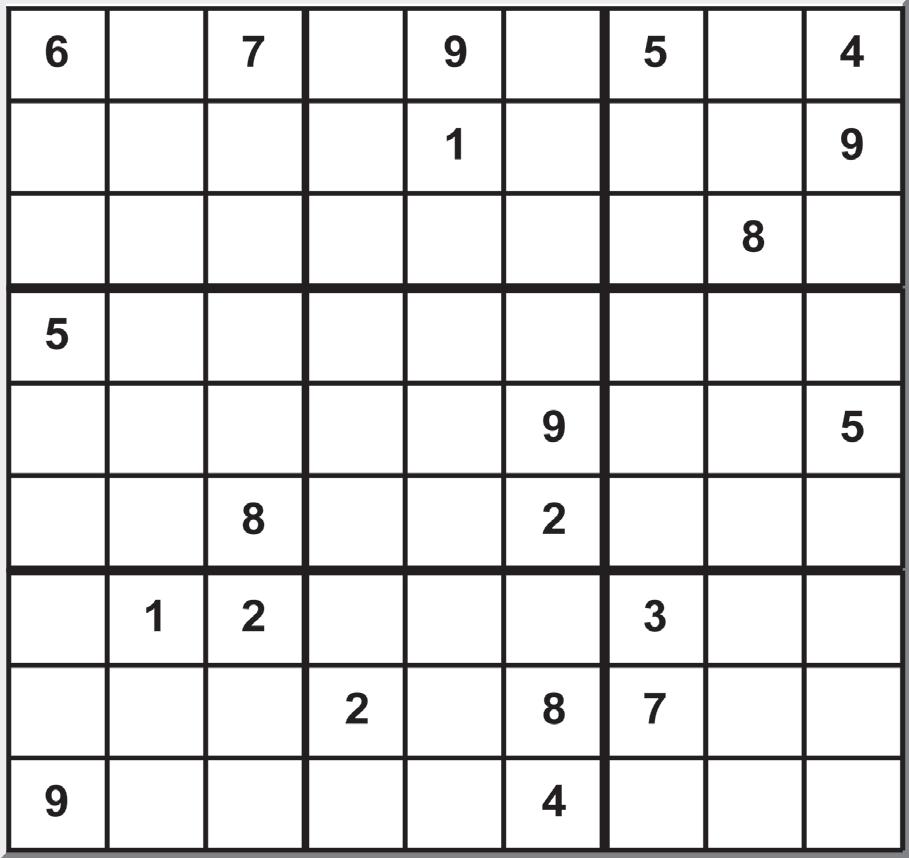
Fill in the empty cells, one number in each, so that each column, row, and region contains the numbers 1-9 exactly once. Each number in the solution therefore occurs only once in each of the three “directions,” hence the “sigle numbers” implied by the puzzle’s name. (Rules from wikipedia.org/wiki/ Sudoku)






*****************************
1-3 Bedroom Apartments
Quiet Fall Creek Location
5 Minutes to Busline 607-351-1267 joe@joegrealty.com
*****************************
120 Oak Avenue
Just steps to Cornell Campus
10 bedroom house & 1 and 2 bedroom apartment
607-277-1234
office@ithacastudentapartments.com Ithacastudentapartments.com
>>SPECIAL PRICING<<
Collegetown Apartments
Furnished 1-3 Bedrooms PARKING, LAUNDRY, UTILITIES! (607) 273-7368 www.WestShoreApts.com
109 Sage Place
2 & 3 Bedroom Apartments
Access to Shuttle to Campus
Access to Free Fitness Center
Novarr-Mackesey Property Management office@ithacastudentapartments.com 607-277-1234
Boldly Refined Living
312 College Avenue Sophisticated studio, 1, 2, 3-bedroom apartments. Superior fitness facility, theater, and coworking space. Free high-speed internet. Exclusive resident parking. Package delivery/return. Overnight concierge. 607-273-9777 or 312collegeave.com
Flexible Housing Solutions!
Short Stay Accommodations Available
Catherine & Eddy St. 1 & 2 bedroom
Furnished, heat included Laundry in building Parking available for fee 607-277-1234 office@ithacastudentapartments.com
Collegetown Crossing
College Ave's Newest Location
307 College Ave. Now Leasing for 2020-2021
Completely New Modern Studios, 2 & 4 Bedroom Apartments. Fully furnished, heat & hot water included. Reception area at 307 College Ave. www.urbanithaca.com 607-330-2442 info@urbanithaca.com
Houses, Apts, Parking 1 to 9 Bedroom Collegetown - College Ave, Linden Ave, Dryden Rd, Bryant Ave, Cook St. 607-330-2442 info@urbanithaca.com www.urbanithaca.com
Now Renting 2-10 Bedroom Houses/ Apartments for 20-21. All Locations. Call today or visit our website: Certified Properties of TC Inc certifiedpropertiesinc.com 607-273-1669
2020-2021
Studio 1, 3, 8 & 11 BR Apts. Great Locations in Collegetown. 607-227-2535
*Brand New* Full Term & Semester Leases Studio, 1 & 2 Bedrooms College Townhouse 121-125 College Ave. CollegeTownhouseIthaca.com Leasing@inteprop.com
*Brand New* Studio Apartments 238Linden.com Leasing@inteprop.com APTS/HOUSES COLLEGETOWN BEST LOCATION/BEST PRICING 607-272-3389 607-592-1352 cbeach24@aol.com
CLEAN & QUIET! 2 bedroom, attached garage, full basement, ON BUS ROUTE, large yard. Avail. 3/1. Concept1747@gmail.com
2020-2021
317 Upper Eddy St. 3 BR Apartment Ten month lease. Heat, water & gas provided. 607-227-0924
20-21
College Ave.
5 BR House
Furnished. Laundry. Parking. Call 607-273-8576

In second protest in less than seven days, CJC interrupts campus ‘business as usual’ to compel Board of Trustees to take action
Continued from page 1
said organizer Nadia Vitek ’22 to the crowd.
Cornell is not the only University to be swept by climate protests this year. Harvard University has been swept by student’s demands for divestment, with protests disrupting the famed Harvard-Yale football game, The Boston Globe reported.
After much student protest, Georgetown University announced on Feb. 7 that it would divest from fossil fuels within 10 years, Georgetown’s student newspaper reported.
Many protesters performed jumping jacks, hugged each other and moved around to stay warm in the 25-degree air, until the protest ended at 4:25 p.m.
“We had a slight detour during this event, which was relatively brief,” said Patty Poist, the communications manager for TCAT. “Our supervisors and drivers did a great job in sticking to schedules to keep our service as fast as possible.”
Last Thursday, CJC disrupted traffic for two hours when the group occupied an intersection to stage a mock wedding between Cornell University and the fossil fuel industry. On Tuesday, the group silently protested in libraries, holding up signs that read “fossil free endowment,” and “Cornell stop funding the climate crisis.”
While CJC’s new pattern of blocking roads may seem extreme to some, Vitek said the group previously attempted to work with the administration on the issue.
“In the past, we have followed traditional
routes within the administration,” Vitek said. “We met with chief financial officers, divestment has even gone to a vote with the board of trustees in 2016.”
Vitek recognizes potential public relations risks with escalating protest tactics, but believes the attention these tactics garner is worth the risk.
“Some people might get annoyed at us, but it is going to publicize this issue much more strongly,” said Vitek.
Every Cornell governing body is also hearing fossil fuel divestment resolutions this spring semester. However, Vitek believes that protests are needed to aid work done in more official avenues, because the last time all five governing bodies passed a divestment resolution, the Board of Trustees ultimately rejected it.
In order for a divestment resolution to be passed at Cornell, all five university assemblies –– the University Assembly, Employee Assembly, Student Assembly, Graduate and Professional Assembly, and Faculty Senate –– must approve, though the matter must ultimately pass through the Board of Trustees.
The Faculty Senate will vote on climate divestment on March 11. The GPSA and University Assembly both unanimously voted for fossil fuel divestment on Feb. 10 and Feb. 18, respectively.
“We are putting extra pressure on them because having [divestment] passed by shared governance wasn’t enough last time, and we want them to listen to us this time,” said Vitek.
Tamara Kamis can be reached at tkamis@cornellsun.com.
SPRING
vice provost for enrollment.
In the program’s first iteration, the University aimed to enroll approximately 125 students in the spring, Burdick said. More recently, this number was adjusted to 50. This — in addition to the North Campus Expansion Project, which will add 2,000 more beds to campus — signals the University’s attempt to make housing available to all firstyears and sophomores. Currently, Cornell guarantees housing to all sophomores.
in Madrid at the University of Nebrija. Now, she is on track to graduate with the rest of the Class of 2023.
Jagid similarly took the semester to complete some classes and get work experience — she enrolled at Florida International University and interned at art exhibit Art Basel in Miami.
The University and each respective college advise incom-
“I don’t
However, the transition hasn’t been entirely smooth. With the West Campus housing deadline approaching on Feb. 28, sending Smith and the rest of the FYSA students scrambling to find apartments or on-campus housing and decide who they want to live with.
“Picking who I want to live with when I’ve only known my friends for less than a month is a tough decision,” Smith said.
feel behind at all. Maybe it was luck, but coming later helped me find such a good group of friends.”
Nikki Jagid ’23, a spring-admit, felt nervous at first but later realized it was more beneficial for her to start in the spring.
“When I first got the spring option, I wished I got in for the fall,” Jagid said. “[But] I don’t feel behind at all. Maybe it was luck, but coming later helped me find such a good group of friends.”
Olivia Smith ’23 was also not thrilled to be starting college later than all her friends.
“I wasn’t crazy about the idea of all my friends going off to college and me being stuck at home,” Smith said. “I wanted to leave with everyone else and I was actually very close to going to a completely different school.”
Despite her initial trepidation, Smith took advantage of her time off and studied abroad
Nikki Jagid ’23
ing students on enrollment procedures, carefully coaching them throughout the summer and fall to prepare them for the transition and to graduate on time. FYSA students also receive the same financial-aid considerations, housing placements and other benefits as students who arrive in the fall.
Once on campus, these students attend a mandatory January orientation before the spring semester, designed to ease their transitions. Jagid said the orientation week helped her acclimate to her new campus.
“Orientation was really helpful,” Jagid said. “I loved that we got to meet other people in the program because now so many of my friends are spring admits. It’s a great resource to go back to.”
But arriving late to campus has not stopped Smith from getting involved. Although Smith noted that integrating with people that arrived in the fall has been challenging, it pushed her closer to her FYSA friends and teammates on the club water polo team.
FYSA is likely to continue, with the goal of having a balanced enrollment between the fall and spring in order to accommodate students relative to housing availability, Burdick said.
As the semester ramps up with prelim season underway, these students remain excited to spend their first semester at Cornell.
“My whole perspective of weather has changed,” Jagid said about her transition. “I look at the weather app and see high 30s, and I think to myself: Wow, it’s going to be such a nice day.”
By CHRISTINA BULKELEY Sun Assistant Sports Editor
With an ECAC Tournament first-round bye already in-hand, men’s hockey will hit the road this weekend looking to take home another bragging right — the Ivy League title. The Red can clinch the top spot in the Ancient Eight with any combination of results against Yale and Brown, save for a pair of losses.
But with Cornell tied for first in the ECAC standings with Clarkson, the Red would prefer to come away with two wins. Cornell is searching for its third straight Cleary Cup — a feat the program has never before accomplished.


“Obviously it would be nice to finish first in the league, it’s got a lot of benefits to it,” said head coach Mike Schafer ’86. “The guys want to, we want to get there, we want to finish first. We’re competitive, we want to get as high [in the standings] as we can.”
The icers will start the weekend in New Haven, where the Bulldogs will return home following a threepoint weekend road trip. On Friday, Yale relinquished a threegoal lead to Harvard, settling for a tie. The next night, the Bulldogs accomplished what Cornell could not back in December — taking down Dartmouth in Hanover.
Yale’s top line boasts its three most prolific scorers, each of whom has 21 points on the season. Curtis Hall is ranked No. 7 in the nation in goals per game with .67. Other than those top three, though, the rest of the Bulldog offensive corps has a cumulative plus-minus rating of minus-76.
“Every team’s got one or two guys that are obviously putting up numbers, but you know for us, it’s just about team effort,” Schafer said. “Knowing who they are, forcing them to play defense, staying above them, making it difficult on them.”
Cornell dropped its last game in New Haven, 5-2, just over a year ago.
The last time Cornell and Yale met, junior forward and captain Morgan Barron completed his first collegiate hat trick only minutes into the second period of the Red’s 6-2 rout of its Ivy foe.
“We played probably some of our best hockey when we played [Yale and Brown in November],” said freshman forward Travis Mitchell. “So I think for us, mainly [the strategy

this weekend] is gonna be focusing on ourselves and ... mak[ing] little adjustments that can give us the advantage over them.”
Brown will be searching for its seventh win of the season. The Bears have not yet claimed a four-point weekend in the 2019-20 campaign and their 29 even-strength goals this season are the second-fewest nationally.
But Brown has gone 3-2-2 in its latest matchups, signaling that the Bears’ season isn’t winding down — it’s heating up.

“Honestly, we can’t believe it — watching the tape on Brown, they’re a really good hockey team,” Schafer said. “Especially at this time of year, where teams had a rough start to the season or they hit a rough patch and they’re getting guys back, you just gotta judge teams for who they are [now]. So we’ve got a lot of work ahead of us.”
Last year’s game in Providence saw Cornell go up 3-0 before conceding three straight goals to the Bears in the span of 53 seconds in the third period — the contest ended in a tie.
However, this year’s edition of the Yale-Brown road trip looks different from the 2019 version — last year, an injury-plagued Cornell limped into the series. But this weekend, the team is expected to be at full strength, with the exception of freshman defenseman Sam Malinski, who has been out since Feb. 1.
“We were playing with like, barely any guys at Yale last year. But I know from the Brown game, guys were really, really mad about that,” said junior forward Cam Donaldson, who missed last year’s road trip himself due to injury. “We could have easily won both games.”
Cornell will go for redemption this weekend in New Haven and Providence. The puck drops at 7 p.m. Friday at Yale and at 7 p.m. Saturday at Brown.

Ardmore, Pa., native hit twine 6:25 into the contest and went on to finish the afternoon with a team-leading three goals.
But from there, Villanova proceeded to take control. The Wildcats scored six of the next eight goals to jump out to a 6-3 lead, but the Red regained its footing, narrowing Villanova’s advantage to 7-6 by the half.
“Although it was a battle, it was a full team effort, and we were able to pull out the win together,” Allen said.
was seeing a lot of our underclassmen step up and play really well out there,” said senior captain Mary Kate Bonnani.
The second frame saw the Red outscore the Wildcats, 7-4. Early in the second frame, Cornell found the back of the net three times in the span of five minutes.
Villanova responded, though, adding four scores to take an 11-10 with 6:42 left in the contest. After this barrage, senior goalkeeper Katie McGahan buckled down in goal, shutting down the Wildcats the rest of the way — picking up 11 saves.
While McGahan locked down the net, Cornell began to rally. Sophomore midfielder Genevieve DeWinter engineered the comeback, scoring two quick goals to help the Red take a lead that it never relinquished.
“Although it was a battle, it was a full team effort, and we were able to pull out the win together.”
Caroline Allen
During the first half, freshmen midfielders Katie Castiello and Bridget Babcock tallied their first career goals. Although the Villanova tilt represented their first game at the collegiate level, the freshmen players made an immediate impact. “The best part of the game for me
Sophomore midfielder Shannon Brazier finished off the Wildcats, putting away an insurance goal with 79 seconds left, to help the Red earn its first victory of the season.
While Cornell finished with a win, the team believes there is room for improvement in the coming games.
“It wasn’t perfect by any means, but we had many moments where we could see the potential we have as a team,” Bonnani said. “The biggest thing for [the] team will be coming out ready to go from the first whistle.”
Next up for the Red is a tilt with Penn State at 1 p.m. on Sunday.
Caroline Allen striking first for the Red. The