The Corne¬ Daily Sun




By RENEE HOH
In the middle of Friday’s snowstorm, scores of full-time employees and student workers made routine treks to their respective dining rooms and cafes. But after the University waited to close the campus until late morning, Cornell Dining was forced to adapt its operating hours and compensate those who did make it to campus — some of whom were left stranded for the night.
“I think if classes are canceled, there’s not going to be a lot of customers.”
Anna Winikow ’22

By CATALINA PEÑÉÑORY Sun Staff Writer
After a push for tough sentencing guidelines was reversed by senior Department of Justice officials on Tuesday, a team of four federal prosecutors resigned from the Roger Stone case — one of whom was Assistant U.S. Attorney and Cornell alumnus Michael J. Marando ’00 J.D. ’03.
An industrial and labor relations graduate, Marando has led a distinguished legal career, one which has seen the attorney prosecute several high-profile cases, ranging from fraud to money laundering. In one such case, Marando secured a 41-month prison sentence on bribery and fraud charges for former government consultant John Woods in December.
See STONE page 4

Guilty as charged | Roger Stone (above) was convicted of seven charges related to alleged Russian collusion with Trump’s 2016 presidential campaign.
A full-time Cornell Dining employee, who requested to remain anonymous, left her home at 4:30 a.m. on Friday to arrive early for her opening shift on Central Campus. By the time the University closed and TCAT bus services were canceled, she and many of her co-workers were stuck on campus for more than five hours. The employee told The Sun that she would have preferred an earlier notification and more coordination with the bus schedule.
Safe partying | Members of Cayuga’s Watchers host a fundraiser on campus. Amidst Greek Life reforms, the Cayuga’s Watchers’ membership has seen a dramatic increase.
By MIA GLASS Sun Staff Contributor
“I’m elderly,” she said. “So walking on campus, I’m thinking ‘Great, if I fall, I’m going to break something,’ then what happens? They have to
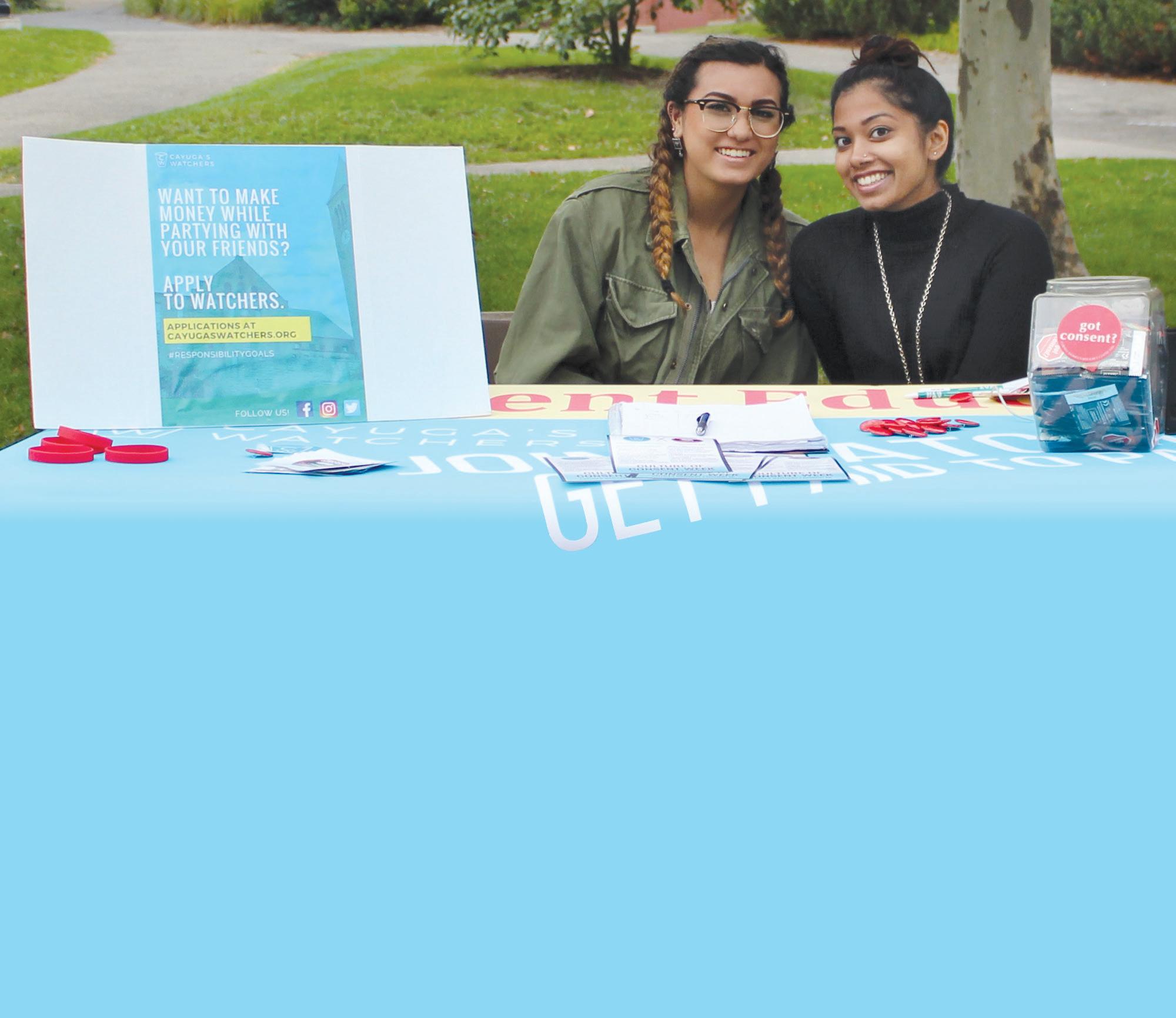
In summer 2012, John Mueller ’13, Eric Silverberg ’14 and Adam Gitlin ’13 were three Cornell students brainstorming how they could prevent dangerous situations from happening at parties and social events. Years later, their ideas culminated in Cayuga’s Watchers — an
independent network of volunteers dedicated to encouraging responsible drinking among Cornell students
These volunteers are anonymous to the public, and, at parties, aim to inconspicuously blend in with their fellow peers. Cayuga Watcher’s is also an organization qualified to be a third-party sober monitor for Greek life events after the recent reforms made in
January. The number of students who joined the program increased by almost two-fold between 2018 and 2019, with 127 students joining the program this past fall, according to the the organization’s annual reports found on the Cayuga’s Watchers website. “To address this increased
See WATCHERS page 4
Thursday, February 13, 2020
Love Your Data Pop-Up 9 - 10 a.m., Mann Library Lobby
Air Pollution Close to Communities: The Need for Better Air Quality Models Noon, 310 Frank H. T. Rhodes Hall
Soup and Hope With Luca Maurer Noon - 1 p.m., Sage Chapel
Bake-Off for Wild Life Rescue in Australia Noon -1:30 p.m., Green Room, Schurman Hall
The City Who Had Two Navels: Curating the Philippine Pavilion At the 16th Venice Architecture Biennale Noon - 1:30 p.m., Kahin Center
From Existential Conflict to Coexistence?
The Case of Israel and Palestine 12:15 - 1:30 p.m., G08 Uris Hall
Fast Fashion: Screening of Hasan Minhaj’s Patriot Act 8 p.m., G27 Carl Becker House
Finger Knitting With Alpha Pi Omega 8 - 9 p.m., William T. Keeton House
Valentine’s Day Candy Grams 9 - 10 p.m., William T. Keeton House



Cornell Men’s Tennis ECAC Indoor Championship 9 a.m., Reis Tennis Center
Asian American Studies Program Spam and Eggs Community Breakfast 9:30 - 11 a.m., 4th Floor Rockefeller Hall
Valentine’s Day at Okenshields 11 a.m. - 2:30 p.m., Willard Straight Hall
Sustainability Social 11 a.m. - 3 p.m., eHub Kennedy Hall
What Happens after DACA? Holding Our Institutions Accountable to Students and Community Members Noon, 429 Rockefeller Hall
Dissection and Reconstructing Plant Metabolism With Synthetic Biology Seminar 12:20 p.m., 404 Plant Science Building
Cornell Women’s Tennis vs. Indiana University 2 p.m., Reis Tennis Center
Sustainable Development: From Manhattan to Warren Hall 3 p.m., B73 Warren Hall
C.U. Music: I Heart Beethoven Festival 8 p.m., Barnes Hall

Te popular website used to track course enrollment will soon ofer an expanded mobile version

By SOPHIE ARZUMANOV Sun Staff Writer
After getting locked out of mandatory and elective classes during pre-enrollment, many Cornellians flock to the CourseGrab website, using it to secure a spot if a course opens up.
But students will soon be able to track class enrollment at their fingertips, with the release of an app planned to give users an even broader suite of course-planning features.
Cornell AppDev — the project team that also developed the popular Ithaca Transit and Eatery apps — plans to roll out the app version by April 13, coinciding with the beginning of pre-enroll for rising seniors. Since spring 2019, Cornell AppDev has managed the CourseGrab website.
With the goal of making “life easier for Cornell students,” Chase Thomas ’20 and Ning Ning Sun ’19 created CourseGrab in 2016 at Big Red Hacks. Since its creation, CourseGrab’s popularity has significantly grown.
“We had both had experiences with trying to get into classes that were full during pre-enroll and add/drop, so this seemed like a natural solution,” Sun said.
To date, more than 8,000 Cornell students have used the website, which allows them to sign in with their Cornell email addresses and track up to three course IDs. If a spot opens in the corresponding section, CourseGrab then sends users an email, urging them to quickly enroll.
Mathew Scullin ’22, the CourseGrab Pod lead — a product management position on AppDev — told The Sun that the
project team decided to create the app after seeing potential in the website during a planning session last fall.
“There was a lot of space to enhance the experience and provide a better sense of immediacy,” Scullin said.
Three new features streamline and expand the app. While courses must be tracked through a specific course ID on the website, with the app, users can simply type in the name of the course. Students will also be able to track at least 10 courses
“There was a lot of space to enhance the experience and provide a better sense of immediacy.”
Mathew Scullin ’22
at a time, an improvement from the website’s current three-course limit.
The app will also send users push notifications immediately when a course opens up, alleviating the need to track their email inboxes.
Shruti Agarwal ’21, the marketing operations leader for the CourseGrab app, said she was optimistic about the project and excited to see what “coherent marketing efforts” can do for it.
She noted that they hope to get users “hooked” on the app instead of the website, even though AppDev will continue to maintain the website.
“We are going to try to make the website parallel the app,” Scullin said. “The timelines may not be perfectly lined up, but we’ll try to have the website reflect new functionality.”
Android capabilities will likely be developed starting next semester.
Sophie Arzumanov can be reached at sarzumanov@cornellsun.com.
By CAROLINE JOHNSON Sun Staff Writer
While surgical wrap — a fabric that sterilizes and protects surgical instruments — is a critical tool in any medical facility, it is not particularly biodegradable.
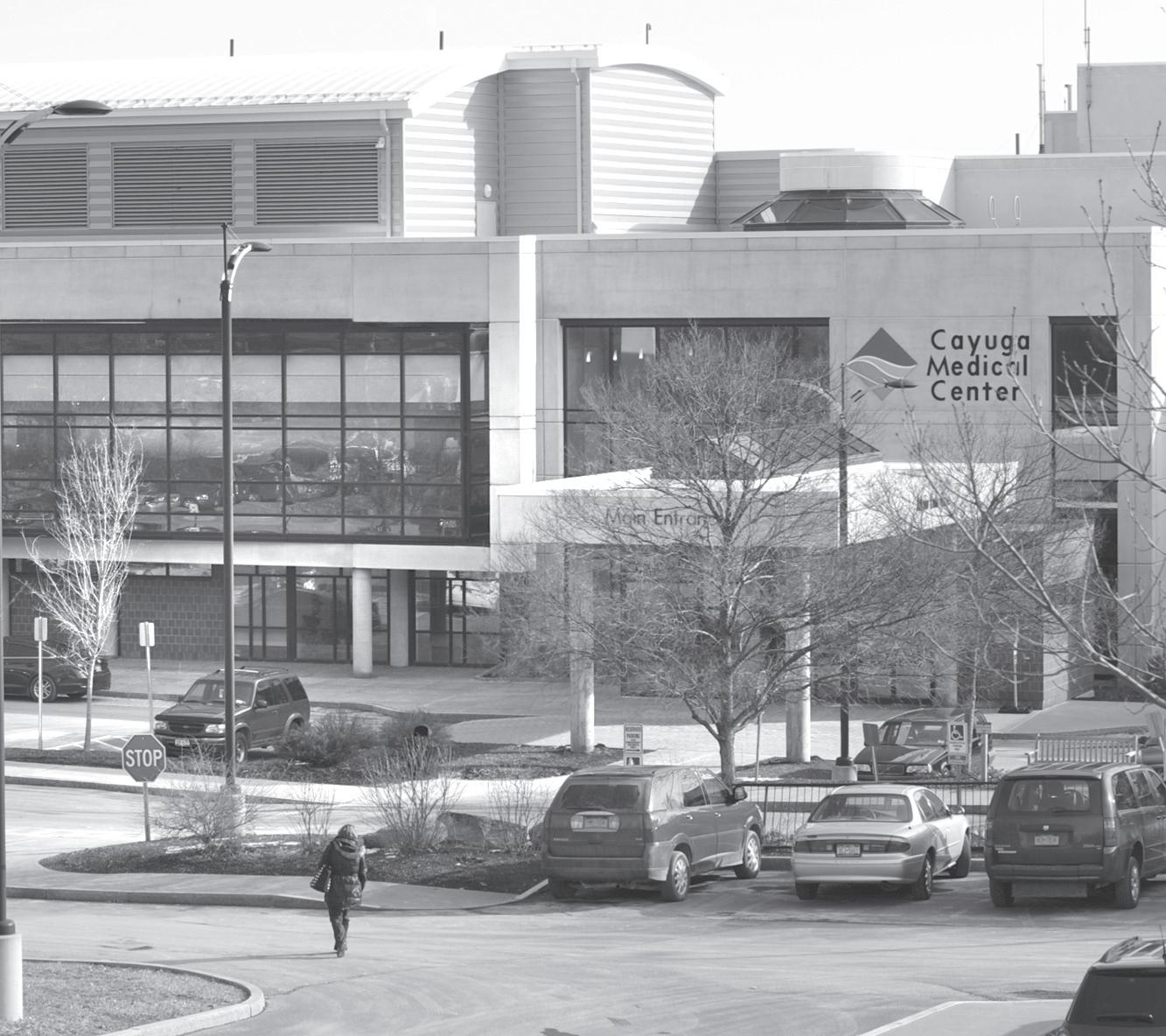
To avoid the pile-up of waste, employees from the Neurodiagnostics Department of the Cayuga Medical Center and volunteers from Ithaca’s Quilters Corner teamed up to create a sustainable solution: Making blankets.
The project, called “Recycle the Warmth,” seeks to distribute these surgical wrap blankets to the neediest communities in Ithaca.
and the Ithaca Police Department squad cars.
The project was inspired by Florida’s Tampa General Hospital, which used its surgical equipment covers to make sleeping bags for homeless people in the area.
Deanna Jacobs, supervisor of Cayuga Medical’s Neurodiagnostics Department, joined a cohort of employees and partnered with Quilting Corners to make this vision a reality in Ithaca.
Volunteers from Quilting Corners, like Lynda VanNederynen, teamed up with Jacobs to make a blanket that is waterproof and heat retainable. This eco-friendly project has already made at least twelve blankets and will continue to make them as more volunteers join.
This eco-friendly project has already made at least twelve blankets and will continue to make them as more volunteers join.
These blankets, made of twelve 44x44 inch squares of surgical wrappings that were once used to heat sterilized surgical instruments, will be distributed to the SPCA of Tompkins County, St. John’s Rescue Mission
The material used in the quilts never comes in contact with hospital patients and undergoes inspections to ensure that the quilts meet health guidelines, allowing people to safely use them.
Caroline Johnson can be reached at cjohnson@cornellsun.com.
STONE Continued from page 1
Stone served as a former Trump campaign advisor in 2015 before resigning. The infamous operative — a self-described “dirty trickster” — previously worked with Republican politicians such as Richard Nixon, Ronald Reagan, Jack Kemp and Bob Dole, where he gained a reputation for pursuing unconventional, controversial political tactics.
The connection between Trump and Stone stems from more than just Trump’s presidential campaign. Their relationship began in the 1970s, and Stone is considered to have persuaded Trump to enter into the realm of politics, earning him the label of “the original architect of Trump’s political career” from political commentators.
On Jan. 25, 2019, the FBI arrested the former advisor with seven charges related to his involvement in Robert Mueller’s investigation into the ties between President Donald Trump’s campaign and Russia during the 2016 election.
The charges included witness tampering, obstructing a proceeding and five counts of lying to Congress.
Despite pleading not guilty on all counts, Stone was convicted for all seven charges at a Nov. 15 trial in Washington, D.C. As recommended by the four prosecutors, Aaron Zelinsky, Jonathan Kravis, Adam Jed and Marando, Stone’s original suggested sentence was seven to nine years.
But in what many legal observers have described as an “extraordinary” step, the proposal was overturned by top Justice Department brass, which deemed the sentence “inappropriate.” Trump, who had already taken to Twitter to comment on the attorneys “who cut and ran,” called the sentence “ridiculous,” explaining Stone’s actions as a result of simply getting “caught up in an investigation.”
In most cases, prosecutors typically have discretion over sentencing guidelines, and the Justice Department’s intervention in the proceedings was enough to incite the four attorneys to withdraw from the case on Tuesday, while one resigned from the Department completely.
The DOJ did not immediately respond to The Sun’s request for comment.
can be reached at cpenenory@cornellsun.com.
demand, Watchers is expanding recruiting efforts and working internally to motivate employees to watch as often as possible,” Robinson told The Sun. “I expect the organization will continue to grow in size going forward."
Although the number of Cayuga’s Watchers members has drastically increased, the frequency of events they staff has declined in response to the new Greek life regulations.
“While the intent of these changes was positive, we believe that they have also driven risk ‘underground’ and off campus,” Cayuga’s Watchers said in its 2019 annual report. “Chapters are increasingly unwilling to bring in ‘outsiders,’ even anonymous and independent bystanders like our Watchers.”
Since its founding, Cayuga’s Watchers has successfully intervened on 2,686 occasions and was present 551 events. During the 2018 to 2019 academic year, the organization staffed 71 events and reported 446 interventions, according to its 2019 report. All members receive formal training and are paid through donations, independent from the University, for their work.
“We learned about the [blood alcohol concentration] ranges, the path of alcohol through the body and at the end of training you have to take a test that has potential scenarios and written questions that were very detailed,” a Watcher told The Sun, who asked to remain unnamed to preserve the organization’s principle of maintaining volunteer anonymity.
Students hosting an event can contact the organization and request a group of Cayuga’s Watchers. The chosen Watchers must arrive at the party 15 minutes early to talk to the

take that into consideration too.”
Those who did not make it to work were still compensated for missing their shift, and after noon, employees present for their shifts were compensated 1.5 times hourly pay.
A North Campus employee drove his usual 30 miles to campus for a night shift and commented on the overtime pay, saying that had it been earlier in the day he “wouldn’t have risked it.”
host, but once party-goers begin to show up, the Watchers go incognito, casually socializing with other students. Watchers only intervene if necessary.
“I would definitely consider myself the mom friend, so it’s like you’re getting paid to do something you would do anyway,” the Watcher said.
To reconcile the number of events with its increase in applicants, Cayuga’s Watchers is continuously striving to improve its staffing opportunities.
John Mueller ’13, the organization’s co-founder and co-chair, said Watchers is expecting a drastic increase in the number of events they will staff in the upcoming semester. In the coming weeks they expect to onboard close to 80 new members.
The Watchers are also looking to increase the range of events they monitor, hoping to move beyond the sphere of Greek life.
“I worry most about the so-called ‘dry’ events, because some students choose to pregame pretty intensely,” Mueller said. “I’m trying to make sure that we have the capacity to not just be at the events where students are being required to request us, but also at any large event.”
Cornell Health is also closely working with the Cayuga’s Watchers to spread the organization’s ideas to the larger Cornell community, according to Laura Santacrose, assistant director of the Skorton Center for Health Initiatives.
“We work for the students and our only objective is to keep parties safe,” Prof. William Sonnenstuhl, industrial and labor relations, an advisor and board member of the Cayuga’s Watchers told The Sun. “We just don’t want anybody to get hurt.”
Another full-time Central Campus employee who relies on TCAT for transportation, stayed to help with dinner service in the dining halls on Friday night. To accommodate poor road conditions and canceled transportation, the University offered employees housing at the Statler Hotel or in the residence halls for the night, according to Paul Muscente, associate director of Cornell Dining.
However, she said she felt the situation could have been avoided entirely had Cornell
— like other area schools — taken a more proactive approach in handling the inclement weather.
“They need to be more vigilant about when to close, because we have to worry about our safety,” the employee said. “A lot of people live far, like 45 minutes, an hour away, and traveling in that snow is really rough and it's dangerous.”
Student workers also found themselves caught in the snow day confusion, arriving for morning shifts even though classes had already been canceled.
Anna Winikow ’22, an employee at Rusty’s in Uris Hall, arrived at her 11:30 a.m. shift from her off-campus house, only to stay 30 minutes before Rusty’s followed the rest of campus in closing for the day.
“We had to throw a lot of food away,” Winikow said. “I think, financially, if classes are canceled, there’s not going to be a lot of customers.”
Some unused items were redistributed to open eateries or given away to customers,
Muscente, said, adding that some slower retail locations made less food in anticipation of a quieter business day.
Risley student managers Amari Williams and Abigail Swanson found it easier to plan for food waste during lunch service, but were unable to staff the dinner shift.
“We were pretty busy at lunch, and we hadn't started dinner preparations before our closing was announced, so we had minimal food waste,” Williams and Swanson wrote to The Sun in an email.
While Thursday night forecasts accurately predicted Friday’s snowstorm, Muscente told The Sun that Cornell's dining operations strive to adapt to Ithaca’s often tough weather conditions.
“Each time our operations are affected by weather is slightly different, whether or not the University officially closes,” Muscente said in an email. “Each time is an opportunity to learn what we can do differently.”
Renee Hoh can be reached at rch294@cornell.edu.

By LUCAS REYES Sun Staff Writer
After 18 years as a faculty member and 10 years as Dean of the College of Engineering, Prof. Lance Collins, mechanical and aerospace engineering, will leave Cornell to serve as the executive director of Virginia Tech’s Innovation Campus.
Collins — the first African American dean at Cornell — has been a faculty member since 2002. While Collins’ departure from the engineering college makes him the second dean in just two weeks to announce an exit from the University, he stressed that it was a standard move planned beforehand.
“Cornell has a practice of deans serving for two terms,” said Collins, noting that a term was for five years. “I was thinking I would step back onto the faculty and continue as a regular faculty member.”
Collins also commented on the recent revolving door of the University’s deans — one in which recent years, has seen top academic officials from Art, Architecture and Planning, College of Arts and Sciences, Cornell Tech, the School of Industrial and Labor Relations and the College of Agriculture and Life Sciences leave Cornell or seek higher positions within the University.
“I don’t see it as a negative thing,” Collins said. “I actually do think it’s great to get somebody new into the job and bring new
ideas and different perspectives.”
Collins was approached by Virginia Tech towards the end of his term, when he was offered the position of first-ever vice president and executive director of its newly formed Innovation Campus.
As the engineering college dean, Collins played a central role in the University’s bid for Roosevelt Island as the site of the Cornell Tech campus in 2011. With Virginia Tech’s Innovation Campus — an offshoot aimed at expanding the school’s footprint in STEMrelated fields — founded for similar reasons as Cornell Tech, Collins said that his new position would be a natural transition, incorporating his existing skills and past experience developing a tech campus.
“I’m stepping into a role that’s not so different,” Collins said. “Virginia Tech is launching their equivalent to Cornell Tech in some ways, and I think the experiences that I gained over the course of those years [working] with Cornell Tech will be very helpful to me.“
Cornell is currently reviewing potential replacement candidates, with a successor to be announced before Collins’ term ends on June 30. A search committee led by Provost Michael Kotlikoff will select Collins’ successor.
While the committee does not take into account the opinions of current deans, Collins is reassured that there are “great candidates.”
One of the most notable

changes Collins presided over was an increase in female enrollment in the engineering college from 33 percent in 2010, when he began his tenure, to approximately 50 percent now. The national average of women enrolled in engineering undergraduate programs is 23 percent, according to the American Society for Engineering Education.
“It’s really without hesitation the 50/50 male female ratio in the undergraduate population … despite other things that were really amazing and fantastic,”
Collins said, who also oversaw doubling of underrepresented minorities in the engineering college from eight percent in 2010 to 19 percent in 2020.
He credited Cornell’s success in expanding diversity under his tenure to the commitment of his colleagues, who he said have adopted “diversity as excellence” as a fundamental maxim for the college’s future programming and growth.
Expressing bittersweet, though hopeful, feelings about his departure, Collins said it would be “very hard to leave just the incredible quality of Cornell.”
“While I’m excited about this new opportunity,” he said, “I will always have Cornell in my heart.“
“One thing I can say about Cornell faculty is that if you can show how one thing you’re doing is going to lead to the college being stronger when they’re with you,“ Collins said.
Lucas Reyes can be reached at lreyes@cornellsun.com.
JOYBEER DATTA GUPTA ’21
Business Manager
PARIS GHAZI ’21
Associate Editor
MEREDITH LIU ’20
Assistant Managing Editor
RAPHY GENDLER ’21
Sports Editor
BORIS TSANG ’21
Photography Editor
AMBER KRISCH ’21
Blogs Editor
SOPHIE REYNOLDS ’20
Science Editor
AMANDA H. CRONIN ’21
News Editor
JOHNATHAN STIMPSON ’21
News Editor
PETER BUONANNO ’21
Arts & Entertainment Editor
ANYI CHENG ’21
Assistant News Editor
HUNTER SEITZ ’20
Assistant News Editor
CHRISTINA BULKELEY ’21
Assistant Sports Editor
BEN PARKER ’22
Assistant Photography Editor
JEREMY MARKUS ’22
Assistant Arts & Entertainment Editor
ALICIA WANG ’21
Graphics and Sketch Editor
DANA CHAN ’21
Production Editor
RYAN RICHARDSON ’21
Snapchat Editor
GIRISHA ARORA ’20 Senior Editor
SARAH SKINNER ’21
Editor
KRYSTAL YANG ’21
Manager
NATALIE FUNG ’20
SABRINA XIE ’21
NOAH HARRELSON ’21
SHRIYA PERATI ’21
KATIE ZHANG ’21
AMINA KILPATRICK ’21
MARYAM ZAFAR ’21
ETHAN WU ’21
SHIVANI SANGHANI ’20
NICOLE ZHU ’21
LUKE PICHINI ’22
JING JIANG ’21
DANIEL MORAN ’21
&
LEI LEI WU ’21
EMMA WANG ’20
LEANN McDOWALL ’21
Editor BREANNE FLEER ’20
On Tuesday, Jan. 28, Cornell Students for Justice in Palestine shared a post on Facebook from the Central Ohio Revolutionary Socialists page. The post read, “This is how you respond to Trump and Netanyahu’s calls for ‘negotiation’ and ‘peace talks’ based on their plan for permanent apartheid” and included a video interview with Ghassan Kanafani entitled “A Conversation Between the Sword and the Neck – Ghassan Kanafani”. Ghassan Kanafani was no ordinary Palestinian leader: he was one of the leaders of the Popular Front for Liberation of Palestine, a group that has conducted hundreds of terror attacks against innocent civilians since the late 1960s. This includes PFLP’s responsibility for numerous suicide bombings, airplane hijackings and other attacks on Israelis. The PFLP is classified by the United States, European Union and Canada as a terrorist organization, and is committed to eradicating the State of Israel.
ians, including 17 Puerto Rican Christian pilgrims, eight Israelis and one Canadian.
Two members of the Puerto Rican Student Association Executive Board at Cornell told this author they were disappointed but not surprised by Cornell SJP’s promotion of a PFLP leader. The students requested their names be kept private, but agreed for their statements to be published.
“Considering what Puerto Ricans have been through in recent years, it hurts to know that some students show hostile sentiment towards us. It truly forms a barrier to inclusion. This act by SJP felt like a major
This is not the first time Cornell Students for Justice in Palestine has promoted PFLP propaganda. Last spring, the group used a PLFP poster before taking it down after students protested.
’21
Editor Luke Pichini ’22
Boris Tsang ’21
Catalina Peñéñory ’22
Rosenberg ’23
Editor Greta Gooding ’22
editor Benjamin Velani ’22 Sanjana Kaicker ’23

The PFLP’s terrorist activity has continued into the 2000s. In 2001, the PFLP claimed responsibility for the assassination of Israeli tourism minister Rehavam Zeevi. The group was also responsible for a suicide bombing on Christmas Day in 2003 which killed four people. In 2014, the PFLP claimed responsibility for the Har Nof Massacre, in which six Jews were murdered while praying in a Jerusalem synagogue. Among those killed was Rabbi Moshe Twersky, the grandson of the founder of the Jewish school this author attended in the Boston area. Most recently, in August 2019, the PFLP was found responsible for a terror attack in which Rina Shnerb, a 17-year-old Israeli girl, was killed by an improvised explosive device.
violation of trust and an outright show of disrespect to the Cornell community in addition to the Puerto Rican and Israeli communities,” one of the PRSA E-board members said.
A second Puerto Rican Student Association E-Board member responded to SJP’s post in a private, written statement: “It is incredibly disheartening to
If you are human, know that Cornell SJP has put its hatred for the sole Jewish state above your life, and has declared that its destructive goals must be reached at any cost.
This is not the first time Cornell Students for Justice in Palestine has promoted PFLP propaganda. Last spring, the group used a PFLP poster to promote an event called “From Ferguson to Palestine: A Conversation Surrounding Struggle” before taking it down after students protested. And Cornell SJP has repeatedly defended Rasmeah Odeh, a former member of the PFLP responsible for a 1969 Jerusalem bombing which killed two Israeli college
see an organization which in theory dedicates itself to advancing human rights in Palestine reposting material from a leader of an internationally recognized terror group regarding his perspective on the IsraeliPalestinian conflict.”
Cornellians must know that Cornell SJP has a consistent record of endorsing a terrorist organization devoted in words and deeds to the death of innocent civilians and to Isreal’s destruction.
students, calling her an “activist.” Cornell Collective for Justice in Palestine, an organization which co-signed Cornell SJP’s call for BDS last spring, has a photograph of PFLP member Leila Khaled as its Facebook profile picture. Khaled led multiple plane hijackings while active in the PFLP.
Ghassan Kanafani, the PFLP leader whom the Cornell SJP post promotes, helped plan one of the PFLP’s most deadly terror attacks. In May 1972, the PFLP and the Japanese Red Army carried out an attack at Lod Airport (now called Ben Gurion) in Israel, killing 26 innocent civil-
Cornellians must know that Cornell SJP has a consistent record of endorsing a terrorist organization devoted in words and deeds to the death of innocent civilians and to Israel’s destruction. If you are Puerto Rican, know that Cornell SJP does not care about the innocent Christian Puerto Rican pilgrims gunned down at Lod Airport. If you are Israeli, know that Cornell SJP endorses the demise of your country. If you are Jewish, know that Cornell SJP has denied your right to peaceful self-determination. If you are a student, know that Cornell SJP has put its weight behind an organization which has murdered innocent Israeli students on the street. And if you are human, know that Cornell SJP has put its hatred for the sole Jewish state above your life, and has declared that its destructive goals must be reached at any cost.
Last January, University of California President Janet Napolitano tasked the University of California’s Academic Senate with “exam[ining] the University’s current use of standardized testing for admission and consider[ing] whether the University and its students are best served by UC’s current testing practices, a modification of current practices, another testing approach, or the elimination of testing.” Institutions across the country were moving away from requiring standardized tests for admissions, so it came as no surprise that the UC system would evaluate the merit of making the submission of standardized tests optional (a policy often referred to as test-optional). What they weren’t prepared for was the announcement of the Operation Varsity Blues admissions scandal two months later, which catapulted conversations regarding admissions into the national spotlight. Now more than ever, people wanted to know whether the UC system, which includes more than 280,000 students, would endorse becoming test-optional.
While the panel convened by the UC Academic Senate worked, other universities began to come forward with decisions of their own regarding standardized testing. The
It is clear that the efficacy of standardized testing in admitting qualified students should be evaluated.
National Center for Fair and Open Testing announced that over 47 new schools had transitioned to test-optional policies raising the total number to over 1,000 institutions in 2019. The University of Chicago, one of the most prominent institutions to go test-optional last year as part of their Empower Program, reported an increase of 56 percent in enrollment of first-gen and low-income, rural, and veteran students. Graduate programs across the country also moved towards test-optional with an increasing number of programs moving to drop the GRE, a graduate school entry exam, from their admission requirements. While relatively minor in comparison to policy changes occurring at other institutions, Cornell’s College of Arts and Sciences dropped the SAT subject test requirement and several graduate fields
including biomedical engineering and english dropped the GRE requirement. The tide seemed to be shifting, with 2019 even dubbed “The Best Year Ever for Test-Optional Higher Ed. Admissions.”
So, when the UC Academic Senate’s report on standardized testing was released last week, many were surprised to see that the report recommended that, at least for the near future, the UC system should continue requiring the ACT/ SAT for admission. While they acknowledge that consideration of test scores may adversely affect underrepresented minority applicants, they believed that dropping the ACT/ SAT requirement “could have significant, unanticipated and undesirable effects on the profile of matriculating classes.” They ultimately argued for keeping the requirement while further research is done on the possible effect of moving towards test-optional.
The results of the UC report seem to not only contradict narratives emerging from schools and programs that have transitioned to test-optional but also recent research that suggests standardized tests are not a strong predictor of college graduate or success. Regardless of one’s opinions on the results of the UC report, the initiative taken by the UC system to explore and publicize how standardized testing influences their admission landscape is admirable. It is time for Cornell to take advantage of the suite of experts currently working for us in this field and follow suit.
To quote Jon Boeckenstedt, associate vice president of enrollment management at DePaul University, “Colleges have an obligation to do research on the efficacy of standardized tests, and to consider the value of them in the admissions process.” Prospective students, current students and alumni are all debating the utility of standardized testing in our admissions process, and the university should provide them with information on whether this metric is effective within the admissions process. In a time when trust in the fairness of the college admissions process is at an all time low, public evidence validating the tools we use to consider admitting students would be invaluable. As touchpoints into the community, students and alumni can be particularly effective defendants of our admissions policies, but only if they understand why they are there.
But, even if we operate on the assumption that standardized testing is an equitable and informative metric (and this is a big assumption) for a moment, we should ask ourselves whether placing significant emphasis on numerical evaluations of applicant ability is really in the best interest of students. As we continue to evaluate the culture of student
If you’re like me, you’re splitting much of your free time between applying to summer internships and hoping that you get one. If you’re above me, you’ve already locked your summer or even post-graduation plans down, freeing up your next three semesters for a fun and stress-free education. But as we buckle down and put our energy into securing our futures, we should remember
mental health on campus, a recurrent theme is the negative consequences of over emphasizing numerical metrics, such as test scores and grade point average. This mentality starts as the admissions level, before students even arrive, as applicants begin to obsess over whether their test scores will help secure them a spot in our incoming class. Limiting our use of numerical metrics to only those with the most proven predictive value may be a way to mitigate this, and current research shows that metric is not standardized testing but high school GPA. Preliminary research extends this result to the graduate level, suggesting that non-quantitative measures were better predictors of student success than the GRE.
While we evaluate the merit of moving test-optional we should not lose sight of what this change must be paired with in order to recruit and retain the best students.
It is clear that the efficacy of standardized testing in finding and admitting qualified students and their potential impact on student culture should be evaluated. However, it would be naive to believe that a transition to test-optional would, on its own, actually advance the university’s goal of enrolling a diverse and talented student body. Remember, the University of Chicago’s impressive 2018 bump in enrollment of first-gen and low-income, rural and veteran students? Their transition to test-optional was paired with the offering of full scholarships to students from families earning less than $125,000 per year and new scholarships for first-generation and veteran students as well as an increased recruitment push to rural and inner-city students. While we evaluate the merit of moving test-optional, we should not lose sight of what this change must be paired with in order to recruit and retain the best students.
Manisha Munasinghe is the graduate and professional student-elected member of the Board of Trustees, and a Ph.D. candidate at Cornell University. Munasinghe can be reached at mmunasinghe@cornellsun.com.
ing voting rights and gerrymandering themselves into nearly unshakable power in certain states. But they have for the most part been able to concede elections and accept them as fair. In addition to Trump’s disdain for our institutions, he has spent years lying about illegal voting practices to sow doubt about the integrity of our democratic process itself and
As the election approaches, spend some time at a phone bank. And as soon as you can, chip in.
that our futures will exist in the context of a broader society.
These are not ordinary times we are living in. President Trump’s contempt for democratic institutions has always been obvious, but he has been truly unleashed following his disgraceful acquittal in the Senate. Antidemocratic sentiment and power are on the rise in the United States, and our institutions are proving incapable of holding back this creeping tide.
The Republican Party has been cynically anti-democratic for decades, gleefully attack-

openly promised to continue to do so in this election year.
You’ve probably heard this all before. If you support this national trajectory, I hope you don’t vote in a swing state. If you do, I hope you’re prepared to tell your grandkids why you were complicit in the decay of the world’s first modern liberal democratic experiment, and not even because you were just following orders. And if, regardless of your political leanings, you believe in the moral and pragmatic necessity of protecting the ideal of self-government, the country needs
our help.
This election is not like other elections. Without a sweeping victory and a mobilized public, the incumbent will likely find ways to delegitimize the election in an attempt to hold onto power. Such a constitutional crisis could indeed be worse than a Trump outright victory, which would guarantee more unqualified judges, environmental protection rollbacks and tax cuts for the wealthy. It would be the first election in American history without a peaceful and willing transition of power, and would likely end the era of stable republican society.
college students in America invested that sum into tossup congressional races or the Democratic Unity Fund, we could put $120 million behind ensuring there is a free and stable future ready to welcome us into the workforce.
When crisis strikes, we college students will depart from our campuses en masse to flood the streets in popular protest.
Like Hungary’s, our government system would nominally continue to be a democratic republic well after one party cements minority rule. When crisis strikes, we college students will depart from our campuses en masse to flood the streets in popular protest. To avert crisis in the first place, we can play our part. So talk to your family, friends and neighbors. As the election approaches, spend some time at a phone bank. And as soon as you can, chip in a couple dollars.
Yes, I wrote my shortest-ever column calling on us all to donate $15. It’s a couple of coffees or a night out, simple luxuries we will barely notice going without. If half the
College students living under undemocratic regimes get summer internships too. But in addition to commitment to our values, we are obligated by both self — and national — interest interest to set our society on back on course, so that we can one day again devote ourselves to career and family without fear for the country those careers and families occupy. For our country’s sake as much as our own, let’s spare a little change for democracy.


By SOFIA SICILIANI Sun Staff Writer
Having trouble getting in your daily source of vegetables? Head to Coltivare, located on 235 South Cayuga Street, to have your mind blown away by a cauliflower dish that tastes so good you would never imagine it’s just vegetables! Before we get to the delicious meals, let’s take a look at what the restaurant truly stands for. Coltivare comes from the Italian verb “to cultivate.” The restaurant cultivates in various ways: The land, since 60 percent of their ingredients are sourced from the local area; learning, through its dynamic partnership and innovative ‘Farm to Bistro’ program; and community outreach programs such as fundraising dinners and charitable giving in Tompkins County. Each month Coltivare offers a “Student Special,” which sets aside $5 with every order and donates the accumulated money to local schools in order to combat child hunger. This money is donated to students who owe money on their lunch accounts to ensure all are able to afford a nutritious meal at school.
Coltivare is a 17,000 squarefoot culinary center that includes a full-service restaurant, culinary lab, amphitheater, wine cellar and special event space. The restaurant is owned by the Tompkins Cortland Community College foundation and acts as a satellite location for TC3. Housing three of the college’s four “Farm to Bistro” programs, Coltivare offers guidance in Hotel and Restaurant Management, Culinary Arts and Wine Marketing. As the central hub for hospitality programs at the college, Coltivare allows students to filter in through classes and internship opportunities with the hotel and restaurant management and sustainable
farming programs. In addition, a beverage studies degree and a culinary arts degree are offered.
Students are able to hit the ground running and gain handson experience as they work alongside a professional staff of hosts, servers, line cooks, prep cooks and head chefs — training that will prepare them for a job in any hotel, restaurant or college dining hall. This intensive program requires a back-of-house practicum of 250 work hours a semester, or a front-of-house practicum of 125 hours. One of the largest and fastest-growing hospitality programs in the country, Coltivare’s culinary program currently hosts 60 students. In addition, the restaurant supports the college’s own TC3 Farm by sourcing fresh produce grown by its Sustainable Farming and Food Systems students and even returns composted food waste back to the fields.
This past week I met with Coltivare’s Director of Operations Jason Sidle, who was able to give me an inside view of the restaurant. From our conversation, what blew me away the most was the various ways in which the restaurant is giving.
One of Jason’s most memorable events was a fundraising dinner that raised over $1,000 to help students from the New Roots Charter School, in Ithaca, go back to the Dominican Republic and Puerto Rico. The students visited their families and helped rebuild the community after a series of earthquakes and other natural disasters. Overall, Coltivare is a breath of fresh air in comparison to their egocentric competitors whose main priority is how much money they’re putting in their pockets at the end of the day.
Now, let’s get back to the good stuff — the food. Ever since
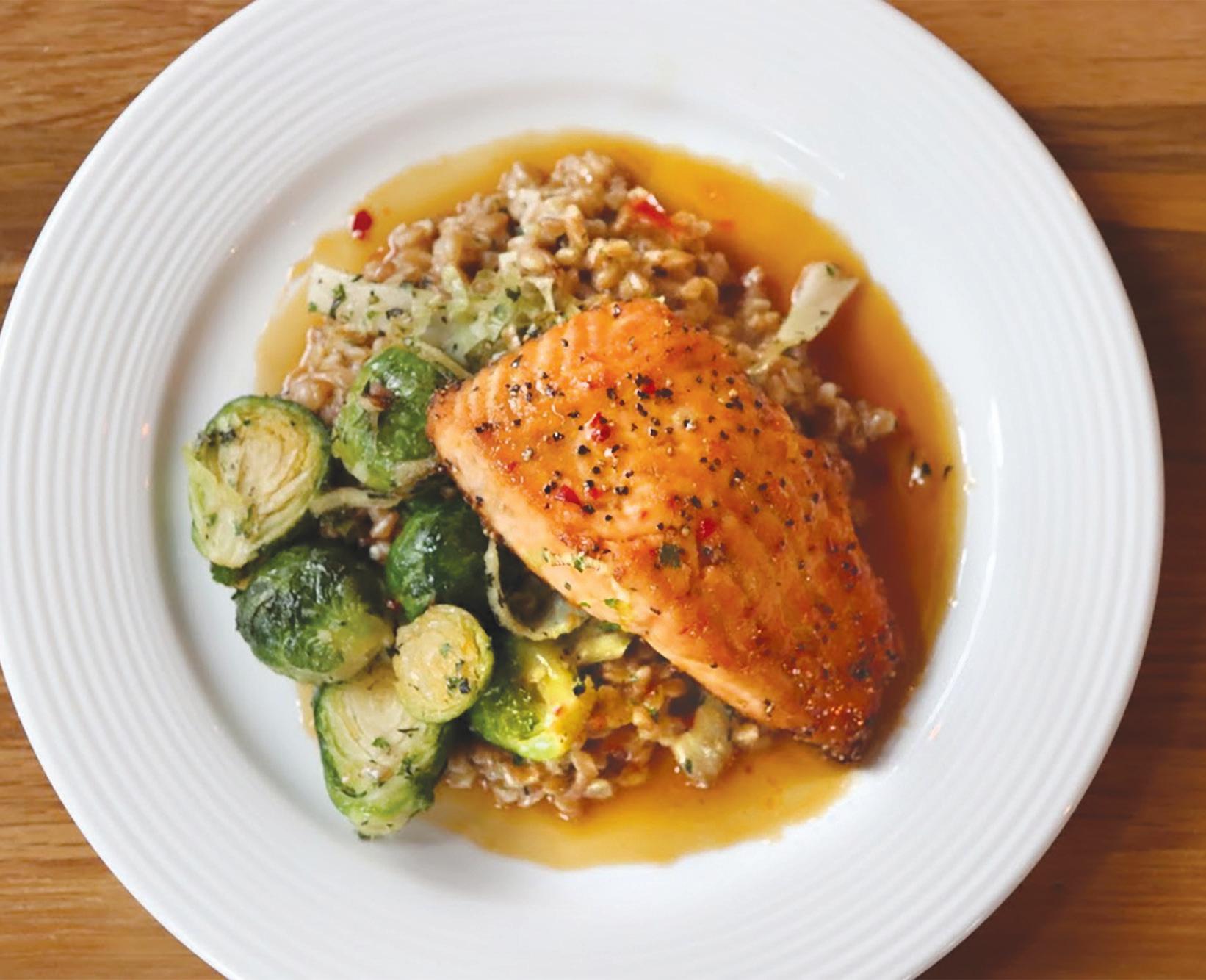
opening in December 2014, Coltivare’s #1 dish has been their citrus and soy glazed salmon served over braised fennel, leeks, brussel sprouts and farro risotto. If fish doesn’t suit your fancy, try one of Jason’s favorite appetizers — the $11 vegetarian and gluten-free tempura buffalo cauliflower, which is tossed in a house-made blue cheese mousse.
At Coltivare, each dish is hand-crafted, ensuring customers are eager to come back for the unique cuisine. Take Corbin’s Cauliflower, an extremely successful take on a cauliflower steak that bursts with flavor in each bite. Named after Sous Chef John Corbin, this cauliflower is served with a choice of basmati rice or farro risotto, seasonal vegetables, leafy greens and topped with a scoop of creamy cashew cheese. Tossed in umami-packed marinade, this dish is always cooked to perfection and absolutely melts into your mouth. Although the restaurant changes their menu seasonally 4-6 times a year, Corbin’s Cauliflower is a staple that cannot be replaced. In addition to being extremely veg-friendly, the menu can satisfy any craving since it features a large variety of options. There is everything from housemade fettuccine in a sugo rosa creamy marinara sauce to a meat-eaters meal like the farmer’s choice steak that is always sourced from a rotation of local farms. For all the nostalgic AppleFest lovers, Coltivare offers their famous AppleFest mac and cheese year round, served with smoked gouda bechamel, apple cider braised pulled pork, N.Y. State apples, caramelized onions and apple butter. Now that’s comforting!
Coltivare is not only unique in the flavor of their food, but also in their restaurant culture.
On the second Saturday of each
month, they offer cooking classes that range from everything between tacos and tequila to vegan cookery and BBQ sauces and marinades. Be sure to get your tickets fast because each class has been sold out for a year and a half now! In addition to the beautiful ambiance, Coltivare works to dispel the preconceived notions of the restaurant industry in which people imagine volatile chefs screaming and cursing as they struggle to get food out on plates as fast as possible. Instead, Coltivare is focused on keeping a professional culture that supports their staff, their customers and most importantly each other.
Fun Fact: For three years running, Coltivare’s wine cellar has been voted one of the top 10 wine cellar venues in the entire country. If that doesn’t speak for itself, come check it out! I promise you will not be disappointed.
Serves: Seasonal, locally sourced New American dishes
Vibe: Rustic-chic atmosphere
Price: $$
Overall:


Sofa Siciliani is a sophomore in the College of Human Ecology. She can be reached at sts72@cornell.edu.



By SARAH AUSTIN Sun Staff Writer
As I approached adulthood (read: gap year) it seemed like I kept getting unsolicited dating advice from everyone I knew. My grandma would cut out articles about the do’s and don’ts of dating for me, the older men in my synagogue would tell me to marry a doctor, while their wives would pull them away and tell me to make sure the guy’s cute with a wink. Meanwhile, my high school friends would talk about the number of dates I should go on before being proposed to. Above all, I heard about rules related to what one should or shouldn’t order on a date. As Valentine’s Day approaches, I decided to pass on this ~very~ important information to my readers because if Valentine’s Day is about the people you love, here’s a list of options to order at your romantic dinner.
Salad
your teeth? Your entire night would be ruined if at the end of your night, you smile and your date notices a flash of spinach in your incisors. As Nick Jonas put it after his Grammys performance, “At least you all know I eat my greens.”
ing out of their mouth. My one and only gripe with this logic is Lady and the Tramp. Arguably the most romantic meal ever eaten on a date was spaghetti and meatballs in Lady and the Tramp. The shared piece of spaghetti, the way their eyes lock and most
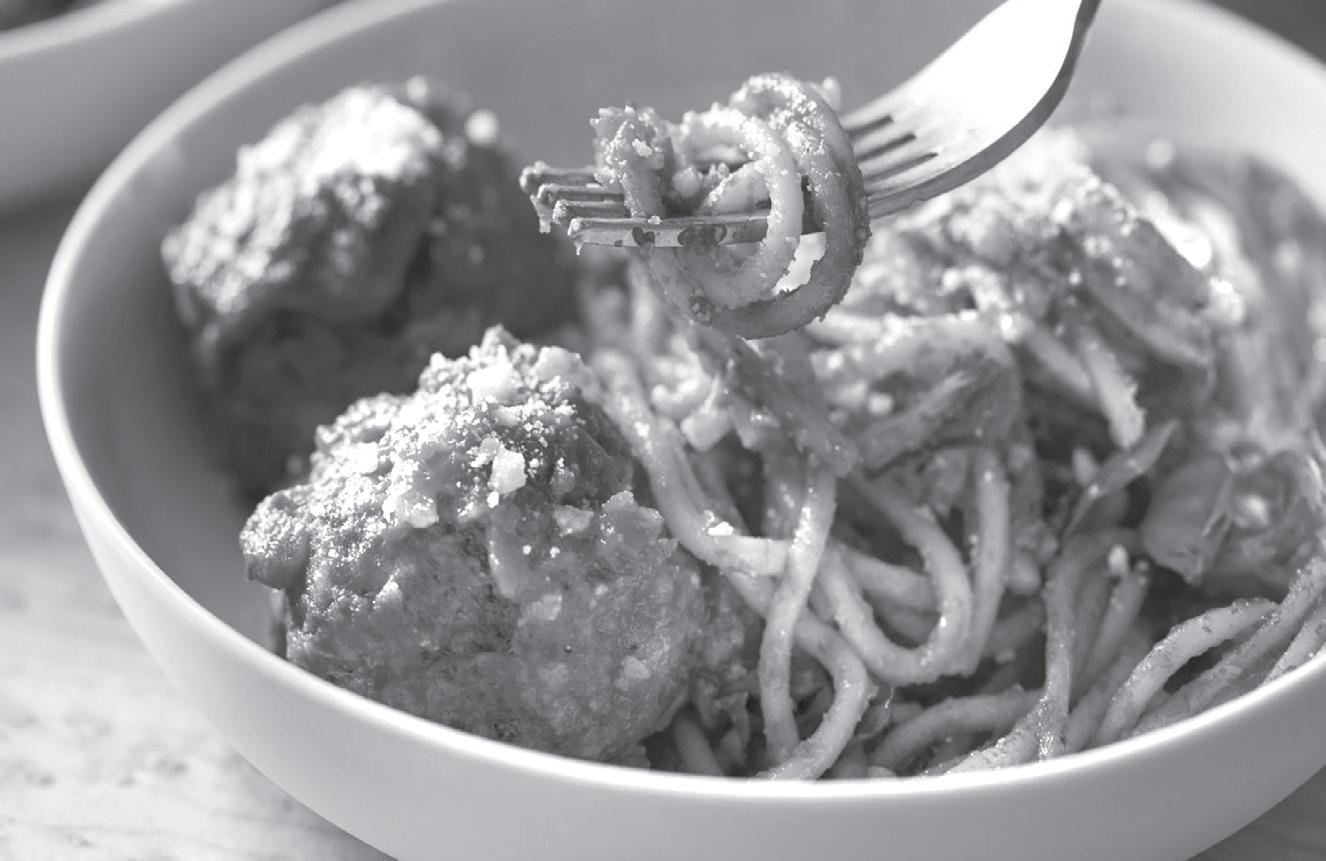
smile at your date because not even the sound of your slurping can ruin your night.
Burger
How many of you have tried eating a burger just to find the vegetables and condiments all over your lap?
Obviously I can’t be the only one because it’s one of the foods on the “do not order” list. Burgers are messy, too big to fit in most normal-sized mouths cleanly, and tend to contain onions. No one looks
Onion and garlic are major no-nos because of the potential good night kiss.
I was told to never ever order a salad on a date. I never understood this one; they tend to be a cheaper option on the menu so you won’t feel bad about costing your date a fortune, and in the most superficial way, they represent your dedication to health and wellness. According to everyone who offered me dating advice, this is completely flawed logic because what if, god forbid, a piece of lettuce gets stuck in
It’s COLD, and soup is a must to combat the chill that has permanently penetrated our bones.
Spaghetti
Now spaghetti is a faux pas on two counts: if you order it with marinara sauce, you run the risk of staining your date night outfit and secondly, no one looks sexy with little stringy noodles com -
importantly the kiss at the end. Please go and order a plate of spaghetti and try your hardest to recreate 1955’s most magical gastronomical moment.
Soup
When I was little, my dad would tell me to stop “zouping my soup.” I guess he was just grooming me for when I started dating because you should NOT order soup. Slurping is definitely not a sexy sound. This “rule” is just stupid. Did any of these 1950’s housewives ever spend a winter in Ithaca?
It’s COLD, and soup is a must to combat the chill that has permanently penetrated our bones. Order your soup, slurp it (because it obviously tastes better that way) and

their best with a small salad and ketchup smeared all over their clothing or with their mouth open as wide as possible just to cram a burger in. Also, bonus tip: onion and garlic are major no-nos because of the potential good night kiss. No one has ever said one of their fantasies includes making out with an onion. My advice: order your burger with extra onions if that’s the way you like it!
Wings
Do you want to seem like an animal on a first date? Prying chicken off of a bone just like our ancestors did when they were hunter-gatherers? Ugh. This is the 21st century and we’re civilized, refined young adults. Studies show that a lot of our romantic relationships are based off our primal urges and subconscious. I don’t know what gets more primal than tearing meat off the bone.
You know what they say: rules are meant to be broken. Go enjoy your lovely, romantic Valentine’s Day dinner, and pay no mind to all the adults and articles trying to tell you what NOT to order on a date. If your significant other can’t accept you at your messiest, then they sure as heck don’t deserve you at your sexiest.
Sarah Austin is a freshman in the College of Agriculture and Life Sciences. She can be reached at sa2334@cornell.edu.
Iwas watching The Bachelor with some friends on a quiet Saturday night. A few hours prior, I had reposted two things on my Instagram story: A list of “facts” and “myths” about the novel coronavirus, and a message stating that “coronavirus doesn’t give you the right to be racist and xenophobic towards Asian people.”
My phone buzzed; I glanced at the screen half-heartedly as the drama in the show unfolded, and was immediately outraged.
“Hey,” I tapped the friend sitting on the other end of the couch. As calmly as I could, I asked, “Do you think that’s funny?” “Yeah!”
surprised I was actually mad, and told me that I needed to “learn to take a joke.”
“That seems like a you problem, Ruby.”

He answered with a nonchalant shrug, “Don’t you?”
He had just replied to my second story with one simple word, “myth.”
And no, I didn’t find it funny, especially because myths have always been a powerful vehicle of xenophobia, as exemplified by notion of Yellow Peril and the anti-semitic belief about Jewish people’s devilish horns. I found the joke to be so terribly insensitive and hurtful that I paused the show and demanded an apology. He was
Is it my problem though? In fact, in my friend groups I’m known to have a dark sense of humor. I joke about dysfunctional family, therapy, race and past trauma no less. But I draw a simple line when it comes to jokes — I only make fun of things I actually understand. It’s quite simple; for example, when you haven’t personally suffered through an eating disorder, maybe don’t make fun of people who have. When
you are not Chinese or of East Asian descent, you probably don’t understand or haven’t experienced firsthand the political implications of this health crisis, so think twice when you are about to make a distasteful joke.
A few months ago, I came across this tweet by Heather Thompon Day about how asking her male boss to explain a sexual joke to her effectively shut him down. She wrote triumphantly at the end, “And that’s how I learned that once
sexual harassers have to explain why their inappropriate jokes are funny, they stop laughing.” I’ve found this technique to be incredibly useful when faced with sexist, racist, homophobic and all otherwise inappropriate or offensive comments. For example, the other day I ran into a friend and stopped for conversation. She introduced me to the person she was with, who joked, “You weren’t in China recently, were you?” My right hand that just shook his suspended mid-air, as he let out a nervous giggle. “Is that funny to you?” I asked. And he just looked away and quickly excused himself. Later when my friend relayed to me that he thought I was “too intense,” I didn’t know how to respond. In the comments section of my column about trigger warnings, an army of middle-aged white men attacked me and even our generation for being “weak”, “wimpy” and “unable to deal with the real challenges of life.” While these statements seem to be contradictory, the same mentality underlies all of them: Their privileged position overlooks or invalidates the feelings of those marginalized. Similar to how women with postpartum depression used to be deemed “hysterical,” victims of various forms of violence today are still faced with harmful and manipulative rhetoric, like “you’re overreacting” or “you need to learn to take a joke.”
I never finished that Bachelor episode
because after trying to explain to my “friend” why some things just aren’t a joking matter for half an hour to no avail, I decided to leave. On my way home I called my grandma, who told me that supermarket shelves are empty everywhere in Hong Kong but luckily, she’s a hoarder and they should have enough rice left for a few weeks. Her words somehow reminded me of 2003, when the severe acute respiratory syndrome epidemic also left us stranded at home. I was too young to feel scared, and was simply happy that I could watch anime all day instead of going to school. Yet 17 years later, thousands of miles away from home, I just can’t stop worrying about my grandparents when statistics suggest that the elderly may be more susceptible to the virus. I asked her again to keep me posted before hanging up.
By the time I got home, another friend that was at the watch party had sent me several texts, asking if I was ok and trying to mitigate the matter by saying that “He’s just clueless sometimes.” “I’m gonna go to bed,” I texted back, “can’t get sick now. I’m Asian.” But I couldn’t laugh at my own joke.
Ruby Que is a senior in the College of Arts and Sciences. Escape runs alternate Thursdays this semester. She can be reached at rque@cornellsun.com.
From reacting to philosophizing, Nick Smith ’20, Ruby Que ’20 and Zachary Lee ’20 discuss the results of the Oscars.
Smith: If you took my “Idiot’s Guide to Sounding Smart While Watching the Oscars” to heart before your viewing party, I owe you an apology: I went five for nine on my picks. That said, I can’t remember a time I’ve been happier to be wrong, as three of my four misses went to Parasite, a film that — while it was the best I’d seen all year — seemed too out-there for the Academy’s traditionally outdated sensibilities. Wrong is wrong, though, and as a result of my failure, I’ve been kicked off The Sun’s Oscars coverage for the foreseeable future … so here are my fellow Arts writers Ruby Que and Zachary Lee with more on the show.
Que: As Nick said, Parasite’s quadruple-win shocked everybody. I do wonder if it deserved every single award it had won though … For one, I wish Original Screenplay had gone to Marriage Story or Once Upon a Time in Hollywood, because Parasite’s storyline definitely fell apart towards the end. I mean, a letter-reading scene with ominous Morse code blinking in the dark? Felt like the screenwriters were just too desperate to deliver the message rather than wrapping up the narrative properly. This forced and on-the nose conclusion reminded me of last year’s Palme d’Or winner Shoplifters, ending with an interrogation scene where characters literally yell out their grievances against the unjust society. And yes, I am aware that my personal favorite Marriage Story did end with a letter-reading
scene too — it was just way more natural! Lee: Granted, Bong’s past filmography, particularly Snowpiercer, had “all the subtlety of an axe fight” (to quote Josh Larsen from the podcast Filmspotting) but to me, the “happy ending” was mere verisimilitude for its more haunting implications. That final shot of Ki-woo promising to rescue his father seemed more ominous than endearing. But at this point, any criticism leveled towards the nominees seems like we’re being picky over the hors d’oeuvres when we’ve been given a five course meal; all (male) directors were operating at the peak of their powers and this speaks to the strength of the nominees. It still is so surreal that in a year when both Martin Scorcese and Quentin Tarantino offered some of their most critically acclaimed movies, Parasite was able to stand above them all. Hopefully this opens the door to people discovering more Korean (and international) cinema. As big a night as it was for my motherland, though, I think there were some painful omissions in the Best Picture (Uncut Gems, Us, The Farewell), Best Director (Greta Gerwig, Safdie Brothers) and Best Actor/Actress (Ana de Armas, Brad Pitt in Ad Astra, and Zhao Shuzhen) categories whose exclusion felt more pronounced given the talent that did make the cut.
Que: Yes! I can’t believe Gerwig didn’t get a Best Director nomination because she’s so damn deserving — for reimagining the story, choosing to shoot on crisp 35mm and directing a stellar ensemble nonetheless. And of course the Safdie brothers, who somehow managed to make a film more intense than Good Time, are off to great things.
Also, what’s up with all the acting awards? As much as I love Joaquin Phoenix’s acceptance speech — which brought me to the brink of tears — Adam Driver’s subdued and realistic performance in Marriage Story

would be my choice. In contrast, Laura Dern’s character in the same film is quite flat and doesn’t compare to Florence Pugh in Little Women at all. Amy March has a full character arc and moments when she wasn’t just being pretty or sassy. Nora, on the other hand, is just the worst version of an evil divorce lawyer through and through — or perhaps best if she’s on your side.
Lee: I am with you on both fronts. Phoenix’s Arthur Fleck never materialized as a character and the random bursts of laughter felt like sharp interjections to remind the audience: “hey you’re watching a comic book movie — Joker laughs right?!” instead of a natural facet of his identity and character.
I do think the Academy missed an opportunity to give an Oscar to either Driver or Johansson (if one won over the other, that would really drive the divorce theme home). Or maybe Scorcese played a role … the
last thing he’d want is for a Marvel movie to boast “Academy Award Winners Scarlett Johansson and Florence Pugh” come the next Black Widow trailer. And my goodness, Pugh’s Amy. I will gladly listen to Jo’s monologue over and over, but the dissonant mix of pain and longing Amy imbues in her confession to Laurie on how she’s always been second best to Jo gets me every time.
To read the rest of this article, please visit www.cornellsun.com.
Ruby Que is a senior in the College of Arts and Sciences. Escape runs alternate Thursdays this semester. She can be reached at rque@cornellsun.com. Nick Smith is a senior in the College of Arts and Sciences. He can be reached at nks53@cornell.edu. Zachary Lee is a senior in the College of Arts and Sciences. He can be reached at zlee@cornellsun.com.
Fill in the empty cells, one number in each, so that each column, row, and region contains the numbers 1-9 exactly once. Each number in the solution therefore occurs only once in each of the three “directions,” hence the “single numbers” implied by the puzzle’s name. (Rules from wikipedia.org/wiki/ Sudoku)







26 A PA R TMENT FOR R ENT *****************************
1-3 Bedroom Apartments
Quiet Fall Creek Location 5 Minutes to Busline 607-351-1267 joe@joegrealty.com
2020-2021 317 Upper Eddy St. 3 BR Apartment Ten month lease. Heat, water & gas provided. 607-227-0924
APTS/HOUSES COLLEGETOWN BEST LOCATION/BEST PRICING 607-272-3389 607-592-1352
cbeach24@aol.com
CLEAN & QUIET! 2 bedroom, attached garage, full basement, ON BUS ROUTE, large yard. Avail. 3/1. Concept1747@gmail.com
Flexible
info@urbanithaca.com www.urbanithaca.com







DISPLAY ADVERTISING DEADLINES: Thursday, February 20 at 3p.m. for the Wednesday, Februar y 26 issue. and the Thursday, Februar y 27 issue.
CLASSIFIEDS DEADLINE: Thursday, Februar y 20 at 2:30 p.m. for the Wednesday, Februar y 26 issue.
The Sun’ s Business Office will close at 5 p.m. on Thursday, Februar y 20. We will reopen Wednesday, Februar y 26 at 9 a.m.
Senior Claire Kao shatters school record in pole vault, tops 2015 mark with 4.08m leap
By ALYSON WONG Sun Staff Writer
After hosting back-to-back home meets, Cornell track and field hit the road this past Saturday to compete in the Sykes and Sabock Challenge at Penn State. While no team scores were recorded, the Red put up impressive personal numbers — even breaking a school record in the process.
The biggest highlight of the weekend came from senior Claire Kao, who broke the school record in pole vault. At 4.08m, she topped the 4.00m record set in 2015, earning her not only a personal record, but also an ECAC qualification.
“We had really good competitive energy, and I think for most people it was the best meet of their season so far.”
Brittany Stenekes
At the meet, the men’s team featured one event champion, 11 personal records and nine IC4A standards, including five new qualifications. Sophomore Paris Howland finished in first place with a 2.06m high jump and earned his first IC4A qualification.
In addition, senior James Enriquez (17.38m) for the weight throw, senior Steve Neumaier (8:24.48) for the 3000m and freshman Perry Mackinnon (4:14.46) for the mile all qualified for the IC4A championships for the first time this season.
“One big goal is to really go into a meet with a confident and sort of dominant mindset.”
Brittany Stenekes
Senior Zach Hawley (16.03m), freshman Smith Charles (6.96), junior Tien Henderson (22.02) and sophomore Johannes Stromhaug (5.01m) all earned another IC4A standard for the shot put, 60m, 200m and pole vault, respectively. The women’s side finished with two event champions, nine personal records and 17 ECAC standards, also garnering five new qualifications. Junior Marguerite Lorenzo (1.71m) for the high jump and the A team (3:48.20) for the 4x400 both finished first in their respective events while earning ECAC qualifications.
For the first time this season, senior co-captain Brittany Stenekes (8.68) for the 60m hurdles, sophomore Kayleigh Furth (56.55) for the 400m and junior Kaitlyn Bonnet

the Red went on the road and continued to excel at the Sykes and Sabock Challenge.
(4:57.32) for the mile all qualified for the ECAC championships. In addition, senior Victoria Casarrubias (4:54.79) for the mile and freshman Ama Boham (8.81) for the 60m hurdles qualified as well.
“We went into Penn State and, being an away meet, tried to dominate against some rivals.”
“The team had an excellent performance this past weekend,” Stenekes said. “We went into Penn State and, being an away meet, tried to dominate against some rivals. [We] had really good competitive energy, and I think for most people it was the best meet of their season so far.”
Brittany Stenekes
While the Red travels to Boston for its next meet, it continues to prepare for the Ivy League Heptagonal Championships, which it will host this year.
“One big goal is to really go into a meet with a confident and sort of dominant mindset,” Stenekes said. “We’re hosting the Ivy League Championships this year … so to be able to have that confidence in our training and high energy at meets to carry each other … is really contagious across the team.”
The team will attend the Boston University Valentine Invitational on Friday and Saturday before heading home to host three consecutive meets.
Alyson Wong can be reached at awong@cornellsun.com.
Betts, who returned from injury on Saturday, scored a goal in his first game back. But during the following game, he experienced an injury scare after a Colgate skater took out his knees. Despite not being at full health, Betts is ready to play.
“I’ll be good to go this weekend,” Betts said. “It’s easy to tweak it — it’s probably not going to be perfect for the rest of the year, but it’s manageable anyways. Yeah, I kind of somersaulted there and pulled it again.”
With only six games left, the race for the ECAC regular-season crown is only heating up with each passing weekend. The Red is currently tied with Clarkson at the top of the league standings — both teams have accrued 26 points so far.
Even with the postseason approaching, Cornell is maintaining its focus and not letting the outside pressure affect its play.
“You know, we just control what we can control,” Schafer said. “There’s six games left and it always seems to come down to the last game of the season. If that’s the case, hopefully we have fate in our own hands. But we’re not looking ahead or at the league standings — just
MEN’S HOCKEY Continued from page 16 Luke Pichini can be reached at lpichini@cornellsun.com.
focusing on our first game on Friday.”
Schafer remains dialed in, and his players are as well, even if they do sometimes engage in unnecessary scoreboard watching.
“Sure, some guys go on and check the scores,” Andreev said. “I sometimes do personally, but I don’t pay much attention to it — I just follow my buddies. Our team isn’t very focused on the scores in the conference, we try to focus more on the way we play.”
Andreev reiterated the team’s focus heading into the homestretch.
“Sometimes even when we win games, we’re not satisfied with the way we played,” Andreev continued. “The focus is to keep the win streak going until the end of the season and keep it going for as long as possible. It’s us against the world — that’s going to be the mentality for the rest of the year.”
Riding a three-game winning streak, Cornell will hope to keep that run alive against Union and RPI on Friday and Saturday at 7 p.m.
WOMEN’S HOCKEY Continued from page 16
weekend, when the Red moved to 8-0 in the Ancient Eight.
Much of Cornell’s talent this season can be attributed to its high-flying offense. Ranked fifth in the nation in goals per game, the Red is averaging well over three goals for each contest.
Cornell’s efficient offense is backed up by junior goaltender Lindsay Browning, who is having a career year between the pipes. Her nine shutouts for the year put her just three away from breaking the single-season record. It was one thing getting to the top, but
now, Cornell is tasked with defending its No. 1 ranking. With only four games to play in the regular season, the Red will seek victories against Brown, Yale, Rensselaer and Union.
The last time Cornell was No. 1 was in 2010, when the Red reached the National Championship game — where it fell in a triple-overtime thriller versus MinnesotaDuluth, 3-2. With momentum on its side, Cornell will hope to charge into the postseason hanging on as the No. 1 team in the country.
Justin Suzzan can be reached at jsuzzan@cornellsun.com.

By LUKE PICHINI Sun Assistant Sports Editor
Coming off a two-game sweep over Colgate, No. 2 Cornell men’s hockey will stay at Lynah Rink this weekend to host a pair of ECAC foes in Union and Rensselaer.
After a postponement on Friday due to heavy snow, Cornell kicked off the weekend on the road and left Hamilton, N.Y. with an impressive 4-1 victory.
“We came out on the road in adverse conditions,” said head coach Mike Schafer ’86. “I was worried a bit because our guys were so dialed in to play on Friday … and we were out of the routine. I talked to them today about how proud I was of them — they stayed the course.”
On Sunday, the Red got off to a hot start, scoring four goals in the first period. After that, though, Cornell let off the gas, tallying only one more score in the final two frames before conceding two late power-play goals.

pedal | Against Colgate
a 4-1
by
of the first period before slowing down in the next two frames. Late in the third period, the Red’s penalty kill struggled, allowing two goals.
Saturday, it struggled to do so on Sunday after building a big lead.


“I was disappointed that we didn’t keep it going on them,” Schafer said. “We just didn’t sustain the same pressure.”
While the Red played a full 60 on

“When you go up on a team, 4-1, after the first period, it’s tough to stay mentally focused, especially with how young we are,” said sophomore forward Max Andreev. “But it comes with experience, and I think guys will start realizing more and more that you can’t let the foot off the gas in college hockey. You’re not allowed to because the teams are too good and they’ll punish you.”
First on the docket this weekend is a tilt with Union, a squad that forced a 3-3 tie
with the Red back on Jan. 11. During that game, the Red fell behind and allowed three goals for the first time all season — two of which came on the power play.
“They have been all over the place a little bit with some big wins and tough losses,” Schafer said. “The one thing we’ve noticed on tape is that they play hard. It doesn’t matter what the score is, they play physical, they play strong, and they’re tenacious.”
takes,” Andreev said. “We have a lot of new guys killing in comparison to last year. I think we’re going to get better and better
“We have a lot of new guys killing in comparison to last year. I think we’re going to get better and better.”
Max Andreev
Even though the Dutchmen have only converted 12.3 percent of their opportunities on the man advantage this year, the team still poses a threat to Cornell’s penalty-kill unit, which has experienced an up-and-down season.
After not allowing a power-play goal over the course of several weeks, the Red regressed against Colgate, allowing three over the weekend. It was especially problematic on Sunday, with Cornell giving up one just seconds after the penalty expired and two power-play goals deep into the third period.
“We’re making some fundamental mis-

every weekend from now on.”
RPI is no slouch, either. Currently in a tie for fifth in the conference standings, the Engineers have played well during 2020, notching two big victories over Colgate and Dartmouth with the latter ending as a 7-1 blowout.
“RPI’s a hard-nosed team,” said junior forward Kyle Betts. “Both games will be very physical, and we got to match that intensity.”
By JUSTIN SUZZAN Sun Staff Writer
With two weeks to go in the regular season, women’s hockey has found itself with a No. 1 ranking right after clinching first place in the Ivy League. Through 25 games, the Red has dominated the competition — acquiring a 21-13 record.
Cornell received a total of 145 points in the polls — and 11 firstplace votes — to catapult itself past Wisconsin
and Minnesota, who are this week ranked second and fourth, respectively. The Red is now the third team this season to find itself at the top of the rankings, with the Badgers and Gophers previously taking turns in the top spot throughout the 2019-20 campaign. The ranking comes in the midst of a 15-game unbeaten streak for the icers. This strong performance also earned the team the Ivy title over the