The Corne¬ Daily Sun

By NICHOLAS BOGEL-BURROUGHS Sun City Editor
An on-duty Tompkins County sheriff’s deputy last week called federal immigration authorities to report that a Mexican man was in the U.S. illegally, holding the man at the Sheriff’s Office until agents arrived. The deputy’s actions

Tompkins County Sheriff’s
Office early Wednesday morning and picked up the man, who has not been identified. He is now being held in the Buffalo Federal Detention Facility in Batavia, according to Tompkins County Sheriff Derek Osborne.
“I’m not too happy about it, I’ll be quite honest with you,” Osborne, a Democrat who was sworn in as sheriff in December, said in a phone interview Thursday afternoon. He said he had already drafted a new policy in response to the deputy’s actions.
in a county that passed sanctuary legislation almost two years ago brought swift criticism from several legislators and the sheriff himself.
Officials from U.S. Immigration and Customs Enforcement drove to the
Osborne said the deputy responded to a 911 call late on Tuesday night from a cleaning crew. A member of the cleaning crew said a man had entered a closed doctor’s office in the Village of Lansing shortly before midnight and asked to have his blood pressure checked.
When the deputy arrived, the man provided a false name and
KAREN
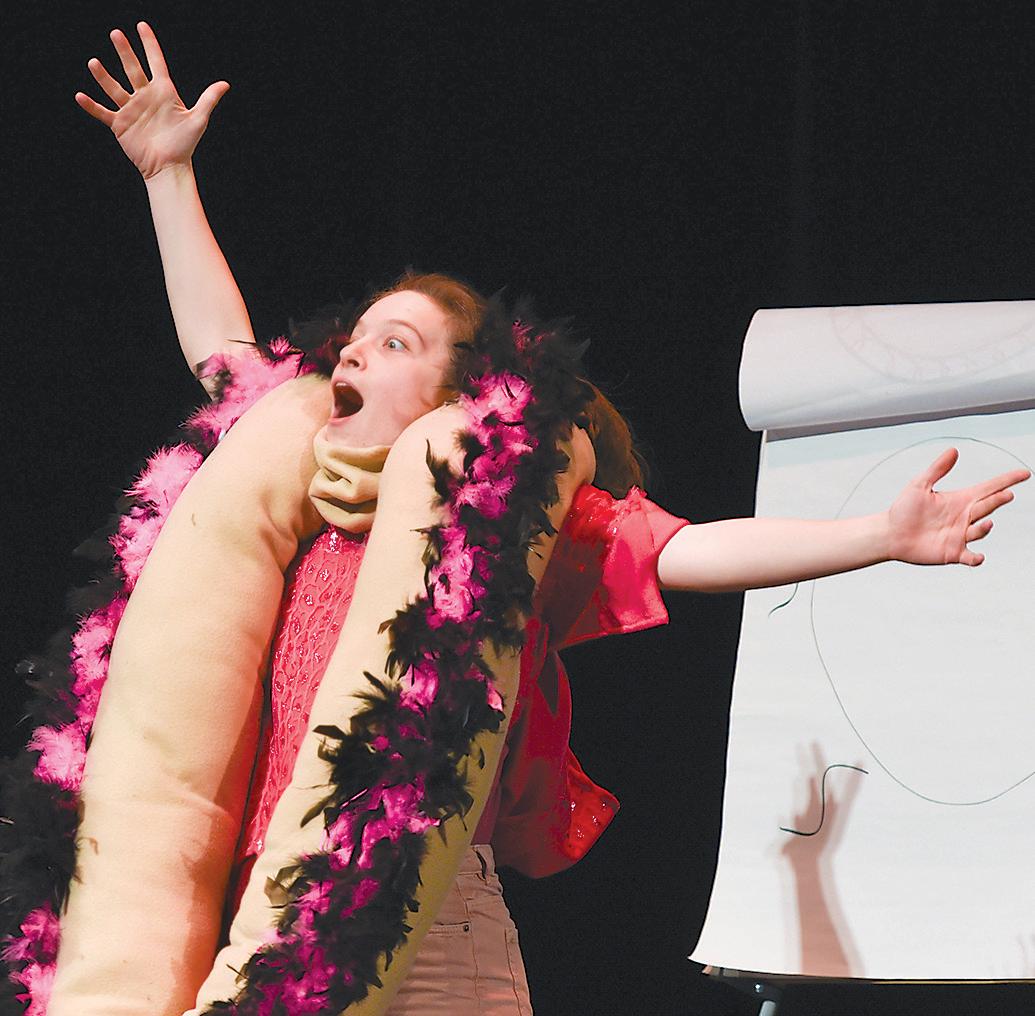
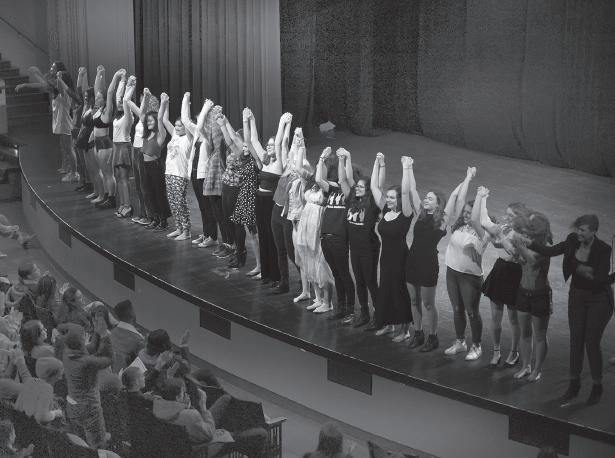
Originally a play written by Eve Ensler, the 21st annual production of The Vagina Monologues at Cornell featured 24 cast members in 19 scenes, filling Bailey Hall on Saturday
AMINA KILPATRICK
In 2016, two Cornell students founded a library to help out their peers who could not afford to buy textbooks. During the spring and fall semesters of 2018, the library rented out
approximately 840 books and 100 iClickers.
The Lending Library offers course materials on a semester-long loan, including textbooks, laptops, books and iClickers, according to the library co-presidents, Dominic Grasso ’20 and Natalia Hernandez ’21.
The inability to afford textbooks and iClickers have prevented many students to take classes they are interested in. For some of them, this even means they have to decide between eating or paying for textbooks.
“I will have to not
eat dinner for a week to afford this textbook,” Jaelle Sanon ’19, founder of the Lending Library, told The Sun. “[Or] for me to be able to eat, I’ll have to drop this class.” Sanon also recalled
night with laughter, shouting and occasionally silence.
During a monologue titled “Reclaiming Cunt” — which looked to rebrand the traditionally derogatory term as empowering — two actresses chanted the word on stage, shouting, “Say it, tell me, cunt, cunt!” As
the scene ended, a woman in the audience echoed them from her seat and the auditorium filled with giggles.
“It’s about empowering women and having the audience leave feeling better and stronger than they did when they walked in,” said Ariel Roldan ’21, co-director of the show.
The production is sponsored by the Women’s Resource Center, with 90 percent of proceeds going to the Advocacy Center of Tompkins County and 10 percent to the Ensler’s V-Day 2019 Spotlight on Women in Prison, Detention Centers and Formerly Incarcerated Women, an annual campaign for Ensler’s global activist movement.
This year’s show raised more than $8,500 from pre-purchased ticket sales, not accounting for additional tickets sold at the door. Last year’s show raised $11,000 in total for the Advocacy Center, according to Roldan.
The Advocacy Center, a local organization, provides outreach work for sexual assault survivors

Monday, February 11, 2019
Cider Science: It’s About the Apples, With Greg Peck 12:20 - 1:10 p.m., 404 Plant Science Building
Introduction to Text Analysis
4 - 5 p.m., Uris Library Classroom
Free Yoga
5 - 6:15 p.m., 413 Art Gallery, Willard Straight Hall
Race in America |
perhaps
and
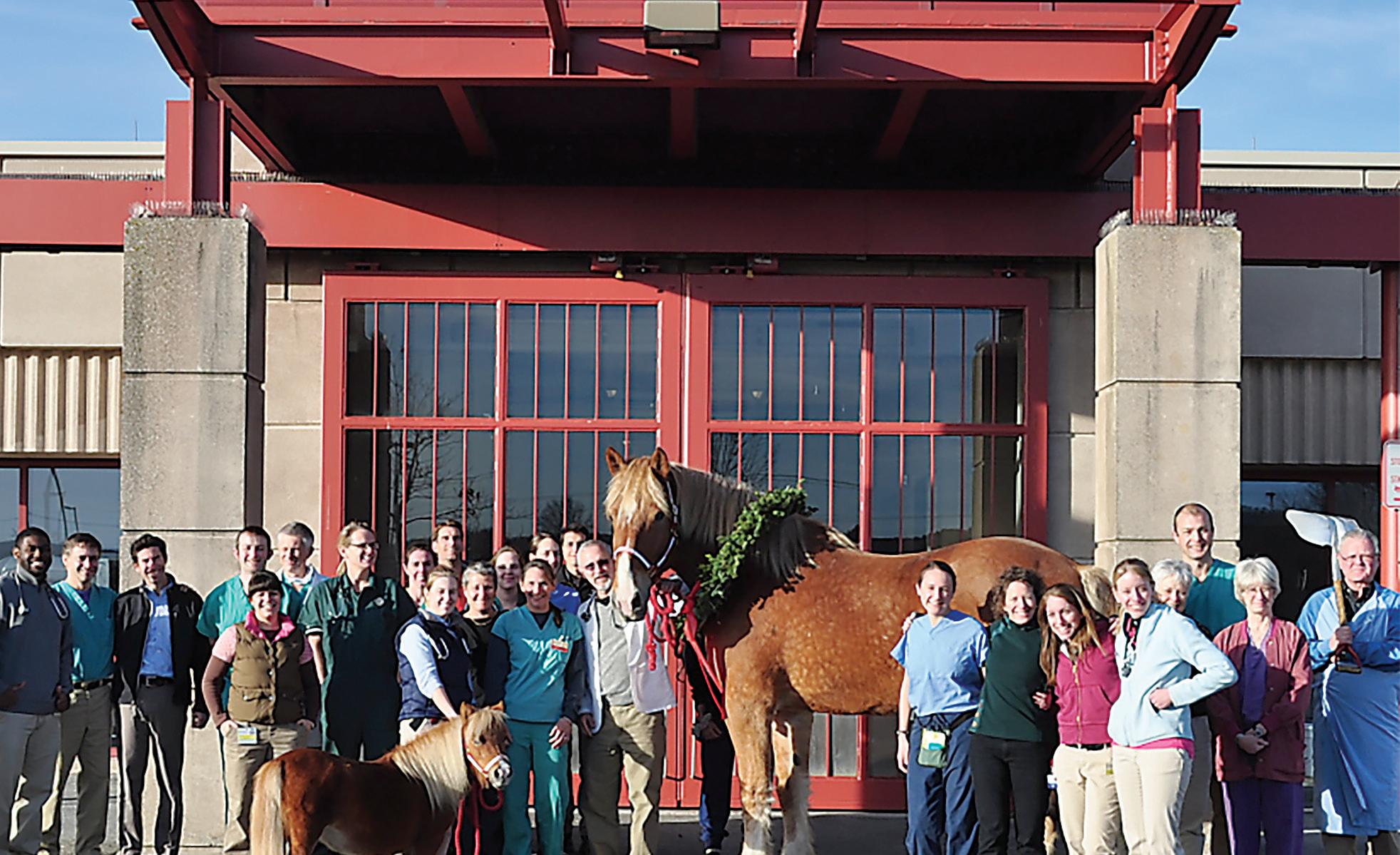
Into the stable | The Cornell Equine Hospital will welcome guests on Feb. 12 at 7 p.m. for an in-depth, behind-the-scenes tour of its facilities, including dentistry, radiology, endoscopy and the ICU.
Chitra Ganesh: Artist Talk 5:15 p.m., Abby and Howard Milstein Auditorium
Darwin Days Keynote Presentation
6 p.m., Kauffman Auditorium, Goldwin Smith Hall
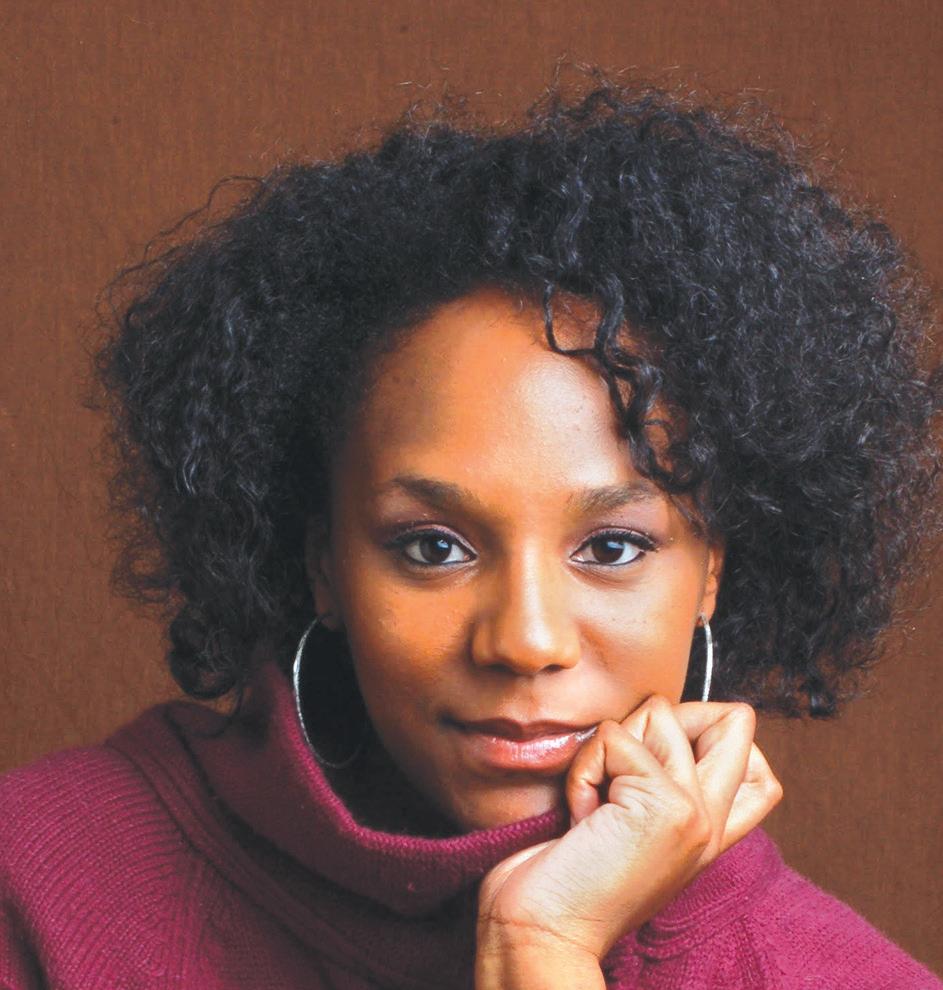
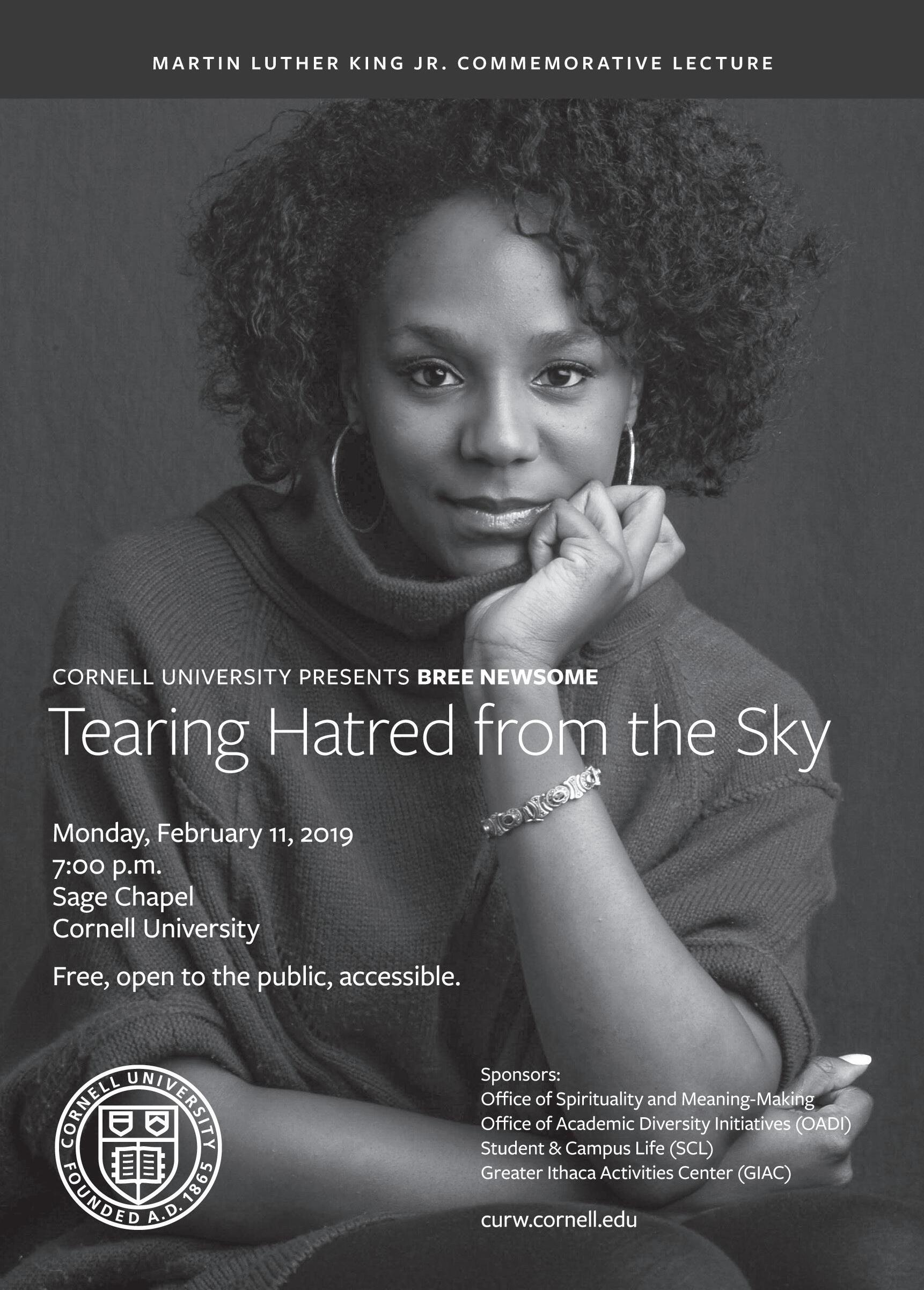
Tearing Hatred From the Sky With Bree Newsome 7 p.m., Sage Chapel
Clearing the Smoke: A Discussion on the Cannabis Regulatory Framework
6 - 7:00 p.m., 186 Myron Taylor Hall
Equine Hospital Tour
7 - 8:30 p.m., Cornell Equine Hospital

By
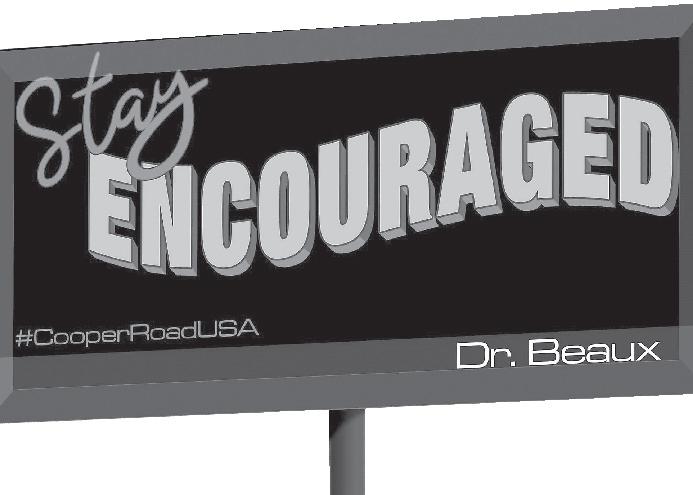
Alongside Cooper Road in Shreveport, Louisiana, eight billboards were set up, each featuring a photo of an AfricanAmerican male. One of them is Darryl Ware grad, a student who grew up in the neighborhood and currently attends the Master of Public Health program at Cornell.
The billboards, funded by Toni Thibeaux, the pub lic health program coordinator at the College of Veterinary Medicine, aimed to celebrate black males who had come from underserved communities but had found success through hard work and persistence.
Thibeaux said the billboards gave her a chance to share positive messages with students, parents and city leaders from afar.
“I want them to know that regardless of their challenges, their limitations, their single-family home settings, their socioeconomic statuses, that doesn’t define who they are,” Thibeaux told The Sun.
“It’s important for me to present to them a variety of African-American males defining their own success,” she said. “I want individuals who stop by to look at the billboards to find themselves in at least one of those eight individuals.”
Thibeaux, who is writing the dissertation for her doctoral
degree at Northcentral University, said that through research she found that black males are the most disadvantaged and underrepresented group when it comes to higher education.
Thibeaux wants to send a message to black males that higher education is attainable.
Growing up in an underserved neighborhood with many challenges, insecurities and barriers, Thibeaux said she has come to treasure any opportunities for learning and growth.
learn from a “wonderful group of faculty members” and leaders who motivate her to climb and achieve.
Thibeaux has also strived to be a role model for her two daughters.
“They begin to modify their life goals based on what I am doing,” she said. “Cornell gave me the opportunity to move outside of being a parent for them to becoming their mentors.”
Cornell’s eight cooperative houses opened their doors last Sunday to undergraduate and graduate students looking for housing for the upcoming school year.
Hopeful students participated in the co-op open house day — known as “Mosey” — and met with current residents to talk about their residential experience. The co-ops, which are completely self-governed, will then choose members for the next academic year.
during those two weeks so they can get to know the residents and become acquainted with the different co-op environments.
“There are a lot of compromises [living in an co-op], so I’ve got to grow a lot and that’s what I really appreciate.”
Amari Sealey ’19
The selection process takes place in the two weeks following the open house, during which students are invited back to participate in house events, ranging from game nights to house dinners.
Prospective students are expected to attend these events
Final selections are made by current residents through voting or a lottery system, said Julie Paige, director of Off-Campus and Cooperative Living. Wari, one of the co-ops, also uses interviews as part of their selection process, said Wari resident Amari Sealey ’19. Paige said she believes that the cooperative houses offer students small communities that are “true to freedom and responsibility.”
“The co-ops are a very unique living experience on campus and students living in the co-ops gain life skills beyond what you would gain in a residence hall and even in off-campus apartments,” Paige said.
See C0-OP
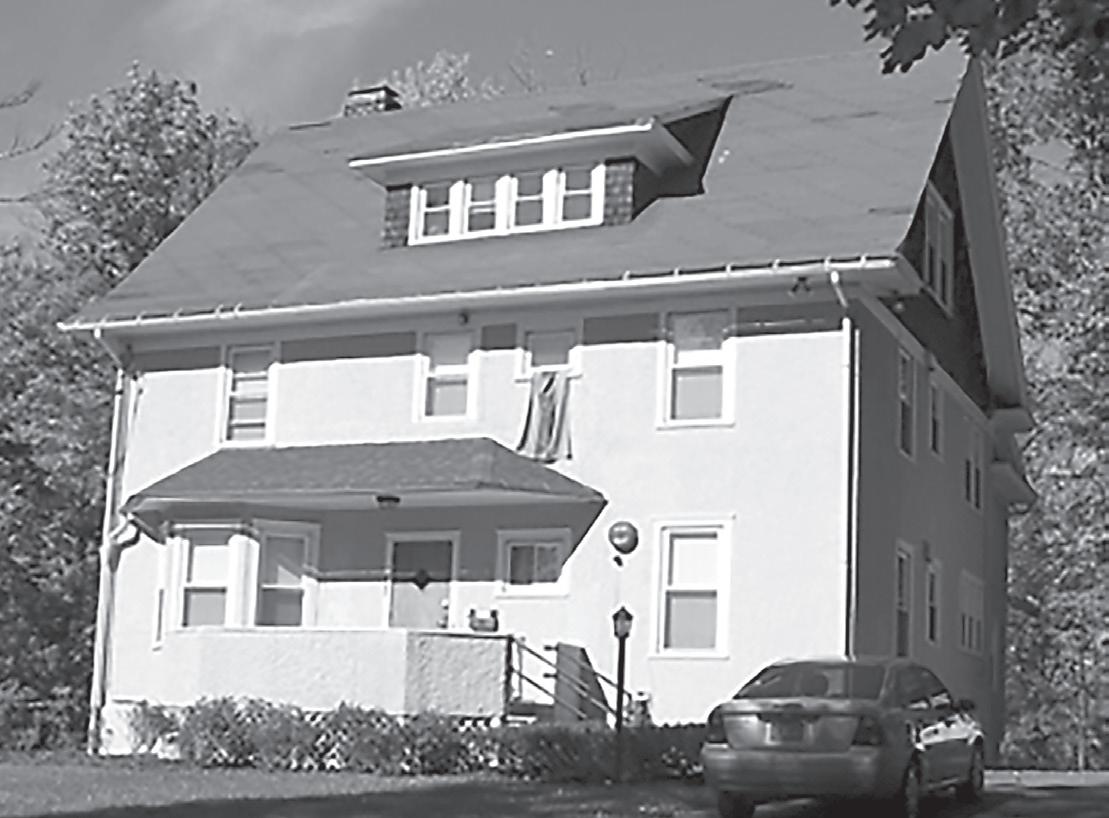
Independent | Wari House is one of Cornell’s eight co-ops.
houses are completely self-governed and have their own
According to Thibeaux, the project has been very well-received. Since the billboards went up, her Facebook account has been filled with messages and notifications and parents have taken their children to see the billboards. The elderly parents of some of the males who were featured also drove from across the country to view the boards, some from as far as Dallas, according to Thibeaux.
She said she plans to host the project yearround and will select various themes for the billboards. From July to September, there will be a campaign focused on community pride and mentorship. From October to December, the Thibeaux plans to center the theme around holiday giving. Next year during Black History Month, black females will be featured, said Thibeaux.
Prior to this project, she said the promotional information on billboards featured bail bondsman and attorneys, both fixtures in the
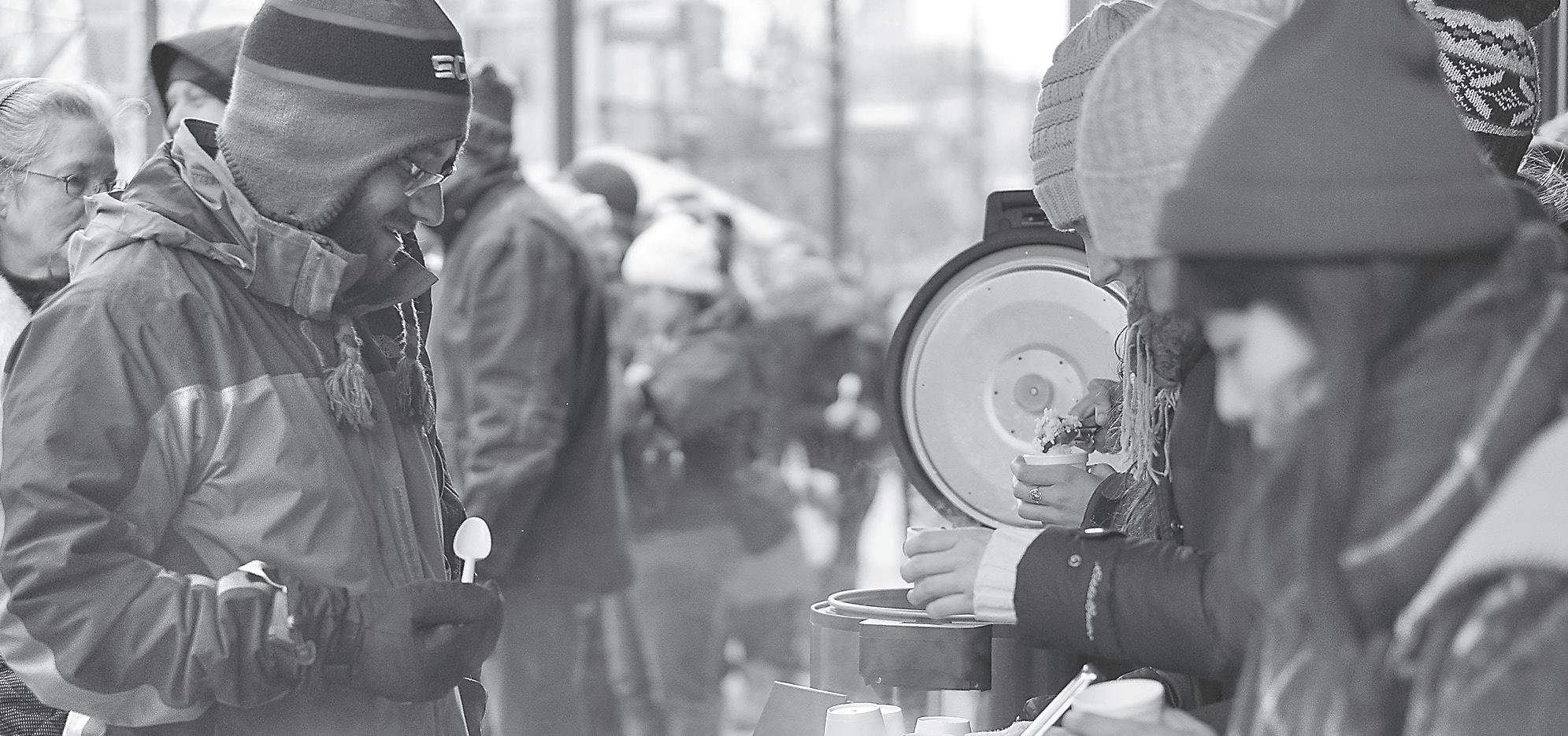
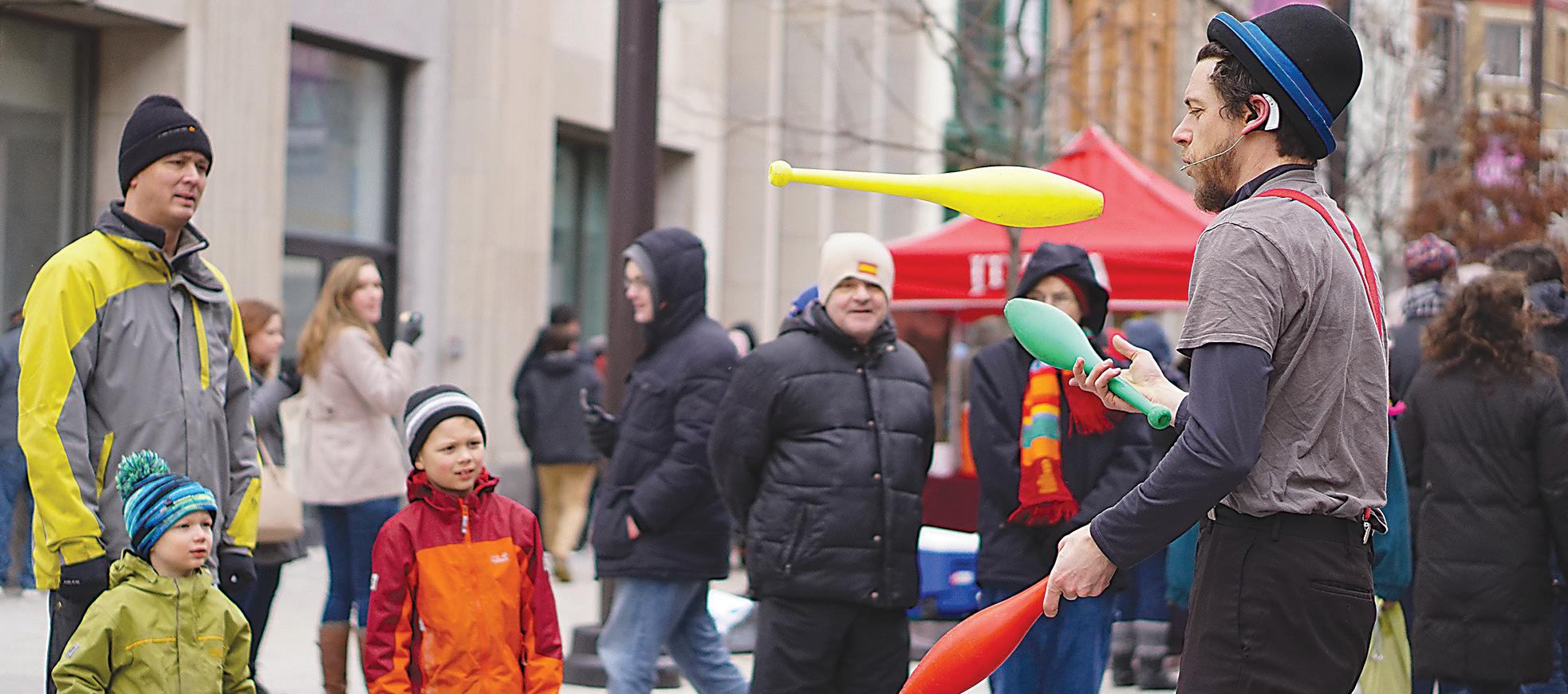
As snow flurries fell last Saturday, Ithaca’s twenty-first annual Chili Fest or “Chili Cook-Off” took place in the Commons. Cornellians and Ithacans alike warmed up on the frigid day with spoonfuls of warm chili as restaurants competed for Best Meat or Overall Chili, Best Vegetarian or Vegan Chili and People’s Choice Chili.
More than forty restaurants, including Simeon’s, Mia, Viva Taqueria, Moosewood, Ithaca
Many
their own mugs or containers from home to optimize the amount of chili they could consume.
The chili options varied greatly. Some tents like Greenstar Cooperative Market and Cornell Dining offered classic beef chili or vegetarian chili, Pasta Vitto’s tent offered spaghetti with chili and cheese on top, Lou’s Street Food offered hot dog chili and Your CBD Store had a tent offering “CBD chili,” chili with Cannabidiol oil mixed in.
For non-chili aficionados, some restaurants offered different types of cornbread, beer from local breweries like Ithaca Ale House, locally sold wine from Wagner Vineyards, a hot sauce tasting bar from SYRACHA’CUSE and other farmer’s market goods.
“I usually don’t enjoy chili, but Chili Fest did it for me.”
’22
Aside from chili, The Ithaca Beard and Mustache Club also hosted a “Chili ’Stache and Beard Competition,” a facial hair competition, during the cook-off. Proceeds from the facial hair feud went to Loaves and Fishes, a charity that serves meals to the local community, the club’s website said.
Some tents had attached a cause to their participation. “Cornbread for Kids,” an organization with a goal to provide fresh snacks for children, was selling wedges of cornbread for $1 per Giant Cornbread Wedge, The Ithaca Voice reported. The organization delivers snacks like apple wedges and Valencia oranges to kids in the Ithaca City School District, according to Downtown website.
The popular event drew local residents and Cornellians alike, and satisfied both chili lovers and more casual fans. Some even made great sacrifices to appreciate the full chili experience.

“I usually don’t enjoy chili, but Chili Fest did it for me,” Cami Haarmann ’22 told The Sun.
“I’m a vegetarian, but today I ate meat,” said Lily Mullany ’22.
Other students came to volunteer their time. Chad Fong ’20, who volunteered at the ticket booth, is a member of The Cornell Tradition — a program for students committed to service.
“I’ve been a part of a lot of different events down in the commons,” Fong said. “I think a lot of people down here ... have a service program that’s part of Cornell and

it’s a lot of fun.”
Cornell’s McCormick’s Dining Hall won Best Meat Chili, Moosewood Restaurant won Best Vegetarian Chili and Wagner Valley Brewing won best beverage.
CO-OP
Continued from page 3
In the cooperative residences, students are given responsibility to manage a house budget and delegate tasks to residents through a chore system. For houses with a meal plan, their residents will take turns preparing meals for themselves and their fellow co-op residents.
The residents also elect their own officers and liaisons for the year to help manage the homes in the absence of any live-in staff, according to Paige.
“The officers of the co-ops also have a value-added experience,” Paige said.
Each co-op also chooses a representative for the Inter-Cooperative Union, according to Sealey. The union helps the co-ops communicate and coordinate programs through-
out the year for a larger sense of community and represent the interests of co-ops to the university.
Although each cooperative house has its own selection process, most of them will review applications on a rolling basis and finalize their future residents in early February, according to the Living at Cornell website.
Sealey, who has lived in the Wari Cooperative since her sophomore year, said that her experience in the cooperative system has been marked by growth.
“There’s a lot of compromises, so I’ve gotten to grow a lot and that’s what I really appreciate,” Sealey said. “The people in the co-ops are the best people that I’ve met, not even just from Wari but from other co-ops as well.”
Penelope Campos can be reached at pcampos@cornellsun.com.
BILLBOARDS
Continued from page 3
criminal justice system. The messages they give to people in the poverty-stricken neighborhood are that they are here for them if those people ever get in trouble, Thibeaux said.
“There is a group of people who wake up every day and as they drive through the neighborhood, and that’s what they see,
and sometimes people set goals based on the environment where they live,” she said.
“I get kind of teary-eyed about this, but it’s really sad,” Thibeaux continued. “ I want to make sure some of the negative publicity that is in that area is removed.”
Winny Sun can be reached at wsun@cornellsun.com.
date of birth and volunteered that he was in the country illegally, Osborne said. At that point, the deputy took the man into custody, called ICE and held him at the Public Safety Building on Warren Road — which houses the jail and Sheriff’s Office — until the ICE officers arrived.
“For whatever reason, the deputy felt inclined to reach out to ICE who did respond and picked him up,” Osborne said. “This type of interaction where ICE gets involved is not at all what my Sheriff’s Office is going to be involved with.”
ICE spokesperson Khaalid Walls said the agency “arrested two unlawfully present foreign nationals for immigration violations” in Tompkins County last week as part of a criminal investigation. A local activist group said it was not aware of the other arrest, and Walls declined to release the arrested people’s names or nationalities.
The Tompkins County Legislature passed a resolution in February 2017 restricting when Tompkins County employees, including sheriff’s deputies, could enforce immigration law or aid federal authorities in doing so.
Prof. Kathleen Bergin, law, who helped draft the legislation, said the deputy’s actions did not violate the statute. That’s because of a federal law that says municipalities cannot prohibit government officials from reporting someone’s immigration status. Bergin added that the deputy was not compelled at any time to call the federal authorities.
“I think it’s a super close call but that no, what the officer did is not a violation of the sanctuary resolution, but he wasn’t required to do that,” Bergin said.
Immigration expert Prof. Stephen Yale-Loehr, law, concurred.
“I agree that it is a close call, but the county resolution explicitly states that nothing in the resolution bars a sheriff’s officer from sending a statement of a person’s immigration status to federal immigration authorities,” Yale-Loehr said in an email.
Anna Kelles, a Democrat who represents the City of Ithaca on the Tompkins County Legislature and who authored the bill, said that while the deputy may not have violated the county resolution, he acted contrary to the legislation’s purpose.
The county resolution, which passed 11-2, states that deputies and other Tompkins personnel “shall not pro-
vide federal agents with access to an individual in their custody or the use of agency facilities or resources to question or interview such individual if the federal agent’s sole purpose is enforcement of federal immigration law.”
It also says deputies should not perform “the functions of a federal immigration officer” or otherwise engage “in the enforcement of federal immigration law.”
Michael Sigler, a Republican representing parts of the Town of Lansing, was out of town when legislators voted on the resolution but vocally opposed it at the time because he said it asks deputies “to circumvent the nation’s laws.”
“I have issues with current immigration laws, but it’s
“I think it’s a super close call but that no, what the officer did is not a violation of the sanctuary resolution.”
Prof.
Kathleen Bergin
the U.S. Congress that needs to address those laws and fix them,” he said Thursday. “We don’t make progress toward a fair system by ignoring the laws that a majority of our representatives voted into place.”
Despite the fact that the county law went into effect in early 2017, Osborne said he was surprised to discover this week that there was no Sheriff’s Office policy dictating deputies’ interactions with federal immigration agencies. Since Wednesday, he has been working with the New York Immigration Coalition, an advocacy group, to draft one. The policy, which he shared with The Sun and implemented Thursday, mirrors much of the County Legislature’s resolution.
Osborne said he also called the coalition to ensure that the detained Mexican man was provided with a lawyer.
“That’s how seriously I’m taking this,” Osborne said, adding that since taking over as sheriff, he has been trying to build a relationship with communities and create an environment in which “people shouldn’t be fearful about calling for help.”
Martha Robertson ’75, chair of the Tompkins County Legislature, said she was glad that Osborne acted quickly in instituting a policy in response to the deputy’s actions.
“Some of us were very surprised there wasn’t such a policy in place, but he’s taken quick action to correct
that,” said Robertson, a Democrat. “I am confident he’ll make sure that every deputy is fully trained and updated on what to do in such a circumstance in the future.”
No local charges have been or will be filed against the Mexican man who was handed over to ICE, Osborne said. The Sheriff’s Office does not know the man’s real name, only the fake name that Osborne said he provided to the deputy.
Ithaca College Prof. Patricia Rodriguez, a member of the Tompkins County Immigrant Rights Coalition steering committee, said the detained man lives in New York City.
Osborne did not identify the deputy who called ICE and said the matter would be handled internally.
“The deputy thought he was doing the right thing at the time but it’s definitely not the way I want these calls handled moving forward,” he said. The president of the union representing Tompkins County sheriff’s deputies did not respond to an email seeking comment.
ICE’s apprehension of the man follows several high-profile arrests of undocumented people in the City of Ithaca and Tompkins County after the municipalities passed separate sanctuary laws in February 2017.
ICE officers arrested a Mexican man in May 2017 in the city’s Northside neighborhood, sparking a large protest in the Commons. In January 2018, ICE confirmed that it arrested two Thai nationals in Ithaca, and a local activist network reported that a third man was arrested by ICE that same month. The Ithaca Police Department said at the time that it had no part in any of the operations.
And in April 2018, ICE arrested a man from Turkey while he was being bailed out of the Tompkins County Jail, the Ithaca Voice reported at the time.
Kelles said she is thankful that Osborne was taking Tuesday’s incident seriously, but added that she is concerned about the effect the deputy’s decision could have on Tompkins County’s undocumented residents.
“We as legislators tried to create an environment where people could feel safe,” she said. “We don’t want people to not trust or not believe in our law enforcement. Law enforcement is here to protect the safety of all human beings in our municipality and if that breaks down, that’s a problem.”
Nicholas Bogel-Burroughs can be reached at nbogel-burroughs@cornellsun.com.
how she once had to drop a class after calculating the costs of course materials. The Cornell experience is dependent upon those who can afford it, according to Sanon.
“It shouldn’t be like that,” she continued, “[That] different people at Cornell are having different experiences because they fall in a different tax bracket.”
Through the lending library’s efforts, students have been able to find course materials. Jenna Steins ’21 rented out an iClicker that was required for two of her classes, and Angie Escalona ’21 was also able to utilize the services of the lending library to get a PC for a business computing class in Fall 2017. Many of the applications necessary for the class were only available on PC computers.
Instead of having to carefully coordinate her study times and library usage around the availability of computers, Escalona rented out a laptop from the lending library for the entire semester.
Currently, the library is focused on growing efforts, including sending out surveys to understand what is most used in the library and the ways they can improve.
“We have grown quite a bit,” Grasso told The Sun. “Now what we are trying to do too is [to] become more targeted and analytical in our approach to supplying materials by connect[ing] more the with students who are using our services.”
Their aggregated collection is comprised of both donated books and books purchased through grants, including those given by the Community Funding Partnership Board, the Student Activity
Funding Commission and Cornell Giving Days. The Cornell Bookstore has also given books to the lending library that students have donated at the end of each semester, according to Grasso.
“We work with the bookstore at the beginning and end of every semester both to collect books from there, some used textbooks that we incorporated into our system and also go through their list to see what books are needed each semester,” Grasso said.
Hernandez said that directed donations is another way they procure the materials they have in their collection. The library recently received an anonymous donation to purchase Industrial and Labor Relations law books which can cost around $500 each, according to Hernandez.
Books that have not been requested by professors or checked out in the past three or four semesters will then be recycled for a new purpose, Grasso said. When books are no being longer used, the library donates them to the prison education program.
The next project the lending library has is to offer travel grants for students to take exams such as the GRE, the MCAT and the LSAT. Many programs offer assistance in affording the test preparatory programs and exams; however, many of these centers are not in Ithaca, which can be a barrier for students according to Hernandez.
“A lot of recipients already receive money to take the test but do not receive financial support to actually get to the test,” Grasso said.
The lendng library is also a part of the Finger Lakes Library System and is run out of the Durland Alternatives
Library in Anabel Taylor Hall. The Alternatives library provides the infrastructure to support the initiative by housing and cataloging the books.
Aside from the public libraries, Cornell administrators have also been supportive of the lending library as well. Vice President of Student Life Ryan Lombardi has had multiple conversations with the lending library and has spoken with faculty on their behalf, according to Hernandez and Grasso.
They have also worked closely with the Dean of Students office through their advisor Shakima Clency, associate dean and director of first-generation/ low-income student support.
Hernandez and Grasso both acknowledged new efforts by Cornell Library to address accessibility of course materials.
Last fall, Cornell Libraries added the ability for students to request books required by their classes for the library to purchase. Additionally, the borrow-direct and interlibrary loan are two other systems that allow students to request books.
“I know personally that there were a lot of students who didn’t have a PC and so they had to stay long spend long hours at the library and manage their time to match their schedules to the computer lab,” Escalona said. “The lending library allowed me to have the resources that a need to utilize a PC based on my own personal schedule.”
The lending library is located in Anabel Taylor Hall and is open Monday to Friday from 11 a.m. - 8 p.m. and on the weekends from 11 a.m. - 5 p.m.
Continued from page 1
and bystander intervention education, according to co-director Nikita Lakhani ’19.
“[The Advocacy Center is] actually presenting a monologue tonight where they discuss what they do,” Lakhani said. “We thought it was important to include them so that you can really know what your proceeds are going towards and the important work they do.”
The play on Saturday, titled “Six Zero Seven Two Seven Seven Five-Thousand” after its 24-hour hotline, captured moments when crisis counselors remember their callers.
The hour-and-a-half production inspired laughter as well as moments of silence throughout the night. Monologues touched on topics including rape, transgender identity, genital mutilation, female liberation and self-realization through sex.
“I appreciate how diverse the cast is and how empowering the whole show was,” said audience member Cameron Dunbar ’21 after watching the play for the first time. “It demystifies female sexuality and promotes women taking agency of their own bodies.”
Lakhani said the show’s main message is to be inclusive.
“This play address a bunch of issues that people don’t really talk about — taboos and such, like the word ‘vagina’ for example,” she said. “It’s interesting to have the audience react to that and come away thinking about these issues and having these conversations a lot more with people that are around them.”
JACOB S. KARASIK RUBASHKIN ’19 Editor in Chief
JOHN McKIM MILLER ’20
Business Manager
KATIE SIMS ’20
Associate Editor
VARUN IYENGAR ’21
Web Editor
MEGAN ROCHE ’19
Projects Editor
EMMA WILLIAMS ’19
Design Editor
JEREMIAH KIM ’19
Blogs Editor
AMOL RAJESH ’20
Science Editor
BREANNE FLEER ’20
News Editor
YUICHIRO KAKUTANI ’19
News Editor
NICHOLAS BOGEL-BURROUGHS ’19
City Editor
LEV AKABAS ’19
Arts & Entertainment Editor
SARAH SKINNER ’21
Assistant News Editor
ANNE SNABES ’19
Assistant News Editor
JOHNATHAN STIMPSON ’21
Assistant Sports Editor
EDEM DZODZOMENYO ’20
Assistant Photography Editor
PETER BUONANNO ’21
Assistant Arts & Entertainment Editor
Letter to the Editor
GIRISHA ARORA ’20 Managing Editor
HEIDI MYUNG ’19
Advertising Manager
ALISHA GUPTA ’20
Assistant Managing Editor
DYLAN McDEVITT ’19 Sports Editor
MICHAEL LI ’20 Photography Editor
GRIFFIN SMITH-NICHOLS ’19 Blogs Editor
JACQUELINE QUACH ’19 Dining Editor
SHRUTI JUNEJA ’20 News Editor
ANU SUBRAMANIAM ’20
News Editor
JUSTIN J. PARK ’19
Multimedia Editor
PARIS GHAZI ’21
Assistant News Editor
MEREDITH LIU ’20
Assistant News Editor
JONATHAN HARRIS ’21
Assistant Sports Editor
RAPHY GENDLER ’21
Assistant Sports Editor
BORIS TSANG ’21
Assistant Photography Editor
VIRI GARCIA ’20
Assistant Arts & Entertainment Editor
As undergraduate students, we would like to provide University leadership with an undergraduate perspective on Cornell Graduate Students United’s recently delivered mental health petition.
Foremost, we want to reiterate the crucial role that graduate student-workers play in the lives of undergrads. Graduate students are our mentors, our instructors and our friends. They oftentimes fill tasks left by overloaded professors — meeting with us oneon-one to guide us not only through our coursework, but through our larger academic and professional trajectories. Cornell does not work unless its graduate student-workers do, and the undergraduate experience would be a shell of itself without them.
As the University embarks on sustained efforts to reform Cornell Health, it is crucial that the interconnectedness of undergrad and grad experiences is centered. In the words of Natalie Hofmeister, CGSU’s grievances chair: “I’ve seen so many of my students struggle with their own mental health, and that, it’s taken a toll on my ability to show up for them when I don’t get adequate support for my own mental health.”
It is for these reasons and others that we stand in absolute solidarity with CGSU’s efforts to improve their working conditions on this campus. The insufficiency of mental health care services for this crucial constituency of Cornellians affects all of us, with grads facing unique health care difficulties that deserve special university consideration. And, when graduate student-workers suffer through mental health troubles, our entire academic institution suffers as well. We strongly echo their rallying cry that “Work Shouldn’t Hurt.”
We believe that the CGSU petition’s demands — from gym membership reimbursement to an improvement of the therapy referral process — are reasonable and necessary requests that deserve immediate University action. We encourage the University to accept and implement CGSU’s recommendations, and ask that CGSU be included at the decision-making table as further actions are taken to improve Cornell’s mental health services.
Joe Anderson ’20
Shivani Parikh ’19
Cristian Gonzalez ’20
Lavanya Aprameya ’19
Chris Arce ’19
Khaddy Kebbeh ’19
Colin Benedict ’21
Steve Tarcan ’20
Kumar Nandanampati ’20
Yana Kalmyka ’21
Daniel Bromberg ’20
Zelia Gonzales ’20
Adam Khatib ’20
Carlton Riley ’20
Max Greenberg ’22
Matthew Anticoli ’20
Nancy Ren ’19
Varun Belur ’19
Matthew Anticoli ’20
Karen Loya ’19
Current full-time students at Cornell must be enrolled in a health insurance plan that provides in-network coverage at the Cayuga Medical Center, which is the only hospital in Ithaca. However, Cornell’s Student Health Benefits Advisory Committee determined that beginning on May 1, 2019, fulltime students may satisfy health insurance coverage with a plan that does not include CMC as an in-network provider.
One of the main reasons for this change is that over 20 percent of Cornell students have coverage offered by UnitedHealthcare, which does not work with CMC as an in-network provider. Instead of requiring thousands of students to change insurance provider to gain access to CMC as an in-network provider, SHBAC is going to “encourage” all fulltime students to have in-network coverage at CMC, according to the Student Health Benefits website.
Is a $2,000 deductible too high?
What should be the optimal coinsurance rate for the age group that insurance companies call “invincible”?
The new health insurance requirement is controversial because there is no obvious solution. On the one hand, the point of health insurance coverage is to be financially protected from unforeseen circumstances. Given that CMC is the only hospital in Ithaca, it seems reasonable to require students to have access to the hospital in case of an emergency. On the other hand, shopping for health insurance may be prohibitively costly for students, many of whom are covered under their parents’ UnitedHealthcare plans. In addition, many students lack experience assessing the level of optimal coverage or comparing their options among various health insurance plans. What should be the optimal coinsurance rate for the age group that insurance companies call “invincible”? What is a reasonable out-of-pocket limit?
Selecting
SHBAC says that university administrators are working with CMC to extend coverage for students with UnitedHealthcare. This is perhaps the ideal solution in the long run for students at Cornell. Until then, what should you do if CMC is an out-of-network provider? It would be ideal to first check what your insurance plan covers. Many plans may have higher coinsurance, copayments and deductibles but otherwise protect the insured from catastrophic incidents. Paying an out-of-network rate may not be significantly different from having CMC as an in-network provider depending on the insurance plan. If your out-of-network coverage seems inadequate based on your individual circumstances and medical history, it may be worth considering enrolling in a plan that works with CMC as an in-network provider. Cornell’s Student Health Plan, which may be a considerable expense for many students, provides a platinum-level coverage (the most comprehensive coverage level) at a much more affordable rate than similar plans offered at the New York State of Health marketplace. Also, your family may review whether there are additional options through employer-sponsored plans. Selecting health insurance can be complicated, but a robust health insurance requirement should exist even for the seemingly invincible group of college students. Meanwhile, we should continue to support SHBAC’s efforts to work with CMC to improve coverage for all Cornellians.
Kiefer Ahn ’14, M.S. ’18 is a Ph.D. candidate at Johns Hopkins University. Guest Room runs periodically this semester. Comments may be sent to opinion@cornellsun.com.
Gandhi ’20
Roche ’19
Yang ’21
Amina Kilpatrick ’21
Zafar ’21
Bulkeley ’21
Song ’19
One warm spring afternoon in 2015, I sat in the bleachers of The Harker School in San Jose, California with my best friend, who was then negotiating the terms of his impending long-distance relationship with his girlfriend. Magnified by the omnipresent backdrop of John Legend’s “All of Me” and the hormones of nostalgic teenagers, I spoke to him with the same oratory fervor I had recently seen from Tom Cruise during the final scene of Jerry Maguire. I promised, “You guys can totally make this work out. Atlanta to Chicago isn’t a long flight — you can see each other all the time.” Under the influence of soon-to-be-legalized medicinal inebriants and the clear ether of youth itself, I delivered my speech oblivious to the imminent scandals of college and with all the unironic conviction of an 18-year-old who thought The Killers were the greatest band of all time.
Then the first person that we love is not just an embodiment of our love, but becomes love itself.
The relationship crumbled in a matter of weeks — as these things usually do — once it turned out the flight from Atlanta to Chicago wasn’t as short or simple as it looked on Google Maps. Though we laugh about it now, I think back to this time when I look at college relationships. Seeing friends travel across the country, move in and plan lives together with their boyfriends and girlfriends brings up either approving smiles affirming the sweetness of love or concern over the inevitability of heartbreak. We thought we knew the world in high school — but who says we know any better now?
College is a strange time to explore the idea of love. Perhaps it’s because it is the time when many of us form our ideations of love. Liberated from parental supervision looming two doors down the hallway, we date, sleep around and repeat until we finally find
someone for whom we can muster an “I love you.” Then the first person that we love is not just an embodiment of our love, but becomes love itself. This person will be the standard to which all other loves will be compared to and the life-long reference for what love is. And during these four formative years of self-discovery, your college partner becomes a formative figure in forming not just your conception of love, but your conception of self. We fall, and we fall hard, for not only a person, but also for a far more selfish vision of what you want out of our lives.
in our head nip away at our faith in love that has been ingrained in us since the first time we watched Beauty and the Beast
We thought we knew the world in high school — but who says we know any better now?
Yet, as 20-some year olds, our age gives us the perspective to make monumental professional, academic and personal decisions, but not enough to wrestle the inescapable ambiguity of our futures. And it might be because we know nothing that college couples think in a language promising permanence. Grandiose ideas of happily-ever-after and everlasting fidelity are blind to the reality that all jobs aren’t located in one city and the ever-increasing opportunity cost of other partners. There is nothing new about not wanting to get hurt. Therefore, it makes sense to be cautious when falling in love with the idea of love. We are raised on a strict regimen of Disney movies and indie rom-coms, and as a result, the promise of finding “the one” is enticing and addicting. There is an urge to tackle the world together with that special somebody, but the immutable “what-ifs”
Things will invariably end up differently than I plan, but relationships are worth pursuing because there will be no question more cripplingly unsatisfying than “what could have been?”
However, I still believe in my love. I am hyper-aware of the irony that will come with revisiting this column in five years. Because no matter what happens, I will look back and cringe while reading the romantic ideology of a naive 22-year-old who had only recently stopped using an old t-shirt as a hand towel. But it just sucks to know that I will be so wrong. Because to dismiss my feelings today as the behavior of childish impulse would be to dismiss the gravity and seriousness of the love I’ve come to feel this past year. To dismiss college love would be to dismiss the countless hours of midnight FaceTimes, the small fortune in plane tickets and all the gustatory and nostalgic warmth I feel every time I use the sandwich press gifted for my birthday. Hindsight bias could leave us with regret and remorse about decisions from our youth, but regret and remorse will only come from not having given everything. Things will invariably end up differently than I plan, but relationships are worth pursuing because there will be no question more cripplingly unsatisfying than “what could have been?”
Reconciling this divide is messy, difficult and often laborious — but it’s not something we do because we’re young and naive. It is something we must give for having to grow up.
Jason Jeong is a senior in the College of Arts and Sciences. Jeongism appears every other Friday this semester. He can be reached at jjeong@cornellsun.com.
The first time I was in Hong Kong, I dragged my feet the entire time. I remember a photo of my 13-year-old self wearing an orange rain jacket and pigtails. I look miserable. Maybe it was the humidity that upset me, or I was jet-lagged and wanted to sleep. I still can’t understand how someone that age who had the opportunity to travel to Asia could look so unhappy. I visited Hong Kong for the second time a year ago, just before my study abroad program in Chiang Mai, Thailand began. I was 21 years old. There was less feet-dragging this time, but I was more aware of the disconnect I felt while navigating the city with my parents. This was where they
The time came at last for my study abroad. A breath of relief. Thailand: my own experience.
had grown up, but I couldn’t relate to the place. I spoke barely a word of Cantonese and strained my ears to pick up on familiar phrases I could understand. The time came at last for my study abroad. A breath of relief. Thailand: my own experience. I realized pretty quickly how my upbringing would help me for the next five months. I had never been to Southeast Asia and was about to spend a semester in a new city. But being
an Asian-American had exposed me to a culture that I learned to adapt to and learned from. While some people struggled with the Thai food that was served — especially what families gave them during the village homestay — I had been exposed to foods that were thought to be odd in America my entire life and felt comfortable accepting whatever came my way. Interacting with people who do not speak the same language as me had also been familiar to me. While it was sometimes difficult to not be able to speak to my grandparents, there was a level of respect and care I had to learn from an early age. As I couldn’t use words to communicate, my actions would have to speak for me. I realized the deep bonds that came from these kinds of relationships.
For the first time in my life, I actually felt as if my background — where my parents came from, how I was raised — mattered to other people, but most importantly, to myself. While I was abroad, people were able to travel outside of Thailand. A group of students from my program went to Hong Kong. People were interested that my parents were from there and asked me recommendations on what to do, where to stay and how to get by. For once, I felt like people were excited about my background and wanted to know more. And I was able to appreciate how much knowledge I had about a place, the people, the culture — it was a part of me. One girl came back and raved about a “large, yellow bun” that she found delicious.
Bo lo bao. Pineapple buns. I used to get them at bakeries in Philadelphia’s Chinatown. “Hong Kong had amazing tarts, they were really sweet.” Dan tat. An outer pastry crust filled with egg custard and then baked.
Studying abroad in Southeast Asia allowed me to connect back to roots I didn’t know I had lost. I grew up in the suburbs of Philadelphia in a predominantly white neighborhood on the Mainline. As a kid, I experienced what almost every AsianAmerican kid has to go through — bringing something “different” to lunch, getting ridiculed by classmates and then sticking to PB&Js. But there was a level of conformity I slid right into. I never felt as if I had to question what it meant to live in America with both parents being from Hong Kong and what that meant for my own identity. I had a newfound appreciation for how being a child of Asian parents had shaped me and how it allowed me to relate to others in different ways.
I’m still trying to figure out for myself. It feels like I came late to finding this deep appreciation, and maybe it really took flying all the way to Asia, studying in Southeast Asia and viewing my self in a global perspective to find it. What does the conglomeration of my experiences look like? How do I stand
Studying abroad in Southeast Asia allowed me to connect back to roots I didn’t know I had lost.
On Lunar New Year this year, two of my roommates and I invited other Chinese friends over. We shared stories of our own Chinese-American experience — how our parents treated us, what set us apart from other kids, who we decide to be today. It was only last year that I truly appreciated and understood the two halves of me — halves that don’t fit in a perfect way but move in and out of each other, that retreat and come forward continuously. Within the Asian-American experience itself exists its own spectrum that
in, and outside of, the boundaries of this singular, massed experience? These are questions that I still want to explore and hopefully won’t take another plane ride to find. When I came back from Thailand, there were a lot of things I didn’t want to forget. I didn’t want to lose my “just say yes” mentality, which had brought unthought of experiences into my life. I didn’t want to forget what it was like to walk back from the Old City at dusk or eat $1 pad thai on the side of the street. But unlike the moments I knew I would desperately try to hold onto, the understanding I had for myself that had developed over the months was something I carried within me even when I returned.
Gabrielle Leung is a senior in the College of Arts and Sciences. Serendipitous Musings appears every other Friday this semester. She can be reached at gleung@cornellsun.com.
In a new feature, two of our columnists offer sharp, contrasting takes on the big questions of the day.

Giancarlo Valdetaro
As the rhetoric of both parties, the power grabs of outgoing Republican .administrations, and the recent response of Democratic leaders to scandals in Virginia suggest, these certainly are uncommon political times we are living through. The public is not only increasingly polarized, but also increasingly isolated, as the number of counties close to the median voter has more than halved over the past two decades.
And yet, to claim that our current political environment involves abnormally high stakes is to sanitize history. For the historically marginalized, the stakes of American politics have always been, and still are, high. Unfortunately, their height is only recognized by the political mainstream in hindsight — after years of grueling work by each marginalized group to establish themselves as worthy of the protection that being an American confers.
The history of race in the United States is the premier example of this, especially when concerning African-Americans. From the Three-Fifths Compromise to the Compromise of 1850, and eventually to the Civil War, every political conversation has high stakes when the everyday consequences of the status quo are the lash of the whip and other unbearable forms of torture. Despite this, slavery and the inferiority of African-Americans were continually contested by activists such as William Lloyd Garrison, Frederick Douglas and Harriet Tubman. Furthermore, as Martha Jones documents in Birthright Citizens of politics were so high that everyday interaction with the state and its legal system by African-Americans came to have signifi cant symbolic political mean ing.
African-Americans by suppressing their vote, forcing them out of power or simply burning their neighborhoods to the ground.
These events, with stakes of life or death, were the direct result of American politics, enabled only by Rutherford B. Hayes ceding political control of the South to the Democratic Party in 1877. After this concession, it took years of activism by groups such as the NAACP to get the political mainstream to look up again. Even then, it took events such as the murder of Emmett Till and the broadcasting of the crackdown on the Birmingham Children’s Crusade to spur political leaders to act decisively at last.
More than a half-century after the first pieces of civil rights legislation, and three years after the inauguration of an explicitly racist president, it is impossible in so few words to do justice to all the ways politics still does have an impact on any marginalized group, much less all of them. As Liel Sterling ’22 explained in The Sun last year, gender equality is not codified in the Constitution. Stripping legal immigrants of their citizenship is becoming part of the Trump administration’s immigration policy. The Justice Department has argued that the LGBT community is not protected under the Civil Rights Act. States like Kentucky have implemented Medicaid work requirements, especially harmful to the poor. Crucial disability insurance is becoming a political chess piece. For racial minorities, women, immigrants,

In 1852, Harriet Beecher Stowe helped to reveal the heights of these stakes. Her opinion-shifting book Uncle Tom’s Cabin gave explicit descriptions of slavery’s brutality, depicting the practice in a way too nightmarish for much of the public to stomach. Only emphasizing the grave importance of Stowe’s novel were the reactions of Southern states. Outraged at the book’s depictions, they censored, outlawed and published narratives to compete with it, a characteristically paternalistic response to a book that jeopardized their power in the years leading up to the Civil War.
Unfortunately, the end of slavery did not mean that the political stakes had fallen. Well into the 20th century, African-Americans continued to experience the effects of politics through violence, frequently in the form of lynching. From 1882 to 1968, 3,446 African-Americans were extrajudicially lynched for crimes they often had no involvement with. During these acts of terror, white perpetrators displayed a savagery characteristic of their stereotypes of African-Americans, mutilating their victims before, during and after murdering them. Beyond these barbaric executions, white perpetrators planned acts of political violence against African-Americans who had or were seeking power. The 1875 Mississippi Plan, 1898 Wilmington coup and the 1921 Tulsa Riot all served to oppress
For the historically marginalized, the stakes of American politics have always been, and still are, high.
the LGBT community, the economically disenfranchised and the disabled, among others, political decisions still dictate everyday life.
However, if there’s anything this white guy’s view of the African-American experience can offer, it’s recognizing the political stakes for what they are. In 1867, when Radical Reconstruction began to respect the rights of and foster equality for AfricanAmericans in the South, it was a time of hope. They held political conventions, were elected to Congress and established a foothold in American politics that was challenged — but never relinquished. It was only when powerful Union politicians lost their appetite for continued action that most of this hope evaporated.
Fortunately, we live in a day and age when it is possible to document and distribute the ever-high stakes of politics. So, when refugee children are put in cages, minority communities are over-policed with deadly consequences and people live on the streets at all times of the year, it is important that we remember this lesson, lest we be lulled into complacency. The stakes are always high, and it shouldn’t be difficult to see that any longer.
Giancarlo Valdetaro is a sophomore in the College of Arts and Sciences. He can be reached at gvaldetaro@cornellsun.com.
In his State of the Union address last week, President Trump extended an invitation to members of Congress to set aside their differences and begin to work collaboratively — not on their respective Republican or Democratic agendas, but on “the agenda of the American people.”
“Many of us,” he argued, “campaigned on the same core promises: to defend American jobs and demand fair trade for American workers; to rebuild and revitalize our Nation’s infrastructure; to reduce the price of healthcare and prescription drugs; to create an immigration system that is safe, lawful, modern and secure; and to pursue a foreign policy that puts America’s interests first.”
Second, as President Trump correctly stated in his address, the country’s success rests on the premise that American citizens have more shared values than points of contention. Should that basic value structure break down much further, however, the country is faced with a reality more severe than just harsh partisanship. At some point, the nation’s very foundation is jeopardized.
In its firm leftward shift of late, the Democratic Party has abandoned that shared
How does a political party that sees socialism as a totally delegitimized and even anti-American ideology do business with a party that increasingly embraces it?
It is an important message, and yet one that sadly is poised to be ignored. Congress, for at least a decade now, has been entrenched in bitter, dysfunctional partisanship where success or failure is measured solely by political victory. In pursuit of this end, the well-being of the nation has too often become little more than a tertiary concern. Does any reasonable onlooker really believe that today’s congressional Democrats want to see President Trump succeed in his bid to create millions of jobs, drive gross domestic product growth above three percent for the first time in over a decade and forge or restructure successful trade agreements? Of course not. In fact, Democrats’ greatest nightmare may well be this precise scenario: A President Trump who can stand before the Republican National Convention next summer and credibly boast that he has delivered on his campaign promises and that, by every metric, the nation is better than when he took office.
How have the stakes of American politics risen so high? Two factors are largely responsible.
First, the federal government’s partisan dysfunction has grown proportionate to the size and scope of the federal government itself. In 1961, the first year of John F. Kennedy’s presidency, the government spent less than $100 billion (not adjusted for inflation), even while expanding its welfare offerings, defending American interests amid Cold War tensions and pursuing an ambitious space program. But by President Trump’s arrival, $100 billion had grown incrementally to over $4 trillion, largely allocated to an unelected bureaucracy that is corrupted by an agenda of self-preservation.
The expansion of governmental power, as evidenced by the hand-off of regulatory rulemaking and other democratically-vested authority from Congress to the federal bureaucracy, has increased the political stakes by leading each party to fight for control of this bureaucracy. Today, seemingly no area of American life escapes the federal government. As the size of this political prize has grown, so has the partisan pursuit of it. As such, big government holds a large amount of responsibility for today’s coarse politics in Washington, D.C.

value structure. The Democratic Party of John F. Kennedy cut taxes, maintained an appropriate skepticism of big government and was hawkish toward America’s Cold War enemies. Like Ronald Reagan, JFK believed the U.S. political system of constitutional liberties and a vibrant free market economy placed it in a position of moral superiority on the world stage. Like Reagan, JFK Democrats viewed socialism with contempt; there was no fanciful romanticization of the ideology that claimed the lives of tens of millions and immiserated tens of millions more.
Today’s Democratic Party of Nancy Pelosi (D-Calif.), Ilhan Omar (D-Minn.) and Alexandria Ocasio-Cortez (D-N.Y.) shares almost no ideological commonality with the Democratic Party of JFK, or even that of Bill Clinton. JFK proudly cut the nation’s marginal tax rates; the Democratic Party of Pelosi, Omar and Ocasio-Cortez openly support increasing them. JFK boldly associated himself with the anti-communist Cold War crusade of his day and wore his Catholic faith in the open. Today’s Democrats, conversely, hold no contempt for socialism and have increasingly demeaned those of faith in the public square.
It is not that Republicans do not wish to identify common ground with Democrats. Rather, it is that Republicans see little common ground to be identified. How does a political party that sees socialism as a totally delegitimized and even anti-American ideology do business with a party that increasingly embraces it? This debate has transcended mere policy disagreements. Instead, in today’s zero-sum national politics, many Americans see a struggle for nothing less than America’s identity.
In an ideal world, all would embrace a common set of values, and policy proposals would live or die on their merits alone — not on partisan association. Ultimately, the 535 representatives the American people send to Washington, D.C. must safeguard both the constitutional responsibility of the legislative branch and uphold the founding principles on which our republic stands. This may ultimately be the secret recipe to de-escalating our inflamed politics.
Michael
a junior in the College of Arts and Sciences. He can be reached at mjohns@cornellsun.com.










hursday, February 14 hursday, February 14




ISABELLE PHILIPPE Sun Staff Writer
Since its first performance in 1996, Eve Ensler’s The Vagina Monologues has sparked a global movement known as V-Day which has worked towards putting an end to incest, battery, female genital mutilation, rape and other forms of violence against women. The Vagina Monologues returned Saturday night to an enthralled crowd in Bailey Hall, and like years prior, it did not disappoint.
The play begins with the history of The Vagina Monologues primarily telling the story through interviews with women of all backgrounds about their vaginas. Black women, young girls, sex workers, Asian women, transgender women and more are represented, enforcing the intersectionality the play brings to light. The events portrayed within the monologues are true. They illustrate stories of hardship and triumph that occur on a daily basis in the lives of women across the globe.
During the first monologue, the star of the show is introduced … many times, that is. The vagina and its many euphemisms that have been garnered over the decades and by those of all cultures are made known right off the bat. From the opening line, it is clear that the vagina has gained an infamous reputation in its name, subject matter and representation. The monologues hope to show differently.
The segments following this attention-grabbing introduction were creatively constructed and brilliantly executed by all of the performers. While “The Woman Who Loved to Make Vaginas Happy” delighted audience members and amassed peals of laughter, others like “My Vagina Was My Village” and “They Beat the
IGirl Out of My Boy … or So They Tried” silenced the room in solemnity. Through its depiction of topics ranging from the wonders of the female body during childbirth to the experience of being a transgender woman, the monologues hit hard.
All monologues but one were written by Ensler, the other being a student-composed feature. This year the spotlight monologue included performances by two women from the Advocacy Center of Tompkins County, which serves as the sole provider of sexual and domestic services within the area. The speakers touched upon their work at the center along with the roles they play in the lives of victims and survivors within the Tompkins community.
As for the cast? Post-show excitement was a tangible feeling. Performers came rushing into the main dressing room with triumphant praises for their fellow cast mates, cries of “We did it!” and even some powerful line reiterations. For Zara Schreiber, performing in The Vagina Monologues was an empowering experience in both portraying the real life stories of women and girls along with embracing empowerment with her fellow performers. Some young women found their outfits to be sources of liberation as well, as some segments proudly displayed bras and lingerie.
Co-director Nikita Lakhani felt it was important for the play to give voice to topics that are often pushed into the dark because of taboos or fears of being dismissed. The play ultimately forms a conversation about important subject matters and provides a way of encouraging audience members to step past their comfort zone and engage in this conversation as well . . .
To continue reading this story, please go to www.cornellsun.com.
Isabelle Philippe is a senior in the College of Agriculture and Life Sciences. She can be reached at ip93@cornell.edu.
t’s something that only comes up when I’m asked to answer the dreaded “tell me a fun fact about yourself” question: I love independent bookstores, and years ago made a conscious effort to visit one whenever I’m in a new city. If you ask me about a city I have visited, I might not be able to give you the best restaurant recommendation, but I can definitely tell you about the bookstores.
You probably wouldn’t be surprised to hear that I can get emotionally attached to the ones I love. It’s not breaking news that bookstores have always struggled in cities where the rent is sky-high, and even more so now in competition with e-books and Amazon. However, I still wasn’t prepared for the news that two of my favorite places in New York City — the Drama Book Shop and McNally Jackson — are either moving or closing due to the rent hike.
The former has been a solid presence in the Theater District for more than a century, beloved by actors and playwrights, and the latter in Nolita for well over a decade, popular with locals and visitors alike. I managed to catch the last day of the Drama Book Shop a few weeks ago, not long after it was announced that Lin-Manuel Miranda and friends have bought the ownership and would work on relocation. The place was filled with people trying to buy up whatever’s left of the inventory, and the mostly empty shelves were covered in thank-you notes from frequent customers, most of whom are theater artists, who recalled fond memories from their drama school days and praised the store for its contribution to the theater community.
to Strand Bookstore for the first time in a while. The first thing that struck me, upon entering the store, was how crammed it was — not with people, but with their wide array of merchandise. Make no mistake, I’ve always loved Strand’s merch, so much so that I covered my backpack with pins from it. However, there was way more than I remember there ever being, and the merch shelves took up an overwhelming amount of space. There was barely any room left for people to stand, pick up a book and properly skim through it. Looking around the room, there seemed to be more coffee mugs, canvas totes, postcards and scented

candles than there were actual books. I walked out of the store without even being tempted to buy a new book, and I felt almost more disappointed than when I heard about my other favorite shops moving.
next photo, rather than the promise of actually good food.
Such knowledge is incredibly frustrating even though I should’ve seen it coming, given how reflective it is of an era where profitability is often attached to social media exposure and trends. However, in my mind bookstores were never simply a business, but rather a cultural and artistic institution with a history of having direct impact on the world of literature. And while I believe that the measure for a good book shop should be based on selections, programming and maybe even just the atmosphere, it is the commercialization of the artsy reader aesthetic, as ridiculous as it sounds, that has become what large independent booksellers need to be good at in order to thrive, or perhaps even just to survive.
I thought then that closing was the worst fate that could befall a bookstore, until this past weekend when I went
Every bookstore I know sells some sort of merchandise, and there isn’t anything wrong with that being a supplement to the business. But if the front of the store is filled with merch, it says a lot about its importance. What I hadn’t realized before then that perhaps for many, independent bookstores have become more about aesthetic rather than practicality and quality. As a result, the focus of the business model has shifted from the promotion of book to selling the concept of reading. It’s the equivalent of Instagram-famous restaurants luring customers in with the prospect of getting the most likes on their
At what expense, though? Losing sight of their true identity and purpose? If we allow literary and cultural value to be made insignificant in the face of profitability, there may never be another place that can inspire young writers and scholars the way the Drama Book Shop nurtured actors and playwrights. Then what is the point of trying so hard to keep independent bookstores alive, if they’ve lost the heart and soul of what makes them different from Amazon in the first place?
But I must not be so hard on the bookstore owners alone. What this reveals is really only a part of a bigger flaw within our modern consumerist culture. The question is, if we continue to allow the commercialization of every possible aspect in our lives, tangible or intangible, in the end, what will we have left?
Andrea Yang is a junior in the College of Arts and Sciences. She can be reached at ayang@cornellsun.com. Five Minutes ‘Til Places runs alternate Mondays this semester.
J.I.D
Continued from page 1
The statement said two separate engineering firms inspected the area and determined the damage was “only cosmetic in nature.”
“At the concert in Emerson Suites, a number of audience members began dancing by jumping in unison,” the statement read. “The movement resulted in some visible flexing of the floor and corresponding flexing of the ceiling in the I.C. Square food court one level below. Some sheet rock in the I.C. Square ceiling also cracked, and small pieces of it fell to the floor.”
Following performances from D.J. Raw and Yung Baby Tate, J.I.D took the stage and captivated the audience. He played songs off of DiCaprio 2 and his debut album The Never Stor y including “Hereditary,” “Underwear,” “Westbrook” and “Slick Talk.”
It quickly became apparent that what I saw as hype was actually real danger. During J.I.D’s performance of “Slick Talk,” the floor began noticeably flexing beneath me as I jumped with the rest of the crowd. The floor rose and fell like a trampoline, bouncing me higher with each beat. The officer announcing the danger was immediately met with boos, to which J.I.D responded by quieting the crowd.
In an attempt to keep the concert going, J.I.D suggested performing in the middle of a mosh pit to redistribute the weight. The officer agreed, allowing the show to proceed under the assumption that the audience would cease its jumping. The East Atlanta rapper was in disbelief: “So you want people at a J.I.D show not to jump?”
J.I.D, riding on the back of his security guard, made his way into the crowd. Knowing his show probably wouldn’t last long, J.I.D dropped “Off Deez,” his breakthrough song which features fellow Dreamville artist J. Cole.
Despite a valiant effort, Ithaca College Public Safety staff were unable to stop the jumping and, in turn, ended the performance. No injuries were reported and the concert hall was quickly cleared.
Ithaca College sophomore Julia Corcoran posted a video to the Overheard at I.C. Facebook group in which the floor below the venue can be seen flexing. She told The Sun in a message that there were no students below the venue when the damages became noticeable.
“The windows in the pub were vibrating, then the lights started squeaking behind us, and we looked and the room was shaking,” she wrote. “It went on for over an hour before the cops decided it was a problem and started taking videos of it.”
The Ithaca College Bureau of Concerts, promoters of the event, said they would issue a statement later on Sunday and that they had not even known that the flexing of the floor was possible.
Fill in the empty cells, one number in each, so that each column, row, and region contains the numbers 1-9 exactly once. Each number in the solution therefore occurs only once in each of the three “directions,” hence the “single numbers” implied by the puzzle’s name. (Rules from wikipedia.org/wiki/ Sudoku)


“Alright, I give up. You win another staring contest.” — Anthony Notaroberta Jr. ’19
To submit your caption for this week’s contest, visit sunspots.cornellsun.com.




2 & 3 BEDROOMS
109 SAGE PLACE
Available NOW, Spring 2019 & 2019/2020 Shuttle Bus Access to Campus Access to Free Fitness Center Novarr- Mackesey Property Management office@ithacastudentapartments.com ithacastudentapartments.com
607-277-1234
Collegetown Terrace
LIVING
TO YOUR SUCCESS 24-Hour Fitness Center Shuttle Bus Service to Campus Study Rooms w/ Expansive Views Apartments Available NOW, Spring 2019 & 2019/2020 Novarr- Mackesey Property Management collegetownterraceithaca.com office@ithacastudentapartments.com 607-277-1234
Houses, Apts, Parking
1 to 9 Bedroom
Collegetown - College Ave, Linden Ave, Dryden Rd, Bryant Ave, Cook St. 607-330-2442 info@urbanithaca.com www.urbanithaca.com
Nicest





By CHRISTINA BULKELEY Sun Staff Writer
On Friday night, Cornell men’s hockey took to the ice not just to play but also to clean. Partway through the second period, they cleared the bench, spread out in a line across the rink and scraped at the surface with their skates until it was spotless. Sophomore defenseman Cody Haiskanen had just skated off in a hurry, clutching his hand. In his wake was a trail of blood, starting from behind Cornell’s own goal and extending all the way to the bench. He then made his exit in an ambulance
down Route 34 to a hospital in Sayre, Pennsylvania. At the 10:45 mark of the second period, Haiskanen and Clarkson forward Chris Klack were racing to the right Cornell hash marks to win an icing call in their team’s favor. As the whistle was being blown, a skate sliced part of Haiskanen’s right arm.
To continue reading this story, please go to www. cornellsun.com.
Christina Bulkeley can be reached at cbulkeley@cornellsun.com.

BASKETBALL
Continued from page 16
big shot after big shot for us down the stretch,” said assistant coach Alex Mumphard about Morgan’s performance. “We all know what he’s capable of … the kid’s explosive.”
Explosive is an especially apt descriptor for one sequence during which Morgan hit three three-pointers in a span of just 79 seconds.
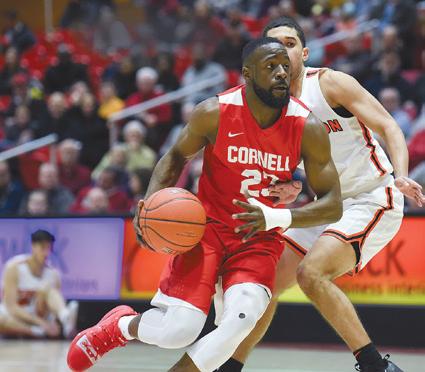
Despite Morgan’s heroics, Dartmouth hung close, largely due to Chris Knight’s careerhigh 27 points. Dartmouth actually had a good look to force overtime, but Brendan Barry’s three-pointer clanged off the front rim as time expired, sealing the 83-80 victory for Cornell.
On the flip side, Saturday’s upset win over Harvard was not as pretty. The Red clawed its way back after trailing by as many as 13 points, capitalizing on 24 Harvard turnovers. It was Cornell’s best defensive game of the season and the Red consistently made Harvard’s scorers uncomfortable, refusing to give away easy buckets.
Cornell trailed by 13 at halftime and outscored the Crimson, 46-27, in the final 20 minutes, a night after Harvard beat Columbia in a highlight-laden triple-overtime contest.
The scoring was also distributed between more players for Cornell as compared to the night prior, with Harvard limiting Morgan to a relatively slow scoring night. Sophomore Jimmy Boeheim led the team with 16 points including a career-high four three-pointers.
Morgan contributed 15 points to extend his streak of consecutive games in double-figure scoring to 73 games. Junior Josh Warren added 14 points and senior Steven Julian ripped down a game-high eight rebounds, three steals and two blocks.
Morgan finished the night with 2,162 career points, passing Dartmouth’s Jim Barton for second on the Ivy League’s alltime scoring list.
The Red will look to continue its hot streak against Brown this Friday at Newman Arena.
Max Ringer can be reached at mr969@cornell.edu.
HOCKEY
Continued from page 16
“Every team has injuries, it seems that we have a lot more this year,” said senior forward and captain Mitch Vanderlaan.
“We lost Codes last night, that was a pretty scary incident, then Donny today. [We] just gotta keep working through it.”
Regush’s goal was his second in as many days, seventh of the season and his fourth on the man-advantage. He’s the first Cornell rookie to record four or more power-play goals in a season since current Columbus Blue Jackets forward Riley Nash ’11.
The Cornell power play, which went 2-for-2 in Friday’s dominant 5-0 win over Clarkson, continued its streak of impressive play minutes after Regush’s tally, when sophomore forward Morgan Barron scored his team-leading 12th goal of the season, a rocket from the right circle that found its way past Saints goaltender Emil Zetterquist.
was playing with just six total defensemen. What’s more, freshman forward Zach Bramwell, who has seen very minimal ice time this season, suited up and played a handful of shifts.
After a first period in which Cornell imposed its will on the last-place Saints, the Red was unable to put away the lowly visitors in the middle period — a St. Lawrence goal after the conclusion of a power play just past the midway point of the period made it 2-1 — but Vanderlaan’s sixth goal of the season, at the 16:19 mark of the second, allowed Cornell to retain a two-goal lead heading into the second intermission.
“Guys have stepped up, played in different roles, different positions ... took on more minutes.”
Mitch Vanderlaan
“The key play in the game was [late] in the second period when Morgan and those guys came in and made the play and Mitch buried it on a scoring chance [to give] us that comfort going into the third period,” Schafer said.
With a bit of breathing room in the ECAC, the Ivy-champion Red visits Brown and Yale next weekend.
“I think it’s just sticking to our habits and taking what’s given,” Regush said of the Red’s success on the man-advantage, which is the best in the nation since Dec. 1 (33.3 percent).
“The chemistry seems to be there. … It’s just going to the net and being around the net, and that’s usually the best way to score.”
After Haiskanen’s gory arm injury on Friday, Cornell
“Guys have stepped up, played in different roles, different positions,” Vanderlaan said of his team’s resilience in the face of its constant injury woes. “Guys took on more minutes and even after the game, guys were really supportive of one another. Codes is in a tough spot, and guys were really supportive of him.”
Raphy Gendler can be reached at rgendler@cornellsun.com.
By FAITH FISHER Sun Staff Writer
Entering the game against the Clarkson Golden Knights, Cornell women’s hockey had staved off all goals from past opponents for over 176 consecutive minutes. After just five minutes on the ice, however, Clarkson netted a goal, bringing that streak — and, eventually, the prospect of a ninth straight game won by the Red — to a devastating close.
With a quick game-opening goal from Clarkson’s Loren Gabel, the Red (16-3-6, 13-3-2 ECAC) began to run a score deficit. Clarkson’s (23-6-1,14-4-0 ECAC) first-period scoring trend only continued.
Clarkson, who is currently defending its second consecutive national title, eclipsed three more goals in the first stanza. Kristy Pidgeon buried the puck into the Red’s net with 13 minutes left in the period, and Kelly Mariana and T.T. Cianfarano channeled their team’s offensive momentum, adding the third and fourth goals of the game.
“We tried to do too much ... they forced some turnovers that ended up in the back of our net.”
Doug Derraugh
“Clarkson is very good defensively and they have very good goaltending, so you can’t afford to get behind a couple of goals,” Cornell head coach Doug Derraugh said. “We didn’t have a good start, and that is going to have to change if we want to be successful in the playoffs.”
Following the fourth goal, sophomore Lindsay Browning replaced senior Marlène Boissonnault as goaltender. She stopped all 10 shots that Clarkson sent her way.
In the second period, the Red had three power play chances, but struggled to convert these opportunities to goals due to Clarkson’s lethal penalty kill unit. Two power play opportunities for Cornell in the third period also proved to be fruitless.
In early December, the Red took a 3-1 victory over the Golden Knights in the comfort of their own Lynah Rink — away at Clarkson, the Red’s dominance dissipated.
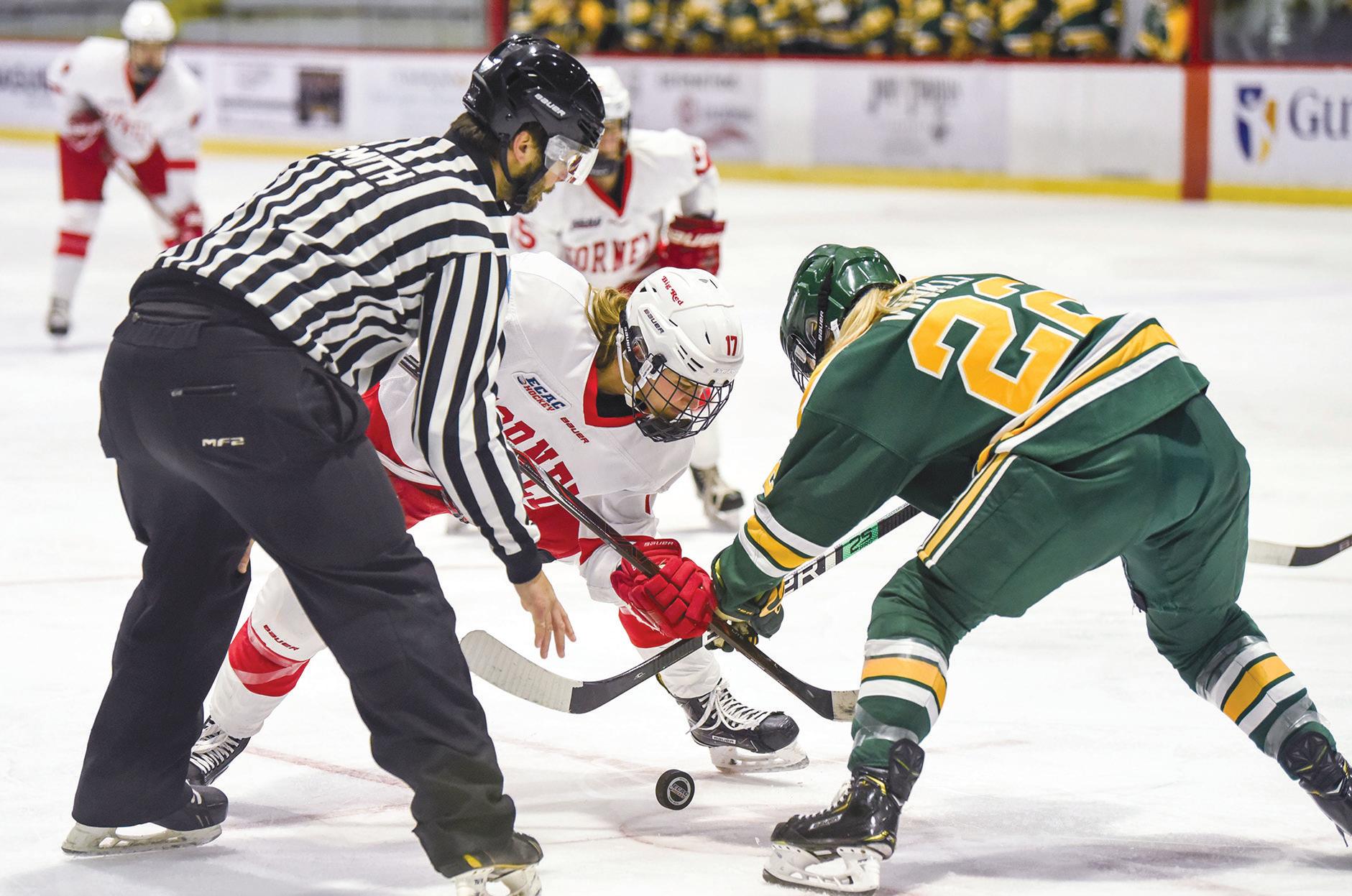
“We managed the puck better when we played them at Lynah, and we were more disciplined early on,” Derraugh said. “At Clarkson this weekend, we tried to do too much at times and they forced some turnovers that ended up in the back of our net.”
With a quick turnaround, the Red traveled to Canton, New York to take on another ECAC competitor, the St. Lawrence Saints (13-12-5, 8-6-4 ECAC) in a game that ended in a 1-1 draw.
In the first four minutes of the contest, St. Lawrence secured a power play opportunity, which was skillfully shut down by Cornell’s penalty kill unit. For the entirety of the power play, goaltender Lindsay Browning did not have to block a single shot.
Neither team made it onto the scoreboard during the first
By GRACIE TODD Sun Staff Writer
Cornell wrestling subjected UPenn and Princeton to its dominance this weekend, handily beating both teams and picking up its 17th straight Ivy League Championship.
The Red’s league win streak is now 88 matches.
On Friday evening, the Red (112, 5-0 Ivy) beat Penn 40-3. The Red started strong with freshman Vitali Arujau and sophomore Yianni Diakomihalis both scoring wins by technical fall in the first three matchups. Between them was Chas Tucker, who claimed victory by decision.
The fourth matchup of the day earned Penn (3-6, 2-1 Ivy) its sole win, as its No. 13 ranked wrestler took down Cornell senior Jonathan Furnas in the 149-weight class.
After that, it was only the Red on top. The Red earned three victories by fall, with junior Adam Santoro, junior Brandon Womack and senior Ben Honis winning their matches. Womack took only a minute to run the score up on his opponent.
Freshman Andrew Berreyesa and senior Jeramy Sweany both won by decision, while senior Jake Taylor won by major decision.
Saturday morning, the Red kept up the momentum, claiming victory over the Tigers, 34-7. Throughout the competition, Cornell’s victory became increasingly certain as it won the first eight matchups. Berreyesa and Arujau won by fall, Womack,
Honis and Tucker won by decision, Sweany and Diakomihalis won by major decision and Dean won by technical fall.
Notably, Honis and Arujau both beat opponents ranked higher than them, and head coach Robert Koll said that “both guys are considerably under-ranked.”
“We had every expectation that they would win,” Koll said.
Though Princeton (6-6, 2-1 Ivy) had already long lost, it claimed the two final matchups of the day, with a No. 2 ranked Tiger winning by decision over Furnas, and another Princetonian claiming major decision over Santoro.
Saturday also marked Senior Day for the Red, to celebrate the 11 senior wrestlers Koll describes as the “keystone to [the team’s] success.”
“Most of the [seniors] don’t start so they don’t receive many accolades, yet they stay with the program,” Koll said. “That’s saying a great deal because the workouts are anything but enjoyable.”
The two weekend wins secured the Red’s 17th straight Ivy League title. Cornell wrestling has now won 40 conference titles, 10 more than all its other conference foes combined. Koll says these titles now come as “more of an expectation than a thrill.”
Next up, the Red will travel south to face Virginia Tech on Friday and UNC on Saturday.
Gracie Todd can be reached at gtodd@cornellsun.com.
period, as Browning, who got the nod to start in goal, saved 12 shots and the Red could only muster three shots on goal.
“Browning really stepped up for us this weekend,” head coach Doug Derraugh said. “It was great for a really young goaltender to step up in a tough environment in the middle of the game. She performed really well and is a big part of the reason we were able to get the tie against St. Lawrence.”
In the latter half of the second period, St. Lawrence gained the offensive advantage and scored the first tally of the night.
To continue reading this story, please go to www. cornellsun.com.
Faith Fisher can be reached at fsher@cornellsun.com.

By RAPHY GENDLER Assistant Sports Editor
For the second straight game, an injury cast a shadow over an otherwise positive result for a Cornell men’s hockey team which has ascended to the top spot in the ECAC and a top-10 national ranking despite being plagued by injuries all season.
Moments before freshman forward Michael Regush’s power-play goal gave the Red an early lead 5:39 into its 3-1 win over St. Lawrence, sophomore forward Cam Donaldson — who has scored 11 goals this season and has been a fixture of Cornell’s hot top line since winter break — fell to the ice and exited the game clutching his left arm. He did not return to action.
“I thought [sophomore defenseman Cody Haiskanen has] been playing some of his best hockey [and] frustrating to see Cam go out tonight. He’s been playing great,” head coach Mike Schafer said a day removed from Haiskanen being rushed to the hospital with a right arm
laceration. “So it’s part of the game and our guys have been pretty resilient to it this year and we’re going to have to be even more resilient [during] the stretch drive.”
With the win, Cornell opens up a three-point lead over second-place Quinnipiac in the ECAC standings with


six games to play. The Red also clinches at least a share of its second consecutive Ivy League title on Saturday, as Princeton beat Yale, 4-1. But the next three weekends reg-
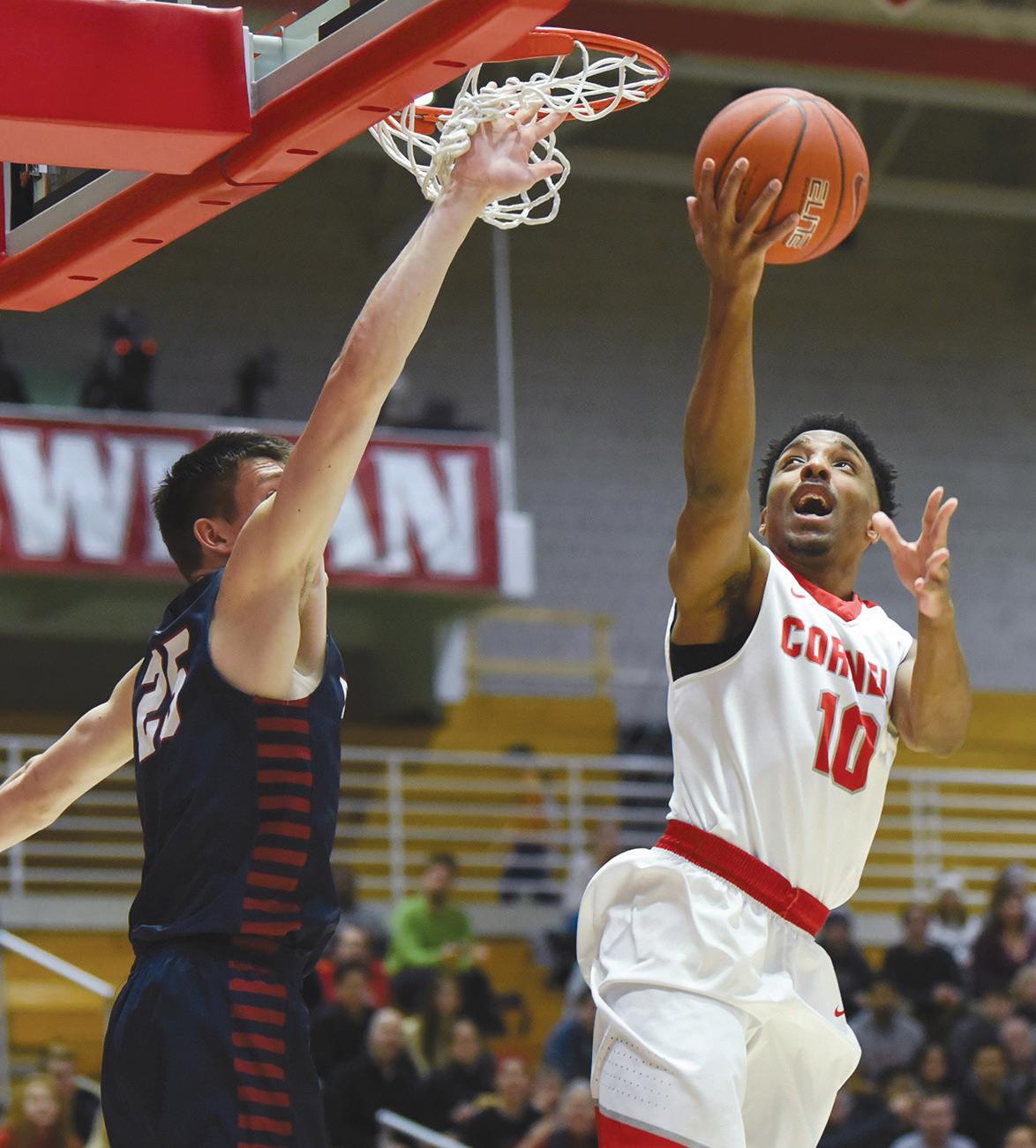
Shoot, score | Men’s hockey secured two key wins over the weekend, one coming over fellow top-ten-ranked Clarkson.
ular season play until what Cornell hopes is a first-round playoff bye will likely be a tough trial for the injury-depleted squad.
“It just seems like one after another guys are going to be out with injuries,” Schafer said. “We got six games left in the regular season, and guys are going to have to step up and play more minutes and play in different roles.
“We’ve seen just about everything this year can throw at us,” Schafer added.
While Schafer wasn’t sure of Donaldson’s specific prognosis, the upper-body injury is expected to keep the sophomore out at least “a couple weeks.”
A Cornell team already without freshman forward Max Andreev — out at least until the postseason with a broken collarbone — and senior defenseman Brendan Smith — day-to-day — earned four key league points this weekend, but the wins came at the cost of two everyday skaters.
See MEN’S HOCKEY RECAP page 14
By MAX RINGER Sun Contributor
With two narrow wins over Dartmouth and Harvard this weekend, Cornell men’s basketball moved into a three-way tie for second place in the Ivy League — after being picked to finish sixth in preseason polling. Although identical in their ultimate outcomes, the two games were won very differently: In one, star senior forward Matt Morgan’s record-setting night propelled the Red to a close victory. In the win over the Crimson, stifling defense and a team effort earned the Red a huge second-half comeback, moving Cornell’s Ivy
record to 4-2. Morgan exploded for a careerhigh 41 points against Dartmouth on Friday, coming just six points shy of the all-time Cornell single-game scoring record. It was the most points ever scored by an
torching Dartmouth for 20 and 21 in each half.
“He weaved around defenders like traffic cones out there and hit big shot after big shot for us down the stretch.”
Alex Mumphard
individual in Dartmouth’s Leede Arena and the first time a Cornell player has scored 40 or more points in 59 years. The remarkable scoring display was equally distributed between halves with Morgan
Morgan shot an incredibly efficient 9 of 11 from beyond the arc, 13-17 from the field and 6-6 from the free throw line to put together the best game of his already-remarkable senior campaign. The nine three-pointers tied the school record, which had already been set by none other than Morgan. Like the Golden State Warriors’ Steph Curry, Morgan’s top three-point competition is himself.
“He weaved around defenders like traffic cones out there and hit
See BASKETBALL page 14