The Corne¬ Daily Sun

Ofcials unclear on who will have say in hunt for Kathy Zoner’s successor
By NICHOLAS BOGEL-BURROUGHS Sun City Editor
As Cornell looks to hire its first new police chief in nearly a decade, administrators have been tight-lipped about what the search process will entail and who will be involved.
Cornell’s executive vice president and chief financial officer, Joanne DeStefano, to whom the police chief reports, said in a brief statement Monday that she hopes to share more about Cornell’s plans to pick the next police chief “within the coming week or so.”
DeStefano has declined multiple interview requests since Chief Kathy Zoner’s announce ment last week that she would leave Cornell on March 4 for a safety consulting firm. She did not answer questions about which campus stakeholders will be involved in the search for Zoner’s successor or what Cornell’s timeline is for finding and inter viewing potential replacements.
“We are taking this opportunity to engage with Cornell Police officers and local law enforcement agencies to understand the leadership qualities that are needed to fill this important role,” DeStefano said.
Even then, the Ithaca Police chief said he hadn’t heard a peep from Cornell about its search. Members of the Cornell Police Union said they are hoping to meet with administrators soon.
Both Zoner and her predeces sor, Curtis S. Ostrander, were hired to lead the department after serving in the force’s No. 2 spot, making current Deputy Chief David Honan
the most apparent candidate for Cornell’s next top cop. Honan demurred this week when asked if he was planning to throw his hat into the ring.
“Our department will continue to operate seamlessly through the leadership transition,” Honan said in an email to The Sun. “I will defer to [Executive Vice President] DeStefano to comment on her plans moving forward.”
Ithaca Police Chief Peter Tyler, who announced last week that he will retire in May, said he is not seeking the Cornell job.
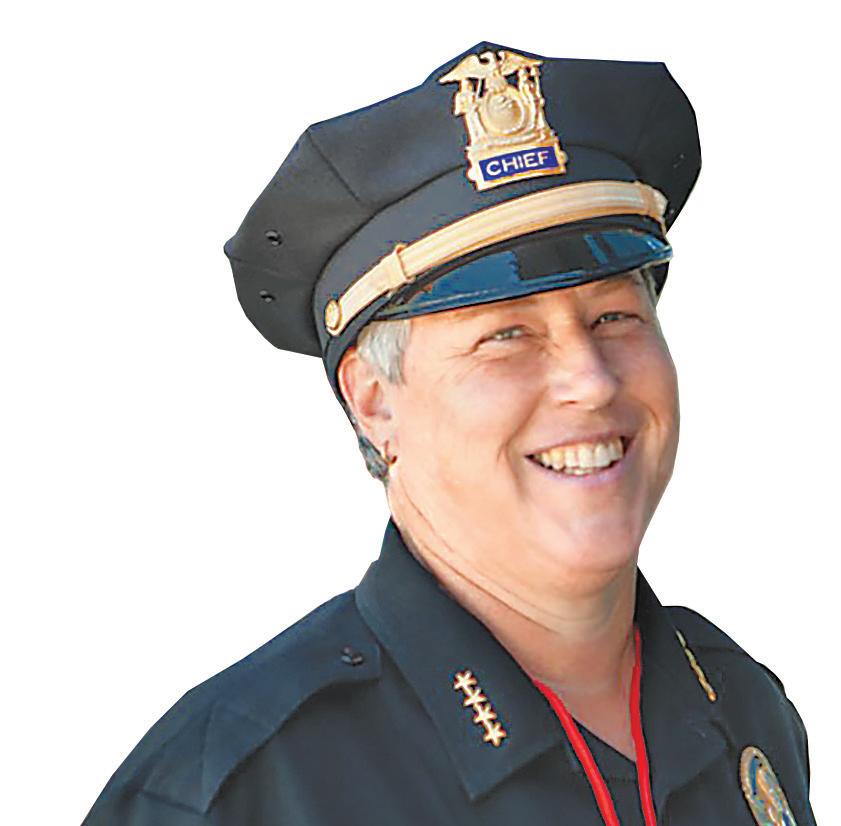
The next Cornell Police chief will lead a department of about 43 sworn officers who are deputized by the Tompkins County Sheriff’s Office and, like municipal police departments, allowed to carry weapons, make arrests and use physical force — including deadly force — when permitted by
Unlike many municipalities, there has historically been no period of public comment between when a chief candidate is nominated and confirmed. Zoner was sworn in as chief in 2009 mere hours after Cornell appointed her to the position, The Sun reported at the time.
The next chief will also be in charge of about 25 additional staff members and oversee a constituency of about 33,000 students, faculty and staff, in addition
See CHIEF page 5
By OLIVIA WEINBERG Sun Staff Writer
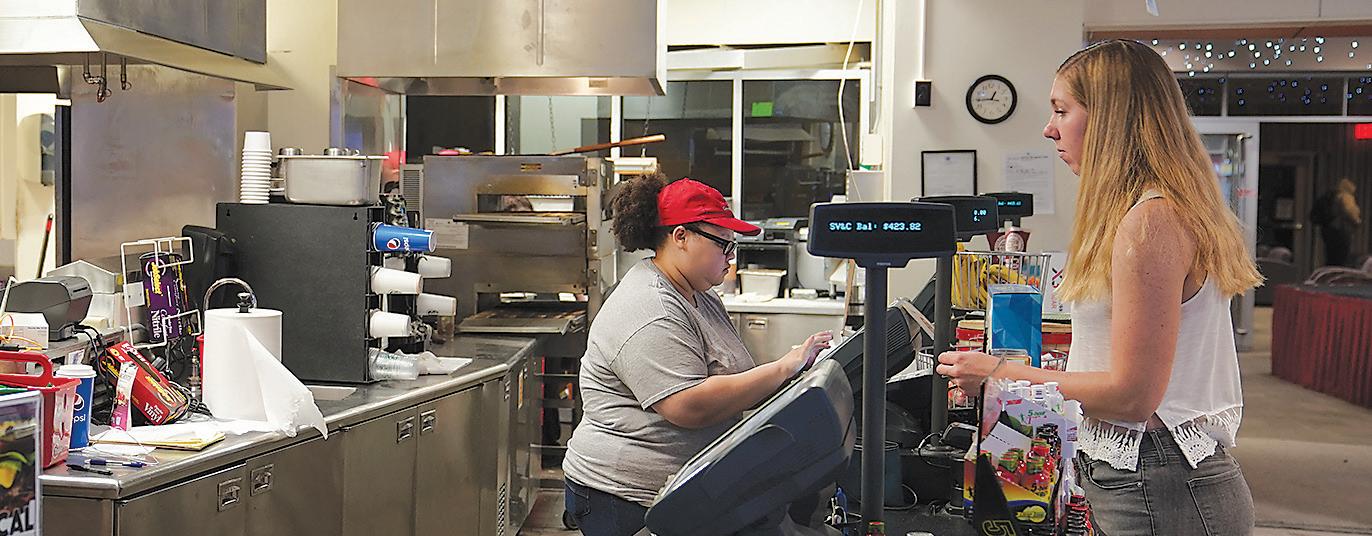
The smell of fried food and greasy burgers almost masks the stench of sweaty partygoers. A place of reconvening and rendezvous, campus staple Nasties has been a long-time late-night favorite for Cornell students.
Nasties, whose rarely-used official name is Bear Necessities, sits on the first
floor of the Robert Purcell Community Center and is one of two late-night food establishments on North Campus. Expectedly, freshmen and nostalgia-seeking upperclassmen flock to the site for food fixes.
As a result of its location and convenient hours — open until 2 a.m. every day — students come to the popular spot in various states of inebriation throughout the night.
“It was definitely super duper crazy late at night, especially on Fridays and Saturdays when everyone was getting back from their parties,” said Ariel Roldan ’21, who worked the cash register at Nasties during her freshman year. Karelia Jaramillo ’22 described one particularly unruly night at Nasties earlier this school year.
See NASTIES page 4

By JOHNATHAN STIMPSON Sun Assistant Sports Editor
This academic year marks the inauguration of the Milstein Program in Technology and Humanity, an initiative in the College of Arts and Sciences aiming to provide students with an education that combines the University’s liberal arts offerings and exposure to front-end technology provided by Cornell Tech.
Although the program was announced in 2017, the first class of 14 students entered Cornell in the fall according to Maja Anderson, Milstein’s program manager.
The vision for the program began five years ago with Gretchen Ritter ’83, the former dean of the arts college and Dan Huttenlocher, the current dean of Cornell Tech, who both sought to build greater academic ties between the education of technology — algorithms, data and design — and the diverse, broad-based curriculum available to liberal arts students.
The program is a unique mix of engineering, design, humanities and ethics training that is difficult to achieve elsewhere within Cornell, according to Anderson.
Students enrolled in the program will complete special technology and project-based coursework in addition to completing any of the 40 majors offered in the College of Arts and Sciences, according to Anderson.
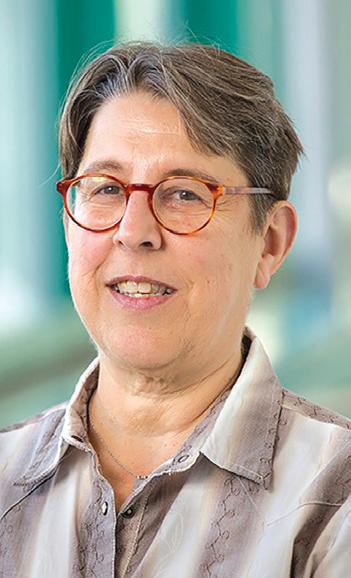
“Our goal is to take in a kid ... passionate about literature and help create a more literate tech world.”
Prof. Amy Villarejo
The program also features two summers of study at the Cornell Tech campus, where students will have the opportunity to conduct research and participate in internships alongside leaders in both academia and industry.
“Fundamentally, our goal is to take in a kid who is really passionate about literature, and help create a more literate tech world,” said Prof. Amy Villarejo, director of the program. “Or the reverse — produce a journalist who has a far better understanding of how tech actually works.”
Villarejo specifically cited Prof. Rick Johnson, electrical and computer engineering, as an example of the sort of interdisciplinary type of thinking that the Milstein Program aims to instill in its students.
For most of his 37-year career at Cornell, Johnson specialized in the study of advanced algorithms and signal processing, but also long
See MILSTEIN page 4
Thursday, February 7, 2019

Canvas@Cornell: Moving from Blackboard to Canvas 8:30 - 10 a.m., G27 Stimson Hall
Blood Drive to Benefit the Dream Factory, Sponsored by Lacrosse Team
11 a.m. - 4 p.m., G10 Biotechnology Building
LGBT Rights After Marriage: Current Battleground and Opportunities 11:30 a.m. - 1 p.m., 184 Myron Taylor Hall


Emerging Markets Institute Fellows Lunch Noon - 1 p.m., Sage Hall Ramin Parlor
The Next Stage in Community Revitalization Noon - 1:30 p.m., G08 Uris Hall
Midday Music with CU Music 12:30 - 1:15 p.m., 101 Lincoln Hall
Challenges to Sustainable Development in Africa 2:30 - 4 p.m., G08 Uris Hall
Introduction to Sewing and Knitting 5:30 - 6:30 p.m., 112 Mann Library

Manipulation of Cellular Processes 9 - 10 a.m., College of Veterinary Medicine, Thaw Lecture Hall
Hot Chocolate Fest 11 a.m. - 1 p.m., Mann LibraryLobby
Gender and Sexuality Lunch Series Noon - 1 p.m., 190 Rockefeller Hall
Latino/a Studies Faculty Seminar and Lunch Discussion Noon, 429 Rockefeller Hall
Trespassers? Asian Americans and the Battle for Suburbia 12:20 p.m., Abby and Howard Milstein Auditorium
Latin American Studeis 2019 Research Symposium 3 - 7 p.m., 401 Physical Sciences Building
Introduction to Zotero Reseach Tool 3:30 - 4:30 p.m., 106G Olin Library
Why Museums Sometimes Lie 4:30 - 6 p.m., G22 Goldwin Smith Hall
Trajectories of Inequality in Latin America 5 - 6:15 p.m., 401 Physical Sciences Building
Cornell Games Club Meeting 7 p.m., 156-164 Goldwin Smith Hall
By VALE LEWIS Sun Staff Writer
Cornell has named Jessica Martinez, the current director of Academic and Public Programs at Harvard University, as the new director of the Herbert F. Johnson Museum of Art.
Johnson Museum’s former director Stephanie Wiles left for Yale in July. After her departure, the role has been temporarily filled by Peter Gould and Ellen Avril, who also serves the museum’s chief curator and curator of Asian art.
The director of the Museum is in charge of overseeing all museum operations. Martinez will be responsible for fundraising, personnel-management, acquisition of objects and conservation efforts, for example. She will also work to engage students through exhibition-planning and program development.
Avril said Martinez’s “enthusiasm and energy” contributed to her appointment as director.
“Her commitment to the Johnson’s mission of providing great experiences with art to the campus and the community, her ability to connect with people and her creative ideas for engaging students with the museum really im-
pressed the search committee,” Avril told The Sun in an email.
In her role at Harvard, Martinez worked to engage undergraduate students by creating the Art Study Center, which made artifacts in storage more accessible to the Harvard community. She also helped faculty incorporate muse- um pieces and artifacts into their curriculum, according to an article in The Harvard Crimson.
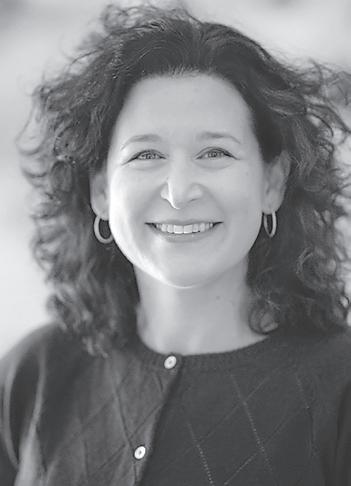
In a Cor- nell press release, Marti- nez expressed a similar inter- est in making the Johnson “a place where people can test ideas.”
“Nearly 400 classes are already visiting the Johnson Museum each academic year, and that constant flow of opportunity with new students, fresh eyes and bold questions is exciting to me,” she said in the same press release.
Courses from over 50 Cornell departments hold classes in the museum as part of their curriculum and each
year, the Johnson hosts students from nearby elementary schools as part of the Kids Discover the Trail program, a series of field trips to local educational sites, including the Sciencenter and the Cornell Botanic Gardens.
Martinez earned her B.A. in fine arts and Ph.D. in history of art and architecture from Harvard University. She then worked at the Smithsonian National Museum of African Art before returning to Harvard to serve as the Research Curator of African Art Initiatives, in addition to her role as Director of Academic and Public Programs.
With this experience in her resume, Avril said Martinez will help enrich Johnson Museum’s African collection.
“Jessica’s area of expertise will bring greater visibility to our important African collection and her depth of experience as a museum educator will carry our already rich and robust educational programs forward,” Avril said.
Martinez is only the fourth director since the museum’s founding in 1973 and will officially start her term on July 15. Avril said she believes the Johnson Museum has a “bright future ahead” under Martinez’s leadership.
Vale Lewis can be reached at vlewis@cornellsun.com.
By SAMANTHA STERN Sun Staff Writer
In the age where “fake news” has become a catchphrase, the general public still trusts the headlines they read — but only if these headlines align with their political affiliations.
A recent study by researchers at Cornell Tech suggests that people “overwhelmingly report believing headlines that align with their political views, regardless of the source of the report.”
The researchers, headed by Prof. Mor Naaman, information science, conducted an online experiment with 400 participants to see if they trusted headlines such as “Trump lashes out at Vanity Fair, one day after it lambastes his restaurant.”
The study also collected their political leaning to evaluate whether
the source of the story — such as Fox News or The New York Times — influenced the participants’ trust in the headlines. The results show that the general public does not believe every headline they read, but are more likely to claim that a headline is accurate if it aligns with their world views.
However, there was a nuance in this finding. When some participants were offered payment for getting the “correct” answer — whether the headline was actually true or false — their political beliefs play less of a role in their answers.
Naaman believes that these findings show that “the source of news might be less polarizing than previously thought.” However, people are likely to discredit accurate headlines if they do not support their views.
“We thought that recent reports

about trust in news did not dig far enough into the determinants of trust, and that understanding this in more detail can help us design better news platforms and social media platforms where news is shared,” Naaman said in an email to The Sun.
The team of researchers are planning to use these findings to dig further into this topic. They are hoping to expand their study to use more headlines, more news sources and more participants.
“We definitely intend to dig in including extending the research to make our results more robust and examining these dynamics in more realistic settings,” Naaman said.
Samantha Stern can be reached at sstern@cornellsun.com.

of degrees devalues liberal arts, he says
By AELYA EHTASHAM Sun Staff Writer
Expressing a need for more funding for the humanities to reap benefits beyond economic value, Prof. Christopher Newfield M.A. ’84 Ph.D. ’88, literature and American studies, University of California, Santa Barbara gave a lecture titled “What the Humanities are for: Two Responses to Vulnerability” on Wednesday.
The lecture focused on the teaching of humanities in higher education, and how the economy and social situations can be shaped by such a curriculum.
Newfield’s presentation referenced several other writers and thinkers engaging with the value of the humanities. He quoted author Mark Edmundson in saying that humanities majors “engage in the activity that Plato commends — seeking to understand themselves and how they ought to lead their lives.”
He first presented how some people idealize universities as embodying “the principle of equality for all” and “the democratization of intelligence.” These ideals, Newfield said, result in “non-market benefits that have enormous value to outside society.”
Newfield also argued that when the value of a college degree rests on its eco -
nomic value, it makes universities “emphasize the monetizable skills” of a degree, resulting in liberal arts degrees being put in a “subordinate position.”
The advocacy for humanities funding “is not an anti-STEM comment, rather a pro-humanities stance where we cannot do our research without money that is currently being removed for other highcost departments,” Newfield said.
He identified the lack of emphasis on humanities as partially motivated by money, where researchers in the field “cannot fund what would be needed to gain systematic knowledge to critically solve problems.”
Newfield advocated a “massive humanities research program, in which we argue for a scale of funding which we were not able to argue for before.” He elaborated, “What I would like for us to think about is how to set up an international research agenda in which these projects are pursued in groups.”
“We want to be able to render this on a scale that is visible to the outside world, with national organizations involved that would take this up,” Newfield said.
Aelya Ehtasham can be reached at aehtasham@cornellsun.com.


MILSTEIN
Continued from page 1
held a deep love for 17th-century Dutch painting. In what Villarejo called an “epiphany moment,” Johnson realized he could merge the science of imaging with art — a novel combination that spawned an entirely new field called “computational art history,” which has made significant strides in dating paintings and analyzing their composition.
“That kind of capacity to recognize and integrate two entirely different areas is what produces true innovation,” Villarejo said. “And that’s exactly what the program is striving for.”
The program is funded by a $20 million grant gifted by the Milstein family — a prolific University benefactor who has previously helped to fund the Milstein Hospital Building and Milstein Hall in the College of Architecture, Art, and Planning.
However, large donations earmarked to a single program have sparked concerns that wealthy alumni may be unduly influencing the university’s priorities, Villarejo said. Much of Cornell’s endowment is considered “donor-restricted,” according to the University’s most recent financial statements, which means they can only be used in ways the donor has deemed fit.
While empathizing with such feelings, Villarejo said “they weren’t accurate” as it was the deans of both schools that are really behind the planning of the initiative.
“The program isn’t just for the enrolled students,” Villarejo added. “It’s about facilitating events, programming, coursework, and other interdisciplinary initiatives that will … spill over … and benefit everyone at Cornell.”
For instance, the program will sponsor a speaker’s series on the Ithaca campus this semester that includes appearances by Oskar Eustice, artistic director of the New York City public theater and Mitchell Baker, executive chairwoman of Mozilla, according to Villarejo.
Moreover, by more closely linking the arts — which Villarejo called an often overlooked, but a “crucial part of the design and technology process” — to STEM fields, she hopes that the Milstein program will ultimately help ward off the trend of “Cornell consistently decreasing funding to the arts.”
A cohort of 25 new students will be enrolled every year in the College of Arts and Sciences. The program will reach a total of 100 students by 2021, according to Villarejo.
Of the 25 enrollees, half will be selected from accepted high school students who have expressed interest in the program on the Common Application, while the other half will be drawn from Cornell freshmen who elect to apply in their second semester.
Given small class sizes, competition for the limited number of spots is expected to be fierce.
Over 100 students admitted to Cornell through early decision applied to the Milstein Program in the current admissions cycle; another several hundred are likely to do the same in the regular decision pool, according to Villarejo.
Through a process of faculty review and potential interviews among finalists, that number will have to be winnowed down to less than 15, Villarejo said.
The ideal student will be one who exhibits aptitude and passion for both liberal arts and technology, or, as Villarejo put, “students who genuinely have feet in both worlds.”
“I’ve always been really interested in Asian studies,” said Reza Madhavan ’22, one of the 14 students currently enrolled in the program. “And this was the only thing I could find that would allow me to continue fully studying that alongside computer science.”
Bliss Zheng ’22, another member of Milstein’s inaugural class, hoped that the program would allow her “to find ways to introduce biology’s unique perspectives and applications to technology.”
The Milstein program’s push to create tighter bonds between liberal arts and STEM is timely, Villarejo said.
“Everyday, the headlines show why we need to do a better job combining liberal arts with technology,” Villarejo explained. “One of the main goals of the program is to introduce into the tech industry questions regarding ethics and values...questions broader than what the industry has been able to deal with so far.”
Johnathan Stimpson can be reached at jstimpson@cornellsun.com.
NASTIES
Continued from page 1
“I remember coming back and it was like 1:30 in the morning and it was insane,” Jaramillo said. “There were so many people. It was literally a zoo.”
“I asked the lady at the counter if it was like this normally and she said, ‘This is a good night,’” Jaramillo recalled, laughing.
The snack spot can be zoo-like, with large groups of rowdy students gesturing wildly behind large glass walls, inadvertently entertaining freshmen walking to and from dorm buildings.
The Cornell Daily Sun freshman issue in 1985 described Bear Necessities as “stocked with such essentials as comic books and pantyhose.” These days, Nasties
serves the standard munchies fare — chips, candy, burgers, calzones — and boasts the Bear Sampler, a plate that includes just about everything: onion rings, fries, mozzarella sticks and chicken tenders.
Roldan estimated that she interacted with about 30 customers per three-hour shift, some of whom she suspected were following their stomachs’ beckoning after smoking weed.
“The funniest thing would be when kids who were really high walked into Nasties and they’d just grab a bunch of snacks and come up to you and try to focus really hard when they’re paying,” Roldan said. “I’d always make a comment or a joke about it.”
Olivia Weinberg can be reached at oweinberg@cornellsun.com.
CHIEF Continued from page 1
to those who pass through the campus.
In 2017, the most recent year for which data is available, there were 21 rapes, three aggravated assaults, 10 fondlings, one robbery and 13 burglaries that were reported to police as occurring on campus. Police received four additional reports of rapes that occurred in off-campus buildings that are frequently used by students or for educational purposes.
Cornell police have also responded with local agencies to high-profile crimes in the last few years, including the murder of one Ithaca College student and stabbing of another near Ho Plaza in August 2016, a man who barricaded himself in his home on Dryden Road after fatally shooting a UPS driver near Walmart in December 2016 and the arrest of a Cornell student in September 2017 on a hate crime assault charge that was later dropped.
“We’ve worked large cases together — homicides, politically or racially charged incidents — and those all take a delicate balance of leadership, a delicate balance of understanding each other and what the object for each particular entity is,” Tyler said. “Sometimes those differ, and if you don’t have those close ties, that’s something that can blow up.”
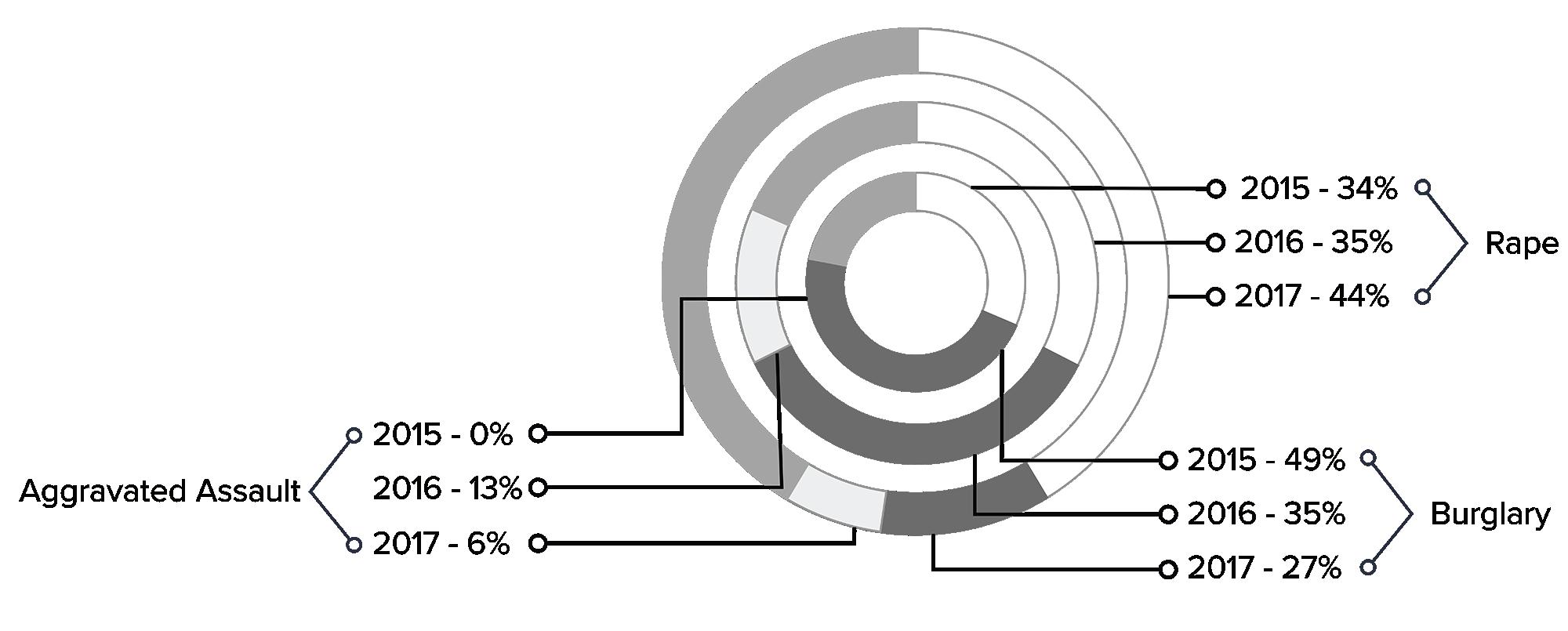
On-campus crimes reported to police | According to crime data Cornell is required to report, 44 percent of the on-campus crimes reported to police were rapes, 27 percent were burglaries and 6 percent were aggravated assaults in 2017.
Light newsletter she emails to students most weeks.
“I think they’re doing a pretty fine job,” Michael Zhao ’21 said of Cornell Police as he walked along Ho Plaza. “They mostly stay out of the way, but they chip in when people need help. That’s pretty solid.”
“I have no idea,” said Jessica Piggott ’20 when asked what she wants to see in the next chief. “I honestly just delete all the Blue Light emails.”
Several student representatives, on the other hand, are asking that administrators seek input from students and engage with historically marginalized groups before and after selecting Zoner’s successor.
“Something that the administrators want might be very different from what students need.”
Varun Devatha ’19
The announcements within three days by the city’s first black police chief and Cornell’s first female chief leave both town and gown residents clueless about who will next lead their police departments.
“It’s a unique situation where you have two fairly large departments where you have two chiefs leaving” so near to one another, Tyler said.
But many students said they were not bothered by the lack of information and only knew Zoner, if at all, by the Blue
“I do think it’s important to have student engagement on this because students are the people who are going to be interfaced with most when it comes to the police department on campus,” said Student Assembly President Varun Devatha ’19. “I think it’d be beneficial to have students engaged sort of from the beginning.”
Devatha recommended that administrators hold a forum at which students could tell DeStefano and others what values they want in a police chief, and for the University to also allow a small number of students to advise during the search itself.
Members of the Cornell Police Union also said they were eager to provide any assistance Cornell desires in its search.
“We would like to thank Chief Zoner for her time
The Sun is out of this world!

and commitment to the personnel and to the department. She will be missed,” Officers William Carpenter and Ray Schweiger, the union president and vice president, said in a statement. “We also offer whatever assistance they desire to the University in finding a replacement and look forward to working with the University in whatever process they decide.”
Haven, Cornell’s LGBTQ student union, said LGBTQ people, particularly those of color, have historically faced violence or humiliation from police departments and the next Cornell chief should work to understand and address that fact.
Yahya Abdul-Basser ’20, president of the Muslim Educational and Cultural Association, said the chief search presents “a great opportunity to improve the relationship between students and CUPD.” Abdul-Basser and Gabriel Vergara ’21, treasurer of Amnesty International, both said they hope the next chief communicates effectively with a diverse campus and promotes equality.
Devatha, the Student Assembly president, said late Wednesday that he had reached out to administrators to discuss how to ensure students were involved in the process in some way.
“Something that the administrators want might be very different from what students need,” he said.
Maryam Zafar ’21 contributed reporting to this article.
Nicholas Bogel-Burroughs can be reached at nbogel-burroughs@cornellsun.com.
136th Editorial Board
JACOB S. KARASIK RUBASHKIN ’19 Editor in Chief
JOHN McKIM MILLER ’20 Business Manager
KATIE
SIMS ’20 Associate Editor
VARUN
IYENGAR ’21 Web Editor
Editors in Training
Editor in Chief Anu Subramaniam ’20
Managing Editor Meredith Liu ’20
Maryam Zafar ’21
News Editor Amina Kilpatrick ’21
Olivia Weinberg ’22
Photo Editor Yisu Zheng ’21
GIRISHA ARORA ’20
Editor
HEIDI MYUNG ’19
ALISHA GUPTA ’20
Associate Editor Paris Ghazi ’21
Dining Editor Lucy Spahr ’22
Katie Zhang ’21
Arts Editor Peter Buonanno ’21
Working on Today’s Sun
Design Deskers Megan Roche ’19
Simon Chen ’21
Daniel Moran ’21
Ad Layout Dana Chan ’21
Production Deskers Megan Roche ’19 Zuobing Qian ’22
The first time my boyfriend and I talked about the definition of love, we were in a New York City apartment. The summer was humid and scented with moss, and in a crowded kitchen, we talked about what love means — argued about it, really. We quickly realized this word required a definition neither of us could grasp — a concept simultaneously as expansive as the city awake around us, yet as narrow as the mortar between brick walls.
We haven’t talked about that definition in a while, but I hear it discussed all the time around me, in cafes, in classrooms, in libraries. And as Valentine’s Day comes around, there emerges a widening rift between those who are lonely and those who are not, those who are cuffed and those who are eating ice cream alone in their bed, those who are happy and those who are heartbroken.
could I ask for anything more, if I had the person I loved by my side?
Pen and paper in hand, I felt a jolt of relief as I finished scribbling the last answer to a math problem set due in 20 minutes. Feeling accomplished, I paraded from Olin Library to Malott Hall, the mathematics building, hoping to find my TA’s office where homework is dropped off.
Upon arriving at Malott, I opened Blackboard to look for his precise office location. The result was appalling: My moment of accomplishment immediately receded as I discovered my TA’s office was located 15 minutes away in Rhodes Hall, which is by the Engineering Quad on the opposite end of the campus.
respective colleges. As such, a standalone applied math department would likely be both feasible and well received by the student population.
Being in a relationship did not rid me of all of my problems.
But if being in a relationship has taught me anything, it’s that most of these distinctions are fallacies: The existence of a significant other runs on a line completely separate from the scale of our happiness. I’ve learned someone can enter your life and fill up space — they can shave away the lonely hours of the day, can fill up a square foot or two of your empty room, can occupy the chair across the dining table — but they can almost never be a substitute for what was already missing.
I used to think if I found a significant other, I would be a happier person. In the plainest, purest sense, happier. I thought if I just stabilized that part of my life, I would finally feel balanced in an enormous uncertainty in my life. We all wonder if that crush will text back, if we’ll leave a party with someone, if we’ll be “forever alone.” I did too. It seemed if this one constant uncertainty was finally settled, I would have much less to worry about. A significant other meant reliability — a constant reminder someone cares about you, a surefire way of remembering we are cherished and valued.
But being in a relationship did not rid me of all of my problems. Not even a fraction of them, actually. It might be a naive concept — of course, we can’t expect one person to fix everything — but I find not nearly enough people know this, or truly believe this. That includes even people in relationships, confused why they are not fully happy. We still persist, ruthlessly, in search for some way to mend ourselves through someone else.
My boyfriend has made several appearances in my columns this year, and contrary to the one or two sentences he occupies, his role in my life is not insignificant. Falling in love with him was exactly the kind of experience most people describe — uplifting, enriching, wholly encompassing. How
But two nights ago, I opened my back window and thought of jumping the long way down to the snow. The lingering sensation — defeat, hopelessness, solitude — had never changed. Looking out the dirty glass panels, the Ithaca snow drowning the grass white, I came to the realization: Yes, it is still possible to feel lonely even when you have a significant other. It is still possible to feel as if you are a pinpoint in a world that is incomprehensibly wide, even when someone you love is next to you. And even when someone stable is by your side, it is possible to be utterly in fear of the future. As much as I cherish my relationship, I’ve come to realize everything we believe about fixing unhappiness is more or less untrue. My boyfriend cannot heal me. He is, simply put, another person who has entered my life. Beautiful and sensational, but only a person. He moves my life with full force, but that’s the point. He moves it, and no more. My narratives belong wholly to me at the end of the day — how they play out, devolve, escalate are up to me. The loneliness will persist, unless I learn how to fix it for myself.
I like to picture that finding someone you love is simply the encounter of two oscillating streaks of life with one another — passing, fleeting and still moving on their own terms. It is a blip of time when two people meet on a path. And as much as life can be illuminated by this new person, they are just like anyone else whose path we cross. They are a person who cannot substitute what was void in our own lives. They will not be the answer to those questions that keep us awake at night. If it is “better to have loved and lost than to never have never loved at all,” then it is best to have loved yourself.
To my boyfriend, I am grateful to you for allowing me to tell our story in bits and pieces over the weeks, and to tell this one. Hopefully, we can reach someone who is feeling lonely during this season I hope they know we are not an ideal, not the dream to chase after, nor are any of the other couples on campus. We may represent some sort of ideal, some stroke of luck, some whatever-the-stories-say starstruck lovers, but we are not the answer to achieving, in the complete sense, happiness. We are far from that. We are just two individuals struggling to chart our path through the expanse that is the world, side by side.
Kelly Song is a junior in the College of Arts and Sciences. The Songbird Sings runs every other Thursday this semester. She can be reached at ksong@cornellsun.com.
Fortunately, after sprinting to Rhodes, I somehow was able to submit my homework on time. It turned out my TA was an applied mathematician, and therefore, his office was located on the sixth floor of a building I had never heard of located far away from Malott.
The lack of an undergrad applied math major bothers me so much because applied math holds great
prominence at Cornell.
I later learned my TA was a member of Cornell’s Center for Applied Mathematics, or CAM, a somewhat elitist program available primarily to Ph.D. students. Applied math, as distinct from “pure” math without any intended application, is a highly respected field by employers and researchers, with broad usage in statistics, engineering, social science and more. I was only a freshman when I learned this. Even now as a junior though, I remain bewildered by the question:
Why doesn’t Cornell have an applied mathematics department for undergraduates?
The lack of an undergrad applied math major bothers me so much because applied math holds great prominence at Cornell. According to the Cornell Department of Mathematics webpage, there are 44 faculty members in mathematics, 28 of whom do active research in applied math. Steven Strogatz, one of the most well-known mathematicians in the world, is a professor of applied mathematics.
Instituting an undergraduate-centered applied math department would bring with it an abundance of perks. With the addition, Cornell’s plentiful faculty and graduate students could work more closely with undergraduates and more easily accommodate student research interests for a wider range of subjects. Several of the research areas available for CAM graduate students, such as mathematical finance and algorithms, are common prerequisites for undergraduates studying business and computer science, respectively. Furthermore, the University could plan classes and host events related to applied math in a more organized manner. Currently, all courses, talks and competitions dealing with pure (i.e., non-applied) math are held in Malott Hall. But most classes and events related to applied math are scattered around campus; courses like MATH 4260: Numerical Analysis are taught in Gates Hall, while others like MATH 3620: Dynamic Models in Biology are taught in Comstock Hall. Having a centralized applied math department would create a single touchpoint for applied math, reducing the need to scatter courses across departments and colleges.
Creating an undergraduate department exclusive to applied math would continue Cornell’s status as one of the top research institutions in the world.
And applied mathematics at Cornell is prevalent among not just professors, but also students. Cornell’s Mathematical Contest in Modeling, an annual university-wide applied math competition for undergraduates, “attracts students from many majors/departments” and “looks cool on your resume,” according to the contest’s website. Additionally, many students in other STEM departments double major with math, according to the math department website, for its “adaptability to a number of purposes. It can emphasize the theoretical or the applied.”
Not to mention, Cornell already has several undergrad departments for applied subjects, something it takes great pride in. The University has distinct departments for the studies of applied economics and applied physics, both of which are popular majors and fields among undergrads within their
Finally, adding a department would greatly reduce the clutter of similar undergrad courses in the math department. In the math course catalog, there are listings for four multivariable calculus courses and four linear algebra courses, two core math courses. However, a student can only receive credit for one in each category because half of these courses are intended for engineers and nonmath majors, and the other half for math majors. The jumble of similar courses in one department has inevitably led to confusion among my peers, uncertain about which class they should take. The addition would alleviate this issue while also providing alternatives for students less interested in taking pure math courses.
Benefits to the University aside, what’s most surprising about Cornell’s lack of the department is that applied math stands as a prevalent undergraduate field of study at other prestigious universities like UC Berkeley and Columbia. Creating an undergraduate department exclusive to applied math would continue to establish Cornell’s status as not only one of the top engineering school in the Ivy League, but also one of the top research institutions in the world.
Nile Jones is a junior in the College of Arts and Sciences. Rivers of Consciousness runs every other Wednesday this semester. He can be reached at nnj9@cornell.edu.
Erogenous Jones | Anals of Mathematics

elegant solutions to quick and dirty problems, which makes Erdos the mathematical equivalent of a fucc boi complete with an addiction to amphetamines. Other mathematicians like Alexander Grothendieck develop an immense amount of theory so that sex happens naturally. There’s no way that sex would not have happened with the mood that Grothendieck carefully sets. Grothendieck was thus the master of foreplay, the king of the long-game and the father of algebraic geometry. Sometimes people attempt the Grothendieck style by playing the long-game only to never actually successfully achieve their goal. These people work for years — often in secrecy in hopes that all of the theory they build up would provide them with a solution — and they are often inspired by the works of Grothendieck such as Éléments de Géométrie Algébrique — the math bible. In the romantic case, this would mean obsessing for years over a close friend with no interest in you only to learn that’s you won’t achieve a relationship if your inspiration is Ryan Gosling’s sexually charged performance in The Notebook , the romantic film analog of EGA. In mathematical circles (i.e. Simple Closed Curves), we call that the Mochizuki method. Hook-up culture is the same as exploring many different areas of math until inevitably deciding algebraic geometry is too hard, geometric topology is really just the word problem, and any accessible problem in combinatorics has already been solved or is an outrageously specific graph theory problem that it is not really interesting. Some mathematicians become totally dedicated to a subject with a lot of results in the beginning and then decreasing amounts until
We are a week away from that holiday: Valentine’s Day. Having been single for 22 years continuously, I’ve really grown to hate this consumption-driven, exclusionary, sickly-pink holiday. Don’t get me wrong, I’m a #strongindependentwoman and know I don’t need a lovey-dovey partner to 1) have fun, 2) be happy or 3) orgasm, but seeing all of the cheesy affection on display reminds me that I’ll never achieve that linear, heteronormative, Hallmark-romance love that society hearts so very much.
little more.
1. Plan ahead to either get your favorite food delivered to your place for solo dinner, or make a reservation at a restaurant offering a V-Day special menu with a friend. Hey, single people should enjoy those “for-two” perks too.
The question to ask yourself this Valentine’s Day isn’t, do you have a boo, but have you romanced yourself lately? If it doesn’t bring you income, inspiration, or orgasms, it doesn’t belong in your life.
So, if you’ve found love just in time to avoid being single on this dreadful day, go fuck yourself, this article isn’t for you. But if you’re a single soul like myself on this miserable day, here are my top 10 Valentine’s Day tips and tricks to hating this day a little less, and loving yourself a
2. Buy or make yourself a gift. It doesn’t have to be expensive to be special, even carving out a portion of you day to do something you love is #selfcare.
3. Check out sex toy sales on the days leading up to V-Day. Not only do a lot of companies offer free shipping on this “special day,” but plenty of them also have great discounts on items that may already be on your Wish List.
4. Gift YOURSELF flowers! Buy them, ship them, pick them off the street, or get a plant and care for it instead — talk about a long-term relationship.
5. Sneak a workout into your sched-
ule. Gyms will be empty (what with all of the lovers frolicking in the streets and sheets or what not), and endorphins are just what your body needs to feel that happy love buzz.
6. Pet an animal, call a relative, Marie Kondo your closet … do anything that makes you feel good and connected to the joy in the world.
7. Pop some bubbly! It’s never a bad day to drink champagne.
8. Get ready for the post-Valentine’s Day discount chocolates and laugh at couples who bought them at full price.
9. Later that night, draw yourself a hot bath, light some candles, or stream some porn.
10. Masturbate: it’s sex with someone you love ;) The better question to ask yourself this Valentine’s Day isn’t, do you have a boo, but rather, have you romanced yourself lately? If it doesn’t bring you income, inspira tion, or orgasms, it doesn’t belong in your life. So for get the antiquated V-Day activities,
a consistent schedule is established that is sometimes slowed down by a pregnancy. This is analogous to how sex begins and decays in a marriage. As you get older and older sex and mathematical lives dwindle, and once you’re over 40 you no longer qualify for the highest achievements such as the Fields Medal or sex with someone who wasn’t out of breath the whole time. Even introducing new definitions of terms and names in mathematics equates to masturbating, which makes perfect sense in the context of the study of formal logic — the academic equivalent of masturbation.
Some connections inform our behavior. Pretty much anybody can learn mathematics in the same way anybody can learn sex. Some people have talent, but at the end of the day, it’s all about practice and having good teachers. Some people like weird shit, and that’s totally okay and sometimes useful. I don’t know why anyone would fuck their teddy bear or study stable commutator length. I’ve tried both and would recommend neither, but if I hear people like stand-up comedian Greg Davies and mathematician Danny Calegari, it doesn’t make me think less of them. Finally, and most importantly, making people solve problems when they don’t want to solve problems is pretty fucked up and doesn’t work to have them learn mathematics. The people who come to love mathematics must arrive at that decision on their own, since the best and only way to learn mathematics is to find a problem you think is interesting and ostentatiously rub the surface of its recently washed asshole.


By PIPER TORPEY Sun Staff Writer
Few things beat a great bowl of pasta on a cold winter’s night. So, when I heard about Pasta Vitto, the new Italian restaurant that had just opened on the Commons, I grabbed three friends and headed downtown to evade the polar vortex via fusilli e fettucine Adjacent to the Marriott Hotel, Pasta Vitto is housed in a large open space with modern decor that lends itself to the restaurant’s casual ambiance. The seating consists of eclectic wavy blue booths upholstered in funky geometric prints beneath walls of exposed wood. My friends and I were promptly greeted and led to one of the booths. As I began to skim the menu, I noticed that they serve an expansive assortment of pizza and pasta dishes; they offer ten “pizzettes,” or personal pizzas, ranging from vegan pesto to walnut and blue cheese to your typical cheese pizza made with their special “momma’s sauce.” The
pizzettes ranged in price from $8 to $15, reflecting their mission to serve “Italian-inspired food at reasonable prices.”
For our appetizers, we elected to share two salads: caprese and roasted vegetable. Drizzled with a delectable blend of balsamic glaze and pesto sauce, the caprese is most definitely a contender for the best dish of the night. The mozzarella balls and ripe cherry tomatoes were garnished with capers, adding
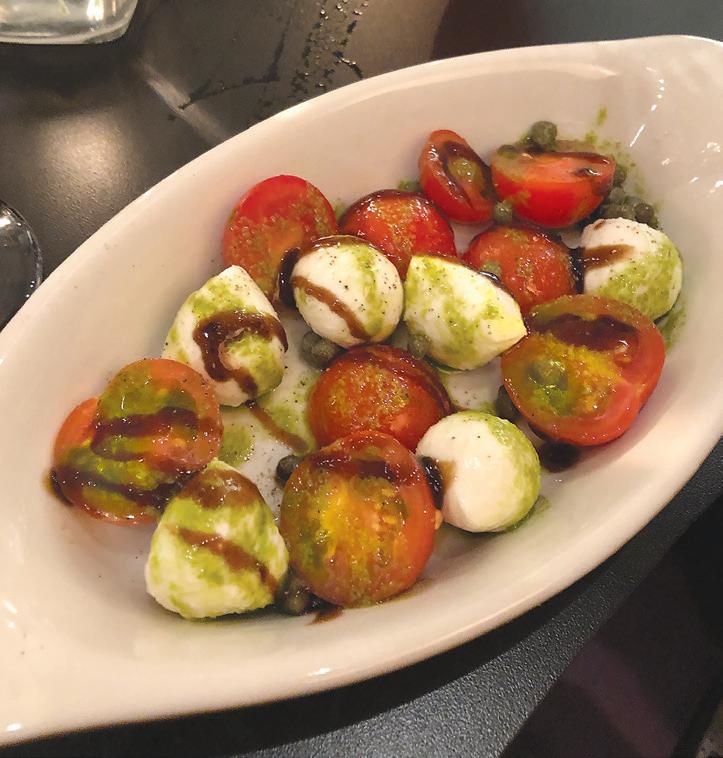
to the overall refreshing, delicious taste of the dish. Next, we dug into the roasted vegetable salad, an experimental melange of baby
kale with red onions, cauliflower, carrots, mushrooms, red peppers and walnuts. While the roasted vegetable was not nearly as good as the caprese, the oregano vinaigrette dressing added an earthy element that complemented the smoky flavors of the roasted veggies. The ratio of the kale base to the toppings, however, was far from ideal, with the roasted vegetables taking up the majority of the dish and dominating the crisp texture of the kale.
Following our salad appetizers, we were parched and flagged down a waiter to bring over a drinks menu. It should be noted that Pasta Vitto has yet to obtain a liquor license, but they do offer an array of creative house-made sodas — I opted for a seltzer with their homemade raspberry syrup. Although the soda was a little too sweet for my liking, it was nice to try something beyond my usual repertoire of Diet Coke or ginger ale.

After a slight 10-minute lull, our main dishes arrived, bringing with them the enticing aroma of creamy sauces and freshly made pasta. For my main dish, I ordered the fusilli with Pasta Vitto’s special pink sauce, a rich blend of tomatoes and
cream enhanced by the whipped consistency of the dollop of ricotta
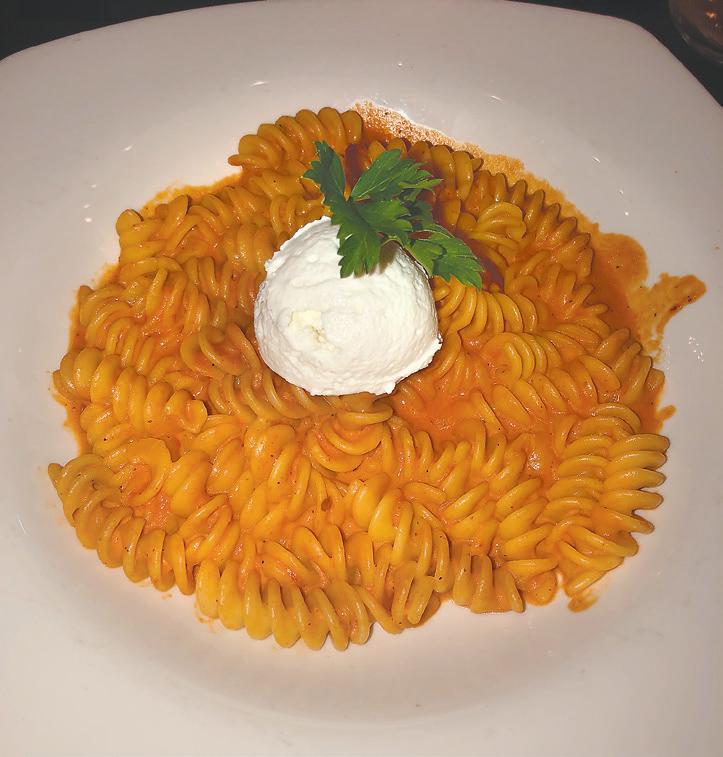
in the dish. The pasta was cooked to perfection, which for me means just beyond al dente. Additionally, the portion size was ideal; I finished the entire dish and felt absolutely satisfied but not uncomfortably full. At $12, the Pasta Vitto fusilli offers incredible quality of price. My friend argued that the best part of this new restaurant is the “accessible price point,” awarding Pasta Vitto “10/10 for prices” and “8/10 for cuisine.” Another friend we dined with agreed that Pasta Vitto’s prices are supreme, but she
was disappointed by the scarcity of gluten-free dishes as her only option was a penne red sauce.
Ultimately, Pasta Vitto is a brand new restaurant off to a good start. Though they could improve by offering more gluten-free options and securing a liquor license for those who like to enjoy a glass of wine with dinner, the cuisine is simple, reliable and satisfies any craving for home-cooked Italian fare. If you are in need of some good pasta to transport you away from the harrowing Ithaca cold, you should give Pasta Vitto a try.
Serves: good, reliable Italian fare at a reasonable price
Vibe: modern and casual spot for dinner with friends
Price: $$
Overall:


Piper Torpey is a sophomore in the College of Agriculture and Life Sciences. She can be reached at pat72@cornell.edu.

By ANNA PAOLUCCI Sun Contributor
f you have ever been to the Ithaca Farmers Market, you might know of a popular stand called Macro Mamas, famous for its delicious lime peanut noodles that are found all over Cornell’s campus. Macro Mamas is run by a group of women from the Finger Lakes area who are, according to their website, “cheerfully merging their talents in order to create fantastic market menus.” While most people will easily recognize and praise the infamous peanut noodles, Macro Mamas offers other creations that are beginning to pop up around campus in places such as Gimme! Coffee. According to their website, “each dish is its own exercise in co-creation, welcoming new found inspiration and varied ingredients, from [their] own fresh herbs to plants foraged from nearby hillsides.”
Gates Hall’s hidden gem, Gimme! Coffee, is arguably the best place to buy coffee on campus, despite its lack of BRB acceptance. The layout of the small coffee stand is simple yet classy in its clean-cut white backdrops and bold red print proudly displaying its name. The tidiness of the stand makes it all the more visually appealing and with the appropriate funds, grabbing a coffee here is always a pleasant experience. After your eyes are immediately drawn to the red “Gimme!” sign, you will notice the abundance of fruity scones, buttery croissants and extra large muffins in the glass case. One may easily pass by the fridge on the left and go straight to the ordering post, but the fridge should not be overlooked. Often there is a line for coffee, so as you wait, peek into the fridge and check out all the additional goods that are offered. Inside their fridge you can discover a myriad of Macro Mamas’

Macro Meals. Macro Mamas focuses on plantbased foods, which means most of the dishes are vegan. Macro Meals vegan protein bowls feature an assortment of different vegetables and grains. The contents of the Macro Meals will change frequently. When I went last Friday, the bowl was an unusual combination of ingredients that pleased my taste buds. The first aspect of the bowl was brown rice and Red Fife with cumin gomasio (a sesame and salt mixture). This rice dish was the base of the bowl. Next, smoky black-eyed peas were listed as a kind of cold bean salad, followed by cumin-roasted sweet potatoes and celeriac, then Brussels sprouts with lemon-poached pears and pistachios and finally, kohlrabi (a German turnip) and apple salad with lime parsley. I was intrigued because while I like all of these ingredients separately, I wondered how such a multitude of different textures and flavors would merge. That being said, I was delightfully surprised with how it all came together.

bowl was the sweet potatoes, my new current obsession. They were perfectly crispy and surprisingly not soggy. They had a cumin flavor and were paired with celeriac. Not only was the texture of these celery roots incompatible with the rest of the dish, but the chunks of celeriac were too large and bland, making them the worst part of the bowl. Although I am not a huge fan of Brussels sprouts, I appreciated how they tasted in contrast to the pears and pistachios. This innovative combination was the correct amount of sweet and salty. The apple salad on top was an excellent and refreshing addition. I noticed, however, that I ate each bit of this meal separately because I was worried about mixing it all together and getting too many unconventional flavors and textures at once. I enjoyed eating
each section and only mixing a few of the different components, like the sweet potatoes and rice, or apple salad and beans. This made the bowl less overwhelming than it could have otherwise been. My friend, who also got a bowl, ate it differently. She mixed all the ingredients, and I think she found it less agreeable. While I finished mine contently, she was deterred from it about three quarters of the way through.
So, in conclusion, would I order a grain bowl again? I think I would. I am a huge fan of rice bowls and different vegetable dishes, so this was right up my alley. My bit of advice, however, is to relish each part of the bowl on its own. Also, I think it is necessary that I address the price of these bowls. At $12, each bowl is very expensive considering how small the portion is. I understand that the vegetables are all organic and locally sourced from the Finger Lakes area; nevertheless, the price would definitely influence whether or not I buy it again. I still look forward to seeing what other kinds of inventive meals Macro Mamas has to offer and whether or not they gain popularity to the same extent as the company’s
mouth-watering peanut noodles.
Serves: vegan, plant-based bowls
Vibe: clean, healthy and modern
Price: $$
Overall:

Anna Paolucci is a sophomore in the College of Arts and Sciences. She can be reached at abp57@cornell.edu.


The rice base was not overwhelmingly flavorful and thus served as an agreeable foundation for all the additional creative flavors. It had a subtle taste of cumin that was just the right amount. The rice was cold, but also fluffy and hearty. The sprinkling of blackeyed peas had a refreshing and salty flavor to them, adding moisture to balance the dryness of the rice portion. My favorite part of the
Last November, Meek Mill published an op-ed in The New York Times reflecting on his time in prison and dissecting the broken system that had put him there. Meek, who had been sentenced to two to four years in prison for a technical violation of his probation, used the op-ed as a springboard for the foundation he was starting, an organization that would prioritize prisoners’ rights and address the systemic racism and injustice underpinning the American criminal justice system.
five-month stint — which ended last April — for popping a wheelie on a dirt bike in Manhattan. The hashtag #FreeMeekMill has come to represent more than just one famous rapper’s plight but rather the overall dysfunction of a system that has created a culture of mass incarceration.
Some have argued that Meek is the wrong symbol to rally around, that at the end of the day he is a person who has committed a crime and should be punished. However, many have united around his story that is marred by untrustworthy cops and severe sentencings by biased judges, characteristics that are unfortunately typical in the justice system.

In January, Meek Mill and Jay-Z introduced the foundation, Reform Alliance, in an auditorium at John Jay College, announcing that they had pledged $50 million toward the initiative, which would work toward a complete overhaul of the probation and parole system as well as the freeing of one million people currently in the system over the next five years. They placed an emphasis on the inherent discrimination in the structure of probation towards the already marginalized populations of people of color and people of low socioeconomic backgrounds, and plan on confronting the disproportionate consequences of jail time for small technical violations such as missing a meeting with one’s parole officer.
This initiative stems from Meek’s own personal experience with extended probation, a result of a crime he committed in 2008. Within these past 10 years, Meek has had to return to jail twice because of parole violations, the most recent being a
In a New York Times op-ed written in 2017 by Jay-Z, he points out that “Meek was around 19 when he was convicted on charges relating to drug and gun possession, and he served an eight-month sentence … Now he’s 30, so he has been on probation for basically his entire adult life. For about a decade, he’s been stalked by a system that considers the slightest infraction a justification for locking him back inside.”
The Reform Alliance is to be rooted in systemic thinking, using the platform offered by media and the music industry to ask people to look at the bigger picture when considering the criminal justice system. On stage at the auditorium in John Jay College, Meek Mill and Jay-Z were joined by the board of Reform Alliance, a motley crew of corporate CEO-types that included Patriots owner (and Trumpsupporter) Robert Kraft, 76ers co-own-

er Michael Rubin, Nets co-owner Clara Wu Tsai, Third Point Management CEO Daniel Loeb, Galaxy Digital CEO Michael E. Novogratz and Vista Equity Partners CEO Robert F. Smith. The team, which Jay-Z compared to the Avengers, was more like a panel for Shark Tank:The only person with a background in criminal justice was Van Jones, political activist and CEO of the foundation.
While many of these people have been outspoken in their support for Meek Mill, numerous board members actively enable systems that are a part of the prison industrial complex through their own businesses. For example, the 76ers utilize Aramark catering for food in their stadiums. However, Aramark is notorious for not only propagating horrible prison conditions by providing maggot-infested food but also actively utilizing corrupt prison labor. While a small example, there is a question as to whether or not the change Reform Alliance is proposing can be sus-
tainable and progressive without a deeper self-evaluation.
The criminal justice system almost seems like a wicked problem, one so integrated into our society in so many ways that it seems impossible to overcome. Despite this, I believe that Meek Mill’s Reform Alliance is exciting and admirable in its goals and represents an attack on the deeply problematic arrest-jail-probation cycle that currently runs rampant. Action taken is better than an apathetic response. However, real change will be nuanced, far-reaching and most importantly, painful. It will be necessary to hold the entire system accountable; otherwise, the tenets (of fighting bad racism) will remain unchanged and institutionalized if the system of bad racism is held accountable.
Isabel Ling is a senior in the College of Art, Architecture and Planning. She can be reached at igl3@cornell.edu. Linguistics runs alternate Mondays this semester.
BY NICK SWAN
Destiny Nicole Frasqueri — perhaps better known as Princess Nokia — released her Metallic Butterfly mixtape on Soundcloud back in 2014, but just this past December the artist reissued the work as a streamable album and expanded it, adding three new tracks. This bit of chronological displacement, however, induced me and other relatively new followers of the rapper to believe that it is her sophomore album and thus to compare it intensely to her “debut” album, 1992 Deluxe. Placing Metallic Butterfly beside 1992 Deluxe reveals an impressive consistency in thematic and imaginative scope, but it also exposes the former’s relative lack of tenacity in the delivery of Frasqueri’s socially transformative ideals.
Frasqueri herself offers some remarks about Metallic Butterfly that are helpful in interpreting the album. In a tweet about the album, Frasqueri wrote that “[Metallic Butterfly]’s visual and audio aesthetics were deep-rooted in anime, cosplay, witchcraft, feminism and
cyber goth/rave culture.” All of these terms possess a certain connotation of intrinsic otherness to mainstream society and its restrictive notions of self-definition. Moreover, they suggest a certain deployment of imagination in the construction of different worlds or, better yet, the planning of what this world might be in the future. Princess Nokia invites us to do just that in the opening track of Metallic Butterfly, “Dimensia.” “This is the metamorphosis of the twenty-second century / Transmitting a higher frequency for the world to thrive on . . . On this planet, you are now released of all plague, hate and disease . . . It is time that you utilize your greatest potential before it is taken from you forever.” Frasqueri creates the grand outline of a future world in which devastating social woes, such as racial and gender hatred, sickness and war, no longer exist. Metallic Butterfly is the name of this world, but I think that it also hints at an individualization of the values that Princess Nokia specifies in “Dimensia,” with “butterfly” suggesting a transcendence and “metallic” signifying both the futuristic, utopian nature of these ideals as well as a personal hardening
of the body and spirit as it reflects the blinding onslaught of the negative forces mentioned above.
Princess Nokia spends time in the subsequent tracks on the album filling in the details of her future world. In “Young Girls,” Frasqueri describes a place where mothers, sisters, and daughters are aptly considered the “patrons of the earth,” with this bit of ironic diction (patron stemming from pater, the Latin term for father) implying that the
ty and other members of the African diaspora.
Something that makes Metallic Butterfly so other-worldly is the way in which it imagines this future without relying on the institutions that currently perpetuate social hierarchies. During the second verse of “Anomaly,” Frasqueri raps “Listen, I don’t get political/Government reform, that’ll be a miracle.” This echoes the sentiments of academics like Justin Adams Burton who envision rap music’s role in human justice as hinging on its own position outside of dominant culture and its power structures.

power inequities of heteronormativity are no longer observed. “Bikini Weather/Corazon en Afrika” features the artist claiming the African origins of her ancestry and, as she raps over an up-tempo, reggaetón beat, we might observe this as a postcolonial, celebratory link between the Afro-Latinx communi-
Metallic Butterfly is poignant art, but 1992 is a true masterpiece. On that album, Frasqueri still possesses a view of distant realms sans bigotry and hatred, but instead of imagining it for the future, she lives in it now and expresses herself through its terms and conditions, creating a more rugged, hardedged clash with social binaries. On tracks like “Bart Simpson,” and “ABCs of New York,” Frasqueri’s flows channel a fire-and-brimstone ferocity as she defines herself in ways that uphold and celebrate a number of hip-hop ideals. She is
authentic, in that who (and what) we hear rapping is undoubtedly her, and as we experience Princess Nokia through so many fronts, rapping styles and personas, we witness a literal movement that is characteristic of hip hop’s great discursive space. During “Brujas,” perhaps the defining track of the album that explains Princess Nokia’s dynamic self-expression, Frasqueri identifies as a bruja, locating herself in a genealogy of women practitioners of brujería who are known for their ability to shapeshift in order to perform work that influences communities and their structures.
Upon a cursory listen of Metallic Butterfly, I was disappointed to hear that it doesn’t possess the same “bite” that characterizes 1992 Deluxe. We don’t hear much of Frasqueri’s rapping technique, and the music doesn’t comprise the sample-heavy, driven beats of 1992. Nevertheless, the concept behind Metallic Butterfly is provocative and performs much productive work in the spirit of social justice. I’ll eagerly await whatever direction Frasqueri decides to take her music in.
Nick Swan is a senior in the College of Arts and Sciences. He can be reached at nswan@cornellsun.com.
If there’s one thing that we can agree on, it’s that the Grammys suck. Even if we don’t consider all of the controversies that have surrounded the politics of the awards show, the award itself has lost its value over the years.
It has become clear the The Recording Academy cares very little for artistic value and is willing to let Macklemore’s The Heist beat out Kanye West’s Yeezus and Kendrick Lamar’s good kid, m.A.A.d city in the 2013 Grammys. They even allowed Drake’s Scorpion to get an album of the year nod . . . seriously, that was the not even a top 50 album this year.
Despite our best efforts to boycott the award show once and for all, your arts editors have succombed to their most primal urges once again and have gathered their predictions together in what they hope will be a return of greatness to the Grammys.
* symbolizes our predicted winner Record of the Year:
“This is America” | Childish Gambino *
“I Like It” | Cardi B, J Balvin and Bad Bunny
“The Joke” | Brandi Carlile
“God’s Plan” | Drake
“Shallow” | Lady Gaga and Bradley Cooper
“All the Stars” | Kendrick Lamar and SZA
“Rockstar” | Post Malone and 21 Savage
“The Middle” | Zedd, Maren Morris and Grey
Album of the Year:
Invasion of Privacy | Cardi B*
By the Way , I Forgive You | Brandi Carlile
Scorpion | Drake
H.E.R | H.E.R
Beerbongs & Bentleys | Post Malone
Dirty Computer | Janelle Monae
Golden Hour | Kacey Musgraves
Black Panther: The Album | Kendrick et al.
Song of the Year:
“This is America” | Childish Gambino*
“All the Stars” | Kendrick Lamar and SZA
“Boo’d Up” | Ella Mai
“God’s Plan” | Drake
“In My Blood” | Shawn Mendes
“The Joke” | Brandi Carlile
“The Middle” | Zedd, Maren Morris, and Grey
“Shallow” by Lady Gaga | Bradley Cooper
Best New Artist:
H.E.R.*
Dua Lipa
Chloe X Halle
Luke Combs
Greta Van Fleet
Margo Price
Bebe Rexha
Jorja Smith
Best Rap Album:
Swimming | Mac Miller*
Invasion of Privacy | Cardi B
Victory Lap | Nispey Hussle
Astroworld | Travis Scott
Daytona | Pusha T
Best Alternative Album:
Masseducation | St. Vincent*
Tranquility Base Hotel + Casino | Arctic Monkeys
Colors | Beck
Utopia | Bjork
American Utopia | David Byrne
Best Pop Album: Shawn Mendes by Shawn Mendes*
Best Rap/Sung Performance: “Pretty Little Fears” | 6lack & J. Cole*
Best Rap Song: “ Sicko Mode” | Travis Scott*
Best Pop Album: Shawn Mendes | Shawn Mendes*
Producer of the Year: Boi-1Da*
For full Grammy coverage visit www.cornellsun.com, Friday, Feb. 8.


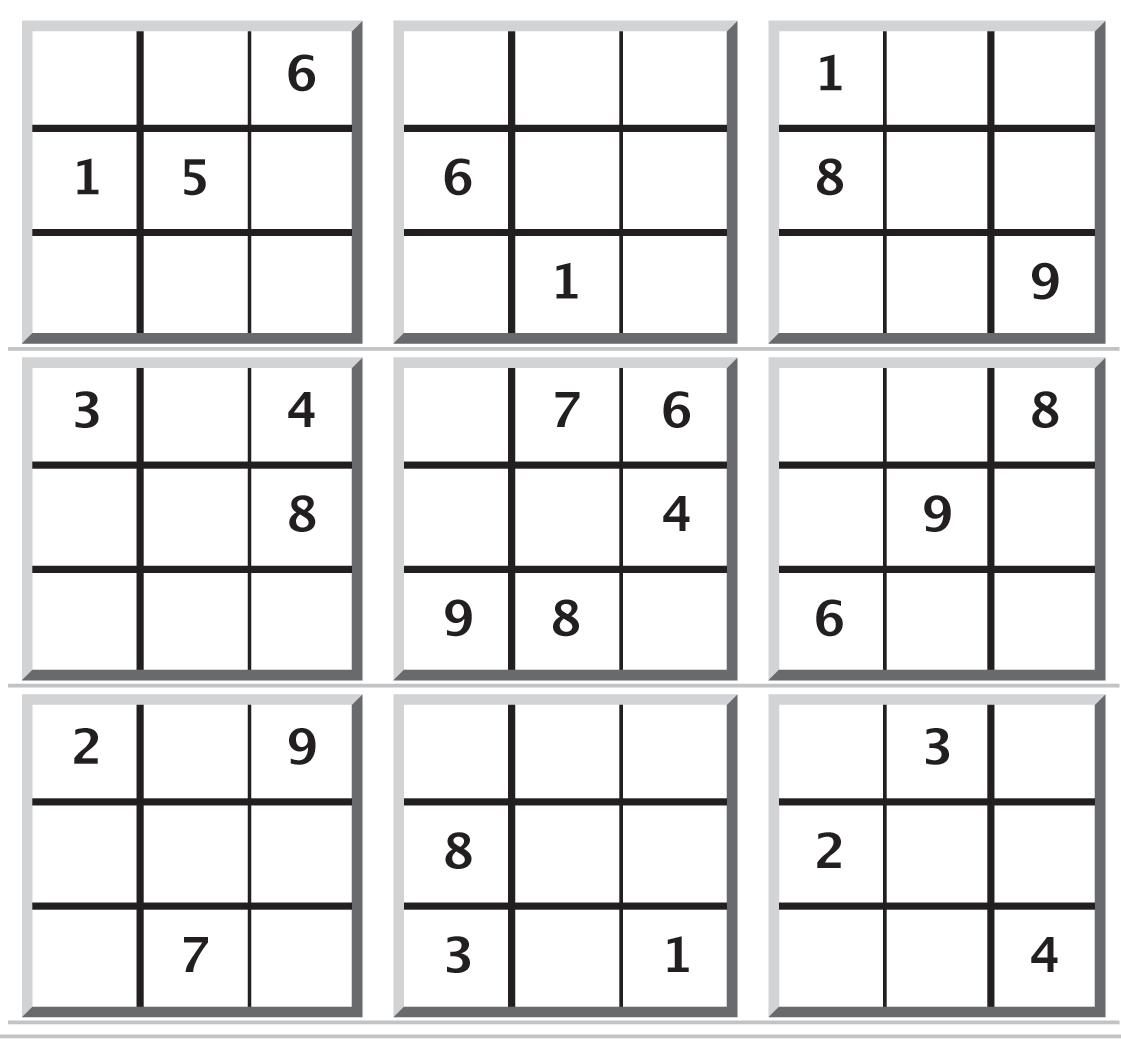
Fill in the empty cells, one number in each, so that each column, row, and region contains the numbers 1-9 exactly once. Each number in the solution therefore occurs only once in each of the three “directions,” hence the “single numbers” implied by the puzzle’s name. (Rules from wikipedia.org/wiki/ Sudoku)




2 & 3 BEDROOMS
109 SAGE PLACE
Available NOW, Spring 2019 & 2019/2020 Shuttle Bus Access to Campus Access to Free Fitness Center Novarr- Mackesey Property Management office@ithacastudentapartments.com ithacastudentapartments.com 607-277-1234
Collegetown Terrace Apartments INSPIRED LIVING TAILORED TO YOUR SUCCESS 24-Hour Fitness Center Shuttle Bus Service to Campus Study Rooms w/ Expansive Views Apartments Available NOW, Spring 2019 & 2019/2020 Novarr- Mackesey Property Management collegetownterraceithaca.com office@ithacastudentapartments.com 607-277-1234

Houses, Apts, Parking 1 to 9 Bedroom
Collegetown - College Ave, Linden Ave, Dryden Rd, Bryant Ave, Cook St. 607-330-2442 info@urbanithaca.com www.urbanithaca.com
Nicest



Around this time last year, Cornell men’s ice hockey was the No. 1 team in the nation. The Red was poised for a strong postseason run, both in the conference and NCAA playoffs. The squad looked like they could beat anyone.
This year, some may say otherwise. Now perched at No. 10, Cornell has double the amount of losses, receiving most of them at the hands of unimpressive opponents.
Wins and losses aside, however, this year’s Cornell men’s hockey squad has shown it may have just as much potential as the team that won the ECAC regular season and made the NCAA tournament last year.
First off, do not forget Cornell is still atop the ECAC standings — albeit by a slim margin. If the season were to end right now, the Red would have a home playoff series against the lowest seeded team remaining. In other words, a third-straight trip to Lake Placid for the ECAC semifinals is likely in the cards.
Yet, Cornell has four more losses than it did in all of last season at this point. That is pretty substantial in a set of 21 games. However, these losses are by no means indicative of the quality of this team.
The first two losses of the season came during the opening weekend at home against Michigan State. To put it bluntly, if this series was played now, or even a week or two later, Cornell would’ve taken care of the Spartans. Whether it was a combination of the Red’s rust, or Michigan State already having started its regular season, the 5-2 and 4-3 losses were truly irregular.
Shortly thereafter came the loss at home to Quinnipiac — currently ranked No. 4 in the country. Not only was this a loss
to a quality opponent, but the Bobcat’s winning goal was perhaps the most bizarre goal Cornell hockey fans have seen. The puck bounced off the boards, off Matt Galajda’s back, and into the Cornell net for a goal that gave Quinnipiac the lead, the momentum and eventually the win.
Cornell also faced a parade of injuries in November and December that resulted in a pair of losses, including another loss in-conference against Dartmouth.
And then there was the most recent loss to Colgate at home. Third-to-last in the ECAC and 45th in Pairwise Rankings, Colgate is not a team Cornell should be dropping losses to, especially at home. In this contest, Cornell outshot its opponent, 41 to 19, but still lost by a goal. A loss is a loss, but these metrics show that the Red outplayed the Raiders and that Cornell is a better team.
The same goes for the tie against RPI last weekend. Again, there was an absurd shot on goal disparity where Cornell put another whopping 40 on net, with Rensselaer only having 14. The result, just like the loss against Colgate, is not indicative of how the Red are playing currently.
Having said all of that, Cornell needs to start finishing their shots. The team faced a pair of goalies who had unbelievable performances. It happens. But scoring one goal on 41 shots will get this team nowhere if this becomes a regular occurrence.
But it’s clear that aside from opening weekend, a healthy Cornell squad has not been truly outplayed by another school.
Amongst all of this, Cornell has only allowed 2.05 goals per game, good for seventh in the nation. However, this was expected from a team that kept all of its defenders and goalie after sporting the country’s best defense in 2017-18. It was that defense that allowed Cornell to hang with any team last year, and it will be this same defense that does the same this year.
The rankings may not show it, but there is no reason this team cannot have just as much success as last year’s squad. Especially when it comes to postseason — the bar was set pretty low the last time around.

Read The Sun as soon as the sun rises.


A group of Cornell professors conducted a study that looked into whether Virtual Reality can be used to improve learning. In the study, people were assigned to comparison groups of hands-on, computer simulation and VR. Participants were to complete a tutorial in astronomy. Although 78 percent of participants believed that the VR option was their one of choice, the study showed that all three groups were equally effective in learning. The study’s senior author was Prof. Natasha Holmes, physics, and took place in the Virtual Embodiment Lab located in Mann Library.
On Monday, the Cortland County Court ruled Dorain Bohn guilty of second degree murder of a two-year-old girl. The girl was Kassidy Dains, the daughter of Bohn’s girlfriend at the time, Krystal Dains. Bohns was babysitting the child on April 9, 2018 when she was murdered due to a head injury. Investigators discovered a damaged area of wallboard in the apartment that was at the height of the child’s head. They also found a hair of hers in a crack of the wallboard. The court ruled Bohn guilty of second-degree murder, first-degree manslaughter and endangering the welfare of a child. He faces the maximum penalty of 25 years to life in prison.
On Wednesday, Mark Herring (D-Va.) admitted to wearing blackface while he was in college. Hours later, a woman came forward saying that Attorney General Justin Fairfax (D-Va.) sexually assaulted her in 2004. These developments are part of a long list of recent accusations against Virginia Democratic leadership. On Feb. 1, Virginia governor Ralph Northam (D-Va.) admitted to being in a medical school yearbook picture that depicted two individuals, one in blackface or as a Ku Klux Klan member. Members of the Democratic Party called for Northam to step down. If he does, next in line would be Fairfax and then Herring, but it may go further in the line of command if they have to also leave their positions, pundits say.
— Compiled by Alex Hale ’21
After a months-long recovery, Alex Green is ready to return to prior elite status

By ZACHARY SILVER Sun Senior Editor
Cornell men’s hockey defenseman Alex Green will be one of the first to tell you he was surprised by how his first collegiate season panned out in 2017-18: immediately thrust into top-four minutes, receiving valuable time on both special teams units and, most notably, being rewarded with an NHL draft selection by the Tampa Bay Lightning.
“I thought that I eventually thought I could get to this point, but I didn’t think it would be this soon,” he told Cornell Big Red in Nov. 2017 of his quick success last season. “I didn’t think I’d have this much of a role at this point, and I was kind of surprised, to be honest.”
Smith, who sat out Saturday’s game with an injury.
“I definitely think there was a little bit of a learning curve, but the team helped me readjust and I just tried to play simple,” Green said. “So it wasn’t anything crazy, but there was definitely a little bit of a learning curve.”
This was the first concussion of Green’s playing career and the longest recovery time he’s ever needed for an ailment, he said. Concussions are nothing new for Cornell, the NCAA and hockey players at every level. But this was a unique recovery that Green has never personally known, and one he knew he could not recover from quickly — as frustrating as it was.
“It was tough, it was really tough ... you can’t rush these things, obviously, because you only have one brain.”
Green’s previous prowess made his concussion in the third game of this season all the more frustrating. Not only had Cornell lost the first of what would become a handful of skaters in the first half of the season to injury, but it also lost an up-and-coming, top-four defenseman who was a staple of Cornell’s top-ranked defense a year ago.
Alex Green
“It was tough, it was really tough, but the medical staff told me you can’t rush these things, obviously, because you only have one brain,” Green said. “Unlike a shoulder injury or something of that nature, you can’t fight through a concussion, so it was kind of being patient and staying with the process. That’s how we approached things.”
of just a roller coaster of emotions up and down. That was definitely the hardest part.”
With so much lost time now in the rearview, Green’s focus is set on the future. As he makes his way back to full speed, he slots back into a defensive corps which is finding its identity from last season and now sits as the country’s No. 7-ranked unit in goals allowed per game, 2.05.
Personally for Green, improving his offensive capabilities has been the focus since resuming skating, and because he hasn’t had to worry about blindside hits from teammates in practice, he’s been able to take a mental step back, be patient with the puck and hone in on that area of his play.
“He’s been practicing a lot over the last month, so even the practices helped him because he hasn’t been able to be physical,” Schafer said. “So he’s had to use better technique as far as defensemen are concerned and be a little bit more patient. I think that’s helped his overall game.”
“I’m definitely looking forward to helping the team offensively,” Green added. “It’s definitely a goal of mine to be offensive, so I just have to pick back [up] where I left off before I got hurt.”
Shortly after picking up an assist on Cornell’s first goal in a Nov. 2 game against Yale, Green was sent head-over-heels while in the neutral zone, landing on his head before being stretchered off the ice. Early prognosis for the injury was positive — “All I can say is that it’s much better than what it looked,” associate head coach Ben Syer said at the time — but the recovery, as it can be with concussions, took much longer than originally anticipated.
Green returned as a full participant to practices by Dec. 27, according to head coach Mike Schafer ’86. After that, it was just waiting on medical clearance from the training staff.
It took another four weeks for his reentry to finally come, but Green was cleared to return to game action this past weekend against Union and RPI after missing 16 games and three months of play.
“It was definitely a sigh of relief,” Green said Tuesday of his long-awaited return. “It was a long time sitting up in the stands not playing, so it was a lot of fun to suit back up and play with the team.”
“I was happy for him. It’s been a long time since early in November for him,” Schafer said. “So now, [with] that consistency of practice and games, I think it’s hard to be out that long and you’re excited to get back into it. And now it’s about following gameplan and for him to get playing. It was exciting to see him get back into game action.”
Green’s first weekend back in action was nothing to write home about: a pair of shots on goal alongside a minus-one plus/minus and a minor penalty amid limited minutes as he eased back in. But Friday’s game represented both the end of a long, grueling recovery process and just the second time Cornell skated with a fully healthy defensive corps this season — albeit unaided by senior defenseman Brendan
“I think the toughest part was just some days you would feel really good and then the next day you would feel really crappy,” he added. “So it was kind

By SMITA NALLURI Sun Staff Writer
After putting on a show for the Lynah crowd and blanking both Union and RPI last weekend, No. 6/6 women’s hockey will hit the road this weekend to take on Clarkson and St. Lawrence in a pair of critical ECAC matchups.
The Red (16-2-5, 13-2-1 ECAC) currently sits atop the league standings at 27 points, but No. 4/4 Golden Knights (22-51, 13-3-0 ECAC) are clipping at their heels with 26 points. The Saints (13-12-3, 8-6-2 ECAC) are in fifth with 18 points.
With the ECAC tournament looming large in three weeks and the opportunity for the Red to host at stake, this weekend provides a key opportunity to pick up points.
Cornell has plenty of momentum heading into the matches: It won its last eight games straight and averaged a whopping 4.5 goals per game. Half of those last eight matches have also been shutouts. The Red also upended both Clarkson and St. Lawrence in early December.
“[I’m] super excited to see what this team can do in the tail end of the season,” said junior forward co-captain and ECAC player of the week Kristin O’Neill. “We’re trying to stay in the moment and not look too far ahead, but playoff hockey is around the cor-
ner and I couldn’t be more confident in our group.”
Riding an eight-game winning streak of its own, however, reigning national champion Clarkson still proves to be a formidable opponent. The Red will look to tarnish the Golden Knights’ unblemished home record by focusing on its own defense and special teams to shut down Clarkson’s prolific offense, which has matched the Red in averaging 4.5 goals per game.
“Clarkson will definitely be a good test of where we’re at, especially playing on the road at Cheel Arena,” said senior forward Lenka Serdar. “We know that Clarkson and St. Lawrence are talented offensively and we must be disciplined in our team defense to have success.”




The Red will trek from Potsdam to Canton to take on the Saints on Saturday. The significance of these two league games is not lost on Cornell’s skaters, whose eyes are trained on the standings.
“We obviously know how important these two games are for us,” O’Neill said. “So I think keeping in mind that the out-
come of the games could potentially allow us to remain at the top of the ECAC is super important.”
Gametime is at 6 p.m. on Friday at Cheel Arena against Clarkson and at 3 p.m.
on Saturday at Appleton Arena against St. Lawrence.
Smita Nalluri can be reached at snalluri@cornellsun.com.
By RAPHY GENDLER Sun Assistant Sports Editor
In two of its last four games, Cornell hasn’t been able to outsmart goaltenders who dominated between the pipes as the Red’s hot streak hit a couple bumps.
This weekend, No. 10/9 Cornell men’s hockey will take on a netminder who gave it headaches last year — a goaltender who plays for one of the ECAC’s best teams, not a squad occupying the bottom quarter of the standings like the last two hot goalies Cornell has run into.
In two games against now-No. 9/10 Clarkson last season, Cornell scored zero total goals against Golden Knights goaltender Jake Kielly in
a 4-0 loss and a 0-0 tie. This weekend, Cornell, occupying first place in the conference standings by a slim margin, welcomes Kielly and the Golden Knights to Lynah Rink.
“Last year, we didn’t play well against them at home and they took it to us pretty good here early in the year,” said head coach Mike Schafer ’86 of his team’s Nov. 2017 loss to Clarkson, its first of the season.
“Watching the video of it, [the 0-0 tie] was a really good hockey game. Both goaltenders played outstanding and the game could’ve easily been 3-3 or 4-4.”
With 20 points in the league standings to Clarkson’s 18, Friday’s contest represents a chance for Cornell to earn some breathing room — or to lose its grip on the top spot. Only two points separate the first and fifth-place teams.

“These are two big ECAC points against Clarkson and then two more points against St. Lawrence so we definitely want to create some separation in the standings,” said sophomore defenseman Alex Green, who returned to the lineup last weekend after missing three months with a concussion.
Clarkson, coached by Cornell alumnus Casey Jones ’90, won eight straight games in late December and January.
Like Cornell, the Golden Knights appeared to be hitting their stride
before a couple of hiccups — losses to Harvard two weekends ago and Quinnipiac last weekend — interrupted their hot streak as the regular season reaches its final month.
The Red rode an eight-game unbeaten streak into a Jan. 26 meeting with Colgate, where Raiders goalie Mitch Benson robbed Cornell on its home ice and led the visitors to a 3-2 overtime win. Last weekend, after a 4-0 beatdown of Union, Cornell was stymied by Rensselaer goaltender Owen Savory, who made 40 saves in a 1-1 tie.
Cornell is prepared to face another top-tier goaltender on Friday night.
“If the goalie’s hot, you just gotta get in front of him,” said sophomore forward Tristan Mullin. “He can’t stop what he can’t see … Get in front of him [and] take away his eyes.”
league wins on the season. One of them was a 4-2 win over Clarkson that was the Golden Knights’ last loss before their eight-game winning streak. St. Lawrence is currently 59th — second to last — in the PairWise Rankings (Cornell and Clarkson are 10th and 12th, respectively).
“Last time we played [Clarkson] at home they gave us a beating,” Mullin said. “With St. Lawrence, it’s college hockey, you can’t take any
Schafer said his team needs to establish its net-front presence and force opposing goaltenders to move “east-west.”
“[Kielly] has just been outstanding in the games we’ve played,” Schafer said. “[Savory] played well [for] RPI but I didn’t think that we did a great job of having traffic in front of him and showing a lot of poise around the net on our rebound opportunities.”
On Saturday, Cornell’s focus will shift to the ECAC’s cellar-dweller, St. Lawrence. The Saints have just two
team lightly; I think you saw that with RPI.”
With only eight games remaining in the regular season, Schafer is prepared for hard-fought battles. Though still banged up, the Red is nearing full health — but freshman forward Max Andreev is out at least a few more weeks and senior defenseman Brendan Smith is banged up. It’s unclear when junior forward Noah Bauld will return to the lineup.
“We took Monday off … to get rejuvenated for the stretch drive,” Schafer said. “Clarkson and St. Lawrence are two teams that play really, really hard, as does everybody this time of year.”
As it gears up to face one of the conference’s best goalies — Kielly’s 1.85 goals against average is second in the league; his .931 save percentage is third — Cornell seems to be nearing the end of its months-long goalie battle.
Sophomore Matt Galajda, who went down with an injury in late November and ceded the starting role to classmate Austin McGrath, spent several weeks splitting starts with the one-time backup. But after shutting out Union last weekend, Galajda started against RPI the next day, making his first consecutive starts since Nov. 17 and 24.
“[Galajda’s] had success and that breeds the confidence,” Schafer said. “In practice, Austin is a big part of his success. Austin has played well and I’ve always said, when Matt competes … his play gets sharper. With Austin playing well and doing a great job, I think Matt has stepped up his game.”
While the bench boss still plans to “play it by ear” for another week or two, Schafer said he’ll have “one guy” when Cornell plays its final regular season home games Feb. 22 and 23.
Puck drop at Lynah Rink is set for 7 p.m. Friday against Clarkson and 7 p.m. Saturday against St. Lawrence.
Raphy Gendler can be reached at rgendler@cornellsun.com.