The Corne¬ Daily Sun
‘A

‘A
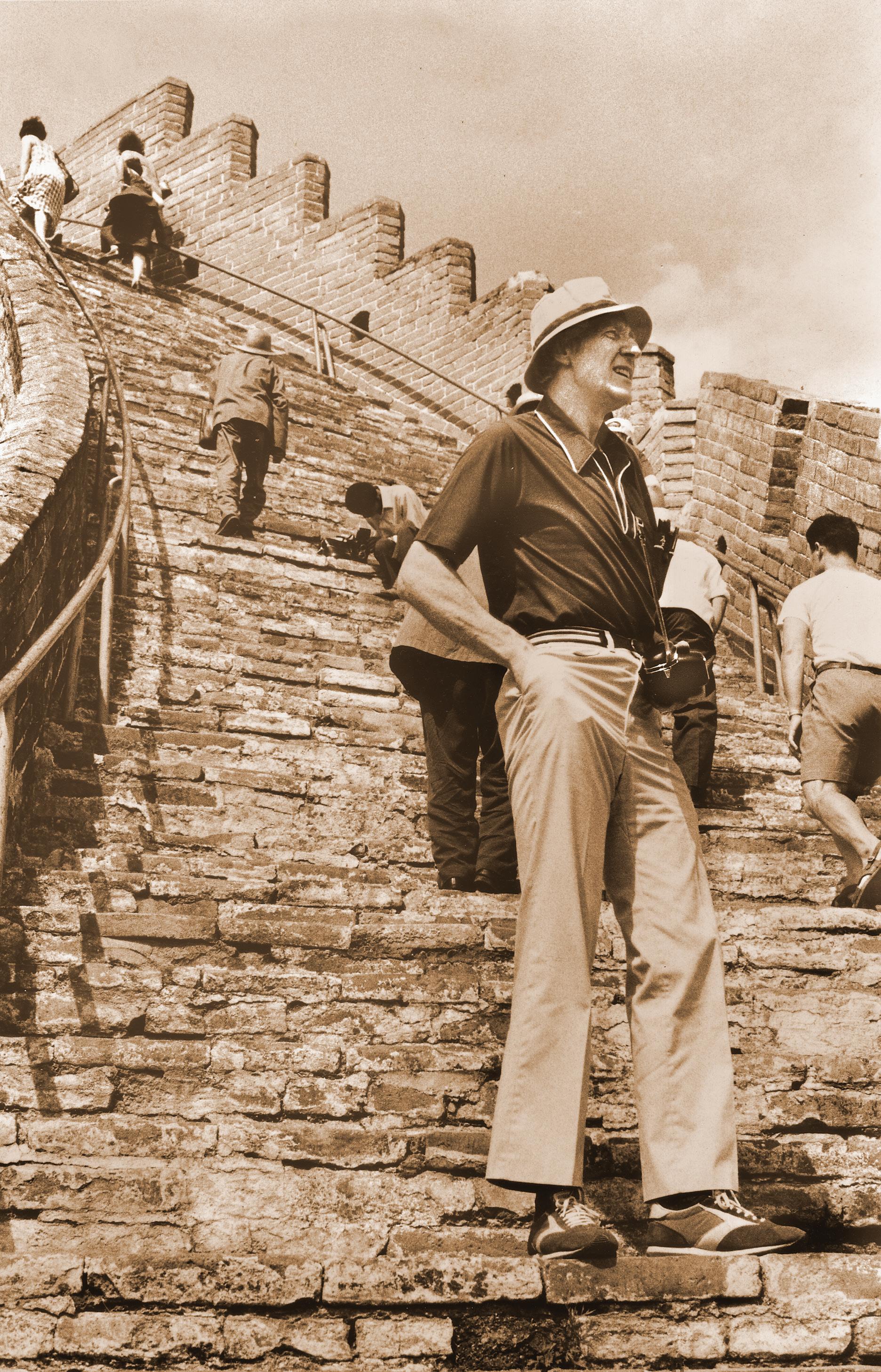
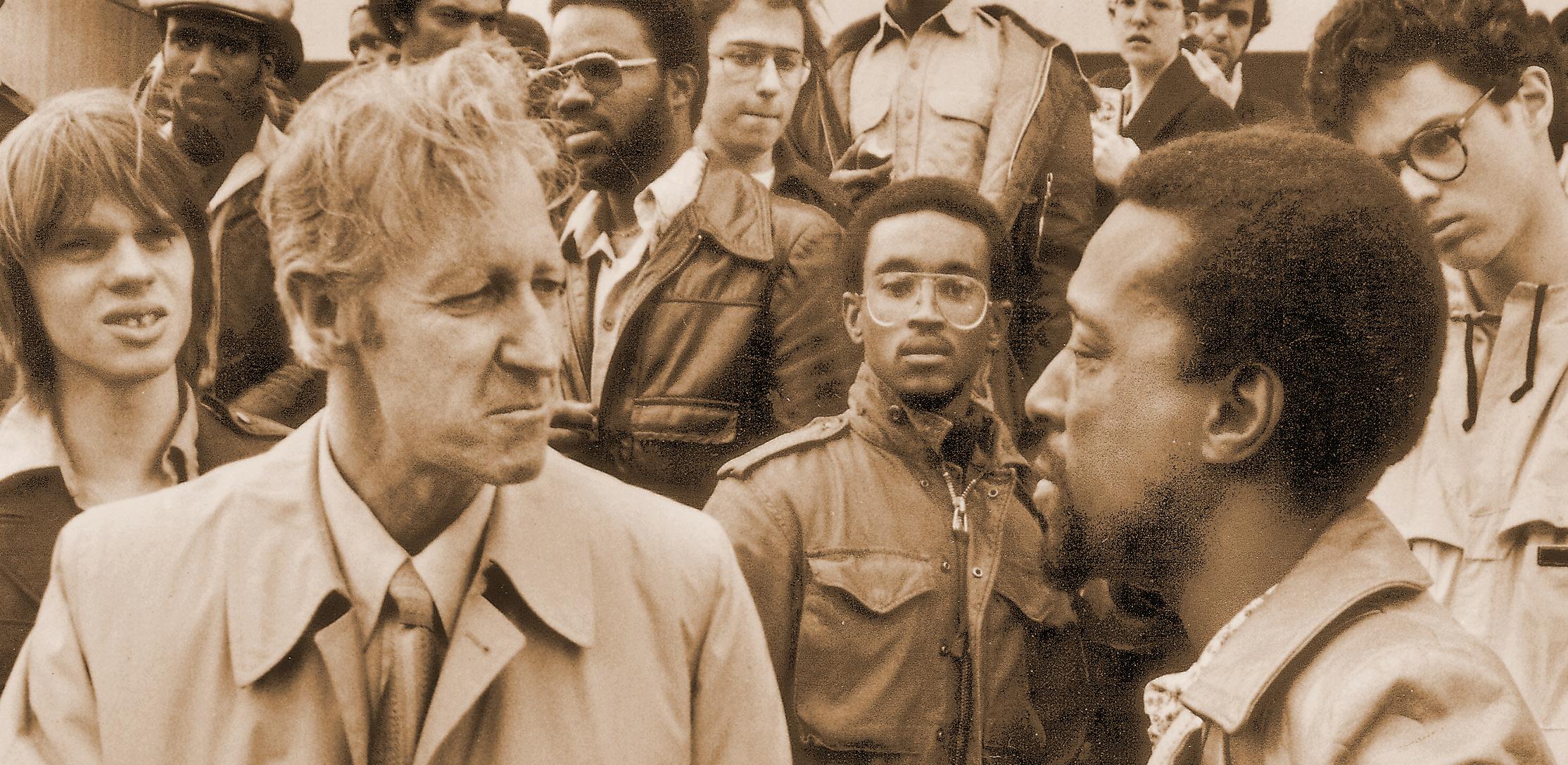
A part of history | Above: President Rhodes stands on steps of the Great Wall of China in July 1980, part of a 10-member Cornell delegation seeking to re-establish ties with the mainland after the Chinese Revolution. Right: President Rhodes glares at Africana Center director James E. Turner after 200 students forcibly detained Rhodes and other trustees in the
of Art in April 1978. The students were protesting against a possible re-evaluation of the center’s status.
University’s ninth president oversaw increased diversity, led unprecedented fundraising success
By MEGHNA MAHARISHI Sun Staff Writer
After it was announced on Tuesday that former Cornell President Frank H.T. Rhodes died, scores of Cornellians mourned the loss. Cornell’s ninth president died Monday night in Bonita Springs, Florida. He was 93.
“Frank Rhodes was a brilliant scholar and a gracious leader who was not only deeply respected, but truly loved by generations of Cornellians,” said President Martha E. Pollack in a University press release.
ty and administrators on Rhodes’ lasting impact on Cornell.
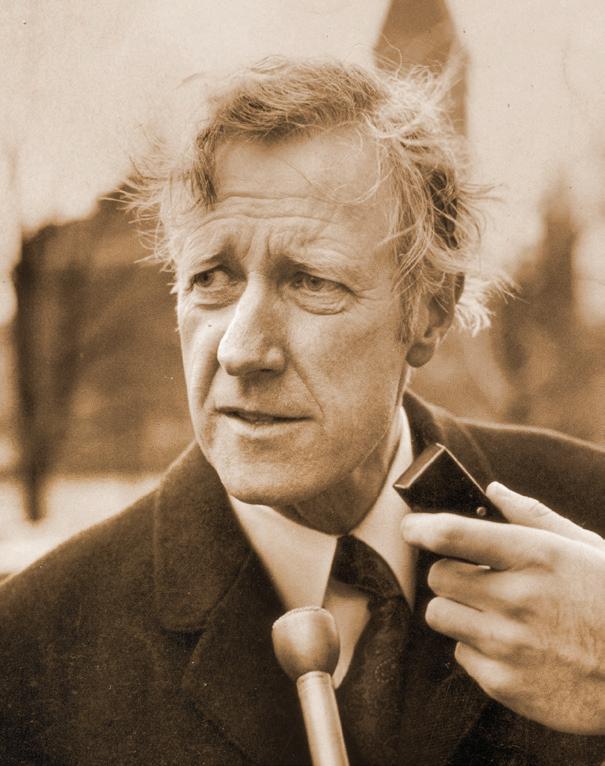
Glenn Altschuler Ph.D. ’76, American studies and dean of the School of Continuing Education and Summer Sessions, commented on the former president’s polite demeanor on a condolences page — which is filled with responses from alumni, facul-
“It was a graciousness that included time he spent chatting with my mom, when he encountered us at Sunday brunch at Banfi’s; that extended … to dayto-day kindnesses that are too little in evidence in 2020,” Altschuler wrote.
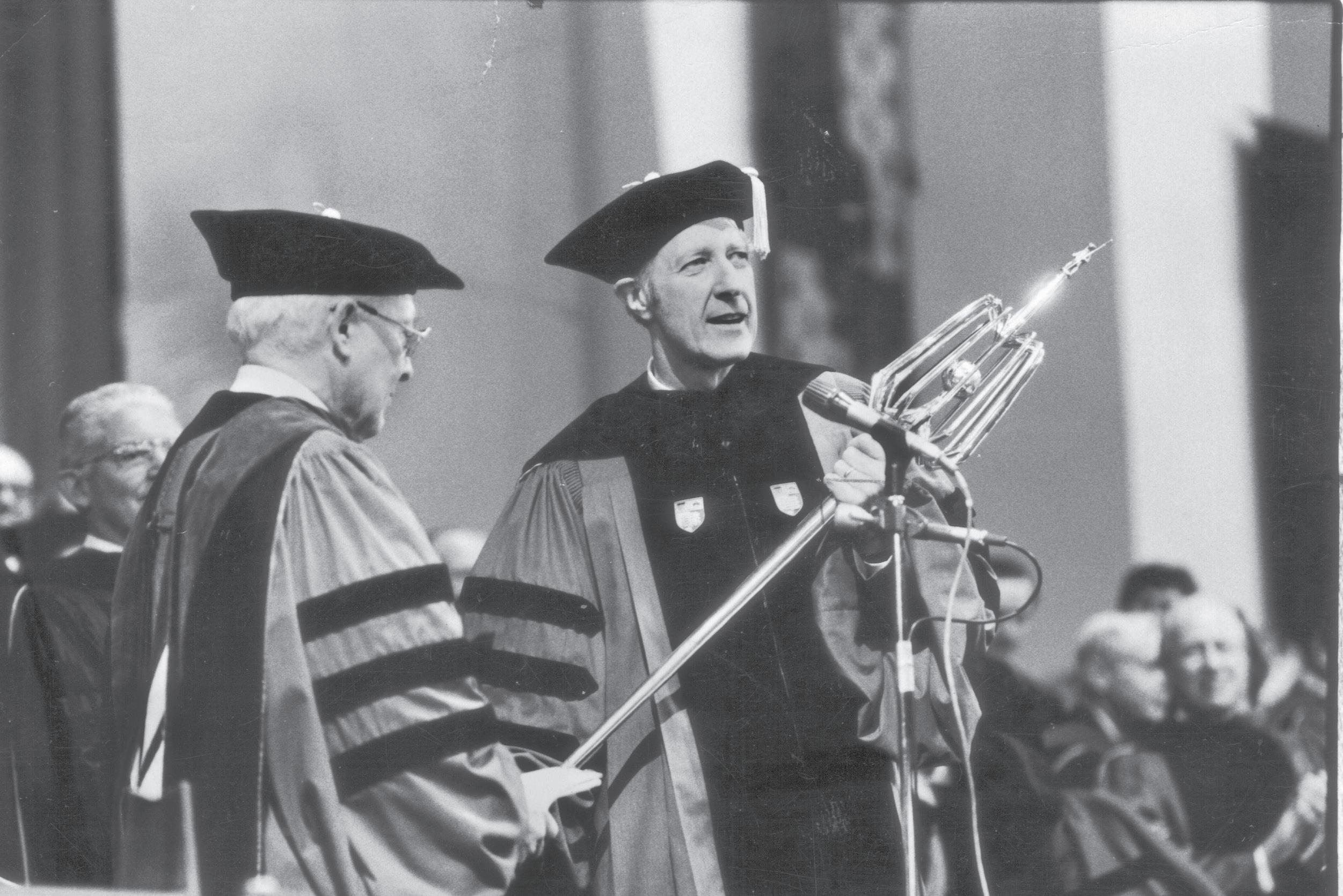
Regarded by many as one of Cornell’s greatest presidents, Rhodes served as the University’s ninth president from 1977 to 1995 — making him one of the longest-serving presidents at Cornell and in the Ivy League. Once Rhodes was inaugurated president, he dedicated the rest of his life to the University.
In his 1977 inaugural speech, Rhodes first spoke of this lifelong commitment to a crowd of 6,000 guests at
By KATHRYN STAMM Sun Staff Writer
With the final winner of the Iowa caucus still unconfirmed as of late Wednesday night, investigations into what went wrong have revealed a Cornell connection.
In December, Seth Klarman ’79, the namesake of Klarman Hall, donated $1.5 million to Pacronym — one of the groups tied to an app that many have blamed for the missteps in the Iowa caucus — just over a month ago, according to the Federal Election Commission.
As of Wednesday night with 97 percent of precincts reporting, Mayor Pete Buttigieg narrowly led the state-equivalent delegate
count with 26.2 percent, as Sen. Bernie Sanders (I-Vt.) trailed behind at 26.1 percent.
The Iowa caucus has been at the center of controversy regard-
ing the botched implementation of a vote-counting app, which delayed its results by days. While votes were supposed to be finalized by Monday night,

a winner was not declared as of Wednesday night — causing many to blame an app the Iowa Democratic Party commissioned to tabulate the results.
The app had not been previously tested on a statewide scale, and on the night of the caucuses, precinct officials confronted a wide variety of issues, including technical glitches, difficulties downloading it and even inability to log in. While officials could instead manually call in results by phone, an overwhelmed hotline led to what most political commentators widely called “unprecedented” disarray.
The company that developed the fledgling app, Shadow, was
The Ithaca Fire Department rescued a woman from Six Mile Creek Gorge near First Dam at around 3 p.m. on Wednesday afternoon.
The older woman had fallen down a 40-foot embankment, Ithaca Police Department Assistant Chief Thomas Basher said in a press release. She was



By SEAN O’CONNELL Sun Staff Writer
Many clubs tend to struggle with the Student Activities Funding Commission’s strict rules when receiving funding from the organization, which is entrusted with bankrolling Cornell’s more than 550 clubs.
The Student Assembly recently attempted to loosen those rules by voting to increase the student activity fee — an expense students pay to support on-campus organizations — from $234 to $321 in December 2019.
This fee, which is meant to provide “financial support to student organizations for their programming,” is charged to every undergraduate student.
The majority of this fee increase — $61 out of the $97 hike proposed by S.A. — is earmarked for SAFC to address a climbing mismatch between club funding requests and the commission’s ability to fulfill them.
SAFC is responsible for funding almost all of Cornell’s student-run groups, ranging from club sports teams to a capella groups.
“A lot of organizations would not get their full budget, because there was $1 million that was requested that SAFC just didn’t have,” Moriah Adeghe ’21, S.A. vice president of finance, told The Sun.
The mismatch had reached almost $1 million by December 2019, according to the budget resolution. SAFC planned to address this by enacting policies changing the club allocation approval process, lengthening the window for budget requests from three weeks to three months and taking those requests on a rolling basis.
“We have been working hard since the beginning of the school year to rectify the SAFC guidelines and funding process,”
Heather Huh ’20, co-chair of SAFC, wrote in an email

to The Sun.
The student activity fee increase would finance new policies, along with relaxed funding guidelines, that streamline the budget request process of the clubs that rely on SAFC.
“We are very excited about the changes that we will be proposing,” Huh said. “[We] hope that student groups understand that the fee increase will greatly benefit their functions and activities in the future.”
Also included in the student activities fee increase was an increase in the S.A. “special projects” fund, which finances events on campus that wouldn’t normally be covered by a regular SAFC budget, according to Adeghe.
By MEGHANA SRIVASTAVA Sun Staff Writer
Cornellians looking for an omelette or pancakes just lost another late-night staple: Denny’s abruptly closed last Thursday after six years of operation — without notifying the public or its employees.
“It is of sincerest regret to inform you that Denny’s of Ithaca is unfortunately closed permanently,” said a sign plastered on the store’s main entrance on Jan. 30. “We could not be more thankful for the opportunity to serve the wonderful people of Ithaca over the years.”
The decision to close the Ithaca Denny’s closely followed the shuttering of the diner’s New Hartford, New York branch, which greeted
customers with a similar sign on Jan. 5, according to a Central New York radio station.
Both locations seem to have provided minimal notice of the closing to employees.
The New Hartford location alerted its employees just two days before the closing, a Utica resident wrote on Facebook. A similar post claimed that the head chef at the Ithaca location was not given any notice before the location closed its doors.
“Denny’s can confirm that this location has closed, but we do not have additional information at this time,” Ashley Kraynak, a Denny’s spokesperson, wrote to The Sun.
The number of diners in Ithaca, and their hours of operation, have
also consistently declined in the past few years. Manos Diner closed in 2014 after 52 years of operation, and Friendly’s relocated across town in 2013, allowing Denny’s to set up shop in its old location.
The State Diner was the other 24/7 diner in Ithaca, but it reduced its hours in 2013 to 6:00 a.m. to 10:00 p.m., after a fire ravaged the building in 2012.
Denny’s closure leaves Ithaca with only three greasy spoons: The State Diner, the Lincoln Street Diner and the Angelhearts Diner.

The most recent of these projects was when the Cornell Lending Library requested $5,000 for its new travel grant, aimed at providing financial support to students who could not afford transportation to pre-professional training and exams. The S.A. unanimously approved the request at last Thursday’s meeting.
“$100 is a lot,” Adeghe said, “[But] now your club is getting the amount that they requested instead of nothing.”
RHODES
Continued from page 1
Barton Hall on Nov. 10, 1977.
“I can promise no certain success and no simple solutions,” Rhodes said. “For hard times lie ahead for all of higher education. And hard choices lie ahead for Cornell. What I can promise is my absolute commitment to the overall welfare of Cornell and to the well-being of its several parts.”
One of the hallmarks of the ninth president’s tenure was his efforts to bolster student and faculty diversity at the University. The number of minority and women faculty doubled during his tenure, while the percentage of minority students increased from 8 percent in 1977 to 28 percent in 1994.
Another one of Rhodes’ major endeavors was an ambitious $1.5 billion fundraising campaign — something nearly unheard of for major universities at the time. The University was able to raise $1 billion ahead of schedule because of Rhodes’ efforts to strengthen financial aid, educational programs and libraries.
The esteemed scholar also saw the establishment of many major buildings — continuously used by students and faculty alike — on campus. Under Rhodes’ administration, the supercomputing center, the Statler teaching hotel, the Schwartz Center for Performing Arts, the Carl A. Kroch Library, Snee Hall and Akwe:kon were among those constructed under his leadership.
While tackling the duties of University president, Rhodes also played an integral role in shaping national science policy under several U.S. presidents. The former
“No one else would have allowed the history department to build a shower in McGraw for me.”
Prof. L. Pearce Williams ’49 Ph.D. ’52
Cornell president served on the National Science Board under President Ronald Reagan, and was also a former chairman of the board.
According to a Nov. 14, 1980 Sun article, Rhodes was even tapped to serve as Secretary of the Department of Education for a newly-elected Reagan. At the time, Rhodes had planned to resign from the presidency, prompting the University to assemble a committee to find a successor.
When Rhodes announced he would leave Cornell to serve in Reagan’s cabinet, faculty told The Sun that the loss would be felt on campus.
“Rhodes was the best president Cornell has had since I began teaching here,” Prof. L. Pearce Williams ’49 Ph.D. ’52, history, told The Sun in 1980. “No one else would have allowed the history department to build a shower in McGraw for me.”
Ultimately, Rhodes stayed at Cornell, and the position went to political theorist and conservative pundit William Bennett. The former University president went
on to serve Reagan’s successor, George H.W. Bush, as an advisor in the President’s Educational Policy Advisory Committee.
While Rhodes remained popular with Cornellians for the duration of his presidency, he sometimes ran into controversy with students. At the height of activism against South Africa’s apartheid, students stormed Rhodes’ office, urging the University to divest from its relationship with the country. Ultimately, Cornell did not completely cut ties with South Africa.
In 1993 — inspired by the 1969 Willard Straight Hall Takeover — students occupied Day Hall in light of a vandalism incident against a display of artwork by a Chicano artist on the Arts Quad. Rhodes agreed to hear the students’ demands four days into the occupation.
Despite the controversies, the ninth president was a revered figure on campus. His 1995 retirement celebration included a parade, a horse-drawn carriage from Day Hall to Barton Hall and more than 200 student groups, athletic teams and University departments attended.
Rhodes was born on Oct. 29, 1926 in Warwickshire, England. He graduated in 1948 from the University of Birmingham with a Bachelors of Science in geology, and went on to earn three other degrees from the British university. The former president was also a Fulbright Scholar, spending a year at the University of Illinois.
Prior to his arrival at Cornell, Rhodes was a professor in geology and mineralogy at the University of Michigan. At Michigan, Rhodes rose up the ranks — becoming the dean of the University’s College of Arts, Sciences and Letters and eventually served as the vice president of academic affairs.
Even after Rhodes retired in 1995, his presence could still be felt on Cornell’s campus. Upon his retirement, the Board of Trustees renamed the Cornell Theory Center to Frank H.T. Rhodes Hall. After his presidency, Rhodes continued to serve as a professor emeritus in geology.
In 2011, the University also created a postdoctoral fellowship in Rhodes’ name to support research in poverty alleviation, public health, human rights and supporting elderly and disadvantaged children. Every year, the University also bestows the Frank H.T. Rhodes Exemplary Alumni Award to alumni who have dedicated their time to Cornell post-graduation.
“What I can promise is my absolute commitment to the overall welfare of Cornell ... ”
President Frank H.T. Rhodes
After retirement, Rhodes split his time between Florida and Ithaca, commenting in a May 2015 interview that he was “enjoying the sunshine.” Rhodes is survived by his wife, Rosa, four daughters, 11 grandchildren and one great-granddaughter. A date for a memorial on campus has yet to be announced.
Meghna Maharishi can be reached at mmaharishi@cornellsun.com.
KLARMAN
Continued from page 1
contracted by the Iowa Democratic Party. Shadow, in turn, received investments from Acronym, the nonprofit that mothered super PAC Pacronym. Klarman’s $1.5 million donation to Pacronym is his most recent in a long line of political donations that have included candidates across the aisle.
Super PAC Pacronym, which aims to run a major digital campaign against President Donald Trump, was launched by Acronym. Acronym itself was born in the wake of the 2016 election, founded with the goal of advancing digital advertising for Democrats, especially on Facebook and Google.
Acronym has invested in “several for-profit companies across the progressive media and technology sectors,” including Shadow, the company that developed the app commissioned by the Iowa Democratic Party, the organization’s spokesperson Kyle Tharp wrote in a statement. Tharp
added that the company was not directly involved in the Iowa caucus.
“We determined with certainty that the underlying data collected via the app was sound,” Iowa Democratic Party chair Troy Price wrote in a statement Tuesday morning. “While the app was recording data accurately, it was reporting out only partial data.”
“We have determined that this was due to a coding issue in the reporting system,” Price wrote.
As results started to trickle in, the IDP realized there were inconsistencies in the reports, which prompted party officials to order precinct chairs to enter data in manually, according to Price.
“The underlying data and collection process via Shadow's mobile caucus app was sound and accurate,”
Gerard Niemira, Shadow’s CEO, wrote in a statement on the app’s website. “But our process to transmit that caucus results data generated via the app to the IDP was not.”
Shadow worked to resolve the issue and has since corrected the under-
lying technology system, according to Niemira, who was also a product director for Hillary Clinton’s 2016 presidential campaign.
Klarman has been a significant benefactor of the University since his graduation, endowing the home of the romance languages department and more recently, the Klarman Fellowship Program.
Klarman Hall, which opened in January 2016 after two years of construction, cost the University $61 million. According to 2013 tax returns, the Klarman Family Foundation donated $26 million to Cornell to “expand access to critical services and enrichment opportunities.”
The billionaire hedge fund manager has also been a frequent donor to political campaigns — contributing to candidates on both sides of the aisle, from Sen. Mitt Romney (R-Ut.) to former President Bill Clinton.
Kathryn Stamm can be reached at kstamm@cornellsun.com.
RESCUE
Continued from page 1
stuck near Treva Avenue and Giles Street — in an area inaccessible to trails.
The woman had been stranded for some time before a passerby heard her calls, who then called 911, the release stated. By that time, she was “cold and exhausted.” Ithaca temperatures reached around 27 degrees Fahrenheit on Wednesday.
The Ithaca Fire Department rappelled down using a rope system to pull her from the embankment, treating some of her injuries on the ground before haul-
ing her up with assistance from the Ithaca Police Department and Bangs Ambulance. She was taken to a local hospital for treatment. This was at least the fourth rescue from Six Mile Creek in the past three years. In August 2018, officials rescued a woman who fell near First Dam and a college-age man who became exhausted while swimming. In April 2019, a man fell into the creek and had to be pulled out by firefighters in rescue suits.
Sarah Skinner can be reached at sskinner@cornellsun.
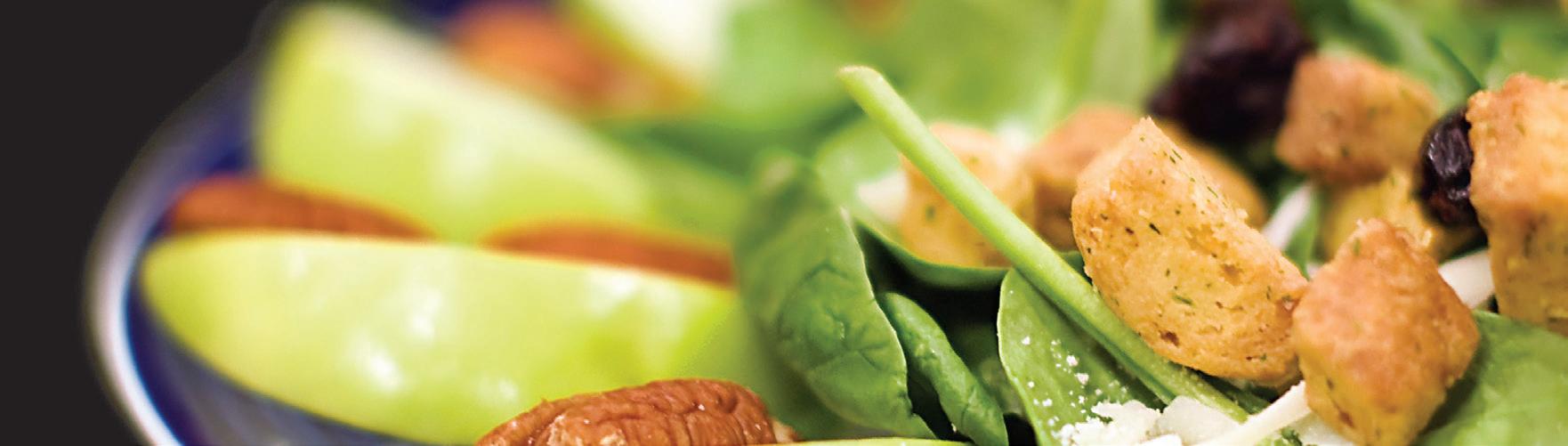
By ISABELLE RIQUELME Sun Contributor
As a lawyer, my father traveled to other parts of Perú and even other countries following different judicial cases of interest, and he loved every day of his job. Whenever my father came back, he always brought interesting travel stories and sometimes even food. He was a firm believer in buying in bulk from people who lived nearby the sea or those who farmed. He loved seafood so much that he wished he could eat it every day, but he knew that it was not possible since he could not stop by the seafood market in Callao, Perú daily.
Whenever he travelled by the coast, he would bring fresh fish back. He shopped for fish from his friend Pepe who went out to the sea every three days. For my father, it was the best fresh food he could eat. There were a few times when I met Pepe, and I thanked him because his fish always tasted the best. He promised to one day take me with him, so I could learn more about fishing.
The day Pepe took my sister, my father and me fishing, he explained to us that the sea can kill. When Pepe’s father first brought him to sea, it was cloudy and it looked like it was going to rain. His father explained to him that fishing should only be for necessity — that we should not take too many lives from the sea. Pepe explained that is why he only sells fish on Wednesday. He fishes only for a few days and fish-selling is not his source of money but rather a hobby. Pepe explained the significance of fishing in his life. My father made sure to mention that it is always important to pray before a meal. Pepe agreed with him, saying that the more we pray, the more good luck we will have, and the more the sea will allow us to take a few fish.
Similarly, my grandfather prays before he eats, and he always says, “Y muchas gracias a todo el trabajo
y las personas que hicieron este plato de comida posible.” He is one of the few food-conscious people that I know, and he probably doesn’t realize it because to him it’s just a lifestyle. He loves farming so much that when he first moved to the U.S., he farmed in the back of the house until he realized the climate was no good.
... he told me that maca is one of the best foods you can have for breakfast; it makes you stronger and it’s cheap.
On one of my trips to Perú, I was staying with my grandparents for a few days since my parents had gone back to the States. I looked around for my grandfather. I spotted my grandmother sitting on the couch, and I kissed her forehead and smiled at her. I sat for a bit until I heard my grandfather from the kitchen washing his dishes, so I surprised him. He smiled at me as I walked in with my pajamas on and asked, “Estabas durmiendo tan bien. ¿Que quieres comer?” I thought about what I wanted to eat. It was almost noon and I was craving lunch, but I felt bad because my grandpa probably made breakfast for me. I told him to give me anything he made for breakfast and that I would be with my grandmother talking.
I sat with my grandmother as she stared at the TV in the living room, and I joked around about how she looked like she was in her twenties. My grandfather came with a bowl of maca and some bread with butter on the side. He sat next to us as he passed the food to me, and he told me that maca is one of the best foods you can have
for breakfast; it makes you stronger and it’s cheap. My grandfather gets his maca from his neighbors in Pomacocha, Perú, and he always says how it’s one of the healthiest breakfasts, and it gives us energy.
The stories of his life in Pomacocha brighten his face, and he starts to talk about how he loved having cows and crops; it was really satisfying knowing you made what you eat. Where he lived, most of the food would be potatoes and cheese, with meat once in a blue moon. He also told me about how much cheaper it is to buy things from actual farmers and how expensive things are in the city. My grandfather probably doesn’t realize it but he is basically vegetarian except for holidays because he rarely eats meat; he prefers corn, cheese and potatoes.
When I go back to Perú, I notice the difference between the food I eat there and the food in New York City. No organic food can ever compare to the freshness of the vegetables and fruits of Perú, but it’s also very hard for my family to access organic food because it is very expensive. In Animal Factory it is mentioned that, “... factory-farmed meat, milk and eggs are usually consid-
No organic food can ever compare to the freshness of the vegetables and fruits of Perú ...
erably more affordable than their organic, free-range, or ‘sustainably produced’ counterparts.”
I always feel bad, but the cheapest and most accessible foods are sometimes the most unhealthy. I try to eat less meat because that is the only food-conscious way for me when I am on a budget.
MERIDITH

Recently, when I went back to New York City for fall break, I saw my mom starting again to thank God and pray before a meal. This reminded me of when we visited my godmother’s house in the city, and she said we had to read a prayer before a meal and handed me a prayer to read. The memories of when I used to do this as a kid came back to me and it made me think about why I don’t do it anymore. Looking back at this made
me wonder how God’s influence on my family helped us be more food-conscious by at least appreciating the people who made the meal possible. I have slowly started to think more about making this a part of my daily life — to thank the people who made the food possible.


There were a lot of ways Nike could have chosen to approach this Super Bowl. With the 49ers playing, they could have revisited their Colin Kaepernick campaign. They could have hoped that their status as sponsor of the NFL’s jerseys was sufficient advertising. They could have released an ad packed with celebrities like many other brands during the Super Bowl. But instead, Nike chose to advertise subtly, to the point where you might not have caught it if you weren’t looking for it.
The first thing I noticed when watching the Super Bowl was some of the players’ choice of footwear. In the NFL, the most popular players will often wear cleats customized with artwork of their choosing. However, it’s usually difficult to see exactly what is painted on each player’s cleats, because it’s relatively difficult to make out the details that make the artwork stand out. Kansas City Chiefs running back Damien Williams expertly subverted this by customizing his cleats to look exactly like the Chicago colorway of the Air Jordan 1. I very rarely notice football cleats because they can’t be worn off the field, but these immediately caught my eye. Here I was watching the most important football game of the year, wondering how Nike decided to give Williams one of the most recognizable silhouettes and colorways in sneaker history. This is the same colorway and style that Michael Jordan wore in his early days with the Chicago Bulls, and revamping it for Super Bowl LIV is a major statement of support towards the Kansas City Chiefs.
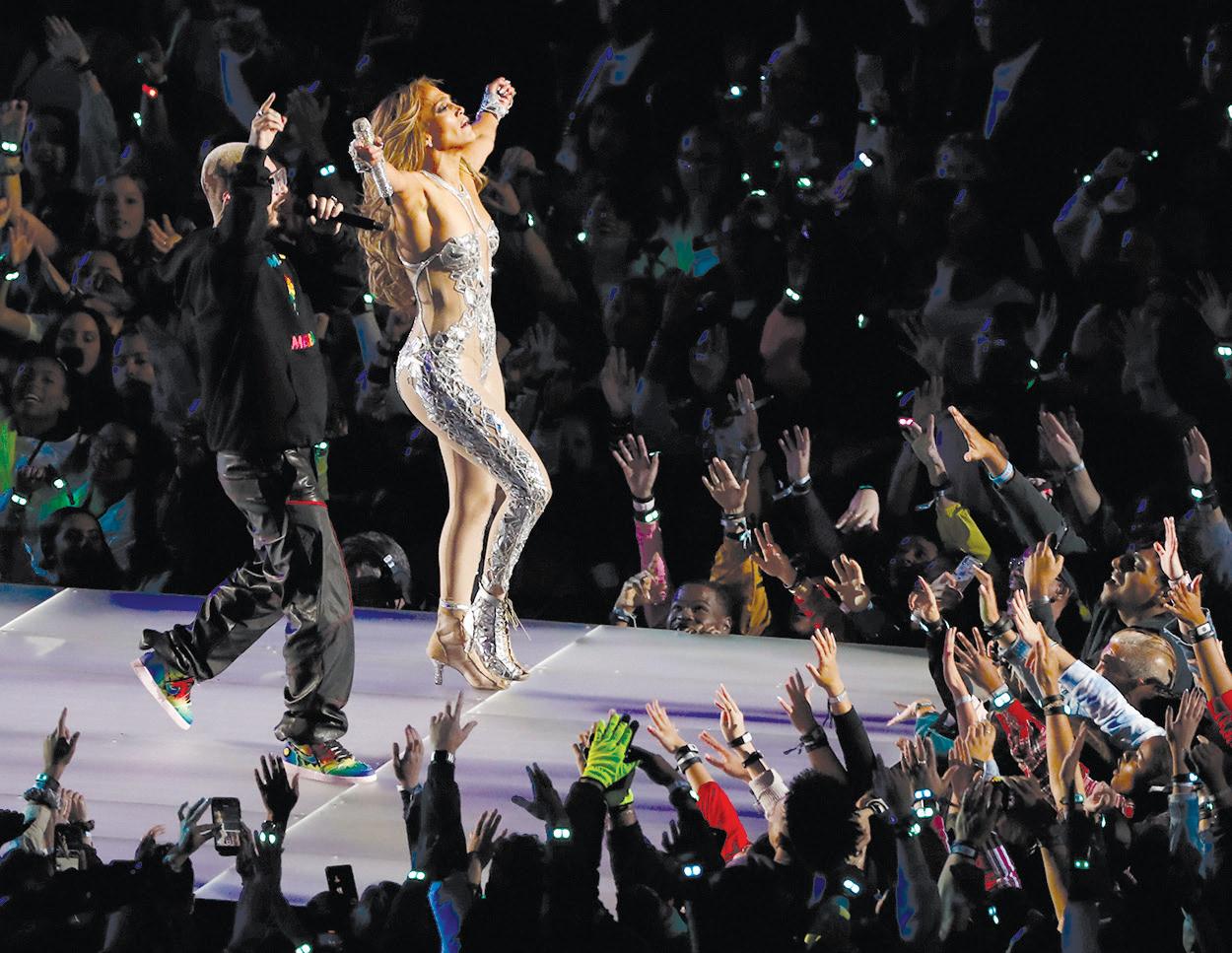
Come halftime, Nike managed to steal my attention again. Early on Sunday morning, J Balvin announced his own exclusive sneaker with Jordan brand and teased the first images of his shoe, telling us that you could see it for real during his appearance in the halftime show. By debuting the shoe at one of the biggest stages in the world, Nike managed to siphon some of the attention away from J Lo and Shakira’s performance, which is no small feat. While the advertising may have been subtle, the shoe was anything but — splashed in fluorescent colors, the sneaker was immediately recognizable on stage.
Even during other company’s commercials, Nike didn’t slow down. During a commercial for Saint Archer Brewing company, Nike athlete Paul Rodriguez showcased his new Nike SB Dunk colorway as the ad depicted him skating around San Diego. Wearing his new “Mexico” colorway, I
legitimately thought the commercial was for Nike, depicting the lifestyle of one of Nike’s most prominent figures. It wasn’t until the Saint Archer logo showed up at the end that I realized that it wasn’t a Nike ad at all; still, Nike managed to insert itself into the picture and funnel the commercial’s audience back to itself.
All of this is to say that Nike looks to be one step ahead of the field when it comes to marketing in the digital age. While every every other company was acting out the Ugly Sweater Theory — if everyone is making run of the mill commercials and you make something particularly zaney it will stand out, but when everyone does it, it becomes overkill — Nike did something that actually stood out, in a way no other company could.
But as well done as these advertisements were, are they as successful at reaching large audiences as a standard commercial? I only recognized the J Balvin Jordans or the Paul Rodriguez SB Dunks because I’m a fan of both. Maybe Nike’s goal wasn’t widespread reach, but rather deepening their relationship with their hardcore fans. One of the things that makes the exclusive products like Chicago Jordan 1s so covetable is the history behind it. In a way, Nike’s giving their products another layer. Now if you purchase the J Balvin shoes, there’s lore behind it, the story of their role in one of the best Super Bowl halftime shows of all time. Same thing with Paul Rodriguez’s SB Dunks. So while Nike may not be gathering too many new fans, they’ve done infinitely more to deepen their relationship with their hardcore fans than they could have through a traditional ad campaign.
This history is part of what drives the secondary market for exclusive Nike shoes. Shoes like the Jordan 12 “Flu Game,” Jordan 1 “Banned” and Nike SB Dunk “Pigeon” are famous and worth hundreds of dollars because they have unique stories behind them. But in all of these stories, something happened after the shoe was released to create their history, which is what makes Nike’s 2020 Super Bowl strategy so brilliant — they’re choosing to be proactive and write their own history.
Daniel Moran is a junior in the College of Human Ecology. He currently serves as the assistant arts and entertainment editor on Te Sun’s board. He can be reached at dmoran@cornellsun.com.

EMMA PLOWE SUN ARTS STAFF WRITER
Dear indie/alternative/funky-or-occasionally-queer-pop fans: it’s time to listen to Torres. Real name Mackenzie Scott, Torres released her fourth studio album Silver Tongue on January 31 — Torres’ sound is genuine, poetically observant, intimate and should not be missed. To first give you some background — Scott’s 2017 album, Three Futures is like a more vulnerable, ego-centric and secret St. Vincent album. Three Futures is both daring and emotional, with album art displaying Scott manspreading in the middle of a couch as she watches a woman strip. She claims a typically masculine sexual power with lyrics like, “I got hard in the parking lot...” and “I am not a righteous woman, I’m more of an ass man.” The power of the album is strengthened in compelling bass sounds and unique melodies. The new album Silver Tongue is not as stunning as Three Futures , but Scott’s raw vocal power and emotional resonance still thrive within its 9 songs. The album opens with “Good Scare,” a gut-wrenching song that sounds like it could be on Three Futures . I teared up when I first heard “Good Scare”; the repetition of the line “you were eyeing all the exits” reminded me of gradually being dumped last year. The song also gets a little country, but not before Scott can warn us. She sings that her lover makes her “want to write a country song folks here in New York get a kick out of.”
A woman singing that she thinks about “knocking you up under Tennessee stars in the bed of my red Chevrolet pickup” is a power move. Country vibes are being claimed by queer artists, and I love it. Orville Peck’s whole gag is homoerotic Western expansion and sunsets, and Lil Nas X’s unapologetic queerness proves there is a space for LGBTQ people in country music. Being a cowboy isn’t quite a part of Torres’ look, but her allusions to male country culture add to the sexual power in her music.
“Dressing America” also dips its toe into pseudo-country music themes. “I tend to sleep with my boots on,” Scott explains, “should I need to gallop over dark water to you on short notice.” This line made me cringe at how I ofen consider fleeing the comfort of my dorm room at ungodly hours for romantic connection. “Dressing America” is not just about this hot-headed love, but about commitment, as it beautifully lists intimate observations of a lover.
The stripped-down aesthetic of the song “Gracious Day” sent me down an emotional rabbit hole. “I don’t want you going home anymore, I want you coming home.” The song seems to be about two people moving in together; it has the sound of Scott serenading her lover in their living room — soft and loving.
The album is like a strange book of poems, I concluded as I reached the end of the album. “My mother told me every breath holds the power of life and death,” opens the album’s last song, which is eponymous with the album. The song is somewhat cryptic, like a poem your high school English teacher would love to unpack. The effects given to Scott’s voice on this track are reminiscent of Lorde’s deep, witchy voice.
I recommend the album for an hour that you have free — let yourself be haunted by thoughts of lovers a little. Oh, and if you agree with me, go to The Haunt on May 14 — Torres will be there!
Emma Plowe is a freshman in the College of Arts and Sciences. She can be reached at eplowe@cornellsun.com
137th Editorial Board
ANU SUBRAMANIAM ’20 Editor in Chief
JOYBEER DATTA GUPTA ’21
Business Manager
PARIS GHAZI ’21
Associate Editor
MEREDITH LIU ’20
Assistant Managing Editor
RAPHY GENDLER ’21
Sports Editor
BORIS TSANG ’21
Photography Editor
AMBER KRISCH ’21
Blogs Editor
SOPHIE REYNOLDS ’20
Science Editor
AMANDA H. CRONIN ’21
News Editor
JOHNATHAN STIMPSON ’21
News Editor
PETER BUONANNO ’21
Arts & Entertainment Editor
ANYI CHENG ’21
Assistant News Editor
Working on Today’s Sun
Ad
SARAH SKINNER ’21
KRYSTAL YANG ’21
NATALIE FUNG ’20
SABRINA XIE ’21
HARRELSON ’21
PERATI ’21
ZHANG ’21
AMINA KILPATRICK ’21
MARYAM ZAFAR ’21
ETHAN WU ’21
SHIVANI SANGHANI ’20
Hoh ’22
’22
Sabrina Xie ’21
Girisha Arora ’20
’22
Editors in Training Editor in Chief Maryam Zafar ’21
Managing Editor
Johnathan Stimpson ’21
Assistant Managing Editor Meghna Maharishi ’22
Associate Editor Peter Buonanno ’21
News Editors Sean O’ Connell ’21
Madeline Rosenberg ’23
Assistant Sports Editor Luke Pichini ’22
Arts Editor Emma Plowe ’23
Editorial
TO SAY CORNELL IS THE SAME INSTITUTION TODAY as it was in 1977, when former President Frank H. T. Rhodes took the helm, would be wrong. However, to say the University has had a vast character transformation over the past 43 years would ignore elements of this institution that still need to be changed.
Yesterday, it was announced that the ninth president of Cornell, Rhodes, had died at the age of 93. Rhodes had the distinction of being one of the longest serving presidents of Cornell. He led the University across three decades, ending his term in 1995. In his tenure as president, he oversaw some of the greatest changes at Cornell, leading the institution in a post-Willard Straight Hall Takeover world.
During his tenure, one of the University’s most notable changes was in its demographics. The number of minority and women faculty more than doubled during his time, in addition to the percentage of minority students at Cornell increasing by 20 points (from 8 percent to 28 percent). The number now stands at about 48.5 percent for the class of 2023.
In the two and a half decades since Rhodes’ departure from Cornell, there have been even more improvements to the diversity on campus. Last year, the first LGBTQcentered program house opened up on North Campus, with other identity affiliated housing still going strong. The University has also launched new programs to strengthen its socioeconomic diversity, at a place where only 3.8 percent of the student body comes from the bottom 20 percent.
However, new programs and initiatives do not tell the full story — the students do. One of the issues that Rhodes had to deal with was divesting from the apartheid regime in South Africa, a topic that was repeatedly addressed throughout his leadership. While the University fell on the wrong side of history, declining to completely divest, these same conversations are happening today. Most recently students have been advocating for the Trustees to divest from fossil fuels, a request that looks ill-fated at best.
Additionally, an increasingly diverse population has felt the consequences of a campus that has not adequately dealt with its community full of difference. Racially motivated attacks have occurred as frequently as every few years to a couple of times a semester. Anti-semitic symbols and racist chants have also become a standpoint in the campus culture. Despite the rejection of these acts from campus leaders, it does not feel like these actions are exceptions to the rule. Rather, they are the rule themselves. In order to reflect on the legacy of a president that worked hard to change the demographics of this campus, we need to look beyond changing numbers and continually focus on a culture of inclusivity across all axis of difference.
The above editorial reflects the opinions of The Cornell Daily Sun. Editorials are penned collaboratively between the Editor in Chief, Associate Editor and Opinion Editor, in consultation with additional Sun editors and staffers. The Sun’s editorials are independent of its news coverage, other columnists and advertisers.
As I returned to campus with open arms last month, ready to embrace the Spring semester, Cornell failed to return the love. And it didn’t take long for me to come down with a classic case of the college sniffles. It is what it is. But given the recent coronavirus outbreak, this time around, any flicker of symptoms prompted my inner hypochondriac to schedule self-check-ups on WebMD. But paranoia reached new highs this week, when an email from the University informed us of the possibility that one of our own has been infected. Waiting in line at Rose’s dining hall when I refreshed my inbox that Monday night, I was fully ready to indulge in warm cookies. Instead, once the news broke, I could only think about the chance that the infected student had just used the fork I held in my hand, had just sat in the very seats I wrapped my coat around, had just interacted with my classmates ... with me. The absence of a diagnosis and the science behind viral infection spread
The absence of a diagnosis didn’t matter: My mind had already switched into preservation mode.
Massachusetts offer little hope; within a week, our eyes have nervously turned from Wuhan to other colleges and, now, to our own campus. But we must remember this isn’t the first time our campus has been quick to panic in the face of health risks.

didn’t matter: My mind had already switched into self-preservation mode. Faced with the possibility of the epidemic at our doorstep, my actions only further a campus atmosphere of self-preservation, counterproductive to the support network we should be promoting as a community. And the explosion of incoherent whispers and murmurs around me that night indicate I am not the only culprit. Stirring in my panicked thoughts, I finished my cookies, got seconds, thought about thirds, then left. Cornellians’ real test in the face of coronavirus is not solely predicated upon how effectively we can avoid it, but rather how unified we stand alongside fellow peers who may personally know victims — or perhaps entire communities — who are now at risk. Instead of convincing ourselves through panic and paranoia that our multinational campus has doomed our chances of immunity, we should focus our energies on the thousands of victims who are truly on the front lines of this epidemic.
So, if we find ourselves guilty of contributing to sentiments urging everyone to wear face masks, red-flagging every audible cough or sneeze in the library or even sarcastically commenting that we can “never be too cautious,” we ultimately fail in immunizing ourselves to internal division. It is during these moments when I can’t help but realize that many Cornellians see our campus as a Petri dish ripe for infection rather than a community where they can look to for support. Perhaps our willingness to abandon a welcoming attitude and instead see each other as health risks is indicative of an unfortunate shallowness that underlies our school spirit.
In 2012, a study of 52 Cornell students, psychologists David Pizzaro and Erik Helzer found that those who were questioned about their political and moral beliefs near a hand sanitizer dispenser rated themselves as more conservative as compared to Cornellians who were questioned in the absence of one. On our very campus, being even subtly reminded of disease and infection — let alone facing a global health crisis — is already prone to skewing our values. Similar sentiments have been echoed around the country. A few years after this survey on our campus, NPR reported that 77 percent of Americans in general would support a travel ban in response to the international Ebola outbreak — despite the policy’s history of failure. Clearly, in the face of such crises, panic over staying healthy undermines the values we hold during times of tranquility; a paranoia potent enough to permeate any facemask infects our campus culture.
Though we should be cautious and practice basic sanitary measures, feeling the need to avoid public contact or wear protective gear can further panic our community. In fact, Cornell’s own Prof. Gary Whittaker, microbiology and immunology, confirms that typical facemasks are not effective in preventing disease spread and that only heavy-duty masks can offer protection — the same masks that, as infectious disease specialist Dr. William Schaffner attests, require annual training to use and can only be endured for roughly 30 minutes at a time. In other words, Cornell, the only guarantee of health would be to quarantine ourselves in our dorms. Yet, this every-man-for-himself mentality is at the very core of trading solidarity in for self-comfort.
So although I take no issue with facemasks or any other personal choice for one’s peace of mind, we must avoid investing more attention into protecting
I can’t help but realize that many see our campus as a Petri dish rather than a community they can look to for support. Perhaps our willingness to see each other as health risks is indicative of an unfortunate shallowness.
ourselves from — rather than supporting — each other. I think it’s safe to say we’ve all gotten a little sick of instinctively fearing any living soul on this campus that sneezes.
And if only to cause more stress and panic, recent diagnoses of students at Arizona State and the University of
Roei Dery is a freshman in the College of Arts and Sciences. He can be reached at rdery@cornellsun.com. The Dery Bar runs every other Thursday this semester.
HELENHU/SUNFILEGRAPHIC
earest reader, I recently found myself in a little bit of a conundrum. Let me explain it to you. It all started the Halloweekend of my freshman year. High on life and several other substances, I met a boy and decided that I was going to sleep with him. We went back to his dorm, did what we were planning on doing and had a decent enough time all around (he did have a bottom bunk and my hair did get stuck in the wire under the top bunk, but that’s a story for a different day). After we were done, he walked me back to my dorm and asked for my number. We texted a few times, but never ran into each other again. And
Or, at least, I thought that was that. A few weeks ago, I was talking to someone on Tinder who raised an interesting question in my mind: Was he the man I hooked up with over Halloweekend my freshman year? You may be asking, “But Scarlet! How can you not know if you’ve hooked up with someone before?” And to that I would answer: Listen, I’ve hooked up with a lot of people, and sometimes it gets hard to keep them all straight. That’s not the actual answer, however. The actual answer is a little bit more complicated. You see, we never exchanged names before we hooked up. He only asked for my name when he asked for my number, and I only learned his a few days later when he first texted me. The passage of time — and the quantity of alcohol I’ve consumed during that time — have blurred my memory to the point that I can’t be sure I’m remembering it correctly. Since then, I’ve gotten a new phone and lost all of my old messages, so I can’t even go back and check. His name is slightly out of the ordinary, but not so unusual as to be instantly recognizable. To complicate matters further, I only saw him in the dark settings of a party and his dorm room, so I can only go off of general physical features. All I know is that the man that I have been talking to on Tinder has a passing resemblance and several of the same interests as my erstwhile Halloween hookup. This left me in a state of confusion for days: unsure if I’ve already slept with someone, and with absolutely no idea how to ask. The whole ordeal has pushed me to reflect on all of the people that I’ve hooked up with over the
Good butts are everywhere. It’s not our fault we have the wagon, especially at a school where most of the student population wheezes up hills all day. We walk into ASTRO 1102 and then our ass walks in an hour later and has to do an extra credit assignment to make up for tardiness. We try to yank up our fleece-lined jeans and the thiccness puts a hole in the seams. If we all have juicy booties, why is munching on them too often off the hook-up menu? The world is a booty buffet, and we must feast with enthusiastic consent.
When I say eating ass, I’m not talking about Okenshields — though, eating at Okenshields can be satisfying on the right day. Rimming should be Okenshields on a
past three and a half years at Cornell. I’ve had more than my fair share of one night stands, and, looking back, I’m genuinely surprised that this is the first time I’m finding myself in this situation. My freshman year especially, I was the queen of the unattached, one-time hookup. I jumped around from person to person and then found ways to never see them again. I made an effort to avoid connection, thinking that it would let me have the most fun possible.
At the time, I thought that this was the best way to do things — that I could sleep around and have my fun and that I would make my connections later on. But somehow, those habits of always looking to move on to the next person and never forming any attachments stuck around. Far from settling down in my third or fourth year of college, like I originally envisioned, I’m now a second semester senior who has only
Those habits of always looking to move on to the next person and never forming any attachments stuck around.
had one significant relationship during her time in college that didn’t even involve formally dating someone. This isn’t to say I regret all of my one night stands and short term flings; they served their purpose, and I certainly enjoyed all of them. But this case of the mystery hookup has made me wonder about what I could have missed out on. What other missed connections could there have been? What if this man had been the one, and I was so closed off to connecting with him that I didn’t even remember his name?
After conferring with my friends and half of a bottle of wine, I decided that the only practical answer to my conundrum was to simply ask the Tinder man if we had met before. If indeed he was my Halloween hookup, then surely he must have been wondering about it as well. If he turned out not to be the same person, then I could simply say he reminded me of someone. However, when I went to message him, I found that he had unmatched me, presumably for taking too long to respond to him. My conflict over opening up to genuine connection with people had closed off my opportunity to it. Perhaps I should message some of my other freshman year hookups and see what could have been.
Scarlet Letters is a student at Cornell University. Between the Sheets runs monthly this semester. Sex on Thursday appears every other Thursday.
crack. There’s also this wonderful thing you should use called a dental dam, a sheet of latex or polyurethane that can act as a barrier between the tongue and the anus. Like a condom, it comes in different colors and flavors. Now you can finally taste passionfruit with your face between the cheeks.
An enema is only necessary if it’ll make you or your partner feel better about face-tobadonkadonk contact. It’s also important if your partner has a vagina to not lick anus to coochie. If any trace of bacteria gets in there, it can mean a urinary tract infection. And a urinary tract infection means sitting on the toilet for five hours balancing your laptop on your knees while your roommate brings you buckets of cranberry juice. It’s not pretty.
We want the person in your bed to be begging you to eat their ass.
good day: Enjoyable for everyone. It’s the great equalizer; everyone has a butt. Since everyone has a bottom, everyone can also have pleasure centers in their anus and enjoy the stir fry.
If you are afraid of E. coli or any other unpleasantness from eating ass, Anya Neeze has a few tips for you. Consider including a shower in the foreplay. Do some role-playing with a wet wipe and really clean that
As the one eating, give regularly scheduled foreplay and then prepare the ass with some caresses while whispering sweet nothings into the abyss within the crack. Shed your inhibitions. Work various tongue shapes. Try out circles, figure eights and tetrahedrons. Descend upon the anus without quite hitting it to peak excitement within your partner.
It’s difficult to reach the ass if you’re in the usual 69 formation. There’s the 69 of rimming, but it’s more like a 68 if you imagine each curve of the 8 as a butt cheek. The most accessible position for a fecal feast is to have the one receiving on all fours.
Don’t think about The Human Centipede while you do this unless it turns you on. If it understandably doesn’t, try some fun positions like the wheelbarrow. You can both work off the booty brunch if one part ner is doing a handstand while the ass eater holds their legs up and works their magic. If any arms get tired, it’s okay to use support. That’s what those excessively giant teddy bears on Valentine’s Day are for. If you see anyone getting one on the 14th, just know they should use it to prop up their hand stand for optimum anilingus technique.
Excitement is important. We want the person in your bed to be begging you to eat their ass. Anilingus, like a ticket to see Cats on Broadway, isn’t right for someone who doesn’t want to have it from the deepest corner of their being. That doesn’t mean it has to be an acquired taste or that it can’t be tried just for fun. Even if you aren’t sure if it’ll be good, I encourage you to still accept a ticket to see chance it might pleasure you in the slightest.
Remind yourself that sex is weird. We are liter ally tasting and entering other people’s bod ies for fun and to create new people. There shouldn’t be a “normal” to the
way we boink. Booty munching is just as bizarre as ramming a sausage attached to your body into someone else’s meat curtains. Therefore, eat ass and skate fast.
Neeze is a student at Cornell University.
runs monthly this semester. Sex on Thursday appears every other Thursday.
Fill in the empty cells, one number in each, so that each column, row, and region contains the numbers 1-9 exactly once. Each number in the solution therefore occurs only once in each of the three “directions,” hence the “sigle numbers” implied by the puzzle’s name. (Rules from wikipedia.org/wiki/ Sudoku)






26 A PA R TMENT FOR R ENT
2020-2021
Studio 1, 3, 8 & 11 BR Apts. Great Locations in Collegetown. 607-227-2535
*****************************
1-3
Bedroom Apartments
Quiet Fall Creek Location 5 Minutes to Busline 607-351-1267 joe@joegrealty.com
*****************************
120 Oak Avenue
Just steps to Cornell Campus 10 bedroom house & 1 and 2 bedroom apartment
607-277-1234 office@ithacastudentapartments.com Ithacastudentapartments.com
>>MAKE ITHACA HOME<<
Collegetown Apartments
Furnished 1-3 Bedrooms PARKING, LAUNDRY, UTILITIES! (607) 273-7368 www.WestShortApts.com
109 Sage Place
2 & 3 Bedroom Apartments
Access to Shuttle to Campus Access to Free Fitness Center
Novarr-Mackesey Property Management office@ithacastudentapartments.com 607-277-1234
1, 2 & 5 Person Apts.
Overlooking Cascadilla Gorge Architecturally designed. Decks, patio, fireplaces, Jacuzzis. Furnished, parking, internet. 607-592-7564
*Brand New*
Full Term & Semester Leases Studio, 1 & 2 Bedrooms College Townhouse 121-125 College Ave. CollegeTownhouseIthaca.com Leasing@inteprop.com
Flexible Housing Solutions!
Short Stay Accommodations Available *Brand New* Studio Apartments 238Linden.com Leasing@inteprop.com
26 A PA R TMENT FOR R ENT
Catherine & Eddy St. 1 & 2 bedroom Furnished, heat included Laundry in building Parking available for fee 607-277-1234 office@ithacastudentapartments.com
Collegetown Crossing College Ave's Newest Location 307 College Ave. Now Leasing for 2020-2021
Completely New Modern Studios, 2 & 4 Bedroom Apartments. Fully furnished, heat & hot water included. Reception area at 307 College Ave. www.urbanithaca.com 607-330-2442 info@urbanithaca.com Now Renting 2-10 Bedroom Houses/ Apartments for 20-21. All Locations. Call today or visit our website: Certified Properties of TC Inc certifiedpropertiesinc.com 607-273-1669
Houses, Apts, Parking 1 to 9 Bedroom
Collegetown - College Ave, Linden Ave, Dryden Rd, Bryant Ave, Cook St. 607-330-2442 info@urbanithaca.com www.urbanithaca.com
TRACK AND FIELD
Continued from page 12
Boldly Refined Living 312 College Avenue
Sophisticated studio, 1, 2, 3-bedroom apartments. Superior fitness facility, theater, and coworking space. Free high-speed internet. Exclusive resident parking. Package delivery/return. Overnight concierge. 607-273-9777 or 312collegeave.com
2020-2021 317 Upper Eddy St. 3 BR Apartment Ten month lease. Heat, water & gas provided. 607-227-0924
27 H OUSE FOR R ENT
20-21 College Ave. 5 BR House Furnished. Laundry. Parking. Call 607-273-8576
“I
know everyone is pumped to compete hard against the other Ivies.”
Reagan Bachman
On the men’s side, sophomore Kuune Mini (6.92) for the 60m dash, senior James Norris (22.76) for the 200m, junior Myles Solan (50.47) for the 400m, sophomore Johannes Stromhaug (4.96m) for the pole vault, junior Tumani Edwards (14.76m) for the triple jump and senior Zach Hawley (15.65m) for the shot put all finished first in their respective events.
Mini, Stromhaug and Edwards’ performances earned them IC4A qualifications. Freshmen Kyle Kimble (8.60m) and Smith Charles (6.97s) also qualified to compete in the IC4A championships for the
60m hurdles and 60m dash, respectively.
If the Red can continue to string together performances like these, it will likely be well prepared when the Heptagonals — the postseason championship for the Ivy League — roll around.
“The Indoor Ivy League Championships will be in Barton this year, so every home meet is great practice for Heptagonals,” Bachman said. “Since we only host Heptagonals every four years … it’s a special season, and I know everyone is pumped to compete hard against the other Ivies in our house come Feb. 29.”
The Red will compete in several meets leading up to the Heps. Next up for Cornell is a trip to University Park, Pennsylvania, where it will compete at the Sykes & Sabock Challenge on Saturday, Feb. 8.
By AYANA SMITH Sun Staff Writer
Bridgette Brady, senior director of Cornell’s transportation and delivery services, assumed the role of the chair of the Tompkins Consolidated Area Transit board of directors on Jan. 23, after serving on the TCAT board for five years.
She replaced Duscon Nguyen (D-2nd Ward), an Ithaca alderperson who promised expanded service and technology changes during his year-long term. Before Cornell, Brady served as the transportation services director at Washington State University.
As TCAT chair, Brady is responsible for managing the company’s resources and initiatives while collaborating with board members to maintain “a high level of transit service” for Tompkins County, she said. Overseeing TCAT is no small feat: In 2019, the transportation service provided 4.2 million rides to thousands of customers.
“Every decision I support will require [that] I ask, ‘Are we compromising the infinite need with a finite solution?’”
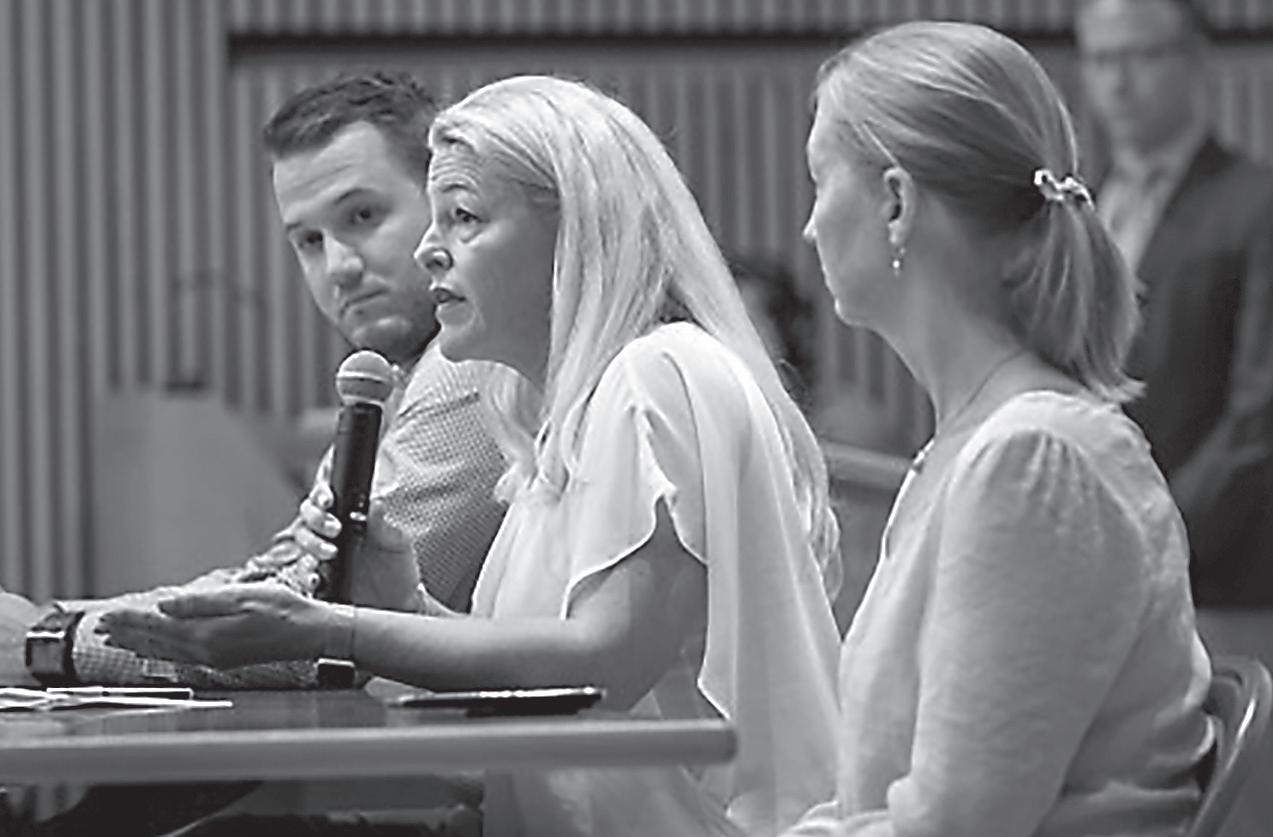
Brady wrote in an email to The Sun.
She added that she plans to prioritize ongoing efforts — such as the on-demand transportation service that is slated to launch in the spring — instead of proposing new initiatives.
“Spreading ourselves too thin compromises the ability to balance providing a high level of service and achieving strategic level goals,” Brady said.
The chair rotates every year to allow members from the board’s constituency —

Cornell, Tompkins County and Ithaca — to be equally represented. As part of the position, Brady is responsible for overseeing TCAT’s board members.
“I’m motivated by being part of something meaningful to so many people,” Brady wrote. “I’m very fortunate to have a role in providing regional transportation.”
By LUKE PICHINI Sun Assistant Sports Editor
Despite riding an eight-game unbeaten streak into last weekend, then-No. 1 Cornell men’s hockey was not playing its best. That weakness was fully exposed in a shocking 5-0 setback to Quinnipiac on Friday.
The Red, however, did return to form with a 5-3 victory over Princeton the next day. Cornell (15-2-4, 10-2-2 ECAC) — now ranked No. 2 in the country — will square off against Colgate (9-11-6, 7-4-3) in a home-and-home series this weekend.
Head coach Mike Schafer ’86 believed that the team’s anemic performance on Friday had been brewing for a while.
“Friday night was really, really disappointing,” Schafer said. “It’s been building for quite some time. We haven’t been playing with the passion, energy, enthusiasm — whatever word you want to use for it.”
Junior goaltender Matt Galajda had an uncharacteristically poor performance at Quinnipiac — getting pulled from the game for the first time of the season after letting up five goals. Prior to that, Galajada had only given up three goals once all season.
Still, Galajda maintained his confidence.

“I haven’t really changed anything,” Galajda said. “You have your bad weekends, it doesn’t really affect you or anything you’re doing. You just have to come ready to play.”
Schafer believed that the rest of the team wasn’t happy with its performance either.
“I think the guys were embarrassed,” Schafer said. “They realized after watching the video how poor they were playing — a lot of those were effort areas. You’re a lot more open-minded to coaching when you lose. When you win, you can make excuses for your performance internally.”
The players responded well to Schafer’s coaching, as the Red rebounded against Princeton. Led by junior for
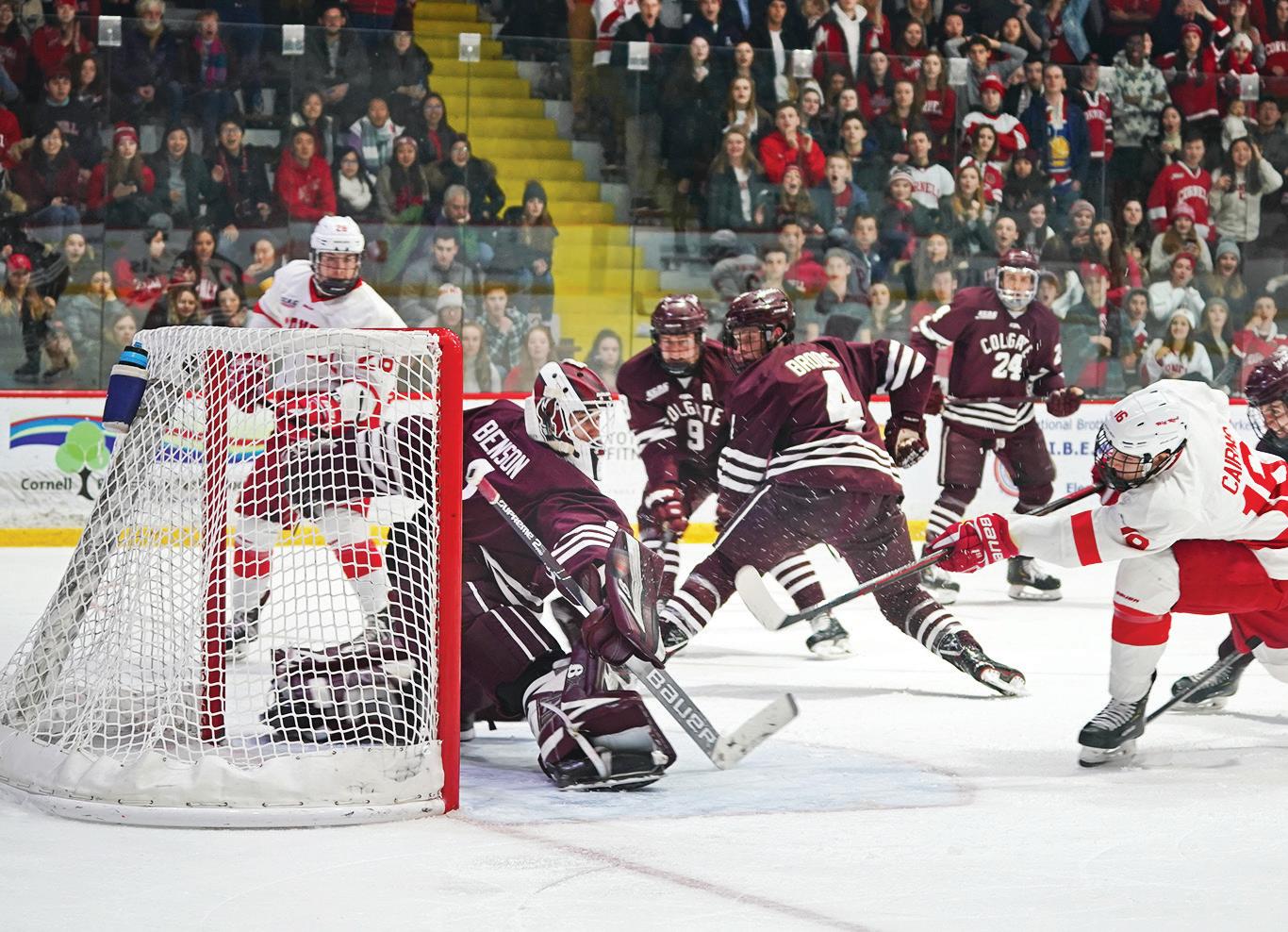
ward Tristan Mullin’s two power-play goals, Cornell returned to the win column.
“Saturday was a big game for us just to regroup and get back to basics — the stuff that made us successful to start the year,” Mullin said. “I was fortunate with the goals, but I guess sometimes those bounces just go in for you.”
During the contest, though, Cornell let up three goals for only the third time all season. All of the scores came on the penalty kill.
“It was weird,” Schafer said. “For all of those, you see pucks heading toward the net through a maze of bodies, it just seemed that night every time it went through a maze of bodies, it found the back of the net.”
While Princeton did find the back of the net three times, Cornell led throughout the game and dominated the final count in shots, 36-15.
Heading into its matchup against Colgate, the Red trails conference-leader Clarkson by only two points in the ECAC standings.
The Raiders currently sit at fifth in the ECAC standings with seven conference victories. In 2020, the Colgate picked up ties against Dartmouth and Harvard, but only notched two wins over Union and Princeton — two conference bottom-feeders.
This weekend’s pair of games represents a prime opportunity for the Red to make up ground against the Golden Knights and perhaps overtake them in the standings.
Those prospects would be boosted by the return of junior defenseman Kyle Betts, who has been injured since the Northern Michigan series, leaving a significant gap in the Red’s lineup.
“He went and saw a specialist last week,” Schafer said. “We’re hoping that as long as he progresses and doesn’t get more sore this week, he’ll probably get a chance to get back in the lineup.”
Though Betts doesn’t stuff the stat sheet, he more than makes up for it with his hustle and intensity.
“We missed him — his intensity and the pace that he plays with is phenomenal,” Schafer said. “It’s more than just goals and assists, his impact on the game is huge. When he’s in our lineup, he can kick it into a gear that no else can.”
With sophomore forward Max Andreev back in the lineup and a possible return for Betts in store, the Red — now fully awake after its Friday loss — could also be back at full strength at a pivotal point in the season.
Cornell will first host Colgate at 7 p.m. Friday before venturing up to face the Raiders again in Hamilton, New York at 7 p.m. Saturday.
Luke Pichini can be reached at lpichini@cornellsun.com.
By ALYSON WONG Sun Staff Writer
As the track and field season ramps up, Cornell’s men’s and women’s teams hosted the Kane Invitational at Barton Hall
on Saturday.
Across both teams, 15 members won their respective events and 11 more qualified for postseason tournaments. Binghamton, Colgate, PSU-Behrend, Rochester, Siena, Syracuse and York

University all competed, but only individual scores were recorded.
The women’s team featured nine event champions and six ECAC qualifications, while the men’s team finished with six event champions and five IC4A qualifications.
On the women’s side, freshman Victoria Atkinson (3.87m) finished in first place for the pole vault. Atkinson’s performance also earned her an ECAC qualification and she recorded the fifth-best height in the program’s history, surpassing the previous record of 3.79m.
Other event champions included senior Brittany Stenekes (8.90s) for the 60m hurdles, sophomore Leone Farquharson (7.75s) for the 60m dash and senior Jinjer Pearce (1:18.71) for the 500m dash.
Sophomore Sydney Smith (3:07.67) finished in first place for the 1000m, as did sophomore Leone Farquharson (12.24m) for the triple jump. Several other members notched the top spot, such as junior Marguerite Lorenzo (1.69m) in the high jump, senior Nikolia Kanaris (14.16m) for shot put and the A team
(4:00.39) for the 4x400 relay.
Farquharson and Kanaris’ performances also earned them ECAC qualifications.
“The meet was another great building block as we move into championship season.” Reagan Bachman
Additionally, senior Claire Kao (3.87m) and sophomore Maria Siciliano’s (3.72m) notched ECAC qualifications for the pole vault, while senior Zenab Ojibe (11.62m) also met the ECAC standard for the triple jump.
“The team performed well as a group, and the meet was another great building block as we move into championship season,” said senior co-head Reagan Bachman.