The Corne¬ Daily Sun




is the frst for any
By ROCHELLE LI Sun Staff Writer
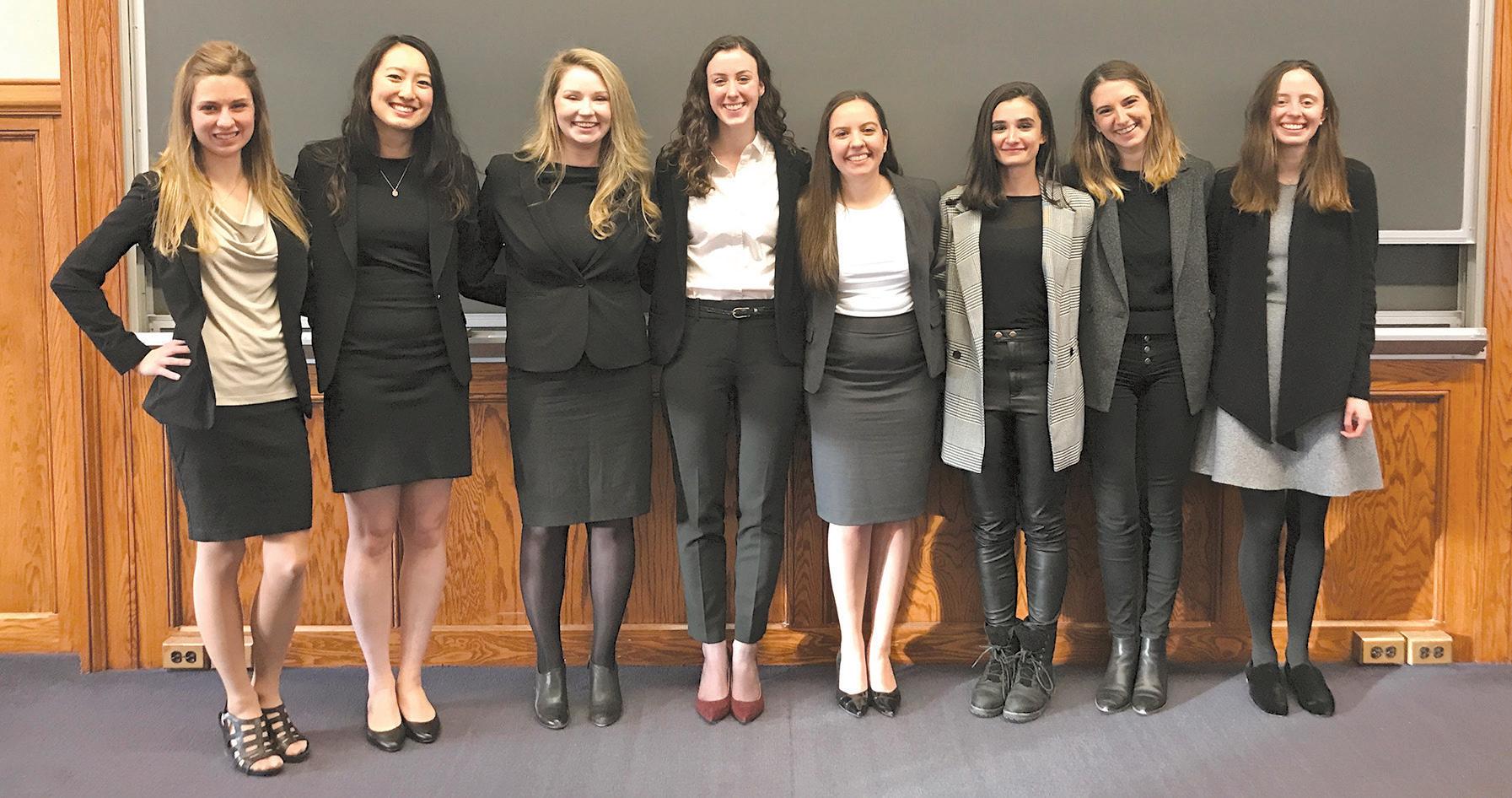
For decades, the legal profession has long been a man’s game: Just over one-third of all lawyers are women, according to the most recent U.S. Census report.
In similar fashion, law reviews and legal scholarship have also been historically male-dominated. Today, only between 43 and 49 percent of J.D. candidates are women, according to a research paper published Lynne N. Kolodinsky J.D. ’14.
But on Saturday, the Cornell Law Review bucked that longtime trend in dramatic fashion, electing an all-female board — the first among any of the top 14 law schools in the country.
The Review typically receives over 100 submissions each week submitted by legal scholars, including professors, judges and other law students. Past issues have included articles penned by Supreme Court Justices Ruth Bader Ginsburg ’54 and William Douglas.
The journal is completely student-run and elects third-year law students to its board every February. This year, the election resulted in
WOMEN page 4
Food insecure students can access ‘central bank’ of donated food swipes
By AMINA KILPATRICK Sun Staff Writer
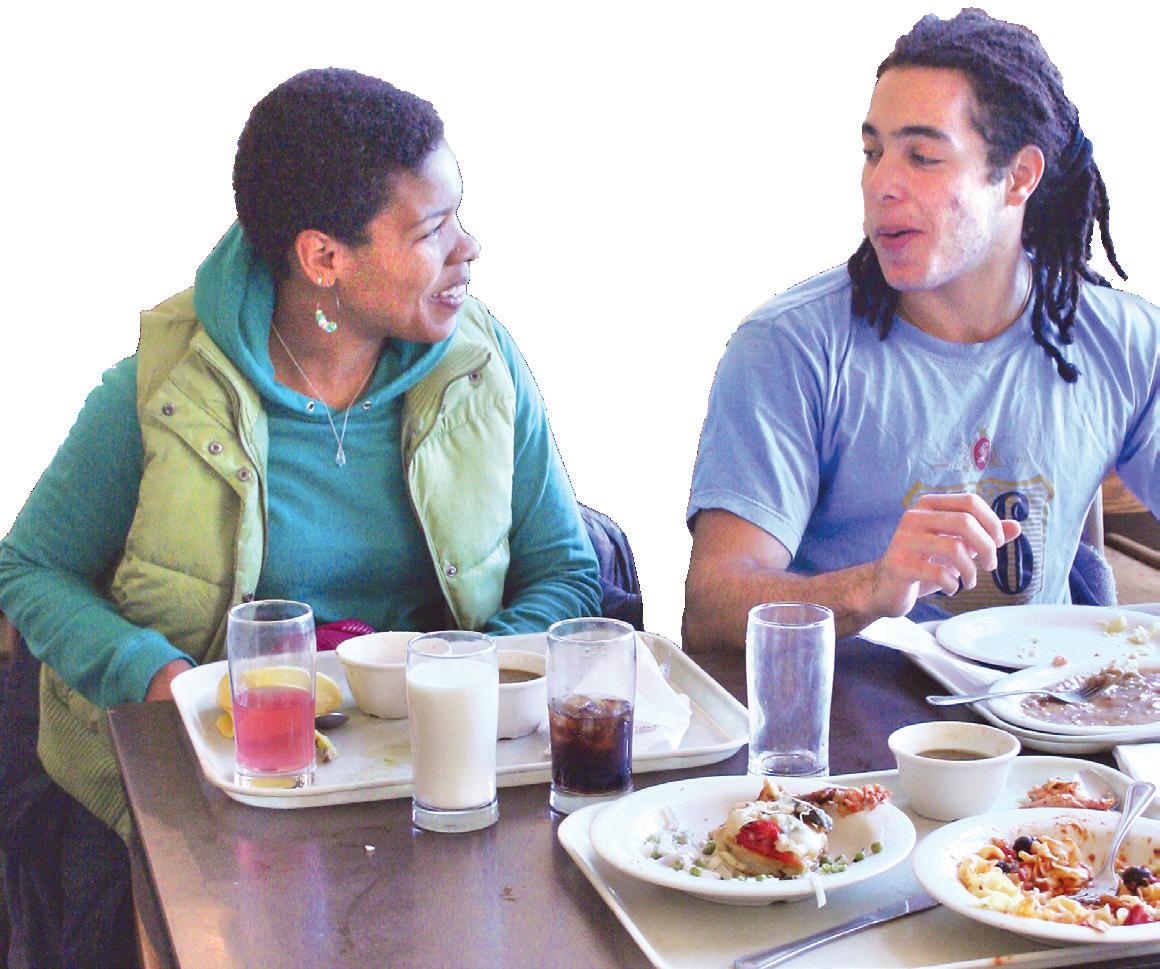
Unused meal swipes no longer need to go to waste. Under a new pilot program, students can now donate unused meals on their meal plan to other students in need.
The new plan, launched Feb. 4 by Cornell Dining, will create a “central bank” of unwanted, extra meals accessible to students experiencing food insecurity.
Cornell’s 10 all-you-care-to-eat dining facilities — and Big Red Bucks cannot be shared between individuals. While some meal plans offer guest swipes, the amount of bonus meals is limited, ranging from four swipes to eight swipes per semester based on different meal plan offerings.
Individuals who do not have a meal plan pay $13.05 for
By OLIVIA WEINBERG Sun Staff Writer
Beltway politics are soon set to migrate northwards as Cornell’s Institute of Politics and Global Affairs readies to open on Mar. 1.
Set to be directed by former Congressman Rep. Steve Israel (D-N.Y.), the new center plans to link domestic and global political organizations. This includes policy think tanks,
political leaders, businesses and individuals within the academic world, Provost Michael Kotlikoff told the Cornell Chronicle, a University-run publication.
Israel previously represented two Long Island-based congressional districts from 2001 to 2017, according to his website. Following his time in politics, he worked as a commentator for MSNBC and served as the inaugural chair for Long Island University’s Global Institute.
“One of the reasons I believe that an institute of politics is valuable in New York is because New York has become an epicenter of intense political activity,” Israel said in an interview with City and State New York.
While New York has long had a reputation for being a “one party” state, Israel highlighted New York’s “fabric of different outlooks and dispositions” as a
See INSTITUTE page 4

Tuesday, February 5, 2019
Spring Study Abroad Fair
10 a.m. - 2 p.m., Willard Straight Hall
How to Conduct Interviews in Real-World Settings Noon - 1:30 p.m., 423 ILR Conference Center
Systems Approaches to Unravel the Control )f Biological Processes Necessary for Plant Life 12:20 p.m., Lecture Hall 4, Veterinary School, 606 Tower Road
Pre-Med Study Abroad Info Session
3 - 4 p.m., G08 Uris Hall
Cornell Engineering Project Showcase 4:30 - 7 p.m., Duffield Hall
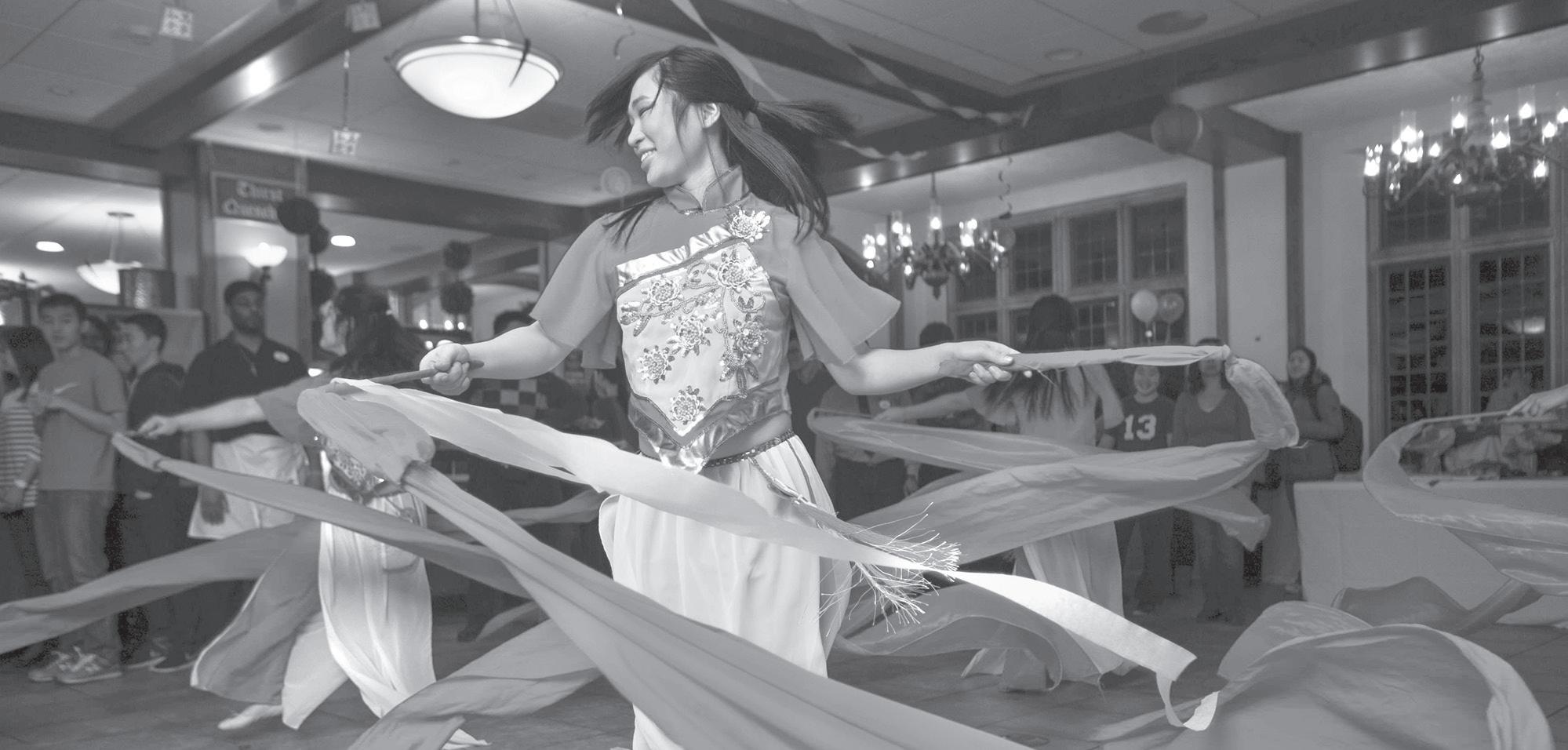
Happy Chinese New Year! 4:30 - 7:30 p.m., Okenshields, Willard Straight Hall
9th Annual Cornell Student Topical Sermon Contest 4:30 - 6:15 p.m., Anabel Taylor Hall
Madeline’s Madeline 7 - 8:33 p.m., Cornell Cinema, Willard Straight Hall
Tomorrow
Drop-in Breakfast at the Engaged Cornell Hub 8:30 - 10 a.m., 3rd floor, Kennedy Hall
Connecting Polerovirus Structural Biology to Function 12:20 p.m., 404 Plant Science Building
Explore Summer Study Abroad Opportunities 3 - 4 p.m., G24 Uris Hall
Biology Open House 4 - 5:30 p.m., Corson/Mudd Halls
Take Care of You!
Mental Health and Self Care Workshop 4 p.m., 429 Rockefeller Hall
Annual Future of the Humanities Lecture: Chris Newfield 4:30 p.m., Guerlac Room, A.D. White House
Fulbright U.S. Student Program 4:30 - 6 p.m., G08 Uris Hall
Rose House Cafe Talks: The History of Engineers and Antibiotics: An Odd Combination
7 p.m., House Professor Dean’s Apartment, Flora Rose House
Conversation at Keeton: Would You Get Rich Quick? 7:15 - 8:15 p.m., G70 Keeton House
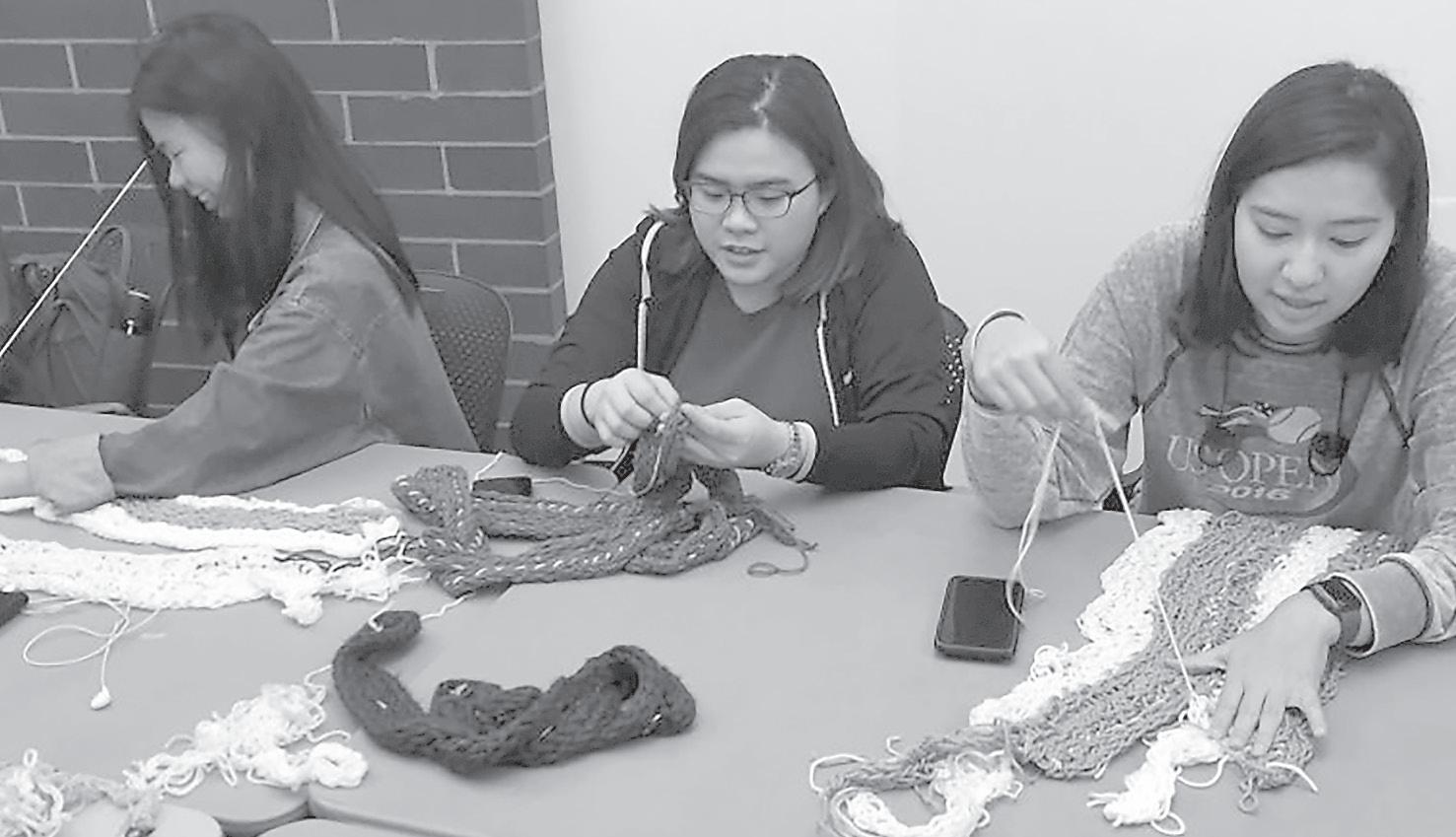
Knitting for a cause | Students gather weekly at the Keeton dorm to finger knit scarves and other wares to be donated to local charity. The event has become one of APO’s most popular and now attracts the participation of other organizations, as well.
By LUCAS REYES Sun Staff Writer
The extreme weather and wind chill that swept Ithaca last week emphasized problems for homeless individuals in the Ithaca community. Even on nicer days, changing weather and environmental conditions can prove to be a challenge.
Cornell’s co-ed service fraternity Alpha Phi Omega has once again continued a project where students finger knit clothes for the people in need.
To better respond to the surging need for resources, APO partnered with the Catholic Charities of Tompkins-Tioga, which receives APO’s freshly assembled garments and distributes them through its free clothing closet to Ithacans.
The finger knitting project has been a staple APO event
By MEREDITH LIU Sun Assistant News Editor
Ever worried about returning a book late and having to pay fine for it? That won’t be the case anymore at Tompkins County Public Library, which eliminated its fine on late items starting Jan. 14.
The reason behind this decision, according to Library Director Annette Birdsall, is that libraries have realized fines have become a social equity barrier: some people can’t afford to pay the fines when they have to return something late,
which brings them embarrassment and reduces their visits to the library.
“Fines have become a privilege and they — not only do they not work — they actually encourage people to keep materials longer if they can afford it. If you can afford it, you pay your fines, you don’t feel guilty and you support the library,” Birdsall told The Ithaca Voice. “We don’t love that it was a privilege and that people who couldn’t afford fines stopped using the library altogether.”
See LIBRARY page 5
for several years, according to members, and has seen steady growth in both membership and popularity since its inauguration.
Knitting sessions are now held weekly in collaboration with other service organizations on campus, such as the Golden Key International Service Fraternity and Epsilon Eta Sustainability Fraternity.
Beyond providing wares to those in need, the finger knitting events also help fulfill the fraternity’s goal of placing a large “emphasis on service learning,” which is intended to teach brothers practical skills through charity, according to Kelly Stone ’20, organizer of the project.
“In the end, it provides someone in a rough place with a handmade scarf and some assurance that someone else cares”
Isabelle Amlicke ’21
“Finger knitting is a great way to work toward this goal since the volunteers learn the skills to make scarves using just yarn and their fingers,” Stone told The Sun. “They can take those newfound skills with them and use even outside the context of the service event.”
But ultimately, the chief benefit of the weekly knitting sessions lies in providing a space for “brothers to talk and form bonds,” while letting struggling Ithaca residents know Cornell has not forgotten about them, according to Isabelle Amlicke ’21.
“In the end, it provides someone in a rough place with a handmade scarf and some assurance that someone else cares,” Amlicke said.
Lucas Reyes can be reached at lreyes@cornellsun.com.

By VALE LEWIS Sun Staff Writer
After using Blackboard for over two decades, Cornell has officially started the transition to Canvas, sparking discussion among students and faculty.
“The transition takes some getting used to,” Jayson Figueroa ’21 said. “No major issues have come up yet, but having to jump between Blackboard and Canvas is irritating.”
class assignments on one page instead of having to do it yourself. That being said, my course isn’t using the feature at all,” he said.
“No major issues have come up yet, but having to jump between Blackboard and Canvas is irritating.”
Jayson Figueroa ’21
However, Figueroa noted that he thinks this method of “experimental transition” is a better way to ease students and faculty into Canvas, rather than switching over all at once.
Figueroa also said he likes the calendar feature on Canvas, but wishes his course would use it more.
“The course calendar feature seems powerful, as it allows students to see the dates of all their
Figueroa thinks once his professors adjust to Canvas, “it will be a much better experience than Blackboard,” but until then, this transitional period is “more annoying than helpful,” he said. Like Blackboard, Canvas is a learning management system which allows students to access course contents and assignments online. Several other universities, including Columbia University, Brown University and Dartmouth College already use Canvas.
Prof. Marianella Casasola, human development, was among the first professors to switch classes over to Canvas as

a historic moment for collegiate law. One after another, a woman was voted into each subsequent position until the entire board was female.
“I think it didn’t quite hit me until the entire process was over,” said Beatriz Albornoz J.D. ’19, the Review’s outgoing editor-inchief. “It was kind of a moving period for me.”
This academic year, the journal has placed a greater emphasis on promoting diverse voices. When selecting articles to publish, the journal also considers in scholars’ race, gender, and sexual orientation. In each issue, the Cornell Law Review aims to select an article by at least one female author.
Saturday’s elections weren’t the first time the law review broke gender barriers in the
legal field. Mary Donlon Alger LL.B. ’20, the namesake of the North Campus freshman dormitory, became the first female editorin-chief of any law review in the United States when she attended Cornell Law School.
This milestone in female representation in the legal field came alongside larger shifts in the national climate. Twelve out of the top 15 law schools have elected female editorsin-chief for their law reviews, according to Albornoz. Columbia University, Georgetown University and the University of Chicago have yet to report their election results.
frankly prestige, it is really special,” Albornoz told The Sun. “This is a massive paradigm shift.”
“We’re proud to be part of this moment and look forward to using it as a catalyst.”
Julia Hollresier J.D. ’20
“Now in terms of leadership positions, especially now in terms of these topmost positions that carry a lot of responsibility and

reason for the state being a prime location for an organization charged with studying and showcasing politics.
“I served as a congressman for 16 years representing a quintessential middle-class community that could as easily vote for a Democrat as a Republican … it’s mostly pockets of purple,” Israel added.
February 5 or TOMORROW, February 6 5 - 6 p.m. Kaufmann Aud. (Room G64) Goldwin Smith Hall
The institute will bridge Cornell’s Ithaca, Washington, D.C. and New York City campuses
in an effort to better connect students and faculty to leaders in the political field, mainly by offering internships, symposiums and a richer variety of lecturers from the world of government, according to the University. This concept is a part of Martha Pollack’s larger “One Cornell” vision, which aims to work to bring campuses and potential employers closer together.
The Ithaca campus will be home to a faculty director, who will be in charge of programming, including guest speakers and a faculty and student fellows program.


The speakers will come from a variety of disciplinary fields and speak on issues including policy, new technologies and journalism, according to The Chronicle.
Israel will serve as a leader and liaison between
Cornell’s and Long Island University’s institutes to co-sponsor certain events. The former congressman will also teach at least one class a semester on the Ithaca campus as a part of the new program.
“My
Steve Israel
“I’m honored to be a part of the Cornell family,” Israel said in a university press release. “Political dynamics in the United States and around the world have become volatile and complex, and my goal is to create a platform for deep and meaningful experiences.”
Moving forward, the board hopes to continue encouraging diverse voices in the law review membership and scholarship.
“We’re proud to be part of this moment and look forward to using it as a catalyst to increase the accessibility of our journal, for people regardless of their identity or background,” said Julia Hollresier J.D. ’20, the incoming managing editor.
Rochelle Li can be reached at rli@cornellsun.com.
lunch and $16.15 for dinner at all-you-careto-eat dining halls, according to Cornell Dining’s website.
“Food insecurity can cause other issues, such as sleeping in class, being unable to concentrate or struggling to complete assignments,” Shakima Clency, director of first-generation and low-income student support, told the Cornell Chronicle, a University-run publication.
of planning, Anabel’s Grocery opened as a way to provide affordable groceries to students in a convenient location.
However, Anabel’s is currently on a hiatus this semester as it is used in the teaching of a course. A mobile food pantry will operate out of the grocery store space this semester in its place.
Additionally, Clency launched a program last fall that allowed individuals selected by Cornell Dining to act as “ambassadors” to give out passes to
“Food insecurity can cause other issues, such as sleeping ... or struggling to complete assignments.”
Shakima Clency
“It is important that we address these larger concerns,” Clency, who will be in charge of the program, said.
A Cornell University PULSE survey found that up to 20 percent of students reported “skipping a meal due to financial constraints.”
Clency said the program is partnered with the nationwide Swipe Out Hunger group, an organization that seeks to provide innovative solutions to reducing college student malnourishment.
The Cornell community has approached food insecurity in a variety of ways prior to the launch of this program. In May 2017, after two years
the AYCTE facilities “no questions asked,” according to the Chronicle.
“For many years, Cornell addressed food insecurity on a person-by-person basis,” Ryan Lombardi, vice president for student and campus life, told the Chronicle.
“Now we are tackling the issue systematically through a multifaceted approach,” Lombardi said. “...not only meeting immediate needs, but also more fully understanding the challenges students face in meeting their nutritional needs.”
Amina Kilpatrick can be reached at

Four motorcycles were reported stolen in October, valued at about $7,500 in total, Cornell University Police said. Since December, two men — Lucas Thomas and Jason Denmark — were charged with larceny for allegedly stealing the motorcycles off of Cornell’s campus. After one of the owners said that he believed a motorcycle of his was posted on Craigslist, investigators of Cornell Police and Tompkins County Sheriff’s Office said they recovered one of the motorcycles from a nearby town. An investigation led police to two of the remaining three missing motorcycles. The two men were charged with three counts each of fourth-degree grand larceny.
CANVAS
Continued from page 3
part of the pilot program in fall 2017. She is also a member of the advisory board for the transition to Canvas, which aims to “review and improve the transition plans to help support faculty and students,” according to a University press release.
“The advisory board has placed a lot of thought and effort so that the transition to Canvas will be as smooth as possible. They have been seeking feedback and outlining solutions for some time,” Casasola told The Sun.
The professor said that she has had “no issues so far” with Canvas and “really like[s] the feel and usability.”
Some students have also reacted favorably to the change, citing a better course calendar and a mobile application.
“I like Canvas so far. It’s straightforward, it has a much cleaner [user interface] than Blackboard, and I also specifically like the
blog-type posts — they are much easier to navigate than any equivalent features on Blackboard,” Daniel Parangi ’21, who uses Canvas for two of his classes, said.
Sally Gao ’20 also said she likes the grades feature on Canvas.
“I like that you can see all your grades in one section, and can test-modify your grades to see how your performance or status would change if your grades were different,” Gao said.
on each page, and it is not clear where to look for, say, the schedule of office hours,” Hanson said.
“[The advisory board] has been seeking feedback and outlining solutions for some time”
Prof. Marianella Casasola
However, others, including Caroline Hanson ’21, still prefer Blackboard to Canvas.
“I find [Canvas] too wordy and confusing to try and find specific information and files. There are many embedded links
A University press release regarding the platform transition noted that students and faculty can look to “curated online resources; onsite training, workshops and demonstrations; and consultations with a team of experienced instructional designers” regarding using Canvas. While Blackboard will still be available through fall 2019, the University will require all classes that use an LMS to transition to Canvas by spring 2020.
Vale Lewis can be reached at vlewis@cornellsun.com.
Jessica Martinez will lead the Herbert F. Johnson Museum of Art, beginning July 15, the University announced Monday. Since its 1973 founding, Martinez will be the museum’s fourth director. The new recruit will be filling the shoes of Stephanie Wiles, who left to join the Yale University Art Gallery. Martinez, who served at the Smithsonian National Museum of African Art for four years, praised the uniqueness of the Johnson Museum because it “drives scholarship,” according to the Cornell Chronicle, a University-run publication. Martinez served as the research curator for African art at Harvard, where she won the Harvard Hero Award, an honor annually given to the university’s most exceptional staff members. The University Board of Trustees approved Martinez as Richard J. Schwartz Director of the museum on Jan. 31 at their New York City meeting.
Ruth Bader Ginsburg ’54 Makes First Public Appearance Since Surgery
Supreme Court Justice Ruth Bader Ginsburg ’54 attended a “Notorious RBG in Song” production in Washington, D.C. Monday night, her first public appearance since a December cancer surgery that was followed by the justice’s first time missing oral arguments since joining the court in 1993. In December, the Cornell alumna underwent a pulmonary lobectomy after doctors found cancerous nodules in her left lung; Ginsburg had not made a public appearance since that surgery, which, according to The Washington Post has a recovery period up to eight weeks long.
— Compiled by Maryam Zafar ’21
renounced all fines on children starting October 2017.
In addition to breaking the socioeconomic barrier, the TCPL also believes that late fines actually don’t work. According to a Colorado State Library whitepaper referenced on its website, “the scant research on the impact of library fines and fees does not indicate a clear benefit to
In the past, libraries around the country have experimented with “amnesty days,” during which libraries were able to regain countless overdue books and reconnect with old patrons, according to the Chicago Tribune.
Although TCPL once collected around $100,000 in fines,
“We don’t want to rely on negative income, we want to rely on people supporting the library.”
Annette Birdsall
administering these policies and may be costly to enforce.”
Although patrons will no longer receive late fee charges, they will still receive bills if they do not return an item in 30 days, according to TCPL’s frequently asked questions page. Past replacement fees and processing charges for lost or damaged items also still apply, the library said.
The Tompkins County Public Library is not the only library going fine-free. The movement has already reached some members of the Finger Lakes Library System — such as Seneca County public libraries — as well as some libraries nationwide. Libraries in New York City also have
overdue fines on average only make up less than one-quarter of 1 percent of the library’s annual budget.
“We don’t want to rely on negative income, we want to rely on people supporting the library because they want to, not because of this artificial punishment,” Birdsall said to the Voice. “It’s exciting. I think it’s really going to open doors for people and allow us to really embrace our mission in a way that we just haven’t been able to because of that barrier.”
Meredith Liu can be reached at meredithliu@cornellsun. com.
• A.D. White House
• Admissions Offce
• Africana Studies And Research Center
• Alice Cook Dining
• Anabel Taylor Hall
• Appel Commons
• Baker Hall
• Bard Hall
• Barnes Hall
• Bartels Hall
• Bethe House
• Big Red Barn
• Carl Becker House
• Carpenter Hall Library
• Center for Intercultural Dialogue
• Clark Hall
• Computer Services & Financial Aid, East Hill Plz.
• Cornell Institute for Social & Economic Research
• Cornell Store
• Corson Hall
• Court Hall
• Dairy Bar
• Day Hall Main Lobby
• Dickson Hall
• Donlon Hall
• Duffeld Hall
• East Hill Offce Complex
• Environmental Health & Safety Building
• Flora Rose
• Gannett
• Goldie’s (Physical Sci. Bldg)
• Goldwin Smith
• Hasbrouck Center
• Horticulture Offce
• Humphreys Service Bldg.
• Ives Hall (ILR)
• Ivy Room (WSH)
• Johnson Museum
• Keeton House Dining
• Kosher Dining Hall
• Mac’s Café
• Martha’s (MVR)
• Mann Library
• Myron Taylor Hall
+ Hughes Dining
• Noyes Main Lobby
• Okenshields (Willard Straight Hall)
• Olin Hall
• Olin Library B Level
• Plantations Gift Shop
• Rhodes Hall
• Risley Dining
• Robert Purcell Community Center (RPCC)
• Sage Hall Atrium
•Sibley Hall, Green Dragon Café
• Snee Hall
• Statler Lobby
• Statler Terrace Restaurant
• Tatkon Center
• Teagle Hall
• Transportation Dept., Maple Avenue
• Trillium
• Uris Hall
• Vet Center (Shurman Hall)
•Weill Hall, M1 Rm
+ Synapsis
• Willard Straight Hall Lobby + Dining
• Autumn Leaves Used Books (Ithaca Commons)
• Bear Necessities
• Center Ithaca
• Coal House Café
• Collegetown Bagels: CTown + Triphammer
• Commons Grocery (Ithaca Commons)
• CFCU (Triphammer Rd. + East Hill Plaza)
• Corner of College & Dryden
• Corner of State & Aurora
• Express Mart, Comm. Crnrs.
• Hillside Inn
• Hilton Garden Inn
• Holiday Inn
• Ithaca Coffee Co.
•Ithaca College, Phillips Hall
• Jason’s Grocery & Deli
• Kendal
• Kraftees
• Lifelong
• Oasis (Greenstar)
• P&C Fresh (East Hill Plaza)
• Salvation Army
• Shortstop Deli
• Tompkins County Public Library
• Tops (Triphammer Rd.)
• Universal Deli
• Warren Real Estate (Downtown + Community Corners)
JACOB S. KARASIK RUBASHKIN ’19 Editor in Chief
JOHN McKIM MILLER ’20
Business Manager
KATIE SIMS ’20
Associate Editor
VARUN IYENGAR ’21
Web Editor
MEGAN ROCHE ’19
Projects Editor
EMMA WILLIAMS ’19
Design Editor
JEREMIAH KIM ’19
Blogs Editor
AMOL RAJESH ’20
Science Editor
BREANNE FLEER ’20
News Editor
YUICHIRO KAKUTANI ’19
News Editor
NICHOLAS BOGEL-BURROUGHS ’19
City Editor
LEV AKABAS ’19
Arts & Entertainment Editor
SARAH SKINNER ’21
Assistant News Editor
ANNE SNABES ’19
Assistant News Editor
JOHNATHAN STIMPSON ’21
Assistant Sports Editor
EDEM DZODZOMENYO ’20
Assistant Photography Editor
PETER BUONANNO ’21
Assistant Arts & Entertainment Editor
CHENAB KHAKH ’20
Assistant Science Editor
GIRISHA ARORA ’20
Managing Editor
HEIDI MYUNG ’19
Advertising Manager
ALISHA GUPTA ’20
Assistant Managing Editor
DYLAN McDEVITT ’19
Sports Editor
MICHAEL LI ’20
Photography Editor
GRIFFIN SMITH-NICHOLS ’19 Blogs Editor
JACQUELINE QUACH ’19 Dining Editor
SHRUTI JUNEJA ’20
ANU SUBRAMANIAM ’20
JUSTIN J. PARK ’19 Multimedia Editor
PARIS GHAZI ’21
Assistant News Editor
MEREDITH LIU ’20
Assistant News Editor
JONATHAN HARRIS ’21
Assistant Sports Editor
RAPHY GENDLER ’21
Assistant Sports Editor
BORIS TSANG ’21
Assistant Photography Editor
VIRI GARCIA ’20
Assistant
CATHERINE HORNG ’21
Working on Today’s Sun
Ad Layout Jamie Lai ’20
Design Desker Lei Lei Wu ’21
Night Desker Amanda Cronin ’21
Production Deskers Krystal Yang ’21 Ben Mayer ’21
Editors in Training
Editor in Chief Anu Subramaniam ’20
Managing Editor Maryam Zafar ’21 Meredith Liu ’20
Associate Editor Ethan Wu ’21
Sports Editor Johnathan Stimpson ’21
Photo Editor Benjamin Parker ’22
News Editor Johnathan Stimpson ’21 Shivani Sanghani ’20
Arts Editor Peter Buonanno ’21
Jeremy Markus ’22
Editorial
The University’s longstanding, disturbing refusal to investigate labor conditions at Weill Cornell Medicine-Qatar has fallen out of the discussion as of late. It is past time to bring the discussion back to light.
Some context for the uninitiated. Human rights groups charge that Qatar’s foreign labor sponsorship system enables exploitation bordering on slavery. Migrant laborers come to the Gulf nation seeking work, but are quickly funneled into involuntary servitude. Laws which let employers revoke workers’ exit permits, prevent them from switching jobs and deny them housing on a whim bind expatriate workers to Qatar.
A much-discussed 2014 report from the International Trade Union Confederation, a labor group, alleges widespread worker exploitation in Education City, the Qatari state-sponsored education complex that WCM-Q calls home. All this creates the very real possibility that WCM-Q may be, directly or through some contractor, exploiting its workers.
And yet Cornell has been frustratingly tight-lipped on labor conditions at WCM-Q. It has resisted a third-party investigation. Former Cornell presidents did little more than downplay and dismiss concerns about WCM-Q. A 2017 Student Assembly resolution on WCM-Q was met with a chilly acknowledgment — and no commitment to accountability.
It is not as if Cornell does not understand the moral imperative here. Indeed, in 2015 when pressed on concerns over labor conditions, Robert Harrison ’76, chair of the Board of Trustees, said, “We treat our staff in Doha, Qatar exactly the same way [as] in Ithaca, New York. We have values to protect. We have missions to accomplish that are consistent with those values.”
So why, then, does the administration filibuster a third-party investigation, one that could put all these questions finally to rest? In the face of this inconvenient question, the laudable sentiments Harrison offers cannot help but ring hollow.
The administration needs to provide answers on WCM-Q, and urgently. The best way to credibly do so is with an independent investigation. President Martha Pollack has said little on the issue. But she must realize the University cannot be in the business of abetting forced labor. Just the possibility alone ought to make President Pollack shudder — and then investigate.
On its surface, the appointment of President Martha Pollack to IBM’s board of directors — effective Feb. 1 — seems to be a boon for Cornell’s foothold in New York City’s tech industry. However, with the added obligation of satisfying IBM shareholders, the implications of our university president participating in corporate board service are worth exploring.
For more than a half-century, IBM has had a presence in New York City where its headquarters for the Watson artificial intelligence and cloud computing divisions are situated. It comes as no surprise, then, that IBM and Cornell Tech have a history of partnering on technological ventures. In 2014, former Cornell Tech professor Rajit Manohar and IBM developed a microchip that simulates processing functions by neurons and synapses of the brain. Then, in
Some of our questions regarding Pollack’s corporate service are still unanswered.
2017, Cornell Tech partnered again with IBM to create WiTNY, an initiative to promote the participation of women in technological industries in New York.
Of course, strong corporate relations are valuable to a university educating thousands of future industry leaders. Pollack sums it up in her press release: “It is important both for universities to have an awareness of the corporate world, where many of our students go on to work, and for those in the corporate world to have a better sense of what happens in universities.”
Some of our questions regarding Pollack’s corporate service are still unanswered.
The other members on the IBM board of directors received at least $300,000 in compensation for their board membership in 2017, according to the IBM Proxy Report. Yet, according to an AGB report, fewer than onethird of chief executives generally serve on for-profit corporate boards. Of those who do, only 3.6 percent receive $300,000 or more in compensation. It is still unclear whether or not Pollack will receive the standard $300,000 for her role on the IBM board of directors.
flicts of commitment and conflicts of interest for trustees, faculty and staff.
Pollack’s new role on the Corporate Board of IBM seems to breach this University policy regarding external entities: Conflict of Commitment, Conflict of Interest, and Conflict Management, defined below.
Conflict of Commitment : A situation caused when an individual undertakes external commitments that may burden or interfere with his or her primary obligations and commitments to the University , even if the outside activity is valuable to the university or contributes to professional development and competence.
Conflict of Interest : A situation where an individual has the opportunity to influence the University’s business, administrative, academic, or other decisions in ways that could lead to personal gain or advantage of any kind
Conflict Management : Measures taken to address the risk of bias or the appearance of bias when members of the university community have real or apparent conflicts of interest.
Moreover, the policy outlines that presidents, as part of the upper echelon of the institution, are held to a higher standard in regards to conflicts of commitment and conflicts of interests: The president “owe[s] special duties of care and loyalty to the institution as a whole, and must keep the University’s interests paramount to all others.”
As a member of a corporate board, Pollack may open herself up to a number of reputational risks, including lawsuits if the board is a party to a failed endeavor. Also, Pollack may be disinclined to question or oppose an industry executive at IBM who may have sway in her continued compensation.
To what extent did the Cornell Board of Trustees approve of this decision, if at all? How extensive is Pollack’s time
Given the objective to bring the precepts and principles of a university to the table at IBM, Pollack’s lack of transparency is incongruous.
Further, the AGB report notes that those typically serving on corporate boards have had longer terms of service, with the majority serving at least three to seven years. Having just arrived to Cornell in 2017, Pollack seems eager to hop on the corporate bandwagon. Presidents should avoid being overcommitted, especially early in their tenure. In 2017, the role involved nine overall board meetings and 16 committee meetings in 2017, a burdensome commitment among all Pollack’s others.
But why does compensation and time commitment matter?
Cornell University Policy 4.14 delineates conduct for real and apparent con-
commitment and obligation to IBM? For a decision made in the name of student benefit, student consideration seems largely absent.
Given the objective to bring the precepts and principles of a university — values of openness, student voice and discourse — to the table at IBM, Pollack’s lack of transparency is incongruous. Pollack should address the drawbacks and questionable implications of corporate board service, placing transparency above all.
Laura DeMassa and Canaan Delgado are sophomores at Cornell University. Double Take appears every other Tuesday. They can be reached at demassa-delgado@cornellsun.com.
William Wang | Willpower
This weekend, I went with a group of friends from the LGBT resource center to Escape Ithaca. The facility, which is surprisingly one of five escape rooms within commuting distance, is located just a couple of blocks from Cornell in Downtown Ithaca. Escape Ithaca, which is the first escape room in Ithaca, charges $10 for each person (we had 10 people in total), which is rather cheap for an escape room (which usually charge $20 to $45 per person).
I swear people have a Ph.D. in creativity when it comes to fun. We invented skydiving to fly, rafting to churn and Catan to indulge in our imperialistic urges. It was only a matter of time before someone had the idea to invent the escape room.
The term “escape room” comes from the early 2000s video games of the same name in which players tried to crack a code to break out of a room and make it to the next level. It was Takao Kato, founder of the Japanese company Scrape who came up with the idea
It was only a matter of time before someone invented the escape room.
of fleshing out the video game for a locked room filled with clues and cryptic messages that eventually lead to a way out of the room.
Kato — who looks like a man from the past hiding in the future, with his fedora and rim horn glasses mashed with his clean blazer — believes earnestly in the value of games. The goal was to immerse oneself in the game and break away from reality, to get away from the stressful omnipresence of work and school. The man, as oddly as he dressed, was a genius: In the 10 years since he invented escape rooms, the game has sparked a massive following. Just five years ago, there were only 22 escape rooms in America. Today, there are 2,000.
Escape rooms have become a worldwide phenomenon, sprouting up from Asia to Europe to the Americas. They have found a special home with overworked, young professionals and students who find a certain joy from being locked out of their small room living a fantasy life, far from a world that rushes them from one place to the next without a moment of rest.
And even though we’re thousands of miles away from Japan, Kato’s vision has remained intact. My friends and I are directed towards an escape room dressed up as an old-fashioned sea ship. Below deck, with shells and wooden crates around us, our Escape Ithaca guide fills us in on what’s happened. It’s not good.
Ocean swirled in my head. I pondered the letter for an agonizing 15 minutes. I felt sure it meant something. For 45 minutes we hunted, until we realized that we were dangerously close to running out of time, with one crate still unopened and one number left to find. We called in the guide to help us.
With two minutes to spare, we punched open the crate, revealing a letter and a plastic skeleton. Finally, we had our last clue. We rushed to the safe box. We punched in the key code, a buzzer whirred, and voila , there was the diamond. Cha-ching
But for now, the escape room is your best bet to break away from reality, one that’s cheap, fun and convenient for local Cornell students.
There’s a deranged man named Captain White who’s drugged us at the bottom of a ship, waiting to come back to torture and kill us. Meanwhile, there’s a diamond in the black safe worth a priceless amount of money, and we have to break the safe open to take it with us. Personally, I would have just run for it, but Escape Ithaca took up a notch. What good was escape without financial security? Being a business major, I kinda appreciate that nice little practical touch.
We got an hour to work through everything, and so I don’t blow up the whole intricate setup by Escape Ithaca, I won’t go too much into detail. But we went through everything: drawers, crates, paintings, bookshelves. We found a blacklight halfway through the event, and went wild shining it everywhere to find clues.
“Give me the blacklight!” was a common thing we repeated over and over again, like we were on the hunt for some perverse killer.
I found a hint from a crumpled-up letter that led to a world map. Latitudes and longitudes of the Indian
“PIt wasn’t until we were almost walking out that I realized something was amiss. So wait, I asked the Escape Ithaca guide, how do we use the map to solve the puzzle, then?
Well, she said with a sly smile, we have to put in some red herrings to throw off some people. Just because.
Ugh.
Still, Escape Room Ithaca was fun, if not a bit silly, but I get why it’s spread around so quickly. We’ve gone from Generation Y to Generation “Y not” — we’ll try anything to temporarily avoid the daily rigors of modern work or school. It’s a fun fad now, but I do wonder if people will eventually tire of it, given that a whole new industry of immersive gaming focused on VR and motion capture has arisen in the past couple of years. But for now, the escape room is your best bet to break away from reality, one that’s cheap, fun and convenient for local Cornell students, and one I think I’ll try again during the semester. 5542, 124 W State St: Escape Ithaca. Check it out.
William Wang is a junior in the College of Agriculture and Life Sciences. Willpower runs every other Monday this semester. He can be reached at wwang@cornellsun.com.
pl knocking each other off lol,” quips the nonchalant Instagram bio of the account @diet_prada. An angry undertone is palpable in the account’s ironic humor, however. The owners of the account, and the 1.1 million users who follow it, have had enough.
Diet Prada has been popularized — and trademarked, according to the account’s name on Instagram — as a term referring to knockoffs in fashion. Within the account, a garment that resembles Prada is exposed as a cheaper rendition that leaves behind a toxic aftertaste. Consider the industry exposed.
Diet Prada is popularizing social media call-out culture through juxtapositions of originals and knockoffs. Designers are pitted at one another through tags in an awkward, public stare-down, as followers take to their comment-pitchforks. Designers-inquestion have three options: defend themselves, concede or ignore the issue, accepting a loss of consumers’ respect.
Critical to understanding the account is the distinction between a knockoff and a counterfeit item. According to Women’s Wear Daily, a knockoff “resembles another item but isn’t exactly identical,” while a counterfeit good “is identical to another product” and “infringes upon its trademark.” In the fashion industry, counterfeit goods are illegal and are typically sold online. Knockoffs are permitted in the industry due to the popularity of designs and the difficulty of regulating them.
The obvious opinion denounces copied designs. When a prominent designer
finds so-called inspiration from a smaller designer, the action can shut down a start-up business and defeat a designer’s ambitions. In one example, Diet Prada called out Virgil Abloh for his “luxury knockoff business,” after his brand, OffWhite, presented designs remarkably similar to those created by ex-Nike employee Elisa van Joolen. She was up for a design position at Off-White that “curiously never materialized.” Entire cultures may be harmed, as well, as when Urban Outfitters added to its rich history of ripped-off designs by mocking another one: In 2016, it marketed a “Navajo print flask.” Fashion knockoffs also harm the industry as a whole. When original designs are copied without penalty, the entire creative process is undermined.
While these injustices are undoubtedly just that, I believe the right to copy designs benefits the fashion industry and is necessary for the advancement of fashion design.
The regulation of design copyright violations is infeasible. While logos or specific colors may receive trademark protection, and iconic silhouettes may qualify for trade dress protection, copyright in fashion is effectively nonexistent. Each design ultimately has too many facets to evaluate, organize and document for legal protection, and countless designs
are produced each day. This is what allows Balenciaga to sell women’s “foam platform sandals,” while the fashion public gossips about the new Balenciaga “Crocs.”
Large companies, with resources to repel legal action against them, unfairly dominate with current legal policy. However, smaller businesses and designers would still lack the upper hand even if they could sue for copyrighted designs. The reality is that all designers are copied, albeit to varying extremes. While Zara profits off copying designs from lesser-known artists, legal action with stronger footing would likely still lack power. A Goliath like Zara has the power to file suit against every small designer that carries a similar silhouette for a particular shoe. Market domination continues.
I believe the right to copy designs benefits the fashion industry and is necessary for the advancement of fashion design.
Modern original content is not the product of a brilliant idea in isolation. A new design is a collection of old ones, sewn together too often with a tool fashion journalists love to call “a fresh spin” on a popular garment. As a result, it may be difficult to distinguish copying from mere coincidence. John Galliano, the creative director of Maison Margiela, expressed his frustration with the overwhelming influx of design information the Internet provides in his Spring 2019 collection. Modern designers face the unique
challenge of avoiding copying existing designs, which may occur even without conscious awareness. Overwhelmed by content, Galliano expelled the imagery back out as a sensory overload of texture and color. These designs, ironically commended for their originality, are merely a regurgitation.
Amidst a laundry list of negative issues presented by the fast fashion industry, such as poor factory working conditions and an immense amount of waste, the increasing affordability of clothing presents a glimmer of light. Businesses like Zara, Forever 21 and Steve Madden are known in the industry for their knockoffs, but their ability to stay constantly on trend has rightfully resulted in their market domination. Fast fashion’s ability to copy designs on the cheap allows fashion consumers to avoid the emotion of Mike Posner’s “Cooler Than Me.” On campus, a fifty-dollar rendition of a Canada Goose is close enough.
From haute couture to ready-to-wear, fall/winter to spring/summer seasons, women’s wear to men’s wear, designers are under constant pressure to deliver new ideas. Hedi Slimane, among others, is even criticized for copying himself. Diet Prada’s account holds so many Instagram stories in twenty-four hours that one questions how its owners afford the time to focus on their own design careers.
Marcel Duchamp once said, “Art is either plagiarism or revolution.”
Victoria Pietsch is a senior in the College of Human Ecology. Fancy Pants runs every other Monday this semester. She can be reached at vpietsch@cornellsun. com.
By SHRIYA PERATI
Sun Staff Writer
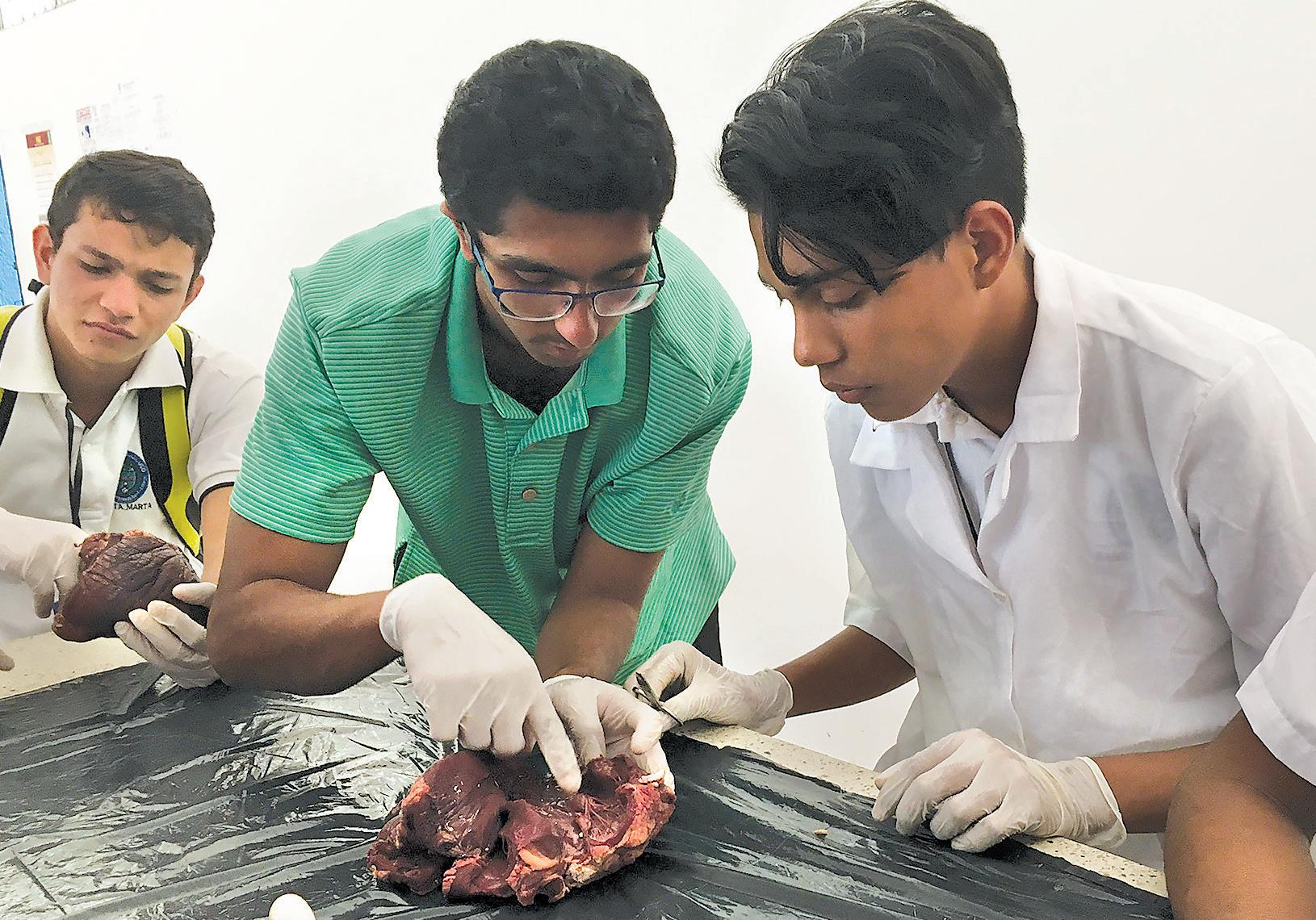
Over winter break, eight Cornell volunteers collaborated with seven students from the Universidad del Magdalena in Santa Marta, Colombia, to teach biology to Liceo Samario high school students.
For some time, Prof. Timothy DeVoogd, psychology, has been trying to create international experiences for Cornell students in the sciences. He realized that one way to promote students’ international involvement might be to work with peers in Latin America over winter break.
DeVoogd proposed the idea to Carlos Coronado, director of International Relations at the University of Magdalena. Coronado then found a public high school in which 80 percent of its students come from families below the Colombian poverty line, DeVoogd said.
“Carlos selected seven students from the University of Magdalena to work with us, and a kind of magic happened,” DeVoogd said.
The Cornellians were in Colombia from the beginning of January until the start of the spring semester.
“We used the first week as a preparation week: meeting our University of Magdalena partners, exploring the high school and Santa Marta, and developing our classes and activities,” Christine Relander ’20 said in an email. The next two weeks was the teaching portion.
Each of the Cornell volunteers worked closely with students from Universidad del Magdalena in Santa Marta. Volunteers from both schools were split into four different groups to teach a specific aspect of biology.
“The four concepts we taught about were the circulatory system, microbiology, vaccines, and nutrition,” Amrit Hingorani ’20 said in an email.
According to Hingorani, these concepts were important topics that the high school

students may never have been exposed to before.
According to Relander, most of the group of Cornell students were Biological Sciences majors, with one Developmental Sociology major and one Biology and Society major.
To make the learning experience more interactive and enjoyable, volunteers had to get creative.
“This meant taking the abstract theories and concepts mentioned in lecture and turning them into interactive games, demonstrations, simulations, and competitions,” Natalie Brown ’20 said.
For example, the immune system and vaccines group volunteers and students
acted out the concept of herd immunity in a sort of dodgeball fashion.
“An infected person threw balls at other members of the community — those that were unvaccinated couldn’t run around or move their arms,” Brown said.
According to Brown, the “vaccinated” students figured out pretty quickly that it was their job to protect those that couldn’t fend for themselves.
“We saw the light bulbs go off in their heads when they connected this back to immunocompromised individuals,” Brown said.
To further promote interactive learning, the Cornell at Magdalena program donated small cardboard microscopes called “Foldscopes,” premade slides and blood pressure cuffs to Liceo Samario High School.
“We had them take each other’s blood pressures and pulses in the circulatory unit and look at local water samples under microscopes in microbiology,” Hingorani said.
resistance in their own communities and how to counteract it.
“As many of the students expressed interest in becoming doctors in the future, it’s my hope that they will be able to advocate for decreased antibiotic usage both among their future patients and with their family now,” Fogel said.
In addition to teaching students about core biology concepts, the Cornell and Magdalena students described what it was like to be in university and how to choose a major.
“The purpose of these meetings was to give the students a more realistic representation of college education from people that are in university and to spark an interest in them to seek higher education above the high school level,” Treasure Nwokeleme ’21 said.
“Some students claimed that this experience helped them solidify the career path that they wanted to explore in college.”
Karen Franco ’19
Volunteers also tried to leverage this interactive approach to promote sustainable community influence. For example, Paula Fogel ’20 made sure to emphasize the mechanisms and impact of antibiotic resistance.
“Antibiotics can be bought over the counter in many parts of Latin America and many people frequently use antibiotics for colds and flus that they’re not appropriate for,” Fogel said.
According to Fogel, by the end of the two weeks, the students had a new appreciation for the negative effects of antibiotic
The program had a lasting influence on the students, Karen Franco ’19 said.
“Some students claimed that this experience helped them solidify the career path that they wanted to explore in college,” Franco said. “Some students even claimed to be inspired to learn English and to study abroad in the United States.”
While the Liceo Samario high school students did most of the learning, “the Cornell and Magdalena students who led the activities, similarly, seem excited with what they learned about their own ability to teach and perhaps even change lives,” DeVoogd said.
Shriya Perati can be reached at sperati@cornellsun.com.
I’ll be the first to admit I know nothing about sports. No one in my immediate family particularly cares to watch or play sports. I think the closest my dad ever gets is solitaire. Yesterday, however, when I went to Bethe dining hall for dinner, I was subjected to the Super Bowl, in all its spectacle and glory, for the first time. I can’t lie; it was mildly entertaining.
Much of this spectacle comes from the auxiliary, non-football stuff — the ads and the halftime show. Yet both were rather lackluster. Robot ads seemed to be a trend, serving as morose reminders of the unfortunate mechanical future we have ahead of us. In a Michelob Ultra ad, a robot out-athletes its human competitors, but tugs at our only mortal heartstrings when we see it excluded from the warmth of human companionship and beer. Then there was the Pringles “Sad Device” commercial, where a robot’s spiel of existential dread is interrupted by an order to play “Funkytown.”

Although I find these robots more relatable than the human characters in these ads, it’s interesting to consider why companies that don’t sell robots are trying to make us feel bad for them. Is it because we’ve lost our empathy for our fellow man and now only have the emotional capacity to feel for speculative hunks of metal? Too much Westworld? Hard to tell.
In contrast, the halftime show presented us with a group of sad androids from the recent past — Maroon 5. Frontman Adam Levine goes through all the motions expected of him, though there’s nothing that really makes him or his band’s performance stand out, compared to, say, the theatrics of Lady Gaga two years ago. Their music is mild and inoffensive, a catchy, artless pop-rock. It’s happy, generally substanceless, based around the usually harmless theme of romance and easy to forget, although some of their older songs like “She Will Be Loved” might get points for nostalgia. They weren’t even worthy fodder for the Internet meme machines — most of that material came from the three seconds of SpongeBob used to introduce “Sicko Mode,” a song which probably has more to unpack than Maroon 5’s entire discography. Nevertheless, Travis Scott came and went quickly, as did Big Boi (one-half of hip-hop duo OutKast), as if
the NFL were crying to everyone, “Look, we’re not racist!”
Amid all the controversy surrounding the Super Bowl, Maroon 5 were probably the safest choice, though not the first. In an interview with Entertainment Tonight, Levine stated, “I’m not in the right profession if I can’t handle a little bit of controversy.” However, several artists, such as Rihanna and Jay-Z, refused to perform because they wanted justice for Colin Kaepernick. Cardi B, who rapped in Maroon 5’s “Girls Like You,” stated that she wouldn’t perform at the halftime show unless Kaepernick “gets hired again.”
Nevertheless, she made an appearance in a Pepsi ad where Steve Carell yells at a waiter for asking a woman, “Is Pepsi OK?” when she requests Coke, until Cardi B and Migos show up to defend the good name of Pepsi. Does refusing to perform at the halftime show while still making an appearance in a Super Bowl ad contradict her initial purpose? Perhaps it’s a less insidious or direct form of participation, yet it’s participation nevertheless.
In “The World of Wrestling,” from Roland Barthes’ seminal 1957 work Mythologies, Barthes writes, “The virtue of all-in wrestling is that it is the spectacle of excess.” Is this also not the primary virtue of the Super Bowl? Why watch, if not for the “grandiloquence,” “the euphoria of men raised for a while above the constitutive ambiguity of everyday situations?”
Clearly, football is not apolitical. But in a world in which everything is made to be sanitized, pleasant, uncontroversial, even the entertainment can’t be entertaining; the “euphoria” falls flat. On the flipside, would it really mean anything at all for Super Bowl ads and the halftime show to definitively choose a stance and, say, come out in favor of Kaepernick? In the world of mass media, especially something so inescapable in America as the Super Bowl, it’s difficult to win.
Then again, maybe it’s Tom Brady’s world, and we’re all just living in it.
Ramya Yandava is a sophomore in the College of Arts and Sciences. She can be reached at ry86@cornell. edu. Ramy’s Rambles runs alternating Tuesdays this semester.
DOUG MILLS / THE NEW

By: Pete Buonanno Sun Assistant Arts Editor
After nearly a decade-long career, performing as a part of the Earthgang collective Spillage Village and most recently as a member of the Dreamville team, J.I.D has become a global sensation following the release of his latest album DiCaprio 2. The J. Cole prodigy is set to take the stage this Saturday at Ithaca College. According to the Ithaca College website, the performance is set to feature “special guests” — which will most likely be IC student artists, given past performances at the college.

The 28-year-old East Atlanta artist is currently dual-signed to Interscope and Dreamville. DiCaprio 2 features collabs such as “Off Deez” with fellow Dreamville artist J. Cole, “Westbrook” with A$AP Ferg and “Skrawberries” with BJ the Chicago Kid, which he performed on Fallon.
In a review of DiCaprio 2, Pitchfork wrote that the best lines on the album “feel like J.I.D is performing acrobatics on a 20-foot tightrope” and even compares his flow with that of Compton great Kendrick Lamar.
Recently, after Tory Lanez questioned the legitimacy of the Dreamville label lineup, J.I.D responded with a tweet suggesting that the rapper was all talk and “balding.”
J.I.D is currently touring in support of DiCaprio 2 and is set to make stops across the East coast as well as in Dublin and Melbourne. This is his first major label tour so expect high energy from J.I.D and a perfomance of most, if not all, of DiCaprio 2.
Tickets are currently on sale for around 25 dollars and can be purchased at the IC website. The Sun recommends drinking lots of water before the show in preparation for rampant mosh pits and dehydration #ArtsCares.
Peter Buonanno is a sophomore in the College of Arts and Sciences. He currently serves as the assistant arts editor on Te Sun’s editorial board. He can be reached at pbuonanno@cornellsun.com.
At The State Theatre:
Bob Weir and Wolf Bros | Thursday, Feb. 28, 7:00 p.m.
Vince Staples | Friday, March 1, 9:00 p.m.
At The Haunt:
Kyra Skye, Lady D, Vee Da Bee, East Coast Summit and Quail | Saturday, Feb. 23, 8:00 p.m.
The Wailers | Sunday, Feb. 24, 8:00 p.m. Blackalicious | Thursday, Feb. 28, 8:00 p.m.
At Ithaca College:
J.I.D | Saturday, Feb. 9, 6:30 p.m.
Around The Finger Lakes:
Drake Bell | Lando’s in Corning, Thursday, Feb. 21, 6 p.m.
To read the full preview, visit www.cornellsun.com.


Fill in the empty cells, one number in each, so that each column, row, and region contains the numbers 1-9 exactly once. Each number in the solution therefore occurs only once in each of the three “directions,” hence the “single numbers” implied by the puzzle’s name. (Rules from wikipedia.org/wiki/ Sudoku)

by Jeffrey Sondike






2 & 3 BEDROOMS
109 SAGE PLACE
Available NOW, Spring 2019 & 2019/2020 Shuttle Bus Access to Campus Access to Free Fitness Center Novarr- Mackesey Property Management office@ithacastudentapartments.com ithacastudentapartments.com
607-277-1234
Collegetown Terrace Apartments INSPIRED LIVING TAILORED TO YOUR SUCCESS 24-Hour Fitness Center Shuttle Bus Service to Campus Study Rooms w/ Expansive Views
Apartments Available NOW, Spring 2019 & 2019/2020 Novarr- Mackesey Property Management collegetownterraceithaca.com office@ithacastudentapartments.com 607-277-1234
We have availability for the 2019-2020 school year beginning June 1st at Hudson heights apartments. The studio apartments come with: heat, water, and electricity included. There are garbages houses and coin-operated laundry facilities on site. Prices start at $740/month for a 12 month lease. If you have any questions or would like to schedule a tour contact us by phone 607-208-7660 or email: renting@ithacaLS.com
Houses, Apts, Parking
1 to 9 Bedroom
Collegetown - College Ave, Linden Ave, Dryden Rd, Bryant Ave, Cook St. 607-330-2442 info@urbanithaca.com www.urbanithaca.com
Nicest Apts. in Collegetown Located on Eddy St.
4 Bedrooms
Fully furnished. Spacious living areas with large bedrooms & closets. Hardwood flors, spectacular views, eat-in kitchens with
1






BASKETBALL
Continued from page 15
three blocks for the home team. Princeton center Richmond Aririguzoh scored 20 points on a perfect six-for-six from the field and eight-for-10 from the free throw line. He was aided by Stephens and Ryan Schwieger who added 15 and 14 points, respectively.
“I was basically just trying to do whatever the team needed me to do out there,” Julian said. “My contribution to this team is to do anything I can to help us win.”
Princeton was without leading scorer Devin Cannady, who was suspended by the team indefinitely after being arrested at a Wawa convenience store a few weeks ago.
Cornell will con-
tinue Ivy League play next weekend when it travels to Dartmouth and Harvard. Last season, the Red swept the Big Green, while the Crimson defeated Cornell all three times the rivals faced off in 2018, most importantly in the Ivy tournament.
“This weekend is over now, so we just have to focus on next weekend,” Morgan said. “We have to do everything we can to steal two road wins against Dartmouth and Harvard; we won a good game [against Penn], so we just have to bounce back from this game. We couldn’t pull it out today, but the season goes on.”
Bennett Gross can be reached at bgross@cornellsun.com.
GYMNASTICS
Continued from page 16
doing lots of rehab, pool therapy and lifting,” Dudley said. “The key to getting all my skills back was building up enough strength and stability so that I could be confident my knee could handle them.”
Her work has paid off, as evidenced by her high scores at her team’s most recent meet.
“Lyanda was a huge asset to this team her freshman and sophomore years, setting many personal and team records,” Hall said. “Her return to our vault, bars and beam lineups is incredibly impactful. She is very consistent which is key to our team score.”
Despite the debilitating injury she experienced, Dudley has been consistently and confidently leading her team. She has pushed herself over the past year to regain her skills.
“Personal goals for the rest of season include beating my personal high-score of 9.85 on bars and making event finals at nationals,” Dudley said.
Finally back from the tough injury, Dudley said she hopes her hard work inspires the team going forward.
“I think our biggest hope is the team continues pushing forward with the incredible momentum we’ve gained over the past four years,” Dudley said. “Personally, the legacy I hope to leave this team is that the hard work and attitude you put into any experience is exactly what you will get out of it.”
The Red will host SUNY Brockport and Ithaca College at Teagle Gymnasium on Saturday.
Zora Hahn can be reached at zhahn@cornellsun.com.
HOCKEY
Continued from page 15
McGrath’s replacement last weekend after McGrath had a rocky start against Colgate at Lynah Rink.
“[Galajda] in his last three games has got two shutouts and

a win at Colgate,” Schafer said. “Whether we continue with the rotation, we’ll see, but he’s kind of getting back into the groove a little bit.”
The Red traveled a few minutes down the road to Rensselaer where they tied with the Engineers.
Following Yale’s victory over Brown this weekend, the Red will have to wait to secure what would be their second Ivy title.
Dylan McDevitt can be reached at dmcdevitt@cornellsun.com.

By DYLAN McDEVITT Sun Sports Editor
Reigning ECAC player of the month Morgan Barron wasted no time in defending his selection. The sophomore forward scored twice and led Cornell men’s hockey to a 4-0 victory over Union on Friday in Schenectady.
The win earned Cornell (13-6-1, 9-3-1 ECAC) two conference points on a night when Yale, the Red’s partner atop the ECAC standings, didn’t play. The Red now stands alone in first place for the time being with 19 points. Barron’s classmate and linemate Cam Donaldson had three assists on the night — the first time this season that a Cornell player has had three points in one game.
“That whole line, Morgan, Cam and Brenden [Locke] … we put them together and they’ve kind of just taken off together,” said head coach Mike Schafer ’86. “They’re classmates, and they know each other pretty well, and magically they’ve hit it off.”
“They’re classmates, and they know each other pretty well, and magically they’ve hit it off.”
Mike Schafer ’86
The Red jumped out to an early and commanding lead over the Dutchmen (12-8-5, 5-7-1), scoring three times in the opening period. First, a nice play from junior forward Jeff Malott led to a goal from freshman forward Michael Regush. Barron capitalized next thanks in part to a solid assist from Donaldson before sophomore defenseman Cody Haiskanen’s one-timer — his first goal of the season — lit the lamp a few minutes later. Barron’s second of the game came on a power play in the second and rounded out the Red’s scoring.
“[After getting an early lead,] we talked about coming out and just trying to win the second period,” Schafer said. “And in the third period, we started playing some of the other guys who hadn’t played a lot … but overall, even in the third period, I thought we didn’t give up many scoring chances.”

|
13/11
All of Cornell’s offense notwithstanding, the story of the game was the defense, which benefited from the return of sophomore Alex Green after he missed nearly three months. It was only the second time this season that the Red had all six of its starting defensemen ready to go for puck drop.
“Getting Alex Green back … allowed us for the first time in a long time to roll six defesnemen,” Schafer said. “[The system] just had some flow to it.”
The health of the blueline unit showed — Cornell was a perfect five-for-five on the penalty kill after Union’s
the game.
power play gave Cornell fits last season.
“Our penalty kill did a great job,” Schafer said. “Twenty two blocked shots, that’s kind of a recipe for our team … [Union is] such a good team at getting pucks to the net.”
Sophomore goaltender Matt Galajda earned the start in net and earned his second shutout of the season. Galajda got the nod after serving as his classmate Austin

By BENNETT GROSS Sun Staff Writer
As Princeton’s junior guard Jose Morales drove to the basket with one second remaining, the 1,800 fans inside of Newman Arena held their collective breath as his acrobatic layup attempt and Myles Stephens’ putback attempt were both unable to find the bottom of the basket, sending the game to overtime.
Although Cornell (10-10, 2-2 Ivy) downed the Tigers in a 107-101 triple-overtime thriller last year, Princeton had too many weapons for Cornell to overcome despite a valiant Cornell comeback that forced overtime.
After last year’s triple-OT win in Ithaca, Princeton exacted its revenge, claiming a 70-61 victory on Saturday.
Coming off an 80-71 win over defending Ivy League champion Penn the night
before, Cornell attempted to extend its home winning streak to six games, welcoming head coach Brian Earl’s alma mater Princeton.
The 2017 Ivy champion, Princeton (12-5, 4-0) was dominant in the rebounding department and defensively in the first half, collecting five more rebounds than the Red and holding the home team to 32 percent shooting from the field and 17 percent threepoint shooting.
able to carry a 31-23 lead into the break.
“It seems like the lesson for us is that ... we should be comfortable being uncomfortable.”
In the second half, Cornell was able to slow down the Tiger offense by playing a three-quarter court press, making it difficult on the Princeton ball handlers to ignite the offense. This issue was compounded for the Tigers when their star freshman point guard Jaelin Llewellyn left the game with 16:51 remaining due to a right ankle injury; he was unable to return.
Brian Earl
Cornell was unable to make a field goal throughout the final five minutes of the half, while the Tigers shot 62 percent from the field — Princeton led for 19 minutes before halftime.
With the strong effort, the Tigers were
As a result, the Tigers shot just 37.5 percent in the second half and missed all six of their three-point attempts. The Red, on the other hand, stepped up their play to send the game into an extra session.
Despite Princeton leading for nearly 37 minutes of regulation, the Red forced OT
behind 11 second half points from junior forward Josh Warren, who hit two clutch free throws with 18 seconds left to tie the game at 56.
In overtime, Princeton got to the free throw line 14 times, where they made 10 of their attempts. On the other hand, Cornell shot just 22 from the field and did not attempt a free throw in the extra session.
“It seems like the lesson for us from this game is that a lot of these games are going to come down to the last couple of seconds for us, so we should be comfortable being uncomfortable,” Earl said. “Also, as always, we have to make foul shots.”
Star senior guard Matt Morgan and Warren had 16 points apiece to lead the Red. Additionally, senior forward Steven Julian had 12 points, eight rebounds and Revenge sought | Princeton was able to hold off the Red this weekend, despite a valiant overtime effort. Last year, the Red won their matchup in triple-overtime.
With two undefeated wrestlers and a home-feld advantage, the Red looks to continue win streak
By GRACIE TODD Sun Staff Writer
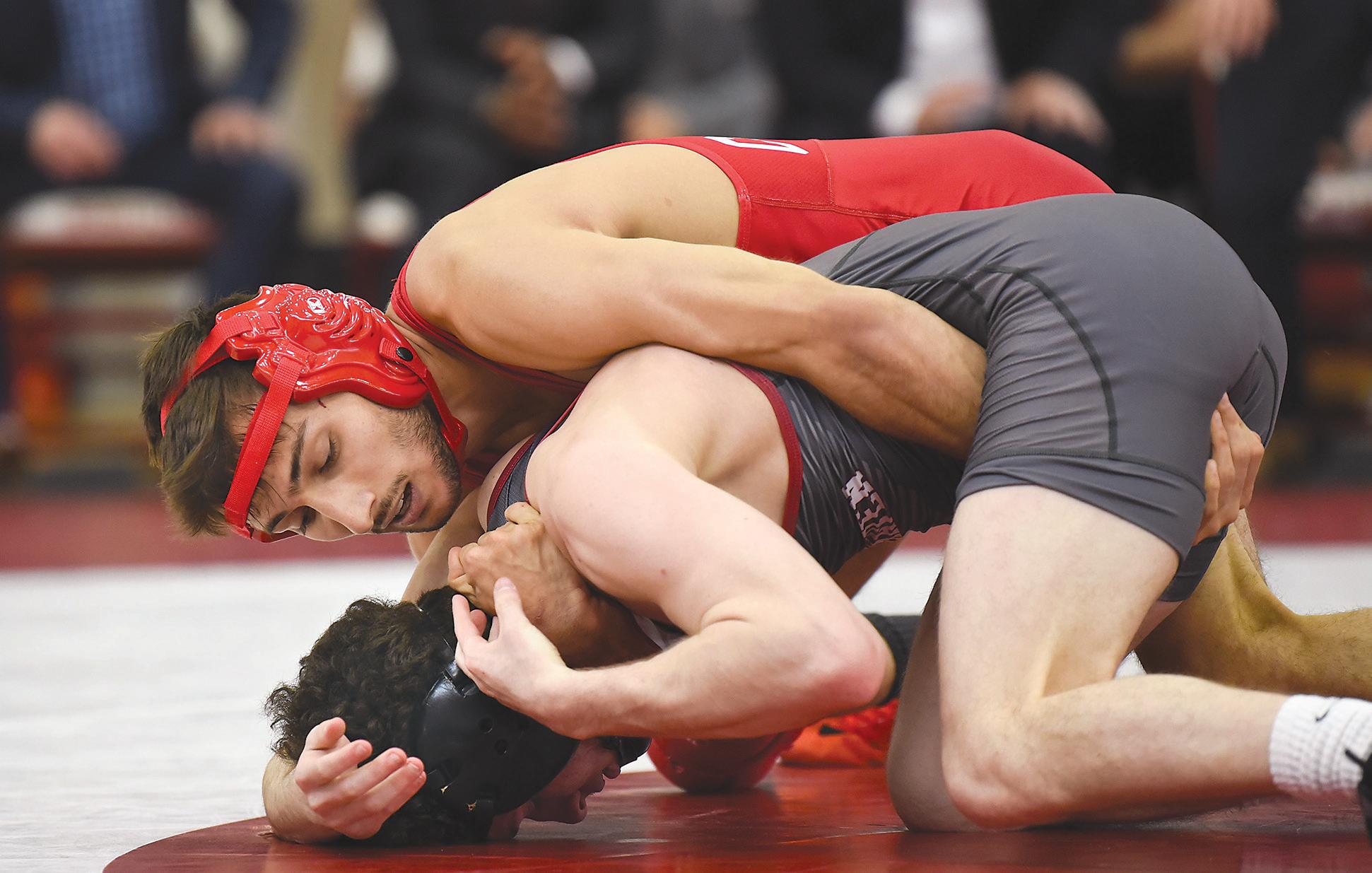
Eight of 10 Cornell wrestlers won their matchups on Saturday at the Friedman Wrestling Center, earning Cornell a 32-9 victory over Lock Haven. Cornell is now 9-2 for the season.
Junior Brandon Womack of the 174 weight class and classmate Max Dean of the 184 weight class both won tight decisions, starting the competition strong for the Red.
Next up, senior Ben Honis won his match in a major decision, continuing the momentum for the Red. In the 285 weight class, senior Jeramy Sweany fell to a nationally ranked opponent, but the Red bounced back — freshman Vitali Arujau in the 125 weight class, junior Chas Tucker in the 133 weight class, sophomore Yianni Diakomihalis in the 141 weight class, senior Jonathan Furnas in the 149 weight class and junior Adam Santoro in the 157 weight class claimed five victories in a row for Cornell.
“These guys have each had great competition this year so they should be comfortable in close matches.”
Rob Koll
Arujau and Tucker both won in tight decisions. Similar to Womack and Dean, Tucker clinched victory after a close battle. Head coach Rob Koll said that Cornell wrestlers win these close matchups because of their experience in competing and training.
“These guys have each had great competition this year so they should be comfortable in close matches,” Koll said. “They also have great workout partners in the practice room that can put them out of their comfort zones in preparation for matches like these.”
Though the Red had already claimed victory, the Bald Eagles responded with a win in the last matchup of the day, beating freshman Andrew Berreyesa in the 165 weight class.
Notably, two Cornell wrestlers remain undefeated this season: No. 11 Arujau and No. 1 Diakomihalis, the latter of whom won the national title as a freshman last season.
In addition to these two, the Red’s 10-wrestler lineup contains four other nationally ranked individuals: No. 15 Womack, No. 10 Dean, No. 13 Tucker and No. 17 Honis.

This was the Red’s first home competition since mid-November, which Koll says gives it an advantage.
“We are extremely difficult to beat at home,” Koll said. “I look forward to continuing this home-field advantage next weekend.”
The Red will face two conference foes at Friedman next weekend: the University of Pennsylvania on Friday evening followed by Princeton University on Saturday afternoon.
Gracie Todd can be reached at gtodd@cornellsun.com.
By ZORA HAHN Sun Staff Writer
The women’s gymnastics team lost to Penn this past weekend, earning a score of 191.125 against the latter’s 193.900.
Despite the disappointing defeat, Cornell triumphed over the other two schools competing in the meet, beating Brown’s 191.000 and Ursinus’s 183.025.
Associate head coach Melanie Hall said the team’s effort during the meet was strong.
“Once again we had some strong performances on every event,” Hall said. “Scoring was a bit low on bars and beam, but overall the team did well. We were very consistent on vault and as a team took first place on that event. It continues to be a solid event for us.”
high 9.825 on bars, and senior Kaitlin Green performed best on the beam with a score of 9.675. On floor, junior Samantha Henry and sophomore Claire Haklik scored 9.800.
Individually, the team performed most strongly on vault with a score of 48.100 given the three high scores by Maughan, Prescott and Dudley. With the Red’s bars, beam and floor earning scores consistently in the mid-47 range (47.825, 47.525, 47.675), beam and floor are areas where the team has room for improvement.
“We were very consistent on vault and as a team took first place on that event. It continues to be a solid event for us.”
Melanie Hall
Various performances drove Cornell to its second-place finish, including freshman Sara Maughan, junior Maci Prescott and senior Lyanda Dudley’s 9.650 scores on vault. Prescott is up 0.1 from her 9.550 score last weekend. Dudley, a senior, also scored a team
One of the team’s goals for this season was improving its consistency. Given the similar scores over the first few meets of the season, the Red is working well toward its goal. Dudley came back with a vengeance this season after tearing her ACL last year and taking a break during her junior year. She is now co-captain, and has been working hard every week.
“I spent the first seven to eight months