The Corne¬ Daily Sun



By NICHOLAS BOGEL-BURROUGHS Sun City Editor
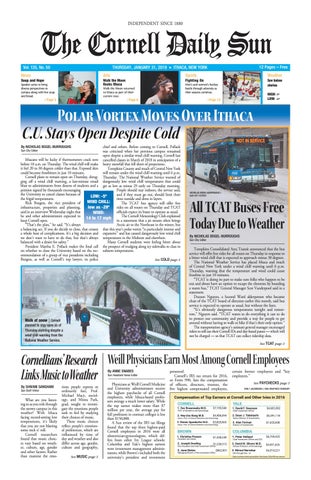
Ithacans will be lucky if thermometers crack zero before 10 a.m. on Thursday. The wind chill will make it feel 20 to 30 degrees colder than that. Exposed skin could become frostbitten in just 10 minutes.
Cornell plans to remain open on Thursday, shrugging off a wind chill warning, a last-minute email blast to administrators from dozens of students and a petition signed by thousands encouraging the University to cancel classes because of the frigid temperatures.
Rick Burgess, the vice president of infrastructure, properties and planning, said in an interview Wednesday night that he and other administrators expected to keep Cornell open.
chief and others. Before coming to Cornell, Pollack was criticized when her previous campus remained open despite a similar wind chill warning. Cornell last cancelled classes in March of 2018 in anticipation of a heavy snowfall that fell short of projections.
Tompkins County and much of Central New York will remain under the wind chill warning until 6 p.m. Thursday. The National Weather Service warned of dangerously low wind chill temperatures that could get as low as minus 29 early on Thursday morning. People should stay indoors, the service said, and if they must go out, should limit their time outside and dress in layers.

“That’s the plan,” he said. “It’s always a balancing act. If you do decide to close, that creates a whole host of complications. It’s a big decision and we don’t want to have to do that, but that’s always balanced with a desire for safety.”
President Martha E. Pollack makes the final call on whether to close the University based on the recommendation of a group of vice presidents including Burgess, as well as Cornell’s top lawyer, its police
The TCAT bus agency will offer free rides on all routes on Thursday and TCAT officials expect its buses to operate as usual.
The Cornell Meteorology Club explained in a statement that a jet stream often brings Arctic air to the Northeast in the winter, but that this year’s polar vortex “is particularly intense and expansive” and has caused dangerously low wind chill temperatures in the Midwest and elsewhere.
Many Cornell students were feeling bitter about the prospect of trudging along icy sidewalks to class in subzero temperatures.
See COLD page 3

By SHIVANI SANGHANI Sun Staff Writer
What are you listening to as you trek through the snowy campus in this weather? With Ithaca facing record-setting low temperatures, it’s likely that you are not blasting some rock n’ roll.
Cornell researchers found that music choices vary based on weather, culture, age, gender and other factors. Rather than examine the emo-
tions people express or ordinarily feel, Prof. Michael Macy, sociology, and Minsu Park, grad, sought to investigate the emotions people seek to feel by studying their choices of music. These music choices reflect people’s emotional preferences, which are influenced by time of day and weather and also differ across age, gender, culture and geography, See MUSIC page 3

By NICHOLAS BOGEL-BURROUGHS Sun City Editor
Tompkins Consolidated Area Transit announced that the bus service will offer free rides for all routes on Thursday in response to a bitter wind chill that is expected to approach minus 30 degrees.
The National Weather Service has placed Ithaca and much of Central New York under a wind chill warning until 6 p.m. Thursday, warning that the temperature and wind could cause frostbite in just 10 minutes.
“TCAT is doing its part to make sure folks who happen to be out and about have an option to escape the elements by boarding a warm bus,” TCAT General Manager Scot Vanderpool said in a statement.
Ducson Nguyen, a Second Ward alderperson who became chair of the TCAT board of directors earlier this month, said bus service is expected to operate as usual, but without the fares.
“It’s obviously dangerous temperatures tonight and tomorrow,” Nguyen said. “TCAT wants to do everything it can to do to protect our community and provide a way for people to get around without having to walk or bike if that’s their only option.”
The transportation agency’s assistant general manager encouraged riders to still use their Cornell IDs and day-based passes — which will not be charged — so that TCAT can collect ridership data.
See TCAT page 3
By ANNE SNABES Sun Assistant News Editor
Physicians at Weill Cornell Medicine and University administrators receive the highest paychecks of all Cornell employees, while Ithaca-based professors average a much lower salary. While the top earner makes more than $7 million per year, the average pay for full professors in contract colleges is less than $150,000.
A Sun review of the IRS tax filings found that the top three highest-paid Cornell employees in 2016 were all obstetrician-gynecologists, which differs from other Ivy League schools: Columbia and Yale’s highest earners were investment management administrators, while Brown’s included both the university’s president and investment
personnel. Cornell’s IRS tax return for 2016, or Form 990, lists the compensation of officers, directors, trustees, the five highest compensated employees,
certain former employees and “key employees.”

Thursday, January 31, 2019
Soup & Hope with Bill Alberta Noon, Sage Chapel
Institute for African Development: Spring Seminar Series 2:30 p.m., G08 Uris Hall
Exploring the Evolution of the Universe with the CCAT-prime 4 - 5 p.m., 105 Space Sciences Building
Career Fair Prep for First-Year Students 4:30 p.m., Takton Center
Linguistics Colloquium Speaker: Margaret Grant 4:30 p.m., 106 Morill Hall
Cornell Chimes Competition Info Session 5 p.m., Playing Stand Level, McGraw Tower
Visitor Relations Spring 2019 Hiring Application 6 p.m., 142 Goldwin Smith Hall

By VIVIAN FAN Sun Staff Writer
Amidst the bone-chilling cold, the annual Soup & Hope speaker series will return to campus with hopes to connect the Cornell community with stories and hot soup.
Organized by Cornell United Religious Work, the speaker series invites people to listen to personal stories that touch “on the universal experience of being human” while enjoying soup and bread provided by Cornell Dining.
The series aims to have diverse speakers who address “different aspects of hope,” according to Jennifer Austin, health communications specialist for Cornell Health, who has been a member of the planning committee since the series kicked off in 2008.
“Soup & Hope talks call upon
a different strength,” Austin told The Sun in an email. “They focus on the ability for someone to speak openly about the ways in which they have personally wrestled with and sought meaning from the struggles and challenges of life.”
For the next three months, community members will gather at Sage Chapel each Thursday for lunch at noon. The series kicked off on Jan. 17 with a talk from Ithaca College president Shirley Collado, in which she urged attendees to be a good model for future generations to follow according to a University press release.
According to Austin, although the series is held at Sage Chapel, attendees and speakers are not necessarily religious and present the community with a wide array of perspectives.
“The talks reflect very diverse personal, cultural, spiritual, polit-

which provides new clothing, toys and blankets to local children.
ical, and philosophical beliefs and experiences,” Austin said.
More than 50 speakers have shared their stories at Sage Chapel over the last 11 years. Speakers are typically a mix of Cornell students, staff, faculty, alumni and retirees, Austin said. Past speakers have included Susan Murphy ’73, who served as the vice president for student and academic services at Cornell, and Ithaca Mayor Svante Myrick ’09.
The next talk will be given by Bill Alberta M.S. ’77, for-
mer career services counselor at Cornell. In 2013, he was honored with the George Peter Award for Dedicated Service for his dedication to Cornell and decades of service to the University.
Alberta also founded the Cornell Elves Program in 1989, which provides new clothing, toys, warm blankets for local children. The program grew to support of 900 children annually by 2013.
Other speakers throughout the 2019 series will include Angela
Winfield J.D. ’08, associate vice president for inclusion and workforce diversity and Prof. Riché Richardson, Africana studies.
“At the core of Soup & Hope is the belief that everyone has a story to tell; a story rooted in personal experience that, when shared, may help or inspire others,” Austin said. Attendance is free and the series takes place each Thursday at noon through March 28.
Continued from page 1
Max Springer ’19 said it was so cold on Wednesday morning that he skipped his morning lecture, choosing instead to stay in his Collegetown apartment until temperatures rose. He’s even more concerned about walking 20 minutes to class on Thursday.
Emily Hurwitz ’21 said she thought she was used to cold weather and snow, having grown up in Massachusetts. That was before she went toe-to-toe with the gusts blowing along Libe Slope.
“I ran down the slope almost in tears because the wind was making the inch of skin between my scarf and hat sting so much,” she said. Hurwitz said she’s thankful for the free buses on Thursday, but is worried they will be so crowded that people will be stuck at bus stops in the biting cold.
Dozens of students emailed Pollack and other Cornell admin-
istrators urging them to keep the University closed because of the threatening temperatures, and nearly 8,000 people had signed a Change.org petition as of early on Thursday morning.
Liz Davis-Frost ’20 said she emailed administrators because she is worried about parents who work hourly jobs at Cornell and still need to report for work despite their children’s schools being cancelled.
Davis-Frost said she thinks the administrators deciding whether to close the University, on the other hand, may not be as affected by the weather as students and staff members.
“People who work for Cornell and who have yearly salaries probably have a car and a parking spot on campus and don’t have to walk 25 minutes to class every day,” she said. “I’m wearing snow boots, two pairs of socks and I still can’t feel my toes.”
Everyone who emailed Pollack
received a response from her chief of staff, Kelly Cunningham, saying that while students should be careful, “it is not necessary to close the university or cancel classes.”
This is not the first time Pollack has come under fire for her decision not to close a university. When she served as provost of the University of Michigan, the Ann Arbor campus stayed open in January of 2014 despite a wind chill as low as minus 35 degrees. Pollack later acknowledged that the university didn’t have a process in place for shutting down.
“By the time it became clear that we were facing an extraordinary weather event, we realized that we didn’t have appropriate mechanisms to close the University even if we wanted to,” The Michigan Daily quoted Pollack as saying in 2014 after being criticized by faculty and staff.
Pollack said at the time that the University of Michigan would form a committee to evaluate
MUSIC
Continued from page 1
These music choices reflect people’s emotional preferences, which are influenced by time of day and weather and also differ across age, gender, culture and geography, according to their study, which was published in the journal Nature Human Behavior.
Drawing from a massive data set of 765 million online Spotify music plays, the researchers analyzed the musical choices streamed in 2016 by one million people from 51 different countries.
Through the research, Macy and Park found that “night owls” who sought to remain alert during nighttime bent towards relaxing, low-intensity melodies. In the winter, the same trends occurred among Spotify users.
Summer, on the other hand, dictated more upbeat musical preferences as it’s associated with greater activity and daylight.
“We found strong evidence of Seasonal Affective Disorder, or SAD, in the winter,” Macy told The Sun. “People tend to be sadder in the winter due to change in the amount of daylight, and people chose to listen to calmer music as a result.”
Macy dubbed this phenomenon “mood management,” or when people utilized music to control their mood, rather than express it.
The study further revealed that Asian civilizations tended to listen to more relaxed music than their Western counterparts.
Gender and age also plays a role in determining music preferences: in the northern hemisphere, women prefer less intense music, yet these preferences are reversed in the Southern hemisphere, as females sought more upbeat tunes; older people, furthermore, were inclined towards more calming music, while younger people chose more exciting music.
Macy and Park did not speculate on a causal explanation for the findings, instead outlining “a more complete picture of the emotional rhythms in emotional behavior,” the researchers wrote.
“We hope that our study will invite future theory and spur more research,” Park said.
Macy said he was grateful for the opportunity to conduct a study on “such a global scale” with a “cross-cultural” scope because the data is not often available to make these comparisons.
“Social science is very provincial, and the data that we had access to was not just specific to our own culture,” Macy said. “We sometimes get cultural blinders, but the nice thing here was that we could look globally at the affective preferences revealed through music across different cultures and regions.”
Shivani Sanghani can be reached at ssanghani@cornellsun.com.
how to cancel classes in inclement weather. Later that month, she shut the school because of a wind chill around minus 30.
Addy Aguilera graduated from the University of Michigan in 2017 and said she still remembers cheering in a dining hall on that frosty Monday night when Pollack
announced that the University of Michigan would close for the first time in 36 years.
“We felt like we were hopelessly waiting,” Aguilera said in an interview. “And then we all got the same email at the same time and
TCAT
Continued from page 1
Mike Smith, the assistant general manager, also said bus drivers may not be able to lower buses when they arrive at bus stops, which drivers regularly do to make getting on and off easier for riders. The weather will be so cold on Thursday, however, that the suspensions’ air lines may freeze, causing buses to not be able to rise up to driving height again. Bus operators will still be able to manually lower ramps. The National Weather Service said the high temperature on Thursday will be 10
degrees, but that wind chill values are expected to plunge as low as minus 20, with the potential to reach a minimum of minus 29. The wind is expected to fluctuate between 14 and 17 miles per hour.
The service urged people to stay indoors as much as possible Thursday and to wear multiple layers if going outside.
“If you are out and about, please keep TCAT in mind as an option to protect yourself from these dangerous temperatures,” Vanderpool said.
Nicholas Bogel-Burroughs can be reached at nickbogel@gmail.com.




PAYCHECKS
Continued from page 1
The IRS defines “key employees” as individuals who receive more than $150,000 annually from Cornell and related organizations — including non-profits, stock corporations and governmental units — and who hold responsibility over the entire University or manage an activity that constitutes at least 10 percent of the University’s assets or expenses.
Because Cornell only has to list 20 “key employees,” other employees who meet these criteria may not be included on the form.
The listed compensation amounts include both reportable compensation from Cornell and “other compensation” from Cornell and related organizations. The IRS defines “other compensation” as tax-deferred employee contributions to a qualified defined contribution retirement plan, employer contributions to health benefits and other benefits.
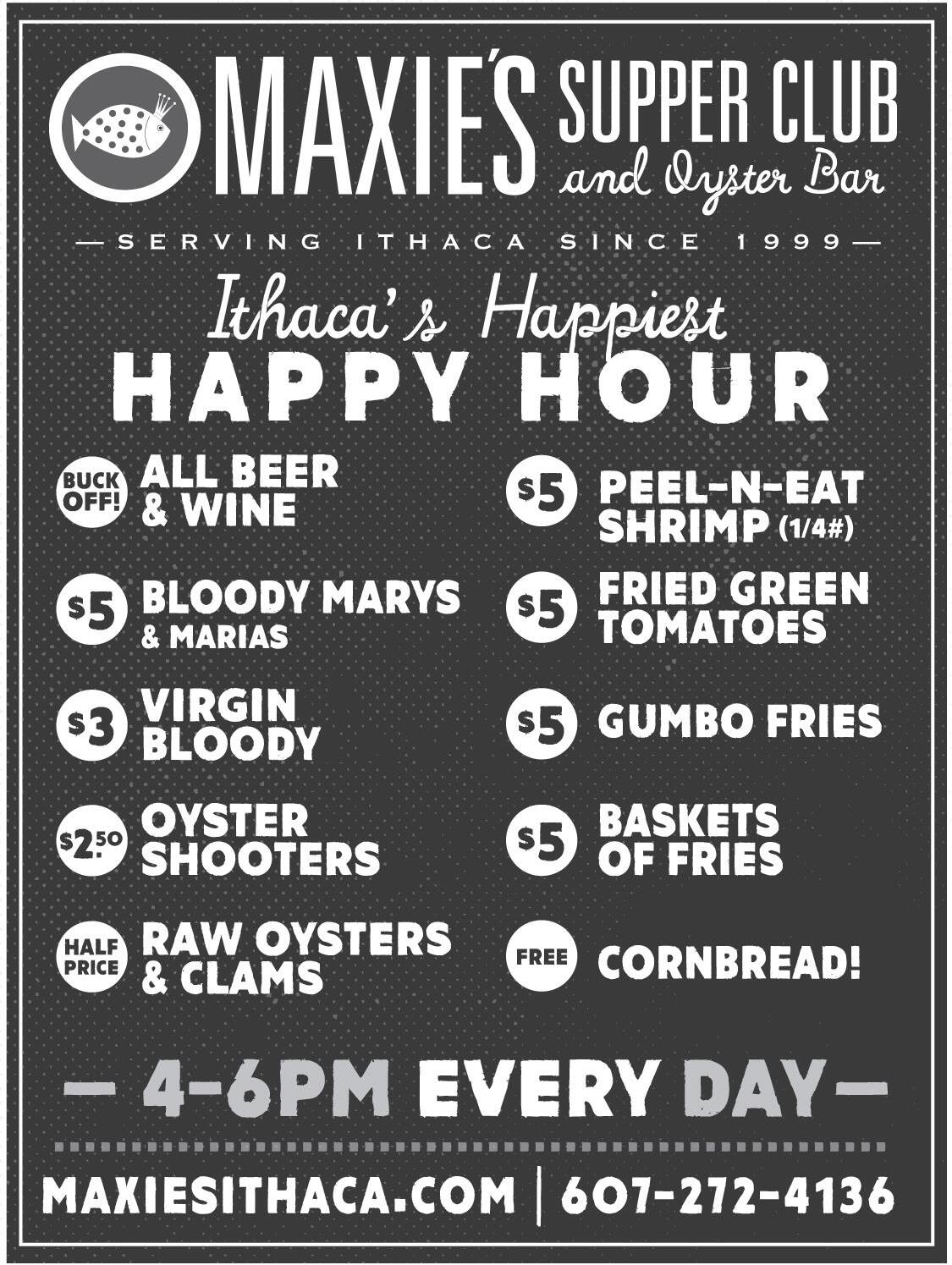
Cornell’s highest earner, Prof. Zev Rosenwaks, obstetrics and gynecology and reproductive medicine, made $7,193,540 in 2016. Rosenwaks is the director and physician-in-chief of the Ronald O. Perelman and Claudia Cohen Center for Reproductive Medicine.
Cornell is unique among the Ivies in having a fertility doctor as its highest earner. The highest paid employee at Yale in 2016 was the university’s chief investment officer, David F. Swensen, whose compensation was $4,683,382, according to Yale’s tax return.
The second and third highest paid employees at Cornell in 2016 were also physicians at the Center for Reproductive Medicine. Prof. Hey-Joo Kang, obstetrics and gynecology and reproductive medicine, who was the second highest earner, made $4,408,394. The third highest paid employee was Prof. Steven Spandorfer, obstetrics and gynecology and reproductive medicine, who earned $3,828,565.
“The compensation of full-time faculty is based upon their teaching, research and administrative responsibilities, as well as the income derived from their clinical practices,” said John Carberry, a University spokesperson, in an email to The Sun.
The fourth highest earner in 2016 was a neurosurgeon at Weill Cornell, Theodore Schwartz, while the fifth highest earner was another obstetrician-gynecologist, Dr. Pak Chung.
At Brown University, the president earned the most money in 2016. As President and fellow of the university, Christina Paxson made $1,528,249. The university’s vice president and chief investment
officer was the second highest earner and a managing director for Brown’s Investment Office was the third.
Like Yale, Columbia’s top earner also manages the university’s endowment. The highest paid employee, Peter Holland, served as chief investment officer until October of 2016, at which point he became the chief executive officer of Columbia Investment Management. He earned $6,709,425 in 2016. The university also follows the trend of having physicians among the highest earners, as Columbia’s second most paid employee is dermatologist David N. Silvers.
Cornell’s tax return also revealed the pay of high-level administrators, some of whom make more than $1 million. In 2016, Chief Medical Officer Daniel M. Knowles made $1,907,984, and Interim President Hunter Rawlings III earned a sum of $1,158,046.
“While a handful of senior administration officials may appear on this IRS filing along with some faculty members in Ithaca and New York City, Cornell University’s top priority has been and remains retaining and attracting the world’s leading researchers and educators,” Carberry said.
Professors average lower salaries than the top Cornell administrators. The average salary of a full professor at Cornell’s endowed colleges in 2011 was approximately $161,800, and the average salary of full professors at the contract colleges was $143,600, according to data provided to The Sun by Prof. Ronald Ehrenberg, industrial and labor relations, and the data from a 2018 issue of Academe, a magazine of the American Association of University Professors.
“The administrative jobs are much higher and have much more responsibility than the typical professor does,” Ehrenberg said. “A typical professor worries about his or her own teaching and research, and the administrators have this responsibility for the institution as a whole.”
He said that the ratio of administrator salaries to faculty salaries has been “increasing dramatically over time.”
In his email to The Sun, Carberry said compensation for faculty and administration is “based on the realities of that global marketplace,” and that as a top global research institution Cornell has to compete with peer institutions to “attract leading scholars as well as the most seasoned and accomplished administrators.”
Anne Snabes can be reached at asnabes@cornellsun.com.
TEMPERATURES
Continued from page 3
were like, Oh my God.”
“I’m kind of surprised that after the amount of backlash that [Pollack] got, that she would do the same thing at Cornell,” Aguilera said.
“I’m wearing snow boots, two pairs of socks and I still can’t feel my toes.”
Liz Davis-Frost ’20
Burgess said extra technicians are on campus so that the University is ready to fix burst pipes, broken heaters or any other emergencies.
Ithaca schools and Tompkins Cortland Community College cancelled all classes on Thursday. Ithaca College planned to remain open.
Ithaca’s homeless shelter, St. John’s Community Services, said people needing a place to stay should go to the county’s Department of Social Services at 320 W. State St. during business hours or head directly to the shelter at 618 West State St. after hours or on weekends. The shelter can be reached at 607-354-8990.
Nicholas Bogel-Burroughs can be reached at nickbogel@gmail.com

5 or Wednesday, February 6 5 - 6 p.m. Kaufmann Aud. (Room G64) Goldwin Smith Hall

By BENJAMIN VELANI Sun Staff Writer
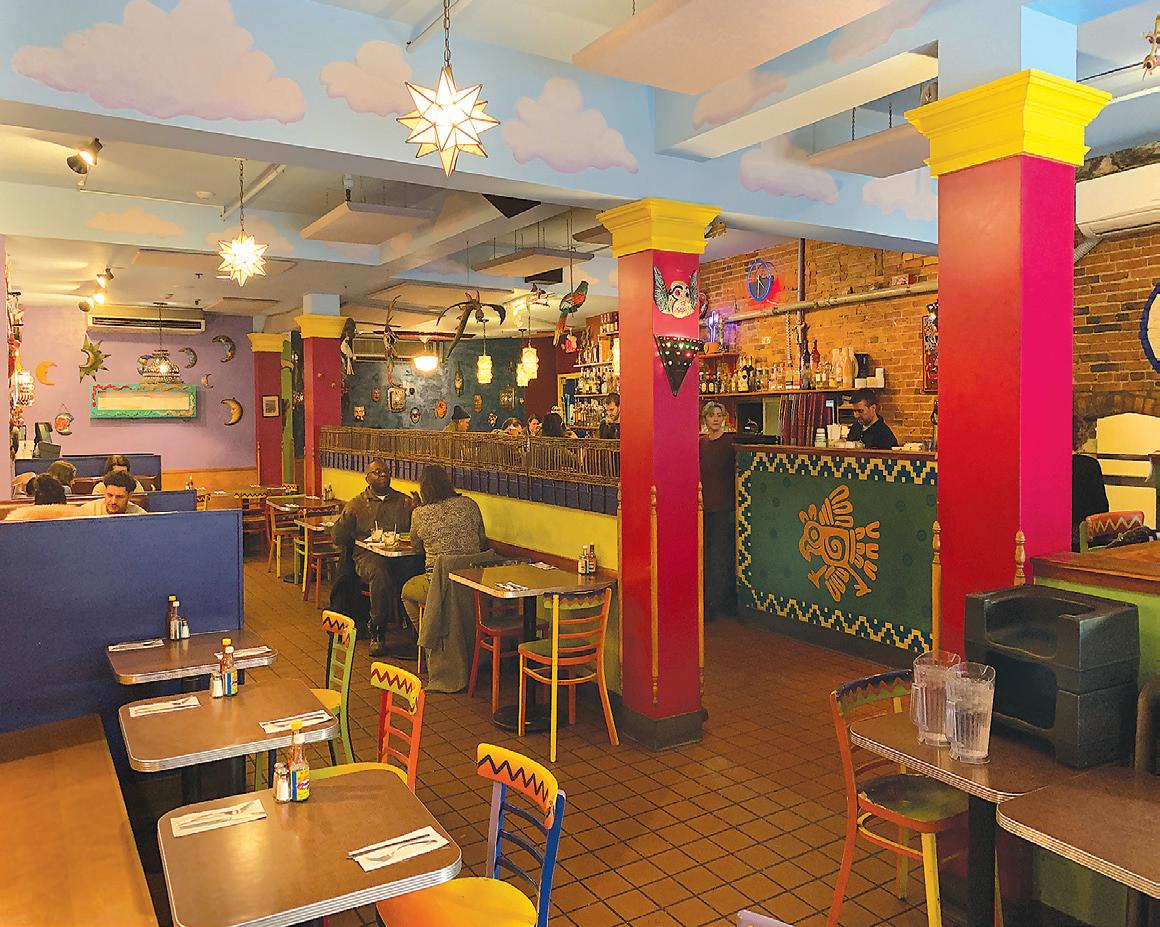
Warmly decorated with white Christmas lights and festive star-shaped lanterns, the colorful exterior and interior of Viva Taqueria and Cantina defies the dark, bitter cold of Ithaca’s winters. As soon as you walk past the neon Dos Equis bar light, your eyes, overwhelmed by the restaurant’s
head guarding the archway to the taqueria.
From here, your eyes might trail down towards the “Self Service / Full Service” sign located beneath the archway dividing the restaurant. I was delighted to learn that customers have the opportunity to grab a quick bite to go or eat at the bar-style seating of the self-service section. I find this especially convenient, being a busy college student

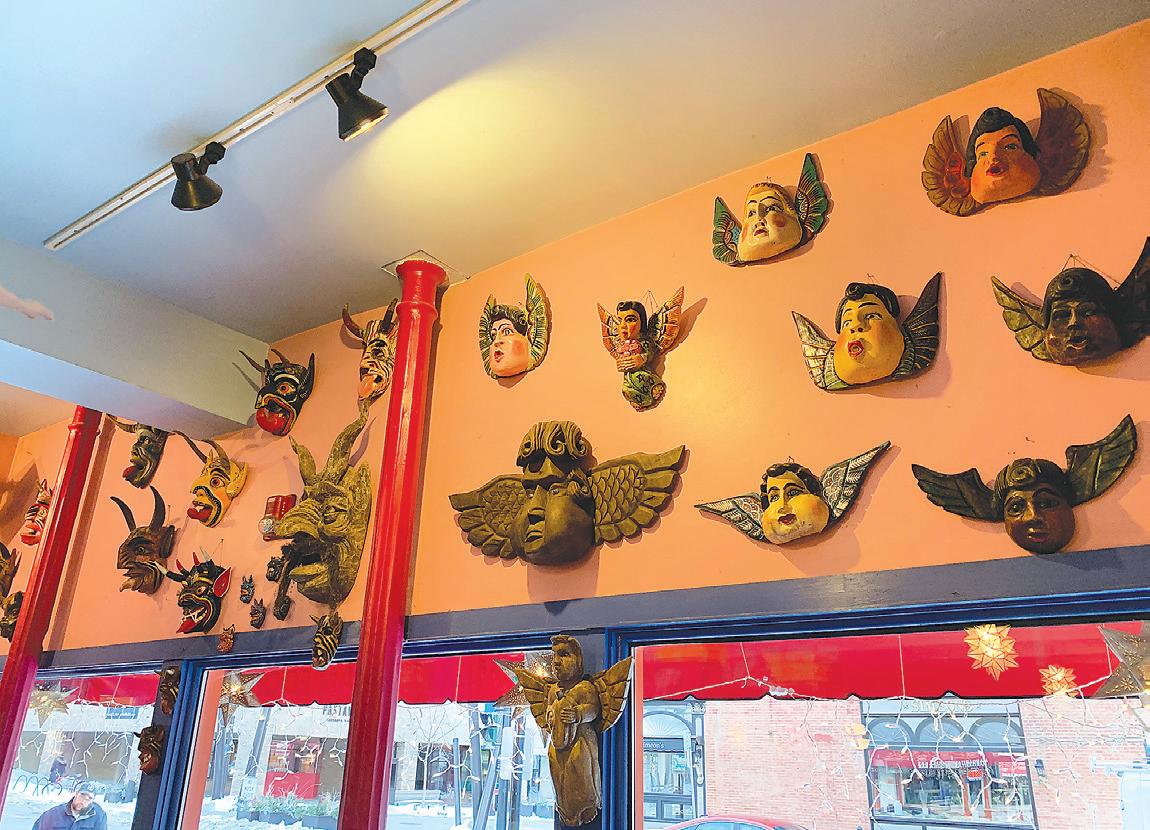
playful theme, will bounce from wall to wall. The taqueria is covered in as many mosaic tiles as a beach is with pebbles. But if you manage to look up from the floor, you will find a familiar face staring back from one of many sun-shaped mirrors. Immediately above your head are four blue feet protruding from the ceiling, and your wonder will only intensify when your eyes eventually land on a massive blue hippopotamus
The enchiladas were generously coated with a rich and creamy mole sauce and jazzed up with a drizzle of sour cream; the dish reminded me of a bougie latte you might order at Temple of Zeus. The soft corn tortillas held together well, even under the healthy layer of sauce.
who has little time to break up the routine of dining hall dinners. As is typical of many fast food restaurants, behind the counter are a number of drink machines, offering brightly colored juices that will tempt anyone with a sweet tooth. Written on a chalkboard are the items available to go, most of which are carried over from the restaurant’s full menu. In the main dining room, you will find chubby-cheeked angels and horned-devil masks mounted on the wall over each booth and


staring across the dining room towards the many ceramic suns and moons that decorate the cloud-covered walls and ceiling. In front of the bar is a vibrant mosaic of an orange bird with wings extended and legs outstretched. From fajitas to carnitas to burritos, the menu here consists of a humble amount of items that are simple and fairly well done. If you happen to need any allergen information or cannot remember what is in a certain sauce or topping, all of it is clearly laid out in a green box at the bottom of the menu.
Once we were seated, my friend Ben Wootton ’22 and I observed that each table had two El Yucateco hot sauce bottles (chile chipotle and green chile habanero), an appreciated alternative to Frank’s RedHot or Tabasco. I found myself craving a hardy and homely meal to lose the chills, so I decided to order their chicken mole enchiladas ($11.99), while Wootton, opting for a lighter dish, ordered a taco salad with chicken ($9.99). Both of us splurged as well, ordering a Jarritos soda ($3) each.
Although our orders came out surprisingly fast — in under ten minutes — we were disappointed
coated with a rich and creamy mole sauce and jazzed up with a drizzle of sour cream; the dish reminded me of a bougie latte you might order at Temple of Zeus.
The soft corn tortillas held together well, even under the healthy layer of sauce, which made up for the chicken’s dryness, though it was well-seasoned. The plate came with three light and simple sides: Spanish rice, black beans and pickled vegetables. These nicely complemented the rich entrée by adding
to find that they were not piping hot, which made me wonder just how fresh they were. Regardless, the plating was quite pretty — the enchiladas were generously
the necessary crunch, acidity and volume that I personally enjoy when eating anything savory. Therefore, my hat is off to Viva for creating the ideal portion
Do you want to be featured in print in the Cornell Daily Sun? Do you dream of being instafamous?

Send food pics from your fave spots in Ithaca, along with a short sentence on why this dish is particularly meaningful to you. Winning photos will be shown in print and posted to our Instagram.
Send to: food@cornellsun.com or Instagram DM @cornellsundining
size; instead of feeling bogged down and bloated after the meal, I left feeling perfectly satisfied.
The taco salad Wootton ordered, which was also well-portioned, has the option of coming with either a lime vinaigrette or a salsa buttermilk dressing. He ordered both on the side; the vinaigrette was light, tart and refreshing — more appropriate for a summer day — while the salsa buttermilk tasted like tangy ranch dressing. The homemade flour tortilla chips wrapped around the side of the dish were hot and crunchy, a perfect contrast to the cool, fresh salad — no wilted lettuce here.
All things considered, I wouldn’t say I was exactly “wowed” by the food at Viva. Rather, I’d say it was perfectly mediocre in that it offered what I expected from any cantina with a particularly American spin — by looking at the menu, you can observe the heavy use of cheese and cream, as opposed to the freshness provided by a sprinkling of cilantro, a squeeze of lime juice and the bite of chopped yellow onion that is typical of traditional Mexican cuisine. In fact, Viva markets itself as “a Californiastyle taqueria” on its website. There are, however, two big pluses of Viva Taqueria and Cantina: the efficiency of its kitchen and its comprehensive drinks menu. With three full pages of drinks, highlighted Happy Hours (4 - 6 p.m., Monday through Friday) and just about every kind of margarita under the sun, Viva might bolster a slightly more impressive bar than kitchen.
The last comment I want to make on Viva is a compliment to the staff. Everyone working there was genuinely kind, and even when I clumsily spilled a sip’s worth of my pineapple Jarritos, they offered to replace the entire bottle. Great customer service!
Serves: classic, Americanized Mexican fare
Vibe: festive and warm
Price: $
Overall:


I’m a sucker for YouTube interviews. Hearing artists talk and converse, while consciously and even subconsciously comparing their tones of voice and slurs to their lyrics and sound is exciting. No Netflix and chill for me, but put on a Genius interview, and I’ll think about it.
YNW Melly is known for his recent track “Mixed Personalities,” which features none other than Kanye West. After learning about YNW Melly from a friend in the industry, I drowned myself in the dark abyss that is musician YouTube interviews. I stumbled across a No Jumper interview with the rapper, published in August 2018. Listening to the 19-year-old artist discuss his ongoing journey to fame and his mind-blowing experience with the American jail system truly had me stunned, especially since he is younger than I am.
Jamell Demons, now professionally known as YNW Melly, is the living proof of SoundCloud’s power in our modern music space. He is undoubtedly someone for “new-wave” rap lovers to keep an eye on this year. For those of you waist-deep in internship applications, Demons is what they call “proficient in SoundCloud.” Put that on your resume.
Born in a small town in Florida and raised in a secluded Mexican neighborhood, YNW Melly began rapping in the eighth grade and showcasing his talent on SoundCloud at only 15. Just two years after he began establishing his online music presence, he was sent to prison for discharging a weapon in close proximity to a school. In his No Jumper interview, YNW Melly opens up about his experience in jail, which he admits truly altered the course of his life and even accelerated his path to success. While locked up, Demons found God as a source of strength and began working harder than ever, when he crafted his most played track, “Murder On My Mind.”

Shut
The “Murder On My Mind” track comes with a story and a half. YNW Melly wrote its lyrics behind bars
and eagerly awaited the moment in which he would be set free to find an appropriate beat for the track, but jail became a bigger roadblock than anticipated. Once he released the track, he was put right back in jail, as the lyrics were deemed a threat. In his words, he begins by reflecting on the difficulties faced in jail. There is somehow positivity in his pain when he raps, “I was locked up on Christmas . . . Ain’t get to hug my mama, couldn’t even give her no kisses.” He then proceeds to discuss none other than what the song’s title boasts, “I wake up in the morning I got murder on my mind . . . His face is on a T-Shirt and his family traumatized.” The lyrics become exceedingly gruesome but all the while, the beat goes harder.

YNW Melly recalls hearing about the track climbing over 1 million streams, while his newfound success was intangible behind bars. YNW Melly says he was aware that the song’s release would lead him to return to jail. Despite the song’s controversial subject matter, however, he had to release it. He had to transform his mind into music, as true artists do. What are “good” lyrics and what is “good” music, then, if not the truth? There’s some food for thought.
YNW Melly has since been released from jail and recently put out his new album, We All Shine . The album features Kanye West and Fredo Bang, with hits
including “Hold Up,” “Rolling Loud,” and bonus track “Butter Pecan,” among others. To the surprise of many, one of his greatest inspirations is Ed Sheeran, however true fans can detect similarities in the way that pure melody is so crucial to both artists’ work. As he continues to mature, we can expect to see the talented, independent rapper working with more big names and climbing toward his long-term goal of signing fifty artists to a label. I believe that we can all be excited to watch YNW Melly grow up right in front of our eyes, both personally and musically.
Juliette Rolnick is a junior in Te College of Arts and Sciences. She can be reached jr798@cornell.edu. Eyes Wide Shut runs alternate Tursdays this semester.
9:15 p.m., much to the excitement of the crowd. They began their set with the fan favorite “Lisa Baby,” followed by two popular singles, “Different Colors” and “One Foot.”
on many of the band’s tracks.
Originally known for their songs “Anna Sun” and “Quesadilla,” Walk the Moon has since exploded through the success of their 2014 summer mega-hit, “Shut Up and Dance.” Following the success of their recent world tour, Walk the Moon returned to Ithaca Monday night as part of their fivemonth tour across North America.
A crowd of mostly students filed into the State Theatre early to stand in the limited room between the stage and the theater seating. I was able to get a spot in the standing room and was surprised by how diverse the music taste among the crowd was: Die-hard Walk the Moon fans and casual listeners alike stood all around me awaiting the lights to dim.
Bear Hands, a Brooklyn-based indie-rock band opened at 8 p.m. The four-piece band played a host of tunes which incorporated heavy bass licks, shimmering guitar accents, looped samples and nonchalant vocals. While the band set the mood nicely for the night, they played for an hour and, by the end, overstayed their welcome.
Walk the Moon took the stage around
They designed their setlist very well, balancing their obligation to play their most famous songs with their responsibility to play songs catering to their veteran fan base.
Bassist Kevin Ray, guitarist Eli Mairman and drummer Sean Waugaman worked tirelessly to provide a solid groove.

The band remained tight in their coordination all night; upbeat tunes and ballads alike were energetic and effective. Frontman Nick Petricca was particularly fantastic, leading the group with his infectious charisma, lively dancing and impressive vocals. He also provided a few enjoyable synthesizer solos which have become staples
As the night went on, Walk the Moon debuted their brand new single “Timebomb.” It was well received by the crowd, although Petricca’s attempt to have the crowd sing the chorus was amusingly unsuccessful as the song hasn’t quite been out long enough for the fans to know the lyrics. Halfway through the set, the band took a short break to lead a group mindfulness session urging us all to breathe in unison and send our “love shockwave” all over the world. They continued their positivity with the charming “I Can Lift a Car.” While the song is a bit silly, I had a great time vibing with the crowd, lifting our arms over our heads. If you buy into positivity and “fake it until you make it,” you will arrive at a genuinely happy place. “Shut Up and Dance” was, unsurprisingly, the biggest hit of the night.
The crowd jumped through the whole tune. I have to admit, the song is just fun. It doesn’t matter who you are, you will dance too if you see this song live.
The indie outfit sped to a finish with their last few songs, including their cover of “Ghostbusters” from the soundtrack of the recent all-female reboot. It was unabashedly corny and, as a result, very lively. The band soared on throwback-sounding ballads “Surrender” and “Aquaman.” Walk the Moon concluded their set with punk-banger “Headphones” which included a long outro and a jam on Led Zeppelin’s “Kashmir.” The only feeling I remember from that moment was pure hype.
When they left the stage before their encore, the crowd was earth-shatteringly loud, even after a long night of singing and screaming. The group returned to sing cult-classics, “Portugal” and “Anna Sun” — much to the delight of the audience.
Walk the Moon brought their infectious charisma, tight grooves and classic hits to the the State Theatre of Ithaca. I left with my ears ringing and a big smile on my face.
James Robertson is a sophomore in the College of Arts and Sciences. He can be reached at jar524@cornell.edu.
Independent Since 1880
136th Editorial Board
JACOB
S. KARASIK RUBASHKIN ’19 Editor in Chief
JOHN McKIM MILLER ’20
Business Manager
KATIE SIMS ’20
Associate Editor
VARUN IYENGAR ’21
Web Editor
MEGAN ROCHE ’19
Projects Editor
EMMA WILLIAMS ’19
Design Editor
JEREMIAH KIM ’19
Blogs Editor
AMOL RAJESH ’20
Science Editor
BREANNE FLEER ’20
News Editor
YUICHIRO KAKUTANI ’19
News Editor
NICHOLAS BOGEL-BURROUGHS ’19
City Editor
LEV AKABAS ’19
Arts & Entertainment Editor
GIRISHA ARORA ’20
Managing Editor
HEIDI MYUNG ’19
Advertising Manager
ALISHA GUPTA ’20
Assistant Managing Editor
DYLAN McDEVITT ’19
MICHAEL LI ’20 Photography Editor
GRIFFIN SMITH-NICHOLS ’19
JACQUELINE QUACH ’19
SHRUTI JUNEJA ’20
ANU SUBRAMANIAM ’20
JUSTIN J. PARK ’19 Multimedia Editor
PARIS GHAZI ’21 Assistant News Editor
Working on Today’s Sun
Ad Layout Dana Chan ’21
’21
Williams ’19
Deskers Zuobing Qian ’22 Katie Reis ’20
Editors in Training
Editor in Chief Anu Subramaniam ’20
Managing Editor Sarah Skinner ’21
Meredith Liu ’20
Associate Editor Paris Ghazi ’21
Sports Editor Christina Bulkeley ’21
Photo Editor Yisu Zheng ’21
Dining Editor Katie Zhang ’21
Lucy Spahr ’22
News Editor Amina Kilpatrick ’21
Olivia Weinberg ’22
Editorial
THE STUDENTS OF PHYS 1102: GENERAL PHYSICS II HAVE A PROBLEM. Last Tuesday, when a pipe burst in the attic of their home, Rockefeller Hall, a whole suite of laboratories and professors’ offices were damaged, rendering them unusable and potentially costing hundreds of thousands of dollars. From the outside, their problem — cancelled sections and inaccessible, damaged labs — might seem minor inconveniences. That may be because it isn’t your education that is affected by it. But you should be concerned, because the incident at Rockefeller points to a disappointing trend at Cornell.
Rockefeller Hall’s administrative manager says the damages were the result of deferred maintenance, the process by which identified issues are put off due to “timing issues or lack of funding.” Deferred maintenance is a fact of life, and is sure to affect buildings as old as Rockefeller, but the reality is that campus is not decaying equally.
Over the last few years, we saw the completion of the Ag Quad Landscape Revitalization project, a largely aesthetic endeavor which focused on circulation patterns, paving, lighting and measures to ensure routine maintenance and the redevelopment of the Schwartz Center plaza, which Cornell deemed an “underutilized, concrete, sunken patio.”
Why was Rockefeller Hall left out?
Cornell was not built in a day, and it cannot be fixed in a day.
But to postpone needed maintenance past the breaking point, to dally until Cornell’s core academic function begins to suffer, while also embarking on shiny new projects — both cosmetic and, yes, in some cases substantive — positions the administration as out of touch with the students and faculty who use these buildings every day.
This issue is larger than a single burst pipe in Rockefeller and the hundreds of thousands of dollars in damage done by it. The Sun has previously lamented the sorry state of McGraw Hall, which remains crumbling (though we hope that the ongoing meeting of the Board of Trustees yields some decisive action on that project), and we continue to see every day the misplaced priorities in capital improvement.
The chemistry students of Baker Hall 200 take their notes on foldable tables better suited for the porch of a Collegetown fraternity annex. And yet, Cornell prepares to renovate not the learning spaces of Baker Hall but rather the Statler Ballroom, a space with limited academic utility, but significant fundraising purposes. Perhaps the ballroom visitors should be consigned to using the pong tables as well.
We understand that Cornell’s budget is finite. But when faced with a decision between the continued academic success and safety of the students, faculty and their environs, and a new chandelier for Statler, our money should be on the former. And as we saw this week, completing deferred maintenance can even save future repair costs.
And of course, it would go a long way toward making students of all departments feel valued, because let’s face it: those who spend the bulk of their class time in Gates Hall are having a different experience than those sitting in McGraw or Rockefeller.
Tomorrow will be another cold day in Ithaca. Who knows which pipes will burst?
Perhaps unsurprisingly, the accessibility and quality of student mental health services continue to be of high interest to the Cornell community. Written recommendations, like those submitted by the student-led Mental Health Taskforce, and ongoing discussions amongst campus stakeholders, like those facilitated by the Coalition on Mental Health, continue to highlight ways in which we can improve services and better support students.
A recurring theme is that student demand for counseling services exceeds the possible support Counseling and Psychological Services can provide. While more than 22 percent of Cornell students used CAPS services in the last academic year, CAPS reports that for students seeking individual counseling, they aim to schedule first appointments within two weeks with wait times increasing even further during periods of high demand. The wait to see a counselor for individual counseling is a significant barrier to receiving high-quality care in a timely manner for many students. As the demand for services has historically increased each year, with no indication that this trend will plateau or disappear, finding a solution to this supply and demand problem is becoming of paramount importance.
Health staff members to rapidly connect students to additional resources on campus that may support them. The benefits of this change exceed simply reducing wait times. It increases the flexibility of CAPS staff while reducing staff burnout. The cumulative change being the elevation of CAPS services to one that is better prepared to meet students needs and provide support.
The most straightforward solution is to continue hiring more and more mental health practitioners as quickly as possible in the hopes that we can meet demand.
The most straightforward solution is to continue hiring more and more mental health practitioners as quickly as possible in the hopes that we can meet demand. The CAPS team is currently comprised over 40 highly-qualified psychologists, social workers, psychiatrists and psychiatric nurse practitioners from a variety of diverse backgrounds with plans to hire more. However, finding and retaining high-quality practitioners continues to be a challenge resulting in a historical inability to simply hire more counselors to meet the demand. We are not the only university facing this problem, which allows us the opportunity to look to other institutions and see what changes they are exploring. In my opinion, there are two specific changes worth highlighting to the broader community.
The first strategy is a shift away from the traditional 50 minute initial mental health assessment to a 30 minute one. Like Cornell, institutions that adopted this model had students waiting anywhere from two to three weeks for their first treatment session. However, changing to this model has resulted in the average wait time dropping to around three days, with most students being seen the same day they reach out to the health center. Students then have the option after the first assessment to stick with either a 30 minute or switch to a 50 minute session if they would like to continue seeing a practitioner. For many students, this change not only allows them to see a practitioner much faster — meaning that they may receive help while the problem is still moderate preventing its escalation to a crisis — but it may also be easier for them to schedule more frequent sessions as it may be easier to find 30 minutes in a packed weekly schedule compared to 50.
While there are additional adjustments that must be made in order to make this shift successful, this change is particularly exciting because it accelerates the development of a relationship between a student in distress and Cornell Health. It now positions students to not only receive high-quality treatment as soon as possible but also positions Cornell
The second strategy is the integration of telemedicine into an institution’s health, and by extension, mental health services portfolio. Technological advancements now allow patients to interact with a health care provider and receive care via virtual text chat or video. For patients living in communities where the demand for certain health services outpaces the supply, such as rural cities, telemedicine is proving to be an effective strategy for bridging this gap. Our own medical school is successfully using telemedicine to evaluate patients in the Emergency Department, once again not only reducing time spent obtaining care but also effectively managing to maintain high levels of patient safety and satisfaction. A recent survey disseminated by the Student Assembly and Graduate and Professional Student Assembly found that 50 percent and 21 percent of respondents believed developing online and app-based mental health resources should be a medium or high priority respectively. All of this suggests that offering telepsychology and telepsychiatry may allow Cornell students to obtain professional support faster than before.
The flexibility associated with telemedicine means that students can schedule sessions not only when but also where it is convenient for them. Many students have vocalized that making it into Cornell Health is a barrier for them receiving care. Telemedicine could minimize or even eliminate this problem. While telemedicine may not be of interest to every student, even a subset of the population utilizing this resource allows CAPS staff members to see more individuals. Also, Cornell Health could potentially invest in creating physical offices on campus allowing students to utilize this service in comfortable and confidential spaces at a comparatively lower cost. Once again, this shift is well positioned to connect students to Cornell Health and mental health practitioners sooner rather than later.
To be clear, I am not advocating for a complete shift in practices to either model detailed above. The path forward may instead be adding these both as options for students. The decision is then in the hands of students. They are ultimately given greater power to choose which model best suits their needs and expectations. For CAPS and Cornell Health staff, the addition of these techniques should help them engage and support more students without increasing burnout. The desire of all campus stakeholders, including students, staff, and administrators, is to provide high-quality care to students in a timely manner and to ensure student success at Cornell. Both of these suggestions should, in theory, serve this goal, and therefore make them worthy of serious consideration.
Manisha Munasinghe is the graduate and professional student-elected member of the Board of Trustees, and a Ph.D. candidate at Cornell University. Trustee Viewpoint runs every other week this semester. Munasinghe can be reached at mmunasinghe@cornellsun.com.
This past weekend, the internet informed me about yet another native-English speaker lashing out at someone for being able to speak more than one language. Unfortunately, this is not a novel incident. Over the past few years, we’ve all become accustomed to various instances of people who are a little bit too in love with the English language. What makes this particular incident different, however, is the fact that the perpetrator was not some screaming dude in a mall being filmed on a bystander’s iPhone. Rather, it was Duke University Prof. Megan Neely, biostatistics, who sent an email to her graduate students advising international students to stop speaking Chinese amongst each other and instead speak English at all times.
No, I’m not kidding.
In the now viral email, Neely writes that her fellow faculty members had expressed concern about first-year students speaking Chinese in student lounge and study areas. Perhaps one of the most ridiculous lines, which she so graciously bolded AND underlined, was the following:
ing from using the LoWeRcAsE-UpPeRcAsE Spongebob meme text).
Jokes aside, it is incredibly frustrating that an assistant professor at such a prestigious university was so comfortable sharing her ignorance and racial insensitivity under the guise of concern. Aside from the fact that this country does not belong to any one group of people, the United States is one of the few nations in the world that does not have an official language. Yes, despite what every white conservative over the age of 30 seems to think, learning “American” is not a prerequisite to living in this country.
It is frustrating that an assistant professor at such a prestigious university was comfortable sharing her ignorance under the guise of concern.
“[The faculty members] were disappointed that these students were not taking this opportunity to improve their English and were being so impolite as to have a conversation that not everyone on the floor could understand.”
Really Neely? I don’t even know where to start with this. I’m not sure why Megan Neely — or her colleagues — feel entitled to know the content of conversations that students are having amongst themselves in their personal time. However, I’m sure that if Dr. Neely and her fellow faculty members are so hellbent on eavesdropping on students, they could start taking Chinese lessons.
When I looked up a picture of Megan Neely, I have to admit that she looks exactly like the type of person who would be personally offended by students speaking a language that she doesn’t understand. At the same time however, I also have to admit that I’ve never understood the uniquely American idea that “if you’re in my country, you need to speak my language” (I am actively refrain-
“To international students, PLEASE PLEASE PLEASE keep these unintended consequences in mind when you choose to speak in Chinese in the building,” Neely wrote in the email. “I have no idea how hard it has been and still is for you to come to the US and have to learn in a non-native language. As such, I have the upmost [sic] respect for what you are doing.”
Neely is right about one thing: she has not an iota of understanding of how difficult it is to move to a country already so unwelcoming of newcomers and pursue not only an education, but a life, in a language that you do not know. Her feigned sympathy for international students reminded me of one of the very real, very sobering experiences I had at Cornell.
I distinctly remember sitting in a biology lecture in my sophomore year, trying not to doze off to the professor’s unbelievably monotonous voice. Unsuccessful in not zoning out, I glanced at the laptop of the girl sitting next to me, in hopes that I could quickly copy down the information I had just missed about lipid bilayers. However, instead of seeing a PowerPoint slide on her screen, I saw that she had Google Translate open and had typed in the word “permeable” to translate into Chinese. Throughout the rest of the lecture, I notice this girl repeatedly switching tabs between her notes and Google Translate and I
In recent years, Venezuela has become a favorite talking point for socialism’s detractors, who typically invoke the nation when they find themselves without a more substantive defense of their views. “But what about Venezuela?” they ask in comment sections everywhere.
The question is rhetorical. Venezuela is just their trump card — present-day proof of the failed socialist experiment. But what if we truly wanted to know the answer to “what about Venezuela?” If the question was asked in good faith, what would the answer be? Are the people of Venezuela living a Marxist’s dream or Trump’s “shithole” nightmare?
In recent weeks, genuine curiosity about the answer to that question has grown as more people wonder whether it’s bad enough to justify regime change. But the answer doesn’t actually matter — because the only thing that’s ever “bad enough” is genocide, so we should mind our own damn business.
Some might reject the idea of turning a blind eye to a world in need. They’ll insist that it is, in fact, our business to know what’s happening in the rest of the world, and to step in and help where we can.
I have a couple of responses to that.
First off, why is it that we are only scandalized by human rights abuses and devastating poverty in countries with oil, land or strategic importance to U.S. power? Nobody cared when people started jumping out the windows of the iPhone factories. Forever 21 didn’t go out of business when we heard that it was four year-old sweatshop slaves making our crop tops. We just made a mental note, kept scrolling and had the little slave girls print “feminism” on said crop tops.
was hit with a surge of realization.
As a bilingual child of immigrants, I have long known how much of a barrier language is in everyday interactions. However, I never considered the sheer resilience that it takes to pursue a degree in a foreign language.
Over the next two years following that incident, I worked as a writing tutor at Cornell’s Knight Writing Center and had a fair share of multilingual students bring in papers for editing. Time and time again, I’ve been impressed by their ability to write about often profound and complex concepts in a language that they are still learning. A particular instance that comes to mind is when an international student brought in a draft of her final philosophy paper for me to critique. Not only did 90 percent of the ideas she expressed go way over my head, but I was genuinely blown away when she told me she had only started speaking English two years ago.
I remember her sheepishly telling me that she was “not very good at grammar” and that “there were probably a lot of mistakes” to which I had to refrain from screaming, “are you kidding me?!” I assured her that the two or three minor grammatical errors in her paper — ones that most natives English speakers make on a daily basis — were the least of my concerns. I told her that it was quite an incredible feat to learn a language with not even so much as a remotely similar script as your mother tongue and within a couple of years manage to write an eight-page paper on philosophy, of all things. In response to my incredulation, she shrugged her shoulders and said “I guess I don’t have a choice.”
I have long known how much of a barrier language is in everyday interactions.
To multilingual and international students at Cornell and all other institutions: I hope that you know that your resilience does not go unnoticed. I hope you continue speaking — loudly and proudly — in whatever language you so desire. Anyone who has a problem with it will just have to catch up, because as far as I’m concerned, you always have a choice.
Faiza Ahmad is a senior in the College of Arts and Sciences. The Fifth Column runs every other Thursday this semester. She can be reached at fahmad@cornellsun.com.
Second, we’re in a mighty big glass house to be throwing stones like this. Our government is a sham; policy has nothing to do with voter preferences and is instead based almost entirely on the “collective interests of the economic elite.” One in six American children — yes, American — goes to bed hungry. Lack of access to medical care is one of the leading causes of death in this country — roughly 122 Americans die every day because of it. In 2008, 1.2 million people lost their homes largely due to the greed and corruption of our government.
But somehow we have the absolute audacity to go into somebody else’s country and tell them we know how to run it better?
Third, the U.S. is currently — and this is true — in the midst of roiling national turmoil because another country might have attempted to influence our elections. Some people think it didn’t happen, some think it did, but everyone agrees that foreign meddling in our elections would be devastating to our belief in democracy.
The majority of Americans don’t just disapprove of their President — they believe he is fundamentally unfit to hold office. It is widely believed that he is corrupt and that he poses a threat not only to his own people, but to the world. And, again, the legitimacy of his election is up for debate.
Yet if the countries of the global South got together and decided to install Chuck Schumer in his place, Americans of every political stripe would be up in arms. Realistically, we’d probably literally take up arms.
Why do we expect other nations to react differently? Is it because we operate according to the implicit belief that brown
people need the benevolent paternalism of the global North because they are somehow less competent, less worthy political actors?
Fourth, we’ve done this song and dance before. Some combination of generating both conservative and liberal media outrage about a leftist dictator in the global South, enforcing sanctions on the dictator’s country to manufacture more evidence of socialism’s failure, cherry-picking a
Sovereign
nations have the right to be left alone.
Venezuela the same way the Bush administration cared about Iraq in 2003 — only insofar as it produces the glug-glug goodness that makes stuff go.
Our politicians aren’t really interested in improving the lives of Venezuelans; they’re not even interested in improving the lives of Americans. We are interested only in oil and in preserving U.S. hegemony, even though we know firsthand how foreign manipulation can cripple a country, having been both the puppeteer and the puppet.

random bootlicker from the opposition to install, then quickly disappearing and conveniently forgetting about the country as chaos — or even civil war — unfolds.
It’s not our first imperialist rodeo.
I implore anyone who thinks we’re actually spreading ‘freedom and democracy’ to check in on Afghanistan, Bolivia, Brazil, Chile, Cuba, Dominican Republic, Egypt, El Salvador, Guatemala, Greece, Grenada, Haiti, Hawaii, Honduras, Indonesia, Iran, Iraq, Korea, Kuwait, Laos, Lebanon, Libya, Nicaragua, Palestine, Panama, the Philippines, Puerto Rico, Syria, Vietnam, Yemen or Yugoslavia, and find out how grateful they are for our valiant rescue.
We’re clearly not cut out to be the world’s policeman.
Prominent supporters of the attempted coup, like Marco Rubio and John Bolton, are openly admitting that they care about
Maduro’s Venezuela is clearly a dumpster fire, but it’s no Nazi Germany. It’s not even a Bolsonaro Brazil, a present-day fascist regime in which we seem to have no interest in intervening.
Until the most recent election, Venezuela’s voting system was widely recognized, even by hyper-capitalist outlets like Forbes, as super legit — they have biometric identification, while we’re still out here with paper ballots like its 1892. Pro-government protesters have been taking to the streets in huge numbers following the attempted coup, but are receiving zero coverage from mainstream Western media, unlike their anti-government counterparts. All signs point to Maduro being the legitimate, democratically elected leader of Venezuela. So, no, it really doesn’t matter what we think. Sovereign nations have the right to be left alone.
Sure, maybe they didn’t pick the greatest guy this time around. But hey, neither did we.
Jade Pinero is a senior in the College of Agriculture and Life Sciences. Jaded and Confused runs every other Thursday this semester. She can be reached at jpinero@cornellsun.com.
Fill in the empty cells, one number in each, so that each column, row, and region contains the numbers 1-9 exactly once. Each number in the solution therefore occurs only once in each of the three “directions,” hence the “single numbers” implied by the puzzle’s name. (Rules from wikipedia.org/wiki/ Sudoku)




2 & 3 BEDROOMS
109 SAGE PLACE
Available NOW, Spring 2019 & 2019/2020 Shuttle Bus Access to Campus Access to Free Fitness Center Novarr- Mackesey Property Management office@ithacastudentapartments.com ithacastudentapartments.com 607-277-1234
Ithaca Renting Company Apartments, Houses, Parking Central Collegetown Superb Panoramic Views Modern Elevator Buildings
Collegetown Plaza: Fitness Room, fantastic Cayuga Lake Views Studio, 1, 2, 3, 4, 5, 6 BRs Parking
Collegetown Center: Concierge Service, quiet building, Fitness Room Studio, 1, 2 BRs Parking
Collegetown Court: Super convenient, exceptional value Fitness room Studio, 1, 3, 4, 5 BRs
Other Collegetown Locations: Apartments and Houses Dryden Road, Eddy Street, Buffalo Street
2, 3, 4, 6, 8, 10, 14 BRs Parking Rent Smart. Live Well.
607-272-3000 Visit our office at: 119 Dryden Road www.ithacarenting.com
Studios and 3-5 bedroom apartments available!
1. Walk to classes and Center Campus amenities in minutes
2. Units with dishwashers, fireplaces, and two bathrooms available.
3. On-Site Laundry
4. Free high-speed Roadrunner Internet and Cable
5. On-site parking
6. Furnished with TVs
7. Very competitive pricing Call us (607)257-0313 for details or to schedule a tour!
Houses, Apts, Parking 1 to 9 Bedroom
Collegetown - College Ave, Linden Ave, Dryden Rd, Bryant Ave, Cook St. 607-330-2442 info@urbanithaca.com www.urbanithaca.com
Nicest Apts. in Collegetown Located on Eddy St.
4 Bedrooms
Fully furnished. Spacious living areas with large bedrooms & closets. Hardwood flors, spectacular views, eat-in kitchens with additional sun rooms. Laundry & parking. 607-339-1137 bgm900@gmail.com
COLLEGE AVE.
1 Bedroom available In a 2 BR apartment For Male, Undergrad student. Available NOW & Spring 2019
4 Bedroom Apartment
26 A PA R TMENT FOR R ENT
312 College Ave
Collegetown’s Best Address Now leasing for 2018-19. Superior Studio, 1, 2, 3 Bedroom Apartments. Fitness facility, theater, and meeting space. Free high-speed internet. Exclusive resident parking. Overnight concierge. Package delivery. 312collegeave.com 607-273-9777
Collegetown Terrace Apartments INSPIRED LIVING TAILORED TO YOUR SUCCESS 24-Hour Fitness Center Shuttle Bus Service to Campus Study Rooms w/ Expansive Views
Apartments Available NOW, Spring 2019 & 2019/2020 Novarr- Mackesey Property Management collegetownterraceithaca.com office@ithacastudentapartments.com 607-277-1234
As the Cornell men’s hockey team made its final preparations for opening night back in October, head coach Mike Schafer ’86 had a goaltending decision to make: Would he go with sophomore Austin McGrath or freshman Nate McDonald? Schafer ultimately chose McGrath … as the backup to classmate and reigning All-American Matt Galajda.
Coming off a stellar freshman season, Galajda’s starting spot was never in jeopardy, but now — three months later — he finds himself in a daily battle with McGrath for the No. 1 job. That competition has gone on long enough; it’s time Galajda gets his job back.
end. Galajda beat the Sun Devils that night and followed it up with a shutout of Harvard in front of a sold-out Lynah Rink.
Despite sky-high expectations for his second collegiate season between the pipes, Galajda could not have gotten off to a worse start. A Hobey Baker finalist just one year ago, the underclassman was pulled in each of his first two games, surrendering eight goals in under five periods of work. McGrath came on in relief in both eventual losses, but any talk of a goalie competition would have been ridiculous.
We have availability for the 2019-2020 school year beginning June 1st at Hudson heights apartments. The studio apartments come with: heat, water, and electricity included. There are garbages houses and coin-operated laundry facilities on site. Prices start at $740/month for a 12 month lease. If you have any questions or would like to schedule a tour contact us by phone 607-208-7660 or email: renting@ithacaLS.com
27 H OUSE FOR R ENT
COLLEGETOWN 6 BEDROOMS Newly Remodeled PRICES SLASHED TO RENT 607-272-3389 avramisrentals@aol.com
“He’s a hell of a goaltender,” Schafer said of Galajda at the time. “I know he’s going to bounce back down the road.”
Galajda and the rest of the team settled down and played well over the next month of games, but the Ontario native sustained an injury in the Harvard game at Madison Square Garden just before Thanksgiving and went on to miss the next five games.
That’s when things got interesting.
Schafer called on McGrath to fill in, and he did not disappoint. In his five starts, the Red went 3-1-1 against a slew of impressive opponents — beating two Ivy rivals and backstopping a blowout of a ranked Arizona State team. He did everything expected of him and more.
But when Galajda came back for game two against ASU, it seemed as if McGrath’s stint had come to an
Yet, Schafer was unwilling to commit to Galajda as his starter going forward. To the surprise of many, it was McGrath who led the team onto the ice the next day against Dartmouth. Once again, he did his job and got the win.
Last Friday, Schafer went back to Galajda — who was solid in Cornell’s 3-2 win over Colgate. But once more, Galajda was benched in favor of his good friend McGrath on Saturday night. This time, the plan did not pay off. McGrath was pulled after allowing a pair of tough goals, and the team dropped its first game in two months.
The Red is currently tied for first in the ECAC, has all but clinched the Ivy title and is ninth in the PairWise rankings. There is no crisis at hand.
But the goalie situation is getting ridiculous.
Galajda was outstanding last sea-
“Something that we want as a coaching staff is competition at that position.”
Mike Schafer ’86
son. He led the nation with a 1.51 goals against average, finished first in shutouts (nine) and third in save percentage (.939). His play earned him too many honors and awards to even mention in this column. Sure, he got off to a rough start this season, but his performance ever since has been reminiscent of his 2017-18 self.
In fairness to McGrath, he played almost lights out when the team counted on him. For that, he deserves a tremendous amount of credit. But Galajda should not have lost his job due to injury — especially given the way he’s played since
coming back. According to Schafer, there is a simple reason behind the madness: competition. Knowing that the other guy is waiting in the wings means both Galajda and McGrath must bring their A-game every day in practice along with every Friday and Saturday night.
“Something that we want as a coaching staff is competition at that position,” the head coach said after Galajda’s shutout of Harvard. “Every time Matt has had competition, he has risen to the challenge and plays better and better … It is good to have two guys back there who will push each other.”
Schafer believes so strongly in this that he admittedly planned to alternate goaltenders each of the last two weeks — seemingly regardless of how the games actually played out. And therein lies the problem. Clearly, Schafer has seen enough in Galajda to give him the start each of the last two Friday nights. And Galajda has done his part by winning both games. So why start McGrath the next day? We all know of Galajda’s potential, and he ought to have the opportunity to find some sort of rhythm as the season really picks up. If he happens to play poorly, his backup McGrath is a great asset to have. But shutout victories should not be followed by benchings. Despite the current state of affairs, Schafer does not want this competition to go on forever. “I definitely want someone to grab and run with it,” he said Tuesday. “By the time we hit playoffs, I do not want to be in this situation where we’re alternating.” However, he refuses to name a starter. “No one stands out either way. They’re still competing ... Both look ready to play, and we just gotta figure it out.”
Galajda has shown more than enough over the last several weeks — not to mention the entirety of last season — to become the number one guy.
It’s time to make the decision, coach. And it’s an easy one.
Charles Cotton can be reached at ccotton@cornellsun.com.

By CHRISTINA BULKELEY Sun Staff Writer
This weekend, Cornell men’s hockey will venture to New York’s Capital District to take on ECAC foes Union and Rensselaer. With only five weeks left in the regular season until the conference playoffs, the Red can’t afford to ease up on its intensity for any of its upcoming matches.
Despite Union’s shoddy ECAC record (5-6-1), the Dutchmen have reemerged as a threat given their success in nonleague play on the season (7-14). Projected to be a powerhouse at the season’s onset, Union has had difficulty finding consistency in its play, but its 7-2 win over current No. 1 St. Cloud State earlier in the month is indicative of the Dutchmen’s potential.
Rensselaer (7-17-1, 4-9 ECAC), meanwhile, has found itself struggling both within and outside of conference play. RPI and Union played the nonleague Mayor’s Cup game on Tuesday, in which the teams tied, 0-0.
Cornell is confident it can match up with any team in its conference — be it a strong team like Union or a team near the bottom of the standings like RPI.
“When we come to play, I don’t think there are too many teams in the league that can get
WOMEN’S HOCKEY
in our way,” junior forward Jeff Malott said.
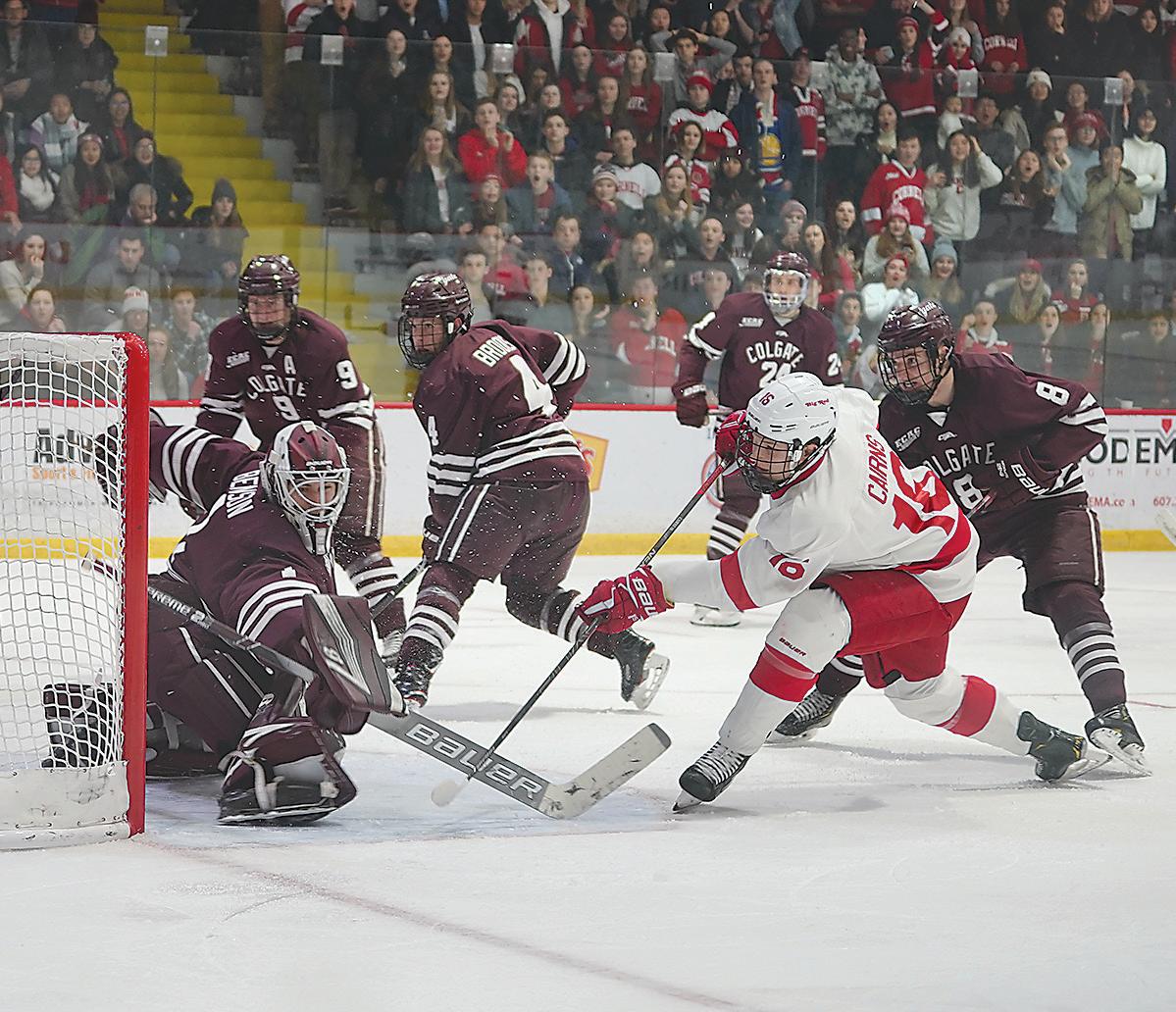
Even so, Cornell should know not to take a win over either Union or RPI for granted. Cornell fans might remember that — almost a year ago to the day — the Red was taken down by an unranked RPI in what seemed to be the beginning of the end of a once-promising season. At that point, Cornell was ranked No. 1 in the nation. The Red went on to be eliminated in the first round of NCAA tournament play.
Especially following Saturday night’s painful overtime loss to Colgate, Cornell’s skaters need to keep their heads in every game.
“Last week, we didn’t string together a great practice week leading up to the weekend, and it showed,” Malott said. “So I think we’ve got some guys chomping at the bit for this weekend.”
Both players and head coach Mike Schafer ’86 agree that Cornell put forward a better effort in Saturday’s 3-2 loss than in Friday’s 3-2 win. The Red’s attention to detail Saturday demonstrated improvement over the night before. But the lack of focus in practice throughout the prior week came back to haunt the Red in that overtime loss.
“The guys are back and competing … When you lose, it
brings things to a head,” Schafer said on Tuesday. “We’ve addressed those [issues], talked about them, practiced hard today.”
Renewed intensity will be vital to the team going forward, as question marks continue to pervade the lineup as a result of injuries. Multiple players’ statuses remain unknown as the weekend approaches. Even Schafer is afraid to speculate on who will be available for this weekend’s series.
“I don’t want to jinx them,” he said.
What is known, however, is that freshman forward Max Andreev is out for the majority of the remainder of the season with a cracked collarbone.
Another persisting unknown is who will start in goal going forward — sophomore Matt Galajda started in goal Friday and classmate Austin McGrath started Saturday, only to be pulled following a Colgate goal early in the second period. Even so, Schafer is undecided on who will become the regular backstop.
“You want to see them battle when things break down and
make that big save when the team needs it,” Schafer said. Going into the season, few would have thought that starting goaltender would be a contested position. But McGrath’s strong showings following Galajda’s injury in November mean that Schafer has been presented with a difficult choice. Both games this weekend — in Schenectady on Friday and in Troy on Saturday — are scheduled for 7 p.m.
Christina Bulkeley can be reached at cbulkeley@cornellsun.com.
By FAITH FISHER Sun Staff Writer
Two goals by the Syracuse Orange in the first eight minutes of the game charted a dismal trajectory for the Cornell women’s hockey team. However, the seasoned competitors prevailed, skillfully netting five unanswered goals over the next two periods to secure the 5-2 victory.
Syracuse (6-18-2) entered the ice forcefully, looking to finally defeat the Red (14-2-5), who have conquered the Orange in their last 11 meetings, including a 4-1 defeat in October.
Within just four minutes of play, Syracuse’s Amanda Hoppner put the Orange on the scoreboard. Emma Polaski was quick to widen the deficit and secure a sec-
ond goal for the Orange.
“There was a little bit of complacency going into the start of the game; we were not quite ready,” said head coach Doug Derraugh. “We have to give Syracuse credit — they came out jumping and got two quick goals on us.”
The Red’s junior forward Grace Graham, assisted by junior defenseman Jaime Bourbonnais, eclipsed the
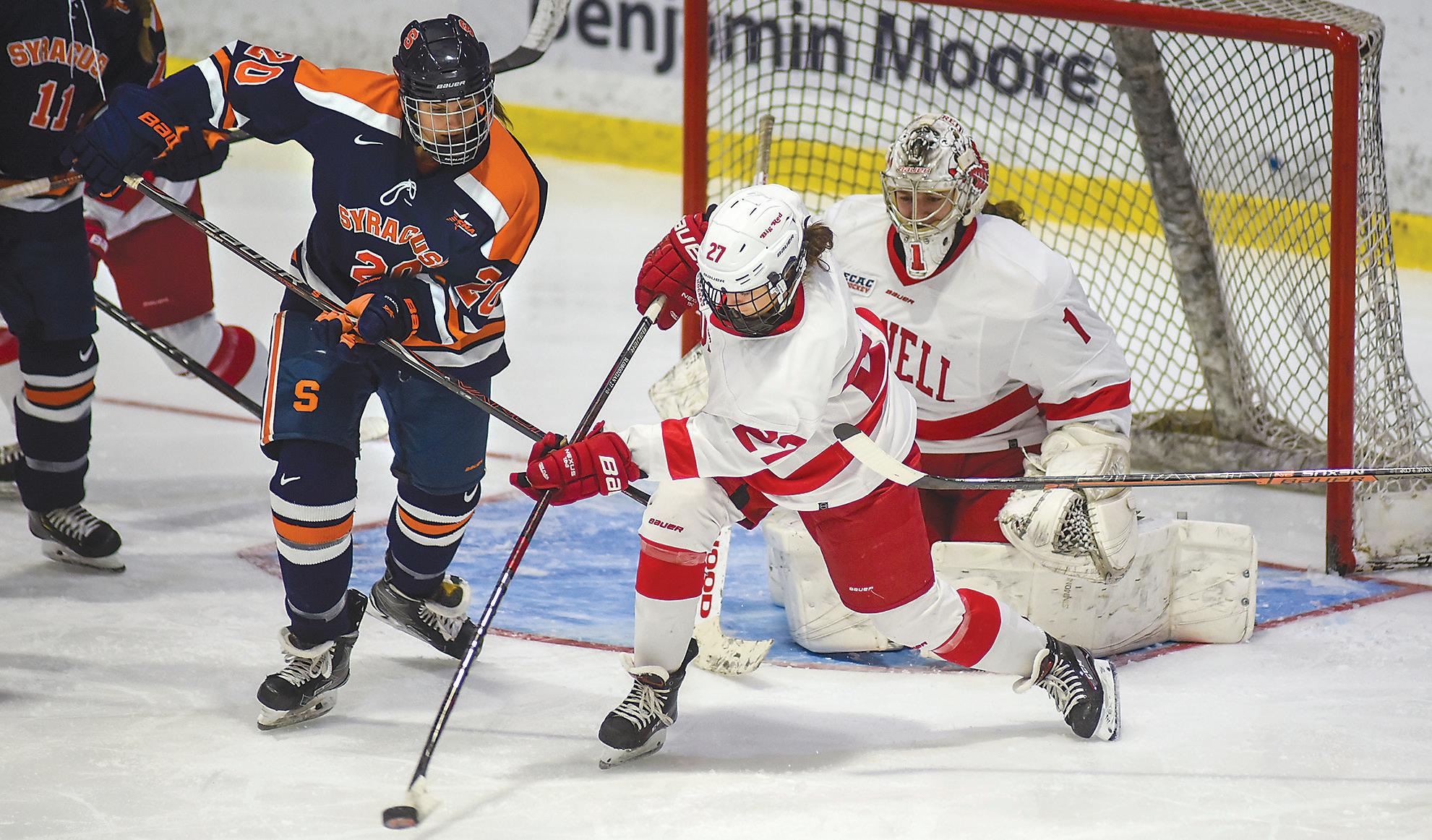
first goal for Cornell, placing them on the scoreboard. Bourbonnais, on a straight away, skated the length of the rink into the Orange’s defensive zone. She passed the puck to Graham, who adeptly sent it straight into the goal.
The Red remained at a 2-1 disadvantage into the second period. Halfway in, it seemed that the Red was doomed to fall even more behind as the Orange’s Victoria Klimek had a breakaway opportunity. She entered the offensive zone with the puck and had no Red defensemen there to stop her. Her attempt to fool senior goaltender Marlène Boissonnault, however, failed. This crucial save kept the game within reach for the Red and shifted the momentum in its favor.
“There were some breakdowns defensively in the second period and Marlène made a big save on the breakaway,” Derraugh said. “I feel like that really lifted us and changed the course of the game.”
Just minutes later, Cornell sophomore defenseman Devon Facchinato sent a shot to
the Orange goaltender. Junior forward Paige Lewis was quick to locate the rebounded puck and, amid the chaos, redirected it to the back of the net. The second period ended in a tie.
Five minutes into the third period, junior forward Kristin O’Neill helped the Red pull forward 3-2 in the contest. On a power play, junior defenseman Micah Zandee-Hart took a shot
“We have to give Syracuse credit — they came out jumping and got two quick goals on us.”
and, on the rebound, O’Neill sank the shot. In 15 out of 20 games this season, the Red has either reached or surpassed three goals in a game.
With under seven minutes left in the competition, the puck was in Cornell’s offensive zone, which was crowded with players from both teams after a missed give-and-go scoring attempt. Among the clutter, Micah Zandee-Hart con-
nected her stick to the puck and answered with a goal. Even with some lapses in defense, the Red staved off goals from the Orange for over two periods, much to the credit of Boissonnault, who had 22 saves. To cap off the win, junior forward Amy Curlew, with the puck on her stick, skated into the offensive zone with no Orange defensemen in sight. She buried the puck into the goal to secure the win for the Red but was not satisfied by the team’s performance.
“In the second and third period, I think we settled more into our game,” said Derraugh. “It’s a good lesson for us that we can’t wait until the second or third period — we need to be ready from the start.”
On Friday at 6 p.m., the Red will look to further extend their winning streak as they host ECAC competitor Union at Lynah Rink.
Faith Fisher can be reached at fsher@cornellsun.com.