The Corne¬ Daily Sun



By SARAH SKINNER Sun Assistant News Editor
The College of Architecture, Art and Planning’s first female dean in 122 years officially took her position on New Year’s Day. Dean J. Meejin Yoon ’94 is expected to serve a five-year term.
“It’s amaz ing that it took 122 years for a woman to be named to this position,”
Yoon previously said in a phone interview with The Sun in July.
the position from interim dean Prof. Kieran Donaghy, city and regional planning.
The Cornell alumna previously told The Sun she wants to “amplify” the positive traits of each aspect of architecture, art and planning within her new

’94
“There are so many women who have done so much for the college until now … and there's a lot of female leadership in the college already. So I don’t see it as so radical.”
“But I’m honored to be the first woman to be the dean,” she continued.
Yoon had been interviewing for the position since early 2018 and was informed of the decision in mid-July. She took over
Yoon transitioned from leading the architecture department at the
“ I’m honored to be the first woman to be the dean. ” J. Meejin Yoon ’94
Massachusetts Institute of Technology to overseeing the art, architecture and planning departments within the architecture college. Cornell holds the No. 1 spot for undergraduate architecture program, according to Architecture Record’s website, which also ranks Cornell’s graduate program at No. 4 and
By SARAH SKINNER Assistant News Editor
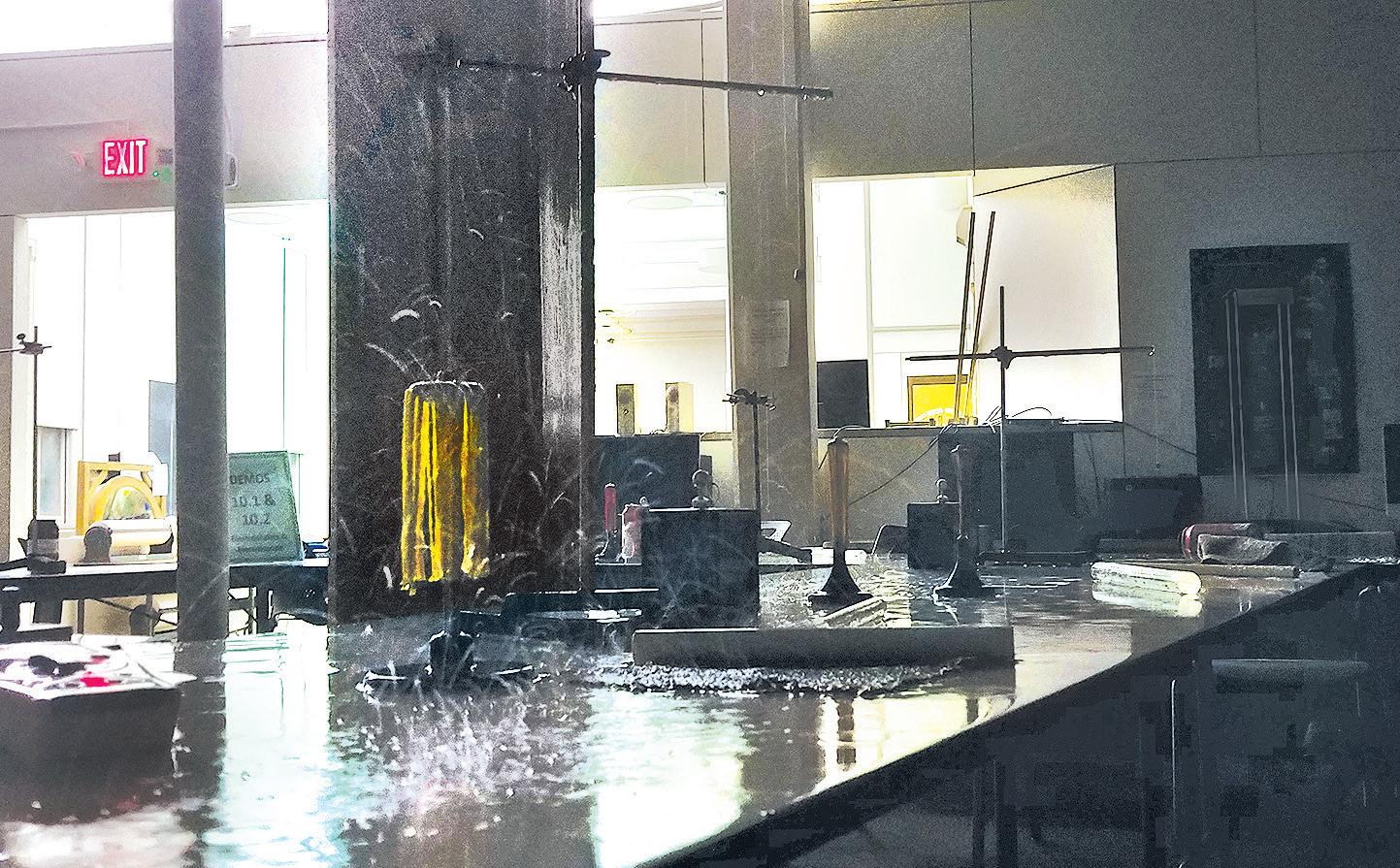
Room 373 of Rockefeller Hall — just last week, a professor’s office — stands empty, stripped of furniture, books and even its torn-up floor, with a handwritten sign on the front door: “Exiled due to flooding.”
When a pipe burst due to freezing temperatures in Rockefeller Hall’s attic last Tuesday night, The Sun previously reported, it kicked off a cascade of events that left professors displaced and materials throughout five floors of the hundred-year-old building ruined.
“We got hit really hard,” Shirley Haddad, administrative manager for the building, told The Sun, sitting in her third-floor office just down the hall from where staff were hauling books by the cartful out of a destroyed office.
“Some [water] went out [an attic window], and the rest came down through the ceilings, walls, etc — third floor, second floor, first floor, and a little bit to the basement,” Haddad said.
After the pipe burst due to the night’s frigid temperatures — which reached -5 degrees Fahrenheit — it triggered the building’s
See PIPE page 5
By MARYAM ZAFAR Sun Staff Writer
The newly-formed Professional Fraternity Council held a recruitment fair in Baker Portico on Sunday, an opportunity for prospective members to get to know nine of the campus’s 13 pre-professional fraternities.
According to Kumar Nandanampati
’20, vice president of recruitment for PFC, the driving force behind the showcase
ment fair?”
“There [are] a lot of discrepancies here and there’s a lot of ways that they’re not inclusive.”
Kumar Nandanampati ’20
was simple. “What can we do to make recruit-
The fair’s main goal was to present the fraternities in an “egalitarian manner,” according to Nandanampati.
Attendees were encouraged to walk around and interact with current members and leaders from each organization.
The timing of the event was early in the semester, Nandanampati said, so that potential new members could familiarize themselves with
See PFC page 5

All Labor Has Dignity: Martin Luther King Jr. and the Labor Movement
8 a.m. - 5 p.m., 227 Ives Hall
Cayuga Basin Bioblitz: A 24-Hour Race to Find What’s Living in Our Backyard
8 a.m. - 5 p.m., Mann Gallery, Mann Library
Its Mysterious Life: An Appreciation of Beetles
8 a.m. - 5 p.m., First Floor, Mann Library
Mixed Media: The Interplay of Sound and Text
9 a.m. - 5 p.m., Hirshland Exhibition Gallery, Level 2B, Kroch Library
Don’t Forget Us: The Plight of the Hemlock and Ash Trees — Stone, Plate and Photo Lithographs
10 a.m. - 2 p.m., Botanic Gardens Welcome Center
Traded Treasure: Indian Textiles for Global Markets
10 a.m. - 5 p.m., Floor 1L, Johnson Museum of Art
Career Advice Q & A with Prof. Cathy Kling 11:30 a.m. - 1 p.m., 102 Mann Library
Edgar S. McFadden – A Life of Contribution to Wheat Improvement 12:30 p.m., 135 Emerson Hall
Exploring Geo-Text Data: Place Names, Place Relations and Place Sentiments 1 - 2 p.m., 100 Mann Library
Using Chemogenetics to Determine how NPY/AgRP Neurons Regulate Thyroid Hormone Levels
4 - 5 p.m., Lecture Hall III, Vet Research Tower
Master Your Future: How to Successfully Navigate Career Fair 4:30 - 5:30 p.m., 101 Phillips Hall
Information Session - Summer Prelaw Programs 5 - 6 p.m., Big Red Barn
Kota Ezawa: Paint Unpaint
8 a.m. - 5 p.m., John Hartell Gallery, Sibley Dome
BBS Program WIP Presentation
9 - 10 a.m., Lecture Hall 3, College of Veterinary
Chia, Amaranth and Quinoa: From Ancient Seeds to “Superfoods”
10 a.m. - 2 p.m., Brian C. Nevin Welcome Center
Junior Recruitment Workshop: Kevin He 11:40 a.m. - 1:10 p.m., 115 Ives Hall
Introduction to Zotero Noon - 1 p.m., 106G Classroom, Olin Library
Sam Price: Frame of Reference Noon, Experimental Gallery, Tjaden Hall
Soup Days Noon, 400 Caldwell Hall
Robust and Controllable Nonequilibrium Self-assembly 4 - 5 p.m., 119 Baker Lab
Be the Change Workshop: Pre-engagement 5:30 - 7 p.m., 213 Kennedy Hall
Procrastinate at the Straight 6 - 8 p.m., Fourth Floor Lobby, Willard Straight Hall

By SARAH SKINNER Sun Assistant News Editor
As the hunt for life in the universe continues, the search is getting smaller and smaller thanks to new technologies that have identified thousands of planets for closer examination.
Prof. Lisa Kaltenegger, astronomer and director of the Carl Sagan Institute, presented about the discovery of these exoplanets — planets outside Earth’s solar system — in a lecture on Monday in Rockefeller Hall’s Schwartz Auditorium.
“We have nearly 4,000 confirmed exoplanets [that we can test] so far,” she told the crowd. “We have about 5,000 more candidates that we are still evaluating.”
Kaltenegger and her team at NASA are evaluating whether or not these planets are worth future study to determine if they might contain organic material. If so, the first step is to measure the planets’ oxygen and methane contents. If enough of both are present, it is a “tell-tale sign of life” on the light-years-away planetary bodies.
However, because these planets are so far away, there is no direct way to sample their atmospheric makeup. Instead, researchers can only observe
the planets when they pass in front of their respective suns.
“Part of the stellar light gets filtered through the atmosphere of the planet before it gets to us,” Kaltenegger said. “We can actually start to characterize the atmosphere, the air, of other planets through this technique.”
By analyzing the light that makes its way back to Earth, the team can determine whether the planets have the combination of gases that they are looking for.
Kaltenegger specializes in more diminutive, rockier exoplanets, which “by chance” became the main focus of the study.
“Even though it’s way easier to find the big or massive planets, we are finding many, many more of the smaller planets,” she said.
Most of these planets were found through the Kepler telescope mission, which focused a massive telescope at the same area of the sky for three and a half years in order to chart the movement and orbits of all the planets within that zone.
Because the planets are detected when they pass in front of solar bodies, smaller planets actually have an advantage.
“It’s really hard to pick up anything smaller than the Earth,” Kaltenegger
added.
Kaltenegger’s team then calculates the density of each planet, which yields more clues to the likely makeup of the planet. After “hundreds and hundreds” of geochemical equations, the researchers decide whether it falls within that “habitable zone.”
“This concept of a habitable zone is something we use to prioritize planets for follow-up,” Kaltenegger said. “By no means is the habitable zone where there can be life. It’s just where we can find life, where we can pick up life.”
However, in this search, her team tries not to be too “human-centric,” as life can take many different shapes even on Earth.
“If you just look around, there’s a lot of really interesting life on Earth that you don’t think about,” she said.
Despite the progress, scientists still don’t have a good estimate about how many planets might contain some form of life. Kaltenegger quipped that she has an answer ready whenever people ask how many planets may be habitable.
“Fifty percent,” she said. “Plus or minus 50.”
Sarah Skinner can be reached at sskinner@cornellsun.com.

By ANU SUBRMANIAM Sun News Editor
Activist, artist and community organizer Bree Newsome — best known for removing the Confederate Flag from the South Carolina Statehouse — will come to Cornell on Feb. 11 to discuss her efforts. Newsome’s talk is part of a larger annual commemorative event that focuses on “the service, activism and legacy of
Dr. King,” according to the event page.
Newsome first rose to national attention in 2015 when she shimmied up the flagpole of the South Carolina Capitol building and removed the Confederate flag that had hung there for more than half a century.
Newsome’s website condemns that flag as a “statement of opposition to the Civil Rights Movement and lunch counter sit-ins occur-

ring at the time.” Tensions over the controversial flag peaked after the shooting of nine black churchgoers by self-proclaimed white supremacist Dylann Roof in Charleston, South Carolina.
A prolific black activist, Newsome’s work primarily deals with “incidents of young black people being unjustly killed and issues related to structural racism,” according to her website. In recent years, Newsome has marched with Occupy Wall Street, volunteered to be arrested in a sit-in protesting legislation at the North Carolina statehouse and organized protests after the deaths of Trayvon Martin and Keith Lamont Scott, Newsome’s website said.
Her activism has earned her many awards and honors, including the 2016 NAACP Image Award “in recognition of her work on behalf of civil rights,” her website reads.
In addition to her work in activism, Newsome is also an accomplished filmmaker. According to her website, Newsome won a
By ANU SUBRAMANIAM Sun News Editor
The Vagina Monologues based off the 1996 Obie-award winning play written by Eve Ensler, will be filling Bailey Hall. The Vagina Monologues is an annual production sponsored by Cornell Women’s Resource Center, according to the event’s Facebook page.
The play is described as a “whirlwind tour of a forbidden zone,” according to its website.
The website said that V-Day — the global non-profit organization founded by Ensler — invites educational institutions like Cornell to perform “benefit events” such as The Vagina Monologues in order to raise money and awareness for charities dedicated to the prevention of violence towards women and girls.
another performer, described the empowering effects of the show from the other side of the curtain.
“It is liberating putting myself in the position to openly talk about the the struggles and triumphs of being a woman and having a vagina,” Serrano said. “It was so inspiring to me last year and having the opportunity to be apart of this years production has been an empowering experience.”
The biggest message to take away from The Vagina Monologues Aboaf said, is that women should “talk about vaginas and sex from the non-male perspective more” and that “women have diverse experiences that are all worth amplifying.”
$40,000 scholarship at the age of 18 from the National Academy of Television Arts and Sciences as part of a short film competition. She later went on to study film at New York University’s Tisch School of the Arts, where her senior year short film was a finalist for the Wasserman Award, the university’s top honor for filmmaking.
The talk is sponsored by Office of Spirituality and Meaning-Making, Office of Academic Diversity Initiatives, Student and Campus Life and the Greater Ithaca Activities Center. It will focus on Newsome’s take on the relationship between activism and art.
Newsome’s past experience weaving the two disciplines includes the 2016 film she produced and directed, Rise Up and Go
The event will take place Feb. 11 at 7 p.m. in Sage Chapel; it will be open to the public.
Anu Subramaniam can be reached at asubramaniam@cornellsun.com.
Ninety percent of proceeds from The Vagina Monologues will go to the Tompkins County Advocacy Center and the remaining 10 percent will go to V-Day, according to Callie Aboaf ’21, a performer in the monologues.
The Advocacy Center is a local resource that provides support, education and advocacy for those affected by domestic violence and sexual assault in Tompkins County.
This year’s themed “Spotlight” focus is on “Women in Prisons and Jails, Detention Centers and Formerly Incarcerated Women,” according to V-Day’s Spotlight website.
Working in conjunction with activists and formerly incarcerated women, V-Day found a direct correlation between incarceration and “violence and abuse done to women and girls.”
According to a 2017 study conducted by The Vera Institute of Justice, 86 percent of women were sexually or physically abused before incarceration.
Eli Serrano ’20,
“It is liberating putting myself in the position to openly talk about the struggles and triumphs of being a woman and having a vagina.”
Eli Serrano ’20
According to the show’s web page, they raised $9,000 in a prior Cornell performance. Aboaf said their goal this year is to sell at least 1,000 tickets for the Bailey Hall performance, which, with a ticket price of $10, would result in another $9,000 for The Advocacy Center.
“It makes me feel confident because I can talk about an important topic on stage, make people laugh and start awesome conversations,” Aboaf said. “Last year people were beyond supportive of my monologue, which is especially risqué, which I really appreciated. I’ve enjoyed meeting my fellow performers and having a space to talk about vaginas.”
The show is coming to Cornell on Feb. 9 at 8 p.m. in Bailey Hall; tickets are available online.
Anu Subramaniam can be reached at asubramaniam @cornellsun.com.


fire response sprinkler system, which continued to pump water down all five floors of the hall for “an hour or more” before it was stymied.
“First the Cornell Police responded, and then they had to call [Cornell Environmental Health and Safety], and then they had to call facilities,” Haddad said. “They’ve been working on it ever since.”
In the wake of the deluge, five professors had to be moved to other areas of the building, including the the chair of the Asian Studies department Prof. Daniel Gold. The second-floor physics lab, located in 280 Rockefeller Hall directly under the northeast attic, was closed from Tuesday night onwards after it sustained major water damage to carpets, walls and computers.
Sun. “Since it’s flooded the tutoring has been moved to our testing center and labs have been cancelled.”
Matt Johnston, coordinator of the cleanup effort and part of the Maintenance Planning division of Cornell’s Office of Facilities Management, told The Sun in an email that despite the ongoing process, PHYS 1102 labs were “likely to be held as scheduled” with “minor adjustments” to move students away from the more-damaged areas of the lab that require renovation.
However, other floors of the building sustained more extensive damage.
“But this is Cornell, so I mean they’re saying probably a few months. [It’s] kind of considered the semester.”
Shirley Haddad
Students enrolled in the PHYS 1102: General Physics II course had last-week’s lab sections cancelled, according to course emails obtained by The Sun. Instructors informed the students Friday that while a decision would not take place until Wednesday, they are “are hoping to be able to reopen the [lab] by the end of [this] week.”
“Usually we use the room to study and review with TAs as well as complete labs,” Sophia Zhang ’21 told The
MIT’s graduate program at No. 3.
“Because Cornell AAP has a strong legacy of both the creative fine arts and design [as well as] planning and the built environment, I think that it can do things that really change the world for the better,” Yoon told The Sun last year.
The newly-inaugurated dean co-founded Höweler + Yoon Architecture LLP and MY Studio with partner Eric Höweler in 2000. Her work has earned her multiple awards, including the Progressive Architecture Award, the Architectural Record’s Design Vanguard Award and the Architecture League’s Emerging Voices Award, according to the firm’s website.
Her firm’s work has also been displayed at prominent museums across the globe, including the Museum of Modern Art in New York, the Los Angeles Museum of Contemporary Art, the Museum of Contemporary Art in Chicago, the National Art Center in Japan and the Venice Architecture Biennale, her website reads.
Yoon received a B.S. in architecture from Cornell in 1995 with the AIA Henry Adams Medal, which honors one student from each graduating class for “excellence throughout their academic career.” She later received the Fulbright Fellowship to Korea in 1998 after earning her M.A. in urban design with distinction from Harvard.
Anu Subramaniam ’20 contributed reporting to this article.
“The first floor is the writing workshop, which took any extra water and absorbed it into all the paper and everything that they had there,” Haddad said. On the fourth floor, maintenance has “already taken out a lot of the carpets and the sheetrock.”
Water damage to the oak floors on the third floor will require at least half of it to be replaced, Haddad said, in addition to computers, furniture and other materials that were destroyed.
Johnston declined to comment on how much the renovation would cost, but Haddad estimated that the figure would be in the “hundreds of thousands.”
“And time,” Haddad said. “I mean I was optimistic and I said, ‘ah, well, like a month.’ In my house it would
be done within a month. But this is Cornell, so I mean they’re saying probably at least a few months. [It’s] kind of considered the semester.”
Despite the damage, Haddad said that they were “lucky” that that the damage had not occurred at the other end of the building, which houses larger classrooms and lecture halls instead of offices.
“It would be another situation,” she said.
Rockefeller Hall was the first building constructed on the top of East Hill, and has been in use as a campus facility since 1904.
“We’ve always been looking at deferred maintenance as being an issue, especially in older buildings,” Haddad said. “Although [maintenance planners] try, this is an area that’s very important.”
Deferred maintenance puts off addressing identified problems, often due to “timing issues or lack of funding,” according to the University’s 2017-2018 budget plan.
Despite this, Johnson told The Sun that the leak was “not the result of deferred maintenance in the building,” but only due to the “significant temperature change” that put stress on the attic pipes.
“A small pipe can create that much damage over five floors,” Haddad said. “With the single digits that are expected for Wednesday and Thursday, I hope they double checked everything.”
although she believes its late execution limited its impact.
all pre-professional organizations before any specific rush process began.
This idea of using the showcase to even the playing field seemed appealing, Akanksha Jain ’20 said, but Jain noted that there just were not enough people at the event.
“The fair was very poorly advertised,” Jain said. “No one knew about the fair besides brothers in fraternities.”
Jain said she thought that the concept behind the fair was good,
The event kicked off PFC’s first active semester on campus and is one of many changes that the PFC intends to implement. Nandanampati noted that when he met with other member organizations in December to plan, one main concern was the many differences between fraternities.
“There’s a lot of discrepancies here and there’s a lot of ways that they’re not very inclusive,” Nandanampati said.
To address issues of inclusiv-
ity, the PFC made changes to the applications. They are now required to include “very explicit” information about an organization’s financial requirements, and to ask applicants about physical accommodations, preferred gender pronouns and ethnicity.
That demographic information, Nandanampati said, will later be used to review whether there are significant differences between the demographics of applicants and those who are ultimately admitted.
“There’s just this idea that there’s no real authority over
the professional fraternities,” Nandanampati said.
The nine fraternities include students interested in fields such as medicine, engineering, law and business. Last fall, the groups joined together to establish an umbrella organization, the Professional Fraternity Council. The role of the council is to establish standards across organizations and facilitate communication between the pre-professional groups.
Study
Last weekend, free-flowing coffee and the glare of the eHub lights kept the increasingly sleep-deprived Cornell Animal Health Hackathon contestants awake. After three days of non-stop brainstorming, coding and presenting, three groups emerged victorious.
At Cornell’s third annual hackathon, over 100 students and 66 mentors worked together to solve some of veterinary medicine’s most
pressing issues. The students were a mix of graduates and undergraduates, from universities such as Virginia Tech and the University of Pennsylvania, whose majors included veterinary medicine, business, biophysics and engineering.
The mentors came from both in and outside of academia, from a selection of universities and company sponsors including Bluepearl, Banfield Pet Hospital, PetPartners, IDEXX and Encore Vet Group.
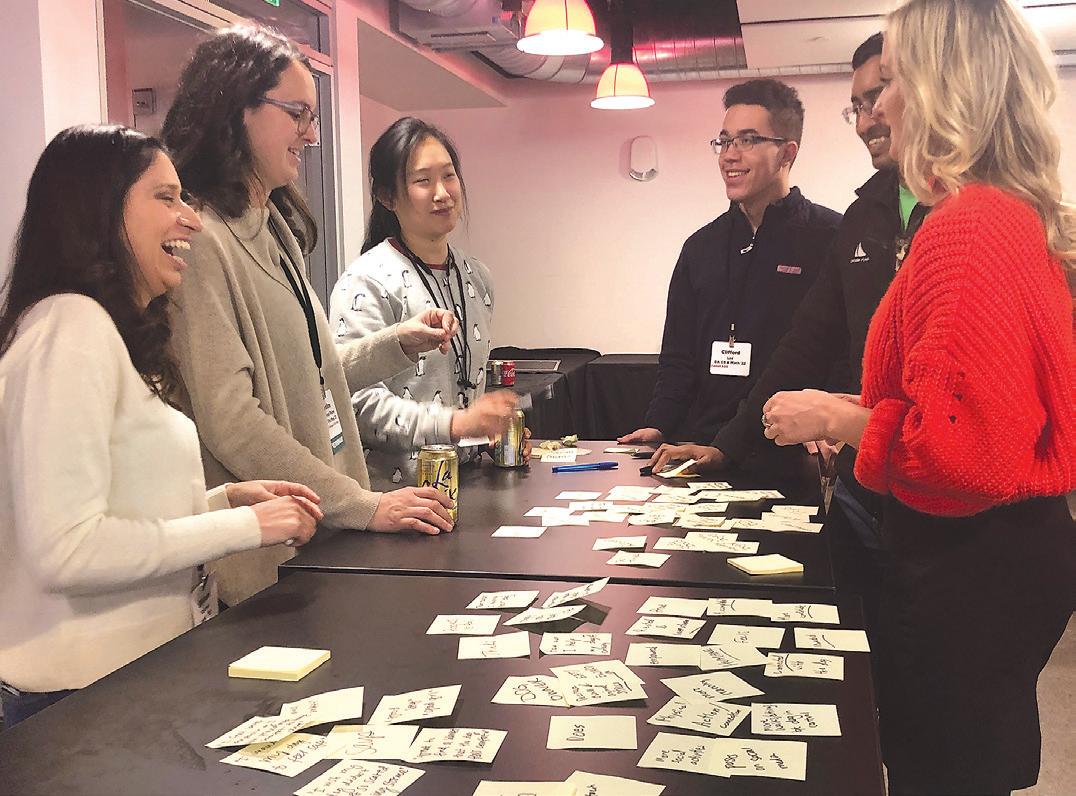
The event began with a whirlwind tour of veterinary medicine by Dean Lorin Warnick of the College of Veterinary Medicine, followed by an inclusion and culture speech by President Brian Garish of Banfield Pet Hospital, one of the event’s biggest sponsors. As a final send-off, Jess Trimble, head of health at Fuzzy, spoke about her work on telemedicine solutions in animal healthcare in the annual Founder’s Speech. Soon after the procedural presentations, the Health Hackathon’s IBM design thinking workshop, led by Neil Fishman, chief technology officer at IBM, launched into action and continued late into the night. The participants’ requests for help transitioned from idea selection to technical feasibility to feedback on their pitches.
At the end of the hackathon, each team gave a demo of their projects and the winners were selected. Presentations were occasionally
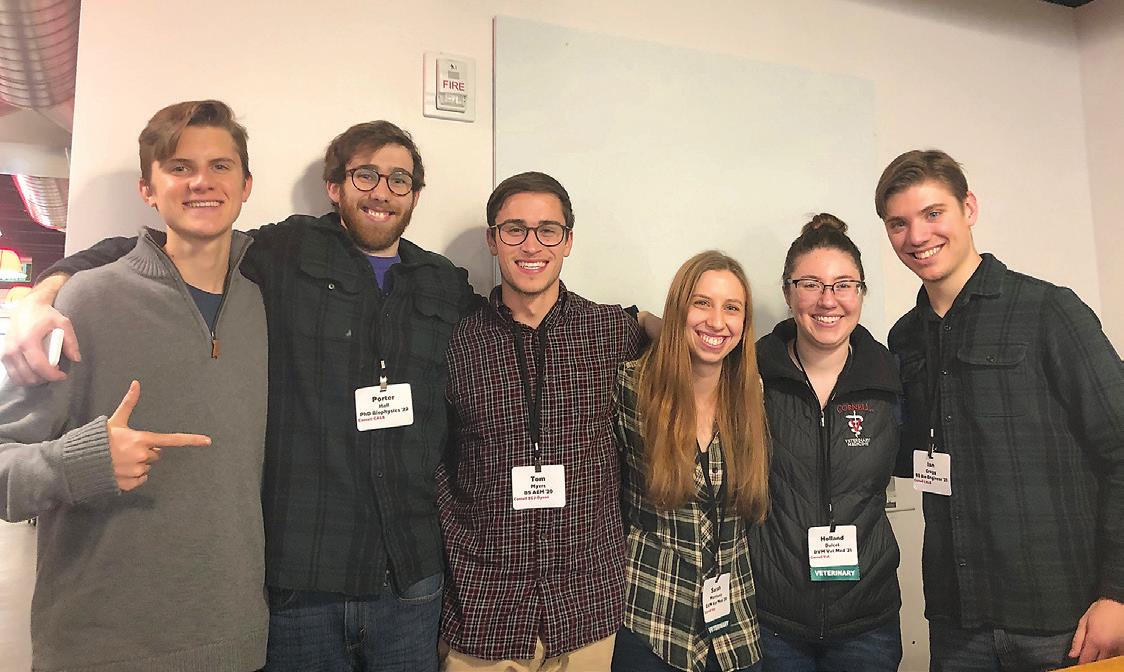
detection method for leg fractures in racehorses by monitoring biomarkers in blood samples.
Porter Hall, grad, part of team “Stay on Track,” believed that the biomarkers in horses could be conserved across species, broadening the scope of the diagnostic tool.
interrupted by one of the six dogs in attendance — it wouldn’t be an animal health hackathon without some animals.
While all of the students at the hackathon were passionate about the opportunity to impact animal health, some got an added bonus: course credit. Prof. Wesley Sine, SC Johnson School of Management, teaches a 50-person course called NBA 6029: Leading Agile Innovation, and attending the hackathon was a required component of the class.
A prize of $4,000 was awarded to the best market-ready product. This year, it went to team “FarmSpeak,” which created a scannable booklet to facilitate communication between dairy farm workers and their employers to better respond to cow health problems.
An award of $2,000 for best veterinary healthcare solution went to team “Stay on Track,” which is currently developing an early
“Pretty much what I want to do is begin the research and development process as soon as possible,” Hall said.
The last $2,000 award — for most innovative project — went to team “Lean Green Machine,” which developed an ultrasound-based method for moving the water used to clean birds impacted by oil spills.
Vivian Bui grad and team member of “Lean Green Machine” has been interested in helping with oiled bird recovery since her first year of veterinary school at the University of Pennsylvania.
“I plan on going back to my school and talking to the wildlife veterinarians that I have been meeting with and expressing my idea with them,” Bui said. “I really do plan on continuing this.”
Some STEM majors encounter obstacles when thinking about studying abroad — cost and time requirements aside, students do not want to miss out on research opportunities. However, new, abbreviated research-centric internships may offer the best of all worlds.
One of these is a cutting-edge agricultural and biological research at a world-class university only 20 miles from Budapest, Hungary’s capital city, open to any College of Agriculture and Life Sciences student with a minimum GPA of 3.0.
This year, for the first time, students can apply for eight-week long professional internships at Szent István University in Gödöll, Hungary. Prof. Mark Sarvary, neurobiology and behavior, who came to the U.S. in 1996 as a study abroad student from Hungary, has been working over the past few years to bridge Cornell and Szent István University, his alma mater.
“To celebrate my 20 years in the U.S., I approached Cornell trying to establish a relationship with the Hungarian University,” Sarvary said.
By collaborating with the already well established CALS fellowship program, Sarvary won a 25,000-euro grant for undergraduate researchers to gain internship experience abroad.
In Sarvary’s experience, many STEM majors choose not to study abroad because of their bulky course load and career anxiety. This is one of the main reasons Sarvary so passionately pursued the creation of this program.

“Especially in biological sciences it is really hard to go for an entire semester because there are so many requirements,” Sarvary said.
The Global Fellows program offers a more manageable abroad experience, especially for those pursuing a science trajectory, according to Sarvary. While students who participate in the program in Hungary will not receive class credit, they will have the opportunity to pursue research experience.
“These days, hardly any of my advisees graduate without undergraduate research experience,” Sarvary said. “As a
science major, research skills are invaluable and we hope to help undergraduates gain this experience.”
Students can study and conduct research under eight different faculty groups in the SZIU program. The groups cover topics ranging from zoology to cryopreservation. A list of the specific group projects and descriptions can be found on the Global Fellows website under available internships.
“The students must apply to the Global Fellows program first and then provide a statement about their specific interest. They are welcome to reach out to the [principal investigators] themselves but have to be accepted to the fellowship program first,” Sarvary said.
As an alumnus of SZIU, Sarvary has personal connections with many of the PIs involved in the program.
“I went back to Hungary and met with all the [Principal Investigators] who are willing and happy to welcome Cornell students,” Sarvary said.
Accepted students are required to take a half semester course which prepares the students for an abroad experience while also preparing them with relevant research skills.
Sarvary expressed his hope that students will use the program to participate in research abroad.
“I want to celebrate the fact that studying abroad and doing research abroad is a life changing experience. I think students will definitely benefit,” Sarvary said.
Applications for the Global Fellows Program close on Feb. 3.
What’s the worst movie you’ve ever seen? Was it so bad it was good?
Did you love to hate it? Do you wish you had those two hours back, or did you enjoy watching it fail to meet your standards?
Some incredible films fail to remain in our canon despite their engaging plot, moving performances or impeccable cinematography. Great films come into our lives but rarely stick. So often we move on and only faintly remember the stellar film. But what really endures are the truly repugnant movies.
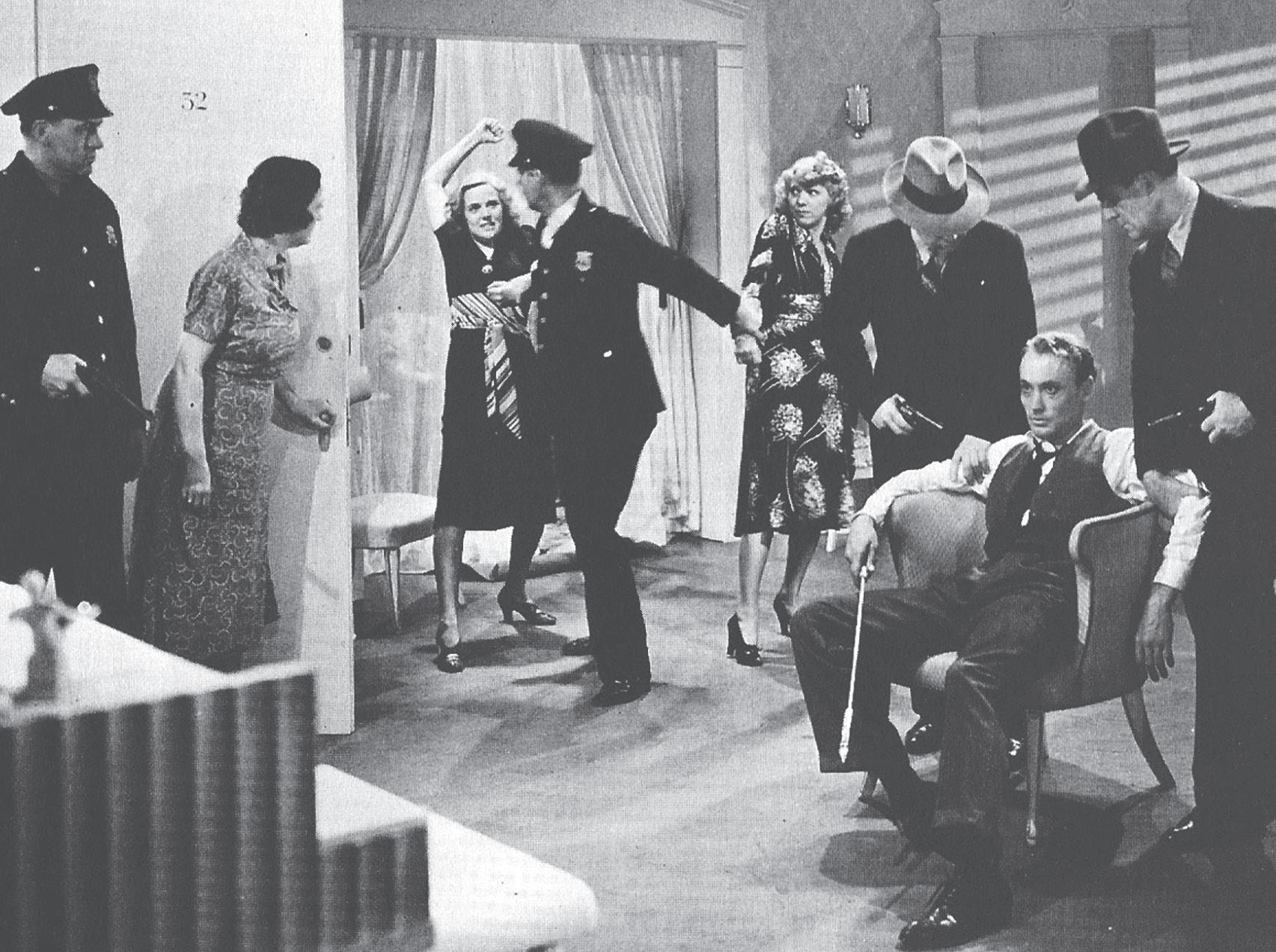
I recently spoke to a family friend about so-bad-yet-so-good movies, and he shared that his college classmates in the ’70s would show up high for showings of Reefer Madness at the student union. For those not familiar with Depression-era anti-drug propaganda, Reefer Madness is an hour-long film presenting outrageously phony stories about people being morally, psychologically and physically ravaged by the new menace, weed.
Produced by a Christian group as a public service film intended to warn parents about the imminent threat of pushers whose marijuana cigarettes would turn their children into psychotic, murdering, sexually active degenerates, it quickly became a farce to audiences. It was so absurd that people loved it leading early pro-legal-weed
college organizations across the country to show Reefer Madness
Frequently cited on lists of awful films, Reefer Madness has attracted audiences for decades because of its outlandishness and obvious lack of production value. Reefer Madness is exploitative and in some ways its historical reception is a tragic story — in the past, while many viewers laughed off the clearly fake effects of marijuana shown, many took it seriously. The moral panic over marijuana during that era, at least in some ways, can be led directly to the hugely unjust drug policies of the last 80 years that in many cases target the black community of urban America. Its saving grace is that the satirization of the film highlighted the misinformation campaigns which contributed to marijuana being listed as a Schedule I narcotic. Given its intent, the present-day effect of Reefer Madness is funny. Just when you thought the “devil’s lettuce” couldn’t
ruin Jimmy’s life any further, it scooby-dooby-does. The factual liberties that the creators tried to pass off as truth are impressive, and I doubt a deliberate satirist could have done such a thorough job of making up the horrific spiral of doom portrayed in the film.
When there’s a great film, there’s an impulse to make a sequel, or a musical, or a spinoff or some other expansion of the film. But everyone always assumes they’ll be bad. Disney Animation churns out sequels like nobody’s business, but has the excitement about The Little Mermaid or Mulan ever turned over to the second one? I don’t think so.
Meryl Streep, for one, has some understanding. She refuses to reprise roles because they tend to lack anything fresh enough to warrant a sequel. And while the most enjoyable movie of 2018, Mamma Mia 2, may have been a little bit harder to make without her, she was correct in stating that it would be basically the same as before.
Somehow, though, the bad movies get sequels, remakes, spinoffs and follow-ups, too. You’d think that notoriously horrendous films might find more roadblocks in their way to getting a sequel. But here we are. Birdemic was followed up with an equally apocalyptic sequel. Sharknado spun out a six-movie series. Paranormal Activity became a pentalogy.
Reefer Madness became a movie musical.
Yeah. Nearly seven decades after Reefer Madness was presented to churchgoing mothers, a musical starring Kirsten Bell and Alan Cumming premiered on Showtime — following a stage run. It was pretty good, too. Drug propaganda looks good on color film, and a heightened production budget sure made the scenes in Satan’s pot den sparkle. The songs were fun and even earned the production an Emmy. Furthermore, they nearly doubled the run-time of Reefer Madness
In other news of bad movies inspiring more bad movies, 2017’s The Disaster Artist was a reenactment of The Room, the latter of which former Sun Arts Columnist David Gouldthorpe ’18 described as having “a fundamental misunderstanding of how humans act and perceive the world.” Like Reefer Madness: The Movie Musical as well as the later installments of Sharknado, it has significantly upgraded production value but still retains
its irreverence for establishment production.
In some ways, it’s easier for a bad movie sequel to succeed because it’s easy to improve upon the horrible aspects of the original film. Maybe the 1936
drug PSA takes itself too seriously, maybe The Room is just a little too out-of-touch and maybe the sharks in the ’nado are just a tiny bit too unrealistic. It may be an easier fix when there’s a lot of room for improvement.
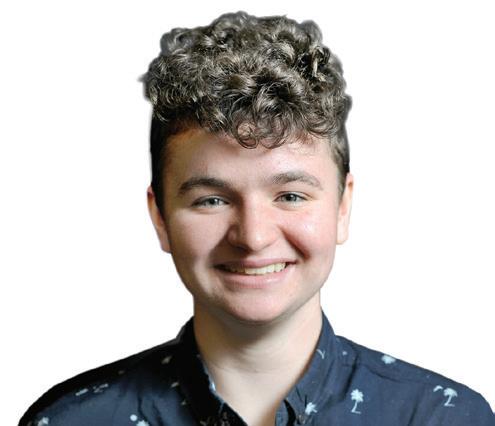
Katie Sims is a junior in the College of Agriculture and Life Sciences. She can be reached at ksims@cornellsun.com. Resident Bad Movie Critic runs alternate Tuesdays this semester.
JOHN McKIM MILLER ’20
Business Manager
SIMS ’20
KATIE
Associate Editor
VARUN IYENGAR ’21
Web Editor
JACOB S. KARASIK RUBASHKIN ’19 Editor in Chief
Jamie Lai ’21
Lei Lei Wu ’21
Greta Reis ’21
Krystal Yang ’21
Nicole Zhu ’21
Winny Sun ’20
Johnathan Stimpson ’21
Ben Mayer ’21
Sabrina Xie ’21
Letter to the Editor
GIRISHA ARORA ’20 Managing Editor
HEIDI
MYUNG ’19 Advertising Manager
ALISHA
GUPTA ’20 Assistant Managing Editor
Editors in Training
Editor in Chief Anu Subramaniam ’20
Managing Editor Sarah Skinner ’21
Maryam Zafar ’21
Associate Editor Ethan Wu ’21
Photo Editor Ben Parker ’22
Science Editor Shriya Perati ’21
Sohpie Reynolds ’20
News Editor Nicole Zhu ’21
Arts Editor Peter Buonanno ’21
Jeremy Markus ’22
To the Editor:
Members of our classes should remember the “Res Club Fire” that occurred in the early morning hours of April 5, 1967 in the Cornell Heights Residential Club (now Ecology House) and took the lives of nine Cornellians, including five senior and graduate women living on the second floor, nine students who were members of the first class of the experimental six-year Ph.D. program (“Phuds”) and John Finch, a professor of English who lived there as an advisor. Mr. Finch had indeed escaped the building, only to return to assist others and be overcome by the toxic smoke that was responsible for all the deaths.
The fire, which included two subsequent fires at locations where Phud survivors were living (Watermargin Cooperative and an apartment in Collegetown), and an investigation that never identified the perpetrator of what was apparently arson were reviewed in a long New York Times article by N. R. Kleinfield on April 13, 2018. Partially motivated by this article, 13 survivors of the fire from the classes of 1967, 1969 and 1970, along with three relatives of one of the deceased students, met with Cornell President Martha Pollack and several members of her staff on Aug. 6, 2018 in Ithaca.
We had several requests of President Pollack. First was a public apology on behalf of Cornell for the institution’s actions (and lack thereof) before and after the fire. Their actions included housing students in a dormitory that did not meet fire codes of the day, lacking sprinklers, multiple exits and fire doors. There was also a shocking lack of support offered by the University to the fire survivors, their families and the families of the dead, in sharp contrast to the effusive support from the Cornell and Ithaca communities.
We also sought the opening of all the Cornell archives related to the fire, including but going beyond the material supplied to Mr. Kleinfield. This also included the records of the Cornell Police Department, which was involved in the investigation along with the Cayuga Heights Police Department (which had primary responsibility), the Ithaca P.D., the New York State Police and the Tompkins County District Attorney. Finally, we asked that the victims be appropriately memorialized by the University. We requested both a permanent physical memorial to be located in a prominent site on campus (such as a “reflection garden”) and “living memorials” in the form of scholarships named for each of those who died to be awarded to students pursuing degrees in the victims’ areas of study. President Pollack has subsequently suggested a lecture series named, each year, for one of those victims.
President Pollack was very welcoming and indeed delivered a personal apology. What form a more public apology might take is still under discussion. She agreed to open all of the Cornell archives that were not otherwise restricted, and she has; several of us have reviewed many of these documents, through our tears.
A major area of discussion remaining is opening the archives of the Cornell, Cayuga Heights and Ithaca Police Departments. Because the investigation of the Fire remains an open case, we have not been able to access the police record. We believe that a 51-year old case in which no active investigation is ongoing is effectively closed, and we have urged Cornell to bring its influence to bear on getting the case officially declared closed so that we may access these materials.
Dr. Pollack and her staff have agreed in principle to both permanent physical and “living” memorials. We have strongly suggested a memorial garden and full scholarships for current students in the names of the dead. We feel that Cornell certainly has the resources to provide appropriate memorials to these nine Cornellians, for whose deaths it bears so much responsibility.
In meeting together, those of us living all realized how much our lives have been affected by this horrific event. Cornell has made a good start, but after an initial cover-up, which was mandated by the chair of the Board of Trustees, and more than 50 years of neglect, a fuller understanding of what happened, and why, can be achieved only through the continued good faith application of resources by the University.
We have committed to continuing to work with the Cornell administration so that the fire and its toll can finally be appropriately recognized in our lifetimes. We want the names of those whose lives were cut short to be remembered. We believe that open acknowledgement of the mishandling of the situation by the University will decrease the likelihood of another such tragedy occurring, at Cornell or elsewhere, in the future.
Ann Agranoff ’69
Diego Benardete ’70
Edgar Blaustein ’69
Neil Blumberg ’69
Sherry Carr ’67 MILR ’70
Matthew Clark ’69
Loren Cobb ’69 Ph.D.’73
Margaret Ferguson ’69
Joshua Freeman ’69
Gene Fry ’70 Ph.D. ’89
Judith Adler Hellman ’67
John Mark Heumann ’70
Michael McFarland ’69
Paul Mermin ’70
Marcia Schwartz ’69
Susan Meld Shell ’69
M. Robert Showalter ’69
David Skidmore ’69
Adrian Tinsley Ph.D. ’69, Res Club resident
Moments after taking the last exam of my freshman year — before preparing to head home to Los Angeles — I walked into Lincoln Hall, found an unoccupied music room and cried silently, fiddling aimlessly with piano keys. It wasn’t for the reasons you might expect. I wasn’t crying over the difficulty of the exam or just how “average” of a Cornellian I was. I was crying because I didn’t want to go back home.
I sometimes receive sarcastic remarks like “lucky” or a highpitched “why would you leave?” when I tell other Cornellians I’m from Los Angeles, California.
room to play video games until 4 a.m. on a nightly basis.
In the final days of winter break, however, something strange occurred. As I began to pack my luggage, the enthusiasm I possessed when I originally started my Cornell life was now mysteriously gone. I was not looking forward to being there again — in fact, I was miserable. I vividly recall walking on the Arts Quad with one of my closest friends shortly after arriving to Cornell for that first spring semester.
I didn’t quite understand why California was adored so much.
California is nicknamed “The Golden State,” but it was always gilded in my eyes.
Before coming to Cornell, I never realized California and my hometown were adored by so many who have never lived there — let alone visited them.
I didn’t quite understand why California was adored so much. California is nicknamed “The Golden State,” but it was always gilded in my eyes. Only I and other Californians know that what lies beneath sunny weather is a layer of pervasive pollution, its famous locales are plagued by traffic jams and its infamously high gas prices are a microcosm of the steep cost of living in the state.
“Ray,” I said, “I don’t want to be here.” It seemed that my initial perception of Cornell in high school from afar was much brighter than my actual reality there.
But why? Did Cornell fail to meet my expectations? Did I hate Cornell? Was California truly the “Golden State?”
I think about that day in Lincoln Hall every now and then. The situation was paradoxical, and familiar questions started to resurface in my mind.
Did I suddenly despise Los Angeles? Was I unhappy there? Were my conceptions about Ithaca and Los Angeles misconstrued all along?
It seemed that my initial perception of Cornell in high school from afar was much brighter than my actual reality there.
But perhaps my view of the West Coast jewel is tarnished by my desensitization to the glory and glamor surrounding it. I was always quite indifferent to my hometown, but it’s only because I’ve lived there my entire life. I’ve visited Hollywood and Disneyland dozens of times, and the state’s sunny weather has become more annoying and boring than rejuvenating. In contrast to the plethora of UC-bound students in my graduating class, when I received my acceptance letter to Cornell, I knew it was time to leave.
Ironically, though, I gained more appreciation for California while I was away at Cornell. As a freshman, as excited as I was to leave my hometown and start college life, I was just as excited to leave Cornell to return home for the winter break. In contrast to the snowy weather of the East Coast, California’s sunny weather no longer seemed like a bad consideration. I would rather be a victim of sunburn than freeze in Ithaca’s winter, I told myself. Freedom was nice, too. Once the semester ends, my actions could finally be meaningless. I no longer have to adhere to the stresses that inevitably pair with a desire to succeed. During the break, I took unprecedented pride in locking myself in my
Jabez Van Cleef ’70
Marguerite Waller ’69
Laurence Parker ’70 Ph.D. ’79
Thomas Cooch, brother of victim Peter Cooch ’69
Eleanor Segal
Sara Segal
Zachary Weiss, cousin of victim Martha Beck ’69
But this paradox was precisely what I needed. I couldn’t answer any of my questions for a good reason; I was asking the wrong ones. It was hardly a matter of which area I hated or loved more. Indeed, each place has its pros and cons. But each place is also what you make of it.
I learned to value Cornell for what it is, an amazing community of intellectuals, and not dislike it for its differences from my hometown.
The factors that caused me to dislike Cornell my first semester were precisely the same reasons I fell in love with it the next semester. I initially hated large class sizes and the existence of prelims, but came to appreciate them as an outlet to study with and befriend many people around me. I learned to value Cornell for what it is, an amazing community of intellectuals, and not dislike it for its differences from my hometown.
Maybe there’s a sense of humility to be observed. I never appreciated warm weather until it was taken away from me. And I never appreciated nature and dynamic weather until I was surrounded by it. Fortunately for me, Los Angeles and Cornell form enough of a dichotomy that I can’t begin to wonder what life would be like without either one.
Nile Jones is a junior in the College of Arts and Sciences. Rivers of Consciousness runs every other Wednesday this semester. He can be reached at nnj9@cornell.edu.
Cornell prides itself in being one of the best research universities in the world. The depth and breadth of research endeavors are true to Ezra Cornell’s founding mission of “any person … any study,” and its faculty are some of the most renowned scholars in their field. Yet, the emphasis placed on scholarly activities often come at the expense of student learning and experience. Around this time every semester, I am shocked at the number of Ivy League professors who put so little effort into their syllabi that they forget to change even the term of the course from Fall 2018 to Spring 2019.
It is no secret that the setup of a research university enables faculty members to thrive so long as they are actively involved in their research interests and advisement of graduate students under their direct supervision. Numerous professors whose student ratings are below average have received tenure because their outstanding research activities override shortfalls in teaching. I have been told by some TAs that professors often even urge their master’s or doctoral teaching assistants to set office hours at an early time in the day when most students have class so that few can actually attend them, and so they will be able to focus their efforts on their own work rather than on undergraduates.
a student’s college career. While many professors are fully engaged in the University — whether that is through their research, in class or in campus governance — others are unconcerned with the classroom learning environment, some even handing over almost all classroom-related functions TAs. Cornell’s vague and non parent criteria for tenure may offer an explanation as to why many professors simply over look the need to be involved with the undergraduate learn ing process. “Significant achievements” needed to be considered for tenure imply that a universities place a disproportionate emphasis on more obvious factors such as scholarly feats while the less visible but often more meaningful ability to impact students is neglected.
Professors should actively seek to debunk the myth that striving to improve the quality of teaching diminishes one’s ability to partake in significant research.
There is no question that many, if not most, professors I have encountered make the effort to learn student names and gain pleasure in mentoring and impacting

Cornell University would fail to exist without students.
Cornell University would fail to exist without students. The University should prioritize its students by encouraging professors to become more actively involved with individuals’ learning and award their teaching abilities as much as their research. Professors who are more confident with their research skills should link teaching to research through, for instance, bringing examples from their experiments and studies into the classroom. Those who are highly involved with research can incorporate that element into their teaching by providing undergraduates a glimpse of high-level research in a classroom setting.
However, such faculty members should realize that research and teaching are not incompatible and that engagement in one does not limit one’s capacity in the other. In fact, there is no correlation between being a skilled researcher and an impressive instructor, according to a study by the Brookings Institution. As such, professors should actively seek to debunk the myth that striving to improve the quality of teaching diminishes one’s ability to partake in significant research. Both research and teaching, which together serve as the backbone of an educational institution, should thus receive equal attention by faculty — and in assessments of faculty.
Jacqueline Groskaufmanis | Te
SThe University should also promote more personalized professor-student interactions outside of office hours. This is especially crucial for first-year students who struggle in the transition from high school classes that are smaller in size to 1000-level courses with hundreds of students. Yes, students should learn to seek resources on their own, but they can only do so with help from a faculty member who is willing to be an active teacher and advisor. Professors are only fully fulfilling their duty when actively engaged in the classroom as well as the learning process of their students. They ought to commit to their responsibilities as educators and mentors as much as their role as researchers.
DongYeon (Margaret) Lee is a junior in the School of Industrial and Labor Relations. Here, There and Everywhere appears alternate Tuesdays this semester. She can be reached at margaretlee@cornellsun.com.
o much of the stereotypical American college experience, as it’s packaged in pop culture and the memories of nostalgic alumni, seems to be wrapped up in anticipation — and sometimes the romanticization — of dysfunction.
Even in the age of hyper-attention to self-care, college remains a bubble in which it’s normal, even commendable, to do things like pull successive all-nighters in the name of work or push passions onto the back burner because they don’t fit our notions of productivity. Staying up all night to study is presented as evidence of a strong work ethic, rather than an unhealthy last resort. At Harvard, students in the class of 2022 were even asked to complete an online “Sleep 101” course, designed to help them develop healthy sleep habits in an environment as “competitive and busy” as college. It is particularly within the context of any work hard, play hard environment, where opposite and sometimes incompatible extremes regarding school and going out are expected to exist simultaneously, that a lot of unsustainable behavior is necessitated. These behaviors, gradually risk becoming normalized even as they become increasingly difficult to maintain.
point of sickness and hospitalization are depicted as representations of typical student behavior. More recent media,
We’ve learned to ignore them, but desperate times may call for desperate measures, and scammers may find the perfect bait.
like the TV show Grown-ish , continues to capture these classic themes but now offers additional commentary on the prevalence of routine sleeplessness and study drugs on today’s campuses. College is depicted as a place where recklessness exists in excess, sleep exists in
I believed the person on the other end of the suspicious phone call I never should’ve picked up in the first place.
In movies portraying college, from Made of Honor (in which the opening scene actually takes place at Cornell) to Ladybird , characters who drink to the
reserve and real life exists in the very distant future. Campuses, including but definitely not limited to Cornell, are uniquely hospitable to certain behaviors and habits that, if engaged in elsewhere, would likely raise red flags. Drinking is an easy example of this, with approximately half of college students reporting that they binge drink. A difficulty specific to college campuses, however, is that the prevalence
of such behaviors makes it difficult to distinguish between issues demanding attention and anomalous behavior confined to a fouryear timeframe. Which habits are destructive and which just constitute college fun? Moreover, is there always a difference?
None of this is necessarily unique to our generation.
Kurt Vonnegut ’44, one of Cornell’s most famous alumni, has referred to a similar phenomenon that existed during his time on the Hill, almost 80 years ago. Describing Cornell as a “boozy dream,” Vonnegut recalls, “Being drunk was utterly acceptable. That’s when I first decided this country was crazy.” The statement is light and potentially comedic, depending on how you read it. In a sense, it paints the quintessential college experience as something that’s inherited, passed down from one generation to another with each successive class, in which dysfunction and tradition are linked.
But it also fits into an underlying narrative that normalizes and romanticizes a certain casual recklessness in college settings, a narrative that, at the very least, is worthy of skepticism.
Jacqueline Groskaufmanis is a senior in the College of Arts and Sciences. The Dissent runs every other Monday this semester. She can be reached at jgroskaufmanis@ cornellsun.com.


Fill in the empty cells, one number in each, so that each column, row, and region contains the numbers 1-9 exactly once. Each number in the solution therefore occurs only once in each of the three “directions,” hence the “single numbers” implied by the puzzle’s name. (Rules from wikipedia.org/wiki/ Sudoku)
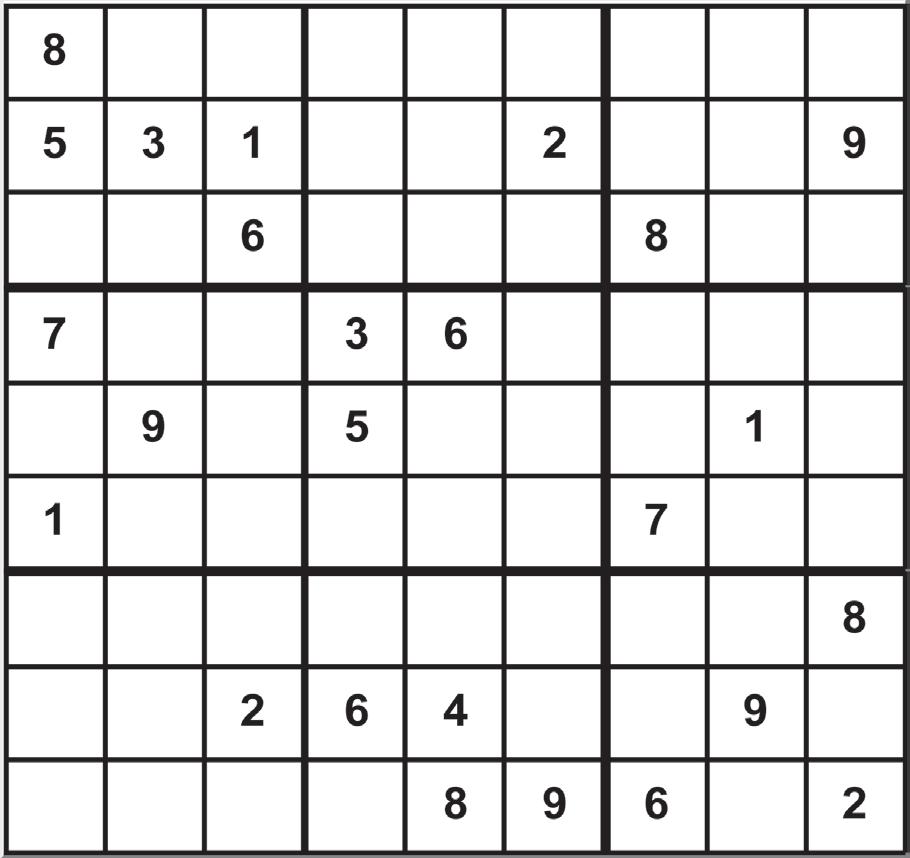
by Jeffrey Sondike


2 & 3 BEDROOMS
109 SAGE PLACE
Available NOW, Spring 2019 & 2019/2020
Shuttle Bus Access to Campus Access to Free Fitness Center Novarr- Mackesey Property Management office@ithacastudentapartments.com ithacastudentapartments.com 607-277-1234
Collegetown
Collegetown
Smart. Live Well. 607-272-3000 Visit our office at: 119 Dryden Road www.ithacarenting.com
Studios and 3-5 bedroom apartments available!
1. Walk to classes and Center Campus amenities in
312 College Ave
Houses, Apts, Parking 1 to 9 Bedroom
Collegetown - College Ave, Linden Ave, Dryden Rd, Bryant Ave, Cook St. 607-330-2442 info@urbanithaca.com www.urbanithaca.com
Nicest Apts. in Collegetown Located on Eddy St.
4 Bedrooms
Fully furnished. Spacious living areas with large bedrooms & closets. Hardwood flors, spectacular views, eat-in kitchens with additional sun rooms. Laundry & parking. 607-339-1137 bgm900@gmail.com
Collegetown’s Best Address Now leasing for 2018-19. Superior Studio, 1, 2, 3 Bedroom Apartments. Fitness facility, theater, and meeting space. Free high-speed internet. Exclusive resident parking. Overnight concierge. Package delivery. 312collegeave.com 607-273-9777
Collegetown Terrace Apartments INSPIRED LIVING TAILORED TO YOUR SUCCESS 24-Hour Fitness Center Shuttle Bus Service to Campus Study Rooms w/ Expansive Views
Apartments Available NOW, Spring 2019 & 2019/2020 Novarr- Mackesey Property Management collegetownterraceithaca.com office@ithacastudentapartments.com 607-277-1234
We have availability for the 2019-2020 school year beginning June 1st at Hudson heights apartments. The studio apartments come with: heat, water, and electricity included. There are garbages houses and coin-operated laundry facilities on site. Prices start at $740/month for a 12 month lease. If you have any questions or would like to schedule a tour contact us by phone 607-208-7660 or email: renting@ithacaLS.com
26 A PA R TMENT FOR R ENT 27 H OUSE FOR R ENT
COLLEGETOWN 6 BEDROOMS Newly Remodeled PRICES SLASHED TO RENT 607-272-3389 avramisrentals@aol.com
MEN’S Continued from page 12
Columbia’s 29 points off the bench.
In good news for Cornell, Morgan — who last weekend set the Cornell men’s basketball program record for career scoring — scored 21 points, tying Kareem Abdul-Jabbar’s streak of 69 consecutive games in double figures. This mark ranks 22nd all-time in NCAA history. Additionally, Boeheim
WRESTLING
Continued from page 12
and Dean — won by fall. Sweany again earned six points on a win by forfeit; he and Dean were the Red’s top scorers of the day, collecting 12 points each between the weekend’s two competitions.
Cornell’s towering score over the Crimson was the largest margin of victory for the team since it beat Princeton 54-0 in 2009 and the sixth-largest in school history in dual meets.
The combination of a historic milestone and record-breaking victory left the nationally-ranked squad emboldened as it turns to the back half of the season.
“Nothing builds confidence more than winning,” head coach Rob Koll said. “Winning convincingly is all the better.”
The weekend’s decisive results against a pair of key rivals reflect a long winning culture under Koll, who has been at Cornell for 30 years, spending the
first four and a half years as an assistant coach before becoming head coach in 1994. His decades-long stewardship of the squad has seen the Red grow into one of the nation’s premier wrestling teams — one of only two teams to finish in the top 10 nationally every year since 2008.
“I am extremely proud of my association with Cornell,” Koll remarked.
Beyond breaking the elusive 300 win barrier, the Ivy League’s all-time most winningest wrestling coach has compiled a long resume of honors, including being named New York State’s Coach of the Year seven times and the Dan Gable Coach of the Year in 2005.
The Red will take a break from league competition as it hosts Lock Haven this Saturday at the Friedman wrestling center. Cornell holds an all-time 11-4-1 record against the Pennsylvania team.
Gracie Todd can be reached at gtodd@cornellsun.com.
finished the night just one point shy of his own career high in points.
In its third Ivy league game, Cornell will face off against the University of Pennsylvania on Feb 1 at Newman Arena. The game between the Red and reigning Ivy champ Quakers is set to be televised nationally on ESPNU.
Bennet Gross can be reached at bgross@cornellsun.com. Max Ringer can be reached at mr969@cornell.edu.
Continued from page 12
reduce the deficit established early in the first half.”
Despite the defeat, the Red delivered a number of performances that kept the team’s chances alive up until the last minutes. Junior forward Laura BagwellKatalinich racked up an impressive 19 points and 10 rebounds, while sophomore guard Kate Sramac notched a career high 14 points and made four of her five three-point shots.
“Kate was extremely clinical from the perimeter and contributed important points to the team,” Smith said.
Looking to put Saturday’s defeat in the rearview mirror, the Red will turn its attention to next weekend, when it will experience its first
double header of the season against Penn and Princeton — a pair of Ivy rivals that will promise to provide Cornell with stiff competition.
“Both of these teams are packed with tremendous experience, making this one of the most challenging weeks for the squad,” Smith said. “We will need to be more cognizant about our effort … and we will require higher quality production from the bench in order to achieve success during the double header this weekend.”
The Red will first take on Princeton, the reigning Ivy League champion, at home this Thursday at 5 p.m. before squaring off against Penn at 7:30 p.m.
Aman Gupta can be reached at agupta@cornellsun. com.
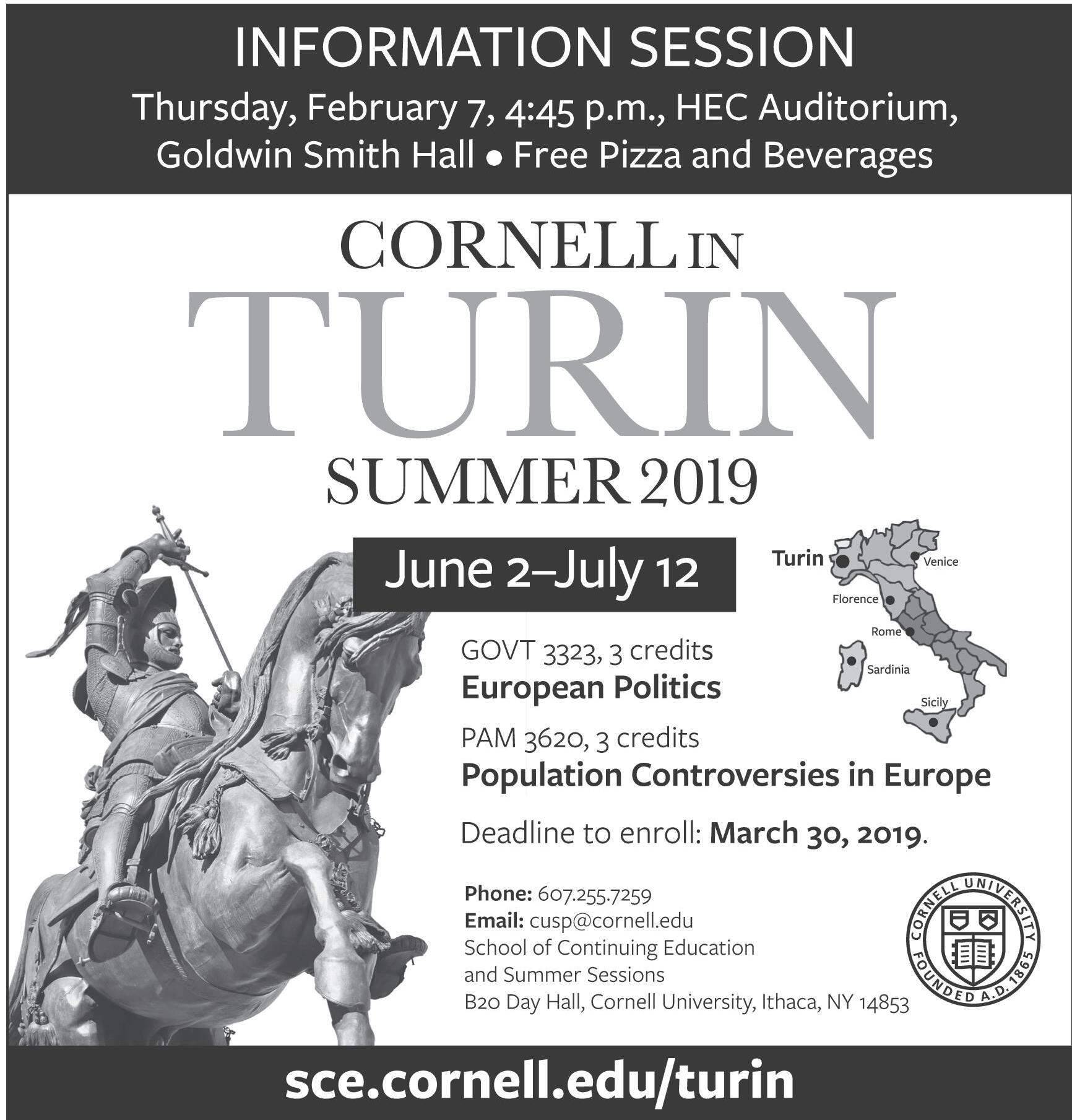
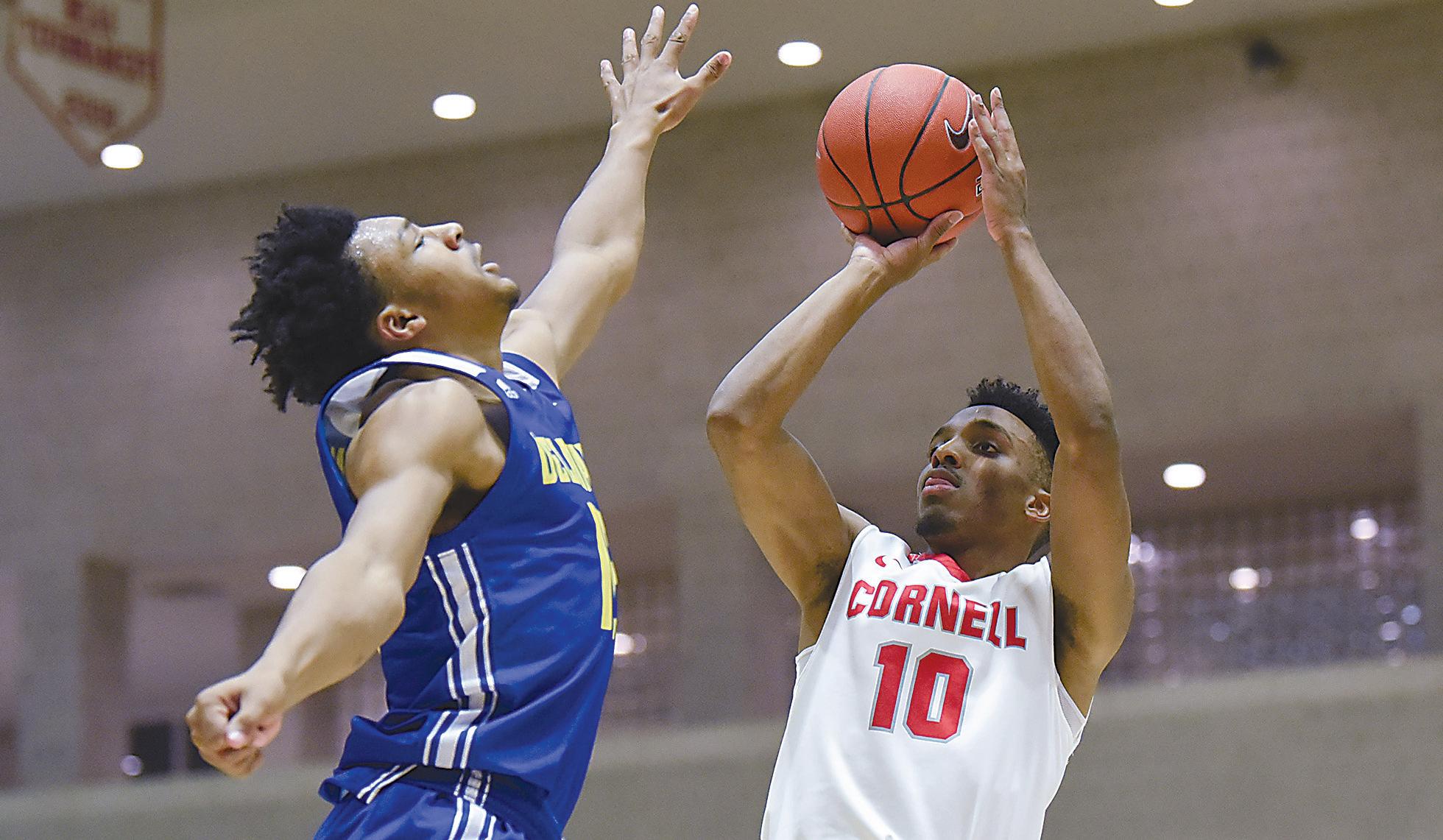
Rolling around the rim twice before ultimately bouncing off, sophomore forward Riley Voss’s last-second three-point heave came about as close as possible to forcing overtime, ending Cornell’s comeback hopes as the Red fell to Columbia, 73-70, Saturday night.
The series between the Empire State rivals is now split 1-1 with both games coming down to last-second shots. Cornell beat the Lions, 60-59, in Ithaca last weekend, nearly squandering a double-digit lead. Both teams’ Ivy League records now sit at 1-1.
Columbia led for the majority of the contest, coming out strong and building an 11-point cushion in the second half. Strong defense by Columbia senior Quinton Adlesh kept star Cornell senior guard Matt Morgan, averaging 23.3 points per game, at bay for most of the first half. Columbia also consistently controlled the boards, getting key offensive rebounds to stifle any chance at a momentum change for the visitors.
But a 22-point performance from sophomore forward Jimmy Boeheim kept the Red within striking distance throughout, as he was able to get to the rim and draw fouls.
“I was just trying to be very aggressive,” Boeheim said. “I felt confident and wanted to do whatever I could to help my team.”
Unfortunately, Cornell had no answer for Columbia guard Gabe Stefanini, who scored 24 points. The Lions’ standout sophomore was consistently able to get in the paint and pull up for midrange jumpers. With Cornell having the best three-point defense in the Ivy league, Stefanini and the Lions adapted and attacked the paint, controlling the interior game from the opening tip.
“Credit to Columbia,” Boeheim said. “They made some big shots down the stretch. We also had a couple communication errors down the stretch that we just can’t have
moving forward.”
Despite its sloppy play at times, Cornell stayed aggressive and had a chance to pull out a victory at the end — Saturday’s contest was a near carbon-copy of last weekend’s, but with the roles reversed. Last weekend, Cornell led 14-0 and a Columbia shot at the buzzer missed, securing a win for the hosts. In New York , Cornell came from behind and had a final chance to tie.
Thanks to back-to-back, pick-and-pop plays featuring Morgan and Boeheim leading to consecutive three-pointers, the Red pulled within one with just under a minute left, looking poised to steal the game.
But Adlesh, who had 21 points in Columbia’s win, had
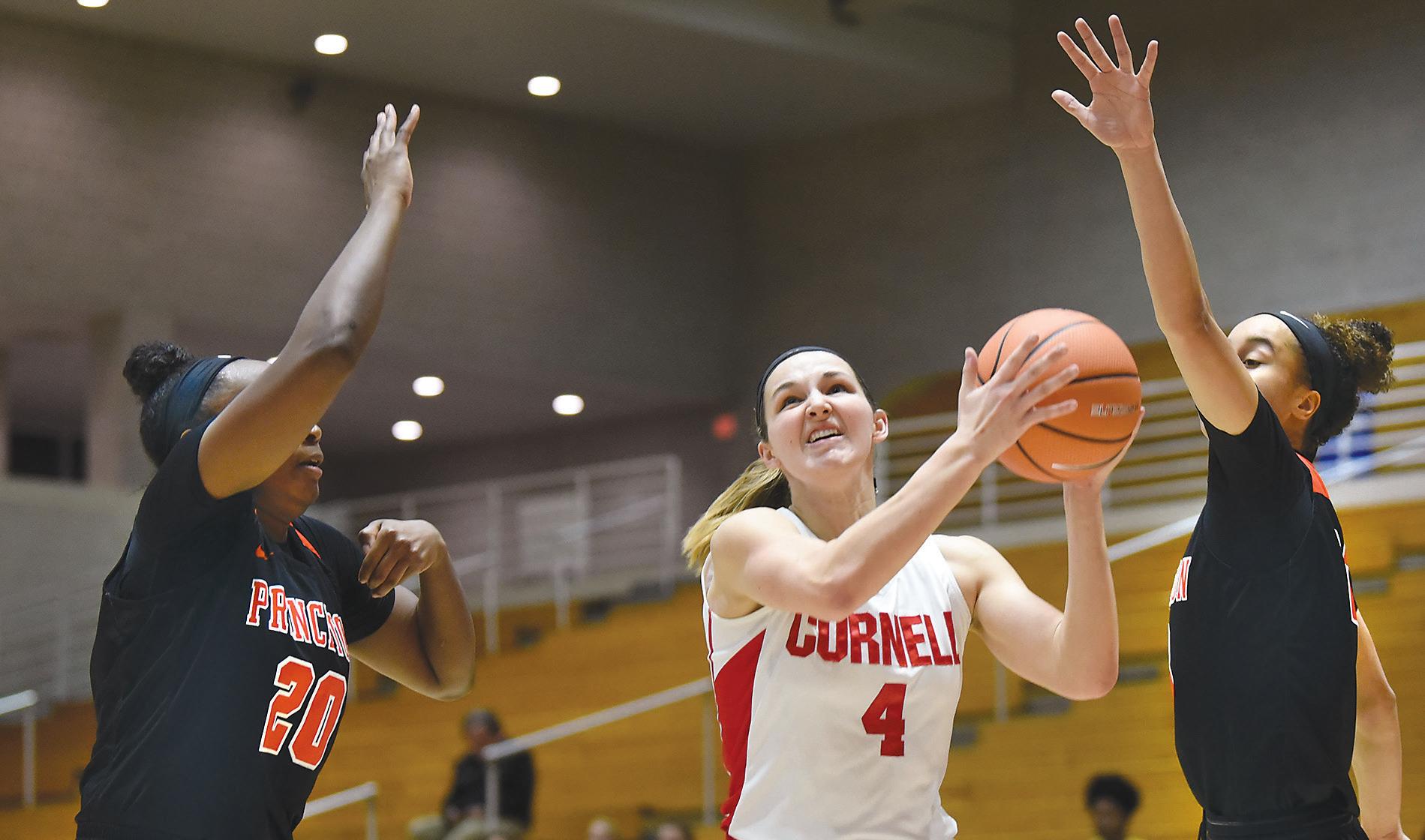
but no cigar | Cornell’s dominant third quarter — when it outscored Columbia 21 to 9 — was not enough to make up for a lethargic first half and a subpar shooting percentage from the floor.
By AMAN GUPTA
An extremely slow start saw Cornell women’s basketball down a yawning 18 points at the half against Columbia on Saturday before it raced back into contention with a towering third quarter.
But the effort wasn’t enough.
While the Red managed to mount an inspired resurgence — nearly eclipsing the Lions at times — it ultimately failed to narrow the deficit, leaving the team with a 65-57 loss. With the defeat, its first in conference play, the Red slipped to 1-1 in the Ivy League and 7-6 overall.
“The team lacked energy during the first half,” head coach Dayna Smith said. “Poor execution of the press and a lack of intent while rebounding significantly reduced our chances of winning the game.”
Throughout the game, Columbia’s junior guard Janiya Clemmons proved to be Cornell’s kryptonite, blocking each grasp at a comeback. While the Red pulled within a point of the Lions twice in the fourth quarter, the junior answered Cornell’s attempts for a lead each time.
“In the first game against Columbia, we were able to restrict Clemmons to only two points in the entire game,” Smith noted.
“However, in the most recent game, Clemmons managed [to score] 16 points thanks to immense aggression in terms of penetration higher up the court.”
Cornell only managed to shoot 13 of 25 from the free throw line, while Columbia also managed to out-rebound the Red by five, ending the game with a formidable 38 rebounds.
“We need to focus more on our free throw shots in order to effectively assert ourselves during a game,” Smith said. “A lack of rebounding during the game definitely cost us crucial points and made it more challenging to
| While Jimmy Boeheim’s 22 points kept the game close, a barely-missed three-pointer thwarted the Red’s last-second attempt at forcing overtime.
other ideas. The senior hit a silky jumper over the contested arms of six-foot-six senior forward Steven Julian, one of the Ivy League’s best defenders — Julian ranks third in the conference with 1.56 blocks per game.
Morgan then delivered a quick basket for Cornell, which was then forced to foul Stefanini. Stefanini missed the game tying free throw in last Saturday’s contest at Newman Arena, but came up clutch this game, hitting both and forcing Voss’s last-second heave.
Bench points continue to be an issue for Cornell as the Red’s non-starters went for eight points, compared to
By GRACIE TODD Sun Staff Writer
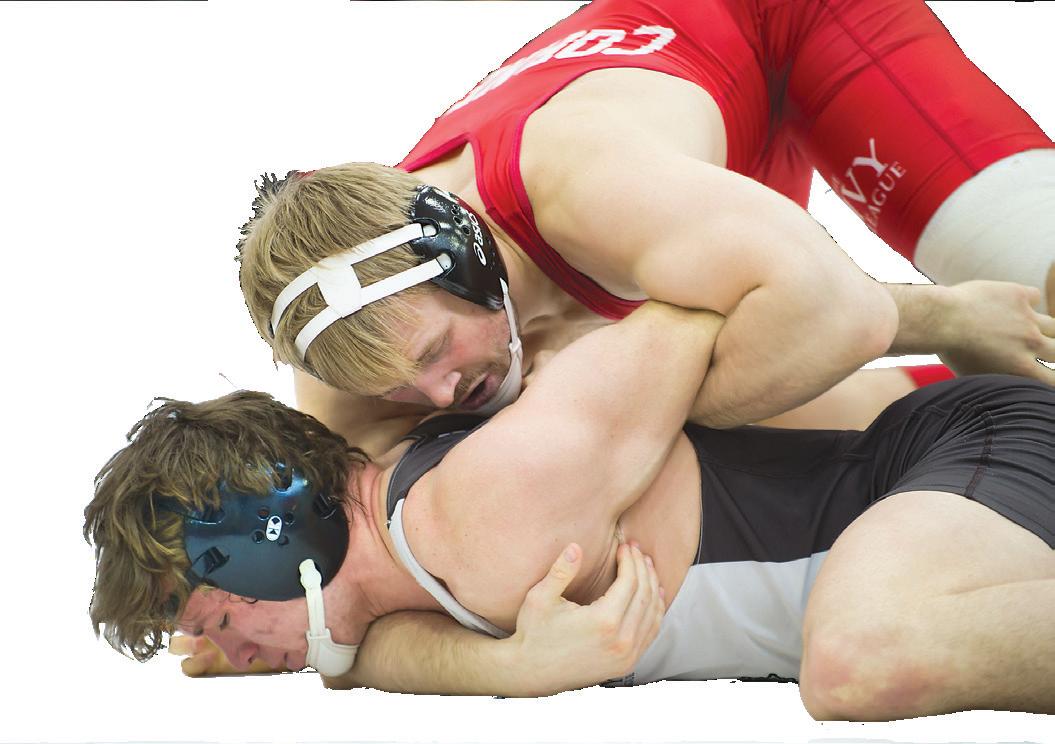
Cornell wrestlers downed two more Ivy teams on Saturday for their 85th and 86th consecutive conference victories — and, in doing so, earned head coach Rob Koll his 300th and 301st wins with the squad.
The Red beat Brown in a landslide 42-6 decision to start Saturday’s New England double-header. En route to victory, only a single Cornell wrestler lost his match, with the team winning its first five matches and sprinting to an early 23-0 team score lead over the Bears.
Powering the Red to an ultimate 36 point win, two wrestlers
Milestone | Head coach Rob Koll surpassed the elusive 300win barrier as Cornell beat Harvard in a 50-0 landslide, the team’s biggest win since 2009.
— senior Jonathan Furnas of the 149 weight class and sophomore Max Dean of the 184 weight class — won by fall, earning Cornell six points apiece, while senior Jeramy Sweany put six points on the board in an injury default.
Cornell’s domination resumed quickly in Cambridge, where the team won seven of the nine contested matches with bonus points on the way to shutting out Harvard 50-0.
This time, four wrestlers — sophomore Yianni Diakomihalis of the 141 weight class, freshman Andrew Berreyesa of the 165 weight class, junior Brandon Womack of the 174 weight class