The Corne¬ Daily Sun

By WINNY SUN Sun Staff Writer
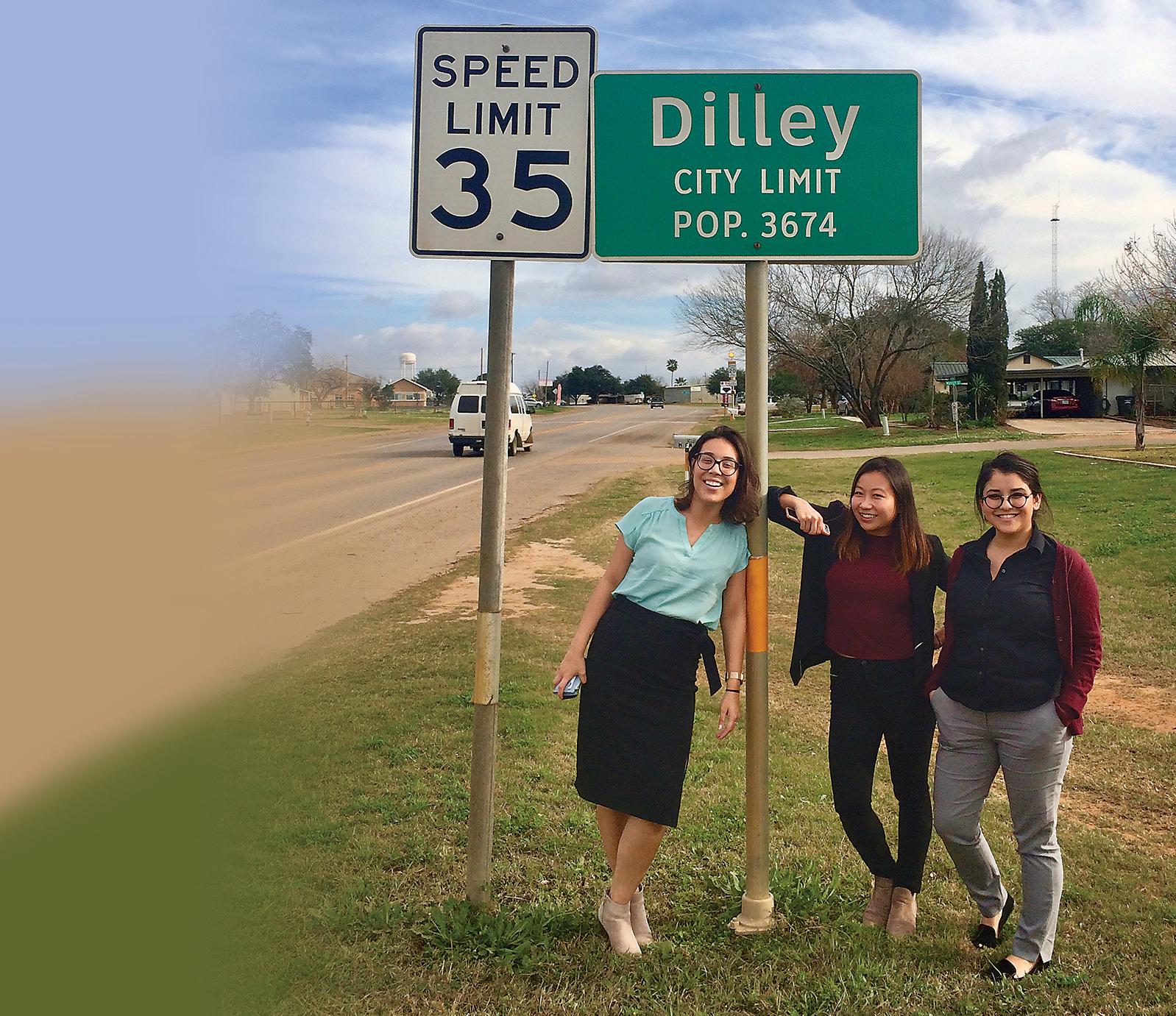
A law professor and six Cornell Law students spent their winter break at the largest immigrant detention center in the country, helping recently arrived asylum seekers prepare for the vetting process.
They were part of the Dilley Pro Bono Project, which provides legal services to mothers and children detained at the South Texas Family Residential Center in Dilley, Texas, according to the program’s website.
Prof. Jaclyn Kelley-Widmer, law, heard about the project from a number of colleagues while practicing immigration law in the San Francisco Bay Area. Though she was long interested in working in the center, she finally took the plunge after the separation crisis of this past summer during which the Trump administration separated 1,995 children from their families at the border.
President Trump’s administration has received “public backlash and
“A lot of them experienced first-hand the persecutions that their mothers had experienced. The amount of trauma [the women] faced is so substantial.”
Diana Caraveo Parra grad

By AMANDA CRONIN Sun Staff Writer
On Monday night, as students returned to their campus dorm rooms and the temperature continued to shiver around the single digits, several students reported broken radiators and insufficient heating on North Campus.
South Campus Residential House
Director Kyle Schillace alerted staff in an internal group chat late on Monday night that there was a “huge heating crisis on North campus (aka the heat isn’t working).” He went on to say that he hadn’t heard of any issues on South Campus but to “call the RHD on call # if you or residents discover heat issues.”
Temperatures dipped below 10 degrees on Monday night and remained in the
single digits with negative 30 degree windchill. According to Weather.com, prolonged exposure to these conditions for about 30 minutes could result in painful frostbite.
“In my suite, all of our heaters are broken,” said Sara Mills ’22, a resident in Low Rise 7. She expressed concern over the adequacy of of the maintenance personnel.
“It was actually hilarious, my suitemate

called the maintenance man to put in a request to fix the radiator last night, and this man came [today] with a bucket and a broom, and just hit the radiator [with the broom] and left. That was the fakest maintenance man I’ve ever seen,” Mills said.
In an email sent to Low Rise residents obtained by The Sun, Residential House

The Gender Expression Non-Discrimination Act passed on Jan. 15 in the New York State Senate in a landslide vote of 100 to 40. The bill will amend current N.Y. human rights laws that pro-
tect against discrimination based on gender identity and expression. GENDA’s amendments also mean that offenses related to gender identity and expression will now be classified as hate crimes in the NYS penal law.
Joseph Anderson ’20, president

All Labor Has Dignity: Martin Luther King Jr. and the Labor Movement
8 a.m. - 5 p.m., 227 Ives Hall
Cayuga Basin Bioblitz: A 24-Hour Race to Find What’s Living in Our Backyard
8 a.m. - 5 p.m., Mann Library
Its Mysterious Life: An Appreciation of Beetles
8 a.m. - 5 p.m., First Floor Mann Library
Mixed Media: The Interplay of Sound and Text
9 a.m. - 5 p.m., Hirshland Exhibition Gallery, Level 2B, Kroch Library
Don’t Forget Us: The Plight of the Hemlock and Ash Trees — Stone, Plate, and Photo Lithographs 10 a.m. - 2 p.m., Botanic Gardens Welcome Center
Modeling Failure in Ductile Metals Under Dynamic Loading
4 p.m., B11 Kimball Hall
Drop-in Breakfast at the Engaged Cornell Hub 8:30 - 10 a.m., 3rd Floor Kennedy Hall
Contemporary Wildlife Management Issue: The Use of Lead Ammunition for Hunting Big Game Noon - 1 p.m., Lecture hall 5, College of Veterinary Medicine
Soup Days Noon, 400 Caldwell Hall
Functional Nanofibers via Electrospinning and Their Applications
12:20 - 1:10 p.m., T01 Human Ecology Building
Chia, Amaranth, and Quinoa: From Ancient Seeds to “Superfoods” 10 a.m. - 2 p.m., Botanic Gardens Welcome Center
16th Annual North Campus Food Show 4 - 6:30 p.m., 1st Floor, Robert Purcell Community Center
Chemistry Seminar: Dual Metal Strategies for Catalytic C-C Bond Formation 4:30 - 5:45 p.m., 119 Baker Lab
The String Swampland and Emergence of Global Symmetries
7 - 9 p.m., 401 Physical Sciences Building
By AMANDA CRONIN
Sun Staff Writer
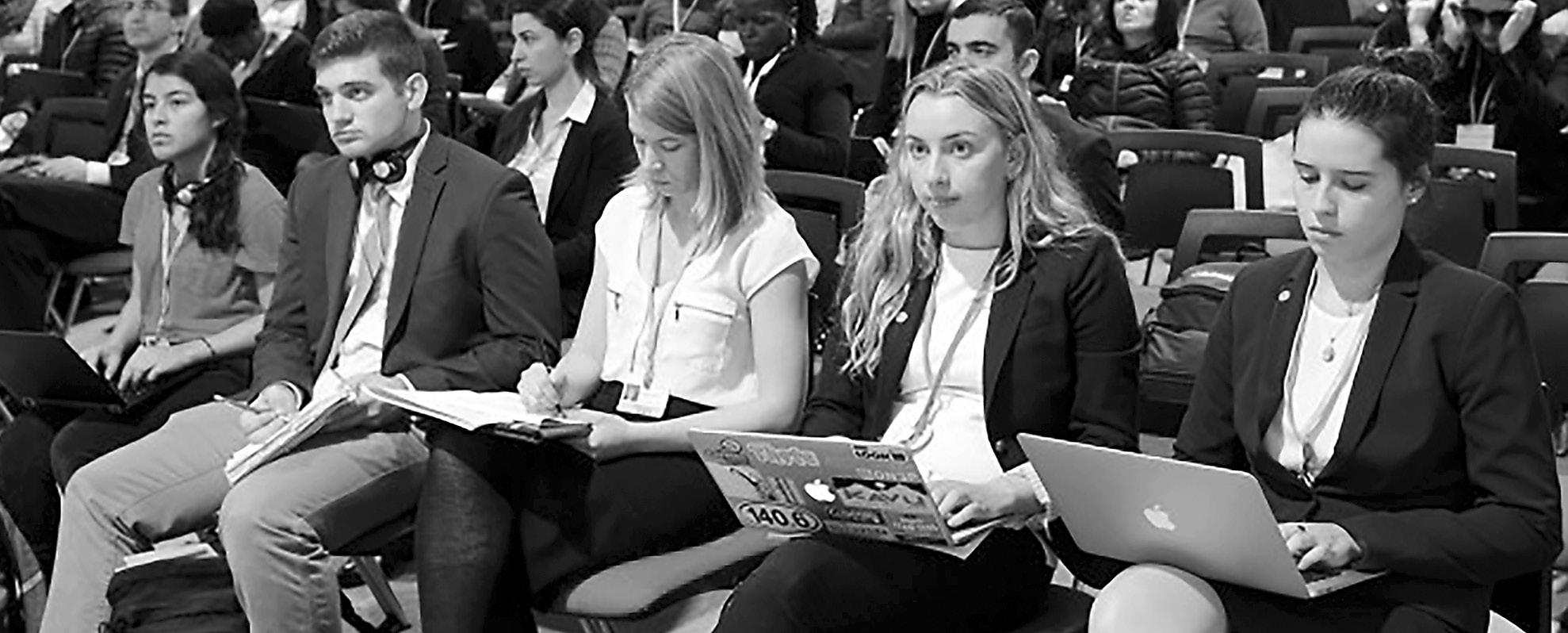
At the 24th Conference of the Parties, or “COP24” in Poland, 17 Students and six professors worked with NGOs to create solutions for climate change problems.
The conference lasted from Dec. 3-17. The delegation was a part of the Global Climate Science and Policy class, taught by four professors, including the director of the Cornell Institute for Climate Smart Solutions Prof. Allison
Chatrchyan, development sociology.
Every student spent the semester preparing for the conference by working with a non-profit organization in improving its international presence. Students studied domestic and international environmental policies in order to produce well-informed deliverables in partnership with their respective organizations.
Julia Kapuvari ’19 worked with the Climate Smart Agriculture Youth Network (CSAYN), a NGO based in Cameroon, “to produce a curriculum to engage high school
By MARYAM ZAFAR Sun Staff Writer
As students dutifully logged into their Blackboard accounts this week, a new message popped up: “Cornell is now transitioning from Blackboard to Canvas!”
The University intends to integrate the new system over time to improve student learning and faculty user experience.
“I know that other products could have moved the concept to the next level.”
Prof. Cindy van Es
Instructors had the option to opt into Canvas’ platform this spring, but the full transition will be complete by spring 2020. The switch is the product of an evaluation process that began in late 2016.
For the upcoming fall
semester, the University plans to have half of all courses accessible on Canvas. By next spring, all courses using a learning management system must switch to Canvas.
Blackboard, which has roots in a program co-founded by Daniel Cane ’98 during his sophomore year, served as Cornell’s primary learning management system for years, even as other universities began to move away from the platform as early as 2008.
The Center for Teaching Innovation began recruiting faculty to pilot new systems, and review systems like Blackboard Ultra, Canvas and Brightspace, other platforms for interactive education, in April 2017.
The purpose of the switch is “to improve the student learning experience,” according to the CTI website. Canvas will share many of Blackboard’s

students in farming techniques that mitigate and adapt to climate change-induced events, such as droughts and floods.”
At the conference, Kapuvari and her classmates attended workshops and interacted with experts from around the world. During breaks, they answered questions at the University’s booth and talked with delegates from Ghana, Australia, Denmark and Great Britain, among others.

By KYLA CHASALOW Sun Staff Writer
Multiple extracurricular activities, educational playtime and thoughtful, emotional conversations – all these attributes could describe the typical Cornell student experience, but are actually the definition of the term “intensive parenting.”
Center, examined “intensive parenting” norms across social groups. He challenged the notion that the differences in parenting styles across socioeconomic groups arise from differences in cultural norms.
supervision.
“The study indicates that intensive parenting is now the dominant cultural model for how to raise children,” Ishizuka told The Sun in an email.
“The study indicates that intensive parenting is now the dominant cultural model for how to raise children.”
According to Cornell researcher Patrick Ishizuka, intensive parenting has become a dominant parenting style across socioeconomic groups.
In his paper “Social Class, Gender, and Contemporary Parenting Standards in the United States,” Ishizuka, Frank H.T. Rhodes postdoctoral fellow at the Cornell Population
Patrick Ishizuka
Using survey data from an original experiment with 3,600 parents, Ishizuka found that participants tended to rate time-intensive, heavily-involved parenting scenarios better than “natural growth” scenarios with less parental involvement and
The intensive parenting model demands parents to supervise children’s activities, talk with them about their thoughts and feelings and respond to misbehavior with discussion, not hard rules.
Parents wanting to spend more time guiding their children is not a new phenomenon, according to the study, which said that American parenting norms have been shifting in this
Students prepare women for frst step of asylum process — the ‘credible fear’ interview
LAW Continued from page 1
a lot of outrage for separating families and kids and detaining them at the same time,” Kelley-Widmer told the Sun, and she felt compelled to take action.
“It was very poignant to see them having come so far, and ... see how much further they still have to go.”
Jaclyn Kelley-Widmer
As a Cornell professor, she also felt that “it’s important for students to get exposure to public service, especially with vulnerable populations.”
Kelley-Widmer described the detention center as a large complex made up of many large temporary buildings, located in a fairly remote part of Texas.
Only mothers and children under the age of 18 are detained here.
“If a dad arrives with a family, he would be sent to a different, adult-only detention center. If a child over 18 arrives, he will similarly be separated from the family and sent to an adult detention center,” she explained. In other cases, “sometimes people have de facto kids that they are caring for, like nieces or nephews, and that child who is not a biological child will be separated and sent to the custody of the Office of Refugee Resettlement,” she said.
During the week that Kelley-Widmer and her students were at the center, they helped several detained women prepare for the first steps of the interview process — the so-called “credible fear” interview — which determines whether asylum seekers were truly persecuted in their home countries.
“We explain to the woman what that interview process is going to look like. We talk to her about her story so she has an idea of what kind of information is
important to reveal to the asylum officer,” she said. Every woman that she worked with had a heartbreaking story, she said, describing it as a “privilege” to work with and help guide them.
The professor shared that the most memorable moment was when she talked to a group of women who had passed their interviews and were about to be released from the detention center. “It was very poignant to see them having come so far, and again see how much further they still have to go before they can have true safety.”
Diana Caraveo Parra grad, one of the law students who went on the trip, said that what really struck her was interacting with the children at the detention center.
“A lot of them experienced first-hand the persecutions that their mothers had experienced,” she said. “The amount of trauma [the women] faced is so substantial.”
Winny Sun can be reached at wsun@cornellsun.com.
GENDA Continued from page 1
of the LGBTQ student union Haven, said that the bill’s passage is long overdue.
“It is a moment to celebrate and thank our lawmakers in Albany for protecting transgender, gender non-binary and gender non-conforming individuals,” he said.
Members of Haven have been involved in lobbying for GENDA, bringing attention to the bill through social media and organizing a day trip to Albany in collaboration with Cornell
State Relations.
The bill was originally introduced in 2003 but failed to reach a vote on the senate floor until this year, when Democrats regained control of the Legislature. Previously, the bill has not been passed in the Assembly for ten consecutive times.
“It is a moment to celebrate and thank our lawmakers in Albany for protecting ... individuals.”
Joseph Anderson ’20
Along with GENDA, a bill ban -
ning mental health care professionals from attempting conversion therapy on minors also passed last Tuesday. Conversion therapy is the practice of attempting to change an individual’s sexual orientation. Health care professionals who violate the legislation would now be subject to discipline by their licensing entity. Similar laws banning this practice have
been passed in 14 other states and Washington D.C.
State Sen. Brad Hoylman (D-NY) took the lead on both GENDA and the bill regarding health care professionals. Hoylman called the move “a quantum leap forward.”
But the fight is not over yet. Following GENDA’s passing, Haven will continue to lobby for the “end of the gay and trans panic defense and many other important issues,” Anderson said.
Penelope Campos can be reached at pcampos@cornellsun.com.
HEATER
Continued from page 1
Director Mark Schneider detailed how to address heating issues. The email explained that the low rise buildings run on steam heat and can be adjusted by turning a knob that goes from level 1 (least heat) to level 5 (most heat).
“If your room has literally no heat, meaning the radiator is completely cold even when turned to 5, first check that the radiator is not blocked or that anything is preventing the heat flow,” the RHD said. “If there still is no heat coming through the radiator, call facilities or the RA on-call in the evening/on weekends to report the problem.”
The director told residents to place a maintenance request in the case of insufficient heating, and to make certain that all windows in rooms and hallways were closed to avoid frozen pipes and “potential flooding.”
Despite multiple reports of issues from residents and staff, University Spokesperson John Carberry stated late on Monday that after reaching out to multiple sources, “the heating system that services North Campus is fully functional.”
The Sun reached out to all the Residential Hall Directors in the North Campus dorms and Program Houses on
Monday evening. None picked up the phone or replied to emails for comment.
“I got in today and I... was expecting some warmth but it was actually very cold. I actually just left to Appel [Commons] because it’s warmer there and now I’m trying to wear warm clothes,” Salaiha Mughal ’22, who lives in Balch Hall, said. “When I sleep I’m going to have, like, two comforters on.”
Meanwhile, Sofia Aguirre ’22 said that she and her roommate have been sleeping with “a lot of blankets” for a month and a half. “Even just to type my hand starts to get really cold,” she said.
“It’s not like it’s unbearable in here, but I could tell that it’s a bit chilly when I am in my room compared to the hallway,” Amina Hasan ’22, another Balch resident, said. “I like sleeping with a lot of blankets so I’m fine at night...I notice it in the daytime when I’m moving around the room.”
The Sun could not reach Energy Management and Control Systems by the time of publication.
Gillian Smith, Cornell’s media relations specialist, encouraged students to “contact their RAs and then CUPD dispatch” if they experience a loss of heat.
PARENTING
Continued from page 3
direction since at least the 1960s.
In the paper Ishizuka noted that in the past, “academic and popular accounts” pointed to socioeconomic and gender differences in parenting norms as the cause of parenting style differences. For example, some researchers argued poor and working-class parents see less value in directing children’s free time.
Ishizuka’s research challenges that narrative.
“What’s remarkable is the consistency of support for intensive parenting among parents of different social classes, regardless of whether mothers or fathers are parenting, or sons or daughters are involved,” he said.
According to Ishizuka, the research also reveals widespread economic anxiety and “pressure to invest heavily in children” despite changes in family and labor structures that have increased time constraints.
“Intensive parenting is an approach that many parents may feel increases their children’s educational attainment
special integrated features, including TurnItIn, iClicker and Panopto. Students reportedly enjoyed the new platform in a pilot program, and it was preferred by pilot faculty over Blackboard, according to the site.
As a result of the staggered rollout, however, some students may be forced to use both platforms
a large class. I wanted a way to use the Website to enhance both education and communication,” said Prof. Cindy van Es, applied economics and management.
The CourseInfo software they created was used by professors similarly to the way Blackboard is used today: To post coursework, record grades and make announcements.
As a result of the staggered rollout, however, some students may be forced to use both platforms simultaneously until next spring.
simultaneously until next spring. This fall, larger courses and freshman-oriented courses will likely be on Canvas, according to the site. Blackboard LLC. previous merged with CourseInfo LLC., a learning management system designed by Cane with the help of 11 Cornell undergraduates and one alumnus, according to a University press release from 1997.
“I asked Dan to help me to create some parts of the page that would facilitate communication with the students, because I teach
“While I have continued to use it in all my courses, and I am proud of the solid foundation we built for this type of tool, I know that other products could have moved the concept to the next level,” van Es previously told The Sun.
Many of Cornell’s peer institutions currently use Canvas, including Brown University, Columbia University, Dartmouth University, Stanford University and Yale University.
The CTI will hold “drop-in” sessions this week for faculty to ask technical questions. Session times are posted on the teaching website, and face-to-face sessions are “coming soon.”
Maryam Zafar can be reached at mzafar@cornellsun.com.
and future economic opportunity,” Ishizuka said.
Widespread pressure to parent this way does not mean that intensive parenting ideals are attainable for everyone.
“Parents need a significant amount of time and money to engage in intensive parenting,” Ishizuka said. “Single parent, dual-earner, and low-income families are likely to face greater challenges in realizing these intensive parenting ideals.”
Kyla Chasalow can be reached at kchasalow@cornellsun.com.
COP24
Continued from page 3
Martha Torres ’19 found the experience to be “motivating, enlightening, and tiring.” She emphasized that climate change is an important issue because it is an inevitable force that will affect us all.
“New York State (working with Cornell) is working to create emergency plans for coastal communities which are likely to suffer the most immediate consequences of sea level changes,” she said in an email to the Sun.
“New York State is working to create emergency plans for coastal communites ... likely to suffer the most immediate consequences of sea level changes.”
Martha
Torres ’19
“This includes not just NYC and the cities on the Atlantic, but all of the Hudson river communities as well as the towns that border the Great Lakes [like Ithaca],” Torres added.
While the students were frustrated and disappointed by United States’ withdrawal from the Paris Climate Agreement, Kapuvari argued that “the people are the real delegates of our country” and urged students to stay engaged by joining “local activist organizations such as Climate Justice Cornell,” of which Kapuvari is the General Body Organizer.
Amanda Cronin can be reached at acronin@cornellsun.com.
By SOPHIE REYNOLDS Sun Staff Writer
While it is easy to take a breakfast scone, PB&J sandwich or Doritos study snack for granted, many countries lack the specific soil conditions for the wheat needed in these products. Iryna Dovirak ’20 has taken the phrase “let’s get this bread” to a whole new level, by pursuing a solution for diminished wheat yields in Ukraine, a major exporter of the grain.
Developing breeding strategies to improve mineral extraction and nutrient transport within wheat crops under Prof. Olena Vatamaniuk, soil and crop sciences, Dovirak hopes to create a resilient grain that can flourish despite limiting soil conditions.
“While other breeding programs have focused on increasing grain yield, they fail to maintain the substantive nutrient concentrations essential in wheat products,” Dovirak said. She and other members of the Vatamaniuk lab instead focus on preserving the nutrient density of wheat, devising ways to both increase yield and maintain nutrient quality.
In order for wheat to successfully grow and retain micronutrient density, it must have access to various minerals in the soil, namely zinc, iron and copper.
“Unfortunately, 70 percent of Ukraine’s farmable land is composed of alkaline soil, which lacks these nutrients, especially copper,” Dovirak said.
Because of the nutrient deficiency and
the unique sensitivity of wheat to the bioavailability of copper, Dovirak decided to focus on better understanding and further improving the process of copper absorption, regulation and transport in grains.
“We knew that copper regulates the growth and development of wheat, but we weren’t sure of the exact pathways,” she
tors, spl7 and citfl1. These molecules turn on specific genes that aid in copper delivery and help maintain homeostasis, or the maintenance of optimal living conditions within the organism. The specific transcription process positively regulates the growth, crop yield and fertility of Brachypodium wheat. According to Dovirak, the manipulation of the spl7
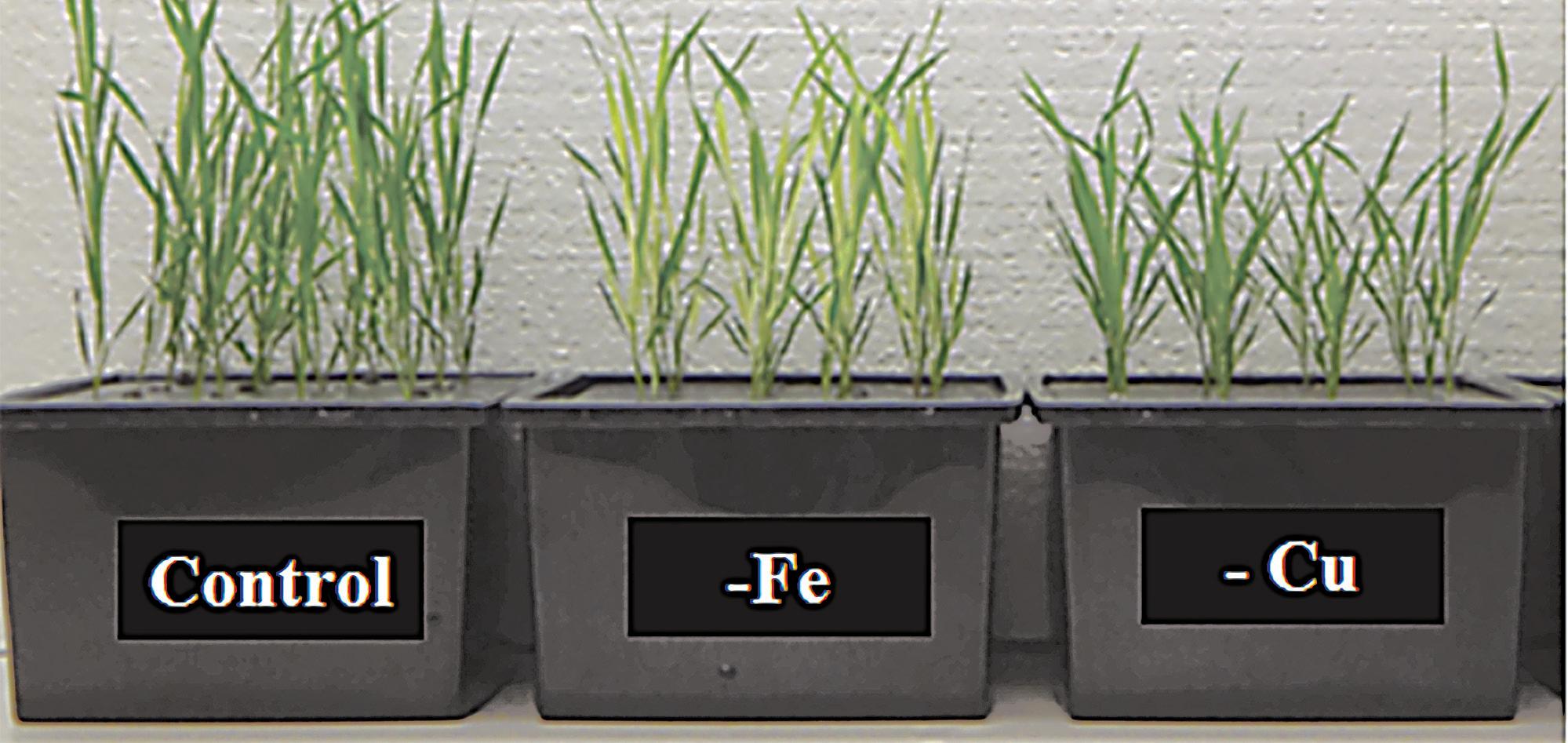
said. In light of this, Dovirak and others in the Vatamaniuk lab decided to take a closer look at a specific species of wheat proxy called Brachypodium
After conducting research in a greenhouse, Dovirak and lab colleagues discovered two important transcription fac-
By SHRIYA PERATI Sun Staff Writer
With the world population set to grow by an estimated 25 percent over the course of the next four decades, the need to increase food production is becoming an increasingly pressing issue. In response, the egg production industry is prioritizing increasing production, especially as eggs are one of the most affordable sources of protein.
Deena Scoville ’20, an animal science major and education minor in the College of Agriculture and Life Sciences, is working towards understanding the variability in egg production amongst chickens.
Scoville has been studying the persistency of lay in chickens under the mentorship of Ph.D. student Lauri Fracoeur. “Egg laying chickens are typically only kept for one year because their egg production decreases significantly after one year,” Scoville said.
or citfl1 pathway in various wheat species can lead to genetically modified grain strains that are resilient to copper deficient soils.
The next steps of the project involve Dovirak using cutting edge gene modification techniques, such as CRISPR. This
ond year of lay. Egg production has been recorded daily and blood samples have been collected monthly for each bird. Her project has been ongoing since this past summer.
“Our lab focuses on ovarian follicle development in chickens at the molecular level and how it relates to the whole organism,” Scoville said. Follicle development is the process by which an ovarian follicle, a small sac of fluid which contains immature eggs, matures. Since chickens have short ovarian cycles, they make good models to study follicle development, Scoville said.
Scoville’s research aims to identify attributes of good egg layers that will have optimal egg production during their sec-
tool analyzes desired genes by using the Cas9 enzyme group, which cleave strands of CRISPR DNA sequences commonly found in prokaryotic organisms.
Dovirak will use these methods to see if the desired spl7 and citfl1 genes from Brachypodium can be selectively inserted into other, less resilient wheat species like Arabidopsis , which is more closely related to commercial wheat grain.
By isolating Brachypodium ctfl1 cDNA and inserting it into another wheat species, Arabidopsis , which lacks the ciyfll1 gene homologs, Dovirak hopes to produce a viable Arabidopsis mutant. This would prove that transgenic modification of transcription factors is a feasible venture. She will use wheat strains acquired from collaboration with a plant genetics lab in Ukraine. With hydroponic techniques to tightly control soil composition, Dovirak will be able to mimic copper-deficient soil conditions in the fields and greenhouses here at Cornell.
Overall, Dovirak believes that this research will be crucial in improving food availability in the face of climate change.
“The growth of these plants is dependent on the composition of the soil which will be affected by climate change and if we fail to solve crop growing issues now, nutrient intake could become a pervasive problem even in the United States,” she said.
Sophie Reynolds can be reached at sreynolds@cornellsun.com.
Scoville emphasized the presence of variability, noting that some chickens continue to lay eggs at high efficiencies past their first year, a phenomenon called “persistency of lay.”
“One of the project’s difficulties early on was collecting and getting a sufficient volume of blood from each bird,” Scoville said. Blood was drawn from the brachial vein, located between the biceps and triceps muscles of the wing.
“Another difficulty of drawing blood from chickens is that hematomas (swelling of clotted blood within the tissues) form easily, and once one forms, blood cannot be collected from that vein,” Scoville said. She said that with more experience and practice, collecting the necessary blood volume from each bird has grown easier.
“Another difficulty of drawing blood from chickens is that hematomas (swelling of clotted blood within the tissues) form easily, and once one forms, blood cannot be collected from that vein,” Scoville said. With more experience and practice, collecting the necessary blood volume from each bird has grown easier she said.
“This project is set to run till January of 2020. At the completion of this experiment, we plan to analyze egg production, hormone profiles and gene expression between high efficiency layers and low efficiency layers,” Scoville said. Layer efficiency will be determined by calculating the number of eggs laid by each bird in a given amount of time.
In order to potentially help correlate early levels of hormones in the hens with layer efficiency, they will measure hormone levels.
Scoville also hopes to identify differentially expressed genes between chickens of varying layer efficiency, using RNA sequencing. If a certain genetic marker could be identified that promotes a longer period of egg production, then chicken breeders could utilize this information when making decisions on which traits to select for the next generation.
“Hopefully, this will shed light on the ovarian factors which influence egg production in order to improve the economic value and sustainability of an already very efficient model,” Scoville said.
Shriya Perati can be reached at sperati@cornellsun.com.
While people worldwide were mourning Mary Oliver’s death, I was at home celebrating my 20th birthday. I saw the news scrolling through Tumblr, the platform that had first made me fall in love with her work at the age of 11. You’ve probably seen the lines “What is it you plan

to do / with your one wild and precious life?” on Facebook or Twitter or staring down at you accusingly from your middle school English teacher’s classroom wall. However, although Oliver’s work regularly appears on sites like Pinterest, it doesn’t quite translate to social media in the same, trite way as you might think at first glance.
Last semester, I wrote a column criticizing Instapoets like Rupi Kaur for sacrificing depth and poetic language for accessibility in order to gain Internet stardom. Oliver, in contrast, is an example of the poet whose accessibility enthralls the ordinary reader with her language and feeling. Her conversational tone beckons you to sit down with her and take a break from the business and superficiality of everyday life. Despite garnering criticism for the accessibility of her themes and her unornamented language, Oliver’s poetry is neither reductive nor inauthentic. In an interview with NPR,
beauty of the world.” An avid walker for much of her life, Oliver took inspiration from the nature she observed, drawing comparisons from critics to other beloved American poets such as Whitman, Emerson, Thoreau and Dickinson. Her other idols include the Romantic poets Keats and Shelley. In the vein of the Romantics, Oliver’s poems are also highly spiritual. Although she mostly wrote in free verse, the rhythm of many of her poems carry the cadence of prayers. For example, take one of her most popular, “Wild Geese.” During the particularly rough patches of my teen angst, I would recite the first part to myself over and over again in my head:
You do not have to be good. You do not have to walk on your knees for a hundred miles through the desert repenting. You only have to let the soft animal of your body love what it loves.
Or “Sometimes,” in which Oliver writes:
Instructions for living a life: Pay attention. Be astonished. Tell about it.
“Oliver’s writing is underscored by the hidden depth and darkness of...a difficult childhood of sexual abuse and family dysfunction.”
Ramya Yandava
Oliver stated, “Poetry must be clear … I always feel that whatever isn’t necessary should not be in the poem.” Simple, however, does not mean simplistic. While not difficult to understand at face value, these poems aren’t the sort to fall apart at deeper examination, but continue to ask questions and inspire.
Oliver’s writing is underscored by the hidden depth and darkness of a woman who utilized the natural world as a refuge from a difficult childhood of sexual abuse and family dysfunction. In an interview, she stated, “I got saved by poetry. And I got saved by the
The simplicity of the language gives these words their directness and punch. They are words I like to remember in times of need, times when I feel I’ve lost sight of who I am or what I want from life, when I forget that there’s more than just grades and the daily grind. They are like a message from some benevolent fairy godmother. Her work reminds us of the little profundities that surround us every day, if only we would just bother to look, to contemplate, to let ourselves be amazed by the small, simple things. Oliver delighted in life, but just as much of her corpus concerns death. In “Every Morning,” she writes of “death and death, messy death— / death as history, death as a habit—.” In another, “When Death Comes,” death is a “hungry bear in autumn,” “an iceberg between the shoulder
blades.” Yet Oliver greets death with her characteristic curiosity and wonder. Like the violence of the natural world, the inherent cruelty of predator and prey, death was something she never shirked from, nor took lightly:
Death waits for me, I know it, around one corner or another. This doesn’t amuse me. Neither does it frighten me.
After the rain, I went back into the field of sunflowers. It was cool, and I was anything but drowsy. I walked slowly, and listened to the crazy roots, in the drenched earth, laughing and growing.
Ramya Yandava is a sophomore in the College of Arts and Sciences. She can be reached at ry86@ cornell.edu. Ramy’s Rambles runs alternating Tuesdays this semester.


136th Editorial Board
JACOB S. KARASIK RUBASHKIN ’19 Editor in Chief
JOHN McKIM MILLER ’20
KATIE SIMS ’20
VARUN IYENGAR ’21
Editor in Chief
GIRISHA ARORA ’20
OAssociate
Across the country, the last few weeks have brought with them the rise of influenza in homes, schools, communities, health centers and hospitals. As the spring semester begins, I’ve engaged with students, faculty and staff about preparing and responding to the flu season at Cornell. Many have asked: How bad is this year’s flu season likely to be? How does Cornell Health prepare? Are we as a community safe? How can I protect myself?
This year, the U.S. Centers for Disease Control and Prevention released for the first time a midyear flu season report, showing that between 6 and 7 million people have gotten sick with the flu, and up to half have sought medical care for their illness. Most states, including New York, are reporting widespread activity, which means that there is increased or sustained numbers of laboratory-confirmed cases in over half of the counties in the state.
While the current flu season is clearly underway, the CDC is reporting that “severity indicators are lower than they were during a similar time-frame last season.” Despite these early estimates, they warn everyone — patients, families, healthcare professionals and public health entities — to continue to prepare for several more weeks of flu season. It is impossible to predict how these future weeks will unfold.
Get
For this reason, we at Cornell Health prepare for the winter flu season months in advance, starting with a community-wide flu vaccine effort in the fall. This year, we partnered with Wegmans to bring vaccine clinics across campus, and were able to vaccinate over 11,000 Cornellians: almost 8,000 in campus clinics and about 3,000 at Cornell Health. Each year we aim to deliver more vaccines than the previous year, and this year we met our goal, successfully vaccinating 1,500 more individuals by the close of 2018 than we did in 2017. These numbers aren’t able to account for the vaccinations some individuals choose to get outside of Cornell, meaning the reality of vaccinated individuals in the community is likely higher.
nity has what it needs to get through the season. We ensure we have enough staffing, including surge capacity in our nursing and clinician staff, to respond to an uptick in sick visits. Despite current estimates of demand and severity, we anticipate seeing flu-like illnesses as students return to campus from all over the world, where different strains and severity of the flu are prevalent. We stock our laboratory with appropriate testing supplies to ensure rapid turn-around of results, and our pharmacy with antiviral drugs (like Tamiflu) and non-prescription medications and supplies (including “flu kits”) to help you weather the illness. We also resupply flu vaccines, to continue the vaccination effort even as the flu season begins.
This year, with increased numbers of vaccinations in the community, we as a community are better prepared than ever for flu season. Still, there are important ways that you can protect yourself as you return to campus and as the semester gets underway:
Get a flu shot — it’s not too late! Flu vaccines are FREE for students, and for student spouses/partners on SHP. Make an appointment and get vaccinated at Cornell Health: health. cornell.edu. Individuals with chronic illnesses, like asthma, diabetes, immunological conditions and others, should make a specific effort to protect themselves.
remind friends to stay at home when they are sick and encourage others to seek treatment and care when they need it.
Wash your hands: as often as you can with soap and warm water, or use alcohol-based hand sanitizer for times you can’t wash.
Take care of yourself: get enough sleep, proper nutrition, and care for your mental health. We are here for you — for your physical and mental health, and all of the ways that they intertwine.
Take a moment to take care of each other, too. The more we help each other — get vaccinated, remind friends to stay at home when they are sick, and encourage others to seek treatment and care when they need it — the better we can get through the flu season together.
ver 15 million Americans have food allergies. One-third of them are allergic to more than one major allergen: peanut, tree nut, milk, soy, shellfish, eggs, wheat and gluten. There are over 500 members of the Cornell community who adhere to a gluten-free diet, according to Michele Lefebvre, Cornell’s director of nutrition management. Each year in the U.S., 200,000 people require emergency medical care for an allergic reaction to food.
Commendably, Cornell has an allergen-free dining hall, a single-use rule for dining hall plates, separate service utensils for each item and labeling of major allergens for each menu item. Nonetheless, these measures fall short in its efforts to fully prevent and accommodate students with life-threatening allergies.
Cornell must undertake a series of absolutely necessary measures to guarantee a safe dining environment for students with allergies.
Expand Risley Dining’s Hours
In January 2017, Risley Dining transitioned to a fully gluten-free, tree nutfree and peanut-free kitchen. However, there still remains a number of pitfalls. For one, Risley is only open for lunch and dinner service with limited hours: 11 a.m.-2 p.m. for lunch and 5 p.m.-7 p.m. for dinner. In comparison, every other dining hall on campus is open for at least three hours for dinner. For students with classes and conflicts, the tight service hours at Risley can preclude accessibility.
What’s more, Risley is closed on Saturdays and Sundays. For those with life-threatening allergies, the 64 hours between Friday evening and Monday lunch can be a grueling and anxious period. Ideally, we urge a plurality of allergen-free dining options at Cornell, but at the bare minimum, we implore Risley to maintain full hours with open breakfast and weekend access.
Currently, if you are a West Campus resident, meals at Risley are deducted from the 50 non-West dining hall allowance. In a 12-week semester, this would mean roughly four meals each week allowed at Risley. This is egregious considering that West Campus students are required to purchase the unlimited meal plan for $5,924 each year. Risley should accept meal allowances from all meal plans.
Better protection: Epinephrine
According to the Food Allergy Research and Education (FARE), more than 30 colleges — including Columbia University, University of California Berkeley and Boston College — stock their dining halls with EpiPens. An instant injection of epinephrine is the only effective treatment in the life-threatening case of anaphylaxis. Each dining hall should be supplied with a set of two EpiPens so Cornell can be prepared in case of an emergency.
Crossing off Cross-Contamination
In dining halls as busy and bustling as Cornell’s, it is easy for cross-contamination to occur. Whether in meal preparation or the reuse of serving utensils in multiple dishes, major allergens can be easily spread due to carelessness or ignorance.
First and foremost, to stop cross-contamination, greater awareness of dietary restrictions must be promoted amongst students. The dining hall can lead the way in safety measures, but students must abide by them. Just as there are floor meetings and sexual assault prevention talks at the beginning of the semester, a general information session is necessary for all students to educate them on the prevalence on allergens and the proper dining hall conduct to inhibit cross-contamination.
To prevent cross-contamination, Boston University takes a three-pronged approach in the kitchen: audits of food production and recipe adherence, frequent changes of serving utensils and access to individual packets of bulk items such as peanut butter and other condiments. Cornell should follow suit and beyond: allergen-containing and allergen-free items should be placed in distinct sections, rather than side-by-side as they often are.
Cornell must undertake a series of absolutely necessary measures to guarantee a safe dining environment for students with allergies. Anne C. Jones ’04,
Only the West Campus dining halls call for a single-use plate policy, a measure only scarcely enforced with many unaware of the rule. This single-use plate policy should be a blanket rule across all campus dining halls, strongly enforced, for hypoallergenic and, of course, hygienic reasons.
One initiative Cornell is particularly proud of is the peanut-free toaster in the North Star Dining Room. Yet, it prompts the question why toasters like such are not ubiquitous across campus? We urge that each dining hall across campus is better stocked with allergy-free appliances and an expanded allergy-friendly corner.
Labeling is the greatest means of communication for those with allergies: Currently, dishes are marked with labels noting major allergens. For students that have particular allergens, rather than blanket labels such as dairy or tree nuts, it is much more informative to have the specific ingredient identified.
Lastly, the most effective way to curtail the threat of an allergic reaction is to diminish the amount of meals that use major allergens. Does the flavor and enjoyment of Pad Thai, a splash of cashew oil, or nutty texture outweigh the potentially fatal threat to the multitudes of students struggling with major allergies? Too many of the dishes served at Cornell unnecessarily and superfluously include major allergens.
Cornell Health spends the early weeks in January ensuring the commu-
EpiPens allow for an extra measure of protection in dining halls, but must also be met with the appropriate employee training. All dining staff should be properly trained in recognizing the symptoms of an anaphylactic reaction and administering an EpiPen.
Joining the likes of many universities across America in their safety initiatives, Cornell must protect all students, especially the most vulnerable. Cornell Dining, whose food program is among the best nationwide, must prioritize allergy prevention to be their utmost commitment and responsibility.
Laura DeMassa and Canaan Delgado are sophomores at Cornell University. They can be reached at demassa-delgado@cornellsun.com. Double Take appears every other Tuesday.
William Wang | Willpower
AYouTube commenter is apoplectic. “Just STOP buying Proctor and Gamble Products.” Another chimes in: “Gillette you just lost a 20 yr. customer.” Over the weekend, Gillette released a short film on YouTube titled “The Best Men Can Be” with a message that was simple, reasonable and needed: men should hold other men accountable for their actions. You’d think something level-headed would get a level-headed response in return. Instead, if you go by YouTube commentators, none seem too pleased.
Oh well. I doubt Gillette (and especially Proctor and Gamble, its parent company, which caters to a large base of consumers who are women) cares much about a subset of toxic keyboard warriors.
The real advertisement is thoughtful and genuine. Despite all the furor and think pieces it has generated, the ad is surprisingly muted from director Kim Gehrig, known for her evocative and layered work during her time as a director of advertisements. Her work also includes other striking videos, from a turn as a director of the music video for Chaka Khan’s percussion-based summer song “Like Sugar” to a short story lamenting the rise of steroids in an increasingly insecure male society. She is the rare director who manages to combine watercolor visuals and kinetic storytelling with aplomb, and it’s why she’s increasingly in demand as an artistic force. Gillette’s “The Best Men Can Be” combines a splice of Gehrig’s typical leanings: a little bit of thoughtful social commentary, a progression of dizzying scenes that seep into each other, and a flip at the end that keeps your mind in a daze for days. The ad is just another feather in her cap, and another step up in what has been a meteoric rise in the advertising world for her.
Conditions in Collegetown lately seem to echo a sentiment proclaimed by Jimmy McMillan, who ran for governor of New York in 2010: “The rent is too damn high.”
Humorous campaign slogan aside, this has become the mantra of Cornell students as well, as rent rates for apartments in Collegetown have increased substantially over the past several years. According to The Ithaca Times, in 2014, Ithaca was ranked 11th on The New York Times’ list of most expensive United States cities, just one spot behind the nation’s financial capital of New York. This accompanied a report released by the Urban Institute in 2015, which revealed that about 44 percent of American renters spent over 35 percent of their income on rent in 2010.
The rent issue is a result of too many students searching for too few off-campus housing options. Over half Cornell’s 14,000 undergraduate students live off campus, and Cornell’s on-campus facilities cannot accommodate the demand for housing. According to a report from the Ithaca Voice last February, Cornell was at “maximum capacity” in its on-campus housing options. Rumors about Cornell’s overflow housing — dormitory common spaces used as collective bedrooms — now ring true.
The struggles of high rent may not be unique to Cornell, but it does appear as though other local institutions have found solutions. Ithaca College, for example, accommodates almost 75 percent of its students through its on-campus housing options, according to the Ithaca Voice. And while Cornell is actively attempting to rectify the need for housing through its North Campus Residential Expansion
But back to the furor: later, after the maelstrom, the company released a statement responding to the criticism — it all felt calculated. And this is where the suits come in: the advertisement, as well meaning as it can be, wouldn’t have been run if the higher up in the company felt it didn’t add something to the bottom line of the company. It’s a reflection of the current climate, as a well-spoken, more progressive and new generation demands something different of their com panies. In a Cone Communications report, 92 percent of con sumers say they have a more positive image of a company when it supports a social issue; meanwhile, Gen Z consumers now see their money as the best way to bring about positive social change.
The advertisement wouldn’t have been run if the higher up in the company felt it didn’t add something to the bottom line of the company.

vince them otherwise. They noted that urban youth, a group that the company was desperately trying to tap into at the time, admired Kaepernick. And while sticking with the beleaguered QB might have angered a older, white population annoyed with the league-wide protests that he had ignited, analysts came up with a damning conclusion: They weren’t a priority over the youth the company wanted to attract. And so Nike began to plot out its campaign.
The company bet on a new generation of consumers that will carry it into the future, and it deserves praise for that.
To miss out on a new wave of consumers would be devastating for businesses. For the companies, an older generation that doesn’t have such staying power doesn’t have much value anymore. In other words, in the eyes of corporations who have to mind rapidly changing demographics and values, they have outlived their usefulness. When Nike ran its now iconic “believe in something, even if it means sacrificing everything” ad with Colin Kaepernick last September, praise was heaped on the company for the risk it took sticking with a polarizing figure who had even incurred scorn from the president. Except, in a bombshell New York Times report, it was revealed that the company had almost dropped him when he was cut by the 49ers, and top executives at the company decided to sever ties with him because he was no longer marketable. Thankfully, a sage group of insiders managed to con-
Victoria Pietsch | Fancy Pants
Here’s the end result: Nike stock surged five percent in the month after it announced the ad campaign. Sales increased 31 percent in the week after the ad’s debut. The company’s investors seemed thrilled, with Wall Street analysts calling it a “stroke of genius.”
This is why I expect Gillette to be just fine in the aftermath of its advertisement. It has run studies on and understands how its market has shifted amid the rise of social media. Online interactions have given companies like Gillette a better grasp of its consumers than ever before. The company bet on a new generation of consumers that will carry it into the future, and it deserves praise for that.
But maybe we shouldn’t applaud them too much. Gillette took an admirable risk, but a business-savvy one. By running the advertisement, it generated a huge swarm of attention while fattening up its bottom line. It’s doubtful they would have done the same if they lost money on the endeavor.
It’s a brilliant business move hidden beneath moral signaling. Let’s not mistake one for the other.
William Wang is a junior in the College of Agriculture and Life Sciences. Willpower runs every other Tuesday this semester. He can be reached at wwang@cornellsun.com.
(NCRE) plan, the University plans to house all of its first and second year students through NCRE. The catch? Those “sophomores” referenced will also be housed through “co-ops and affiliated housing.” After the development of new residences, Cornell still can’t accommodate all its first- and second-year students in its dorms. With “anticipated increases in undergraduate enrollment,” it seems as though the on-campus housing need will remain proportionally unchanged in future years.
As a result of these limited accommodations, Cornell students looking for residences within walking distance of the classroom end up searching in Collegetown. Competition is high: In Collegetown, leases for Lambrou Real Estate’s “desirable” apartments are signed as early as 16 months before the leases’ start dates, leaving few options for those who wait to sign. However, securing these covetable apartments often entails unreasonably high rent prices. According to the Ithaca Voice, students — myself included — find their off-campus rent prices unreasonable. Collegetown realtors often place a premium on their apartments to achieve a particular “level of exclusivity.” Thus, realtors attempting to beat competitors may simultaneously take financial advantage of struggling students. Not a great look for Ithaca.
Landlords may not all be to blame, however. In 2014, property taxes were 22 cents to the dollar, according to same Ithaca Times story. Landlords also experienced about 75 percent turnover each year, as students move out and seek new housing. Maintaining properties that are already expensive creates a large financial strain for Collegetown real estate.
Unfortunately, these expensive properties fail to provide the appropriate quality of housing. This November, Cornell undergraduate student Shimon Shuchat told The Sun he “began sleeping in a library on campus,” after dealing with the stress of an off-campus apartment that failed to provide adequate heating, plumbing, and hot water.
The struggles of high rent may not be unique to Cornell, but it does appear as though other local institutions have found solutions.
While the high rent prices might be arbitrary for some Cornell families, these circumstances drastically penalize others in the community.
Building off students’ ability to pay high rent, landlords increase prices each year to beat competitive rates. This largely disadvantages Cornell students who are simultaneously unable to find on-campus housing and unable to afford the off-campus prices. The Ithaca community as a whole also struggles to afford increasingly expensive rent due to the inflationary pressure of the student rent market. The Ithaca Times notes, however, that increasing the available housing options while keeping rent
rates in the same price range would do little to remedy these issues.
High rent may not be the problem, however, according to the Ithaca Journal. Reporter Mary Jarvis argues that the average rent in Collegetown in 1990 was $705. In 2010, it was $1,066. While the increase is dramatic, the rent incline was less than the inflation rate increase. The effect felt by students looking for off-campus housing was a result of the University itself: As new on-campus housing options opened, the price of rent and meal plans increased dramatically — double that of the inflation increase from 1990 to 2010. The off-campus housing market simply adjusted to compete. Next time we complain, we may need to remember to point fingers at ourselves.
Regardless of who may be to blame in this scenario, it is clear that changes need to be made. If Cornell wants to demonstrate respect for the financial struggles of its students — if that’s even one of its priorities. It’s possible that such high housing rates may discourage students from pursuing graduate programs at Cornell due to the continued financial strain. Students’ inability to provide for themselves, even in a small college town, creates an atmosphere of apprehension for the future.
Collegetown landlords, too, may need to watch their rates if they want to avoid a resurgence of Jimmy McMillan’s political party. If you ask my depleted bank account, my two jobs, or my mom, who scolded me after I signed my own lease, the rent is still too damn high.
Victoria Pietsch is a senior in the College of Human Ecology. Fancy Pants runs every other Tuesday this semester. She can be reached at vpietsch@cornellsun. com.

Fill in the empty cells, one number in each, so that each column, row, and region contains the numbers 1-9 exactly once. Each number in the solution therefore occurs only once in each of the three “directions,” hence the “single numbers” implied by the puzzle’s name. (Rules from wikipedia.org/wiki/ Sudoku)

by Jeffrey Sondike




2 & 3 BEDROOMS
109 SAGE PLACE
Available NOW, Spring 2019 & 2019/2020 Shuttle Bus Access to Campus Access to Free Fitness Center Novarr- Mackesey Property Management office@ithacastudentapartments.com ithacastudentapartments.com 607-277-1234
26 A PA R TMENT FOR R ENT
312 College Ave
Collegetown’s Best Address Now leasing for 2018-19. Superior Studio, 1, 2, 3 Bedroom Apartments. Fitness facility, theater, and meeting space. Free high-speed internet. Exclusive resident parking. Overnight concierge. Package delivery. 312collegeave.com 607-273-9777
Collegetown Terrace Apartments INSPIRED LIVING TAILORED TO YOUR SUCCESS 24-Hour Fitness Center
Shuttle Bus Service to Campus Study Rooms w/ Expansive Views
Collegetown
Collegetown
Smart. Live Well. 607-272-3000
our office at: 119 Dryden Road www.ithacarenting.com
and 3-5
6. Furnished with TVs 7. Very competitive pricing Call us (607)257-0313 for details or to schedule a tour!
Houses, Apts, Parking 1 to 9 Bedroom
Collegetown - College Ave, Linden Ave, Dryden Rd, Bryant Ave, Cook St. 607-330-2442 info@urbanithaca.com www.urbanithaca.com
Nicest Apts. in Collegetown
Located on Eddy St. 4 Bedrooms Fully furnished. Spacious living areas with large bedrooms & closets. Hardwood flors, spectacular views, eat-in kitchens with additional sun rooms. Laundry & parking. 607-339-1137 bgm900@gmail.com
COLLEGE AVE.
1
4
Apartments Available NOW, Spring 2019 & 2019/2020 Novarr- Mackesey Property Management collegetownterraceithaca.com office@ithacastudentapartments.com 607-277-1234
>>AFFORDABLE, QUALITY LIVING<< Special Deals for you! Furnished 1-6 Bedrooms Collegetown Apartments PARKING, LAUNDRY, UTILITIES! (607) 273-7368 www.IthacaApartmentRental.com
We have availability for the 2019-2020 school year beginning June 1st at Hudson heights apartments. The studio apartments come with: heat, water, and electricity included. There are garbages houses and coin-operated laundry facilities on site. Prices start at $740/month for a 12 month lease. If you have any questions or would like to schedule a tour contact us by phone 607-208-7660 or email: renting@ithacaLS.com
WYCKOFF AVE 6 Bedroom House Novarr-Mackesey Property Management office@ithacastudentapartments.com ithacastudentapartments.com 607-277-1234
27 H OUSE FOR R ENT
COLLEGETOWN 6 BEDROOMS Newly Remodeled PRICES SLASHED TO RENT 607-272-3389 avramisrentals@aol.com

By ZORA HAHN Sun Staff Writer
The women’s gymnastics team had a rough time kicking off the 2019 season at George Washington University, and finishing last place in their first two meets. The Red also competed against Ball State University and the University of North Carolina, earning a comprehensive score of 190.750.
The Red’s senior Kelsy Kurfirst earned the best score on vault, averaging 9.55, while senior co-captain Lyanda Dudley prevailed on bars and on beam (9.75 and 9.575 averages, respectively). Sophomore Claire Haklik did best on floor (9.825 average).
Dudley is recovering from an ACL surgery which kept her out of competition last season. However, “she is healthy and back to competing this year! In her first meet back she competed three events and hit every routine,” junior Payton Murphy said. Dudley’s performance on bars and beam indicate her recovery process is going well.
Murphy herself recently recovered from an injury on bars last September and said, “I’m slowly gaining my skills and confidence back on the event.”
The second meet of this season took place this last Thursday, Jan. 18 at Towson University where the Red also competed against North Carolina State University and the College of William and Mary, but only managed a score of 191.725 — falling once again to last place.
Senior Malia Mackey had the highest vault score from Cornell, averaging a 9.75. Senior Kelsy Kurfirst triumphed on bars with a 9.75 average, and freshman Miranda Lund succeeded on beam with a 9.75 average. Junior Samantha Henry did best on floor, averaging 9.825.
Mackey spoke a bit about the team’s goals for the season, saying that “we’d love to send some girls to NCAA regionals, and have Ivy and ECAC titles.” Mackey was named to the ECAC AllAcademic team last season.
The five new freshmen are a large asset to the team, as is shown by Lund’s impressive beam score. Murphy said, “All of our freshmen are very talented. They’re all working so hard in the gym and are great competitors at meets. They help make the team the most talented one we have had yet.”
However, the team had a tough start to the season given the amount of injuries sustained during

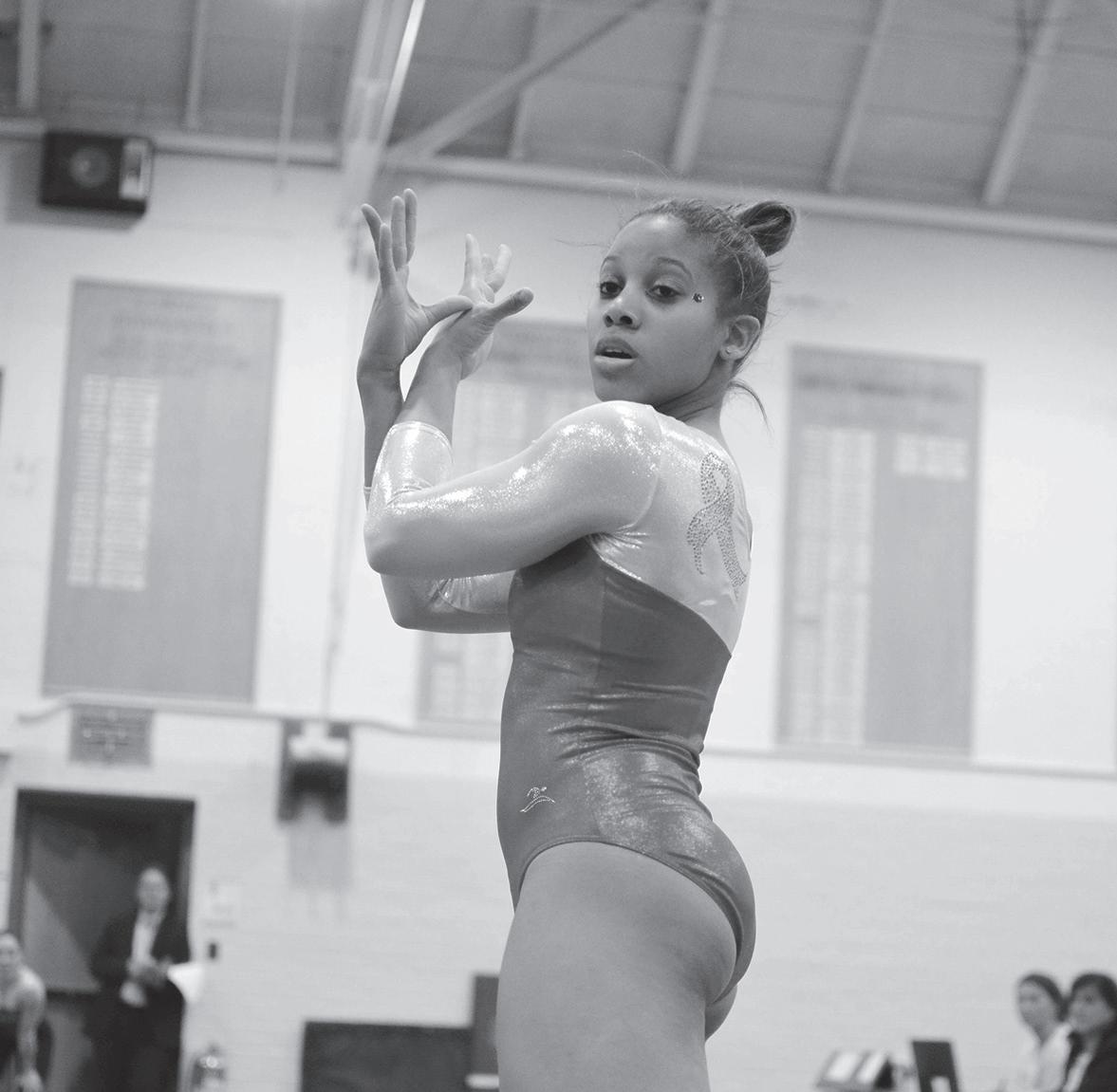
Slow start | With some athletes still recovering from injuries, the Red started its season with two last-place finishes on the road.
the fall semester. “Unfortunately, we lost sophomore Amy Shen, our top all-arounder, to an injury so she will be out for this season,” said Associate Head Coach Melanie Hall.
Despite the injuries, the return of individuals like Dudley and Murphy as well as the added freshmen have improved the team as a whole. However, this has resulted in some juggling of the lineup and has encouraged each team member to become comfortable in different events.
While the team may not have huge overall scores thus far, both Hall and some individuals on the team noted that they did particularly well in certain events during each meet, but will need to combine these strengths for better overall scores.
“In our first meet we had strong showings on vault, bars and floor but needed to improve on beam. This weekend at Towson, we had excellent results on vault and floor again, but we swapped off bars for beam in this meet,” Hall said.
Judging from past seasons, the team has often begun with scores in the low 190’s before finding their stride. The team’s goal is to have a greater overall average than last year, which makes 192.7375 the score to beat. Both Hall and various players are confident that they can achieve this.

“She’s only been here for a week and a half, but she’s already done a great job,” Stevens said. “We feel incredibly fortunate to acquire someone of her caliber, and Katie is going to bring a lot to the team.”
Another key asset to the team going forward will almost certainly be the return of senior Mariko Iinuma — the last remaining player apart of the Red’s Ivy League Championship run in 2017. Her championship pedigree and experience will prove to be a valuable tool for a young team that is now comprised mostly of freshmen, according to coach Stevens.
The team returns to action next week at home against Army on Saturday at 1 p.m., and Binghamton the following day at the same time.
By GRACIE TODD Sun Staff Writer
Classes may have been out, but Cornell wrestling stayed plenty busy. In just over a month, the Red competed in six matches, three against nationally ranked teams. Cornell reigned victorious in four of these winter break competitions, and is now not only 6-2 for the season, but ranked No. 10 nationally.
Yet despite its successes, wrestling — which, last year, lost only two of its 15 matches — is not content.
“We had mediocre performances, so I can’t say I am overly pleased with results,” said Head Coach Rob Koll. “That being said, we are finally getting everyone back into the lineup so I expect a vastly improved team moving forward.”
“Wrestling
can be a miserable sport. So anything we can do to make the training aspect more enjoyable is invaluable.”
Head Coach Rob Koll
The Red kicked off winter break on Dec. 16 with an away match against No. 16 University of Northern Iowa, winning decisively, 21-14.
Two weekends later, Cornell headed to the South Beach Duals in Fort Lauderdale, Florida, where, despite having its first match of the tournament cancelled, the Red faced three teams in just over 24 hours. The Red came out on top in the first two competitions, beating out Wyoming 23-9 and Indiana 32-10, but fell to No. 6 Missouri 9-22.
Cornell’s decision to head south was largely to cut down on time spent in Ithaca over break, Koll said.
“Wrestling can be a miserable sport,” Koll said. “So anything we can do to make the training aspect more enjoyable is invaluable.”
Two weekends later, Cornell faced its only other loss thus far this season, succumbing to Lehigh 16-19.
This past Saturday, however, Cornell bounced back,
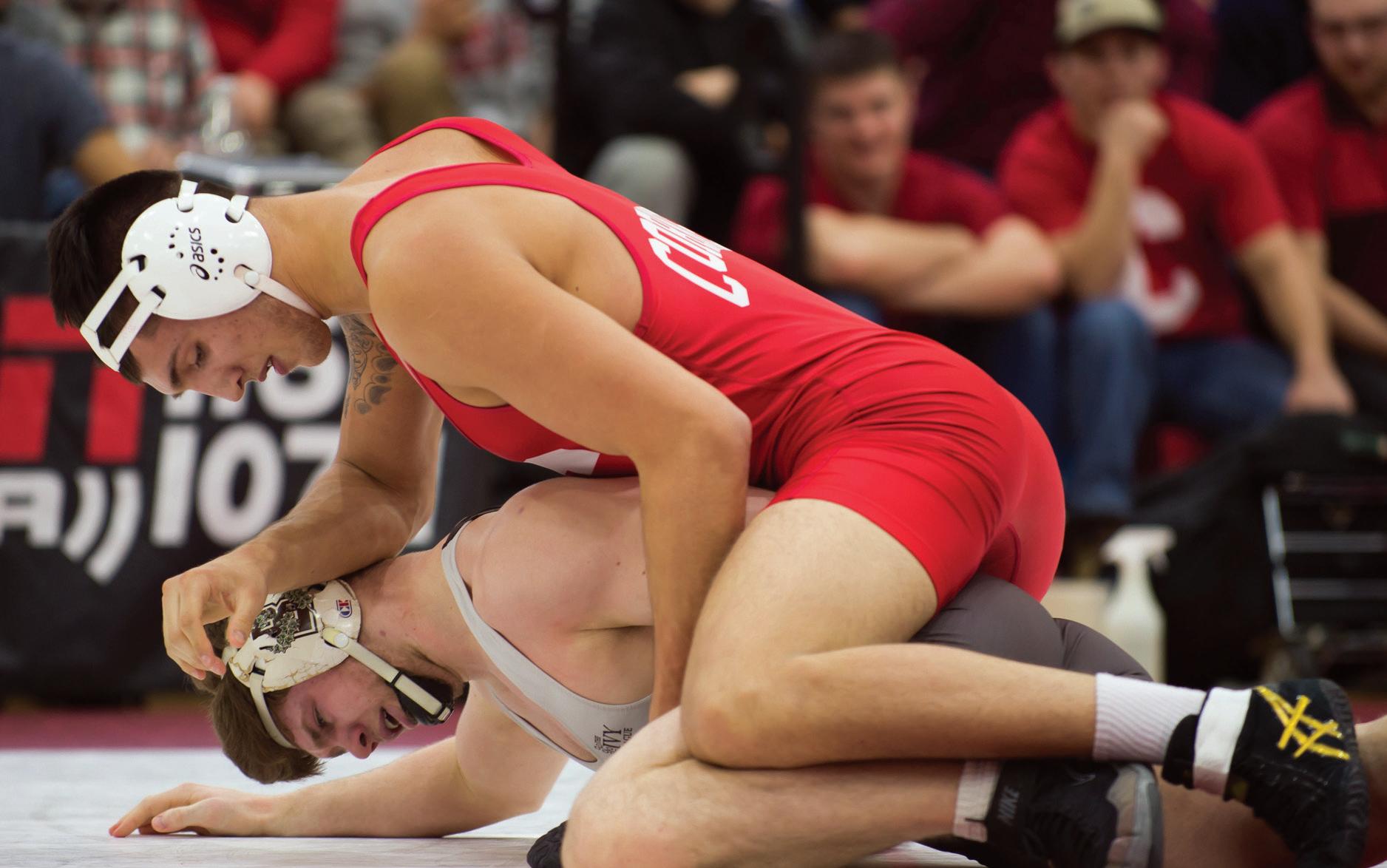
dominating Columbia 30-10 on a snowy day in New York City, even as it entered the match missing nearly half of its starting lineup.
The Red’s Ivy League win streak now stands at 84.
In addition to its place in the national polls, Cornell currently claims six individually ranked wrestlers: No.1 ranked sophomore Yianni Diakomihalis in the 141 weight class, who last year won nationals as a true freshman, along with No.10 sophomore Max Dean in the 184 weight class, No. 11 freshman Vito Arujau in the 125 weight class, No.12 junior Chas Tucker in the 133 weight class, No. 15 senior Brandon Womack in the 174 weight
class and No.17 senior Ben Honis in the 197 weight class. Despite fielding a wide breadth of highly talented individuals, Koll nevertheless believes the team — owing mostly to winter break absences — has lacked the full extent of its depth.
“For this reason I am particularly excited to have everyone back in the lineup,” he said.
The Red hits the road once again to face Brown this Saturday at 11 a.m., which, should Cornell claim victory, will be Koll’s 300th as head coach.
Gracie Todd can be reached at gtodd@cornellsun.com.
By ROBERT LI Sun Staff Writer
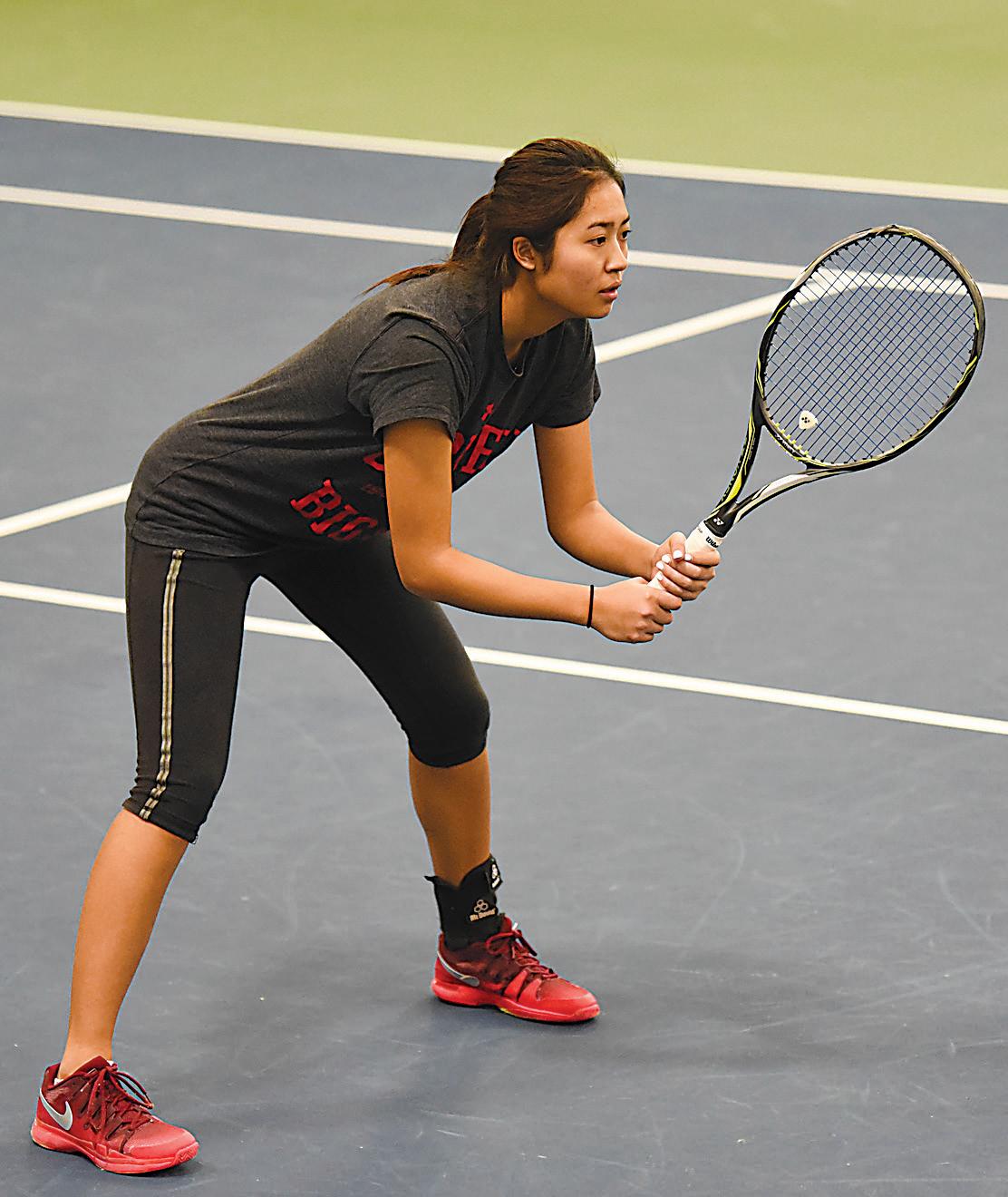
This past weekend, Cornell women’s tennis travelled to Fort Myers, Florida to face off against Georgia State University and the No. 17 ranked University of Miami. Facing a difficult double header, the Red lost its opening match to the Panthers, 2-5, and dropped its second contest later that afternoon to the Hurricanes, 1-6.
Against Georgia State, Cornell managed to notch only two victories, first by freshman Valerie Ho at No. 5 singles in a 4-6, 6-3, 6-3 decision, followed by freshman Sarah Campbell at No. 6 singles with an easy 6-2, 6-2 scoreline.
of a 2-5 loss,” said Head Coach Mike Stevens.
The second half of Saturday’s double header faired hardly better for Cornell, though freshman Katherine Nguyen somewhat softened the 1-6 loss to the Hurricanes by scoring a striking upset win over Miami’s Daniella Roldan, who is ranked 82nd in the nation.
“We certaintly had a chance to win, [so] it was disappointing that we couldn’t pull off a 5-2 win against Georgia.”
Stevens commended his players’ continued fight and vigor in facing tiring conditions, but particularly highlighted Nguyen for praise.
Head Coach Mike Stevens
However, Georgia’s margin of victory was much slimmer than it seemed, with both Katherine Nguyen at No. 2 singles and Ana Elhom at No. 4 singles losing incredibly close matches (3-6, 7-6, (10-4) and 7-5, 6-4), which — had they instead won — would have resulted in a 4-3 Cornell victory.
“We certainly had chances to win, [so] it was disappointing that we couldn’t pull off a 5-2 win against Georgia instead
“Things certainly got a lot better against a much better team, and to see Katherine win against the 82nd ranked girl in the country was excellent,” he said. “Against her second opponent, her demeanor on the court was much better, the way she competed and her team cheering was much better, and she hung in there for a great win.”
Despite the losses, the Red has a lot to look forward to as the season moves progresses, such as the addition of