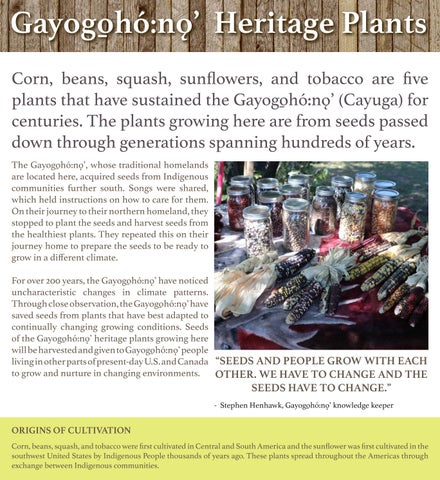
Gayogo̱hó:nǫ’ Heritage Plants Corn, beans, squash, sunflowers, and tobacco are five plants that have sustained the Gayogo̱hó:nǫ’ (Cayuga) for centuries. The plants growing here are from seeds passed down through generations spanning hundreds of years. The Gayogo̱hó:nǫ’, whose traditional homelands are located here, acquired seeds from Indigenous communities further south. Songs were shared, which held instructions on how to care for them. On their journey to their northern homeland, they stopped to plant the seeds and harvest seeds from the healthiest plants. They repeated this on their journey home to prepare the seeds to be ready to grow in a different climate. For over 200 years, the Gayogo̱hó:nǫ’ have noticed uncharacteristic changes in climate patterns. Through close observation, the Gayogo̱hó:nǫ’ have saved seeds from plants that have best adapted to continually changing growing conditions. Seeds of the Gayogo̱hó:nǫ’ heritage plants growing here will be harvested and given to Gayogo̱hó:nǫ’ people living in other parts of present-day U.S. and Canada “SEEDS AND PEOPLE GROW WITH EACH to grow and nurture in changing environments. OTHER. WE HAVE TO CHANGE AND THE
SEEDS HAVE TO CHANGE.”
- Stephen Henhawk, Gayogo̱hó:nǫ’ knowledge keeper
ORIGINS OF CULTIVATION Corn, beans, squash, and tobacco were first cultivated in Central and South America and the sunflower was first cultivated in the southwest United States by Indigenous People thousands of years ago. These plants spread throughout the Americas through exchange between Indigenous communities.
Oyęgwáǫweh Gayogo̱hó:nǫ’ Original tobacco of the Cayuga Nation Nicotiana rustica According to the Hodinǫhsǫ́:ni (People of the Longhouse) this tobacco is a gift from the Sky World. It is used to maintain that connection to the Sky World by conveying the intentions and messages of the people. The plants in this bed are grown from seeds given by the Gayogo̱hó:nǫ’ (Cayuga) Nation to the American Indian and Indigenous Studies Program (AIISP) at Cornell. The Gayogo̱hó:nǫ’, referred to as both “people of the pipe,” and “of the swamp,” are the overseers of this homeland maintaining their ancestral obligations and responsibilities to the future generations. This tobacco will be gifted back to the Gayogo̱hó:nǫ’ Nation and Indigenous speakers visiting Cornell. Please do not touch the plants.
Onę́hę’
Indigenous Corn To the Gayogo̱hó:nǫ’, corn is a true gift from the sky world. Corn has been a staple to our diet since time immemorial. These seeds survived the burn campaign initiated by George Washington in 1779. Our grandmothers carried the seeds when they fled the soldiers. We are proud to carry them back here to our traditional homelands. These corn plants represent resiliency of the Gayogo̱hó:nǫ’. They will continue to be planted in the years to come in the same lands that our grandmothers planted. Oral history by Gayogo̱hó:nǫ’ Knowledge Keeper Stephen Henhawk Onę́hę’ (Corn)
Gayogo̱hó:nǫ’ Osáhe’da’ Gayę́:twęh Cayuga Bean Garden
Seeds of this variety of beans were given to a Gayogo̱hó:nǫ’ community member who visited a Cherokee community in present-day Oklahoma in the 1930’s. With the bean seeds came a song, which held instructions on how to care for them. When the song was shared with the Gayogo̱hó:nǫ’ community, it became very popular and people continued to grow this bean variety and sing its song year after year.
Oral history by Gayogo̱hó:nǫ’ Knowledge Keeper Stephen Henhawk Osáhe’da’ (beans)
Skunk pole bean
Bear bean pod and flower
Bear Bean
Ohnyǫhsaǫ́weh (squash) This variety of squash produces very large fruits and has been known to feed large villages. Gayogo̱hó:nǫ’ elders have shared that this variety was grown in large quantities when the population of villages in the traditional homeland were very large. It was needed to sustain and nourish all of the people. - Oral history by Gayogo̱hó:nǫ’ Knowledge Keeper Stephen Henhawk Gayogo̱hó:nǫ’ gayę́:twęh (Cayuga garden) ohnyǫhsaǫ́weh (squash)
awę’́ǫsa’ Sunflower seeds are also a staple of traditional Gayogo̱hó:nǫ’ diets and provide a healthy source of fat from the oil.