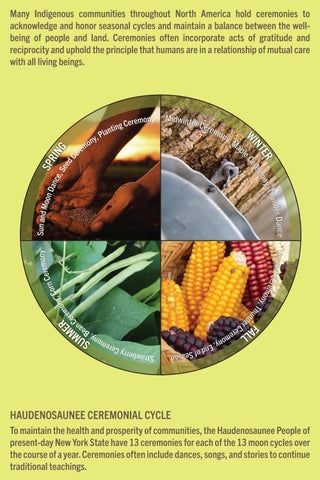
Many Indigenous communities throughout North America hold ceremonies to acknowledge and honor seasonal cycles and maintain a balance between the wellbeing of people and land. Ceremonies often incorporate acts of gratitude and reciprocity and uphold the principle that humans are in a relationship of mutual care with all living beings.
Midwinte r Cer emo ny,
ce der Dan Thun ny, mo ere eC
Ma pl
Harves t C e r e m o n y , T h u n d e
of End ny, mo ere rC
Season
HAUDENOSAUNEE CEREMONIAL CYCLE To maintain the health and prosperity of communities, the H audenosaunee People of present-day New York State have 13 ceremonies for each of the 13 moon cycles over the course of a year. Ceremonies often include dances, songs, and stories to continue traditional teachings.
Ceremonies express gratitude for the gifts that sustain people. They often include offerings, songs, and dances in return for the gifts received from the more-than-human world.
Hoop dancer Moontee Sinquah from the Hopi Villages in present-day Arizona
Dance during spring equinox ceremony in Puebla, Mexico
Ceremonies reaffirm the sacred relationship between humans and the spirit world, often seeking guidance, blessings, or healing.
Sun Dance ceremonial site in northern Ontario, Canada
Allegany River Indian Dancers share the living traditions of the Onöndowa’ga:’ (Seneca) Nation
Ceremonies strengthen communities by expressing and celebrating cultural identity and passing teachings and values from generation to generation, ensuring ongoing respect between land and community.
Interior of a clan house used for a Potlatch in a Tlingit village in Ketchikan, Alaska
Frame of a sweat lodge used for purification by the Lakota People of the northern plains