Drillers’ Trusted Publication
coringmagazine.com
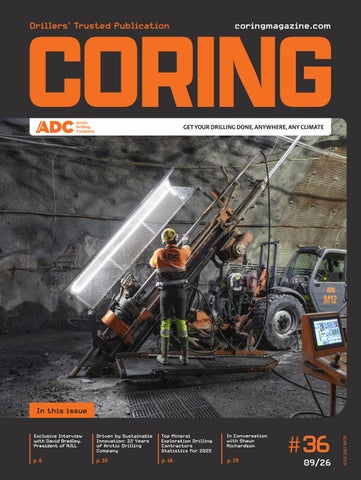
GET YOUR DRILLING DONE, ANYWHERE, ANY CLIMATE
Exclusive Interview with David Bradley, President of RJLL
Driven by Sustainable Innovation: 22 Years of Arctic Drilling Company
Top Mineral Exploration Drilling Contractors Statistics for 2025
In Conversation with Shaun Richardson
p. 6
p. 10
p. 16
p. 29
#36
09/26
ISSN 2367-847X
In this issue
AXIS ALIGNER™ THE NEXT GENERATION IN RIG ALIGNMENT
“ I have had the opportunity to use the new AXIS Aligner on multiple drills and it is great. The calibration time is incredible, and with the new lightweight design and magnetic clamping system, it's going to be hard to beat. Thanks, Axis, for the development of a new tool making our jobs more efficient.”
Joshua Brink, Project Manager Timberline Drilling Set-up in 3 minutes
Increase productivity
Improve safety
Integrate with AXIS Connect™
Featuring a state-of-the-art north-seeking gyro, ergonomic one arm lift, and innovative push-button clamping mechanism; the AXIS Aligner™ offers a clear step forward in the safe, easy and precise alignment of a drill rig.
To learn more about AXIS Aligner™ and how it can support your operations, contact your local Orica Digital Solutions representative or scan the QR code.
Table Contents /21 QUESTIONS 6
Exclusive interview with David Bradley, President of RJLL Drilling
/CASE STUDY 24
44
From Blue Spur to Porgera by Laurentia Laracy, Lawyer and governance adviser
46
What is an exploration model? What is it worth? by Tim Craske, Director and Principal Geoscience Consultant at Geowisdom
From spreadsheets to smarter drilling How Kinross Gold Corporation improved visibility, reporting, and cost control
/EXPLORATION & MINING GEOLOGY /IN FOCUS 10
29
Driven by sustainable innovation 22 years of Arctic Drilling Company by Aleksi Autti, CEO, Nina Valjus, HR Manager and Laura Mämmelä, HR & Marketing Coordinator at Arctic Drilling Company Ltd
32
36
/DRILLING STATISTICS 16
Geological Survey Ireland Supporting the future of mineral exploration Challenging gold exploration and structural analysis in the Amazon jungle of the Guiana Shield by Vincent Combes, Chief Geologist at Founders Metals Inc.
Top mineral exploration drilling contractors for 2025 Statistics of diamond drilling meters by Maksim M. Mayer, Editor at Coring Magazine
42
/PRODUCT ADVERTORIAL 20
Q&A from the experts: In conversation with Shaun Richardson
Connecting field, office, and resource companies for better decisions
Practically fractal magic by Mikayla Sambrooks, Senior Exploration Geophysicist at Fleet Space Technologies and Federal Secretary at ASEG
/EXPLORATION DRILLING CATALOG 48
Drilling services
49
Drilling equipment & accessories
53
Survey & Core orientation tools
54
Miscellaneous
/AUTHORS
Authors in this issue Aleksi Autti, CEO, Nina Valjus, HR Manager and Laura Mämmelä, HR & Marketing Coordinator at Arctic Drilling Company Ltd
David Bradley President of RJLL Drilling
Maksim M. Mayer Editor at Coring Magazine
Shaun Richardson
Vincent Combes Chief Geologist at Founders Metals Inc.
Mikayla Sambrooks Senior Exploration Geophysicist at Fleet Space Technologies and Federal Secretary at ASEG
Laurentia Laracy Lawyer and governance adviser
Tim Craske Director and Principal Geoscience Consultant at Geowisdom
CORING MAGAZINE September 2026 Cover photo Arctic Drilling Company Issue 36
Executive Officer & Editor in Chief Martina Samarova Editor Maksim M. Mayer
ISSN 2367-847X Not for resale. Subscribe:
coringmagazine.com/subscribe Contact Us Coring Media Ltd. 57A Okolovrasten pat street, r.d. Manastirski Livadi, Triaditsa region, 1404 Sofia, Bulgaria Phone Email Website
Publisher Coring Media
+359 87 811 5710 editorial@coringmagazine.com coringmagazine.com
Coring Magazine is an international quarterly title covering the exploration core drilling industry. Published in print and digital formats, Coring has a rapidly growing readership that includes diamond drilling contractors, drilling manufacturers and suppliers, service companies, mineral exploration companies and departments, geologists, and many others involved in exploration core drilling.
Section Editor – Exploration
Launched in late 2015, Coring aims to provide
& Mining Geology
a fresh perspective on the sector by sourcing
Dr Brett Davis
authentic, informed and quality commentary
Digital Marketing Manager Elena Dorfman
direct from those working in the field. With regular interviews, insightful company profiles, detailed product articles, field-
Assistant Editor
practice tips and illustrated case studies of
Adelina Fendrina
the world’s most unique diamond drilling and mineral exploration projects, Coring
Graphic Design
provides a platform for learning about
Cog Graphics
the industry’s exciting developments.
Want to contribute to Coring Magazine? Get in touch with us at: editorial@coringmagazine.com 4
Coring Magazine #36
BlastGyro® The name for blast hole surveys Born in the oilfield, matured underground All inclinations All latitudes No limits Superior accuracy Superior safety Open data
www.blastgyro.com
/21 QUESTIONS
questions
Exclusive interview with
DAVID BRADLEY President of RJLL Drilling
David Bradley started his drilling career in 1988 working as a helper and then as a drill rig operator for the family business Bradley Brothers. At the age of 30, he became the company’s Co-owner and VP of Operations; by then, Bradley Brothers was a globally recognized drilling contractor with a broad international presence and a workforce of 1200 people. 6
When the family business was sold in 2011, David spent the next nine years as a Co-owner of a management consulting firm. Today, he is a partner in and President of Canadian RJLL Drilling, which specializes in wedges, directional drilling, and complicated projects. RJLL is committed to providing high-quality service under the industry’s best safety practices. Coring Magazine #36
DAVID BRADLEY
Grigor Topev: David, thank you for agreeing to participate! We are excited to learn more about you and RJLL Drilling. But let’s start at the beginning: how did you start your career in drilling? Tell us the story. David Bradley: I started working in the family business in 1988. At the time, I was only 13 years old, but I was already 6 ft (1.83 m) tall and weighed more than 240 lbs (109 kg). After seeing my brother leave for several summers to work on drilling projects, I wanted to do exactly what he was doing. I finally convinced my father to let me go. I started by driving muskegs and supplying the drills with equipment and tools. I was also responsible for preparing access roads for the water lines. By the end of that summer, I knew that one day the family business would be mine! I worked there every summer from 1988 to 1995 as a helper. In 1995, after completing my college education in administration and my third year of football at John Abbott College in Montreal, Canada, I returned to Rouyn-Noranda and explained to my parents that I wanted to work full time as a driller for the family business. GT: Any good/funny memories from those early years you would like to share with us? DB: At 13 years old, as I said, I was six feet tall and weighed 240 pounds (109 kg). After my summer work, I lost 45 pounds (20 kg)! GT: Tell us more about the famous Bradley Brothers. I’d love to hear about it firsthand. What was the size of the company before the sale to Major Drilling in 2011? How many projects, drill rigs, team members? Roughly, what was the meterage achieved per year?
GT: Walk us through how you joined RJLL. DB: RJLL was founded in 2014 by Réal Lemoine and Jérôme Lefebvre. I joined them as a partner in 2020. Since then, RJLL has grown to operate 47 surface drilling rigs. Our next objective is to develop underground drilling. The success of our company is directly tied to the quality of our teams. Réal and Jérôme, who had previously been operational leaders at Bradley Brothers Canada, were able to develop outstanding workers, most of whom chose to return to work with RJLL because of the quality of the leadership and the organizational culture.
‘The industry should promote drilling as a skilled, rewarding career with real opportunities for growth. We need to invest in training, mentorship, safety, and modern technology to show young people that drilling is not only physically demanding work, but also a profession where they can build a strong future.’
DB: My grandfather, Edgar Bradley, and his four brothers started the business in 1942 with a man named Mr. Jones. The company was incorporated as Jones and Bradley Drilling Contractor. In 1944, my grandfather caught Mr. Jones stealing. He assessed the value of Mr. Jones’s shares, subtracted the amount stolen, and paid Mr. Jones the difference to buy all his shares. At that time, all transactions between customers and suppliers were made in cash, so access to money was easy. Following this transaction, the company was renamed Bradley Bros Ltd. My father, Wallace Bradley, started working for the company in 1952, at the age of eleven, as a cook’s assistant in the camps during the summer. After finishing high school at St. Michael’s in Toronto, my grandfather sent him to Colorado to study for a Bachelor of Engineering degree. However, after only one year, my father came back and told his father that he preferred to work as a driller. Gradually, he took the reins of the company and eventually bought my grandDrillers’ Trusted Publication
father’s shares in 1968, at the age of 27, with the primary objective of modernizing the drill and equipment inventory, which was in dire need of replacement. In 2011, Bradley Brothers had operations in Canada, Peru, Colombia, Suriname, Mexico, and the Philippines. We had 145 drills in operation and drilled 1 500 000 m (4 921 260 ft) per year.
GT: What are RJLL’s main projects now? We’d love to hear the highlights. DB: Of our 47 drills, 32 are on longterm contracts in Ontario and Québec. As of today, we have 44 drills in operation. GT: Over the past two years, we had tariffs, war, and the Canadian elections. Without going into the politics, what changes and challenges did the company face? How did you respond to them? DB: Our consumable prices increased significantly in 2026, by more than CAD 7.00 per meter, or 35%. This does not include fuel costs or increased labor costs due to demand.
GT: RJLL was featured in Coring’s In Focus article nearly three years ago. For future goals, you mentioned hoping to get to 20 surface and ten underground rigs. What are your next goals? DB: Developing our underground operations is still part of the plan, and we would also like to develop operations abroad. GT: What legislation, requirements, or standards would you like to see changed to improve the drilling industry in Canada? DB: I would like to see the industry apply the same safety standards across the board. RJLL always applies best practices on every contract, and if a customer brings RJLL to a higher level, we apply those standards to all our operations. I would like the industry to encourage and support contractors that truly invest in safety. 7
/21 QUESTIONS
↑ David Bradley in the field
GT: How big is the problem of getting new hands into the industry?
GT: Tell us more about your experience with the super-cycle. How has it affected RJLL’s business?
DB: It is not easy, but with a strong training program and a good mentorship program, we are able to attract and bring new blood into the drilling industry. Still, this remains one of the biggest challenges the industry is facing.
DB: Since November 2025, we have felt the industry entering a super-cycle phase. This means that significant financing has been completed and continues to take place, creating a major impact on the drilling industry. From the outside, it may look positive to be as busy as we are; however, drilling contractors are being hit very hard by rising consumable and labor costs. This impacts contractors directly, while also increasing drilling costs for exploration and mining companies. The impact of the super-cycle on RJLL, particularly from a management perspective, has been even more challenging than COVID. RJLL has been very well supported by its customers, who have given us the opportunity to adjust our pricing to reflect cost increases over which we have absolutely no control. This requires a great deal of transparency and open communication between the mining company and the drilling contractor. There is a fine line between increasing drilling costs to cover unexpected increases caused by the super-cycle and taking advantage of the situation. RJLL has always worked with this principle in mind: we aim to adjust pricing only to cover unforeseen cost increases, not to profit from the situation.
GT: Following on from that, what, if anything, should the industry do to attract more young people to drilling? DB: The industry should promote drilling as a skilled, rewarding career with real opportunities for growth. We need to invest in training, mentorship, safety, and modern technology to show young people that drilling is not only physically demanding work, but also a profession where they can build a strong future. GT: Going back to the expansion of RJLL’s drill fleet, what would be your feedback for manufacturers? What should they focus on, and what are the features and requirements every new rig should match and exceed? DB: Manufacturers are working on drill automation and autonomous drills. I believe they should keep simple and practical electronics in mind to minimize downtime. For example, if I have a drill in northern Canada and my supervisor cannot repair or troubleshoot it because it requires a technician, that is not practical for us. Still, I believe this is the way forward for safety, productivity, and cost efficiency. They should also carry more inventory during this super-cycle to better support operations. 8
GT: How does RJLL test and adopt innovations, whether it is new drilling software, equipment, or tools? What criteria does the company use? DB: As of today, we are working with a few suppliers, and even with a customer, to collect and compile data that can help develop AI technologies for the drilling industry. For now, we use our suppliers’ Coring Magazine #36
DAVID BRADLEY
technologies, but a major technological change needs to happen in our industry.
GT: What would be your advice to a person in a drilling management role?
GT: Going from the previous question, what is a common piece of drilling equipment or tool that you think is overdue for innovation, or you just cannot believe hasn’t been improved or reinvented yet?
DB: Take care of the people working in this industry, especially the men and women in the field. They sacrifice time with their spouses, families, and friends to put bread on the table. As management, we need to pass on our passion. Even if this work pays well, without passion, we will not prevail.
DB: Other than automation, which has already started, and applying AI to our drills, being able to change the bit without pulling the rods would be a major step forward. It has been tried before, but there has not yet been a successful solution. GT: What about directional drilling, my favorite topic? What does RJLL adopt in terms of wedging and directional drilling? DB: RJLL performs steel wedge and retrievable wedge installations. We also do directional drilling, and 50% of our drills are using directional drilling.
GT: What do you do in your free time? DB: I spend time with my wife and family, and I enjoy fishing, hunting, and anything related to the bush. GT: Any parting words for our readers? DB: Stay safe and keep your teams safe!
GT: How will the industry be evolving? Will we see any AI implementation in a physical profession like ours? DB: Yes, I believe AI will become part of the drilling industry, even in a very physical profession like ours. It will help improve safety, planning, data analysis, productivity, and decision-making in the field.
For more information Get in touch with David on LinkedIn
OPTIMAL DRILLING OPERATIONS REQUIRE OPTIMAL FLUID PROGRAMS
Discover how to level up your drilling fluids program with Earth Pro® by Di-Corp.
Di-Corp is a registered trade name of Diversity Technologies Corp.
Ad_Di-Corp_EarthPro_Half-Page_202607.indd 1
Drillers’ Trusted Publication
1-800-661-2792 di-corp.com/earthpro 7/8/2026 10:26:00 AM
9
/IN FOCUS
Driven by sustainable innovation:
22 years of Arctic Drilling Company by Aleksi Autti, CEO, Nina Valjus, HR Manager and Laura Mämmelä, HR & Marketing Coordinator at Arctic Drilling Company Ltd
10
ARCTIC DRILLING COMPANY
The story of the Arctic Drilling Company (ADC) starts in 2004 when Juha Säärelä, the founder, was visiting the Suhanko exploration project near Rovaniemi in Finland. He had been building machinery for the asphalting business during the 1980-90s, so he understood the technology used in the drilling rigs. After the visit, Juha began searching the internet for any possibilities in exploration drilling. One ‘How hard can it be?’ turned into a decision to build the first drilling rig himself, with help from friends.
In 2005, Timo Kämäräinen, the owner, joined Juha to run the company. This helped a lot; Juha and Timo had years of experience working together in the same asphalting company. Their different characteristics supported the company’s success. By 2012, it had grown to over EUR 17 million in revenue. In 2013, the global mining industry faced major challenges, which also caused the exploration market’s crash. Drilling activity was down in Finland and Sweden, sharpening competition in the market and crashing drilled meter prices. A new approach had to be developed. ADC began focusing on growth in underground diamond core drilling. The company had already independently developed a mobile underground rig, which minimized downtime in underground drilling. The product was a success in every project, and ADC quickly doubled the number of underground drill rigs. Underground was more stable than the surface market at the time, so this helped gain the needed momentum. Finally, after a few years, the market started to pick up again, and ADC had an opportunity to meet the demand with newly developed deep hole diamond rigs. From 2018 onwards, significant growth came from the Swedish market on the basis of long-term partnerships and the ability to reach the targets in deep drilling programs. Success in several projects and serving the customers’ needs helped the company achieve EUR 43 million in turnover by 2024. 11
/IN FOCUS
↑ An ADC-developed surface drill rig in operation, with drilling work safely controlled from the rig’s ergonomic interior
Drill fleet Currently, ADC is considered one of the biggest exploration drilling companies operating in Europe and has built a solid foundation to operate across Scandinavia as its home market. Since 2014, all our drilling services have been certified by DNV, a global independent expert in assurance and risk management, to ISO 9001, ISO 14001, and ISO 45001 standards. These certifications show our focus is not only on drilling meters and targets but also on delivering high-quality service, using environmentally friendly technology, and ensuring safe working methods throughout the company. ADC’s drilling services include mainly diamond drilling, both surface and underground, RC drilling, and BoT sampling. We have 30 rigs in our fleet to serve various drilling projects. Apart from the RC rigs, all rigs are built in-house in Rovaniemi, Finland. Great emphasis on research and development has allowed us to create our own drilling units as well as the software to run them. This has enabled efficiency on another level; it also means that every ADC surface rig can reach depths of up to 1800 m (5906 ft) in NQ size, while our deep hole fleet can drill down to 3500 m (11 483 ft). All surface rigs are mounted on rubber tracks to ensure minimal environmental impact. ADC’s underground fleet has two different setups. The mobile underground drill rig for fast site transfer and quick setup before drilling is ideal for shorter holes and keeping high production rates at all times. This mobile rig can still drill NQ size down to 1200 m (3937 ft), which gives customers excellent versatility and serves the needs of most underground mines. The other setup is our deep hole underground rig, 12
built to ensure safe and efficient drilling of up to 2100 m depth in NQ (6890 ft). This rig is designed with ergonomic working conditions in mind and keeps delivering good production rates in deeper holes. Lastly, our own development has resulted in the BoT rig. This design and its features have been approved by Anglo American and ensure correct BoT samples within a safe and ergonomic working environment. The rig is extremely capable in difficult terrain; it will give even a snowmobile a run for its money in winter conditions. It is important to remember that even the best rig is nothing without an experienced crew. Diamond core is always diamond core, but a BoT sample can be anything if the crew does not have the necessary experience.
Directional drilling In addition to the services above, we also offer directional drilling using Aziwell’s technology. Our approach to directional drilling includes handling planning, the traditional drilling, and the directional core drilling, all with the same crew. This creates more flexibility, allowing the customer to use directional core drilling even on smaller projects. By using the same crew for everything, we ensure high-quality service and excellent communication on every part of the project. We have been growing our experience with directional drilling since 2018, and we have several long-term projects in Finland and in Sweden. Right now, we have four rigs operating on directional core drilling (DCD) projects with our own crew handling everything. Naturally, we have been Aziwell’s long-term testing partner in developing their directional core drilling tool. Coring Magazine #36
Directional drilling project: Viscaria Ab in Kiruna, Sweden Our largest directional drilling project has been operating non-stop for two years in the Viscaria Ab’s area in Kiruna. The project size varies between two and five rigs. Our supervisors and drilling team work closely with the customer: from the first steps of planning the targets, through changing the DCD plans based on surveys and natural deviation, to making suggestions if extra corrections might be needed. Having experienced personnel working with capable equipment means we have a solution that reaches the customer’s targets in all conditions. ‘We have worked closely with ADC for several years, and what we value most is the experience and problem-solving mentality of their crews and supervisors. At Viscaria, we are exploring deeper than ever before, with long and technically challenging drill holes in rock conditions that are not always straightforward. Their teams communicate well and work collaboratively to find solutions and efficiently get the hole to target. Their expertise in directional core drilling has also been a real benefit to our exploration campaigns,’ states Ross Armstrong, Head of Exploration, Viscaria Ab.
• B20 Drill Heads “H” & “P” • 12HH Chuck Assy’s • “H” & “P” Hydraulic Clamps • Quality Repair Parts • Jaw Sets - Boyles 12HH, 35PH - LY Nitro Chuck - Christensen - MiRoW “P” Clamp
Dorado Drilling – Golden Triangle, BC
Other services and manufacturing Apart from drilling services, we can offer customers drill site management and planning, route planning and maintenance, and much more. If there is something that we cannot offer, we have a variety of partners to deliver the services, while we will handle the management. Research and development have always been a major part of ADC, which has led to interest in our rigs from other companies. Throughout the years, ADC has built and sold 32 diamond rigs internationally and we are still selling rigs to external customers. A new generation rigs, designed to meet underground drilling needs for years to come, is coming up in the pipeline. Currently, our market focus spans Europe, but we are looking to expand into new horizons with a new generation of products and with our services. We have proven our ability to mobilize quickly for totally new markets, so if you have drilling needs anywhere, it never hurts to ask for our services.
Team ADC’s growth has always been closely connected to its people and their expertise. Today, ADC employs 200 people. Most of the workforce, 158 employees, work in drilling operations, while 30 professionals work in production, maintenance, and engineering, and 12 are in Drillers’ Trusted Publication
“UNMATCHED QUALITY” 13
WWW.PROLENC.COM
/IN FOCUS
↑ ADC’s mobile underground drill rig at a mining site
administrative positions. Many of ADC’s drillers have years of experience in the industry. The average length of employment in drilling operations is 7.7 years, providing continuity and a strong foundation of knowledge within the company. Experience is also shared in everyday work. For example, surface drilling is carried out in pairs, with a driller and an assistant driller working closely together. This allows employees to learn from each other and develop their skills through hands-on work across different projects and environments in the Arctic. ‘We want to give every new employee a strong start, regardless of their previous experience. Good onboarding provides the foundation for safe working, professional development, and becoming part of the team,’ says ADC’s HR Manager Nina Valjus. Trust and safety are the cornerstones of ADC’s daily operations, from safe working practices to reliable equipment and its responsible use. ADC has a flat organizational structure, which supports quick decision-making and allows employees to contribute ideas and have an influence over their work. Sharing knowledge, helping colleagues, and succeeding together are important parts of the working culture. Continuous learning is encouraged through regular training and relevant certifications. As ADC continues to grow, maintaining a skilled and experienced workforce will remain important. The aim is to develop the expertise already within the company, while also attracting new professionals to support ADC’s future growth.
↑ Underground deep hole drilling in progress. Cutting-edge solutions enable reaching 2000 m (6562 ft) depths with ease.
For more information Visit adcltd.fi/en
14
Coring Magazine #36
/DRILLING STATISTICS
0M
500 000 M
1 000 000 M
3 228 838 2 520 949
2 600 838 2 591 763
2 380 802 2 238 556
1 223 150 1 310 460
668 194 679 729
617 236 540 535
508 250 486 906
GEODRILL ®
495 973 439 645
314 120 208 428
285 297 233 209
254 218 250 927 208 545
239 392 370 948
217 719 165 200
199 150 209 738
179 440 160 235
160 100 162 000
146 700 137 400
112 211 98 641
2025 2024
58 785 57 657
51 000 72 605
Coring Magazine #36
1 500 000 M
2 000 000 M
2 500 000 M
3 000 000 M
Top mineral exploration drilling contractors for 2025 Statistics of diamond drilling meters by Maksim M. Mayer, Editor at Coring Magazine
13.9 M+
12.9 M+
DD meters in 2025 drilled by the companies listed here
DD meters in 2024 drilled by the companies listed here
Drillers’ Trusted Publication
Want to be included? Get in touch and submit your meters at: editorial@coringmagazine.com
/DRILLING STATISTICS
Disclaimer: Coring Magazine proudly presents the new statistics of ‘Top mineral exploration drilling contractors for 2025’ ranked by the number of meters achieved exclusively through diamond drilling. All figures were provided and verified by the companies, and were rounded to whole numbers where needed. Results include a mix of calendar and fiscal year data, as noted throughout the text. Some qualifying companies are not listed, having either declined to participate or not responded. The magazine cannot be held liable for any errors or inconsistencies presented in this report. Coring Magazine extends its congratulations to all companies for their outstanding results and expresses gratitude for their support!
In focus: Company results Perenti Drilling Services has achieved a 3 228 838 m (10 593 301 ft) via DD for FY26 (ended June 30, 2026). This result is a record for these statistics and represents continued significant growth over the result of 2 520 949 m (8 270 830 ft) from FY25 and that from FY24. In addition, the company has also reported an increase in RC meterage to 1 228 396 m (4 030 171 ft). Perenti’s drill fleet has also increased by 9 rigs, reaching a total of 321: 63 surface production, 147 surface exploration, and 111 underground. Company management has commented that the drilling division, formed by brands DDH1, Swick, Ausdrill, Ranger, and Strike, remains well positioned to capitalize on increasing customer demand in FY27. For FY26 (ended Apr. 30), Major Drilling reported 2 600 838 m (8 532 933 ft) drilled via DD. This is an increase of 9000 m (29 528 ft) over FY25. RC drilling results are 1 416 946 m (4 648 773 ft) compared to 1 287 131 m (4 222 871 ft) from the prior FY. Their fleet totals 688 rigs. In 2026, the company introduced Major+, a line of high-performance tools including a drillside imaging unit, a hands-free rod handler, and a water control system, among others. Boart Longyear has achieved 2 380 802 m (7 811 030 ft) DD in 2025 vs 2 238 556 m (7 344 344 ft) in 2024. The company also reported 538 336 m (1 766 194 ft) of RC drilling in 2025. Management is particularly encouraged by the quality of the revenue generated. Growth was achieved through a balanced portfolio of work, strong pricing discipline, and strategic customer relationships, resulting in a steady yearover-year performance rather than volume growth at any cost. Orbit Garant reported slightly lower results for FY25 (ended June 30, 2025): 1 223 150 m (4 012 959 ft) compared to 1 310 460 m (4 299 409 ft). Per the company’s Annual Report, revenue, profit, and margin have all improved from FY24. Orbit Garant had a fleet of 186 rigs, a part of which is in the process of modernization. On the back of record growth in 2024, Forages Rouillier announced a slight contraction in DD meterage to 668 194 m (2 192 238 ft) for 2025. This represents a decrease of less than 2% YoY. Hy-Tech Drilling has returned to growth in 2025. The company has achieved 617 236 m via DD, compared to 540 535 m in 2024 (2 025 053 vs 1 773 409 ft). The company has also manufactured another 10 rigs, bringing its fleet to 104. On the back of another successful year, RJLL Drilling has performed 508 250 m (1 667 487 ft) of DD; over 20 000 m (65 617 ft) more than in 2024. The company has 44 rigs in operation, 12 more than in 2024. RJLL President David Bradley explained that their tremendous growth comes with tremendous challenges in 21 Questions on p. 6.
18
Geodrill and its South American subsidiary Recon Drilling have recorded another year of growth. Their total DD results are 495 973 m (1 627 208 ft) in 2025, an increase of over 50 000 m (164 042 ft). RC results have grown significantly to 1 141 176 m vs 825 958 m (3 744 016 vs 2 709 836 ft) in 2024. Geodrill had the same 102 mostly multi-purpose rigs and had 31 projects in 2025. Turkish contractor and manufacturer Ortadoğu Drilling had a record year. In 2025, they reported 314 120 m (1 030 577 ft) achieved through DD, an increase of over 50%. The company had the same number of projects as in 2024 (31), and has added 3 diamond drill rigs for a total of 43. Australian Topdrill has continued its growth in 2025. Management reported 285 297 m (936 014 ft) achieved through DD and a further 996 810 m from RC (3 270 374 ft). The latter result represents an increase of nearly 50% from 2024. Topdrill had 60 DD projects served by 18 drill rigs, 5 more than the year prior. Another 21 rigs worked the company’s 73 RC projects. The Canadian division of Foraco International has reported drilling 254 218 m (834 049 ft) of DD in 2025. This represents a decrease from 2024. Please note that global results for this year were not available at the time of writing. However, Foraco International has a total of 260 drill rigs globally. Another company with significant growth in 2025 is GEOPS. Their results from DD were 250 927 m (823 251 ft), achieved from 20 projects in Bulgaria and abroad. This represents a nearly 25% increase over 2024. The company has over 45 drill rigs. Capital Limited, another company performing primarily other types of drilling, reported 239 392 m (785 407 ft) in 2025. This is a significant decrease from 2024. However, the company reported a second consecutive year of growth in other types of drilling: 439 348 m RC (1 441 431 ft); 65 000 m air core (213 255 ft); and, notably, 3 585 546 m (11 763 602 ft) of blast hole, grade control, and other. This year’s new entry, Canadian G4 Drilling, reported performing 217 719 m of DD (714 301 ft). The result is close to 30% growth over figures from 2024. Arctic Drilling Company from Finland reported 199 150 m (653 379 ft) achieved through DD in 2025. This is a decrease of around 5% from 2024. In addition, RC drilling results were 32 560 m (106 824 ft). Read more about the company in this issue’s In Focus on p. 10. Brazilian DrillGeo reports results for the first time since 2023. They achieved 179 440 m (588 714 ft) through DD in 2025, whereas in 2024, they performed 160 235 m (525 705 ft). RC results have also grown from 15 240 m in the prior year to 17 183 m (50 000 vs 56 375 ft). In 2025, Team Drilling has reported nearly identical results from DD compared to 2024: 160 100 m (525 263 ft). Finnish KATI OY reported reaching 146 700 m (481 299 ft) through DD in 2025. This is an increase of nearly 9000 m (29 528 ft) from 2024. Alton Drilling, New Zealand’s leading mineral exploration drilling contractor, has completed 112 211 m (368 146 ft) of DD in 2025. Across a total of 12 active projects and a fleet of over 40 drill rigs, the company reported further 6513 m (21 368 ft) of air core drilling and 22 241 m (72 969 ft) across specialized applications. Another new entrant, African Ox Drilling, conducted 58 785 m (192 864 ft) of DD in 2025 across 8 projects, as well as 9850 m (32 316 ft) of RC in 2 projects for 2025. In total, the company had 14 rigs: 12 DD, 1 RC, and 1 for air core drilling. Canadian Bryson Drilling has achieved 51 000 m (167 323 ft) through DD in 2025. This is a decline of more than 10% from the year prior.
Coring Magazine #36
/PRODUCT ADVERTORIAL
Connecting field, office, and resource companies for better decisions Successful drilling is measured by more than just meters drilled. It is also measured by how effectively information moves between the field, the office, and the client. Yet in many drilling operations, critical information still travels through paper reports, spreadsheets, emails, phone calls, and text messages. As projects become larger and more complex, keeping everyone aligned becomes increasingly difficult. 20
Coring Magazine #36
PILOT & CO
The challenge is no longer collecting information; it is ensuring that everyone is working from one source of operational information. This is precisely what led to the creation of Lantern Drilling Software.
Built on real drilling experience Now offered as part of Pilot & Co’s product portfolio, Lantern software was originally developed from an internal platform created and used by a successful diamond drilling contractor. It was born from real operational experience, not from a software company looking for a new market. ↑ Lantern’s workflow ensures there is one operational record: from the rig to the office. The platform was built by people who understood the realities of remote drill sites, changing conditions, and the daily pressure of delivering accurate information while A typical day before and after Lantern keeping crews focused on drilling. From the beginning, the vision was simple: capture operational information once, at the source, and create one shared record that Before Lantern With Lantern could follow the project from the drill site to the office and ultimately to the client. Field notes are shared Information is captured once through paper, spreadsheets, and shared through a single emails, or phone calls. operational record. The workflow:
One source of operational information
Every drilling project generates hundreds of operational data points every day. For example: • • • • •
Who was on shift? How many meters were drilled? What caused downtime? Which equipment was used? What activities were completed?
Individually, these details may seem routine. Together, they tell the story of a drilling project. Traditionally, this information is captured on paper, transferred into spreadsheets, shared through emails, discussed over phone calls, and often recreated several times before reaching the office or the client. Each manual step introduces the possibility of delays, inconsistencies, or duplicate work. Lantern approaches the challenge differently. Information is captured once at the source and remains connected throughout the workflow: from the drill site to the client. Field crews record daily shift information—including time, meters drilled, activities, equipment use, and downtime—directly in the platform. The administrative team reviews and validates the record, while clients can review the information and request any necessary corrections before approval. Once approved, the same operational record supports invoicing, payroll, reporting, and project oversight without requiring information to be re-entered or reconciled across separate records. This gives field crews, supervisors, office teams, and resource companies access to consistent information, with user roles ensuring that each person can access the data and functions relevant to their responsibilities. It also reduces the unnecessary emails, phone calls, report revisions, Drillers’ Trusted Publication
Office teams spend time re-entering information and reconciling different versions of reports.
Everyone works from the same trusted information, reducing duplicate work and confusion.
Drilling contractors and clients often rely on separate records and ongoing email exchanges.
Field teams, office staff, and clients stay connected through shared operational information.
Approvals, payroll, invoicing, and reporting can be delayed while information is verified.
Faster access to accurate information helps streamline approvals and day-to-day operations.
Valuable time is spent managing information instead of supporting the drilling operations.
More time is spent focusing on what matters most: safe, efficient drilling and successful project delivery.
and delays that occur when each stakeholder is working from a different version of the same project data. This connected workflow ensures that operational information moves consistently from the drill site to supervisors, the office, and ultimately to the client.
More than digital forms Many digital solutions replace paper forms with electronic versions. Lantern was designed with a broader objective: to connect the entire flow of operational information. 21
/PRODUCT ADVERTORIAL
For drilling contractors, this means less time entering data, reconciling reports, responding to information requests, and validating completed work. For resource companies, it means clearer visibility into project progress, reported activities, costs, and invoices. The objective is not to change how drilling is performed. The expertise of the driller, the judgment of the supervisor, the experience of the geologist, and the decisions of the project manager remain at the heart of every successful drilling program. Lantern supports these roles by making the information behind their decisions accurate, accessible, and easier to share. As drilling programs grow, so does their operational complexity. Multiple rigs, rotating crews, remote locations, evolving client requirements, and larger project teams all increase the volume of information that must be managed every day. In these environments, operational efficiency depends not only on drilling performance, but also on how quickly reliable information can move between the people supporting the project.
Simple. Practical. Built for the drill site. One of Lantern’s greatest strengths is its ability to simplify operational complexity. Every additional click, unnecessary field, and administrative task takes time away from the work that creates value. Designed with input from drilling professionals, the platform reflects the realities crews face every day, including remote locations, changing conditions, demanding schedules, and the need to provide timely information to clients. By making information easy to capture and share, Lantern allows teams to spend less time managing paperwork and more time managing operations.
Continuous improvement and long-term flexibility Lantern continues to evolve through feedback from drilling contractors, field crews, office teams, and resource companies. Its development roadmap also includes expanded API capabilities so that Lantern can connect more easily with accounting, payroll, ERP, and client reporting systems. This focus on interoperability will give customers greater flexibility and help information move securely between the different technologies supporting a drilling project. ‘Continuous improvement is central to how we develop Lantern because operational needs and technology never stop evolving. Some companies fall into the trap of believing that building their own system will provide greater control or cost less, but they often underestimate the long-term impact. A digital platform requires ongoing development, maintenance, cybersecurity, user support, and integration. Internal teams can quickly find themselves managing software instead of focusing on their drilling operations,’ said Fiona Pinnell, Chief Growth Officer at Lantern.
The practical impact The value of better operational information extends far beyond administration. When field information is captured accurately and made available across the operation, supervisors gain faster visibility into daily 22
Customer success story: Turning better visibility into better decisions Forage Fusion Drilling is a well-established Canadian drilling contractor operating across Canada. Like many drilling contractors, the company wanted to reduce its administrative burden and make communication between the field, the office, and its clients easier and more organized. The goal was to give each stakeholder access to the reliable, up-todate operational information they needed to work efficiently, while allowing the drilling team to stay focused on what brings the most value to its clients: core samples in the box. ‘After implementing Lantern, our reporting became significantly more streamlined. Information captured at the rig was immediately available throughout the organization, eliminating much of the manual effort required to compile reports, answer client questions, and reconcile operational records. Instead of spending valuable time tracking down information, our team focused on supporting active drilling operations,’ said Mike McTavish, President and Owner of Forage Fusion Drilling. The biggest change, however, was not simply faster reporting. It was better operational visibility. ‘With timely access to trusted field data, our operations managers have a clear understanding of what is happening across our drilling programs as the work progresses. Decisions that previously relied on delayed reports or multiple phone calls can now be made with confidence using current operational information. That visibility has improved communication with our clients, reduced administrative overhead, and helped keep projects moving without unnecessary delays,’ added McTavish. Forage Fusion’s experience demonstrates that the greatest value of connected operational data isn’t replacing paper; it’s giving every stakeholder the confidence to make better decisions while the work is still happening.
Coring Magazine #36
PILOT & CO
activities, office teams spend less time reconciling reports, and resource companies receive clearer information to support project decisions. Resource companies found that the real-time transparency offered by Lantern allowed them to optimize their budget and, in some cases, drill more meters while remote projects were unfolding. Contractors using Lantern have reported benefits including: Decrease of invoice discrepancies requiring clarification: from approximately 20% to virtually none; • A shorter service-to-cash cycle to improve cash flow; • Decrease in time spent consolidating daily field information: from nearly 50% of the operations manager’s workday to less than 10%; • Less time spent reconciling reports and more time supporting field operations. •
These improvements demonstrate that better information does more than just reduce paperwork. It supports faster decisions, stronger collaboration, and greater confidence throughout the project.
Better information. Better collaboration. Better drilling. Today’s drilling projects generate more operational information than ever before and represent the most expensive activity for a resource company. The challenge is turning that information into a reliable record that everyone can use. As exploration programs continue to grow in scale and complexity, timely information is becoming increasingly important. Contractors and resource companies that work from a shared operational record are better positioned to improve communication, strengthen collaboration, and respond more quickly to the realities of the field. At the end of the day, the objective is simple: give the right people accurate information when they need it. When the field, the office, and the resource company remain connected, decisions can be made faster, approvals become easier, and drilling teams can stay focused on delivering value to their clients.
For more information Visit pilotnco.com or email info@drillwithlantern.com
For over 55 years, Pilot & Co. has supported the people who make core drilling happen. Today, Lantern Drilling Software extends that support with a practical digital platform that connects field operations, simplifies reporting, and provides better visibility. Our goal remains the same: to create tools drillers can rely on and enjoy using every day.
drillwithlantern.com
Drillers’ Trusted Publication
23
/CASE STUDY
From spreadsheets to smarter drilling How Kinross Gold Corporation improved visibility, reporting, and cost control In mineral exploration, drilling programs generate a constant stream of operational data. Meters drilled, shift reports, contractor performance, equipment utilization and cost tracking all contribute to daily decision-making. Despite that, at many operations, critical information is still managed through spreadsheets, emails, and manually compiled reports. While these methods may be familiar, they often create challenges as drilling programs expand in complexity. Data becomes fragmented across teams, reporting standards vary between contractors, and identifying discrepancies in billing or performance can be time-consuming. For Kinross Gold Corporation, a global gold mining company with operations and projects across the Americas and West Africa, these challenges became increasingly apparent as it sought greater visibility and control over its drilling activities. The company ultimately transitioned from spreadsheet-based processes to Krux Analytics, a drilling management platform that connects mining companies and drilling contractors through a shared digital environment. The platform captures daily drilling data, contractor reports, utilization metrics, 24
Collaboration drives results Success was driven by more than technology alone. The exploration team at Kinross brought deep operational expertise and a willingness to challenge existing workflows, while Krux provided the tools and support needed to digitize and standardize drilling management processes. This collaborative approach ensured the platform evolved around real operational requirements rather than forcing users to adapt to a rigid system. The result was a solution that delivered measurable value while fitting naturally into existing exploration workflows.
Coring Magazine #36
KRUX ANALYTICS
productivity indicators, and billing information in a centralized system, providing near real-time visibility into drilling performance and costs. This enables teams to improve productivity, strengthen cost control, increase transparency and make more informed decisions, while building the data foundation required for advanced analytics and continuous operational improvement. The experience with Kinross offers insights into a broader trend taking place across the mining industry: the shift from manual data management toward integrated digital workflows that provide real-time operational visibility.
The limits of spreadsheetbased management For many teams, spreadsheets have long served as the default tool for managing drilling data. They are flexible, widely available, and familiar to technical teams. However, as drilling programs grow, spreadsheets can become increasingly difficult to maintain. According to Kinross, drilling contracts, operational reporting, and cost tracking were historically managed through Excel-based systems. While effective enough, the process created inefficiencies that affected day-to-day operations. Manual handling of information slowed workflows, validating and filtering data required significant effort, visibility across drilling programs was limited, and identifying billing discrepancies was often difficult.
A skeptical start Like many digital transformation projects, the company’s move to a new platform did not begin with universal enthusiasm. Ricardo Romero, Exploration Supervisor at Kinross, openly acknowledged that he was initially unconvinced about the value a new system could offer. The successful implementation of a digital solution rarely depends solely on software capabilities. Adoption often relies on whether operational teams can see practical benefits within everyday workflows. ‘In many cases, resistance is not driven by opposition to technology itself. Rather, users may question whether a new system will genuinely improve existing processes or simply add another layer of complexity,’ says Jody Conrad, General Manager – Digital Drill Site, IMDEX (formerly Founder and CEO of Krux Analytics before its acquisition by IMDEX in April 2026). ‘For Kinross, the turning point came not through new functionality alone, but through a focused effort to integrate the platform into routine operational decisions.’
The importance of adoption Industry discussions about digitalization often focus only on the technology on offer—dashboards, analytics, and automation. Yet many industry leaders ultimately succeed or fail based on how effectively the implementation of that technology is managed and maintained. In the case of Kinross, adoption was supported through direct collaboration with the customer success team at Krux Analytics. A dedicated Customer Success Specialist, Javier Barreto, worked closely with Romero and his team, helping them understand how to navigate the platform, use dashboards, and apply insights to operational workflows. The goal was not simply software training but practical and ongoing utilization. Romero credits this hands-on support as a major factor in the platform’s eventual success. Drillers’ Trusted Publication
‘With Javier, there’s trust. When I have a question, I get help right away. That made a big difference.’ Javier Barreto emphasized that customer onboarding requires tailoring the experience to each operation’s specific needs. ‘When onboarding a customer, we focus on how they will truly use the platform and get the value out of it,’ he said. ‘Each situation is different. We focus on being available when the customer needs us. That’s how truly successful adoption really happens.’ The experience reinforces a lesson increasingly recognized within mining technology deployments: initial implementation is only the beginning. Long-term value often depends on an ongoing partnership between the technology provider, the resource company, and drillers.
Standardizing drilling data Once adoption accelerated, Kinross began managing drilling activities through the Krux platform. Designed specifically for the drilling industry, the system consolidates contractor reports, shift data, equipment information, and billing records into a single source of truth. Rather than waiting until month-end to compile and reconcile information, exploration teams can access operational and financial data as drilling progresses. For Kinross, contractor reports were standardized through a common reporting framework, allowing all drilling partners to report information in a consistent format. This created a reliable foundation for KPI reporting, performance comparisons, and cost tracking across multiple projects and contractors, while increasing confidence in the underlying data.
‘In many cases, resistance is not driven by opposition to technology itself. [...] For Kinross, the turning point came not through new functionality alone, but through a focused effort to integrate the platform into routine operational decisions.’ From retrospective analysis to real-time visibility One of the most significant changes reported by Kinross was the ability to move from retrospective reporting toward near real-time operational oversight. In traditional spreadsheet workflows, operational and financial data often needs to be manually consolidated before issues become visible. By contrast, Krux provides continuous access to drilling performance, contractor activity, and project costs through live dashboards and automated reporting. 25
/CASE STUDY
This allows exploration managers to identify anomalies sooner, whether they involve unexpected costs, contractor performance trends, or data quality issues. Earlier visibility means corrective action can be taken before those issues materially affect the program.
Finding hidden costs One of the most tangible benefits reported by Kinross was the ability to improve billing oversight. Managing drilling contractor invoices can be challenging, particularly when information is spread across multiple systems or manually entered records. Small discrepancies can be difficult to identify; even minor errors can accumulate over the course of a drilling campaign. Through its centralized approach, Kinross improved its billing reconciliation process and reduced errors. Faster validation of contractor reporting and greater transparency into operational data helped provide more confidence in cost tracking. The financial impact was significant. By combining operational data and contractor billing information within a single platform, Kinross was able to validate reported activities against invoices more efficiently than under its previous spreadsheet-based process. This transparency helped uncover discrepancies that may otherwise have gone unnoticed. According to Romero, identifying billing errors produced sufficient cost savings to fund an additional drill hole within two months. ‘If I hadn’t caught those errors, we wouldn’t have had the budget to drill that extra hole,’ he said. For exploration programs operating within tight budgets, this example illustrates how relatively small process improvements can translate into meaningful operational outcomes. The value was not simply the reduction of errors themselves, but the ability to redirect recovered funds toward additional exploration activity.
Productivity gains beyond the drill rig Digital transformation initiatives are often evaluated through cost savings or production improvements. However, administrative efficiency can also deliver substantial value. Kinross reported saving more than an hour per day through automated reporting, faster data validation, and reduced time spent reconciling contractor information. While an hour may seem modest in isolation, cumulative savings across weeks and months can be considerable, particularly for supervisors and managers responsible for reviewing large volumes of operational information. Reducing time spent filtering spreadsheets, validating data, and preparing reports allows technical personnel to focus more attention on analysis, planning, and decision-making. For exploration teams facing increasing demands on both budgets and staff resources, these efficiency gains may become increasingly important.
new approaches, champion change internally, and build confidence among operational teams. Platforms such as Krux provide the digital infrastructure required to support that transition. By creating a centralized and standardized dataset, companies can establish the foundation needed for advanced analytics, performance benchmarking, and, increasingly, artificial intelligence-driven decision support. However, the value of these technologies depends on the quality and accessibility of the underlying data. Kinross demonstrates that before organizations can take advantage of AI and predictive analytics, they must first address the fundamentals of data capture, standardization, and visibility. By embracing digital drilling management and establishing a more connected approach to operational data, Kinross demonstrated what is possible when technology and operational expertise are combined.
Lessons for exploration teams Several key lessons emerge from the Kinross experience: •
•
•
•
Technology adoption matters as much as technology capability. The platform’s value only became fully apparent after users integrated it into daily workflows and developed confidence in its outputs. Standardized reporting can produce benefits that extend well beyond data management. Consistent contractor reporting creates a stronger basis for KPI measurement, performance comparisons, and cost control. Visibility drives accountability. By making information easier to access and verify, digital systems can help identify issues that may otherwise remain hidden within fragmented spreadsheets or manual processes. Incremental efficiencies can unlock additional drilling. For exploration teams working within fixed budgets, small improvements in reporting accuracy and billing validation can quickly translate into more meters drilled and more targets tested.
Conclusion As drilling programs continue to generate larger volumes of operational data, the ability to transform information into actionable insight will become increasingly important. The experience of Kinross demonstrates that digital drilling platforms are no longer simply administrative tools. When effectively implemented, they can improve decision-making, strengthen cost control, and ultimately help exploration teams maximize the value of every drilling dollar. For an industry increasingly focused on productivity, transparency, and data-driven decision-making, that may be one of the most compelling outcomes of all.
A broader industry transition The experience of Kinross also highlights the role that forward-looking mining companies play in advancing digital transformation across the industry, alongside technology leaders. Successfully implementing new technologies requires organizations that are willing to test 26
For more information
Visit kruxanalytics.com or imdex.com
Coring Magazine #36
®
LEADING EXPLORATION DRILLING IN WEST AND NORTH AFRICA & SOUTH AMERICA ®
Deep Capacity RC Drilling Diamond Core Drilling Deep Directional Navi Drilling Grade Control Drilling Air-Core Drilling Underground Drilling Geotech Drilling
CÔTE D'IVOIRE
EGYPT
SENEGAL
Bouaké +225 8875 1895 +225 0929 4604
New Cairo Dakar Geodrill Egypt +225 07 8875 1895 Katameya Heights Business Center, Office F20 Katameya Heights Compound +20 120 159 8527
PERU
CHILE
Lima Recon Drilling SAC Calle. Los Eucaliptos Mz. D Lote 15, Urb. Los Huertos de Santa Genoveva, Lurín +51 (0) 1 748 5738 info@recondrilling.com
La Serena Recon Drilling SPA Kilómetro 12 Quinta Los Rosales Comuna de La Serena 1711112 info@recondrilling.com
GEODRILL.LTD TSX:GEO.TO OTC:GDLLF
Exploration Mining Geology In this Issue:
Q&A from the experts In conversation with Shaun Richardson Geological Survey Ireland Supporting the future of mineral exploration Challenging gold exploration and structural analysis in the Amazon jungle of the Guiana Shield by Vincent Combes, Chief Geologist at Founders Metals Inc.
Practically fractal magic
by Mikayla Sambrooks, Senior Exploration Geophysicist at Fleet Space Technologies and Federal Secretary at ASEG
From Blue Spur to Porgera
by Laurentia Laracy, Lawyer and governance adviser
What is an exploration model? What is it worth? by Tim Craske, Director and Principal Geoscience Consultant at Geowisdom
28
Coring Magazine #36
/Q&A FROM THE EXPERTS
In conversation with
Shaun Richardson FROM
THE EXPERTS
Shaun Richardson
Brett Davis: Firstly, thanks for allowing Coring to interview you, Shaun. We have known each other for a long time, but I can’t recall you mentioning what got you interested in a career in geology. Can you give the readers some insight? Shaun Richardson: At school, I organized a camping trip with two friends to explore an area where gold had been worked in the late 1800s. We took a gold pan, although none of us knew how to use it. That was my first memory of gold prospecting and my interest in it. My great-great-grandfather was a gold miner operating an alluvial sluicing business and was moderately successful. His picture is on my wall at home. I guess it’s in my blood. BD: Were there any genuinely formative moments in your early career and/or people apart from me who truly inspired you? SR: I always say that you will only meet a few good and talented ‘teachers’ in your lifetime. Even spending a short time with these people is so important to take on board what they can show you. In exploration, and maybe it’s due to time pressures, I have rarely benefited from input from the supervising staff as they are usually caught up in administrative tasks. Release the geologists and let them run into the bush and find stuff. Their time is wasted on rosters, statutory reports, budgets, endless HSEC meetings, etc. Let Drillers’ Trusted Publication
I am a geologist of the bush; not a country boy but a city boy who has crawled through the jungles of Laos, Borneo, Irian Jaya, and the Solomon Islands, to name a few. I like looking at outcrops, especially in younger terranes where 2.8 Ga hasn’t destroyed all the texture, followed by 20 Ma of regolith development that has turned the remaining textures into mud in the logging sieve. I have worked in both ancient and relatively modern geological camps and seen petrified Miocene tree stumps in-situ along a riverbank in East Kalimantan and marveled at such youthful terrane. I have also seen preserved pristine pillowed basalts from an Archaean sea that was devoid of life. I guess it’s a matter of degrees. The job has allowed me to see remote parts of the world and meet ancient cultures where no common language was spoken. In one incident, I met a couple of Irian tribesmen wandering through the jungle. They had never been to school to learn the national language. I don’t think they even knew they were in a country called Indonesia. They looked at me and my field assistant and must have felt sorry for us and gave us their only piece of food wrapped in a leaf. I felt touched that these two near-naked men carrying nothing but a plant fiber string-bag and a spear were offering us their last stock of food. Maybe it was their way of greeting strangers, who knows?
other seat-warmers take care of the paperwork and let the geos kiss a rock or two. BD: You are an old-school geologist and explorationist, you ‘walked the walk’. You’ve done the long stints in isolated exploration camps in foreign countries, run remote exploration campaigns in Australia, worked in FIFO operations, etc. How do you compare the mindsets and conditions of companies and individuals you worked with at the start of your career with those you have most recently interacted with? SR: The geology modeling and targeting is streets ahead of what it used to be. This is to be expected as the geological sciences benefit from advances. The way I look at it is to look back at projects I worked on (including my thesis) and consider how I would look at that today. Things would be done differently because of our advances in thinking and
better technologies (e.g. assaying/geochemistry software). The term ‘mindset’ invokes a feeling of being in a rut of some kind. Perhaps in the old days, in my experience, it was carrying out your work as required without criticizing your superiors. Now Gen Z are more apt to comment on supervisors’ behaviors because they have far better access to information and are not inhibited by any ‘brow beating’. I like to see the younger team members having sufficient autonomy to run their own programs with minimal supervision. Have faith in your geo! BD: One topic we commonly talk about, but rarely put into print, is that of the health hazards of working in different countries and environments. Has your health ever been particularly challenged and, if so, what happened? SR: Yes. Apart from venomous critters and 29
/Q&A FROM THE EXPERTS
always challenges. Maintaining respect and having patience are important traits. You must remember that the timetable of the mob doesn’t always match the timetable of the exploration companies. BD: I want to piggyback on the previous question and ask what you have learned professionally and personally from working with Traditional Owners and members of remote communities? SR: I have learned that Aboriginal people have an amazing ability to read you from your body language and demeanor. They have worked you out from the get-go. Professionally, I get frustrated with dealing with the bureaucracy involved in the native title negotiations. I see white fellas in advisory roles to the Aboriginal Corporations whose motivation could be called into question. The black fellas certainly need representation in a legal sense to protect their native title interests, but when you do a heritage survey that costs AUD 200 000 and the Traditional Owners only get 60 000 in their pocket for two weeks of work (say ten people), you can see how it’s been turned into a multi-billion dollar business around the country.
↑ I just need a tyre and I’m good to go! (West Musgraves, WA) animals that can eat you, leeches, and foot rot, I guess the real challenge was multiple doses of malaria, both vivax and falciparum. I was lucky. You should walk through a cemetery in a village in Borneo and see the number of little graves. Lots of kids didn’t make it. BD: Having worked with you in remote central Australia, I am keenly aware of the value you place on safety. Have there been jobs where you think the safety aspects have been over- or underdone, and can you give examples? SR: In recent years, not so much underdone but overdone. The bigger companies tend to be worse, as they are very risk-averse and can afford to fly me to a mine site for three days to do an induction that will allow me to walk unescorted the 100 m (328 ft) from the front gate to the shed housing the exploration equipment. I think most companies are, however, doing the right thing. BD: One of the key aspects of your previous roles in Australia has been interfacing with Traditional Owners. Very few people have garnered the respect you have both in the remote communities you have worked in and with your colleagues. What skills and personality traits do you consider desirable and undesirable if someone wants to emulate your success? SR: As I became more involved in organizing heritage surveys and land access, I certainly learned a lot, not only about interacting with Traditional Owners but also with landowners. Recently, after leaving my former position where I had built up a relationship with the Traditional Owners over 14 years, the new incoming company struggled with forming that important bond. The Traditional Owners got so frustrated with the faux pas being committed by the new company that they wrote a five-page procedure that needed to be adhered to by the new people interacting with the Traditional Owners on a heritage survey. The relationship built up is not transferable and must be earned by the new operators. Working within the Aboriginal groups takes time and there are 30
BD: Do you have a rock collection? If so, what are the favorite items in there and why? If not, why not? Geologists without rock collections are hard to trust! SR: I do have some prized rocks. Although comparing anybody’s collection to your museum-grade one, Brett, is not fair. I sailed out to the island that popped out of the ocean above where Krakatoa exploded in 1883. My favorite piece is a young andesite from the beach there. BD: What is your favorite dinosaur and why? SR: I guess the ones preserved in the fossil record that show feathers, such as Archaeopteryx. The debate still rages about the feathers and whether some of the big guys had less developed bunches of feathers. Also, there were other guys around on parallel lineages with feathers as well. I like that these guys may have survived the Chicxulub meteorite to go on and become birds. BD: Despite your recent roles, I know you are a geologist at heart. Is there a particular mineralization style or deposit type that interests you, and why? SR: I think that, although I have spent a good part of my career exploring for gold, I am fascinated by how the fluid pathways play an important role in metal deposition. People can start mining deposits without really having a full understanding of how they form. For example, in many cases there is a protracted history of changing stresses that massage a deposit into shape. These histories fascinate me and often are not understood until partway through a mining operation. BD: Leading on from the previous question, is there a company, a camp, or an operation that you think of more fondly than others? If so, which one(s) and why? SR: Yes, the Gruyere deposit in the Yamarna Belt of Western Australia. It’s hosted in a tonalite and in a part of the belt that is older than the rest (2.8 Ga). It’s an interesting deposit and has a great future, especially in terms of underground potential. We originally named all the prospects after cheeses (as geologists do) and the name has stuck. Sometimes during the resource drill-out it was called ‘Gray Hair’, because time pressures caused many of us to age prematurely! BD: Ok, I’ll ask a series of short-answer questions. What is your favorite type of beer, and do you have a favorite brand? Coring Magazine #36
SHAUN RICHARDSON
What type of music do you prefer, and do you have a favorite artist? What is your go-to meal if you are eating out? SR: I like Peroni or Asahi, both are nice and refreshing! My music tastes are wide and varied (from the Rolling Stones to the Crash Test Dummies, from Talking Heads to Enya). Hard to nail down any favorites. The only album that I have bought and loved every song (pretty rare) many years ago was Stop Making Sense by Talking Heads. My go-to meal, if I’m eating in a new place or out in the bush, is a steak. It’s reasonably hard to fuck up. BD: What is the most maddeningly common and frustrating thing that you have encountered when trying to progress an exploration project or discussions with stakeholders? SR: Stakeholders that make access to their property so difficult (citing biosecurity issues) that it becomes impossible to practically carry out the work. This, fortunately, is very rare. BD: Has there been any single satisfying moment in your career that rates above all the others? SR: The discovery of a deposit that turned the company around overnight. The biggest discovery in WA for ten years. We were running out of money. We ended up raising AUD 30 million in two days. BD: Have any incidents really disappointed you and affected your career, e.g. lack of support from management when working remotely, co-workers with poor attitudes, etc.? SR: The only thing that sticks in my mind was the way in which the recent takeover of our company was carried out in an extremely hostile way. Existing paid-for registrations for a gold conference were all canceled by the incoming company. An exercise in bastardly action. You know who you are! BD: What has stressed you most in the roles you’ve had over the course of your career? Dealing with people? Technical challenges? Financial constraints? Physical relocation? Long stints in remote camps? Travel? Other? SR: The early morning flights, leaving home at 3:30 a.m. to get out to the terminal. The long days on an aircore rig in the middle of summer. Poor communications between head office and the field teams. The creation of working blocks of mates in one team that control logistics and create problems for the rest of the crew, etc., etc., etc… BD: Having worked remotely, what fundamental things do you think a remote camp should have in terms of people, procedures, and equipment/infrastructure? SR: These days, with satellite services such as Starlink making it easy, communications is the most important thing, with all the field crew able to spend time accessing this service. Good food is important, and in bigger deployments a cook should be used who can run the camp and look after logistics for the field team. Some operations expect teams to camp out in summer heat in swags and tents. This is not about being a tough bushie but is a health and safety issue with lack of sleep liable to impact safe working. BD: This is a standard question of mine... If you have abundant financial funding, is there a fundamentally annoying question or problem you’d like to solve or a topic you’d like to work on? It doesn’t have to be about geology! SR: To allow field teams, especially those on long remote drill programs, to have time later to digest the assay results and fully interpret the data. Many times, I’ve seen teams on a 6:8 roster or whatever, Drillers’ Trusted Publication
↑ Shaun and Brett in the West Musgraves in 2005 rotating in and out of programs, not being allocated enough time to validate the results. They come back from break and are sent straight into the field. The programs are geochemically centric, and if there is no anomalous gold, then you move on. There may be other geochemical indicators that need to be evaluated, and it takes time to work out what is meaningful. Managers need to allow time for interpretation. BD: What is your opinion about people and companies ‘giving back’ to the industry, e.g. in terms of mentorship? Do you think we see enough of it? SR: In my last position, we visited schools as part of the GIC program to educate children about the mining and exploration industry. It’s important to do this to share knowledge with potential stakeholders and help the future of our industry. You would be surprised to see what misconceptions people have about exploration and mining activities. BD: Now to a personal question. What does Shaun Richardson do when he isn’t thinking about rocks? I know you are a caravan aficionado! SR: I bought a caravan to eventually travel around Australia. I have been away for a few trips and have enjoyed it. I was no stranger to living in caravans while I was working in the field. I have a good book collection (nothing like your library, Brett!) and need to spend less time buying books and should start reading them! BD: Finally, any concluding comments or words of wisdom from a geology veteran? SR: It’s been a great ride, and if I had my time again, I wouldn’t change a thing!
For more information Get in touch with Shaun on LinkedIn 31
/GEOLOGICAL SURVEYS
Geological Survey Ireland
Supporting the future of mineral exploration Founded in 1845, Geological Survey Ireland (GSI) is Ireland’s public earth science knowledge center. An early adopter of free data principles, it provides free, open, and accurate data and maps on Ireland’s subsurface to landowners, the public, industry, and all other domestic and international stakeholders. The Survey also acts as a project partner in interpreting data and developing models and viewers to allow people to understand the underground.
GSI is a section of the Department of Climate, Energy and the Environment. As such, it has a strong focus on sustainability and supporting the green transition through its work on critical raw materials, groundwater, and geothermal energy, and is a key contributor to Ireland’s leading position as a mineral exploration destination in Europe.
Ireland as a mining jurisdiction Ireland is an internationally significant mining district, with a record of repeated discoveries, established mining and exploration expertise, extensive and open geological data, and infrastructure capable of supporting mineral exploration. In combination with its resource potential, these inform Ireland’s strategic role in securing the sustainable supply of critical raw materials (CRMs) needed for the EU’s 2030 climate and digital objectives.
World-class Zn-Pb A world-class zinc–lead province, the Irish Midlands Orefield covers approximately 22 000 km2 (8494 mi2) hosting Irish-type deposits. It is commonly ranked in the top five globally for zinc and lead metal discovered per unit area. While the Navan deposit is currently the most internationally significant, the Orefield has demonstrated repeated discoveries such as Tynagh, Silvermines, Galmoy, and Lisheen.
Critical Raw Material potential Historically, Ireland was a copper province, with the Gortdrum and Avoca deposits producing significant volumes of copper. Gortdrum is related to the metallogenic system of the Irish-type province, suggesting an undiscovered endowment of Cu in a mature orefield. The Avoca deposit is entirely external to the Irish Midlands Orefield, as a VMS deposit hosted in the Lower Palaeozoic of southwest Ireland. Germanium, gallium, and indium are EU critical raw materials that can be recovered as co- or by-products. Sphalerite can incorporate all three, indicating Ireland may become productive in them. Recent drilling at the Ballywire Zn–Pb discovery by Group Eleven Resources 32
has demonstrated elevated germanium in Irish-type mineralization. Ireland also contains a recognized lithium pegmatite system along the eastern margin of the Leinster granite. Spodumene has been recognized in this area since the 1960s and active exploration is ongoing.
GSI’s exploration capacity Within this context, GSI supports exploration activities in a variety of ways, including regional mapping campaigns and the provision of national-scale datasets, mineral prospectivity research projects, and close collaborations with industry. As part of its National Archive responsibilities, the Survey maintains two drill core libraries and has accepted significant volumes of core from industry partners to preserve this valuable resource. The archive now contains more than 500 km (310.7 mi) of core, all available for examination and analysis free of charge to industry and academia. A key issue identified on multiple occasions by GSI’s industry partners has been the volume of legacy data and the logistical difficulty in accessing drill core. GSI responded by acquiring a hyperspectral core scanner and commencing a scanning program to make the entire archive available online and free of charge. The Survey has taken on a significant global leadership role in hyperspectral scanning over the past few years, establishing the International Working Group on Hyperspectral Core Scanning and developing free, open-source software packages to reduce the barriers to entry surrounding hyperspectral imaging. Hyperspectral core scanning datasets are information dense and are often provided as sequences of images or in niche, specialized file types. Too frequently, exploration geologists are unfamiliar with the specialized skills or software required to fully interrogate hyperspectral data; GSI efforts have focused on demystifying the technology, providing easy entry points, and facilitating its use. GSI is also one of the few remaining surveys across Europe that still operates an in-house drilling program, with three rigs available for deployment across the country. The primary diamond coring rig has the capacity to core to depths over 1 km (3280.8 ft). It is a mainstay of Ireland’s response to the Critical Raw Materials Act and will be a key component of the forthcoming National Exploration Program. Coring Magazine #36
GEOLOGICAL SURVEY IRELAND
Drillers’ Trusted Publication
33
/GEOLOGICAL SURVEYS
Recent work has focused on a deeper understanding of the stratigraphy of the Irish Midlands Orefield, with targets often selected following industry workshops and discussions. Without the demands of an economic imperative, GSI is able to drill deep stratigraphic holes that provide invaluable data for the exploration industry but are highly unlikely to be sanctioned by active exploration projects where mineralized targets are paramount and drilling budgets are tightly controlled.
Supporting European drilling Ireland is known internationally as a drilling export jurisdiction, with Irish drilling companies in huge demand across the globe. GSI has been a significant supporter of the importance of drilling as the best source of subsurface geological knowledge and was involved in a recent drilling apprenticeship program to train drillers in Ireland. It is currently examining options to assist other European surveys in redeveloping their drilling capacities to ensure that European companies can address the relevant challenges in supporting the exploration industry.
National Exploration Program Within the Critical Raw Materials Act, each member state is mandated to design and implement a National Exploration Program for CRMs to stimulate exploration activities and underpin a more diverse and secure raw materials supply chain. It is clear that geological surveys across Europe will have to increase their operational activities to ensure that new national-scale data is acquired, published, and that feedback is taken on board to improve workflows.
GSI Tellus project The Tellus program is GSI’s national scale geochemical and geophysical data acquisition program, and 2026 saw the final acquisition flights of the geophysical component. The entire island has now been overflown with a magnetic, EM, and radiometric survey at 200 m (656.2 ft) line spacing. This has been a concerted effort over the past two decades and a key project in National Development Programs across numerous governments. Alongside it, a large-scale national soil geochemistry component has just completed its final field sampling phase, with samples now entering the processing and analytical workstreams. Early geophysical full coverage maps will be available in early 2027, with additional data arriving over the following period. As a key GSI product, the Tellus data has been one of the largest drivers of Ireland’s inward investment into the exploration industry, along with a highly rated jurisdiction for permitting and licensing. The Tellus program also took advantage of several rounds of industry co-funding where areas were prioritized ahead of schedule in return for industry investment. This public-private approach maintained the data as free and open while reducing the burden on public spending. It also allowed the Survey to build close relationships with industry and to understand where it could best add value to the sector.
↑ Geological Survey Ireland’s drilling rig can reach depths in excess of 1 km (3280.8 ft). 34
As a national public body, GSI has a mandate to look at significantly larger scales than individual exploration companies and so has been able to add regional data and interpretations which have been invaluable in mapping out mineralizing structures and broader trends across geological terranes that span license areas. The Survey has also entered partnerships with industry to acquire seismic reflection data and in relation to archiving drill core.
Coring Magazine #36
GEOLOGICAL SURVEY IRELAND
GSI is positioned to be a key leader in ensuring that exploration expertise is shared and made available to all stakeholders. The Survey is currently chairing a National Exploration expert sub-group of all European surveys and will be providing drilling expertise across future pan-European activities and in support of large-scale research programs. Within Ireland, the focus will be on the most prospective commodities found across its diverse geology, including copper and CRMs hosted in Irish-style deposits such as gallium and germanium. The program will bring together legacy datasets and newly acquired and planned geochemical, geophysical, and geological data to develop Ireland as a preferred jurisdiction for exploration expenditure. Existing work has seen the Survey commence drilling operations on mine waste stockpiles in support of circularity targets, and a clear vision of Ireland as one of Europe’s leading mining jurisdictions is emerging in response to the Critical Raw Materials Act. The future of Irish exploration is bright, and the already significant investment in exploration is expected to grow over the coming years.
For more information ↑ View of the Skelligs from the Tellus survey plane
Visit: gsi.ie
Challenge accepted.
Making the unpredictable, predictable. With a focus on preparedness, Hy-Tech Drilling is the long-term partner you can trust to ensure safe and seamless execution, giving you peace of mind. hy-techdrilling.com
Drillers’ Trusted Publication
35
/EXPLORATION & MINING GEOLOGY
Challenging gold exploration and structural analysis in the Amazon jungle of the Guiana Shield by Vincent Combes, Chief Geologist at Founders Metals Inc.
The Guiana Shield lies in the northeastern part of South America, spanning roughly 900 000 km2 (347 492 mi2) across parts of Venezuela, Guyana, Suriname, French Guiana, and Brazil. It forms the northern segment of the Amazonian Craton, separated from its southern counterpart, the Guaporé Shield, by the Phanerozoic sedimentary cover of the Amazon Basin.
↑ Figure 1 - A. Location of the Guiana Shield in South America with its counterpart in West Africa, B. Overview of the main gold occurrences in the NE part of the Guiana Shield, modified from Combes et al. (2024), Kroonenberg et al. (2016), and Delor et al. (2003), highlighting the spatial distribution of the Rhyacian Marowijne Greenstone Belt over Suriname and French Guiana. Major craton scale shear zones are named after Ledru et al. (1991) and Voicu et al. (2001). 36
Coring Magazine #36
Compared to other cratons, the Rhyacian rocks of the Guiana Shield remain relatively understudied and underexplored for gold. However, the northeastern part of the craton (Figure 1) hosts several worldclass orogenic gold deposits. In Suriname, where the author is currently working, the Rosebel and Saramacca deposits are operated by Zijin Mining Group, while the Merian deposit is mined by Newmont. Junior exploration companies, including Founders Metals, Miata Metals, Greenheart Gold, Sranan Gold, and Colossal Gold, are actively exploring the region. A boom in exploration in the region has been observed since 2023, driven by the success of Founders Metals at Antino in Suriname and Reunion Gold at Oko West in Guyana. The metallogeny and structural controls of several deposits have been documented, notably by Voicu et al. (2001), Tedeschi et al. (2018), Combes et al. (2021a, 2022), Bardoux (2022), Hainque et al. (2024), among others. Despite this growing research effort, exploring the Guiana Shield remains challenging due to limited rock exposure, dense jungle cover (Figure 2A), and humid tropical conditions. The deep weathering profile (Figure 2B), combined with false-negative and false-positive gold anomalies, complicates geological interpretation, making it difficult to understand the structurally complex geology of these Precambrian terranes. However, a careful evaluation of possible transported cover or truncated profile, with detailed landform analysis, is possible to assess the provenance of gold. Getting to the field to conduct such studies often involves long drives and the occasional encounter with local wildlife (Figure 3A, B). In this context, the three challenges outlined below illustrate how geological fieldwork can be carried out in the Amazon jungle.
Assessing the deep weathering profile The weathering profile can extend over hundreds of meters, and unraveling its architecture is often essential to correctly interpreting a gold anomaly. The Couriège prospect (French Guiana), studied during my PhD, provides a good illustration of the diversity of weathering profiles and gold types related to supergene processes in an orogenic gold system (Figure 4). To illustrate this diversity, the nature of gold is examined in two contrasting weathering profiles as a function of the weathering lithofacies. The autochthonous profile hosts weathered Au-bearing quartz veins whereas the pediment profile is enriched in free gold issued from dismantled gold-bearing quartz veins. The gold distribution is controlled by:
↑ Figure 2 - A. The Amazon jungle seen from helicopter, somewhere near the Yaou deposit in French Guiana, B. Saprolite mapping with a trowel, the best tool for geologists who enjoy playing with mud, C. Crossing a dried riverbed within the Central Guiana Shear Zone (CGSZ), an 8 km-wide (4.97 mi) shear zone (see Figure 1), D. Mapping along the Lawa River (border between Suriname and French Guiana) during the ‘extremely dry’ dry season of 2024, with students from the University of Paramaribo.
(1) the preservation of primary gold as free gold in both transported and autochthonous horizons and as electrum inclusions in detrital pyrite, (2) the formation of secondary gold through dissolution/ precipitation processes, expressed as gold spherulites on the free gold grain surface, an Ag-depleted rim around transported free gold grains, and Ag-depleted gold microinclusions hosted by oxidized autochthonous pyrite. Gold enrichment through supergene chemical processes remains limited within the truncated autochthonous profile. A new conceptual model is proposed for the area, defining the role of chemical and physical processes in gold endowment and accounting for the geomorphological context. As illustrated in Figure 4, the overall evolution includes: Drillers’ Trusted Publication
↑ Figure 3 – A. Typical access road to drill site in wet season (Brothers gold project, 2021, Suriname), B. Typical access road to drill site in dry season with a small anaconda crossing the track (Suku Passi gold project, 2022, Suriname). 37
Time NNW
Deep weathering
-
-
-
-
-
-
-
-
-
-
Diversity of gold expressions
-
-
-
-
-
-
-
-
-
-
-
-
-
-
-
-
-
-
Mineralized structures (Qz veins)
-
SSE
Peneplanation
-
Autochthonous horizon
-
-
-
-
Dismantlement, transport & deposition
No dispersion in lower mottled zone & saprolite
sion
-
Transported material
-
-
-
Mineralized - structure undiscovered
-
-
-
-
-
-
-
-Truncated autochthonous - profile
Transported horizon Gth
100 µm
Electrum inclusions in Gth
Hypogene gold with supergene chemical dissolution
C
Autochthonous horizon
Not to scale 100 µm
Free gold grain
Secondary gold Latosol development spherolite at surface from underlaying horizon (transported cover, mottled zone, Lupe site saprolite) Hypogene gold witnessing Achman Giraud site D D - physical transport B E - Transported C A horizon 100 µm - - Weak Mineralized - False positive A supergene - structure response -at surface Hypogene gold (core) enrichment/ - undiscovered lateral - dispersion
Latosol development
This study highlights that gold exploration in tropical environments must consider the residual versus transported nature of the horizon and the inheritance of targeted pedogenic horizons.
Hypogene gold
Denudation Lowering of the weathering profile
Ero
-
5 mm
Qz vein B
Upper paleolandsurface
-
Primary gold
Py
Hypogene gold
Not to scale
- - -
A
(1) deep weathering and peneplanation, (2) dismantlement and transport of lateritic material, (3) the development of a latosol cover.
-
Finding fresh rock exposures in the jungle In the jungle, finding fresh rock exposure is more difficult than finding gold. When a project is crossed by water, the most effective approach is river mapping by small canoe during the dry season, often with the help of local Amerindians. Exceptionally low water levels over the past two years revealed rare exposures of fresh rock (Figure 2C and D). In most cases, the soula (English equivalent: rock bar with rapids) is the primary area of exposure. However, these outcrops typically represent the least deformed geological domains, while the more highly strained rocks remain submerged beneath water. Small creeks are another useful way to find grab samples and measure structures, though they are not always the best exposures. Finally, small-scale mining activity also creates exposures. Saprolite mapping has the added advantage that saprolite pieces are easy to remove, leaving a clean plane where lineations can be observed and measured.
Not to scale 100 µm
. .
Brown/red latosol
Geochemical dispersion halo
Lateritic residuum
Gold-bearing alluvial plain
Ag-depleted rims (supergene refinement)
E
Building a multi-scale structural framework
g 16
In the Guiana Shield, drilling is possible all year round. By contrast, in Canada and other northern jurisdictions, the field season is limited to a maximum of four months, which balances out the effect of the wet season. In the end, logging the drill cores with attention to the timing of deformation remains essential to supporting a multi-scale structural analysis and understanding a deposit. Our paper ‘District to mineral-scale geometry of the world-class Antino orogenic gold system, southeastern Suriname, Guiana Shield’, published in March 2025 in Ore Geology Reviews, emphasizes the value of integrating multi-scale data for gold targeting, particularly through detailed vein analysis. It also shows the importance of academic work, on this occasion carried out with the GeoRessources laboratory in Nancy, France,
38
Coring Magazine #36
Mottled zone
-
Mafic saprolite
-
Mafic bedrock
Gold-bearing transported cover
Gth
Supergene gold Autochthonous horizon 50 µm
Ag-depleted gold micro-inclusion
↑ Figure 4 - Conceptual model for the formation of gold-bearing regolith in the Couriège area (French Guiana), illustrating the context in which gold expressions encountered in this study may be formed. The proposed model includes a deep weathering phase, followed by a dismantlement–transport–deposition phase and a late latosol development episode (Combes et al., 2021b). → Figure 5 - Overview of the Antino orogenic gold system, from the district to the mineral scale (modified after Combes et al., 2025), illustrating how a multi-scale, multi-method study can be applied to gold targeting. All lab work conducted at the GeoRessources laboratory in Nancy, France.
/EXPLORATION & MINING GEOLOGY
Drillers’ Trusted Publication
39
/EXPLORATION & MINING GEOLOGY
in complementing exploration. The Antino orogenic gold system (Figure 1 and 5), chosen in this paper as a case study, is actively explored by Founders Metals Inc., a Canadian gold exploration company backed by a strategic partnership with Gold Fields Limited. The Antino–Yaou–Benzdorp gold district (Eastern Suriname) hosts multiple gold deposits preferentially developed within intermediate intrusive bodies (intrusion-hosted orogenic gold) and at lithological boundaries (shear zone-hosted orogenic gold). Within the district, the spatial distribution and orientation of gold camps, such as the Antino gold camp, are controlled by the location and shape of TTG complexes. These rigid bodies act as buttresses for strain accumulation within the volcano-sedimentary sequence. At the deposit scale, zones of enhanced deformation are located at lithological contacts, along antiformal limbs, and along the edges of tonalitic intrusive bodies. These intrusions were preferential hosts for later brittle deformation and related brecciation and veining. The first compressional stage, D1, produced the ENE fabric, while the second stage, D2a, was responsible for the main folding event during ongoing compression under NE-SW-oriented shortening and for the formation of the axial planar fabric S2a. NW-oriented dip-slip reverse shear zones are related to the D2b deformation stage and host both metric fault-fill veins and progressively deformed tension vein arrays (tva2b). Locally, a refolding of the S2b mylonitic foliation is observed (D3 deformation stage). This progressive ductile deformation is then locally overprinted by a polyphase brittle deformation stage (D4), expressed by breccias, extensional veins, and fractures. Strain axis orientations for shearing (NE-SW shortening) and for refolding of the mylonitic segments (NW-SE shortening) control the location of low-stress sites and, therefore, the location and orientation of gold mineralized shoots. At the mineral scale, micro X-ray fluorescence scanning on core samples reveals that early D2b veins act as more competent sites for later gold deposition related to D3 and D4. Boudin necks (of tva2b) and hinges of folded mylonite are serving as low-stress sites for pyrrhotite and gold precipitation. The D4-related brittle overprinting plays an important role in the total gold budget, through remobilization and/or the input of new gold, and is responsible for the highest gold grades encountered in the project. Both shearzone-hosted and tonalite-intrusion-hosted systems demonstrate the importance of rheology in building an orogenic gold system.
References • • •
•
•
•
•
•
•
•
Conclusion Combining such multi-scale structural (academic) research with an exploration campaign is invaluable for better targeting of mineralization and understanding mineralized shoot geometry, an approach that is often lacking in the junior exploration industry. Although the Guiana Shield remains relatively underexplored, it currently represents the Precambrian craton with the greatest potential for Tier One gold discoveries, offering significant opportunities for future exploration.
•
•
Bardoux, M. (2022). OCSH, IH and IR rhyacian gold deposits of the Guiana shield. In SAXI- XII Inter-guiana Geological Conference 2022, Georgetown, Guyana. Combes, V., Eglinger, A., Andre-Mayer, A.-S., Teitler, Y., Heuret, A., Gibert, P., Beziat, D. (2021a). Polyphase gold mineralization at the Yaou deposit, French Guiana. Geological Society, London. Combes V., Teitler Y., Eglinger A., Andre-Mayer A.-S., Heuret A., Pochon A., Cathelineau M., Gibert P. (2021b). Diversity of supergene gold expressions and implications for gold targetting in an equatorial regolith (AMG’s Couriege Exploration Prospect, French Guiana). Geological Society, London, Special Publications, 516. Combes, V., Eglinger, A., Andre-Mayer, A.S., Teitler, Y., Jessell, M., Zeh, A., Reisberg, L., Heuret, A., Gibert, P. (2022). Integrated geological-geophysical investigation of goldhosting Rhyacian intrusions (Yaou, French Guiana), from deposit- to district-scale. Journal of South American Earth Sciences, 114, 103708. Combes, V., Eglinger, A., Bhoelan, R., LaPoint, D. (2024). Batholith-hosted polyphase gold mineralization at the Brothers project, eastern Suriname. Journal of South American Earth Sciences, 133, 104740. Combes, V., Eglinger, A., Voegeli, P., Bhoelan, R., Bertoni, C., Padget, C., Andre-Mayer, A.-S. (2025). District to mineral-scale geometry of the world-class Antino orogenic gold system, southeastern Suriname, Guiana Shield. Ore Geology Reviews, 180, 106575. Delor, C., Lahondere, D., Egal, E., Lafon, J.-M., Cocherie, A., Guerrot, C., Rossi, P., Truffert, C., Theveniaut, H., Phillips, D., Avelar, V.G.d. (2003). Transamazonian crustal growth and reworking as revealed by the 1:500000 scale geological map of French Guiana. Géologie de la France, 5–57. Hainque, P.J., Lacroix, B., Trap, P., Bertoni, C., Eckfeldt, M., Lahondes, D., Toorn, J., Goff, E. (2024). Polyphase deformation and structural controls on Rhyacian gold mineralization at the Oko West deposit, Guyana. Journal of South American Earth Sciences, 153, 105327. Kroonenberg, S.B., de Roever, E.W.F., Fraga, L., Reis, N., Faraco, T., Lafon, J.-M., Cordani, U., Wong, T. (2016). Paleoproterozoic evolution of the Guiana Shield in Suriname: a revised model. Netherlands Journal of Geosciences, 95, 491–522. Ledru, P., Laserre, J.L., Manier, E., Mercier, D. (1991). Le Proterozoique inferieur nord guyanais: revision de la lithologie, tectonique transcurrente et dynamique des bassins sedimentaires. Bulletin de la Société Géologique de France, 162 (4), 627–636. Tedeschi, M., Hagemann, S.G., Davis, J. (2018). The Karouni Gold Deposit, Guyana, South America: Part I. Stratigraphic Setting and Structural Controls on Mineralization. Economic Geology, 113, 1679–1704. Voicu, G., Bardoux, M., Stevenson, R. (2001). Lithostratigraphy, geochronology and gold metallogeny in the northern Guiana Shield, South America: a review. Ore Geology Reviews, 18, 211–236.
For more information Get in touch with Vincent on LinkedIn
40
Coring Magazine #36
Jinshi Drilltech
Integrated Geological Drilling Solution Provider
Y-Series
Surface Full Hydraulic Core Drill Rig
Drill Rods
Core Barrel
Drill Bit & Reaming Shell
Jinshi Drilltech Co., Ltd.
Scan QR code Follow us for latest insights & updates Instagram
TikTok
/EXPLORATION & MINING GEOLOGY
Practically fractal magic by Mikayla Sambrooks, Senior Exploration Geophysicist at Fleet Space Technologies and Federal Secretary at ASEG
What is a fractal?
Fractals in geoscience
Fractals can be defined as self-similar patterns that repeat over several orders of magnitude in scale. The patterns themselves range from being simplistic and easily recognizable, to infinitely complex and difficult to perceive. If this is the first time you’re reading about fractals, I have no doubt you’ll have seen and interacted with them in your everyday life, even if unknowingly. For instance, have you ever noticed how ammonite shells, cyclone systems, and our very own galaxy share the same spiral pattern? This is no coincidence. They all follow fractal geometry (the self-repeating pattern at all scales) using numbers from the Fibonacci sequence. The pattern in the sequence is that every number, aside from the first two, is equal to the sum of the two numbers before it in the sequence. This ultimately results in a spiral that gets bigger or smaller by the same ‘golden’ ratio at each turn (Sivakumar et al., 2025). Much more complex fractal patterns exist that govern processes you know of but may not recognize as following fractal geometry at first. For example, the formation of a rugged coastline, the paths a lightning strike takes, or the growth structure of a neuron, all follow fractal patterns. Complex fractal patterns reveal a sense of order within what appears to be chaos, proving extremely useful for making predictions in non-linear deterministic environments (Kaur et al., 2025), like weather forecasting or stock market trends. Fractal geometry is even being used to understand the structure of the universe at its most fundamental level. Recently, researchers at MIT discovered that certain quantum materials exhibit a fractal-like pattern in their magnetic domains (Chu, 2019). This discovery could have profound implications for our understanding of quantum phase transitions and the development of new materials for quantum computing.
But what about geoscience? For a discipline that is centered around understanding dynamic natural systems that transcend scale in time and space, it makes sense that fractals should play a fundamental role in achieving that endeavor. It’s occurred to me more than once that structural patterns seem to reappear at very different scales, like shear fabric observed at the nanometer scale in thin sections, or a fault escarpment that traverses hundreds of kilometers interpreted from remote-sense data and field observations. So, are we really taking advantage of fractals in geoscience as well as other industries? It appears that some are! Beyond the quantum scale, fractal geometry has played a critical role in how we interpret the vast landscapes of planetary bodies. Research into lunar and Martian crater ejecta demonstrates that many planetary landforms lack a single, measurable perimeter; instead, they exhibit a ‘coastline paradox’ where the measured length increases significantly as the measurement scale becomes finer (Robbins, 2018). This scale-dependency means that traditional geological metrics, such as lobateness, can fluctuate by an order of magnitude depending on the resolution of imagery used. By calculating the fractal dimension of these features, geologists can move beyond subjective visual descriptions and use mathematical complexity as a diagnostic tool to distinguish between surface processes (Robbins, 2018). In the field of geophysics, these principles could be leveraged to generate more realistic predictions. Since many fundamental geophysical problems are inherently geometric, fractal geometry can be used at the survey planning stage to optimize station spacing for maximum efficiency and data resolution. Furthermore, fractals could be implemented at the inversion stage to influence mesh geometry for better computational
42
↑ Ammonite shell (by Mahmut MAT, geologyscience.com) An extratropical cyclone near Iceland (NASA/GSFC, MODIS Rapid Response Team, Jacques Descloitres) Milky Way (Matthew Williams, November 04, 2013 08:13 AM UTC, universetoday.com) Coring Magazine #36
performance, or at the interpretation stage to allow for more quantitative and consistent analysis of results. In the mining and exploration industry specifically, fractal dimension is being used as a proxy to understand the spatial distribution of Carlin-type gold deposits (Wang et al., 2023). By identifying the fractal patterns in the distribution of gold mineralization, geologists can more effectively target potential deposits and optimize their drilling programs. It seems to me that the possibilities for improving processes in geoscience using fractals could be infinite! Where do you see the potential for uplift across the exploration and drilling industries using fractals?
References •
•
•
Chu, J. (2019, October 16). Scientists discover fractal patterns in quantum material. MIT News Office. Available at: news. mit.edu/2019/fractal-patterns-quantum-material-1016. Kaur, S., Kumar, R., & Singh, J. (2025). Escape criterion using fixed point iteration with applications in fractal generation. International Journal of Mathematical, Engineering and Management Sciences, 10(6), 1701–1720. Robbins, S. J. (2018). The fractal nature of planetary landforms and implications to geologic mapping. Earth and Space Science, 5(11), 711–720.
•
•
Sivakumar, S., Rathinasamy, A., & Balakrishnan, K. (2025). On the evolution and importance of the Fibonacci sequence in visualization of fractals. Chaos, Solitons & Fractals, 191, 115851. Wang, G., Zhang, S., & Li, R. (2023). Fractal dimension used as a proxy to understand the spatial distribution for Carlin-type gold deposits. Ore Geology Reviews, 158, 105534.
For more information Get in touch with Mikayla on LinkedIn
Drillers’ Trusted Publication
43
/EXPLORATION & MINING GEOLOGY
From Blue Spur to Porgera by Laurentia Laracy, Lawyer and governance adviser who recently worked in community development at the Porgera gold mine in Papua New Guinea There is a wonderful moment in the mess at a mining camp when you sit down next to someone you have never met before and ask, ‘What brings you here?’ It is one of those questions that seems simple enough. People talk about where they have just come from, where they are heading next, how long they have been in mining, or whether this is their first swing. When it was my turn, there were really two answers. One was professional. I had accepted a community development role at the Porgera gold mine, something I genuinely wanted to do. The other was personal. The opportunity came along at a time when my son had grown up, I was on my own, the money was good and, at the risk of sounding like a cliché, I wanted a bit of an adventure. After my contract ended earlier this year, I found myself thinking about that question again. The more I thought about it, the more I realized my connection with mining had not begun in Porgera. It had begun years earlier, as a child, without me ever recognizing it. My family is from New Zealand and during my childhood my father’s work as a historian took us to Canberra for several years. Living in Australia gave us the opportunity for wonderful family holidays and long road trips. We made several trips to Melbourne and every one of them included a day excursion to Ballarat and Sovereign Hill, the living museum that recreates life on the Victorian goldfields during the Australian gold rush. Like so many children, I loved everything about Sovereign Hill. There was the recreated nineteenth-century mining village, the old main street, the blacksmith, panning for gold, and the sweet shop with its giant lollipops and jars of boiled sweets. I was equally fascinated by 44
the Chinese settlement with its beautiful red silk curtains. As a child, I simply thought it was colorful and exotic. Only much later did I come to understand the enormous contribution Chinese miners had made to the Victorian goldfields and the prejudice many of them endured. Those trips were never simply about keeping children entertained. My father seemed determined to cram as much history into our young brains as they could possibly hold, like squashing soft white bread into an egg cup. His own paternal great-grandfather had come from Ireland to Victoria during the gold rush years, though he worked as a shearer rather than a miner. Whenever we traveled through Victoria, my father looked for places connected with our family’s past. More than once, we searched for his great-grandfather’s grave but never found it. Like many early cemeteries, it had disappeared over time. As we wandered around Sovereign Hill, another history lesson would begin. We heard about Irish immigration, the Eureka Stockade, miners’ licenses, and the mining claims that lay behind the dispute. As children, we absorbed only fragments of the story. We knew there had been a miners’ rebellion. We knew the miners believed they had been treated unfairly. We knew it mattered. I understood much later that mining claims were never simply holes in the ground. They were tied to law, labor, taxation, authority, and the question of who had the right to extract value from the earth. I also came to appreciate that the Eureka Stockade helped shape Australia’s democratic traditions as much as it shaped the story of its goldfields. At the end of the day, we all tumbled back into our Holden station wagon for the drive back to Melbourne. Like many station wagons of the era, it had a large rectangular rear window that wound down Coring Magazine #36
on hot summer days, our version of air conditioning. On journeys like these, my father, who was never a particularly good singer, would work his way through his limited repertoire, which included Oh My Darling, Clementine. As children, we thought it was simply a lovely song that was easy to sing in the car. That was until I discovered it was about a California miner during the Gold Rush of 1849 grieving the loss of his little daughter after she drowned. I found that deeply distressing and from that day on my father was firmly instructed that he was no longer allowed to sing it. To his credit, he generally followed those instructions. Sometime later another family holiday took us north-west to Lightning Ridge in New South Wales. This time we were fossicking for opals rather than panning for gold. Then the gearbox failed. What had been planned as a few days in Lightning Ridge became a much longer stay while a replacement gearbox was brought from Dubbo. Looking back, it was probably one of the better breakdowns we ever had. The extra time gave us the chance to explore the town properly and one local family invited us into their underground home. Until then I had never imagined people living beneath the ground. It seemed completely extraordinary and yet perfectly normal to the people who lived there. I never quite understood why my parents allowed us to have a TV while we were living in Canberra. Once we returned to New Zealand, however, it disappeared and we were not allowed to have one at home. Perhaps that is why I remember so clearly what I watched as a child. I remember cold Canberra mornings sitting by the fire watching Sesame Street before school, the Leyland Brothers traveling around Australia and, one weekend, seeing the black-and-white film How Green Was My Valley. Set in a Welsh mining village, one of the film’s most memorable scenes shows the Welsh male choir gathering outside the family home to sing; I fell in love with the sound of it. Beautiful though the singing was, it never disguised the hardship of mining life. The years passed and mining surfaced again in different ways. My father had a habit of reading the newspaper aloud to us at the dinner table and it was there that I first heard about the decline of the British coal industry, the miners’ strikes and Arthur Scargill, leader of Britain’s National Union of Mineworkers. As an adult I watched the films Brassed Off and Billy Elliot. Both were set in coal mining communities, but they were about much more than mining itself. They told stories of families, pride, humor, hardship, and communities facing enormous change. They gave a human face to issues I already knew about and reinforced something I had long understood: that mining was never simply about what came out of the ground. It shaped livelihoods, communities, and generations of families, while decisions made far from the mine itself could alter the course of people’s lives. That understanding made the reporting of mining disasters all the more confronting. In New Zealand, the tragedy of Pike River reached far beyond the coalfields. Even those of us who lived in cities and had no connection with coal mining found there was something visceral and terrifying about the disaster. More than fifteen years later, the families are still fighting to recover their loved ones. It is easy for people outside those circumstances to express opinions about whether that fight should continue. I cannot begin to imagine what those families have endured, nor would I ever presume to tell them how they should grieve. Mining will never be without risk, but every loss carries an obligation to ask what can be learned and how the chances of another family facing the same heartbreak can be reduced. By the time I arrived in Porgera, mining already occupied a place in my imagination through childhood holidays, family stories, songs, films, and the news. Living and working there was something entirely different. For the first time I was inside a mining operation rather than observing one from the outside. Drillers’ Trusted Publication
I expected to be impressed by the scale of the operation. Instead, I was struck by the range of people and skills required to keep a modern mine operating. Before long the camp developed its own rhythm. Faces became names, names became jobs. Maintenance shutdowns transformed the camp almost overnight as hundreds of additional workers arrived from other operations. Every meal introduced another profession, another story, and often another part of the world. Living in camp introduced me to a new way of life. After years of school lunches, grocery shopping, and everything else that came with raising my son on my own, I found myself in a place where someone else cooked breakfast and dinner, my room was cleaned, a hot shower waited at the end of the day, and good coffee was never far away. Those things sound quite ordinary, but in a remote mining camp they are comforts that quickly come to be appreciated. What I had not expected was the sense of companionship. Breakfast was rarely eaten alone, the bus ride back to camp often ended in laughter and every meal brought the chance to sit beside somebody from a completely different profession. Some mornings the women compared hormone replacement patches with gels, laughed about how long they took to dry before getting dressed, then headed off to work. It was simply the sort of conversation shared by women of a certain age looking after themselves while getting on with their lives. Mining is often portrayed as a young person’s industry, yet I met many women whose children had grown up, whose relationships had ended or changed and who were embracing another chapter of their lives. Good salaries mattered, but they were only part of the attraction. Mining also offered friendship, independence, and the opportunity to begin again. The experience also broadened my understanding of mining beyond the operation itself. I met people from every corner of the industry, but I was equally interested in the lives of the people living in the footprint of the mine, whose relationship with it extended far beyond employment. Their stories revealed just how closely mining, land, community, and family life can become intertwined. Last year my mother died. Ten years earlier we had buried my father, and now we laid her to rest with him, together again after a decade apart. Grief has its own practicalities. There is paperwork to complete, cupboards to empty, a lifetime of possessions to sort through. Among them was my mother’s engagement ring. It is a small ring, but it carries more than a century of family history. The gold in the band was mined by my father’s maternal great-grandfather during the Otago Gold Rush on the Blue Spur near Gabriel’s Gully in Central Otago. He recovered the gold for his own engagement ring before later dying in a mining-related accident, leaving behind his wife and five young children. Many years later my father wanted to ask my mother to marry him. He was still a student and had very little money, so his grandmother gave him the family ring. My mother wore it throughout their marriage and for the rest of her life. When I look at that ring today, I no longer see only a piece of family jewelry. I think about the skill, effort, and risks involved in recovering the gold from which it was made. I think about the people whose lives have been shaped by mining, from the goldfields of Otago and Ballarat to the mountains of Porgera. Without ever recognizing it, mining had been part of my own story long before I arrived there. It gave that small band of gold a meaning I had never understood before.
For more information Get in touch with Laurentia on LinkedIn 45
/EXPLORATION & MINING GEOLOGY
What is an exploration model? What is it worth? by Tim Craske, Director and Principal Geoscience Consultant at Geowisdom
I have been modeling ore systems and investigating how ore bodies form and what makes them economic for nearly 30 years. I have applied my insights to find ore bodies and to help younger generations of geologists also do the same. It has not been an easy or straightforward journey... and that’s the point. Any truly worthwhile and motivating goal must have a degree of difficulty, controversy and, if you are lucky, some serendipity too.
I started my targeting and project generation journey in the midto late-1980s when I moved from Western Australia to Townsville with Western Mining Corporation (WMC) to explore the then less-than-fashionable Eastern Succession at Mount Isa. I nearly failed and lost faith in my mission. I came close to resigning from WMC to become a scuba diving instructor! What saved me was the support of a mentor: Douglas Haynes of Olympic Dam fame. He was neither my first nor my last mentor. My first had been Professor Janet Watson during my studies at RSM Imperial College. My co-mentor at that time was a young but charismatic structural geologist called Rick Sibson. But it was Douglas who identified and nurtured potential at WMC in the crucial years of my early career. Douglas taught what he called ‘holistic modeling’, also referred to as ‘conceptual modeling’. This was a combination of empirical observation, process science, a bit of thermodynamics and minerals chemistry wrapped up in critical thinking and the scientific method. It was an intoxicating mix for a young geo from the Cotswolds. The next four years were spent in the Queensland outback, trying to explore the Eastern Succession outcrop and finding out it was even harder to identify original rock types there (due to extreme metasomatism) than it was to see through laterite in WA! I started to feel like a failure, which was tough. I lost faith and lost my way. I was saved by the community of WMC’s Exploration Division and a geophysicist called Mike Webb. Mike and I formed a partnership of equals. Douglas still supported me in the background, but Mike was far more pragmatic: he suggested we explore for a target type we had evidence exists, rather than exploring conceptual Homestake-style sediment-hosted gold systems that we had already shown over four years did not exist in the Eastern Succession. While Mike took an empirical approach, pointing out the extreme mag anomalies that might be Starra or Osborne look-alikes under shallow cover north of Cloncurry, I followed Douglas’ methodology and developed my own ‘Starra-style Au-Cu’ conceptual model. As luck would have it, our targets pretty much coincided. Both were driven by strong magnetics, but I favored complex ‘folded?’ structural signatures over extreme nanoteslas. The top 12 targets were nearly the same, and the middle strength response with greatest complexity 46
was target number five… FC5, which became Ernest Henry. The number one target on the 100% WMC-owned ground to the east was E1. Both E1 and Ernest Henry have been mined profitably by Glencore’s Mount Isa Mines. Ernest Henry is currently being mined by Evolution and has been more profitable than Olympic Dam for most of the last 30 years. Not bad for a Tier Two IOCG that just happens to be close to Mt Isa’s smelter. Conceptual modeling requires science, good thinking skills, and a lot of reading… interspersed with periods relaxing in nature, to allow the subconscious to offer up new insights. Like when snorkeling on the Barrier Reef or venturing into the Queensland rainforest, where Douglas encouraged me to experience what a stinging tree felt like! These were formative years; I was glad that I had not thrown it all in for scuba diving as a career and rock collecting as a hobby. I have had several more mentors since leaving WMC. Among them are a couple of significant non-geologists, including an insurance salesman turned corporate coach and a car salesman turned hypnotherapist. My current mentors are both geoscience professors; I have other mentors on my personal board of advisers too, including management consultants and young AI gurus. Back to the title of this article. What is an exploration model, and what is it worth? If you explore under cover without having a model, you have no hope of finding anything other than disappointment. But an exploration model is not a conceptual model. The latter incorporates sneaky ideas of how type deposits form. The former has to be expressed in proxy data that you can go out and collect to build and rate your targets. The conversion of the concepts into proxies is the key stage. When you explore with an exploration model, you are not only testing the ground but also the model. If the model says good and yet you find nothing, the model must be questioned too. This is the scientific principle applied to the science of exploration and discovery. This is where critical thinking and systems thinking skills can help you, where candor and reflective thinking will make you and your model stronger. So, what is a model worth? A lot… until its first failure. As Einstein said, ‘If the model no longer works, change the model.’ Hunt for a better model as well as a better orebody. Coring Magazine #36
•
‘We over-rationalize the past, we dramatize the present, and because of this, we underestimate the future.’
This is a set of remarks the President of Finland, Alexander Stubb, made at the Eurelectric Power Summit in 2026 that has since been widely shared by commentators and policy experts. Given my work in systems thinking and mineral discovery, the quote aligns closely with several ideas this article investigated: •
Complex systems often produce non-linear change, making the future look more surprising than it actually is. This includes the probability of different outcomes from a single probability-based exploration prospectivity map or targetranking schemes. These are either oversimplified or overly complex and can sometimes be hard to apply, except by
•
experts. Exploration teams can become trapped by historical models, by ‘how deposits have always been found’ and also by today’s operational pressures, causing them to underestimate emerging technologies such as AI, new sensing methods, or paradigm shifts in ore targeting, including systems thinking approaches. It echoes the distinction between forecasting and foresight: rather than predicting one future or locking-in a single preferred or fashionable model, systems thinkers instead explore multiple plausible futures and models and prepare for and assess against their actual outcomes.
In the overlapping worlds of process, holistic, conceptual, empirical, and exploration models, one thing is clear, ‘All models are wrong… but some are useful.’ (quote from the British statistician George E. P. Box). Box’s point was not that models are bad, but that every model is a simplification of reality. Since reality is too complex to capture perfectly, the value of a model lies in whether it helps us understand, predict, or make better decisions. You make use of models at your peril, but this is still better than having no model; without it, failure results cannot be integrated into insights (transferable learning) and exploration strategies are hard to improve.
For more information Get in touch with Tim on LinkedIn
Major Drilling provides specialized drilling services for exploration and mining projects around the world. From surface and underground coring to directional drilling, reverse circulation, and mine services, our experienced teams deliver safe, reliable results in some of the industry’s most challenging environments. Wherever the next discovery begins, Major Drilling is built to go further.
MDI.TSX
Drillers’ Trusted Publication
info@majordrilling.com www.majordrilling.com
47
/EXPLORATION DRILLING CATALOG
Drilling Services Drilling Contractors (A-Z): Diamond Drilling, Reverse Circulation, AirCore
48
Coring Magazine #36
Drilling Contractors (A-Z): Cont.
Directional Drilling (A-Z)
Drilling Equipment & Accessories Drill Rigs & Accessories (A-Z)
BRYSON DRILLING Phone 306-323-2202 Fax 306-323-2203 info@brysondrilling.ca www.brysondrilling.ca Canada
DDH1 DRILLING Phone +61 08 9435 1700 admin@ddh1.com.au www.ddh1.com.au Australia
KATI OY Phone 0207430660 info@oykatiab.com www.oykatiab.com Finland
CAPITAL DRILLING Phone +230 464 3250 info@capdrill.com www.capdrill.com East, North, West Africa
DIAFOR Phone (819) 860-3957 info@diafor.ca www.diafor.ca Canada
MITCHELL SERVICES Phone +61 7 3722 7222 Fax +61 7 3722 7256 info@mitchellservices. com.au www.mitchellservices. com.au Australia
Drillers’ Trusted Publication
49
/EXPLORATION DRILLING CATALOG
Drill Rigs & Accessories Cont.
Drill Rig Parts (A-Z)
Specialized Machine Works (A-Z) NORTH BAY MACHINING CENTRE Phone (705) 472-9416 Fax (705) 472-2927 luc@nbmc.ca www.nbmc.ca
PROLENC Phone (250) 563-8899 Fax (250) 563-6704 khodgins@prolenc.com www.prolenc.com
Diamond Products (A-Z)
ATELIER VAL-D’OR Phone (819) 824-3676 Fax (819) 824-2891 info@avddrills.com www.avddrills.com
50
BARKOM Phone 90-312 385 60 50 Fax 90-312 385 35 75 info@barkomas.com www.barkomas.com
DISCOVERY DRILL MANUFACTURER Phone 1-506-542-9708 Fax 1-506-542-9709 info@discoverydrills.com www.discoverydrills.com
Coring Magazine #36
Diamond Products (A-Z): Cont.
BOART LONGYEAR Phone 1-801-972-6430 Fax 1-801-977-3374 www.boartlongyear.com
Drillers’ Trusted Publication
CORE TECH Phone +51 983 856 666 info@coretech.com.pe www.coretech.com.pe
DIASET Phone 1-800-663-5004 bits@diaset.com www.diaset.com
HOLE PRODUCTS Phone (888) 465-1569 Fax (320) 631-0064 www.holeproducts.com
51
/EXPLORATION DRILLING CATALOG
Diamond Products Cont.
Drill Rods & Casings (A-Z)
Core Barrels (A-Z)
BARKOM Phone 90-312 385 60 50 Fax 90-312 385 35 75 info@barkomas.com www.barkomas.com
52
CORE TECH Phone +51 983 856 666 info@coretech.com.pe www.coretech.com.pe
Coring Magazine #36
Drill Rods & Casings Cont.
Survey & Core Orientation Tools Survey Tools (A-Z)
Wedges (A-Z) Core Orientation (A-Z)
Drillers’ Trusted Publication
53
/EXPLORATION DRILLING CATALOG
Miscellaneous
Cloud Solutions (A-Z)
Drilling Fluids (A-Z)
Surveying & Geophysics (A-Z)
Specialty Drilling Solutions (A-Z)
54
CORE TECH Phone +51 983 856 666 info@coretech.com.pe www.coretech.com.pe Peru
DIGITAL SURVEYING TRUST SOLUÇÕES Phone +27 18 788 6349 GEOLÓGICAS sales@digitalsurveying.co.za Phone +55 62 992720023 www.digitalsurveying.com.za contato@trustsg.com.br Africa Brazil
Coring Magazine #36
FORACO
NORTH AMERICA Connecting Solutions Across Borders Services & Capabilities Surface & underground drilling Exploration, development, & production programs Coring, directional, rotary & percussive drilling
Safety & Compliance Safety-first culture with strong training and risk management Aligned with provincial regulations and client site protocols Consistent quality assurance and control across every project
ESG & Community Low-impact, environmentally responsible drilling practices Indigenous partnerships and local hiring Transparent and responsible business conduct
northamerica@foraco.com
TSX:FAR
Digitize your core samples in minutes
CorePhoto
Epiroc’s CorePhoto, is a versatile and precise core photography and 3D laser profiling system that is designed to capture high-precision imaging and core morphology in almost any location.
Discover this powerful tool on our website.