SPECIAL EDITION
BUILT TO LAST
SEPTEMBER 2026 · ISSUE No. 263
ARCHITECTURE & DESIGN
SPECIAL EDITION SWITZERLAND
Business | Diplomacy | Society COMMENT
When the Extraordinary Becomes Routine PERSPECTIVE
Only the Chosen Succeed
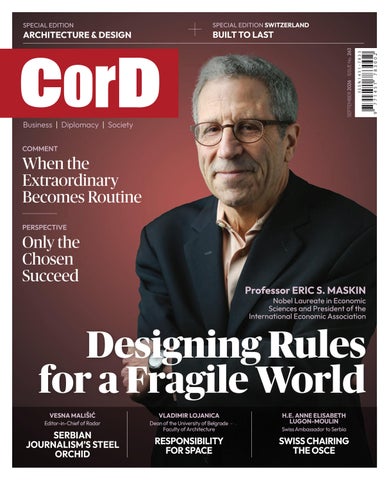
Professor ERIC S. MASKIN Nobel Laureate in Economic Sciences and President of the International Economic Association
Designing Rules for a Fragile World VESNA MALIŠIĆ
Editor-in-Chief of Radar
SERBIAN JOURNALISM’S STEEL ORCHID
VLADIMIR LOJANICA
H.E. ANNE ELISABETH LUGON-MOULIN
Dean of the University of Belgrade Faculty of Architecture
Swiss Ambassador to Serbia
RESPONSIBILITY FOR SPACE
SWISS CHAIRING THE OSCE
SPECIAL EDITION SWITZERLAND 2026
Contents
ARCHITECTURE & DESIGN
BUILT TO LAST
SPECIAL EDITION 2026
06 WHEN THE
EXTRAORDINARY BECOMES ROUTINE
COMMENT
84 ON HER OWN TERMS IRÈNE ZURKINDEN
18 O NLY THE CHOSEN
08 DESIGNING RULES FOR A FRAGILE WORLD
SUCCEED
PERSPECTIVE
56 THE LONG GAME
PROFESSOR ERIC S. MASKIN
GUILLAUME POUSAZ Founder and CEO of Checkout.com
Nobel Laureate in Economic Sciences and President of the International Economic Association
90 SERBIAN
JOURNALISM’S STEEL ORCHID
22 C LOSER THAN THE
VESNA MALIŠIĆ
DISTANCE SUGGESTS
Editor-in-Chief of political weekly news magazine Radar
BILATERAL: AUSTRALIA
83 ART AS A SPACE FOR
12 S WISS CHAIRING
CONNECTION
THE OSCE
GALA ČAKI
H.E. ANNE ELISABETH LUGON-MOULIN
Painter
Swiss Ambassador to Serbia
96 C HILL OUT 98 F ASHION 100 C ALENDAR 102 F ACES & PLACES
“CorD - 23 Years of Independent Thought and Inspiration”
CorD_Magazine cordmagazine thecordmagazine cordmagazine cordmagazine The views expressed in this publication are those of the presenter; they do not necessarily reflect the view of publications published by alliance international media
04
EDITOR IN CHIEF: Neda Lukić n.lukic@aim.rs DESIGN: Slađan Radosavljević Zoran Perović design@aim.rs COPY EDITOR: Mark Pullen TRANSLATION & EDITING: Pullen Editorial, Halifax
september
CONTRIBUTORS: Ljubica Gojgić Zoran Panović Radmila Stanković Maja Vukadinović Mirjana Jovanović Miša Brkić, Rob Dugdale Steve MacKenzie Zorica Todorović Mirković Sonja Ćirić, Miloš Belčević
DIRECTOR OF SALES: Maja Subotić m.subotic@aim.rs SALES MANAGERS: Biljana Dević b.devic@aim.rs Vesna Vukajlović v.vukajlovic@aim.rs SUBSCRIPTIONS: office@aim.rs FINANCE: finance@aim.rs
PRINTING: E-mail: office@aim.rs CEO: office@cordmagazine.com Rotografika d.o.o. Ana Novčić a.novcic@cordmagazine.com Segedinski put 72, Subotica www.cordmagazine.com www.aim.rs CorD is published by: COO: ISSN no: 1451-7833 alliance international Ivana Jovanović All rights reserved media d.o.o. i.jovanovic@aim.rs alliance international media Resavska 1/III, 2026 PUBLISHER: 11111 Belgrade 17, Ivan Novčić PAK 125806, Serbia i.novcic@aim.rs Phone: +(381 11) 2450 508
K2 Green Escape - Your next business address Quality|Sustainability|Flexibility|Modern Architecture|Strategic Location More than just an office space 25.000 sqm total GBA Purchase or rent - from 145 sqm up to 7500 sqm 254 parking places on two underground levels
45
Planned finalization Q4 2027/Q1 2028 LEED standards and energy-efficient construction Excellent connection with the rest of the city
Years of Excellence Purchase | Rent | Build-to-Suit +381 63 40 80 60 www.imel.rs
COMMENT
When the Extraordinary Becomes Routine Wildfires sweeping across Serbia and Europe this summer raise a question that can no longer be postponed: how much have we actually invested in preparing for risks that we have long known are coming? nite. Climate resilience therefore cannot begin with the arrival of firefighting aircraft. By then, much of the battle has already been lost. CorD has asked these questions before. In our 2023 Focus, **Are We Prepared for Climate Change? Unprotected on a Baking Roof**, experts warned of high vulnerability, insufficient adaptation capacity and inadequate financing. They stressed the need for early warning, functioning procedures, trained citizens and stronger local civil protection. By Neda Lukić
or more than two weeks this August, fire burned through the Deliblato Sands, one of Serbia’s most valuable nature reserves, affecting thousands of hectares of forest and other vegetation. Serbia activated the EU Civil Protection Mechanism, prompting the deployment of rescEU helicopters and firefighting teams from Germany and Romania. The European response demonstrates why solidarity and shared emergency capacities are indispensable in a continent facing increasingly severe climate extremes. But it also raises a less comfortable question: what happens when everyone needs help at the same time? Serbia was the ninth country to activate the EU mechanism for wildfires this summer by 24 August. Europe entered the season with its largest-ever wildfire response capacity, yet even an expanding common reserve is fi-
F
06
september
If prevention can reduce disaster damage by 70 to 90 per cent, resilience is not merely a cost – it is an investment we can no longer afford to postpone 2023 Are We Prepared for Climate Change?
2024 Massive Adaptation Awaits Us
There has been progress since then. Serbia has adopted its Climate Change Adaptation Programme and developed new tools for assessing and managing risk. Yet our 2024 Focus, Massive Adaptation Awaits Us, contained a sentence worth remembering today: everything is known; it is now time to invest in reducing the risks to which society and the economy are exposed. The economics are increasingly difficult to ignore. The World Bank estimates that Serbia needs around $9.5 billion in adaptation investment over the next decade, while inadequate action could reduce GDP by at least 15% by 2050. And a UNDP study cited in CorD’s 2024 Focus estimated that preven-
tive investment could reduce disaster damage in Serbia by 70 to 90 per cent. If prevention can save that much, the question is no longer whether Serbia can afford to invest in resilience. It is whether it can afford to postpone doing so. Europe is reaching much the same conclusion. The EU’s new approach to wildfire management is built around four stages: prevention, preparedness, response and recovery. The shift matters. Fighting fires remains essential, but so do early warning, risk assessment, resilient landscapes, community preparedness and coordination. And this extends far beyond forests. Heatwaves, droughts, floods and fires affect agriculture, infrastructure, energy and water security, public health, businesses and economic growth. Climate adaptation is therefore not an environmental luxury. It is part of economic policy, public investment and national security. Serbia will continue to need European solidarity, just as other European countries will sometimes need Serbia’s help. But solidarity works best as the final layer of protection, not the first. The warning signs are no longer warnings about a distant future. We have the projections, strategies, risk assessments and, increasingly, the experience. The real measure of preparedness will not be how successfully we respond to the next disaster, but how much we have done before it happens.
INTERVIEW
EXCLUSIVE
Designing Rules for a Fragile World In order for diplomacy to succeed, international rules must be designed to ensure governments stick to agreements not out of goodwill, but because breaking them is against their own interests
Professor Eric S. Maskin
Nobel Laureate in Economic Sciences and President of the International Economic Association By Tanja Jakobi
08
september
cordmagazine.com
09
elgrade’s hosting of the 21st World Congress of the International Economic Association has placed Serbia at the centre of global debates around how to govern an increasingly fragmented world. Here American economist and mathematician Eric S. Maskin, a Nobel Laureate in Economic Sciences, newly appointed President of the International Economic Association, and one of the leading figures in mechanism design theory, explains how carefully designed rules and incentives can help societies address challenges ranging from geopolitical distrust to climate change. He also discusses with CorD Magazine ways to regulate artificial intelligence and the future of smaller economies such as those of Southeast Europe.
B
Your work in mechanism design theory has shown how rules and incentives can be designed in such a way that individual actors, even when pursuing their own interests, may still contribute to better collective outcomes. Today, however, international relations are increasingly marked by strategic distrust, domestic political pressures, populist rhetoric and weakening commitments to multilateral cooperation. In such an environment, what are the limits of mechanism design? Can it still provide useful guidance for international diplomacy when political leaders may prioritise national prestige, short-term electoral gains or symbolic confrontation over long-term collective wellbeing? — It certainly is easier to enforce mechanisms that exist within a nation than those that cross international boundaries, since the national legal system can be enlisted in the former case, but not in the latter. The only way to ensure an international agreement is adhered to is to make it self-enforcing, i.e., to design it in such a way that parties wish to stick to the agreement due to their own self-interest. However, despite this difficulty, there are
10
september
some notable cases of successful international mechanisms in the world today. One example is the Montreal Protocol, which has eliminated emissions of practically all ozone-depleting substances and has, thus, allowed the planet’s ozone layer to make a remarkable recovery. Another example is the European Monetary Union, which – despite some design flaws (monetary policy is centralised in the ECB, but there is no corresponding central fiscal authority) – has worked quite well and has allowed Europe to weather some severe storms like the Great Recession and the Covid pandemic.
Despite the difficulty of enforcement across borders, there are notable cases of successful international mechanisms, such as the Montreal Protocol and the European Monetary Union Modern economics has been shaped strongly by formal models and mathematical reasoning, including the frameworks to which your own work has made such an important contribution. At the same time, many of today’s economic and political crises are deeply connected to social fragmentation, identity politics, institutional mistrust and cultural polarisation. Do you think formal economic models remain sufficiently equipped to explain these realities? Or does economics today require a stronger dialogue with sociology, history, political science and psychology in order for us to better understand the behaviour of individuals, institutions and societies? — There was a time when economic theory was separate from history and psychology, but that was long ago. Modern economic models are deeply informed by work in these other fields. To see that, just note who has
won Nobel prizes in the last quarter of a century, e.g., Daniel Kahnman and Richard Thaler in behavioural economics, and Claudia Goldin and Joel Mokyr in economic history.
During your recent lecture at the Serbian Academy of Sciences and Arts, you described climate change as a major collective-action problem and argued that international agreements must be designed so that cooperation becomes a rational choice for every country through an appropriate combination of incentives, sanctions and self-enforcing commitments. In the meantime, the global economy continues to measure success largely through GDP growth, industrial expansion and capital accumulation, while climate policy requires long-term coordination, restraint and a broader understanding of sustainability. Can carbon pricing, penalties and green incentives be sufficient to achieve meaningful international climate cooperation within the current economic framework? Or does effective climate policy also require us to rethink how economic progress itself is defined? — I don’t think it’s necessary to abandon GDP as our measure of economic progress in order to make headway with climate policy. After all, the Kyoto Protocol was, in its time, a significant step forward and was adopted by many countries that use GDP as the centrepiece of their national accounts. Nevertheless, I agree that GDP is a poor measure of wellbeing. I very much agree with the approach proposed by Partha Dasgupta: to use “Inclusive Capital” – the value of produced capital, natural capital, and our store of knowledge – as the basis of our accounts. A central issue in mechanism design theory is information: how to create rules that encourage actors to reveal relevant information truthfully and to behave in ways that are compatible with the desired social outcome. However,
TRUTH
WELLBEING
INTERDISCIPLINARITY
Governments need to regulate AI so that citizens can learn the truth, including requiring that the provenance of every ‘fact’ proclaimed by AI be published
Wellbeing should be measured on the basis of inclusive wealth produced and natural capital, together with our stock of knowledge, rather than GDP
The most interesting economics now happens where models meet psychology, history and politics, not in isolation from them
world in which information itself can be strategically manufactured or manipulated? Are there ways to design institutions that remain robust when deception becomes systematic rather than occasional? — Just as governments regulate many products to ensure that they are safe to use, governments need to regulate AI to make sure that citizens can learn the truth. This could include such devices as requiring that the provenance of every “fact” proclaimed by AI be published.
artificial intelligence is today making it increasingly easy to generate disinformation, manipulate public opinion and distort the information environment in which institutions, markets and democratic societies operate. How should mechanism design respond to a
The economies of Southeast Europe will gain most by investing in human capital, through strong education systems and continuous skills training
Many smaller economies, including those of Southeast Europe, occupy a particularly challenging position in today’s global economy. They must adapt to technological transformation, the climate transition and growing geopolitical uncertainty while often facing limited institutional capacity and having relatively weak influence over the rules governing international markets. What can mechanism design teach smaller countries about building stronger institutions? Are there areas where careful institutional design can make a meaningful difference, even when countries have limited influence over the broader global environment? — In a world where new technology and information will play an increasingly important role, the most important investment that the economies of Southeast Europe can make is in their people: education and skill training. Mechanism design can be useful in the development of policies that (i) enable and encourage ordinary people to acquire that education and those skills and (ii) give employers the incentive to provide such training.
cordmagazine.com
11
INTERVIEW
EXCLUSIVE
Swiss Chairing the Osce As Serbia prepares for a new electoral cycle, it’s important that conditions allow for broad political participation and reinforce public confidence in the electoral process. In that regard, the implementation of OSCE/ODIHR recommendations related to elections in Serbia is critical. Some important laws pertaining to those recommendations were recently passed in the Serbian Assembly, which we evaluate positively. Switzerland is this year chairing the OSCE and sees the ODIHR recommendations as a practical roadmap to further strengthen the electoral framework, including election administration, the media environment and the transparency of the process ~ Anne Elisabeth Lugon-Moulin H.E. Anne Elisabeth Lugon-Moulin Swiss Ambassador to Serbia By Ljubica Gojgić
he marking of 110 years of bilateral relations provided an opportunity to reflect on a partnership that today spans diplomacy, trade, innovation, climate cooperation and migration. Serbia is also one of the very few countries with which Switzerland has a migration partnership agreement, providing a framework for regular bilateral dialogue in that field.
T
Your Excellency, this year marks the 110th anniversary of diplomatic relations between Switzerland and Serbia. How would you assess the state of those bilateral relations today? — We recognised each other during the difficult times of the First World War, which was a strong sign of solidarity and trust. Those bonds have evolved over time into a steadfast partnership, characterised by dialogue, mutual respect and shared commitment. Over the past 110 years, the two countries have maintained diplomatic ties that have developed into a broad and multifaceted partnership. Our cooperation today extends from diplo-
12
september
PARTNERSHIP
COOPERATION
BUSINESS
110 years of diplomatic relations built on dialogue, trust and cooperation
The 2026–2029 programme prioritises governance, economic development, climate and sustainable urban development
Over 600 Swiss companies are present in Serbia, with around 23,000 jobs created by Swiss investment
macy and trade to education, migration and culture, as examples. There has been an acceleration of high-level bilateral visits over the last two and a half years. The Swiss President’s visit to Serbia this April was the epitome of our lasting friendship. Another important dimension of our relationship is the strong connection between our people. The Serbian community in Switzerland, which numbers around 130,000 people and is among the largest diaspora communities in the country, represents an important bridge between our two societies. The 50 flights per week that connect Zurich, Geneva and Basel with Belgrade and Niš reflect the closeness of those ties.
During April’s official visit to Serbia of President of the Swiss Confederation Guy Parmelin, Switzerland described Serbia as its most important partner in the Western Balkans. What does that mean in practical terms? — Stability and prosperity in the Western Balkans are a priority of Swiss foreign policy. We support efforts that strengthen resilience, foster dialogue and contribute to lasting stability and security in the region. At this time of international uncertainty, stable and predictable relations are particularly valuable. Since 1995, Switzerland has invested more than three billion euros in the Western Balkans, as part of its international cooperation efforts. The countries of the region have made significant progress in terms of security, the development of democratic institutions and economic growth. Where stability grows, trust and economic opportunities grow as well. Serbia is today Switzerland’s most important economic partner in the Western Bal-
kans, and that’s not surprising given that the country functions as a hub of the region for many entities. More than 600 Swiss companies have a presence here; direct investments have totalled around 2.3 billion euros over the past decade, while bilateral trade flows surpassed the one-billion-euro mark for the first time in 2024. This description reflects the depth of our economic bilateral relations. We also enjoy very good cooperation across a wide range of other areas. I will highlight a few examples: in the education sector, Switzerland helped put in place a vocational education system. With regard to innovation and in an effort to boost the Serbian ecosystem, an agreement worth 10 million euros was signed during the President’s visit as an additional support package to what we’ve al-
Stable and predictable relations are particularly valuable at a time of international uncertainty ready done over more than ten years. In the migration sector, Serbia is one of the very few countries with which Switzerland has a so-called “partnership” agreement, which entails a regular dialogue and support to various projects. President Parmelin’s April visit provided an opportunity to discuss how Switzerland and Serbia can build on this existing cooperation, particularly in areas where we see clear potential for further engagement and where our respective experience and expertise can complement each other. With a newly launched bilateral human rights dialogue, we are taking another important step.
Switzerland has maintained a strong presence in Serbia for decades, with its support evolving from humanitarian assistance to fostering innovation and strengthening good governance. What would you highlight as the key priorities of the Switzerland–Serbia Cooperation Programme for 2026–2029? — Switzerland was one of the few donor countries to start its long-term humanitarian/international cooperation presence during the wars of the 1990s. For decades, we have supported Serbia’s reform efforts, its economic development and its sustainable transformation. Our commitment reflects our belief in the country’s potential and in our shared future. The 2026–29 Cooperation Programme for Serbia focuses on democratic governance, economic development, climate change and sustainable urban development. As a worldwide leader of innovation, we can bring specific expertise regarding what works and foster valuable connections. With our new Swiss-Serbian Innovation Programme, we envisage more additional capacity building activities, the launching of a grant scheme to better commercialise research with the Innovation Fund, and the continuation of our longstanding cooperation with Science and Technology Park Belgrade. Key elements of our private sector development portfolio of projects include support to Serbian small and medium-sized enterprises, boosting SMEs’ access to international markets, improvements to the business environment and sound public financial management, as well as sustainable urban planning. Supporting the green transition – with a focus on the decarbonisation of the economy, energy efficiency and climate adaptation meas-
cordmagazine.com
13
ures – is another important pillar of our activities. Within the framework of previous engagements, Switzerland contributed to improving local service delivery and strengthened democratic governance in more than 50 per cent of Serbia’s municipalities. Empowering local governments and encouraging citizen participation has therefore been one of our lines of action for many years.
With reference to last year’s record levels of bilateral trade, which exceeded a billion euros, President Parmelin noted that attracting Swiss companies to Serbia depends on the rule of law, fair legal procedures, and open and transparent public procurement processes. How would you assess Serbia’s progress in these areas? — \Trade relations between Switzerland and Serbia continue to grow, with bilateral trade in goods reaching €1.1 billion and services €1.6 billion last year, making Switzerland Serbia’s fourth largest trading partner in services. There has been an existing free trade agreement between our countries for more than a decade. Between 2010 and 2025, Swiss companies invested around €2.6 billion in Serbia, creating around 23,000 jobs in the process. Serbia remains an attractive market, but continued progress on the rule of law, judicial efficiency, regulatory predictability and open public procurement processes would further strengthen investor confidence and attract even more Swiss companies. Switzerland has based its own prosperity on sound economic framework conditions, like free and fair competition, open markets, the multilateral order and the rule of law. We believe that, for small countries, those conditions are integral parts of a conducive environment. There are reports from Washington that some countries might reduce their military presence in Kosovo. Is Switzerland considering a similar move, given that your soldiers are part of the KFOR mission (Swisscoy)?
14
september
— Switzerland’s position is that KFOR remains important for security and stability. The current 215 Swiss military personnel deployed in the Swisscoy mission is our contribution to this joint international endeavour. That mandate runs until 31st December 2026, but the Swiss Federal Council has submitted a request to the Swiss Parliament to keep Swisscoy active in Kosovo, and even to increase our contingent up to 300 persons. The Parliament approved this request in June. Therefore, Switzerland will increase its military presence in Kosovo, rather than decreasing it.
How would you assess the current state of media freedom and political pluralism in Serbia, at a time when the country is preparing for a new election cycle? — Political pluralism is central to the credibility of any electoral process. As
Serbia is today Switzerland’s most important economic partner in the Western Balkans Serbia prepares for a new election cycle, it is important that the conditions allow for broad political participation and reinforce public confidence in the electoral process. In that regard, the implementation of the OSCE/ODIHR recommendations related to elections in Serbia is of critical importance. Some important laws pertaining to those recommendations have recently been passed in the Serbian Assembly, and we value this positively. Switzerland holds the OSCE Chairpersonship this year and we see the ODIHR recommendations as a practical roadmap to further strengthen the electoral framework, including election administration, the media environment and the transparency of the process. Their implementation can help build confidence among political actors and citizens alike. We therefore encourage continued dialogue and cooperation among all relevant stakeholders. While media pluralism exists,
media freedom continues to face challenges, including when it comes to hate speech, inflammatory rhetoric and attacks against journalists. We remain engaged in a constructive dialogue with our various partners to address concerns raised by journalists, media associations and government entities.
You also serve as ambassador to Montenegro. Do you believe that country is on the threshold of joining the European Union, and what will ultimately determine the pace of its accession process – its fulfilment of membership criteria or broader geopolitical considerations? — Whether Montenegro is ready to join the European Union is ultimately for the European Union and its member states to determine. The Western Balkan region’s stability and its European integration are a priority of our foreign policy. Switzerland is not an EU member state, but we believe that the European integration of Western Balkan countries would bring more prosperity and stability to the region. This is in the interest of everyone on the European continent. From Switzerland’s perspective, we welcome reform efforts related to the rule of law and the economy, as well as the fight against transnational crime, which have been undertaken by the government of Montenegro. Those endeavours matter because they strengthen the way public institutions work and, in return, have led to more investments, which ultimately translate into more prosperity for the people. In 2024, Switzerland ranked as the 5th foreign direct investor in Montenegro. This shows not only the potential of Montenegro, but also the strength of the Swiss economy. We are supporting Montenegro in the field of vocational education training through a regional project aimed at investing in technical schools in the Western Balkan region. At the same time, we are also one of the main contributors to the Montenegro Acceleration Fund, which is being managed by the United Nations Office in Podgorica.
Global Diary
“Peace is not absence of conflict, it is the ability to handle conflict by peaceful means” Ronald Reagan
Ukraine Revives Peace Push Ukrainian President Volodymyr Zelenskyy said Ukraine had developed a new one-page peace proposal together with US and European officials to present to Moscow. The ideas include a ceasefire and a US proposal for a free economic zone in the Donbas administered by a third party, while presidential chief of staff Kyrylo Budanov said direct Ukraine-Russia talks could resume in September with US participation. The initiative represents a renewed attempt to revive negotiations after US-led peace efforts stalled earlier this year.
Syria and Israel Hold Direct Talks Syrian Foreign Minister Asaad al-Shaibani and senior Israeli representatives held US-mediated talks in Jordan aimed at preventing further military escalation between the two countries. The discussions followed renewed tensions and Israeli military action in Syria, with security arrangements and de-escalation at the centre of the negotiations. Direct contact between representatives of Syria and Israel remains significant given that the two countries have no formal diplomatic relations.
Kushner Meets Hamas and Netanyahu US envoy Jared Kushner met Hamas leader Khalil al-Hayya in Egypt on 16 August before holding talks with Israeli Prime Minister Benjamin Netanyahu the following day. The meetings focused on a US-backed plan linking Hamas handing over its weapons to an eventual Israeli withdrawal from Gaza, with Kushner and Netanyahu subsequently agreeing on what US officials described as a path forward. The direct US engagement with Hamas represents a notable departure from Washington’s longstanding policy of avoiding formal contacts with the group. 16
september
“Diplomacy is the art of restraining power” Henry Kissinger
China and India Resume Border Dialogue Chinese Foreign Minister Wang Yi and India’s National Security Adviser Ajit Doval held high-level talks in Beijing on 25 August over the countries’ long-running Himalayan border dispute. China and India agreed to maintain peace along their roughly 3,800-kilometre disputed frontier and continue seeking what they described as a fair and mutually acceptable settlement. The meeting marks another step in the gradual improvement of relations between the two Asian powers following the deadly 2020 border clashes and subsequent military standoff.
Qatar Steps Up Iran Mediation Qatari Prime Minister and Foreign Minister Sheikh Mohammed bin Abdulrahman Al Thani travelled to Tehran on 27 August for talks with Iranian Foreign Minister Abbas Araqchi aimed at reviving diplomacy between Iran and the United States. Discussions included proposals for a temporary Iranian-Omani shipping corridor and mine-clearing operations in the Strait of Hormuz, a critical route for global energy supplies. Qatar’s intervention comes as Washington increases economic pressure on Tehran and the two sides remain divided over control and navigation through the strategic waterway.
Glucksmann Enters French Presidential Race French centre-left politician and European Parliament member Raphaël Glucksmann formally announced his candidacy for France’s 2027 presidential election on 23 August. The strongly pro-European politician is seeking to unite moderate left-wing voters while challenging Jean-Luc Mélenchon on the left and a far-right camp led by Marine Le Pen. His entry adds another significant contender to the increasingly polarised race to succeed Emmanuel Macron, who cannot seek a third consecutive term. cordmagazine.com
17
PERSPECTIVE
PUBLIC AND PRIVATE INVESTMENT
Only the Chosen Succeed Serbia’s high level of public investment is failing to generate development effects commensurate with its scale. Weak institutions, high corruption and the selection of projects with limited multiplier effects leave little room for public expenditure to provide a stronger boost to private investment
ccording to a report by the Vienna Institute, Serbia has a high share of public investment and a relatively low share of private investment, while comparisons among Western Balkan countries re-
A
18
september
veal significant differences in both the structure and impact of such investment. Taking the report as our starting point, we asked our interlocutors whether Serbia’s major public projects encourage broader domestic and for-
eign private investment, or whether their benefits largely remain confined to companies directly engaged in their implementation, but also whether projects linked to EXPO 2027 can deliver longer-term development effects.
PERSPECTIVE
Dejan Šoškić Professor at the University of Belgrade Faculty of Economics
Weak Institutions, Weak Investment Weak institutions and corruption suppress domestic private investment by limiting the opportunities and profitability of companies operating on market principles that lack privileged access to the state erbia has an unfavourable investment structure. Instead of domestic private investment dominating – as the main driver of development in every economy that has experienced periods of rapid, peacetime and sustainable growth over the past century – it remains at a very low level in Serbia, while public investment and FDI dominate. Why is private investment in Serbia so low? One explanation may lie in the deterioration of the “business environment”, i.e. the erosion of institutions, as recorded and verified by international organisations and indices (Transparency International, the World Bank’s WGI indicators, Freedom House, the Basel Index etc.), a process that has been particularly pronounced in Serbia over the past decade. In the absence of a functional legal system, free market and competent, impartial and efficient state institutions, domestic private investment – and private entrepreneurship more broadly – lacks the natural conditions required to develop. Another reason may lie in the specific structure of the private sector in economies characterised by high levels of corruption (Transparency International currently ranks Serbia at its lowest level historically and among Europe’s four most corrupt countries). High corruption effectively “divides” private companies into those that secure state contracts through corruption and those that possess the expertise required to perform the work as subcontractors. The former cannot drive growth in domestic private investment because they are engaged in corruption rather than genuine business and investment. The latter, meanwhile, lack sufficient profitability – due
S
to the corruption of the former – and thus have neither the “space” to invest and grow through retained earnings nor sufficiently strong financial statements to expand through commercial lending. Public investment is, in itself, potentially desirable and could be highly beneficial in accelerating overall economic activity in the country. The fundamental prerequisite, however, is that it be corruption free and that a large share isn’t spent on overpriced purchases of military equipment from abroad that provide no real benefit to domestic economic activity. A third condition is that investment should be directed towards projects that will prove profitable in the future and that stimulate domestic investment
Public investment can stimulate private investment only within a sound institutional environment and when directed towards projects that generate future economic benefits and development – which projects such as EXPO and the construction of stadiums across Serbia certainly will not. Finally, and most importantly, strong institutions, the rule of law, the ability to protect property and contracts, and a free market constitute the essential environment in which public investment can actually stimulate domestic private investment and broader development. Unfortunately, none of these conditions is currently being met in Serbia.
cordmagazine.com
19
PERSPECTIVE
Saša Đogović economist
Big Projects, Short-Lived Gains Not all public investment is equal: key transport corridors have already helped attract private investors, while EXPO and stadium projects primarily offer a mere short-term boost to growth
high level of public investment doesn’t necessarily translate into high and sustainable long-term economic growth rates. The absence of economic feasibility studies for certain projects, non-transparent procedures when projects enter the implementation phase and shortened procedures all signal that the focus is on satisfying particular interests that are often at odds with the public interest. There are numerous examples: from the construction of stadiums across Serbia and the National Stadium in Belgrade, to the EXPO 2027 project and certain road routes that don’t necessarily need to be built to motorway standards. When comparing projects, Serbia certainly needs investment in irrigation systems and sewage networks, as well as investment in renewable energy sources through public-private initiatives, more than projects such as the vaccine factory, National Stadium or EXPO 2027. These latter projects will only generate economic growth during preparations for their implementation and, in the case of EXPO 2027, during the year in which the event itself takes place. A select group of construction companies will be engaged, while it remains questionable how large the multiplier effect will be during the final phase of implementation, through the fitting out of commercial and residential buildings and stadiums, and whether most of the required goods and equipment will be imported or sourced from domestic production. In any event, once completed, these projects will become cost centres rather than profit centres, as
A
20
september
no economic feasibility studies exist for them. This means that, apart from providing marketing benefits for the authorities and selected project contractors, Serbia will gain little or nothing from them in economic terms. Certain public investments have undoubtedly helped attract new market players to Serbia. These include major road corridors, such as the Morava Corridor, the connecting of Šabac and Loznica to Corridor X and the ongoing construction of the Fruška Gora Corridor. In other words, access to modern roads, coupled with the expansion of Belgrade Nikola Tesla Airport, has created conditions conducive to
Priority should be given to investments in irrigation, sewage systems, renewable energy and railways, as these provide more durable foundations for economic development attracting new private investment. Further efforts should focus on modernising and developing railway infrastructure. However, this is merely a necessary condition, rather than a sufficient one. A sustainable inflow of such investment also requires political stability, which in turn implies strong, independent institutions and a predictable overall institutional environment – something Serbia currently lacks
PERSPECTIVE
Branimir Jovanović Economist at the Vienna Institute for International Economic Studies (wiiw)
The Wrong Investment Mix Education and digital infrastructure have the strongest impact on private investment – precisely the areas that receive only a small share of public investment in Serbia
erbia has had an unusual investment structure over recent years. Public investment stands at around 6% of GDP, among the highest levels in Europe, while private investment is around 18% of GDP, among the lowest in the region. This is all the more interesting given that research shows public investment generally increases private investment. One of our studies shows that an increase in public investment equivalent to one percentage point of GDP is associated with an increase of around 0.4 percentage points in private investment. This raises the question: how can Serbia have high public investment and low private investment, if the former tends to increase the latter? The explanation lies in the structure of public investment. Our research shows that the effect depends on what is being invested in. The strongest development effects come from investments that remove constraints on the private sector, increase productivity and create opportunities for new investment. More specifically, investment in education and digital infrastructure has the greatest impact in the region, while transport investment has the smallest. Yet the lion’s share of Serbia’s public investment is directed precisely towards transport, while investment in education and information and communications remains low. Serbia’s problem, therefore, is not that the state invests too little, but that the structure and quality of investment are not at the highest level. EXPO 2027 should also be viewed through this lens. The first problem when assessing its effects is insufficient transparency. There is no clear overview of all projects and costs. The best available figures come from the Fiscal Coun-
S
cil, which estimates that EXPO and directly related projects could cost around €3.4 billion: approximately €1.8 billion for EXPO itself (the complex, facilities and other costs) and around €1.6 billion for related infrastructure, including the National Stadium, valued at around €640 million, linear infrastructure and the railway. The problem is that a large proportion of this investment doesn’t constitute infrastructure that will permanently increase productivity. The National Stadium, EXPO facilities or housing may retain value after the exposition, but it is difficult to expect them to trigger a new cycle of private investment. Among the major EXPO-related projects, the railway stands out most clearly as an investment capable of gener-
Most EXPO 2027-related investment is only weakly productive, while just around a third – primarily the railway, roads and utility infrastructure – has the potential to generate lasting development effects ating longer-term development effects, as it improves connectivity between the airport, Belgrade and this part of the city, and it can continue to be used long after the event concludes. Road and utility infrastructure could likewise have such an effect. However, these investments account for only around a third of total EXPO-related investment, which is too little to produce a stronger long-term impact on private investment and economic development.
cordmagazine.com
21
BILATERAL: AUSTRALIA
Closer Than the Distance Suggests Sixty years after establishing diplomatic relations, Australia and Serbia are connected far more strongly by people than by trade. A large Serbian-Australian community, renewed political dialogue and increasingly organised business networks provide a solid foundation – but turning those links into broader economic and institutional cooperation remains a work in progress ore than 15,000 kilometres separate Australia and Serbia, their economies are anchored in different regions and their principal trading partners lie much closer to home. It is therefore hardly surprising that economic exchange between them remains modest. Yet distance tells only part of the story. In 2026, Australia and Serbia mark 60 years since establishing diplomatic relations, while the Australian Serbian Commerce Chamber (ASCC) celebrates its first decade. The two anniversaries provide a useful opportunity to assess a relationship that has developed unevenly: exceptionally strong in terms of people-to-people links, considerably more modest in trade and investment, and now showing signs of renewed political and institutional engagement. Australia established diplomatic relations with Yugoslavia in 1966, subsequently establishing relations with its successor states. Today, Australia and Serbia maintain embassies in Belgrade and Canberra and a bilateral framework that includes agreements covering social security, air services and cultural cooperation. One of the most recent additions is particularly illustrative of the rela-
ment built around what has always been the strongest connection between Australia and Serbia: people.
M
22
september
A Relationship Built on People
tionship itself. The bilateral Social Security Agreement, which entered into force in February 2024, improves access to pensions for people who have divided their lives between the two countries. It is a practical arrange-
Successive waves of migration, particularly after the Second World War and during the 1990s, created a Serbian community that is today firmly embedded in Australian society. The 2021 Australian Census recorded 94,997 people identifying Serbian ancestry, while 25,454 Australian residents were born in Serbia. Of the latter, almost 92 per cent were Australian citizens. Indeed, almost half of all people reporting Serbian ancestry were born in Australia – an important indication that this is no longer simply an immigrant community, but an established part of Australian society extending across generations. That human connection remains much larger than the formal economic relationship. It is visible in family and professional networks, community organisations, language, schools and cultural associations, but increasingly also among Australian-born professionals and entrepreneurs whose relationship with Serbia is less about migration itself and more about heritage, networks and opportunity.
Movement between the countries offers another indication of these ties. Australian government figures record 14,360 Australian visitors to Serbia in 2024, compared with 2,610 Serbian visitors to Australia. It is precisely at the intersection of these human and economic links that the Australian Serbian Commerce Chamber operates. Established in Melbourne and today present in both Australia and Serbia, the ASCC seeks to turn an extensive network of personal and professional connections into more systematic cooperation in trade, investment, tourism, education and business. Its tenth anniversary consequently comes at an interesting point. The challenge is no longer to demonstrate
that links between the two countries exist. They clearly do. The harder task is to convert them into relationships that extend beyond individual contacts and produce lasting economic and institutional results.
The Economics of Distance Trade figures demonstrate how much work remains to be done. Australia’s DFAT data show that bilateral exchange remains small relative to either country’s overall foreign trade. Services, including travel, represent an important part of the rela-
24
september
tionship, alongside relatively modest merchandise flows. This should temper easy talk of vast “untapped potential”. Geography matters, as do transport costs, market familiarity and the very different economic environments in which Serbian and Australian companies operate. Australia is a highly developed economy whose strengths span services and finance, agriculture, resources, energy and advanced industries, with economic relationships oriented strongly towards the Asia-Pacific. Serbia’s economy is much smaller, but offers a skilled workforce, particularly in technology and engineering, competitive operating costs and a strategic position between Central and Southeast Europe.
Distance cannot be removed, but unnecessary administrative friction can The more promising areas of cooperation may therefore not necessarily be those that depend on moving large volumes of physical goods halfway around the world. Technology, professional and digital services, education, specialist expertise, innovation and selected forms of investment are all areas in which geography can become less decisive.
The institutional environment around such cooperation also matters. The ASCC has, for example, advocated the conclusion of a double taxation agreement between Australia and Serbia, arguing that it would provide greater certainty for businesses and individuals operating between the two jurisdictions. That kind of work may ultimately prove as important as business promotion itself. Distance cannot be removed, but unnecessary administrative friction can.
A Renewed Political Dialogue Political relations have generally been stable, though high-level exchanges have not always reflected the strength of community ties. There are signs of renewed engagement. Bilateral political consultations between Serbia’s Ministry of Foreign Affairs and Australia’s Department of Foreign Affairs and Trade were held in Canberra in September 2025. Discussions included political cooperation, stronger economic ties and opportunities for cooperation within international organisations, with both sides explicitly referring to the approaching 60th anniversary. The visit of Serbian State Secretary Damjan Jović to Australia in 2025 was also the first high-level Serbian visit recorded by DFAT since 2012. Australia’s most recent ministerial visits to Serbia listed by DFAT date from 2017. These gaps are themselves revealing: the bilateral relationship has often been sustained more continuously by people and communities than by intensive political exchange. That makes the current effort to broaden institutional links more relevant. The ASCC’s “Double Jubilee” year reflects the same ambition from the business side. During the first half of 2026, the Chamber combined engagement with Australian political and business representatives with new partnerships, networking initiatives and the launch of its NextGen Leaders Chapter. The latter may be particularly significant over the longer term. Diaspo-
ra relationships inevitably change as generations pass. Maintaining strong Australia-Serbia links will increasingly depend on younger Australians of Serbian heritage finding contemporary reasons to engage with Serbia – through business, technology, entrepreneurship, education and professional exchange rather than family history alone.
Culture Beyond Diplomacy Culture provides another layer of continuity. Formal cultural ties have a long history: an agreement on cultural cooperation concluded between Australia and Yugoslavia remains listed among the treaties applicable to relations with Serbia. Yet cultural exchange has arguably been sustained more visibly from below than through major bilateral programmes. Language, community organisations, schools, cultural and religious institutions and successive generations of Serbian-Australians have created a form of exchange that is less easily measured than trade. The size and longevity of the community have ensured that Serbia remains culturally present in Australia even when official contacts have been less intensive. This also makes cultural cooperation an area in which the relationship could evolve. Preserving heritage is important, but future connections need not depend solely on preserving the identity of earlier generations. Contemporary arts, education, academic exchange and creative industries can provide new channels between societies whose knowledge of one another otherwise remains limited by distance. The same applies in the opposite direction. Australia is familiar to many in Serbia through popular culture and its global profile, but the depth and diversity of contemporary Australian society, business, research and culture are far less widely understood. There is consequently room for the relationship to become broader
26
september
without pretending that it is already deeper than the evidence suggests.
From Connections to Cooperation That is perhaps the clearest conclusion to draw after six decades of diplomatic relations. Australia and Serbia are much closer socially than they are economically. Their strongest bilateral asset already exists: a substantial, established community with generations of experience connecting two distant societies. The weakest dimension remains
Diaspora ties provide language, knowledge, contacts and familiarity with two very different markets – but they are a foundation, not an economic strategy in themselves the one most easily measured – trade and investment. Neither anniversary changes that reality. What the 60th anniversary of diplomatic relations and the ASCC’s tenth year can do is highlight the gap between the strength of human ties and the still limited scale of economic and institutional cooperation. Closing that gap will require more than promotional language about bridg-
es between continents. Some obstacles are structural and will remain so. Australia and Serbia will continue to be distant markets whose economic priorities are shaped primarily by their respective regions, while not every potential area of cooperation will translate into sustainable business. The more realistic opportunity is to identify where cooperation genuinely makes sense – and make it easier. That means stronger business networks and more regular political dialogue, but also better information, educational and professional exchange,
institutional agreements and connections between younger generations. The Serbian-Australian community provides language, knowledge, contacts and familiarity with two very different environments, but diaspora ties are a foundation, not an economic strategy in themselves. For organisations like the Australian Serbian Commerce Chamber, the next step is to build on the networks established over the past decade and help translate them into durable partnerships, investment, knowledge exchange and opportunities in both directions. Sixty years after diplomatic relations were established, Australia and Serbia are indeed closer than the map suggests. The question for the next decade is whether their economic and institutional relationship can begin to reflect that closeness.
ARCHITECTURE & DESIGN SPECIAL EDITION 2026
CONTENTS ARCHITECTURE & DESIGN 2026 30 R esponsibility for Space Vladimir Lojanica
COMMENT
WHAT WE CHOOSE TO BUILD Architecture has always shaped the way we live. Today, its responsibility increasingly begins one step earlier – with deciding what deserves to be built, what can be transformed and what should simply be left alone
DEAN OF THE UNIVERSITY OF BELGRADE FACULTY OF ARCHITECTURE
34 S haping Architecture Through Context, Innovation and Long-Term Value Bureau Cube
36 T he Future Lies in Transformation Sonja Milićević and Nikola Radović
NRA ATELIER
38 T he Age of Enough EUROPEAN ARCHITECTURE
40 A rchitecture of Togetherness
Marija Nenadić Novaković
PRESIDENT OF THE WOMEN’S ARCHITECTURAL SOCIETY (ŽAD)
42 Supervision Protects Investment Aleksandra Nedeljković
FOUNDER AND OWNER OF DIART 26 ARCHITECTURAL STUDIO
28
ARCHITECTURE & DESIGN 2026
or much of the past century, progress in architecture was easy to recognise. Cities grew, skylines changed, infrastructure expanded and new buildings provided visible evidence of economic ambition. Building more generally meant moving forward. That equation has become considerably less certain. Climate change, pressure on resources, housing shortages and increasingly intensive urban development are forcing architects and societies to reconsider not only how we build, but what – and how much – we need to build at all. The most important architectural decision may sometimes be to transform rather than replace, to preserve rather than demolish, or to improve what already exists rather than begin again. This is not an argument for architectural restraint at the expense of ambition. Quite the opposite. Working with existing cities, buildings and communities can demand more imagination than starting from an empty site. It requires architects to understand context, investors to recognise value beyond additional square metres and institutions to think beyond the lifespan of individual projects. It also changes the meaning of professional responsibility. Architecture is never created by architects alone. The quality of what ultimately gets built depends on clients and investors, engineers and contractors, public institutions and planning rules, professional supervision and, ultimately, on a so-
F
ciety’s ability to recognise and demand good space. Strong architecture therefore requires not only strong individuals, but a strong professional culture – one capable of dialogue, knowledge-sharing and defending standards even when doing so is inconvenient. Europe is increasingly moving in this direction. Renovation, adaptive reuse and whole-life carbon are entering the mainstream of architectural and policy thinking, while the existing building stock is being reconsidered as an enormous economic, environmental and spatial resource. The question is gradually shifting from what can we build here? to what is the best use of what we already have? For Serbia, where cities are changing at remarkable speed, that question is particularly relevant. Every period of intensive construction leaves a legacy that lasts far longer than the economic cycle that produced it. Poor decisions become part of the city just as permanently as good ones. That is why architecture cannot be measured only in completed square metres, investment volumes or striking façades. Its real value emerges over time: in how buildings age, how neighbourhoods function, what has been preserved, how resources have been used and whether people still find those spaces worth inhabiting decades later. Perhaps the architecture of the future will therefore be distinguished less by its ability to build more and more by its capacity to choose better.
EVERY PERIOD OF INTENSIVE CONSTRUCTION LEAVES A LEGACY THAT LASTS FAR LONGER THAN THE ECONOMIC CYCLE THAT PRODUCED IT
cordmagazine.com
29
VLADIMIR LOJANICA Dean of the University of Belgrade Faculty of Architecture
INTERVIEW
RESPONSIBILITY FOR SPACE Architecture is not merely a mirror of society – it can change how we live, communicate and understand shared values. The future of our cities therefore depends not only on architects’ expertise, but also on society’s ability to recognise, demand and preserve quality space By Neda Lukić
ne of the leading figures in contemporary Serbian architecture, Professor Vladimir Lojanica today heads, as Dean of the University of Belgrade Faculty of Architecture, an institution celebrating its 180th anniversary. At a time when Serbia’s built environment is changing rapidly, and decisions on cities, infrastructure and heritage increasingly raise questions about the profession’s place in decision-making, this anniversary is not only a reminder of the Belgrade School of Architecture’s long and distinguished tradition, but also an opportunity to discuss its future – the architect’s evolving role, our culture of relating to space and the responsibility of both the profession and society for the cities we leave to future generations.
O
Recent years have seen decisions taken in Serbia that are permanently reshaping our built environment – from major infrastructure projects to issues of cultural heritage – often creating the impression that the role
30
of architects and urban planners has been reduced to a formality. Has the profession lost its voice, or has that voice been taken away? — It seems to me that, although both situations you mention are highly illustrative, neither fully describes the position in which the profession finds itself today. The situation is considerably more complex. Something has clearly changed compared to the not-sodistant past. What changed first was the traditional, inherited model under which the architect had a clearly defined role and always acted from the same established professional position within the same context. The “architect’s voice” was then easy to identify and anticipate. It was always heard loudly and in the same way in similar situations. Today, the profession’s entire “ecosystem” has changed. We have not only a plurality of roles for architects, but also a plurality of circumstances in which they operate. Society and relationships have changed, while decision-making models, processes, systems and
technologies continue to evolve... How, under such circumstances, do we develop new models of professional action based on knowledge, arguments, dialogue and cooperation – first and foremost among ourselves? — Every change carries risks, but also creates opportunities for the profession to reaffirm its position and social relevance. Recently, particularly when it comes to protecting cultural heritage, we have had an opportunity not only to hear the architectural profession’s voice, but also to see numerous other professions rally around important questions concerning our inherited built environment. Those voices have not always been in harmony – nor do they need to be – but that is precisely where an important change lies. Different disciplines have come together around a common issue, combining their knowledge and arguments and acting jointly. Such action may lack the simplicity and recognisability of the former “architect’s voice”, but it has shown that it can play a very important role in the future.
ARCHITECTURE & DESIGN 2026
cordmagazine.com
31
The Faculty of Architecture is celebrating its 180th anniversary this year – a milestone that extends far beyond a single educational institution. What do you consider the greatest legacy of the Serbian school of architecture, and are we sufficiently aware and worthy of it today? — The Faculty’s 180 years speak above all of the continuity of a
worthy of our heritage and tradition means, in my view, recognising those fundamental values and continuing to advance and nurture them. I see one of our school’s important qualities precisely in the fact that it has never sought to produce a single model of architect, but has instead enabled different creative positions to develop over
must it change to remain relevant in the European and global context? — The greatest strength of the Belgrade School of Architecture lies precisely in its broad understanding of architecture and a tradition that recognises the architect as an active social actor. Its value has rested equally on producing a competent and recognisable mod-
INTERNATIONAL RELEVANCE DOES NOT MEAN REPLICATING WHAT IS HAPPENING ELSEWHERE, BUT BEING ABLE TO RESPOND FROM OUR OWN CONTEXT TO QUESTIONS THAT CONCERN US ALL TODAY
culture of architectural education – one in which architecture is understood as a discipline belonging simultaneously to art, technology and society. That continuity represents far more than the sum of prominent authors, works, buildings or individual periods in our architectural history, although it undoubtedly encompasses a rich legacy of all these. Tradition achieves its full value when we know how to understand it, learn from it and develop it further. This is precisely the opposite of our familiar and all too common tendency to act as though history always begins anew with us. Being
32
time, while insisting on broad education, critical thinking and responsibility towards space and society. The Faculty draws strength from its rich history and tradition, while reaffirming that strength through its ability to understand the time in which it operates and educate generations ready for the time yet to come. For decades, the B elgr ade School of Architecture enjoyed an international reputation and produced generations of architects whose work shaped the identity of our cities. What is its greatest strength today, and how
el of professional and on its ability to educate distinctive creative individuals who have worked in very different professional and social circumstances. I would therefore not view change solely as a matter of adapting to some predefined European or global model or standard. Being internationally relevant does not mean simply replicating what is happening elsewhere, but being able to respond to questions that concern us all today, in line with broader trends but from within one’s own context. Climate change, new technologies, urban transformation, housing and our relationship with resources and heritage are global issues, but the answers cannot be identical in every society and every place. Technical and design
ARCHITECTURE & DESIGN 2026
knowledge unquestionably forms the foundation of our profession and cannot be abandoned, but architects today must also understand complex social circumstances in order to play an active role in processes where decisions about space are made. This also requires expanding the knowledge and skills that future architects need to operate in such a world. I see our school’s ability to recognise these changes and incorporate them into the education of new generations as the way to continue strengthening its relevance. It is increasingly said that the quality of our cities will determine the quality of life of their residents. If you could set one priority for the development of Serbian cities over the next decade, what would it be – public space, housing, sustainability, mobility or something else? — It is difficult to single out just one of these priorities, because the quality of a city emerges precisely from the relationships between all these aspects. Housing cannot be considered independently of mobility, just as the quality of public space cannot be separated from sustainability, infrastructure or access to different amenities. If I nevertheless had to identify one priority, it would be the overall quality and culture of everyday urban life. One of the key challenges for the coming decade is therefore our ability to once again view and plan the city holistically – not as a collection of individual interest-driven projects and sectoral policies, with outcomes left to chance, but as a complex system in which every intervention affects the whole. Such an approach to the city also means that education cannot remain confined to professionals. The quality of our overall relationship with space must become a broader social competence and responsibility. I believe we need to cordmagazine.com
do much more to develop a culture of living and a culture of relating to space in the broadest sense. Understanding the space in which we live, its value and our responsibility towards it should form part of a much broader education. A better city is not created solely through good planning and design, but also through society’s ability to recognise, demand and preserve the quality of the spaces in which we live. If we accept that the way we build our cities reflects the way we organise society, what does contemporary Serbian architecture tell us about Serbia as a society? — Architecture certainly speaks about the society in which it emerges – I often say that, and I am certainly not the first – but it would be overly simplistic to draw conclusions about contemporary society solely through the prism of architecture, particularly today, when society is being shaped simultaneously in physical and digital space. Just as our society is not homogeneous, neither is the architecture we create today. We can simultaneously recognise very different and sometimes opposing processes in our built environment – development and complete neglect, ambition alongside an absence of long-term thinking, outstanding individual achievements alongside problems that cannot be resolved through individual architectural interventions alone. Perhaps it is precisely this complexity that tells us most about the society in which we live. It is important, however, not to view architecture purely passively, as a consequence of social circumstances. It is not merely a mirror of society – it can also influence how we live, communicate and understand shared values. Architecture therefore has the potential to influence changes in certain social relationships, open up new mod-
A BETTER CITY IS NOT CREATED SOLELY THROUGH GOOD PLANNING AND DESIGN, BUT ALSO THROUGH SOCIETY’S ABILITY TO RECOGNISE, DEMAND AND PRESERVE THE QUALITY OF THE SPACES IN WHICH WE LIVE els of communal life and raise expectations of the spaces we create. In that context, I might reverse the question and instead ask what message we, as a society, want to convey today through architecture. I see a far more important role for our profession in this shift from interpreting what already exists towards taking responsibility for what we create.
33
SHAPING ARCHITECTURE THROUGH CONTEXT, INNOVATION AND ~ } LONG-TERM VALUE Cities are shaped by thousands of buildings, but only a small number meaningfully shape the city in
Cube as as part of a return. For Bureau Partners, architecture is not conceived an isolated object but broader with innovation, technical with urban system, one that must reconcile history performance human experience, while sensitively its surroundings retaining distinct identity responding to and a of its own. THIS PHILOSOPHY HAS GUIDED THE BELGRADE-BASED PRACTICE SINCE
ITS ESTABLISHMENT IN 2009.
670&4-70,/&/-7.47*&4)#0' '457 42 ,)%*' "3*& '4-%*$50$ 4&0!$ 4 Today, with a multidisciplinary team of more than eighty architects and engineers, BCP Studio delivers a diverse portfolio !540!4+ 1( of projects. We cover residential, commercial, cultural, educational, sports, healthcare 05&4 &5*3,0&7
and urban developments while maintaining a consistent design methodology rooted in research, contextual technical ^ understanding and excellence. Z digital technologies, BIM processes and enable greater Advanced : interdisciplinary collaboration precision, and coordination, still innovation always toward a larger goal: creating efficiency, is directed forges a unique identity, responds to its environment, and generates architecture that intelligently Q lasting value for cities and communities.
The diversity BCP Studio reflects philosophy ability < of the TB portfolio this while demonstrating its to respond to vastly different urban conditions and requirements. P M 8
g|zk xjyz{djwtk mrk w|zk opnk lwvxjmk qm{wrmijmk {zhzewdkw|jdkq|jimdmq|tkc|jizkxzbmadw{`wja_k jwdk`sjijwtkwmk{zdqmaxkwmky`dwitkxjrrz{zawkv{s`ak emaxjwjmadk`axk{zuvj{zbzawdf
KNEZA MILOŠA Upholding the doctrine that architecture, embedded within the historic, urban and built fabric of its time, is never neutral, Bureau Cube Partners uses this project to reaffirm that every intervention in architectural heritage inevitably provokes dilemma and disquiet. That disquiet stems from the absence of codified principles governing whether architecture should yield to the old, transcend it, or instead embrace a layered coexistence in which successive epochs are integrated rather than erased. Bureau Cube Partners adopts this latter approach, conceiving the project as a palimpsest where inherited layers remain legible while overlapping to form a complex, heterogeneous context that resists the trend-driven hegemonism of “quasi-contemporaneity.” The resulting architecture transforms context itself into an artifact. One that’s professionally legible, carefully stratified, and deliberately provocative, inviting critical discourse.
CARA DUŠANA Among its completed works, Cara Dušana illustrates a sensitive approach to architectural heritage. The project combines the restoration and integration of an early twentieth-century corner building with a contemporary extension, carefully preserving the historic character of the site while introducing modern residential and commercial functions. Rather than replicating the original architecture, the intervention establishes a dialogue between old and new, reinforcing the identity of one of Belgrade’s most historically significant streets. This is also a project that is in fact already completed. Cara Dušana now stands as an active conversation between the historic and the modern about timelessness. As such it is forged in the crucible of exchange between preservation and invention, deeming contrast a compromise.
THE FUTURE LIES IN TRANSFORMATION The architecture of the future does not begin with demolition and a new “blank canvas”, but with understanding the value of what already exists – space, structure, materials and heritage
SONJA MILIĆEVIĆ AND NIKOLA RADOVIĆ NRA ATELIER
36
arking ten years of work and an invitation from the European Cultural Centre to participate in the Time, Space, Existence 2027 exhibition in Venice, Sonja Milićević and Nikola Radović bring a distinctly new-generation optimism to architecture – one
M
rooted not in building more, but in believing we can build better. The European Cultural Centre’s invitation to participate in the Time, Space, Existence 2027 exhibition in Venice comes as NRA Atelier marks ten years of work and builds an increasing-
ly strong international presence. What does the opportunity to present your philosophy of circular architecture in Venice mean to you, and what message do you want to convey to the international architectural community? SONJA: The invitation to participate in Time, Space, Existence 2027 comes as we complete our first ten years, and we see this coincidence as a continuation of our evolution. Venice is an ideal platform: a city that has practised circularity for centuries by preserving, adapting and reusing its built heritage. Presenting our philosophy in such a context means engaging with an audience that views restraint, longevity and respect for the existing environment not as passing trends, but as an authentic culture of living. Since founding the Atelier, we have chosen, wherever feasible, to preserve, revitalise and extend existing buildings, even when building anew would be easier. Our approach is not dogmatic: where the site or structure demands it, new construction is a logical response, but with the same sensitivity towards its surroundings. The strength of future architecture lies in transforming heritage and materials to create new value with minimal impact on nature. Over the years, NRA has evolved from Nikola Radović Architecture into Nature-Reflecting Architecture, based on the idea that architecture should respect its natural surroundings and leave the smallest possible footprint. Is circular ar-
ARCHITECTURE & DESIGN 2026
chitecture today the fullest expression of that evolution – and where does sustainability cease to be a desirable principle and become a genuine responsibility of the architect? NIKOLA: The name began with me, but our studio has long since grown beyond the individual. Nature-Reflecting Architecture marks a key moment when we embraced the view that a project must respond to its setting, rather than subordinating nature to itself. In this context, circularity is the most mature and consistent expression of our evolution, because it turns theoretical respect for the environment into a concrete design method: a clear decision about what we preserve, what we transform and what we choose not to do within a space. Sustainability remains a desirable principle or marketing declaration as long as it is quick, cheap and superficial. An architect’s real responsibility begins when we stop seeking justification for taking the path of least resistance. Only when we reject radical removal as the default and commit to resource-efficient solutions do we become truly responsible designers. Goyko House, which is soon to enter the construction phase, is based on reconstruction and extension, material reuse and minimal environmental impact. How does the process work when you view an existing house not as a limitation, but as a resource – and what will Goyko best demonstrate about your understanding of the architecture of the future? NIKOLA: With Goyko House, our first step was not to assess the building by what it lacked, but by what it already had – its structure, orientation, walls and materials, whose environmental cost nature has already paid. Viewing an existing building as a resource means entering into an equal diacordmagazine.com
logue with it, rather than erasing it and starting the project from a “blank canvas”. Goyko will best demonstrate that, for us, the architecture of the future does not mean a new race for form, but a new discipline of decision-making, in which every intervention is justified only if it improves what already exists, never if it suppresses it. This project shows that outstanding aesthetics can emerge from circularity, with the least visible decision – what we chose not to demolish –
ing with a sound structure, lower risk and unique positioning that competitors building on an empty site cannot replicate. Framed in this way, transformation ceases to be a compromise and becomes a key market advantage that we advocate confidently. Montenegro is both a country of exceptional natural and architectural heritage and a market experiencing very intensive development. Can a new generation of Montenegrin architects
SUCCESS SHOULD BE MEASURED NOT ONLY BY WHAT HAS BEEN BUILT, BUT ALSO BY WHAT HAS DELIBERATELY BEEN LEFT UNTOUCHED becoming perhaps our most important design statement. The principle of “don’t demolish if you can transform” can already be seen in your work – from the award-winning Hotel Centrale, where the structure of a former military workshop was preserved, to projects based on local materials, tradition and minimal intervention. How difficult is it today to convince investors that value does not necessarily have to come from entirely new construction? SONJA: The challenge is considerable when success is measured solely in square metres and the speed of return on investment. However, we understand investors’ position: they rightly expect a clear calculation of returns. Our job is to broaden that calculation and show that a preserved structure, such as the one at Hotel Centrale, gives a project an authenticity that new construction cannot create – and one that has genuine market value. We therefore convince investors not through sentiment towards heritage, but through data: shorter construction times when work-
change the way we build – so that a project’s success is measured not only by its appeal and market value, but also by what it has managed to preserve? NIKOLA: It can, but only if we stop defending the profession through the market and instead use the profession to guide and restrain the market. The new generation does not need to be braver than the previous one, but more persistent in dialogue with investors and local and national authorities, because resistance to preservation cannot be overcome with a single project, but through consistency. We grew up witnessing the consequences of aggressive urbanisation and recognise that space is not a disposable commodity, but part of our identity. Success should therefore be measured not only by what has been built, but also by what has deliberately been left untouched. The day investors and authorities begin asking how much a project has preserved, rather than merely how much it has utilised, we will know that the change is real rather than declarative.
37
EUROPEAN ARCHITECTURE
THE AGE OF ENOUGH Europe is beginning to question one of architecture’s oldest assumptions: that progress means building something new. As climate, housing and resource pressures converge, the buildings already standing are increasingly being viewed not as constraints, but as perhaps the continent’s greatest architectural resource
or much of the modern era, architecture has been associated with addition. New housing, new offices, new landmarks and expanding cities were visible signs of development. Today, a different idea is gaining ground across Europe: perhaps the most intelligent building is sometimes the one we do not build. This is not an argument against new architecture. It is a change in the order of questions. Before asking what should replace an existing building, architects, planners and investors are increasingly asking what can be retained, adapted, extended or given an entirely new purpose. The shift is moving rapidly from architectural debate into European policy. In 2026, the European Commission placed the concept of whole-life carbon at the centre of new guidance for decarbonising
F
38
buildings. The approach considers emissions not only from operating a building, but across its entire life cycle – materials, construction, use, renovation and eventual demolition. Renovation, repurposing and conversion therefore acquire a value that energy efficiency alone cannot capture.
Existing Buildings, New Possibilities
The implications extend far beyond climate policy. Europe simultaneously faces housing shortages and an enormous stock of buildings that is vacant, underused or no longer suited to its original purpose. A 2026 study by the Buildings Performance Institute Europe and its partners estimates that making better use of the existing building stock could theoretically unlock 50 to 107 million addition-
al homes, through measures ranging from renovation and subdivision to converting empty offices and adding to existing buildings. Its proposed hierarchy is strikingly simple: renovate first, extend where appropriate and build new only when necessary. That changes the meaning of architectural creativity. An obsolete office block can become housing. An industrial building can accommodate culture or education. An unused attic can become living space. A structure designed for one generation can be adapted for another. The building is no longer a finished object. It becomes a resource.
From Efficiency to Sufficiency
Behind this change lies another concept entering the architectural vocabulary: sufficiency.
ARCHITECTURE & DESIGN 2026
Efficiency asks how a building can use less energy or fewer materials. Sufficiency asks an earlier question: how much building, material and space do we actually need? That distinction matters. A highly efficient new building still requires land, materials, construction and energy. Preserving a sound structure avoids part of that environmental cost before sophisticated technology is even introduced. Better use of existing space can also reduce pressure on land and resources while responding to housing demand. Europe’s leading architecture is already reflecting this thinking. The 2026 EU Prize for Contemporary Architecture – Mies van der Rohe Awards highlighted projects that transform existing structures alongside innovative new construction, with the jury pointing to a growing cordmagazine.com
THE BUILDING IS NO LONGER A FINISHED OBJECT. IT BECOMES A RESOURCE connection between architecture, urban planning and governance in creating resilient environments. Among the finalists are transformations of former exhibition halls, industrial buildings and historic structures for entirely new forms of public life.
A Different Measure of Progress
None of this means that Europe has entered an age without new buildings. Growing cities will continue to need housing, infrastructure and exceptional new architecture.
What is changing is the assumption that demolition and replacement represent the natural starting point. The emerging alternative is more demanding. It requires architects to understand what already exists before drawing what comes next; investors to recognise value beyond immediate additional square metres; and cities to consider buildings as assets capable of changing repeatedly over time. Perhaps that is why the idea of “enough” is more radical than it first appears. It does not ask architecture to become less ambitious. It asks ambition to be measured differently. The architecture of the future may ultimately be defined not only by the extraordinary things we create, but by the intelligence with which we use what we already have.
39
he Women’s Architectural Society is marking its first decade this year, having grown from a platform aimed at increasing the visibility of women architects into a space for professional networking, mentorship and knowledge-sharing. For Marija Nenadić Novaković, the value of this journey lies not only in women’s greater presence in the profession, but in creating a culture in which experience is passed on, individual success opens doors for others and sol-
T
EXPERIENCE GAINS ITS FULL VALUE WHEN IT DOES NOT REMAIN INDIVIDUAL, BUT IS PASSED ON idarity provides a foundation for new professional opportunities.
MARIJA NENADIĆ NOVAKOVIĆ President of the Women’s Architectural Society (ŽAD) goals
40
INTERVIEW
ARCHITECTURE OF TOGETHERNESS Over ten years, ŽAD has evolved from an initiative to increase the visibility of women architects into a professional community built on knowledge-sharing, mentorship and solidarity – with the ambition of creating even greater opportunities for the next generation
The Women’s Architectural Society is marking its tenth anniversary this year. Looking back at ŽAD’s journey – from an idea to a strong professional community – what do you consider its most important contribution to Serbian architecture? — I believe ŽAD’s greatest contribution over the past ten years has been its ability to turn visibility, networking and exchange into lasting professional value. When ŽAD was founded, there was a clear need for the voices of women architects to be heard more strongly and for a space to be created for professional networking. Today, that initial idea has grown into an active and diverse community. It is particularly important to us that ŽAD has become more than a professional association. It is now a space for dialogue, learning, mentorship, sharing experience and initiating new collaborations. Through exhibitions, lectures, discussions
ARCHITECTURE & DESIGN 2026
and various programmes, we connect women architects of different generations and professional backgrounds. For me, this is its greatest value – creating an infrastructure of togetherness within the profession. ŽAD today not only addresses the position of women architects in Serbian architecture, but actively contributes to shaping where architecture in Serbia can be tomorrow. ŽAD was founded to increase the visibility of women in architecture, while also building a network of mutual support and knowledge-sharing. How much has the position of women architects in Serbia changed over the past decade, and what challenges remain? — The change is visible, and I think it is important to acknowledge it. Women architects today have a much stronger presence and greater professional visibility, with increasing numbers of outstanding women running successful practices, participating in major projects and working in institutions, academia and international design teams. However, numbers alone are not enough. Women must have equal opportunities to advance, receive recognition for their work and participate in decision-making. Major challenges remain – from balancing professional and private life to career advancement and leadership positions, as well as the need for greater visibility and more equal representation across different areas of the profession. What has also changed is the awareness that these issues are not individual problems, but questions concerning the quality of our profession. I see an important role for ŽAD here: to discuss challenges openly, but also to talk much more about opportunities. We want to build a culture in which the success of one woman architect is not seen as an exception, but as encouragement and a stepping stone for others. cordmagazine.com
ŽAD’s traditional annual exhibi tion has become one of the most recognisable gatherings on Serbia’s architectural scene. What will this October’s exhibition offer and what will make it special? — This year’s exhibition is particularly important to us because it coincides with ŽAD’s tenth anniversary. We therefore see it not only as an overview of current architectural production, but also as an opportunity to consider where we are today and ask where we want to go over the next decade. Hence this year’s title: PROCESSES. We want the exhibition to showcase the breadth and diversity of women architects’ work today – across different typologies, scales and approaches to the profession. It is equally important to us that the exhibition serves as a place for encounters and dialogue. What will make this year’s edition special is precisely this combination of anniversary, reflection and a strong focus on the future. Ten years gives us reason to celebrate what has been achieved, but even more energy to set ambitious goals for the future. We want ŽAD to continue growing, connecting more women architects and opening up to new generations and the international scene. ŽAD established the Jelisaveta Načić Award, named after one of the great pioneers of architecture in Serbia. What does this award represent for ŽAD today, and how important is it in recognising quality, professional courage and the contribution of women architects to contemporary architecture? — For us, the Jelisaveta Načić Award represents much more than recognition of individual professional achievement. It is a way to draw attention to the quality, dedication and diversity of women architects’ contributions to our profession, while also highlighting the continuity between generations of women in architecture.
Jelisaveta Načić’s name carries particular symbolism, reminding us that women have been present in architecture for far longer than dominant narratives of our profession’s history sometimes suggest. Today, we want to make that continuity visible and create space for new role models and new generations. ŽAD today brings together women architects of different generations and professional backgrounds. If you had to name one value that you would like to leave to future generations of women architects, what would it be and why? — It would be solidarity – a willingness to support one another rather than compete with one another.
THE SUCCESS OF ONE WOMAN ARCHITECT SHOULD NOT BE SEEN AS AN EXCEPTION, BUT AS ENCOURAGEMENT AND A STEPPING STONE FOR OTHERS Architecture is a demanding profession, and every generation faces different circumstances. That is why it is so valuable when experience does not remain individual, but is passed on. When a younger colleague can receive advice, a contact, support or simply reassurance that she is not alone on her professional journey, that is when a community truly has meaning. We are stronger together! I would like future generations to see ŽAD as something they have inherited together, but also as a platform they are free to change and improve. Our goal is not merely to preserve what has been built over the first ten years, but to make the next ten even more dynamic, open and ambitious. If I had to sum up what we want to leave behind, I would say: the belief that we can achieve more when we work together – and the courage to actually strive for that “more”.
41
Arhitektonski biro DIArt 26
SUPERVISION PROTECTS INVESTMENT
Engaging professional supervision from the earliest stage helps investors control quality, deadlines and costs, while preventing problems before they reach the construction site
ALEKSANDRA NEDELJKOVIĆ Founder and Owner of DIArt 26 Architectural Studio he right professional supervision ensures that a building is constructed according to design, completed on time and meets expected quality standards, says Aleksandra Nedeljković, a graduate architect with more than 20 years of experience in design, technical consultancy, construction and supervision of residential, commercial, retail and industrial facilities. She is the founder and owner of DIArt 26, which recently marked nine years in business and has worked with companies including EKO Hellenic Petroleum, Dr.Max, Sinsay, Cortix, etc.
T
Supervision is perhaps the least visible part of construction. What do the domestic and international clients you have worked with consider most important? — Supervision ensures that construction proceeds according to design, without deviations in quality or technical sys-
tems, and that the project is completed on time. Monitoring progress is particularly important when project financing is involved and loan tranches depend on progress at the construction site. While working on a major production facility near Belgrade, I collaborated with a Danish team of experts. I saw that my Serbian colleagues and I use similar digital platforms that give all parties access to information, transparently identify shortcomings and potential problems, and provide guidance on resolving them. Such technologies also simplify reporting, enabling clients to see in real time the benefits of engaging the right supervision team. The Serbian market has caught up with international companies providing supervision services. Our investors expect global standards because they themselves have international experience. Foreign franchises once led this segment, while today a growing number of Serbian firms provide services of the same qual-
DIArt 26 DIArt 26 recently marked nine years in business. The studio provides design, technical consultancy and professional supervision services for residential, commercial, retail and industrial projects. Founder Aleksandra Nedeljković brings more than two decades of experience across different stages of project development and implementation. www.diart26.com info@diart26.rs
42
ity, with smaller teams offering greater agility, flexibility and more direct commitment to clients. What does an investor gain by engaging professional supervision from the earliest stages, and how can good preparation prevent subsequent problems and additional costs? — Early involvement of supervision takes the form of consultancy. It is advisable for the supervision team also to conduct a technical review of project documentation, while prior to construction the same team can assist the investor in selecting the location, designer and contractor. Clients cannot be expected to know all the legal and technical characteristics of a site or fully assess its potential. Even when they have this information, they often need professional assistance in estimating the costs and time required to prepare the site for construction. For example, a road connection or transformer substation can represent a significant additional financial and technical requirement. Good preparation is half the job, though clients often only realise this when problems arise during construction. The right technical solutions, such as an appropriate heating and cooling system, can generate significant savings both during construction and throughout the building’s use. The construction schedule can also be optimised without compromising quality.
ARCHITECTURE & DESIGN 2026
Business Dialogue LEADERS’ MEETING POINT Brook Hill School in Three Words
46
Reliability is the New Measure of Intermodal Transport
52
cordmagazine.com
43
Education
The End of Finished Education For generations, education was something we completed before entering working life. That model is disappearing. In a world where knowledge, technology and professions change faster than careers end, the ability to keep learning may become the most valuable skill of all
44
september
here was once a reassuring order to education. We went to school, perhaps continued to university or vocational training, acquired a profession and then entered the world of work. Education occupied the first part of life; employment came afterwards. That distinction is becoming increasingly difficult to maintain. People are living and working longer, careers are becoming less linear and technology is transforming not only which jobs exist, but what people need to know in order to perform jobs they already have. The OECD now describes lifelong learning not simply as an educational aspiration, but as essential to building resilient, future-ready societies. Its latest analysis identifies critical learning moments extending from early childhood and adolescence all the way to mid-career and the years approaching retirement. The implication is profound: education is ceasing to be a phase of life.
T
Skills With an Expiry Date Artificial intelligence has made this transformation impossible to ignore, but it did not create it. Digitalisation, demographic change, the green transition and shifting business models were already shortening the useful life of many skills. The World Economic Forum estimates that 39 per cent of workers’ existing core skills will change or become outdated between 2025 and 2030. If the global workforce were represented by 100 people, 59 would require some form of training by the end of the decade. Employers increasingly expect technological capabilities to sit alongside analytical thinking, creativity, resilience, flexibility and curiosity. That combination is significant. The future does not appear to belong simply to those who know how to use the newest technology. It belongs to people capable of adapting when the newest technology changes again. This alters the meaning of expertise. A qualification earned at 23 may remain valuable at 43, but it is increasingly unlikely to contain everything needed for a career spanning four or five decades. Knowledge is not becoming worthless; on the contrary, it is becoming more important. What is disappearing is the assumption that acquiring it can ever be considered complete.
important alongside traditional degrees. Employers, meanwhile, will have to assume greater responsibility for developing talent rather than simply searching the labour market for ready-made skills. Europe is already moving in this direction. The EU’s Union of Skills places lifelong upskilling and reskilling alongside basic education as part of its competitiveness strategy, while the OECD argues that adult learning systems need to accommodate people whose work, family and other responsibilities make a return to traditional full-time education unrealistic. Yet there is a paradox. Those who most need new skills are often those with the least access to acquiring them. OECD analysis shows that participation in adult learning remains highly unequal, with older workers, people with lower qualifications and those in vulnerable forms of employment often facing the greatest barriers. Lifelong learning therefore cannot simply become another responsibility placed on individuals. If continuous education is becoming an economic necessity, access to it will increasingly become an economic and social question too.
What Should Children Learn? All of this brings us back to the beginning: school. If we cannot predict precisely what a child entering school today will need to know in 2045, what should education give them? Certainly not less knowledge. Critical thinking is impossible without something to think critically about. AI does not eliminate the need to understand mathematics, science, history, language or the world around us. And the OECD’s latest work on generative AI in education explicitly warns against allowing technology to replace the cognitive effort through which learning actually occurs. But knowledge alone is no longer enough. Young people will need to know how to question information, recognise reliable sources, solve unfamiliar problems, communicate across cultures and disciplines and use technology without surrendering judgement to it. They will need resilience when established answers stop working and curiosity when entirely new questions appear. Above all, they will need to know how to learn. That may ultimately prove more consequential than any debate over which technology belongs in the classroom. The most important preparation for an uncertain future is not predicting exactly which professions will survive or which new ones will emerge. It is developing people who can continue acquiring knowledge when those predictions prove wrong. Education has never simply been about preparing children for their first job. Increasingly, it must prepare them for their second and third professions, for technologies not yet invented and for moments when experience itself has to be reconsidered. The diploma will not disappear. Nor will the school, university or teacher. But their place in our lives is changing. The educated person of the future may not be the one who knows the most, but the one who never loses the ability to learn.
Almost two-fifths of workers’ core skills are expected to change by 2030 – making the ability to learn, unlearn and relearn increasingly valuable
Back to School, Again and Again This creates a challenge not only for individuals, but also for the institutions built around them. Universities have traditionally concentrated on people at the beginning of their adult lives. Companies have largely expected education systems to supply workers with the skills they need. Governments have tended to organise education around clearly separated stages. Those boundaries are beginning to blur. Universities may increasingly become institutions to which people return repeatedly, rather than places they leave permanently after receiving a degree. Shorter courses, modular qualifications, workplace learning and professional retraining are likely to become more
cordmagazine.com
45
Brook Hill School in Three Words English Immersion • Individualised Approach • Critical Thinking
he world is changing at an unprecedented pace, raising an important question: how can we best prepare children for tomorrow? Traditional approaches based on memorisation are no longer enough. Today’s generations need an education that develops meaningful skills rather than simply providing information. Here are three qualities that help make Brook Hill School unique.
T
English as More Than a Subject “He who does not know foreign languages knows nothing of his own.” – Johann Wolfgang von Goethe At Brook Hill School, English is not simply a subject. It is the language through which learning takes place and everyday social connections are built. With children from different cultural backgrounds joining the school from the age of two through to eighteen, English becomes much more than a foreign language. Continuous immersion enables students to develop fluency and understanding that represent a distinctive and valuable form of bilingualism. While a child’s mother tongue is most often nurtured at home, switching naturally to English in the school environment provides valuable stimulation for the developing brain. Research points to cognitive benefits associated with bilingual environments, including improved attention, concentration and the ability to filter out irrelevant information. This mental flexibility can also help children approach complex tasks more creatively and effectively. Learning the structure of another language can deepen their understanding of their own and help them organise their thoughts more analytically. Language also carries culture. In Brook Hill’s international environment, English connects children with peers from different parts of the world. Through everyday communication, students develop empathy, encounter different perspectives and become more open-minded and confident in engaging with the wider world.
Education goes beyond preparing students for examinations – it is preparation for life 46
september
An Individualised Approach to Learning Every child learns at their own pace and in their own way, which is why a one-size-fits-all approach does not always bring out the best in every student. At Brook Hill School, learning is adapted to the individual child wherever the curriculum allows, with the aim of discovering and nurturing their unique strengths and talents. Teachers are not simply instructors, but attentive mentors who know each child as an individual and support them within their “zone of proximal development”. The aim is to provide the right level of challenge – enough to inspire growth without undermining self-belief – while nurturing intrinsic motivation and encouraging students to fulfil their potential.
Developing Critical Thinking In a world where information is available at the click of a button, simply memorising facts is becoming less meaningful. Brook Hill students are active participants in their learning, engaging through constructivist approaches and real-world problem-solving. Rather than asking only when something happened, they are encouraged to explore why it happened and how that knowledge can be applied. Students learn to navigate the vast sea of information, identify what matters, question assumptions and reach logical conclusions independently. Education at Brook Hill School goes beyond preparing students for examinations – it is preparation for life. By removing language barriers, personalising learning and nurturing inquisitive, critical minds, the school aims to develop thinkers equipped with skills that no technology can replace.
Business Alcazar of Adria ADRIA'S VOICE IN GLOBAL BUSINESS
The Region
Ten visionaries from Adria. One future being built today.
ISSN 3009-4380
Inventing Tomorrow
9 773009 438006 >
No.7 • APRIL - JUNE 2025
cordmagazine.com
47
Business Dialogue
“Geological potential alone is not enough” Slobodanka Lazarev Director, Jantar Group
LOCAL NEWS
Belgrade Arena Could Be Sold
Triple Jump Group Brings Polleo Sport to Serbia
The Belgrade Arena could be sold in the future as the city considers changes to the ownership and management of one of Serbia’s largest sports and entertainment venues. According to Nikola Jovanović, director of the Belgrade City Assembly, a sale of the Arena is being considered, although no final decision has been made on the potential transaction or a possible buyer. The Arena, located in New Belgrade, is one of the country’s most important venues, hosting major sporting competitions, concerts, cultural events and international gatherings.
Triple Jump Group and Polleo Sport have entered a long-term strategic partnership, giving Triple Jump Group exclusive distribution rights for the brand in Serbia. The agreement also covers the development and strategic positioning of Polleo Sport, a leading regional brand in sports supplements, healthy nutrition and fitness equipment. The partnership expands Triple Jump Group’s portfolio into the fast-growing sports nutrition and wellness market.
Carlsberg Serbia Supports Bačka Palanka Healthcare Carlsberg Serbia has continued its support for the Dr Mladen Stojanović Health Centre in Bačka Palanka with a financial donation for new equipment and improved working conditions. The funds were used to equip occupational medicine, emergency care and laboratory diagnostic services with medical, office and IT equipment. The donation aims to improve conditions for both healthcare professionals and patients in the local community.
48
september
“Integrated knowledge and services under one roof will become the key competitive advantage” Rastko Petrović
Director, TASH GROUP
Mercedes-Benz Unveils New C-Class Mercedes-Benz has introduced the new C-Class Saloon and Estate, featuring the model family’s most extensive technical upgrade to date. The new generation combines sportier design and enhanced comfort with intuitive digital technologies and a broad range of electrified petrol, diesel and plug-in hybrid powertrains. The engines have also been upgraded for greater efficiency and performance, while preparing the C-Class for upcoming EU7 emissions standards.
OTP Bank to Acquire Luminor
Delta Holding Reports Strong First-Half Growth
OTP Bank has signed an agreement with a consortium of private equity funds managed by Blackstone and DNB Bank to acquire Luminor, the third-largest banking group in the Baltics. The deal will take OTP Group into Estonia, Latvia and Lithuania, expanding its presence to 14 countries and increasing its total assets by more than 10%. The acquisition will also bring around half of OTP Group’s operations into the eurozone, significantly strengthening its European footprint.
Delta Holding generated €564 million in revenue and €70 million in EBITDA in the first half of 2026, representing 7% year-on-year growth. If the trend continues, the company expects full-year revenue to exceed €1.3 billion, with EBITDA reaching €170 million. Growth was driven by strong performance across distribution and logistics, real estate, hospitality, automotive and other business segments, while the company contributed €126 million to Serbia’s state budget.
cordmagazine.com
49
Transport
The Age of Movement 50
september
For more than a century, progress in transport was measured largely by speed. The next revolution will be measured by something more complex: how intelligently, seamlessly and sustainably we can move people and goods
or most of modern history, the future of transport had a remarkably simple definition: faster. Faster trains, faster cars, faster ships, faster aircraft. Distance was the enemy and speed was the answer. The 20th century became extraordinarily good at defeating distance. Motorways reshaped countries, aviation shrank continents and containerisation quietly rewrote the rules of world trade. Concorde perhaps best embodied the ambition of the age: not merely to travel, but to outrun geography itself. Today, however, the transport revolution is pursuing a different prize. The fastest train is of little use if it stops at a border. The smartest autonomous vehicle achieves little if the infrastructure around it remains analogue. An electric truck may eliminate tailpipe emissions, but it still needs energy, charging infrastructure and a logistics system capable of putting it in the right place at the right time. The defining question is shifting from how fast can we move? to how intelligently can we move?
F
From vehicles to networks Few technologies illustrate this shift better than rail. Once viewed in parts of the developed world as a legacy of the industrial age, trains are returning to the centre of transport policy. Europe is investing in highspeed and cross-border connections, while night trains are again linking cities that aviation appeared to have claimed permanently. Yet the railway of the future is not simply a faster railway. Digital signalling, automated operations, predictive maintenance and real-time
traffic management promise greater capacity and reliability. A train travelling at 300 kilometres per hour is impressive; a network capable of moving passengers and freight predictably across multiple borders is transformative. Road transport is undergoing its own revolution. Electrification is already reshaping the automotive industry, while autonomous technologies are gradually taking over tasks once performed exclusively by humans. Artificial intelligence can analyse traffic, weather, demand and infrastructure conditions simultaneously, adjusting routes before a human operator even knows that a problem exists. The revolution may therefore arrive without the dramatic moment when humans simply stop driving. Decision after decision will instead migrate quietly from people to machines.
Resilience becomes the new speed The movement of goods is changing just as profoundly. Recent disruptions to global trade have shown how quickly a blocked shipping route, congested port or closed border can affect factories and consumers thousands of kilometres away. Transport is consequently becoming a question not only of efficiency, but of resilience. The old model sought the cheapest and often shortest route. The emerging one places greater value on alternatives: multiple ports, different corridors and flexible combinations of road, rail and sea. Intermodal transport fits naturally into this new landscape. A container may travel by ship, continue by rail and complete its journey by truck, while the customer increasingly expects to
experience that complex chain as a single, predictable service. Cities, too, are abandoning old assumptions. Public transport, cycling, walking, shared vehicles and micromobility increasingly coexist within interconnected systems in which the private car is one option rather than the organising principle of urban life. The future of transport may depend less on inventing a new vehicle than on enabling existing networks to finally work as one
Beyond speed Infrastructure has also returned to the geopolitical agenda. Ports, railway corridors and trade routes are no longer viewed simply as ways of moving people and goods, but as strategic assets that determine access to markets and resilience in times of disruption. For countries positioned between major markets, this creates both opportunity and responsibility. Geography alone does not make a transport hub. Roads, railways, terminals and digital systems must turn location into connectivity. For generations, we imagined the future of transport through machines: the locomotive, automobile, jet aircraft and high-speed train. The symbols of the next age may be less spectacular — algorithms that prevent congestion, digital systems that allow cargo to cross borders more efficiently and networks that enable different modes of transport to function as parts of a single journey. The great transport race of the 20th century was about conquering distance. We already know how to move extraordinarily fast. The challenge now is to make all that movement work together.
cordmagazine.com
51
Reliability is the New Measure of Intermodal Transport Ivan Milićević Intermodal Transport Operations and Development Manager
Nelt’s integrated logistics model combines an intermodal terminal, rail and road transport, warehousing, customs and distribution, providing clients with greater predictability and flexibility throughout the supply chain are connected, there are fewer breaks in communication and more scope to resolve problems before they impact the client. Our Belgrade terminal operates 24/7 and forms part of Nelt’s broader logistics system. In 2026, we increased the terminal’s storage capacity by 30 per cent, acquired an additional container handler and continued digitalising operations and client communication by upgrading our web platform. We will continue along this investment path in 2027. The value of this model is most evident when things do not go according to plan. We can then adjust collection schedules, temporarily store goods, adapt the road transport component or customs procedures, and offer the client a viable alternative. For me, that is the essence of supply chain resilience.
ntermodal transport is increasingly becoming less a question of the future and more a matter of competitiveness for today’s supply chains. Nelt is responding to growing market demands by developing its regional logistics hub in Dobanovci, continuously investing in terminal capacity, equipment and digitalisation, and integrating different modes of transport into a single service. The terminal’s container storage capacity was increased by 30 per cent in 2026, with a new investment cycle set to continue in 2027.
I
Intermodal transport is becoming an increasingly important component of competitive and resilient supply chains. How are client requirements changing and what, besides sustainability, do they now expect from a high-quality intermodal service? — Intermodal transport was long discussed as the future of logistics. Today, what matters is its ability to provide a reliable and commercially viable service. Clients no longer view rail, terminals and road transport separately. They expect a door-to-door solution, a clear timeframe, timely information and a rapid response when disruptions occur. Sustainability is important, but is not enough on its own. Decisions are made when competitive pricing, stable capacity, predictable transit times and measurable emissions reductions come together. Intermodal trans-
52
september
port is not the solution for every shipment, but where there is sufficient volume and good organisation, it can deliver real business value. Clients are looking for a partner that connects the entire chain and responds when the original plan no longer works.
Nelt has developed an integrated logistics model that combines terminal operations, rail and road transport, warehousing, customs clearance and distribution. How do the advantages of this model translate into greater reliability and flexibility for clients? — Clients are not buying container handling or a single slot on a train, but rather the reliable flow of goods to their final destination. When terminal and rail operations, road transport, customs, warehousing and distribution
The region is currently undergoing a significant cycle of investment in ports, rail infrastructure and intermodal terminals. Where do you see the greatest opportunity for Serbia in these developments and its connectivity with European and regional markets? — New port capacities are being developed on the Adriatic and in the northern Aegean, while rail connections to Central and Southeast Europe are being modernised. The revised Trans-European Transport Network (TEN-T) framework introduced the Western Balkans–Eastern Mediterranean Corridor. A Transport Community analysis identified Belgrade, Niš and Novi Sad as locations of relevance to the regional network of multimodal terminals. This presents Serbia with a genuine opportunity, but geographical position alone
does not constitute a business model. Reliable connections with multiple ports, sufficient terminal capacity and stronger links with domestic industry are required. Regular rail services also depend on a balance between import and export flows. However, the terminal network should not be limited to three major centres. Nelt’s terminal in Kruševac demonstrates the potential of regional hubs that bring rail closer to industry in central Serbia, consolidate export flows and reduce the road transport leg to major terminal centres. Serbia’s advantage therefore lies not in relying on a single port, but in its ability to offer clients multiple routes and European gateways.
The development of intermodal transport depends on cooperation between rail operators, ports, terminals, logistics companies and state institutions. Which operational and infrastructure obstacles need to be addressed as a priority in order to make intermodal solutions more reliable and competitive? — New infrastructure is essential, but kilometres of new railway track are not enough in themselves. Among its standards, the revised TEN-T framework requires the ability to accommodate 740-metre freight trains and the development of adequate terminal capacity. For Serbia, this is a practical business issue: longer trains, usable track lengths, the quality of last-mile connections and sta-
ble capacity management directly influence the economics of intermodal services. Borders represent another major issue. If a train loses several hours due to uncoordinated procedures, inspections or data exchange, some of the advantages of rail are quickly lost. Joint controls, harmonised procedures among customs and inspection authorities, and electronic data exchange are therefore just as important as investment in rail infrastructure. The third issue is predictability. It is often more important to clients that their goods
By 2030, successful terminals will not necessarily be merely the largest, but rather those that use space and equipment most efficiently and reliably connect different routes arrive within the promised timeframe than for a train to achieve a higher speed on one section of its route. Infrastructure, terminals and procedures need to be viewed as a single system. The private sector should be involved earlier in planning, as it has the clearest insight into where time and capacity are being lost.
Sustainability, digitalisation and measurable emissions reductions are increasingly influencing the choice of logistics solutions. How is Nelt preparing for these changes and what role could its integrated logistics system and intermodal terminals play by 2030? — We are entering a period in which it will no longer be enough simply to say that one solution is greener than another. Europe is standardising emissions calculations and accelerating the transition to the electronic exchange of transport documentation. Clients will expect data for specific routes that can be used for reporting and decision-making. Status tracking and reliable estimated times of arrival will become standard rather than additional services. Nelt is preparing for this by developing its regional logistics hub in Dobanovci, which combines an intermodal terminal, warehousing, customs and distribution. The planned automated high-bay warehouse forms part of this concept, providing greater capacity and faster flows of goods while making more efficient use of space. By 2030, successful terminals will not necessarily be merely the largest, but rather those that use space and equipment most efficiently, can accommodate longer trains and reliably connect different routes. This is where I see Nelt’s role: using its operational experience and integrated system to develop solutions that are competitive, measurable and sustainable.
cordmagazine.com
53
Business Dialogue
“The limiting factor isn’t money; it’s the number of fully investment-ready projects” Slađana Ćosić Head of the EIB Group Office in Croatia
REGIONALNEWS
Andrea Eggers Appointed CEO of Porto Montenegro Eggers brings nearly two decades of international experience in real estate and destination management, having held senior positions across some of Europe’s leading mixed-use, retail and lifestyle destinations. Before joining Adriatic Marinas, she served as Retail Portfolio Director for Austria and Germany and General Manager at Unibail-Rodamco-Westfield, overseeing the strategic and commercial performance of a multi-asset portfolio.
Albania’s Soft Drink Production Falls by More Than Half According to data from the Ministry of Agriculture, Albanian producers manufactured 30.8 million litres of soft drinks in 2025, representing a 55% decline from 2024, when production reached 68.6 million litres. The sharp drop marks a significant setback for the domestic manufacturing sector. Apart from the exceptional decline recorded in 2020, when the COVID-19 pandemic and restrictions disrupted economic activity, the sector had already been experiencing a gradual deterioration. Production fell by around 3% in 2022 compared with the previous year, while a modest recovery followed in 2024, when output increased by 4% from 2023.
Montenegro’s Housing Market Keeps Climbing Apartment prices in Montenegro continue to rise, with the average price per square metre in Podgorica reaching up to €3,000, while prices on the coast have climbed as high as €3,500. The latest figures underline the continued strength of Montenegro’s property market, particularly in coastal areas that remain highly attractive to foreign buyers, investors and tourists. Demand for apartments in destinations along the Adriatic has kept prices elevated, while new developments are increasingly targeting the luxury segment. 54
september
Source
“Investors ultimately respond to coherence and predictability, not isolated strengths” Grzegorz Zielinski EBRD Managing Director for South-Eastern Europe
Tax Lock Removed From Sveti Stefan The measure follows efforts by the authorities and relevant institutions to settle issues that have kept the famous resort complex closed for years. The tax lock had prevented normal financial operations connected with the resort. Sveti Stefan, one of Montenegro’s most recognisable luxury tourism destinations, has remained at the centre of a prolonged dispute involving the state, the resort operator and local stakeholders. Its closure has been a significant issue for Montenegro’s tourism sector, given the resort’s international reputation and importance to the country’s high-end tourism offering.
MTEL Launches Back-to-School Offers for Young Users MTEL Montenegro has launched a new back-to-school campaign aimed at children, teenagers and their families, combining postpaid mobile packages with discounted smartphones and smartwatches. At the centre of the campaign is the company’s Copy Paste offer, which includes unlimited calls to all networks in Montenegro, additional mobile data and the Siguran NET service designed to provide safer internet access for younger users.
Slovenia’s Economy Accelerates With 5% Growth in Second Quarter Slovenia’s economy grew by 5.0% year on year in real terms in the second quarter of 2026, marking its strongest growth since early 2022 and placing the country among the fastest-growing EU economies with available data. The latest figures from Slovenia’s Statistical Office show that growth accelerated significantly from 3.2% in the first quarter. GDP expanded by 4.1% in the first half of the year compared with the same period in 2025. cordmagazine.com
55
ENTREPRENEUR
Guillaume Pousaz Founder and CEO of Checkout.com
56
september
The Long Game Guillaume Pousaz built Checkout.com into a global payments powerhouse by thinking beyond the next funding round, the next valuation and even the next few years ome entrepreneurs build for an exit. Others build for the next funding round. Guillaume Pousaz has spent much of his career doing almost the opposite. The Swiss founder of Checkout. com has built one of Europe’s most significant fintech companies while largely avoiding the cult of personality that surrounds many technology founders. His company operates behind the scenes, processing the payments that make an increasingly digital global economy function. Yet Pousaz’s ambitions have never been particularly quiet. From Geneva to the heart of the global fintech industry, his story is one of patience, resilience and a determination to build a business for the long term.
S
From Switzerland to California Born and raised in Geneva, Pousaz did not follow the carefully mapped career trajectory often associated with Swiss business success. He studied mathematical engineering at the École Polytechnique Fédérale de Lausanne before leaving university and moving to California. There, an early
job in the payments industry introduced him to a sector that was still largely invisible to consumers but becoming increasingly important to global commerce. He had found his field. After gaining experience in payments and building earlier ventures, Pousaz founded the business that would eventually become Checkout. com in 2012. The opportunity was straightforward to describe but extraordinarily difficult to execute. As commerce moved online and companies began selling across dozens of markets, accepting payments became increasingly complex. Different currencies, regulations, payment methods and banking systems created friction precisely where businesses wanted simplicity. Checkout.com set out to remove it.
uilding the Infrastructure B Nobody Sees Most consumers will never consciously use Checkout.com. That is precisely the point. The company provides the technology infrastructure that allows businesses to accept and manage digital payments around the world. Behind a purchase that takes a customer seconds sits a complicated network of banks, card schemes, currencies, fraud
prevention systems and regulatory requirements. Checkout.com makes that complexity largely invisible. That position has placed the company at the centre of one of the defining economic transformations of the past two decades: the migration of commerce from physical locations towards global digital platforms.
From Geneva to the heart of the global fintech industry, his story is one of patience, resilience and a determination to build a business for the long term The company has grown into an international operation serving major businesses across multiple industries and markets. In 2025 alone, it processed more than $300 billion in ecommerce volume. For Pousaz, however, scale has never been simply about becoming bigger. The objective is to build infrastructure companies can rely on as they themselves become global.
When the Valuation Falls The more revealing part of Pousaz’s story came not during Checkout.com’s
cordmagazine.com
57
spectacular rise, but when the fintech boom ended. At the height of technology-market exuberance, Checkout.com reached a valuation of around $40 billion, placing Pousaz among Europe’s most successful technology entrepreneurs. Then market conditions changed dramatically. Technology valuations fell, investors became more cautious and Checkout.com sharply reduced its internal valuation. For founders accustomed to treating valuation as a measure of personal and corporate success, such a reversal could have become an existential crisis. Pousaz treated it differently. The company shifted its attention towards efficiency, sustainable growth and profitability. The correction became a reminder of something that traditional entrepreneurship occasionally forgets: a valuation is a moment in time. A company has to survive many of them. Checkout.com subsequently returned to full-year profitability and continued expanding its global business. The experience arguably reveals more about Pousaz than the $40 billion headline ever did.
Whoever controls the infrastructure enabling that movement occupies an unusually powerful position in the digital economy.
Swiss Founder A With a Global Outlook There is something distinctly Swiss about the business Pousaz has built, even though Checkout.com is global in almost every meaningful sense. It operates in an industry where reliability matters more than visibility, where infrastructure must work continuously and where trust is worth more than hype. Pousaz himself has followed a similar pattern. He has remained considerably less visible than many founders of companies worth a fraction of Checkout. com. Instead of turning himself into the product, he has concentrated on building one. That restraint should not be confused with a lack of ambition. Checkout.com competes in a market populated by some of the largest financial and technology companies in the world. Its continued expansion
Guillaume Pousaz with Ale Galán, one of the world’s leading padel players and a Checkout.com ambassador
Beyond the Unicorn
hinking in Years, T Not Quarters Pousaz has described his current role in unusually long-term terms, noting that much of what occupies him as CEO today is intended to shape the company several years from now. That mindset runs against much of contemporary business culture. Public companies live from quarter to quarter. Startups often move from funding round to funding round. Technology trends can rise and disappear within months. Pousaz is betting on endurance. Payments may change dramatically as artificial intelligence, digital wallets, instant payments and new forms of commerce develop, but the fundamental requirement remains the same: money must move securely, quickly and across borders.
58
september
reflects Pousaz’s conviction that even the infrastructure underpinning global finance can be challenged by a company prepared to build differently.
At the height of technology-market exuberance, Checkout.com reached a valuation of around $40 billion
The most interesting thing about Guillaume Pousaz today is no longer that he created a unicorn. Technology has produced plenty of those. The more compelling question is whether he can build something considerably rarer: a technology company capable of moving beyond the startup cycle and becoming permanent global infrastructure. His career suggests that he understands the distinction. Entrepreneurship is often celebrated for speed — moving first, growing fastest and reaching the highest valuation. Pousaz offers another model. Sometimes the greater competitive advantage is knowing where you want to be years from now — and having the patience to keep building until everyone else arrives there.
SPECIAL EDITION SWITZERLAND 2026
BUILT TO LAST
Contents 62 Knowledge Is the New Advantage
Ana Govedarica
Swiss-Serbian Chamber of Commerce
66 Learning for the World of Work Mirjana Kovačević
Head of the Centre for Education, Dual Education and Education Policies and Director of the Chamber Business Academy, Chamber of Commerce and Industry of Serbia
67 Keeping Aviation Moving Milena Gajović Shrestha
SR Technics Services
68 Supporting Growth, Creating Quality Jobs
Bulevar kralja Aleksandra 142, Beograd 011 4391999 www.primea.rs Specialties: Internal Medicine, Pediatrics, Gynecology
Aleksandar Goračinov
Be there for the moments that matter. We’ll be there for your health.
SME Hub Project
70 Closer to Home, Wherever You Are TELEKOM GROUP
72 Engineering a More Sustainable Future ABB Serbia
73 P artnerships That Build Sustainable Communities Helvetas
60
Poliklinika Primea
74 From Engineering Excellence to Real-World Impact
Milica Đurić Jovičić ICEF
76 More Than Networking
Jelena Aničić Sadler
78 Between Temperament and Restraint Tamara Andjus artist
82 25 Years of Partnership and Innovation Gorica Jević Sika Serbia
Swiss-Serbian Chamber of Commerce
SWITZERLAND 2026
Više od 140 zemalja sveta ima poverenje u KINEGRAM pri obezbeđivanju najvažnijih dokumenata i novčanica. Širom sveta centralne banke i državne institucije veruju u stručnost švajcarske kompanije OVD Kinegram kao vodećeg specijaliste za proveru autentičnosti i zaštite od prevara i manipulacije.
INTERVIEW | ANA GOVEDARICA PRESIDENT OF THE SWISS-SERBIAN CHAMBER OF COMMERCE
Knowledge Is the New Advantage Serbia has an opportunity to move beyond the traditional investment destination model and become a partner to Swiss companies in knowledge-based industries, with particularly strong potential for future cooperation in biotechnology, digital health and advanced technologies 62
SWITZERLAND 2026
t a time of geopolitical uncertainty and rapid economic change, stability, innovation and long-term planning are more important than ever. Ana Govedarica, President of the Swiss-Serbian Chamber of Commerce, sees considerable scope for Serbia to strengthen its position in knowledge-based industries, while emphasising that transparency, the rule of law and a predictable business environment are essential to attracting more sophisticated investments.
A
The past year has brought significant geopolitical and economic changes affecting international trade and investment. How are the priorities of the Swiss-Serbian business community changing in this environment? — Amid global instability, the priorities of the Swiss-Serbian business community are naturally shifting from pure cost optimisation towards building resilient, viable and sustainable supply chains. Swiss investors traditionally favour stable environments, bringing greater focus to moving production and partnerships closer to home markets.
For our business community, this means prioritising process digitalisation, risk diversification, energy efficiency and strict compliance with ESG standards. Serbia remains an attractive destination in this equation, but further progress is expected in transparency, the rule of law and creating a predictable business environment capable of meeting complex international requirements.
Serbia should no longer offer only labour, but knowledge and high added value Switzerland has for decades been synonymous with stability, innovation and long-term planning. How important are these values today for companies operating in Serbia? — In times of rapid change, Swiss values are not merely a business philosophy, but a key mechanism for weathering crises. Stability provides an essential anchor during market fluctuations, innovation enables companies to remain relevant, while long-term planning prevents ad hoc decisions that could jeopardise business.
Devoted to your safety Securiton is your global professional partner for sophisticated fire detection.
Securiton d.o.o., Alarm and Security Systems www.securiton.co.rs, office@securiton.rs A company of the Swiss Securitas Group
For companies operating in Serbia, adopting this model means moving from short-term responses to market opportunities towards building sustainable business systems. Through the Swiss-Serbian Chamber of Commerce, we seek to promote these values and help the local ecosystem adopt standards that ensure stability regardless of external challenges. Serbia continues to attract foreign investment, but there is increasing emphasis on attracting development centres, research and high-tech projects. What is needed to make this qualitative leap? — To make this leap, we need to change the narrative – Serbia should no longer offer only labour, but knowledge and high added value. This transition rests on three key pillars: • Stronger synergy between science and business: We need deeper integration of universities and research centres with the business sector, following the Swiss model, such as ETH Zurich. • Intellectual property protection and the regulatory framework: High-tech projects require the highest level of legal certainty. • Dual education and continuous learning: The Swiss dual education system, which we are already successfully applying, must be further adapted to the needs of Industry 4.0 and 5.0, focusing on biotechnology, AI and R&D in healthcare and technology. European competitiveness today depends on the pace of innovation, digitalisation and human capital development. In which areas could Serbia become a reliable partner to Swiss companies over the next decade? — Serbia has exceptional potential to become a reliable partner in the transition to a knowledge-based economy. The ICT sector has already demonstrated its strength, but the next level is biotechnology, pharmaceutical R&D and biomedicine. With projects such as the BIO4 Campus, Serbia is clearly signalling where it sees its future, and this aligns perfectly with Switzerland’s leadership in the life sciences. Advanced industrial automation, green energy and sustainable agriculture also offer areas where Serbian engineering talent and Swiss technology and capital can deliver outstanding results. Sustainability is no longer a matter of reputation, but of competitiveness. How prepared are companies in Serbia for the new European regulatory reality, and where do you see the greatest challenges in the coming years? 64
— New European regulations, such as the CSDDD on supply chain due diligence and the CBAM carbon levy, set demanding standards. Companies in Serbia – particularly those integrated into global supply chains – must adapt quickly, as sustainability is becoming a direct condition for accessing EU and Swiss markets. The greatest challenges are faced by small and medium-sized enterprises (SMEs), which often lack the resources and capacity to handle complex reporting procedures and process decarbonisation. This is where I see a role for our Chamber: through education, knowledge transfer and the examples set by our large member companies, we can help local suppliers transform their operations in time. EXPO 2027 is bringing Serbia to the attention of the international business community. How should this opportunity be used to strengthen long-term economic cooperation between Serbia and Switzerland? — EXPO 2027 should not be viewed merely as an exhibition or infrastructure project, but as a catalyst for long-term business partnerships. It offers a platform to promote Serbia as the region’s innova-
Biotechnology and digital health could become a new major chapter in Swiss-Serbian cooperation tion hub. This opportunity should be used to organise targeted B2B meetings and business missions, and to showcase concrete investment projects in smart cities, infrastructure, environmental protection and technology. Switzerland is a global leader in sustainable urban solutions and organisation – connecting our companies as part of EXPO preparations will create a network of partnerships that can endure for decades after the event itself. If you had to identify one area in which Swiss-Serbian cooperation could make the greatest leap over the next five years, what would it be and why? — Without doubt, the life sciences and biotechnology, closely linked to digital health. Switzerland is a global powerhouse in healthcare and pharmaceutical innovation, while Serbia is investing considerable effort and resources in developing its biotechnology ecosystem and has outstanding experts in IT and the natural sciences. Combining these strengths – Swiss experience, capital and global reach with Serbia’s innovation potential and agility – could position our cooperation as an example of success both regionally and across Europe. SWITZERLAND 2026
INTERVIEW | MIRJANA KOVAČEVIĆ HEAD OF THE CENTRE FOR EDUCATION, DUAL EDUCATION AND EDUCATION POLICIES AND DIRECTOR OF THE CHAMBER BUSINESS ACADEMY, CHAMBER OF COMMERCE AND INDUSTRY OF SERBIA
Learning for the World of Work A decade of Serbian-Swiss partnership in dual education is entering a new phase, with more flexible curricula, more workplace learning and skills that keep pace with technological change
rom Serbia’s first dual education profile to modernising curricula for the age of AI and digitalisation, cooperation between the Chamber of Commerce and Industry of Serbia (CCIS) and Swiss partners is helping education respond faster to the needs of business and the labour market.
F
How has cooperation between CCIS and Switzerland on dual education developed, and what are its main achievements? — Cooperation with Switzerland began in 2015 with the development of Serbia’s first dual education profile – furniture manufacturing operator. This was followed by the Master Plan, a unique instrument for planning, monitoring and improving dual education at the systemic level. Today, Switzerland’s contribution is particularly important in developing modern, flexible curricula fully aligned with the needs of business and the labour market, providing a basis for further progress. How has Swiss experience helped shape a model suited to Serbia? — More than two thirds of young people in Switzerland opt for dual education, whose alignment with business needs is a key factor in growth and development. Serbia has established dual education, but the system is still evolving, making Swiss experience extremely valuable. Employers must be involved not only in implementation, but also in curriculum 66
development, as key professional skills are acquired not only at school, but primarily in the workplace. Curricula must adapt faster and more frequently to the real needs of business if education is to keep pace with the market. How successfully has dual education brought education and business closer together? — Education and business meet through learning in the workplace. Students work with the equipment and technologies
Key professional skills are acquired not only at school, but primarily in the workplace companies actually use, learn how work is organised and develop skills needed for specific jobs. For companies, this means easier recruitment and much shorter onboarding. This is one of the key strengths of dual education – developing skills where they will later be applied, bringing tangible benefits to both sides. What is the current DualVET Serbia project focused on and what benefits does it bring? — DualVET Serbia is implemented by CCIS with the Austrian Federal Economic Chamber, ibw, SFUVET and ZUOV, with financial support from Switzerland and Austria. It focuses on three ar-
eas: the right balance between general and vocational education to enable further study, more workplace learning and early career guidance. For young people, this means better career choices, more practical learning and a clear path to further education. For companies, it means greater influence on skills development, earlier contact with future employees and easier recruitment of trained staff, reducing training costs. How do you see the future of dual education amid technological change, and what role can the partnership with Switzerland play? — AI and digitalisation are not eliminating skilled professions, but transforming them and increasing demand for new technical skills. Dual education enables young people to adapt to rapid technological change faster than traditional school-based education. This is where the partnership with Switzerland is particularly valuable. Its approach to curriculum development starts from real workplace situations and skills identified by business. Through cooperation and mentoring with the Swiss SFUVET team, together with colleagues from education, we have worked to modernise our curricula so that this workplace reality is reflected in programmes in Serbia. This approach enables education profiles to keep pace with technological change and actual labour market needs – essential to economic competitiveness. SWITZERLAND 2026
INTERVIEW | MILENA GAJOVIĆ SHRESTHA
GENERAL MANAGER, SR TECHNICS SERVICES
Keeping Aviation Moving Milena Gajović Shrestha, General Manager, SR Technics Services, discusses the company’s continued growth in Serbia, the importance of talent development and the role of innovation in supporting the future of aviation maintenance
wiss investment has played an important role in the development of Serbia’s aviation sector. As part of the global SR Technics network, the Belgrade centre has grown into a strategic hub, combining Swiss standards with local expertise to support customers worldwide.
S
How has the Belgrade centre become such an important part of SR Technics’ global network, and where do you see its future potential? — With more than 90 years of aviation experience, SR Technics is one of the world’s leading independent MRO providers.
success. Strong local talent, technical expertise and an international working environment have been key to our success. Looking ahead, we see further opportunities to expand our capabilities, support innovation and strengthen our role as the aviation industry continues to evolve. How is SR Technics responding to rapid technological change and growing demand for MRO services? — The aviation industry is changing rapidly, and SR Technics continues to invest in both capacity and innovation. A recent milestone was the opening of our new engine maintenance facility in Bad Zurzach, Switzerland, alongside our existing Zurich location, that further strengthens our engine maintenance capabilities. Operating from two locations close to Zurich Airport,
The quality of our people, together with our commitment to their continuous development, remains the cornerstone of SR Technics’ long-term success and future growth Since opening in Belgrade 11 years ago, our centre has become an integral part of the global organisation thanks to the expertise built over the past decade and the professionalism of our people. Today, more than 330 highly skilled professionals work from Belgrade, collaborating with colleagues across our international network and supporting projects worldwide. This combination of expertise, technical excellence and an international working environment has been key to our cordmagazine.com
supported by two engine test cells, further enhances our operational flexibility and capacity. At the same time, we are exploring how digitalisation and artificial intelligence can improve efficiency while maintaining the highest standards of quality, safety and reliability. Continuous learning also remains a priority. Over the years, SR Technics Services has successfully taken over the majority of the company’s shared service and administrative functions, further
strengthening its role within the global organisation. How do you combine Swiss standards with local expertise, and how important is talent development to your competitiveness? — Our people are our greatest strength and the foundation of our success. Combining Swiss standards with local expertise begins with investing in employees and creating an environment where they can develop both professionally and personally. We support this through technical training, leadership programmes and continuous learning opportunities, while also promoting employee well-being and work-life balance. We believe professional development goes hand in hand with personal well-being, which is why we complement these programmes with initiatives focusing on mental health, personal development and sport. A good example is the SR Technics Training Academy, our internal programme dedicated to employee training, skills development and knowledge sharing across the organisation. Colleagues from Belgrade are not only participants but also active members of the global project team shaping this initiative. The quality of our people, together with our commitment to their continuous development, remains the cornerstone of SR Technics’ long-term success and future growth. 67
INTERVIEW | ALEKSANDAR GORAČINOV DIRECTOR OF THE SME HUB PROJECT
Supporting Growth, Creating Quality Jobs By helping small and medium-sized manufacturing companies improve their business organisation, strengthen competitiveness and meet the standards of large corporations, the SME HUB project is contributing to a more resilient, innovative and internationally connected manufacturing sector in Serbia s European companies increasingly seek reliable regional suppliers, the competitiveness of Serbian SMEs is becoming one of the key drivers of sustainable economic growth. Through the Swiss-supported SME HUB project, manufacturing companies in Serbia are strengthening their organisational capacities, improving competitiveness and creating the conditions needed to join international value chains. We spoke with Aleksandar Goračinov, Director of the SME HUB Project, about its achievements, the challenges facing Serbian industry and the opportunities emerging through new partnerships.
SME HUB visit to a potential beneficiary
SME HUB has evolved beyond a traditional support programme and is increasingly positioning itself as a platform for strengthening the competitiveness of Serbian companies. How well prepared are Serbian SMEs today to meet the standards of large multinational companies, and where do you still see their greatest weaknesses? — Our experience shows that Serbia has a large number of manufacturing SMEs with expertise, high-quality products and strong growth potential. What most often prevents them from working with multinational companies is not technology,
but the way they are organised. Large corporations today are looking not only for a good product, but for reliable partners with well-structured processes, clear procedures, consistent quality, responsible people management and a commitment to continuous improvement. This is precisely where SME HUB delivers the greatest value. Our objective is not simply to help companies meet a particular standard, but to build long-term capabilities that make them more competitive, resilient and ready to integrate into international value chains. When a domestic company becomes a trusted
A
When a domestic company becomes a trusted partner to major corporations, the benefits extend far beyond the business itself, strengthening the local economy, creating quality jobs and supporting sustainable economic growth 68
partner to major corporations, the benefits extend far beyond the business itself, strengthening the local economy, creating quality jobs and supporting sustainable economic growth. Switzerland has consistently demonstrated its commitment to sustainable economic development, innovation and strengthening the competitiveness of the Serbian economy. How important is this continuity of support for manufacturing SMEs, and what should be the next step in Serbia’s economic transformation? — Continuity is one of the key prerequisites for meaningful economic transformation. Improvements in business organisation, digitalisation, workforce development and manufacturing processes cannot happen overnight. This is why the support of Switzerland, trough the Swiss Agency for Development and Cooperation is so important. SWITZERLAND 2026
So far, SME HUB has worked with 36 manufacturing SMEs. The total value of their transformation projects has exceeded CHF 2.8 million, while more than 20 large domestic and multinational companies have joined the initiative. When SMEs improve their processes, quality, efficiency and human resource management, they become more competitive and better positioned for growth. That growth translates into new jobs, greater job security and better working conditions. After almost three years, we can already point to tangible results. Companies participating in SME HUB have secured new or expanded contracts with large domestic and multinational companies worth more than CHF 9.9 million. We therefore see SME HUB as a model that contributes not only to the development of individual businesses, but also to building a stronger and more competitive manufacturing sector in Serbia. In recent years, supply chain shortening and the regionalisation of manufacturing have become major topics, particularly following global geopolitical and logistical disruptions. Does Serbia now have an opportunity to position itself as a more reliable manufacturing partner for European companies, and what role does SME HUB play in this process? — I believe this is one of Serbia’s most important development opportunities. European companies now place far greater value on the reliability, flexibility and proximity of their suppliers. It is also encouraging that major corporations increasingly recognise that developing local suppliers is in everyone’s interest. Partnerships between international companies, domestic manufacturers and development institutions such as the Swiss Agency for Development and Cooperation are among the most effective ways of strengthening the resilience and competitiveness of the local economy. Our role is to help Serbian SMEs turn this opportunity into concrete business partnerships and commercial contracts. Digital transformation is no longer a matter of competitive advantage, but of survival. Yet many SMEs still struggle cordmagazine.com
with organisational capacity, process management and technological adaptation. How have the challenges facing Serbian companies changed since the project was launched in 2023? — Today’s challenges are much more clearly defined. At the beginning, many companies viewed digitalisation simply as purchasing new software. They now increasingly understand that technology alone cannot solve problems if processes, organisation and management are not already in place. That is why SME HUB takes a comprehensive approach to transformation. We work with companies on strategy, organisational development, employee development and production improvement before selecting technological solutions.
We see transformation as a process of organisational change in which technology is an enabler rather than an end in itself. Only when people, processes and management have been strengthened can digital solutions deliver their full value. After three years of working with a large number of manufacturing companies, you have gained unique insight into the needs of the sector. Is the way SMEs think about their own development changing? — I believe this is one of the most significant changes we have witnessed. We are increasingly working with companies that want to build long-term development strategies and understand that competitiveness is not a one-off investment but a process of continuous improvement. Equally important is the growing willingness among companies to exchange knowledge and learn from one another. In the long run, the greatest value of programmes like SME HUB lies not only in the number of companies supported, but also in creating the conditions for new jobs, higher productivity and the long-term competitiveness of Serbia’s economy. Once business owners change their mindset, companies begin investing in improving their operations, sharing knowledge and building partnerships with major corporations. That is when transformation becomes truly sustainable. BUSINESS
69
TELEKOM SRBIJA GROUP
Closer to Home, Wherever You Are With an expanding presence across the DACH region, Telekom Srbija Group is building a global diaspora ecosystem that combines telecommunications, content and digital services with a strong local presence s MTEL Germany prepares to open its 10th shop in Germany, this time in Frankfurt, Telekom Srbija Group is strengthening its presence across the DACH region and advancing its broader strategy to connect the global diaspora with the region through telecommunications, content, digital services and new partnerships. Telekom Srbija Group is taking another important step in strengthening its presence among the diaspora in Europe. On 3 September, MTEL Germany will open its 10th shop in Germany, at Pfingstweidstraße 9b in Frankfurt, close to the Consulate General of the Republic of Serbia. Following the opening of its Offenbach shop earlier this year, the new Frankfurt location marks another milestone in MTEL’s expansion across
A
Germany. Situated in an area with a strong community from Serbia and the wider region, it reflects MTEL’s commitment to being closer to its customers and the communities it serves. But the Frankfurt opening is about more than expanding a retail network. It forms part of a broader strategy to build a global ecosystem for the diaspora and create new ways for people to remain connected to home, family, culture and the region they come from.
DACH at the Heart of the Strategy Germany, Austria and Switzerland are among the Group’s most important international markets. MTEL Germany, MTEL Austria and MTEL Switzerland are expanding their presence across the region, offering communication services alongside television and digital content. The strategy combines a strong local presence with digital development. Physical shops provide direct contact with customers and communities, while digital platforms allow Telekom Srbija Group to reach audiences far beyond markets where it has a physical footprint. The Frankfurt shop exemplifies this approach, bringing MTEL closer to one of Europe’s largest diaspora communities while strengthening the Group’s long-term presence in Germany. DACH also represents much more than a diaspora market. Germany, Austria and Switzerland are highly developed economies and important centres of business, innovation and international connectivity, creating opportunities beyond traditional telecom services.
Connecting the Region with the World Today’s diaspora is a global community connected through language, culture, family and heritage. With operations across 15 markets and
Beyond Connectivity Customers increasingly expect more than reliable connectivity – they want content, digital services and seamless experiences that fit their everyday lives. Telekom Srbija Group is respond-
The ambition is to create an experience that is both local and global – providing services where customers live while keeping home within easy reach
70
more than 14 million subscribers, Telekom Srbija Group has built an international footprint that provides a strong foundation for further growth. A key focus is on markets with large communities originating from Serbia and the wider Balkans, particularly Germany, Austria and Switzerland. The addressable global diaspora from the region is estimated at approximately 10–15 million people, representing significant potential for services that go beyond traditional telecommunications and reflect how these communities live, communicate and consume content today.
SWITZERLAND 2026
BEZ BRIGE.
MTEL KOMMT IN DEINE STADT!
language is another way to maintain a connection with the region. The ambition is to create an experience that is both local and global – providing services in the country where customers live while keeping the region they identify with within easy reach.
Wir eröffnen eine neue Filiale in der Pfingstweidstraße 9b, 60316 Frankfurt am Main, Germany
Physical shops provide direct contact with customers and communities, while digital platforms extend the Group’s reach far beyond its physical footprint ing by evolving from a traditional telecommunications operator into a next-generation telco and digital company. Content is a key part of this transformation. Through its television and digital platforms, the Group offers news, entertainment and sports of particular relevance to audiences living abroad. For someone living thousands of kilometres from Serbia, following events at home, watching a favourite team or accessing content in their native cordmagazine.com
A New Season in Frankfurt The opening of the Frankfurt shop on 3 September will also launch MTEL Germany’s autumn customer campaign, extending the occasion into a month-long celebration of connection. Throughout September, every new postpaid customer who signs a contract with MTEL Germany will receive six months of TV service free of charge, providing not only reliable connectivity but also continued access to content that keeps them connected to home. On opening day, customers visiting the new Frankfurt shop will also have the opportunity to take part in prize games and win special gifts, turning the launch into an occasion to meet and celebrate with the local community. Together, the new shop and September campaign reflect MTEL’s approach to the diaspora: combining a strong local presence with services and experiences that make connections to the region closer and more accessible. Global Vision, Local Understanding The Frankfurt shop is a tangible example of Telekom Srbija Group’s broader international strategy: combining global ambition with local understanding. As MTEL continues to expand across the DACH region, the Group is building more than a network of telecom services. It is creating new touchpoints with customers, viewers, partners and communities – connecting people living abroad with the region they call home. Because today, connection is no longer defined by geography. It is the ability to keep what matters close, wherever in the world you may be. 71
Engineering a More Sustainable Future ABB Serbia combines global innovation with local expertise, helping industry, infrastructure and utilities accelerate the energy transition through electrification, automation and digital technologies he world is in the midst of an accelerating energy transition. Rising demand for electricity, the expansion of data centres, the digitalisation of industry and the growing share of renewable energy sources are transforming the way we design, build and operate energy and industrial systems. In this environment, technological innovation is no longer simply a competitive advantage – it is becoming a prerequisite for sustainable growth. As part of the global ABB Group, ABB Serbia has been bringing world-class electrification and automation technologies to the local market for more than two decades. Through its Electrification and Motion Business Areas, the company works with customers across the industrial, energy, infrastructure and commercial sectors, supporting them throughout the entire project lifecycle – from engineering and commissioning to servicing, modernisation and digital solutions. “Serbia today is a market with significant growth potential. Investment in energy, infrastructure and industry is creating opportunities to deploy advanced technologies that deliver greater reliability, efficiency and sustainability. Our goal is not simply to supply equipment, but to
T
72
build long-term partnerships with our customers and develop solutions tailored to their specific challenges and needs,” says Nenad Dlačić, Electrification Marketing & Sales Manager. One of today’s key challenges is how to meet growing demand for electricity while simultaneously improving system reliability and reducing environmental impact. This is why ABB directs a significant share of its global investment towards developing technologies that bring together electrification, digitalisation and sustainability. This year, at the ABB Serbia Technology and Innovation Forum 2026, the company showcased the new generation of SACE Emax 3 low-voltage air circuit breakers, in-
Our goal is not simply to supply equipment, but to build longterm partnerships and develop solutions tailored to our customers’ specific challenges and needs
telligent SF₆-free UniSec Air medium-voltage switchgear, solutions for the digitalisation of power systems, predictive maintenance and energy efficiency, as well as future-ready motor and drive solutions and advanced technologies that enable more efficient energy use. “At ABB, we recognise that decarbonisation and energy efficiency are achieved not only through advanced technologies, but also through strategic partnerships. Together with our partners, we implement solutions such as IE6 hyper-efficient motors, advanced automation systems and cloud-connected digital powertrain services, all designed to meet the highest performance and sustainability standards. This collaborative mindset is embedded in our ‘Engineered to Outrun’ strategy, which encourages industries not simply to increase production, but to push beyond existing limits in productivity, efficiency and sustainability,” says Milan Jevremović, Local Business Area Manager, Motion. With more than 140 years of engineering heritage, ABB continues to combine technology, sustainability and close customer collaboration, supporting the development of a more competitive and sustainable Serbian economy. SWITZERLAND 2026
HELVETAS
Partnerships That Build Sustainable Communities Social change cannot be sustainable if it relies on a single source of support. Its impact grows when citizens, civil society organisations, companies and institutions come together around a shared goal, each contributing their own resources, expertise and sense of responsibility
hrough the ACT For An Active Civil Society Together project, implemented by Helvetas Serbia and Civic Initiatives with the support of the Swiss Government, civil society organisations across Serbia have developed diverse models of sustainability. They have moved beyond donor funding and established partnerships with the private sector, local communities and citizens. In this process, the principles of environmental, social and governance (ESG) responsibility are playing an increasingly important role. For civil society organisations, cooperation on the social pillar – and increasingly the environmental one – means partnering with companies to address specific challeng-
T
Crowdfunding has also become an increasingly important sustainability tool, allowing large numbers of individuals to support specific initiatives through small online donations. Campaigns launched by ACT-supported organisations have shown that fundraising is not only about raising money, but also about mobilising citizens to address local challenges. Creative cam-
Sustainability is not simply about funding, but about a community’s ability to recognise a shared interest and turn it into meaningful action es, generate measurable social impact and deliver meaningful change within communities. One practical example is Helvetas’ cooperation with Visa and Payten, through which ACT partner organisations have been provided with POS terminals for cashless donations. This model reflects the growing shift away from cash payments and enables organisations to make fundraising simpler, more accessible and more transparent. cordmagazine.com
paigns have raised funds to support women survivors of violence, empower women farmers and assist children living with rare diseases. At the same time, cultural events, charity initiatives, community bazaars and pub quizzes bring people together around important social issues while creating sustainable local fundraising models. Another example of partnership with companies seeking to strengthen their social impact is Helvetas’ cooperation with IKEA Serbia within the RECONOMY pro-
gramme, funded by the Swedish International Development Cooperation Agency (Sida). The partnership responds to the need of a major business to connect with local small and medium-sized enterprises, with particular focus on social enterprises, operating according to circular economy principles. Its objective is to identify and strengthen promising circular businesses, helping them develop cooperation in reuse, repair, repurposing and waste valorisation, while creating new green economic opportunities for women, young people and other underrepresented entrepreneurs. What these models have in common is the understanding that sustainability is not merely a financial issue, but the capacity of communities to identify, initiate and finance the changes that matter to their future. This is the foundation of Helvetas’ approach. Whether through citizens donating via POS terminals, communities supporting crowdfunding campaigns or companies entering strategic ESG partnerships, each of these actions contributes to building a society where change is not simply expected from others, but created together. BUSINESS
73
INTERVIEW | MILICA ĐURIĆ JOVIČIĆ PHD, MANAGING DIRECTOR, ICEF
From Engineering Excellence to Real-World Impact From AI and advanced engineering to European research partnerships, ICEF is turning academic expertise into practical solutions while building stronger links between Serbian science, industry and the European innovation ecosystem
ICEF
expertise for each project. For our partners, that means access not only to a single team, but to a much broader knowledge base that can be shaped around the problem they need to solve.
or two decades, the Innovation Center of the School of Electrical Engineering, University of Belgrade (ICEF), has been connecting academic expertise with industry and technology development. Director Dr Milica Đurić Jovičić discusses the Center’s growing focus on AI, its links with the European innovation ecosystem, and why Switzerland’s culture of excellence offers particular inspiration for future cooperation.
F
ICEF marks 20 years this year. How has the original vision evolved, and what defines ICEF today? — As we celebrate this important anniversary, our results fully justify the vision behind ICEF’s creation: to turn the knowledge and engineering strength of the School of Electrical Engineering, University of Belgrade, into technologies with real-world impact. What excites me most about ICEF is how we bring together academic excellence, experienced engineers and real industry challenges, taking ideas from research and proof of concept to working systems. In 2025 alone, we delivered 51 projects, with nearly 60% of our revenue coming from industry collaboration. That confirms the original vision: ICEF has grown into a trusted R&D partner, turning advanced engineering into solutions that create real value in Serbia and internationally. 74
How does ICEF bring together the right expertise for complex R&D and industry challenges? — One of ICEF’s greatest strengths is flexibility. We build teams around the problem, drawing on our core staff, the broader academic expertise of the School of Electrical Engineering and external specialists when needed. In 2025, 92 experts and associates contributed to our projects, spanning software and AI, automation, biomedical engineering, electronics, telecommunications, energy and other fields. This allows us to approach complex challenges from several angles and combine the right scientific and engineering
What kinds of real-world systems and challenges does ICEF work on today? — Our work ranges from AI systems and advanced industrial software to something as unexpected as melting lunar dust for future space applications. We develop LLM- and NLP-based solutions for Serbian-language content, decision-support systems for air traffic planning, predictive models and large-scale data platforms, as well as software for complex industrial and public-sector processes. Our teams also work on intelligent control and automation – from assistive systems for thermal power plants to smart distillation – and on biomedical technologies for advanced diagnostics, IoT and smart-city applications. It may sound like an unusually eclectic portfolio, but that is precisely one of ICEF’s strengths. Being able to contribute to solving such different problems is deeply rewarding – it brings out the best in engineering: creativity, discipline and the pursuit of excellence. Which technology areas are shaping ICEF’s work today, and how does European collaboration strengthen that work? — AI is becoming one of the strongest areas of our R&D work, alongside software engineering, data, automation and signal processing, biomedical technologies, SWITZERLAND 2026
IoT and smart environments. We develop solutions for companies and public institutions while also participating in European initiatives supported by Digital Europe and EuroHPC. ICEF is part of S4AI_HUB, a European Digital Innovation Hub focused on AI, where we work with companies and institutions to test technologies, build capabilities and bring AI into practical use.
– as an engineer and researcher with a PhD in electrical engineering, as founding managing director of the Science Fund, as a member of the Governing Board of Science Europe, and today at ICEF, where research meets industry and application. What matters most to me is not the AI label, but understanding the problem, the system and the data well enough
Meaningful innovation starts with understanding the problem, users and data – even the most sophisticated technology can be the wrong solution We are also a partner in SAIFA, Serbia’s AI Factory Antenna, connecting Serbia with European AI Factories, advanced computing infrastructure and expertise. This reflects our approach: developing technology locally while remaining deeply connected to the European AI ecosystem. Drawing on your experience across research, innovation and high-level management, how do you approach the opportunities and responsibilities that come with AI? — My perspective on AI comes from working across the full innovation chain cordmagazine.com
to choose the right technological path. Even the most sophisticated technology can be the wrong solution; meaningful innovation starts with understanding the problem, users and data. That is particularly important with AI, where technical possibilities are expanding much faster than many organisations’ capacity to apply them wisely. I am also active in European AI discussions, with a strong interest in talent, diversity and responsible deployment. I support Women in AI initiatives in both dimensions: enabling more women to build careers in AI, while ensuring that AI is developed and used fair-
ly, with women properly represented in the data, design and decisions that shape these systems. Switzerland has ranked first in the Global Innovation Index. Which parts of its innovation ecosystem do you follow most closely, and what makes Switzerland particularly inspiring for future cooperation? — What I find particularly inspiring about Switzerland is its culture of taking ideas to an exceptional level of quality. Innovation is not always about creating something the world has never seen before; it can also mean taking a technology, product or experience and making it extraordinarily precise, reliable and well executed. That mindset resonates with me both professionally and personally. I follow Swiss developments in AI, deep tech and science-based entrepreneurship closely, but also longevity and the increasingly interesting intersection of technology and luxury industries. What connects them is a combination of strong science, ambitious entrepreneurship, capital and very demanding standards. For me, that is also what makes cooperation with Switzerland compelling: connecting people and institutions that share the ambition to turn good ideas into something truly excellent. 75
INTERVIEW | JELENA ANIČIĆ SADLER EXECUTIVE DIRECTOR OF THE SWISS-SERBIAN CHAMBER OF COMMERCE
More Than Networking The Chamber’s new energy is focused on providing members with more tangible support, strengthening dialogue with institutions and creating new opportunities to connect the Swiss and Serbian business communities he new mandate at the helm of the Swiss-Serbian Chamber of Commerce brings an ambition to inject fresh business dynamism into a longstanding bilateral partnership. A more agile Chamber, more attuned to the needs of its members and more closely connected with institutions, should become an even stronger partner to companies in both markets.
T
You are taking over as Executive Director of the Swiss-Serbian Chamber of Commerce at a time when it is entering a new phase of development. What changes do you want to introduce to its day-to-day work, and what would you most like members to associate with your mandate? — I took the helm of the Chamber in January this year with a clear task: to revitalise it and restore its dynamism. As the newly appointed Executive Director, my vision is to respect the Chamber’s longstanding tradition, dating back to its establishment in March 2014, while at the same time positioning it as a modern and agile bilateral business association in the region. This means working to make the Chamber faster, more digital and more present in everyday business life, so that we can provide members with more tangible support. They should see this first and foremost through clearer communication and new activity formats, such as the “Swiss Way” reception that we recently organised on Kopaonik, as well as our regular CEO Breakfast meetings, where company executives have an opportunity to get to know one another better and exchange experiences in a more relaxed setting. Your professional background spans medicine, international journalism, communications and cross-border business cooperation. How will these diverse experiences help you better understand the needs of companies and build dialogue between the business community, institutions and the public? 76
SWITZERLAND 2026
— Each of those experiences taught me the same skill, albeit in different contexts: to listen carefully to the person I am speaking to and translate complex matters into clear, understandable messages. Medicine taught me precision and responsibility towards facts, journalism taught me how to quickly understand very different industries and the people behind them, while my years working in international communications and cross-border cooperation taught me how to reconcile different business cultures, languages and expectations around the same table. That combination today helps me understand both the language of companies and that of institutions, and to build dialogue between them based on trust rather than merely formal communication. This is best reflected in the platform that the Chamber represents – a place where companies, institutions and the wider business community connect, rather than simply a formal address for membership fees. You have emphasised that the Chamber must provide companies with tangible business value, rather than merely networking opportunities. What new services, formats or support mechanisms are you planning for existing members, particularly SMEs? — Networking remains important, but it is no longer sufficient in itself. Our goal is to provide members with tangible business value through networking, the exchange of experience, institutional support and the promotion of best business practices – the four pillars on which we are building the Chamber’s work. For Swiss companies that are just entering the Serbian market, we are here to connect them with relevant institutions and legal and financial advisers, and to help them understand the local business environment, regulations and business culture. Through events, business forums and thematic discussions, both new and existing members can quickly build networks of contacts and gain useful market insights. We place particular emphasis on SMEs, for which practical support and rapid access to the right contacts are far more valuable than simply another networking opportunity. Swiss companies increasingly view Serbia as a market of talent, innovation and advanced services, rather than merely a manufacturing location with competitive costs. What most encourages them to enter the Serbian market today, and what concerns does the Chamber need to help them overcome? cordmagazine.com
— Switzerland and Serbia are marking 110 years of diplomatic relations this year. The Swiss economy has long been renowned for its innovative capacity, while Serbia has a highly educated and talented workforce, particularly in the IT sector, making this combination a major opportunity for new projects and investments. Increasing attention is also being devoted to the start-up ecosystem, research and development, and cooperation between universities and companies. Administrative procedures and regulatory predictability remain the issues that cause Swiss companies the greatest uncertainty. The Chamber’s role is therefore to maintain regular dialogue with the Serbian Government and advocate greater regulatory predictability through formal recommendations, as this is a prerequisite for long-term Swiss investment.
The Chamber should be a place that connects companies, institutions and the wider business community, rather than simply a formal address for membership fees One of the priorities you have announced is strengthening communication with members and expanding the business community. How do you intend to raise the Chamber’s visibility among companies in Switzerland that are not yet present in Serbia, while also encouraging existing members to become more actively involved in its work? — By the end of the year, we are planning several business forums, sector-specific workshops, CEO Breakfast meetings and encounters with Swiss business delegations, with a particular focus on promoting investment opportunities in Serbia among Swiss companies and connecting Serbian businesses with the Swiss market. The CEO Breakfast format has proven an excellent way for members, as well as companies that are considering joining the Chamber, to get to know one another better through smaller, more informal gatherings and build business relationships more easily. We are also planning events dedicated to innovation, sustainability and cooperation in education, alongside preparations for Expo 2027. Switzerland was the first country to officially confirm its participation, and the Chamber is working closely with the Embassy of Switzerland to ensure that this presence is both visible and substantive. 77
Between TAMARA ANDJUS
ARTIST
Temperament and
Restraint
78
SWITZERLAND 2026
Life between Serbia and Switzerland has shaped an artistic expression in which spontaneity meets structure, while international experience is increasingly giving way to a desire to open doors for a new generation of artists — It was never something I consciously set out to build, but over time it became a natural part of my life. I grew up in Serbia, where I started painting as a child and first received encouragement that what I was doing had value. Switzerland came much later, and there I had to rediscover myself – both as a person and as an artist. Zurich became my home and the place where I turned my relationship with painting into a serious professional path. It is interesting that only after living away from the country of your birth for a long time do you realise how much of it remains within you. Sometimes you recognise it in colour, temperament, the way you respond to people or in a memory that unexpectedly appears on the canvas. At the same time, my years in Switzerland introduced me to a different rhythm of life and work. I no longer think about where one ends and the other begins – both experiences are part of me. If my work can bring those two worlds closer, that means a great deal to me. I particularly enjoy presenting artists from our region in Switzerland or seeing my own work spark interest in where I come from. But the most beautiful moment is when origin ceases to matter – when people who do not speak the same language stand before a painting and each understands it in their own way. That is when art truly becomes a bridge.
rom her first drawings in Serbia to establishing herself professionally in Zurich and exhibiting across Europe and the United States, her artistic path has been shaped by different cultures and experiences. Today, that journey is not only about new paintings, exhibitions and audiences, but also mentoring, supporting other artists and pursuing collaborations that leave a lasting mark.
F
You were born in Subotica, established yourself as an artist in Zurich and have exhibited across Europe and the United States. To what extent do you feel your work now serves as a cultural bridge between Serbia and Switzerland, and how important is that to you? cordmagazine.com
Switzerland is known for its strong support for the arts, developed gallery system and culture of collecting. What has living and working there taught you about the position of contemporary artists, and are there practices you would like to see more of in Serbia? — When I arrived in Zurich, nobody was waiting for me as an artist. I had no gallery, circle of collectors or network within the art world. I had to knock on doors myself, meet people and show them my work. That experience was invaluable, because I quickly realised that an artist’s life is about far more than time spent in front of a canvas. What I particularly appreciate in Switzerland is the seriousness with which people engage with art. Exhibitions are not reserved for experts. People come, look, speak to the artist and ask questions. Collecting is also about more than buying an object – relationships often develop with artists and their work is followed over the years. For an artist, BUSINESS
79
it is important to feel that their work continues to have a life after leaving the studio. I would like to see more of these direct encounters in Serbia. We have extraordinarily talented people, but talent needs space in which to be seen, particularly young artists. I know from experience how much a prize, a professor or simply someone saying “keep going” at the right moment can change the course of a life. Switzerland also taught me one simple lesson: opportunities rarely arrive while you sit and wait. Artists have to work, but they also have to leave the studio, meet people, show their work and accept that some doors will remain closed. The next one may open. Your work is characterised by strong colour, movement and emotional expression, often combining figurative and abstract elements. How much of that reflects the Mediterranean and Balkan sensibility you bring from Serbia, and how much the precision, discipline and aesthetics associated with Switzerland? — Perhaps my paintings show best that you do not have to choose between the two. They probably contain the temperament of the environment in which I grew up, but also the sense of balance I developed while living in Switzerland. My working process is a good example of that encounter. I do not make sketches. When an idea appears, I carry it with me for a while and try to see the painting before it exists. Then a completely dif-
Success is not only about how far you have come. It also matters what you do with the experience gained along the way, whose doors you open and what you leave behind ferent process begins. I work in layers, use brushes and a palette knife, often mix colours directly on the canvas and allow things to happen that I did not plan. There comes a moment when you have to stop controlling the painting. That is why I am drawn to subjects with movement. The human body is never merely anatomy – the position of a shoulder, arm or back can tell an entire story. The same is true of horses. What fascinates me is not only the beauty of their form, but the energy they possess even when standing still. Perhaps this is precisely where the different parts of my life meet: temperament and restraint, spontaneity and structure. Even my legal education is present in some way. Law teaches you to think precisely, while painting forces you, at times, to forget the rules. I need both. 80
Contemporary artists cross national borders far more easily than previous generations, yet it is increasingly difficult to build a distinctive artistic identity. In your experience, what is crucial for an artist from a smaller cultural environment to gain recognition internationally? — I think the first step is to lose the fear of coming from a “small” place. When a painting reaches an audience in London, Vienna, Paris or Miami, nobody stands in front of it holding a map. Either something touches them or it does not. Artists today have opportunities previous generations never had. You can introduce the world to your work almost directly from your studio. But there is another side to this: we see thousands of images every day, and it is incredibly easy to begin unconsciously resembling what we see. That is why preserving your own artistic voice may be harder than ever. It took me time to understand that. My path into art was not conventional: I studied law and had a completely different professional life. I no longer see that as a detour. Everything we experience enters our work. What makes you feel differSWITZERLAND 2026
ent from others may one day become your greatest advantage. An international career also involves a great deal of work that audiences never see: applications, transporting paintings, conversations with galleries, travel, exhibitions that go brilliantly and others that leave you wondering what comes next. Awards and recognition are wonderful and can open doors, but they cannot be the reason you paint. I think an artist becomes recognisable when they stop trying to be recognisable and start speaking in their own voice. After numerous international exhibitions and a successful career in Switzerland, how do you see the next stage of your artistic journey? Are there themes, projects or collaborations you would particularly like to pursue? — I am now less interested in asking “what is the next achievement?” and much more interested in “what have I not tried yet?” It is a privileged moment in an artist’s life – when you have experience behind you but still feel curiosity in front of a blank canvas. I want to continue exploring figures, movement, nature and horses, but I do not want to know in advance what my paintings will look like in five years. If I did, I would probably be worried. Art has to change with the person creating it. I would like to work on larger formats, push the boundary between figurative and abstract further and embrace collaborations that take me beyond the familiar. What happens around art itself is also becoming an increasingly important part of my work. I have had opportunities to organise and curate exhibitions and help other artists present their work in
cordmagazine.com
TIME FOR CREATIVITY Tamara Andjus’s collaboration with Swiss brand Mondaine began with the “Time for Creativity” project and has since developed into a relationship built on mutual respect, inspiration and shared values. In the distinctive simplicity of Swiss design, she sees parallels with her own artistic approach – particularly in the Mondaine Doppio, whose double lines remind her of the layers in a painting that create depth and rhythm. She perhaps sums up the meeting of these two worlds best herself: “Mondaine measures time. I try to leave its trace through painting.”
Switzerland. That gives me a different kind of satisfaction. When you once had to find your own first door, it is rewarding later to be able to open one for somebody else. Working with children also has a special place for me, perhaps because I still remember how much it meant when somebody took my drawing seriously while I was still a child. A child does not have to become an artist for art to change their life; it is enough for it to teach them to see, imagine and trust their own ideas. Of course I want new exhibitions, cities and audiences. But after a certain number of exhibitions, you realise that a biography in itself is not what matters most. You remember far longer the person who approaches you and says that a painting reminded them of something in their own life. I would like the coming years of my career to contain more of those encounters – and more projects that leave something meaningful behind after the exhibition ends.
81
INTERVIEW | GORICA JEVIĆ HEAD OF MARKETING, SIKA SERBIA
25 Years of Partnership and Innovation From local projects to major infrastructure developments, Sika has built its position in Serbia through innovation, sustainability and long-term partnerships arking 25 years of operations in Serbia, Sika continues to contribute to the development of the domestic construction industry through advanced technologies, technical expertise and sustainable solutions. Gorica Jević, Head of Marketing at Sika Serbia, reflects on the company’s milestones, the transformation of the construction sector and the potential for stronger Swiss-Serbian business cooperation.
Digitalisation is also becoming an essential part of our business. Investors expect faster decision-making, more accurate planning and comprehensive technical support, which is why we continue to develop digital tools that simplify design, system selection and project execution. In Serbia, we see the greatest potential in infrastructure, industrial construction, energy efficiency and the refurbishment of existing buildings. Our strategy is to provide integrated system solutions that deliver long-term value and reliability for investors.
M
Sika is celebrating 25 years in Serbia this year. Looking back, what have been the company’s key milestones and its greatest contribution to the domestic construction industry? — Celebrating 25 years in Serbia means much more to us than marking an anniversary – it reflects the long-term partnerships we have built with customers, investors and contractors, as well as the trust we have earned over the past quarter of a century. Among the most important milestones, I would highlight the expansion of our product portfolio and the development of local capacities, enabling us to offer innovative solutions tailored to the needs of the Serbian market. We have also invested continuously in educating designers, contractors and partners, because even the highest-quality products achieve their full potential only when supported by expertise and proper application. We are particularly proud that Sika systems have been incorporated into numerous infrastructure, industrial and residential projects across Serbia. Our greatest contribution lies in introducing innovative technologies and integrated solutions that improve the quality, durability and sustainability of construction, sup82
Sustainability is no longer an added value – it has become the standard for modern construction ported by strong technical expertise and the transfer of international know-how. How is Sika responding to the growing focus on sustainability, digitalisation and changing investor expectations, and which areas will drive future growth? — The construction industry is undergoing a major transformation. Sustainability is no longer an ambition for the future, but a standard that shapes the way buildings are designed, constructed and maintained. Sika develops products and systems that improve resource efficiency, extend the service life of buildings and contribute to sustainability throughout their entire life cycle.
How do you assess today’s business environment in Serbia, and where do you see the greatest opportunities for strengthening Swiss-Serbian economic cooperation? — Serbia’s business environment is far more developed today than it was 25 years ago. The market is more mature, investment cycles are stronger and investors’ expectations regarding quality and international standards are significantly higher. Serbian companies increasingly operate in line with these standards, enhancing the competitiveness of the economy. We believe there is considerable scope for further strengthening Swiss-Serbian cooperation, particularly in sustainable construction, industrial manufacturing, innovation, energy efficiency and human capital development. Swiss companies bring high quality standards, a long-term business perspective and a strong focus on innovation, while Serbia offers skilled professionals, a well-developed industrial base and an increasingly attractive investment environment. Together, these strengths provide an excellent foundation for new investments and lasting partnerships. SWITZERLAND 2026
PROFILE
Art as a Space for Connection Art preserves memory, questions identity and builds bridges between cultures, remaining one of the few universal languages that requires no translation Gala Čaki Painter y name is Gala Čaki. I earned my PhD in Painting from the Faculty of Fine Arts in Belgrade, having previously become the first student in the history of the Academy of Arts in Novi Sad to complete two Master’s degrees – in Painting and Drawing – within the same academic year. Academic education did not provide me with definitive answers, but it did give me a method: a way of transforming questions of identity, presence and absence into a visual language, rather than allowing them to remain merely personal preoccupations. In recent years, I have developed this visual language through the international project MAMA, which explores the relationship between the body, memory and motherhood as a universal archetype. The project has enabled me to exhibit at the United Nations Office in Geneva, MAXXI Museum in Rome, Somerset House in London, the Heydar Aliyev Centre in Baku and the National Museum of Bahrain in Manama. I have also participated in the Empower Her Forum at the Grand Egyptian Museum in Cairo and in the Tenth Beijing International Art Biennale, where I represented Serbia for the third time. For me, international recognition is not an end in itself, but confirmation that an authentic artistic voice can transcend geographical, cultural and social boundaries.
Photo by Aleksandar Ramadanović
M
Whenever I am asked what purpose art serves in a world burdened by so many challenges, my answer is always the same: its role is not to decorate a space, but to open questions to which neither society nor the individual has simple answers
Each of these venues has provided a different context for the same body of work. Yet what has always mattered most to me is what remains unchanged: the question of what happens to a work of art when it encounters audiences shaped by different cultures and life experiences, while remaining the very same canvas created in the silence of the studio during the early hours of the morning. Among the distinctions I have received, the Gold Medal for Humanitarian Contribution and Artistic Excellence holds a particularly special place. It was awarded in recognition of exhibitions organised in support of children with disabilities in Dubai and children undergoing cancer treatment in Serbia, in cooperation with NURDOR. For me, this honour confirms that art can extend beyond the walls of a gallery and become a meaningful way of offering support to those who need it most. Behind every exhibition and every new cycle of work lies the same question with which I begin: what is it that cannot be seen, yet sets everything in motion? Talent is a gift, but artistic expression is shaped through discipline, perseverance and a willingness to question oneself continuously. During my doctoral studies, I came to understand that it is method that transforms talent into work capable of enduring. I believe that an artist creates not only images, but also a creative identity capable of expressing what words often cannot. Whenever I am asked what purpose art serves in a world burdened by so many challenges, my answer is always the same: its role is not to decorate a space, but to open questions to which neither society nor the individual has simple answers. I believe that this is where its enduring value lies – in its ability to bring people together, encourage understanding and remind us of what we share, even at times when it seems that far more divides us than unites us.
cordmagazine.com
83
ART
On Her Own Terms IRÈNE ZURKINDEN
Moving between Basel and Paris, portraiture and street life, intimacy and independence, Irène Zurkinden created an art that resisted categories – and a life remarkably free for a woman of her generation here is something strikingly contemporary about Irène Zurkinden in photographs. In one taken in Basel in 1942, she sits at a drawing board in her studio, pencil in hand, surrounded by books, pictures and the ordinary objects of a working artist’s life. She is 33. There is nothing theatrical about the scene, yet the woman looking back at us seems entirely certain of her place in it. More than eight decades later, that sense of independence feels like a key to both her life and her work. This summer, Basel is rediscovering one of its most distinctive artists. On 27 August, coinciding with Kunsttage Basel, Hauser & Wirth opened an exhibition dedicated to Irène Zurkinden, bringing together paintings and works on paper spanning the ear-
T
ly 1930s to the 1980s. On view until 28 November, the exhibition focuses on portraits and self-portraits, revealing a more intimate side of an artist who was well known in her lifetime, particularly as a portraitist of Basel society, yet whose place in the broader story of 20th-century European art has remained surprisingly understated. It is the latest chapter in a wider reassessment. Just last year, Kulturstiftung Basel H. Geiger devoted a major exhibition, Irène Zurkinden: Love, Life, to an artist whose work had not been presented in a major institutional exhibition in Basel for four decades. Together, these shows are returning attention to a career that stretched across six decades and a woman who moved with unusual ease between worlds.
Portrait of Irène Zurkinden, 1977. Photo by Kurt Wyss
84
september
cordmagazine.com
85
Between two cities Born in Basel in 1909, Zurkinden entered the city’s School of Applied Arts at just 16. Four years later, in 1929, she left for Paris with her friend Meret Oppenheim. The move proved decisive. Paris offered something Basel could not: the freedom and intensity of a metropolis in which artistic conventions were being dismantled almost as quickly as new ones were created. Zurkinden absorbed the atmosphere without allowing herself to be consumed by any particular movement. Surrealism and Neo-Impressionism can both be detected in her work, but neither defines it. Even while moving among cosmopolitan artistic circles, she remained stylistically independent. That independence may explain why her paintings can feel so difficult to place – and so fresh. Her Paris is not monumental. It is populated. Streets, cafés, rooms and faces matter more than landmarks. In Rue d’Odessa en fête of 1935, the city appears almost weightless: flags flutter above the street, signs and façades dissolve into rapid strokes of colour, and the everyday becomes festive without becoming grand. Paris is observed from within, as a place being lived rather than admired. Basel remained the other pole of her life. She repeatedly moved between the two cities, drawing energy from their differences: one disciplined and familiar, the other restless and permissive. People, streets and social life in both became recurring sources of inspiration.
The freedom to remain herself Zurkinden’s friendship with Meret Oppenheim provides one of the most intriguing threads running through her story. Oppenheim would become an international icon of Surrealism; Zurkinden never sought quite the same
86
september
relationship with a movement or artistic identity. She painted her friend repeatedly. Meret à l’orange, dating from 1932– 35, captures not an art-world legend but a young woman seen by another young woman who knew her. That distinction matters. Zurkinden’s portraits are often less concerned with status than presence. Her sitters inhabit the picture rather than pose for history. The same searching gaze becomes particularly revealing when she turns it on herself. Her self-portraits accompany different stages of her life. An early Self-Portrait in the Studio, painted around 1926–28, shows an artist still at the beginning of her career. A decade later, in an untitled 1937 self-portrait, she depicts herself pregnant – turning an experience routinely excluded from the heroic mythology of artistic creation into a subject worthy of painting. There is no obvious manifesto here. That may be precisely the point. Zurkinden did not need to proclaim independence in order to practise it. She built a life around work, relationships, motherhood, friendship, travel and curiosity without reducing herself to any one of those identities. In 1942, amid the very different reality of wartime Switzerland, she joined Basel’s anti-fascist artists’ collective Gruppe 33. Yet even belonging to a group did not make her a group artist. Her visual language remained unmistakably personal.
Painting life as it happened Perhaps the best record of Zurkinden’s appetite for the world lies not in her best-known paintings, but in the extraordinary volume of work she left behind. Over a career spanning six decades, she filled more than 100 sketchbooks. They contain studies and preparations for paintings, but also something more intimate: a running visual diary of en-
Meret à l’orange, 1932–35. Photo by Martin P. Bühler
Self-portrait in the studio, 1926-28. Photo by SKKG 2022
Rue d’Odessa en fête, 1935. Helvetia Art Collection cordmagazine.com
87
counters, observations and thoughts. Together, they reveal an artist who was almost continuously looking. And there was plenty she wanted to look at. Friends and family appear alongside strangers. Parisian streets coexist with Basel society. Circus performers, ballet dancers and the exuberant world of Basel Carnival enter a body of work that refuses to establish a hierarchy between supposedly serious subjects and the pleasures of everyday life. That openness also accounts for the remarkable shifts in tone across her work. Some paintings are restrained and psychologically precise; others are humorous, sensual or almost mischievous. There is elegance without excessive reverence, and colour without prettiness for its own sake. Above all, there are people. Zurkinden was an acute observer of faces, gestures, clothing and social
narratives through which 20th-century art was traditionally presented. So, undoubtedly, did the broader historical tendency to place women artists at the edges of movements whose histories were subsequently written around their male protagonists. What matters now is that the picture is changing. The 2025 Love, Life exhibition approached Zurkinden through questions of identity, belonging and expression, while also emphasising her humour and her ability to move between very different social worlds. Hauser & Wirth’s new Basel presentation narrows the lens towards the intimate: portraits and self-portraits that allow her biography and artistic development to be read through faces – including her own. Together they reveal something that labels alone cannot. Irène Zurkinden was close enough to the great currents of European mod-
Zurkinden was close enough to the great currents of European modernism to understand them, but independent enough not to disappear inside them performance – particularly of women. They are friends, mothers, performers, fashionable figures, strangers and versions of herself. They are looked at closely, but rarely idealised. Seen today, this makes her work unexpectedly modern. The women in her paintings are not simply there to be beautiful. They occupy space.
Rediscovered in Basel Why, then, did an artist with such a long and prolific career remain comparatively overlooked beyond Switzerland? There is rarely a single answer to that question. Zurkinden’s resistance to stylistic categorisation may have made her harder to fit into the neat
88
september
ernism to understand them, but independent enough not to disappear inside them. She knew Paris and Basel, avant-garde artists and bourgeois patrons, private domesticity and public life. She could paint society portraits and still turn her attention to a street, a circus, a friend or herself. Perhaps that is why the photograph of her at her drawing board feels so appropriate today. The room is modest. The artist is young. History has not yet decided where to place her. She appears unconcerned by the question. Irène Zurkinden had already chosen the more interesting option: her own terms.
Femmes et chevaux de cirque, 1977. Photo by Studio David Berweger
Lothar Jeck, portrait of Irène Zurkinden (1909– 1987) with drawing board, 1942.
Untitled (Self-portrait, pregnant), 1937. Photo by Studio David Berweger
Untitled (Two Women Looking at Two Women), 1936. Photo by Studio David Berweger
cordmagazine.com
89
MY LIFE
Serbian Journalism’s Steel Orchid
Her mother taught her that the most important thing in life is the ability to say no. This meant that, as a journalist, she didn’t want to serve any government. And she was supported in that desire by her husband, professor Ratko Božović, who had in her a competent interlocutor and companion throughout their life together. She today heads weekly magazine Radar, which does all it can to ensure the power of the government doesn’t silence the truth
Vesna Mališić
Editor-in-Chief of political weekly news magazine Radar By Radmila Stanković
nstead of retiring, Vesna Mališić launched weekly Radar with a team of journalists. With the assistance and understanding of United Media, this magazine’s small newsroom quickly achieved huge success and Radar today has the largest circulation, bigger than all other weeklies in Serbia combined. It also has strong influence in a society that’s prone to dangerous divisions. Asked how she acquired her knowledge and forged her career, CorD’s interlocutor starts from the upbringing she received at home, instilled in Vesna and her sister, Ljiljana, by their mother, Kaja. Ljiljana and Vesna have remained close throughout their lives. Her sister has two daughters and two grandchildren, all of whom bring Vesna great joy. “My mother was a very liberal woman. She taught us to be free, but also very responsible. When we started go-
I
90
september
ing out, she only asked us how long we would stay out. If we asked to stay out until 11pm or until 2am, that meant we would be home by that time precisely. If we asked if we could hitchhike to Hvar, she would say that we could. We weren’t allowed to lie and were accountable for every move we made. “Along with the space of freedom that she gave us, my mother taught us early on that the most important word in life is ‘no’, and that would help me a lot later, in my profession. She taught us not to agree to something that we didn’t want, at any cost. When I was asked to write an article for (news magazine) Duga that made my stomach churn, before I was fully employed there, I remembered my mother’s advice and said ‘no’. I went home feeling like I might never work again. And actually that ‘no’ secured me the privilege of not doing what I didn’t want to do.”
Vesna’s ID card states that she was born in Kotor, which was due to there having been no maternity ward in Herceg Novi at the time. Her teacher for her first four years of primary school was Vida Batrićević, a distant relative of her mother. Pressured by that fact, Vida constantly sought for Vesna to be better than the other pupils. This caused her to fear the teacher and try to please her by being the best. She was later also the best student in high school, representing an example for subsequent generations. Her inclination for literature and writing undoubtedly determined her departure for Belgrade and studies at the Faculty of Political Science. In the second year of her studies, someone suggested that the students organise and visit newsrooms to see if collaboration was possible. News magazine Duga had a Youth Club section, with pages dedicated to young people.
cordmagazine.com
91
Photo by Mika Knežević
“One day, I went to Duga with a female colleague. We introduced ourselves and asked if we could write something. We were received by a smiling Brana Crnčević, who told me to write an article about what young people read. I took to the streets and tormented myself asking people, as I was ashamed to approach anyone and tell them that I was a journalist. I felt as though I was falsely presenting myself. That article was published in the section for young people. I continued writing articles for young people, until the major editors one day called me in and suggested that I write about Josip Broz Tito’s legacy. I was in shock. That was just a few years after Tito’s death. Brana Crnčević insisted that I be the one to write it.” That famous satirist had an interesting reason to offer her that topic. The editorial staff was divided between liberals and nationalists, all of whom had reputations. He needed someone who didn’t have much of a biography to write that article. She was still a student at the time, but she received good instructions from the editorial department and wrote an article that prompted a huge public response. The subject of the properties of Tito, who had just passed away, was still taboo. And especially data on the disappearance of the gifts that the lifelong Yugoslav president had received over the years. Vesna became famous overnight. “Duga was the most appealing magazine in Yugoslavia back then. Those writing for it included Igor Mandić, Žika Lazić, Momo Kapor, Brana Crnčević, Dragoljub Golubović Pižon... from leftists to those on the right, the conflicting opinions of those vying in the discipline then profiled as auteur journalism collided. As Mirjana Bobić has already written about, they gave those of us who were young a chance to develop and choose the intellectual space in which we would move.” Crnčević once gave her the home telephone number of Dragoljub Mićunović to ask him about a topic she was
92
september
covering. She had no idea that he and another seven professors had been removed from the Belgrade Faculty of Philosophy in 1975 due to “political inadequacy” and branded persona non grata, only to be reinstated in December 1989. “I called Mićunović and he asked me if I was sure I wanted his statement. I said yes and went to see him. The topic was a bit strange – do rural people die more easily than city dwellers – but he was then dealing
Duga was the most appealing magazine in Yugoslavia back then. Those writing for it included Igor Mandić, Žika Lazić, Momo Kapor, Brana Crnčević, Dragoljub Golubović Pižon...
I hadn’t known that, of course, but it made me feel good.” She also worked at Duga during the years of the war in Bosnia in which Serbia didn’t participate directly. Through the editorial department, they covered all conflicts and divisions with tragic consequences. Journalist Dada Vujasinović (1964-1994) was the first to request to report from the frontlines. She was from Čapljina (Bosnian city) and was well-acquainted with the mentality of that world, so she thought that she could do better reporting than others. And she did the best she could, until her life ended tragically when she was shot and killed in her apartment. “And then, in March 1999, Ilija Rapajić came and said that censorship had been imposed in response to threats that we would be bombed, and that all articles had to be approved by the
1 Boni the dog & Ratko 2 With husband Ratko Božović 3 Interviewing Zoran Đinđić 4 Vesna by the sea
4 with rural communities for some reason, so I was able to seek an answer to that question from him. An article was published with Mićunović’s lengthy statement, and he told me: ‘You brought me back to public life!’
Ministry of Information, which was then headed by Aleksandar Vučić. I went to the administration and tendered my resignation, leaving Duga. At that time, Ratko (her husband) refused to sign an employment contract based
2
1
3
The local public didn’t like Zoran Đinđić. They neither understood nor accepted him. He was aware of that, and therefore wasn’t a typical example of the Serbian mentality
on Milošević’s new infamous Law on Universities, so he left the faculty. And when I came home with my confirmation of resignation, we laughed about how we were both suddenly unemployed. I said that I would look after the children, while he was invited to teach at the Faculty of Philosophy in Nikšić. We worked on some projects and survived. Vesa Simonović later invited me to work at Blic News, where I was one of the editors.” Vesna spent almost 40 years as the wife and life partner of Ratko Božović (1934-2023). Ratko had been a professor at the Faculty of Political Science and one of the University of Belgrade’s most beloved and respected professors. He was also a precious and reliable interlocutor of every journalist, happy to engage in any cultural topic. And he epitomised honesty and integrity in the years when that cost him his job. When the disputed Law on Universities was passed in 1998, with which the government of Slobodan Milošević significantly limited the autonomy of the university, only 173 of the approximately 5,000 lecturers and associates refused to sign contracts under the new conditions. Ratko was among them. “If the freedom and responsibility instilled in me by my mother were important during my upbringing, those two terms determined our life together. One of Ratko’s first statements to me was that love isn’t possible between people who aren’t free. And that is the greatest truth. We lived freely in such a way that we each had our own life path and space; we didn’t ‘hang’ on one another. We had strong reciprocity, which implied conversations, advice and mutual influences. We each maintained our own space. We didn’t expose ourselves publicly as a couple much. We tried to preserve our uniqueness and our privacy. He was a lot older than me, but he was actually very young, with broad understanding – much broader than me. He was easy and nice to live with. It was difficult to be in conflict with him. He understood everything. And I want-
cordmagazine.com
93
ed to argue when I was nervous and angry. He would wait for my thunder to pass, so we could talk further.” At the start of their relationship, many people interpreted Vesna’s professional successes as a result of the great help and backing she received from Ratko. But he made the situation clear long ago in one interview, insisting: “She helped me much more than I helped her. She told me to remove the pathos from my writing, asking what I would get from that general place. She explained how I could state everything much better and simpler. I gradually rid myself of that flamboyant, epic and old-fashioned style. That had been an attack on my complete habitus, but I came to love Vesna’s influence, which modified my verbal milieu and voluminousness.” Vesna says that although Ratko was Montenegrin, he wasn’t a typical Montenegrin man. “He was neither pretentious nor boastful. He was paradoxically shy, despite appearing in public a lot. Our house was visited by people who needed both conversation and help. Ratko had that Kosović trait in him, on his mother’s side [Ratko’s uncle was famous American psychiatrist Dušan Kosović, 1926-2015], not to turn anyone away. Out of a sense of curiosity, but also deep humanity.” Vesna gave one of the most precious testimonies about Zoran Đinđić, the most tragic figure of contemporary Serbian politics, in her book of conversations with him entitled Dream about Serbia. “Ahead of 5th October 2000, I wasn’t working at that time and Zoran Đinđić invited me to help by reading texts that needed to be made public. I was in bed with pneumonia, so I was of no use to him. That 5th October happened. I had only just recovered from my illness, but I was on the streets. A month later, I asked Zoran if we could compile a record of everything that had happened on 5th October – for that to be an authentic testimony, as tall tales had already started to be told. He was working round
94
september
the clock and told me that he didn’t have the time. Two hours later, I received a call from his secretary Biljana, who said: Zoran asks when you can start conversing. I said ‘immediately’ and we reached an agreement. Whenever he had a spare hour, he would call me and I would go to him so we could work on it. We worked like that for the next month. I would go to the Democratic Party HQ on Krunska Street whenever he had a break. Early in the mornings, at noon, in the afternoons, in the evenings... for an hour or so. I would
ed star and the declaring of the White Palace a cultural asset financed by the Serbian budget for culture...those were all moves attributed to Đinđić, who was under great pressure from the monarchists of the DEPOS coalition, which would win power after 5th October 2000. “Zoran Đinđić’s idea was that the first government after 5th October should be composed of experts. The pressure from political parties was so great that he was unable to implement that idea and had to appoint ministers from all 18 parties. That was un-
Freedom and responsibility were important in my upbringing, and were instilled in me by my mother
1 Vesna’s Mother, Kajaa 2 With her sister 3 Vesna and Ante Marković 4 Vesna and Dragoljub Mićunović
remind him where we’d left off last time and we would continue from there. I later published it all as a feature in Blitz News, and as a book.” As a journalist who was closely acquainted with the assassinated politician, Vesna testifies today: “The local public didn’t like Zoran Đinđić. They neither understood nor accepted him. He was aware of that, and therefore wasn’t a typical example of the Serbian mentality. He was clearly oriented in time and space, and in relations with people. He was able to make extremely rational decisions, free of vanity. “When it came to politics, he didn’t get angry. He tried to understand things, to conduct politics by understanding the mentality of the people. He spoke precisely, without epic rhetoric, national pathos or exaggerated self-importance. “In the 1990s, when he was just a political activist, he had a great influence on us young journalists. You could talk with him for an hour and publish a statement of just a few sentences. We received an education in the multiparty system by talking with him. It was from him that we first heard about alternative movements, about the green movement.” From the introduction of religious studies to the removal of the five-point-
1
2
Photo by Zoran Tatar Photo by Z. Tatar
3
4 pleasant proof of how strong that traditionalist, monarchist and nationalist influence is in Serbia and that he had to reach a compromise with them.” When the nationalist madness of the 1990s reached dramatic proportions, a group of scoundrels raided a pastry shop in the Prizrenska Street building where Ratko and Vesna lived,
One of Ratko’s first statements to me was that love isn’t possible between people who aren’t free. And that is the greatest truth of our relationship
at 3am. Enraged, Vesna dressed and ran out of the building to shout at them, calling for help from people in the neighbourhood. When the scoundrels fled, she returned to the apartment and asked her husband why he hadn’t gone outside with her. Ratko responded, saying with his easy smile: “Well, who would have called a press conference if something had happened to you?!” A sensitive soul who is firm in her conviction that she serves no one, Vesna has made brave decisions. “I consider a need to serve the authorities as the worst trait a person can have. It is humiliating for a human being to serve anyone. I felt like that when we were at [weekly news magazine] NIN and when I recognised the wave that was being prepared. I didn’t invite anyone from the editorial department to leave with me, but something fascinating happened. Everyone felt the same and everyone wanted to leave. We left to make a newspaper tailored to ourselves: Radar. And when some uninformed person asks today what we will do when we’re conquered, only one answer exists: no one will conquer us if we don’t consent to being conquered. An alternative always exists; there’s always the memory that we survived in even worse times. All we have to do is not serve power, because journalism that serves power isn’t journalism.” When Ratko passed away on 23rd November 2023, professor Slaviša Orlović wrote in his obituary published in Danas: “Ratko’s life and creativity primarily emerged from the warmth of the environment created by his Vesna Mališić. The right (research) questions were always asked. In Vesna he had inspiration, a pillar to rely on, support, understanding, a corrective and a competent interlocutor and companion. Faithful and dedicated to the end. Their apartment was an embassy and consulate for many who would make the ascent up Balkanska Street. Ratko was a springboard for many who took flight. Coincidentally, Ivo Andrić had lived in the same building.”
cordmagazine.com
95
Chill Out SERENA WILLIAMS RETURNS TO THE US OPEN Serena Williams will return to the US Open alongside Carlos Alcaraz after the pair received a wildcard for the mixed doubles competition. It will be the 23-time Grand Slam singles champion’s first competitive appearance at Flushing Meadows since 2022. Williams, now 44, returned to competitive tennis this summer after a four-year absence.
RIDLEY SCOTT FINDS HOPE AFTER THE APOCALYPSE Ridley Scott premiered his new dystopian thriller The Dog Stars in London on 20 August, marking his return to science fiction after nearly a decade. Based on Peter Heller’s novel, the film stars Jacob Elordi alongside Josh Brolin, Margaret Qualley and Guy Pearce. Scott has deliberately steered the post-apocalyptic story away from zombies, instead putting hope and human connection at its centre.
JOURNEY PREPARES FOR ITS FINAL GOODBYE Journey is preparing for the final leg of what is being billed as the legendary rock band’s farewell tour. Beginning in Los Angeles in September, the run will conclude with an emotional homecoming in San Francisco on 28 November after more than 100 concerts this year. Neal Schon, Jonathan Cain and Arnel Pineda are among the members taking classics including Don’t Stop Believin’, Faithfully and Open Arms back on the road. 96
september
THE MET TURNS TO JOHN GALLIANO New York’s Metropolitan Museum of Art announced in August that its next major Costume Institute exhibition will be dedicated to British designer John Galliano. John Galliano: Horizons will make him only the third living designer to receive a solo exhibition at the Costume Institute and will also confront the controversy that led to his dismissal from Dior. Opening in May 2027, the exhibition will provide the theme for one of fashion’s most closely watched nights, the Met Gala.
US OPEN SETS $108 MILLION PRIZE RECORD The US Open announced a record $108 million prize purse for its 2026 tournament, the largest in tennis history. The men’s and women’s singles champions will each collect $5.5 million, while even a first-round appearance will now earn $140,000. The increase follows pressure from leading players including Jannik Sinner and Aryna Sabalenka for Grand Slam tournaments to share more of their revenues with competitors.
ROBOT BRAINS APPROACH THEIR ‘CHATGPT MOMENT’ ACE Robotics chairman Wang Xiaogang said in August that humanoid robots could experience their own “ChatGPT moment” by the end of 2027. The Chinese company is developing AI systems that allow robots to understand their surroundings, plan actions and perform physical tasks in real-world environments. Backed by Ant Group and SenseTime, ACE is already targeting applications ranging from retail to logistics as China’s humanoid robotics race accelerates. cordmagazine.com
97
FASHION
DESIGN
ICONS
Ten objects that prove great design never really grows old
Braun SK 4 Record Player 1956 · Hans Gugelot & Dieter Rams
Alessi 9090 Espresso Maker
Its transparent lid earned it the nickname “Snow White’s Coffin” and helped establish a new visual language for consumer electronics.
1978 · Richard Sapper Sculptural stainless steel turned the everyday espresso maker into an object worthy of a museum.
Original 1227 desk lamp, jet black
Celebrating the 75th Anniversary
Artemide Eclisse Lamp 1965 · Vico Magistretti A rotating inner shade lets the user eclipse the light itself — an ingenious idea in an extraordinarily simple form. 98
september
Anglepoise is celebrating the 75th Anniversary of the first 1227 Anglepoise lamp. To mark this occasion the brand has reissued the original lamp.
Louis Poulsen PH 5 Pendant 1958 · Poul Henningsen A layered system of shades created glare-free illumination and one of Scandinavian design’s most recognisable silhouettes.
Sony Walkman TPS-L2 1979 · Sony Design Team A small blue-and-silver cassette player fundamentally changed where — and how — the world listened to music.
Bialetti Moka Express 1933 · Alfonso Bialetti Designed and crafted in Italy, the Moka Express is the original stovetop espresso maker loved worldwide for its classic octagonal shape and authentic Italian brew since 1933.
Enzo Mari 16 Animals 1957 · Enzo Mari Sixteen animals cut from a single piece of wood turned a children’s puzzle into an enduring lesson in economy of form.
Stelton Cylinda-Line Coffee Pot
Artemide Tizio Lamp 1972 · Richard Sapper A counterweighted engineering marvel that transformed the desk lamp into an architectural object.
1967 · Arne Jacobsen Pure geometry and polished steel distilled Scandinavian modernism into an everyday object. cordmagazine.com
99
CULTURE CALENDAR
EXHIBITION: THE LIGHT OF LOGOS 1–16 September – Kolarac Gallery, Belgrade
CONCERT: GAROU MAKES HIS BELGRADE DEBUT 26 September – Sava Centar, Blue Hall, Belgrade
Bringing together 124 icons by 103 artists from 18 countries, The Light of Logos presents a broad international survey of contemporary sacred art and icon painting. The exhibition, organised by the Kaleidoscope Cultural Centre with support from UNESCO’s International Fund for Cultural Diversity, features artists from Europe, the Middle East, North and South America and Asia. A special guest is acclaimed Greek icon painter and former University of Athens professor Georgios Kordis, whose work and teaching have exerted considerable influence on contemporary approaches to Byzantine painting. The Belgrade exhibition will also offer a rare opportunity to see three icons from the renowned workshop of St Elisabeth Convent in Minsk. More than 20 international artists are expected to participate in the exhibition and accompanying programme.
FOR CHILDREN: HOW TO LISTEN TO A CONCERT 12 September – Kolarac, Great Hall, Belgrade
Designed for children aged five to ten and their parents, How to Listen to a Concert turns a first encounter with concert etiquette into an entertaining musical experience. Part of the Little School of Etiquette programme, the event features the ROCHER band and singer Irena Blagojević, with Miloš Milovanović as host.
100
september
Canadian singer Garou makes his first appearance before a Serbian audience with Garou The Best Of, a concert spanning the highlights of his international career. Best known for his breakthrough role as Quasimodo in the acclaimed musical Notre-Dame de Paris and his distinctive raspy baritone, Garou has become one of the most recognisable voices of francophone pop. The Belgrade programme will range from songs associated with Notre-Dame de Paris and hits including Gitan to material from different stages of his career and selected rock classics. The audience will also hear songs from Un Meilleur Lendemain, his first album composed entirely of his own material, revealing a more personal side of an artist whose career has taken him from small bars to major stages around the world.
OPERA: LADIES SOPRANO CELEBRATE ITALIAN BEL CANTO 27 September – mts Hall, Belgrade Four Italian sopranos join forces for Ladies Soprano – Belcanto Italiano, a gala concert celebrating the Italian operatic tradition through some of its best-loved arias, Neapolitan songs and the film music of Ennio Morricone. Accompanied by the Le Muse Orchestra under the baton of Maestro Albertini, a former student and assistant of Morricone, the singers bring together four distinctive voices in a contemporary interpretation of the classical gala format. Combining opera, Italian song and cinematic music,
SCIENCE: ELMINA 2026 – EXPLORING THE WORLD OF NANOSTRUCTURES 7–11 September – SASA Ceremonial Hall, Belgrade
The International Conference on Electron Microscopy of Nanostructures – ELMINA 2026 brings together researchers working at the intersection of electron microscopy, nanoscience and advanced materials. Held at the Serbian Academy of Sciences and Arts, the five-day international conference will provide a forum for presenting and discussing new research, methods and applications in the study of materials and structures at the nanoscale. The conference opens on 7 September in the SASA Ceremonial Hall.
EXHIBITION: TRACES OF TIME – SERBIA’S GEOHERITAGE 3–19 September – SASA, Belgrade
Traces of Time – Serbia’s Geoheritage explores the geological record preserved in Serbia’s landscapes and natural formations, revealing traces of processes that have shaped the territory over millions of years. Organised by the Institute for Nature Conservation of Serbia, the exhibition draws attention to geoheritage as an important but often overlooked part of the country’s natural heritage. Through geological sites, formations and phenomena, it invites visitors to read the landscape as a record of deep time and to consider why these exceptional natural features deserve greater recognition and protection.
S C I E N C E : M AT H E M AT I C A L MODELLING IN MECHANICS AND ENGINEERING
EXHIBITION: DRAWINGS BY UROŠ TOŠKOVIĆ 24 September–8 October – SASA Branch Gallery, Novi Sad
10–12 September – SASA Audiovisual Archive and Centre
for Digitisation, Belgrade
The third International Conference on Mathematical Modelling in Mechanics and Engineering brings together researchers working on the mathematical methods used to understand and solve problems in mechanics and engineering. Hosted by the Serbian Academy of Sciences and Arts, the three-day conference will focus on contemporary approaches to mathematical modelling and their applications across engineering and related scientific fields, providing a platform for the exchange of research results and ideas among international participants.
An exhibition of drawings by Uroš Tošković, one of the most distinctive figures of post-war Yugoslav and Montenegrin art, opens at the SASA Branch Gallery in Novi Sad. Renowned for the raw intensity and expressive power of his drawing, Tošković developed an uncompromising visual language centred on the human figure, existential experience and the darker reaches of human nature. His works on paper reveal drawing at its most immediate – stripped of ornament and driven by gesture, line and extraordinary psychological force. The exhibition offers an opportunity to encounter an artist for whom drawing was not a preliminary stage in creating art, but one of its most direct and powerful forms.
cordmagazine.com
101
Faces & Places Morocco Celebrates Throne Day in Belgrade 30/7/2026 Ambassador highlights the Kingdom’s development achievements and the growing partnership with Serbia ahead of the 70th anniversary of diplomatic relations. The Embassy of the Kingdom of Morocco in Belgrade marked Throne Day with a reception attended by representatives of the Serbian Government, the diplomatic corps, business leaders and members of the cultural community. Addressing the guests, Ambassador of Morocco underlined the Kingdom’s remarkable transformation under the leadership of His Majesty King Mohammed VI, highlighting major achievements in industrial development, infrastructure, renewable energy, healthcare, education and digital transformation. He noted that these reforms have strengthened Morocco’s position as a leading economic, industrial and investment hub in Africa and an increasingly important international partner. “The Kingdom of Morocco and the Republic of Serbia are connected by friendship founded on mutual support for the territorial integrity of both countries, mutual respect and solidarity, as well as a strong desire to strengthen cooperation across various areas of common interest,” the Ambassador said.
102
september
Looking ahead, the Ambassador pointed out that 2027 will mark the 70th anniversary of diplomatic relations between Morocco and Serbia, describing the milestone as an opportunity to further expand bilateral cooperation in areas including industry, trade,
agriculture, tourism, renewable energy, digital transformation, culture, sports, higher education and scientific research. The address also highlighted Morocco’s growing international role, emphasising the country’s commitment to sustainable development, regional cooperation and major strategic projects in renewable energy, infrastructure and water security. The Ambassador noted that Morocco’s successful organisation of the 2025 Africa Cup of Nations and preparations to co-host the 2030 FIFA World Cup alongside Spain and Portugal reflect the Kingdom’s ability to deliver world-class projects and events. Concluding his remarks, the Ambassador thanked the Serbian authorities for their continued cooperation and support, reaffirming Morocco’s commitment to further strengthening the longstanding friendship and partnership between the two countries.
cordmagazine.com
103
Faces & Places Pakistan Celebrates Independence Day 14/8/2026 The Embassy of the Islamic Republic of Pakistan in Belgrade hosted a reception marking the country’s 80th Independence Day and the 150th birth anniversary of Quaid-e-Azam Muhammad Ali Jinnah, founder of Pakistan. Hosted by Ambassador Syed Faraz Hussain Zaidi, the reception brought together Serbian officials, members of the diplomatic corps and international organisations, representatives of the media and academia, as well as members of the Pakistani community in Serbia. Damjan Jović, State Secretary at the Serbian Ministry of Foreign Affairs, attended as Guest of Honour. Addressing guests, Ambassador Zaidi paid tribute to Jinnah’s leadership and vision of a progressive and inclusive nation, while also highlighting Pakistan’s achievements and the growing friendship between Pakistan and Serbia.
104
september
India Celebrates 80th Independence Day 15/8/2026 The Embassy of India in Belgrade celebrated the 80th Independence Day of India on 15 August, bringing together members of the Indian community and friends of India in Serbia. Held at the Embassy premises in Dedinje, the traditional Independence Day gathering was hosted by H.E. Abhishek Shukla, Ambassador of India to Serbia, and formed part of celebrations marking the anniversary of India’s independence, proclaimed on 15 August 1947. The ceremony offered an opportunity for the Indian community and Serbian friends of India to come together in celebration of the country’s national day, reflecting the longstanding friendship and cultural ties between India and Serbia.
cordmagazine.com
105
Faces & Places
Indonesia Celebrates 81 Years of Independence 17/8/2026 The Embassy of the Republic of Indonesia in Belgrade celebrated the 81st anniversary of Indonesia’s independence with a traditional flag-raising ceremony held at the Ambassador’s Residence. Members of the Indonesian community and Friends of Indonesia from Serbia and Montenegro gathered to commemorate the proclamation of independence on 17 August 1945. The ceremony was followed by a colourful celebration featuring younger members of the community in traditional dress, reflecting Indonesia’s rich cultural diversity. Guests later continued the celebration over a lunch featuring dishes from across the Indonesian archipelago, bringing a warm and distinctly Indonesian flavour to the country’s most important national holiday.
106
september
DOKUMENTARNI — KRATKI IGRANI — ANIMIRANI — EKSPERIMENTALNI — VIDEO-ART K_01 K_01 K_01 K_01 K_01 K_01 K_01 K_01 K_01 K_01 K_01 K_01 K_01 K_01 K_01 K_01 K_01 K_01 K_01 K_01 K_01 K_01 K_01 K_01 K_01 K_01 K_01 K_01 K_01 K_01 K_01 K_01 K_01 K_01 K_01 K_01 K_01 K_01 K_01 K_01 K_01 K_01 K_01 K_01
/ / / / / / / / / / / / / / / / / / / / / / / / / / / / / / / / / / / / / / / / / / / /
ŠIRI ŠIRI ŠIRI ŠIRI ŠIRI ŠIRI ŠIRI ŠIRI ŠIRI ŠIRI ŠIRI ŠIRI ŠIRI ŠIRI ŠIRI ŠIRI ŠIRI ŠIRI ŠIRI ŠIRI ŠIRI ŠIRI ŠIRI ŠIRI ŠIRI ŠIRI ŠIRI ŠIRI ŠIRI ŠIRI ŠIRI ŠIRI ŠIRI ŠIRI ŠIRI ŠIRI ŠIRI ŠIRI ŠIRI ŠIRI ŠIRI ŠIRI ŠIRI ŠIRI
PLAN PLAN PLAN PLAN PLAN PLAN PLAN PLAN PLAN PLAN PLAN PLAN PLAN PLAN PLAN PLAN PLAN PLAN PLAN PLAN PLAN PLAN PLAN PLAN PLAN PLAN PLAN PLAN PLAN PLAN PLAN PLAN PLAN PLAN PLAN PLAN PLAN PLAN PLAN PLAN PLAN PLAN PLAN PLAN
K_01 K_01 K_01 K_01 K_01 K_01 K_01 K_01 K_01 K_01 K_01 K_01 K_01 K_01 K_01 K_01 K_01 K_01 K_01 K_01 K_01 K_01 K_01 K_01 K_01 K_01 K_01 K_01 K_01 K_01 K_01 K_01 K_01 K_01 K_01 K_01 K_01 K_01 K_01 K_01 K_01 K_01 K_01 K_01
/ / / / / / / / / / / / / / / / / / / / / / / / / / / / / / / / / / / / / / / / / / / /
ŠIRI ŠIRI ŠIRI ŠIRI ŠIRI ŠIRI ŠIRI ŠIRI ŠIRI ŠIRI ŠIRI ŠIRI ŠIRI ŠIRI ŠIRI ŠIRI ŠIRI ŠIRI ŠIRI ŠIRI ŠIRI ŠIRI ŠIRI ŠIRI ŠIRI ŠIRI ŠIRI ŠIRI ŠIRI ŠIRI ŠIRI ŠIRI ŠIRI ŠIRI ŠIRI ŠIRI ŠIRI ŠIRI ŠIRI ŠIRI ŠIRI ŠIRI ŠIRI ŠIRI
PLAN PLAN PLAN PLAN PLAN PLAN PLAN PLAN PLAN PLAN PLAN PLAN PLAN PLAN PLAN PLAN PLAN PLAN PLAN PLAN PLAN PLAN PLAN PLAN PLAN PLAN PLAN PLAN PLAN PLAN PLAN PLAN PLAN PLAN PLAN PLAN PLAN PLAN PLAN PLAN PLAN PLAN PLAN PLAN
K_01 K_01 K_01 K_01 K_01 K_01 K_01 K_01 K_01 K_01 K_01 K_01 K_01 K_01 K_01 K_01 K_01 K_01 K_01 K_01 K_01 K_01 K_01 K_01 K_01 K_01 K_01 K_01 K_01 K_01 K_01 K_01 K_01 K_01 K_01 K_01 K_01 K_01 K_01 K_01 K_01 K_01 K_01 K_01
/ / / / / / / / / / / / / / / / / / / / / / / / / / / / / / / / / / / / / / / / / / / /
ŠIRI ŠIRI ŠIRI ŠIRI ŠIRI ŠIRI ŠIRI ŠIRI ŠIRI ŠIRI ŠIRI ŠIRI ŠIRI ŠIRI ŠIRI ŠIRI ŠIRI ŠIRI ŠIRI ŠIRI ŠIRI ŠIRI ŠIRI ŠIRI ŠIRI ŠIRI ŠIRI ŠIRI ŠIRI ŠIRI ŠIRI ŠIRI ŠIRI ŠIRI ŠIRI ŠIRI ŠIRI ŠIRI ŠIRI ŠIRI ŠIRI ŠIRI ŠIRI ŠIRI
PLAN PLAN PLAN PLAN PLAN PLAN PLAN PLAN PLAN PLAN PLAN PLAN PLAN PLAN PLAN PLAN PLAN PLAN PLAN PLAN PLAN PLAN PLAN PLAN PLAN PLAN PLAN PLAN PLAN PLAN PLAN PLAN PLAN PLAN PLAN PLAN PLAN PLAN PLAN PLAN PLAN PLAN PLAN PLAN
K_06 / ANIMACIJA
P
O
G
K_02 / DOKUMENTARNI
21–27. sep tem b ar
2026.
K_03 / U FOKUSU
E
D
.
72/73.
K
A
D
A
K_04 / KRATKA FORMA
K_05 K_08 K_08 K_08 K_08 K_08 K_08 K_08 K_08 K_08 K_08 K_08 K_08 K_08 K_08
K_07
L
ISO 400 · ƒ/2.8
R
.
S
V
E
T
/ / / / / / / / / / / / / /
EKSPERIMENT EKSPERIMENT EKSPERIMENT EKSPERIMENT EKSPERIMENT EKSPERIMENT EKSPERIMENT EKSPERIMENT EKSPERIMENT EKSPERIMENT EKSPERIMENT EKSPERIMENT EKSPERIMENT EKSPERIMENT
K_08 K_08 K_08 K_08 K_08 K_08 K_08 K_08 K_08 K_08 K_08 K_08 K_08 K_08
/ / / / / / / / / / / / / /
EKSPERIMENT EKSPERIMENT EKSPERIMENT EKSPERIMENT EKSPERIMENT EKSPERIMENT EKSPERIMENT EKSPERIMENT EKSPERIMENT EKSPERIMENT EKSPERIMENT EKSPERIMENT EKSPERIMENT EKSPERIMENT
.
ULAZNICE:
MARTOVSKI.RS
ORGANIZATOR FESTIVALA
POKROVITELJI FESTIVALA cordmagazine.com
107
WHERE ZURICH MEETS. NOW ON YOUR DESK. Meeting Point Clock - Zurich Main Station