Head of the Regional Delegation of the International Committee of the Red Cross
www.cordmagazine.com
NO COUNTRY CAN IGNORE THE REST OF THE WORLD
Biljana Braithwaite
Aleksandra Vukosavljević
CEO and Founding Partner at Sustineri Partners
EBRD Director for Financial Institutions
LEADERSHIP THAT SHAPES THE FUTURE
THE POTENTIAL DRIVING THE REGION
JANUARY 2026/ ISSUE NO. 255
Jelena Stijačić
interviews opinions news comments events
FOCUS
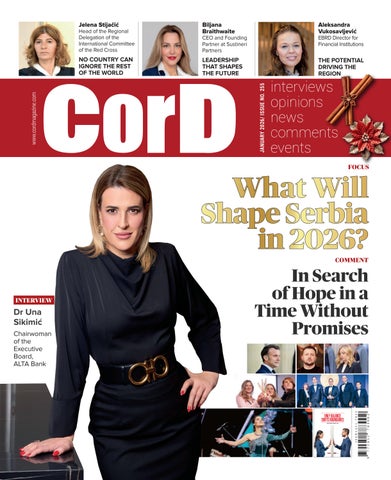
What Will Shape Serbia in 2026? COMMENT
EMPOWERED WOMEN 2026
783002
ONLY BALANCE SHIFTS BOUNDARIES
771451
Chairwoman of the Executive Board, ALTA Bank
9
Dr Una Sikimić
ISSN1451-7833
INTERVIEW
In Search of Hope in a Time Without Promises
ONLY BALANCE SHIFTS BOUNDARIES
Contents
EMPOWERED WOMEN 2026
40 T HE ESTONIAN 06 I N SEARCH OF HOPE
IN A TIME WITHOUT PROMISES
20 NO COUNTRY CAN
WHO REWROTE THE RULES OF GLOBAL MONEY
JELENA STIJAČIĆ
TAAVET HINRIKUS
IGNORE THE REST OF THE WORLD
84 ROYAL INSIGNIA THROUGH THE CENTURIES
Co-founder of Wise
Head of the Regional Delegation of the International Committee of the Red Cross
90 A LIFE SHAPED BY LINE
DRAGANA OGNJENOVIĆ
08 W HAT WILL SHAPE
83 A RT AS A SPACE OF
SERBIA IN 2026?
24 I NTEGRITY AS A
FOUNDATION OF SUCCESS
Painter, Fashion Designer
RESPONSIBILITY
MIROSLAV KARIĆ
Curator and Coordinator, Museum of Contemporary Art Belgrade
Dr UNA SIKIMIĆ
Chairwoman of the Executive Board, ALTA Bank
96 C HILL OUT 98 F ASHION 100 C ULTURE CALENDAR 102 F ACES & PLACES
“CorD - 23 Years of Independent Thought and Inspiration”
CorD_Magazine cordmagazine thecordmagazine cordmagazine
DESIGN: Slađan Radosavljević Zoran Perović design@aim.rs COPY EDITOR: Mark Pullen
cordmagazine The views expressed in this publication are those of the presenter; they do not necessary reflect the view of publications published by alliance international media
04
EDITOR IN CHIEF: Neda Lukić n.lukic@aim.rs
january
TRANSLATION & EDITING: Pullen Editorial, Halifax
CONTRIBUTORS: Ljubica Gojgić Zoran Panović Radmila Stanković Maja Vukadinović Mirjana Jovanović Miša Brkić, Rob Dugdale Steve MacKenzie Zorica Todorović Mirković Sonja Ćirić, Miloš Belčević
SALES MANAGERS: Biljana Dević b.devic@aim.rs Mihailo Čučković m.cuckovic@aim.rs Vesna Vukajlović v.vukajlovic@aim.rs OFFICE MANAGER: Svetlana Petrović s.petrovic@aim.rs FINANCE: finance@aim.rs
PRINTING: E-mail: office@aim.rs CEO: office@cordmagazine.com Rotografika d.o.o. Ana Novčić a.novcic@cordmagazine.com Segedinski put 72, Subotica www.cordmagazine.com www.aim.rs CorD is published by: PUBLISHER: ISSN no: 1451-7833 alliance international Ivan Novčić All rights reserved media d.o.o. i.novcic@aim.rs alliance international media Resavska 1/III, 2026 11111 Belgrade 17, PAK 125806, Serbia Phone: +(381 11) 2450 508
COMMENT
In Search of Hope in a Time Without Promises “If we fail to look at one another truthfully, nothing will protect us.” (inspired by the Nobel Lecture of László Krasznahorkai)
he end of the year always prompts us to pause and take stock, to look at the world with a measure of distance. Yet this year, that gesture feels more demanding than usual. The year ahead begins at a moment when political crises deepen faster than they can be resolved, societies polarise more quickly than they can unite, and trust evaporates more easily than it can be rebuilt. It is against this backdrop that the words of Hungarian writer László Krasznahorkai, delivered in his Nobel Lecture, resonate far beyond literature. Krasznahorkai speaks of angels — but not the messengers who once brought news, protection or revelation. He speaks of silent angels, present yet without a role, angels who carry no message and perhaps no purpose. They do not arrive to save us; they simply stand before us, waiting for us to take the first step, to recover the capacity to truly see one another. His metaphor is uncomfortably contemporary: the world does not suffer because it has
T
06
january
László Krasznahorkai at the Nobel Prize Museum in Stockholm, 6 December 2025. © Nobel Prize Outreach. Photo: Clément Morin
lost its saviours, but because it has lost its sense of responsibility. Krasznahorkai reminds us that humanity once created entire worlds — language, meaning, the rhythm of time, community. Today, however, we inhabit a landscape where noise has replaced understanding, speed has overtaken reflection, and algorithms have encroached on our imagination. In such a world, hope does not disappear because circumstances have become darker; it disappears because our ability to imagine it has weakened. It is at this point that his lecture stops being literary and becomes existential. Not because it offers solutions, but because it insists on recognition — that simple, yet increasingly neglected human act of acknowledging the other. “If we fail to look at one another truthfully, nothing will protect us.” In that sentence lies both Europe’s history and its current state of mind. It reminds us that the crisis of trust is deeper than any crisis of geopolitics; that fractures within societies can be more dangerous than fractures between institutions. And that, as with Krasznahorkai’s silent angels, the greatest threat may not be external noise, but the inner quiet created by exhausted imagination and diminished solidarity. As we enter 2026, the world confronts questions that can no longer be postponed: How do we restore confidence in democratic processes? How do we mend societies fatigued by uncertainty? How do we reconcile global ambitions with local anxieties? How do we live with the knowledge that security can no longer be taken for granted?
Yet despite this, Krasznahorkai’s lecture does not leave us in despair. His pessimism is never passive; it urges a quiet form of mobilisation. If the angels have fallen silent, he suggests, perhaps it is time for us to speak. To recover the courage to pause, to observe, to recognise, to listen. To reclaim responsibility for the world we are shaping — and the world we will leave behind. The end of the year is therefore not merely a moment of reckoning, but a moment of decision.
For hope, as one of the most distinctive voices of contemporary literature reminds us, never arrives on its own. It comes only when we dare to create it Will we enter 2026 expecting someone else to restore hope, or will we begin to create it ourselves? If we choose the latter, then perhaps we too — like Krasznahorkai’s still, unguarded angels — may rediscover a way to elevate our own humanity above fear, uncertainty and exhaustion. For hope, as one of the most distinctive voices of contemporary literature reminds us, never arrives on its own. It comes only when we dare to create it.
FOCUS
WHAT WILL SHAPE SERBIA IN 2026?
Serbia at a Crossroads What follows in 2026 will depend on whether Serbia can transform protest into policy, awakening into direction, and crisis into a catalyst for change orD therefore invited leading voices from economics, culture, civil society, academia and European affairs to reflect on the forces that defined the past year and to articulate the expectations, uncertainties and responsibilities that will shape the one to come. Their perspectives do not offer a single narrative; rather, they reveal a shared understanding that Serbia’s future now hinges on accountability, institutional integrity and the civic energy that emerged with uncommon clarity in 2025.
C
08
january
FOCUS
Dejan Šoškić Economist, Professor at the Faculty of Economics, University of Belgrade
No Growth Without the Rule of Law Falling investment, stalled economic activity and deepening political crisis demonstrated a simple truth: prosperity requires institutions that serve the Constitution, not power
he past year in Serbia was one in which citizens largely recognised the need to stand up in defence of the Constitution, the law and institutions — in other words, in defence of the Republic itself. The tragedy in Novi Sad triggered wide public protests and, above all, extensive and persistent student demonstrations demanding lawful and efficient institutional action in prosecuting those responsible for the deaths of sixteen citizens and the permanent disability of one citizen of Serbia. Public pressure, driven predominantly by these student protests, together with civic activism and expert testimony, exposed unconstitutional and unlawful behaviour by individuals at the highest levels of political power, as well as strong indications of possible corruption and incompetence in procedures that may have directly contributed to the tragedy. Students, as educated young people, clearly understood that despite broad public pressure, institutional processes were not moving towards meeting their demands — that institutions still largely failed to act in line with the Constitution and the laws of the country, and that responsibility for this lay in the political capture of state structures. It was therefore natural that students called for elections, a demand that citizens overwhelmingly supported, expressing this support through mass and persistent gatherings across Serbia, including some of the largest assemblies ever held in Belgrade and Novi Sad. In normal countries, far less than what occurred in Serbia during the past year would have led to elections as a way to overcome an obvious political crisis. In Serbia, however, elections have for a dec-
T
ade been conducted in an unconstitutional manner, marked by direct violations of the right to free voting and free access to information. Moreover, the current political structure has clearly refused to call elections, thereby prolonging both the political and broader social crisis. The past year was another “lost year” for Serbia, characterised by the absence of the rule of law and extremely weak — even “captured” — institutions. It is therefore unsurprising that investment fell and economic activity slowed in 2025. Acemoglu, Robinson and Johnson received the 2024 Nobel Prize in Economics for demonstrating that strong institutions are the foundation of economic development
Strong, impartial institutions are not a luxury — they are the foundation on which Serbia’s development in 2026 must decisively stand and national prosperity. The good news is that solutions to Serbia’s economic problems do exist. The key expectation and challenge for 2026 is for Serbia, through the outcome of political elections, to return peacefully to respect for the Constitution and the law at all levels, and to ensure efficient, competent and impartial institutional work in the public interest and in accordance with legality. This is the necessary foundation of any accelerated and sustainable development.
cordmagazine.com
09
Photo Marko Krunić
FOCUS
Borisav Matić Theatre Critic and Dramaturge, Former Member of the Artistic Directorate of the 59th Bitef Festival
Resistance as a Blueprint for What Comes Next Ne:Bitef shows how the cultural sector builds its own institutions when official ones collapse under political pressure
he cultural scene entered 2025 with wholehearted support for the newly formed student movement and by joining the wider civic uprising. Actors appeared at curtain calls with raised, bloodied palms; parts of the cultural workforce launched brief strikes or work stoppages — just a few among many expressions of protest. The year, however, draws to a close under the weight of brutal repression and governmental retaliation. Funds for cultural institutions have been drastically reduced, politically motivated dismissals have become standard instruments of punishment, and open censorship a tool of control. For the first time since their founding, several major national festivals will not take place, with the institutional Bitef being only one of many examples. Yet the spark of hope ignited by students has not been extinguished. Instead of submission, the cultural sector responded with solidarity and self-organisation. Once the possibility of critical engagement within institutions was shut down, cultural workers sought alternative ways to articulate their resistance. The clearest example is ne:Bitef, held from 15 to 18 December across several Belgrade venues. Organised by a coalition of domestic and international theatre practitioners, the event delivered a resounding “no” to censorship and preserved — through an alternative, independent, guerrilla edition of Bitef — the untamed, dangerous and rebellious spirit of our most important international festival. Ne:Bitef demonstrates that, rather than passively observing the takeover of institutions, we must, through pro-
T
10
january
active resistance, build parallel institutions shaped by the needs of the community. The greatest strength of Serbia’s heterogeneous anti-regime movement lies in its foundation of care and solidarity. Student assemblies and citizens’ councils emerged precisely when institutions of a supposedly democratic society were hijacked and repurposed into instruments of maintaining power. Ne:Bitef and other forms of alternative cultural action simply followed their lead. There is little doubt that a politics of care will ultimately triumph over the politics of blunt force; the only question is how long it will take and how painful the journey will be for all of
The task for 2026 is to turn solidarity into structure — to ensure that the care forged in resistance becomes the foundation of new, accountable cultural institutions us. Yet even once that victory is achieved, our work should not end. Our ambition must be to ensure that the politics of care does not remain merely a tool of the marginalised against tyranny, but becomes an institutionalised principle of a new, more egalitarian society. In other words, that assemblies and councils serve not only as mechanisms of resistance, but as models of governance — and that every future official Bitef follows the rebellious spirit first reclaimed by ne:Bitef.
FOCUS
Darko Tomović Actor and President of the Serbian Actors’ Union
A Year Closer to a Freer Serbia We at the National Theatre hold the line every day, refusing to let our strength falter. We work for better days — for a society in which education and culture finally receive the dignity they deserve, because they are the foundation of a healthy nation capable of critical thought
s someone whose personal and professional life spans more than four decades, I can say with certainty that this year ranks among the most difficult in the past half-century. We lived through the collapse of the SFRY and its long aftermath; 1999 and the NATO intervention; and 2003, with the assassination of Prime Minister Đinđić — a moment that briefly offered hope to an exhausted nation. Then came the further fragmentation of the country, through the separation of Montenegro (constitutionally) and Kosovo (in a way that still raises questions). All of this has culminated in the political order that has held power in Serbia since 2012. This year represents the apex of its consequences: impoverished and frightened citizens, numbed by the grinding wheel of history, convinced they cannot change anything; people existentially anxious, fearing what tomorrow may bring. Opposite them stands an amalgam of the worst elements found in any society: predatory politicians, a criminal underlayer directly tied to them, and — as the final injury — a newly manufactured “academic” elite adorned with colourful diplomas from phantom “universities”. When it comes to culture, it is enough to mention a single budgetary figure: 0.67%. And to add that voices within the ruling structure claim even that is too much.
A
The little money available for cultural production is awarded exclusively to “their” people among us. That is the full picture. And yet, the bleakness of this year has one bright side: the awakening, the growing consciousness of an ever-larger number of citizens, fuelled by student and civic action. It is a spark of hope, and it is gaining strength. My sense is that the time until change arrives is shortening by the day.
The awakening that began on the streets must, in 2026, mature into lasting civic resolve — a sustained insistence on dignity, culture and a society governed by reason, not fear We at the National Theatre work towards that moment continuously. We do not allow our resolve to break. We work for better days — for a country in which education and culture hold a dignified place, because they are the pillars of a society capable of reasoning, of questioning, of imagining something better. Until then — here’s to 2026.
cordmagazine.com
11
FOCUS
Marija Milinović Student
Serbia Can — and Must Become a Free Society The student protests of 2025 transformed unrest into hope — marking the rise of a new generation shaped by responsibility, courage and a refusal to accept a state without accountability
he year 2025, to me, marks a moment in which Serbia stands between two worlds — one still shaped by political instability, economic stagnation and institutional decay, and another emerging on the streets, in lecture halls and in the hearts of students who, for the first time in decades, rose en masse in defence of dignity and rights. As someone who participated actively in the protests, I can say with certainty: this was a year of profound societal awakening. The student movements of 2025 brought something Serbia had long been missing — a clear awareness that change is neither quick nor easy, yet undeniably possible. What defined our experience was the stark inconsistency of institutional action: police who remained passive when members of the ruling party assaulted students, yet acted against peaceful demonstrators; a system that absolved those who violated the law, and a president who publicly defended them. And yet, despite these injustices, the protests became a space where a generation realised it would no longer accept a society in which force overrides the rule of law. It is equally important to note that these protests were not orchestrated by any political party. Quite the opposite — the streets became a meeting point for both left-leaning and right-leaning voices, interacting in a surprisingly balanced and constructive way that revealed a shared core of values: freedom, justice, order and a desire to belong to a modern European society. Traditional symbols that appeared at
T
12
january
the protests were not opposed to European ideals, but rather became part of a new synthesis — one that embraces identity while striving for a functional, lawful and normal state. This is why I describe 2025 as both a year of resistance and a year of hope. Despite the difficult political landscape, economic uncertainty and institutions frequently misused for partisan aims, something essential happened — Serbia woke up. We became one year closer to freedom, one year closer to a European-style society governed by rules, not by the impulses of individuals.
The greatest test of 2026 will be whether Serbia’s newly awakened civic energy can remain organised, principled and persistent enough to reshape daily life and public institutions The greatest challenge for 2026 will be ensuring that this awakened civic consciousness remains consistent, organised and persistent. That the energy of the streets flows into institutions, local communities and everyday life. If we succeed, it will become clear that these protests — born under the most unfavourable government — ultimately produced something profoundly positive: the conviction that Serbia can, and must, become a free society.
FOCUS
Prof. Dr Nebojša Bojović Vice-Rector for International Cooperation, University of Belgrade
Where Serbia’s Future Begins The university remains a space from which the most important social changes originate, while 2026 carries expectations of stabilisation, clearer strategies and more accountable governance
he year 2025 has indeed opened a series of difficult questions for our society – from economic stagnation, declining investment and political uncertainty to challenges in energy security and the disruption of cultural institutions. At the same time, the powerful voice of students and their mass awakening demonstrated that the university is still the place from which essential social change begins. The academic community has always been, and remains, the bearer of positive trends in Serbia, because within it grows a generation unafraid to ask questions, demand accountability and believe in a better society. From the perspective of international cooperation, these challenges have only strengthened our ties with partners across Europe and the world. Despite uncertainties, we see no decline in the interest of foreign universities in joint projects, exchanges and research. On the contrary – it is precisely in complex periods that bridges of knowledge, trust and professional solidarity grow stronger. This gives me well-founded optimism when I consider Serbia’s future – but only under one condition: that we do not expect key changes to come from outside, but take responsibility for initiating and implementing them ourselves as a society.
T
For 2026, the most important expectation is stabilisation and a clearer strategic direction for the country, especially in areas that influence education, research and international cooperation. The greatest challenge will be retaining young and talented people, providing them with the opportunities they deserve, and demonstrating that Serbia is
A generation unafraid to question and demand accountability gives 2026 a rare potential — but only if that courage is matched by strategic leadership and responsible governance a place where one can create, research and live with dignity. The University of Belgrade, as the country’s most significant scientific and educational institution, stands ready to take an active role in this process and to use its knowledge and integrity to help ensure that 2026 becomes a year of more responsible decisions and visible steps forward.
cordmagazine.com
13
Photo Marija Janković
FOCUS
Prof. Slobodan G. Markovich Faculty of Political Science and Institute of European Studies
Europe Moves Forward Serbia Stands EU candidate countries are moving toward Brussels. Serbia remains stranded at a station called Nowhere
ince the democratic changes in 2000, all the governments of Serbia have repeated their commitment to pursuing EU membership. Various factors inherited from the 1990s slowed down this process, but even the victory of pro-Russian presidential candidate and the government change in 2012, did not influence Serbia’s commitment to EU integration. Now and again the EU reports repeated Serbia’s good administrative capacities. Indeed, in the period 2015-2021, Serbia opened 22 out of 35 chapters in the process of negotiations with the EU. The end of 2021 was the moment when further advancement was stopped. Serbia’s repeated rejection to align its foreign policy on Russia with Brussels made all EU prospects of Serbia clinically dead. The Student Protest and increasing sympathies of MEPs for the main aim of the Protest, which is to make institutions in Serbia functional, further alienated the Serbian regime from Brussels. This alienation culminated in the resolution of the European Parliament adopted on October 21, 2025. It represents the most exceptional document in the history of Serbia’s relations with the EU. It includes 31 points. It is sufficient to quote point 4 here which “holds the Serbian leadership politically responsible for escalating repression, normalising violence and weakening democratic institutions.” Five points of the resolution begin with the phrase “condemns”, and one with “strongly condemns”. Obviously, Serbia’s chances to advance in EU integration now depend also on meeting demands from
S
14
january
this resolution. However, the acceptance of the demands would for the Serbian regime be equal to undermining itself. In other words, no EU integration of Serbia seem possible unless the Serbian regime dramatically changes itself which is highly unlikely for any regime categorised as “autocratizing hybrid”. In 2019 Serbia was slightly legging behind Montenegro and was the second in row in terms of candidate countries’ EU prospects. Democratic backsliding, close relations with China, and refusal to impose even minor sanctions against Russia, gradually but persistently marginalised Serbia. At the
Democratic backsliding and foreign-policy misalignment have pushed Serbia to the margins of EU enlargement summit of the European Political Community, in May 2025, in Tirana, Albania secured a place of a front runner and got closer to Montenegro in terms of EU prospects. Ukraine and Moldova, as countries directly endangered by Russia’s aggression, are expected to be granted an accelerated path to the EU. Thus, top four EU candidate front runners emerged. This left Serbia’s leadership at the train station called Nowhere, or, to phrase it in EU terminology, Serbia’s EU prospects have been, for the time being, “opted out”.
FOCUS
Sneška Quaedvlieg-Mihailović Secretary General of Europa Nostra
Reclaiming Europe’s Cultural and Moral Compass Europe must treat its cultural and democratic foundations not as relics of the past, but as strategic assets for peace, resilience and a renewed sense of belonging and common purpose; this vital responsibility belongs equally to institutions, leaders and citizens n moments of fears and uncertainty caused by a mega-crisis, societies reveal what they truly value. Over the past year, travelling across Europe and speaking with communities, heritage experts, political and civic leaders and young people, I have felt a growing awareness that our cultural and democratic foundations cannot be taken for granted. Europe is at a crossroads, and the directions we take now will shape the future of our shared civilisation and of the entire European project. This is why Europa Nostra has been calling for a renewed European commitment that sees culture (both arts and heritage) as a pillar of peace and sustainable development. In a world marked by polarisation and the normalisation of violence, Europe must reassert its cultural and moral leadership. We therefore applaud the vision and the ambition of the “Culture Compass for Europe”, a strategic document recently published by the European Commission. Civil society has a decisive role to play. Through Europa Nostra, I have witnessed communities saving endangered monuments, young people reclaiming public spaces and experts helping restore what neglect or conflict has damaged. These actions are not peripheral — they are the heartbeat of Europe. Many of these actions were recognized by the European Heritage Awards organised jointly by Europa Nostra and the European Commission. The recent massive expert and civic mobilisation in defense of Belgrade’s Generalštab, a protected Modernist masterpiece, has shown how deeply people care about their public spaces. When citizens (including students) defend the Generalštab, they defend more than a building: they defend the rule of law, and the principle that public interest and cultural value must not be sacrificed to short-term private profits. For this reason, Europa Nostra Serbia, with the support of the EU
I
Delegation in Belgrade, presented this year’s Heritage Heroes award to the students of architecture and applied arts dedicated to the protection, promotion and contemporary interpretation of Serbia’s modernist architectural heritage, with a focus on Generalštab. The recent withdrawal of a prominent foreign investor from the controversial redevelopment project — coming amid serious corruption charges against senior officials —is a clear result of this vital mobilization and a stark reminder that the rule of law and cultural stewardship stand or fall together. The Generalštab case has thus become both a warning and an opportunity: a test of whether we are willing to defend the values that define Europe and Serbia’s rightful place in Europe.
The Generalštab is not merely a building — it is a test of whether we are willing to defend the values that define Europe and Serbia’s rightful place in Europe The broader debate reveals another truth: heritage is most vulnerable when institutions fail to act with clarity, consistency and respect for due process. Too often, short-term politics overshadow long-term vision. Yet the challenges before us require patience, competence and integrity — and leaders who understand that public trust is earned through accountability and a genuine commitment to the common good. I remain convinced that a better and more visionary Europe is possible. A Europe that safeguards its heritage with care and pride, invests in culture as a strategic asset and empowers its citizens — especially young people — to shape together a better, peaceful and sustainable future.
cordmagazine.com
15
FOCUS
Zoran Hamović Director and Editor-in-Chief, Clio Publishing House
The Threshold of a Cultural Renewal Awakened students, renewed civic energy and rising interest in socially relevant books could form the basis of a renaissance in intellectual life. With social stability and adequate public support, this potential could be transformed into the cultural and publishing development we aspire to he student protest acted as a catalyst for the cultural sector – actors, publishers, writers, curators, directors, professors – to join the public dialogue and the uprising itself. The most prominent artists and cultural figures voiced their support for educators, from primary schools to universities, as well as for students engaged in faculty blockades. A spontaneous generational response to accumulated social injustice evolved into a politically unexpected form of civic mobilisation. I would not be exaggerating to say that it represents the most significant expression of public resistance in the past decade. The movement introduced a fresh, direct and non-violent language, free from party rhetoric, reshaped the themes of responsibility, abuse and the public good, and created space for a “political culture of decency and argument”, long absent from public life. For the publishing sector, 2025 was a year of reduced business opportunities but heightened social engagement. Many publishers and their associates became key voices in public debate, often assuming the role of critical observers in an increasingly tense and restricted media environment. The character of 2025 in publishing could best be described as a year of resistance: numerous publishers renounced institutional support due to manipulated procurement conditions for library acquisitions and the neglect of investment in major editions. The most important expectation for 2026 is a post-election stabilisation of social conditions, the establishment of
T
16
january
a coherent cultural policy, the application of transparent public funding models and open competitions, as well as stronger participation in European and regional cultural events, literary festivals and book fairs. The greatest challenge in 2026 will be the survival of medium-sized and small publishing houses amid declining purchasing power and potential energy or social shocks. Should current trends continue, deeper crisis, shortages and accelerated social polarisation are likely. Under such circumstances, books will certainly not be among consumer priorities.
Publishers enter 2026 facing mounting economic and social pressures — yet civic engagement and renewed interest in meaningful books may still ignite a quiet cultural revival And yet, there is reason for cautious optimism. Awakened students, renewed civic energy and a growing interest in socially relevant books may form the foundation of a renaissance in intellectual life. With social stability and adequate public support, this potential could be transformed into the cultural and publishing development we seek.
FOCUS
Zorana Đaković Minniti Deputy Director for Programmes, Cultural Centre of Belgrade
What’s Left and What Comes Next With the abolition of the artistic director, the absence of a new board and no conditions for planning, the October Salon has entered the deepest institutional crisis in its history he past year has been exhausting for all individuals, associations, institutions and programmes that critically examine and challenge global neoliberal tendencies, wars and the current political system. Almost every decision and every solution – whether concerning competitions or appointments – has demonstrated power rather than support. Most cultural activity this year unfolded on the streets, in silence, in the Liberated SKC, at the Blockade FEST, within faculties and schools, in certain institutions such as the Belgrade Philharmonic and the Cultural Centre of Belgrade, in the so-called Liberated CCB, and through numerous initiatives across Serbia advocating for a more credible and transparent fulfilment of the social role of institutions and cultural events. It is important not to forget the professional efforts that ensured certain film festivals took place, that good practices were preserved, books translated and meaningful conversations continued. Yet the question of the position, future and significance of certain cultural manifestations – such as the October Salon, symbolically captured in the title of last year’s edition, What’s Left? – has become more urgent than ever. By the June 2025 decision on permanent cultural manifestations of significance for the City of Belgrade, and the adoption of a new rulebook, the position of Artistic Director was abolished, the previous Board’s mandate expired, no new Board was appointed, and the Cultural Centre of Belgrade – the long-standing organiser of the manifestation – was unable to begin preparations amid uncertain financial and social circumstances. The October Salon, one of the city’s most important manifestations of contemporary visual art, has since its inception been tied to 20 October 1945, the day Belgrade was liberated from fascist occupation. On that same date this year, a public statement was issued outlining the crisis now facing the exhibition. Our wish is to organise, at the beginning
T
of 2026, several joint programmes and actions with artists, collaborators and associations with whom we worked during the 59th October Salon. There is no viable way forward if we continue to operate from the perspective of Power and Authority. Thanks to the family library anarhija/blok 45, we were able this year to read translations of several essays by French sociologist and jurist Jacques Ellul, who argues that in non-power lies our strength – a path towards new forms of sociality, cooperation, action, expression, resistance, and new personal and communal styles essential for transforming our paradigm towards a more humane society. Those of us who operate within the system struggle to fully expose it, as we belong to it and often contribute to the illusion of its normality. Throughout 2025, the Centre for
What 2026 requires is decisive public investment, transparent cultural policy and collective resistance to every form of institutional decay — anything less would leave little worth preserving Theatre Research ApsArt, through a series of performances – including one staged in front of the Cultural Centre of Belgrade – directly addressed the tension between the desire for social change and institutions that are merely façades, inertly expecting someone else to enact that change. We should now have gained experiences that enable us, individually or collectively, to fight for certain changes in the future. For 2026, I expect a dramatically increased cultural budget, the repeal of all laws endangering this country’s cultural and natural heritage, different commissions, councils and boards, and far more solidarity as well as open resistance to all forms of incivility and anti-culture.
cordmagazine.com
17
Global Diary
“Neutrality is not indifference; it is a position that must be defended” Henry Kissinger
France Positions for a Fragmented Europe France stepped up diplomatic signalling as President Emmanuel Macron pushed the idea of European strategic autonomy ahead of major EU decisions in 2026. Paris is clearly preparing for a less cohesive Union and a more competitive leadership landscape. France wants to be the anchor when others wobble.
Italy Hardens Its Migration Policy Italy introduced tougher migration measures, reinforcing border controls and accelerating agreements with third countries. Rome insists the move is pragmatic rather than ideological. The decision places Italy at the centre of Europe’s most persistent political fault line.
EU Divided Over Long-Term Ukraine Support European leaders intensified discussions on long-term support for Ukraine, including funding mechanisms and defence coordination. Legal constraints and political divisions remain unresolved. The issue continues to test the EU’s credibility as a geopolitical actor. 18
january
“Politics is the art of the possible — and the responsibility of the necessary” Bruno Kreisky
Washington Signals Transactional Diplomacy The United States signalled a more transactional foreign-policy approach as President Donald Trump set the tone for his second term. Alliance burden-sharing and national interest were placed firmly at the centre. Global partners are adjusting expectations accordingly.
Switzerland Defends Neutrality Under Pressure Tanzania’s election handed President Samia Suluhu Hassan an overwhelming victory with 97.66% of the vote—but opposition parties had been barred from running. Reports of violence and intimidation cast a shadow over the results. The outcome raises fresh concerns about democratic backsliding in East Africa.
Austria Enters Political Recalibration Austria moved into a quieter phase of political adjustment as coalition dynamics and policy priorities shifted in late autumn. Vienna signalled continuity on EU alignment but greater caution on fiscal and migration matters. Its traditional role as a bridge-builder is under pressure. cordmagazine.com
19
INTERVIEW
EXCLUSIVE
No Country Can Ignore the Rest of the World The year 2025 was marked by overlapping humanitarian crises, each compounding the suffering of millions. Beyond Gaza, the Russia-Ukraine international armed conflict and conflicts in Sudan, Yemen and Syria have created some of the most complex and dangerous environments for civilians and humanitarian workers alike. Breaches of international humanitarian law, as well as arbitrary interpretations of its rules, remain our major concern ~ Jelena Stijačić Jelena Stijačić
Head of the Regional Delegation of the International Committee of the Red Cross By Ljubica Gojgić
e’re witnessing “widespread and serious violations of international humanitarian law”, says the Red Cross’s Jelena Stijačić in this interview for CorD Magazine. Stressing that the number of crisis hotspots around the world is on the rise, while technological advances are changing the way war is waged, she warns that there are ever more people in need of help, and at a moment when the global humanitarian sector is facing a serious financial strain. “The ICRC isn’t immune to these pressures. Like many humani-
W
20
january
tarian organisations, we’ve had to make difficult adjustments to ensure we can continue operating responsibly,” says Stijačić.
Mrs Stijačić, 2023 marked the 160th anniversary of the International Committee of the Red Cross, while 2026 marks 150 years of the Red Cross of Serbia. Has Serbia remained committed to the ICRC’s foundational universal principles of humanity, impartiality and solidarity? — Over previous decades, Serbia has demonstrated a consistent commitment
to the universal principles underpinning the International Committee of the Red Cross and the wider Red Cross and Red Crescent Movement. This is reflected both in our strong partnership with the Red Cross of Serbia and in the willingness of state institutions to engage on issues of international humanitarian law (IHL), reforms, and the protection of victims of conflict. Serbian government representatives have repeatedly affirmed that respecting IHL remains a key strategic priority. While there is always room to strengthen knowledge of IHL, better
support vulnerable groups and address unresolved humanitarian issues from the past, sustained cooperation with the ICRC remains essential, particularly in our joint efforts on missing persons from the conflicts of the 1990s and assistance to those most in need. Together, these efforts show that the principles of humanity, impartiality and solidarity continue to guide Serbia’s institutions and society as a whole.
The ICRC’s work is grounded in IHL and based on the Geneva Conventions, which mandate humane treatment of the wounded and vulnerable in conflict areas. As we enter 2026, an unavoidable question arises as to whether these principles been violated on the battlefields of today, including Gaza? — As we move into 2026, we are unfortunately witnessing widespread and serious violations of international humanitarian law. Gaza has become a symbol of immense human suffering, while ongoing conflicts elsewhere continue to cause devastation on a scale not seen in years. Breaches of IHL, as well as arbitrary interpretations of its rules, remain our major concern. As a neutral and impartial humanitarian actor, the ICRC consistently reminds all parties in armed conflict of their obligations: to distinguish between combatants and civilians; to protect the wounded, the sick, prisoners of war and other vulnerable groups; and to allow unhindered humanitarian access. This is the only way to reduce the human cost of war. As ICRC President Mirjana Špoljarić has stated: “The Geneva Conventions are of vital importance, but they have become extremely vulnerable in com-
cordmagazine.com
21
parison to the reality on the ground. Political leaders must return to the principle that no country can simply ignore the rest of the world.” Since 1864, the ICRC has remained steadfast in its role as the initiator and guardian of the Geneva Conventions. Our responsibility is clear: to continue strengthening our ability to protect human life and dignity, and to uphold the values on which these conventions were built.
Apart from Gaza, where else around the world was the need for humanitarian action most urgent during 2025? — The year behind us was marked by overlapping humanitarian crises, each compounding the suffering of millions. Beyond Gaza, the Russia-Ukraine international armed conflict and conflicts in Sudan, Yemen and Syria have created some of the most complex and dangerous environments for civilians and humanitarian workers alike. Together with RC National Societies, we work to remain present precisely where needs are greatest, often in areas that are hardest to reach and where assistance is most urgently required. In 2026, our largest operation will be in the Middle East. The region demands our full attention, not only because of the immense humanitarian needs, but also considering dynamics that require close monitoring due to the possible wider impact. At the same time, the ICRC will continue to scale up its response in Africa, with Sudan as a priority given the level of displacement and violence. Ukraine will remain at the core of our operations in Eurasia, where communities continue to endure the consequences of prolonged conflict. Technological progress has led to new types of warfare. The ICRC participates in discussions on the use of new technologies in caring for the wounded, while also insisting on the need for psychological support for people traumatised by to-
22
january
day’s conflicts. In what other ways is the ICRC changing to meet the challenges of the times? — Technological change is reshaping not only the way wars are fought, but also how humanitarian organisations can assist people affected by them. Today’s conflicts involve cyberattacks and the use of artificial intelligence for military purposes, yet these same advances also offer new opportunities: faster ways to reach communities in need, improved telemedicine, digital tools to help trace missing per-
Serbia’s long-standing cooperation with the ICRC reflects a sustained commitment to IHL and protecting conflict-affected communities sons, and better systems to protect our staff in the field. In recent years, the ICRC has taken a more active role in global discussions on the responsible use of new technologies during conflicts, emphasising that the basic rules of humanity must apply equally in digital and physical spaces. At the same time, we are adapting our own organisation, focusing our resources on the most critical crises and using data more effectively, so that our work can be both more efficient and more humane.
One of the ICRC’s priorities in this region has been resolving the issue of persons missing since the wars of the former Yugoslavia during the 1990s. Although progress has been made, the work remains unfinished. How would you comment on this? — Missing persons remain among the most tragic legacies of the conflicts of the former Yugoslavia. While roughly three-quarters of the 40,000 people who went missing during the 1990s have been identified, the fate of over 9,000 individuals is still unknown. Be-
hind every number is a family living with decades of uncertainty, waking and sleeping with the same question - what happened to my loved one? Even when families have accepted the possibility of death, grieving without a body and the recognition of society continues to impact every aspect of their lives. The ICRC acts as a neutral intermediary where direct dialogue isn’t possible. We support national bodies with expertise, facilitate data search and information exchange, assist forensic investigations and promote regional cooperation. We also stand by families and their associations in their tireless quest for answers, focusing solely on humanitarian objectives – to uncover information that can reveal the fate of missing persons, whether alive or deceased.
OPERATIONS
ACCESS
RESILIENCE
In 2026, our largest operation will be in the Middle East
Humanitarian needs are immense, yet many areas remain hardest to reach where aid is most required
The humanitarian sector faces serious financial strain, while needs continue rapidly increasing
Every identification is a step forward, but progress is slow and time is the enemy of families. Resolving the fate of the missing isn’t only a legal duty, but also a moral one, essential to uphold human dignity, help families in their grief and contribute to lasting reconciliation and peace in the region.
The Red Cross of Serbia is actively engaged in discussions on care for the elderly and preventing discrimination against this segment of the population. To what extent
is ageing, and the growing share of older people globally, a challenge in the ICRC’s strategic planning? — While this isn’t a traditional focus of the ICRC’s mandate, the growing number of elderly people worldwide is an important consideration in our analysis and planning. The ICRC increasingly emphasises the need to take older people’s needs into account in humanitarian crises. We recognise and com-
Overlapping global crises, rising needs and shrinking resources reveal the growing fragility of humanitarian action today mend our colleagues at the Red Cross of Serbia for their dedication and the energy they bring to programmes that address these important issues.
During 2025, many international organisations that provide assistance to the population, starting with the United Nations, faced the questioning of the very need for their existence and work, while some also faced significant funding challenges. Have similar problems confronted the ICRC, which relies heavily on donations from the U.S. and the other wealthiest countries? — The global humanitarian sector is facing a serious financial strain. Needs are rising, more conflicts mean more people in need, while available funding isn’t keeping pace with reality. The ICRC isn’t immune to these pressures. Like many humanitarian organisations, we’ve had to make difficult ad-
justments to ensure we can continue operating responsibly. These decisions are never easy, as they can impact programmes at a time when people’s needs are massive. Our priority remains to assist those hit hardest by conflict, while strengthening the organisation’s financial stability in a challenging environment. We are taking steps to improve efficiency, streamline our operations and broaden our donor base, so that we can continue fulfilling our mission to protect and support people affected by armed conflict. This is of the utmost importance for us, as less funding means fewer people receiving humanitarian aid.
The start of a new year allows for some optimism regarding the future. Considering the events that marked 2025, do you look to the coming year with hope that it has to be better? — When you work in a humanitarian organisation, you cannot afford the luxury of pessimism. Every day brings difficult human tragedies, but also extraordinary moments of solidarity, courage and compassion. The events of 2025 have shown how quickly the world can slide into deeper crises, yet they have also shown how much difference a single act in support of humanity can make. I hope the coming year will open more space for dialogue, for respect of international humanitarian law and for rebuilding trust – between entities and within communities. For me, optimism isn’t a belief that everything will improve overnight - it is a choice to keep working, despite the challenges, so that the year ahead will be better for at least one person, one family or one community.
cordmagazine.com
23
CORPORATE
Integrity as a Foundation of Success Dr Una Sikimić Chairwoman of the Executive Board, ALTA Bank
ALTA Bank is part of the strong and expanding ALTA Group. With nearly five decades of tradition, built on experience and stability, the bank is setting new benchmarks in the sector through digital transformation, modern financing models and a strategic regional footprint LTA Bank is currently in a phase of accelerated development, guided by a clear strategy of modernisation and stronger market presence. Under the leadership of Dr Una Sikimić, the bank is advancing through a transformation that includes enhanced services, a strengthened organisational structure and entry into new markets. In this interview for CorD, she reflects on the key stages of that journey, the bank’s regional ambitions and the principles shaping contemporary financial leadership.
A
ALTA Bank is today recognised as one of the country’s most dynamic financial institutions, and your leadership has been central to its transformation. How would you describe the phase the bank is currently in – positioned between stable growth at home and an ambitious regional expansion? — ALTA Bank’s growth trajectory is exceptionally strong, with a clear market position in Serbia and a defined strategy for regional expansion. Our solid financial standing and consistent regulatory alignment underpin the investment cycle we are implementing. Every initiative is directed towards accessibility and high-quality service, based on understand-
24
january
ing clients’ needs and responding to market dynamics. We are widening our branch network, developing digital services, and introducing new products and financing models, while simultaneously executing our regional expansion plans. Our ambition is to connect financial systems and build a platform that supports long-term economic development across the region. This is the framework within which we shape the bank’s future.
ALTA Bank has successfully completed the acquisition of Stopanska Banka Bitola in North Macedonia. What does this integration mean for the bank and how will it influence its position within the regional financial ecosystem? — Stopanska Banka Bitola, now operating as ALTA Bank Bitola, brings a strong identity and long-standing tradition, much like ALTA Bank itself. This acquisition allows us to combine the bank’s experience and reputation with the regional potential of the ALTA Group, offering added value to the market. Our vision is to serve as a driver of integration – a financial partner that accelerates investment and contributes to a stronger economic platform for the region. We see this acquisition as a bridge between two economies, opening space for innovative products, digital services and financing models that improve client experience and enhance competitiveness. At recent industry panels, including those organised by ACI Serbia, you have spoken about the future of banking and the balance between digital channels and physical presence. How do you see the evolution of the client–bank relationship over the next decade, especially in terms of trust, personalisation and service speed? The future of banking rests on the synergy of digital efficiency and physical accessibility. Clients expect instant service, transparency and personalised solutions. Digital channels will dominate transactional operations, while branches will remain essential for advisory services and more complex financial decisions. Our model is “high-tech, high-touch”: technology that saves time, paired with human interaction that builds trust. By 2030, I expect full integration of AI into core processes, while keeping the elements that provide clients with reassurance and a sense of partnership. Leaders of the new banking era will be those who connect advanced technology with a deep
understanding of customer needs. The future belongs to banks that allocate resources precisely, offer digital solutions tailored to every user and build strategic alliances with technology companies. These principles underpin ALTA Bank’s sustainable growth, combining agility, speed and security across all channels.
ALTA Bank was a partner of the regional conference “Women’s Entrepreneurship – Towards EXPO 2027”. What kind of support do women in business most often seek from the banking sector, and how is ALTA Bank responding?
The future belongs to banks that allocate resources precisely, introduce digital solutions tailored to every user and build strategic alliances with technology companies — Women entrepreneurs primarily seek access to capital, flexible financing models and knowledge that enables them to scale their businesses. ALTA Bank has recognised these needs and developed products that improve access to finance, complemented by mentoring and educational programmes. Our aim is to remove barriers and create an environment in which women can build resilient enterprises. Partnerships with conferences and initiatives that support women’s entrepreneurship form part of a wider strategy. We want women to have equal access to resources and opportunities for growth, as this strengthens both inclusivity and economic resilience. ALTA Bank is one of the few institutions in the region committed to gender equality through its membership in the UN Global Compact and the Women’s Empowerment Principles, confirming our dedication to creating equal opportunities.
As a leader in finance, you often emphasise the importance of clear strategy and integrity in decision-making. Looking back, what would you identify as one of the pivotal decisions that shaped your professional path? — Leadership requires a clear vision, consistency and the ability to make decisions with
long-term impact. Throughout my career, I faced challenges and moments of change that demanded careful consideration and commitment. Choosing the more complex path has always opened space for progress, and that remains a guiding principle today — decisions must carry responsibility and lasting value. One of the most significant decisions was initiating major changes across key areas of the bank’s operations over five years ago — from redefining our business model and reorganising the system to redesigning processes and improving client communication. That cycle of continual reassessment, adaptation and innovation has remained constant. What worked yesterday, we reassess today to ensure it is the best answer for tomorrow. This requires strategy, clarity and unwavering implementation. Seeing today’s results confirms that this decision shaped not only my professional journey, but also ALTA Bank’s position as a modern and regionally relevant institution. Vision, consistency, responsibility and commitment — that is the formula for success.
What inspires you personally – what reminds you, even in the most demanding periods, why you love your work? — Creating new value for clients, colleagues and the wider community is the essence of this profession. I see banking as a driver of development — the bloodstream of the real economy. Each year brings new ideas, fresh perspectives and shifts that push us to rethink and advance our approach. In that continuous evolution lies the opportunity to introduce innovations that make banking more efficient, accessible and sustainable. Our work fuels investment, generates employment and supports economic growth. When I see measurable results, I know we are on the right path. A bank is a complex organisation requiring deep understanding, maturity and careful management of the risks inherent to financial institutions. Success also means consistently creating changes that ultimately improve client satisfaction, ensuring longevity and proper market valuation. Knowledge as a catalyst and work as the basis of progress — these are the principles that guide me daily. I draw strength from the energy, dedication and professionalism of the people I work with. That shared vision and team spirit confirm the unique value of this profession.
cordmagazine.com
25
Volunteers for Nature
With the Support of the European Union, Serbia’s Protected Areas Gain Permanent Volunteer Groups ith the adoption of the Nature Restoration Law in 2024, the European Union launched the largest nature restoration program in its history.
W
The European Union (EU) Member States have committed to restore at least 30 percent of degraded ecosystems by 2030, and as much as 90 percent by 2050. It is no longer enough to merely protect nature; it must be restored, the European Parliament emphasized. All Member States are preparing their national plans and budgets. As a candidate country for EU membership, Serbia closely follows the new legal framework and EU legal practice. Civil society, through the work of Coalition 27, monitors and oversees the work of institutions in aligning domestic legislation with EU standards. This Coalition recently (on November 20) presented its 12th Shadow Report on Serbia’s progress in Chapter 27 “Environment and Climate Change,” and the conclusions of the expert team are not optimistic.
“It seems that problems in the field of environmental protection, i.e. those related to Chapter 27, have been the same for years: delays in drafting and implementing regulations, weak oversight, lack of sanctions for irregularities, and lack of political will to address problems in a systemic way,” says Tanja Petrović, Executive Director of Young Researchers of Serbia, a member of Coalition 27.
26
january
Young Researchers of Serbia, in partnership with the organizations Environment Engineering Group from Novi Sad and Team 42 from Leskovac, began work earlier this year on a three-year project aimed at actively involving citizens in nature restoration. The project is called “Volunteers for Nature,” financially supported by the EU, and
tion of volunteer groups reaches as many interested citizens as possible. The greatest reliance is on young people, but there is also growing interest from the corporate sector in organized participation in such actions. For the first time, during this project, older citizens, pensioners, will be systematically engaged, to present to them all the benefits of volunteering in nature.
“With the adoption of the Nature Restoration Law, the European Union has made it clear that protection alone is no longer enough - nature must be restored. That is why I find it particularly important to see projects in Serbia that follow this approach. The establishment of permanent volunteer groups in protected areas is an excellent example of how citizens can become part of this process.
within the project cooperation is planned with two national parks, Fruška Gora and Đerdap, as well as with a protected natural area in southern Serbia, Sićevo Gorge . The goal is to form permanent volunteer groups for each of these protected areas, which will later participate in protection or restoration actions. Volunteer programs will be prepared for each area, and campaigns will be organized both nationally and locally, so that information about the forma-
Volunteering in nature brings a double benefit: it contributes to the preservation and restoration of ecosystems, while also strengthening communities, connecting people, and giving them the sense of being part of something greater.”, says Plamena Halacheva, Deputy Head of the EU Delegation to Serbia. Young Researchers of Serbia have for years cooperated with companies through corporate volunteering programs and record growing interest from enterprises to link their Environmental, Social, and Governance (ESG) and Corporate Social Responsibility (CSR) goals with concrete activities in nature.
Business Dialogue LEADERS’ MEETING POINT
How BIG Redefined Retail in 2025 LEV WEISS CEO, BIG CEE
28
Malaysia as Southeast Asia’s Technology Bridge to the Balkans
32
Setting New Legal Benchmarks BOGDAN GECIĆ
Founding Partner, Gecić Law
35
cordmagazine.com
27
How BIG Redefined Retail in 2025 Lev Weiss CEO, BIG CEE
With a series of strategic acquisitions and new retail park openings, BIG CEE strengthened its position as one of the key retail players in Serbia and the wider region. The company’s expansion created more than 1,000 new jobs and set new benchmarks for market growth
n a year marked by both challenges and significant progress, BIG CEE delivered strong results and continued the rapid expansion of its retail network. CEO Lev Weiss reflects on one of the company’s most dynamic periods, during which bold investments and steady development shaped the retail landscape across Serbia and the region.
I
The year 2025 was extremely intense for BIG. You rebranded the former Promenada into BIG Fashion Novi Sad in April,
28
january
and in the second half of the year you opened three new centres in Serbia. How challenging was this, and how would you describe the year in one word? — The past year was the most dynamic yet for BIG in Serbia. We entered 2025 with a clear ambition for growth, beginning with the rebranding of one of the country’s most significant shopping malls — BIG Fashion Novi Sad. From September onwards, in just 56 days, we opened three new retail parks in Čačak, Šabac and Bor, strengthening our presence across the country.
This pace demands discipline, strong team coordination and clearly defined processes. Opening three centres in such a short period was a real stress test for our system, but it demonstrated the strength and alignment of the organisation. We invested roughly €60 million in these projects, and initial results already confirm that the decisions were right. If I had to describe the year in one word, it would be vision. Everything we achieved stems from long-term strategy, a clear plan and the people who implement it every
day. The results are visible immediately — through footfall, tenant performance and consumer feedback.
You manage a portfolio of 20 assets in Serbia and Montenegro. Are you considering new markets, and where do you see BIG in five years? — Today, we operate a portfolio of 20 assets — 18 shopping centres, one mixed-use project and one office building. Seventeen of our shopping centres are in Serbia, including the only two open-air lifestyle projects in the market. And our growth will certainly not stop there. In Serbia, we remain open to new opportunities and plan to expand several of our existing centres, along with a few additional surprises. In Montenegro, we have secured a zoning change for the extension of our Podgorica mall — a development that will position it
expand into cities where they previously had no presence. How do you assess BIG’s impact on local economies? — Opening more than 100 stores is a significant achievement, but equally important is enabling brands to enter cities where they had not been present before. A strong example is Eastern Serbia, where the opening of BIG Bor retail park has completely transformed the region’s retail landscape. Similarly, IKEA in Čačak is now accessible to consumers in central Serbia — one of the most sought-after retail offers on the market. We also opened the only cinemas in Čačak and Šabac, as well as Fashion&Friends, Buzz and many other brands. Moreover, we introduced a modern culinary experience previously unavailable in these cities. At first, many tenants were surprised by the level of vision and investment in cer-
Our impact on local economies is tangible and multidimensional: we create jobs, bring new brands, increase competition and contribute to the development of regions and communities among the most modern in the region — and we are preparing a new retail park project in Nikšić. As for new markets, we will soon launch a project in Shkodra, Albania — one of the region’s fastest-growing economies and a highly promising landscape for BIG’s further expansion. We also expect to develop several retail parks there. In five years, we see BIG as the undisputed regional leader — a company that sets retail standards and a brand recognised in every household for delivering the best shopping experience and a wide range of free activities for visitors.
This year, more than 100 stores opened within your newly launched centres. While most tenants are not new to the market, it is significant that BIG enables them to
tain locations, but we believed in these cities — and early performance shows that belief was justified. Results have been strong from day one, and the potential for further expansion is considerable. Our impact on local economies is tangible and multidimensional: we create jobs, bring new brands, increase competition and contribute to broader regional and community development.
From an internal perspective, what do you consider BIG’s greatest achievements, given that a relatively small team operates a large-scale system across different countries and various retail formats? — Our greatest internal achievement is our people. BIG has around 80 employees, while each centre has its own operational team
dedicated to every detail and committed to a strong hands-on approach — whether managing a retail park, a large shopping mall or an outlet format. This enables us to enhance the experience in every project we acquire. Although we operate centres across different formats and countries, our standards remain unified. Achieving this requires operational discipline but also flexibility, as each market has its own characteristics. Maintenance, cleanliness, signage and navigation, green areas, parking, overall customer experience — these are all elements we treat with equal importance to ensure excellence and make visits to our centres effortless and seamless.
What can we expect from BIG going forward, and what is your message to partners and the communities in which you operate? — Today, BIG is no longer a foreign investor operating from a distance — we are a company deeply rooted in the region. After more than a decade of investment, expansion and presence in almost every part of Serbia, we are essentially a domestic company. We understand the market, the consumers and the needs of each community. We see enormous long-term potential in the Balkans, and we believe a period of stable, continuous growth lies ahead. For us, expansion is never just about the number of assets — it is about creating value for communities, partners and consumers. To our partners, I would say that BIG will continue to be a reliable and predictable system — one that builds long-term trust and stands by them in both good and challenging times. That has been our approach from the start and will remain the foundation of our business. To our consumers, I can promise that BIG will keep raising shopping standards and developing centres that reflect modern lifestyles. In the cities where we operate, we strive to be more than a place to shop — we aim to be part of everyday life.
cordmagazine.com
29
Business Dialogue
“Leasing enables companies to access modern equipment without large upfront costs” Ratko Petrović Alta Leasing
LOCAL NEWS
OTP Group Tops the Banker’s CEE Rankings
A1 Ultra 5G Launches Across Urban Serbia
OTP Group has ranked first on The Banker magazine’s TOP 100 banks in Central and Eastern Europe for the third consecutive year. Group members also won three “Bank of the Year 2025” awards in Montenegro, Slovenia and Uzbekistan, underscoring OTP’s regional strength and focus on sustainable growth and innovation. The group’s performance reinforces the stability and reliability of OTP Bank Serbia, supporting predictable operations and continued service improvements for clients.
A1 Srbija has launched its A1 Ultra 5G network, delivering significantly faster and more reliable mobile internet from day one. In areas already covered— mainly city centres and key business zones—users can experience speeds up to eight times faster than 4G, with no additional activation or tariff changes required. As coverage expands month by month, more users will gain access to a future-ready network built to support everything from seamless streaming to advanced digital services.
Sekopak Marks 19 Years of Recycling Leadership Sekopak, Serbia’s leading packaging waste management operator, marked 19 years of operations, having enabled the recycling of more than 1.15 million tonnes of packaging waste to date. Through partnerships with local authorities, the company has installed over 6,000 collection containers nationwide, giving 2.5 million citizens daily access to recycling. Entering its third decade, Sekopak remains a key player in building a sustainable waste management system in Serbia.
30
january
“Sustainability in energy begins not with technology, but with the people who create it” Dragoljub Damljanović Schneider Electric HUB
Air Serbia Named Best Airline in Eastern Europe Air Serbia has been named Best Airline in Eastern Europe for the second year in a row by Global Traveler magazine, recognising service quality and passenger experience. The award is based on more than one million votes from travellers, mainly frequent business and premium passengers, with CEO Jiří Marek accepting the prize on behalf of the airline. Air Serbia said the recognition confirms its continuous service improvements and strengthens its international reputation.
ProCredit and EBRD Back SMEs with €40m
Apatinska Pivara Partners with Gold Drink
ProCredit Bank and the EBRD have secured €40 million in financing to support small and medium-sized enterprises in Serbia. The funds will be used for working capital, investment loans and projects in less developed regions, improving access to finance for SMEs nationwide. At least 30% of the lending will target green economy investments, focusing on energy efficiency and renewable energy use.
Apatinska pivara and Subotica-based Gold Drink have signed a partnership agreement covering the exclusive distribution of Gold Drink’s beverage portfolio in Serbia. The deal includes brands such as VODAVODA mineral water, V Vodka, Plavi Džin, OR liqueurs and Vermutino vermouth. Part of the Molson Coors Group, Apatinska pivara strengthens its offer through this cooperation, while Gold Drink expands national reach for its regionally recognised brands.
cordmagazine.com
31
Malaysia as Southeast Asia’s Technology Bridge to the Balkans A landmark webinar hosted by the Malaysian Embassy in Belgrade signals the opening of a new chapter in industrial cooperation, with Penang’s high-tech ecosystem emerging as a key driver of future commercial ties alaysia has taken an important step toward strengthening its commercial footprint in Southeast Europe through a high-level webinar dedicated to the country’s electrical and electronics (E&E) sector, with a special focus on Penang’s fast-growing high-tech ecosystem. Organised by the Embassy of Malaysia in Belgrade in cooperation with the Chamber of Commerce and Industry of Serbia (CCIS), the event brought together nearly 70 participants from Serbia, Croatia, Bosnia and Herzegovina, Hungary and Romania — marking the first regional initiative of this scale focused on Malaysia’s technology sector. The broad institutional support from Malaysian embassies in Bucharest, Budapest, Zagreb and Sarajevo reinforced the country’s commitment to cultivating deeper industrial ties with emerging European markets. Attendance by representatives of chambers, technology companies and major industrial players signalled growing recognition that Malaysia’s technology evolution — particularly in semiconductors, integrated circuit design and advanced electronics — aligns closely with the needs of Balkan industries undergoing their own transitions.
M
Penang’s Global Competitiveness: A Model for Emerging Markets A key moment of the event was the address by Penang’s Chief Minister, Chow Kon Yeow, who highlighted the state’s transformation into one of
32
january
Penang’s advanced semiconductor ecosystem positions Malaysia as a natural partner for Balkan industries seeking high-value technology collaboration Asia’s most advanced high-tech hubs. Penang now contributes 60% of Malaysia’s total E&E and semiconductor exports, hosts four of the world’s top ten semiconductor manufacturers, and maintains a strong trade sur-
plus driven by its integrated industrial ecosystem. Introducing the Penang Silicon Design @5km+ initiative, the Chief Minister presented Malaysia’s first complete end-to-end integrated circuit (IC) design ecosystem — a platform that has already yielded the country’s first home-grown FPGA chips. He invited Serbian and regional companies to explore opportunities not only in E&E and semiconductors, but also in medical devices, digital solutions, rubber-based products and other high-value segments anchored in Penang’s manufacturing strength.
A Competitive Investment Climate Backed by Strong Institutions In her detailed presentation, InvestPenang CEO Dato’ Loo Lee Lian traced Penang’s industrial evolution since the 1970s, showing how the state moved from commodity-based production to high-value manufacturing and advanced services. Today, more than 350 multinational corporations and 6,500 SMEs operate across Penang’s industrial parks, supported by multilingual talent, a highly urbanised economy and a reliable infrastructure network protected from natural disasters. She outlined Malaysia’s investment incentives — tax exemptions, investment allowances and dedicated facilitation support through the Malaysian Investment Development Authority (MIDA) — as well as workforce-development initiatives such as the Penang STEM Talent Blueprint, designed to produce 60,000 new engineers by enhancing interest in STEM at all educational levels.
These programmes, she noted, are closely aligned with Malaysia’s National Semiconductor Strategy and its ambition to position the country as a global R&D and advanced-manufacturing hub.
ded-systems industries are developing rapidly, especially in automotive-related technologies and precision hardware. The webinar created a rare platform
Serbia and the Region Turn Toward Technology Partnerships Addressing participants, CCIS President’s Adviser Radman Šelmić emphasised that Serbia’s ICT sector has expanded several times over recent years, now equalling the output of the agricultural sector and becoming one of the country’s fastest-growing export domains. Serbia sees Malaysia’s experience — particularly in high-value industrialisation and the Green Technology Master Plan — as a relevant model for guiding its own green and digital transformation in line with EU strategies. Regional representatives from Croatia, Romania and Bosnia and Herzegovina echoed this sentiment, noting that their domestic E&E and embed-
for all parties to map complementary strengths and identify where collaboration could be most productive.
Expanding Trade and Unlocking New Growth Opportunities Malaysia’s Trade Commissioner, Ravidran P. Manogaran of MATRADE Milan, provided a broader econom-
cordmagazine.com
33
ic context. He highlighted Malaysia’s transition from an agriculture-driven economy to a diversified export powerhouse, with total trade surpassing USD 630 billion in 2024. Malaysia today ranks as the world’s 24th largest trading nation. Bilateral trade with Serbia nearly doubled over the last five years — from €10.4 million in 2019 to €20.9 million in 2024 — but remains modest relative to the potential. Malaysia’s exports to Serbia are led by palm-oilbased manufactured goods and E&E products, while Serbian exports mainly include metal ores, machinery and agricultural goods. The Trade Commissioner pointed to several high-potential export and collaboration areas: semiconductors, solar technologies, LED applications, ICT (including animation and gaming), industrial machinery, medical gloves and custom-designed gold jewellery — sectors in which Malaysia holds strong comparative advantages. He also outlined MATRADE’s support mechanisms, ranging from trade fair facilitation and sponsored accommodation to assistance in establishing connections with Malaysian manufacturers and technology companies.
Building a Framework for Long-Term Industrial Cooperation One of the strongest outcomes of the webinar was the shared recognition that a structured, long-term framework is needed to unlock the
34
january
full potential of Malaysia–Balkan industrial cooperation. Participants emphasised that collaboration could begin with targeted industry mapping, sector identification and applied-technologies partnerships in smart grids, smart buildings, automotive electronics, embedded hardware and co-manufacturing models for global markets. Serbian ICT companies alone export around €4.5 billion worth of hardware and embedded-system solutions annually — a strong foundation for joint ventures with Malaysia’s advanced-manufacturing and semiconductor ecosystem.
Looking Ahead: A New Chapter in Regional Engagement
Malaysia’s evolution into a diversified, innovation-driven economy offers a roadmap for emerging markets navigating digital and green transitions
In closing, the Embassy of Malaysia described the webinar as a significant diplomatic and commercial milestone — one that introduced Southeast Europe to Malaysia’s high-tech capabilities while opening fresh channels for industrial cooperation. The Embassy reaffirmed its readiness to facilitate follow-up activities in 2026, including business-matching missions, technical workshops, sector-specific dialogues and exploratory visits to Penang’s innovation ecosystem. As Malaysia positions itself as Southeast Asia’s technology bridge and the Balkan region seeks reliable partners for its industrial transformation, this pioneering webinar sets the stage for a partnership capable of delivering long-term, strategic and mutually beneficial results.
innovation, and a deep understanding of the economy—is recognized among the elite of the European legal profession. At the same time, it motivates us to continuously raise standards and deliver maximum value to our clients and to the wider community.
Setting New Legal Benchmarks Bogdan Gecić Founding Partner, Gecić Law
Gecić Law’s triple win at The Lawyer European Awards places the firm among Europe’s most consistent leaders in legal excellence hen a law firm earns The Lawyer European Award three times — a distinction often described as the “Oscars” of the European legal profession — its success is neither accidental nor fleeting. Representing a market of more than 150 million people across Southeast Europe, including Turkey and the entire Balkan region, this category is one of the most competitive on the continent. Gecić Law’s consistency ranks it statistically among the top one to two per cent of firms in the region and within the highest single digits Europe-wide. Under the leadership of founding partner Bogdan Gecić, the firm continues to set standards in innovation, strategic vision and social responsibility. In this interview, he reflects on these achievements and on the future of the firm — and of the legal profession itself.
W
The Lawyer European Awards are regarded as one of the most demanding distinctions
in Europe—what does it mean to stand out in such competition? — Winning or being shortlisted for The Lawyer European Awards is confirmation that we operate at the highest level - not only within the region, but across Europe as a whole. These awards recognize innovation, strategic leadership, and tangible results delivered to clients. For us, this acknowledgment affirms that our approach—a combination of legal excellence,
Our new Brussels office, led by former Wall Street partner Anne MacGregor, will serve as a vital bridge between “old” and “new” Europe, connecting not only the Balkans but the broader continent with Brussels
How much did your international strategy and presence in Brussels contribute to this year’s recognition? — The opening of our Brussels office in 2025 is not a symbolic gesture, but a carefully considered strategic step that positions us directly at the center of European law, business, and decision-making processes. With this move, we became the first independent law firm anywhere east of Germany to establish a presence of this caliber in the capital of the European Union. Our new Brussels office, led by former Wall Street partner Anne MacGregor, will serve as a vital bridge between “old” and “new” Europe, connecting not only the Balkans but the broader continent with Brussels. What is the firm’s vision for the next 5–10 years within the EU, and how do you plan to maintain competitiveness and relevance on the European legal scene? — Over the next decade, we aim to expand the firm’s influence in the most cutting-edge areas of law, including digitalization, artificial intelligence, and sustainable development. Our analysis shows that the caliber of our Brussels office, together with this unique combination of expertise, is unmatched anywhere east of Germany—from Poland in the north to Greece and Turkey in the south. The opportunities are limitless - and we are just getting started. Gecić Law is often described as one of the most innovative law firms in the region— what does innovation mean in practice for you, on a day-to-day basis? — In a competitive market, new ideas create the greatest added value. That is why innovation has always been our top priority—and why it gives us a decisive competitive advantage. Innovation requires continuous learning and the ability to anticipate clients’ needs. Many of today’s critical topics—such as AI, CBAM, foreign investment control, and multi-jurisdictional tariffs—did not even exist a few years ago. It is precisely this approach that underpins our firm’s international recognition and positions us among Europe’s legal leaders.
cordmagazine.com
35
Business Dialogue
“Over the past four years, Air Serbia has introduced almost 50 new destinations” Jiri Marek Air Serbia
REGIONALNEWS
CKB Named Montenegro’s Bank of the Year CKB has been named Montenegro’s Bank of the Year by The Banker, reaffirming its position as the country’s leading financial institution. The award recognises strong market share, advanced digital banking and a year marked by stability and growth, while also highlighting the contribution of the bank’s employees.
Portonovi Named an AmEx Favorite One&Only Portonovi has been selected as an American Express Travel® 2025 Card Member Favorite Hotel, placing the Montenegrin resort among a global list chosen by AmEx cardholders. The recognition highlights the property’s appeal to high-end international travellers and its growing visibility on the global luxury map. It also reinforces Montenegro’s position as an emerging destination for premium tourism.
Zagrebačka banka Named Croatia’s Best Bank Zagrebačka banka has been named Best Bank in Croatia by The Banker at the magazine’s annual awards ceremony in London, recognising excellence in performance, strategy and market impact. CEO Dalibor Ćubela said the award reflects the work of the entire team and the bank’s long-term focus on digital innovation, client-centric services and responsibility to the community. The recognition marks the second consecutive year Zagrebačka banka has received the Bank of the Year title, while UniCredit Group banks were also awarded across several European markets. 36
january
“SEPA is a great example of how a process can be made faster, better, and cheaper” Martin Leberle
NLB Banka AD Podgorica
Nelt’s ‘Uspon 2030’ Strategy Shows Early Results Nelt Group expects revenues of €1.5 billion in 2025, up 9% year-on-year, driven by the early impact of its “Uspon 2030” strategy. More than €30 million has already been invested in logistics, production and digitalisation across Adria markets and Africa, with new facilities in Albania, Bosnia and Herzegovina and Zambia. All business units recorded growth, while continued investment in employees and digital tools reinforced the group’s long-term development focus.
Orbico Takes Over Dockers Distribution in Europe and Central Asia Orbico Group has been selected by Authentic Brands Group as its partner for the expansion of Dockers across Europe and Central Asia, following ABG’s $311 million acquisition of the brand from Levi Strauss & Co. The agreement covers distribution, production and design of Dockers’ men’s and women’s collections across apparel, footwear and accessories. The move is part of ABG’s strategy to strengthen Dockers’ presence outside the US through strong regional partners.
EasyJet to Acquire Adria Tehnika in Slovenia EasyJet has agreed to acquire Adria Tehnika, the aircraft maintenance provider based at Ljubljana Airport, with the deal expected to close in early 2026 pending regulatory approval. The move supports the airline’s strategy to expand in-house engineering operations, with EasyJet confirming long-term investment plans for the Slovenian facility. Adria Tehnika employs around 250 people and operates five maintenance bays, maintaining EasyJet’s Airbus fleet for nearly a decade. cordmagazine.com
37
Business Dialogue
“Companies don’t fail from change; they fail from refusing to change” Satya Nadella
WORLD NEWS
Sealed Air Advances $10.3 Billion TakePrivate Deal Sealed Air is moving closer to a $10.3 billion take-private transaction led by private equity firm Clayton, Dubilier & Rice. The packaging company’s go-shop period ended without rival bids, clearing a major hurdle for the deal. If completed, Sealed Air will exit public markets and operate under long-term private ownership.
Meta Faces Internal Fallout Over Advertising Fraud Controls Meta Platforms is facing renewed scrutiny after internal documents revealed the company tolerated widespread advertising fraud in certain markets to protect revenue growth. The disclosures have raised concerns about governance and risk management inside Facebook and Instagram’s parent company. Meta said it continues to invest in ad-quality systems, but pressure from regulators and advertisers is intensifying.
CICC Expands Through Acquisitions of Regional Securities Firms China International Capital Corporation (CICC) announced plans to acquire two domestic securities firms through a shareswap deal. The transaction will expand CICC’s retail reach and significantly increase its branch network across China. The company described the move as a cornerstone of its ambition to become a globally competitive investment bank. 38
january
“In business, scale follows strategy — not the other way around” Jamie Dimon
Warner Bros Discovery Draws Competing Takeover Interest Warner Bros Discovery has become the focus of competing takeover approaches from both strategic and financial investors. Bidders are reportedly targeting the group’s studio, television and streaming assets. The talks reflect rising consolidation pressure in the global media industry as companies seek scale and content control.
ICG Sells SCF to ABL in Portfolio Exit International Capital Group (ICG) has completed the sale of SCF to ABL, finalising its exit from the investment. The transaction highlights ongoing investor appetite for specialised financial platforms. ICG said the sale aligns with its strategy of actively rotating capital across global portfolios.
Deutsche Börse and Euronext Signal New Acquisition Plans Deutsche Börse and Euronext have both indicated plans to pursue acquisitions and partnerships in technology and data services. Exchange operators are looking beyond traditional trading revenues to diversify income streams. The strategy points to further consolidation within Europe’s financial market infrastructure. cordmagazine.com
39
ENTREPRENEUR
hen Taavet Hinrikus co-founded what would later become Wise, he was not trying to build a fintech unicorn. He was trying to solve a personal inconvenience. Like many expatriates living and working across borders, he was frustrated by the opaque fees and unfavourable exchange rates imposed by banks every time money crossed a national line. What began as an irritation evolved into one of the most consequential financial disruptors of the past decade. Hinrikus, an Estonian by birth and a European by instinct, belongs to a rare category of entrepreneurs whose work reshapes systems rather than merely improves products. Wise did not simply offer cheaper international transfers; it challenged the very business model of global banking — one that had thrived for decades on complexity, asymmetry of information, and customer inertia. Before Wise, Hinrikus was best known as the first employee at Skype, another Estonian-rooted company that quietly redefined global communication. At Skype, he witnessed how software could dismantle entrenched monopolies by making the old way of doing things feel suddenly indefensible. That lesson would later guide his thinking on finance: if people truly understood how much they were paying, the system would not survive. Founded in 2011 with British entrepreneur Kristo Käärmann, TransferWise — as it was then called — took a radical but deceptively simple approach. Instead of moving money across borders, the company matched transfers locally, using domestic banking systems on each side. The result was faster transactions, dramatically lower costs, and full transparency on fees. The idea was not glamorous. But it was devastatingly effective.
W
40
january
The Estonian Who Rewrote the Rules of
Global Money Taavet Hinrikus Co-founder of Wise
Hinrikus insisted on an almost unfashionable principle: honesty
cordmagazine.com
41
From the outset, Hinrikus insisted on an almost unfashionable principle: honesty. Wise would show customers exactly what they paid and why. There would be no hidden margins, no fine print, no preferential exchange rates for insiders. This commitment to transparency became not just a marketing promise, but a cultural discipline. Internally, salaries were transparent. Externally, pricing was published and explained. Trust was treated as infrastructure, not branding. As Wise expanded, it encountered the reality that breaks many fintech ambitions: regulation. Instead of treating regulators as obstacles to be navigated or avoided, Hinrikus chose a slower, more demanding path. Wise would become regulated in every major market it entered, submitting itself to scrutiny normally reserved for banks. This decision slowed growth in the short term, but it created a foundation that proved resilient as fintech hype gave way to tougher oversight globally. By the time Wise went public in London in 2021, it was already profitable — an anomaly in a sector addicted to growth at any cost. The IPO itself was unconventional. Rather than chasing a splashy New York listing or a traditional fundraising-driven flotation, Wise opted for a direct listing on the London Stock Exchange. No new shares were issued. No inflated story was sold. Existing shareholders were given liquidity, and the company remained focused on longterm independence. Hinrikus was explicit about the reasoning. Public markets, he argued, should reward sustainable businesses, not quarterly theatre. Wise’s governance structure was designed to protect that philosophy, even if it meant disappointing short-term investors. It was a quiet rebuke to the prevailing venture-capital playbook — and a signal that European companies need not mimic Silicon Valley to succeed. Under Hinrikus’s leadership, Wise grew into a global financial platform serving millions of individuals and
42
january
businesses, processing tens of billions of euros in cross-border transactions annually. More importantly, it forced banks to respond. Transfer fees fell across the industry. Transparency became harder to avoid. The competitive pressure Wise in-
Financial services should work in the customer’s interest by default, not as an exception troduced reshaped consumer expectations worldwide. Yet Hinrikus has never presented himself as a crusader. Soft-spoken and analytical, he avoids the performative confidence common among tech
founders. His public interventions tend to focus less on disruption and more on governance, fairness, and the long-term health of financial systems. In interviews, he often returns to the same idea: financial services should work in the customer’s interest by default, not as an exception. In recent years, Hinrikus has expanded his influence beyond Wise. Through Plural, a Europe-focused investment firm he co-founded, he supports founders building foundational technologies — often in areas neglected by fast capital. The firm’s thesis is explicit: Europe does not lack talent or ideas; it lacks patient, principled capital willing to build for decades rather than exits. This view is shaped by Estonia’s own trajectory. A small country with limited resources, Estonia invested early in digital public infrastructure — identity, governance, transparency — not because it was fashionable, but because it was necessary. Hinrikus often points to that experience as evidence that systems, when designed thoughtfully, can outperform scale. For a region like Southeast Europe, where trust in institutions is often fragile and financial systems uneven, Wise’s story carries particular resonance. It demonstrates that credibility is not inherited; it is engineered. That regulation can be a competitive advantage. And that global relevance does not require abandoning regional values. Taavet Hinrikus is not a flamboyant entrepreneur. He does not dominate headlines or cultivate a cult of personality. His influence operates differently — through architecture rather than spectacle, through rules rather than rhetoric. In an era when finance is once again under scrutiny, his work stands as a reminder that the most durable revolutions are often the quietest. Wise did not promise to change the world. It promised to tell the truth about money. And in doing so, it changed the system anyway.
ONLY BALANCE SHIFTS BOUNDARIES EMPOWERED WOMEN 2026
CONTENTS 46 Only Balance Shifts Boundaries By Brankica Janković
Human rights expert and former Commissioner for the Protection of Equality
58 Women’s Leadership Between Responsibility and Authenticity Sanja Pešić
CEO, Alma Quattro
60 INPHARM – A Leader in Brand 48 Leadership That Shapes the Future Protection and Innovation Biljana Braithwaite
CEO and Founding Partner at Sustineri Partners
50 The Potential Driving the Region
61 The Power of Purposeful Leadershi Jelena Okjan
Country Lead Pfizer Serbia
Aleksandra Vukosavljević
62 The Economics of Equal Opportunity 52 The New Architecture of Reputation 64 L eading with Clarity and Purpose EBRD Director for Financial Institutions, Western Balkans and Eastern Europe
Maja Knežević
Marketing & Corporate Communications Director – Addiko Bank
Ivana Kantar
People & Culture Director – Addiko Bank
Maja Dulc
Country Manager Serbia, CPI Property Group
65 Skills That Shape Value Jelena Tadić
Director, PPP Investment
56 Leadership With Purpose Marina Trajković
Senior Brand Manager at The Coca-Cola Company
66 A New Map of Power 67 N ew Learning Rules for a New Business Reality Zorana Pejčić
Chairman, SorS Academy
44
EMPOWERED WOMEN 2026
EMPOWERED WOMEN 2026 68 A Turning Point for Inclusion 69 Women Shaping the Future of Real Estate Mina Đorđević
CEO, Brixwell Investment
70 Standards That Create Value Andrijana Rabrenović Director, Scordia
71 Built to Last Jasna Stanivuk
Sharholder, Magna MedTech Group ltd
72 C ommunications That Accompany Transformation Irena Trifunović
Corporate Communications Director, MaxBet
73 I Don’t Believe in Labels I Believe in Continuity Wild Card: Mila Litvinjenko
74 Where Courage Becomes Art Tamara Rađenović Soprano
78 Where Does Serbia Stand in 2025? 80 Sixteen Voices for Change cordmagazine.com
45
COMMENT
ONLY BALANCE SHIFTS BOUNDARIES Women work hard, yet their influence remains limited, and society has not undergone the necessary transformation in which equality does not imply superhero feats or the exceptional success of women in politics, business, the arts or sport, as it is so often understood and portrayed. Equality, rather, means equal rights and opportunities—both in private and professional life
BY BRANKICA JANKOVIĆ Human rights expert and former Commissioner for the Protection of Equality
ender equality entails equal rights, responsibilities and opportunities, balanced participation and fair representation of women and men in all areas of social life; equal opportunities to exercise rights and freedoms, to use personal knowledge and abilities for individual development and for the development of society; equal access to goods and ser-
G
46
vices and equal benefit from the results of work, while acknowledging biological, social and culturally shaped differences between women and men, as well as their distinct interests, needs and priorities when public and other policies are formulated and when decisions are made regarding rights, duties and legally-based provisions, including constitutional arrangements.” This is how gender
equality is defined in our Gender Equality Act, whose fate will soon be decided by the Constitutional Court, given that proceedings are under way following several initiatives arguing that the law threatens to disrupt our legal system and to undermine the traditional Serbian family and its values (definitions of which vary according to personal preference). It is fortunate, one might conclude with a touch of healthy cynicism, that nothing else disrupts our system or our lives, and that everything else is evidently in perfect order. I believed it important to revisit the legal definition, precisely because the environment in which we live requires clarity of thought and expression. We must regularly return to core conceptual categories in order to understand what we are actually discussing. Even if the law were being implemented in full, as it could have been, readers may judge for themselves how far we remain from the proclaimed equality of women and men, whether we have genuinely created conditions for equal opportunities, and whether personal knowledge and abilities can truly be used for the good and progress of our society—and whether all individuals benefit equally from the results of work. In making that assessment, we must avoid looking solely through the lens of women who push boundaries and make this world a better place—some of whom
EMPOWERED WOMEN 2026
appear in this New Year’s issue in which CorD consistently highlights and celebrates the stories of exceptional women from business, diplomacy, politics and culture. It is important that women have greater visibility in the media so that we may collectively challenge and change social norms—norms still shaped by strong patriarchal influences that hinder the emancipation of both women and men, deepen fears and solidify barriers to personal development for both sexes, and thus hamper the development of society as a whole. All around us we see women who create opportunities and encourage others to grow, thinking from the perspective of those who remain insufficiently empowered or inhibited by social barriers and living conditions. They include them, give them space, and expand the network of free and creative individuals. In doing so, they open the way for a different, inclusive leadership—one that we urgently need today. Young people, many of whom feel let down by their leaders, need exactly this kind of shift—women and men of integrity who can recognise the needs of even the quietest members of society, who can see potential in others long before they see it in themselves, and who offer support discreetly and without fanfare, enabling each new generation of women to inherit better possibilities and a wider horizon of choice. Men, who for centuries have occupied positions of power, bear a particular responsibility to support this process of emancipation—especially for boys—so that they may understand equality as a prerequisite for a prosperous and healthy society. There is no other viable path forward. Global trends are such that only societies which genuinely nurture equality as a core value will remain stable and successful. Strong and responsible women can be found in nearly every part cordmagazine.com
of our society, in greater or smaller numbers. Yet the other side of our reality is dark—often pitch-dark— and manifests in exclusion, humiliation, insults, belittling, discrimination and violence against women, both physical and increasingly digital. Old problems have migrated into new spaces: women are silenced once again, now through modern digital tools. Step by step, these problems are conveniently ignored under the pretext that there are “more pressing” issues. For me, few issues are more pressing. This is why, in my final months as Commissioner, I devoted special attention to these phenomena— including discrimination against women in the labour market and barriers in accessing social and
and society has not experienced the transformation it needs: one in which equality does not denote extraordinary accomplishments by exceptional women, but rather equal protection under the law and equal access to opportunity in both private and professional spheres. I believe equality within the private sphere is significantly neglected. Education and culture, too—not in terms of numbers of women, but in terms of substance. This is why substantial interventions are required precisely in these areas, because inequality is primarily expressed through practices and policies rather than through legislation. Power lies in education, knowledge, support and an understanding
I BELIEVE EQUALITY WITHIN THE PRIVATE SPHERE IS SIGNIFICANTLY NEGLECTED. EDUCATION AND CULTURE, TOO – NOT IN TERMS OF THE NUMBER OF WOMEN BUT IN TERMS OF SUBSTANCE. THIS IS WHY SUBSTANTIAL INTERVENTIONS ARE NEEDED IN PRECISELY THESE DOMAINS, BECAUSE INEQUALITY MANIFESTS IN PRACTICE AND POLICY RATHER THAN IN LEGISLATION healthcare rights and cultural participation—in the Special Report on Discrimination Against Women submitted to the National Assembly as my final official document. Without neglecting any individual or group facing heightened risk of discrimination (and who today is not exposed?), I felt—as a woman, not only as Commissioner—that this was the right way to close my mandate. My overall conclusion was that women are permitted to be present, but their voices are constrained. They often feel compelled to silence themselves so as not to “disrupt” too much—particularly in politics, sport and security. Women work diligently, but their influence remains limited,
of the complex dynamics of gender— dynamics that are neither linear nor simple, but rather filled with challenges, traps and risks that make life more complicated. Inequality is not only an injustice for those who endure it; it is a loss for society as a whole. We need free, critical thinking and the courage to make changes that move us towards the kind of balance that shifts boundaries—towards a society that nurtures, normalises and accepts gender equality as part of its social fabric. Women are not an “interest group”; they constitute half of the labour, knowledge, care and creativity of our society. It is time for genuine modernity, for the rule of law and justice—for substantive democracy.
47
expectations, the strategic value of ESG, the role of women in strengthening institutions, and the sectors where the next generation will have the greatest impact.
BILJANA BRAITHWAITE CEO and Founding Partner at Sustineri Partners
INTERVIEW
LEADERSHIP THAT SHAPES THE FUTURE The era of predictable systems is over; leadership today is defined by judgement in uncertainty. Women who have long led in complex environments now stand at the forefront of a model the world is only beginning to understand ~ Biljana Braithwaite n a region where stability is never guaranteed and change rarely unfolds in a linear way, leadership is increasingly defined by the ability to navigate complexity with clarity and longterm purpose. For Biljana Braithwaite, whose work sits at the intersection of sustainability, govern-
I
48
ance and systemic reform, responsible leadership is no longer about maximising performance in predictable conditions, but about making sound, future-proof decisions in an environment shaped by uncertainty, rapid technological shifts and geopolitical pressures. In this interview, she speaks about the evolution of leadership
You lead an organisation working at the intersection of sustainability, governance and long-term value creation. What shifts are shaping responsible leadership today, particularly for women driving change in the Western Balkans and Europe? — Leadership is no longer judged solely on growth or performance, but on whether someone can navigate uncertainty while still creating opportunity. Energy shocks, climate pressure, geopolitical tension and technologies moving faster than regulation have converged and reshaped what “good leadership” means. Today, it is about making sound decisions in volatile conditions, while still enabling innovation. AI illustrates this well. It offers enormous potential for productivity and inclusion, while raising questions about governance, accountability and long-term impact. Responsible leadership means embracing innovation while ensuring the right guardrails are in place. For many women in the Western Balkans, leading in complexity is not new. Fragile institutions and narrow margins for error teach you to read risk early, think systemically and balance competing interests without perfect information. What is changing is that these capabilities are now recognised as core leadership strengths. As risks become more interconnected, organisations need leaders who understand systems, not silos. Women are not catching up to a new model — the model is evolving toward the way many women here have long led. ESG has moved from an add-on to a strategic imperative. Where do you see the biggest opportunities and misconceptions in the region?
EMPOWERED WOMEN 2026
— The Western Balkans’ advantage is that many systems are still being built. This creates room to integrate sustainability and governance from the outset, which can be a real differentiator in terms of access to capital, regulatory alignment and competitiveness. The most forward-looking companies no longer see ESG as reporting, but as a way of understanding where the world is going. Climate policy, energy markets, supply chains and technology are shifting simultaneously; ESG helps leaders connect these dynamics and make decisions that remain relevant in the long term. The most persistent misconception is that ESG is about compliance or reputation. In reality, it sits at the intersection of climate transition, geopolitics and technological change — particularly AI. In this environment, governance becomes decisive. Without strong governance, sustainability remains fragmented. With it, ESG becomes a framework for managing uncertainty and making strategic choices. Women leaders are expected to deliver results, build resilient teams and uphold integrity. What qualities define effective leadership today? — Effective leadership rests on clarity, integrity and accountability. These qualities have always mattered, but they are tested more intensely in a world defined by overlapping pressures and incomplete information. Leaders rarely manage stable systems anymore; they navigate trade-offs, ambiguity and the need for judgement rather than certainty. Many women excel in this space — not because they lead in a uniform way, but because they have often operated under higher scrutiny and lower tolerance for error. This sharpens decision-making and risk awareness. Earlier in my career, women were expected to adapt to a narrow leadership model. Today, there is more room for diverse cordmagazine.com
styles, but expectations remain uneven. Real progress will come when leadership is assessed less by style and more by judgement, behaviour and long-term impact. Your work spans public and private sectors, with a strong focus on regional cooperation. What role do women leaders play in strengthening institutions? — Women leaders often influence not only how institutions are designed, but how they function day-to-day. They pay close attention to process, accountability and follow-through — all crucial in environments where trust in institutions is still being built. They also serve as connectors, bridging public and private interests, international frameworks and local realities. This bridging role is essential if reforms are to move beyond policy documents and truly take root. Initiatives like Women on Boards Adria support this shift. The goal is not representation for its own sake, but stronger governance and more credible institutions. Transparent and inclusive business environments are built through everyday leadership decisions — and wom-
en play a significant part in setting those standards. Which domains hold the greatest potential for women in the Western Balkans, and what message do you have for the next generation? — The greatest potential lies in areas that will define the region’s future: the green transition, sustainable finance, governance, entrepreneurship and AI. Climate change is already reshaping energy systems, infrastructure resilience, agriculture and investment. AI will influence how decisions are made, how people are hired and governed, and how power is distributed. These are sectors where rules are still being written — offering a rare chance to shape direction early. My message to younger women is simple: many of you are more ready than you think. Knowledge is essential, but networks, visibility and sponsorship matter just as much. Competence does not automatically open doors. Leadership requires stepping forward before you feel fully ready, building relationships deliberately and taking space where decisions are made. Women in this region have a great deal to contribute — now is the moment to act on it.
WITHOUT STRONG GOVERNANCE, SUSTAINABILITY EFFORTS REMAIN FRAGMENTED. WITH IT, ESG BECOMES A TOOL FOR MAKING BETTER LONG-TERM DECISIONS
49
INTERVIEW
THE POTENTIAL DRIVING THE REGION EBRD Director for Financial Institutions for the Western Balkans and Eastern Europe Aleksandra Vukosavljević discusses the economic impact of women’s entrepreneurship, partnerships with banks and the next phase of inclusive financial policies
ALEKSANDRA VUKOSAVLJEVIĆ EBRD Director for Financial Institutions, Western Balkans and Eastern Europe or more than a decade, the EBRD’s Women in Business progr amme has been transforming the region’s financial landscape, giving thousands of women entrepreneurs access to capital, knowledge and advisory services, while building a network of partner banks committed to gender-inclusive growth models. In this interview for CorD, Aleksandra Vukosavljević reflects on the current state of women’s entrepreneurship, the progress made within the financial sector, and a new generation of programmes that make digitalisation and the green transition more accessible to women.
F
50
What does the map of women’s entrepreneurship in the Western Balkans look like today, and where are the key remaining barriers? — Since its launch in 2014, the Women in Business programme has provided more than €1.4 billion in credit through 82 financial institutions across 23 economies, supporting over 125,000 women entrepreneurs. In the Western Balkans alone, more than €110 million has been approved, with over 12,000 women benefiting from financing, advisory and training. The region has a strong pool of talented women entrepreneurs, yet the gender gap persists – both in business creation and in access
to capital. In North Macedonia, for example, women own 29% of companies but receive only 14% of loans and 8% of total credit volume. Barriers are cultural, financial and linked to limited business skills and networks. Removing them brings major economic potential: BCG estimates that global GDP could increase by $5 trillion if women were to start businesses at the same rate as men. Why has the EBRD–bank partnership model proved successful, and how is the perception of risk changing? — A decade on, the programme operates through a full spectrum of financial institutions – from large
EMPOWERED WOMEN 2026
commercial banks such as Banca Intesa Serbia to microfinance organisations – expanding access to capital, particularly in smaller and rural communities. Programme data consistently show that non-performing loan rates for women entrepreneurs are significantly below SME averages, while more than a quarter of beneficiaries have become first-time clients of partner banks. Many banks have strengthened internal gender policies, increased the share of women in their SME portfolios and developed tailor-made products, including agri-finance lines. In some cases, the share of women clients has grown from 5% to over 17% within
with a strong focus on agriculture and on encouraging women entrepreneurs to invest in green technologies. These initiatives are reinforced by partnerships with chambers of commerce, business associations, the EDIH network and UN Women, alongside workshops on digital skills and green standards. Regional implementation begins at the end of 2025 and continues through 2026. What systemic changes are needed to make capital more accessible to women, and where does responsibility lie among key actors? — Progress requires coordinated action by international institutions, local banks, regulators and
they transform opportunities into growth, even in challenging environments. Which qualities define women’s leadership in finance today, and what is your message to banks and young women pursuing such roles? — Regardless of gender, successful leadership rests on expertise, vision, integrity and resilience. Yet the modern financial sector increasingly values inclusive leadership styles – collaboration, the ability to navigate complex stakeholder interests, team building and authentic communication. Women often bring strong interperson-
BANKS SEEKING SERIOUS WOMEN IN BUSINESS STRATEGIES MUST GO BEYOND BRANDING – THEY MUST USE DATA, DESIGN RELEVANT PRODUCTS AND ENSURE WOMEN’S PARTICIPATION IN DECISION-MAKING PROCESSES a decade. The upward trend is further confirmed by a record number of new credit lines signed in 2025. How do the digital and green programmes complement Women in Business and mark a new stage of support? — These new programmes extend the principles of inclusive finance into digitalisation and the green transition. Under SME Go Digital, the EBRD combines credit lines with investment incentives and advisory support to help small and medium-sized firms adopt automation, e-commerce, data solutions and cybersecurity more rapidly. SME Go Green offers 100% green financing and technical assistance, cordmagazine.com
the entrepreneurs themselves. The EBRD will continue providing financing, donor funds and expertise. Banks must adapt their products, broaden access to capital and use gender-disaggregated data to shape their strategies. Regulators play a decisive role in removing structural barriers and crafting evidence-based policies. In Montenegro, for instance, women’s non-performing loan rates are more than twice as low as men’s, yet women receive only 18% of total credit volume – a clear case for regulatory and market correction. Ultimately, women entrepreneurs are central agents of change. By investing in their skills and leveraging available networks,
al intelligence and a unique balance of assertiveness and diplomacy, reshaping traditional leadership archetypes. Banks that wish to develop meaningful Women in Business strategies must move beyond branding: they need to collect and use gender-disaggregated data, design products that reflect women-owned firms’ realities and ensure women’s presence in decision-making structures. To young women, my message is: invest in your education, believe in your ambitions and persist. Obstacles exist, both cultural and structural, but they are overcome through consistency – and with the right support.
51
Maja Knežević Marketing & Corporate Communications Director – Addiko Bank
Ivana Kantar People & Culture Director – Addiko Bank
52
INTERVIEW
THE NEW ARCHITECTURE OF REPUTATION In today’s business environment, a company’s reputation is no longer built through individual messages or campaigns, nor can organisational culture be viewed as a closed internal system. The way companies operate from within is increasingly visible from the outside — through behaviours, decisions and the quality of relationships with the market. It is precisely along this line that Communications and People & Culture meet: where credibility ceases to be a narrative and becomes the outcome of a system
EMPOWERED WOMEN 2026
t Addiko Bank, this shift is not seen as a passing trend, but as a starting point. A focus on clarity, responsibility and consistency is embedded both in how the bank communicates externally and in how it develops its people, makes decisions and builds leadership culture. We spoke with Maja Knežević, Marketing & Corporate Communications Director, and Ivana Kantar, People & Culture Director at Addiko Bank, about how reputation, culture and leadership are shaped today as a single, long-term sustainable system.
A
How separable are a company’s reputation and its internal culture today? Maja: In practice, these two concepts are almost inseparable. Reputation is no longer constructed as an “image” projected outward, but as the sum of behaviours that originate within. The market has become far more sensitive to discrepancies — the gap between what a company says and what it actually does. What is often underestimated is the speed at which that gap becomes visible. Culture, decisions and leadership styles quickly become part of the public narrative, even when that is not the organisation’s intention. This is why communications can no longer function as a corrective, but rather as a reflector of what already exists. Ivana: From a People & Culture
perspective, culture is not a set of declarative statements written in documents, but the way an organisation lives every day. It may begin with defined principles, but it is truly shaped in situations that no handbook describes — in how conflicts are resolved, how difficult decisions are made, and how we respond when results fall short of expectations.
CREDIBILITY IS NOT CREATED THROUGH MESSAGES, BUT THROUGH BEHAVIOURS THAT CONSISTENTLY EMBODY AN ORGANISATION’S VALUES Employees clearly recognise whether an organisation’s values are genuinely lived or merely formalised. When culture and reputation do not align, that misalignment first appears as a drop in engagement and trust internally. Over time, that gap becomes visible externally as people inevitably carry their experiences with them. Addiko is recognised as a brand that insists on clarity, speed and simplicity. How challenging is
it to align market expectations with the real capacities of people within the organisation? Maja: Digital transformation is often viewed as a technological issue, yet in practice its centre is people. Technology can accelerate processes, but if users do not understand what they are gaining, or employees do not understand why something is changing, the effect is lost. From a marketing and communications standpoint, digital solutions are never treated as “finished products”, but as part of the broader user experience. That experience must be clearly explained, consistent and aligned with real customer needs. Simple communication in banking is not simplification — it is discipline. To communicate clearly, you must understand the product, the regulatory framework and the risks behind it. Only then can you distinguish what is essential for the client from what matters only internally. In the Addiko context, clarity means consciously moving away from the language the industry prefers. Terminology that feels natural to us often means little to those we address. That is why we work to ensure our messages are precise, yet sufficiently understandable for clients to make decisions without further interpretation. It is more demanding, but it builds long-term trust and meaningful differentiation.
Financial solutions always at your fingertips! Find out more at cordmagazine.com Your choice for quick loans
addiko.rs 53
Ivana: That clarity cannot exist only externally — what we see in relationships with stakeholders begins internally. For change to be embraced, employees must understand why something is being introduced, which problem it solves and how it affects their daily work. Only when they see the wider picture and their own contribution does change stop feeling imposed and instead become a natural part of development. This is when every change evolves into transformation — not only altering processes, but reshaping thinking, decision-making and the organisation’s ultimate impact. Everyone gains value in that chain (“what’s in it for me”), and transformation becomes a sustainable way of operating. This is why at Addiko we continuously work to ensure people understand the broader context — not just what they do, but why it matters. With that understanding, employees adopt priorities more easily and make decisions aligned with the bank’s values and brand promise. When does diversity of perspectives — professional, generational, cultural — genuinely improve decision-making, and when does it remain merely declarative? Maja: Diversity has value only when it influences how decisions are made. If it remains at the level of formal representation without real influence, outcomes do not change. It can even create a false sense of progress. From an external standpoint, organisations that fail to examine their decisions through multiple lenses often pay a reputational price later. Mistakes rarely arise from a lack of competence, but from a lack of diverse questions in the process.
54
Ivana: In practice, the key difference lies in culture — specifically, whether it is permissible to ask uncomfortable questions and express differing views openly. In meeting rooms where everyone feels encouraged to say what they truly think, rather than merely nodding to senior opinions, genuine diversity emerges. Such an environment creates real value for the organisation and becomes a decisive factor in the quality of decisions.
DIVERSITY ADDS REAL VALUE ONLY WHEN DIFFERENT PERSPECTIVES GENUINELY SHAPE DECISIONS — NOT WHEN THEY SERVE AS DECORATION What do leaders most often underestimate today — something that will significantly influence organisational reputation and results in the long run? Maja: Leaders often underestimate how visible internal decisions have become. Reputation is no longer something built slowly and then “maintained”, but something continuously tested. Every internal change has the potential to shape the public image. This is why reputation is no longer solely a communications topic, but a governance topic. Organisations that understand this sooner gain an advantage that is difficult to replicate. Ivana: From a People & Culture standpoint, one of the most un-
derestimated factors is the development of leaders as people, not only as experts. Technical skills can be learned quickly — and can become outdated just as quickly — while the ability to work with people is increasingly critical. Organisations that invest in self-aware leadership — in understanding one’s own influence, emotions and behaviour — build long-term resilience. While the effects may not be immediately visible, they become decisive in times of crisis or rapid change. Why are we still talking about women in leadership — and what do organisations get wrong when they personalise the issue instead of changing the system? Maja: The conversation about women in leadership should not be sentimental — it is a question of system design. When women’s success is treated as an exception, it signals that the structure has not changed. Real progress begins when organisations redesign the rules — how careers are shaped, how performance is assessed and how work–life balance is supported. Ivana: The issue is not how many women hold leadership roles, because that number alone says little. The essence lies in what stands behind it — what is rewarded, what is promoted and what the organisation truly values. How well we understand different life circumstances, and how ready we are to adapt to parenthood, raising children and teenagers, and life as a whole with all its shifts. Only when we clearly recognise what we value — and where we are unwilling to be flexible — can we understand why women remain underrepresented in leadership roles.
EMPOWERED WOMEN 2026
LEADERSHIP WITH PURPOSE How creativity, responsibility and inclusion shape the Coca-Cola brand across the region
MARINA TRAJKOVIĆ Senior Brand Manager at The Coca-Cola Company
arina Trajković, Senior Brand Manager at The Coca-Cola Company, explains how loc al teams, women’s leadership and socially responsible practices create long-term value for consumers and the wider community.
M
Coca-Cola is a brand that shapes consumer habits around the world, but it is also a company that has, in recent years, significantly redefined its values from within. How would you describe your vision of leadership in such an ecosystem today – and how do you balance creativity, responsibility and the
56
influence that brands carry in the region? — I do not view leadership today as a position of authority, but as a responsibility towards people, teams and communities. When you work in a system like Coca-Cola, you quickly understand that every choice, decision and message carries additional weight, because it affects a large number of people. My focus is to ensure that creativity is never an end in itself, but a means of reaching meaningful, human and long-term sustainable solutions. I strive to balance bold ideas with responsibility by always asking the same question: what impact will this decision leave on people and the community? I believe that a leader who listens to their team and understands wider social responsibility can build brand trust and relevance in the long run. At regional level, you oversee markets that have different cultural impulses and consumer patterns. What do you consider the greatest strength of local teams in the Balkans, and how do you ensure that a strategy remains globally consistent while staying authentically “ours”? — Working with teams across the Balkans has taught me that emotion and intuition are as important as data. People in this region
have a strong sense of belonging; they understand local nuances, humour and everyday challenges better than any global guideline could. The greatest strength of local teams is their ability to translate global ideas into a language that people feel with their hearts, not only understand with their minds. When consumers sense that a brand “speaks” their language, the strategy becomes truly authentic. This combination of local insight and global vision enables the brand to remain relevant, yet recognisable across all markets. Women’s leadership in the FMCG industry today encompasses far more than brand management – it includes mentorship, building healthy team environments and nurturing new generations of female professionals. Which principles do you consider essential in talent development? — For me, talent development begins with trust. No one grows in fear – growth happens in an environment of safety and support. I aim to create a space where questions are welcome, different opinions are valued and mistakes are accepted as part of the learning process. It is especially important to show young women that they do not need to choose between profes-
EMPOWERED WOMEN 2026
sional success and their authenticity. Leadership, to me, is the ability to illuminate the path for others, not to shorten it for them. I believe that continuous investment in talent development and the creation of opportunities build teams capable of responding to future challenges and driving innovation. Rosa has become one of the most recognisable examples of socially responsible branding in the region. How do you view the relationship between business success and social purpose today – and what has it taught you personally, as a leader? — My time working on the Rosa brand was one of the most significant stages of my professional journey. Through projects supporting families, mothers and children, I learned that true results are not measured only by sales figures, but also by the changes that remain in people’s lives. I realised that social purpose does not slow a business down; it gives it deeper meaning. It taught me patience, empathy and the courage to choose what is right, even when that is not the easiest path. This experience showed me that a brand with a clear purpose not only strengthens its reputation but also inspires teams to give their best. Marketing is undergoing rapid transformation under the influence of digitalisation, audience fragmentation and consumers’ growing expectations for honesty from brands. Which trends do you believe will most shape brands in the coming years, especially in the soft drinks category? — I believe brands are entering a phase in which it is no longer enough to be visible – they must be credible. I see the future of marketing in greater transparency, direct dialogue with consumers and the creation of communities built around shared values. In the world of non-alcoholic and soft drinks, I cordmagazine.com
expect a stronger focus on healthier alternatives, clearer consumer information and experiences that bring people together rather than simply selling products. Trends that combine digital interaction, social responsibility and personalisation will shape the brands that remain relevant in the decade ahead. Within a global system such as Coca-Cola, which skills become essential for women who want to build long-term careers? What did you recognise as decisive at the moment when your own professional path began to accelerate? — The most important skills are resilience, curiosity and a willingness to keep learning. When I reached a turning point in my ca-
I BELIEVE THAT A LEADER WHO LISTENS TO THEIR TEAM AND UNDERSTANDS WIDER SOCIAL RESPONSIBILITY CAN BUILD BRAND TRUST AND LONG-TERM RELEVANCE reer, I realised that I did not need to have all the answers, but I did need the courage to say “yes” to challenges. What was decisive was confidence in my own values and the ability to remain true to myself, even in a system that is large, fast and often demanding. Success also depends on the ability to learn from the experiences of others, to listen and adapt, while still maintaining authenticity.
57
omen’s leadership in Serbia is becoming increasingly visible, yet visibility does not always equate to real power. Women are more frequently stepping into managerial roles, but these positions are often shaped by expectations that they will preserve stability rather than transform systems. The gap between formal authority and actual influence thus remains one of the central challenges of contemporary leadership. Cultural expectations continue to define how women are “allowed” to lead. They are expected to be decisive yet gentle, ambitious yet un-
W
IN THE SPACE BETWEEN STRENGTH AND CLARITY LIES A VISION OF A FUTURE IN WHICH SUCCESS BECOMES A SHARED TASK SANJA PEŠIĆ CEO, Alma Quattro
WOMEN’S LEADERSHIP BETWEEN RESPONSIBILITY AND AUTHENTICITY Support is not reflected only in formal initiatives, but in everyday decisions — whose voice is heard and whose potential is recognized
58
derstated, responsible yet constantly available. These contradictory demands drain energy, suppress strategic thinking and place an invisible burden on women that is seldom acknowledged. One of the most demanding aspects of women’s leadership lies in emotional and relational labour — caring for teams, mediating conflict and assuming responsibility in moments of crisis. This contribution is essential to the functioning of any organisation, yet it is rarely reflected in formal assessment frameworks or recognition systems. Across different organisational contexts, it is evident how important it is for women to have the space to speak openly, without the need for continual justification or additional proving of competence. Support is not expressed solely through formal programmes but through everyday decisions —
EMPOWERED WOMEN 2026
whose ideas are heard, whose potential is recognised and whose growth is encouraged. Working with new generations of women in business reveals a great deal of confidence and energy, but also a lack of experience and consistent support structures. The role of women leaders therefore extends beyond guidance; it involves channelling ambition through mentorship, creating room for learning and modelling resilience. Support does not mean removing obstacles on their behalf, but creating an environment in which young women can make mistakes, learn from them and develop the capacity to make decisions under pressure — a crucial skill for long-term professional endurance.
Empathy, attentive listening and a long-term perspective are among the strengths of women’s leadership, but without boundaries and authority they quickly turn into overload. Perfectionism, still culturally rewarded, slows decision-making, suppresses creativity and, over time, leads to burnout. Organisations seeking sustainable leadership must reassess systems that reward excessive self-sacrifice instead of clarity, focus and responsible distribution of work. A vital part of this process is the inclusion of men. Sustainable change does not emerge through division, but through partnership. When male leaders actively support the advancement of women — through mentorship, alliance-build-
ing and shared responsibility — organisational culture evolves more naturally and endures more deeply. Experience shows that the values that matter most are clarity, patience and consistency. Long-term development of women in the professional sphere requires leaders to recognise and elevate the potential of others, while safeguarding their own boundaries that protect energy and focus. New generations must be taught that success is not defined by constant proving or perfectionism, but by the ability to make decisions from a place of clarity, supported by a community and in partnership with colleagues — both women and men. Authentic leadership does not imply a lack of structure or a lowering of professional standards. It requires a clear understanding of personal values, the ability to set boundaries and a healthy distinc-
EMPATHY IS A STRENGTH, BUT ONLY WHEN ACCOMPANIED BY CLEAR BOUNDARIES AND AUTHORITY tion between self-worth and professional role. This combination brings lasting stability both to leadership and to organisations. Women’s leadership in Serbia today stands between adaptation and authenticity. The true breakthrough will not be measured by the number of women in positions of power, but by the quality of their experience once they are there. In the space between strength and clarity lies a vision of a future in which success becomes a shared responsibility: through support, partnership and mutual respect, women and men together build organisations that recognise the potential of every individual. When this occurs, leadership becomes an expression of collective purpose — and the changes that leave a lasting mark become not merely possible, but expected. cordmagazine.com
59
INPHARM – A Leader in Brand Protection and Innovation The Serbian innovator has been recognised for two decades of brand protection and growth, confirming that strategic investment in intellectual property builds long-term market trust
General Director, MSc Pharm Snežana Pažin
NPHARM’s General Director, MSc Pharm Snežana Pažin, has been presented with the prestigious National WIPO Award – the National Award for WIPO Users, granted to the domestic legal entity with the most intensive use of the international trademark registration system in 2025. This accolade stands as recognition of the company’s consistent and strategic approach to brand protection at both national and global levels.
I
AN AWARD THAT BRINGS ADDITIONAL ENCOURAGEMENT As a company that has long been at the forefront of innovation in the pharmaceutical industry, INPHARM continuously invests in developing new solutions and setting high standards of quality and safety. The award, presented by the Intellectual
60
Property Office, provides strong encouragement and confirms that the company is moving in the right direction. Its commitment to research, product advancement and responsible business practices positions INPHARM among the leaders in the pharmaceutical sector and further motivates its team to continue expanding and evolving.
MORE THAN TWO DECADES OF STEADY GROWTH Over more than 20 years of operating in the markets of Serbia, Montenegro and Bosnia and Herzegovina, INPHARM has built a reputation as a reliable partner in the fields of pharmaceuticals, distribution and the development of dietary supplements. Following an initial phase focused on representing foreign manufacturers, the company made a strategic shift towards developing its own products—an essential step in its further expansion. INPHARM’s range of dietary supplements is today recognised across the region, founded on domestic expertise, Eu-
ropean quality standards and carefully selected raw materials from the European Union. From the very beginning, special emphasis has been placed on intellectual property protection: as early as 2011, the company submitted its first trademark application in Serbia, at a time when most domestic companies had not yet adopted a systematic approach to this issue. BRAND PROTECTION AS THE FOUNDATION OF TRUST In the years that followed, INPHARM built one of the most extensive and well-structured intellectual property portfolios in Southeast Europe. To date, 123 trademark applications have been filed in Serbia, 101 of which have been registered, while in the previous year alone 65 new applications were submitted across the markets of Serbia, Montenegro and Bosnia and Herzegovina. These figures clearly position INPHARM as a regional leader in brand protection and intellectual property management. As company representatives note, intellectual property is not an administrative formality but a key component of business strategy: “Intellectual property protection is the foundation of trust. It ensures that everything we create—from an idea to the final product—belongs to the team that invested its knowledge, creativity and years of work.” In today’s highly competitive global environment, customer trust has become one of the most valuable assets, while companies that strategically safeguard their brands demonstrate responsibility and a long-term commitment to quality and innovation.
EMPOWERED WOMEN 2026
THE POWER OF PURPOSEFUL LEADERSHIP Leadership in healthcare demands emotional intelligence, motivation and the ability to unite people around a shared goal ~ Jelena Okjan n this interview for CorD, Jelena Okjan, Country Lead Pfizer Serbia, reflects on nearly two decades in the pharmaceutical industry, the challenges of the Serbian market and the importance of collaboration in implementing innovation. She explains how experience across different sectors shapes effective leadership and why women play a pivotal role in transforming healthcare systems.
I
How would you describe your path in the pharmaceutical industry and the key milestones, challenges and lessons that shaped you as a leader? — I began my career 19 years ago, immediately after completing my finance studies. I spent much of it in external affairs, responsible for commercial activities, team leadership and financial performance — experiences that shaped my understanding of managing people and resources. I worked across various therapeutic areas and companies, navigating markets with distinct challenges, which required flexibility, analytical thinking and the ability to adapt to regulatory change. Leading multidisciplinary teams taught me the value of collaboration, strong insights and innovative approaches. Equally important was working with people from different cultures, which strengthened my openness and resilience in complex environments. The combination of financial expertise, commercial experience and intercultural leadership defined cordmagazine.com
my style and gave me a broader perspective on the industry. How do you see your role in Serbia in connecting innovation, regulation and social responsibility — and where do you recognise the particular contribution of women leaders in pharmacy? — Working in Serbia, a market often shaped by shifting regulatory and economic conditions, requires close coordination between regulatory, medical, commercial and digital teams to implement innovation sustainably and effectively. Leaders must understand the local context, the needs of healthcare professionals and patients, and adapt global experience to local realities. Women leaders often bring added value: they recognise individual strengths, demonstrate strong empathy and build trust within teams. They view diversity as an advantage, enabling the creation of comprehensive and lasting solutions.
THE COMBINATION OF GLOBAL KNOWLEDGE AND LOCAL EXPERTISE ENABLES US TO CONTRIBUTE TO TRANSFORMING THE HEALTHCARE SYSTEM AND IMPROVING PATIENTS’ QUALITY OF LIFE
Leadership in healthcare demands emotional intelligence, motivation and the ability to unite people around shared goals — which is why women can be powerful drivers of change that advance the health system.
JELENA OKJAN Country Lead Pfizer Serbia
What concrete strategies do you and Pfizer apply to ensure that innovative therapies reach patients — and what role do the teams you lead play in that process? — Pfizer teams work daily on projects that support the modernisation of healthcare policies, improve access to therapies and develop models that make them economically sustainable. The teams I lead focus on adapting global strategies and regional experience to local needs. Our approach involves working with decision-makers, healthcare experts and patient organisations to understand the realities of the system. We develop models of financial sustainability, partnerships with insurers and educational initiatives that highlight the importance of innovation. We also analyse local priorities, identify barriers and design actions that improve access — from training healthcare professionals to digitalising approval processes. The combination of global knowledge and local expertise enables us to contribute to system transformation and to improving patients’ quality of life.
61
EMPOWERED ECONOMY
THE ECONOMICS OF EQUAL OPPORTUNITY Why closing gender gaps is one of the most powerful growth strategies for Europe today
or more than a decade, the Gender Equality Index has served as Europe’s most comprehensive diagnostic tool for understanding how gender shapes economies, labour markets and social systems. The 2025 Index confirms a trend that is both promising and deeply concerning: despite steady progress, the European Union remains nearly half a century away from achieving genuine gender equality. The slow pace of change in economic participation, access to resources, distribution of unpaid work and leadership opportunities continues to limit Euro p e ’ s co m p e t i t ive n e s s a n d resilience.
F
62
At the core of this stagnation lies a paradox. Women today are more educated than ever before, increasingly present in the workforce and essential to the functioning of both the public and private sectors. Yet systemic barriers remain entrenched: occupational segregation, unequal pay, limited access to capital, and the disproportionate burden of unpaid domestic and care work. These factors continue to suppress women’s economic contribution — and with it, the region’s growth potential. The Index highlights a crucial structural fault line: time. Across Europe, women perform significantly more unpaid labour than men, constraining their ability to
pursue higher-paying roles, entrepreneurial ventures or leadership positions. This “time tax” is one of the hidden engines of inequality, shaping every other economic outcome — from earnings and pensions to career advancement. Another persistent challenge is the limited access women have to financial resources and investment capital. Women-led businesses remain underfinanced across the continent, despite evidence that their loan repayment rates are consistently stronger and their growth trajectories highly competitive. The cost of this imbalance is substantial. According to global economic modelling, closing the gender gap in entrepreneurship could
EMPOWERED WOMEN 2026
Gender Equality Index and domain scores, 2020 and 2025 2025
2020
100 86.2
90 80 70
65.0
63.4
71.4
67.7
60 59.9
50
86.2
73.9
69.3
57.4
65.0
56.9 40.5
40 30
31.5
20 10 0 Index
Work
Money
Knowledge
Time
Power
Health
NB: The full list of indicators, including the data sources, is presented in Annex 1.
Gender Equality Index and changes over time, 2025 (scores) Gender Equality Index 2025
add up to five trillion dollars to the world economy. The Index also reveals structural vulnerabilities in the labour market. Women dominate lower-paid sectors and remain underrepresented in fast-growing industries that define the future economy, such as technology, engineering and digital innovation. Without targeted interventions, the ongoing green and digital transitions risk widening these disparities — misaligning the labour supply with the demands of the future. An empowered economy is not simply one in which women participate, but one in which barriers to full participation have been intentionally dismantled. Policies that
cordmagazine.com
SE FR DK ES NL IE BE FI LU PT EU-27 DE IT AT LT EE MT BG SI PL SK HR EL RO LV CZ HU CY
73.7 73.4 71.8 70.9 69.5 69.0 68.5 68.3 63.9 63.4 63.4 63.2 61.9 61.2 60.9 59.4 58.9 58.1 58.0 57.8 57.2 57.1 57.0 57.0 56.7 53.2 51.6 47.6
Change since 2015
Change since 2020 4.2 9.3 7.3 13.2 9.2 13.3 9.5 5.5 10.1 9.1 7.4 4.8 9.4 7.7 9.2 8.5 12.8 1.8 2.0 7.4 5.0 3.0 7.3 7.4 3.7 5.3 2.1 5.1
1.4 3.2 4.0 5.2 4.8 7.8 4.9 1.8 4.6 4.3 3.5 3.9 3.9 2.0 7.0 5.2 8.6 –0.7 2.8 5.9 2.0 0.4 5.7 5.1 0.4 2.8 0.5 1.8
NB: majority of indicators and traces progress over the short term (2020–2024) and the longer term (2015–2024). Greece and Romania have the same scores. Their position in the rank is determined statistically based on the second decimal place of the Index score.
expand access to childcare, reduce unpaid work, support women entrepreneurs, promote flexible career pathways, and ensure equal representation in leadership are not “social” measures — they are economic accelerators. For governments, businesses and financial institutions, the
data provides a clear mandate: prosperity in the twenty-first century depends on building economies in which women can develop, lead and invest on equal terms. Closing gender gaps is no longer a matter of fairness alone — it is a strategic imperative for sustainable growth.
63
LEADING WITH CLARITY AND PURPOSE I believe that trust is built through integrity, resilience and consistent delivery, and that strong business outcomes arise when people feel supported and empowered ~ Maja Dulc
MAJA DULC Country Manager Serbia, CPI Property Group
s Country Manager for Serbia at CPI Property Group, Maja Dulc has shaped her leadership around strategic focus, operational precision and a people-centred ethos. In this conversation for CorD, she reflects on the qualities that define women leaders today, the importance of team culture in a fast-moving real estate environment, and the personal strategies that allow her to balance ambition with wellbeing.
A
How would you describe your professional development within CPI Property Group and the experiences that most shaped your approach to leadership in such a dynamic real estate sector?
staying close to the business while enabling people to grow. Working within an international company strengthened my ability to align local execution with global standards, ensuring both strong results and a culture that values people development. Today my priorities are strengthening the business, preparing for future expansion and enabling continuous growth within the team—an approach that helps sustain high performance in an increasingly competitive market. Which qualities do you consider essential for women leaders today, particularly in your industry, and what has helped you most in building trust and authority? — Integrity, clarity, resilience and a people-first mindset are central to my leadership. Combining strategic thinking with an accessible, handson approach builds confidence in fast-changing conditions. Open communication and fairness form the basis of trust—internally and externally. In practice, I earn credibil-
BALANCE IS NOT A FIXED STATE BUT A SERIES OF CONSCIOUS CHOICES THAT ALLOW AMBITION AND HUMANITY TO COEXIST — My development as CEO has grown through leading a diverse, high-performing team across asset management, leasing, development and marketing. Over time, I have learnt to balance operational excellence with long-term strategy,
64
ity by delivering results, remaining consistent, supporting colleagues and leading by example, especially in demanding moments. This balance of performance and empathy has helped me build long-lasting professional relationships.
How important are team support, collegiality and mutual empowerment in your work, and how do these values influence results and the overall atmosphere within CPI Property Group? — These values are essential, as real estate relies on swift decisions, shared information and mutual confidence. When people work as one, solutions come faster and clients feel the difference. An environment where individuals feel respected and empowered encourages initiative and strengthens ownership. I’ve seen that when people feel supported not only as employees but as colleagues, motivation rises, collaboration deepens and the whole office becomes more dynamic and productive. How do you balance demanding professional responsibilities with personal priorities, and what guidance would you offer women who wish to progress while maintaining a stable work–life rhythm? — It’s a continuous process rather than a perfect formula. Setting boundaries, focusing on what truly matters and allowing space for adjustment have been key for me. Women in leadership often feel pressure to excel simultaneously in every area, but balance comes from conscious choices, leaning on support and accepting that ambition and humanity can coexist. When you take care of yourself, you lead better and create an environment where others feel able to do the same.
EMPOWERED WOMEN 2026
SKILLS THAT SHAPE VALUE By applying ESG principles and the UN 2030 Agenda, public–private partnerships can strengthen social value, gender equality and long-term community trust
JELENA TADIĆ Director, PPP Investment
PPP INVESTMENT Consulting company
nfrastructure, investment and public–private partnerships are fields where responsibility, expertise and an understanding of long-term relationships form a single professional framework. In such an environment, women’s career paths raise questions not only of technical competence, but also of leadership approach, commitment and the ability to navigate complex partnership models. Speaking for CorD, Jelena Tadić reflects on the competencies essential in this industry, the importance of partnership philosophy, and the ways in which ESG and the 2030 Agenda can strengthen women’s p articipation in planning and decision-making.
I
What qualities, knowledge and approaches do you consider essential for women pursuing careers in infrastructure, investment and public–private partnerships? — Success in this — as in any other — field requires knowledge, but also commitment. This applies equally to men. Expertise is important, yet it can be refined and expanded, especially today with global access to technologies, practices and AI-driven insights. Commitment, however, is something you cannot acquire through a search engine or purchase on the market. The PPP model inherently demands it, given the long-term relationship between public and private partners. A key factor in investment success lies in embracing the philosophy of partnercordmagazine.com
ship — as a principle that guides both business and life. Flexibility is equally important, enabling us to understand and bridge the inherent differences between private-sector goals (profit, efficiency) and public-sector responsibilities (public interest, citizen needs). Real success depends on balancing these objectives and creating genuine win–win outcomes.
IN A SECTOR DEFINED BY LONG-TERM COMMITMENTS, WOMEN’S LEADERSHIP CONTRIBUTES PATIENCE, RESILIENCE AND THE ABILITY TO ALIGN PUBLIC AND PRIVATE INTERESTS INTO LASTING PARTNERSHIPS Given the multidisciplinary nature of PPPs, success also requires the integration of different types of expertise rarely found in a single person. This is why team synergy has been a major area of investment for us. And finally, perseverance and resilience — qualities increasingly rare in an era of impatience and expectations of instant results. Just as PPPs rely on an optimal allocation of risks and
rewards, the same philosophy underpins long-term success in business and stability in personal life. Can the implementation of ESG and SDG standards encourage greater participation of women — through employment, training or leadership roles? — PPP models are not merely about cooperation between the public and private sectors — they represent a long-term partnership with the community itself. By applying ESG standards and broader UN 2030 Agenda principles, we increase the social value of projects. Ensuring greater participation of women in politics and business cannot be limited to legal requirements; it must also reflect an ethical standard. This is not a matter of favouring women, but recognising true equality — including in the creation and management of value. As a UN evaluator, I have seen the impact of applying all available standards and tools. The Sustainable Development Goals represent principles we believe in and actively apply. Although EU funding is conditional on meeting these targets, our commitment to them arises from a deeper conviction, not from obligation — something the conditionality itself reinforces. Each project promotes social responsibility, gender equality and women’s roles, as well as broader social and environmental benefits, in line with principles of sustainable and inclusive development, beginning with ourselves and the environments in which we work and live.
65
LEADERSHIP & INFLUENCE
A NEW MAP OF POWER Why women’s leadership remains the slowest-moving frontier of equality — and what must change to accelerate progress espite more than a decade of policy commitments, legislative advances and public debate, the 2025 Gender Equality Index confirms that power remains the most stagnant and unequal dimension of gender equality across Europe. While women’s participation in education and the labour market has strengthened, their representation in decision-making roles — political, economic and social — advances at a pace too slow to reshape the institutional landscape. At the political level, women continue to be underrepresented in national parliaments, governments and senior policy bodies. Even in countries with strong institutional frameworks, gender parity is still the exception rather than the rule. The bottleneck is not a lack of qualified women, but
D
66
the persistence of systemic barriers: party structures, informal networks, nomination practices and cultural expectations that influence who is seen as “leadership material”. Economic decision-making shows similar patterns. Women remain significantly outnumbered in corporate boards, executive teams and financial institutions — precisely the spaces where strategic decisions about investment, technology and long-term development are made. EU legislation on board diversity has accelerated progress in some markets, yet across the region the pipeline to top leadership remains narrow. Occupational segregation, limited access to high-growth sectors and unequal distribution of unpaid work all contribute to the slower rise of women into senior roles. The media and public sphere play a critical role as well. Research increasingly shows that women leaders are held to higher standards of visibility and accountability, while being offered less institutional protection. Narratives that question women’s competence or authority subtly influence public perception and the legitimacy of women’s leadership, creating an environment where progress is possible — but rarely linear. Yet the picture is not static. Across Europe, more women are entering politics, leading civil society organisations, shaping corporate agendas and influencing public debate. Where targeted reforms have been implemented — from transparent appointment processes to stronger parental policies and investment in leadership pipelines — the pace of change accelerates. The most successful systems are
those that treat gender balance not as a symbolic goal, but as an instrument for institutional effectiveness, economic resilience and democratic stability. A new map of power requires more than representation. It requires inclusive decision-making cultures, accountability mechanisms and leadership models that recognise the value of diverse perspectives. If Europe is to respond effectively to the economic, technological and geopolitical challenges of the next decade, its institutions must reflect the people they serve. Empowering women in positions of influence is not simply a matter of fairness. It is a strategic investment in the quality of governance, the strength of economies and the legitimacy of democratic institutions. The data are clear: systems that include women at every level — from policy design to boardrooms — make better decisions, innovate more and deliver more equitable outcomes.
EMPOWERING WOMEN IN POSITIONS OF INFLUENCE IS NOT SIMPLY A MATTER OF FAIRNESS. IT IS A STRATEGIC INVESTMENT IN THE QUALITY OF GOVERNANCE, THE STRENGTH OF ECONOMIES AND THE LEGITIMACY OF DEMOCRATIC INSTITUTIONS EMPOWERED WOMEN 2026
NEW LEARNING RULES FOR A NEW BUSINESS REALITY SorS Academy develops learning models aligned with market needs, uniting international perspectives with knowledge that applies directly in practice.The focus is on competencies that accelerate growth and strengthen the independence of future leaders orana Pejčić, Chairman of SorS Academy, explains how the Academy has evolved into a regional platform that blends practical expertise, global exchange and strong mentoring. She discusses which learning formats matter most today, why participants seek real case studies, and how ESG, sustainability, Generation Z and women’s leadership shape the Academy’s plans for 2026.
Z
SorS Academy has become a regional platform connecting professionals across industries. How do you see its role in developing competencies and supporting career growth? — Bringing together participants from different countries and sectors gives our programmes real depth. When people from Europe, Asia and the region learn together, knowledge quickly moves beyond theory into practical, market-tested insight. Our role is to offer expertise that can be used immediately and to strengthen participants’ confidence in their own judgement. Exposure to diverse markets shows that challenges can be solved in many ways, widening their perspective and reinforcing indecordmagazine.com
pendence. This international dynamic also enables faster learning, stronger networking and quicker professional development. The labour market is changing rapidly. Which topics attract participants most today? Participants value programmes that clarify emerging risks and link them to real work situations. They want to understand market shifts, the impact of technology and how to improve the processes they lead. They also seek content that broadens their outlook and helps them use knowledge more confidently in demanding environments. We appreciate that participants recognise our programmes as grounded in real business, not theory. For them, learning becomes support in their work — and that is the essence of what we aim to deliver. How do you create an environment that provides both expertise and ongoing support? — Our model is based on open discussion and real case analysis. Mentors work closely with participants, creating a collaborative, not hierarchical, learning atmosphere. The international mix further encourages connection. Colleagues from different countries
exchange practices, and these networks often remain active long after the workshops end — becoming one of the most valuable outcomes. What are your plans for 2026, especially regarding new ESG and sustainability programmes? — Next year we will expand programmes that give participants a broader understanding of today’s business landscape, especially in sustainability and ESG, as these standards increasingly shape everyday operations. Our aim is to help participants lead teams and make decisions in complex situations, regardless of their industry. We will also focus on Generation Z and women’s leadership. Building my own career in a traditionally male industry has shown me the importance of support and solidarity. I am confident that our programmes will give women the momentum and confidence to step into leadership roles.
ZORANA PEJČIĆ Chairman, SorS Academy
INTERNATIONAL DYNAMICS FOSTER FASTER LEARNING, STRONGER CONNECTIONS AND MORE DYNAMIC PROFESSIONAL DEVELOPMENT 67
FUTURE NOW – WOMEN, TECH & SUSTAINABILITY
A TURNING POINT FOR INCLUSION How the digital and green transitions could either accelerate equality — or deepen existing divides
he digital and green transformations are reshaping Europe’s economic landscape faster than any previous industrial shift. They are redefining how people work, what skills they need and which sectors will drive long-term growth. Yet the 2025 Gender Equality Index shows that these transitions are unfolding across an unequal playing field: women remain underrepresented in the very fields that will define the future economy, from advanced digital technologies to green innovation and sustainable production systems. Despite high levels of education, women continue to be significantly outnumbered in STEM, ICT and engineering
T
68
disciplines. Digital professions — data science, cybersecurity, software development and AI design — remain among the most gender-segregated in Europe. This imbalance is not merely a matter of representation; it directly affects the design, governance and ethical outcomes of technologies that increasingly shape public services, private markets and democratic processes. Without women at the table, the risk of embedding old biases into new systems becomes structurally higher. The green transition reveals a similar pattern. While women are deeply engaged in community-based environmental initiatives and sustainability advocacy, they are less present in decision-mak-
ing roles within energy, infrastructure, climate finance and green technology sectors. Investments in renewable energy, smart agriculture, circular economy models and sustainable manufacturing often channel resources into industries where women remain underrepresented — limiting their access to emerging economic opportunities. Digital exclusion further compounds these gaps. Women, particularly younger cohorts in certain regions, report lower confidence in digital skills and fewer pathways into digital careers. This affects not only employability, but the ability to participate in innovation ecosystems, entrepreneurship and leadership pipelines. If the digital transition proceeds without targeted inclusion strategies, it risks reinforcing structural inequalities rather than mitigating them. Yet the data also offer a powerful message: inclusive transitions deliver better outcomes. When women are integrated into technology, sustainability and innovation sectors, economies become more dynamic, more resilient and more socially responsive. Programmes that combine access to finance, tailored training, mentorship and institutional support have shown measurable success in closing entry gaps and increasing retention in highgrowth industries. Future-oriented policies must therefore bridge three parallel divides: • t he skills divide, ensuring equal access to digital and green competencies; • the innovation divide, strengthening women’s participation in research, development and entrepreneurial ecosystems; • the leadership divide, accelerating women’s presence in decision-making roles shaping the transition. As Europe moves through its most consequential economic transformation in decades, the central question is no longer whether women should participate in these sectors, but what consequences follow when they do not. A future built without women risks becoming a future that does not work for society as a whole. Ensuring that the digital and green transitions are inclusive is not a symbolic aspiration — it is essential to building a sustainable, competitive and equitable Europe.
EMPOWERED WOMEN 2026
WOMEN SHAPING THE FUTURE OF REAL ESTATE In a sector long defined by strict market rules and predominantly male perspectives, a model grounded in vision, trust and precise insight is increasingly proving its strength
MINA ĐORĐEVIĆ CEO, Brixwell Investment
ina Đorđević, CEO of Brixwell Investment, has led the company’s sales for seven years, driving one of the most dynamic real estate firms on the market. In this interview for CorD, she discusses the principles behind sustainable growth based on trust, team energy and careful attention to detail. Over seven years at the helm of sales at Brixwell Investment, you’ve established steady growth and a recognisable approach to
M
is personal and centred on listening and anticipating expectations so that every investment feels right. The growth we achieve stems from continuous work and a dedicated team focused on quality, as well as long-term relationships with clients who believe in our brand and vision. Guided by our founder and director, Branislav Mirković, we draw inspiration from global design and apply that perspective to each new project to ensure the best possible experience for our buyers.
Brixwell Investment is preparing new projects that will further strengthen your market position. Can you reveal the investments and development directions? What can clients expect next? — We are currently developing The Dorcol Residence, a project that
WITH A CLEAR VISION, DEDICATION AND MEANINGFUL MENTORSHIP, EVERY YOUNG WOMAN CAN FIND HER PLACE AND BUILD A SUCCESSFUL CAREER IN THIS INDUSTRY client relations. What do you see as the key elements of a successful sales strategy in today’s real estate market? — Success in real estate is never accidental. Trust, consistency and a genuine understanding of clients’ needs are fundamental. Buyers today expect transparency, investment security and clear value. Our approach cordmagazine.com
has already attracted strong interest and marks a significant step in our portfolio. Located in the heart of Dorćol, on the corner of Dunavska and Knežopoljska streets, it introduces a new concept of urban living. With 459 luxury apartments, it is reshaping the Belgrade skyline and setting new standards of comfort and quality. In the first phase,
100 apartments were sold in 47 days, confirming clients’ trust and the quality we have built over the years. Going forward, clients can expect more projects that reflect our long-term approach: choosing prime locations, creating high-end living spaces and continuously raising construction standards. Each development aims to enrich the urban environment, improve quality of life and preserve the long-term value of investment.
As a woman who has built a career in a dynamic and competitive sector, what message would you share with young women hoping to enter the real estate industry? — Although real estate is often seen as a “man’s business”, women bring unique strengths—precision, commitment and an eye for detail— which are essential in high-standard projects. My advice is that hard work, knowledge and professionalism remain the foundation of every step. At Brixwell Investment, we foster an environment that supports women, enables growth and encourages participation in all aspects of the business. Diverse teams lead to better decisions and stronger projects. I believe that courage and initiative open new opportunities and that every ambitious woman can shape her career on her own terms. With a clear vision, dedication and the right mentorship, every young woman can build a meaningful and successful path in this industry.
69
STANDARDS THAT CREATE VALUE Scordia develops its projects on a philosophy of consistency, responsibility and a clear sense of identity, which positions the company among the most reliable players in the real estate sector. At the core of this approach are high quality criteria, strong partnerships and an understanding of contemporary users’ needs
ANDRIJANA RABRENOVIĆ Director, Scordia ndrijana Rabrenović, Director of Scordia, speaks to CorD about the principles that shape the agency’s work and set it apart: a culture of high standards, close cooperation with Bureau Cube Partners and the development of projects grounded in vision, discipline and continuity. She also shares the message she wishes to convey to young professionals — particularly women — entering the real estate sector.
A
Scordia is recognised for its culture of high standards. What lies behind this philosophy, and how do you maintain it across every project? — High standards at Scordia Properties are not a marketing tool, but a way of working. They stem from a deep understanding of the responsibility carried by every project, because real estate is not a transient commodity — it is the space in which people live, work and build their everyday lives. This philosophy means that quality is not treated as the final layer, but as the starting point of every process: from choosing the location and understanding the urban context, to architectural concept and functionality, and the way we communicate with clients and partners. Maintaining high standards requires consistency and discipline — the ability to avoid compromise, even when easier or faster options appear. It means being present at every
70
step, setting clear expectations and taking responsibility for each decision. At Scordia, we believe that reputation is built precisely through this kind of continuity. Bureau Cube Partners is your close development and architectural collaborator. How does this partnership influence the originality and recognisability of your projects? — Bureau Cube Partners is a major anchor in our work, and their experience, expertise and dedication give us the confidence that what we deliver will carry not only a distinctive visual signature, but also impeccable quality. From the outset, we have shared the view that a project must have identity, functionality and long-term sustainability — and that these three elements must never be in conflict. Bureau Cube Partners brings a strong authorial approach and a deep understanding of urban context, while Scordia contributes
TO YOUNG PEOPLE, ESPECIALLY WOMEN, MY MESSAGE IS NOT TO FIT INTO EXISTING PATTERNS, BUT TO BUILD THEIR OWN PROFESSIONAL IDENTITY
market logic, client experience and a clear vision of the end user. This synergy and the constant exchange of insight ensure that our projects are recognisable, yet never generic. Our developments do not follow preset templates — each one is a response to its specific location, lifestyle and the needs of future users. Originality is never the goal in itself; it is the natural outcome of a thoughtful process and mutual trust between partners. As a woman in a senior position within a traditionally male sector, what message would you share with young professionals entering the real estate industry? — Real estate demands knowledge, determination and consistency — regardless of gender. My experience has taught me that authority does not come from a title, but from the responsibility you assume and the quality of the decisions you make. To young people, especially women, I would say: do not try to fit into existing patterns — build your own professional identity. It is important to understand processes, be open to learning and maintain integrity even in demanding circumstances. This is an industry with room for those who know what they are doing, who are committed and who understand that longterm success does not happen overnight. I believe that such an approach — calm, thorough and responsible — is what truly makes the difference.
EMPOWERED WOMEN 2026
BUILT TO LAST ome business stories are measured in numbers, others in the care, vision, and consistency behind every decision. For over 30 years, Jasna Stanivuk has quietly but decisively shaped Magna Pharmacia, creating one of Serbia’s leading MedTech companies and laying the foundation for the Magna MedTech Group. Under her guidance, the company has thrived on quality, trust, ethical responsibility, and a commitment to preventive medicine and high-performance teams. In addition to her professional achievements, Jasna is a devoted mother of six and a passionate athlete.
S
CONSISTENCY, RESPONSIBILITY, AND PEOPLE-CENTERED GROWTH From the very beginning, Stanivuk was deeply involved in every aspect of the company — from strategy and product development to shaping corporate culture and team leadership. “Consistency and responsibility were always my compass. Every decision, no matter how small, had to reflect the long-term vision. Trust is earned every day, and it is at the core of everything we do at Magna Pharmacia,” she explains. This hands-on, values-driven approach allowed Magna Pharmacia to grow steadily, maintain trust with healthcare professionals, and adapt to an evolving MedTech landscape. By investing early in people and creating systems capable of functioning independently, the company laid the foundation for long-term succordmagazine.com
cess. High-performance teams and professional development remain central pillars of the organization, enabling employees to contribute meaningfully and take ownership of their work. PREVENTIVE MEDICINE: RESPONSIBILITY BEYOND BUSINESS Preventive medicine has been at the heart of the company’s philosophy. “Healthcare is not just about treating illness — it’s about protecting health before problems arise,” Stanivuk says. “We aimed to support programmes that integrate prevention into everyday medical practice, making early detection accessible and reliable.” Through the development and logistical support of preventive health programs, Magna Pharmacia has helped shift public awareness toward long-term health management, playing a tangible role in improving Serbia’s healthcare system. For Stanivuk, this work represents responsibility in action, demonstrating that business success and societal contribution can go hand in hand. LEADERSHIP, VALUES, AND LASTING IMPACT Today, Jasna Stanivuk acts primarily as a stakeholder, focusing on strategic guidance rather than daily operations. Her leadership philosophy emphasizes empowerment, clear responsibilities, and systems that work independently. “Good leadership means building something that can run without you standing next to it every day. Wealth, position, or privilege come with responsibility. Leadership is about consistency, fairness,
and the ability to create structures that last — not about visibility or accolades,” she says. Her advice to aspiring entrepreneurs, especially women entering MedTech, is clear: commit fully, take responsibility, and prioritize values alongside products or profits. “Knowledge, clarity, and courage matter more than shortcuts or quick wins. Surround yourself with people you trust, invest in their growth, and build systems that allow the company to thrive even when you are not present. Integrity and quality are what ensure your work endures,” Stanivuk adds. Through more than three decades of determination, vision, and ethical business practice, Jasna Stanivuk has not only built a MedTech powerhouse but also created a model of sustainable leadership, proving that consistent values and careful strategy are the foundation of enduring success.
JASNA STANIVUK Sharholder, Magna MedTech Group ltd
71
COMMUNICATIONS THAT ACCOMPANY TRANSFORMATION The competencies of future women leaders will be tied to integrity, the ability to think systemically and the courage to challenge the status quo ~ Irena Trifunović
IRENA TRIFUNOVIĆ Corporate Communications Director, MaxBet y joining the global Flutter International family, MaxBet has entered a new stage of development, marked by greater transparency, accountability and international standards. We discuss the changes brought by this transformation – especially in communications – as well as the positioning of women in a traditionally male industry and the new demands that leadership entails, with Irena Trifunović, MaxBet’s Corporate Communications Director.
More than 60% of MaxBet’s employees are women, and their presence in managerial positions continues to rise. What does it mean in practice to build a system in which competence – rather than gender – defines opportunities for advancement? — It means building an environment where knowledge, results and integrity define progress. When women have equal chances to join projects, take responsibility and make decisions, gender becomes secondary. At MaxBet we have many ex-
MaxBet is today part of Flutter International, which has introduced new standards of transparency, responsible gaming and organisational culture. How has this transformation shaped your work and the role of communications in the company? — Integration into Flutter International provided momentum for redefining how we communicate, internally and externally. In line with global standards – particularly in responsible business – we place growing emphasis on two-way communication with employees, customers, partners and the community. Communications have become a strategic pillar underpinning changes in culture, values, reputation and employer branding. As part of an international group with a clear purpose – to create a safe, responsible and sustainable environment for work and entertainment – our task is to translate that purpose into messages, channels and behaviours.
WHEN WOMEN HAVE EQUAL OPPORTUNITIES TO PARTICIPATE IN PROJECTS, TAKE RESPONSIBILITY AND MAKE DECISIONS, GENDER BECOMES SECONDARY
B
72
amples of successful colleagues leading teams, projects and functions. What matters to me is that this culture of equality isn’t just “communicated” – it is lived, seen in how we select leaders, develop talent and offer support. In your earlier statements, you emphasised that the key for women to enter the “heart of the business” lies in understanding the product, the numbers
and taking responsibility. Which skills and experiences are essential for women who want to lead transformational projects in this industry? — First, it is crucial to understand the business – the product, the market and the customer. Without that, leadership can’t be authentic. Then comes the ability to lead a team in a complex, often highly regulated setting. Thirdly, emotional intelligence – recognising people’s challenges, building trust and balancing short-term goals with long-term values. Transformational projects demand focus, clarity and resilience. Increasingly, women bring this stability. The gaming industry is changing rapidly under the influence of digitalisation and artificial intelligence. How will leadership evolve in such an environment – and which competencies will set future women leaders apart? — Digital transformation requires leaders who see change as opportunity. Future women leaders must be technologically literate and able to understand customer behaviour, risks and ethical issues linked to AI and digital platforms. In the gaming sector this is vital, as we balance entertainment, responsibility and regulation. The key competencies will be integrity, systemic thinking and the courage to question the status quo.
EMPOWERED WOMEN 2026
I DON’T BELIEVE IN LABELS I BELIEVE IN CONTINUITY My wildcard isn’t a moment of surprise, but the way I have always lived — open to what is new and loyal to what shapes me at my core port and movement were a natural part of my childhood, but equally present were the things that cannot be defined as either sport or hobby. There was an innate curiosity, a need to understand the world, people and processes. Basketball, skating, skiing and tennis taught me discipline, focus and perseverance. At the same time, interests without a competitive nature were growing — reading, music, observing spaces, understanding form, proportion and energy. Skydiving from 6,000 metres and scuba diving didn’t come as attempts to step out of my comfort zone. They came when I was ready. I cannot call them hobbies — they are more a confirmation of inner stability and trust in myself. When I commit to something, it matters to me to be entirely present, without the need to prove anything. Golf came later, as a quiet yet precise lesson. It taught me patience, focus and concentration. There is no speed in golf, no noise — only the moment, the breath and a clear intention. Every swing is a conversation with oneself. Mistakes are not explained — they are accepted and corrected. That discipline of silence has profoundly shaped my thinking and my leadership.
S
cordmagazine.com
Some interests evolve, and some remain. My love for interior design, architecture and aesthetics has been with me for years. I have always shaped my living and working spaces myself — not because I doubt the expertise of those I work with, but because I believe that a space, like a style, must carry a personal signature. Just as I
IN GOLF THERE IS NO SPEED AND NO NOISE – ONLY THE MOMENT, THE BREATH AND A CLEAR INTENTION. EVERY SWING IS A CONVERSATION WITH ONESELF choose clothing in which I recognise myself, my spaces must resemble me: they must hold calm, clarity and character. Medicine — especially surgery — has always fascinated me. Whenever possible, I attend operations. In those quiet, focused rooms I have learned much about responsibility, precision and the
absence of ego — lessons that have little to do with titles and everything to do with character. Books are my constant support, and music is my inner balance. Classical music comes first — it teaches patience, depth and the art of listening. It does not demand attention; it earns it. For more than two decades now, my day has often begun early, in the gym. Not for appearance, but for mental clarity. I have learned how important it is to find the right expert — someone who understands both physical and psychological needs, because strength without balance does not last. Travel is another form of learning. Moving through Serbia and the world, meeting different people and cultures, teaches me that knowledge often hides in seemingly ordinary moments — if we are open enough to notice them. I draw strength from certain scenes: the morning sun, the horizon over the sea, the silence between two sounds. The closeness of water and light always brings me back to myself. When titles and achievements are set aside, what remains is a curious, disciplined woman who believes in focus, silence and continuity. That is my personal identity. That is my wildcard.
Wild CarD: MILA LITVINJENKO
73
74
EMPOWERED WOMEN 2026
WHERE COURAGE
BECOMES ART
The women who shaped my values, work ethic and relationship with the arts are, above all, my mother, who taught me discipline, dedication and perseverance. Montserrat Caballé also played a major role, as her artistic bravery left an indelible mark on my understanding of music
TAMARA RAĐENOVIĆ Soprano
cordmagazine.com
75
amara Rađenović is a young diva of the modern era, an operatic and crossover artist whose professional ascent unfolds on international stages: from New York and Tokyo to London and Zagreb, as well as major European festivals and her forthcoming debut at the renowned Stern Auditorium of Carnegie Hall in 2026. She graduated from the prestigious Royal College of Music in London and was featured on the Forbes “30 Under 30” list in the field of Culture and Arts, as one of the most promising artists of her generation. Recognised worldwide as the last student of the legendary Montserrat Caballé, Tamara today represents a new generation of international sopranos who are redefining the boundaries of classical music and bringing it to audiences through a contemporary, elegant and authentic expression. In this exclusive interview for CorD, she speaks about success built through perseverance, courage, vision and unwavering dedication to her art.
T
and Zagreb reacted in the same way – with emotion. That showed me that art has no geography and that I am on the right path towards building a global career. In the world of opera, where tradition is deeply respected, you have succeeded in finding your own voice. What did it mean for you to have the courage to be different and to embody the female face of a new generation in classical music? — The courage to be authentic is the greatest challenge, especially in the world of classical music. For me, it was a personal calling to show that opera can live through modern aesthetics, visual poetry and a different relationship with the audience. As a young artist and as a woman, I feel a responsibility to open space for a new generation of sopranos who wish to create without limitations. Who are the women who shaped your values, work ethic and relationship with the arts? — Above all, my mother, who taught me discipline, commitment and
NOW I STAND BEFORE A MAJOR MILESTONE: MY DEBUT SOLO CONCERT AT CARNEGIE HALL’S STERN AUDITORIUM IN NOVEMBER 2026, WITH THE RENOWNED NEW YORK ENSEMBLE ST. LUKE’S ORCHESTRA UNDER THE BATON OF DARKO BUTORAC, TOGETHER WITH ONE OF TODAY’S LEADING TENORS, MURAT KARAHAN Your career has accelerated rapidly over the past year, with performances across several continents. When you look at everything you have achieved, what do you consider the most important step in your professional journey? — Every international performance has been a step that shaped me, but the most important moment was realising that the world truly embraces my blend of opera and contemporary expression. Audiences in New York, Tokyo, London
76
perseverance. Montserrat Caballé also played a significant role, as her artistic bravery left an indelible mark on my understanding of music. Both taught me that talent is common, but it is character that carries a career. Your concerts blend opera, film music and crossover aesthetics. Does a contemporary artist today also need to be the visual creator of her own identity? — I believe today’s audience perceives the complete aesthetic of an
artist. My voice is my primary means of expression, but visual identity, stage poetry and an authentic style are what create a unique experience. This does not mean being glamorous for glamour’s sake, but using the visual world as an extension of the emotion carried by the voice. Challenges are inevitable in an international career. Which moment tested your strength and patience the most, and what did that experience teach you about yourself? — The most challenging moments are those when travelling across time zones and needing to be both a person and an artist on the same day. The Tokyo performance after a long journey was a test of endurance, but it taught me that the artist’s strength lies in staying present, focused and emotionally open regardless of the circumstances. Your upcoming concert at the Sava Centre is the largest performance in the region. How did you conceive it, and what does it mean to you to experience it as the crown of your year? — This concert was conceived as a musical journey through all the genres that inspire me – from grand opera, through film music, to crossover arrangements. For me, it is a celebration of a year that has been intense, successful and filled with emotion. The Sava Centre symbolises my return to the regional audience. A return to my beloved home city, and I want this performance to be an expression of gratitude for all the support I receive. The world already recognises you through performances in London, Tokyo, New York, Istanbul and at European festivals, and you have Carnegie Hall ahead of you in 2026. What do you see as your long-term artistic mission? — My mission is to bring classical music closer to new generations and to show that opera can be contemporary, alive and inspiring. I want the
EMPOWERED WOMEN 2026
MILLIONS OF VIEWS ACROSS PLATFORMS SHOW THAT PEOPLE WANT TO EXPERIENCE OPERA IN A NEW WAY. TODAY, THIS IS JUST AS IMPORTANT A PART OF A CAREER AS THE CONCERT STAGE, AS IT BUILDS A GLOBAL COMMUNITY AND CREATES THE OPPORTUNITY FOR ART TO LIVE EVERY DAY bridge between tradition and modern sound to be my contribution to the arts, as well as to connect global audiences through emotion that transcends language and culture. I am immensely grateful that I debuted at Carnegie Hall at the age of 23, performing two solo recitals in New York – experiences that profoundly shaped me as an artist. Now I stand before a major milestone: my debut solo concert at Carnegie Hall’s Stern Auditorium in November 2026, with the renowned New York ensemble St. Luke’s Orchestra under the baton of Darko Butorac, together with one of today’s leading tenors, Murat Karahan. I see this performance as both a symbol and confirmation of the path I wish to pursue. Alongside your international career, you have developed a strong digital presence. How important is this segment for a contemporary artist? — The digital world has allowed my voice to reach audiences I might never meet in person. Millions of views across platforms show that people want to experience opera in a new way. Today, this is just as important a part of a career as the concert stage, as it builds a global community and creates the opportunity for art to live every day. If you had to describe your 2025 in one sentence, what would you call it? — A year in which my art crossed new boundaries and opened the door to the world I had dreamed of. cordmagazine.com
77
SERBIA DATA INSIGHT
WHERE DOES SERBIA STAND IN 2025? A closer look at the country’s progress, persistent gaps and the policies needed to accelerate equality
ithin the broader European landscape, Serbia’s performance on gender equality reflects a pattern common to many economies in transition: steady structural improvements contrasted with deeply entrenched disparities that continue to influence women’s economic, social and political participation. The 2025 Gender Equality Index highlights areas of measurable progress, yet it also underlines domains where Serbia — much like the region as a whole — must intensify reforms to ensure sustainable and inclusive development.
W
LABOUR MARKET PARTICIPATION: PROGRESS WITH SIGNIFICANT CAVEATS
Serbia has made notable strides in increasing women’s participation in the workforce, supported by higher education levels and a more diversified service economy. However, gender gaps remain evident in employment rates, earnings and access to stable, formal work. Women are still overrepresented in lower-paid sectors and in roles that offer limited career progression, while underrepresentation persists in high-growth fields such
as technology, engineering and renewable energy. The enduring influence of unpaid domestic and care responsibilities further limits the range of economic opportunities available to women.
FINANCIAL INCLUSION AND ENTREPRENEURSHIP: GROWING INTEREST, LIMITED ACCESS
Female entrepreneurship in Serbia is vibrant and increasingly visible, yet access to finance remains uneven. Women-led businesses often face structural barriers — from collateral requirements to risk perceptions within the financial sector — that restrict their expansion. International programmes supporting women entrepreneurs have helped open new pathways to credit, advisory services and training, but the ecosystem still requires stronger institutional alignment. Greater availability of targeted financial products and stronger links between banks, development institutions and business-support organisations will be essential to closing these gaps.
WITHOUT TARGETED REFORMS, THE GENDER GAPS SHAPING SERBIA’S LABOUR MARKET, LEADERSHIP AND CARE ECONOMY WILL CONTINUE TO LIMIT LONG-TERM GROWTH 78
EMPOWERED WOMEN 2026
KNOWLEDGE AND DIGITAL SKILLS: STRONG EDUCATIONAL FOUNDATIONS, EMERGING DIVIDES
Serbia continues to demonstrate high levels of female participation in higher education, particularly in social sciences, humanities and certain applied fields. However, the digital and technological skills divide is becoming increasingly visible. Women remain less represented in STEM studies and ICT professions, reducing their access to the fastest-growing sectors of the economy. As digital transformation accelerates, disparities in technological competencies risk widening existing labour market gaps unless addressed through targeted education and upskilling initiatives.
TIME AND UNPAID WORK: THE CORE STRUCTURAL INEQUALITY
As in much of Europe, the unequal distribution of unpaid domestic and care work is one of the most significant factors shaping women’s economic and social prospects. Serbian women continue to devote substantially more hours to household responsibilities than men, limiting their availability for full-time employment, leadership positions or entrepreneurial ventures. Policies that expand childcare services, promote shared parental responsibilities and support flexible
cordmagazine.com
working models are crucial to unlocking women’s full economic potential.
ventive and mental health services remains a priority for long-term gender equality.
REPRESENTATION AND DECISION-MAKING: INCREMENTAL GAINS, LIMITED TRANSFORMATIOn
LOOKING AHEAD: WHAT SERBIA NEEDS TO ACCELERATE PROGRESS
Women in Serbia remain underrepresented in political institutions, senior public roles and corporate leadership. Although recent years have seen improvements in parliamentary representation and certain sectors of public administration, leadership pipelines remain narrow. Strengthening gender-sensitive appointment practices, ensuring transparent selection processes and investing in leadership development programmes for women are essential steps to building more inclusive institutions.
HEALTH, SAFETY AND SOCIAL WELLBEING: IMPROVING ACCESS, UNEVEN PERCEPTIONS
Women in Serbia have generally good access to essential health services, but inequalities remain in the quality, availability and responsiveness of certain areas of care. Public perception studies also point to growing concerns among young women regarding institutional fairness, safety and mental wellbeing — trends closely aligned with broader European patterns. Ensuring accessible, high-quality reproductive, pre-
Serbia stands at an important juncture. With strong educational foundations, a dynamic base of women entrepreneurs and ongoing institutional reforms, the country has the potential to significantly reduce gender gaps in the next decade. Achieving this, however, requires coordinated investment in three key areas: • e conomic empowerment, through improved access to finance, quality employment and high-growth industries; • care infrastructure, reducing the burden of unpaid work and enabling more equitable participation in the labour market; • inclusive leadership, strengthening representation in political, administrative and corporate spheres. Gender equality is not only a social priority; it is a strategic economic imperative. Serbia’s ability to harness the full potential of its population will shape the country’s competitiveness, resilience and long-term development — and the data clearly show that investing in women is one of the most effective ways to accelerate that progress.
79
n a world where gender-based violence remains one of the most persistent human rights violations, the international campaign 16 Days of Activism against Gender-Based Violence again united governments, institutions and civil society across more than one hundred countries. Belgrade contributed to this global movement with a distinctive and compelling initiative: a photographic exhibition that placed men at the centre of a call for solidarity, responsibility and action. The Swedish Embassy in Belgrade presented the exhibition “16 Male Voices against Gender-Based Violence” at the European House, offering powerful portraits of men who chose to speak publicly and personally about why the fight against violence must also be theirs. Created in collaboration with Fabrika fotografa and photographer Aleksandar Crnogorac, the exhibition was open to visitors throughout December 2025 and stood out as one of the most visually com-
I
SIXTEEN VOICES FOR CHANGE Men Taking a Stand Against Gender-Based Violence • A Belgrade Exhibition with a Global Message
80
EMPOWERED WOMEN 2026
pelling contributions to the 16 Days campaign in the region. What distinguished this exhibition was its insistence on engaging men not as passive supporters, but as active participants whose personal convictions can drive broader cultural change. Each portrait was accompanied by an authentic statement — a concise reflection on why each participant decided to take part. Among them were representatives of Swedish companies operating in Serbia, public figures and Swedish nationals of Serbian origin, symbolising both the depth of bilateral ties and a shared commitment to equality. Ambassador Andreas von Beckerath, one of the faces featured in the exhibition, underscored that the European Union condemns digital violence and disinformation as instruments of intimidation and hybrid pressure, particularly targeting young women, journalists and human rights defenders. The global theme for 2025, “Unite to Stop Digital Violence against Women and Girls”, brought sharp focus to one of the cordmagazine.com
PORTRAITS OF MEN WHO REFUSED SILENCE SHOWED THAT CONFRONTING GENDERBASED VIOLENCE IS A COLLECTIVE OBLIGATION, NOT A BURDEN BORNE BY WOMEN ALONE fastest-growing forms of abuse. Studies show that digital violence affected between 16 and 58 per cent of women and girls worldwide, with artificial intelligence accelerating its reach and complexity. Image-based abuse, deepfakes, gendered disinformation and coordinated online harassment became widespread, disproportionately targeting women with high public visibility — journalists, politicians, activists — as well as young women navigating digital spaces. Between 90 and 95 per cent of online deepfakes consisted of non-consensual sexualised images of women, illustrating a technologically enhanced manifestation of misogyny.
In this context, the Belgrade exhibition acquired particular significance. It did not merely present portraits; it reframed responsibility. Swedish Ambassador to Serbia Charlotte Sammelin emphasised that these photographs conveyed stories of commitment — of men who refused silence and advocated for a safer, more just world. Gender-based violence, she noted, is not a “women’s issue”; it is a societal problem requiring collective engagement, especially from men who often hold influence. The 16 Days campaign itself rests on a powerful historical foundation. It begins on 25 November, the International Day for the Elimination of Violence against Women, honouring the Mirabal sisters — political activists murdered under the Trujillo dictatorship in 1960 — and concludes on 10 December, Human Rights Day, marking the adoption of the Universal Declaration of Human Rights in 1948. Throughout this period, the campaign connects key dates that highlight violence, discrimination and the struggle
81
for equality, including World AIDS Day on 1 December, the International Day of Persons with Disabilities on 3 December, and the anniversary of the Montreal Massacre on 6 December. Despite decades of progress, the scale of violence has remained alarming: one in three women worldwide experienced physical or sexual violence in her lifetime. Digital technologies, while offering tools for empowerment and advocacy, simultaneously opened new avenues for abuse — often more pervasive, anon-
ymous and far-reaching than traditional forms. Harmful online content reinforced damaging social norms and contributed to offline violence. For these reasons, the visibility of the Belgrade exhibition mattered deeply. It demonstrated not only artistic quality and narrative integrity, but also the willingness of men — business leaders, diplomats, public figures — to use their platforms to confront a problem too often dismissed as private or invisible. By expressing personal motivation and re-
sponsibility, they sent a clear message: change requires courage, and courage begins with speaking out. By foregrounding men’s voices, this edition of the campaign in Belgrade achieved something rare: it transformed advocacy into shared ownership. The exhibition invited viewers not only to reflect, but to recognise that the fight against gender-based violence depends on every individual who chooses to challenge silence, prejudice and harmful behaviour. This is its power — and its legacy.
PROFILE
Art as a Space of Responsibility
Photo Marija Strajnić
From the independent scene and Remont to the Museum of Contemporary Art, Miroslav Karić has shaped his curatorial identity through dialogue, collaboration and a sustained reflection on the social role of art
Miroslav Karić
tion, but it also opened a path to the richness of the museum’s collection and a deeper exploration of movements and tendencies in modern art — central to both the museum’s history and the cultural heritage of this country. Years of closely following the contemporary art scene in both local and broader contexts found new resonance in my programme work at the MSUB Salon and the Milica Zorić & Rodoljub Čolaković Gallery, spaces dedicated to presenting current artistic production across generations. Solo and group exhibitions, as well as thematic retrospectives realised in these venues, have marked an exciting chapter grounded in the exchange of ideas, knowledge and experience — and in constant negotiation of how to present an increasingly complex field of contemporary practices. For me, an exhibition has always been a shared endeavour shaped by dialogue, coordination and careful listening to everyone involved in its creation, including both expert and general audiences, who participate in interpreting and affirming the works and the concept. Lastly, I feel it is important to acknowledge something that per-
Curator and Coordinator, Museum of Contemporary Art Belgrade must admit that I am always slightly taken aback when asked to speak or write about myself; it is a challenge to summarise personal and professional experiences that have often intertwined over the past two decades. I am never entirely sure where to begin: with 1997, when I published my first text in the journal Likovni život after the student and civic protests — and discovered a lasting passion for writing about art — or with the early 2000s, when, only months after graduating, I joined Remont, the independent art association where I spent nearly twenty years in various roles. Remont shaped the most formative part of my professional life, teaching me the value of collective work, responsibility and the understand-
I
ing that curating is a public practice in which every gesture, every decision and every word carries a position. It was within Remont that I gained experience in intensive curatorial work and learned how to integrate diverse knowledge and skills in project development — an approach I continue to apply within a different, institutional system. My long-standing ties with the independent scene remain essential, as they allow for a critical engagement with the many challenges faced daily by the artistic and wider cultural community striving to sustain itself. Joining the Museum of Contemporary Art (MSUB) required adapting to a different organisational rhythm, hierarchy and extensive administra-
None of my dedication and love for visual art would have been possible without the formative influence of Beat poetry, Pier Paolo Pasolini’s cinematic language, the music of The Doors and the imaginative universe of David Lynch haps reframes the beginning of this text: none of my dedication to visual art would have been possible without the formative influence, during my secondary school years, of other creative worlds — the sensibility of Beat poetry, Pier Paolo Pasolini’s films, the music of The Doors and the imaginative universe of David Lynch.
cordmagazine.com
83
Royal Insignia
ART
Through the Centuries
Photo Saša Srećković
Symbols of power that shape our understanding of Serbia’s past and reveal how reconstructions revive the memory of medieval rulers
84
january
cordmagazine.com
85
1 3
n the year marking six decades since its founding, the Historical Museum of Serbia presented the exhibition Waiting for the Permanent Exhibition in 2023, showcasing the most valuable objects from its collection originating from the legacies of two modern Serbian dynasties – the Karađorđević and the Obrenović. Particular attention was drawn to the premiere reconstructions of the crowns and robes of Serbian medieval rulers and consorts, created with the aim of refreshing the collective memory of one of the most formative epochs in Serbian history. The exhibition was designed to present selected segments of the fu-
I
86
january
1 Lead Seal of Grand Župan Stefan Nemanja Photo IMS
3 Crown of Jelena Anjou Photo: Marcel and Simon Čivljak
4 Waiting for the Permanent Exhibition detail Photo Dragan Kurucic
4
2 Robe of Mihailo I Vojisavljević Photo IMS
5 Crown of Mihailo I Vojisavljević Photo IMS
2
5
5
ture permanent display, with a special section enabling visitors to gain insight into the period of pre-Nemanjić and Nemanjić rulers. The reconstructions of crowns, sceptres and robes were crafted by hand using traditional goldsmithing and artisanal techniques, grounded in preserved written sources and monastic frescoes, and developed in consultation with relevant experts in history, art and conservation. The value of these original and reconstructed objects lies not only in the fact that they offer precious material for researchers across various disciplines, but also in the reality that only a small portion of the authentic
cordmagazine.com
87
legacy of Serbian ruling dynasties has survived to the present day. This is largely the result of turbulent historical events – centuries of Ottoman rule, wars, dynastic changes, plunder, destruction, exile and prolonged institutional neglect. The authors of the exhibition concept are Dr Dušica Bojić, Slađana Boj ković and Tijana Jovanović Češka, while the display design was created by curator Izabela Martinov Tomović. Curators of the Museum played a key role in the preparation and implementation of the entire project. Among the particularly significant objects is the lead seal of Grand Župan Stefan Nemanja (1113–1199), founder of the Nemanjić dynasty, dated to the second half of the twelfth century and acquired in 2023 from the auction house Artemide aste of San Marino. The reconstruction of the possible appearance of the crown of Mihailo I Vojisavljević (c. 1050–1081), a ruler from the pre-Nemanjić era, was created by the goldsmith workshop of Marcel and Simon Čivljak, based on the donor fresco in the Church of St Michael in Ston, on the Pelješac Peninsula. The crown, shaped as a cir-
6 Robe of Stefan the FirstCrowned Photo IMS
7 Robe of Queen Catalina Photo IMS
8-9 Sevastokrator’s Circlet of Stefan the First-Crowned Photo IMS
6
7
8
88
january
9
The reconstructions of crowns, sceptres and robes were crafted by hand using traditional goldsmithing and artisanal techniques, grounded in preserved written sources and monastic frescoes, and developed in consultation with relevant experts in history, art and conservation clet topped with four crosses, represents an exceptional rarity, as this form appears only among the rulers of England, Germany and Norway during a brief period of European history. It is made of gilded silver and adorned with freshwater pearls, green agate, green onyx, jade, chrysoprase, synthetic blue sapphire and amethyst. The reconstruction of the robe of Queen Catalina (mid-thirteenth century – after 1316) was created according to the fresco in the Church of St Achillius in Arilje, the endowment of her husband, King Stefan Dragutin. The portrayal of Queen Catalina differs markedly from earlier depictions of royal consorts, not only in colour but also in the stylistic treatment of her attire, which is entirely atypical
compared with the robes of Empress Jelena or Simonida. The shape of the mantle resembles a felon yet is significantly more voluminous; the maniakis is joined with the loros, and the border appears both on the mantle and on the gown. The lily motif on the gown signals her Hungarian heritage. Decorative elements of semi-precious stones and pearls are rendered in larger formats than on other frescoes of royal women. The headscarf is also painted with a bold, recognisable pattern. The reconstruction of the robe of Stefan the First-Crowned (1196–1227) was made according to the fresco from Mileševa, the endowment of King Vladislav from the early thirteenth century. The red tunic is decorated with palmettes and golden-ochre heart-shaped leaves, over which he wears a purple chlamys adorned with double-headed eagles within circular medallions. Attached to the chlamys is a tavlion – a square applique of gold fabric as a sign of imperial dignity – while the tunic features perivrachia and epimanikia. The reconstruction of the sevastokrator’s circlet of Stefan the FirstCrowned was crafted by the filigree artist Goran Ristović Pokimica, based on the fresco in Studenica. The circlet of the first anointed king of the Nemanjić dynasty, known among the people as the First-Crowned, is made of gilded silver and richly adorned with tourmalines, garnets, rubies, amethysts and freshwater pearls. The reconstruction of the robe of Mihailo I Vojisavljević (c. 1050–1081) was created according to the donor fresco from the Church of St Michael in Ston. The reconstruction of the crown of Jelena Anjou (1236–1314), known popularly as the Angevin, was also produced in the goldsmith workshop of Marcel and Simon Čivljak. All robes were created by costume designer Jelena Stokuća and her team of collaborators, presented on specially designed mannequins crafted by sculptor Darko Kuzmanović.
cordmagazine.com
89
MY LIFE
Life Shaped A
by
Line
Subtle yet unwavering, Dragana Ognjenović has, for more than three decades, stood as the principal architect of Serbian minimalism — an author whose work preceded trends, resisted spectacle and carved out a distinct visual language long before the region had the vocabulary to name it. Her fashion is not designed to impress instantly but to unfold slowly, revealing its logic only to those prepared to look with attention. From painting and theatre to international runways and the disciplined solitude of her atelier, she has built an oeuvre that is unmistakable, measured and profoundly her own Dragana Ognjenović Painter, Fashion Designer Photos Monika Pavlović
90
january
cordmagazine.com
91
he came into art at a moment when Belgrade still carried an atmosphere of intellectual curiosity and aesthetic rigor. As a student of the Academy of Fine Arts, she absorbed the principles that would remain central to her work: construction, spatial balance, line, proportion and the discipline of form. This foundation was neither ornamental nor conceptualist — it was structural. While studying, she worked in graphic and interior design and, very early on, entered the theatre, where the demands of crafting more than a hundred costumes taught her that ideas mean little without precision, responsibility and an understanding of how form behaves in movement, under light, and within a collective creative process. This theatre period was not merely formative; it introduced her to a way of working in which discipline and intuition coexist. It was here that her constructive minimalism began to crystallise — a minimalism not rooted in stylistic reduction but in the functional clarity of line. Clean cuts emerging from purpose rather than ornament, silhouettes anchored in logic rather than display. This approach would soon distinguish her as one of the very few designers in the region developing a coherent, original aesthetic at a time when the fashion scene was fragmented and often defined by immediacy rather than principle. When she opened her first boutique in 1992 — an event that occurred almost incidentally — her aesthetic position was already fully formed. She did not enter fashion in search of identity; she entered it with one. At a moment when the local scene gravitated toward excess, visual noise and instantly legible impact, Ognjenović introduced a vocabulary built on restraint, structure and the intelligence of the silhouette. Her work rejected embellishment, not out of negation, but out of conviction that form must carry meaning without ornament. This was not a fashion easily consumed. It required literacy — an un-
S
92
january
derstanding of proportion, material, movement and silence. Yet precisely because it demanded something from the viewer, it attracted a specific audience: those who recognised that the absence of spectacle can, in itself, be a statement. Within a small circle of architects, artists, academics and cultural professionals, her collec-
I wanted to know whether my work spoke a universal or a regional language. Once I received the answer, the searching ended tions quickly became a point of reference, signalling a shift from fashion as surface to fashion as articulation. In the years that followed, her work began to draw attention beyond Ser-
bia. Collections presented in New York, London, Paris, Italy, Austria, Miami and Mexico placed her design in direct conversation with international currents. Ognjenović did not travel to prove herself abroad; she travelled to test whether her language held meaning beyond its local context. “I wanted to know whether my work spoke a universal or a regional language,” she recalls. “Once I received the answer, the searching ended.” The reception she encountered confirmed what was already clear in her practice: that minimalism, when grounded in construction rather than trend, communicates across cultures. Foreign critics often described her designs as “fashion for thinking people” — a rare definition in an industry preoccupied with speed and visibility. It underscored something essential: her work was not about novelty; it was about conti-
nuity, coherence and the refinement of an idea over time. Her runway presentations reinforced this position. Staged in non-traditional spaces and directed with a dramaturgy closer to contemporary art than commercial fashion, they disrupted expectations of what a show should be. Light, sound, spatial composition and pacing were orchestrated with the same precision as the garments themselves. These presentations were not spectacles but experiences — concise, architectural, deliberate — expanding the notion of what fashion can express without raising its voice. Despite her reluctance toward public exposure, Ognjenović’s professional trajectory carved out a lasting space within Serbian design culture. She built a brand that relied not on market intuition or trend cycles, but on a long-term methodology: clarity of vision, uncompromising standards and an insistence on construction as the intellectual core
of fashion. This approach proved demanding, both artistically and organisationally, particularly in a country where the textile industry had begun to dissolve. As production capacities weakened and infrastructure disappeared, designers were left to operate without
Simplicity is not absence — it is the precision that remains when everything unnecessary is removed the ecosystem on which their profession traditionally depends. Factories closed, supply chains fragmented, skilled technicians became scarce. Ognjenović continued nonetheless — not by adapting her work to the absence of structure, but by compensating for that absence with even stricter discipline. She speaks of this matter without sentimentality:
“I miss production,” she states simply. Not as nostalgia, but as an observation about what a society loses when it loses industry: continuity, specialised knowledge, and the cultural memory embedded in craft. Entrepreneurship, for her, was never a parallel activity — it was part of the same discipline that guided her design. “Entrepreneurship is a lonely job,” she reflects. “You learn that there is no superior to blame for a wrong decision. You learn everything — even what a designer should not need to know. And you learn which machines to buy, because those will be the ones used to realise your collections.” In these words there is no self-dramatisation, only the pragmatic understanding that authorship, in environments without adequate structure, inevitably includes management, logistics and responsibility for every stage of production. Her relationship to fashion has never been commercial in the conven-
cordmagazine.com
93
tional sense. She approaches design as a form of communication — subtle, almost invisible, yet always present. “Design is an invisible yet present communication among us,” she notes. For Ognjenović, a garment is not a commodity but an articulation: of line, of thought, of discipline. This philosophy extends to her runway presentations, which often function as hybrid performances. They draw on elements of visual art, theatre, music and spatial design, arranged with precision to create a coherent experience. To the audience, this might appear effortless; to her, it is the most complex task — removing all that is unnecessary, leaving only what carries meaning. This is the paradox of her practice: the quieter the work, the more rigorously it is constructed. In her universe, simplicity is never minimal effort; it is maximal intention. Today, more than three decades after establishing her studio, Ognjenović says she has closed one circle and begun another. The shift is quiet, deliberate and consistent with the logic that has shaped her career from the beginning. “A new time brings new ways,” she reflects. “Beyond fashion, I am once again drawn to broader artistic practices, to painting… There are plans, invitations, and a great deal of enthusiasm.” She offers no prediction, no manifesto — only the assurance that her work will continue to evolve through disciplines that have always been part of her artistic vocabulary. For her, change is not rupture; it is continuity in another form. She avoids grand statements about identity or legacy. Her sentences are short, measured, almost architectural in their precision. Behind them stands a discipline that does not need to be advertised: decades of work built on clarity rather than display, on internal logic rather than external expectations. Her fashion refuses immediacy; it asks to be approached with attention, with the same kind of focus she invests in creating it. In many ways, her career resembles the structures she constructs —
94
january
quiet, meticulously built, resistant to time. There is no spectacle in the trajectory, no dramatic turns, only a patient unfolding of an idea from one medium to another. And precisely because of that restraint, the work endures. It does not rely on trend cycles, nor does it seek validation through volume or visibility. It persists because it is anchored in something more durable: knowledge, craft and the autonomy of artistic thought. This autonomy is one of the rarest qualities in contemporary fashion, particularly in environments where the industry is fragile and cultural memory is easily disrupted. Ognjenović has created not only a personal aesthetic but also a framework of integrity — a way of working that resists haste and superficiality. In a landscape marked by instability and constant reinvention, her insistence on coherence becomes, paradoxically, an act of quiet radicalism. Her new beginning carries the same calm determination as every phase before it. There is no need for proclamation; the work will speak, as it always has, through line, construction and silence. Over time, these elements
Form endures when it is built on thought, not trend have proven more eloquent than any verbal explanation. They form a language that is entirely her own — one that remains unmistakable, enduring and immune to imitation. And perhaps this is the essence of Dragana Ognjenović: a creator whose impact does not rely on volume or visibility, but on the uncompromising clarity of an idea. A designer who has shaped her career with the same precision with which she shapes a garment. Someone for whom fashion has never been a performance, but a form of thought. A life, quite simply, shaped by line.
cordmagazine.com
95
Chill Out INTER MIAMI TURNS BECKHAM’S BET INTO A TROPHY Inter Miami capped a breakthrough season by winning the MLS Eastern Conference title and lifting the MLS Cup. Lionel Messi led the charge, while David Beckham made history by winning the league as both a former player and a club owner. The club’s rise has pushed Major League Soccer firmly onto the global football map. Miami didn’t just win — it arrived.
LOS 40 MUSIC AWARDS CROWN POP’S BORDERLESS STARS’ Spain’s Los 40 Music Awards celebrated artists including Ed Sheeran, Karol G and Aitana, reflecting pop’s fully globalised era. English- and Spanish-language hits shared the spotlight without distinction. The night confirmed streaming’s power to erase borders while shaping new stars. Pop now travels faster than language.
THE RISE OF THE “NODESTINATION” HOLIDAY Travel agencies reported a spike in bookings for trips with no disclosed destination until arrival. The trend took off in November among burned-out professionals seeking surprise and simplicity. You pack once, surrender control, and just go. Apparently, not knowing is the new luxury. 96
january
LAGOS TURNS ITS WALLS INTO A GALLERY Lagos launched its first largescale street art festival, transforming neighbourhoods with murals by local and international artists. The works explored identity, urban pressure and social change, bringing contemporary art directly into public space. The project drew strong local engagement and global attention. Art didn’t wait for galleries — it went straight to the street.
G-DRAGON’S COMEBACK TOUR SELLS OUT THE WORLD G-Dragon returned to the stage with his first solo world tour in years, selling out arenas across Asia, Europe and North America. The shows fused music, fashion and high-concept visuals into a carefully curated spectacle. Fans treated the comeback as a cultural moment, not just a tour. Few artists still command that level of anticipation.
OLIVIA DEAN FORCES TICKET REFUNDS After fans complained about extreme resale prices for her shows, British singer Olivia Dean publicly challenged major ticketing platforms. The backlash worked: resale caps were introduced and fans received refunds for inflated prices. Dean said artists must speak up when systems punish loyal audiences. The episode reignited the debate over who really controls live-music pricing. cordmagazine.com
97
FASHION
The Unexpected Desk Object Georg Jensen Desk Tray A small object that brings order — and calm — to daily chaos.
OBJECTS WORTH GIVING New Year’s gifts with taste, restraint, and staying power The Pen That Outlives Emails Lamy 2000 Fountain Pen A design classic that makes writing feel deliberate again.
A Speaker With Restraint Bang & Olufsen Beosound A1 (2nd gen) Beautiful sound, beautiful object. Designed to stay on the table, not hidden.
98
january
A Scarf That Signals Taste Acne Studios Narrow Wool Scarf Understated warmth with Scandinavian restraint. No logos, no drama.
Headphones for Focus, Not Flex Sony WH-1000XM5 Industry-leading noise cancellation for flights, offices, and mental survival in Q1.
A Candle That Feels Adult Diptyque “Feu de Bois” Smoky, calm, and convincingly winter. The opposite of a generic gift.
A Watch That Works Everywhere Nomos Tangente 38 Minimal, mechanical, and quietly confident. A watch for people who don’t explain themselves.
Coffee, Taken Seriously Wacaco Nanopresso Compact, powerful, and unforgiving toward bad coffee. As it should be.
The Bag That Replaces a Briefcase TUMI Alpha Bravo Navigation Backpack Smart, structured, and built for movement. Your office, minus the clutter.
The Alarm Clock That Respects You Lumie Bodyclock Luxe 750D A gentler way to start dark mornings and long quarters. Surprisingly life-changing.
cordmagazine.com
99
CULTURE CALENDAR
CONCERT: KANDA, KODŽA I NEBOJŠA 1 January – Zappa Baza, Belgrade
EXHIBITION: DAS UNSICHTBARE / THE INVISIBLE / NEVIDLJIVO / AU-DELÀ DU REGARD Until 7 January – X Vitamin Gallery, Belgrade
For two decades the tradition has remained unchanged, yet no two nights have ever been the same. On the first day of the year, while the city is still searching for its rhythm, Kanda, Kodža i Nebojša return to Zappa Baza for their twentieth New Year concert. This anniversary edition carries an additional sense of anticipation, heightened by the release of their new single in December — a natural continuation of a musical story that has been unfolding for twenty years.
In her drawings, artist Jovana Ilić explores psychology, the layers of the mind and the various ways in which we perceive the world, touching upon what fundamentally shapes us. Through music, text, instinctive gesture and series of drawings and photographs, she examines form, figure and presence, as well as the patterns and stereotypes that define our experience. Her works invite viewers to reconsider their own vulnerabilities and the tension between concealment and revelation. Ilić investigates the invisible — the space between light and shadow, control and chaos, the private and the shared. This “invisible” is not an absence, but a threshold of awareness, a refuge of authentic emotions and inner truths that lie at the heart of her artistic practice.
BELGRADE NEW YEAR CONCERT – RTS SYMPHONY ORCHESTRA 14 January – Sava Centre, Belgrade
CONCERT: NIKOLA VRANJKOVIĆ 2 January – Club Fest, Belgrade Composer, lyricist, guitarist and producer Nikola Vranjković is one of the most distinctive voices of Serbia’s alternative rock scene. He first came to prominence as the frontman and principal author of Block Out, a cult Belgrade band that shaped the alternative landscape from the mid-1990s to the early 2000s. Since embarking on a solo career in 2013, Vranjković has continued to develop a deeply personal artistic idiom — a blend of powerful, atmospheric rock and introspective, poetic lyrics — earning a loyal following and an enduring place in regional music culture.
100
january
Belgrade welcomes 2026 with one of the most impressive classical music events in the country — the “Belgrade New Year Concert” performed by the RTS Symphony Orchestra and Choir, under the baton of Chief Conductor Srboljub Dinić. This year’s programme features distinguished soloists from Serbia and abroad: soprano Olivera Gočanin, mezzo-soprano Sofija Petrović, tenor José de Eça and baritone Paul Armin Edelmann. A special guest appearance will be made by thirteen-year-old cellist Dora Trifu.
CONCERT: JOHN AXELROD & ZLATOMIR FUNG 16 January – Grand Hall of the Kolarac Foundation
EXHIBITION: IRENA LAGATOR PEJOVIĆ & JELENA MICIĆ — INVENTORY: MATERIAL, ART, CAPITALISM Until 23 February – Salon of the Museum of Contemporary Art, Belgrade
The United States marks the 250th anniversary of the Declaration of Independence in 2026, and the Belgrade Philharmonic joins the jubilee with a programme dedicated to American composers. Leading American conductor John Axelrod and award-winning cellist Zlatomir Fung — the youngest-ever winner of the Tchaikovsky Competition — will perform works that reflect the cultural DNA of contemporary America. The evening opens with Route 66 by Michael Daugherty, a vivid seven-minute journey through jazz, Latin rhythms and symphonic colour. The composer describes the piece as “a high-octane nostalgic musical romp from Illinois to California along America’s first intercontinental highway, as seen through my rear-view mirror.”
The exhibition at the Salon of the Museum of Contemporary Art presents a selection of earlier and new works by Irena Lagator Pejović and Jelena Micić, tracing their long-term interest in how materials and materiality shape urban, social and cultural environments. Drawing from everyday life, public spaces and private contexts, the artists examine the political and societal implications of various material forms, opening questions about systemic crises, endangered biodiversity and the accelerating cycles of capitalist production and consumption.
MUSICAL: DON JUAN 24–25 January – Sava Centre, Belgrade
EXHIBITION: ĐURO DANIČIĆ – DEVOTION TO LANGUAGE 23 December 2025 – 15 March 2026 – SANU Gallery As part of the Year of Academician Đuro Daničić (1825–1882) — a central figure in the development of the modern Serbian language — and on the occasion of the bicentennial of his birth, the SANU Gallery presents the exhibition Đuro Daničić: Devotion to Language, curated by Academician Zlata Bojović. Working across several cities and serving in multiple roles, Daničić remained devoted to language throughout his life: as librarian of the National Library, professor at the Belgrade Lyceum and the Great School, translator, editor of literary monuments, and lexicographer who dedicated his entire career to compiling the first Serbian dictionaries. He was a member and secretary of the Society of Serbian Letters, a full member and later President of the Serbian Learned Society, as well as a member of the Yugoslav Academy of Sciences and Arts, the Imperial Academy of Sciences in St Petersburg, the Literary Department of Matica Srpska, the Czech Academy of Sciences, and the boards of the Čupić Endowment and the Kolarac Endowment. 23.
The legendary musical Don Juan — a passionate reimagining of the classic tale, composed and written by French artist Félix Gray — will be performed on 24 and 25 January in the Sava Centre’s Blue Hall. Revived in the 2019–2020 season, this spectacular production will be presented to a European audience for the first time in Belgrade, before continuing on tour to Sofia. More than 60 performers will take the stage, including dancers, singers and flamenco musicians. Gray’s score and libretto, based on a free adaptation of Molière’s narrative, are complemented by an opulent visual design, dynamic stage duels, striking lighting and a choreography inspired by Spanish dance traditions — especially flamenco — all of which heighten the drama and fantastical elements of the story.
2025 – 15. 35,
2025 /
,
cordmagazine.com
101
Faces & Places Canada–Serbia Ties Gain New Momentum 2/12/2025 The Embassy of Canada in Belgrade hosted a reception highlighting the strength and momentum of Canada–Serbia economic relations, with representatives of the Serbian government, business and industry in attendance. Ambassador Michelle Cameron underlined the strategic importance of the new Toronto–Belgrade direct flight, noting that bilateral trade has grown by 80% in the first eight months of the year and pointing to expanding cooperation in aerospace, clean tech, digital innovation and cybersecurity. The event also showcased successful partnerships and investments, including Air Serbia’s connectivity expansion and growing Canadian business presence in Serbia, ahead of the 85th anniversary of bilateral relations next year.
Swedish Embassy Opens “16 Male Voices” Exhibition 2/12/2025 The Embassy of Sweden in Serbia opened the exhibition “16 Male Voices” as part of the global 16 Days of Activism Against Gender-Based Violence campaign. The exhibition features Swedish public figures of Serbian background — including Jale Poljarevius, Jovan Radomir, Branislav “Branne” Pavlović and Dragomir Mršić — who are using their public platforms to challenge harmful norms and speak out against violence towards women. Created in collaboration with Fabrika Fotografa and photographers Aleksandar Crnogorac and Aleksandra Popović Petković, the exhibition calls for collective responsibility and action beyond awareness.
CEBAC Conference Maps Serbia’s Investment Outlook 4/12/2025 The CEBAC “Serbia Investment Compass” Conference was held at the Embassy of Italy in Belgrade, bringing together representatives of Serbian and EU institutions, the business community and financial sector to discuss key drivers shaping Serbia’s investment environment. Silvija (Herceg) Rakić, CEBAC General Secretary, stressed the need for clear policies, modern regulation and stronger focus on innovation, technology and skills, while EU Ambassador Andreas von Beckerath reaffirmed the EU’s role as Serbia’s largest investor and closest economic partner. Italian Ambassador Luca Gori highlighted continued confidence in Serbia’s market potential, as speakers across three panels underlined opportunities for growth based on sustainability, innovation and technological progress. 102
january
Finland Marks National Day in Belgrade 4/12/2025 The Embassy of Finland marked Finland’s National Day with a reception at the Ambassador’s Residence, hosted by Ambassador Niklas Lindqvist. The event gathered diplomats, Serbian officials and partners to celebrate Finland’s independence and its strong ties with Serbia. In his address, Ambassador Lindqvist highlighted shared values, cooperation in innovation and digitalisation, and Finland’s continued support for regional collaboration.
AHK Hosts Festive Evening at Kolarac 4/12/2025 The German-Serbian Chamber of Commerce (AHK) hosted a festive evening at the Kolarac Foundation, gathering members, partners and friends in an atmosphere of elegance and togetherness. Guests enjoyed performances by the Jazz Summit septet with Aleksandar Bijelić and the band Mushkalica, whose distinctive Balkan sound set a warm holiday tone. The event was supported by sponsors including Raiffeisen banka, EneTel Solutions, Messer, Delta Auto Group, Vizim Doctors, Vinarija Virtus and Kare Srbija. cordmagazine.com
103
Faces & Places JBAS Hosts Annual Gala in Belgrade 5/12/2025 The Japanese Business Alliance (JBAS) hosted its Annual Gala at Hala 5, Belgrade Fair, gathering member companies, partners and friends for a festive evening linked to EXPO 2027 Belgrade. H.E. Akira Imamura, Ambassador of Japan to Serbia, highlighted the strength of bilateral ties, while Minister of Economy Adrijana Mesarović and Minister of Internal and Foreign Trade Jagoda Lazarević underlined opportunities for deeper economic cooperation. Dušan Borovčanin presented upcoming initiatives to further promote Japanese companies and collaboration in the lead-up to EXPO 2027.
IWC Charity Bazaar Raises Over 5.5 Million RSD 7/12/2025 The International Women’s Club of Belgrade (IWC) raised more than 5.5 million RSD at its 2025 Charity Bazaar, held on 7 December at the Sava Center and attended by nearly 2,000 visitors. The funds will support women’s empowerment projects across Serbia and will be allocated in the first half of 2026 by the IWC Charity Committee. The event featured over 35 booths from international embassies and organisations, offering crafts, food and gifts, alongside cultural performances and a lively food court.
104
january
Ansambl Generalštab Wins “Heritage Heroes” Award 10/12/2025
The “Heritage Heroes” Award for 2025, presented by Europa Nostra Serbia and the EU Delegation to Serbia, was awarded to Ansambl Generalštab as the winner among eight shortlisted initiatives. Launched by students of the University of Belgrade and the University of Arts, the initiative was recognised for its outstanding contribution to the promotion, protection and contemporary interpretation of Serbia’s modernist architectural heritage. The jury highlighted the group’s creativity, public engagement and collective action as an example of how young people can safeguard European values and shared cultural heritage.
Slovenian Business Club Hosts New Year Reception in Belgrade 10/12/2025 The Slovenian Business Club marked its traditional New Year Reception at the Hyatt Regency Belgrade, bringing together members, partners and friends to reflect on business achievements and strengthen Slovenian–Serbian economic ties. Club President Danijela Fišakov highlighted a year marked by innovation, new partnerships and active engagement from the Club’s more than 150 members. H.E. Slobodan Šešum, Ambassador of Slovenia to Serbia, underlined the importance of bilateral cooperation and the Club’s role in connecting businesses and supporting Slovenian companies in Serbia.
Sweden Hosts St. Lucia Celebration in Belgrade 15/12/2025 The Embassy of Sweden hosted a St. Lucia celebration at the Hilton Hotel Belgrade, led by H.E. Charlotte Sabina Sammelin, Ambassador of Sweden to Serbia. The event brought together diplomats, officials and guests to mark one of Sweden’s most cherished traditions, symbolising light, hope and renewal. Ambassador Sammelin highlighted the cultural significance of St. Lucia and the strong ties between Sweden and Serbia, celebrated in a warm and festive atmosphere.
cordmagazine.com
105
Faces & Places Nordic Business Alliance Hosts Year-End Gathering 17/12/2025
Qatar Marks National Day in Belgrade 17/12/2025 The Embassy of Qatar hosted a reception at the Hyatt Regency Belgrade to mark Qatar’s National Day, led by H.E. Faris bin Roumi Al Nuaimi, Ambassador of Qatar to Serbia. The event gathered diplomats, Serbian officials and business representatives to celebrate Qatar’s national heritage and strong bilateral relations. In his address, Ambassador Al Nuaimi highlighted friendship, cooperation and opportunities for further partnership between Qatar and Serbia.17/12
Japan Awards Friendship Associations in Belgrade 17/12/2025
The Embassy of Japan in Serbia hosted a ceremony at which H.E. Akira Imamura, Ambassador of Japan, presented Japanese Foreign Minister’s Commendations to the Serbian–Japanese Friendship Association “Hanami” from Vršac and “Srce Srema” from Ruma. The awards recognise individuals and organisations for outstanding contributions to strengthening friendship and mutual understanding between Japan and other countries. The ceremony highlighted the long-term efforts of local associations in promoting cultural ties and public support for Japan–Serbia relations. 106
january
The Nordic Business Alliance (NBA) marked the end of the year with a networking event at Restaurant Tikas, hosted by Iva Petrović, Executive Director of NBA. The gathering brought together member companies alongside ambassadors of the Nordic countries in Serbia. The evening provided an opportunity to reflect on the year’s cooperation and strengthen ties within the Nordic-Serbian business community.
SELECTED CLIO EDITIONS
New Year Offer for CorD Readers Clio Publishing is offering CorD readers an exclusive New Year discount of 30% on a curated selection of titles, predominantly in English. The following editions, spanning cultural history, diplomacy, contemporary politics and major figures of Serbian art, reflect the breadth and intellectual depth for which Clio is known
Daily Life in Medieval Serbia Danica Popović, Marko Popović, Smilja Marjanović-Dušanić Translated by Charles Robertson This volume brings together decades of research on everyday life in medieval Serbia, comparing it with Western Europe, Byzantium and neighbouring regions. With a focus on the individual—from rulers and nobles to urban and rural labourers, soldiers and clergy—the book offers a multidimensional insight into beliefs, habits and social relations. Political, economic and cultural histories intersect throughout, illuminating an era often viewed solely through major historical events.
Cultural Diplomacy and Cultural Relations – Cooperation, Diversity, Dialogue Milena Dragićević Šešić, Ljiljana Rogač Mijatović, Rafaela Hence Based on papers presented at the 2022 international conference at the University of Arts in Belgrade, this book explores how cultural diplomacy is understood and constructed today. It examines culture beyond the notion of soft power, analysing it as a field that enables cross-societal and intercultural ties. Through a critical lens, the authors address eurocentrism, inequalities in international cooperation, and the growing role of new actors such as social networks, civic initiatives and artistic collectives.
Situating Populist Politics: Art & Media Nexus Edited by Milena Dragićević Šešić and Mirjana Nikolić This collection explores the rise of populism in Serbia from the 1980s to the present, tracing its influence on media, culture, urban policy and even education. The contributors—scholars of culture, media and the arts—analyse how populist rhetoric has shaped public discourse, artistic practices and value systems. The volume encourages readers to critically examine populism within both national and global contexts.
Vers les nouvelles politiques culturelles – Les pratiques interculturelles engagées Milena Dragićević Šešić Intended for Francophone audiences, this collection gathers essays on cultural policies and practices in regions marked by complex social and political change, including the Balkans and the Middle East. Emphasising the interactions between cultural phenomena and broader societal processes, the author proposes new policy models tailored to local contexts rather than imported frameworks.
Miodrag Tabački Gordana Popović-Vasić, Irina Subotić A comprehensive monograph dedicated to Miodrag Tabački, one of Serbia’s most prominent scenographers and costume designers. Featuring more than 130 colour illustrations, the
book follows his career across more than 250 theatre productions and highlights his contributions as a professor and active member of OISTAT, the International Organisation of Scenographers and Theatre Architects.
Miodrag B. Protić Jerko Denegri, Radmila Matić-Panić This monograph traces the life and work of Miodrag B. Protić— painter, critic, art historian and founding director of the Museum of Contemporary Art in Belgrade. It presents his artistic achievements, curatorial legacy and influential writings on Serbian and modern art, as well as his role in shaping key exhibitions at home and abroad.
Olga Jančić Irina Subotić, Ivana Simeonović Ćelić Dedicated to the acclaimed sculptor Olga Jančić (1929–2012), this edition reflects her international career, with exhibitions across Yugoslavia, the United Kingdom, Canada and beyond. Her works are held in major museums from Vienna to Alexandria and in renowned private collections worldwide. The book also highlights commentary on her oeuvre by distinguished art critics, including Herbert Read and Michel Ragon.
www.clio.rs • Jovanova 63 street, Belgrade • info@clio.rs