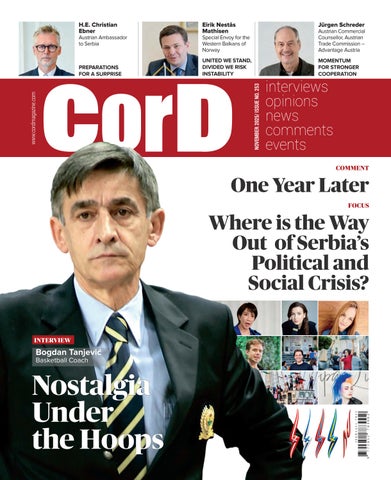
Eirik Nestås Mathisen
Jürgen Schreder
Special Envoy for the Western Balkans of Norway
Austrian Commercial Counsellor, Austrian Trade Commission – Advantage Austria
PREPARATIONS FOR A SURPRISE
UNITED WE STAND, DIVIDED WE RISK INSTABILITY
MOMENTUM FOR STRONGER COOPERATION
www.cordmagazine.com
Austrian Ambassador to Serbia
NOVEMBER 2025/ ISSUE NO. 253
H.E. Christian Ebner
interviews opinions news comments events
COMMENT
One Year Later FOCUS
Where is the Way Out of Serbia’s Political and Social Crisis? INTERVIEW
Bogdan Tanjević
783002 771451 9
Nostalgia Under the Hoops
ISSN1451-7833
Basketball Coach
Contents 06 O NE YEAR LATER
BY ZORAN PANOVIĆ
08 U NITED WE STAND, DIVIDED WE RISK INSTABILITY
32 H OHENSALZBURG FORTRESS
18 A YEAR OF STUDENT
68 CYCLING AS
A WAY OF LIFE
Stone Crown Above the City
PROTESTS WHERE IS THE WAY OUT OF SERBIA’S POLITICAL AND SOCIAL CRISIS?
EIRIK NESTÅS MATHISEN Special Envoy for the Western Balkans of the Ministry of Foreign Affairs of the Kingdom of Norway
64 THE SWEDE WHO
TAUGHT AI TO CODE
ANTON OSIKA
Co-Founder and CEO of Lovable
74 NOSTALGIA UNDER THE HOOPS
BOGDAN TANJEVIĆ basketball coach
12 P REPARATIONS
24 M OMENTUM
FOR A SURPRISE
FOR STRONGER COOPERATION
H.E. CHRISTIAN EBNER
JÜRGEN SCHREDER
Austrian Ambassador to Serbia
Austrian Commercial Counsellor, Austrian Trade Commission – Advantage Austria
67 THE STRENGTH OF THE INNER VOICE
MARIJA JELIĆ soprano
80 C HILL OUT 82 F ASHION 84 C ULTURE CALENDAR 86 F ACES & PLACES
“CorD - 22 Years of Independent Thought and Inspiration”
CorD_Magazine cordmagazine thecordmagazine cordmagazine cordmagazine The views expressed in this publication are those of the presenter; they do not necessary reflect the view of publications published by alliance international media
04
EDITOR IN CHIEF: Neda Lukić n.lukic@aim.rs DESIGN: Slađan Radosavljević Zoran Perović design@aim.rs COPY EDITOR: Mark Pullen TRANSLATION & EDITING: Pullen Editorial, Halifax
november
CONTRIBUTORS: Ljubica Gojgić Zoran Panović Radmila Stanković Maja Vukadinović Mirjana Jovanović Miša Brkić, Rob Dugdale Steve MacKenzie Zorica Todorović Mirković Sonja Ćirić, Miloš Belčević
SALES MANAGERS: Biljana Dević b.devic@aim.rs Mihailo Čučković m.cuckovic@aim.rs Vesna Vukajlović v.vukajlovic@aim.rs OFFICE MANAGER: Svetlana Petrović s.petrovic@aim.rs FINANCE: finance@aim.rs
PRINTING: E-mail: office@aim.rs CEO: office@cordmagazine.com Rotografika d.o.o. Ana Novčić a.novcic@cordmagazine.com Segedinski put 72, Subotica www.cordmagazine.com www.aim.rs CorD is published by: PUBLISHER: ISSN no: 1451-7833 alliance international Ivan Novčić All rights reserved media d.o.o. i.novcic@aim.rs alliance international media Resavska 1/III, 2025 11111 Belgrade 17, PAK 125806, Serbia Phone: +(381 11) 2450 508
COMMENT
One Year Later By Zoran Panović
Paradoxically, it is the government that has taken on a revolutionary character through its impulse to rule everywhere and at every level – despite lacking anything close to majority support in Serbian public opinion. On the contrary, it faces a crisis of legitimacy
vica Dačić, President of the Socialist Party of Serbia and Vučić’s Minister of the Interior, claims that Slobodan Milošević was “the first victim of coloured revolutions” – thirteen years before Ukraine’s Maidan. If Milošević was the victim of a “coloured revolution”, then the one that Vučić speaks of now would be the second “coloured revolution” (or its attempted version). The propagandistic use of this term may be understandable, but the current crisis in Serbia – now entering its second year – is the result of deep social and political contradictions, not some sort of “hybrid war” against the country. Paradoxically, it is precisely the government that has taken on a revolutionary character, driven by the desire to control everything and everywhere – even though it lacks public legitimacy. Controlled elections are therefore essential to maintaining
I
06
november
its grip on power. Most of the protesting students advocate constitutional patriotism. Political dynamics in Serbia are shaped by tragedies. Before the Novi Sad tragedy of 1 November 2024, the trigger for demonstrations were the mass murders in a Belgrade primary school and nearby villages. “Black swan” is a metaphor for unforeseen events with severe consequences, popularised by statistician and risk analyst Nassim Nicholas Taleb. In the case of the Novi Sad railway station tragedy, in which 16 people were killed – which Vučić described as a “black swan” – the outraged public will inevitably ask whether this tragedy truly fits that definition once the anatomy and functioning of the system are examined. With the new government
Citizens in Serbia are far more frightened by the possible return of the 1990s (sanctions, visas, petrol canisters, war…) than by the so-called “dark years” of 2000–2012 with which Vučić tries to frighten them narrative of “sabotage”, even the regime no longer fully supports its own “black swan” theory. The victory of Trump was initially seen as a “white swan” for Vučić. However, U.S. sanctions against the Serbian Oil Industry, majority-owned by Russia, have already cast doubt on that expectation.
Unlike Milošević’s Serbia, Vučić’s Serbia is integrated into the Western economic system as a capitalist semi-periphery – integrated enough that the West does not overly insist on democracy as long as there is no clear alternative capable of offering the EU the same guarantees that the SNS offered when it came to power in 2011/12. EU Commissioner for Enlargement Marta Kos gave Vučić “three to four weeks” in March this year to improve the state of European values in Serbia. That deadline was not mentioned by European Commission President Ursula von der Leyen when she visited Belgrade in October, instead giving Vučić a new deadline of “around a month”. This more serious deadline also did not seem to trouble Vučić. The same pro-government media that praised von der Leyen’s earlier statements later claimed that “Europe is stabbing Serbia in the back” after the European Parliament’s Resolution on Serbia, while the opposition interpreted this sharp Resolution as overdue compensation for von der Leyen’s rather mild criticism of Vučić. Citizens in Serbia are far more frightened by the possible return of the 1990s (sanctions, visas, petrol canisters, war…) than by the socalled “dark years” of 2000–2012 with which Vučić tries to intimidate the public. And he himself does not renounce the essential achievements of 5 October and the overthrow of Milošević – an open country connected to the West.
INTERVIEW
EXCLUSIVE
United We Stand, Divided We Risk Instability I believe there is real momentum behind the enlargement agenda right now, and it’s crucial not to let this opportunity slip away. We have shared challenges that require a united European response
Eirik Nestås Mathisen Special Envoy for the Western Balkans of the Ministry of Foreign Affairs of the Kingdom of Norway Photos by MFA Serbia
he Western Balkans continues to face complex political, economic and security challenges. It is nonetheless important to view these challenges within a much larger framework, says Eirik Nestås Mathisen, Special Envoy for the Western Balkans of the Ministry of Foreign Affairs of the Kingdom of Norway, speaking in this interview for CorD. “First of all, it’s important not to view the Western Balkans as separate from the rest of Europe. Whether in the northwest, like Norway, or the southeast, like Serbia, we are all part of the same European community. Many of the challenges we face are shared, and they require a united European response,” says our interlocutor. “That’s why I firmly believe
T
08
november
European integration is the best path forward—economically, politically, and when it comes to improving daily life. The risks we face are often the reverse: when unity and cooperation are lacking, vulnerability and instability grow.”
Serbia is widely seen as a key player in the region. How do you view its role in promoting long-term regional stability and constructive cooperation among neighbours? — I agree that Serbia is a central player, both in this region and beyond. We count on Serbia to be a positive contributor to stability. I believe that, in this regard, mutual respect and understanding also form a solid foundation for our good bilateral relations.
When it comes to regional cooperation, it’s important to not only focus on remaining challenges, but also to acknowledge the progress made. There are certainly outstanding issues and untapped potential, but much has also been achieved, for instance when it comes to the common regional market. Serbia has both contributed to this and gained significantly from it. I see regional cooperation not as a substitute for European integration, but as a valuable and necessary part of it.
How would you assess Serbia’s progress on its path to EU membership, particularly in areas related to democratic governance, the rule of law and human rights?
cordmagazine.com
09
TRUST
SUPPORT
COOPERATION
In a polarised environment, investing in trust-building may seem risky, but I would argue that the greater risk lies in not investing in it enough
International law and cooperation face pressure, and Norway sees steadfast support for Ukraine as being crucial to overcoming these challenges
Norway prioritises helping Serbia integrate into the EU, as Serbia’s progress also strengthens Norway’s close cooperation with both Serbia and the EU
— Supporting Serbia and the other candidate countries in their European integration processes is a priority for Norway. While we’re not an EU member, we are part of the single market and today enjoy our closest ever cooperation with the EU. Serbia’s EU integration is therefore also very important for our own cooperation with Serbia. I believe there is real momentum behind the enlargement agenda right now, and it’s crucial not to let this opportunity slip away. I also think it’s important to stress how integrated Serbia is with the rest of Europe, not least in terms of the economy. In this sense, I am convinced that there is so much to gain from accelerating integration efforts, both in terms of reducing vulnerabilities and in terms of opening up new opportunities. But, yes, I would also have preferred to see the process more advanced than it currently is. I agree with what president von der Leyen said during her visit to Belgrade in October: now is the time to double down on the efforts. Democracy, the rule of law and human rights are fundamental issues in this regard. I can only encourage all parts of society to unite around this agenda. Trust is central—and it takes far longer to build than to lose. In a polarised environment, investing in trust-building may seem risky, but I would argue that the greater risk lies in not investing in it enough.
It is well known that this region faces pressing security challenges – ranging from disinformation and institutional fragility to unresolved political disputes. What do you see as the most urgent prior-
10
november
ities to ensure long-term regional stability? — It is important to acknowledge that the current context, first and foremost stemming from Russia’s illegal war of aggression in Ukraine, reinforces existing vulnerabilities. Strategic dependencies are being leveraged. International law and multilateral cooperation are under heavy pressure. Fake news and disinformation are actively used to further undermine unity and democratic processes.
I agree with what president von der Leyen said during her visit to Belgrade in October: now is the time to double down on efforts For Norway, standing firmly with Ukraine is central to addressing these challenges. This is also what we ask of our friends. Ukraine’s future is of fundamental importance to stability in Europe. In the region, we strongly support the EU-led dialogue and the efforts of Peter Sørensen. This also remains a
crucial component of successful European integration, which in turn is key to long-term stability.
Energy security and sustainability are high on the agenda across Europe, including in Serbia. Where do you see the most promising avenues for cooperation between Norway and Serbia in renewable and green energy, and in transforming the Serbian Power Company into a modern and efficient enterprise? — I am pleased that Norwegian experiences and competence in the energy sector have been highly valued in Serbia, both in the private and public sectors. It is true that Norway plays a special role as a reliable supplier to Europe and that we have a lot of experience in oil, gas and renewable energy. I understand that the energy situation is difficult now and that many in Serbia worry, particularly with winter coming. Many European countries, citizens and companies have faced similar challenges since the 2022 invasion of Ukraine. However, the EU showed how dependencies can be overcome through diversification and cooperation. I believe this is the way forward for Serbia as well, in close cooperation with the EU. Serbia has every potential to succeed in diversifying and attracting more investment in renewables, but that requires clear, strategic decisions. What I see elsewhere in Southeast Europe is that investors are looking for opportunities in places where the energy systems are well integrated with the rest of Europe, both in terms of regulation and infrastructure. In many ways, this is a strong argument for what we discussed earlier in terms of the dividends of regional and European integration.
A turning point for the region.
One room. One day. Real impact.
SUPPORTED BY
RESERVE YOUR SEAT
cordmagazine.com
11
INTERVIEW
EXCLUSIVE
Preparations for a Surprise H.E. Christian Ebner Austrian Ambassador to Serbia By Ljubica Gojgić
12
november
The EXPO offers Austria an attractive stage on which to present itself as an innovative, future-oriented location and to further expand our excellent economic relations with the region and beyond. The Austrian participation in EXPO Belgrade is being organised in cooperation with the Federal Ministry for Economic Affairs, Energy and Tourism and the Austrian Federal Economic Chamber. With EXPO Osaka having just closed its doors, our team is returning from Japan and will immediately focus on our participation in Belgrade in 2027. Our pavilion is sure to be something very special ~ Christian Ebner espite the year being marked by economic challenges, both globally and on the EU market, key figures for the past year when it comes to economic cooperation between Austria and Serbia (such as the number of employees, order situation, total sales and capacity utilisation) remained stable, and no major changes are expected for the coming year – as we are assured by ambassador Christian Ebner. He speaks optimistically in this interview for CorD Magazine, explaining that “since most of our companies depend on exports, the difficult economic conditions at home are generating even more interest in the Serbian market”. Cooperation between the two countries was also marked by talks at the highest level in 2025, including a visit to Belgrade by Austrian Foreign Minister Beate Meinl-Reisinger and subsequently also by Chancellor Christian Stocker.
er with potential Austrian investors and businesses, in order to identify prospective areas of future cooperation. The Chancellor already mentioned a list of areas where we see new opportunities. And I would add that this list should be understood as being open-ended.
D
Your Excellency, this past summer saw Austria and Serbia sign a Joint Declaration on further deepening their economic relations. At that time, Chancellor Christian Stocker stated that the focus would be on telecommunications, wastewater management, infrastructure and logistics. Can we already speak about concrete projects in these areas? — The signing of the Joint Declaration during the new Austrian Chancellor’s first visit to Belgrade in August this year was motivated by recognition
of our longstanding economic relations and the conviction that, given Serbia’s economic development and its increasing economic convergence with the European Single Market, we can and should do more. In order to put into practice this mutual desire for an enhanced level of economic cooperation between Serbia and Austria, we are planning to strengthen our institutional cooperation between the responsible ministries, as well as the chambers of commerce, togeth-
Austria has been one of Serbia’s most important economic partners for decades. Given that your country is also facing the challenges of slower GDP growth in 2025, does this impact the operations of Austrian companies in Serbia, as well as the interest of new investors in entering the market? — Our trade relations are developing well. We have been the third largest investor in Serbia over recent years and remain so today. Serbia continues to be an important market for Austria. Our more than 800 companies provide thousands of jobs in this country and are important partners in various business sectors, such as banking and insurance, construction, telecommunications, logistics, agrobusiness, energy and many more. According to one survey of Austrian companies, most Austrian subsidiaries rated the economic conditions and climate in Serbia as good and stable. Key figures for the past year, such as the number of employees, order situation, total sales and capacity utilisation, have also remained stable and no major changes are expected over the coming year. Since most of
cordmagazine.com
13
TRADE
ACCESSION
MARKET
Our trade relations are developing well. We have been the third largest investor in Serbia over recent years and remain so today
It is not Montenegro or Albania that are standing in Serbia’s way of making faster progress in the accession process
Our more than 800 companies provide thousands of jobs in this country and are important partners in various business sectors
ed its position as front-runner to Montenegro and Albania? — The duration of accession negotiations is determined by the pace of reform and the progress made by each individual candidate country in aligning itself with the EU, and therefore depends on many different factors and circumstances. There is little point in comparing yourself to others if you cannot draw the right conclusions for yourself. It is not Montenegro or Albania that are standing in Serbia’s way of making faster progress in the accession process. Everyone knows what needs to be done. The challenge is to commit to and maintain an environment that promotes a more efficient and inclusive implementation process. If we can agree to this, the pace will surely accelerate on its own. our companies depend on exports, the difficult economic conditions at home are generating even more interest in the Serbian market.
Austrian Chancellor Stocker has confirmed Austria’s participation at Expo 2027 Belgrade. How will Austria be represented at this specialised exhibition? — EXPO 2027 in Belgrade – the first world exhibition to be held in the Western Balkan region – can be a strong signal of the dynamism and potential of the entire region. We see excellent prospects here for further deepening our economic cooperation. The EXPO offers Austria an attractive stage on which to present itself as an innovative, future-oriented location and to further expand our excellent economic relations with the region and beyond. Austria’s participation in EXPO Belgrade is being organised in cooperation with the Federal Ministry for Economic Affairs,
14
november
Although most Austrians oppose new enlargement today, the majority still believe that admitting Slovakia, Czechia, Hungary and Slovenia 20 years ago was a good decision Energy and Tourism (BMWET) and the Austrian Federal Economic Chamber (WKÖ). With EXPO Osaka having just closed its doors, our team is returning from Japan and will immediately focus on our participation in Belgrade in 2027. Our pavilion is sure to be something very special. Let yourself be surprised!
As ambassador of a country that supports Serbia’s European integration, what do you see as the main reasons for the slowdown in this process, in which Serbia has ced-
The European Eurobarometer recently published the results of a survey on EU citizens’ attitudes towards Serbia’s potential accession. It came as a surprise that Austria is among the countries where opposition to Serbia’s membership exceeds 50%. How do you explain this? — Austrians tend to be very sceptical when it comes to surveys in general. As far as further EU enlargement is concerned, the traditionally cautious opinion in Austria has changed little in recent years. Although the majority would not welcome a potential candidate country as a new EU member if asked, 20 years after the EU enlargement that included Slovakia, Czechia, Hungary and Slovenia, the vast majority of Austrians say that the admission of these countries to the EU was a “good decision”. I am therefore very confident that this will also be the case with the accession of the Western Balkan countries.
a sme Academy For business beyond boundaries!
supported by
Global Diary
“No empire lasts forever” Ray Dalio
Japan Elects First Female Prime Minister S a n a e Ta k a i c h i b e came Japan’s first female prime minister, pledging to fast-track defence reforms and raise military spending to 2 percent of GDP. Her election marks a turning point in Japan’s conservative politics, where leadership has long been male-dominated.
Global M&A Surges Past $1 Trillion Corporate deal-making has bounced back sharply, with global mergers and acquisitions exceeding the $1 trillion mark. The revival is led by major takeovers in tech, energy, and healthcare, including a $55 billion buy-out of gaming giant Electronic Arts.
Germany May Lift Arms Ban to Israel Berlin is weighing whether to end restrictions on weapons exports to Israel, imposed during the Gaza conflict. Vice-Chancellor Lars Klingbeil said the policy could be revised as Germany reaffirms its “historic responsibility” for Israel’s security. 16
november
“New roads demand courage” Henry Kissinger
Aid Flotilla to Gaza Intercepted A civilian flotilla carrying hundreds of activists and humanitarian aid was stopped by Israeli forces before reaching Gaza. One vessel reportedly entered coastal waters, drawing global attention to the worsening humanitarian situation in the enclave.
China Expands Rare-Earth Export Controls China dramatically widened its export controls on rare-earth elements, adding five new elements and dozens of refining technologies to its restricted list. The move targets foreign users of Chinese materials and comes amid mounting tensions ahead of talks between Donald Trump and Xi Jinping over trade and technology.
Fossil Fuel Projects Defy Climate Pledges From oilfields to new airports, governments are quietly expanding fossil-fuel infrastructure despite their net-zero commitments. Environmental groups warn that the world is moving further away from the Paris Agreement’s 1.5 °C target. cordmagazine.com
17
FOCUS
A YEAR OF STUDENT PROTESTS – WHERE IS THE WAY OUT OF SERBIA’S POLITICAL AND SOCIAL CRISIS?
Rebuilding Trust Begins with Elections The student protests, which began after the tragedy in which 16 people were killed when a canopy collapsed, drew public attention to the need for more responsible politics and deeper institutional reform. Although young people injected new energy into public life, citizens’ trust in institutions continues to decline, while society remains deeply divided
lmost a year later, Serbia is still facing a serious socio-political crisis. A part of the opposition insists on institutional struggle and pressure through parliamentary and international mechanisms, while the students’ demand for early elections has yet to receive a re-
A
18
november
sponse. In such an environment, the question arises – is the energy of the student movement and the idea of “new politics” still present and relevant, or has it been exhausted under the weight of political calculations and long-lasting institutional stagnation?
In this Focus, our contributors offer different perspectives on whether elections, institutional pressure or international support can unlock systemic change – and whether the spirit of the student movement still represents a credible path to rebuilding trust in public institutions.
FOCUS
Anja Despotović Student of the Faculty of Electrical Engineering, University of Belgrade
Elections Are the First Step Towards Healing the System Real change requires more than removing those responsible for the crisis – it demands rebuilding institutions, restoring trust, and taking personal responsibility for the kind of society we wish to create. The students who sparked last year’s protests now see elections not as an end goal, but as the beginning of a deeper transformation that must come from within – a process that will require perseverance, integrity, and courage e can only emerge from the crisis by taking away power from those who created it – through elections. But that is only the first step. What must follow is the healing of the consequences of years of abuse of power and the establishment of a new, fair and accountable system. No one expected this process to be easy or quick, but we must start with ourselves. If every citizen takes a share of responsibility for change, the benefit will be collective. From the very beginning, our struggle was institutional. All our demands were directed to concrete institutions, not individuals or the regime. Each protest had a specific goal and a clearly defined institutional address. We refused to focus on one autocrat, choosing instead to point to systemic problems that must be resolved at their roots. It soon became evident that our demands could not be met before a change of government – something that can only be achieved legitimately through elections. Other options are simply unrealistic under the current circumstances, and that is the conclusion reached after long discussions among students across the country. The result was a unified demand for early parliamentary elections and the formation of a student list. This decision was not made lightly. We are aware of the poor electoral conditions and the manipulations that will persist as long as this government remains in power. Yet elections will eventually have to be called, and what we can offer this time is mass participation and stronger control than ever before. With a student list created in the most democratic way seen so far, we believe victory is achievable. Students – especially those from the Faculty of Electrical Engineering – are not only a factor of change but also its driving current. We are aware of the strength of our move-
W
ment and the overwhelming public support it has received – in the streets, in conversations across the country, and in the data from relevant public opinion polls. That support has not made us arrogant, but more responsible. We do not want to disappoint anyone – not even ourselves. There is still much work ahead, and it will not end with victory at the polls. History has taught us that real change begins after elections. We know that every day counts, that every small improvement matters, and that everyone can contribute. From the start, we knew we were entering a long-term struggle, and perhaps we are more patient than older gener-
We can only emerge from the crisis by taking power away from those who caused it – through elections ations in understanding how gradual systemic change must be. We will not stop until we build a system that serves its citizens – and even then, it must be maintained through constant vigilance and responsibility. Some things we must do ourselves, as no international actor can solve our internal problems. However, there are areas where international support is desirable and necessary – particularly pressure leading to free elections, the release of political prisoners, and improving the electoral process. For a long time, concrete support was absent, but this is now changing – and from the direction we hoped for and worked towards. Everything now points to victory. It is only a matter of time before it happens – naturally and inevitably.
cordmagazine.com
19
FOCUS
doc. dr Biljana Đorđević Co-President of the Green–Left Front
The Way Out of the Crisis Lies in Elections The way out of the crisis lies in elections that should lead to a peaceful transfer of power from illegitimate to legitimate representatives of citizens. That is why coordination within the anti-regime front is essential in order to be ready when elections are called he way out of the crisis lies in elections that should lead to a peaceful transfer of power from illegitimate to legitimate representatives of citizens. President Vučić has refused to call elections for six months since students demanded them, just as the authorities failed to meet their earlier demands, but elections will have to take place sooner or later. Precisely because we do not know what the political context – not only local but also European and global – will look like at the moment elections are announced, we must prepare for different scenarios. This is why coordination within the anti-regime front is so important – to ensure we are ready when the time comes. For us in the Green–Left Front, it is crucial that no unilateral solutions are imposed, as that would not reflect the need for democratic consensus within the anti-regime front, nor should we take for granted citizens who, despite a decade of anti-European propaganda, clearly state that Serbia’s rightful place is within the European Union. The regime shows its unwillingness to respect court rulings even at the level of local self-government, such as in Zaječar, so it is to be expected that it will act even worse when national power is at stake and that it will not easily give up its position. Therefore, the answer to the question of early elections or strengthening institutional struggle is not an either– or choice, because elections are also an institutional solution. But while we wait for them, we must continue to fight wherever we can and not surrender any of the ground we have gained in the institutions that exist – no matter how illegitimate or repressive
T
20
november
they may be. Parliament still exists, and it is the duty of opposition MPs to point out when it fails to adopt laws that would improve people’s lives, such as the parent–caregiver law, or when it adopts harmful ones, as well as to propose solutions for the day after. The political strength of the student movement lies in the fact that they have mobilised themselves politically, but also inspired or reactivated their parents and entire families. This kind of transformation within families can only come from the young – those upon whom the future of this country rests – and there is no dispute about that. However, since students chose not
The answer to the question of early elections or strengthening institutional struggle is not either–or, because elections are also an institutional solution to run on their own list, it remains unclear who will take responsibility for participating in the formation of a new government, what exact programme they intend to pursue, how they will cooperate among themselves, and to whom they will be accountable. Without such clarifications, it is difficult to assess what kind of systemic change is being advocated and in what way. For victory and change to be sustainable, there must be an agreement within the anti-regime front on the key issues we have committed to, so that they can actually be implemented.
FOCUS
Enes Džogović Student at the State University of Novi Pazar
Free and Fair Elections Are the Only Acceptable Path Elections are the socially acceptable way out of this crisis, but only the first step – the system must be changed fundamentally and over the long term. Despite pressures, threats and irregularities, I believe that mass civic participation and strong electoral control can lead to victory believe that free and fair elections are the only socially acceptable way out of this crisis – first a moral one, and then a political one. For us as a movement, this is also the only legitimate solution. We have never called for violent or radical methods, nor do we consider them effective, because we are not seeking short-term gains, but systemic change that will endure. Of course, we are fully aware that elections cannot be fair while this regime remains in power, as it has already perfected every form of manipulation and abuse – from blackmail, threats and bribery, to irregular voter rolls and distorted electoral conditions. However, despite this, we concluded that victory is possible. We know that conditions will not improve before a change of government, but that will not stop us. Our goal is to secure unprecedented electoral oversight and confront the regime with mass civic participation. The enormous rise in public interest to take part in the electoral process is already one of our greatest victories. For that reason, elections are currently the only solution on the horizon – but they are only the beginning, given how deeply this regime has rooted itself within state institutions. Although systemic change is slow, we are convinced that society has matured quietly in the background. It
I
has produced a democratic – even, one could say, timeless – movement for this country. For years, many believed that our generation was apathetic, disinterested, and intent on leaving Serbia. Our actions proved the opposite. We did not grow up outside politics – we observed it, learned from it, and when the time came, we stepped forward directly and openly.
Elections are only the beginning – the system must be rebuilt from its foundations, and citizens have shown they are ready to take part in that fight, massively and actively With regard to international actors, I am confident that we will preserve the country’s sovereignty. Support is always welcome – through statements of encouragement, the recently adopted resolution, trade agreements and diplomatic pressure on the regime – but we do not expect interference in Serbia’s internal affairs or reforms. Those changes must come from us.
cordmagazine.com
21
FOCUS
Srđan Milivojević President of the Democratic Party
Change Is Inevitable The way out of Serbia’s deep political and social crisis lies in restoring institutions and rebuilding trust in a system that should serve citizens rather than vested interests. The student movement has brought new energy into public life and shown that Serbia still has the strength to nurture a generation that believes in knowledge, responsibility, and the common good
he only path out of the profound political and social crisis Serbia faces is through dismantling the network of power that has usurped the state. Aleksandar Vučić is not merely a symbol of that crisis – he is its architect and the head of a structure that has privatised institutions, plundered public resources, and turned Serbia into a platform for personal enrichment and repression. As long as people responsible for violence against students and the suppression of civic protest occupy key state positions, Serbia cannot move forward. Early elections are therefore not only realistic but essential. The Democratic Party has fully supported the students’ demand for early parliamentary elections. These elections must mark a turning point – a victory of civic integrity over corruption. The student list represents the only authentic and morally uncompromised force capable of confronting the regime even under the most unfavourable conditions. The difference between the vitality of the student movement and the machinery of coercion and manipulation is so great that the government has been avoiding elections for months. When Vučić speaks of “institutional struggle”, he is staging a performance of democracy. In a country
T
22
november
where the president violates the constitution on a daily basis, institutions have become nothing more than props in his political theatre. That is why the Democratic Party decided to withdraw from this charade – because engaging within a system entirely controlled by the same corrupt network is not only meaningless but counterproductive to our goal of restoring democratic accountability. The emergence of the student movement is the best news Serbia has had in years. It has brought
Early elections must bring change that will return institutions to the citizens and open space for new, responsible governance into public life a generation of young, educated, and responsible people who believe in knowledge, solidarity, and the public good – the very opposite of the model promoted by those in power, where criminality and false credentials thrive. The student initiative has not only restored faith in the possibility of change but also shown that Serbia possesses the strength to free itself.
PLACEMENTS & POSTINGS
H.E. Ms. Florence FERRARI new Ambassador of France to Serbia
A career diplomat, H.E. Florence Ferrari joined the French Ministry for Europe and Foreign Affairs in 1995, serving in a number of senior roles related to the European Union, Eastern Europe and the Balkans. She was Deputy Director for Russia and Eastern Europe, Deputy Director for Human Resources, and later Deputy Inspector General of Foreign Affairs. Abroad, she has served in Berlin, Brussels, Ottawa and Ljubljana, where she was Ambassador of France to Slovenia from 2018 to 2022. Ambassador Ferrari holds degrees from the Sorbonne and Sciences Po Paris, and is a Knight of the Legion of Honour and an Officer of the National Order of Merit. She speaks English and German fluently, and also understands Italian, Russian and Slovenian.
H.E. Mohammad Sadegh Fazli
H.E. Mrs. Maria Clara DE ABREU RADA
new Ambassador of the Islamic Republic of Iran
new Ambassador of Brazil to Serbia
H.E. Mohammad Sadegh Fazli has been appointed Ambassador of the Islamic Republic of Iran to the Republic of Serbia.
H.E. Maria Clara de Abreu Rada has been appointed Ambassador of the Federative Republic of Brazil to the Republic of Serbia.
Born in Qom in 1974, he holds a Master’s degree in International Relations from Islamic Azad University in Tehran.
Born in Brasília in 1966, she graduated in Economics from the University of Brasília and joined the Brazilian diplomatic service in 1994.
Ambassador Fazli has served in several senior diplomatic and advisory positions within Iran’s Ministry of Foreign Affairs, including as Assistant Minister and Director General for the Middle East and North Africa, and as Deputy Ambassador in Beirut. Fluent in English and Arabic, he brings over two decades of experience in international relations, regional diplomacy, and multilateral cooperation.
Over her distinguished career, she has held senior positions both at home and abroad, including postings in Tokyo, Buenos Aires, Budapest and Tirana. Ambassador de Abreu Rada was awarded the Order of Rio Branco, Grand Cross, in recognition of her exceptional service to Brazilian diplomacy.
Formwork & Scaffolding ALU KOENIG STAHL d.o.o. Beograd SRB-11070 Novi Beograd, Vladimira Popovića 6 T: + 381 63 307 266 www.alukoenigstahl.rs
We make it work.
Doka Serb d.o.o. | Svetogorska 4 | 22310 Šimanovci | Srbija T + 381 22 400 100 | serb@doka.com | www.doka.com/rs | A company of Umdasch Group
cordmagazine.com
23
INTERVIEW
Momentum for Stronger Cooperation Jürgen SCHREDER
Austrian Commercial Counsellor, Austrian Trade Commission – Advantage Austria
The recent declaration signed between Austria and Serbia will bring more joint initiatives and public–private partnerships, closer cooperation, and a stronger framework for investment in energy, infrastructure and digitalisation – confirming and deepening already excellent ties 24
november
COOPERATION
TRUST
OPTIMISATION
In the coming years, Austrian–Serbian cooperation should deepen, particularly in renewable energy, sustainable infrastructure and digital transformation
Trust in institutions remains fragile; Serbia can enhance its standing and investor confidence through tangible rule-of-law progress and transparent enforcement
Austrian firms value Serbia’s dual education system and the skills it provides but seek a stronger role in student selection, more practical hours, and clearer incentives
his year opened strongly for Serbia–Austria trade, which in the first four months of 2025 already exceeded €600 million. Further growth is expected from the same sectors that drove performance earlier in the year – notably mechanical and electrical engineering, the pharmaceutical and chemical industries, and the paper and packaging sector. “These continue to underpin Austria’s export performance,” says Jürgen SCHREDER, Austrian Commercial Counsellor at the Austrian Trade Commission – Advantage Austria.
T
At the same time, Serbia’s expanding industrial base and growing demand for high-quality machinery, technology and intermediate goods continue to fuel imports from Austria. “Over the past few years, Serbian exports – particularly in agriculture, food processing and metal products – have shown a positive trend overall, despite occasional short-term fluctuations,” adds our interlocutor. According to the WKO Wirtschaftsbericht Serbien 2025, Austria’s strong presence in banking, insurance, energy supply, telecommunications, fuel retail and logistics adds further stabil-
ity and supports deeper economic integration between the two countries.
Austria is currently the third-largest foreign investor in Serbia, with growing interest from Austrian companies. Which sectors are likely to attract the most new investment? — Austria is highly regarded in Serbia and has maintained its position as the third-largest foreign investor for several years. Based on current market developments and major ongoing projects, the information and communication technology (ICT), renewable energy and energy efficiency, as well
Osigurajte svoje zaposlene. Wiener Premium Care je jedinstveni proizvod na našem tržištu koji podrazumeva pokriće troškova lečenja malignih bolesti u inostranstvu do milion evra! Pogledaj ponudu
Dobrovoljno zdravstveno osiguranje Zdravlje prvo.
cordmagazine.com
25
as infrastructure and construction sectors, are expected to attract the most significant new investments. The ICT sector remains one of Serbia’s most dynamic markets – expanding rapidly and actively supported by government policies focused on digitalisation and tax incentives. This creates strong opportunities for Austrian companies, particularly in software development, IT services and business process outsourcing. Renewable energy and energy efficiency also represent key areas for future cooperation. Serbia has begun a comprehensive review of its energy policy to reduce dependence on fossil fuels and align with EU accession requirements. The country has made notable progress in diversifying its energy mix, but the path towards a fully sustainable energy transition remains long – a process that will offer increasing potential for Austrian investors. Infrastructure and construction projects are another major driver, particularly in the context of preparations for Specialised Expo 2027, with planned investments of around €12 billion. Projects in road and rail development, as well as building technology and engineering services, are expected to create attractive opportunities for Austrian firms (WKO Wirtschaftsbericht Serbien 2025).
Recently, Austria and Serbia signed a declaration to strengthen economic relations. In practical terms, what new forms of cooperation can we expect in the coming years? — The declaration is designed to strengthen economic ties and promote investment in key areas. In the coming years, cooperation is expected to deepen particularly in renewable energy projects, sustainable infrastructure and digital transformation. In practice, this will include more joint initiatives, public–private partnerships and closer institutional cooperation between Austrian and Serbian stakeholders. The declaration therefore establishes a stronger framework for Austrian investment and for col-
26
november
Surveys show that Austrian companies in Serbia expect stronger revenues and higher employment, yet continue to voice concerns about the rule of law and regulatory predictability. From your perspective, which specific reforms would most immediately improve investor confidence? — While the government has announced reforms to align with EU standards,
How do Austrian companies assess the effectiveness of dual education so far, and are current measures sufficient to align the skills supply with employer demand? — Based on surveys conducted among Austrian companies operating in Serbia, as well as through continuous dialogue with them, several important conclusions have been drawn. Austrian companies are generally familiar with the dual education system and recognise the need for professionals with the specific skills that this model can provide. However, they believe there
ongoing protests and public criticism suggest that trust in institutions remains fragile. The most effective way to strengthen Serbia’s position and investor confidence is to demonstrate visible progress in the rule of law and regulatory transparency. This includes faster judicial and administrative reforms, better alignment with the EU acquis communautaire, and consistent enforcement of regulations. Building stronger, independent institutions and promoting fair and transparent competition would send a clear signal that Serbia is committed to maintaining a stable and predictable investment environment.
is room for improvement – particularly through greater company involvement in student selection, more hours of practical training within firms, and the introduction of additional incentives for active participants in the system. They also stress the importance of introducing the concept of dual education to children and parents from the early years of primary school. Special attention should be given to informing parents, to break down existing prejudices about certain professions and provide a realistic understanding of the opportunities that dual education offers in terms of professional development and future employment prospects.
laboration between public and private actors in key sectors such as energy, infrastructure and digitalisation.
New Phase of Partnership BUSINESS PARTNER AUSTRIA
EIGHTEEN YEARS OF TRUST
GLOBAL THINKING, LOCAL RELEVANCE
MELANIJA PAVLOVIĆ
MILENA AVRAMOVIĆ BJELICA AND TAMARA BEKČIĆ
General Manager, JAF Serbia
28
Directors and Co-Founders of Chapter 4 Agency
29
COMPREHENSIVE CANCER CARE VIENNA LEADING EXPERTISE AND PERSONALISED TREATMENT PREMIQAMED
30
BUILDING ON A CENTURY OF INNOVATION MLADEN SAMARDŽIJA Commercial Director, wienerberger Central Balkan
31
Eighteen Years of Trust Melanija Pavlović General Manager, JAF Serbia
For nearly two decades, JAF Serbia has grown from a timber distributor into a partner providing complete, quality-driven solutions. At the same time, the company nurtures a culture of equal opportunity – one third of its employees are women, many of them in leadership roles – proving that true leadership is measured by knowledge, results and responsibility n conversation with Melanija Pavlović, General Manager of JAF Serbia, we discuss growth built on quality, smart digitalisation and know-how that gives clients confidence while raising market standards. We also explore gender equality as a real competitive advantage – from mixed teams that shape decisions together to a system that fosters meritocracy, trust and long-term partnerships.
innovation and efficiency. Women lead several departments, proving that authority comes from competence, not stereotypes. When employees see that trust and merit shape success, motivation and loyalty grow – and that’s every company’s greatest asset.
I
What key changes would you highlight in JAF Serbia’s development over nearly two decades? — Over the past 18 years, JAF Serbia has evolved from a materials distributor into a partner offering comprehensive solutions. What began as sales has become a full-service model – from consultancy and technical support to digital tools for architects and furniture makers. This shift from selling products to providing know-how marks our true transformation. As the market grew more demanding and projects more complex, speed and precision became crucial. That’s why we developed modern processing centres, digital platforms and support services. Our goal is not just to deliver materials but to create value through expertise, reliability and trust. JAF stands out for its quality, consistency and long-term partnerships. By combining international experience with local knowledge, we’ve positioned ourselves as a leader that doesn’t follow trends but sets them – through innovation, sustainability and superior service. JAF is a strong example of gender equality in an industry often seen as male-dominated. What makes this approach work?
28
november
The JAF Group operates in 15 countries, with over 60 branches and more than 3,000 employees – a network that keeps innovation flowing across markets — The key is a culture where everyone advances through knowledge and results, regardless of gender. When this becomes part of company values, equality is not imposed but lived naturally. At JAF we believe diversity brings strength. The combination of women’s analytical and empathetic approach with men’s technical focus and decisiveness produces balance,
What defines the next stage of JAF Serbia’s development? — Our growth is sustainable and built on quality. After consolidation, we’re entering a phase of smart expansion – investing in technology, digital processes, logistics and expertise. Our advanced processing centre shows that quality drives growth, as clients seek reliable partners rather than suppliers. With new digital tools, online sales and product configurators, we’re strengthening cooperation with architects, designers and manufacturers. Quality and innovation remain our main drivers – growth naturally follows. How does being part of the global JAF Group support innovation? — Belonging to the global JAF Group is a major advantage – a network of knowledge and innovation working as one. Present in 15 countries, with over 60 branches and 3,000 employees, it allows us to anticipate global trends and apply them locally. What’s developed today in Austria or the Czech Republic can be implemented in Serbia tomorrow – from new technologies to sustainable materials. Global experience and local expertise make us unique. Thanks to this synergy, JAF Serbia not only keeps pace with trends but often sets them – through innovation, knowledge and lasting trust.
local teams adapt the content and enhance its value. Such a hybrid approach ensures both brand consistency and high campaign relevance.
Global Thinking, Local Relevance Milena Avramović Bjelica and Tamara Bekčić Directors and Co-Founders of Chapter 4 Agency
In an era when communication is becoming both global and deeply personalised, PR agencies are evolving into strategic partners of companies and brands. Chapter 4 PR, with experience across many countries of Central and Southeast Europe, highlights the importance of education, innovation and regional cooperation
e spoke with the agency’s directors and co-founders, Milena Avramović Bjelica and Tamara Bekčić, who reveal how they balance global trends with local relevance, develop professional competences, and open new communication perspectives.
W
How is the role of agencies such as Chapter 4 changing at a time when market boundaries are fading and communi-
cation is becoming increasingly global, yet also more personalised? TAMARA: The role of agencies is increasingly shifting towards that of adviser and strategic partner. Globalisation and digitalisation enable ideas to reach audiences worldwide, yet people expect a personalised and relevant approach within their local context. Our strength lies in translating global trends into local reality while maintaining authenticity and emotional resonance. MILENA: In the regional context, the most effective models of cooperation are those that combine strategy with local implementation. This means that global or regional narratives can provide the framework, while
Chapter 4 often emphasises the importance of education and knowledge-sharing in communications. How do you strengthen professional competences and foster innovation within the PR industry? MILENA: Education is essential. Internally, we invest in continuous team development through workshops, training and mentoring, as we believe that the quality of communication directly depends on the expertise and curiosity of the people who create it. TAMARA: Externally, we actively participate in professional conferences and lectures. We strive to share practical insights and encourage professional exchange. This way, we strengthen competences across the industry while building a network that inspires innovation and creativity among peers. What are currently your most interesting projects or partnerships that open new communication perspectives? Tamara: I would highlight campaigns that combine local creativity with global quality standards, particularly in the fields of sustainability and ESG, where we are developing innovative communication approaches. MILENA: Cooperation with regional Chapter 4 agencies and with our global network leader, Burson, allows us to exchange experience and apply best practices. Partnerships with institutions and corporations not only bring new projects but also set benchmarks for professional excellence in PR. Given the regional insights you have through Chapter 4, how do you assess the potential of the regional market for further growth? MILENA: The region holds enormous potential – the markets are small enough to allow fast innovation, yet diverse enough to stimulate creativity. TAMARA: Connectivity and knowledge exchange are key. When agencies and clients within the creative industries work in synergy, the result is not only more successful communication but also a stronger reputation for the entire region as a place where innovative and effective campaigns are created.
cordmagazine.com
29
Comprehensive Cancer Care Vienna Leading Expertise and Personalised Treatment Austria ranks among the world’s leaders in cancer treatment and research, offering patients access to the latest therapies, top specialists and state-of-the-art medical technology
Cancer Treatment in Austria Cancer research has long held a prominent place in Austria’s medical tradition. The country is among the global leaders in cancer care – ranking in the world’s top five for survival rates. This success stems from the availability of advanced therapies and modern medications, as well as the excellent hospital infrastructure and high medical standards.
Comprehensive Cancer Care Vienna The Cancer Centre of the Mavie Med Private Hospitals in Vienna brings together a network of leading specialists and institutes providing cancer treatment at the highest academic level. Most of the experts have international experience and are involved in pioneering scientific studies, enabling new research findings to be rapidly translated into clinical practice. Our mission is to ensure that patients diagnosed with cancer have fast access to multidisciplinary teams of leading oncologists. We aim to provide each patient with a clear understanding of their condition and the most suitable treatment options. The term comprehensive reflects a truly multidisciplinary approach to cancer care. The Centre serves as a central hub for all patient needs, offering a full spectrum of services – from screening and prevention to diagnosis, second opinions, treatment and management of related conditions.
Tailor-Made Cancer Treatment Modern treatment success depends on close cooperation across medical disciplines, in-
30
november
cluding oncology, radiology, surgery, pathology and radiation oncology, working together through regular multidisciplinary “tumour board” meetings. In recent years, medical therapy has expanded significantly: innovative immunotherapies and targeted medicines are now available that act precisely on tumour cell structures responsible for growth. Chemotherapy remains an important treatment method, but modern drugs are now far better tolerated.
Advanced Surgical Techniques Minimally invasive and function-preserving procedures have become increasingly common, reducing physical stress and recovery time for patients. The Centre also operates the da Vinci Xi surgical robot – the most advanced robotic system currently available.
Second Opinion The Centre provides patients with the opportunity to have their diagnosis reviewed, including a second histopathological examination and precise tumour classification. All results are assessed and treatment recommendations are made by a recognised multidisciplinary team.
Prevention and Early Detection When detected early, most cancers can be cured. A healthy lifestyle alone cannot always prevent the development of cancer, which is why preventive screenings are so essential. Early detection of precancerous lesions or initial cancer stages allows for timely and effective treatment.
More and More Patients Can Be Cured New advances in diagnostics and therapy have dramatically improved recovery prospects for cancer patients compared with a decade ago. A growing number of patients benefit from individually tailored and highly effective treatments. In many cases where complete remission cannot be achieved, cancer can increasingly be managed as a chronic condition that allows a good quality of life – provided that continuous medical care and follow-up are ensured. www.premiqamed.com/en/cancer-center
Building on a Century of Innovation Mladen Samardžija Commercial Director, wienerberger Central Balkan
By uniting its long-established brands under one name, wienerberger is strengthening its position in Serbia and across the region. The company’s focus on innovation, sustainability and responsible growth continues to set new benchmarks for the construction industry n this interview for CorD Magazine, Mladen Samardžija, Commercial Director of wienerberger Cent ral Balkan, discusses the company’s transformation into a unified global brand, its sustainable business strategy, and the balance between tradition, innovation, and community engagement.
— Smart solutions, design innovation and energy efficiency are key drivers of the modern construction industry. Our most recent major investment was the acquisition of Terreal, a leading manufacturer of advanced roofing systems that integrate solar panels on pitched roofs. Working closely with architects and design teams, we’ve launched new products such as large-format roof tiles and darker shades that ensure durability and weather resistance.
I
From September 2024, wienerberger became the umbrella brand for all company products. What does this transformation mean for the Serbian and regional markets? — wienerberger is a global leader in the production of clay-based building materials and one of the most recognised names in the global construction industry. We entered the Serbian market through the acquisition of Tondach, the owner of the Potisje Kanjiža factory with a tradition exceeding 100 years. By integrating brands such as Tondach, Porotherm, Semmelrock, Pipelife, Vargon and Teca under the wienerberger name, we aim to strengthen recognition and clearly communicate the values that define us – trust, respect, creativity and passion. The Kanjiža factory has been part of Serbia’s industrial tradition for more than a century. How do you combine heritage with innovation, and how important is the local community to wienerberger’s story? — The Kanjiža factory is one of the most modern facilities in the construction sector, while maintaining a strong link to its heritage. We are strongly committed to the local
community and always ready to offer support. Following last year’s natural disaster, we promptly donated building materials to help restore damaged homes.
Sustainability is one of wienerberger’s strategic pillars. What are your key initiatives in Serbia and the region? — Sustainability is at the heart of wienerberger’s global strategy. We take responsibility towards both people and the planet through an active contribution to a healthy ecosystem and consistent implementation of ESG principles. Our priorities include decarbonisation, circular economy and biodiversity protection. As the holder of the ECO Vadis Platinum medal, we are among the top one per cent of the world’s most sustainable companies. wienerberger is also known for innovation. Which new products and trends stand out on the local market?
How would you assess the development of Southeast Europe’s construction market, and what are wienerberger’s future plans? — Responding to the strong growth of Serbia’s construction market, wienerberger continuously modernises production and expands its range. Three years ago, we invested over €10 million in a new large-format roof tiles production line. Around 50 per cent of our production is exported to regional markets, confirming both quality and strategic direction. wienerberger promotes architecture and building culture through the global Brick Award. What message do you wish to send to architects in Serbia? — The Brick Award is held every two years and celebrates innovative projects using brick and clay materials. Projects do not have to use wienerberger products – our aim is to promote traditional materials that have no real substitute. The next Brick Award cycle is open, and we invite architects from Serbia to participate. The winners will be announced in 2026.
cordmagazine.com
31
HOHENSALZBURG FORTRESS
Stone Crown
Above the City
Perched high above Salzburg’s baroque skyline, Hohensalzburg Fortress has watched over the city for more than 900 years. Once the stronghold of prince-archbishops and a symbol of political and military power, it remains one of the best-preserved medieval fortresses in Europe – a landmark where architecture, history and culture intertwine ohensalzburg Fortress is not only the city’s most recognisable silhouette, but also one of the largest fully preserved castles in Central Europe. Built in 1077 by Archbishop Gebhard of Salzburg dur-
H
32
november
ing a period of conflict between the papacy and the Holy Roman Emperor, it served as a strategic defensive post meant to protect the church’s authority and secure control over vital Alpine trade routes. Over the centu-
ries, it evolved from a simple stone fortress into a monumental military complex, expanding with towers, courtyards, defensive walls, storerooms, a chapel and even lavish residential spaces.
Today, Hohensalzburg offers a different kind of experience: a journey through history with panoramic views. Visitors can walk through medieval courtyards, climb defensive towers and explore museums that tell the story of the city, its rulers and its strategic role in European history. The Marionette Museum and militaristic exhibitions show Salzburg’s cultural and military heritage from unusual angles, while the fortress’s 360-degree views over the city, the Salzach River and snow-capped Alps remain one of the most memorable images for every traveller. A favourite moment for many visitors is arriving by the historic funicular, which has been carrying passengers up the hill since 1892. Others prefer to climb on foot through narrow medieval streets and forest paths, just as guards, merchants and archbishops once did. Whether by cable car or cobblestone, every route ends in the same reward – a fortress that feels both ancient and alive. Hohensalzburg is more than an architectural monument. It is a reminder of how art, power and faith shaped Salzburg. From military bastion to cultural stage – the fortress is
One of Europe’s few fortresses that never fell to an enemy army, Hohensalzburg remains a symbol of Salzburg’s strength and independence Despite its imposing size and weaponry, the fortress famously never fell to enemy forces. It was besieged only once – during the German Peasants’ War in 1525 – but the rebels failed to take it. The prince-archbishops continued to strengthen and modernise the structure, preparing for battles that ultimately never came. Ironically, its greatest power was psychological: a reminder of Salzburg’s wealth, independence and influence.
One of the fortress’s most unique features is the magnificent Prince’s Chambers, created in the late 15th century under Archbishop Leonhard von Keutschach. Richly decorated with carved wood, gilded ornaments and late-Gothic details, these private rooms are considered among the best-preserved secular Gothic interiors in Europe. The Golden Hall, with its decorative ceiling and elegant columns, reflects the sophisticated lifestyle and political prestige of Salzburg’s spiritual rulers.
today a venue for concerts, festivals and classical music performances, especially during the world-renowned Salzburg Festival. Music now fills halls once built for defence, turning walls of stone into theatres of harmony. Surrounded by history and framed by Alpine peaks, Hohensalzburg Fortress continues to define Salzburg’s identity. It stands as a testament to resilience, beauty and the way Europe’s medieval past still breathes within its most enduring monuments.
cordmagazine.com
33
Business Dialogue
“Partnerships thrive where trust and persistence meet” Alexander Schallenberg
AUSTRIA–SERBIA BUSINESS TIES
EIB Plans €22 Million Loan to Erste Bank Serbia The European Investment Bank is preparing a €22 million loan to Erste Bank Serbia, part of Austria’s Erste Group, to boost SME financing and green transition projects. The facility will expand access to affordable credit for small businesses.
A1 Telekom Austria Invests €300 Million in Serbia A1 Telekom Austria Group announced plans to invest up to €300 million in its Serbian subsidiary A1 Srbija to accelerate network upgrades and digital-service expansion. The investment reinforces Austria’s role as a long-term telecom player in the region.
Austria Among Serbia’s Key Trade Partners According to Serbia’s Government Data Office, Austria remains one of the country’s largest foreign trade partners, with robust exchange in energy, manufacturing, and services. The partnership continues to anchor Austria among Serbia’s top five investors.
34
november
Business Dialogue LEADERS’ MEETING POINT
The “Age of Elegance” Concept Prof. Dr IOANNA BATSIALOU
Pharmacies as the First Line of Care MILOŠ JAUKOVIĆ
Medical Director and Founder of Ioanna REGEN Clinic
General Manager, Dr.Max Serbia Page 38
Page 40
A Partner in Advancing Medical Practice JELENA BELOKAPIĆ ČAVKUNOVIĆ Vice President, Medicon
Page 42
Connecting Today’s Efforts to Tomorrow’s Europe Western Balkans 2030 Conference, Belgrade – 12 November 2025
he European Investment Bank (EIB) and United Nations Office for Project Services (UNOPS) unite their messages ahead of the Western Balkans 2030 Conference — a forum dedicated to shaping a stronger, more connected regional future. As Europe navigates a decade of transformation, the Western Balkans stand at a decisive crossroads. With the momentum of EU enlargement, new investment mechanisms, and the growing imperative of green and digital transitions, the region’s path to 2030 is taking on greater clarity — and urgency. The Western Balkans 2030 Conference, jointly supported by the European Investment Bank (EIB) and UNOPS, will bring together ministers, business leaders, and international institutions to explore how cooperation, integration, and innovation can define the region’s next chapter.
T
For the European Investment Bank, the moment is about more than resilience — it is about redefining competitiveness and opportunity: “Europe’s competitiveness increasingly relies on diversified supply chains and nearshoring, where the Western Balkans offer a strategic edge. For the region, the EU Single Market opens access to a harmonised customer base that can fuel growth and job creation. Realising this potential depends on advancing with the energy and digital transition, while fostering innovation and skills. Stronger regional integration and closer ties to Europe’s energy and industrial networks can reinforce broader economic resilience. But this isn’t just about resilience; it’s about shaping a future where Europe leads in innovation, secures its supply chains, and strengthens its industrial and technological base in a sustainable, inclusive and globally competitive way. As a reliable partner, EIB Global, the EU Bank, helps regional economies transform, lower emissions, expand connectivity and trade opportunities. The Western Balkans 2030 Conference is a timely occasion to strengthen these connections and reinforce these messages.” Damien Sorrell, EIB Head of the Regional Hub for the Western Balkans
36
november
For UNOPS, the region’s progress is rooted in collaboration and shared vision: “The Western Balkans is a region defined by its shared aspirations and common goals. Partnership and regional integration are drivers of investments that deliver a better quality of life for all. At UNOPS, we believe in our expertise to translate these aspirations into tangible results. Working with governments, the EU, and international partners, we focus on practical solutions that provide real impact — from advancing digital reforms and green transition, to improving local governance and fostering inclusive economic development. The Western Balkans 2030 Conference is an important reminder that our progress is interconnected. It is this shared knowledge that facilitates reforms and economic convergence, building a shared vision where this region becomes a contributor of innovation and entrepreneurship through its investment in human capital.” Michela Telatin, UNOPS South East Europe Multi-Country Office Director
Damien Sorrell
Tim Lardner
Head of Regional Hub, European Investment Bank (EIB)
UNOPS Europe and Central Asia Regional Director
Orhan Murtezani
Mauro Di Veroli
Head of Cooperation in the EU delegation in Serbia
Minister of European Affairs of North Macedonia - TBC
H.E. Edward Ferguson
Arslan Umut Ergezer
Dubravka Đedović Handanović
Ivan Stoiljković DP President &
UK Ambassador to Serbia
Minister of Mining and Energy of Serbia
Deputy Secretary General of the Regional Cooperation Council (RCC)
Minister of InterCommunity Relations of North Macedonia
Damjan Ćulafić
Dušan Živković
Minister of Ecology, Sustainable Development and Northern Region Development of Montenegro - TBC
General Manager of Joint Stock Company "Elektroprivreda Srbije"
Sanja Božinovska
Arben Fetai
Minister of Energy, Mining and Mineral Resources of North Macedonia
Deputy Prime Minister of North Macedonia for Policies and Good Governance - TBC
Dušan Polović
Mihailo Jovanović
Director General for Infrastructure, Information Security, Digitalisation and E-services of Montenegro - TBC
Aleksandar Andrija Pejović
Rozeta Karova
Office for IT and eGov - TBC
Aleksandar Mastilović
Health
& Wellbeing Industry A changing market where pharmacies evolve into modern healthcare hubs s patients become more informed, expectations rise – safety, transparency and access to expert guidance now define the pharmaceutical sector. With digitalisation, new services and a stronger role in prevention, pharmacies are no longer just points of sale, but the first line of healthcare support The pharmaceutical market is going through one of its most dynamic transformations in decades. What once began as a traditional retail model – dispensing medicines and fulfilling prescriptions – is steadily becoming a comprehensive healthcare ecosystem. Patients now expect far more than shelves of products: they seek professional counselling, preventive diagnostics, personalised therapy and immediate access to reliable, science-based information. Modern pharmacies have responded by expanding their role. Vaccinations, blood pressure checks, digital records, loyalty platforms, remote consultations and medication management are increasingly standard services. Digitalisation is changing supply chains, improving logistics and enabling faster access to essential medicines. At the same time, investments in education and specialist training are strengthening the role of pharma-
A
cists as trusted healthcare advisers rather than mere intermediaries. Personalisation is a key trend shaping the industry. With data-driven insights and advanced software, pharmacies can better understand patient needs, treatment adherence and lifestyle patterns. Loyalty programmes, once focused only on discounts, are now becoming tools for tailored recommendations, reminders, chronic therapy support and improved patient outcomes. The result is a system built on prevention rather than reaction, and on partnership rather than transaction. Pharmaceutical companies are also shifting their strategies. Innovation is no longer limited to product development; it includes digital health platforms, patient support programmes, home-delivery services and educational initiatives. In many markets, pharmacies are becoming hubs for dermocosmetics,
The modern pharmacy is no longer a shop – it is a healthcare partner focused on prevention, expert guidance and personalised wellbeing
supplements, nutrition advice and preventive care. Consumers increasingly expect holistic wellbeing – a combination of medical therapy, lifestyle support and science-based products that improve everyday quality of life. Parallel to this shift, aesthetic medicine has emerged as a rapidly expanding branch of healthcare. Non-invasive treatments, dermatology-backed procedures and medical-grade skincare are now part of a broader wellbeing philosophy. While driven by different technologies, pharmacies and aesthetic clinics share a common ground: certified products, clinical safety, professional expertise and measurable results. The connection between both sectors is becoming visible through dermocosmetic counselling, anti-ageing categories, personalised skincare and patient education on safe medical treatments. What unites this industry is trust. The public increasingly values regulated systems, licensed experts and transparent standards. Pharmacies that invest in training, digital innovation and patient-centred services are building long-term credibility and loyalty. As the market evolves, the winners will be those who combine science, technology and human touch – a healthcare model where advice is as important as the medicine itself.
cordmagazine.com
37
Pharmacies as the First Line of Care Miloš Jauković General Manager, Dr.Max Serbia
Preventive medicine, digital services and personalised care are rapidly reshaping the role of the pharmacy sector. Dr. Max is no longer just a pharmacy chain, but a comprehensive healthcare platform accessible to citizens across Serbia
he General Manager of Dr. Max Serbia, Miloš Jauković, explains how the role of pharmacies will evolve in the years ahead, particularly given the declining number of doctors, the ageing of the population and the growing need for
T
38
november
stronger primary healthcare. In this interview for CorD, he speaks about digital innovation, supply stability, inflationary pressures and the importance of investing in knowledge through the Dr. Max Academy.
Dr. Max is increasingly shifting from a traditional pharmacy chain into a broad healthcare platform. How do you see the role of the pharmacy sector changing in
the coming years, especially in the field of preventive medicine and services that go beyond dispensing medication? — As Europe ages, the importance of health and preventive medicine is becoming a central topic. Trends across Europe show that there are fewer doctors and that they are getting older. They are also less available in small and medium-sized towns, which reduces the accessibility of pri-
mary healthcare and creates more space for pharmacists and pharmacies. Serbia is no exception to this trend, so pharmacies will become a far more significant factor in offering advice and information to patients and customers. Patients are increasingly exposed to various information regarding medicines and therapies; apart from doctors, the main relevant and trusted source are pharmacists, and we clearly see that their influence will only continue to grow. Pharmacy chains, due to their size and direct contact with patients, will be in a unique position to offer complete care and comprehensive solutions, combining both reach and professional expertise.
paring to maintain stability of supply and affordability in these conditions? — Inflation is present everywhere, and — just like in the rest of Europe — patients in Serbia are increasingly price-sensitive. At Dr. Max, we carefully monitor our “internal inflation” — we adjust price changes to the financial possibilities of our population and continuously search for more affordable products. Because of that, we have earned recognition from customers as a chain with a very positive price per-
students. How do these programmes improve professional practice and development within the company? — At Dr. Max, we believe that knowledge is the foundation of quality and progress — both for the individual and the organisation. The Dr. Max Academy is an integral part of our talent management strategy and a tool for continuous professional development of pharmacists and pharmacy students. Through structured training programmes, practical workshops, mentoring and co-
ception. We see this not only as a reward, but as an obligation to keep ensuring that our products remain accessible to the widest population. Global tensions certainly influence supply chains, logistics and operational costs. However, thanks to our regional presence and process optimisation, we succeed in absorbing part of these pressures. Since July this year, we have been operating our own logistics platform, which provides additional efficiency and security in the supply chain. Our priority remains the same — to ensure the lowest possible prices and top professional service in our pharmacies.
operation with academia, we enable employees to improve their expertise, develop new skills and stay aligned with modern trends in pharmacy. This directly increases the quality of pharmaceutical services and strengthens patient trust. For students, the Academy is a gateway into the world of professional pharmacy — offering learning in a real environment, guided by mentors, and the chance to join our community even before graduation. Our goal is clear — we want Dr. Max to be the first choice for pharmacists in Serbia. Through these initiatives, we are not only building a strong internal team, but also contributing to elevating the profession as a whole.
A large part of the Dr. Max system’s success is based on standardisation, quality monitoring and an integrated
Pharmacies will become a much more significant source of advice and information for patients – the influence of pharmacists will only continue to grow IT approach. Which new technologies, digital services or analytical tools do you plan to introduce to improve the patient experience and operational efficiency? — In our physical pharmacies, through the Super Dr. Max concept, we offer various preventive check-ups that patients can undergo. In the coming year, we will further develop online trade, enhance communication with patients using loyalty card data, and introduce artificial intelligence in key business processes. The core benefit for the patient is to be better informed, while Dr. Max provides far more relevant and personalised solutions than today. Rising medicine prices, global supply disruptions and changes in pharmaceutical manufacturing have become a reality across Europe. How is Dr. Max pre-
Through the Dr. Max Academy, you invest in the knowledge of pharmacists and
cordmagazine.com
39
The “Age of Elegance” Concept Prof. Dr Ioanna Batsialou Medical Director and Founder of Ioanna REGEN Clinic
The Age of Elegance philosophy rests on the belief that beauty is not created through correction, but through balance – where health, vitality and aesthetic culture work together in harmony
t Ioanna REGEN Clinic, beauty is not treated as a goal, but as a consequence of a properly guided process of physical, mental and biological alignment. Our approach is holistic: we combine medicine, nutrition, regenerative and aesthetic science into a single system. Every treatment is personalised, refined and res p e c t f u l o f t h e p a t i e n t ’s n a t u r a l appearance. We believe that aesthetic interventions should never be obvious. Their purpose is to enhance, not alter identity. Elegance cannot be “installed” – it is built through knowledge, health and emotional maturity. Age of Elegance means caring for the
A
40
november
body and spirit simultaneously, creating a synergy of health, vitality and aesthetics – where appearance becomes an expression of inner balance, rather than a pursuit of perfection.
A MULTIDISCIPLINARY APPROACH TO HEALTH AND AESTHETICS We believe that long-lasting aesthetics begin with health. Our mission is not “more Botox”, but more balance, knowledge and respect for the body. Aesthetic medicine is not a fight against age – it is a way of living that protects the heart, skin and internal vitality in a world
full of stress. Each treatment integrates two to five specialities, from endocrinology and dermatology to regenerative medicine, nutrition and psychology. Changes on the skin always start deep within the body, and only a comprehensive approach delivers sustainable results. Our work also includes younger generations, through education about health, self-respect and prevention. When inner and outer balance are aligned, results are more natural and longer-lasting – even simple fillers can last significantly longer in a healthy, well-regulated system. Healthy beauty is more effective, more affordable and, above all, more humane.
includes highly trained professionals from different fields of medicine, united by expertise, empathy and responsibility towards each patient. Aesthetics and regenerative medicine evolve rapidly, and continuous education is essential. Our doctors and therapists regularly attend international congresses, courses and trainings, ensuring access to the most advanced techniques and innovations. Education does not stop within the clinic. We believe patients must understand every treatment, its purpose and the biological logic behind it. When there is trust and knowledge on both sides, aesthetic success becomes a partnership – one that builds a culture of health and elegance.
WHERE AESTHETICS MEETS THE PHILOSOPHY OF HEALTHY AGEING
INNOVATION AND THE ROLE OF REGENERATIVE MEDICINE Regenerative therapies represent a new chapter in modern medicine. They do not erase the signs of ageing – they address the cause. Our goal is not to remove years, but to slow biological ageing and preserve the natural function of skin, hormones and cells. Surgical procedures have their place, but they cannot improve the quality and vitality of the skin. Regenerative medicine restores circulation, stimulates collagen, balances hormones and supports the body’s capacity to renew its own tissue.
A facelift without internal balance may offer only short-term improvement. But when surgical correction is combined with regenerative therapies and hormonal harmony, the result remains fresh and natural for much longer. We see surgery not as the opposite of “natural”, but as the final touch in a carefully orchestrated regenerative process. Elegance cannot be manufactured – it is built through synergy, health and self-care.
EDUCATION FOR PATIENTS AND PROFESSIONALS Knowledge is the most important form of care – for both patients and doctors. Our team
No one can stop ageing – but we can slow it, enrich it, and live in a state of graceful maturity. The goal of modern aesthetics is not eternal youth, but dignified, healthy and conscious ageing, where body and mind are nurtured together. A healthy person has more energy, confidence and love for themselves. That is why, at Ioanna REGEN Clinic, we do not focus solely on appearance, but on understanding why someone wishes to make a change. Aesthetic medicine is not a product – it is a process that must have meaning: does a person want a transformation for themselves, for personal satisfaction and self-confidence, or because of external pressures? The market offers many options, but the most important recommendation is knowledge, experience and trust. Every patient carries their own story, culture, background and emotion. Our task is to recognise and align all of these elements, so that the result remains natural, harmonious and true to the patient’s personality. Those who seek extreme changes often carry deeper emotional reasons – and this requires attention and understanding. No external correction can fill what is missing in the heart or the soul. That is why our work combines medicine, aesthetics and psychology, creating a philosophy of healthy ageing in which beauty is a reflection of inner peace, not an escape from time.
cordmagazine.com
41
A Partner in Advancing Medical Practice Jelena Belokapić Čavkunović Vice President, Medicon
ver four decades of dedication to dialysis, transfusion and advanced therapies, Medicon has built its position as a trusted partner of the healthcare system. Today, its mission goes beyond the distribution of medical technology – it is focused on raising healthcare standards, education and the development of sustainable treatment solutions. In an interview with CorD Magazine, Jelena Belokapić Čavkunović, Vice President of Medicon, discusses the company’s growth from a distributor of medical equipment to a strategic partner of hospitals and clinics in Serbia and the region. She highlights the importance of personalised treatment approaches, innovation in dialysis and transfusion, and continuous medical education as key drivers of clinical progress and improved patient outcomes.
For decades, in the field of transfusion, we have promoted automation, safety and traceability through advanced solutions developed by the manufacturer we represent. These innovations significantly reduce the risk of human error and ensure the highest safety standards for both donors and patients. I would particularly highlight the potential of individualised cell therapies. Medicon’s strategic goal is to make modern and safe therapies accessible to every patient. That is why our priorities are directed towards expanding our portfolio and developing strategic partnerships.
O
For four decades, Medicon has operated in the field of dialysis, transfusion and advanced therapies. How do you see the company’s development today – from a distributor of medical equipment to a partner in improving healthcare standards in Serbia? — Medicon has evolved far beyond its initial role as a distributor of medical equipment. Today, the company is recognised as a strategic partner of the healthcare system, actively contributing to raising medical standards and improving dialysis outcomes in its hospitals. The same applies to the fields of acute dialysis, intensive care and transfusion, which remain at the core of our activities across Serbia and the region. Our development has been guided by a clear vision centred on introducing global
42
november
medical innovations. We have built longterm partnerships with leading international manufacturers with the aim of bringing modern medical technologies to our market. At the same time, we have continuously invested in our team’s expertise, logistics and service infrastructure. Through this evolution, the company has moved from a product-oriented to a solution-oriented approach – supporting hospitals and clinics not only with technology, but also with knowledge transfer, education and system optimisation.
Which innovations and new technologies is Medicon introducing in dialysis and transfusion to ensure that modern therapies are available to patients? — Medicon continually introduces technological innovations designed to enable a more individualised approach to treatment. I believe personalised treatment models represent the future – bringing better therapeutic outcomes and a higher quality of life for dialysis and other patients alike.
How does Medicon support the education of doctors and medical staff, and how important is this for improving clinical practice? — We firmly believe that only continuous professional education can lead to real improvements in healthcare and ensure consistent quality in medical services. It is not enough to have the most advanced technology on the market – it is equally important to understand and use it to its full potential. That is why we continuously invest in the education and training of medical professionals. Through expert gatherings, accredited courses and partnerships with global specialists and medical associations, Medicon helps healthcare professionals stay up to date with the latest developments in dialysis, transfusion and advanced therapies. These initiatives create a sustainable ecosystem of knowledge, enabling modern technology to be used to its full capacity and ensuring more effective therapy. Education is an integral part of our mission and makes a meaningful contribution to raising the standards of healthcare services and treatment quality.
44 H.E. Mrs Pernille DAHLER KARDEL
48 H.E. Mr. Niklas LINDQVIST
H.E. Ms Kristin MELSOM
52
56 H.E. Mrs. Charlotte Sabina SAMMELIN
Ambassador of Denmark
Ambassador of Finland
Ambassador of Norway
Ambassador of Sweden
SEIZE THE ENLARGEMENT MOMENTUM
DEEPENING STRATEGIC COOPERATION
MANY OPPORTUNITIES FOR COOPERATION
HELPING ENERGY STABILITY AND THE GREEN TRANSITION
Partners for Sustainable Progress SPECIAL EDITION 2025 NORDIC
NAVIGATING IN CHANGING BEVERAGE TRENDS PAVEL ERANKEVICH Managing Director at Carlsberg Serbia Group
46
GLOBAL EXPERIENCE AND LOCAL EXPERTISE MARIJANA VASILESCU CEO of MediGroup
50
SCIENCE AND PARTNERSHIP FOR BETTER HEALTH ALEKSANDAR TRIPKOVIĆ Governmental Affairs & Market Access Manager, Astra Zeneca
58
PARTNERSHIPS THAT BUILD SUSTAINABLE COMMUNITIES IVA PETROVIĆ
Executive Director of the Nordic Business Alliance
60
INTERVIEW
EXCLUSIVE
Seize the Enlargement Momentum Serbia has the opportunity to seize the enlargement momentum by delivering credible reforms – above all in the areas of the rule of law and media freedom – and by fully aligning with EU values and the Copenhagen Criteria. Progress is in its hands H.E. Mrs Pernille DAHLER KARDEL Ambassador of Denmark to Serbia enmark assumed the Presidency of the Council of the EU in July 2025 under the motto “A Stronger Europe in a Time of Change.” The motto is self-explanatory, says H.E. Mrs Pernille Dahler Kardel, Ambassador of Denmark to Serbia: “A stronger Europe means a united Europe, which calls for joint and increased efforts – both from us as member states, and indeed from candidate countries progressing on reforms.” It is difficult to state any concrete outcomes, as this is a work in progress, she notes, but during the Danish Presidency “the focus is on initiating activities, implementing specific laws that will make Europe stronger and more competitive, increasing our ability to defend ourselves through greater investment in the military, and, of course, encouraging the Union’s enlargement and thereby enhancing European unity,” says the Ambassador. “As has also been announced by our official sites and our ministers, the Presidency will make efforts to promote a strong European space sector, boost competitiveness by simplifying EU regulations and making business opportunities easier for companies, and stimulate green investments as well as technological development across Europe,” says our interlocutor. As may be well known, she adds, Denmark has been successful when it comes to public–private collabora-
D
44
november
tion. “That is also how we became a frontrunner in the green transition when the oil crisis forced us to come together in pursuit of a sustainable future – it was driven by a desire to go green as well as by the need to develop our economy. It was a solid public–private partnership that drove that success. We strongly believe that the green transition is essential to building a more secure and competitive Europe, and the Danish–Serbian
partnership in reducing emissions is a valuable one. We will continue to join and strengthen efforts on renewable energy, where Danish expertise sharing and support are already ongoing,” says the Ambassador. When it comes to energy, the Presidency will push for smart initiatives to boost Europe’s energy security, competitiveness and green transition, focusing on clean, affordable power for all – one crucial priority being the pur-
DECARBONISATION
OPPORTUNITY
PROGRESS
We see the green transition as key to a secure and competitive Europe and will continue to strengthen the Denmark–Serbia partnership in the field of renewables and emissions reduction
Denmark views EU enlargement as a security necessity in the wake of Russia’s invasion, giving renewed momentum to Western Balkan candidates. A more united Europe is a stronger Europe
Progress achieved by the REM Council and in the review of the voter register is welcome. Key work remains: strengthening the rule of law and media freedom in order to advance on the EU path
suit of a united EU that is independent of Russian energy.
Enlargement has recently been framed as a geopolitical necessity rather than a purely normative project. How does Denmark interpret this shift, and what does it mean for candidate countries such as Serbia? — This shift creates new momentum for all candidate countries, including Serbia. It is not merely a wish, but rightfully stated: a necessity. A necessity because the full-scale invasion of Ukraine has shaken Europe’s security. A more united Europe is a stronger Europe.
In these uncertain times, one thing is very certain: the stronger the unity of Europeans, the stronger we are together Therefore, enlargement is important to secure and connect us as Europeans even more. In these uncertain times, one thing is very certain: the stronger the unity of Europeans, the stronger we are together. Serbia and Denmark share decades of good and respectful partnership, also reflected in our cooperation on the green transition. So, this new momentum for enlargement is an opportunity for Serbia to step up its efforts and make the progress needed. We are determined to support Serbia on its EU path, and you can always count on us as a reliable partner in sharing our experiences and supporting reforms. But enlargement is not a one-way process – the Copenhagen Criteria are non-negotiable – and I
hope that the time ahead, with more reforms, will continue to confirm that Serbia is on a dedicated path towards membership of the European Union.
In practical terms, where do you see Denmark’s contribution to Serbia’s EU integration process, and in which areas do you believe there is the greatest opportunity for improvement on the Serbian side? — We notice and welcome every step that Serbia takes in advancing along its road towards EU membership. Although there is still essential work to be done – particularly regarding the rule of law and media freedom – the progress achieved in the work of the REM Council and in the review of the voter register are encouraging steps. These are important areas that also represent the very heart of the EU – the shared values on which the Union is founded – so I sincerely encourage Serbia to further strengthen its focus on the rule of law and dedicate its efforts to our shared goal. Danish companies are global leaders in renewable energy and sustainability. Where do you see the strongest potential for expanding Danish–Serbian business cooperation and investment in the green transition? — As winter approaches – and having experienced how cold it can also get in Serbia – I believe that keeping our homes warm is something we can all relate to. Already, Danish–Serbian cooperation on district heating represents a valuable partnership – a green one, if you like. Energy efficiency, particularly through district heating, which lies at the core of Denmark’s green transition, is an
area of good cooperation, and I believe that as Serbian cities begin implementing this transition, our cooperation will naturally expand. With decades of practical experience, Denmark provides Serbia with expertise and concrete solutions for sustainable development, making us a natural partner on this journey.
With security challenges reshaping Europe, what role does Denmark see for the Western Balkans in strengthening regional stability and EU resilience? — It is crucial that the Western Balkans remain committed to the EU path. A more united Europe is essential for creating a resilient continent, and being united in EU values naturally means sharing the same principles that are shaping and protecting our future – in terms of security, climate, and our shared European identity. Just recently, I was in Podgorica to mark a historic day for Montenegro, as the country joined the Single Euro Payments Area (SEPA). This is a crucial step for Montenegrin citizens, who can now make payments within the EU more quickly, securely and at lower cost, thereby boosting investment and generating tangible benefits for individuals and the country even before EU membership. This is just one example of how unity creates progress and strengthens the Union economically and socially – and it is a step that Serbia is also very close to taking. Enlargement is about protecting the rule of law and fostering economic development, both of which contribute to regional and EU-wide stability. The Western Balkans are crucial to securing and enhancing the Union’s resilience against both internal and external challenges.
cordmagazine.com
45
Navigating in Changing Beverage Trends Pavel Erankevich Managing Director at Carlsberg Serbia Group
Carlsberg Serbia Group continues to innovate across categories, responding to changing consumer habits and the growing demand for low- and non-alcoholic drinks. Alongside sustainability and digitalisation, the company’s focus remains on quality, responsibility, and people consistent quality, transparent communication, and a partnership-based approach with all stakeholders. Our priority is to deliver value to consumers through quality, innovation and authenticity, while investing in people – because motivated and dedicated employees are our greatest strength. We operate responsibly and sustainably, taking into account the economic, social and environmental aspects of our business. This combination of strong brands, committed people and responsible practices allows us to maintain trust and stability even in volatile market conditions.
Serbia Group n this interview for CorD Magazine, Pavel Erankevich, Managing Director of Carlsberg Serbia Group, speaks about the company’s evolving portfolio, its sustainability commitments, and the balance between global trends and local consumer needs.
I
Carlsberg Serbia Group continues to explore new opportunities, particularly in non-alcoholic and low-calorie beverages. How do you see the potential of this category? — Carlsberg is, above all, a beer company, and the development of our beer portfolio remains central to our long-term strategy. However, we actively follow global, European and local trends, adapting our offer to changing consumer habits. The shift towards low- and non-alcoholic beverages is clear, and we are building a strong and competitive portfolio in this area. Our non-alcoholic Somersby cider range continues to grow, while this year we introduced the Battery energy drink, entering a completely new category of younger consumers. For beer enthusiasts, we launched Tuborg 0.0, the non-alcoholic version of our most popular brand. We aim to set trends and bring novelties each year while continuing to strengthen our beer heritage and market position.
46
november
Stability is built long-term – through consistency in quality, transparent communication and a partnership-based approach How do you maintain stability and trust in such a challenging market? — Challenging times reveal the true strength of a company’s culture and strategy. At Carlsberg Serbia Group, we build stability through
How do global trends – from digitalisation to sustainability – influence Carlsberg’s operations in Serbia? — Digitalisation today extends far beyond sales. It improves internal processes, strengthens collaboration with partners, and enhances our understanding of consumers through data and digital tools, allowing us to respond faster to market changes and design more relevant campaigns. Sustainability is another strategic pillar, embodied in our Together Towards ZERO and Beyond programme, which we implement across the region. This includes initiatives to reduce water and energy use in our Čelarevo brewery, develop eco-friendly packaging, and support community projects. Our goal is to align with global standards while staying rooted in local needs – because that balance ensures long-term, sustainable growth and the continued relevance of our brands.
Denmark’s Turn at the Helm of Europe A Stronger, Greener and Safer EU? Denmark’s Presidency of the Council of the European Union sets out its agenda amid turbulence rom 1 July to 31 December 2025, Denmark holds the rotating presidency of the Council of the European Union — its eighth time at the wheel. Operating under the slogan “A strong Europe in a changing world”, Denmark has emphasised two central priorities: security and competitiveness / green transition.
F
WHY IT MATTERS The presidency comes at a critical moment: Europe still bears the military and economic consequences of the war in Ukraine, faces renewed trade conflict with major global powers and must jump-start green and digital transitions in a fragmented political climate. the presidency means Denmark chairs many Council formations, sets agendas and brokers compromise among the 27 member states — tasks that demand both neutrality and ambition.
THE CORE AGENDA • Denmark’s programme highlights several key areas: • European security and defence: Denmark advocates a Europe capable of defending itself by 2030 and working more closely with NATO. • Green, competitive economy: Efforts to simplify regulations, boost productivity and accelerate the transition to clean technologies are central. • EU enlargement and neighbourhood policy: Extending the Union’s membership to ensure sta-
bility in Europe’s east-southern flank is explicitly mentioned as a geopolitical priority. • Digital and innovation leadership: Rather than piling on new technology laws, Denmark emphasises making existing rules work better and promoting innovation.
CHALLENGES AHEAD Denmark will need to navigate several tricky waters: reconciling divergent member-state interests on defence spending and migration, driving forward enlargement when some states remain sceptical, and proving that a small-state presidency can deliver big results in an era of global turbulence. Because six months is a
short timeframe to effect structural change, Denmark’s real task is ensuring continuity, building consensus and leaving a legacy that outlasts its term.
LEGACYANDWHATTOWATCH Beyond the headline priorities, the Danish presidency will also focus on forums such as the artificial-intelligence summit in Copenhagen (Nov 2025), the bio-economy conference and the long-term budget discussions of the EU. The extent to which Denmark successfully positions the EU to act with unified purpose on security, technology and enlargement will shape how the bloc is viewed through the second half of the decade.
cordmagazine.com
47
INTERVIEW
EXCLUSIVE
Deepening Strategic Cooperation From stronger economic cooperation to green transition, democratic reforms, and security dialogue, there are plenty of opportunities for Finland and Serbia to set a new bar in their already excellent bilateral relations H.E. Mr. Niklas LINDQVIST Ambassador of Finland to Serbia inland and Serbia enjoy excellent bilateral relations, but as recent high-level meetings show, there is a rich and expanding agenda for deeper cooperation.
F
From your perspective, which areas of cooperation offer the greatest opportunities to take the Finnish–Serbian partnership to a higher level in the coming years? — That is certainly true. Relations between Finland and Serbia remain excellent and are based on mutual respect, but there is still plenty of room for improvement, especially when it comes to economic cooperation. We need to continue raising awareness about market opportunities among companies, as this will ultimately lead to an increase in trade volume. There have already been positive signs. I was particularly pleased to see that the Finnish Mehiläinen Group, which is the largest healthcare and social care provider in Finland, acquired the leading healthcare provider in Serbia, MediGroup, earlier this year. This is an exciting new development in the healthcare sector. In the fields of arts and culture, we can also do much more. I have been positively surprised by the great interest shown by the Serbian public in our exhibitions and events. This year we are celebrating the 80th anniversary of the Moomin stories – a cornerstone of Finnish literature by Tove Jansson,
48
november
a Finnish author and artist. Another important anniversary we are marking this year is the 160th birthday of the Finnish composer Jean Sibelius.
Foreign Minister Valtonen’s recent visit to Belgrade as OSCE Chairper-
son-in-Office placed a spotlight on youth engagement, media freedom and regional cooperation. From your perspective, what was the importance of this visit for Finland’s partnership with Serbia, and what steps or opportunities
PROMOTION
VALUES
DIALOGUE
Raising awareness among Finnish companies about Southeast Europe and Serbia and matching it with Finnish business offerings is central to our work
Minister Valtonen reaffirmed our support for Serbia’s EU path and the importance of Serbia’s full commitment to democracy, media freedom, and peaceful assembly
As NATO Contact Point Embassy with Germany, we aim to foster dialogue and raise awareness of NATO in Serbia amid today’s evolving European landscape
do you expect it to open in the period ahead? — Indeed, Foreign Minister Valtonen recently visited Belgrade in her capacity as the OSCE Chairperson-in-Office (CiO). Minister Valtonen met with Serbian officials as well as with representatives of civil society. In the discussions, she emphasised the importance of youth engagement, media freedom and regional cooperation. Moreover, she conveyed her firm view that freedom of peaceful assembly is a central pillar of democracy. Bilaterally, Finland continues to support Serbia on its path towards EU membership. This requires that the Serbian government tackles cor-
Our goal is to deepen cooperation through innovation, sustainability, and dialogue — setting new standards in Finnish–Serbian relations ruption and implements reforms that strengthen the rule of law and citizens’ freedoms. The OSCE’s support for Serbia in implementing these reforms is very important, as it facilitates the country’s progress towards EU accession.
You’ve highlighted that demand for sustainable products and solutions will grow strongly in the coming years. Which areas of Serbia’s economy do you see as most ready to benefit from Finnish expertise in the circular economy, clean technologies and renewable energy? — Serbia has significant capacity and potential across many sectors, ranging from renewable energy and bioecon-
omy to expertise in the IT sector. I see major opportunities for the manufacturing sector to benefit from Finnish expertise and smart solutions. This includes industrial symbiosis, eco-design and clean-production technologies. Finland is one of the pioneers of the circular economy. Finnish companies and institutions view the global transition towards a circular and carbon-neutral economy as an opportunity to address global challenges. We aim to apply this vision also in the Serbian market and to promote it among local stakeholders. Furthermore, Finland has for decades focused on developing renewable energy sources. In the past couple of years, several Finnish companies have entered the Serbian market, either as investors or as service and technology providers in renewable energy and green economy projects. This is a direct contribution to Serbia’s economy and its sustainability.
Finland’s new Team Finland strategy for 2025–2027 puts strong emphasis on supporting exports and international business growth. How is the Embassy in Belgrade working to translate this into concrete opportunities for Finnish and Serbian companies? — This is the core of our trade-promotion efforts. We work tirelessly to identify growing demand in the Serbian economy and to match it with Finnish business expertise and knowhow. This means collaborating with relevant stakeholders, including national and local authorities, companies, research institutes and the international community. The Embassy provides tailored support for Finnish small, medium-sized and large enterprises operating in the
Serbian market. Moreover, we promote business opportunities in Serbia to Finnish companies that have expressed interest in entering the market. Raising awareness among Finnish companies about Southeast Europe – one of Europe’s fastest-growing regions – is increasingly important. We do this annually during our Team Finland Days in Helsinki. We also work closely with our Nordic colleagues whenever there is a joint interest in collaborating under the Nordic umbrella.
Since 2025, Finland has been serving as one of NATO’s Contact Point embassies in Serbia. How do you see this role creating opportunities for dialogue and practical cooperation on modern security challenges while supporting regional stability? — Together with the Embassy of Germany, we have been appointed NATO Contact Point Embassies in Serbia for a two-year period. I believe the role of the Contact Point Embassies is increasingly important given the current geopolitical landscape in Europe. Our focus during these two years is to foster dialogue and raise awareness of NATO in Serbia – both in general terms and through our own experience of joining the Alliance. We have been active in organising events and engaging citizens via social media. In April, we held a successful seminar targeted at youth, focusing on Finland’s accession to NATO. I have also had excellent discussions at the Military Academy about the partnership between the Serbian Armed Forces and NATO. Moreover, we have facilitated visits by members of NATO HQ to Belgrade, thus strengthening exchanges between NATO and Serbian officials.
cordmagazine.com
49
Global Experience and Local Expertise Marijana Vasilescu CEO of MediGroup
Through strategic integration with Finland’s Mehiläinen Group, MediGroup will enter a new phase of growth that will redefine private healthcare standards in Serbia and the region. CEO Marijana Vasilescu shares how the company plans to combine Nordic excellence, digital innovation, and local expertise to create a sustainable and patient-centred healthcare model
ith more than twelve years of continuous growth, MediGroup has established itself as the largest private healthcare system in Serbia and one of the most advanced in the region. Earlier this year, the company announced its upcoming integration into Mehiläinen Group – one of Finland’s leading healthcare providers with over 115 years of experience. Upon receiving all regulatory approvals, this strategic step will mark a new chapter for private healthcare in Serbia, opening opportunities for international collaboration, innovation, and the introduction of advanced healthcare models. In this interview, Marijana Vasilescu, CEO of MediGroup, shares her vision for the future of healthcare in Serbia and the region.
W
The upcoming integration of MediGroup into Mehiläinen Group is seen as a new chapter for private healthcare in Serbia and the region. How do you expect this step to shape the future of healthcare delivery in this part of Europe? — Joining Mehiläinen Group represents a defining milestone in MediGroup’s development and a strong recognition of Serbia’s growing relevance within the European healthcare landscape. Mehiläinen brings a century-long legacy of clinical excellence, governance, and sustainable growth. Together with Romania’s Regina Maria net-
50
november
work, we are becoming part of one of the most significant healthcare alliances in Central and Eastern Europe. For MediGroup, this partnership is not a transaction – it is a strategic alignment of values. We share the same focus on patient experience, medical excellence, and continuous investment in technology and people. These principles will guide our cooperation, enabling the transfer of expertise and the implementation of advanced European practices. Ultimately, this integration will further enhance the quality of patient experience through access to cutting-edge equipment, advanced digital tools, and continuous professional development of our teams, while
contributing to the broader modernisation of the regional healthcare ecosystem.
How do you see MediGroup balancing global expertise and local needs when introducing new healthcare models in Serbia? — The strength of this partnership lies in combining international knowledge with the continuous education of our medical teams, ensuring that global expertise becomes everyday practice in our clinics. Serbia has a specific healthcare landscape, shaped by both public and private systems and by patients’ growing expectations. Our role is to translate proven global models into locally relevant solutions – not to replicate, but to adapt them intelligently.
We focus on innovations that work in real clinical practice: models that enhance accessibility and efficiency while preserving the trust and personal connection we have built with patients for more than a decade. That trust remains the compass guiding every step of our transformation. Our objective is clear – to bridge global excellence with local expertise, ensuring that every innovation we introduce strengthens healthcare delivery and supports the sustainable growth of the system.
Nordic healthcare systems are known for their efficiency and patient-centred approach. Which principles of this model do you find most relevant and applicable in Serbia, and how can MediGroup successfully adapt them locally? — I agree – Nordic healthcare systems are globally admired for their efficiency, trans-
parency, and respect for the individual patient. Their focus on accessibility, prevention, and continuity of care fully aligns with MediGroup’s strategic direction. At the core of the Nordic model is a strong primary care network, clear patient pathways, and seamless coordination between all levels of healthcare – principles that are highly relevant for us. With the support of Mehiläinen’s experience, we plan to apply these frameworks to improve both quality and efficiency in patient care. We also share the Nordic belief that prevention and early detection are essential for healthcare. Serbia’s awareness in this area is growing, and MediGroup is ready to transform that awareness into tangible practice. By pairing preventive care with investment in modern technology and medical training, we can bring Nordic standards of quality into the local healthcare
MEDIGROUP ONCE AGAIN NAMED TOP WORKPLACE AND BEST OF THE BEST 2025 At this year’s HR Weekend in Rovinj, MediGroup was recognised with the Top Workplace 2025 award for the second consecutive year, along with the Best of the Best award. Based on extensive employee satisfaction research, these awards highlight MediGroup’s strong culture, engagement, and commitment to excellence in healthcare.
environment. The result will undoubtedly be a healthcare model that is efficient, patient-centred, and future-oriented.
As healthcare systems evolve, technology and data are playing a growing role. How do you see MediGroup using innovation to shape the healthcare of the future? — Technology and data are redefining what quality, accessibility, and continuity of care mean. For MediGroup, the implementation of technology and digital solutions is the foundation of how we will deliver smarter, more connected, and more sustainable healthcare. Advanced digital platforms will strengthen patient pathways, improve clinical decision-making, and personalise healthcare like never before. These tools will help doctors make faster, more accurate decisions, reduce administrative burden, and give patients greater control and clarity in managing their health. Yet our vision of digitalisation remains firmly human-centred. Technology must empower professionals, not replace them. By combining data, expertise, and empathy, we intend to lead Serbia’s private healthcare sector into a new digital era – one defined by trust and transparency.
cordmagazine.com
51
INTERVIEW
EXCLUSIVE
Many Opportunities for Cooperation The most important areas of cooperation between Norway and Serbia include the green transition, energy diversification and knowledge transfer, alongside security, good governance and economic development H.E. Ms Kristin MELSOM Ambassador of Norway to Serbia orway and Serbia maintain an active and evolving bilateral relationship, characterised by diplomatic engagement, development and economic cooperation, and shared interests in regional stability and European integration. Indeed, says H.E. Ms Kristin Melsom, Ambassador of Norway to Serbia, “economic relations between Norway and Serbia have seen steady growth.” Norway’s development cooperation with Serbia further strengthens bilateral ties. Through its assistance programmes, Norway supports initiatives aimed at enhancing security, good governance and economic development. Norway’s strategic goal is to contribute to regional stability and Serbia’s integration into Euro-Atlantic structures.
N
In your view, which areas offer the greatest potential for further improvement and deeper cooperation? — When it comes to the greatest potential for cooperation, I believe it lies in the green transition, energy diversification and knowledge transfer. Innovation is another area where we could expand our relations through the exchange of technology and ideas. In recent years, our cooperation has focused on providing expert support to Serbia in areas such as energy, youth mental health and media freedom.
52
november
What were the key objectives of the visit of Mr Eirik Nesteas Mathisen, Norway’s Special Envoy for the Western Balkans, and in what ways might his engagement support Serbia’s European integration, the Belgrade–Pristina dialogue and stability in the wider region? — The visit of Mr Eirik Nesteas Mathisen in May this year aimed to reinforce
Norway’s commitment to supporting Serbia’s European integration, facilitate the Belgrade–Pristina dialogue, promote regional stability and discuss the geopolitical situation in Europe. During meetings with Serbian officials, we emphasised Norway’s active engagement in the Western Balkans and its readiness to deepen bilateral cooperation. We hope that
INTEGRATION
PROGRESS
TRANSITION
Norway’s strategic goal is to contribute to regional stability and Serbia’s integration into Euro-Atlantic structures
Serbia has taken steps to improve judicial efficiency and accountability; however, the pace and depth of reform remain under scrutiny, and further institutional strengthening is needed
Serbia knows what must be done: to shift from fossil fuels and rethink industry, requiring alignment between business, government and academia for real progress
Mathisen’s involvement will foster a more nuanced understanding of the realities on the ground and contribute to constructive dialogue.
Norway has been a longstanding partner in supporting Serbia’s reforms in the judiciary and the rule of law. From your perspective, how much progress has Serbia achieved in this area so far, and which aspects of judicial digitalisation would most benefit from further cooperation as the country advances on its European integration path? — Ten years ago, Norway supported the reconstruction and renovation of
True progress depends on linking innovation, governance and sustainability – turning cooperation into long-term resilience multiple court buildings across Serbia. Digitalisation is another area where Norway’s support could prove transformative. Serbia has begun implementing an IT solution for prosecutorial case management but still lacks a uniform and centralised system for courts. Norway has strong capacity in this field, and the Norwegian Courts Administration is currently working in the region, primarily in Bosnia and Herzegovina, Montenegro and Kosovo, while Serbia participates in the working group. I would say that Serbia has made notable progress in reforming its judiciary and strengthening the rule of law, particularly through the constitutional amendments adopted in 2022. However, challenges remain. The European Commission’s 2025 Rule of Law
Report highlighted persistent issues such as political pressure on courts and prosecutors, a lack of transparency in judicial appointments, and limited progress in prosecuting high-level corruption cases. So, while Serbia has taken steps to improve judicial efficiency and accountability, the pace and depth of reform remain under scrutiny, and further institutional strengthening is still needed.
How do you see the role and impact of the newly established Centre of Excellence in supporting Serbia’s EU accession process? — The newly established Centre of Excellence plays a pivotal role in strengthening Serbia’s institutional capacity for EU accession. Created within the Ministry of European Integration and supported by Norway through UNOPS, the Centre is designed to serve as a hub for coordination, expert exchange and technical support. Its primary mission is to enhance the efficiency of reform processes by recruiting experts and providing tailored assistance to institutions involved in accession negotiations. The Centre also facilitates the transfer of knowledge and best practices from EU member states, helping Serbia align more effectively with the EU acquis. This initiative is part of the broader Knowledge for Reform Action in the Western Balkans programme, which consolidates expertise from ministries and institutions that have been engaged in the integration process for years. Norway and the Nordic countries have long supported Serbia’s green transition. You have noted that this process is not only about reducing emissions but also about changing
how we produce, use and reuse resources. How do you assess the results achieved so far, and where do you see the greatest opportunities for future cooperation? — We have been actively engaged in circular economy and energy transformation initiatives in Serbia in recent years. One notable example is the Balkan Renewable Energy Accelerator project, which will produce investment plans for decarbonising the Western Balkans’ heat and power sectors by identifying investment-ready projects and engaging local public utilities, private investors and technology providers. I would say that both the authorities and businesses in Serbia are fully aware of what needs to be done. However, it is a complex process that requires a shift towards energy production less dependent on fossil fuels, as well as a change in the way we think and plan practically any industrial endeavour. These two must go hand in hand, requiring coordination between the business sector, national institutions at all levels and academia. On this topic, let me also mention that two Norwegian companies operate in Serbia – TOMRA, which specialises in recycling, and CAMBI, which works in wastewater treatment. Overall, it is difficult to measure results at this stage, nor should I be the one to do so. I can only say that, considering the complexity and the ambitious goals set out in Serbia’s national energy strategy, there is still a long way to go, though concrete steps have been taken. We certainly intend to continue sharing our experiences and ideas from Norway with our partners here. There are many talented people we have met who are doing excellent work, so indeed, Serbia has great potential.
cordmagazine.com
53
NORDIC BUSINESS CULTURE
Trust, Equality and Innovation as the Foundation of Competitiveness ordic economies are consistently ranked among the world’s most innovative, competitive and socially advanced. Behind this success lies a distinct business culture shaped by trust, transparency, equality and long-term thinking. For companies from Denmark, Finland, Sweden and Norway operating in Serbia, these values are not slogans, but practical frameworks that have helped build resilient organisations, efficient teams and sustainable growth models At the heart of the Nordic business mindset is trust. Workplaces are built on responsibility, autonomy and open communication. Decision-making is decentralised, managers are accessible, and employees are encouraged to take initiative. This culture reduces formal barriers, accelerates cooperation and increases productivity. In Nordic companies present on the Serbian market, this is visible through team-oriented work, project responsibility and a strong emphasis on professional development. Equality is another core value. Nordic organisations are known for flat hierarchies, inclusive leadership and transparent career advancement. Titles carry less importance than competencies, and collaboration is more valued than competition. This creates a work environment in which everyone can contribute, regardless of age, gender or background — fostering cre-
N
54
november
ativity and loyalty. These principles have proven attractive to Serbian professionals, especially younger generations seeking a modern and motivating workplace. A central pillar of this culture is innovation — not only in technology, but in ways of thinking. Nordic companies invest heavily in research, sustainability and digital transformation. Whether in renewable energy, telecommunications, urban infrastructure or healthcare, they strive to develop longterm solutions rather than short-term gains. The same approach is applied to the Serbian market, where Nordic investors often combine commer-
Nordic companies prove that sustainable success comes from trust, innovation and respect for people — values that create strong organisations and strong communities cial growth with knowledge transfer, training and support for local talent. Work–life balance is also a defining feature. Nordic businesses view employee wellbeing as a foundation of productivity, not a cost. Flexibility, respect for personal time and healthy work environments result in lower stress, higher motivation and better results. This philosophy has begun influencing business practices in Serbia,
A central pillar of this culture is innovation — not only in technology, but in ways of thinking
where more companies recognise that success depends on people — their wellbeing, energy and creativity. Another important characteristic is the strong link between business and sustainability. For Nordic companies, environmental responsibility is part of corporate identity. Investments in renewable energy, energy efficiency, circular economy and clean technologies are not only economic decisions, but reflections of national culture. This mindset aligns with Serbia’s broader green transition and its ambition to attract responsible investors. The Nordic model is not just a business formula — it is a partnership with society. Companies are expected to contribute to communities, respect the environment and operate transparently. The result is a stable ecosystem in which trust between the state, citizens, companies and institutions generates long-term value. In Serbia, Nordic companies have become examples of professionalism, corporate ethics and respect for employees. Their presence enriches the business environment not only economically, but culturally. By bringing innovation, sustainability, high standards and modern management practices, they set a benchmark that inspires others. Nordic business culture shows that competitiveness is not built on pressure or hierarchy, but on knowledge, responsibility, cooperation and respect.
cordmagazine.com
55
INTERVIEW
EXCLUSIVE
Helping Energy Stability and the Green Transition Sweden continues to support Serbia´s EU integration process in the environmental sector and green transition focusing on sustainable development, digital transformation and regional stability. This is a foundation for a resilient, forwardlooking partnership H.E. Mrs. Charlotte Sabina SAMMELIN Ambassador of Sweden to Serbia weden and Serbia enjoy longstanding bilateral relations and, through a long cooperation, we have continuously developed new avenues of engagement. “Sweden values it constructive relationship with Serbia, built on mutual respect and shared interests,” says H.E. Charlotte Sabina Sammelin, Ambassador of Sweden to Serbia. “Our cooperation is support-ed by deep people-to-people connections, with approximately 180,000 people of Serbian origin living in Swe-den. Serbia’s strategic role in the West-ern Balkans remains central to Swe-den’s regional engagement.” Sweden continues to support Serbia’s EU integration process, which provides the framework for reforms and alignment with European values. Sweden is one of the largest bilateral donors in Serbia, playing a leading role in the environmental sector and the green transition. “Our engagement is guided by principles of transparency, democracy and human rights,” notes the Ambassador. With around 200 Swedish busi-nesses active in Serbia, including Tet-ra Pak, IKEA and Ericsson, Swedish industry contributes to innovation and sustainable growth, fully aligned with Sweden’s foreign trade strategy.
S
With Europe facing both climate commitments and energy securi-
56
november
ty concerns, how do you see Serbia and Sweden working together to balance energy stability with the green transition? — Climate action is more urgent than ever, and Sweden continues to play a leading role in Europe’s green transition. Our bilateral cooperation with Serbia in this field is essential. The opportunities within the green transition are immense: climate action creates jobs, strengthens competitiveness and attracts sustainable investment. Sweden remains a strong international voice in climate negotiations and is committed to supporting partners in aligning with the European Green Deal. Over the years, Sweden has worked closely with Serbia in the environmental field. Since 1998, Sweden has provided more than EUR 325 million in total bilateral aid to Serbia. Sweden also contributes directly to the green transition through support for innovative projects. One example is “EU for the Green Agenda in Serbia”, implemented in partnership with UNDP and the European Investment Bank. The project aims to strengthen governance and improve the management of wetland ecosystems by building capacity for planning, implementation and enforcement of nature, water and climate policies, with concrete goals set for 2026. This initiative helps translate the European Green Deal into practice and supports Serbia in aligning its policy
LEADERSHIP
COOPERATION
CONFERENCE
With climate action more urgent than ever, Sweden’s leadership in Europe’s green transition makes it a natural partner for Serbia
Fostering competitiveness and responsible AI development requires open dialogue and collaboration. Sweden and Serbia stand to gain greatly from such engagement
The upcoming Smart City Conference in Belgrade will be a key platform for Sweden and Serbia to deepen collaboration, showcase innovative solutions and foster partnerships
and regulatory frameworks with the EU environmental acquis. It also lays the groundwork for a more resilient and sustainable economy.
Which sectors or types of partnerships do you see as the most promising for expanding Swedish–Serbian economic cooperation, and how can reforms in transparency and innovation support this process? — Key opportunities for economic cooperation lie in sectors aligned with the green transition, such as renewable energy, energy efficiency, sustainable mining and electrified transport systems. Swedish companies, renowned
Sweden and the Nordic countries support rule-of-law reforms that promote transparency, accountability and human rights — essential for building public trust and aligning with European standards for climate tech and circular-economy models, offer scalable solutions well suited to Serbia’s reform ambitions. Reforms in transparency, innovation and environmental governance not only enhance investor confidence, but also streamline regulatory processes, making Serbia a more predictable and attractive destination for foreign investment. A flagship example is Sweden’s forthcoming support for Serbia’s green transition through a large-scale solar-energy initiative valued at approximately EUR 1.6 billion. This project includes 1 GW of solar capacity and 200 MW of battery storage. Swedish actors such as Hitachi Energy, the Swedish Export Credit Agency and the Swedish Ex-
port Credit Corporation are contributing to this strategic effort, which accelerates Serbia’s shift away from fossil fuels and supports its progress towards EU accession. Smart and sustainable cities represent another promising area for cooperation. Sweden’s expertise in sustainable urban planning and the circular economy — exemplified by projects like the Stockholm Royal Seaport — can complement Serbia’s ambitions in environmental technology and digital infrastructure. The upcoming Smart City Conference in Belgrade in February will offer a timely platform to deepen this dialogue, showcase innovative solutions and foster new partnerships between Swedish and Serbian stakeholders.
What opportunities do you see for Swedish–Serbian cooperation in developing legal and regulatory frameworks that both encourage innovation and ensure competitiveness and trustworthiness? — Sweden’s digital strategy is built on values such as ethical AI, secure data infrastructure and transparency — principles that resonate with broader European regulatory ambitions. As Serbia continues to develop its digital governance and align with EU standards, there is room for mutual learning and exchange of experience. Sweden’s approach to building trustworthy digital ecosystems, particularly in the public sector where secure services and transparent algorithms are key, offers useful insights. Informal cooperation — such as academic dialogue, joint workshops or knowledge-sharing between institutions — could help both countries explore regulatory models that balance innovation with public trust.
Ultimately, fostering competitiveness and responsible AI development requires open channels for dialogue and collaboration. Sweden and Serbia, each with their own strengths, have much to gain from such engagement.
Sweden has long supported Serbia in strengthening the rule of law and police capacities. How can Swedish and Nordic experience be most valuable in helping Serbia build stronger trust and alignment with European standards? — Sweden remains firmly committed to strengthening the rule of law as a cornerstone of democratic societies and global security. In today’s interconnected world, the rule of law is under increasing pressure from transnational threats — not least organised crime, which exploits digital tools, financial systems and jurisdictional gaps to operate across borders with growing sophistication. As criminal networks evolve, the need for smarter, more collaborative policing has never been greater. To address these challenges, we must invest in intelligence-led policing, robust financial investigations and digital innovation. Intelligence-led policing helps prevent and disrupt crime before it escalates. Tackling criminal finances — through asset recovery, financial investigations and non-conviction-based confiscation — is key to dismantling illicit networks. Digital transformation is equally vital, with integrated intelligence systems improving coordination and enabling timely, data-driven responses aligned with European and international standards. Sweden sees key opportunities for progress in expanding these app roaches.
cordmagazine.com
57
Science and Partnership for Better Health Aleksandar Tripković Governmental Affairs & Market Access Manager, Astra Zeneca
Through science-led innovation and long-term partnerships, AstraZeneca strengthens Serbia’s healthcare system and supports earlier access to advanced therapies
n an interview for CorD Magazine, Aleksandar Tripković, Governmental Affairs & Market Access Manager of AstraZeneca Serbia, discusses the company’s mission to improve patient outcomes through innovation and collaboration. He highlights AstraZeneca’s four-decade presence in Serbia, its investment in clinical research, early cancer detection, and initiatives that enhance the overall capacity and resilience of the national healthcare system.
I
AstraZeneca has for decades been recognised as one of the global leaders in innovative therapies and scientific research. How would you assess the company’s development in Serbia and the contribution AstraZeneca makes to improving the healthcare system and access to modern therapies? — AstraZeneca is a science-led biopharmaceutical company whose innovative medicines reach patients in more than 125 countries. In Serbia, AstraZeneca has been active for over four decades, and our role as an innovative company has grown steadily as we focus on areas where we can make the greatest difference – oncology, rare diseas-
58
november
es, and cardiovascular, renal & metabolism, respiratory, and immunology. Our bold ambition is clear: to transform outcomes and bring life-changing therapies to Serbian patients as early as possible. That ambition is reflected in how we work and invest locally. We have more than doubled in size to over 100 professionals. Also, we have initiated clinical trials in Serbia, giving patients and clinicians earlier access to cutting-edge therapies while strengthening the local research ecosystem through investigator training, data quality standards, and international collaboration. These efforts help accelerate access and build capacity across the healthcare system. We pursue this through partnership, because sustained progress happens when the healthcare system advances as one. One example is our collaboration with the Ministry of Health, the Embassy of Sweden and Business Sweden to strengthen screening, optimise patient pathways from referral to treatment, and support clinician education in breast cancer. We also invest in public awareness and community engagement. In 2024, we supported a breast cancer theatre production that brought the topic clos-
breast cancer pathways – to enable precision medicine and align with international standards. We are also exploring AI-enabled early detection approaches, including for lung cancer, to shorten the time to diagnosis and improve outcomes. We work with clinicians and partners to embed integrated care pathways, strengthen multidisciplinary decision-making, and ensure consistent, guideline-based practices. It is important for Serbia to keep pace with neighbouring countries in adopting innovative therapies so that patients are not left behind. Training and digital resources for clinicians are prioritised to sustain high-quality implementation.
Recently, as part of a project implemented by the Ministry of Health of the Republic of Serbia and the Embassy of Sweden, with support from AstraZeneca, you visited Malmö. Can you tell us more about the visit and its significance? — The visit to Malmö formed part of the Serbia–Sweden collaboration led by the Ministry of Health and the Embassy of Sweden, with support from AstraZeneca. The programme focused on exchanging best prac-
Sustained progress in healthcare happens when the entire system moves together through innovation, collaboration, and shared responsibility er to the wider community in a human and relatable way – encouraging women to attend regular check-ups and helping early diagnosis become the norm rather than the exception.
How much are investment in science, research, and collaboration with healthcare institutions in Serbia part of your strategy for long-term growth and business sustainability? — They are at the core of our long-term strategy. Globally, AstraZeneca is committed to science-driven innovation and multi-stakeholder partnerships; locally, this includes memoranda of understanding and programmes linking biomedicine and biotechnology to tangible improvements in care. We support genomic testing relevant to oncology – such as BRCA testing within early
tices in prevention, screening, and integrated oncology care. Through meetings with Swedish clinical teams, the Serbian delegation examined how mammography screening is organised, the optimisation of patient pathways from referral through diagnosis and treatment, the structure and functioning of multidisciplinary tumour boards, the role of registries, and patient navigation in ensuring continuity of care. The significance lies in translating proven Swedish approaches – including standardised protocols, quality indicators, and outcomes tracking – into actionable steps for Serbia. The visit informed recommendations on screening coverage, diagnostic timeliness, and expanding access to innovative therapies, fully in line with AstraZeneca’s bold ambition in oncology.
What are the most important lessons and experiences from the Swedish healthcare system that could be applicable in Serbia, especially in the area of prevention and early detection of breast cancer? — Several lessons stand out for Serbia. First, standardised, quality-assured population screening with clear eligibility criteria and high coverage targets improves stage at diagnosis and survival rates. Secondly, registry-based outcomes and operational analytics enable benchmarking and continuous improvement. Equally important are integrated multidisciplinary care and the systematic use of biomarkers and genomic testing, including BRCA, which are of paramount importance. Finally, patient navigation and psychosocial support increase adherence and reduce loss to follow-up. Serbia can phase in these practices through training and systematic measurement. It is also essential to keep pace with neighbouring countries in adopting innovative therapies, as unequal access across Europe leads to poorer survival outcomes. What are AstraZeneca’s further plans in Serbia – can we expect new projects, innovations, or partnerships that will additionally contribute to the development of the healthcare system and better outcomes for patients? — AstraZeneca will continue to expand multi-stakeholder initiatives across oncology – further enhancing screening, diagnostics, and timely access to therapy – to strengthen Serbia’s healthcare system and improve patient outcomes. Clinical trials are already under way in Serbia, with plans to expand research and translational innovation. Our priority remains reaching agreements that enable rapid and equitable access to innovative medicines that transform patients’ lives, ensuring Serbia keeps pace with Europe. Digital and AI-enabled tools for earlier detection, clinician training, and patient support will also continue to develop. Beyond the clinical sphere, community engagement remains vital. All our activities are aligned with national priorities and evidence-based standards, with the overarching goal of earlier diagnosis, better outcomes, and resilient patient pathways.
cordmagazine.com
59
Partnerships That Build Sustainable Communities Iva Petrović
Executive Director of the Nordic Business Alliance
The Nordic Business Alliance is expanding its Smart Cities roadmap across the Western Balkans, connecting Nordic experience with local innovation, sustainable development and community-focused solutions. Through knowledge transfer, regional cooperation and future EU-funded projects, the Alliance aims to turn smart city ambitions into practical, scalable results s the Smart Cities agenda continues to evolve across Europe, the Nordic Business Alliance (NBA) is positioning itself as a key regional partner for sustainable development, innovation and cross-sector cooperation. Speaking for CorD, Iva Petrović, Executive Director of the Nordic Business Alliance, explains how the Nordic approach is being translated into local practice through conferences, partnerships, community projects and future regional programmes. With growing interest among municipalities and businesses, NBA now seeks to connect the concept of smart cities with broader economic development, stronger governance and new public-private opportunities in the Western Balkans.
A
60
november
How is the Smart Cities Roadmap further developing within the NBA programme? What activities have you carried out in 2025, and what are your plans to connect this concept with broader social development and business opportunities? — We’ve had a very active year for the Smart Cities initiative. The successful launch in 2024 was recognised by the Nordic Council of Ministers, which decided to support our efforts through the project Nordic Green and Smart Cities – Building Partnerships in the Western Balkans. Initiated by four Nordic embassies – Denmark, Finland, Norway and Sweden – in partnership with the Nordic Business Alliance, this project aims to facilitate the exchange of knowledge and experience between
countries and to create a solid foundation for long-term cooperation with local partners and stakeholders. Under this umbrella, we have so far organised three conferences – in Kragujevac and Niš in April, and earlier this month in Podgorica. The first was inspired by the Danish journey, with a focus on energy efficiency and smart district heating. The second, inspired by cooperation between Oslo Metropolitan University (Norway) and the Faculty of Economics in Niš, highlighted how data analytics can enable smart, sustainable and resilient cities. The third conference marked our first Smart Cities initiative in Montenegro. Inspired by the Finnish experience, it examined the concept of the sustainable city as a service, with a focus on transport and mobility. We look forward to our fourth event in early 2026, which will showcase Swedish examples. Relevant topics, inspiring speakers and an engaged audience motivate us to deepen this impact in a broader context – with concrete community projects and opportunities for public-private partnerships. Building smart communities is a collaborative effort. It goes beyond technology, placing citizens and engagement at the centre. Our goal is to support communities in turning their smart city ambitions into scalable realities. Naturally, innovative business ideas will play an important role. We have already held initial talks with key stakeholders, identified immediate opportunities, and will continue this work in the coming months.
As a regional association, how does the NBA contribute to strengthening collaboration between Nordic and local partners in the Western Balkans, particularly through projects that transfer experience and models of sustainable development? — Through our close and dynamic cooperation with the four Nordic embassies – Denmark, Finland, Norway and Sweden – we continue to build our position as a regional Nordic hub, recognised as a credible partner not
only for our member companies, but also for governments, international development organisations and other stakeholders. Regional connectivity is important on many levels, especially in terms of market access, knowledge and innovation, and social integration. Many Nordic companies – including our members – already see this region as a single market. At events such as the recent conference in Podgorica, we brought together smart city enthusiasts to share national experiences and compare them with Nordic models. The conversations were lively, with numerous sideline meetings that we hope will lead to concrete business collaborations. We are also pleased to announce that our new partner in Montenegro is
Smart communities are built through cooperation, citizen engagement and practical solutions – not just technology the Association of Montenegrin Managers (AMM). Our joint ambition is to engage in EU-funded projects that promote cross-regional cooperation and the transfer of Nordic experience. The Nordic model shows that regional connectivity is not only about infrastructure – it is equally about governance, sustainability and trust. We continue to learn from that experience, hoping that relevant lessons can be meaningfully applied in our regional context.
Is the Nordic Business Alliance involved in Horizon Europe projects and other EU initiatives that promote innovation and the green transition, and how do such programmes contribute to new partnerships between Nordic and domestic companies? — This is planned for 2026. The Nordic Business Alliance will join a consortium applying for Horizon Europe funding under the European Excel-
lence Initiative. We will work with universities (in the Nordics, Serbia and Montenegro), research centres, companies, NGOs and public bodies to boost innovation capacity, digital transformation and sustainable development. The project itself will be an example of cross-cutting cooperation and partnership, and our aim is to make its outcomes as relevant as possible for new business opportunities, especially for SMEs in Serbia.
Given the growing importance of public procurement in promoting ESG principles, how do you see the potential for integrating Nordic standards of sustainability and transparency into Serbia’s public procurement system? — Serbia’s public procurement system is at a turning point. The country now has an opportunity to shift from a compliance-driven model to one that prioritises quality, innovation and sustainability. Achieving that is not just a matter of changing the law — it means upgrading institutions, skills and mindset. Nordic countries underwent this shift over the past 20 years. A structured partnership with Nordic institutions would allow Serbia to draw on that experience: practical tools, transparent procedures and procurement models that reward long-term value rather than simply the lowest price. Such cooperation would strengthen institutions, make local companies more competitive and accelerate alignment with EU and global standards for sustainable procurement. The goal is not a one-off initiative, but a lasting platform between Serbian and Nordic stakeholders. The focus would be tangible: pilot projects, knowledge transfer and measurable results. The next step is opening a formal dialogue between relevant Serbian and Nordic actors and working together on a new generation of public procurement — one that delivers better services to citizens, strengthens governance and supports sustainable growth.
cordmagazine.com
61
Business Dialogue
Strength lies not in size, but in the clarity of vision Klas Eklund
Swedish economist
NORDIC POWER PLAYS
Sweden Unveils SEK 7 Billion Tax-Cut Package for Small Business The Swedish government has announced a SEK 7 billion (≈ €600 million) tax-relief package to support small businesses and boost competitiveness ahead of the 2026 election year. The initiative includes incentives for new investments and aims to accelerate job creation in key industrial regions.
Nordic Capital Raises Takeover Offer for Bavarian Nordic A consortium led by Nordic Capital has increased its takeover bid for Danish biotech company Bavarian Nordic to DKK 250 (€33.5) per share, valuing the firm at over €3 billion. The deal would mark one of the largest biotech acquisitions in Scandinavia this decade.
Denmark Places Record €9 Billion Defence Order Citing heightened regional security needs, Denmark will acquire new European-made air-defence systems worth DKK 58 billion (€9.1 billion) — its largest defence procurement to date. The order underscores growing Nordic cooperation on defence and technology amid shifting geopolitical realities.
62
november
“Innovation is part of our survival instinct — not a strategy” Ilkka Paananen
CEO of Supercell (Finland)
EQT Puts Nordic Digital Infrastructure Giant Up for Sale Swedish investment firm EQT has launched the sale of its broadband and data-centre group GlobalConnect, which operates across Sweden, Norway, Denmark, and Finland. The deal, estimated at around €8 billion, could be one of the largest infrastructure transactions ever seen in Northern Europe, reflecting surging investor appetite for digital assets.
Saab Eyes Landmark Gripen Deal with Ukraine Sweden’s Saab AB revealed this week that it has signed a long-term cooperation agreement with Ukraine on air-defence systems. The deal could lead to the export of 100 to 150 Gripen E fighter jets, representing Sweden’s largest aircraft export order yet and marking a substantial boost for its defence-industrial sector.
cordmagazine.com
63
ENTREPRENEUR
The Swede
Who Taught AI to Code When Anton Osika and his small Stockholm team launched their artificialintelligence startup Lovable, few in the tech world expected a quiet Scandinavian experiment to become one of Europe’s fastest-growing companies. Within months, the platform—described by its creators as “the last piece of software |you’ll ever need to build software”—was being hailed as a revolution in how humans communicate with machines
Anton Osika Co-Founder and CEO of Lovable
64
november
Team of Lovable company
till in his thirties, Osika embodies a new generation of Nordic entrepreneurs who blend engineering rigour with design sensitivity and social purpose. His company’s ascent, from concept to unicorn status in under a year, has drawn comparisons with OpenAI and Anthropic, yet its spirit feels distinctly Swedish—reserved, collaborative, and grounded in real-world utility rather than hype. Before founding Lovable, Osika co-created Depict.ai, an e-commerce recommendation engine powered by machine learning. That experience convinced him that modern software development remained locked behind an unnecessary wall of technical complexity. Even as AI was transforming industries, building digital tools still required teams of engineers translating human ideas into code. Osika wanted to break that barrier—to let anyone describe what they needed in plain language and see it instantly materialise on-screen.
S
In late 2023 he began building Lovable with a small circle of engineers and designers. The vision was audacious: an AI system capable of turning natural-language prompts into working applications—databases, user interfaces, and entire software architectures. The team called this approach “vibe coding”, a term that captured both its intuition and ambition. The idea was not to remove human intention from software but to make technology responsive to it. By mid-2025, Lovable had become a sensation. It had raised more than $200 million in Series A funding, achieved a valuation near $1.8 billion, and reported over $100 million in annual recurring revenue within eight months of launch. Such velocity is almost unheard of in European tech. Investors called Lovable “an AI co-founder rather than an AI tool.” Its system doesn’t replace programmers; it collaborates with them, anticipating their needs, learning their style, and responding to conversational cues with code that actually works.
Osika avoids the grandiose language common in Silicon Valley. “We’re not building magic,” he told a Swedish business daily. “We’re building a partner that helps you express yourself through technology.” That combination of restraint and radicalism defines both him and the culture he represents. Sweden has long been fertile ground for quiet innovation. From Spotify to Northvolt, the country’s mix of egal-
We’re not building magic. We’re building a partner that helps you express yourself through technology itarian values, design culture, and strong social safety nets has created an environment where experimentation is encouraged and failure is not fatal. Osika credits that ethos for Lovable’s agility. “People here collaborate by default,” he says. “We build things together before we compete.”
cordmagazine.com
65
At Lovable’s Stockholm headquarters, collaboration is literal. The company functions as a constellation of small, autonomous teams combining AI engineers, designers, and user-experience researchers. Instead of rigid hierarchies, Osika relies on an iterative rhythm more akin to a game studio than a corporate IT firm. Every product decision is tested live with users, refined in real time, and rolled into the next release cycle. Even the office design reflects Swedish minimalism—clean spaces, soft light, and screens showing not dashboards but ongoing conversations between humans and the company’s AI models. The phrase “vibe coding” may have started as an internal joke, but it captures a profound shift. Traditional programming depends on logic and syntax; vibe coding depends on clarity of intent. Users describe the system they want—an inventory tracker, a booking engine, a logistics platform—and the AI constructs it through a continuous exchange, asking for clarifications the way a designer might ques-
66
november
tion a client. The technology doesn’t just execute commands; it engages in dialogue. Some critics warn that such automation could erode human craftsmanship or introduce new risks in security and intellectual property. Osika sees it differently. “Lovable doesn’t replace developers,” he explains. “It expands who can create.” To him, the
Software has shaped our world for fifty years. It’s time we made the process of creating it more human rise of AI-assisted software is less about automation than about democratization: the ability for anyone to speak the language of technology without years of training. Lovable’s breathtaking growth has also sparked curiosity about its internal discipline. The company’s first year counted just fifteen employees, a deliberate choice. Osika believes
that small, tightly aligned teams move faster than sprawling organisations. Every decision, he insists, must serve a single purpose—helping people create faster. Culture, he says, is not a by-product of success but its foundation. “Skill can be taught,” he once noted. “Conviction cannot.” This philosophy embodies the essence of Nordic entrepreneurship— lean, ethical, and community-minded—yet infused with the speed and ambition usually associated with Silicon Valley. Lovable’s rise challenges Europe’s reputation as a follower in the global tech race. From a modest office in Stockholm, a handful of engineers are redefining what human-AI collaboration can look like. For Osika, the mission goes far beyond valuations or headlines. “Software has shaped our world for fifty years,” he says quietly. “It’s time we made the process of creating it more human.” Osika’s trajectory reflects Europe’s changing innovation landscape. Born and educated in Sweden, he launched Depict.ai in 2019, turning his academic curiosity about machine learning into a profitable commercial product. Four years later he began developing Lovable, which entered public beta in 2024. The phrase “vibe coding” soon went viral on social media, as users shared stories of building entire applications with nothing more than a paragraph of text. By 2025, the company had reached milestones that even veteran investors found hard to believe: a $200 million Series A, a $1.8 billion valuation, and $100 million in annual revenue—all within its first year of operation. Lovable’s story resonates because it is not merely about AI or coding. It is about the enduring Scandinavian belief that technology should be human-centred, accessible, and beautiful in its simplicity. Osika’s work suggests that Europe’s next generation of entrepreneurs may not need to imitate Silicon Valley at all—they may simply need to build on the quiet confidence of their own culture.
WILD CarD: MARIJA JELIĆ, soprano
The Strength of the Inner Voice Technology can measure frequency, but only the heart carries vibration. My inner voice became a bridge between science, music and leadership rom a young age, I relied on my intuition. It guided me towards discovering my voice – a quiet whisper that directed every step. Alongside my studies as an electrical engineer, my passion for music grew stronger. Technology can measure frequency, but only the heart carries vibration. Every fear, every doubt, and every setback, I transformed into energy that pushed me forward. I learnt that after every fall I emerge stronger, because the inner voice always knows the path to the light, even when reason hesitates. A new chapter in my life began when I realised the importance of following what I intuitively feel. That was the moment my voice became a bridge between science and art. Through opera, I have learnt lessons in discipline, courage, vulnerability and mental strength. The introspection that music brings reveals new worlds within us. My inner voice became the first step towards courage and freedom. Every note I sing carries the strength of my inner world and reminds me that perseverance and love for what we do can create something lasting and timeless. In a world that constantly changes, the inner voice remains a guide. Through music, leadership gains a new dimension. The values music teaches allow for deep listening, authentic communication and intuition-led leadership. Success comes when we understand that we do not need to be perfect, only sincere and present in the moment. Just as a con-
Photo by Danilo Pavlovic
F
Genuine emotion transformed into art reflects our shared desire to understand ourselves and one another. Emotion and humanity remain the foundations of true leadership – just as they keep opera alive through centuries
ductor inspires an orchestra, a leader motivates a team – through presence, feeling and understanding. Creativity flourishes when teams learn to listen to one another, when every voice has its place and meaning, just as in music. Opera has given me a different view of leadership – the art of guiding through strength and emotion. Magic happens when a team breathes, listens and creates together, as in an orchestra. Singing teaches us that less can indeed be more. True results are not measured in numbers, but in a sense of unity and sincerity in what we create. “Leadership is like opera – you listen first, and then you sing with feeling, not force.” Have we reached a point where humanity has become a luxury? Where true values lose their meaning? Opera reminds us that emotion is everything. It is a way to touch hearts, to heal, and to remind ourselves that we are not alone in what we feel. Genuine emotion transformed into art reflects our shared desire to understand ourselves and each other. Emotion and humanity remain the foundations of true leadership – precisely what has kept opera alive through the centuries. When I feel I cannot go further, I recall the stage – every line, aria or duet. After applause and ovations, what remains is the most important: the emotion and my inner voice, which has become my guiding star. Titles and achievements only show how persistent we have been. But the true experience lies in that moment when I stand alone, listening to my heart and recognising my own strength. That inner voice – quiet, but unwavering – guides me through life and work, inspiring me to be brave, present and authentic in every moment. “The true voice comes from the heart – when we listen to ourselves, we inspire others to hear the truth of their inner world and to realise their potential.”
cordmagazine.com
67
68
november
Cycling CULTURE
Way
as a
of
Life
More than a means of transport, the bicycle has become a symbol of equality, sustainability and modern Nordic identity. In the region’s largest cities – from Copenhagen and Oslo to Helsinki and Stockholm – cycling is woven into everyday life, urban planning and even the habits of royal families. What began as a practical way to move through narrow streets has evolved into a cultural statement: health, simplicity, and a respect for the environment
cordmagazine.com
69
cross the Nordic countries, the bicycle is not merely a vehicle – it is a value system on two wheels. In Denmark, the world’s unofficial cycling capital, it is completely normal to see ministers, CEOs, diplomats and members of the royal family riding through the streets on their way to work. There is no prestige in arriving by car, nor status to be gained from hiding behind tinted glass. In Nordic society, the highest form of respect is to live simply and responsibly – and the bicycle fits that philosophy perfectly.
A
Crown Princess Mary of Denmark and her family
Nordic model is shaped by a unique cultural message: progress and simplicity belong together. Sustainable mobility is not a trend – it is a way of life The roots of this culture stretch back more than a century. At the beginning of the 1900s, when bicycles were still seen as the transport of everyday people, Danish royalty did something revolutionary: they joined the citizens. Kings Christian X and later Frederik IX were frequently seen cycling through Co-
70
november
Nordic governments invest heavily in safe cycling infrastructure, education, public bike-sharing systems and strict wtraffic rules that protect cyclists This royal endorsement did more than inspire admiration. It influenced how cities were planned. During the interwar period, Copenhagen began creating broad cycle lanes, later expanding them after the Second World War. Under
Crown Prince Frederik (IX) in front of Christiansborg Palace, 1939.
Queen Margrethe II, the city returned to bicycle-first urban planning: major streets were pedestrianised, and cycling infrastructure became a priority. Today, Copenhagen is ranked among the most bicycle-friendly cities in the world, with over 375 kilo-
Crown Prince Frederik (IX) in front of Christiansborg Palace, 1939.
Image credit H.M. Kongens Håndbibliotek
penhagen, choosing two wheels over horse-drawn carriages and official motorcades. Their public rides sent a powerful message – in a modern society, everyone moves the same way. The bicycle became a symbol of democratic spirit, modesty and closeness to the people.
metres of bike lanes and traffic systems designed first for cyclists, then for cars. Norway and Sweden followed similar paths. In Oslo and Trondheim, cyclists enjoy tunnel systems, heated bike lanes and modern parking hubs.
cordmagazine.com
71
Stockholm’s cycling network has doubled in size over the past decade, supported by government incentives for e-bikes and cargo bikes for families. In Finland, winter does not stop cyclists – cities simply adjust by clearing bike paths before roads. Children cycle to school even in snow, wrapped in colourful winter jackets and reflective vests. Mobility is not seasonal; it is a commitment. Royal households continue to nurture the tradition. Members of the Danish royal family, including Crown Prince Frederik and Crown Princess Mary, are known for riding bikes with their children, often without ceremony or escort. It sends a clear message: cy-
Images of royals commuting on bicycles have influenced attitudes well beyond Scandinavia, turning the phrase “bicycling monarchy” into a recognised term in European media cling is normal, healthy and safe. Images of royals commuting on bicycles have influenced attitudes well beyond Scandinavia, turning the phrase “bicycling monarchy” into a recognised term in European media. The Nordic cycling lifestyle is built on three values: accessibility, sustainability and public health. Cycling reduces traffic, pollution and noise, while encouraging physical activity across generations. It is affordable, available to everyone and an essential part of social equality. A city where schoolchildren, bankers and politicians all ride the same streets is a city where community is visible every morning. Of course, none of this was achieved by chance. Nordic governments invest heavily in safe cycling infrastructure, education, public bike-sharing sys-
72
november
Princess Victoria and Daniel of Sweden
Winter Cycling in Finland
A king’s simple ride on two wheels became a symbol of equality and everyday elegance tems and strict traffic rules that protect cyclists. Urban planning places people – not vehicles – at the centre. The result is a culture where drivers respect bicycles, not as obstacles but as neighbours. Today, more than half of Copenhagen’s residents commute by bicycle dai-
ly. In Amsterdam the number is similar, but the Nordic model is shaped by a unique cultural message: progress and simplicity belong together. Sustainable mobility is not a trend – it is a way of life. Across the region, the bicycle remains a living emblem of Nordic identity: modern, egalitarian and environmentally conscious. And it all began with a simple gesture – a king stepping onto two wheels alongside his citizens.
cordmagazine.com
73
MY LIFE
Nostalgia
Under
the
Hoops
Wikipedia, the popular online encyclopedia, describes CorD’s interlocutor as a Montenegrin baskebtall coach born in Pljevlja as the child of a combatant in the National Liberation War, and that he studied in Belgrade and played for basketball cub OKK Belgrade. However, Bogdan Tanjević himself says that he’s a native of Sarajevo. Despite only arriving in the city at the age of four, he made lifelong friends there and celebrated one of the greatest successes of his career when securing the title of European club champion as coach of club KK Bosna
Bogdan Tanjević Basketball coach By Ljubica Gojgić Photos Gety images
74
november
cordmagazine.com
75
s one of the most successful coaches, he’s won medals in international competitions for clubs from three countries: Turkey, Italy and Yugoslavia. A longtime resident of Trieste, he nonetheless follows events unfolding on the territory of the former Yugoslavia, a country he speaks of with great nostalgia, refusing to refer to the area as a ‘region’, despite it today comprising several new countries.
A
Why don’t you like the term ‘Western Balkans’ and why don’t you like to talk about this area as a region? — Because it’s derogatory, viewed from the perspective of external observers. They use the term Western Balkans, while the word balkanisation describes disorder. When they mention crises in the West, even for instance in the case of Gaza – though that’s exaggerated – everything is dubbed ‘balkanisation’. On the other hand, I don’t like the cowardice of these new leaders, these statesmen who daren’t say the word Yugoslavia. They say “the region”, and the most courageous way they can refer to it is as “the former country”. I think it’s because they struggle with comparisons with that time, as Yugoslavia was very well respected around the world. I’m even convinced that what’s happening in Gaza today wouldn’t be happening if there was authority in that so-called ‘Third World’ like there once was with the Non-Aligned Movement, in which the President of Yugoslavia was a key figure. You say that the time of Yugoslavia represented the Age of Pericles for the peoples of these lands? — Well, yes, that’s the best expression. I didn’t come up with it – my son-in-law heard it in an interview with Lordan Zafranović, which was done long ago for the culture column of [weekly news magazine] Slobodna Bosna. He was referring to the areas of education and culture. What Yugoslavia did was miraculous, but Greece’s Age of Pericles only lasted
76
november
12 years. And what’s happening in Greece 2000 years later? Our golden age lasted 45 years. So, tell me, what will some painter or writer live from today?
Some would say that, despite you undoubtedly being a Yugo-nostalgic, reality has become blurred in your recollections, where everything is perfect? — I left Yugoslavia as a coach at the federal level, giving up a respectable position for the most banal of reasons, because the state of Yugoslavia didn’t have the possibility, or rather the rule, to grant me a scholarship –
Europe is the last refuge for a decent urban life, with certain protections, where you can get sick and be treated by the state, because you paid for that through high taxes because it really was a scholarship – to cover my living expenses. I had to sell my car to pay off my debts and take my family on summer holiday in Tučepi [Croatian tourist resort]. My wife, Jasna, who was also a basketball player and an esteemed sports-
woman of the City of Belgrade, fed me and covered all my expenses, so that I could coach at KK Bosnia and dream of becoming a European champion. And there were seasons when neither I nor the players received anything for five months, but we still achieved success.
That’s a contrasting view of life in the Yugoslavia of the 1970s and ‘80s. Was it even more difficult later? — It was, but I don’t think that was intentional. Following Tito’s death, with Ante Marković as PM, who was an extremely talented politician and a highly educated man, but also a manager in the true sense, a slow transition to a market economy began, but in an honest way. According to Mondo Economico, Italy’s most important economic weekly, 45 of our top 100 companies were operating in Eastern Europe in 1989. Where are they today? Where are our companies now that everything that made money has been sold – from banks to mines, factories and all the rest? Now just imagine what it would be like if our country had merely dealt with selling filling stations to Shell or Elf on time. It could have had highways like those in Italy, and earnings could have been distributed more fairly. I think we had clever people and two of them always cross my mind: Kiro Gligorov and Koča Popović, who I always saw as Tito’s true successor, in a system that would be completely solid, reformed. You are very active on social media and like to respond to calls from journalists, while you show that you monitor very closely what’s happening in the countries of Yugoslavia. — That’s my nature; I’m political as a man. I read newspapers from cover-to-cover from an early age. Our newspapers were world-class back then, with wonderful journalists. Take, for example, Politika, which utilised the status of its founders, the fantastic Ribnikar family. And I think it was thanks to them that Politika
took a more liberal approach to journalism. It had great correspondents around the world and world-class journalists. I read Miroslav Radojčić, Risto Bajalski, China correspondent Dragoslav Rančić. I once had an opportunity to spend 25 days discussing politics with Rančić. He told me that China would become a respected world power, despite that seeming unimaginable back then, 40 years ago. So, I was interested in politics, and that was also a necessity when working as a coach. I led KK Bosna, which was a club without money or anything else except dreams, but with a desire to do something meaningful. I knew every time funds were added to or taken from the coffers, even knowing the exact salaries of every player. Later, when working in rich
I think we had clever people and two of them always cross my mind: Kiro Gligorov and Koča Popović, who I always saw as Tito’s true successor countries like Italy, France and Turkey, I never allowed a player to sign a contract that was unrealistic given the club’s budget. So, at KK Bosna I’d been compelled to deal with finances, to help, to look for people and connect them. Back then we’d had to court people who held those “command positions” at major enterprises, such as Enegoinvest, UPI, Šipad and others, to convince them that we were building a team that would be world-class, and that we were seeking money not to enrich ourselves, but for something that’s positive for the society.
What do you mostly say to your children, grandchildren and friends about those glory days of basketball in Yugoslavia, but also your great successes outside the country? — Well, to me, KK Bosna – as Fitzgerald put it in the Great Gatsby – is like
success achieved in youth that ensures the whole life that follows looks like a decline. That was also the case with my Bosna – it was such a great result, so miraculous, so unrepeatable, that everything I later achieved in sport seems lesser. It is normal that my heart is fondest of KK Bosna and those players, that group of fantastic guys. Later on in my coaching career, around once a year, when I was really annoyed, I would swear at my players and curse them, saying that I was doing so “if nothing else, then because of those boys of mine, who played for a scholarship that would feed them for half the month, and yet they were champions of Europe!”
You studied literature. Have you considered transforming your memories into a memoir? — Well, everyone’s urging me to do so, but I only want to do that when I mature definitively! When I’m around 90 years old. I’m only closing in on 80 now, so there’s still time. What did EuroBasket 2025 – which included Serbia, Slovenia, Montenegro and Bosnia and Herzegovina – tell you about the state of basketball in our lands? — It firstly showed that our former unified state would be a dominant force today. I’m referring to that wonderful film The Lost Dream Team, which has been made fantastically and follows that great national team led by Duda Ivković. If not for the war and the collapse of the country, that team would have dominated over the subsequent 10-15 years and would have gone toe-to-toe with America’s dream teams. That was such a powerhouse of talented and young super stars. We also had the 1999 European Championships, where there were five national teams representing the six republics of the former Yugoslavia. I then had the good fortunate to be leading Italy, which won the championship. And I think basketball was the sport that was damaged the least. In my opinion, the ABA League, which I con-
cordmagazine.com
77
sider excellent and prefer to the Italian league, should also exist in football. I know some say it wouldn’t be good because of the possible conflicts among fans, but all I say is that these states should bring them under control, if they truly have so much force and might. Like Margaret Thatcher, who threatened to demolish stadiums. And today in England they sing songs at matches, people come with children and the stadiums are always full. There can be no quality without high-quality competitions, even when it comes to national teams.
What do these national teams represent today, when some of them have a starting five comprising naturalised players who are essentially foreigners? You are known as a coach who won with a team that didn’t include foreigners. — I spent my life during the best of times, when the fate of a team or some competition was still linked mainly to local players. In my time, the players – for example at KK Bosna – were outright amateurs. And as national team coach I was also an absolute amateur, who didn’t earn enough to cover basic living expenses. The sport later opened up to foreigners, but there were only two foreign players per team, which is quite enough to ensure that domestic players still represented the core of the team. I naturally don’t like what’s happening today. In my time, coaches weighed up what contributed to a team’s results. We had what is called knowhow; we knew how to nurture players, to raise them in clubs from their youngest days, to prepare them. That’s how you make a team. That’s also how I worked in Italy, where I had what I call the ideology of the team, which is developed by the coach, together with the management. So, there’s something that’s greater and more important than the money we’re paid to play. The only quality today is the budget, 27 million, 47 million... We can then assume what the results will be like and what they depend on.
78
november
If Europe doesn’t close ranks and strengthen some form of centralisation, it won’t survive a war between America, China, Russia, India etc. That’s a losing battle, in an economic sense Trieste, the city where you’ve long been resident, was once the dream of Yugoslavs. And today it is again being talked about as a place where ever more people from the former Yugoslavia come to live. Will Trieste be the final oasis of the Yugo-nostalgics? — I don’t know if it already is to a large extent. The locals here in Trieste have sold a lot of real estate over the last ten years – mostly to us, and some to Hungarians and Austrians. Of course, people of my age, who have some kind of decent pension, choose this city that has slightly greater tranquility than in our region, with all those happenings. Our people are the least nationalist when they come here; they behave like they used to back in the day. Because it’s nice that someone is a Croat, Serb or Bosniak etc.,
and that their gatherings are mostly friendly. I’ve never seen a scene here like those in, say, Australia or some other society that cultivates divisions between them. Here people naturally accept the rules of the city, and it has always been a multinational city, the world in miniature. Something that Italians once feared is happening here now. Until the collapse of Yugoslavia in 1991, it wasn’t possible to buy real estate in Trieste without the approval of the Italian Ministry of Defence, and it never granted approval because it was defending the country against the possibility of Trieste falling into the hands of Yugoslavs through the purchase of real estate. And so it was that I only bought my first property in the city when Yugoslavia collapsed, and prior to that I’d been renting. Gorizia and Nova Gorica are today almost one city, and they have excellent relations. Slovenians buy apartments in the Italian Gorizia, which has suffered so much economically that property is cheaper. That’s where I’d look if I wanted to buy an apartment today, because it is close to Trieste, yet much cheaper.
How do you view Montenegro, Serbia and Bosnia and Herzegovina from your position today, in Trieste? — Those that were weaker in our time remain weak today. In my time, Slovenians complained about having to send aid to less developed republics, even though they were protected – they only imported what the state permitted and they had a market in those less developed republics, from which they took raw materials and brought back final products. I mean, that’s where it started and ended. Macedonia, Bosnia and Herzegovina, Montenegro... And now they remain in just such a position. And Slovenia has completely extracted itself and reached the level of quality of life of the former Yugoslavia, where the average monthly salary was 1000 Deutschmarks in 1989 and is around 1500 euros today. So, Slovenia preserved what was best of Yugoslavia, such as healthcare and
education – as the most important elements. You can see today how many people from the former Yugoslavia enrol their children in education in Slovenia, which doesn’t cost as much in Ljubljana as it does in America.
Ukraine has more support, but that’s more a matter of people feeling guilty about what’s happening in Ukraine. According to all criteria, our countries are much closer to joining the EU
Will Montenegro, the country of your birth, join the EU by 2028, as is envisaged? Do you think Serbia or North Macedonia will become members? — Of course not, when everything is being done to avoid joining. Imagine Europe sending that prosecutor Laura Kövesi to control your accounts. It seems as though the EU itself can’t achieve results at the highest level? — Well, it can’t cover the losses of all the huge theft, because the entire global economy is generally based on dodgy deals. We deceive you; you deceive us; salvation lies in deception. That’s how the song goes. Here in Europe, but also around the world, we have a general circus of corrupt affairs. We didn’t invent anything – we merely copied others. When you see a politician who has a monthly salary of ten thousand euros, he cannot be rich and cannot have millions in real estate alone. Some people often compare the EU to the former Yugoslavia, as a community of different nations, but also in terms of bureaucracy and divisions between a developed north and a less developed south? — Yes, we were the European Union during the time of Yugoslavia. Regardless of all the objections, it is certainly better to be in the EU than not. It seems to me that the EU is making a catastrophic mistake by not empowering some kind of federation. Instead of that, you have local politicians courting the public with tales of sovereignty. If Europe doesn’t close ranks and strengthen some form of centralisation, it won’t survive a war between America, China, Russia, India etc. That’s a losing battle, in an economic sense. And yet, Europe is the last refuge for a decent urban life, with certain protections, where you can get sick and be treated by the state, because you paid for that through high taxes. And these social benefits are still such
that, in my opinion, Europe is the best place to live.
We were surprised by the recent announcement of the EU’s Eurostat statistical office that almost 50% of Italians don’t support the Union’s expansion to encompass the countries of the former Yugoslavia, or the Western Balkans. Rather they give most support to Ukraine’s accession. How would you interpret that? — Yes, Ukraine has more support, but that’s more a matter of people feeling guilty about what’s happening in Ukraine. According to all criteria, our countries are much closer to joining the EU. However, Ukraine is our untreatable tumour, and we are just as guilty as those waging war against it, because there is an insistence on something illogical. When it comes to Ukraine’s NATO membership, that clearly can’t happen because Russia won’t allow it. NATO has also expanded to former Soviet countries despite promising Gorbachev that they wouldn’t. But that was the Soviet Union and all those countries should have been dissolved, so that everyone could go where they wanted, to head West, and that was already paid for by the victims, and it is also being paid for by the devastated Ukraine. It is now normal that a great many people in the West, due to their memory of that guilt, give more support to Ukraine than to the countries of the Western Balkans. You say that’s how it all started, but is there any inkling of how it will end? — No one here knows the capacity great world leaders have to comprehend that we are on the brink. It would be enough, for instance, for America to give Ukraine Tomahawk missiles and for them to start firing them at Russia and Moscow, as is happening to Kiev and other cities, and to then shift from tactical moves to the main moves, which is just a millimetre further. That’s how flimsy world leaders are.
cordmagazine.com
79
Chill Out MONACO REDEFINES SEASIDE WELLNESS A new wave of wellness retreats is transforming Monaco’s coastlines into minimalist sanctuaries. Spearheaded by designer Jonathan Aristhène, the concept blends architecture, mindfulness, and marine calm. It’s less about luxury excess and more about emotional detox. The Riviera may finally have found serenity beyond champagne flutes.
FLYING CARS COLLIDE MID-AIR At China’s eVTOL Air Show, two electric flying taxis crashed during a rehearsal, shocking spectators and investors alike. Both pilots escaped unharmed, but the incident highlighted how far the futuristic mobility industry still has to go. The collision briefly halted the event but sparked new safety discussions. Apparently, even in the sky, traffic is still a problem.
SURVIVING LONDON DESIGN WEEK London Design Festival 2025 delivered its usual chaos of creativity — from 3D-printed furniture to 100-year dustpans. With hundreds of installations across the city, first-timers needed more than a map: they needed stamina. This year’s hot tip? Comfortable shoes, patience, and a sense of humour. For design lovers, exhaustion never looked so inspired. 80
november
TRAINS OVERTAKE PLANES IN PRICE Once the greener, cheaper option, European trains are now often pricier than budget flights. Travellers complain that sustainability shouldn’t cost so much. Ticket spikes across France, Germany, and Italy are fuelling frustration — and irony. For many, the romance of rail now comes with a luxury price tag.
MUSIC FROM MUSHROOMS, SLUGS ON PATROL In Britain, a band wired mushrooms with sensors to turn their growth signals into electronic music. Meanwhile, in Germany, local police discovered slugs repeatedly setting off door alarms. Nature’s sense of humour seems alive and well. From symphonic fungi to prankster molluscs — weirdness is thriving in 2025.
SAUDI ARABIA LAUGHS OUT LOUD Saudi Arabia hosted the world’s largest comedy festival this autumn, featuring global stars like Kevin Hart and Russell Peters. The event marked a milestone in the Kingdom’s cultural transformation. For two weeks, laughter replaced stereotypes and drew thousands of visitors. The message was clear — even reform can be funny. cordmagazine.com
81
FASHION
Envelope1976 – Recycled Wool Jacket (Norway)
Rotate – Statement Mini Dress (Denmark)
Sustainability meets sophistication in this Norwegian ode to slow fashion.
A burst of colour and confidence from Copenhagen’s queens of party chic.
Acne Studios – Leather Bag (Sweden) A study in balance—bold form softened by
buttery craftsmanship.
NORDIC THREADS OF STYLE In the hands of Scandinavia’s leading designers, fashion becomes an exercise in form, texture, and function—where every stitch is deliberate and every line tells a story
Marimekko – Patterned Scarf (Finland) A pop of print from Helsinki’s design icon, turning minimalism into art.
82
november
Han Kjøbenhavn – Structured Outerwear (Denmark) Sculptural and street-savvy, this coat carries the edge of Nordic rebellion.
Cecilie Bahnsen – Voluminous Dress (Denmark) Dreamlike textures and couture-grade detail turn simplicity into poetry.
Toteme – Tailored Blazer (Sweden) Precision tailoring meets quiet luxury in
Toteme’s signature silhouette.
Ganni – Printed Dress (Denmark)
Filippa K – Wool Coat (Sweden) A masterclass in timeless restraint, crafted for decades—not seasons—of wear.
Playful prints and fearless femininity redefine what effortless dressing means.
Asket – Merino Knit (Sweden) A minimalist essential designed to outlast trends
and outshine basics.
cordmagazine.com
83
FILM FESTIVAL: FREE ZONE 5–10 November – Belgrade (Kulturni centar), Novi Sad, Niš and Kragujevac
The 21st edition of the Free Zone Film Festival will take place from 5 to 10 November. In Belgrade, screenings will be held at the Kulturni centar Hall (Kolarčeva 6) at 17:00 and 19:00. Tickets, priced at 400 RSD, are on sale from 24 October, with the box office open from 12:00 to 18:00. Free Zone brings powerful feature and documentary films that explore human rights, social realities and contemporary challenges. This year’s programme presents 37 premieres from 20 countries, offering emotional, provocative and thought-provoking stories that encourage audiences to question values, prejudices and shared responsibility.
CONCERT: DANIEL RAISKIN & TORLEIF THEDÉEN 21 November – Grand Hall of the Kolarac Foundation, Belgrade
Conductor Daniel Raiskin and celebrated Scandinavian cellist Torleif Thedéen will present a powerful programme inspired by Slavic history and mythology. The evening opens with Lyadov’s vivid symphonic poem Baba Yaga, followed by Kabalevsky’s rarely performed Cello Concerto No. 2, featuring Thedéen performing on an instrument that once belonged to the legendary Mstislav Rostropovich. The programme concludes with Shostakovich’s monumental Symphony No. 11, a cinematic musical reflection on the 1905 Russian Revolution, interwoven with revolutionary and folk melodies.
CONCERT: JOSIPA LISAC 27 November – Sava Centar, Belgrade
BALLET: IGOR MOISEYEV BALLET – “DANCES OF THE WORLD” 8–9 November – Sava Centar, Belgrade Belgrade will host one of the world’s most renowned dance ensembles this autumn. The iconic Igor Moiseyev Ballet, the first professional folk dance company in history, will present its celebrated programme Dances of the World in Sava Centar on 8 and 9 November, for two exclusive evenings only. Founded in 1937 by visionary choreographer Igor Moiseyev, the ensemble transformed folk dance into a theatrical art form, blending ballet technique with the spirit of world traditions. Having performed in more than 70 countries, and honoured with numerous international awards, the Moiseyev Ballet remains a symbol of artistic excellence and cultural diplomacy.
84
november
Primadonna of the ex-Yu music scene, Josipa Lisac, returns to Belgrade for a special concert on 27 November at Sava Centar. Known for her distinctive voice, timeless elegance and unmistakable artistic identity, Lisac continues to captivate audiences with emotional performances and a unique connection with her fans. Her long-standing musical legacy, marked by classics such as Dnevnik jedne ljubavi, remains a symbol of creativity, freedom and love. This Belgrade concert promises an unforgettable evening for all who cherish her music and artistic spirit.
FESTIVAL: ARS VIVENDI CLAVICEMBALUM – HARPSICHORD: THE LIVING ART 3–12 November – Belgrade
SASA LIBRARY LECTURE: BOB DYLAN: THE POETICS OF OUTLAWRY – ZORAN PAUNOVIĆ (CLIO, 2024) 18 November, 13:00 – SASA Grand Hall
The 22nd edition of the International Festival Ars vivendi clavicembalum will take place from 3 to 12 November at the Gallery of SASA (SANU), the Artget Gallery and the Church of St Peter. Alongside concerts, the programme includes masterclasses for young harpsichordists at the Josip Slavenski Music School and the Faculty of Music.
EXHIBITION OPENING: HEROINES – THE STRENGTH OF ROMA WOMEN 17–29 November – Gallery of Science and Technology, SASA (SANU)
The SASA Library will host a discussion dedicated to the book Bob Dylan: The Poetics of Outlawry by academician Zoran Paunović, published by CLIO in 2024. Speakers are: Academician Zoran Paunović, Prof. Dr Divna Vuksanović and Dr Vladan Bajčeta.
LECTURE: DECARBONISATION OF TRANSPORT AND THE FUTURE OF THE AUTOMOTIVE INDUSTRY 13 November, 12:00 – SASA Grand Hall By Academician Slobodan N. Vukosavić The exhibition Heroines – The Strength of Roma Women presents stories of resilience, creativity and solidarity within Roma communities. Created by the project team Heroines – Empowering Roma Women through Building Networks of Solidarity, the exhibition is organised by the SASA Institute of Ethnography, the Roma Women’s Centre “BIBIJA”, the Faculty of Philosophy of the University of Belgrade and the SASA Gallery of Science and Technology.
cordmagazine.com
85
Faces & Places China’s National Day Observed 29/9/2025 The Embassy of the People’s Republic of China in Serbia in Belgrade held a reception to mark China’s National Day, hosted by Ambassador Li Ming. The event brought together diplomats, government officials and members of the business community to celebrate the deep-rooted friendship between China and Serbia. In his address, Ambassador Li highlighted the “iron-clad friendship” between the two countries and their joint commitment to peace, development and shared prosperity.
Germany Marks Day of Unity in Belgrade 1/10/2025 The Embassy of Germany in Serbia hosted a reception to celebrate the Day of German Unity, led by Ambassador Anke Konrad. The event gathered representatives of the diplomatic corps, government, and business community. In her address, Ambassador Konrad highlighted the strong partnership and shared European values between Germany and Serbia.
86
november
Korea’s National Day Celebrated in Belgrade 7/10/2025 The Embassy of the Republic of Korea in Belgrade hosted a reception on the occasion of Korea’s National Foundation Day, led by Ambassador Hjong Te KIM. The gathering brought together diplomats, government officials and business leaders to highlight the deepening ties between Korea and Serbia. Ambassador Lee underscored the shared ambitions for enhanced cultural exchange and economic partnership.
Spain Celebrates National Day 10/10/2025 The Embassy of Spain in Serbia hosted a reception to mark Spain’s National Day, led by Ambassador Juan José Sanz Aparicio. The event welcomed senior diplomatic, governmental and business representatives to highlight the strong and friendly ties between Spain and Serbia. Ambassador Sanz Aparicio used the occasion to reaffirm Spain’s commitment to further cultural exchange and economic cooperation with Serbia. cordmagazine.com
87
Faces & Places Indonesia Celebrates Independence Day 10/10/2025 The Embassy of the Republic of Indonesia in Serbia hosted a reception to mark Indonesia’s Independence Day, led by Ambassador Andreano Erwin. The gathering brought together senior diplomats, business leaders and cultural figures to reaffirm the strong and growing partnership between Indonesia and Serbia. Ambassador Erwin used the occasion to highlight shared priorities in trade, people-to-people exchange and sustainable development.
Belgrade Marks 160 Years of Jean Sibelius 15/10/2025 The Embassy of Finland and the Cultural Centre of Belgrade hosted a concert celebrating 160 years since the birth of composer Jean Sibelius. Finnish pianist Uki Ovaskainen performed Sibelius’s piano works and transcriptions, including the famous Finlandia. Ambassador Niklas Lindqvist highlighted the piece’s timeless message of freedom and resilience.
88
november
Hungary’s National Day Celebrated in Belgrade
Flavors of Mexico Festival Opens in Belgrade
21/10/2025
20/10/2025
The Embassy of Hungary in Serbia hosted a reception led by Ambassador József Magyar. The event gathered diplomats, business leaders, and public officials to celebrate the enduring friendship between Hungary and Serbia. In his address, Ambassador Magyar emphasised the continued cooperation in trade, infrastructure, and culture.
The Embassy of Mexico in Serbia inaugurated the third edition of the *Flavors of Mexico in Serbia* gastronomic festival at the Metropol Palace Hotel in collaboration with La Cucaracha restaurant from Rome. Special guest chef Diana Beltrán Casarrubias presented an exclusive menu celebrating Mexico’s rich culinary heritage. In his address, Ambassador Carlos Félix highlighted traditional Mexican cuisine as a cornerstone of national identity and a bridge between cultures.
Cyprus Commemorates Independence Day 22/10/2025 The Embassy of the Republic of Cyprus in Serbia celebrated its National Day under the leadership of Ambassador Andreas Photiou. Distinguished guests from diplomacy, business and civil society gathered to reaffirm Cyprus-Serbia friendship and cooperation. Ambassador Photiou highlighted shared goals in culture, economy and regional stability.
cordmagazine.com
89
Faces & Places Austria’s National Day Celebrated 23/10/2025 The Embassy of Austria in Serbia hosted a reception to mark Austria’s National Day, led by Ambassador Christian Ebner. The event brought together diplomatic, governmental, and business representatives, highlighting the strong friendship and cooperation between Austria and Serbia. In his address, Ambassador Ebner reaffirmed Austria’s commitment to deepening cultural and economic ties with Serbia.
United Nations Day Marked in Belgrade 24/10/2025 The United Nations in Serbia and the Government of Serbia came together at the Museum of Yugoslavia in Belgrade to celebrate 80 years of the UN and highlight the results of their long-standing cooperation. Matilde Mordt, UN Resident Coordinator in Serbia, noted that the partnership is built on trust and shared priorities—and that turning global goals into local action is what sets the collaboration apart.
90
november
SUBSCRIBE
To The Region Stay Ahead in Adria 75€
The Region is where ideas, perspectives, and ambitions from across the Adria region come together. From industry leaders to bold innovators, we bring you the stories that drive change and shape the future. Stay connected to the pulse of business, progress, and the people making an impact.