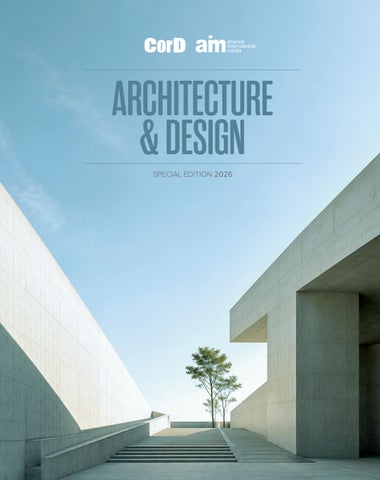
ARCHITECTURE & DESIGN SPECIAL EDITION 2026
CONTENTS ARCHITECTURE 2026 04 R esponsibility for Space Vladimir Lojanica
DEAN OF THE UNIVERSITY OF BELGRADE FACULTY OF ARCHITECTURE
COMMENT
WHAT WE CHOOSE TO BUILD Architecture has always shaped the way we live. Today, its responsibility increasingly begins one step earlier – with deciding what deserves to be built, what can be transformed and what should simply be left alone
08 S haping Architecture Through Context, Innovation and Long-Term Value Bureau Cube
10 T he Future Lies in Transformation Sonja Milićević and Nikola Radović
NRA ATELIER
12 T he Age of Enough EUROPEAN ARCHITECTURE
14 A rchitecture of Togetherness
Marija Nenadić Novaković
PRESIDENT OF THE WOMEN’S ARCHITECTURAL SOCIETY (ŽAD)
16 Supervision Protects Investment Aleksandra Nedeljković
FOUNDER AND OWNER OF DIART 26 ARCHITECTURAL STUDIO
02
ARCHITECTURE & DESIGN 2026
or much of the past century, progress in architecture was easy to recognise. Cities grew, skylines changed, infrastructure expanded and new buildings provided visible evidence of economic ambition. Building more generally meant moving forward. That equation has become considerably less certain. Climate change, pressure on resources, housing shortages and increasingly intensive urban development are forcing architects and societies to reconsider not only how we build, but what – and how much – we need to build at all. The most important architectural decision may sometimes be to transform rather than replace, to preserve rather than demolish, or to improve what already exists rather than begin again. This is not an argument for architectural restraint at the expense of ambition. Quite the opposite. Working with existing cities, buildings and communities can demand more imagination than starting from an empty site. It requires architects to understand context, investors to recognise value beyond additional square metres and institutions to think beyond the lifespan of individual projects. It also changes the meaning of professional responsibility. Architecture is never created by architects alone. The quality of what ultimately gets built depends on clients and investors, engineers and contractors, public institutions and planning rules, professional supervision and, ultimately, on a so-
F
ciety’s ability to recognise and demand good space. Strong architecture therefore requires not only strong individuals, but a strong professional culture – one capable of dialogue, knowledge-sharing and defending standards even when doing so is inconvenient. Europe is increasingly moving in this direction. Renovation, adaptive reuse and whole-life carbon are entering the mainstream of architectural and policy thinking, while the existing building stock is being reconsidered as an enormous economic, environmental and spatial resource. The question is gradually shifting from what can we build here? to what is the best use of what we already have? For Serbia, where cities are changing at remarkable speed, that question is particularly relevant. Every period of intensive construction leaves a legacy that lasts far longer than the economic cycle that produced it. Poor decisions become part of the city just as permanently as good ones. That is why architecture cannot be measured only in completed square metres, investment volumes or striking façades. Its real value emerges over time: in how buildings age, how neighbourhoods function, what has been preserved, how resources have been used and whether people still find those spaces worth inhabiting decades later. Perhaps the architecture of the future will therefore be distinguished less by its ability to build more and more by its capacity to choose better.
EVERY PERIOD OF INTENSIVE CONSTRUCTION LEAVES A LEGACY THAT LASTS FAR LONGER THAN THE ECONOMIC CYCLE THAT PRODUCED IT
cordmagazine.com
03
VLADIMIR LOJANICA Dean of the University of Belgrade Faculty of Architecture
INTERVIEW
RESPONSIBILITY FOR SPACE Architecture is not merely a mirror of society – it can change how we live, communicate and understand shared values. The future of our cities therefore depends not only on architects’ expertise, but also on society’s ability to recognise, demand and preserve quality space By Neda Lukić
ne of the leading figures in contemporary Serbian architecture, Professor Vladimir Lojanica today heads, as Dean of the University of Belgrade Faculty of Architecture, an institution celebrating its 180th anniversary. At a time when Serbia’s built environment is changing rapidly, and decisions on cities, infrastructure and heritage increasingly raise questions about the profession’s place in decision-making, this anniversary is not only a reminder of the Belgrade School of Architecture’s long and distinguished tradition, but also an opportunity to discuss its future – the architect’s evolving role, our culture of relating to space and the responsibility of both the profession and society for the cities we leave to future generations.
O
Recent years have seen decisions taken in Serbia that are permanently reshaping our built environment – from major infrastructure projects to issues of cultural heritage – often creating the impression that the role
04
of architects and urban planners has been reduced to a formality. Has the profession lost its voice, or has that voice been taken away? — It seems to me that, although both situations you mention are highly illustrative, neither fully describes the position in which the profession finds itself today. The situation is considerably more complex. Something has clearly changed compared to the not-sodistant past. What changed first was the traditional, inherited model under which the architect had a clearly defined role and always acted from the same established professional position within the same context. The “architect’s voice” was then easy to identify and anticipate. It was always heard loudly and in the same way in similar situations. Today, the profession’s entire “ecosystem” has changed. We have not only a plurality of roles for architects, but also a plurality of circumstances in which they operate. Society and relationships have changed, while decision-making models, processes, systems and
technologies continue to evolve... How, under such circumstances, do we develop new models of professional action based on knowledge, arguments, dialogue and cooperation – first and foremost among ourselves? — Every change carries risks, but also creates opportunities for the profession to reaffirm its position and social relevance. Recently, particularly when it comes to protecting cultural heritage, we have had an opportunity not only to hear the architectural profession’s voice, but also to see numerous other professions rally around important questions concerning our inherited built environment. Those voices have not always been in harmony – nor do they need to be – but that is precisely where an important change lies. Different disciplines have come together around a common issue, combining their knowledge and arguments and acting jointly. Such action may lack the simplicity and recognisability of the former “architect’s voice”, but it has shown that it can play a very important role in the future.
ARCHITECTURE & DESIGN 2026
cordmagazine.com
05
The Faculty of Architecture is celebrating its 180th anniversary this year – a milestone that extends far beyond a single educational institution. What do you consider the greatest legacy of the Serbian school of architecture, and are we sufficiently aware and worthy of it today? — The Faculty’s 180 years speak above all of the continuity of a
worthy of our heritage and tradition means, in my view, recognising those fundamental values and continuing to advance and nurture them. I see one of our school’s important qualities precisely in the fact that it has never sought to produce a single model of architect, but has instead enabled different creative positions to develop over
must it change to remain relevant in the European and global context? — The greatest strength of the Belgrade School of Architecture lies precisely in its broad understanding of architecture and a tradition that recognises the architect as an active social actor. Its value has rested equally on producing a competent and recognisable mod-
INTERNATIONAL RELEVANCE DOES NOT MEAN REPLICATING WHAT IS HAPPENING ELSEWHERE, BUT BEING ABLE TO RESPOND FROM OUR OWN CONTEXT TO QUESTIONS THAT CONCERN US ALL TODAY
culture of architectural education – one in which architecture is understood as a discipline belonging simultaneously to art, technology and society. That continuity represents far more than the sum of prominent authors, works, buildings or individual periods in our architectural history, although it undoubtedly encompasses a rich legacy of all these. Tradition achieves its full value when we know how to understand it, learn from it and develop it further. This is precisely the opposite of our familiar and all too common tendency to act as though history always begins anew with us. Being
06
time, while insisting on broad education, critical thinking and responsibility towards space and society. The Faculty draws strength from its rich history and tradition, while reaffirming that strength through its ability to understand the time in which it operates and educate generations ready for the time yet to come. For decades, the B elgr ade School of Architecture enjoyed an international reputation and produced generations of architects whose work shaped the identity of our cities. What is its greatest strength today, and how
el of professional and on its ability to educate distinctive creative individuals who have worked in very different professional and social circumstances. I would therefore not view change solely as a matter of adapting to some predefined European or global model or standard. Being internationally relevant does not mean simply replicating what is happening elsewhere, but being able to respond to questions that concern us all today, in line with broader trends but from within one’s own context. Climate change, new technologies, urban transformation, housing and our relationship with resources and heritage are global issues, but the answers cannot be identical in every society and every place. Technical and design
ARCHITECTURE & DESIGN 2026
knowledge unquestionably forms the foundation of our profession and cannot be abandoned, but architects today must also understand complex social circumstances in order to play an active role in processes where decisions about space are made. This also requires expanding the knowledge and skills that future architects need to operate in such a world. I see our school’s ability to recognise these changes and incorporate them into the education of new generations as the way to continue strengthening its relevance. It is increasingly said that the quality of our cities will determine the quality of life of their residents. If you could set one priority for the development of Serbian cities over the next decade, what would it be – public space, housing, sustainability, mobility or something else? — It is difficult to single out just one of these priorities, because the quality of a city emerges precisely from the relationships between all these aspects. Housing cannot be considered independently of mobility, just as the quality of public space cannot be separated from sustainability, infrastructure or access to different amenities. If I nevertheless had to identify one priority, it would be the overall quality and culture of everyday urban life. One of the key challenges for the coming decade is therefore our ability to once again view and plan the city holistically – not as a collection of individual interest-driven projects and sectoral policies, with outcomes left to chance, but as a complex system in which every intervention affects the whole. Such an approach to the city also means that education cannot remain confined to professionals. The quality of our overall relationship with space must become a broader social competence and responsibility. I believe we need to cordmagazine.com
do much more to develop a culture of living and a culture of relating to space in the broadest sense. Understanding the space in which we live, its value and our responsibility towards it should form part of a much broader education. A better city is not created solely through good planning and design, but also through society’s ability to recognise, demand and preserve the quality of the spaces in which we live. If we accept that the way we build our cities reflects the way we organise society, what does contemporary Serbian architecture tell us about Serbia as a society? — Architecture certainly speaks about the society in which it emerges – I often say that, and I am certainly not the first – but it would be overly simplistic to draw conclusions about contemporary society solely through the prism of architecture, particularly today, when society is being shaped simultaneously in physical and digital space. Just as our society is not homogeneous, neither is the architecture we create today. We can simultaneously recognise very different and sometimes opposing processes in our built environment – development and complete neglect, ambition alongside an absence of long-term thinking, outstanding individual achievements alongside problems that cannot be resolved through individual architectural interventions alone. Perhaps it is precisely this complexity that tells us most about the society in which we live. It is important, however, not to view architecture purely passively, as a consequence of social circumstances. It is not merely a mirror of society – it can also influence how we live, communicate and understand shared values. Architecture therefore has the potential to influence changes in certain social relationships, open up new mod-
A BETTER CITY IS NOT CREATED SOLELY THROUGH GOOD PLANNING AND DESIGN, BUT ALSO THROUGH SOCIETY’S ABILITY TO RECOGNISE, DEMAND AND PRESERVE THE QUALITY OF THE SPACES IN WHICH WE LIVE els of communal life and raise expectations of the spaces we create. In that context, I might reverse the question and instead ask what message we, as a society, want to convey today through architecture. I see a far more important role for our profession in this shift from interpreting what already exists towards taking responsibility for what we create.
07
SHAPING ARCHITECTURE THROUGH CONTEXT, INNOVATION AND ~ } LONG-TERM VALUE Cities are shaped by thousands of buildings, but only a small number meaningfully shape the city in return. For Bureau Cube Partners, architecture is not conceived as an isolated object but as part of a performance broader urban system, one that must reconcile history with innovation, technical with human experience, while responding sensitively to its surroundings and retaining a distinct identity of its own.
THIS PHILOSOPHY HAS GUIDED THE BELGRADE-BASED PRACTICE SINCE ITS ESTABLISHMENT IN 2009.
670&4-70,/&/-7.47*&4)#0' '457 42 ,)%*' "3*& '4-%*$50$ 4&0!$ 4 Today, with a multidisciplinary team of more than eighty architects and engineers, BCP Studio delivers 05&4 &5*3,0&7 a diverse portfolio !540!4+ 1( of projects. We cover residential, commercial, cultural, educational, sports, healthcare
and urban developments while maintaining a consistent design methodology rooted in research,
^ understanding and excellence. Z contextual technical Advanced : interdisciplinary collaboration digital technologies, BIM processes and enable greater precision, efficiency, and coordination, still innovation is always directed toward a larger goal: creating architecture that intelligently Q forges a unique identity, responds to its environment, and generates lasting value for cities and communities.
< of the TB portfolio this while demonstrating its to The diversity BCP Studio reflects philosophy ability P M respond to vastly different urban conditions and requirements. 8 g|zk xjyz{djwtk mrk w|zk opnk lwvxjmk qm{wrmijmk {zhzewdkw|jdkq|jimdmq|tkc|jizkxzbmadw{`wja_k jwdk`sjijwtkwmk{zdqmaxkwmky`dwitkxjrrz{zawkv{s`ak emaxjwjmadk`axk{zuvj{zbzawdf
KNEZA MILOŠA Upholding the doctrine that architecture, embedded within the historic, urban and built fabric of its time, is never neutral, Bureau Cube Partners uses this project to reaffirm that every intervention in architectural heritage inevitably provokes dilemma and disquiet. That disquiet stems from the absence of codified principles governing whether architecture should yield to the old, transcend it, or instead embrace a layered coexistence in which successive epochs are integrated rather than erased. Bureau Cube Partners adopts this latter approach, conceiving the project as a palimpsest where inherited layers remain legible while overlapping to form a complex, heterogeneous context that resists the trend-driven hegemonism of “quasi-contemporaneity.” The resulting architecture transforms context itself into an artifact. One that’s professionally legible, carefully stratified, and deliberately provocative, inviting critical discourse.
CARA DUŠANA Among its completed works, Cara Dušana illustrates a sensitive approach to architectural heritage. The project combines the restoration and integration of an early twentieth-century corner building with a contemporary extension, carefully preserving the historic character of the site while introducing modern residential and commercial functions. Rather than replicating the original architecture, the intervention establishes a dialogue between old and new, reinforcing the identity of one of Belgrade’s most historically significant streets. This is also a project that is in fact already completed. Cara Dušana now stands as an active conversation between the historic and the modern about timelessness. As such it is forged in the crucible of exchange between preservation and invention, deeming contrast a compromise.
THE FUTURE LIES IN TRANSFORMATION The architecture of the future does not begin with demolition and a new “blank canvas”, but with understanding the value of what already exists – space, structure, materials and heritage
SONJA MILIĆEVIĆ AND NIKOLA RADOVIĆ NRA ATELIER
10
arking ten years of work and an invitation from the European Cultural Centre to participate in the Time, Space, Existence 2027 exhibition in Venice, Sonja Milićević and Nikola Radović bring a distinctly new-generation optimism to architecture – one
M
rooted not in building more, but in believing we can build better. The European Cultural Centre’s invitation to participate in the Time, Space, Existence 2027 exhibition in Venice comes as NRA Atelier marks ten years of work and builds an increasing-
ly strong international presence. What does the opportunity to present your philosophy of circular architecture in Venice mean to you, and what message do you want to convey to the international architectural community? SONJA: The invitation to participate in Time, Space, Existence 2027 comes as we complete our first ten years, and we see this coincidence as a continuation of our evolution. Venice is an ideal platform: a city that has practised circularity for centuries by preserving, adapting and reusing its built heritage. Presenting our philosophy in such a context means engaging with an audience that views restraint, longevity and respect for the existing environment not as passing trends, but as an authentic culture of living. Since founding the Atelier, we have chosen, wherever feasible, to preserve, revitalise and extend existing buildings, even when building anew would be easier. Our approach is not dogmatic: where the site or structure demands it, new construction is a logical response, but with the same sensitivity towards its surroundings. The strength of future architecture lies in transforming heritage and materials to create new value with minimal impact on nature. Over the years, NRA has evolved from Nikola Radović Architecture into Nature-Reflecting Architecture, based on the idea that architecture should respect its natural surroundings and leave the smallest possible footprint. Is circular ar-
ARCHITECTURE & DESIGN 2026
chitecture today the fullest expression of that evolution – and where does sustainability cease to be a desirable principle and become a genuine responsibility of the architect? NIKOLA: The name began with me, but our studio has long since grown beyond the individual. Nature-Reflecting Architecture marks a key moment when we embraced the view that a project must respond to its setting, rather than subordinating nature to itself. In this context, circularity is the most mature and consistent expression of our evolution, because it turns theoretical respect for the environment into a concrete design method: a clear decision about what we preserve, what we transform and what we choose not to do within a space. Sustainability remains a desirable principle or marketing declaration as long as it is quick, cheap and superficial. An architect’s real responsibility begins when we stop seeking justification for taking the path of least resistance. Only when we reject radical removal as the default and commit to resource-efficient solutions do we become truly responsible designers. Goyko House, which is soon to enter the construction phase, is based on reconstruction and extension, material reuse and minimal environmental impact. How does the process work when you view an existing house not as a limitation, but as a resource – and what will Goyko best demonstrate about your understanding of the architecture of the future? NIKOLA: With Goyko House, our first step was not to assess the building by what it lacked, but by what it already had – its structure, orientation, walls and materials, whose environmental cost nature has already paid. Viewing an existing building as a resource means entering into an equal diacordmagazine.com
logue with it, rather than erasing it and starting the project from a “blank canvas”. Goyko will best demonstrate that, for us, the architecture of the future does not mean a new race for form, but a new discipline of decision-making, in which every intervention is justified only if it improves what already exists, never if it suppresses it. This project shows that outstanding aesthetics can emerge from circularity, with the least visible decision – what we chose not to demolish –
ing with a sound structure, lower risk and unique positioning that competitors building on an empty site cannot replicate. Framed in this way, transformation ceases to be a compromise and becomes a key market advantage that we advocate confidently. Montenegro is both a country of exceptional natural and architectural heritage and a market experiencing very intensive development. Can a new generation of Montenegrin architects
SUCCESS SHOULD BE MEASURED NOT ONLY BY WHAT HAS BEEN BUILT, BUT ALSO BY WHAT HAS DELIBERATELY BEEN LEFT UNTOUCHED becoming perhaps our most important design statement. The principle of “don’t demolish if you can transform” can already be seen in your work – from the award-winning Hotel Centrale, where the structure of a former military workshop was preserved, to projects based on local materials, tradition and minimal intervention. How difficult is it today to convince investors that value does not necessarily have to come from entirely new construction? SONJA: The challenge is considerable when success is measured solely in square metres and the speed of return on investment. However, we understand investors’ position: they rightly expect a clear calculation of returns. Our job is to broaden that calculation and show that a preserved structure, such as the one at Hotel Centrale, gives a project an authenticity that new construction cannot create – and one that has genuine market value. We therefore convince investors not through sentiment towards heritage, but through data: shorter construction times when work-
change the way we build – so that a project’s success is measured not only by its appeal and market value, but also by what it has managed to preserve? NIKOLA: It can, but only if we stop defending the profession through the market and instead use the profession to guide and restrain the market. The new generation does not need to be braver than the previous one, but more persistent in dialogue with investors and local and national authorities, because resistance to preservation cannot be overcome with a single project, but through consistency. We grew up witnessing the consequences of aggressive urbanisation and recognise that space is not a disposable commodity, but part of our identity. Success should therefore be measured not only by what has been built, but also by what has deliberately been left untouched. The day investors and authorities begin asking how much a project has preserved, rather than merely how much it has utilised, we will know that the change is real rather than declarative.
11
EUROPEAN ARCHITECTURE
THE AGE OF ENOUGH Europe is beginning to question one of architecture’s oldest assumptions: that progress means building something new. As climate, housing and resource pressures converge, the buildings already standing are increasingly being viewed not as constraints, but as perhaps the continent’s greatest architectural resource
or much of the modern era, architecture has been associated with addition. New housing, new offices, new landmarks and expanding cities were visible signs of development. Today, a different idea is gaining ground across Europe: perhaps the most intelligent building is sometimes the one we do not build. This is not an argument against new architecture. It is a change in the order of questions. Before asking what should replace an existing building, architects, planners and investors are increasingly asking what can be retained, adapted, extended or given an entirely new purpose. The shift is moving rapidly from architectural debate into European policy. In 2026, the European Commission placed the concept of whole-life carbon at the centre of new guidance for decarbonising
F
12
buildings. The approach considers emissions not only from operating a building, but across its entire life cycle – materials, construction, use, renovation and eventual demolition. Renovation, repurposing and conversion therefore acquire a value that energy efficiency alone cannot capture.
Existing Buildings, New Possibilities
The implications extend far beyond climate policy. Europe simultaneously faces housing shortages and an enormous stock of buildings that is vacant, underused or no longer suited to its original purpose. A 2026 study by the Buildings Performance Institute Europe and its partners estimates that making better use of the existing building stock could theoretically unlock 50 to 107 million addition-
al homes, through measures ranging from renovation and subdivision to converting empty offices and adding to existing buildings. Its proposed hierarchy is strikingly simple: renovate first, extend where appropriate and build new only when necessary. That changes the meaning of architectural creativity. An obsolete office block can become housing. An industrial building can accommodate culture or education. An unused attic can become living space. A structure designed for one generation can be adapted for another. The building is no longer a finished object. It becomes a resource.
From Efficiency to Sufficiency
Behind this change lies another concept entering the architectural vocabulary: sufficiency.
ARCHITECTURE & DESIGN 2026
Efficiency asks how a building can use less energy or fewer materials. Sufficiency asks an earlier question: how much building, material and space do we actually need? That distinction matters. A highly efficient new building still requires land, materials, construction and energy. Preserving a sound structure avoids part of that environmental cost before sophisticated technology is even introduced. Better use of existing space can also reduce pressure on land and resources while responding to housing demand. Europe’s leading architecture is already reflecting this thinking. The 2026 EU Prize for Contemporary Architecture – Mies van der Rohe Awards highlighted projects that transform existing structures alongside innovative new construction, with the jury pointing to a growing cordmagazine.com
THE BUILDING IS NO LONGER A FINISHED OBJECT. IT BECOMES A RESOURCE connection between architecture, urban planning and governance in creating resilient environments. Among the finalists are transformations of former exhibition halls, industrial buildings and historic structures for entirely new forms of public life.
A Different Measure of Progress
None of this means that Europe has entered an age without new buildings. Growing cities will continue to need housing, infrastructure and exceptional new architecture.
What is changing is the assumption that demolition and replacement represent the natural starting point. The emerging alternative is more demanding. It requires architects to understand what already exists before drawing what comes next; investors to recognise value beyond immediate additional square metres; and cities to consider buildings as assets capable of changing repeatedly over time. Perhaps that is why the idea of “enough” is more radical than it first appears. It does not ask architecture to become less ambitious. It asks ambition to be measured differently. The architecture of the future may ultimately be defined not only by the extraordinary things we create, but by the intelligence with which we use what we already have.
13
he Women’s Architectural Society is marking its first decade this year, having grown from a platform aimed at increasing the visibility of women architects into a space for professional networking, mentorship and knowledge-sharing. For Marija Nenadić Novaković, the value of this journey lies not only in women’s greater presence in the profession, but in creating a culture in which experience is passed on, individual success opens doors for others and sol-
T
EXPERIENCE GAINS ITS FULL VALUE WHEN IT DOES NOT REMAIN INDIVIDUAL, BUT IS PASSED ON idarity provides a foundation for new professional opportunities.
MARIJA NENADIĆ NOVAKOVIĆ President of the Women’s Architectural Society (ŽAD) goals
14
INTERVIEW
ARCHITECTURE OF TOGETHERNESS Over ten years, ŽAD has evolved from an initiative to increase the visibility of women architects into a professional community built on knowledge-sharing, mentorship and solidarity – with the ambition of creating even greater opportunities for the next generation
The Women’s Architectural Society is marking its tenth anniversary this year. Looking back at ŽAD’s journey – from an idea to a strong professional community – what do you consider its most important contribution to Serbian architecture? — I believe ŽAD’s greatest contribution over the past ten years has been its ability to turn visibility, networking and exchange into lasting professional value. When ŽAD was founded, there was a clear need for the voices of women architects to be heard more strongly and for a space to be created for professional networking. Today, that initial idea has grown into an active and diverse community. It is particularly important to us that ŽAD has become more than a professional association. It is now a space for dialogue, learning, mentorship, sharing experience and initiating new collaborations. Through exhibitions, lectures, discussions
ARCHITECTURE & DESIGN 2026
and various programmes, we connect women architects of different generations and professional backgrounds. For me, this is its greatest value – creating an infrastructure of togetherness within the profession. ŽAD today not only addresses the position of women architects in Serbian architecture, but actively contributes to shaping where architecture in Serbia can be tomorrow. ŽAD was founded to increase the visibility of women in architecture, while also building a network of mutual support and knowledge-sharing. How much has the position of women architects in Serbia changed over the past decade, and what challenges remain? — The change is visible, and I think it is important to acknowledge it. Women architects today have a much stronger presence and greater professional visibility, with increasing numbers of outstanding women running successful practices, participating in major projects and working in institutions, academia and international design teams. However, numbers alone are not enough. Women must have equal opportunities to advance, receive recognition for their work and participate in decision-making. Major challenges remain – from balancing professional and private life to career advancement and leadership positions, as well as the need for greater visibility and more equal representation across different areas of the profession. What has also changed is the awareness that these issues are not individual problems, but questions concerning the quality of our profession. I see an important role for ŽAD here: to discuss challenges openly, but also to talk much more about opportunities. We want to build a culture in which the success of one woman architect is not seen as an exception, but as encouragement and a stepping stone for others. cordmagazine.com
ŽAD’s traditional annual exhibi tion has become one of the most recognisable gatherings on Serbia’s architectural scene. What will this October’s exhibition offer and what will make it special? — This year’s exhibition is particularly important to us because it coincides with ŽAD’s tenth anniversary. We therefore see it not only as an overview of current architectural production, but also as an opportunity to consider where we are today and ask where we want to go over the next decade. Hence this year’s title: PROCESSES. We want the exhibition to showcase the breadth and diversity of women architects’ work today – across different typologies, scales and approaches to the profession. It is equally important to us that the exhibition serves as a place for encounters and dialogue. What will make this year’s edition special is precisely this combination of anniversary, reflection and a strong focus on the future. Ten years gives us reason to celebrate what has been achieved, but even more energy to set ambitious goals for the future. We want ŽAD to continue growing, connecting more women architects and opening up to new generations and the international scene. ŽAD established the Jelisaveta Načić Award, named after one of the great pioneers of architecture in Serbia. What does this award represent for ŽAD today, and how important is it in recognising quality, professional courage and the contribution of women architects to contemporary architecture? — For us, the Jelisaveta Načić Award represents much more than recognition of individual professional achievement. It is a way to draw attention to the quality, dedication and diversity of women architects’ contributions to our profession, while also highlighting the continuity between generations of women in architecture.
Jelisaveta Načić’s name carries particular symbolism, reminding us that women have been present in architecture for far longer than dominant narratives of our profession’s history sometimes suggest. Today, we want to make that continuity visible and create space for new role models and new generations. ŽAD today brings together women architects of different generations and professional backgrounds. If you had to name one value that you would like to leave to future generations of women architects, what would it be and why? — It would be solidarity – a willingness to support one another rather than compete with one another.
THE SUCCESS OF ONE WOMAN ARCHITECT SHOULD NOT BE SEEN AS AN EXCEPTION, BUT AS ENCOURAGEMENT AND A STEPPING STONE FOR OTHERS Architecture is a demanding profession, and every generation faces different circumstances. That is why it is so valuable when experience does not remain individual, but is passed on. When a younger colleague can receive advice, a contact, support or simply reassurance that she is not alone on her professional journey, that is when a community truly has meaning. We are stronger together! I would like future generations to see ŽAD as something they have inherited together, but also as a platform they are free to change and improve. Our goal is not merely to preserve what has been built over the first ten years, but to make the next ten even more dynamic, open and ambitious. If I had to sum up what we want to leave behind, I would say: the belief that we can achieve more when we work together – and the courage to actually strive for that “more”.
15
Arhitektonski biro DIArt 26
SUPERVISION PROTECTS INVESTMENT
Engaging professional supervision from the earliest stage helps investors control quality, deadlines and costs, while preventing problems before they reach the construction site
ALEKSANDRA NEDELJKOVIĆ Founder and Owner of DIArt 26 Architectural Studio he right professional supervision ensures that a building is constructed according to design, completed on time and meets expected quality standards, says Aleksandra Nedeljković, a graduate architect with more than 20 years of experience in design, technical consultancy, construction and supervision of residential, commercial, retail and industrial facilities. She is the founder and owner of DIArt 26, which recently marked nine years in business and has worked with companies including EKO Hellenic Petroleum, Dr.Max, Sinsay, Cortix, etc.
T
Supervision is perhaps the least visible part of construction. What do the domestic and international clients you have worked with consider most important? — Supervision ensures that construction proceeds according to design, without deviations in quality or technical sys-
tems, and that the project is completed on time. Monitoring progress is particularly important when project financing is involved and loan tranches depend on progress at the construction site. While working on a major production facility near Belgrade, I collaborated with a Danish team of experts. I saw that my Serbian colleagues and I use similar digital platforms that give all parties access to information, transparently identify shortcomings and potential problems, and provide guidance on resolving them. Such technologies also simplify reporting, enabling clients to see in real time the benefits of engaging the right supervision team. The Serbian market has caught up with international companies providing supervision services. Our investors expect global standards because they themselves have international experience. Foreign franchises once led this segment, while today a growing number of Serbian firms provide services of the same qual-
DIArt 26 DIArt 26 recently marked nine years in business. The studio provides design, technical consultancy and professional supervision services for residential, commercial, retail and industrial projects. Founder Aleksandra Nedeljković brings more than two decades of experience across different stages of project development and implementation. www.diart26.com info@diart26.rs
16
ity, with smaller teams offering greater agility, flexibility and more direct commitment to clients. What does an investor gain by engaging professional supervision from the earliest stages, and how can good preparation prevent subsequent problems and additional costs? — Early involvement of supervision takes the form of consultancy. It is advisable for the supervision team also to conduct a technical review of project documentation, while prior to construction the same team can assist the investor in selecting the location, designer and contractor. Clients cannot be expected to know all the legal and technical characteristics of a site or fully assess its potential. Even when they have this information, they often need professional assistance in estimating the costs and time required to prepare the site for construction. For example, a road connection or transformer substation can represent a significant additional financial and technical requirement. Good preparation is half the job, though clients often only realise this when problems arise during construction. The right technical solutions, such as an appropriate heating and cooling system, can generate significant savings both during construction and throughout the building’s use. The construction schedule can also be optimised without compromising quality.
ARCHITECTURE & DESIGN 2026